EP0771806B1 - Silicon containing charge transport compounds - Google Patents
Silicon containing charge transport compounds Download PDFInfo
- Publication number
- EP0771806B1 EP0771806B1 EP96117733A EP96117733A EP0771806B1 EP 0771806 B1 EP0771806 B1 EP 0771806B1 EP 96117733 A EP96117733 A EP 96117733A EP 96117733 A EP96117733 A EP 96117733A EP 0771806 B1 EP0771806 B1 EP 0771806B1
- Authority
- EP
- European Patent Office
- Prior art keywords
- group
- charge transporting
- ionization potential
- silicon
- potential
- Prior art date
- Legal status (The legal status is an assumption and is not a legal conclusion. Google has not performed a legal analysis and makes no representation as to the accuracy of the status listed.)
- Expired - Lifetime
Links
- YXFVVABEGXRONW-UHFFFAOYSA-N Cc1ccccc1 Chemical compound Cc1ccccc1 YXFVVABEGXRONW-UHFFFAOYSA-N 0.000 description 2
- YYSFKLUMHATPLP-UHFFFAOYSA-N CCC(CC1)CCC1[IH]C Chemical compound CCC(CC1)CCC1[IH]C YYSFKLUMHATPLP-UHFFFAOYSA-N 0.000 description 1
- URLKBWYHVLBVBO-UHFFFAOYSA-N Cc1ccc(C)cc1 Chemical compound Cc1ccc(C)cc1 URLKBWYHVLBVBO-UHFFFAOYSA-N 0.000 description 1
- YVJQXZQIGSNYKS-UHFFFAOYSA-N Cc1ccc(CI)cc1 Chemical compound Cc1ccc(CI)cc1 YVJQXZQIGSNYKS-UHFFFAOYSA-N 0.000 description 1
Classifications
-
- G—PHYSICS
- G03—PHOTOGRAPHY; CINEMATOGRAPHY; ANALOGOUS TECHNIQUES USING WAVES OTHER THAN OPTICAL WAVES; ELECTROGRAPHY; HOLOGRAPHY
- G03G—ELECTROGRAPHY; ELECTROPHOTOGRAPHY; MAGNETOGRAPHY
- G03G5/00—Recording-members for original recording by exposure, e.g. to light, to heat or to electrons; Manufacture thereof; Selection of materials therefor
- G03G5/02—Charge-receiving layers
- G03G5/04—Photoconductive layers; Charge-generation layers or charge-transporting layers; Additives therefor; Binders therefor
- G03G5/08—Photoconductive layers; Charge-generation layers or charge-transporting layers; Additives therefor; Binders therefor characterised by the photoconductive material being inorganic
-
- G—PHYSICS
- G03—PHOTOGRAPHY; CINEMATOGRAPHY; ANALOGOUS TECHNIQUES USING WAVES OTHER THAN OPTICAL WAVES; ELECTROGRAPHY; HOLOGRAPHY
- G03G—ELECTROGRAPHY; ELECTROPHOTOGRAPHY; MAGNETOGRAPHY
- G03G5/00—Recording-members for original recording by exposure, e.g. to light, to heat or to electrons; Manufacture thereof; Selection of materials therefor
- G03G5/02—Charge-receiving layers
- G03G5/04—Photoconductive layers; Charge-generation layers or charge-transporting layers; Additives therefor; Binders therefor
- G03G5/06—Photoconductive layers; Charge-generation layers or charge-transporting layers; Additives therefor; Binders therefor characterised by the photoconductive material being organic
- G03G5/0601—Acyclic or carbocyclic compounds
- G03G5/062—Acyclic or carbocyclic compounds containing non-metal elements other than hydrogen, halogen, oxygen or nitrogen
-
- C—CHEMISTRY; METALLURGY
- C07—ORGANIC CHEMISTRY
- C07F—ACYCLIC, CARBOCYCLIC OR HETEROCYCLIC COMPOUNDS CONTAINING ELEMENTS OTHER THAN CARBON, HYDROGEN, HALOGEN, OXYGEN, NITROGEN, SULFUR, SELENIUM OR TELLURIUM
- C07F7/00—Compounds containing elements of Groups 4 or 14 of the Periodic Table
- C07F7/02—Silicon compounds
- C07F7/08—Compounds having one or more C—Si linkages
- C07F7/18—Compounds having one or more C—Si linkages as well as one or more C—O—Si linkages
- C07F7/1804—Compounds having Si-O-C linkages
-
- G—PHYSICS
- G03—PHOTOGRAPHY; CINEMATOGRAPHY; ANALOGOUS TECHNIQUES USING WAVES OTHER THAN OPTICAL WAVES; ELECTROGRAPHY; HOLOGRAPHY
- G03G—ELECTROGRAPHY; ELECTROPHOTOGRAPHY; MAGNETOGRAPHY
- G03G5/00—Recording-members for original recording by exposure, e.g. to light, to heat or to electrons; Manufacture thereof; Selection of materials therefor
-
- G—PHYSICS
- G03—PHOTOGRAPHY; CINEMATOGRAPHY; ANALOGOUS TECHNIQUES USING WAVES OTHER THAN OPTICAL WAVES; ELECTROGRAPHY; HOLOGRAPHY
- G03G—ELECTROGRAPHY; ELECTROPHOTOGRAPHY; MAGNETOGRAPHY
- G03G5/00—Recording-members for original recording by exposure, e.g. to light, to heat or to electrons; Manufacture thereof; Selection of materials therefor
- G03G5/02—Charge-receiving layers
- G03G5/04—Photoconductive layers; Charge-generation layers or charge-transporting layers; Additives therefor; Binders therefor
- G03G5/06—Photoconductive layers; Charge-generation layers or charge-transporting layers; Additives therefor; Binders therefor characterised by the photoconductive material being organic
- G03G5/0601—Acyclic or carbocyclic compounds
- G03G5/0612—Acyclic or carbocyclic compounds containing nitrogen
- G03G5/0614—Amines
- G03G5/06142—Amines arylamine
-
- G—PHYSICS
- G03—PHOTOGRAPHY; CINEMATOGRAPHY; ANALOGOUS TECHNIQUES USING WAVES OTHER THAN OPTICAL WAVES; ELECTROGRAPHY; HOLOGRAPHY
- G03G—ELECTROGRAPHY; ELECTROPHOTOGRAPHY; MAGNETOGRAPHY
- G03G5/00—Recording-members for original recording by exposure, e.g. to light, to heat or to electrons; Manufacture thereof; Selection of materials therefor
- G03G5/02—Charge-receiving layers
- G03G5/04—Photoconductive layers; Charge-generation layers or charge-transporting layers; Additives therefor; Binders therefor
- G03G5/06—Photoconductive layers; Charge-generation layers or charge-transporting layers; Additives therefor; Binders therefor characterised by the photoconductive material being organic
- G03G5/0601—Acyclic or carbocyclic compounds
- G03G5/0612—Acyclic or carbocyclic compounds containing nitrogen
- G03G5/0614—Amines
- G03G5/06142—Amines arylamine
- G03G5/06144—Amines arylamine diamine
-
- G—PHYSICS
- G03—PHOTOGRAPHY; CINEMATOGRAPHY; ANALOGOUS TECHNIQUES USING WAVES OTHER THAN OPTICAL WAVES; ELECTROGRAPHY; HOLOGRAPHY
- G03G—ELECTROGRAPHY; ELECTROPHOTOGRAPHY; MAGNETOGRAPHY
- G03G5/00—Recording-members for original recording by exposure, e.g. to light, to heat or to electrons; Manufacture thereof; Selection of materials therefor
- G03G5/02—Charge-receiving layers
- G03G5/04—Photoconductive layers; Charge-generation layers or charge-transporting layers; Additives therefor; Binders therefor
- G03G5/06—Photoconductive layers; Charge-generation layers or charge-transporting layers; Additives therefor; Binders therefor characterised by the photoconductive material being organic
- G03G5/0601—Acyclic or carbocyclic compounds
- G03G5/0612—Acyclic or carbocyclic compounds containing nitrogen
- G03G5/0614—Amines
- G03G5/06142—Amines arylamine
- G03G5/06144—Amines arylamine diamine
- G03G5/061443—Amines arylamine diamine benzidine
-
- G—PHYSICS
- G03—PHOTOGRAPHY; CINEMATOGRAPHY; ANALOGOUS TECHNIQUES USING WAVES OTHER THAN OPTICAL WAVES; ELECTROGRAPHY; HOLOGRAPHY
- G03G—ELECTROGRAPHY; ELECTROPHOTOGRAPHY; MAGNETOGRAPHY
- G03G5/00—Recording-members for original recording by exposure, e.g. to light, to heat or to electrons; Manufacture thereof; Selection of materials therefor
- G03G5/02—Charge-receiving layers
- G03G5/04—Photoconductive layers; Charge-generation layers or charge-transporting layers; Additives therefor; Binders therefor
- G03G5/06—Photoconductive layers; Charge-generation layers or charge-transporting layers; Additives therefor; Binders therefor characterised by the photoconductive material being organic
- G03G5/0601—Acyclic or carbocyclic compounds
- G03G5/0612—Acyclic or carbocyclic compounds containing nitrogen
- G03G5/0614—Amines
- G03G5/06142—Amines arylamine
- G03G5/06147—Amines arylamine alkenylarylamine
-
- G—PHYSICS
- G03—PHOTOGRAPHY; CINEMATOGRAPHY; ANALOGOUS TECHNIQUES USING WAVES OTHER THAN OPTICAL WAVES; ELECTROGRAPHY; HOLOGRAPHY
- G03G—ELECTROGRAPHY; ELECTROPHOTOGRAPHY; MAGNETOGRAPHY
- G03G5/00—Recording-members for original recording by exposure, e.g. to light, to heat or to electrons; Manufacture thereof; Selection of materials therefor
- G03G5/02—Charge-receiving layers
- G03G5/04—Photoconductive layers; Charge-generation layers or charge-transporting layers; Additives therefor; Binders therefor
- G03G5/06—Photoconductive layers; Charge-generation layers or charge-transporting layers; Additives therefor; Binders therefor characterised by the photoconductive material being organic
- G03G5/0601—Acyclic or carbocyclic compounds
- G03G5/0612—Acyclic or carbocyclic compounds containing nitrogen
- G03G5/0614—Amines
- G03G5/06142—Amines arylamine
- G03G5/06147—Amines arylamine alkenylarylamine
- G03G5/061473—Amines arylamine alkenylarylamine plural alkenyl groups linked directly to the same aryl group
Definitions
- This invention is directed to new charge transporting substances used in electrophotographic organic photoconductor.
- Electrophotographic organic photoconductor utilizing organic photoconductive materials have been attracting attention from the standpoint of productivity, facility of material design, and safety. They have undergone various improvements and are widely in use.
- the configuration referred to as function-separation type in which the layer which generates electric charge and the layer which transports electric charge are separated, has been both proposed and applied.
- An electrophotographic organic photoconductor with this configuration has two layers. One layer is composed of the electric charge generating substance and an appropriate resin as binding agent. Another layer above is the charge transporting substance dispersed or dissolved in a binder resin.
- the layer containing the charge transporting substance often contains a charge transporting material, and a binder which is a thermoplastic resin such as a polycarbonate, polyester, acrylic, and polystyrene; or a thermosetting resin such as polyurethane or epoxy.
- a corona discharge device it is necessary to apply a negative charge through a corona discharge device to the surface of the electric charge generating layer.
- this process generates ozone which causes degradation of the resin, reduces sensitivity, and reduces electrostatic chargeability of the resin. This leads to mechanical damage in the subsequent process of development, transfer of an image onto paper, and friction generated during cleaning.
- the reduction in properties of the organic photoconductor caused by such factors has been a persistent problem.
- Polysiloxane resins possess characteristics such as transparency, ability to withstand dielectric breakdown, photostability, and low surface tension, which are not seen in other resins. But because they are incompatible with organic compounds, they are not used alone as the resin constituting the charge transporting material. Rather, polysiloxane resins are used to improve the quality of the resin making up the charge transporting material through copolymerization or blending. For polysiloxane resins to be used alone, as the binder making up the charge transporting layer, it is necessary that a charge transporting substance also be dissolved in the polysiloxane resin.
- the purpose of our invention is to provide a method of manufacturing such a charge transporting material which is uniformly dissolved in the polysiloxane resin, and which imparts an electric charge transporting property to the resin that is used in an electrophotographic organic photoconductor
- the invention provides a silicon-containing charge transporting material represented by formula A-[R 1 SiR 2 3-n Q n ] p wherein A denotes an organic group derived from a charge transporting compound having an ionization potential within the range of 4.5-6.2 e V, which is a tertiary amine having a plurality of aromatic groups, R 1 is an alkylene group of 1-18 carbon atoms, R 2 is a monovalent hydrocarbon group or a halogen-substituted monovalent hydrocarbon group of 1-15 carbon atoms , Q is a hydrolyzable group; and n and p are each integers from 1-3 and a method for its manufacture. R 1 is preferably an alkylene group of 2-18 carbon atoms.
- Our silicone-type charge transporting material is characterized in that it represents an aromatic substituted tertiary amine which has a plurality of aromatic groups, a silyl group which is hydrolyzable, and wherein the silyl group is introduced via a hydrocarbon group into an aromatic ring of at least one of the aromatic groups of the compound with the charge transporting properties having the ionization potential of 4.5-6.2 electron volts.
- hydrolyzable group Q examples include hydroxyl, methoxy, ethoxy, butoxy, methylethylketoximo, diethylamino, acetoxy, propenoxy, and Cl.
- hydroxyl and alkoxy groups especially alkoxy groups with 1-6 carbon atoms, are preferable.
- Silicon-type charge transporting compounds according to our invention have an ionization potential of 4.5-6.2 eV.
- the ionization potential is less than 4.5 eV, the silicon-type charge transporting material is easily oxidized and deteriorated making it undesirable.
- the ionization potential exceeds 6.2 eV, injection of charge from the charge generating layer is inhibited, resulting in decreased sensitivity also making it undesirable.
- the ionization potential in our invention was measured by open-air photoelectric spectrometry using surface analyzer AC-1 manufactured by Riken KeikiTM Company.
- the organic silicon group is bonded to an electron-donor group via a hydrocarbon group. If it is bonded directly without hydrocarbon, the p electron of the aromatic group in the charge transporting material is affected by the p-d interaction effect with the d electron of silicon; and this changes the ionization potential from that of the base material. Bonding via a hydrocarbon group prevents this phenomenon and facilitates designing of our organic photoconductor.
- One method of introducing a hydrocarbon group between an aromatic ring and a silicon atom is to bond an unsaturated aliphatic group to at least one of the multiple aromatic rings in the charge transporting compound, with an alkoxysilane whose essential substituent for the silicon atom is hydrogen atom or an alkoxy group, by means of a hydrosilylation reaction.
- the silicon-type charge transporting material manufactured by means of a hydrosilylation reaction between a vinyl group substituted onto an aromatic ring that is bonded to a nitrogen atom of an aromatic substituted tertiary amine, whose ionization potential is 4.5-6.2 eV, and an organic silicon compound with a hydrogen atom bonded to silicon.
- One method of introducing the vinyl group to the aromatic group is to first formylate the hydrogen atom or the methyl group on the aromatic ring, and finally convert the resulted aldehyde group to the vinyl group by the Wittig reaction. After this process, the hydrosilylation reaction can be employed.
- Another method starts with a saturated hydrocarbon group substituted on the aromatic group, e.g. a methyl group, which is brominated, e.g. bromomethylated, then a lithium complex is formed and the complex is reacted with a halogenated alkoxy silane.
- Our aromatically substituted tertiary amine may constitute any of the following compounds (Groups 1-18). Each of the eighteen groups is contained on a single page, and a total of 72 compounds are enumerated. In these formulae, and hereinafter, Me is methyl, Et is ethyl, Ph is phenyl, Bu is butyl, and Pr is propyl.
- the hydrogenated organic silicon compound which is able to react with the vinyl group bonded to an aromatic ring of the tertiary amine , with ionization potential of 4.5-6.2 eV, is a hydrogenated organic silicon compound whose substituents on the silicon atom in its molecule comprise at least one hydrogen atom.
- This compound is added to the vinyl group by a hydrosilylation reaction.
- Hydrogen, directly bonded to silicon, is an indispensable component of the hydrosilylation reaction to add to the vinyl group.
- Another indispensable component is a hydrolyzable group, such as an alkoxy group -OR 3 .
- R 3 of the alkoxy group is a relatively short chain, i.e., 1-6 carbon atoms, such as methyl, ethyl, propyl, butyl, amyl, and hexyl or, R 3 is a branched alkyl.
- the selection of R 3 depends on the intended use of the product, stability during hydrosilylation process, and the hydrolyzable properties desired.
- n in formula (I) denotes the number of alkoxy groups substituted on silicon.
- n is greater than 1, the hydrophilic property of the compound is improved.
- the compound also acts as a cross-linking agent; so the selection must be made taking into account the hardness of the resin, as a result of the crosslinking, as well as its hydrophilic property.
- Organic group R 2 other than hydrogen atom or alkoxy, which is directly bonded to the silicon atom, is selected according to the type of substituent on the silicon atom in the polysiloxane resin, and according to the various properties such as solubility in the resin, reactivity for hydrosilylation reaction, and other property adjustments of the polysiloxane resin.
- R 2 is an alkyl group such as methyl, ethyl, propyl, butyl, amyl, and hexyl; an alkenyl group such as vinyl or allyl; halogenated hydrocarbon groups; aryl group such as phenyl or tolyl; halongenated hydrocarbon groups such as chloromethyl, chloroethyl and and chloropropyl; and fluorohydrocarbon groups represented by trifluoropropyl, heptafluoropentyl, and nonafluorohexyl. If the substituent on silicon in the polysiloxane resin is methyl, the solubility is better if R 2 is also methyl.
- Our curable polysiloxane resin is a resin soluble in organic solvents, and primarily constituting silicon-type macromolecules known as MT resins, MQ resins, T resins, and polysilsesquioxanes. Methods of manufacturing such resins are known, such as the method described on Page 71 of "Silicon-Based Polymer Science", edited by John M. Ziegler and F. W. Gordon Fearon, ACS Series 224, The American Chemical Society (1990).
- the hydrosilylation reaction is conducted using a platinum catalyst or an organic peroxide catalyst.
- the platinum catalyst is a platinum compound used in standard hydrosilylation reactions and addition-type silicone rubbers; platinum chloride; chloroplatinic acid; platinum-olefin complexes; platinum-phosphine complexes; substances in which platinum is supported by a carrier, such as platinum/carbon, platinum/silica gel, and platinum/macromolecules.
- the quantity of platinum catalyst is that amount used conventionally. In terms of mole ratio, the quantity of platinum metal to alkenyl groups of electron-donor groups is within the range of 1/10 to 1/100,000.
- the hydrosilylation reaction temperature varies depending on the type of platinum catalyst used, its quantity, reaction group materials, and reaction conditions. However, from the standpoint of efficiency, it is desirable that the temperature be below the decomposition temperature of the platinum catalyst, i.e., below 200°C. In the case of an organic peroxide catalyst, the only limitation is that its half-life be above room temperature.
- Organic peroxides which are useful are radical polymerization initiators such as lauryl peroxide, butyl peroxide, and benzoyl peroxide.
- Products of hydrosilylation reactions are divided into two groups.
- the silicon atom is added to the alpha position of the vinyl group.
- the silicon atom is added to the beta position of the vinyl group.
- the position depends on reaction conditions, such as the type of vinyl compound substituent and the type of catalyst used.
- having a mixture is preferable since it prevents aggregation of electron hole transferring materials which tend to easily form aggregates.
- N-bromosuccinimide N-bromosuccinimide
- triphenylamine triphenylamine
- a 300 ml four-neck flask was filled with 1.0 g (40 mmol) of magnesium metal and the flask was filled with nitrogen. Diethyl ether was added in an amount of 100 ml, and stirring was initiated. 30 ml of a diethyl ether solution of 8.6 g (27 mmol) of 4-bromotriphenylamine was slowly added by dripping into the stirred mixture. After the dropped amount reached 3 ml, refluxing was slowly started. In the course of refluxing, the addition of diethylether solution by dripping was continued. Upon completion of dripping, refluxing was carried out for another hour.
- a Grignard reagent solution obtained in the manner described above was cooled to room temperature, and combined with 40 ml of a diethylether solution of 2.1 g (27 mmol) of allyl chloride added slowly by dripping. Upon completion of dripping, the reaction mixture was refluxed for 2 hours, and allowed to cool. Ice-cold water was added in an amount of 50 ml, and hydrolysis was carried out. The ether layer was extracted, washed once with an aqueous saturated sodium bicarbonate solution, and twice with water. The product was dried with anhydrous sodium sulfate. After drying, diethylether was removed, and a white solid substance of 4-N,N-diphenyl aminoallyl benzene was obtained in an amount of 4.9 g (yield 63.2%).
- a 200 ml four-neck flask was filled with 1.0 g (40 mmol) of magnesium metal, and the flask was filled with nitrogen. Diethyl ether was added in an amount of 100 ml, and stirring was initiated. 20 ml of diethyl ether solution of 9.1 g (27 mmol) of 4-bromomethyltriphenylamine was slowly added by dripping to the stirred mixture. After the dropped amount reached 5 ml, refluxing was slowly started. In the course of refluxing, addition of diethylether solution by dripping was continued. Upon completion of dripping, refluxing was carried out for another hour.
- a Grignard reagent solution obtained in the manner described above was cooled to room temperature, and combined with 20 ml of a diethylether solution of 2.1 g (27 mmol) of allyl chloride which was added slowly by dripping. Upon completion of dripping, the reaction mixture was refluxed for 2 hours, and the reaction was cooled. Ice-cold water was added in an amount of 50 ml, and hydrolysis was carried out. The ether layer was extracted, washed once with an aqueous saturated sodium bicarbonate solution, twice with water. The product was dried with anhydrous sodium sulfate. After drying, diethylether was removed, and a white solid substance of 4-N,N-diphenyl aminophenyl-1-butene was obtained in an amount of 5.5 g (yield 66.7%).
- our invention provides an electron hole transfer material which allows practical application of low surface energy polysiloxane organic photoconductive resins that have excellent hardness and weather resistant properties, unattainable by conventional technique.
- the silicon-type electron hole transferring material provided by our invention can be used not only in electrophotographic processes, such as photocopiers and laser beam printers, but also as an electric charge transfer layer necessary in construction of organic electroluminescent elements.
Landscapes
- Physics & Mathematics (AREA)
- General Physics & Mathematics (AREA)
- Chemical & Material Sciences (AREA)
- Organic Chemistry (AREA)
- Inorganic Chemistry (AREA)
- Photoreceptors In Electrophotography (AREA)
- Silicon Polymers (AREA)
- Compositions Of Macromolecular Compounds (AREA)
Description
- This invention is directed to new charge transporting substances used in electrophotographic organic photoconductor.
- Electrophotographic organic photoconductor utilizing organic photoconductive materials have been attracting attention from the standpoint of productivity, facility of material design, and safety. They have undergone various improvements and are widely in use. In recent years, the configuration referred to as function-separation type, in which the layer which generates electric charge and the layer which transports electric charge are separated, has been both proposed and applied. An electrophotographic organic photoconductor with this configuration has two layers. One layer is composed of the electric charge generating substance and an appropriate resin as binding agent. Another layer above is the charge transporting substance dispersed or dissolved in a binder resin. The layer containing the charge transporting substance often contains a charge transporting material, and a binder which is a thermoplastic resin such as a polycarbonate, polyester, acrylic, and polystyrene; or a thermosetting resin such as polyurethane or epoxy. In this latter case, it is necessary to apply a negative charge through a corona discharge device to the surface of the electric charge generating layer. However, this process generates ozone which causes degradation of the resin, reduces sensitivity, and reduces electrostatic chargeability of the resin. This leads to mechanical damage in the subsequent process of development, transfer of an image onto paper, and friction generated during cleaning. The reduction in properties of the organic photoconductor caused by such factors has been a persistent problem.
- Various studies have been conducted to solve these problems. For example, various attempts have been made to blend the polysiloxane resin with either a copolymer constituent or another resin, such as the use of a thermosetting polysiloxane resin as the charge transporting layer, JP-A 61-238062; the use of a protective layer containing a polysiloxane resin, JP-A 62-108260; the use of a protective layer of a thermosetting polysiloxane resin in which silica gel, urethane resin, and/or a fluoro resin have been dispersed, JP-A 4-346356; and the use of a resin in which a thermosetting polysiloxane resin has been dispersed as a protective layer or as an electric charge transporting material binder resin, JP-A 4-273252. Studies have also been made to improve the performance, extend the life, and improve the cleaning property of organic photoconductor by utilizing the properties of a polysiloxane.
- Polysiloxane resins possess characteristics such as transparency, ability to withstand dielectric breakdown, photostability, and low surface tension, which are not seen in other resins. But because they are incompatible with organic compounds, they are not used alone as the resin constituting the charge transporting material. Rather, polysiloxane resins are used to improve the quality of the resin making up the charge transporting material through copolymerization or blending. For polysiloxane resins to be used alone, as the binder making up the charge transporting layer, it is necessary that a charge transporting substance also be dissolved in the polysiloxane resin.
- Thus, the purpose of our invention is to provide a method of manufacturing such a charge transporting material which is uniformly dissolved in the polysiloxane resin, and which imparts an electric charge transporting property to the resin that is used in an electrophotographic organic photoconductor
- The invention provides a silicon-containing charge transporting material represented by formula
R1 is preferably an alkylene group of 2-18 carbon atoms. Our silicone-type charge transporting material is characterized in that it represents an aromatic substituted tertiary amine which has a plurality of aromatic groups, a silyl group which is hydrolyzable, and wherein the silyl group is introduced via a hydrocarbon group into an aromatic ring of at least one of the aromatic groups of the compound with the charge transporting properties having the ionization potential of 4.5-6.2 electron volts. - Examples of the hydrolyzable group Q include hydroxyl, methoxy, ethoxy, butoxy, methylethylketoximo, diethylamino, acetoxy, propenoxy, and Cl. Of these groups, the hydroxyl and alkoxy groups, especially alkoxy groups with 1-6 carbon atoms, are preferable.
- Silicon-type charge transporting compounds according to our invention have an ionization potential of 4.5-6.2 eV. When the ionization potential is less than 4.5 eV, the silicon-type charge transporting material is easily oxidized and deteriorated making it undesirable. When the ionization potential exceeds 6.2 eV, injection of charge from the charge generating layer is inhibited, resulting in decreased sensitivity also making it undesirable. The ionization potential in our invention was measured by open-air photoelectric spectrometry using surface analyzer AC-1 manufactured by Riken Keiki™ Company.
- In the silicon-type charge transporting material provided by our invention, the organic silicon group is bonded to an electron-donor group via a hydrocarbon group. If it is bonded directly without hydrocarbon, the p electron of the aromatic group in the charge transporting material is affected by the p-d interaction effect with the d electron of silicon; and this changes the ionization potential from that of the base material. Bonding via a hydrocarbon group prevents this phenomenon and facilitates designing of our organic photoconductor.
- One method of introducing a hydrocarbon group between an aromatic ring and a silicon atom is to bond an unsaturated aliphatic group to at least one of the multiple aromatic rings in the charge transporting compound, with an alkoxysilane whose essential substituent for the silicon atom is hydrogen atom or an alkoxy group, by means of a hydrosilylation reaction. For example, the silicon-type charge transporting material manufactured by means of a hydrosilylation reaction between a vinyl group substituted onto an aromatic ring that is bonded to a nitrogen atom of an aromatic substituted tertiary amine, whose ionization potential is 4.5-6.2 eV, and an organic silicon compound with a hydrogen atom bonded to silicon. One method of introducing the vinyl group to the aromatic group is to first formylate the hydrogen atom or the methyl group on the aromatic ring, and finally convert the resulted aldehyde group to the vinyl group by the Wittig reaction. After this process, the hydrosilylation reaction can be employed. Another method starts with a saturated hydrocarbon group substituted on the aromatic group, e.g. a methyl group, which is brominated, e.g. bromomethylated, then a lithium complex is formed and the complex is reacted with a halogenated alkoxy silane.
- Our aromatically substituted tertiary amine , with an ionization potential of 4.5-6.2 eV may constitute any of the following compounds (Groups 1-18). Each of the eighteen groups is contained on a single page, and a total of 72 compounds are enumerated. In these formulae, and hereinafter, Me is methyl, Et is ethyl, Ph is phenyl, Bu is butyl, and Pr is propyl.


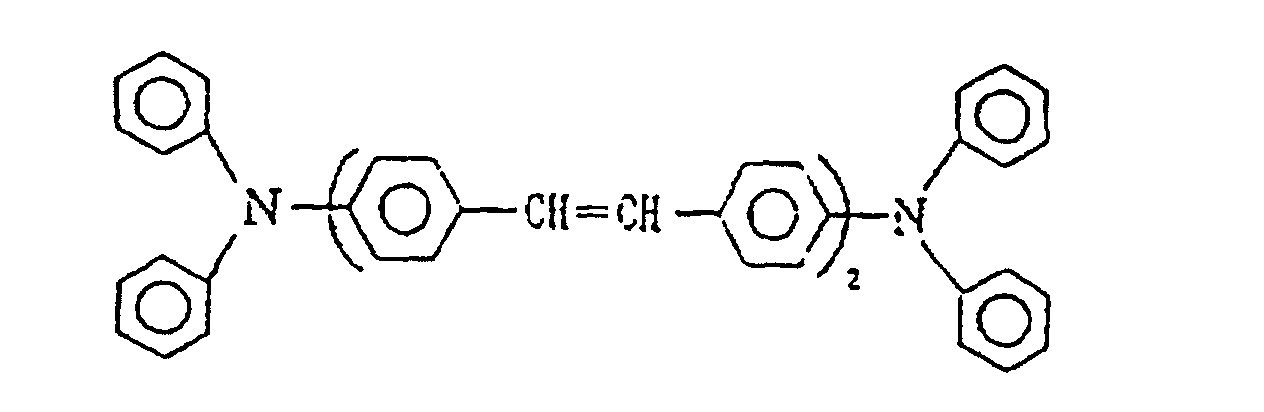
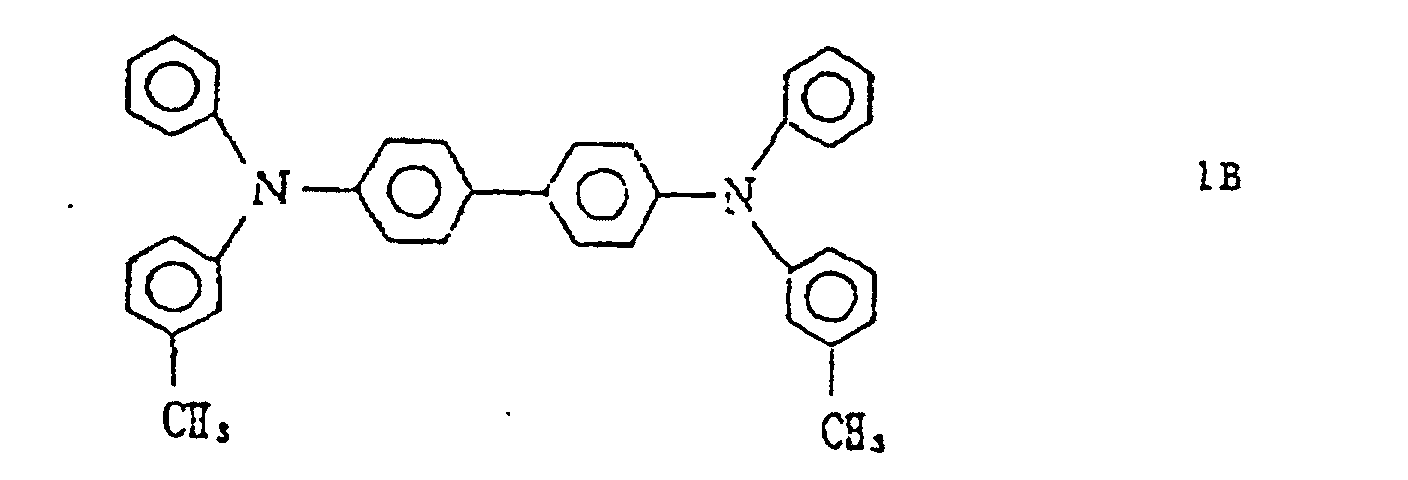
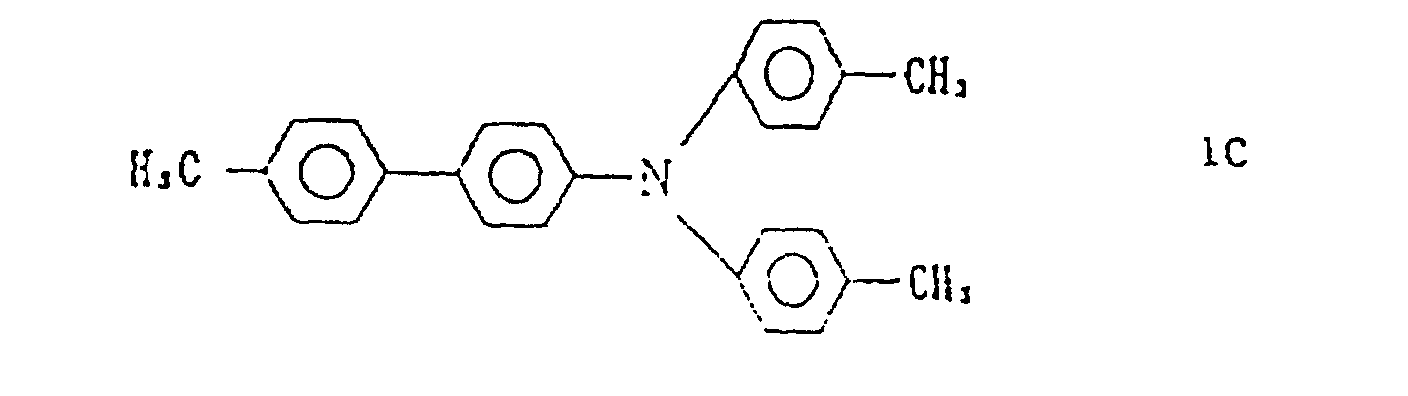

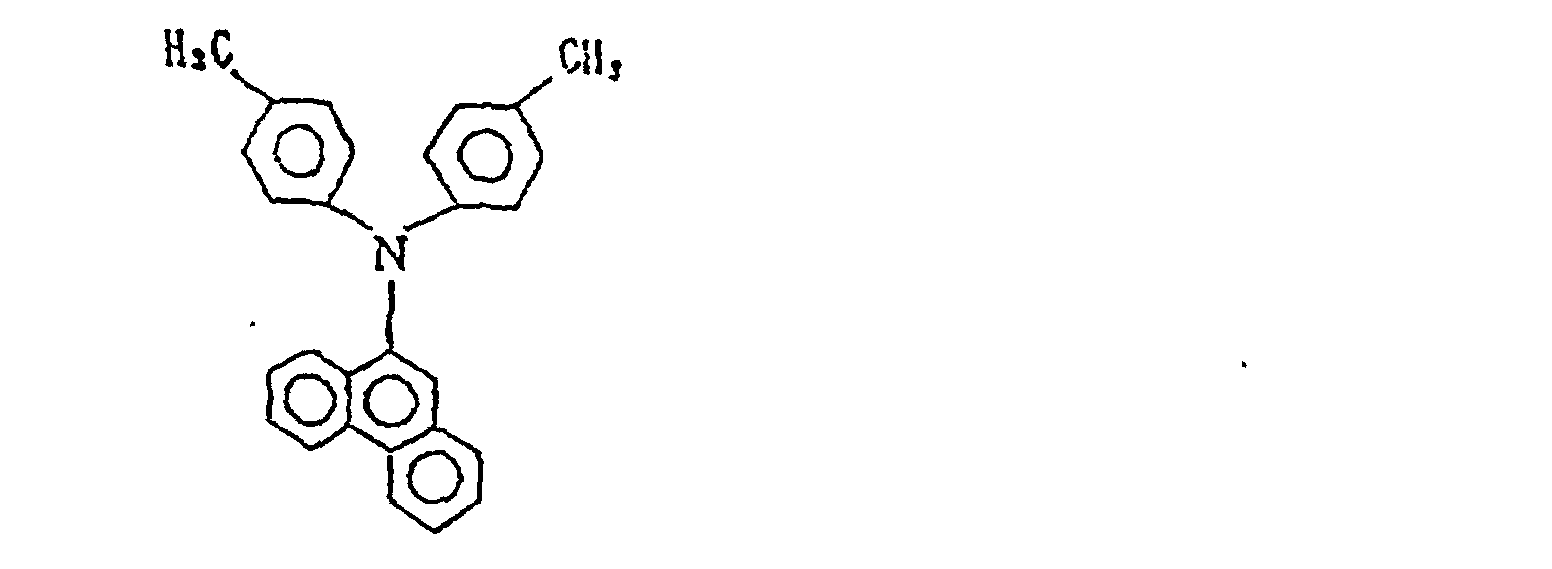
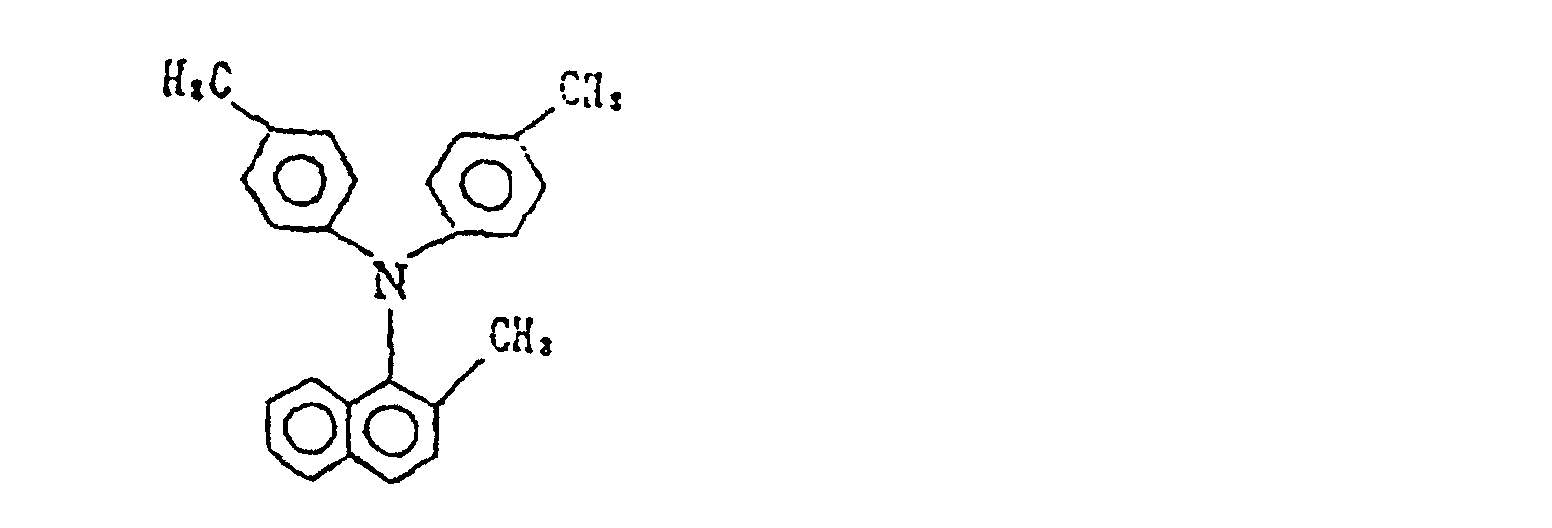

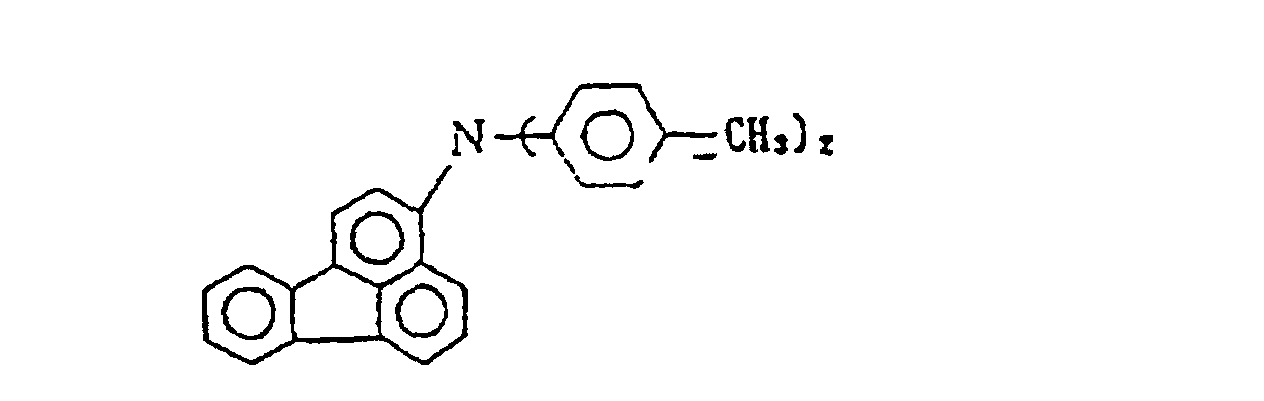

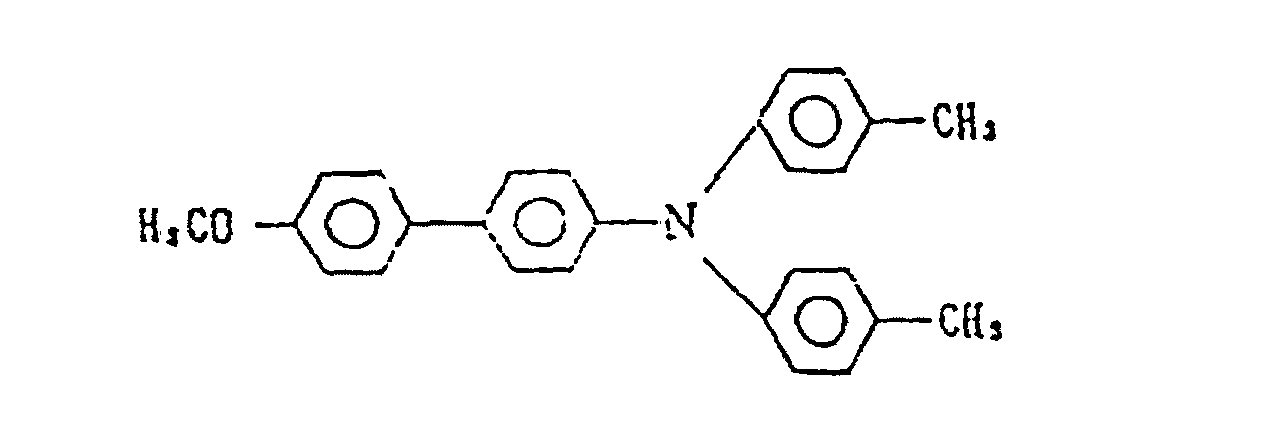
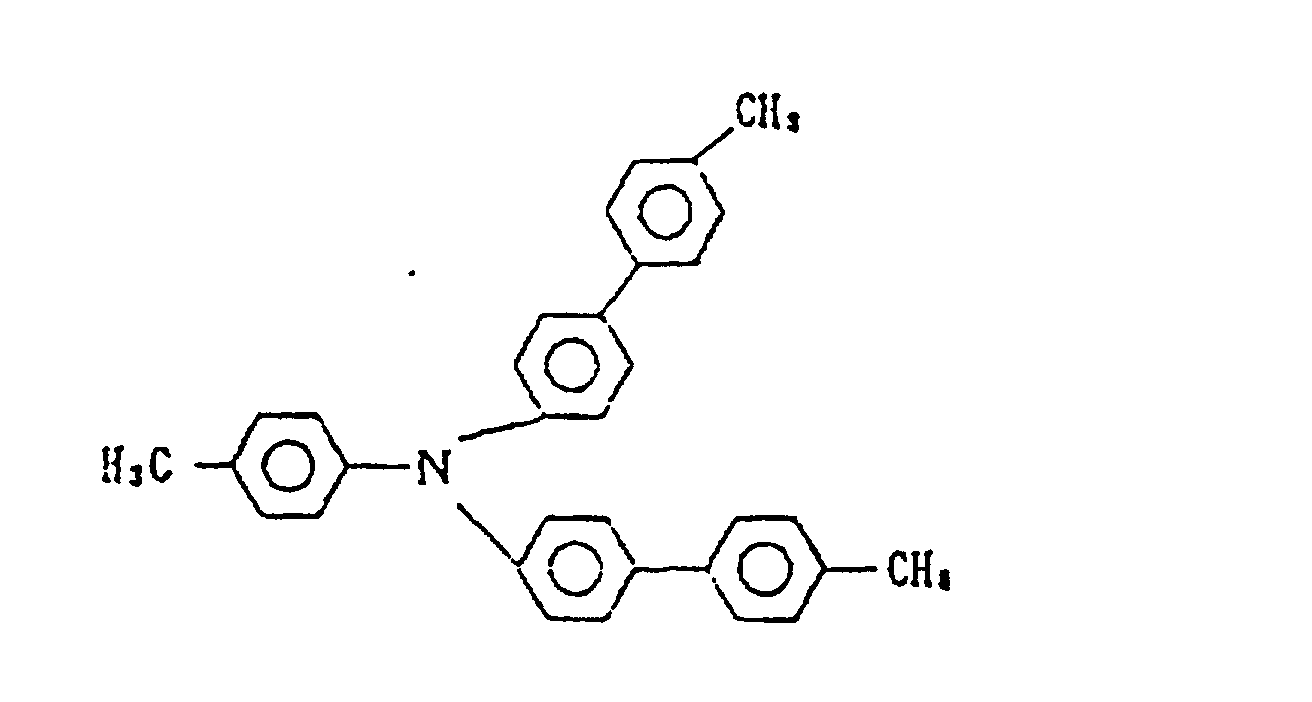
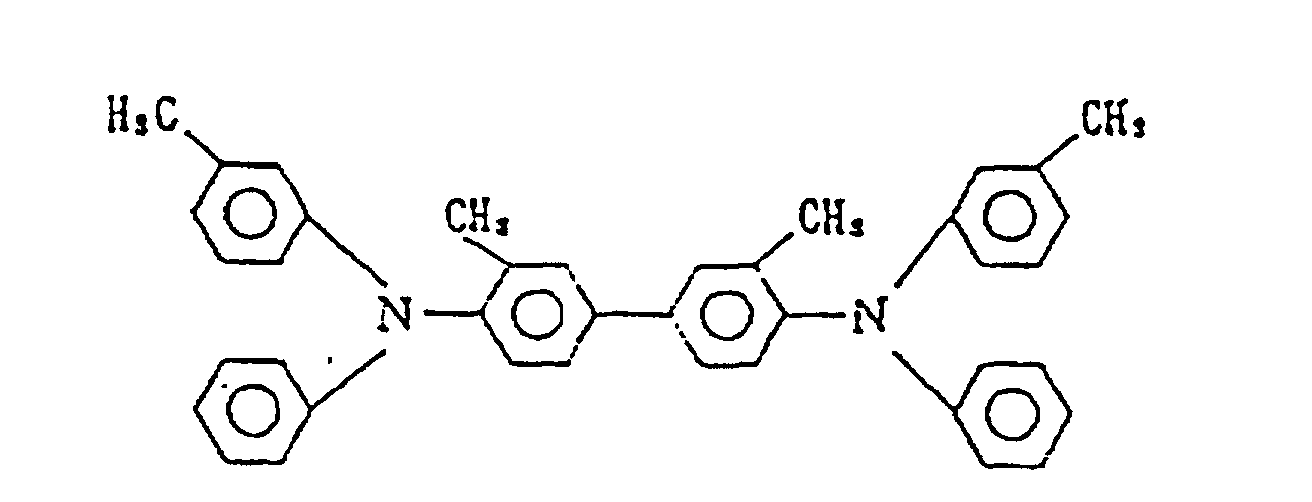


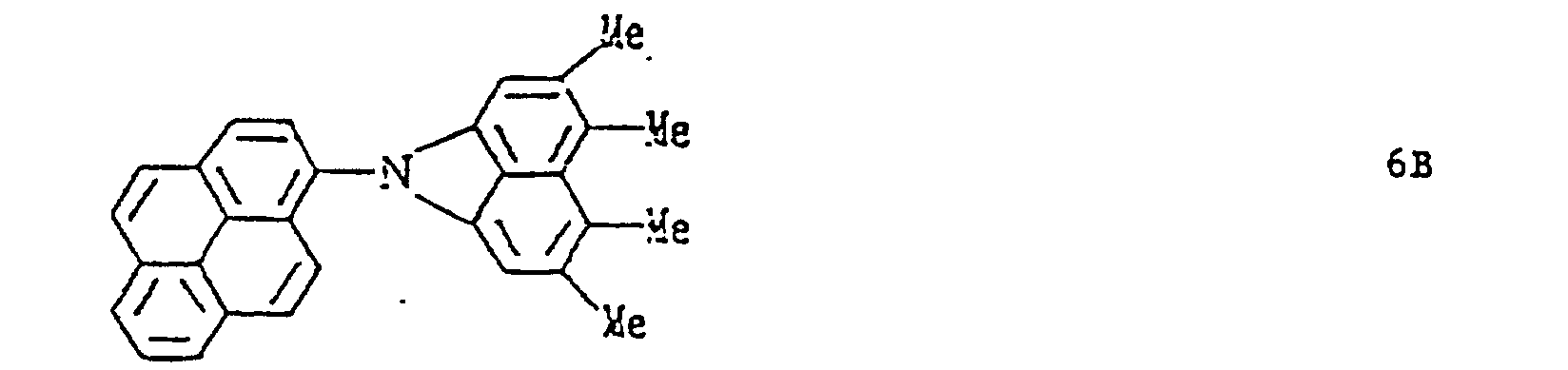

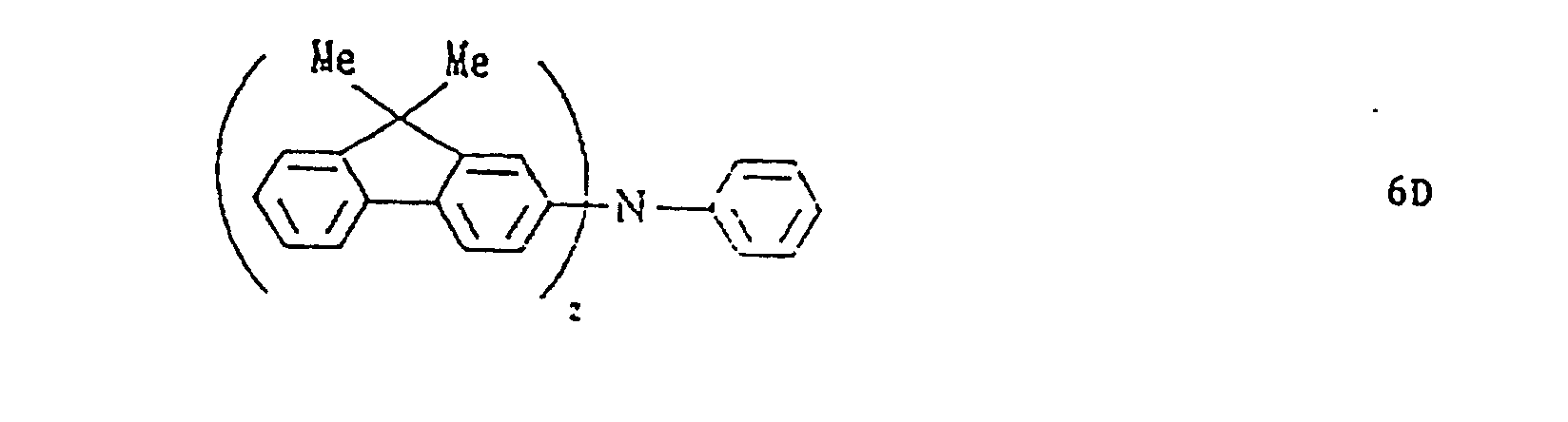
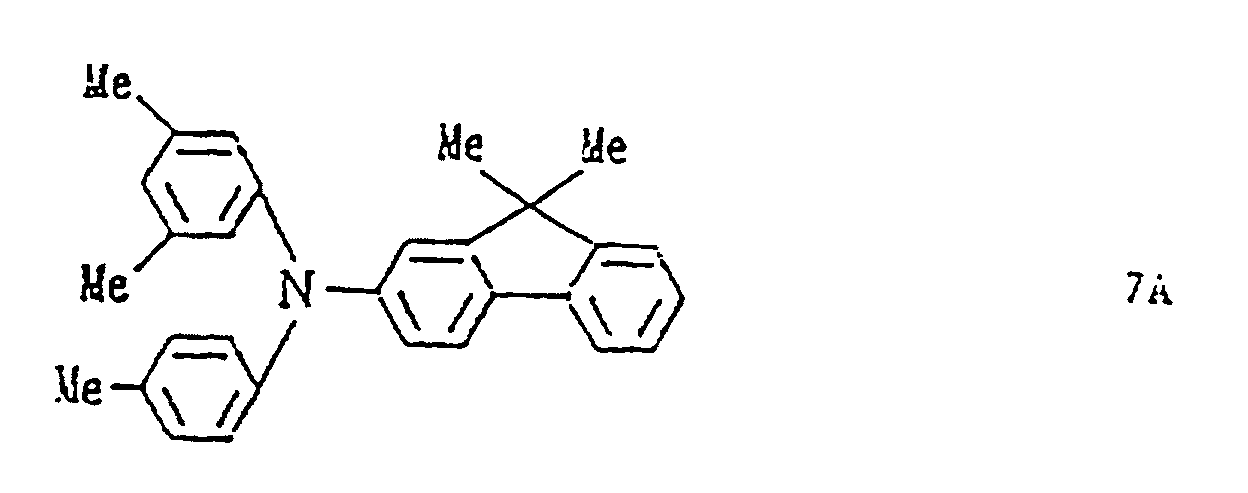


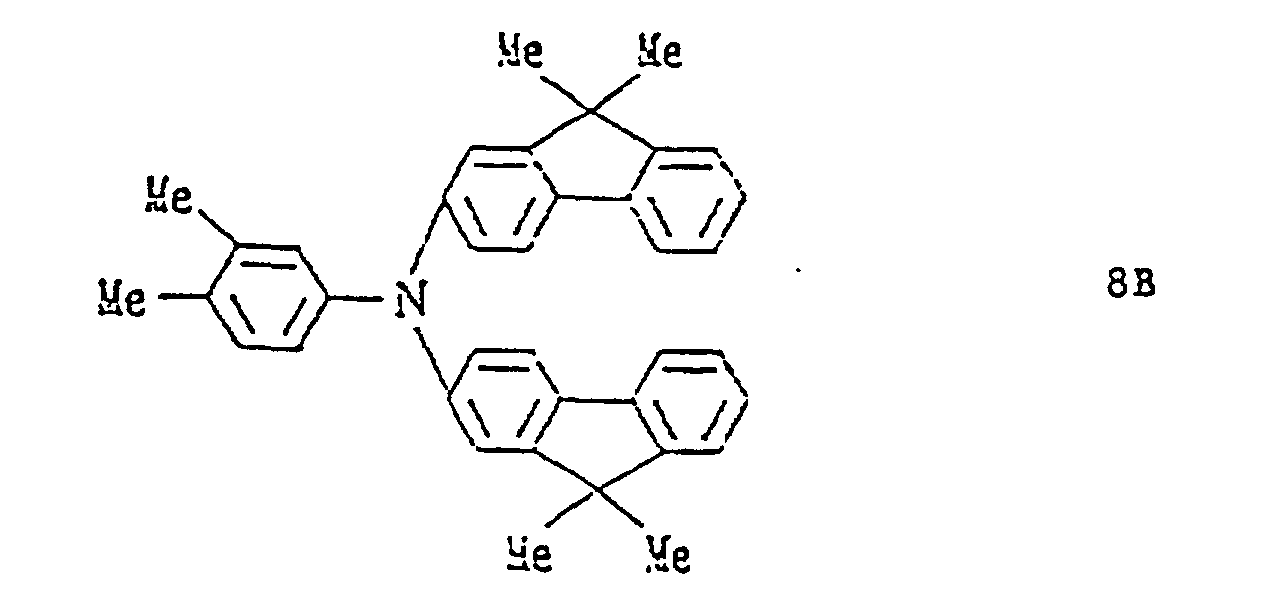

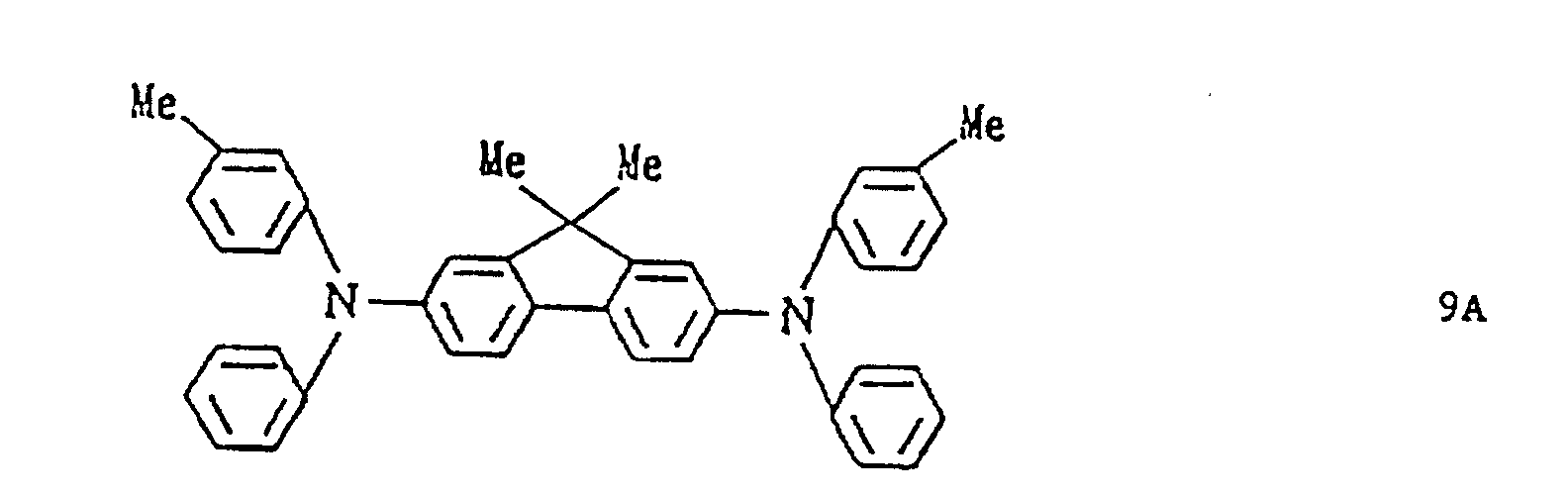
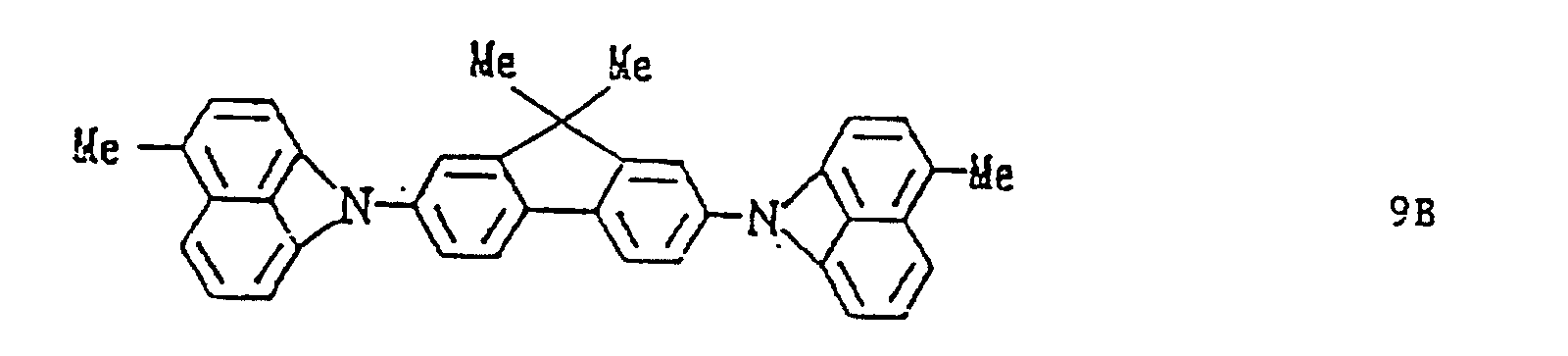

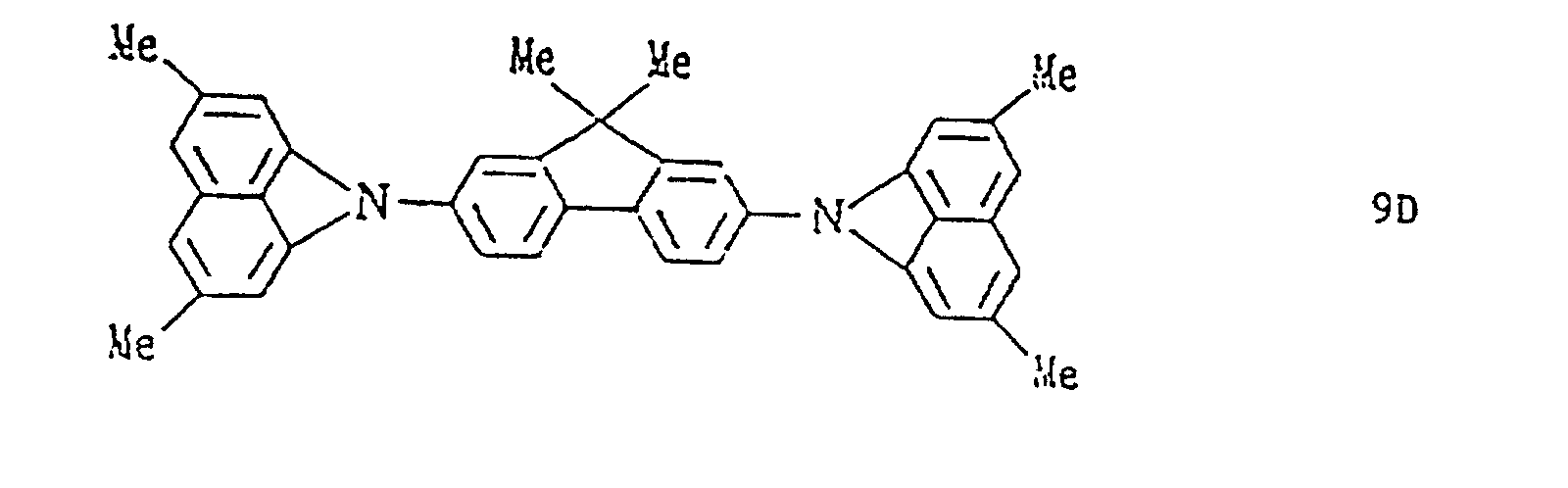


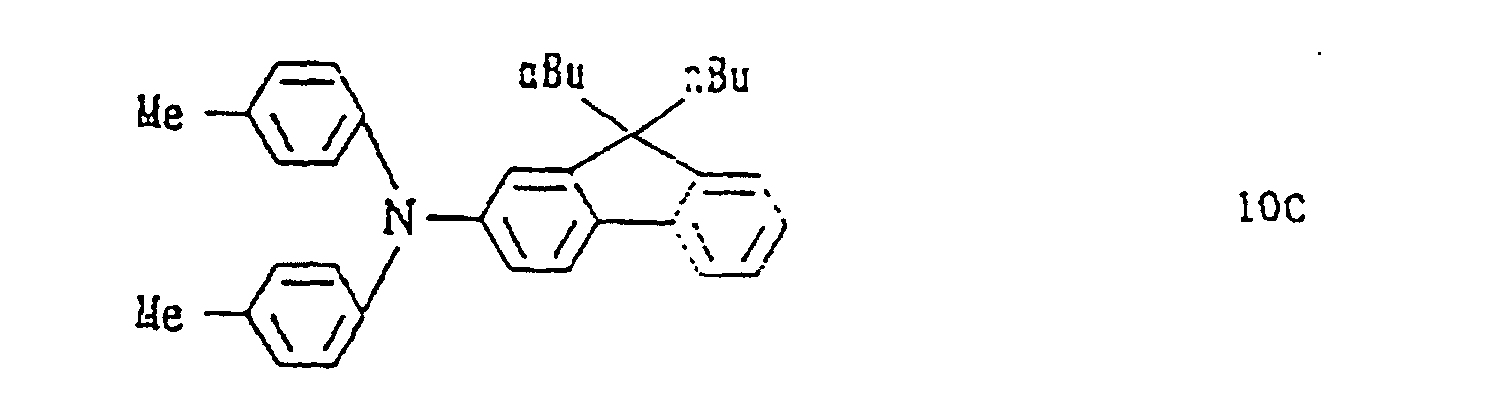
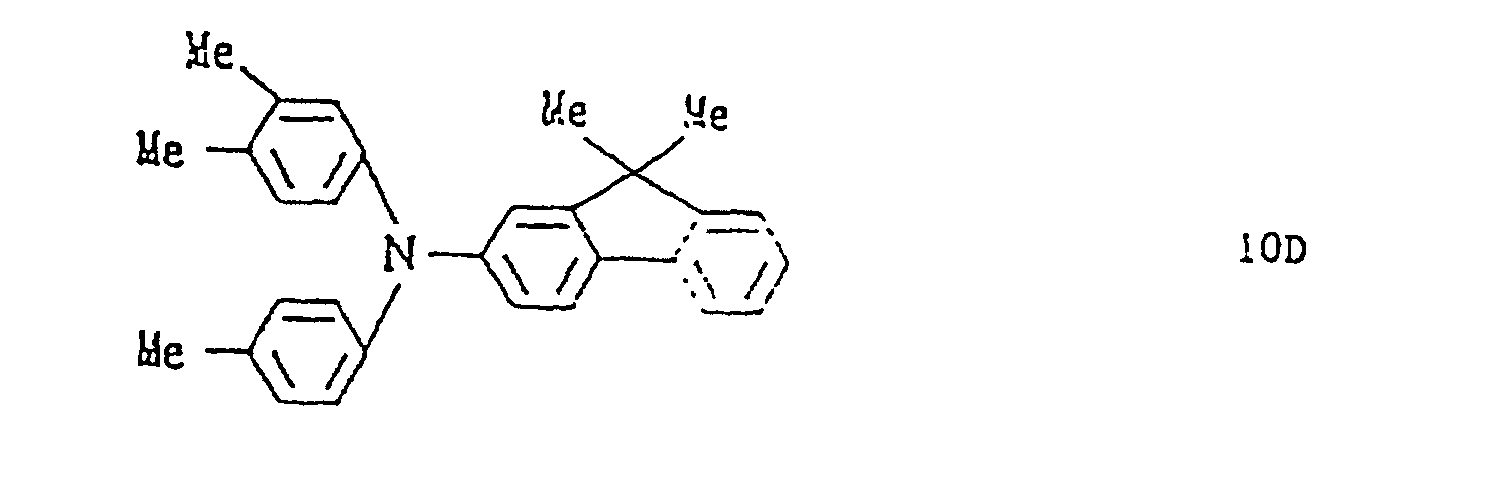

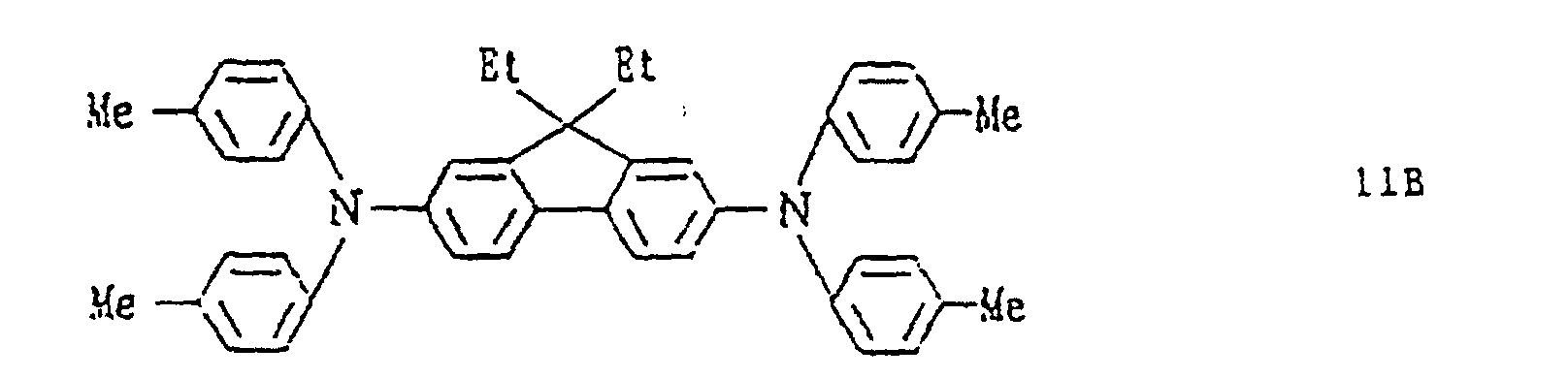

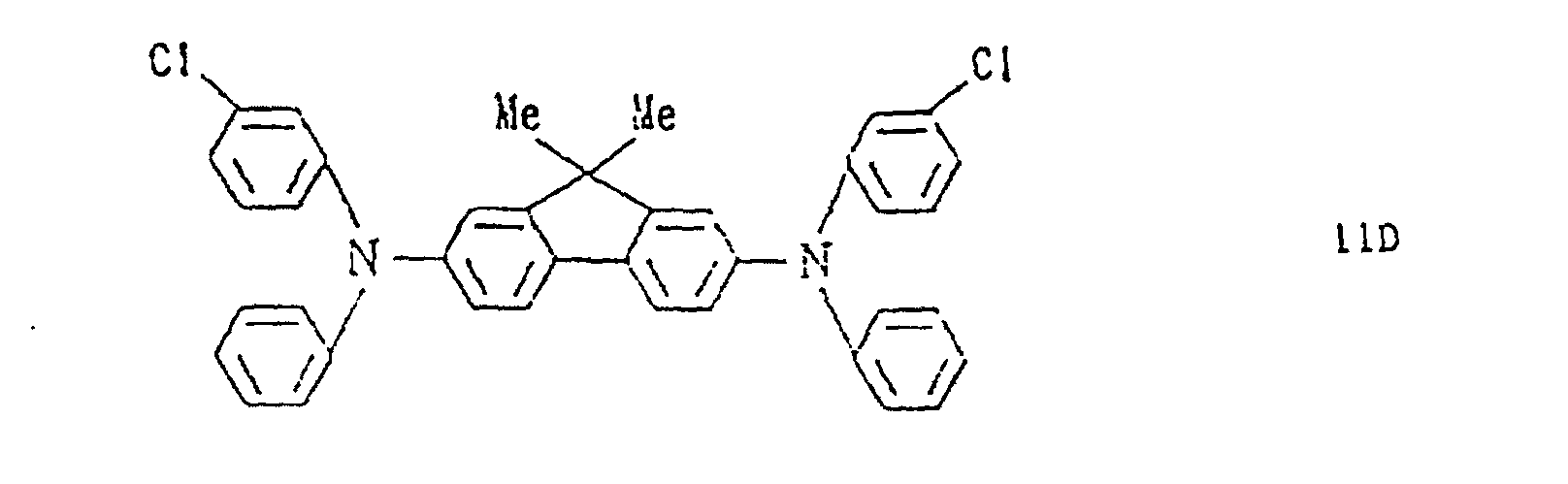
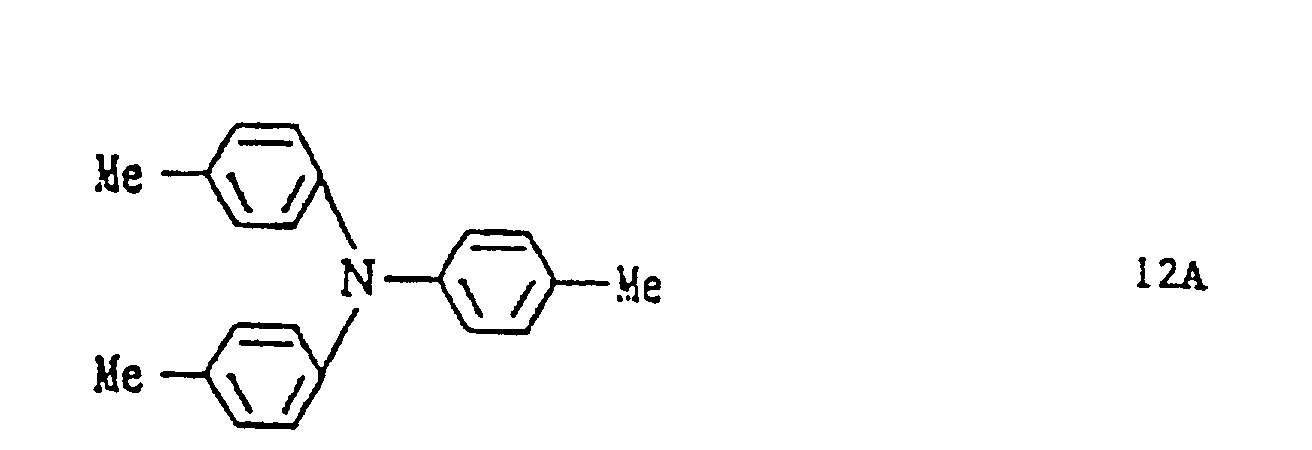


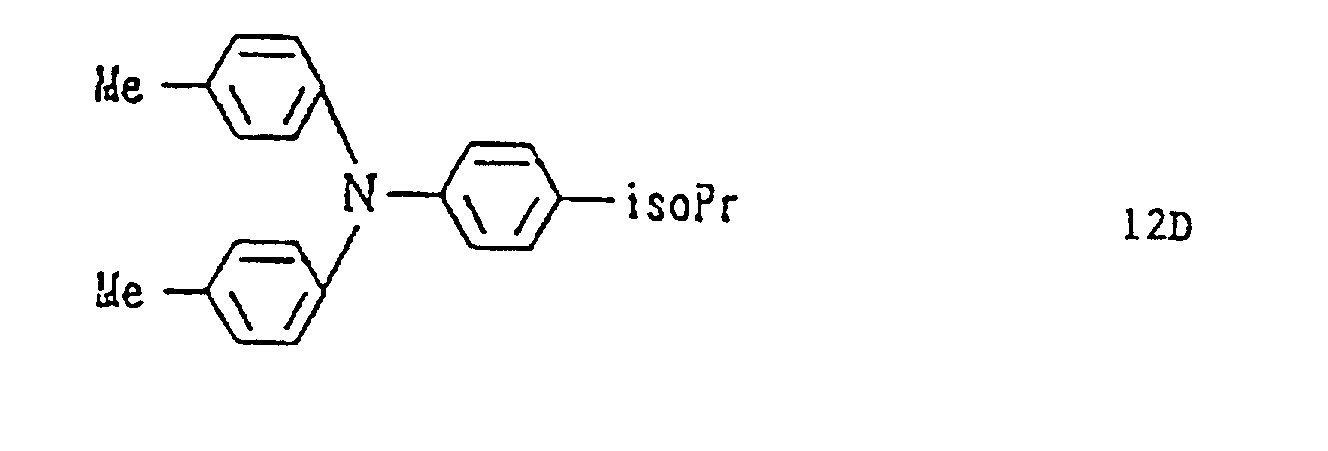
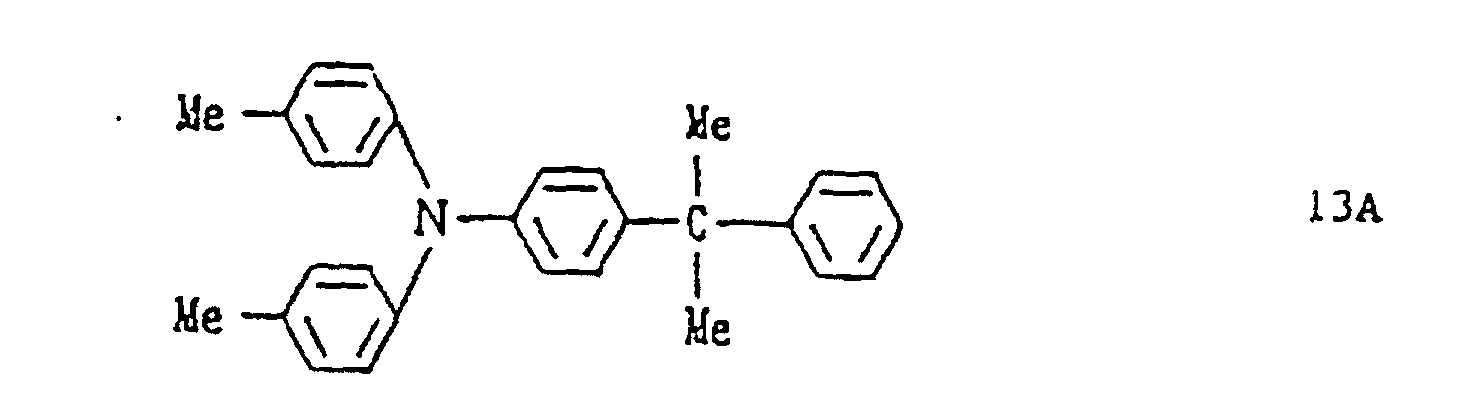
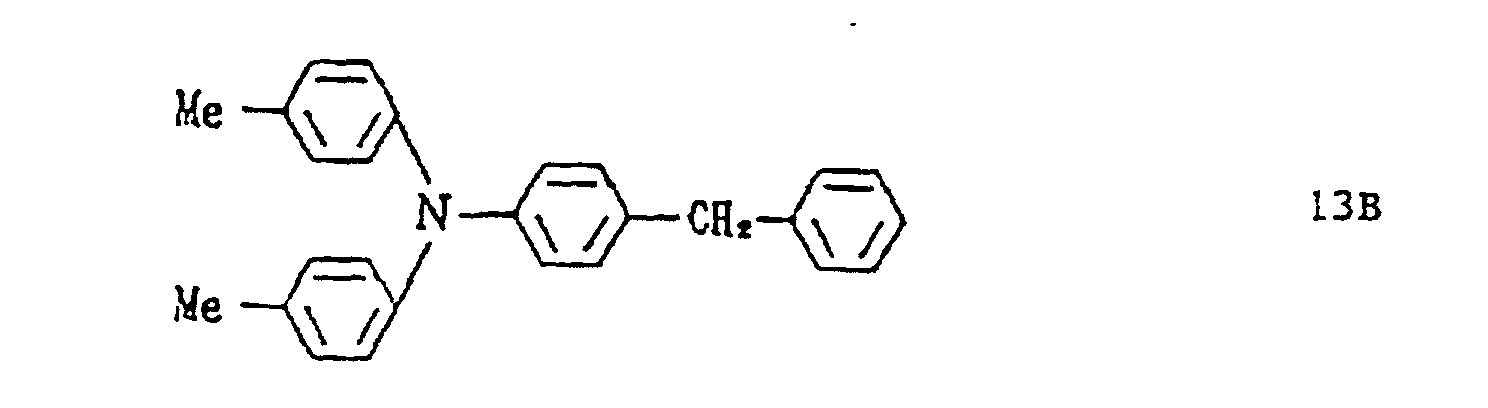
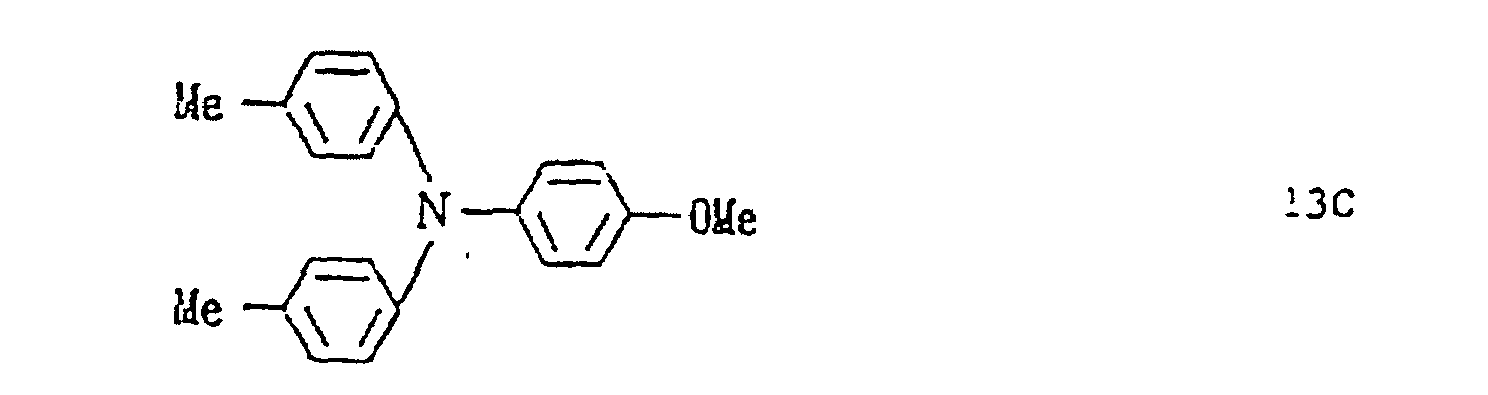


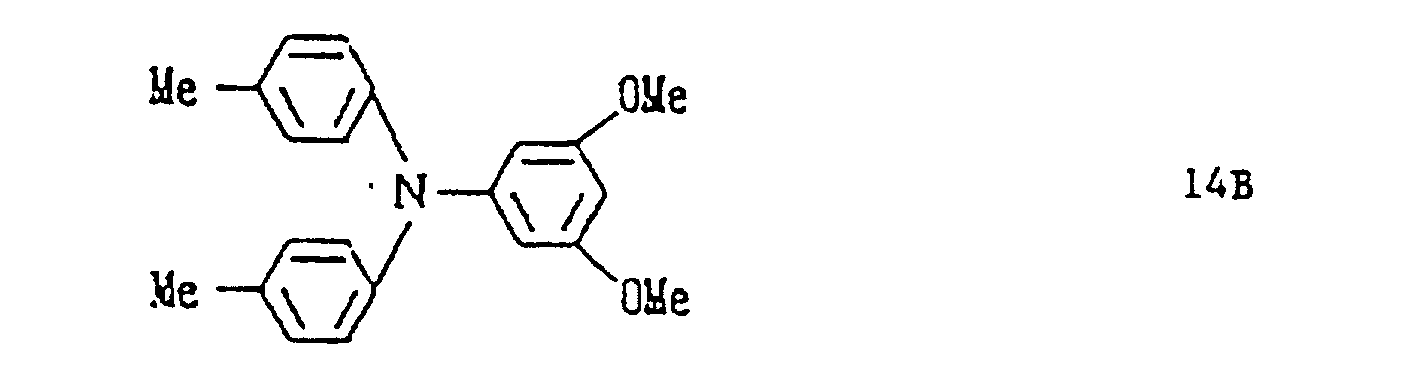

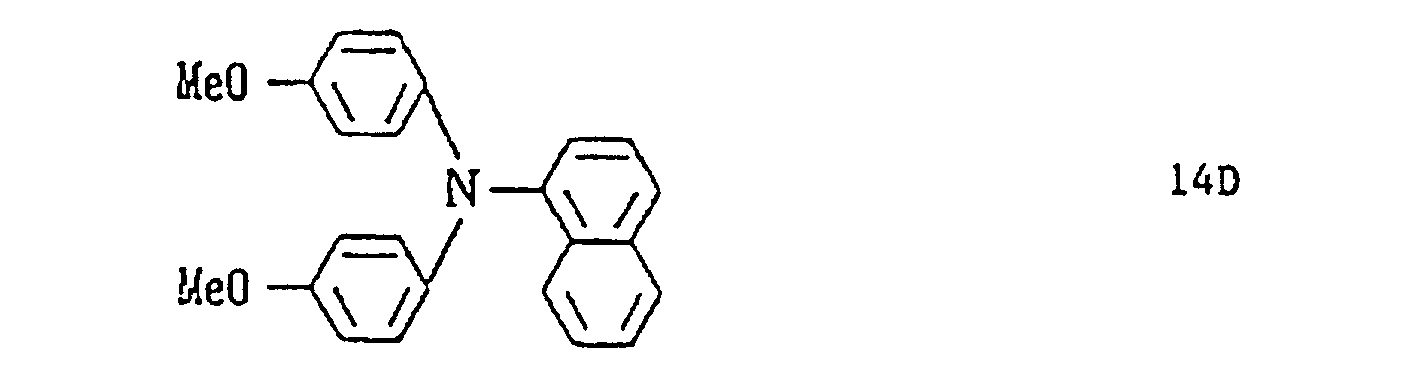


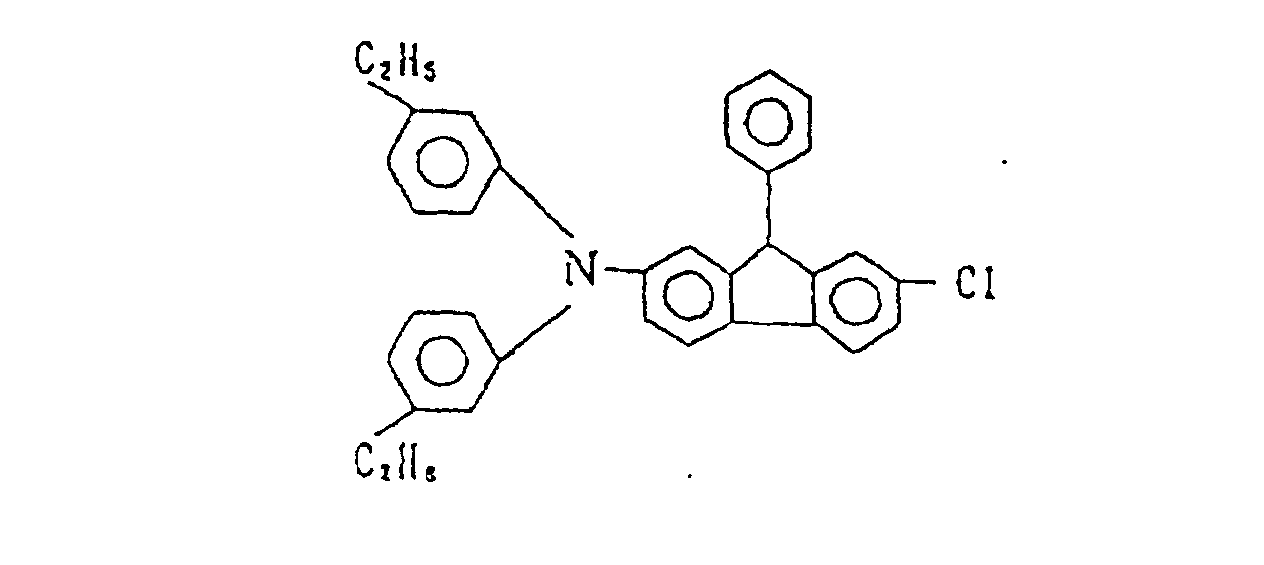


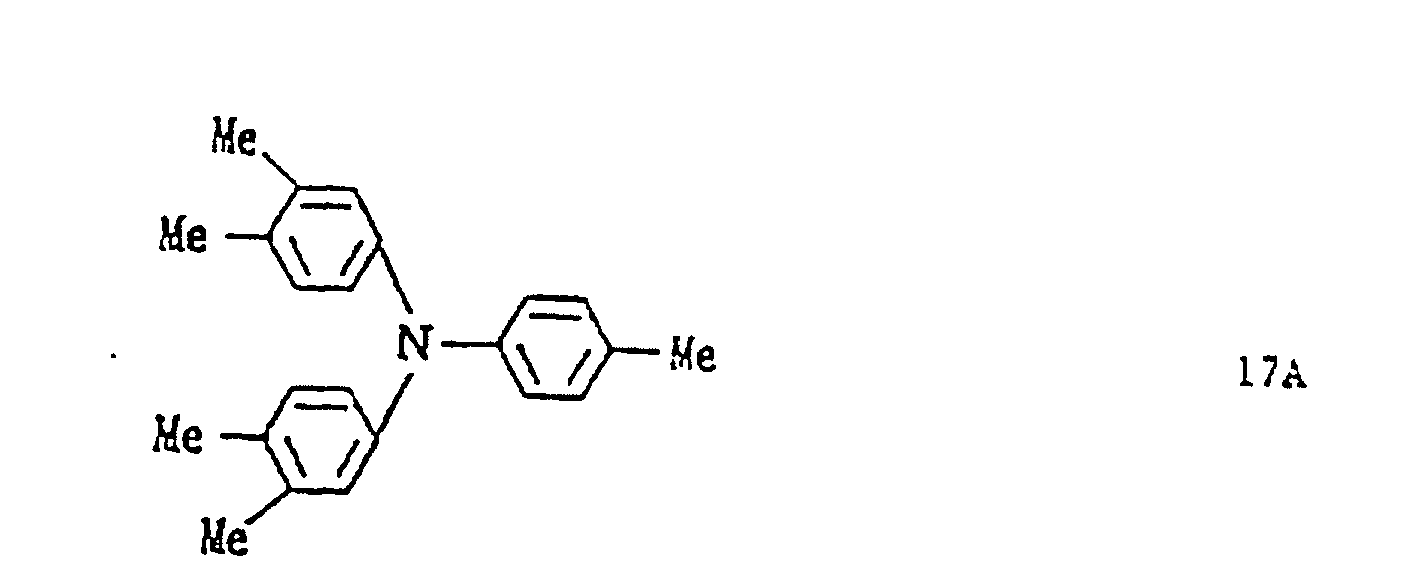


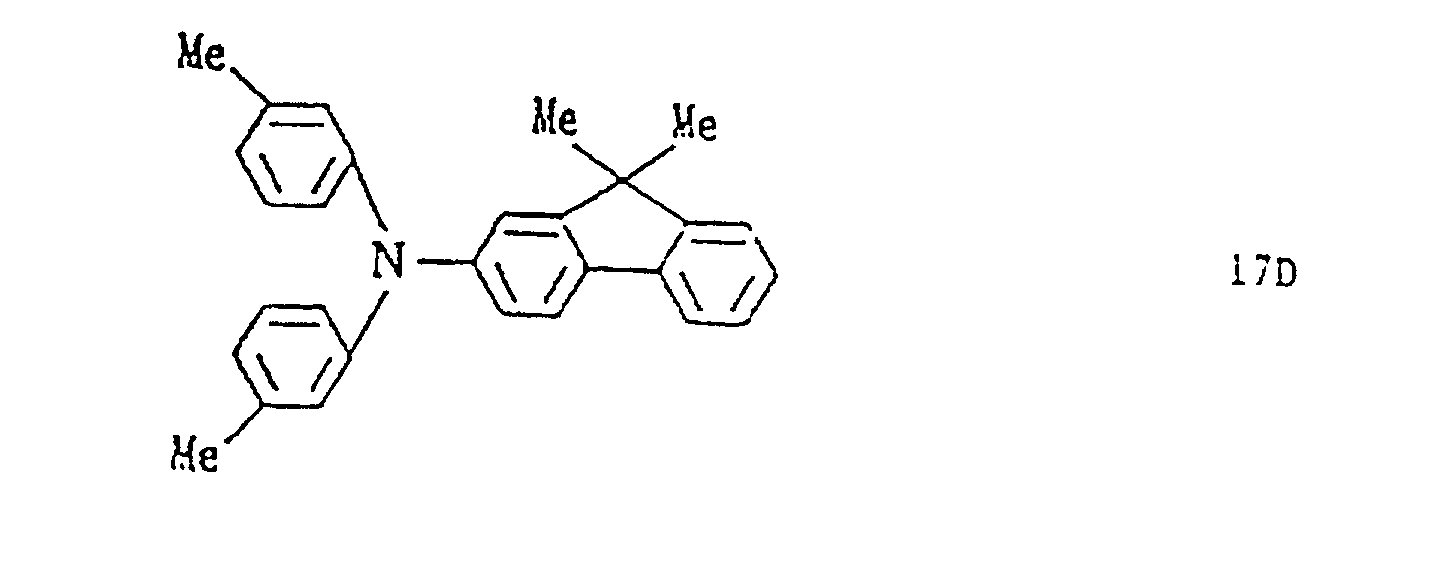


- Following are representative oxidation and ionization potentials for some (51) of the aromatic substituted tertiary amines (A), shown supra (72 total compounds). These oxidation and ionization potentials refer only to those specific compounds identified above by means of a reference numeral, such as 1A.
- 1A - Ionization potential: 5.7 eV
- 1B - Oxidation potential: 0.78 V
Ionization potential: 5.42 eV - 1C - Oxidation potential: 0.81 V
Ionization potential: 5.45 eV - 3A - Oxidation potential: 0.84 V
Ionization potential: 5.47 eV - 5A - Oxidation potential: 0.57 V
lonization potential: 5.22 eV - 5B - Oxidation potential: 0.75 V
Ionization potential: 5.40 eV - 5C - Oxidation potential: 0.76 V
Ionization potential: 5.40 eV - 5D - Oxidation potential: 0.86 V
Ionization potential: 5.49 eV - 6A - Oxidation potential: 0.76 V
Ionization potential: 5.40 eV - 6B - Oxidation potential: 0.79 V
Ionization potential: 5.43 eV - 6C - Oxidation potential: 0.75 V
lonization potential: 5.40 eV - 6D - Oxidation potential: 0.77 V
Ionization potential: 5.41 eV - 7A - Oxidation potential: 0.80 V
Ionization potential: 5.44 eV - 7B - Oxidation potential: 0.79 V
Ionization potential: 5.43 eV - 7C - Oxidation potential: 0.88 V
Ionization potential: 5.51 eV - 8A - Oxidation potential: 0.76 V
lonization potential: 5.40 eV - 8B - Oxidation potential: 0.74 V
Ionization potential: 5.38 eV - 8C - Oxidation potential: 0.77 V
lonization potential: 5.41 eV - 9A - Oxidation potential: 0.63 V
Ionization potential: 5.28 eV - 9B - Oxidation potential: 0.62 V
Ionization potential: 5.27 eV - 9C - Oxidation potential: 0.58 V
Ionization potential: 5.22 eV - 9D - Oxidation potential: 0.59 V
Ionization potential: 5.23 eV - 10A - Oxidation potential: 0.80 V
Ionization potential: 5.44 eV - 10B - Oxidation potential: 0.78 V
Ionization potential: 5.43 eV - 10C - Oxidation potential: 0.78 V
Ionization potential: 5.43 eV - 10D - Oxidation potential: 0.76 V
Ionization potential: 5.41 eV - 11A - Oxidation potential: 0.58 V
Ionization potential: 5.23 eV - 11 B - Oxidation potential: 0.58 V
Ionization potential: 5.23 eV - 11C - Oxidation potential: 0.63 V
Ionization potential: 5.28 eV - 11D - Oxidation potential: 0.77 V
Ionization potential: 5.41 eV - 12A - Oxidation potential: 0.83 V
Ionization potential: 5.47 eV - 12B - Oxidation potential: 0.83 V
Ionization potential: 5.47 eV - 12C - Oxidation potential: 0.84 V
Ionization potential: 5.47 eV - 12D - Oxidation potential: 0.83 V
Ionization potential: 5.47 eV - 13A - Oxidation potential: 0.83 V
Ionization potential: 5.47 eV - 13B - Oxidation potential: 0.85 V
Ionization potential: 5.48 eV - 13C - Oxidation potential: 0.74 V
Ionization potential: 5.38 eV - 13D - Oxidation potential: 0.80 V
Ionization potential: 5.44 eV - 14A - Oxidation potential: 0.83 V
Ionization potential: 5.47 eV - 14B - Oxidation potential: 0.84 V
Ionization potential: 5.47 eV - 14C - Oxidation potential: 0.72 V
Ionization potential: 5.36 eV - 14D - Oxidation potential: 0.73 V
Ionization potential: 5.38 eV - 14E - Oxidation potential: 0.81V
Ionization potential: 5.45 eV - 17A - Oxidation potential: 0.78 V
Ionization potential: 5.43 eV - 17B - Oxidation potential: 0.76 V
Ionization potential: 5.40 eV - 17C - Oxidation potential: 0.82 V
Ionization potential: 5.46 eV - 17D - Oxidation potential: 0.82 V
Ionization potential: 5.45 eV - 18A - Oxidation potential: 0.89 V
Ionization potential: 5.52 eV - 18B - Oxidation potential: 0.81 V
Ionization potential: 5.45 eV - 18C - Oxidation potential: 0.84 V
Ionization potential: 5.47 eV - 18D - Oxidation potential: 0.79 V
Ionization potential: 5.43 eV -
- There is no limitation as to which position on the aromatic ring of the tertiary amine that the alkoxysilane is introduced, nor is it necessary for alkoxysilane groups to be bonded to all aromatic rings. Such determinations are made by considering factors such as solubility in the polysiloxane resin. In this case, the method of introducing a vinyl group to an aromatic ring that is bonded to a nitrogen atom is to formylate the hydrogen or the methyl group substituted on the aromatic ring, and finally to convert the aldehyde group to the vinyl group by the Wittig reaction. It is also produced by means of the dehydrohalogenation between the hydrogen on a secondary amine and a halogenated aromatic group compound, which has been substituted by a vinyl group.
- The hydrogenated organic silicon compound which is able to react with the vinyl group bonded to an aromatic ring of the tertiary amine , with ionization potential of 4.5-6.2 eV, is a hydrogenated organic silicon compound whose substituents on the silicon atom in its molecule comprise at least one hydrogen atom. This compound is added to the vinyl group by a hydrosilylation reaction. Hydrogen, directly bonded to silicon, is an indispensable component of the hydrosilylation reaction to add to the vinyl group. Another indispensable component is a hydrolyzable group, such as an alkoxy group -OR3. R3 of the alkoxy group is a relatively short chain, i.e., 1-6 carbon atoms, such as methyl, ethyl, propyl, butyl, amyl, and hexyl or, R3 is a branched alkyl. The selection of R3 depends on the intended use of the product, stability during hydrosilylation process, and the hydrolyzable properties desired.
- Integer n in formula (I) denotes the number of alkoxy groups substituted on silicon. When n is greater than 1, the hydrophilic property of the compound is improved. When there are several groups that are condensed, the compound also acts as a cross-linking agent; so the selection must be made taking into account the hardness of the resin, as a result of the crosslinking, as well as its hydrophilic property.
- Organic group R2, other than hydrogen atom or alkoxy, which is directly bonded to the silicon atom, is selected according to the type of substituent on the silicon atom in the polysiloxane resin, and according to the various properties such as solubility in the resin, reactivity for hydrosilylation reaction, and other property adjustments of the polysiloxane resin. R2 is an alkyl group such as methyl, ethyl, propyl, butyl, amyl, and hexyl; an alkenyl group such as vinyl or allyl; halogenated hydrocarbon groups; aryl group such as phenyl or tolyl; halongenated hydrocarbon groups such as chloromethyl, chloroethyl and and chloropropyl; and fluorohydrocarbon groups represented by trifluoropropyl, heptafluoropentyl, and nonafluorohexyl. If the substituent on silicon in the polysiloxane resin is methyl, the solubility is better if R2 is also methyl.
- Our curable polysiloxane resin is a resin soluble in organic solvents, and primarily constituting silicon-type macromolecules known as MT resins, MQ resins, T resins, and polysilsesquioxanes. Methods of manufacturing such resins are known, such as the method described on Page 71 of "Silicon-Based Polymer Science", edited by John M. Ziegler and F. W. Gordon Fearon, ACS Series 224, The American Chemical Society (1990).
- The hydrosilylation reaction is conducted using a platinum catalyst or an organic peroxide catalyst. The platinum catalyst is a platinum compound used in standard hydrosilylation reactions and addition-type silicone rubbers; platinum chloride; chloroplatinic acid; platinum-olefin complexes; platinum-phosphine complexes; substances in which platinum is supported by a carrier, such as platinum/carbon, platinum/silica gel, and platinum/macromolecules. The quantity of platinum catalyst is that amount used conventionally. In terms of mole ratio, the quantity of platinum metal to alkenyl groups of electron-donor groups is within the range of 1/10 to 1/100,000.
- The hydrosilylation reaction temperature varies depending on the type of platinum catalyst used, its quantity, reaction group materials, and reaction conditions. However, from the standpoint of efficiency, it is desirable that the temperature be below the decomposition temperature of the platinum catalyst, i.e., below 200°C. In the case of an organic peroxide catalyst, the only limitation is that its half-life be above room temperature. Organic peroxides which are useful are radical polymerization initiators such as lauryl peroxide, butyl peroxide, and benzoyl peroxide.
- Products of hydrosilylation reactions are divided into two groups. In one group, the silicon atom is added to the alpha position of the vinyl group. In the other group, the silicon atom is added to the beta position of the vinyl group. The position depends on reaction conditions, such as the type of vinyl compound substituent and the type of catalyst used. In our invention, there is no adverse effect of a mixture on the alpha-additions and beta-additions in the hydrosilylation process. In fact, having a mixture is preferable since it prevents aggregation of electron hole transferring materials which tend to easily form aggregates.
- 101.4 g of triphenylamine and 35.5 mL of dimethyl formamide (DMF) were placed in a three-neck flask, and while stirring with cooling in ice water, 84.4 ml of phosphorus oxychloride was dropped into the flask. The temperature was raised to 95°C, and the mixture was reacted for 5 hours. The reaction solution was poured into 4l of warm water and stirred for 1 hour. The precipitate was then collected and washed in a 1:1 mixture solution of ethanol/water, and 4-(N,N-diphenylamino) benzaldehyde was obtained. The yield was 91.5 g (yield rate of 81.0%).
- 14.6 g of sodium hydride and 700 ml of 1,2-dimethoxyethane were placed in a three-neck flask, and while stirring at room temperature, 130.8 g of tetramethylphosphonium bromide was added. After adding one drop of anhydrous ethanol, the mixture was reacted for 4 hours at 70°C. Then 100 g of 4-(N,N-diphenylamino) benzaldehyde was added to the mixture. The temperature was raised to 70°C, and the mixture was reacted for 5 hours. The reaction solution was filtered, and an ether extract of the precipitate and the filtrate were washed in water. Next, the ether solution was dehydrated with calcium chloride, the ether was removed, and the reaction mixture was obtained. This was recrystallized from ethanol, and a needle-form, lemon-yellow vinyltriphenylamine was obtained. The yield was 83.4 g (yield rate of 84.0%).
- 40 ml of toluene, 9.9 g (60 mmol) of triethoxysilane, and 0.018 mmol of a toluene solution of tris-(tetramethyldivinyldisiloxane) diplatinum (0, i.e., zero oxidation number of platinum in the molecule) were placed in a three-neck flask, and while stirring under room temperature, 20 ml of a toluene solution of 8.2 g of 4-vinyltriphenylamine was dropped into the flask. Upon completion of the addition of the drops, the mixture was stirred for 3 hours at 70 °C, then the solvent was removed under reduced pressure. As a result, a lemon-yellow oily substance of 4-[2-(triethoxysilyl) ethyl] triphenylamine was obtained. The amount obtained was 12.1 g (yield 91.7%).
- 40 ml of toluene, 8.1 g of methyl diethoxy silane, and 0.018 mmol of a toluene solution of tris-(tetramethyldivinyldisiloxane) diplatinum (0) were placed in a three-neck flask, and while stirring under room temperature, 20 ml of a toluene solution of 8.2 g of 4-vinyltriphenylamine was dropped into the flask. Upon completion of the addition of the drops, the mixture was stirred for 3 hours at 70°C, then the solvent was removed under reduced pressure. As a result, a lemon-yellow oily substance of 4-[2-(methyldiethoxysilyl) ethyl] triphenylamine was obtained. The amount obtained was 11.2 g (yield 91.4%).
- 50.7 g of triphenylamine and 53.3 ml of DMF were placed in a three-neck flask, and while stirring while cooling in ice water, 126.6 ml of phosphorus oxychloride was dropped into the flask. Upon completion of the addition of the drops, the mixture solution was reacted for 5 hours at 95°C, then poured into 5 I of warm water, and stirred for 1 hour. The precipitate was then collected by filtering and washed in a 1:1 mixture solution of ethanol/water. As a result, tris-(4-formylphenyl) amine was obtained in an amount of 65.3 g (yield 95.9%).
- 14.6 g of sodium hydride and 700 ml of 1,2-dimethoxy ethane were placed in a three-neck flask, and while stirring at room temperature, 130.8 g of tetramethyl phosphonium bromide was added. Anhydrous ethanol was then added by dripping, and after completion of dripping, a reaction was carried out for 4 hours at 70°C. The reaction mixture was then combined with 40.2 g of tri-(4-formylphenyl) amine, and the reaction was continued for 5 hours at 70°C. The reaction product was filtered. The filtrated cake was extracted with ethanol, and after being combined with the filtrate, was washed with water. After dehydrating the ether solution with calcium chloride, the ether was removed, and a reaction mixture was obtained. This mixture was twice recrystallized with ethanol. As a result, a needle-like lemon-yellow substance of tri-(4-vinylphenyl) amine was obtained. The amount obtained was 38.4 g (yield 97.3%).
- 40 ml of toluene, 9.9 g (60 mmol) of triethoxysilane, and 0.018 mmol of a toluene solution of tris-(tetramethyldivinyldisiloxane) diplatinum (0) were placed in a three-neck flask, and while stirring under room temperature, 20 ml of a toluene solution of 3.3 g (13 mmol) of tri-(4-vinylphenyl) amine was dropped into the flask. Upon completion of the addition of the drops, the mixture was stirred for 3 hours at 70°C, then the solvent was removed under reduced pressure. As a result, a lemon-yellow oily substance of 4,4',4'-[2-(triethoxysilyl) ethyl] triphenylamine was obtained, and the amount obtained was 7.8 g (yield 80.6%).
- 38.5 g (166 mmol) of 4-iodo-o-xylene, 22.9 g (166 mmol) of anhydrous potassium carbonate, and 7.0 g of copper powder were added to 20 ml of nitrobenzene, and heat-refluxed for 8 hours while stirring. The mixture was cooled, filtered, and the filtrate was removed. The obtained reaction mixture was passed through a silica gel column, and N,N-bis-(3,4-dimethylphenyl) aminobenzene was obtained. The amount obtained was 15.7 g (yield rate of 69%).
- 124.6 g of 4-[N,N-bis-(3,4-dimethylphenyl) amino] benzene and 35.5 ml of DMF were placed in a three-neck flask, and while stirring while cooling in ice water, 84.4 ml of phosphorus oxychloride was dropped into the flask. Upon completion of the addition of the drops, the mixture solution was reacted for 5 hours at 95°C, then poured into 4 l of warm water, and stirred for 1 hour. The precipitate was collected and washed in a 1:1 mixture solution of ethanol/water, and 4-[N,N-bis-(3,4-dimethylphenyl) amino] benzaldehyde was obtained. The amount obtained was 107.6 g (yield rate of 79.0%).
- 12.1 g of sodium hydride and 580 ml of 1,2-dimethoxyethane were placed in a three-neck flask, and while stirring at room temperature, 108.5 g of tetramethyl phosphonium bromide was added. After adding one drop of anhydrous ethanol, the mixture was reacted for 4 hours at 70°C. 100 g of 4-[N,N-bis-(3,4-dimethylphenyl) amino] benzaldehyde was added to the reaction mixture, and the mixture was reacted for 5 hours at 70°C. The reaction solution was filtered, and an ether extract of the filtered cake and filtrate were washed in water. The ether solution was dehydrated with calcium chloride. The ether was removed and the reaction mixture was obtained. This was recrystallized twice with ethanol, and a needle-form of 4-[N,N-bis-(3,4-dimethylphenyl) amino] styrene was obtained. The amount obtained was 84.5 g (yield rate of 85.0%).
- 40 ml of toluene, 6.0 g of triethoxysilane, and 0.54 mmol of a toluene solution of tris-(tetramethyldivinyldisiloxane) diplatinum (0) were placed in a three-neck flask, and while stirring under room temperature, 20 ml of a toluene solution of 9.9 g of 4-[N,N-bis-(3,4-dimethylphenyl) amino] styrene was dropped into the flask. Upon completion of the addition of the drops, the mixture was stirred for 3 hours at 70°C. The solvent was removed under reduced pressure, and a lemon-yellow oil of 4-[N,N-bis-(3,4-dimethylphenyl) amino]-[2-(triethoxysilyl) ethyl] benzene was obtained. The amount obtained was 13.4 g (yield rate of 90.1%).
- 40 ml of toluene, 6.0 g (37 mmol) of triethoxysilane, and 0.34 mmol of dichloro-(n-cycloocta-1,5-diene) platinum were loaded into a three-neck flask. While being stirred at room temperature, 20 ml of a toluene solution of 9.9 g of 4-[N,N-bis-(3,4-dimethylphenyl) amino] styrene was dropped into the flask. Upon completion of the addition of the drops, the mixture was stirred for 3 hours at 70°C. The solvent was removed under reduced pressure, and a lemon-yellow oily substance of 4-[N,N-bis-(3,4-dimethylphenyl) amino]-[2-(triethoxysilyl) ethyl] benzene was obtained. The amount obtained was 14.0 g (yield was 94.2%).
- 8.0 g (45 mmol) of N-bromosuccinimide (NBS) and 10.0 g (41 mmol) of triphenylamine were loaded in a 200 ml three-neck flask and then 150 ml of N,N-dimethyl formamide was added. The components were stirred overnight at room temperature.
N,N-dimethyl formamide was removed, and the solid substance obtained was extracted with carbon tetrachloride. Carbon tetrachloride was removed, and the reaction mixture was twice recrystallized with ethanol. As a result, a solid white substance of 4-bromotriphenylamine was obtained in an amount of 8.2 g (yield was 61.7%). - A 300 ml four-neck flask was filled with 1.0 g (40 mmol) of magnesium metal and the flask was filled with nitrogen. Diethyl ether was added in an amount of 100 ml, and stirring was initiated. 30 ml of a diethyl ether solution of 8.6 g (27 mmol) of 4-bromotriphenylamine was slowly added by dripping into the stirred mixture. After the dropped amount reached 3 ml, refluxing was slowly started. In the course of refluxing, the addition of diethylether solution by dripping was continued. Upon completion of dripping, refluxing was carried out for another hour. A Grignard reagent solution obtained in the manner described above was cooled to room temperature, and combined with 40 ml of a diethylether solution of 2.1 g (27 mmol) of allyl chloride added slowly by dripping. Upon completion of dripping, the reaction mixture was refluxed for 2 hours, and allowed to cool. Ice-cold water was added in an amount of 50 ml, and hydrolysis was carried out. The ether layer was extracted, washed once with an aqueous saturated sodium bicarbonate solution, and twice with water. The product was dried with anhydrous sodium sulfate. After drying, diethylether was removed, and a white solid substance of 4-N,N-diphenyl aminoallyl benzene was obtained in an amount of 4.9 g (yield 63.2%).
- 40 ml of toluene, 6.0 g (37 mmol) of triethoxysilane, and 0.54 mmol of a toluene solution of tris-(tetramethyldivinyldisiloxane) diplatinum (0) were loaded into a three-neck flask. While being stirred at room temperature, 20 ml of a toluene solution of 9.7 g (34 mmol) of 4-[N,N-diphenylaminoallyl benzene was dropped into the flask. Upon completion of addition of drops, the mixture was stirred for 3 hours at 70°C. The solvent was removed under reduced pressure, and a lemon-yellow oily substance of 4-[3-(triethoxysilyl) propyl] triphenylamine was obtained. The amount obtained was 10.7 g (yield was 70.1%).
- 4.5 g (27 mmol) of diphenylamine, 11.0 g (51 mmol) of p-iodotoluene, 5.5 g (40 mmol) of anhydrous potassium carbonate, and 1.1 g of copper chips were added to 30 ml of o-dichlorobenzene. The mixture was subjected to heating and refluxing for 7 hours under stirring conditions. Upon completion of the reaction, the reaction solution was filtered, the filtrate was washed with a 3-5% aqueous solution of sodium thiosulfate, and then with saturated brine. After drying the organic layer with anhydrous sodium sulfate, the solvent was removed. The reaction mixture obtained was recrystallized with ethanol, and 4-methyltriphenylamine was obtained in an amount of 5.7 g (yield 81.4 %).
- 6.9 g (39 mmol) of N-bromosuccinimide and 9.1 g (35 mmol) of 4-methyltriphenylamine were loaded in a 300 ml three-neck flask, and 100 m of carbon tetrachloride was added. The components were stirred overnight. Upon completion of the reaction, the reaction solution was cooled and then filtered. The solvent was removed.
The reaction mixture obtained was recrystallized with ethanol. As a result, the substance 4-bromomethyltriphenylamine was obtained in an amount of 10.8 g (yield was 91.2%). - A 200 ml four-neck flask was filled with 1.0 g (40 mmol) of magnesium metal, and the flask was filled with nitrogen. Diethyl ether was added in an amount of 100 ml, and stirring was initiated. 20 ml of diethyl ether solution of 9.1 g (27 mmol) of 4-bromomethyltriphenylamine was slowly added by dripping to the stirred mixture. After the dropped amount reached 5 ml, refluxing was slowly started. In the course of refluxing, addition of diethylether solution by dripping was continued. Upon completion of dripping, refluxing was carried out for another hour. A Grignard reagent solution obtained in the manner described above was cooled to room temperature, and combined with 20 ml of a diethylether solution of 2.1 g (27 mmol) of allyl chloride which was added slowly by dripping. Upon completion of dripping, the reaction mixture was refluxed for 2 hours, and the reaction was cooled. Ice-cold water was added in an amount of 50 ml, and hydrolysis was carried out. The ether layer was extracted, washed once with an aqueous saturated sodium bicarbonate solution, twice with water. The product was dried with anhydrous sodium sulfate. After drying, diethylether was removed, and a white solid substance of 4-N,N-diphenyl aminophenyl-1-butene was obtained in an amount of 5.5 g (yield 66.7%).
- 40 ml of toluene, 9.9 g (60 mmol) of triethoxysilane, and 0.018 mmol of a toluene solution of tris-(tetramethyldivinyldisiloxane) diplatinum (0) were placed in a three-neck flask. While stirring under room temperature, 20 ml of a toluene solution of 16.7 g (54.7 mmol) of 4-N,N-diphenylaminophenyl-1-butene was dropped into the flask. Upon completion of addition of the drops, the mixture was stirred for 3 hours at 70°C. The solvent was removed under reduced pressure. As a result, a lemon-yellow oily substance of 4-[4-(triethoxysilyl) butyl] triphenylamine was obtained. The amount obtained was 13.9 g (yield 83.2%).
- In view of the above, it can be seen that our invention provides an electron hole transfer material which allows practical application of low surface energy polysiloxane organic photoconductive resins that have excellent hardness and weather resistant properties, unattainable by conventional technique. The silicon-type electron hole transferring material provided by our invention can be used not only in electrophotographic processes, such as photocopiers and laser beam printers, but also as an electric charge transfer layer necessary in construction of organic electroluminescent elements.
Claims (5)
- A silicon-containing charge transporting material represented by formula
- The silicon-containing charge transporting material of claim 1, wherein the hydrolyzable group is an alkoxy group.
- The silicon-containing charge transporting material of any of claims 1 or 2, wherein the alkylene group R1 is bonded directly to an aromatic group of the organic group A.
- A method for manufacturing a silicon-containing charge transporting material represented by formulaa) subjecting the substituent in the form of an unsaturated hydrocarbon group or some or all of the aromatic groups of the compound with charge transporting properties having an ionization potential within the range of 4.5-6.2 eV which is a tertiary amine having a plurality of aromatic groups to hydrosilylation with an organic silicon compound with a hydrogen atom bonded to silicon and at least one hydrolyzable group; orb) brominating the saturated hydrocarbon group on at least one aromatic group of the compound with charge transporting properties having an ionization potential within the range of 4.5-6.2 eV which is a tertiary amine having a plurality of aromatic groups, then forming a lithium complex and reacting the complex with a halogenated organic silicon compound bearing at least one hydrolyzable group.
- The method according to claim 4, wherein the hydrolyzable group is an alkoxy group.
Applications Claiming Priority (3)
| Application Number | Priority Date | Filing Date | Title |
|---|---|---|---|
| JP7287634A JPH09127710A (en) | 1995-11-06 | 1995-11-06 | Method for producing silicon-based hole transport material |
| JP287634/95 | 1995-11-06 | ||
| JP28763495 | 1995-11-06 |
Publications (2)
| Publication Number | Publication Date |
|---|---|
| EP0771806A1 EP0771806A1 (en) | 1997-05-07 |
| EP0771806B1 true EP0771806B1 (en) | 2002-02-27 |
Family
ID=17719775
Family Applications (1)
| Application Number | Title | Priority Date | Filing Date |
|---|---|---|---|
| EP96117733A Expired - Lifetime EP0771806B1 (en) | 1995-11-06 | 1996-11-06 | Silicon containing charge transport compounds |
Country Status (8)
| Country | Link |
|---|---|
| US (1) | US5824443A (en) |
| EP (1) | EP0771806B1 (en) |
| JP (1) | JPH09127710A (en) |
| KR (1) | KR100494208B1 (en) |
| CN (1) | CN1156850A (en) |
| AU (1) | AU708183B2 (en) |
| DE (1) | DE69619464T2 (en) |
| TW (1) | TW348230B (en) |
Families Citing this family (16)
| Publication number | Priority date | Publication date | Assignee | Title |
|---|---|---|---|---|
| EP0812820B1 (en) * | 1995-03-01 | 2001-01-17 | Takasago International Corporation | Triphenylamine derivatives, and charge transport material and electrophotographic photoreceptor prepared therefrom |
| JP4158204B2 (en) * | 1995-04-10 | 2008-10-01 | 住友化学株式会社 | Polysilane compound, production method thereof and raw material thereof |
| JP3640444B2 (en) * | 1995-11-06 | 2005-04-20 | ダウ コーニング アジア株式会社 | Method for producing polysiloxane hole transport material |
| JP3267519B2 (en) * | 1995-11-06 | 2002-03-18 | キヤノン株式会社 | Electrophotographic photosensitive member, process cartridge having the electrophotographic photosensitive member, and image forming apparatus |
| JP3614222B2 (en) * | 1995-11-06 | 2005-01-26 | ダウ コーニング アジア株式会社 | Method for producing silicon-based hole transport material |
| KR100273180B1 (en) * | 1997-01-28 | 2000-12-01 | 이마이 기요스케 | Eletrophotographic photoreceptor |
| JPH1135687A (en) * | 1997-07-17 | 1999-02-09 | Sumitomo Chem Co Ltd | Polysilane copolymer, method for producing the same, organic electroluminescent device using the same, and electrophotographic photoreceptor |
| TW558561B (en) | 1997-07-22 | 2003-10-21 | Sumitomo Chemical Co | Hole transporting polymer and organic electroluminescence device using the same |
| US6187491B1 (en) | 1999-02-08 | 2001-02-13 | Eastman Kodak Company | Electrophotographic charge generating element containing acid scavenger in overcoat |
| US6265122B1 (en) * | 1999-02-22 | 2001-07-24 | Konica Corporation | Electrophotographic photoreceptor and an image forming apparatus and a process cartridge using the same |
| JP2002212150A (en) * | 2001-01-22 | 2002-07-31 | Canon Inc | Triarylamine compound, polymer film using the triarylamine compound, organic light emitting device, and method of manufacturing the same |
| US6319645B1 (en) * | 2001-02-26 | 2001-11-20 | Xerox Corporation | Imaging members |
| US6517984B1 (en) | 2001-03-27 | 2003-02-11 | Heidelberger Druckmaschinen Ag | Silsesquioxane compositions containing tertiary arylamines for hole transport |
| DE60317856T2 (en) * | 2002-07-08 | 2008-11-27 | Eastman Kodak Co. | Organic charge transport polymers with charge transport residues and silane groups and silsesquioxane compositions prepared therefrom |
| CN102219700A (en) * | 2011-04-22 | 2011-10-19 | 南京邮电大学 | Fluorene aniline structure-based organic photovoltaic materials |
| US20230131195A1 (en) * | 2021-09-10 | 2023-04-27 | Rohm And Haas Electronic Materials Korea Ltd. | Organic electroluminescent compound and organic electroluminescent device comprising the same |
Family Cites Families (14)
| Publication number | Priority date | Publication date | Assignee | Title |
|---|---|---|---|---|
| JPS5595953A (en) * | 1979-01-11 | 1980-07-21 | Ricoh Co Ltd | Electrophotographic photoreceptor |
| JPS61238062A (en) * | 1985-04-16 | 1986-10-23 | Canon Inc | electrophotographic photoreceptor |
| JPH071400B2 (en) * | 1985-11-05 | 1995-01-11 | 三菱化成株式会社 | Electrophotographic photoreceptor |
| EP0224784A3 (en) * | 1985-11-21 | 1988-09-28 | BASF Aktiengesellschaft | Carbazole group-containing polysiloxane, photoconductive layers and electrophotographic material |
| US5187310A (en) * | 1990-03-14 | 1993-02-16 | Kao Corporation | Organic silicon compound, method of its production, and photoreceptor for electrophotography incorporating it |
| US5290963A (en) * | 1990-05-12 | 1994-03-01 | Kao Corporation | Organic silicon compound, method of its production, and photoreceptor for electrophotography incorporating it |
| US5272029A (en) * | 1991-02-28 | 1993-12-21 | Canon Kabushiki Kaisha | Image-bearing member and apparatus including same |
| JPH04273252A (en) | 1991-02-28 | 1992-09-29 | Canon Inc | Image holding member and device using the same |
| JPH04346356A (en) * | 1991-05-24 | 1992-12-02 | Matsushita Electric Ind Co Ltd | Electrophotographic photoconductor |
| US5326661A (en) * | 1991-11-13 | 1994-07-05 | Hoechst Celanese Corp. | Photorefractive polymers containing discrete photoconductive and electrooptical units |
| US5232801A (en) * | 1991-12-23 | 1993-08-03 | Eastman Kodak Company | Hole-transport liquid crystalline polymeric compounds, electrophotographic elements comprising same, and electrophotographic process |
| US5230976A (en) * | 1991-12-27 | 1993-07-27 | Xerox Corporation | Polymeric arylamine silane compounds and imaging members incorporating same |
| US5436099A (en) * | 1993-12-21 | 1995-07-25 | Xerox Corporation | Photoreceptor with low surface energy overcoat |
| JP3614222B2 (en) * | 1995-11-06 | 2005-01-26 | ダウ コーニング アジア株式会社 | Method for producing silicon-based hole transport material |
-
1995
- 1995-11-06 JP JP7287634A patent/JPH09127710A/en active Pending
-
1996
- 1996-11-04 US US08/743,265 patent/US5824443A/en not_active Expired - Lifetime
- 1996-11-04 AU AU70593/96A patent/AU708183B2/en not_active Ceased
- 1996-11-06 KR KR1019960052205A patent/KR100494208B1/en not_active Expired - Fee Related
- 1996-11-06 CN CN96121687A patent/CN1156850A/en active Pending
- 1996-11-06 DE DE69619464T patent/DE69619464T2/en not_active Expired - Fee Related
- 1996-11-06 EP EP96117733A patent/EP0771806B1/en not_active Expired - Lifetime
- 1996-11-13 TW TW085113885A patent/TW348230B/en not_active IP Right Cessation
Also Published As
| Publication number | Publication date |
|---|---|
| KR970028879A (en) | 1997-06-24 |
| DE69619464D1 (en) | 2002-04-04 |
| JPH09127710A (en) | 1997-05-16 |
| DE69619464T2 (en) | 2002-10-17 |
| CN1156850A (en) | 1997-08-13 |
| KR100494208B1 (en) | 2005-11-11 |
| TW348230B (en) | 1998-12-21 |
| AU708183B2 (en) | 1999-07-29 |
| EP0771806A1 (en) | 1997-05-07 |
| US5824443A (en) | 1998-10-20 |
| AU7059396A (en) | 1997-05-15 |
Similar Documents
| Publication | Publication Date | Title |
|---|---|---|
| EP0771809B1 (en) | Method of manufacturing a polysiloxane charge transporting material | |
| US5824443A (en) | Method of manufacturing sililcon-type charge transporting materials | |
| EP0771807B1 (en) | Method of manufacturing a silicon-containing charge-transporting material | |
| KR100195429B1 (en) | Organosilicon-modified charge transporting compound and curable composition containing the compound and having charge transporting ability | |
| EP0446895B1 (en) | Novel organic silicon compound, method of its production, and photoreceptor for electrophotography incorporating it | |
| AU704760B2 (en) | Method of manufacturing a cohydrolyzed polysiloxane electron-hole transfer material | |
| EP0321229A2 (en) | Photoresponsive imaging members with oxygenated polysilylenes | |
| EP0457212A1 (en) | Novel organic silicon compound, method of its production, and photoreceptor for electrophotography incorporating it | |
| JPH09188764A (en) | Method for producing polysiloxane hole transport material | |
| JP3541076B2 (en) | Dihydroxystilbene compound and method for producing the same | |
| TW386100B (en) | Organosilicon-modified charge transporting compound and curable composition containing the compound and having charge transporting ability | |
| JPH08272115A (en) | Electrophotographic photoreceptor |
Legal Events
| Date | Code | Title | Description |
|---|---|---|---|
| PUAI | Public reference made under article 153(3) epc to a published international application that has entered the european phase |
Free format text: ORIGINAL CODE: 0009012 |
|
| AK | Designated contracting states |
Kind code of ref document: A1 Designated state(s): BE DE FR GB |
|
| 17P | Request for examination filed |
Effective date: 19970710 |
|
| 17Q | First examination report despatched |
Effective date: 20000420 |
|
| GRAG | Despatch of communication of intention to grant |
Free format text: ORIGINAL CODE: EPIDOS AGRA |
|
| GRAG | Despatch of communication of intention to grant |
Free format text: ORIGINAL CODE: EPIDOS AGRA |
|
| GRAH | Despatch of communication of intention to grant a patent |
Free format text: ORIGINAL CODE: EPIDOS IGRA |
|
| GRAH | Despatch of communication of intention to grant a patent |
Free format text: ORIGINAL CODE: EPIDOS IGRA |
|
| REG | Reference to a national code |
Ref country code: GB Ref legal event code: IF02 |
|
| GRAA | (expected) grant |
Free format text: ORIGINAL CODE: 0009210 |
|
| AK | Designated contracting states |
Kind code of ref document: B1 Designated state(s): BE DE FR GB |
|
| REF | Corresponds to: |
Ref document number: 69619464 Country of ref document: DE Date of ref document: 20020404 |
|
| ET | Fr: translation filed | ||
| REG | Reference to a national code |
Ref country code: FR Ref legal event code: CA |
|
| PLBE | No opposition filed within time limit |
Free format text: ORIGINAL CODE: 0009261 |
|
| STAA | Information on the status of an ep patent application or granted ep patent |
Free format text: STATUS: NO OPPOSITION FILED WITHIN TIME LIMIT |
|
| 26N | No opposition filed |
Effective date: 20021128 |
|
| PGFP | Annual fee paid to national office [announced via postgrant information from national office to epo] |
Ref country code: FR Payment date: 20031009 Year of fee payment: 8 |
|
| PGFP | Annual fee paid to national office [announced via postgrant information from national office to epo] |
Ref country code: BE Payment date: 20050215 Year of fee payment: 9 |
|
| PG25 | Lapsed in a contracting state [announced via postgrant information from national office to epo] |
Ref country code: FR Free format text: LAPSE BECAUSE OF NON-PAYMENT OF DUE FEES Effective date: 20050729 |
|
| REG | Reference to a national code |
Ref country code: FR Ref legal event code: ST |
|
| PG25 | Lapsed in a contracting state [announced via postgrant information from national office to epo] |
Ref country code: BE Free format text: LAPSE BECAUSE OF NON-PAYMENT OF DUE FEES Effective date: 20051130 |
|
| BERE | Be: lapsed |
Owner name: *DOW CORNING ASIA LTD Effective date: 20051130 |
|
| PGFP | Annual fee paid to national office [announced via postgrant information from national office to epo] |
Ref country code: DE Payment date: 20071101 Year of fee payment: 12 |
|
| PGFP | Annual fee paid to national office [announced via postgrant information from national office to epo] |
Ref country code: GB Payment date: 20071031 Year of fee payment: 12 |
|
| GBPC | Gb: european patent ceased through non-payment of renewal fee |
Effective date: 20081106 |
|
| PG25 | Lapsed in a contracting state [announced via postgrant information from national office to epo] |
Ref country code: DE Free format text: LAPSE BECAUSE OF NON-PAYMENT OF DUE FEES Effective date: 20090603 |
|
| PG25 | Lapsed in a contracting state [announced via postgrant information from national office to epo] |
Ref country code: GB Free format text: LAPSE BECAUSE OF NON-PAYMENT OF DUE FEES Effective date: 20081106 |