EP0768751B1 - Improved offset cancellation for differential amplifiers - Google Patents
Improved offset cancellation for differential amplifiers Download PDFInfo
- Publication number
- EP0768751B1 EP0768751B1 EP96115661A EP96115661A EP0768751B1 EP 0768751 B1 EP0768751 B1 EP 0768751B1 EP 96115661 A EP96115661 A EP 96115661A EP 96115661 A EP96115661 A EP 96115661A EP 0768751 B1 EP0768751 B1 EP 0768751B1
- Authority
- EP
- European Patent Office
- Prior art keywords
- current
- differential
- differential amplifier
- current source
- pair
- Prior art date
- Legal status (The legal status is an assumption and is not a legal conclusion. Google has not performed a legal analysis and makes no representation as to the accuracy of the status listed.)
- Expired - Lifetime
Links
- 230000000295 complement effect Effects 0.000 claims description 7
- 238000000034 method Methods 0.000 claims description 6
- 101150034459 Parpbp gene Proteins 0.000 claims 1
- 238000010586 diagram Methods 0.000 description 6
- 238000012986 modification Methods 0.000 description 2
- 230000004048 modification Effects 0.000 description 2
- 102100021851 Calbindin Human genes 0.000 description 1
- 101000898082 Homo sapiens Calbindin Proteins 0.000 description 1
- 101001021643 Pseudozyma antarctica Lipase B Proteins 0.000 description 1
- 230000002411 adverse Effects 0.000 description 1
- 239000000872 buffer Substances 0.000 description 1
- 230000001419 dependent effect Effects 0.000 description 1
- 230000000694 effects Effects 0.000 description 1
- 238000002347 injection Methods 0.000 description 1
- 239000007924 injection Substances 0.000 description 1
- 238000005070 sampling Methods 0.000 description 1
Images


Classifications
-
- H—ELECTRICITY
- H03—ELECTRONIC CIRCUITRY
- H03F—AMPLIFIERS
- H03F3/00—Amplifiers with only discharge tubes or only semiconductor devices as amplifying elements
- H03F3/45—Differential amplifiers
- H03F3/45071—Differential amplifiers with semiconductor devices only
- H03F3/45479—Differential amplifiers with semiconductor devices only characterised by the way of common mode signal rejection
- H03F3/45632—Differential amplifiers with semiconductor devices only characterised by the way of common mode signal rejection in differential amplifiers with FET transistors as the active amplifying circuit
- H03F3/45744—Differential amplifiers with semiconductor devices only characterised by the way of common mode signal rejection in differential amplifiers with FET transistors as the active amplifying circuit by offset reduction
-
- H—ELECTRICITY
- H03—ELECTRONIC CIRCUITRY
- H03F—AMPLIFIERS
- H03F1/00—Details of amplifiers with only discharge tubes, only semiconductor devices or only unspecified devices as amplifying elements
- H03F1/30—Modifications of amplifiers to reduce influence of variations of temperature or supply voltage or other physical parameters
- H03F1/303—Modifications of amplifiers to reduce influence of variations of temperature or supply voltage or other physical parameters using a switching device
Definitions
- the present invention relates to amplifier circuits and more particularly to fully differential amplifier circuits with differential offset.
- the amplifier is converted into a single-ended comparator by having both inputs of the amplifiers grounded to analog ground (“AGND”) and using switches to make the amplifier open-loop and single-ended.
- the positive output (“OUTP”) will sit at the positive or negative supply rail, while a current is injected through Current-In. As more and more Current-In is applied to the amplifier, the voltage level of the output OUTP will flip sooner or later to the other supply rail and therefore cross AGND. Note that for analog applications, the AGND is typically half-way between the positive and negative supply rails. At this time, the current needed to cancel the differential offset voltage is determined. After calibration, the normal operation resumes as in the configuration of Figure 1 with the now-determined Current-In consistently applied to cancel the differential offset of the amplifier.
- the conventional approach to offset cancellation has been to reduce the differential offset by injecting a current, I, in one of the two branches of the differential input pair.
- this approach has resulted in a common-mode offset in that the differential offset is now, effectively, shifted by the injected current to the common-mode circuitry of the differential amplifier.
- the total current out of branches pa and pb is now greater than the current out of the current source CS due to the injected current from Current-In.
- the common-mode circuitry (not shown) needs to generate an offset voltage, which will then adversely affect the dynamic range of the amplifier.
- CMOS chopper-stabilized operational amplifier including a nulling amplifier and a main amplifier and which has a pair of two input differential amplifiers in the input stage of each of the nulling amplifier and the main amplifier.
- the nulling amplifier one two-input differential amplifier switchably receives the input signals to the chopper stabilized operational amplifier, while the other two input differential amplifier functions in a feedback loop for developing a nulling voltage for the DC offset of the first two input differential amplifier.
- the operational amplifier has a three-phase clock and samples through a nulling time period, a setting time period, and a sampling time period.
- a differential amplifier with offset cancellation as set forth in claim 1 and 9 and a method for canceling a predetermined offset, as set forth in claim 12 is provided.
- Preferred embodiments of the invention are disclosed in the dependent claims.
- a differential amplifier with improved offset cancellation is disclosed.
- the differential amplifier is converted to a single-ended comparator and the differential offset is reduced by injecting a current, Iin one branch and extracting the same current, lout of the other branch, without affecting the offset of the common-mode circuitry.
- the differential amplifier has a current source connected to a positive supply for providing current through the differential amplifier. Also, a differential pair in common source configuration is coupled to the current source with the common source being coupled to the current source. The differential pair is also coupled to an active load at their drain terminals and has a current source coupled to both the drain terminals of the differential pair for providing complementary currents, which are currents of the same amplitude but in opposite direction, to cancel the offset voltage. This way, the common-mode offset of the circuit is not affected by the injection.
- a current source (“CS") is coupled to the sources of a differential pair of transistors.
- the gates of the transistors are coupled to the differential input signals INP, INM.
- An active load is coupled to the drains of the differential pair and controlled by common-mode circuitry (not shown) through the signal BIAS.
- the supply rails P and N are typically 2.7 V and 0V, respectively, for low-power applications.
- the outputs OUTP, OUTM appear at the drains of the differential pair of transistors.
- a floating current source i.e.
- a current source with neither of its two terminals connected to a supply rail voltage, is coupled between the output nodes of OUTM and OUTP for branches pa and pb , respectively. Note that the floating current source injects current into the differential pair and extract the same from the differential pair.
- Figure 4(b) shows another embodiment of the current source configuration for offset cancellation. Note that only one floating current source is used here.
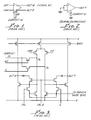
- FIG. 5 shows a schematic diagram of the differential amplifier with improved offset cancellation in accordance with the present invention.
- the transistors 501, 502, 503 are PMOS devices acting as a current source. Their gates are coupled to a BIAS voltage 505 generated from a separate BIAS circuit (not shown)
- the differential pair 510, 511 are also PMOS devices with their sources coupled to the drains of the PMOS 502.
- the input signals INM and INP are applied to the gates of the differential pair 510, 511, respectively. Coupled to the drains of the differential pair 510, 511 at branch pa and pb are the drains of load transistors 532, 533.
- One of the output signals, OUTM 520 appears at the node connecting the drain of PMOS 501, the drain of NMOS 523, and the drain of NMOS 536.
- the other output, OUTP 525 appears at the node connecting the drain of PMOS 503, the drain of NMOS 524 and the drain of NMOS 537.
- a calibration signal CAL 521 is applied to the gate of NMOS 530, which has its source connected to the source of NMOS 531 and the gate of NMOS 532.
- the complementary calibration CALB 522 is applied to the gates of NMOS transistors 523, 524. Note that the gate of NMOS 533 and the source of NMOS 531 are also coupled to common-mode circuitry (not shown), as will be understood by those skilled in the art.
- the floating current sources 514, 515 are connected between the branches pa and pb 513, 512, respectively, as previously described in connection with Figure 2, to apply a current of I.
- the calibration process begins with the signal Q going high to connect the current source 514. This will cause the output OUTP to gradually ramp down, until it flips to the other supply rail, thus crossing AGND. The current from current source 514 is therefore the current needed to cancel the offset voltage.
- the offset has the other polarity, then the maximum current will be reached without the output voltage level ever crossing AGND, since the output will reach and stay at the bottom rail.
- the other current source 515 will be connected by QB going high. Then the output voltage level OUTP will be ramped up to eventually cross AGND. The current from the current source 515 at this moment is therefore what is needed to cancel the offset.
- Figure 6 shows a symbolic representation of the differential amplifier with improved offset cancellation during calibration mode. As previously described, the two inputs are tied to AGND, while the output OUTP is checked for an AGND crossing to determine the current needed to cancel the output voltage offset.
Landscapes
- Engineering & Computer Science (AREA)
- Power Engineering (AREA)
- Amplifiers (AREA)
- Measurement Of Current Or Voltage (AREA)
Description
- The present invention relates to amplifier circuits and more particularly to fully differential amplifier circuits with differential offset.
- It is quite common to use fully differential amplifiers in the analog front end of signal buffers or filters such as those in audio applications, where high dynamic range is desired. With a higher dynamic range, the signal-to-noise ratio is increased. Figure 1 shows a conventional fully differential amplifier in its normal operation mode, while Figure 2 shows the same differential amplifier undergoing an initial calibration process. It will be appreciated by those skilled in the art that calibration is needed for these amplifiers due to the differential offset voltage from the differential pair transistors, which reduces the effective dynamic range of the circuit. The goal for calibration is therefore to determine the current needed to effectuate offset cancellation.
- Reference is to Figure 2. During the calibration cycles, the amplifier is converted into a single-ended comparator by having both inputs of the amplifiers grounded to analog ground ("AGND") and using switches to make the amplifier open-loop and single-ended. The positive output ("OUTP") will sit at the positive or negative supply rail, while a current is injected through Current-In. As more and more Current-In is applied to the amplifier, the voltage level of the output OUTP will flip sooner or later to the other supply rail and therefore cross AGND. Note that for analog applications, the AGND is typically half-way between the positive and negative supply rails. At this time, the current needed to cancel the differential offset voltage is determined. After calibration, the normal operation resumes as in the configuration of Figure 1 with the now-determined Current-In consistently applied to cancel the differential offset of the amplifier.
- Referring to Figure 3, where a schematic diagram of the conventional differential amplifier of Figure 2 is shown. Again, during calibration cycles, i.e. CAL is active, with both inputs INP and INM grounded to AGND, Current-In is supplying current to either branch pa or pb, depending upon whether Q or QB is active. (Note: Q and QB are complementary signals.) If Q is active, current is injected to the branch pa to ramp down the output voltage OUTP until OUTP's level crosses AGND. When AGND is crossed by the output OUTP, the current applied to branch pa is thus the requisite current to cancel the offset voltage of the differential pair.
- If, however, the maximum current is reached and the output OUTP never crossed AGND, it indicates that the offset voltage has another polarity, e.g. offset < 0. In this case, QB turns high and begins injecting current into branch pb to cause the voltage level of OUTP to ramp up and to cross AGND. This will determine the current, albeit in another direction, necessary to cancel the offset voltage of the input differential pair.
- As described, the conventional approach to offset cancellation has been to reduce the differential offset by injecting a current, I, in one of the two branches of the differential input pair. For fully differential amplifiers, this approach has resulted in a common-mode offset in that the differential offset is now, effectively, shifted by the injected current to the common-mode circuitry of the differential amplifier. Referring to Figure 3, the total current out of branches pa and pb is now greater than the current out of the current source CS due to the injected current from Current-In. To compensate for the difference, the common-mode circuitry (not shown) needs to generate an offset voltage, which will then adversely affect the dynamic range of the amplifier.
- Therefore, it is desirable to have a differential amplifier with offset cancellation of the differential signal without affecting the offset of the common-mode circuitry.
- It is also desirable to achieve offset cancellation without increasing complexity of the circuit.
- Further attention is drawn to the US patent 4,933,642, which discloses a CMOS chopper-stabilized operational amplifier including a nulling amplifier and a main amplifier and which has a pair of two input differential amplifiers in the input stage of each of the nulling amplifier and the main amplifier. In the nulling amplifier, one two-input differential amplifier switchably receives the input signals to the chopper stabilized operational amplifier, while the other two input differential amplifier functions in a feedback loop for developing a nulling voltage for the DC offset of the first two input differential amplifier. The operational amplifier has a three-phase clock and samples through a nulling time period, a setting time period, and a sampling time period.
- In accordance with the present invention a differential amplifier with offset cancellation, as set forth in claim 1 and 9 and a method for canceling a predetermined offset, as set forth in claim 12 is provided. Preferred embodiments of the invention are disclosed in the dependent claims.
- A differential amplifier with improved offset cancellation is disclosed. In this approach, the differential amplifier is converted to a single-ended comparator and the differential offset is reduced by injecting a current, Iin one branch and extracting the same current, lout of the other branch, without affecting the offset of the common-mode circuitry.
- The differential amplifier has a current source connected to a positive supply for providing current through the differential amplifier. Also, a differential pair in common source configuration is coupled to the current source with the common source being coupled to the current source. The differential pair is also coupled to an active load at their drain terminals and has a current source coupled to both the drain terminals of the differential pair for providing complementary currents, which are currents of the same amplitude but in opposite direction, to cancel the offset voltage. This way, the common-mode offset of the circuit is not affected by the injection.
- Additional objects, features and advantages of the present invention will become apparent to those skilled in the art from the following detailed description, wherein:
- Figure 1 shows a conventional fully differential amplifier in its normal operation mode.
- Figure 2 shows the same differential amplifier undergoing an initial calibration process.
- Figure 3 shows a schematic diagram of the conventional differential amplifier of Figure 2.
- Figure 4(a) shows a simplified schematic diagram of the improved offset cancellation amplifier in accordance with the present invention.
- Figure 4(b) shows another embodiment of the current source to be used in connection with the present invention.
- Figure 5 shows a schematic diagram of the differential amplifier with improved offset cancellation in accordance with the present invention.
- Figure 6 shows a symbolic representation of the improved differential amplifier with offset cancellation in calibration mode.
-
- Reference is to Figure 4(a), where a simplified schematic diagram of the improved offset cancellation amplifier in accordance with the present invention is shown. A current source ("CS") is coupled to the sources of a differential pair of transistors. The gates of the transistors are coupled to the differential input signals INP, INM. An active load is coupled to the drains of the differential pair and controlled by common-mode circuitry (not shown) through the signal BIAS. Note that the supply rails P and N are typically 2.7 V and 0V, respectively, for low-power applications. The outputs OUTP, OUTM appear at the drains of the differential pair of transistors. A floating current source, i.e. a current source with neither of its two terminals connected to a supply rail voltage, is coupled between the output nodes of OUTM and OUTP for branches pa and pb, respectively. Note that the floating current source injects current into the differential pair and extract the same from the differential pair.
- Referring to Figure 4(a), note that either Q or QB is switched on to allow current, I, be injected into branches pa or pb, and extracted from branches pb or pa, respectively. When Q is closed, a current, I, is injected into branch pa, while a current of the same magnitude is extracted from branch pb back to the current source. Similarly, when QB is closed, a current, I, is injected into branch pb, while the same is extracted from branch pa. Note that once the current, either through Q or QB, necessary to achieve offset cancellation is determined during calibration, the same current is consistently applied during normal operation. The net effect of this is that the total current into the differential pair has not changed and no shifting to the common-mode circuitry can take place to worsen the undesirable common-mode offset.
- Figure 4(b) shows another embodiment of the current source configuration for offset cancellation. Note that only one floating current source is used here.
- Figure 5 shows a schematic diagram of the differential amplifier with improved offset cancellation in accordance with the present invention. The
transistors differential pair PMOS 502. The input signals INM and INP are applied to the gates of thedifferential pair differential pair load transistors OUTM 520, appears at the node connecting the drain of PMOS 501, the drain ofNMOS 523, and the drain ofNMOS 536. Similarly, the other output,OUTP 525 , appears at the node connecting the drain ofPMOS 503, the drain ofNMOS 524 and the drain ofNMOS 537. - During calibration, a
calibration signal CAL 521 is applied to the gate ofNMOS 530, which has its source connected to the source ofNMOS 531 and the gate ofNMOS 532. The complementary calibration CALB 522 is applied to the gates ofNMOS transistors NMOS 533 and the source ofNMOS 531 are also coupled to common-mode circuitry (not shown), as will be understood by those skilled in the art. - The floating
current sources pb - When the signal CAL goes high, the calibration process begins with the signal Q going high to connect the
current source 514. This will cause the output OUTP to gradually ramp down, until it flips to the other supply rail, thus crossing AGND. The current fromcurrent source 514 is therefore the current needed to cancel the offset voltage. - However, if the offset has the other polarity, then the maximum current will be reached without the output voltage level ever crossing AGND, since the output will reach and stay at the bottom rail. In this case, the other
current source 515 will be connected by QB going high. Then the output voltage level OUTP will be ramped up to eventually cross AGND. The current from thecurrent source 515 at this moment is therefore what is needed to cancel the offset. - Figure 6 shows a symbolic representation of the differential amplifier with improved offset cancellation during calibration mode. As previously described, the two inputs are tied to AGND, while the output OUTP is checked for an AGND crossing to determine the current needed to cancel the output voltage offset.
- Although only a few exemplary embodiments of this invention have been described in detail above, those skilled in the art will readily appreciate that many modifications are possible in the exemplary embodiments without materially departing from the novel teachings and advantages of this invention. Accordingly, all such modifications are intended to be included within the scope of this invention as defined in the following claims. In the claims, means-plus-function clauses are intended to cover the structures described herein as performing the recited function and not only structural equivalents but also equivalent structures. Thus although a nail and a screw may not be structural equivalents in that a nail employs a cylindrical surface to secure wooden parts together, whereas a screw employs a helical surface, in the environment of fastening wooden parts, a nail and a screw may be equivalent structures.
Claims (12)
- A differential amplifier with offset cancellation, said differential amplifier having a predetermined output voltage offset, comprising:characterised in that said differential amplifier further comprisesfirst current source means (501,502,503) connected to a positive supply (p) for providing current through said differential amplifier;a differential pair (510,511) comprising source, drain and gate terminals in common source configuration, said common source being coupled to said first current source means (501,502,503);active load means connected to said drain terminals of said differential pair (510,511),Second current source means (514,515) coupled to both of said drain terminals of said differential pair (510,511) for injecting and extracting complementary currents to said drain terminals, respectively to cancel said predetermined offset voltage.
- A differential amplifier according to Claim 1, wherein said second current source means (514,515) comprises either one of at least one floating current source or at least two fixed current sources with complementary currents.
- A differential amplifier according to Claim 2, wherein: said differential pair (510,511) comprises a pair of PMOS transistors.
- A differential amplifier according to Claim 2, wherein: said differential pair (510,511) comprises a pair of NMOS transistors.
- A differential amplifier according to Claim 1, wherein said second current source means (514,515) comprises first and second current sources for injecting currents into said differential pair (510,511) to cancel said predetermined offset voltage.
- A differential amplifier according to Claim 2, wherein said floating current source means (514,515) comprises first and second current sources for injecting currents into, and extracting currents out of, said differential pair (510,511) to cancel said predetermined offset voltage.
- A differential amplifier according to Claim 3, wherein said floating current source means (514,515) comprises first and second current sources for injecting currents into, and extracting currents out of, said differential pair (510,511) to cancel said predetermined offset voltage.
- A differential amplifier according to Claim 4, wherein said floating current source means (514,515) comprises first and second current sources for injecting currents into, and extracting currents out of, said differential pair (510,511) to cancel said predetermined offset voltage.
- A differential amplifier with offset cancellation, said differential amplifier having a predetermined offset voltage, comprising:characterised in that said differential amplifier further comprisescurrent source means (501,502,503) coupled to a positive supply (p) for providing current through said differential amplifier;a differential pair (510,511) having source, gate and drain terminals in common source configuration, their common source terminals being coupled to said current source means (501,502,503);active load means coupled to the drain terminals of said differential pari (510,511),wherein both said first and second currents applied together cancel said predetermined offset voltage.first current source means (514) coupled to the drain terminal of said differential pair (510,511) for applying a first current to said differential pair, andsecond current source (515), equal in magnitude to, but opposite in direction to, said first current source means (514), coupled to another drain terminal of said differential pair (510,511) for applying a second current to said differential amplifier,
- A differential amplifier according to claim 9, wherein:
said differential pair (510,511) comprises a pair of PMOS transistors. - A differential amplifier according to claim 9, wherein:
said differential pair (510,511) comprises a pair of NMOS transistors. - A method of canceling a predetermined offset voltage is a differential amplifier, said differential amplifier comprising a first current source (501,502,503) connected to a positive supply for providing current through said differential amplifier, the method comprising the steps of:(a) connecting a differential pair (510,511) comprising source, drain and gate terminals in common source configuration, said common source being coupled to said first current source means (501,502,503);(b) connecting an active load to said drain terminals of said differential pair (510,511),
characterised by the step of(c) connecting a second current source (514,515) to said drain terminals of said differential pair (510,511) for providing complementary currents to said drain terminals to cancel said predetermined offset voltage, said current source applying a predetermined current to one drain terminal of said differential pair (510,511) while extracting a complementary current of said predetermined current from another drain terminal.
Applications Claiming Priority (2)
| Application Number | Priority Date | Filing Date | Title |
|---|---|---|---|
| US536331 | 1995-09-29 | ||
| US08/536,331 US5631603A (en) | 1995-09-29 | 1995-09-29 | Offset cancellation for differential amplifiers |
Publications (2)
| Publication Number | Publication Date |
|---|---|
| EP0768751A1 EP0768751A1 (en) | 1997-04-16 |
| EP0768751B1 true EP0768751B1 (en) | 2002-01-16 |
Family
ID=24138075
Family Applications (1)
| Application Number | Title | Priority Date | Filing Date |
|---|---|---|---|
| EP96115661A Expired - Lifetime EP0768751B1 (en) | 1995-09-29 | 1996-09-30 | Improved offset cancellation for differential amplifiers |
Country Status (4)
| Country | Link |
|---|---|
| US (1) | US5631603A (en) |
| EP (1) | EP0768751B1 (en) |
| JP (1) | JPH09130172A (en) |
| DE (1) | DE69618523T2 (en) |
Cited By (2)
| Publication number | Priority date | Publication date | Assignee | Title |
|---|---|---|---|---|
| TWI385922B (en) * | 2007-10-03 | 2013-02-11 | Renesas Electronics Corp | Semiconductor circuit |
| CN105954563A (en) * | 2016-05-16 | 2016-09-21 | 国电南瑞科技股份有限公司 | Method of identifying tail current based on current derivative and differential current zero-crossing |
Families Citing this family (15)
| Publication number | Priority date | Publication date | Assignee | Title |
|---|---|---|---|---|
| US6006169A (en) * | 1997-12-31 | 1999-12-21 | Intel Corporation | Method and apparatus for trimming an integrated circuit |
| US6072349A (en) * | 1997-12-31 | 2000-06-06 | Intel Corporation | Comparator |
| JP2004527179A (en) * | 2001-04-24 | 2004-09-02 | トリパス テクノロジー インコーポレイテッド | Improved DC offset self-calibration system for digital switching amplifier |
| US6535030B1 (en) * | 2001-06-19 | 2003-03-18 | Xilinx, Inc. | Differential comparator with offset correction |
| WO2003003568A2 (en) * | 2001-06-29 | 2003-01-09 | Infineon Technologies North America Corp. | Active auto zero circuit for programmable time continuous open loop amplifiers |
| DE10142707A1 (en) * | 2001-08-31 | 2003-04-03 | Infineon Technologies Ag | Multistage differential amplifier includes current source that additionally feeds current into feedback loop, to prevent current mirror from being switched OFF |
| US7026866B2 (en) * | 2003-03-28 | 2006-04-11 | Tripath Technology, Inc. | DC offset self-calibration system for a switching amplifier |
| US7154421B2 (en) * | 2003-12-12 | 2006-12-26 | Telasic Communications, Inc. | DNL/INL trim techniques for comparator based analog to digital converters |
| US7142047B2 (en) * | 2004-11-29 | 2006-11-28 | Tripath Technology, Inc. | Offset cancellation in a switching amplifier |
| US7321259B1 (en) | 2005-10-06 | 2008-01-22 | Altera Corporation | Programmable logic enabled dynamic offset cancellation |
| US7541857B1 (en) | 2005-12-29 | 2009-06-02 | Altera Corporation | Comparator offset cancellation assisted by PLD resources |
| US7368968B1 (en) * | 2005-12-29 | 2008-05-06 | Altera Corporation | Signal offset cancellation |
| TW201134088A (en) | 2010-03-31 | 2011-10-01 | Sunplus Technology Co Ltd | Differential offset calibration circuit |
| US12580539B2 (en) * | 2021-04-30 | 2026-03-17 | Sumitomo Electric Industries, Ltd. | Transimpedance amplifier circuit |
| US11888483B2 (en) * | 2022-04-05 | 2024-01-30 | Cypress Semiconductor Corporation | Clock signal conversion circuit for high-speed serial data controllers |
Family Cites Families (4)
| Publication number | Priority date | Publication date | Assignee | Title |
|---|---|---|---|---|
| US4806875A (en) * | 1988-05-11 | 1989-02-21 | Maxim Integrated Products | Precision operational amplifier |
| US4933642A (en) * | 1989-02-17 | 1990-06-12 | Linear Technology Corporation | CMOS chopper-stabilized operational amplifier using two differential amplifier pairs as input stages |
| DE59007921D1 (en) * | 1989-09-20 | 1995-01-19 | Itt Ind Gmbh Deutsche | Offset voltage balancing operational amplifier. |
| US5124663A (en) * | 1991-03-04 | 1992-06-23 | Motorola, Inc. | Offset compensation CMOS operational amplifier |
-
1995
- 1995-09-29 US US08/536,331 patent/US5631603A/en not_active Expired - Lifetime
-
1996
- 1996-09-27 JP JP8256242A patent/JPH09130172A/en not_active Withdrawn
- 1996-09-30 DE DE69618523T patent/DE69618523T2/en not_active Expired - Lifetime
- 1996-09-30 EP EP96115661A patent/EP0768751B1/en not_active Expired - Lifetime
Cited By (3)
| Publication number | Priority date | Publication date | Assignee | Title |
|---|---|---|---|---|
| TWI385922B (en) * | 2007-10-03 | 2013-02-11 | Renesas Electronics Corp | Semiconductor circuit |
| CN105954563A (en) * | 2016-05-16 | 2016-09-21 | 国电南瑞科技股份有限公司 | Method of identifying tail current based on current derivative and differential current zero-crossing |
| CN105954563B (en) * | 2016-05-16 | 2018-09-28 | 国电南瑞科技股份有限公司 | The method for identifying tail currents based on electric current derivation and difference current zero crossing |
Also Published As
| Publication number | Publication date |
|---|---|
| DE69618523D1 (en) | 2002-02-21 |
| DE69618523T2 (en) | 2002-09-05 |
| JPH09130172A (en) | 1997-05-16 |
| US5631603A (en) | 1997-05-20 |
| EP0768751A1 (en) | 1997-04-16 |
Similar Documents
| Publication | Publication Date | Title |
|---|---|---|
| EP0768751B1 (en) | Improved offset cancellation for differential amplifiers | |
| US5124663A (en) | Offset compensation CMOS operational amplifier | |
| EP1380101B1 (en) | A switched-capacitor, common-mode feedback circuit for a differential amplifier without tail current | |
| US6456159B1 (en) | CMOS operational amplifier | |
| US6624698B2 (en) | Low-voltage, broadband operational amplifier | |
| US5963156A (en) | Sample and hold circuit and method with common mode differential signal feedback for converting single-ended signals to differential signals | |
| US5663680A (en) | Chopper stabilized amplifier having an additional differential amplifier stage for improved noise reduction | |
| US6002299A (en) | High-order multipath operational amplifier with dynamic offset reduction, controlled saturation current limiting, and current feedback for enhanced conditional stability | |
| JPH0927722A (en) | Variable gain amplification device | |
| US7310016B2 (en) | Chopper-stabilized operational amplifier and method | |
| JPH08130422A (en) | Low voltage exchange capacitance circuit using exchange operational amplifier with maximum voltage swing | |
| EP0345621A2 (en) | High speed CMOS comparator with hysteresis | |
| JP3320434B2 (en) | Operational amplifier circuit | |
| US6396334B1 (en) | Charge pump for reference voltages in analog to digital converter | |
| US5798660A (en) | Cascoded differential pair amplifier with current injection for gain enhancement | |
| US20020105369A1 (en) | Clock buffer with DC offset suppression | |
| US6617921B2 (en) | High output swing comparator stage | |
| US5136255A (en) | Amplifier circuit | |
| EP0836275B1 (en) | High speed switched OP-AMP for low supply voltage applications | |
| US5923206A (en) | Charge injection cancellation technique | |
| CN111669166B (en) | Switching scheme for low offset switched capacitor integrator | |
| US6127855A (en) | Switch-capacitor circuit with overdrive-protected switch | |
| US7449950B2 (en) | Analog signal processing circuit | |
| US7888994B2 (en) | Differential to single-ended conversion circuit and comparator using the circuit | |
| US6480065B1 (en) | CMOS folding amplifier having high resolution and low power consumption |
Legal Events
| Date | Code | Title | Description |
|---|---|---|---|
| PUAI | Public reference made under article 153(3) epc to a published international application that has entered the european phase |
Free format text: ORIGINAL CODE: 0009012 |
|
| AK | Designated contracting states |
Kind code of ref document: A1 Designated state(s): DE FR GB |
|
| RIN1 | Information on inventor provided before grant (corrected) |
Inventor name: SHAMLOU, DARYUSH (NMI) Inventor name: MACROBBIE, EDWARD W. Inventor name: STUBBE, FREDERIC M. |
|
| 17P | Request for examination filed |
Effective date: 19971013 |
|
| 17Q | First examination report despatched |
Effective date: 19991216 |
|
| RAP1 | Party data changed (applicant data changed or rights of an application transferred) |
Owner name: CONEXANT SYSTEMS, INC. |
|
| GRAG | Despatch of communication of intention to grant |
Free format text: ORIGINAL CODE: EPIDOS AGRA |
|
| GRAG | Despatch of communication of intention to grant |
Free format text: ORIGINAL CODE: EPIDOS AGRA |
|
| GRAH | Despatch of communication of intention to grant a patent |
Free format text: ORIGINAL CODE: EPIDOS IGRA |
|
| GRAH | Despatch of communication of intention to grant a patent |
Free format text: ORIGINAL CODE: EPIDOS IGRA |
|
| GRAA | (expected) grant |
Free format text: ORIGINAL CODE: 0009210 |
|
| REG | Reference to a national code |
Ref country code: GB Ref legal event code: IF02 |
|
| AK | Designated contracting states |
Kind code of ref document: B1 Designated state(s): DE FR GB |
|
| REF | Corresponds to: |
Ref document number: 69618523 Country of ref document: DE Date of ref document: 20020221 |
|
| PLBE | No opposition filed within time limit |
Free format text: ORIGINAL CODE: 0009261 |
|
| STAA | Information on the status of an ep patent application or granted ep patent |
Free format text: STATUS: NO OPPOSITION FILED WITHIN TIME LIMIT |
|
| 26N | No opposition filed | ||
| REG | Reference to a national code |
Ref country code: GB Ref legal event code: 732E |
|
| REG | Reference to a national code |
Ref country code: FR Ref legal event code: TP |
|
| PGFP | Annual fee paid to national office [announced via postgrant information from national office to epo] |
Ref country code: DE Payment date: 20130919 Year of fee payment: 18 |
|
| PGFP | Annual fee paid to national office [announced via postgrant information from national office to epo] |
Ref country code: FR Payment date: 20130919 Year of fee payment: 18 Ref country code: GB Payment date: 20130919 Year of fee payment: 18 |
|
| REG | Reference to a national code |
Ref country code: DE Ref legal event code: R119 Ref document number: 69618523 Country of ref document: DE |
|
| GBPC | Gb: european patent ceased through non-payment of renewal fee |
Effective date: 20140930 |
|
| REG | Reference to a national code |
Ref country code: FR Ref legal event code: ST Effective date: 20150529 |
|
| PG25 | Lapsed in a contracting state [announced via postgrant information from national office to epo] |
Ref country code: GB Free format text: LAPSE BECAUSE OF NON-PAYMENT OF DUE FEES Effective date: 20140930 Ref country code: DE Free format text: LAPSE BECAUSE OF NON-PAYMENT OF DUE FEES Effective date: 20150401 |
|
| PG25 | Lapsed in a contracting state [announced via postgrant information from national office to epo] |
Ref country code: FR Free format text: LAPSE BECAUSE OF NON-PAYMENT OF DUE FEES Effective date: 20140930 |