EP0765814B1 - System for application of labels - Google Patents
System for application of labels Download PDFInfo
- Publication number
- EP0765814B1 EP0765814B1 EP96306945A EP96306945A EP0765814B1 EP 0765814 B1 EP0765814 B1 EP 0765814B1 EP 96306945 A EP96306945 A EP 96306945A EP 96306945 A EP96306945 A EP 96306945A EP 0765814 B1 EP0765814 B1 EP 0765814B1
- Authority
- EP
- European Patent Office
- Prior art keywords
- label
- labels
- assemblies
- needle
- racks
- Prior art date
- Legal status (The legal status is an assumption and is not a legal conclusion. Google has not performed a legal analysis and makes no representation as to the accuracy of the status listed.)
- Expired - Lifetime
Links
- 230000000712 assembly Effects 0.000 claims description 68
- 238000000429 assembly Methods 0.000 claims description 68
- 238000002372 labelling Methods 0.000 claims description 25
- 239000000853 adhesive Substances 0.000 claims description 8
- 230000001070 adhesive effect Effects 0.000 claims description 8
- 230000001154 acute effect Effects 0.000 claims description 3
- 230000000007 visual effect Effects 0.000 claims description 3
- 239000004820 Pressure-sensitive adhesive Substances 0.000 claims description 2
- 238000009499 grossing Methods 0.000 claims description 2
- 230000000149 penetrating effect Effects 0.000 description 13
- 238000004519 manufacturing process Methods 0.000 description 10
- 239000008280 blood Substances 0.000 description 5
- 210000004369 blood Anatomy 0.000 description 5
- 244000005700 microbiome Species 0.000 description 4
- 238000011194 good manufacturing practice Methods 0.000 description 3
- 230000002093 peripheral effect Effects 0.000 description 3
- 230000004888 barrier function Effects 0.000 description 2
- 230000036512 infertility Effects 0.000 description 2
- 238000000034 method Methods 0.000 description 2
- 238000009877 rendering Methods 0.000 description 2
- 238000011282 treatment Methods 0.000 description 2
- 238000004804 winding Methods 0.000 description 2
- IAYPIBMASNFSPL-UHFFFAOYSA-N Ethylene oxide Chemical compound C1CO1 IAYPIBMASNFSPL-UHFFFAOYSA-N 0.000 description 1
- 230000004075 alteration Effects 0.000 description 1
- 230000001010 compromised effect Effects 0.000 description 1
- 239000003814 drug Substances 0.000 description 1
- 229940079593 drug Drugs 0.000 description 1
- 239000012943 hotmelt Substances 0.000 description 1
- 238000002347 injection Methods 0.000 description 1
- 239000007924 injection Substances 0.000 description 1
- 230000005865 ionizing radiation Effects 0.000 description 1
- 239000004745 nonwoven fabric Substances 0.000 description 1
- 230000001105 regulatory effect Effects 0.000 description 1
- 239000002904 solvent Substances 0.000 description 1
- 230000002459 sustained effect Effects 0.000 description 1
- 210000003462 vein Anatomy 0.000 description 1
Images



Classifications
-
- B—PERFORMING OPERATIONS; TRANSPORTING
- B65—CONVEYING; PACKING; STORING; HANDLING THIN OR FILAMENTARY MATERIAL
- B65C—LABELLING OR TAGGING MACHINES, APPARATUS, OR PROCESSES
- B65C9/00—Details of labelling machines or apparatus
- B65C9/08—Label feeding
- B65C9/18—Label feeding from strips, e.g. from rolls
- B65C9/1865—Label feeding from strips, e.g. from rolls the labels adhering on a backing strip
- B65C9/1869—Label feeding from strips, e.g. from rolls the labels adhering on a backing strip and being transferred directly from the backing strip onto the article
-
- B—PERFORMING OPERATIONS; TRANSPORTING
- B65—CONVEYING; PACKING; STORING; HANDLING THIN OR FILAMENTARY MATERIAL
- B65C—LABELLING OR TAGGING MACHINES, APPARATUS, OR PROCESSES
- B65C3/00—Labelling other than flat surfaces
- B65C3/06—Affixing labels to short rigid containers
- B65C3/08—Affixing labels to short rigid containers to container bodies
- B65C3/14—Affixing labels to short rigid containers to container bodies the container being positioned for labelling with its centre-line vertical
-
- B—PERFORMING OPERATIONS; TRANSPORTING
- B65—CONVEYING; PACKING; STORING; HANDLING THIN OR FILAMENTARY MATERIAL
- B65C—LABELLING OR TAGGING MACHINES, APPARATUS, OR PROCESSES
- B65C9/00—Details of labelling machines or apparatus
- B65C9/02—Devices for moving articles, e.g. containers, past labelling station
-
- B—PERFORMING OPERATIONS; TRANSPORTING
- B65—CONVEYING; PACKING; STORING; HANDLING THIN OR FILAMENTARY MATERIAL
- B65C—LABELLING OR TAGGING MACHINES, APPARATUS, OR PROCESSES
- B65C9/00—Details of labelling machines or apparatus
- B65C9/26—Devices for applying labels
- B65C9/36—Wipers; Pressers
-
- Y—GENERAL TAGGING OF NEW TECHNOLOGICAL DEVELOPMENTS; GENERAL TAGGING OF CROSS-SECTIONAL TECHNOLOGIES SPANNING OVER SEVERAL SECTIONS OF THE IPC; TECHNICAL SUBJECTS COVERED BY FORMER USPC CROSS-REFERENCE ART COLLECTIONS [XRACs] AND DIGESTS
- Y10—TECHNICAL SUBJECTS COVERED BY FORMER USPC
- Y10T—TECHNICAL SUBJECTS COVERED BY FORMER US CLASSIFICATION
- Y10T156/00—Adhesive bonding and miscellaneous chemical manufacture
- Y10T156/17—Surface bonding means and/or assemblymeans with work feeding or handling means
- Y10T156/1702—For plural parts or plural areas of single part
- Y10T156/1705—Lamina transferred to base from adhered flexible web or sheet type carrier
- Y10T156/1707—Discrete spaced laminae on adhered carrier
- Y10T156/171—Means serially presenting discrete base articles or separate portions of a single article
-
- Y—GENERAL TAGGING OF NEW TECHNOLOGICAL DEVELOPMENTS; GENERAL TAGGING OF CROSS-SECTIONAL TECHNOLOGIES SPANNING OVER SEVERAL SECTIONS OF THE IPC; TECHNICAL SUBJECTS COVERED BY FORMER USPC CROSS-REFERENCE ART COLLECTIONS [XRACs] AND DIGESTS
- Y10—TECHNICAL SUBJECTS COVERED BY FORMER USPC
- Y10T—TECHNICAL SUBJECTS COVERED BY FORMER US CLASSIFICATION
- Y10T156/00—Adhesive bonding and miscellaneous chemical manufacture
- Y10T156/17—Surface bonding means and/or assemblymeans with work feeding or handling means
- Y10T156/1702—For plural parts or plural areas of single part
- Y10T156/1744—Means bringing discrete articles into assembled relationship
- Y10T156/1768—Means simultaneously conveying plural articles from a single source and serially presenting them to an assembly station
-
- Y—GENERAL TAGGING OF NEW TECHNOLOGICAL DEVELOPMENTS; GENERAL TAGGING OF CROSS-SECTIONAL TECHNOLOGIES SPANNING OVER SEVERAL SECTIONS OF THE IPC; TECHNICAL SUBJECTS COVERED BY FORMER USPC CROSS-REFERENCE ART COLLECTIONS [XRACs] AND DIGESTS
- Y10—TECHNICAL SUBJECTS COVERED BY FORMER USPC
- Y10T—TECHNICAL SUBJECTS COVERED BY FORMER US CLASSIFICATION
- Y10T156/00—Adhesive bonding and miscellaneous chemical manufacture
- Y10T156/17—Surface bonding means and/or assemblymeans with work feeding or handling means
- Y10T156/1702—For plural parts or plural areas of single part
- Y10T156/1744—Means bringing discrete articles into assembled relationship
- Y10T156/1768—Means simultaneously conveying plural articles from a single source and serially presenting them to an assembly station
- Y10T156/1771—Turret or rotary drum-type conveyor
- Y10T156/1773—For flexible sheets
Definitions
- the present invention generally relates to the labeling of objects and more particularly to a system for high speed application of labels to objects according to the preamble of claim 1.
- Labels are applied to manufactured articles for many reasons. They provide identification, instructions for use and, increasingly, provide evidence of tampering with or prior use of the article.
- Tamper evidence or evidence of prior usage of an article is particularly important in the medical device industry. Many medical devices are intended only to be used once, then properly disposed of. These devices are also often supplied as "sterile until opened.” Sterile single use medical devices often have a label applied over a joint between a removable cover and a functional part of the device. The cover serves as a barrier to the passage of microorganisms and provides physical protection to the functional part of the device. The label over the joint with the cover provides the tamper evidence on these sterile single use medical devices. When used in this fashion, the label is generally designed to adhere strongly to the elements forming the joint and be irreversibly visually altered when the cover is moved with respect to the functional part of the device. The alteration of the label provides visual evidence that the cover has been moved and that the sterility barrier of the device has been breached.
- tamper-evident labels When a label additionally serves as tamper evidence for sterile single use devices, several other requirements are added.
- the tamper-evident labels not only need to be securely applied to the device, they must be visually altered when the device is opened, and they should not substantially impede the opening of the device for its intended use.
- An example of a medical device produced in high volume where the label is used for tamper evidence is a disposable needle assembly used with evacuated blood collection tubes.
- the needle assembly has a hub for holding a needle that has one end to penetrate the patient's vein and another end to pierce a rubber stopper on the evacuated blood collection tube.
- Each end of the needle is covered by a needle shield mounted onto the hub to protect their respective needle end.
- One needle shield abuts a side of a circumferential rib on the hub and the other shield fits over a portion of the first shield forming a joint that has a label applied over it.
- This label serves to secure the shields to each other and, when either shield is moved with respect to the other, the label is irreversibly torn, providing evidence that the sterility of the assembly may have been compromised.
- the needle assemblies are produced on a carrier system where the hub is mounted onto a station on the carrier, the needle is fitted into the hub with the patient penetrating end upward, the needle is bonded into the hub, and then the first needle shield is fitted onto the hub to shield the patient end of the needle.
- These partially completed assemblies are then transferred to a rack where the stopper penetrating end of the needle is upward.
- a resilient valve is then installed over the stopper penetrating end of the needle and the second needle shield is positioned onto the hub.
- the shielded assemblies are removed from the rack, fitted into a labeling apparatus and a label applied over the joint between the shields. The assemblies are then packaged and exposed to conditions that render any microorganisms inside the assembly nonviable.
- a phlebotomist removes the shield from the stopper penetrating end of the needle assembly, mounts the assembly on a needle holder and removes the shield from the patient penetrating end of the needle to withdraw blood from a patient. Since the label provides evidence of movement of the shields with respect to each other, if the label is not strong enough, either shield may be moved during shipment or handling prior to actual use, tearing the label and causing the phlebotomist to discard the assembly as possibly contaminated. If the label is too strong, the phlebotomist may have difficulty in removing the shields, causing an inefficiency in the clinical usage of the needle assembly.
- JP 4339747 discloses a method for affixing labels, wherein a label moved along a peeling plate and peeled off from a base board is attracted onto an outer peripheral surface of a winding roller and pasted on an outer peripheral surface of the injection needle housing container which moves to come into contact with the outer peripheral surface of the winding roller.
- the present invention provides a system for applying labels to shielded needle assemblies, comprising;
- the labelling system of the invention is particularly well suited for application of tamper evidence labels over a joint between the shields and the hub of a needle assembly used with evacuated blood collection tubes.
- the system of the invention utilizes a rack system currently used for assembling the needle assemblies to deliver the assemblies to the label applicator where labels are applied to the assemblies while they are mounted in the racks.
- the labelling system of the invention simplifies the current manufacturing process by eliminating a separate handling step.
- the labels applied by the system reliably meet the stringent GMP requirements for the devices and, additionally, allow a phlebotomist to easily remove the covers from the hub in clinical usage.
- System 10 includes a supply 13 of needle assemblies 14 to have labels 12 applied at a label applicator 18.
- assemblies 14 are mounted on a plurality of racks 16, each having twenty-five assemblies, so that assemblies 14 are substantially equally spaced and aligned in single file.
- System 10 includes a label supply 20 to provide labels 12. After the labels are applied to needle assemblies 14 at the label applicator, the labeled assemblies still mounted in racks 16, pass through a label finisher 22 to complete the labeling.
- labeling system 10 is used to apply labels 12 to a plurality of needle assemblies 14 as illustrated in Fig. 2.
- the system of the present invention is suitable for the application of labels to informational labels and tamper evident labels to substantially any object produced in large quantities that can be supplied to the label application station substantially equally spaced in single file.
- the system of the invention is particularly well suited for labeling sets of objects that are already produced in assembly racks with a predetermined number of objects in each rack.
- the system of the invention is capable of application of the labels to the objects while they are still in their racks. This capability of the system of the invention to apply labels to the objects while they are still in the assembly racks substantially maintains the object orientation and count already present in an existing system and generally improves the efficiency of the overall manufacturing process for the objects. It is intended that application of labels to objects other than needle assemblies and other than medical devices be included in the scope ofthe present invention.
- needle assembly 14 includes a needle hub 24 for mounting a needle 26 that has a patient penetrating end 28 and a stopper penetrating end 30.
- hub 24 initially is mounted into a carrier and then needle 26 is fitted into the hub so that patient penetrating end 28 of the needle is upward. Needle 26 is then bonded to the hub and a patient end needle shield 32 is fitted. Shield 32 covers patient penetrating end 28 of the needle and mounts onto a first part 34 of hub 24 to abut one side 35 of a circumferential ring 36 on hub 24.
- the partially completed assembly is then removed from the carrier and placed in rack 16 (as seen with completed assemblies 14 in Fig. 1) so that stopper penetrating end 30 of the needle is upward.
- a resilient valve 38 is then placed over stopper penetrating end 30 and a stopper penetrating end shield 40 is fitted.
- Shield 40 covers stopper penetrating end 30 and mounts onto a portion 42 of shield 32 to abut a shoulder 37 on shield 32.
- a label is then applied to the assembly covering at least a portion of the juncture of shields 32 and 40.
- the completed assembly is removed from the rack, individually placed onto a separate labeling apparatus and the label is applied in a secondary operation.
- label supply 20 includes a multiplicity of labels 12 as shown in Figs. 4 and 5. Each label is joined at an end 41 to at least one other label as shown in Fig. 5.
- labels 12 are supplied in a plurality of sets 44 each with twenty-five labels 12 having a perforation 46 at the end 41 where it joins the other label to form the set corresponding to the twenty-five needle assemblies 14 in each of racks 16.
- Sets 44 of the labels are releasably mounted on a continuous release strip 48.
- the labels either may be continuous or in sets having larger or smaller numbers of labels to correspond to the object supply.
- label 12 has an exposed side 50 and an adhesive side 52 (schematically illustrated by a turned down corner 51).
- Adhesive side 52 has a layer of pressure sensitive adhesive 54 applied to it.
- Adhesive 54 releasably adheres labels 12 onto release strip 48 and fixedly adheres labels 12 to assemblies 14. Suitable adhesives include, but are not limited to hot melts, aqueous based and solvent based adhesives.
- Label 12 may be formed from paper, non-wovens, polymeric films and the like.
- label 12 is formed from paper and includes a tamper evident portion 55 having reduced strength due to a multiplicity of slits 56 through the label in the reduced strength portion.
- preferred label 12 is visibly irreversibly torn, preferably at slits 56, if either shield 32 or shield 40 is moved with respect to each other, providing the tamper evidence property.
- Other forms of tamper evidence provided by openings in the label, notching and the like, are suitable to provide reduced strength in at least a portion of the label, in addition to the preferred slits, and are considered within the scope of the invention.
- label applicator 18 preferably includes a first reel 58 containing label supply 20 on one side 59 of release strip 48.
- Release strip 48 is preferably unrolled from reel 58 around roller 60, with side 59 facing the objects, in this example, assemblies 14, and taken up around second reel 62.
- Roller 60 is positioned so that an acute angle ⁇ is formed by the release strip from reel 58 to reel 62.
- labels 12 are partially detached from side 59 of the release paper, presented to and transferred to each assembly 14 as the assemblies in the racks are moved past the roller.
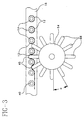
- the labels are supplied in sets 44 spaced apart on continuous release strip 48 a distance "a" allowing for a spacing "b” between the racks as seen in Fig. 1. Additionally, the spacing distance "a” between sets 44 allows the label supply to be started and stopped, allowing the label supply to be substantially conformed to the delivery of the racks containing the needle assemblies so that a "start" label 45 of sets 44 of the labels is presented to and transferred to an initially positioned needle assembly 47 of the racks of assemblies at label applicator 18. Within sets 44, the labels are sized and spaced so that perforation 46 is intermediate the uniformly spaced assemblies on the racks when the labels are applied to the assemblies. After the labels are applied to the assemblies, the assemblies, still in racks 16, are moved to the label finisher 22.
- preferred label finisher 22 includes a wheel 64 with a plurality of teeth 66 that have a pitch "c" corresponding to distance "d," the distance between perforations 46 of the labels in sets 44.
- wheel 64 is positioned so that teeth 66 engage perforations 46 as the racks with the assemblies are moved through the system and detach the labels from one another at the perforations. Additionally, teeth 66 serve to smooth the ends of the labels onto the assemblies, substantially ensuring that the labels are securely adhered to the assemblies.
- Assemblies labeled by the system of the present invention were compared to assemblies labeled using the current system that requires the secondary operation.
- the comparison measured the torque required to twist the needle shields and break the label.
- One hundred randomly selected assemblies of each type were collected from each of two trial runs and the label breakage torque was determined with a standard laboratory strain gauge.
- the results of the comparison showed that labels applied by the preferred system of the present invention required only about sixty percent of the force required to break labels applied by the existing system
- the reduced label breakage torque is a benefit to the end-user phlebotomist.
- the preferred system of the present invention was capable of reliably applying labels to more than one thousand assemblies per minute compared to the capacity of four to five hundred per minute of the existing system.
- the system of the present invention is mechanically less complex than the existing system, eliminating an entire handling step and the mechanically complex secondary operation.
- the orientation and the numerical count of the labeled assemblies is maintained through the labeling because the labeled assemblies are still in the racks in which they were assembled.
- the finished labeled assemblies are transferred directly into their final package from the assembly racks. Then, the packages are sealed and exposed to conditions rendering nonviable any microorganisms contained therein. Suitable conditions for rendering microorganisms nonviable include, but are not limited to, exposure to ethylene oxide and ionizing radiation. After the exposure, the labeled assemblies are considered "sterile" until the shields are removed.
- the label applied by the system of the present invention provides evidence of any movement of the shields with respect to the hub.
- the preferred system of the present invention substantially improves the efficiency of the labeling of needle assemblies by eliminating the secondary operation and additional handling of the assemblies required by the current labeling operation.
- the system is compact and easily fits into less space than is occupied by the equipment used in the current secondary operation.
- the system of the invention is capable of reliable sustained high speed operation and provides a labeled product with superior end-user use properties to those provided by the current labeling operation.
Landscapes
- Labeling Devices (AREA)
Description
Claims (10)
- A system for applying labels [12] to shielded needle assemblies [14], comprising;a supply of shielded needle assemblies [14], the assemblies [14] being arrayed in racks [16] having a predetermined number of the assemblies [14] substantially equally spaced and aligned in single file for labelling;a label applicator [18] for receiving the racks [16] of assemblies and applying a label [12] to each of the assemblies [14]; anda label supply [20] for supplying labels [12] to said label applicator [18], characterised in that;each shielded needle assembly [14] includes two shields [32, 40] releasably mounted on opposing ends of a needle hub [24] forming a juncture on the hub [24],the labels [12] are tamper-indicating labels [12] which are supplied in sets having a number of labels [12] corresponding to the predetermined number of assemblies [14] in the racks [16], said labels [12] in said sets being joined at an end to at least one other label of said set;the labels [12] are applied to shielded needle assemblies [14] at the juncture between the shields [32, 40] and the needle hub [24]; andthere is provided a labelling finisher [22] for detaching said end of said each label from said at least one other label in said set and smoothing said ends of each of said labels [12] onto their respective needle assembly [14].
- The system of claim 1 wherein said label supply [20] further comprises said sets of labels [12] being releasably adhered to and linearly spaced a predetermined distance apart on one side of continuous release paper strip [48], said spacing substantially corresponding to a distance between the racks [16] of said supply of needle assemblies [14].
- The system of claim 2 wherein said labels [12] are formed from paper having an exposed side [50] and an adhesive side [52], said adhesive side [52] having a layer of pressure sensitive adhesive applied thereto for releasably adhering said labels [12] to said release paper and for fixedly adhering said labels [12] to said needle assemblies [14].
- The system of claim 3 wherein said label applicator [18]further comprises a first reel [58], a second reel [62] and a roller [60], said release paper [48] having said labels [12] thereon being unrollable from said first reel [58] about said roller [60] and being taken up on said second reel [62], said release paper [48] forming an acute angle with said roller [60] between said first and said second reel, said roller [60] being disposed to present and to transfer said labels [12] from said one side of said release paper strip [48] to the needle assemblies [14] in the racks [16].
- The system of claim 4 wherein the joining of each label [12] to at least one other label comprises perforations [46] spaced at predetermined intervals so that one of said each label [12] is applied to one of each of the needle assemblies [14] and said perforations [46] are intermediate each of the needle assemblies [14].
- The system of claim 5 wherein said each label [12] is detachable from said at least one other label [12] at said perforation [46] by said label finisher [22].
- The system of claim 6 wherein said label finisher [22] comprises a wheel [64] having a plurality of outward teeth [66] having a pitch substantially equal to the spacing between said perforations [46], said label finisher [22] being disposed so that said teeth [66] engage said perforations [46] as said needle assemblies [14] are moved through said label finisher [22] on the racks [16], and detach said labels [12] at said perforations [46].
- The system of claim 3 wherein each of said labels [12] further comprises a portion having reduced strength in comparison to another portion of said label so that when either of the shields [32, 40] is moved from an initial position to another position with respect to each other after said label [12] is applied, said label [12] substantially noticeably tears at said reduced strength portion thereby providing visual evidence of tampering with the assembly.
- The system of claim 8 wherein said portion or each of said labels [12] having reduced strength is selected from the group consisting of a plurality of openings through said label, slits therethrough, notches and combinations of openings, slits and notches so that when either of the shields [32, 40] is moved from an initial position to another position with respect to the hub [24] after said label [12] is applied, said label [12] substantially noticeably tears at said portion thereby providing visual evidence of tampering with the assembly.
- The system of claim 9 wherein said portion having reduced strength comprises a plurality of slits through said label.
Applications Claiming Priority (2)
| Application Number | Priority Date | Filing Date | Title |
|---|---|---|---|
| US08/534,917 US5705024A (en) | 1995-09-28 | 1995-09-28 | System for application of labels |
| US534917 | 1995-09-28 |
Publications (2)
| Publication Number | Publication Date |
|---|---|
| EP0765814A1 EP0765814A1 (en) | 1997-04-02 |
| EP0765814B1 true EP0765814B1 (en) | 1999-08-25 |
Family
ID=24132062
Family Applications (1)
| Application Number | Title | Priority Date | Filing Date |
|---|---|---|---|
| EP96306945A Expired - Lifetime EP0765814B1 (en) | 1995-09-28 | 1996-09-24 | System for application of labels |
Country Status (4)
| Country | Link |
|---|---|
| US (1) | US5705024A (en) |
| EP (1) | EP0765814B1 (en) |
| JP (1) | JP2781171B2 (en) |
| DE (1) | DE69603925T2 (en) |
Families Citing this family (20)
| Publication number | Priority date | Publication date | Assignee | Title |
|---|---|---|---|---|
| US5853439A (en) * | 1997-06-27 | 1998-12-29 | Donaldson Company, Inc. | Aerosol separator and method |
| US6013150A (en) * | 1997-12-02 | 2000-01-11 | Grinnell Corporation | Article tagging apparatus and method |
| FR2789972B1 (en) * | 1999-02-18 | 2001-06-01 | Oreal | METHOD FOR SUPPLYING A LABELING STATION AND LABEL HOLDER |
| FR2789971B1 (en) * | 1999-02-18 | 2001-06-01 | Oreal | METHOD FOR SUPPLYING A LABELING STATION AND LABEL HOLDER |
| US7229517B2 (en) * | 2000-06-06 | 2007-06-12 | Applied Extrusion Technologies, Inc. | Labeling apparatus and method employing radiation curable adhesive |
| US7074295B2 (en) * | 2000-06-06 | 2006-07-11 | Applied Extrusion Technologies, Inc. | Labelling apparatus and method for correcting visual adhesive defects |
| US6551439B1 (en) | 2000-06-06 | 2003-04-22 | Applied Extrusion Technologies, Inc. | Ultraviolet labeling apparatus and method |
| WO2001094211A2 (en) * | 2000-06-06 | 2001-12-13 | Applied Extrusion Technologies Inc. | Labeling apparatus and method employing radiation curable adhesive |
| JP2002347145A (en) * | 2001-05-29 | 2002-12-04 | Toppan Forms Co Ltd | IC labeler and IC label forming method |
| US6875304B2 (en) * | 2003-04-17 | 2005-04-05 | Brady Worldwide, Inc. | Label applicator |
| US7014139B2 (en) * | 2003-04-17 | 2006-03-21 | Brady Worldwide, Inc. | Unwind spool assembly |
| US7178572B2 (en) * | 2003-04-17 | 2007-02-20 | Brady Worldwide, Inc. | Label wrapper block assembly |
| US7231952B2 (en) * | 2003-04-17 | 2007-06-19 | Brady Worldwide, Inc. | Label wrapper assembly |
| US20060134364A1 (en) * | 2004-12-16 | 2006-06-22 | Landoll Leo M | Clear, peelable plastic labels |
| DE102008018200A1 (en) * | 2008-04-10 | 2009-10-15 | Krones Ag | Device for applying self-adhesive labels to containers and self-adhesive label |
| CN102700788B (en) * | 2012-05-31 | 2014-12-03 | 浙江双枪竹木有限公司 | Equipment for sticking paint prevention paster to chopsticks and dedicated paster belt |
| CN106428696A (en) * | 2016-08-28 | 2017-02-22 | 浙江强力控股有限公司 | Tin wire packaging forming device |
| US11247338B2 (en) | 2016-12-15 | 2022-02-15 | Kyoraku Co., Ltd. | Robot system and cutting blade |
| JP7089340B2 (en) * | 2016-12-15 | 2022-06-22 | キョーラク株式会社 | Robot system |
| CN109606887B (en) * | 2018-12-19 | 2023-08-22 | 威海万丰镁业科技发展有限公司 | Hub welting device |
Family Cites Families (15)
| Publication number | Priority date | Publication date | Assignee | Title |
|---|---|---|---|---|
| US3174888A (en) * | 1962-05-14 | 1965-03-23 | Morgan Adhesives Co | Method of labeling articles |
| FR1357785A (en) * | 1963-02-28 | 1964-04-10 | Labeling machine | |
| DE2627757A1 (en) * | 1976-06-21 | 1977-12-29 | Gerhard Schubert Gmbh Spezialm | LABELING MACHINE |
| US4115179A (en) * | 1976-12-06 | 1978-09-19 | A-T-O Inc. | Wrap neck label mechanism |
| GB1559179A (en) * | 1976-12-17 | 1980-01-16 | Precision Packaging Machinery | Labelling machines |
| US4275856A (en) * | 1978-10-27 | 1981-06-30 | Diamond International Corporation | Heat transfer labeling machine |
| WO1980002131A1 (en) * | 1979-04-05 | 1980-10-16 | Fukushima Printing Ind | Apparatus for adhering labels |
| US4522672A (en) * | 1981-02-26 | 1985-06-11 | Monarch Marking Systems, Inc. | Composite label web and method of making and method of applying labels |
| US4624734A (en) * | 1984-10-19 | 1986-11-25 | New Jersey Machine Inc. | Label dispenser with articulated guide |
| GB8606629D0 (en) * | 1986-03-18 | 1986-04-23 | Waddington John Plc | Application of labels to articles |
| US4758300A (en) * | 1986-10-03 | 1988-07-19 | Stackpole Limited | High speed labelling machine |
| JPH0248333U (en) * | 1988-09-29 | 1990-04-04 | ||
| JPH0341712U (en) * | 1989-08-30 | 1991-04-22 | ||
| JPH04339747A (en) * | 1991-05-14 | 1992-11-26 | Nissho Corp | Labeling device |
| US5254099A (en) * | 1992-03-10 | 1993-10-19 | Injectimed. Inc. | Hard cover for pre-cocking protected injection apparatus |
-
1995
- 1995-09-28 US US08/534,917 patent/US5705024A/en not_active Expired - Lifetime
-
1996
- 1996-09-24 EP EP96306945A patent/EP0765814B1/en not_active Expired - Lifetime
- 1996-09-24 DE DE69603925T patent/DE69603925T2/en not_active Expired - Lifetime
- 1996-09-30 JP JP8259451A patent/JP2781171B2/en not_active Expired - Fee Related
Also Published As
| Publication number | Publication date |
|---|---|
| JPH09104424A (en) | 1997-04-22 |
| DE69603925T2 (en) | 2000-04-20 |
| JP2781171B2 (en) | 1998-07-30 |
| US5705024A (en) | 1998-01-06 |
| DE69603925D1 (en) | 1999-09-30 |
| EP0765814A1 (en) | 1997-04-02 |
Similar Documents
| Publication | Publication Date | Title |
|---|---|---|
| US5705024A (en) | System for application of labels | |
| CA1146609A (en) | Sealing cover and method for resealing an intravenous container | |
| US4423819A (en) | Flexible sterile closure system for containers | |
| US4550842A (en) | Flexible plastic sterile closure system for containers | |
| US7815123B2 (en) | Sterile medication identification delivery and application system | |
| CA2237570C (en) | A removably replaceable, readherable label | |
| US6193279B1 (en) | Label for labelling of preferably cylindrical containers | |
| US5958536A (en) | Self-adhesive label with detachable sticker | |
| EP1276089B1 (en) | Label for labelling of preferably cylindrical containers | |
| CA2178801C (en) | Double-blind label and method for double-blind labelling | |
| EP0989944B1 (en) | Flexible sealing cover with seal break indicator | |
| US4598834A (en) | Flexible sterile closure system for a container with a side injection port | |
| US4394904A (en) | Peripherally supported package for adhesive-surfaced articles | |
| US4505770A (en) | Peripherally supported package for adhesive-surfaced articles | |
| AU2004231205A1 (en) | Label, syringe body and syringe arrangement with label | |
| JP2010168063A (en) | Label for packaging vessel | |
| US8365451B2 (en) | Multi-layer label for affixing to a curved surface, particularly to a cylindrical surface, of an object | |
| WO2004039678A2 (en) | Labeling apparatus and method of making same | |
| JPH11507255A (en) | Multipurpose bottle for subcutaneous dosing and drug dispensing systems | |
| JPH03124433A (en) | Manufacture of label tape | |
| JPH0571874U (en) | Multifunctional label | |
| JPH05943Y2 (en) | ||
| JP2004041565A (en) | Lid label for vial bottle and usage of the same | |
| CA1205311A (en) | Method of making a flexible sterile closure system for containers | |
| JPH0666680U (en) | Ampoule wrapping paper and packaging |
Legal Events
| Date | Code | Title | Description |
|---|---|---|---|
| PUAI | Public reference made under article 153(3) epc to a published international application that has entered the european phase |
Free format text: ORIGINAL CODE: 0009012 |
|
| AK | Designated contracting states |
Kind code of ref document: A1 Designated state(s): DE FR GB IT |
|
| 17P | Request for examination filed |
Effective date: 19970930 |
|
| 17Q | First examination report despatched |
Effective date: 19980309 |
|
| GRAG | Despatch of communication of intention to grant |
Free format text: ORIGINAL CODE: EPIDOS AGRA |
|
| GRAG | Despatch of communication of intention to grant |
Free format text: ORIGINAL CODE: EPIDOS AGRA |
|
| GRAG | Despatch of communication of intention to grant |
Free format text: ORIGINAL CODE: EPIDOS AGRA |
|
| GRAH | Despatch of communication of intention to grant a patent |
Free format text: ORIGINAL CODE: EPIDOS IGRA |
|
| GRAH | Despatch of communication of intention to grant a patent |
Free format text: ORIGINAL CODE: EPIDOS IGRA |
|
| GRAA | (expected) grant |
Free format text: ORIGINAL CODE: 0009210 |
|
| AK | Designated contracting states |
Kind code of ref document: B1 Designated state(s): DE FR GB IT |
|
| REF | Corresponds to: |
Ref document number: 69603925 Country of ref document: DE Date of ref document: 19990930 |
|
| ITF | It: translation for a ep patent filed | ||
| ET | Fr: translation filed | ||
| PLBE | No opposition filed within time limit |
Free format text: ORIGINAL CODE: 0009261 |
|
| STAA | Information on the status of an ep patent application or granted ep patent |
Free format text: STATUS: NO OPPOSITION FILED WITHIN TIME LIMIT |
|
| 26N | No opposition filed | ||
| REG | Reference to a national code |
Ref country code: GB Ref legal event code: IF02 |
|
| PGFP | Annual fee paid to national office [announced via postgrant information from national office to epo] |
Ref country code: GB Payment date: 20030917 Year of fee payment: 8 |
|
| PGFP | Annual fee paid to national office [announced via postgrant information from national office to epo] |
Ref country code: FR Payment date: 20030918 Year of fee payment: 8 |
|
| PG25 | Lapsed in a contracting state [announced via postgrant information from national office to epo] |
Ref country code: GB Free format text: LAPSE BECAUSE OF NON-PAYMENT OF DUE FEES Effective date: 20040924 |
|
| GBPC | Gb: european patent ceased through non-payment of renewal fee |
Effective date: 20040924 |
|
| PG25 | Lapsed in a contracting state [announced via postgrant information from national office to epo] |
Ref country code: FR Free format text: LAPSE BECAUSE OF NON-PAYMENT OF DUE FEES Effective date: 20050531 |
|
| REG | Reference to a national code |
Ref country code: FR Ref legal event code: ST |
|
| PG25 | Lapsed in a contracting state [announced via postgrant information from national office to epo] |
Ref country code: IT Free format text: LAPSE BECAUSE OF NON-PAYMENT OF DUE FEES;WARNING: LAPSES OF ITALIAN PATENTS WITH EFFECTIVE DATE BEFORE 2007 MAY HAVE OCCURRED AT ANY TIME BEFORE 2007. THE CORRECT EFFECTIVE DATE MAY BE DIFFERENT FROM THE ONE RECORDED. Effective date: 20050924 |
|
| PGFP | Annual fee paid to national office [announced via postgrant information from national office to epo] |
Ref country code: DE Payment date: 20120927 Year of fee payment: 17 |
|
| REG | Reference to a national code |
Ref country code: DE Ref legal event code: R119 Ref document number: 69603925 Country of ref document: DE Effective date: 20140401 |
|
| PG25 | Lapsed in a contracting state [announced via postgrant information from national office to epo] |
Ref country code: DE Free format text: LAPSE BECAUSE OF NON-PAYMENT OF DUE FEES Effective date: 20140401 |