EP0764607B1 - Improvements in or relating to saddles - Google Patents
Improvements in or relating to saddles Download PDFInfo
- Publication number
- EP0764607B1 EP0764607B1 EP96306807A EP96306807A EP0764607B1 EP 0764607 B1 EP0764607 B1 EP 0764607B1 EP 96306807 A EP96306807 A EP 96306807A EP 96306807 A EP96306807 A EP 96306807A EP 0764607 B1 EP0764607 B1 EP 0764607B1
- Authority
- EP
- European Patent Office
- Prior art keywords
- saddle
- bladders
- bladder
- panel
- dimensions
- Prior art date
- Legal status (The legal status is an assumption and is not a legal conclusion. Google has not performed a legal analysis and makes no representation as to the accuracy of the status listed.)
- Expired - Lifetime
Links
- 238000000034 method Methods 0.000 claims abstract description 21
- 239000000463 material Substances 0.000 claims abstract description 20
- 239000012530 fluid Substances 0.000 claims abstract description 12
- 238000004891 communication Methods 0.000 claims abstract description 7
- 210000003127 knee Anatomy 0.000 claims description 11
- 241000283086 Equidae Species 0.000 abstract description 7
- 239000006260 foam Substances 0.000 description 23
- 239000004744 fabric Substances 0.000 description 12
- 239000000126 substance Substances 0.000 description 11
- 230000008901 benefit Effects 0.000 description 5
- 238000004519 manufacturing process Methods 0.000 description 5
- 239000004677 Nylon Substances 0.000 description 4
- 238000013461 design Methods 0.000 description 4
- 229920001778 nylon Polymers 0.000 description 4
- 230000000694 effects Effects 0.000 description 3
- 238000003780 insertion Methods 0.000 description 3
- 230000037431 insertion Effects 0.000 description 3
- 210000003205 muscle Anatomy 0.000 description 3
- 230000008569 process Effects 0.000 description 3
- 230000007704 transition Effects 0.000 description 3
- 238000003466 welding Methods 0.000 description 3
- 229910001369 Brass Inorganic materials 0.000 description 2
- 229920001651 Cyanoacrylate Polymers 0.000 description 2
- 238000005299 abrasion Methods 0.000 description 2
- 239000000853 adhesive Substances 0.000 description 2
- 230000001070 adhesive effect Effects 0.000 description 2
- 239000010951 brass Substances 0.000 description 2
- 230000008859 change Effects 0.000 description 2
- 238000010276 construction Methods 0.000 description 2
- 239000000499 gel Substances 0.000 description 2
- 230000009191 jumping Effects 0.000 description 2
- 210000002414 leg Anatomy 0.000 description 2
- 235000019271 petrolatum Nutrition 0.000 description 2
- 229920002635 polyurethane Polymers 0.000 description 2
- 239000004814 polyurethane Substances 0.000 description 2
- XLYOFNOQVPJJNP-UHFFFAOYSA-N water Substances O XLYOFNOQVPJJNP-UHFFFAOYSA-N 0.000 description 2
- 241001465754 Metazoa Species 0.000 description 1
- MWCLLHOVUTZFKS-UHFFFAOYSA-N Methyl cyanoacrylate Chemical compound COC(=O)C(=C)C#N MWCLLHOVUTZFKS-UHFFFAOYSA-N 0.000 description 1
- 241001441752 Philesturnus carunculatus Species 0.000 description 1
- 239000004830 Super Glue Substances 0.000 description 1
- 238000010521 absorption reaction Methods 0.000 description 1
- 210000004712 air sac Anatomy 0.000 description 1
- 239000004411 aluminium Substances 0.000 description 1
- XAGFODPZIPBFFR-UHFFFAOYSA-N aluminium Chemical compound [Al] XAGFODPZIPBFFR-UHFFFAOYSA-N 0.000 description 1
- 229910052782 aluminium Inorganic materials 0.000 description 1
- 238000013459 approach Methods 0.000 description 1
- 238000009835 boiling Methods 0.000 description 1
- 210000000988 bone and bone Anatomy 0.000 description 1
- 238000004140 cleaning Methods 0.000 description 1
- 239000002131 composite material Substances 0.000 description 1
- 230000006835 compression Effects 0.000 description 1
- 238000007906 compression Methods 0.000 description 1
- 238000005336 cracking Methods 0.000 description 1
- 238000005520 cutting process Methods 0.000 description 1
- 230000037213 diet Effects 0.000 description 1
- 235000005911 diet Nutrition 0.000 description 1
- 238000009826 distribution Methods 0.000 description 1
- 244000144992 flock Species 0.000 description 1
- 230000005021 gait Effects 0.000 description 1
- 230000001788 irregular Effects 0.000 description 1
- 238000005304 joining Methods 0.000 description 1
- 208000030175 lameness Diseases 0.000 description 1
- 238000003475 lamination Methods 0.000 description 1
- 238000005259 measurement Methods 0.000 description 1
- 239000003921 oil Substances 0.000 description 1
- 239000003973 paint Substances 0.000 description 1
- 229920006264 polyurethane film Polymers 0.000 description 1
- 230000000630 rising effect Effects 0.000 description 1
- 238000005096 rolling process Methods 0.000 description 1
- 235000013580 sausages Nutrition 0.000 description 1
- 238000007789 sealing Methods 0.000 description 1
- 238000000926 separation method Methods 0.000 description 1
- 239000007787 solid Substances 0.000 description 1
- 239000004575 stone Substances 0.000 description 1
- 210000004243 sweat Anatomy 0.000 description 1
- 229920002994 synthetic fiber Polymers 0.000 description 1
- 210000002268 wool Anatomy 0.000 description 1
Images


Classifications
-
- B—PERFORMING OPERATIONS; TRANSPORTING
- B68—SADDLERY; UPHOLSTERY
- B68C—SADDLES; STIRRUPS
- B68C1/00—Saddling equipment for riding- or pack-animals
- B68C1/02—Saddles
- B68C1/08—Saddles with pneumatic pads
Definitions
- the saddle cloth or numnah is placed between the horse and the saddle and is used to protect the saddle from the perspiration of the horse and to reduce chaffing of the saddle against the horse's skin.
- the padding is typically sheepskin although foam or gel pads are also utilised. Some gel pads are used in conjunction with a numnah, between the horse and the saddle.
- the saddle it is the usual practice to push wadding or flocking (usually wool or a synthetic material) into the pockets or panels on either side of the underside of the seat of the saddle, a job requiring the skills of the saddler.
- wadding or flocking usually wool or a synthetic material
- These panels starting at the back of the saddle, run its length along the backbone and then turn downwards following the knee rolls of the saddle over the horse's shoulders.
- the wadding is forced through holes in the upper surface of each panel hidden under the stirrup flaps and cantle, thereby forming a cushion for the saddle against the horses back.
- the saddler needs to be very careful in ensuring consistent density of wadding in the panels to avoid uneven or hard areas which would give rise to discomfort for the horse.
- Bladders within a panel will overlap their adjacent bladder/s to form a continuous smooth bearing surface. Air can be adjusted in each pair of bladders so they may find their own level and equalise the saddle's bearing surface on the horse's back. The saddler utilises a valve to trap air within each bladder once he is satisfied the saddle fits correctly.
- the present invention provides a saddle having a saddle tree and two generally L-shaped pockets or panels constructed within the saddle; wherein a set of inflatable bladders is inserted into each panel: each set comprises a pommel bladder and rear bladder; characterised in that fluid communication means are provided for fluid communication between corresponding bladders in each set; in that each bladder is constructed from a flexible, substantially inelastic material; in that the dimensions of each bladder, in a deflated state, exceeds the dimensions of the area within the panel into which the bladder is inserted, such that adjacent bladders within each panel overlap; and further characterised in that a resilient element is provided between the upper surface of the bladders and the under surface of the seat.
- the bladders are preferably filled with air or other fluid substance.
- air or an other gaseous medium is used primarily due to the advantage of weight and fluidity of movement of this medium.
- three pairs of bladders are provided, suitably referred to as a rear bladder pair, a pommel bladder pair and a knee roll bladder pair, by reference to the adjacent areas of the saddle (one of each pair being provided on respective sides of the saddle). It is thought in practice that most riders will adopt the rear and pommel bladders only, opting to leave the knee roll area with traditional flocking. This will not impede the performance of the invention since the main area of concern, adjacent to the backbone and withers are protected by the invention.
- the saddle 1 comprises a seat 2 rising at the rear of the saddle to form cantle 3, and at the front forming pommel 4 formed over the tree 20 allowing a gap between the saddle and the withers of the horse, to ensure that the saddle does not inhibit movement.
- the underside of the saddle is formed with a generally 'L' shaped panel 5 on either side of a gullet 6, which sits over the horse's spine; and panel flaps 7 which serve to protect the horse's skin from rubbing against the girth strap 8 by which the saddle is secured to the horse's back.
- a seat flap 9 protects the rider from the girth strap and the stirrup 10 is attached to a hook (not shown) between the seat flap 9 and a stirrup flap or skirt 11 of the seat 2.
- the conventional saddle is actually made in two pieces (see Figure 4) and comprises:-
- the two sections are stitched together at the front and back of the saddle with the tree points 21 inserted in the tree pockets 16.
- the stitching at the back of the saddle connects the exposed rear section of the panel 5 and rear gusset 15 to the cantle 3.
- the pommel of the seat section is stitched to the matching area of the panel section including the pommel gusset 14. Starting adjacent the tree pocket on one side, stitching runs the pommel to the corresponding position on the other side of the saddle.
- wadding or flocking is inserted into the panels 5 on either side of the saddle 1 through one or more flocking holes 12.
- a major advantage of the present invention is that it makes use of an entirely conventional saddle, that is, it is not necessary to have a saddle specially made or to replace an existing saddle, with the expense that that would entail. It also does not destroy the fabric of the saddle in anyway.
- FIG. 5 illustrates schematically the embodiment of the present invention in which three bladders and a foam insert are provided in each pocket of the panels 5; a rear bladder 30, a pommel bladder 31, a foam insert (38) and a knee roll bladder 32.
- the bladders may be inflated by means of respective hoses 33 which are attached to the bladders via a welded flange 34. It should be noted that the bladders always overlap therefore giving a smooth transition between the different zones of inflation i.e. pommel, rear and knee roll. This smooth transition is vital in order that the saddle does not yaw front to back on the horse.
- Rectaleen U49 is made of 2 x 175 mym plys bonded together with polyurethane adhesive. It is made to BS2782 Part 1 and can withstand temperatures of -25°C before cold cracking.
- Polyurethane Film Unlike PVC it is not porous and does not require lamination. Its abrasion resistance is much better than PVC along with low temperature flexibility. This material is very new on the market in a high frequency radio welding form and so may prove too expensive or be over specified for the application.
- each bladder will be 30-40% oversized for the panel 5 it is be fitted in to, so that when inflated, the bladder takes up all the available space within the panel and overlaps adjacent bladders without leaving a gap. This is shown by dotted line 37 which shows the actual size of the panel 5. This must be the case so that the rider does not feel the bladders have a bouncy effect, which would be most unsuitable and undesirable.
- the overlap area of bladders within the saddle should be approximately 25% of the front to back measurement of the panel to give a smooth transition between inflated zones of the saddle.
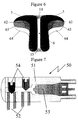
- the pommel area of a panel varies in shape depending on the design or make of saddle. In essence there are four panel designs which are illustrated in Figure 6.
- the different panels produce a change in the flocking area mainly around the wither or pommel area.
- the smallest bearing surface produced is the standard panel 5 followed by the drop panel 62, then the half panel 63 and finally the full panel 64.
- Each takes more available area of the panel flap 7. This variance is due to the needs of higher, narrower withered horses such as thoroughbred's needing a larger bearing surface around the withers to stop saddle soreness..
- the bladders must take up all available room within the panel without any portion of the bladder being inflated so its material is stretched thus preventing an elasticised bouncy consistency within the panel and they must overlap so as to provide a consistent smooth bearing surface.
- the horse's back changes in shape (cross section) as one looks at the back in sections moving from the withers (over which the pommel 4 sits), through a section upon which the front of the seat 2 of the saddle sits, to a section upon which the rear of the seat 2 of the saddle sits.
- the withers are nearer to the vertical at their uppermost point and form a hollow at their base. Therefore the pommel bladders 31 must form themselves to either side of this irregular bearing surface to enable the pommel 4 and tree 20 of the saddle to be borne 40 - 50mm above the horse's wither.
- the horse's back at the rear of the seat 2 of the saddle is comparatively flat. Accordingly the bearing surface produced by the panel 5 and bladders 30 should be capable of forming to this profile.
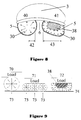
- FIG. 8 illustrates both the problem that is caused by utilising the bladder 30 alone in the panel 5 and the solution of using a foam insert 38 with a bladder 30.
- the problem with the left hand side 40 is that the pressure within the bladder 30 creates a round profile in cross section. This causes the panel 5 to have a sausage like appearance when inflated and a bearing surface 42 against the horse's back.
- FIG 8 also shows that the right hand panel 41 has a larger bearing surface 43 against the horse's back. This is achieved by the insertion of a specially shaped foam insert 38 in such a way that the bladder 30 wraps around the lower and side surfaces of the foam insert 38. When the rear bladder 30 is inflated, the foam insert 38 forces the air in the bladder 30 to create a flatter and larger bearing surface 43.
- the foam may be an open or closed cell foam or a composite comprising both types of foam.
- the preferred arrangement of the present invention is to have three bladders in each panel 5. Inflation of opposing pairs of bladders is essential to accurate adjustment of the saddle with respect to the horse's back i.e. the pressure on both sides of the back bone is the same. For this reason, each pair of bladders are linked and served by a single valve 50 i.e. rear bladders link to one valve, pommel bladders to another etc.
- the valves may be positioned in any convenient position on the saddle. Typically, they will be positioned at the rear of the cantle 3 as this is the most accessible place for the saddle fitter.
- FIG. 7 illustrates an embodiment of a valve body 51 which acts as a manifold for the air. Equal amounts of air are passed to each bladder in a pair i.e. rear, pommel and knee roll, via hoses 52. These valve bodies have a means of stopping the air from moving between bladders at the point when the saddler is satisfied that the saddle fits correctly and is balanced (left to right) on the horse's back.
- the valve 50 as shown consists of a valve body 51 incorporating a Schrader type valve 53 commonly used on cars and motorbikes. These valves are easily available, reliable and due to their world wide adoption by car manufacturer are very cheap.
- the Schrader valve is encapsulated in a nylon or brass valve body 51 which has two pipe entries 52 and two grub screws 54.
- the grub screws When the grub screws are retracted they ensure an equalisation of pressures in the matching pairs of bladders therefore giving a completely level saddle as it is inflated and/or deflated whilst the rider is sitting on the saddle.
- the grub screws have several benefits including:
- valves bodies 51 incorporating grub screws 54 to seal off the air flow between bladders
- the same effect could be achieved by injecting through the Schrader valve 53 a substance with the consistency of petroleum jelly.
- petroleum jelly is an ideal substance.
- This substance can be injected quite simply using a bicycle pump in the same manner as when inflating the bladders with air.
- the substance is injected into the valve body and down the 3mm hoses 52 so that they are filled to a length of approximately 25mm from the valve body. This would be sufficient to create a satisfactory seal.
- the substance will not move from this position since its viscosity is such that the force required to move the substance is far in excess of the normal working pressures.
- hoses 52 will have an external diameter sufficiently small that they can be hidden within the fabric of the seat section of the saddle (not the panel 5) under the seat 2. Approximately 3.5mm is considered suitable. If the hoses were routed through the panel 5 they may be detected by the horse as pressure points.
- these hoses 52 will connect into the short length (75mm) of larger diameter PVC hose 33 on the bladders.
- the hoses 33 on the bladders will have a 6mm OD 3mm ID and will be welded or glued into a flange 34 on the bladder.
- the positioning of these flanges is important so as to be undetectable by the horse through the panel fabric. If they were not they could cause greater pressure point problems than the flock they replace.
- the joining of the 3.5mm hose 52 to the 6mm hose 33 can simply be a push fit.
- the 6mm PVC hose will stretch to accept the 3.5mm Nylon hose and should be pushed in at least 20-25 mm. This will be sufficient to create an air tight seal whilst also giving a method of disconnection of the valves from the bladders.
- this joint can be permanently glued with an adhesive such as cyanoacrylate (super-glue).
- the bladders can be readily incorporated into a new saddle during manufacture or easily inserted into an existing saddle through the same holes 12 used for inserting wadding or flocking.
- Small crosscut holes 17 must be made in the panel's upper surface for the 6mm hoses to pass though. The positioning of these holes should be as near to a solid structure of the saddle as possible i.e.
- the pressure in the bladders There is no need to measure the pressure in the bladders. The pressures will be very small and would not differ to any great extent between different riders.
- the overall bearing surface of a man's saddle is approximately 140 square inches or 960 square centimetres. If the man weighed 16 stone, (224 pounds), 101kg he would create an internal pressure in the bladders of no more than 1.5 pounds per square inch, 100g per square centimetre.
- the present invention is suitable for inclusion in any style of saddle, be it for racing, eventing, dressage, show jumping, endurance, hunting and general recreation and so on. It will also be possible to incorporate the valves into the cantle 12 if the saddle were to be manufactured with the bladders from new.
- the invention herein described has been tested by the inventors using state-of-the-art equipment that measures the pressures applied by the saddle on the horses's back.
- This equipment consists of a thin saddle cloth with 256 no. pressure sensors (each being 25mm square) over its surface.
- the cloth is attached to a computer via a cable and with specialised software the computer produces images of the pressures present under a saddle. The image is very much like that given by a thermal image camera.
- the inventors have not only addressed and overcome the physical and anatomical problems related to this concept but also disclosed a product in a form that is both acceptable, achievable and cost effective to the market place.
Landscapes
- Engineering & Computer Science (AREA)
- Mechanical Engineering (AREA)
- Mattresses And Other Support Structures For Chairs And Beds (AREA)
- Gyroscopes (AREA)
- Pharmaceuticals Containing Other Organic And Inorganic Compounds (AREA)
- Lubricants (AREA)
- Prostheses (AREA)
- Lining Or Joining Of Plastics Or The Like (AREA)
- Orthopedics, Nursing, And Contraception (AREA)
Applications Claiming Priority (2)
| Application Number | Priority Date | Filing Date | Title |
|---|---|---|---|
| GB9519291 | 1995-09-21 | ||
| GBGB9519291.0A GB9519291D0 (en) | 1995-09-21 | 1995-09-21 | Improvements in or relating to saddles |
Publications (2)
| Publication Number | Publication Date |
|---|---|
| EP0764607A1 EP0764607A1 (en) | 1997-03-26 |
| EP0764607B1 true EP0764607B1 (en) | 2000-05-24 |
Family
ID=10781057
Family Applications (1)
| Application Number | Title | Priority Date | Filing Date |
|---|---|---|---|
| EP96306807A Expired - Lifetime EP0764607B1 (en) | 1995-09-21 | 1996-09-19 | Improvements in or relating to saddles |
Country Status (8)
| Country | Link |
|---|---|
| EP (1) | EP0764607B1 (da) |
| AT (1) | ATE193275T1 (da) |
| DE (1) | DE69608514T2 (da) |
| DK (1) | DK0764607T3 (da) |
| ES (1) | ES2146838T3 (da) |
| GB (1) | GB9519291D0 (da) |
| GR (1) | GR3034145T3 (da) |
| PT (1) | PT764607E (da) |
Cited By (1)
| Publication number | Priority date | Publication date | Assignee | Title |
|---|---|---|---|---|
| US6769233B2 (en) | 2002-09-05 | 2004-08-03 | William Bret Hadlock | System and method for fitting a horse with a riding saddle or saddle pad |
Families Citing this family (12)
| Publication number | Priority date | Publication date | Assignee | Title |
|---|---|---|---|---|
| DE19740199B4 (de) | 1997-09-12 | 2005-05-12 | Stephanie Coors | Reitsattel |
| EP1092675A1 (de) | 1999-10-12 | 2001-04-18 | GEORG KIEFFER Sattlerwarenfabrik GmbH | Luftgepolstertes Sattelkissen für Reitsättel |
| AUPQ641600A0 (en) * | 2000-03-23 | 2000-04-15 | Hammersmith Nominees Pty. Ltd. | Saddles |
| US6619019B2 (en) | 2000-03-23 | 2003-09-16 | Hammersmith Nominees Pty Ltd | Saddles |
| GB0107582D0 (en) | 2001-03-27 | 2001-05-16 | Kempsell David M K | Improvements in or telating to saddle pads |
| CA2354494A1 (en) * | 2001-08-01 | 2003-02-01 | Hammersmith Nominees Pty. Ltd. | Saddles |
| AUPR682501A0 (en) * | 2001-08-03 | 2001-08-30 | Hammersmith Nominees Pty. Ltd. | Saddle cloths |
| AUPS172302A0 (en) | 2002-04-12 | 2002-05-23 | Hammersmith Nominees Pty. Ltd. | Saddles |
| AU2005204232B2 (en) * | 2004-09-08 | 2011-05-12 | Hammersmith Nominees Pty Ltd | Saddles |
| CA2624098C (en) * | 2008-02-28 | 2009-08-11 | Danny Kroetch | Adjustable saddle |
| DE102023128429A1 (de) * | 2023-10-17 | 2025-04-17 | Carsten Engelke | Reitsattel mit Vorrichtung zur Korrektur der Sitzhaltung |
| SE2400038A1 (en) * | 2024-03-20 | 2025-09-21 | Hippomotion Ab | A device for an equestrian equipment |
Family Cites Families (1)
| Publication number | Priority date | Publication date | Assignee | Title |
|---|---|---|---|---|
| AT255251B (de) * | 1965-02-16 | 1967-06-26 | Stuebben Ohg Joh S | Reisattel mit luftgefüllten Satellkissen |
-
1995
- 1995-09-21 GB GBGB9519291.0A patent/GB9519291D0/en active Pending
-
1996
- 1996-09-19 PT PT96306807T patent/PT764607E/pt unknown
- 1996-09-19 EP EP96306807A patent/EP0764607B1/en not_active Expired - Lifetime
- 1996-09-19 AT AT96306807T patent/ATE193275T1/de active
- 1996-09-19 ES ES96306807T patent/ES2146838T3/es not_active Expired - Lifetime
- 1996-09-19 DE DE69608514T patent/DE69608514T2/de not_active Expired - Lifetime
- 1996-09-19 DK DK96306807T patent/DK0764607T3/da active
-
2000
- 2000-08-07 GR GR20000401840T patent/GR3034145T3/el not_active IP Right Cessation
Cited By (1)
| Publication number | Priority date | Publication date | Assignee | Title |
|---|---|---|---|---|
| US6769233B2 (en) | 2002-09-05 | 2004-08-03 | William Bret Hadlock | System and method for fitting a horse with a riding saddle or saddle pad |
Also Published As
| Publication number | Publication date |
|---|---|
| DE69608514D1 (de) | 2000-06-29 |
| ATE193275T1 (de) | 2000-06-15 |
| PT764607E (pt) | 2000-09-29 |
| DE69608514T2 (de) | 2001-02-01 |
| DK0764607T3 (da) | 2000-08-14 |
| ES2146838T3 (es) | 2000-08-16 |
| GB9519291D0 (en) | 1995-11-22 |
| EP0764607A1 (en) | 1997-03-26 |
| GR3034145T3 (en) | 2000-11-30 |
Similar Documents
| Publication | Publication Date | Title |
|---|---|---|
| EP0764607B1 (en) | Improvements in or relating to saddles | |
| US4745734A (en) | Riding saddle with flexible skirts | |
| US4033097A (en) | Riding saddle | |
| US7178318B2 (en) | Saddle tree including a progressive flex headplate assembly | |
| CA2498334A1 (en) | Treeless jumping saddle and method of making the same | |
| US5555710A (en) | Inflatable saddle support apparatus | |
| US5548948A (en) | Inflatable saddle support apparatus | |
| US5187924A (en) | Saddle | |
| AU2003229909B2 (en) | Riding saddle | |
| US6474052B2 (en) | “Western” style saddles | |
| AU2002242839B2 (en) | Air cushioned saddle cloths | |
| CA2356503C (en) | Saddle girth | |
| US20060080946A1 (en) | Treeless riding saddle and method of making the same | |
| US20020069464A1 (en) | Saddle seat supplement and pad | |
| AU2002242839A1 (en) | Air cushioned saddle cloths | |
| US6035616A (en) | Suspended cantle support | |
| US20130227920A1 (en) | Saddle pad eliminating the area of highest pressure from saddle tree bars with circle cut out areas lined with silicon rubber. | |
| GB2292062A (en) | Adjustable saddle | |
| US11591208B2 (en) | Saddle stirrup adjustable strap D-ring | |
| CA3237216A1 (en) | Saddle for horse riding | |
| AU2003100570A4 (en) | Improved Saddle and Method of Construction Thereof |
Legal Events
| Date | Code | Title | Description |
|---|---|---|---|
| PUAI | Public reference made under article 153(3) epc to a published international application that has entered the european phase |
Free format text: ORIGINAL CODE: 0009012 |
|
| AK | Designated contracting states |
Kind code of ref document: A1 Designated state(s): AT BE CH DE DK ES FI FR GB GR IE IT LI LU MC NL PT SE |
|
| 17P | Request for examination filed |
Effective date: 19970903 |
|
| GRAG | Despatch of communication of intention to grant |
Free format text: ORIGINAL CODE: EPIDOS AGRA |
|
| 17Q | First examination report despatched |
Effective date: 19990506 |
|
| GRAG | Despatch of communication of intention to grant |
Free format text: ORIGINAL CODE: EPIDOS AGRA |
|
| GRAH | Despatch of communication of intention to grant a patent |
Free format text: ORIGINAL CODE: EPIDOS IGRA |
|
| GRAH | Despatch of communication of intention to grant a patent |
Free format text: ORIGINAL CODE: EPIDOS IGRA |
|
| GRAA | (expected) grant |
Free format text: ORIGINAL CODE: 0009210 |
|
| RAP1 | Party data changed (applicant data changed or rights of an application transferred) |
Owner name: WHITE, MARGARET LESLEY Owner name: KEMPSELL, DAVID |
|
| RIN1 | Information on inventor provided before grant (corrected) |
Inventor name: WHITE, MARGARET LESLEY Inventor name: KEMPSELL, DAVID |
|
| AK | Designated contracting states |
Kind code of ref document: B1 Designated state(s): AT BE CH DE DK ES FI FR GB GR IE IT LI LU MC NL PT SE |
|
| REF | Corresponds to: |
Ref document number: 193275 Country of ref document: AT Date of ref document: 20000615 Kind code of ref document: T |
|
| REG | Reference to a national code |
Ref country code: CH Ref legal event code: EP |
|
| REG | Reference to a national code |
Ref country code: IE Ref legal event code: FG4D |
|
| REF | Corresponds to: |
Ref document number: 69608514 Country of ref document: DE Date of ref document: 20000629 |
|
| ITF | It: translation for a ep patent filed | ||
| ET | Fr: translation filed | ||
| REG | Reference to a national code |
Ref country code: DK Ref legal event code: T3 |
|
| REG | Reference to a national code |
Ref country code: CH Ref legal event code: NV Representative=s name: PATENTANWALTSBUREAU R. A. MASPOLI |
|
| REG | Reference to a national code |
Ref country code: ES Ref legal event code: FG2A Ref document number: 2146838 Country of ref document: ES Kind code of ref document: T3 |
|
| REG | Reference to a national code |
Ref country code: PT Ref legal event code: SC4A Free format text: AVAILABILITY OF NATIONAL TRANSLATION Effective date: 20000628 |
|
| PLBE | No opposition filed within time limit |
Free format text: ORIGINAL CODE: 0009261 |
|
| STAA | Information on the status of an ep patent application or granted ep patent |
Free format text: STATUS: NO OPPOSITION FILED WITHIN TIME LIMIT |
|
| 26N | No opposition filed | ||
| REG | Reference to a national code |
Ref country code: GB Ref legal event code: IF02 |
|
| PGFP | Annual fee paid to national office [announced via postgrant information from national office to epo] |
Ref country code: GR Payment date: 20030821 Year of fee payment: 8 |
|
| PGFP | Annual fee paid to national office [announced via postgrant information from national office to epo] |
Ref country code: FI Payment date: 20030902 Year of fee payment: 8 |
|
| PGFP | Annual fee paid to national office [announced via postgrant information from national office to epo] |
Ref country code: MC Payment date: 20030916 Year of fee payment: 8 |
|
| PGFP | Annual fee paid to national office [announced via postgrant information from national office to epo] |
Ref country code: LU Payment date: 20030918 Year of fee payment: 8 |
|
| PG25 | Lapsed in a contracting state [announced via postgrant information from national office to epo] |
Ref country code: LU Free format text: LAPSE BECAUSE OF NON-PAYMENT OF DUE FEES Effective date: 20040919 Ref country code: FI Free format text: LAPSE BECAUSE OF NON-PAYMENT OF DUE FEES Effective date: 20040919 |
|
| PG25 | Lapsed in a contracting state [announced via postgrant information from national office to epo] |
Ref country code: MC Free format text: LAPSE BECAUSE OF NON-PAYMENT OF DUE FEES Effective date: 20040930 |
|
| PG25 | Lapsed in a contracting state [announced via postgrant information from national office to epo] |
Ref country code: GR Free format text: LAPSE BECAUSE OF NON-PAYMENT OF DUE FEES Effective date: 20050405 |
|
| PGFP | Annual fee paid to national office [announced via postgrant information from national office to epo] |
Ref country code: ES Payment date: 20120926 Year of fee payment: 17 |
|
| PGFP | Annual fee paid to national office [announced via postgrant information from national office to epo] |
Ref country code: PT Payment date: 20120320 Year of fee payment: 17 |
|
| REG | Reference to a national code |
Ref country code: PT Ref legal event code: MM4A Free format text: LAPSE DUE TO NON-PAYMENT OF FEES Effective date: 20140319 |
|
| PG25 | Lapsed in a contracting state [announced via postgrant information from national office to epo] |
Ref country code: PT Free format text: LAPSE BECAUSE OF NON-PAYMENT OF DUE FEES Effective date: 20140319 |
|
| REG | Reference to a national code |
Ref country code: ES Ref legal event code: FD2A Effective date: 20141007 |
|
| PG25 | Lapsed in a contracting state [announced via postgrant information from national office to epo] |
Ref country code: ES Free format text: LAPSE BECAUSE OF NON-PAYMENT OF DUE FEES Effective date: 20130920 |
|
| REG | Reference to a national code |
Ref country code: FR Ref legal event code: PLFP Year of fee payment: 20 |
|
| REG | Reference to a national code |
Ref country code: CH Ref legal event code: NV Representative=s name: ISLER AND PEDRAZZINI AG, CH |
|
| PGFP | Annual fee paid to national office [announced via postgrant information from national office to epo] |
Ref country code: CH Payment date: 20150918 Year of fee payment: 20 Ref country code: IE Payment date: 20150925 Year of fee payment: 20 |
|
| PGFP | Annual fee paid to national office [announced via postgrant information from national office to epo] |
Ref country code: SE Payment date: 20150924 Year of fee payment: 20 Ref country code: BE Payment date: 20150924 Year of fee payment: 20 Ref country code: AT Payment date: 20150924 Year of fee payment: 20 |
|
| PGFP | Annual fee paid to national office [announced via postgrant information from national office to epo] |
Ref country code: DK Payment date: 20150922 Year of fee payment: 20 Ref country code: IT Payment date: 20150923 Year of fee payment: 20 |
|
| PGFP | Annual fee paid to national office [announced via postgrant information from national office to epo] |
Ref country code: DE Payment date: 20151012 Year of fee payment: 20 Ref country code: GB Payment date: 20151012 Year of fee payment: 20 |
|
| PGFP | Annual fee paid to national office [announced via postgrant information from national office to epo] |
Ref country code: FR Payment date: 20150925 Year of fee payment: 20 Ref country code: NL Payment date: 20150922 Year of fee payment: 20 |
|
| REG | Reference to a national code |
Ref country code: DE Ref legal event code: R071 Ref document number: 69608514 Country of ref document: DE |
|
| REG | Reference to a national code |
Ref country code: NL Ref legal event code: MK Effective date: 20160918 |
|
| REG | Reference to a national code |
Ref country code: DK Ref legal event code: EUP Effective date: 20160919 |
|
| REG | Reference to a national code |
Ref country code: CH Ref legal event code: PL |
|
| REG | Reference to a national code |
Ref country code: GB Ref legal event code: PE20 Expiry date: 20160918 |
|
| PG25 | Lapsed in a contracting state [announced via postgrant information from national office to epo] |
Ref country code: GB Free format text: LAPSE BECAUSE OF EXPIRATION OF PROTECTION Effective date: 20160918 |
|
| REG | Reference to a national code |
Ref country code: SE Ref legal event code: EUG |
|
| REG | Reference to a national code |
Ref country code: IE Ref legal event code: MK9A |
|
| REG | Reference to a national code |
Ref country code: AT Ref legal event code: MK07 Ref document number: 193275 Country of ref document: AT Kind code of ref document: T Effective date: 20160919 |
|
| PG25 | Lapsed in a contracting state [announced via postgrant information from national office to epo] |
Ref country code: IE Free format text: LAPSE BECAUSE OF EXPIRATION OF PROTECTION Effective date: 20160919 |