EP0762312B1 - Appareil et procédé pour l'identification d'individus - Google Patents
Appareil et procédé pour l'identification d'individus Download PDFInfo
- Publication number
- EP0762312B1 EP0762312B1 EP96306509A EP96306509A EP0762312B1 EP 0762312 B1 EP0762312 B1 EP 0762312B1 EP 96306509 A EP96306509 A EP 96306509A EP 96306509 A EP96306509 A EP 96306509A EP 0762312 B1 EP0762312 B1 EP 0762312B1
- Authority
- EP
- European Patent Office
- Prior art keywords
- image signal
- individual
- signal
- correlation
- reference image
- Prior art date
- Legal status (The legal status is an assumption and is not a legal conclusion. Google has not performed a legal analysis and makes no representation as to the accuracy of the status listed.)
- Expired - Lifetime
Links
Images


Classifications
-
- G—PHYSICS
- G06—COMPUTING OR CALCULATING; COUNTING
- G06V—IMAGE OR VIDEO RECOGNITION OR UNDERSTANDING
- G06V40/00—Recognition of biometric, human-related or animal-related patterns in image or video data
- G06V40/10—Human or animal bodies, e.g. vehicle occupants or pedestrians; Body parts, e.g. hands
- G06V40/12—Fingerprints or palmprints
- G06V40/1365—Matching; Classification
Definitions
- the present invention relates to an individual identification apparatus for confirming identities of individuals using a pattern recognition technique.
- Fingerprints, palm prints, retinas, and voices are unique for each individual.
- the individual identification apparatuses therefore generally compare such a unique characteristic of an arbitrary person with a corresponding characteristic of the specific person.
- the fingerprint has attracted attention because it is easily handled and it can allow the individual identification apparatus to provide a high recognition accuracy.
- the individual identification apparatus extracts features (minutiae) from fingerprints.
- the features include character points such as ending and turning points of ridges in the fingerprints. Confirmation of the individual's identity is performed based on those features extracted from the fingerprints.
- fingerprints have to be subjected to complicated preprocessings in order'to accurately extract features from the fingerprints.
- a large number of features have to be extracted from the fingerprints in order to enhance recognition accuracy.
- confirming a mismatch between different individuals generally requires a longer time period than when confirming a match between identical individuals as described below.
- the extracted feature is compared with a corresponding feature of the specific person's fingerprint.
- the features in the arbitrary person's fingerprint are subjected one by one to this extracting-and-comparing operation.
- a predetermined large number of features have to be subjected to the extracting-and-comparing operations.
- the number of features, in the arbitrary person's fingerprint, that match the corresponding features of the specific person's fingerprint are counted.
- the mismatch between the arbitrary person and the specific person is confirmed when the number of those matching features is less than a predetermined threshold.
- a match between the arbitrary person and the specific person is confirmed when the number of the matching features reaches the predetermined threshold. It is noted, however, that the number, of the matching features will possibly reach the predetermined threshold before the extracting-and-matching operations are completed for all the predetermined number of features. In this case, it becomes unnecessary to extract remaining features from the arbitrary person's fingerprint. Thus, confirming a match between identical individuals generally needs extraction of less features than when confirming a mismatch between different individuals. In other words, confirming a mismatch between different individuals generally requires a longer time period than when confirming a match between identical individuals.
- an apparatus for identifying an arbitrary individual as a specific individual comprises:
- a method for identifying an arbitrary individual as a specific individual comprises the steps of:
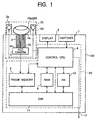
- Fig. 1 shows a structure of the individual identification apparatus 100 of the present embodiment.
- the apparatus 100 of the present embodiment is for identifying an individual under investigation (arbitrary individual) with a specific individual through calculating a correlation between their fingerprints.
- a fingerprint of the specific individual is previously recorded in the apparatus.
- the apparatus picks up a fingerprint of the arbitrary person.
- the apparatus electronically calculates a correlation between the specific individual's fingerprint and the arbitrary individual's fingerprint, based on which the apparatus judges whether or not the arbitrary person is the specific person.
- the individual identification apparatus 100 includes: an image pick up portion 50; a calculation processing portion 60; a display portion 6; and switches 7.
- the image pick up portion 50 includes a pair of light emission diodes (LEDs) 2a and 2b, a fiber optical plate (FOF) 3, and a charge-coupled device (CCD) camera 4.
- LEDs light emission diodes
- FOF fiber optical plate
- CCD charge-coupled device
- the calculation processing portion 60 includes a frame memory 5, a digital signal processor (DSP) 11, a control CPU 8, a random access memory (RAM) 9, and a hard disk (HD) 10.
- the display portion 6 is for showing recognition results.
- the switches 7 include several switches with which an operator controls the apparatus 100.
- the switches include mode setting keys for setting a filter storage mode, a recognition mode, and a pattern pick up mode.
- the switches further include a numerical pad for designating an identification number of a specific individual.
- the pair of LEDs 2a and 2b are light emitting elements.
- the LEDs 2a and 2b irradiate the finger of an individual with light when desiring to pick up a fingerprint of the individual.
- the FOP 3 is an integrated bundle of a plurality of optical fibers.
- the FOP 3 has opposite end surfaces, that is, an input end surface 3a and an output end surface 3b along the longitudinal directions of the optical fibers.
- the finger of the individual is placed on the input end surface 3a.
- the output end surface 3b is coupled to a light receiving surface 4a of the CCD camera 4.
- the FOP 3 transmits the fingerprint from the input end surface 3a to the output end surface 3b.
- the CCD camera 4 is a two-dimensional image pick up element for picking up the fingerprint outputted from the output end surface 3b.
- the frame memory 5 is connected to the CCD camera 4.
- the frame memory 5 serves as an image storage device for receiving image signals output from the CCD camera 4, for digitizing the image signals, and for storing the digitized image signals.
- the DSP 11 is for performing various digital calculations, such as a fast Fourier transform (FFT), on the digital image signals stored in the frame memory 5 to thereby obtain a correlation signal indicative of a correlation between the specific individual's fingerprint and the arbitrary person's fingerprint.
- the control CPU 8 is for determining, based on the correlation signal, whether or not the arbitrary individual is the specific individual.
- the control CPU 8 is also for receiving instruction signals input from the switches 7 and for driving the LEDs 2a and 2b and controlling the display 6 to show the determined results.
- Each of the RAM 9 and the HD 10 is for storing a filter image (matched filter) representative of the specific individual's fingerprint and an identification number indicative of the specific individual.
- the HD 10 serves as a backup memory for permanently storing the filter image and the identification number of the specific individual.
- the RAM 9 is for maintaining the filter image and the identification number only when they are frequently used for a recognition process which will be described later.
- the fingerprint of a specific individual is previously stored in the apparatus 100 through a filter storage process shown in Fig. 2.
- the recognition (individual identification) process is conducted as shown in Fig. 3.
- the specific individual When a specific individual desires to record his/her fingerprint in the apparatus 100, the specific individual first manipulates the mode setting key to select a filter storage mode, whereupon the filter storage mode starts as shown in Fig. 2. Then, the specific individual manipulates the numeric pad in the switches 7 to designate his/her own identification number. The specific individual places his/her finger on the input end surface 3a as shown in Fig. 1. Then, the specific individual again manipulates the mode setting key to select a pattern pick up mode, upon which the control CPU 8 turns on the LEDs 2a and 2b in S201. As a result, a fingerprint image is formed on the output end surface 3b of the FOP 3. The fingerprint image is picked up by the CCD camera 4. This fingerprint image will be referred to as a "reference fingerprint" hereinafter. The reference fingerprint is then digitized by the frame memory 5 and stored in the frame memory 5.
- the DSP 11 performs a background noise cutting operation and a fast Fourier transform (FFT) operation on the reference fingerprint now stored in the frame memory 5.
- FFT fast Fourier transform
- the DSP 11 creates in S203 a phase-only filter based on a phase term of the Fourier transformed result.
- the phase-only filter will be subjected to a correlation calculation and serve as a matched filter.
- a filter image will be produced in S203 only from the phase term of the Fourier transformed image.
- the thus produced filter image and an arbitrary person's fingerprint will be subjected to a correlation calculation.
- the intensity of the reference fingerprint will provide no contribution to the production of a correlation signal.
- any background image, even a low intensity one, included in the reference fingerprint will possibly provide a high correlation signal due to a high correlation between the background image in the reference fingerprint and another background image included in the arbitrary person's fingerprint.
- the background images in those fingerprints will erroneously provide a high correlation signal even though the arbitrary person is not the specific person.
- the DSP 11 performs a background noise cutting operation in S202 before performing the fast Fourier transform. That is, the DSP 11 subtracts the background image from the image data on the frame memory 5.
- the DSP 11 performs in S203 a fast Fourier transform on the noise-out reference fingerprint.
- the reference fingerprint is represented by h (x, y)
- the DSP 11 then eliminates a zero-order component and its vicinity component from the Fourier transformed image. This zero order cutting operation can be easily performed because the spatial frequency of the reference fingerprint gathers within a range of several 1p/mm.
- the DSP 11 then normalizes the amplitude term represented by
- the filter image is stored in the RAM 9 together with the designated identification number.
- the filter image and the identification number are also stored in the HD 10. It is noted that the HD 10 will permanently store the data of the filter image and the identification number as backup data. Contrarily, the RAM 9 will maintain the data of the filter image and the identification number only when the data is frequently used in the recognition process which will be described later. For example, when the data is not used for a predetermined time period, the data will be automatically erased from the RAM 9.
- a phase-only filter is produced from the reference fingerprint. Accordingly, recognition accuracy will be enhanced, and it becomes possible to increase the probability of a match between identical persons and the probability of a mismatch between different persons.
- noise is eliminated from the reference fingerprint in S202, it becomes unnecessary to perform a noise cutting operation on a fingerprint of an arbitrary individual during the recognition process described below.
- the arbitrary person When an arbitrary person desires to be identified with the specific individual on record, the arbitrary person first manipulates the mode setting key to select the recognition mode, whereupon the recognition process of Fig. 3 starts. Then, the arbitrary person manipulates the numeric pad in the switches 7 to designate the identification number of the specific individual. In S210, the control CPU 8 first transfers the designated identification number to the DSP 11, whereupon the DSP 11 retrieves from the RAM 9 or the HD 10 a filter image corresponding to the identification number. Simultaneously, the arbitrary person places his/her finger on the input end surface 3a of the FOP 3. Then, the arbitrary person manipulates the mode setting key to select the pattern pick up mode, whereupon the control CPU 8 turns on the LEDs 2a and 2b in S211.
- a fingerprint image is formed on the output end surface 3b of the FOP 3.
- the fingerprint image is picked up by the CCD camera 4.
- the fingerprint image of the arbitrary person will be referred to as a "target fingerprint” hereinafter.
- the target fingerprint is digitized by the frame memory 5 and then stored in the frame memory 5.
- the DSP 11 performs a fast Fourier transform on the target fingerprint in the same manner as in the filter storage process.
- the DSP 11 eliminates the zero order component and its vicinity component from the Fourier transformed result.
- the DSP 11 then calculates a conjugate of the Fourier transformed image.
- the DSP 11 normalizes an amplitude term of the obtained conjugate pattern, thereby obtaining a phase term of the conjugate pattern.
- the DSP 11 multiplies in S213 the phase term of the conjugate pattern with the filter image.
- G* (fx, fy)
- phase term of this conjugate image is multiplied in S213 with the filter image retrieved from the memory 5. Accordingly, this multiplication obtains a product represented by exp (j ⁇ 1 ) ⁇ exp (-j ⁇ 2 ).
- the DSP 11 performs an inverse fast Fourier transform on the multiplied result.
- the transformed result repreaents a correlation signal indicative of a correlation between the target fingerprint and the reference fingerprint.
- the correlation signal is transferred to the control CPU 8.
- the control CPU 8 measures a maximum value of the correlation peak, and judges whether the measured value is equal to or higher than a predetermined first threshold value T1.
- the control CPU 8 further measures the amount of a half-width of the correlation signal, and judges whether the measured value is equal to or lower than a predetermined second threshold value T2.
- the control CPU 8 determines that the arbitrary person is the specific person when the maximum value is equal to or higher than the first threshold T1 and the half-width value is equal to or lower than the second threshold T2.
- control CPU 8 may measure only the maximum value of the correlation peak.
- the control CPU 8 may determine the match between the arbitrary person and the specific person when the maximum value is equal to or higher than the first threshold. In this case, however, an error judgement will possibly occur due to a large variety in the picked-up states of the fingerprint images. That is, the fingerprint images are often picked up by the FOP 3 as being distorted or being partially faint.
- the correlation peak intensity will vary largely according to the picked-up states of the fingerprint images. It is further noted that not only the intensity but also the shape, such as the half-width, of the correlation peak indicates a correlation degree between the target fingerprint and the reference fingerprint. In view of this, according to the present embodiment, the control CPU 8 performs judgements based on both the peak intensity and the half-width of the correlation signal. It becomes possible to enhance the recognition accuracy.
- control CPU 8 controls in S216 the display 6 to show the judged results.
- the control CPU 8 further outputs a recognition signal 12 to an external device.
- the recognition signal 12 represents whether or not the arbitrary person is the specific individual.
- the external device performs various processes using the supplied recognition signal 12.
- the external device is, for example, a door lock system provided to a door provided to a restricted area. The lock is released only when the recognition signal 12 represents that the arbitrary person is the specific person.
- the present inventor produced the individual identification apparatus 100 using the following electronic devices for the respective elements.
- a CPU "80486” was used as the control CPU 8.
- a "TMS320C40” was used as the DSP 11.
- a frame memory with 256 * 256 * 8 bit areas were used as the frame memory 5. Only the even frames ware used.
- An extended protect memory was used as the RAM 9.
- An SCSI interface 270 MB hard disk was used as the HD 10.
- the present inventor then conducted experiments with the apparatus 100 comprised of the above-described devices.
- the apparatus 100 was controlled to examine identities of six hundred individuals to confirm its operability.
- the first and second thresholds T1 and T2 were set so that the probability of erroneously judging a match between different persons became 0.1 %. In this case, the probability of erroneously judging a mismatch between identical persons became only 0.1 %.
- the threshold T1 was decreased and the threshold T2 was increased so that the probability of erroneously judging a match between different persons became 0 %. Still in this case, the probability of erroneously judging a mismatch between identical persons increased up to only 4.1 %.
- the apparatus 100 of the present embodiment includes the image pick up portion 50 and the calculation processing portion 60.
- the portion 50 picks up a pattern of a fingerprint of the specific individual and outputs a reference image signal.
- the portion 50 picks up a pattern of a fingerprint of the arbitrary individual and outputs a target image signal.
- the portion 60 calculates a correlation signal between the reference image signal and the target image signal. That is, the portion 60 digitizas the reference image signal and the target image signal, electronically Fourier transforms those image signals, electronically multiplies the Fourier transformed images, and electronically inverse Fourier transforms the multiplied result to obtain the correlation signal.
- the portion 60 judges, based on the correlation signal, whether or not the arbitrary person is the specific person.
- the individual identification apparatus 100 does not need to extract features from fingerprints of individuals. Instead, the apparatus 100 employs a method for calculating correlation between entire fingerprints. No complicated preprocessings are required. Identities of individuals can be confirmed within a short period of time.
- the apparatus 100 obtains a correlation signal through performing a fast Fourier transform operation and an inverse fast Fourier transform operation. Accordingly, the apparatus can perform its recognition operation within a quite short period of time.
- the apparatus 100 is advantageous additionally in that the apparatus can perform judgements for both a match between identical persons and a mismatch between different persons at the same speed.
- the apparatus can therefore perform trial judgements a plurality of times within a short period of time.
- the apparatus 100 can therefore perform a highly accurate recognition operation within a short period of time.
- the apparatus 100 digitizes image signals, and electronically or digitally performs calculation operations with the use of several kinds of electronic devices.
- the stability and reliability of the apparatus is therefore high with regards to environmental changes.
- the apparatus is also easy to manufacture, compact, and inexpensive, but has a high performance.
- control CPU 8 is provided separately from the DSP 11. However, the control CPU 8 can be omitted.
- the DSP 11 may be designed to serve also as the control CPU 8.
- a conjugate of the Fourier transformed image of the target fingerprint is multiplied with the filter image.
- the Fourier transformed image of the target fingerprint can be directly multiplied with the filter image.
- the multiplied result may be subjeoted to the inverse fast Fourier transform, and an obtained signal may be used as a correlation signal.
- fingerprints of individuals are used for confirming identities of individuals.
- other various portions of individuals' bodies can be used.
- the individual identification apparatus is comprised of an image pick up portion and a calculation processing portion.
- the image pick up portion picks up a pattern of a predetermined body portion of a specific individual and outputs a reference image signal.
- the reference image signal is stored in the apparatus.
- the image pick up portion also picks up a pattern of a predetermined body portion of an arbitrary individual who is desired to be identified with the specific individual, and outputs a target image signal.
- the calculation processing portion obtains a correlation signal indicative of a correlation between the reference image signal and the target image signal in the following manner.
- the calculation processing portion first digitizes the reference image signal and the target image signal, electronically performs a Fourier transform on those image signals, electronically multiplies the Fourier transformed images, and electronically performs an inverse Fourier transform on the multiplied results to thereby obtain the correlation signal.
- the calculation processing portion then judges, based on the correlation signal, whether or not the arbitrary individual is the specific individual.
- the Fourier transformed image of the reference image signal may be multiplied with the Fourier transformed image of the target image signal. Or otherwise, the Fourier transformed image of the reference image signal may be multiplied with a conjugate of the Fourier transformed image of the target image signal.
- features are not extracted from the body portion patterns, but a correlation calculation is performed onto the body portion patterns.
- a correlation or a match between the entire body portion patterns is determined through the correlation calculation.
- the arbitrary person is identified or not identified with the specific individual. Accordingly, contrary to the conventional feature extracting system, it is possible to detect both match and mismatch between the specific person and the arbitrary person within the same short period of time. Accordingly, trial measurements can be performed plural times within a short period of time. Confirmation of individuals' identities can therefore be performed highly accurately within a short period of time.
- the Fourier transform operation, the multiplication operation, and the inverse Fourier transform operation are all performed electronically onto the digitized reference image signal and the digitized target image signal. Accordingly, those operations do not suffer due to environmental changes such as temperature change.
- the apparatus can therefore maintain its high accuracy recognition operation regardless of its environmental changes.
- the apparatus can perform its calculation operation with using easily-manufactured electronic devices. The overall apparatus can therefore be easily manufactured.
Landscapes
- Engineering & Computer Science (AREA)
- Human Computer Interaction (AREA)
- Physics & Mathematics (AREA)
- General Physics & Mathematics (AREA)
- Multimedia (AREA)
- Theoretical Computer Science (AREA)
- Collating Specific Patterns (AREA)
- Image Analysis (AREA)
Claims (10)
- Dispositif d'identification d'un individu arbitraire en tant qu'individu spécifique, le dispositif comprenant :des moyens de saisie d'image (50) pour saisir un motif d'une partie de corps prédéterminée d'un individu spécifique et pour sortir un signal d'image de référence à stocker, les moyens de saisie d'image (50) servant également à saisir un motif de la partie de corps prédéterminée d'un individu arbitraire que l'on souhaite identifier en tant qu'individu spécifique et pour sortir un signal d'image cible ;des moyens de traitement de calcul (60) comprenant :caractérisé pardes moyens de numérisation (4) pour numériser le signal d'image de référence et le signal d'image cible ;des moyens de transformation de Fourier (11) pour effectuer une transformation de Fourier, de manière numérique, sur le signal d'image de référence et sur le signal d'image cible ;des moyens de multiplication (11) pour multiplier de façon numérique les transformées de Fourier l'une avec l'autre ;des moyens de transformation de Fourier inverse (11) pour effectuer une transformation de Fourier inverse, de manière numérique, sur le résultat multiplié pour obtenir de ce fait un signal de corrélation, etdes moyens de détermination (8) pour déterminer, sur la base du signal de corrélation, si l'individu arbitraire est ou non l'individu spécifique ; dans lesquels les moyens de détermination comprennent :des moyens de mesure de crête pour mesurer une intensité de crête du signal de corrélation ;des moyens de comparaison pour déterminer si l'intensité de crête mesurée est égale ou supérieure à une première valeur de seuil prédéterminée et
des moyens de mesure de demi-largeur pour mesurer une demi-largeur du signal de corrélation ; lesdits moyens de comparaison servant également à déterminer si la demi-largeur mesurée est égale ou inférieure à une seconde valeur de seuil prédéterminée, pour déterminer de ce fait que l'individu arbitraire est l'individu spécifique quand l'intensité de crête mesurée est égale ou supérieure à la première valeur de seuil et quand la demi-largeur mesurée est égale ou inférieure à la seconde valeur de seuil. - Dispositif selon la revendication 1, dans lequel les moyens de traitement de calcul (60) comprennent de plus :des moyens de stockage (9, 10) pour stocker la transformée de Fourier du signal d'image de référence ; etdes moyens de recherche pour retrouver la transformée de Fourier du signal d'image de référence à partir des moyens de stockage (9, 10), les moyens de multiplication (11) multipliant de façon numérique la transformée de Fourier ainsi retrouvée avec la transformée de Fourier du signal d'image cible.
- Dispositif selon la revendication 1 ou 2, dans lequel les moyens de transformation de Fourier (11) comprennent des moyens de production de filtre de phase seule pour produire un filtre de phase seule à partir d'un terme de phase de la transformée de Fourier du signal d'image de référence.
- Dispositif selon l'une quelconque des revendications précédentes, dans lequel les moyens de transformation de Fourier (11) comprennent de plus des moyens de coupure de bruit pour couper un bruit d'arrière-plan en provenance du signal d'image de référence, le signal d'image de référence à bruit d'arrière-plan coupé étant soumis à l'opération de transformation de Fourier.
- Dispositif selon l'une quelconque des revendications précédentes, comprenant de plus des moyens d'affichage (6) pour afficher les résultats déterminés.
- Dispositif selon l'une quelconque des revendications précédentes, comprenant de plus des moyens de sortie pour sortir un signal indicatif des résultats déterminés.
- Dispositif selon l'une quelconque des revendications précédentes, dans lequel les moyens de traitement de calcul (60) comprennent :une mémoire d'image complète (5) pour numériser le signal d'image de référence et le signal d'image cible ;un processeur de signal numérique (11) pour effectuer une transformation de Fourier, de manière numérique, sur les signaux d'image, pour multiplier de façon numérique des images transformées de Fourier l'une avec l'autre, et pour effectuer une transformation de Fourier inverse, de manière numérique, sur les résultats multipliés pour obtenir de ce fait le signal de corrélation ; etune CPU de commande (8) pour déterminer, sur la base du signal de corrélation, si l'individu arbitraire est ou non l'individu spécifique.
- Dispositif selon l'une quelconque des revendications précédentes, dans lequel les moyens de saisie d'image (50) comprennent :une unité d'émission de lumière (2a, 2b) pour émettre une lumière vers la partie prédéterminée de l'un ou l'autre de l'individu arbitraire et de l'individu spécifique pour produire une image de la partie prédéterminée ;une plaque à fibres optiques (3) pour recevoir l'image au niveau de sa surface d'extrémité d'entrée (3a) et pour transmettre l'image vers sa surface d'extrémité de sortie (3b) ; etun appareil de prise de vues à CCD (4) pour saisir l'image sortie en provenance de la surface d'extrémité de sortie (3b) de la plaque à fibres optiques (3).
- Dispositif selon l'une quelconque des revendications précédentes, dans lequel la partie prédéterminée est un doigt, et le signal d'image de référence indique une empreinte digitale de l'individu spécifique, et le signal d'image cible indique une empreinte digitale de l'individu arbitraire.
- Procédé d'identification d'un individu arbitraire en tant qu'individu spécifique, le procédé comprenant les étapes suivantes :dans lequel l'étape de détermination comprend :la saisie d'image d'un motif d'une partie prédéterminée d'un individu spécifique pour produire un signal d'image de référence indicatif du motif saisi ;la saisie d'un motif d'une partie correspondante d'un individu arbitraire que l'on souhaite identifier en tant qu'individu spécifique, pour produire un signal d'image cible indicatif du motif saisi ;la numérisation du signal d'image de référence ;la transformation de Fourier du signal d'image de référence numérisé en un signal d'image de filtre ;le stockage du signal d'image de filtre ;la numérisation du signal d'image cible ;la transformation de Fourier du signal d'image cible numérisé ;la multiplication de façon numérique du résultat de la transformation de Fourier du signal d'image cible et du signal d'image de filtre stocké ;la réalisation d'une transformation de Fourier inverse, de manière numérique, sur les résultats multipliés pour obtenir de ce fait un signal de corrélation indicatif d'une corrélation entre le signal d'image de référence et le signal d'image cible ; etla détermination, sur la base du signal de corrélation, si l'individu arbitraire est ou non l'individu spécifique ;caractérisée en ce que l'étape de détermination comprend également :la mesure d'une intensité de crête du signal de corrélation ; etla comparaison de l'intensité de crête mesurée à une première valeur de seuil prédéterminée ;la mesure d'une demi-largeur du signal de corrélation ; etla comparaison de la demi-largeur mesurée à une seconde valeur de seuil prédéterminée, pour déterminer de ce fait que l'individu arbitraire est l'individu spécifique quand l'intensité de crête mesurée est égale ou supérieure à la première valeur de seuil et quand la demi-largeur mesurée est égale ou inférieure à la seconde valeur de seuil.
Applications Claiming Priority (3)
| Application Number | Priority Date | Filing Date | Title |
|---|---|---|---|
| JP7231364A JPH0981725A (ja) | 1995-09-08 | 1995-09-08 | 人物照合装置 |
| JP23136495 | 1995-09-08 | ||
| JP231364/95 | 1995-09-08 |
Publications (2)
| Publication Number | Publication Date |
|---|---|
| EP0762312A1 EP0762312A1 (fr) | 1997-03-12 |
| EP0762312B1 true EP0762312B1 (fr) | 2001-12-19 |
Family
ID=16922470
Family Applications (1)
| Application Number | Title | Priority Date | Filing Date |
|---|---|---|---|
| EP96306509A Expired - Lifetime EP0762312B1 (fr) | 1995-09-08 | 1996-09-06 | Appareil et procédé pour l'identification d'individus |
Country Status (4)
| Country | Link |
|---|---|
| US (1) | US5878157A (fr) |
| EP (1) | EP0762312B1 (fr) |
| JP (1) | JPH0981725A (fr) |
| DE (1) | DE69618114T2 (fr) |
Families Citing this family (16)
| Publication number | Priority date | Publication date | Assignee | Title |
|---|---|---|---|---|
| DE3903607A1 (de) * | 1989-02-08 | 1990-08-09 | Leybold Ag | Vorrichtung zum reinigen, pruefen und einordnen von werkstuecken |
| DE19648016A1 (de) * | 1996-11-20 | 1998-05-28 | Philips Patentverwaltung | Verfahren zur fraktalen Bildkodierung und Anordnung zur Durchführung des Verfahrens |
| US6125192A (en) | 1997-04-21 | 2000-09-26 | Digital Persona, Inc. | Fingerprint recognition system |
| US6137896A (en) * | 1997-10-07 | 2000-10-24 | National Research Council Of Canada | Method of recognizing faces using range images |
| JPH11134498A (ja) * | 1997-10-30 | 1999-05-21 | Yamatake Corp | パターン照合装置 |
| EP1054340B1 (fr) * | 1999-05-17 | 2008-05-28 | Nippon Telegraph and Telephone Corporation | Appareil et méthode de reconnaissance des modèles de surface |
| US6744909B1 (en) | 1999-08-19 | 2004-06-01 | Physical Optics Corporation | Authentication system and method |
| WO2001041032A1 (fr) * | 1999-11-30 | 2001-06-07 | David Russell | Procedes, systemes et appareils pour interactions securisees |
| GB2360581A (en) * | 2000-03-15 | 2001-09-26 | Television Monitoring Services | Quantification of brand exposure on screen |
| KR100353730B1 (ko) * | 2001-01-30 | 2002-09-28 | (주)니트 젠 | 지문 인증 시스템의 도난 지문데이터 방지 장치 및 방법 |
| US7103200B2 (en) * | 2001-03-05 | 2006-09-05 | Robert Hillhouse | Method and system for adaptively varying templates to accommodate changes in biometric information |
| JP4258393B2 (ja) * | 2003-03-13 | 2009-04-30 | 三菱電機株式会社 | 個人識別装置および指紋画像撮像装置、指紋画像取得方法 |
| US20050063562A1 (en) * | 2003-08-07 | 2005-03-24 | Brunk Hugh L. | Conveying fingerprint minutiae with digital watermarks |
| US7634139B2 (en) * | 2004-03-16 | 2009-12-15 | Sony Corporation | System and method for efficiently performing a pattern matching procedure |
| US20080298647A1 (en) * | 2005-04-08 | 2008-12-04 | Us Biometrics Corporation | System and Method for Identifying an Enrolled User Utilizing a Biometric Identifier |
| US10579880B2 (en) * | 2017-08-31 | 2020-03-03 | Konica Minolta Laboratory U.S.A., Inc. | Real-time object re-identification in a multi-camera system using edge computing |
Family Cites Families (10)
| Publication number | Priority date | Publication date | Assignee | Title |
|---|---|---|---|---|
| JPS5952359A (ja) * | 1982-09-02 | 1984-03-26 | Hitachi Medical Corp | 画像間演算時の画像歪み自動補正装置 |
| US4513441A (en) * | 1983-08-02 | 1985-04-23 | Sparta, Inc. | Image comparison system |
| US4703349A (en) * | 1985-03-19 | 1987-10-27 | Picturetel Corporation | Method and apparatus for multi-dimensional signal processing using a Short-Space Fourier transform |
| US4895431A (en) * | 1986-11-13 | 1990-01-23 | Olympus Optical Co., Ltd. | Method of processing endoscopic images |
| JPH06110918A (ja) * | 1990-05-24 | 1994-04-22 | Grumman Aerospace Corp | ディジタル周波数領域相関器 |
| US5224174A (en) * | 1990-11-07 | 1993-06-29 | Niagara Technology Incorporated | Surface feature mapping using high resolution c-scan ultrasonography |
| JPH05159056A (ja) * | 1991-12-06 | 1993-06-25 | Sumitomo Chem Co Ltd | パターンマッチングによる位置推定方法 |
| JP3057590B2 (ja) * | 1992-08-06 | 2000-06-26 | 中央発條株式会社 | 個人識別装置 |
| CA2105926A1 (fr) * | 1992-09-11 | 1994-03-12 | George J. Tomko | Systeme de verification d'empreintes digitales |
| US5537669A (en) * | 1993-09-30 | 1996-07-16 | Kla Instruments Corporation | Inspection method and apparatus for the inspection of either random or repeating patterns |
-
1995
- 1995-09-08 JP JP7231364A patent/JPH0981725A/ja active Pending
-
1996
- 1996-09-06 US US08/709,035 patent/US5878157A/en not_active Expired - Fee Related
- 1996-09-06 EP EP96306509A patent/EP0762312B1/fr not_active Expired - Lifetime
- 1996-09-06 DE DE69618114T patent/DE69618114T2/de not_active Expired - Fee Related
Also Published As
| Publication number | Publication date |
|---|---|
| US5878157A (en) | 1999-03-02 |
| JPH0981725A (ja) | 1997-03-28 |
| DE69618114T2 (de) | 2002-08-01 |
| DE69618114D1 (de) | 2002-01-31 |
| EP0762312A1 (fr) | 1997-03-12 |
Similar Documents
| Publication | Publication Date | Title |
|---|---|---|
| EP0762312B1 (fr) | Appareil et procédé pour l'identification d'individus | |
| EP0778541B1 (fr) | Appareil de reconnaissance d'individus | |
| EP0766192B1 (fr) | Appareil d'identification de personnes | |
| US4896363A (en) | Apparatus and method for matching image characteristics such as fingerprint minutiae | |
| EP1183638B1 (fr) | Procede et appareil formant une image composite d'empreinte digitale | |
| de Martin-Roche et al. | Iris recognition for biometric identification using dyadic wavelet transform zero-crossing | |
| US5761330A (en) | Hybrid optical-digital method and apparatus for fingerprint verification | |
| JP4027118B2 (ja) | 本人認証方法、プログラム及び装置 | |
| US5892838A (en) | Biometric recognition using a classification neural network | |
| JP3057590B2 (ja) | 個人識別装置 | |
| US20030039382A1 (en) | Fingerprint recognition system | |
| WO2001024700A1 (fr) | Detection de d'empreintes frauduleuses pour systemes de detection biometrique | |
| EP0387522A2 (fr) | Appareil de vérification de personnes | |
| Joshi et al. | Computer-vision-based approach to personal identification using finger crease pattern | |
| AU8329687A (en) | Information concerned with the body of an individual | |
| Kolivand et al. | A functional enhancement on scarred fingerprint using sigmoid filtering | |
| KR100359920B1 (ko) | 홍채 인식 시스템에서의 모조 홍채 판별방법 | |
| JP2002279413A (ja) | 擬似指紋判別装置および指紋照合装置 | |
| EP0300167A2 (fr) | Appareil et procédé de comparaison de caractéristiques d'image comme de menus détails d'empreintes digitales | |
| JPH03248278A (ja) | 指紋照合方法 | |
| JPH113423A (ja) | 画像照合装置及び照合方法並びに照合プログラムを記録したコンピュータ読み取り可能な記録媒体 | |
| US20050238206A1 (en) | Method and device for identifying individuals | |
| WO2001009821A1 (fr) | Caracterisation d'images automatiques par traitement de correlation de classes | |
| JP3866672B2 (ja) | 生体パターン情報の入力・照合装置及び方法 | |
| GB2308712A (en) | Facial identification |
Legal Events
| Date | Code | Title | Description |
|---|---|---|---|
| PUAI | Public reference made under article 153(3) epc to a published international application that has entered the european phase |
Free format text: ORIGINAL CODE: 0009012 |
|
| AK | Designated contracting states |
Kind code of ref document: A1 Designated state(s): DE FR GB |
|
| 17P | Request for examination filed |
Effective date: 19970905 |
|
| 17Q | First examination report despatched |
Effective date: 20000223 |
|
| RTI1 | Title (correction) |
Free format text: INDIVIDUAL IDENTIFICATION APPARATUS AND METHOD |
|
| GRAG | Despatch of communication of intention to grant |
Free format text: ORIGINAL CODE: EPIDOS AGRA |
|
| GRAG | Despatch of communication of intention to grant |
Free format text: ORIGINAL CODE: EPIDOS AGRA |
|
| GRAH | Despatch of communication of intention to grant a patent |
Free format text: ORIGINAL CODE: EPIDOS IGRA |
|
| GRAH | Despatch of communication of intention to grant a patent |
Free format text: ORIGINAL CODE: EPIDOS IGRA |
|
| GRAA | (expected) grant |
Free format text: ORIGINAL CODE: 0009210 |
|
| AK | Designated contracting states |
Kind code of ref document: B1 Designated state(s): DE FR GB |
|
| REG | Reference to a national code |
Ref country code: GB Ref legal event code: IF02 |
|
| REF | Corresponds to: |
Ref document number: 69618114 Country of ref document: DE Date of ref document: 20020131 |
|
| ET | Fr: translation filed | ||
| PLBE | No opposition filed within time limit |
Free format text: ORIGINAL CODE: 0009261 |
|
| STAA | Information on the status of an ep patent application or granted ep patent |
Free format text: STATUS: NO OPPOSITION FILED WITHIN TIME LIMIT |
|
| 26N | No opposition filed | ||
| PGFP | Annual fee paid to national office [announced via postgrant information from national office to epo] |
Ref country code: DE Payment date: 20060831 Year of fee payment: 11 |
|
| PGFP | Annual fee paid to national office [announced via postgrant information from national office to epo] |
Ref country code: GB Payment date: 20060906 Year of fee payment: 11 |
|
| PGFP | Annual fee paid to national office [announced via postgrant information from national office to epo] |
Ref country code: FR Payment date: 20060908 Year of fee payment: 11 |
|
| GBPC | Gb: european patent ceased through non-payment of renewal fee |
Effective date: 20070906 |
|
| PG25 | Lapsed in a contracting state [announced via postgrant information from national office to epo] |
Ref country code: DE Free format text: LAPSE BECAUSE OF NON-PAYMENT OF DUE FEES Effective date: 20080401 |
|
| REG | Reference to a national code |
Ref country code: FR Ref legal event code: ST Effective date: 20080531 |
|
| PG25 | Lapsed in a contracting state [announced via postgrant information from national office to epo] |
Ref country code: FR Free format text: LAPSE BECAUSE OF NON-PAYMENT OF DUE FEES Effective date: 20071001 |
|
| PG25 | Lapsed in a contracting state [announced via postgrant information from national office to epo] |
Ref country code: GB Free format text: LAPSE BECAUSE OF NON-PAYMENT OF DUE FEES Effective date: 20070906 |