EP0761608B1 - Method für die Herstellung von Sekundärmetaboliten - Google Patents
Method für die Herstellung von Sekundärmetaboliten Download PDFInfo
- Publication number
- EP0761608B1 EP0761608B1 EP19960306333 EP96306333A EP0761608B1 EP 0761608 B1 EP0761608 B1 EP 0761608B1 EP 19960306333 EP19960306333 EP 19960306333 EP 96306333 A EP96306333 A EP 96306333A EP 0761608 B1 EP0761608 B1 EP 0761608B1
- Authority
- EP
- European Patent Office
- Prior art keywords
- biofilm
- micro
- organism
- nutrient
- gradient
- Prior art date
- Legal status (The legal status is an assumption and is not a legal conclusion. Google has not performed a legal analysis and makes no representation as to the accuracy of the status listed.)
- Expired - Lifetime
Links
- 238000000034 method Methods 0.000 title claims abstract description 28
- 229930000044 secondary metabolite Natural products 0.000 title claims abstract description 24
- 239000012528 membrane Substances 0.000 claims abstract description 45
- 235000015097 nutrients Nutrition 0.000 claims abstract description 39
- 244000005700 microbiome Species 0.000 claims abstract description 28
- 239000002351 wastewater Substances 0.000 claims abstract description 17
- 239000000835 fiber Substances 0.000 claims abstract description 14
- 230000012010 growth Effects 0.000 claims abstract description 12
- 239000011800 void material Substances 0.000 claims abstract description 9
- 239000003344 environmental pollutant Substances 0.000 claims abstract description 6
- 231100000719 pollutant Toxicity 0.000 claims abstract description 6
- 241000233866 Fungi Species 0.000 claims description 14
- QVGXLLKOCUKJST-UHFFFAOYSA-N atomic oxygen Chemical compound [O] QVGXLLKOCUKJST-UHFFFAOYSA-N 0.000 claims description 11
- 239000001301 oxygen Substances 0.000 claims description 11
- 229910052760 oxygen Inorganic materials 0.000 claims description 11
- 230000024053 secondary metabolic process Effects 0.000 claims description 10
- 241000222393 Phanerochaete chrysosporium Species 0.000 claims description 9
- 230000000694 effects Effects 0.000 claims description 8
- 239000007789 gas Substances 0.000 claims description 6
- 230000004060 metabolic process Effects 0.000 claims description 3
- 239000002957 persistent organic pollutant Substances 0.000 claims description 2
- 230000034655 secondary growth Effects 0.000 abstract 1
- 239000000758 substrate Substances 0.000 abstract 1
- 230000004907 flux Effects 0.000 description 31
- QTWJRLJHJPIABL-UHFFFAOYSA-N 2-methylphenol;3-methylphenol;4-methylphenol Chemical compound CC1=CC=C(O)C=C1.CC1=CC=CC(O)=C1.CC1=CC=CC=C1O QTWJRLJHJPIABL-UHFFFAOYSA-N 0.000 description 24
- 229930003836 cresol Natural products 0.000 description 24
- 239000002609 medium Substances 0.000 description 14
- 239000002028 Biomass Substances 0.000 description 11
- 239000001963 growth medium Substances 0.000 description 9
- 238000004519 manufacturing process Methods 0.000 description 9
- IWDCLRJOBJJRNH-UHFFFAOYSA-N p-cresol Chemical compound CC1=CC=C(O)C=C1 IWDCLRJOBJJRNH-UHFFFAOYSA-N 0.000 description 8
- 230000008569 process Effects 0.000 description 7
- 108090000790 Enzymes Proteins 0.000 description 6
- 102000004190 Enzymes Human genes 0.000 description 6
- 108010054320 Lignin peroxidase Proteins 0.000 description 6
- 230000015556 catabolic process Effects 0.000 description 5
- 238000006731 degradation reaction Methods 0.000 description 5
- XLYOFNOQVPJJNP-UHFFFAOYSA-N water Substances O XLYOFNOQVPJJNP-UHFFFAOYSA-N 0.000 description 5
- 238000010923 batch production Methods 0.000 description 4
- 230000001533 ligninolytic effect Effects 0.000 description 4
- 239000007788 liquid Substances 0.000 description 4
- 239000012466 permeate Substances 0.000 description 4
- 239000000047 product Substances 0.000 description 4
- WEVYAHXRMPXWCK-UHFFFAOYSA-N Acetonitrile Chemical compound CC#N WEVYAHXRMPXWCK-UHFFFAOYSA-N 0.000 description 3
- UHOVQNZJYSORNB-UHFFFAOYSA-N Benzene Chemical compound C1=CC=CC=C1 UHOVQNZJYSORNB-UHFFFAOYSA-N 0.000 description 3
- WSFSSNUMVMOOMR-UHFFFAOYSA-N Formaldehyde Chemical compound O=C WSFSSNUMVMOOMR-UHFFFAOYSA-N 0.000 description 3
- YXFVVABEGXRONW-UHFFFAOYSA-N Toluene Chemical compound CC1=CC=CC=C1 YXFVVABEGXRONW-UHFFFAOYSA-N 0.000 description 3
- 238000002474 experimental method Methods 0.000 description 3
- 230000002538 fungal effect Effects 0.000 description 3
- 239000010808 liquid waste Substances 0.000 description 3
- 230000002503 metabolic effect Effects 0.000 description 3
- 230000002441 reversible effect Effects 0.000 description 3
- OEGPRYNGFWGMMV-UHFFFAOYSA-N (3,4-dimethoxyphenyl)methanol Chemical compound COC1=CC=C(CO)C=C1OC OEGPRYNGFWGMMV-UHFFFAOYSA-N 0.000 description 2
- HGUFODBRKLSHSI-UHFFFAOYSA-N 2,3,7,8-tetrachloro-dibenzo-p-dioxin Chemical compound O1C2=CC(Cl)=C(Cl)C=C2OC2=C1C=C(Cl)C(Cl)=C2 HGUFODBRKLSHSI-UHFFFAOYSA-N 0.000 description 2
- IJGRMHOSHXDMSA-UHFFFAOYSA-N Atomic nitrogen Chemical compound N#N IJGRMHOSHXDMSA-UHFFFAOYSA-N 0.000 description 2
- FMMWHPNWAFZXNH-UHFFFAOYSA-N Benz[a]pyrene Chemical compound C1=C2C3=CC=CC=C3C=C(C=C3)C2=C2C3=CC=CC2=C1 FMMWHPNWAFZXNH-UHFFFAOYSA-N 0.000 description 2
- YNQLUTRBYVCPMQ-UHFFFAOYSA-N Ethylbenzene Chemical compound CCC1=CC=CC=C1 YNQLUTRBYVCPMQ-UHFFFAOYSA-N 0.000 description 2
- 230000008859 change Effects 0.000 description 2
- 150000001875 compounds Chemical class 0.000 description 2
- 230000000593 degrading effect Effects 0.000 description 2
- 239000012737 fresh medium Substances 0.000 description 2
- 229910052737 gold Inorganic materials 0.000 description 2
- 235000003642 hunger Nutrition 0.000 description 2
- 238000009434 installation Methods 0.000 description 2
- 229920002492 poly(sulfone) Polymers 0.000 description 2
- 230000009467 reduction Effects 0.000 description 2
- 230000004044 response Effects 0.000 description 2
- 230000028327 secretion Effects 0.000 description 2
- 230000037351 starvation Effects 0.000 description 2
- 239000000725 suspension Substances 0.000 description 2
- 238000012546 transfer Methods 0.000 description 2
- 238000004065 wastewater treatment Methods 0.000 description 2
- 229920001817 Agar Polymers 0.000 description 1
- TXVHTIQJNYSSKO-UHFFFAOYSA-N BeP Natural products C1=CC=C2C3=CC=CC=C3C3=CC=CC4=CC=C1C2=C34 TXVHTIQJNYSSKO-UHFFFAOYSA-N 0.000 description 1
- YVGGHNCTFXOJCH-UHFFFAOYSA-N DDT Chemical compound C1=CC(Cl)=CC=C1C(C(Cl)(Cl)Cl)C1=CC=C(Cl)C=C1 YVGGHNCTFXOJCH-UHFFFAOYSA-N 0.000 description 1
- 108090000854 Oxidoreductases Proteins 0.000 description 1
- 102000004316 Oxidoreductases Human genes 0.000 description 1
- 108700020962 Peroxidase Proteins 0.000 description 1
- 102000003992 Peroxidases Human genes 0.000 description 1
- 241000287181 Sturnus vulgaris Species 0.000 description 1
- 239000004480 active ingredient Substances 0.000 description 1
- 230000002411 adverse Effects 0.000 description 1
- 239000008272 agar Substances 0.000 description 1
- 230000003698 anagen phase Effects 0.000 description 1
- 150000001491 aromatic compounds Chemical class 0.000 description 1
- 125000003118 aryl group Chemical group 0.000 description 1
- 238000003556 assay Methods 0.000 description 1
- 238000006065 biodegradation reaction Methods 0.000 description 1
- 210000001601 blood-air barrier Anatomy 0.000 description 1
- 238000004113 cell culture Methods 0.000 description 1
- 238000004587 chromatography analysis Methods 0.000 description 1
- 239000000039 congener Substances 0.000 description 1
- 238000010924 continuous production Methods 0.000 description 1
- 230000002950 deficient Effects 0.000 description 1
- 230000003413 degradative effect Effects 0.000 description 1
- 239000003599 detergent Substances 0.000 description 1
- 238000011161 development Methods 0.000 description 1
- 230000018109 developmental process Effects 0.000 description 1
- 230000004069 differentiation Effects 0.000 description 1
- 239000012153 distilled water Substances 0.000 description 1
- 238000005516 engineering process Methods 0.000 description 1
- 230000002708 enhancing effect Effects 0.000 description 1
- 238000000605 extraction Methods 0.000 description 1
- 239000012526 feed medium Substances 0.000 description 1
- 238000001914 filtration Methods 0.000 description 1
- 239000012530 fluid Substances 0.000 description 1
- JLYXXMFPNIAWKQ-GNIYUCBRSA-N gamma-hexachlorocyclohexane Chemical compound Cl[C@H]1[C@H](Cl)[C@@H](Cl)[C@@H](Cl)[C@H](Cl)[C@H]1Cl JLYXXMFPNIAWKQ-GNIYUCBRSA-N 0.000 description 1
- JLYXXMFPNIAWKQ-UHFFFAOYSA-N gamma-hexachlorocyclohexane Natural products ClC1C(Cl)C(Cl)C(Cl)C(Cl)C1Cl JLYXXMFPNIAWKQ-UHFFFAOYSA-N 0.000 description 1
- PCHJSUWPFVWCPO-UHFFFAOYSA-N gold Chemical compound [Au] PCHJSUWPFVWCPO-UHFFFAOYSA-N 0.000 description 1
- 239000010931 gold Substances 0.000 description 1
- 238000004128 high performance liquid chromatography Methods 0.000 description 1
- 239000012510 hollow fiber Substances 0.000 description 1
- 229910052500 inorganic mineral Inorganic materials 0.000 description 1
- 230000003993 interaction Effects 0.000 description 1
- 230000002045 lasting effect Effects 0.000 description 1
- 229960002809 lindane Drugs 0.000 description 1
- 239000011707 mineral Substances 0.000 description 1
- 229910052757 nitrogen Inorganic materials 0.000 description 1
- 150000002989 phenols Chemical class 0.000 description 1
- 229920001296 polysiloxane Polymers 0.000 description 1
- 239000011148 porous material Substances 0.000 description 1
- 239000013587 production medium Substances 0.000 description 1
- 230000003134 recirculating effect Effects 0.000 description 1
- 238000011160 research Methods 0.000 description 1
- 238000009751 slip forming Methods 0.000 description 1
- 239000007362 sporulation medium Substances 0.000 description 1
- 230000001052 transient effect Effects 0.000 description 1
- 238000000108 ultra-filtration Methods 0.000 description 1
- 230000035899 viability Effects 0.000 description 1
- 238000005406 washing Methods 0.000 description 1
- 239000002699 waste material Substances 0.000 description 1
- 150000003738 xylenes Chemical class 0.000 description 1
Images




Classifications
-
- C—CHEMISTRY; METALLURGY
- C02—TREATMENT OF WATER, WASTE WATER, SEWAGE, OR SLUDGE
- C02F—TREATMENT OF WATER, WASTE WATER, SEWAGE, OR SLUDGE
- C02F3/00—Biological treatment of water, waste water, or sewage
- C02F3/02—Aerobic processes
- C02F3/10—Packings; Fillings; Grids
- C02F3/102—Permeable membranes
-
- C—CHEMISTRY; METALLURGY
- C02—TREATMENT OF WATER, WASTE WATER, SEWAGE, OR SLUDGE
- C02F—TREATMENT OF WATER, WASTE WATER, SEWAGE, OR SLUDGE
- C02F3/00—Biological treatment of water, waste water, or sewage
- C02F3/34—Biological treatment of water, waste water, or sewage characterised by the microorganisms used
-
- Y—GENERAL TAGGING OF NEW TECHNOLOGICAL DEVELOPMENTS; GENERAL TAGGING OF CROSS-SECTIONAL TECHNOLOGIES SPANNING OVER SEVERAL SECTIONS OF THE IPC; TECHNICAL SUBJECTS COVERED BY FORMER USPC CROSS-REFERENCE ART COLLECTIONS [XRACs] AND DIGESTS
- Y02—TECHNOLOGIES OR APPLICATIONS FOR MITIGATION OR ADAPTATION AGAINST CLIMATE CHANGE
- Y02W—CLIMATE CHANGE MITIGATION TECHNOLOGIES RELATED TO WASTEWATER TREATMENT OR WASTE MANAGEMENT
- Y02W10/00—Technologies for wastewater treatment
- Y02W10/10—Biological treatment of water, waste water, or sewage
Definitions
- THIS INVENTION relates to a method of producing secondary metabolites, and also to the treatment of waste water in a bioreactor by utilising the capability of certain micro-organisms to produce secondary metabolites.
- micro-organisms In the presence of a nutrient solution of sufficiently high concentration, most micro-organisms exhibit exponential growth. This is also referred to herein as primary growth. As the concentration of the nutrient solution falls, the micro-organisms, in response to the stress caused by nutrient starvation, switch to what is referred to herein as secondary metabolism in which they start to produce secondary metabolites.
- Phanerochaete chrysosporium is a filamentous fungus capable of degrading a wide range of recalcitrant aromatic pollutants. These compounds include BTEX (Benzene, Toluene, Ethylbenzene and Xylene) type compounds, DDT, TCDD (2,3,7,8-tetrachlorodibenzo-p-dioxin), benzo(a)pyrene, Lindane and certain PCB congeners. This organism has thus been considered a candidate for the bioremediation of waste waters containing such pollutants.
- BTEX Benzene, Toluene, Ethylbenzene and Xylene
- This degradative ability is due in part to the secretion, during secondary metabolism initiated by nutrient limiting conditions, of a group of H 2 O 2 -producing oxidases as well as a group of peroxidases called lignin peroxidases (LiP). In whole cell cultures, however, a certain amount of biodegradation of these compounds occurs independently of the secretion of these enzymes.
- US-A-4554075 discloses a method of degrading chloro-organics contained in liquid waste or effluent by using a white-rot fungus as the active ingredient in the chloro-organic degradation.
- the fungus is grown on the roughened discs of a rotating biological contact reactor, to form mycelial mats or films on the discs.
- the fungus is thereafter, through nutrient starvation, caused to enter a secondary metabolic state. With the fungus in the secondary metabolic state the liquid waste or effluent is exposed to the fungus on the rotating discs, resulting in degradation of the chloro-organics in the liquid waste or effluent.
- the discs are partly immersed in the liquid, the enclosed space above the liquid level having an oxygen-enriched atmosphere therein. Improvements in efficacy and active lifetime of the fungus is achieved by adding nitrogen, nutrient minerals and a detergent to the effluent, but the process is still essentially a batch process.
- Venkatadri et al "Cultivation of Phanerochaete chrysosporium and production of lignin peroxidase in novel biofilm reactor systems: hollow fiber reactor and silicone membrane reactor" Water Research. Vol. 27, no.
- the substratum may be in the form of a hollow fibre membrane, with the biofilm being on the outside of the membrane.
- the hollow fibre membrane may have a relatively thin, porous skin on the inside, and a relatively thick, finger-like, externally unskinned void structure radiating outwardly from the skin. It may have an outside diameter of about 2mm, a porous skin having a thickness of about 1 ⁇ m and a void structure having a thickness of about 300 ⁇ m.
- the outside of the biofilm may be contacted with an oxygen-containing gas to provide oxygen for metabolism.
- the oxygen-containing gas may be air.
- the oxygen-containing gas may be blown over the outside surface of the biofilm, to carry away spores and dead cells of the micro-organism.
- the micro-organism may be a filamentous fungus.
- the filamentous fungus may be Phanerochaete chrysosporium .
- a method of treating nutrient-containing waste water containing organic pollutants, through the activity of secondary metabolites comprises:
- reference numeral 10 generally indicates a waste water treatment installation in which waste water that is to be treated is fed via a line 12 into a reservoir 14.
- the waste water is withdrawn from the reservoir and pumped by means of a pump 16 through a hollow fibre membrane bioreactor 18.
- the membrane bioreactor 18 comprises a large number of capillary, hollow fibre membranes 20 enclosed in a shell 22.
- the waste water passes through the capillary lumen 24 of the hollow fibre membranes 20, from one end thereof to the other. Waste water exiting from the other end of the hollow fibre membranes 20 is returned to the reservoir 14 for recirculation.
- waste water permeates through the membranes 20 and collects in the extra-capillary space of the bioreactor, from where it is drained through an outwash line 26.
- the extra-capillary space of the bioreactor 18 is ventilated by means of air which is blown into the shell via an air inlet 28, and leaves the shell together with the permeate via the outwash line 26.
- the hollow fibre membranes 20 are inoculated with a suitable micro-organism such as P. chrysosporium. This can be done by means of reverse filtration, i.e. by establishing a reverse flow of water through the membrane, the water carrying spores of the micro-organism in suspension. A period is then allowed for attachment of the organism to the membrane. Once this has taken place, the bioreactor is ready for use.
- a suitable micro-organism such as P. chrysosporium.
- the waste water contains nutrient which supports growth of the micro-organism.
- a biofilm 30 of immobilised micro-organism develops on the outside of the membrane 20.
- the membrane 20 may be a polysulphone or polyethersulphone ultrafiltration membrane having a porous skin 32 on the inside and a void structure 34 consisting of finger-like voids which radiate outwardly from the skin.
- the membrane 20 will typically have a diameter of 2mm, the skin 32 a thickness of about 1 ⁇ m, and the void structure 34 a thickness of up to 300 ⁇ m.
- Such membranes are described our co-pending European patent application 96304167.8 filed 6 June 1996 and claiming priority from ZA 95/4648 of 6 June 1995.
- the void structure 34 forms open passages which are many times larger in cross-section than the pores in the skin 32. This allows a relatively thick biofiim of approximately 300 ⁇ m to develop on the membrane 20, the biofilm being firmly attached to the membrane.
- the flow of permeate through the membrane should be low enough so that a nutrient gradient is established across the biofilm.
- the nutrient concentration should be high enough to support primary growth of the biofilm population, whereas, towards the outside of the biofilm, the nutrient concentration should drop to a level which causes the biofilm population to switch to secondary metabolism, thereby resulting in the production of secondary metabolites.
- the air that is blown through the bioreactor shell serves to supply the oxygen that is required for viability of the biofilm, and also to carry away spores and dead cells that are shed from the outer surface of the biofilm.
- a membrane bioreactor system was developed for the continuous production of LiF at high levels while maintaining a high biomass density. The objective was to determine some of the factors influencing the performance of the system in removing cresol from a synthetic effluent. Cresol was used as a model pollutant since it is a simple example of a phenolic compound and cresylic effluents are fairly common in many industries.
- the membrane reactor was operated as a gradostat for continuous secondary metabolite production. This involved inoculating the reactor with fungal spores onto a membrane with an annular wall morphology as described in the aforesaid co-pending patent application.
- the reactor was perfused with growth medium from the lumen to the extra-capillary space.
- Humidified air was supplied to the extra capillary space of the membrane reactor to provide the developing biofilm with the required oxygen, to provide a relatively high shear environment in order to slough off dead biomass from biofilm immobilised on the membrane and to wash out the effluent from the reactor. This resulted in the development of a dense, thick, continuous biofilm on the membrane.
- Diffusional nutrient gradients were allowed to establish radially across the biofilm. These gradients result from the depletion of nutrients from the growth medium as it perfuses the biofilm. This results in the biomass closest to the lumen residing in a nutrient-rich environment while the biomass radially distant from the lumen of the capillary membrane experiences nutrient deficient conditions such that this biomass switches to secondary metabolism and produces the ligninolytic enzymes. This biomass eventually dies or sporulates and is sloughed off the outside of the biofilm. Thus a zone of new biomass is continuously formed at the lumen end of the biofilm, while a zone of biomass is always producing ligninolytic enzymes and the dead biomass and spores are being continuously sloughed of. This leads to steady state dynamic equilibrium which can be maintained for long periods of time.
- a transverse flow, high volumetric mass transfer coefficient, biological contactor was then developed, having the following features:
- Phanerochaete chrysosporium DSM 1556 (equivalent to ATCC 34541) was used.
- the growth medium used was similar to that used by Tien and Kirk [Tien, M and Kirk, T K (1988). Lignin Peroxidase of Phanerochaete chrysosporium . Methods Enzymology. 161 pp. 238-249] except that veratryl alcohol was excluded.
- the membranes used were externally unskinned polysulphone capillaries as described in the aforementioned co-pending patent application.
- the reactors were sterilised with formaldehyde and rinsed with sterile distilled water.
- the reactors were inoculated with a suspension of spores and homogenised mycelia. These were obtained by washing of agar slants containing sporulation medium (as described by Tien and Kirk) inoculated 7 days previously. Growth medium was recirculated through both channels of the reactor for four days until LiP production was observed. Thereafter cresol was added to fresh growth medium and recirculated through the reactors.
- the two reactors were operated as follows: Reactor 1 : High flux Reactor 2 : Low Flux
- Samples were collected from the emerging effluent as well as from the recirculating medium at the same time as a control. These were assayed for P-cresol concentration as well as pH and relative redox potential. Samples were also taken from the effluent of the reactor 24 hours after emergence and assayed for p-cresol concentration.
- p-Cresol was determined using a Beckman System Gold HPLC unit with Beckman System Gold Software for chromatographic analysis. A reverse phase Machery-Nagel Nucleosil 5 ⁇ column was used with water:acetonitrile (6:4) as the mobile phase at a flow rate of 1ml/min. p-Cresol was detected on a Diode Array UV-Detector at 254nm. Assays were performed in duplicate and the averages were used.
- the reactors were operated for a total of 160 hours. Cresol degradation trials commenced after 96 hours of operation after which a suitable biofilm would have established.
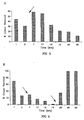
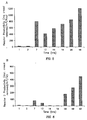
- Reactor performance was judged in terms of efficiency, which is defined herein as the reduction of cresol concentration in the medium after a single pass through the biofilm expressed as percentage removal of cresol from the recirculation medium. Reactor performance is also expressed in terms of productivity, which is defined as the amount in mg. of cresol removed per unit time.
- efficiency of Reactor 1 is shown in Figure 3 and that of Reactor 2 in Figure 4, being plots of % cresol removal against time (in hours). The arrows indicate when a fresh medium reservoir containing cresol was attached. Times indicated are after p-cresol addition.
- Bioreactor performance is affected by flux and by pH and redox potential.
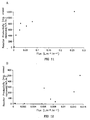
- Figure 9 (Reactor 1) indicates that efficiency increases with increasing flux rate up to a rate of about 0.025l.m -2 .hr -1 . Thereafter a non-linear drop in cresol removal is observed with increasing flux rates. This trend is not observed in Figure 10 (Reactor 2). This implies that some important operating parameter other than flux has a major influence on degradation efficiency.
- cresol removal efficiency of 100% could be achieved at a productivity of 508mg. of cresol removed per m 2 per hour. This means that 113l of 100ppm p-Cresol- containing synthetic effluent can be treated per day in a single pass operation using a 1m 2 reactor. Greater throughput can be achieved by operating the reactor in recycle mode at higher fluxes.
Landscapes
- Life Sciences & Earth Sciences (AREA)
- Microbiology (AREA)
- Water Supply & Treatment (AREA)
- Hydrology & Water Resources (AREA)
- Engineering & Computer Science (AREA)
- Environmental & Geological Engineering (AREA)
- Biodiversity & Conservation Biology (AREA)
- Chemical & Material Sciences (AREA)
- Organic Chemistry (AREA)
- Apparatus Associated With Microorganisms And Enzymes (AREA)
- Organic Low-Molecular-Weight Compounds And Preparation Thereof (AREA)
- Immobilizing And Processing Of Enzymes And Microorganisms (AREA)
- Steroid Compounds (AREA)
- Pharmaceuticals Containing Other Organic And Inorganic Compounds (AREA)
Claims (10)
- Verfahren zur Herstellung eines Sekundärmetaboliten, welches die Bereitstellung eines porösen Substrates einschließt, an das ein Mikroorganismus-Biofilm gebunden ist, dadurch gekennzeichnet, daß es umfaßt:
daß man eine Nährstofflösung durch das Substrat mit einer Geschwindigkeit strömen läßt, die ausreichend niedrig ist, daß sich ein Nährstoffgradient über den Biofilm aufbaut, so daß die Nährstoffkonzentration bei einem hohen Niveau entlang des Gradienten ausreichend hoch ist, um Primärwachstum des Mikroorganismus zu unterstützen, und die Nährstoffkonzentration bei einem niedrigen Niveau entlang des Gradienten ausreichend niedrig ist, um Sekundärmetabolismus im Mikroorganismus zu induzieren, wodurch auf einer kontinuierlichen Basis ein Sekundärmetabolit erzeugt wird. - Verfahren zur Behandlung nährstoffhaltigen Abwassers, das organische Verunreinigungen enthält, durch die Aktivität von Sekundärmetaboliten auf besagte Verunreinigungen, und welches die Bereitstellung eines porösen Substrates einschließt, an das ein Mikroorganismus-Biofilm gebunden ist, dadurch gekennzeichnet, daß es umfaßt:
daß man das Abwasser durch das Substrat mit einer Geschwindigkeit strömen läßt, die ausreichend niedrig ist, daß sich ein Nährstoffgradient über den Biofilm aufbaut, so daß die Nährstoffkonzentration bei einem hohen Niveau entlang des Gradienten ausreichend hoch ist, um Primärwachstum des Mikroorganismus zu unterstützen, und die Nährstoffkonzentration bei einem niedrigen Niveau entlang des Gradienten ausreichend niedrig ist, um Sekundärmetabolismus im Mikroorganismus zu induzieren, wodurch auf einer kontinuierlichen Basis ein Sekundärmetabolit erzeugt wird. - Verfahren nach Anspruch 1 oder Anspruch 2, dadurch gekennzeichnet, daß das Substrat in der Form einer Hohlfasermembran vorliegt, wobei der Biofilm sich auf der Außenseite der Membran befindet.
- Verfahren nach Anspruch 3, dadurch gekennzeichnet, daß die Hohlfasermembran eine poröse Haut auf der Innenseite aufweist und eine fingerähnliche, außen nicht mit Haut versehene Hohlraumstruktur, die von der Haut nach außen verläuft, wobei die nicht mit Haut versehene Hohlraumstruktur dicker ist als die poröse Haut
- Verfahren nach Anspruch 4, dadurch gekennzeichnet, daß die Hohlfasermembran einen Außendurchmesser von 2 mm besitzt, wobei eine poröse Haut eine Dicke von 1 µm besitzt und eine Hohlraumstruktur eine Dicke von 300 µm besitzt
- Verfahren nach einem der vorangehenden Ansprüche, dadurch gekennzeichnet, daß die Außenseite des Biofilms mit einem sauerstoffhaltigen Gas in Kontakt gebracht wird, um Sauerstoff für den Metabolismus bereitzustellen.
- Verfahren nach Anspruch 6, dadurch gekennzeichnet, daß das sauerstoffhaltige Gas Luft ist
- Verfahren nach Anspruch 6 oder Anspruch 7, dadurch gekennzeichnet, daß das sauerstoffhaltige Gas über die äußere Oberfläche des Biofilms geblasen wird, um Sporen und tote Zellen des Mikroorganismus abzutragen.
- Verfahren nach einem der vorangehenden Ansprüche, dadurch gekennzeichnet, daß der Mikroorganismus ein Fadenpilz ist.
- Verfahren nach Anspruch 9, dadurch gekennzeichnet, daß der Fadenpilz Phanerochaete chrysosporium ist.
Applications Claiming Priority (2)
| Application Number | Priority Date | Filing Date | Title |
|---|---|---|---|
| ZA9507366 | 1995-09-01 | ||
| ZA957366 | 1995-09-01 |
Publications (3)
| Publication Number | Publication Date |
|---|---|
| EP0761608A2 EP0761608A2 (de) | 1997-03-12 |
| EP0761608A3 EP0761608A3 (de) | 1998-04-15 |
| EP0761608B1 true EP0761608B1 (de) | 2001-03-14 |
Family
ID=25585288
Family Applications (1)
| Application Number | Title | Priority Date | Filing Date |
|---|---|---|---|
| EP19960306333 Expired - Lifetime EP0761608B1 (de) | 1995-09-01 | 1996-09-02 | Method für die Herstellung von Sekundärmetaboliten |
Country Status (6)
| Country | Link |
|---|---|
| US (1) | US5945002A (de) |
| EP (1) | EP0761608B1 (de) |
| AT (1) | ATE199701T1 (de) |
| DE (1) | DE69612048T2 (de) |
| DK (1) | DK0761608T3 (de) |
| GR (1) | GR3036003T3 (de) |
Families Citing this family (37)
| Publication number | Priority date | Publication date | Assignee | Title |
|---|---|---|---|---|
| US6368343B1 (en) | 2000-03-13 | 2002-04-09 | Peter M. Bonutti | Method of using ultrasonic vibration to secure body tissue |
| US9138222B2 (en) | 2000-03-13 | 2015-09-22 | P Tech, Llc | Method and device for securing body tissue |
| US6475382B2 (en) | 2000-12-19 | 2002-11-05 | Co2 Solution Inc. | Treatment unit for treating a fluid and method thereof |
| IL159016A0 (en) * | 2001-05-24 | 2004-05-12 | Synexa Life Sciences Proprieta | Production of secondary metabolites |
| CA2353307A1 (fr) | 2001-07-13 | 2003-01-13 | Carmen Parent | Appareil et procede pour le traitement des effluents gazeux |
| FR2834285B1 (fr) * | 2002-01-02 | 2004-10-01 | Ondeo Degremont | Procede de traitement des boues et des dechets issus du traitement d'eaux usees |
| US9155544B2 (en) | 2002-03-20 | 2015-10-13 | P Tech, Llc | Robotic systems and methods |
| CA2405635A1 (en) | 2002-09-27 | 2004-03-27 | C02 Solution Inc. | A process and a plant for the production of useful carbonated species and for the recycling of carbon dioxide emissions from power plants |
| US7175763B2 (en) * | 2003-02-13 | 2007-02-13 | Zenon Technology Partnership | Membrane supported biofilm process for autotrophic reduction |
| US7294259B2 (en) * | 2003-02-13 | 2007-11-13 | Zenon Technology Partnership | Membrane module for gas transfer |
| US7300571B2 (en) * | 2003-02-13 | 2007-11-27 | Zenon Technology Partnership | Supported biofilm apparatus |
| CN100361907C (zh) * | 2003-02-13 | 2008-01-16 | 泽农技术合伙公司 | 受支撑的生物薄膜设备和反应器及处理液体方法 |
| WO2005016826A2 (en) * | 2003-08-18 | 2005-02-24 | Zenon Environmental Inc. | Supported biofilm apparatus and process |
| US7303676B2 (en) * | 2003-02-13 | 2007-12-04 | Zenon Technology Partnership | Supported biofilm apparatus and process |
| AU2004210726A1 (en) * | 2003-02-13 | 2004-08-26 | Zenon Technology Partnership | Supported biofilm apparatus and process |
| US7497864B2 (en) | 2003-04-30 | 2009-03-03 | Marctec, Llc. | Tissue fastener and methods for using same |
| US20080039873A1 (en) | 2004-03-09 | 2008-02-14 | Marctec, Llc. | Method and device for securing body tissue |
| US9271766B2 (en) | 2004-10-26 | 2016-03-01 | P Tech, Llc | Devices and methods for stabilizing tissue and implants |
| US9463012B2 (en) | 2004-10-26 | 2016-10-11 | P Tech, Llc | Apparatus for guiding and positioning an implant |
| US9173647B2 (en) | 2004-10-26 | 2015-11-03 | P Tech, Llc | Tissue fixation system |
| US20060089646A1 (en) | 2004-10-26 | 2006-04-27 | Bonutti Peter M | Devices and methods for stabilizing tissue and implants |
| US9089323B2 (en) | 2005-02-22 | 2015-07-28 | P Tech, Llc | Device and method for securing body tissue |
| CA2613237C (en) * | 2005-06-30 | 2015-06-16 | Quorus Biotech (Proprietary) Limited | Production of secondary metabolites or recombinant products |
| CA2629910C (en) * | 2005-11-17 | 2013-04-23 | Australian Nuclear Science And Technology Organisation | Sewage treatment |
| US8496657B2 (en) | 2006-02-07 | 2013-07-30 | P Tech, Llc. | Methods for utilizing vibratory energy to weld, stake and/or remove implants |
| US7967820B2 (en) | 2006-02-07 | 2011-06-28 | P Tech, Llc. | Methods and devices for trauma welding |
| US11253296B2 (en) | 2006-02-07 | 2022-02-22 | P Tech, Llc | Methods and devices for intracorporeal bonding of implants with thermal energy |
| US11278331B2 (en) | 2006-02-07 | 2022-03-22 | P Tech Llc | Method and devices for intracorporeal bonding of implants with thermal energy |
| EP2010641A1 (de) * | 2006-04-12 | 2009-01-07 | Synexa Life Sciences (Proprietary) Ltd | Bioprozessvorrichtung mit hohem durchsatz |
| WO2007116267A1 (en) * | 2006-04-12 | 2007-10-18 | Synexa Life Sciences (Pty) Ltd | Bioreactor |
| US11246638B2 (en) | 2006-05-03 | 2022-02-15 | P Tech, Llc | Methods and devices for utilizing bondable materials |
| US8617185B2 (en) | 2007-02-13 | 2013-12-31 | P Tech, Llc. | Fixation device |
| ES2827773T3 (es) * | 2007-04-20 | 2021-05-24 | Zenon Tech Partnership | Aparato y procedimiento de biopelícula con soporte de membrana |
| US10076377B2 (en) | 2013-01-05 | 2018-09-18 | P Tech, Llc | Fixation systems and methods |
| KR102370290B1 (ko) | 2013-02-22 | 2022-03-04 | 비엘 테크놀러지스 인크. | 바이오필름 지지용 맴브레인 조립체 |
| CA2943072C (en) | 2014-03-20 | 2023-09-26 | General Electric Company | Wastewater treatment with primary treatment and mbr or mabr-ifas reactor |
| US10058393B2 (en) | 2015-10-21 | 2018-08-28 | P Tech, Llc | Systems and methods for navigation and visualization |
Family Cites Families (10)
| Publication number | Priority date | Publication date | Assignee | Title |
|---|---|---|---|---|
| US4554075A (en) * | 1984-05-29 | 1985-11-19 | North Carolina State University | Process of degrading chloro-organics by white-rot fungi |
| US4655926A (en) * | 1984-05-29 | 1987-04-07 | North Carolina State University | Process of treating effluent from a pulp or papermaking operation |
| US4948728A (en) * | 1985-09-03 | 1990-08-14 | California Institute Of Technology | Monolith reactor containing a plurality of flow passages and method for carrying out biological reactions |
| US4705503A (en) * | 1986-02-03 | 1987-11-10 | Regents Of The University Of Minnesota | Metabolite sensor including a chemical concentration sensitive flow controller for a drug delivery system |
| JP2559592B2 (ja) * | 1987-06-11 | 1996-12-04 | 大成建設株式会社 | 廃水処理生物膜担体 |
| US4988443A (en) * | 1990-07-03 | 1991-01-29 | North Carolina State University | Bioreactor process for continuous removal of organic toxicants and other oleophilc solutes from an aqueous process stream |
| US5342765A (en) * | 1991-08-01 | 1994-08-30 | Occidental Chemical Corporation | Method of producing extracellular products from aerobic microorganisms |
| GB9119955D0 (en) * | 1991-09-18 | 1991-10-30 | Imperial College | Treatment of aqueous supplies containing organic material |
| US5232601A (en) * | 1992-05-29 | 1993-08-03 | W. R. Grace & Co.-Conn. | High flux hollow fiber membrane |
| US5622819A (en) * | 1995-03-28 | 1997-04-22 | Kinetic Biosystems, Inc. | Centrifugal fermentation process |
-
1996
- 1996-08-30 US US08/705,624 patent/US5945002A/en not_active Expired - Lifetime
- 1996-09-02 DE DE69612048T patent/DE69612048T2/de not_active Expired - Lifetime
- 1996-09-02 DK DK96306333T patent/DK0761608T3/da active
- 1996-09-02 AT AT96306333T patent/ATE199701T1/de active
- 1996-09-02 EP EP19960306333 patent/EP0761608B1/de not_active Expired - Lifetime
-
2001
- 2001-06-06 GR GR20010400856T patent/GR3036003T3/el unknown
Also Published As
| Publication number | Publication date |
|---|---|
| EP0761608A3 (de) | 1998-04-15 |
| US5945002A (en) | 1999-08-31 |
| ATE199701T1 (de) | 2001-03-15 |
| DE69612048T2 (de) | 2001-10-11 |
| EP0761608A2 (de) | 1997-03-12 |
| DK0761608T3 (da) | 2001-07-16 |
| GR3036003T3 (en) | 2001-09-28 |
| DE69612048D1 (de) | 2001-04-19 |
Similar Documents
| Publication | Publication Date | Title |
|---|---|---|
| EP0761608B1 (de) | Method für die Herstellung von Sekundärmetaboliten | |
| Zhang et al. | Transport and biodegradation of toxic organics in biofilms | |
| Arya et al. | Performance of suspended and attached growth bioreactors for the removal of cationic and anionic pharmaceuticals | |
| Pazarlioğlu et al. | Biodegradation of phenol by Pseudomonas putida immobilized on activated pumice particles | |
| US4442206A (en) | Method of using isotropic, porous-wall polymeric membrane, hollow-fibers for culture of microbes | |
| Huang et al. | Effect of sludge retention time on microbial behaviour in a submerged membrane bioreactor | |
| Brindle et al. | Nitrification and oxygen utilisation in a membrane aeration bioreactor | |
| US4127447A (en) | Biomass growth restriction in a packed bed reactor | |
| Casey et al. | Oxygen mass transfer characteristics in a membrane‐aerated biofilm reactor | |
| Pankhania et al. | Membrane aeration bioreactors for wastewater treatment: completely mixed and plug-flow operation | |
| US4988443A (en) | Bioreactor process for continuous removal of organic toxicants and other oleophilc solutes from an aqueous process stream | |
| O'Reilly et al. | Kinetics of p-cresol degradation by an immobilized Pseudomonas sp | |
| US5403450A (en) | Method of water purification | |
| Taşkan et al. | Effective biofilm control in a membrane biofilm reactor using a quenching bacterium (Rhodococcus sp. BH4) | |
| Ogawa et al. | Production of kojic acid by membrane-surface liquid culture of Aspergillus oryzae NRRL484 | |
| Sharari et al. | Treatment of bagasse preparation effluent by Phanerochaete chrysosporium immobilized on polyurethane foam: Enzyme production versus pollution removal | |
| Chen et al. | Biocatalytic membranes prepared by inkjet printing functionalized yeast cells onto microfiltration substrates | |
| Yang et al. | Design and performance study of a novel immobilized hollow fiber membrane bioreactor | |
| US20040191855A1 (en) | Production of secondary metabolites | |
| Lim et al. | Microbial community in biofilm on membrane surface of submerged MBR: effect of in-line cleaning chemical agent | |
| Salter et al. | New materials and technology for cell immobilization | |
| Dolasa et al. | Membrane bioreactor for cometabolism of trichloroethene air emissions | |
| US6099731A (en) | Method and apparatus for treating water | |
| Ferreira Jorge et al. | Microbial dynamics in an extractive membrane bioreactor exposed to an alternating sequence of organic compounds | |
| Bodzek et al. | Immobilized enzyme membranes for phenol and cyanide decomposition |
Legal Events
| Date | Code | Title | Description |
|---|---|---|---|
| PUAI | Public reference made under article 153(3) epc to a published international application that has entered the european phase |
Free format text: ORIGINAL CODE: 0009012 |
|
| AK | Designated contracting states |
Kind code of ref document: A2 Designated state(s): AT BE CH DE DK FR GB GR IT LI NL SE |
|
| AX | Request for extension of the european patent |
Free format text: AL;LT;LV;SI |
|
| RBV | Designated contracting states (corrected) |
Designated state(s): AT BE CH DE DK FR GB GR IT LI NL SE |
|
| PUAL | Search report despatched |
Free format text: ORIGINAL CODE: 0009013 |
|
| AK | Designated contracting states |
Kind code of ref document: A3 Designated state(s): AT BE CH DE DK FR GB GR IT LI NL SE |
|
| 17P | Request for examination filed |
Effective date: 19981014 |
|
| 17Q | First examination report despatched |
Effective date: 19990429 |
|
| GRAG | Despatch of communication of intention to grant |
Free format text: ORIGINAL CODE: EPIDOS AGRA |
|
| GRAG | Despatch of communication of intention to grant |
Free format text: ORIGINAL CODE: EPIDOS AGRA |
|
| GRAG | Despatch of communication of intention to grant |
Free format text: ORIGINAL CODE: EPIDOS AGRA |
|
| GRAH | Despatch of communication of intention to grant a patent |
Free format text: ORIGINAL CODE: EPIDOS IGRA |
|
| GRAH | Despatch of communication of intention to grant a patent |
Free format text: ORIGINAL CODE: EPIDOS IGRA |
|
| GRAA | (expected) grant |
Free format text: ORIGINAL CODE: 0009210 |
|
| AK | Designated contracting states |
Kind code of ref document: B1 Designated state(s): AT BE CH DE DK FR GB GR IT LI NL SE |
|
| REF | Corresponds to: |
Ref document number: 199701 Country of ref document: AT Date of ref document: 20010315 Kind code of ref document: T |
|
| REG | Reference to a national code |
Ref country code: CH Ref legal event code: EP |
|
| REF | Corresponds to: |
Ref document number: 69612048 Country of ref document: DE Date of ref document: 20010419 |
|
| ITF | It: translation for a ep patent filed | ||
| REG | Reference to a national code |
Ref country code: CH Ref legal event code: NV Representative=s name: PATENTANWAELTE SCHAAD, BALASS, MENZL & PARTNER AG |
|
| REG | Reference to a national code |
Ref country code: DK Ref legal event code: T3 |
|
| ET | Fr: translation filed | ||
| REG | Reference to a national code |
Ref country code: GB Ref legal event code: IF02 |
|
| PLBE | No opposition filed within time limit |
Free format text: ORIGINAL CODE: 0009261 |
|
| STAA | Information on the status of an ep patent application or granted ep patent |
Free format text: STATUS: NO OPPOSITION FILED WITHIN TIME LIMIT |
|
| 26N | No opposition filed | ||
| PGFP | Annual fee paid to national office [announced via postgrant information from national office to epo] |
Ref country code: SE Payment date: 20120911 Year of fee payment: 17 |
|
| PGFP | Annual fee paid to national office [announced via postgrant information from national office to epo] |
Ref country code: GR Payment date: 20120817 Year of fee payment: 17 |
|
| PGFP | Annual fee paid to national office [announced via postgrant information from national office to epo] |
Ref country code: AT Payment date: 20120829 Year of fee payment: 17 |
|
| PGFP | Annual fee paid to national office [announced via postgrant information from national office to epo] |
Ref country code: CH Payment date: 20130912 Year of fee payment: 18 Ref country code: DK Payment date: 20130910 Year of fee payment: 18 Ref country code: NL Payment date: 20130910 Year of fee payment: 18 Ref country code: DE Payment date: 20130904 Year of fee payment: 18 |
|
| PGFP | Annual fee paid to national office [announced via postgrant information from national office to epo] |
Ref country code: FR Payment date: 20130910 Year of fee payment: 18 Ref country code: GB Payment date: 20130904 Year of fee payment: 18 |
|
| PGFP | Annual fee paid to national office [announced via postgrant information from national office to epo] |
Ref country code: IT Payment date: 20130906 Year of fee payment: 18 |
|
| PGFP | Annual fee paid to national office [announced via postgrant information from national office to epo] |
Ref country code: BE Payment date: 20130912 Year of fee payment: 18 |
|
| REG | Reference to a national code |
Ref country code: SE Ref legal event code: EUG |
|
| PG25 | Lapsed in a contracting state [announced via postgrant information from national office to epo] |
Ref country code: SE Free format text: LAPSE BECAUSE OF NON-PAYMENT OF DUE FEES Effective date: 20130903 |
|
| REG | Reference to a national code |
Ref country code: AT Ref legal event code: MM01 Ref document number: 199701 Country of ref document: AT Kind code of ref document: T Effective date: 20130902 |
|
| REG | Reference to a national code |
Ref country code: GR Ref legal event code: ML Ref document number: 20010400856 Country of ref document: GR Effective date: 20140403 |
|
| PG25 | Lapsed in a contracting state [announced via postgrant information from national office to epo] |
Ref country code: GR Free format text: LAPSE BECAUSE OF NON-PAYMENT OF DUE FEES Effective date: 20140403 Ref country code: AT Free format text: LAPSE BECAUSE OF NON-PAYMENT OF DUE FEES Effective date: 20130902 |
|
| REG | Reference to a national code |
Ref country code: DE Ref legal event code: R119 Ref document number: 69612048 Country of ref document: DE |
|
| REG | Reference to a national code |
Ref country code: DK Ref legal event code: EBP Effective date: 20140930 |
|
| REG | Reference to a national code |
Ref country code: CH Ref legal event code: PL |
|
| GBPC | Gb: european patent ceased through non-payment of renewal fee |
Effective date: 20140902 |
|
| REG | Reference to a national code |
Ref country code: FR Ref legal event code: ST Effective date: 20150529 |
|
| PG25 | Lapsed in a contracting state [announced via postgrant information from national office to epo] |
Ref country code: NL Free format text: LAPSE BECAUSE OF NON-PAYMENT OF DUE FEES Effective date: 20150401 Ref country code: BE Free format text: LAPSE BECAUSE OF NON-PAYMENT OF DUE FEES Effective date: 20140930 |
|
| PG25 | Lapsed in a contracting state [announced via postgrant information from national office to epo] |
Ref country code: LI Free format text: LAPSE BECAUSE OF NON-PAYMENT OF DUE FEES Effective date: 20140930 Ref country code: CH Free format text: LAPSE BECAUSE OF NON-PAYMENT OF DUE FEES Effective date: 20140930 Ref country code: GB Free format text: LAPSE BECAUSE OF NON-PAYMENT OF DUE FEES Effective date: 20140902 Ref country code: DE Free format text: LAPSE BECAUSE OF NON-PAYMENT OF DUE FEES Effective date: 20150401 |
|
| PG25 | Lapsed in a contracting state [announced via postgrant information from national office to epo] |
Ref country code: IT Free format text: LAPSE BECAUSE OF NON-PAYMENT OF DUE FEES Effective date: 20140902 Ref country code: FR Free format text: LAPSE BECAUSE OF NON-PAYMENT OF DUE FEES Effective date: 20140930 |
|
| PG25 | Lapsed in a contracting state [announced via postgrant information from national office to epo] |
Ref country code: DK Free format text: LAPSE BECAUSE OF NON-PAYMENT OF DUE FEES Effective date: 20140930 |