BACKGROUND OF THE INVENTION
a) Field of the Invention
This invention relates to (co)polymer particles
having a function to be substantially redispersible in
water of pH 5 or higher and also to a process for the
production of the (co)polymer particles.
b) Description of the Related Art
An aqueous emulsion available by emulsion
polymerization generally contains as much as 30 to
90 wt.% of water as a dispersion medium. This means
that upon its piping or shipping, a great deal of water
has to be transported, thereby causing a problem from
the standpoint of both energy and cost.
On the other hand, a redispersible polymer is, in
contrast to general aqueous emulsions, in the form of a
solid or paste which is either completely or substantially
free of water, and permits easy piping, shipping
and storage. As another characteristic feature, a
redispersible polymer can be reconstituted into an
emulsified form similar to an ordinary aqueous emulsion
by dissolving it in water when needed.
A redispersible polymer or a powder thereof can
be premixed with another powder such as cement, gypsum
or a pigment in accordance with a desired formula and
can hence be provided as a one-pack product.
One-pack products with a redispersible polymer or
a powder thereof premixed therein are widely used in
the field of cement modifiers.
Such one-pack products with a redispersible
polymer or a powder thereof premixed therein are in the
form of compact light-weight powders during their
piping, shipping and storage but upon use, mixing of
such powders with water at construction sites makes it
possible to prepare desired concretes in a single-step
operation for immediate use.
Upon mixing a polymer, irksome procedures such as
measuring operations can be significantly omitted so
that the efficiency of work becomes extremely good.
This is substantially meritorious.
Gallon cans or drum cans are needed in the case
of a conventional aqueous emulsion. They are however
no longer needed in the case of a redispersible polymer
of a powder thereof. This is advantageous in that
packaging cost can be reduced at the time of shipping
and packaging materials, such as gallon cans and drum
cans, to be disposed can be substantially reduced in
quantity.
When provided as a premixed one-pack product, the
quality control of concrete at the time of construction
is made easier and the reliability of the construction
is improved further, because its components have been
precisely measured beforehand in accordance with a
desired formula.
Compared with conventional aqueous emulsions, the
redispersible polymer or its powder according to the
present invention is therefore advantageous at least
for the following reasons:
Nevertheless, redispersible polymers produced by
conventional techniques are accompanied by at least the
following disadvantages because they use conventional
spray drying:
A. Conventional techniques on polymer particles
Conventional techniques on polymer particles will
be described below. Polymer particles produced by such
conventional techniques show either no redispersibility
or dispersibility which is not fully satisfactory.
Further, the below-described conventional techniques
for the provision of polymer particles which show
redispersibility all employ conventional spray drying
and due to one or more drawbacks inherent to the conventional
spray drying, they are unable to provide sufficient
redispersibility.
[Japanese Patent Laid-Open No. 193903/1984]
Japanese Patent Laid-Open No. 193903/1984 in the
name of TOSOH CORPORATION discloses a technique for
readily obtaining an aggregate-free powder composition
by polymerizing one or more unsaturated monomers in the
presence of a special water-soluble copolymer which
acts as a stabilizer or powdering agent across a particular
pH value.
Described specifically, this technique is a production
process in which, after a stable emulsion is
polymerized in the presence of a water-soluble
copolymer of methacrylamide and an unsaturated carboxylic
acid, the resultant polymer is separated at pH
4 or lower, followed by dehydration and drying.
However, insofar as its disclosure is concerned,
the process is understood to have the following inventive
features.
In the invention disclosed in Japanese Patent
Laid-Open No. 193903/1984, the water-soluble copolymer
has the following two functions:
This technique makes it possible to obtain an
aggregate-free powder by conducting emulsion
polymerization in the presence of a water-soluble
copolymer having a function as a stabilizer.
Namely, a radically-polymerizable, unsaturated-bond-containing
monomer (e.g., styrene) (A) is first
polymerized at pH 5 or higher in an aqueous medium in
the presence of a water-soluble copolymer (B) of
methacrylamide and an unsaturated carboxylic acid
(preferably, methacrylic acid or itaconic acid), thereby
obtaining an emulsion which is stable under the action
of the component (B) as a stabilizer. The pH is
then adjusted to 4 or lower to separate the resultant
polymer from the emulsion under the action of the component
(B) as a powdering agent. The thus-separated
polymer is dehydrated and dried, whereby a powder composition
is obtained.
Concerning the weight ratio of the radially-polymerizable,
unsaturated-bond-containing monomer (A)
to the water-soluble copolymer (B), it is preferred to
use (B) in an amount of from 1 to 10 parts by weight
per 100 parts by weight of (A). It is described that
an amount of (B) smaller than 1 part by weight cannot
exhibit sufficient powdering effect for the emulsion
while an amount of (B) greater than 10 parts by weight
leads to an increase in production cost and is hence
not needed. As a matter of fact, (B) was used in an
amount of 2 parts by weight per 100 parts by weight of
(A) in Examples 7 to 9.
It is also disclosed that, when methacrylic acid
or itaconic acid is used as an unsaturated carboxylic
acid monomer upon production of a water-soluble
copolymer, the resulting water-soluble copolymer has a
function as a powdering agent at a composition ratio of
methacrylic acid or itaconic acid to methacrylamide in
a range of from 9/1 to 1/9. Further, as a method for
lowering the pH, it is disclosed to add hydrochloric
acid under stirring.
The theme dealt with by the technique of this
publication is limited to powdering of a polymer, so
that redispersion of the polymer so powdered is not
contemplated at all. The powdered polymers disclosed
in this publication therefore has no inherent redispersibility.
[Japanese Patent Publication No. 54973/1991]
Japanese Patent Publication No. 54973/1991 in the
name of Wacker-Chemie GMBH discloses a technique for
producing dispersible powder having excellent
flowability and good redispersibility by subjecting one
or more ethylenically unsaturated compounds to emulsion
polymerization in the presence of a specific protective
colloid and a free-radical initiator and then drying
the resultant polymer.
Described specifically, in an aqueous medium containing
5 wt.% or more of a protective colloid - which
is selected from a water-soluble starch having an
amylose content of 30 wt.% or less, a water-swellable
starch, a dispersible starch, a cyanoalkylated,
hydroxyalkylated or carboxylated starch or a water-soluble
protein - and a free-radical initiator (e.g.,
isopropyl hydroperoxide), one or more copolymerizable,
ethylenically unsaturated compounds are subjected to
emulsion (co)polymerization, whereby an aqueous dispersion
having a water content of from 10 to 75 wt.% is
obtained.
This aqueous dispersion is next subjected to
spray drying optionally after adding a detackifier
(e.g., PVA) and/or an atomizing aid (e.g., dextrin) in
an amount of 0 to 40 wt.% as needed.
[Japanese Patent Laid-Open No. 210336/1991]
Japanese Patent Laid-Open No. 210336/1991 in the
name of Nippon Paint Co., Ltd. discloses a technique
for obtaining crosslinked resin particles from a resin
having a glass transition point of 0°C or lower by a
particular post-emulsification method, which comprises
subjecting the resin to the post-emulsification method
after addition of specific plural substances to the
resin, thereby obtaining crosslinked resin particles
free from interparticulate cohesion and excellent in
redispersibility and storage stability.
Described specifically, the technique is a process
for obtaining crosslinked resin particles by post
emulsification, which comprises the following steps:
dispersing a resin component in water from a resin having
a glass transition point (Tg) of 0°C or lower, for
example, an elastomer such as acrylic rubber,
polybutadiene, polyisoprene, chloroprene, poly(ε-caprolactone)
or poly(tetramethylene glycol), forming
an interior of each dispersed particle into a three-dimensional
structure and then removing the aqueous medium.
The process features that the resin component is
subjected to the post emulsification after the resin
component is added with a monomer (e.g., styrene)
capable of affording a resin having a Tg 20°C higher in
the polymerized form than the resin component and or a
resin (e.g., PS) having a Tg 20°C higher than the resin
component and also with a polyfunctional vinyl compound
(e.g., neopentyl glycol methacrylate).
[Japanese Patent Publication No. 59324/1992]
Japanese Patent Publication No. 59324/1992 in the
name of BASF AG discloses a process for producing a
polymer powder permitting storage at room temperature
and having stick-free property and water redispersibility
by spray drying an aqueous dispersion which
contains a vinylpyrrolidone-vinyl acetate copolymer or
a water-soluble alkali (or alkaline earth) metal salt
of a naphthalenesulfonic acid-formaldehyde condensation
product.
Described specifically, an aqueous dispersion of
a polymer is spray-dried after adding, as a water-soluble
polymer substance, a copolymer (A) obtained
from 20-70 wt.% of vinylpyrrolidone and 30-80 wt.% of
vinyl acetate and/or a water-soluble alkali metal salt
or alkaline earth metal salt (B) of a naphthalenesulfonic
acid-formaldehyde condensation product in an
amount of from 2 to 40 wt.% based on the polymer in the
dispersion.
The redispersible polymer powder obtained in the
above-described manner is suited as an additive especially
for a hydraulic binder, for example, gypsum, cement,
mortar and magnesia cement.
[Japanese Patent Laid-Open No. 194681/1993]
Japanese Patent Laid-Open No. 194681/1993 in the
name of Rohm & Haas Co. discloses a technique, which
relates to a process for producing a novel redispersible
core-shell polymer powder effective as a mortar
modifier.
Namely, disclosed is a redispersible polymer powder
obtained by spray-drying a core-shell polymer which
has been produced by polymerizing cores in the presence
of alkali-soluble shells and which is formed of cores
and shells chemically grafted together owing to the use
of a polyfunctional compound.
Described more specifically, disclosed is a
redispersible polymer powder produced from a core-shell
polymer which has shells made of an alkali-soluble
emulsion polymer and cores made of a water-insoluble
emulsion polymer, the polymer of each of said shells
and the polymer of its corresponding core having been
chemically graft-bonded together by the use of a
polyfunctional compound. This core-shell polymer is
produced by a two-step successive emulsion polymerization
process, that is, by polymerizing cores of an
alkali-insoluble emulsion polymer in the presence of an
emulsion polymer which has been solubilized with an
alkali. Use of the core-shell polymer powder of this
invention as a cement modifier has been confirmed to
improve physical properties of the powder and hence to
provide cement mortar having improved properties.
[Japanese Language Laid-Open Publication (PCT)
No. 501575/1993]
Japanese Language Laid-Open Publication (PCT) No.
501575/1993 in the name of Henkel KG Auf Aktien) discloses
a process for the production of a stable polymer
dispersion by employing as a stabilizer an amphoteric
polymer which has excellent shear stability and waterproofness
and is useful inter alia as a finish for textile
products. The amphoteric polymer is obtained by
adjusting the pH of an aqueous solution of a stabilizer
composed of a starting amphoteric polymer to an
isoelectric point with an acid or the like to cause the
starting amphoteric polymer to precipitate from the
aqueous solution, adjusting the pH of the aqueous solution
to redissolve the precipitate, adding a catalyst
and the like and hen conducting emulsion polymerization.
Described specifically, the pH of an aqueous
solution of a stabilizer composed of a starting
amphoteric polymer is adjusted to an isoelectric point
with a non-volatile acid or base to cause the starting
amphoteric polymer to precipitate. Using a volatile
base or acid, the pH of the solution is adjusted to a
value desirable for emulsion polymerization, so that
the precipitate is redissolved. Thereafter, an unsaturated
monomer of the vinyl structure is neutralized
with a non-volatile neutralizing agent and is added together
with a catalyst and one or more optional aids,
followed by emulsion polymerization so that the target
dispersion is obtained.
B. Conventional techniques on protective colloid
polymerization
Protective colloid polymerization is a
polymerization process which is known to the public and
is used publicly.
The concepts of the terms "protective colloid
polymerization" and "protective colloid" as well as the
concept and principle of protective colloid polymerization
are disclosed in introductory textbooks, for example,
Tsunetaka Matsumoto: "Kogyo Zairyo (Industrial
Material), Emarushion Gairon (Introduction to Emulsion)",
24(3), 10-15.
In particular, visual and readily-understandable
explanations are found in "Fig. 2 Shinsuisei Monoma no
Nyuka Jyugo (Emulsion Polymerization of Hydrophilic
Monomers" (page 12) and its description [under
"Shinsuisei Monoma no Nyuka Jyugo (Emulsion Polymerization
of Hydrophilic Monomers" on page 12] and further
in "Fig. 3 Mizu Emarushion no Anteika (Stabilization
of Aqueous Emulsion)" (page 13) and its description
[under "Mizu Emarushion no Anteika (Stabilization of
Aqueous Emulsion)" on pages 12-13].
Illustrative of specific examples of known techniques
on protective colloid polymerization are those
disclosed in Japanese Patent Laid-Open Nos. 173003/1990
and 185607/1992, which will be described hereinafter.
[Japanese Patent Laid-Open No. 185607/1992]
Japanese Patent Laid-Open No. 185607/1992 in the
name of Hoechst Gosei K.K. discloses an invention on a
redispersible acrylic resin emulsion powder of the protective
colloid type and its production process. Namely,
an acrylic monomer is subjected to emulsion
(co)polymerization in the presence of a specific amount
of a chain transfer agent while using a water-soluble
protective colloid. The resulting emulsion is spray-dried,
whereby the above-described powder excellent in
redispersibility and, film properties is obtained.
Described specifically, using a water-soluble
protective colloid (e.g., polyvinyl alcohol), an
acrylic monomer (e.g., methyl methacrylate) is subjected
to emulsion polymerization in the presence of a
chain transfer agent (e.g., trichloroethylene) in an
amount of from 0.1 to 50 wt.% on the basic of the
acrylic monomer, optionally together with 30 wt.% or
less of a copolymerizable monomer (e.g., styrene). The
resulting acrylic resin emulsion is then spray-dried,
so that a redispersible acrylic resin emulsion of the
protective colloid type is obtained. The resin emulsion
powder so obtained is suitably usable as an adhesive,
a paint binder and a cement additive.
[Japanese Patent Laid-Open No. 173003/1990]
Japanese Patent Laid-Open No. 173003/1990 in the
name of Mitsui-Toatsu Chemicals Inc. discloses a technique
for efficiently obtaining porous polymer particles
without inclusion of impurities such as a dispersant,
a diluent and the like by dispersing an oil
phase, which contains a polymerizable monomer and a
diluent, in an aqueous medium containing a dispersant
and then polymerizing the resultant dispersion under
specific conditions.
Described specifically, in an aqueous medium (b)
containing 0.1-10 wt.% of a dispersant (a) which is a
partially-saponified PVA having a saponification degree
of 50-95%, an oil phase (e) containing a polymerizable
monomer (c), which is a monomer insoluble or sparingly
soluble in the component (b) and contains a vinyl
group, and a diluent (d) which is soluble in the component
(c) but insoluble or sparingly soluble in the
component (b) and has no polymerizability is dispersed
in the form of spheres of 1-50 µm in diameter at a
volume ratio of the component (b) to the component (c)
in an range of from 10:1 to 1:1. While polymerizing
the component (c), the dispersed particles are caused,
in their spherical forms, to flocculate into sizes of
from 0.1 to 3 mm in diameter so that a polymer particle
flocculate is obtained. This flocculate is then
washed to remove the component (a). Subsequent to extraction
of the component (d), the flocculate is
redispersed to sizes of from 1 to 5 µm.
C. Technical background concerning redispersibility and
film-forming properties
[Redispersibility and film-forming properties]
Redispersible polymers or their powders include
those incapable of forming films at room temperature
when reconstituted to redispersions. To be usable for
a wide range of applications, a redispersible polymer
or a powder thereof whose reconstituted redispersion
dries at room temperature into a film is however
preferred. When an aqueous emulsion such as that
capable of forming a film at room temperature is dried,
a serious problem arises, that is, the polymer is so
soft that dispersed particles of the polymer undergo
aggregation and cohesion and the redispersibility is
lost.
[Anti-binding agent]
To avoid mutual aggregation and cohesion of powder
particles, it is known to add as an anti-binding
agent a fine inorganic powder or a fine organic powder
having no binding ability.
Such a method however involves a problem in that,
when a film is formed by drying a redispersion, undesirous
effects are given to various properties such
as transparency. This has imposed a considerable
limitation on the utility and application field.
Among applications of a redispersible polymer or
its powder, a cement additive is expected to develop
less problem even when fine inorganic power is mixed.
Even in the case of such a cement additive, an increase
in flow value is observed due to large hygroscopicity
of the fine inorganic powder, thereby making it necessary
to increase the water/cement ratio.
Further problems have also been observed, including
production of cement products having high hygroscopicity
and also production of cement products prone
to dusting of fine powder and hence to non-uniformity
in composition.
For such problems, it has been desired to develop
a redispersible polymer which does not require such an
anti-binding agent.
[Core-shell polymers having alkali-soluble shells]
Among the conventional techniques on redispersible
polymer powders, the method making use of a core-shell
polymer equipped with alkali-soluble shells is
accompanied by a problem in redispersibility because
the shells have a low density due to their solubility .
and are unable to completely prevent cohesion of particles
during drying.
Moreover, omission of an anti-binding agent
results in a new problem that the cohesion of particles
cannot be prevented.
EP 0 338 486 B1 discloses a stable aqueous latex produced by
reacting latex-forming monomers under aqueous emulsion
polymerisation reaction conditions to form a hydrophilic,
first-stage polymer and contacting the first-stage polymer
with an effective amount of at least one hydrophobic, latex-forming
monomer under emulsion-polymerisation reaction
conditions to form a hydrophobic, second-stage polymer,
wherein the second-stage hydrophobic polymer partitions into
the first-stage hydrophilic polymer thereby producing an
inverted core-shell emulsion polymer. This document, however,
does not mention the problem of producing a re-dispersible
polymer.
[Spray drying technique]
Most redispersible polymer powders are produced
by spray drying, which directly obtains powder by causing
water to evaporate while preventing aggregation.
Conventional spray drying however involves a
problem in redispersibility, because powder is dried
usually at a temperature as high as 100°C or higher and
cohesion of particles cannot be prevented completely.
In some instances, a deposit occurs
on an inner wall of a drying tower upon spray drying,
leading to a substantial reduction in yield.
A further serious problem is also involved in
that enormous time and energy are needed in large-scale
production or batchwise production.
The present inventors considered that the conventional
techniques for the production of a redispersible
polymer or its powder are not satisfactory for the need
for such enormous time and energy.
D. Technical background concerning cement additives
[Dai 50 Kai Semento Gijyutsu Taikai Koen Yoshishu
(Abstracts of Lectures at the 50th Cement Technology
Symposium), 324-325, 1996]
A polymer cement mortar with a redispersible powder
resin mixed therein is described to still involve
an unsolved technical problem in redispersibility or
the like and to result in lowered compression strength
and/or flexural strength in some instances.
[Dai 50 Kai Semento Gijyutsu Taikai Koen Yoshishu
(Abstracts of Lectures at the 50th Cement Technology
Symposium), 322-323, 1996]
A polymer cement mortar with a redispersible powder
resin mixed therein is described to have tendency
to permit introduction of air into cement so that in
some instances, the compression strength and/or
flexural strength may be reduced to adversely affect
various physical properties.
In view of the above-described teachings, development
of a redispersible powder resin excellent in
redispersibility, if succeeded, is expected to provide
polymer cement mortar with improved physical properties
because such a redispersible powder resin makes it possible
to complete the mixing of water, cement and sand
in a short time and hence to reduce the amount
of air to be introduced into cement.
SUMMARY OF THE INVENTION
In view of the above-described problems of the
conventional techniques, the present inventors found it
to be an extremely meaningful theme to provide a high-quality
redispersible polymer product of the piping-cost
saving, transportation-cost saving and waste-material
reducing type by an efficient production process
that is energy saving, labor saving, space saving
and simplified, and totally different from the
conventional redispersible-polymer production techniques
which require enormous time and energy (for example,
those making use of spray drying.
Namely, the following themes (1) and (2) were
sought for achievement in the present invention.
Such unique recognitions of the present inventors
have been scarcely acknowledged by artisans to date.
Accordingly, the "themes sought for achievement
by the invention" which served as a basis for the completion
of the present invention have themselves
novelty and unobviousness, to say nothing of the possession
of novelty and unobviousness by the present invention.
As a result of an extensive investigation, the
present inventors have found that an aqueous emulsion
available by the polymerization of an ethylenically unsaturated
monomer in the presence of a protective colloid
under specific conditions forms a flocculate by
the addition of an acid or a metal salt and moreover,
this flocculate surprisingly has the function to be substantially
redispersible in water of pH 5 or higher,
leading to the completion of the present invention.
The present invention therefore provides the following
(co)polymers, and their production processes and compositions:
(2) A (co)polymer having a function to be substantially
redispersible in water of pH 5 or higher,
wherein:
(3) A (co)polymer as described above under the item
(2), wherein of said recurring units making up
each of (α1) and (α2), the recurring unit other than
said at least one recurring unit having said pendant
group represented by the formula (1) and/or (2) is composed
of at least one of the following structural units
(v) to (z):
wherein R
11 represents a hydrogen atom or a methyl
group, R
12 represents a hydrogen atom or an alkyl group
having 1-12 carbon atoms, R
13 represents a hydrogen
atom, an alkyl group having 1-20 carbon atoms, an
alkenyl group having 1-20 carbon atoms or a phenyl
group, R
14s are the same or different and individually
represent a hydrogen atom, an alkyl group having 1-12
carbon atoms, a sulfonic group or a metal sulfonate
group, and R
15 represents a divalent hydrocarbon group
having 1-6 carbon atoms.
(4) A (co)polymer as described above under any one
of the items (2) to (3), wherein (α1) comprises 20 wt.%
or more but not greater than 100 wt.% of at least one
recurring unit selected from the group consisting of
said recurring units having said pendant groups
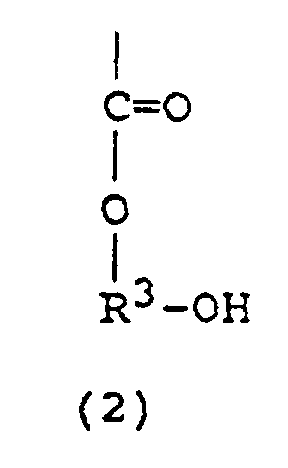
represented by the following formula (2):
wherein R
3 represents an alkylene group having 1-30
carbon atoms or R
3, together with the hydroxyl group
bonded thereto, represents -(R
22-O)
n-H in which n
stands for an integer of 2 to 33 and R
22s may be the
same or different and individually represents an
alkylene group having 2-5 carbon atoms.
(5) A (co)polymer as described above under item
(4), wherein said at least one recurring unit having
said pendant group represented by the formula (2) has
been derived from 2-hydroxyethyl methacrylate.
DESCRIPTION OF THE PREFERRED EMBODIMENTS
Specific processes for the production of the above-described
(co)polymers include:
to radical (co)polymerization so that based on the total
weight of (a1) and (a2), (a1) ranges from 15 to 85
wt.% while (a2) ranges from 85 to 15 wt.% and said at
least one monomer having said pendant group represented
by the formula (1) and/or (2) in (a1) is contained at a
higher content than said at least one monomer in (a2),
whereby an aqueous emulsion formed of a dispersed phase
of (co)polymer particles (A) and a continuous phase of
water is prepared; and
as step 2 (flocculate forming step),
adding a mineral acid and/or an organic acid to
said aqueous emulsion, which has been prepared in step
1, to adjust the pH of said aqueous emulsion to 4 or
lower, whereby said (co)polymer particles (A) are
caused to flocculate and a flocculate (A') of said
(co)polymer is formed. (8) A process for the production of a (co)polymer
having a function to be substantially redispersible in
water of pH 5 or higher, which comprises:
as step 1 (aqueous emulsion preparation step),
emulsion (co)polymerizing, into a (co)polymer
(a2), an ethylenically unsaturated monomer comprising 0
wt.% or more but less than 40 wt.% of at least one
monomer selected from the group consisting of ethylenically
unsaturated monomers having pendant groups
represented by the following formula (1) and the group
consisting of ethylenically unsaturated monomers having
pendant groups represented by the following formula
(2):
wherein in the formula (1), R1 and R2 are either the
same or different and individually represent a hydrogen
atom, an alkyl group having 1-12 carbon atoms, or an
OH-containing alkyl group having 1-12 carbon atoms and
in the formula (2), and R3 represents an alkylene group
having 1-30 carbon atoms or R3, together with the
hydroxyl group bonded thereto, represents -(R22-O)n-H
in which n stands for an integer of 2 to 33 and R22s
may be the same or different and individually
represents an alkylene group having 2-5 carbon atoms,
whereby an aqueous emulsion formed of a dispersed phase
of (co)polymer core particles (A°) and a continuous
phase of water is prepared; as step 2 (protective colloid preparation step),
conducting radical (co)polymerization of an
ethylenically unsaturated monomer comprising 20 wt.% or
more but not greater than 100 wt.% of at least one
monomer selected from the group consisting of said
ethylenically unsaturated monomers having said pendant
groups represented by the formula (1) and the group
consisting of said ethylenically unsaturated monomers
having said pendant groups represented by the formula
(2), whereby a protective colloid (a1) is prepared; As step 3 (mixing step),
mixing said aqueous emulsion prepared in step 1
with said protective colloid prepared in step 2 so that
based on the total weight of (a1) and (a2), (a1) ranging
from 15 to 85 wt.% while (a2) ranging from 85 to 15
wt.% and said at least one monomer having said pendant
group represented by the formula (1) and/or (2) in (a1)
is contained at a higher content than said at least one
monomer in (a2); and as step 4 (flocculate forming step),
adding a mineral acid and/or an organic acid to a
mixture of said aqueous emulsion and said protective
colloid, which has been obtained in step 3, to adjust
the pH of said mixture to 4 or lower, whereby said
(co)polymer particles (A) and said protective colloid
are caused to flocculate and a flocculate (A') of said
(co)polymers is formed. (9) A process for the production of a (co)polymer
having a function to be substantially redispersible in
water of pH 5 or higher, which comprises:
as step 1 (aqueous emulsion preparation step),
subjecting a reaction mixture, which comprises:
a protective colloid (a1) obtained by radical
(co)polymerization of an ethylenically unsaturated
monomer comprising 20 wt.% or more but not greater than
100 wt.% of at least one monomer selected from the
group consisting of ethylenically unsaturated monomers
having pendant groups represented by the following formula
(1) and the group consisting of ethylenically unsaturated
monomers having pendant groups represented by
the formula (2):
wherein in the formula (1), R1 and R2 are either the
same or different and individually represent a hydrogen
atom, an alkyl group having 1-12 carbon atoms, or an
OH-containiag alkyl group having 1-12 carbon atoms and
in the formula (2), R3 represents an alkylene group
having 1-30 carbon atoms or R3, together with the
hydroxyl group bonded thereto, represents -(R22-O)n-H
in which n stands for an integer of 2 to 33 and R22s
may be the same or different and individually
represents an alkylene group having 2-5 carbon atoms,
and an ethylenically unsaturated monomer for forming
a copolymer (a2), said ethylenically unsaturated
monomer comprising 0 wt.% or more but less than 40 wt.%
of at least one monomer selected from the group consisting
of said ethylenically unsaturated monomers having
said pendant groups represented by the formula (1)
and the group consisting of said ethylenically unsaturated
monomers having said pendant groups
represented by the formula (2),
to radical (co)polymerization so that based on the total
weight of (a1) and (a2), (a1) ranges from 15 to 85
wt.% while (a2) ranges from 85 to 15 wt.% and said at
least one monomer having said pendant group represented
by the formula (1) and/or (2) in (a1) is contained at a
higher content than said at least one monomer in (a2),
whereby an aqueous emulsion formed of a dispersed phase
of (co)polymer particles (A) and a continuous phase of
water is prepared; and
as step 2 (flocculate forming step),
adding a metal salt to said aqueous emulsion,
which has been prepared in step 1, to salt out said
(co)polymer particles (A), whereby a flocculate (A') of
said (co)polymer is formed. (11) A process for the production of a (co)polymer
having a function to be substantially redispersible in
water of pH 5 or higher, which comprises:
as step 1 (aqueous emulsion preparation step),
emulsion (co)polymerizing, into a (co)polymer
(a2), an ethylenically unsaturated monomer comprising
0 wt.% or more but less than 40 wt.% of at least one
monomer selected from the group consisting of ethylenically
unsaturated monomers having pendant groups
represented by the following formula (1) and the group
consisting of ethylenically unsaturated monomers having
pendant groups represented by the following formula
(2):
wherein in the formula (1), R1 and R2 are either the
same or different and individually represent a hydrogen
atom, an alkyl group having 1-12 carbon atoms, or an
OH-containing alkyl group having 1-12 carbon atoms and
in the formula (2), and R3 represents an alkylene group
having 1-30 carbon atoms or R3, together with the
hydroxyl group bonded thereto, represents -(R22-O)n-H
in which n stands for an integer of 2 to 33 and R22s
may be the same or different and individually
represents an alkylene group having 2-5 carbon atoms,
whereby an aqueous emulsion formed of a dispersed phase
of (co)polymer core particles (A°) and a continuous
phase of water is prepared; as step 2 (protective colloid preparation step),
conducting radical (co)polymerization of an
ethylenically unsaturated monomer comprising 20 wt.% or
more but not greater than 100 wt.% of at least one
monomer selected from the group consisting of said
ethylenically unsaturated monomers having said pendant
groups represented by the formula (1) and the group
consisting of said ethylenically unsaturated monomers
having said pendant groups represented by the formula
(2); as step 3 (mixing step),
mixing said aqueous emulsion prepared in step 1
with said protective colloid prepared in step 2 so that
based on the total weight of (a1) and (a2), (a1) ranges
from 15 to 85 wt.% while (a2) ranges from 85 to 15 wt.%
and said at least one monomer having said pendant group
represented by the formula (1) and/or (2) in (a1) is
contained at a higher content than said at least one
monomer in (a2); and as step 4 (flocculate forming step),
adding a metal salt to a mixture of said aqueous
emulsion and said protective colloid, which has been
obtained in step 3, to salt out said (co)polymer particles
(A) and said protective colloid, whereby a flocculate
(A') of said (co)polymer is formed. (12) A process as described above under any one of
the items (6) to (11), wherein (a1) is obtained using
at least one monomer selected from the group consisting
of said ethylenically unsaturated monomers having said
pendant groups represented by the following formula
(2):
wherein R3 represents an alkylene group having 1-30
carbon atoms or R3, together with the hydroxyl group
bonded thereto, represents -(R22-O)n-H in which n
stands for an integer of 2 to 33 and R22s may be the
same or different and individually represents an
alkylene group having 2-5 carbon atoms. (13) A process as described above under item (12),
wherein said at least one monomer is 2-hydroxyethyl
methacrylate. (14) A (co)polymer having a function to be substantially
redispersible in water of pH 5 or higher and obtained
by a process as described above under any one of
the items (7) to (13). (18) A hydraulic cement composition comprising 0.5-60
wt.%, based on hydraulic cement, of a (co)polymer as
described above under the items (1) to (5) and (14) to
(17) as calculated in a dry state. (19) A method for the formation of a hardened cement
body, which comprises mixing a hydraulic cement
composition, which has been added with 0.5-60 wt.%,
based on hydraulic cement, of a (co)polymer as described
above under any one of the items (1) to (5) and
(14) to (17) as calculated in a dry state, with water
and then placing the resultant cement-water mixture.
As the flocculate according to the present invention
can be readily subjected to solid-liquid separation
by a simple operation such as filtration,
centrifugation or decantation, it is not absolutely
needed to conduct spray drying.
Another characteristic feature of such a flocculate
resides in that any mixed protective colloid, free
acid and other free water-soluble substances can be
eliminated by washing the flocculate during and/or subsequent
its solid-liquid separation.
Such a flocculate is characterized in that it has
excellent anti-binding property without the need for an
anti-binding agent (fine inorganic power or fine organic
powder) as an essential component.
When used as a cement modifier, the redispersible
(co)polymer according to the present invention improves
the tensile strength, flexural strength, compression
strength, bonding strength and wear resistance.
It is the characteristic feature of the present
invention that an anti-binding agent (for example, a
fine inorganic powder, a fine organic powder having no
film-forming property,) is not absolutely
required. As applications other than the above-mentioned
cement modifier, the present invention can be
applied to a wide variety of fields where an aqueous
emulsion is usually employed, for example, construction
materials, papermaking chemicals, paints, adhesives and
fiber finishes.
Incidentally, no particular limitation is imposed
on the form, shape and morphology of the "(co)polymer
having a function to be substantially redispersible in
water of pH 5 or higher" according to the present invention
insofar as the "(co)polymer" has the function
to be substantially redispersible in water of pH 5 or
higher. In general, the redispersible (co)polymer according
to the present invention is preferably in the
form of powder, granules, paste, wet cake available
after filtration, or beads available by
granulation of such powder, granules, paste or wet
cake.
The present invention will hereinafter be described
in detail.
A. Basic concept
The glass transition point (Tg) of each
(co)polymer described herein can be measured by a method
known per se in the art, for example, by DSC.
In the case of a copolymer, its glass transition
point is measured as will be described below.
[Measured Glass Transition Point - Measurement of
Glass Transition Point (Tg) of Copolymer]
The glass transition point (Tg) of a copolymer is
measured and evaluated as will be described below.
The glass transition point (Tg) of a copolymer
having a specific monomer composition can be determined
by conducting a calculation in accordance with the
Fox's equation. According to the Fox's equation, the
Tg of a copolymer can be calculated on the basis of the
Tgs of homopolymers of individual monomers forming the
copolymer. Its details are described in Bulletin of
the American Physical Society, Series 2, 1(3), 123,
1956. The term "calculated glass transition point" as
used herein embraces glass transition points calculated
in accordance with the Fox's equation.
As the Tgs of homopolymers of various monomers
based on which Tgs of copolymers can be calculated in
accordance with the Fox's equation, it is possible to
use, for example, the values shown on pages 525-546 of
Kobunshi Data Handbook, Volume: Basic Data (compiled by
The Society of Polymer Science, Japan) or values actually
measured by a method known per se in the art.
[Concept of the term "emulsion (co)polymerization"]
The term "emulsion (co)polymerization", which is
used in the aqueous emulsion preparation step of the
production process according to the present invention,
embraces techniques such as not only ordinary emulsion
(co)polymerization but also certain special techniques
[protective colloid (co)polymerization, mini-emulsion
(co)polymerization and micro-emulsion (co)polymerization].
Further, a process in which a polymer is subjected
to self-emulsification or forced emulsification
subsequent to its mixing with a solvent and an emulsifier
is also encompassed by the concept of "emulsification"
as used herein.
[Protective Colloid Polymerization]
The concepts of the terms "protective colloid
polymerization" and "protective colloid" as well as the
concept and principle of protective colloid polymerization
are disclosed, for example, in an introductory
textbook such as Tsunetaka Matsumoto: "Kogyo Zairyo
(Industrial Material), Emarushion Gairon (Introduction
to Emulsion)", 24(3), 10-15.
In particular, visual and readily-understandable
explanations are found in "Fig. 2 Shinsuisei Monoma no
Nyuka Jyugo (Emulsion Polymerization of Hydrophilic
Monomers" (page 12) and its description [under
"Shinsuisei Monoma no Nyuka Jyugo (Emulsion Polymerizeticn
of Hydrophilic Monomers" on page 12] and further
in "Fig. 3 Mizu Emarushion no Anteika (Stabilization
of Aqueous Emulsion)" (page 13) and its description
[under "Mizu Emarushion no Anteika (Stabilization of
Aqueous Emulsion)" on pages 12-13].
As a typical known example of protective colloid
polymerization, the technique disclosed to the above-described
Japanese Patent Laid-Open No. 173003/1990 can
be mentioned.
[Concept of the term "(co)polymer"]
The concept of the term "(co)polymer" as used
herein embraces both homopolymers and copolymers.
No particular limitation is imposed on the arrangement
of monomer segments in each copolymer. The
copolymer can therefore be a random copolymer, an
alternating copolymer, a block copolymer, a graft
copolymer or the like.
The term "(co)polymer" as used herein also encompasses
(co)polymers in each of which at least a part
thereof has any one of linear, cyclic, macrocyclic,
branched, star, three-dimensional network, IPN (interpenetrated
network), PIC (polyion complex) and like
structures.
[Concept of the expression "substantially redispersible
in water of pH 5 or higher"]
The concept of the expression "substantially
redispersible in water of pH 5 or higher" as used
herein means that the redispersible (co)polymer according
to the present invention can show redispersibility
to such an extent as not attainable by conventional
spray drying. For example, it means that the value of
"redispersibility (%)" as defined in Evaluation Example
1-2 to be described subsequently herein ranges from 40
to 100%, preferably from 60 to 100%, more preferably
from 80 to 100%. In Evaluation Example 7-5, it is also
meant that its value ranges from 20 to 100%, more
preferably from 40 to 100%.
[Form of flocculate (A') of (co)polymer]
In the present invention, a (co)polymer flocculate
(A') is generally in the form of a paste containing
some water in many instances.
The (co)polymer flocculate is however not limited
to such a form and may also take any other form such as
tablets, granules or a film.
[(Co)polymer having a function to be substantially
redispersible in water of pH 5 or higher]
No particular limitation is imposed on the form,
shape and morphology of the "(co)polymer having a function
to be substantially redispersible in water of pH 5
or higher" according to the present invention insofar
as the "(co)polymer" has the function to be substantially
redispersible in water of pH 5 or higher. In
general, the redispersible (co)polymer according to the
present invention is preferably in the form of powder,
granules or paste.
[Concept of the term "particles"]
The concept of the term "particles" as used
herein fully embraces the concept which this term generally
has in high-molecular chemistry, but they are
not completely equivalent to each other. The scanning
electron microscopic form of "particles" as used herein
includes, for example, forms having many asperities
like raspberries or konpeito ("confeitos" in
Portuguese), flattened forms like erythrocytes,
prolate-spheroidal forms like rugger balls, and
spindle-shaped forms like E. coli.
The concept of the term "particles" as used
herein embraces microspheres which form, for example,
polymer emulsions, latexes or polymer suspensions. In
the present invention, these exemplified forms are
taken in general. As is appreciated from the foregoing,
the term "particles" will be used for the sake of
convenience in frequently referring to certain essential
"embodiments" of a heteropolymer system according
to the present invention although the concept of the
term "particles" as used herein is not completely
equivalent to the concept which the same term generally
has in high-molecular chemistry.
[Structure of particles]
Examples of the particle structure of the
(co)polymer particles (A) as primary particles include:
Morphologically, the term "particle" as used
herein also embraces particles of special shapes such
as hollow particles and particles of the structure that
an additional particle exists in each hollow particle.
Accordingly, no particular limitation is imposed on the
structure of particles.
It is to be noted that the structure of particles
is not limited to such exemplified structures insofar
as on an outer wall of each (co)polymer particle of the
ethylenically unsaturated monomer (a2), the protective
colloid (a1) exists in a quantity sufficient to show
redispersibility.
[High-order particles]
In the present invention, when the (co)polymer
particles (A) are considered to exist as primary particles,
the flocculate (A') of the (co)polymer particles
can be in the form of secondary particles, tertiary
particles formed of plural secondary particles united
together, or particles of a still higher order insofar
as the flocculate conforms with the objects of the
present invention. No particular limitation is therefore
imposed in this respect.
In the present invention, the flocculate (A') of
the (co)polymer is generally in the form of particles
of the tertiary or still higher order which are formed
of secondary particles obtained by cohesion of plural
(co)polymer particles (A) as primary particles. When
added to water or alkaline water, the flocculate is
readily emulsified back into primary particles or into
a form substantially resembling primary particles.
[Concept of the term "salting out"]
The concept of the term "salting out" as used
herein embraces the concept which the same term generally
has in high-molecular chemistry, but they are not
completely equivalent to each other. For example,
"Kagaku Daijiten (ENCYCLOPAEDIA CHIMICA)", Volume 1
(a,i,u,e), 1960 (Kyoritsu Shuppan Co., Ltd.) contains
an annotation of the term "salting out" in the left-right
column on page 1108, where "salting out" is described
to mean "to add to an aqueous solution another
substance (primarily, an inorganic salt to
cause coagulation of a substance dissolved beforehand
(in the aqueous solution)".
The concept of the term "salting out" as used
herein fully encompasses the concept recognized in general
chemistry as described in "Kagaku Daijiten (ENCYCLOPAEDIA
CHIMICA)" and as will be described next,
also embraces the concept which this term generally has
in colloid chemistry and high-molecular chemistry.
Namely, as is described on pages 187-200 of
Soichi Muroi: "Kohbunshi Ratekkusu no Kagaku (Chemistry
of High-Molecular Latex)", 1980 (Kobunshi Kankokai,
Inc), particles which are maintained in a uniformly-dispersed
state can be caused to undergo coagulation by
adding an electrolyte and hence developing a
dispersion-destructing action (salting out). The concept
of the term "salting out" as used herein also embraces
such a phenomenon.
As is appreciated from the foregoing, the term
"salting out" will be used for the sake of convenience
in frequently referring to certain essential "embodiments"
of the present invention although the concept of
the term "salting out" as used herein is not completely
equivalent to the concept which the same term generally
has in general chemistry.
Illustrative of the (co)polymer according to the
present invention are:
[Ethylenically unsaturated monomer having a pendant
group represented by the formula (1)]
Examples of the ethylenically unsaturated monomer
having the pendant group, which is represented by the
following formula (1):
wherein R
1 and R
2 are either the same or different and
individually represent a hydrogen atom, an alkyl group
having 1-12 carbon atoms, or an OH-containing alkyl
group having 1-12 carbon atoms, include ethylenically
unsaturated monomers represented by the following formulas
(3) to (6), respectively:
wherein in the formula (4), R
1 and R
2 are either the
same or different and individually represent a hydrogen
atom, an alkyl group having 1-12 carbon atoms, or an
OH-containing alkyl group having 1-12 carbon atoms; in
the formula (5), R
5 represents an alkylene group having
1-12 carbon atoms or an OH-containing alkylene group
having 1-12 carbon atoms; in the formulas (3) to (6),
R
4 represents a hydrogen atom or an alkyl group having
1-12 carbon atoms; and in the formula (6), n stands for
an integer of 1-20.
Examples of the ethylenically unsaturated monomer
having the pendant group, which is represented by the
following formula (2):
wherein R
3 represents an alkylene group having 1-30
carbon atoms, include ethylenically unsaturated
monomers represented by the following formulas (7) to
(9), respectively:
wherein in the formulas (7) to (9), R
4 represents a
hydrogen atom or an alkyl group having 1-12 carbon
atoms; and in the formula (9), m stands for an integer
of 1-16 and n stands for an integer of 0-14.
Examples of R
6 in the formula (9) include the
groups represented by the following formulas (10) and
(11), respectively:
Illustrative of R
7 in the formula (9) are the
groups represented by the following formulas (12) to
(14), respectively:
In the present invention, the content of said at
least one monomer having the recurring unit(s)
represented by the formula (1) and/or the formula (2)
ranges, based on the whole monomers making up the (a2)
or the (a1), from 0 to 40 wt.%, preferably from 0 to 30
wt.%, more preferably from 0 to 20 wt.% in (a2) and
from 20 to 100 wt.%, preferably from 30 to 100 wt.%,
more preferably 40-100 wt.% in (a1).
In addition, it is required that said at least
one monomer having the recurring unit(s) containing the
pendant group(s) represented by the formula (1) and/or
(2) in (a1) be contained at a higher content than said
at least one monomer in (a2). The difference ranges
preferably from 5 to 95 wt.%, more preferably from 20
to 90 wt.%, still more preferably from 40 to 80 wt.%.
[Recurring unit having the pendant group represented
by the formula (1)]
Examples of the recurring unit having the pendant
group represented by the following formula (1):
wherein R
1 and R
2 are either the same or different and
individually represent a hydrogen atom, an alkyl group
having 1-12 carbon atoms, or an OH-containing alkyl
group having 1-12 carbon atoms, include recurring units
represented by the following formulas (15) to (18),
respectively:
wherein in the formula (16), R
1 and R
2 are either the
same or different and individually represent a hydrogen
atom, an alkyl group having 1-12 carbon atoms, or an
OH-containing alkyl group having 1-12 carbon atoms; in
the formula (17), R
5 represents an alkylene group having
1-12 carbon atoms or an OH-containing alkyl group
having 1-12 carbon atoms; in the formulas (15) to (18),
R
4 represents a hydrogen atom or an alkyl group having
1-12 carbon atoms; and in the formula (18), n stands
for an integer of 1-20.
Examples of the recurring unit having the pendant
group represented by the following formula (2):
wherein R
3 represents an alkylene group having 1-30
carbon atoms, include recurring units represented by
the following formulas (19) to (21), respectively:
wherein in the formulas (19) to (21), R
4 represents a
hydrogen atom or an alkyl group having 1-12 carbon
atoms; and in the formula (21), m stands for an integer
of 1-16 and n stands for an integer of 0-14.
Examples of R
6 in the formula (21) include the
groups represented by the following formulas (10) and
(11), respectively:
Illustrative of R
7 in the formula (21) are the
groups represented by the following formulas (12) to
(14), respectively:
In the present invention, the content of the
recurring unit(s) represented by the formula (1) and/or
the formula (2) ranges, based on the whole recurring
units, from 0 to 40 wt.%, preferably from 0 to 30 wt.%,
more preferably from 0 to 20 wt.% in (a2) and from 20
to 100 wt.%, preferably from 30 to 100 wt.%, more
preferably 40-100 wt.% in (a1).
In addition, it is required that said at least
one recurring unit having the pendant group represented
by the formula (1) and/or (2) in (a1) be contained at a
higher content than said at least one recurring unit in
(a2). The difference ranges preferably from 5 to 95
wt.%, more preferably from 20 to 90 wt.%, still more
preferably from 40 to 80 wt.%.
[Blocking]
The term "blocking" as used herein means "compression
bonding" as described, for example, under the
entry of "blocking" in the right column on page 403 of
"KOBUNSHI JITEN (Dictionary of Polymer Technology)",
1988 (compiled by: The Society of Polymer Science,
Japan; published by: Asakura Shoten Co., Ltd.), and
specifically means firm cohesion that polymer particles,
which have been dispersed in a solvent, are
brought into contact with each other and are bonded together
at their surfaces of contact without permitting
easy separation.
From the viewpoint of a principle, to show
redispersibility means to allow polymer particles to
individually disperse in water when added to water. If
blocking, that is, cohesion of polymer particles takes
place firmly, the polymer particles are brought into
such a state that they can no longer readily separated
from each other, leading to a reduction in redispersibility.
To show excellent redispersibility, it is therefore
necessary to permit easy separation by suppressing
blocking as much as possible.
The present invention has made it possible to allow
polymer particles to exhibit superb redispersibility
by associating a protective colloid
with polymer particles under particular conditions and
suppressing blocking between the polymer particles.
Namely, the function of the protective colloid
in the present invention is essentially to act
as a blocking preventive for polymer particles themselves.
In the present invention, the protective colloid
is therefore not absolutely required to exhibit a
function as a stabilizer for emulsion polymerization.
If the protective colloid does not function as a stabilizer
for emulsion polymerization, it is only necessary
to achieve a stable polymerization reaction by using a
surfactant. In other words, the extent of exhibition
of redispersibility in the present invention is closely
correlated to the blocking-preventing function of the
protective colloid .
It is therefore very important to use the protective
colloid (a1) and the (co)polymer (a2) of the
ethylenically unsaturated monomer in proportions of 85-15
wt.% and 15-85 wt.%, respectively, based on the total
weight of the (co)polymer (a2) and the protective
colloid (a1).
Here, the proportion of the latter is preferably
15 wt.% or greater, more preferably 25 wt.% or greater,
still more preferably 35 wt.% or greater, notably
45 wt.% or greater. Its upper limit is preferably
85 wt.% or less, more preferably 70 wt.% or less, especially
60 wt.% or less.
Further, the glass transition point of the protective
colloid (a1) is preferably 20°C or
higher, more preferably 30°C or higher, still more
preferably 40°C or higher, notably 50°C or higher.
Preferred examples of the material of the protective
colloid include a copolymer having a
carboxyl-containing recurring unit in addition to a
recurring unit containing a pendant group represented
by the formula (1) and/or a recurring unit containing a
pendant group represented by the formula (2). In the
case of the recurring unit of the formula (1), the proportion
of the carboxyl-containing recurring unit
ranges preferably from 0.5 to 30 wt.%, more preferably
from 0.5 to 10 wt.%, still more preferably from 1 to 3
wt.%, all based on the copolymer. In the case of the
recurring unit of the formula (2) on the other hand,
the proportion of the carboxyl-containing recurring
unit ranges preferably from 0.5 to 60 wt.%, more
preferably from 0.5 to 40 wt.%, still more preferably
from 0.5 to 20 wt.%, all based on the copolymer (a1).
The above-described copolymer having the
carboxyl-containing recurring unit is characterized in
that it has particularly good solubility in water and
it easily flocculates in the flocculation step.
[Anti-blocking property]
As a common cause for blocking, the glass transition
point (Tg) of polymer particles is so low that the
polymer particles become soft and show tackiness in a
high-temperature environment.
The term "anti-blocking property" as used herein
embraces the property that neither compression bonding
nor firm cohesion takes place even when polymer particles
are brought into contact with each other.
B. Mechanism
[Mechanism of flocculation by the addition of an
acid in a flocculate-forming step]
In a flocculate-forming step, a mineral acid
and/or an organic acid is added to adjust the pH to 4
or lower, whereby (co)polymer particles (A) are caused
to flocculate to form a flocculate (A') of the
(co)polymer.
The scientific mechanism of the phenomenon that
the (co)polymer particles (A) according to the present
invention undergo flocculation in the presence of an
acid has not been fully elucidated. However, the
(co)polymer particles (A) are considered to flocculate
into the flocculate (A') of the (co)polymer by the addition
of the mineral acid and/or the organic acid because
of the existence of the protective colloid
(which has properties to undergo self-insolubilization
and self-flocculation under acidic
conditions) in the specific amount. In other words, it
is presumed that the intervening protective colloid
is rendered hydrophobic at pH 4 or lower and
act as a flocculant, thereby flocculating
the (co)polymer particles (A).
As flocculants, polymers which are called high-molecular
flocculants and exhibit flocculating action
are commonly known. These polymers are presumed to be
adsorbed on suspended particles and then crosslinked
there so that the suspended particles may be coarsened
to undergo flocculation and settling. As an alternative,
such polymers presumably lower the ζ-potential of
surfaces of the suspended particles, whereby the
suspended particles may flocculate together.
In the present invention, the protective colloid
is considered to induce flocculation of the
(co)polymer particles (A) under acidic conditions in
accordance with a similar mechanism.
Details of the above-described flocculation mechanism
by a high-molecular flocculant is described in
Eiji Ohmori: "Kobunshi Gyoshuzai (High-molecular Flocculants)",
1-90, 1975 (Kobunshi Kankokai, Inc.).
[Mechanism of flocculation by the addition of a metal
salt in a flocculate-forming step]
In a flocculate-forming step, (co)polymer particles
(A) are caused to flocculate by the addition of a
metal salt. The' scientific mechanism of the phenomenon
in which the (co)polymer particles according to the
present invention flocculate with the metal salt has
not been fully elucidated.
It is known to separate a solid polymer from a
(co)polymer particle dispersion, which has been produced
by emulsion (co)polymerization, by using a
salting-out phenomenon, that is, by adding a metal salt
and forming a flocculate.
From the standpoint of high-molecular physical
chemistry, the following interactions are considered to
take place between (co)polymer particles in an aqueous
emulsion:
The dispersing and flocculating properties of the
(co)polymer particles are considered to be determined
by the balance between these attraction and repulsions
(repulsive forces).
In such a system, a metal salt primarily acts to
lower electrostatic repulsion.
It is therefore considered that the addition of a
metal salt to an aqueous emulsion, i.e., a system with
a disperse phase [(co)polymer particles] evenly dispersed
in a continuous phase (water) reduces the repulsion
between the (co)polymer particles and hence convert
the (co)polymer particles from a dispersed form
into a flocculated form.
Details of the above-described consideration of
the flocculation mechanism of (co)polymer particles
from the standpoint of high-molecular physical
chemistry are descried on pages 187-200 of Soichi
Muroi: "Kohbunshi Ratekkusu no Kagaku (Chemistry of
High-Molecular Latex)", 1980 (Kobunshi Kankokai, Inc).
At least a part of the mechanism of flocculation
by the addition of a metal salt in the flocculate-forming
step is presumed to take place in the above-described
mechanism.
[Mechanism of the exhibition of a function to be
substantially redispersible in water of pH 5 or
higher]
When an aqueous emulsion prepared in an aqueous
emulsion preparation step is dried by spray drying,
marked cohesion of (co)polymer particles (A) generally
takes place because they are dried fast at high
temperatures. As a consequence, the redispersibility
is substantially lowered. Moreover, a great deal of
deposit occurs on a wall of a drying tower so that the
operability and productivity are lowered.
However, the formation of a flocculate (A') of a
(co)polymer by the flocculate-forming step of the production
process according to the present invention
makes it possible to obtain the (co)polymer having a
function to be substantially redispersible in water either
directly or after drying the flocculate or further
grinding the thus-dried flocculate.
Further, the flocculate (A') of the (co)polymer
may be subjected to thorough washing either during
and/or after its solid/liquid separation upon its
recovery. Any mixed free protective colloid, free acid
and other free water-soluble substances are hence
removed, thereby making it possible to eliminate substances
which would otherwise give undesired effects to
the properties of the flocculate (A') of the
(co)polymer.
General examples, as primary particles, of the
(co)polymer particles (A) obtained by the production
process according to the present invention include composite
particles which are each formed of the
(co)polymer of the ethylenically unsaturated monomer
(a2) and the protective colloid (a1) deposited or
otherwise applied on the (co)polymer.
The general examples, as primary particles, of
the (co)polymer particles (A) obtained by the production
process according to the present invention also
include composite particles which are each formed of
the a (co)polymer particle of the ethylenically unsaturated
monomer (a2) and the protective colloid (a1)
existing in a large amount on an outer wall of the
(co)polymer particle.
The (co)polymer particles (A) which are obtained
in the aqueous emulsion preparation step can be converted
to the flocculate (A') of the (co)polymer, which
has a function to be substantially redispersible in
water, by flocculating the (co)polymer particles in the
flocculate-forming step of the production process according
to the present invention.
It is presumed that in the thus-formed flocculate
(A') of the (co)polymer, the interaction of the
(co)polymer particles of the ethylenically unsaturated
monomer (a2) contained in the (co)polymer particles (A)
is reduced by the buffer action of the protective colloid
(a1) contained in the (co)polymer particles (A) to
control the strength of cohesion of the particles themselves,
thereby allowing the flocculate (A') of the
(co)polymer to show a function to be substantially
redispersible in water.
[Problems of spray drying]
spray drying is a method for effecting drying by
spraying an aqueous dispersion of (co)polymer particles
through nozzles into a high-temperature gas.
According to spray drying, capillary water between
(co)polymer particles abruptly evaporates upon
conducting drying of a dispersion of the (co)polymer
particles by spraying it through nozzles into a high-temperature
gas. Since a pressure resulting from a
capillary pressure is applied between the (co)polymer
particles and heat of the system is applied to the particles,
strong cohesion takes place between the particles
themselves, resulting in the problem that the particles
become susceptible to irreversible cohesion.
This capillary pressure theory upon cohesion of the
(co)polymer particles themselves is described in detail
on pages 242-248 of Soichi Muroi: "Kohbunshi Ratekkusu
no Kagaku (Chemistry of High-Molecular Latex)", 1980
(Kobunshi Kankokai, Inc).
It should be worthy to note that the present invention
can avoid the application of unnecessary capillary
pressure and high temperature to particles owing
to the formation of a flocculate without heating the
particles although the application of such capillary
pressure and intense heat is inevitable in the case of
spray drying.
In the present invention, it is possible to bring
the particles into a dispersed form without cohesion
between the particles or, even if such cohesion takes
place, by reversibly, easily and substantially
destructing the state of cohesion.
In the present invention, the reversible state of
cohesion between particles (namely, the state which can
be substantially and reversibly brought back to a dispersed
state even after a cohered state is once formed)
can be controlled by suitably choosing conditions for
flocculating particles, for example, the temperature,
the amount of an acid to be used for flocculation and
the like upon conducting flocculation. It is therefore
possible to practically avoid the irreversible state of
cohesion between particles (namely, the state which
cannot be substantially and reversibly brought back to
a dispersed state once a cohered state is formed) which
is unavoidable in the case of spray drying.
[Polymerization of protective colloid ]
In the present invention, the protective colloid,
when taken singly, is water-soluble or
hydrophilic, and has the property to insolubilize and
flocculate under acidic conditions or in the presence
of a metal salt and also anti-blocking property.
Namely, the degree of development of redispersibility
in the present invention is closely correlated
to the anti-blocking function of the protective colloid.
It is therefore very important, in the radical
(co)polymerization of the protective colloid (a1)
, to use at least one monomer selected from
the group consisting of ethylenically unsaturated
monomers having pendant groups represented by the following
formula (1) and the group consisting of
ethylenically unsaturated monomers having pendant
groups represented by the following formula (2):
wherein in the formula (1), R
1 and R
2 are either the
same or different and individually represent a hydrogen
atom, an alkyl group having 1-12 carbon atoms, or an
OH-containing alkyl group having 1-12 carbon atoms and
in the formula (2), R
3 represents an alkylene group
having 1-30 carbon atoms.
It is also very important to use the ethylenically
unsaturated monomer (a2) and the protective colloid
(a1) in proportions of from 85 to 15 wt.%
and from 15 to 85 wt.%, respectively, based on the to-tal
weight of the former and the latter. Here, the
proportion of the latter is preferably 15 wt.% or
greater, more preferably 25 wt.% or greater, more
preferably 35 wt.% or greater, notably 45 wt.% or
greater.
Further, the calculated glass transition point of
the protective colloid (a1) is preferably
20°C or higher, more preferably 30°C or higher, still
more preferably 40°C or higher, notably 50°C or higher.
No particular limitation is imposed on its upper limit,
but one having a glass transition point of 300°C or so
can be preferably used.
Preferred examples of the material of the protective
colloid include a copolymer having a
carboxyl-containing recurring unit in addition to the
essential element or elements, that is, the recurring
unit containing the pendant group represented by the
formula (1) and/or the recurring unit containing a
pendant group represented by the formula (2). In the
case of the recurring unit of the formula (1), the proportion
of the carboxyl-containing recurring unit
ranges preferably from 0.5 to 30 wt.%, more preferably
from 0.5 to 10 wt.%, still more preferably from 1 to
3 wt.%, all based on the copolymer. In the case of the
recurring unit of the formula (2) on the other hand,
the proportion of the carboxyl-containing recurring
unit ranges preferably from 0.5 to 60 wt.%, more
preferably from 0.5 to 40 wt.%, still more preferably
from 0.5 to 20 wt.%, all based on the copolymer (a1).
[Ethylenically unsaturated monomer having a pendant
group represented by the formula (1)]
Examples of the ethylenically unsaturated monomer
having the pendant group, which is represented by the
following formula (1), include ethylenically unsaturated
monomers represented by the following formulas
(3) to (6), respectively:
wherein in the formula (4), R
1 and R
2 are either the
same or different and individually represent a hydrogen
atom, an alkyl group having 1-12 carbon atoms, or an
OH-containing alkyl group having 1-12 carbon atoms; in
the formula (5), R
5 represents an alkylene group having
1-12 carbon atoms or an OH-containing alkylene group
having 1-12 carbon atoms; in the formulas (3) to (6),
R
4 represents a hydrogen atom or an alkyl group having
1-12 carbon atoms; and in the formula (6), n stands for
an integer of 1-20.
Upon frequently referring herein to the ethylenically
unsaturated monomer having the pendant group
represented by the formula (1), the term "ethylenically
unsaturated, amido-containing monomer" may be used for
the sake of convenience.
Specific examples of the ethylenically unsaturated,
amido-containing monomer include acrylamide,
methacylamide, N-methylol methacrylamide, N-methylol
acrylamide, N-acryloylpyridine, N,N-dimethylacrylamide,
N-isopropylacrylamide, N-hexylacrylamide, N-octylacrylamide,
N-dodecylacrylamide, N,N-diethylacrylamide,
N-acryloylpyrrolidine, diacetone acrylamide, and maleic
amide. Of these, particularly preferred are methacrylamide,
N,N-dimethylacrylamide, N-isopropylacrylamide,
N-hexylacrylamide, N-octylacrylamide, N,N-diethylacrylamide,
and N-acryloylpyrrolidine, They can be used
either singly or in combination. Methacrylamide is especially
preferred.
[Concept of the word "amido group"]
The concept of the word "amido group" as used
herein completely encompasses the concept which this
word generally has in high-molecular chemistry, but
they are not completely equivalent to each other. For
example, "Kagagu Daijiten (ENCYCLOPAEDIA CHIMICA)",
Volume 1 (a,i,u,e), 1960 (Kyoritsu Shuppan Co., Ltd.)
contains an annotation of the term "amido or amide" in
the left column on page 244, where the term "amido or
amide" is defined as "[1] The name of a group in the
form of RCONH- formed as a result of bonding of an
amino group, -NH2, with an acid group (acyl group).
For example, CH3CONH- is called "acetamido". [2](1)
(Compound obtained) by substituting one or more acid
groups (acyl groups) for the like number of hydrogen
atoms of ammonia. RCONH2. Same as the acid amides.".
The concept of the term "amido group" as used herein
completely embraces the concept recognized in general
chemistry as described in the "Kagagu Daijiten (ENCYCLOPAEDIA
CHIMICA)" and also fully encompasses the
concept based on the pendant group represented by the
formula 1.
[Ethylenically unsaturated monomer having a pendant
group represented by the formula (2)]
Examples of the ethylenically unsaturated monomer
having the pendant group, which is represented by the
formula (2), include ethylenically unsaturated monomers
represented by the following formulas (7) to (9),
respectively:
wherein in the formulas (7) to (9), R
4 represents a
hydrogen atom or an alkyl group having 1-12 carbon
atoms; and in the formula (9), m stands for an integer
of 1-16 and n stands for an integer of 0-14.
Examples of R
6 in the formula (9) include the
groups represented by the following formulas (10) and
(11), respectively:
Illustrative of R
7 in the formula (9) are the
groups represented by the following formulas (12) to
(14), respectively:
Upon frequently referring herein to the ethylenically
unsaturated monomer having the pendant group
represented by the formula (2), the expression "OH-containing
ethylenically unsaturated monomer" may be
used for the sake of convenience. A (co)polymer making
use of this "OH-containing ethylenically unsaturated
monomer" can be preferably used for cement as it provides
good stability.
Specific examples of the OH-containing ethylenically
unsaturated monomer preferably include (meth)-acrylates
such as hydroxymethyl (meth)acrylates, 2-hydroxyethyl
(meth)acrylates, hydroxypropyl (meth)-acrylates,
hydroxybutyl (meth)acrylates, hydroxypentyl
(meth)acrylates, polyethylene glycol mono(meth)-acrylates,
polypropylene glycol mono(meth)acrylates,
polyethylene glycol polypropylene glycol mono(meth)-acrylates,
polyethylene glycol polytetramethylene
glycol mono(meth)acrylates, and polypropylene glycol
polytetramethylene glycol (meth)acrylates. They can be
used either singly or in combination.
Particularly preferred is 2-hydroxyethyl
methacrylate.
[Carboxyl-containing ethylenically unsaturated
monomer]
Particularly preferred specific examples of the
carboxyl-containing ethylenically unsaturated monomer
include unsaturated carboxylic acids such as acrylic
acid, methacrylic acid, itaconic acid, maleic acid,
fumaric acid, acrylic anhydride, methacrylic anhydride,
maleic anhydride, itaconic anhydride and fumaric anhydride.
[Other ethylenically unsaturated monomer]
As particularly preferred specific examples of
the ethylenically unsaturated monomer which makes up
(a1) and is other than the ethylenically unsaturated
monomer having the pendant group represented by the
formula (1), the ethylenically unsaturated monomer having
the pendant group represented by the formula (2)
and the carboxyl-containing ethylenically unsaturated
monomers, ethylenically unsaturated monomers
copolymerizable with unsaturated monomers, such as
those to be described below under (1) to (3), can be
mentioned.
[Initiator]
No particular limitation is imposed on the initiators
which are used in the present invention, namely,
in the protective colloid formation step.
Usable examples include
hydrogen peroxide; persulfates such as ammonium persulfate
and potassium persulfate; sodium azobiscyano-valerate;
and redox initiators composed of such compounds,
metal ions such as iron ions and reducing
agents such as sodium sulfoxylate, formaldehyde, sodium
pyrosulfite, sodium hydrogensulfite and L-ascorbic
acid.
These polymerization initiators are generally
used in a proportion of from 0.01 to 25 parts by weight
per 100 parts by weight of all the monomers which are
charged upon polymerization of the protective colloid
(a1).
[Molecular weight regulator]
In the present invention, a mercaptan such as t-dodecyl
mercaptan or n-dodecyl mercaptan or an allyl
compound such as allylsulfonic acid, methallylsulfonic
acid or the sodium salt thereof can be used as a
molecular weight regulator, as needed, in the protective
colloid formation step.
[Properties of protective colloid]
In the present invention, no particular limitation
is imposed on the protective colloid (a)
insofar as, when taken individually, it is a substantially
water-soluble or hydrophilic (co)polymer and
has property to insolubilize and flocculate under
acidic conditions or in the presence of a metal salt.
The weight average molecular weight of the protective
colloid (a1) generally ranges from 1,000 to 500,000,
preferably from 1,000 to 350,000, more preferably from
1,000 to 200,000.
To provide the flocculate (A') of the (co)polymer
with practically complete dispersibility, the calculated
value of the glass transition point of the protective
colloid (a1) is preferably 20°C
or higher, more preferably 30°C or higher, still more
preferably 40°C or higher, notably 50°C or higher.
[Ethylenically unsaturated monomer for forming (a2)]
No particular limitation is imposed on the
ethylenically unsaturated monomer employed in the present
invention for forming (a2), insofar as it undergoes
substantial polymerization and forms desired
(co)polymer particles. Specific examples of the
ethylenically unsaturated monomer include those
employed for the production of aqueous emulsions which
are used for applications such as construction
materials, papermaking chemicals, paints, adhesives and
fiber finishes.
Specific examples of the ethylenically unsaturated
monomer include:
They can be used either singly or in combination.
Among these, preferred are aromatic vinyl compounds,
dienes, olefins, (meth)acrylates and vinyl
esters. Preferred specific examples include styrene,
butyl acrylate, 2-ethylhexyl acrylate, butadiene,
methyl methacrylate, vinyl acetate, "VeoVa", and
ethylene. For use in cement, alkali-resistant monomers
are preferred.
[Polymerization process]
No particular limitation is imposed on the
polymerization process for the aqueous emulsion preparation
step in
the present invention, insofar as an aqueous emulsion
formed of a disperse phase of the (co)polymer particles
(A) and a continuous phase of water can be prepared.
In general, however, emulsion polymerization is
preferably adopted. In emulsion polymerization, a surfactant,
a pH regulator and the like can be used as
needed insofar as the use of such additives conforms
with the objects of the present invention.
Specific examples of the polymerization process
usable for the aqueous emulsion preparation step or the
core particle preparation step in the present invention
include:
Specific examples of the polymerization process
usable for the protective colloid formation step in the
present invention include:
Since protective colloid polymerization can be
adopted for the aqueous emulsion preparation step in
the present invention, the polymerization in the
presence of a protective colloid can bring about the
advantage that the stability of the polymerization is
improved and the amount of a surfactant to be used can
be reduced.
Because the surfactant can be used in a smaller
amount, a further advantage can be brought about that,
when a redispersion of the redispersible polymer is
formed into a film, the film can be provided with improved
waterproofness.
According to the production process of the present
invention, the polymerization of the ethylenically
unsaturated monomer (a2) is conducted in the presence
of a protective colloid (a1) which will be described
subsequently herein. This polymerization can be conducted
following ordinary emulsion polymerization, that
is, the ethylenically unsaturated monomer. (a2) is
polymerized in the absence of the protective colloid
(a1).
[Surfactant]
No particular limitation is imposed on the surfactant
usable for the emulsion polymerization process
adopted in the present invention, insofar as a disperse
phase can be formed practically in a long-lasting
uniform and stable form in a water-base continuous
phase. As the surfactant, known surfactants which are
employed in ordinary emulsion polymerization can be
suitably used either singly or in combination.
Specific examples of nonionic surfactants,
anionic surfactants and cationic surfactants will be
listed below. They can be suitably used either singly
or in combination.
(1) Nonionic surfactants:
Specific examples of a nonionic surfactant usable
in step 1 (aqueous emulsion preparation step) of the
production process according to the present invention
include polyoxyethylene lauryl ether, polyoxyethylene
octylphenyl ether, polyoxyethylene oleyl ether,
polyoxyethylene nonylphenyl ether, and oxyethylene-oxypropylene
block copolymer. They can be used either
singly or in combination.
(2) Anionic surfactants:
Specific examples of an anionic surfactant usable
in step 1 (aqueous emulsion preparation step) of the
production process according to the present invention
include sodium dodecylbenzene sulfonate, sodium lauryl
sulfate, sodium alkyl diphenyl ether disulfonate,
sodium alkylnaphthalenesulfonate, sodium dialkylsulfosuccinate,
potassium stearate, potassium oleate,
sodium dioctyl sulfosuccinate, sodium polyoxyethylene
alkyl ether sulfate, sodium polyoxyethylene alkyl
phenyl ether sulfate, sodium stearate, and sodium
oleate. They can be used either singly or in combination.
(3) Cationic surfactants:
Specific examples of a cationic surfactant usable
in step 1 (aqueous emulsion preparation step) of the
production process according to the present invention
include lauryltrimethylammonium chloride and stearyltrimethylammonium
chloride. They can be used either
singly or in combination.
[Amount of surfactant to be used]
No particular limitation is imposed on the amount
of the surfactant to be used, insofar as it is used in
an amount sufficient to practically form micelles in a
reaction system or in an amount sufficient to form a
disperse phase practically in a long-lasting uniform
and stable form in a water-base continuous phase.
As the kind and concentration of the surfactant,
it is generally necessary to adequately choose conditions
sufficient to substantially achieve desired particle
properties (layer structure, shape, particle
size, particle size distribution, etc.) while taking
into consideration the CMC (critical mycelle concentration)
value inherent to the surfactant and HLB
(hydrophilic-lipophilic balance) value.
In general, the surfactant can be used in an
amount of from 0.1 to 10 wt.% based on the total weight
of all monomers supplied to the reaction system.
[Polymerization initiator]
No particular limitation is imposed on the
polymerization initiator usable in the emulsion
polymerization process adopted in the present invention,
insofar as it can substantially show a function
to initiate polymerization.
Specific examples of the polymerization initiator
include hydrogen peroxide; persulfates such as ammonium
persulfate and potassium persulfate; organic peroxides
such as cumene hydroperoxide and tert-butyl hydroperoxide;
azo compounds such as azobisisobutylonitrile;
and redox initiators composed of such compounds, metal
ions such as iron ions and reducing agents such as
sodium sulfoxylate, formaldehyde, sodium pyrosulfite,
sodium hydrogensulfite and L-ascorbic acid.
These polymerization initiators are used in an
amount of 0.01-15 parts by weight per 100 parts by
weight of the ethylenically unsaturated monomer (a2).
[Molecular weight regulator]
In the present invention, the preferred weight
average molecular weight of the (co)polymer particles
(A) generally ranges from 50,000 to 90,000,000.
[Particle size of (co)polymer particles (A)]
Concerning the particle size of the (co)polymer
particles (A), the average particle size as measured in
a wet state by the laser light scattering method can
range preferably from 50 to 5,000 nm, more preferably
from 70 to 3,000 nm, still more preferably from 100 to
1,000 nm.
In general, as the particle size is progressively
reduced beyond 50 nm, the viscosity of the redispersion
of the flocculate (A') of the (co)polymer is observed
to have a tendency to rapidly increase and the
workability upon use is observed to have a tendency to
become poorer, and because the specific surface area of
the particles progressively increases, the stability of
the redispersion itself of the flocculate (A') of the
(co)polymer is observed to have a tendency to drop correspondingly.
On the other hand, as the particle size is progressively
increased beyond 5,000 nm, it is generally
observed that the film-forming ability of the redispersion
drops and a composition obtained by adding the
particles according to the present invention tends to
have lower waterproofness and strength.
[Mineral acid and/or organic acid employed in the
flocculate forming step]
No particular limitation is imposed on the
mineral acid and/or organic acid employed in the flocculate
forming step, insofar as they have a function to
insolubilize the (co)polymer particles (A) as the flocculate
(A') of the (co)polymer.
Specific examples of the mineral acid and organic
acid include sulfuric acid, hydrochloric acid, nitric
acid, phosphoric acid and acetic acid. They can be
used either singly or in combination. Sulfuric acid is
particularly preferred, as it can be added in a smaller
amount and does not contain chlorine.
[Manner of addition of mineral acid and/or organic
acid in the flocculate forming step]
It is also effective to add an alcohol or electrolyte
upon formation of a flocculate to facilitate
the occurrence of flocculation by making combined use
of coagulation or salting-out. Preferred as the electrolyte
are those containing aluminum ions and capable
of showing their effects in a small amount. For example,
aluminum sulfate can be mentioned.
No particular limitation is imposed on the
temperature of the emulsion system upon addition of the
mineral acid and/or organic acid, insofar as the
temperature is in such a range as allowing the aqueous
emulsion or the mixture of the aqueous emulsion and the
protective colloid to retain a liquid phase. The
temperature of the emulsion system upon addition of an
acid is generally in a range of from 0 to 100°C. As
flocculation is caused to occur at a higher temperature,
the resulting flocculate lumps become more solid
and greater so that their solid-liquid separation becomes
easier. In some instances, however, cohesion of
particles may become stronger upon flocculation so that
the redispersibility may be reduced. In general, the
temperature ranges preferably from 10°C to 80°C, more
preferably from 20°C to 60°C.
It is also possible to induce flocculation by
raising the temperature of the system subsequent to the
addition of an acid.
[Amount of mineral acid and/or organic acid to be
added in the flocculate forming step]
In general, the mineral acid and/or organic acid
can be added preferably in an amount sufficient to adjust
the pH of the aqueous emulsion or the mixture of
the aqueous emulsion and the protective colloid to 4 or
lower, more preferably in an amount sufficient to adjust
its pH to 3 or lower.
Generally, addition of the acid in an unduly
small amount may lead to incomplete flocculation and
difficult solid-liquid separation, whereas addition of
the acid in an excessively large amount may lead to a
failure in allowing the (co)polymer particles (A) to
exhibit their inherent properties or to difficulty in
eliminating the acid by washing same during and/or
after solid-liquid separation.
[Manner of addition of mineral acid and/or organic
acid in the flocculate forming step]
No particular limitation is imposed on the manner
of addition of the mineral acid and/or organic acid.
It is generally preferred to use the acid in the
form of an aqueous solution for mixing the acid more
uniformly and also from the standpoint of safety, although
the acid is not necessarily limited to such a
solution.
In general, it is preferred to add the acid in
the form of a 50% or lower aqueous solution.
[metal salt for use in the flocculate forming step]
No particular limitation is imposed on the metal
salt to be used in the flocculate forming step, insofar
as it has a function to insolubilize the (co)polymer
particles (A) as the flocculate (A') of the
(co)polymer.
Specific examples of the metal salt include
aluminum salts such as aluminum sulfate, aluminum
chloride, ammonium alum, potassium alum, aluminum
polychloride and aluminum polysulfate; iron salts such
as ferrous sulfate, ferric sulfate, ferric chloride,
ferric polychloride and ferric polysulfate; zinc salts
such as zinc chloride and zinc sulfate; magnesium salts
such as magnesium oxide, magnesium carbonate and magnesium
sulfate; and others, including aluminum
hydroxide, iron hydroxide, calcium chloride, sodium
chloride, calcium thiosulfate, calcium nitrite, calcium
formate, calcium sulfate and potassium nitrate. They
can be used either singly or in combination. As the
valence of a metal ion becomes higher, the flocculating
power becomes stronger so that flocculation can be induced
using the metal salt in a smaller amount. Use of
an aluminum salt or iron salt is hence preferred in
general. Such an aluminum salt or iron salt is also
preferred from the standpoint of the safety of effluent.
or the like.
[pH upon addition of metal salt in the flocculate
forming step]
Upon addition of the metal salt, it is generally
preferred to adjust the pH to a level of from 6 to 2,
more preferably from 5 to 3.
This is because, as the acidity increases, the
metal can be used in a smaller amount, a flocculate
permitting easier solid-liquid separation is formed,
and the yield is improved.
Here, use of a mineral acid and/or organic acid
as a pH regulator is feasible. Specific examples of
the pH regulator include hydrochloric acid, sulfuric
acid, phosphoric acid and acetic acid. Sulfuric acid
is preferred as a pH regulator, because it can be added
in a smaller amount and does not contain chlorine.
No particular limitation is imposed on the
temperature of the emulsion system upon addition of the
metal salt, insofar as the temperature is in such a
range as allowing the aqueous emulsion, which has been
obtained in step 2 (aqueous emulsion preparation step),
to retain a liquid phase. The temperature of the emulsion
system at the time of the addition of the metal
salt generally ranges from 0 to 100°C. In general,
however, the temperature ranges preferably from 10°C to
80°C, more preferably from 20°C to 60°C because, as the
flocculation is caused to occur at a higher temperature,
the resulting flocculate lumps become more solid
and greater and permits easier solid-liquid separation.
[Amount of the metal to be added in the flocculate
forming step]
In general, the amount of the metal to be added
is preferably from 0.01 to 70 wt.%, more preferably
from 1 to 50 wt.%, still more preferably from 5 to 30
wt.%, all, based on the solid content of the
(co)polymer particles (A).
Generally, addition of the metal salt in an unduly
small amount may lead to incomplete flocculation and
difficult solid-liquid separation, whereas addition of
the metal salt in an excessively large amount may lead
to a failure in allowing the (co)polymer particles (A)
to exhibit their inherent properties or to difficulty
in eliminating the metal salt by washing same during
and/or after solid-liquid separation.
[Manner of addition of the metal salt in the flocculate
forming step]
No particular limitation is imposed on the manner
of addition of the metal salt.
It is generally preferred to add the metal salt
in the form of an aqueous solution from the standpoint
of safety, although the metal salt is not necessarily
limited to such a solution.
Examples of the manner of addition of the metal
salt include:
[Separation method, drying method and grinding method
of the flocculate (A') of the (co)polymer]
No particular limitation is imposed on the solid-liquid
separation method in the process of the present
invention, insofar as it is generally employed. In
particular, a commonly employed method such as filtration,
centrifugation or decantation can be used.
Further, the separated flocculate can also be used
after drying same.
No particular limitation is imposed on the drying
method. For example, the flocculate can be dried by
hot-air drying, vacuum drying. The flocculate
may undergo further flocculation by drying.
A redispersible polymer - which is available by
completely drying a flocculate, which has been subjected
to solid-liquid separation, at a temperature of
from room temperature to 100°C - is generally crushable
because it is hard and does not have tackiness.
No particular limitation is imposed on the crushing
method of the dried redispersible polymer, and a
conventional equipment, for example, a hammer mill, a
jet mill, a pin mill can be used. This
crushing is not required to crush the polymer into primary
particles. It is only necessary to crush the
polymer to powder in a form convenient for further processing.
To increase the redispersing speed, it is desired
to crush the polymer to an average particle size of
1 mm or smaller, with 500 µm or smaller being more
preferred and with 300 µm or smaller being still more
preferred.
[Utility and application - hydraulic cement composition)
The redispersible polymer according to the present
invention can be preferably used as a modifier for
hydraulic cement. A hydraulic cement composition can
be modified by mixing the redispersible polymer in an
amount of from 0.5 to 60 wt.%, preferably from 1 to 40
wt.%, still more preferably from 2 to 20 wt.%, all,
based on the hydraulic cement.
[Utility and application - placing method of
hydraulic cement]
An excellent hardened cement structure can be obtained
by mixing 0.5-60 wt.%, preferably 1-40 wt.%,
more preferably 2-20 wt.%, based on hydraulic cement,
of the redispersible polymer according to the present
invention and water with the cement and then placing
the mixed concrete. The use of the redispersible
polymer according to the present invention as a cement
additive can bring about the following marked advantageous
effects:
[Examples]
To more specifically describe the present invention,
the present invention will be described further
on the basis of the following examples and comparative
examples.
All designations of "%", which will follow, refer
to "wt.%" unless specified otherwise.
Abbreviations of various raw materials, which
will appear in tables to be described in the following
examples and comparative examples, are shown below:
1. Examples directed to the flocculation of an aqueous
emulsion, which had been prepared by protective colloidal
polymerization, with an acid (a system making
use of an amido-containing ethylenically unsaturated
monomer).
Example 1-1
(1) Step 1 (Aqueous Emulsion Preparation Step)
<Preparation of Protective Colloid (a1)>
In a reaction vessel equipped with a stirrer, a
reflux condenser and a thermometer, 785.0 g of purified
water and 150.0 g of methacrylamide were charged. Under
stirring in a nitrogen gas atmosphere, the contents
were heated to 75°C and were maintained at the same
temperature. After the methacrylamide was completely
dissolved, 45.0 g of a 5% aqueous solution of ammonium
persulfate were added and the resultant mixture was
maintained at 75°C for 7 hours.
Aqueous ammonia and purified water were added to
the resultant mixture, whereby a protective colloid (B-1)
of 15% resin content and pH 7 was obtained. When
that protective colloid (B-1) was acidified to pH 3
with sulfuric acid, flocculation of a polymer took
place.
<Protective Colloid Polymerization>
In a reaction vessel equipped with a stirrer, a
reflux condenser and a thermometer, 666.7 g of the protective
colloid (B-1) were charged, followed by the addition
of 0.5 g of potassium persulfate at 80°C under
stirring in a nitrogen gas atmosphere. On the side, an
emulsion of the below-described composition was
prepared. The emulsion was added dropwise to the above
protective colloid at 80°C over 3 hours, followed by
stirring at 80°C for 3 hours.
| Purified water | 40.0 g |
| Sodium dodecylbenzenesulfonate | 0.1 g |
| Styrene | 40.0 g |
| n-Butyl acrylate | 50.0 g |
| 2-Hydroxyethyl methacrylate | 5.0 g |
| Methacrylic acid | 3.0 g |
| Acrylamide | 2.0 g |
| n-Dodecylmercaptan | 0.1 g |
Aqueous ammonia and purified water were added to
the resultant polymer, whereby an aqueous emulsion (C-1)
of 10% resin content and pH 9 was prepared.
(2) Step 2 (Flocculate Forming Step)
When a 5% aqueous solution of sulfuric acid was
added at room temperature to 1,000 g of (C-1) until the
pH dropped to 2.5, a flocculate was formed. The flocculate
was subjected to solid-liquid separation by filtration,
and was then dried at 80°C until the residual
water content dropped to 2% or less [note: The residual
water content was measured by the measuring method of
weight loss on heating prescribed under K5407.5 of JIS
(Japanese Industrial Standards). All residual water
contents described herein are values measured by this
method.]. The thus-dried flocculate was crushed,
whereby redispersible polymer powder was obtained.
Example 1-2
Following the procedures of Example 1-1, a protective
colloid (B-2) was prepared in accordance with a
composition shown in Table 1-1. [When the pH of this
protective colloid (B-2) was lowered to pH 3 with sulfuric
acid, flocculation of a polymer took place.]
Protective colloid polymerization was then conducted to
prepare an aqueous emulsion (C-2) of 10% resin content
and pH 9. Redispersible polymer powder was obtained by
similar procedures.
Example 1-3
Following the procedures of Example 1-1, a protective
colloid (B-3) was prepared in accordance with a
composition shown in Table 1-1. [When the pH of this
protective colloid (B-3) was lowered to pH 3 with sulfuric
acid, flocculation of a polymer took place.]
Protective colloid polymerization was then conducted to
prepare an aqueous emulsion (C-3) of 10% resin content
and pH 9. Redispersible polymer powder was obtained by
similar procedures.
Example 1-4
Following the procedures of Example 1-1, a protective
colloid (B-4) was prepared in accordance with a
composition shown in Table 1-1. [When the pH of this
protective colloid (B-4) was lowered to pH 3 with sulfuric
acid, flocculation of a polymer took place.]
Protective colloid polymerization was then conducted to
prepare an aqueous emulsion (C-4) of 10% resin content
and pH 9. Redispersible polymer powder was obtained by
similar procedures.
Example 1-5
Following the procedures of Example 1-1, a protective
colloid (B-5) was prepared in accordance with a
composition shown in Table 1-1. [When the pH of this
protective colloid (B-5) was lowered to pH 3 with sulfuric
acid, flocculation of a polymer took place.]
Protective colloid polymerization was then conducted to
prepare an aqueous emulsion (C-5) of 10% resin content
and pH 9. Redispersible polymer powder was obtained by
similar procedures.
Example 1-6
Following the procedures of Example 1-1, a protective
colloid (B-6) was prepared in accordance with a
composition shown in Table 1-1. [When the pH of this
protective colloid (B-6) was lowered to pH 3 with sulfuric
acid, flocculation of a polymer took place.]
Protective colloid polymerization was then conducted to
prepare an aqueous emulsion (C-6) of 10% resin content
and pH 9. Redispersible polymer powder was obtained by
similar procedures.
Example 1-7
Following the procedures of Example 1-1, a protective
colloid (B-7) was prepared in accordance with a
composition shown in Table 1-1. [When the pH of this
protective colloid (B-7) was lowered to pH 3 with sulfuric
acid, flocculation of a polymer took place.]
Protective colloid polymerization was then conducted to
prepare an aqueous emulsion (C-7) of 10% resin content
and pH 9. Redispersible polymer powder was obtained by
similar procedures.
Example 1-8
Following the procedures of Example 1-1, a protective
colloid (B-8) was prepared in accordance with a
composition shown in Table 1-1. [When the pH of this
protective colloid (B-8) was lowered to pH 3 with sulfuric
acid, flocculation of a polymer took place.]
Protective colloid polymerization was then conducted to
prepare an aqueous emulsion (C-8) of 10% resin content
and pH 9. Redispersible polymer powder was obtained by
similar procedures.
Example 1-9
Following the procedures of Example 1-1, a protective
colloid (B-1) was prepared in accordance with
the composition shown in Table 1-1. Protective colloid
polymerzation was then conducted under the below-described
conditions, whereby an aqueous emulsion (C-9)
of 10% resin content and pH 9 was prepared. Redispersible
polymer powder was obtained by similar procedures.
<Protective Colloid Polymerization>
In a reaction vessel equipped with a stirrer, a
reflux condenser and a thermometer, 400 g of the protective
colloid (B-1) and 210 g of purified water were
charged, followed by the addition of 0.7 g of pottasium
persulfate at 80°C under stirring in a nitrogen gas atmosphere.
On the side, an emulsified monomer mixture
of the below-described composition was prepared. The
emulsified monomer mixture was added dropwise to the
above aqueous solution at 80°C over 3 hours, followed
by aging for 3 hours.
| Purified water | 56.0 g |
| Sodium dodecylbenzenesulfonate | 0.14 g |
| Styrene | 56.0 g |
| n-Butyl acrylate | 70.0 g |
| 2-Hydroxyethyl methacrylate | 7.0 g |
| Methacrylic acid | 4.2 g |
| Acrylamide | 2.8 g |
| n-Dodecylmercaptan | 0.14 g |
Redispersible polymer powder was obtained as in
Example 1-4 except that a 5% aqueous solution of
hydrochloric acid was added instead of the 5% aqueous
solution of sulfuric acid employed for obtaining the
flocculate in Example 1-4.
Example 1-11
Redispersible polymer powder was obtained as in
Example 1-4 except that a 5% aqueous solution of acetic
acid was added instead of the 5% aqueous solution of
sulfuric acid employed for obtaining the flocculate in
Example 1-4.
Example 1-12
Redispersible polymer powder was obtained as in
Example 1-4 except that a flocculate was repeatedly
washed with sufficient amounts of purified water upon
its collection by filtration.
The redispersible polymer powder and that of Example
1-4 were separately added to portions of a 1%
aqueous solution of sodium hydroxide to obtain
redispersions. Those redispersions were coated on
glass plates and were then dried at room temperature
for 3 days, so that films were obtained. Those films
were immersed in water for a day and their percent
water absorptions were measured. The film formed from
the redispersible polymer powder of Example 1-12 was
lower in percent water absorption and was superior in
waterproofness.
Example 1-13
Following the procedures of Example 1-2 except
for the replacement of the emulsion composition used in
Example 1-1 by that shown in Table 1-4, an aqueous
emulsion (C-10) was obtained and redispersible polymer
powder was then obtained from the aqueous emulsion.
| Purified water | 40.0 g |
| Sodium dodecylbenzenesulfonate | 0.1 g |
| Butyl acrylate | 40.0 g |
| 2-Hydroxyethyl methacrylate | 5.0 g |
| Methacrylic acid | 3.0 g |
| Acrylamide | 2.0 g |
| n-Dodecylmercaptan | 0.1 g |
Following the procedures of Example 1-13 except
for the replacement of the protective colloid (B-1) by
the protective colloid (B-4), an aqueous emulsion (C-11)
was obtained and redispersible polymer powder was
then obtained from the aqueous emulsion.
Example 1-15
In a reaction vessel equipped with a stirrer,
666.7 g of the protective colloid (B-1) were charged,
followed by the addition of 1.0 g of potassium persulfate
at 70°C under stirring in a nitrogen gas atmosphere.
On the side, an emulsion of the below-described
composition was prepared. The emulsion was
added dropwise to the above protective colloid at 70°C
over 6 hours, followed by stirring at the same temperature.
| Purified water | 40.0 g |
| Sodium lauryl sulfate | 0.3 g |
| Styrene | 28.0 g |
| Butadiene | 70.0 g |
| Acrylic acid | 2.0 g |
| t-Dodecylmercaptan | 0.3 g |
Aqueous ammonia and purified water were added to
the resultant polymer, whereby an aqueous emulsion (C-12)
of 10% solid content and pH 9 was prepared.
When a 5% aqueous solution of sulfuric acid was
added at room temperature to 1,000 g of (C-12) until
the pH dropped to 2.5, a flocculate was formed. The
flocculate was subjected to solid-liquid separation by
filtration, and was then dried at 80°C until the
residual water content dropped to 2% or less. The
thus-dried flocculate was crushed, whereby redispersible
polymer powder was obtained.
Comparative Example 1-1
Following the procedures of Example 1-13 except
that the protective colloid (B-1) was replaced by
650.0 g of purified water, an aqueous emulsion polymer
(C-14) free of the protective colloid (B-1) was obtained.
As in Example 1-13, a 5% aqueous solution of
sulfuric acid was added until the pH dropped to 2.5.
No flocculate was however formed.
Comparative Example 1-2
Following the procedures of Example 1-13 except
that the protective colloid (B-1) was replaced by
650.0 g of purified water, an aqueous emulsion polymer
(C-14) free of the protective colloid (B-1) was obtained.
As in Example 1-13, a 5% aqueous solution of
sulfuric acid was added until the pH dropped to 2.5.
No flocculate was however formed.
Comparative Example 1-3
Following the procedures of Example 1-15 except
that the protective colloid (B-1) was replaced by
650.0 g of purified water, an aqueous emulsion polymer
(C-15) free of the protective colloid (B-1) was obtained.
As in Example 1-15, a 5% aqueous solution of
sulfuric acid was added until the pH dropped to 2.5.
No flocculate was however formed.
Comparative Example 1-4
The aqueous emulsions (C-1) to (C-12) were separately
subjected to spray drying at an inlet air
temperature of 120°C and an outlet air temperature of
60°C instead of subjecting same to flocculation with an
acid, whereby redispersible polymer powders were obtained.
All the aqueous emulsions formed a great deal
of deposit on an inner wall of a drying tower. Each
redispersible polymer powder had a yield of 30% or
lower and was also substantially inferior in redispersibility.
Evaluation Example 1-1
A yield was calculated in accordance with the
following formula:
Yield (%) = [{M2 - (M2 x A/100}/M1] x 100
where
- M1:
- solid weight of an aqueous emulsion,
- M2:
- weight of a flocculate dried at 80°C after
filtration,
- A:
- residual water content (%) of the flocculate.
The yield was ranked in accordance with the following
system:
- A:
- 95% or higher
- B:
- 90% (inclusive) to 95% (exclusive)
- C:
- 90% to 30% (both, exclusive)
- D:
- 30% or lower
Evaluation Example 1-2
Each redispersible polymer powder was crushed to
a particle size not greater than 1 mm. The thus-crushed
redispersible polymer powder was added to a 1%
aqueous solution of sodium hydroxide to give a solid
content of 10.00%. The resulting mixture was thoroughly
stirred for 30 minutes and then left over for 24
hours. A supernatant was collected and to eliminate
any undissolved matter, the solution was filtered
through a filter cloth of 300 mesh (50 µm) to prepare a
redispersion.
However, the redispersible polymer obtained by
spray drying in Comparative Example 1-4 had already
been in the form of powder, so that it was sifted
through a 16-mesh (1 mm) sieve. Using powder of a particle
size of 1 mm and smaller, a redispersion was
prepared in the same manner as described above.
The external appearance, redispersibility and
room-temperature film-forming properties of the
redispersion were evaluated as will be described
hereinafter.
- A:
- 100% to 80% (both, inclusive)
- B:
- 80% (exclusive) to 40% (inclusive)
- C:
- 40% (exclusive) to 10% (inclusive)
- D:
- 10% (exclusive) to 0% (inclusive)
(ii) External appearance: The external appearance
of the redispersion was visually measured. (iii) Room-temperature film-forming properties: The
redispersion was coated on a glass plate and then dried
at room temperature for 1 day. The external appearance
of the resultant film was visually evaluated and was
ranked in accordance with the following system:
- A:
- Film was formed.
- B:
- Film was formed with cracks formed therein.
- C:
- No film was formed.
Evaluation Example 1-3
Redispersible polymer powder was crushed until
the plus-sieve residue on an 80-mesh (200-µm) sieve became
5% or less. The resultant powder was mixed in the
below-described portion in cement, and the resulting
cement mix was tested in mixing time, workability,
flexural strength and compression strength.
However, the redispersible polymer obtained by
spray drying in Comparative Example 1-4 had already
been in the form of powder so that powder, which was
obtained by classifying the polymer to give a plus-sieve
residue of 5% on an 80-mesh (200-µm) sieve, was
tested in the same manner as described above.
| Portland cement | 1,000 g |
| Toyoura standard sand | 2,000 g |
| Solid anti-foaming agent | 5 g |
| Redispersible polymer powder | 100 g |
Water was mixed with the above-described dry mix
to give a flow value of 170 ± 10 mm. Aging was conducted
first at 20°C and at least 80% R.H. for 2 days
and then at 20°C and 65 R.H. Testing methods will be
described below.
- A:
- Excellent
- B:
- Good
- C:
- Average
- D:
- Poor
(iii) Flexural strength: Samples of 7 days of age
and 28 days of age were tested in accordance with JIS
A1172. (iv) Compression strength: Samples of 7 days of age
and 28 days of age were tested in accordance with JIS
A1172.
Further, samples obtained without using any
redispersible polymer powder were also tested as controls.
The compositions of the protective colloids used
in the above Examples and Comparative Examples are presented
in Table 1-1, the compositions of the aqueous
emulsions employed in the above Examples and Comparative
Examples are shown in Table 1-2 to Table 1-4, and
the compositions and evaluation results of the
redispersible polymer powders obtained in the above Examples
and Comparative Examples are summarized in Table
1-5 to Table 1-15.
3. Examples directed to the flocculation of a mixture
of an aqueous emulsion and a protective colloid with an
acid (a system making use of an amido-containing
ethylenically unsaturated monomer).
Example 3-1
(i) Aqueous Emulsion Preparation Step
An aqueous emulsion (A-1) was prepared by the
following procedures.
In a reaction vessel equipped with a stirrer, a
reflux condenser and a thermometer, an aqueous solution
consisting of 785 g of purified water and 3 g of sodium
dodecylbenzenesulfonate (abbreviated as "DBS") was
charged, followed by the addition of 5 g of potassium
persulfate at 80°C under stirring in a nitrogen gas atmosphere.
On the side, an emulsion of the below-described
composition was prepared. The emulsion was
added dropwise to the above aqueous solution at 80°C
over 3 hours, followed by maintenance at the same
temperature for 3 hours.
| Purified water | 400 g |
| DBS | 1 g |
| Styrene | 400 g |
| n-Butyl acrylate | 500 g |
| 2-Hydroxyethyl methacrylate | 50 g |
| Methacrylic acid | 30 g |
| Acrylamide | 20 g |
| n-Dodecylmercaptan | 1 g |
Aqueous ammonia and purified water were added to
the resultant aqueous emulsion to adjust its pH and
resin content to 9 and 45%, respectively. This aqueous
emulsion will be designated "(A-1)".
(ii) Protective Colloid Preparation Step
A protective colloid (a1) was prepared by the
following procedures.
In a reaction vessel equipped with a stirrer, a
reflux condenser and a thermometer, 850 g of purified
water and 100.0 g of methacrylamide were charged. The
contents were heated to 75°C under stirring in a
nitrogen gas atmosphere and were maintained at the same
temperature. After the methacrylamide was completely
dissolved, 30.0 g of a 5% aqueous solution of ammonium
persulfate were added and the resultant mixture was
maintained at 75°C for 7 hours.
Aqueous ammonia and purified water were then
added, whereby a protective colloid (B-1) of 10% resin
content and pH 9 was obtained.
(iii) Mixing Step
The aqueous emulsion (A-1) and the protective
colloid (B-1) were mixed and stirred to give a solid
ratio of 50/50.
(iv) Flocculate Forming Step
When the mixture of the aqueous emulsion (A-1) an
the protective colloid (B-1), which had been formed in
the mixing step, was diluted to 10% resin content with
purified water and a 5% aqueous solution of sulfuric
acid was then added at room temperature to 1,000 g of
the thus-diluted mixture until the pH dropped to 2.5, a
flocculate was formed. The flocculate was subjected to
solid-liquid separation by filtration, and was then
dried at 80°C until the residual water content dropped
to 2% or less. The thus-dried flocculate was crushed,
whereby redispersible polymer powder was obtained.
Examples 3-2 to 3-9
(i) Aqueous Emulsion Preparation Step
Aqueous emulsions (A-1 to A-3) of the compositions
shown in Table 3-1 were prepared as in Example 3-1.
(ii) Protective Colloid Preparation Step
Following the procedures of Example 3-1, protective
colloids (B-2 to B-8) were prepared in accordance
with their corresponding compositions shown in
Table 3-2.
(iii) Mixing Step
The aqueous emulsions (A-1 to A-3) and the protective
colloids (B-2 to B-8) were mixed and stirred to
give a solid ratio of 50/50 or 70/30.
(iv) Flocculate Forming step
Following the procedures of Example 3-1,
redispersible polymer powders were obtained.
Example 3-10
Redispersible polymer powder was obtained as in
Example 3-4 except that a 5% aqueous solution of
hydrochloric acid was added instead of the 5% aqueous
solution of sulfuric acid employed for obtaining the
flocculate in Example 3-4.
Example 3-11
Redispersible polymer powder was obtained as in
Example 3-4 except that a 5% aqueous solution of acetic
acid was added instead of the 5% aqueous solution of
sulfuric acid employed for obtaining the flocculate in
Example 3-4.
Example 3-12
Redispersible polymer powder was obtained as in
Example 3-4 except that a flocculate was repeatedly
washed with sufficient amounts of purified water upon
its collection by filtration.
The redispersible polymer powder and that of Example
3-4 were separately added to portions of a 1%
aqueous solution of sodium hydroxide to obtain
redispersions. Those redispersions were coated on
glass plates and were then dried at room temperature
for 3 days, so that films were obtained. Those films
were immersed in water. The film formed from the
redispersible polymer powder of Example 3-12 was found
to be superior in waterproofness.
Example 3-13
After the protective colloid (B-1) was mixed and
stirred with the aqueous emulsion (A-2) to give a solid
ratio of 50/50, redispersible polymer powder was obtained
following the procedures of Example 3-1.
Example 3-14
After the protective colloid (B-4) was mixed and
stirred with the aqueous emulsion (A-2) to give a solid
ratio of 50/50, redispersible polymer powder was obtained
following the procedures of Example 3-1.
Example 3-15
(i) Aqueous Emulsion Preparation Step
An aqueous emulsion (A-3) was prepared by the
following procedures.
In an autoclave equipped with a stirrer, 790 g of
purified water, 2 g of sodium laurylsulfate and 1 g of
sodium hydrogencarbonate were charged, followed by the
addition of 10 g of potassium persulfate at 70°C under
stirring in a nitrogen gas atmosphere. On the side, an
emulsified monomer mixture of the below-described composition
was prepared. The monomer mixture was added
dropwise to the above aqueous solution over 6 hours,
followed by aging.
| Purified water | 400 g |
| Sodium lauryl sulfate | 3 g |
| Styrene | 280 g |
| Butadiene | 700 g |
| Acrylic acid | 20 g |
| t-Dodecylmercaptan | 3 g |
Aqueous ammonia and purified water were added to
the thus-obtained SBR latex, whereby an aqueous emulsion
(A-3) of pH 9 and 45% solid content was prepared.
(ii) Protective Colloid Preparation Step
A protective colloid (B-1) of the corresponding
composition shown in Table 3-2 was prepared by the following
the procedures of Example 3-1.
(iii) Mixing Step
The aqueous emulsion (A-3) and the protective
colloid (B-1) were mixed and stirred to give a solid
ratio of 50/50.
(iv) Flocculate Forming Step
Kedispersible polymer powder was obtained as in
Example 3-4 except that a flocculate was repeatedly
washed with sufficient amounts of purified water upon
its collection by filtration.
Comparative Examples 3-1 to 3-3
The aqueous emulsions (A-1) to (A-3) were each
diluted to 10% solid content with purified water and a
5% aqueoos solution of sulfuric acid was then added at
room temperature to 1,000 g of the thus-dilated emulsion
until its pH dropped to 2.5. No flocculate was
however formed from any of the aqueous emulsions.
Comparative Example 3-4
Mixtures of the aqueous emulsions and the protective
colloids, said mixtures having been prepared in
Examples 3-1 to 3-9 and 3-13 to 3-15, were separately
subjected to spray drying at an inlet air temperature
of 120°C and an outlet air temperature of 60°C, whereby
redispersible polymer powders were obtained. All the
mixtures formed a great deal of deposit on an inner
wall of a drying tower. Each redispersible polymer
powder had a yield of 30% or lower and was also substantially
inferior in redispersibility.
Evaluation Example 3-1
Yields were calculated and ranked as in Evaluation
Example 1-1.
Evaluation Example 3-2 to 3-3
From the redispersible polymer powders, redispersions
were prepared as in Evaluation Examples 1-2 to 1-3.
However, the redispersible polymer obtained by
spray drying in Comparative Example 2-4 had already
been in the form of powder, so that it was sifted
through a 16-mesh (1 mm) sieve. Using powder of a particle
size of 1 mm and smaller, a redispersion was
prepared in the same manner as described above.
The external appearance, redispersibility and
room-temperature film-forming properties of each of
those redispersions were evaluated by the methods described
in Evaluation Example 1-2. Further, cement
mixes were prepared and evaluated by the methods described
in Evaluation Example 1-3.
However, the redispersible polymer obtained by
spray drying in Comparative Example 3-4 had already
been in the form of powder, so that it was sifted
through a 16-mesh (1 mm) sieve. Using powder of a particle
size of 1 mm and smaller, a redispersion was
prepared in the same manner as described above.
The compositions of the aqueous emulsions
employed in the above Examples and Comparative Examples
are shown in Table 3-1, the compositions of the protective
colloids employed in the above Examples and
Comparative Examples are presented in Table 3-2, and
the compositions and evaluation results of the
redispersible polymer powders obtained in the above Examples
and Comparative Examples are summarized in Table
3-3 to Table 3-14.
4. Examples directed to the flocculation of an aqueous
emulsion, which had been prepared by protective colloidal
polymerization, with a metal salt (a system
making use of an amido-containing ethylenically unsaturated
monomer).
Example 4-1
(1) Step 1 (Aqueous Emulsion Preparation Step)
In a reaction vessel equipped with a stirrer, a
reflux condenser and a thermometer, 785.0 g of purified
water and 150.0 g of methacrylamide were charged. Under
stirring in a nitrogen gas atmosphere, the contents
were heated to 75°C and were maintained at the same
temperature. After the methacrylamide was completely
dissolved, 45.0 g of a 5% aqueous solution of ammonium
persulfate were added and the resultant mixture was
maintained at 75°C for 7 hours to obtain an aqueous
solution. Aqueous ammonia and purified water were
added to the aqueous solution, whereby a protective
colloid (B-1) of 15% resin content and pH 9 was obtained.
<Protective Colloid Polymerization>
In a reaction vessel equipped with a stirrer, a
reflux condenser and a thermometer, 666.7 g of the protective
colloid (B-1) were charged, followed by the addition
of 0.5 g of potassium persulfate at 80°C under
stirring in a nitrogen gas atmosphere. On the side, an
emulsion of the below-described composition was
prepared. The emulsion was added dropwise to the above
aqueous solution at 80°C over 3 hours, followed by
stirring at the same temperature for 3 hours.
| Purified water | 40.0 g |
| Sodium dodecylbenzenesulfonate | 0.1 g |
| Styrene | 40.0 g |
| n-Butyl acrylate | 50.0 g |
| 2-Hydroxyethyl methacrylate | 5.0 g |
| Methacrylic acid | 3.0 g |
| Acrylamide | 2.0 g |
| n-Dodecylmercaptan | 0.1 g |
Aqueous ammonia and purified water were added to
the resultant polymer, whereby an aqueous emulsion (C-1)
of 10% resin content and pH 9 was prepared.
(2) step 2 (Flocculate Forming Step)
When 50 g of a 45% aqueous solution of aluminum
sulfate were added at room temperature to 1,000 g of
(C-1), a flocculate was formed. The flocculate was
subjected to solid-liquid separation by filtration, and
was then dried at 80°C until the residual water content
dropped to 2% or less [note: Each residual water content
will hereinafter mean a value measured by this
method). The thus-dried flocculate was crushed,
whereby redispersible polymer powder was obtained.
Examples 4-2 to 4-8
(1) Step 1 (Aqueous Emulsion Preparation Step)
<Preparation of Protective Colloid (a1)>
Following the procedures of Example 4-1, protective
colloids (B-2) to (B-8) were prepared in accordance
with their corresponding compositions shown in
Table 4-1.
<Protective Colloid Polymerization>
Aqueous emulsions (C-2) to (C-8) were obtained
following the procedures of Example 4-1 except that the
protective colloid (B-1) in Example 4-1 was replaced by
the protective colloids (B-2) to (B-8), respectively.
(2) Step 2 (Flocculate Forming Step)
Redispersible polymer powders were obtained following
the procedures of Example 4-1 except that the
aqueous emulsion (C-1) in Example 4-1 was replaced by
the aqueous emulsions (C-2) to (C-8).
Example 4-9
(1) Step 1 (Aqueous Emulsion Preparation Step)
<Preparation of Protective Colloid (a1)>
Following the procedures of Example 4-1, a protective
colloid (B-1) was prepared.
<Protective Colloid Polymerization>
In a reaction vessel equipped with a stirrer, a
reflux condenser and a thermometer, 400.0 g of the protective
colloid (B-1) and 210 g of purified water were
charged, followed by the addition of 0.7 g of potassium
persulfate at 80°C under stirring in a nitrogen gas atmosphere.
On the side, an emulsion of the below-described
composition was prepared. The emulsion was
added dropwise to the above aqueous solution over 3
hours, followed by aging for 3 hours.
| Purified water | 56.0 g |
| Sodium dodecylbenzenesulfonate | 0.14 g |
| Styrene | 56.0 g |
| n-Butyl acrylate | 70.0 g |
| 2-Hydroxyethyl methacrylate | 7.0 g |
| Methacrylic acid | 4.2 g |
| Acrylamide | 2.8 g |
| n-Dodecylmercaptan | 0.14 g |
Aqueous ammonia and purified water were added to
the resultant polymer, whereby an aqueous emulsion (C-9)
of 10% resin content and pH 9 was prepared.
(2) Step 2 (Flocculate Forming Step)
When 50 g of a 45% aqueous solution of aluminum
sulfate were added at room temperature to 1,000 g of
(C-9), a flocculate was formed. The flocculate was
subjected to solid-liquid separation by filtration, and
was then dried at 80°C until the residual water content
dropped to 2% or less. The thus-dried flocculate was
crushed, whereby redispersible polymer powder was obtained.
Example 4-10
Redispersible polymer powder was obtained as in
Example 4-4 except that 225 g of a 10% aqueous solution
of ferric sulfate were added in place of the 45%
aqueous solution of aluminum sulfate employed for obtaining
the flocculate in Example 4-4.
Example 4-11
Redispersible polymer powder was obtained following
the procedures of Example 4-4 except that the 45%
aqueous solution of aluminum sulfate was added after
the temperature of the aqueous emulsion was raised to
70°C. Flocculate lumps so obtained were greater than
those obtained in Example 4-4, so that the solid-liquid
separation time by filtration was shortened to 1/10 and
the workability was improved.
Example 4-12
Redispersible polymer powder was obtained following
the procedures of Example 4-4 except that 225 g of
a 10% aqueous solution of calcium chloride were added
in place of the 45% aqueous solution of aluminum sulfate
employed for obtaining the flocculate in Example
4-4.
Example 4-13
Redispersible polymer powder was obtained following
the procedures of Example 4-12 except that the pH
of the aqueous emulsion was adjusted to 4 with sulfuric
acid before the addition of a metal salt and 225 g of a
10% aqueous solution of calcium chloride were added as
the metal salt. Flocculate lumps so obtained were
greater than those obtained in Example 4-12, so that
the solid-liquid separation time by filtration was
shortened to 1/3 and the workability was improved.
Example 4-14
Redispersible polymer powder was obtained as in
Example 4-4 except that the amount of the 45% aqueous
solution of aluminum sulfate was changed to 6.5 g.
Example 4-15
Redispersible polymer powder was obtained as in
Example 4-4 except that a flocculate was repeatedly
washed with sufficient amounts of purified water upon
its collection by filtration.
The redispersible polymer powder and that of Example
4-4 were separately added to portions of a 1%
aqueous solution of sodium hydroxide to obtain
redispersions. Those redispersions were coated on
glass plates and were then dried at room temperature
for 3 days, so that films were obtained. Those films
were immersed in water for a day and their percent
water absorptions were measured. The film formed from
the redispersible polymer powder of Example 4-15 was
lower in percent water absorption and was superior in
waterproofness.
Example 4-16
(1) Step 1 (Aqueous Emulsion Preparation Step)
<Preparation of Protective Colloid (a1)>
Following the procedures of Example 4-1, a protective
colloid (B-1) was prepared.
<Protective Colloid Polymerization>
Following the procedures of Example 4-1 except
that the emulsion employed there was modified as will
be described below, an aqueous emulsion (C-10) was obtained
and from the aqueous emulsion, redispersible
polymer powder was obtained.
| Purified water | 40.0 g |
| Sodium dodecylbenzenesulfonate | 0.1 g |
| Methyl methacrylate | 50.0 g |
| Butyl acrylate | 40.0 g |
| 2-Hydroxyethyl methacrylate | 5.0 g |
| Methacrylic acid | 3.0 g |
| Acrylamide | 2.0 g |
| n-Dodecylmercaptan | 0.1 g |
Redispersible polymer powder was obtained as in
Example 4-1.
Example 4-17
Following the procedures of Example 4-16 except
that the protective colloid (B-1) was changed to the
protective colloid (B-4), an aqueous emulsion (C-11)
was obtained and from the aqueous emulsion, redispersible
polymer powder was obtained.
Example 4-18
(1) Step 1 (Aqueous Emulsion Preparation Step)
<Preparation of Protective Colloid (a1)>
Following the procedures of Example 4-1, a protective
colloid (B-1) was prepared.
<Protective Colloid Polymerization>
In an autoclave equipped with a stirrer, 666.7 g
of the protective colloid (B-1) were charged, followed
by the addition of 1.0 g of potassium persulfate at
70°C under stirring in a nitrogen gas atmosphere. On
the side, an emulsion of the below-described composition
was prepared. The emulsion was added dropwise to
the above aqueous solution over 6 hours, followed by
aging.
| Purified water | 40.0 g |
| Sodium lauryl sulfate | 0.3 g |
| Styrene | 28.0 g |
| Butadiene | 70.0 g |
| Acrylic acid | 2.0 g |
| t-Dodecylmercaptan | 0.3 g |
Aqueous ammonia and purified water were added to
the resultant polymer, whereby an aqueous emulsion (C-12)
of 10% solid content and pH 9 was prepared.
(2) Step 2 (Flocculate Forming Step)
When 50 g of a 45% aqueous solution of aluminum
sulfate were added at room temperature to 1,000 g of
(C-12), a flocculate was formed. The flocculate was
subjected to solid-liquid separation by filtration, and
was then dried at 80°C until the residual water content
dropped to 2% or less. The thus-dried flocculate was
crushed, whereby redispersible polymer powder was obtained.
Comparative Example 4-1
Following the procedures of Example 4-1 except
that the protective colloid (B-1) was replaced by
650.0 g of purified water, an aqueous emulsion polymer
(C-13) free of the protective colloid (B-1) was obtained.
It was then attempted to obtain redispersible
polymer powder from the aqueous emulsion polymer. However,
a flocculate obtained after drying was so soft
that its crushing was impossible. Evaluation of its
redispersibility was therefore conducted without crushing.
Comparative Example 4-2
Following the procedures of Example 4-16 except
that the protective colloid (B-1) was replaced by
650.0 g of purified water, an aqueous emulsion polymer
(C-14) free of the protective colloid (B-1) was obtained.
It was then attempted to obtain redispersible
polymer powder from the aqueous emulsion polymer. However,
a flocculate obtained after drying was so soft
that its crushing was impossible. Evaluation of its
redispersibility was therefore conducted without crushing.
Comparative Example 4-3
Following the procedures of Example 4-18 except
that the protective colloid (B-1) was replaced by
650.0 g of purified water, an aqueous emulsion polymer
(C-15) free of the protective colloid (B-1) was obtained.
It was then attempted to obtain redispersible
polymer powder from the aqueous emulsion polymer. However,
a flocculate obtained after drying was so soft
that its crushing was impossible. Evaluation of its
redispersibility was therefore conducted without crushing.
Comparative Example 4-4
The aqueous emulsions (C-1) to (C-12) were separately
subjected to spray drying at an inlet air
temperature of 120°C and an outlet air temperature of
60°C instead of subjecting to flocculation with any
metal salt, whereby redispersible polymer powders were
obtained. All the aqueous emulsions formed a great
deal of deposit on an inner wall of a drying tower.
Each redispersible polymer powder had a yield of 30% or
lower and was also substantially inferior in redispersibility.
Comparative Example 4-5
It was attempted to obtain redispersible polymer
powder as in Example 4-4 except that the amount of the
45% aqueous solution of aluminum sulfate was changed to
0.01 g. No flocculate was however formed.
Evaluation Example 4-1
Yields were calculated and ranked as in Evaluation
Example 1-1.
Evaluation Example 4-2
The redispersible polymer powders were evaluated
as in Evaluation Example 1-2.
Evaluation Example 4-3
Evaluation was conducted as in Evaluation Example
1-3.
However, the redispersible polymer obtained by
spray drying in Comparative Example 4-4 had already
been in the form of powder so that powder, which was
obtained by classifying the polymer to give a plus-sieve
residue of 5% or less on an 80-mesh (200-µm)
sieve, was tested in the same manner as described
above.
The compositions of the protective colloids used
in the above Examples and Comparative Examples are presented
in Table 4-1, the compositions of the aqueous
emulsions employed in the above Examples and Comparative
Examples are shown in Table 4-2 to Table 4-4, and
the compositions and evaluation results of the
redispersible polymer powders obtained in the above Examples
and Comparative Examples are summarized in Table
4-5 to Table 4-13.
6. Examples directed to the flocculation of a
mixture of an aqueous emulsion and a protective colloid
with a metal salt (a system making use of an amido-containing
ethylenically unsaturated monomer).
Example 6-1
(i) Aqueous Emulsion Preparation Step
An aqueous emulsion (A-1) was prepared by the
following procedures.
In a reaction vessel equipped with a stirrer, a
reflux condenser and a thermometer, 785 g of purified
water and 3 g of sodium dodecylbenzenesulfonate (abbreviated
as "DBS") were charged, followed by the addition
of 5 g of potassium persulfate at 80°C under stirring
in a nitrogen gas atmosphere. On the side, an
emulsion of the below-described composition was
prepared. The emulsion was added dropwise to the above
aqueous solution at 80°C over 3 hours, followed by
maintenance at the same temperature for 3 hours.
| Purified water | 400 g |
| DBS | 1 g |
| Styrene | 400 g |
| n-Butyl acrylate | 500 g |
| 2-Hydroxyethyl methacrylate | 50 g |
| Methacrylic acid | 30 g |
| Acrylamide | 20 g |
| n-Dodecylmercaptan | 1 g |
Aqueous ammonia and purified water were added to
the resultant aqueous emulsion to adjust its pH and
resin content to 9 and 45%, respectively. This aqueous
emulsion will be designated "(A-1)".
(ii) Protective Colloid Preparation Step
A protective colloid (a1) was prepared by the
following procedures.
In a reaction vessel equipped with a stirrer, a
reflux condenser and a thermometer, 850 g of purified
water and 100.0 g of methacrylamide were charged. The
contents were heated to 75°C under stirring in a
nitrogen gas atmosphere and were maintained at the same
temperature. After the methacrylamide was completely
dissolved, 30.0 g of a 5% aqueous solution of ammonium
persulfate were added and the resultant mixture was
maintained at 75°C for 7 hours.
Aqueous ammonia and purified water were then
added, whereby a protective colloid (B-1) of 10% resin
content and pH 9 was obtained.
(iii) Mixing Step
The aqueous emulsion (A-1) and the protective
colloid (B-1) were mixed and stirred to give a solid
ratio of 50/50.
(iv) Flocculate Forming Step
When the mixture of the aqueous emulsion (A-1) an
the protective colloid (B-1), which had been formed in
the mixing step, was diluted to 10% resin content with
purified water and 50 g of a 45% aqueous solution of
aluminum sulfate were then added at room temperature to
1,000 g of the thus-diluted mixture, a flocculate was
formed. The flocculate was subjected to solid-liquid
separation by filtration, and was then dried at 80°C
until the residual water content dropped to 2% or less.
The thus-dried flocculate was crushed, whereby
redispersible polymer powder was obtained.
Examples 6-2 to 6-8
(1) Aqueous Emulsion Preparation Step
i) Preparation of aqueous emulsion (A-1)
As in Example 6-1, an aqueous emulsion (A-1) was
prepared.
ii) Preparation of aqueous emulsion (A-2)
In the same manner as the preparation process of
the aqueous emulsion (A-1) shown in Example 6-1, an
aqueous emulsion (A-2) of pH 9 and 45% resin content
was obtained in accordance with its corresponding
monomer composition shown in Table 6-1.
iii) Preparation of aqueous emulsion (A-3)
In an autoclave equipped with a stirrer, 790 g of
purified water, 2 g of sodium lauryl sulfate and 1 g of
sodium hydrogencarbonate were charged, followed by the
addition of 10 g of pottasium persulfate at 70°C under
stirring in a nitrogen gas atmosphere to prepare an
aqueous solution. On the side, an emulsion of the
below-described composition was prepared. The emulsion
was added dropwise to the above aqueous solution over 6
hours, followed by aging.
| Purified water | 400 g |
| Sodium lauryl sulfate | 3 g |
| Styrene | 280 g |
| Butadiene | 700 g |
| Acrylic acid | 20 g |
| t-Dodecylmercaptan | 3 g |
Aqueous ammonia and purified water were added to
the thus-obtained SBR latex, whereby an aqueous emulsion
(A-3) of pH 9 and 45% solid content was prepared.
(2) Protective Colloid Preparation Step
Protective colloids (B-2 to B-8) were prepared
following the procedures of Example 6-1.
(3) Mixing Step
The protective colloids (B-2 to B-8) were each
mixed and stirred with the aqueous emulsion (A-1) to
give a solid ratio of 50/50.
(4) Flocculate Forming Step
Following the procedures of Example 6-1,
redispersible polymer powders were obtained.
Example 6-9
After the aqueous emulsion (A-1) and the protective
colloid (B-1) were mixed and stirred to give a
solid ratio of 70/30, the procedures of Example 6-1
were followed so that redispersible polymer powder was
obtained.
Example 6-10
Redispersible polymer powder was obtained as in
Example 6-4 except that 225 g of a 10% aqueous solution
of ferric sulfate were added in place of the 45%
aqueous solution of aluminum sulfate employed for obtaining
the flocculate in Example 6-4.
Example 6-11
Redispersible polymer powder was obtained following
the procedures of Example 6-4 except that the 45%
aqueous solution of aluminum sulfate was added after
the temperature of the mixture of the aqueous emulsion
and the protective colloid was raised to 70°C. Flocculate
lumps so obtained were greater than those obtained
in Example 6-4, so that the solid-liquid separation
time by filtration was shortened to 1/10 and the
workability was improved.
Example 6-12
Redispersible polymer powder was obtained following
the procedures of Example 6-4 except that 225 g of
a 10% aqueous solution of calcium chloride were added
in place of the 45% aqueous solution of aluminum sulfate
employed for obtaining the flocculate in Example
6-4.
Example 6-13
Redispersible polymer powder was obtained following
the procedures of Example 6-12 except that the pH
of the mixture of the aqueous emulsion and the protective
colloid was adjusted to 4 with sulfuric acid
before the addition of a metal salt and 225 g of a 10%
aqueous solution of calcium chloride were added as the
metal salt. Flocculate lumps so obtained were greater
than those obtained in Example 6-12, so that the solid-liquid
separation time by filtration was shortened to
1/3 and the workability was improved.
Example 6-14
Redispersible polymer powder was obtained as in
Example 6-4 except that the amount of the 45% aqueous
solution of aluminum sulfate was changed to 6.5 g.
Example 6-15
Redispersible polymer powder was obtained as in
Example 6-4 except that a flocculate was repeatedly
washed with sufficient amounts of purified water upon
its collection by filtration.
The redispersible polymer powder and that of Example
6-4 were separately added to portions of a 1%
aqueous solution of sodium hydroxide to obtain
redispersions. Those redispersions were coated on
glass plates and were then dried at room temperature
for 3 days, so that films were obtained. Those films
were immersed in water for a day and their percent
water absorptions were measured. The film formed from
the redispersible polymer powder of Example 6-15 was
lower in percent water absorption and was superior in
waterproofness.
Example 6-16
After the aqueous emulsion (A-2) and the protective
colloid (B-1) were mixed and stirred to give a
solid ratio of 50/50, the procedures of Example 6-1
were followed so that redispersible polymer powder was
obtained.
Example 6-17
After the aqueous emulsion (A-2) and the protective
colloid (B-4) were mixed and stirred to give a
solid ratio of 50/50, the procedures of Example 6-1
were followed so that redispersible polymer powder was
obtained.
Example 6-18
After the aqueous emulsion (A-3) and the protective
colloid (B-1) were mixed and stirred to give a
solid ratio of 50/50, the procedures of Example 6-1
were followed so that redispersible polymer powder was
obtained.
Comparative Examples 6-1 to 6-3
The aqueous emulsions (A-1) to (A-3) were each
diluted to 10% resin content with purified water and
50 g of a 45% aqueous solution of aluminum sulfate was
then added at room temperature to 1,000 g of the thus-diluted
emulsion. Each of the aqueous emulsions formed
a flocculate. The flocculate was subjected to solid-liquid
separation by filtration and was then dried at
80°C until its residual water content dropped to 2% or
lower. The flocculates so dried were however all soft
so that their crushing was impossible. Evaluations of
redispersibility was therefore conducted without crushing.
Comparative Example 6-4
Mixtures of the aqueous emulsions and the protective
colloids, said mixtures having been prepared in
Examples 6-1 to 6-9 and 6-16 to 6-18, were separately
subjected to spray drying at an inlet air temperature
of 120°C and an outlet air temperature of 60°C instead
of subjecting them to flocculation with any metal salt,
whereby redispersible polymer powders were obtained.
All the mixtures formed a great deal of deposit
on an inner wall of a drying tower. Each redispersible
polymer powder had a yield of 30% or lower and was also
substantially inferior in redispersibility.
Comparative Example 6-5
It was attempted to obtain redispersible polymer
powder as in Example 6-4 except that the amount of the
45% aqueous solution of aluminum sulfate was changed to
0.01 g. No flocculate was however formed.
Evaluation Example 6-1
Yields were calculated and ranked as in Evaluation
Example 1-1.
Evaluation Example 6-2
The redispersible polymer powders were evaluated
as in Evaluation Example 1-2.
Evaluation Example 6-3
As in Evaluation Example 1-3, redispersible
polymer powders were mixed in cement and the resulting
cement mixes were tested.
However, the redispersible polymer obtained by
spray drying in Comparative Example 6-4 had already
been in the form of powder so that powder, which was
obtained by classifying the polymer to give a plus-sieve
residue of 5% or less on an 80-mesh (200-µm)
sieve, was tested in the same manner as described
above.
The compositions of the aqueous emulsions
employed in the above Examples and Comparative Examples
are shown in Table 6-1, the compositions of the protective
colloids employed in the above Examples and
Comparative Examples are presented in Table 6-2, and
the compositions and evaluation results of the
redispersible polymer powders obtained in the above Examples
and Comparative Examples are summarized in Table
6-3 to Table 6-14.
7. Examples directed to the flocculation of an aqueous
emulsion, which had been prepared by protective colloidal
polymerization, with a metal salt (a system
making use of a hydroxyl-containing ethylenically unsaturated
monomer).
Example 7-1
(1) Step 1 (Aqueous Emulsion Preparation Step)
<Preparation of Protective Colloid (a1)>
In a reaction vessel equipped with a stirrer, a
reflux condenser and a thermometer, 700.0 g of a 1.5%
aqueous solution of sodium hydroxide, 90.0 g of 2-hydroxyethyl
methacrylate and 10.0 g of methacrylic
acid were charged. Under stirring in a nitrogen gas
atmosphere, the contents were heated to 40°C. When
this temperature remained unchanged, 10.0 g of potassium
persulfate were added. After the potassium persulfate
was completely dissolved, 25.6 g of a 15%
aqueous solution of sodium hydrogensulfite were added
further as a reducing agent and the resultant mixture
was maintained at 40°C for 6 hours to prepare an
aqueous solution.
| 1.5% Aq. soln. of NaOH | 700.0 g |
| 2-Hydroxyethyl methacrylate | 90.0 g |
| Methacrylic acid | 10.0 g |
| Potassium persulfate | 10.0 g |
| 15% Aq. soln. of NaHSO3 | 25.6 g |
A colloid (B-1) of 15% resin content and pH 9 was
obtained.
<Protective Colloid Polymerization>
In a reaction vessel equipped with a stirrer, a
reflux condenser and a thermometer, 666.7 g of the protective
colloid (B-1) were charged, followed by the addition
of 0.5 g of potassium persulfate at 80°C under
stirring in a nitrogen gas atmosphere. On the side, an
emulsion of the below-described composition was
prepared. The emulsion was added dropwise to the above
protective colloid at 80°C over 3 hours, and the
resultant mixture was maintained at the same temperature
for 3 hours.
| Purified water | 40.0 g |
| Sodium dodecylbenzenesulfonate | 0.1 g |
| Styrene | 50.0 g |
| n-Butyl acrylate | 40.0 g |
| 2-Hydroxyethyl methacrylate | 5.0 g |
| Methacrylic acid | 3.0 g |
| Acrylamide | 2.0 g |
| n-Dodecylmercaptan | 0.1 g |
Aqueous ammonia and purified water were added to
the resultant polymer, whereby an aqueous emulsion (C-1)
of 10% resin content and pH 9 was prepared. The
particle size of this aqueous emulsion (C-1) was
0.18 µm.
(2) Step 2 (Flocculate Forming Step)
When 50 g of a 45% aqueous solution of aluminum
sulfate were added at room temperature to 1,000 g of
(C-1), a flocculate was formed. The flocculate was
subjected to solid-liquid separation by filtration, and
was then dried at 80°C until the residual water content
dropped to 2% or less [note: The residual water content
was measured by the measuring method of weight loss on
heating prescribed under JIS K5407.5. Each residual
water content will hereinafter mean a value measured by
this method). The thus-dried flocculate was crushed
and sifted through a 50-mesh (300-µm) sieve, whereby
redispersible polymer powder of 300 µm and smaller in
particle size was obtained. Its bulk specific gravity
was 670 q/ℓ.
Examples 7-2 to 7-7
(1) Step 1 (Aqueous Emulsion Preparation Step)
<Preparation of Protective Colloid (a1)>
Following the procedures of Example 7-1, protective
colloids (B-2) to (B-7) were prepared in accordance
with their corresponding compositions shown in
Table 7-1.
<Protective Colloid Polymerization>
Aqueous emulsions (C-2) to (C-7) were obtained
following the procedures of Example 7-1 except that the
protective colloid (B-1) in Example 7-1 was replaced by
the protective colloids (B-2) to (B-7), respectively.
(2) Step 2 (Flocculate Forming Step)
Redispersible polymer powders were obtained following
the procedures of Example 7-1 except that the
aqueous emulsion (C-1) in Example 7-1 was replaced by
the aqueous emulsions (C-2) to (C-7).
Example 7-8
In a reaction vessel equipped with a stirrer, a
reflux condenser and a thermometer, 400.0 g of the protective
colloid (B-2) and 210 g of purified water were
charged, followed by the addition of 0.7 g of potassium
persulfate at 80°C under stirring in a nitrogen gas atmosphere.
On the side, an emulsion of the below-described
composition was prepared. The emulsion was
added dropwise to the above aqueous solution over 3
hours, followed,by aging for 3 hours.
| Purified water | 56.0 g |
| Sodium dodecylbenzenesulfonate | 0.14 g |
| Styrene | 70.0 g |
| n-Butyl acrylate | 56.0 g |
| 2-Hydroxyethyl methacrylate | 7.0 g |
| Methacrylic acid | 4.2 g |
| Acrylamide | 2.8 g |
| n-Dodecylmercaptan | 0.14 g |
Aqueous ammonia and purified water were added to
the resultant polymer, whereby an aqueous emulsion (C-8)
of 10% resin content and pH 9 was prepared.
When 50 g of a 45% aqueous solution of aluminum
sulfate were added at room temperature to 1,000 g of
(C-8), a flocculate was formed. The flocculate was
subjected to solid-liquid separation by filtration, and
was then dried at 80°C until the residual water content
dropped to 2% or less. The thus-dried flocculate was
crushed, whereby redispersible polymer powder was obtained.
Example 7-9
Redispersible polymer powder was obtained as in
Example 7-2 except that 225 g of a 10% aqueous solution
of ferric sulfate were added in place of the 45%
aqueous solution of aluminum sulfate employed for obtaining
the flocculate in Example 7-2.
Example 7-10
Redispersible polymer powder was obtained following
the procedures of Example 7-2 except that the 45%
aqueous solution of aluminum sulfate was added after
the temperature of the aqueous emulsion was raised to
70°C. Flocculate lumps so obtained were greater than
those obtained in Example 7-2, so that the solid-liquid
separation time by filtration was shortened to 1/10 and
the workability was improved.
Example 7-11
Redispersible polymer powder was obtained following
the procedures of Example 7-2 except that 225 g of
a 10% aqueous solution of calcium chloride were added
in place of the 45% aqueous solution of aluminum sulfate
employed for obtaining the flocculate in Example
7-2.
Example 7-12
Redispersible polymer powder was obtained following
the procedures of Example 7-11 except that the pH
of the aqueous emulsion was adjusted to 4 with sulfuric
acid before the addition of a metal salt and 225 g of a
10% aqueous solution of calcium chloride were added as
the metal salt. Flocculate lumps so obtained were
greater than those obtained in Example 7-11, so that
the solid-liquid separation time by filtration was
shortened to 1/3 and the workability was improved.
Example 7-13
Redispersible polymer powder was obtained as in
Example 7-2 except that the amount of the 45% aqueous
solution of aluminum sulfate was changed to 6.5 g.
Example 7-14
Redispersible polymer powder was obtained as in
Example 7-2 except that a flocculate was repeatedly
washed with sufficient amounts of purified water upon
its collection by filtration.
The redispersible polymer powder and that of Example
7-2 were separately added to portions of a 1%
aqueous solution of sodium hydroxide to obtain
redispersions. Those redispersions were coated on
glass plates and were then dried at room temperature
for 3 days, so that films were obtained. Those films
were immersed in water for a day and their percent
water absorptions were measured. The film formed from
the redispersible polymer powder of Example 7-14 was
lower in percent water absorption and was superior in
waterproofness.
Example 7-15
Following the procedures of Example 7-1 except
that the emulsion employed there was modified as will
be described below, an aqueous emulsion (C-9) was obtained
and from the aqueous emulsion, redispersible
polymer powder was obtained.
| Purified water | 40.0 g |
| Sodium dodecylbenzenesulfonate | 0.1 g |
| Methyl methacrylate | 30.0 g |
| Butyl acrylate | 60.0 g |
| 2-Hydroxyethyl methacrylate | 5.0 g |
| Methacrylic acid | 3.0 g |
| Acrylamide | 2.0 g |
| n-Dodecylmercaptan | 0.1 g |
Following the procedures of Example 7-15 except
that the protective colloid (B-1) was changed to the
protective colloid (B-2), an aqueous emulsion (C-10)
was obtained and from the aqueous emulsion, redispersible
polymer powder was obtained.
Example 7-17
In an autoclave equipped with a stirrer, 666.7 g
of the protective colloid (B-2) were charged, followed
by the addition of 1.0 g of pottasium persulfate at
70°C under stirring in a nitrogen gas atmosphere. On
the side, an emulsion of the below-described composition
was prepared. The emulsion was added dropwise to
the above aqueous solution over 6 hours, followed by
aging.
| Purified water | 40.0 g |
| Sodium lauryl sulfate | 0.3 g |
| Styrene | 28.0 g |
| Butadiene | 70.0 g |
| Acrylic acid | 2.0 g |
| t-Dodecylmercaptan | 0.3 g |
Aqueous ammonia and purified water were added to
the resultant polymer, whereby an aqueous emulsion (C-11)
of 10% solid content and pH 9 was prepared.
When 50 g of a 45% aqueous solution of aluminum
sulfate were added at room temperature to 1,000 g of
(C-11), a flocculate was formed. The flocculate was
subjected to solid-liquid separation by filtration, and
was then dried at 80°C until the residual water content
dropped to 2% or less. The thus-dried flocculate was
crushed, whereby redispersible polymer powder was obtained.
Comparative Example 7-1
Following the procedures of Example 7-2 except
that the protective colloid (B-2) was replaced by
650.0 g of purified water, an aqueous emulsion polymer
(C-12) free of the protective colloid (B-2) was obtained.
It was then attempted to obtain redispersible
polymer powder from the aqueous emulsion polymer. However,
a flocculate obtained after drying was so soft
that its crushing was impossible. Evaluation of its
redispersibility was therefore conducted without crushing.
Comparative Example 7-2
Following the procedures of Example 7-2 except
that the protective colloid (B-2) employed in Example
7-13 was replaced by 650.0 g of purified water, an
aqueous emulsion polymer (C-13) free of the protective
colloid (B-2) was obtained. It was then attempted to
obtain redispersible polymer powder from the aqueous
emulsion polymer. However, a flocculate obtained after
drying was so soft that its crushing was impossible.
Evaluation of its redispersibility was therefore conducted
without crushing.
Comparative Example 7-3
Following the procedures of Example 7-16 except
that the protective colloid (B-2) employed in Example
7-14 was replaced by 650.0 g of purified water, an
aqueous emulsion polymer (C-14) free of the protective
colloid (B-2) was obtained. It was then attempted to
obtain redispersible polymer powder from the aqueous
emulsion polymer. However, a flocculate obtained after
drying was so soft that its crushing was impossible.
Evaluation of its redispersibility was therefore conducted
without crushing.
Comparative Example 7-4
The aqueous emulsions (C-1) to (C-11) were separately
subjected to spray drying at an inlet air
temperature of 120°C and an outlet air temperature of
60°C instead of subjecting them to flocculation with
any metal salt, whereby redispersible polymer powders
were obtained. All the mixtures formed a great deal of
deposit on an inner wall of a drying tower. Each
redispersible polymer powder had a yield of 30% or
lower and was also substantially inferior in redispersibility.
Comparative Example 7-5
It was attempted to obtain redispersible polymer
powder as in Example 7-2 except that the amount of the
45% aqueous solution of aluminum sulfate was changed to
0.01 g. No flocculate was however formed.
Evaluation Example 7-1
The weights of the solid contents of the aqueous
emulsions were measured as in Evaluation Example 1-1.
Evaluation Example 7-2
The redispersible polymer powders were evaluated
as in Evaluation Example 1-2.
Evaluation Example 7-3
As in Evaluation Example 1-3, the redispersible
polymer powders were mixed in cement and the resulting
cement mixes were tested.
However, the redispersible polymer obtained by
spray drying in Comparative Example 7-4 had already
been in the form of powder so that powder, which was
obtained by classifying the polymer to give a plus-sieve
residue of 5% or less on an 80-mesh (200-µm)
sieve, was tested in the same manner as described
above.
Evaluation Example 7-4
The polymer powder obtained in Example 7-4 was
mixed with Portland cement and water in accordance with
the below-described composition. The resulting concrete
was aged at 20°C and 80% R.H. (relative
humidity), whereby its smell and hardening were
evaluated,
<Composition>
| Portland cement |
1,000 g |
| Redispersible polymer powder |
100 g |
| Water |
500 g |
<Evaluation>
- Smell:
- One day later, the existence or nonexistence
of ammonia smell was
determined.
- Hardening:
- By the setting test prescribed under
JIS R5201, it was determined whether
setting had been completed or not
after one-day aging.
<Results>
- Smell:
- Not sensed.
- Hardening:
- Setting had been completed.
Evaluation Example 7-5
<Evaluation of Redispersibility under the Assumption
of Emulsification in Cement>
Evaluation of redispersibility was conducted by
the following method.
The above redispersibility (%) of the polymer
powder obtained in Example 7-2 was 40% or higher and
was hence good. On the other hand, the redispersibility
of the polymer powder obtained by spray drying
the polymer of Example 7-2 was 15% or lower and was
hence poor.
The compositions of the protective colloids
employed in the above Examples and Comparative Examples
are shown in Table 7-1, the compositions of the aqueous
emulsions employed in the above Examples and Comparative
Examples are presented in Table 7-2 and Table 7-3,
and the compositions and evaluation results of the
redispersible polymer powders obtained in the above Examples
and Comparative Examples are summarized in Table
7-4 to Table 7-5.
9. Examples directed to the flocculation of a mixture
of an aqueous emulsion and a protective colloid with a
metal salt (a system making use of a hydroxyl-containing
ethylenically unsaturated monomer).
Example 9-1
(i) Aqueous Emulsion Preparation Step
An aqueous emulsion (A-1) was prepared by the
following procedures.
In a reaction vessel equipped with a stirrer, a
reflux condenser and a thermometer, 785 g of purified
water and 3 g of sodium dodecylbenzenesulfonate (abbreviated
as "DBS") were charged, followed by the addition
of 5 g of pottasium persulfate at 80°C under stirring
in a nitrogen gas atmosphere. On the side, an
emulsion of the below-described composition was
prepared. The emulsion was added dropwise to the above
aqueous solution at 80°C over 3 hours, followed by
maintenance at the same temperature for 3 hours.
| Purified water | 400 g |
| DBS | 1 g |
| Styrene | 500 g |
| n-Butyl acrylate | 400 g |
| 2-Hydroxyethyl methacrylate | 50 g |
| Methacrylic acid | 30 g |
| Acrylamide | 20 g |
| n-Dodecylmercaptan | 1 g |
Aqueous ammonia and purified water were added to
the resultant aqueous emulsion to adjust its pH and
resin content to 9 and 45%, respectively. This aqueous
emulsion will be designated "(A-1)". The particle size
of the aqueous emulsion (A-1) was 0.11 µm.
(ii) Protective Colloid Preparation Step
A protective colloid (a1) was prepared by the
following procedures.
In a reaction vessel equipped with a stirrer, a
reflux condenser and a thermometer, 700.0 g of a 1.5%
aqueous solution of sodium hydroxide, 90.0 g of 2-hydroxyethyl
methacrylate and 10.0 g of methacrylic
acid were charged. The contents were then heated to
40°C under stirring in a nitrogen gas atmosphere and
were maintained at the same temperature. Potassium
persulfate (10.0 g) was added. Subsequent to dissolution
of potassium persulfate, 25.6 g of an 15% aqueous
solution of sodium hydrogensulfite were added further
as a reducing agent and the resulting mixture was
maintained at 40°C for 6 hours.
| 1.5% Aq. soln. of NaOH | 700.0 g |
| 2-Hydroxyethyl methacrylate | 90.0 g |
| Methacrylic acid | 10.0 g |
| Potassium persulfate | 10.0 g |
| 15% Aq. soln. of NaHSO3 | 25.6 g |
Purified water was added to the thus-obtained
mixture, whereby a protective colloid (B-1) of 10%
resin content and pH 5 was obtained.
(iii) Mixing Step
The aqueous emulsion (A-1) and the protective
colloid (B-1) were mixed and stirred to give a solid
ratio of 50/50.
(iv) Flocculate Forming Step
When the mixture of the aqueous emulsion (A-1) an
the protective colloid (B-1), which had been formed in
the mixing step, was diluted to 10% resin content with
purified water and 50 g of a 45% aqueous solution of
aluminum sulfate were then added at room temperature to
1,000 g of the thus-diluted mixture, a flocculate was
formed. The flocculate was subjected to solid-liquid
separation by filtration, and was then dried at 80°C
until the residual water content dropped to 2% or less.
The thus-dried flocculate was crushed, whereby
redispersible polymer powder was obtained.
The thus-dried flocculate was crushed and sifted
through a 50-mesh (300-µm) sieve, whereby redispersible
polymer powder of 300 µm and smaller in particle size
was obtained. Its bulk specific gravity was 605 g/ℓ.
Examples 9-2 to 9-7
(1) Aqueous Emulsion Preparation Step
i) Preparation of aqueous emulsion (A-1)
As in Example 9-1, an aqueous emulsion (A-1) was
prepared.
ii) Preparation of aqueous emulsion (A-2)
In the same manner as the preparation process of
the aqueous emulsion (A-1) shown in Example 9-1, an
aqueous emulsion (A-2) of pH 9 and 45% resin content
was obtained in accordance with its corresponding
monomer composition shown in Table 9-1.
iii) Preparation of aqueous emulsion (A-3)
In an autoclave equipped with a stirrer, 790 g of
purified water, 2 g of sodium laurylsulfate and 1 g of
sodium hydrogencarbonate were charged, followed by the
addition of 10 g of pottasium persulfate at 70°C under
stirring in a nitrogen gas atmosphere to prepare an
aqueous solution. On the side, an emulsion of the
below-described composition was prepared. The emulsion
was added dropwise to the above aqueous solution over 6
hours and was maintained at the same temperature for 6
hours.
| Purified water | 400 g |
| Sodium lauryl sulfate | 3 g |
| Styrene | 280 g |
| Butadiene | 700 g |
| Acrylic acid | 20 g |
| t-Dodecylmercaptan | 3 g |
Aqueous ammonia and purified water were added to
the thus-obtained SBR latex, whereby an aqueous emulsion
(A-3) of pH 9 and 45% solid content was prepared.
(2) Protective Colloid Preparation Step
Protective colloids (B-2) to (B-7) were prepared
following the procedures of Example 9-1.
(3) Mixing Step
The protective colloids (B-2) to (B-8) were each
mixed and stirred with the aqueous emulsion (A-1) to
give a solid ratio of 50/50.
(4) Flocculate Forming Step
Following the procedures of Example 9-1, redispersible
polymer powders were obtained.
Example 9-8
After the aqueous emulsion (A-1) and the protective
colloid (B-2) were mixed and stirred to give a
solid ratio of 70/30, the procedures of Example 9-2
were followed so that redispersible polymer powder was
obtained.
Example 9-9
Redispersible polymer powder was obtained as in
Example 9-2 except that 225 g of a 10% aqueous solution
of ferric sulfate were added in place of the 45%
aqueous solution of aluminum sulfate employed for obtaining
the flocculate in Example 9-2.
Example 9-10
Redispersible polymer powder was obtained following
the procedures of Example 9-2 except that the 45%
aqueous solution of aluminum sulfate was added after
the temperature of the mixture of the aqueous emulsion
and the protective colloid was raised to 70°C. Flocculate
lumps so obtained were greater than those obtained
in Example 9-2, so that the solid-liquid separation
time by filtration was shortened to 1/10 and the
workability was improved.
Example 9-11
Redispersible polymer powder was obtained following
the procedures of Example 9-2 except that 225 g of
a 10% aqueous solution of calcium chloride were added
in place of the 45% aqueous solution of aluminum sulfate
employed for obtaining the flocculate in Example
9-2.
Example 9-12
Redispersible polymer powder was obtained following
the procedures of Example 9-11 except that the pH
of the mixture of the aqueous emulsion and the protective
colloid was adjusted to 4 with sulfuric acid
before the addition of a metal salt and 225 g of a 10%
aqueous solution of calcium chloride were added as the
metal salt. Flocculate lumps so obtained were greater
than those obtained in Example 9-11, so that the solid-liquid
separation time by filtration was shortened to
1/3 and the workability was improved.
Example 9-13
Redispersible polymer powder was obtained as in
Example 9-2 except that the amount of the 45% aqueous
solution of aluminum sulfate was changed to 6.5 g.
Example 9-14
Redispersible polymer powder was obtained as in
Example 9-2 except that a flocculate was repeatedly
washed with sufficient amounts of purified water upon
its collection by filtration.
The redispersible polymer powder and that of Example
9-2 were separately added to portions of a 1%
aqueous solution of sodium hydroxide to obtain
redispersions. Those redispersions were coated on
glass plates and were then dried at room temperature
for 3 days, so that films were obtained. Those films
were immersed in water for a day. The film formed from
the redispersible polymer powder of Example 9-14 was
superior in waterproofness.
Example 9-15
After the aqueous emulsion (A-2) and the protective
colloid (B-1) were mixed and stirred to give a
solid ratio of 50/50, the procedures of Example 9-1
were followed so that redispersible polymer powder was
obtained.
Example 9-16
After the aqueous emulsion (A-2) and the protective
colloid (B-2) were mixed and stirred to give a
solid ratio of 50/50, the procedures of Example 9-2
were followed so that redispersible polymer powder was
obtained.
Example 9-17
After the aqueous emulsion (A-3) and the protective
colloid (B-2) were mixed and stirred to give a
solid ratio of 50/50, the procedures of Example 9-1
were followed so that redispersible polymer powder was
obtained.
Comparative Examples 9-1 to 9-3
The aqueous emulsions (A-1) to (A-3) were each
diluted to 10% resin content with purified water and
50 g of a 45% aqueous solution of aluminum sulfate was
then added at room temperature to 1,000 g of the thus-diluted
emulsion. Each of the aqueous emulsions formed
a flocculate. The flocculate was subjected to solid-liquid
separation by filtration and was then dried at
80°C until its residual water content dropped to 2% or
lower. The flocculates so dried were however all soft
so that their crushing was impossible. Evaluations of
redispersibility was therefore conducted without crushing.
Comparative Example 9-4
The mixtures of the aqueous emulsions and the
protective colloids, said mixtures having been prepared
in Examples 9-1 to 9-8 and 9-15 to 9-17, were separately
subjected to spray drying at an inlet air
temperature of 120°C and an outlet air temperature of
60°C instead of subjecting them to flocculation with
any metal salt, whereby redispersible polymer powders
were obtained.
All the mixtures formed a great deal of deposit
on an inner wall of a drying tower. Each redispersible
polymer powder had a yield of 30% or lower and was also
substantially inferior in redispersibility.
Comparative Example 9-5
It was attempted to obtain redispersible polymer
powder as in Example 9-2 except that the amount of the
45% aqueous solution of aluminum sulfate was changed to
0.01 g. No flocculate was however formed.
Evaluation Example 9-1
Yields were calculated and ranked as in Evaluation
Example 1-1.
Evaluation Example 9-2
The redispersible polymer powders were evaluated
as in Evaluation Example 1-2.
Evaluation Example 9-3
As in Evaluation Example 1-3, the redispersible
polymer powders were mixed in cement and the resulting
cement mixes were tested with respect to mixing time,
workability, flexural strength and compression
strength.
However, the redispersible polymer obtained by
spray drying in Comparative Example 9-4 had already
been in the form of powder so that powder, which was
obtained by classifying the polymer to give a plus-sieve
residue of 5% or less on an 80-mesh (200-µm)
sieve, was tested in the same manner as described
above.
Evaluation Example 9-4
With respect to the polymer powder obtained in
Example 9-2, smell and hardening were determined in a
similar manner as in Evaluation Example 7-4.
<Results>
- Smell:
- Not sensed.
- Hardening:
- Setting had been completed.
Evaluation Example 9-5
<Evaluation of Redispersibility under the Assumption
of Emulsification in Cement>
Evaluation of redispersibility was conducted in
the same manner as in Evaluation Example 7-5.
The above redispersibility (%) of the polymer
powder obtained in Example 9-2 was 40% or higher and
was hence good. On the other hand, the redispersibility
of the polymer powder obtained by spray drying
the polymer of Example 9-2 was 15% or lower and was
hence poor.
The compositions of the aqueous emulsions
employed in the above Examples and Comparative Examples
are shown in Table 9-1, the compositions of the protective
colloids employed in the above Examples and
Comparative Examples are presented in Table 9-2, and
the compositions and evaluation results of the
redispersible polymer powders obtained in the above Examples
and Comparative Examples are summarized in Table
9-3 to Table 9-14.
[Advantages of the Invention]
The present invention can provide a (co)polymer
or (co)polymer powder having a function to be substantially
redispersible in water of pH 5 or higher.
When the (co)polymer or (co)polymer powder is
used as a hydraulic cement modifier, the resulting
mixed mortar or concrete shows good trowelability and
provides a hardened mortar or concrete having excellent
flexural strength and compression strength.
The redispersible polymer according to the present
invention is characterized in that it requires no
It is hence not required to add fine inorganic
powder. The redispersible polymer according to the
present invention is therefore also characterized in
that it does not cause increases in water absorption
properties and flow value, uneven suspension of fine
powder and other problems, all of which would be unavoidable
if fine inorganic powder were added, and can
reduce the water/cement ratio.
As the addition of fine inorganic powder is not
required, resulting cement products do not have high
water absorption properties.
The redispersible polymer according to the present
invention is advantageous over conventional aqueous
emulsions at least for the following reasons:
A redispersible polymer produced by the conventional
art making use of conventional spray drying is
disadvantageous at least for the following reasons:
Such problems have been solved by the present invention.
When employed as a cement modifier, the redispersible
polymer according to the present invention can
impart high tensile strength, flexural strength, compression
strength, bonding strength, and wear resistance.
Owing to the characteristic feature of the
redispersible polymer according to the present invention
that it does not absolutely require an anti-binding
agent (for example, fine inorganic powder, fine
organic powder having no film-forming properties, or
the like), it can be used in a wide variety of fields
where aqueous emulsions are generally employed, including,
for example, construction materials, papermaking
chemicals, paints, adhesives, fiber finishes
as applications other than cement modifiers.
| Compositions of aqueous emulsions (2) |
| | C-6 | C-7 | C-8 | C-9 |
| Protective colloid | B-6 | B-7 | B-8 | B-1 |
| (a 1) | 100.0 | 100.0 | 100.0 | 140.0 |
| Monomer ( a 2) |
| ST | 40.0 | 40.0 | 40.0 | 40.0 |
| BA | 50.0 | 50.0 | 50.0 | 50.0 |
| HEMA | 5.0 | 5.0 | 5.0 | 5.0 |
| MAc | 3.0 | 3.0 | 3.0 | 3.0 |
| AAm | 2.0 | 2.0 | 2.0 | 2.0 |
| n-DM | 0.1 | 0.1 | 0.1 | 0.1 |
| Tg of (a2) (°C) | 5 | 5 | 5 | 5 |
| (a2)/(a1) ratio | 50/50 | 50/50 | 50/50 | 70/30 |
| Compositions of aqueous emulsions (3) |
| | C-10 | C-11 | C-12 | C-13 | C-14 | C-15 |
| Protective colloid | B-1 | B-4 | B-1 | Not | Not | Not |
| (a 1) | 100.0 | 100.0 | 100.0 | used | used | used |
| Monomer (a 2) |
| MMA | 50.0 | 50.0 | - | - | 50.0 | - |
| ST | - | - | 28.0 | 40.0 | - | 28.0 |
| BA | 40.0 | 40.0 | - | 50.0 | 40.0 | - |
| BD | - | - | 70.0 | - | - | 70.0 |
| HEMA | 5.0 | 5.0 | - | 5.0 | 5.0 | - |
| MAc | 3.0 | 3.0 | - | 3.0 | 3.0 | - |
| AA | - | - | 2.0 | - | - | 2.0 |
| AAm | 2.0 | 2.0 | - | 2.0 | 2.0 | - |
| n-DM | 0.1 | 0.1 | - | 0.1 | 0.1 | - |
| t-DM | - | - | 0.3 | - | - | 0.3 |
| Tg of (a2) (°C) | -10 | -10 | -24 | 5 | -10 | -24 |
| (a2)/(a1) ratio | 50/50 | 50/50 | 50/50 | 100/0 | 100/0 | 100/0 |
| Compositions and evaluation results of redispersible polymer powders (1) |
| Example | 1 | 2 | 3 | 4 | 5 |
| Aqueous emulsion | C-1 | C-2 | C-3 | C-4 | C-5 |
| Powdering | Method | Flocculation | Flocculation | Flocculation | Flocculation | Flocculation |
| Acid | H2SO4 | H2SO4 | H2SO4 | H2SO4 | H2SO4 |
| Yield | B | A | A | A | A |
| Physical properties of resin | Redispersibility | A | A | A | A | A |
| External appearance of redispersion | Milky white | Milky white | Milky white | Milky white | Milky white |
| Room-temperature film-forming properties | A | A | A | A | A |
| Compositions and evaluation results of redispersible polymer powders (1) (Cont'd) |
| Example | 1 | 2 | 3 | 4 | 5 |
| Aqueous emulsion | C-1 | C-2 | C-3 | C-4 | C-5 |
| Physical properties of mortar | Mixing time (sec) | 20 | 20 | 20 | 20 | 20 |
| Trowelability | A | A | A | A | A |
| Flexual strength |
| (kg/cm2) 7 Days | 73 | 70 | 75 | 75 | 75 |
| 28 Days | 132 | 130 | 120 | 125 | 130 |
| Compression strength |
| (kg/cm2) 7 Days | 210 | 210 | 220 | 215 | 195 |
| 28 Days | 350 | 340 | 340 | 335 | 290 |
| Compositions and evaluation results of redispersible polymer powders (2) |
| Example | 6 | 7 | 8 | 9 |
| Aqueous emulsion | C-6 | C-7 | C-8 | C-9 |
| Powdering | Method | Flocculation | Flocculation | Flocculation | Flocculation |
| Acid | H2SO4 | H2SO4 | H2SO4 | H2SO4 |
| Yield | A | B | B | B |
| Physical properties of resin | Redispersibility | A | A | A | A |
| External appearance of redispersion | Milky white | Milky white | Milky white | Milky white |
| Room-temperature film-forming properties | A | A | A | A |
| Compositions and evaluation results of redispersible polymer powders (2) (Cont'd.) |
| Example | 6 | 7 | 8 | 9 |
| Aqueous emulsion | C-6 | C-7 | C-8 | C-9 |
| Physical properties of mortar | Mixing time (sec) | 20 | 20 | 20 | 20 |
| Trowelability | A | B | B | A |
| Flexual strength |
| (kg/cm2) 7 Days | 80 | 75 | 80 | 73 |
| 28 Days | 140 | 140 | 140 | 125 |
| Compression strength |
| (kg/cm2) 7 Days | 200 | 195 | 195 | 200 |
| 28 Days | 290 | 300 | 280 | 290 |
| Compositions and evaluation results of redispersible polymer powders (3) |
| Example | 10 | 11 | 12 |
| Aqueous emulsion | C-4 | C-4 | C-4 |
| Powdering | Method | Flocculation | Flocculation | Flocculatio |
| Acid | HCl | CH3COOH | H2SO4 |
| Yield | B | B | B |
| Physical properties of resin | Redispersibility | A | A | A |
| External appearance of redispersion | Milky white | Milky white | Milky white |
| Room-temperature film-forming properties | A | A | A |
| Compositions and evaluation results of redispersible polymer powders (3) (Cont'd) |
| Example | 10 | 11 | 12 |
| Aqueous emulsion | C-4 | C-4 | C-4 |
| Physical properties of mortar | Mixing time (sec) | 20 | 20 | 20 |
| Trowelability | A | A | A |
| Flexual strength |
| (kg/cm2) 7 Days | 72 | 75 | 83 |
| 28 Days | 130 | 125 | 150 |
| Compression strength |
| (kg/cm2) 7 Days | 205 | 210 | 225 |
| 28 Days | 320 | 335 | 350 |
| Compositions and evaluation results of redispersible polymer powders (4) |
| Example | 13 | 14 | 15 |
| Aqueous emulsion | C-10 | C-11 | C-12 |
| Powdering | Method | Flocculation | Flocculation | Flocculation |
| Acid | H2SO4 | H2SO4 | H2SO4 |
| Yield | B | A | B |
| Physical properties of resin | Redispersibility | A | A | A |
| External appearance of redispersion | Milky white | Milky white | Milky white |
| Room-temperature film-forming properties | A | A | A |
| Compositions and evaluation results of redispersible polymer powders (4) (Cont'd) |
| Example | 13 | 14 | 15 |
| Aqueous emulsion | C-10 | C-11 | C-12 |
| Physical properties of mortar | Mixing time (sec) | 20 | 20 | 20 |
| Trowelability | A | A | B |
| Flexual strength |
| (kg/cm2) 7 Days | 70 | 75 | 80 |
| 28 Days | 125 | 130 | 140 |
| Compression strength |
| (kg/cm2) 7 Days | 215 | 225 | 200 |
| 28 Days | 310 | 325 | 305 |
| Compositions and evaluation results of redispersible polymer powders (5) |
| Comparative example | 1 | 2 3 | 4 |
| Aqueous emulsion | C-13 | C-14 | C-15 | C-1 to C-12 (Tested separately) |
| Protective Colloid | Not used | Not used | Not used | Used |
| Powdering | Method | Flocculation | Flocculation | Flocculation | Spray drying |
| Acid | H2SO4 | H2SO4 | H2SO4 |
| Yield | D | D | D | D |
| Physical properties of resin | Redispersibility | Does not flocculate | Does not flocculate | Does not flocculate | D |
| External appearance of redispersion | Colorless |
| Room-temperature film-forming properties | C |
| Compositions and evaluation results of redispersible polymer powders (5) (Cont'd) |
| Comparative example | 1 | 2 | 3 | 4 |
| Aqueous emulsion | C-13 | C-14 | C-15 | C-1 to C-12 (Tested separately) |
| Protectiveed Colloid | Not used | Not used | Not used | Used |
| Physical properties of mortar | Mixing time(sec) | not evaluated due to unavailability of any flocculate | not evaluated due to unavailability of any flocculate | not evaluated due to unavailability of any flocculate | 20 |
| Trowelability | C |
| Flexual strength |
| (kg/cm2) 7 Days | 30∼50 |
| 28 Days | 40∼60 |
| Compression strength |
| (kg/cm2) 7 Days | 150∼190 |
| 28 Days | 190∼230 |
| Compositions and valuation Results Redispersible polymer powders (6) |
| Comparative Example | Physical Properties of resin-free mortar |
| Aqueous emulsion |
| Protectiveed Colloid |
| Powdering | Method |
| Acid |
| Yield |
| Physical properties of resin | Redispersibility |
| External appearance of redispersion |
| Room-temperature film-forming properties |
| Compositions and evaluation results of redispersible polymer powders (6) (Cont'd) |
| Comparative example | Physical Properties of resin-free mortar |
| Aqueous emulsion |
| Protectiveed Colloid |
| Physical properties of mortar | Mixing time (sec) | 20 |
| Trowelability | C |
| Flexual strength |
| (kg/cm2) 7 Days | 40 |
| 28 Days | 55 |
| Compression strength |
| (kg/cm2) 7 Days | 172 |
| 28 Days | 210 |
| Compositions of Aqueous Emulsions (1) |
| | A-1 | A-2 | A-3 |
| MMA | - | 50.0 | - |
| ST | 40.0 | - | 28.0 |
| BA | 50.0 | 40.0 | - |
| BD | - | - | 70.0 |
| HEMA | 5.0 | 5.0 | - |
| MAc | 3.0 | 3.0 | - |
| AA | - | - | 2.0 |
| AAm | 2.0 | 2.0 | - |
| n-DM | 0.1 | 0.1 | - |
| t-DM | - | - | 0.3 |
| Tg of Aqueous emulsions (°C) | 5 | -10 | -24 |
| Compositions and Evaluation Results of Redispersible Polymer Powders (1) |
| Example | 1 | 2 | 3 | 4 | 5 |
| Aqueous emulsion | A-1 | A-1 | A-1 | A-1 | A-1 |
| Protective colloid (a1) | B-1 | B-2 | B-3 | B-4 | B-5 |
| Mixing ratio of emulsion to protective colloid | 50/50 | 50/50 | 50/50 | 50/50 | 50/50 |
| Powdering | Method | Flocculation | Flocculation | Flocculation | Flocculation | Flocculation |
| Acid | H2SO4 | H2SO4 | H2SO4 | H2SO4 | H2SO4 |
| Yield | B | A | A | A | A |
| Physical properties of resin | Redispersibility | A | A | A | A | A |
| External appearance of redispersion | Milky white | Milky white | Milky white | Milky white | Milky white |
| Room-temperature film-forming properties | A | A | A | A | A |
| Compositions and evaluation results of redispersible polymer powders (1) (Cont'd) |
| Example | 1 | 2 | 3 | 4 | 5 |
| Aqueous emulsion | A-1 | A-1 | A-1 | A-1 | A-1 |
| Protective colloid (a1) | B-1 | B-2 | B-3 | B-4 | B-5 |
| Mixing ratio of emulsion to protective colloid | 50/50 | 50/50 | 50/50 | 50/50 | 50/50 |
| Physical properties of mortar | Mixing time(sec) | 20 | 20 | 20 | 20 | 20 |
| Trowelability | A | A | A | A | A |
| Flexual strength |
| (kg/cm2) 7 Days | 80 | 75 | 76 | 78 | 67 |
| 28 Days | 140 | 135 | 130 | 120 | 100 |
| Compression strength |
| (kg/cm2) 7 Days | 215 | 205 | 220 | 220 | 200 |
| 28 Days | 350 | 330 | 335 | 325 | 280 |
| Compositions and Evaluation Results of Redispersible Polymer Powders (2) |
| Example | 6 | 7 | 8 | 9 |
| Aqueous emulsion | A-1 | A-1 | A-1 | A-1 |
| Protective colloid (a1) | B-6 | B-7 | B-8 | B-1 |
| Mixing ratio of emulsion to protective colloid | 50/50 | 50/50 | 50/50 | 70/30 |
| Powdering | Method | Flocculation | Flocculation | Flocculation | Flocculation |
| Acid | H2SO4 | H2SO4 | H2SO4 | H2SO4 |
| Yield | A | B | B | B |
| Physical properties of resin | Redispersibility | A | A | A | A |
| External appearance of redispersion | Milky white | Milky white | Milky white | Milky white |
| Room-temperature film-forming properties | A | A | A | A |
| Compositions and evaluation results of redispersible polymer powders (2) (Cont'd.) |
| Example | 6 | 7 | 8 | 9 |
| Aqueous emulsion | A-1 | A-1 | A-1 | A-1 |
| Protective colloid (a1) | B-6 | B-7 | B-8 | B-1 |
| Mixing ratio of emulsion to protective colloid | 50/50 | 50/50 | 50/50 | 70/30 |
| Physical properties of mortar | Mixing time (sec) | 20 | 20 | 20 | 20 |
| Trowelability | A | B | B | A |
| Flexual strength |
| (kg/cm2) 7 Days | 70 | 70 | 75 | 73 |
| 28 Days | 110 | 120 | 110 | 125 |
| Compression strength |
| (kg/cm2) 7 Days | 190 | 200 | 190 | 205 |
| 28 Days | 280 | 290 | 285 | 300 |
| Compositions and evaluation results of redispersible polymer powders (2) |
| Example | 10 | 11 | 12 |
| Aqueous emulsion | A-1 | A-1 | A-1 |
| Protective colloid (a1) | B-4 | B-4 | B-4 |
| Mixing ratio of emulsion to protective colloid | 50/50 | 50/50 | 50/50 |
| Powdering | Method | Flocculation | Flocculation | Flocculation |
| Acid | HCl | CH3COOH | H2SO4 |
| Yield | B | B | B |
| Physical properties of resin | Redispersibility | A | A | A |
| External appearance of redispersion | Milky white | Milky white | Milky white |
| Room-temperature film-forming properties | A | A | A |
| Compositions and evaluation results of redispersible polymer powders (3) (Cont'd) |
| Example | 10 | 11 | 1 2 |
| Aqueous emulsion | A-1 | A-1 | A-1 |
| Protective colloid (a1) | B-4 | B-4 | B-4 |
| Mixing ratio of emulsion to protective colloid | 50/50 | 50/50 | 50/50 |
| Physical properties of mortar | Mixing time (sec) | 20 | 20 | 20 |
| Trowelability | A | A | A |
| Flexual strength |
| (kg/cm2) 7 Days | 72 | 75 | 85 |
| 28 Days | 130 | 130 | 145 |
| Compression strength |
| (kg/cm2) 7 Days | 200 | 200 | 225 |
| 28 Days | 330 | 325 | 355 |
| Compositions and evaluation results of redispersible polymer powders (4) |
| Example | 1 3 | 14 | 1 5 |
| Aqueous emulsion | A-2 | A-2 | A-3 |
| Protective colloid (a1) | B-1 | B-4 | B-1 |
| Mixing ratio of emulsion to protective colloid | 50/50 | 50/50 | 50/50 |
| Powdering | Method | Flocculation | Flocculation | Flocculation |
| Acid | H2SO4 | H2SO4 | H2SO4 |
| Yield | B | A | B |
| Physical properties of resin | Redispersibility | A | A | A |
| External appearance of redispersion | Milky white | Milky white | Milky white |
| Room-temperature film-forming properties | A | A | A |
| Compositions and evaluation results of redispersible polymer powders (4) (Cont'd.) |
| Example | 1 3 | 14 | 15 |
| Aqueous emulsion | A-2 | A-2 | A-3 |
| Protective colloid (a1) | B-1 | B-4 | B-1 |
| Mixing ratio of enulsion to protective colloid | 50/50 | 50/50 | 50/50 |
| Physical properties of mortar | Mixing time (sec) | 20 | 20 | 20 |
| Trowelability | A | A | A |
| Flexual strength |
| (kg/cm2) 7 Days | 68 | 80 | 78 |
| 28 Days | 125 | 130 | 135 |
| Compression strength |
| (kg/cm2) 7 Days | 205 | 225 | 215 |
| 28 Days | 310 | 310 | 310 |
| Compositions and evaluation results of redispersible polymer powders (5) |
| Comparative example | 1 | 2 | 3 | 4 |
| Aqueous emulsion | A-1 | A-2 | A-3 | Mixtures employed in examples 1 to 9 and examples 13 to 15 (separately tested) |
| Protective colloid (a1) | Not used | Not used | Not used |
| Mixing ratio of emulsion to protective colloid | 100/100 | 100/100 | 100/100 |
| Powdering | Method | Flocculation | Flocculation | Flocculation | Spray drying |
| Acid | H2SO4 | H2SO4 | H2SO4 | Not used |
| Yield | D | D | D | D |
| Physical properties of resin | Redispersibility | Not flocculated | Not flocculated | Not flocculated | D |
| External appearance of redispersion | Colorless |
| Room-temperature film-forming properties | C |
| Compositions and Evaluation Results of Redispersible polymer powders (5) (Cont'd) |
| Comparative example | 1 | 2 3 | 4 |
| Aqueous emulsion | A-1 | A-2 | A-3 | Mixtures employed in Examples 1 to 9 and Examples 13 to 15 (separately rested) |
| Protective colloid (a1) | Not used | Not used | Not used |
| Mixing ratio of emulsion to protective colloid | 100/0 | 100/0 | 100/0 |
| Physical properties of mortar | Mixing time(sec) | Not evaluated due to unavailability of any flocculate | Not evaluated due to unavailability of any flocculate | Not evaluated due to unavailability of any flocculate | 20 |
| Trowelability | C |
| Flexual strength |
| (kg/cm2) 7 Days | 30∼50 |
| 28 Days | 40∼60 |
| Compression strength |
| (kg/cm2) 7 Days | 150∼190 |
| 28 Days | 190∼230 |
| Compositions and evaluation results of redispersible polymer powders (6) |
| Comparative example | Physical properties of resin-free mortar |
| Aqueous emulsion |
| Protective colloid (a1) |
| Mixing ratio of emulsion to protective colloid |
| Powdering | Method |
| Acid |
| Yield |
| Physical properties of resin | Redispersibilily |
| External appearance of redispersion |
| Room-temperature film-forming properties |
| Compositions and evaluation results of redispersible polymer powders (6) (Cont'd.) |
| Comparative example | Physical properties of resin-free mortar |
| Aqueous emulsion |
| Protective colloid (a1) |
| Mixing ratio of emulsion to protective colloid |
| Physical properties of mortar | Mixing time (sec) | 20 |
| Trowelability | C |
| Flexual strength |
| (kg/cm2) 7 Days | 40 |
| 28 Days | 55 |
| Compression strength |
| (kg/cm2) 7 Days | 172 |
| 28 Days | 210 |
| Compositions of aqueous emulsions (1) |
| | C-1 | C-2 | C-3 | C-4 | C-5 |
| Protective colloid | B-1 | B-2 | B-3 | B-4 | B-5 |
| (a1) | 100.0 | 100.0 | 100.0 | 100.0 | 100.0 |
| Monomer ( a2) |
| ST | 40.0 | 40.0 | 40.0 | 40.0 | 40.0 |
| BA | 50.0 | 50.0 | 50.0 | 50.0 | 50.0 |
| HEMA | 5.0 | 5.0 | 5.0 | 5.0 | 5.0 |
| MAc | 3.0 | 3.0 | 3.0 | 3.0 | 3.0 |
| AAm | 2.0 | 2.0 | 2.0 | 2.0 | 2.0 |
| n-DM | 0.1 | 0.1 | 0.1 | 0.1 | 0.1 |
| Tg of (a2) (°C) | 3 | 3 | 3 | 3 | 3 |
| (a2)/(a1) ratio | 50/50 | 50/50 | 50/50 | 50/50 | 50/50 |
| Compositions of aqueous emulsions (1) (Cont'd) |
| | C-6 | C-7 | C-8 | C-9 |
| Protective colloid | B-6 | B-7 | B-8 | B-1 |
| (a1) | 100.0 | 100.0 | 100.0 | 140.0 |
| Monomer ( a2) ST | 40.0 | 40.0 | 40.0 | 40.0 |
| BA | 50.0 | 50.0 | 50.0 | 50.0 |
| HEMA | 5.0 | 5.0 | 5.0 | 5.0 |
| MAc | 3.0 | 3.0 | 3.0 | 3.0 |
| AAm | 2.0 | 2.0 | 2.0 | 2.0 |
| n-DM | 0.1 | 0.1 | 0.1 | 0.1 |
| Tg of (a2) (°C) | 3 | 3 | 3 | 3 |
| (a2)/(a1) ratio | 50/50 | 50/50 | 50/50 | 70/30 |
| Compositions of aqueous emulsions (2) |
| | C-10 | C-11 | C-12 | C-13 | C-14 | C-15 |
| Protective colloid | B-1 | B-4 | B-1 | Not | Not | Not |
| (a1) | 100.0 | 100.0 | 100.0 | used | used | used |
| Monomer (a2) |
| MMA | 50.0 | 50.0 | - | - | 50.0 | - |
| ST | - | - | 28.0 | 40.0 | - | 28.0 |
| BA | 40.0 | 40.0 | - | 50.0 | 40.0 | - |
| BD | - | - | 70.0 | - | - | 70.0 |
| HEMA | 5.0 | 5.0 | - | 5.0 | 5.0 | - |
| MAc | 3.0 | 5.0 | - | 3.0 | 3.0 | - |
| AA | - | - | 2.0 | - | - | 2.0 |
| AAm | 2.0 | 2.0 | - | 2.0 | 2.0 | - |
| n-DM | 0.1 | 0.1 | - | 0.1 | 0.1 | - |
| t-DM | - | - | 0.3 | - | - | 0.3 |
| Tg of (a2) (°C) | -10 | -10 | -24 | 3 | -10 | -24 |
| (a2)/(a1) ratio | 50/50 | 50/50 | 50/50 | 100/0 | 100/0 | 100/0 |
| Compositions and evaluation results of redispersible polymer powders (1) |
| Example | 1 | 2 | 3 | 4 | 5 |
| Aqueous emulsion | C-1 | C-2 | C-3 | C-4 | C-5 |
| Powdering | Method | Flocculation | Flocculation | Flocculation | Flocculation | Flocculation |
| Polyvalent metal salt | Al2(SO4)3 | Al2(SO4)3 | Al2(SO4)3 | Al2(SO4)3 | Al2(SO4)3 |
| Polyvalent metal salt | B | A | A | A | A |
| Physical properties of resin | Redispersibility | A | A | A | A | A |
| External appearance of redispersion | Milky white | Milky white | Milky white | Milky white | Milky white |
| Room-temperature film-forming properties | A | A | A | A | A |
| Compositions and evaluation results of redispersible polymer powders (1) (Cont'd.) |
| Example | 1 | 2 | 3 | 4 | 5 |
| Aqueous emulsion | C-1 | C-2 | C-3 | C-4 | C-5 |
| Physical properties of mortar | Mixing time (sec) | 20 | 20 | 20 | 20 | 20 |
| Trowelability | A | A | A | A | B |
| Flexual strength |
| (kg/cm2) 7 Days | 72 | 71 | 75 | 75 | 75 |
| 28 Days | 130 | 129 | 120 | 127 | 130 |
| Compression strength |
| (kg/cm2) 7 Days | 215 | 210 | 215 | 220 | 195 |
| 28 Days | 350 | 345 | 340 | 340 | 290 |
| Compositions and evaluation results of redispersible polymer powders (1) (Cont'd) |
| Example | 6 | 7 | 8 | 9 | 10 |
| Aqueous emulsion | C-6 | C-7 | C-8 | C-9 | C-4 |
| Powdering | Method | Flocculation | Flocculation | Flocculation | Flocculation | Flocculation |
| Polyvalent metal salt | Al2(SO4)3 | Al2(SO4)3 | Al2(SO4)3 | Al2(SO4)3 | FeSO4 |
| Yield | A | B | A | B | A |
| Physical properties of resin | Redispersibility | A | A | A | A | A |
| External appearance of redispersion | Milky white | Milky white | Milky white | Milky white | Milky white |
| Room-temperature film-forming properties | A | A | A | A | A |
| Compositions and evaluation results of rRedispersible polymer powders (1) (Cont'd) |
| Example | 6 | 7 | 8 | 9 | 10 |
| Aqueous emulsion | C-6 | C-7 | C-8 | C-9 | C-4 |
| Physical properties of mortar | Mixing time (sec) | 20 | 20 | 20 | 20 | 20 |
| Trowelability | B | B | A | A | A |
| Flexual strength |
| (kg/cm2) 7 Days | 80 | 75 | 80 | 73 | 72 |
| 28 Days | 140 | 140 | 140 | 130 | 130 |
| Compression strength |
| (kg/cm2) 7 Days | 200 | 195 | 195 | 195 | 205 |
| 28 Days | 290 | 300 | 280 | 290 | 320 |
| Compositions and evaluation results of redispersible polymer powders (2) |
| Example | 11 | 12 | 13 | 14 | 14 |
| Aqueous emulsion | C-4 | C-4 | C-4 | C-4 | C-4 |
| Powdering | Method | Flocculation | Flocculation | Flocculation | Flocculation | Flocculation |
| Polyvalent metal salt | Al2(SO4)3 | CaCl2 | CaCl2 | Al2(SO4)3 | Al2(SO4)3 |
| Yield | A | C | B | B | B |
| Physical properties of resin | Redispersibility | A | A | A | A | A |
| External appearance of redispersion | Milky white | Milky white | Milky white | Milky white | Milky white |
| Room-temperature film-forming properties | A | A | A | A | A |
| Compositions and evaluation results of redispersible polymer powders (2) |
| Example | 11 | 12 | 13 | 14 | 15 |
| Aqueous emulsion | C-4 | C-4 | C-4 | C-4 | C-4 |
| Physical properties of mortar | Mixing time (sec) | 20 | 20 | 20 | 20 | 0 |
| Trowelability | B | B | A | A | A |
| Flexual strength |
| (kg/cm2) 7 Days | 80 | 75 | 80 | 70 | 72 |
| 28 Days | 140 | 140 | 140 | 130 | 130 |
| Compression strength |
| (kg/cm2) 7 Days | 200 | 195 | 195 | 195 | 205 |
| 28 Days | 290 | 300 | 280 | 290 | 320 |
| Compositions and evaluation results of redispersible polymer powders (2) (Cont'd.) |
| Example | 1 6 | 1 7 | 1 8 |
| Aqueous emulsion | C-10 | C-11 | C-12 |
| Powdering | Method | Flocculation | Flocculation | Flocculation |
| Polyvalent metal salt | Al2(SO4)3 | Al2(SO4)3 | Al2(SO4)3 |
| Yield | B | A | B |
| Physical properties of resin | Redispersibility | A | A | A |
| External appearance of redispersion | Milky white | Milky white | Milky white |
| Room-temperature film-forming properties | A | A | A |
| Compositions and evaluation results of redispersible polymer powders (2) (Cont'd.) |
| Example | 16 | 17 | 18 |
| Aqueous emulsion | C-10 | C-11 | C-12 |
| Physical properties of mortar | Mixing time (sec) | 20 | 20 | 20 |
| Trowelability | A | A | A |
| Flexual strength |
| (kg/cm2) 7 Days | 70 | 75 | 85 |
| 28 Days | 125 | 135 | 145 |
| Compression strength |
| (kg/cm2) 7 Days | 210 | 225 | 205 |
| 28 Days | 310 | 330 | 305 |
| Compositions and evaluation results of redispersible polymer powders (3) |
| Comparative example | 1 | 2 | 3 | 4 |
| Aqueous emulsion | C-13 | C-14 | C-15 | C-1 to C-12 (tested separately) |
| Protective colloid | Not used | Not used | Not used | Used |
| Powdering | Method | Flocculation | Flocculation | Flocculation | Spray drying |
| Polyvalent metal salt | Al2(SO4)3 | Al2(SO4)3 | Al2(SO4)3 | Not used |
| Yield | A | A | A | D |
| Physical properties of resin | Redispersibility | D | D | D | D |
| External appearance of redispersion | Colorless | Colorless | Colorless | Colorless |
| Room-temperature film-forming properties | C | C | C | C |
| Compositions and evaluation results redispersible polymer powders (3) (Cont'd.) |
| Comparative example | 1 | 2 3 | 4 |
| Aqueous emulsion | C-13 | C-14 | C-15 | C-1 to C-12 (tested separately) |
| Protective colloid | Not used | Not used | Not used | Used |
| Physical properties of mortar | Mixing time (sec) | uncrushable | uncrushable | uncrushable | 20 |
| Trowelability | C |
| Flexual strength |
| (kg/cm2) 7 Days | 30∼50 |
| 28 Days | 40∼60 |
| Compression strength |
| (kg/cm2) 7 Days | 150∼190 |
| 28 Days | 190∼230 |
| Compositions and evaluation results redispersible polymer powders (3) (Cont'd.) |
| Comparative example | 5 | Physical properties of resin-free mortar |
| Aqueous emulsion | C-4 |
| Protective colloid | Used |
| Powdering | Method | Flocculation |
| Polyvalent metal salt | Al2(SO4)3 |
| Yield | D |
| Physical properties of resin | Redispersibility | Not flocculated |
| External appearance of |
| Room-temperature film-forming properties |
| Compositions and revaluation results redispersible polymer powders (3) (Cont'd.) |
| Comparative example | 5 |
| Aqueous emulsion | C-4 | Physical properties of resin-free mortar |
| Protective colloid | Used |
| Physical properties of mortar | Mixing time (sec) | 20 |
| Trowelability | C |
| Flexual strength |
| (kg/cm2) 7 Days | 40 |
| 28 Days | 55 |
| Compression strength |
| (kg/cm2) 7 Days | 172 |
| 28 Days | 210 |
| Compositions of aqueous emulsions |
| | A-1 | A-2 | A-3 |
| MMA | - | 50.0 | - |
| ST | 40.0 | - | 28.0 |
| BA | 50.0 | 40.0 |
| BD | - | - | 70.0 |
| HEMA | 5.0 | 5.0 | - |
| MAc | 3.0 | 3.0 | - |
| AA | - | - | 2.0 |
| AAm | 2.0 | 2.0 | - |
| n-DM | 0.1 | 0.1 | - |
| t-DM | - | - | 0.3 |
| Tg of Aqueous emulsions (°C) | 3 | -10 | -24 |
| Compositions and evaluation results of redispersible polymer powders (1) |
| Example | 1 | 2 | 3 | 4 | 5 |
| Aqueous emulsion | A-1 | A-1 | A-1 | A-1 | A-1 |
| Protective colloid (a1) | B-1 | B-2 | B-3 | B-4 | B-5 |
| Mixing ratio of emulsion to protective colloid | 50/50 | 50/50 | 50/50 | 50/50 | 50/50 |
| Powdering | Method | Flocculation | Flocculation | Flocculation | Flocculation | Flocculation |
| Polyvalent metal salt | Al2(SO4)3 | Al2(SO4)3 | Al2(SO4)3 | Al2(SO4)3 | Al2(SO4)3 |
| Yield | B | A | A | A | A |
| Physical proeprties of resin | Redispersibility | A | A | A | A | A |
| External appearance of redispersion | Milky white | Milky white | Milky white | Milky white | Milky white |
| Room-temperature film-forming properties | A | A | A | A | A |
| Compositions and evaluation results of redispersible polymer powders (1) (Cont'd) |
| Example | 1 | 2 | 3 | 4 | 5 |
| Aqueous emulsion | A-1 | A-1 | A-1 | A-1 | A-1 |
| Protective colloid (a1) | B-1 | B-2 | B-3 | B-4 | B-5 |
| Mixing ratio of emulsion to protective colloid | 50/50 | 50/50 | 50/50 | 50/50 | 50/50 |
| Physical properties of mortar | Mixing time(sec) | 20 | 20 | 20 | 20 | 20 |
| Trowelability | A | A | A | A | B |
| Flexual strength |
| (kg/cm2) 7 Days | 80 | 75 | 76 | 78 | 75 |
| 28 Days | 140 | 135 | 130 | 120 | 100 |
| Compression strength |
| (kg/cm2) 7 Days | 215 | 200 | 210 | 220 | 200 |
| 28 Days | 350 | 345 | 350 | 345 | 290 |
| Compositions and evaluationrResults of redispersible polymer powders (2) |
| Example | 6 | 7 | 8 | 9 | 10 |
| Aqueous emulsion | A-1 | A-1 | A-1 | A-1 | A-1 |
| Protective colloid (a1) | B-6 | B-7 | B-8 | B-1 | B-4 |
| Mixing ratio of emulsion to protective colloid | 50/50 | 50/50 | 50/50 | 70/30 | 50/50 |
| Powdering | Method | Flocculation | Flocculation | Flocculation | Flocculation | Flocculation |
| Polyvalent metal salt | Al2(SO4)3 | Al2(SO4)3 | Al2(SO4)3 | Al2(SO4)3 | FeSO4 |
| Yield | A | B | A | B | A |
| Physical proeprties of resin | Redispersibility | A | A | A | A | A |
| External appearance of redispersion | Milky white | Milky white | Milky white | Milky white | Milky white |
| Room-temperature film-forming properties | A | A | A | A | A |
| Compositions and evaluation results of redispersible polymer powders (2) (Cont'd.) |
| Example | 6 | 7 | 8 | 9 | 10 |
| Aqueous emulsion | A-1 | A-1 | A-1 | A-1 | A-1 |
| Protective colloid (a1) | B-6 | B-7 | B-8 | B-1 | B-4 |
| Mixing ratio of emulsion to protective colloid | 50/50 | 50/50 | 50/50 | 70/30 | 50/50 |
| Physical properties of mortar | Mixing time(sec) | 20 | 20 | 20 | 20 | 20 |
| Trowelability | B | B | A | A | A |
| Flexual strength |
| (kg/cm2) 7 Days | 73 | 74 | 73 | 73 | 72 |
| 28 Days | 100 | 120 | 110 | 115 | 120 |
| Compression strength |
| (kg/cm2) 7 Days | 195 | 215 | 195 | 205 | 200 |
| 28 Days | 290 | 315 | 290 | 320 | 330 |
| Compositions and evaluation results of redispersible polymer powders (3) |
| Example | 11 | 12 | 13 | 14 | 15 |
| Aqueous emulsion | A-1 | A-1 | A-1 | A-1 | A-1 |
| Protective colloid (a1) | B-4 | B-4 | B-4 | B-4 | B-4 |
| Mixing ratio of emulsion to protective colloid | 50/50 | 50/50 | 50/50 | 50/50 | 50/50 |
| Powdering | Method | Flocculation | Flocculation | Flocculation | Flocculation | Flocculation |
| Polyvalent metal salt | Al2(SO4)3 | CaCl2 | CaCl2 | Al2(SO4)3 | Al2(SO4)3 |
| Yield | A | C | B | B | B |
| Physical proeprties of resin | Redispersibility | A | A | A | A | A |
| External appearance of redispersion | Milky white | Milky white | Milky white | Milky white | Milky white |
| Room-temperature film-forming properties | A | A | A | A | A |
| Compositions and evaluation results of redispersible polymer powders (3) (Cont'd) |
| Example | 11 | 12 | 13 | 14 | 15 |
| Aqueous emulsion | A-1 | A-1 | A-1 | A-1 | A-1 |
| Protective colloid (a1) | B-4 | B-4 | B-4 | B-4 | B-4 |
| Mixing ratio of emulsion to protective colloid | 50/50 | 50/50 | 50/50 | 50/50 | 50/50 |
| Physical properties of mortar | Mixing time(sec) | 20 | 20 | 20 | 20 | 20 |
| Trowelability | A | A | A | A | A |
| Flexual strength |
| (kg/cm2) 7 Days | 75 | 72 | 75 | 80 | 78 |
| 28 Days | 125 | 115 | 125 | 130 | 130 |
| Compression strength |
| (kg/cm2) 7 Days | 200 | 210 | 205 | 225 | 215 |
| 28 Days | 350 | 320 | 340 | 330 | 340 |
| Compositions and evaluation results of redispersible polymer powders (4) |
| Example | 16 | 17 | 18 |
| Aqueous emulsion | A-2 | A-2 | A-3 |
| Protective colloid (a 1) | B-1 | B-4 | B-1 |
| Mixing ratio of emulsion to protective colloid | 50/50 | 50/50 | 50/50 |
| Powdering | Method | Flocculation | Flocculation | Flocculation |
| Polyvalent metal | Al2(SO4)3 | Al2(SO4)3 | Al2(SO4)3 |
| Yield | B | A | B |
| Physical properties of resin | Redispersibility | A | A | A |
| External appearance of redispersion | Milky white | Milky white | Milky white |
| Room-temperature film-forming properties | A | A | A |
| Compositions and evaluation results of redispersible polymer powders (4) (Cont'd.) |
| Example | 16 | 17 | 18 |
| Aqueous emulsion | A-2 | A-2 | A-3 |
| Protective colloid (a1) | B-1 | B-4 | B-1 |
| Mixing ratio of emulsion to protective colloid | 50/50 | 50/50 | 50/50 |
| Physical properties of mortar | Mixing time(sec) | 20 | 20 | 20 |
| Trowelability | A | A | A |
| Flexual strength |
| (kg/cm2) 7 Days | 70 | 75 | 85 |
| 28 Days | 125 | 130 | 125 |
| Compression strength |
| (kg/cm2) 7 Days | 210 | 225 | 205 |
| 28 Days | 330 | 340 | 340 |
| Compositions and evaluation results of redispersible polymer powders (5) |
| Comparative Example | 1 | 2 | 3 | 4 |
| Aqueous emulsion | A-1 | A-2 | A-3 | Mixtures employed in Examples 1 to 9 and Examples 16 to 18 (separately tested) |
| Protective colloid (a1) | Not used | Not used | Not used | Used |
| Mixing ratio of emulsion to protective colloid | 100/0 | 100/0 | 100/0 |
| Powdering | Method | Flocculation | Flocculation | Flocculation | Spray drying |
| Polyvalent metal salt | Al2(SO4)3 | Al2(SO4)3 | Al2(SO4)3 | Not used |
| Yield | A | A | A | D |
| Physical properties of resin | Redispersibility | D | D | D | D |
| External appearance of redispersion | Colorless | Colorless | Colorless | Colorless |
| Room-temperature film-forming properties | C | C | C | C |
| Compositions and evaluation results of redispersible polymer powders (5) (Cont'd) |
| Comparative example | 1 | 2 | 3 | 4 |
| Aqueous emulsion | A-1 | A-2 | A-3 | Mixtures employed in Examples 1 to 9 and Examples 16 to 18 (separately rested) |
| Protective colloid (a1) | Not used | Not used | Not used |
| Mixing ratio of emulsion to protective colloid | 100/0 | 100/0 | 100/0 |
| Physical properties of mortar | Mixing time (sec) | uncrushable | uncrushable | uncrushable | 20 |
| Trowetability | C |
| Flexual strength |
| (kg/cm2) 7 Days | 30∼50 |
| 28 Days | 40∼60 |
| Compression strength |
| (kg/cm2) 7 Days | 150∼190 |
| 28 Days | 190∼230 |
| Compositions and evaluation results of redispersible polymer powders (6) |
| Comparative example | 5 | Physical properties of resin-free mortar |
| Aqueous emulsion | A-1 |
| Protective colloid (a1) | B-4 |
| Mixing ratio of emulsion to protective colloid | 50/50 |
| Powdering | Method | Flocculation |
| Polyvalent metal salt | Al2(SO4)3 |
| Yield | D |
| Physical properties of resin | Redispersibility | Not flocculate |
| External appearance of redispersion |
| Room-temperature film-forming properties |
| Compositions and evaluation results of redispersible polymer powders (6) (Cont'd) |
| Comparative example | 5 | Physical properties of resin-free mortar |
| Aqueous emulsion | A-1 |
| Protective colloid (a1) | B-4 |
| Mixing ratio of emulsion to protective colloid | 50/50 |
| Physical properties of mortar | Mixing time(sec) | | 20 |
| Trowelability | C |
| Flexual strength |
| (kg/cm2) 7 Days | 40 |
| 28 Days | 55 |
| Compression strength |
| (kg/cm2) 7 Days | 172 |
| 28 Days | 210 |
| Compositions of aqueous emulsions (2) |
| | C-9 | C-10 | C-11 | C-12 | C-13 | C-14 |
| Protective colloid | B-1 | B-2 | B-2 | Not | Not | Not |
| (a1) | 100.0 | 100.0 | 100.0 | used | used | used |
| Monomer (a2 ) |
| MMA | 30.0 | 30.0 | - | - | 30.0 | - |
| ST | - | - | 28.0 | 50.0 | | 28.0 |
| BA | 60.0 | 60.0 | - | 40.0 | 60.0 | - |
| BD | - | - | 70.0 | - | - | 70.0 |
| HEMA | 5.0 | 5.0 | - | 5.0 | 5.0 | - |
| MAc | 3.0 | 3.0 | - | 3.0 | 3.0 | - |
| AA | - | - | 2.0 | - | - | 2.0 |
| AAm | 2.0 | 2.0 | - | 2.0 | 2.0 | - |
| n-DM | 0.1 | 0.1 | - | 0.1 | 0.1 | - |
| t-DM | - | - | 0.3 | - | - | 0.3 |
| Tg of (a2) (°C) | -10 | -10 | -24 | 3 | -10 | -24 |
| (a2)/(a1) ratio | 50/50 | 50/50 | 50/50 | 100/0 | 100/0 | 100/0 |
| Compositions of aqueous emulsions |
| | A-1 | A-2 | A-3 |
| MMA | - | 50.0 | - |
| ST | 50.0 | - | 28.0 |
| BA | 40.0 | 40.0 | - |
| BD | - | - | 70.0 |
| HEMA | 5.0 | 5.0 | - |
| MAc | 3.0 | 3.0 | - |
| AA | - | - | 2.0 |
| AAm | 2.0 | 2.0 | - |
| n-DM | 0.1 | 0.1 | - |
| t-DM | - | - | 0.3 |
| Tg of Aqueous emulsions (°C) | 5 | -10 | -24 |
| Compositions and evaluation results of redispersible polymer powders (1) |
| Example | 1 | 2 | 3 | 4 | 5 |
| Aqueous emulsion | A-1 | A-1 | A-1 | A-1 | A-1 |
| Protective colloid (a1) | B-1 | B-2 | B-3 | B-4 | B-5 |
| Mixing ratio of emulsion to protective colloid | 50/50 | 50/50 | 50/50 | 50/50 | 50/50 |
| Powdering | Method | Flocculation | Flocculation | Flocculation | Flocculation | Flocculation |
| Polyvalent metal salt | Al2(SO4)3 | Al2(SO4)3 | Al2(SO4)3 | Al2(SO4)3 | Al2(SO4)3 |
| Yield | A | A | A | A | A |
| Physical properties of resin | Redispersibility | A | A | A | A | A |
| External appearance of redispersion | Milky white | Milky white | Milky white | Milky white | Milky white |
| Room-temperature film-forming properties | A | A | A | A | A |
| Compositions and evaluation results of redispersible polymer powders (1) (Cont'd) |
| Example | 1 | 2 | 3 | 4 | 5 |
| Aqueous emulsion | A-1 | A-1 | A-1 | A-1 | A-1 |
| Protective colloid (a1) | B-1 | B-2 | B-3 | B-4 | B-5 |
| Mixing ratio of emulsion to protective colloid | 50/50 | 50/50 | 50/50 | 50/50 | 50/50 |
| Physical properties of mortar | Mixing time(sec) | 20 | 20 | 20 | 20 | 20 |
| Trowelability | A | A | A | A | B |
| Flexual strength |
| (kg/cm2) 7 Days | 75 | 80 | 76 | 78 | 75 |
| 28 Days | 135 | 140 | 130 | 120 | 100 |
| Compression strength |
| (kg/cm2) 7 Days | 205 | 215 | 210 | 220 | 200 |
| 28 Days | 345 | 350 | 350 | 345 | 290 |
| Compositions and evaluation results of redispersibie polymer powders (2) |
| Example | 6 7 8 |
| Aqueous emulsion | A-1 | A-1 | A-1 |
| Protective colloid (a1) | B-6 | B-7 | B-2 |
| Mixing ratio of emulsion to protective colloid | 50/50 | 50/50 | 70/30 |
| Powdering | Method | Flocculation | Flocculation | Flocculation |
| Polyvalent metal salt | Al2(SO4)3 | Al2(SO4)3 | Al2(SO4)3 |
| Yield | A | A | A |
| Physical properties of resin | Redispersibility | A | A | A |
| External appearance of redispersion | Milky white | Milky white | Milky white |
| Room-temperature film-forming properties | A | A | A |
| Compositions and evaluation results of redispersible polymer powders (2) (Cont'd.) |
| Example | 6 | 7 | 8 |
| Aqueous emulsion | A-1 | A-1 | A-1 |
| Protective colloid (a1) | B-6 | B-7 | B-2 |
| Mixing ratio of emulsion to protective colloid | 50/50 | 50/50 | 70/30 |
| Physical properties of mortar | Mixing time(sec) | 20 | 20 | 20 |
| Trowelability | A | A | A |
| Flexual strength |
| (kg/cm2) 7 Days | 73 | 73 | 72 |
| 28 Days | 120 | 120 | 115 |
| Compression strength |
| (kg/cm2) 7 Days | 195 | 205 | 200 |
| 28 Days | 300 | 320 | 330 |
| Compositions and evaluation results of redispersible polymer powders (3) |
| Example | 9 | 10 | 11 | 1 2 |
| Aqueous emulsion | A-1 | A-1 | A-1 | A-1 |
| Protective colloid (a1) | B-2 | B-2 | B-2 | B-2 |
| Mixing ratio of emulsion to protective colloid | 50/50 | 50/50 | 50/50 | 50/50 |
| Powdering | Method | Flocculation | Flocculation | Flocculation | Flocculation |
| Polyvalent metal salt | FeSO4 | Al2(SO4)3 | CaCl2 | CaCl2 |
| Yield | A | A | C | B |
| Physical properties of resin | Redispersibility | A | A | A | A |
| External appearance of redispersion | Milky white | Milky white | Milky white | Milky white |
| Room-temperature film-forming properties | A | A | A | A |
| Compositions and evaluation results of redispersible polymer powders (3) (Cont'd) |
| Example | 9 | 10 | 11 | 12 |
| Aqueous emulsion | A-1 | A-1 | A-1 | A-1 |
| Protective colloid (a1) | B-2 | B-2 | B-2 | B-2 |
| Mixing ratio of emulsion to protective colloid | 50/50 | 50/50 | 50/50 | 50/50 |
| Physical properties of mortar | Mixing time(sec) | 20 | 20 | 20 | 20 |
| Trowelability | A | A | A | A |
| Flexual strength |
| (kg/cm2) 7 Days | 75 | 72 | 78 | 75 |
| 28 Days | 120 | 125 | 130 | 130 |
| Compression strength |
| (kg/cm2) 7 Days | 210 | 205 | 215 | 215 |
| 28 Days | 330 | 325 | 330 | 335 |
| Compositions and evaluation results of redispersibl polymer powders (4) |
| Example | 13 | 14 | 15 | 16 | 17 |
| Aqueous emulsion | A-1 | A-1 | A-2 | A-2 | A-3 |
| Protective colloid (a1) | B-2 | B-2 | B-1 | B-2 | B-2 |
| Mixing ratio of emulsion to protective colloid | 50/50 | 50/50 | 50/50 | 50/50 | 50/50 |
| Powdering | Method | Flocculation | Flocculation | Flocculation | Flocculation | Flocculation |
| Polyvalent metal | Al2(SO4)3 | Al2(SO4)3 | Al2(SO4)3 | Al2(SO4)3 | Al2(SO4)3 |
| Yieid | B | A | B | A | A |
| Physical properties of resin | Redispersibility | A | A | A | A | A |
| External appearance of redispersion | Milky white | milky white | mcilky white | milky white | mcilky white |
| Room-temperature film-forming properties | A | A | A | A | A |
| Compositions and evaluation results of redispersible polymer owders (4) (Cont'd.) |
| Example | 13 | 14 | 1 5 | 16 | 17 |
| Aqueous emulsion | A-1 | A-1 | A-2 | A-2 | A-3 |
| Protective colloid (a1) | B-2 | B-2 | B-1 | B-2 | B-2 |
| Mixing ratio of emulsion to protective colloid | 50/50 | 50/50 | 50/50 | 50/50 | 50/50 |
| Physical properties of mortar | Mixing time(sec) | 20 | 20 | 20 | 20 | 20 |
| Trowelability | A | A | A | A | A |
| Flexual strength |
| (kg/cm2) 7 Days | 70 | 75 | 85 | 80 | 85 |
| 28 Days | 125 | 130 | 125 | 130 | 135 |
| Compression strength |
| (kg/cm2) 7 Days | 215 | 220 | 205 | 210 | 215 |
| 28 Days | 335 | 335 | 330 | 315 | 320 |
| Compositions and evaluation results of redispersible polymer powders (5) |
| Comparative Example | 1 | 2 | 3 | 4 |
| Aqueous emulsion | A-1 | A-2 | A-3 | Mixtures employed in Examples 1 to 8 and Examples 15 to 17 (separately rested) |
| Protective Colloid (a1) | Not used | Not used | Not used |
| Mixing ratio of emulsion to protective colloid | 100/0 | 100/0 | 100/0 |
| Powdering | Method | Flocculation | Flocculation | Flocculation | Spray drying |
| Polyvalent metal salt | Al2(SO4)3 | Al2(SO4)3 | Al2(SO4)3 | Not used |
| Yield | A | A | A | D |
| Physical properties of resin | Redispersibility | D | D | D | D |
| External appearance of redispersion | Colorless | Colorless | Colorless | Colorless |
| Room-temperature film-forming properties | C | C | C | C |
| Compositions and evaluation results of redispersible polymer powders (5) (Cont'd) |
| Comparative example | 1 | 2 | 3 | 4 |
| Aqueous emulsion | A-1 | A-2 | A-3 | Mixtures employed in Examples 1 to 9 and Examples 15 to 17 (separately rested) |
| Protective colloid (a1) | Not used | Not used | Not used |
| Mixing ratio of emulsion to protective colloid | 100/0 | 100/0 | 100/0 |
| Physical properties of mortar | Mixing time(sec) | uncrushable | uncrushable | uncrushable | 20 |
| Trowelability | C |
| Flexual strength |
| (kg/cm2) 7 Days | 30∼50 |
| 28 Days | 40∼60 |
| Compression strength |
| (kg/cm2) 7 Days | 150∼190 |
| 28 Days | 190∼230 |
| Compositions and evaluation results of redispersible polymer powders (6) |
| Comparative example | 5 | Physical properties of resin-free mortar |
| Aqueous emulsion | A-1 |
| Protective colloid (a1) | B-2 |
| Mixing ratio of emulsion to protective colloid | 50/50 |
| Powdering | Method | Flocculation |
| Polyvalent metal salt | Al2(SO4)3 |
| Yield | D |
| Physical properties of resin | Redispersibility | Not flocculate |
| External appearance of redispersion |
| Room-temperature film-forming properties |
| Compositions and evaluation results of redispersible polymer powders (6) (Cont'd) |
| Comparative example | 5 | Physical properties of resin-free mortar |
| Aqueous emulsion | A-1 |
| Protective colloid (a1) | B-2 |
| Mixing ratio of emulsion to protective colloid | 50/50 |
| Physical properties of mortar | Mixing time(sec) | | 20 |
| Trowelability | C |
| Flexual strength |
| (kg/cm2) 7 Days | 40 |
| 28 Days | 55 |
| Compression strength |
| (kg/cm2) 7 Days | 172 |
| 28 Days | 210 |

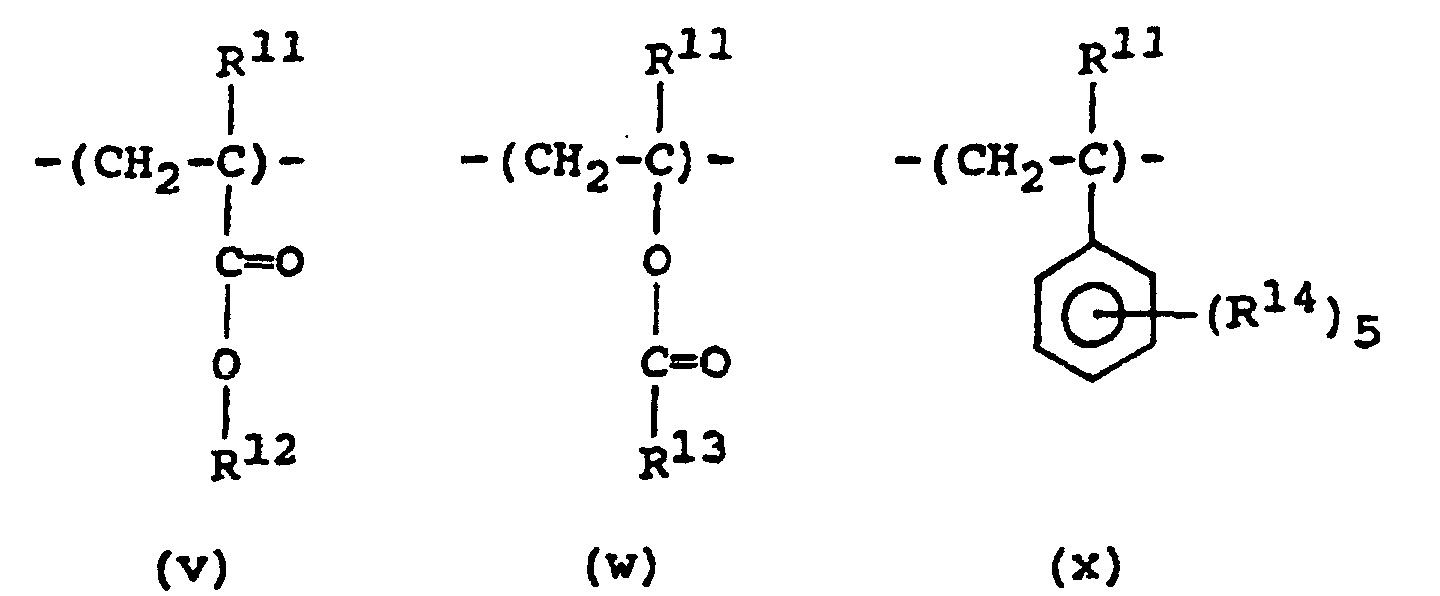

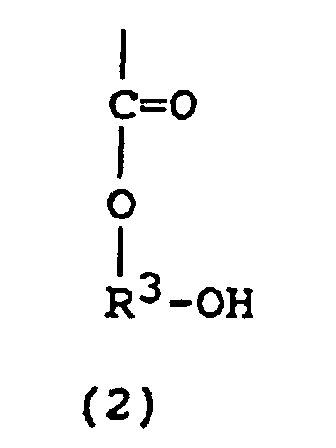


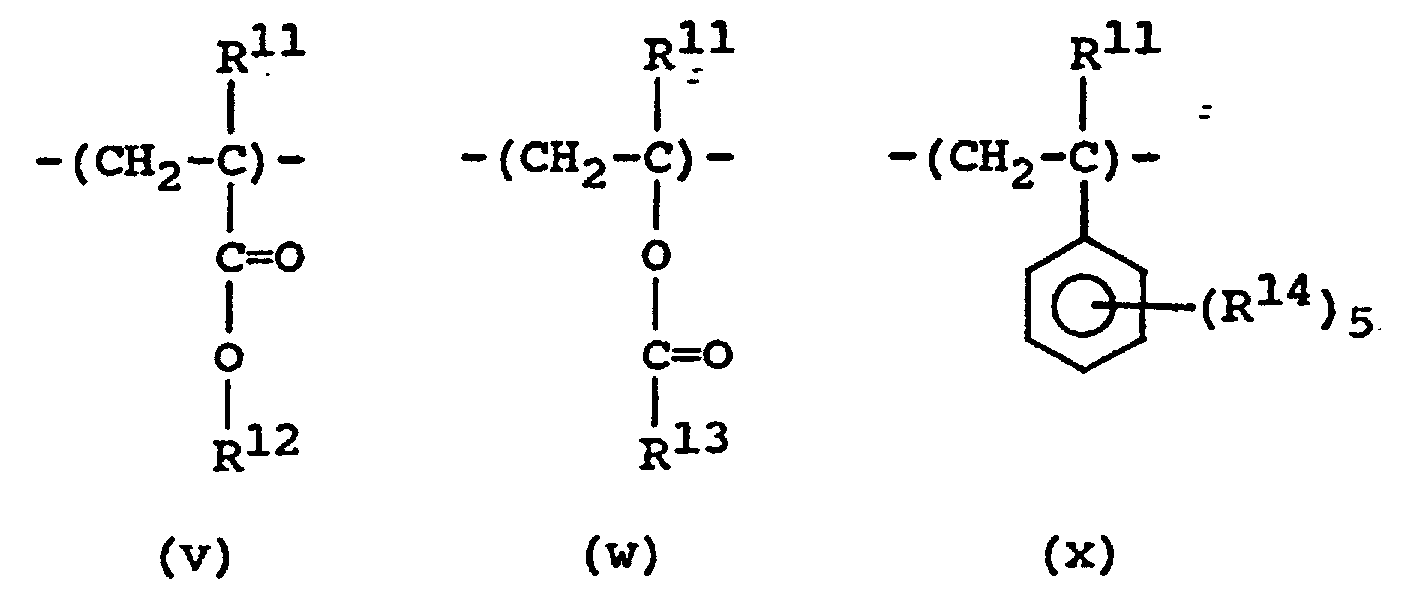


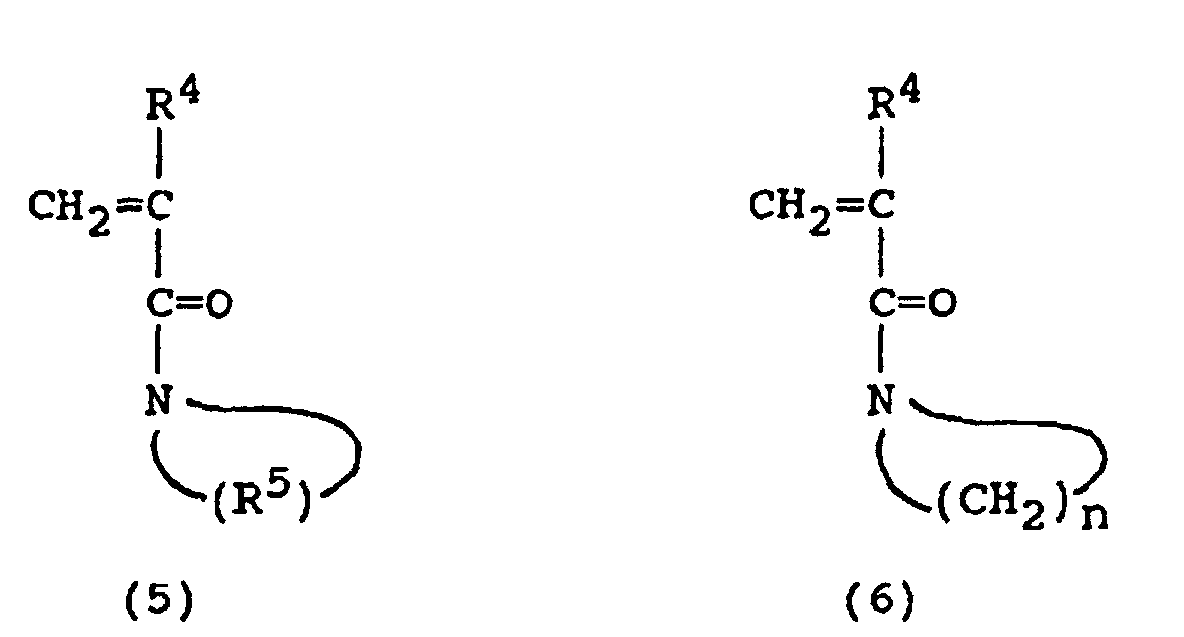

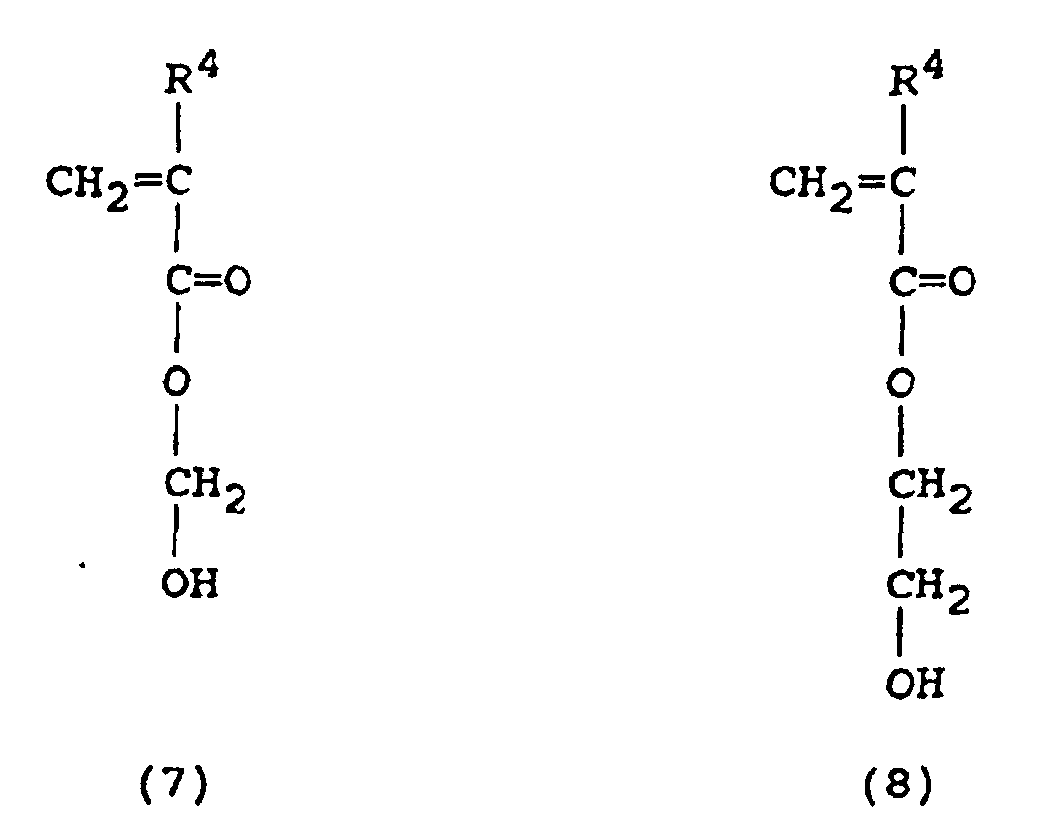
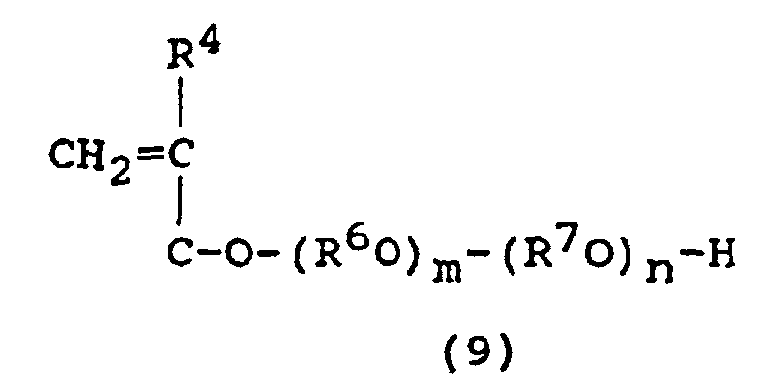
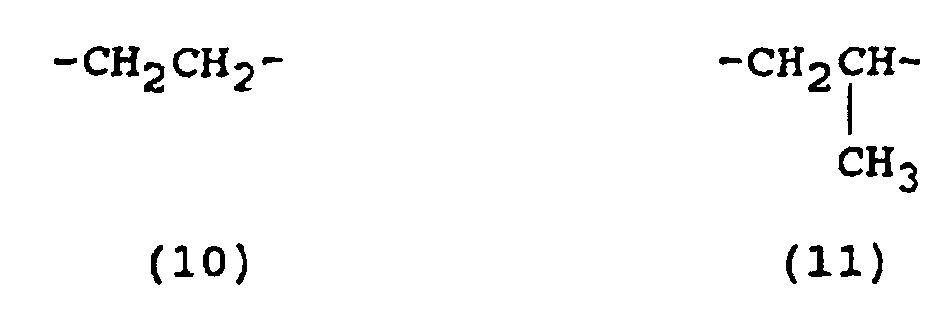
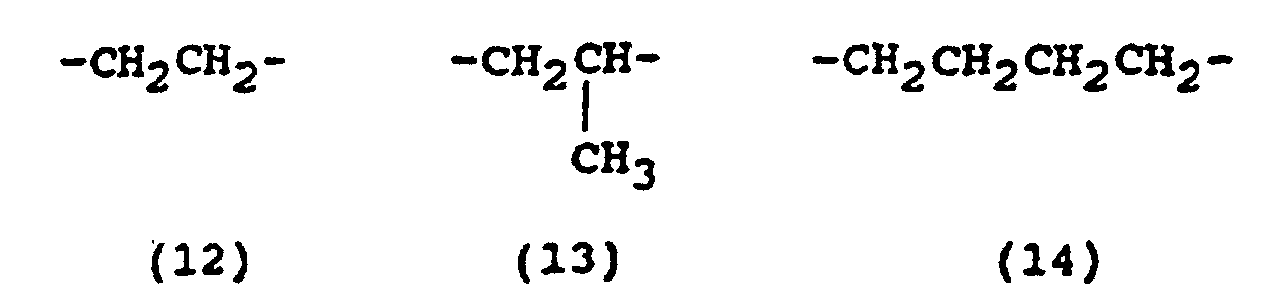

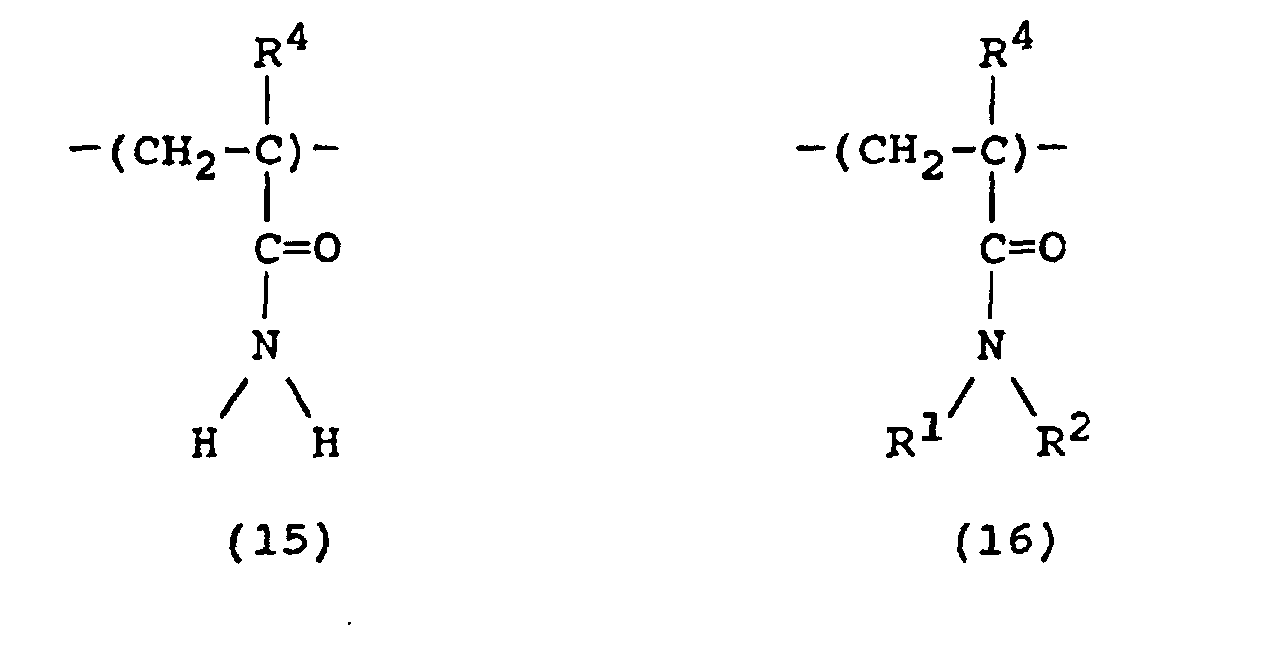


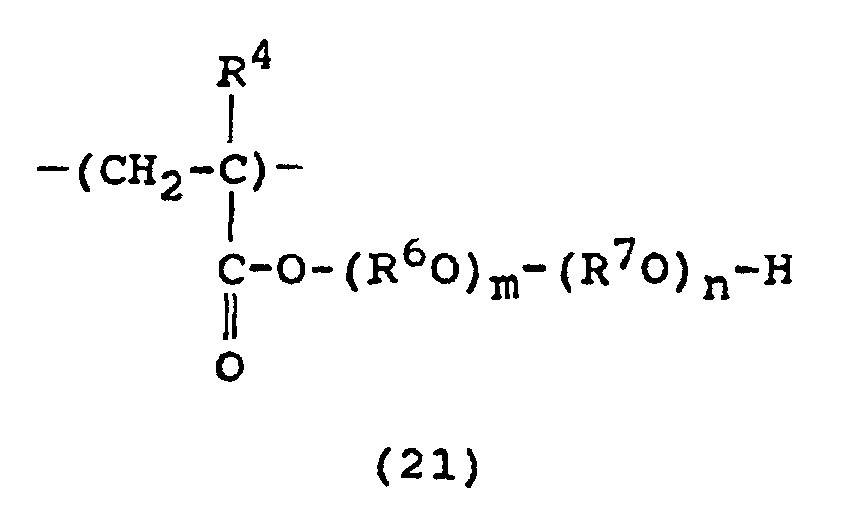
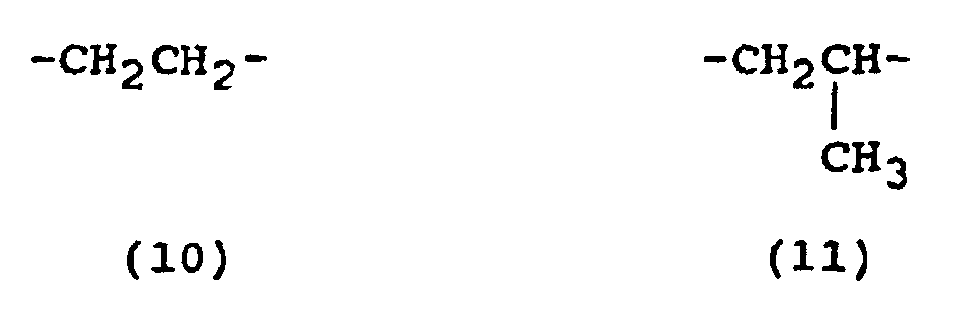


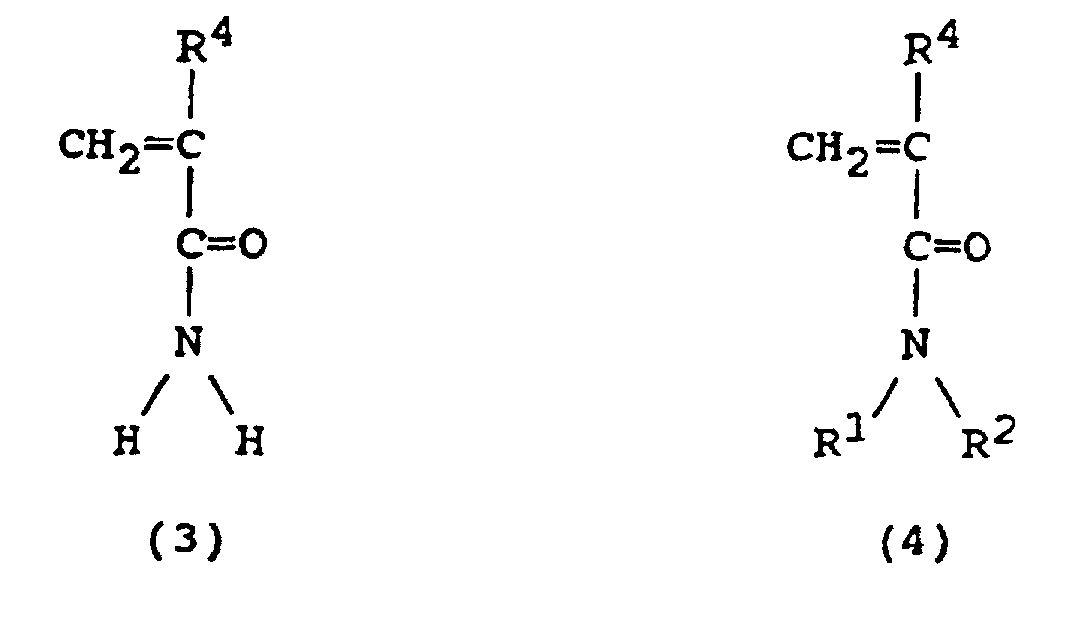
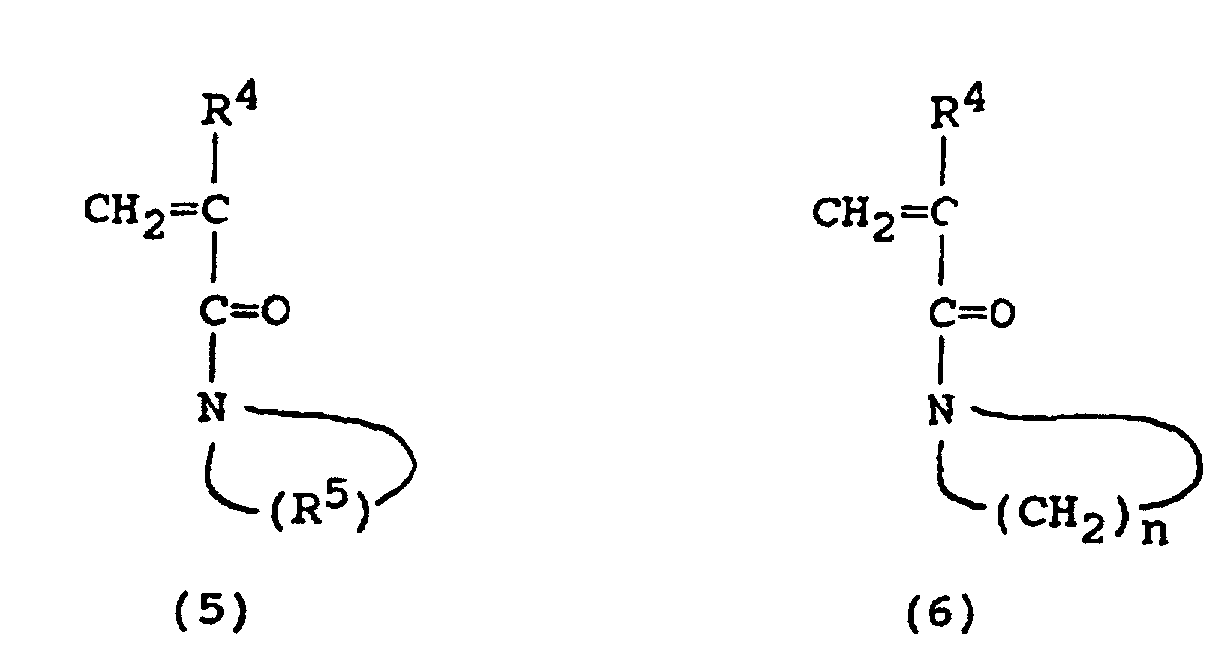

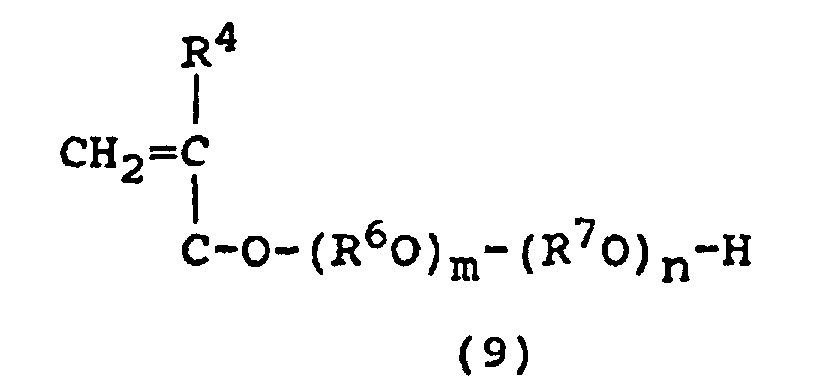

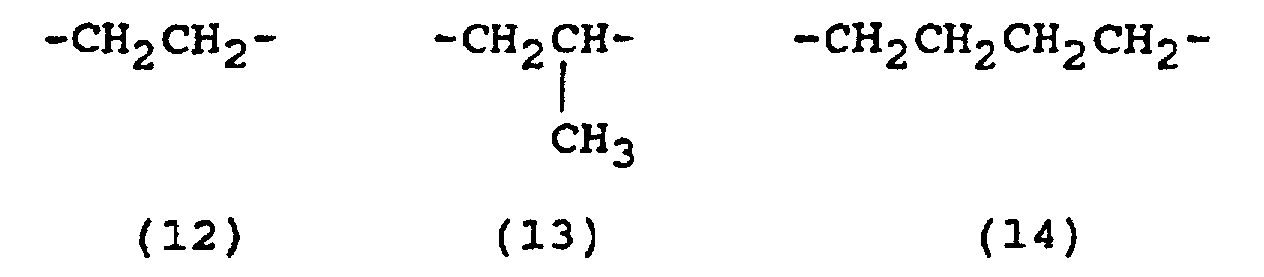


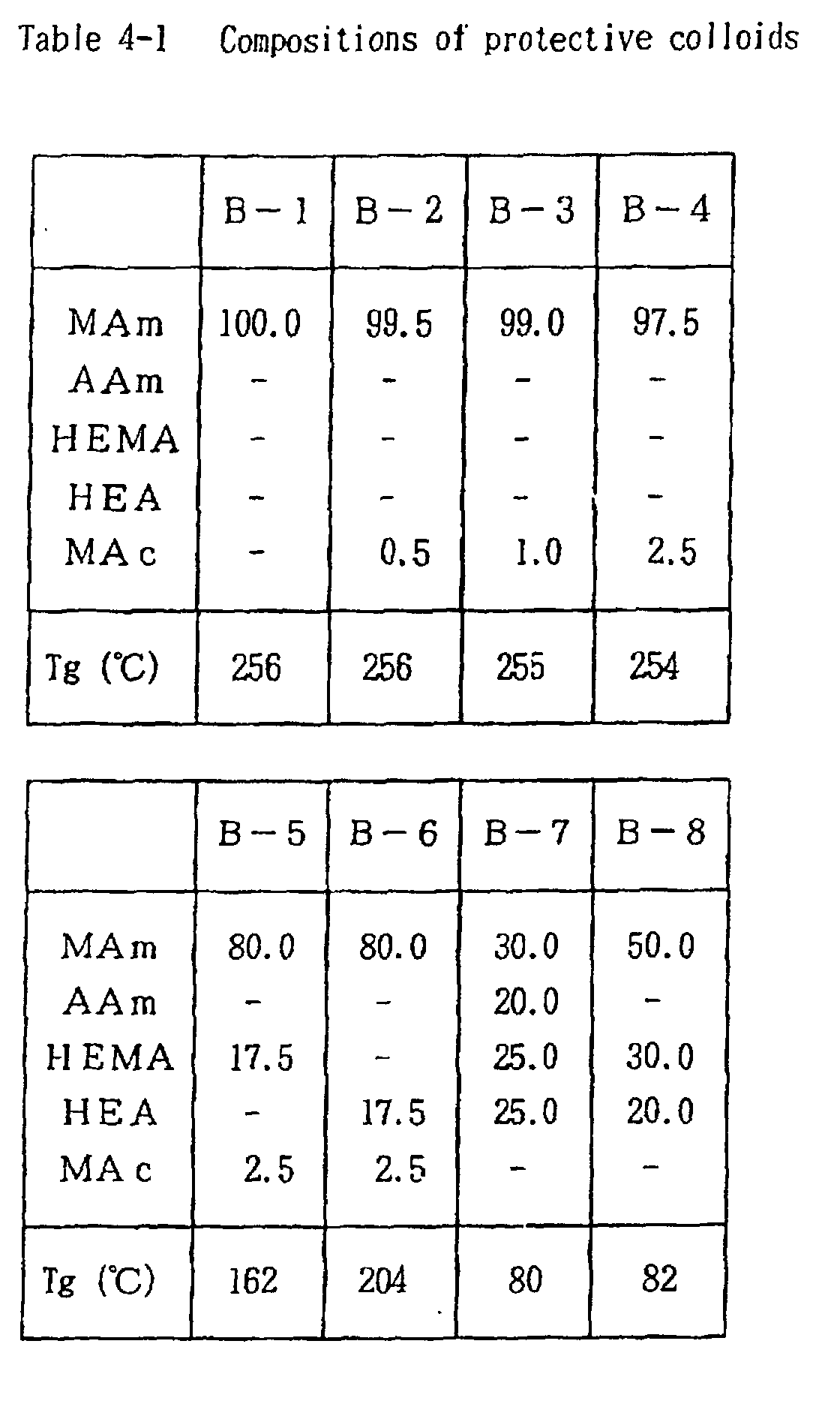

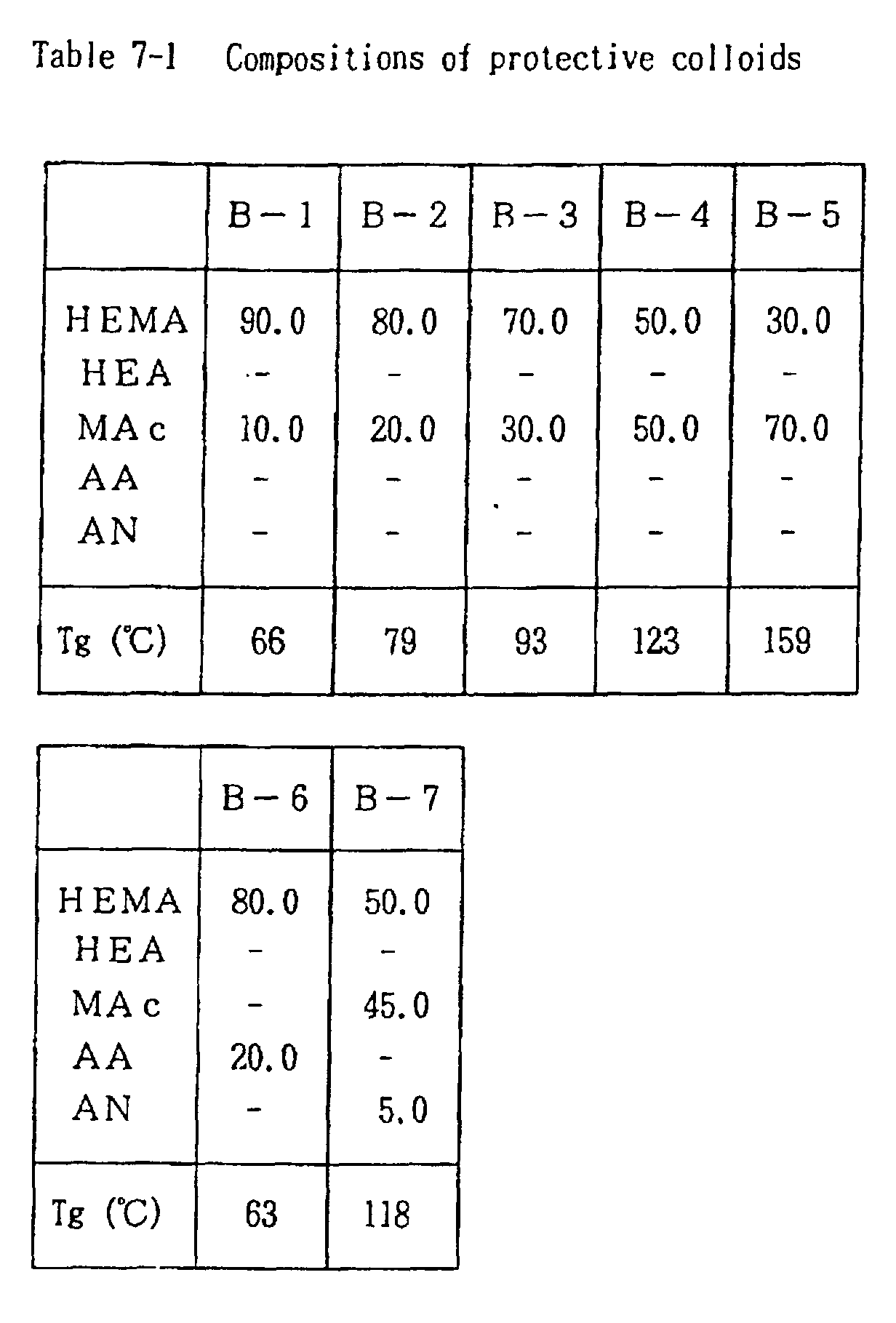
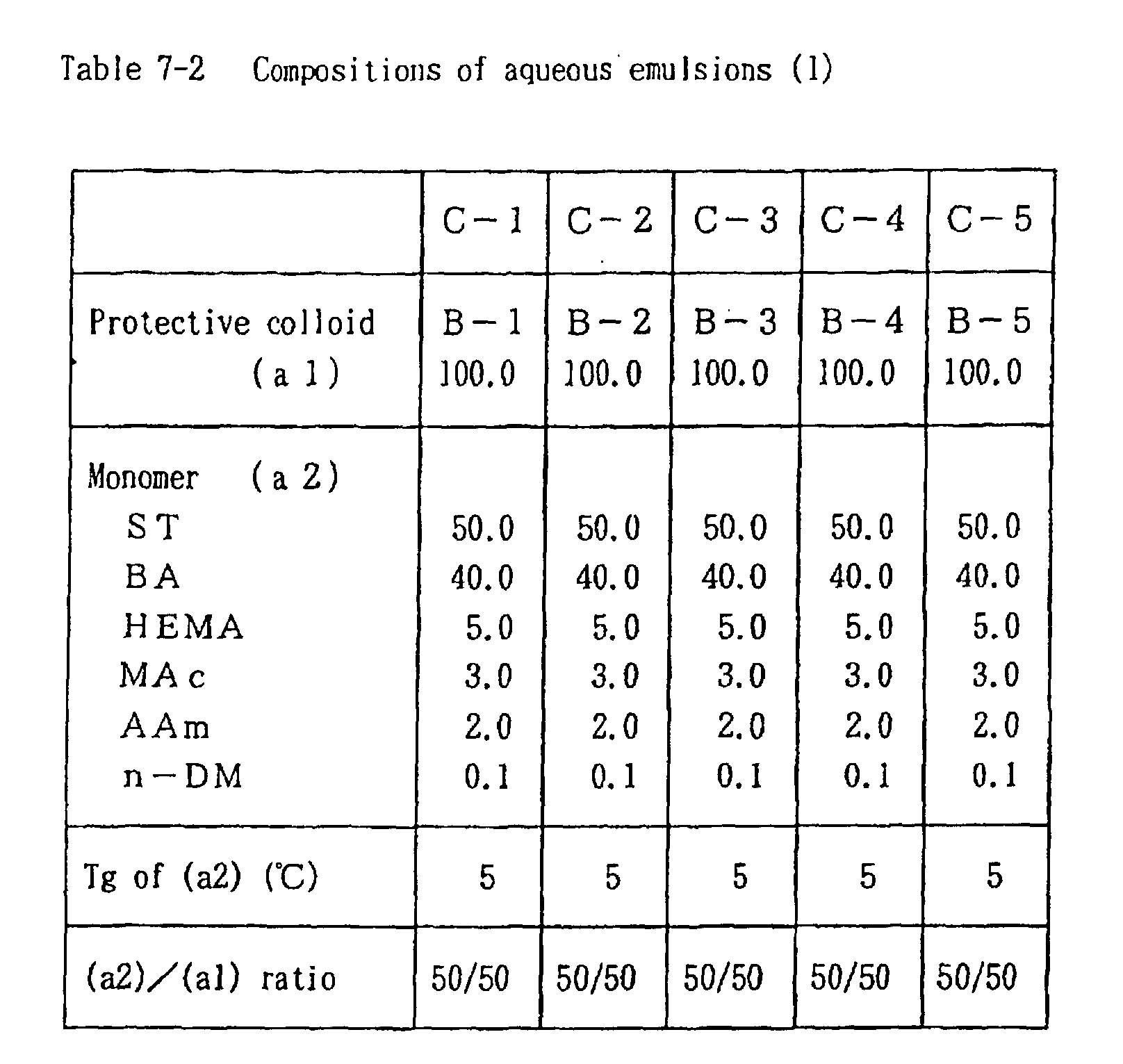
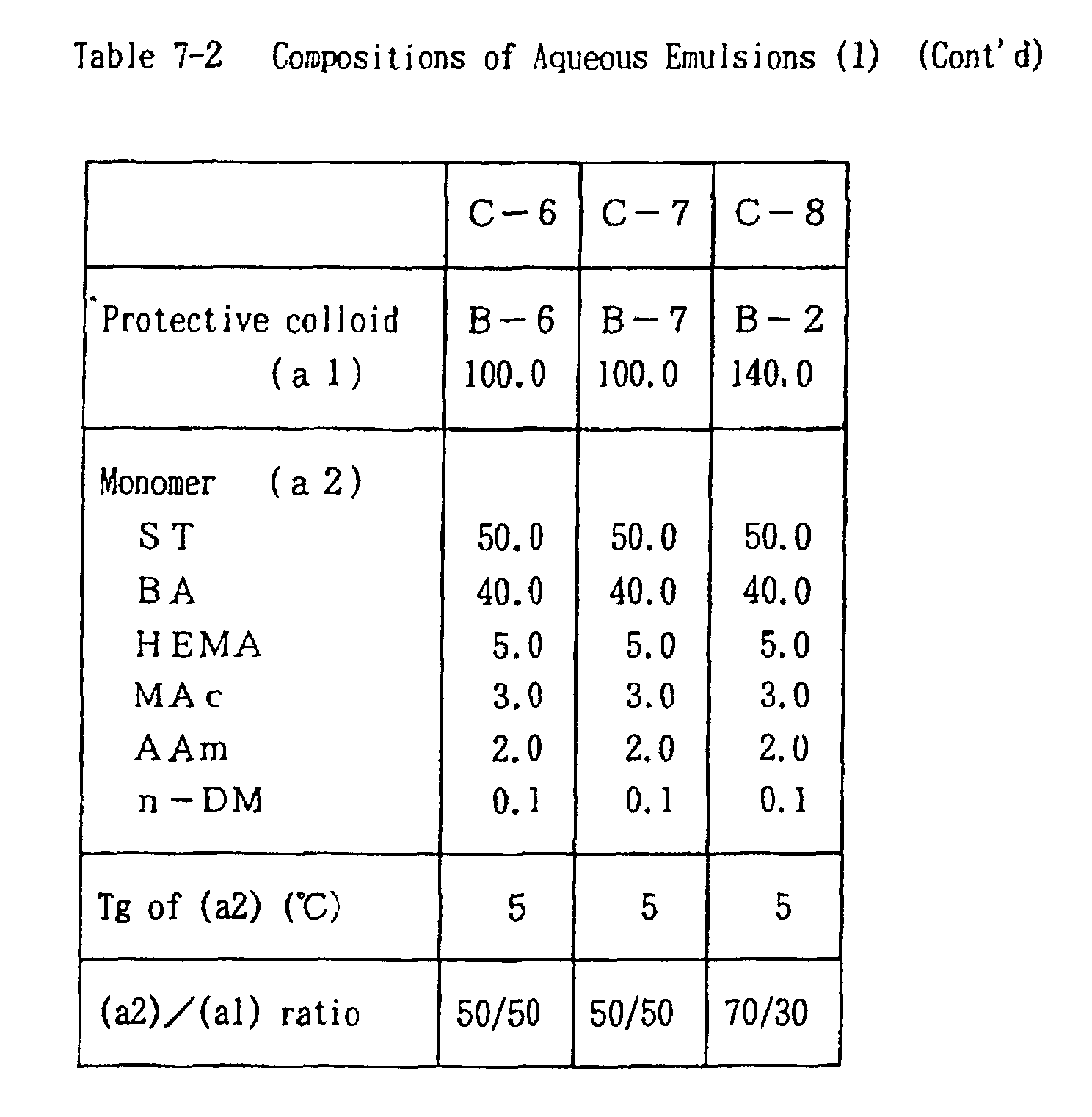
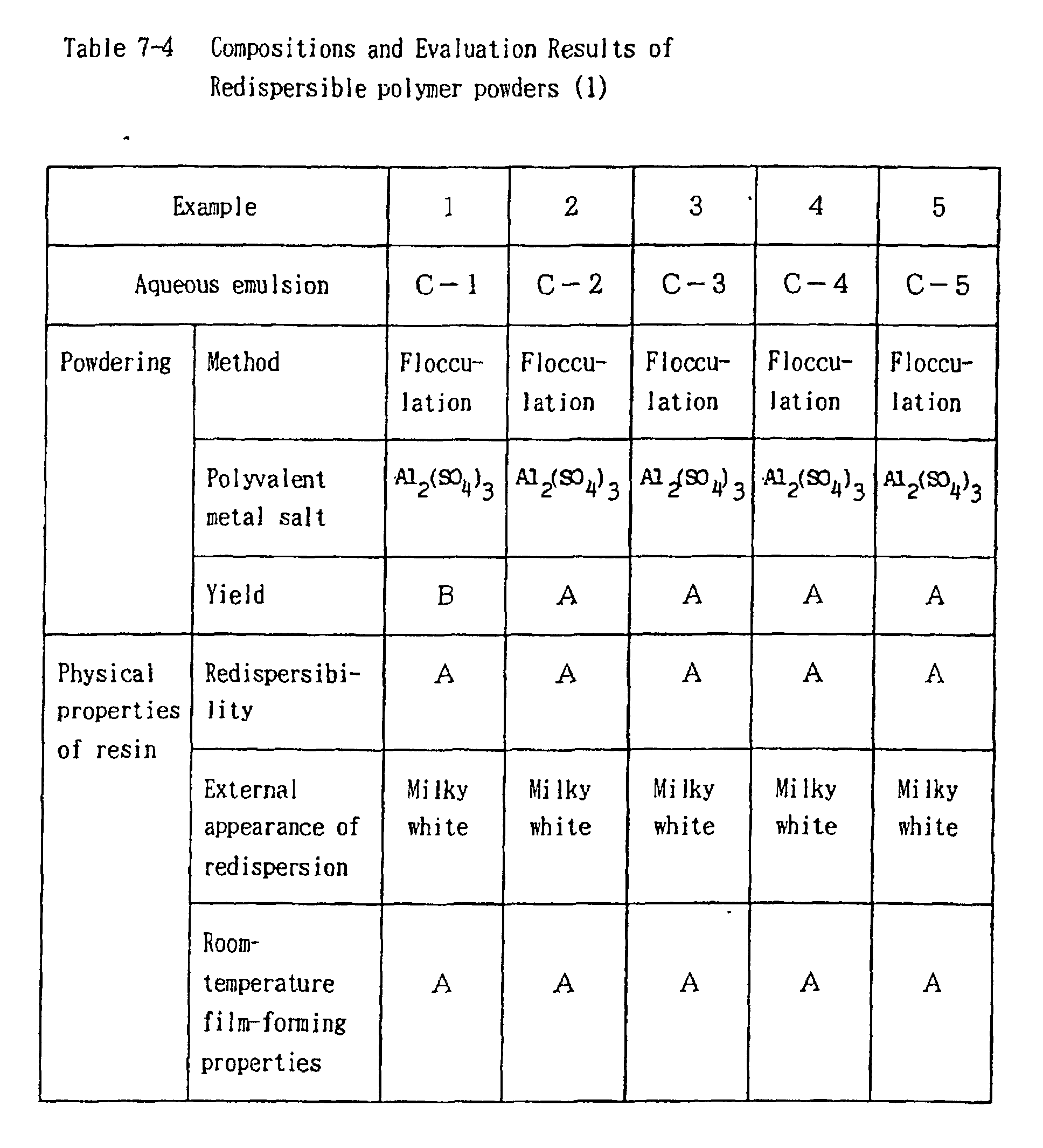
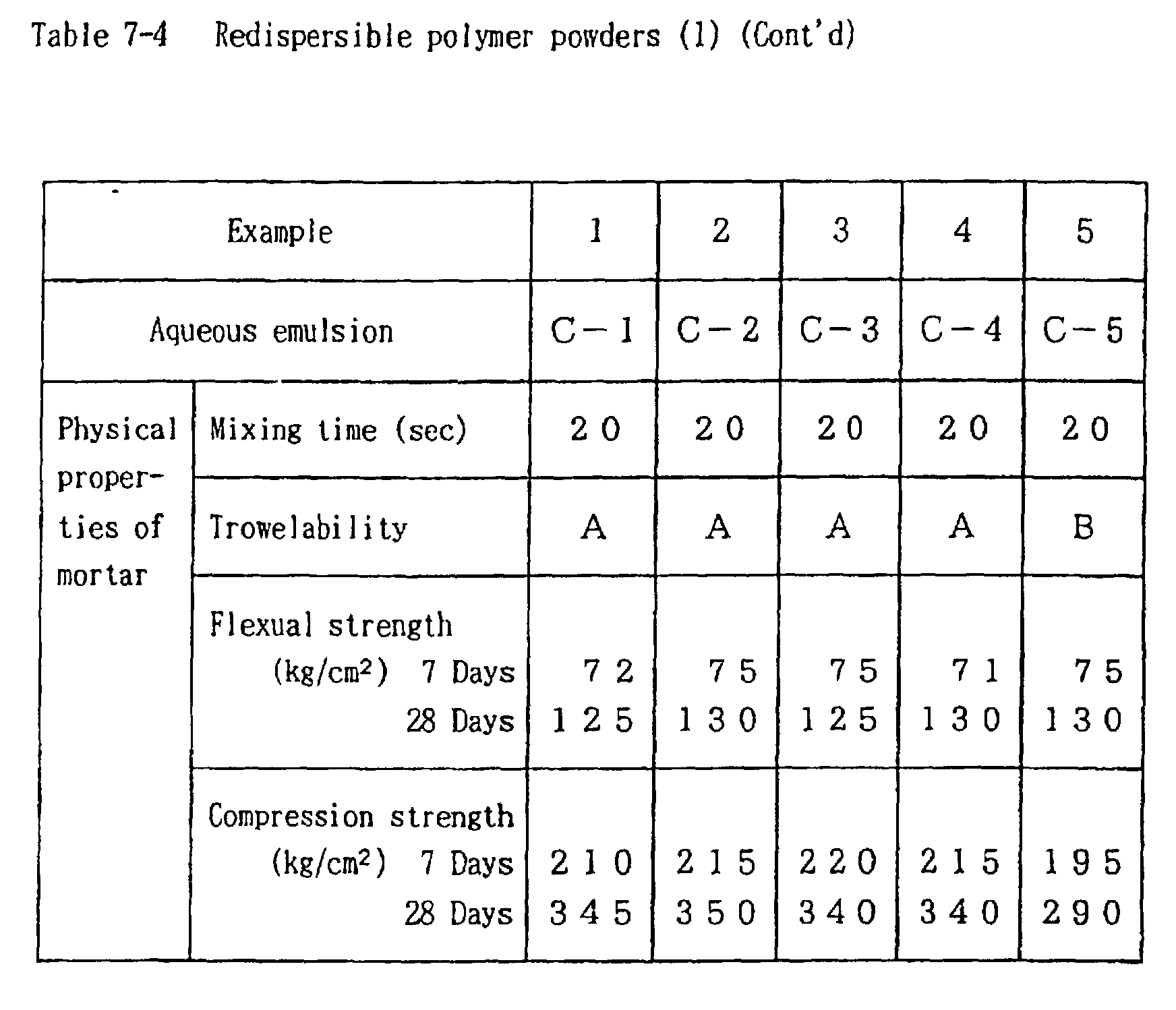
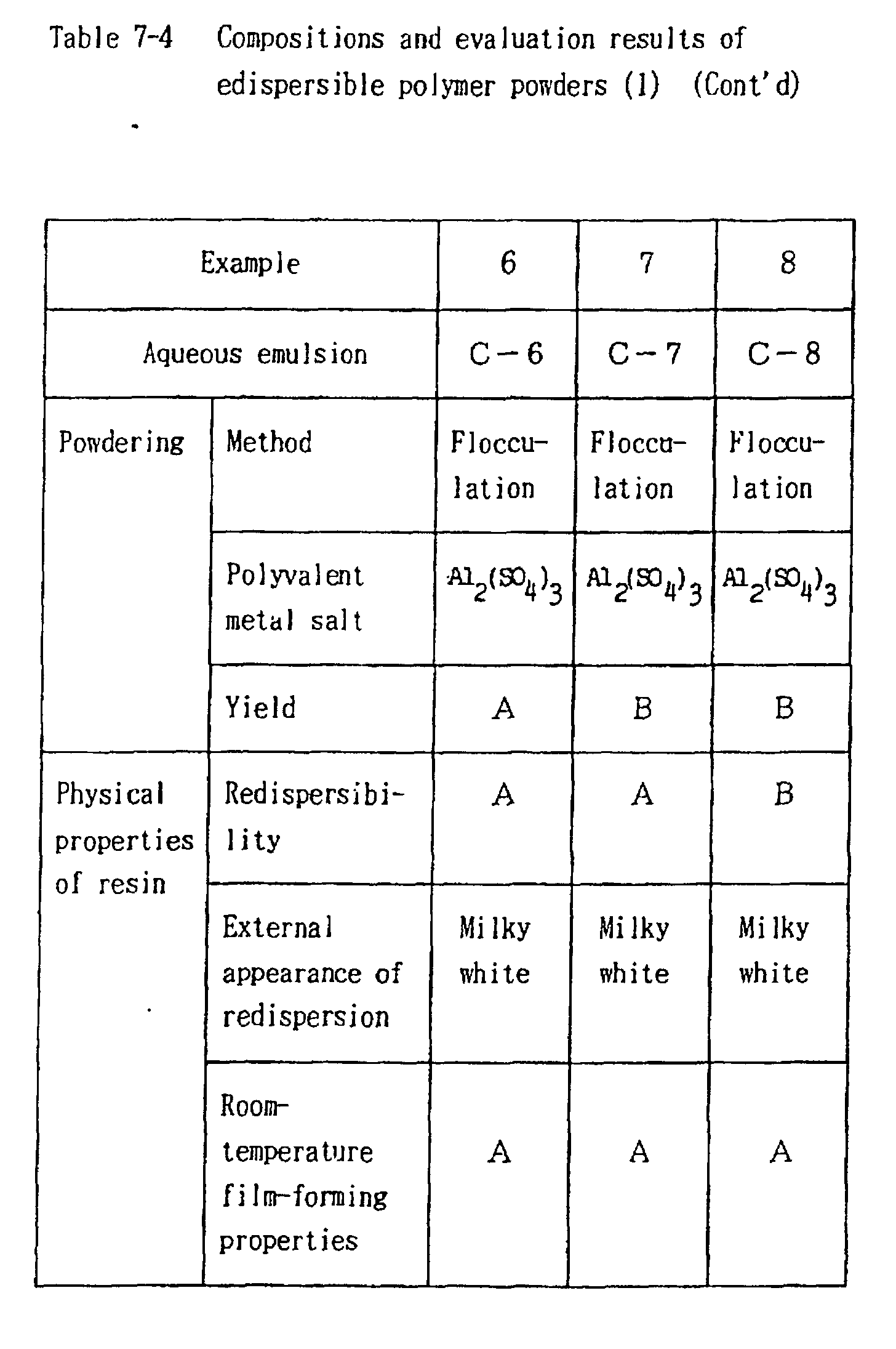
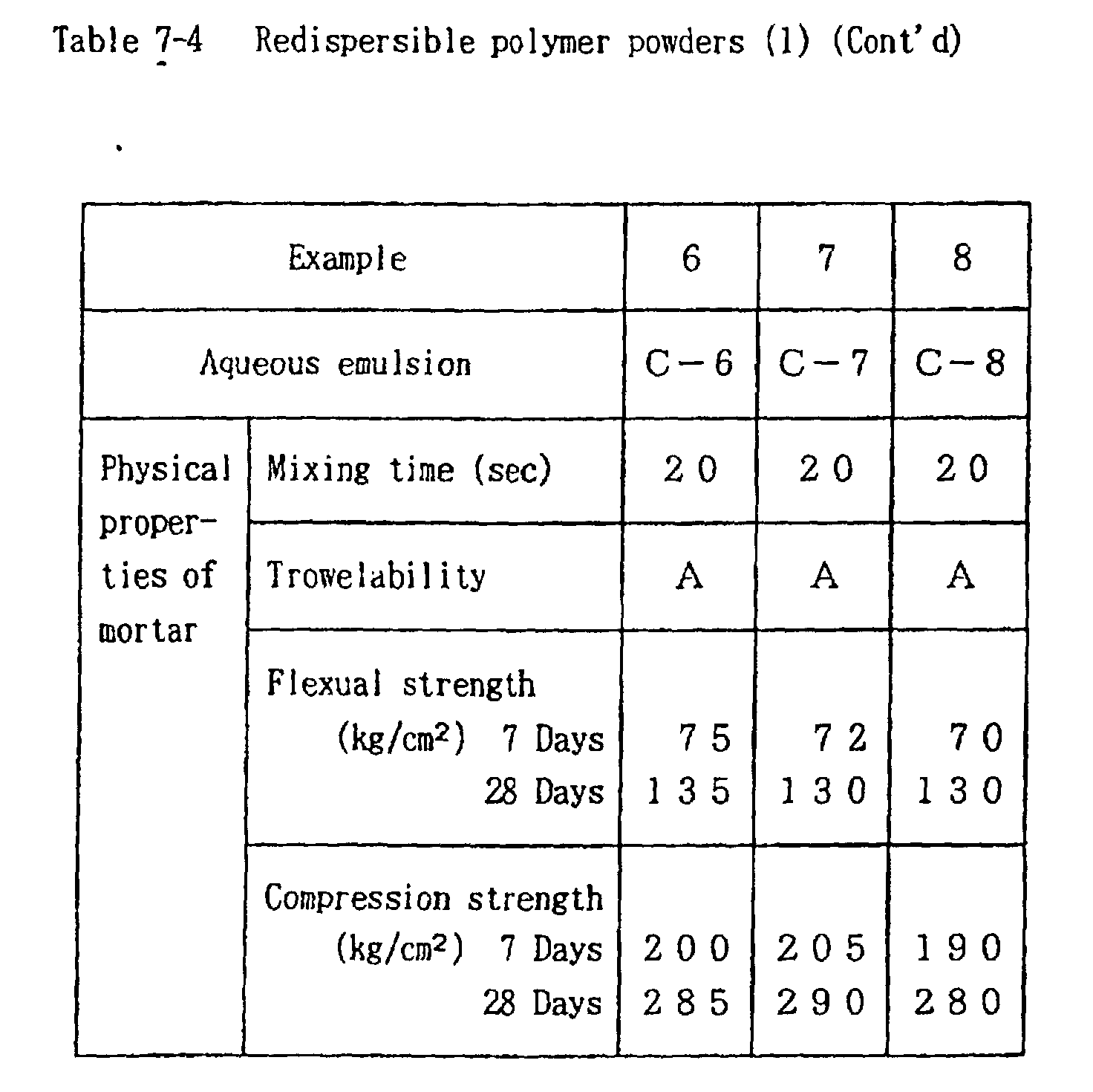

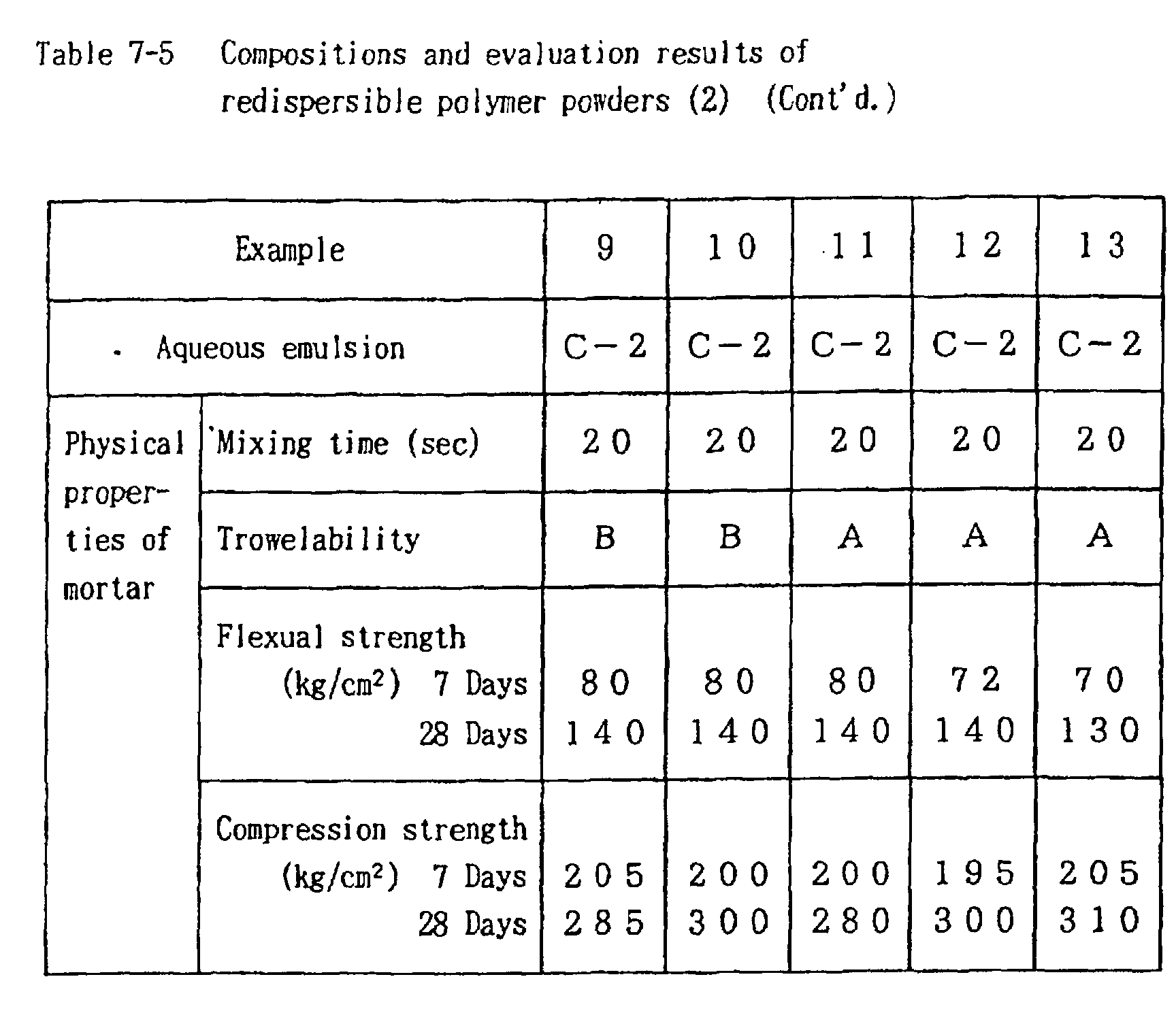


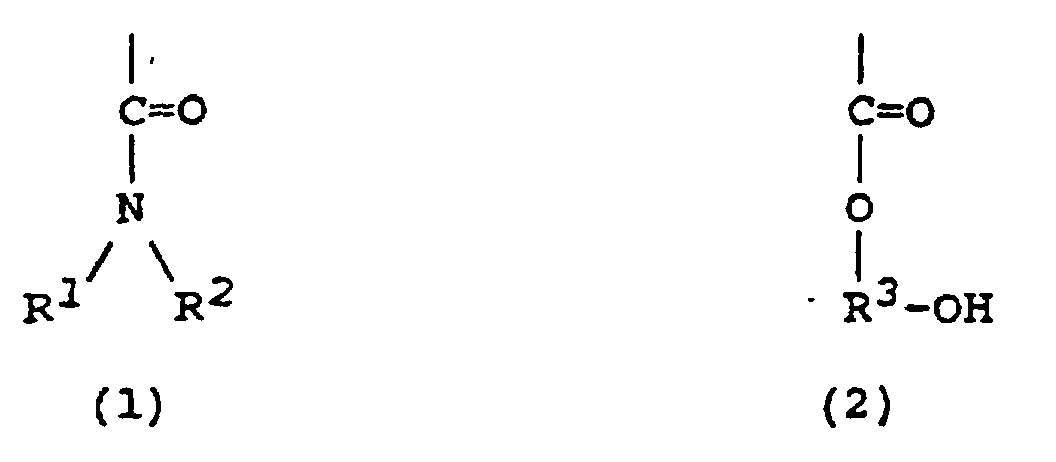 said protective colloid is made of a (co)polymer (a1) composed of a recurring unit and 20 wt.% or more up to 100 wt.% of at least one recurring unit selected from the group consisting of said recurring units having said pendant groups represented by the formula (1) and the group consisting of said recurring units having said pendant groups represented by the formula (2);based on the total weight of (a1) and (a2), (a1) ranges from 15 to 85 wt.% while (a2) ranges from 85 to 15 wt.%; andsaid at least one recurring unit having said pendant group represented by the formula (1) and/or (2) in (α1) is contained at a higher content than said at least one recurring unit in (α2).
 wherein R11 represents a hydrogen atom or a methyl group, R12 represents a hydrogen atom or an alkyl group having 1-12 carbon atoms, R13 represents a hydrogen atom, an alkyl group having 1-20 carbon atoms, an alkenyl group having 1-20 carbon atoms or a phenyl group, R14s are the same or different and individually represent a hydrogen atom, an alkyl group having 1-12 carbon atoms, a sulfonic group or a metal sulfonate group, and R15 represents a divalent hydrocarbon group having 1-6 carbon atoms.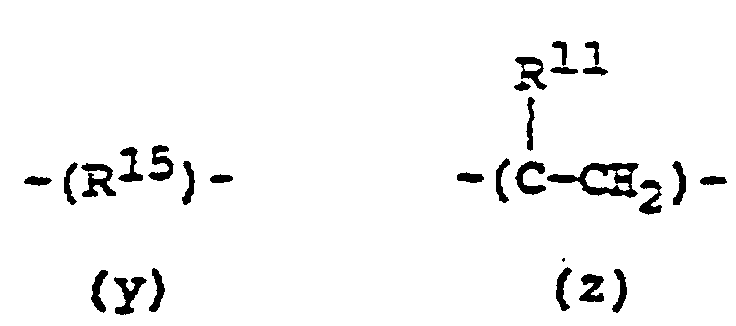
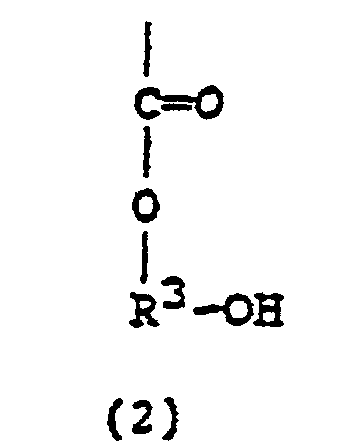
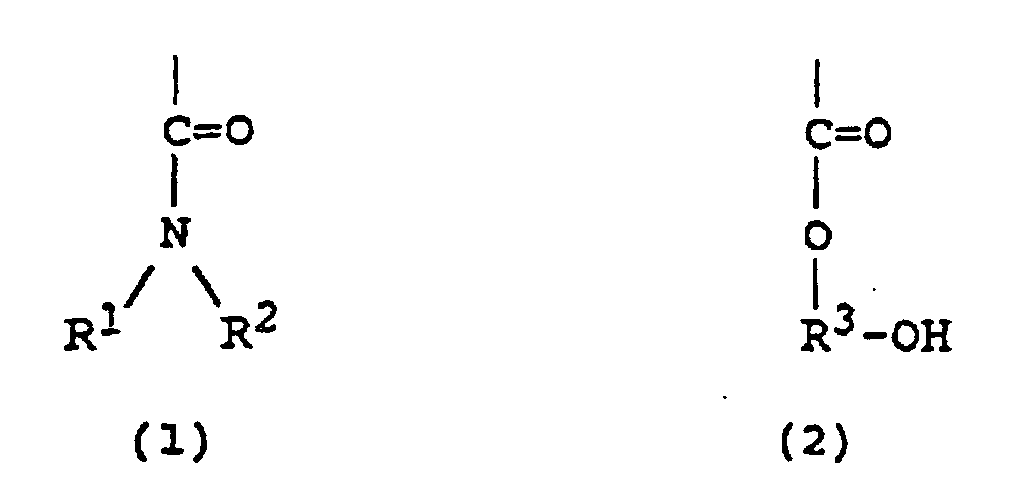 an ethylenically unsaturated monomer for forming a copolymer (a2), said ethylenically unsaturated monomer comprising 0 wt.% or more but less than 40 wt.% of at least one monomer selected from the group consisting of said ethylenically unsaturated monomers having said pendant groups represented by the formula (1) and the group consisting of said ethylenically unsaturated monomers having said pendant groups represented by the formula (2),
 as step 2 (protective colloid preparation step),