EP0754758B1 - Process for the production of xylitol - Google Patents
Process for the production of xylitol Download PDFInfo
- Publication number
- EP0754758B1 EP0754758B1 EP96304727A EP96304727A EP0754758B1 EP 0754758 B1 EP0754758 B1 EP 0754758B1 EP 96304727 A EP96304727 A EP 96304727A EP 96304727 A EP96304727 A EP 96304727A EP 0754758 B1 EP0754758 B1 EP 0754758B1
- Authority
- EP
- European Patent Office
- Prior art keywords
- pentitol
- xylitol
- isomerisation
- arabinitol
- fermentation
- Prior art date
- Legal status (The legal status is an assumption and is not a legal conclusion. Google has not performed a legal analysis and makes no representation as to the accuracy of the status listed.)
- Expired - Lifetime
Links
- HEBKCHPVOIAQTA-UHFFFAOYSA-N meso ribitol Natural products OCC(O)C(O)C(O)CO HEBKCHPVOIAQTA-UHFFFAOYSA-N 0.000 title claims abstract description 88
- TVXBFESIOXBWNM-UHFFFAOYSA-N Xylitol Natural products OCCC(O)C(O)C(O)CCO TVXBFESIOXBWNM-UHFFFAOYSA-N 0.000 title claims abstract description 33
- 239000000811 xylitol Substances 0.000 title claims abstract description 33
- HEBKCHPVOIAQTA-SCDXWVJYSA-N xylitol Chemical compound OC[C@H](O)[C@@H](O)[C@H](O)CO HEBKCHPVOIAQTA-SCDXWVJYSA-N 0.000 title claims abstract description 33
- 229960002675 xylitol Drugs 0.000 title claims abstract description 33
- 235000010447 xylitol Nutrition 0.000 title claims abstract description 33
- 238000000034 method Methods 0.000 title claims abstract description 30
- 238000004519 manufacturing process Methods 0.000 title claims abstract description 7
- HEBKCHPVOIAQTA-NGQZWQHPSA-N d-xylitol Chemical compound OC[C@H](O)C(O)[C@H](O)CO HEBKCHPVOIAQTA-NGQZWQHPSA-N 0.000 claims abstract description 21
- 238000006317 isomerization reaction Methods 0.000 claims abstract description 19
- 239000000126 substance Substances 0.000 claims abstract description 13
- 150000002402 hexoses Chemical class 0.000 claims abstract description 11
- HEBKCHPVOIAQTA-QWWZWVQMSA-N D-arabinitol Chemical compound OC[C@@H](O)C(O)[C@H](O)CO HEBKCHPVOIAQTA-QWWZWVQMSA-N 0.000 claims description 28
- WQZGKKKJIJFFOK-GASJEMHNSA-N Glucose Natural products OC[C@H]1OC(O)[C@H](O)[C@@H](O)[C@@H]1O WQZGKKKJIJFFOK-GASJEMHNSA-N 0.000 claims description 21
- 239000008103 glucose Substances 0.000 claims description 17
- 239000000203 mixture Substances 0.000 claims description 16
- 238000000855 fermentation Methods 0.000 claims description 14
- 230000004151 fermentation Effects 0.000 claims description 14
- 239000003054 catalyst Substances 0.000 claims description 13
- 239000006188 syrup Substances 0.000 claims description 10
- 235000020357 syrup Nutrition 0.000 claims description 10
- 240000004808 Saccharomyces cerevisiae Species 0.000 claims description 8
- UFHFLCQGNIYNRP-UHFFFAOYSA-N Hydrogen Chemical compound [H][H] UFHFLCQGNIYNRP-UHFFFAOYSA-N 0.000 claims description 7
- JVWLUVNSQYXYBE-UHFFFAOYSA-N Ribitol Natural products OCC(C)C(O)C(O)CO JVWLUVNSQYXYBE-UHFFFAOYSA-N 0.000 claims description 7
- HEBKCHPVOIAQTA-ZXFHETKHSA-N ribitol Chemical compound OC[C@H](O)[C@H](O)[C@H](O)CO HEBKCHPVOIAQTA-ZXFHETKHSA-N 0.000 claims description 7
- 239000002253 acid Substances 0.000 claims description 6
- 239000001257 hydrogen Substances 0.000 claims description 6
- 229910052739 hydrogen Inorganic materials 0.000 claims description 6
- 241000222120 Candida <Saccharomycetales> Species 0.000 claims description 5
- 238000005984 hydrogenation reaction Methods 0.000 claims description 5
- 241000235648 Pichia Species 0.000 claims description 4
- 241000235017 Zygosaccharomyces Species 0.000 claims description 3
- 239000008121 dextrose Substances 0.000 claims description 3
- 150000004682 monohydrates Chemical class 0.000 claims description 3
- 239000011347 resin Substances 0.000 claims description 3
- 229920005989 resin Polymers 0.000 claims description 3
- 241000235035 Debaryomyces Species 0.000 claims description 2
- 241000235070 Saccharomyces Species 0.000 claims description 2
- 239000003513 alkali Substances 0.000 claims description 2
- 238000006356 dehydrogenation reaction Methods 0.000 claims description 2
- 238000000926 separation method Methods 0.000 claims description 2
- 238000010564 aerobic fermentation Methods 0.000 claims 1
- 150000001768 cations Chemical class 0.000 claims 1
- 238000006243 chemical reaction Methods 0.000 abstract description 19
- 230000003197 catalytic effect Effects 0.000 abstract description 5
- WQZGKKKJIJFFOK-VFUOTHLCSA-N beta-D-glucose Chemical compound OC[C@H]1O[C@@H](O)[C@H](O)[C@@H](O)[C@@H]1O WQZGKKKJIJFFOK-VFUOTHLCSA-N 0.000 description 18
- SRBFZHDQGSBBOR-IOVATXLUSA-N D-xylopyranose Chemical compound O[C@@H]1COC(O)[C@H](O)[C@H]1O SRBFZHDQGSBBOR-IOVATXLUSA-N 0.000 description 16
- PYMYPHUHKUWMLA-UHFFFAOYSA-N arabinose Natural products OCC(O)C(O)C(O)C=O PYMYPHUHKUWMLA-UHFFFAOYSA-N 0.000 description 8
- SRBFZHDQGSBBOR-UHFFFAOYSA-N beta-D-Pyranose-Lyxose Natural products OC1COC(O)C(O)C1O SRBFZHDQGSBBOR-UHFFFAOYSA-N 0.000 description 8
- PEDCQBHIVMGVHV-UHFFFAOYSA-N Glycerine Chemical compound OCC(O)CO PEDCQBHIVMGVHV-UHFFFAOYSA-N 0.000 description 6
- HEMHJVSKTPXQMS-UHFFFAOYSA-M Sodium hydroxide Chemical compound [OH-].[Na+] HEMHJVSKTPXQMS-UHFFFAOYSA-M 0.000 description 6
- 238000004587 chromatography analysis Methods 0.000 description 6
- 239000000543 intermediate Substances 0.000 description 6
- 229920005862 polyol Polymers 0.000 description 6
- 229910052707 ruthenium Inorganic materials 0.000 description 6
- KJTLSVCANCCWHF-UHFFFAOYSA-N Ruthenium Chemical compound [Ru] KJTLSVCANCCWHF-UHFFFAOYSA-N 0.000 description 5
- 150000003077 polyols Chemical class 0.000 description 5
- 239000000047 product Substances 0.000 description 5
- 238000007670 refining Methods 0.000 description 5
- ZAQJHHRNXZUBTE-WUJLRWPWSA-N D-xylulose Chemical compound OC[C@@H](O)[C@H](O)C(=O)CO ZAQJHHRNXZUBTE-WUJLRWPWSA-N 0.000 description 4
- CSNNHWWHGAXBCP-UHFFFAOYSA-L Magnesium sulfate Chemical compound [Mg+2].[O-][S+2]([O-])([O-])[O-] CSNNHWWHGAXBCP-UHFFFAOYSA-L 0.000 description 4
- VYPSYNLAJGMNEJ-UHFFFAOYSA-N Silicium dioxide Chemical compound O=[Si]=O VYPSYNLAJGMNEJ-UHFFFAOYSA-N 0.000 description 4
- 238000002425 crystallisation Methods 0.000 description 4
- 230000007062 hydrolysis Effects 0.000 description 4
- 238000006460 hydrolysis reaction Methods 0.000 description 4
- 239000000463 material Substances 0.000 description 4
- 239000002609 medium Substances 0.000 description 4
- 229920001221 xylan Polymers 0.000 description 4
- 150000004823 xylans Chemical class 0.000 description 4
- 244000144725 Amygdalus communis Species 0.000 description 3
- 235000011437 Amygdalus communis Nutrition 0.000 description 3
- LKDRXBCSQODPBY-AMVSKUEXSA-N L-(-)-Sorbose Chemical compound OCC1(O)OC[C@H](O)[C@@H](O)[C@@H]1O LKDRXBCSQODPBY-AMVSKUEXSA-N 0.000 description 3
- PXHVJJICTQNCMI-UHFFFAOYSA-N Nickel Chemical compound [Ni] PXHVJJICTQNCMI-UHFFFAOYSA-N 0.000 description 3
- 235000020224 almond Nutrition 0.000 description 3
- 229920001223 polyethylene glycol Polymers 0.000 description 3
- 150000005846 sugar alcohols Chemical class 0.000 description 3
- WQZGKKKJIJFFOK-SVZMEOIVSA-N (+)-Galactose Chemical compound OC[C@H]1OC(O)[C@H](O)[C@@H](O)[C@H]1O WQZGKKKJIJFFOK-SVZMEOIVSA-N 0.000 description 2
- 241000196324 Embryophyta Species 0.000 description 2
- KDLHZDBZIXYQEI-UHFFFAOYSA-N Palladium Chemical compound [Pd] KDLHZDBZIXYQEI-UHFFFAOYSA-N 0.000 description 2
- NBIIXXVUZAFLBC-UHFFFAOYSA-N Phosphoric acid Chemical compound OP(O)(O)=O NBIIXXVUZAFLBC-UHFFFAOYSA-N 0.000 description 2
- FAPWRFPIFSIZLT-UHFFFAOYSA-M Sodium chloride Chemical compound [Na+].[Cl-] FAPWRFPIFSIZLT-UHFFFAOYSA-M 0.000 description 2
- 229920002125 Sokalan® Polymers 0.000 description 2
- XSQUKJJJFZCRTK-UHFFFAOYSA-N Urea Chemical compound NC(N)=O XSQUKJJJFZCRTK-UHFFFAOYSA-N 0.000 description 2
- 240000008042 Zea mays Species 0.000 description 2
- 235000005824 Zea mays ssp. parviglumis Nutrition 0.000 description 2
- 235000002017 Zea mays subsp mays Nutrition 0.000 description 2
- -1 alkali metal arabinonate Chemical class 0.000 description 2
- WQZGKKKJIJFFOK-PHYPRBDBSA-N alpha-D-galactose Chemical compound OC[C@H]1O[C@H](O)[C@H](O)[C@@H](O)[C@H]1O WQZGKKKJIJFFOK-PHYPRBDBSA-N 0.000 description 2
- 230000015572 biosynthetic process Effects 0.000 description 2
- 229940041514 candida albicans extract Drugs 0.000 description 2
- 229910052799 carbon Inorganic materials 0.000 description 2
- 238000009903 catalytic hydrogenation reaction Methods 0.000 description 2
- 239000007795 chemical reaction product Substances 0.000 description 2
- 235000005822 corn Nutrition 0.000 description 2
- 239000013078 crystal Substances 0.000 description 2
- FBPFZTCFMRRESA-GUCUJZIJSA-N galactitol Chemical compound OC[C@H](O)[C@@H](O)[C@@H](O)[C@H](O)CO FBPFZTCFMRRESA-GUCUJZIJSA-N 0.000 description 2
- 229930182830 galactose Natural products 0.000 description 2
- 239000001963 growth medium Substances 0.000 description 2
- 229910052943 magnesium sulfate Inorganic materials 0.000 description 2
- 235000019341 magnesium sulphate Nutrition 0.000 description 2
- 230000037361 pathway Effects 0.000 description 2
- BASFCYQUMIYNBI-UHFFFAOYSA-N platinum Chemical compound [Pt] BASFCYQUMIYNBI-UHFFFAOYSA-N 0.000 description 2
- 239000000377 silicon dioxide Substances 0.000 description 2
- 239000007858 starting material Substances 0.000 description 2
- LWIHDJKSTIGBAC-UHFFFAOYSA-K tripotassium phosphate Chemical compound [K+].[K+].[K+].[O-]P([O-])([O-])=O LWIHDJKSTIGBAC-UHFFFAOYSA-K 0.000 description 2
- 239000012138 yeast extract Substances 0.000 description 2
- 239000010457 zeolite Substances 0.000 description 2
- NWUYHJFMYQTDRP-UHFFFAOYSA-N 1,2-bis(ethenyl)benzene;1-ethenyl-2-ethylbenzene;styrene Chemical compound C=CC1=CC=CC=C1.CCC1=CC=CC=C1C=C.C=CC1=CC=CC=C1C=C NWUYHJFMYQTDRP-UHFFFAOYSA-N 0.000 description 1
- 241000589220 Acetobacter Species 0.000 description 1
- GUBGYTABKSRVRQ-XLOQQCSPSA-N Alpha-Lactose Chemical compound O[C@@H]1[C@@H](O)[C@@H](O)[C@@H](CO)O[C@H]1O[C@@H]1[C@@H](CO)O[C@H](O)[C@H](O)[C@H]1O GUBGYTABKSRVRQ-XLOQQCSPSA-N 0.000 description 1
- 241000894006 Bacteria Species 0.000 description 1
- 235000018185 Betula X alpestris Nutrition 0.000 description 1
- 235000018212 Betula X uliginosa Nutrition 0.000 description 1
- OYPRJOBELJOOCE-UHFFFAOYSA-N Calcium Chemical group [Ca] OYPRJOBELJOOCE-UHFFFAOYSA-N 0.000 description 1
- UXVMQQNJUSDDNG-UHFFFAOYSA-L Calcium chloride Chemical compound [Cl-].[Cl-].[Ca+2] UXVMQQNJUSDDNG-UHFFFAOYSA-L 0.000 description 1
- OKTJSMMVPCPJKN-UHFFFAOYSA-N Carbon Chemical compound [C] OKTJSMMVPCPJKN-UHFFFAOYSA-N 0.000 description 1
- RYGMFSIKBFXOCR-UHFFFAOYSA-N Copper Chemical compound [Cu] RYGMFSIKBFXOCR-UHFFFAOYSA-N 0.000 description 1
- FBPFZTCFMRRESA-FSIIMWSLSA-N D-Glucitol Natural products OC[C@H](O)[C@H](O)[C@@H](O)[C@H](O)CO FBPFZTCFMRRESA-FSIIMWSLSA-N 0.000 description 1
- QXKAIJAYHKCRRA-UHFFFAOYSA-N D-lyxonic acid Natural products OCC(O)C(O)C(O)C(O)=O QXKAIJAYHKCRRA-UHFFFAOYSA-N 0.000 description 1
- 229930091371 Fructose Natural products 0.000 description 1
- RFSUNEUAIZKAJO-ARQDHWQXSA-N Fructose Chemical compound OC[C@H]1O[C@](O)(CO)[C@@H](O)[C@@H]1O RFSUNEUAIZKAJO-ARQDHWQXSA-N 0.000 description 1
- 239000005715 Fructose Substances 0.000 description 1
- 241000589236 Gluconobacter Species 0.000 description 1
- 102000004195 Isomerases Human genes 0.000 description 1
- 108090000769 Isomerases Proteins 0.000 description 1
- 241001480034 Kodamaea ohmeri Species 0.000 description 1
- QXKAIJAYHKCRRA-NUNKFHFFSA-N L-xylonic acid Chemical compound OC[C@H](O)[C@@H](O)[C@H](O)C(O)=O QXKAIJAYHKCRRA-NUNKFHFFSA-N 0.000 description 1
- GUBGYTABKSRVRQ-QKKXKWKRSA-N Lactose Natural products OC[C@H]1O[C@@H](O[C@H]2[C@H](O)[C@@H](O)C(O)O[C@@H]2CO)[C@H](O)[C@@H](O)[C@H]1O GUBGYTABKSRVRQ-QKKXKWKRSA-N 0.000 description 1
- 239000007868 Raney catalyst Substances 0.000 description 1
- 229910000564 Raney nickel Inorganic materials 0.000 description 1
- CZMRCDWAGMRECN-UGDNZRGBSA-N Sucrose Chemical compound O[C@H]1[C@H](O)[C@@H](CO)O[C@@]1(CO)O[C@@H]1[C@H](O)[C@@H](O)[C@H](O)[C@@H](CO)O1 CZMRCDWAGMRECN-UGDNZRGBSA-N 0.000 description 1
- 229930006000 Sucrose Natural products 0.000 description 1
- 241000191472 Yamadazyma triangularis Species 0.000 description 1
- 229910021536 Zeolite Inorganic materials 0.000 description 1
- 230000002378 acidificating effect Effects 0.000 description 1
- 150000007513 acids Chemical class 0.000 description 1
- 229910052783 alkali metal Inorganic materials 0.000 description 1
- WQZGKKKJIJFFOK-DVKNGEFBSA-N alpha-D-glucose Chemical group OC[C@H]1O[C@H](O)[C@H](O)[C@@H](O)[C@@H]1O WQZGKKKJIJFFOK-DVKNGEFBSA-N 0.000 description 1
- 229910000147 aluminium phosphate Inorganic materials 0.000 description 1
- 239000003957 anion exchange resin Substances 0.000 description 1
- 239000002585 base Substances 0.000 description 1
- 239000006227 byproduct Substances 0.000 description 1
- 239000001110 calcium chloride Substances 0.000 description 1
- 229910001628 calcium chloride Inorganic materials 0.000 description 1
- 239000004202 carbamide Substances 0.000 description 1
- 239000003729 cation exchange resin Substances 0.000 description 1
- 125000002091 cationic group Chemical group 0.000 description 1
- 229910017052 cobalt Inorganic materials 0.000 description 1
- 239000010941 cobalt Substances 0.000 description 1
- GUTLYIVDDKVIGB-UHFFFAOYSA-N cobalt atom Chemical compound [Co] GUTLYIVDDKVIGB-UHFFFAOYSA-N 0.000 description 1
- 230000002860 competitive effect Effects 0.000 description 1
- 229910052802 copper Inorganic materials 0.000 description 1
- 239000010949 copper Substances 0.000 description 1
- 238000005115 demineralization Methods 0.000 description 1
- HNPSIPDUKPIQMN-UHFFFAOYSA-N dioxosilane;oxo(oxoalumanyloxy)alumane Chemical compound O=[Si]=O.O=[Al]O[Al]=O HNPSIPDUKPIQMN-UHFFFAOYSA-N 0.000 description 1
- ZPWVASYFFYYZEW-UHFFFAOYSA-L dipotassium hydrogen phosphate Chemical compound [K+].[K+].OP([O-])([O-])=O ZPWVASYFFYYZEW-UHFFFAOYSA-L 0.000 description 1
- 229910000396 dipotassium phosphate Inorganic materials 0.000 description 1
- 235000019797 dipotassium phosphate Nutrition 0.000 description 1
- 150000002016 disaccharides Chemical class 0.000 description 1
- 231100000040 eye damage Toxicity 0.000 description 1
- 235000013305 food Nutrition 0.000 description 1
- 239000012535 impurity Substances 0.000 description 1
- 238000005342 ion exchange Methods 0.000 description 1
- 239000003456 ion exchange resin Substances 0.000 description 1
- 229920003303 ion-exchange polymer Polymers 0.000 description 1
- 239000008101 lactose Substances 0.000 description 1
- 230000007483 microbial process Effects 0.000 description 1
- 230000002906 microbiologic effect Effects 0.000 description 1
- 229910052759 nickel Inorganic materials 0.000 description 1
- 230000003647 oxidation Effects 0.000 description 1
- 238000007254 oxidation reaction Methods 0.000 description 1
- 238000005895 oxidative decarboxylation reaction Methods 0.000 description 1
- 238000010979 pH adjustment Methods 0.000 description 1
- 229910052763 palladium Inorganic materials 0.000 description 1
- 229910052697 platinum Inorganic materials 0.000 description 1
- 229920005903 polyol mixture Polymers 0.000 description 1
- 229910000160 potassium phosphate Inorganic materials 0.000 description 1
- 235000011009 potassium phosphates Nutrition 0.000 description 1
- 238000002360 preparation method Methods 0.000 description 1
- 238000000746 purification Methods 0.000 description 1
- 239000012429 reaction media Substances 0.000 description 1
- 229910052703 rhodium Inorganic materials 0.000 description 1
- 239000010948 rhodium Substances 0.000 description 1
- MHOVAHRLVXNVSD-UHFFFAOYSA-N rhodium atom Chemical compound [Rh] MHOVAHRLVXNVSD-UHFFFAOYSA-N 0.000 description 1
- 238000004904 shortening Methods 0.000 description 1
- 239000002002 slurry Substances 0.000 description 1
- 239000011780 sodium chloride Substances 0.000 description 1
- 239000002910 solid waste Substances 0.000 description 1
- 239000000600 sorbitol Substances 0.000 description 1
- 239000012607 strong cation exchange resin Substances 0.000 description 1
- 239000000758 substrate Substances 0.000 description 1
- 239000005720 sucrose Substances 0.000 description 1
- 235000000346 sugar Nutrition 0.000 description 1
- 150000008163 sugars Chemical class 0.000 description 1
- 238000010977 unit operation Methods 0.000 description 1
- 239000002699 waste material Substances 0.000 description 1
- 239000002023 wood Substances 0.000 description 1
Classifications
-
- C—CHEMISTRY; METALLURGY
- C07—ORGANIC CHEMISTRY
- C07C—ACYCLIC OR CARBOCYCLIC COMPOUNDS
- C07C29/00—Preparation of compounds having hydroxy or O-metal groups bound to a carbon atom not belonging to a six-membered aromatic ring
- C07C29/56—Preparation of compounds having hydroxy or O-metal groups bound to a carbon atom not belonging to a six-membered aromatic ring by isomerisation
-
- C—CHEMISTRY; METALLURGY
- C12—BIOCHEMISTRY; BEER; SPIRITS; WINE; VINEGAR; MICROBIOLOGY; ENZYMOLOGY; MUTATION OR GENETIC ENGINEERING
- C12P—FERMENTATION OR ENZYME-USING PROCESSES TO SYNTHESISE A DESIRED CHEMICAL COMPOUND OR COMPOSITION OR TO SEPARATE OPTICAL ISOMERS FROM A RACEMIC MIXTURE
- C12P7/00—Preparation of oxygen-containing organic compounds
- C12P7/02—Preparation of oxygen-containing organic compounds containing a hydroxy group
- C12P7/04—Preparation of oxygen-containing organic compounds containing a hydroxy group acyclic
- C12P7/18—Preparation of oxygen-containing organic compounds containing a hydroxy group acyclic polyhydric
-
- C—CHEMISTRY; METALLURGY
- C07—ORGANIC CHEMISTRY
- C07B—GENERAL METHODS OF ORGANIC CHEMISTRY; APPARATUS THEREFOR
- C07B2200/00—Indexing scheme relating to specific properties of organic compounds
- C07B2200/07—Optical isomers
-
- Y—GENERAL TAGGING OF NEW TECHNOLOGICAL DEVELOPMENTS; GENERAL TAGGING OF CROSS-SECTIONAL TECHNOLOGIES SPANNING OVER SEVERAL SECTIONS OF THE IPC; TECHNICAL SUBJECTS COVERED BY FORMER USPC CROSS-REFERENCE ART COLLECTIONS [XRACs] AND DIGESTS
- Y10—TECHNICAL SUBJECTS COVERED BY FORMER USPC
- Y10S—TECHNICAL SUBJECTS COVERED BY FORMER USPC CROSS-REFERENCE ART COLLECTIONS [XRACs] AND DIGESTS
- Y10S435/00—Chemistry: molecular biology and microbiology
- Y10S435/8215—Microorganisms
- Y10S435/911—Microorganisms using fungi
- Y10S435/921—Candida
-
- Y—GENERAL TAGGING OF NEW TECHNOLOGICAL DEVELOPMENTS; GENERAL TAGGING OF CROSS-SECTIONAL TECHNOLOGIES SPANNING OVER SEVERAL SECTIONS OF THE IPC; TECHNICAL SUBJECTS COVERED BY FORMER USPC CROSS-REFERENCE ART COLLECTIONS [XRACs] AND DIGESTS
- Y10—TECHNICAL SUBJECTS COVERED BY FORMER USPC
- Y10S—TECHNICAL SUBJECTS COVERED BY FORMER USPC CROSS-REFERENCE ART COLLECTIONS [XRACs] AND DIGESTS
- Y10S435/00—Chemistry: molecular biology and microbiology
- Y10S435/8215—Microorganisms
- Y10S435/911—Microorganisms using fungi
- Y10S435/93—Hansenula
-
- Y—GENERAL TAGGING OF NEW TECHNOLOGICAL DEVELOPMENTS; GENERAL TAGGING OF CROSS-SECTIONAL TECHNOLOGIES SPANNING OVER SEVERAL SECTIONS OF THE IPC; TECHNICAL SUBJECTS COVERED BY FORMER USPC CROSS-REFERENCE ART COLLECTIONS [XRACs] AND DIGESTS
- Y10—TECHNICAL SUBJECTS COVERED BY FORMER USPC
- Y10S—TECHNICAL SUBJECTS COVERED BY FORMER USPC CROSS-REFERENCE ART COLLECTIONS [XRACs] AND DIGESTS
- Y10S435/00—Chemistry: molecular biology and microbiology
- Y10S435/8215—Microorganisms
- Y10S435/911—Microorganisms using fungi
- Y10S435/938—Pichia
-
- Y—GENERAL TAGGING OF NEW TECHNOLOGICAL DEVELOPMENTS; GENERAL TAGGING OF CROSS-SECTIONAL TECHNOLOGIES SPANNING OVER SEVERAL SECTIONS OF THE IPC; TECHNICAL SUBJECTS COVERED BY FORMER USPC CROSS-REFERENCE ART COLLECTIONS [XRACs] AND DIGESTS
- Y10—TECHNICAL SUBJECTS COVERED BY FORMER USPC
- Y10S—TECHNICAL SUBJECTS COVERED BY FORMER USPC CROSS-REFERENCE ART COLLECTIONS [XRACs] AND DIGESTS
- Y10S435/00—Chemistry: molecular biology and microbiology
- Y10S435/8215—Microorganisms
- Y10S435/911—Microorganisms using fungi
- Y10S435/94—Saccharomyces
-
- Y—GENERAL TAGGING OF NEW TECHNOLOGICAL DEVELOPMENTS; GENERAL TAGGING OF CROSS-SECTIONAL TECHNOLOGIES SPANNING OVER SEVERAL SECTIONS OF THE IPC; TECHNICAL SUBJECTS COVERED BY FORMER USPC CROSS-REFERENCE ART COLLECTIONS [XRACs] AND DIGESTS
- Y10—TECHNICAL SUBJECTS COVERED BY FORMER USPC
- Y10S—TECHNICAL SUBJECTS COVERED BY FORMER USPC CROSS-REFERENCE ART COLLECTIONS [XRACs] AND DIGESTS
- Y10S435/00—Chemistry: molecular biology and microbiology
- Y10S435/8215—Microorganisms
- Y10S435/911—Microorganisms using fungi
- Y10S435/944—Torulopsis
Definitions
- the present invention discloses a method for producing a pentitol.
- the present invention relates to a method for producing pentitols from hexoses.
- xylitol is obtained from glucose in a reaction comprising a sequence of only two separate steps.
- Glucose is fermented to arabinitol and chemically isomerised to a pentitol mixture comprising xylitol.
- Xylitol is produced on an industrial scale by hydrogenation of xylose.
- Xylose is not available as such it is obtained from xylan-containing plant materials.
- xylan-containing plant materials such as almond shells, corn cobs or birch wood are hydrolysed in acidic medium at elevated temperatures.
- This hydrolysis suffers from two major disadvantages: a high load of waste material due to the low content of xylan in the above mentioned starting materials and a low product purity and yield due to considerable formation of by-products under the extreme hydrolysis conditions which are used. Extensive purification and refining is required to remove excess of acid and the pronounced colour.
- EP 403 392 and EP 421 882 a four step process is disclosed in which glucose is fermented to D-arabinitol by an osmophilic yeast. Subsequently, the arabinitol ( C 5 -intermediate ) is converted by bacteria (Acetobacter, Gluconobacter or Kiebsiella ) into D-xylulose.
- xylulose is isomerised by glucose (xylose) isomerase into a xylose/xylulose mixture.
- the xylose is enriched prior to hydrogenation by chromatography, or the xylulose/xylose mixture is directly subjected to hydrogenation followed by the separation of xylitol by chromatography.
- glucose, fructose or galactose or mixtures thereof obtained by hydrolysis of the disaccharides sucrose and lactose
- alkali metal arabinonate and lyxonate obtained by hydrolysis of the disaccharides sucrose and lactose
- These intermediates are first converted to the aldonic acid form.
- the aldonic acids which are the C 5 -intermediates , are transformed into xylitol.
- L-sorbose is used, L-xylonate is obtained via the oxidative decarboxylation and this is converted to the aldonic acid form before being hydrogenated to xylitol.
- L-Sorbose is mainly obtained via fermentative oxidation of sorbitol, which in turn is obtained from glucose by catalytic hydrogenation, resulting overall in five reaction steps to obtain the final xylitol.
- the present invention provides such a method.
- the present invention relates to a method for producing a pentitol from a hexose characterised in that the method comprises the following steps,
- the present invention can be summarised as follows.
- the invention discloses the fermentation of C 6 -carbohydrates which results in C 5 -polyols, the fermentation step is followed by chemical catalytic isomerisation.
- the starting material can be any easily available C 6 -carbohydrate, the preferred substrate is glucose, anhydrous as monohydrate or in the form of a high dextrose syrup. Starting with glucose the fermentation yields mainly arabinitol.
- the fermentation of the present invention is based on methods known in the art. In carrying out a process according to the present invention, any yeast which has an ability to produce D-arabinitol from glucose may be used.
- yeasts belonging to the genera Pichia , Endomycopsis , Hansenula , Debaryomyces , Zygosaccharomyces , Saccharomyces , Candida and other yeasts belonging to the genus Torulopsis are suitable for this particular fermentation.
- the yield of D-arabinitol in the fermentation product is preferably larger than 20% (w/w) more preferably larger than 40% (w/w) based on the initial hexose content.
- D-arabinitol is the only pentitol which is produced.
- the D-arabinitol is subjected to catalytic isomerisation by methods known in the art.
- D-arabinitol is treated at temperatures between 70 and 250°C, preferably at a temperature above-100°C, and at hydrogen gas pressures between 0.1 and 10 MPa, preferably between 1 and 8 MPa.
- the catalytic isomerisation is performed in the presence of catalysts which are known in the art for performing hydrogenation/dehydrogenation.
- Suitable catalysts include ruthenium, copper, palladium, platinum, rhodium, cobalt and nickel based catalysts, or their oxides and mixtures thereof.
- the polyol isomerisation is performed at distinctly different pH levels, and the addition of alkali or acid has an influence on the thermodynamic equilibrium of the pentitol mixture.
- the isomerisation reaction results in a product containing xylitol, ribitol and DL-arabinitol. Xylitol is present in these mixtures in more than 10% preferably in more than 20%.
- the reaction product further contains some lower alditols, such as tetritols and triitols, adding up to a maximum of 10% preferably only to 5% of the total alditol content.
- the isomerisation mixture is optionally subjected to chromatography on cationic resin material yielding purified xylitol with a purity in excess of 95%.
- the mixture is first demineralized and subsequently submitted to chromatography.
- the refining is suitably performed using a strong cation exchange resin e.g. Duolite C 26 followed by a medium base anion exchange resin Duolite A 368. This process is preferably repeated once.
- a strong cation exchange resin e.g. Duolite C 26 followed by a medium base anion exchange resin Duolite A 368. This process is preferably repeated once.
- On industrial scale chromatography is performed using suitable equipment obtainable for example from Mitsubishi with Diaion UBK-555 resin (in Ca 2+ form).
- the other pentitols are optionally recycled to the polyol isomerisation step, resulting in increased overall yield.
- the xylitol can also be further purified by crystallisation.
- Zygosaccharomyces barkeri Y-222 is inoculated in a culture medium containing 30 % (w/v) glucose, 4.0 % (w/v) corn steep liquor, 0.1 % (w/v) potassium phosphate, 0.05 % (w/v) magnesium sulphate, 0.01 % (w/v) calcium chloride, 0.01 % (w/v) sodium chloride, and cultured at pH 6, (pH-adjustment with sodium hydroxide) at 30°C for 4 days.
- the following yield is obtained: 46.1% arabinitol, 2% residual glucose, and 10.5% glycerol (as a percentage of glucose which has been converted).
- the reaction product is demineralized and refined on a double-pass ion exchange battery, followed by selective crystallisation of the arabinitol. This results in crystals with a purity of 99%.
- Arabinitol was isomerised on ruthenium catalyst (4% catalyst on total dry substance), which is supported on silica (5% Ru on silica), by applying a hydrogen pressure of 4 MPa at a temperature of 150°C. Polyol isomerisation is completed within 4 hours.
- the obtained demineralized isomerisate has the following pentitol composition: arabinitol (60%), xylitol (22%), ribitol (18%).
- the xylitol was separated by chromatography on cation exchange resin in the calcium form, yielding xylitol with a purity greater than 95%.
- the arabinitol and ribitol were recycled to isomerisation.
- the xylitol was crystallised to obtain crystals of 99.9% purity.
- Pichia ohmeri ATCC 20.209 was cultured at 30°C in a medium containing 15 % (w/v) glucose, 0.2 % (w/v) yeast extract, 0.1 % (w/v) potassium hydrogen phosphate and 0.1 % (w/v) magnesium sulphate. After 6 days the reaction medium was filtered and demineralized on ion exchange resins. A yield of 40.5% arabinitol was obtained, after crystallisation. Arabinitol was isomerised on ruthenium catalyst (6% catalyst on total dry substance), which is supported on active carbon (5% Ru on carbon). To isomerize the arabinitol syrup phosphoric acid (1% on total dry substance) was added.
- the reaction temperature was 150°C at a hydrogen pressure of 4 MPa.
- the isomerised syrup had the following composition: 90% total pentitols (of which: arabinitol (45%), xylitol (34%), ribitol (21%)) and 10% lower alditols.
- the xylitol was recovered in a similar way as described in example 1.
- Fermentation of glucose to arabinitol is performed by using a culture medium of 10 % (w/v) glucose, 0.5 % (w/v) yeast extract and 0.1 % (w/v) urea.
- the medium is inoculated with a yeast strain of the genus Endomycopsis chodati. After 72 hours fermentation time 56% arabinitol was obtained without considerable amounts of glycerol (below 4%). After demineralisation and refining the arabinitol syrup is directly used for polyol isomerisation in the presence of Raney-nickel (5% catalyst slurry on total dry substance). The pH is increased to 11, by the addition of 0.5 M NaOH.
- a hydrogen pressure of 4 MPa is applied at a temperature of 170°C and the isomerisation reaction is stopped after 4 hours, resulting in a pentitol mixture of the following composition: arabinitol (90%), xylitol (6%), ribitol (4%).
- Fermentation of glucose to arabinitol is performed as described in example 1, except that a yeast strain belonging to the genus Candida, namely Candida polymorpha ATCC 20 213 is used. 4.5 g of D-arabinitol was obtained per 100 ml fermentation liquor. The subsequent polyol isomerisation is performed on a ruthenium catalyst (4% catalyst on total dry substance) which is supported on zeolite material (5% Ru on zeolite). The reaction temperature is 135°C at a hydrogen pressure of 4 MPa. After 4 hours reaction the polyol mixture has the following pentitol composition: arabinitol (73%), xylitol (13%), ribitol (14%).
- the xylitol is recovered as in example 1.
Landscapes
- Organic Chemistry (AREA)
- Chemical & Material Sciences (AREA)
- Wood Science & Technology (AREA)
- Life Sciences & Earth Sciences (AREA)
- Engineering & Computer Science (AREA)
- Zoology (AREA)
- Health & Medical Sciences (AREA)
- General Engineering & Computer Science (AREA)
- General Chemical & Material Sciences (AREA)
- Chemical Kinetics & Catalysis (AREA)
- Biotechnology (AREA)
- Biochemistry (AREA)
- Bioinformatics & Cheminformatics (AREA)
- Microbiology (AREA)
- General Health & Medical Sciences (AREA)
- Genetics & Genomics (AREA)
- Organic Low-Molecular-Weight Compounds And Preparation Thereof (AREA)
- Preparation Of Compounds By Using Micro-Organisms (AREA)
- Catalysts (AREA)
- Low-Molecular Organic Synthesis Reactions Using Catalysts (AREA)
Abstract
Description
- The present invention discloses a method for producing a pentitol. The present invention relates to a method for producing pentitols from hexoses. Specifically, xylitol is obtained from glucose in a reaction comprising a sequence of only two separate steps. Glucose is fermented to arabinitol and chemically isomerised to a pentitol mixture comprising xylitol.
- Xylitol is produced on an industrial scale by hydrogenation of xylose. Xylose is not available as such it is obtained from xylan-containing plant materials. In order to obtain xylose, xylan-containing plant materials such as almond shells, corn cobs or birch wood are hydrolysed in acidic medium at elevated temperatures. This hydrolysis suffers from two major disadvantages: a high load of waste material due to the low content of xylan in the above mentioned starting materials and a low product purity and yield due to considerable formation of by-products under the extreme hydrolysis conditions which are used. Extensive purification and refining is required to remove excess of acid and the pronounced colour. The subsequent crystallisation of the demineralised xylose syrup suffers from the low purity of the xylose syrup. Other hemicellulosic sugars also formed during hydrolysis have similar physico-chemical properties and have to be removed quantitatively. In an earlier stage to avoid the formation of galactitol, galactose has to be removed prior to the catalytic hydrogenation. Application of xylitol in food and related products requires the complete removal of galactitol for reasons of human safety, e.g. eye damage.
- For every kilogram of crystalline xylitol 12 to 13 kg of almond shells have to be processed, resulting in about 11 to 12 kg of solid waste. Apart from a pollution problem there is also a logistic problem with this process in that large quantities of almond shells have to be transported. Finally, the availability of the xylan containing material may become a limiting factor.
- It is therefore of interest to consider alternative processes for producing xylitol which do not suffer from the mentioned drawbacks. Chemical and microbial processes for producing xylitol have been described.
- Recently, some reaction schemes to produce xylitol, starting from readily available hexoses, in particular D-glucose and D-galactose, have been published. All of these schemes comprise a sequence of more than two reaction steps. In a first step the hexose is submitted to a chain shortening reaction which yields a C5-intermediate. This step is performed either fermentatively or chemically. The subsequent process relates to the conversion of the C5-intermediate into xylitol, by using a sequence of at least two fermentative and/or chemical conversion steps.
- In EP 403 392 and EP 421 882 a four step process is disclosed in which glucose is fermented to D-arabinitol by an osmophilic yeast. Subsequently, the arabinitol (C5-intermediate) is converted by bacteria (Acetobacter, Gluconobacter or Kiebsiella) into D-xylulose. In the third step xylulose is isomerised by glucose (xylose) isomerase into a xylose/xylulose mixture. In the final step either the xylose is enriched prior to hydrogenation by chromatography, or the xylulose/xylose mixture is directly subjected to hydrogenation followed by the separation of xylitol by chromatography.
- In WO 93/19030 glucose, fructose or galactose or mixtures thereof (obtained by hydrolysis of the disaccharides sucrose and lactose) are oxidatively decarboxylated into alkali metal arabinonate and lyxonate, respectively. These intermediates are first converted to the aldonic acid form. Subsequently, the aldonic acids which are the C5-intermediates, are transformed into xylitol. When L-sorbose is used, L-xylonate is obtained via the oxidative decarboxylation and this is converted to the aldonic acid form before being hydrogenated to xylitol. This last pathway seems simple however one has to take into account the reaction steps required to obtain L-sorbose. L-Sorbose is mainly obtained via fermentative oxidation of sorbitol, which in turn is obtained from glucose by catalytic hydrogenation, resulting overall in five reaction steps to obtain the final xylitol.
- Other chemical methods for xylitol preparation include elaborated reaction schemes involving the use of protection groups. Due to the lack of economic feasibility these reactions are not further considered here (Helv. Chim. Acta 58, 1975, 311).
- Several exclusively microbiological pathways have been published, however, none of them are competitive because of the overall yield which is far too low.
- There exists therefore a need for an economically valuable method for producing pentitols, especially xylitol, with a low level of impurities, which is easily refinable, which comprises a short reaction sequence, and starting from readily available hexoses, such as glucose (anhydrous, monohydrate, or high dextrose syrups).
- The present invention provides such a method. The present invention relates to a method for producing a pentitol from a hexose characterised in that the method comprises the following steps,
- a) fermentation of a hexose to yield a C5- intermediate consisting mainly of a pentitol,
- b) isomerisation of the pentitol of step a) in the presence of a chemical catalyst to yield a corresponding pentitol mixture,
- c) optionally separating the desired pentitol from the product of step b).
-
- The present invention can be summarised as follows. The invention discloses the fermentation of C6-carbohydrates which results in C5-polyols, the fermentation step is followed by chemical catalytic isomerisation. The starting material can be any easily available C6-carbohydrate, the preferred substrate is glucose, anhydrous as monohydrate or in the form of a high dextrose syrup. Starting with glucose the fermentation yields mainly arabinitol. The fermentation of the present invention is based on methods known in the art. In carrying out a process according to the present invention, any yeast which has an ability to produce D-arabinitol from glucose may be used. For example yeasts belonging to the genera Pichia, Endomycopsis, Hansenula, Debaryomyces, Zygosaccharomyces, Saccharomyces, Candida and other yeasts belonging to the genus Torulopsis are suitable for this particular fermentation.
- The yield of D-arabinitol in the fermentation product is preferably larger than 20% (w/w) more preferably larger than 40% (w/w) based on the initial hexose content. In general with the use of osmophylic yeasts D-arabinitol is the only pentitol which is produced.
- The D-arabinitol is subjected to catalytic isomerisation by methods known in the art. D-arabinitol is treated at temperatures between 70 and 250°C, preferably at a temperature above-100°C, and at hydrogen gas pressures between 0.1 and 10 MPa, preferably between 1 and 8 MPa.
- The catalytic isomerisation is performed in the presence of catalysts which are known in the art for performing hydrogenation/dehydrogenation. Suitable catalysts include ruthenium, copper, palladium, platinum, rhodium, cobalt and nickel based catalysts, or their oxides and mixtures thereof.
- The polyol isomerisation is performed at distinctly different pH levels, and the addition of alkali or acid has an influence on the thermodynamic equilibrium of the pentitol mixture. The isomerisation reaction results in a product containing xylitol, ribitol and DL-arabinitol. Xylitol is present in these mixtures in more than 10% preferably in more than 20%. The reaction product further contains some lower alditols, such as tetritols and triitols, adding up to a maximum of 10% preferably only to 5% of the total alditol content.
- The isomerisation mixture is optionally subjected to chromatography on cationic resin material yielding purified xylitol with a purity in excess of 95%. Preferably the mixture is first demineralized and subsequently submitted to chromatography. The refining is suitably performed using a strong cation exchange resin e.g. Duolite C 26 followed by a medium base anion exchange resin Duolite A 368. This process is preferably repeated once. On industrial scale chromatography is performed using suitable equipment obtainable for example from Mitsubishi with Diaion UBK-555 resin (in Ca2+ form).
- The other pentitols are optionally recycled to the polyol isomerisation step, resulting in increased overall yield. The xylitol can also be further purified by crystallisation.
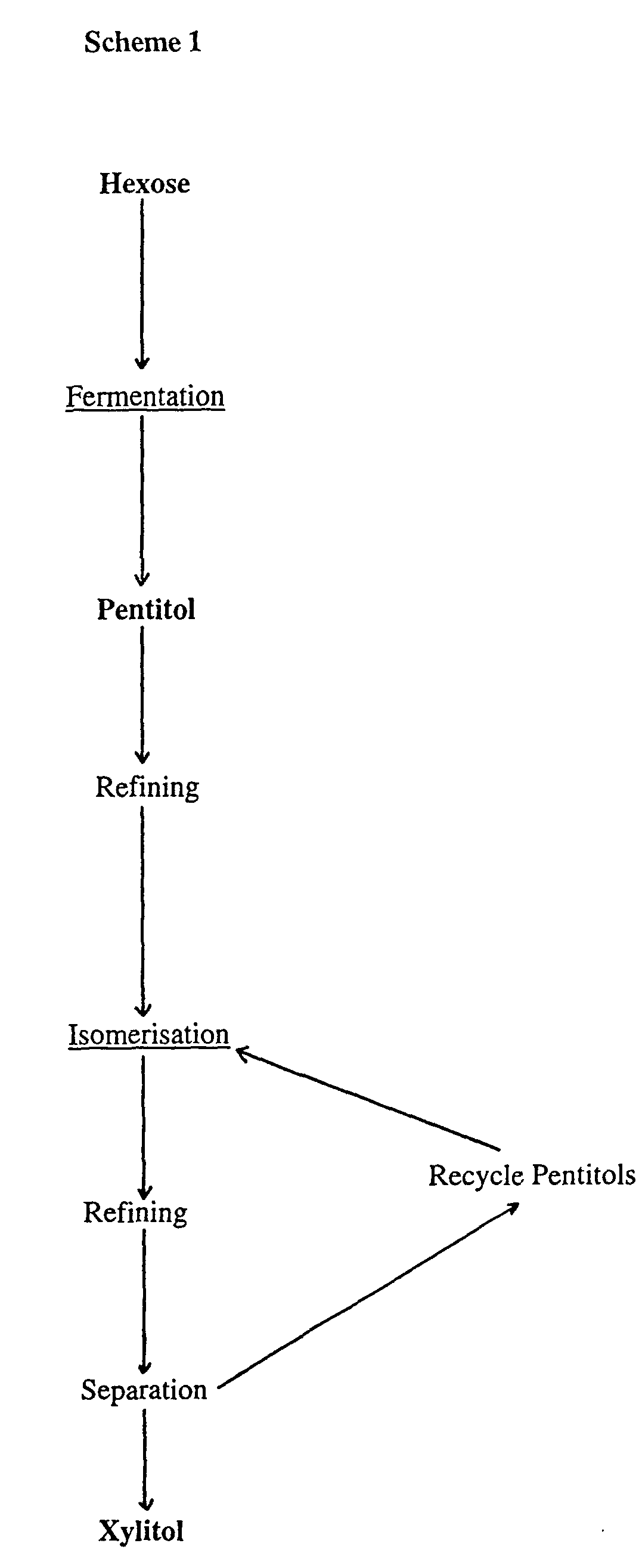
- The advantage of this process in comparison with earlier described processes such as the process disclosed in WO 93/19030 is that well established unit operations can be used for the refining (classical syrup refining) and that known techniques and equipment for fermentation and catalytic isomerisation can be used. The main advantage compared with other methods such as described in EP 403 392 and EP 421 882 and WO 93/19030 is the much shorter overall reaction sequence. Schematically the method of the present invention is illustrated in Scheme 1, wherein the underlined steps are essential.
- The invention is further illustrated by the following examples.
- Zygosaccharomyces barkeri Y-222 is inoculated in a culture medium containing 30 % (w/v) glucose, 4.0 % (w/v) corn steep liquor, 0.1 % (w/v) potassium phosphate, 0.05 % (w/v) magnesium sulphate, 0.01 % (w/v) calcium chloride, 0.01 % (w/v) sodium chloride, and cultured at pH 6, (pH-adjustment with sodium hydroxide) at 30°C for 4 days. The following yield is obtained: 46.1% arabinitol, 2% residual glucose, and 10.5% glycerol (as a percentage of glucose which has been converted). The reaction product is demineralized and refined on a double-pass ion exchange battery, followed by selective crystallisation of the arabinitol. This results in crystals with a purity of 99%.
Arabinitol was isomerised on ruthenium catalyst (4% catalyst on total dry substance), which is supported on silica (5% Ru on silica), by applying a hydrogen pressure of 4 MPa at a temperature of 150°C. Polyol isomerisation is completed within 4 hours. The obtained demineralized isomerisate has the following pentitol composition: arabinitol (60%), xylitol (22%), ribitol (18%).
The xylitol was separated by chromatography on cation exchange resin in the calcium form, yielding xylitol with a purity greater than 95%. The arabinitol and ribitol were recycled to isomerisation. The xylitol was crystallised to obtain crystals of 99.9% purity. - Pichia ohmeri ATCC 20.209 was cultured at 30°C in a medium containing 15 % (w/v) glucose, 0.2 % (w/v) yeast extract, 0.1 % (w/v) potassium hydrogen phosphate and 0.1 % (w/v) magnesium sulphate. After 6 days the reaction medium was filtered and demineralized on ion exchange resins. A yield of 40.5% arabinitol was obtained, after crystallisation.
Arabinitol was isomerised on ruthenium catalyst (6% catalyst on total dry substance), which is supported on active carbon (5% Ru on carbon). To isomerize the arabinitol syrup phosphoric acid (1% on total dry substance) was added. The reaction temperature was 150°C at a hydrogen pressure of 4 MPa. Within 4 hours the isomerised syrup had the following composition: 90% total pentitols (of which: arabinitol (45%), xylitol (34%), ribitol (21%)) and 10% lower alditols. - The xylitol was recovered in a similar way as described in example 1.
- Fermentation of glucose to arabinitol is performed by using a culture medium of 10 % (w/v) glucose, 0.5 % (w/v) yeast extract and 0.1 % (w/v) urea. The medium is inoculated with a yeast strain of the genus Endomycopsis chodati. After 72 hours fermentation time 56% arabinitol was obtained without considerable amounts of glycerol (below 4%). After demineralisation and refining the arabinitol syrup is directly used for polyol isomerisation in the presence of Raney-nickel (5% catalyst slurry on total dry substance). The pH is increased to 11, by the addition of 0.5 M NaOH. A hydrogen pressure of 4 MPa is applied at a temperature of 170°C and the isomerisation reaction is stopped after 4 hours, resulting in a pentitol mixture of the following composition: arabinitol (90%), xylitol (6%), ribitol (4%).
- Fermentation of glucose to arabinitol is performed as described in example 1, except that a yeast strain belonging to the genus Candida, namely Candida polymorpha ATCC 20 213 is used. 4.5 g of D-arabinitol was obtained per 100 ml fermentation liquor. The subsequent polyol isomerisation is performed on a ruthenium catalyst (4% catalyst on total dry substance) which is supported on zeolite material (5% Ru on zeolite). The reaction temperature is 135°C at a hydrogen pressure of 4 MPa. After 4 hours reaction the polyol mixture has the following pentitol composition: arabinitol (73%), xylitol (13%), ribitol (14%).
- The xylitol is recovered as in example 1.
Claims (10)
- A method for producing a pentitol from a hexose characterized in that the method comprises the following steps,a) fermentation of a hexose to yield a C5- intermediate consisting mainly of a pentitol,b) isomerisation of the pentitol of step a) in the presence of a chemical catalyst to yield a corresponding pentitol mixture,c) optionally separating the desired pentitol from the product of step b).
- A method according to claim 1 characterized in that the pentitol is refined after fermentation and/or after isomerisation.
- A method according to claim 1 characterized in that the hexose is a readily available C6-carbohydrate, preferably glucose (for example in anhydrous, monohydrate or high dextrose syrup form).
- A method according to claim 1 characterized in that step a) is an aerobic fermentation of glucose syrup to arabinitol by an osmophilic yeast selected from the group consisting of the following genera: Pichia, Endomycopsis, Hansenula, Debaryomyces, Zygosaccharomyces, Saccharomyces, Candida and Torulopsis.
- A method according to claim 1 characterized in that the pentitol is selected from the group consisting of xylitol, ribitol, and arabinitol.
- A method according to claim 1 characterized in that the isomerisation is performed in the presence of a hydrogenation/dehydrogenation catalyst promoted by the addition of alkali or acid respectively.
- A method according to anyone of the previous claims characterized in that the isomerisation is conducted at a hydrogen pressure between 0.1 and 10 MPa and a temperature between 70 and 250°C.
- A method according to claim 7 characterized in that the hydrogen pressure is preferably between 1 and 8 MPa.
- A method according to claim 7 characterized in that the temperature is preferably between 100 and 200°C.
- A method according to claim 1 characterized in that the separation of step c) is performed using a cation resin.
Applications Claiming Priority (2)
| Application Number | Priority Date | Filing Date | Title |
|---|---|---|---|
| GBGB9514538.9A GB9514538D0 (en) | 1995-07-15 | 1995-07-15 | Process for the production of xylitol |
| GB9514538 | 1995-07-15 |
Publications (2)
| Publication Number | Publication Date |
|---|---|
| EP0754758A1 EP0754758A1 (en) | 1997-01-22 |
| EP0754758B1 true EP0754758B1 (en) | 2001-08-29 |
Family
ID=10777760
Family Applications (1)
| Application Number | Title | Priority Date | Filing Date |
|---|---|---|---|
| EP96304727A Expired - Lifetime EP0754758B1 (en) | 1995-07-15 | 1996-06-26 | Process for the production of xylitol |
Country Status (8)
| Country | Link |
|---|---|
| US (1) | US6458570B1 (en) |
| EP (1) | EP0754758B1 (en) |
| JP (1) | JPH0965888A (en) |
| CN (1) | CN1058721C (en) |
| AT (1) | ATE204906T1 (en) |
| CA (1) | CA2179972A1 (en) |
| DE (1) | DE69614786D1 (en) |
| GB (1) | GB9514538D0 (en) |
Families Citing this family (11)
| Publication number | Priority date | Publication date | Assignee | Title |
|---|---|---|---|---|
| FR2762011B1 (en) * | 1997-04-11 | 1999-06-25 | Roquette Freres | PROCESS FOR THE PREPARATION OF RIBITOL BY FERMENTATION AND A STRAIN OF MICROORGANISMS USED IN THIS PROCESS |
| JP2000210095A (en) | 1999-01-20 | 2000-08-02 | Ajinomoto Co Inc | Method for producing xylitol or D-xylulose |
| EP1075795B1 (en) | 1999-08-10 | 2003-04-09 | Ajinomoto Co., Inc. | Process for producing xylitol of high purity |
| US7812153B2 (en) * | 2004-03-11 | 2010-10-12 | Rayonier Products And Financial Services Company | Process for manufacturing high purity xylose |
| DK2314560T3 (en) * | 2004-03-26 | 2012-06-11 | Purdue Research Foundation | Methods for the production of xylitol |
| AU2005245940B2 (en) | 2004-05-19 | 2010-07-08 | Agricultural Research Service, United States Department Of Agriculture | Methods for production of xylitol in microorganisms |
| CN101560142B (en) * | 2009-05-25 | 2012-05-23 | 山东福田药业有限公司 | Method for separating and refining arabitol in fermentation liquor |
| US20120021467A1 (en) * | 2010-07-22 | 2012-01-26 | Thomson Biotech (Xiamen) PTE. LTD. | Method of producing xylitol and arabinose at same time from hemicellulose hydrolysates |
| CN103184164A (en) * | 2011-12-30 | 2013-07-03 | 天津工业生物技术研究所 | Yeast capable of producing D- arabitol and xylitol simultaneously and application thereof |
| MX391237B (en) | 2016-02-19 | 2025-03-21 | Intercontinental Great Brands Llc | Processes to create multiple value streams from biomass sources |
| WO2018112639A1 (en) | 2016-12-21 | 2018-06-28 | Creatus Biosciences Inc. | Xylitol producing metschnikowia species |
Family Cites Families (10)
| Publication number | Priority date | Publication date | Assignee | Title |
|---|---|---|---|---|
| JPS543949B1 (en) * | 1968-05-25 | 1979-02-28 | ||
| JPS6296090A (en) | 1986-10-22 | 1987-05-02 | Natl Food Res Inst | Production of polyhydric alcohol by fermentation using novel microorganism |
| FR2648474B1 (en) * | 1989-06-16 | 1995-01-06 | Roquette Freres | NEW PROCESS FOR THE MANUFACTURE OF XYLOSE |
| FR2652589B1 (en) * | 1989-10-04 | 1995-02-17 | Roquette Freres | PROCESS FOR THE MANUFACTURE OF XYLITOL AND XYLITOL-RICH PRODUCTS. |
| FI92051C (en) * | 1992-03-17 | 1994-09-26 | Amylum Nv | Process for the preparation of xylitol from D-glucose and mixtures of D-glucose and D-fructose and D-glucose and D-galactose |
| PL178040B1 (en) * | 1992-11-05 | 2000-02-29 | Xyrofin Oy | Method of recombining and host cell for producing xylythol |
| JPH06296090A (en) * | 1993-04-09 | 1994-10-21 | Mitsubishi Electric Corp | Module fixing apparatus |
| FR2708269B1 (en) * | 1993-07-26 | 1995-10-06 | Roquette Freres | Viscous liquid xylitol compositions and process for their preparation. |
| GB9424567D0 (en) * | 1994-12-06 | 1995-01-25 | Cerestar Holding Bv | Process for the production of xylitol |
| GB9424566D0 (en) * | 1994-12-06 | 1995-01-25 | Cerestar Holding Bv | Method for decarbonylation of sugars |
-
1995
- 1995-07-15 GB GBGB9514538.9A patent/GB9514538D0/en active Pending
-
1996
- 1996-06-26 CA CA002179972A patent/CA2179972A1/en not_active Abandoned
- 1996-06-26 AT AT96304727T patent/ATE204906T1/en not_active IP Right Cessation
- 1996-06-26 DE DE69614786T patent/DE69614786D1/en not_active Expired - Lifetime
- 1996-06-26 EP EP96304727A patent/EP0754758B1/en not_active Expired - Lifetime
- 1996-07-12 JP JP8183771A patent/JPH0965888A/en active Pending
- 1996-07-15 US US08/680,139 patent/US6458570B1/en not_active Expired - Fee Related
- 1996-07-15 CN CN96106196A patent/CN1058721C/en not_active Expired - Fee Related
Also Published As
| Publication number | Publication date |
|---|---|
| CA2179972A1 (en) | 1997-01-16 |
| DE69614786D1 (en) | 2001-10-04 |
| GB9514538D0 (en) | 1995-09-13 |
| JPH0965888A (en) | 1997-03-11 |
| CN1058721C (en) | 2000-11-22 |
| US20020076772A1 (en) | 2002-06-20 |
| CN1148597A (en) | 1997-04-30 |
| ATE204906T1 (en) | 2001-09-15 |
| EP0754758A1 (en) | 1997-01-22 |
| US6458570B1 (en) | 2002-10-01 |
Similar Documents
| Publication | Publication Date | Title |
|---|---|---|
| US5096820A (en) | Process for manufacturing xylitol and xylitol-rich products | |
| US5714602A (en) | Process for the production of xylitol | |
| US5238826A (en) | Process for manufacturing xylose | |
| US5563303A (en) | Production of xylitol | |
| US6458570B1 (en) | Process for the production of xylitol | |
| US5846794A (en) | Process for the preparation of D-arabitol | |
| US6538133B1 (en) | Process for producing xylitol of high purity | |
| US5756865A (en) | Method for production of tetritols, specifically meso-erythritol | |
| CA1083988A (en) | High mannitol process (enzymatic isomerization) | |
| US5739303A (en) | Method for decarbonylation of sugars | |
| MXPA96002768A (en) | Procedure for the production of xili | |
| EP1392711B1 (en) | Process for the production of xylose | |
| SU981309A1 (en) | Process for producing alkane diols | |
| Hall | Polyhydric alcohols from wood | |
| JP3965641B2 (en) | Co-production method of D-mannitol and D-sorbitol | |
| SU899526A1 (en) | Process for producing xylite | |
| HU204487B (en) | Process for producing sugqr alcohols withcatalytic hydrogenation |
Legal Events
| Date | Code | Title | Description |
|---|---|---|---|
| PUAI | Public reference made under article 153(3) epc to a published international application that has entered the european phase |
Free format text: ORIGINAL CODE: 0009012 |
|
| AK | Designated contracting states |
Kind code of ref document: A1 Designated state(s): AT BE CH DE DK ES FI FR GB GR IE IT LI NL PT SE |
|
| 17P | Request for examination filed |
Effective date: 19970711 |
|
| GRAG | Despatch of communication of intention to grant |
Free format text: ORIGINAL CODE: EPIDOS AGRA |
|
| GRAG | Despatch of communication of intention to grant |
Free format text: ORIGINAL CODE: EPIDOS AGRA |
|
| 17Q | First examination report despatched |
Effective date: 20000829 |
|
| GRAG | Despatch of communication of intention to grant |
Free format text: ORIGINAL CODE: EPIDOS AGRA |
|
| GRAH | Despatch of communication of intention to grant a patent |
Free format text: ORIGINAL CODE: EPIDOS IGRA |
|
| GRAH | Despatch of communication of intention to grant a patent |
Free format text: ORIGINAL CODE: EPIDOS IGRA |
|
| GRAA | (expected) grant |
Free format text: ORIGINAL CODE: 0009210 |
|
| AK | Designated contracting states |
Kind code of ref document: B1 Designated state(s): AT BE CH DE DK ES FI FR GB GR IE IT LI NL PT SE |
|
| PG25 | Lapsed in a contracting state [announced via postgrant information from national office to epo] |
Ref country code: NL Free format text: LAPSE BECAUSE OF FAILURE TO SUBMIT A TRANSLATION OF THE DESCRIPTION OR TO PAY THE FEE WITHIN THE PRESCRIBED TIME-LIMIT Effective date: 20010829 Ref country code: LI Free format text: LAPSE BECAUSE OF FAILURE TO SUBMIT A TRANSLATION OF THE DESCRIPTION OR TO PAY THE FEE WITHIN THE PRESCRIBED TIME-LIMIT Effective date: 20010829 Ref country code: IT Free format text: LAPSE BECAUSE OF FAILURE TO SUBMIT A TRANSLATION OF THE DESCRIPTION OR TO PAY THE FEE WITHIN THE PRE;WARNING: LAPSES OF ITALIAN PATENTS WITH EFFECTIVE DATE BEFORE 2007 MAY HAVE OCCURRED AT ANY TIME BEFORE 2007. THE CORRECT EFFECTIVE DATE MAY BE DIFFERENT FROM THE ONE RECORDED.SCRIBED TIME-LIMIT Effective date: 20010829 Ref country code: FI Free format text: LAPSE BECAUSE OF FAILURE TO SUBMIT A TRANSLATION OF THE DESCRIPTION OR TO PAY THE FEE WITHIN THE PRESCRIBED TIME-LIMIT Effective date: 20010829 Ref country code: CH Free format text: LAPSE BECAUSE OF FAILURE TO SUBMIT A TRANSLATION OF THE DESCRIPTION OR TO PAY THE FEE WITHIN THE PRESCRIBED TIME-LIMIT Effective date: 20010829 Ref country code: BE Free format text: LAPSE BECAUSE OF FAILURE TO SUBMIT A TRANSLATION OF THE DESCRIPTION OR TO PAY THE FEE WITHIN THE PRESCRIBED TIME-LIMIT Effective date: 20010829 Ref country code: AT Free format text: LAPSE BECAUSE OF FAILURE TO SUBMIT A TRANSLATION OF THE DESCRIPTION OR TO PAY THE FEE WITHIN THE PRESCRIBED TIME-LIMIT Effective date: 20010829 |
|
| REF | Corresponds to: |
Ref document number: 204906 Country of ref document: AT Date of ref document: 20010915 Kind code of ref document: T |
|
| REG | Reference to a national code |
Ref country code: CH Ref legal event code: EP |
|
| REG | Reference to a national code |
Ref country code: IE Ref legal event code: FG4D |
|
| REF | Corresponds to: |
Ref document number: 69614786 Country of ref document: DE Date of ref document: 20011004 |
|
| ET | Fr: translation filed | ||
| PG25 | Lapsed in a contracting state [announced via postgrant information from national office to epo] |
Ref country code: SE Free format text: LAPSE BECAUSE OF FAILURE TO SUBMIT A TRANSLATION OF THE DESCRIPTION OR TO PAY THE FEE WITHIN THE PRESCRIBED TIME-LIMIT Effective date: 20011129 Ref country code: PT Free format text: LAPSE BECAUSE OF FAILURE TO SUBMIT A TRANSLATION OF THE DESCRIPTION OR TO PAY THE FEE WITHIN THE PRESCRIBED TIME-LIMIT Effective date: 20011129 Ref country code: DK Free format text: LAPSE BECAUSE OF FAILURE TO SUBMIT A TRANSLATION OF THE DESCRIPTION OR TO PAY THE FEE WITHIN THE PRESCRIBED TIME-LIMIT Effective date: 20011129 |
|
| PG25 | Lapsed in a contracting state [announced via postgrant information from national office to epo] |
Ref country code: GR Free format text: LAPSE BECAUSE OF FAILURE TO SUBMIT A TRANSLATION OF THE DESCRIPTION OR TO PAY THE FEE WITHIN THE PRESCRIBED TIME-LIMIT Effective date: 20011130 Ref country code: DE Free format text: LAPSE BECAUSE OF FAILURE TO SUBMIT A TRANSLATION OF THE DESCRIPTION OR TO PAY THE FEE WITHIN THE PRESCRIBED TIME-LIMIT Effective date: 20011130 |
|
| REG | Reference to a national code |
Ref country code: GB Ref legal event code: IF02 |
|
| NLV1 | Nl: lapsed or annulled due to failure to fulfill the requirements of art. 29p and 29m of the patents act | ||
| PG25 | Lapsed in a contracting state [announced via postgrant information from national office to epo] |
Ref country code: ES Free format text: LAPSE BECAUSE OF FAILURE TO SUBMIT A TRANSLATION OF THE DESCRIPTION OR TO PAY THE FEE WITHIN THE PRESCRIBED TIME-LIMIT Effective date: 20020228 |
|
| REG | Reference to a national code |
Ref country code: CH Ref legal event code: PL |
|
| PG25 | Lapsed in a contracting state [announced via postgrant information from national office to epo] |
Ref country code: IE Free format text: LAPSE BECAUSE OF NON-PAYMENT OF DUE FEES Effective date: 20020626 Ref country code: GB Free format text: LAPSE BECAUSE OF NON-PAYMENT OF DUE FEES Effective date: 20020626 |
|
| PLBE | No opposition filed within time limit |
Free format text: ORIGINAL CODE: 0009261 |
|
| STAA | Information on the status of an ep patent application or granted ep patent |
Free format text: STATUS: NO OPPOSITION FILED WITHIN TIME LIMIT |
|
| 26N | No opposition filed | ||
| GBPC | Gb: european patent ceased through non-payment of renewal fee |
Effective date: 20020626 |
|
| REG | Reference to a national code |
Ref country code: IE Ref legal event code: MM4A |
|
| PGFP | Annual fee paid to national office [announced via postgrant information from national office to epo] |
Ref country code: FR Payment date: 20070608 Year of fee payment: 12 |
|
| REG | Reference to a national code |
Ref country code: FR Ref legal event code: ST Effective date: 20090228 |
|
| PG25 | Lapsed in a contracting state [announced via postgrant information from national office to epo] |
Ref country code: FR Free format text: LAPSE BECAUSE OF NON-PAYMENT OF DUE FEES Effective date: 20080630 |