EP0753831A1 - Modifiziertes Leaky-Bucketverfahren - Google Patents
Modifiziertes Leaky-Bucketverfahren Download PDFInfo
- Publication number
- EP0753831A1 EP0753831A1 EP96460024A EP96460024A EP0753831A1 EP 0753831 A1 EP0753831 A1 EP 0753831A1 EP 96460024 A EP96460024 A EP 96460024A EP 96460024 A EP96460024 A EP 96460024A EP 0753831 A1 EP0753831 A1 EP 0753831A1
- Authority
- EP
- European Patent Office
- Prior art keywords
- rate
- bucket
- images
- filling rate
- equal
- Prior art date
- Legal status (The legal status is an assumption and is not a legal conclusion. Google has not performed a legal analysis and makes no representation as to the accuracy of the status listed.)
- Granted
Links
Images

Classifications
-
- G—PHYSICS
- G06—COMPUTING OR CALCULATING; COUNTING
- G06T—IMAGE DATA PROCESSING OR GENERATION, IN GENERAL
- G06T9/00—Image coding
- G06T9/007—Transform coding, e.g. discrete cosine transform
Definitions
- the present invention relates to a method for controlling the output rate of an encoder of digital data representative of image sequences.
- the field of the invention is that of multimedia applications, and in particular transmission applications on high speed networks of the ATM type of animated, compressed images, for example according to an algorithm defined in the standard known as Mpeg-2, stored or in real time.
- Video compression is based on the exploitation of the redundancy of information that characterizes moving images.
- Two forms of information redundancy are present: spatial and temporal. Spatial redundancy is that which exists within the same image and is the fact that the pixels neighboring the image tend to have very close luminance and / or chrominance values. As for temporal redundancy, it exists between successive images and is the fact that the pixels having the same position in two neighboring images tend to have very close luminance and / or chrominance values.
- spatial quantity or spatial complexity will be called a quantity which is directly linked to the spatial correlation.
- the correlation will be weak and vice versa.
- Video compression consists precisely in using coding techniques which exploit redundancies to produce a quantity of data which is less than that of the raw video signal.
- the reduction in spatial redundancy is essentially done during the quantification step.
- the coefficients obtained are divided by integer values given by the quantization matrix.
- the aim of this integer division is to increase the number of zero values which will not be represented after a Huffman coding. Because of this integer division, this operation introduces an error in the restored values.
- the quantization matrix is weighted by a coefficient called quantization parameter (generally noted Q). The larger the value of this parameter, the greater the reduction gain and vice versa.
- Q quantization parameter
- the impact of the quantification parameter on the visual degradation of the restored image depends on the spatial complexity of the image. In other words, to have an equivalent visual quality, the quantization parameter used when compressing an image containing a large number of small details is smaller than that used for compressing a rather uniform image.
- the quantization parameter used when compressing an image containing a large number of small details is larger than that used for compressing a rather uniform image.
- the technique used for the reduction of time redundancy is estimation and motion compensation. This involves determining the position of each block or macroblock of an image in the following image.
- the size of the search window in the following image is limited due to the calculation complexity. If the macroblock sought is found in the search window, we define a displacement vector which describes the movement of the macroblock. This is the motion estimate.
- the macroblock found is not exactly identical to the original macroblock but differs, for a few pixels, from an error. A correction of this error is then carried out by coding the difference pixel by pixel between the two macroblocks. It is motion compensation.
- the macroblock is not found in the search window, it is then coded by transform and quantization as has already been described above.
- a scene is a series of images having more or less the same content within a video sequence. It is, for example a person who speaks in front of a fixed background or a fixed shot.
- an active scene will be called a scene which shows great spatial and temporal complexity and therefore which requires to be transmitted a bit rate greater than the average bit rate for the transmission of the entire video sequence.
- a scene which is not very active will be called a scene which has a low spatial and temporal complexity, that is to say one whose required transmission rate is lower than the average transmission rate of the entire video sequence.
- the speed here is the amount of data transmitted per unit of time.
- compression algorithms In order to be able to transmit their information over network services at constant bit rate, compression algorithms generally incorporate mechanisms to keep the bit rate almost constant at the output of the encoder.
- Networks which use the asynchronous switching technique ATM have been designed to be able to transmit traffic of different types to different qualities of service. They are based on the transmission of small cells of 48 bytes of data and 5 bytes of header. In principle, such networks allow connections with variable speed over time.
- the field of application of the invention is therefore that of coding image data with variable bit rate.
- variable flow traffic descriptor the maintained flow or Sustainable Cell Rate (SCR) and the jitter tolerance or Burst Tolerance (BT).
- SCR maintained flow or Sustainable Cell Rate
- BT Burst Tolerance
- a rate control algorithm must be used to ensure that the output bit rate of the encoder remains constant.
- This technique consists in varying the quantization parameter Q, from one image to another and within the same image to satisfy the constraint of constant bit rate.
- the principle used in this type of algorithm is to maintain, between the encoder and the network channel, a buffer in which the compressed data are stored. This buffer is continuously emptied at the rate of the network channel.
- the flow control algorithm must prevent the buffer from overflowing or to empty.
- the quantization parameter Q changes in proportion to the filling rate of the buffer.
- the object of the invention is to propose a method for controlling the output bit rate of a video coder which is in accordance with the model of the pierced bucket.
- Reibman and BG Haskell entitled "Constraints on Variable bit rate video for ATM networks" published in the journal IEEE Transactions On Circuits and Systems for Video Technology, 254) : 361-372 of December 1992.
- Reibman and Haskell show a system which includes a video coder provided with a buffer and a device intended to control the bit rate transmitted to the network. To do this, they use the model of the pierced bucket and varies the quantification parameter Q according to the filling rates of the buffer and the bucket. More precisely, it is considered a pierced bucket whose size is M and whose leak rate is equal to the desired average traffic rate.
- a quantization parameter Q is used which is proportional to the filling of the bucket and the buffer of the decoder.
- the flow rate is inversely proportional to the quantification parameter, so that the more the bucket and the buffer fill, the lower the flow rate generated. This allows you to stay below the maximum values allowed for the speed transmitted to the network.
- the disadvantage of this algorithm is that the choice of the quantization parameter Q only depends on the filling of the bucket and does not take into account the complexity of the scene in progress. Indeed, if the bucket is empty, the algorithm increases the bit rate of the image even if it is very little active and can be satisfied with a transmission bit rate lower than a bit rate of average value. The bucket will therefore fill up because of the high flow generated, but this will not lead to an improvement in the quality of the scene if it is not very active. Because the bucket is filled, the next scene will be forced to generate an average rate or a lower rate which, in the case where this scene is an active scene, will cause visible degradation of the image.
- the object of the invention is to remedy this drawback and is therefore to propose a flow control method which takes account of the complexity of the scene while maintaining the condition of the bucket not overflowing.
- the invention proposes a method for controlling the output bit rate of a coder of digital data representative of image sequences, the coding carried out by said coder comprising a quantization step of quantization parameter Q, said image sequences being composed of successive groups of images.
- Said method consists in determining, at the time of the presence of the i th group of images at the output of the encoder, the quantization parameter Q (i + 1) for coding the (i + 1) th group of images so as to that the flow rate at the output of said encoder is in accordance with a pierced bucket model defined by a size M and by a leakage flow rate ⁇ .
- it consists in determining the quantization parameter Q (i + 1) so that the output rate of the encoder is equal, in the case of active scenes, or to the open loop rate when the filling rate of the bucket is zero , either at the leakage rate of said pierced bucket when the filling rate of the bucket is equal to the maximum filling rate of said bucket, or at a value between the open loop flow rate and the leakage rate when the filling rate of said bucket takes a non-zero value lower than its maximum filling rate, and, in the case of inactive scenes, either at the leakage rate of said pierced bucket when the filling rate of the bucket is zero, or at the open-loop flow rate when the rate of filling of the bucket is equal to the maximum filling rate of said bucket, or a value between the leakage flow rate and the flow rate in open loop when the filling rate of said bucket takes a non-zero value i n lower than its maximum filling rate.
- it consists in determining the quantization parameter by calculation, in the case of active scenes, of a function having as a variable the filling rate of the pierced bucket and as a parameter, the leakage rate of said bucket, the maximum filling rate of said bucket and a predetermined quantization parameter and, in the case of not very active scenes, of another function having the same variables and the same parameters.
- the output traffic of an encoder is defined on the basis of the groups of images that the latter delivers on its output.
- This traffic denoted ⁇ G ⁇ is defined by a series of numbers G (i) which measure the number of bits generated by the compression of the i th group of images of a video sequence.
- the period of each group of images is noted ⁇ .
- the average bit rate D is defined on a video sequence of size equal to n groups of images by the following relation:
- the model of the pierced bucket (or leaky bucket in English terminology) can be defined in several ways all expressing the same thing.
- Two parameters are used to define a pierced bucket: the size of the bucket noted M (in bits) and the leakage rate noted ⁇ (in bits per second).
- a traffic ⁇ G ⁇ conforms to a bucket model pierced with parameters M and ⁇ if it satisfies the following relation:
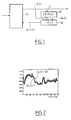
- FIG. 1 is a schematic representation of the method according to the invention.
- an encoder 10 which ensures the coding of the video sequences which are present on its input and which delivers, for each video sequence, a series of blocks of images each referenced by an index varying from 1 to n, n being the number of groups of images in said sequence.
- the i th block of images of a sequence therefore has the index i.
- the coding is carried out by quantization of each block of images with a quantization parameter denoted Q (i) and generates a bit rate for this block of images denoted G (i).
- FIG. 1 we can see a schematic representation 20 of the pierced bucket. It receives on its input 21 each group of images i having a bit rate G (i).
- the drilled bucket 20 is defined by two parameters: its size denoted M (in bits) and the leakage rate denoted ⁇ (in bits per second).
- the drilled bucket 20 calculates an item of information denoted X (i) corresponding to the number of bits in the bucket 20 at the time of the i th block of images.
- a control device 30 which implements the method of the invention. It receives on its inputs, at the time of the processing of the i th block of images, the information X (i) concerning the number of bits present in the bucket 20 and the value of the bit rate G (i) at the output of the encoder 10. The device 30 delivers, to the coder 10, the value of the quantization parameter Q (i + 1) which the latter will apply to the (i + 1) th block of images of the video sequence being processed.
- the method of the invention also requires the value taken by the bit rate Go (i) which is the bit rate that the i th frame block would have if it had been quantified in the encoder 10 with a predetermined quantization parameter Qo constant.
- the parameter Qo must be chosen so that the average bit rate D over the entire video sequence of which each group of images is quantified with this constant parameter Qo is equal to the leak bit rate ⁇ of the bucket 20. We have D which then verifies the relation next:
- Each bit rate value Go (i) is either delivered by the encoder 10 or, as will be seen in a particular embodiment of the invention, calculated by the device 30.
- the object of the invention is to maintain a quality which is as close as possible to that offered by open loop coding.
- the traffic generated by an open loop coding does not guarantee compliance with a pierced bucket model LB (M, ⁇ ) because it is not constrained in bit rate.
- an active scene tends to fill the bucket because, by definition, it generates a flow greater than the average flow D which, in open loop, is equal to the leakage flow ⁇ of the bucket.
- a scene of low activity tends to empty the bucket since it generates a flow greater than ⁇ . If an active scene is excessively long, the bucket of capacity M overflows.
- the invention proposes to act on the quantization parameter Q to satisfy this constraint on the bit rate.
- the gain factor of the feedback mouth is however much lower than that of the algorithms in which the output rate of the encoder is kept constant.
- the quantization factor Q (i + 1) is chosen so that the bit rate G (i + 1) is equal to the leakage rate ⁇ of the bucket.
- the quantization factor chosen Q (i + 1) is that of open loop, that is to say Qo.
- the flow G (i) is then equal to the open loop flow Go (i).
- the active scenes do not exceed the rate ⁇ and the bucket does not overflow.
- the scenes which are not very active they are coded in open loop and their low bit rate makes it possible to empty the bucket.
- the visual quality is therefore at least as good as with the constant bit rate coding method for active scenes and with the open loop coding method for less active scenes.
- the quality of the group of images i for an inactive scene is at least as good as that obtained by open-loop coding which, for its part, would have generated a bit rate less than ⁇ .
- an active scene is authorized to generate a flow rate greater than ⁇ and therefore to fill the bucket.
- the table below shows the bit rate averages for open loop coding and the quantization parameter means for constant mean bit rate coding.
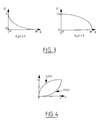
- Fig. 2 shows the values taken by the products D x Q ⁇ (1) and Go (i) x Qo as a function of the image numbers. We can also see that these two products are equal for any group of images and that it therefore only depends on the image to be processed and its variations indicate the activity of the scene.
- the parameters of the relations are then ⁇ , M and Qo.
- the first two parameters are those of the pierced bucket and are therefore fixed according to network contract and / or desired image quality considerations.
- the Qo parameter it must be chosen so that the average speed D of the traffic generated by an open loop coding of the Qo parameter is precisely equal to ⁇ .
- the rate G (i) provided for a given group of images depends on the filling state of the bucket X (i) as well as on the activity of the scene.
- the performance of the process of the invention in terms of visual quality as well as stability depends on the way in which the flow rate G (i) varies with the filling state of the bucket X (i).
- G (i) G 0 (i). (1 - ⁇ 1 (x)) + ⁇ . ⁇ 1 (x))
- Fig. 4 shows the form of the functions ⁇ k (x).
- Fig. 5 shows the bit rates respectively generated by these two codings. It can be observed that the algorithm of the invention generates less traffic than open-loop coding for very active scenes (images 1 to 150 and 900 to 1000) and more traffic for less active scenes (see for example the images 200 to 300 and 1400 to 1500). The variability of the flow is therefore maintained and is proportional to the complexity of the scene.
- the variations in the filling rate of the bucket X (i) are presented in Fig. 6.
- the dynamics of filling the bucket shows that the algorithm of the present invention fully exploits the variability allowed in that it empties the bucket during low scenes active and fills it during active scenes giving better visual quality. This behavior cannot be achieved by the algorithms of the prior art.
Landscapes
- Physics & Mathematics (AREA)
- General Physics & Mathematics (AREA)
- Engineering & Computer Science (AREA)
- Discrete Mathematics (AREA)
- Multimedia (AREA)
- Theoretical Computer Science (AREA)
- Compression Or Coding Systems Of Tv Signals (AREA)
- Compression, Expansion, Code Conversion, And Decoders (AREA)
- Image Processing (AREA)
Applications Claiming Priority (2)
| Application Number | Priority Date | Filing Date | Title |
|---|---|---|---|
| FR9508581 | 1995-07-10 | ||
| FR9508581A FR2736743B1 (fr) | 1995-07-10 | 1995-07-10 | Procede de controle de debit de sortie d'un codeur de donnees numeriques representatives de sequences d'images |
Publications (2)
| Publication Number | Publication Date |
|---|---|
| EP0753831A1 true EP0753831A1 (de) | 1997-01-15 |
| EP0753831B1 EP0753831B1 (de) | 2001-01-10 |
Family
ID=9481021
Family Applications (1)
| Application Number | Title | Priority Date | Filing Date |
|---|---|---|---|
| EP96460024A Expired - Lifetime EP0753831B1 (de) | 1995-07-10 | 1996-07-08 | Modifiziertes Leaky-Bucketverfahren |
Country Status (6)
| Country | Link |
|---|---|
| US (1) | US5724099A (de) |
| EP (1) | EP0753831B1 (de) |
| JP (1) | JP3954136B2 (de) |
| CA (1) | CA2179876C (de) |
| DE (1) | DE69611488T2 (de) |
| FR (1) | FR2736743B1 (de) |
Cited By (3)
| Publication number | Priority date | Publication date | Assignee | Title |
|---|---|---|---|---|
| US6278735B1 (en) | 1998-03-19 | 2001-08-21 | International Business Machines Corporation | Real-time single pass variable bit rate control strategy and encoder |
| CN109905711A (zh) * | 2019-02-28 | 2019-06-18 | 深圳英飞拓智能技术有限公司 | 一种图像的处理方法、系统及终端设备 |
| CN110519571A (zh) * | 2019-09-19 | 2019-11-29 | 天津英田视讯科技有限公司 | 一种基于场景复杂度动态调整编码器参数的方法 |
Families Citing this family (27)
| Publication number | Priority date | Publication date | Assignee | Title |
|---|---|---|---|---|
| US6282684B1 (en) | 1997-10-23 | 2001-08-28 | Sony Corporation | Apparatus and method for recovery of data in a lossy transmission environment |
| US6263468B1 (en) | 1997-10-23 | 2001-07-17 | Sony Corporation | Apparatus and method for partial buffering transmitted data to provide robust error recovery in a lossy transmission environment |
| US6581170B1 (en) | 1997-10-23 | 2003-06-17 | Sony Corporation | Source coding to provide for robust error recovery during transmission losses |
| US6591398B1 (en) | 1999-02-12 | 2003-07-08 | Sony Corporation | Multiple processing system |
| US6418548B1 (en) * | 1999-02-12 | 2002-07-09 | Sony Corporation | Method and apparatus for preprocessing for peripheral erroneous data |
| US6535148B1 (en) | 1999-02-12 | 2003-03-18 | Sony Corporation | Method and apparatus for truncated decoding |
| US6621936B1 (en) | 1999-02-12 | 2003-09-16 | Sony Corporation | Method and apparatus for spatial class reduction |
| US6170074B1 (en) | 1999-02-12 | 2001-01-02 | Sony Corporation | Source coding to provide for robust error recovery |
| US6519369B1 (en) | 1999-02-12 | 2003-02-11 | Sony Corporation | Method and apparatus for filter tap expansion |
| US7010737B2 (en) * | 1999-02-12 | 2006-03-07 | Sony Corporation | Method and apparatus for error data recovery |
| US6307979B1 (en) | 1999-02-12 | 2001-10-23 | Sony Corporation | Classified adaptive error recovery method and apparatus |
| US6363118B1 (en) | 1999-02-12 | 2002-03-26 | Sony Corporation | Apparatus and method for the recovery of compression constants in the encoded domain |
| US6307560B1 (en) | 1999-02-12 | 2001-10-23 | Sony Corporation | Classified adaptive spatio-temporal format conversion method and apparatus |
| US6567379B1 (en) * | 1999-06-09 | 2003-05-20 | Cisco Technology, Inc. | Traffic monitor using leaky bucket with variable fill |
| US6389562B1 (en) | 1999-06-29 | 2002-05-14 | Sony Corporation | Source code shuffling to provide for robust error recovery |
| US6549672B1 (en) | 1999-06-29 | 2003-04-15 | Sony Corporation | Method and apparatus for recovery of encoded data using central value |
| US6473876B1 (en) | 1999-06-29 | 2002-10-29 | Sony Corporation | Method and apparatus for encoding of bitstreams using rotation |
| US6493842B1 (en) | 1999-06-29 | 2002-12-10 | Sony Corporation | Time-varying randomization for data synchronization and implicit information transmission |
| US6351494B1 (en) | 1999-09-24 | 2002-02-26 | Sony Corporation | Classified adaptive error recovery method and apparatus |
| US6522785B1 (en) | 1999-09-24 | 2003-02-18 | Sony Corporation | Classified adaptive error recovery method and apparatus |
| US6539517B1 (en) | 1999-11-09 | 2003-03-25 | Sony Corporation | Data transformation for explicit transmission of control information |
| US6754371B1 (en) | 1999-12-07 | 2004-06-22 | Sony Corporation | Method and apparatus for past and future motion classification |
| JP2002330165A (ja) * | 2001-04-27 | 2002-11-15 | Fujitsu Ltd | 輻輳制御装置 |
| US20060143678A1 (en) * | 2004-12-10 | 2006-06-29 | Microsoft Corporation | System and process for controlling the coding bit rate of streaming media data employing a linear quadratic control technique and leaky bucket model |
| US7543073B2 (en) * | 2004-12-10 | 2009-06-02 | Microsoft Corporation | System and process for performing an exponentially weighted moving average on streaming data to establish a moving average bit rate |
| US7536469B2 (en) * | 2004-12-10 | 2009-05-19 | Microsoft Corporation | System and process for controlling the coding bit rate of streaming media data employing a limited number of supported coding bit rates |
| US9338463B2 (en) * | 2011-10-06 | 2016-05-10 | Synopsys, Inc. | Visual quality measure for real-time video processing |
Family Cites Families (5)
| Publication number | Priority date | Publication date | Assignee | Title |
|---|---|---|---|---|
| US5159447A (en) * | 1991-05-23 | 1992-10-27 | At&T Bell Laboratories | Buffer control for variable bit-rate channel |
| US5231484A (en) * | 1991-11-08 | 1993-07-27 | International Business Machines Corporation | Motion video compression system with adaptive bit allocation and quantization |
| US5331348A (en) * | 1992-07-27 | 1994-07-19 | At&T Bell Laboratories | Adaptive leak HDTV encoder |
| US5426463A (en) * | 1993-02-22 | 1995-06-20 | Rca Thomson Licensing Corporation | Apparatus for controlling quantizing in a video signal compressor |
| US5543853A (en) * | 1995-01-19 | 1996-08-06 | At&T Corp. | Encoder/decoder buffer control for variable bit-rate channel |
-
1995
- 1995-07-10 FR FR9508581A patent/FR2736743B1/fr not_active Expired - Lifetime
-
1996
- 1996-06-04 US US08/658,050 patent/US5724099A/en not_active Expired - Lifetime
- 1996-06-25 CA CA002179876A patent/CA2179876C/en not_active Expired - Fee Related
- 1996-06-28 JP JP17020696A patent/JP3954136B2/ja not_active Expired - Lifetime
- 1996-07-08 DE DE69611488T patent/DE69611488T2/de not_active Expired - Lifetime
- 1996-07-08 EP EP96460024A patent/EP0753831B1/de not_active Expired - Lifetime
Non-Patent Citations (4)
| Title |
|---|
| LUCANTONI D M ET AL: "Methods for performance evaluation of VBR video traffic models", IEEE/ACM TRANSACTIONS ON NETWORKING, APRIL 1994, USA, vol. 2, no. 2, ISSN 1063-6692, pages 176 - 180, XP002014797 * |
| PANCHA P ET AL: "Leaky bucket access control for VBR MPEG video", PROCEEDINGS. IEEE INFOCOM '95. THE CONFERENCE ON COMPUTER COMMUNICATIONS. FOURTEENTH ANNUAL JOINT CONFERENCE OF THE IEEE COMPUTER AND COMMUNICATIONS SOCIETIES. BRINGING INFORMATION TO PEOPLE (CAT. NO.95CH35759), PROCEEDINGS OF INFOCOM'95, BOSTON, MA,, ISBN 0-8186-6990-X, 1995, LOS ALAMITOS, CA, USA, IEEE COMPUT. SOC. PRESS, USA, pages 796 - 803 vol.2, XP000560183 * |
| REIBMAN A R ET AL: "Constraints on variable bit-rate video for ATM networks", IEEE TRANSACTIONS ON CIRCUITS AND SYSTEMS FOR VIDEO TECHNOLOGY, DEC. 1992, USA, vol. 2, no. 4, ISSN 1051-8215, pages 361 - 372, XP000323661 * |
| REIBMAN A R ET AL: "Traffic descriptors for VBR video teleconferencing over ATM networks", IEEE/ACM TRANSACTIONS ON NETWORKING, JUNE 1995, USA, vol. 3, no. 3, ISSN 1063-6692, pages 329 - 339, XP002014796 * |
Cited By (3)
| Publication number | Priority date | Publication date | Assignee | Title |
|---|---|---|---|---|
| US6278735B1 (en) | 1998-03-19 | 2001-08-21 | International Business Machines Corporation | Real-time single pass variable bit rate control strategy and encoder |
| CN109905711A (zh) * | 2019-02-28 | 2019-06-18 | 深圳英飞拓智能技术有限公司 | 一种图像的处理方法、系统及终端设备 |
| CN110519571A (zh) * | 2019-09-19 | 2019-11-29 | 天津英田视讯科技有限公司 | 一种基于场景复杂度动态调整编码器参数的方法 |
Also Published As
| Publication number | Publication date |
|---|---|
| CA2179876C (en) | 2007-01-09 |
| US5724099A (en) | 1998-03-03 |
| FR2736743A1 (fr) | 1997-01-17 |
| CA2179876A1 (en) | 1997-01-11 |
| JPH0937253A (ja) | 1997-02-07 |
| DE69611488T2 (de) | 2001-06-07 |
| JP3954136B2 (ja) | 2007-08-08 |
| FR2736743B1 (fr) | 1997-09-12 |
| EP0753831B1 (de) | 2001-01-10 |
| DE69611488D1 (de) | 2001-02-15 |
Similar Documents
| Publication | Publication Date | Title |
|---|---|---|
| EP0753831B1 (de) | Modifiziertes Leaky-Bucketverfahren | |
| EP0247075B1 (de) | Hybrid-kodierungssystem durch umwandlung zur bildübertragung | |
| US20200244969A1 (en) | Video compression with generative models | |
| USRE39955E1 (en) | Multiple encoder output buffer apparatus for differential coding of video information | |
| EP2589223B1 (de) | Video-streaming | |
| CN107846590B (zh) | 一种视频编码的方法和视频编码器 | |
| EP0670663A1 (de) | Verfahren und Vorrichtung zur Kodierung von eine Bildsequenz darstellenden digitalen signalen | |
| FR2755817A1 (fr) | Appareil de regulation du volume binaire pour coder un signal video et procede pour celui-ci | |
| FR2776159A1 (fr) | Systeme de codage d'images animees | |
| CN113287319B (zh) | 优化编码操作的方法和装置 | |
| WO2009080928A1 (fr) | Procede de codage double passe par macrobloc | |
| CN1134170C (zh) | 视频传输系统 | |
| FR3024314A1 (de) | ||
| FR2897741A1 (fr) | Procede et dispositif de generation de donnees representatives d'un degre d'importance de blocs de donnees et procede et dispositif de transmission d'une sequence video encodee | |
| CN101420601B (zh) | 视频编码中码率控制的方法及装置 | |
| WO2006064098A1 (fr) | Procede de transmission a debit binaire variable a travers un canal de transmission | |
| FR2907990A1 (fr) | Encodeur temps-reel contraint en debit et en delai,procede, produit programme d'ordinateur et moyen de stockage correspondants. | |
| EP2368367B1 (de) | Interaktives system und verfahren zum übertragen von aus einem videostrom ausgewählten schlüsselbildern über ein netzwerk mit niedriger bandbreite | |
| WO2024113869A1 (zh) | 视频编码方法及相关装置 | |
| EP0660619A1 (de) | Verfahren zur variablen Längenkodierung von Bildern und Vorrichtung zur Ausführung eines solchen Verfahrens | |
| EP3843409A1 (de) | Zuweisungsverfahren für einen low-speed-verbindung | |
| EP0517719A1 (de) | Verfahren zur kodierung von bildsignalen | |
| FR2926177A1 (fr) | Procede et disositif de transmission de donnees avec partage specifique des ressources de debit d'un reseau. | |
| WO1996019081A1 (fr) | Dispositif de multiplexage numerique de programmes video | |
| CN117082243A (zh) | 视频编码方法、装置、计算机设备和存储介质 |
Legal Events
| Date | Code | Title | Description |
|---|---|---|---|
| PUAI | Public reference made under article 153(3) epc to a published international application that has entered the european phase |
Free format text: ORIGINAL CODE: 0009012 |
|
| AK | Designated contracting states |
Kind code of ref document: A1 Designated state(s): DE GB IT NL SE |
|
| 17P | Request for examination filed |
Effective date: 19970221 |
|
| GRAG | Despatch of communication of intention to grant |
Free format text: ORIGINAL CODE: EPIDOS AGRA |
|
| GRAG | Despatch of communication of intention to grant |
Free format text: ORIGINAL CODE: EPIDOS AGRA |
|
| GRAH | Despatch of communication of intention to grant a patent |
Free format text: ORIGINAL CODE: EPIDOS IGRA |
|
| 17Q | First examination report despatched |
Effective date: 20000616 |
|
| GRAH | Despatch of communication of intention to grant a patent |
Free format text: ORIGINAL CODE: EPIDOS IGRA |
|
| GRAA | (expected) grant |
Free format text: ORIGINAL CODE: 0009210 |
|
| AK | Designated contracting states |
Kind code of ref document: B1 Designated state(s): DE GB IT NL SE |
|
| ITF | It: translation for a ep patent filed | ||
| GBT | Gb: translation of ep patent filed (gb section 77(6)(a)/1977) |
Effective date: 20010118 |
|
| REF | Corresponds to: |
Ref document number: 69611488 Country of ref document: DE Date of ref document: 20010215 |
|
| PLBE | No opposition filed within time limit |
Free format text: ORIGINAL CODE: 0009261 |
|
| STAA | Information on the status of an ep patent application or granted ep patent |
Free format text: STATUS: NO OPPOSITION FILED WITHIN TIME LIMIT |
|
| REG | Reference to a national code |
Ref country code: GB Ref legal event code: IF02 |
|
| 26N | No opposition filed | ||
| PGFP | Annual fee paid to national office [announced via postgrant information from national office to epo] |
Ref country code: NL Payment date: 20080711 Year of fee payment: 13 Ref country code: IT Payment date: 20080717 Year of fee payment: 13 |
|
| PGFP | Annual fee paid to national office [announced via postgrant information from national office to epo] |
Ref country code: SE Payment date: 20080626 Year of fee payment: 13 |
|
| REG | Reference to a national code |
Ref country code: GB Ref legal event code: 732E Free format text: REGISTERED BETWEEN 20090528 AND 20090603 |
|
| EUG | Se: european patent has lapsed | ||
| NLV4 | Nl: lapsed or anulled due to non-payment of the annual fee |
Effective date: 20100201 |
|
| PG25 | Lapsed in a contracting state [announced via postgrant information from national office to epo] |
Ref country code: IT Free format text: LAPSE BECAUSE OF NON-PAYMENT OF DUE FEES Effective date: 20090708 |
|
| PG25 | Lapsed in a contracting state [announced via postgrant information from national office to epo] |
Ref country code: SE Free format text: LAPSE BECAUSE OF NON-PAYMENT OF DUE FEES Effective date: 20090709 |
|
| PGFP | Annual fee paid to national office [announced via postgrant information from national office to epo] |
Ref country code: DE Payment date: 20110729 Year of fee payment: 16 |
|
| PG25 | Lapsed in a contracting state [announced via postgrant information from national office to epo] |
Ref country code: NL Free format text: LAPSE BECAUSE OF NON-PAYMENT OF DUE FEES Effective date: 20100201 |
|
| PG25 | Lapsed in a contracting state [announced via postgrant information from national office to epo] |
Ref country code: DE Free format text: LAPSE BECAUSE OF NON-PAYMENT OF DUE FEES Effective date: 20130201 |
|
| REG | Reference to a national code |
Ref country code: DE Ref legal event code: R119 Ref document number: 69611488 Country of ref document: DE Effective date: 20130201 |
|
| PGFP | Annual fee paid to national office [announced via postgrant information from national office to epo] |
Ref country code: GB Payment date: 20150624 Year of fee payment: 20 |
|
| REG | Reference to a national code |
Ref country code: GB Ref legal event code: PE20 Expiry date: 20160707 |
|
| PG25 | Lapsed in a contracting state [announced via postgrant information from national office to epo] |
Ref country code: GB Free format text: LAPSE BECAUSE OF EXPIRATION OF PROTECTION Effective date: 20160707 |