EP0753591B1 - Brazeable aluminum alloy cast material and method of brazing the same - Google Patents
Brazeable aluminum alloy cast material and method of brazing the same Download PDFInfo
- Publication number
- EP0753591B1 EP0753591B1 EP96305060A EP96305060A EP0753591B1 EP 0753591 B1 EP0753591 B1 EP 0753591B1 EP 96305060 A EP96305060 A EP 96305060A EP 96305060 A EP96305060 A EP 96305060A EP 0753591 B1 EP0753591 B1 EP 0753591B1
- Authority
- EP
- European Patent Office
- Prior art keywords
- weight
- aluminum alloy
- brazing
- flux
- cast material
- Prior art date
- Legal status (The legal status is an assumption and is not a legal conclusion. Google has not performed a legal analysis and makes no representation as to the accuracy of the status listed.)
- Expired - Lifetime
Links
Images
Classifications
-
- B—PERFORMING OPERATIONS; TRANSPORTING
- B23—MACHINE TOOLS; METAL-WORKING NOT OTHERWISE PROVIDED FOR
- B23K—SOLDERING OR UNSOLDERING; WELDING; CLADDING OR PLATING BY SOLDERING OR WELDING; CUTTING BY APPLYING HEAT LOCALLY, e.g. FLAME CUTTING; WORKING BY LASER BEAM
- B23K35/00—Rods, electrodes, materials, or media, for use in soldering, welding, or cutting
- B23K35/22—Rods, electrodes, materials, or media, for use in soldering, welding, or cutting characterised by the composition or nature of the material
- B23K35/36—Selection of non-metallic compositions, e.g. coatings or fluxes; Selection of soldering or welding materials, conjoint with selection of non-metallic compositions, both selections being of interest
- B23K35/3601—Selection of non-metallic compositions, e.g. coatings or fluxes; Selection of soldering or welding materials, conjoint with selection of non-metallic compositions, both selections being of interest with inorganic compounds as principal constituents
- B23K35/3603—Halide salts
-
- B—PERFORMING OPERATIONS; TRANSPORTING
- B23—MACHINE TOOLS; METAL-WORKING NOT OTHERWISE PROVIDED FOR
- B23K—SOLDERING OR UNSOLDERING; WELDING; CLADDING OR PLATING BY SOLDERING OR WELDING; CUTTING BY APPLYING HEAT LOCALLY, e.g. FLAME CUTTING; WORKING BY LASER BEAM
- B23K35/00—Rods, electrodes, materials, or media, for use in soldering, welding, or cutting
- B23K35/22—Rods, electrodes, materials, or media, for use in soldering, welding, or cutting characterised by the composition or nature of the material
- B23K35/24—Selection of soldering or welding materials proper
- B23K35/28—Selection of soldering or welding materials proper with the principal constituent melting at less than 950°C
- B23K35/282—Zn as the principal constituent
-
- B—PERFORMING OPERATIONS; TRANSPORTING
- B23—MACHINE TOOLS; METAL-WORKING NOT OTHERWISE PROVIDED FOR
- B23K—SOLDERING OR UNSOLDERING; WELDING; CLADDING OR PLATING BY SOLDERING OR WELDING; CUTTING BY APPLYING HEAT LOCALLY, e.g. FLAME CUTTING; WORKING BY LASER BEAM
- B23K35/00—Rods, electrodes, materials, or media, for use in soldering, welding, or cutting
- B23K35/22—Rods, electrodes, materials, or media, for use in soldering, welding, or cutting characterised by the composition or nature of the material
- B23K35/24—Selection of soldering or welding materials proper
- B23K35/28—Selection of soldering or welding materials proper with the principal constituent melting at less than 950°C
- B23K35/286—Al as the principal constituent
- B23K35/288—Al as the principal constituent with Sn or Zn
-
- C—CHEMISTRY; METALLURGY
- C22—METALLURGY; FERROUS OR NON-FERROUS ALLOYS; TREATMENT OF ALLOYS OR NON-FERROUS METALS
- C22C—ALLOYS
- C22C21/00—Alloys based on aluminium
Definitions
- the present invention relates to a castable and brazeable aluminum alloy cast material, and more particularly to an aluminum alloy adapted for die-casting material to be brazed and also to a method of brazing cast material.
- Products made from aluminum alloy casting are widely used as the parts of automobile vehicles, household electric apparatuses and the like. Those cast material are brazed one to another or to other expanded metal parts.
- the die-casting is suited to manufacture products of a sophisticated shape and having a smooth surface, rapidly and at a higher productivity.
- die-cast material often suffers from a certain defect known as 'blister', when subjected to considerably raised temperatures.
- the blister appearing on cast material is a partial outward expansion thereof.
- This problem is an irreversible deformation of surface layer of said cast material, due to thermal expansion of entrained air or hydrogen gas that was entrained into the article when a molten metal was forced into a mold.
- the surface layer yields or succumbs to a high internal pressure of the heated air or gas.
- the present inventors considered that materials of aluminum alloy casting which were strong and tough at high temperatures would withstand well the expansion pressure of entrained gas so as to be free of blister, even if the amount and distribution of the gas were not reduced or improved.
- a brazeable aluminum alloy casting comprising 0.5 - 4.5 % by weight of Mn; 0.5 - 3 % by weight of Si; 0.5 - 1 % by weight of Fe; and the balance composed of aluminum and impurities.
- a method of brazing such an aluminum alloy casting characterised in that a brazing agent and/or a flux is used, the brazing agent comprising 25 - 65 % by weight of Zn; 2 - 7 % by weight of Si; and the balance composed of aluminum and impurities, wherein Fe as one of the impurities is controlled a concentration to 0.1 % by weight or less, and the flux comprising 0.5 - 5 % by weight of LiF; 1 - 10 % by weight of ZnCl 2 ; 1 - 5 5 by weight of K ⁇ AlF ⁇ +3 ( ⁇ is an integer not less than 1.); and the balance composed of BaCl 2 -KCl-NaCl.
- Mn in the cast material enhances heat resistance thereof, thereby improving its strength at high temperatures.
- a content of Mn less than 0.5 % by weight is not sufficient to ensure this effect while a content of Mn more than 4.5 % will impair the flowability and castability of molten alloy.
- Mn must be contained within a range from 0.5 to 4.5 % by weight.
- Preferable range of Mn content is 1.5 % - 4 % by weight, and more preferably within a range of 1.5 - 3 % by weight.
- the further element, Si improves both the heat resistance and melt flowability of the aluminum alloy provided herein.
- Si content must be within a range from 0.5 to 3 %, and more preferably should be 1 % by weight and more.
- Fe protects the molten alloy from sticking to a mold surface. As a content of Fe less than 0.5 % or more than 1 % by weight lowers this effect, Fe content must be within a range from 0.5 to 1 %, and more preferably, should be 0.7 % by weight or less within this range.
- the composition of the balance of the aluminum alloy cast material in the present invention is substantially aluminum and inclusion of unavoidable impurities is allowable.
- Al, Zn and Si are principal components of the brazing agent used in the method of the present invention.
- Zn functions to lower the melting point of said brazing agent.
- Zn content less than 25 % by weight is insufficient to realize a moderately lowered melting temperature so that the brazing can be carried out at 500 - 550 °C.
- Zn content exceeding 65 % by weight will further lower the melting point, but the brazing agent melts in a wide range of temperatures, so that the brazing agent will produce voids in brazed regions and fail to ensure an airtight connection of the aluminum alloy cast material when it solidifies again.
- Zn must be contained at 25 - 65 % by weight in the brazing agent.
- the lower limit of Zn content is preferably 30 % by weight, and more desirably, 35 % by weight.
- the upper limit of Zn content is 60 % by weight, and more desirably, 55 % by weight.
- Si does not only lower the melting point, but also narrows the range thereof.
- a Si content less than 2 % by weight is insufficient, though the content more than 7 % by weight will cause said effectiveness to be saturated and will affect the processability of brazing agent. Therefore, Si has to be contained in said agent within the range of 2 - 7 % by weight, and the lower limit is preferably 3 % by weight, and the upper limit is preferably 5 % by weight.
- the balance of a brazing agent is aluminum and Fe which is one of impurities.
- An excessive content of Fe promotes generation of voids when the molten brazing agent is solidified.
- Fe content must be controlled to contain 0.1 % by weight or less.
- a matrix component of the mixed flux recommended for use in the method of the present invention is BaCl 2 -KCl-NaCl, which is less hygroscopic as compared with many other ordinary fluxes.
- a desirable composition of this matrix is: 49 - 53 % by weight of BaCl 2 ; 23 - 27 % by weight of KCl; and 15 - 19 % by weight of NaCl.
- the matrix may contain a small amount of fluoride flux such as KAlF 4 , MgF 2 or CaF 2 , and an eutectic compound KF + AlF 3 .
- LiF and ZnCl 2 added to the flux matrix serve not only to lower the melting point thereof but also to improve its activity. While a content of LiF less than 0.5 % by weight is insufficient to afford these effects, the content more than 5 % by weight rather raises the melting point. LiF must be contained from 0.5 to 5 % by weight, more desirably, from 1 to 3 % by weight of the flux. A content of ZnCl 2 less than 1 % by weight is insufficient to afford the effects on lowering the melting point and improving its activity while the content more than 10 % by weight rather renders the flux too hygroscopic to be handled easily and to protect a brazing oven and brazing tools from damages. ZnCl 2 must be contained within the range of 1 % to 10 % by weight, more desirably, from 3 % to 7 % by weight of the flux.
- K ⁇ AlF ⁇ +3 ( ⁇ is an integer not less than 1.) is added to the flux so as to break an oxide member present on the material to be brazed when the brazing agent is heated up to or a little below its melting point.
- K ⁇ AlF ⁇ +3 are KAlF 4 , K 2 AlF 5 , K 3 AlF 6 or the like.
- One or more of these compounds may be used as a mixture or as a complex thereof.
- a content of K ⁇ AlF ⁇ +3 less than 1 % by weight is insufficient to afford the above effect, while the excessive content more than 5 % by weight rather raises the melting point of the composite flux.
- K ⁇ AlF ⁇ +3 must be contained from 1 % to 5 % by weight, more desirably, from 2 % to 4 % by weight of the flux.
- the articles to be brazed by the aluminum alloy cast material of the present invention may be of an article of the same composition as the cast material or one of the different composition or expanded metal. There is no limitation for the method of supplying the brazing material and the flux.
- Brazeable aluminum alloy cast material provided herein comprises: 0.5 - 4.5 % by weight of Mn; 0.5 - 3 % by weight of Si; 0.5 - 1 % by weight of Fe, as mentioned above.
- This composition affords an excellent strength of the cast material at high temperatures. Consequently, even if a noticeable amount of gas were entrained in the cast by heating, a surface portion of each cast material can withstand an expanding pressure and generation of blisters are restrained.
- the products manufactured by the conventional process of die-casting can be used at high temperatures between 500 °C and 550 °C and be brazeable.
- Productivity of the products is same as the conventional ones.
- Remarkable strength at high temperatures will be obtained if the alloy is composed of: 1. 5 - 4 % by weight of Mn; 1 - 3 % % by weight of Si; and 0.5 - 0.7 % by weight of Fe of alloy.
- blisters will not be produced by the method of brazing the aluminum alloy cast material in the present invention at temperatures between 500 °C and 550 °C.
- the brazing agent is an Aluminum alloy cast material composed of: 25 - 65 % by weight of Zn; 2 - 7 % by weight of Si; and aluminum as the balance including less than 0.1 % by weight of Fe, the brazing agent will show a good melt flowability even at such high temperatures, to thereby offers high quality brazed products.
- the melt flowability will be most conspicuous if the aluminum alloy contains: 30 - 60 % by weight of Zn; and 3 - 5 % by weight of Si.
- the flux is a mixture composed of: 0.5 - 5 % by weight of LiF; 1 - 10 % by weight of ZnCl 2 ; 1 - 5 % by weight of K ⁇ AlF ⁇ +3 ; and a matrix of BaCl 2 -KCl-NaCl, the flux will melt entirely at high temperatures noted above to become so active as to afford high quality brazed products. This effect is most conspicuous if the flux contains 1 - 3 % by weight of LiF; 3 - 7 % by weight of ZnCl 2 ; and 2 - 4 % by weight of K ⁇ AlF ⁇ +3 .
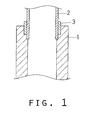
- Fig. 1 is a vertical cross section of a lap joint comprising an aluminum alloy cast material of the present invention, wherein the brazing method proposed herin is illustrated.
- Aluminum alloy cast materials whose chemical compositions are listed in Table 1 were prepared at first. The cast material was then die-casted into pipes 1 as shown in Fig. 1, under the conditions listed in Table 2. Each pipe had one end whose inner periphery was recessed to provide a stepped region.
- the aluminum alloy cast materials were casted and cut into pieces for a test of strength at high temperatures. Further, specimens severed from the respective cast pipes 1 were also tested as to their heat resisitance and corrosion resistance.
- Tensile strength was measured at 500 °C according to JIS Z-2241 (viz. Japanese Industrial Standards).
- Weight loss was measured after 180 cycles of corrosion test as defined in 'JASO CCT M609-91' (Viz. 'Corrosion Tests on Materials for Automobiles).
- the brazeable aluminum alloy cast materials of the present invention are of higher strength at high temperatures.
- the material proved resistant to blister even at 550 °C, even if the materials are manufacured by the ordinary die-casting method. They also proved remarkably superior to prior art cast materials in respect of corrosion resistance.
- the pipes 1 formed of alloys indicated in EXAMPLE I to III and extruding pipes composed of aluminum alloys of JIS A6063 were brazed each other using the brazing agent shown in Table 3 and the flux shown in Table 4.
- the combination of the sample pipes 1 with the brazing agents and fluxes is shown in Table 5.
- Lap joints were prepared by fitting a lower end of each extruding pipe 2 in the upper end of each pipe 1, the upper end having an increased inner diameter.
- a ring 3 of brazing agent was placed on the upper end, and coated with a flux suspension which concentration is 60 %.
- the lap joints were heated to and kept at 550 °C for 5 minutes, within nitrogen gas atmosphere. Subsequent to this brazing process, the sample joints were cooled down to a room temperature for evaluation of anti-blister property and brazeability. Visual inspection was carried out to check blister and appearance of the brazed portions, and X-ray inspection was done to determine the density of the sample. For measurement of strength of brazed joints, each of the specimen was longitudinally sliced into eight so that they were subjected to a breaking test at a room temperature. Joint strength was judged by a point where each specimen had been broken. The sample joints which were torn at their cast pipes 1 or extruding pipes 2 were rated 'passed', while those torn an their brazed regions were rated 'failed'.
Landscapes
- Engineering & Computer Science (AREA)
- Mechanical Engineering (AREA)
- Chemical & Material Sciences (AREA)
- Inorganic Chemistry (AREA)
- Materials Engineering (AREA)
- Metallurgy (AREA)
- Organic Chemistry (AREA)
- Mold Materials And Core Materials (AREA)
- Details Of Heat-Exchange And Heat-Transfer (AREA)
- Arc Welding In General (AREA)
Description
- The present invention relates to a castable and brazeable aluminum alloy cast material, and more particularly to an aluminum alloy adapted for die-casting material to be brazed and also to a method of brazing cast material.
- Products made from aluminum alloy casting are widely used as the parts of automobile vehicles, household electric apparatuses and the like. Those cast material are brazed one to another or to other expanded metal parts. The die-casting is suited to manufacture products of a sophisticated shape and having a smooth surface, rapidly and at a higher productivity. However, such die-cast material often suffers from a certain defect known as 'blister', when subjected to considerably raised temperatures. Thus, it has been difficult or impossible to employ material of die-cast aluminum alloy if they have to be heated to 450 °C and above when they are brazed.
- The blister appearing on cast material is a partial outward expansion thereof. This problem is an irreversible deformation of surface layer of said cast material, due to thermal expansion of entrained air or hydrogen gas that was entrained into the article when a molten metal was forced into a mold. In other words, the surface layer yields or succumbs to a high internal pressure of the heated air or gas.
- A reduced amount of the entrained gas has been expected to diminish the 'blistering'. Thus, the so-called slow squeeze-casting and SSF (semi-sintered piece forging) were proposed. By the squeeze-casting method, a molten metal is injected at a decreased rate into a mold, so as to effect the forging of a molten metal. It may also be useful to optimize the injection condition for the ordinary die-casting process in such a manner that the amount of entrained gas is reduced and/or prevented from concentrating in a surface layer of each cast material.
- Productivity of squeeze-casting and SSF processes is much poorer than that of ordinary die-casting, and less suited to mass production of cast material. As seeking of optimum conditions takes long, and as a strict and severe control of ordinary casting process is mandatory, the operation efficiency is much lower than the ordinary die-casting. In consequence, it has been difficult for die-cast material to be brazed.
- Accordingly, it is an object of the present invention to resolve these problems by providing an aluminum alloy of a novel composition, efficiently castable into material and suitable to subsequent brazing, and also by providing a method of brazing the material of aluminum alloy cast in a manner adapted to its novel composition.
- The present inventors considered that materials of aluminum alloy casting which were strong and tough at high temperatures would withstand well the expansion pressure of entrained gas so as to be free of blister, even if the amount and distribution of the gas were not reduced or improved.
- According to the present invention there is provided a brazeable aluminum alloy casting comprising 0.5 - 4.5 % by weight of Mn; 0.5 - 3 % by weight of Si; 0.5 - 1 % by weight of Fe; and the balance composed of aluminum and impurities.
- In one aspect of the present invention there is provided a method of brazing such an aluminum alloy casting, characterised in that a brazing agent and/or a flux is used, the brazing agent comprising 25 - 65 % by weight of Zn; 2 - 7 % by weight of Si; and the balance composed of aluminum and impurities, wherein Fe as one of the impurities is controlled a concentration to 0.1 % by weight or less, and the flux comprising 0.5 - 5 % by weight of LiF; 1 - 10 % by weight of ZnCl2; 1 - 5 5 by weight of KαAlFα+3 (α is an integer not less than 1.); and the balance composed of BaCl2-KCl-NaCl.
- Mn in the cast material enhances heat resistance thereof, thereby improving its strength at high temperatures. A content of Mn less than 0.5 % by weight is not sufficient to ensure this effect while a content of Mn more than 4.5 % will impair the flowability and castability of molten alloy. Thus, Mn must be contained within a range from 0.5 to 4.5 % by weight. Preferable range of Mn content is 1.5 % - 4 % by weight, and more preferably within a range of 1.5 - 3 % by weight. The further element, Si, improves both the heat resistance and melt flowability of the aluminum alloy provided herein. As a content of Si less than 0.5 % or more than 3 % by weight lowers these effects, Si content must be within a range from 0.5 to 3 %, and more preferably should be 1 % by weight and more. Fe protects the molten alloy from sticking to a mold surface. As a content of Fe less than 0.5 % or more than 1 % by weight lowers this effect, Fe content must be within a range from 0.5 to 1 %, and more preferably, should be 0.7 % by weight or less within this range. The composition of the balance of the aluminum alloy cast material in the present invention is substantially aluminum and inclusion of unavoidable impurities is allowable.
- The methods proposed herein are intended to work well in practice when brazing various aluminum alloy material that are previously cast, for instance die-casted, into given shapes at temperatures of 500 - 550 °C.
- Al, Zn and Si are principal components of the brazing agent used in the method of the present invention.
- Zn functions to lower the melting point of said brazing agent. Zn content less than 25 % by weight is insufficient to realize a moderately lowered melting temperature so that the brazing can be carried out at 500 - 550 °C. Zn content exceeding 65 % by weight will further lower the melting point, but the brazing agent melts in a wide range of temperatures, so that the brazing agent will produce voids in brazed regions and fail to ensure an airtight connection of the aluminum alloy cast material when it solidifies again. Thus, Zn must be contained at 25 - 65 % by weight in the brazing agent. The lower limit of Zn content is preferably 30 % by weight, and more desirably, 35 % by weight. The upper limit of Zn content is 60 % by weight, and more desirably, 55 % by weight. Si does not only lower the melting point, but also narrows the range thereof. A Si content less than 2 % by weight is insufficient, though the content more than 7 % by weight will cause said effectiveness to be saturated and will affect the processability of brazing agent. Therefore, Si has to be contained in said agent within the range of 2 - 7 % by weight, and the lower limit is preferably 3 % by weight, and the upper limit is preferably 5 % by weight.
- The balance of a brazing agent is aluminum and Fe which is one of impurities. An excessive content of Fe promotes generation of voids when the molten brazing agent is solidified. Thus, Fe content must be controlled to contain 0.1 % by weight or less.
- A matrix component of the mixed flux recommended for use in the method of the present invention is BaCl2-KCl-NaCl, which is less hygroscopic as compared with many other ordinary fluxes. A desirable composition of this matrix is: 49 - 53 % by weight of BaCl2; 23 - 27 % by weight of KCl; and 15 - 19 % by weight of NaCl. The matrix may contain a small amount of fluoride flux such as KAlF4, MgF2 or CaF2, and an eutectic compound KF + AlF3.
- LiF and ZnCl2 added to the flux matrix serve not only to lower the melting point thereof but also to improve its activity. While a content of LiF less than 0.5 % by weight is insufficient to afford these effects, the content more than 5 % by weight rather raises the melting point. LiF must be contained from 0.5 to 5 % by weight, more desirably, from 1 to 3 % by weight of the flux. A content of ZnCl2 less than 1 % by weight is insufficient to afford the effects on lowering the melting point and improving its activity while the content more than 10 % by weight rather renders the flux too hygroscopic to be handled easily and to protect a brazing oven and brazing tools from damages. ZnCl2 must be contained within the range of 1 % to 10 % by weight, more desirably, from 3 % to 7 % by weight of the flux.
- Kα AlFα+3 (α is an integer not less than 1.) is added to the flux so as to break an oxide member present on the material to be brazed when the brazing agent is heated up to or a little below its melting point. Examples of such Kα AlFα+3 are KAlF4, K2AlF5, K3AlF6 or the like. One or more of these compounds may be used as a mixture or as a complex thereof. A content of Kα AlFα+3 less than 1 % by weight is insufficient to afford the above effect, while the excessive content more than 5 % by weight rather raises the melting point of the composite flux. Kα AlFα+3 must be contained from 1 % to 5 % by weight, more desirably, from 2 % to 4 % by weight of the flux.
- The articles to be brazed by the aluminum alloy cast material of the present invention may be of an article of the same composition as the cast material or one of the different composition or expanded metal. There is no limitation for the method of supplying the brazing material and the flux.
- Brazeable aluminum alloy cast material provided herein comprises: 0.5 - 4.5 % by weight of Mn; 0.5 - 3 % by weight of Si; 0.5 - 1 % by weight of Fe, as mentioned above. This composition affords an excellent strength of the cast material at high temperatures. Consequently, even if a noticeable amount of gas were entrained in the cast by heating, a surface portion of each cast material can withstand an expanding pressure and generation of blisters are restrained.
- Therefore, the products manufactured by the conventional process of die-casting can be used at high temperatures between 500 °C and 550 °C and be brazeable. Productivity of the products is same as the conventional ones. Remarkable strength at high temperatures will be obtained if the alloy is composed of: 1. 5 - 4 % by weight of Mn; 1 - 3 % % by weight of Si; and 0.5 - 0.7 % by weight of Fe of alloy.
- Furthermore, blisters will not be produced by the method of brazing the aluminum alloy cast material in the present invention at temperatures between 500 °C and 550 °C.
- In a case wherein the brazing agent is an Aluminum alloy cast material composed of: 25 - 65 % by weight of Zn; 2 - 7 % by weight of Si; and aluminum as the balance including less than 0.1 % by weight of Fe, the brazing agent will show a good melt flowability even at such high temperatures, to thereby offers high quality brazed products.
- The melt flowability will be most conspicuous if the aluminum alloy contains: 30 - 60 % by weight of Zn; and 3 - 5 % by weight of Si.
- In a case wherein the flux is a mixture composed of: 0.5 - 5 % by weight of LiF; 1 - 10 % by weight of ZnCl2; 1 - 5 % by weight of Kα AlFα+3 ; and a matrix of BaCl2-KCl-NaCl, the flux will melt entirely at high temperatures noted above to become so active as to afford high quality brazed products. This effect is most conspicuous if the flux contains 1 - 3 % by weight of LiF; 3 - 7 % by weight of ZnCl2; and 2 - 4 % by weight of Kα AlFα+3.
- Fig. 1 is a vertical cross section of a lap joint comprising an aluminum alloy cast material of the present invention, wherein the brazing method proposed herin is illustrated.
- The invention will now be described in detail on a brazeable aluminum alloy cast material in connection with one mode of the method of brazing the same, both proposed herein.
- Aluminum alloy cast materials whose chemical compositions are listed in Table 1 were prepared at first. The cast material was then die-casted into pipes 1 as shown in Fig. 1, under the conditions listed in Table 2. Each pipe had one end whose inner periphery was recessed to provide a stepped region.
- The aluminum alloy cast materials were casted and cut into pieces for a test of strength at high temperatures. Further, specimens severed from the respective cast pipes 1 were also tested as to their heat resisitance and corrosion resistance.
- Tensile strength was measured at 500 °C according to JIS Z-2241 (viz. Japanese Industrial Standards).
- Each specimen was heated until a blister appeared in order to measure the highest tolerable temperature.
- Weight loss was measured after 180 cycles of corrosion test as defined in 'JASO CCT M609-91' (Viz. 'Corrosion Tests on Materials for Automobiles).
- Results of these tests are shown in Table 1.
Alloys Composition of alloys (% by weight) Tensile strength (kgf/mm2) Tolerable temp. (°C) Corrosion loss in wt. (mg/cm2) EXAMPLES I Al -4% Mn 3.0 500 3.3 -2% Si -0.9% Fe II Al -3% Mn 3.2 530 3.2 -1.5% Si -0.6% Fe III Al -2% Mn 3.1 550 3.1 -1% Si -0.6% Fe REFERENCES IV ADC12 1.6 430 31.0 V AC4C 1.2 450 12.4 VI AC4B 0.9 400 68.4 Notes: 'temp.' = temperature, 'wt.' = weight, Casting method Ordinary ( evacuated ) Casting machine 125 t Injection speed 1.8 - 2.5 m/s Casting pressure ACC pressure, 140 - 160 kgf Temperature of melting alloy 720 - 750 °C Temperature of mold fixed parts 200 °C movable parts 140 °C Repellent for mold water-soluble Lubricant for sleeve oily - As seen in Table 1, the brazeable aluminum alloy cast materials of the present invention are of higher strength at high temperatures. The material proved resistant to blister even at 550 °C, even if the materials are manufacured by the ordinary die-casting method. They also proved remarkably superior to prior art cast materials in respect of corrosion resistance.
- For the purpose of a test, the pipes 1 formed of alloys indicated in EXAMPLE I to III and extruding pipes composed of aluminum alloys of JIS A6063 were brazed each other using the brazing agent shown in Table 3 and the flux shown in Table 4. The combination of the sample pipes 1 with the brazing agents and fluxes is shown in Table 5.
- Lap joints were prepared by fitting a lower end of each extruding
pipe 2 in the upper end of each pipe 1, the upper end having an increased inner diameter. Aring 3 of brazing agent was placed on the upper end, and coated with a flux suspension which concentration is 60 %. - After the flux suspension had dried, the lap joints were heated to and kept at 550 °C for 5 minutes, within nitrogen gas atmosphere. Subsequent to this brazing process, the sample joints were cooled down to a room temperature for evaluation of anti-blister property and brazeability. Visual inspection was carried out to check blister and appearance of the brazed portions, and X-ray inspection was done to determine the density of the sample. For measurement of strength of brazed joints, each of the specimen was longitudinally sliced into eight so that they were subjected to a breaking test at a room temperature. Joint strength was judged by a point where each specimen had been broken. The sample joints which were torn at their cast pipes 1 or extruding
pipes 2 were rated 'passed', while those torn an their brazed regions were rated 'failed'. - Results of these tests are listed in Table 5.
Brazing agents Composition ( % by weight ) Zn Si Fe Al A 40 3.5 < 0.1 balance B 40 4.5 < 0.1 balance C 50 3.5 < 0.1 balance D 50 4.5 < 0.1 balance E 20 2.5 0.2 balance Notes: The underlined figures in combination, are excluded from the scope of the present invention. Composition (% by weight) Fluxes LiF ZnCl2 AD-II STF-A (a) 1.5 5 3.0 balance (b) 3 5 1 balance (c) - - - 100 Notes:
1. The underlined figures are excluded from the scope of the present invention.Brazeability Joints Pipes Brazingagents Fluxes Blister Dens. App. Str. EXAMPLES 1 I A (a) No Passed Passed Passed 2 I B (b) No Passed Passed Passed 3 I C (a) No Passed Passed Passed 4 I D (b) No Passed Passed Passed REFERENCE 5 I E (c) No Failed Failed Failed EXAMPLES 6 II A (b) No Passed Passed Passed 7 II B (a) No Passed Passed Passed 8 II C (b) No Passed Passed Passed 9 III D (a) No Passed Passed Passed Notes:
The undersigned figures are excluded from the scope of the present invention.
'Dens.' = Density of brazed regions
'App.' = Appearance of brazed regions
'Str.' = Strength of lap joints - As seen in Table 5, it was confirmed that an excellent brazeability was afforded even at a temperature from 500 to 550 °C, by means of the specific brazing agent and/or the specially designed flux.
Claims (10)
- A brazeable aluminum alloy casting comprising 0.5 - 4.5 % by weight of Mn; 0.5 - 3 % by weight of Si; 0.5 - 1 % by weight of Fe; and the balance composed of aluminum and impurities.
- A brazeable aluminum alloy casting as claimed in claim 1, characterised in that the casting contains 1.5 - 4 % by weight of Mn.
- A brazeable aluminum alloy casting as claimed in claim 1 or 2, characterised in that the casting contains 1 - 3 % by weight of Si.
- A brazeable aluminum alloy casting as claimed in claim 1, 2 or 3, wherein the casting contains 0.5 - 0.7 % by weight of Fe.
- A method of brazing an aluminum alloy casting as claimed in any preceding claim, characterised in that a brazing agent and/or a flux is used, the brazing agent comprising 25 - 65 % by weight of Zn; 2 - 7 % by weight of Si; and the balance composed of aluminum and impurities, wherein Fe as one of the impurities is controlled a concentration to 0.1 % by weight or less, and the flux comprising 0.5 - 5 % by weight of LiF; 1 - 10 % by weight of ZnCl2; 1 - 5 % by weight of Kα AlFα+3 (α is an integer not less than 1.); and the balance composed of BaCl2-KCl-NaCl.
- A method as claimed in claim 5, characterised in that the brazing agent contains 30 - 60 % by weight of Zn.
- A method as claimed in claim 5 or 6, characterised in that the brazing agent contains 3 - 5 % by weight of Si.
- A method as claimed in claim 5, 6 or 7, characterised in that the flux contains 1 - 3 % by weight of LiF.
- A method as claimed in claim 5, 6, 7 or 8, characterised in that the flux contains 3 - 7 % by weight of ZnCl2.
- A method as claimed in claim 5, 6, 7, 8 or 9, characterised in that the flux contains 2 - 4 % by weight of KαAlFα+3 (α is an integer not less than 1.).
Applications Claiming Priority (3)
| Application Number | Priority Date | Filing Date | Title |
|---|---|---|---|
| JP173386/95 | 1995-07-10 | ||
| JP17338695 | 1995-07-10 | ||
| JP17338695A JP3159893B2 (en) | 1995-07-10 | 1995-07-10 | Aluminum alloy casting material for brazing and brazing method thereof |
Publications (2)
| Publication Number | Publication Date |
|---|---|
| EP0753591A1 EP0753591A1 (en) | 1997-01-15 |
| EP0753591B1 true EP0753591B1 (en) | 2000-03-22 |
Family
ID=15959445
Family Applications (1)
| Application Number | Title | Priority Date | Filing Date |
|---|---|---|---|
| EP96305060A Expired - Lifetime EP0753591B1 (en) | 1995-07-10 | 1996-07-09 | Brazeable aluminum alloy cast material and method of brazing the same |
Country Status (5)
| Country | Link |
|---|---|
| US (1) | US5862976A (en) |
| EP (1) | EP0753591B1 (en) |
| JP (1) | JP3159893B2 (en) |
| CA (1) | CA2180879C (en) |
| DE (1) | DE69607250T2 (en) |
Families Citing this family (8)
| Publication number | Priority date | Publication date | Assignee | Title |
|---|---|---|---|---|
| CZ291829B6 (en) * | 1995-01-24 | 2003-06-18 | Solvay Fluor Und Derivate Gmbh | Brazing process of metallic materials, flux for brazing metallic materials and process for preparing thereof |
| DE19719254B4 (en) * | 1997-05-07 | 2005-08-18 | Valeo Klimatechnik Gmbh & Co. Kg | Collector of a heat exchanger for motor vehicles with chamber division of intersecting flat bars |
| US7451906B2 (en) * | 2001-11-21 | 2008-11-18 | Dana Canada Corporation | Products for use in low temperature fluxless brazing |
| DE10314700A1 (en) * | 2003-03-31 | 2004-10-14 | Behr Gmbh & Co. Kg | Method for producing surface-modified workpieces |
| EP2533937B1 (en) * | 2010-02-10 | 2019-01-09 | Solvay Fluor GmbH | Flux forming an insoluble brazing residue |
| US11047032B2 (en) * | 2013-03-05 | 2021-06-29 | Brunswick Corporation | Method for solution heat treating with pressure |
| KR102602006B1 (en) * | 2021-10-07 | 2023-11-14 | 김준수 | Manufacturing method for products with complex internal shapes |
| EP4686524A1 (en) * | 2024-07-31 | 2026-02-04 | Aisin Corporation | Brazing material, manifold, and brazing method |
Family Cites Families (7)
| Publication number | Priority date | Publication date | Assignee | Title |
|---|---|---|---|---|
| JPS63207494A (en) * | 1987-02-24 | 1988-08-26 | Kobe Steel Ltd | Flux for zn brazing filler metal |
| GB8814056D0 (en) * | 1988-06-14 | 1988-07-20 | Alcan Int Ltd | Treating aluminium workpieces |
| JPH02243734A (en) * | 1989-10-25 | 1990-09-27 | Sky Alum Co Ltd | Aluminum alloy for vacuum brazing sheet corrugated fin core material |
| JPH05263173A (en) * | 1992-03-16 | 1993-10-12 | Furukawa Alum Co Ltd | Aluminum alloy for fin material of heat exchanger |
| JP3189517B2 (en) * | 1993-07-26 | 2001-07-16 | 日本軽金属株式会社 | Manufacturing method of heat exchanger tube material for non-corrosive flux brazing |
| JPH0790446A (en) * | 1993-08-18 | 1995-04-04 | Furukawa Electric Co Ltd:The | Method for manufacturing aluminum alloy fin material and aluminum alloy heat exchanger |
| JP2677961B2 (en) * | 1993-12-28 | 1997-11-17 | 昭和アルミニウム株式会社 | Flux for low temperature brazing used for joining low melting point aluminum materials |
-
1995
- 1995-07-10 JP JP17338695A patent/JP3159893B2/en not_active Expired - Fee Related
-
1996
- 1996-07-08 US US08/679,377 patent/US5862976A/en not_active Expired - Fee Related
- 1996-07-09 EP EP96305060A patent/EP0753591B1/en not_active Expired - Lifetime
- 1996-07-09 DE DE69607250T patent/DE69607250T2/en not_active Expired - Fee Related
- 1996-07-10 CA CA002180879A patent/CA2180879C/en not_active Expired - Fee Related
Also Published As
| Publication number | Publication date |
|---|---|
| DE69607250T2 (en) | 2000-12-21 |
| JP3159893B2 (en) | 2001-04-23 |
| CA2180879A1 (en) | 1997-01-11 |
| US5862976A (en) | 1999-01-26 |
| DE69607250D1 (en) | 2000-04-27 |
| JPH0925531A (en) | 1997-01-28 |
| CA2180879C (en) | 2007-03-27 |
| EP0753591A1 (en) | 1997-01-15 |
Similar Documents
| Publication | Publication Date | Title |
|---|---|---|
| AU2016343539B2 (en) | Aluminum alloy | |
| EP1048743B1 (en) | Creep-resistant magnesium alloy die castings | |
| US3322517A (en) | Aluminum brazed article | |
| JP2730847B2 (en) | Magnesium alloy for castings with excellent high temperature creep strength | |
| EP0799901A1 (en) | Heat-resistant magnesium alloy member | |
| US5862976A (en) | Brazeable aluminum alloy cast material and method of brazing the same | |
| CA3087917C (en) | Low silicon copper alloy piping components and articles | |
| CA1177679A (en) | Cast bar of an aluminum alloy for wrought products, having improved mechanical properties and workability, as well as process for producing the same | |
| EP0488670B1 (en) | Aluminum alloy casting having high strength and high toughness and process for producing the same | |
| JPH0368097B2 (en) | ||
| EP0816009B1 (en) | Method for brazing low-melting alumininum material | |
| JPH115190A (en) | Low temperature brazing filler metal | |
| US12578038B2 (en) | Piping articles incorporating an alloy of copper, zinc, and silicon | |
| JPS61190051A (en) | Manufacture of al type hollow section having low coefficient of linear expansion | |
| EP0845321A1 (en) | Process for brazing die-cast aluminium material | |
| JP2001247925A (en) | High ductility magnesium alloy and magnesium alloy material with excellent fluidity | |
| JP2000153389A (en) | Brazing filler metal and joints | |
| JPH03122247A (en) | High strength aluminum alloy for welding excellent in stress corrosion cracking resistance | |
| JP2000239776A (en) | Die-cast cylinder block and method of manufacturing the same | |
| JPH0355535B2 (en) | ||
| JPH03230889A (en) | Aluminum alloy brazing material | |
| Jung et al. | Characterization of Interfacial Microstructure of Cast Iron Inserts Dipping in Aluminum Alloy Melt | |
| CA1180989A (en) | Method for manufacture of aluminum alloy casting | |
| Tsukeda et al. | Effects of Alloying Elements of the Creep Resistance of Thixomolded Mg‐Al‐Ca‐X (X= Si, Zn, Mm, Ba, Sr) Alloys | |
| JPS63206440A (en) | Wear-resistant cu alloy combining high strength with high toughness |
Legal Events
| Date | Code | Title | Description |
|---|---|---|---|
| PUAI | Public reference made under article 153(3) epc to a published international application that has entered the european phase |
Free format text: ORIGINAL CODE: 0009012 |
|
| AK | Designated contracting states |
Kind code of ref document: A1 Designated state(s): DE FR GB |
|
| 17P | Request for examination filed |
Effective date: 19970707 |
|
| 17Q | First examination report despatched |
Effective date: 19970808 |
|
| GRAG | Despatch of communication of intention to grant |
Free format text: ORIGINAL CODE: EPIDOS AGRA |
|
| GRAG | Despatch of communication of intention to grant |
Free format text: ORIGINAL CODE: EPIDOS AGRA |
|
| GRAH | Despatch of communication of intention to grant a patent |
Free format text: ORIGINAL CODE: EPIDOS IGRA |
|
| GRAH | Despatch of communication of intention to grant a patent |
Free format text: ORIGINAL CODE: EPIDOS IGRA |
|
| GRAA | (expected) grant |
Free format text: ORIGINAL CODE: 0009210 |
|
| AK | Designated contracting states |
Kind code of ref document: B1 Designated state(s): DE FR GB |
|
| REF | Corresponds to: |
Ref document number: 69607250 Country of ref document: DE Date of ref document: 20000427 |
|
| ET | Fr: translation filed | ||
| PLBE | No opposition filed within time limit |
Free format text: ORIGINAL CODE: 0009261 |
|
| STAA | Information on the status of an ep patent application or granted ep patent |
Free format text: STATUS: NO OPPOSITION FILED WITHIN TIME LIMIT |
|
| 26N | No opposition filed | ||
| REG | Reference to a national code |
Ref country code: GB Ref legal event code: 732E |
|
| REG | Reference to a national code |
Ref country code: GB Ref legal event code: IF02 |
|
| REG | Reference to a national code |
Ref country code: FR Ref legal event code: TP |
|
| PGFP | Annual fee paid to national office [announced via postgrant information from national office to epo] |
Ref country code: GB Payment date: 20040707 Year of fee payment: 9 |
|
| PGFP | Annual fee paid to national office [announced via postgrant information from national office to epo] |
Ref country code: FR Payment date: 20040708 Year of fee payment: 9 |
|
| PGFP | Annual fee paid to national office [announced via postgrant information from national office to epo] |
Ref country code: DE Payment date: 20040722 Year of fee payment: 9 |
|
| PG25 | Lapsed in a contracting state [announced via postgrant information from national office to epo] |
Ref country code: GB Free format text: LAPSE BECAUSE OF NON-PAYMENT OF DUE FEES Effective date: 20050709 |
|
| PG25 | Lapsed in a contracting state [announced via postgrant information from national office to epo] |
Ref country code: DE Free format text: LAPSE BECAUSE OF NON-PAYMENT OF DUE FEES Effective date: 20060201 |
|
| GBPC | Gb: european patent ceased through non-payment of renewal fee |
Effective date: 20050709 |
|
| PG25 | Lapsed in a contracting state [announced via postgrant information from national office to epo] |
Ref country code: FR Free format text: LAPSE BECAUSE OF NON-PAYMENT OF DUE FEES Effective date: 20060331 |
|
| REG | Reference to a national code |
Ref country code: FR Ref legal event code: ST Effective date: 20060331 |