EP0753003B1 - Aziridine derivatives, their production and use - Google Patents
Aziridine derivatives, their production and use Download PDFInfo
- Publication number
- EP0753003B1 EP0753003B1 EP95915310A EP95915310A EP0753003B1 EP 0753003 B1 EP0753003 B1 EP 0753003B1 EP 95915310 A EP95915310 A EP 95915310A EP 95915310 A EP95915310 A EP 95915310A EP 0753003 B1 EP0753003 B1 EP 0753003B1
- Authority
- EP
- European Patent Office
- Prior art keywords
- compound
- working example
- carbonyl
- yield
- phenylalanyl
- Prior art date
- Legal status (The legal status is an assumption and is not a legal conclusion. Google has not performed a legal analysis and makes no representation as to the accuracy of the status listed.)
- Expired - Lifetime
Links
- 238000004519 manufacturing process Methods 0.000 title claims description 7
- 150000001541 aziridines Chemical class 0.000 title 1
- 150000001875 compounds Chemical class 0.000 claims abstract description 399
- 150000003839 salts Chemical class 0.000 claims abstract description 85
- 239000001257 hydrogen Substances 0.000 claims abstract description 35
- 229910052739 hydrogen Inorganic materials 0.000 claims abstract description 35
- 125000003178 carboxy group Chemical group [H]OC(*)=O 0.000 claims abstract description 34
- 125000002252 acyl group Chemical group 0.000 claims abstract description 24
- 208000020084 Bone disease Diseases 0.000 claims abstract description 20
- 101710097834 Thiol protease Proteins 0.000 claims abstract description 19
- 239000003814 drug Substances 0.000 claims abstract description 15
- 125000004435 hydrogen atom Chemical group [H]* 0.000 claims abstract description 11
- 125000001183 hydrocarbyl group Chemical group 0.000 claims abstract 9
- 239000000203 mixture Substances 0.000 claims description 68
- BMFVGAAISNGQNM-UHFFFAOYSA-N isopentylamine Chemical compound CC(C)CCN BMFVGAAISNGQNM-UHFFFAOYSA-N 0.000 claims description 44
- 125000000623 heterocyclic group Chemical group 0.000 claims description 24
- 229910052757 nitrogen Inorganic materials 0.000 claims description 24
- 125000004433 nitrogen atom Chemical group N* 0.000 claims description 19
- 125000003710 aryl alkyl group Chemical group 0.000 claims description 14
- UFHFLCQGNIYNRP-UHFFFAOYSA-N Hydrogen Chemical compound [H][H] UFHFLCQGNIYNRP-UHFFFAOYSA-N 0.000 claims description 13
- 125000003275 alpha amino acid group Chemical group 0.000 claims description 10
- 230000036961 partial effect Effects 0.000 claims description 10
- 208000001132 Osteoporosis Diseases 0.000 claims description 9
- 150000002431 hydrogen Chemical group 0.000 claims description 8
- 125000004070 6 membered heterocyclic group Chemical group 0.000 claims description 7
- 125000000217 alkyl group Chemical group 0.000 claims description 7
- 239000008194 pharmaceutical composition Substances 0.000 claims description 7
- 230000005764 inhibitory process Effects 0.000 claims description 5
- 230000002401 inhibitory effect Effects 0.000 abstract description 17
- 239000003795 chemical substances by application Substances 0.000 abstract description 11
- 230000000069 prophylactic effect Effects 0.000 abstract description 10
- 229940124597 therapeutic agent Drugs 0.000 abstract description 9
- -1 formyloxy, acetyloxy, propionyloxy Chemical group 0.000 description 232
- XEKOWRVHYACXOJ-UHFFFAOYSA-N Ethyl acetate Chemical compound CCOC(C)=O XEKOWRVHYACXOJ-UHFFFAOYSA-N 0.000 description 153
- HEDRZPFGACZZDS-MICDWDOJSA-N Trichloro(2H)methane Chemical compound [2H]C(Cl)(Cl)Cl HEDRZPFGACZZDS-MICDWDOJSA-N 0.000 description 146
- 239000000047 product Substances 0.000 description 142
- 238000005160 1H NMR spectroscopy Methods 0.000 description 136
- 238000000921 elemental analysis Methods 0.000 description 136
- XLYOFNOQVPJJNP-ZSJDYOACSA-N Heavy water Chemical compound [2H]O[2H] XLYOFNOQVPJJNP-ZSJDYOACSA-N 0.000 description 123
- LFQSCWFLJHTTHZ-UHFFFAOYSA-N Ethanol Chemical compound CCO LFQSCWFLJHTTHZ-UHFFFAOYSA-N 0.000 description 72
- 239000011734 sodium Substances 0.000 description 68
- 229910001868 water Inorganic materials 0.000 description 68
- OKKJLVBELUTLKV-UHFFFAOYSA-N Methanol Chemical compound OC OKKJLVBELUTLKV-UHFFFAOYSA-N 0.000 description 66
- XLYOFNOQVPJJNP-UHFFFAOYSA-N water Substances O XLYOFNOQVPJJNP-UHFFFAOYSA-N 0.000 description 66
- 230000007062 hydrolysis Effects 0.000 description 64
- 238000006460 hydrolysis reaction Methods 0.000 description 64
- 239000003513 alkali Substances 0.000 description 61
- 238000006243 chemical reaction Methods 0.000 description 55
- 229940093499 ethyl acetate Drugs 0.000 description 51
- 235000019439 ethyl acetate Nutrition 0.000 description 51
- 239000000126 substance Substances 0.000 description 49
- 125000001424 substituent group Chemical group 0.000 description 48
- 239000013078 crystal Substances 0.000 description 46
- HEDRZPFGACZZDS-UHFFFAOYSA-N Chloroform Chemical compound ClC(Cl)Cl HEDRZPFGACZZDS-UHFFFAOYSA-N 0.000 description 45
- 238000000034 method Methods 0.000 description 41
- ZCYVEMRRCGMTRW-UHFFFAOYSA-N 7553-56-2 Chemical compound [I] ZCYVEMRRCGMTRW-UHFFFAOYSA-N 0.000 description 40
- ZMXDDKWLCZADIW-UHFFFAOYSA-N N,N-Dimethylformamide Chemical compound CN(C)C=O ZMXDDKWLCZADIW-UHFFFAOYSA-N 0.000 description 40
- 239000000460 chlorine Substances 0.000 description 40
- YMWUJEATGCHHMB-UHFFFAOYSA-N Dichloromethane Chemical compound ClCCl YMWUJEATGCHHMB-UHFFFAOYSA-N 0.000 description 39
- HEMHJVSKTPXQMS-UHFFFAOYSA-M Sodium hydroxide Chemical compound [OH-].[Na+] HEMHJVSKTPXQMS-UHFFFAOYSA-M 0.000 description 39
- WKBOTKDWSSQWDR-UHFFFAOYSA-N Bromine atom Chemical compound [Br] WKBOTKDWSSQWDR-UHFFFAOYSA-N 0.000 description 37
- ZAMOUSCENKQFHK-UHFFFAOYSA-N Chlorine atom Chemical compound [Cl] ZAMOUSCENKQFHK-UHFFFAOYSA-N 0.000 description 37
- PXGOKWXKJXAPGV-UHFFFAOYSA-N Fluorine Chemical compound FF PXGOKWXKJXAPGV-UHFFFAOYSA-N 0.000 description 37
- GDTBXPJZTBHREO-UHFFFAOYSA-N bromine Substances BrBr GDTBXPJZTBHREO-UHFFFAOYSA-N 0.000 description 37
- 229910052794 bromium Inorganic materials 0.000 description 37
- 229910052801 chlorine Inorganic materials 0.000 description 37
- 239000011737 fluorine Substances 0.000 description 37
- 229910052731 fluorine Inorganic materials 0.000 description 37
- 125000005843 halogen group Chemical group 0.000 description 37
- 239000011630 iodine Substances 0.000 description 37
- 229910052740 iodine Inorganic materials 0.000 description 37
- FAPWRFPIFSIZLT-UHFFFAOYSA-M Sodium chloride Chemical compound [Na+].[Cl-] FAPWRFPIFSIZLT-UHFFFAOYSA-M 0.000 description 36
- 239000002904 solvent Substances 0.000 description 36
- 150000002430 hydrocarbons Chemical group 0.000 description 34
- 125000000449 nitro group Chemical group [O-][N+](*)=O 0.000 description 34
- YRTFLDFDKPFNCJ-UHFFFAOYSA-N 1-[4-amino-2,6-di(propan-2-yl)phenyl]-3-[1-butyl-2-oxo-4-[3-(3-pyrrolidin-1-ylpropoxy)phenyl]-1,8-naphthyridin-3-yl]urea;dihydrochloride Chemical compound Cl.Cl.CC(C)C=1C=C(N)C=C(C(C)C)C=1NC(=O)NC=1C(=O)N(CCCC)C2=NC=CC=C2C=1C(C=1)=CC=CC=1OCCCN1CCCC1 YRTFLDFDKPFNCJ-UHFFFAOYSA-N 0.000 description 30
- 239000000243 solution Substances 0.000 description 28
- IAZDPXIOMUYVGZ-WFGJKAKNSA-N Dimethyl sulfoxide Chemical compound [2H]C([2H])([2H])S(=O)C([2H])([2H])[2H] IAZDPXIOMUYVGZ-WFGJKAKNSA-N 0.000 description 27
- 239000002609 medium Substances 0.000 description 26
- 125000002496 methyl group Chemical group [H]C([H])([H])* 0.000 description 26
- 239000011541 reaction mixture Substances 0.000 description 26
- 239000007864 aqueous solution Substances 0.000 description 25
- 125000001449 isopropyl group Chemical group [H]C([H])([H])C([H])(*)C([H])([H])[H] 0.000 description 25
- RTZKZFJDLAIYFH-UHFFFAOYSA-N Diethyl ether Chemical compound CCOCC RTZKZFJDLAIYFH-UHFFFAOYSA-N 0.000 description 24
- UIIMBOGNXHQVGW-UHFFFAOYSA-M Sodium bicarbonate Chemical compound [Na+].OC([O-])=O UIIMBOGNXHQVGW-UHFFFAOYSA-M 0.000 description 24
- 229940024606 amino acid Drugs 0.000 description 24
- 235000001014 amino acid Nutrition 0.000 description 24
- 239000002585 base Substances 0.000 description 24
- VLKZOEOYAKHREP-UHFFFAOYSA-N n-Hexane Chemical compound CCCCCC VLKZOEOYAKHREP-UHFFFAOYSA-N 0.000 description 23
- 125000001436 propyl group Chemical group [H]C([*])([H])C([H])([H])C([H])([H])[H] 0.000 description 23
- 101000983583 Homo sapiens Procathepsin L Proteins 0.000 description 22
- KDLHZDBZIXYQEI-UHFFFAOYSA-N Palladium Chemical compound [Pd] KDLHZDBZIXYQEI-UHFFFAOYSA-N 0.000 description 21
- KRKNYBCHXYNGOX-UHFFFAOYSA-N citric acid Chemical compound OC(=O)CC(O)(C(O)=O)CC(O)=O KRKNYBCHXYNGOX-UHFFFAOYSA-N 0.000 description 21
- 125000001495 ethyl group Chemical group [H]C([H])([H])C([H])([H])* 0.000 description 21
- 229920006395 saturated elastomer Polymers 0.000 description 21
- WGQKYBSKWIADBV-UHFFFAOYSA-N benzylamine Chemical compound NCC1=CC=CC=C1 WGQKYBSKWIADBV-UHFFFAOYSA-N 0.000 description 20
- 125000000484 butyl group Chemical group [H]C([*])([H])C([H])([H])C([H])([H])C([H])([H])[H] 0.000 description 20
- 125000000999 tert-butyl group Chemical group [H]C([H])([H])C(*)(C([H])([H])[H])C([H])([H])[H] 0.000 description 20
- DTQVDTLACAAQTR-UHFFFAOYSA-N trifluoroacetic acid Substances OC(=O)C(F)(F)F DTQVDTLACAAQTR-UHFFFAOYSA-N 0.000 description 20
- 102000050937 human CTSL Human genes 0.000 description 19
- 125000000959 isobutyl group Chemical group [H]C([H])([H])C([H])(C([H])([H])[H])C([H])([H])* 0.000 description 19
- 125000002914 sec-butyl group Chemical group [H]C([H])([H])C([H])([H])C([H])(*)C([H])([H])[H] 0.000 description 19
- QTBSBXVTEAMEQO-UHFFFAOYSA-N Acetic acid Chemical compound CC(O)=O QTBSBXVTEAMEQO-UHFFFAOYSA-N 0.000 description 18
- WEVYAHXRMPXWCK-UHFFFAOYSA-N Acetonitrile Chemical compound CC#N WEVYAHXRMPXWCK-UHFFFAOYSA-N 0.000 description 18
- PMZURENOXWZQFD-UHFFFAOYSA-L Sodium Sulfate Chemical compound [Na+].[Na+].[O-]S([O-])(=O)=O PMZURENOXWZQFD-UHFFFAOYSA-L 0.000 description 18
- WYURNTSHIVDZCO-UHFFFAOYSA-N Tetrahydrofuran Chemical compound C1CCOC1 WYURNTSHIVDZCO-UHFFFAOYSA-N 0.000 description 18
- ZMANZCXQSJIPKH-UHFFFAOYSA-N Triethylamine Chemical compound CCN(CC)CC ZMANZCXQSJIPKH-UHFFFAOYSA-N 0.000 description 18
- 239000002253 acid Substances 0.000 description 18
- 150000001413 amino acids Chemical class 0.000 description 18
- 238000001816 cooling Methods 0.000 description 18
- 238000010828 elution Methods 0.000 description 18
- 125000002777 acetyl group Chemical group [H]C([H])([H])C(*)=O 0.000 description 17
- 125000004063 butyryl group Chemical group O=C([*])C([H])([H])C([H])([H])C([H])([H])[H] 0.000 description 17
- 125000001501 propionyl group Chemical group O=C([*])C([H])([H])C([H])([H])[H] 0.000 description 17
- YQTCQNIPQMJNTI-UHFFFAOYSA-N 2,2-dimethylpropan-1-one Chemical group CC(C)(C)[C]=O YQTCQNIPQMJNTI-UHFFFAOYSA-N 0.000 description 16
- OKTJSMMVPCPJKN-UHFFFAOYSA-N Carbon Chemical compound [C] OKTJSMMVPCPJKN-UHFFFAOYSA-N 0.000 description 16
- VEXZGXHMUGYJMC-UHFFFAOYSA-N Hydrochloric acid Chemical compound Cl VEXZGXHMUGYJMC-UHFFFAOYSA-N 0.000 description 16
- YNAVUWVOSKDBBP-UHFFFAOYSA-N Morpholine Chemical compound C1COCCN1 YNAVUWVOSKDBBP-UHFFFAOYSA-N 0.000 description 16
- JUJWROOIHBZHMG-UHFFFAOYSA-N Pyridine Chemical compound C1=CC=NC=C1 JUJWROOIHBZHMG-UHFFFAOYSA-N 0.000 description 16
- 125000003104 hexanoyl group Chemical group O=C([*])C([H])([H])C([H])([H])C([H])([H])C([H])([H])C([H])([H])[H] 0.000 description 16
- 239000007858 starting material Substances 0.000 description 16
- 125000003774 valeryl group Chemical group O=C([*])C([H])([H])C([H])([H])C([H])([H])C([H])([H])[H] 0.000 description 16
- 108090000765 processed proteins & peptides Proteins 0.000 description 15
- 125000004178 (C1-C4) alkyl group Chemical group 0.000 description 14
- 102000004172 Cathepsin L Human genes 0.000 description 14
- 108090000624 Cathepsin L Proteins 0.000 description 14
- NQRYJNQNLNOLGT-UHFFFAOYSA-N Piperidine Chemical compound C1CCNCC1 NQRYJNQNLNOLGT-UHFFFAOYSA-N 0.000 description 14
- 239000012141 concentrate Substances 0.000 description 14
- 238000002360 preparation method Methods 0.000 description 14
- 125000000229 (C1-C4)alkoxy group Chemical group 0.000 description 13
- 229940125904 compound 1 Drugs 0.000 description 13
- 229960005190 phenylalanine Drugs 0.000 description 13
- WVDDGKGOMKODPV-UHFFFAOYSA-N Benzyl alcohol Chemical compound OCC1=CC=CC=C1 WVDDGKGOMKODPV-UHFFFAOYSA-N 0.000 description 12
- QOSSAOTZNIDXMA-UHFFFAOYSA-N Dicylcohexylcarbodiimide Chemical compound C1CCCCC1N=C=NC1CCCCC1 QOSSAOTZNIDXMA-UHFFFAOYSA-N 0.000 description 12
- KWYUFKZDYYNOTN-UHFFFAOYSA-M Potassium hydroxide Chemical compound [OH-].[K+] KWYUFKZDYYNOTN-UHFFFAOYSA-M 0.000 description 12
- 230000000694 effects Effects 0.000 description 12
- 125000002887 hydroxy group Chemical group [H]O* 0.000 description 12
- 239000010410 layer Substances 0.000 description 12
- 229910000030 sodium bicarbonate Inorganic materials 0.000 description 12
- 235000017557 sodium bicarbonate Nutrition 0.000 description 12
- 229920001817 Agar Polymers 0.000 description 11
- IJGRMHOSHXDMSA-UHFFFAOYSA-N Atomic nitrogen Chemical compound N#N IJGRMHOSHXDMSA-UHFFFAOYSA-N 0.000 description 11
- 208000006386 Bone Resorption Diseases 0.000 description 11
- 239000008272 agar Substances 0.000 description 11
- 125000001797 benzyl group Chemical group [H]C1=C([H])C([H])=C(C([H])=C1[H])C([H])([H])* 0.000 description 11
- 230000024279 bone resorption Effects 0.000 description 11
- 238000010531 catalytic reduction reaction Methods 0.000 description 11
- 239000003480 eluent Substances 0.000 description 11
- 125000001997 phenyl group Chemical group [H]C1=C([H])C([H])=C(*)C([H])=C1[H] 0.000 description 11
- 239000000049 pigment Substances 0.000 description 11
- 229910052717 sulfur Inorganic materials 0.000 description 11
- 125000004213 tert-butoxy group Chemical group [H]C([H])([H])C(O*)(C([H])([H])[H])C([H])([H])[H] 0.000 description 11
- FPQQSJJWHUJYPU-UHFFFAOYSA-N 3-(dimethylamino)propyliminomethylidene-ethylazanium;chloride Chemical compound Cl.CCN=C=NCCCN(C)C FPQQSJJWHUJYPU-UHFFFAOYSA-N 0.000 description 10
- 241000282414 Homo sapiens Species 0.000 description 10
- 239000005700 Putrescine Substances 0.000 description 10
- CDBYLPFSWZWCQE-UHFFFAOYSA-L Sodium Carbonate Chemical compound [Na+].[Na+].[O-]C([O-])=O CDBYLPFSWZWCQE-UHFFFAOYSA-L 0.000 description 10
- 150000001298 alcohols Chemical class 0.000 description 10
- IFCCPDAHQDGHMH-UHFFFAOYSA-N aziridine-2,3-dicarboxylic acid Chemical compound OC(=O)C1NC1C(O)=O IFCCPDAHQDGHMH-UHFFFAOYSA-N 0.000 description 10
- 238000000605 extraction Methods 0.000 description 10
- 239000001963 growth medium Substances 0.000 description 10
- 125000001624 naphthyl group Chemical group 0.000 description 10
- 239000013612 plasmid Substances 0.000 description 10
- BWHMMNNQKKPAPP-UHFFFAOYSA-L potassium carbonate Chemical compound [K+].[K+].[O-]C([O-])=O BWHMMNNQKKPAPP-UHFFFAOYSA-L 0.000 description 10
- 125000000094 2-phenylethyl group Chemical group [H]C1=C([H])C([H])=C(C([H])=C1[H])C([H])([H])C([H])([H])* 0.000 description 9
- CSCPPACGZOOCGX-UHFFFAOYSA-N Acetone Chemical compound CC(C)=O CSCPPACGZOOCGX-UHFFFAOYSA-N 0.000 description 9
- OYPRJOBELJOOCE-UHFFFAOYSA-N Calcium Chemical compound [Ca] OYPRJOBELJOOCE-UHFFFAOYSA-N 0.000 description 9
- SJRJJKPEHAURKC-UHFFFAOYSA-N N-Methylmorpholine Chemical compound CN1CCOCC1 SJRJJKPEHAURKC-UHFFFAOYSA-N 0.000 description 9
- 229910052791 calcium Inorganic materials 0.000 description 9
- 239000011575 calcium Substances 0.000 description 9
- 239000003054 catalyst Substances 0.000 description 9
- 238000004440 column chromatography Methods 0.000 description 9
- 150000002148 esters Chemical class 0.000 description 9
- 125000005842 heteroatom Chemical group 0.000 description 9
- 125000001972 isopentyl group Chemical group [H]C([H])([H])C([H])(C([H])([H])[H])C([H])([H])C([H])([H])* 0.000 description 9
- 230000002441 reversible effect Effects 0.000 description 9
- 238000010898 silica gel chromatography Methods 0.000 description 9
- 239000011780 sodium chloride Substances 0.000 description 9
- YLQBMQCUIZJEEH-UHFFFAOYSA-N tetrahydrofuran Natural products C=1C=COC=1 YLQBMQCUIZJEEH-UHFFFAOYSA-N 0.000 description 9
- QGNUASPEQJUTGO-HRFVKAFMSA-N (2s,3s)-1-methylaziridine-2,3-dicarboxylic acid Chemical compound CN1[C@H](C(O)=O)[C@H]1C(O)=O QGNUASPEQJUTGO-HRFVKAFMSA-N 0.000 description 8
- YEDUAINPPJYDJZ-UHFFFAOYSA-N 2-hydroxybenzothiazole Chemical compound C1=CC=C2SC(O)=NC2=C1 YEDUAINPPJYDJZ-UHFFFAOYSA-N 0.000 description 8
- 125000005915 C6-C14 aryl group Chemical group 0.000 description 8
- VTYYLEPIZMXCLO-UHFFFAOYSA-L Calcium carbonate Chemical compound [Ca+2].[O-]C([O-])=O VTYYLEPIZMXCLO-UHFFFAOYSA-L 0.000 description 8
- IAZDPXIOMUYVGZ-UHFFFAOYSA-N Dimethylsulphoxide Chemical compound CS(C)=O IAZDPXIOMUYVGZ-UHFFFAOYSA-N 0.000 description 8
- ZHNUHDYFZUAESO-UHFFFAOYSA-N Formamide Chemical compound NC=O ZHNUHDYFZUAESO-UHFFFAOYSA-N 0.000 description 8
- PEDCQBHIVMGVHV-UHFFFAOYSA-N Glycerine Chemical compound OCC(O)CO PEDCQBHIVMGVHV-UHFFFAOYSA-N 0.000 description 8
- NBIIXXVUZAFLBC-UHFFFAOYSA-N Phosphoric acid Chemical compound OP(O)(O)=O NBIIXXVUZAFLBC-UHFFFAOYSA-N 0.000 description 8
- 150000001732 carboxylic acid derivatives Chemical class 0.000 description 8
- 239000002299 complementary DNA Substances 0.000 description 8
- 238000010511 deprotection reaction Methods 0.000 description 8
- 125000002485 formyl group Chemical group [H]C(*)=O 0.000 description 8
- 239000012634 fragment Substances 0.000 description 8
- NPZTUJOABDZTLV-UHFFFAOYSA-N hydroxybenzotriazole Substances O=C1C=CC=C2NNN=C12 NPZTUJOABDZTLV-UHFFFAOYSA-N 0.000 description 8
- 239000007788 liquid Substances 0.000 description 8
- 125000001147 pentyl group Chemical group C(CCCC)* 0.000 description 8
- 239000002244 precipitate Substances 0.000 description 8
- UMJSCPRVCHMLSP-UHFFFAOYSA-N pyridine Natural products COC1=CC=CN=C1 UMJSCPRVCHMLSP-UHFFFAOYSA-N 0.000 description 8
- ZYJPUMXJBDHSIF-NSHDSACASA-N (2s)-2-[(2-methylpropan-2-yl)oxycarbonylamino]-3-phenylpropanoic acid Chemical compound CC(C)(C)OC(=O)N[C@H](C(O)=O)CC1=CC=CC=C1 ZYJPUMXJBDHSIF-NSHDSACASA-N 0.000 description 7
- IFCCPDAHQDGHMH-LWMBPPNESA-N (2s,3s)-aziridine-2,3-dicarboxylic acid Chemical compound OC(=O)[C@H]1N[C@@H]1C(O)=O IFCCPDAHQDGHMH-LWMBPPNESA-N 0.000 description 7
- 108091003079 Bovine Serum Albumin Proteins 0.000 description 7
- 229920002472 Starch Polymers 0.000 description 7
- 125000004453 alkoxycarbonyl group Chemical group 0.000 description 7
- 150000001408 amides Chemical class 0.000 description 7
- 125000003277 amino group Chemical group 0.000 description 7
- 150000004982 aromatic amines Chemical class 0.000 description 7
- 125000005098 aryl alkoxy carbonyl group Chemical group 0.000 description 7
- 125000001584 benzyloxycarbonyl group Chemical group C(=O)(OCC1=CC=CC=C1)* 0.000 description 7
- 210000004027 cell Anatomy 0.000 description 7
- 235000015165 citric acid Nutrition 0.000 description 7
- 238000009833 condensation Methods 0.000 description 7
- 230000005494 condensation Effects 0.000 description 7
- 125000003754 ethoxycarbonyl group Chemical group C(=O)(OCC)* 0.000 description 7
- 239000012894 fetal calf serum Substances 0.000 description 7
- 238000001914 filtration Methods 0.000 description 7
- 125000004051 hexyl group Chemical group [H]C([H])([H])C([H])([H])C([H])([H])C([H])([H])C([H])([H])C([H])([H])* 0.000 description 7
- 125000001160 methoxycarbonyl group Chemical group [H]C([H])([H])OC(*)=O 0.000 description 7
- 125000001971 neopentyl group Chemical group [H]C([*])([H])C(C([H])([H])[H])(C([H])([H])[H])C([H])([H])[H] 0.000 description 7
- 238000010647 peptide synthesis reaction Methods 0.000 description 7
- UYWQUFXKFGHYNT-UHFFFAOYSA-N phenylmethyl ester of formic acid Natural products O=COCC1=CC=CC=C1 UYWQUFXKFGHYNT-UHFFFAOYSA-N 0.000 description 7
- 125000003548 sec-pentyl group Chemical group [H]C([H])([H])C([H])([H])C([H])([H])C([H])(*)C([H])([H])[H] 0.000 description 7
- 239000008107 starch Substances 0.000 description 7
- 125000001973 tert-pentyl group Chemical group [H]C([H])([H])C([H])([H])C(*)(C([H])([H])[H])C([H])([H])[H] 0.000 description 7
- 229960004441 tyrosine Drugs 0.000 description 7
- 238000005406 washing Methods 0.000 description 7
- 125000004169 (C1-C6) alkyl group Chemical group 0.000 description 6
- PAMIQIKDUOTOBW-UHFFFAOYSA-N 1-methylpiperidine Chemical compound CN1CCCCC1 PAMIQIKDUOTOBW-UHFFFAOYSA-N 0.000 description 6
- OISVCGZHLKNMSJ-UHFFFAOYSA-N 2,6-dimethylpyridine Chemical compound CC1=CC=CC(C)=N1 OISVCGZHLKNMSJ-UHFFFAOYSA-N 0.000 description 6
- DLFVBJFMPXGRIB-UHFFFAOYSA-N Acetamide Chemical compound CC(N)=O DLFVBJFMPXGRIB-UHFFFAOYSA-N 0.000 description 6
- WQZGKKKJIJFFOK-GASJEMHNSA-N Glucose Natural products OC[C@H]1OC(O)[C@H](O)[C@@H](O)[C@@H]1O WQZGKKKJIJFFOK-GASJEMHNSA-N 0.000 description 6
- XEEYBQQBJWHFJM-UHFFFAOYSA-N Iron Chemical compound [Fe] XEEYBQQBJWHFJM-UHFFFAOYSA-N 0.000 description 6
- 102000003982 Parathyroid hormone Human genes 0.000 description 6
- 108090000445 Parathyroid hormone Proteins 0.000 description 6
- DNIAPMSPPWPWGF-UHFFFAOYSA-N Propylene glycol Chemical compound CC(O)CO DNIAPMSPPWPWGF-UHFFFAOYSA-N 0.000 description 6
- QAOWNCQODCNURD-UHFFFAOYSA-N Sulfuric acid Chemical compound OS(O)(=O)=O QAOWNCQODCNURD-UHFFFAOYSA-N 0.000 description 6
- 235000011054 acetic acid Nutrition 0.000 description 6
- 125000003435 aroyl group Chemical group 0.000 description 6
- 125000003236 benzoyl group Chemical group [H]C1=C([H])C([H])=C(C([H])=C1[H])C(*)=O 0.000 description 6
- WQZGKKKJIJFFOK-VFUOTHLCSA-N beta-D-glucose Chemical compound OC[C@H]1O[C@@H](O)[C@H](O)[C@@H](O)[C@@H]1O WQZGKKKJIJFFOK-VFUOTHLCSA-N 0.000 description 6
- JQVDAXLFBXTEQA-UHFFFAOYSA-N dibutylamine Chemical compound CCCCNCCCC JQVDAXLFBXTEQA-UHFFFAOYSA-N 0.000 description 6
- XBDQKXXYIPTUBI-UHFFFAOYSA-N dimethylselenoniopropionate Natural products CCC(O)=O XBDQKXXYIPTUBI-UHFFFAOYSA-N 0.000 description 6
- 238000005516 engineering process Methods 0.000 description 6
- 230000032050 esterification Effects 0.000 description 6
- 238000005886 esterification reaction Methods 0.000 description 6
- 239000000706 filtrate Substances 0.000 description 6
- 230000014509 gene expression Effects 0.000 description 6
- 150000008282 halocarbons Chemical class 0.000 description 6
- 244000005700 microbiome Species 0.000 description 6
- 239000012044 organic layer Substances 0.000 description 6
- 125000004430 oxygen atom Chemical group O* 0.000 description 6
- 229910052763 palladium Inorganic materials 0.000 description 6
- 239000000199 parathyroid hormone Substances 0.000 description 6
- 229960001319 parathyroid hormone Drugs 0.000 description 6
- 125000006239 protecting group Chemical group 0.000 description 6
- 230000035484 reaction time Effects 0.000 description 6
- 239000007787 solid Substances 0.000 description 6
- 235000019698 starch Nutrition 0.000 description 6
- 125000004434 sulfur atom Chemical group 0.000 description 6
- 238000012360 testing method Methods 0.000 description 6
- GETQZCLCWQTVFV-UHFFFAOYSA-N trimethylamine Chemical compound CN(C)C GETQZCLCWQTVFV-UHFFFAOYSA-N 0.000 description 6
- 125000001376 1,2,4-triazolyl group Chemical group N1N=C(N=C1)* 0.000 description 5
- 125000001088 1-naphthoyl group Chemical group C1(=CC=CC2=CC=CC=C12)C(=O)* 0.000 description 5
- KDSNLYIMUZNERS-UHFFFAOYSA-N 2-methylpropanamine Chemical compound CC(C)CN KDSNLYIMUZNERS-UHFFFAOYSA-N 0.000 description 5
- 125000001216 2-naphthoyl group Chemical group C1=C(C=CC2=CC=CC=C12)C(=O)* 0.000 description 5
- VVJKKWFAADXIJK-UHFFFAOYSA-N Allylamine Chemical compound NCC=C VVJKKWFAADXIJK-UHFFFAOYSA-N 0.000 description 5
- PAYRUJLWNCNPSJ-UHFFFAOYSA-N Aniline Chemical compound NC1=CC=CC=C1 PAYRUJLWNCNPSJ-UHFFFAOYSA-N 0.000 description 5
- 241000588724 Escherichia coli Species 0.000 description 5
- DGAQECJNVWCQMB-PUAWFVPOSA-M Ilexoside XXIX Chemical compound C[C@@H]1CC[C@@]2(CC[C@@]3(C(=CC[C@H]4[C@]3(CC[C@@H]5[C@@]4(CC[C@@H](C5(C)C)OS(=O)(=O)[O-])C)C)[C@@H]2[C@]1(C)O)C)C(=O)O[C@H]6[C@@H]([C@H]([C@@H]([C@H](O6)CO)O)O)O.[Na+] DGAQECJNVWCQMB-PUAWFVPOSA-M 0.000 description 5
- OUYCCCASQSFEME-QMMMGPOBSA-N L-tyrosine Chemical compound OC(=O)[C@@H](N)CC1=CC=C(O)C=C1 OUYCCCASQSFEME-QMMMGPOBSA-N 0.000 description 5
- 241000124008 Mammalia Species 0.000 description 5
- CZMRCDWAGMRECN-UGDNZRGBSA-N Sucrose Chemical compound O[C@H]1[C@H](O)[C@@H](CO)O[C@@]1(CO)O[C@@H]1[C@H](O)[C@@H](O)[C@H](O)[C@@H](CO)O1 CZMRCDWAGMRECN-UGDNZRGBSA-N 0.000 description 5
- 229930006000 Sucrose Natural products 0.000 description 5
- NINIDFKCEFEMDL-UHFFFAOYSA-N Sulfur Chemical compound [S] NINIDFKCEFEMDL-UHFFFAOYSA-N 0.000 description 5
- 230000002378 acidificating effect Effects 0.000 description 5
- 210000004102 animal cell Anatomy 0.000 description 5
- 229910052799 carbon Inorganic materials 0.000 description 5
- 229920001429 chelating resin Polymers 0.000 description 5
- PAFZNILMFXTMIY-UHFFFAOYSA-N cyclohexylamine Chemical compound NC1CCCCC1 PAFZNILMFXTMIY-UHFFFAOYSA-N 0.000 description 5
- 125000000524 functional group Chemical group 0.000 description 5
- DDRPCXLAQZKBJP-UHFFFAOYSA-N furfurylamine Chemical compound NCC1=CC=CO1 DDRPCXLAQZKBJP-UHFFFAOYSA-N 0.000 description 5
- 239000008103 glucose Substances 0.000 description 5
- 125000001041 indolyl group Chemical group 0.000 description 5
- 125000001570 methylene group Chemical group [H]C([H])([*:1])[*:2] 0.000 description 5
- 125000005440 p-toluyl group Chemical group [H]C1=C([H])C(=C([H])C([H])=C1C(*)=O)C([H])([H])[H] 0.000 description 5
- 229910000027 potassium carbonate Inorganic materials 0.000 description 5
- 235000011181 potassium carbonates Nutrition 0.000 description 5
- 108091008146 restriction endonucleases Proteins 0.000 description 5
- 229910052708 sodium Inorganic materials 0.000 description 5
- 229910000029 sodium carbonate Inorganic materials 0.000 description 5
- 239000005720 sucrose Substances 0.000 description 5
- 239000011593 sulfur Substances 0.000 description 5
- OUYCCCASQSFEME-UHFFFAOYSA-N tyrosine Natural products OC(=O)C(N)CC1=CC=C(O)C=C1 OUYCCCASQSFEME-UHFFFAOYSA-N 0.000 description 5
- URQQEIOTRWJXBA-QRPNPIFTSA-N (2s)-4-methyl-2-[(2-methylpropan-2-yl)oxycarbonylamino]pentanoic acid;hydrate Chemical compound O.CC(C)C[C@@H](C(O)=O)NC(=O)OC(C)(C)C URQQEIOTRWJXBA-QRPNPIFTSA-N 0.000 description 4
- HWYASFRRJSZSNE-IUCAKERBSA-N (2s,3s)-1-benzylaziridine-2,3-dicarboxylic acid Chemical compound OC(=O)[C@@H]1[C@@H](C(O)=O)N1CC1=CC=CC=C1 HWYASFRRJSZSNE-IUCAKERBSA-N 0.000 description 4
- QBARQZRELHRJQT-IMJSIDKUSA-N (2s,3s)-1-ethylaziridine-2,3-dicarboxylic acid Chemical compound CCN1[C@H](C(O)=O)[C@H]1C(O)=O QBARQZRELHRJQT-IMJSIDKUSA-N 0.000 description 4
- RYHBNJHYFVUHQT-UHFFFAOYSA-N 1,4-Dioxane Chemical compound C1COCCO1 RYHBNJHYFVUHQT-UHFFFAOYSA-N 0.000 description 4
- 125000002941 2-furyl group Chemical group O1C([*])=C([H])C([H])=C1[H] 0.000 description 4
- 125000004105 2-pyridyl group Chemical group N1=C([*])C([H])=C([H])C([H])=C1[H] 0.000 description 4
- 125000000175 2-thienyl group Chemical group S1C([*])=C([H])C([H])=C1[H] 0.000 description 4
- 125000003682 3-furyl group Chemical group O1C([H])=C([*])C([H])=C1[H] 0.000 description 4
- 125000003349 3-pyridyl group Chemical group N1=C([H])C([*])=C([H])C([H])=C1[H] 0.000 description 4
- 125000001541 3-thienyl group Chemical group S1C([H])=C([*])C([H])=C1[H] 0.000 description 4
- 125000000339 4-pyridyl group Chemical group N1=C([H])C([H])=C([*])C([H])=C1[H] 0.000 description 4
- KDDQRKBRJSGMQE-UHFFFAOYSA-N 4-thiazolyl Chemical compound [C]1=CSC=N1 KDDQRKBRJSGMQE-UHFFFAOYSA-N 0.000 description 4
- 125000002373 5 membered heterocyclic group Chemical group 0.000 description 4
- CWDWFSXUQODZGW-UHFFFAOYSA-N 5-thiazolyl Chemical group [C]1=CN=CS1 CWDWFSXUQODZGW-UHFFFAOYSA-N 0.000 description 4
- CURLTUGMZLYLDI-UHFFFAOYSA-N Carbon dioxide Chemical compound O=C=O CURLTUGMZLYLDI-UHFFFAOYSA-N 0.000 description 4
- FBPFZTCFMRRESA-KVTDHHQDSA-N D-Mannitol Natural products OC[C@@H](O)[C@@H](O)[C@H](O)[C@H](O)CO FBPFZTCFMRRESA-KVTDHHQDSA-N 0.000 description 4
- XBPCUCUWBYBCDP-UHFFFAOYSA-N Dicyclohexylamine Chemical compound C1CCCCC1NC1CCCCC1 XBPCUCUWBYBCDP-UHFFFAOYSA-N 0.000 description 4
- KRHYYFGTRYWZRS-UHFFFAOYSA-N Fluorane Chemical compound F KRHYYFGTRYWZRS-UHFFFAOYSA-N 0.000 description 4
- DHMQDGOQFOQNFH-UHFFFAOYSA-N Glycine Chemical compound NCC(O)=O DHMQDGOQFOQNFH-UHFFFAOYSA-N 0.000 description 4
- FYYHWMGAXLPEAU-UHFFFAOYSA-N Magnesium Chemical compound [Mg] FYYHWMGAXLPEAU-UHFFFAOYSA-N 0.000 description 4
- 241000699666 Mus <mouse, genus> Species 0.000 description 4
- SECXISVLQFMRJM-UHFFFAOYSA-N N-Methylpyrrolidone Chemical compound CN1CCCC1=O SECXISVLQFMRJM-UHFFFAOYSA-N 0.000 description 4
- 239000001888 Peptone Substances 0.000 description 4
- 108010080698 Peptones Proteins 0.000 description 4
- BHHGXPLMPWCGHP-UHFFFAOYSA-N Phenethylamine Chemical compound NCCC1=CC=CC=C1 BHHGXPLMPWCGHP-UHFFFAOYSA-N 0.000 description 4
- 206010035226 Plasma cell myeloma Diseases 0.000 description 4
- ZLMJMSJWJFRBEC-UHFFFAOYSA-N Potassium Chemical compound [K] ZLMJMSJWJFRBEC-UHFFFAOYSA-N 0.000 description 4
- XBDQKXXYIPTUBI-UHFFFAOYSA-M Propionate Chemical compound CCC([O-])=O XBDQKXXYIPTUBI-UHFFFAOYSA-M 0.000 description 4
- 229920005654 Sephadex Polymers 0.000 description 4
- 239000012507 Sephadex™ Substances 0.000 description 4
- 230000009471 action Effects 0.000 description 4
- 125000004423 acyloxy group Chemical group 0.000 description 4
- 229960003767 alanine Drugs 0.000 description 4
- 229910052783 alkali metal Inorganic materials 0.000 description 4
- 229910052784 alkaline earth metal Inorganic materials 0.000 description 4
- 229910000147 aluminium phosphate Inorganic materials 0.000 description 4
- 230000009435 amidation Effects 0.000 description 4
- 238000007112 amidation reaction Methods 0.000 description 4
- 235000019445 benzyl alcohol Nutrition 0.000 description 4
- 229960004217 benzyl alcohol Drugs 0.000 description 4
- 229910000019 calcium carbonate Inorganic materials 0.000 description 4
- 229940041514 candida albicans extract Drugs 0.000 description 4
- 125000004432 carbon atom Chemical group C* 0.000 description 4
- 239000000969 carrier Substances 0.000 description 4
- 235000010980 cellulose Nutrition 0.000 description 4
- 229920002678 cellulose Polymers 0.000 description 4
- 239000001913 cellulose Substances 0.000 description 4
- OSASVXMJTNOKOY-UHFFFAOYSA-N chlorobutanol Chemical compound CC(C)(O)C(Cl)(Cl)Cl OSASVXMJTNOKOY-UHFFFAOYSA-N 0.000 description 4
- 150000004292 cyclic ethers Chemical class 0.000 description 4
- 125000001995 cyclobutyl group Chemical group [H]C1([H])C([H])([H])C([H])(*)C1([H])[H] 0.000 description 4
- 125000000113 cyclohexyl group Chemical group [H]C1([H])C([H])([H])C([H])([H])C([H])(*)C([H])([H])C1([H])[H] 0.000 description 4
- 125000001511 cyclopentyl group Chemical group [H]C1([H])C([H])([H])C([H])([H])C([H])(*)C1([H])[H] 0.000 description 4
- 125000001559 cyclopropyl group Chemical group [H]C1([H])C([H])([H])C1([H])* 0.000 description 4
- 201000010099 disease Diseases 0.000 description 4
- 208000037265 diseases, disorders, signs and symptoms Diseases 0.000 description 4
- 150000002170 ethers Chemical class 0.000 description 4
- 230000004151 fermentation Effects 0.000 description 4
- WBJINCZRORDGAQ-UHFFFAOYSA-N formic acid ethyl ester Natural products CCOC=O WBJINCZRORDGAQ-UHFFFAOYSA-N 0.000 description 4
- 239000000499 gel Substances 0.000 description 4
- 150000004679 hydroxides Chemical class 0.000 description 4
- 239000007924 injection Substances 0.000 description 4
- 238000002347 injection Methods 0.000 description 4
- 125000005956 isoquinolyl group Chemical group 0.000 description 4
- 229910052749 magnesium Inorganic materials 0.000 description 4
- 239000011777 magnesium Substances 0.000 description 4
- HQKMJHAJHXVSDF-UHFFFAOYSA-L magnesium stearate Chemical compound [Mg+2].CCCCCCCCCCCCCCCCCC([O-])=O.CCCCCCCCCCCCCCCCCC([O-])=O HQKMJHAJHXVSDF-UHFFFAOYSA-L 0.000 description 4
- 235000010355 mannitol Nutrition 0.000 description 4
- BDAGIHXWWSANSR-UHFFFAOYSA-N methanoic acid Natural products OC=O BDAGIHXWWSANSR-UHFFFAOYSA-N 0.000 description 4
- 201000000050 myeloid neoplasm Diseases 0.000 description 4
- SASNBVQSOZSTPD-UHFFFAOYSA-N n-methylphenethylamine Chemical compound CNCCC1=CC=CC=C1 SASNBVQSOZSTPD-UHFFFAOYSA-N 0.000 description 4
- 150000002825 nitriles Chemical class 0.000 description 4
- 235000019319 peptone Nutrition 0.000 description 4
- 229910052700 potassium Inorganic materials 0.000 description 4
- 239000011591 potassium Substances 0.000 description 4
- 229960003975 potassium Drugs 0.000 description 4
- 108090000623 proteins and genes Proteins 0.000 description 4
- 125000002206 pyridazin-3-yl group Chemical group [H]C1=C([H])C([H])=C(*)N=N1 0.000 description 4
- 125000004940 pyridazin-4-yl group Chemical group N1=NC=C(C=C1)* 0.000 description 4
- IUVKMZGDUIUOCP-BTNSXGMBSA-N quinbolone Chemical compound O([C@H]1CC[C@H]2[C@H]3[C@@H]([C@]4(C=CC(=O)C=C4CC3)C)CC[C@@]21C)C1=CCCC1 IUVKMZGDUIUOCP-BTNSXGMBSA-N 0.000 description 4
- 125000005493 quinolyl group Chemical group 0.000 description 4
- 230000009467 reduction Effects 0.000 description 4
- 238000006722 reduction reaction Methods 0.000 description 4
- 150000003462 sulfoxides Chemical class 0.000 description 4
- 125000005931 tert-butyloxycarbonyl group Chemical group [H]C([H])([H])C(OC(*)=O)(C([H])([H])[H])C([H])([H])[H] 0.000 description 4
- 239000012138 yeast extract Substances 0.000 description 4
- LRJPRJKTBNGSNP-FYZYNONXSA-N (2s)-2-amino-n-(naphthalen-1-ylmethyl)-3-phenylpropanamide;hydrochloride Chemical compound Cl.C([C@H](N)C(=O)NCC=1C2=CC=CC=C2C=CC=1)C1=CC=CC=C1 LRJPRJKTBNGSNP-FYZYNONXSA-N 0.000 description 3
- OOKAZRDERJMRCJ-KOUAFAAESA-N (3r)-7-[(1s,2s,4ar,6s,8s)-2,6-dimethyl-8-[(2s)-2-methylbutanoyl]oxy-1,2,4a,5,6,7,8,8a-octahydronaphthalen-1-yl]-3-hydroxy-5-oxoheptanoic acid Chemical compound C1=C[C@H](C)[C@H](CCC(=O)C[C@@H](O)CC(O)=O)C2[C@@H](OC(=O)[C@@H](C)CC)C[C@@H](C)C[C@@H]21 OOKAZRDERJMRCJ-KOUAFAAESA-N 0.000 description 3
- 125000006552 (C3-C8) cycloalkyl group Chemical group 0.000 description 3
- AVFZOVWCLRSYKC-UHFFFAOYSA-N 1-methylpyrrolidine Chemical compound CN1CCCC1 AVFZOVWCLRSYKC-UHFFFAOYSA-N 0.000 description 3
- VCUXVXLUOHDHKK-UHFFFAOYSA-N 2-(2-aminopyrimidin-4-yl)-4-(2-chloro-4-methoxyphenyl)-1,3-thiazole-5-carboxamide Chemical compound ClC1=CC(OC)=CC=C1C1=C(C(N)=O)SC(C=2N=C(N)N=CC=2)=N1 VCUXVXLUOHDHKK-UHFFFAOYSA-N 0.000 description 3
- NJBCRXCAPCODGX-UHFFFAOYSA-N 2-methyl-n-(2-methylpropyl)propan-1-amine Chemical compound CC(C)CNCC(C)C NJBCRXCAPCODGX-UHFFFAOYSA-N 0.000 description 3
- 125000000389 2-pyrrolyl group Chemical group [H]N1C([*])=C([H])C([H])=C1[H] 0.000 description 3
- FAXDZWQIWUSWJH-UHFFFAOYSA-N 3-methoxypropan-1-amine Chemical compound COCCCN FAXDZWQIWUSWJH-UHFFFAOYSA-N 0.000 description 3
- 125000001397 3-pyrrolyl group Chemical group [H]N1C([H])=C([*])C([H])=C1[H] 0.000 description 3
- GSDQYSSLIKJJOG-UHFFFAOYSA-N 4-chloro-2-(3-chloroanilino)benzoic acid Chemical compound OC(=O)C1=CC=C(Cl)C=C1NC1=CC=CC(Cl)=C1 GSDQYSSLIKJJOG-UHFFFAOYSA-N 0.000 description 3
- XFJBGINZIMNZBW-CRAIPNDOSA-N 5-chloro-2-[4-[(1r,2s)-2-[2-(5-methylsulfonylpyridin-2-yl)oxyethyl]cyclopropyl]piperidin-1-yl]pyrimidine Chemical compound N1=CC(S(=O)(=O)C)=CC=C1OCC[C@H]1[C@@H](C2CCN(CC2)C=2N=CC(Cl)=CN=2)C1 XFJBGINZIMNZBW-CRAIPNDOSA-N 0.000 description 3
- WFDIJRYMOXRFFG-UHFFFAOYSA-N Acetic anhydride Chemical compound CC(=O)OC(C)=O WFDIJRYMOXRFFG-UHFFFAOYSA-N 0.000 description 3
- GUBGYTABKSRVRQ-XLOQQCSPSA-N Alpha-Lactose Chemical compound O[C@@H]1[C@@H](O)[C@@H](O)[C@@H](CO)O[C@H]1O[C@@H]1[C@@H](CO)O[C@H](O)[C@H](O)[C@H]1O GUBGYTABKSRVRQ-XLOQQCSPSA-N 0.000 description 3
- DCXYFEDJOCDNAF-UHFFFAOYSA-N Asparagine Natural products OC(=O)C(N)CC(N)=O DCXYFEDJOCDNAF-UHFFFAOYSA-N 0.000 description 3
- UHNRLQRZRNKOKU-UHFFFAOYSA-N CCN(CC1=NC2=C(N1)C1=CC=C(C=C1N=C2N)C1=NNC=C1)C(C)=O Chemical compound CCN(CC1=NC2=C(N1)C1=CC=C(C=C1N=C2N)C1=NNC=C1)C(C)=O UHNRLQRZRNKOKU-UHFFFAOYSA-N 0.000 description 3
- 108020004414 DNA Proteins 0.000 description 3
- WHUUTDBJXJRKMK-UHFFFAOYSA-N Glutamic acid Natural products OC(=O)C(N)CCC(O)=O WHUUTDBJXJRKMK-UHFFFAOYSA-N 0.000 description 3
- 244000068988 Glycine max Species 0.000 description 3
- 235000010469 Glycine max Nutrition 0.000 description 3
- QNAYBMKLOCPYGJ-REOHCLBHSA-N L-alanine Chemical compound C[C@H](N)C(O)=O QNAYBMKLOCPYGJ-REOHCLBHSA-N 0.000 description 3
- DCXYFEDJOCDNAF-REOHCLBHSA-N L-asparagine Chemical compound OC(=O)[C@@H](N)CC(N)=O DCXYFEDJOCDNAF-REOHCLBHSA-N 0.000 description 3
- CKLJMWTZIZZHCS-REOHCLBHSA-N L-aspartic acid Chemical compound OC(=O)[C@@H](N)CC(O)=O CKLJMWTZIZZHCS-REOHCLBHSA-N 0.000 description 3
- WHUUTDBJXJRKMK-VKHMYHEASA-N L-glutamic acid Chemical compound OC(=O)[C@@H](N)CCC(O)=O WHUUTDBJXJRKMK-VKHMYHEASA-N 0.000 description 3
- KDXKERNSBIXSRK-YFKPBYRVSA-N L-lysine Chemical compound NCCCC[C@H](N)C(O)=O KDXKERNSBIXSRK-YFKPBYRVSA-N 0.000 description 3
- COLNVLDHVKWLRT-QMMMGPOBSA-N L-phenylalanine Chemical compound OC(=O)[C@@H](N)CC1=CC=CC=C1 COLNVLDHVKWLRT-QMMMGPOBSA-N 0.000 description 3
- QIVBCDIJIAJPQS-VIFPVBQESA-N L-tryptophane Chemical compound C1=CC=C2C(C[C@H](N)C(O)=O)=CNC2=C1 QIVBCDIJIAJPQS-VIFPVBQESA-N 0.000 description 3
- GUBGYTABKSRVRQ-QKKXKWKRSA-N Lactose Natural products OC[C@H]1O[C@@H](O[C@H]2[C@H](O)[C@@H](O)C(O)O[C@@H]2CO)[C@H](O)[C@@H](O)[C@H]1O GUBGYTABKSRVRQ-QKKXKWKRSA-N 0.000 description 3
- WMFOQBRAJBCJND-UHFFFAOYSA-M Lithium hydroxide Chemical compound [Li+].[OH-] WMFOQBRAJBCJND-UHFFFAOYSA-M 0.000 description 3
- KDXKERNSBIXSRK-UHFFFAOYSA-N Lysine Natural products NCCCCC(N)C(O)=O KDXKERNSBIXSRK-UHFFFAOYSA-N 0.000 description 3
- 239000004472 Lysine Substances 0.000 description 3
- 229930195725 Mannitol Natural products 0.000 description 3
- SVYKKECYCPFKGB-UHFFFAOYSA-N N,N-dimethylcyclohexylamine Chemical compound CN(C)C1CCCCC1 SVYKKECYCPFKGB-UHFFFAOYSA-N 0.000 description 3
- AHVYPIQETPWLSZ-UHFFFAOYSA-N N-methyl-pyrrolidine Natural products CN1CC=CC1 AHVYPIQETPWLSZ-UHFFFAOYSA-N 0.000 description 3
- 206010028980 Neoplasm Diseases 0.000 description 3
- MUBZPKHOEPUJKR-UHFFFAOYSA-N Oxalic acid Chemical compound OC(=O)C(O)=O MUBZPKHOEPUJKR-UHFFFAOYSA-N 0.000 description 3
- VYPSYNLAJGMNEJ-UHFFFAOYSA-N Silicium dioxide Chemical compound O=[Si]=O VYPSYNLAJGMNEJ-UHFFFAOYSA-N 0.000 description 3
- QIVBCDIJIAJPQS-UHFFFAOYSA-N Tryptophan Natural products C1=CC=C2C(CC(N)C(O)=O)=CNC2=C1 QIVBCDIJIAJPQS-UHFFFAOYSA-N 0.000 description 3
- 150000008065 acid anhydrides Chemical class 0.000 description 3
- 150000007513 acids Chemical class 0.000 description 3
- 235000004279 alanine Nutrition 0.000 description 3
- 150000001338 aliphatic hydrocarbons Chemical group 0.000 description 3
- 150000001340 alkali metals Chemical class 0.000 description 3
- 150000001342 alkaline earth metals Chemical class 0.000 description 3
- 125000000539 amino acid group Chemical group 0.000 description 3
- HOPRXXXSABQWAV-UHFFFAOYSA-N anhydrous collidine Natural products CC1=CC=NC(C)=C1C HOPRXXXSABQWAV-UHFFFAOYSA-N 0.000 description 3
- 235000009582 asparagine Nutrition 0.000 description 3
- 229960001230 asparagine Drugs 0.000 description 3
- 235000003704 aspartic acid Nutrition 0.000 description 3
- 239000012298 atmosphere Substances 0.000 description 3
- QVGXLLKOCUKJST-UHFFFAOYSA-N atomic oxygen Chemical compound [O] QVGXLLKOCUKJST-UHFFFAOYSA-N 0.000 description 3
- AXNCITLGAIYHQM-UHFFFAOYSA-N aziridine-1,2-dicarboxylic acid Chemical class OC(=O)C1CN1C(O)=O AXNCITLGAIYHQM-UHFFFAOYSA-N 0.000 description 3
- AGEZXYOZHKGVCM-UHFFFAOYSA-N benzyl bromide Chemical compound BrCC1=CC=CC=C1 AGEZXYOZHKGVCM-UHFFFAOYSA-N 0.000 description 3
- HSDAJNMJOMSNEV-UHFFFAOYSA-N benzyl chloroformate Chemical compound ClC(=O)OCC1=CC=CC=C1 HSDAJNMJOMSNEV-UHFFFAOYSA-N 0.000 description 3
- OQFSQFPPLPISGP-UHFFFAOYSA-N beta-carboxyaspartic acid Natural products OC(=O)C(N)C(C(O)=O)C(O)=O OQFSQFPPLPISGP-UHFFFAOYSA-N 0.000 description 3
- 230000015572 biosynthetic process Effects 0.000 description 3
- 210000000988 bone and bone Anatomy 0.000 description 3
- 201000011510 cancer Diseases 0.000 description 3
- 125000003917 carbamoyl group Chemical group [H]N([H])C(*)=O 0.000 description 3
- 238000009903 catalytic hydrogenation reaction Methods 0.000 description 3
- 239000003153 chemical reaction reagent Substances 0.000 description 3
- UTBIMNXEDGNJFE-UHFFFAOYSA-N collidine Natural products CC1=CC=C(C)C(C)=N1 UTBIMNXEDGNJFE-UHFFFAOYSA-N 0.000 description 3
- 229940126214 compound 3 Drugs 0.000 description 3
- 239000012228 culture supernatant Substances 0.000 description 3
- HPYNZHMRTTWQTB-UHFFFAOYSA-N dimethylpyridine Natural products CC1=CC=CN=C1C HPYNZHMRTTWQTB-UHFFFAOYSA-N 0.000 description 3
- LOKCTEFSRHRXRJ-UHFFFAOYSA-I dipotassium trisodium dihydrogen phosphate hydrogen phosphate dichloride Chemical compound P(=O)(O)(O)[O-].[K+].P(=O)(O)([O-])[O-].[Na+].[Na+].[Cl-].[K+].[Cl-].[Na+] LOKCTEFSRHRXRJ-UHFFFAOYSA-I 0.000 description 3
- 238000000855 fermentation Methods 0.000 description 3
- 235000013922 glutamic acid Nutrition 0.000 description 3
- 239000004220 glutamic acid Substances 0.000 description 3
- 235000011187 glycerol Nutrition 0.000 description 3
- 238000004128 high performance liquid chromatography Methods 0.000 description 3
- 238000005342 ion exchange Methods 0.000 description 3
- 229910052742 iron Inorganic materials 0.000 description 3
- 239000008101 lactose Substances 0.000 description 3
- 235000018977 lysine Nutrition 0.000 description 3
- 239000000594 mannitol Substances 0.000 description 3
- 239000002207 metabolite Substances 0.000 description 3
- ZUSSTQCWRDLYJA-UHFFFAOYSA-N n-hydroxy-5-norbornene-2,3-dicarboximide Chemical compound C1=CC2CC1C1C2C(=O)N(O)C1=O ZUSSTQCWRDLYJA-UHFFFAOYSA-N 0.000 description 3
- 235000019198 oils Nutrition 0.000 description 3
- 229910052760 oxygen Inorganic materials 0.000 description 3
- 239000001301 oxygen Substances 0.000 description 3
- COLNVLDHVKWLRT-UHFFFAOYSA-N phenylalanine Natural products OC(=O)C(N)CC1=CC=CC=C1 COLNVLDHVKWLRT-UHFFFAOYSA-N 0.000 description 3
- 239000002953 phosphate buffered saline Substances 0.000 description 3
- 238000003752 polymerase chain reaction Methods 0.000 description 3
- 235000019260 propionic acid Nutrition 0.000 description 3
- 235000018102 proteins Nutrition 0.000 description 3
- 102000004169 proteins and genes Human genes 0.000 description 3
- 230000002829 reductive effect Effects 0.000 description 3
- 239000011347 resin Substances 0.000 description 3
- 229920005989 resin Polymers 0.000 description 3
- 229910052703 rhodium Inorganic materials 0.000 description 3
- 239000010948 rhodium Substances 0.000 description 3
- MHOVAHRLVXNVSD-UHFFFAOYSA-N rhodium atom Chemical compound [Rh] MHOVAHRLVXNVSD-UHFFFAOYSA-N 0.000 description 3
- 150000003335 secondary amines Chemical class 0.000 description 3
- GFYHSKONPJXCDE-UHFFFAOYSA-N sym-collidine Natural products CC1=CN=C(C)C(C)=C1 GFYHSKONPJXCDE-UHFFFAOYSA-N 0.000 description 3
- 238000003786 synthesis reaction Methods 0.000 description 3
- 150000003512 tertiary amines Chemical class 0.000 description 3
- 125000003396 thiol group Chemical group [H]S* 0.000 description 3
- YFTHZRPMJXBUME-UHFFFAOYSA-N tripropylamine Chemical compound CCCN(CCC)CCC YFTHZRPMJXBUME-UHFFFAOYSA-N 0.000 description 3
- 229960004799 tryptophan Drugs 0.000 description 3
- UAOUIVVJBYDFKD-XKCDOFEDSA-N (1R,9R,10S,11R,12R,15S,18S,21R)-10,11,21-trihydroxy-8,8-dimethyl-14-methylidene-4-(prop-2-enylamino)-20-oxa-5-thia-3-azahexacyclo[9.7.2.112,15.01,9.02,6.012,18]henicosa-2(6),3-dien-13-one Chemical compound C([C@@H]1[C@@H](O)[C@@]23C(C1=C)=O)C[C@H]2[C@]12C(N=C(NCC=C)S4)=C4CC(C)(C)[C@H]1[C@H](O)[C@]3(O)OC2 UAOUIVVJBYDFKD-XKCDOFEDSA-N 0.000 description 2
- AOSZTAHDEDLTLQ-AZKQZHLXSA-N (1S,2S,4R,8S,9S,11S,12R,13S,19S)-6-[(3-chlorophenyl)methyl]-12,19-difluoro-11-hydroxy-8-(2-hydroxyacetyl)-9,13-dimethyl-6-azapentacyclo[10.8.0.02,9.04,8.013,18]icosa-14,17-dien-16-one Chemical compound C([C@@H]1C[C@H]2[C@H]3[C@]([C@]4(C=CC(=O)C=C4[C@@H](F)C3)C)(F)[C@@H](O)C[C@@]2([C@@]1(C1)C(=O)CO)C)N1CC1=CC=CC(Cl)=C1 AOSZTAHDEDLTLQ-AZKQZHLXSA-N 0.000 description 2
- GLGNXYJARSMNGJ-VKTIVEEGSA-N (1s,2s,3r,4r)-3-[[5-chloro-2-[(1-ethyl-6-methoxy-2-oxo-4,5-dihydro-3h-1-benzazepin-7-yl)amino]pyrimidin-4-yl]amino]bicyclo[2.2.1]hept-5-ene-2-carboxamide Chemical compound CCN1C(=O)CCCC2=C(OC)C(NC=3N=C(C(=CN=3)Cl)N[C@H]3[C@H]([C@@]4([H])C[C@@]3(C=C4)[H])C(N)=O)=CC=C21 GLGNXYJARSMNGJ-VKTIVEEGSA-N 0.000 description 2
- SZUVGFMDDVSKSI-WIFOCOSTSA-N (1s,2s,3s,5r)-1-(carboxymethyl)-3,5-bis[(4-phenoxyphenyl)methyl-propylcarbamoyl]cyclopentane-1,2-dicarboxylic acid Chemical compound O=C([C@@H]1[C@@H]([C@](CC(O)=O)([C@H](C(=O)N(CCC)CC=2C=CC(OC=3C=CC=CC=3)=CC=2)C1)C(O)=O)C(O)=O)N(CCC)CC(C=C1)=CC=C1OC1=CC=CC=C1 SZUVGFMDDVSKSI-WIFOCOSTSA-N 0.000 description 2
- GMKMEZVLHJARHF-UHFFFAOYSA-N (2R,6R)-form-2.6-Diaminoheptanedioic acid Natural products OC(=O)C(N)CCCC(N)C(O)=O GMKMEZVLHJARHF-UHFFFAOYSA-N 0.000 description 2
- GHYOCDFICYLMRF-UTIIJYGPSA-N (2S,3R)-N-[(2S)-3-(cyclopenten-1-yl)-1-[(2R)-2-methyloxiran-2-yl]-1-oxopropan-2-yl]-3-hydroxy-3-(4-methoxyphenyl)-2-[[(2S)-2-[(2-morpholin-4-ylacetyl)amino]propanoyl]amino]propanamide Chemical compound C1(=CCCC1)C[C@@H](C(=O)[C@@]1(OC1)C)NC([C@H]([C@@H](C1=CC=C(C=C1)OC)O)NC([C@H](C)NC(CN1CCOCC1)=O)=O)=O GHYOCDFICYLMRF-UTIIJYGPSA-N 0.000 description 2
- GCTFTMWXZFLTRR-GFCCVEGCSA-N (2r)-2-amino-n-[3-(difluoromethoxy)-4-(1,3-oxazol-5-yl)phenyl]-4-methylpentanamide Chemical compound FC(F)OC1=CC(NC(=O)[C@H](N)CC(C)C)=CC=C1C1=CN=CO1 GCTFTMWXZFLTRR-GFCCVEGCSA-N 0.000 description 2
- URKWHOVNPHQQTM-HNNXBMFYSA-N (2s)-2-[(2-methylpropan-2-yl)oxycarbonylamino]-3-naphthalen-2-ylpropanoic acid Chemical compound C1=CC=CC2=CC(C[C@H](NC(=O)OC(C)(C)C)C(O)=O)=CC=C21 URKWHOVNPHQQTM-HNNXBMFYSA-N 0.000 description 2
- VIJSPAIQWVPKQZ-BLECARSGSA-N (2s)-2-[[(2s)-2-[[(2s)-2-[[(2s)-2-[[(2s)-2-[[(2s)-2-acetamido-5-(diaminomethylideneamino)pentanoyl]amino]-4-methylpentanoyl]amino]-4,4-dimethylpentanoyl]amino]-4-methylpentanoyl]amino]propanoyl]amino]-5-(diaminomethylideneamino)pentanoic acid Chemical compound NC(=N)NCCC[C@@H](C(O)=O)NC(=O)[C@H](C)NC(=O)[C@H](CC(C)C)NC(=O)[C@H](CC(C)(C)C)NC(=O)[C@H](CC(C)C)NC(=O)[C@H](CCCNC(N)=N)NC(C)=O VIJSPAIQWVPKQZ-BLECARSGSA-N 0.000 description 2
- LWIKUUMUASQVGI-NTISSMGPSA-N (2s)-2-amino-3-phenyl-n-(2-phenylethyl)propanamide;hydrochloride Chemical compound Cl.C([C@H](N)C(=O)NCCC=1C=CC=CC=1)C1=CC=CC=C1 LWIKUUMUASQVGI-NTISSMGPSA-N 0.000 description 2
- XFYCBJHUCMXATG-ZDUSSCGKSA-N (2s)-2-amino-n-(3-methylbutyl)-3-phenylpropanamide Chemical compound CC(C)CCNC(=O)[C@@H](N)CC1=CC=CC=C1 XFYCBJHUCMXATG-ZDUSSCGKSA-N 0.000 description 2
- GGQJPLDFBJFCCZ-RSAXXLAASA-N (2s)-2-amino-n-benzyl-3-phenylpropanamide;hydrochloride Chemical compound Cl.C([C@H](N)C(=O)NCC=1C=CC=CC=1)C1=CC=CC=C1 GGQJPLDFBJFCCZ-RSAXXLAASA-N 0.000 description 2
- STBLNCCBQMHSRC-BATDWUPUSA-N (2s)-n-[(3s,4s)-5-acetyl-7-cyano-4-methyl-1-[(2-methylnaphthalen-1-yl)methyl]-2-oxo-3,4-dihydro-1,5-benzodiazepin-3-yl]-2-(methylamino)propanamide Chemical compound O=C1[C@@H](NC(=O)[C@H](C)NC)[C@H](C)N(C(C)=O)C2=CC(C#N)=CC=C2N1CC1=C(C)C=CC2=CC=CC=C12 STBLNCCBQMHSRC-BATDWUPUSA-N 0.000 description 2
- QFLWZFQWSBQYPS-AWRAUJHKSA-N (3S)-3-[[(2S)-2-[[(2S)-2-[5-[(3aS,6aR)-2-oxo-1,3,3a,4,6,6a-hexahydrothieno[3,4-d]imidazol-4-yl]pentanoylamino]-3-methylbutanoyl]amino]-3-(4-hydroxyphenyl)propanoyl]amino]-4-[1-bis(4-chlorophenoxy)phosphorylbutylamino]-4-oxobutanoic acid Chemical compound CCCC(NC(=O)[C@H](CC(O)=O)NC(=O)[C@H](Cc1ccc(O)cc1)NC(=O)[C@@H](NC(=O)CCCCC1SC[C@@H]2NC(=O)N[C@H]12)C(C)C)P(=O)(Oc1ccc(Cl)cc1)Oc1ccc(Cl)cc1 QFLWZFQWSBQYPS-AWRAUJHKSA-N 0.000 description 2
- UDQTXCHQKHIQMH-KYGLGHNPSA-N (3ar,5s,6s,7r,7ar)-5-(difluoromethyl)-2-(ethylamino)-5,6,7,7a-tetrahydro-3ah-pyrano[3,2-d][1,3]thiazole-6,7-diol Chemical compound S1C(NCC)=N[C@H]2[C@@H]1O[C@H](C(F)F)[C@@H](O)[C@@H]2O UDQTXCHQKHIQMH-KYGLGHNPSA-N 0.000 description 2
- HUWSZNZAROKDRZ-RRLWZMAJSA-N (3r,4r)-3-azaniumyl-5-[[(2s,3r)-1-[(2s)-2,3-dicarboxypyrrolidin-1-yl]-3-methyl-1-oxopentan-2-yl]amino]-5-oxo-4-sulfanylpentane-1-sulfonate Chemical compound OS(=O)(=O)CC[C@@H](N)[C@@H](S)C(=O)N[C@@H]([C@H](C)CC)C(=O)N1CCC(C(O)=O)[C@H]1C(O)=O HUWSZNZAROKDRZ-RRLWZMAJSA-N 0.000 description 2
- VUEGYUOUAAVYAS-JGGQBBKZSA-N (6ar,9s,10ar)-9-(dimethylsulfamoylamino)-7-methyl-6,6a,8,9,10,10a-hexahydro-4h-indolo[4,3-fg]quinoline Chemical compound C1=CC([C@H]2C[C@@H](CN(C)[C@@H]2C2)NS(=O)(=O)N(C)C)=C3C2=CNC3=C1 VUEGYUOUAAVYAS-JGGQBBKZSA-N 0.000 description 2
- 125000004739 (C1-C6) alkylsulfonyl group Chemical group 0.000 description 2
- 125000003088 (fluoren-9-ylmethoxy)carbonyl group Chemical group 0.000 description 2
- DEVSOMFAQLZNKR-RJRFIUFISA-N (z)-3-[3-[3,5-bis(trifluoromethyl)phenyl]-1,2,4-triazol-1-yl]-n'-pyrazin-2-ylprop-2-enehydrazide Chemical compound FC(F)(F)C1=CC(C(F)(F)F)=CC(C2=NN(\C=C/C(=O)NNC=3N=CC=NC=3)C=N2)=C1 DEVSOMFAQLZNKR-RJRFIUFISA-N 0.000 description 2
- WSLDOOZREJYCGB-UHFFFAOYSA-N 1,2-Dichloroethane Chemical compound ClCCCl WSLDOOZREJYCGB-UHFFFAOYSA-N 0.000 description 2
- NWUYHJFMYQTDRP-UHFFFAOYSA-N 1,2-bis(ethenyl)benzene;1-ethenyl-2-ethylbenzene;styrene Chemical compound C=CC1=CC=CC=C1.CCC1=CC=CC=C1C=C.C=CC1=CC=CC=C1C=C NWUYHJFMYQTDRP-UHFFFAOYSA-N 0.000 description 2
- ASOKPJOREAFHNY-UHFFFAOYSA-N 1-Hydroxybenzotriazole Chemical compound C1=CC=C2N(O)N=NC2=C1 ASOKPJOREAFHNY-UHFFFAOYSA-N 0.000 description 2
- WZZBNLYBHUDSHF-DHLKQENFSA-N 1-[(3s,4s)-4-[8-(2-chloro-4-pyrimidin-2-yloxyphenyl)-7-fluoro-2-methylimidazo[4,5-c]quinolin-1-yl]-3-fluoropiperidin-1-yl]-2-hydroxyethanone Chemical compound CC1=NC2=CN=C3C=C(F)C(C=4C(=CC(OC=5N=CC=CN=5)=CC=4)Cl)=CC3=C2N1[C@H]1CCN(C(=O)CO)C[C@@H]1F WZZBNLYBHUDSHF-DHLKQENFSA-N 0.000 description 2
- QXOGPTXQGKQSJT-UHFFFAOYSA-N 1-amino-4-[4-(3,4-dimethylphenyl)sulfanylanilino]-9,10-dioxoanthracene-2-sulfonic acid Chemical compound Cc1ccc(Sc2ccc(Nc3cc(c(N)c4C(=O)c5ccccc5C(=O)c34)S(O)(=O)=O)cc2)cc1C QXOGPTXQGKQSJT-UHFFFAOYSA-N 0.000 description 2
- BMVXCPBXGZKUPN-UHFFFAOYSA-N 1-hexanamine Chemical compound CCCCCCN BMVXCPBXGZKUPN-UHFFFAOYSA-N 0.000 description 2
- PHRABVHYUHIYGY-UHFFFAOYSA-N 1-methylnaphthalene Chemical group C1=CC=C2C([CH2])=CC=CC2=C1 PHRABVHYUHIYGY-UHFFFAOYSA-N 0.000 description 2
- 125000000579 2,2-diphenylethyl group Chemical group [H]C1=C([H])C([H])=C(C([H])=C1[H])C([H])(C1=C([H])C([H])=C([H])C([H])=C1[H])C([H])([H])* 0.000 description 2
- FQMZXMVHHKXGTM-UHFFFAOYSA-N 2-(1-adamantyl)-n-[2-[2-(2-hydroxyethylamino)ethylamino]quinolin-5-yl]acetamide Chemical compound C1C(C2)CC(C3)CC2CC13CC(=O)NC1=CC=CC2=NC(NCCNCCO)=CC=C21 FQMZXMVHHKXGTM-UHFFFAOYSA-N 0.000 description 2
- QEBYEVQKHRUYPE-UHFFFAOYSA-N 2-(2-chlorophenyl)-5-[(1-methylpyrazol-3-yl)methyl]-4-[[methyl(pyridin-3-ylmethyl)amino]methyl]-1h-pyrazolo[4,3-c]pyridine-3,6-dione Chemical compound C1=CN(C)N=C1CN1C(=O)C=C2NN(C=3C(=CC=CC=3)Cl)C(=O)C2=C1CN(C)CC1=CC=CN=C1 QEBYEVQKHRUYPE-UHFFFAOYSA-N 0.000 description 2
- ZWEHNKRNPOVVGH-UHFFFAOYSA-N 2-Butanone Chemical compound CCC(C)=O ZWEHNKRNPOVVGH-UHFFFAOYSA-N 0.000 description 2
- PYRKKGOKRMZEIT-UHFFFAOYSA-N 2-[6-(2-cyclopropylethoxy)-9-(2-hydroxy-2-methylpropyl)-1h-phenanthro[9,10-d]imidazol-2-yl]-5-fluorobenzene-1,3-dicarbonitrile Chemical compound C1=C2C3=CC(CC(C)(O)C)=CC=C3C=3NC(C=4C(=CC(F)=CC=4C#N)C#N)=NC=3C2=CC=C1OCCC1CC1 PYRKKGOKRMZEIT-UHFFFAOYSA-N 0.000 description 2
- FMKGJQHNYMWDFJ-CVEARBPZSA-N 2-[[4-(2,2-difluoropropoxy)pyrimidin-5-yl]methylamino]-4-[[(1R,4S)-4-hydroxy-3,3-dimethylcyclohexyl]amino]pyrimidine-5-carbonitrile Chemical compound FC(COC1=NC=NC=C1CNC1=NC=C(C(=N1)N[C@H]1CC([C@H](CC1)O)(C)C)C#N)(C)F FMKGJQHNYMWDFJ-CVEARBPZSA-N 0.000 description 2
- VVCMGAUPZIKYTH-VGHSCWAPSA-N 2-acetyloxybenzoic acid;[(2s,3r)-4-(dimethylamino)-3-methyl-1,2-diphenylbutan-2-yl] propanoate;1,3,7-trimethylpurine-2,6-dione Chemical compound CC(=O)OC1=CC=CC=C1C(O)=O.CN1C(=O)N(C)C(=O)C2=C1N=CN2C.C([C@](OC(=O)CC)([C@H](C)CN(C)C)C=1C=CC=CC=1)C1=CC=CC=C1 VVCMGAUPZIKYTH-VGHSCWAPSA-N 0.000 description 2
- YSUIQYOGTINQIN-UZFYAQMZSA-N 2-amino-9-[(1S,6R,8R,9S,10R,15R,17R,18R)-8-(6-aminopurin-9-yl)-9,18-difluoro-3,12-dihydroxy-3,12-bis(sulfanylidene)-2,4,7,11,13,16-hexaoxa-3lambda5,12lambda5-diphosphatricyclo[13.2.1.06,10]octadecan-17-yl]-1H-purin-6-one Chemical compound NC1=NC2=C(N=CN2[C@@H]2O[C@@H]3COP(S)(=O)O[C@@H]4[C@@H](COP(S)(=O)O[C@@H]2[C@@H]3F)O[C@H]([C@H]4F)N2C=NC3=C2N=CN=C3N)C(=O)N1 YSUIQYOGTINQIN-UZFYAQMZSA-N 0.000 description 2
- WFOVEDJTASPCIR-UHFFFAOYSA-N 3-[(4-methyl-5-pyridin-4-yl-1,2,4-triazol-3-yl)methylamino]-n-[[2-(trifluoromethyl)phenyl]methyl]benzamide Chemical compound N=1N=C(C=2C=CN=CC=2)N(C)C=1CNC(C=1)=CC=CC=1C(=O)NCC1=CC=CC=C1C(F)(F)F WFOVEDJTASPCIR-UHFFFAOYSA-N 0.000 description 2
- PECYZEOJVXMISF-UHFFFAOYSA-N 3-aminoalanine Chemical compound [NH3+]CC(N)C([O-])=O PECYZEOJVXMISF-UHFFFAOYSA-N 0.000 description 2
- QCHPKSFMDHPSNR-UHFFFAOYSA-N 3-aminoisobutyric acid Chemical compound NCC(C)C(O)=O QCHPKSFMDHPSNR-UHFFFAOYSA-N 0.000 description 2
- BMYNFMYTOJXKLE-UHFFFAOYSA-N 3-azaniumyl-2-hydroxypropanoate Chemical compound NCC(O)C(O)=O BMYNFMYTOJXKLE-UHFFFAOYSA-N 0.000 description 2
- OSWFIVFLDKOXQC-UHFFFAOYSA-N 4-(3-methoxyphenyl)aniline Chemical compound COC1=CC=CC(C=2C=CC(N)=CC=2)=C1 OSWFIVFLDKOXQC-UHFFFAOYSA-N 0.000 description 2
- VHYFNPMBLIVWCW-UHFFFAOYSA-N 4-Dimethylaminopyridine Chemical compound CN(C)C1=CC=NC=C1 VHYFNPMBLIVWCW-UHFFFAOYSA-N 0.000 description 2
- WYFCZWSWFGJODV-MIANJLSGSA-N 4-[[(1s)-2-[(e)-3-[3-chloro-2-fluoro-6-(tetrazol-1-yl)phenyl]prop-2-enoyl]-5-(4-methyl-2-oxopiperazin-1-yl)-3,4-dihydro-1h-isoquinoline-1-carbonyl]amino]benzoic acid Chemical compound O=C1CN(C)CCN1C1=CC=CC2=C1CCN(C(=O)\C=C\C=1C(=CC=C(Cl)C=1F)N1N=NN=C1)[C@@H]2C(=O)NC1=CC=C(C(O)=O)C=C1 WYFCZWSWFGJODV-MIANJLSGSA-N 0.000 description 2
- MPMKMQHJHDHPBE-RUZDIDTESA-N 4-[[(2r)-1-(1-benzothiophene-3-carbonyl)-2-methylazetidine-2-carbonyl]-[(3-chlorophenyl)methyl]amino]butanoic acid Chemical compound O=C([C@@]1(N(CC1)C(=O)C=1C2=CC=CC=C2SC=1)C)N(CCCC(O)=O)CC1=CC=CC(Cl)=C1 MPMKMQHJHDHPBE-RUZDIDTESA-N 0.000 description 2
- RSIWALKZYXPAGW-NSHDSACASA-N 6-(3-fluorophenyl)-3-methyl-7-[(1s)-1-(7h-purin-6-ylamino)ethyl]-[1,3]thiazolo[3,2-a]pyrimidin-5-one Chemical compound C=1([C@@H](NC=2C=3N=CNC=3N=CN=2)C)N=C2SC=C(C)N2C(=O)C=1C1=CC=CC(F)=C1 RSIWALKZYXPAGW-NSHDSACASA-N 0.000 description 2
- GDUANFXPOZTYKS-UHFFFAOYSA-N 6-bromo-8-[(2,6-difluoro-4-methoxybenzoyl)amino]-4-oxochromene-2-carboxylic acid Chemical compound FC1=CC(OC)=CC(F)=C1C(=O)NC1=CC(Br)=CC2=C1OC(C(O)=O)=CC2=O GDUANFXPOZTYKS-UHFFFAOYSA-N 0.000 description 2
- HCCNBKFJYUWLEX-UHFFFAOYSA-N 7-(6-methoxypyridin-3-yl)-1-(2-propoxyethyl)-3-(pyrazin-2-ylmethylamino)pyrido[3,4-b]pyrazin-2-one Chemical compound O=C1N(CCOCCC)C2=CC(C=3C=NC(OC)=CC=3)=NC=C2N=C1NCC1=CN=CC=N1 HCCNBKFJYUWLEX-UHFFFAOYSA-N 0.000 description 2
- KDCGOANMDULRCW-UHFFFAOYSA-N 7H-purine Chemical compound N1=CNC2=NC=NC2=C1 KDCGOANMDULRCW-UHFFFAOYSA-N 0.000 description 2
- NLXLAEXVIDQMFP-UHFFFAOYSA-N Ammonia chloride Chemical compound [NH4+].[Cl-] NLXLAEXVIDQMFP-UHFFFAOYSA-N 0.000 description 2
- 239000004475 Arginine Substances 0.000 description 2
- 125000000041 C6-C10 aryl group Chemical group 0.000 description 2
- KCBAMQOKOLXLOX-BSZYMOERSA-N CC1=C(SC=N1)C2=CC=C(C=C2)[C@H](C)NC(=O)[C@@H]3C[C@H](CN3C(=O)[C@H](C(C)(C)C)NC(=O)CCCCCCCCCCNCCCONC(=O)C4=C(C(=C(C=C4)F)F)NC5=C(C=C(C=C5)I)F)O Chemical compound CC1=C(SC=N1)C2=CC=C(C=C2)[C@H](C)NC(=O)[C@@H]3C[C@H](CN3C(=O)[C@H](C(C)(C)C)NC(=O)CCCCCCCCCCNCCCONC(=O)C4=C(C(=C(C=C4)F)F)NC5=C(C=C(C=C5)I)F)O KCBAMQOKOLXLOX-BSZYMOERSA-N 0.000 description 2
- BQXUPNKLZNSUMC-YUQWMIPFSA-N CCN(CCCCCOCC(=O)N[C@H](C(=O)N1C[C@H](O)C[C@H]1C(=O)N[C@@H](C)c1ccc(cc1)-c1scnc1C)C(C)(C)C)CCOc1ccc(cc1)C(=O)c1c(sc2cc(O)ccc12)-c1ccc(O)cc1 Chemical compound CCN(CCCCCOCC(=O)N[C@H](C(=O)N1C[C@H](O)C[C@H]1C(=O)N[C@@H](C)c1ccc(cc1)-c1scnc1C)C(C)(C)C)CCOc1ccc(cc1)C(=O)c1c(sc2cc(O)ccc12)-c1ccc(O)cc1 BQXUPNKLZNSUMC-YUQWMIPFSA-N 0.000 description 2
- 102000007590 Calpain Human genes 0.000 description 2
- 108010032088 Calpain Proteins 0.000 description 2
- KXDHJXZQYSOELW-UHFFFAOYSA-N Carbamic acid Chemical compound NC(O)=O KXDHJXZQYSOELW-UHFFFAOYSA-N 0.000 description 2
- 229920002134 Carboxymethyl cellulose Polymers 0.000 description 2
- 102000004225 Cathepsin B Human genes 0.000 description 2
- 108090000712 Cathepsin B Proteins 0.000 description 2
- 102000005600 Cathepsins Human genes 0.000 description 2
- 108010084457 Cathepsins Proteins 0.000 description 2
- 229940126657 Compound 17 Drugs 0.000 description 2
- FBPFZTCFMRRESA-FSIIMWSLSA-N D-Glucitol Natural products OC[C@H](O)[C@H](O)[C@@H](O)[C@H](O)CO FBPFZTCFMRRESA-FSIIMWSLSA-N 0.000 description 2
- FBPFZTCFMRRESA-JGWLITMVSA-N D-glucitol Chemical compound OC[C@H](O)[C@@H](O)[C@H](O)[C@H](O)CO FBPFZTCFMRRESA-JGWLITMVSA-N 0.000 description 2
- OKKJLVBELUTLKV-MZCSYVLQSA-N Deuterated methanol Chemical compound [2H]OC([2H])([2H])[2H] OKKJLVBELUTLKV-MZCSYVLQSA-N 0.000 description 2
- 229920001353 Dextrin Polymers 0.000 description 2
- 239000004375 Dextrin Substances 0.000 description 2
- SNRUBQQJIBEYMU-UHFFFAOYSA-N Dodecane Natural products CCCCCCCCCCCC SNRUBQQJIBEYMU-UHFFFAOYSA-N 0.000 description 2
- LYCAIKOWRPUZTN-UHFFFAOYSA-N Ethylene glycol Chemical compound OCCO LYCAIKOWRPUZTN-UHFFFAOYSA-N 0.000 description 2
- 239000004471 Glycine Substances 0.000 description 2
- 244000043261 Hevea brasiliensis Species 0.000 description 2
- 208000037147 Hypercalcaemia Diseases 0.000 description 2
- AHLPHDHHMVZTML-BYPYZUCNSA-N L-Ornithine Chemical compound NCCC[C@H](N)C(O)=O AHLPHDHHMVZTML-BYPYZUCNSA-N 0.000 description 2
- ODKSFYDXXFIFQN-BYPYZUCNSA-P L-argininium(2+) Chemical compound NC(=[NH2+])NCCC[C@H]([NH3+])C(O)=O ODKSFYDXXFIFQN-BYPYZUCNSA-P 0.000 description 2
- HNDVDQJCIGZPNO-YFKPBYRVSA-N L-histidine Chemical compound OC(=O)[C@@H](N)CC1=CN=CN1 HNDVDQJCIGZPNO-YFKPBYRVSA-N 0.000 description 2
- AGPKZVBTJJNPAG-WHFBIAKZSA-N L-isoleucine Chemical compound CC[C@H](C)[C@H](N)C(O)=O AGPKZVBTJJNPAG-WHFBIAKZSA-N 0.000 description 2
- ROHFNLRQFUQHCH-YFKPBYRVSA-N L-leucine Chemical compound CC(C)C[C@H](N)C(O)=O ROHFNLRQFUQHCH-YFKPBYRVSA-N 0.000 description 2
- FFEARJCKVFRZRR-BYPYZUCNSA-N L-methionine Chemical compound CSCC[C@H](N)C(O)=O FFEARJCKVFRZRR-BYPYZUCNSA-N 0.000 description 2
- KZSNJWFQEVHDMF-BYPYZUCNSA-N L-valine Chemical compound CC(C)[C@H](N)C(O)=O KZSNJWFQEVHDMF-BYPYZUCNSA-N 0.000 description 2
- ROHFNLRQFUQHCH-UHFFFAOYSA-N Leucine Natural products CC(C)CC(N)C(O)=O ROHFNLRQFUQHCH-UHFFFAOYSA-N 0.000 description 2
- WHXSMMKQMYFTQS-UHFFFAOYSA-N Lithium Chemical compound [Li] WHXSMMKQMYFTQS-UHFFFAOYSA-N 0.000 description 2
- TWRXJAOTZQYOKJ-UHFFFAOYSA-L Magnesium chloride Chemical compound [Mg+2].[Cl-].[Cl-] TWRXJAOTZQYOKJ-UHFFFAOYSA-L 0.000 description 2
- 241000544912 Melanoides Species 0.000 description 2
- 241001465754 Metazoa Species 0.000 description 2
- AFVFQIVMOAPDHO-UHFFFAOYSA-N Methanesulfonic acid Chemical compound CS(O)(=O)=O AFVFQIVMOAPDHO-UHFFFAOYSA-N 0.000 description 2
- 229920000168 Microcrystalline cellulose Polymers 0.000 description 2
- DATAGRPVKZEWHA-YFKPBYRVSA-N N(5)-ethyl-L-glutamine Chemical compound CCNC(=O)CC[C@H]([NH3+])C([O-])=O DATAGRPVKZEWHA-YFKPBYRVSA-N 0.000 description 2
- OPFJDXRVMFKJJO-ZHHKINOHSA-N N-{[3-(2-benzamido-4-methyl-1,3-thiazol-5-yl)-pyrazol-5-yl]carbonyl}-G-dR-G-dD-dD-dD-NH2 Chemical compound S1C(C=2NN=C(C=2)C(=O)NCC(=O)N[C@H](CCCN=C(N)N)C(=O)NCC(=O)N[C@H](CC(O)=O)C(=O)N[C@H](CC(O)=O)C(=O)N[C@H](CC(O)=O)C(N)=O)=C(C)N=C1NC(=O)C1=CC=CC=C1 OPFJDXRVMFKJJO-ZHHKINOHSA-N 0.000 description 2
- 229910002651 NO3 Inorganic materials 0.000 description 2
- QOVYHDHLFPKQQG-NDEPHWFRSA-N N[C@@H](CCC(=O)N1CCC(CC1)NC1=C2C=CC=CC2=NC(NCC2=CN(CCCNCCCNC3CCCCC3)N=N2)=N1)C(O)=O Chemical compound N[C@@H](CCC(=O)N1CCC(CC1)NC1=C2C=CC=CC2=NC(NCC2=CN(CCCNCCCNC3CCCCC3)N=N2)=N1)C(O)=O QOVYHDHLFPKQQG-NDEPHWFRSA-N 0.000 description 2
- 241001045988 Neogene Species 0.000 description 2
- PVNIIMVLHYAWGP-UHFFFAOYSA-N Niacin Chemical compound OC(=O)C1=CC=CN=C1 PVNIIMVLHYAWGP-UHFFFAOYSA-N 0.000 description 2
- PXHVJJICTQNCMI-UHFFFAOYSA-N Nickel Chemical compound [Ni] PXHVJJICTQNCMI-UHFFFAOYSA-N 0.000 description 2
- NHNBFGGVMKEFGY-UHFFFAOYSA-N Nitrate Chemical compound [O-][N+]([O-])=O NHNBFGGVMKEFGY-UHFFFAOYSA-N 0.000 description 2
- 208000010191 Osteitis Deformans Diseases 0.000 description 2
- 208000027868 Paget disease Diseases 0.000 description 2
- JGSARLDLIJGVTE-MBNYWOFBSA-N Penicillin G Chemical group N([C@H]1[C@H]2SC([C@@H](N2C1=O)C(O)=O)(C)C)C(=O)CC1=CC=CC=C1 JGSARLDLIJGVTE-MBNYWOFBSA-N 0.000 description 2
- NBBJYMSMWIIQGU-UHFFFAOYSA-N Propionic aldehyde Chemical compound CCC=O NBBJYMSMWIIQGU-UHFFFAOYSA-N 0.000 description 2
- 108020004511 Recombinant DNA Proteins 0.000 description 2
- 240000004808 Saccharomyces cerevisiae Species 0.000 description 2
- 229920002125 Sokalan® Polymers 0.000 description 2
- 241000187747 Streptomyces Species 0.000 description 2
- 241000187180 Streptomyces sp. Species 0.000 description 2
- QAOWNCQODCNURD-UHFFFAOYSA-L Sulfate Chemical compound [O-]S([O-])(=O)=O QAOWNCQODCNURD-UHFFFAOYSA-L 0.000 description 2
- XSQUKJJJFZCRTK-UHFFFAOYSA-N Urea Chemical compound NC(N)=O XSQUKJJJFZCRTK-UHFFFAOYSA-N 0.000 description 2
- KZSNJWFQEVHDMF-UHFFFAOYSA-N Valine Natural products CC(C)C(N)C(O)=O KZSNJWFQEVHDMF-UHFFFAOYSA-N 0.000 description 2
- 101100020289 Xenopus laevis koza gene Proteins 0.000 description 2
- 240000008042 Zea mays Species 0.000 description 2
- 235000005824 Zea mays ssp. parviglumis Nutrition 0.000 description 2
- 235000002017 Zea mays subsp mays Nutrition 0.000 description 2
- HCHKCACWOHOZIP-UHFFFAOYSA-N Zinc Chemical compound [Zn] HCHKCACWOHOZIP-UHFFFAOYSA-N 0.000 description 2
- SPXSEZMVRJLHQG-XMMPIXPASA-N [(2R)-1-[[4-[(3-phenylmethoxyphenoxy)methyl]phenyl]methyl]pyrrolidin-2-yl]methanol Chemical compound C(C1=CC=CC=C1)OC=1C=C(OCC2=CC=C(CN3[C@H](CCC3)CO)C=C2)C=CC=1 SPXSEZMVRJLHQG-XMMPIXPASA-N 0.000 description 2
- LNUFLCYMSVYYNW-ZPJMAFJPSA-N [(2r,3r,4s,5r,6r)-2-[(2r,3r,4s,5r,6r)-6-[(2r,3r,4s,5r,6r)-6-[(2r,3r,4s,5r,6r)-6-[[(3s,5s,8r,9s,10s,13r,14s,17r)-10,13-dimethyl-17-[(2r)-6-methylheptan-2-yl]-2,3,4,5,6,7,8,9,11,12,14,15,16,17-tetradecahydro-1h-cyclopenta[a]phenanthren-3-yl]oxy]-4,5-disulfo Chemical compound O([C@@H]1[C@@H](COS(O)(=O)=O)O[C@@H]([C@@H]([C@H]1OS(O)(=O)=O)OS(O)(=O)=O)O[C@@H]1[C@@H](COS(O)(=O)=O)O[C@@H]([C@@H]([C@H]1OS(O)(=O)=O)OS(O)(=O)=O)O[C@@H]1[C@@H](COS(O)(=O)=O)O[C@H]([C@@H]([C@H]1OS(O)(=O)=O)OS(O)(=O)=O)O[C@@H]1C[C@@H]2CC[C@H]3[C@@H]4CC[C@@H]([C@]4(CC[C@@H]3[C@@]2(C)CC1)C)[C@H](C)CCCC(C)C)[C@H]1O[C@H](COS(O)(=O)=O)[C@@H](OS(O)(=O)=O)[C@H](OS(O)(=O)=O)[C@H]1OS(O)(=O)=O LNUFLCYMSVYYNW-ZPJMAFJPSA-N 0.000 description 2
- SMNRFWMNPDABKZ-WVALLCKVSA-N [[(2R,3S,4R,5S)-5-(2,6-dioxo-3H-pyridin-3-yl)-3,4-dihydroxyoxolan-2-yl]methoxy-hydroxyphosphoryl] [[[(2R,3S,4S,5R,6R)-4-fluoro-3,5-dihydroxy-6-(hydroxymethyl)oxan-2-yl]oxy-hydroxyphosphoryl]oxy-hydroxyphosphoryl] hydrogen phosphate Chemical compound OC[C@H]1O[C@H](OP(O)(=O)OP(O)(=O)OP(O)(=O)OP(O)(=O)OC[C@H]2O[C@H]([C@H](O)[C@@H]2O)C2C=CC(=O)NC2=O)[C@H](O)[C@@H](F)[C@@H]1O SMNRFWMNPDABKZ-WVALLCKVSA-N 0.000 description 2
- 239000003377 acid catalyst Substances 0.000 description 2
- 238000005903 acid hydrolysis reaction Methods 0.000 description 2
- 239000000654 additive Substances 0.000 description 2
- 239000002671 adjuvant Substances 0.000 description 2
- 230000000274 adsorptive effect Effects 0.000 description 2
- 125000001931 aliphatic group Chemical group 0.000 description 2
- 229910000288 alkali metal carbonate Inorganic materials 0.000 description 2
- 150000008041 alkali metal carbonates Chemical class 0.000 description 2
- 150000008044 alkali metal hydroxides Chemical class 0.000 description 2
- ODKSFYDXXFIFQN-UHFFFAOYSA-N arginine Natural products OC(=O)C(N)CCCNC(N)=N ODKSFYDXXFIFQN-UHFFFAOYSA-N 0.000 description 2
- 125000004391 aryl sulfonyl group Chemical group 0.000 description 2
- XRWSZZJLZRKHHD-WVWIJVSJSA-N asunaprevir Chemical compound O=C([C@@H]1C[C@H](CN1C(=O)[C@@H](NC(=O)OC(C)(C)C)C(C)(C)C)OC1=NC=C(C2=CC=C(Cl)C=C21)OC)N[C@]1(C(=O)NS(=O)(=O)C2CC2)C[C@H]1C=C XRWSZZJLZRKHHD-WVWIJVSJSA-N 0.000 description 2
- IADUEWIQBXOCDZ-UHFFFAOYSA-N azetidine-2-carboxylic acid Chemical compound OC(=O)C1CCN1 IADUEWIQBXOCDZ-UHFFFAOYSA-N 0.000 description 2
- HUMNYLRZRPPJDN-UHFFFAOYSA-N benzaldehyde Chemical compound O=CC1=CC=CC=C1 HUMNYLRZRPPJDN-UHFFFAOYSA-N 0.000 description 2
- ZLZGBBIPWXUQST-RSAXXLAASA-N benzyl (2s)-2-amino-3-phenylpropanoate;4-methylbenzenesulfonic acid Chemical compound CC1=CC=C(S(O)(=O)=O)C=C1.C([C@H](N)C(=O)OCC=1C=CC=CC=1)C1=CC=CC=C1 ZLZGBBIPWXUQST-RSAXXLAASA-N 0.000 description 2
- 125000000051 benzyloxy group Chemical group [H]C1=C([H])C([H])=C(C([H])=C1[H])C([H])([H])O* 0.000 description 2
- SRBFZHDQGSBBOR-UHFFFAOYSA-N beta-D-Pyranose-Lyxose Natural products OC1COC(O)C(O)C1O SRBFZHDQGSBBOR-UHFFFAOYSA-N 0.000 description 2
- UCMIRNVEIXFBKS-UHFFFAOYSA-N beta-alanine Chemical compound NCCC(O)=O UCMIRNVEIXFBKS-UHFFFAOYSA-N 0.000 description 2
- 210000004369 blood Anatomy 0.000 description 2
- 239000008280 blood Substances 0.000 description 2
- 125000004744 butyloxycarbonyl group Chemical group 0.000 description 2
- 125000003739 carbamimidoyl group Chemical group C(N)(=N)* 0.000 description 2
- 239000001569 carbon dioxide Substances 0.000 description 2
- 229910002092 carbon dioxide Inorganic materials 0.000 description 2
- 150000001728 carbonyl compounds Chemical class 0.000 description 2
- 235000010948 carboxy methyl cellulose Nutrition 0.000 description 2
- 239000001768 carboxy methyl cellulose Substances 0.000 description 2
- 239000008112 carboxymethyl-cellulose Substances 0.000 description 2
- 229940105329 carboxymethylcellulose Drugs 0.000 description 2
- 210000005056 cell body Anatomy 0.000 description 2
- 229960004926 chlorobutanol Drugs 0.000 description 2
- GGRHYQCXXYLUTL-UHFFFAOYSA-N chloromethyl 2,2-dimethylpropanoate Chemical compound CC(C)(C)C(=O)OCCl GGRHYQCXXYLUTL-UHFFFAOYSA-N 0.000 description 2
- 238000004587 chromatography analysis Methods 0.000 description 2
- 239000011248 coating agent Substances 0.000 description 2
- 229940125797 compound 12 Drugs 0.000 description 2
- 229940126543 compound 14 Drugs 0.000 description 2
- 229940125758 compound 15 Drugs 0.000 description 2
- 229940125782 compound 2 Drugs 0.000 description 2
- 229940125810 compound 20 Drugs 0.000 description 2
- 229940126086 compound 21 Drugs 0.000 description 2
- 229940125833 compound 23 Drugs 0.000 description 2
- 229940125961 compound 24 Drugs 0.000 description 2
- 229940125878 compound 36 Drugs 0.000 description 2
- 229940127573 compound 38 Drugs 0.000 description 2
- 229940125936 compound 42 Drugs 0.000 description 2
- 229940127271 compound 49 Drugs 0.000 description 2
- 229940125898 compound 5 Drugs 0.000 description 2
- 229940126545 compound 53 Drugs 0.000 description 2
- 229940127113 compound 57 Drugs 0.000 description 2
- 229940125900 compound 59 Drugs 0.000 description 2
- 238000007796 conventional method Methods 0.000 description 2
- 235000005822 corn Nutrition 0.000 description 2
- 239000002385 cottonseed oil Substances 0.000 description 2
- 235000012343 cottonseed oil Nutrition 0.000 description 2
- 238000002425 crystallisation Methods 0.000 description 2
- 230000008025 crystallization Effects 0.000 description 2
- 125000004093 cyano group Chemical group *C#N 0.000 description 2
- AVKNGPAMCBSNSO-UHFFFAOYSA-N cyclohexylmethanamine Chemical compound NCC1CCCCC1 AVKNGPAMCBSNSO-UHFFFAOYSA-N 0.000 description 2
- XVOYSCVBGLVSOL-UHFFFAOYSA-N cysteic acid Chemical compound OC(=O)C(N)CS(O)(=O)=O XVOYSCVBGLVSOL-UHFFFAOYSA-N 0.000 description 2
- 230000020176 deacylation Effects 0.000 description 2
- 238000005947 deacylation reaction Methods 0.000 description 2
- 125000002704 decyl group Chemical group [H]C([H])([H])C([H])([H])C([H])([H])C([H])([H])C([H])([H])C([H])([H])C([H])([H])C([H])([H])C([H])([H])C([H])([H])* 0.000 description 2
- 235000019425 dextrin Nutrition 0.000 description 2
- 235000014113 dietary fatty acids Nutrition 0.000 description 2
- 125000003438 dodecyl group Chemical group [H]C([H])([H])C([H])([H])C([H])([H])C([H])([H])C([H])([H])C([H])([H])C([H])([H])C([H])([H])C([H])([H])C([H])([H])C([H])([H])C([H])([H])* 0.000 description 2
- 230000008030 elimination Effects 0.000 description 2
- 238000003379 elimination reaction Methods 0.000 description 2
- BJXYHBKEQFQVES-NWDGAFQWSA-N enpatoran Chemical compound N[C@H]1CN(C[C@H](C1)C(F)(F)F)C1=C2C=CC=NC2=C(C=C1)C#N BJXYHBKEQFQVES-NWDGAFQWSA-N 0.000 description 2
- 125000006125 ethylsulfonyl group Chemical group 0.000 description 2
- 239000013613 expression plasmid Substances 0.000 description 2
- 229930195729 fatty acid Natural products 0.000 description 2
- 239000000194 fatty acid Substances 0.000 description 2
- 150000004665 fatty acids Chemical class 0.000 description 2
- 235000013312 flour Nutrition 0.000 description 2
- 235000019253 formic acid Nutrition 0.000 description 2
- 238000009472 formulation Methods 0.000 description 2
- BTCSSZJGUNDROE-UHFFFAOYSA-N gamma-aminobutyric acid Chemical compound NCCCC(O)=O BTCSSZJGUNDROE-UHFFFAOYSA-N 0.000 description 2
- 229960002449 glycine Drugs 0.000 description 2
- JAXFJECJQZDFJS-XHEPKHHKSA-N gtpl8555 Chemical compound OC(=O)C[C@H](N)C(=O)N[C@@H](CCC(O)=O)C(=O)N[C@@H](C(C)C)C(=O)N[C@@H](C(C)C)C(=O)N1CCC[C@@H]1C(=O)N[C@H](B1O[C@@]2(C)[C@H]3C[C@H](C3(C)C)C[C@H]2O1)CCC1=CC=C(F)C=C1 JAXFJECJQZDFJS-XHEPKHHKSA-N 0.000 description 2
- 238000003306 harvesting Methods 0.000 description 2
- 125000003187 heptyl group Chemical group [H]C([*])([H])C([H])([H])C([H])([H])C([H])([H])C([H])([H])C([H])([H])C([H])([H])[H] 0.000 description 2
- HNDVDQJCIGZPNO-UHFFFAOYSA-N histidine Natural products OC(=O)C(N)CC1=CN=CN1 HNDVDQJCIGZPNO-UHFFFAOYSA-N 0.000 description 2
- 230000000148 hypercalcaemia Effects 0.000 description 2
- 208000030915 hypercalcemia disease Diseases 0.000 description 2
- 239000005457 ice water Substances 0.000 description 2
- 238000001727 in vivo Methods 0.000 description 2
- 238000011534 incubation Methods 0.000 description 2
- 229960000310 isoleucine Drugs 0.000 description 2
- AGPKZVBTJJNPAG-UHFFFAOYSA-N isoleucine Natural products CCC(C)C(N)C(O)=O AGPKZVBTJJNPAG-UHFFFAOYSA-N 0.000 description 2
- YGPSJZOEDVAXAB-UHFFFAOYSA-N kynurenine Chemical compound OC(=O)C(N)CC(=O)C1=CC=CC=C1N YGPSJZOEDVAXAB-UHFFFAOYSA-N 0.000 description 2
- 229960003136 leucine Drugs 0.000 description 2
- 229910052744 lithium Inorganic materials 0.000 description 2
- 235000019359 magnesium stearate Nutrition 0.000 description 2
- 230000036210 malignancy Effects 0.000 description 2
- 208000027202 mammary Paget disease Diseases 0.000 description 2
- GMKMEZVLHJARHF-SYDPRGILSA-N meso-2,6-diaminopimelic acid Chemical compound [O-]C(=O)[C@@H]([NH3+])CCC[C@@H]([NH3+])C([O-])=O GMKMEZVLHJARHF-SYDPRGILSA-N 0.000 description 2
- 229910052751 metal Inorganic materials 0.000 description 2
- 239000002184 metal Substances 0.000 description 2
- 229930182817 methionine Natural products 0.000 description 2
- 235000006109 methionine Nutrition 0.000 description 2
- LXCFILQKKLGQFO-UHFFFAOYSA-N methylparaben Chemical compound COC(=O)C1=CC=C(O)C=C1 LXCFILQKKLGQFO-UHFFFAOYSA-N 0.000 description 2
- 125000004170 methylsulfonyl group Chemical group [H]C([H])([H])S(*)(=O)=O 0.000 description 2
- 230000002906 microbiologic effect Effects 0.000 description 2
- 239000008108 microcrystalline cellulose Substances 0.000 description 2
- 229940016286 microcrystalline cellulose Drugs 0.000 description 2
- 235000019813 microcrystalline cellulose Nutrition 0.000 description 2
- 150000007522 mineralic acids Chemical class 0.000 description 2
- 239000012046 mixed solvent Substances 0.000 description 2
- 238000002156 mixing Methods 0.000 description 2
- 239000002808 molecular sieve Substances 0.000 description 2
- 125000001421 myristyl group Chemical group [H]C([*])([H])C([H])([H])C([H])([H])C([H])([H])C([H])([H])C([H])([H])C([H])([H])C([H])([H])C([H])([H])C([H])([H])C([H])([H])C([H])([H])C([H])([H])C([H])([H])[H] 0.000 description 2
- MQRIUFVBEVFILS-UHFFFAOYSA-N n-methyl-1-naphthalen-1-ylmethanamine Chemical compound C1=CC=C2C(CNC)=CC=CC2=C1 MQRIUFVBEVFILS-UHFFFAOYSA-N 0.000 description 2
- NVSYANRBXPURRQ-UHFFFAOYSA-N naphthalen-1-ylmethanamine Chemical compound C1=CC=C2C(CN)=CC=CC2=C1 NVSYANRBXPURRQ-UHFFFAOYSA-N 0.000 description 2
- 229920003052 natural elastomer Polymers 0.000 description 2
- 229920001194 natural rubber Polymers 0.000 description 2
- IOMMMLWIABWRKL-WUTDNEBXSA-N nazartinib Chemical compound C1N(C(=O)/C=C/CN(C)C)CCCC[C@H]1N1C2=C(Cl)C=CC=C2N=C1NC(=O)C1=CC=NC(C)=C1 IOMMMLWIABWRKL-WUTDNEBXSA-N 0.000 description 2
- 101150091879 neo gene Proteins 0.000 description 2
- 125000001400 nonyl group Chemical group [H]C([*])([H])C([H])([H])C([H])([H])C([H])([H])C([H])([H])C([H])([H])C([H])([H])C([H])([H])C([H])([H])[H] 0.000 description 2
- 108020004707 nucleic acids Proteins 0.000 description 2
- 150000007523 nucleic acids Chemical class 0.000 description 2
- 102000039446 nucleic acids Human genes 0.000 description 2
- 235000015097 nutrients Nutrition 0.000 description 2
- 125000002347 octyl group Chemical group [H]C([*])([H])C([H])([H])C([H])([H])C([H])([H])C([H])([H])C([H])([H])C([H])([H])C([H])([H])[H] 0.000 description 2
- 239000003921 oil Substances 0.000 description 2
- PIDFDZJZLOTZTM-KHVQSSSXSA-N ombitasvir Chemical compound COC(=O)N[C@@H](C(C)C)C(=O)N1CCC[C@H]1C(=O)NC1=CC=C([C@H]2N([C@@H](CC2)C=2C=CC(NC(=O)[C@H]3N(CCC3)C(=O)[C@@H](NC(=O)OC)C(C)C)=CC=2)C=2C=CC(=CC=2)C(C)(C)C)C=C1 PIDFDZJZLOTZTM-KHVQSSSXSA-N 0.000 description 2
- 150000007524 organic acids Chemical class 0.000 description 2
- YNOGYQAEJGADFJ-UHFFFAOYSA-N oxolan-2-ylmethanamine Chemical compound NCC1CCCO1 YNOGYQAEJGADFJ-UHFFFAOYSA-N 0.000 description 2
- 125000002958 pentadecyl group Chemical group [H]C([*])([H])C([H])([H])C([H])([H])C([H])([H])C([H])([H])C([H])([H])C([H])([H])C([H])([H])C([H])([H])C([H])([H])C([H])([H])C([H])([H])C([H])([H])C([H])([H])C([H])([H])[H] 0.000 description 2
- FDPIMTJIUBPUKL-UHFFFAOYSA-N pentan-3-one Chemical compound CCC(=O)CC FDPIMTJIUBPUKL-UHFFFAOYSA-N 0.000 description 2
- 239000000546 pharmaceutical excipient Substances 0.000 description 2
- 125000003170 phenylsulfonyl group Chemical group C1(=CC=CC=C1)S(=O)(=O)* 0.000 description 2
- 239000013600 plasmid vector Substances 0.000 description 2
- BASFCYQUMIYNBI-UHFFFAOYSA-N platinum Chemical compound [Pt] BASFCYQUMIYNBI-UHFFFAOYSA-N 0.000 description 2
- 229920001467 poly(styrenesulfonates) Polymers 0.000 description 2
- 229920001223 polyethylene glycol Polymers 0.000 description 2
- 239000002243 precursor Substances 0.000 description 2
- 239000003755 preservative agent Substances 0.000 description 2
- 230000002335 preservative effect Effects 0.000 description 2
- 230000008569 process Effects 0.000 description 2
- 102000004196 processed proteins & peptides Human genes 0.000 description 2
- WGYKZJWCGVVSQN-UHFFFAOYSA-N propylamine Chemical compound CCCN WGYKZJWCGVVSQN-UHFFFAOYSA-N 0.000 description 2
- 125000004742 propyloxycarbonyl group Chemical group 0.000 description 2
- QELSKZZBTMNZEB-UHFFFAOYSA-N propylparaben Chemical compound CCCOC(=O)C1=CC=C(O)C=C1 QELSKZZBTMNZEB-UHFFFAOYSA-N 0.000 description 2
- 238000000746 purification Methods 0.000 description 2
- 229930195734 saturated hydrocarbon Natural products 0.000 description 2
- 238000011218 seed culture Methods 0.000 description 2
- 239000008159 sesame oil Substances 0.000 description 2
- 235000011803 sesame oil Nutrition 0.000 description 2
- 235000020183 skimmed milk Nutrition 0.000 description 2
- URGAHOPLAPQHLN-UHFFFAOYSA-N sodium aluminosilicate Chemical compound [Na+].[Al+3].[O-][Si]([O-])=O.[O-][Si]([O-])=O URGAHOPLAPQHLN-UHFFFAOYSA-N 0.000 description 2
- 239000008247 solid mixture Substances 0.000 description 2
- 239000000600 sorbitol Substances 0.000 description 2
- 235000010356 sorbitol Nutrition 0.000 description 2
- 239000003549 soybean oil Substances 0.000 description 2
- 235000012424 soybean oil Nutrition 0.000 description 2
- UCSJYZPVAKXKNQ-HZYVHMACSA-N streptomycin Chemical compound CN[C@H]1[C@H](O)[C@@H](O)[C@H](CO)O[C@H]1O[C@@H]1[C@](C=O)(O)[C@H](C)O[C@H]1O[C@@H]1[C@@H](NC(N)=N)[C@H](O)[C@@H](NC(N)=N)[C@H](O)[C@H]1O UCSJYZPVAKXKNQ-HZYVHMACSA-N 0.000 description 2
- 125000000547 substituted alkyl group Chemical group 0.000 description 2
- 238000006467 substitution reaction Methods 0.000 description 2
- 239000000829 suppository Substances 0.000 description 2
- 230000009897 systematic effect Effects 0.000 description 2
- 230000001225 therapeutic effect Effects 0.000 description 2
- JOXIMZWYDAKGHI-UHFFFAOYSA-N toluene-4-sulfonic acid Chemical compound CC1=CC=C(S(O)(=O)=O)C=C1 JOXIMZWYDAKGHI-UHFFFAOYSA-N 0.000 description 2
- 125000002088 tosyl group Chemical group [H]C1=C([H])C(=C([H])C([H])=C1C([H])([H])[H])S(*)(=O)=O 0.000 description 2
- 125000002889 tridecyl group Chemical group [H]C([*])([H])C([H])([H])C([H])([H])C([H])([H])C([H])([H])C([H])([H])C([H])([H])C([H])([H])C([H])([H])C([H])([H])C([H])([H])C([H])([H])C([H])([H])[H] 0.000 description 2
- 125000002948 undecyl group Chemical group [H]C([*])([H])C([H])([H])C([H])([H])C([H])([H])C([H])([H])C([H])([H])C([H])([H])C([H])([H])C([H])([H])C([H])([H])C([H])([H])[H] 0.000 description 2
- 210000000689 upper leg Anatomy 0.000 description 2
- 239000004474 valine Substances 0.000 description 2
- 229960004295 valine Drugs 0.000 description 2
- 239000013598 vector Substances 0.000 description 2
- 235000015112 vegetable and seed oil Nutrition 0.000 description 2
- 239000008158 vegetable oil Substances 0.000 description 2
- 235000013311 vegetables Nutrition 0.000 description 2
- 229920002554 vinyl polymer Polymers 0.000 description 2
- 229910052725 zinc Inorganic materials 0.000 description 2
- 239000011701 zinc Substances 0.000 description 2
- OGNSCSPNOLGXSM-UHFFFAOYSA-N (+/-)-DABA Natural products NCCC(N)C(O)=O OGNSCSPNOLGXSM-UHFFFAOYSA-N 0.000 description 1
- VCGRFBXVSFAGGA-UHFFFAOYSA-N (1,1-dioxo-1,4-thiazinan-4-yl)-[6-[[3-(4-fluorophenyl)-5-methyl-1,2-oxazol-4-yl]methoxy]pyridin-3-yl]methanone Chemical compound CC=1ON=C(C=2C=CC(F)=CC=2)C=1COC(N=C1)=CC=C1C(=O)N1CCS(=O)(=O)CC1 VCGRFBXVSFAGGA-UHFFFAOYSA-N 0.000 description 1
- RQEUFEKYXDPUSK-SSDOTTSWSA-N (1R)-1-phenylethanamine Chemical compound C[C@@H](N)C1=CC=CC=C1 RQEUFEKYXDPUSK-SSDOTTSWSA-N 0.000 description 1
- ASGMFNBUXDJWJJ-JLCFBVMHSA-N (1R,3R)-3-[[3-bromo-1-[4-(5-methyl-1,3,4-thiadiazol-2-yl)phenyl]pyrazolo[3,4-d]pyrimidin-6-yl]amino]-N,1-dimethylcyclopentane-1-carboxamide Chemical compound BrC1=NN(C2=NC(=NC=C21)N[C@H]1C[C@@](CC1)(C(=O)NC)C)C1=CC=C(C=C1)C=1SC(=NN=1)C ASGMFNBUXDJWJJ-JLCFBVMHSA-N 0.000 description 1
- RQEUFEKYXDPUSK-ZETCQYMHSA-N (1S)-1-phenylethanamine Chemical compound C[C@H](N)C1=CC=CC=C1 RQEUFEKYXDPUSK-ZETCQYMHSA-N 0.000 description 1
- ABJSOROVZZKJGI-OCYUSGCXSA-N (1r,2r,4r)-2-(4-bromophenyl)-n-[(4-chlorophenyl)-(2-fluoropyridin-4-yl)methyl]-4-morpholin-4-ylcyclohexane-1-carboxamide Chemical compound C1=NC(F)=CC(C(NC(=O)[C@H]2[C@@H](C[C@@H](CC2)N2CCOCC2)C=2C=CC(Br)=CC=2)C=2C=CC(Cl)=CC=2)=C1 ABJSOROVZZKJGI-OCYUSGCXSA-N 0.000 description 1
- JWYOAMOZLZXDER-UHNVWZDZSA-N (1r,2s)-2-azaniumylcyclopentane-1-carboxylate Chemical compound N[C@H]1CCC[C@H]1C(O)=O JWYOAMOZLZXDER-UHNVWZDZSA-N 0.000 description 1
- MTCFGRXMJLQNBG-REOHCLBHSA-N (2S)-2-Amino-3-hydroxypropansäure Chemical compound OC[C@H](N)C(O)=O MTCFGRXMJLQNBG-REOHCLBHSA-N 0.000 description 1
- MYFVWSDZEBSNKM-UWTATZPHSA-N (2r)-2-amino-3-carbamoyloxypropanoic acid Chemical compound OC(=O)[C@H](N)COC(N)=O MYFVWSDZEBSNKM-UWTATZPHSA-N 0.000 description 1
- IUSARDYWEPUTPN-OZBXUNDUSA-N (2r)-n-[(2s,3r)-4-[[(4s)-6-(2,2-dimethylpropyl)spiro[3,4-dihydropyrano[2,3-b]pyridine-2,1'-cyclobutane]-4-yl]amino]-3-hydroxy-1-[3-(1,3-thiazol-2-yl)phenyl]butan-2-yl]-2-methoxypropanamide Chemical compound C([C@H](NC(=O)[C@@H](C)OC)[C@H](O)CN[C@@H]1C2=CC(CC(C)(C)C)=CN=C2OC2(CCC2)C1)C(C=1)=CC=CC=1C1=NC=CS1 IUSARDYWEPUTPN-OZBXUNDUSA-N 0.000 description 1
- YJLIKUSWRSEPSM-WGQQHEPDSA-N (2r,3r,4s,5r)-2-[6-amino-8-[(4-phenylphenyl)methylamino]purin-9-yl]-5-(hydroxymethyl)oxolane-3,4-diol Chemical compound C=1C=C(C=2C=CC=CC=2)C=CC=1CNC1=NC=2C(N)=NC=NC=2N1[C@@H]1O[C@H](CO)[C@@H](O)[C@H]1O YJLIKUSWRSEPSM-WGQQHEPDSA-N 0.000 description 1
- OIMQYJJMDNKKOD-YFKPBYRVSA-N (2s)-2,6-diamino-4-oxohexanoic acid Chemical compound NCCC(=O)C[C@H](N)C(O)=O OIMQYJJMDNKKOD-YFKPBYRVSA-N 0.000 description 1
- WWTBZEKOSBFBEM-SPWPXUSOSA-N (2s)-2-[[2-benzyl-3-[hydroxy-[(1r)-2-phenyl-1-(phenylmethoxycarbonylamino)ethyl]phosphoryl]propanoyl]amino]-3-(1h-indol-3-yl)propanoic acid Chemical compound N([C@@H](CC=1C2=CC=CC=C2NC=1)C(=O)O)C(=O)C(CP(O)(=O)[C@H](CC=1C=CC=CC=1)NC(=O)OCC=1C=CC=CC=1)CC1=CC=CC=C1 WWTBZEKOSBFBEM-SPWPXUSOSA-N 0.000 description 1
- YTFJJZDVDWBIJD-YDALLXLXSA-N (2s)-2-amino-1-morpholin-4-yl-3-phenylpropan-1-one;hydrochloride Chemical compound Cl.C([C@H](N)C(=O)N1CCOCC1)C1=CC=CC=C1 YTFJJZDVDWBIJD-YDALLXLXSA-N 0.000 description 1
- DSRNQMBIRIOZNG-BKLSDQPFSA-N (2s)-2-amino-3-(5-oxo-4h-1,2-oxazol-4-yl)propanoic acid Chemical compound OC(=O)[C@@H](N)CC1C=NOC1=O DSRNQMBIRIOZNG-BKLSDQPFSA-N 0.000 description 1
- KHVZXXWDPSCGEK-ROHCDXGRSA-N (2s)-2-amino-3-[(1r,2r,6r)-5-oxo-7-oxabicyclo[4.1.0]heptan-2-yl]propanoic acid Chemical compound OC(=O)[C@@H](N)C[C@H]1CCC(=O)[C@@H]2O[C@H]12 KHVZXXWDPSCGEK-ROHCDXGRSA-N 0.000 description 1
- WRSDWRRFBJHELY-FVGYRXGTSA-N (2s)-2-amino-4-methyl-1-morpholin-4-ylpentan-1-one;hydrochloride Chemical compound Cl.CC(C)C[C@H](N)C(=O)N1CCOCC1 WRSDWRRFBJHELY-FVGYRXGTSA-N 0.000 description 1
- FRTKOPTWTJLHNO-BYPYZUCNSA-N (2s)-2-amino-5-hydroxy-4-oxopentanoic acid Chemical compound OC(=O)[C@@H](N)CC(=O)CO FRTKOPTWTJLHNO-BYPYZUCNSA-N 0.000 description 1
- PJDINCOFOROBQW-LURJTMIESA-N (3S)-3,7-diaminoheptanoic acid Chemical compound NCCCC[C@H](N)CC(O)=O PJDINCOFOROBQW-LURJTMIESA-N 0.000 description 1
- 125000001987 (3S)-3-hydroxy-L-aspartic acid group Chemical group [H]OC(=O)[C@@]([H])(O[H])[C@]([H])(N([H])*)C(=O)O* 0.000 description 1
- IWZSHWBGHQBIML-ZGGLMWTQSA-N (3S,8S,10R,13S,14S,17S)-17-isoquinolin-7-yl-N,N,10,13-tetramethyl-2,3,4,7,8,9,11,12,14,15,16,17-dodecahydro-1H-cyclopenta[a]phenanthren-3-amine Chemical compound CN(C)[C@H]1CC[C@]2(C)C3CC[C@@]4(C)[C@@H](CC[C@@H]4c4ccc5ccncc5c4)[C@@H]3CC=C2C1 IWZSHWBGHQBIML-ZGGLMWTQSA-N 0.000 description 1
- LCWXJXMHJVIJFK-RFZPGFLSSA-N (3r,5r)-3,6-diamino-5-hydroxyhexanoic acid Chemical compound NC[C@H](O)C[C@@H](N)CC(O)=O LCWXJXMHJVIJFK-RFZPGFLSSA-N 0.000 description 1
- MPDDTAJMJCESGV-CTUHWIOQSA-M (3r,5r)-7-[2-(4-fluorophenyl)-5-[methyl-[(1r)-1-phenylethyl]carbamoyl]-4-propan-2-ylpyrazol-3-yl]-3,5-dihydroxyheptanoate Chemical compound C1([C@@H](C)N(C)C(=O)C2=NN(C(CC[C@@H](O)C[C@@H](O)CC([O-])=O)=C2C(C)C)C=2C=CC(F)=CC=2)=CC=CC=C1 MPDDTAJMJCESGV-CTUHWIOQSA-M 0.000 description 1
- YMVFJGSXZNNUDW-UHFFFAOYSA-N (4-chlorophenyl)methanamine Chemical compound NCC1=CC=C(Cl)C=C1 YMVFJGSXZNNUDW-UHFFFAOYSA-N 0.000 description 1
- YQOLEILXOBUDMU-KRWDZBQOSA-N (4R)-5-[(6-bromo-3-methyl-2-pyrrolidin-1-ylquinoline-4-carbonyl)amino]-4-(2-chlorophenyl)pentanoic acid Chemical compound CC1=C(C2=C(C=CC(=C2)Br)N=C1N3CCCC3)C(=O)NC[C@H](CCC(=O)O)C4=CC=CC=C4Cl YQOLEILXOBUDMU-KRWDZBQOSA-N 0.000 description 1
- STPKWKPURVSAJF-LJEWAXOPSA-N (4r,5r)-5-[4-[[4-(1-aza-4-azoniabicyclo[2.2.2]octan-4-ylmethyl)phenyl]methoxy]phenyl]-3,3-dibutyl-7-(dimethylamino)-1,1-dioxo-4,5-dihydro-2h-1$l^{6}-benzothiepin-4-ol Chemical compound O[C@H]1C(CCCC)(CCCC)CS(=O)(=O)C2=CC=C(N(C)C)C=C2[C@H]1C(C=C1)=CC=C1OCC(C=C1)=CC=C1C[N+]1(CC2)CCN2CC1 STPKWKPURVSAJF-LJEWAXOPSA-N 0.000 description 1
- 125000006717 (C3-C10) cycloalkenyl group Chemical group 0.000 description 1
- 125000006652 (C3-C12) cycloalkyl group Chemical group 0.000 description 1
- 125000006569 (C5-C6) heterocyclic group Chemical group 0.000 description 1
- FDKXTQMXEQVLRF-ZHACJKMWSA-N (E)-dacarbazine Chemical compound CN(C)\N=N\c1[nH]cnc1C(N)=O FDKXTQMXEQVLRF-ZHACJKMWSA-N 0.000 description 1
- MIOPJNTWMNEORI-GMSGAONNSA-N (S)-camphorsulfonic acid Chemical compound C1C[C@@]2(CS(O)(=O)=O)C(=O)C[C@@H]1C2(C)C MIOPJNTWMNEORI-GMSGAONNSA-N 0.000 description 1
- BJEPYKJPYRNKOW-REOHCLBHSA-N (S)-malic acid Chemical compound OC(=O)[C@@H](O)CC(O)=O BJEPYKJPYRNKOW-REOHCLBHSA-N 0.000 description 1
- ZGNLFUXWZJGETL-YUSKDDKASA-N (Z)-[(2S)-2-amino-2-carboxyethyl]-hydroxyimino-oxidoazanium Chemical compound N[C@@H](C\[N+]([O-])=N\O)C(O)=O ZGNLFUXWZJGETL-YUSKDDKASA-N 0.000 description 1
- UKAUYVFTDYCKQA-UHFFFAOYSA-N -2-Amino-4-hydroxybutanoic acid Natural products OC(=O)C(N)CCO UKAUYVFTDYCKQA-UHFFFAOYSA-N 0.000 description 1
- 125000001399 1,2,3-triazolyl group Chemical group N1N=NC(=C1)* 0.000 description 1
- BDNKZNFMNDZQMI-UHFFFAOYSA-N 1,3-diisopropylcarbodiimide Chemical compound CC(C)N=C=NC(C)C BDNKZNFMNDZQMI-UHFFFAOYSA-N 0.000 description 1
- KKHFRAFPESRGGD-UHFFFAOYSA-N 1,3-dimethyl-7-[3-(n-methylanilino)propyl]purine-2,6-dione Chemical compound C1=NC=2N(C)C(=O)N(C)C(=O)C=2N1CCCN(C)C1=CC=CC=C1 KKHFRAFPESRGGD-UHFFFAOYSA-N 0.000 description 1
- RAIPHJJURHTUIC-UHFFFAOYSA-N 1,3-thiazol-2-amine Chemical compound NC1=NC=CS1 RAIPHJJURHTUIC-UHFFFAOYSA-N 0.000 description 1
- LMDZBCPBFSXMTL-UHFFFAOYSA-N 1-Ethyl-3-(3-dimethylaminopropyl)carbodiimide Substances CCN=C=NCCCN(C)C LMDZBCPBFSXMTL-UHFFFAOYSA-N 0.000 description 1
- KQZLRWGGWXJPOS-NLFPWZOASA-N 1-[(1R)-1-(2,4-dichlorophenyl)ethyl]-6-[(4S,5R)-4-[(2S)-2-(hydroxymethyl)pyrrolidin-1-yl]-5-methylcyclohexen-1-yl]pyrazolo[3,4-b]pyrazine-3-carbonitrile Chemical compound ClC1=C(C=CC(=C1)Cl)[C@@H](C)N1N=C(C=2C1=NC(=CN=2)C1=CC[C@@H]([C@@H](C1)C)N1[C@@H](CCC1)CO)C#N KQZLRWGGWXJPOS-NLFPWZOASA-N 0.000 description 1
- ABDDQTDRAHXHOC-QMMMGPOBSA-N 1-[(7s)-5,7-dihydro-4h-thieno[2,3-c]pyran-7-yl]-n-methylmethanamine Chemical compound CNC[C@@H]1OCCC2=C1SC=C2 ABDDQTDRAHXHOC-QMMMGPOBSA-N 0.000 description 1
- ONBQEOIKXPHGMB-VBSBHUPXSA-N 1-[2-[(2s,3r,4s,5r)-3,4-dihydroxy-5-(hydroxymethyl)oxolan-2-yl]oxy-4,6-dihydroxyphenyl]-3-(4-hydroxyphenyl)propan-1-one Chemical compound O[C@@H]1[C@H](O)[C@@H](CO)O[C@H]1OC1=CC(O)=CC(O)=C1C(=O)CCC1=CC=C(O)C=C1 ONBQEOIKXPHGMB-VBSBHUPXSA-N 0.000 description 1
- UNILWMWFPHPYOR-KXEYIPSPSA-M 1-[6-[2-[3-[3-[3-[2-[2-[3-[[2-[2-[[(2r)-1-[[2-[[(2r)-1-[3-[2-[2-[3-[[2-(2-amino-2-oxoethoxy)acetyl]amino]propoxy]ethoxy]ethoxy]propylamino]-3-hydroxy-1-oxopropan-2-yl]amino]-2-oxoethyl]amino]-3-[(2r)-2,3-di(hexadecanoyloxy)propyl]sulfanyl-1-oxopropan-2-yl Chemical compound O=C1C(SCCC(=O)NCCCOCCOCCOCCCNC(=O)COCC(=O)N[C@@H](CSC[C@@H](COC(=O)CCCCCCCCCCCCCCC)OC(=O)CCCCCCCCCCCCCCC)C(=O)NCC(=O)N[C@H](CO)C(=O)NCCCOCCOCCOCCCNC(=O)COCC(N)=O)CC(=O)N1CCNC(=O)CCCCCN\1C2=CC=C(S([O-])(=O)=O)C=C2CC/1=C/C=C/C=C/C1=[N+](CC)C2=CC=C(S([O-])(=O)=O)C=C2C1 UNILWMWFPHPYOR-KXEYIPSPSA-M 0.000 description 1
- SNUSZUYTMHKCPM-UHFFFAOYSA-N 1-hydroxypyridin-2-one Chemical compound ON1C=CC=CC1=O SNUSZUYTMHKCPM-UHFFFAOYSA-N 0.000 description 1
- IXPNQXFRVYWDDI-UHFFFAOYSA-N 1-methyl-2,4-dioxo-1,3-diazinane-5-carboximidamide Chemical compound CN1CC(C(N)=N)C(=O)NC1=O IXPNQXFRVYWDDI-UHFFFAOYSA-N 0.000 description 1
- RUFPHBVGCFYCNW-UHFFFAOYSA-N 1-naphthylamine Chemical compound C1=CC=C2C(N)=CC=CC2=C1 RUFPHBVGCFYCNW-UHFFFAOYSA-N 0.000 description 1
- 125000004214 1-pyrrolidinyl group Chemical group [H]C1([H])N(*)C([H])([H])C([H])([H])C1([H])[H] 0.000 description 1
- 125000001462 1-pyrrolyl group Chemical group [*]N1C([H])=C([H])C([H])=C1[H] 0.000 description 1
- OWEGMIWEEQEYGQ-UHFFFAOYSA-N 100676-05-9 Natural products OC1C(O)C(O)C(CO)OC1OCC1C(O)C(O)C(O)C(OC2C(OC(O)C(O)C2O)CO)O1 OWEGMIWEEQEYGQ-UHFFFAOYSA-N 0.000 description 1
- 238000001644 13C nuclear magnetic resonance spectroscopy Methods 0.000 description 1
- RXMTUVIKZRXSSM-UHFFFAOYSA-N 2,2-diphenylethanamine Chemical compound C=1C=CC=CC=1C(CN)C1=CC=CC=C1 RXMTUVIKZRXSSM-UHFFFAOYSA-N 0.000 description 1
- WGFNXGPBPIJYLI-UHFFFAOYSA-N 2,6-difluoro-3-[(3-fluorophenyl)sulfonylamino]-n-(3-methoxy-1h-pyrazolo[3,4-b]pyridin-5-yl)benzamide Chemical compound C1=C2C(OC)=NNC2=NC=C1NC(=O)C(C=1F)=C(F)C=CC=1NS(=O)(=O)C1=CC=CC(F)=C1 WGFNXGPBPIJYLI-UHFFFAOYSA-N 0.000 description 1
- PAWQVTBBRAZDMG-UHFFFAOYSA-N 2-(3-bromo-2-fluorophenyl)acetic acid Chemical compound OC(=O)CC1=CC=CC(Br)=C1F PAWQVTBBRAZDMG-UHFFFAOYSA-N 0.000 description 1
- SRXFXCKTIGELTI-UHFFFAOYSA-N 2-(4-chlorophenyl)ethanamine Chemical compound NCCC1=CC=C(Cl)C=C1 SRXFXCKTIGELTI-UHFFFAOYSA-N 0.000 description 1
- KZDCMKVLEYCGQX-UDPGNSCCSA-N 2-(diethylamino)ethyl 4-aminobenzoate;(2s,5r,6r)-3,3-dimethyl-7-oxo-6-[(2-phenylacetyl)amino]-4-thia-1-azabicyclo[3.2.0]heptane-2-carboxylic acid;hydrate Chemical group O.CCN(CC)CCOC(=O)C1=CC=C(N)C=C1.N([C@H]1[C@H]2SC([C@@H](N2C1=O)C(O)=O)(C)C)C(=O)CC1=CC=CC=C1 KZDCMKVLEYCGQX-UDPGNSCCSA-N 0.000 description 1
- PAYROHWFGZADBR-UHFFFAOYSA-N 2-[[4-amino-5-(5-iodo-4-methoxy-2-propan-2-ylphenoxy)pyrimidin-2-yl]amino]propane-1,3-diol Chemical compound C1=C(I)C(OC)=CC(C(C)C)=C1OC1=CN=C(NC(CO)CO)N=C1N PAYROHWFGZADBR-UHFFFAOYSA-N 0.000 description 1
- TVTJUIAKQFIXCE-HUKYDQBMSA-N 2-amino-9-[(2R,3S,4S,5R)-4-fluoro-3-hydroxy-5-(hydroxymethyl)oxolan-2-yl]-7-prop-2-ynyl-1H-purine-6,8-dione Chemical compound NC=1NC(C=2N(C(N(C=2N=1)[C@@H]1O[C@@H]([C@H]([C@H]1O)F)CO)=O)CC#C)=O TVTJUIAKQFIXCE-HUKYDQBMSA-N 0.000 description 1
- 125000004974 2-butenyl group Chemical group C(C=CC)* 0.000 description 1
- CFMZSMGAMPBRBE-UHFFFAOYSA-N 2-hydroxyisoindole-1,3-dione Chemical compound C1=CC=C2C(=O)N(O)C(=O)C2=C1 CFMZSMGAMPBRBE-UHFFFAOYSA-N 0.000 description 1
- LFOIDLOIBZFWDO-UHFFFAOYSA-N 2-methoxy-6-[6-methoxy-4-[(3-phenylmethoxyphenyl)methoxy]-1-benzofuran-2-yl]imidazo[2,1-b][1,3,4]thiadiazole Chemical compound N1=C2SC(OC)=NN2C=C1C(OC1=CC(OC)=C2)=CC1=C2OCC(C=1)=CC=CC=1OCC1=CC=CC=C1 LFOIDLOIBZFWDO-UHFFFAOYSA-N 0.000 description 1
- CDUUKBXTEOFITR-SCSAIBSYSA-N 2-methyl-D-serine Chemical compound OC[C@](N)(C)C(O)=O CDUUKBXTEOFITR-SCSAIBSYSA-N 0.000 description 1
- MUZDXNQOSGWMJJ-UHFFFAOYSA-N 2-methylprop-2-enoic acid;prop-2-enoic acid Chemical compound OC(=O)C=C.CC(=C)C(O)=O MUZDXNQOSGWMJJ-UHFFFAOYSA-N 0.000 description 1
- 125000003903 2-propenyl group Chemical group [H]C([*])([H])C([H])=C([H])[H] 0.000 description 1
- XPQIPUZPSLAZDV-UHFFFAOYSA-N 2-pyridylethylamine Chemical compound NCCC1=CC=CC=N1 XPQIPUZPSLAZDV-UHFFFAOYSA-N 0.000 description 1
- HVLUYXIJZLDNIS-UHFFFAOYSA-N 2-thiophen-2-ylethanamine Chemical compound NCCC1=CC=CS1 HVLUYXIJZLDNIS-UHFFFAOYSA-N 0.000 description 1
- DFRAKBCRUYUFNT-UHFFFAOYSA-N 3,8-dicyclohexyl-2,4,7,9-tetrahydro-[1,3]oxazino[5,6-h][1,3]benzoxazine Chemical compound C1CCCCC1N1CC(C=CC2=C3OCN(C2)C2CCCCC2)=C3OC1 DFRAKBCRUYUFNT-UHFFFAOYSA-N 0.000 description 1
- HCDMJFOHIXMBOV-UHFFFAOYSA-N 3-(2,6-difluoro-3,5-dimethoxyphenyl)-1-ethyl-8-(morpholin-4-ylmethyl)-4,7-dihydropyrrolo[4,5]pyrido[1,2-d]pyrimidin-2-one Chemical compound C=1C2=C3N(CC)C(=O)N(C=4C(=C(OC)C=C(OC)C=4F)F)CC3=CN=C2NC=1CN1CCOCC1 HCDMJFOHIXMBOV-UHFFFAOYSA-N 0.000 description 1
- QBWKPGNFQQJGFY-QLFBSQMISA-N 3-[(1r)-1-[(2r,6s)-2,6-dimethylmorpholin-4-yl]ethyl]-n-[6-methyl-3-(1h-pyrazol-4-yl)imidazo[1,2-a]pyrazin-8-yl]-1,2-thiazol-5-amine Chemical compound N1([C@H](C)C2=NSC(NC=3C4=NC=C(N4C=C(C)N=3)C3=CNN=C3)=C2)C[C@H](C)O[C@H](C)C1 QBWKPGNFQQJGFY-QLFBSQMISA-N 0.000 description 1
- VGUWZCUCNQXGBU-UHFFFAOYSA-N 3-[(4-methylpiperazin-1-yl)methyl]-5-nitro-1h-indole Chemical compound C1CN(C)CCN1CC1=CNC2=CC=C([N+]([O-])=O)C=C12 VGUWZCUCNQXGBU-UHFFFAOYSA-N 0.000 description 1
- WNEODWDFDXWOLU-QHCPKHFHSA-N 3-[3-(hydroxymethyl)-4-[1-methyl-5-[[5-[(2s)-2-methyl-4-(oxetan-3-yl)piperazin-1-yl]pyridin-2-yl]amino]-6-oxopyridin-3-yl]pyridin-2-yl]-7,7-dimethyl-1,2,6,8-tetrahydrocyclopenta[3,4]pyrrolo[3,5-b]pyrazin-4-one Chemical compound C([C@@H](N(CC1)C=2C=NC(NC=3C(N(C)C=C(C=3)C=3C(=C(N4C(C5=CC=6CC(C)(C)CC=6N5CC4)=O)N=CC=3)CO)=O)=CC=2)C)N1C1COC1 WNEODWDFDXWOLU-QHCPKHFHSA-N 0.000 description 1
- HCLQARMRCPEALF-DNQXCXABSA-N 3-[[(2r)-2-[(1r)-2-[[1-(1-benzothiophen-2-yl)-2-methylpropan-2-yl]amino]-1-hydroxyethyl]pyrrolidin-1-yl]methyl]benzonitrile Chemical compound C([C@@H]1[C@H](O)CNC(C)(CC=2SC3=CC=CC=C3C=2)C)CCN1CC1=CC=CC(C#N)=C1 HCLQARMRCPEALF-DNQXCXABSA-N 0.000 description 1
- 125000004975 3-butenyl group Chemical group C(CC=C)* 0.000 description 1
- LPUBRQWGZPPVBS-UHFFFAOYSA-N 3-butoxypropan-1-amine Chemical compound CCCCOCCCN LPUBRQWGZPPVBS-UHFFFAOYSA-N 0.000 description 1
- LYUQWQRTDLVQGA-UHFFFAOYSA-N 3-phenylpropylamine Chemical compound NCCCC1=CC=CC=C1 LYUQWQRTDLVQGA-UHFFFAOYSA-N 0.000 description 1
- VHYUNSUGCNKWSO-UHFFFAOYSA-N 3-propan-2-yloxypropan-1-amine Chemical compound CC(C)OCCCN VHYUNSUGCNKWSO-UHFFFAOYSA-N 0.000 description 1
- KVCQTKNUUQOELD-UHFFFAOYSA-N 4-amino-n-[1-(3-chloro-2-fluoroanilino)-6-methylisoquinolin-5-yl]thieno[3,2-d]pyrimidine-7-carboxamide Chemical compound N=1C=CC2=C(NC(=O)C=3C4=NC=NC(N)=C4SC=3)C(C)=CC=C2C=1NC1=CC=CC(Cl)=C1F KVCQTKNUUQOELD-UHFFFAOYSA-N 0.000 description 1
- DQAZPZIYEOGZAF-UHFFFAOYSA-N 4-ethyl-n-[4-(3-ethynylanilino)-7-methoxyquinazolin-6-yl]piperazine-1-carboxamide Chemical compound C1CN(CC)CCN1C(=O)NC(C(=CC1=NC=N2)OC)=CC1=C2NC1=CC=CC(C#C)=C1 DQAZPZIYEOGZAF-UHFFFAOYSA-N 0.000 description 1
- 150000005168 4-hydroxybenzoic acids Chemical class 0.000 description 1
- LTPVSOCPYWDIFU-UHFFFAOYSA-N 4-methoxyphenylethylamine Chemical compound COC1=CC=C(CCN)C=C1 LTPVSOCPYWDIFU-UHFFFAOYSA-N 0.000 description 1
- KRKRAOXTGDJWNI-BKLSDQPFSA-N 4-methyl-L-glutamic acid Chemical compound OC(=O)C(C)C[C@H](N)C(O)=O KRKRAOXTGDJWNI-BKLSDQPFSA-N 0.000 description 1
- AGNFWIZBEATIAK-UHFFFAOYSA-N 4-phenylbutylamine Chemical compound NCCCCC1=CC=CC=C1 AGNFWIZBEATIAK-UHFFFAOYSA-N 0.000 description 1
- VKLKXFOZNHEBSW-UHFFFAOYSA-N 5-[[3-[(4-morpholin-4-ylbenzoyl)amino]phenyl]methoxy]pyridine-3-carboxamide Chemical compound O1CCN(CC1)C1=CC=C(C(=O)NC=2C=C(COC=3C=NC=C(C(=O)N)C=3)C=CC=2)C=C1 VKLKXFOZNHEBSW-UHFFFAOYSA-N 0.000 description 1
- 125000005330 8 membered heterocyclic group Chemical group 0.000 description 1
- CYJRNFFLTBEQSQ-UHFFFAOYSA-N 8-(3-methyl-1-benzothiophen-5-yl)-N-(4-methylsulfonylpyridin-3-yl)quinoxalin-6-amine Chemical compound CS(=O)(=O)C1=C(C=NC=C1)NC=1C=C2N=CC=NC2=C(C=1)C=1C=CC2=C(C(=CS2)C)C=1 CYJRNFFLTBEQSQ-UHFFFAOYSA-N 0.000 description 1
- XASOHFCUIQARJT-UHFFFAOYSA-N 8-methoxy-6-[7-(2-morpholin-4-ylethoxy)imidazo[1,2-a]pyridin-3-yl]-2-(2,2,2-trifluoroethyl)-3,4-dihydroisoquinolin-1-one Chemical compound C(N1C(=O)C2=C(OC)C=C(C=3N4C(=NC=3)C=C(C=C4)OCCN3CCOCC3)C=C2CC1)C(F)(F)F XASOHFCUIQARJT-UHFFFAOYSA-N 0.000 description 1
- IRBAWVGZNJIROV-SFHVURJKSA-N 9-(2-cyclopropylethynyl)-2-[[(2s)-1,4-dioxan-2-yl]methoxy]-6,7-dihydropyrimido[6,1-a]isoquinolin-4-one Chemical compound C1=C2C3=CC=C(C#CC4CC4)C=C3CCN2C(=O)N=C1OC[C@@H]1COCCO1 IRBAWVGZNJIROV-SFHVURJKSA-N 0.000 description 1
- 244000215068 Acacia senegal Species 0.000 description 1
- 229920002126 Acrylic acid copolymer Polymers 0.000 description 1
- 208000024827 Alzheimer disease Diseases 0.000 description 1
- USFZMSVCRYTOJT-UHFFFAOYSA-N Ammonium acetate Chemical compound N.CC(O)=O USFZMSVCRYTOJT-UHFFFAOYSA-N 0.000 description 1
- 239000005695 Ammonium acetate Substances 0.000 description 1
- KHVZXXWDPSCGEK-UHFFFAOYSA-N Anticapsin Natural products OC(=O)C(N)CC1CCC(=O)C2OC12 KHVZXXWDPSCGEK-UHFFFAOYSA-N 0.000 description 1
- 244000186140 Asperula odorata Species 0.000 description 1
- IADUEWIQBXOCDZ-VKHMYHEASA-N Azetidine-2-carboxylic acid Natural products OC(=O)[C@@H]1CCN1 IADUEWIQBXOCDZ-VKHMYHEASA-N 0.000 description 1
- 238000011725 BALB/c mouse Methods 0.000 description 1
- IYHHRZBKXXKDDY-UHFFFAOYSA-N BI-605906 Chemical compound N=1C=2SC(C(N)=O)=C(N)C=2C(C(F)(F)CC)=CC=1N1CCC(S(C)(=O)=O)CC1 IYHHRZBKXXKDDY-UHFFFAOYSA-N 0.000 description 1
- 235000017166 Bambusa arundinacea Nutrition 0.000 description 1
- 235000017491 Bambusa tulda Nutrition 0.000 description 1
- LSNNMFCWUKXFEE-UHFFFAOYSA-M Bisulfite Chemical compound OS([O-])=O LSNNMFCWUKXFEE-UHFFFAOYSA-M 0.000 description 1
- JQUCWIWWWKZNCS-LESHARBVSA-N C(C1=CC=CC=C1)(=O)NC=1SC[C@H]2[C@@](N1)(CO[C@H](C2)C)C=2SC=C(N2)NC(=O)C2=NC=C(C=C2)OC(F)F Chemical compound C(C1=CC=CC=C1)(=O)NC=1SC[C@H]2[C@@](N1)(CO[C@H](C2)C)C=2SC=C(N2)NC(=O)C2=NC=C(C=C2)OC(F)F JQUCWIWWWKZNCS-LESHARBVSA-N 0.000 description 1
- 125000006374 C2-C10 alkenyl group Chemical group 0.000 description 1
- PKMUHQIDVVOXHQ-HXUWFJFHSA-N C[C@H](C1=CC(C2=CC=C(CNC3CCCC3)S2)=CC=C1)NC(C1=C(C)C=CC(NC2CNC2)=C1)=O Chemical compound C[C@H](C1=CC(C2=CC=C(CNC3CCCC3)S2)=CC=C1)NC(C1=C(C)C=CC(NC2CNC2)=C1)=O PKMUHQIDVVOXHQ-HXUWFJFHSA-N 0.000 description 1
- 102000055006 Calcitonin Human genes 0.000 description 1
- 108060001064 Calcitonin Proteins 0.000 description 1
- UXVMQQNJUSDDNG-UHFFFAOYSA-L Calcium chloride Chemical compound [Cl-].[Cl-].[Ca+2] UXVMQQNJUSDDNG-UHFFFAOYSA-L 0.000 description 1
- 241000282472 Canis lupus familiaris Species 0.000 description 1
- 239000004215 Carbon black (E152) Substances 0.000 description 1
- 208000002177 Cataract Diseases 0.000 description 1
- 102000004171 Cathepsin K Human genes 0.000 description 1
- 108090000625 Cathepsin K Proteins 0.000 description 1
- 229920000623 Cellulose acetate phthalate Polymers 0.000 description 1
- 241000282693 Cercopithecidae Species 0.000 description 1
- VEXZGXHMUGYJMC-UHFFFAOYSA-M Chloride anion Chemical compound [Cl-] VEXZGXHMUGYJMC-UHFFFAOYSA-M 0.000 description 1
- 229910021580 Cobalt(II) chloride Inorganic materials 0.000 description 1
- 229940126639 Compound 33 Drugs 0.000 description 1
- 229940127007 Compound 39 Drugs 0.000 description 1
- 229920002261 Corn starch Polymers 0.000 description 1
- 229920000742 Cotton Polymers 0.000 description 1
- RFSUNEUAIZKAJO-VRPWFDPXSA-N D-Fructose Natural products OC[C@H]1OC(O)(CO)[C@@H](O)[C@@H]1O RFSUNEUAIZKAJO-VRPWFDPXSA-N 0.000 description 1
- SHZGCJCMOBCMKK-UHFFFAOYSA-N D-mannomethylose Natural products CC1OC(O)C(O)C(O)C1O SHZGCJCMOBCMKK-UHFFFAOYSA-N 0.000 description 1
- SRBFZHDQGSBBOR-IOVATXLUSA-N D-xylopyranose Chemical compound O[C@@H]1COC(O)[C@H](O)[C@H]1O SRBFZHDQGSBBOR-IOVATXLUSA-N 0.000 description 1
- 102000012410 DNA Ligases Human genes 0.000 description 1
- 108010061982 DNA Ligases Proteins 0.000 description 1
- FEWJPZIEWOKRBE-JCYAYHJZSA-N Dextrotartaric acid Chemical compound OC(=O)[C@H](O)[C@@H](O)C(O)=O FEWJPZIEWOKRBE-JCYAYHJZSA-N 0.000 description 1
- YXHKONLOYHBTNS-UHFFFAOYSA-N Diazomethane Chemical compound C=[N+]=[N-] YXHKONLOYHBTNS-UHFFFAOYSA-N 0.000 description 1
- 108010016626 Dipeptides Proteins 0.000 description 1
- 206010059866 Drug resistance Diseases 0.000 description 1
- KCXVZYZYPLLWCC-UHFFFAOYSA-N EDTA Chemical compound OC(=O)CN(CC(O)=O)CCN(CC(O)=O)CC(O)=O KCXVZYZYPLLWCC-UHFFFAOYSA-N 0.000 description 1
- 239000004593 Epoxy Substances 0.000 description 1
- 241000283086 Equidae Species 0.000 description 1
- 239000001856 Ethyl cellulose Substances 0.000 description 1
- ZZSNKZQZMQGXPY-UHFFFAOYSA-N Ethyl cellulose Chemical compound CCOCC1OC(OC)C(OCC)C(OCC)C1OC1C(O)C(O)C(OC)C(CO)O1 ZZSNKZQZMQGXPY-UHFFFAOYSA-N 0.000 description 1
- JOYRKODLDBILNP-UHFFFAOYSA-N Ethyl urethane Chemical compound CCOC(N)=O JOYRKODLDBILNP-UHFFFAOYSA-N 0.000 description 1
- 229920003134 Eudragit® polymer Polymers 0.000 description 1
- 241000282326 Felis catus Species 0.000 description 1
- RFSUNEUAIZKAJO-ARQDHWQXSA-N Fructose Chemical compound OC[C@H]1O[C@](O)(CO)[C@@H](O)[C@@H]1O RFSUNEUAIZKAJO-ARQDHWQXSA-N 0.000 description 1
- 235000008526 Galium odoratum Nutrition 0.000 description 1
- 241000287828 Gallus gallus Species 0.000 description 1
- 108010010803 Gelatin Proteins 0.000 description 1
- 229920000084 Gum arabic Polymers 0.000 description 1
- SQUHHTBVTRBESD-UHFFFAOYSA-N Hexa-Ac-myo-Inositol Natural products CC(=O)OC1C(OC(C)=O)C(OC(C)=O)C(OC(C)=O)C(OC(C)=O)C1OC(C)=O SQUHHTBVTRBESD-UHFFFAOYSA-N 0.000 description 1
- 229920002153 Hydroxypropyl cellulose Polymers 0.000 description 1
- OGNSCSPNOLGXSM-VKHMYHEASA-N L-2,4-diaminobutyric acid Chemical compound NCC[C@H](N)C(O)=O OGNSCSPNOLGXSM-VKHMYHEASA-N 0.000 description 1
- OYIFNHCXNCRBQI-BYPYZUCNSA-N L-2-aminoadipic acid Chemical compound OC(=O)[C@@H](N)CCCC(O)=O OYIFNHCXNCRBQI-BYPYZUCNSA-N 0.000 description 1
- XUJNEKJLAYXESH-REOHCLBHSA-N L-Cysteine Chemical compound SC[C@H](N)C(O)=O XUJNEKJLAYXESH-REOHCLBHSA-N 0.000 description 1
- ONIBWKKTOPOVIA-BYPYZUCNSA-N L-Proline Chemical compound OC(=O)[C@@H]1CCCN1 ONIBWKKTOPOVIA-BYPYZUCNSA-N 0.000 description 1
- MLFKVJCWGUZWNV-UHFFFAOYSA-N L-alanosine Natural products OC(=O)C(N)CN(O)N=O MLFKVJCWGUZWNV-UHFFFAOYSA-N 0.000 description 1
- QWCKQJZIFLGMSD-VKHMYHEASA-N L-alpha-aminobutyric acid Chemical compound CC[C@H](N)C(O)=O QWCKQJZIFLGMSD-VKHMYHEASA-N 0.000 description 1
- SRBFZHDQGSBBOR-HWQSCIPKSA-N L-arabinopyranose Chemical compound O[C@H]1COC(O)[C@H](O)[C@H]1O SRBFZHDQGSBBOR-HWQSCIPKSA-N 0.000 description 1
- RHGKLRLOHDJJDR-BYPYZUCNSA-N L-citrulline Chemical compound NC(=O)NCCC[C@H]([NH3+])C([O-])=O RHGKLRLOHDJJDR-BYPYZUCNSA-N 0.000 description 1
- LEVWYRKDKASIDU-IMJSIDKUSA-N L-cystine Chemical compound [O-]C(=O)[C@@H]([NH3+])CSSC[C@H]([NH3+])C([O-])=O LEVWYRKDKASIDU-IMJSIDKUSA-N 0.000 description 1
- DATAGRPVKZEWHA-UHFFFAOYSA-N L-gamma-glutamyl-n-ethylamine Natural products CCNC(=O)CCC(N)C(O)=O DATAGRPVKZEWHA-UHFFFAOYSA-N 0.000 description 1
- ZDXPYRJPNDTMRX-VKHMYHEASA-N L-glutamine Chemical compound OC(=O)[C@@H](N)CCC(N)=O ZDXPYRJPNDTMRX-VKHMYHEASA-N 0.000 description 1
- UKAUYVFTDYCKQA-VKHMYHEASA-N L-homoserine Chemical compound OC(=O)[C@@H](N)CCO UKAUYVFTDYCKQA-VKHMYHEASA-N 0.000 description 1
- DWPCPZJAHOETAG-IMJSIDKUSA-N L-lanthionine Chemical compound OC(=O)[C@@H](N)CSC[C@H](N)C(O)=O DWPCPZJAHOETAG-IMJSIDKUSA-N 0.000 description 1
- HXEACLLIILLPRG-YFKPBYRVSA-N L-pipecolic acid Chemical compound [O-]C(=O)[C@@H]1CCCC[NH2+]1 HXEACLLIILLPRG-YFKPBYRVSA-N 0.000 description 1
- PNNNRSAQSRJVSB-UHFFFAOYSA-N L-rhamnose Natural products CC(O)C(O)C(O)C(O)C=O PNNNRSAQSRJVSB-UHFFFAOYSA-N 0.000 description 1
- AYFVYJQAPQTCCC-GBXIJSLDSA-N L-threonine Chemical compound C[C@@H](O)[C@H](N)C(O)=O AYFVYJQAPQTCCC-GBXIJSLDSA-N 0.000 description 1
- GUBGYTABKSRVRQ-PICCSMPSSA-N Maltose Natural products O[C@@H]1[C@@H](O)[C@H](O)[C@@H](CO)O[C@@H]1O[C@@H]1[C@@H](CO)OC(O)[C@H](O)[C@H]1O GUBGYTABKSRVRQ-PICCSMPSSA-N 0.000 description 1
- 206010027476 Metastases Diseases 0.000 description 1
- VVQNEPGJFQJSBK-UHFFFAOYSA-N Methyl methacrylate Chemical compound COC(=O)C(C)=C VVQNEPGJFQJSBK-UHFFFAOYSA-N 0.000 description 1
- 241000699670 Mus sp. Species 0.000 description 1
- 206010028289 Muscle atrophy Diseases 0.000 description 1
- MDXGYYOJGPFFJL-QMMMGPOBSA-N N(alpha)-t-butoxycarbonyl-L-leucine Chemical compound CC(C)C[C@@H](C(O)=O)NC(=O)OC(C)(C)C MDXGYYOJGPFFJL-QMMMGPOBSA-N 0.000 description 1
- NQTADLQHYWFPDB-UHFFFAOYSA-N N-Hydroxysuccinimide Chemical compound ON1C(=O)CCC1=O NQTADLQHYWFPDB-UHFFFAOYSA-N 0.000 description 1
- AYCPARAPKDAOEN-LJQANCHMSA-N N-[(1S)-2-(dimethylamino)-1-phenylethyl]-6,6-dimethyl-3-[(2-methyl-4-thieno[3,2-d]pyrimidinyl)amino]-1,4-dihydropyrrolo[3,4-c]pyrazole-5-carboxamide Chemical compound C1([C@H](NC(=O)N2C(C=3NN=C(NC=4C=5SC=CC=5N=C(C)N=4)C=3C2)(C)C)CN(C)C)=CC=CC=C1 AYCPARAPKDAOEN-LJQANCHMSA-N 0.000 description 1
- LVDRREOUMKACNJ-BKMJKUGQSA-N N-[(2R,3S)-2-(4-chlorophenyl)-1-(1,4-dimethyl-2-oxoquinolin-7-yl)-6-oxopiperidin-3-yl]-2-methylpropane-1-sulfonamide Chemical compound CC(C)CS(=O)(=O)N[C@H]1CCC(=O)N([C@@H]1c1ccc(Cl)cc1)c1ccc2c(C)cc(=O)n(C)c2c1 LVDRREOUMKACNJ-BKMJKUGQSA-N 0.000 description 1
- AVYVHIKSFXVDBG-UHFFFAOYSA-N N-benzyl-N-hydroxy-2,2-dimethylbutanamide Chemical compound C(C1=CC=CC=C1)N(C(C(CC)(C)C)=O)O AVYVHIKSFXVDBG-UHFFFAOYSA-N 0.000 description 1
- POFVJRKJJBFPII-UHFFFAOYSA-N N-cyclopentyl-5-[2-[[5-[(4-ethylpiperazin-1-yl)methyl]pyridin-2-yl]amino]-5-fluoropyrimidin-4-yl]-4-methyl-1,3-thiazol-2-amine Chemical compound C1(CCCC1)NC=1SC(=C(N=1)C)C1=NC(=NC=C1F)NC1=NC=C(C=C1)CN1CCN(CC1)CC POFVJRKJJBFPII-UHFFFAOYSA-N 0.000 description 1
- 238000005481 NMR spectroscopy Methods 0.000 description 1
- RHGKLRLOHDJJDR-UHFFFAOYSA-N Ndelta-carbamoyl-DL-ornithine Natural products OC(=O)C(N)CCCNC(N)=O RHGKLRLOHDJJDR-UHFFFAOYSA-N 0.000 description 1
- SLTGLTLBIVDQKE-BYPYZUCNSA-N O-(2-aminoethyl)-L-serine Chemical compound NCCOC[C@H](N)C(O)=O SLTGLTLBIVDQKE-BYPYZUCNSA-N 0.000 description 1
- AHLPHDHHMVZTML-UHFFFAOYSA-N Orn-delta-NH2 Natural products NCCCC(N)C(O)=O AHLPHDHHMVZTML-UHFFFAOYSA-N 0.000 description 1
- 241000283973 Oryctolagus cuniculus Species 0.000 description 1
- 244000082204 Phyllostachys viridis Species 0.000 description 1
- 235000015334 Phyllostachys viridis Nutrition 0.000 description 1
- 229920003171 Poly (ethylene oxide) Polymers 0.000 description 1
- 239000002202 Polyethylene glycol Substances 0.000 description 1
- ONIBWKKTOPOVIA-UHFFFAOYSA-N Proline Natural products OC(=O)C1CCCN1 ONIBWKKTOPOVIA-UHFFFAOYSA-N 0.000 description 1
- CZPWVGJYEJSRLH-UHFFFAOYSA-N Pyrimidine Chemical compound C1=CN=CN=C1 CZPWVGJYEJSRLH-UHFFFAOYSA-N 0.000 description 1
- MUPFEKGTMRGPLJ-RMMQSMQOSA-N Raffinose Natural products O(C[C@H]1[C@@H](O)[C@H](O)[C@@H](O)[C@@H](O[C@@]2(CO)[C@H](O)[C@@H](O)[C@@H](CO)O2)O1)[C@@H]1[C@H](O)[C@@H](O)[C@@H](O)[C@@H](CO)O1 MUPFEKGTMRGPLJ-RMMQSMQOSA-N 0.000 description 1
- IDIDJDIHTAOVLG-UHFFFAOYSA-N S-methyl-L-cysteine Natural products CSCC(N)C(O)=O IDIDJDIHTAOVLG-UHFFFAOYSA-N 0.000 description 1
- IDIDJDIHTAOVLG-VKHMYHEASA-N S-methylcysteine Chemical compound CSC[C@H](N)C(O)=O IDIDJDIHTAOVLG-VKHMYHEASA-N 0.000 description 1
- MTCFGRXMJLQNBG-UHFFFAOYSA-N Serine Natural products OCC(N)C(O)=O MTCFGRXMJLQNBG-UHFFFAOYSA-N 0.000 description 1
- PNUZDKCDAWUEGK-CYZMBNFOSA-N Sitafloxacin Chemical compound C([C@H]1N)N(C=2C(=C3C(C(C(C(O)=O)=CN3[C@H]3[C@H](C3)F)=O)=CC=2F)Cl)CC11CC1 PNUZDKCDAWUEGK-CYZMBNFOSA-N 0.000 description 1
- VMHLLURERBWHNL-UHFFFAOYSA-M Sodium acetate Chemical compound [Na+].CC([O-])=O VMHLLURERBWHNL-UHFFFAOYSA-M 0.000 description 1
- 241000970903 Streptomyces omiyaensis Species 0.000 description 1
- FEWJPZIEWOKRBE-UHFFFAOYSA-N Tartaric acid Natural products [H+].[H+].[O-]C(=O)C(O)C(O)C([O-])=O FEWJPZIEWOKRBE-UHFFFAOYSA-N 0.000 description 1
- 244000299461 Theobroma cacao Species 0.000 description 1
- 235000005764 Theobroma cacao ssp. cacao Nutrition 0.000 description 1
- 235000005767 Theobroma cacao ssp. sphaerocarpum Nutrition 0.000 description 1
- AYFVYJQAPQTCCC-UHFFFAOYSA-N Threonine Natural products CC(O)C(N)C(O)=O AYFVYJQAPQTCCC-UHFFFAOYSA-N 0.000 description 1
- 239000004473 Threonine Substances 0.000 description 1
- 208000007536 Thrombosis Diseases 0.000 description 1
- MUPFEKGTMRGPLJ-UHFFFAOYSA-N UNPD196149 Natural products OC1C(O)C(CO)OC1(CO)OC1C(O)C(O)C(O)C(COC2C(C(O)C(O)C(CO)O2)O)O1 MUPFEKGTMRGPLJ-UHFFFAOYSA-N 0.000 description 1
- LXRZVMYMQHNYJB-UNXOBOICSA-N [(1R,2S,4R)-4-[[5-[4-[(1R)-7-chloro-1,2,3,4-tetrahydroisoquinolin-1-yl]-5-methylthiophene-2-carbonyl]pyrimidin-4-yl]amino]-2-hydroxycyclopentyl]methyl sulfamate Chemical compound CC1=C(C=C(S1)C(=O)C1=C(N[C@H]2C[C@H](O)[C@@H](COS(N)(=O)=O)C2)N=CN=C1)[C@@H]1NCCC2=C1C=C(Cl)C=C2 LXRZVMYMQHNYJB-UNXOBOICSA-N 0.000 description 1
- LJOOWESTVASNOG-UFJKPHDISA-N [(1s,3r,4ar,7s,8s,8as)-3-hydroxy-8-[2-[(4r)-4-hydroxy-6-oxooxan-2-yl]ethyl]-7-methyl-1,2,3,4,4a,7,8,8a-octahydronaphthalen-1-yl] (2s)-2-methylbutanoate Chemical compound C([C@H]1[C@@H](C)C=C[C@H]2C[C@@H](O)C[C@@H]([C@H]12)OC(=O)[C@@H](C)CC)CC1C[C@@H](O)CC(=O)O1 LJOOWESTVASNOG-UFJKPHDISA-N 0.000 description 1
- PSLUFJFHTBIXMW-WYEYVKMPSA-N [(3r,4ar,5s,6s,6as,10s,10ar,10bs)-3-ethenyl-10,10b-dihydroxy-3,4a,7,7,10a-pentamethyl-1-oxo-6-(2-pyridin-2-ylethylcarbamoyloxy)-5,6,6a,8,9,10-hexahydro-2h-benzo[f]chromen-5-yl] acetate Chemical compound O([C@@H]1[C@@H]([C@]2(O[C@](C)(CC(=O)[C@]2(O)[C@@]2(C)[C@@H](O)CCC(C)(C)[C@@H]21)C=C)C)OC(=O)C)C(=O)NCCC1=CC=CC=N1 PSLUFJFHTBIXMW-WYEYVKMPSA-N 0.000 description 1
- PRDBLLIPPDOICK-UHFFFAOYSA-N [4-(trifluoromethyl)phenyl]methanamine Chemical compound NCC1=CC=C(C(F)(F)F)C=C1 PRDBLLIPPDOICK-UHFFFAOYSA-N 0.000 description 1
- IBVDXHNTFWKXQE-UHFFFAOYSA-N [acetyloxy-[2-(diacetyloxyamino)ethyl]amino] acetate;sodium Chemical compound [Na].[Na].CC(=O)ON(OC(C)=O)CCN(OC(C)=O)OC(C)=O IBVDXHNTFWKXQE-UHFFFAOYSA-N 0.000 description 1
- ITLHXEGAYQFOHJ-UHFFFAOYSA-N [diazo(phenyl)methyl]benzene Chemical compound C=1C=CC=CC=1C(=[N+]=[N-])C1=CC=CC=C1 ITLHXEGAYQFOHJ-UHFFFAOYSA-N 0.000 description 1
- 235000010489 acacia gum Nutrition 0.000 description 1
- 239000000205 acacia gum Substances 0.000 description 1
- IKHGUXGNUITLKF-XPULMUKRSA-N acetaldehyde Chemical compound [14CH]([14CH3])=O IKHGUXGNUITLKF-XPULMUKRSA-N 0.000 description 1
- WETWJCDKMRHUPV-UHFFFAOYSA-N acetyl chloride Chemical compound CC(Cl)=O WETWJCDKMRHUPV-UHFFFAOYSA-N 0.000 description 1
- 239000012346 acetyl chloride Substances 0.000 description 1
- 230000004913 activation Effects 0.000 description 1
- 239000004480 active ingredient Substances 0.000 description 1
- 125000005073 adamantyl group Chemical group C12(CC3CC(CC(C1)C3)C2)* 0.000 description 1
- 238000005273 aeration Methods 0.000 description 1
- 239000011543 agarose gel Substances 0.000 description 1
- 238000000246 agarose gel electrophoresis Methods 0.000 description 1
- 238000013019 agitation Methods 0.000 description 1
- 229950005033 alanosine Drugs 0.000 description 1
- 150000001299 aldehydes Chemical class 0.000 description 1
- QBYJBZPUGVGKQQ-SJJAEHHWSA-N aldrin Chemical compound C1[C@H]2C=C[C@@H]1[C@H]1[C@@](C3(Cl)Cl)(Cl)C(Cl)=C(Cl)[C@@]3(Cl)[C@H]12 QBYJBZPUGVGKQQ-SJJAEHHWSA-N 0.000 description 1
- 150000001447 alkali salts Chemical class 0.000 description 1
- 229910001860 alkaline earth metal hydroxide Inorganic materials 0.000 description 1
- 150000001350 alkyl halides Chemical class 0.000 description 1
- 125000005103 alkyl silyl group Chemical group 0.000 description 1
- 125000000304 alkynyl group Chemical group 0.000 description 1
- HFEHLDPGIKPNKL-UHFFFAOYSA-N allyl iodide Chemical compound ICC=C HFEHLDPGIKPNKL-UHFFFAOYSA-N 0.000 description 1
- HSFWRNGVRCDJHI-UHFFFAOYSA-N alpha-acetylene Natural products C#C HSFWRNGVRCDJHI-UHFFFAOYSA-N 0.000 description 1
- 150000001370 alpha-amino acid derivatives Chemical class 0.000 description 1
- 235000008206 alpha-amino acids Nutrition 0.000 description 1
- BJEPYKJPYRNKOW-UHFFFAOYSA-N alpha-hydroxysuccinic acid Natural products OC(=O)C(O)CC(O)=O BJEPYKJPYRNKOW-UHFFFAOYSA-N 0.000 description 1
- WOLHOYHSEKDWQH-UHFFFAOYSA-N amantadine hydrochloride Chemical compound [Cl-].C1C(C2)CC3CC2CC1([NH3+])C3 WOLHOYHSEKDWQH-UHFFFAOYSA-N 0.000 description 1
- 150000001412 amines Chemical class 0.000 description 1
- 235000019257 ammonium acetate Nutrition 0.000 description 1
- 229940043376 ammonium acetate Drugs 0.000 description 1
- 235000019270 ammonium chloride Nutrition 0.000 description 1
- 150000003863 ammonium salts Chemical class 0.000 description 1
- BFNBIHQBYMNNAN-UHFFFAOYSA-N ammonium sulfate Chemical compound N.N.OS(O)(=O)=O BFNBIHQBYMNNAN-UHFFFAOYSA-N 0.000 description 1
- 229910052921 ammonium sulfate Inorganic materials 0.000 description 1
- 235000011130 ammonium sulphate Nutrition 0.000 description 1
- 238000004458 analytical method Methods 0.000 description 1
- 239000003957 anion exchange resin Substances 0.000 description 1
- 229940121363 anti-inflammatory agent Drugs 0.000 description 1
- 239000002260 anti-inflammatory agent Substances 0.000 description 1
- 230000003110 anti-inflammatory effect Effects 0.000 description 1
- 239000007900 aqueous suspension Substances 0.000 description 1
- 125000005099 aryl alkyl carbonyl group Chemical group 0.000 description 1
- 125000003118 aryl group Chemical group 0.000 description 1
- 125000005161 aryl oxy carbonyl group Chemical group 0.000 description 1
- MZZGOOYMKKIOOX-VKHMYHEASA-N azaserine Chemical compound OC(=O)[C@@H](N)COC(=O)C=[N+]=[N-] MZZGOOYMKKIOOX-VKHMYHEASA-N 0.000 description 1
- 150000001540 azides Chemical class 0.000 description 1
- 239000011425 bamboo Substances 0.000 description 1
- 239000007640 basal medium Substances 0.000 description 1
- 229960000686 benzalkonium chloride Drugs 0.000 description 1
- RROBIDXNTUAHFW-UHFFFAOYSA-N benzotriazol-1-yloxy-tris(dimethylamino)phosphanium Chemical compound C1=CC=C2N(O[P+](N(C)C)(N(C)C)N(C)C)N=NC2=C1 RROBIDXNTUAHFW-UHFFFAOYSA-N 0.000 description 1
- CADWTSSKOVRVJC-UHFFFAOYSA-N benzyl(dimethyl)azanium;chloride Chemical compound [Cl-].C[NH+](C)CC1=CC=CC=C1 CADWTSSKOVRVJC-UHFFFAOYSA-N 0.000 description 1
- 229940000635 beta-alanine Drugs 0.000 description 1
- GUBGYTABKSRVRQ-QUYVBRFLSA-N beta-maltose Chemical compound OC[C@H]1O[C@H](O[C@H]2[C@H](O)[C@@H](O)[C@H](O)O[C@@H]2CO)[C@H](O)[C@@H](O)[C@@H]1O GUBGYTABKSRVRQ-QUYVBRFLSA-N 0.000 description 1
- UUQMNUMQCIQDMZ-UHFFFAOYSA-N betahistine Chemical compound CNCCC1=CC=CC=N1 UUQMNUMQCIQDMZ-UHFFFAOYSA-N 0.000 description 1
- 125000002619 bicyclic group Chemical group 0.000 description 1
- 239000011230 binding agent Substances 0.000 description 1
- 210000001185 bone marrow Anatomy 0.000 description 1
- KGBXLFKZBHKPEV-UHFFFAOYSA-N boric acid Chemical compound OB(O)O KGBXLFKZBHKPEV-UHFFFAOYSA-N 0.000 description 1
- 239000004327 boric acid Substances 0.000 description 1
- 201000008247 brain infarction Diseases 0.000 description 1
- 239000000872 buffer Substances 0.000 description 1
- 239000007853 buffer solution Substances 0.000 description 1
- 239000006172 buffering agent Substances 0.000 description 1
- 235000014121 butter Nutrition 0.000 description 1
- ZTQSAGDEMFDKMZ-UHFFFAOYSA-N butyric aldehyde Natural products CCCC=O ZTQSAGDEMFDKMZ-UHFFFAOYSA-N 0.000 description 1
- 235000001046 cacaotero Nutrition 0.000 description 1
- BBBFJLBPOGFECG-VJVYQDLKSA-N calcitonin Chemical compound N([C@H](C(=O)N[C@@H](CC(C)C)C(=O)NCC(=O)N[C@@H](CCCCN)C(=O)N[C@@H](CC(C)C)C(=O)N[C@@H](CO)C(=O)N[C@@H](CCC(N)=O)C(=O)N[C@@H](CCC(O)=O)C(=O)N[C@@H](CC(C)C)C(=O)N[C@@H](CC=1NC=NC=1)C(=O)N[C@@H](CCCCN)C(=O)N[C@@H](CC(C)C)C(=O)N[C@@H](CCC(N)=O)C(=O)N[C@@H]([C@@H](C)O)C(=O)N[C@@H](CC=1C=CC(O)=CC=1)C(=O)N1[C@@H](CCC1)C(=O)N[C@@H](CCCNC(N)=N)C(=O)N[C@@H]([C@@H](C)O)C(=O)N[C@@H](CC(N)=O)C(=O)N[C@@H]([C@@H](C)O)C(=O)NCC(=O)N[C@@H](CO)C(=O)NCC(=O)N[C@@H]([C@@H](C)O)C(=O)N1[C@@H](CCC1)C(N)=O)C(C)C)C(=O)[C@@H]1CSSC[C@H](N)C(=O)N[C@@H](CO)C(=O)N[C@@H](CC(N)=O)C(=O)N[C@@H](CC(C)C)C(=O)N[C@@H](CO)C(=O)N[C@@H]([C@@H](C)O)C(=O)N1 BBBFJLBPOGFECG-VJVYQDLKSA-N 0.000 description 1
- 229960004015 calcitonin Drugs 0.000 description 1
- 239000001110 calcium chloride Substances 0.000 description 1
- 229910001628 calcium chloride Inorganic materials 0.000 description 1
- AXCZMVOFGPJBDE-UHFFFAOYSA-L calcium dihydroxide Chemical compound [OH-].[OH-].[Ca+2] AXCZMVOFGPJBDE-UHFFFAOYSA-L 0.000 description 1
- 239000000920 calcium hydroxide Substances 0.000 description 1
- 229910001861 calcium hydroxide Inorganic materials 0.000 description 1
- 239000002775 capsule Substances 0.000 description 1
- 239000004202 carbamide Substances 0.000 description 1
- 125000001589 carboacyl group Chemical group 0.000 description 1
- 150000001721 carbon Chemical group 0.000 description 1
- BVKZGUZCCUSVTD-UHFFFAOYSA-N carbonic acid Chemical compound OC(O)=O BVKZGUZCCUSVTD-UHFFFAOYSA-N 0.000 description 1
- 229940084030 carboxymethylcellulose calcium Drugs 0.000 description 1
- 230000003197 catalytic effect Effects 0.000 description 1
- 239000003729 cation exchange resin Substances 0.000 description 1
- 239000006285 cell suspension Substances 0.000 description 1
- 210000002421 cell wall Anatomy 0.000 description 1
- 229940081734 cellulose acetate phthalate Drugs 0.000 description 1
- 206010008118 cerebral infarction Diseases 0.000 description 1
- 235000013477 citrulline Nutrition 0.000 description 1
- 229960002173 citrulline Drugs 0.000 description 1
- 238000010367 cloning Methods 0.000 description 1
- 238000005345 coagulation Methods 0.000 description 1
- 230000015271 coagulation Effects 0.000 description 1
- 238000000576 coating method Methods 0.000 description 1
- 229910017052 cobalt Inorganic materials 0.000 description 1
- 239000010941 cobalt Substances 0.000 description 1
- GUTLYIVDDKVIGB-UHFFFAOYSA-N cobalt atom Chemical compound [Co] GUTLYIVDDKVIGB-UHFFFAOYSA-N 0.000 description 1
- 235000019646 color tone Nutrition 0.000 description 1
- 229940125773 compound 10 Drugs 0.000 description 1
- 229940126142 compound 16 Drugs 0.000 description 1
- 229940126208 compound 22 Drugs 0.000 description 1
- 229940125846 compound 25 Drugs 0.000 description 1
- 229940125851 compound 27 Drugs 0.000 description 1
- 229940127204 compound 29 Drugs 0.000 description 1
- 229940125877 compound 31 Drugs 0.000 description 1
- 229940125807 compound 37 Drugs 0.000 description 1
- 229940126540 compound 41 Drugs 0.000 description 1
- 229940125844 compound 46 Drugs 0.000 description 1
- 229940126179 compound 72 Drugs 0.000 description 1
- 238000006482 condensation reaction Methods 0.000 description 1
- 239000000498 cooling water Substances 0.000 description 1
- 239000002285 corn oil Substances 0.000 description 1
- 235000005687 corn oil Nutrition 0.000 description 1
- 239000008120 corn starch Substances 0.000 description 1
- GLNDAGDHSLMOKX-UHFFFAOYSA-N coumarin 120 Chemical compound C1=C(N)C=CC2=C1OC(=O)C=C2C GLNDAGDHSLMOKX-UHFFFAOYSA-N 0.000 description 1
- 125000000753 cycloalkyl group Chemical group 0.000 description 1
- 125000000596 cyclohexenyl group Chemical group C1(=CCCCC1)* 0.000 description 1
- 125000004956 cyclohexylene group Chemical group 0.000 description 1
- 125000002433 cyclopentenyl group Chemical group C1(=CCCC1)* 0.000 description 1
- 125000004979 cyclopentylene group Chemical group 0.000 description 1
- 125000000298 cyclopropenyl group Chemical group [H]C1=C([H])C1([H])* 0.000 description 1
- 235000018417 cysteine Nutrition 0.000 description 1
- XUJNEKJLAYXESH-UHFFFAOYSA-N cysteine Natural products SCC(N)C(O)=O XUJNEKJLAYXESH-UHFFFAOYSA-N 0.000 description 1
- 229960003067 cystine Drugs 0.000 description 1
- CRGRWBQSZSQVIE-UHFFFAOYSA-N diazomethylbenzene Chemical compound [N-]=[N+]=CC1=CC=CC=C1 CRGRWBQSZSQVIE-UHFFFAOYSA-N 0.000 description 1
- 239000005546 dideoxynucleotide Substances 0.000 description 1
- HPNMFZURTQLUMO-UHFFFAOYSA-N diethylamine Chemical compound CCNCC HPNMFZURTQLUMO-UHFFFAOYSA-N 0.000 description 1
- 239000003085 diluting agent Substances 0.000 description 1
- HNPSIPDUKPIQMN-UHFFFAOYSA-N dioxosilane;oxo(oxoalumanyloxy)alumane Chemical compound O=[Si]=O.O=[Al]O[Al]=O HNPSIPDUKPIQMN-UHFFFAOYSA-N 0.000 description 1
- 239000002270 dispersing agent Substances 0.000 description 1
- 201000009338 distal myopathy Diseases 0.000 description 1
- 239000012153 distilled water Substances 0.000 description 1
- 238000009826 distribution Methods 0.000 description 1
- VHJLVAABSRFDPM-QWWZWVQMSA-N dithiothreitol Chemical compound SC[C@@H](O)[C@H](O)CS VHJLVAABSRFDPM-QWWZWVQMSA-N 0.000 description 1
- 229940079593 drug Drugs 0.000 description 1
- 238000001035 drying Methods 0.000 description 1
- 238000001962 electrophoresis Methods 0.000 description 1
- 230000001804 emulsifying effect Effects 0.000 description 1
- 229940011871 estrogen Drugs 0.000 description 1
- 239000000262 estrogen Substances 0.000 description 1
- 125000005678 ethenylene group Chemical group [H]C([*:1])=C([H])[*:2] 0.000 description 1
- GWNFQAKCJYEJEW-UHFFFAOYSA-N ethyl 3-[8-[[4-methyl-5-[(3-methyl-4-oxophthalazin-1-yl)methyl]-1,2,4-triazol-3-yl]sulfanyl]octanoylamino]benzoate Chemical compound CCOC(=O)C1=CC(NC(=O)CCCCCCCSC2=NN=C(CC3=NN(C)C(=O)C4=CC=CC=C34)N2C)=CC=C1 GWNFQAKCJYEJEW-UHFFFAOYSA-N 0.000 description 1
- OAYLNYINCPYISS-UHFFFAOYSA-N ethyl acetate;hexane Chemical compound CCCCCC.CCOC(C)=O OAYLNYINCPYISS-UHFFFAOYSA-N 0.000 description 1
- 235000019325 ethyl cellulose Nutrition 0.000 description 1
- 229920001249 ethyl cellulose Polymers 0.000 description 1
- RIFGWPKJUGCATF-UHFFFAOYSA-N ethyl chloroformate Chemical compound CCOC(Cl)=O RIFGWPKJUGCATF-UHFFFAOYSA-N 0.000 description 1
- 125000004494 ethyl ester group Chemical group 0.000 description 1
- 229940035423 ethyl ether Drugs 0.000 description 1
- VXNZUUAINFGPBY-UHFFFAOYSA-N ethyl ethylene Natural products CCC=C VXNZUUAINFGPBY-UHFFFAOYSA-N 0.000 description 1
- UVECLJDRPFNRRQ-UHFFFAOYSA-N ethyl trifluoromethanesulfonate Chemical compound CCOS(=O)(=O)C(F)(F)F UVECLJDRPFNRRQ-UHFFFAOYSA-N 0.000 description 1
- 125000002534 ethynyl group Chemical group [H]C#C* 0.000 description 1
- 230000005284 excitation Effects 0.000 description 1
- 239000000284 extract Substances 0.000 description 1
- 238000005187 foaming Methods 0.000 description 1
- 229960003692 gamma aminobutyric acid Drugs 0.000 description 1
- 239000008273 gelatin Substances 0.000 description 1
- 229920000159 gelatin Polymers 0.000 description 1
- 239000007903 gelatin capsule Substances 0.000 description 1
- 235000019322 gelatine Nutrition 0.000 description 1
- 235000011852 gelatine desserts Nutrition 0.000 description 1
- 238000010353 genetic engineering Methods 0.000 description 1
- ZDXPYRJPNDTMRX-UHFFFAOYSA-N glutamine Natural products OC(=O)C(N)CCC(N)=O ZDXPYRJPNDTMRX-UHFFFAOYSA-N 0.000 description 1
- 125000005456 glyceride group Chemical group 0.000 description 1
- 230000013632 homeostatic process Effects 0.000 description 1
- 229930195733 hydrocarbon Natural products 0.000 description 1
- 150000002483 hydrogen compounds Chemical class 0.000 description 1
- 230000003301 hydrolyzing effect Effects 0.000 description 1
- WGCNASOHLSPBMP-UHFFFAOYSA-N hydroxyacetaldehyde Natural products OCC=O WGCNASOHLSPBMP-UHFFFAOYSA-N 0.000 description 1
- 229920003063 hydroxymethyl cellulose Polymers 0.000 description 1
- 229940031574 hydroxymethyl cellulose Drugs 0.000 description 1
- 235000010977 hydroxypropyl cellulose Nutrition 0.000 description 1
- 239000001863 hydroxypropyl cellulose Substances 0.000 description 1
- 229920003132 hydroxypropyl methylcellulose phthalate Polymers 0.000 description 1
- 229940031704 hydroxypropyl methylcellulose phthalate Drugs 0.000 description 1
- LFKYBJLFJOOKAE-UHFFFAOYSA-N imidazol-2-ylidenemethanone Chemical compound O=C=C1N=CC=N1 LFKYBJLFJOOKAE-UHFFFAOYSA-N 0.000 description 1
- 210000003000 inclusion body Anatomy 0.000 description 1
- 229960000367 inositol Drugs 0.000 description 1
- CDAISMWEOUEBRE-GPIVLXJGSA-N inositol Chemical compound O[C@H]1[C@H](O)[C@@H](O)[C@H](O)[C@H](O)[C@@H]1O CDAISMWEOUEBRE-GPIVLXJGSA-N 0.000 description 1
- HVTICUPFWKNHNG-UHFFFAOYSA-N iodoethane Chemical compound CCI HVTICUPFWKNHNG-UHFFFAOYSA-N 0.000 description 1
- INQOMBQAUSQDDS-UHFFFAOYSA-N iodomethane Chemical compound IC INQOMBQAUSQDDS-UHFFFAOYSA-N 0.000 description 1
- 239000003456 ion exchange resin Substances 0.000 description 1
- 229920003303 ion-exchange polymer Polymers 0.000 description 1
- ZLVXBBHTMQJRSX-VMGNSXQWSA-N jdtic Chemical compound C1([C@]2(C)CCN(C[C@@H]2C)C[C@H](C(C)C)NC(=O)[C@@H]2NCC3=CC(O)=CC=C3C2)=CC=CC(O)=C1 ZLVXBBHTMQJRSX-VMGNSXQWSA-N 0.000 description 1
- 150000002576 ketones Chemical class 0.000 description 1
- HXEACLLIILLPRG-RXMQYKEDSA-N l-pipecolic acid Natural products OC(=O)[C@H]1CCCCN1 HXEACLLIILLPRG-RXMQYKEDSA-N 0.000 description 1
- 229940041476 lactose 100 mg Drugs 0.000 description 1
- 125000005647 linker group Chemical group 0.000 description 1
- 239000007791 liquid phase Substances 0.000 description 1
- 239000012280 lithium aluminium hydride Substances 0.000 description 1
- RENRQMCACQEWFC-UGKGYDQZSA-N lnp023 Chemical compound C1([C@H]2N(CC=3C=4C=CNC=4C(C)=CC=3OC)CC[C@@H](C2)OCC)=CC=C(C(O)=O)C=C1 RENRQMCACQEWFC-UGKGYDQZSA-N 0.000 description 1
- 239000000314 lubricant Substances 0.000 description 1
- 210000003712 lysosome Anatomy 0.000 description 1
- 230000001868 lysosomic effect Effects 0.000 description 1
- ZLNQQNXFFQJAID-UHFFFAOYSA-L magnesium carbonate Chemical compound [Mg+2].[O-]C([O-])=O ZLNQQNXFFQJAID-UHFFFAOYSA-L 0.000 description 1
- 239000001095 magnesium carbonate Substances 0.000 description 1
- 229910000021 magnesium carbonate Inorganic materials 0.000 description 1
- 229910001629 magnesium chloride Inorganic materials 0.000 description 1
- VTHJTEIRLNZDEV-UHFFFAOYSA-L magnesium dihydroxide Chemical compound [OH-].[OH-].[Mg+2] VTHJTEIRLNZDEV-UHFFFAOYSA-L 0.000 description 1
- 239000000347 magnesium hydroxide Substances 0.000 description 1
- 229910001862 magnesium hydroxide Inorganic materials 0.000 description 1
- 239000001630 malic acid Substances 0.000 description 1
- 235000011090 malic acid Nutrition 0.000 description 1
- WPBNNNQJVZRUHP-UHFFFAOYSA-L manganese(2+);methyl n-[[2-(methoxycarbonylcarbamothioylamino)phenyl]carbamothioyl]carbamate;n-[2-(sulfidocarbothioylamino)ethyl]carbamodithioate Chemical compound [Mn+2].[S-]C(=S)NCCNC([S-])=S.COC(=O)NC(=S)NC1=CC=CC=C1NC(=S)NC(=O)OC WPBNNNQJVZRUHP-UHFFFAOYSA-L 0.000 description 1
- 239000003550 marker Substances 0.000 description 1
- 230000000873 masking effect Effects 0.000 description 1
- 235000013372 meat Nutrition 0.000 description 1
- MJGFBOZCAJSGQW-UHFFFAOYSA-N mercury sodium Chemical compound [Na].[Hg] MJGFBOZCAJSGQW-UHFFFAOYSA-N 0.000 description 1
- DWPCPZJAHOETAG-UHFFFAOYSA-N meso-lanthionine Natural products OC(=O)C(N)CSCC(N)C(O)=O DWPCPZJAHOETAG-UHFFFAOYSA-N 0.000 description 1
- 230000009401 metastasis Effects 0.000 description 1
- 125000005394 methallyl group Chemical group 0.000 description 1
- 229940098779 methanesulfonic acid Drugs 0.000 description 1
- 125000005948 methanesulfonyloxy group Chemical group 0.000 description 1
- WSFSSNUMVMOOMR-NJFSPNSNSA-N methanone Chemical compound O=[14CH2] WSFSSNUMVMOOMR-NJFSPNSNSA-N 0.000 description 1
- 125000001434 methanylylidene group Chemical group [H]C#[*] 0.000 description 1
- XELZGAJCZANUQH-UHFFFAOYSA-N methyl 1-acetylthieno[3,2-c]pyrazole-5-carboxylate Chemical compound CC(=O)N1N=CC2=C1C=C(C(=O)OC)S2 XELZGAJCZANUQH-UHFFFAOYSA-N 0.000 description 1
- GSYSFVSGPABNNL-UHFFFAOYSA-N methyl 2-dimethoxyphosphoryl-2-(phenylmethoxycarbonylamino)acetate Chemical group COC(=O)C(P(=O)(OC)OC)NC(=O)OCC1=CC=CC=C1 GSYSFVSGPABNNL-UHFFFAOYSA-N 0.000 description 1
- RIJWDPRXCXJDPK-UHFFFAOYSA-N methyl 3-cyclopropyl-3-oxopropanoate Chemical compound COC(=O)CC(=O)C1CC1 RIJWDPRXCXJDPK-UHFFFAOYSA-N 0.000 description 1
- VUQUOGPMUUJORT-UHFFFAOYSA-N methyl 4-methylbenzenesulfonate Chemical compound COS(=O)(=O)C1=CC=C(C)C=C1 VUQUOGPMUUJORT-UHFFFAOYSA-N 0.000 description 1
- 150000004702 methyl esters Chemical class 0.000 description 1
- 239000004292 methyl p-hydroxybenzoate Substances 0.000 description 1
- 235000010270 methyl p-hydroxybenzoate Nutrition 0.000 description 1
- 229960002216 methylparaben Drugs 0.000 description 1
- 230000000813 microbial effect Effects 0.000 description 1
- 235000013379 molasses Nutrition 0.000 description 1
- 230000000877 morphologic effect Effects 0.000 description 1
- 230000020763 muscle atrophy Effects 0.000 description 1
- 201000000585 muscular atrophy Diseases 0.000 description 1
- 201000006938 muscular dystrophy Diseases 0.000 description 1
- 208000010125 myocardial infarction Diseases 0.000 description 1
- YGBMCLDVRUGXOV-UHFFFAOYSA-N n-[6-[6-chloro-5-[(4-fluorophenyl)sulfonylamino]pyridin-3-yl]-1,3-benzothiazol-2-yl]acetamide Chemical compound C1=C2SC(NC(=O)C)=NC2=CC=C1C(C=1)=CN=C(Cl)C=1NS(=O)(=O)C1=CC=C(F)C=C1 YGBMCLDVRUGXOV-UHFFFAOYSA-N 0.000 description 1
- 125000004108 n-butyl group Chemical group [H]C([H])([H])C([H])([H])C([H])([H])C([H])([H])* 0.000 description 1
- RIWRFSMVIUAEBX-UHFFFAOYSA-N n-methyl-1-phenylmethanamine Chemical compound CNCC1=CC=CC=C1 RIWRFSMVIUAEBX-UHFFFAOYSA-N 0.000 description 1
- 125000000740 n-pentyl group Chemical group [H]C([H])([H])C([H])([H])C([H])([H])C([H])([H])C([H])([H])* 0.000 description 1
- 239000007923 nasal drop Substances 0.000 description 1
- 229940100662 nasal drops Drugs 0.000 description 1
- 230000007935 neutral effect Effects 0.000 description 1
- 229910052759 nickel Inorganic materials 0.000 description 1
- 229960003512 nicotinic acid Drugs 0.000 description 1
- 235000001968 nicotinic acid Nutrition 0.000 description 1
- 239000011664 nicotinic acid Substances 0.000 description 1
- QJGQUHMNIGDVPM-UHFFFAOYSA-N nitrogen group Chemical group [N] QJGQUHMNIGDVPM-UHFFFAOYSA-N 0.000 description 1
- 238000000655 nuclear magnetic resonance spectrum Methods 0.000 description 1
- 239000006916 nutrient agar Substances 0.000 description 1
- 239000006877 oatmeal agar Substances 0.000 description 1
- 239000012053 oil suspension Substances 0.000 description 1
- 235000014593 oils and fats Nutrition 0.000 description 1
- 239000004006 olive oil Substances 0.000 description 1
- 235000008390 olive oil Nutrition 0.000 description 1
- 230000003287 optical effect Effects 0.000 description 1
- 239000003960 organic solvent Substances 0.000 description 1
- 229960003104 ornithine Drugs 0.000 description 1
- 230000011164 ossification Effects 0.000 description 1
- 210000002997 osteoclast Anatomy 0.000 description 1
- 235000006408 oxalic acid Nutrition 0.000 description 1
- 230000033116 oxidation-reduction process Effects 0.000 description 1
- QNGNSVIICDLXHT-UHFFFAOYSA-N para-ethylbenzaldehyde Natural products CCC1=CC=C(C=O)C=C1 QNGNSVIICDLXHT-UHFFFAOYSA-N 0.000 description 1
- 239000012188 paraffin wax Substances 0.000 description 1
- 229940056360 penicillin g Drugs 0.000 description 1
- 239000012071 phase Substances 0.000 description 1
- 125000004561 phenothiazin-10-yl group Chemical group C1=CC=CC=2SC3=CC=CC=C3N(C12)* 0.000 description 1
- 125000004557 phenoxazin-10-yl group Chemical group C1=CC=CC=2OC3=CC=CC=C3N(C12)* 0.000 description 1
- 239000008363 phosphate buffer Substances 0.000 description 1
- 239000008055 phosphate buffer solution Substances 0.000 description 1
- 230000001766 physiological effect Effects 0.000 description 1
- LWMPFIOTEAXAGV-UHFFFAOYSA-N piperidin-1-amine Chemical compound NN1CCCCC1 LWMPFIOTEAXAGV-UHFFFAOYSA-N 0.000 description 1
- 125000000587 piperidin-1-yl group Chemical group [H]C1([H])N(*)C([H])([H])C([H])([H])C([H])([H])C1([H])[H] 0.000 description 1
- 229910052697 platinum Inorganic materials 0.000 description 1
- 229940093429 polyethylene glycol 6000 Drugs 0.000 description 1
- 235000010482 polyoxyethylene sorbitan monooleate Nutrition 0.000 description 1
- 229920000053 polysorbate 80 Polymers 0.000 description 1
- 239000001267 polyvinylpyrrolidone Substances 0.000 description 1
- 229920000036 polyvinylpyrrolidone Polymers 0.000 description 1
- 235000013855 polyvinylpyrrolidone Nutrition 0.000 description 1
- 229910000028 potassium bicarbonate Inorganic materials 0.000 description 1
- 235000015497 potassium bicarbonate Nutrition 0.000 description 1
- 239000011736 potassium bicarbonate Substances 0.000 description 1
- TYJJADVDDVDEDZ-UHFFFAOYSA-M potassium hydrogencarbonate Chemical compound [K+].OC([O-])=O TYJJADVDDVDEDZ-UHFFFAOYSA-M 0.000 description 1
- 229940086066 potassium hydrogencarbonate Drugs 0.000 description 1
- 230000003389 potentiating effect Effects 0.000 description 1
- 239000000843 powder Substances 0.000 description 1
- 150000003140 primary amides Chemical group 0.000 description 1
- 238000012545 processing Methods 0.000 description 1
- 235000013930 proline Nutrition 0.000 description 1
- 230000002035 prolonged effect Effects 0.000 description 1
- 125000006410 propenylene group Chemical group 0.000 description 1
- 238000011321 prophylaxis Methods 0.000 description 1
- 239000004405 propyl p-hydroxybenzoate Substances 0.000 description 1
- 235000010232 propyl p-hydroxybenzoate Nutrition 0.000 description 1
- QQONPFPTGQHPMA-UHFFFAOYSA-N propylene Natural products CC=C QQONPFPTGQHPMA-UHFFFAOYSA-N 0.000 description 1
- 235000013772 propylene glycol Nutrition 0.000 description 1
- 125000004805 propylene group Chemical group [H]C([H])([H])C([H])([*:1])C([H])([H])[*:2] 0.000 description 1
- 229960003415 propylparaben Drugs 0.000 description 1
- 238000010298 pulverizing process Methods 0.000 description 1
- 125000003072 pyrazolidinyl group Chemical group 0.000 description 1
- 125000003226 pyrazolyl group Chemical group 0.000 description 1
- YNZAFFFENDLJQG-UHFFFAOYSA-N pyrrol-1-amine Chemical compound NN1C=CC=C1 YNZAFFFENDLJQG-UHFFFAOYSA-N 0.000 description 1
- 125000000719 pyrrolidinyl group Chemical group 0.000 description 1
- MUPFEKGTMRGPLJ-ZQSKZDJDSA-N raffinose Chemical compound O[C@H]1[C@H](O)[C@@H](CO)O[C@@]1(CO)O[C@@H]1[C@H](O)[C@@H](O)[C@H](O)[C@@H](CO[C@@H]2[C@@H]([C@@H](O)[C@@H](O)[C@@H](CO)O2)O)O1 MUPFEKGTMRGPLJ-ZQSKZDJDSA-N 0.000 description 1
- 238000001953 recrystallisation Methods 0.000 description 1
- 239000006215 rectal suppository Substances 0.000 description 1
- 238000001226 reprecipitation Methods 0.000 description 1
- 238000011160 research Methods 0.000 description 1
- 230000004044 response Effects 0.000 description 1
- CDAISMWEOUEBRE-UHFFFAOYSA-N scyllo-inosotol Natural products OC1C(O)C(O)C(O)C(O)C1O CDAISMWEOUEBRE-UHFFFAOYSA-N 0.000 description 1
- 150000003334 secondary amides Chemical group 0.000 description 1
- 238000000926 separation method Methods 0.000 description 1
- 238000007493 shaping process Methods 0.000 description 1
- 239000000741 silica gel Substances 0.000 description 1
- 229910002027 silica gel Inorganic materials 0.000 description 1
- XGVXKJKTISMIOW-ZDUSSCGKSA-N simurosertib Chemical compound N1N=CC(C=2SC=3C(=O)NC(=NC=3C=2)[C@H]2N3CCC(CC3)C2)=C1C XGVXKJKTISMIOW-ZDUSSCGKSA-N 0.000 description 1
- 239000001632 sodium acetate Substances 0.000 description 1
- 235000017281 sodium acetate Nutrition 0.000 description 1
- 239000007974 sodium acetate buffer Substances 0.000 description 1
- 235000010413 sodium alginate Nutrition 0.000 description 1
- 239000000661 sodium alginate Substances 0.000 description 1
- 229940005550 sodium alginate Drugs 0.000 description 1
- 229910001023 sodium amalgam Inorganic materials 0.000 description 1
- 239000012279 sodium borohydride Substances 0.000 description 1
- 229910000033 sodium borohydride Inorganic materials 0.000 description 1
- FDRCDNZGSXJAFP-UHFFFAOYSA-M sodium chloroacetate Chemical compound [Na+].[O-]C(=O)CCl FDRCDNZGSXJAFP-UHFFFAOYSA-M 0.000 description 1
- BEOOHQFXGBMRKU-UHFFFAOYSA-N sodium cyanoborohydride Chemical compound [Na+].[B-]C#N BEOOHQFXGBMRKU-UHFFFAOYSA-N 0.000 description 1
- 238000002415 sodium dodecyl sulfate polyacrylamide gel electrophoresis Methods 0.000 description 1
- KSAVQLQVUXSOCR-UHFFFAOYSA-M sodium lauroyl sarcosinate Chemical compound [Na+].CCCCCCCCCCCC(=O)N(C)CC([O-])=O KSAVQLQVUXSOCR-UHFFFAOYSA-M 0.000 description 1
- OIIWPAYIXDCDNL-HGFPCDIYSA-M sodium;2,2,3,3-tetradeuterio-3-trimethylsilylpropanoate Chemical compound [Na+].[O-]C(=O)C([2H])([2H])C([2H])([2H])[Si](C)(C)C OIIWPAYIXDCDNL-HGFPCDIYSA-M 0.000 description 1
- 239000002689 soil Substances 0.000 description 1
- 238000010532 solid phase synthesis reaction Methods 0.000 description 1
- 238000000527 sonication Methods 0.000 description 1
- 229910001220 stainless steel Inorganic materials 0.000 description 1
- 239000010935 stainless steel Substances 0.000 description 1
- 229960005322 streptomycin Drugs 0.000 description 1
- 239000000758 substrate Substances 0.000 description 1
- 239000006228 supernatant Substances 0.000 description 1
- 239000004094 surface-active agent Substances 0.000 description 1
- 238000013268 sustained release Methods 0.000 description 1
- 239000012730 sustained-release form Substances 0.000 description 1
- 238000010189 synthetic method Methods 0.000 description 1
- 239000000454 talc Substances 0.000 description 1
- 229910052623 talc Inorganic materials 0.000 description 1
- 239000011975 tartaric acid Substances 0.000 description 1
- 235000002906 tartaric acid Nutrition 0.000 description 1
- BHFUBRBEEFGRHT-SFHVURJKSA-N tert-butyl n-[(2s)-1-(benzylamino)-1-oxo-3-phenylpropan-2-yl]carbamate Chemical compound C([C@H](NC(=O)OC(C)(C)C)C(=O)NCC=1C=CC=CC=1)C1=CC=CC=C1 BHFUBRBEEFGRHT-SFHVURJKSA-N 0.000 description 1
- ZGIRDKXPYNEHSK-QFIPXVFZSA-N tert-butyl n-[(2s)-1-(benzylamino)-3-naphthalen-2-yl-1-oxopropan-2-yl]carbamate Chemical compound O=C([C@H](CC=1C=C2C=CC=CC2=CC=1)NC(=O)OC(C)(C)C)NCC1=CC=CC=C1 ZGIRDKXPYNEHSK-QFIPXVFZSA-N 0.000 description 1
- VRHSDCRYSGRQCX-HNNXBMFYSA-N tert-butyl n-[(2s)-1-morpholin-4-yl-1-oxo-3-phenylpropan-2-yl]carbamate Chemical compound C([C@H](NC(=O)OC(C)(C)C)C(=O)N1CCOCC1)C1=CC=CC=C1 VRHSDCRYSGRQCX-HNNXBMFYSA-N 0.000 description 1
- CNYYLCDGLCSSGJ-IBGZPJMESA-N tert-butyl n-[(2s)-1-oxo-3-phenyl-1-(2-phenylethylamino)propan-2-yl]carbamate Chemical compound C([C@H](NC(=O)OC(C)(C)C)C(=O)NCCC=1C=CC=CC=1)C1=CC=CC=C1 CNYYLCDGLCSSGJ-IBGZPJMESA-N 0.000 description 1
- BNOUQVLBWIOFGQ-ZDUSSCGKSA-N tert-butyl n-[(2s)-4-methyl-1-(3-methylbutylamino)-1-oxopentan-2-yl]carbamate Chemical compound CC(C)CCNC(=O)[C@H](CC(C)C)NC(=O)OC(C)(C)C BNOUQVLBWIOFGQ-ZDUSSCGKSA-N 0.000 description 1
- ZJQWFHXQWNCURA-LBPRGKRZSA-N tert-butyl n-[(2s)-4-methyl-1-morpholin-4-yl-1-oxopentan-2-yl]carbamate Chemical compound CC(C)(C)OC(=O)N[C@@H](CC(C)C)C(=O)N1CCOCC1 ZJQWFHXQWNCURA-LBPRGKRZSA-N 0.000 description 1
- NUBASFBVAKRQMG-ZDUSSCGKSA-N tert-butyl n-[(2s)-4-methyl-1-oxo-1-piperidin-1-ylpentan-2-yl]carbamate Chemical compound CC(C)(C)OC(=O)N[C@@H](CC(C)C)C(=O)N1CCCCC1 NUBASFBVAKRQMG-ZDUSSCGKSA-N 0.000 description 1
- QSUJAUYJBJRLKV-UHFFFAOYSA-M tetraethylazanium;fluoride Chemical compound [F-].CC[N+](CC)(CC)CC QSUJAUYJBJRLKV-UHFFFAOYSA-M 0.000 description 1
- 125000000383 tetramethylene group Chemical group [H]C([H])([*:1])C([H])([H])C([H])([H])C([H])([H])[*:2] 0.000 description 1
- CZDYPVPMEAXLPK-UHFFFAOYSA-N tetramethylsilane Chemical compound C[Si](C)(C)C CZDYPVPMEAXLPK-UHFFFAOYSA-N 0.000 description 1
- 238000002560 therapeutic procedure Methods 0.000 description 1
- 239000002562 thickening agent Substances 0.000 description 1
- FKKJJPMGAWGYPN-UHFFFAOYSA-N thiophen-2-ylmethanamine Chemical compound NCC1=CC=CS1 FKKJJPMGAWGYPN-UHFFFAOYSA-N 0.000 description 1
- 230000001988 toxicity Effects 0.000 description 1
- 231100000419 toxicity Toxicity 0.000 description 1
- 231100000041 toxicology testing Toxicity 0.000 description 1
- 230000010474 transient expression Effects 0.000 description 1
- 125000005951 trifluoromethanesulfonyloxy group Chemical group 0.000 description 1
- 125000002023 trifluoromethyl group Chemical group FC(F)(F)* 0.000 description 1
- 125000000026 trimethylsilyl group Chemical group [H]C([H])([H])[Si]([*])(C([H])([H])[H])C([H])([H])[H] 0.000 description 1
- 125000002221 trityl group Chemical group [H]C1=C([H])C([H])=C([H])C([H])=C1C([*])(C1=C(C(=C(C(=C1[H])[H])[H])[H])[H])C1=C([H])C([H])=C([H])C([H])=C1[H] 0.000 description 1
- 229930195735 unsaturated hydrocarbon Natural products 0.000 description 1
- 239000006216 vaginal suppository Substances 0.000 description 1
- 125000000391 vinyl group Chemical group [H]C([*])=C([H])[H] 0.000 description 1
- 239000011782 vitamin Substances 0.000 description 1
- 235000013343 vitamin Nutrition 0.000 description 1
- 229940088594 vitamin Drugs 0.000 description 1
- 229930003231 vitamin Natural products 0.000 description 1
- 238000005303 weighing Methods 0.000 description 1
- 238000001262 western blot Methods 0.000 description 1
Classifications
-
- C—CHEMISTRY; METALLURGY
- C07—ORGANIC CHEMISTRY
- C07D—HETEROCYCLIC COMPOUNDS
- C07D203/00—Heterocyclic compounds containing three-membered rings with one nitrogen atom as the only ring hetero atom
- C07D203/04—Heterocyclic compounds containing three-membered rings with one nitrogen atom as the only ring hetero atom not condensed with other rings
- C07D203/06—Heterocyclic compounds containing three-membered rings with one nitrogen atom as the only ring hetero atom not condensed with other rings having no double bonds between ring members or between ring members and non-ring members
- C07D203/08—Heterocyclic compounds containing three-membered rings with one nitrogen atom as the only ring hetero atom not condensed with other rings having no double bonds between ring members or between ring members and non-ring members with only hydrogen atoms, hydrocarbon or substituted hydrocarbon radicals, directly attached to the ring nitrogen atom
-
- C—CHEMISTRY; METALLURGY
- C07—ORGANIC CHEMISTRY
- C07D—HETEROCYCLIC COMPOUNDS
- C07D203/00—Heterocyclic compounds containing three-membered rings with one nitrogen atom as the only ring hetero atom
- C07D203/04—Heterocyclic compounds containing three-membered rings with one nitrogen atom as the only ring hetero atom not condensed with other rings
- C07D203/06—Heterocyclic compounds containing three-membered rings with one nitrogen atom as the only ring hetero atom not condensed with other rings having no double bonds between ring members or between ring members and non-ring members
- C07D203/16—Heterocyclic compounds containing three-membered rings with one nitrogen atom as the only ring hetero atom not condensed with other rings having no double bonds between ring members or between ring members and non-ring members with acylated ring nitrogen atoms
- C07D203/18—Heterocyclic compounds containing three-membered rings with one nitrogen atom as the only ring hetero atom not condensed with other rings having no double bonds between ring members or between ring members and non-ring members with acylated ring nitrogen atoms by carboxylic acids, or by sulfur or nitrogen analogues thereof
-
- C—CHEMISTRY; METALLURGY
- C07—ORGANIC CHEMISTRY
- C07D—HETEROCYCLIC COMPOUNDS
- C07D401/00—Heterocyclic compounds containing two or more hetero rings, having nitrogen atoms as the only ring hetero atoms, at least one ring being a six-membered ring with only one nitrogen atom
- C07D401/02—Heterocyclic compounds containing two or more hetero rings, having nitrogen atoms as the only ring hetero atoms, at least one ring being a six-membered ring with only one nitrogen atom containing two hetero rings
- C07D401/12—Heterocyclic compounds containing two or more hetero rings, having nitrogen atoms as the only ring hetero atoms, at least one ring being a six-membered ring with only one nitrogen atom containing two hetero rings linked by a chain containing hetero atoms as chain links
-
- C—CHEMISTRY; METALLURGY
- C07—ORGANIC CHEMISTRY
- C07D—HETEROCYCLIC COMPOUNDS
- C07D405/00—Heterocyclic compounds containing both one or more hetero rings having oxygen atoms as the only ring hetero atoms, and one or more rings having nitrogen as the only ring hetero atom
- C07D405/02—Heterocyclic compounds containing both one or more hetero rings having oxygen atoms as the only ring hetero atoms, and one or more rings having nitrogen as the only ring hetero atom containing two hetero rings
- C07D405/12—Heterocyclic compounds containing both one or more hetero rings having oxygen atoms as the only ring hetero atoms, and one or more rings having nitrogen as the only ring hetero atom containing two hetero rings linked by a chain containing hetero atoms as chain links
-
- C—CHEMISTRY; METALLURGY
- C07—ORGANIC CHEMISTRY
- C07D—HETEROCYCLIC COMPOUNDS
- C07D409/00—Heterocyclic compounds containing two or more hetero rings, at least one ring having sulfur atoms as the only ring hetero atoms
- C07D409/02—Heterocyclic compounds containing two or more hetero rings, at least one ring having sulfur atoms as the only ring hetero atoms containing two hetero rings
- C07D409/12—Heterocyclic compounds containing two or more hetero rings, at least one ring having sulfur atoms as the only ring hetero atoms containing two hetero rings linked by a chain containing hetero atoms as chain links
-
- C—CHEMISTRY; METALLURGY
- C07—ORGANIC CHEMISTRY
- C07D—HETEROCYCLIC COMPOUNDS
- C07D417/00—Heterocyclic compounds containing two or more hetero rings, at least one ring having nitrogen and sulfur atoms as the only ring hetero atoms, not provided for by group C07D415/00
- C07D417/02—Heterocyclic compounds containing two or more hetero rings, at least one ring having nitrogen and sulfur atoms as the only ring hetero atoms, not provided for by group C07D415/00 containing two hetero rings
- C07D417/12—Heterocyclic compounds containing two or more hetero rings, at least one ring having nitrogen and sulfur atoms as the only ring hetero atoms, not provided for by group C07D415/00 containing two hetero rings linked by a chain containing hetero atoms as chain links
-
- C—CHEMISTRY; METALLURGY
- C07—ORGANIC CHEMISTRY
- C07K—PEPTIDES
- C07K5/00—Peptides containing up to four amino acids in a fully defined sequence; Derivatives thereof
- C07K5/02—Peptides containing up to four amino acids in a fully defined sequence; Derivatives thereof containing at least one abnormal peptide link
- C07K5/022—Peptides containing up to four amino acids in a fully defined sequence; Derivatives thereof containing at least one abnormal peptide link containing the structure -X-C(=O)-(C)n-N-C-C(=O)-Y-; X and Y being heteroatoms; n being 1 or 2
- C07K5/0222—Peptides containing up to four amino acids in a fully defined sequence; Derivatives thereof containing at least one abnormal peptide link containing the structure -X-C(=O)-(C)n-N-C-C(=O)-Y-; X and Y being heteroatoms; n being 1 or 2 with the first amino acid being heterocyclic, e.g. Pro, Trp
-
- C—CHEMISTRY; METALLURGY
- C07—ORGANIC CHEMISTRY
- C07K—PEPTIDES
- C07K5/00—Peptides containing up to four amino acids in a fully defined sequence; Derivatives thereof
- C07K5/04—Peptides containing up to four amino acids in a fully defined sequence; Derivatives thereof containing only normal peptide links
- C07K5/06—Dipeptides
- C07K5/06139—Dipeptides with the first amino acid being heterocyclic
-
- A—HUMAN NECESSITIES
- A61—MEDICAL OR VETERINARY SCIENCE; HYGIENE
- A61K—PREPARATIONS FOR MEDICAL, DENTAL OR TOILETRY PURPOSES
- A61K38/00—Medicinal preparations containing peptides
Definitions
- This invention relates to novel aziridinedicarboxylic acid derivatives, which are useful as a prophylactic and therapeutic agent of bone diseases and an agent of inhibiting thiol protease.
- aziridinedicarboxylic acid derivatives having prophylactic and therapeutic activity against bone diseases and activity of inhibiting thiol protease have not been reported yet.
- bone resorption suppressors such as estrogens and calcitonin are used for the prophylaxis and therapy of bone diseases such as osteoporosis.
- subjects to be administered are limited and their efficacy is uncertain in some instances, and satisfactory effects have not yet been brought about.
- compounds showing satisfactory inhibiting action against thiol protease secreted from lysosome of osteoclasts have not yet been available.
- amino acids, peptides and others used in the present specification are based on those specified by the IUPAC-IUB Commission on Biochemical Nomenclature or those in conventionally used in relevant fields.
- an optical isomer is present in amino acid, it is of the L-configuration, unless otherwise specified.
- esterified carboxyl groups represented by R 1 and Q use is made of, for example, pharmaceutically acceptable ones or those which convert to pharmaceutically acceptable ones in vivo .
- esterified carboxyl group are represented by the formula -COOR 5 , wherein R 5 is an optionally substituted hydrocarbon residue.
- R 5 is exemplified by (1) C 1-6 alkyl groups (e.g.
- C 6-14 aryl groups e.g. phenyl, naphthyl,etc.
- substituents selected from (a) nitro group, (b) halogen atom (e.g. fluorine, chlorine, bromine and iodine) and (c) C 1-4 alkoxy group ( e.g.
- C 7-12 aralkyl groups e.g. benzyl, phenethyl, etc.
- substituents selected from (a) nitro group, (b) halogen atoms (e.g. fluorine, chlorine, bromine and iodine) and (c) C 1-4 alkoxy groups (e.g. methoxy, ethoxy, propoxy, isopropoxy, butoxy, isobutoxy, sec-butoxy, tert-butoxy, etc.).
- R 5 include C 1-6 alkyl groups (e.g. methyl, ethyl, propyl, isopropyl, butyl, isobutyl, sec-butyl, tert-butyl, pentyl, isopentyl, sec-pentyl, neopentyl, tert-pentyl, hexyl, etc.) optionally having 1 to 3 substituents selected from (a) nitro group, (b) halogen atoms (e.g. fluorine, chlorine, bromine and iodine) and (c) C 1-6 alkanoyloxy groups (e.g. formyloxy, acetyloxy, propionyloxy, isopropionyloxy, butyryloxy, valeryloxy, isovaleryloxy, pivaloyloxy, hexanoyloxy, etc.).
- C 1-6 alkyl groups e.g. methyl, ethyl, propy
- R 5 include C 1-5 alkyl groups (e.g. methyl, ethyl, propyl, isopropyl, butyl, isobutyl, sec-butyl, tert-butyl, pentyl, isopentyl, sec-pentyl, neopentyl, tert-pentyl, etc.)
- C 1-5 alkyl groups e.g. methyl, ethyl, propyl, isopropyl, butyl, isobutyl, sec-butyl, tert-butyl, pentyl, isopentyl, sec-pentyl, neopentyl, tert-pentyl, etc.
- amidated carboxyl group represented by R 1 and Q in general formula [I] use is made of, for example, pharmaceutically acceptable ones or those which convert to pharmaceutically acceptable ones in vivo .
- Preferable amidated carboxyl groups for R 1 are represented by the formula -CONHR 6 , wherein R 6 is hydrogen or an optionally substituted hydrocarbon residue. More specifically, R 6 is, for example, (1) hydrogen, (2) C 1-6 alkyl groups (e.g.
- C 1-4 alkoxy groups e.g. methoxy, ethoxy, propoxy, isopropoxy, butoxy, isobutoxy, sec-butoxy and tert-butoxy
- C 7-12 aralkyl groups e.g. benzyl and phenethyl
- substituents selected from (a) nitro group, (b) halogen atoms (e.g. fluorine, chlorine, bromine and iodine) and (c) C 1-4 alkoxy groups (e.g. methoxy, ethoxy, propoxy, isopropoxy, butoxy, isobutoxy, sec-butoxy and tert-butoxy).
- R 6 include C 1-6 alkyl groups (e.g. methyl, ethyl, propyl, isopropyl, butyl, isobutyl, sec-butyl, tert-butyl, pentyl, isopentyl, sec-pentyl, neopentyl, tert-pentyl and hexyl) optionally having 1 to 3 substituents selected from (a) nitro group and (b) halogen atoms (e.g. fluorine, chlorine, bromine and iodine).
- C 1-6 alkyl groups e.g. methyl, ethyl, propyl, isopropyl, butyl, isobutyl, sec-butyl, tert-butyl, pentyl, isopentyl, sec-pentyl, neopentyl, tert-pentyl and hexyl
- substituents selected from (a)
- R 6 include C 1-5 alkyl groups (e.g.methyl, ethyl, propyl, isopropyl, butyl, isobutyl, sec-butyl, tert-butyl, pentyl, isopentyl, sec-pentyl, neopentyl and tert-pentyl).
- C 1-5 alkyl groups e.g.methyl, ethyl, propyl, isopropyl, butyl, isobutyl, sec-butyl, tert-butyl, pentyl, isopentyl, sec-pentyl, neopentyl and tert-pentyl).
- the amidated carboxyl group represented by Q is primary amide or secondary amide.
- the amidated carboxyl group is preferably represented by the partial structural formula: -CON(R 3 )R 4 wherein R 3 and R 4 are independently hydrogen, an optionally substituted hydrocarbon residue or an optionally substituted heterocyclic group; or R 3 and R 4 are combined with the adjacent nitrogen atom to represent an optionally substituted heterocyclic group.
- R 3 and R 4 have the same meaning as that of R 2 described hereinafter.
- heterocyclic group represented by R 3 and R 4 use is made of, for example, 5- to 6-membered heterocyclic groups containing, besides carbon atoms, 1 to 4 hetero atoms such as oxygen atom, sulfur atom and nitrogen atom, or condensed heterocyclic groups thereof (e.g.
- Such heterocyclic groups as above may optionally have, at any possible positions, 1 to 5 substituents selected from, for example, (1) C 1-4 alkyl groups (e.g. methyl, ethyl, propyl, isopropyl, butyl, isobutyl, sec-butyl and tert-butyl), (2) C 6-14 aryl groups (e.g. phenyl and naphthyl) optionally having 1 to 4 substituents selected from (a) nitro group, (b) halogen atoms (e.g. bromine, chlorine, fluorine and iodine), (c) C 1-4 alkyl groups (e.g.
- C 1-4 alkoxy groups e.g. methoxy, ethoxy, propoxy, isopropoxy, butoxy, isobutoxy, sec-butoxy and tert-butoxy
- C 7-12 aralkyl groups e.g. benzyl and phenethyl
- substituents selected from (a) nitro group, (b) halogen atoms (e.g.
- C 1-4 alkyl groups e.g.methyl,ethyl, propyl, isopropyl, butyl, isobutyl, sec-butyl, tert-butyl
- C 1-4 alkoxy groups e.g. methoxy, ethoxy, propoxy, isopropoxy, butoxy, isobutoxy, sec-butoxy and tert-butoxy
- hydroxyl group optionally having substituents selected from (a) C 1-4 alkyl groups (e.g.
- C 7-12 aralkyl groups e.g. benzyl and phenethyl
- C 1-6 alkanoyl groups e.g. formyl, acetyl, propionyl, isopropionyl, butyryl, isobutyryl, valeryl, isovaleryl, pivaloyl and hexanoyl
- C 7-11 aroyl groups e.g.
- carboxyl group e.g. methoxycarbonyl and ethoxycarbonyl
- C 8-14 aralkyloxycarbonyl groups e.g. benzyloxycarbonyl
- nitro group e.g. fluorine, chlorine, bromine and iodine
- the compound, wherein either R 3 or R 4 is hydrogen and the other is an optionally substituted hydrocarbon residue is preferably used.
- the optionally substituted heterocyclic group wherein R 3 and R 4 are combined with the adjacent nitrogen atom
- 5- to 8- membered heterocyclic groups optionally containing, besides nitrogen atoms, 1 to 3 hetero-atoms such as oxygen atom, sulfur atom and nitrogen atom, or condensed heterocyclic groups thereof.
- 5-membered heterocyclic groups optionally containing, besides nitrogen atom, 1 to 3 hetero-atoms selected from oxygen atom, sulfur atom and nitrogen atom, (e.g.
- heterocyclic groups include 6-membered heterocyclic groups optionally containing, besides nitrogen atom, one or two hetero-atoms selected from oxygen atom, sulfur atom and nitrogen atom, (e.g. piperidino, thiomorpholino, morpholino, piperazinyl, 4H-1,4-oxazinyl and 4H-1,4-thiazinyl).
- 6-membered heterocyclic groups optionally containing, besides nitrogen atom, one or two hetero-atoms selected from oxygen atom, sulfur atom and nitrogen atom, (e.g. piperidino, thiomorpholino, morpholino, piperazinyl, 4H-1,4-oxazinyl and 4H-1,4-thiazinyl).
- Such heterocyclic groups as above may optionally have, at any possible positions, 1 to 5 substituents which have the same meaning as the substituents in the optionally substituted heterocyclic group represented by R 3 and R 4 .
- R 1 is preferably an optionally esterified carboxyl group.
- R 1 is a carboxyl group optionally esterified with a C 1-6 alkyl group optionally having 1 to 3 substituents selected from (a) nitro group, (b) halogen atoms (e.g. fluorine, chlorine, bromine and iodine) and (c) C 1-6 alkanoyloxy groups (e.g. formyloxy,acetyloxy, propionyloxy, isopropionyloxy, butyryloxy, isobutyryloxy, valeryloxy, isovaleryloxy, pivaloyloxy and hexanoyloxy).
- halogen atoms e.g. fluorine, chlorine, bromine and iodine
- C 1-6 alkanoyloxy groups e.g. formyloxy,acetyloxy, propionyloxy, isopropionyloxy, butyryloxy, isobutyryloxy, valeryloxy, isovaleryloxy, pivaloyloxy and
- R 1 include a carboxyl group esterified with a C 1-5 alkyl group.
- acyl groups represented by R 2 are preferably (1) formyl group, (2) C 2-6 alkanoyl groups (e.g. acetyl, propionyl, isopropionyl, butyryl, isobutyryl, valeryl, isovaleryl, pivaloyl and hexanoyl) optionally having 1 to 3 substituents selected from, for example, halogen atoms (e.g. fluorine, chlorine, bromine and iodine), C 2-6 alkanoyl groups (e.g.
- C 7-11 aroyl groups e.g. benzoyl
- substituents selected from, for example, halogen atoms (e.g. fluorine, chlorine, bromine and iodine), C 2-6 alkanoyl groups (e.g.
- C 2-7 alkoxycarbonyl groups e.g. methoxycarbonyl, ethoxycarbonyl, n-propoxycarbonyl, n-butoxycarbonyl, and tert-butoxycarbonyl
- substituents selected from, for example, halogen atoms (fluorine, chlorine, bromine and iodine), C 2-6 alkanoyl groups (e.g.
- C 7-11 aryloxycarbonyl groups e.g. phenyloxycarbonyl
- substituents selected from, for example, halogen atoms (e.g. fluorine, chlorine, bromine and iodine), C 2-6 alkanoyl groups (e.g.
- C 8-13 aralkylcarbonyl groups e.g. benzylcarbonyl and phenylethylcarbonyl
- substituents selected from, for example, halogen atoms (e.g. fluorine, chlorine, bromine and iodine), C 2-6 alkanoyl groups (e.g.
- C 8-13 aralkyloxycarbonyl groups e.g. benzyloxycarbonyl
- substituents selected from, for example, halogen atoms (e.g. fluorine, chlorine, bromine and iodine), C 2-6 alkanoyl groups (e.g. acetyl, propionyl, isopropionyl, butyryl, isobutyryl, valeryl, isovaleryl, pivaloyl and hexanoyl) and nitro group.
- acyl group include (1) formyl, (2) C 2-6 alkanoyl groups (e.g. acetyl, propionyl, isopropionyl, butyryl, isobutyryl, valeryl, isovaleryl, pivaloyl and hexanoyl) optionally having 1 to 3 substituents selected from, for example, halogen atoms (e.g. fluorine, chlorine, bromine and iodine), C 2-6 alaknoyl groups (e.g.
- C 2-7 alkoxycarbonyl groups e.g. methoxycarbonyl, ethoxycarbonyl, n-propoxycarbonyl, n-butoxycarbonyl and tert-butoxycarbonyl
- substituents selected from, for example, halogen atoms (e.g. fluorine, chlorine, bromine and iodine), C 2-6 alkanoyl groups (e.g.
- C 8-13 aralkyloxycarbonyl groups e.g. benzyloxycarbonyl
- substituents selected from, for example, halogen atoms (e.g. fluorine, chlorine, bromine and iodine), C 2-6 alkanoyl groups (e.g. acetyl, propionyl, isopropionyl, butyryl, isobutyryl, valeryl, isovaleryl, pivaloyl and hexanoyl) and nitro group.
- the hydrocarbon residues in the optionally substituted hydrocarbon residues represented by R 2 are preferably C 1-20 hydrocarbon residues.
- These hydrocarbon residues are exemplified by (1) C 1-15 alkyl groups (methyl, ethyl, propyl, isopropyl, butyl, isobutyl, sec-butyl, tert-butyl, pentyl, isopentyl, hexyl, heptyl, octyl,nonyl, decyl, undecyl, dodecyl, tridecyl, tetradecyl and pentadecyl), (2) C 3-12 cycloalkyl groups (cyclopropyl, cyclobutyl, cyclopentyl, cyclohexyl and adamantyl), (3) C 2-10 alkenyl groups (e.g.
- hydrocarbon residues are C 1-15 hydrocarbon residues, as exemplified by C 1-15 alkyl groups (e.g. methyl, ethyl, propyl, isopropyl, butyl, isobutyl, sec-butyl, tert-butyl, pentyl, isopentyl, hexyl, heptyl, octyl, nonyl, decyl, undecyl, dodecyl, tridecyl, tetradecyl and pentadecyl) and C 7-14 aralkyl groups (e.g. benzyl, phenethyl, (1-naphthyl)methyl, (2-naphthyl)methyl and 2,2-diphenylethyl).
- C 1-15 alkyl groups e.g. methyl, ethyl, propyl, isopropyl, butyl, isobutyl, sec-but
- hydrocarbon residues may optionally have 1 to 5 substituents, at any possible positions, selected from, for example, (1) amino groups optionally having one or two substituents selected from (a) C 1-4 alkyl groups (e.g. methyl, ethyl, propyl, isopropyl, butyl, isobutyl, sec-butyl and tert-butyl), (b) C 1-6 alkanoyl groups (e.g. formyl,acetyl, propionyl, isopropionyl, butyryl, isobutyryl, valeryl, isovaleryl, pivaloyl and hexanoyl), (c) C 7-11 aroyl groups (e.g.
- C 2-7 alkoxycarbonyl groups e.g. methoxycarbonyl, ethoxycarbonyl, propoxycarbonyl, butoxycarbonyl and tert-butoxycarbonyl
- C 8-12 aralkyloxycarbonyl groups e.g. benzyloxycarbonyl and phenylethyloxycarbonyl
- C 1-6 alkylsulfonyl groups e.g.
- C 7-11 aroyl groups e.g. benzoyl, p-toluoyl, 1-naphthoyl and 2-naphthoyl
- mercapto group optionally having substituents selected from (a) C 1-4 alkyl group (e.g.
- benzyloxycarbonyl (8) 5- or 6-membered heterocyclic groups including, besides carbon atoms, 1 to 4 hetero-atoms selected from oxygen, sulfur and nitrogen, or condensed heterocyclic groups thereof (e.g. 2- or 3- thienyl, 2- or 3-furyl, 3-, 4- or 5-pyrazolyl, 2-, 4- or 5-thiazolyl, 3-, 4- or 5-isothiazolyl, 2-, 4- or 5- oxazolyl, 3-, 4- or 5-isoxazolyl, 2-, 4- or 5- imidazolyl, 1,2,3- or 1,2,4-triazolyl, 1H or 2H-tetrazolyl, 2-, 3- or 4-pyridyl, 2-, 4- or 5-pyrimidyl, 3- or 4-pyridazinyl, quinolyl, isoquinolyl, indolyl, 2- or 3-tetrahydrofuryl, pyrrolidinyl and piperidino) optionally having 1 to 4 substituents selected from (
- cyclopropyl, cyclobutyl, cyclopentyl and cyclohexyl when the hydrocarbon residue is cycloalkyl, cyloalkenyl, aryl or aralkyl group, it may optionally have, as substituents, one to four C 1-4 alkyl groups optionally substituted by halogen atoms (e.g. fluorine, chlorine, bromine and iodine)- (e.g. methyl, ethyl, propyl, isopropyl, butyl and trifluoromethyl).
- halogen atoms e.g. fluorine, chlorine, bromine and iodine
- R 2 is preferably hydrogen or an optionally substituted hydrocarbon residue, more preferably hydrogen or an optionally substituted alkyl or aralkyl group. R 2 is most preferably hydrogen.
- the divalent hydrocarbon residue in the optionally substituted divalent hydrocarbon represented by X is preferably, among others, a C 1-20 divalent aliphatic hydrocarbon residue.
- divalent aliphatic hydrocarbon residue examples include straight-chain or branched saturated hydrocarbon groups represented by -C m H 2m - (1 ⁇ m ⁇ 15, m is an integer) (e.g. methylene, ethylene, trimethylene, tetramethylene, pentamethylene, hexamethylene, heptamethylene, octamethylene, nonamethylene, decamethylene, undecamethylene, dodecamethylene, tridecamethylene, tetradecamethylene, pentadecamethylene, methylmethylene, ethylethylene and propylene), straight-chain or branched unsaturated hydrocarbon groups (e.g.
- propenylene and vinylene represented by -C p H 2 ( p-q )- (2 ⁇ p ⁇ 15, p>q, p and q are integral numbers) and aliphatic cyclic hydrocarbon groups (e.g. cyclohexylene and cyclopentylene) represented by -C r H 2 ( r-1 )- (3 ⁇ r ⁇ 15, r is an integer).
- the divalent aliphatic hydrocarbon residue is preferably a straight-chain or branched saturated hydrocarbon group represented by -C m H 2m - (1 ⁇ m ⁇ 15, m is an integral number).
- examples of the substituents in the optionally substituted divalent hydrocarbon residue represented by X include (1) amino group optionally having one or two substituents selected from (a) C 1-4 alkyl groups (e.g. methyl, ethyl, propyl, isopropyl, butyl, isobutyl, sec-butyl and tert-butyl), (b) C 1-6 alkanoyl groups (e.g. formyl,acetyl, propionyl, isopropionyl, butyryl, isobutyryl, valeryl, isovaleryl, pivaloyl and hexanoyl), (c) C 7-11 aroyl groups (e.g.
- C 7-11 aroyl groups e.g. benzoyl, p-toluoyl, 1-naphthoyl, and 2-naphthoyl
- mercapto group optionally having substituents selected from (a) C 1-4 alkyl groups (e.g.
- C 6-10 aryl groups e.g. phenyl and naphthyl
- carboxyl group (5) carbamoyl group, (6) C 2-5 alkoxycarbonyl groups (e.g. methoxycarbonyl and ethoxycarbonyl), (7) C 8-14 aralkyloxycarbonyl groups (e.g.
- benzyloxycarbonyl (8) 5- or 6-membered heterocyclic groups containing 1 to 4 hetero-atoms, besides carbon atom, selected from oxygen, sulfur and nitrogen, or its condensed heterocyclic groups (e.g. 2- or 3-thienyl, 2- or 3-furyl, 2- or 3-pyrrolyl, 3-, 4-or 5-pyrazolyl, 2-, 4- or 5-thiazolyl, 3-, 4- or 5-isothiazolyl, 2-, 4- or 5-oxazolyl, 3-, 4- or 5-isoxazolyl, 2-, 4- or 5- imidazolyl, 1,2,3- or 1,2,4-triazolyl, 1H or 2H-tetrazolyl, 2-, 3- or 4-pyridyl, 2-, 4- or 5-pyrimidyl, 3- or 4-pyridazinyl, quinolyl, isoquinolyl and indolyl) optionally having 1 to 4 substituents selected from (a) halogen atoms (e.g.
- C 6-14 aryl groups e.g phenyl and naphthyl
- substituents selected from (a) halogen atoms (e.g. fluorine, chlorine, bromine and iodine), (b) nitro group, (c) hydroxyl group and (d) C 1-4 alkoxy groups (e.g. methoxy, ethoxy, propoxy, isopropoxy, butoxy, isobutoxy, sec-butoxy and tert-butoxy) and (15) C 3-8 cycloalkyl groups (e.g.
- cyclopropyl, cyclobutyl, cyclopentyl and cyclohexyl optionally having 1 to 3 substituents selected from (a) halogen atoms (e.g. fluorine, chlorine, bromine and iodine), (b) nitro group, (c) hydroxyl group and (d) C 1-4 alkoxy groups (e.g. methoxy,ethoxy, propoxy, isopropoxy, butoxy, isobutoxy, sec-butoxy and tert-butoxy).
- halogen atoms e.g. fluorine, chlorine, bromine and iodine
- Preferable substituents include (1) 5- or 6- membered heterocyclic group having, besides carbon atoms, 1 to 4 hetero-atoms selected from oxygen, sulfur and nitrogen, or its condensed heterocyclic group (e.g. 2- or 3-thienyl, 2- or 3-furyl, 2- or 3-pyrrolyl, 3-, 4- or 5-pyrazolyl, 2-, 4- or 5-thiazolyl, 3-, 4- or 5- isothiazolyl, 2-, 4- or 5-oxazolyl, 3-, 4- or 5- isoxazolyl, 2-, 4- or 5-imidazolyl, 1,2,3- or 1,2,4-triazolyl, 1H or 2H-tetrazolyl, 2-, 3- or 4-pyridyl, 2- , 4- or 5-pyrimidyl, 3, or 4-pyridazinyl, quinolyl, isoquinolyl and indolyl) optionally having 1 to 4 substituents selected from (a) halogen atoms (e,g, fluorine, chlorine,
- halogenophenoxy groups e.g. o-, m- or p-chlorophenoxy, and o-, m- or p-bromophenoxy
- C 6-14 aryl groups e.g. phenyl and naphthyl
- substituents selected from (a) halogen atoms (e.g. fluorine, chlorine, bromine and iodine), (b) nitro group, (c) hydroxyl group and (d) C 1-4 alkoxy groups (e.g.
- C 3-8 cycloalkyl groups e.g. cyclopropyl, cyclobutyl, cyclopentyl and cyclohexyl
- substituents selected from (a) halogen atoms (e.g. fluorine, chlorine, bromine and iodine), (b) nitro group, (c) hydroxyl group and (d) C 1-4 alkoxy groups (e.g. methoxy, ethoxy, propoxy, isopropoxy, butoxy, isobutoxy, sec-butoxy and tert-butoxy).
- substituents are C 6-14 aryl groups (e.g. phenyl and naphthyl) optionally having 1 to 3 substituents selected from (a) halogen atoms (e.g. fluorine, chlorine, bromine and iodine), (b) nitro group, (c) hydroxyl group and (d) C 1-4 alkoxy groups (e.g. methoxy, ethoxy, propoxy, isopropoxy, butoxy, isobutoxy, sec-butoxy and tert-butoxy).
- halogen atoms e.g. fluorine, chlorine, bromine and iodine
- nitro group e.g. fluorine, chlorine, bromine and iodine
- C 1-4 alkoxy groups e.g. methoxy, ethoxy, propoxy, isopropoxy, butoxy, isobutoxy, sec-butoxy and tert-butoxy.
- Number of substituents ranges preferably from 1 to 5, more preferably 1 to 3.
- the partial structural formula -NH-X-CO- are preferably amino acid residue.
- amino acid mention is made of, for example, amino acid which constitutes protein or amino acid obtainable from natural sources as metabolite of microorganisms or components of animals and vegetables.
- amino acids which constitute protein include aliphatic monoaminocarboxylic acid (e.g. glycine, alanine, valine, leucine and isoleucine), aliphatic hydroxyamino acid (e.g. serine and threonine), acidic amino acid (e.g. aspartic acid and glutamic acid), acidic amino acid amide (e.g. asparagine and glutamine), aromatic amino acid (e.g. phenylalanine, tyrosine and tryptophan), basic amino acid (e.g. arginine, lysine and histidine) and sulfur-containing amino acid (e.g. methionine, cystine and cysteine).
- aliphatic monoaminocarboxylic acid e.g. glycine, alanine, valine, leucine and isoleucine
- aliphatic hydroxyamino acid e.g. serine and threonine
- acidic amino acid
- amino acids obtainable from natural sources as metabolites of microorganisms or components of animals and vegetables include aliphatic monoaminocarboxylic acids (e.g. L- ⁇ -aminobutyric acid, ⁇ -aminobutyric acid, ⁇ -aminoisobutyric acid, ⁇ -alanine, homoserine, ⁇ -methyl-D-serine, O-carbamyl-D-serine, and ⁇ -hydroxy- ⁇ -oxo-norvaline), monoaminodicarboxylic acid (e.g.
- L- ⁇ -aminobutyric acid e.g. L- ⁇ -aminobutyric acid, ⁇ -aminobutyric acid, ⁇ -aminoisobutyric acid, ⁇ -alanine, homoserine, ⁇ -methyl-D-serine, O-carbamyl-D-serine, and ⁇ -hydroxy- ⁇ -oxo-norvaline
- L- ⁇ -aminoadipic acid L-theanine,L- ⁇ -methyleneglutamic acid and L- ⁇ -methylglutamic acid
- diaminomonocarboxylic acid e.g. L-ornithine, ⁇ -lysine, ⁇ , ⁇ -diaminopropionic acid and L- ⁇ , ⁇ -diaminobutyric acid
- diaminiodicarboxylic acid e.g. diaminopimeric acid
- amino acid containing sulfonic acid e.g. cysteic acid
- aromatic amino acid e.g. kynurenine and 3,4-dioxyphenyl-L-alanine
- heterocyclic amino acid e.g.
- pipecolic acid azetidine-2-carboxylic acid and [1R,2S]-2-aminocyclopentane-1-carboxylic acid) and amino acid substituted with specific functional group (e.g. citrulline, alanosine and L-azaserine).
- specific functional group e.g. citrulline, alanosine and L-azaserine
- the amino acid residue represented by the partial structural formula, -NH-X-CO- is preferably ⁇ -amino acid residue.
- the ⁇ -amino acid residue include residues of aliphatic monoaminocarboxylic acid (e.g. glycine, alanine, valine, leucine and isoleucine), acidic amino acid (e.g. aspartic acid and glutamic acid), aromatic amino acid (e.g. phenylalanine, tyrosine and tryptophan) and basic amino acid (e.g. arginine, lysine and histidine). More preferable examples of the ⁇ -amino acid residue are residues of aromatic amino acid (e.g. phenylalanine, tyrosine and tryptophan).
- the ⁇ -amino acid is preferably of L-configuration.
- compounds of the general formula [I], wherein R 1 is an optionally esterified carboxyl group; R 2 is hydrogen or an optionally substituted hydrocarbon residue; and Q represents the partial structural formula: -CO-N(R 3 )(R 4 ), are preferable.
- the compounds, wherein amino acid residue represented by the partial structural formula -NH-X-CO- is ⁇ -amino acid residue; and either R 3 or R 4 is hydrogen, and the other is an optionally substituted hydrocarbon residue are especially preferable.
- a compound represented by general formula [I] or a salt thereof can be produced by subjecting a compound represented by general formula: wherein symbols have the same meanings as defined above, or a salt thereof, to esterification or amidation; or by reacting a compound represented by the general formula: wherein symbols have the same meaning as defined above, or a salt thereof with a compound represented by the general formula: H 2 N-X-Q wherein symbols have the same meaning as defined above, or a salt thereof, followed by, when necessary, a deprotection reaction.
- the esterification can be carried out by per se known methods, as exemplified below.
- This reaction is usually carried out in a solvent which does not interfere with the reaction.
- the solvent include amides such as formamide, N,N-dimethylformamide and N-methylpyrrolidone, sulfoxides such as dimethyl sulfoxide, aromatic amines such as pyridine, halogenated hydrocarbons such as chloroform and dichloromethane, ethers such as tetrahydrofuran and dioxane, nitriles such as acetonitrile, esters such as ethyl acetate and ethyl formate, alcohols such as methanol and ethanol, or mixtures of them in appropriate ratios.
- amides such as formamide, N,N-dimethylformamide and N-methylpyrrolidone
- sulfoxides such as dimethyl sulfoxide
- aromatic amines such as pyridine
- halogenated hydrocarbons such as chloroform and dichloromethane
- ethers such as t
- This reaction may be conducted in the presence of a base.
- a base use is made of, for example, tertiary amines such as trimethylamine, triethylamine, tripropylamine, N-methylpiperidine, N-methylpyrrolidine, cyclohexyldimethylamine and N-methylmorpholine, secondary amines such as di-n-butylamine, diisobutylamine and dicyclohexylamine, aromatic amine such as pyridine, lutidine and collidine, hydroxides or salts of alkali metals such as lithium, sodium and potassium, and hydroxides or salts of alkaline earth metals such as calcium and magnesium.
- tertiary amines such as trimethylamine, triethylamine, tripropylamine, N-methylpiperidine, N-methylpyrrolidine, cyclohexyldimethylamine and N-methylmorpholine
- secondary amines such as di-n-butylamine, di
- the reaction temperatures ranges usually from -50°C to 150°C, preferably -30°C to 80°C, although they are not specifically limited so long as the reaction proceeds.
- the reaction time varies with starting compounds, bases, reaction temperatures and kinds of solvents then employed, and it ranges normally from several ten minutes to several ten hours.
- the protecting groups to be employed elimination of the protecting groups, and activation of functional groups involved in the reaction, per se known ones or per se known means can be appropriately employed.
- This reaction may be conducted in the presence of a base.
- the base include tertiary amines such as trimethylamine, triethylamine, tripropylamine, N-methylpiperidine, N-methylpyrrolidine, cyclohexyldimethylamine and N-methylmorpholine, secondary amines such as di-n-butylamine, diisobutylamine and dicyclohexylamine, aromatic amines such as pyridine, lutidine and collidine, alkali metal hydroxides such as lithium hydroxide, sodium hydroxide and potassium hydroxide, alkali metal hydrogencarbonates such as sodium hydrogencarbonate and potassium hydrogencarbonate, alkali metal carbonates such as sodium carbonate and potassium carbonate, alkaline earth metal hydroxides such as calcium hydroxide and magnesium hydroxide, and alkaline earth metal carbonates such as calcium carbonate and magnesium carbonate.
- tertiary amines such as trimethylamine, triethylamine, tripropylamine,
- a base When a base is used, its amount ranges usually from about 1 to 5 mol., preferably from about 1 to 3 mol., relative to 1 mol.of compound [III] or [V], while it varies depending on starting compounds, kinds of reactive derivatives of carboxylic acid and other reaction conditions.
- the solvent can be selected appropriately from known solvents as useful in peptide condensation reaction.
- solvents are exemplified by amides such as formamide, N,N-dimethylformamide and N-methylpyrrolidone, sulfoxides such as dimethyl sulfoxide, aromatic amines such as pyridine, halogenated hydrocarbons such as chloroform and dichloromethane, ethers such as tetrahydrofuran and dioxane, nitriles such as acetonitrile, and esters such as ethyl acetate and ethyl formate. These solvents can be used as an appropriate mixture.
- the reaction temperatures range usually from about -50°C to +150°C, preferably from -30°C to +80°C, although they are not specifically limited, so long as the reaction proceeds.
- the reaction time ranges usually from several ten minutes to several ten hours, depending on starting compounds, bases, reaction temperatures and kinds of solvents employed.
- a compound [I], wherein R 1 is an esterified carboxyl group, or a salt thereof can be produced by, for example, subjecting a compound [I], wherein R 1 is carboxyl group, or a salt thereof to esterification described above.
- a compound [I], wherein R 1 is an amidated carboxyl group, or a salt thereof can also be produced by, for example, subjecting a compound [I], wherein R 1 is carboxyl group, or a salt thereof to condensation with a compound represented by the formula: R 6 -NH 2 wherein R 6 has the same meaning as defined above, or a salt thereof by a conventional method for petitde synthesis as described above.
- a compound [I], wherein R 2 is an optionally substituted hydrocarbon residue, or a salt thereof can also be produced by subjecting a compound [I], wherein R 2 is hydrogen, or a salt thereof to substitution reaction using a compound represented by the general formula: R 2 '-Y wherein R 2 ' is an optionally substituted hydrocarbon residue and Y is a leaving group, or a salt thereof.
- R 2 ' has the same meaning as that in R 2 described above.
- the leaving group represented by Y mentioned above is a functional group which is readily substituted by a chemical reaction. More specifically, use is made of, for example, halogen atoms (e.g. fluorine, chlorine, bromine and iodine), methanesulfonyloxy group, p-toluenesulfonyloxy group, benzenesulfonyloxy group, trifluoromethanesulfonyloxy group, methoxysulfonyloxy group and ethoxysulfonyloxy group.
- halogen atoms e.g. fluorine, chlorine, bromine and iodine
- methanesulfonyloxy group e.g. fluorine, chlorine, bromine and iodine
- methanesulfonyloxy group e.g. fluorine, chlorine, bromine and iodine
- methanesulfonyloxy group e.g. flu
- This reaction is carried out in a solvent which does not interefere with the reaction.
- the solvent include amides such as formamide, N,N-dimethylformamide and N-methylpyrrolidone, sulfoxides such as dimethyl sulfoxide, aromatic amines such as pyridine, halogenated hydrocarbons such as chloroform and dichloromethane, ethers such as tetrahydrofuran and dioxane, nitriles such as acetonitrile, esters such as ethyl acetate and ethyl formate, alcohols such as methanol and ethanol, or mixtures of them in appropriate ratios.
- amides such as formamide, N,N-dimethylformamide and N-methylpyrrolidone
- sulfoxides such as dimethyl sulfoxide
- aromatic amines such as pyridine
- halogenated hydrocarbons such as chloroform and dichloromethane
- ethers such as
- This reaction may be conducted in the presence of a base.
- a base use is made of, for example, tertiary amines such as trimethylamine, triethylamine, tripropylamine, N-methylpiperidine, N-methylpyrrolidine, cyclohexyldimethylamine and N-methylmorpholine, secondary amines such as di-n-butylamine, diisobutylamine and dicyclohexylamine, aromatic amine such as pyridine, lutidine and collidine, hydroxides or salts of alkali metals such as lithium, sodium and potassium, and hydroxides or salts of alkaline earth metals such as calcium and magnesium.
- tertiary amines such as trimethylamine, triethylamine, tripropylamine, N-methylpiperidine, N-methylpyrrolidine, cyclohexyldimethylamine and N-methylmorpholine
- secondary amines such as di-n-butylamine, di
- the reaction temperatures ranges usually from -50°C to 150°C, preferably -30°C to 80°C, although they are not specifically limited, so long as the reaction proceeds.
- the reaction time varies with starting compounds, bases, reaction temperatures and kinds of solvents then employed, and it ranges normally from several ten minutes to several ten hours.
- a compound [I], wherein R 2 is an optionally substituted hydrocarbon residue, or a salt thereof can also be produced by, for example, subjecting a compound, wherein R 2 is hydrogen, or a salt thereof to reductive condensation with a carbonyl compound.
- aldehydes such as formaldehyde, acetaldehyde, propionaldehyde and benzaldehyde
- ketones such as acetone, ethyl methyl ketone and diethyl ketone.
- method of reduction mention is made of, for example, 1) reduction using complex hydrogen compounds such as lithium aluminum hydride, sodium cyanoborohydride and sodium borohydride, diborane, sodium, sodium amalgam and zinc-acid, 2) catalytic reduction using palladium catalyst (e.g. palladium/barium sulfate, palladium/activated charcoal, palladium black) or rhodium catalyst, and 3) electrolytic reduction using lead or platinum as cathode.
- palladium catalyst e.g. palladium/barium sulfate, palladium/activated charcoal, palladium black
- rhodium catalyst e.g. palladium/barium sulfate, palladium/activated charcoal, palla
- This reaction is carried out in a solvent which does not interfere with the reaction.
- the solvent include amides such as formamide, N,N-dimethylformamide and N-methylpyrrolidone, sulfoxides such as dimethyl sulfoxide, aromatic amines such as pyridine, halogenated hydrocarbons such as chloroform and dichloromethane, ethers such as tetrahydrofuran and dioxane, nitriles such as acetonitrile, esters such as ethyl acetate and ethyl formate, alcohols such as methanol and ethanol, or mixtures of them in appropriate ratios.
- amides such as formamide, N,N-dimethylformamide and N-methylpyrrolidone
- sulfoxides such as dimethyl sulfoxide
- aromatic amines such as pyridine
- halogenated hydrocarbons such as chloroform and dichloromethane
- ethers such as te
- the reaction temperatures ranges usually from -50°C to 150°C, preferably -30°C to 80°C, although they are not specifically limited, so long as the reaction proceeds.
- the reaction time varies with starting compounds, bases, reaction temperatures and kinds of solvents then employed, and it ranges normally from several ten minutes to several ten hours.
- a compound of the general formula [I] or a salt thereof can be produced by, when necessary, subjecting a compound or a salt thereof produced by the above-described method to a deprotection reaction.
- This deprotection reaction can be carried out by a per se known method, such as a method in common use in peptide chemistry (cf. Gosei Kagaku Series, Peptide Gosei, by Nobuo Izumiya, Motonori Ohno, Tetsuo Kato and Haruhiko Aoyagi, published by Maruzen Co., Ltd.,1975).
- the deprotection reaction for the amino group protected by an urethane type protecting group is carried out in contact with an acid in the absence of a solvent or in a solvent which does not interfere with the reaction.
- a solvent use is made of, for example, halogenated hydrocarbons (e.g. dichloromethane, chloroform and 1,2-dichloroethane), alcohols (e.g. methanol and ethanol), esters (e.g. ethyl acetate), water and appropriate mixtures thereof.
- the acid is exemplified by haloacetic acids (e.g. trifluoroacetic acid) and hydrohalogenic acids (e.g. hydrochloric acid and hydrobromic acid).
- N-benzyloxycarbonyl(Z) group and N-4-methoxybenzyloxycarbonyl group are eliminated by catalytic hydrogenation using, e.g. a palladium catalyst (e.g. palladium/barium sulfate, palladium/activated charcoal and palladium black) and a rhodium catalyst.
- a palladium catalyst e.g. palladium/barium sulfate, palladium/activated charcoal and palladium black
- a rhodium catalyst e.g. a palladium catalyst
- This reaction is carried out in a solvent which does not interfere with the reaction.
- the solvent use is made of, for example, amides (e.g. N,N-dimethylformamide and acetamide), alcohols (e.g. methanol and ethanol), cyclic ethers (e.g. tetrahydrofuran), organic carboxylic acid (e.g. acetic acid and propionic acid
- N-9-fluorenylmethyloxycarbonyl (Fmoc) group is eliminated using an organic amine such as diethylamine, piperidine, morpholine, 4-dimethylaminopyridine or dicyclohexylamine.
- organic amine such as diethylamine, piperidine, morpholine, 4-dimethylaminopyridine or dicyclohexylamine.
- This reaction is carried out in a solvent which does not interfere with the reaction.
- the solvent use is made of, for example, amides (e.g. N,N-dimethylformamide and acetamide), alcohols (e.g. methanol and ethanol) and an appropriate mixture of them.
- N-2,2,2-trichloroethyloxycarbonyl group is eliminated using a metal (e.g. zinc) along with an organic carboxylic acid (e.g. acetic acid and propionic acid).
- a metal e.g. zinc
- an organic carboxylic acid e.g. acetic acid and propionic acid.
- This reaction is carried out in a solvent which does not interfere with the reaction.
- the solvent use is made of, for example, the above-mentioned organic carboxylic acid, alcohols (e.g. methanol and ethanol), water and an appropriate mixture of them.
- the deprotection reaction (deacylation) of the acylated hydroxyl group is carried out in contact with an acid in a solvent which does not interfere with the reaction.
- a solvent use is made of, for example, halogenated hydrocarbons (e.g. dichloromethane, chloroform and 1,2-dichloroethane), alcohols (e.g. methanol and ethanol), water and an appropriate mixture of them.
- the acid use is made of, for example, haloacetic acids (e.g. trifluoracetic acid) and hydrohalogenic acid (e.g. hydrochloric acid and hydrobromic acid).
- the O-benzyl (Bzl) group is eliminated by catalytic hydrogenation using, e.g., a palladium catalyst (e.g. palladium/barium sulfate, palladium/activated charcoal and palladium black) or a rhodium catalyst.
- a palladium catalyst e.g. palladium/barium sulfate, palladium/activated charcoal and palladium black
- a rhodium catalyst e.g., a cyclic ether (e.g. tetrahydrofuran) is employed singly or, depending on cases, in a mixture with another inner solvent [e.g. lower aliphatic acid amide (e.g. N,N-dimethylformamide)].
- deprotection can be conducted by acid hydrolysis as in the above-described deacylation.
- the carboxyl protecting group can be removed by acid hydrolysis in substantially the same manner as above.
- the benzyl ester can be removed by catalytic hydrogenation in substantially the same manner as in the case of elimination of the O-benzyl group.
- the methyl ester or ethyl ester can be removed by bringing them into contact with a base in a solvent which does not interfere with the reaction.
- the solvent is exemplified by alcohols (e.g. methanol and ethanol), cyclic ethers (e.g.tetrahydrofuran), water and an appropriate mixture of them.
- the base use is made of, for example, sodium hydroxide, potassium hydroxide, sodium carbonate and potassium carbonate.
- the 2-(trimethylsilyl)ethyl group can be eliminated by allowing, under neutral conditions, a salt of hydrofluoric acid, especially, for example, a salt of a quaternary nitrogen base with hydrofluoric acid (e.g. tetraethylammonium fluoride) to act in an appropriate solvent.
- a salt of hydrofluoric acid especially, for example, a salt of a quaternary nitrogen base with hydrofluoric acid (e.g. tetraethylammonium fluoride)
- the compound [I] or a salt thereof thus produced is recovered, after completion of the reaction, by a means of isolating peptide, for example, extraction, distribution, reprecipitation, crystallization, various kinds of chromatography and high performance liquid chromatography.
- the compound [II] or a salt thereof, which is used as a starting compound for producing the compound [I] can be produced by subjecting a compound [IV] or a salt thereof to condensation with a compound represented by the general formula: H 2 N-X-R 7 wherein X has the same meaning as defined above and R 7 is a protected carboxyl group, or a salt thereof by a conventional means of peptide synthesis and, then, to deprotection reaction to eliminate the carboxyl protecting group.
- the carboxyl-protecting group in the protected carboxyl group represented by R 7 above is exemplified by (1) C 1-6 alkyl groups (e.g. methyl, ethyl, propyl, isopropyl, n-butyl, isobutyl, sec-butyl, tert-butyl, n-pentyl, isopentyl, sec-pentyl, neo-pentyl, tert-pentyl and hexyl) optionally having 1 to 3 substituents selected from (a) nitro group, (b) halogen atoms (e.g.
- C 1-6 alkanoyloxy groups e.g. formyloxy,acetyloxy, propionyloxy, isopropionyloxy, butyryloxy, isobutyryloxy, valeryloxy, isovaleryloxy, pivaloyloxy and hexanoyloxy
- C 6-14 aryl groups e.g. phenyl and naphthyl
- substituents selected from (a) nitro group, (b) halogen atoms (e.g. fluorine, chlorine, bromine and iodine) and (c) C 1-4 alkoxy groups (e.g.
- C 7-12 aralkyl groups e.g. benzyl and phenethyl
- substituents selected from (a) nitro group, (b) halogen atoms (e.g. fluorine, chlorine, bromine and iodine)and (c) C 1-4 alkoxy groups (e.g.
- trityl group optionally having 1 to 3 substituents selected from (a) halogen atoms (e.g. fluorine, chlorine, bromine and iodine), (b) C 1-6 alkanoyl (e.g. formyl,acetyl, propionyl and butyryl) and (c) nitro group, and (5) tri-C 1-4 alkylsilyl groups (e.g.trimethylsilyl and triethylsilyl).
- halogen atoms e.g. fluorine, chlorine, bromine and iodine
- C 1-6 alkanoyl e.g. formyl,acetyl, propionyl and butyryl
- tri-C 1-4 alkylsilyl groups e.g.trimethylsilyl and triethylsilyl.
- the above-mentioned compound [V] or a salt thereof can be produced by subjecting a compound represented by the general formula: R 8 -X-COOH wherein X has the same meaning as defined above, and R 8 is a protected amino group, or a salt thereof to esterification or amidation.
- the esterification is carried out in the same manner as described above.
- the amidation is carried out by subjecting the compound [IX] or a salt thereof to condensation with the compound [III] or a salt thereof by such a conventional means for peptide synthesis as described above, and then to deprotection reaction to eliminate the amino-protecting group.
- the amino-protecting group in the protected amino group represented by R 8 above has the same meaning as the acyl group represented by R 2 above.
- a compound [IV], wherein R 1 is an esterified carboxyl group and R 2 is an amino-protecting group, or a salt thereof can be produced by protecting the amino group of aziridine-2,3-dicarboxylic acid, followed by substantially the same esterification as above to give a diester compound represented by the general formula: wherein R 5 has the same meaning as defined above, and R 2 " is an amino-protecting group, then by subjecting the resulting compound to hydrolysis.
- the amino-protecting group represented by the above-mentioned R 2 " has the same meaning as the acyl group in R 2 described above.
- the hydrolysis is carried out in contact with a base, in the presence of water, in a solvent which does not interfere with the reaction.
- solvent which does not interfere with the reaction
- alcohols e.g. methanol and ethanol
- cyclic ethers e.g. tetrahydrofuran
- amides e.g. N,N-dimethylformamide and acetamide
- alkali metal hydroxide e.g. sodium hydroxide and potassium hydroxide
- alkali metal carbonates e.g. sodium carbonate and potassium carbonate
- the base is employed usually about 1 mol. relative to 1 mol.of the compound [X].
- the reaction temperatures are not specifically limited so long as the reaction proceeds, and usually range from -50°C to 150°C, preferably from -10°C to 80°C.
- the reaction time usually ranges from several ten minutes to several ten hours, although it varies with the starting compounds, bases, reaction temperatures and kinds of solvents then employed.
- a compound [IV], wherein R 1 is an esterified carboxyl group and R 2 is an optionally substituted hydrocarbon residue, or a salt thereof can be produced by deprotecting the amino-protecting group in the compound [X] or a salt thereof, subjecting the resultant compound to substantially the same substitution reaction or reductive condensation as described above and, then, subjecting the compound thus obtained to substantially the same hydrolysis as described above.
- a compound [IV], wherein R 1 is an amidated carboxyl group, or a salt thereof can be produced by subjecting a compound [IV], wherein R 1 is an esterified carboxyl group, or a salt thereof to condensation with a compound [VI] or a salt thereof by a substantially the same conventional means for peptide synthesis as described above, and subjecting the compound thus obtained to substantially the same hydrolytic reaction as described above.
- Aziridine-2,3-dicarboxylic acid employed as the starting compound for producing the compound [IV] can be produced by the production method using Streptomyces omiyaensis MD398-A1 [JPA S52(1977)-38091] or by the synthetic method described in Tetrahedron Vol.47, p.5287 (1991).
- aziridine-2,3-dicarboxylic acid can also be produced by using a microorganism capable of producing the compound.
- microorganisms employable for this purpose mention is made of, for example, a strain of Streptomyces , 116-20 strain, which was newly isolated from soil in Ohita Prefecture.
- Microbiological properties of the 116-20 strain investigated in accordance with the method described in International Journal of Systematic Bacteriology, Vol.16, p.313 - p.340 (1966) are as follows.
- Findings on culture media are based on observations conducted in accordance with a conventional method by incubating for 14 days at 28°C, unless otherwise specifically stated. Description of color tones is based on "Color Harmony Manual” 4th ed. published by Container Corporation of America, 1958.
- 116-20 strain has mycelia whose tips are spiral, and the surface of its spores is smooth. The color in growth is pale yellowish gray or yellowish brown to brown, and aerial mycelia show grayish tone. Incidentally, the strain does not produce melanoid pigment. And, since LL-diaminopimelic acid is detected from cell bodies, the strain classified as belonging to cell wall type I. Based on the above-described properties, identification of the strain was conducted in accordance with "Bergey's Manual of Systematic Bacteriology (1989) Vol.4" to reveal that the strain belongs to the genus Streptomyces, and can be named as Streptomyces sp. 116-20.
- Aziridine-2,3-dicarboxylic acid can be produced by cultivating this strain, and in some instances, any microorganisms including any variants thereof, derived by per se known methods including genetic engineering technique, capable of producing the compound, in a culture medium, allowing the compound to be accumulated in a culture medium, and by harvesting the compound.
- a culture medium for cultivation of strains capable of producing aziridine-2,3-dicarboxylic acid may be liquid or solid one so long as it contains nutrients which the strain can utilize, it is more advantageous to employ a liquid medium for processing a relatively large volume.
- the culture medium is appropriately incorporated with carbon sources, nitrogen sources, inorganic substances and a trace amount of nutrient sources, assimilable by the strain capable of producing aziridine-2,3-dicarboxylic acid.
- carbon sources include glucose, lactose, sucrose, maltose, dextrin, starch, glycerine, mannitol, sorbitol,, oils and fats (e.g.
- soybean oil, lard and chicken oil and n-paraffin and, examples of nitrogen sources include meat extract, yeast extract, dry yeast, soybean flour, corn steep liquor, peptone, cotton seed powder, blackstrap molasses, urea, ammonium salts (ammonium sulfate, ammonium chloride, ammonium nitrate and ammonium acetate).
- nitrogen sources include meat extract, yeast extract, dry yeast, soybean flour, corn steep liquor, peptone, cotton seed powder, blackstrap molasses, urea, ammonium salts (ammonium sulfate, ammonium chloride, ammonium nitrate and ammonium acetate).
- salts containing, for example, sodium, potassium, calcium or magnesium, metal salts of, for example, iron, manganese, zinc, cobalt or nickel, salts of, for example, phosphoric acid or boric acid, and organic acid salts such as acetic acid and propionic acid salt may be conveniently employed.
- amino acids e.g. glutamic acid, aspartic acid, alanine, lysine, methionine and proline
- peptides e.g. dipeptide and tripeptide
- vitamins e.g. B1, B2, nicotinic acid, B12, and C
- nucleic acids e.g. purine, pyrimidine, derivatives of them
- nucleic acids e.g. purine, pyrimidine, derivatives of them
- an inorganic or organic acid or alkalis or a buffering agent may be added, or for the purpose of preventing foaming, an appropriate amount of a surfactant may be supplemented.
- a surfactant In the case of liquid cultivation, it is preferable to conduct the cultivation for a period ranging from about 48 to 240 hours.
- aziridine-2,3-dicarboxylic acid For harvesting the desired compound, aziridine-2,3-dicarboxylic acid, use is made of adequately a means in common use to recover microbial metabolites from a culture of the microorganism.
- aziridine-2,3-dicarboxylic acid a water-soluble acidic substance, is contained principally in the culture filtrate
- Chromatographic carriers which can be used favorably include compounds with which adsorbability difference is applied, such as activated charcoal, silica gel, fine crystalline cellulose and adsorptive resins, those with which functional group difference is applied, such as ion-exchange resin, ion-exchange cellulose and ion-exchange sephadex, and those with which a molecular weight difference is applied, such as molecular sieve carriers.
- Eluents which can be used in proper combination to elute object compounds from these carriers include an mixed solvent in an appropriate ratio of, for example, a water-miscible organic solvent (e.g.
- aqueous solution of alkali e.g. sodium hydroxide, potassium hydroxide and sodium hydrogencarbonate
- acid e.g. hydrochloric acid, acetic acid, formic acid and phosphoric acid
- salt e.g. aqueous saline solution, acetic acid buffer solution and phosphate buffer solution.
- activated charcoal for chromatographic use (manufactured by Takeda Chemical Industries, Ltd.), Kieselgel 60 (manufactured by Merck A.G., Germany), microcrystalline cellulose [Avicel (manufactured by Asahi Chemical Industries, Co., Ltd.), and Funacel (manufactured by Funakoshi Pharmaceutical Co., Ltd.)], adsorptive resin [e.g., activated charcoal for chromatographic use (manufactured by Takeda Chemical Industries, Ltd.), Kieselgel 60 (manufactured by Merck A.G., Germany), microcrystalline cellulose [Avicel (manufactured by Asahi Chemical Industries, Co., Ltd.), and Funacel (manufactured by Funakoshi Pharmaceutical Co., Ltd.)], adsorptive resin [e.g.
- Diaion HP-20 or SP-207 manufactured by Mitsubishi Chemical Industries, Ltd.
- Amberlite XAD-I or II manufactured by Rohm & Haas, Co., U.S.A.
- cation-exchange resin e.g. Amberlite IR-120, IRC-50 or CG-50 (manufactured by Rohm & Haas, Co., U.S.A.), Dowex 50W (manufactured by Dow Chemical Co., U.S.A.), Diaion SK1A (manufactured by Mitsubishi Chemical Industries, Ltd.)]
- anion-exchange resin e.g.
- Amberlite IRA-402 or IRA-68 (manufactured by Rohm & Haas, Co., U.S.A.), Dowex 1 (manufactured by Dow Chemical, Co., U.S.A), Diaion SA10B, PA-404 or WA-30 (manufactured by Mitsubishi Chemical Industries, Ltd.)], ion-exchange sephadex [e.g. QAE or CM-Sephadex (manufactured by Pharmacia, Sweden)], and molecular sieve resin [e.g. Sephadex LH-20 (manufactured by Pharmacia, Sweden].
- Amberlite IRA-402 or IRA-68 manufactured by Rohm & Haas, Co., U.S.A.
- Dowex 1 manufactured by Dow Chemical, Co., U.S.A
- Diaion SA10B Diaion SA10B
- PA-404 or WA-30 manufactured by Mitsubishi Chemical Industries, Ltd.
- molecular sieve resin e.g. Sephadex LH-20
- aziridin-2,3-dicarboxylic acid is dissolved in an adequate solvent for crystallization, for example, acetone, methanol, ethanol, water or a mixture of them, then the solution is left standing under cooling to thereby give the compound as crystals.
- an adequate solvent for crystallization for example, acetone, methanol, ethanol, water or a mixture of them
- the compound [I] of this invention can be used as a salt thereof, preferably, a pharmaceutically acceptable salt.
- a salt when the compound [I] has an acidic group such as carboxyl group, mention is made of basic salts, for example, salts with an alkali metal (e.g. sodium and potassium) and salts with an alkaline earth metal (e.g. calcium and magnesium).
- an alkali metal e.g. sodium and potassium
- an alkaline earth metal e.g. calcium and magnesium
- acid addition salts including, for example, salts with an inorganic acid (e.g. hydrochloric acid, sulfuric acid and phosphoric acid) or those with an organic acid (e.g. acetic acid, propionic acid, citric acid, tartaric acid, malic acid, oxalic acid and methanesulfonic acid).
- the bioactivities of the compounds of this invention are described below.
- the compounds [I] or salts thereof have activities of inhibiting cathepsin L and cathepsin B, and of potently inhibiting thiol protease. Their inhibitory activities against cathepsin L were determined by the methods described below.
- cathepsin L inhibitory activity To 75 ⁇ l of a reaction mixture containing 1 ng of human recombinant cathepsin L (as produced in Reference Examples 1 through 7 below), 2 ⁇ M of dithiothreitol (hereinafter abbreviated as DTT), 1 mM of ethylenediamine tetraacetate disodium salt, a 0.1 M sodium acetate buffer solution (pH 5.5) and various concentrations of test samples, 25 ⁇ l of 20 ⁇ M benzyloxycarbonyl-L-phenylalanyl-L-arginine-4-methylcoumaryl-7-amide (hereinafter abbreviated as Z-Phe-Arg-7MCA, manufactured by Peptide Institute) was added to initiate the reaction.
- DTT dithiothreitol
- Z-Phe-Arg-7MCA benzyloxycarbonyl-L-phenylalanyl-L-arginine-4-methylcoumaryl-7-amide
- the compounds[I] or salts thereof of this invention show suppressive action against bone resorption as enhanced by PTH (parathyroid hormone), and the action was determined by method described below. The results are shown in Table 2. Determination of bone resorption suppressive activity
- Femurs were aseptically isolated from female BALB/c mice at 8-10 weeks of age. After the bone marrow cavity was washed with a Ham F12 medium containing 10 weight % thermally inactivated fetal calf serum, 100 unit/ml penicillin G and 100 unit/ml streptomycin (hereinafter referred to as culture broth), each femur was added to 1 ml of the culture broth and precultured for 3 hours at 37°C in the presence of 5% carbon dioxide and 95% air.
- culture broth a Ham F12 medium containing 10 weight % thermally inactivated fetal calf serum, 100 unit/ml penicillin G and 100 unit/ml streptomycin
- Compound 4 caused no death in mice when it was intravenously or intraperitoneally administered at 1,000 mg/kg.
- the compounds [I] or salts thereof have an inhibitory activity against substances having a thiol group as an active center such as thiol protease [e.g. cathepsins (e.g. cathepsin L, cathepsin B, cathepsin K), calpains (e.g. calpain I, calpain II)], which can be used as thiol protease inhibitory agents being useful for prophylactic and therapeutic agents for diseases caused by thiol protease (e.g.
- the thiol protease inhibitory agent of the present invention can be used as an antiinflammatory agent as well.
- the compounds[I] or salts thereof have bone resorption suppressive activity, which are used as prophylactic and therapeutic agents for bone diseases such as osteoporosis, hypercalcemia in malignancy and Paget's diseases.
- the compounds [I] or salts thereof are low in toxicity, which can be safely used for mammals (e.g. dogs, cats, horses, monkeys and man).
- the compound [I] or a salt thereof When the compound [I] or a salt thereof is administered to, for example, man, it can be safely administered orally or non-orally as such, or in a pharmaceutical composition along with an appropriate pharmacologically acceptable carrier, excipient and diluent.
- compositions described above include, as oral preparations, for example, powdery preparations, granular preparation, capsules and tablets, and, as non-oral preparations, for example, injections, instillations, medicines for external application (e.g. nasal drops and transdermal preparations), suppositories (e.g. rectal suppositories and vaginal suppositories).
- oral preparations for example, powdery preparations, granular preparation, capsules and tablets
- non-oral preparations for example, injections, instillations, medicines for external application (e.g. nasal drops and transdermal preparations), suppositories (e.g. rectal suppositories and vaginal suppositories).
- the compounds [I] or salts thereof can be formulated as an oral preparation by compressive shaping in the presence of an excipent (e.g. lactose, sucrose, starch and mannitol), a disintegrating agent (e.g. calcium carbonate and carboxymethyl cellulose calcium), a binder (e.g. ⁇ -starch, gum arabic, carboxymethyl cellulose, polyvinylpyrrolidone, hydroxypropyl cellulose) or a lubricant (e.g. talc, magnesium stearate and polyethylene glycol 6000) and other additives, followed by coating if necessary for the purpose of taste masking, enteric release or sustained release by a per se known method.
- an excipent e.g. lactose, sucrose, starch and mannitol
- a disintegrating agent e.g. calcium carbonate and carboxymethyl cellulose calcium
- a binder e.g. ⁇ -starch, gum arabic, carboxymethyl cellulose, poly
- Coating agents for this purpose include ethyl cellulose, hydroxymethyl cellulose, polyoxyethylene glycol, cellulose acetate phthalate, hydroxypropylmethyl cellulose phthalate and Eudragit (manufactured by Roehm Pharma GmbH, Germany, methacrylic acid acrylic acid copolymer).
- the compounds [I] or salts thereof can be formulated into an aqueous injection along with a dispersing agent [e.g. Tween 80 (manufactured by Atlas Powder, U.S.A.), HCO 60 (manufactured by Nikko Chemicals), polyethylene glycol, carboxymethyl cellulose and sodium alginate], a preservative (e.g. methyl paraben, propyl paraben, benzyl alcohol and chlorobutanol), an isotonizing agent (e.g. sodium chloride, glycerol, sorbitol and glucose) and other additives, or into an injection in oil by dissolving, suspending or emulsifying in a vegetable oil (e.g. olive oil, sesame oil, cotton seed oil and corn oil and propylene glycol).
- a dispersing agent e.g. Tween 80 (manufactured by Atlas Powder, U.S.A.), HCO 60 (manufactured by Nikko
- the compounds [I] or salts thereof can also be formulated into a medicine for external application by preparing into a solid, semi-solid or liquid composition.
- the solid composition for example, is prepared by pulverizing the compound of this invention as it is, or after mixing with an excipient (e.g. lactose,mannitol, starch, microcrystalline cellulose and sucrose), a thickening agent (e.g. natural rubber, cellulose derivatives and acrylic acid polymers).
- the liquid composition can be prepared, by substantially the same process as in the case of injectable preparations, by formulating into an oil or aqueous suspension.
- the semi-solid composition is in the state of, preferably aqueous or oily gel form or cartilage-like.
- compositions may contain, for example, a pH controlling agent (e.g. carbonic acid, phosphoric acid, citric acid, hydrochloric acid and sodium hydroxide) and a preservative (e.g. p-hydroxybenzoic acid esters, chlorobutanol and benzalkonium chloride).
- a pH controlling agent e.g. carbonic acid, phosphoric acid, citric acid, hydrochloric acid and sodium hydroxide
- a preservative e.g. p-hydroxybenzoic acid esters, chlorobutanol and benzalkonium chloride.
- the suppository can be prepared by formulating the compound [I] or a salt thereof into an oily or aqueous solid, semi-solid or liquid composition.
- the oleaginous base used for the said composition include glyceride of higher fatty acid [e.g. cacao butter and Witepsols (manufactured by Dynamite Nobel A.S.)], middle fatty acid [e.g. migliols (manufactured by Dynamite Nobel A.S.)] or vegetable oil (e.g. sesame oil, soybean oil and cotton seed oil).
- the aqueous base include polyethylene glycols and propylene glycol.
- examples of the aqueous gel base include natural rubbers, cellulose derivatives, vinyl polymers and acrylic acid polymers.
- the daily dose is normally 1 mg to 2 g, preferably about 10 mg to 2 g, more preferably about 20 mg to 1 g, based on active ingredient content, varying depending on the target disease, route of administration, age of individual subject patient and severity of disease.
- the dose is substantially the same as that in the case of using as prophylactic and therapeutic agent of above-mentioned bone diseases.
- NMR spectra were taken using the Bruker AC-300 spectrometer ( 1 H NMR, 300MHz; 13 C NMR, 75MHz) or Varian Gemini 200 spectrometer ( 1 H NMR, 200MHz).
- As the internal standard use is made of 3-(trimethylsilyl) propionic acid-d 4 sodium salt in heavy water, while tetramethylsilane in other solvents, and all ⁇ values are expressed by ppm.
- the PCR product was separated by electrophoresis on 1.2% agarose gel; an amplified DNA fragment was detected at a position corresponding to the size (1132 bp) expected from the base sequence of cathepsin L of human renal origin.
- This DNA fragment was recovered from the gel and subcloned to the plasmid vector pBluescript R II SK+ (produced by STRATAGENE).
- the base sequence of the cDNA portion was determined by the dideoxynucleotide synthetic chain termination method [J. Messing et al., Nucleic Acid Research, Vol.9, p.309 (1981); it proved identical with the reported sequence.
- the plasmid containing this cDNA fragment was named pHCL-5.
- the cDNA of Reference Example 1 was cleaved with restriction enzyme EcoRI, and a 798bp fragment (which encodes a part of the human cathepsin L precursor and the whole matured human cathepsin L) was recovered. To both ends of this fragment was ligated a BamHI linker (5'-pCCCGGATCCGGG-3'), and the ligation product was inserted to the plasmid vector pET-3c for expression in Escherichia coli [Methods in Enzymology, ed. D. V. Goeddel, Vol.185, p.68, Academic Press (1990)]. The thus-constructed plasmid was designated as pET-HCl ⁇ .
- Escherichia coli MM294(DE3) was transformed with pET-HCl ⁇ to express human cathepsin L in the presence of the T7 promoter [Methods in Enzymology, Vol.185, p.60 (1990)].
- the thus-obtained Escherichia coli transformant [ Escherichia coli JM109/pTBN-HCl neo , harboring the plasmid pTBN-HCl neo , has been deposited under accession number IFO 15341 at the Institute for Fermentation, Osaka (IFO) since June 12, 1992, and under accession number FERM BP 3897 at the National Institute of Bioscience and Human-Technology (NIBH), Agency of Industrial Science and Technology, Ministry of International Trade and Industry, since June 22, 1992] was cultured, and cells were disrupted by sonication and subjected to SDS-PAGE; a unique band appeared near 30kDal, corresponding to human cathepsin L. Since the expressed product formed an inclusion body, human cathepsin L was roughly purified from the precipitate fraction of the ultrasonically disrupted transformant.
- the roughly purified recombinant human cathepsin L described in Reference Example 2 was mixed with an equal amount of Freund's complete adjuvant, and about 1 ml was inoculated to a rabbit. Later, a mixture of a roughly purified human cathepsin L specimen and an equal amount of of Freund's incomplete adjuvant was injected 3 times at 10-day intervals, and blood was collected seven days after the final injection. The blood thus collected was left standing at 37°C for 30 minutes and then at 4°C overnight, which was then subjected to centrifugal separation to yield a human cathepsin L antiserum.
- the drug resistance marker neo gene was inserted to the recombinant vector pTBN-HCL described in Reference Example 4 in the following manner: first, a fragment comprising the SV40 early promoter and the neo gene was inserted between the restriction enzyme ClaI and Sal I sites of plasmid pTBN-HCL to yield the plasmid pTBN-HCL neo .
- mouse myeloma Sp2/0 cells were transformed as follows: Sp2/0 cells, cultivated in an ASF104 medium supplemented with 5% fetal calf serum (FCS) (5% FCS/ASF medium), were suspended in phosphate-buffered saline (PBS) (-)[the same as Dullbecco's PBS but CaCl 2 and MgCl 2 were removed] to adjust 1 x 10 7 cells/ml. Five hundred ⁇ l of this cell suspension was injected to to a cuvette, 10 ⁇ g of said plasmid DNA was added, and the mixture was left standing on ice for 5 minutes.
- PBS phosphate-buffered saline
- This liquid was pulsated at 125 ⁇ F and 300 V, using a gene pulser (manufactured by Bio-Rad Laboratories), and then again left standing on ice for 10 minutes.
- This liquid was transferred to 10 ml of a 5% FCS/ASF104 medium and cultured at 37°C in the presence of 5% carbon dioxide. Forty-eight hours later, the culture was transferred to a selection medium (5% FCS/ASF104 medium containing 200 ⁇ g/ml G418) and cultured on a 24-well plate for two weeks.
- the strain obtained in Reference Example 6, showing high expression of cathepsin L, (the mouse myeloma Sp-HCL26, transformed with the plasmid pTBN-HCL neo , has been deposited under accession number IFO 50371 at the Institute of Fermentation, Osaka (IFO) since June 16, 1992, and under accession number FERM BP 3902 at the National Institute of Bioscience and Human-Technology (NIBH), Agency of Industrial Science and Technology, Ministry of International Trade and Industry, since June 24, 1992) was cultured in 20 ml of an ASF104 medium supplemented with 10% FCS and 200 ⁇ g/ml G418, after which it was transferred to 50 ml of a serum-free selection medium (ASF104 medium supplemented with 200 ⁇ g/ml G418) and cultured for 5 days.
- ASF104 medium serum-free selection medium supplemented with 200 ⁇ g/ml G418
- CM-Sephadex C-50 25 x 4.4 cm
- the column was washed with buffer A (20 mM sodium acetate, 1 mM EDTA, pH 5.5), followed by elution on a sodium chloride (NaCl) density gradient from 0 to 1M,to elute human cathepsin L near an NaCl concentration of about 0.4 M.
- This fraction was applied to the Mono S column (HR5/5) of an FPLC system (manufactured by Pharmacia), followed by column washing and human cathepsin L elution in the same manner as above.
- Streptomyces sp.116-20 (IFO 15746) strain grown on yeast extract ⁇ malt extract agar slant medium was inoculated to 40 ml of a seed medium (pH 7.0) containing 2% glucose, 3% soluble starch, 1% soybean flour, 1% corn steep liquor, 0.5% peptone, 0.3% NaCl and 0.5% CaCO 3 in a 200 ml Erlenmeyer flask, and cultured at 28°C for 48 hours on a rotary shaker to give a pre-culture broth.
- a seed medium pH 7.0
- the culture broth (100 litres) obtained in Reference Example 8 was filtered using a filter aid (Radiolite 600, manufactured by Showa Chemical Industry). After adjustment to pH 6.8, the filtrate (90 liters) was subjected to a column chromatography on activated carbon (10 liters), and the column was washed with water (10 liters). The effluent and the washing were combined, which was subjected to a column chromatography on Amberlite 120 (H type, 15 liters), and the column was washed with water (15 liters). The effluent and the washing were combined, which was concentrated to a volume of 4.3 liters. The concentrate was left standing at 4°C, then resulting precipitate was collected by filtration.
- a filter aid Radiolite 600, manufactured by Showa Chemical Industry
- (2S,3S)-aziridine-2,3-dicarboxylic acid (10.4 g), which is disclosed in JPA S52(1977)-38091 or Tetrahedron Vol.47 p.5287 (1991), was dissolved in a 4N aqueous solution of sodium hydroxide (40ml). To the solution were added dropwise, under ice-cooling, a 4N aqueous solution of sodium hydroxide (24 ml) and Z-chloride (12.6 ml, manufactured by Wako Pure Chemical Industries, Ltd.), in the course of 40 minutes, then the mixture was stirred for 3 hours.
- the mixture was washed with a 10% aqueous solution of citric acid, water, a saturated aqueous solution of sodium hydrogen carbonate, a 2% aqueous solution of sodium hydrogen carbonate, water and a saturated aqueous saline solution, successively.
- the organic layer was dried over anhydrous sodium sulfate, which was subjected to a silica gel column chromatography (Kieselgel 60 (Merck A.G.), 200 ml). The column was subjected to elution with eluents prepared by adding methanol to chloroform in sequence.
- the compound 2 produced in Working Example 2 (1.00 g) was dissolved in ethanol (35 ml). To the solution were added water (15 ml), 1N sulfuric acid (0.98 ml) and Pd-C (10%(w/w), manufactured by Engelhard A.G., 100 mg). The mixture was stirred for one hour at room temperature under the atmosphere of hydrogen gas. The catalyst was filtered off, and the filtrate was adjusted to pH 3, which was then concentrated. Resulting precipitate was collected by filtration, washed with water and dried to afford the above-titled compound (Compound 3; 610 mg) as a white powdery product (yield 83%).
- the compound 3 produced in Working Example 3 (500 mg) was dissolved in methanol (25 ml). To the solution was added, under ice-cooling, 1N aqueous solution of sodium hydroxide (2.66 ml). The mixture was stirred for one hour under ice-cooling, and for one hour at room temperature. The reaction mixture was adjusted to pH 6.0, which was then concentrated. The concentrate was subjected to a column chromatography using Diaion HP-20 (manufactured by Mitsubishi Chemical Industries, Ltd., 50ml). The column was washed with water, then elution was conducted with 50% (V/V) methanolic water to give the above-titled compound (Compound 4; 475 mg) as a white powdery product (yield 97%).
- N-Z-1,4-diaminobutane (1.00 g) disclosed in Hoppe-Seylers' Z. Physiol. Chem. 349, p.251 (1968) was condensed with Boc-L-phenylalanine (1.31 g) to yield N-Z-N'-(Boc-L-phenylalanyl)-1,4-diaminobutane (1.89 g) as a white powdery product (yield 90%).
- the mixture was stirred for 14 hours at room temperature.
- the reaction mixture was concentrated, to which was added ethyl acetate.
- the mixture was washed with a 10% aqueous solution of citric acid, water, a saturated aqueous solution of sodium hydrogen carbonate, a 2% aqueous solution of sodium hydrogen carbonate, water and a saturated aqueous saline solution, respectively, followed by drying over anhydrous sodium sulfate, which was concentrated.
- the concentrate was subjected to a silica gel column chromatography (100 ml). The column was subjected to elution with solutions prepared by adding ethyl acetate to hexane in sequence.
- N-Z-1,4-diaminobutane (3.33 g) was condensed with Boc-L-leucine monohydrate (4.11 g) to give N-Z-N'-(Boc-L-leucyl)-1,4-diaminobutane (5.40 g) as a white powdery product (yield 83%).
- (2S,3S)-N-Z-Aziridine-2,3-dicarboxylic acid diethyl ester produced in Working Example 1 (2.00 g) was dissolved in ethanol (67 ml). To the solution was added Pd-C (10% (w/w), 200 mg), and the mixture was stirred for two hours at room temperature under the atmosphere of hydrogen gas. The catalyst was filtered off, and the filtrate was condensed to give diethyl ester of (2S,3S)-aziridine-2,3-dicarboxylic acid (1.05 g) as a colorless oily product (yield 90%).
- the product was dissolved in ethanol (50 ml), to which were added potassium carbonate (369 mg), sodium hydrogen carbonate (449 mg) and methyl p-toluenesulfonate (1.49 ml). The mixture was stirred for 14 hours at room temperature. The reaction mixture was poured into ice-water, which was subjected to extraction with ethyl acetate (100ml x 2). The ethyl acetate layer was washed with water and a saturated aqueous saline solution, which was dried over anhydrous sodium sulfate and subjected to a silica gel column chromatography.
- the reaction time was prolonged to 64 hours, and the reaction mixture was subjected to posttreatment to give diethyl ester of (2S,3S)-N-methylaziridine-2,3-dicarboxylic acid (116 mg) (yield 15%).
- the diethyl ester of (2S,3S)-N-methyl-aziridine-2,3-dicarboxylic acid thus obtained (172 mg) was dissolved in ethanol (8.5 ml). To the solution was added, under ice-cooling, 1N aqueous solution of sodium hydroxide (845 ⁇ l). The mixture was stirred for one hour and for further 30 minutes at room temperature. The reaction mixture was adjusted to pH 7, to which was added water, and the mixture was concentrated.
- the concentrate was adjusted to pH 7, followed by washing with ether.
- the aqueous layer was adjusted to pH 3, to which was added sodium chloride, followed by extraction with ethyl acetate.
- the ethyl acetate layer was washed with a saturated aqueous saline solution, dried over anhydrous sodium sulfate, followed by concentration to give monoethyl ester of (2S,3S)-N-methylaziridine-2,3dicarboxylic acid (68 mg) as a white powdery product (yield 46%).
- the ethyl acetate was washed with water and a saturated aqueous saline solution, which was dried over anhydrous sodium sulfate, followed by concentration.
- the concentrate was subjected to a silica gel column chromatography. Elution was conducted with eluents prepared by adding ethyl acetate to hexane in sequence. From the fraction eluted with 15% (v/v) ethyl acetate, diethyl ester of (2S,3S)-N-ethylaziridine-2,3-dicarboxylic acid (60 mg) was obtained as a colorless oily product (yield 4.7%).
- the starting material (780 mg) was recovered, which was subjected to substantially the same reaction as above to produce diethyl ester of (2S,3S)-N-ethylaziridine-2,3-dicarboxylic acid (25 mg) (yield 2.8%).
- the diethyl ester of (2S,3S)-N-ethylaziridine-2,3-dicarboxylic acid 85 mg was dissolved in ethanol (4.2ml). To the solution was added, under ice-cooling, a 1N aqueous solution of sodium hydroxide (390 ⁇ l).
- the reaction mixture was adjusted to pH7, to which was added water, and the mixture was concentrated.
- the concentrate was adjusted to pH7, followed by washing with ether.
- the aqueous layer was adjusted to pH 3, to which was added sodium chloride, followed by extraction with ethyl acetate.
- the ethyl acetate layer was washed with a saturated aqueous saline solution, dried over anhydrous sodium sulfate, followed by concentration to give monoethyl ester of (2S,3S)-N-benzylaziridine-2,3-dicarboxylic acid (2.0 g) as a white powdery product (yield 18%).
- the powdery product was purified with analytical HPLC [column, YMC-Pack D-ODS-5, manufactured by YMC Co., Ltd; mobile phase, 25% acetonitrile/0.01M phosphate buffer (pH 6.3); flow rate, 10 ml/min.]. Fractions which give a single peak in the analytical HPLC were collected and concentrated, which was subjected to a Diaioin HP-20 (5 ml) column chromatography. Elution was conducted by the use of 50% (v/v) methanolic water. The eluate was concentrated, and the concentrate was lyophilized to give the above-titled compound (Compound 105; 34 mg) as a white powdery product (yield 31%).
- isopentylamine (232 ⁇ l) was condensed with Boc-3-(2-naphthyl)-L-alanine (631 mg, manufactured by BACHEM Fein Chemikalien AG., Switzerland) to give N-(Boc-3-(2-naphthyl)-L-alanyl)isopentylamine (560 mg) as a white powdery product (yield 73%).
- N-methyl-2-phenylethylamine (782 ⁇ l) was condensed with Boc-(0-benzyl)-L-tyrosine (2.00 g, manufactured by Peptide Institute, Inc.) to give N-[Boc-(0-benzyl)-L-tyrosyl]-N-methyl-2-phenylethylamine (2.56 g) as a colorless oily product (yield 97%).
- N-methyl-1-naphthalenemethylamine (877 ⁇ l) was condensed with Boc-(0-benzyl)-L-tyrosine (2.00 g) to give N-[Boc-(0-benzyl)-L-tyrosyl]-N-methyl-1-naphthalenemethylamine (2.60 g) as a white powdery product (yield 92%).
- the compound [I] or salts thereof are used for prophylactic and therapeutic agents for bone diseases such as osteoporosis, hypercalcemia in malignancy and Paget's disease. And, the compound [I] or salts thereof have an activity of inhibiting thiol protease, and are used as prophylactic and therapeutic agents for diseases caused by thiol protease.
Landscapes
- Chemical & Material Sciences (AREA)
- Organic Chemistry (AREA)
- Health & Medical Sciences (AREA)
- Life Sciences & Earth Sciences (AREA)
- Biochemistry (AREA)
- Biophysics (AREA)
- General Health & Medical Sciences (AREA)
- Genetics & Genomics (AREA)
- Medicinal Chemistry (AREA)
- Molecular Biology (AREA)
- Proteomics, Peptides & Aminoacids (AREA)
- Pharmaceuticals Containing Other Organic And Inorganic Compounds (AREA)
Abstract
Description
- This invention relates to novel aziridinedicarboxylic acid derivatives, which are useful as a prophylactic and therapeutic agent of bone diseases and an agent of inhibiting thiol protease.
- In bone tissue, bone resorption and formation occur constantly with a good balance to ensure bone homeostasis; bone diseases such as osteoporosis are caused when the balance shifts to the bone resorption side. In recent years, various epoxy compounds possessing prophylactic and therapeutic activity against bone diseases have been reported [JPA H2(1990)-218610, EP-A 269311].
- However, aziridinedicarboxylic acid derivatives having prophylactic and therapeutic activity against bone diseases and activity of inhibiting thiol protease have not been reported yet.
- Currently, bone resorption suppressors such as estrogens and calcitonin are used for the prophylaxis and therapy of bone diseases such as osteoporosis. However, in the case of administration of these therapeutic agents, subjects to be administered are limited and their efficacy is uncertain in some instances, and satisfactory effects have not yet been brought about. And, at the present stage, compounds showing satisfactory inhibiting action against thiol protease secreted from lysosome of osteoclasts have not yet been available.
- With the above situation in mind, the present inventors paid attention to thiol protease, especially cathepsin L [H. Kakegawa et al., FEBS Letters, Vol.321,p.247 (1993)], which has recently been shown to play a major role in bone resorption, and they conducted diligent study and found that novel aziridinedicarboxylic acid derivatives show potent actions of inhibiting cathepsin L and further of suppressing bone resorption.
- Based on these findings, the present inventors have made further study to accomplish the invention.
- According to the present invention, there is provided:
- (1) A compound of the formula:
wherein R1 and Q are independently an optionally esterified or amidated carboxyl group; R2 is hydrogen, an acyl group or an optionally substituted hydrocarbon residue; X is a divalent hydrocarbon residue which may be substituted; or a salt thereof,

- (2) A compound or a salt thereof according to term (1) above, wherein the salt is a pharmaceutically acceptable salt,
- (3) The compound according to term (1) above, wherein Q is a group of the partial structural formula: -CO-N(R3)(R4) wherein R3 and R4 are independently hydrogen, an optionally substituted hydrocarbon residue or an optionally substituted heterocyclic group; or R3 and R4 are combined with the adjacent nitrogen atom to represent an optionally substituted heterocyclic group,
- (4) The compound according to term (3) above, wherein R3 and R4 are independently hydrogen or an optionally substituted hydrocarbon residue; or R3 and R4 are combined with the adjacent nitrogen atom to represent an optionally substituted heterocyclic group,
- (5) The compound according to term (1) above, wherein R1 is an optionally esterified carboxyl group,
- (6) The compound according to term (1) above, wherein R2 is hydrogen or an acyl group,
- (7) The compound according to term (1) above, wherein R2 is hydrogen,
- (8) The compound according to term (3) above, wherein the partial structural formula: -NH-X-CO- is an α-amino acid residue,
- (9) The compound according to term (8) above, wherein the α-amino acid residue is of L-configuration,
- (10) The compound according to term (8) above, wherein the α-amino acid residue is an aromatic amino acid residue,
- (11) The compound according to term (3) above, wherein either R3 or R4 is hydrogen and the other is an optionally substituted hydrocarbon residue,
- (12) The compound according to term (11) above, wherein the hydrocarbon residue is an alkyl group,
- (13) The compound according to term (11) above, wherein the hydrocarbon residue is an aralkyl group,
- (14) The compound according to term (3) above, wherein R3 and R4 are combined with the adjacent nitrogen atom to represent an optionally substituted heterocyclic group,
- (15) The compound according to term (14) above, wherein the heterocyclic group is a 6-membered heterocyclic group,
- (16) The compound according to term (1) above, wherein the compound is N-[N-[(2S,3S)-3-ethoxycarbonylaziridine-2-carbonyl]-L-phenylalanyl]-2-phenylethylamine,
- (17) The compound according to term (1) above, wherein the compound is N-[N-[(2S,3S)-3-ethoxycarbonylaziridine-2-carbonyl]-L-phenylalanyl]isopentylamine,
- (18) The compound according to term (1) above, wherein the compound is N-[N-[(2S,3S)-3-ethoxycarbonylaziridine-2-carbonyl]-L-phenylalanyl]-3-methoxypropylamine,
- (19) The compound according to term (1) above, wherein the compound is N-[N-[(2S,3S)-3-ethoxycarbonylaziridine-2-carbonyl]-L-phenylalanyl]-N-methyl-2-phenylethylamine,
- (20) A composition for inhibition of a thiol protease, which comprises a compound or a salt thereof as defined in term (1) above,
- (21) A pharmaceutical composition for preventing or treating a bone disease, which comprises a compound or a pharmaceutical acceptable salt thereof as defined in term (2) above,
- (22) The pharmaceutical composition according to term (21) above, wherein the bone disease is osteoporosis,
- (23) Use of a compound according to term (1) above, for the manufacture of a medicament for inhibition of a thiol protease,
- (24) Use of a compound according to term (1) above, for the manufacture of a medicament for preventing or treating a bone disease,
- (25) The use according to term (24) above, wherein the bone disease is osteoporosis,
- (26) A method for inhibiting a thiol protease in a mammal, which comprises administering an effective amount of the compound or a pharmaceutically acceptable salt thereof as defined in term (2) above, to the mammal,
- (27) A method for preventing or treating a bone disease in a mammal, which comprises administering an effective amount of the compound or a pharmaceutically acceptable salt thereof as defined in term (2) above, to the mammal,
- (28) The method according to term (27) above, wherein the bone disease is osteoporosis, and
- (29) The compound according to term (1) above, wherein Q is a carboxyl group.
-
- Abbreviations for amino acids, peptides and others used in the present specification are based on those specified by the IUPAC-IUB Commission on Biochemical Nomenclature or those in conventionally used in relevant fields. When an optical isomer is present in amino acid, it is of the L-configuration, unless otherwise specified.
- With respect to the general formula [I], as optionally esterified carboxyl groups represented by R1 and Q, use is made of, for example, pharmaceutically acceptable ones or those which convert to pharmaceutically acceptable ones in vivo. Preferable examples of esterified carboxyl group are represented by the formula -COOR5, wherein R5 is an optionally substituted hydrocarbon residue. R5 is exemplified by (1) C1-6 alkyl groups (e.g. methyl, ethyl, propyl, isopropyl, butyl, isobutyl, sec-butyl, tert-butyl, pentyl, isopentyl, sec-pentyl, neopentyl, tert-pentyl, hexyl, etc.) optionally having 1 to 3 substituents selected from (a) nitro group, (b) halogen atom (e.g. fluorine, chlorine, bromine and iodine) and (c) C1-6 alkanoyloxy group (e.g. formyloxy, acetyloxy, propionyloxy, isopropionyloxy, butyryloxy, isobutyryloxy, valeryloxy, isovaleryloxy, pivaloyloxy, hexanoyloxy,etc.), (2) C6-14 aryl groups (e.g. phenyl, naphthyl,etc.) optionally having 1 to 3 substituents selected from (a) nitro group, (b) halogen atom (e.g. fluorine, chlorine, bromine and iodine) and (c) C1-4 alkoxy group ( e.g. methoxy, ethoxy, propoxy, isopropoxy, butoxy, isobutoxy, sec-butoxy, tert-butoxy, etc.), and (3) C7-12 aralkyl groups (e.g. benzyl, phenethyl, etc.) optionally having 1 to 3 substituents selected from (a) nitro group, (b) halogen atoms (e.g. fluorine, chlorine, bromine and iodine) and (c) C1-4 alkoxy groups (e.g. methoxy, ethoxy, propoxy, isopropoxy, butoxy, isobutoxy, sec-butoxy, tert-butoxy, etc.).
- Preferable examples of R5 include C1-6 alkyl groups (e.g. methyl, ethyl, propyl, isopropyl, butyl, isobutyl, sec-butyl, tert-butyl, pentyl, isopentyl, sec-pentyl, neopentyl, tert-pentyl, hexyl, etc.) optionally having 1 to 3 substituents selected from (a) nitro group, (b) halogen atoms (e.g. fluorine, chlorine, bromine and iodine) and (c) C1-6 alkanoyloxy groups (e.g. formyloxy, acetyloxy, propionyloxy, isopropionyloxy, butyryloxy, valeryloxy, isovaleryloxy, pivaloyloxy, hexanoyloxy, etc.).
- More preferable examples of R5 include C1-5 alkyl groups (e.g. methyl, ethyl, propyl, isopropyl, butyl, isobutyl, sec-butyl, tert-butyl, pentyl, isopentyl, sec-pentyl, neopentyl, tert-pentyl, etc.)
- As the amidated carboxyl group represented by R1 and Q in general formula [I], use is made of, for example, pharmaceutically acceptable ones or those which convert to pharmaceutically acceptable ones in vivo. Preferable amidated carboxyl groups for R1 are represented by the formula -CONHR6, wherein R6 is hydrogen or an optionally substituted hydrocarbon residue. More specifically, R6 is, for example, (1) hydrogen, (2) C1-6 alkyl groups (e.g. methyl, ethyl, propyl, isopropyl, butyl, isobutyl, sec-butyl, tert-butyl, pentyl, isopentyl, sec-pentyl, neopentyl, tert-pentyl and hexyl) optionally having 1 to 3 substituents selected from (a) nitro group and (b) halogen atoms (e.g. fluorine, chlorine, bromine and iodine), (3) C6-14 aryl groups (e.g. phenyl and naphthyl) optionally having 1 to 3 substituents selected from (a) nitro group, (b) halogen atoms (e.g. fluorine, chlorine, bromine and iodine) and (c) C1-4 alkoxy groups (e.g. methoxy, ethoxy, propoxy, isopropoxy, butoxy, isobutoxy, sec-butoxy and tert-butoxy), and (4) C7-12 aralkyl groups (e.g. benzyl and phenethyl) optionally having 1 to 3 substituents selected from (a) nitro group, (b) halogen atoms (e.g. fluorine, chlorine, bromine and iodine) and (c) C1-4 alkoxy groups (e.g. methoxy, ethoxy, propoxy, isopropoxy, butoxy, isobutoxy, sec-butoxy and tert-butoxy).
- Preferable examples of R6 include C1-6 alkyl groups (e.g. methyl, ethyl, propyl, isopropyl, butyl, isobutyl, sec-butyl, tert-butyl, pentyl, isopentyl, sec-pentyl, neopentyl, tert-pentyl and hexyl) optionally having 1 to 3 substituents selected from (a) nitro group and (b) halogen atoms (e.g. fluorine, chlorine, bromine and iodine).
- More preferable examples of R6 include C1-5 alkyl groups (e.g.methyl, ethyl, propyl, isopropyl, butyl, isobutyl, sec-butyl, tert-butyl, pentyl, isopentyl, sec-pentyl, neopentyl and tert-pentyl).
- The amidated carboxyl group represented by Q is primary amide or secondary amide. The amidated carboxyl group is preferably represented by the partial structural formula: -CON(R3)R4 wherein R3 and R4 are independently hydrogen, an optionally substituted hydrocarbon residue or an optionally substituted heterocyclic group; or R3 and R4 are combined with the adjacent nitrogen atom to represent an optionally substituted heterocyclic group.
- The optionally substituted hydrocarbon residues represented by R3 and R4 have the same meaning as that of R2 described hereinafter.
- As the optionally substituted heterocyclic group represented by R3 and R4 use is made of, for example, 5- to 6-membered heterocyclic groups containing, besides carbon atoms, 1 to 4 hetero atoms such as oxygen atom, sulfur atom and nitrogen atom, or condensed heterocyclic groups thereof (e.g. 2- or 3- thienyl, 2- or 3-furyl, 1-, 2- or 3-pyrrolyl, 3-, 4- or 5-pyrazolyl, 2-, 4- or 5-thiazolyl, 3-, 4- or 5- isothiazolyl, 2-, 4- or 5-oxazolyl, 3-, 4- or 5- isoxazolyl, 2-, 4- or 5-imidazolyl, 1,2,3- or 1,2,4- triazolyl, 1H or 2H-tetrazolyl, 2-, 3- or 4-pyridyl, 2- , 4- or 5-pyrimidyl, 3- or 4-pyridazinyl, quinolyl, isoquinolyl, indolyl, piperidino, morpholino).
- Such heterocyclic groups as above may optionally have, at any possible positions, 1 to 5 substituents selected from, for example, (1) C1-4 alkyl groups (e.g. methyl, ethyl, propyl, isopropyl, butyl, isobutyl, sec-butyl and tert-butyl), (2) C6-14 aryl groups (e.g. phenyl and naphthyl) optionally having 1 to 4 substituents selected from (a) nitro group, (b) halogen atoms (e.g. bromine, chlorine, fluorine and iodine), (c) C1-4 alkyl groups (e.g. methyl, ethyl, propyl, isopropyl, butyl, isobutyl, sec-butyl and tert-butyl) and (d) C1-4 alkoxy groups (e.g. methoxy, ethoxy, propoxy, isopropoxy, butoxy, isobutoxy, sec-butoxy and tert-butoxy), (3) C7-12 aralkyl groups (e.g. benzyl and phenethyl) optionally having 1 to 4 substituents selected from (a) nitro group, (b) halogen atoms (e.g. fluorine, chlorine, bromine and iodine), (c) C1-4 alkyl groups (e.g.methyl,ethyl, propyl, isopropyl, butyl, isobutyl, sec-butyl, tert-butyl) and (d) C1-4 alkoxy groups (e.g. methoxy, ethoxy, propoxy, isopropoxy, butoxy, isobutoxy, sec-butoxy and tert-butoxy), (4) hydroxyl group optionally having substituents selected from (a) C1-4 alkyl groups (e.g. methyl, ethyl, propyl, isopropyl, butyl, isobutyl, sec-butyl and tert-butyl), (b) C7-12 aralkyl groups (e.g. benzyl and phenethyl), (c) C1-6 alkanoyl groups (e.g. formyl, acetyl, propionyl, isopropionyl, butyryl, isobutyryl, valeryl, isovaleryl, pivaloyl and hexanoyl) and (d) C7-11 aroyl groups (e.g. benzoyl, p-toluoyl, 1-naphthoyl and 2-naphthoyl), (5) carboxyl group, (6) carbamoyl group, (7) C2-5 alkoxycarbonyl groups (e.g. methoxycarbonyl and ethoxycarbonyl), (8) C8-14 aralkyloxycarbonyl groups (e.g. benzyloxycarbonyl), (9) nitro group, and (10) halogen atoms (e.g. fluorine, chlorine, bromine and iodine).
- In the present invention, the compound, wherein either R3 or R4 is hydrogen and the other is an optionally substituted hydrocarbon residue, is preferably used. The compound, wherein either R3 or R4 is hydrogen and the other is an optionally substituted alkyl or aralkyl group, is more preferably used.
- As the optionally substituted heterocyclic group, wherein R3 and R4 are combined with the adjacent nitrogen atom, use is made of, for example, 5- to 8- membered heterocyclic groups optionally containing, besides nitrogen atoms, 1 to 3 hetero-atoms such as oxygen atom, sulfur atom and nitrogen atom, or condensed heterocyclic groups thereof. Specific examples of them include (1) 5-membered heterocyclic groups optionally containing, besides nitrogen atom, 1 to 3 hetero-atoms selected from oxygen atom, sulfur atom and nitrogen atom, (e.g. 1-pyrrolidinyl, 2-pyrrolin-1-yl, 1,3-diazacyclopentan-1-yl, 1-aza-3-oxacyclopentan-1-yl, 1-aza-3-thiacyclopentan-1-yl, pyrazolyl, pyrazolidinyl, 3-pyrazolin-2-yl, 2-imidazolidin-1-yl, 1,2,3-triazolyl, 1,2,4-triazolyl and 1H- or 2H-tetrazolyl), (2) 6-membered heterocyclic groups optionally containing, besides nitrogen atom, one or two hetero-atoms selected from oxygen atom, sulfur atom and nitrogen atom, (e.g. piperidino, thiomorpholino, morpholino, piperazinyl, 4H-1,4-oxazinyl and 4H-1,4-thiazinyl), and (3) bicyclic or tricyclic condensed heterocyclic groups optionally containing, besides nitrogen atom, one or two hetero-atoms selected from oxygen atom, sulfur atom and nitrogen atom,
(e.g. 1H-indazol-1-yl, purin-1-yl, phenothiazin-10-yl, phenoxazin-10-yl and indolyl). - Preferable heterocyclic groups include 6-membered heterocyclic groups optionally containing, besides nitrogen atom, one or two hetero-atoms selected from oxygen atom, sulfur atom and nitrogen atom, (e.g. piperidino, thiomorpholino, morpholino, piperazinyl, 4H-1,4-oxazinyl and 4H-1,4-thiazinyl).
- Such heterocyclic groups as above may optionally have, at any possible positions, 1 to 5 substituents which have the same meaning as the substituents in the optionally substituted heterocyclic group represented by R3 and R4.
- With respect to general formula [I], R1 is preferably an optionally esterified carboxyl group.
- More preferably, R1 is a carboxyl group optionally esterified with a C1-6 alkyl group optionally having 1 to 3 substituents selected from (a) nitro group, (b) halogen atoms (e.g. fluorine, chlorine, bromine and iodine) and (c) C1-6 alkanoyloxy groups (e.g. formyloxy,acetyloxy, propionyloxy, isopropionyloxy, butyryloxy, isobutyryloxy, valeryloxy, isovaleryloxy, pivaloyloxy and hexanoyloxy).
- Especially preferable examples of R1 include a carboxyl group esterified with a C1-5 alkyl group.
- In the general formula [I], acyl groups represented by R2, are preferably (1) formyl group, (2) C2-6 alkanoyl groups (e.g. acetyl, propionyl, isopropionyl, butyryl, isobutyryl, valeryl, isovaleryl, pivaloyl and hexanoyl) optionally having 1 to 3 substituents selected from, for example, halogen atoms (e.g. fluorine, chlorine, bromine and iodine), C2-6 alkanoyl groups (e.g. acetyl, propionyl, isopropionyl, butyryl, isobutyryl, valeryl, isovaleryl, pivaloyl and hexanoyl) and nitro group, (3) C7-11 aroyl groups (e.g. benzoyl) optionally having 1 to 3 substituents selected from, for example, halogen atoms (e.g. fluorine, chlorine, bromine and iodine), C2-6 alkanoyl groups (e.g. acetyl, propionyl, isopropionyl, butyryl, isobutyryl, valeryl, isovaleryl, pivaloyl and hexanoyl) and nitro group, (4) C2-7 alkoxycarbonyl groups (e.g. methoxycarbonyl, ethoxycarbonyl, n-propoxycarbonyl, n-butoxycarbonyl, and tert-butoxycarbonyl) optionally having 1 to 3 substituents selected from, for example, halogen atoms (fluorine, chlorine, bromine and iodine), C2-6 alkanoyl groups (e.g. acetyl, propionyl, isopropionyl, butyryl, isobutyryl, valeryl, isovaleryl, pivaloyl and hexanoyl) and nitro group, (5) C7-11 aryloxycarbonyl groups (e.g. phenyloxycarbonyl) optionally having 1 to 3 substituents selected from, for example, halogen atoms (e.g. fluorine, chlorine, bromine and iodine), C2-6 alkanoyl groups (e.g. acetyl, propionyl, isopropionyl, butyryl, valeryl, isovaleryl, pivaloyl and hexanoyl) and nitro group, (6) C8-13 aralkylcarbonyl groups (e.g. benzylcarbonyl and phenylethylcarbonyl) optionally having 1 to 3 substituents selected from, for example, halogen atoms (e.g. fluorine, chlorine, bromine and iodine), C2-6 alkanoyl groups (e.g. acetyl, propionyl, isopropionyl, butyryl, isobutyryl, valeryl, isovaleryl, pivaloyl and hexanoyl) and nitro group, and (7) C8-13 aralkyloxycarbonyl groups (e.g. benzyloxycarbonyl) optionally having 1 to 3 substituents selected from, for example, halogen atoms (e.g. fluorine, chlorine, bromine and iodine), C2-6 alkanoyl groups (e.g. acetyl, propionyl, isopropionyl, butyryl, isobutyryl, valeryl, isovaleryl, pivaloyl and hexanoyl) and nitro group.
- More preferable examples of the acyl group include (1) formyl, (2) C2-6 alkanoyl groups (e.g. acetyl, propionyl, isopropionyl, butyryl, isobutyryl, valeryl, isovaleryl, pivaloyl and hexanoyl) optionally having 1 to 3 substituents selected from, for example, halogen atoms (e.g. fluorine, chlorine, bromine and iodine), C2-6 alaknoyl groups (e.g. acetyl, propionyl, isopropionyl, butyryl, isobutyryl, valeryl, isovaleryl, pivaloyl and hexanoyl) and nitro group, (3) C2-7 alkoxycarbonyl groups (e.g. methoxycarbonyl, ethoxycarbonyl, n-propoxycarbonyl, n-butoxycarbonyl and tert-butoxycarbonyl) optionally having 1 to 3 substituents selected from, for example, halogen atoms (e.g. fluorine, chlorine, bromine and iodine), C2-6 alkanoyl groups (e.g. acetyl, propionyl, isopropionyl, butyryl, isobutyryl, valeryl, isovaleryl, pivaloyl and hexanoyl) and nitro group, and (4) C8-13 aralkyloxycarbonyl groups (e.g. benzyloxycarbonyl) optionally having 1 to 3 substituents selected from, for example, halogen atoms (e.g. fluorine, chlorine, bromine and iodine), C2-6 alkanoyl groups (e.g. acetyl, propionyl, isopropionyl, butyryl, isobutyryl, valeryl, isovaleryl, pivaloyl and hexanoyl) and nitro group.
- Referring to the general formula [I], the hydrocarbon residues in the optionally substituted hydrocarbon residues represented by R2 are preferably C1-20 hydrocarbon residues. These hydrocarbon residues are exemplified by (1) C1-15 alkyl groups (methyl, ethyl, propyl, isopropyl, butyl, isobutyl, sec-butyl, tert-butyl, pentyl, isopentyl, hexyl, heptyl, octyl,nonyl, decyl, undecyl, dodecyl, tridecyl, tetradecyl and pentadecyl), (2) C3-12 cycloalkyl groups (cyclopropyl, cyclobutyl, cyclopentyl, cyclohexyl and adamantyl), (3) C2-10 alkenyl groups (e.g. vinyl,allyl, 2-methylallyl, 2-butenyl, 3-butenyl and 3-octenyl), (4) C2-10 alkynyl groups (e.g. ethynyl, 2-propinyl and 3-hexynyl), (5) C3-10 cycloalkenyl groups (e.g. cyclopropenyl, cyclopentenyl and cyclohexenyl), (6) C6-14 aryl groups (e.g. phenyl and naphthyl) and (7) C7-14 aralkyl groups (e.g. benzyl, phenethyl, (1-naphthyl)methyl, (2-naphthyl)methyl and 2,2-diphenylethyl).
- More preferable examples of hydrocarbon residues are C1-15 hydrocarbon residues, as exemplified by C1-15 alkyl groups (e.g. methyl, ethyl, propyl, isopropyl, butyl, isobutyl, sec-butyl, tert-butyl, pentyl, isopentyl, hexyl, heptyl, octyl, nonyl, decyl, undecyl, dodecyl, tridecyl, tetradecyl and pentadecyl) and C7-14 aralkyl groups (e.g. benzyl, phenethyl, (1-naphthyl)methyl, (2-naphthyl)methyl and 2,2-diphenylethyl).
- These hydrocarbon residues may optionally have 1 to 5 substituents, at any possible positions, selected from, for example, (1) amino groups optionally having one or two substituents selected from (a) C1-4 alkyl groups (e.g. methyl, ethyl, propyl, isopropyl, butyl, isobutyl, sec-butyl and tert-butyl), (b) C1-6 alkanoyl groups (e.g. formyl,acetyl, propionyl, isopropionyl, butyryl, isobutyryl, valeryl, isovaleryl, pivaloyl and hexanoyl), (c) C7-11 aroyl groups (e.g. benzoyl, p-toluoyl, 1-naphthoyl and 2-naphthoyl), (d) C2-7 alkoxycarbonyl groups (e.g. methoxycarbonyl, ethoxycarbonyl, propoxycarbonyl, butoxycarbonyl and tert-butoxycarbonyl), (e) C8-12 aralkyloxycarbonyl groups (e.g. benzyloxycarbonyl and phenylethyloxycarbonyl), (f) C1-6 alkylsulfonyl groups (e.g. methylsulfonyl, ethylsulfonyl and propylsulfonyl) and (g) C6-12 arylsulfonyl groups (e.g. phenylsulfonyl and tosyl), (2) hydroxyl group optionally having substituents selected from (a) C1-4 alkyl groups (e.g. methyl, ethyl, propyl, isopropyl, butyl, isobutyl, sec-butyl and tert-butyl), (b) C7-12 aralkyl groups (e.g. benzyl and phenethyl), (c) C1-6 alkanoyl groups (e.g. formyl, acetyl, propionyl, isopropionyl, butyryl, isobutyryl, valeryl, isovaleryl, pivaloyl and hexanoyl) and (d) C7-11 aroyl groups (e.g. benzoyl, p-toluoyl, 1-naphthoyl and 2-naphthoyl), (3) mercapto group optionally having substituents selected from (a) C1-4 alkyl group (e.g. methyl, ethyl, propyl, isopropyl, butyl, isobutyl, sec-butyl and tert-butyl) and (b) C6-10 aryl group (e.g. phenyl and naphthyl), (4) carboxyl group, (5) carbamoyl group, (6) C2-5 alkoxycarbonyl groups (e.g. methoxycarbonyl and ethoxycarbonyl), (7) C8-14 aralkyloxycarbonyl groups (e.g. benzyloxycarbonyl), (8) 5- or 6-membered heterocyclic groups including, besides carbon atoms, 1 to 4 hetero-atoms selected from oxygen, sulfur and nitrogen, or condensed heterocyclic groups thereof (e.g. 2- or 3- thienyl, 2- or 3-furyl, 3-, 4- or 5-pyrazolyl, 2-, 4- or 5-thiazolyl, 3-, 4- or 5-isothiazolyl, 2-, 4- or 5- oxazolyl, 3-, 4- or 5-isoxazolyl, 2-, 4- or 5- imidazolyl, 1,2,3- or 1,2,4-triazolyl, 1H or 2H-tetrazolyl, 2-, 3- or 4-pyridyl, 2-, 4- or 5-pyrimidyl, 3- or 4-pyridazinyl, quinolyl, isoquinolyl, indolyl, 2- or 3-tetrahydrofuryl, pyrrolidinyl and piperidino) optionally having 1 to 4 substituents selected from (a) halogen atoms (e.g. fluorine, chlorine, bromine and iodine), (b) C1-4 alkyl groups (e.g. methyl,ethyl, propyl and isopropyl), (c) halogenophenoxy groups (e.g. o-, m- or p-chlorophenoxy and o-, m- or p-bromophenoxy) and (d) hydroxyl group, (9) nitro group, (10) cyano group, (11) halogen atom (e.g. fluorine, chlorine, bromine and iodine), (12) guanidyl groups optionally substituted with nitro group, (13) amidino group and (14) C3-8 cycloalkyl groups (e.g. cyclopropyl, cyclobutyl, cyclopentyl and cyclohexyl); and, when the hydrocarbon residue is cycloalkyl, cyloalkenyl, aryl or aralkyl group, it may optionally have, as substituents, one to four C1-4 alkyl groups optionally substituted by halogen atoms (e.g. fluorine, chlorine, bromine and iodine)- (e.g. methyl, ethyl, propyl, isopropyl, butyl and trifluoromethyl).
- In the general formula [I], R2 is preferably hydrogen or an optionally substituted hydrocarbon residue, more preferably hydrogen or an optionally substituted alkyl or aralkyl group. R2 is most preferably hydrogen.
- In the general formula [I], the divalent hydrocarbon residue in the optionally substituted divalent hydrocarbon represented by X is preferably, among others, a C1-20 divalent aliphatic hydrocarbon residue.
- Examples of the divalent aliphatic hydrocarbon residue include straight-chain or branched saturated hydrocarbon groups represented by -CmH2m- (1≦m≦15, m is an integer) (e.g. methylene, ethylene, trimethylene, tetramethylene, pentamethylene, hexamethylene, heptamethylene, octamethylene, nonamethylene, decamethylene, undecamethylene, dodecamethylene, tridecamethylene, tetradecamethylene, pentadecamethylene, methylmethylene, ethylethylene and propylene), straight-chain or branched unsaturated hydrocarbon groups (e.g. propenylene and vinylene) represented by -CpH2(p-q)- (2≦p≦15, p>q, p and q are integral numbers) and aliphatic cyclic hydrocarbon groups (e.g. cyclohexylene and cyclopentylene) represented by -CrH2(r-1)- (3≦r≦15, r is an integer).
- The divalent aliphatic hydrocarbon residue is preferably a straight-chain or branched saturated hydrocarbon group represented by -CmH2m- (1≦m≦15, m is an integral number).
- Referring to the general formula [I], examples of the substituents in the optionally substituted divalent hydrocarbon residue represented by X include (1) amino group optionally having one or two substituents selected from (a) C1-4 alkyl groups (e.g. methyl, ethyl, propyl, isopropyl, butyl, isobutyl, sec-butyl and tert-butyl), (b) C1-6 alkanoyl groups (e.g. formyl,acetyl, propionyl, isopropionyl, butyryl, isobutyryl, valeryl, isovaleryl, pivaloyl and hexanoyl), (c) C7-11 aroyl groups (e.g. benzoyl, p-toluoyl, 1-naphthoyl and 2-naphthoyl), (d) C2-7 alkoxycarbonyl groups (e.g. methoxycarbonyl, ethoxycarbonyl, propoxycarbonyl, butoxycarbonyl and tert-butoxycarbonyl), (e) C8-12 aralkyloxycarbonyl groups (e.g. benzyloxycarbonyl and phenethyloxycarbonyl), (f) C1-6 alkylsulfonyl groups (e.g. methylsulfonyl, ethylsulfonyl and propylsulfonyl) and (g) C6-12 arylsulfonyl groups (e.g. phenylsulfonyl and tosyl), (2) hydroxyl group optionally having substituents selected from (a) C1-4 alkyl groups (e.g. methyl, ethyl, propyl, isopropyl, butyl, isobutyl, sec-butyl and tert-butyl), (b) 7-12 aralkyl groups (e.g. benzyl and phenethyl), (c) C1-6 alkanoyl groups (e.g. formyl,acetyl,propionyl, isopropionyl, butyryl, isobutyryl, valeryl, isovaleryl, pivaloyl and hexanoyl) and (d) C7-11 aroyl groups (e.g. benzoyl, p-toluoyl, 1-naphthoyl, and 2-naphthoyl), (3) mercapto group optionally having substituents selected from (a) C1-4 alkyl groups (e.g. methyl, ethyl, propyl, isopropyl, butyl, isobutyl, sec-butyl and tert-butyl) and (b) C6-10 aryl groups (e.g. phenyl and naphthyl), (4) carboxyl group, (5) carbamoyl group, (6) C2-5 alkoxycarbonyl groups (e.g. methoxycarbonyl and ethoxycarbonyl), (7) C8-14 aralkyloxycarbonyl groups (e.g. benzyloxycarbonyl), (8) 5- or 6-membered heterocyclic groups containing 1 to 4 hetero-atoms, besides carbon atom, selected from oxygen, sulfur and nitrogen, or its condensed heterocyclic groups (e.g. 2- or 3-thienyl, 2- or 3-furyl, 2- or 3-pyrrolyl, 3-, 4-or 5-pyrazolyl, 2-, 4- or 5-thiazolyl, 3-, 4- or 5-isothiazolyl, 2-, 4- or 5-oxazolyl, 3-, 4- or 5-isoxazolyl, 2-, 4- or 5- imidazolyl, 1,2,3- or 1,2,4-triazolyl, 1H or 2H-tetrazolyl, 2-, 3- or 4-pyridyl, 2-, 4- or 5-pyrimidyl, 3- or 4-pyridazinyl, quinolyl, isoquinolyl and indolyl) optionally having 1 to 4 substituents selected from (a) halogen atoms (e.g. fluorine, chlorine, bromine and iodine), (b) C1-4 alkyl groups (e.g. methyl, ethyl, propyl and isopropyl), (c) halogenophenoxy groups (e.g. o-, m- or p-chlorophenoxy and o-, m- or p-bromopohenoxy) and (d) hydroxyl group, (9) nitro group, (10) cyano group, (11) halogen atoms (e.g. fluorine, chlorine, bromine and iodine), (12) guanidyl group optionally substituted with nitro group, (13) amidino group, (14) C6-14 aryl groups (e.g phenyl and naphthyl) optionally having 1 to 3 substituents selected from (a) halogen atoms (e.g. fluorine, chlorine, bromine and iodine), (b) nitro group, (c) hydroxyl group and (d) C1-4 alkoxy groups (e.g. methoxy, ethoxy, propoxy, isopropoxy, butoxy, isobutoxy, sec-butoxy and tert-butoxy) and (15) C3-8 cycloalkyl groups (e.g. cyclopropyl, cyclobutyl, cyclopentyl and cyclohexyl) optionally having 1 to 3 substituents selected from (a) halogen atoms (e.g. fluorine, chlorine, bromine and iodine), (b) nitro group, (c) hydroxyl group and (d) C1-4 alkoxy groups (e.g. methoxy,ethoxy, propoxy, isopropoxy, butoxy, isobutoxy, sec-butoxy and tert-butoxy).
- Preferable substituents include (1) 5- or 6- membered heterocyclic group having, besides carbon atoms, 1 to 4 hetero-atoms selected from oxygen, sulfur and nitrogen, or its condensed heterocyclic group (e.g. 2- or 3-thienyl, 2- or 3-furyl, 2- or 3-pyrrolyl, 3-, 4- or 5-pyrazolyl, 2-, 4- or 5-thiazolyl, 3-, 4- or 5- isothiazolyl, 2-, 4- or 5-oxazolyl, 3-, 4- or 5- isoxazolyl, 2-, 4- or 5-imidazolyl, 1,2,3- or 1,2,4-triazolyl, 1H or 2H-tetrazolyl, 2-, 3- or 4-pyridyl, 2- , 4- or 5-pyrimidyl, 3, or 4-pyridazinyl, quinolyl, isoquinolyl and indolyl) optionally having 1 to 4 substituents selected from (a) halogen atoms (e,g, fluorine, chlorine, bromine and iodine), (b) C1-4 alkyl groups (e.g. methyl,ethyl, propyl and isopropyl), (c) halogenophenoxy groups (e.g. o-, m- or p-chlorophenoxy, and o-, m- or p-bromophenoxy) and (d) hydroxyl group, (2) C6-14 aryl groups (e.g. phenyl and naphthyl) optionally having 1 to 3 substituents selected from (a) halogen atoms (e.g. fluorine, chlorine, bromine and iodine), (b) nitro group, (c) hydroxyl group and (d) C1-4 alkoxy groups (e.g. methoxy, ethoxy, propoxy, isopropoxy, butoxy, isobutoxy, sec-butoxy and tert-butoxy), and (3) C3-8 cycloalkyl groups (e.g. cyclopropyl, cyclobutyl, cyclopentyl and cyclohexyl) optionally having 1 to 3 substituents selected from (a) halogen atoms (e.g. fluorine, chlorine, bromine and iodine), (b) nitro group, (c) hydroxyl group and (d) C1-4 alkoxy groups (e.g. methoxy, ethoxy, propoxy, isopropoxy, butoxy, isobutoxy, sec-butoxy and tert-butoxy).
- More preferable substituents are C6-14 aryl groups (e.g. phenyl and naphthyl) optionally having 1 to 3 substituents selected from (a) halogen atoms (e.g. fluorine, chlorine, bromine and iodine), (b) nitro group, (c) hydroxyl group and (d) C1-4 alkoxy groups (e.g. methoxy, ethoxy, propoxy, isopropoxy, butoxy, isobutoxy, sec-butoxy and tert-butoxy).
- Number of substituents ranges preferably from 1 to 5, more preferably 1 to 3.
- In the general formula [I] wherein Q represents the partial structural formula: -CO-N(R3)(R4), the partial structural formula -NH-X-CO- are preferably amino acid residue. As the amino acid, mention is made of, for example, amino acid which constitutes protein or amino acid obtainable from natural sources as metabolite of microorganisms or components of animals and vegetables.
- Examples of amino acids which constitute protein include aliphatic monoaminocarboxylic acid (e.g. glycine, alanine, valine, leucine and isoleucine), aliphatic hydroxyamino acid (e.g. serine and threonine), acidic amino acid (e.g. aspartic acid and glutamic acid), acidic amino acid amide (e.g. asparagine and glutamine), aromatic amino acid (e.g. phenylalanine, tyrosine and tryptophan), basic amino acid (e.g. arginine, lysine and histidine) and sulfur-containing amino acid (e.g. methionine, cystine and cysteine).
- Examples of amino acids obtainable from natural sources as metabolites of microorganisms or components of animals and vegetables include aliphatic monoaminocarboxylic acids (e.g. L-α-aminobutyric acid, γ-aminobutyric acid, β-aminoisobutyric acid, β-alanine, homoserine, α-methyl-D-serine, O-carbamyl-D-serine, and δ-hydroxy-γ-oxo-norvaline), monoaminodicarboxylic acid (e.g. L-α-aminoadipic acid, L-theanine,L-γ-methyleneglutamic acid and L-γ-methylglutamic acid), diaminomonocarboxylic acid (e.g. L-ornithine, β-lysine, α,β-diaminopropionic acid and L-α,γ-diaminobutyric acid), diaminiodicarboxylic acid (e.g. diaminopimeric acid), amino acid containing sulfonic acid (e.g. cysteic acid), aromatic amino acid (e.g. kynurenine and 3,4-dioxyphenyl-L-alanine), heterocyclic amino acid (e.g. aziridine-2,3-dicarboxylic acid, [S]-2-amino-3-(isoxazolin-5-on-4-yl)propionic acid and anticapsin), basic amino acid (e.g. L-4-oxalysine, L-4-oxolysine and [3R,5R]-3,6-diamino-5-hydroxyhexanoic acid), sulfur-containing amino acid (e.g. lanthionine and S-methyl-L-cysteine), cyclic amino acid (e.g. pipecolic acid, azetidine-2-carboxylic acid and [1R,2S]-2-aminocyclopentane-1-carboxylic acid) and amino acid substituted with specific functional group (e.g. citrulline, alanosine and L-azaserine).
- The amino acid residue represented by the partial structural formula, -NH-X-CO-, is preferably α-amino acid residue. Preferable examples of the α-amino acid residue include residues of aliphatic monoaminocarboxylic acid (e.g. glycine, alanine, valine, leucine and isoleucine), acidic amino acid (e.g. aspartic acid and glutamic acid), aromatic amino acid (e.g. phenylalanine, tyrosine and tryptophan) and basic amino acid (e.g. arginine, lysine and histidine). More preferable examples of the α-amino acid residue are residues of aromatic amino acid (e.g. phenylalanine, tyrosine and tryptophan). The α-amino acid is preferably of L-configuration.
- In the present invention, compounds of the general formula [I], wherein R1 is an optionally esterified carboxyl group; R2 is hydrogen or an optionally substituted hydrocarbon residue; and Q represents the partial structural formula: -CO-N(R3)(R4), are preferable. Furthermore, the compounds, wherein amino acid residue represented by the partial structural formula -NH-X-CO- is α-amino acid residue; and either R3 or R4 is hydrogen, and the other is an optionally substituted hydrocarbon residue, are especially preferable.
- The preferred examples of compound [I] or salts thereof include
- N-[N-[(2S,3S)-3-ethoxycarbonylaziridine-2-carbonyl]-L-phenylalanyl]-2-phenylethylamine,
- N-[N-[(2S,3S)-3-ethoxycarbonylaziridine-2-carbonyl]-L-phenylalanyl]isopentylamine,
- N-[N-[(2S,3S)-3-ethoxycarbonylaziridine-2-carbonyl]-L-phenylalanyl]-3-methoxypropylamine,
- N-[N-[(2S,3S)-3-ethoxycarbonylaziridine-2-carbonyl]-L-phenylalanyl]-N-methyl-2-phenylethylamine or salts thereof.
-
- A method of producing the above-described compound [I] or a salt thereof is hereinafter described.
- Protecting groups and reagents often mentioned herein are abbreviated as follows:
- Fmoc :
- 9-fluorenylmethyloxycarbonyl
- Z :
- benzyloxycarbonyl
- Boc :
- t-butoxycarbonyl
- Bzl :
- benzyl
- TFA :
- trifluoroacetic acid
- Tos :
- p-toluenesulfonic acid
- DCC :
- N,N'-dicyclohexylcarbodiimide
- BOP :
- benzotriazol-1-yloxytris (dimethylamino) phosphonium hexafluorophosphate
- DIC :
- N,N'-diisopropylcarbodiimide
- HONB :
- N-hydroxy-5-norbornene-2,3-dicarboxyimide
- HOBT :
- 1-hydroxybenzotriazole
- WSC :
- water-soluble carbodiimide[1-ethyl-3-(3-dimethylaminopropyl)carbodiimide hydrochloride]
- R- :
- R-configuration
- S- :
- S-configuration
- A compound represented by general formula [I] or a salt thereof can be produced by subjecting a compound represented by general formula:wherein symbols have the same meanings as defined above, or a salt thereof, to esterification or amidation; or by reacting a compound represented by the general formula:
 wherein symbols have the same meaning as defined above, or a salt thereof with a compound represented by the general formula:
- The esterification can be carried out by per se known methods, as exemplified below.
- 1) A starting compound is allowed to react with diazoalkane (e.g. diazomethane, phenyldiazomethane and diphenyldiazomethane).
- 2) A starting compound is allowed to react with an activated alkyl halide (e.g. methyl iodide, benzyl bromide and pivaloyloxymethyl chloride).
- 3) A starting compound is allowed to react with alcohol (e.g. methanol, ethanol and benzyl alcohol) in the presence of an acid catalyst or a condensing agent. As the acid catalyst, use is made of, for example, hydrochloric acid, sulfuric acid or camphorsulfonic acid, and as the condensing agent, use is made of DCC, WSC or DIC.
- 4) A starting material is led to its active ester, which is allowed to react with alcohol (e.g. methanol, ethanol, benzyl alcohol). As the active ester, use is made of,for example, esters with 1-hydroxy-1H-2-pyridone, N-hydroxysuccinimide, N-hydroxyphthalimide and 1-hydroxybenzotriazole.
- 5) A starting compound is allowed to react with an acid halogenide (e.g. ethyl chloroformate and benzyl chloroformate) to give an acid anhydride, which is then allowed to react with alcohol (e.g. methanol, ethanol and benzyl alcohol).
-
- This reaction is usually carried out in a solvent which does not interfere with the reaction. Examples of the solvent include amides such as formamide, N,N-dimethylformamide and N-methylpyrrolidone, sulfoxides such as dimethyl sulfoxide, aromatic amines such as pyridine, halogenated hydrocarbons such as chloroform and dichloromethane, ethers such as tetrahydrofuran and dioxane, nitriles such as acetonitrile, esters such as ethyl acetate and ethyl formate, alcohols such as methanol and ethanol, or mixtures of them in appropriate ratios.
- This reaction may be conducted in the presence of a base. As the base, use is made of, for example, tertiary amines such as trimethylamine, triethylamine, tripropylamine, N-methylpiperidine, N-methylpyrrolidine, cyclohexyldimethylamine and N-methylmorpholine, secondary amines such as di-n-butylamine, diisobutylamine and dicyclohexylamine, aromatic amine such as pyridine, lutidine and collidine, hydroxides or salts of alkali metals such as lithium, sodium and potassium, and hydroxides or salts of alkaline earth metals such as calcium and magnesium.
- The reaction temperatures ranges usually from -50°C to 150°C, preferably -30°C to 80°C, although they are not specifically limited so long as the reaction proceeds. The reaction time varies with starting compounds, bases, reaction temperatures and kinds of solvents then employed, and it ranges normally from several ten minutes to several ten hours.
- In the above-mentioned amidation and reaction of compound [IV] with compound [V], a conventional means of peptide synthesis, such as liquid phase synthesis or solid phase synthesis. Any known methods for peptide synthesis can be employed, as exemplified by those described in "Peptide Synthesis" authored by M. Bondasky and M. Ondetti, Interscience, New York, (1966); in "The Proteins Vol.2" authored by F.M. Finn and K. Hofmann, edited by H. Nenrath and R.L.Hill, Academic Press Inc., New York, (1976),; in "Peptide Gosei No Kiso To Jikken" Maruzen Co.,Ltd., (1985), authored by Nobuo Izumiya et al.; in "Seikagaku Jikken Koza 1" authorized by Haruaki Yajima, Shunpei Sakakibara et al., edited by the Japanese Biochemical Society, Tokyo Kagaku Dojin (1977); in "Zoku Seikagaku Jikken Koza 2", authorized by Toshiya Kimura et al., edited by the Japanese Biochemical Society, Tokyo Kagaku Dojin (1987); and in "Solid Peptide Synthesis", Pierce Chemical Company, Illinois (1984), authorized by J. M.Stewart and J. D. Young; or analogous methods thereto. Specific examples of those methods include the azide method, the chloride method, the acid anhydride method, the mixed acid anhydride method, the DCC method, the active ester method, the method using Woodward reagent K, the carbonylimidazole method, the oxidation reduction method, the DCC/HONB method, the DIC/HONB method, the DCC/HOBT method, the WSC/HOBT method and the method using BOP reagent, in which the carboxylic acid in compound [II] or a salt thereof and compound [IV] or a salt thereof is activated, which is then condensed with a compound represented by the general formulawherein symbols have the same meaning as defined above, or a salt thereof, and compound [V] or a salt thereof, respectively.

- With respect, among others, to the protection of functional groups not to be involved in the reaction of starting materials, the protecting groups to be employed, elimination of the protecting groups, and activation of functional groups involved in the reaction, per se known ones or per se known means can be appropriately employed.
- This reaction may be conducted in the presence of a base. Examples of the base include tertiary amines such as trimethylamine, triethylamine, tripropylamine, N-methylpiperidine, N-methylpyrrolidine, cyclohexyldimethylamine and N-methylmorpholine, secondary amines such as di-n-butylamine, diisobutylamine and dicyclohexylamine, aromatic amines such as pyridine, lutidine and collidine, alkali metal hydroxides such as lithium hydroxide, sodium hydroxide and potassium hydroxide, alkali metal hydrogencarbonates such as sodium hydrogencarbonate and potassium hydrogencarbonate, alkali metal carbonates such as sodium carbonate and potassium carbonate, alkaline earth metal hydroxides such as calcium hydroxide and magnesium hydroxide, and alkaline earth metal carbonates such as calcium carbonate and magnesium carbonate.
- In the above-mentioned reaction of compound [II] with compound [III], usually about 1 mol. of a reactive derivative of carboxylic acid of compound [II] is used relative to 1 mol. of compound [III]. And, in the reaction of compound [IV] with compound [V], usually about 1 mol.of a reactive derivative of carboxylic acid of compound [IV] is used relative to 1 mol.of compound [V]. These reactive derivatives of carboxylic acid can be used in an excess amount, so long as they do not give undesirable effects on the reaction. When a base is used, its amount ranges usually from about 1 to 5 mol., preferably from about 1 to 3 mol., relative to 1 mol.of compound [III] or [V], while it varies depending on starting compounds, kinds of reactive derivatives of carboxylic acid and other reaction conditions.
- This reaction is usually carried out in a solvent which does not interfere with the reaction. The solvent can be selected appropriately from known solvents as useful in peptide condensation reaction. Such solvents are exemplified by amides such as formamide, N,N-dimethylformamide and N-methylpyrrolidone, sulfoxides such as dimethyl sulfoxide, aromatic amines such as pyridine, halogenated hydrocarbons such as chloroform and dichloromethane, ethers such as tetrahydrofuran and dioxane, nitriles such as acetonitrile, and esters such as ethyl acetate and ethyl formate. These solvents can be used as an appropriate mixture.
- The reaction temperatures range usually from about -50°C to +150°C, preferably from -30°C to +80°C, although they are not specifically limited, so long as the reaction proceeds. The reaction time ranges usually from several ten minutes to several ten hours, depending on starting compounds, bases, reaction temperatures and kinds of solvents employed.
- A compound [I], wherein R1 is an esterified carboxyl group, or a salt thereof can be produced by, for example, subjecting a compound [I], wherein R1 is carboxyl group, or a salt thereof to esterification described above.
- A compound [I], wherein R1 is an amidated carboxyl group, or a salt thereof can also be produced by, for example, subjecting a compound [I], wherein R1 is carboxyl group, or a salt thereof to condensation with a compound represented by the formula:
- A compound [I], wherein R2 is an optionally substituted hydrocarbon residue, or a salt thereof can also be produced by subjecting a compound [I], wherein R2 is hydrogen, or a salt thereof to substitution reaction using a compound represented by the general formula:
- The above-mentioned optionally substituted hydrocarbon residue represented by R2' has the same meaning as that in R2 described above.
- The leaving group represented by Y mentioned above is a functional group which is readily substituted by a chemical reaction. More specifically, use is made of, for example, halogen atoms (e.g. fluorine, chlorine, bromine and iodine), methanesulfonyloxy group, p-toluenesulfonyloxy group, benzenesulfonyloxy group, trifluoromethanesulfonyloxy group, methoxysulfonyloxy group and ethoxysulfonyloxy group.
- This reaction is carried out in a solvent which does not interefere with the reaction. Examples of the solvent include amides such as formamide, N,N-dimethylformamide and N-methylpyrrolidone, sulfoxides such as dimethyl sulfoxide, aromatic amines such as pyridine, halogenated hydrocarbons such as chloroform and dichloromethane, ethers such as tetrahydrofuran and dioxane, nitriles such as acetonitrile, esters such as ethyl acetate and ethyl formate, alcohols such as methanol and ethanol, or mixtures of them in appropriate ratios.
- This reaction may be conducted in the presence of a base. As the base, use is made of, for example, tertiary amines such as trimethylamine, triethylamine, tripropylamine, N-methylpiperidine, N-methylpyrrolidine, cyclohexyldimethylamine and N-methylmorpholine, secondary amines such as di-n-butylamine, diisobutylamine and dicyclohexylamine, aromatic amine such as pyridine, lutidine and collidine, hydroxides or salts of alkali metals such as lithium, sodium and potassium, and hydroxides or salts of alkaline earth metals such as calcium and magnesium.
- The reaction temperatures ranges usually from -50°C to 150°C, preferably -30°C to 80°C, although they are not specifically limited, so long as the reaction proceeds. The reaction time varies with starting compounds, bases, reaction temperatures and kinds of solvents then employed, and it ranges normally from several ten minutes to several ten hours.
- A compound [I], wherein R2 is an optionally substituted hydrocarbon residue, or a salt thereof can also be produced by, for example, subjecting a compound, wherein R2 is hydrogen, or a salt thereof to reductive condensation with a carbonyl compound.
- As the carbonyl compound, use is made of, for example, aldehydes such as formaldehyde, acetaldehyde, propionaldehyde and benzaldehyde, and ketones such as acetone, ethyl methyl ketone and diethyl ketone. As the method of reduction, mention is made of, for example, 1) reduction using complex hydrogen compounds such as lithium aluminum hydride, sodium cyanoborohydride and sodium borohydride, diborane, sodium, sodium amalgam and zinc-acid, 2) catalytic reduction using palladium catalyst (e.g. palladium/barium sulfate, palladium/activated charcoal, palladium black) or rhodium catalyst, and 3) electrolytic reduction using lead or platinum as cathode.
- This reaction is carried out in a solvent which does not interfere with the reaction. Examples of the solvent include amides such as formamide, N,N-dimethylformamide and N-methylpyrrolidone, sulfoxides such as dimethyl sulfoxide, aromatic amines such as pyridine, halogenated hydrocarbons such as chloroform and dichloromethane, ethers such as tetrahydrofuran and dioxane, nitriles such as acetonitrile, esters such as ethyl acetate and ethyl formate, alcohols such as methanol and ethanol, or mixtures of them in appropriate ratios.
- The reaction temperatures ranges usually from -50°C to 150°C, preferably -30°C to 80°C, although they are not specifically limited, so long as the reaction proceeds. The reaction time varies with starting compounds, bases, reaction temperatures and kinds of solvents then employed, and it ranges normally from several ten minutes to several ten hours.
- A compound of the general formula [I] or a salt thereof can be produced by, when necessary, subjecting a compound or a salt thereof produced by the above-described method to a deprotection reaction. This deprotection reaction can be carried out by a per se known method, such as a method in common use in peptide chemistry (cf. Gosei Kagaku Series, Peptide Gosei, by Nobuo Izumiya, Motonori Ohno, Tetsuo Kato and Haruhiko Aoyagi, published by Maruzen Co., Ltd.,1975).
- For instance, the deprotection reaction for the amino group protected by an urethane type protecting group is carried out in contact with an acid in the absence of a solvent or in a solvent which does not interfere with the reaction. As the solvent, use is made of, for example, halogenated hydrocarbons (e.g. dichloromethane, chloroform and 1,2-dichloroethane), alcohols (e.g. methanol and ethanol), esters (e.g. ethyl acetate), water and appropriate mixtures thereof. The acid is exemplified by haloacetic acids (e.g. trifluoroacetic acid) and hydrohalogenic acids (e.g. hydrochloric acid and hydrobromic acid).
- It is advantageous that the N-benzyloxycarbonyl(Z) group and N-4-methoxybenzyloxycarbonyl group are eliminated by catalytic hydrogenation using, e.g. a palladium catalyst (e.g. palladium/barium sulfate, palladium/activated charcoal and palladium black) and a rhodium catalyst. This reaction is carried out in a solvent which does not interfere with the reaction. As the solvent, use is made of, for example, amides (e.g. N,N-dimethylformamide and acetamide), alcohols (e.g. methanol and ethanol), cyclic ethers (e.g. tetrahydrofuran), organic carboxylic acid (e.g. acetic acid and propionic acid), water or an appropriate mixture of them.
- It is advantageous that the N-9-fluorenylmethyloxycarbonyl (Fmoc) group is eliminated using an organic amine such as diethylamine, piperidine, morpholine, 4-dimethylaminopyridine or dicyclohexylamine. This reaction is carried out in a solvent which does not interfere with the reaction. As the solvent, use is made of, for example, amides (e.g. N,N-dimethylformamide and acetamide), alcohols (e.g. methanol and ethanol) and an appropriate mixture of them.
- It is advantageous that the N-2,2,2-trichloroethyloxycarbonyl group is eliminated using a metal (e.g. zinc) along with an organic carboxylic acid (e.g. acetic acid and propionic acid). This reaction is carried out in a solvent which does not interfere with the reaction. As the solvent, use is made of, for example, the above-mentioned organic carboxylic acid, alcohols (e.g. methanol and ethanol), water and an appropriate mixture of them.
- The deprotection reaction (deacylation) of the acylated hydroxyl group is carried out in contact with an acid in a solvent which does not interfere with the reaction. As the solvent, use is made of, for example, halogenated hydrocarbons (e.g. dichloromethane, chloroform and 1,2-dichloroethane), alcohols (e.g. methanol and ethanol), water and an appropriate mixture of them. As the acid, use is made of, for example, haloacetic acids (e.g. trifluoracetic acid) and hydrohalogenic acid (e.g. hydrochloric acid and hydrobromic acid).
- It is advantageous that the O-benzyl (Bzl) group is eliminated by catalytic hydrogenation using, e.g., a palladium catalyst (e.g. palladium/barium sulfate, palladium/activated charcoal and palladium black) or a rhodium catalyst. In this case, a solvent known from literature, for example, a cyclic ether (e.g. tetrahydrofuran) is employed singly or, depending on cases, in a mixture with another inner solvent [e.g. lower aliphatic acid amide (e.g. N,N-dimethylformamide)].
- For the O-tetrahydropyranyl group or O-tert-butyl group, deprotection can be conducted by acid hydrolysis as in the above-described deacylation.
- The carboxyl protecting group can be removed by acid hydrolysis in substantially the same manner as above. And, for example, the benzyl ester can be removed by catalytic hydrogenation in substantially the same manner as in the case of elimination of the O-benzyl group. Further, the methyl ester or ethyl ester can be removed by bringing them into contact with a base in a solvent which does not interfere with the reaction. The solvent is exemplified by alcohols (e.g. methanol and ethanol), cyclic ethers (e.g.tetrahydrofuran), water and an appropriate mixture of them. As the base, use is made of, for example, sodium hydroxide, potassium hydroxide, sodium carbonate and potassium carbonate.
- The 2-(trimethylsilyl)ethyl group can be eliminated by allowing, under neutral conditions, a salt of hydrofluoric acid, especially, for example, a salt of a quaternary nitrogen base with hydrofluoric acid (e.g. tetraethylammonium fluoride) to act in an appropriate solvent.
- The compound [I] or a salt thereof thus produced is recovered, after completion of the reaction, by a means of isolating peptide, for example, extraction, distribution, reprecipitation, crystallization, various kinds of chromatography and high performance liquid chromatography.
- The compound [II] or a salt thereof, which is used as a starting compound for producing the compound [I], can be produced by subjecting a compound [IV] or a salt thereof to condensation with a compound represented by the general formula:
- The carboxyl-protecting group in the protected carboxyl group represented by R7 above is exemplified by (1) C1-6 alkyl groups (e.g. methyl, ethyl, propyl, isopropyl, n-butyl, isobutyl, sec-butyl, tert-butyl, n-pentyl, isopentyl, sec-pentyl, neo-pentyl, tert-pentyl and hexyl) optionally having 1 to 3 substituents selected from (a) nitro group, (b) halogen atoms (e.g. fluorine, chlorine, bromine and iodine) and (c) C1-6 alkanoyloxy groups (e.g. formyloxy,acetyloxy, propionyloxy, isopropionyloxy, butyryloxy, isobutyryloxy, valeryloxy, isovaleryloxy, pivaloyloxy and hexanoyloxy), (2) C6-14 aryl groups (e.g. phenyl and naphthyl) optionally having 1 to 3 substituents selected from (a) nitro group, (b) halogen atoms (e.g. fluorine, chlorine, bromine and iodine) and (c) C1-4 alkoxy groups (e.g. methoxy, ethoxy, propoxy, isopropoxy, butoxy, isobutoxy, sec-butoxy and tert-butoxy), (3) C7-12 aralkyl groups (e.g. benzyl and phenethyl) optionally having 1 to 3 substituents selected from (a) nitro group, (b) halogen atoms (e.g. fluorine, chlorine, bromine and iodine)and (c) C1-4 alkoxy groups (e.g. methoxy, ethoxy, propoxy, isopropoxy, butoxy, isobutoxy, sec-butoxy and tert-butoxy), (4) trityl group optionally having 1 to 3 substituents selected from (a) halogen atoms (e.g. fluorine, chlorine, bromine and iodine), (b) C1-6 alkanoyl (e.g. formyl,acetyl, propionyl and butyryl) and (c) nitro group, and (5) tri-C1-4 alkylsilyl groups (e.g.trimethylsilyl and triethylsilyl).
- The above-mentioned compound [V] or a salt thereof can be produced by subjecting a compound represented by the general formula:
- The amino-protecting group in the protected amino group represented by R8 above has the same meaning as the acyl group represented by R2 above.
- A compound [IV], wherein R1 is an esterified carboxyl group and R2 is an amino-protecting group, or a salt thereof can be produced by protecting the amino group of aziridine-2,3-dicarboxylic acid, followed by substantially the same esterification as above to give a diester compound represented by the general formula:wherein R5 has the same meaning as defined above, and R2" is an amino-protecting group, then by subjecting the resulting compound to hydrolysis.

- The amino-protecting group represented by the above-mentioned R2" has the same meaning as the acyl group in R2 described above.
- The hydrolysis is carried out in contact with a base, in the presence of water, in a solvent which does not interfere with the reaction.
- As the solvent which does not interfere with the reaction, use is made of, for example, alcohols (e.g. methanol and ethanol), cyclic ethers (e.g. tetrahydrofuran), amides (e.g. N,N-dimethylformamide and acetamide) and an appropriate mixture of them.
- As the base, use is made of, for example, alkali metal hydroxide (e.g. sodium hydroxide and potassium hydroxide) or alkali metal carbonates (e.g. sodium carbonate and potassium carbonate). The base is employed usually about 1 mol. relative to 1 mol.of the compound [X]. The reaction temperatures are not specifically limited so long as the reaction proceeds, and usually range from -50°C to 150°C, preferably from -10°C to 80°C. The reaction time usually ranges from several ten minutes to several ten hours, although it varies with the starting compounds, bases, reaction temperatures and kinds of solvents then employed.
- A compound [IV], wherein R1 is an esterified carboxyl group and R2 is an optionally substituted hydrocarbon residue, or a salt thereof can be produced by deprotecting the amino-protecting group in the compound [X] or a salt thereof, subjecting the resultant compound to substantially the same substitution reaction or reductive condensation as described above and, then, subjecting the compound thus obtained to substantially the same hydrolysis as described above.
- A compound [IV], wherein R1 is an amidated carboxyl group, or a salt thereof can be produced by subjecting a compound [IV], wherein R1 is an esterified carboxyl group, or a salt thereof to condensation with a compound [VI] or a salt thereof by a substantially the same conventional means for peptide synthesis as described above, and subjecting the compound thus obtained to substantially the same hydrolytic reaction as described above.
- Aziridine-2,3-dicarboxylic acid employed as the starting compound for producing the compound [IV] can be produced by the production method using Streptomyces omiyaensis MD398-A1 [JPA S52(1977)-38091] or by the synthetic method described in Tetrahedron Vol.47, p.5287 (1991). And, aziridine-2,3-dicarboxylic acid can also be produced by using a microorganism capable of producing the compound. As microorganisms employable for this purpose, mention is made of, for example, a strain of Streptomyces, 116-20 strain, which was newly isolated from soil in Ohita Prefecture.
- Microbiological properties of the 116-20 strain investigated in accordance with the method described in International Journal of Systematic Bacteriology, Vol.16, p.313 - p.340 (1966) are as follows.
- Findings on culture media are based on observations conducted in accordance with a conventional method by incubating for 14 days at 28°C, unless otherwise specifically stated. Description of color tones is based on "Color Harmony Manual" 4th ed. published by Container Corporation of America, 1958.
- (I) Morphological properties
Aerial mycelia grow, showing monopodial branching, from substrate mycelia well growing branchedly. The spore chain (usually consisting of 10 to 50 or more spores) on the top of them show open-spiral. No verticil is observed. Shape of spores is cylindrical or like bamboo tubes (0.8∼0.9 x 0.9∼1.4 µm). The surface of each spore is smooth. - (II) Properties on culture media for classification
- (a) Sucrose nitrate agar medium Growth: poor pale ivory (2ca) Aerial mycelia: poor, white Color of reverse of colonies: pale ivory (2ca) Soluble pigment: none
- (b) Glucose.asparagine agar medium Growth: good, yellowish gray (2ge) Aerial mycelia: good, pale reddish gray (4ec) Color of reverse of colonies: pale yellowish gray (2gc) ∼ brownish gray (2ni) Soluble pigment: none
- (c) Glycerol asparagine agar medium Growth: good, pale yellowish gray (2gc) Aerial mycelia: good, gray (3fe) Color of reverse of colonies: pale yellowish brown (2ga) ∼ yellowish gray (21e) Soluble pigment: none
- (d) Inorganic salts starch agar medium Growth: good, yellowish gray (2ie) Aerial mycelia: good, gray (3fe) Color of reverse of colonies: pale yellowish brown (2ga) ∼ dark brown (2ng) Soluble pigment: none
- (e) Tyrosine agar medium Growth: good, pale yellowish gray (2gc) Aerial mycelia: good, gray (3fe) Color of reverse of colonies: pale brown (2ic) ∼ dark brown (2ng) Soluble pigment: none
- (f) Nutrient agar medium Growth: moderate, pale yellowish brown (2ga) aerial mycelia: none Color of reverse of colonies: ivory (2ea) Soluble pigment: none
- (g) Yeast extract.malt extract agar medium growth: good, grayish brown (31g) Aerial mycelia: good, grayish white (3cb)∼pale reddish gray (4gc) Color of reverse of colonies: pale yellowish gray (2gc) ∼ reddish gray (2ne∼4ni) Soluble pigment: none
- (h) Oatmeal agar medium Growth: good, brownish gray (2ni) Aerial mycelia: good, gray (3fe) Color of reverse of colonies: pale yellowish gray (2gc) ∼ dark brown (2pi) Soluble pigment: none
- (i) Peptone.yeast extract.iron agar medium Growth: moderate, pale brown (2ic) Aerial mycelia: none Color of reverse of colonies: pale brown (2ic) Soluble pigment: none
- (III) Physiological properties
(a) Growth temperature range 12∼37°C Optimum growth temperature range 21∼37°C (b) Nitrate reduction negative (c) Liquefaction of gelatin positive (d) Hydrolysis of starch positive (e) Coagulation of skimmed milk negative Peptonization of skimmed milk positive (f) Production of melanoid pigment Tyrosine agar medium negative Peptone.yeast.iron agar medium negative (g) Assimilation of carbon sources L-arabinose + D-xylose + D-glucose ++ D-fructose ++ Sucrose ± Inositol - L-rhamnose ± Raffinose - D-mannitol - None - -
- Basal medium: Pridham & Gottlieb agar medium (IV) Analytical determination of diaminopimelic acid in the hydrolyzate in the whole culture cells
- Analysis in accordance of the method of Hasegawa et al disclosed in "Journal of General Applied Microbiology 29, 319-322 (1983)" revealed that the diaminopimelic acid in HCl-hydrolyzate of the culture cells was LL-compound.
- To summarize the above-described microbiological properties, 116-20 strain has mycelia whose tips are spiral, and the surface of its spores is smooth. The color in growth is pale yellowish gray or yellowish brown to brown, and aerial mycelia show grayish tone. Incidentally, the strain does not produce melanoid pigment. And, since LL-diaminopimelic acid is detected from cell bodies, the strain classified as belonging to cell wall type I. Based on the above-described properties, identification of the strain was conducted in accordance with "Bergey's Manual of Systematic Bacteriology (1989) Vol.4" to reveal that the strain belongs to the genus Streptomyces,and can be named as Streptomyces sp. 116-20.
- This strain has been deposited under accession number IFO 15746 at the Institute for Fermentation, Osaka (IFO) since September 12, 1994, and under accession number FERM BP 4879 at the National Institute of Bioscience and Human Technology (NIBH), Agency of Industrial Science and Technology, Ministry of International Trade and Industry, since November 24, 1994.
- Aziridine-2,3-dicarboxylic acid can be produced by cultivating this strain, and in some instances, any microorganisms including any variants thereof, derived by per se known methods including genetic engineering technique, capable of producing the compound, in a culture medium, allowing the compound to be accumulated in a culture medium, and by harvesting the compound.
- While a culture medium for cultivation of strains capable of producing aziridine-2,3-dicarboxylic acid may be liquid or solid one so long as it contains nutrients which the strain can utilize, it is more advantageous to employ a liquid medium for processing a relatively large volume. The culture medium is appropriately incorporated with carbon sources, nitrogen sources, inorganic substances and a trace amount of nutrient sources, assimilable by the strain capable of producing aziridine-2,3-dicarboxylic acid. Examples of carbon sources include glucose, lactose, sucrose, maltose, dextrin, starch, glycerine, mannitol, sorbitol,, oils and fats (e.g. soybean oil, lard and chicken oil) and n-paraffin and, examples of nitrogen sources include meat extract, yeast extract, dry yeast, soybean flour, corn steep liquor, peptone, cotton seed powder, blackstrap molasses, urea, ammonium salts (ammonium sulfate, ammonium chloride, ammonium nitrate and ammonium acetate).
- Further, salts containing, for example, sodium, potassium, calcium or magnesium, metal salts of, for example, iron, manganese, zinc, cobalt or nickel, salts of, for example, phosphoric acid or boric acid, and organic acid salts such as acetic acid and propionic acid salt may be conveniently employed. Besides, amino acids (e.g. glutamic acid, aspartic acid, alanine, lysine, methionine and proline), peptides (e.g. dipeptide and tripeptide), vitamins (e.g. B1, B2, nicotinic acid, B12, and C), nucleic acids (e.g. purine, pyrimidine, derivatives of them) may optionally be incorporated in the culture medium. Needless to state, for the purpose of adjusting the pH of the culture medium, an inorganic or organic acid or alkalis or a buffering agent may be added, or for the purpose of preventing foaming, an appropriate amount of a surfactant may be supplemented. In the case of liquid cultivation, it is preferable to conduct the cultivation for a period ranging from about 48 to 240 hours.
- For harvesting the desired compound, aziridine-2,3-dicarboxylic acid, use is made of adequately a means in common use to recover microbial metabolites from a culture of the microorganism. For example, since aziridine-2,3-dicarboxylic acid, a water-soluble acidic substance, is contained principally in the culture filtrate, use is made of advantageously a means which comprises adding a filter aid to the culture broth, removing the cell bodies by filtration or centrifuge, and then by subjecting the culture filtrate or the supernatant of the culture broth to a well known chromatography. Chromatographic carriers which can be used favorably include compounds with which adsorbability difference is applied, such as activated charcoal, silica gel, fine crystalline cellulose and adsorptive resins, those with which functional group difference is applied, such as ion-exchange resin, ion-exchange cellulose and ion-exchange sephadex, and those with which a molecular weight difference is applied, such as molecular sieve carriers. Eluents which can be used in proper combination to elute object compounds from these carriers include an mixed solvent in an appropriate ratio of, for example, a water-miscible organic solvent ( e.g. methanol, ethanol, acetone and acetonitrile) and water, an aqueous solution of alkali (e.g. sodium hydroxide, potassium hydroxide and sodium hydrogencarbonate), an aqueous solution of acid (e.g. hydrochloric acid, acetic acid, formic acid and phosphoric acid), and an aqueous solution containing salt (e.g. aqueous saline solution, acetic acid buffer solution and phosphate buffer solution).
- To describe in more detail, use is advantageously made of, as the carriers, for example, activated charcoal for chromatographic use (manufactured by Takeda Chemical Industries, Ltd.), Kieselgel 60 (manufactured by Merck A.G., Germany), microcrystalline cellulose [Avicel (manufactured by Asahi Chemical Industries, Co., Ltd.), and Funacel (manufactured by Funakoshi Pharmaceutical Co., Ltd.)], adsorptive resin [e.g. Diaion HP-20 or SP-207 (manufactured by Mitsubishi Chemical Industries, Ltd.), Amberlite XAD-I or II (manufactured by Rohm & Haas, Co., U.S.A.)], cation-exchange resin [e.g. Amberlite IR-120, IRC-50 or CG-50 (manufactured by Rohm & Haas, Co., U.S.A.), Dowex 50W (manufactured by Dow Chemical Co., U.S.A.), Diaion SK1A (manufactured by Mitsubishi Chemical Industries, Ltd.)], anion-exchange resin [e.g. Amberlite IRA-402 or IRA-68 (manufactured by Rohm & Haas, Co., U.S.A.), Dowex 1 (manufactured by Dow Chemical, Co., U.S.A), Diaion SA10B, PA-404 or WA-30 (manufactured by Mitsubishi Chemical Industries, Ltd.)], ion-exchange sephadex [e.g. QAE or CM-Sephadex (manufactured by Pharmacia, Sweden)], and molecular sieve resin [e.g. Sephadex LH-20 (manufactured by Pharmacia, Sweden]. And, aziridin-2,3-dicarboxylic acid is dissolved in an adequate solvent for crystallization, for example, acetone, methanol, ethanol, water or a mixture of them, then the solution is left standing under cooling to thereby give the compound as crystals.
- The compound [I] of this invention can be used as a salt thereof, preferably, a pharmaceutically acceptable salt. As the salt, when the compound [I] has an acidic group such as carboxyl group, mention is made of basic salts, for example, salts with an alkali metal (e.g. sodium and potassium) and salts with an alkaline earth metal (e.g. calcium and magnesium). When the compound [I] has a basic group such as amino group, mention is made of acid addition salts including, for example, salts with an inorganic acid (e.g. hydrochloric acid, sulfuric acid and phosphoric acid) or those with an organic acid (e.g. acetic acid, propionic acid, citric acid, tartaric acid, malic acid, oxalic acid and methanesulfonic acid).
- And, as salts of the compound [II]∼[X], use is made of similar ones to those of the compound [I].
- Structural formulae of the compounds produced by Working Examples described later are shown as follows.


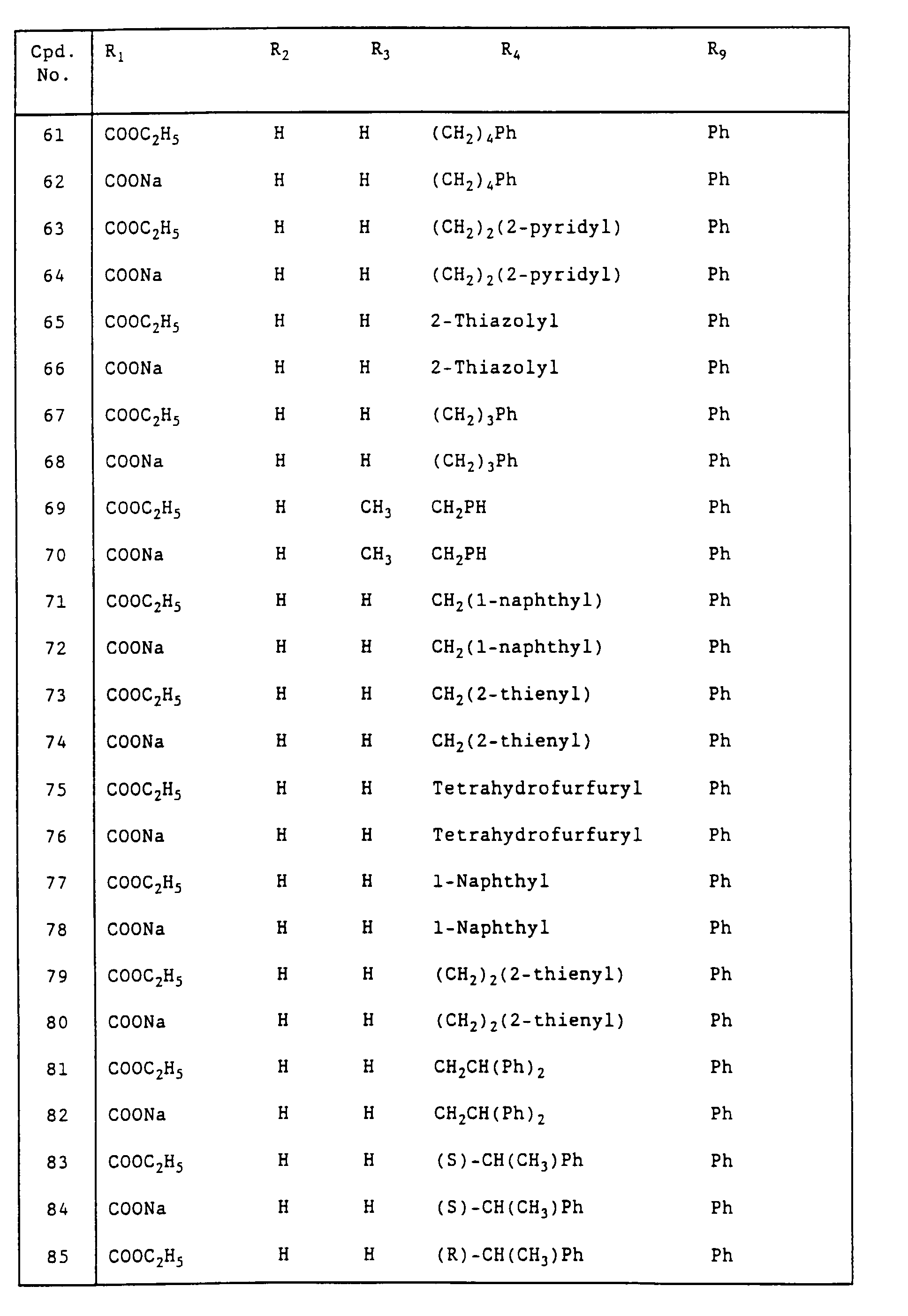

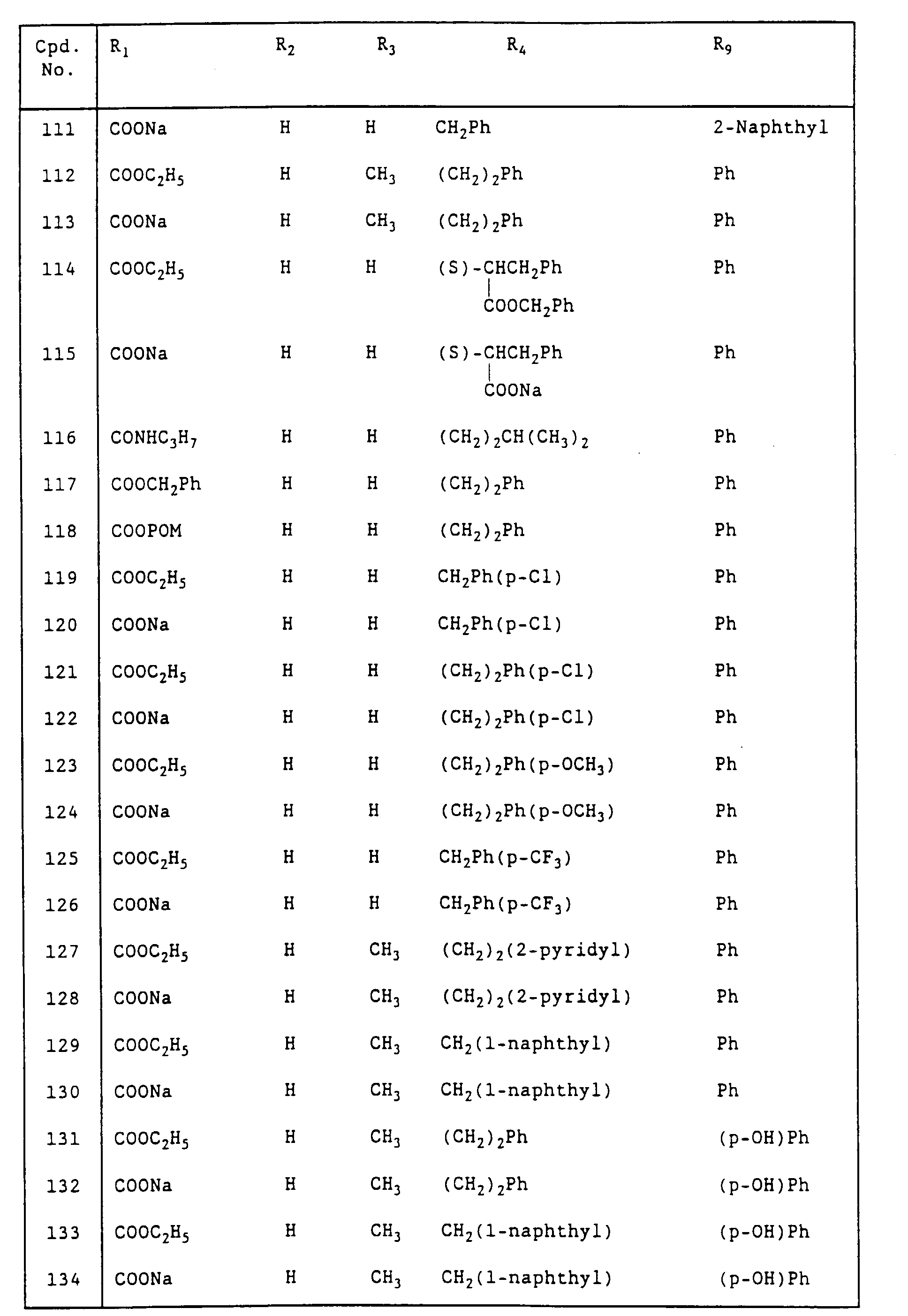

- (S) and (R) show that the carbon atoms bearing the symbols are S- and R-configuration, respectively; Ph represents phenyl group; i-Pr represents isopropyl group; Bu represents butyl group; POM represents pivaloyloxymethyl group.
- The bioactivities of the compounds of this invention are described below. The compounds [I] or salts thereof have activities of inhibiting cathepsin L and cathepsin B, and of potently inhibiting thiol protease. Their inhibitory activities against cathepsin L were determined by the methods described below.
- Determination of cathepsin L inhibitory activity To 75 µℓ of a reaction mixture containing 1 ng of human recombinant cathepsin L (as produced in Reference Examples 1 through 7 below), 2 µM of dithiothreitol (hereinafter abbreviated as DTT), 1 mM of ethylenediamine tetraacetate disodium salt, a 0.1 M sodium acetate buffer solution (pH 5.5) and various concentrations of test samples, 25 µℓ of 20 µM benzyloxycarbonyl-L-phenylalanyl-L-arginine-4-methylcoumaryl-7-amide (hereinafter abbreviated as Z-Phe-Arg-7MCA, manufactured by Peptide Institute) was added to initiate the reaction. After incubation at 37°C for 20 minutes, 100 µℓ of a reaction stopper solution containing 100 mM sodium monochloroacetate was added. The amount of liberated 4-methyl-7-aminocoumarin was determined at an excitation wavelength of 365 nm and a fluorescence wavelength of 450 nm, using a fluorophotometer (FCA:manufactured by Baxter Travenol). The sample concentration required to cause 50% inhibition was expressed as the IC50 value, with the fluorescence value obtained from the same reaction in the absence of the sample taken as 100%. The results are shown in Table 1.
Compound No. Inhibitory activity potency IC50(ng/ml) Cathepsin L 4 5 7 3 43 0.2 45 0.1 - The compounds[I] or salts thereof of this invention show suppressive action against bone resorption as enhanced by PTH (parathyroid hormone), and the action was determined by method described below. The results are shown in Table 2. Determination of bone resorption suppressive activity
- Femurs were aseptically isolated from female BALB/c mice at 8-10 weeks of age. After the bone marrow cavity was washed with a Ham F12 medium containing 10 weight % thermally inactivated fetal calf serum, 100 unit/ml penicillin G and 100 unit/ml streptomycin (hereinafter referred to as culture broth), each femur was added to 1 ml of the culture broth and precultured for 3 hours at 37°C in the presence of 5% carbon dioxide and 95% air. Each bone was transferred to lml of the culture broth supplemented with PTH (manufactured by Peptide Institute,Inc., final concentration 1 µM) and the test compound (final concentration 10 µg/ml) and cultured for 7 more days, after which the total calcium content in the culture broth was determined using Calcium E-Test Wako (manufactured by Wako Pure Chemical Industries, Ltd.). The bone resorption suppressive activity of the test compound was calculated using the following equation.
- Cc:
- Total calcium content in the culture broth containing neither PTH nor test compound
- Cp:
- Total calcium content in the culture broth containing PTH
- Cs:
- Total calcium content in the culture broth
containing both PTH and test compound
Compound No. Bone resorption suppressive activity (%) 7 99 - Compound 4 caused no death in mice when it was intravenously or intraperitoneally administered at 1,000 mg/kg.
- As described hereinbefore, the compounds [I] or salts thereof have an inhibitory activity against substances having a thiol group as an active center such as thiol protease [e.g. cathepsins (e.g. cathepsin L, cathepsin B, cathepsin K), calpains (e.g. calpain I, calpain II)], which can be used as thiol protease inhibitory agents being useful for prophylactic and therapeutic agents for diseases caused by thiol protease (e.g. muscular dystrophy, aerocystic distal myopathy, myocardial infarction, brain infarction, thrombosis, cataract, Alzheimer's disease, muscle atrophy, cancer metastasis). Besides, since substances inhibiting thiol protease show an anti-inflammatory activity, the thiol protease inhibitory agent of the present invention can be used as an antiinflammatory agent as well.
- Further, the compounds[I] or salts thereof have bone resorption suppressive activity, which are used as prophylactic and therapeutic agents for bone diseases such as osteoporosis, hypercalcemia in malignancy and Paget's diseases.
- The compounds [I] or salts thereof are low in toxicity, which can be safely used for mammals (e.g. dogs, cats, horses, monkeys and man).
- When the compound [I] or a salt thereof is administered to, for example, man, it can be safely administered orally or non-orally as such, or in a pharmaceutical composition along with an appropriate pharmacologically acceptable carrier, excipient and diluent.
- The pharmaceutical compositions described above include, as oral preparations, for example, powdery preparations, granular preparation, capsules and tablets, and, as non-oral preparations, for example, injections, instillations, medicines for external application (e.g. nasal drops and transdermal preparations), suppositories (e.g. rectal suppositories and vaginal suppositories).
- These preparations can be produced by per se known methods in common use for pharmaceutical formulation steps.
- The compounds [I] or salts thereof can be formulated as an oral preparation by compressive shaping in the presence of an excipent (e.g. lactose, sucrose, starch and mannitol), a disintegrating agent (e.g. calcium carbonate and carboxymethyl cellulose calcium), a binder (e.g. α-starch, gum arabic, carboxymethyl cellulose, polyvinylpyrrolidone, hydroxypropyl cellulose) or a lubricant (e.g. talc, magnesium stearate and polyethylene glycol 6000) and other additives, followed by coating if necessary for the purpose of taste masking, enteric release or sustained release by a per se known method. Coating agents for this purpose include ethyl cellulose, hydroxymethyl cellulose, polyoxyethylene glycol, cellulose acetate phthalate, hydroxypropylmethyl cellulose phthalate and Eudragit (manufactured by Roehm Pharma GmbH, Germany, methacrylic acid acrylic acid copolymer).
- The compounds [I] or salts thereof can be formulated into an aqueous injection along with a dispersing agent [e.g. Tween 80 (manufactured by Atlas Powder, U.S.A.), HCO 60 (manufactured by Nikko Chemicals), polyethylene glycol, carboxymethyl cellulose and sodium alginate], a preservative (e.g. methyl paraben, propyl paraben, benzyl alcohol and chlorobutanol), an isotonizing agent (e.g. sodium chloride, glycerol, sorbitol and glucose) and other additives, or into an injection in oil by dissolving, suspending or emulsifying in a vegetable oil (e.g. olive oil, sesame oil, cotton seed oil and corn oil and propylene glycol).
- The compounds [I] or salts thereof can also be formulated into a medicine for external application by preparing into a solid, semi-solid or liquid composition. The solid composition, for example, is prepared by pulverizing the compound of this invention as it is, or after mixing with an excipient (e.g. lactose,mannitol, starch, microcrystalline cellulose and sucrose), a thickening agent (e.g. natural rubber, cellulose derivatives and acrylic acid polymers). The liquid composition can be prepared, by substantially the same process as in the case of injectable preparations, by formulating into an oil or aqueous suspension. The semi-solid composition is in the state of, preferably aqueous or oily gel form or cartilage-like. And, these compositions may contain, for example, a pH controlling agent (e.g. carbonic acid, phosphoric acid, citric acid, hydrochloric acid and sodium hydroxide) and a preservative (e.g. p-hydroxybenzoic acid esters, chlorobutanol and benzalkonium chloride).
- The suppository can be prepared by formulating the compound [I] or a salt thereof into an oily or aqueous solid, semi-solid or liquid composition. Examples of the oleaginous base used for the said composition include glyceride of higher fatty acid [e.g. cacao butter and Witepsols (manufactured by Dynamite Nobel A.S.)], middle fatty acid [e.g. migliols (manufactured by Dynamite Nobel A.S.)] or vegetable oil (e.g. sesame oil, soybean oil and cotton seed oil). Examples of the aqueous base include polyethylene glycols and propylene glycol. And, examples of the aqueous gel base include natural rubbers, cellulose derivatives, vinyl polymers and acrylic acid polymers.
- When the compound [I] or a salt thereof is administered as a prophylactic and therapeutic agent of bone diseases in oral administration to an adult patient weighing 50 kg, the daily dose is normally 1 mg to 2 g, preferably about 10 mg to 2 g, more preferably about 20 mg to 1 g, based on active ingredient content, varying depending on the target disease, route of administration, age of individual subject patient and severity of disease.
- When the compound [I] or a salt thereof is administered to man as an agent of inhibiting thiol protease, the dose is substantially the same as that in the case of using as prophylactic and therapeutic agent of above-mentioned bone diseases.
- The present invention is hereinafter described in detail by means of, but not limited to, the following Reference Examples, Working Examples and Formulation Examples. Incidentally, percent (%) means, unless otherwise specified, percent by weight/volume. Numeral values for mixing ratios of mixed solvents are based on volume.
- NMR spectra were taken using the Bruker AC-300 spectrometer (1H NMR, 300MHz; 13C NMR, 75MHz) or Varian Gemini 200 spectrometer (1H NMR, 200MHz). As the internal standard, use is made of 3-(trimethylsilyl) propionic acid-d4 sodium salt in heavy water, while tetramethylsilane in other solvents, and all δ values are expressed by ppm. The symbols used in the present specification have the following meanings: Q, quaternary carbon; s, singlet; d, doublet; t, triplet; q, quartet; dd, double doublet; dt, double triplet; m, multiplet; br., broad; CH, methine; CH2, methylene; and CH3, methyl.
- To amplify human cathepsin cDNA by the polymerase chain reaction (PCR) method, four primers were synthesized in accordance with a reported base sequence of cathepsin L of human renal origin [S. Gal and M. M. Gottesman, Biochemical Journal, Vol.253, p.303 (1988)] as follows.




- Three µl of a solution of human renal cDNA library λ gtll (CLONTECH Laboratories, Inc.) and 50 µl of distilled water were mixed. After incubation at 95°C for 5 minutes, the mixture was immediately cooled in ice. Two primers (No. 1 and No.3 above; 50 pmol each) were added, and reaction was carried out as directed in the instruction manual for the kit supplied by Cetus/Perkin-Elmer, in which a series of reactions at 94°C for one minutes, 55°C for two minutes and 72°C for three minutes were repeated in 50 cycles. To the reaction mixture, two other primers (No. 2 and No. 4; 50 pmol each) were added, and the same reaction as above was conducted. The PCR product was separated by electrophoresis on 1.2% agarose gel; an amplified DNA fragment was detected at a position corresponding to the size (1132 bp) expected from the base sequence of cathepsin L of human renal origin. This DNA fragment was recovered from the gel and subcloned to the plasmid vector pBluescriptR II SK+ (produced by STRATAGENE). The base sequence of the cDNA portion was determined by the dideoxynucleotide synthetic chain termination method [J. Messing et al., Nucleic Acid Research, Vol.9, p.309 (1981); it proved identical with the reported sequence. The plasmid containing this cDNA fragment was named pHCL-5.
- The cDNA of Reference Example 1 was cleaved with restriction enzyme EcoRI, and a 798bp fragment (which encodes a part of the human cathepsin L precursor and the whole matured human cathepsin L) was recovered. To both ends of this fragment was ligated a BamHI linker (5'-pCCCGGATCCGGG-3'), and the ligation product was inserted to the plasmid vector pET-3c for expression in Escherichia coli [Methods in Enzymology, ed. D. V. Goeddel, Vol.185, p.68, Academic Press (1990)]. The thus-constructed plasmid was designated as pET-HClα. Escherichia coli MM294(DE3) was transformed with pET-HClα to express human cathepsin L in the presence of the T7 promoter [Methods in Enzymology, Vol.185, p.60 (1990)]. The thus-obtained Escherichia coli transformant [Escherichia coli JM109/pTBN-HClneo, harboring the plasmid pTBN-HClneo, has been deposited under accession number IFO 15341 at the Institute for Fermentation, Osaka (IFO) since June 12, 1992, and under accession number FERM BP 3897 at the National Institute of Bioscience and Human-Technology (NIBH), Agency of Industrial Science and Technology, Ministry of International Trade and Industry, since June 22, 1992] was cultured, and cells were disrupted by sonication and subjected to SDS-PAGE; a unique band appeared near 30kDal, corresponding to human cathepsin L. Since the expressed product formed an inclusion body, human cathepsin L was roughly purified from the precipitate fraction of the ultrasonically disrupted transformant.
- The roughly purified recombinant human cathepsin L described in Reference Example 2 was mixed with an equal amount of Freund's complete adjuvant, and about 1 ml was inoculated to a rabbit. Later, a mixture of a roughly purified human cathepsin L specimen and an equal amount of of Freund's incomplete adjuvant was injected 3 times at 10-day intervals, and blood was collected seven days after the final injection. The blood thus collected was left standing at 37°C for 30 minutes and then at 4°C overnight, which was then subjected to centrifugal separation to yield a human cathepsin L antiserum.
- After the plasmid pHCL-5, described in Reference Example 1, was digested with restriction enzyme BamHI, a fragment of human cathepsin L cDNA was recovered by agarose gel electrophoresis. Subsequently, this cDNA fragment was inserted to the restriction enzyme Bgl II site of the vector pTB551 for transient expression in animal cells [prepared by converting the EcoRI to Bgl II site in the plasmid pTB389 described by Ono et al. in Science, Vol.236, p.1116 (1989)] by the action of T4 DNA ligase and ATP, to yield the expression plasmid pTB-HCl. MuLV-LTR was inserted between the restriction enzyme HindIII and ClaI sites of pTB-HCl to yield the expression plasmid pTBN-HCL.
- To obtain an animal cell line that stably expresses human cathepsin L, the drug resistance marker neo gene was inserted to the recombinant vector pTBN-HCL described in Reference Example 4 in the following manner: first, a fragment comprising the SV40 early promoter and the neo gene was inserted between the restriction enzyme ClaI and Sal I sites of plasmid pTBN-HCL to yield the plasmid pTBN-HCLneo.
- Using the plasmid described in Reference Example 5 (pTBN-HCLneo), mouse myeloma Sp2/0 cells were transformed as follows: Sp2/0 cells, cultivated in an ASF104 medium supplemented with 5% fetal calf serum (FCS) (5% FCS/ASF medium), were suspended in phosphate-buffered saline (PBS) (-)[the same as Dullbecco's PBS but CaCl2 and MgCl2 were removed] to adjust 1 x 10⁷ cells/ml. Five hundred µl of this cell suspension was injected to to a cuvette, 10 µg of said plasmid DNA was added, and the mixture was left standing on ice for 5 minutes. This liquid was pulsated at 125 µF and 300 V, using a gene pulser (manufactured by Bio-Rad Laboratories), and then again left standing on ice for 10 minutes. This liquid was transferred to 10 ml of a 5% FCS/ASF104 medium and cultured at 37°C in the presence of 5% carbon dioxide. Forty-eight hours later, the culture was transferred to a selection medium (5% FCS/ASF104 medium containing 200 µg/ml G418) and cultured on a 24-well plate for two weeks. A number of colonies emerged, each of which was transferred to an ASF10 medium containing 200 µg/ml G418 and cultured, followed by Western blot analysis of the culture supernatant using the human cathepsin L antiserum prepared in Reference Example 3. In response to the antiserum, unique bands corresponding to molecular weights of about 40,000 to 30,000 and lower molecular weights appeared; they were identified as a precursor of human cathepsin L and a product processed therefrom, estimated from these molecular weights. The culture supernatant was assayed for cathepsin L activity, in accordance with the method of A. J. Barrett and H. Kirschke [Methods in Enzymology, Vol.80, p.535 (1981)]; human cathepsin L activity was detected.
- These findings confirm that transformant mouse myeloma cells expressing cathepsin L were obtained, which were designated as the mouse myeloma Sp-HCL26. Reference Example 7 (Purification of human cathepsin L)
- The strain obtained in Reference Example 6, showing high expression of cathepsin L, (the mouse myeloma Sp-HCL26, transformed with the plasmid pTBN-HCLneo, has been deposited under accession number IFO 50371 at the Institute of Fermentation, Osaka (IFO) since June 16, 1992, and under accession number FERM BP 3902 at the National Institute of Bioscience and Human-Technology (NIBH), Agency of Industrial Science and Technology, Ministry of International Trade and Industry, since June 24, 1992) was cultured in 20 ml of an ASF104 medium supplemented with 10% FCS and 200 µg/ml G418, after which it was transferred to 50 ml of a serum-free selection medium (ASF104 medium supplemented with 200 µg/ml G418) and cultured for 5 days. After the culture supernatant was applied to a column of CM-Sephadex C-50 (25 x 4.4 cm), the column was washed with buffer A (20 mM sodium acetate, 1 mM EDTA, pH 5.5), followed by elution on a sodium chloride (NaCl) density gradient from 0 to 1M,to elute human cathepsin L near an NaCl concentration of about 0.4 M. This fraction was applied to the Mono S column (HR5/5) of an FPLC system (manufactured by Pharmacia), followed by column washing and human cathepsin L elution in the same manner as above. The human cathepsin L fraction, eluted near an NaCl concentration of about 0.36 M, was concentrated to yield a purified standard preparation.
- Streptomyces sp.116-20 (IFO 15746) strain grown on yeast extract·malt extract agar slant medium was inoculated to 40 ml of a seed medium (pH 7.0) containing 2% glucose, 3% soluble starch, 1% soybean flour, 1% corn steep liquor, 0.5% peptone, 0.3% NaCl and 0.5% CaCO3 in a 200 ml Erlenmeyer flask, and cultured at 28°C for 48 hours on a rotary shaker to give a pre-culture broth. Five ml of thus-prepared pre-culture was transplanted to 500 ml of a seed medium in a 2000 ml Sakaguchi's flask, which was cultured at 28°C for 48 hours on a reciprocal shaker to give a seed culture broth. Five hundred ml of this seed culture medium was transplanted to 120 liters of a main culture medium (pH 7.0) containing 0.5% glucose, 5% dextrin, 3.5% defatted soybean, 0.0002% CoCl2 and 0.7% CaCO3 in a 200 liter stainless steel tank. The fermentation was carried out at 28°C for 96 hours with aeration of 120 liters/min., agitation of 120 rpm and inner pressure of 1 kg/cm2.
- The culture broth (100 litres) obtained in Reference Example 8 was filtered using a filter aid (Radiolite 600, manufactured by Showa Chemical Industry). After adjustment to pH 6.8, the filtrate (90 liters) was subjected to a column chromatography on activated carbon (10 liters), and the column was washed with water (10 liters). The effluent and the washing were combined, which was subjected to a column chromatography on Amberlite 120 (H type, 15 liters), and the column was washed with water (15 liters). The effluent and the washing were combined, which was concentrated to a volume of 4.3 liters. The concentrate was left standing at 4°C, then resulting precipitate was collected by filtration.
Recrystallization of the crude crystals (128 g) afforded (2S,3S)-aziridine-2,3-dicarboxylic acid as crystals (94 g).
[α] D 28 + 53° (c 0.47, H2O)Elemental Analysis for C4H5NO4: Calcd. C; 36.65, H; 3.84, N; 10.68 (%) Found C; 36.56, H; 3.87, N; 10.46 (%) - (2S,3S)-aziridine-2,3-dicarboxylic acid (10.4 g), which is disclosed in JPA S52(1977)-38091 or Tetrahedron Vol.47 p.5287 (1991), was dissolved in a 4N aqueous solution of sodium hydroxide (40ml). To the solution were added dropwise, under ice-cooling, a 4N aqueous solution of sodium hydroxide (24 ml) and Z-chloride (12.6 ml, manufactured by Wako Pure Chemical Industries, Ltd.), in the course of 40 minutes, then the mixture was stirred for 3 hours. To the reaction mixture were added dropwise, under ice-cooling, a 4N aqueous solution of sodium hydroxide (12 ml) and Z-chloride (6.3ml), taking 40 minutes. The same process was conducted once more. The reaction mixture was stirred for 3 hours under ice-cooling, and then for 14 hours at room temperature. To the reaction mixture was added water (400ml), which was washed with ether (150ml x 3). The aqueous layer was adjusted to pH 2.5, which was saturated with sodium chloride, followed by extraction with ethyl acetate (200ml x 4). The ethyl acetate layer was washed with a saturated aqueous saline solution, dried over anhydrous sodium sulfate, followed by concentration to dryness to give (2S,3S)-N-Z-aziridine-2,3-dicarboxylic acid (19.6 g) (yield 92%). The compound thus produced was dissolved in N,N-dimethylformamide (DMF, 200 ml), to which were added potassium carbonate (12.3 g) and ethyl iodide (14.2 ml), and then the mixture was stirred for 14 hours at room temperature. The reaction mixture was concentrated, to which was added ethyl acetate, followed by washing with water. The organic layer was dried over anhydrous sodium sulfate, which was subjected to a silica gel column chromatography (1000 ml). Elution was conducted with eluents prepared by adding ethyl acetate to hexane in sequence. From the fraction of eluate with 15% (V/V) ethyl acetate, (2S,3S)-N-Z-aziridine-2,3-dicarbioxylic acid diethyl ester (11.3 g) as a colorless oily product (yield 48%). The compound thus produced was dissolved in ethanol (380 ml). To the solution was added, under ice-cooling, 1N aqueous solution of sodium hydroxide (35.2 ml), and the mixture was stirred for 30 minutes. The reaction mixture was adjusted to pH 7.5, which was then concentrated. To the concentrate was added water (150 ml), which was washed with ether (100 ml x 3). The aqueous layer was adjusted to pH 2.5, followed by extraction with ethyl acetate (150 ml x 2). The ethyl acetate layer was washed with a saturated aqueous saline solution, dried over anhydrous sodium sulfate, and concentrated to dryness to afford the above-titled compound (Compound 1; 9.23 g) (yield 89%).
1H NMR δ ppm (300 MHz, CDCl3)
1.27(3H,t,J=7.2Hz), 3.41(1H,d,J=2.3Hz),
3.44(1H,d,J=2.3Hz), 4.20(2H,m), 5.14(1H,d,J=12.1Hz), 5.20(1H,d,J=12.1Hz), 7.34(5H,m) - Isopentylamine (3.00 ml, manufactured by Wako Pure Chemical Industries, Ltd.) and Boc-L-phenylalanine (7.52 g, manufactured by Peptide Institute, Inc.) were dissolved in dichloromethane (50 ml). To the solution were added, under ice-cooling, HOBT (3.84 g) and WSC (5.44 g). The mixture was stirred for 18 hours at room temperature. The reaction mixture was concentrated, to which was added ethyl acetate (300 ml). The mixture was washed with a 10% aqueous solution of citric acid, a 3% aqueous solution of sodium hydrogen carbonate and a saturated aqueous saline solution. The organic layer was dried over anhydrous sodium sulfate, which was then concentrated to dryness. The concentrate was treated with ether to give N-(Boc-L-phenylalanyl)isopentylamine (7.77 g) (yield 90%). The compound thus obtained (1.00 g) was dissolved in dichloromethane (5 ml), to which was added trifluoroacetic acid (TFA, 5 ml), and the mixture was left standing for one hour at room temperature. The reaction mixture was concentrated, to which was added chloroform, followed by washing with a saturated aqueous solution of sodium hydrogen carbonate, water and a saturated aqueous saline solution, successively. The organic layer was dried over anhydrous sodium sulfate, which was then concentrated to dryness. The residue was dissolved in dichloromethane (26 ml). To the solution were added, under ice-cooling, (2S,3S)-ethyl hydrogen N-Z-aziridine-2,3-dicarboxylate (Compound 1, 965 mg) obtained in Working Example 1, HOBT (445 mg) and WSC (631 mg). The mixture was stirred for 18 hours at room temperature. The reaction mixture was concentrated, to which was added ethyl acetate. The mixture was washed with a 10% aqueous solution of citric acid, water, a saturated aqueous solution of sodium hydrogen carbonate, a 2% aqueous solution of sodium hydrogen carbonate, water and a saturated aqueous saline solution, successively. The organic layer was dried over anhydrous sodium sulfate, which was subjected to a silica gel column chromatography (Kieselgel 60 (Merck A.G.), 200 ml). The column was subjected to elution with eluents prepared by adding methanol to chloroform in sequence. From the fraction of chloroform containing 1% (V/V) methanol, the above-titled compound (Compound 2; 1.15 g) was obtained as a white powdery product (yield 76%).
[α] D 21 + 26° (c 0.45, CHCl3)Elemental Analysis for C28H35N3O6: Calcd. C; 65.99, H; 6.92, N; 8.25 (%) Found C; 66.10, H; 6.95, N; 8.38 (%)
0.83(3H,d,J=6.6Hz), 0.84(3H,d,J=6.6Hz),
1.22(2H,dt,J=7.3,7.3Hz), 1.24(3H,t,J=7.1Hz),
1.42(1H,m), 2.96(1H,d,J=2.5Hz), 2.98(1H,d,J=8.0Hz),
3.15(2H,m), 3.37(1H,d,J=2.4Hz), 4.15(2H,m),
4.50(1H,dt,J=7.7,7.7Hz), 5.10(1H,d,J=12.0Hz),
5,19(1H,d,J=12.0Hz), 5.53(1H,t,J=5.7Hz),
6.90(1H,d,J=8.0Hz), 7.16(2H,m), 7.20-7.38(8H,m) - The compound 2 produced in Working Example 2 (1.00 g) was dissolved in ethanol (35 ml). To the solution were added water (15 ml), 1N sulfuric acid (0.98 ml) and Pd-C (10%(w/w), manufactured by Engelhard A.G., 100 mg). The mixture was stirred for one hour at room temperature under the atmosphere of hydrogen gas. The catalyst was filtered off, and the filtrate was adjusted to pH 3, which was then concentrated. Resulting precipitate was collected by filtration, washed with water and dried to afford the above-titled compound (Compound 3; 610 mg) as a white powdery product (yield 83%).
[α] D 21 + 33° (c 0.61, CHCl3)Elemental Analysis for C20H29N3O4: Calcd. C; 63.98, H; 7.79, N; 11.19 (%) Found C; 63.77, H; 7.58, N; 11.29 (%)
0.85(3H,d,J=6.5Hz), 0.86(3H,d,J=6.5Hz), 1.26(2H,m), 1.30(3H,t,J=7.2Hz), 1.45(1H,m), 1.74(1H,t,J=8.4Hz), 2.22(1H,dd,J=2.2,7.8Hz), 2.78(2H,dd,J=2.2,9.0Hz), 2.96(1H,dd,J=7.7,13.8Hz), 3.07(1H,dd,J=7.4,13.8Hz), 3.18(2H,m), 4.21(2H,q,J=7.1Hz), 4.51(1H,dt,J=8.2,7.7Hz), 5.88(1H,t,J=4.8Hz), 6.96(1H,d,J=8.3Hz), 7.17(2H,m), 7.28(3H,m) - The compound 3 produced in Working Example 3 (500 mg) was dissolved in methanol (25 ml). To the solution was added, under ice-cooling, 1N aqueous solution of sodium hydroxide (2.66 ml). The mixture was stirred for one hour under ice-cooling, and for one hour at room temperature. The reaction mixture was adjusted to pH 6.0, which was then concentrated. The concentrate was subjected to a column chromatography using Diaion HP-20 (manufactured by Mitsubishi Chemical Industries, Ltd., 50ml). The column was washed with water, then elution was conducted with 50% (V/V) methanolic water to give the above-titled compound (Compound 4; 475 mg) as a white powdery product (yield 97%).
[α] D 21 + 70° (c 0.59, H2O)Elemental Analysis for C18H24N3O4Na·H2O: Calcd. C; 55.80, H; 6.76, N; 10.85, Na; 5.94 (%) Found C; 55.74, H; 6.64, N; 11.08, Na; 5.67 (%)
0.80(3H,d,J=6.4Hz), 0.81(3H,d,J=6.5Hz), 1.20(2H,m), 1.30(1H,m), 2.44(1H,d,J=2.5Hz), 2.72(1H,d,J=2.5Hz), 3.05(2H,m), 3.13(2H,m), 4.49(1H,t,J=7.7Hz), 7.26(2H,m), 7.36(3H,m) - In substantially the same manner as Working Example 2, N-Z-1,4-diaminobutane (1.00 g) disclosed in Hoppe-Seylers' Z. Physiol. Chem. 349, p.251 (1968) was condensed with Boc-L-phenylalanine (1.31 g) to yield N-Z-N'-(Boc-L-phenylalanyl)-1,4-diaminobutane (1.89 g) as a white powdery product (yield 90%). The Boc group was deprotected with TFA, and 506 mg of thus-obtained compound was condensed with (2S,3S)-ethyl hydrogen N-Z-aziridine-2,3-dicarboxylate (Compound 1,400 mg) to afford the above-titled compound (Compound 5; 647 mg) as a white powdery product (yield 73%).
[α] D 21 + 3.7° (c 0.52, CHCl3)Elemental Analysis for C35H40N4O8: Calcd. C; 65.20, H; 6.25, N; 8.69 (%) Found C; 64.99, H; 6.20, N; 8.82 (%)
1.23(3H,t,J=7.2Hz), 1.37(4H,m), 2.95(1H,d,J=2.5Hz), 2.99(1H,m), 3.11(1H,m), 3.15(4H,m), 3.38(1H,d,J=2.5Hz), 4.14(2H,m), 4.53(1H,m), 4.86(1H,br s), 5.09(2H,s), 5.09(1H,d,J=11.9Hz), 5.18(1H,d,J=12.0Hz), 5.92(1H,br s), 6.93(1H,d,J=8.1Hz), 7.15(2H,m), 7.18-7.38(13H,m) - In substantially the same manner as Working Example 3, Compound 5 (500 mg) was subjected to catalytic reduction to thereby deprotect the Z group. The resultant compound was subjected to a column chromatography using Diaion HP-20 (50ml). The column was washed with water. Elution was then conducted with a 50% (V/V) methanolic water to afford the above-titled compound (Compound 6; 270 mg) as a white powdery product (yield 73%).
[α] D 22 + 89° (c 0.59, H2O)Elemental Analysis for C19H28N4O4·0.5H5SO4·H2O: Calcd. C; 51.45, H; 7.05, N; 12.63, S; 3.61 (%) Found C; 51.23, H; 6.84, N; 13.05, S; 3.76 (%)
1.28(3H,t,J=7.2Hz), 1.42(4H,m), 2.92(2H,m), 3.10(5H,m), 3.28(1H,d,J=3.3Hz), 4.27(2H,q,J=7.2Hz), 4.53(1H,t,J=7.9Hz), 7.35(5H,m) - In substantially the same manner as Working Example 4, Compound 6 (220 mg) was subjected to alkali hydrolysis to give the above-titled compound (Compound 7; 162 mg) as a white powdery product (yield 88%)
[α] D 22 + 79° (c 0.59, H2O)Elemental Analysis for C17H24N4O4·H2O: Calcd. C; 55.73, H; 7.15, N; 15.29 (%) Found C; 55.62, H; 7.25, N; 15.32 (%)
1.47(4H,m), 2.39(1H, br s), 2.74(1H, br s), 2.95(2H,m), 3.11(4H,m), 4.50(1H,t,J=7.7Hz), 7.36(5H,m) - In substantially the same manner as Working Example 2, morpholine (1.64 ml, manufactured by Tokyo Kasei) was condensed with Boc-L-phenylalanine (5.00 g) to give Boc-L-phenylalanylmorpholine (6.00 g) as a white powdery product (yield 95%). Taking a portion (2.00 g) of this product, the Boc group was deprotected with TFA, followed by concentration to dryness. The concentrate was dissolved in water, and the solution was allowed to pass through IRA-402 (Cl type, 250 ml, manufactured by Amberlite Inc.), and the solution was concentrated and lyophilized to give L-phenylalanylmorpholine hydrochloride (1.68 g) as a white powdery product (yield: quantitative). A portion (923 mg) of this product was dissolved in dichloromethane (23 ml). To the solution were added, under ice-cooling, (2S,3S)-ethyl hydrogen N-Z-aziridine-2,3-dicarboxylate produced in Working Example 1 (Compound 1, 1.00 g), HOBT (507 mg), WSC (719 mg) and triethylamine (1.02 ml). The mixture was stirred for 14 hours at room temperature. The reaction mixture was concentrated, to which was added ethyl acetate. The mixture was washed with a 10% aqueous solution of citric acid, water, a saturated aqueous solution of sodium hydrogen carbonate, a 2% aqueous solution of sodium hydrogen carbonate, water and a saturated aqueous saline solution, respectively, followed by drying over anhydrous sodium sulfate, which was concentrated. The concentrate was subjected to a silica gel column chromatography (100 ml). The column was subjected to elution with solutions prepared by adding ethyl acetate to hexane in sequence. The eluate with 60% to 70% (v/v) ethyl acetate was concentrated to give the above-titled compound (Compound 8; 940 mg) as a white powdery product (yield 54%).
[α] D 25 + 17° (c 0.55, CHCl3)Elemental Analysis for C27H31N3O7·0.5H2O: Calcd. C; 62.54, H; 6.22, N; 8.10 (%) Found C; 62.56, H; 6.16, N; 7.95 (%)
1.25(3H,t,J=7.2Hz), 2.92(4H,m), 3.16(1H,d,J=2.4Hz), 3.26(1H,m), 3.40(1H,d,J=2.5Hz), 3.45(3H,m), 3.59(2H,m), 4.16(2H,m), 5.08(1H,dt,J=8.4,6.1Hz), 5.10(1H,d,J=11.9Hz), 5.20(1H,d,J=12.0Hz), 7.16(2H,m), 7.27(4H,m), 7.35(5H,m) - In substantially the same manner as Working Example 3, Compound 8 (840 mg) was subjected to catalytic reduction to deprotect the Z group, then the pH was adjusted to 4.0, followed by extraction with ethyl acetate (30 ml x 3). The ethyl acetate layer was washed with a saturated aqueous saline solution, which was dried over anhydrous sodium sulfate, followed by concentration to dryness to afford the above-titled compound (Compound 9; 520 mg) as a white powdery product (yield 84%).
[α] D 25 + 58° (c 0.55, CHCl3)Elemental Analysis for C19H25N3O5: Calcd. C; 60.79, H; 6.71, N; 11.19 (%) Found C; 60.51, H; 6.85, N; 10.99 (%)
1.31(3H,t,J=7.1Hz), 2.47(1H,dd,J=2.1,7.8Hz), 2.80(1H,dd,J=2.2,8.8Hz), 2.97(4H,m), 3.33(1H,m), 3.46(2H,m), 3.57(3H,m), 4.23(2H,q,J=7.1Hz), 5.08(1H,m), 7.18(2H,m), 7.29(3H,m) - In substantially the same manner as Working Example 4, Compound 9 (100 mg) was subjected to alkali hydrolysis to produce the above-titled compound (Compound 10; 92 mg) as a white powdery product (yield 94%).
[α] D 26 + 92° (c 0.56, H2O)Elemental Analysis for C17H20N3O3Na·H2O: Calcd. C; 52.71, H; 5.72, N; 10.85, Na; 5.93 (%) Found C; 52.51, H; 5.92, N; 10.95, Na; 6.15 (%)
2.43(1H,br s), 2.75(1H,br s), 2.91(1H,m), 3.02(1H,m), 3.08(1H,m), 3.23(1H,m), 3.42(3H,m), 3.55(2H,m), 3.65(1H,m), 5.03(1H,dd,J=6.9,8.6Hz), 7.27(2H,m), 7.37(3H,m) - In substantially the same manner as Working Example 2, isopentylamine (2.33 ml) was condensed with Boc-L-leucine monohydrate (5.00 g, manufactured by Peptide Institute, Inc.) to give N-(Boc-L-leucyl)isopentylamine (5.73 g) as a white powdery product (yield 95%). The Boc group was deprotected with TFA, and 667 mg of thus-produced compound was condensed, in substantially the same manner as Working Example 2, with (2S,3S)-ethyl hydrogen N-Z-aziridine-2,3-dicarboxylate (Compound 1, 1.00g) to afford the above-titled compound (Compound 11; 920 mg) as a colorless oily product (yield 58%).
[α] D 26 - 16° (c 1.01, CHCl3)Elemental Analysis for C25H37N3O6: Calcd. C; 63.14, H; 7.84, N; 8.84 (%) Found C; 62.99, H; 7.70, N; 8.94 (%)
0.90(12H,d,J=6.6Hz), 1.25(3H,t,J=7.2Hz), 1.38(2H,m), 1.56(4H,m), 3.21(1H,d,J=2.5Hz), 3.25(2H,m), 3.44(1H,d,J=2.5Hz), 4.17(2H,m), 4.36(1H,dt,J=6.0,8.4Hz), 5.08(1H,d,J=12.1Hz), 5.22(1H,d,J=12.0Hz), 6,12(1H,t,J=5.6Hz), 6.90(1H,d,J=8.6Hz), 7.35(5H,m) - In substantially the same manner as Working Example 3, Compound 11 (800 mg) was subjected to catalytic reduction to deprotect the Z group, and the resultant compound was concentrated to give precipitate. The precipitate was collected by filtration, washed with water and dried to afford the above-titled compound (Compound 12; 458 mg) as a white powdery product (yield 80%).
[α] D 25 + 6.1° (c 0.61, CHCl3)Elemental Analysis for C17H31N3O4·0.1H2O: Calcd. C; 59.48, H; 9.16, N; 12.24 (%) Found C; 59.41, H; 9.08, N; 12.39 (%)
0.90(3H,d,J=6.5Hz), 0.91(6H,d,J=6.6Hz), 0.92(3H,d,J=6.5Hz), 1.32(3H,t,J=7.1Hz), 1.39(2H,m), 1.52(1H;m), 1.62(2H,m), 1.80(2H,m), 2.56(1H,dd,J=2.3,7.7Hz), 2.85(1H,dd,J=2.3,9.0Hz), 3.25(2H,m), 4.25(2H,m), 4.31(1H,dt,J=8.7,6.0Hz), 6.13(1H,t,J=4.2Hz), 6.80(1H,d,J=8.7Hz) - In substantially the same manner as Working Example 4, Compound 12 (100 mg) was subjected to alkali hydrolysis to produce the above-titled compound (Compound 13; 87 mg) as a white powdery product (yield 89%).
[α] D 26 + 38° (c 0.55, H2O)Elemental Analysis for C15H26N3O4Na·H2O: Calcd. C; 50.98, H; 7.99, N; 11.89 (%) Found C; 51.02, H; 8.18, N; 11.68 (%)
0.86(3H,d,J=6.6Hz), 0.87(3H,d,J=6.6Hz), 0.88(3H,d,J=5.8Hz), 0.92(3H,d,J=6.0Hz), 1.37(2H,m), 1.59(4H,m), 2.52(1H,d,J=2.4Hz), 2.76(1H,d,J=2.4Hz), 3.15(1H,dt,J=13.6,7.0Hz), 3.26(1H,dt,J=13.6,7.0Hz), 4.24(1H,dd,J=5.5,9.1Hz) - In substantially the same manner as Working Example 2, N-Z-1,4-diaminobutane (3.33 g) was condensed with Boc-L-leucine monohydrate (4.11 g) to give N-Z-N'-(Boc-L-leucyl)-1,4-diaminobutane (5.40 g) as a white powdery product (yield 83%). The Boc group was deprotected with TFA, and 3.80 g of the resultant compound was subjected to condensation, in substantially the same manner as Working Example 2, with (2S,3S)-ethyl hydrogen N-Z-aziridine-2,3-dicarboxylate (Compound 1, 3.65 g) to give the above-titled compound (Compound 14; 3.90 g) as a white powdery product (yield 57%).
[α] D 26 - 10° (c 0.56, CHCl3)Elemental Analysis for C32H42N4O8: Calcd. C; 62.94, H; 6.93, N; 9.17 (%) Found C; 62.65, H; 6.77, N; 9.24 (%)
0.88(3H,d,J=6.0Hz), 0.90(3H,d,J=6.0Hz), 1.24(3H,t,J=7.2Hz), 1.52(5H,m), 1.62(2H,m), 3.19(1H,d,J=2.5Hz), 3.22(4H,m), 3.42(1H,d,J=2.5Hz), 4.16(2H,m), 4.36(1H,m), 4.95(1H,t,J=4.8Hz), 5.07(1H,d,J=12.1Hz), 5.10(2H,s), 5.20(1H,d,J=12.0Hz),
6.30(1H,br s), 6.72(1H,d,J=8.4Hz), 7.35(10H,m) - In substantially the same manner as Working Example 3, Compound 14 (2.44 g) was subjected to catalytic reduction to deprotect the Z group. The resultant compound was subjected to a Diaion HP-20 (100ml) column chromatography. The column was washed with water, then elution was conducted by the use of 50% (v/v) mathanolic water. The eluate was concentrated,and the concentrate was lyophilized to give the above-titled compound (Compound 15; 1.24 g) as a white powdery product (yield 79%).
[α] D 26 + 65° (c 0.55, H2O)Elemental Analysis for C16H30N4O4·0.5H2SO4·0.5H2O: Calcd. C; 47.99, H; 8.05, N; 13.99, S; 4.00 (%) Found C; 47.85, H; 8.09, N; 14.17, S; 4.18 (%)
0.88(3H,d,J=6.1Hz), 0.93(3H,d,J=6.0Hz), 1.27(3H,t,J=7.2Hz), 1.61(7H,m), 2.83(1H,d,J=2.3Hz), 2.96(1H,d,J=2.3Hz), 3.00(2H,m), 3.22(2H,m), 4.23(2H,q,J=7.2Hz), 4.27(1H,m) - In substantially the same manner as Working Example 4, Compound 15 (200 mg) was subjected to alkali hydrolysis to give the above-titled compound (Compound 16; 159 mg) as a white powdery product (yield 99%). [α] D 26 + 51° (c 0.56, H2O)
Elemental Analysis for C14H26N4O4·0.5H2O: Calcd. C; 52.00, H; 8.42, N; 17.32 (%) Found C; 52.01, H; 8.62, N; 17.37 (%)
0.88(3H,d,J=6.1Hz), 0.93(3H,d,J=6.1Hz), 1.60(7H,m),
2.51(1H,br s), 2.78(1H,br s), 2.99(2H,m), 3.22(2H,m), 4.23(1H,dd,J=5.2,9.4Hz) - In substantially the same manner as Working Example 2, morpholine (1.76 ml) was condensed with Boc-L-leucine monohydrate (5.00 g) to give Boc-L-leucylmorpholine (5.76 g) as a colorless oily product (yield 95%). A portion (2.00 g) of this product was taken, and the Boc group was deprotected by using TFA. The resultant compound was treated in substantially the same manner as Working Example 8 to afford L-leucylmorpholine hydrochloride (1.52 g) as a white powdery product (yield 96%). A portion (807 mg) of this product was condensed, in substantially the same manner as Working Example 8, with (2S,3S)-ethyl hydrogen N-Z-aziridine-2,3-dicarboxylate (Compound 1, 100g) to afford the above-titled compound (Compound 17; 1.06 g) as a white powdery product (yield 65%).
[α] D 25 + 16° (c 0.54, CHCl3)Elemental Analysis for C24H33N3O7: Calcd. C; 60.62, H; 6.99, N; 8.84 (%) Found C; 60.38, H; 7.07, N; 8.97 (%)
0.88(3H,d,J=6.4Hz), 0.94(3H,d,J=6.4Hz), 1.25(3H,t,J=7.2Hz), 1.40(1H,m), 1.52(2H,m), 3.24(1H,d,J=2.4Hz), 3.43(1H,d,J=2.4Hz), 3.54(3H,m), 3.69(5H,m), 4.17(2H,m), 4.96(1H,dt,J=4.2,9.0Hz), 5.06(1H,d,J=12.1Hz), 5.23(1H,d,J=12.1Hz), 7.17(2H,d,J=8.7Hz), 7.35(5H,m) - In substantially the same manner as Working Example 3, Compound 17 (950 mg) was subjected to catalytic reduction to deprotect the Z group, which was treated in substantially the same manner as Working Example 9 to afford the above-titled compound (Compound 18; 540 mg) as a colorless oily product (yield 79%).
[α] D 26 + 53° (c 0.75, CHCl3)Elemental Analysis for C16H27N3O5·0.25H2O: Calcd. C; 55.56, H; 8.01, N; 12.15 (%) Found C; 55.44, H; 7.98, N; 11.68 (%)
0.91(3H,d,J=6.4Hz), 0.96(3H,d,J=6.4Hz), 1.32(3H,t,J=7.2Hz), 1.43(1H,m), 1.53(2H,m), 1.81(1H,t,J=8.4Hz), 2.59(1H,dd,J=2.2,7.8Hz), 2.84(1H,dd,J=2.1,9.2Hz), 3.55(3H,m), 3.69(5H,m), 4.24(2H,m), 4.92(1H,dt,J=4.3,9.2Hz), 7.11(1H,d,J=8.8Hz) - In substantially the same manner as Working Example 4, Compound 18 (100 mg) was subjected to alkali hydrolysis to give the above-titled compound (Compound 19; 85 mg) as a white powdery product (yield 87%). [α]D 26 + 55° (c 0.56, H2O)
Elemental Analysis for C14H22N3O5Na·0.5H2O: Calcd. C; 48.83, H; 6.73, N; 12.20, Na; 6.68 (%) Found C; 48.94, H; 6.88, N; 12.37, Na; 6.71 (%)
0.99(3H,d,J=5.9Hz), 1.02(3H,d,J=6.0Hz), 1.58(1H,m), 1.73(2H,m), 2.58(1H,br s), 2.88(1H,br s), 3.64(1H,m), 3.81(7H,m), 4.90(1H,dd,J=4.1,9.5Hz) - In substantially the same manner as Working Example 2, 3-methoxypropylamine (6.1 ml, Wako Pure Chemical Industries, Ltd.) was condensed with Boc-L-leucine monohydrate (5.00 g, manufactured by Peptide Institute, Inc.) to afford N-(Boc-L-leucyl)methoxypropylamine (17.5 g) as a colorless waxy product (yield 89%). The Boc group was deprotected by using TFA, and 1.21 g of the resultant compound was condensed, in substantially the same manner as Working Example 2, with (2S,3S)-ethyl hydrogen N-Z-aziridine-2,3-dicarboxylate (Compound 1, 1.93 g) to afford the above-titled compound (Compound 20; 2.55 g) as a white crystalline product (yield 89%).
Elemental Analysis for C24H35N3O7: Calcd. C; 60.36, H; 7.38, N; 8.80 (%) Found C; 60.24, H; 7.10, N; 8.95 (%)
0.91(3H,d), 0.92(3H,d), 1.25(3H,t,J=7.2Hz), 1.53(2H,m), 1.68(1H,m), 1.77(2H,m), 3.20(1H,d,J=2.5Hz), 3.34(3H,s), 3.37(2H,m), 3.43(1H,d,J=2.5Hz), 3.48(2H,t), 4.17(2H,m), 4.37(1H,m), 5.08(1H,d), 5.22(1H,d), 6.50(1H,t), 6.77(1H,d), 7.35(5H,m) - In substantially the same manner as Working Example 3, Compound 20 (2.2 g) was subjected catalytic reduction to deprotect the Z group, which was concentrated to dryness. The concentrate was recrystallized, when hot, from a small quantity of water to afford the above-titled compound (Compound 21; 1.31 g) as a white cubic crystalline product (yield 83%).
Elemental Analysis for C16H29N3O5: Calcd. C; 55.96, H; 8.51, N; 12.24 (%) Found C; 55.88, H; 8.35, N; 12.49 (%)
0.89(3H,d), 0.92(3H,d), 1.31(3H,t,J=7.2Hz), 1.53(2H,m), 1.68(1H,m), 1.80(2H,m), 2.55(1H,d), 2.86(1H,d), 3.35(3H,s), 3.37(2H,m), 3.47(2H,m), 3.47(2H,t,J=5.7Hz),
4.25(2H,q,J=7.2Hz), 4.34(1H,m), 6.54(1H,br s), 6.82(1H,d) - In substantially the same manner as Working Example 4, Compound 21 (700 mg) was subjected to alkali hydrolysis to afford the above-titled compound (Compound 22; 590 mg) as a white powdery product (yield 85%).
Elemental Analysis for C14H24N3O5Na·0.5H2O: Calcd. C; 48.55, H; 7.28, N; 12.13 (%) Found C; 48.79, H; 7.46, N; 12.21 (%)
0.88(3H,d,J=5.8Hz), 0.92(3H,d,J=5.7Hz), 1.60(2H,m), 1.66(1H,m), 1.75(2H,m), 2.53(1H,d), 2.77(1H,d,J=2.2Hz), 3.24(2H,m), 3.32(3H,s), 3.46(2H,t,J=6.3Hz), 4.26(1H,m) - In substantially the same manner as Working Example 2, piperidine (0.86 g, manufactured by Wako Pure Chemical Industries, Ltd.) was condensed with Boc-L-leucine (2.74 g, manufactured by Peptide Institute, Inc.) to give N-(Boc-L-leucyl)piperidine (3.34 g) as white needles (yield 80%). The Boc group of the product was deprotected by using TFA, and 1.20 g of thus-deprotected compound was condensed, in substantially the same manner as Working Example 2, with (2S,3S)-ethyl hydrogen N-Z-aziridine-2,3-dicarboxylate (Compound 1, 1.93 g) to give the above-titled compound (Compound 23; 1.10 g) as a pale yellow oily product (yield 39%).
Elemental Analysis for C25H35N3O6: Calcd. C; 63.40, H; 7.45, N; 8.87 (%) Found C; 63.16, H; 7.76, N; 8.99 (%)
0.85(3H,d,J=6.4Hz), 0.95(3H,d,J=6.3Hz), 1.25(3H,t,J=7.2Hz), 1.32-1.72(9H,m), 3.25(1H,d,J=2.5Hz), 3.40(1H,d,J=2.5Hz), 3.42(2H,m), 3.55(2H,m), 4.16(2H,m), 4.98(1H,m), 5.05(1H,d), 5.24(1H,d), 7.18(1H,d), 7.35(5H,m) - In substantially the same manner as Working Example 3, Compound 23 (2.78 g) was subjected to catalytic reduction to deprotect the Z group, which was subjected to a silica gel column chromatography (200ml). Elution was conducted with eluents prepared by adding methanol to chloroform in sequence. From the fraction eluted with 2% (v/v) methanol-containing-chloroform, the above-titled compound (Compound 24; 1.26 g) was obtained as white crystals (yield 45%)
Elemental Analysis for C17H29N3O4·2H2O: Calcd. C; 54.38, H; 8.85, N; 11.19 (%) Found C; 54.29, H; 7.83, N; 11.03 (%)
0.91(3H,d,J=6.3Hz), 0.98(3H,d,J=6.2Hz), 1.31(3H,t,J=7.2Hz), 1.37-1.90(9H,m), 2.63(1H,br s), 2.81(1H,br s), 3.45(2H,m), 3.55(2H,m), 4.23(2H,q,J=7.3Hz), 4.98(1H,m), 7.15(1H,d) - In substantially the same manner as Working Example 4, Compound 24 (760 mg) was subjected to alkali hydrolysis to afford the above-titled compound (Compound 25; 162 mg) as a white powdery product (yield 73%).
Elemental Analysis for C15H24N3O4Na·0.5H2O: Calcd. C; 52.62, H; 7.36, N; 12.26 (%) Found C; 52.77, H; 7.67, N; 12.31 (%)
0.92(6H,d,J=5.8Hz), 1.40-1.75(9H,m), 2.51(1H,d), 2.77(1H,d,J=2.7Hz), 3.37-3.62(4H,m), 4.88(1H,m) - L-Phenylalanine benzylester tosylate (80.5 g, manufactured by Peptide Institute, Inc.) was dissolved in dichloromethane (2200 ml). To the solution was added, under ice-cooling, triethylamine (20 g). To the mixture was added (2S,3S)-ethyl hydrogen N-Z-aziridine-2,3-dicarboxylate (Compound 1; 61.3 g) produced in Working Example 1, HOBT (26.7 g), WSC (37.9 g), which was stirred for 3 hours at room temperature. The reaction mixture was concentrated, to which was added ethyl acetate (1500 ml). The mixture was washed with a 10% aqueous solution of citric acid, a 3% aqueous solution of sodium hydrogen carbonate and a saturated aqueous saline solution, successively. The organic layer was dried over anhydrous sodium sulfate, followed by concentration to dryness. The concentrate was pulverized by adding n-hexane to give N-[(2s,3S)-N-Z-3-ethoxycarbonylaziridine-2-carbonyl]-L-phenylalanine benzylester (compound 26a; 98 g) (yield 98%).
Elemental Analysis for C30H30N2O7: Calcd. C; 67.91, H; 5.69, N; 5.28 (%) Found C; 68.13. H; 5.54. N; 5.36 (%)
1.24(3H,t,J=7.2Hz), 2.98(1H,d,J=2.4Hz), 3.08(2H,m), 3.34(1H,d,J=2.4Hz), 4.15(2H,m), 4.87(1H,m), 5.09(1H,d), 5.16(2H,s), 5.20(1H,d), 6.55(1H,d), 6.93(2H,m), 7.20(3H,m), 7.34(10H,m) - The whole amount (98 g) of the above product was dissolved in a mixture of ethanol (640 ml) and ethyl acetate (160 ml). To the solution was added Pd-C (10% (w/w), 4.5 g), and the mixture was stirred for 3 hours at room temperature under hydrogen gas atmosphere. The catalyst was filtered off,and the filtrate was concentrated to dryness under reduced pressure to give white amorphous crystals. The crystalline product was recrystallized, when hot, from tetrahydrofuran to afford N-[(2S,3S)-3-ethoxycarbonylaziridine-2-carbonyl]-L-phenylalanine (compound 26b; 45.3 g) as white fine needles (yield 80%).
Elemental Analysis for C15H18N2O5: Calcd. C; 58.82, H; 5.92, N; 9.15 (%) Found C: 58.82, H; 5.77, N; 9.36 (%)
1.25(3H,t,J=7.3Hz), 2.28(1H,m), 2.80(1H,m), 3.17(2H,m), 3.73(2H,q,J=7.0Hz), 4.22(1H,m), 6.74(1H,m), 7.13(2H,m), 7.28(3H,m) - Further, in dichloromethane (40 ml) was dissolved the N-[(2S,3S)-3-ethoxycarbonylaziridine-2-carbonyl]-L-phenylalanine (1.22 g). To the solution were added, under ice-cooling, 3-methoxypropylamine (0.39 g, manufactured by Wako Pure Chemical Industries, Ltd.), HOBT (0.59 g) and WSC (0.84 g), then the mixture was stirred for 16 hours at room temperature. The reaction mixture was concentrated, to which was added ethyl acetate (150 ml). The mixture was washed with a 10% aqueous solution of citric acid, a 3% aqueous solution of sodium hydrogen carbonate and a saturated aqueous saline solution, successively. The organic layer was dried over anhydrous sodium sulfate, which was concentrated and, then subjected to a silica gel column chromatography (200 ml). Elution was conducted by using eluents prepared by adding methanol to chloroform in sequence. From the fraction of chloroform containing 2% (v/v) methanol, the above-titled compound (Compound 26; 1.18 g) was obtained as white crystals (yield 78%).
Elemental Analysis for C19H27N3O5: Calcd. C; 60.46, H; 7.21, N; 11.13 (%) Found C; 60.21, H; 7.02, N; 11.17 (%)
1.30(3H,t,J=7.2Hz), 1.60(2H,m), 2.20(1H,dd,J=2.2,7.7Hz), 2.79(1H,dd,J=2.1,9.0Hz), 3.02(2H,m), 3.26(3H,s), 3.32(4H,m), 4.20(2H,q,J=7.2Hz), 4.50(1H,m), 6.27(1H,br s), 6.90(1H,d), 7.18(2H,m), 7.32(3H,m) - In substantially the same manner as Working Example 4, Compound 26 (670 mg) was subjected to alkali hydrolysis to produce the above-titled compound (Compound 27; 510 mg) as a white powdery product (yield 81%).
Elemental Analysis for C17H22N3O5Na·0.5H2O: Calcd. C; 53.68, H; 6.09, N; 11.05 (%) Found C; 53.49, H; 6.36, N; 11.03 (%)
1.58(2H,m), 2.40(1H,br s), 2.71(1H,d,J=2.6Hz), 3.05(2H,m), 3.18(2H,m), 3.23(2H,m), 3.28(3H,s), 4.49(1H,m), 7.26(2H,m), 7.37(3H,m) - In substantially the same manner as Working Example 26, N-[(2S,3S)-3-ethoxycarbonylaziridine-2-carbonyl]-L-phenylalanine (1.22 g) was condensed with hexylamine (0.44 g, manufactured by Wako Pure Chemical Industries, Ltd.) to give the above-titled compound (Compound 28; 0.84 g) as white crystals (yield 54%).
Elemental Analysis for C21H31N3O4: Calcd. C; 64.76, H; 8.02, N; 10.79 (%) Found C; 64.61, H; 8.05, N; 10.85 (%)
0.87(3H,t,J=6.6Hz), 1.22(8H,m), 1.30(3H,t,J=7.2Hz), 1.72(1H,m), 2.20(1H,dd), 2.78(1H,dd,J=2.2,9.0Hz), 3.01(2H,m), 3.15(2H,m), 4.22(2H,q,J=7.2Hz), 4.48(1H,m), 5.72(1H,t), 6.90(1H,d), 7.18(2H,m), 7.30(3H,m) - In substantially the same manner as Working Example 4, Compound 28 (440 mg) was subjected to alkali hydrolysis to give the above-titled compound (Compound 29; 330 mg) as a white powdery product (yield 73%).
Elemental Analysis for C19H26N3O4Na·H2O: Calcd. C; 56.85, H; 7.03, N; 10.47 (%) Found C; 57.50, H; 7.04, N; 10.46 (%)
0.84(3H,t,J=6.7Hz), 1.20(8H,m), 2.42(1H,br s), 2.71(1H,d,J=2.6Hz), 3.04(4H,m), 4.49(1H,t,J=7.7Hz), 7.25(2H,m), 7.34(3H,m) - In substantially the same manner as Working Example 26, N-[(2S,3S)-3-ethoxycarbonylaziridine-2-carbonyl]-L-phenylalanine (1.22 g) was condensed with allylamine (0.25 g, manufactured by Wako Pure Chemical Industries, Ltd.) to give the above-titled compound (Compound 30; 1.25 g) as white crystals (yield 91%).
Elemental Analysis for C18H23N3O4: Calcd. C; 62.59, H; 6.71, N; 12.17 (%) Found C; 62.12, H; 6.48, N; 12.13 (%)
1.29(3H,t,J=7.2Hz), 1.73(1H,m), 2.17(1H,dd,J=2.5,7.9Hz), 2.77(1H,dd), 3.04(2H,m), 3.81(2H,m), 4.21(2H,q,J=7.2Hz), 4.52(1H,m), 5.08(2H,m), 5.07(1H,m), 5.95(1H,t), 6.98(1H,d), 7.17(2H,m),
7.28(3H,m) - In substantially the same manner as Working Example 4, Compound 30 (570 mg) was subjected to alkali hydrolysis to give the above-titled compound (Compound 31; 480 mg) as a white powdery product (yield 79%)
Elemental Analysis for C16H18N3O4Na·H2O: Calcd. C; 53.78, H; 5.64, N; 11.76 (%) Found C; 53.27, H; 5.99, N; 11.47 (%)
2.33(1H,br s), 2.70(1H,d), 3.09(2H,m), 3.71(2H,d,J=5.0Hz), 4.56(1H,t,J=7.7Hz), 5.00(1H,dd,J=1.5,17.2Hz), 5.07(1H,dd,J=1.5,10.4Hz), 5.70(1H,m), 7.27(2H,m), 7.35(3H,m) - In substantially the same manner as Working Example 26, N-[(2S,3S)-3-ethoxycarbonylaziridine-2-carbonyl]-L-phenylalanine (1.22 g) was condensed with 3-butoxypropylamine (0.58 g, manufactured by Wako Pure Chemical Industries, Ltd.) to give the above-titled compound (Compound 32; 1.20 g) as white crystals (yield 72%).
Elemental Analysis for C22H33N3O5: Calcd. C; 62.98, H; 7.92, N; 10.01 (%) Found C; 62.83, H; 7.73, N; 10.18 (%)
0.93(3H,t,J=7.2Hz), 1.30(3H,t,J=7.2Hz), 1.33-1.80(7H,m), 2.19(1H,dd), 2.77(1H,dd), 3.01(1H,m), 3.34(6H,m), 4.21(2H,q,J=7.2Hz), 4.49(1H,m), 6.28(1H,t), 6.90(1H,d), 7.16(2H,m), 7.28(3H,m) - In substantially the same manner as Working Example 4, Compound 32 (600 mg) was subjected to alkali hydrolysis to give the above-titled compound (Compound 33; 370 mg) as a white powdery product (yield 58%).
Elemental Analysis for C20H28N3O5Na·2H2O: Calcd. C; 53.44, H; 7.18, N; 9.35 (%) Found C; 53.52, H; 6.84, N; 9.31 (%)
0.89(3H,t,J=7.3Hz), 1.32(2H,m), 1.53(4H,m), 2.36(1H,d), 2.73(1H,d,J=2.6Hz), 3.00-3.33(6H,m), 3.46(2H,t,J=6.6Hz), 4.50(1H,t,J=7.7Hz), 7.24(2H,m), 7.36(3H,m) - In substantially the same manner as Working Example 26, N-[(2S,3S)-3-ethoxycarbonylaziridine-2-carbonyl]-L-phenylalanine (1.53 g) was condensed with isobutylamine (0.40 g, manufactured by Wako Pure Chemical Industries, Ltd.) to give the above-titled compound (Compound 34; 1.14 g) as white crystals (yield 55%).
Elemental Analysis for C19H27N3O4: Calcd. C; 63.14, H; 7.53, N; 11.63 (%) Found C; 63.01, H; 7.27, N; 11.53 (%)
0.79(3H,d,J=6.6Hz), 0.86(3H,d,J=6.6Hz), 1.30(3H,t,J=7.2Hz), 1.62(1H,m), 1.72(1H,m), 2.00(1H,dd), 2.77(1H,dd), 2.88-3.16(4H,m), 4.22(2H,q,J=7.1Hz), 4.51(1H,m), 5.85(1H,br s), 6.90(1H,d), 7.19(2H,m), 7.29(3H,m) - In substantially the same manner as Working Example 4, Compound 34 (580 mg) was subjected to alkali hydrolysis to give the above-titled compound (Compound 35; 380mg) as a white powdery product (yield 58%)
Elemental Analysis for C17H22N3O4Na·3H2O: Calcd. C; 49.87, H; 6.89, N; 10.26 (%) Found C; 49.59, H; 6.27, N; 9.98 (%)
0.73(3H,d,J=5.9Hz), 0.76(3H,d,J=6.2Hz), 1.62(1H,m), 2.34(1H,d,J=2.6Hz), 2.72(1H,d), 2.91(2H,m), 3.06(2H,m), 4.53(1H,t,J=7.6Hz), 7.31(5H,m) - In substantially the same manner as Working Example 26, N-[(2S,3S)-3-ethoxycarbonylaziridine-2-carbonyl]-L-phenylalanine (1.22 g) was condensed with 3-isopropoxypropylamine (0.64 g, manufactured by Tokyo Kasei Co., Ltd.) to give the above-titled compound (Compound 36; 1.20 g) as white crystals (yield 74%).
Elemental Analysis for C21H31N3O5: Calcd. C; 62.20, H; 7.71, N; 10.36 (%) Found C; 62.13, H; 7.55, N; 10.54 (%)
1.11(3H,d,J=5.9Hz), 1.12(3H,d,J=6.1Hz), 1.30(3H,t,J=7.2Hz), 1.68(3H,m), 2.18(1H,dd), 2.77(1H,dd), 3.02(2H,m), 3.25-3.56(5H,m), 4.21(2H,q,J=7.2Hz), 4.48(1H,m), 6.35(1H,t), 6.89(1H,d), 7.16(2H,m), 7.28(3H,m) - In substantially the same manner as Working Example 4, Compound 36 (710 mg) was subjected to alkali hydrolysis to give the above-titled compound (Compound 37; 490 mg) as a white powdery product (yield 66%)
Elemental Analysis for C19H26N3O5Na·1.5H2O: Calcd. C; 53.51, H; 6.85, N; 9.85 (%) Found C; 53.32, H; 6.78, N; 9.60 (%)
1.12(6H,d,J=6.2Hz), 1.56(2H,m), 2.35(1H,br s), 2.71(1H,d), 3.00-3.37(6H,m), 3.60(1H,m), 4.50(1H,m), 7.27(2H,m), 7.35(3H,m) - In substantially the same manner as Working Example 26, N-[(2S,3S)-3-ethoxycarbonylaziridine-2-carbonyl]-L-phenylalanine (1.22 g) was condensed with furfurylamine (0.43 g, manufactured by Wako Pure Chemical Industries, Ltd.) to give the above-titled compound (Compound 38; 1.14 g) as white crystals (yield 74%).
Elemental Analysis for C20H23N3O5: Calcd. C; 62.33, H; 6.01, N; 10.90 (%) Found C; 61.95, H; 6.13, N; 10.93 (%)
1.30(3H,t,J=7.2Hz), 1.69(1H,br s), 2.16(1H,br s), 2.75(1H,br s), 3.04(2H,m), 4.20(2H,q,J=7.1Hz), 4.37(2H,dd,J=2.9,5.5Hz), 4.56(1H,m), 6.14(1H,m), 6.21(1H,m), 6.29(1H,m), 6.89(1H,d,J=8.5Hz), 7.08-7,37(6H,m) - In substantially the same manner as Working Example 4, Compound 38 (606 mg) was subjected to alkali hydrolysis to give the above-titled compound (Compound 39; 560mg) as a white powdery product (yield 88%).
Elemental Analysis for C18H18N3O5Na.1.5 H2O: Calcd. C; 53.20, H; 5.21, N; 10.34 (%) Found C; 53.44, H; 5.44, N; 10.45 (%)
2.35(1H,d,J=2.6Hz), 2.69(1H,d,J=2.3Hz), 2.98(1H,dd,J=8.0,13.7Hz), 3.10(1H,dd,J=7.2,13.7Hz), 4.24(1H,d,J=15.8Hz), 4.36(1H,d,J=15.8Hz), 4.53(1H,t,J=7.3Hz), 6.19(1H,m), 6.40(1H,m), 7.20(2H,m), 7.31(3H,m), 7.47(1H,m) - In substantially the same manner as Working Example 26, N-[(2S,3S)-3-ethoxycarbonylaziridine-2-carbonyl]-L-phenylalanine (1.22 g) was condensed with cyclohexylamine (0.44 g, manufactured by Wako Pure Chemical Industries, Ltd.) to give the above-titled compound (Compound 40; 0.92 g) as white crystals (yield 60%).
Elemental Analysis for C21H29N3O4: Calcd. C; 65.10, H; 7.54, N; 10.84 (%) Found C; 64.29, H; 7.41, N; 10.74 (%)
1.03(4H,m), 1.22(2H,m), 1.30(3H,t,J=7.2Hz), 1.48-1.88(5H,m), 2.28(1H,br s), 2.77(1H,br s), 2.99(2H,d,J=7.2Hz), 3.66(1H,m), 4.22(2H,q,J=7.1Hz), 4.48(1H,m), 5.54(1H,br s), 6.99(1H,d,J=7.7Hz), 7.18(2H,m), 7.28(3H,m) - In substantially the same manner as Working Example 4, Compound 40 (308 mg) was subjected to alkali hydrolysis to give the above-titled compound (Compound 41; 280 mg) as a white powdery product (yield 84%).
Elemental Analysis for C19H24N3O4Na·2H2O: Calcd. C; 54.67, H; 6.76, N; 10.01 (%) Found C; 54.30, H; 6.74, N; 10.10 (%)
0.83-1.41(6H,m), 1.45-1.83(6H,m), 2.41(1H,d,J=2.6Hz),
2.71(1H,d,J=2.5Hz), 3.03(2H,d,J=7.4Hz), 3.47(2H,m), 4.46(1H,t,J=7.0Hz), 7.32(5H,m) - (2S,3S)-N-Z-Aziridine-2,3-dicarboxylic acid diethyl ester produced in Working Example 1 (2.00 g) was dissolved in ethanol (67 ml). To the solution was added Pd-C (10% (w/w), 200 mg), and the mixture was stirred for two hours at room temperature under the atmosphere of hydrogen gas. The catalyst was filtered off, and the filtrate was condensed to give diethyl ester of (2S,3S)-aziridine-2,3-dicarboxylic acid (1.05 g) as a colorless oily product (yield 90%).
- Further, the product was dissolved in ethanol (50 ml), to which were added potassium carbonate (369 mg), sodium hydrogen carbonate (449 mg) and methyl p-toluenesulfonate (1.49 ml). The mixture was stirred for 14 hours at room temperature. The reaction mixture was poured into ice-water, which was subjected to extraction with ethyl acetate (100ml x 2). The ethyl acetate layer was washed with water and a saturated aqueous saline solution, which was dried over anhydrous sodium sulfate and subjected to a silica gel column chromatography. Elution was conducted with eluents prepared by adding ethyl acetate to hexane in sequence. The fractions eluted with 15% (v/v) ethyl acetate were combined and concentrated to dryness to give diethyl ester of (2S,3S)-N-methylaziridine-2,3-dicarboxylic acid (56 mg) as a colorless oily product (yield 5.2%). Further, from the fraction eluted with 40% (v/v) ethylacetate, the starting material (740 mg) was recovered, which was subjected to substantially the same reaction. The reaction time was prolonged to 64 hours, and the reaction mixture was subjected to posttreatment to give diethyl ester of (2S,3S)-N-methylaziridine-2,3-dicarboxylic acid (116 mg) (yield 15%). The diethyl ester of (2S,3S)-N-methyl-aziridine-2,3-dicarboxylic acid thus obtained (172 mg) was dissolved in ethanol (8.5 ml). To the solution was added, under ice-cooling, 1N aqueous solution of sodium hydroxide (845 µl). The mixture was stirred for one hour and for further 30 minutes at room temperature. The reaction mixture was adjusted to pH 7, to which was added water, and the mixture was concentrated. The concentrate was adjusted to pH 7, followed by washing with ether. The aqueous layer was adjusted to pH 3, to which was added sodium chloride, followed by extraction with ethyl acetate. The ethyl acetate layer was washed with a saturated aqueous saline solution, dried over anhydrous sodium sulfate, followed by concentration to give monoethyl ester of (2S,3S)-N-methylaziridine-2,3dicarboxylic acid (68 mg) as a white powdery product (yield 46%). This product was condensed, in substantially the same manner as Working Example 2, with N-(L-phenylalanyl)isopentylamine (100 mg) to afford the above-titled compound (Compound 42; 112 mg) as a white powdery product (yield 77%).
Elemental Analysis for C21H31N3O4: Calcd. C; 64.76, H; 8.02, N; 10.79 (%) Found C; 64.72, H; 7.81, H; 11.02 (%)
0.86(3H,d,J=6.6Hz), 0.87(3H,d,J=6.6Hz), 1.27(2H,m), 1.29(3H,t,J=7.2Hz), 1.46(1H,m), 2.33(1H,d,J=2.3Hz), 2.62(3H,s), 2.66(1H,d,J=2.3Hz), 2.94(1H,dd,J=7.6,13.8Hz), 3.05(1H,dd,J=7.5,13.6Hz), 3.17(2H,m), 4.19(2H,m), 4.46(1H,dt,J=8.1,7.8Hz), 5.78(1H,br s), 6.93(1H,d,J=8.0Hz), 7.17(2H,m), 7.27(3H,m) - In substantially the same manner as Working Example 4, Compound 42 (70 mg) was subjected to alkali hydrolysis to give the above-titled compound (Compound 43; 57 mg) as a white powdery product (yield 83%).
Elemental Analysis for C19H26N3O4Na·1.5H2O: Calcd. C; 55.60, H; 7.12, N; 10.24 (%) Found C; 55.59, H; 7.19, N; 10.37 (%)
0.80(3H,d,J=6.2Hz), 0.81(3H,d,J=6.4Hz), 1.23(2H,m), 1.32(1H,m), 2.19-2.78(5H,m), 2.95-3.22(4H,m), 4.46-4.61(1H,m), 7.23-7.42(5H,m)
13H NMR δ ppm (75 MHz, D2O): Compound 43 occurs as a mixture of two conformers in heavy water; the signal for the main conformer is shown.
24.5(CH3), 24.5(CH3), 27.7(CH), 39.9(CH2), 40.2(CH2), 4 0.5(CH2), 40.9(CH3), 47.6(CH), 48.7(CH), 58.1(CH), 130.1(CH), 131.7(CH)x2, 132.3(CH)x2, 139.1(Q), 173.9(Q), 175.3(Q)# 175.8(Q) - In dichloromethane (37 ml) was dissolved diethyl ester of (2S,3S)-aziridine-2,3-dicarboxylic acid (1.10 g) obtained in Working Example 42. To the solution were added dropwise, under ice-cooling, triethylamine (4.10 ml) and ethyl trifluoromethanesulfonate (3.80 ml). The mixture was stirred for one hour. The reaction mixture was poured into ice-water, whose pH was adjusted to 7, followed by extraction with ethylacetate (100 ml x 2). The ethyl acetate was washed with water and a saturated aqueous saline solution, which was dried over anhydrous sodium sulfate, followed by concentration. The concentrate was subjected to a silica gel column chromatography. Elution was conducted with eluents prepared by adding ethyl acetate to hexane in sequence. From the fraction eluted with 15% (v/v) ethyl acetate, diethyl ester of (2S,3S)-N-ethylaziridine-2,3-dicarboxylic acid (60 mg) was obtained as a colorless oily product (yield 4.7%). Further, from the fraction eluted with 30% (v/v) ethyl acetate, the starting material (780 mg) was recovered, which was subjected to substantially the same reaction as above to produce diethyl ester of (2S,3S)-N-ethylaziridine-2,3-dicarboxylic acid (25 mg) (yield 2.8%). The diethyl ester of (2S,3S)-N-ethylaziridine-2,3-dicarboxylic acid (85 mg) was dissolved in ethanol (4.2ml). To the solution was added, under ice-cooling, a 1N aqueous solution of sodium hydroxide (390 µl). The mixture was processed in the same manner as in Working Example 42 to give monoethyl ester of (2S,3S)-N-ethyl-aziridine-2,3-dicarboxylic acid (65 mg) as a white powdery product (yield 89%). This product was condensed, in substantially the same manner as in Working Example 2, with N-(L-phenylalanyl)isopentylamine (92 mg) to give the above-titled compound (Compound 44; 96 mg) as a white powdery product (yield 68%).
Elemental Analysis for C22H33N3O4: Calcd. C; 65.48, H; 8.24, N; 10.41 (%) Found C; 65.19, H; 8.27, N; 10.83 (%)
0.85(3H,d,J=6.6Hz), 0.86(3H,d,J=6.6Hz), 1.03(3H,t,J=7.1Hz), 1.26(2H,m), 1.29(3H,t,J=7.2Hz), 1.45(1H,m), 2.37(1H,d,J=2.3Hz), 2.71(1H,d,J=2.3Hz), 2.76(1H,m), 2.91(1H,m), 3.00(2H,m), 3.18(2H,m), 4.19(2H,q,J=7.0Hz), 4.46(1H,dt,J=8.1,7.6Hz), 5.73(1H,br s), 6.98(1H,d,J=8.1Hz), 7.18(2H,m), 7.28(3H,m) - In substantially the same manner as Working Example 4, Compound 44 (70 mg) was subjected to alkali hydrolysis to give the above-titled compound (Compound 45; 44 mg) as a white powdery product (yield 64%).
Elemental Analysis for C20H28N3O4Na·H2O: Calcd. C; 57.82, H; 7.28, N; 10.11 (%) Found C; 57.75, H; 7.08, N; 10.19 (%)
0.80(6H,d,J=6.3Hz), 0.83-1.03(3H,m), 1.23(2H,m), 1.33(1H,m), 2.33-2.82(4H,m), 2.95-3.22(4H,m), 4.47-4.59(1H,m), 7.23-7.41(5H,m) - Compound 4 obtained in Working Example 4 (100 mg) was dissolved in N,N-dimethylformamide (2 ml), to which were added, under ice-cooling, pyridine (44 µl) and acetyl chloride (39 µl). The mixture was stirred for 1.5 hour under ice-cooling. To the reaction mixture was added water (50 ml), which was adjusted to pH 6.8. The mixture was then subjected to a Diaion HP-20 (10 ml) column chromatography, followed by elution with 50% (v/v) methanolic water. The eluent was concentrated and lyophilized to give the above-titled compound (Compound 46; 98 mg) as a white powdery product (yield 88%).
Elemental Analysis for C20H26N3O5Na·2H2O: Calcd. C; 53.68, H; 6.76, N; 9.39 (%) Found C; 53.99, H; 6.56, N; 9.21 (%)
0.82(3H,d,J=6.5Hz), 0.83(3H,d,J=6.5Hz), 1.24(2H,m), 1.34(1H,m), 2.06(3H,s), 2.97-3.26(4H,m), 3.08(1H,d,J=2.0Hz), 3.32(1H,d,J=2.0Hz), 4.56(1H,t,J=8.0Hz), 7.24-7.45(5H,m) - In substantially the same manner as Working Example 26, Compound 26b (1.22 g) was condensed with piperidine (0.38 g, manufactured by Wako Pure Chemical Industries, Ltd.) to give the above-titled compound (Compound 47; 1.20 g) as a colorless oily product (vield 80%).
Elemental Analysis for C20H27N3O4·0.2H2O: Calcd. C; 63.71, H; 7.32, N; 11.14 (%) Found C; 63.78, H; 7.36, N; 11.00 (%)
1.11(1H,m), 1.30(3H,t,J=7.1Hz), 1.47-1.79(6H,m), 2.42(1H,m), 2.78(1H,m), 2.85-3.16(3H,m), 3.27(1H,m), 3.50(2H,m), 4.22(2H,q,J=7.2Hz), 5.14(1H,m), 7.10-7.36(6H,m) - In substantially the same manner as Working Example 4, Compound 47 (610 mg) was subjected to alkali hydrolysis to give the above-titled compound (Compound 48; 460 mg) as a white powdery product (yield 77%).
Elemental Analysis for C18H22N3O4Na·0.8H2O: Calcd. C; 56.63, H; 6.23, N; 11.01 (%) Found C; 56.65, H; 6.18, N; 11.05 (%)
0.95(1H,m), 1.18-1.50(5H,m), 2.29(1H,d,J=2.6Hz), 2.58(1H,d,J=2.6Hz), 2.87(2H,d,J=7.6Hz), 3.02-3.35(4H,m), 4.93(1H,t,J=7.6Hz), 7.07-7.30(5H,m) - In substantially the same manner as Working Example 26, Compound 26b (1.22 g) was condensed with 1-aminopiperidine (0.45 g, manufactured by Wako Pure Chemical Industries, Ltd.) to give the above-titled compound (Compound 49; 0.83 g) as white crystals (yield 54%).
Elemental Analysis for C20H28N4O4·0.5H2O: Calcd. C; 60.44, H; 7.35, N; 14.10 (%) Found C; 60.43, H; 7.07, N; 14.12 (%) - In substantially the same manner as Working Example 4, Compound 49 (388 mg) was subjected to alkali hydrolysis to give the above-titled compound (Compound 50; 380 mg) as a white powdery product (yield 99%).
Elemental Analysis for C18H23N4O4Na·1.4H2O: Calcd. C; 53.04, H; 6.38, N; 13.75 (%) Found C; 53.06, H; 6.58, N; 13.80 (%)
1.35(2H,m), 1.55(4H,m), 2.44(5H,m), 2.74(1H,s), 3.05(2H,m), 4.39(1H,m), 7.27(2H,m), 7.39(3H,m) - In substantially the same manner as Working Example 26, Compound 26b (1.22 g) was condensed with 1-aminopyrrole (0.37 g, manufactured by Tokyo Kasei Co., Ltd.) to give the above-titled compound (Compound 51; 0.88 g) as white crystals (yield 60%).
Elemental Analysis for C19H22N4O4: Calcd. C; 61.61, H; 5.99, N; 15.13 (%) Found C; 61.28, H; 5.97, N; 15.05 (%)
1.30(3H,t,J=7.2Hz), 1.78(1H,t,J=8.2Hz), 2.21(1H,dd,2.2,7.7Hz), 2.79(1H,dd,J=2.2,8.8Hz), 3.04(1H,dd,J=8.0,13.8Hz), 3.17(1H,dd,J=7.5,13.8Hz), 4.22(1H,q,J=7.2Hz), 4.65(1H,m), 6.12(2H,m), 6.48(2H,m), 6.96(1H,d,J=8.1Hz), 7.23(2H,m), 7.32(3H,m), 8.88(1H,s) - In substantially the same manner as Working Example 4, Compound 51 (370 mg) was subjected to alkali hydrolysis to give the above titled compound (Compound 52; 280 mg) as a white powdery product (yield 77%).
Elemental Analysis for C17H17N4O4Na·2.0H2O: Calcd. C; 51.00, H; 5.29, N; 13.99 (%) Found C; 50.99, H; 5.08, N; 13.94 (%)
2.50(1H,s), 2.70(1H,s), 3.20(2H,m), 4.70(1H,m), 6.13(2H,m), 6.47(2H,m), 7.34(2H,m), 7.43(3H,m) - In substantially the same manner as Working Example 26, Compound 26b (1.22 g) was condensed with aniline (0.44 g, manufactured by Wako Pure Chemical Industries, Ltd.) to give the above-titled compound (Compound 53; 1.05 g) as white crystals (yield 69%).
Elemental Analysis for C21H23N3O4: Calcd. C; 66.13, H; 6.08, N; 11.02 (%) Found C; 65.61, H; 6.06, N; 11.05 (%)
1.30(3H,t,J=7.2Hz), 1.76(1H,dd,J=8.1,8.7Hz), 2.16(1H,dd,J=2.2,7.7Hz), 2.81(1H,dd,J=2.2,9.0Hz), 3.05(1H,dd,J=8.3,13.9Hz), 3.22(1H,dd,J=7.0,13.9Hz), 4.22(2H,q,J=7.2Hz), 4.66(1H,m), 6.97(1H,d,J=8.7Hz), 7.08-7.46(10H,m), 7.92(1H,s) - In substantially the same manner as Working Example 4, Compound 53 (572 mg) was subjected to alkali hydrolysis to give the above-titled compound (Compound 54; 500 mg) as a white powdery product (yield 89%).
Elemental Analysis for C19H18N3O4Na·1.4H2O: Calcd. C; 56.97, H; 5.23, N; 10.49 (%) Found C; 56.95, H; 5.32, N; 10.50 (%)
2.50(1H,d,J=2.7Hz), 2.78(1H,d,J=2.7Hz), 3.20(2H,m), 4.65(1H,m), 7.21-7.42(10H,m) - In substantially the same manner as Working Example 26, Compound 26b (1.22 g) was condensed with benzylamine (0.48 g, manufactured by Wako Pure Chemical Industries, Ltd.) to give the above-titled compound (Compound 55; 1.25 g) as white crystals (yield 79%).
Elemental Analysis for C22H25N3O4: Calcd. C; 66.82, H; 6.37, N; 10.63 (%) Found C; 66.66, H; 6.42, N; 10.67 (%)
1.30(3H,t,J=7.2Hz), 1.72(1H,m), 2.20(1H,dd,J=2.3,7.7Hz), 2.75(1H,dd,J=2.3,9.0Hz), 2.99(1H,dd,J=7.7,13.8Hz), 3.13(1H,dd,J=7.5,13.7Hz), 4.21(2H,q,J=7.1Hz), 4.37(2H,m), 4.56(1H,dt,J=8.3,7.6Hz), 6.16(1H,m), 6.91(1H,d,J=8.4Hz), 7.02-7.36(10H,m) - In substantially the same manner as Working Example 4, Compound 55 (593 mg) was subjected to alkali hydrolysis to give the above-titled compound (Compound 56; 540 mg) as a white powdery product (yield 93%).
Elemental Analysis for C20H20N3O4Na·H2O: Calcd. C; 58.96, H; 5.44, N; 10.31 (%) Found C; 58.85, H; 5.44, N; 10.36 (%)
2.45(1H,m), 2.70(1H,m), 3.10(2H,m), 4.30(2H,m), 4.60(1H,m), 7.10(2H,m), 7.25(2H,m), 7.35(6H,m) - In substantially the same manner as Working Example 26, Compound 26b (1.22 g) was condensed with 2-phenylethylamine (0.53 g, manufactured by Wako Pure Chemical Industries, Ltd.) to give the above-titled compound (Compound 57; 1.20 g) as white crystals (yield 74%).
Elemental Analysis for C23H27N3O4: Calcd. C; 67.46, H; 6.65, N; 10.26 (%) Found C; 67.15, H; 6.54, N; 10.29 (%)
1.30(3H,t,J=7.2Hz), 1.70(1H,m), 2.17(1H,dd,J=2.2,7.8Hz), 2.71(2H,m), 2.74(1H,dd,J=2.3,9.0Hz), 2.93(1H,dd,J=7.6,13.9Hz), 3.07(1H,dd,J=7.2,13.8Hz), 3.44(2H,m), 4.21(2H,q,J=7.1Hz), 4.45(1H,m), 5.82(1H,m), 6.83(1H,d,J=8.3Hz), 7.00-7.35(10H,m) - In substantially the same manner as Working Example 4, Compound 57 (614 mg) was subjected to alkali hydrolysis to give the above-titled compound (Compound 58; 580 mg) as a white powdery product (yield 97%).
Elemental Analysis for C21H22N3O4Na·1.4H2O: Calcd. C; 58.85, H; 5.83, N; 9.80 (%) Found C; 58.80, H; 5.68, N; 9.82 (%)
2.37(1H,m), 2.65(1H,m), 2.72(2H,m), 2.95(2H,m), 3.39(2H,m), 4.45(1H,m), 7.17-7.38(10H,m) - In substantially the same manner as Working Example 26, Compound 26b (1.22 g) was condensed with 1-adamantanamine hydrochloride (0.83 g, manufactured by Wako Pure Chemical Industries, Ltd.) to give the above-titled compound (Compound 59; 0.14 g) as white crystals (yield 8.0%).
Elemental Analysis for C25H33N3O4: Calcd. C; 68.31, H; 7.57, N; 9.56 (%) Found C; 68.02, H; 7.34, N; 9.57 (%) - In substantially the same manner as Working Example 4, Compound 59 (66 mg) was subjected to alkali hydrolysis to give the above-titled compound (Compound 60; 42 mg) as a white powdery product (yield 66%).
Elemental Analysis for C23H28N3O4Na·2.2H2O: Calcd. C; 58.39, H; 6.90, N; 8.88 (%) Found C; 58.41, H; 6.64, N; 8.85 (%)
1.62(6H,m), 1.79(6H,m), 1.99(3H,m), 2.45(1H,m), 2.74(1H,m), 3.01(2H,m), 4.45(1H,m), 7.26-7.39(5H,m) - In substantially the same manner as Working Example 26, Compound 26b (1.22 g) was condensed with 4-phenylbutylamine (0.67 g, manufactured by Aldrich Chemical Company, Inc.) to give the above-titled compound (Compound 61; 0.90 g) as white crystals (yield 51%).
Elemental Analysis for C25H31N3O4: Calcd. C; 68.63, H; 7.14, .N; 9.60 (%) Found C; 68.69, H; 7.03, N; 9.62 (%)
1.31(3H,t,J=7.1Hz), 1.43(2H,m), 1.53(2H,m), 1.73(1H,m), 2.21(1H,dd,J=2.3,7.7Hz), 2.59(2H,m), 2.78(1H,dd,J=2.3,9.2Hz), 3.02(2H,m), 3.20(2H,m),
4.25(2H,q,J=7.2Hz), 4.49(1H,m), 5.79(1H,t,J=5.7Hz), 6.91(1H,d,J=8.4Hz), 7.13-7.33(10H,m) - In substantially the same manner as Working Example 4, Compound 61 (438 mg) was subjected to alkali hydrolysis to give the above-titled compound (Compound 62; 389 mg) as a white powdery product (yield 90%).
Elemental Analysis for C23H26N3O4Na·1.4H2O: Calcd. C; 60.49, H; 6.36, N; 9.20 (%) Found C; 60.59, H; 6.22, N; 9.19 (%)
1.32(4H,m), 2.43(1H,m), 2.48(2H,m), 2.71(1H,d,J=2.4Hz), 2.98(2H,d,J=7.5Hz), 3.13(2H,m), 4.45(1H,t,J=7.8Hz), 7.14-7.32(10H,m) - In substantially the same manner as Working Example 26, Compound 26b (1.22 g) was condensed with 2-(2-aminoethyl)pyridine (0.56 g, manufactured by Aldrich Chemical Company, Inc.) to give the above-titled compound (Compound 63; 0.53 g) as white crystals (yield 32%).
Elemental Analysis for C22H26N4O4: Calcd. C; 64.38, H; 6.38, N; 13.65 (%) Found C; 64.30, H; 6.25, N; 13.63 (%)
1.30(3H,t,J=6.9Hz), 1.72(1H,t,J=8.4Hz), 2.21(1H,dd,J=2.3,7.7Hz), 2.76(1H,dd,J=2.3,9.2Hz), 2.87(2H,m), 3.00(2H,m), 3.60(2H,m), 4.21(2H,q,J=7.2Hz), 4.53(1H,m), 6.90(2H,m), 7.04-7.24(7H,m), 7.59(1H,m), 8.45(1H,m) - In substantially the same manner as Working Example 4, Compound 63 (328 mg) was subjected to alkali hydrolysis to give the above-titled compound (Compound 64; 295mg) as a white powdery product (yield 91%).
Elemental Analysis for C20H21N4O4Na·1.5H2O: Calcd. C; 55.68, H; 5.61, N; 12.99 (%) Found C; 55.95, H; 5.66, N; 12.97 (%)
2.37(1H,br s), 2.66(1H,d,J=2.1Hz), 2.85(2H,m), 2.93(2H,m), 3.50(2H,m), 4.45(1H,m), 7.20(3H,m), 7.32(4H,m), 7.76(1H,m), 8.41(1H,m) - In substantially the same manner as Working Example 26, Compound 26b (1.22 g) was condensed with 2-aminothiazole (0.45 g, manufactured by Aldrich Chemical Company, Inc.) to give the above-titled compound (Compound 65; 0.77g) as white crystals (yield 50%).
Elemental Analysis for C18H20N4O4S·0.3H2O: Calcd. C; 54.89, H; 5.27, N; 14.23 (%) Found C; 54.81, H; 5.07, N; 14.10 (%)
1.28(3H,t,J=6.9Hz), 1.85(1H,dd,J=7.8,8.4Hz), 2.32(1H,d,J=6.3Hz), 2.86(1H,d,J=8.4Hz), 3.10(2H,m), 4.20(2H,q,J=6.9Hz), 5.26(1H,m), 7.06(3H,m), 7.18(3H,m), 7.32(1H,d,J=8.4Hz), 7.62(1H,d,J=3.6Hz), 12.31(1H,br s) - In substantially the same manner as Working Example 4, Compound 65 (210 mg) was subjected to alkali hydrolysis to give the above-titled compound (Compound 66; 169 mg) as a white powdery product (yield 82%).
Elemental Analysis for C16H15N4O4SNa·1.6H2O: Calcd. C; 46.74, H; 4.46, N; 13.63 (%) Found C; 46.89, H; 4.50, N; 13.38 (%)
2.46(1H,br s), 2.76(1H,d,J=2.7Hz), 3.18(2H,m), 4.81(1H,m), 7.20(1H,d,J=3.9Hz), 7.25(2H,m), 7.32(3H,m), 7.44(1H,d,J=3.9Hz) - In substantially the same manner as Working Example 26, Compound 26b (1.17 g) was condensed with 3-phenyl-1-propylamine (0.57 g, manufactured by Aldrich Chemical Company, Inc.) to give the above-titled compound (Compound 67; 1.29 g) as white crystals (yield 80%).
Elemental Analysis for C24H29N3O4·0.1H2O: Calcd. C; 67.78, H; 6.92, N; 9.88 (%) Found C; 67.53, H; 6.95, N; 9.99 (%)
1.29(3H,t,J=7.2Hz), 1.73(3H,m), 2.19(1H,dd,J=2.3,7.7Hz), 2.53(2H,m), 2.77(1H,dd,J=2.3,9.2Hz), 3.00(2H,m), 3.22(2H,m), 4.20(2H,q,J=7.2Hz), 4.48(1H,m), 5.90(1H,t,J=5.4Hz), 6.90(1H,d,J=7.8Hz), 7.07-7.33(10H,m) - In substantially the same manner as Working Example 4, Compound 67 (423 mg) was subjected to alkali hydrolysis to give the above-titled compound (Compound 68; 310 mg) as a white powdery product (yield 75%).
Elemental Analysis for C22H24N3O4Na·2.OH2O: Calcd. C; 58.27, H; 6.22, N; 9.27 (%) Found C; 58.14, H; 6.22, N; 9.25 (%)
1.67(2H,m), 2.43(3H,m), 2.72(1H,d,J=2.4Hz),
3.02(2H,d,J=8.1Hz), 3.13(2H,m), 4.47(1H,t,J=7.8Hz), 7.18-7.38(10H,m) - In substantially the same manner as Working Example 26, Compound 26b (0.92 g) was condensed with N-methylbenzylamine (0.41 g, manufactured by Wako Pure Chemical Industries, Ltd.) to give the above-titled compound (Compound 69; 0.69 g) as an oily product (yield 57%).
Elemental Analysis for C23H27N3O4·0.3H2O: Calcd. C; 66.58, H; 6.71, N; 10.13 (%) Found C; 66.65, H; 6.89, N; 10.00 (%)
1.31(3H,t,J=6.9Hz), 2.40(1H,m), 2.71(3H,s), 2.71-3.10(3H,m), 4.22(2H,m), 4.40(1H,m), 4.66(1H,m), 5.13(1H,m), 7.00-7.35(11H,m) - In substantially the same manner as Working Example 4, Compound 69 (387 mg) was subjected to alkali hydrolysis to give the above-titled compound (Compound 70; 304 mg) as a white powdery product (yield 80%).
Elemental Analysis for C21H22N3O4Na·1.2H2O: Calcd. C; 59.34, H; 5.79, N; 9.89 (%) Found C; 59.36, H; 5.63, N; 9.87 (%)
2.32(1H,br s), 2.50(1H,br s), 2.77(3H,s),
3.03(2H,d,J=7.5Hz), 4.28(1H,d,J=15.0Hz), 4.63(1H,d,J=15.0Hz), 5.08(1H,t,J=7.7Hz), 7.02(1H,m),
7.11(2H,m), 7.23(1H,m), 7.31(6H,m) - In substantially the same manner as Working Example 26, Compound 26b (0.92 g) was condensed with 1-naphthalenemethylamine (0.52 g, manufactured by Aldrich Chemical Company, Inc.) to give the above-titled compound (Compound 71; 0.47 g) as white crystals (yield 35%).
Elemental Analysis for C26H27N3O4·0.4H2O: Calcd. C; 68.98, H; 6.19, N; 9.28 (%) Found C; 68.85, H; 6.15, N; 9.26 (%)
1.28(3H,t,J=7.2Hz), 2.18(1H,d,J=6.6Hz), 2.65(1H,d,J=8.1Hz), 3.03(2H,m), 4.19(2H,q,J=7.2Hz), 4.56(1H,m), 4.80(2H,m), 6.22(1H,br s), 6.94(1H,d,J=7.5Hz), 7.05-7.27(6H,m), 7.37(1H,m), 7.50(2H,m), 7.76-7.88(3H,m) - In substantially the same manner as Working Example 4, Compound 71 (356 mg) was subjected to alkali hydrolysis to give the above-titled compound (Compound 72; 248 mg) as a white powdery product (yield 71%).
Elemental Analysis for C24H22N3O4Na·2.0H2O: Calcd. C; 60.63, H; 5.51, N; 8.84 (%) Found C; 60.58, H; 5.48, N; 8.80 (%)
2.44(1H,br s), 2.71(1H,br s), 2.93(2H,m), 4.45-4.70(3H,m), 6.99(2H,m), 7.06(4H,m), 7.30(1H,m), 7.43(2H,m), 7.72(3H,m) - In substantially the same manner as Working Example 26, Compound 26b (0.92 g) was condensed with 2-thiophenemethylamine (0.37 g, manufactured by Lancaster Synthesis Ltd.) to give the above-titled compound (Compound 73; 0.83 g) as white crystals (yield 69%).
Elemental Analysis for C20H23N3O4S: Calcd. C; 59.83, H; 5.77, N; 10.47, S; 7.99 (%) Found C; 59.92, H; 5.71, N; 10.47, S; 7.95 (%)
1.30(3H,t,J=7.2Hz), 1.69(1H,m), 2.16(1H,dd,J=1.8,7.5Hz), 2.73(1H,dd,J=1.8,9.0Hz), 3.04(2H,m), 4.20(2H,q,J=7.2Hz), 4.56(3H,m), 6.43(1H,br s), 6.87(3H,m), 7.21(6H,m) - In substantially the same manner as Working Example 4, Compound 73 (401 mg) was subjected to alkali hydrolysis to give the above-titled compound (Compound 74; 353 mg) as a white powdery product (yield 89%).
Elemental Analysis for C18H18N3O4SNa·0.9H2O: Calcd. C; 52.51, H; 4.85, N; 10.21, S; 7.79 (%) Found C; 52.59, H; 4.97, N; 10.16, S; 8.06 (%)
2.42(1H,s), 2.70(1H,d,J=2.4Hz), 3.06(2H,m), 4.45(3H,m), 6.89(1H,m), 6.99(1H,m), 7.17-7.35(6H,m) - In substantially the same manner as Working Example 26, Compound 26b (0.92 g) was condensed with tetrahydrofurfurylamine (0.33 g, manufactured by Tokyo Kasei Co., Ltd.) to give the above-titled compound (Compound 75; 0.48 g) as white crystals (yield 41%).
Elemental Analysis for C20H27N3O5: Calcd. C; 61.68, H; 6.99, N; 10.79 (%) Found C; 61.52, H; 6.84, N; 10.78 (%)
1.30(3H,t,J=7.2Hz), 1.73(1H,m), 1.88(4H,m), 2.18(1H,d,J=7.5Hz), 2.78(1H,dd,J=2.1,10.2Hz), 3.00(1H,m), 3.09(3H,m), 3.44(1H,m), 3.69(1H,m), 3.81(1H,m), 4.20(2H,q,J=7.2Hz), 4.57(1H,m), 6.20(1H,m), 6.91(1H,d,J=8.4Hz), 7.17(2H,m), 7.30(3H,m) - In substantially the same manner as Working Example 4, Compound 75 (273 mg) was subjected to alkali hydrolysis to give the above-titled compound (Compound 76; 188 mg) as a white powdery product (yield 70%).
Elemental Analysis for C18H22N3O5Na·1.0H2O: Calcd. C; 53.86, H; 6.03, N; 10.40 (%) Found C: 53.73, H; 6.04, N; 10.66 (%)
2.41(1H,s), 2.71(1H,s), 3.07(2H,m), 3.22(2H,m), 3.71(2H,m), 3.88(1H,m), 4.56(1H,m), 7.27(2H,m), 7.37(3H,m) - In substantially the same manner as Working Example 26, Compound 26b (0.92 g) was condensed with 1-naphtylamine (0.47 g, manufactured by Aldrich Chemical Company, Inc.) to give the above-titled compound (Compound 77; 0.40 g) as white crystals (yield 31%).
Elemental Analysis for C25H25N3O4: Calcd. C; 69.59, H; 5.84, N; 9.74 (%) Found C; 69.42, H; 6.00, N; 9.48 (%)
1.30(3H,t,J=7.2Hz), 1.77(1H,t,J=8.4Hz), 2.23(1H,dd,J=2.3,7.7Hz), 2.82(1H,dd,J=2.3,8.7Hz), 3.12(1H,dd,J=8.0,14.0Hz), 3.30(1H,dd,J=7.4,14.0Hz),
4.21(2H,q,J=7.0Hz), 4.91(1H,m), 7.09(1H,d,J=8.4Hz), 7.30(5H,m), 7.43(3H,m), 7.58(1H,d,J=7.2Hz), 7.65(1H,d,J=8.4Hz), 7.81(1H,d,J=7.2Hz), 7.90(1H,d,J=7.2Hz), 8.60(1H,s) - In substantially the same manner as Working Example 4, Compound 77 (200 mg) was subjected to alkali hydrolysis to give the above-titled compound (Compound 77; 194 mg) as a white powdery product (yield 99%).
Elemental Analysis for C23H20N3O4Na·1.7H2O: Calcd. C; 60.58, H; 5.17, N; 9.21 (%) Found C; 60.26, H; 5.23, N; 9.63 (%)
2.53(1H,s), 2.82(1H,s), 3.23(2H,m), 4.89(1H,m), 7.20-7.65(10H,m), 7.70-7.95(2H,m) - In substantially the same manner as Working Example 26, Compound 26b (0.92 g) was condensed with 2-(2-thienyl)ethylamine (0.42 g, manufactured by Maybridge Chemical Co., Ltd.) to give the above-titled compound (Compound 79; 1.04 g) as white crystals (yield 84%).
Elemental Analysis for C21H25N3O4S: Calcd. C; 60.70, H; 6.06, N; 10.11, S;7.72 (%) Found C; 60.67, H; 5.91, N; 10.01, S;7.68 (%)
1.30(3H,t,J=7.1Hz), 1.72(1H,m), 2.18(1H,d,J=6.3Hz), 2.74(1H,d,J=7.8Hz), 2.93(3H,m), 3.06(1H,m), 3.46(2H,m), 4.21(2H,q,J=7.2Hz), 4.50(1H,m), 6.06(1H,br s), 6.70(1H,m), 6.87(1H,d,J=8.4Hz), 6.91(1H,m), 7.14(3H,m), 7.30(3H,m) - In substantially the same manner as Working Example 4, Compound 79 (415 mg) was subjected to alkali hydrolysis to give the above-titled compound (Compound 80; 181 mg) as a white powdery product (yield 44%).
Elemental Analysis for C19H20N3O4SNa·1.0H2O: Calcd. C; 53.39, H; 5.19, N; 9.83, S; 7.50 (%) Found C; 53.54, H; 5.13, N; 9.99, S; 7.51 (%)
2.39(1H,d,J=2.7Hz), 2.66(1H,d,J=2.4Hz), 2.93(3H,m), 3.04(1H,m), 3.41(2H,m), 4.50(1H,m), 6.83(1H,d,J=3.6Hz), 6.98(1H,dd,J=3.6,5.1Hz), 7.21(2H,m), 7.27(1H,d,J=4.8Hz), 7.35(3H,m) - In substantially the same manner as Working Example 26, Compound 26b (0.92 g) was condensed with 2,2-diphenylethylamine (0.68 g, manufactured by Aldrich Chemical Company, Inc.) to give the above-titled compound (Compound 81; 0.43 g) as white crystals (yield 30%).
Elemental Analysis for C29H31N3O4: Calcd. C; 71.73, H; 6.43, N; 8.65 (%) Found C; 71.33, H; 6.45, N; 8.64 (%)
1.29(3H,t,J=7.1Hz), 1.64(1H,m), 2.13(1H,dd,J=2.4,7.5Hz), 2.62(1H,dd,J=2.3,8.9Hz), 2.86(1H,dd,J=7.8,13.5Hz), 3.00(1H,dd,J=7.4,13.7Hz), 3.82(2H,m), 4.03(1H,m), 4.20(2H,q,J=7.1Hz), 4.38(1H,m), 5.84(1H,t,J=5.4Hz), 6.75(1H,d,J=8.4Hz), 7.05-7.31(15H,m) - In substantially the same manner as Working Example 4, Compound 81 (243 mg) was subjected to alkali hydrolysis to give the above-titled compound (Compound 82; 176 mg) as a white powdery product (yield 74%).
Elemental Analysis for C27H26N3O4Na·1.3H2O: Calcd. C; 64.48, H; 5.73, N; 8.36 (%) Found C; 64.40, H; 5.60, N; 8.56 (%)
2.34(1H,br s), 2.61(1H,d,J=2.4Hz), 2.74(2H,m), 3.60(1H,dd,J=8.6,13.4Hz), 3.74(1H,dd,J=7.8,12.9Hz), 4.00(1H,dd,J=7.8,8.4Hz), 4.37(1H,m), 6.90-7.20(15H,m) - In substantially the same manner as Working Example 26, Compound 26b (1.07 g) was condensed with (S)-1-phenylethylamine (0.46 g, manufactured by Aldrich Chemical Company, Inc.) to give the above-titled compound (Compound 83; 0.60 g) as white crystals (yield 42%).
Elemental Analysis for C23H27N3O4·0.5H2O: Calcd. C; 66.01, H; 6.74, N; 10.04 (%) Found C; 66.00, H; 6.64, N; 9.91 (%)
1.30(3H,t,J=7.1Hz), 1.42(3H,d,J=6.9Hz), 1.74(1H,m), 2.22(1H,dd,J=2.2,7.7Hz), 2.79(1H,dd,J=2.4,9.0Hz), 2.99(2H,m), 4.22(2H,q,J=7.2Hz), 4.52(1H,m), 5.00(1H,m), 6.07(1H,d,J=8.1Hz), 6.94(1H,d,J=8.1Hz), 7.09(4H,m), 7.24(6H,m) - In substantially the same manner as Working Example 4, Compound 83 (430 mg) was subjected to alkali hydrolysis to give the above-titled compound (Compound 84; 320 mg) as a white powdery product (yield 72%).
Elemental Analysis for C21H22N3O4Na·1.0H2O: Calcd. C; 59.85, H; 5.74, N; 9.97 (%) Found C; 59.73, H; 5.85, N; 9.92 (%)
1.37(3H,d,J=7.0Hz), 2.46(1H,br s), 2.73(1H,d,J=2.5Hz), 3.01(2H,d,J=7.8Hz), 4.59(1H,t,J=7.7Hz), 4.83(1H,m), 7.00(2H,m), 7.15(2H,m), 7.31(6H,m) - In substantially the same manner as Working Example 26, Compound 26b (1.22 g) was condensed with (R)-1-phenylethylamine (0.53 g, manufactured by Aldrich Chemical Company, Inc.) to give the above-titled compound (Compound 85; 0.96 g) as white crystals (yield 59%).
Elemental Analysis for C23H21N3O4: Calcd. C; 67.46, H; 6.65, N; 10.26 (%) Found C; 67.19, H; 6.52, N; 10.28 (%)
1.30(3H,t,J=7.1Hz), 1.30(3H,d,J=6.9Hz), 1.71(1H,m), 2.24(1H,dd,J=2.3,7.7Hz), 2.76(1H,dd,J=2.1,8.7Hz), 3.02(2H,m), 4.21(2H,q,J=7.0Hz), 4.52(1H,m), 4.99(1H,m), 5.95(1H,d,J=6.9Hz), 6.93(1H,d,J=8.4Hz), 7.10-7.40(10H,m) - In substantially the same manner as Working Example 4, Compound 85 (870 mg) was subjected to alkali hydrolysis to give the above-titled compound (Compound 86; 650 mg) as a white powdery product (yield 74%).
Elemental Analysis for C21H22N3O4Na·0.7H2O: Calcd. C; 60.62, H; 5.67, N; 10.10 (%) Found C; 60.54, H; 5.88, N; 10.07 (%)
1.21(3H,d,J=7.0Hz), 2.43(1H,s), 2.69(1H,d,J=2.5Hz), 3.07(2H,m), 4.54(1H,m), 4.77(1H,m), 7.20-7.40(10H,m) - In substantially the same manner as Working Example 26, Compound 26b (1.22 g) was condensed with cyclohexanemethylamine (0.50 g, manufactured by Wako Pure Chemical Industries, Ltd.) to give the above-titled compound (Compound 87; 0.85 g) as white crystals (yield 53%).
Elemental Analysis for C22H31N3O4: Calcd. C; 65.65, H; 8.01, N; 10.44 (%) Found C; 65.51, H; 7.74, N; 10.68 (%)
0.79(2H,m), 1.14(3H,m), 1.30(1H,m), 1.30(3H,t,J=7.2Hz), 1.52(2H,m), 1.65(2H,m), 1.74(1H,m),
2.23(1H,dd,J=2.1,7.8Hz), 2.78(1H,dd,J=2.1,9.3Hz), 2.90-3.15(4H,m), 4.21(2H,q,J=7.1Hz), 4.51(1H,m),
5.87(1H,t,J=5.9Hz), 6.94(1H,d,J=8.4Hz), 7.15-7.34(5H,m) - In substantially the same manner as Working Example 4, Compound 87 (740 mg) was subjected to alkali hydrolysis to give the above-titled compound (Compound 88; 650 mg) as a white powdery product (yield 87%).
Elemental Analysis for C20H26N3O4Na·0.7H2O: Calcd. C; 58.87, H; 6.76, N; 10.29 (%) Found C; 58.58, H; 6.98, N; 10.19 (%)
0.72(2H,m), 1.10(3H,m), 1.24(1H,m), 1.40(2H,m),
1.60(3H,m), 2.44(1H,s), 2.72(1H,d,J=2.5Hz), 2.79(1H,m), 3.01(1H,m), 3.05(2H,d,J=7.8Hz), 4.51(1H,t,J=7.7Hz),
7.26(2H,m), 7.37(3H,m) - In substantially the same manner as Working Example 2, furfurylamine (2.91 g) was condensed with Boc-L-phenylalanine (8.75 g) to give N-(Boc-L-phenylalanyl)furfurylamine (9.14 g) (yield 89%). The Boc group of the product was deprotected by using TFA, and 0.43 g of thus-deprotected compound was condensed, in substantially the same manner as Working Example 42, with monoethyl ester of (2S,3S)-N-methylaziridine-2,3-dicarboxylic acid (0.28 g) to give the above-titled compound (Compound 89; 0.23 g) as white crystals (yield 36%).
Elemental Analysis for C21H25N3O5: Calcd. C; 63.15, H; 6.31, N; 10.52 (%) Found C; 62.99, H; 6.23, N; 10.48 (%)
1.30(3H,t,J=7.2Hz), 2.28(1H,d,J=2.4Hz), 2.62(3H,s),
2.64(1H,d,J=1.8Hz), 3.03(2H,m), 4.18(2H,m), 4.37(2H,m), 4.52(1H,m), 6.15(1H,d,J=3.3Hz),
6.30(1H,dd,J=2.3,3.2Hz), 6.31(1H,m),
6.91(1H,d,J=8.4Hz), 7.12(2H,m), 7.22(3H,m),
7.33(1H,d,J=1.2Hz) - In substantially the same manner as Working Example 4, Compound 89 (100 mg) was subjected to alkali hydrolysis to give the above-titled compound (Compound 90; 56 mg) as a white powdery product (yield 52%).
Elemental Analysis for C19H20N3O5Na·2.0H2O: Calcd. C; 53.15, H; 5.63, N; 9.76 (%) Found C; 53.34, H; 5.50, N; 9.61 (%)
2.48(3H,s), 2.60(2H,m), 3.07(2H,m), 4.30(2H,m),
4.54(1H,m), 6.19(1H,m), 6.39(1H,m), 7.15-7.38(5H,m),
7.44(1H,m) - In substantially the same manner as Working Example 2, benzylamine (3.53 g) was condensed with Boc-L-phenylalanine (7.96 g) to give N-(Boc-L-phenylalanyl)benzylamine (9.30 g) (yield 87%). The compound thus obtained (7.08 g) was dissolved in ethyl acetate (100 ml), to which was added 4N hydrochloric acid/ethyl acetate solution (80 ml, manufactured by Kokusan Chemical Works, Ltd.), and the mixture was left standing for a half hour at room temperature. The reaction mixture was treated with ethylether to give N-(L-phenylalanyl)benzylamine hydrochloride (3.51 g) (yield 60%). The compound thus obtained (0.96 g) was condensed, in substantially the same manner as Working Example 8, with monoethyl ester of (2S,3S)-N-methylaziridine-2,3-dicarboxylic acid (0.52 g) obtained in Working Example 42 to give the above-titled compound (Compound 91; 0.86 g) as white crystals (yield 71%).
Elemental Analysis for C23H27N3O4·0.3H2O: Calcd. C; 66.58, H; 6.70, N; 10.12 (%) Found C; 66.50, H; 6.57, N; 10.16 (%)
1.29(3H,t,J=7.2Hz), 2.31(1H,d,J=2.1Hz), 2.62(3H,s), 2.64(1H,d,J=2.4Hz), 3.03(2H,m), 4.19(2H,m), 4.36(2H,m), 4.53(1H,m), 6.19(1H,br s), 6.93(1H,d,J=8.1Hz), 7.13(4H,m), 7.26(6H,m) - In substantially the same manner as Working Example 4, Compound 91 (740 mg) was subjected to alkali hydrolysis to give the above-titled compound (compound 92; 460 mg) as a white powdery product (yield 61%).
Elemental Analysis for C21H22N3O4Na·1.0H2O: Calcd. C; 59.85, H; 5.74, N; 9.97 (%) Found C; 59.93, H; 5.80, N; 9.81 (%)
2.48(3H,s), 2.59(2H,m), 3.06(2H,m), 4.33(2H,m),
4.60(1H,m), 7.11(2H,m), 7.24(2H,m), 7.32(6H,m) - In substantially the same manner as Working Example 2, 2-phenylethylamine (4.00 g) was condensed with Boc-L-phenylalanine (7.96 g) to give N-(Boc-L-phenylalanyl)-2-phenylethylamine (9.65 g) (yield 87%). The Boc group of the product was deprotected, in substantially the same manner as Working Example 91, to give N-(L-phenylalanyl)-2-phenylethylamine hydrochloride (4.93 g) (yield 81%). The compound thus obtained (1.00 g) was condensed, in substantially the same manner as Working Example 8, with monoethyl ester of (2S,3S)-N-methylaziridine-2,3-dicarboxylic acid (0.52 g) obtained in Working Example 42 to give the above-titled compound (Compound 93; 1.05 g) as white crystals (yield 83%).
Elemental Analysis for C24H29N3O4·0.5H2O: Calcd. C; 66.64, H; 6.99, N; 9.71 (%) Found C; 66.86, H; 6.85, N; 9.61 (%)
1.29(3H,t,J=7.1Hz), 2.80(1H,d,J=2.4Hz), 2.60(3H,s), 2.62(1H,d,J=2.7Hz), 2.71(2H,m), 3.00(2H,m), 3.43(2H,m), 4.18(2H,m), 4.43(1H,m), 5.89(1H,br s), 6.85(1H,d,J=7.5Hz), 7.00-7.33(10H,m) - In substantially the same manner as Working Example 4, Compound 93 (890 mg) was subjected to alkali hydrolysis to give the above-titled compound (Compound 94; 760 mg) as a white powdery product (yield 83%).
Elemental Analysis for C22H24N3O4Na·1.0H2O: Calcd. C; 60.68, H; 6.02, N; 9.65 (%) Found C; 60.98, H; 5.95, N; 9.54 (%)
2.45(3H,s), 2.52(2H,m), 2.73(2H,m), 2.96(2H,m),
3.45(2H,m), 4.45(1H,m), 7.15-7.40(10H,m) - Diethyl ester of (2S,3S)-aziridine-2,3-dicarboxylic acid (10.3 g) obtained in Working Example 42 was dissolved in DMF (155 ml). To the solution was added sodium carbonate (4.4 g) and benzyl bromide (14.1 g), and the mixture was stirred for 15 hours at 60°C. The reaction mixture was poured into ice-cooling water, which was subjected to extraction with ethyl acetate (100 mlx2). The ethyl acetate layer was washed with water and a saturated aqueous saline solution, which was dried over anhydrous sodium sulfate and subjected to a slica gel column chromatography. Elution was conducted with eluents prepared by adding ethyl acetate to hexane in sequence. The fractions eluted with 10% (v/v) ethyl acetate were combined and concentrated to dryness to give diethyl ester of (2S,3S)-N-benzylaziridine-2,3-dicarboxylic acid (12.3 g) as a colorless oily product (yield 81%). The whole amount of the product was dissolved in ethanol (300 ml). To the solution was added, under ice-cooling, 1N aqueous solution of sodium hydroxide (44 ml). The mixture was stirred for one hour and for further 30 minutes at room temperature. The reaction mixture was adjusted to pH7, to which was added water, and the mixture was concentrated. The concentrate was adjusted to pH7, followed by washing with ether. The aqueous layer was adjusted to pH 3, to which was added sodium chloride, followed by extraction with ethyl acetate. The ethyl acetate layer was washed with a saturated aqueous saline solution, dried over anhydrous sodium sulfate, followed by concentration to give monoethyl ester of (2S,3S)-N-benzylaziridine-2,3-dicarboxylic acid (2.0 g) as a white powdery product (yield 18%). The compound thus obtained (0.50 g) was condensed, in substantially the same manner as Working Example 8, with N-(L-phenylalanyl) benzylamine hydrochloride (0.64 g) obtained in Working Example 91 to give the above-titled compound (Compound 95; 0.91 g) as a white powdery product (yield 94%).
Elemental Analysis for C29H31N3O4: Calcd. C; 71.73, H; 6.43, N; 8.65 (%) Found C; 71.37, H; 6.32, N; 8.72 (%)
1.21(3H,t,J=7.2Hz), 2.46(1H,d,J=2.4Hz),
2.88(1H,d,J=2.4Hz), 3.06(2H,d,J=6.9Hz),
3.75(1H,d,J=13.2Hz), 4.06(1H,d,J=13.2Hz), 4.13(2H,m), 4.33(2H,m), 4.56(1H,m), 5.92(1H,br s), 6.95(1H,d), 7.05-7.30(15H,m) - In substantially the same manner as Working Example 4, Compound 95 (496 mg) was subjected to alkali hydrolysis to give the above-titled compound (Compound 96; 320 mg) as a white powdery product (yield 59%).
Elemental Analysis for C27H26N3O4Na·3.0H2O: Calcd. C; 60.78, H; 6.05, N; 7.88 (%) Found C; 60.56, H; 5.45, N; 8.04 (%)
2.76(1H,s), 2.84(1H,s), 2.91(2H,m), 3.80(1H,m),
3.99(1H,m), 4.30(2H,m), 4.54(1H,m), 7.05-7.45(15H,m) - In substantially the same manner as Working Example 8, monoethyl ester of (2S,3S)-N-benzylaziridine-2,3-dicarboxylic acid (0.50 g) obtained in Working Example 95 was condensed with N-(L-phenylalanyl)-2-phenylethylamine hydrochloride (0.67 g) obtained in Working Example 93 to give the above-titled compound (Compound 97; 0.67 g) as white powdery product (yield 67%).
Elemental Analysis for C30H33N3O4: Calcd. C; 72.12, H; 6.66, N; 8.41 (%) Found C; 71.68, H; 6.50, N; 8.51 (%)
1.20(3H,t,J=7.1Hz), 2.45(1H,d,J=2.1Hz), 2.65(2H,m), 2.86(1H,d,J=1.8Hz), 3.01((2H,d,J=7.5Hz), 3.38(2H,m), 3.93(1H,m), 4.04(1H,m), 4.12(2H,m), 4.44(1H,m),
5.67(1H,m), 6.88(1H,d,J=7.5Hz), 7.00-7.40(15H,m) - In substantially the same manner as Working Example 4, Compound 97 (415 mg) was subjected to alkali hydrolysis to give the above-titled compound (Compound 98; 330 mg) as a white powdery product (yield 73%).
Elemental Analysis for C28H28N3O4Na·1.5H2O: Calcd. C; 64.60, H; 6.00, N; 8.07 (%) Found C; 64.53, H; 5.89, N; 8.09 (%)
2.65-2.95(6H,m), 3.39(2H,m), 3.72(1H,d,J=13.2Hz), 3.97(1H,d,J=14.1Hz), 4.40(1H,m), 7.05-7.40(15H,m) - In substantially the same manner as Working Example 2, 1-naphthalenemethylamine (4.32 g) was condensed with Boc-L-phenylalanine (6.63 g) to give N-(Boc-L-phenylalanyl)-1-naphthalenemethylamine (7.92 g) (yield 91%). The Boc group of the product was deprotected in substantially the same manner as Working Example 91 to give N-(L-phenylalanyl)-1-naphthalenemethylamine hydrochloride (4.24 g) (yield 64%). The compound thus obtained (0.75 g) was condensed, in substantially the same manner as Working Example 8, with monoethyl ester of (2S,3S)-N-benzylaziridine-2,3-dicarboxylic acid (0.50 g) obtained in Working Example 95 to give the above-titled compound (Compound 99; 0.79 g) as white crystals (yield 74%).
Elemental Analysis for C33H33N3O4: Calcd. C; 74.00, H; 6.21, N; 7.84 (%) Found C; 73.70, H; 6.21, N; 7.90 (%)
1.20(3H,t,J=7.4Hz), 2.45(1H,d,J=2.4Hz),
2.85(1H,d,J=1.8Hz), 3.04(2H,d,J=6.6Hz),
3.91(1H,d,J=14.4Hz), 4.04(1H,d,J=12.9Hz), 4.13(2H,m), 4.52(1H,m), 4.80(2H,m), 5.96(1H,br s),
6.97(1H,d,J=8.4Hz), 7.11(2H,m), 7.21(9H,m), 7.38(1H,m), 7.51(2H,m), 7.86(3H,m) - In substantially the same manner as Working Example 4, Compound 99 (535 mg) was subjected to alkali hydrolysis to give the above-titled compound (Compound 100; 290 mg) as a white powdery product (yield 49%).
Elemental Analysis for C31H28N3O4Na·3.8H2O: Calcd. C; 62.26, H; 5.99, N; 7.02 (%) Found C; 61.86, H; 5.10, N; 6.60 (%)
2.30(1H,m), 2.49(1H,m), 2.90(2H,m),
3.95(1H,d,J=14.5Hz), 4.13(1H,d,J=14.5Hz), 4.57(1H,m), 4.73(2H,m), 7.05 - 7.35(10H,m), 7.41(1H,m), 7.54(3H,m),
7.85(1H,m), 7.95(1H,m), 8.02(1H,m) - In substantially the same manner as Working Example 8, N-(L-phenylalanyl)-1-naphthalenemethylamine hydrochloride (0.63 g) obtained in Working Example 99 was condensed with monoethyl ester of (2S,3S)-N-methylaziridine-2,3-dicarboxylic acid (0.29 g) obtained in Working Example 42 to give the above-titled compound (Compound 101; 0.19 g) as white crystals (yield 24%).
Elemental Analysis for C27H29N3O4: Calcd. C; 70.57, H; 6.36, N; 9.14 (%) Found C; 70.33, H; 6.29, N; 8.95 (%)
1.29(3H,t,J=7.3Hz), 2.31(1H,d,J=2.3Hz), 2.60(3H,s), 2.60(1H,m), 2.95(1H,m), 3.08(1H,m), 4.18(2H,m), 4.50(1H,m), 4.77(1H,m), 4.88(1H,m), 6.07(1H,m), 6.93(1H,d,J=5.9Hz), 7.10(2H,m), 7.18(3H,m), 7.28(1H,m), 7.39(1H,m), 7.51(2H,m), 7.82(3H,m) - In substantially the same manner as Working Example 4, Compound 101 (140 mg) was subjected to alkali hydrolysis to give the above-titled compound (Compound 102; 100 mg) as a white powdery product (yield 67%).
Elemental Analysis for C25H24N3O4Na·2.5H2O: Calcd. C; 60.23, H; 5.86, N; 8.43 (%) Found C; 59.89, H; 5.52, N; 8.34 (%)
2.10(1H,m), 2.29(1H,m), 2.50(3H,s), 2.92(2H,m), 4.52(1H,m), 4.75(2H,m), 7.13(2H,m), 7.22(3H,m), 7.33(1H,m), 7.43(2H,m), 7.54(1H,m), 7.81(1H,m), 7.95(1H,m), 8.05(1H,m), 8.70(1H,m) - Diethyl ester of (2S,3S)-aziridine-2,3-dicarboxylic acid (9.36 g) obtained in Working Example 42 was dissolved in DMF (230 ml). To the solution was added sodium carbonate (5.3 g) and allyl iodide (12.6 g), and the mixture was stirred for 15 hours at 45 °C. The reaction mixture was treated in substantially the same manner as Working Example 95 to give diethyl ester of (2S,3S)-N-allylaziridine-2,3-dicarboxylic acid (5.2 g) as a colorless oily product (yield 46%). 2.27 g of thus-obtained compound was subjected to alkali hydrolysis in substantially the same manner as Working Example 95 to give monoethyl ester of (2S,3S)-N-allylaziridine-2,3-dicarboxylic acid (1.21 g) as a white powdery product (yield 48%). The compound thus obtained (0.34 g) was condensed, in substantially the same manner as Working Example 8, with N-(L-phenylalanyl)-1-naphthalenemethylamine hydrochloride (0.64 g) obtained in Working Example 99 to give the above-titled compound (Compound 103; 0.34 g) as a white powdery product (yield 41%).
Elemental Analysis for C29H31N3O4: Calcd. C; 71.73, H; 6.43, N; 8.65 (%) Found C; 71.53, H; 6.54, N; 8.72 (%)
1.26(3H,t,J=7.4Hz), 2.36(1H,m), 2.69(1H,m), 3.03(2H,m), 3.34(1H,m), 3.49(1H,m), 4.14(2H,m), 4.53(1H,m), 4.83(2H,m), 5.03(1H,d,J=10.3Hz), 5.12(1H,d,J=18.1Hz), 5.79(1H,m), 6.11(1H,m), 6.97(1H,d,J=9.2Hz), 7.10(2H,m), 7.18(3H,m), 7.28(1H,m), 7.38(1H,m), 7.51(2H,m), 7.86(3H,m) - In substantially the same manner as Working Example 4, Compound 103 (240 mg) was subjected to alkali hydrolysis to give the above-titled compound (Compound 104; 177 mg) as a white powdery product (yield 71%).
Elemental Analysis for C27H26N3O4Na·1.5H2O: Calcd. C; 64.02, H; 5.77, N; 8.30 (%) Found C; 64.43, H; 5.65, N; 8.43 (%)
2.18(1H,m), 2.29(1H,m), 2.89(2H,m), 3.44(2H,m),
4.57(1H,m), 4.72(2H,m), 4.95(1H,m),
5.13(1H,dd,J=2.3,19.3Hz), 5.81(1H,m), 7.11(2H,m), 7.18(3H,m), 7.34(1H,m), 7.45(2H,m), 7.56(2H,m),
7.87(1H,m), 7.96(1H,m), 8.04(1H,m), 8.65(1H,m) - To Compound 4 (103 mg) obtained in Working Example 4 were added formic acid (1.0 ml) and acetic anhydride (0.2 ml), and the mixture was stirred for one hour at room temperature. To the reaction mixture was added an ice-cooled 2% aqueous solution of sodium hydrogen carbonate (50 ml), which was subjected to a Diaioin HP-20 (10 ml) column chromatography after adjustment to pH 6.6. Elution was conducted by the use of 50% (v/v) methanolic water. The eluate was concentrated, and the concentrate was lyophilized to give a powdery product. The powdery product was purified with analytical HPLC [column, YMC-Pack D-ODS-5, manufactured by YMC Co., Ltd; mobile phase, 25% acetonitrile/0.01M phosphate buffer (pH 6.3); flow rate, 10 ml/min.]. Fractions which give a single peak in the analytical HPLC were collected and concentrated, which was subjected to a Diaioin HP-20 (5 ml) column chromatography. Elution was conducted by the use of 50% (v/v) methanolic water. The eluate was concentrated, and the concentrate was lyophilized to give the above-titled compound (Compound 105; 34 mg) as a white powdery product (yield 31%).
Elemental Analysis for C19H24N3O5Na·1.5H2O: Calcd. C; 53.77, H; 6.41, N; 9.90, Na; 5.42 (%) Found C; 53.84, H; 6.20, N; 10.04, Na; 5.21 (%)
0.81(3H,d,J=6.5Hz), 0.83(3H,d,J=6.5Hz), 1.15 -
1.42(3H,m), 2.98 - 3.24(4H,m), 3.08(1H,d,J=2.5Hz), 3.34(1H,d,J=2.5Hz), 4.55(1H,t,J=8.0Hz), 7.23 -
7.46(5H,m), 8.59(1H,s) - In substantially the same manner as Working Example 2, isopentylamine (232 µ l) was condensed with Boc-3-(2-naphthyl)-L-alanine (631 mg, manufactured by BACHEM Fein Chemikalien AG., Switzerland) to give N-(Boc-3-(2-naphthyl)-L-alanyl)isopentylamine (560 mg) as a white powdery product (yield 73%). The Boc group of the product was deprotected by using TFA, and 364 mg of thus-obtained compound was condensed, in substantially the same manner as Working Example 2, with Compound 1 (419 mg) to give the above-titled compound (Compound 106; 470 mg) as a white powdery product (yield 66%).
Elemental Analysis for C32H37N3O6·0.25H2O: Calcd. C; 68.13, H; 6.70, N; 7.45 (%) Found C; 68.10, H; 6.57, N; 7.37 (%)
0.72(3H,d,J=6.6Hz), 0.75(3H,d,J=6.6Hz), 1.10(2H,m), 1.22(3H,t,J=7.1Hz), 1.26(1H,m), 2.97(1H,d,J=2.5Hz), 3.00 - 3.24(4H,m), 3.36(1H,d,J=2.5Hz), 4.13(2H,m), 4.57(1H,dt,J=6.4,8.1Hz), 5.10(1H,d,J=12.0Hz),
5.20(1H,d,J=12.0Hz), 5.35(1H,t,J=5.8Hz),
6.90(1H,d,J=7.9Hz), 7.34(6H,m), 7.47(2H,m), 7.60(1H,m), 7.79(3H,m) - In substantially the same manner as Working Example 3, Compound 106 (400 mg) was subjected to catalytic reduction to thereby deprotect the Z group, followed by concentration. The resulting precipitate was collected by filtration, washed with water and then dried. The dry product was subjected to a silica gel column chromatography (50 ml). Elution was conducted with eluents prepared by adding ethyl acetate to hexane in sequence. The eluate with 50% (v/v) ethyl acetate was concentrated to dryness to give the above-titled compound (Compound 107; 166 mg) as a white powdery product (yield 55%).
Elemental Analysis for C24H31N3O4: Calcd. C; 67.74, H; 7.34, N; 9.87 (%) Found C; 67.58, H; 7.35, N; 10.10 (%)
0.75(3H,d,J=6.4Hz), 0.78(3H,d,J=6.4Hz), 1.16(2H,m), 1.26(3H,t,J=7.1Hz), 1.33(1H,m), 1.72(1H,m), 2.19(1H,m), 2.77(1H,m), 3.06 - 3.25(4H,m), 4.17(2H,q,J=7.1Hz), 4.58(1H,m), 5.65(1H,br s), 6.99(1H,d,J=8.3Hz),
7.32(1H,d,J=8.2Hz), 7.47(2H,m), 7.62(1H,br s),
7.80(3H,m) - In substantially the same manner as Working Example 4, Compound 107 (80 mg) was subjected to alkali hydrolysis. After adjustment to pH 3.0, the resulting precipitate was collected by filtration, washed with water and dried to give the above-titled compound (Compound 108; 56 mg) as a white powdery product (yield 75%).
Elemental Analysis for C22H27N3O4·0.25H2O: Calcd. C; 65.73, H; 6.90, N; 10.45 (%) Found C; 65.80, H; 6.82, N; 10.48 (%)
0.75(3H,d,J=6.5Hz), 0.77(3H,d,J=6.6Hz), 1.16(2H,m), 1.39(1H,m), 2.33(1H,m), 2.72(1H,m), 2.91 - 3.16(4H,m), 4.59(1H,m), 7.39(1H,d,J=8.1Hz), 7.47(2H,m), 7.69(1H,s), 7.82(2H,m), 7.85(1H,m), 8.01(1H,t,J=5.6Hz) - In substantially the same manner as Working Example 2, benzylamine (0.93 g) was condensed with Boc-3-(2-naphthyl)-L-alanine (2.50 g) to give N-(Boc-3-(2-naphthyl)-L-alanyl)benzylamine (3.0 g) as white crystals (yield 94%). The Boc group of the product was deprotected by using 4N hydrochloric acid/ethyl acetate solution, and 1.82 g of thus-obtained compound was condensed, in substantially the same manner as Working Example 2, with Compound 1 (1.47 g) to give the above-titled compound (Compound 109; 0.85 g) as white crystals (yield 29%).
Elemental Analysis for C34H33N3O6·0.5H2O: Calcd. C; 69.37, H; 5.82, N; 7.13 (%) Found C; 69.49, H; 5.68, N; 7.21 (%)
1.21(3H,t), 2.99(1H,d), 3.16(2H,d,J=7.3Hz), 3.38(1H,d), 4.18(2H,m), 4.30(1H,m), 4.37(1H,dd,J=6.7,15.5Hz), 4.66(1H,m), 5.09(1H,d,J=12.2Hz), 5.19(1H,d),
5.86(1H,dd,J=5.5,6.7Hz), 6.89(2H,m),
6.99(1H,d,J=8.8Hz), 7.12(3H,m), 7.34(6H,m), 7.48(2H,m), 7.59(1H,m), 7.75(3H,m) - In substantially the same manner as Working Example 3, Compound 109 (0.85 g) was subjected to catalytic reduction to thereby deprotect the Z group, followed by concentration. The resulting precipitate was collected by filtration to give the above-titled compound (Compound 110; 385 mg) as a white powdery product (yield 57%).
Elemental Analysis for C26H27N3O4·0.5H2O: Calcd. C; 68.70, H; 6.20, N; 9.24 (%) Found C; 68.89, H; 6.13, N; 9.01 (%)
1.26(3H,t,J=7.2Hz), 1.71(1H,dd,J=7.3,8.5Hz),
2.19(1H,m), 2.76(1H,m), 3.22(2H,m), 4.19(2H,m), 4.34(2H,m), 4.66(1H,m), 6.07(1H,dd,J=5.1,6.3Hz), 6.98(2H,m), 7.15(3H,m), 7.34(2H,m), 7.48(2H,m), 7.61(1H,m), 7.77(3H,m) - In substantially the same manner as Working Example 4, Compound 110 (222 mg) was subjected to alkali hydrolysis to give the above-titled compound (Compound 111; 74 mg) as a white powdery product (yield 32%).
Elemental Analysis for C24H22N3O4Na·1.0H2O: Calcd. C; 63.01, H; 5.29, N; 9.19 (%) Found C; 62.98, H; 5.55, N; 8.89 (%)
1.68(1H,m), 1.98(1H,m), 2.77(1H,m), 3.05(2H,m), 4.28(2H,m), 4.68(1H,m), 7.07(2H,m), 7.17(3H,m), 7.48(3H,m), 7.83(4H,m), 8.77(1H,m), 9.31(1H,m) - In substantially the same manner as Working Example 26, Compound 26b (0.92 g) was condensed with N-methyl-2-phenylethylamine (0.45 g, manufactured by Wako Pure Chemical Industries, Ltd.) to give the above-titled compound (Compound 112; 0.50 g) as an oily product (yield 39%).
Elemental Analysis for C24H29N3O4: Calcd. C; 68.07, H; 6.90, N; 9.92 (%) Found C; 67.59, H; 6.41, N; 9.20 (%)
1.31(3H,t,J=6.9Hz), 1.73(1H,dd,J=7.4,8.9Hz),
2.38(1H,m), 2.70(3H,s), 2.81(2H,m), 2.88(2H,m), 3.43(2H,m), 4.23(2H,m), 5.11(1H,m), 7.02 - 7.28(11H,m) - In substantially the same manner as Working Example 4, Compound 112 (400 mg) was subjected to alkali hydrolysis to give the above-titled compound (Compound 113; 250 mg) as a white powdery product (yield 61%).
Elemental Analysis for C22H24N3O4Na·1.0H2O: Calcd. C; 60.68, H; 6.02, N; 9.65 (%) Found C; 60.20, H; 5.93, N; 9.63 (%)
1.44(1H,m), 1.87(1H,m), 2.21(1H,m), 2.69(2H,m), 2.73(2H,m), 2.77(3H,s), 3.59(2H,m), 4.84(1H,m), 7.10 - 7.29(10H,m), 7.60(1H,m) - In substantially the same manner as Working Example 8, Compound 26b (0.92 g) was condensed with L-phenylalanine benzyl ester tosylate (1.41 g) to give the above-titled compound (Compound 114; 0.94 g) as white crystals (yield 58%).
Elemental Analysis for C31H33N3O6: Calcd. C; 68.49, H; 6.12, N; 7.73 (%) Found C; 68.31, H; 6.02, N; 7.66 (%)
1.30(3H,t), 1.67(1H,dd,J=7,1,9.4Hz), 2.11(1H,m), 2.70(1H,m), 2.91(1H,dd,J=8.2,14.1Hz), 3.06(3H,m), 4.21(2H,q,J=7.2Hz), 4.53(1H,m), 4.83(1H,m), 5.12(2H,s), 6.36(1H,d,J=8.7Hz), 6.74(1H,d,J=10.4Hz), 6.93(2H,m), 7.10 - 7.38(13H,m) - In substantially the same manner as Working Example 4, Compound 114 (720 mg) was subjected to alkali hydrolysis to give the above-titled compound (Compound 115; 405 mg) as a white powdery product (yield 58%).
Elemental Analysis for C22H21N3O6Na2·3.0H2O: Calcd. C; 50.48, H; 5.20, N; 8.03 (%) Found C; 50.02, H; 4.87, N; 7.93 (%)
1.39(1H,m), 2.00(1H,m), 2.33(1H,m), 2.58(2H,m),
2.86(1H,m), 3.09(1H,m), 4.09(1H,m), 4.21(1H,m), 7.07 - 7.26(10H,m) - In substantially the same manner as Working Example 4, Compound 3 (200 mg) was subjected to alkali hydrolysis, then the pH was adjusted to pH 3.0, followed by extraction with ethyl acetate (50 ml x 3). The ethyl acetate layer was washed with water and a saturated aqueous saline solution, which was dried over anhydrous sodium sulfate, followed by concentration to dryness to afford N-[N-[(2S,3S)-3-carboxyaziridine-2-carbonyl]-L-phenylalanyl]isopentylamine (183 mg) as a white powdery product (yield 99%). 150 mg of thus-obtained compound was condensed, in substantially the same manner as Working Example 2, with n-propylamine (36 µ l, manufactured by Wako Pure Chemical Industries, Ltd.) to give the above-titled compound (Compound 116; 143 mg) as a white powdery product (yield 85%).
Elemental Analysis for C21H32N4O3·0.2H2O: Calcd. C; 64.32, H; 8.33, N; 14.29 (%) Found C; 64.24, H; 8.13, N; 14.55 (%)
0.84(3H,d,J=6.6Hz), 0.85(3H,d,J=6.6Hz),
0.92(3H,t,J=7.5Hz), 1.24(2H,m), 1.44(1H,m), 1.52(2H,m), 2.35(1H,br s), 2.64(1H,d,J=2.2Hz), 3.04(2H,d,J=7.5Hz), 3.06 - 3.27(4H,m), 4.59(1H,dt,J=8.1,7.5Hz), 6.06(1H,br s), 6.51(1H,t,J=5.6Hz), 7.17 - 7.33(5H,m),
7.40(1H,d,J=8.0Hz) - Compound 58 (100 mg) was dissolved in DMF (5 ml). To the solution was added benzyl bromide (44.2 µ l, manufactured by Wako Pure Chemical Inudstries, Ltd.), and the mixture was stirred for 24 hours at room temperature. The reaction mixture was concentrated, dissolved in ethyl acetate, washed with water and a saturated aqueous saline solution, which was dried over anhydrous sodium sulfate. The dry product as concentrated and subjected to a silica gel column chromatography (20 ml). Elution was conducted with eluents prepared by adding ethyl acetate to hexane in sequence. The eluate with 50% (v/v) ethyl acetate was concentrated to dryness to give the above-titled compound (Compound 117; 64 mg) as a white powdery product (yield 55%).
Elemental Analysis for C28H29N3O4: Calcd. C; 71.32, H; 6.20, N; 8.91 (%) Found C; 71.23, H; 6.12, N; 8.89 (%)
1.73(1H,br s), 2.24(1H,br s), 2.70(2H,m), 2.75(1H,br s), 2.98(2H,m), 3.43(2H,m), 4.45(1H,m),
5.13(1H,d,J=12.1Hz), 5.21(1H,d,J=12.1Hz), 5.81(1H,br s), 6.82(1H,d,J=8.2Hz), 7.02-7.43(15H,m) - Compound 58 (150 mg) was dissolved in DMF (7.5 ml). To the solution was added pivalic acid chloromethyl ester (107 µ l, manufactured by Tokyo Kasei Co., Ltd.), and the mixture was stirred for 24 hours at room temperature. The reaction mixture was concentrated, dissolved in ethyl acetate, washed with water and a saturated aqueous saline solution, which was dried over anhydrous sodium sulfate. The dry product was concentrated and powderized from ethyl acetate-hexane to give the above-titled compound (Compound 118; 93 mg) as a white powdery product (yield 50%).
Elemental Analysis for C27H33N3O6: Calcd. C; 65.44, H; 6.71, N; 8.48 (%) Found C; 65.09, H; 6.48, N; 8.84 (%)
1.23(9H,s), 2.23(1H,br s), 2.70(2H,m), 2.77(1H,br s), 2.99(2H,m), 3.45(2H,m), 4.45(1H,m), 5.76(1H,d,J=5.5Hz), 5.81(1H,d,J=5.5Hz), 6.84(1H,d,J=9.8Hz), 7.02-7.33(10H,m) - In substantially the same manner as Working Example 26, Compound 26b (0.92 g) was condensed with p-chlorobenzylamine (0.47 g, manufactured by Aldrich Chemical Company, Inc.) to give the above-titled compound (Compound 119; 0.97 g) as white crystals (vield 75%).
Elemental Analysis for C22H24N3O4Cl: Calcd. C; 61.47, H; 5.63, N; 9.77 (%) Found C; 61.25, H; 5.56, N; 9.55 (%)
1.30(3H,t,J=7.1Hz), 1.74(1H,m), 2.21(1H,m), 2.74(1H,m), 2.97(1H,dd,J=7.4,13.7Hz), 3.10(1H,dd,J=7.7,13.4Hz), 4.21(2H,m), 4.25(1H,m), 4.37(1H,m), 4.58(1H,m),
6.40(1H,m), 6.94(1H,d,J=8.1Hz), 7.01(2H,d,J=7.8Hz), 7.15(2H,m), 7.26(5H,m) - In substantially the same manner as Working Example 4, Compound 119 (430 mg) was subjected to alkali hydrolysis to give the above-titled compound (Compound 120; 187 mg) as a white powdery product (vield 42%).
Elemental Analysis for C20H19N3O4ClNa·1.2H2O: Calcd. C; 53.93, H; 4.84, N; 9.43 (%) Found C; 53.98, H; 4.91, N; 9.28 (%)
1.45(1H,m), 1.95(1H,m), 2.38(1H,m), 2.95(2H,m),
4.19(1H,dd,J=5.9,15.6Hz), 4.29(1H,dd,J=5.9,15.6Hz), 4.39(1H,m), 7.18(2H,d,J=8.5Hz), 7.23(5H,m),
7.35(2H,d,J=8.3Hz), 8.81(1H,br s), 9.37(1H,br s) - In substantially the same manner as Working Example 26, Compound 26b (0.92 g) was condensed with 2-(p-chlorophenyl)ethylamine (0.51 g, manufactured by Tokyo Kasei Co., Ltd.) to give the above-titled compound (Compound 121; 0.94 g) as white crystals (yield 71%).
Elemental Analysis for C23H26N3O4Cl: Calcd. C; 62.23, H; 5.90, N; 9.47 (%) Found C; 62.05, H; 5.80, N; 9.71 (%)
1.30(3H,t,J=7.1Hz), 1.73(1H,t,J=8.4Hz), 2.18(1H,m), 2.64(2H,m), 2.73(1H,m), 2.93(1H,dd,J=7.7,13.7Hz), 3.06(1H,dd,J=7.3,13.7Hz), 3.41(2H,q,J=6.6Hz), 4.21(2H,q,J=7.1Hz), 4.45(1H,m), 5.93(1H,br s), 6.83(1H,d,J=8.0Hz), 6.99(2H,d,J=8.0Hz), 7.13 - 7.33(7H,m) - In substantially the same manner as Working Example 4, Compound 121 (444 mg) was subjected to alkali hydrolysis to give the above-titled compound (Compound 122; 396 mg) as a white powdery product (yield 90%).
Elemental Analysis for C21H21N3O4ClNa·0.6H2O: Calcd. C; 56.22, H; 4.99, N; 9.37 (%) Found C; 56.35, H; 5.22, N; 9.34 (%)
2.02(1H,m), 2.41(1H,m), 2.68(2H,t,J=7.1Hz), 2.82(2H,m), 3.27(2H,m), 4.37(1H,m), 7.14 - 7.35(9H,m), 8.52(1H,m) - In substantially the same manner as Working Example 26, Compound 26b (0.92 g) was condensed with 2-(p-methoxyphenyl)ethylamine (0.50 g, manufactured by Tokyo Kasei Co., Ltd.) to give the above-titled compound (Compound 123; 0.92 g) as white crystals (yield 70%).
Elemental Analysis for C24H29N3O5: Calcd. C; 65.59, H; 6.65, N; 9.56 (%) Found C; 65.34, H; 6.49, N; 9.38 (%)
1.30(3H,t,J=7.1Hz), 1.70(1H,m), 2.19(1H,m), 2.65(2H,m), 2.72(1H,m), 2.99(2H,m), 3.40(2H,m), 3.78(3H,s),
4.21(2H,m), 4.45(1H,m), 5.79(1H,m), 6.81(2H,d,J=8.7Hz), 6.84(1H,m), 6.96(2H,d,J=8.5Hz), 7.15(2H,m), 7.28(3H,m) - In substantially the same manner as Working Example 4, Compound 123 (440 mg) was subjected to alkali hydrolysis to give the above-titled compound (Compound 124; 209 mg) as a white powdery product (yield 48%).
Elemental Analysis for C22H24N3O5Na: Calcd. C; 60.96, H; 5.58, N; 9.69 (%) Found C; 61.26, H; 6.05, N; 9.61 (%)
2.30(1H,m), 2.60(2H,m), 2.70(1H,m),
2.74(1H,dd,J=9.6,13.8Hz), 2.92(1H,dd,J=4.8,13.5Hz), 3.21(2H,m), 3.71(3H,s), 4.47(1H,m), 6.84(2H,d,J=8.4Hz), 7.10(2H,d,J=8.4Hz), 7.17 - 7.29(5H,m), 8.16(1H,m) - In substantially the same manner as Working Example 26, Compound 26b (0.92 g) was condensed with p-trifluoromethylbenzylamine (0.58 g, manufactured by Tokyo Kasei Co., Ltd.) to give the above-titled compound (compound 125; 1.10 g) as white crystals (yield 79%).
Elemental Analysis for C23H24N3O4F3·0.3H2O: Calcd. C; 58.92, H; 5.29, N; 8.96 (%) Found C; 59.00, H; 5.03, N; 8.91 (%)
1.20(3H,t,J=7.2Hz), 2.53(1H,m), 2.77(1H,m), 2.82(1H,m), 3.03(1H,m), 4.12(2H,m), 4.35(2H,m), 4.59(1H,m),
7.26(5H,m), 7.36(2H,d,J=8.1Hz), 7.65(2H,d,J=7.5Hz),
8.74(1H,m), 9.02(1H,d,J=8.1Hz) - In substantially the same manner as Working Example 4, Compound 125 (463 mg) was subjected to alkali hydrolysis to give the above-titled compound (Compound 126; 390 mg) as a white powdery product (yield 85%).
Elemental Analysis for C21H19N3O4F3Na: Calcd. C; 55.15, H; 4.19, N; 9.19 (%) Found C; 55.85, H; 4.58, N; 9.16 (%)
2.29(1H,m), 2.67(1H,m), 2.86(1H,dd,J=9.0,13.5Hz), 3.02(1H,dd,J=5.6,13.7Hz), 4.35(2H,m), 4.57(1H,m), 7.23(5H,m), 7.35(2H,d,J=8.1Hz), 7.65(2H,d,J=8.4Hz), 8.48(1H,m), 8.75(1H,m) - In substantially the same manner as Working Example 26, Compound 26b (0.92 g) was condensed with 2-(2-methylaminoethyl)pyridine (0.45 g, manufactured by Aldrich Chemical Company, Inc.) to give the above-titled compound (Compound 127; 0.99 g) as an oily product (yield 78%).
Elemental Analysis for C23H28N4O4·0.5CHCl3: Calcd. C; 58.29, H; 5.93, N; 11.57 (%) Found C; 58.05, H; 6.10, N; 11.28 (%)
1.30(3H,m), 1.72(1H,m), 2.35(1H,m), 2.66 - 3.10(8H,m), 3.40 - 3.80(2H,m), 4.22(1H,m), 5.09(1H,m), 7.14(5H,m), 7.26(3H,m), 7.59(1H,m), 8.15(1H,m) - In substantially the same manner as Working Example 4, Compound 127 (637 mg) was subjected to alkali hydrolysis to give the above-titled compound (Compound 128; 567 mg) as a white powdery product (yield 90%).
Elemental Analysis for C21H23N4O4Na·0.6H2O: Calcd. C; 58.76, H; 5.68, N; 13.05 (%) Found C; 58.69, H; 5.66, N; 12.91 (%)
1.48(1H,m), 1.92(1H,m), 2.27(1H,m), 2.70 - 3.00(9H,m), 3.40 - 3.80(2H,m), 4.89(1H,m), 7.10 - 7.30(9H,m), 7.70(1H,m), 8.49(1H,m) - In substantially the same manner as Working Example 26, Compound 26b (450 mg) was condensed with N-methyl-1-naphthalenemethylamine (250 µ l) to give the above-titled compound (Compound 129; 421 mg)(yield 62%).
Elemental Analysis for C27H29N3O4·0.5H2O: Calcd. C; 69.21, H; 6.45, N; 8.97 (%) Found C; 69.53, H; 6.25, N; 8.63 (%)
1.30(3H,m), 2.35 - 3.15(7H,m), 4.22(2H,m), 4.90 - 5.20(3H,m), 6.95 - 8.05(12H,m) - In substantially the same manner as Working Example 4, Compound 129 ( 102 mg) was subjected to alkali hydrolysis to give the above-titled compound (Compound 130; 68 mg) as a white powdery product (yield 68%).
Elemental Analysis for C25H24N3O4Na·2.0H2O: Calcd. C; 61.34, H; 5.77, N; 8.58, Na; 4.70 (%) Found C; 61.39, H; 5.58, N; 8.53, Na; 4.96 (%)
2.25 - 2.90(7H,m), 4.38 - 5.07(3H,m), 6.80 -
7.80(12H,m) - In substantially the same manner as Working Example 2, N-methyl-2-phenylethylamine (782 µ l) was condensed with Boc-(0-benzyl)-L-tyrosine (2.00 g, manufactured by Peptide Institute, Inc.) to give N-[Boc-(0-benzyl)-L-tyrosyl]-N-methyl-2-phenylethylamine (2.56 g) as a colorless oily product (yield 97%). The Boc group of the product was deprotected by using TFA, and 1.94 g of thus-obtained compound was condensed, in substantially the same manner as Working Example 2, with Compound 1 (1.47 g) to give N-[N-[(2S,3S)-N-Z-3-ethoxycarbonylaziridine-2-carbonyl]-(0-benzyl)-L-tyrosyl]-N-methyl-2-phenylethylamine (1.53 g) as a white powdery product (yield 46%). This compound was subjected to catalytic reduction to thereby deprotect the Z group and benzyl group in substantially the same manner as Working Example 3 to give the above-titled compound (Compound 131; 930 mg) as white crystals (yield 98%).
Elemental Analysis for C24H29N3O5·0.3H2O: Calcd. C; 64.79, H; 6.71, N; 9.45 (%) Found C; 65.14, H; 7.04, N; 9.02 (%)
1.28(3H,t,J=7.2Hz), 2.46(1H,br s), 2.75(3H,s), 2.77(5H,m), 3.40(2H,m), 4.20(2H,m), 5.04(1H,m), 6.71(2H,d,J=8.5Hz), 6.95(2H,d,J=8.5Hz),
7.02(1H,d,J=8.4Hz), 7.10 - 7.32(5H,m) - In substantially the same manner as Working Example 4, Compound 131 (220 mg) was subjected to alkali hydrolysis to give the above-titled compound (Compound 132; 138 mg) as a white powdery product (yield 64%).
Elemental Analysis for C22H24N3O5Na·1.5H2O: Calcd. C; 57.39, H; 5.91, N; 9.13 (%) Found C; 57.34, H; 5.86, N; 8.84 (%)
2.49(1H,br s), 2.66(1H,d,J=2.5Hz), 2.84(4H,m), 2.93(3H,s), 3.37(2H,m), 4.96(1H,t,J=7.6Hz),
6.87(2H,d,J=8.5Hz), 7.06(2H,d,J=8.5Hz), 7.36(5H,m) - In substantially the same manner as Working Example 2, N-methyl-1-naphthalenemethylamine (877 µ l) was condensed with Boc-(0-benzyl)-L-tyrosine (2.00 g) to give N-[Boc-(0-benzyl)-L-tyrosyl]-N-methyl-1-naphthalenemethylamine (2.60 g) as a white powdery product (yield 92%). The Boc group of the product was deprotected by using TFA, and 2.02 g of thus-obtained compound was condensed, in substantially the same manner as Working Example 2, with Compound 1 (1.40 g) to give N-[N-[(2S,3S)-N-Z-3-ethoxycarbonylaziridine-2-carbonyl]-(0-benzyl)-L-tyrosyl]-N-methyl-1-naphthalenemethylamine (1.73 g) as a white powdery product (yield 52%). This compound was subjected to catalytic reduciton to thereby deprotect the Z group and benzyl group in substantially the same manner as Working Example 3 to give the above-titled compound (compound 133; 580 mg) as white crystals (yield 53%).
Elemental Analysis for C27H29N3O5·0.9H2O: Calcd. C; 65.95, H; 6.31, N; 8.55 (%) Found C; 66.41, H; 6.31, N; 8.06 (%)
1.30(3H,t,J=7.0Hz), 2.52(1H br s), 2.71(3H,s),
2.80(1H,d,J=2.2Hz), 2.84(1H,dd,J=6.3,13.7Hz),
2.96(1H,dd,J=7.6,13.6Hz), 4.22(2H,m),
4.80(1H,d,J=14.8Hz), 5.13(1H,m), 5.26(1H,d,J=14.9Hz), 6.60(2H,d,J=8.5Hz), 6.93(2H,d,J=8.5Hz), 7.18(1H,m), 7.40(1H,dd,J=7.1,8.3Hz), 7.52(2H,m), 7.80(1H,m), 7.87(1H,m), 8.04(1H,m) - In substantially the same manner as Working Example 4, Compound 133 (180 mg) was subjected to alkali hydrolysis to give the above-titled compound (Compound 134; 130 mg) as a white powdery product (yield 73%).
Elemental Analysis for C25H24N3O5Na·1.0H2O: Calcd. C; 61.60, H; 5.38, N; 8.62 (%) Found C; 61.65, H; 5.60, N; 8.35 (%)
2.56(1H,d,J=2.6Hz), 2.68(3H,s), 2.82(1H,d,J=2.7Hz), 2.92(2H,m), 4.62(1H,d,J=15.6Hz), 5.04(1H,m),
5.10(1H,d,J=15.7Hz), 6.72(2H,d,J=8.4Hz), 6.91(2H,m), 7.04(2H,d,J=8.5Hz), 7.40(1H,m), 7.57(2H,m), 7.87(2H,m) - All the following components, including Compound 7 obtained in Example 7, were mixed together and filled in a gelatin capsule to prepare a capsular preparation containing 30 mg of Compound 7.
Compound 7 30 mg Lactose 100 mg Corn starch 40 mg Magnesium stearate 10 mg Total 180 mg - The compound [I] or salts thereof are used for prophylactic and therapeutic agents for bone diseases such as osteoporosis, hypercalcemia in malignancy and Paget's disease. And, the compound [I] or salts thereof have an activity of inhibiting thiol protease, and are used as prophylactic and therapeutic agents for diseases caused by thiol protease.
Claims (26)
- A compound of the formula:wherein R1 and Q are independently an optionally esterified or amidated carboxyl group; R2 is hydrogen, an acyl group or an optionally substituted hydrocarbon residue; X is a divalent hydrocarbon residue which may be substituted; or a salt thereof.
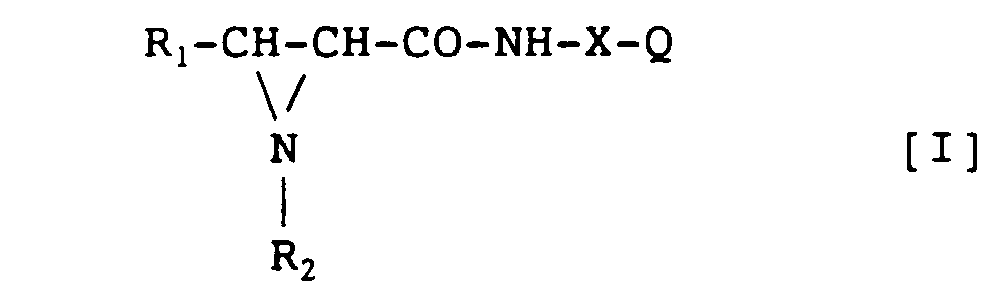
- A compound or a salt thereof according to claim 1, wherein the salt is a pharmaceutically acceptable salt.
- The compound according to claim 1, wherein Q is a group of the partial structural formula: -CO-N(R3)(R4) wherein R3 and R4 are independently hydrogen, an optionally substituted hydrocarbon residue or an optionally substituted heterocyclic group; or R3 and R4 are combined with the adjacent nitrogen atom to represent an optionally substituted heterocyclic group.
- The compound according to claim 3, wherein R3 and R4 are independently hydrogen or an optionally substituted hydrocarbon residue; or R3 and R4 are combined with the adjacent nitrogen atom to represent an optionally substituted heterocyclic group.
- The compound according to claim 1, wherein R1 is an optionally esterified carboxyl group.
- The compound according to claim 1, wherein R2 is hydrogen or an acyl group.
- The compound according to claim 1, wherein R2 is hydrogen.
- The compound according to claim 3, wherein the partial structural formula: -NH-X-CO- is an α-amino acid residue.
- The compound according to claim 8, wherein the α-amino acid residue is of L-configuration.
- The compound according to claim 8, wherein the α-amino acid residue is an aromatic amino acid residue.
- The compound according to claim 3, wherein either R3 or R4 is hydrogen and the other is an optionally substituted hydrocarbon residue.
- The compound according to claim 11, wherein the hydrocarbon residue is an alkyl group.
- The compound according to claim 11, wherein the hydrocarbon residue is an aralkyl group.
- The compound according to claim 3, wherein R3 and R4 are combined with the adjacent nitrogen atom to represent an optionally substituted heterocyclic group.
- The compound according to claim 14, wherein the heterocyclic group is a 6-membered heterocyclic group.
- The compound according to claim 1, wherein the compound is N-[N-[(2S,3S)-3-ethoxycarbonylaziridine-2-carbonyl]-L-phenylalanyl]-2-phenylethylamine.
- The compound according to claim 1, wherein the compound is N-[N-[(2S,3S)-3-ethoxycarbonylaziridine-2-carbonyl]-L-phenylalanyl]isopentylamine.
- The compound according to claim 1, wherein the compound is N-[N-[(2S,3S)-3-ethoxycarbonylaziridine-2-carbonyl]-L-phenylalanyl]-3-methoxypropylamine.
- The compound according to claim 1, wherein the compound is N-[N-[(2S,3S)-3-ethoxycarbonylaziridine-2-carbonyl]-L-phenylalanyl]-N-methyl-2-phenylethylamine.
- A composition for inhibition of a thiol protease, which comprises a compound or a salt thereof as claimed in claim 1.
- A pharmaceutical composition for preventing or treating a bone disease, which comprises a compound or a pharmaceutical acceptable salt thereof as claimed in claim 2.
- The pharmaceutical composition according to claim 21, wherein the bone disease is osteoporosis.
- Use of a compound according to claim 1, for the manufacture of a medicament for inhibition of a thiol protease.
- Use of a compound according to claim 1, for the manufacture of a medicament for preventing or treating a bone disease.
- The use according to claim 24, wherein the bone disease is osteoporosis.
- The compound according to claim 1, wherein Q is a carboxyl group.
Applications Claiming Priority (7)
| Application Number | Priority Date | Filing Date | Title |
|---|---|---|---|
| JP7462194 | 1994-04-13 | ||
| JP74621/94 | 1994-04-13 | ||
| JP7462194 | 1994-04-13 | ||
| JP269175/94 | 1994-11-01 | ||
| JP26917594 | 1994-11-01 | ||
| JP26917594 | 1994-11-01 | ||
| PCT/JP1995/000718 WO1995028416A1 (en) | 1994-04-13 | 1995-04-12 | Aziridine derivatives, their production and use |
Publications (2)
| Publication Number | Publication Date |
|---|---|
| EP0753003A1 EP0753003A1 (en) | 1997-01-15 |
| EP0753003B1 true EP0753003B1 (en) | 1999-06-16 |
Family
ID=26415785
Family Applications (1)
| Application Number | Title | Priority Date | Filing Date |
|---|---|---|---|
| EP95915310A Expired - Lifetime EP0753003B1 (en) | 1994-04-13 | 1995-04-12 | Aziridine derivatives, their production and use |
Country Status (7)
| Country | Link |
|---|---|
| US (1) | US5668128A (en) |
| EP (1) | EP0753003B1 (en) |
| AT (1) | ATE181333T1 (en) |
| AU (1) | AU2223595A (en) |
| CA (1) | CA2187451A1 (en) |
| DE (1) | DE69510338T2 (en) |
| WO (1) | WO1995028416A1 (en) |
Cited By (2)
| Publication number | Priority date | Publication date | Assignee | Title |
|---|---|---|---|---|
| US7067148B2 (en) | 2001-02-15 | 2006-06-27 | King Pharmaceutical Research & Development, Inc. | Stabilized pharmaceutical and thyroid hormone compositions and method of preparation |
| US7101569B2 (en) | 2001-08-14 | 2006-09-05 | Franz G Andrew | Methods of administering levothyroxine pharmaceutical compositions |
Families Citing this family (15)
| Publication number | Priority date | Publication date | Assignee | Title |
|---|---|---|---|---|
| CA2209109A1 (en) * | 1995-10-30 | 1997-05-09 | Thomas Joseph . Carr | Method of inhibiting cathepsin k |
| CZ132798A3 (en) * | 1995-10-30 | 1999-02-17 | Smithkline Beecham Corporation | Protease inhibitors |
| US6586466B2 (en) | 1995-10-30 | 2003-07-01 | Smithkline Beecham Corporation | Carbohydrazide-protease inhibitors |
| JP2000517319A (en) * | 1996-08-28 | 2000-12-26 | スミスクライン・ビーチャム・コーポレイション | Inhibitors of cysteine protease |
| US20030144175A1 (en) * | 1998-12-23 | 2003-07-31 | Smithkline Beecham Corporation | Protease inhibitors |
| US20030044399A1 (en) * | 1998-12-23 | 2003-03-06 | Smithkline Beecham Corporation | Method of treatment |
| WO2000061785A2 (en) * | 1999-04-14 | 2000-10-19 | Smithkline Beecham Corporation | Polynucleotide and polypeptide sequences of monkey cathepsin k |
| EP1229914A4 (en) | 1999-11-10 | 2004-06-23 | Smithkline Beecham Corp | Protease inhibitors |
| US6583137B1 (en) | 1999-11-10 | 2003-06-24 | Smithkline Beecham Corporation | Protease inhibitors |
| US6596715B1 (en) | 1999-11-10 | 2003-07-22 | Smithkline Beecham Corporation | Protease inhibitors |
| AU4344101A (en) * | 2000-03-21 | 2001-10-03 | Smithkline Beecham Corp | Protease inhibitors |
| US20040038965A1 (en) * | 2001-10-09 | 2004-02-26 | Marquis, Jr. Robert W. | Protease inhibitors |
| US7008979B2 (en) | 2002-04-30 | 2006-03-07 | Hydromer, Inc. | Coating composition for multiple hydrophilic applications |
| DE102005024040A1 (en) * | 2005-05-25 | 2006-12-14 | Rovi Gmbh & Co. Kosmetische Rohstoffe Kg | Cosmetic or therapeutic combination preparation with theanine |
| EP4140542A1 (en) * | 2021-08-24 | 2023-03-01 | Centre National De La Recherche Scientifique (Cnrs) | New vashs inhibitors, conjugates thereof and their uses as drugs or as research tools |
Family Cites Families (3)
| Publication number | Priority date | Publication date | Assignee | Title |
|---|---|---|---|---|
| JPS55153778A (en) * | 1979-05-17 | 1980-11-29 | Taisho Pharmaceut Co Ltd | Epoxysuccinylamino acid derivative |
| EP0269311A3 (en) * | 1986-11-17 | 1990-06-06 | Merck & Co. Inc. | Methods of treating bone diseases by administration of a cysteine proteinase inhibitor |
| DE4142958A1 (en) * | 1991-12-24 | 1993-07-01 | Univ Halle Wittenberg | New inhibitors of proline-specific and other enzymes - used in diagnosis and in therapy as cytostatics, immunosuppressives or antitumoral agents, and for treating viral infection including HIV |
-
1995
- 1995-04-12 US US08/513,896 patent/US5668128A/en not_active Expired - Fee Related
- 1995-04-12 WO PCT/JP1995/000718 patent/WO1995028416A1/en not_active Ceased
- 1995-04-12 CA CA002187451A patent/CA2187451A1/en not_active Abandoned
- 1995-04-12 DE DE69510338T patent/DE69510338T2/en not_active Expired - Fee Related
- 1995-04-12 AT AT95915310T patent/ATE181333T1/en not_active IP Right Cessation
- 1995-04-12 AU AU22235/95A patent/AU2223595A/en not_active Abandoned
- 1995-04-12 EP EP95915310A patent/EP0753003B1/en not_active Expired - Lifetime
Cited By (2)
| Publication number | Priority date | Publication date | Assignee | Title |
|---|---|---|---|---|
| US7067148B2 (en) | 2001-02-15 | 2006-06-27 | King Pharmaceutical Research & Development, Inc. | Stabilized pharmaceutical and thyroid hormone compositions and method of preparation |
| US7101569B2 (en) | 2001-08-14 | 2006-09-05 | Franz G Andrew | Methods of administering levothyroxine pharmaceutical compositions |
Also Published As
| Publication number | Publication date |
|---|---|
| ATE181333T1 (en) | 1999-07-15 |
| DE69510338T2 (en) | 1999-10-14 |
| AU2223595A (en) | 1995-11-10 |
| CA2187451A1 (en) | 1995-10-26 |
| US5668128A (en) | 1997-09-16 |
| WO1995028416A1 (en) | 1995-10-26 |
| DE69510338D1 (en) | 1999-07-22 |
| EP0753003A1 (en) | 1997-01-15 |
Similar Documents
| Publication | Publication Date | Title |
|---|---|---|
| US5668128A (en) | Aziridine derivatives, their production and use | |
| RU2164229C2 (en) | Antiviral substrate isoster esters of aspartate protease or their salts, method of their synthesis, pharmaceutical preparation and composition | |
| ES2336562T3 (en) | REPLACED HETEROCICLES. | |
| EP0264106B1 (en) | 5-Substituted amino-4-hydroxy-pentanoic acid derivatives and their use | |
| HUT72966A (en) | Inhibitors of farnesyl-protein transferase | |
| US6194383B1 (en) | Lipopeptides from actinoplanes sp. with pharmacological action, process for their production and the use thereof | |
| US4816560A (en) | Partially retro-inverted tuftsin analogues, method for the preparation thereof and pharmaceutical compositions containing them | |
| WO2004084812A2 (en) | Tamandarin analogs and fragments thereof and methods of making and using | |
| US5679708A (en) | Epoxysuccinic acid derivatives, their production and use | |
| US5556853A (en) | Epoxysuccinic acid derivatives | |
| JP5653900B2 (en) | Highly cross-linked peptide from Actinomadura namibiensis | |
| KR0125117B1 (en) | Novel hiv protease inhibitors with anti aids effect and the process for preparation thereof | |
| US4742047A (en) | Semi-synthetic peptide antibiotics | |
| EP0822260B1 (en) | Substance fa-70d, process for producing the same, and uses thereof | |
| US5478809A (en) | TAN-1511, its derivatives, production and use thereof | |
| JPH08104683A (en) | Epoxy succinic acid derivative | |
| JPH08183767A (en) | Aziridine carboxylic acid derivative | |
| CZ54194A3 (en) | Derivatives of acylhexanoic acid, process of their preparation, pharmaceutical preparations in which they are comprised and their pharmaceutical use | |
| JPH08104684A (en) | Epoxy succinic acid-related compound | |
| US4789731A (en) | Semi-synthetic peptide antibiotics | |
| IE832491L (en) | Sparsomycin (sc-rs) derivatives. | |
| JPH10182648A (en) | TAN-2474-related compounds, their production and use | |
| JPH10287679A (en) | TAN-2483-related compounds, their production and use | |
| JPH07145084A (en) | TAN-1511 related compound | |
| GB2282602A (en) | 2,3-Epoxysuccinamoyl-2,3-diaminopropanoic acid derivatives as antimicrobial peptides |
Legal Events
| Date | Code | Title | Description |
|---|---|---|---|
| PUAI | Public reference made under article 153(3) epc to a published international application that has entered the european phase |
Free format text: ORIGINAL CODE: 0009012 |
|
| 17P | Request for examination filed |
Effective date: 19961016 |
|
| AK | Designated contracting states |
Kind code of ref document: A1 Designated state(s): AT BE CH DE DK ES FR GB GR IE IT LI LU MC NL PT SE |
|
| 17Q | First examination report despatched |
Effective date: 19970805 |
|
| GRAG | Despatch of communication of intention to grant |
Free format text: ORIGINAL CODE: EPIDOS AGRA |
|
| GRAG | Despatch of communication of intention to grant |
Free format text: ORIGINAL CODE: EPIDOS AGRA |
|
| GRAH | Despatch of communication of intention to grant a patent |
Free format text: ORIGINAL CODE: EPIDOS IGRA |
|
| GRAH | Despatch of communication of intention to grant a patent |
Free format text: ORIGINAL CODE: EPIDOS IGRA |
|
| GRAH | Despatch of communication of intention to grant a patent |
Free format text: ORIGINAL CODE: EPIDOS IGRA |
|
| GRAA | (expected) grant |
Free format text: ORIGINAL CODE: 0009210 |
|
| AK | Designated contracting states |
Kind code of ref document: B1 Designated state(s): AT BE CH DE DK ES FR GB GR IE IT LI LU MC NL PT SE |
|
| PG25 | Lapsed in a contracting state [announced via postgrant information from national office to epo] |
Ref country code: SE Free format text: THE PATENT HAS BEEN ANNULLED BY A DECISION OF A NATIONAL AUTHORITY Effective date: 19990616 Ref country code: NL Free format text: LAPSE BECAUSE OF FAILURE TO SUBMIT A TRANSLATION OF THE DESCRIPTION OR TO PAY THE FEE WITHIN THE PRESCRIBED TIME-LIMIT Effective date: 19990616 Ref country code: GR Free format text: LAPSE BECAUSE OF NON-PAYMENT OF DUE FEES Effective date: 19990616 Ref country code: ES Free format text: THE PATENT HAS BEEN ANNULLED BY A DECISION OF A NATIONAL AUTHORITY Effective date: 19990616 Ref country code: BE Free format text: LAPSE BECAUSE OF FAILURE TO SUBMIT A TRANSLATION OF THE DESCRIPTION OR TO PAY THE FEE WITHIN THE PRESCRIBED TIME-LIMIT Effective date: 19990616 Ref country code: AT Free format text: LAPSE BECAUSE OF FAILURE TO SUBMIT A TRANSLATION OF THE DESCRIPTION OR TO PAY THE FEE WITHIN THE PRESCRIBED TIME-LIMIT Effective date: 19990616 |
|
| REF | Corresponds to: |
Ref document number: 181333 Country of ref document: AT Date of ref document: 19990715 Kind code of ref document: T |
|
| REG | Reference to a national code |
Ref country code: CH Ref legal event code: NV Representative=s name: A. BRAUN, BRAUN, HERITIER, ESCHMANN AG PATENTANWAE Ref country code: CH Ref legal event code: EP |
|
| ET | Fr: translation filed | ||
| REF | Corresponds to: |
Ref document number: 69510338 Country of ref document: DE Date of ref document: 19990722 |
|
| REG | Reference to a national code |
Ref country code: IE Ref legal event code: FG4D |
|
| PG25 | Lapsed in a contracting state [announced via postgrant information from national office to epo] |
Ref country code: PT Free format text: LAPSE BECAUSE OF FAILURE TO SUBMIT A TRANSLATION OF THE DESCRIPTION OR TO PAY THE FEE WITHIN THE PRESCRIBED TIME-LIMIT Effective date: 19990916 Ref country code: DK Free format text: LAPSE BECAUSE OF FAILURE TO SUBMIT A TRANSLATION OF THE DESCRIPTION OR TO PAY THE FEE WITHIN THE PRESCRIBED TIME-LIMIT Effective date: 19990916 |
|
| NLV1 | Nl: lapsed or annulled due to failure to fulfill the requirements of art. 29p and 29m of the patents act | ||
| PG25 | Lapsed in a contracting state [announced via postgrant information from national office to epo] |
Ref country code: LU Free format text: LAPSE BECAUSE OF NON-PAYMENT OF DUE FEES Effective date: 20000412 Ref country code: IE Free format text: LAPSE BECAUSE OF NON-PAYMENT OF DUE FEES Effective date: 20000412 |
|
| PLBE | No opposition filed within time limit |
Free format text: ORIGINAL CODE: 0009261 |
|
| STAA | Information on the status of an ep patent application or granted ep patent |
Free format text: STATUS: NO OPPOSITION FILED WITHIN TIME LIMIT |
|
| 26N | No opposition filed | ||
| PG25 | Lapsed in a contracting state [announced via postgrant information from national office to epo] |
Ref country code: MC Free format text: LAPSE BECAUSE OF NON-PAYMENT OF DUE FEES Effective date: 20001031 |
|
| REG | Reference to a national code |
Ref country code: IE Ref legal event code: MM4A |
|
| PGFP | Annual fee paid to national office [announced via postgrant information from national office to epo] |
Ref country code: DE Payment date: 20010330 Year of fee payment: 7 |
|
| PGFP | Annual fee paid to national office [announced via postgrant information from national office to epo] |
Ref country code: FR Payment date: 20010409 Year of fee payment: 7 |
|
| PGFP | Annual fee paid to national office [announced via postgrant information from national office to epo] |
Ref country code: GB Payment date: 20010411 Year of fee payment: 7 |
|
| PGFP | Annual fee paid to national office [announced via postgrant information from national office to epo] |
Ref country code: CH Payment date: 20010412 Year of fee payment: 7 |
|
| REG | Reference to a national code |
Ref country code: GB Ref legal event code: IF02 |
|
| PG25 | Lapsed in a contracting state [announced via postgrant information from national office to epo] |
Ref country code: GB Free format text: LAPSE BECAUSE OF NON-PAYMENT OF DUE FEES Effective date: 20020412 |
|
| PG25 | Lapsed in a contracting state [announced via postgrant information from national office to epo] |
Ref country code: LI Free format text: LAPSE BECAUSE OF NON-PAYMENT OF DUE FEES Effective date: 20020430 Ref country code: CH Free format text: LAPSE BECAUSE OF NON-PAYMENT OF DUE FEES Effective date: 20020430 |
|
| PG25 | Lapsed in a contracting state [announced via postgrant information from national office to epo] |
Ref country code: DE Free format text: LAPSE BECAUSE OF NON-PAYMENT OF DUE FEES Effective date: 20021101 |
|
| GBPC | Gb: european patent ceased through non-payment of renewal fee |
Effective date: 20020412 |
|
| REG | Reference to a national code |
Ref country code: CH Ref legal event code: PL |
|
| PG25 | Lapsed in a contracting state [announced via postgrant information from national office to epo] |
Ref country code: FR Free format text: LAPSE BECAUSE OF NON-PAYMENT OF DUE FEES Effective date: 20021231 |
|
| REG | Reference to a national code |
Ref country code: FR Ref legal event code: ST |
|
| PG25 | Lapsed in a contracting state [announced via postgrant information from national office to epo] |
Ref country code: IT Free format text: LAPSE BECAUSE OF NON-PAYMENT OF DUE FEES;WARNING: LAPSES OF ITALIAN PATENTS WITH EFFECTIVE DATE BEFORE 2007 MAY HAVE OCCURRED AT ANY TIME BEFORE 2007. THE CORRECT EFFECTIVE DATE MAY BE DIFFERENT FROM THE ONE RECORDED. Effective date: 20050412 |