EP0748255B1 - Copper catalysts - Google Patents
Copper catalysts Download PDFInfo
- Publication number
- EP0748255B1 EP0748255B1 EP95909862A EP95909862A EP0748255B1 EP 0748255 B1 EP0748255 B1 EP 0748255B1 EP 95909862 A EP95909862 A EP 95909862A EP 95909862 A EP95909862 A EP 95909862A EP 0748255 B1 EP0748255 B1 EP 0748255B1
- Authority
- EP
- European Patent Office
- Prior art keywords
- catalyst
- oxygen
- bed
- carbon dioxide
- temperature
- Prior art date
- Legal status (The legal status is an assumption and is not a legal conclusion. Google has not performed a legal analysis and makes no representation as to the accuracy of the status listed.)
- Expired - Lifetime
Links
Images
Classifications
-
- B—PERFORMING OPERATIONS; TRANSPORTING
- B01—PHYSICAL OR CHEMICAL PROCESSES OR APPARATUS IN GENERAL
- B01J—CHEMICAL OR PHYSICAL PROCESSES, e.g. CATALYSIS OR COLLOID CHEMISTRY; THEIR RELEVANT APPARATUS
- B01J33/00—Protection of catalysts, e.g. by coating
-
- B—PERFORMING OPERATIONS; TRANSPORTING
- B01—PHYSICAL OR CHEMICAL PROCESSES OR APPARATUS IN GENERAL
- B01J—CHEMICAL OR PHYSICAL PROCESSES, e.g. CATALYSIS OR COLLOID CHEMISTRY; THEIR RELEVANT APPARATUS
- B01J23/00—Catalysts comprising metals or metal oxides or hydroxides, not provided for in group B01J21/00
- B01J23/70—Catalysts comprising metals or metal oxides or hydroxides, not provided for in group B01J21/00 of the iron group metals or copper
- B01J23/72—Copper
-
- B—PERFORMING OPERATIONS; TRANSPORTING
- B01—PHYSICAL OR CHEMICAL PROCESSES OR APPARATUS IN GENERAL
- B01J—CHEMICAL OR PHYSICAL PROCESSES, e.g. CATALYSIS OR COLLOID CHEMISTRY; THEIR RELEVANT APPARATUS
- B01J23/00—Catalysts comprising metals or metal oxides or hydroxides, not provided for in group B01J21/00
- B01J23/70—Catalysts comprising metals or metal oxides or hydroxides, not provided for in group B01J21/00 of the iron group metals or copper
- B01J23/76—Catalysts comprising metals or metal oxides or hydroxides, not provided for in group B01J21/00 of the iron group metals or copper combined with metals, oxides or hydroxides provided for in groups B01J23/02 - B01J23/36
- B01J23/80—Catalysts comprising metals or metal oxides or hydroxides, not provided for in group B01J21/00 of the iron group metals or copper combined with metals, oxides or hydroxides provided for in groups B01J23/02 - B01J23/36 with zinc, cadmium or mercury
-
- C—CHEMISTRY; METALLURGY
- C23—COATING METALLIC MATERIAL; COATING MATERIAL WITH METALLIC MATERIAL; CHEMICAL SURFACE TREATMENT; DIFFUSION TREATMENT OF METALLIC MATERIAL; COATING BY VACUUM EVAPORATION, BY SPUTTERING, BY ION IMPLANTATION OR BY CHEMICAL VAPOUR DEPOSITION, IN GENERAL; INHIBITING CORROSION OF METALLIC MATERIAL OR INCRUSTATION IN GENERAL
- C23C—COATING METALLIC MATERIAL; COATING MATERIAL WITH METALLIC MATERIAL; SURFACE TREATMENT OF METALLIC MATERIAL BY DIFFUSION INTO THE SURFACE, BY CHEMICAL CONVERSION OR SUBSTITUTION; COATING BY VACUUM EVAPORATION, BY SPUTTERING, BY ION IMPLANTATION OR BY CHEMICAL VAPOUR DEPOSITION, IN GENERAL
- C23C8/00—Solid state diffusion of only non-metal elements into metallic material surfaces; Chemical surface treatment of metallic material by reaction of the surface with a reactive gas, leaving reaction products of surface material in the coating, e.g. conversion coatings, passivation of metals
- C23C8/06—Solid state diffusion of only non-metal elements into metallic material surfaces; Chemical surface treatment of metallic material by reaction of the surface with a reactive gas, leaving reaction products of surface material in the coating, e.g. conversion coatings, passivation of metals using gases
- C23C8/08—Solid state diffusion of only non-metal elements into metallic material surfaces; Chemical surface treatment of metallic material by reaction of the surface with a reactive gas, leaving reaction products of surface material in the coating, e.g. conversion coatings, passivation of metals using gases only one element being applied
- C23C8/10—Oxidising
- C23C8/16—Oxidising using oxygen-containing compounds, e.g. water, carbon dioxide
Definitions
- Copper catalysts are widely employed in reactions involving hydrogen. Thus they are employed for hydrogenations, including the hydrogenation of carbon oxides to organic oxygen-containing compounds, such as alcohols, e.g. methanol, and for the shift reaction where carbon monoxide is reacted with steam to form carbon dioxide and hydrogen. They may also be used for the reverse of the shift reaction.
- Such copper catalysts usually have the copper in finely dispersed form, and usually incorporate a support or stabiliser such as silica, alumina, chromia, magnesia, and/or zinc oxide to maintain the copper in that finely dispersed form.
- the catalysts are often supplied as oxidic precursors which require reduction, e.g. with hydrogen, to the active state. This reduction step is often relatively lengthy and consumes a considerable amount of reducing gas, e.g. hydrogen, which in some cases has to be imported to effect the reduction. It is not normally possible to supply copper catalysts in the reduced state as such reduced catalysts tend to be pyrophoric and so present handling difficulties.
- the passivation is effected with carbon dioxide as well as oxygen, e.g. air.
- oxygen e.g. air.
- an oxidic copper catalyst precursor can be reduced by passing a stream of inert gas over the catalyst to heat the precursor to 350-375°F (177-191°C) and then introducing hydrogen to effect the reduction.
- passivation can be effected by purging the hydrogen with inert gas, cooling to 100°F (38°C) and then introducing the small concentration of oxygen as aforesaid.
- carbon dioxide is listed as a possible inert gas for the reduction step, the only inert gas mentioned in the context of the passivation stage is nitrogen: there is no appreciation that the presence of carbon dioxide in the passivation step is advantageous.
- the present invention provides a process for the stabilisation of a reduced copper catalyst comprising a) passivating the catalyst by passing a passivating gas stream that is free of reducing gases and which contains 0.05 to 0.5% by volume of oxygen and an amount of carbon dioxide at least twice the amount of oxygen through a bed of the catalyst until the catalyst is passivated, the proportion of oxygen in said passivating gas stream and the temperature at which said passivating gas stream is fed to the bed being such that the temperature of the catalyst does not rise to above 100°C during said passivation step, and then b) increasing the oxygen content of the gas passing through the bed until the oxygen partial pressure corresponds to that of air at atmospheric pressure.
- the catalyst temperature is above 50°C
- the catalyst is preferably cooled to below 50°C before increasing the oxygen partial pressure to that of air at atmospheric pressure.
- the reduced catalyst to which the passivation process of the invention may be obtained by reduction of a precursor in which the copper is present as a reducible compound, such as copper oxide, copper hydroxide, copper carbonate, and basic copper carbonates.
- a precursor in which the copper is present as a reducible compound such as copper oxide, copper hydroxide, copper carbonate, and basic copper carbonates.
- Such precursors may be obtained by dry mixing the copper compound, usually in finely divided form, with any other desired ingredients of the precursor such as zinc, chromium, zirconium, magnesium, silicon and/or aluminium compounds or by a precipitation route where the copper compound is obtained by precipitation from a copper salt solution with a suitable basic compound, such as sodium carbonate and/or hydroxide.
- ingredients as aforesaid may be co-precipitated with the copper compound or sequentially precipitated, before or after the copper compound, or added to a slurry of the precipitated copper compound.
- the precursor is calcined to convert the copper compound, and any readily decomposible compounds of other ingredients to the corresponding oxides.
- the composition is often formed into pellets or granules before or after any calcination step. In some cases it may be desirable to form the composition into such granules or pellets after reduction of the copper compound.
- the precursor may be made by impregnating a support, such as alumina, zirconia, magnesia, and/or silica with a solution of a copper compound, such as copper nitrate, and optionally compounds of other metals. followed by heating to decompose the copper compound to the oxide.
- a support such as alumina, zirconia, magnesia, and/or silica
- a copper compound such as copper nitrate
- optionally compounds of other metals optionally compounds of other metals.
- the reduced catalyst preferably contains 5-95%, particularly 10-80%, by weight of copper.
- an exotherm typically of up to about 50°C, may pass rapidly through the bed upon contacting the catalyst with carbon dioxide.
- This latter exotherm is generally not observed when a catalyst that has been used for a reaction involving, or producing, carbon dioxide, e.g. methanol synthesis or the shift, or reverse shift, reaction, is contacted with a carbon dioxide gas during the passivation process.
- a catalyst that has not previously been contacted with carbon dioxide e.g. in the preparation of a freshly reduced and passivated catalyst, is simultaneously contacted with carbon dioxide and oxygen, a double or combined exotherm may be observed.
- an initial exotherm corresponding to reaction with carbon dioxide may pass rapidly through the bed and an exotherm, hereinafter termed the oxidation exotherm, corresponding to the aforesaid 10-15°C per 0.1% oxygen in the gas stream may be observed passing more slowly through the bed.
- Passivation is complete when the exotherm corresponding to the reaction with oxygen has passed right through the bed, i.e. when the temperature at the outlet end of the bed has reached its peak and started to fall as a result of the cooling effect of the continued supply of gas. In contrast to previous passivation techniques, it is not necessary to gradually increase the oxygen content to effect passivation.
- the partial pressure of oxygen in the gas can be increased up to a level corresponding to that of air at atmospheric pressure. It will be appreciated that if the passivation is effected at elevated pressure, it is possible to effect this simply by introducing air and reducing the pressure to atmospheric pressure.
- the maximum temperature of the catalyst may be as high as 100°C, but is preferably less than 90°C, and in particular less than 60°C.
- the maximum catalyst temperature employed will to some extent be determined on the application envisaged. Thus whereas relatively high temperatures, e.g. 80-90°C, may be acceptable where a used catalyst is being passivated prior to discharge and disposal. lower maximum temperatures, e.g. less than 60°C, are desirable where the passivation is being effected on freshly reduced catalyst prior to supply to a customer. It is however permissible to allow the catalyst to be subject to temperatures above the aforesaid maximum before contact with the oxygen-containing gas.
- One advantage of the application of the passivation process of the invention to fresh catalyst for supply to a customer is the ease with which the reduced, but passivated, catalyst can be re-reduced and converted to the active state. Reduction can be effected at much lower temperatures than are required for the reduction of oxidic catalyst precursors, and indeed in some processes a step of re-reduction may not be necessary: thus, where the catalyst is to be used in a reaction wherein the reactants fed to the catalyst contain a reducing gas such as hydrogen or carbon monoxide. the passivated catalyst may be charged to the plant reactor, which is then purged of air with an inert gas. Upon switching to the desired reactants and heating to the desired reaction temperature, or vice versa, the necessary re-reduction will occur.
- a reducing gas such as hydrogen or carbon monoxide
- a further advantage results from the use of pre-reduced and passivated catalysts.
- a considerable volume reduction generally occurs upon reduction of oxidic precursors.
- By pre-reducing and passivating the catalyst it is possible to charge a greater amount of active copper catalyst to a reactor of a given size than if, as is normally the procedure, an oxidic catalyst precursor is charged to the reactor in which it is to be used and reduced in situ. In the latter case, shrinkage of the precursor upon reduction gives rise to an increase in the space at the top of the reactor so that the reactor volume is not fully utilised.
- the use of a greater amount of active copper enables the throughput of a given reactor to be increased.
- the oxygen concentration that is employed for the passivation is in the range 0.05 to 0.5% by volume. As indicated above, the magnitude of the oxidation exotherm is typically 10-15°C for each 0.1% by volume of oxygen in the gas. Hence, in order to keep the maximum catalyst temperature to an acceptable value, the maximum oxygen concentration that may be employed will largely depend upon how low an inlet temperature can be used. It will be appreciated that for a given maximum temperature, an increase in the inlet temperature will result in the need to decrease the oxygen concentration to avoid exceeding that given maximum temperature with the result that the passivation step will take longer. Thus if the inlet temperature is 25°C, to avoid a maximum temperature above about 60°C, the oxygen concentration should be below about 0.25% by volume.
- the inlet gas temperature is 15°C and a maximum temperature of 90°C can be tolerated, an oxygen concentration as high as 0.5% by volume may be employed. If the inlet temperature is too low, the initial rate of reaction may be low and so it is preferred that the inlet temperature is at least 10°C.
- the passivation is effected as a result of the formation of a very thin copper carbonate, possibly cuprous carbonate, layer on the copper surface of the catalyst: calculations based upon the amount of oxygen employed and the copper surface area of the catalyst in a typical passivation, show that it is probable that only the first few, e.g. 2, layers of copper atoms at the catalyst surface react to form the copper carbonate. As a result the bulk of the copper remains in the reduced state. It further appears that, at least at temperatures up to about 50°C, on exposure to air no further, or bulk, oxidation of the copper takes place. In contrast, with copper catalysts passivated with oxygen in the absence of carbon dioxide, the outer layers of the copper surface are converted to copper oxide.
- the present invention also provides a passivated copper catalyst having a thin copper carbonate layer on the copper surface and which does not exhibit substantial oxidation when heated in air from 20°C at a rate of 10°C per minute until the temperature has reached at least 100°C.
- the presence of the copper carbonate layer is generally not detectable by techniques such as X-ray diffraction spectroscopy but can be observed by X-ray photoelectron spectroscopy (XPS) or by infra-red spectroscopy.
- XPS X-ray photoelectron spectroscopy
- the gas used for passivation should contain at least twice as much carbon dioxide as oxygen.
- air which contains only about 0.03% by volume of carbon dioxide, gives rise to copper oxide surface layers rather than a copper carbonate layer.
- the proportion of carbon dioxide should be such that the formation of the copper carbonate surface layer is favoured rather than diffusion of oxygen adsorbed on the copper surface into the bulk of the copper with consequent bulk oxidation of the latter. Therefore it is preferred that the proportion of carbon dioxide in the passivating gas is much greater than the oxygen concentration and preferably is at least 5% by volume, particularly at least 10% by volume.
- the passivating gas has a carbon dioxide partial pressure of approximately 0.3 bar abs, or more.
- the passivation may be effected using a passivating gas consisting essentially of carbon dioxide and a small proportion of oxygen or air, or of an inert gas admixed with carbon dioxide and a small proportion of oxygen or air.
- Suitable inert gases include nitrogen, helium, and argon. While hydrocarbon gases such as methane are here inert, their use is less preferable from safety considerations.
- the passivation may be effected at atmospheric pressure (in which case it is preferred to use a mixture consisting essentially of carbon dioxide and the small amount of oxygen or air as the passivating gas) or at elevated pressure.
- the upper pressure limit is determined by the proportion of carbon dioxide present: thus liquefaction of the carbon dioxide should be avoided.
- the pressure employed will be in the range 1-20 bar abs.
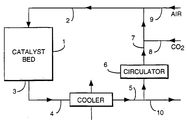
- the catalyst to be passivated is situated as a bed 1 in a vessel provided with ports for the flow of passivating gas from line 2, through the bed, and out via line 3.
- a cooler 4 is provided to cool the gas in line 3 giving a cooled gas which is fed, via line 5, to the inlet of a circulator 6.
- the gas leaves circulator 6 via line 7.
- the gas from line 7, together with any carbon dioxide and air added via lines 8 and 9 forms the gas fed to the catalyst bed via line 2.
- a vent or purge line 10 is provided to enable the pressure in the system to be controlled.
- an inert gas e.g. nitrogen
- an inert gas e.g. nitrogen
- Cooler 4 ensures that the temperature of the circulating gas entering the circulator is kept at a suitable low temperature, e.g. 15-25°C.
- the temperature of the gas leaving the circulator 4 will depend on the amount of compression that has to be performed by the circulator to maintain the flow at the desired rate. If the temperature rise across the circulator is large it may be desirable to provide for a cooler in the circulator delivery line, e.g. in line 7 or in line 2 as well as, or instead of, the cooler in line 3.
- the temperature at which the gas is fed to the catalyst bed via line 2 is less than 40°C.
- the pressure in the loop at this stage is about 5 bar abs.
- Carbon dioxide under pressure is then introduced into the loop via line 8 until the pressure in the loop has risen to about 7 bar abs: the circulating gas is thus about 70% by volume inert gas and 30% by volume carbon dioxide. If the catalyst is one that is freshly reduced, i.e. has not been used for reactions involving or producing carbon dioxide, an exotherm will generally be observed to pass rapidly through the bed.
- oxygen or air
- line 9 oxygen, or air
- line 9 oxygen, or air
- gas is then introduced via line 9 at a controlled rate so that the gas flowing through line 2 has an oxygen content typically in the range 0.1 to 0.3% by volume.
- Gas is vented as necessary through purge line 10 to maintain the pressure approximately constant.
- the gas entering the catalyst bed 1 from line 2 effects passivation of the catalyst in the inlet region of the bed, consuming the oxygen (and a little of the carbon dioxide): the region where passivation is occurring moves through the bed as the inlet region becomes fully passivated.
- the passivation reaction is exothermic and so causes the temperature of the catalyst to rise locally. However the passivated catalyst is then cooled by the incoming cool gas.
- thermocouples disposed in the bed it is possible to follow the course of the passivation by observing the progression of the oxidation exotherm through the bed. While passivation is occurring, the gas leaving bed 1 via line 3 will contain essentially no oxygen. When passivation is complete, not only will the oxidation exotherm have reached the end of the bed and the temperature of the outlet region of the bed started to fall from the peak temperature achieved, but also, by the use of suitable monitoring equipment, oxygen can be detected in the gas leaving the bed via line 3.
- the supply of oxygen or air via line 9 can then be increased until the oxygen partial pressure of the gas in the loop reaches about 0.2 bar abs, i.e. essentially that of air at atmospheric pressure. This increase in the supply of air may be accompanied by purging gas from the loop, via line 10, with or without decrease of the loop pressure.
- the sharpness of the oxidation exotherm i.e. local heating in the catalyst bed, will depend on the oxygen concentration of the gas used for the passivation and also on the flow rate.
- the flow rate is such that the space velocity of the gas (expressed at STP) flowing through the bed is in the range 300-2500. particularly 800-1600, h -1 .
- a pelleted copper oxide/zinc oxide/alumina methanol synthesis catalyst precursor containing about 60% by weight of copper oxide, was charged to a reactor. Air was purged from the catalyst by a flow of nitrogen at atmospheric pressure and then, while continuing the flow of nitrogen, the temperature was increased to 210°C. The flow of nitrogen was replaced by a flow of helium containing 2% by volume of hydrogen which was passed over the precursor at a space velocity of 850 h -1 . Reduction of the copper oxide in the precursor took place, giving a maximum temperature rise of 20°C. After 17 hours, the hydrogen/helium mixture was replaced by nitrogen and purged for 2 hours to remove any residual hydrogen. The reduced catalyst was then cooled, under the flow of nitrogen, to about 20°C.
- X-ray diffraction spectroscopy of the passivated catalyst failed to detect any copper phases except copper metal, indicating that no significant bulk oxidation had occurred during the passivation. However XPS demonstrated the presence of a surface layer of copper carbonate.
- the passivation procedure outlined above in relation to the drawing was applied to the passivation of a charge of about 40 m 3 of a spent, but still reduced, copper/ zinc oxide/alumina methanol synthesis catalyst from the synthesis reactor of a commercial methanol plant.
- the passivation was effected using a passivation gas comprising about 30% by volume carbon dioxide, 0.1% by volume oxygen, balance nitrogen, at a total pressure of about 7 bar abs. Since the catalyst had been previously used for methanol synthesis from a mixture of hydrogen, carbon monoxide and carbon dioxide, no exotherm was observed upon introducing carbon dioxide into the circulating nitrogen.
- the oxygen was supplied as air.
- the circulator inlet temperature was about 15°C and the circulator exit temperature about 40°C.
- the flow rate corresponded to a space velocity of about 350-400 h -1 .
- the exotherm resulting upon introduction of the air into the nitrogen/carbon dioxide mixture took about 60 minutes to pass from the inlet to the exit of the bed, and after about a further 45 minutes, during which time the oxygen content of the circulating gas was maintained at 0.1% by volume, the temperature of the whole bed fell to the temperature of the inlet gas.
- the air injection rate was increased until the oxygen content of the circulating gas was about 5% by volume, i.e. an oxygen partial pressure well above the partial pressure of oxygen in air at atmospheric pressure, and then the pressure was released and the catalyst discharged from the reactor.
- the discharged catalyst could be safely handled for transportation for disposal or reclaim.
- a catalyst precursor is reduced and then passivated by the passivation procedure outlined above in relation to the drawing.
- the precursor employed was a further sample of the precursor employed in Example 1.
- the precursor was charged to a reactor to form a bed of precursor therein.
- the reactor was then purged of air with nitrogen.
- the precursor was then reduced by passing a mixture of nitrogen and hydrogen. containing 2% by volume of hydrogen, over the precursor with an inlet temperature of 200°C.
- the gas hourly space velocity was 1500 h -1 and the total pressure was 3.9 bar g. Reduction was continued until the temperature throughout the bed was constant and no further water was produced.
- the nitrogen/hydrogen mixture was replaced by nitrogen and the reactor purged of hydrogen.
- the reduced catalyst was then cooled to 40°C.
- Nitrogen was circulated round the loop at 6.0 bar g at such a rate as to give a gas hourly space velocity of 800 h -1 through the bed.
- the bed inlet temperature was 40°C.
- the loop pressure was dropped to 4.0 bar g and carbon dioxide added to increase the pressure back to 6 bar g.
- a temperature rise, to a maximum temperature of 53°C. was observed in the bed and this increased temperature rapidly moved through the bed. In less than 1 hour, the temperature of the bed had returned to 40°C.
- Sufficient air was then injected into the nitrogen/carbon dioxide mixture flowing round the loop to give a concentration of oxygen of 0.2% by volume at the inlet point.
- a catalyst precursor is reduced and then passivated by the passivation procedure outlined above in relation to the drawing, but the temperature during passivation exceeds 100°C.
- the precursor employed was a further sample of the precursor employed in Example 1.
- the precursor was charged to a reactor to form a bed of precursor therein.
- the reactor was then purged of air with nitrogen.
- the precursor was then reduced by passing a mixture of nitrogen and hydrogen, containing 1% by volume of hydrogen, over the precursor with an inlet temperature of 200°C.
- the gas hourly space velocity was 1500 h -1 and the total pressure was 3.9 bar g. Reduction was continued until the temperature throughout the bed was constant and no further water was produced.
- the nitrogen/hydrogen mixture was replaced by nitrogen and the reactor purged of hydrogen.
- the reduced catalyst was then cooled to 98°C.
- Nitrogen was circulated round the loop at 5.0 bar g at such a rate as to give a gas hourly space velocity of 1500 h -1 through the bed.
- the bed inlet temperature was 98°C.
- Carbon dioxide was gradually added to the circulating nitrogen at such a rate that no significant exotherm occurred as the carbon dioxide/nitrogen mixture passed through the bed. Carbon dioxide addition was stopped when the circulating gas contained 20% by volume of carbon dioxide, and then carbon dioxide and nitrogen added as required to maintain the carbon dioxide content at approximately 20% by volume.
- Air was then injected into the nitrogen/carbon dioxide mixture flowing round the loop to give a concentration of oxygen of 0.2% by volume at the inlet point.
- the precursor employed was a further sample of the precursor employed in Example 1.
- the precursor was charged to a reactor to form a bed of precursor therein.
- the reactor was then purged of air with nitrogen.
- the precursor was then reduced by passing a mixture of nitrogen and hydrogen, containing 1% by volume of hydrogen, over the precursor with an inlet temperature of 200°C.
- the gas hourly space velocity was 1500 h -1 and the total pressure was 3.9 bar g. Reduction was continued until the temperature throughout the bed was constant and no further water was produced.
- the nitrogen/hydrogen mixture was replaced by nitrogen and the reactor purged of hydrogen.
- the reduced catalyst was then cooled to 25°C.
- Nitrogen was circulated round the loop at 5.0 bar g at such a rate as to give a gas hourly space velocity of 1500 h -1 through the bed.
- the bed inlet temperature was 25°C.
- Air was then injected into the nitrogen flowing round the loop to give a concentration of oxygen of 0.1% by volume at the inlet point.
- An exotherm developed and moved slowly through the bed over a period of 21 hours. However on passage of the exotherm through the bed, the bed temperature did not return to 25°C, but remained 2-3°C above this level through out the remainder of the experiment.
Landscapes
- Chemical & Material Sciences (AREA)
- Chemical Kinetics & Catalysis (AREA)
- Engineering & Computer Science (AREA)
- Materials Engineering (AREA)
- Organic Chemistry (AREA)
- Mechanical Engineering (AREA)
- Metallurgy (AREA)
- Catalysts (AREA)
- Organic Low-Molecular-Weight Compounds And Preparation Thereof (AREA)
- Low-Molecular Organic Synthesis Reactions Using Catalysts (AREA)
Description
Claims (8)
- A process for the stabilisation of a reduced copper catalyst containing copper and optionally compounds of zinc, chromium, zirconium, magnesium, silicon and/or aluminium, comprising a) passivating the catalyst by passing a passivating gas stream that is free of reducing gases and which contains less than 5% by volume of oxygen through a bed of the catalyst under conditions such that the temperature of the catalyst does not exceed a specified value until the catalyst is passivated, and then b) increasing the oxygen content of the gas passing through the bed until the oxygen partial pressure corresponds to that of air at atmospheric pressure, characterised in that said passivating gas stream contains 0.05 to 0.5% by volume of oxygen and an amount of carbon dioxide at least twice the amount of oxygen, and the proportion of oxygen in said passivating gas stream and the temperature at which said passivating gas stream is fed to the bed being such that the temperature of the catalyst does not rise to above 100°C during said passivation step.
- A process according to claim 1 wherein the catalyst is a charge of a reduced, used, copper catalyst in a reactor and the catalyst is discharged from the reactor after the oxygen content of the gas passing through the bed has been increased until its oxygen partial pressure corresponds to that of air at atmospheric pressure.
- A process according to claim 1 wherein the reduced catalyst has not previously been contacted with carbon dioxide or subjected to a reaction involving or producing carbon dioxide, comprising passing a gas stream containing carbon dioxide but no oxygen through a bed of said catalyst whereby an exotherm corresponding to the reaction of said catalyst with carbon dioxide passes through the bed, and thereafter effecting said passivation by passing the passivating gas stream through said bed under conditions such that the temperature of said catalyst does not exceed 100°C during said passivation.
- A process according to claim 2 or claim 3 wherein the catalyst is a freshly reduced catalyst and the proportion of oxygen in said passivating gas stream and the temperature at which said passivating gas stream is fed to the bed being such that the temperature of the catalyst does not rise to above 60°C during said passivation step.
- A process according to any one of claims 1 to 4 wherein the temperature of the passivating gas fed to the catalyst bed is at least 10°C.
- A process according to any one of claims 1 to 5 wherein the proportion of carbon dioxide in the passivating gas stream is at least 5% by volume.
- A process according to any one of claims 1 to 6 wherein the passivation is effected using a passivating gas consisting essentially of i) carbon dioxide and oxygen or air, or ii) an inert gas admixed with carbon dioxide and oxygen or air.
- A stabilised passivated copper catalyst containing copper and optionally compounds of zinc, chromium, zirconium, magnesium, silicon and/or aluminium, characterised in that the passivated catalyst has a thin copper carbonate layer on the copper surface and does not exhibit substantial oxidation when heated in air from 20°C at a rate of 10°C per minute until the temperature has reached at least 100°C.
Applications Claiming Priority (3)
| Application Number | Priority Date | Filing Date | Title |
|---|---|---|---|
| GB9404198 | 1994-03-04 | ||
| GB9404198A GB9404198D0 (en) | 1994-03-04 | 1994-03-04 | Copper catalysts |
| PCT/GB1995/000416 WO1995023644A1 (en) | 1994-03-04 | 1995-02-28 | Copper catalysts |
Publications (2)
| Publication Number | Publication Date |
|---|---|
| EP0748255A1 EP0748255A1 (en) | 1996-12-18 |
| EP0748255B1 true EP0748255B1 (en) | 2001-05-30 |
Family
ID=10751300
Family Applications (1)
| Application Number | Title | Priority Date | Filing Date |
|---|---|---|---|
| EP95909862A Expired - Lifetime EP0748255B1 (en) | 1994-03-04 | 1995-02-28 | Copper catalysts |
Country Status (12)
| Country | Link |
|---|---|
| US (1) | US5928985A (en) |
| EP (1) | EP0748255B1 (en) |
| JP (1) | JPH09509881A (en) |
| AU (1) | AU1816995A (en) |
| CA (1) | CA2183625C (en) |
| DE (1) | DE69521121T2 (en) |
| DK (1) | DK0748255T3 (en) |
| GB (1) | GB9404198D0 (en) |
| NO (1) | NO963667L (en) |
| NZ (1) | NZ281272A (en) |
| RU (1) | RU2141874C1 (en) |
| WO (1) | WO1995023644A1 (en) |
Families Citing this family (21)
| Publication number | Priority date | Publication date | Assignee | Title |
|---|---|---|---|---|
| DE19944536C2 (en) * | 1999-09-17 | 2002-08-29 | Xcellsis Gmbh | Process for the periodic reactivation of a copper-containing catalyst material |
| DE10111198A1 (en) * | 2001-03-08 | 2002-09-19 | Basf Ag | Methanol reforming catalyst with reduced volume loss |
| DE10111197A1 (en) | 2001-03-08 | 2002-09-19 | Basf Ag | Process for the production of catalysts with low volume loss |
| US6580000B1 (en) | 2002-06-06 | 2003-06-17 | Ak Research Company | Process for the manufacture of alkoxysilanes and alkoxy orthosilicates |
| GB0217801D0 (en) * | 2002-08-01 | 2002-09-11 | Ici Plc | Hydrogen |
| DE10241529A1 (en) * | 2002-09-05 | 2004-03-11 | Basf Ag | Adsorption mass and process for removing carbon monoxide from material flows |
| WO2007093526A2 (en) | 2006-02-14 | 2007-08-23 | Basf Se | Adsorption composition and process for removal of co from material streams |
| JP5264084B2 (en) * | 2006-02-17 | 2013-08-14 | 新日鐵住金株式会社 | Methanol synthesis catalyst, method for producing the catalyst, and method for producing methanol |
| JP5127145B2 (en) * | 2006-02-17 | 2013-01-23 | 新日鐵住金株式会社 | Methanol synthesis catalyst, method for producing the catalyst, and method for producing methanol |
| JP5264083B2 (en) * | 2006-02-17 | 2013-08-14 | 新日鐵住金株式会社 | Methanol synthesis catalyst, method for producing the catalyst, and method for producing methanol |
| US8022264B2 (en) | 2006-06-21 | 2011-09-20 | Basf Se | Adsorption composition and method of removing CO from streams |
| US8680350B2 (en) | 2006-07-17 | 2014-03-25 | Basf Se | Process for hydrogenating unsaturated hydrocarbons in the presence of catalysts containing copper and zinc |
| GB0620793D0 (en) * | 2006-10-20 | 2006-11-29 | Johnson Matthey Plc | Process |
| KR20090086106A (en) | 2006-12-01 | 2009-08-10 | 바스프 에스이 | Removal of CO from Adsorption Composition and Stream |
| US8614158B2 (en) * | 2008-02-29 | 2013-12-24 | Schlumberger Technology Corporation | Fischer-trospch and oxygenate synthesis catalyst activation/regeneration in a micro scale process |
| US7939953B2 (en) * | 2008-04-16 | 2011-05-10 | Schlumberger Technology Corporation | Micro scale fischer-tropsch and oxygenate synthesis process startup unit |
| US8293805B2 (en) * | 2008-05-29 | 2012-10-23 | Schlumberger Technology Corporation | Tracking feedstock production with micro scale gas-to-liquid units |
| GB0910366D0 (en) * | 2009-06-17 | 2009-07-29 | Johnson Matthey Plc | Methanol synthesis process |
| US9545619B2 (en) * | 2014-12-04 | 2017-01-17 | Clariant Corporation | Catalyst materials for hydrogenating olefins and shifting carbon monoxide |
| GB202103659D0 (en) | 2021-03-17 | 2021-04-28 | Johnson Matthey Plc | Getter activation and use |
| CN113151855B (en) * | 2021-04-28 | 2022-11-25 | 北京化工大学 | Copper nano electrode rich in twin crystal boundary and preparation and application thereof |
Family Cites Families (7)
| Publication number | Priority date | Publication date | Assignee | Title |
|---|---|---|---|---|
| BE757482R (en) * | 1969-04-01 | 1971-03-16 | Chemetron Corp | PROCESS FOR THE PRODUCTION OF REDUCED AND STABILIZED COPPER OXIDE-ZINC OXIDE CATALYZERS FOR THE REACTION OF TRANSFORMATION OF GAS TO WATER AND NEW PRODUCTS THUS OBTAINED |
| US4062899A (en) * | 1974-09-21 | 1977-12-13 | Basf Aktiengesellschaft | Butynediol manufacture |
| GB2118453B (en) * | 1982-03-12 | 1985-06-26 | British Gas Corp | Passivated nickel-alumina catalysts |
| SE8303976L (en) * | 1983-10-05 | 1985-04-06 | Thermacore Ab | PATINERINGSFORFARANDE |
| DE3620275A1 (en) * | 1986-06-16 | 1987-12-17 | Henkel Kgaa | METHOD FOR STABILIZING ACTIVATED CATALYST MATERIALS |
| GB8714539D0 (en) * | 1987-06-22 | 1987-07-29 | Ici Plc | Catalysts |
| US4980327A (en) * | 1990-03-06 | 1990-12-25 | United Catalysts Inc. | Reduced and stabilized hydrogenation catalysts |
-
1994
- 1994-03-04 GB GB9404198A patent/GB9404198D0/en active Pending
-
1995
- 1995-02-28 US US08/702,581 patent/US5928985A/en not_active Expired - Lifetime
- 1995-02-28 DK DK95909862T patent/DK0748255T3/en active
- 1995-02-28 CA CA002183625A patent/CA2183625C/en not_active Expired - Lifetime
- 1995-02-28 RU RU96119266A patent/RU2141874C1/en active
- 1995-02-28 JP JP7522752A patent/JPH09509881A/en active Pending
- 1995-02-28 EP EP95909862A patent/EP0748255B1/en not_active Expired - Lifetime
- 1995-02-28 DE DE69521121T patent/DE69521121T2/en not_active Expired - Lifetime
- 1995-02-28 NZ NZ281272A patent/NZ281272A/en unknown
- 1995-02-28 WO PCT/GB1995/000416 patent/WO1995023644A1/en not_active Ceased
- 1995-02-28 AU AU18169/95A patent/AU1816995A/en not_active Abandoned
-
1996
- 1996-09-03 NO NO963667A patent/NO963667L/en unknown
Also Published As
| Publication number | Publication date |
|---|---|
| WO1995023644A1 (en) | 1995-09-08 |
| DE69521121D1 (en) | 2001-07-05 |
| DE69521121T2 (en) | 2001-09-13 |
| RU2141874C1 (en) | 1999-11-27 |
| CA2183625A1 (en) | 1995-09-08 |
| EP0748255A1 (en) | 1996-12-18 |
| AU1816995A (en) | 1995-09-18 |
| NZ281272A (en) | 1998-01-26 |
| NO963667D0 (en) | 1996-09-03 |
| JPH09509881A (en) | 1997-10-07 |
| US5928985A (en) | 1999-07-27 |
| NO963667L (en) | 1996-10-30 |
| GB9404198D0 (en) | 1994-04-20 |
| DK0748255T3 (en) | 2001-09-17 |
| CA2183625C (en) | 2004-04-13 |
Similar Documents
| Publication | Publication Date | Title |
|---|---|---|
| US5928985A (en) | Copper catalysts | |
| EP0533227B2 (en) | Process for the activation of a Fischer-Tropsch catalyst and the activated catalyst | |
| JPS58116431A (en) | Manufacture of alcohol from olefin and synthetic gas | |
| EP2924002A1 (en) | Process for operating hts reactor at low o/c molar ratio | |
| JPS6253740A (en) | Catalyst precursor | |
| EP2442904A1 (en) | Carbon oxides conversion processs | |
| US4801574A (en) | In-situ activation of CuO/ZnO/Al2 O3 catalysts in the liquid phase | |
| US4131616A (en) | Methanation catalyst | |
| Huber et al. | Remarks on the passivation of reduced Cu-, Ni-, Fe-, Co-based catalysts | |
| EP1590081A2 (en) | Method of preparation of non-pyrophoric copper-alumina catalysts | |
| EP1476246B2 (en) | Process for the selective removal of sulphur compounds from synthesis gas | |
| Silva et al. | A Kinetic andin SituXRD Study of Carbon Reactions Catalyzed by Nickel, Cobalt, Molybdenum, and Their Mixtures | |
| JP2004523459A (en) | How to use molybdenum carbide catalyst | |
| EP0133778A2 (en) | Methanol conversion process | |
| JP4048332B2 (en) | Method for producing hydrogen | |
| Tilset et al. | Properties of LaCo1− tCrtO3 III. Catalytic activity for CO oxidation | |
| CA2051064C (en) | Catalyst material and method for decomposition of chlorofluorocarbons | |
| JPS59189937A (en) | Method for manufacturing methanol steam reforming catalyst | |
| JPS60161302A (en) | Reforming method of hydrocarbon | |
| KR20250150078A (en) | Method for passivating a Fischer-Tropsch catalyst | |
| Onoe et al. | Comparison of catalytic properties of Ni/CeO2 and Ni/La2O3 prepared by low-temperature oxidation | |
| AU2009266113B2 (en) | Process for operating HTS reactor | |
| EP1525153A1 (en) | Process for producing hydrogen including a water gas shift reaction | |
| DE FR GB | VERFAHREN ZUR HERSTELLUNG VON EDELMETALLE ENTHALTENDEM METALLOXID PROCEDE DE PREPARATION D’OXYDE DE METAL CONTENANT DES METAUX PRECIEUX | |
| WO2003035544A1 (en) | Compact shift reactor |
Legal Events
| Date | Code | Title | Description |
|---|---|---|---|
| PUAI | Public reference made under article 153(3) epc to a published international application that has entered the european phase |
Free format text: ORIGINAL CODE: 0009012 |
|
| 17P | Request for examination filed |
Effective date: 19960812 |
|
| AK | Designated contracting states |
Kind code of ref document: A1 Designated state(s): BE DE DK FR GB IT NL |
|
| GRAG | Despatch of communication of intention to grant |
Free format text: ORIGINAL CODE: EPIDOS AGRA |
|
| 17Q | First examination report despatched |
Effective date: 20000822 |
|
| GRAG | Despatch of communication of intention to grant |
Free format text: ORIGINAL CODE: EPIDOS AGRA |
|
| GRAH | Despatch of communication of intention to grant a patent |
Free format text: ORIGINAL CODE: EPIDOS IGRA |
|
| GRAH | Despatch of communication of intention to grant a patent |
Free format text: ORIGINAL CODE: EPIDOS IGRA |
|
| GRAA | (expected) grant |
Free format text: ORIGINAL CODE: 0009210 |
|
| AK | Designated contracting states |
Kind code of ref document: B1 Designated state(s): BE DE DK FR GB IT NL |
|
| PG25 | Lapsed in a contracting state [announced via postgrant information from national office to epo] |
Ref country code: NL Free format text: LAPSE BECAUSE OF FAILURE TO SUBMIT A TRANSLATION OF THE DESCRIPTION OR TO PAY THE FEE WITHIN THE PRESCRIBED TIME-LIMIT Effective date: 20010530 Ref country code: IT Free format text: LAPSE BECAUSE OF FAILURE TO SUBMIT A TRANSLATION OF THE DESCRIPTION OR TO PAY THE FEE WITHIN THE PRESCRIBED TIME-LIMIT;WARNING: LAPSES OF ITALIAN PATENTS WITH EFFECTIVE DATE BEFORE 2007 MAY HAVE OCCURRED AT ANY TIME BEFORE 2007. THE CORRECT EFFECTIVE DATE MAY BE DIFFERENT FROM THE ONE RECORDED. Effective date: 20010530 Ref country code: FR Free format text: LAPSE BECAUSE OF FAILURE TO SUBMIT A TRANSLATION OF THE DESCRIPTION OR TO PAY THE FEE WITHIN THE PRESCRIBED TIME-LIMIT Effective date: 20010530 Ref country code: BE Free format text: LAPSE BECAUSE OF FAILURE TO SUBMIT A TRANSLATION OF THE DESCRIPTION OR TO PAY THE FEE WITHIN THE PRESCRIBED TIME-LIMIT Effective date: 20010530 |
|
| REF | Corresponds to: |
Ref document number: 69521121 Country of ref document: DE Date of ref document: 20010705 |
|
| REG | Reference to a national code |
Ref country code: DK Ref legal event code: T3 |
|
| NLV1 | Nl: lapsed or annulled due to failure to fulfill the requirements of art. 29p and 29m of the patents act | ||
| EN | Fr: translation not filed | ||
| REG | Reference to a national code |
Ref country code: GB Ref legal event code: IF02 |
|
| PLBQ | Unpublished change to opponent data |
Free format text: ORIGINAL CODE: EPIDOS OPPO |
|
| PLBI | Opposition filed |
Free format text: ORIGINAL CODE: 0009260 |
|
| PLBF | Reply of patent proprietor to notice(s) of opposition |
Free format text: ORIGINAL CODE: EPIDOS OBSO |
|
| 26 | Opposition filed |
Opponent name: SUED-CHEMIE AG Effective date: 20020227 |
|
| PLBF | Reply of patent proprietor to notice(s) of opposition |
Free format text: ORIGINAL CODE: EPIDOS OBSO |
|
| RAP2 | Party data changed (patent owner data changed or rights of a patent transferred) |
Owner name: IMPERIAL CHEMICAL INDUSTRIES PLC |
|
| REG | Reference to a national code |
Ref country code: GB Ref legal event code: 732E |
|
| RAP2 | Party data changed (patent owner data changed or rights of a patent transferred) |
Owner name: JOHNSON MATTHEY PLC |
|
| APBP | Date of receipt of notice of appeal recorded |
Free format text: ORIGINAL CODE: EPIDOSNNOA2O |
|
| APAY | Date of receipt of notice of appeal deleted |
Free format text: ORIGINAL CODE: EPIDOSDNOA2O |
|
| APBP | Date of receipt of notice of appeal recorded |
Free format text: ORIGINAL CODE: EPIDOSNNOA2O |
|
| APBP | Date of receipt of notice of appeal recorded |
Free format text: ORIGINAL CODE: EPIDOSNNOA2O |
|
| APBQ | Date of receipt of statement of grounds of appeal recorded |
Free format text: ORIGINAL CODE: EPIDOSNNOA3O |
|
| APBQ | Date of receipt of statement of grounds of appeal recorded |
Free format text: ORIGINAL CODE: EPIDOSNNOA3O |
|
| APAA | Appeal reference recorded |
Free format text: ORIGINAL CODE: EPIDOS REFN |
|
| APAH | Appeal reference modified |
Free format text: ORIGINAL CODE: EPIDOSCREFNO |
|
| RAP2 | Party data changed (patent owner data changed or rights of a patent transferred) |
Owner name: JOHNSON MATTHEY PLC |
|
| APBU | Appeal procedure closed |
Free format text: ORIGINAL CODE: EPIDOSNNOA9O |
|
| PLBN | Opposition rejected |
Free format text: ORIGINAL CODE: 0009273 |
|
| PLCK | Communication despatched that opposition was rejected |
Free format text: ORIGINAL CODE: EPIDOSNREJ1 |
|
| STAA | Information on the status of an ep patent application or granted ep patent |
Free format text: STATUS: OPPOSITION REJECTED |
|
| 27O | Opposition rejected |
Effective date: 20080108 |
|
| PGFP | Annual fee paid to national office [announced via postgrant information from national office to epo] |
Ref country code: DK Payment date: 20140218 Year of fee payment: 20 Ref country code: DE Payment date: 20140219 Year of fee payment: 20 |
|
| PGFP | Annual fee paid to national office [announced via postgrant information from national office to epo] |
Ref country code: GB Payment date: 20140218 Year of fee payment: 20 |
|
| REG | Reference to a national code |
Ref country code: DE Ref legal event code: R082 Ref document number: 69521121 Country of ref document: DE Representative=s name: ANDRAE WESTENDORP PATENTANWAELTE PARTNERSCHAFT, DE |
|
| REG | Reference to a national code |
Ref country code: DK Ref legal event code: EUP Effective date: 20150228 |
|
| REG | Reference to a national code |
Ref country code: DE Ref legal event code: R071 Ref document number: 69521121 Country of ref document: DE |
|
| REG | Reference to a national code |
Ref country code: GB Ref legal event code: PE20 Expiry date: 20150227 |
|
| PG25 | Lapsed in a contracting state [announced via postgrant information from national office to epo] |
Ref country code: GB Free format text: LAPSE BECAUSE OF EXPIRATION OF PROTECTION Effective date: 20150227 |