EP0743262A1 - Tray of plastics material for food substances which tend to release liquids - Google Patents
Tray of plastics material for food substances which tend to release liquids Download PDFInfo
- Publication number
- EP0743262A1 EP0743262A1 EP96200606A EP96200606A EP0743262A1 EP 0743262 A1 EP0743262 A1 EP 0743262A1 EP 96200606 A EP96200606 A EP 96200606A EP 96200606 A EP96200606 A EP 96200606A EP 0743262 A1 EP0743262 A1 EP 0743262A1
- Authority
- EP
- European Patent Office
- Prior art keywords
- plastics material
- tray
- foamed plastics
- surfactant
- tray according
- Prior art date
- Legal status (The legal status is an assumption and is not a legal conclusion. Google has not performed a legal analysis and makes no representation as to the accuracy of the status listed.)
- Granted
Links
- 239000000463 material Substances 0.000 title claims abstract description 44
- 239000004033 plastic Substances 0.000 title claims abstract description 38
- 229920003023 plastic Polymers 0.000 title claims abstract description 38
- 239000007788 liquid Substances 0.000 title claims abstract description 29
- 235000013305 food Nutrition 0.000 title description 10
- 239000000126 substance Substances 0.000 title 1
- 239000004094 surface-active agent Substances 0.000 claims abstract description 14
- 239000002585 base Substances 0.000 claims description 7
- -1 polypropylene Polymers 0.000 claims description 6
- 239000004793 Polystyrene Substances 0.000 claims description 4
- 229910052784 alkaline earth metal Inorganic materials 0.000 claims description 4
- 229920002223 polystyrene Polymers 0.000 claims description 4
- 150000003839 salts Chemical group 0.000 claims description 3
- 229910004727 OSO3H Inorganic materials 0.000 claims description 2
- 239000004698 Polyethylene Substances 0.000 claims description 2
- 239000004743 Polypropylene Substances 0.000 claims description 2
- 229910006069 SO3H Inorganic materials 0.000 claims description 2
- 239000003513 alkali Substances 0.000 claims description 2
- 150000001342 alkaline earth metals Chemical class 0.000 claims description 2
- 125000002877 alkyl aryl group Chemical group 0.000 claims description 2
- 125000000217 alkyl group Chemical group 0.000 claims description 2
- 229920001577 copolymer Polymers 0.000 claims description 2
- 150000002148 esters Chemical class 0.000 claims description 2
- 229920000573 polyethylene Polymers 0.000 claims description 2
- 239000005020 polyethylene terephthalate Substances 0.000 claims description 2
- 229920000139 polyethylene terephthalate Polymers 0.000 claims description 2
- 229920001155 polypropylene Polymers 0.000 claims description 2
- 229920000915 polyvinyl chloride Polymers 0.000 claims description 2
- 239000004800 polyvinyl chloride Substances 0.000 claims description 2
- BDHFUVZGWQCTTF-UHFFFAOYSA-N sulfonic acid Chemical compound OS(=O)=O BDHFUVZGWQCTTF-UHFFFAOYSA-N 0.000 claims description 2
- 239000002250 absorbent Substances 0.000 description 6
- 230000002745 absorbent Effects 0.000 description 6
- 238000004519 manufacturing process Methods 0.000 description 5
- 238000004806 packaging method and process Methods 0.000 description 5
- 210000002966 serum Anatomy 0.000 description 5
- 238000005520 cutting process Methods 0.000 description 3
- 235000013372 meat Nutrition 0.000 description 3
- 230000000717 retained effect Effects 0.000 description 3
- 241000251468 Actinopterygii Species 0.000 description 2
- 238000005299 abrasion Methods 0.000 description 2
- 210000004369 blood Anatomy 0.000 description 2
- 239000008280 blood Substances 0.000 description 2
- 239000003153 chemical reaction reagent Substances 0.000 description 2
- 229920006248 expandable polystyrene Polymers 0.000 description 2
- 230000005484 gravity Effects 0.000 description 2
- 238000010438 heat treatment Methods 0.000 description 2
- 238000003856 thermoforming Methods 0.000 description 2
- 229920002125 Sokalan® Polymers 0.000 description 1
- 238000010521 absorption reaction Methods 0.000 description 1
- 239000000853 adhesive Substances 0.000 description 1
- 238000004026 adhesive bonding Methods 0.000 description 1
- 230000001070 adhesive effect Effects 0.000 description 1
- 125000001931 aliphatic group Chemical group 0.000 description 1
- 125000000129 anionic group Chemical group 0.000 description 1
- JXLHNMVSKXFWAO-UHFFFAOYSA-N azane;7-fluoro-2,1,3-benzoxadiazole-4-sulfonic acid Chemical compound N.OS(=O)(=O)C1=CC=C(F)C2=NON=C12 JXLHNMVSKXFWAO-UHFFFAOYSA-N 0.000 description 1
- 125000002091 cationic group Chemical group 0.000 description 1
- 239000003086 colorant Substances 0.000 description 1
- 230000006835 compression Effects 0.000 description 1
- 238000007906 compression Methods 0.000 description 1
- 210000003027 ear inner Anatomy 0.000 description 1
- 230000000694 effects Effects 0.000 description 1
- 238000000034 method Methods 0.000 description 1
- 230000002093 peripheral effect Effects 0.000 description 1
- 239000004584 polyacrylic acid Substances 0.000 description 1
- 230000002035 prolonged effect Effects 0.000 description 1
- 238000004064 recycling Methods 0.000 description 1
- 230000009467 reduction Effects 0.000 description 1
- 238000007789 sealing Methods 0.000 description 1
- 239000007787 solid Substances 0.000 description 1
- 239000002023 wood Substances 0.000 description 1
Images

Classifications
-
- B—PERFORMING OPERATIONS; TRANSPORTING
- B65—CONVEYING; PACKING; STORING; HANDLING THIN OR FILAMENTARY MATERIAL
- B65D—CONTAINERS FOR STORAGE OR TRANSPORT OF ARTICLES OR MATERIALS, e.g. BAGS, BARRELS, BOTTLES, BOXES, CANS, CARTONS, CRATES, DRUMS, JARS, TANKS, HOPPERS, FORWARDING CONTAINERS; ACCESSORIES, CLOSURES, OR FITTINGS THEREFOR; PACKAGING ELEMENTS; PACKAGES
- B65D81/00—Containers, packaging elements, or packages, for contents presenting particular transport or storage problems, or adapted to be used for non-packaging purposes after removal of contents
- B65D81/24—Adaptations for preventing deterioration or decay of contents; Applications to the container or packaging material of food preservatives, fungicides, pesticides or animal repellants
- B65D81/26—Adaptations for preventing deterioration or decay of contents; Applications to the container or packaging material of food preservatives, fungicides, pesticides or animal repellants with provision for draining away, or absorbing, or removing by ventilation, fluids, e.g. exuded by contents; Applications of corrosion inhibitors or desiccators
- B65D81/261—Adaptations for preventing deterioration or decay of contents; Applications to the container or packaging material of food preservatives, fungicides, pesticides or animal repellants with provision for draining away, or absorbing, or removing by ventilation, fluids, e.g. exuded by contents; Applications of corrosion inhibitors or desiccators for draining or collecting liquids without absorbing them
- B65D81/262—Rigid containers having false bottoms provided with passages for draining and receiving liquids
-
- B—PERFORMING OPERATIONS; TRANSPORTING
- B65—CONVEYING; PACKING; STORING; HANDLING THIN OR FILAMENTARY MATERIAL
- B65D—CONTAINERS FOR STORAGE OR TRANSPORT OF ARTICLES OR MATERIALS, e.g. BAGS, BARRELS, BOTTLES, BOXES, CANS, CARTONS, CRATES, DRUMS, JARS, TANKS, HOPPERS, FORWARDING CONTAINERS; ACCESSORIES, CLOSURES, OR FITTINGS THEREFOR; PACKAGING ELEMENTS; PACKAGES
- B65D81/00—Containers, packaging elements, or packages, for contents presenting particular transport or storage problems, or adapted to be used for non-packaging purposes after removal of contents
- B65D81/24—Adaptations for preventing deterioration or decay of contents; Applications to the container or packaging material of food preservatives, fungicides, pesticides or animal repellants
- B65D81/26—Adaptations for preventing deterioration or decay of contents; Applications to the container or packaging material of food preservatives, fungicides, pesticides or animal repellants with provision for draining away, or absorbing, or removing by ventilation, fluids, e.g. exuded by contents; Applications of corrosion inhibitors or desiccators
- B65D81/264—Adaptations for preventing deterioration or decay of contents; Applications to the container or packaging material of food preservatives, fungicides, pesticides or animal repellants with provision for draining away, or absorbing, or removing by ventilation, fluids, e.g. exuded by contents; Applications of corrosion inhibitors or desiccators for absorbing liquids
-
- B—PERFORMING OPERATIONS; TRANSPORTING
- B29—WORKING OF PLASTICS; WORKING OF SUBSTANCES IN A PLASTIC STATE IN GENERAL
- B29L—INDEXING SCHEME ASSOCIATED WITH SUBCLASS B29C, RELATING TO PARTICULAR ARTICLES
- B29L2031/00—Other particular articles
- B29L2031/712—Containers; Packaging elements or accessories, Packages
Definitions
- the present invention relates generally to a tray for the packaging of food products.
- the invention relates to a tray of plastics material for packaging foodstuffs such as meat and fish which may release serum or other liquids and which is able to avoid these foods being in prolonged contact with the released liquids and which can prevent these liquids from being visible within the package.
- a problem is encountered in the packaging of foodstuffs such as meat and fish which tend to release serum, which is that of providing packages which are able to isolate and hide the blood released from the foodstuff since it is found that its presence and visibility within the package reduce the attractiveness of the package to the purchaser.
- the absorbent layer may simply be fixed to the inner surface of a tray of plastics material or interposed between two sheets of plastics material, of which that in contact with the food has holes through which the liquid released from the food is conveyed to the interposed absorbent layer.
- the tray mentioned above has the disadvantage of being made of materials of different types, that is, foamed plastics, generally polystyrene, and paper or like hydrophilic materials, that are difficult to separate from each other with the result that there is little or no possibility of recycling them. Moreover the cost of the production of such trays, because of the presence of the paper, is considerably higher than that of conventional, non-absorbent trays.
- the wad or sheet of absorbent material impregnated with serum released from the foodstuff is not a pleasing sight to the purchaser, neither at the moment of purchase nor, even less, on opening of the package.
- Trays are also known which are made from only a single material, generally foamed polystyrene, which are able to isolate the liquid released by the food by allowing it to fall under gravity into an interspace between two sheets of the plastics material, the liquid passing through holes formed in the sheet on which the food is placed.
- the problem at the root of the present invention is that of providing a tray for foodstuffs which tend to release liquids which avoids the problems indicated above with reference to prior-art trays.
- a tray of plastics material for foodstuffs which may release liquids, comprising a base and side walls constituted by an upper layer and a lower layer, the layers forming the side walls of which are joined together while those forming the base are spaced from each other to define an interspace characterised in that the upper layer is pierced by holes having a diameter of 0.2 - 1.5 mm and is of foamed plastics material including a surfactant and in that the surface of the upper layer facing the interspace is rough.
- the lower layer is also of foamed plastics material containing a surfactant and its surface facing the interspace is rough.
- the foamed plastics material used for the production of the tray according to the invention is preferably selected from the group comprising polystyrene polypropylene, polyethylene, polyethylene terephthalate, polyvinyl chloride and their copolymers.
- Foamed polystyrene is particularly preferred.
- the surfactant in the foamed plastics material used in the production of the tray according to the invention preferably constitutes from 0.2 - 10% by weight of the total weight of the material and it may be selected from surfactants in common use, whether anionic, cationic or non ionic.
- the surfactant is contained in the foamed plastics material in quantities which may vary from 1 - 3% by weight of the total weight and is preferably a salt of a sulphonic acid having the formula R-SO 3 H or a sulphuric ester having the formula R-OSO 3 H, where R is selected from the group comprising alkyl and alkaryl groups, with an alkali or alkaline earth metal.
- a surfactant which has been found to be particularly useful for the purposes of the present invention is the aliphatic sulphonate sold by the firm NOVACROME under the name HOSTASTAT SYSTEM E 3904®.
- the thickness of the interspace defined by the upper and lower layers is preferably between 0.1 and 5 mm and, to advantage, between 0.2 and 3 mm.
- a superabsorbent gel such as, for example, the product FAVORPAC 300 ® made by the firm STOCKHAUSEN, or other salts of cross-linked polyacrylic acid, may be inserted in the interspace.
- the number of holes in the upper layer of the tray is generally between 10 and 100 per dm 2 and they are preferably arranged in the peripheral regions of the base of the tray.
- the thickness of the two layers constituting the tray is conveniently between 1 and 3 mm.
- a tray according to the invention comprises a body 1 having a base 2 and side walls 3.
- a tray according to the invention is constituted by an upper layer 4 and a lower layer 5, both of plastics material, the layers constituting the side walls 3 being joined together while those forming the base 2 are spaced apart to define an interspace 6.
- the layers 4 and 5 are joined firmly together, for example by heat-sealing or glueing.
- the upper layer 4 is pierced by holes 7 having a diameter of 0.2 - 1.5 mm.
- the surface 8 of the layer 4 facing the interspace 6 is rough as a result either of mechanical abrasion or treatment with suitable chemical reagents.
- the surface 9 of the layer 5 facing the interspace 6 is also roughened like the surface 8 of the layer 4.
- the tray according to the invention of the type described When the tray according to the invention of the type described is used for packaging foodstuffs, such as meat, which tend to release aqueous liquids, the liquid freed from the foodstuff encounters the holes 7 in the surface 10 of the upper layer 4 of the tray and passes through these holes, notwithstanding their small diameter, by virtue of the surfactant present in the foamed plastics material constituting the layer 4 which considerably reduces the natural water-repellence of the plastics material, increasing the adhesive forces between the solid (plastics material) and the liquid until these exceed the cohesive forces between the molecules of the liquid and enabling the liquid to wet the surface 10 of the layer 4 and to penetrate the holes 7.
- depressions may be formed in the surface 10 of the layer 4 centred on the holes 7.
- the liquid After the liquid has passed through the entire thickness of the layer 4 through the holes 7, it reaches the surface 8 of this layer which, following the abrasion, is rough and formed with a close network of capillary channels which result from the rupture of the cells in the surface of the foamed plastics material.
- the liquid diffuses rapidly by capillary action into the network of channels and this has the further effect of exerting a sucking action on the liquid which is on that surface of the layer 4 in contact with the food.
- the rough surface 8 of the layer 4 is able to retain a considerable volume of liquid in the capillary network, preventing its return to the opposite surface 10 in contact with the food even when the tray is inclined or indeed overturned.
- the tray according to the invention is used to package foodstuffs which tend to release very large volumes of liquid, it is convenient for the lower layer 5 also to be made of foamed plastics material containing a surfactant, the surface 9 facing the interspace 6 being roughened.
- any excess liquid which is not retained by the surface 8 of the upper layer 4 may traverse the interspace 6 to reach the rough surface 9 of the lower layer 5 and will then diffuse through the latter's capillary network to be retained therein.
- the lower layer 5 of the tray according to the invention may conveniently be made from any plastics material, even a non-foamed plastics material and even a recycled plastics, with consequent reductions in the production costs.
- the lower layer 5 may also be made in such a manner that it has several protuberances which contact the upper layer 4 in order to increase the resistance of the tray to compression and deformation during packaging or transport.
- the lower layer 5 may also be designed with ribs or grooves to form labyrinths in order to increase the surface available for retaining the liquid.
- the two layers constituting the tray may be made of different colours and of different plastics materials to accord with differing technical or market requirements.
- the surfaces of the layers of foamed plastics material may be roughened in various ways. For example, once a layer of plastics material has been extruded through a die-head, one surface thereof may be abraded by passage through a machine generally used for rubbing-down wood.
- the tray according to the invention may be produced by methods well known in the art.
- the upper and lower layers once extruded and subjected to any treatment described above, may be fed into a thermoforming machine suitable for plastics materials, the two layers being guided simultaneously by chains to a heating station, after which the upper and lower parts of the tray are vacuum-formed.
- the mould for the forming is so designed that a strong mechanical pressure is exerted on the side walls of the tray, which have previously been heated at the heating station, so as to join and seal the upper and lower parts together.
- the holes in the upper layer of the tray may, for example, be made by perforation with a machine having a roller with needles before the upper sheet is sent to the thermoforming station.
- needles may be provided in the cutting device so that the perforations are formed during the cutting of the edge of the tray.
- the tray according to the present invention has a series of advantages over the prior-art trays.
- the tray of the present invention has the advantage that it absolutely prevents any liquid released from the foodstuff from being seen by virtue of the extremely small diameter of the holes in the upper layer of the tray.
- the tray of the present invention also differs from the prior-art trays mentioned above by virtue of the fact that the strong retaining action exerted on the liquid by the porous-capillary structure of the rough surface of the upper layer of the tray prevents the liquid released from the foodstuff from returning to the surface on which this foodstuff is arranged.
- liquid retained by the rough surface is not in fact visible to the purchaser of a product packaged in the tray of the invention since it is separated from the surface exposed to view by the entire thickness of the layer of foamed plastics material and cannot be seen through this layer.
Landscapes
- Engineering & Computer Science (AREA)
- Food Science & Technology (AREA)
- Mechanical Engineering (AREA)
- Packging For Living Organisms, Food Or Medicinal Products That Are Sensitive To Environmental Conditiond (AREA)
- Packages (AREA)
- Laminated Bodies (AREA)
- Containers Having Bodies Formed In One Piece (AREA)
- Wrappers (AREA)
Abstract
Description
- The present invention relates generally to a tray for the packaging of food products.
- More particularly, the invention relates to a tray of plastics material for packaging foodstuffs such as meat and fish which may release serum or other liquids and which is able to avoid these foods being in prolonged contact with the released liquids and which can prevent these liquids from being visible within the package.
- A problem is encountered in the packaging of foodstuffs such as meat and fish which tend to release serum, which is that of providing packages which are able to isolate and hide the blood released from the foodstuff since it is found that its presence and visibility within the package reduce the attractiveness of the package to the purchaser.
- Of the prior-art solution to this problem, the simplest is that of providing a tray with a wad or layer of absorbent material, generally paper. This solution is described; for example, in European Patent Applications EP-A-0182139, FR-A-2688474, GB-A-1168925, EP-A-0544562 and in the utility model DE9013898.8.
- The absorbent layer may simply be fixed to the inner surface of a tray of plastics material or interposed between two sheets of plastics material, of which that in contact with the food has holes through which the liquid released from the food is conveyed to the interposed absorbent layer.
- The tray mentioned above has the disadvantage of being made of materials of different types, that is, foamed plastics, generally polystyrene, and paper or like hydrophilic materials, that are difficult to separate from each other with the result that there is little or no possibility of recycling them. Moreover the cost of the production of such trays, because of the presence of the paper, is considerably higher than that of conventional, non-absorbent trays.
- Finally, the wad or sheet of absorbent material impregnated with serum released from the foodstuff is not a pleasing sight to the purchaser, neither at the moment of purchase nor, even less, on opening of the package.
- Trays are also known which are made from only a single material, generally foamed polystyrene, which are able to isolate the liquid released by the food by allowing it to fall under gravity into an interspace between two sheets of the plastics material, the liquid passing through holes formed in the sheet on which the food is placed.
- Examples of such trays are provided in Patent Applications EP-A-0574819 and WO 94/00366.
- Trays of this type described above have the problem of having holes which are necessarily rather large in order to allow the serum to drain under gravity and hence they easily allow the serum collected in the interspace to be seen. Moreover the blood may easily return to the sheet in contact with the food if the tray is overturned or simply inclined.
- The problem at the root of the present invention is that of providing a tray for foodstuffs which tend to release liquids which avoids the problems indicated above with reference to prior-art trays.
- Such a problem is resolved according to the invention by a tray of plastics material for foodstuffs which may release liquids, comprising a base and side walls constituted by an upper layer and a lower layer, the layers forming the side walls of which are joined together while those forming the base are spaced from each other to define an interspace characterised in that the upper layer is pierced by holes having a diameter of 0.2 - 1.5 mm and is of foamed plastics material including a surfactant and in that the surface of the upper layer facing the interspace is rough.
- Preferably the lower layer is also of foamed plastics material containing a surfactant and its surface facing the interspace is rough.
- The foamed plastics material used for the production of the tray according to the invention is preferably selected from the group comprising polystyrene polypropylene, polyethylene, polyethylene terephthalate, polyvinyl chloride and their copolymers.
- Foamed polystyrene is particularly preferred.
- The surfactant in the foamed plastics material used in the production of the tray according to the invention preferably constitutes from 0.2 - 10% by weight of the total weight of the material and it may be selected from surfactants in common use, whether anionic, cationic or non ionic.
- To advantage the surfactant is contained in the foamed plastics material in quantities which may vary from 1 - 3% by weight of the total weight and is preferably a salt of a sulphonic acid having the formula R-SO3H or a sulphuric ester having the formula R-OSO3H, where R is selected from the group comprising alkyl and alkaryl groups, with an alkali or alkaline earth metal.
- A surfactant which has been found to be particularly useful for the purposes of the present invention is the aliphatic sulphonate sold by the firm NOVACROME under the name HOSTASTAT SYSTEM E 3904®.
- The thickness of the interspace defined by the upper and lower layers is preferably between 0.1 and 5 mm and, to advantage, between 0.2 and 3 mm.
- In order to further increase the absorption capacity of the tray according to the invention even further, a superabsorbent gel, such as, for example, the product FAVORPAC 300 ® made by the firm STOCKHAUSEN, or other salts of cross-linked polyacrylic acid, may be inserted in the interspace.
- The number of holes in the upper layer of the tray is generally between 10 and 100 per dm2 and they are preferably arranged in the peripheral regions of the base of the tray.
- Obviously slits having widths of about 0.2 - 1.5 mm may be provided instead of holes.
- The thickness of the two layers constituting the tray is conveniently between 1 and 3 mm.
- The advantages of the tray according to the invention will become clearer from the detailed description of one embodiment thereof, given below by way of non-limitative example, with reference to the appended drawings, in which:
- Figure 1 is a perspective view of a tray according to the invention;
- Figure 2 is a partial cross-section of a tray according to the invention;
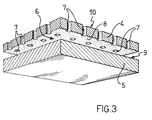
- Figure 3 is a perspective view of a detail of the tray of Figure 1.
- With reference to Figure 1, a tray according to the invention comprises a
body 1 having abase 2 andside walls 3. - With reference to Figure 2, a tray according to the invention is constituted by an
upper layer 4 and alower layer 5, both of plastics material, the layers constituting theside walls 3 being joined together while those forming thebase 2 are spaced apart to define aninterspace 6. Thelayers - The
upper layer 4 is pierced byholes 7 having a diameter of 0.2 - 1.5 mm. As may be seen from Figure 3, thesurface 8 of thelayer 4 facing theinterspace 6 is rough as a result either of mechanical abrasion or treatment with suitable chemical reagents. - In one embodiment, not illustrated in the drawings, the
surface 9 of thelayer 5 facing theinterspace 6 is also roughened like thesurface 8 of thelayer 4. - When the tray according to the invention of the type described is used for packaging foodstuffs, such as meat, which tend to release aqueous liquids, the liquid freed from the foodstuff encounters the
holes 7 in thesurface 10 of theupper layer 4 of the tray and passes through these holes, notwithstanding their small diameter, by virtue of the surfactant present in the foamed plastics material constituting thelayer 4 which considerably reduces the natural water-repellence of the plastics material, increasing the adhesive forces between the solid (plastics material) and the liquid until these exceed the cohesive forces between the molecules of the liquid and enabling the liquid to wet thesurface 10 of thelayer 4 and to penetrate theholes 7. - To facilitate the ingress of the liquid into the
holes 7, depressions may be formed in thesurface 10 of thelayer 4 centred on theholes 7. - After the liquid has passed through the entire thickness of the
layer 4 through theholes 7, it reaches thesurface 8 of this layer which, following the abrasion, is rough and formed with a close network of capillary channels which result from the rupture of the cells in the surface of the foamed plastics material. - As soon as it reaches the
surface 8, the liquid diffuses rapidly by capillary action into the network of channels and this has the further effect of exerting a sucking action on the liquid which is on that surface of thelayer 4 in contact with the food. - The
rough surface 8 of thelayer 4 is able to retain a considerable volume of liquid in the capillary network, preventing its return to theopposite surface 10 in contact with the food even when the tray is inclined or indeed overturned. - Whenever the tray according to the invention is used to package foodstuffs which tend to release very large volumes of liquid, it is convenient for the
lower layer 5 also to be made of foamed plastics material containing a surfactant, thesurface 9 facing theinterspace 6 being roughened. - Thus any excess liquid which is not retained by the
surface 8 of theupper layer 4 may traverse theinterspace 6 to reach therough surface 9 of thelower layer 5 and will then diffuse through the latter's capillary network to be retained therein. - Whenever there is no particular need to retain larger volumes of liquid than usual, the
lower layer 5 of the tray according to the invention may conveniently be made from any plastics material, even a non-foamed plastics material and even a recycled plastics, with consequent reductions in the production costs. - The
lower layer 5 may also be made in such a manner that it has several protuberances which contact theupper layer 4 in order to increase the resistance of the tray to compression and deformation during packaging or transport. - The
lower layer 5 may also be designed with ribs or grooves to form labyrinths in order to increase the surface available for retaining the liquid. - Obviously the two layers constituting the tray may be made of different colours and of different plastics materials to accord with differing technical or market requirements.
- The surfaces of the layers of foamed plastics material may be roughened in various ways. For example, once a layer of plastics material has been extruded through a die-head, one surface thereof may be abraded by passage through a machine generally used for rubbing-down wood.
- Alternatively use may be made of chemical reagents which can attack the smooth surface film.
- The tray according to the invention may be produced by methods well known in the art.
- For example, the upper and lower layers, once extruded and subjected to any treatment described above, may be fed into a thermoforming machine suitable for plastics materials, the two layers being guided simultaneously by chains to a heating station, after which the upper and lower parts of the tray are vacuum-formed.
- The mould for the forming is so designed that a strong mechanical pressure is exerted on the side walls of the tray, which have previously been heated at the heating station, so as to join and seal the upper and lower parts together.
- Finally the usual operations for opening the moulds and cutting the trays obtained are carried out.
- The holes in the upper layer of the tray may, for example, be made by perforation with a machine having a roller with needles before the upper sheet is sent to the thermoforming station.
- Alternatively needles may be provided in the cutting device so that the perforations are formed during the cutting of the edge of the tray.
- The tray according to the present invention has a series of advantages over the prior-art trays.
- First of all, it has the advantage over trays including a wad or layer of paper-like, absorbent material of being made solely from plastics material and therefore of being easy to recycle. Moreover the cost of producing a tray of the invention is considerably less than that for the manufacture of the trays mentioned above.
- In comparison with prior-art trays made from a single material, the tray of the present invention has the advantage that it absolutely prevents any liquid released from the foodstuff from being seen by virtue of the extremely small diameter of the holes in the upper layer of the tray.
- Moreover the tray of the present invention also differs from the prior-art trays mentioned above by virtue of the fact that the strong retaining action exerted on the liquid by the porous-capillary structure of the rough surface of the upper layer of the tray prevents the liquid released from the foodstuff from returning to the surface on which this foodstuff is arranged.
- Moreover the liquid retained by the rough surface is not in fact visible to the purchaser of a product packaged in the tray of the invention since it is separated from the surface exposed to view by the entire thickness of the layer of foamed plastics material and cannot be seen through this layer.
Claims (7)
- A tray (1) of plastics material for foodstuffs which may release liquids, comprising a base (2) and side walls (3) constituted by an upper layer (4) and a lower layer (5), the layers forming the side walls (3) of which are joined together while those forming the base (2) are spaced from each other to define an interspace (6), characterised in that the upper layer (4) is pierced by holes (7) having a diameter of 0.2 - 1.5 mm and is of foamed plastics material including a surfactant and in that the surface (8) of the upper layer (4) facing the interspace (6) is rough.
- A tray according to claim 1, characterised in that the lower layer (5) is also of foamed plastics material containing a surfactant and its surface (9) facing the interspace is rough.
- A tray according to any one of the preceding claims, characterised in that the foamed plastics material is selected from the group comprising polystyrene polypropylene polyethylene, polyethylene terephthalate, polyvinyl chloride and their copolymers.
- A tray according to Claim 3, characterised in that the foamed plastics material is polystyrene.
- A tray according to any one of the preceding Claims, characterised in that the surfactant is contained in the foamed plastics material in quantities which may vary from 0.2 - 10% by weight of the total weight of the foamed plastics material.
- A tray according to claim 5, characterised in that the surfactant is contained in the foamed plastics material in quantities which may vary from 1 - 3% by weight of the total weight of the foamed plastics material.
- A tray according to any one of the preceding Claims, characterised in that the surfactant is a salt of a sulphonic acid having the formula R-SO3H or a sulphuric ester having the formula R-OSO3H, where R is selected from the group comprising alkyl and alkaryl groups, with an alkali or alkaline earth metal.
Applications Claiming Priority (3)
| Application Number | Priority Date | Filing Date | Title |
|---|---|---|---|
| ITMI951024A IT1274530B (en) | 1995-05-19 | 1995-05-19 | PLASTIC TRAY FOR SUSCEPTIBLE FOODS TO RELEASE LIQUIDS |
| ITMI951024 | 1995-05-19 | ||
| US08/604,876 US5720999A (en) | 1995-05-19 | 1996-02-22 | Tray of plastics material for food substances which tend to release liquids |
Publications (2)
| Publication Number | Publication Date |
|---|---|
| EP0743262A1 true EP0743262A1 (en) | 1996-11-20 |
| EP0743262B1 EP0743262B1 (en) | 1998-10-21 |
Family
ID=26331276
Family Applications (1)
| Application Number | Title | Priority Date | Filing Date |
|---|---|---|---|
| EP96200606A Revoked EP0743262B1 (en) | 1995-05-19 | 1996-03-05 | Tray of plastics material for food substances which tend to release liquids |
Country Status (7)
| Country | Link |
|---|---|
| US (1) | US5720999A (en) |
| EP (1) | EP0743262B1 (en) |
| AT (1) | ATE172430T1 (en) |
| DE (1) | DE69600820T2 (en) |
| ES (1) | ES2124618T3 (en) |
| IT (1) | IT1274530B (en) |
| PL (1) | PL179821B1 (en) |
Cited By (9)
| Publication number | Priority date | Publication date | Assignee | Title |
|---|---|---|---|---|
| DE19725949A1 (en) * | 1997-06-19 | 1998-12-24 | Silver Plastics Gmbh & Co Kg | Packaging container, especially for foods |
| WO1999032372A1 (en) * | 1997-12-18 | 1999-07-01 | Linpac Plastics Limited | Packaging materials and packaging trays |
| WO2000034148A1 (en) * | 1998-12-08 | 2000-06-15 | Wilfried Wiegers | Tray for packaging portions of meat or similar foods |
| EP1231160A1 (en) * | 2001-02-12 | 2002-08-14 | Sealed Air S.A.S. | Package for the preservation and cooking or reheating of food products |
| WO2003031282A1 (en) * | 2001-10-10 | 2003-04-17 | Linpac Plastics Gmbh | Packaging container for receiving foodstuffs and method for producing same |
| EP1371574A1 (en) * | 2002-06-14 | 2003-12-17 | Huhtamaki France S.A. | Absorbent tray with or without barrier layer and process of manufacture |
| WO2009020805A1 (en) * | 2007-08-08 | 2009-02-12 | Meadwestvaco Corporation | Packaging tray with compartment |
| EP2835324A1 (en) | 2013-08-05 | 2015-02-11 | Depron B.V. | Backing board for supporting comestibles, assembly for displaying comestibles and method for manufacturing a backing board |
| EP3002231A1 (en) * | 2014-09-30 | 2016-04-06 | Dampack International BV | A closed food packaging tray |
Families Citing this family (27)
| Publication number | Priority date | Publication date | Assignee | Title |
|---|---|---|---|---|
| US6376034B1 (en) | 1996-01-23 | 2002-04-23 | William M. Brander | Absorbent material for use in disposable articles and articles prepared therefrom |
| US7381437B2 (en) * | 1998-03-27 | 2008-06-03 | Brander William M | Edge stackable absorbent display container |
| US6152295A (en) * | 1998-03-27 | 2000-11-28 | Brander; William M. | Storage container for containing food products |
| US6478147B1 (en) | 1998-03-27 | 2002-11-12 | William M. Brander | Container with absorbent material |
| US6095787A (en) * | 1998-10-19 | 2000-08-01 | The Colonel's, Inc. | Method of making a skid-resistant bed liner |
| US6257401B1 (en) * | 1999-05-14 | 2001-07-10 | Pactiv Corporation | Vented container with handles and embossment |
| US6491993B1 (en) | 1999-08-12 | 2002-12-10 | Pactiv Corporation | Absorbent pouches |
| US6279738B1 (en) | 2000-06-17 | 2001-08-28 | Cryovac, Inc. | Foam packaging tray and packaging method using same |
| US6695138B1 (en) | 2001-07-16 | 2004-02-24 | Commodaic Machine Co. Inc. | Food package with integral juice absorbing bottom |
| US20030054073A1 (en) * | 2001-07-25 | 2003-03-20 | Delduca Gary R. | Modified atmosphere packages and methods for making the same |
| US20030054074A1 (en) * | 2001-07-25 | 2003-03-20 | Delduca Gary R. | Modified atomsphere packages and methods for making the same |
| US20030190273A1 (en) * | 2002-04-09 | 2003-10-09 | Bernard Technologies, Inc. | Container liner for inhibiting decay of perishable items |
| US6848733B2 (en) * | 2002-11-08 | 2005-02-01 | Durakon Industries, Inc. | Co-formed bed liner having enhanced frictional characteristics |
| US7175021B2 (en) * | 2002-11-20 | 2007-02-13 | Commodore Machine Co. Inc. | Highly absorbent open cell polymer foam and food package comprised thereof |
| US7116183B2 (en) * | 2004-02-05 | 2006-10-03 | Qualcomm Incorporated | Temperature compensated voltage controlled oscillator |
| WO2006067413A1 (en) * | 2004-12-22 | 2006-06-29 | Easy Pad Limited | Packaging tray |
| US8083887B2 (en) * | 2005-02-09 | 2011-12-27 | Pactiv Corporation | Method of forming a container having an internal reservoir |
| CA2627392A1 (en) * | 2005-11-14 | 2007-05-24 | Pactiv Corporation | Container having internal reservoir |
| US20100189848A1 (en) * | 2006-10-05 | 2010-07-29 | Mabry Ronald D | Food packaging system for extended shelf life |
| US20100031829A1 (en) * | 2008-08-08 | 2010-02-11 | Terry Vovan | Food container liquid isolation |
| US20100258471A1 (en) * | 2009-04-08 | 2010-10-14 | PWPI Industries | Rotisserie chicken tray |
| JP2013522131A (en) * | 2010-03-19 | 2013-06-13 | シュレーゲル・トビーアス | Packaging means for objects with liquid components |
| CN103271614A (en) * | 2013-06-13 | 2013-09-04 | 苏州新区华士达工程塑胶有限公司 | Plastic tray with drain holes |
| US10486885B2 (en) * | 2014-12-12 | 2019-11-26 | Bemis Company, Inc. | Flexible package with embossed liquid containment cells |
| US10517415B2 (en) * | 2017-01-18 | 2019-12-31 | The Boeing Company | Tray table trays |
| WO2019216956A1 (en) * | 2018-05-11 | 2019-11-14 | Maxwell Chase Technologies, Llc | Apparatus and method for the preservation, storage and/or shipment of liquid-exuding products |
| EP4175520A4 (en) * | 2020-07-02 | 2024-08-21 | Converter Manufacturing, LLC | BOWL WITH NESTED DRAINAGE PLATFORM |
Citations (5)
| Publication number | Priority date | Publication date | Assignee | Title |
|---|---|---|---|---|
| FR1596691A (en) * | 1968-11-27 | 1970-06-22 | ||
| EP0090507A1 (en) * | 1982-03-22 | 1983-10-05 | Mobil Oil Corporation | Condensate absorbant fast food container and method of packaging |
| DE3406399A1 (en) * | 1984-02-22 | 1985-08-22 | Hoechst Ag, 6230 Frankfurt | Shell-shaped packaging container with a bottom for receiving liquid |
| FR2578512A1 (en) * | 1984-09-18 | 1986-09-12 | Socintec Sarl | Cushion for the sealing of packages intended for packaging products releasing liquid and ensuring the separate retention of this liquid |
| US4865855A (en) * | 1988-01-11 | 1989-09-12 | Kimberly-Clark Corporation | Antimicrobial absorbent food pad |
Family Cites Families (10)
| Publication number | Priority date | Publication date | Assignee | Title |
|---|---|---|---|---|
| GB1168925A (en) * | 1967-04-22 | 1969-10-29 | Paul Taylor Developments Ltd | Expendible Tray for Displaying Moist Foodstuffs |
| DE3032810A1 (en) * | 1980-08-30 | 1982-04-15 | Hoechst Ag, 6000 Frankfurt | SHELL-SHAPED PACKAGING CONTAINER WITH LIQUID-ADSORBING BOTTOM |
| DE3442341A1 (en) * | 1984-11-20 | 1986-05-22 | LinTec Verpackungstechnik GmbH, 2863 Ritterhude | TRAY FOR ACCOMPANYING FOODSTUFFS AND METHOD AND DEVICE FOR THE PRODUCTION THEREOF |
| US4949897A (en) * | 1989-05-03 | 1990-08-21 | Knx Holdings International Ltd. | Product tray |
| US5135787A (en) * | 1990-08-14 | 1992-08-04 | E. I. Du Pont De Nemours And Company | Iced food shipping container with aqueous liquid absorbing pad |
| DE9013898U1 (en) * | 1990-10-05 | 1990-12-13 | Silver-Plastics Gmbh & Co Kg, 5210 Troisdorf | Packaging tray with absorbent layer |
| FR2684330B1 (en) * | 1991-11-28 | 1994-12-30 | Vitembal | METHOD AND PLANT FOR MANUFACTURING TRAYS FOR THE PACKAGING OF FOOD PRODUCTS AND TRAYS OBTAINED BY THIS PROCESS. |
| FR2688474B1 (en) * | 1992-03-10 | 1995-05-05 | Epi Ste Nouvelle | PROCESS FOR OBTAINING A COMPOSITE MATERIAL, IN PARTICULAR FOR THE MANUFACTURE OF PACKAGING CONTAINERS FOR FOODSTUFFS SUITABLE FOR EXUDATION, AND CONTAINERS THUS OBTAINED. |
| DE4220195A1 (en) * | 1992-06-19 | 1993-12-23 | Linpac Technologie Gmbh | Food holding tray and process for making the tray |
| WO1994000366A1 (en) * | 1992-06-19 | 1994-01-06 | Linpac Plastics International Limited | Food tray and process for manufacture |
-
1995
- 1995-05-19 IT ITMI951024A patent/IT1274530B/en active IP Right Grant
-
1996
- 1996-02-22 US US08/604,876 patent/US5720999A/en not_active Expired - Fee Related
- 1996-02-28 PL PL312976A patent/PL179821B1/en unknown
- 1996-03-05 AT AT96200606T patent/ATE172430T1/en not_active IP Right Cessation
- 1996-03-05 ES ES96200606T patent/ES2124618T3/en not_active Expired - Lifetime
- 1996-03-05 DE DE69600820T patent/DE69600820T2/en not_active Expired - Fee Related
- 1996-03-05 EP EP96200606A patent/EP0743262B1/en not_active Revoked
Patent Citations (5)
| Publication number | Priority date | Publication date | Assignee | Title |
|---|---|---|---|---|
| FR1596691A (en) * | 1968-11-27 | 1970-06-22 | ||
| EP0090507A1 (en) * | 1982-03-22 | 1983-10-05 | Mobil Oil Corporation | Condensate absorbant fast food container and method of packaging |
| DE3406399A1 (en) * | 1984-02-22 | 1985-08-22 | Hoechst Ag, 6230 Frankfurt | Shell-shaped packaging container with a bottom for receiving liquid |
| FR2578512A1 (en) * | 1984-09-18 | 1986-09-12 | Socintec Sarl | Cushion for the sealing of packages intended for packaging products releasing liquid and ensuring the separate retention of this liquid |
| US4865855A (en) * | 1988-01-11 | 1989-09-12 | Kimberly-Clark Corporation | Antimicrobial absorbent food pad |
Cited By (13)
| Publication number | Priority date | Publication date | Assignee | Title |
|---|---|---|---|---|
| DE19725949A1 (en) * | 1997-06-19 | 1998-12-24 | Silver Plastics Gmbh & Co Kg | Packaging container, especially for foods |
| DE19725949C2 (en) * | 1997-06-19 | 1999-09-02 | Silver Plastics Gmbh & Co Kg | Packaging tray for food and a method for producing these packaging trays |
| WO1999032372A1 (en) * | 1997-12-18 | 1999-07-01 | Linpac Plastics Limited | Packaging materials and packaging trays |
| WO2000034148A1 (en) * | 1998-12-08 | 2000-06-15 | Wilfried Wiegers | Tray for packaging portions of meat or similar foods |
| EP1231160A1 (en) * | 2001-02-12 | 2002-08-14 | Sealed Air S.A.S. | Package for the preservation and cooking or reheating of food products |
| WO2003031282A1 (en) * | 2001-10-10 | 2003-04-17 | Linpac Plastics Gmbh | Packaging container for receiving foodstuffs and method for producing same |
| EP1371574A1 (en) * | 2002-06-14 | 2003-12-17 | Huhtamaki France S.A. | Absorbent tray with or without barrier layer and process of manufacture |
| FR2840882A1 (en) * | 2002-06-14 | 2003-12-19 | Huhtamaki France Sa | IMPROVED ABSORBENT TRAY WITH OR WITHOUT BARRIER AND PROCESS FOR OBTAINING SAME |
| WO2009020805A1 (en) * | 2007-08-08 | 2009-02-12 | Meadwestvaco Corporation | Packaging tray with compartment |
| EP2835324A1 (en) | 2013-08-05 | 2015-02-11 | Depron B.V. | Backing board for supporting comestibles, assembly for displaying comestibles and method for manufacturing a backing board |
| EP3002231A1 (en) * | 2014-09-30 | 2016-04-06 | Dampack International BV | A closed food packaging tray |
| WO2016050736A1 (en) * | 2014-09-30 | 2016-04-07 | Dampack International Bv | A closed food packaging tray |
| BE1026851B1 (en) * | 2014-09-30 | 2020-12-23 | Dampack Int Bv | A CLOSED FOOD PACKAGING DISH |
Also Published As
| Publication number | Publication date |
|---|---|
| DE69600820T2 (en) | 1999-04-22 |
| DE69600820D1 (en) | 1998-11-26 |
| ATE172430T1 (en) | 1998-11-15 |
| ITMI951024A0 (en) | 1995-05-19 |
| PL179821B1 (en) | 2000-11-30 |
| US5720999A (en) | 1998-02-24 |
| PL312976A1 (en) | 2000-10-09 |
| ITMI951024A1 (en) | 1996-11-19 |
| ES2124618T3 (en) | 1999-02-01 |
| IT1274530B (en) | 1997-07-17 |
| EP0743262B1 (en) | 1998-10-21 |
Similar Documents
| Publication | Publication Date | Title |
|---|---|---|
| US5720999A (en) | Tray of plastics material for food substances which tend to release liquids | |
| US5833894A (en) | Sheet of expanded plastics material with absorbent properties towards aqueous liquids | |
| US5307934A (en) | Blister pack | |
| CA1190016A (en) | Method and apparatus for manufacturing a purge trap tray | |
| US4935276A (en) | Absorbent pad and method of manufacture | |
| US4008347A (en) | Receptacle of foamed plastic lined with unoriented polyolefin film | |
| US5320895A (en) | Perforated absorbent pad with tufts of tissue projecting from the underside | |
| EP1202858B1 (en) | Absorbent sheet material having cut-resistant layer and method for making the same | |
| US4036675A (en) | Film-lined foam plastic receptacles and laminated materials and methods for making the same | |
| US6491993B1 (en) | Absorbent pouches | |
| GB2060543A (en) | Making a reclosable package | |
| WO2012122427A2 (en) | Liquid sequestering container, optionally with peelably detachable layers | |
| EP0766637A1 (en) | Food packaging tray | |
| EP0748746A1 (en) | Easy-to-open thermoplastic package | |
| US5470594A (en) | Paper pouch for food products | |
| JPH0756190Y2 (en) | Composite structure synthetic resin products | |
| KR20250086594A (en) | Dosage packaging and method of manufacturing the same | |
| JP2001151219A (en) | Plastic package having easy opening property and method of manufacturing the same | |
| FI63722B (en) | FOERPACKNING FOER FASTA ELLER PASTAFORMIGA PRODUKTER | |
| WO2017151553A1 (en) | Microcapillary fluid absorbing sheet | |
| EP1445211B1 (en) | Absorbent pad and package containing it | |
| EP1238795A1 (en) | Self-absorbing gas-barrier thermoformable sheet and receptacle for food packaging obtained therefrom | |
| US20250388378A1 (en) | Formed paperboard package | |
| JPS63237926A (en) | Molding method for vessel | |
| AU711909B2 (en) | Easy to open package |
Legal Events
| Date | Code | Title | Description |
|---|---|---|---|
| PUAI | Public reference made under article 153(3) epc to a published international application that has entered the european phase |
Free format text: ORIGINAL CODE: 0009012 |
|
| AK | Designated contracting states |
Kind code of ref document: A1 Designated state(s): AT BE CH DE DK ES FI FR GB GR IE IT LI LU MC NL PT SE |
|
| AX | Request for extension of the european patent |
Free format text: LT PAYMENT 960325;LV PAYMENT 960325;SI PAYMENT 960325 |
|
| RAX | Requested extension states of the european patent have changed |
Free format text: LT PAYMENT 960325;LV PAYMENT 960325;SI PAYMENT 960325 |
|
| 17P | Request for examination filed |
Effective date: 19970227 |
|
| GRAG | Despatch of communication of intention to grant |
Free format text: ORIGINAL CODE: EPIDOS AGRA |
|
| 17Q | First examination report despatched |
Effective date: 19970922 |
|
| GRAG | Despatch of communication of intention to grant |
Free format text: ORIGINAL CODE: EPIDOS AGRA |
|
| GRAG | Despatch of communication of intention to grant |
Free format text: ORIGINAL CODE: EPIDOS AGRA |
|
| GRAH | Despatch of communication of intention to grant a patent |
Free format text: ORIGINAL CODE: EPIDOS IGRA |
|
| ITF | It: translation for a ep patent filed | ||
| GRAH | Despatch of communication of intention to grant a patent |
Free format text: ORIGINAL CODE: EPIDOS IGRA |
|
| GRAA | (expected) grant |
Free format text: ORIGINAL CODE: 0009210 |
|
| AK | Designated contracting states |
Kind code of ref document: B1 Designated state(s): AT BE CH DE DK ES FI FR GB GR IE IT LI LU MC NL PT SE |
|
| AX | Request for extension of the european patent |
Free format text: LT PAYMENT 960325;LV PAYMENT 960325;SI PAYMENT 960325 |
|
| LTIE | Lt: invalidation of european patent or patent extension | ||
| PG25 | Lapsed in a contracting state [announced via postgrant information from national office to epo] |
Ref country code: GR Free format text: LAPSE BECAUSE OF NON-PAYMENT OF DUE FEES Effective date: 19981021 Ref country code: FI Free format text: LAPSE BECAUSE OF NON-PAYMENT OF DUE FEES Effective date: 19981021 |
|
| REF | Corresponds to: |
Ref document number: 172430 Country of ref document: AT Date of ref document: 19981115 Kind code of ref document: T |
|
| REG | Reference to a national code |
Ref country code: CH Ref legal event code: NV Representative=s name: JACOBACCI & PERANI S.A. Ref country code: CH Ref legal event code: EP |
|
| REF | Corresponds to: |
Ref document number: 69600820 Country of ref document: DE Date of ref document: 19981126 |
|
| REG | Reference to a national code |
Ref country code: IE Ref legal event code: FG4D |
|
| ET | Fr: translation filed | ||
| PG25 | Lapsed in a contracting state [announced via postgrant information from national office to epo] |
Ref country code: SE Free format text: LAPSE BECAUSE OF FAILURE TO SUBMIT A TRANSLATION OF THE DESCRIPTION OR TO PAY THE FEE WITHIN THE PRESCRIBED TIME-LIMIT Effective date: 19990121 Ref country code: PT Free format text: LAPSE BECAUSE OF FAILURE TO SUBMIT A TRANSLATION OF THE DESCRIPTION OR TO PAY THE FEE WITHIN THE PRESCRIBED TIME-LIMIT Effective date: 19990121 Ref country code: DK Free format text: LAPSE BECAUSE OF FAILURE TO SUBMIT A TRANSLATION OF THE DESCRIPTION OR TO PAY THE FEE WITHIN THE PRESCRIBED TIME-LIMIT Effective date: 19990121 |
|
| REG | Reference to a national code |
Ref country code: ES Ref legal event code: FG2A Ref document number: 2124618 Country of ref document: ES Kind code of ref document: T3 |
|
| PG25 | Lapsed in a contracting state [announced via postgrant information from national office to epo] |
Ref country code: LU Free format text: LAPSE BECAUSE OF NON-PAYMENT OF DUE FEES Effective date: 19990305 Ref country code: IE Free format text: LAPSE BECAUSE OF NON-PAYMENT OF DUE FEES Effective date: 19990305 |
|
| PLAV | Examination of admissibility of opposition |
Free format text: ORIGINAL CODE: EPIDOS OPEX |
|
| PLBQ | Unpublished change to opponent data |
Free format text: ORIGINAL CODE: EPIDOS OPPO |
|
| PLBI | Opposition filed |
Free format text: ORIGINAL CODE: 0009260 |
|
| PLBQ | Unpublished change to opponent data |
Free format text: ORIGINAL CODE: EPIDOS OPPO |
|
| PLBI | Opposition filed |
Free format text: ORIGINAL CODE: 0009260 |
|
| PLAV | Examination of admissibility of opposition |
Free format text: ORIGINAL CODE: EPIDOS OPEX |
|
| PLBF | Reply of patent proprietor to notice(s) of opposition |
Free format text: ORIGINAL CODE: EPIDOS OBSO |
|
| 26 | Opposition filed |
Opponent name: DEPRON B.V. Effective date: 19990706 |
|
| 26 | Opposition filed |
Opponent name: SILVER-PLASTICS GMBH & CO KG Effective date: 19990720 Opponent name: DEPRON B.V. Effective date: 19990706 |
|
| PG25 | Lapsed in a contracting state [announced via postgrant information from national office to epo] |
Ref country code: MC Free format text: LAPSE BECAUSE OF NON-PAYMENT OF DUE FEES Effective date: 19990930 |
|
| PLBF | Reply of patent proprietor to notice(s) of opposition |
Free format text: ORIGINAL CODE: EPIDOS OBSO |
|
| REG | Reference to a national code |
Ref country code: IE Ref legal event code: MM4A |
|
| PGFP | Annual fee paid to national office [announced via postgrant information from national office to epo] |
Ref country code: AT Payment date: 20000223 Year of fee payment: 5 |
|
| PGFP | Annual fee paid to national office [announced via postgrant information from national office to epo] |
Ref country code: GB Payment date: 20000228 Year of fee payment: 5 Ref country code: DE Payment date: 20000228 Year of fee payment: 5 Ref country code: CH Payment date: 20000228 Year of fee payment: 5 |
|
| PLBF | Reply of patent proprietor to notice(s) of opposition |
Free format text: ORIGINAL CODE: EPIDOS OBSO |
|
| PGFP | Annual fee paid to national office [announced via postgrant information from national office to epo] |
Ref country code: NL Payment date: 20000308 Year of fee payment: 5 |
|
| PGFP | Annual fee paid to national office [announced via postgrant information from national office to epo] |
Ref country code: ES Payment date: 20000315 Year of fee payment: 5 |
|
| PGFP | Annual fee paid to national office [announced via postgrant information from national office to epo] |
Ref country code: BE Payment date: 20000327 Year of fee payment: 5 |
|
| PGFP | Annual fee paid to national office [announced via postgrant information from national office to epo] |
Ref country code: FR Payment date: 20010112 Year of fee payment: 6 |
|
| RDAH | Patent revoked |
Free format text: ORIGINAL CODE: EPIDOS REVO |
|
| RDAG | Patent revoked |
Free format text: ORIGINAL CODE: 0009271 |
|
| STAA | Information on the status of an ep patent application or granted ep patent |
Free format text: STATUS: PATENT REVOKED |
|
| 27W | Patent revoked |
Effective date: 20010207 |
|
| GBPR | Gb: patent revoked under art. 102 of the ep convention designating the uk as contracting state |
Free format text: 20010207 |
|
| REG | Reference to a national code |
Ref country code: CH Ref legal event code: PL |
|
| NLR2 | Nl: decision of opposition | ||
| PLAB | Opposition data, opponent's data or that of the opponent's representative modified |
Free format text: ORIGINAL CODE: 0009299OPPO |
|
| PLAB | Opposition data, opponent's data or that of the opponent's representative modified |
Free format text: ORIGINAL CODE: 0009299OPPO |