EP0742178B1 - Von Ketonen stammendes Tensid und Verfahren zum Behandeln von Abwässern aus Industrie, Handel oder öffentlichen Körperschaften - Google Patents
Von Ketonen stammendes Tensid und Verfahren zum Behandeln von Abwässern aus Industrie, Handel oder öffentlichen Körperschaften Download PDFInfo
- Publication number
- EP0742178B1 EP0742178B1 EP96303261A EP96303261A EP0742178B1 EP 0742178 B1 EP0742178 B1 EP 0742178B1 EP 96303261 A EP96303261 A EP 96303261A EP 96303261 A EP96303261 A EP 96303261A EP 0742178 B1 EP0742178 B1 EP 0742178B1
- Authority
- EP
- European Patent Office
- Prior art keywords
- surfactant
- water
- splittable
- surfactants
- relatively water
- Prior art date
- Legal status (The legal status is an assumption and is not a legal conclusion. Google has not performed a legal analysis and makes no representation as to the accuracy of the status listed.)
- Expired - Lifetime
Links
- 239000004094 surface-active agent Substances 0.000 title claims description 143
- 238000000034 method Methods 0.000 title claims description 82
- 150000002576 ketones Chemical class 0.000 title claims description 30
- 239000002351 wastewater Substances 0.000 title description 21
- 239000000203 mixture Substances 0.000 claims description 89
- 239000002736 nonionic surfactant Substances 0.000 claims description 63
- XLYOFNOQVPJJNP-UHFFFAOYSA-N water Substances O XLYOFNOQVPJJNP-UHFFFAOYSA-N 0.000 claims description 56
- 125000002777 acetyl group Chemical class [H]C([H])([H])C(*)=O 0.000 claims description 38
- 238000004140 cleaning Methods 0.000 claims description 37
- 239000000356 contaminant Substances 0.000 claims description 27
- DHKHKXVYLBGOIT-UHFFFAOYSA-N acetaldehyde Diethyl Acetal Natural products CCOC(C)OCC DHKHKXVYLBGOIT-UHFFFAOYSA-N 0.000 claims description 25
- 239000000463 material Substances 0.000 claims description 25
- 230000002209 hydrophobic effect Effects 0.000 claims description 21
- 229910019142 PO4 Inorganic materials 0.000 claims description 17
- 150000002894 organic compounds Chemical class 0.000 claims description 17
- 235000021317 phosphate Nutrition 0.000 claims description 17
- 229920005862 polyol Polymers 0.000 claims description 11
- 150000003077 polyols Chemical class 0.000 claims description 11
- 239000001257 hydrogen Substances 0.000 claims description 9
- 229910052739 hydrogen Inorganic materials 0.000 claims description 9
- 239000007864 aqueous solution Substances 0.000 claims description 8
- 125000004432 carbon atom Chemical group C* 0.000 claims description 8
- 125000002496 methyl group Chemical group [H]C([H])([H])* 0.000 claims description 7
- 150000003013 phosphoric acid derivatives Chemical class 0.000 claims description 7
- 230000002378 acidificating effect Effects 0.000 claims description 6
- 125000001495 ethyl group Chemical group [H]C([H])([H])C([H])([H])* 0.000 claims description 6
- 239000004744 fabric Substances 0.000 claims description 6
- 239000007788 liquid Substances 0.000 claims description 5
- 125000004435 hydrogen atom Chemical group [H]* 0.000 claims description 4
- 239000003921 oil Substances 0.000 description 56
- 238000009472 formulation Methods 0.000 description 40
- 239000012530 fluid Substances 0.000 description 37
- 238000005555 metalworking Methods 0.000 description 36
- 230000008569 process Effects 0.000 description 35
- 238000011282 treatment Methods 0.000 description 26
- 239000000126 substance Substances 0.000 description 24
- 239000002699 waste material Substances 0.000 description 24
- 239000000243 solution Substances 0.000 description 20
- PEDCQBHIVMGVHV-UHFFFAOYSA-N Glycerine Chemical compound OCC(O)CO PEDCQBHIVMGVHV-UHFFFAOYSA-N 0.000 description 16
- 238000005191 phase separation Methods 0.000 description 16
- HEMHJVSKTPXQMS-UHFFFAOYSA-M Sodium hydroxide Chemical compound [OH-].[Na+] HEMHJVSKTPXQMS-UHFFFAOYSA-M 0.000 description 15
- 229910052751 metal Inorganic materials 0.000 description 14
- 239000002184 metal Substances 0.000 description 14
- IMNFDUFMRHMDMM-UHFFFAOYSA-N N-Heptane Chemical compound CCCCCCC IMNFDUFMRHMDMM-UHFFFAOYSA-N 0.000 description 12
- 230000008901 benefit Effects 0.000 description 12
- 238000004945 emulsification Methods 0.000 description 12
- 238000005187 foaming Methods 0.000 description 12
- NBIIXXVUZAFLBC-UHFFFAOYSA-K phosphate Chemical compound [O-]P([O-])([O-])=O NBIIXXVUZAFLBC-UHFFFAOYSA-K 0.000 description 12
- 239000000839 emulsion Substances 0.000 description 11
- 239000000047 product Substances 0.000 description 11
- KWYUFKZDYYNOTN-UHFFFAOYSA-M Potassium hydroxide Chemical compound [OH-].[K+] KWYUFKZDYYNOTN-UHFFFAOYSA-M 0.000 description 10
- 230000000694 effects Effects 0.000 description 10
- 239000012535 impurity Substances 0.000 description 10
- 239000010452 phosphate Substances 0.000 description 10
- 238000012360 testing method Methods 0.000 description 10
- 239000002253 acid Substances 0.000 description 9
- 239000003995 emulsifying agent Substances 0.000 description 9
- IAYPIBMASNFSPL-UHFFFAOYSA-N Ethylene oxide Chemical compound C1CO1 IAYPIBMASNFSPL-UHFFFAOYSA-N 0.000 description 8
- CDBYLPFSWZWCQE-UHFFFAOYSA-L Sodium Carbonate Chemical compound [Na+].[Na+].[O-]C([O-])=O CDBYLPFSWZWCQE-UHFFFAOYSA-L 0.000 description 8
- 239000003599 detergent Substances 0.000 description 8
- 239000012153 distilled water Substances 0.000 description 8
- 239000011159 matrix material Substances 0.000 description 8
- 238000002156 mixing Methods 0.000 description 8
- QAOWNCQODCNURD-UHFFFAOYSA-N Sulfuric acid Chemical compound OS(O)(=O)=O QAOWNCQODCNURD-UHFFFAOYSA-N 0.000 description 7
- 239000003054 catalyst Substances 0.000 description 7
- 238000006243 chemical reaction Methods 0.000 description 7
- 239000006185 dispersion Substances 0.000 description 7
- 230000007062 hydrolysis Effects 0.000 description 7
- 238000006460 hydrolysis reaction Methods 0.000 description 7
- 239000011541 reaction mixture Substances 0.000 description 7
- 238000000926 separation method Methods 0.000 description 7
- 238000004065 wastewater treatment Methods 0.000 description 7
- CSCPPACGZOOCGX-UHFFFAOYSA-N Acetone Chemical compound CC(C)=O CSCPPACGZOOCGX-UHFFFAOYSA-N 0.000 description 6
- OKKJLVBELUTLKV-UHFFFAOYSA-N Methanol Chemical compound OC OKKJLVBELUTLKV-UHFFFAOYSA-N 0.000 description 6
- 239000000654 additive Substances 0.000 description 6
- 150000001412 amines Chemical class 0.000 description 6
- 239000003945 anionic surfactant Substances 0.000 description 6
- ZAJNGDIORYACQU-UHFFFAOYSA-N decan-2-one Chemical compound CCCCCCCCC(C)=O ZAJNGDIORYACQU-UHFFFAOYSA-N 0.000 description 6
- -1 ether sulfates Chemical class 0.000 description 6
- 239000006260 foam Substances 0.000 description 6
- 235000011187 glycerol Nutrition 0.000 description 6
- 229920000847 nonoxynol Polymers 0.000 description 6
- 239000012071 phase Substances 0.000 description 6
- 125000001424 substituent group Chemical group 0.000 description 6
- VYPSYNLAJGMNEJ-UHFFFAOYSA-N Silicium dioxide Chemical compound O=[Si]=O VYPSYNLAJGMNEJ-UHFFFAOYSA-N 0.000 description 5
- 125000003118 aryl group Chemical group 0.000 description 5
- 150000001875 compounds Chemical class 0.000 description 5
- 235000014113 dietary fatty acids Nutrition 0.000 description 5
- 230000007613 environmental effect Effects 0.000 description 5
- 238000011156 evaluation Methods 0.000 description 5
- 239000000194 fatty acid Substances 0.000 description 5
- 229930195729 fatty acid Natural products 0.000 description 5
- 150000004665 fatty acids Chemical class 0.000 description 5
- 230000006870 function Effects 0.000 description 5
- 150000002431 hydrogen Chemical group 0.000 description 5
- 125000002887 hydroxy group Chemical group [H]O* 0.000 description 5
- 238000005461 lubrication Methods 0.000 description 5
- 239000012528 membrane Substances 0.000 description 5
- 238000005406 washing Methods 0.000 description 5
- LSKONYYRONEBKA-UHFFFAOYSA-N 2-Dodecanone Chemical compound CCCCCCCCCCC(C)=O LSKONYYRONEBKA-UHFFFAOYSA-N 0.000 description 4
- ZPVFWPFBNIEHGJ-UHFFFAOYSA-N 2-octanone Chemical compound CCCCCCC(C)=O ZPVFWPFBNIEHGJ-UHFFFAOYSA-N 0.000 description 4
- IJGRMHOSHXDMSA-UHFFFAOYSA-N Atomic nitrogen Chemical compound N#N IJGRMHOSHXDMSA-UHFFFAOYSA-N 0.000 description 4
- GOOHAUXETOMSMM-UHFFFAOYSA-N Propylene oxide Chemical compound CC1CO1 GOOHAUXETOMSMM-UHFFFAOYSA-N 0.000 description 4
- 229920004890 Triton X-100 Polymers 0.000 description 4
- 150000007513 acids Chemical class 0.000 description 4
- 125000002947 alkylene group Chemical group 0.000 description 4
- 238000007796 conventional method Methods 0.000 description 4
- 238000005260 corrosion Methods 0.000 description 4
- 230000007797 corrosion Effects 0.000 description 4
- 239000002761 deinking Substances 0.000 description 4
- 238000009826 distribution Methods 0.000 description 4
- 238000005516 engineering process Methods 0.000 description 4
- 239000008233 hard water Substances 0.000 description 4
- 239000000976 ink Substances 0.000 description 4
- 125000005702 oxyalkylene group Chemical group 0.000 description 4
- 239000003208 petroleum Substances 0.000 description 4
- 229910000029 sodium carbonate Inorganic materials 0.000 description 4
- 241000894007 species Species 0.000 description 4
- 239000007858 starting material Substances 0.000 description 4
- 238000009736 wetting Methods 0.000 description 4
- 239000000080 wetting agent Substances 0.000 description 4
- YPIFGDQKSSMYHQ-UHFFFAOYSA-N 7,7-dimethyloctanoic acid Chemical compound CC(C)(C)CCCCCC(O)=O YPIFGDQKSSMYHQ-UHFFFAOYSA-N 0.000 description 3
- QTBSBXVTEAMEQO-UHFFFAOYSA-N Acetic acid Chemical compound CC(O)=O QTBSBXVTEAMEQO-UHFFFAOYSA-N 0.000 description 3
- ZJCCRDAZUWHFQH-UHFFFAOYSA-N Trimethylolpropane Chemical compound CCC(CO)(CO)CO ZJCCRDAZUWHFQH-UHFFFAOYSA-N 0.000 description 3
- 125000002015 acyclic group Chemical group 0.000 description 3
- 125000003545 alkoxy group Chemical group 0.000 description 3
- 125000000217 alkyl group Chemical group 0.000 description 3
- 125000000129 anionic group Chemical group 0.000 description 3
- 239000008346 aqueous phase Substances 0.000 description 3
- QVGXLLKOCUKJST-UHFFFAOYSA-N atomic oxygen Chemical compound [O] QVGXLLKOCUKJST-UHFFFAOYSA-N 0.000 description 3
- 230000033228 biological regulation Effects 0.000 description 3
- KRKNYBCHXYNGOX-UHFFFAOYSA-N citric acid Chemical compound OC(=O)CC(O)(C(O)=O)CC(O)=O KRKNYBCHXYNGOX-UHFFFAOYSA-N 0.000 description 3
- 238000009833 condensation Methods 0.000 description 3
- 230000005494 condensation Effects 0.000 description 3
- 238000001816 cooling Methods 0.000 description 3
- 239000010779 crude oil Substances 0.000 description 3
- 125000004122 cyclic group Chemical group 0.000 description 3
- 230000009849 deactivation Effects 0.000 description 3
- 238000007046 ethoxylation reaction Methods 0.000 description 3
- 239000000835 fiber Substances 0.000 description 3
- 238000010438 heat treatment Methods 0.000 description 3
- 230000005764 inhibitory process Effects 0.000 description 3
- 150000002500 ions Chemical class 0.000 description 3
- 238000004900 laundering Methods 0.000 description 3
- 238000009740 moulding (composite fabrication) Methods 0.000 description 3
- 239000001301 oxygen Substances 0.000 description 3
- 229910052760 oxygen Inorganic materials 0.000 description 3
- 238000012545 processing Methods 0.000 description 3
- 238000011084 recovery Methods 0.000 description 3
- 238000007670 refining Methods 0.000 description 3
- 238000010992 reflux Methods 0.000 description 3
- 230000002441 reversible effect Effects 0.000 description 3
- 150000004760 silicates Chemical class 0.000 description 3
- 239000000344 soap Substances 0.000 description 3
- 238000010561 standard procedure Methods 0.000 description 3
- 150000003871 sulfonates Chemical class 0.000 description 3
- 239000000725 suspension Substances 0.000 description 3
- 239000004753 textile Substances 0.000 description 3
- XJLDYKIEURAVBW-UHFFFAOYSA-N 3-decanone Chemical compound CCCCCCCC(=O)CC XJLDYKIEURAVBW-UHFFFAOYSA-N 0.000 description 2
- IYTXKIXETAELAV-UHFFFAOYSA-N Aethyl-n-hexyl-keton Natural products CCCCCCC(=O)CC IYTXKIXETAELAV-UHFFFAOYSA-N 0.000 description 2
- 0 C*C1(*)COC(*)(*)OC1 Chemical compound C*C1(*)COC(*)(*)OC1 0.000 description 2
- 229920002134 Carboxymethyl cellulose Polymers 0.000 description 2
- KCXVZYZYPLLWCC-UHFFFAOYSA-N EDTA Chemical compound OC(=O)CN(CC(O)=O)CCN(CC(O)=O)CC(O)=O KCXVZYZYPLLWCC-UHFFFAOYSA-N 0.000 description 2
- 229920005682 EO-PO block copolymer Polymers 0.000 description 2
- KRHYYFGTRYWZRS-UHFFFAOYSA-N Fluorane Chemical compound F KRHYYFGTRYWZRS-UHFFFAOYSA-N 0.000 description 2
- VEXZGXHMUGYJMC-UHFFFAOYSA-N Hydrochloric acid Chemical compound Cl VEXZGXHMUGYJMC-UHFFFAOYSA-N 0.000 description 2
- NBIIXXVUZAFLBC-UHFFFAOYSA-N Phosphoric acid Chemical compound OP(O)(O)=O NBIIXXVUZAFLBC-UHFFFAOYSA-N 0.000 description 2
- 239000004115 Sodium Silicate Substances 0.000 description 2
- WYURNTSHIVDZCO-UHFFFAOYSA-N Tetrahydrofuran Chemical compound C1CCOC1 WYURNTSHIVDZCO-UHFFFAOYSA-N 0.000 description 2
- 150000001298 alcohols Chemical class 0.000 description 2
- 229920005628 alkoxylated polyol Polymers 0.000 description 2
- DIZPMCHEQGEION-UHFFFAOYSA-H aluminium sulfate (anhydrous) Chemical compound [Al+3].[Al+3].[O-]S([O-])(=O)=O.[O-]S([O-])(=O)=O.[O-]S([O-])(=O)=O DIZPMCHEQGEION-UHFFFAOYSA-H 0.000 description 2
- 125000001797 benzyl group Chemical group [H]C1=C([H])C([H])=C(C([H])=C1[H])C([H])([H])* 0.000 description 2
- 239000011575 calcium Substances 0.000 description 2
- 125000002837 carbocyclic group Chemical group 0.000 description 2
- 125000002091 cationic group Chemical group 0.000 description 2
- 229920006317 cationic polymer Polymers 0.000 description 2
- 239000000919 ceramic Substances 0.000 description 2
- 239000003795 chemical substances by application Substances 0.000 description 2
- 238000004581 coalescence Methods 0.000 description 2
- 239000000470 constituent Substances 0.000 description 2
- 238000011109 contamination Methods 0.000 description 2
- 238000005520 cutting process Methods 0.000 description 2
- 125000000753 cycloalkyl group Chemical group 0.000 description 2
- 238000006356 dehydrogenation reaction Methods 0.000 description 2
- 230000001419 dependent effect Effects 0.000 description 2
- 238000011161 development Methods 0.000 description 2
- 239000002270 dispersing agent Substances 0.000 description 2
- 238000009300 dissolved air flotation Methods 0.000 description 2
- 239000000975 dye Substances 0.000 description 2
- 238000004043 dyeing Methods 0.000 description 2
- RTZKZFJDLAIYFH-UHFFFAOYSA-N ether Substances CCOCC RTZKZFJDLAIYFH-UHFFFAOYSA-N 0.000 description 2
- 238000002474 experimental method Methods 0.000 description 2
- 239000003925 fat Substances 0.000 description 2
- 238000001914 filtration Methods 0.000 description 2
- 239000012634 fragment Substances 0.000 description 2
- 239000004519 grease Substances 0.000 description 2
- 238000000227 grinding Methods 0.000 description 2
- 125000000623 heterocyclic group Chemical group 0.000 description 2
- 125000000592 heterocycloalkyl group Chemical group 0.000 description 2
- 239000003752 hydrotrope Substances 0.000 description 2
- 239000007791 liquid phase Substances 0.000 description 2
- 239000000314 lubricant Substances 0.000 description 2
- 238000004519 manufacturing process Methods 0.000 description 2
- 150000002739 metals Chemical class 0.000 description 2
- 229910052757 nitrogen Inorganic materials 0.000 description 2
- VKCYHJWLYTUGCC-UHFFFAOYSA-N nonan-2-one Chemical compound CCCCCCCC(C)=O VKCYHJWLYTUGCC-UHFFFAOYSA-N 0.000 description 2
- KJIFKLIQANRMOU-UHFFFAOYSA-N oxidanium;4-methylbenzenesulfonate Chemical compound O.CC1=CC=C(S(O)(=O)=O)C=C1 KJIFKLIQANRMOU-UHFFFAOYSA-N 0.000 description 2
- 230000003647 oxidation Effects 0.000 description 2
- 238000007254 oxidation reaction Methods 0.000 description 2
- 238000010979 pH adjustment Methods 0.000 description 2
- 230000020477 pH reduction Effects 0.000 description 2
- 239000012188 paraffin wax Substances 0.000 description 2
- 239000001267 polyvinylpyrrolidone Substances 0.000 description 2
- 235000013855 polyvinylpyrrolidone Nutrition 0.000 description 2
- 238000002360 preparation method Methods 0.000 description 2
- 150000003138 primary alcohols Chemical class 0.000 description 2
- 230000035484 reaction time Effects 0.000 description 2
- 230000009467 reduction Effects 0.000 description 2
- 238000011160 research Methods 0.000 description 2
- 150000003333 secondary alcohols Chemical class 0.000 description 2
- 239000000377 silicon dioxide Substances 0.000 description 2
- GCLGEJMYGQKIIW-UHFFFAOYSA-H sodium hexametaphosphate Chemical compound [Na]OP1(=O)OP(=O)(O[Na])OP(=O)(O[Na])OP(=O)(O[Na])OP(=O)(O[Na])OP(=O)(O[Na])O1 GCLGEJMYGQKIIW-UHFFFAOYSA-H 0.000 description 2
- 235000019795 sodium metasilicate Nutrition 0.000 description 2
- NTHWMYGWWRZVTN-UHFFFAOYSA-N sodium silicate Chemical compound [Na+].[Na+].[O-][Si]([O-])=O NTHWMYGWWRZVTN-UHFFFAOYSA-N 0.000 description 2
- 229910052911 sodium silicate Inorganic materials 0.000 description 2
- QUCDWLYKDRVKMI-UHFFFAOYSA-M sodium;3,4-dimethylbenzenesulfonate Chemical compound [Na+].CC1=CC=C(S([O-])(=O)=O)C=C1C QUCDWLYKDRVKMI-UHFFFAOYSA-M 0.000 description 2
- 239000002689 soil Substances 0.000 description 2
- 239000007787 solid Substances 0.000 description 2
- 239000002904 solvent Substances 0.000 description 2
- 239000008399 tap water Substances 0.000 description 2
- 235000020679 tap water Nutrition 0.000 description 2
- 125000000999 tert-butyl group Chemical group [H]C([H])([H])C(*)(C([H])([H])[H])C([H])([H])[H] 0.000 description 2
- 238000010998 test method Methods 0.000 description 2
- UEUXEKPTXMALOB-UHFFFAOYSA-J tetrasodium;2-[2-[bis(carboxylatomethyl)amino]ethyl-(carboxylatomethyl)amino]acetate Chemical compound [Na+].[Na+].[Na+].[Na+].[O-]C(=O)CN(CC([O-])=O)CCN(CC([O-])=O)CC([O-])=O UEUXEKPTXMALOB-UHFFFAOYSA-J 0.000 description 2
- CYIFVRUOHKNECG-UHFFFAOYSA-N tridecan-2-one Chemical compound CCCCCCCCCCCC(C)=O CYIFVRUOHKNECG-UHFFFAOYSA-N 0.000 description 2
- QXJQHYBHAIHNGG-UHFFFAOYSA-N trimethylolethane Chemical compound OCC(C)(CO)CO QXJQHYBHAIHNGG-UHFFFAOYSA-N 0.000 description 2
- KYWIYKKSMDLRDC-UHFFFAOYSA-N undecan-2-one Chemical compound CCCCCCCCCC(C)=O KYWIYKKSMDLRDC-UHFFFAOYSA-N 0.000 description 2
- ZXPCCXXSNUIVNK-UHFFFAOYSA-N 1,1,1,2,3-pentachloropropane Chemical compound ClCC(Cl)C(Cl)(Cl)Cl ZXPCCXXSNUIVNK-UHFFFAOYSA-N 0.000 description 1
- UOCLXMDMGBRAIB-UHFFFAOYSA-N 1,1,1-trichloroethane Chemical compound CC(Cl)(Cl)Cl UOCLXMDMGBRAIB-UHFFFAOYSA-N 0.000 description 1
- VDFVNEFVBPFDSB-UHFFFAOYSA-N 1,3-dioxane Chemical compound C1COCOC1 VDFVNEFVBPFDSB-UHFFFAOYSA-N 0.000 description 1
- WNXJIVFYUVYPPR-UHFFFAOYSA-N 1,3-dioxolane Chemical compound C1COCO1 WNXJIVFYUVYPPR-UHFFFAOYSA-N 0.000 description 1
- 125000006091 1,3-dioxolane group Chemical group 0.000 description 1
- IEORSVTYLWZQJQ-UHFFFAOYSA-N 2-(2-nonylphenoxy)ethanol Chemical compound CCCCCCCCCC1=CC=CC=C1OCCO IEORSVTYLWZQJQ-UHFFFAOYSA-N 0.000 description 1
- LBLYYCQCTBFVLH-UHFFFAOYSA-N 2-Methylbenzenesulfonic acid Chemical compound CC1=CC=CC=C1S(O)(=O)=O LBLYYCQCTBFVLH-UHFFFAOYSA-N 0.000 description 1
- RZKJRTYHOUYGGM-UHFFFAOYSA-N 2-methylnonan-4-one Chemical compound CCCCCC(=O)CC(C)C RZKJRTYHOUYGGM-UHFFFAOYSA-N 0.000 description 1
- YXFDTUKUWNQPFV-UHFFFAOYSA-N 4,6-dimethylheptan-2-one Chemical compound CC(C)CC(C)CC(C)=O YXFDTUKUWNQPFV-UHFFFAOYSA-N 0.000 description 1
- JYCQQPHGFMYQCF-UHFFFAOYSA-N 4-tert-Octylphenol monoethoxylate Chemical compound CC(C)(C)CC(C)(C)C1=CC=C(OCCO)C=C1 JYCQQPHGFMYQCF-UHFFFAOYSA-N 0.000 description 1
- ZPQAKYPOZRXKFA-UHFFFAOYSA-N 6-Undecanone Chemical compound CCCCCC(=O)CCCCC ZPQAKYPOZRXKFA-UHFFFAOYSA-N 0.000 description 1
- RZVAJINKPMORJF-UHFFFAOYSA-N Acetaminophen Chemical compound CC(=O)NC1=CC=C(O)C=C1 RZVAJINKPMORJF-UHFFFAOYSA-N 0.000 description 1
- YNMZZHPSYMOGCI-UHFFFAOYSA-N Aethyl-octyl-keton Natural products CCCCCCCCC(=O)CC YNMZZHPSYMOGCI-UHFFFAOYSA-N 0.000 description 1
- OYPRJOBELJOOCE-UHFFFAOYSA-N Calcium Chemical compound [Ca] OYPRJOBELJOOCE-UHFFFAOYSA-N 0.000 description 1
- UXVMQQNJUSDDNG-UHFFFAOYSA-L Calcium chloride Chemical compound [Cl-].[Cl-].[Ca+2] UXVMQQNJUSDDNG-UHFFFAOYSA-L 0.000 description 1
- 241000870659 Crassula perfoliata var. minor Species 0.000 description 1
- FBPFZTCFMRRESA-FSIIMWSLSA-N D-Glucitol Natural products OC[C@H](O)[C@H](O)[C@@H](O)[C@H](O)CO FBPFZTCFMRRESA-FSIIMWSLSA-N 0.000 description 1
- FBPFZTCFMRRESA-KVTDHHQDSA-N D-Mannitol Chemical compound OC[C@@H](O)[C@@H](O)[C@H](O)[C@H](O)CO FBPFZTCFMRRESA-KVTDHHQDSA-N 0.000 description 1
- FBPFZTCFMRRESA-JGWLITMVSA-N D-glucitol Chemical compound OC[C@H](O)[C@@H](O)[C@H](O)[C@H](O)CO FBPFZTCFMRRESA-JGWLITMVSA-N 0.000 description 1
- VVNCNSJFMMFHPL-VKHMYHEASA-N D-penicillamine Chemical compound CC(C)(S)[C@@H](N)C(O)=O VVNCNSJFMMFHPL-VKHMYHEASA-N 0.000 description 1
- ZGTMUACCHSMWAC-UHFFFAOYSA-L EDTA disodium salt (anhydrous) Chemical compound [Na+].[Na+].OC(=O)CN(CC([O-])=O)CCN(CC(O)=O)CC([O-])=O ZGTMUACCHSMWAC-UHFFFAOYSA-L 0.000 description 1
- 229930195725 Mannitol Natural products 0.000 description 1
- 229920000557 Nafion® Polymers 0.000 description 1
- GRYLNZFGIOXLOG-UHFFFAOYSA-N Nitric acid Chemical class O[N+]([O-])=O GRYLNZFGIOXLOG-UHFFFAOYSA-N 0.000 description 1
- 238000012356 Product development Methods 0.000 description 1
- UIIMBOGNXHQVGW-DEQYMQKBSA-M Sodium bicarbonate-14C Chemical compound [Na+].O[14C]([O-])=O UIIMBOGNXHQVGW-DEQYMQKBSA-M 0.000 description 1
- GSEJCLTVZPLZKY-UHFFFAOYSA-N Triethanolamine Chemical compound OCCN(CCO)CCO GSEJCLTVZPLZKY-UHFFFAOYSA-N 0.000 description 1
- 238000009825 accumulation Methods 0.000 description 1
- 239000003377 acid catalyst Substances 0.000 description 1
- 239000003929 acidic solution Substances 0.000 description 1
- 230000009471 action Effects 0.000 description 1
- 150000003998 acyclic ketones Chemical class 0.000 description 1
- 238000005054 agglomeration Methods 0.000 description 1
- 230000002776 aggregation Effects 0.000 description 1
- 238000013019 agitation Methods 0.000 description 1
- 150000004703 alkoxides Chemical class 0.000 description 1
- 125000005529 alkyleneoxy group Chemical group 0.000 description 1
- 239000000956 alloy Substances 0.000 description 1
- 229910045601 alloy Inorganic materials 0.000 description 1
- 229940037003 alum Drugs 0.000 description 1
- 229910000147 aluminium phosphate Inorganic materials 0.000 description 1
- 239000002280 amphoteric surfactant Substances 0.000 description 1
- 229920006318 anionic polymer Polymers 0.000 description 1
- 238000010936 aqueous wash Methods 0.000 description 1
- 125000004104 aryloxy group Chemical group 0.000 description 1
- 238000010533 azeotropic distillation Methods 0.000 description 1
- 239000011324 bead Substances 0.000 description 1
- 230000009286 beneficial effect Effects 0.000 description 1
- 239000011230 binding agent Substances 0.000 description 1
- 230000015572 biosynthetic process Effects 0.000 description 1
- 230000000903 blocking effect Effects 0.000 description 1
- KGBXLFKZBHKPEV-UHFFFAOYSA-N boric acid Chemical compound OB(O)O KGBXLFKZBHKPEV-UHFFFAOYSA-N 0.000 description 1
- 229960002645 boric acid Drugs 0.000 description 1
- 235000010338 boric acid Nutrition 0.000 description 1
- 230000003139 buffering effect Effects 0.000 description 1
- 244000309464 bull Species 0.000 description 1
- 229960005069 calcium Drugs 0.000 description 1
- 229910052791 calcium Inorganic materials 0.000 description 1
- 239000001110 calcium chloride Substances 0.000 description 1
- 229910001628 calcium chloride Inorganic materials 0.000 description 1
- LLSDKQJKOVVTOJ-UHFFFAOYSA-L calcium chloride dihydrate Chemical compound O.O.[Cl-].[Cl-].[Ca+2] LLSDKQJKOVVTOJ-UHFFFAOYSA-L 0.000 description 1
- 229940052299 calcium chloride dihydrate Drugs 0.000 description 1
- 238000003965 capillary gas chromatography Methods 0.000 description 1
- HJMZMZRCABDKKV-UHFFFAOYSA-N carbonocyanidic acid Chemical compound OC(=O)C#N HJMZMZRCABDKKV-UHFFFAOYSA-N 0.000 description 1
- 239000001768 carboxy methyl cellulose Substances 0.000 description 1
- 235000010948 carboxy methyl cellulose Nutrition 0.000 description 1
- 239000008112 carboxymethyl-cellulose Substances 0.000 description 1
- 230000015556 catabolic process Effects 0.000 description 1
- 150000001768 cations Chemical class 0.000 description 1
- 239000003518 caustics Substances 0.000 description 1
- 238000005119 centrifugation Methods 0.000 description 1
- 229920001429 chelating resin Polymers 0.000 description 1
- 239000007795 chemical reaction product Substances 0.000 description 1
- 239000012459 cleaning agent Substances 0.000 description 1
- 239000000701 coagulant Substances 0.000 description 1
- 238000000576 coating method Methods 0.000 description 1
- 238000010960 commercial process Methods 0.000 description 1
- 230000000052 comparative effect Effects 0.000 description 1
- 239000002131 composite material Substances 0.000 description 1
- 238000006482 condensation reaction Methods 0.000 description 1
- 230000008878 coupling Effects 0.000 description 1
- 238000010168 coupling process Methods 0.000 description 1
- 238000005859 coupling reaction Methods 0.000 description 1
- YKFKEYKJGVSEIX-UHFFFAOYSA-N cyclohexanone, 4-(1,1-dimethylethyl)- Chemical compound CC(C)(C)C1CCC(=O)CC1 YKFKEYKJGVSEIX-UHFFFAOYSA-N 0.000 description 1
- 239000013530 defoamer Substances 0.000 description 1
- 238000006731 degradation reaction Methods 0.000 description 1
- 238000013461 design Methods 0.000 description 1
- IJKVHSBPTUYDLN-UHFFFAOYSA-N dihydroxy(oxo)silane Chemical compound O[Si](O)=O IJKVHSBPTUYDLN-UHFFFAOYSA-N 0.000 description 1
- 230000003292 diminished effect Effects 0.000 description 1
- 238000004851 dishwashing Methods 0.000 description 1
- AVQSOIZWTINZLU-UHFFFAOYSA-N dodecan-4-one Chemical compound CCCCCCCCC(=O)CCC AVQSOIZWTINZLU-UHFFFAOYSA-N 0.000 description 1
- 230000001804 emulsifying effect Effects 0.000 description 1
- 229910052564 epsomite Inorganic materials 0.000 description 1
- 150000002148 esters Chemical class 0.000 description 1
- 150000002169 ethanolamines Chemical class 0.000 description 1
- 150000002191 fatty alcohols Chemical group 0.000 description 1
- 239000010685 fatty oil Substances 0.000 description 1
- 238000007667 floating Methods 0.000 description 1
- 238000005189 flocculation Methods 0.000 description 1
- 230000016615 flocculation Effects 0.000 description 1
- 235000013305 food Nutrition 0.000 description 1
- 239000011521 glass Substances 0.000 description 1
- 150000002334 glycols Chemical class 0.000 description 1
- 230000005484 gravity Effects 0.000 description 1
- 229910052736 halogen Inorganic materials 0.000 description 1
- 150000002367 halogens Chemical class 0.000 description 1
- XLYOFNOQVPJJNP-ZSJDYOACSA-N heavy water Substances [2H]O[2H] XLYOFNOQVPJJNP-ZSJDYOACSA-N 0.000 description 1
- 150000004678 hydrides Chemical class 0.000 description 1
- 229930195733 hydrocarbon Natural products 0.000 description 1
- 150000002430 hydrocarbons Chemical class 0.000 description 1
- 230000003301 hydrolyzing effect Effects 0.000 description 1
- 125000002768 hydroxyalkyl group Chemical group 0.000 description 1
- 238000007654 immersion Methods 0.000 description 1
- 238000011065 in-situ storage Methods 0.000 description 1
- 239000003112 inhibitor Substances 0.000 description 1
- 239000002198 insoluble material Substances 0.000 description 1
- 239000010721 machine oil Substances 0.000 description 1
- 239000011777 magnesium Substances 0.000 description 1
- WRUGWIBCXHJTDG-UHFFFAOYSA-L magnesium sulfate heptahydrate Chemical compound O.O.O.O.O.O.O.[Mg+2].[O-]S([O-])(=O)=O WRUGWIBCXHJTDG-UHFFFAOYSA-L 0.000 description 1
- 229940061634 magnesium sulfate heptahydrate Drugs 0.000 description 1
- 230000014759 maintenance of location Effects 0.000 description 1
- 239000000594 mannitol Substances 0.000 description 1
- 235000010355 mannitol Nutrition 0.000 description 1
- 238000010907 mechanical stirring Methods 0.000 description 1
- 230000007246 mechanism Effects 0.000 description 1
- 239000002923 metal particle Substances 0.000 description 1
- 239000004530 micro-emulsion Substances 0.000 description 1
- 230000002906 microbiologic effect Effects 0.000 description 1
- 239000002480 mineral oil Substances 0.000 description 1
- 229910003455 mixed metal oxide Inorganic materials 0.000 description 1
- 238000012986 modification Methods 0.000 description 1
- 230000004048 modification Effects 0.000 description 1
- 150000004682 monohydrates Chemical class 0.000 description 1
- 239000010705 motor oil Substances 0.000 description 1
- SYSQUGFVNFXIIT-UHFFFAOYSA-N n-[4-(1,3-benzoxazol-2-yl)phenyl]-4-nitrobenzenesulfonamide Chemical class C1=CC([N+](=O)[O-])=CC=C1S(=O)(=O)NC1=CC=C(C=2OC3=CC=CC=C3N=2)C=C1 SYSQUGFVNFXIIT-UHFFFAOYSA-N 0.000 description 1
- 230000003472 neutralizing effect Effects 0.000 description 1
- 239000012299 nitrogen atmosphere Substances 0.000 description 1
- WSGCRAOTEDLMFQ-UHFFFAOYSA-N nonan-5-one Chemical compound CCCCC(=O)CCCC WSGCRAOTEDLMFQ-UHFFFAOYSA-N 0.000 description 1
- 229920002113 octoxynol Polymers 0.000 description 1
- 239000010899 old newspaper Substances 0.000 description 1
- 238000005457 optimization Methods 0.000 description 1
- 239000003960 organic solvent Substances 0.000 description 1
- 239000010893 paper waste Substances 0.000 description 1
- 239000002245 particle Substances 0.000 description 1
- 229920000058 polyacrylate Polymers 0.000 description 1
- 229920001515 polyalkylene glycol Polymers 0.000 description 1
- 229920000867 polyelectrolyte Polymers 0.000 description 1
- 239000000843 powder Substances 0.000 description 1
- 238000007639 printing Methods 0.000 description 1
- 238000011112 process operation Methods 0.000 description 1
- 238000010926 purge Methods 0.000 description 1
- 238000000746 purification Methods 0.000 description 1
- 230000009257 reactivity Effects 0.000 description 1
- 230000001105 regulatory effect Effects 0.000 description 1
- 238000012552 review Methods 0.000 description 1
- 238000009991 scouring Methods 0.000 description 1
- 238000012216 screening Methods 0.000 description 1
- 239000000741 silica gel Substances 0.000 description 1
- 229910002027 silica gel Inorganic materials 0.000 description 1
- 239000010802 sludge Substances 0.000 description 1
- 235000019832 sodium triphosphate Nutrition 0.000 description 1
- XNRNJIIJLOFJEK-UHFFFAOYSA-N sodium;1-oxidopyridine-2-thione Chemical compound [Na+].[O-]N1C=CC=CC1=S XNRNJIIJLOFJEK-UHFFFAOYSA-N 0.000 description 1
- 239000000600 sorbitol Substances 0.000 description 1
- 238000005507 spraying Methods 0.000 description 1
- 239000010935 stainless steel Substances 0.000 description 1
- 229910001220 stainless steel Inorganic materials 0.000 description 1
- 239000000375 suspending agent Substances 0.000 description 1
- 238000003786 synthesis reaction Methods 0.000 description 1
- 150000003512 tertiary amines Chemical class 0.000 description 1
- 239000012085 test solution Substances 0.000 description 1
- GPRLSGONYQIRFK-MNYXATJNSA-N triton Chemical compound [3H+] GPRLSGONYQIRFK-MNYXATJNSA-N 0.000 description 1
- 238000000108 ultra-filtration Methods 0.000 description 1
- 238000009827 uniform distribution Methods 0.000 description 1
- 239000003981 vehicle Substances 0.000 description 1
- 239000003643 water by type Substances 0.000 description 1
- 239000010457 zeolite Substances 0.000 description 1
Classifications
-
- C—CHEMISTRY; METALLURGY
- C02—TREATMENT OF WATER, WASTE WATER, SEWAGE, OR SLUDGE
- C02F—TREATMENT OF WATER, WASTE WATER, SEWAGE, OR SLUDGE
- C02F1/00—Treatment of water, waste water, or sewage
- C02F1/52—Treatment of water, waste water, or sewage by flocculation or precipitation of suspended impurities
- C02F1/54—Treatment of water, waste water, or sewage by flocculation or precipitation of suspended impurities using organic material
- C02F1/547—Tensides
-
- B—PERFORMING OPERATIONS; TRANSPORTING
- B01—PHYSICAL OR CHEMICAL PROCESSES OR APPARATUS IN GENERAL
- B01D—SEPARATION
- B01D17/00—Separation of liquids, not provided for elsewhere, e.g. by thermal diffusion
- B01D17/02—Separation of non-miscible liquids
- B01D17/04—Breaking emulsions
- B01D17/047—Breaking emulsions with separation aids
-
- C—CHEMISTRY; METALLURGY
- C09—DYES; PAINTS; POLISHES; NATURAL RESINS; ADHESIVES; COMPOSITIONS NOT OTHERWISE PROVIDED FOR; APPLICATIONS OF MATERIALS NOT OTHERWISE PROVIDED FOR
- C09K—MATERIALS FOR MISCELLANEOUS APPLICATIONS, NOT PROVIDED FOR ELSEWHERE
- C09K23/00—Use of substances as emulsifying, wetting, dispersing, or foam-producing agents
- C09K23/32—Heterocyclic compounds
-
- C—CHEMISTRY; METALLURGY
- C09—DYES; PAINTS; POLISHES; NATURAL RESINS; ADHESIVES; COMPOSITIONS NOT OTHERWISE PROVIDED FOR; APPLICATIONS OF MATERIALS NOT OTHERWISE PROVIDED FOR
- C09K—MATERIALS FOR MISCELLANEOUS APPLICATIONS, NOT PROVIDED FOR ELSEWHERE
- C09K23/00—Use of substances as emulsifying, wetting, dispersing, or foam-producing agents
- C09K23/42—Ethers, e.g. polyglycol ethers of alcohols or phenols
-
- C—CHEMISTRY; METALLURGY
- C02—TREATMENT OF WATER, WASTE WATER, SEWAGE, OR SLUDGE
- C02F—TREATMENT OF WATER, WASTE WATER, SEWAGE, OR SLUDGE
- C02F1/00—Treatment of water, waste water, or sewage
- C02F1/42—Treatment of water, waste water, or sewage by ion-exchange
- C02F2001/425—Treatment of water, waste water, or sewage by ion-exchange using cation exchangers
-
- C—CHEMISTRY; METALLURGY
- C02—TREATMENT OF WATER, WASTE WATER, SEWAGE, OR SLUDGE
- C02F—TREATMENT OF WATER, WASTE WATER, SEWAGE, OR SLUDGE
- C02F2101/00—Nature of the contaminant
- C02F2101/30—Organic compounds
-
- Y—GENERAL TAGGING OF NEW TECHNOLOGICAL DEVELOPMENTS; GENERAL TAGGING OF CROSS-SECTIONAL TECHNOLOGIES SPANNING OVER SEVERAL SECTIONS OF THE IPC; TECHNICAL SUBJECTS COVERED BY FORMER USPC CROSS-REFERENCE ART COLLECTIONS [XRACs] AND DIGESTS
- Y10—TECHNICAL SUBJECTS COVERED BY FORMER USPC
- Y10S—TECHNICAL SUBJECTS COVERED BY FORMER USPC CROSS-REFERENCE ART COLLECTIONS [XRACs] AND DIGESTS
- Y10S516/00—Colloid systems and wetting agents; subcombinations thereof; processes of
- Y10S516/01—Wetting, emulsifying, dispersing, or stabilizing agents
Definitions
- This invention relates to nonionic splittable surfactants and their use in industrial, commercial, and institutional applications which process aqueous streams, typically effluent streams, bearing water-insoluble, oily or waxy contaminants/impurities, including fats, oils and grease (FOGs), total petroleum hydrocarbons (TPHs), and other such hydrophobic materials.
- This invention provides compositions and methods designed to allow treatment of said aqueous streams to remove such hydrophobic materials.
- These aqueous streams generated during processing contain said contaminants which are held in the form of a relatively stable emulsion by the action of said surfactants.
- the contaminants may be removed from the aqueous effluent by acidifying the waste water, resulting in a release of said contaminants.
- effluents include spent laundry wash water, contaminated oil/water emulsions from metalworking processes, aqueous streams from textile dyeing, aqueous wash streams from metal (vehicle) cleaning operations, waste or recycle streams from deinking processes, etc.
- Direct discharge of contaminants or discharge of contaminants to a Public Owned Treatment Works presents significant problems to numerous industries, e.g., industrial laundries, metalworking, food processing, metal cleaning, etc., which generate large volumes of aqueous effluents containing FOG, TPH, and/or other emulsified oils (organics) commonly referred to as oily waste-water.
- Discharge of aqueous waste steams to a POTW or direct disposal of wash solutions into waterways must be done in compliance with environmental regulation standards.
- the waste stream In order to meet these requirements, the waste stream generally undergoes pretreatment to reduce the contaminants (e.g., FOGs, TPHs, etc.) so discharge compliance may be accomplished.
- Metalworking fluids are used to provide cooling and lubrication during the many cutting, grinding and forming operations that are used during processing.
- Metalworking formulations are complex mixtures which contain additives to perform various functions, e.g., emulsification, corrosion inhibition, lubrication, coupling, defoaming, wetting, dispersing, etc.
- Surfactants are primarily used in metalworking formulations as emulsifiers, wetting agents and corrosion inhibitors.
- the fluids are constantly recycled for an extended time. After a period of use, however, the effectiveness of the metalworking fluids becomes significantly less due to contaminants which are introduced to the fluid from the process operations.
- tramp oil machine oil
- metal particles metal particles
- anionic salts cations
- other foreign matter which have collected in the metalworking fluid.
- These fluids are then discharged to holding tanks whereby numerous treatment technologies are employed to remove oils (some of which are recycled) and greases to allow the aqueous phase to meet the required local pretreatment ordinances (typically oil and grease concentrations of less than 100 mg/l).
- One of the treatment technologies involves chemical emulsion (oil/water)-breaking, whereby an emulsion-breaking agent e.g., alum or a polyelectrolyte, is added to facilitate phase separation. This process works by neutralizing electrical charges which aid in the emulsification of the oil droplets.
- anionic surfactants such as soaps, petroleum sulfonates, and the like
- soaps e.g., soaps, petroleum sulfonates, and the like
- Anionic surfactants have undesirable properties, e.g., foaming and lack of hard-water stability vis-a'-vis nonionic surfactants; however, nonionic surfactants bear no charge and are not amenable to this type of chemical emulsion-breaking.
- Hard surface cleaning formulations are used to clean hard, usually smooth surfaces, e.g., metals, ceramics, etc., of process fluids, oil, dirt, debris, etc.
- Alkaline cleaners are commonly used for aqueous systems and surfactants are used as wetting agents and dispersants. Hard surface cleaning may be done by immersion or spraying.
- the surfactants should be stable to an alkaline pH and be low foaming. After several cleaning operations, the cleaning chemicals have accumulated sufficient contaminants (e.g., oils) to limit the effectiveness of the surfactant to remove them from the cleaned surfaces, e.g., metal parts, ceramic tiles, and the like, and prevent redeposition (through emulsification).
- Additional surfactant may be added to mitigate this problem; however, the additional surfactant increases the likelihood of undesirable foam generation, and makes waste treatment (oil/water emulsion) more difficult when the bath is discarded.
- Alkylphenol ethoxylates e.g., Triton® X-100, sold by Union Carbide Corp., Danbury, CT
- Triton® X-100 sold by Union Carbide Corp., Danbury, CT
- Deinking formulations are used to remove printing ink from old newspapers, magazines, business paper, etc.
- the printed waste paper is fiberized in an alkaline environment, under elevated temperatures, and mechanical stirring in the presence of deinking formulations.
- Various washing stages are employed to obtain a thick suspension of pulp fibers that are largely free of ink.
- Surfactants are used in deinking processes as wetting agents to aid in dispersing the inks and binders, and as emulsifiers. Alkylphenol ethoxylates and primary and secondary fatty alcohol ethoxylates are commonly used due to low foaming and good dispersion properties. Effluent from the washing process which contains these surfactants has emulsions/dispersions (e.g., ink in water) which must be waste-treated. Additionally, recycled water streams from the process need to be treated.
- the textile industry also generates several waste water effluent streams from their processes. For example, during scouring (a cleaning process) of man-made fibers, surfactants are added to remove chemical adjuncts (e.g., lubricant oil) which remain on the fiber. Surfactants are used for detergency and dispersion of the scoured-off particles. Alkylphenol ethoxylates are commonly used due to low foaming and good dispersion properties. Effluent from the washing process which contains these surfactants has emulsions (e.g., oil in water) which are difficult to waste-treat. In addition, in a dispersion dyeing process, surfactants are employed to disperse the water-insoluble dyes to ensure uniform distribution in the dye bath. When these baths must be discarded, the resultant dispersions are difficult to waste-treat.
- surfactants are employed to disperse the water-insoluble dyes to ensure uniform distribution in the dye bath. When these baths must be discarded, the resultant dis
- tertiary oil recovery oil deposits which remain after primary and secondary oil recovery are extracted.
- chemicals are added to water to aid in the recovery.
- surfactants which are used to reduce the interfacial tension between the oil and the water.
- the surfactant (and sometimes a co-surfactant) generates an emulsion with the crude oil and the water, which allows the oil to be removed from the deposit.
- micellar flooding process the surfactant with crude oil is pumped into the oil deposit for several days to extract additional crude oil.
- anionic surfactants e.g., petroleum sulfonates, ether sulfates, ether carboxylates, etc. are employed.
- One of the desirable properties of an effective surfactant is to efficiently emulsify water insoluble components.
- the separation of these components, which might now be considered impurities, and other contaminants from the aqueous effluent is complicated by the emulsifying property of the surfactant. Therefore, the stronger or more efficient the surfactant in removing and suspending hydrophobic compounds in aqueous solution, the more difficult is the later separation of the hydrophobic impurities from the water.
- Amine-based surfactants have not proven to be fully satisfactory, however, since their detergency is below the best surfactants commonly used in laundry applications, e.g., nonyl phenol ethoxylates (NPE), generally considered to be the standard of the industry. Moreover, the amine-based surfactants tend to re-form and regain their surfactancy when the pH is raised, e.g., to neutralize the stream prior to discharge to a POTW which may cause problems downstream (e.g., foaming).
- NPE nonyl phenol ethoxylates
- acetal-based surfactants which within an alkaline or high pH environment act as nonionic surfactants.
- acetal is intended to refer to those compounds previously known as "ketals,” such nomenclature having been abandoned by the art; see IUPAC rule C-331.1.
- these surfactants undergo, due to the presence of the acetal chemical functionality, a chemical splitting of the hydrophobe portion of the surfactant from the hydrophile portion, which destroys their surfactant properties thereby breaking down their association with the hydrophobic constituents and allowing them to more easily separate from the aqueous phase.
- the instant invention provides a splittable, acetal-based nonionic surfactant conforming to either of, or mixtures of, the formulas below, and a method for removing impurities assoicated with such surfactant in an aqueous stream, comprising:
- This invention pertains to the purification of commercial, industrial and institutional waste water streams in order to bring them into dischargeable compliance with environmental standards. While the compositions and methods of this invention have broad applicability in the industries and uses mentioned above, the invention will be described for convenience principally in terms of its extremely effective applicability to industrial laundry processes. It will, of course, be understood by those skilled in the art that beneficial results can also be obtained in numerous other industrial applications, with formulation adjustments as and if needed.
- the invention provides a method for removing contaminants, such as FOGs and TPHs, e.g., from laundry waste water effluents on a batch or continuous basis.
- contaminants such as FOGs and TPHs
- the contaminants disposed within the textiles to be cleaned are treated with an alkaline detergent containing a splittable nonionic surfactant of the type described herein causing their emulsification or otherwise causing an association between the surfactant and contaminants.
- the surfactant is split by acidification of the waste water effluent, destroying the emulsification properties associated with the surfactant, and thus allowing the contaminants to phase-separate from the water.
- the FOGs, TPHs, and other contaminants are then removed from the waste water by conventional methods (e.g., skimming, chemical treatment, dissolved air flotation, etc.).
- the laundry waste water is then dischargeable to the POTW after a final pH adjustment that conforms the waste effluent to environmental regulations.
- this invention relates to a method for removing impurities in aqueous effluents associated with certain pH-receptive, splittable, nonionic surfactants.
- anionics, cationics, and amphoteric surfactants which contain charged ions can be neutralized (i.e., lose surfactant properties) by adjusting the pH of the mixture; however, this does not work for conventional nonionic surfactants, other than certain amine-based surfactants, since they do not carry a charged moiety.
- certain cyclic acetals having a pendant hydroxyl group can function as the hydrophobe portion of a pH-splittable surfactant.
- This material can be alkoxylated or otherwise modified to give a surfactant with a wide range of HLBs and having performance properties which are surprisingly superior to those exhibited by other surfactants of related chemical structure.
- surfactants useful in this invention have been broadly described in the art, particularly USP Nos. 3,948,953 and 3,909,460, as well as Polish Temporary Pat. Nos. 115,527 and 139,977.
- the present invention improves upon the teachings of the art, however, by providing optimized molecular structures and by expanding their application to diverse end-uses for which such surfactants have heretofore been unknown.
- surfactants of this invention offer the surprising advantages of cleaning performance equivalent to that of NPE, and significant reduction of environmentally problematical materials such as phosphate builders, as will be described more fully below.
- the surfactants of this invention offer the surprising advantages of good oil/water emulsification, metal cleaning, low foaming, and waste treatability of metalworking formulations.
- the pH-receptive, splittable, nonionic surfactants useful in this invention comprise acetal-based surfactants derived from condensation of a ketone with a polyol followed by alkoxylation.
- the surfactants of this invention are represented by either of, or mixtures of, the formulas: or, of which R and R' are the residue of an organic compound (substituted or unsubstituted) derived from a ketone of the formula wherein R and R' may be the same or different, and are residues of an organic compound (substituted or unsubstituted) which contains a total of 8 to 20 carbon atoms, preferably 10 to 18 carbon atoms, more preferably 12 to 18 carbon atoms, and most preferably 12 to 15 carbon atoms;
- X is hydrogen, or the residue of a hydrophobic end-cap, e.g., CH 2 Ph, tert-butyl;
- Y is hydrogen, methyl, ethyl, or mixture
- the phrase "residue of an organic compound” is contemplated to include all permissible residues of organic compounds. (By the term “permissible” is meant all residues, moieties, etc., which do not significantly interfere with the performance of the surfactant for its intended purposes.)
- the permissible residues include acyclic and cyclic, branched and unbranched, carbocyclic and heterocyclic, aromatic and nonaromatic residues of organic compounds.
- Illustrative organic compound residues include, for example, alkyl, aryl, cycloalkyl, heterocycloalkyl, alkyl(oxyalkylene), aryl(oxyalkylene), cycloalkyl(oxyalkylene), heterocycloalkyl(oxyalkylene), hydroxy(alkyleneoxy), and the like.
- the permissible residues can be substituted or unsubstituted and the same or different for appropriate organic compounds. This invention is not intended to be limited in any manner by the permissible residues of organic compounds.
- the term "substituted" is contemplated to include all permissible substituents of organic compounds.
- the permissible substituents include acyclic and cyclic, branched and unbranched, carbocyclic and heterocyclic, aromatic and nonaromatic substituents of organic compounds.
- Illustrative substituents include, for example, alkyl, alkyloxy, aryl, aryloxy, hydroxy, hydroxyalkyl, halogen, and the like, in which the number of carbons can range from 1 to about 20 or more, preferably from 1 to about 12.
- the permissible substituents can be one or more and the same or different for appropriate organic compounds.
- the splittable, nonionic surfactants of the formula above can be prepared by conventional methods known in the art. (See, e.g., USP 3,948,953 and its CIP 3,909,460, as well as Polish Temporary Pat. Nos. 115,527 and 139,977, which refer to the pH-splittability of such compounds.)
- the surfactants of the formulas may be prepared using polyol starting materials containing at least three hydroxyl groups, two of which form a cyclic 1,3-dioxane or 1,3-dioxolane functionality, by treating a polyol with a suitable ketone.
- polyols examples include, for example, glycerol, 2-ethyl-2-(hydroxymethyl)-1,3-propanediol (trimethylolpropane), 1,1,1-tris(hydroxymethyl)-ethane (trimethylolethane), sorbitol and mannitol among others.
- glycerol and trimethylolpropane are preferred.
- ketones examples include 2-octanone, 2-nonanone, 3-nonanone, 5-nonanone, 4,6-dimethyl-2-heptanone, 2-decanone, 3-decanone, 4-tert-butylcyclohexanone, 2-methyl-4-nonanone, 2-undecanone, 6-undecanone, 2-dodecanone, 4-dodecanone, and 2-tridecanone.
- 2-octanone, 2-decanone and 2-dodecanone are preferred.
- Most preferred is a series of isomers derived from liquid-phase normal paraffin oxidation followed by dehydrogenation of the resultant alcohols to afford an isomeric mixture of C 12 to C 14 ketones. This material is available from Nippon Shokubai Co. Ltd., Tokyo, Japan.
- the first step in the synthesis of the splittable surfactants of this invention is to form the acetal moiety by treating the polyol with the ketone under suitable reaction conditions, usually at atmospheric pressure and a temperature of from about 40° C to about 175° C in the presence of an acid catalyst, such as sulfuric or toluenesulfonic acid in an amount of from about 0.01 to about 10, preferably about 0.01 to about 0.5, weight percent based on the total charge, with removal of water formed from the condensation reaction. It has been found that phosphoric acid is also desirable since, although somewhat slower in reaction rate, it produces a somewhat lighter, more desirable color in the product.
- the ketone is mixed with about a 1.1 to 1.3 molar excess of the polyol. Heptane is added as a solvent to aid in the azeotropic removal of water from the system.
- the five-membered ring (1,3-dioxolane) is formed preferentially.
- the resulting acetal containing at least one free hydroxyl group is suitable for the alkoxylation reaction, normally conducted under basic conditions, which involves reaction of the acetal with a suitable alkylene oxide such as ethylene oxide, propylene oxide, butylene oxide or mixtures thereof.
- a suitable alkylene oxide such as ethylene oxide, propylene oxide, butylene oxide or mixtures thereof.
- Conventional reaction conditions may be employed, e.g., temperatures of from about 80° C to 150° C and modestly elevated pressures.
- Suitable basic catalysts include tertiary amines, sodium hydroxide, potassium hydroxide and the corresponding metals, hydrides and alkoxides.
- the resultant acetal-based alkoxylation reaction products are represented by formulas (I) and (II), above. Typically from about 1 to about 100 moles, preferably from 1 to about 40 moles of alkylene oxide per mole of acetal may be employed.
- the splittable, nonionic surfactants of this invention have a broad distribution of alkoxylation species which is expected from a base-catalyzed alkoxylation process. See, for example, M. J. Schick, Nonionic Surfactants, Volume I, Marcel Dekker, Inc., New York, N. Y. (1967) pp. 28 to 41.
- the splittable, nonionic surfactants of this invention may be produced to have a narrow, but balanced, distribution of alkoxylation species by employing narrow molecular weight catalysts (e.g., calcium-based) which have been disclosed in the art (e.g., USP Nos. 4,754,075; 4,820,673; and 4,886,917).
- narrow molecular weight catalysts e.g., calcium-based
- These catalysts produce surfactants which can be relatively free from large amounts of substantially higher alkoxylation moieties, i.e., those having at least three more alkoxyl groups than the average peak alkoxylate species.
- these narrow distributions can be obtained where the most prevalent alkoxylation moiety has four or greater alkoxy units, that is, in the regions in which conventional catalysts provide a relatively wide range of alkoxylation species. It is common for one skilled in the art to tailor-manufacture an alkoxylate to enhance the end-use performance.
- the benefit of the narrow molecular weight products can be determined by evaluation under a given process vis-a'-vis the more conventional distribution obtained under typical (e.g., potassium hydroxide) base-catalyzed alkoxylations.
- alkylene oxide added to the acetal starter will depend on various factors associated with the end-use application, e.g., the desired hydrophile-lipophile balance (HLB) for emulsification, cloud point, etc. No one alkoxylate is preferred for all applications, and within a given application a blend of a low mole (e.g., 3-mole) and a high mole (e.g., 9-mole) alkoxylate may be preferred vis-a'-vis a single product (e.g., 6-mole alkoxylate).
- ethylene oxide/propylene oxide/butylene oxide mixtures may show advantages in certain applications as compared to a material in which only ethylene oxide has been added.
- surfactants are typically combined with one or more "builders.” Such materials are added to the composition for various reasons, including, e.g., sequestering water hardness ions, facilitating the removal and suspension of soils and blocking redeposition, maintaining pH in the basic range, and the like.
- builders e.g., sodium tripolyphosphate
- silicates and metasilicates typically used in concentrations of about 5 to about 40 wt. percent
- sodium carbonate and bicarbonate typically used in concentrations of about 0 to about 40 wt.
- CMC carboxymethyl cellulose
- PVP polyvinyl-pyrrolidone
- EDTA ethylenediaminetetraacetic acid
- citric acid and the like.
- nonionic surfactants such as nonylphenol ethoxylates, primary and secondary alcohol ethoxylates, and the like.
- phosphates not only soften water but have other properties (e.g., deflocculate and suspend insoluble materials, emulsify oils, etc.) which aid in the cleaning and removal of impurities from the soiled fabrics.
- phosphate builders can be largely or completely avoided with little or no effect on cleaning performance.
- phosphate content may be limited to no more than about 10%, more preferably 0 to about 5%, by weight of the total dry detergent formulation. If it is desired to include one or more builders in the formulation, normal concentrations of silicates or metasilicates are preferred.
- a principal purpose of the invention is to permit coalescence or agglomeration of the FOGs into readily removable form; it is desirable to avoid the use of effective concentrations of materials which impede coalescence, e.g., redeposition aids, such as phosphates, polyacrylates, and CMC.
- Redeposition aids such as phosphates, polyacrylates, and CMC.
- Dispersing aids in general should be used sparingly, and preferably avoided, to maximize the phase separation which occurs after the surfactants of the instant invention are split.
- metalworking fluids are used principally to aid in the cutting, grinding or forming of metal, to provide a quality finish to the workpiece while minimizing wear of the machine tools. These fluids provide cooling and lubrication of the metal/tool interface while aiding in the removal of metal fines and chips from the piece being formed.
- the evolution of metalworking fluids has gone from simple oils to complex systems based on the emulsification of oils in water. To those skilled in the art, the water-based technology types of metalworking fluids are generally classified as soluble oils, semisynthetic fluids, or synthetic fluids. Each type of fluid offers different benefits for metalworking. For example, soluble oils, which are fluids with a high oil content, provide better lubricity vis-a'-vis synthetic fluids.
- synthetic fluids which are generally water-soluble and contain no mineral oils, offer better cooling, hard water stability, and resistance to microbiological degradation vis-a'-vis soluble oils.
- the third type of metalworking fluid, the semisynthetics was developed to take advantage of the benefits of both soluble and synthetic oils.
- These semisynthetics are water-based fluids containing some oil-based components emulsified into water to form a microemulsion system.
- semisynthetic and synthetic metalworking fluids would be more difficult to waste-treat than the soluble oils.
- surfactants are combined with one or more chemical additives in order to formulate a metalworking fluid which can serve a multitude of functions. These functions includes such things as corrosion inhibition, lubrication, defoaming, pH buffering, dispersing and wetting.
- chemical additives include chemical functionalities such as fatty acids, fatty alkanolamides, esters, sulfonates, soaps, chlorinated paraffins, sulfurized fats and oils, glycol esters, ethanolamines, polyalkylene glycols, sulfated oils, and fatty oils. Such additives are necessary and are commonly used with conventional anionic and nonionic surfactants.
- Metalworking formulations which use anionic surfactants are relatively easy to waste-treat since these materials are amenable to treatment by acidification or reaction with cationic coagulants.
- metalworking fluid formulations which contain conventional nonionic surfactants are much more difficult to waste-treat since they are not amenable to these types of chemical treatment. See, for example, J. C. Childers, Metalworking Fluids, edited by J. P. Byers, Marcel Dekker Inc., New York, N.Y. (1994), pp. 185, 367-393.
- nonionic surfactants e.g., a nonylphenol ethoxylate
- formulations are designed to allow for waste water treatment.
- splittable, nonionic surfactants described herein provide good emulsification and wetting for soluble oils, semisynthetics, and synthetics, while providing the added benefit of easier waste-water treatment. Further, with splittable, nonionic surfactants, improved metalworking formulations can be developed which provide better end-use performance vis-a'-vis metalworking fluids which are designed to be waste-treatable. It is an unexpected benefit of this invention that other additives may be incorporated in the metalworking fluid formulation when a splittable, nonionic surfactant is used as the emulsifier.
- a metalworking formulation which contains a conventional nonionic surfactant might not include a fatty acid (e.g., neodecanoic acid), since as soaps (a neutralized fatty acid) these materials can act as emulsifiers and cause problems with waste-water treatment.
- fatty acids may be added to the metalworking formulation to provide boundary lubricity while still maintaining a metalworking fluid which can be waste-treated by conventional methods.
- the instant invention provides a method to waste-treat not only soluble oils and semisynthetic oils, but also synthetic fluids.
- splittable, nonionic surfactants of the instant invention may function as the primary emulsifier or as an additional emulsifier while still providing waste-treatability to the formulation.
- Metal-cleaning fluids are used in a variety of metal-forming and coating processes, and are used to clean metal surfaces of process fluids, oil, dirt, debris, etc.
- organic solvents such as methyl chloroform, trichloroethylene, methylene chloride, etc.
- Aqueous alkaline cleaners therefore, are increasing in their use, and formulations are being developed to maximize their usefulness.
- Conventional nonionic surfactants e.g., Triton® X-100
- Triton® X-100 are commonly used as wetting agents, dispersants and emulsifiers.
- a problem typically encountered with metal-cleaning solutions is the accumulation of oils in the cleaning bath. As the oils increase in the cleaning bath, it becomes more difficult for the surfactant to emulsify the oil. More surfactant may be added to the bath to remedy this problem; however, problems of foaming and waste-water treatment of the effluent become more pronounced because of the higher amount of surfactant present. It would be desirable to have a surfactant which provides cleaning, low foaming, and waste-treatability.
- 5,114,607 discloses the use of an ethylene oxide-propylene oxide block copolymer surfactant and a defoaming reverse ethylene oxide-propylene oxide block copolymer surfactant as a surfactant in an alkaline formulation which provides good metal-cleaning, low foaming, and waste-treatability.
- a hydrotrope must be added to maintain the suspension. After cleaning, the hydrotrope is neutralized with acid, which allows for phase separation. This technology may be viewed as similar to the aforementioned reversible surfactants.
- the nonionic, splittable surfactants of the instant invention provide low foaming, cleaning, and waste treatability which hitherto was unavailable with the conventional nonionic surfactants.
- An additional defoamer may be minimized by the addition of propylene oxide, or other hydrophobic moieties (e.g., tert-butyl, benzyl, methyl, etc.) to the parent surfactant.
- Waste-water treatment can be accomplished as detailed above.
- suspension agents e.g., phosphates
- the invention described herein may add significant value to secondary-stage treatments including membrane (e.g., ultrafiltration systems which are often fouled by impurities resulting in significant process down-time), centrifugation, and a dissolved air flotation (DAF) unit.
- membrane e.g., ultrafiltration systems which are often fouled by impurities resulting in significant process down-time
- centrifugation e.g., centrifugation
- DAF dissolved air flotation
- the acetal-derived, splittable, nonionic surfactant is split in an aqueous solution to release impurities from association with the surfactant by adjusting the pH of the solution to an acidic pH sufficient to cause the acetal functionality to chemically break (rupture of two carbon-oxygen bonds) resulting in a hydrophilic fragment and a hydrophobic-fragment. Since in most processes this bond breaking is done in an aqueous environment, this splitting process may also be referred to as an acetal hydrolysis.
- the pH can be adjusted by conventional procedures using conventional acids. Suitable acids include, for example, sulfuric acid, hydrochloric acid, acetic acid, hydrofluoric acid, nitric acids, etc.
- the pH of the adjusted solution is from about pH 3 to about pH 6.
- the amount of acid to be added is an amount sufficient to cause splitting of the surfactant, and is dependent upon the volume and composition of the solution.
- the splittable nonionic surfactants may also be split with well-known solid heterogeneous acids (e.g., Nafion®, silica gel, Amberlyst® 15, mixed metal oxides, etc.). The use of solid heterogeneous acids is especially useful in fixed-bed treatments.
- the catalyzed hydrolysis of acetals has been extensively studied in the art. For example, T. H. Fife, Accounts of Chemical Research, Volume 5 (1972), pp. 264-272; and, E. H. Cordes and H. G. Bull, Chemical Reviews, Volume 74(1974) pp. 581-603. From these, it is apparent that the rate and reaction conditions necessary to cause carbon-oxygen bond rupture of the acetal are complex. While not wishing to be bound by theory, the splittable, nonionic surfactants of the instant invention may be split over a wide range of pressures ranging from atmospheric or subatmospheric pressures to superatmospheric pressures, preferably atmospheric pressure.
- the temperature of the deactivation may be as low as about ambient temperature to about 100° C. Generally, temperatures above ambient result in shorter times for splitting of the surfactant, but in processes whereby temperatures above ambient are not preferred (e.g., for economic reasons), the splittable, nonionic surfactant will still hydrolyze. Temperatures of about 40-80° C are generally preferred.
- matrix effects Chemical components in the waste-water effluent in combination with the splittable, nonionic surfactants can produce what are hereinafter referred to as "matrix effects.” These matrix effects may inhibit the ready hydrolysis of the acetal moiety and/or interfere with the phase separation of the treated effluent. It is expected that the hydrolytic reactivities of the splittable, nonionic surfactants will be less in a complex matrix composed of numerous chemical components vis-a'-vis the splittable, nonionic surfactant in water. Conversely, some chemical components (e.g., silicates) in the matrix may actually aid in the hydrolysis of the splittable, nonionic surfactants, and/or the phase separation of the treated effluent.
- silicates some chemical components in the matrix may actually aid in the hydrolysis of the splittable, nonionic surfactants, and/or the phase separation of the treated effluent.
- Treatment of the waste water effluent to split the splittable, nonionic surfactant and ultimately cause phase separation is conducted for a minimum period of time sufficient to cause hydrolysis or splitting of the surfactant, followed by partial phase separation of the organic and aqueous components, which hitherto were emulsified.
- the exact reaction time employed is dependent, in part, upon factors such as temperature, matrix effects, degree of agitation, and the like.
- the reaction time will normally be within the range of from about one-half to about 10 hours or more, and, preferably, from less than about one to about 5 hours.
- the splittable, nonionic surfactant is split into a relatively water-insoluble fraction (hydrophobic) and a relatively water-soluble (hydrophilic) fraction.
- the water-insoluble fraction comprises the starting ketone and the water-soluble fraction comprises an alkoxylated polyol.
- Neither fraction produced from the hydrolysis is surface-active, so the FOGs and TPHs are released from association, e.g., emulsion, with the surfactant.
- the FOGs , TPHs and the hydrophobic fraction of the surfactant form a relatively water-insoluble phase in the aqueous stream. At least a portion of this phase in the spent aqueous stream is recovered by conventional methods such as filtration, skimming, and the like.
- a substantial portion of the water-insoluble phase is recovered, e.g., the spent aqueous stream has less than 100 parts per million FOG.
- the recovered water-insoluble phase can be disposed of, for example, in a landfill or by burning in a furnace, or may undergo oil reclamation processes.
- the remaining aqueous stream can be discharged to a POTW after a final pH adjustment to a relatively non-acidic pH that conforms the waste effluent to environmental regulations, or in some cases be recycled for further use.
- Recycle is especially attractive if the aqueous stream is further treated with a membrane system to remove any water-soluble organics, including the water-soluble alkoxylated polyol which is present after the splittable, nonionic surfactant is hydrolyzed. It is another advantage that the splittable, nonionic surfactants of the instant invention may be used in conjunction with membrane systems to provide essentially organic-free aqueous effluent.
- the nonylphenol ethoxylates known under the surfactant trade names as Tergitol® NP-4, Tergitol® NP-6, and Tergitol® NP-9 are 4-mole, 6-mole, and 9-mole ethoxylates, respectively.
- the octylphenol ethoxylate known under the surfactant trade name of Triton® X-100 is a 10-mole ethoxylate.
- the amine ethoxylate known under the surfactant trade name Triton® RW-75 is a 7.5-mole ethoxylate.
- the secondary alcohol ethoxylate known under the surfactant trade name as Tergitol® 15-S-9 is a 9-mole ethoxylate.
- the primary alcohol ethoxylate known under the surfactant trade name as Neodol® 25-9 is a 9-mole ethoxylate.
- compositions and methods of this invention are not limited to the particular uses discussed above.
- a stream bearing materials emulsified by a surfactant not of this invention could be treated with a surfactant of this invention to replace in whole or in part such other surfactant, followed by effecting a separation method of this invention, and returning the other surfactant to the process as by a recycle.
- a method of this invention need not result in complete deactivation of the surfactant; for example, sufficient deactivation could be employed to reduce contaminants to an acceptable level and the treated stream returned to the process until the contaminant level builds up to the point where additional treatment is required. Obviously, such a technique could be applied on either a continuous or batch basis.
- a surfactant of this invention can be used in a method to co-emulsify in an aqueous stream an existing emulsion of hydrophobic materials with unemulsified hydrophobic materials also in such stream, and thereafter splitting the resulting co-emulsified materials by reducing the pH of the stream, according to the method previously described.
- the reaction mixture was cooled and placed in a separatory funnel; whereby, 87.2 grams of glycerol separated from the reaction mixture and was removed. An additional ca. 500ml of heptane were added to the reaction mixture and it was extracted 3 times with a 10 percent by weight sodium carbonate/water solution. The aqueous solution was discarded, and the organic solution was further refined on a rotary evaporator under vacuum. The product was collected at 196°C (399.96 Pa - 3 mm Hg) to afford 743.9 grams (68.3 percent yield) of product.
- the general procedure to produce the base-catalyzed starter was as follows.
- the acetal was charged to the reactor or to a round-bottom flask equipped with a water condenser.
- the catalyst typically sodium hydroxide or potassium hydroxide at 0.05-5.0 wt. percent
- the catalyst was added to the acetal and the mixture was heated at 140°C under vacuum (1333.2 to 6666 Pa - 10-50mm/Hg) for one hour while removing water overhead. After this time the kettle product was suitable for alkoxylation as described below.
- the procedure described herein was used to produce the splittable, nonionic surfactants described in the instant invention.
- the reactor for these preparations was a 9.08 litre (2-gallon), stirred autoclave equipped with an automatic ethylene oxide (or other alkylene oxide) feed system wherein a motor valve controlled the feed of ethylene oxide to maintain about 514.7 kPa (60 psig) pressure.
- stirred autoclave were added to the acetal starter (examples A-B), ethylene oxide and a catalyst (either performed as described hereinabove, or generated in situ by heating the contents and removing the water from the system).
- Ethoxylations were conducted under a nitrogen atmosphere 239.1 kPa (20 psig) at a temperature of 140° C. Propoxylations were done at a temperature of 110-115° C. The ethoxylation was continued until a desired mole ethoxylate (or mixed alkoxylate) was obtained, after which the oxide feed was discontinued and the contents were allowed to "cook out” (maintain a constant reactor pressure). An aliquot was discharged through the dump valve, allowed to cool, and partly neutralized with acid (e.g., acetic, phosphoric, etc.), being certain to maintain an alkaline pH.
- acid e.g., acetic, phosphoric, etc.
- Each of the six buckets was charged with 1000 mL of distilled water, 2.5 grams of surfactant, and sodium hydroxide solution to give a pH of 10.7 to 11.0.
- Four standard soiled cloths containing the same amount of dirty motor oil soil were added to the bucket.
- Four clean swatches were also added for bulking purposes and to provide a qualitative evaluation for redeposition.
- the test swatches were obtained from Testfabrics, Inc., Middlesex, NJ, and Scientific Services S/D, Inc., Sparrow Bush, NY.
- compositions containing 15-25 weight percent of a splittable, nonionic surfactant and 75-85 weight percent builder were prepared.
- Ten grams of built detergent were added to the Terg-o-Tometer bucket (pH ranged from 9.5-11.5, depending on the choice and amount of builders) and evaluated using the procedure described hereinabove.
- the waste-water effluent was collected by combining the wash and rinse waters from the standard Terg-o-Tometer test procedure for each bucket, and filtering each through a 35 mesh screen (to remove the larger lint) into a 2.27L (1/2 gallon) jar. Each composite was maintained at the wash and rinse temperature 62.8°C (145°) in a constant temperature bath until time for treatment. Each composited waste was well agitated then approximately 800 to 900 mL were poured into each of two 1 liter beakers.
- the beakers were modified with a 4 mm Teflon-barrel stopcock located 3.81 to 5.08cm (1 1/2 to 2 inches) from the bottom for the purpose of withdrawing a water sample as a side stream free of contamination from floating oil and floc or settled sludge.
- the beakers were custom-fabricated by Lab Glass, Inc. Kingsport, TN.
- the waste-water in one of the beakers was left unchanged (Untreated Sample).
- the pH of the waste-water in the other beaker (Treated Sample) was lowered to 3 or 5 using an aqueous sulfuric acid solution. Both beakers were maintained at the wash and rinse temperature 62.8°C (145°F) in a constant temperature bath for 30 to 90 minutes.
- the beakers were removed from the bath and allowed to sit undisturbed for 20 to 30 minutes. Water samples (approximately 5 mL) were taken from each beaker through the stopcock after first purging out and discarding approximately 10 to 15 mL to remove contamination from the side arms of the stopcock. The water samples were then analyzed for Chemical Oxygen Demand (COD) which was determined under limited and controlled conditions described in Standard Methods For The Examination of Water and Wastewater, 18 th Edition (1992), procedure No. 5220 D.
- COD Chemical Oxygen Demand
- phase separation examples 2, 3, 5, and 6
- a conventional nonionic surfactant e.g., Tergitol® NP-9
- Comparative examples of the surfactants of the instant invention with those disclosed in USP Nos. 3,909,460 and 3,948,953 are provided in Table D.
- the evaluation was done using the test procedures described, and comparing the surfactants of the instant invention with the standards disclosed.
- ketones are acyclic, and minimally branched, such as those obtained from normal paraffin liquid-phase oxidation with concurrent dehydrogenation of the resultant alcohols to provide ketones.
- Emulsification tests were run simulating a soluble oil formulation. To a mixture of 16 grams of naphthenic oil (Ergon Hygold V-200) and 4 grams of surfactant were added 25 grams of water. Observations were made after standing at room temperature for 1 hour and 24 hours. The results are given in Table E. As the results show, some of the splittable, nonionic surfactants of the instant invention afford emulsification properties similar to Tergitol® NP-6 and Tergitol® NP-9.
- the relative foaming properties of the nonionic, splittable surfactants were determined under limited and controlled conditions described in ASTM procedure No. D1173 and are reported in Table F. As the results show, the nonionic, splittable surfactants of the instant invention show significantly less foam after 5 minutes compared to the standard Tergitol® NP-9 (example 9). Capping of the parent molecule with propylene oxide further diminishes the foam (experiments 6, 7, and 8). As expected, when the foam tests are run near the cloud point temperature of the products (experiments 10, 11 and 12), the foam is greatly diminished.
- the mixture to be tested was diluted to 0.5 wt. percent and stored for at least 24 hours at room temperature. After this time, the pH of 0.5 wt. percent solution was lowered to a pH of 3- 5 with 2.5 wt. percent aqueous sulfuric acid. This acidic solution was then heated to 50 - 60 °C for 2 - 3 hours. After allowing the solution to cool to room temperature, it was adjusted to pH 6 - 9 with 2.5 wt. percent aqueous sodium hydroxide. Up to six 600-mL beakers were filled with 250 mL of the test solution. The mixture was stirred at 95-100 rpm for 5-6 minutes on a Phipps & Bird six-paddle stirrer with illuminated base.
- Cationic polymer (WT 2545 from Calgon Corp., Pittsburgh, PA) was added in increments of 50-100 ppm up to a maximum of 1200 ppm while mixing at 95-100 rpm for at least five minutes. After this time, 300 ppm of aluminum sulfate solution were added to the mixture and mixing continued for at least five minutes. After the required mixing time, the mixing speed was increased to 150 rpm. Five ppm of anionic polymer (DOL E-Z-2706 from Calgon Corp.) were added and then the solution was mixed at 150 rpm for two minutes, followed by mixing at 60 rpm for an additional two minutes. The stirrer was turned off and the mixture allowed to settle for five minutes, after which the clarity of the mixture was determined.
- anionic polymer DOL E-Z-2706 from Calgon Corp.
- the samples were discarded and the method was repeated using additional cationic polymer (up to 1200 ppm). Optimization of the aluminum sulfate may be done, but is not required.
- the treated samples were gravity-filtered through 25-micron filter paper and the water layer was used to determine chemical oxygen demand (COD) and turbidity.
- Chemical oxygen demand was determined under limited and controlled conditions described in Standard Methods For The Examination of Water and Wastewater, 18th Edition (1992), procedure No. 5220 D. Since many of the additives used in metalworking fluids are water-soluble, high COD levels are still obtained despite splitting the surfactants of the instant invention and obtaining distinct phase separation. Turbidity was determined by the nephelometric method under limited and controlled conditions described in Standard Methods For The Examination of Water and Wastewater, 18th Edition (1992), procedure No. 2130 B.
- Table H shows the result of waste-treatment, as evidenced by the reduction in COD levels (examples 4-9) by using the procedure described hereinabove for a typical metalworking fluid formulation which contains a nonionic, splittable surfactant of the instant invention, whereas the same formulation containing a conventional nonionic (e.g., Tergitol® NP-9) surfactant was not treatable under the same conditions (examples 10-15).
- Table H shows that matrix effects may also be present in metalworking formulations. At low surfactant concentration (1 wt.
- a conventional nonionic surfactant e.g., Tergitol® NP-9
- a fatty acid e.g., neodecanoic acid
- the same mixture which instead contains a nonionic splittable surfactant of the instant invention is waste treatable under the same conditions (example 3).
- the nonionic splittable surfactant concentration in the mixture may be significantly increased while maintaining waste treatability (examples 13 through 17).
- Stainless Steel 304-2B Alloy coupons (Stock No. SS-13) were purchased from The Q Panel Company, Cleveland, Ohio. All 0.159cm (1/16-inch) hole was drilled in the coupon centered on one end so the coupon could hang vertically. Prior to use, the coupons were precleaned by two different methods. Procedure A used a methanol/potassium hydroxide solution. The panels were soaked overnight in the solution, rinsed with tap water, acetone, and allowed to dry at room temperature. Procedure B used a dishwashing liquid/water solution with a scrub brush. After cleaning, the coupons were rinsed with tap water, dipped in methanol, rinsed with acetone, and hung to dry at room temperature.
- the precleaned coupons were weighed on an analytical balance to 4 decimal places (0.0000g).
- the coupons were soiled by immersing 80-85% (6.35cm - approx. 2.5 inches) of the coupon in test oil, followed by a vertical hang for one hour. After this time, the excess oil bead at the bottom of the coupon was wiped off with a 2.54 cm (1-inch), sponge-type paint brush. The coupon was then reweighed to determine the amount of oil residue on the panel. Solutions of builders, solvents and surfactants were used as the cleaning media. Typically, a 1-L aqueous solution with the following formulation was prepared: 0.1 wt. percent sodium hydroxide, 0.1 wt. percent of surfactant, 0.1 wt.
Landscapes
- Chemical & Material Sciences (AREA)
- Engineering & Computer Science (AREA)
- Organic Chemistry (AREA)
- Materials Engineering (AREA)
- Water Supply & Treatment (AREA)
- Hydrology & Water Resources (AREA)
- Life Sciences & Earth Sciences (AREA)
- Environmental & Geological Engineering (AREA)
- Physics & Mathematics (AREA)
- Chemical Kinetics & Catalysis (AREA)
- Thermal Sciences (AREA)
- Detergent Compositions (AREA)
- Removal Of Specific Substances (AREA)
- Polyethers (AREA)
- Separation Of Suspended Particles By Flocculating Agents (AREA)
- Physical Water Treatments (AREA)
- Emulsifying, Dispersing, Foam-Producing Or Wetting Agents (AREA)
- Extraction Or Liquid Replacement (AREA)
Claims (11)
- Verfahren zur Abtrennung von Substanzen, die mit einem spaltbaren nichtionischen Tensid auf Acetal-Basis, das in einem wäßrigen Strom enthalten ist, assoziiert sind, welches Verfahren folgende Schritte umfaßt:worin das spaltbare nichtionische Tensid auf Acetal-Basis durch eine oder Mischungen der folgenden Formeln dargestellt wird:(a) das Einstellen des pH-Wertes des wäßrigen Stroms auf einen sauren pH-Wert, der ausreicht, das Tensid irreversibel in eine relativ wasserunlösliche Fraktion und eine relativ wasserlösliche Fraktion zu spalten, wodurch die Substanzen, die vor der Spaltung mit dem Tensid assoziiert waren, und die relativ wasserunlösliche Fraktion zusammen eine relativ wasserunlösliche Phase bilden, und(b) das Abtrennen mindestens eines Teils der relativ wasserunlöslichen Phase aus dem wäßrigen Strom, der die relativ wasserlösliche Fraktion des Tensids umfaßt,oder
 worin R und R' der Rest einer organischen Verbindung (substituiert oder unsubstituiert) sind, die von einem Keton oder einer Mischung von Ketonen der Formel
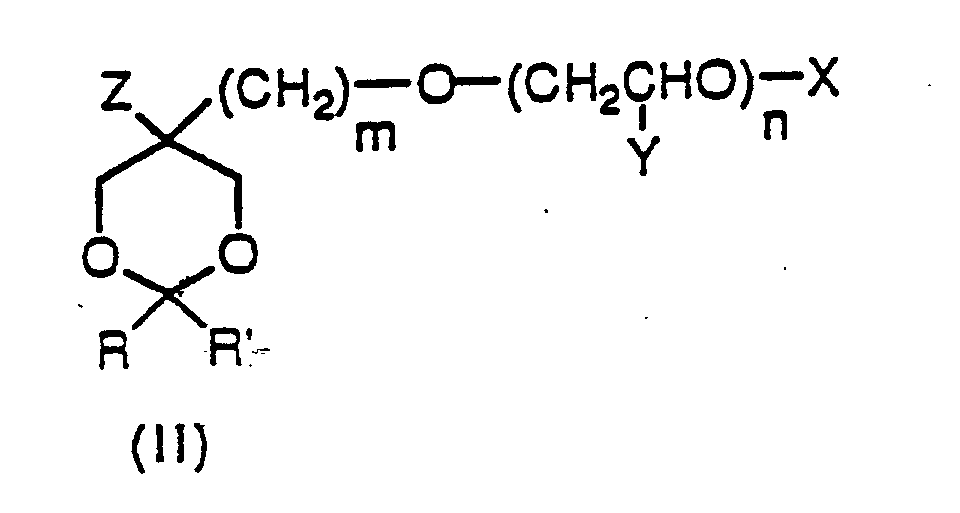 abgeleitet ist, worin R und R' gleich oder verschieden sein können und Reste einer organischen Verbindung (substituiert oder unsubstituiert) sind, die insgesamt 8 bis 20 Kohlenstoffatome enthält, X Wasserstoff oder der Rest einer hydrophoben Endgruppe ist, Y Wasserstoff, Methyl, Ethyl oder Mischungen davon ist, Z Wasserstoff, Methyl oder Ethyl ist, m 0 oder 1 ist, n eine ganze Zahl von 1 bis 40 ist und die Acetalgruppe ein durchschnittliches Molekulargewicht von mindestens 260 aufweist.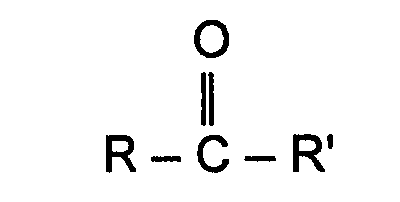
- Verfahren zur Reinigung einer Oberfläche mit damit assoziierten hydrophoben Verunreinigungen, welches Verfahren die folgenden Schritte umfaßt:(a) Kontaktieren der Oberfläche mit einer wäßrigen Lösung, umfassend ein Tensid ausgewählt aus solchen der Formel (I), der Formel (II) oder Mischungen davon, wie in Anspruch 1 definiert,(b) Entfernen einer Flüssigkeit von der Oberfläche, die Wasser, Tensid und assoziierte hydrophobe Verunreingung umfaßt,(c) Behandeln mindestens eines Teils der entfernten Flüssigkeit mit einer sauren Substanz, um den pH-Wert der entfernten Flüssigkeit in einem ausreichenden Maß zu verringern, um eine irreversible Spaltung des Tensids in eine relativ wasserunlösliche Fraktion und eine relativ wasserlösliche Fraktion zu bewirken, wodurch hydrophobe Verunreinigungen, die mit dem Tensid vor der Spaltung assoziiert waren, zusammen mit der relativ wasserunlöslichen Fraktion eine relativ wasserunlösliche Phase bilden, und(d) Abtrennen mindestens eines Teils der relativ wasserunlöslichen Phase von der Flüssigkeit, die die relativ wasserlösliche Fraktion umfaßt.
- Verfahren wie in Anspruch 2 beansprucht, worin die Oberfläche eine Oberfläche eines Gewebes ist, das mindestens eine hydrophobe Verunreinigung aufweist.
- Verfahren wie in irgendeinem der Ansprüche 1 bis 3 beansprucht, worin das Keton eine Mischung von C12-C14-Ketonen ist.
- Verfahren wie in irgendeinem der Ansprüche 2 bis 4 beansprucht, worin Schritt (c) im wesentlichen in Abwesenheit von Phosphaten ausgeführt wird.
- Verfahren wie in irgendeinem der Ansprüche 1 bis 5 beansprucht, worin das Tensid sich irreversibel in mindestens ein Keton und mindestens ein Polyol spaltet.
- Verfahren wie in Anspruch 2 beansprucht, worin die Oberfläche eine harte Oberfläche oder eine Oberfläche einer Metallkomponente ist.
- Verfahren wie in Anspruch 1 beansprucht, worin die Substanz, die vor der Spaltung mit dem Tensid assoziiert war, eine Farbe umfaßt.
- Spaltbares nichtionisches Tensid, das durch eine oder Mischungen der folgenden Formeln dargestellt wird:oder
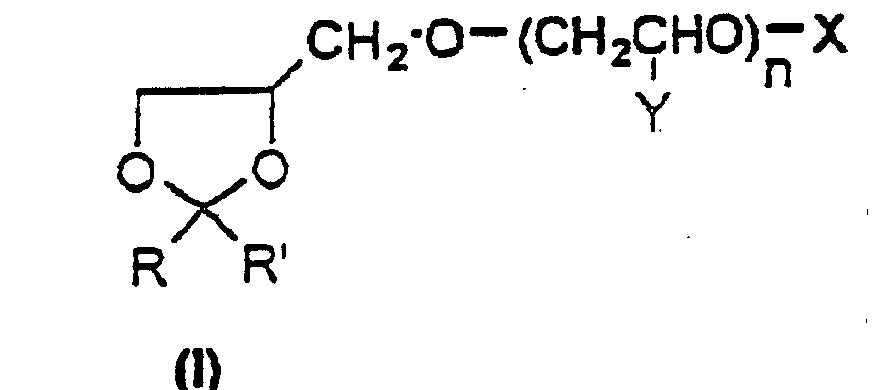 worin R und R' der Rest einer organischen Verbindung sind, die von einer Mischung von Ketonen der Formel
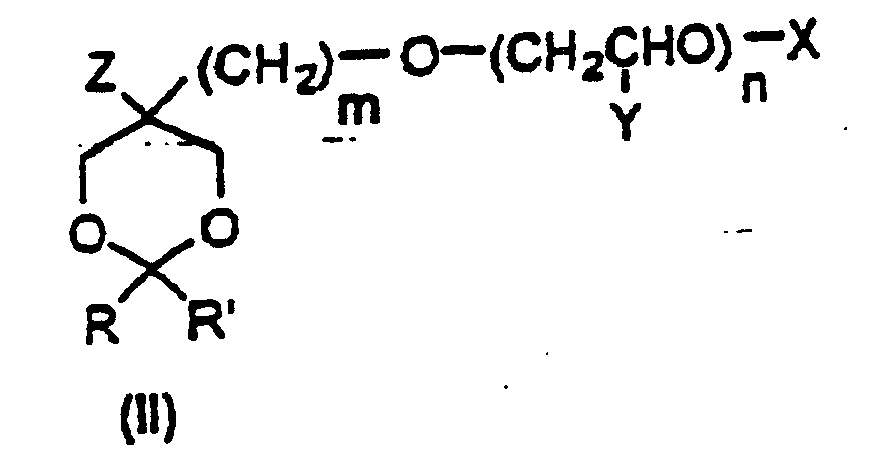 abgeleitet ist, worin R, R', X, Y, Z, m und n wie in Anspruch 1 definiert sind und die Acetalgruppe ein durchschnittliches Molekulargewicht von mindestens 260 aufweist.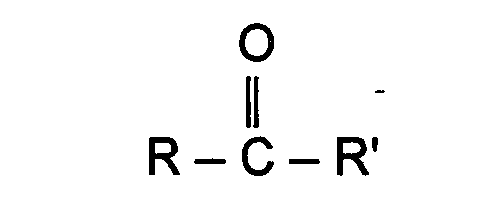
- Spaltbares nichtionisches Tensid wie in Anspruch 9 beansprucht, welches durch Erniedrigen des pH-Wertes einer wäßrigen Lösung davon auf 6 oder weniger irreversibel gespalten wird.
- Spaltbares nichtionisches Tensid wie in Anspruch 9 beansprucht, welches aus einer Mischung von C12-C14-Ketonen abgeleitet ist und worin die Acetalgruppe ein durchschnittliches Molekulargewicht von 272,3 aufweist.
Applications Claiming Priority (2)
| Application Number | Priority Date | Filing Date | Title |
|---|---|---|---|
| US08/439,953 US5744064A (en) | 1995-05-12 | 1995-05-12 | Ketone-based surfactant and method for treating industrial, commerical, and institutional waste-water |
| US439953 | 1995-05-12 |
Publications (2)
| Publication Number | Publication Date |
|---|---|
| EP0742178A1 EP0742178A1 (de) | 1996-11-13 |
| EP0742178B1 true EP0742178B1 (de) | 2001-07-25 |
Family
ID=23746800
Family Applications (1)
| Application Number | Title | Priority Date | Filing Date |
|---|---|---|---|
| EP96303261A Expired - Lifetime EP0742178B1 (de) | 1995-05-12 | 1996-05-10 | Von Ketonen stammendes Tensid und Verfahren zum Behandeln von Abwässern aus Industrie, Handel oder öffentlichen Körperschaften |
Country Status (9)
| Country | Link |
|---|---|
| US (2) | US5744064A (de) |
| EP (1) | EP0742178B1 (de) |
| JP (1) | JPH09164385A (de) |
| KR (1) | KR960041065A (de) |
| CN (2) | CN1151332A (de) |
| AU (1) | AU693341B2 (de) |
| CA (1) | CA2176276C (de) |
| DE (1) | DE69614029T2 (de) |
| DK (1) | DK0742178T3 (de) |
Families Citing this family (12)
| Publication number | Priority date | Publication date | Assignee | Title |
|---|---|---|---|---|
| US5744064A (en) * | 1995-05-12 | 1998-04-28 | Union Carbide Chemicals & Plastics Technology Corporation | Ketone-based surfactant and method for treating industrial, commerical, and institutional waste-water |
| US5744065A (en) * | 1995-05-12 | 1998-04-28 | Union Carbide Chemicals & Plastics Technology Corporation | Aldehyde-based surfactant and method for treating industrial, commercial, and institutional waste-water |
| US6110231A (en) * | 1998-06-01 | 2000-08-29 | Boehme Filatex, Inc. | Method of processing textile products utilizing decomposable emulsifiers |
| EP1162178A3 (de) * | 2000-06-06 | 2003-10-15 | BP Köln GmbH | Verfahren zur Entfernung von zyklischen Acetalen aus Abwässern |
| US7201227B2 (en) * | 2004-12-20 | 2007-04-10 | Bj Services Company | Method and composition for treating a subterranean formation with splittable foams |
| CA2559675C (en) * | 2005-09-22 | 2009-10-27 | Halliburton Energy Services, Inc. | Orthoester-based surfactants and associated methods |
| US20080108522A1 (en) * | 2006-11-07 | 2008-05-08 | Bj Services Company | Use of anionic surfactants as hydration aid for fracturing fluids |
| US7816305B2 (en) * | 2008-05-15 | 2010-10-19 | Halliburton Energy Services, Inc. | Reversible surfactants and methods of use in subterranean formations |
| EP2135989B1 (de) * | 2008-06-19 | 2015-03-04 | Electrolux Home Products Corporation N.V. | Waschverfahren und Waschmaschine mit diesem Verfahren |
| US8349777B2 (en) * | 2010-11-22 | 2013-01-08 | Chevron Oronite Company Llc | Lubricating composition containing 1,3-dioxolane-4-methanol compounds as antiwear additives |
| US8518267B2 (en) | 2011-12-15 | 2013-08-27 | General Electric Company | Treatment of surfactant laden wastewater |
| WO2015103095A1 (en) * | 2013-12-30 | 2015-07-09 | Houghton Technical Corp. | Dissolved air floatation use with cationic metal processing fluids |
Citations (1)
| Publication number | Priority date | Publication date | Assignee | Title |
|---|---|---|---|---|
| US3948953A (en) * | 1969-08-05 | 1976-04-06 | Texaco Inc. | Dioxolane derivatives having surfactant properties |
Family Cites Families (35)
| Publication number | Priority date | Publication date | Assignee | Title |
|---|---|---|---|---|
| US2905719A (en) * | 1959-09-22 | Cxhzo | ||
| US3244753A (en) * | 1966-04-05 | Process f-or manufacture cf acetals | ||
| GB414772A (en) * | 1932-11-05 | 1934-08-07 | Ig Farbenindustrie Ag | Improvements in the manufacture and production of substances suitable as wetting, washing, dispersing and like agents |
| NL181914B (nl) * | 1952-11-29 | Toyo Seikan Kaisha Ltd | Inrichting voor het vervaardigen van getrokken voorwerpen. | |
| US2786081A (en) * | 1954-01-08 | 1957-03-19 | Quaker Chemical Products Corp | Acetal condensation products |
| US3058981A (en) * | 1958-11-14 | 1962-10-16 | Richardson Merrell Inc | 2-methyl-2-nonyl-4-hydroxymethyl-1, 3-dioxolane and carbamates thereof |
| FR1302969A (fr) * | 1960-06-25 | 1962-09-07 | Molins Y Puigarnau S R C | Procédé pour l'obtention d'un produit doué d'une grande stabilité, avec toutes les propriétés émanant du chlore actif à des températures relativement élevées |
| NL295816A (de) * | 1962-07-27 | |||
| US3909460A (en) * | 1969-08-05 | 1975-09-30 | Texaco Inc | Detergent compositions containing dioxolanes as surfactants and their preparation |
| US3725438A (en) * | 1970-10-16 | 1973-04-03 | Petro Tex Chem Corp | Production of cyclic acetals |
| US4060532A (en) * | 1972-03-15 | 1977-11-29 | Ici United States Inc. | Halogenated dioxolane tranquilizers |
| US3931337A (en) * | 1974-08-19 | 1976-01-06 | Basf Wyandotte Corporation | Multi-block polyacetal copolymer surfactants |
| US4189609A (en) * | 1974-08-19 | 1980-02-19 | Basf Wyandotte Corporation | Multi-block coupled polyoxyalkylene copolymer surfactants |
| FR2302969A1 (fr) * | 1975-03-03 | 1976-10-01 | Mitsui Toatsu Chemicals | Procede pour le traitement de deshuilage d'une eau residuaire contenant des substances huileuses |
| US4198294A (en) * | 1975-06-16 | 1980-04-15 | The Redux Corporation, Inc. | Water purification system |
| CA1075718A (en) * | 1975-12-12 | 1980-04-15 | Gerhard W. H. Scherf | Acetals as enervatable surface-active organic compounds |
| NL7810361A (nl) * | 1977-10-20 | 1979-04-24 | Montedison Spa | Werkwijze voor het ontinkten van afvalpapier en daarbij te gebruiken preparaat. |
| US4360439A (en) * | 1977-10-20 | 1982-11-23 | Montedison S.P.A. | Composition for the de-inking of printed waste paper by the washing process |
| EP0054366A3 (de) * | 1980-12-15 | 1982-08-11 | Imperial Chemical Industries Plc | Tensio-aktive Substanzen und die sie enthaltenden Zusammensetzungen |
| US4408084A (en) * | 1981-01-09 | 1983-10-04 | Basf Wyandotte Corporation | Non-ionic surfactants containing acetal groups |
| JPS5813530A (ja) * | 1981-07-20 | 1983-01-26 | Kao Corp | 2,3−ジアルコキシプロピルグリセリルエ−テル及びその製造法並びにこれを含有する化粧料 |
| US4605773A (en) * | 1982-08-10 | 1986-08-12 | Diamond Shamrock Chemicals Company | Low-foaming, pH sensitive, alkylamine polyether surface active agents and methods for using |
| US4483741A (en) * | 1982-08-10 | 1984-11-20 | Economics Laboratory, Inc. | Low-foaming, pH sensitive, alkylamine polyether surface active agents and methods for using |
| DE3318592A1 (de) * | 1983-05-21 | 1984-11-22 | Hoechst Ag, 6230 Frankfurt | Grenzflaechenaktive polyglykolaetheracetale |
| US4675125A (en) * | 1984-07-02 | 1987-06-23 | Cincinnati-Vulcan Company | Multi-purpose metal cleaning composition containing a boramide |
| DE3441542A1 (de) * | 1984-11-14 | 1986-05-15 | Hoechst Ag, 6230 Frankfurt | Grenzflaechenaktive polyglykolaetheracetale |
| US4977281A (en) * | 1987-12-21 | 1990-12-11 | Milliken Research Corporation | Polyoxyalkylene amino alcohols and polyoxyalkylene amino 1,3-dioxanes and 1,3-dioxolanes |
| US5076937A (en) * | 1990-07-26 | 1991-12-31 | Unitog Rental Services, Inc. | Method for removal of fat, oil and grease from laundry wash water |
| US5114607A (en) * | 1990-08-08 | 1992-05-19 | Betz Laboratories, Inc. | Low foaming alkaline cleaner comprising a surfactant mixture of an EO-PO-EO block copolymer and a PO-ZO-PO block copolymer |
| US5207922A (en) * | 1990-10-25 | 1993-05-04 | Diversey Corporation | Method for treating laundry waste water |
| US5246590A (en) * | 1991-06-21 | 1993-09-21 | Dober Chemical Corporation | Water treatment to reduce fog levels controlled with streaming current detector |
| US5167829A (en) * | 1991-06-21 | 1992-12-01 | Harold Diamond | System for treating commercial waste effluents |
| US5137654A (en) * | 1991-10-17 | 1992-08-11 | Eaton Corporation | Process for reclaiming oil/water emulsion |
| US5744064A (en) * | 1995-05-12 | 1998-04-28 | Union Carbide Chemicals & Plastics Technology Corporation | Ketone-based surfactant and method for treating industrial, commerical, and institutional waste-water |
| US5744065A (en) * | 1995-05-12 | 1998-04-28 | Union Carbide Chemicals & Plastics Technology Corporation | Aldehyde-based surfactant and method for treating industrial, commercial, and institutional waste-water |
-
1995
- 1995-05-12 US US08/439,953 patent/US5744064A/en not_active Expired - Lifetime
-
1996
- 1996-05-10 AU AU52224/96A patent/AU693341B2/en not_active Ceased
- 1996-05-10 JP JP8151458A patent/JPH09164385A/ja active Pending
- 1996-05-10 EP EP96303261A patent/EP0742178B1/de not_active Expired - Lifetime
- 1996-05-10 DE DE69614029T patent/DE69614029T2/de not_active Expired - Fee Related
- 1996-05-10 CA CA002176276A patent/CA2176276C/en not_active Expired - Fee Related
- 1996-05-10 KR KR1019960015339A patent/KR960041065A/ko not_active Abandoned
- 1996-05-10 DK DK96303261T patent/DK0742178T3/da active
- 1996-05-11 CN CN96108424A patent/CN1151332A/zh active Pending
-
1997
- 1997-11-26 US US08/978,920 patent/US5851434A/en not_active Expired - Fee Related
-
2001
- 2001-07-17 CN CN01123061A patent/CN1336423A/zh active Pending
Patent Citations (1)
| Publication number | Priority date | Publication date | Assignee | Title |
|---|---|---|---|---|
| US3948953A (en) * | 1969-08-05 | 1976-04-06 | Texaco Inc. | Dioxolane derivatives having surfactant properties |
Also Published As
| Publication number | Publication date |
|---|---|
| CN1336423A (zh) | 2002-02-20 |
| CA2176276A1 (en) | 1996-11-13 |
| AU693341B2 (en) | 1998-06-25 |
| CN1151332A (zh) | 1997-06-11 |
| AU5222496A (en) | 1996-11-21 |
| DE69614029T2 (de) | 2002-03-14 |
| DE69614029D1 (de) | 2001-08-30 |
| DK0742178T3 (da) | 2001-11-05 |
| US5744064A (en) | 1998-04-28 |
| JPH09164385A (ja) | 1997-06-24 |
| US5851434A (en) | 1998-12-22 |
| CA2176276C (en) | 2001-07-03 |
| EP0742178A1 (de) | 1996-11-13 |
| KR960041065A (ko) | 1996-12-17 |
Similar Documents
| Publication | Publication Date | Title |
|---|---|---|
| EP0742177B1 (de) | Von Aldehyden stammendes Tensid und Verfahren zum Behandeln von Abwässern aus Industrie, Handel oder öffentliche Körperschaften | |
| EP0742178B1 (de) | Von Ketonen stammendes Tensid und Verfahren zum Behandeln von Abwässern aus Industrie, Handel oder öffentlichen Körperschaften | |
| US6207058B1 (en) | Recovery and reuse of nonionic surfactants from aqueous solutions | |
| US4784798A (en) | Demulsifying cleaning preparation having a prolonged surface-wetting effect | |
| US5459066A (en) | Method of separating oily materials from wash water | |
| CA2256300A1 (en) | De-oiling process using enzymes | |
| KR100670964B1 (ko) | 수용액으로부터 음이온 계면활성제의 회수 및 재사용 | |
| CA2018738A1 (en) | Heavy duty washing process | |
| JPH09299931A (ja) | アルデヒドをベースとする界面活性剤ならびに工業的、商業的及び公共施設廃水の処理方法 | |
| CN119242332B (zh) | 处理含铁硫化物的组合物及其应用和处理乳化原油的方法 | |
| Peterson | Industrial Lubricants, Cleaning Processes, and Waste Minimization |
Legal Events
| Date | Code | Title | Description |
|---|---|---|---|
| PUAI | Public reference made under article 153(3) epc to a published international application that has entered the european phase |
Free format text: ORIGINAL CODE: 0009012 |
|
| 17P | Request for examination filed |
Effective date: 19960518 |
|
| AK | Designated contracting states |
Kind code of ref document: A1 Designated state(s): BE CH DE DK FR GB IT LI NL SE |
|
| K1C3 | Correction of patent application (complete document) published |
Effective date: 19961113 |
|
| 17Q | First examination report despatched |
Effective date: 19981001 |
|
| GRAG | Despatch of communication of intention to grant |
Free format text: ORIGINAL CODE: EPIDOS AGRA |
|
| GRAG | Despatch of communication of intention to grant |
Free format text: ORIGINAL CODE: EPIDOS AGRA |
|
| GRAH | Despatch of communication of intention to grant a patent |
Free format text: ORIGINAL CODE: EPIDOS IGRA |
|
| GRAH | Despatch of communication of intention to grant a patent |
Free format text: ORIGINAL CODE: EPIDOS IGRA |
|
| GRAA | (expected) grant |
Free format text: ORIGINAL CODE: 0009210 |
|
| AK | Designated contracting states |
Kind code of ref document: B1 Designated state(s): BE CH DE DK FR GB IT LI NL SE |
|
| REG | Reference to a national code |
Ref country code: CH Ref legal event code: EP |
|
| REF | Corresponds to: |
Ref document number: 69614029 Country of ref document: DE Date of ref document: 20010830 |
|
| ITF | It: translation for a ep patent filed | ||
| REG | Reference to a national code |
Ref country code: CH Ref legal event code: NV Representative=s name: KIRKER & CIE SA |
|
| REG | Reference to a national code |
Ref country code: DK Ref legal event code: T3 |
|
| ET | Fr: translation filed | ||
| REG | Reference to a national code |
Ref country code: GB Ref legal event code: IF02 |
|
| PGFP | Annual fee paid to national office [announced via postgrant information from national office to epo] |
Ref country code: FR Payment date: 20020313 Year of fee payment: 7 |
|
| PGFP | Annual fee paid to national office [announced via postgrant information from national office to epo] |
Ref country code: SE Payment date: 20020315 Year of fee payment: 7 Ref country code: NL Payment date: 20020315 Year of fee payment: 7 Ref country code: GB Payment date: 20020315 Year of fee payment: 7 Ref country code: DK Payment date: 20020315 Year of fee payment: 7 Ref country code: DE Payment date: 20020315 Year of fee payment: 7 Ref country code: CH Payment date: 20020315 Year of fee payment: 7 |
|
| PGFP | Annual fee paid to national office [announced via postgrant information from national office to epo] |
Ref country code: BE Payment date: 20020409 Year of fee payment: 7 |
|
| PLBE | No opposition filed within time limit |
Free format text: ORIGINAL CODE: 0009261 |
|
| STAA | Information on the status of an ep patent application or granted ep patent |
Free format text: STATUS: NO OPPOSITION FILED WITHIN TIME LIMIT |
|
| 26N | No opposition filed | ||
| PG25 | Lapsed in a contracting state [announced via postgrant information from national office to epo] |
Ref country code: GB Free format text: LAPSE BECAUSE OF NON-PAYMENT OF DUE FEES Effective date: 20030510 |
|
| PG25 | Lapsed in a contracting state [announced via postgrant information from national office to epo] |
Ref country code: SE Free format text: LAPSE BECAUSE OF NON-PAYMENT OF DUE FEES Effective date: 20030511 |
|
| PG25 | Lapsed in a contracting state [announced via postgrant information from national office to epo] |
Ref country code: LI Free format text: LAPSE BECAUSE OF NON-PAYMENT OF DUE FEES Effective date: 20030531 Ref country code: CH Free format text: LAPSE BECAUSE OF NON-PAYMENT OF DUE FEES Effective date: 20030531 Ref country code: BE Free format text: LAPSE BECAUSE OF NON-PAYMENT OF DUE FEES Effective date: 20030531 |
|
| BERE | Be: lapsed |
Owner name: *UNION CARBIDE CHEMICALS & PLASTICS TECHNOLOGY COR Effective date: 20030531 |
|
| PG25 | Lapsed in a contracting state [announced via postgrant information from national office to epo] |
Ref country code: NL Free format text: LAPSE BECAUSE OF NON-PAYMENT OF DUE FEES Effective date: 20031201 Ref country code: DK Free format text: LAPSE BECAUSE OF NON-PAYMENT OF DUE FEES Effective date: 20031201 |
|
| PG25 | Lapsed in a contracting state [announced via postgrant information from national office to epo] |
Ref country code: DE Free format text: LAPSE BECAUSE OF NON-PAYMENT OF DUE FEES Effective date: 20031202 |
|
| REG | Reference to a national code |
Ref country code: DK Ref legal event code: EBP |
|
| GBPC | Gb: european patent ceased through non-payment of renewal fee |
Effective date: 20030510 |
|
| EUG | Se: european patent has lapsed | ||
| REG | Reference to a national code |
Ref country code: CH Ref legal event code: PL |
|
| PG25 | Lapsed in a contracting state [announced via postgrant information from national office to epo] |
Ref country code: FR Free format text: LAPSE BECAUSE OF NON-PAYMENT OF DUE FEES Effective date: 20040130 |
|
| NLV4 | Nl: lapsed or anulled due to non-payment of the annual fee |
Effective date: 20031201 |
|
| REG | Reference to a national code |
Ref country code: FR Ref legal event code: ST |
|
| PG25 | Lapsed in a contracting state [announced via postgrant information from national office to epo] |
Ref country code: IT Free format text: LAPSE BECAUSE OF NON-PAYMENT OF DUE FEES Effective date: 20050510 |