EP0742016A2 - Moist-heat sterilization plant and process, in particular to set up autoclaves for dental surgery use - Google Patents
Moist-heat sterilization plant and process, in particular to set up autoclaves for dental surgery use Download PDFInfo
- Publication number
- EP0742016A2 EP0742016A2 EP96106007A EP96106007A EP0742016A2 EP 0742016 A2 EP0742016 A2 EP 0742016A2 EP 96106007 A EP96106007 A EP 96106007A EP 96106007 A EP96106007 A EP 96106007A EP 0742016 A2 EP0742016 A2 EP 0742016A2
- Authority
- EP
- European Patent Office
- Prior art keywords
- chamber
- boiler shell
- heating block
- heating
- members
- Prior art date
- Legal status (The legal status is an assumption and is not a legal conclusion. Google has not performed a legal analysis and makes no representation as to the accuracy of the status listed.)
- Granted
Links
Images

Classifications
-
- A—HUMAN NECESSITIES
- A61—MEDICAL OR VETERINARY SCIENCE; HYGIENE
- A61L—METHODS OR APPARATUS FOR STERILISING MATERIALS OR OBJECTS IN GENERAL; DISINFECTION, STERILISATION OR DEODORISATION OF AIR; CHEMICAL ASPECTS OF BANDAGES, DRESSINGS, ABSORBENT PADS OR SURGICAL ARTICLES; MATERIALS FOR BANDAGES, DRESSINGS, ABSORBENT PADS OR SURGICAL ARTICLES
- A61L2/00—Disinfection or sterilisation of materials or objects, in general; Accessories therefor
- A61L2/02—Disinfection or sterilisation of materials or objects, in general; Accessories therefor using physical processes
- A61L2/04—Heat
- A61L2/06—Hot gas
- A61L2/07—Steam
Definitions
- the invention relates to a moist-heat sterilization plant and process, in particular to set up autoclaves for dental surgery use, defined in the preambles of the accompanying Claims 1 and 8.
- steam autoclaves also referred to as saturated-steam autoclaves, comprise a sterilization chamber for the objects to be sterilized which is substantially filled with saturated steam.
- the sterilizing function is in fact performed by saturated steam carrying out a strong heat exchange with the material in the sterilization chamber.
- the steam autoclaves for dental surgery use are distinguishable because they have small sizes, are provided with heating members defined by electrical resistors, and are capable of housing superposed trays inside which the instruments used by dental surgeons are held.
- a first drawback resides in that it is necessary to continuously execute evacuation of the water condensing within the chamber, to avoid formation of a colder mass at the chamber base.
- a second drawback is represented by the fact that this external steam-generating unit causes an important loss of heat, along the steam conveying path as well. Actually, an external steam-generating unit needs a power of about 2500 watts on an average.
- an autoclave with an internal steam generation of a volume of about fifteen litres, needs a starting time of about twenty minutes, before it reaches a steady condition and is therefore able to begin the sterilization step. This is a long time if compared with the duration of the sterilization step approximately lasting only four minutes when this operation is carried out with 205 kilopascals of pressure and at a temperature of about 134 degrees centigrade, as it often happens.
- the starting time to bring water to evaporation within the sterilization chamber is unwelcome and damaging in the autoclaves used in dentist's surgeries, since each delay reduces the amount of work that can be executed over a day, or involves the purchase of many specimens of all currently used instruments.
- thermoregulation members with the resistors is known, so that, when the resistors get overheated, said members are capable of stopping the delivery of current to the resistors themselves for short periods of time, in order to enable a partial cooling of the latter.
- the technical task underlying the present invention is to devise a plant and process which are capable of overcoming the above mentioned drawbacks and which, even in the presence of water to be heated within the sterilization chamber, enable the overall sterilization time to be reduced without oversizing the water-heating elements, and in addition allow a particularly careful thermal control of the heat distribution.
- the technical task specified is substantially achieved by a moist-heat sterilization plant, in particular to set up autoclaves for dental surgery use, as claimed in the Claims 1 and 8.
- the sterilization plant in accordance with the invention generally embodying a saturated-steam autoclave, is identified by reference numeral 1 .
- It comprises a boiler 2 externally having a boiler shell 3 and internally provided with a sterilization chamber 4 .
- a bottom area 3a is distinguisable in the boiler shell 3 and an upper area 4a is highlighted in the chamber 4.
- the boiler shell 3 has at least one opening and closing door and the chamber 4 is adapted to house trays in which the objects to be sterilized are arranged.
- the boiler 2 is provided with temperature and pressure control means consisting of sensors for example, such as a first thermal probe 5 located at the upper area 4a and capable of detecting the saturated steam temperature, and a second thermal probe 6 , disposed close to the bottom area 3a and capable of detecting the condensate temperature at the chamber 4 base.
- sensors for example, such as a first thermal probe 5 located at the upper area 4a and capable of detecting the saturated steam temperature, and a second thermal probe 6 , disposed close to the bottom area 3a and capable of detecting the condensate temperature at the chamber 4 base.
- thermal base probe 7 Disposed externally of chamber 4, and immediately below the bottom area 3a, there is a thermal base probe 7 , the function of which is that of controlling the heating members, as better clarified in the following.
- Safety devices are also provided, such as a safety valve 8 communicating via a pipeline 9 with a top hole 9a formed in the upper area of the boiler shell 3.
- control and safety devices known per se may be also provided, as well as members of the electronic type, known per se and not shown, for coordinating all the work steps.
- the plant 1 comprises several members for water, steam and air circulation at the boiler 2.
- Identified by 10 in Fig. 1 is a feed tank holding distilled water to be used for sterilization, and by 11 a discharge tank for collection of the water used for sterilization.
- the distilled water in the feed tank 10 is maintained between a minimum level and a maximum level, due to the presence of two level sensors 10a , whereas a maximum-level sensor alone 11a is provided in the discharge tank 11.
- the tanks are equipped with drain cocks 10b and 11b at the bottom.
- a feeding circuit 12 extends between the feed tank 10 and chamber 4 and it comprises members for water circulation such as a metering pump 13 capable of sending dosed amounts of water from the tank 10 to the chamber 4. Connected downstream of the metering pump 13 is a one-way valve 13a inhibiting return flows from the chamber 4 to the metering pump 13.
- the feeding circuit 12 opens, through an inlet 14a , into a heating block or unit 14 for heat formation, disposed in close contact with the boiler shell 3, as better clarified in the following.
- a discharge circuit 17 is connected to the chamber 4 bottom at a discharge opening 15 ; said discharge circuit is controlled by a solenoid exhaust valve 16 and extends until the discharge tank 11, where it comprises pumping members 18 and a branch 17a provided with an exhaust valve 17b .
- the discharge circuit 17 passes through the feed tank 10, upstream of the pumping members 18, where it is provided with a condenser coil 17c .
- bleeding members mainly comprising a bleeding circuit 19 one end of which terminates with a bleed hole 20 and an end portion 19a of which is connected both with the pumping members 18 and the exhaust valve 17b of the discharge circuit 17.
- the bleeding circuit 19 downstream of the bleed hole 20 comprises a solenoid bleed valve 21 enabling bleedings to be carried out upon command.
- a heat exchanger 22 is also provided downstream of the solenoid bleed valve 21, to condensate steam coming out of chamber 4.
- the plant 1 also comprises an air-admitting circuit 23 terminating at the pipeline 9 and provided with a second one-way valve 23a .
- the air-admitting circuit 23 preferably is comprised of a bacteriologic filter 24 for the external air and a compensation solenoid valve 25 controlling said air admission.
- the above mentioned heating block 14 intended for steam formation is disposed at the outside of chamber 4 but in close physical contact with the bottom area 3a of the boiler shell 3, so as to enable an efficient heat conduction between the heating block 14 and the boiler area where condensate is gathered.
- the heating block 14 is provided with the above mentioned inlet 14a and with an outlet 14b .
- a conveying circuit 26 preferably extending in contact with the external side of the boiler shell 3 and opening into the upper area 4a of chamber 4, through a steam-admitting hole 26a .
- the heating block 14 is adapted to convert to steam both the water from the circulation members 13 so as to form a first steam flow 27 conveyed into the conveying circuit 26, and the condensation water 28 gathered in the bottom area 3a of the boiler shell 3, to form a second steam flow 29 .
- the first steam flow 27 is substantially directed downwardly, whereas the second steam flow 29 is directed naturally upwardly.
- the heating block 14 comprises substantially plate-like heating members 30 , the shape of which matches that of the bottom area 3a of the boiler shell 3 at least partly, and canalization members 31 .
- the heating members 30 are formed of a central layer 33 on which an electrical resistor 34 of 1500 watts is wound, and two outer layers 33a of electrically insulating material, enclosing the central layer 33 and the electrical resistor 34 between them.
- the canalization members 31 comprise a coil channel 32 brought into thermal conduction contact with the heating members 30.
- the coil channel 32 is formed in a plate 36 in contact with the heating members 30 and is embodied by a through slot provided in the plate 36 and closed by the heating members 30 at the upper part thereof and an outer band 37 at the lower part. Practically the coil channel 32 extends in the plate 36 thickness.
- the outer band 37 has an inlet hole 37a and an outlet hole 37b for the coil channel 32 which are to be aligned with the inlet 14a and outlet 14b.
- the coil channel 32 is defined by a plate 36 conveniently shaped and deformed so as to exhibit a coil hollow which is already closed at the lower part thereof.
- a sealing sheet made of stainless steel or another material adapted to be brought into contact with water and steam may be interposed between the heating members 30 and the coil channel 32.
- a conductive band 35 substantially extending around the whole boiler shell 3 and promoting distribution of heat from the heating members 30.
- This conductive band 35 is made of copper, aluminium or alloys thereof and transmits heat better than the walls of the boiler shell 3, generally made of stainless steel.
- the conductive band 35 leads to a more homogeneous heating of the whole boiler shell 3.
- the pumping members 18 After introducing the trays carrying the material to be sterilized into the chamber 4 and closing the chamber door, the pumping members 18 are turned on so that they suck the air contained in chamber 4 at least partly.
- the solenoid exhaust valve 16 enables suction of air through the discharge circuit 17.
- the solenoid bleed valve 21 is maintained open so that air can be sucked through the bleeding circuit 19 as well.
- the solenoid exhaust valve 16 closes communication with the discharge circuit 17.
- the solenoid bleed valve too closes and operation of the pumping members 18 is stopped.
- the metering pump 13 sends water in a dosed amount to the heating block, 14 which has been previously turned on so that the heating members 30 have already reached the foreseen operative temperature when water begins passing through the coil channel 32.
- the first steam flow condensate at least partly and the condensation water 28 thus formed is collected in the bottom area 3a of the boiler shell 3 (fig. 5).
- the heating block 14 however, intensely heats the boiler shell 3 as well, in that the heating members 30 are exactly in contact with the bottom area 3a of the boiler shell 3 and transfer heat thereto, so that evaporation of the condensation water 28 is caused and, as a result, a second steam flow directed upwardly is generated (Fig. 6).
- Heating of the boiler shell 3 and the flow rate of the first steam flow are adjusted depending both on the temperature and pressure values to be reached in chamber 4, and the thermal conditions of the heating block 14.
- the temperature and pressure values to be reached in chamber 4 typically are a pressure of at least approximately 205 kilopascals and a temperature of at least 134 degrees centigrade.
- thermal base probe 7 is intended for thermal control of the heating block 14 and that detections of said probe cause operation of the metering pump 13: in the presence of overheatings, the metering pump sends greater amounts of water that will give rise to an immediate cooling of the resistor 34.
- the compensation solenoid valve 25 is operated to enable admission of filtered air into the chamber 4, through the air-admitting circuit 23.
- the sterilization process performed by the plant in accordance with the invention takes place as follows, with reference to the steps of filling the chamber 4 with steam, carried out after suction of air from the chamber itself.
- First of all a heating step is executed, which consists in admitting a first steam flow formed by the heating members into the chamber 4, preferably at the upper area thereof.
- the first steam flow preferably impinges from top on the objects located inside the chamber 4.
- said first steam flow impinging on said objects partly condenses and is collected in a bottom area of the boiler shell 3, in the form of water.
- Said sanitization step initiates a true sterilization step, for example when in chamber 4 pressure and temperature values of 205 kilopascals and 134 degrees centigrade respectively are reached.
- the sterilization step lasts approximately four minutes.
- the fist steam flow itself carries out thermoregulation of said heat source: in the presence of overheatings the first steam flow is increased so as to achieve a greater heat absorption through the same. Therefore it does not appear necessary that operation of the heating members be stopped when said members tend to become overheated.
- the invention achieves important advantages.
- the plant has a single heating block the sizes of which are selected based on the heat amount usually required for causing the water built up within the boiler shell 3 to evaporate gradually, and in addition in many respects the plant remains similar to the autoclaves forming steam inside them.
- this single heating block 14 is not only capable of heating the boiler shell 3 so as to cause evaporation of the water in chamber 4, but also of admitting this water into chamber 4 in the form of a first steam flow, which flow combines with the second flow generated by normal heating of the boiler shell 3 so as to perform a sanitizing step.
- the sanitizing step on reaching appropriate pressure and temperature values, initiates a particularly efficient sterilization step, in that the presence of two steam flows of different directions leads to an inprovement in sterilization and a greater homogeneity in temperatures, since the material is better impinged on by steam.
Landscapes
- Health & Medical Sciences (AREA)
- Epidemiology (AREA)
- Life Sciences & Earth Sciences (AREA)
- Animal Behavior & Ethology (AREA)
- General Health & Medical Sciences (AREA)
- Public Health (AREA)
- Veterinary Medicine (AREA)
- Apparatus For Disinfection Or Sterilisation (AREA)
- Dental Tools And Instruments Or Auxiliary Dental Instruments (AREA)
Abstract
Description
- The invention relates to a moist-heat sterilization plant and process, in particular to set up autoclaves for dental surgery use, defined in the preambles of the accompanying
Claims 1 and 8. - It is known that steam autoclaves, also referred to as saturated-steam autoclaves, comprise a sterilization chamber for the objects to be sterilized which is substantially filled with saturated steam.
- The sterilizing function is in fact performed by saturated steam carrying out a strong heat exchange with the material in the sterilization chamber.
- The steam autoclaves for dental surgery use are distinguishable because they have small sizes, are provided with heating members defined by electrical resistors, and are capable of housing superposed trays inside which the instruments used by dental surgeons are held.
- Of the autoclaves of the above type, those that are the most commonly used and have the simplest and less expensive structure are featured by having water converted to steam directly within the sterilization chamber into which cold water is admitted which is brought to evaporation by electrical resistors of a power of about 1500 watts.
- If, on the contrary, sterilization is carried out by steam generated externally of said chamber, by an external and self-contained steam generating unit, inconveniences of some importance occur for these small autoclaves.
- A first drawback resides in that it is necessary to continuously execute evacuation of the water condensing within the chamber, to avoid formation of a colder mass at the chamber base.
- A second drawback is represented by the fact that this external steam-generating unit causes an important loss of heat, along the steam conveying path as well. Actually, an external steam-generating unit needs a power of about 2500 watts on an average.
- Practically, strong water and electrical current consumptions occur and many complications are involved.
- Conversion of water to steam carried out within the sterilization chamber does not suffer from the above drawbacks, but in this case a certain lapse of time is necessary for the admitted water to carry out a passage of state, which will involve a longer overall duration of the sterilization operations.
- Just as indication, an autoclave with an internal steam generation, of a volume of about fifteen litres, needs a starting time of about twenty minutes, before it reaches a steady condition and is therefore able to begin the sterilization step. This is a long time if compared with the duration of the sterilization step approximately lasting only four minutes when this operation is carried out with 205 kilopascals of pressure and at a temperature of about 134 degrees centigrade, as it often happens.
- Since the working time should be as quick as possible, for a prompt reuse of the sterilized material, it is apparent that this long starting time is greatly unwelcome.
- In particular, the starting time to bring water to evaporation within the sterilization chamber is unwelcome and damaging in the autoclaves used in dentist's surgeries, since each delay reduces the amount of work that can be executed over a day, or involves the purchase of many specimens of all currently used instruments.
- Notwithstanding the above, a relatively slow setting of the plant to a steady condition has always been considered as inevitable for the purpose of avoiding an excessive oversizing of the heating members, resulting in high installation and power supply costs and in true difficulties in the sterilization management, since with too powerful heating members it is difficult to exactly control the sterilization temperatures.
- Oversizing of the heating members also brings about a loss of heat in the surrounding atmosphere and a reduced thermal efficiency and checking capability of the whole process. This is all the more true, given the fact that also with substantially non-oversized members it is difficult, in the case of internal steam generation, to achieve a uniform distribution of heat in the sterilization chamber: the lower part of the chamber easily has a different and higher temperature than the upper part thereof.
- Above all, in the case of internal steam generation it is practically impossible to exploit heating members such as usual electrical resistors in a continuous manner.
- In fact these resistors are not subjected to a very high heat exchange with the closed environment of the sterilization chamber and therefore can easily get overheated until being damaged in an irreparable manner. For this reason association of thermoregulation members with the resistors is known, so that, when the resistors get overheated, said members are capable of stopping the delivery of current to the resistors themselves for short periods of time, in order to enable a partial cooling of the latter.
- The technical task underlying the present invention is to devise a plant and process which are capable of overcoming the above mentioned drawbacks and which, even in the presence of water to be heated within the sterilization chamber, enable the overall sterilization time to be reduced without oversizing the water-heating elements, and in addition allow a particularly careful thermal control of the heat distribution.
- The technical task specified is substantially achieved by a moist-heat sterilization plant, in particular to set up autoclaves for dental surgery use, as claimed in the
Claims 1 and 8. - Preferred embodiments of the invention are specified in
Claims 2 to 7 and 9 to 11. - The description of a preferred embodiment of a plant and a process in accordance with the invention is now taken with reference to the accompanying drawings, in which:
- Fig. 1 shows an overall diagram of the plant in accordance with the invention;
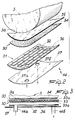
- Fig. 2 is a perspective and exploded view of a steam -formation unit of the plant in fig. 1;
- Fig. 3 is an exploded cross-sectional view of the unit shown in Fig. 2; and
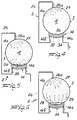
- Figs. 4, 5 and 6 show the heating step, condensation step, and sanitization and sterilization step respectively, as carried out by the plant of the invention.
- With reference to the drawings, the sterilization plant in accordance with the invention, generally embodying a saturated-steam autoclave, is identified by reference numeral 1.
- It comprises a
boiler 2 externally having aboiler shell 3 and internally provided with asterilization chamber 4. - A
bottom area 3a is distinguisable in theboiler shell 3 and anupper area 4a is highlighted in thechamber 4. - In a manner known per se, the
boiler shell 3 has at least one opening and closing door and thechamber 4 is adapted to house trays in which the objects to be sterilized are arranged. - In known manner, the
boiler 2 is provided with temperature and pressure control means consisting of sensors for example, such as a firstthermal probe 5 located at theupper area 4a and capable of detecting the saturated steam temperature, and a second thermal probe 6, disposed close to thebottom area 3a and capable of detecting the condensate temperature at thechamber 4 base. - Disposed externally of
chamber 4, and immediately below thebottom area 3a, there is athermal base probe 7, the function of which is that of controlling the heating members, as better clarified in the following. - Safety devices are also provided, such as a
safety valve 8 communicating via apipeline 9 with a top hole 9a formed in the upper area of theboiler shell 3. - Several other control and safety devices known per se may be also provided, as well as members of the electronic type, known per se and not shown, for coordinating all the work steps.
- The plant 1 comprises several members for water, steam and air circulation at the
boiler 2. - Identified by 10 in Fig. 1 is a feed tank holding distilled water to be used for sterilization, and by 11 a discharge tank for collection of the water used for sterilization. The distilled water in the
feed tank 10 is maintained between a minimum level and a maximum level, due to the presence of twolevel sensors 10a, whereas a maximum-level sensor alone 11a is provided in thedischarge tank 11. The tanks are equipped with drain cocks 10b and 11b at the bottom. - A
feeding circuit 12 extends between thefeed tank 10 andchamber 4 and it comprises members for water circulation such as ametering pump 13 capable of sending dosed amounts of water from thetank 10 to thechamber 4. Connected downstream of themetering pump 13 is a one-way valve 13a inhibiting return flows from thechamber 4 to themetering pump 13. - The
feeding circuit 12 opens, through aninlet 14a, into a heating block orunit 14 for heat formation, disposed in close contact with theboiler shell 3, as better clarified in the following. - A
discharge circuit 17 is connected to thechamber 4 bottom at a discharge opening 15; said discharge circuit is controlled by asolenoid exhaust valve 16 and extends until thedischarge tank 11, where it comprises pumpingmembers 18 and a branch 17a provided with an exhaust valve 17b. - The
discharge circuit 17 passes through thefeed tank 10, upstream of thepumping members 18, where it is provided with acondenser coil 17c. - Extending from the
sterilization chamber 4 are bleeding members mainly comprising ableeding circuit 19 one end of which terminates with ableed hole 20 and anend portion 19a of which is connected both with thepumping members 18 and the exhaust valve 17b of thedischarge circuit 17. - The
bleeding circuit 19 downstream of thebleed hole 20 comprises a solenoid bleedvalve 21 enabling bleedings to be carried out upon command. Aheat exchanger 22 is also provided downstream of the solenoid bleedvalve 21, to condensate steam coming out ofchamber 4. - It is also possible to make the
bleeding circuit 19 directly open into thedischarge tank 11, by replacing theend portion 19a with a terminal portion 19b shown in chain line in the Figure 1. - The plant 1 also comprises an air-admitting circuit 23 terminating at the
pipeline 9 and provided with a second one-way valve 23a. - The air-admitting circuit 23 preferably is comprised of a bacteriologic filter 24 for the external air and a
compensation solenoid valve 25 controlling said air admission. - The above mentioned
heating block 14 intended for steam formation is disposed at the outside ofchamber 4 but in close physical contact with thebottom area 3a of theboiler shell 3, so as to enable an efficient heat conduction between theheating block 14 and the boiler area where condensate is gathered. - The
heating block 14 is provided with the above mentionedinlet 14a and with an outlet 14b. - Arranged downstream of the outlet 14b is a
conveying circuit 26 preferably extending in contact with the external side of theboiler shell 3 and opening into theupper area 4a ofchamber 4, through a steam-admittinghole 26a. - The
heating block 14 is adapted to convert to steam both the water from thecirculation members 13 so as to form afirst steam flow 27 conveyed into theconveying circuit 26, and thecondensation water 28 gathered in thebottom area 3a of theboiler shell 3, to form asecond steam flow 29. - The
first steam flow 27 is substantially directed downwardly, whereas thesecond steam flow 29 is directed naturally upwardly. - In detail, the
heating block 14 comprises substantially plate-like heating members 30, the shape of which matches that of thebottom area 3a of theboiler shell 3 at least partly, andcanalization members 31. - The
heating members 30 are formed of acentral layer 33 on which anelectrical resistor 34 of 1500 watts is wound, and twoouter layers 33a of electrically insulating material, enclosing thecentral layer 33 and theelectrical resistor 34 between them. - The
canalization members 31 comprise acoil channel 32 brought into thermal conduction contact with theheating members 30. - The
coil channel 32 is formed in aplate 36 in contact with theheating members 30 and is embodied by a through slot provided in theplate 36 and closed by theheating members 30 at the upper part thereof and anouter band 37 at the lower part. Practically thecoil channel 32 extends in theplate 36 thickness. - The
outer band 37 has aninlet hole 37a and an outlet hole 37b for thecoil channel 32 which are to be aligned with theinlet 14a and outlet 14b. - In an embodiment not shown in the figures, the
coil channel 32 is defined by aplate 36 conveniently shaped and deformed so as to exhibit a coil hollow which is already closed at the lower part thereof. - If necessary, a sealing sheet made of stainless steel or another material adapted to be brought into contact with water and steam may be interposed between the
heating members 30 and thecoil channel 32. - At all events the heat-exchange efficiency between the
heating members 30 andcanalization members 31 is practically sufficiently high so as to enable theheating block 14 to be used also as a self-contained steam generator, separated fromboiler 3. - In addition, preferably interposed between the
heating members 30 andboiler shell 3, there is aconductive band 35 substantially extending around thewhole boiler shell 3 and promoting distribution of heat from theheating members 30. - This
conductive band 35 is made of copper, aluminium or alloys thereof and transmits heat better than the walls of theboiler shell 3, generally made of stainless steel. - Practically, the
conductive band 35 leads to a more homogeneous heating of thewhole boiler shell 3. - Operation of the plant is as follows.
- After introducing the trays carrying the material to be sterilized into the
chamber 4 and closing the chamber door, the pumpingmembers 18 are turned on so that they suck the air contained inchamber 4 at least partly. - During this step the
solenoid exhaust valve 16 enables suction of air through thedischarge circuit 17. The solenoid bleedvalve 21 is maintained open so that air can be sucked through the bleedingcircuit 19 as well. - When the desired vacuum level has been reached, the
solenoid exhaust valve 16 closes communication with thedischarge circuit 17. The solenoid bleed valve too closes and operation of thepumping members 18 is stopped. - The
metering pump 13 sends water in a dosed amount to the heating block, 14 which has been previously turned on so that theheating members 30 have already reached the foreseen operative temperature when water begins passing through thecoil channel 32. - Under this situation, the water is immediately converted to a
first steam flow 27 which is conveyed to theupper area 4a of chamber 4 (Fig. 4). - Due to its impinging on the material to be sterilized, the first steam flow condensate at least partly and the
condensation water 28 thus formed is collected in thebottom area 3a of the boiler shell 3 (fig. 5). - The
heating block 14 however, intensely heats theboiler shell 3 as well, in that theheating members 30 are exactly in contact with thebottom area 3a of theboiler shell 3 and transfer heat thereto, so that evaporation of thecondensation water 28 is caused and, as a result, a second steam flow directed upwardly is generated (Fig. 6). - There is therefore a double steam flow in two different and basically opposite directions, and this double flow enables a better sterilization of the objects arranged in
chamber 4 and a more homogeneous heat distribution. - Obviously, the
second steam flow 29 partially condensate too and this condensed water as well is evaporated again. - Heating of the
boiler shell 3 and the flow rate of the first steam flow are adjusted depending both on the temperature and pressure values to be reached inchamber 4, and the thermal conditions of theheating block 14. - As regards the temperature and pressure values to be reached in
chamber 4, it is pointed out that they typically are a pressure of at least approximately 205 kilopascals and a temperature of at least 134 degrees centigrade. - As regards thermal conditions of
resistor 34, it is pointed out that thethermal base probe 7 is intended for thermal control of theheating block 14 and that detections of said probe cause operation of the metering pump 13: in the presence of overheatings, the metering pump sends greater amounts of water that will give rise to an immediate cooling of theresistor 34. - Simultaneously with the steam formation, several steam drainages and bleedings can be carried out through the bleeding
circuit 19 and solenoid bleedvalve 21, for the purpose of adjusting pressure at the inside ofchamber 4 and above all discharging, together with steam, the residual air still present inchamber 4. This is in particular necessary when the temperature and pressure control devices within thechamber 4 detect temperature values noticeably different from the theoretical saturated-steam values at the same pressures. - When sterilization is over, steam is discharged through the
discharge circuit 17, after opening thedischarge solenoid valve 16. The bleedingcircuit 19 too may cooperate in discharging. - After the discharging operations, the
compensation solenoid valve 25 is operated to enable admission of filtered air into thechamber 4, through the air-admitting circuit 23. - The sterilization process performed by the plant in accordance with the invention takes place as follows, with reference to the steps of filling the
chamber 4 with steam, carried out after suction of air from the chamber itself. - First of all a heating step is executed, which consists in admitting a first steam flow formed by the heating members into the
chamber 4, preferably at the upper area thereof. - The first steam flow preferably impinges from top on the objects located inside the
chamber 4. - In an immediately following condensation step, said first steam flow impinging on said objects partly condenses and is collected in a bottom area of the
boiler shell 3, in the form of water. - Then, a step takes place in which also the
bottom area 3a ofboiler 3 submitted to heating causes evaporation of the condensation water collected therein, so as to form a second steam flow, directed upwardly. - By this second flow being produced while the first flow still lasts, a sanitization step is accomplished which is exactly characterized by the presence of two steam flows preferably moving in opposite directions and therefore capable of impinging on all the objects to be sterilized in an optimum way.
- Said sanitization step initiates a true sterilization step, for example when in
chamber 4 pressure and temperature values of 205 kilopascals and 134 degrees centigrade respectively are reached. - Under these conditions, the sterilization step lasts approximately four minutes.
- It is provided that the same heat source acting on the bottom area of the boiler shell should also produce the first steam flow.
- In addition, the fist steam flow itself carries out thermoregulation of said heat source: in the presence of overheatings the first steam flow is increased so as to achieve a greater heat absorption through the same. Therefore it does not appear necessary that operation of the heating members be stopped when said members tend to become overheated.
- The invention achieves important advantages.
- The plant has a single heating block the sizes of which are selected based on the heat amount usually required for causing the water built up within the
boiler shell 3 to evaporate gradually, and in addition in many respects the plant remains similar to the autoclaves forming steam inside them. - However this
single heating block 14 is not only capable of heating theboiler shell 3 so as to cause evaporation of the water inchamber 4, but also of admitting this water intochamber 4 in the form of a first steam flow, which flow combines with the second flow generated by normal heating of theboiler shell 3 so as to perform a sanitizing step. - In addition, the sanitizing step, on reaching appropriate pressure and temperature values, initiates a particularly efficient sterilization step, in that the presence of two steam flows of different directions leads to an inprovement in sterilization and a greater homogeneity in temperatures, since the material is better impinged on by steam.
- By the present invention an immediate utilization of the time during which it was previously needed to wait for the water to evapore in
chamber 4 is achieved; in addition and above all, also greatly reduced is the starting time which in the prior art was required for reaching the temperature and pressure values necessary for the sterilization step to begin. - Practical tests have shown a halving of this starting time, that therefore passes from about twenty minutes to about ten minutes. The drastic reduction of this starting time is due to the fact that the first steam flow first heats the objects and the surrounding atmosphere within
chamber 4, and to the fact that the same first steam flow thermoregulates theresistor 34, by its intensity varying upon command, so that a current cut off to said resistor is always avoided even in case of overheatings. - Thermal efficiency is satisfactory too: the produced heat is almost completely absorbed, since the resistor has the boiler shell on one side and the coil channel on the other side and therefore the loss of heat in the surrounding atmosphere is minimum.
Claims (11)
- A moist-heat sterilization plant, in particular to set up autoclaves for dental surgery use, comprising a boiler shell (3) internally provided with a chamber (4) adapted to hold objects to be sterilized, characterized in that it comprises a heating block (14) external to said chamber (4) and in contact with said boiler shell (3) in a manner adapted to enable a heat transmission by conduction from said heating block (14) to said boiler shell (3), a feeding circuit (12) adapted to supply said heating block (14) with water, and a conveying circuit (26) extending between said heating block (14) and said chamber (4), said heating block (14) internally having canalization members (31) interposed between said feeding circuit (12) and said conveying circuit (26), and heating members (30) adapted to form a first steam flow through said canalization members (31).
- A plant according to claim 1, in which said chamber (4) has an upper area (4a) and said boiler shell (3) has a bottom area (3a), and in which said heating block (14) is in contact with said bottom area (3a) and said conveying channel (26) opens into said chamber (4) at said upper area (4a).
- A plant according to claim 1, comprising a thermal base probe (7) for temperature control in said heating block (14) and in which said feeding circuit (12) comprises a water metering pump (13) substantially interlocked to said thermal base probe (7), overheating of said heating members (30) giving rise to an increase in the water flow to said heating block (14).
- A plant according to claim 1, in which said canalization members (31) comprise a coil channel (32) and in which said heating members (30) comprise an electrical resistor (34) interposed between said boiler shell (3) and coil channel (32), said electrical resistor (34) being disposed in a manner adapted to enable a heat transmission by induction to said boiler shell (3) and coil channel (32).
- A plant according to claim 4, in which said canalization members (31) comprise one plate (36) adhering to said electrical resistor (34) and in which said coil channel (32) is formed in said plate (36).
- A plant according to claim 4, in which a conductive band (35) is inserted between said electrical resistor (34) and boiler shell (3), which band is made of a material having a thermal conduction greater than the stainless steel conduction, said cunductive band (35) extending from said heating block (14) in such a manner that it substantially encloses said boiler shell (3).
- A moist-heat sterilization plant, in particular to set up autoclaves for dental surgery use, comprising a boiler shell (3) internally provided with a chamber (4) intended for holding articles to be sterilized, characterized in that it comprises a heating block (14), a feeding circuit (12) adapted to supply said heating block (14) with water, and a conveying circuit (26) extending between said heating block (14) and chamber (4), said heating block (14) internally having at least one coil channel (32) connecting said feeding circuit (12) with said conveying circuit (26) and at least one electrical resistor (34) in contact with said coil channel in a manner adapted to enable heat transmission by conduction from said electrical resistor (34).
- A moist-heat sterilization process, in particular to set up autoclaves for dental surgery use, having a boiler shell and a chamber within Said boiler shell intended for holding articles to be sterilized, characterized in that it comprises at least: one immediate-heating step applied to the objects to be sterilized and carried out by admitting water in the form of a first steam flow into said chamber, one condensation step, obtained by building up water resulting from condensation of said first steam flow in said boiler shell, and one sanitization step carried out by heating said boiler shell in a manner adapted to form a second steam flow from said condensation water, which second flow combines with said first steam flow, said sanitization step initiating a sterilization step on reaching of predetermined pressure and temperature values in said chamber.
- A process according to claim 8, in which said first and second steam flows are caused to flow in two substantially opposite directions.
- A process according to claim 8, in which one and the same heat source is used for heating said boiler shell and generating said first steam flow.
- A process according to claim 10, in which generation of said first steam flow is utilized to thermoregulate said heat source, said first steam flow being increased in the presence of overheatings of said heat source.
Applications Claiming Priority (2)
| Application Number | Priority Date | Filing Date | Title |
|---|---|---|---|
| ITMI950852 | 1995-04-28 | ||
| ITMI950852A IT1274396B (en) | 1995-04-28 | 1995-04-28 | STEAM STERILIZATION PROCESS AND PLANT IN PARTICULAR FOR AUTOCLAVES |
Publications (3)
| Publication Number | Publication Date |
|---|---|
| EP0742016A2 true EP0742016A2 (en) | 1996-11-13 |
| EP0742016A3 EP0742016A3 (en) | 1999-07-28 |
| EP0742016B1 EP0742016B1 (en) | 2002-07-17 |
Family
ID=11371466
Family Applications (1)
| Application Number | Title | Priority Date | Filing Date |
|---|---|---|---|
| EP96106007A Expired - Lifetime EP0742016B1 (en) | 1995-04-28 | 1996-04-17 | Moist-heat sterilization plant and process, in particular to set up autoclaves for dental surgery use |
Country Status (5)
| Country | Link |
|---|---|
| US (1) | US5840248A (en) |
| EP (1) | EP0742016B1 (en) |
| DE (1) | DE69622316T2 (en) |
| ES (1) | ES2180670T3 (en) |
| IT (1) | IT1274396B (en) |
Cited By (7)
| Publication number | Priority date | Publication date | Assignee | Title |
|---|---|---|---|---|
| GB2333959A (en) * | 1998-02-05 | 1999-08-11 | Smiths Industries Plc | Autoclave |
| EP1462120A1 (en) * | 2003-03-24 | 2004-09-29 | M.O.COM. S.r.L. | Steam sterilisation chamber for steam sterilising apparatus, in particular for sterilising dental instruments, and process for manufacturing of same |
| DE102004055150A1 (en) * | 2004-11-16 | 2006-05-24 | Human Nutrition Gmbh | Arrangement for cleaning and sterilizing systems used for intestinal feeding comprises a unit for producing a mixture or water vapor and hot water and a connecting unit for introducing the mixture into the system |
| EP2181718A3 (en) * | 2008-09-30 | 2010-06-02 | Nybro s.r.o. | Autoclave |
| ITMI20130373A1 (en) * | 2013-03-12 | 2014-09-13 | Absolute Up S R L | AUTOCLAVE |
| CN105031677A (en) * | 2015-07-02 | 2015-11-11 | 肖叶 | Air conditioner pipeline inner wall degerming device |
| PL238866B1 (en) * | 2019-05-27 | 2021-10-11 | Enbio Tech Spolka Z Ograniczona Odpowiedzialnoscia | Steam autoclave process chamber and steam autoclave process chamber manufacturing method |
Families Citing this family (13)
| Publication number | Priority date | Publication date | Assignee | Title |
|---|---|---|---|---|
| NL1003576C1 (en) * | 1996-07-12 | 1996-08-22 | Werkendam Installatiebedr Bv | Sterilizer. |
| US6001305A (en) * | 1998-05-12 | 1999-12-14 | Steris Corporation | Sterilizer with elliptical pressure vessel |
| US20060057021A1 (en) * | 2002-10-15 | 2006-03-16 | Sawyer Melvyn L | Fixed vacuum-insulated saturated steam autoclave |
| US8707861B2 (en) * | 2004-08-02 | 2014-04-29 | John Bean Technologies Corporation | Dry food pasteurization apparatus and method |
| ATE515274T1 (en) * | 2007-03-01 | 2011-07-15 | Getinge Sterilization Aktiebolag | STERILIZATION APPARATUS, STERILIZATION METHOD, EVAPORATION SYSTEM AND USE OF SUCH EVAPORATION SYSTEM |
| KR100862377B1 (en) * | 2007-08-20 | 2008-10-13 | 대한민국(관리부서:농촌진흥청) | Direct heated animal carcass processing device using vacuum state |
| IT1399017B1 (en) * | 2009-04-24 | 2013-04-05 | W & H Sterilization Srl | ARRANGEMENT TO OPTIMIZE THE TEMPERATURE DISTRIBUTION WITHIN A STERILIZATION CHAMBER AND AUTOCLAVE OBTAINED WITH SUCH A DEVICE |
| US8808638B2 (en) * | 2011-09-16 | 2014-08-19 | Tomoda Selling & Sailing Co., Ltd. | Retort sterilization device, heating device, heat sterilization method, and heat treatment method |
| US10760853B1 (en) * | 2012-03-15 | 2020-09-01 | Crosstex International, Inc. | Automated thermal exchange system for autoclave sterilizer |
| EP2705779B1 (en) * | 2012-09-10 | 2014-09-03 | Electrolux Home Products Corporation N.V. | A steam system for a steam cooking appliance |
| DK2745803T3 (en) * | 2012-12-20 | 2016-07-04 | W & H Dentalwerk Bürmoos GmbH | Processing chamber or treatment carrier and device for the treatment of at least one medical, in particular dental, instrument |
| EP3653288B1 (en) * | 2018-11-13 | 2022-06-29 | MELAG Medizintechnik GmbH & Co. KG | Steam sterilisation device and method for its operation |
| EP4541382A1 (en) | 2023-10-16 | 2025-04-23 | MELAG Medizintechnik GmbH & Co. KG | Method for steam sterilization in an autoclave and autoclave |
Family Cites Families (9)
| Publication number | Priority date | Publication date | Assignee | Title |
|---|---|---|---|---|
| FR1370360A (en) * | 1963-09-28 | 1964-08-21 | Flicoteaux Sa | Autoclave sterilization process as well as autoclaves for the implementation of the previous process or similar process |
| ZA715429B (en) * | 1970-09-10 | 1972-04-26 | Olivetti & Co Spa | A device for moulding parts to be sintered |
| DK163033C (en) * | 1987-10-02 | 1992-06-15 | Sven Karl Lennart Goof | APPLIANCES FOR STERILIZATION OF ARTICLES |
| JP2933330B2 (en) * | 1989-10-30 | 1999-08-09 | 株式会社三浦研究所 | Inner wall structure of steam sterilizer |
| US5271893A (en) * | 1989-11-24 | 1993-12-21 | Duncan Newman | Apparatus for steam sterilization of articles |
| US5196165A (en) * | 1990-12-20 | 1993-03-23 | The Pelton & Crane Company | Air bleeding apparatus for an autoclave |
| US5366693A (en) * | 1992-01-21 | 1994-11-22 | Mdt Corporation | Air/steam/liquid exhaust device for single cycle pressure vessel |
| DE4231204C1 (en) * | 1992-09-17 | 1994-04-14 | Stiefenhofer Gmbh C | Steam generator for a steam sterilizer |
| DE69423569T2 (en) * | 1993-11-19 | 2000-11-02 | M.O.Com. S.R.L., Buccinasco | Sterilization process and plant for a steam autoclave |
-
1995
- 1995-04-28 IT ITMI950852A patent/IT1274396B/en active IP Right Grant
-
1996
- 1996-04-17 ES ES96106007T patent/ES2180670T3/en not_active Expired - Lifetime
- 1996-04-17 EP EP96106007A patent/EP0742016B1/en not_active Expired - Lifetime
- 1996-04-17 DE DE69622316T patent/DE69622316T2/en not_active Expired - Fee Related
- 1996-04-19 US US08/634,882 patent/US5840248A/en not_active Expired - Fee Related
Cited By (13)
| Publication number | Priority date | Publication date | Assignee | Title |
|---|---|---|---|---|
| GB2333959A (en) * | 1998-02-05 | 1999-08-11 | Smiths Industries Plc | Autoclave |
| EP1462120A1 (en) * | 2003-03-24 | 2004-09-29 | M.O.COM. S.r.L. | Steam sterilisation chamber for steam sterilising apparatus, in particular for sterilising dental instruments, and process for manufacturing of same |
| DE102004055150A1 (en) * | 2004-11-16 | 2006-05-24 | Human Nutrition Gmbh | Arrangement for cleaning and sterilizing systems used for intestinal feeding comprises a unit for producing a mixture or water vapor and hot water and a connecting unit for introducing the mixture into the system |
| DE102004055150B4 (en) * | 2004-11-16 | 2008-04-30 | Human Nutrition Gmbh | Device for cleaning enteral feeding systems |
| EP2181718A3 (en) * | 2008-09-30 | 2010-06-02 | Nybro s.r.o. | Autoclave |
| WO2014141062A1 (en) * | 2013-03-12 | 2014-09-18 | Absolute Up S.R.L. | Autoclave |
| ITMI20130373A1 (en) * | 2013-03-12 | 2014-09-13 | Absolute Up S R L | AUTOCLAVE |
| CN105073145A (en) * | 2013-03-12 | 2015-11-18 | 绝对向上有限责任公司 | Autoclave |
| JP2016510617A (en) * | 2013-03-12 | 2016-04-11 | アブソリュート ユーピー エス.アール.エル. | Autoclave |
| CN105073145B (en) * | 2013-03-12 | 2018-10-12 | 中西公司 | Sterilizer |
| US10350316B2 (en) | 2013-03-12 | 2019-07-16 | Nakanishi Inc. | Autoclave |
| CN105031677A (en) * | 2015-07-02 | 2015-11-11 | 肖叶 | Air conditioner pipeline inner wall degerming device |
| PL238866B1 (en) * | 2019-05-27 | 2021-10-11 | Enbio Tech Spolka Z Ograniczona Odpowiedzialnoscia | Steam autoclave process chamber and steam autoclave process chamber manufacturing method |
Also Published As
| Publication number | Publication date |
|---|---|
| IT1274396B (en) | 1997-07-17 |
| ES2180670T3 (en) | 2003-02-16 |
| ITMI950852A0 (en) | 1995-04-28 |
| US5840248A (en) | 1998-11-24 |
| EP0742016A3 (en) | 1999-07-28 |
| DE69622316T2 (en) | 2003-03-13 |
| EP0742016B1 (en) | 2002-07-17 |
| ITMI950852A1 (en) | 1996-10-28 |
| DE69622316D1 (en) | 2002-08-22 |
Similar Documents
| Publication | Publication Date | Title |
|---|---|---|
| US5840248A (en) | Moist-heat sterilization apparatus and process, in particular to set up autoclaves for dental surgery use | |
| EP0992247B1 (en) | Autoclave | |
| US4263258A (en) | Steam-operated sterilization apparatus | |
| US5549038A (en) | Modulated steam cooker | |
| US7509034B2 (en) | Vapor production device and cooker with the same | |
| JP3796406B2 (en) | Cooking device with energy storage and energy extraction device | |
| US4909988A (en) | Steam efficient prevacuum sterilizer cycle | |
| EP1795845A3 (en) | Steam-heating apparatus | |
| EP0654274B1 (en) | Sterilization process and plant for a steam autoclave | |
| AU3823902A (en) | Autoclave | |
| EP0937465B1 (en) | Process and apparatus for steam sterilization, in particular for dental uses | |
| GB2044907A (en) | Heat pump, particularly vapour- compressing jet type heat pump | |
| EP1424084B1 (en) | Device and process for steam sterilisation | |
| JPH0223306Y2 (en) | ||
| JP3785216B2 (en) | Heating and cooling device | |
| RU2004116334A (en) | METHOD FOR PRE-HEATING PROCESSING OF GRAINS AND EQUIPMENT FOR PRE-HEATING PROCESSING OF GRAINS | |
| KR20170107234A (en) | Drying and sterilizing system using superheated steam | |
| JP4409715B2 (en) | Steam heating device | |
| EP4199792B1 (en) | A control method for an oven | |
| JP4481870B2 (en) | Cooker | |
| JP2006145069A (en) | Steam generator | |
| KR200354398Y1 (en) | Heating mechanism of soy-bean by vacuum boiler | |
| JP4087013B2 (en) | Evaporative cooling device | |
| KR100471451B1 (en) | Electrical Rice Pot and Controlling Method for the Same | |
| CN119014724A (en) | A steam oven |
Legal Events
| Date | Code | Title | Description |
|---|---|---|---|
| PUAI | Public reference made under article 153(3) epc to a published international application that has entered the european phase |
Free format text: ORIGINAL CODE: 0009012 |
|
| AK | Designated contracting states |
Kind code of ref document: A2 Designated state(s): DE ES FR GB IT |
|
| PUAL | Search report despatched |
Free format text: ORIGINAL CODE: 0009013 |
|
| AK | Designated contracting states |
Kind code of ref document: A3 Designated state(s): DE ES FR GB IT |
|
| 17P | Request for examination filed |
Effective date: 19991206 |
|
| 17Q | First examination report despatched |
Effective date: 20000712 |
|
| GRAG | Despatch of communication of intention to grant |
Free format text: ORIGINAL CODE: EPIDOS AGRA |
|
| GRAG | Despatch of communication of intention to grant |
Free format text: ORIGINAL CODE: EPIDOS AGRA |
|
| GRAG | Despatch of communication of intention to grant |
Free format text: ORIGINAL CODE: EPIDOS AGRA |
|
| GRAH | Despatch of communication of intention to grant a patent |
Free format text: ORIGINAL CODE: EPIDOS IGRA |
|
| GRAH | Despatch of communication of intention to grant a patent |
Free format text: ORIGINAL CODE: EPIDOS IGRA |
|
| GRAA | (expected) grant |
Free format text: ORIGINAL CODE: 0009210 |
|
| AK | Designated contracting states |
Kind code of ref document: B1 Designated state(s): DE ES FR GB IT |
|
| REG | Reference to a national code |
Ref country code: GB Ref legal event code: FG4D |
|
| REF | Corresponds to: |
Ref document number: 69622316 Country of ref document: DE Date of ref document: 20020822 |
|
| ET | Fr: translation filed | ||
| REG | Reference to a national code |
Ref country code: ES Ref legal event code: FG2A Ref document number: 2180670 Country of ref document: ES Kind code of ref document: T3 |
|
| PLBE | No opposition filed within time limit |
Free format text: ORIGINAL CODE: 0009261 |
|
| STAA | Information on the status of an ep patent application or granted ep patent |
Free format text: STATUS: NO OPPOSITION FILED WITHIN TIME LIMIT |
|
| 26N | No opposition filed |
Effective date: 20030422 |
|
| PGFP | Annual fee paid to national office [announced via postgrant information from national office to epo] |
Ref country code: ES Payment date: 20080418 Year of fee payment: 13 Ref country code: DE Payment date: 20080530 Year of fee payment: 13 |
|
| PGFP | Annual fee paid to national office [announced via postgrant information from national office to epo] |
Ref country code: FR Payment date: 20080409 Year of fee payment: 13 |
|
| PGFP | Annual fee paid to national office [announced via postgrant information from national office to epo] |
Ref country code: GB Payment date: 20080404 Year of fee payment: 13 |
|
| GBPC | Gb: european patent ceased through non-payment of renewal fee |
Effective date: 20090417 |
|
| REG | Reference to a national code |
Ref country code: FR Ref legal event code: ST Effective date: 20091231 |
|
| PG25 | Lapsed in a contracting state [announced via postgrant information from national office to epo] |
Ref country code: DE Free format text: LAPSE BECAUSE OF NON-PAYMENT OF DUE FEES Effective date: 20091103 |
|
| PG25 | Lapsed in a contracting state [announced via postgrant information from national office to epo] |
Ref country code: GB Free format text: LAPSE BECAUSE OF NON-PAYMENT OF DUE FEES Effective date: 20090417 Ref country code: FR Free format text: LAPSE BECAUSE OF NON-PAYMENT OF DUE FEES Effective date: 20091222 |
|
| REG | Reference to a national code |
Ref country code: ES Ref legal event code: FD2A Effective date: 20090418 |
|
| PG25 | Lapsed in a contracting state [announced via postgrant information from national office to epo] |
Ref country code: ES Free format text: LAPSE BECAUSE OF NON-PAYMENT OF DUE FEES Effective date: 20090418 |
|
| PGFP | Annual fee paid to national office [announced via postgrant information from national office to epo] |
Ref country code: IT Payment date: 20150325 Year of fee payment: 20 |