EP0739983B1 - Gene encoding lacto-n-biosidase - Google Patents
Gene encoding lacto-n-biosidase Download PDFInfo
- Publication number
- EP0739983B1 EP0739983B1 EP96106569A EP96106569A EP0739983B1 EP 0739983 B1 EP0739983 B1 EP 0739983B1 EP 96106569 A EP96106569 A EP 96106569A EP 96106569 A EP96106569 A EP 96106569A EP 0739983 B1 EP0739983 B1 EP 0739983B1
- Authority
- EP
- European Patent Office
- Prior art keywords
- lacto
- biosidase
- dna
- gene
- seq
- Prior art date
- Legal status (The legal status is an assumption and is not a legal conclusion. Google has not performed a legal analysis and makes no representation as to the accuracy of the status listed.)
- Expired - Lifetime
Links
- 108010088312 lacto-N-biosidase Proteins 0.000 title claims description 134
- 108090000623 proteins and genes Proteins 0.000 title description 106
- 108020004414 DNA Proteins 0.000 claims description 101
- 108090000765 processed proteins & peptides Proteins 0.000 claims description 53
- 230000000694 effects Effects 0.000 claims description 44
- 229920001184 polypeptide Polymers 0.000 claims description 43
- 102000004196 processed proteins & peptides Human genes 0.000 claims description 43
- 238000009396 hybridization Methods 0.000 claims description 29
- 241000187747 Streptomyces Species 0.000 claims description 28
- 239000000523 sample Substances 0.000 claims description 28
- DBMJMQXJHONAFJ-UHFFFAOYSA-M Sodium laurylsulphate Chemical compound [Na+].CCCCCCCCCCCCOS([O-])(=O)=O DBMJMQXJHONAFJ-UHFFFAOYSA-M 0.000 claims description 22
- 235000019333 sodium laurylsulphate Nutrition 0.000 claims description 22
- 239000013598 vector Substances 0.000 claims description 17
- 108091028043 Nucleic acid sequence Proteins 0.000 claims description 12
- 238000004519 manufacturing process Methods 0.000 claims description 9
- 108020004511 Recombinant DNA Proteins 0.000 claims description 8
- 238000012258 culturing Methods 0.000 claims description 7
- 108091003079 Bovine Serum Albumin Proteins 0.000 claims description 6
- 229940098773 bovine serum albumin Drugs 0.000 claims description 6
- 241000972773 Aulopiformes Species 0.000 claims description 5
- 229920001917 Ficoll Polymers 0.000 claims description 5
- 239000001267 polyvinylpyrrolidone Substances 0.000 claims description 5
- 229920000036 polyvinylpyrrolidone Polymers 0.000 claims description 5
- 235000013855 polyvinylpyrrolidone Nutrition 0.000 claims description 5
- 235000019515 salmon Nutrition 0.000 claims description 5
- FWMNVWWHGCHHJJ-SKKKGAJSSA-N 4-amino-1-[(2r)-6-amino-2-[[(2r)-2-[[(2r)-2-[[(2r)-2-amino-3-phenylpropanoyl]amino]-3-phenylpropanoyl]amino]-4-methylpentanoyl]amino]hexanoyl]piperidine-4-carboxylic acid Chemical compound C([C@H](C(=O)N[C@H](CC(C)C)C(=O)N[C@H](CCCCN)C(=O)N1CCC(N)(CC1)C(O)=O)NC(=O)[C@H](N)CC=1C=CC=CC=1)C1=CC=CC=C1 FWMNVWWHGCHHJJ-SKKKGAJSSA-N 0.000 claims description 4
- 241000894006 Bacteria Species 0.000 claims description 4
- 238000005406 washing Methods 0.000 claims description 3
- 241000206602 Eukaryota Species 0.000 claims description 2
- 238000000034 method Methods 0.000 description 62
- 239000012634 fragment Substances 0.000 description 48
- 239000002585 base Substances 0.000 description 44
- 125000003275 alpha amino acid group Chemical group 0.000 description 43
- 102000004169 proteins and genes Human genes 0.000 description 32
- 235000018102 proteins Nutrition 0.000 description 31
- 239000013612 plasmid Substances 0.000 description 30
- 239000000243 solution Substances 0.000 description 28
- 210000004027 cell Anatomy 0.000 description 26
- 239000012528 membrane Substances 0.000 description 24
- 235000001014 amino acid Nutrition 0.000 description 23
- 150000001413 amino acids Chemical class 0.000 description 23
- 108091008146 restriction endonucleases Proteins 0.000 description 22
- 241000588724 Escherichia coli Species 0.000 description 21
- 150000007523 nucleic acids Chemical class 0.000 description 21
- 108020004707 nucleic acids Proteins 0.000 description 20
- 102000039446 nucleic acids Human genes 0.000 description 20
- 239000013615 primer Substances 0.000 description 19
- 239000004677 Nylon Substances 0.000 description 17
- 238000006243 chemical reaction Methods 0.000 description 17
- 229920001778 nylon Polymers 0.000 description 17
- FAPWRFPIFSIZLT-UHFFFAOYSA-M Sodium chloride Chemical compound [Na+].[Cl-] FAPWRFPIFSIZLT-UHFFFAOYSA-M 0.000 description 16
- 108091034117 Oligonucleotide Proteins 0.000 description 15
- 239000000872 buffer Substances 0.000 description 13
- 210000003000 inclusion body Anatomy 0.000 description 13
- 102000004190 Enzymes Human genes 0.000 description 12
- 108090000790 Enzymes Proteins 0.000 description 12
- 238000000246 agarose gel electrophoresis Methods 0.000 description 12
- 238000012163 sequencing technique Methods 0.000 description 12
- 238000005119 centrifugation Methods 0.000 description 10
- 238000007796 conventional method Methods 0.000 description 10
- 238000000746 purification Methods 0.000 description 10
- 239000000284 extract Substances 0.000 description 9
- 239000000047 product Substances 0.000 description 9
- 239000011541 reaction mixture Substances 0.000 description 9
- JLCPHMBAVCMARE-UHFFFAOYSA-N [3-[[3-[[3-[[3-[[3-[[3-[[3-[[3-[[3-[[3-[[3-[[5-(2-amino-6-oxo-1H-purin-9-yl)-3-[[3-[[3-[[3-[[3-[[3-[[5-(2-amino-6-oxo-1H-purin-9-yl)-3-[[5-(2-amino-6-oxo-1H-purin-9-yl)-3-hydroxyoxolan-2-yl]methoxy-hydroxyphosphoryl]oxyoxolan-2-yl]methoxy-hydroxyphosphoryl]oxy-5-(5-methyl-2,4-dioxopyrimidin-1-yl)oxolan-2-yl]methoxy-hydroxyphosphoryl]oxy-5-(6-aminopurin-9-yl)oxolan-2-yl]methoxy-hydroxyphosphoryl]oxy-5-(6-aminopurin-9-yl)oxolan-2-yl]methoxy-hydroxyphosphoryl]oxy-5-(6-aminopurin-9-yl)oxolan-2-yl]methoxy-hydroxyphosphoryl]oxy-5-(6-aminopurin-9-yl)oxolan-2-yl]methoxy-hydroxyphosphoryl]oxyoxolan-2-yl]methoxy-hydroxyphosphoryl]oxy-5-(5-methyl-2,4-dioxopyrimidin-1-yl)oxolan-2-yl]methoxy-hydroxyphosphoryl]oxy-5-(4-amino-2-oxopyrimidin-1-yl)oxolan-2-yl]methoxy-hydroxyphosphoryl]oxy-5-(5-methyl-2,4-dioxopyrimidin-1-yl)oxolan-2-yl]methoxy-hydroxyphosphoryl]oxy-5-(5-methyl-2,4-dioxopyrimidin-1-yl)oxolan-2-yl]methoxy-hydroxyphosphoryl]oxy-5-(6-aminopurin-9-yl)oxolan-2-yl]methoxy-hydroxyphosphoryl]oxy-5-(6-aminopurin-9-yl)oxolan-2-yl]methoxy-hydroxyphosphoryl]oxy-5-(4-amino-2-oxopyrimidin-1-yl)oxolan-2-yl]methoxy-hydroxyphosphoryl]oxy-5-(4-amino-2-oxopyrimidin-1-yl)oxolan-2-yl]methoxy-hydroxyphosphoryl]oxy-5-(4-amino-2-oxopyrimidin-1-yl)oxolan-2-yl]methoxy-hydroxyphosphoryl]oxy-5-(6-aminopurin-9-yl)oxolan-2-yl]methoxy-hydroxyphosphoryl]oxy-5-(4-amino-2-oxopyrimidin-1-yl)oxolan-2-yl]methyl [5-(6-aminopurin-9-yl)-2-(hydroxymethyl)oxolan-3-yl] hydrogen phosphate Polymers Cc1cn(C2CC(OP(O)(=O)OCC3OC(CC3OP(O)(=O)OCC3OC(CC3O)n3cnc4c3nc(N)[nH]c4=O)n3cnc4c3nc(N)[nH]c4=O)C(COP(O)(=O)OC3CC(OC3COP(O)(=O)OC3CC(OC3COP(O)(=O)OC3CC(OC3COP(O)(=O)OC3CC(OC3COP(O)(=O)OC3CC(OC3COP(O)(=O)OC3CC(OC3COP(O)(=O)OC3CC(OC3COP(O)(=O)OC3CC(OC3COP(O)(=O)OC3CC(OC3COP(O)(=O)OC3CC(OC3COP(O)(=O)OC3CC(OC3COP(O)(=O)OC3CC(OC3COP(O)(=O)OC3CC(OC3COP(O)(=O)OC3CC(OC3COP(O)(=O)OC3CC(OC3COP(O)(=O)OC3CC(OC3COP(O)(=O)OC3CC(OC3CO)n3cnc4c(N)ncnc34)n3ccc(N)nc3=O)n3cnc4c(N)ncnc34)n3ccc(N)nc3=O)n3ccc(N)nc3=O)n3ccc(N)nc3=O)n3cnc4c(N)ncnc34)n3cnc4c(N)ncnc34)n3cc(C)c(=O)[nH]c3=O)n3cc(C)c(=O)[nH]c3=O)n3ccc(N)nc3=O)n3cc(C)c(=O)[nH]c3=O)n3cnc4c3nc(N)[nH]c4=O)n3cnc4c(N)ncnc34)n3cnc4c(N)ncnc34)n3cnc4c(N)ncnc34)n3cnc4c(N)ncnc34)O2)c(=O)[nH]c1=O JLCPHMBAVCMARE-UHFFFAOYSA-N 0.000 description 8
- 238000005516 engineering process Methods 0.000 description 8
- 239000000203 mixture Substances 0.000 description 8
- 239000011780 sodium chloride Substances 0.000 description 8
- XLYOFNOQVPJJNP-UHFFFAOYSA-N water Substances O XLYOFNOQVPJJNP-UHFFFAOYSA-N 0.000 description 8
- QKNYBSVHEMOAJP-UHFFFAOYSA-N 2-amino-2-(hydroxymethyl)propane-1,3-diol;hydron;chloride Chemical compound Cl.OCC(N)(CO)CO QKNYBSVHEMOAJP-UHFFFAOYSA-N 0.000 description 7
- AVKUERGKIZMTKX-NJBDSQKTSA-N ampicillin Chemical compound C1([C@@H](N)C(=O)N[C@H]2[C@H]3SC([C@@H](N3C2=O)C(O)=O)(C)C)=CC=CC=C1 AVKUERGKIZMTKX-NJBDSQKTSA-N 0.000 description 7
- 229960000723 ampicillin Drugs 0.000 description 7
- 230000029087 digestion Effects 0.000 description 7
- 239000011521 glass Substances 0.000 description 7
- 241001198387 Escherichia coli BL21(DE3) Species 0.000 description 6
- ISWSIDIOOBJBQZ-UHFFFAOYSA-N Phenol Chemical compound OC1=CC=CC=C1 ISWSIDIOOBJBQZ-UHFFFAOYSA-N 0.000 description 6
- HEMHJVSKTPXQMS-UHFFFAOYSA-M Sodium hydroxide Chemical compound [OH-].[Na+] HEMHJVSKTPXQMS-UHFFFAOYSA-M 0.000 description 6
- DTQVDTLACAAQTR-UHFFFAOYSA-N Trifluoroacetic acid Chemical compound OC(=O)C(F)(F)F DTQVDTLACAAQTR-UHFFFAOYSA-N 0.000 description 6
- XSQUKJJJFZCRTK-UHFFFAOYSA-N Urea Chemical compound NC(N)=O XSQUKJJJFZCRTK-UHFFFAOYSA-N 0.000 description 6
- 239000003513 alkali Substances 0.000 description 6
- 238000004458 analytical method Methods 0.000 description 6
- 239000013613 expression plasmid Substances 0.000 description 6
- 239000013604 expression vector Substances 0.000 description 6
- 238000003780 insertion Methods 0.000 description 6
- 230000037431 insertion Effects 0.000 description 6
- 238000012360 testing method Methods 0.000 description 6
- 238000007792 addition Methods 0.000 description 5
- 238000004113 cell culture Methods 0.000 description 5
- 238000012217 deletion Methods 0.000 description 5
- 230000037430 deletion Effects 0.000 description 5
- 239000013600 plasmid vector Substances 0.000 description 5
- 239000002244 precipitate Substances 0.000 description 5
- 230000009466 transformation Effects 0.000 description 5
- 238000002525 ultrasonication Methods 0.000 description 5
- KCXVZYZYPLLWCC-UHFFFAOYSA-N EDTA Chemical compound OC(=O)CN(CC(O)=O)CCN(CC(O)=O)CC(O)=O KCXVZYZYPLLWCC-UHFFFAOYSA-N 0.000 description 4
- 125000001429 N-terminal alpha-amino-acid group Chemical group 0.000 description 4
- MQUQNUAYKLCRME-INIZCTEOSA-N N-tosyl-L-phenylalanyl chloromethyl ketone Chemical compound C1=CC(C)=CC=C1S(=O)(=O)N[C@H](C(=O)CCl)CC1=CC=CC=C1 MQUQNUAYKLCRME-INIZCTEOSA-N 0.000 description 4
- 108020005187 Oligonucleotide Probes Proteins 0.000 description 4
- 238000002105 Southern blotting Methods 0.000 description 4
- 235000010724 Wisteria floribunda Nutrition 0.000 description 4
- 238000010276 construction Methods 0.000 description 4
- 238000003384 imaging method Methods 0.000 description 4
- 238000011534 incubation Methods 0.000 description 4
- 239000002751 oligonucleotide probe Substances 0.000 description 4
- SCVFZCLFOSHCOH-UHFFFAOYSA-M potassium acetate Chemical compound [K+].CC([O-])=O SCVFZCLFOSHCOH-UHFFFAOYSA-M 0.000 description 4
- 239000006228 supernatant Substances 0.000 description 4
- 239000012588 trypsin Substances 0.000 description 4
- WEVYAHXRMPXWCK-UHFFFAOYSA-N Acetonitrile Chemical compound CC#N WEVYAHXRMPXWCK-UHFFFAOYSA-N 0.000 description 3
- 241001417105 Clupea pallasii Species 0.000 description 3
- 108020004705 Codon Proteins 0.000 description 3
- 102000053602 DNA Human genes 0.000 description 3
- 239000003155 DNA primer Substances 0.000 description 3
- LFQSCWFLJHTTHZ-UHFFFAOYSA-N Ethanol Chemical compound CCO LFQSCWFLJHTTHZ-UHFFFAOYSA-N 0.000 description 3
- KFZMGEQAYNKOFK-UHFFFAOYSA-N Isopropanol Chemical compound CC(C)O KFZMGEQAYNKOFK-UHFFFAOYSA-N 0.000 description 3
- 102000007079 Peptide Fragments Human genes 0.000 description 3
- 108010033276 Peptide Fragments Proteins 0.000 description 3
- 108090000631 Trypsin Proteins 0.000 description 3
- 102000004142 Trypsin Human genes 0.000 description 3
- 210000004102 animal cell Anatomy 0.000 description 3
- 238000000211 autoradiogram Methods 0.000 description 3
- 239000004202 carbamide Substances 0.000 description 3
- 239000003153 chemical reaction reagent Substances 0.000 description 3
- 238000004587 chromatography analysis Methods 0.000 description 3
- 238000003776 cleavage reaction Methods 0.000 description 3
- 238000010367 cloning Methods 0.000 description 3
- 239000002299 complementary DNA Substances 0.000 description 3
- 230000009089 cytolysis Effects 0.000 description 3
- 238000004925 denaturation Methods 0.000 description 3
- 230000036425 denaturation Effects 0.000 description 3
- 239000003480 eluent Substances 0.000 description 3
- 238000002474 experimental method Methods 0.000 description 3
- 238000000605 extraction Methods 0.000 description 3
- 239000000499 gel Substances 0.000 description 3
- 229940094991 herring sperm dna Drugs 0.000 description 3
- 230000007062 hydrolysis Effects 0.000 description 3
- 238000006460 hydrolysis reaction Methods 0.000 description 3
- 125000001360 methionine group Chemical group N[C@@H](CCSC)C(=O)* 0.000 description 3
- 244000005700 microbiome Species 0.000 description 3
- 229920001542 oligosaccharide Polymers 0.000 description 3
- 230000007017 scission Effects 0.000 description 3
- 239000001509 sodium citrate Substances 0.000 description 3
- NLJMYIDDQXHKNR-UHFFFAOYSA-K sodium citrate Chemical compound O.O.[Na+].[Na+].[Na+].[O-]C(=O)CC(O)(CC([O-])=O)C([O-])=O NLJMYIDDQXHKNR-UHFFFAOYSA-K 0.000 description 3
- 238000002415 sodium dodecyl sulfate polyacrylamide gel electrophoresis Methods 0.000 description 3
- 239000002904 solvent Substances 0.000 description 3
- 238000003756 stirring Methods 0.000 description 3
- 239000000126 substance Substances 0.000 description 3
- 238000006467 substitution reaction Methods 0.000 description 3
- 241000186361 Actinobacteria <class> Species 0.000 description 2
- 108020005544 Antisense RNA Proteins 0.000 description 2
- 101000893748 Arabidopsis thaliana Alpha-L-fucosidase 1 Proteins 0.000 description 2
- IJGRMHOSHXDMSA-UHFFFAOYSA-N Atomic nitrogen Chemical compound N#N IJGRMHOSHXDMSA-UHFFFAOYSA-N 0.000 description 2
- 108090000994 Catalytic RNA Proteins 0.000 description 2
- 102000053642 Catalytic RNA Human genes 0.000 description 2
- HEDRZPFGACZZDS-UHFFFAOYSA-N Chloroform Chemical compound ClC(Cl)Cl HEDRZPFGACZZDS-UHFFFAOYSA-N 0.000 description 2
- SHZGCJCMOBCMKK-UHFFFAOYSA-N D-mannomethylose Natural products CC1OC(O)C(O)C(O)C1O SHZGCJCMOBCMKK-UHFFFAOYSA-N 0.000 description 2
- 229930186217 Glycolipid Natural products 0.000 description 2
- 102000003886 Glycoproteins Human genes 0.000 description 2
- 108090000288 Glycoproteins Proteins 0.000 description 2
- 102000000588 Interleukin-2 Human genes 0.000 description 2
- 108010002350 Interleukin-2 Proteins 0.000 description 2
- SHZGCJCMOBCMKK-PQMKYFCFSA-N L-Fucose Natural products C[C@H]1O[C@H](O)[C@@H](O)[C@@H](O)[C@@H]1O SHZGCJCMOBCMKK-PQMKYFCFSA-N 0.000 description 2
- SHZGCJCMOBCMKK-DHVFOXMCSA-N L-fucopyranose Chemical compound C[C@@H]1OC(O)[C@@H](O)[C@H](O)[C@@H]1O SHZGCJCMOBCMKK-DHVFOXMCSA-N 0.000 description 2
- PNNNRSAQSRJVSB-UHFFFAOYSA-N L-rhamnose Natural products CC(O)C(O)C(O)C(O)C=O PNNNRSAQSRJVSB-UHFFFAOYSA-N 0.000 description 2
- CSNNHWWHGAXBCP-UHFFFAOYSA-L Magnesium sulfate Chemical compound [Mg+2].[O-][S+2]([O-])([O-])[O-] CSNNHWWHGAXBCP-UHFFFAOYSA-L 0.000 description 2
- JUJWROOIHBZHMG-UHFFFAOYSA-N Pyridine Chemical compound C1=CC=NC=C1 JUJWROOIHBZHMG-UHFFFAOYSA-N 0.000 description 2
- 240000004808 Saccharomyces cerevisiae Species 0.000 description 2
- 230000009471 action Effects 0.000 description 2
- 238000001042 affinity chromatography Methods 0.000 description 2
- 230000003321 amplification Effects 0.000 description 2
- 238000000137 annealing Methods 0.000 description 2
- 238000013459 approach Methods 0.000 description 2
- 238000003556 assay Methods 0.000 description 2
- 230000004071 biological effect Effects 0.000 description 2
- 230000015556 catabolic process Effects 0.000 description 2
- 238000006731 degradation reaction Methods 0.000 description 2
- 238000011033 desalting Methods 0.000 description 2
- 238000001514 detection method Methods 0.000 description 2
- 238000010790 dilution Methods 0.000 description 2
- 239000012895 dilution Substances 0.000 description 2
- 238000001962 electrophoresis Methods 0.000 description 2
- 238000002523 gelfiltration Methods 0.000 description 2
- 238000004128 high performance liquid chromatography Methods 0.000 description 2
- 230000002209 hydrophobic effect Effects 0.000 description 2
- 238000005342 ion exchange Methods 0.000 description 2
- 238000005304 joining Methods 0.000 description 2
- 238000012986 modification Methods 0.000 description 2
- 230000004048 modification Effects 0.000 description 2
- 238000010369 molecular cloning Methods 0.000 description 2
- 238000006386 neutralization reaction Methods 0.000 description 2
- 238000003199 nucleic acid amplification method Methods 0.000 description 2
- 230000001766 physiological effect Effects 0.000 description 2
- 235000011056 potassium acetate Nutrition 0.000 description 2
- 239000008057 potassium phosphate buffer Substances 0.000 description 2
- 108091092562 ribozyme Proteins 0.000 description 2
- 239000000377 silicon dioxide Substances 0.000 description 2
- VYPSYNLAJGMNEJ-UHFFFAOYSA-N silicon dioxide Inorganic materials O=[Si]=O VYPSYNLAJGMNEJ-UHFFFAOYSA-N 0.000 description 2
- 239000000758 substrate Substances 0.000 description 2
- 239000000725 suspension Substances 0.000 description 2
- 108091032973 (ribonucleotides)n+m Proteins 0.000 description 1
- KFDVPJUYSDEJTH-UHFFFAOYSA-N 4-ethenylpyridine Chemical compound C=CC1=CC=NC=C1 KFDVPJUYSDEJTH-UHFFFAOYSA-N 0.000 description 1
- HVCNXQOWACZAFN-UHFFFAOYSA-N 4-ethylmorpholine Chemical compound CCN1CCOCC1 HVCNXQOWACZAFN-UHFFFAOYSA-N 0.000 description 1
- OPIFSICVWOWJMJ-AEOCFKNESA-N 5-bromo-4-chloro-3-indolyl beta-D-galactoside Chemical compound O[C@@H]1[C@@H](O)[C@@H](O)[C@@H](CO)O[C@H]1OC1=CNC2=CC=C(Br)C(Cl)=C12 OPIFSICVWOWJMJ-AEOCFKNESA-N 0.000 description 1
- 108010055851 Acetylglucosaminidase Proteins 0.000 description 1
- 229920001817 Agar Polymers 0.000 description 1
- 241000235349 Ascomycota Species 0.000 description 1
- 241000221198 Basidiomycota Species 0.000 description 1
- UXVMQQNJUSDDNG-UHFFFAOYSA-L Calcium chloride Chemical compound [Cl-].[Cl-].[Ca+2] UXVMQQNJUSDDNG-UHFFFAOYSA-L 0.000 description 1
- 108020001019 DNA Primers Proteins 0.000 description 1
- 102100031780 Endonuclease Human genes 0.000 description 1
- 108010067770 Endopeptidase K Proteins 0.000 description 1
- 241000588722 Escherichia Species 0.000 description 1
- 241001131785 Escherichia coli HB101 Species 0.000 description 1
- 241001524679 Escherichia virus M13 Species 0.000 description 1
- BDAGIHXWWSANSR-UHFFFAOYSA-M Formate Chemical compound [O-]C=O BDAGIHXWWSANSR-UHFFFAOYSA-M 0.000 description 1
- 241000233866 Fungi Species 0.000 description 1
- 102000009338 Gastric Mucins Human genes 0.000 description 1
- 108010009066 Gastric Mucins Proteins 0.000 description 1
- 108010031186 Glycoside Hydrolases Proteins 0.000 description 1
- 102000005744 Glycoside Hydrolases Human genes 0.000 description 1
- 101001002657 Homo sapiens Interleukin-2 Proteins 0.000 description 1
- 102000004157 Hydrolases Human genes 0.000 description 1
- 108090000604 Hydrolases Proteins 0.000 description 1
- 239000007836 KH2PO4 Substances 0.000 description 1
- 108010053229 Lysyl endopeptidase Proteins 0.000 description 1
- 241001465754 Metazoa Species 0.000 description 1
- PQMWYJDJHJQZDE-UHFFFAOYSA-M Methantheline bromide Chemical compound [Br-].C1=CC=C2C(C(=O)OCC[N+](C)(CC)CC)C3=CC=CC=C3OC2=C1 PQMWYJDJHJQZDE-UHFFFAOYSA-M 0.000 description 1
- 101710181812 Methionine aminopeptidase Proteins 0.000 description 1
- 239000000020 Nitrocellulose Substances 0.000 description 1
- 108020002230 Pancreatic Ribonuclease Proteins 0.000 description 1
- 102000005891 Pancreatic ribonuclease Human genes 0.000 description 1
- 108091005804 Peptidases Proteins 0.000 description 1
- 102000035195 Peptidases Human genes 0.000 description 1
- 239000001888 Peptone Substances 0.000 description 1
- 108010080698 Peptones Proteins 0.000 description 1
- 239000004365 Protease Substances 0.000 description 1
- 102100030122 Protein O-GlcNAcase Human genes 0.000 description 1
- 108010092799 RNA-directed DNA polymerase Proteins 0.000 description 1
- MTCFGRXMJLQNBG-UHFFFAOYSA-N Serine Natural products OCC(N)C(O)=O MTCFGRXMJLQNBG-UHFFFAOYSA-N 0.000 description 1
- 241000187180 Streptomyces sp. Species 0.000 description 1
- 229930006000 Sucrose Natural products 0.000 description 1
- CZMRCDWAGMRECN-UGDNZRGBSA-N Sucrose Chemical compound O[C@H]1[C@H](O)[C@@H](CO)O[C@@]1(CO)O[C@@H]1[C@H](O)[C@@H](O)[C@H](O)[C@@H](CO)O1 CZMRCDWAGMRECN-UGDNZRGBSA-N 0.000 description 1
- 241000282898 Sus scrofa Species 0.000 description 1
- 239000007984 Tris EDTA buffer Substances 0.000 description 1
- 229920004890 Triton X-100 Polymers 0.000 description 1
- 239000013504 Triton X-100 Substances 0.000 description 1
- DLLXAZJTLIUPAI-XLPZGREQSA-N [[(2r,3s,5r)-5-(2-amino-4-oxo-1h-pyrrolo[2,3-d]pyrimidin-7-yl)-3-hydroxyoxolan-2-yl]methoxy-hydroxyphosphoryl] phosphono hydrogen phosphate Chemical compound C1=2NC(N)=NC(=O)C=2C=CN1[C@H]1C[C@H](O)[C@@H](COP(O)(=O)OP(O)(=O)OP(O)(O)=O)O1 DLLXAZJTLIUPAI-XLPZGREQSA-N 0.000 description 1
- 239000008272 agar Substances 0.000 description 1
- 125000000539 amino acid group Chemical group 0.000 description 1
- 238000000376 autoradiography Methods 0.000 description 1
- HMQPEDMEOBLSQB-RCBHQUQDSA-N beta-D-Galp-(1->3)-alpha-D-GlcpNAc Chemical compound CC(=O)N[C@H]1[C@@H](O)O[C@H](CO)[C@@H](O)[C@@H]1O[C@H]1[C@H](O)[C@@H](O)[C@@H](O)[C@@H](CO)O1 HMQPEDMEOBLSQB-RCBHQUQDSA-N 0.000 description 1
- 230000015572 biosynthetic process Effects 0.000 description 1
- 238000013452 biotechnological production Methods 0.000 description 1
- 239000001110 calcium chloride Substances 0.000 description 1
- 229910001628 calcium chloride Inorganic materials 0.000 description 1
- 229940041514 candida albicans extract Drugs 0.000 description 1
- 150000001720 carbohydrates Chemical class 0.000 description 1
- 235000014633 carbohydrates Nutrition 0.000 description 1
- 230000008859 change Effects 0.000 description 1
- 239000013611 chromosomal DNA Substances 0.000 description 1
- 230000000295 complement effect Effects 0.000 description 1
- 239000012228 culture supernatant Substances 0.000 description 1
- 125000000151 cysteine group Chemical group N[C@@H](CS)C(=O)* 0.000 description 1
- SUYVUBYJARFZHO-RRKCRQDMSA-N dATP Chemical compound C1=NC=2C(N)=NC=NC=2N1[C@H]1C[C@H](O)[C@@H](COP(O)(=O)OP(O)(=O)OP(O)(O)=O)O1 SUYVUBYJARFZHO-RRKCRQDMSA-N 0.000 description 1
- SUYVUBYJARFZHO-UHFFFAOYSA-N dATP Natural products C1=NC=2C(N)=NC=NC=2N1C1CC(O)C(COP(O)(=O)OP(O)(=O)OP(O)(O)=O)O1 SUYVUBYJARFZHO-UHFFFAOYSA-N 0.000 description 1
- RGWHQCVHVJXOKC-SHYZEUOFSA-J dCTP(4-) Chemical compound O=C1N=C(N)C=CN1[C@@H]1O[C@H](COP([O-])(=O)OP([O-])(=O)OP([O-])([O-])=O)[C@@H](O)C1 RGWHQCVHVJXOKC-SHYZEUOFSA-J 0.000 description 1
- HAAZLUGHYHWQIW-KVQBGUIXSA-N dGTP Chemical compound C1=NC=2C(=O)NC(N)=NC=2N1[C@H]1C[C@H](O)[C@@H](COP(O)(=O)OP(O)(=O)OP(O)(O)=O)O1 HAAZLUGHYHWQIW-KVQBGUIXSA-N 0.000 description 1
- NHVNXKFIZYSCEB-XLPZGREQSA-N dTTP Chemical compound O=C1NC(=O)C(C)=CN1[C@@H]1O[C@H](COP(O)(=O)OP(O)(=O)OP(O)(O)=O)[C@@H](O)C1 NHVNXKFIZYSCEB-XLPZGREQSA-N 0.000 description 1
- 238000000502 dialysis Methods 0.000 description 1
- VHJLVAABSRFDPM-QWWZWVQMSA-N dithiothreitol Chemical compound SC[C@@H](O)[C@H](O)CS VHJLVAABSRFDPM-QWWZWVQMSA-N 0.000 description 1
- 238000010828 elution Methods 0.000 description 1
- 108010030074 endodeoxyribonuclease MluI Proteins 0.000 description 1
- 238000012869 ethanol precipitation Methods 0.000 description 1
- ZMMJGEGLRURXTF-UHFFFAOYSA-N ethidium bromide Chemical compound [Br-].C12=CC(N)=CC=C2C2=CC=C(N)C=C2[N+](CC)=C1C1=CC=CC=C1 ZMMJGEGLRURXTF-UHFFFAOYSA-N 0.000 description 1
- 229960005542 ethidium bromide Drugs 0.000 description 1
- 239000007789 gas Substances 0.000 description 1
- 229960000789 guanidine hydrochloride Drugs 0.000 description 1
- PJJJBBJSCAKJQF-UHFFFAOYSA-N guanidinium chloride Chemical compound [Cl-].NC(N)=[NH2+] PJJJBBJSCAKJQF-UHFFFAOYSA-N 0.000 description 1
- 102000055277 human IL2 Human genes 0.000 description 1
- 238000001727 in vivo Methods 0.000 description 1
- 239000000411 inducer Substances 0.000 description 1
- 230000006698 induction Effects 0.000 description 1
- 238000011835 investigation Methods 0.000 description 1
- 238000002955 isolation Methods 0.000 description 1
- BPHPUYQFMNQIOC-NXRLNHOXSA-N isopropyl beta-D-thiogalactopyranoside Chemical compound CC(C)S[C@@H]1O[C@H](CO)[C@H](O)[C@H](O)[C@H]1O BPHPUYQFMNQIOC-NXRLNHOXSA-N 0.000 description 1
- 229930191176 lacto-N-biose Natural products 0.000 description 1
- 239000007788 liquid Substances 0.000 description 1
- 229910052943 magnesium sulfate Inorganic materials 0.000 description 1
- 239000012533 medium component Substances 0.000 description 1
- 239000013028 medium composition Substances 0.000 description 1
- 108020004999 messenger RNA Proteins 0.000 description 1
- 239000011259 mixed solution Substances 0.000 description 1
- 229910000402 monopotassium phosphate Inorganic materials 0.000 description 1
- 239000004570 mortar (masonry) Substances 0.000 description 1
- 229920001220 nitrocellulos Polymers 0.000 description 1
- 229910052757 nitrogen Inorganic materials 0.000 description 1
- 235000019319 peptone Nutrition 0.000 description 1
- 239000008363 phosphate buffer Substances 0.000 description 1
- 230000035790 physiological processes and functions Effects 0.000 description 1
- 108091033319 polynucleotide Proteins 0.000 description 1
- 102000040430 polynucleotide Human genes 0.000 description 1
- 239000002157 polynucleotide Substances 0.000 description 1
- GNSKLFRGEWLPPA-UHFFFAOYSA-M potassium dihydrogen phosphate Chemical compound [K+].OP(O)([O-])=O GNSKLFRGEWLPPA-UHFFFAOYSA-M 0.000 description 1
- 238000002360 preparation method Methods 0.000 description 1
- 230000001902 propagating effect Effects 0.000 description 1
- 235000019419 proteases Nutrition 0.000 description 1
- 230000004952 protein activity Effects 0.000 description 1
- 235000004252 protein component Nutrition 0.000 description 1
- 238000001742 protein purification Methods 0.000 description 1
- UMJSCPRVCHMLSP-UHFFFAOYSA-N pyridine Natural products COC1=CC=CN=C1 UMJSCPRVCHMLSP-UHFFFAOYSA-N 0.000 description 1
- 238000011160 research Methods 0.000 description 1
- 238000004007 reversed phase HPLC Methods 0.000 description 1
- 238000005185 salting out Methods 0.000 description 1
- 239000012488 sample solution Substances 0.000 description 1
- 229920006395 saturated elastomer Polymers 0.000 description 1
- 238000012216 screening Methods 0.000 description 1
- 238000000926 separation method Methods 0.000 description 1
- 238000005063 solubilization Methods 0.000 description 1
- 230000007928 solubilization Effects 0.000 description 1
- 239000008223 sterile water Substances 0.000 description 1
- 239000005720 sucrose Substances 0.000 description 1
- 238000003786 synthesis reaction Methods 0.000 description 1
- 238000012546 transfer Methods 0.000 description 1
- 230000014621 translational initiation Effects 0.000 description 1
- TUQOTMZNTHZOKS-UHFFFAOYSA-N tributylphosphine Chemical compound CCCCP(CCCC)CCCC TUQOTMZNTHZOKS-UHFFFAOYSA-N 0.000 description 1
- 241001446247 uncultured actinomycete Species 0.000 description 1
- 238000011144 upstream manufacturing Methods 0.000 description 1
- 210000005253 yeast cell Anatomy 0.000 description 1
- 239000012138 yeast extract Substances 0.000 description 1
Images

Classifications
-
- C—CHEMISTRY; METALLURGY
- C12—BIOCHEMISTRY; BEER; SPIRITS; WINE; VINEGAR; MICROBIOLOGY; ENZYMOLOGY; MUTATION OR GENETIC ENGINEERING
- C12N—MICROORGANISMS OR ENZYMES; COMPOSITIONS THEREOF; PROPAGATING, PRESERVING, OR MAINTAINING MICROORGANISMS; MUTATION OR GENETIC ENGINEERING; CULTURE MEDIA
- C12N9/00—Enzymes; Proenzymes; Compositions thereof; Processes for preparing, activating, inhibiting, separating or purifying enzymes
- C12N9/14—Hydrolases (3)
- C12N9/24—Hydrolases (3) acting on glycosyl compounds (3.2)
- C12N9/2402—Hydrolases (3) acting on glycosyl compounds (3.2) hydrolysing O- and S- glycosyl compounds (3.2.1)
-
- C—CHEMISTRY; METALLURGY
- C12—BIOCHEMISTRY; BEER; SPIRITS; WINE; VINEGAR; MICROBIOLOGY; ENZYMOLOGY; MUTATION OR GENETIC ENGINEERING
- C12Y—ENZYMES
- C12Y302/00—Hydrolases acting on glycosyl compounds, i.e. glycosylases (3.2)
- C12Y302/01—Glycosidases, i.e. enzymes hydrolysing O- and S-glycosyl compounds (3.2.1)
- C12Y302/0114—Lacto-N-biosidase (3.2.1.140)
Definitions
- the present invention relates to a gene encoding a polypeptide possessing lacto-N-biosidase activity, and to a method for producing a polypeptide possessing lacto-N-biosidase activity by the use of the gene.
- glycosidase with high specificity has become a very useful tool in the research of structures and biological activities of the sugar chains.
- Two types of sugar chains, type 1 structure (Gal ⁇ 1-3GlcNAc ⁇ 1-) and type 2 structure (Gal ⁇ 1-4GlcNAc ⁇ 1-) are frequently found in N-and 0-linked sugar chains of glycoproteins, or in sugar chains of glycolipids.
- lacto-N-biosidase is used as a very useful reagent, because lacto-N-biosidase specifically acts on the type 1 structure and is capable of releasing lacto-N-biose (Gal ⁇ 1-3GlcNAc) from the nonreducing terminus.
- lacto-N-biosidase those produced by Streptomyces strains are known [ Proceedings of the National Academy of Sciences of the USA, 89, 8512-8516 (1992 ); Journal of Biological Chemistry, 268, 18560-18566(1993 )].
- a method for producing lacto-N-biosidase by culturing such lacto-N-biosidase producing Streptomyces bacteria requires tedious and time-consuming purification procedures because the bacteria also produce other enzymes such as protease, P-N-acetylglucosaminidase and ⁇ -1,3/4-fucosidase. Also, in order to induce enzyme production, it is required to add L-fucose, swine gastric mucin, etc. Hence, there has been a need for a method of producing lacto-N-biosidase at low cost and high purity.
- An object of the present invention is to provide a gene encoding a polypeptide possessing lacto-N-biosidase activity.
- Another object of the present invention is to provide an advantageous method for producing a polypeptide possessing lacto-N-biosidase activity on an industrial scale using the gene of the invention.
- genes of actinomycetes have high G + C contents, thereby making the isolation of a desired gene extremely difficult. This is reflected in the fact that the number of genes with established sequences in actinomycetes is markedly smaller than that in other microorganisms.
- the present inventors conducted intensive studies with a lacto-N-biosidase producing actinomycete strain ( Streptomyces sp142) and have first succeeded in establishing the entire base sequence of the gene and the amino acid sequence of lacto-N-biosidase.
- the present inventors have also succeeded in developing an advantageous method for industrial scale production of lacto-N-biosidase using the gene of the invention. Based upon these facts, the present invention has been completed.
- the gist of the present invention is concerned with:
- lacto-N-biosidase and the gene sequence encoding the enzyme have first been provided by the present invention, thereby enabling an advantageous, industrial-scale production of a polypeptide possessing lacto-N-biosidase activity using recombinant DNA technology.
- Figure 1 shows restriction endonuclease maps of (A) PstI-KpnI region in insertion PstI fragment of pULNBP80; and (B) MluI-PstI region in insertion PstI fragment of pULNHP2-17, both (A) and (B) indicating the location of the lacto-N-biosidase gene in bold line.
- lacto-N-biosidase refers to an enzyme that is capable of specifically acting on a sugar chain having a structure represented by Gal ⁇ 1-3GlcNAc ⁇ 1-R (R is a sugar residue), and specifically catalyzing the hydrolysis of the lacto-N-bioside bond only.
- lacto-N-biosidase activity means that the activity of lacto-N-biosidase as determined by the method described in Proceedings of the National Academy of Sciences of the USA, 89, 8512-8516 (1992 ) is not less than 1 x 10 -7 units.
- a polypeptide possessing lacto-N-biosidase activity includes not only native lacto-N-biosidase but also its variations due to modification of amino acid sequence by, for example, deletion, substitution, insertion, or addition of amino acid(s), as long as they retain lacto-N-biosidase activity.
- “Native lacto-N-biosidase” as used herein includes, but is not limited to, those produced by Streptomyces strains. Also included are those derived from other microorganisms, such as bacteria, yeasts, fungi, Ascomycetes, and Basidiomycetes, and those derived from plants and animals.
- a naturally-occurring protein can undergo amino acid deletion, insertion, addition, substitution and other variations in its amino acid sequence due to modifications, etc. of the protein itself in vivo or during purification, as well as those due to polymorphism and variation of the gene encoding it. It is a well-known fact that there are some such polypeptides which are substantially equivalent to variation-free proteins in terms of physiological and biological activity. A polypeptide structurally different from the corresponding protein, but having no significant functional difference from the protein is referred to as a functionally equivalent variant.
- polypeptides prepared by artificially introducing such variations into the amino acid sequence of a protein are construed as functionally equivalent variants, as long as their physiological activity is substantially equivalent to that of the original variation-free protein.
- the methionine residue at the N-terminus of a protein expressed in Escherichia coli is reportedly often removed by the action of methionine aminopeptidase, but some such expressed proteins have the methionine residue and others do not.
- the presence or absence of the methionine residue does not affect protein activity in most cases.
- a polypeptide resulting from replacement of a particular cysteine residue with serine in the amino acid sequence of human interleukin 2 (IL-2) retains IL-2 activity [ Science, 224, 1431 (1984 )].
- the desired protein is often expressed as a fused protein.
- the N-terminal peptide chain derived from another protein is added to the N-terminus of the desired protein to enhance the expression of the desired protein, or purification of the desired protein is facilitated by adding an appropriate peptide chain to the N- or C-terminus of the desired protein, expressing the protein, and using a carrier showing affinity for the peptide chain added.
- codon triplet base combination
- 1 to 6 kinds are known to exist for each amino acid. Therefore, there can be a large number of genes encoding an amino acid sequence, though depending on the amino acid sequence. In nature, the gene is not stable, commonly undergoing nucleic acid variation. A variation on the gene may not affect the amino acid sequence to be encoded (silent variation); in this case, it can be said that a different gene encoding the same amino acid sequence has been produced. The possibility is therefore unnegligible that even when a gene encoding a particular amino acid sequence is isolated, a variety of genes encoding the same amino acid sequence are produced with generation of the organism containing it.
- a polypeptide resulting from at least one change, such as deletion, addition, insertion or substitution, of one or more amino acid residues in the amino acid sequence of the desired protein commonly possesses an activity functionally equivalent to that of the desired protein; genes encoding such polypeptides are also included in the scope of the present invention, whether isolated from natural sources or produced artificially.
- nucleic acid molecules capable of hybridizing to a gene of the present invention, and encoding a polypeptide possessing lacto-N-biosidase activity, are therefore also included in the scope of the present invention.
- the hybridization is under stringent conditions.
- the nucleic acid molecule of the present invention can either be DNA or RNA molecules.
- the invention also encompasses DNA molecules that encode anti-sense RNAs or specific ribozymes which allow the control of the expression of the nucleic acid molecules of the present invention in desired host and target cells. Said anti-sense RNAs and specific ribozymes are also contemplated by the present invention.
- the invention relates to primers which allow the specific amplification of nucleic acid molecules of the present invention or of any specific parts thereof.
- the invention relates to probes that specifically hybridize to nucleic acid sequences of the present invention or to any part thereof.
- the present invention relates to vectors, comprising said DNA molecule of the present invention.
- vectors are preferably plasmids, cosmids or phage vectors.
- said DNA molecule of the present invention contained therein is operably linked to a promoter.
- the promoter is selected so as to allow expression of said DNA molecule in a desired host cell of the present invention.
- the present invention relates to host cells which contain the vector of the present invention.
- host cells can be either prokaryotic or eucaryotic.
- An example of preferred prokaryotic host cells are bacteria such as those of the genus Escherichia.
- Examples of preferred eucaryotic cells are yeast or animal cells.
- the polypeptide of the invention may be produced by culturing a host cell of the invention and recovering from said culture the polypeptide so produced.
- strain Streptomyces sp142 has been deposited under accession number FERM BP-4569 at the National Institute of Bioscience and Human-Technology, Agency of Industrial Science and Technology, Ministry of International Trade and Industry.
- This method represents an approach to amplifying the desired DNA fragment in which a PCR reaction is carried out using a synthetic oligonucleotide primer designed on the basis of partial amino acid sequence information by a conventional method and another synthetic oligonucleotide primer (cassette primer) complementary to synthetic DNA having a known sequence (cassette DNA), in the presence of a template prepared by digesting the genomic DNA (extracted from Streptomyces sp142 by a conventional method) with appropriate restriction enzymes, then joining the cassette DNA.
- the cassette DNA or cassette primer may be a product of Takara Shuzo Co., Ltd.
- the cassette DNA contains sequences corresponding to two kinds of cassette primers. It is known that the desired DNA fragment can be efficiently amplified by conducting a first PCR reaction using the primer distant from the restriction enzyme site, and conducting a second PCR reaction using the primer near the restriction enzyme site with a portion of the first PCR reaction mixture as a template.
- the present inventors attempted to obtain the gene of the present invention by this method. First, synthetic oligonucleotide primers LN-PN2-1 (SEQ ID NO:5) and LN-PN2-2 (SEQ ID NO:6) were synthesized on the bases of the N-terminus sequence LN-N2 (SEQ ID NO:4).
- the genomic DNA extracted from Streptomyces sp142 by a conventional method was digested with restriction enzymes Sau3AI,BamHI, PstI and SalI, followed by ligation of the respective cassette DNA (produced by Takara Shuzo). Using these ligation products as templates, PCR reactions were carried out with a combination of LN-PN2-1 and the C1 primer (produced by Takara Shuzo). The PCR was conducted in accordance with the method described in " PCR Technology", ed. Erlich, HA, Stockton Press, 1989 , using, for example, the Gene Amp Reagent Kit produced by Perkin-Elmer-Cetus Instruments.
- additional PCR reaction was carried out with a combination of LN-PN2-2 and the C2 primer (produced by Takara Shuzo) under the same conditions as those described above.
- the reaction mixture was analyzed by agarose gel electrophoresis, and the base sequence of the amplified DNA fragment was determined using a commonly used method, but no sequences possibly representing the desired gene were detected, except the sequences of the synthetic DNAs.
- PCR reaction was carried out with a combination of LN-PN2-1 and the C1 primer (produced by Takara Shuzo).
- the PCR was conducted using the Gene Amp Reagent Kit and a mixture of dATP, dCTP, dTTP, dGTP and dc 7 GTP in place of a mixture of dNTP, by repeating a thermal cycle of 94°C x 30 seconds, 55°C x 2 minutes and 72°C x 3 minutes in 25 cycles.
- PCR reaction was carried out in the same cycles with a combination of LN-PN2-2 and the C2 primer (produced by Takara Shuzo) under the same thermal conditions as those described above, except that an ordinary dNTP mixture was used as a substrate.
- the reaction mixture was analyzed by agarose gel electrophoresis, and the base sequence of the amplified DNA fragment was determined using a commonly used method, but no sequences possibly representing the desired gene were detected except the sequences of the synthetic DNAs.
- the genomic DNA of Streptomyces sp142 was completely digested with restriction enzymes BamHI, PstI, SacI and SalI and subjected to agarose gel electrophoresis to separate them, and the resulting fragments were blotted onto a nylon membrane by a conventional method.
- Hybridization was conducted under commonly used conditions. Specifically, the nylon membrane was blocked at 60°C in a prehybridization solution containing 6 x SSC (1 x SSC is a solution of 8.77 g of NaCl and 4.41 g of sodium citrate in 1,000 ml of water), 0.5% SDS, 5 x Denhardt's solution and 100 ⁇ g/ml salmon sperm DNA, and each 32 P-labeled synthetic oligonucleotide was added, followed by overnight incubation at 40°C for LN-PN2-2 or at 50°C for LN-PN2-3.
- 6 x SSC is a solution of 8.77 g of NaCl and 4.41 g of sodium citrate in 1,000 ml of water
- SDS 0.5% SDS
- 5 x Denhardt's solution 5 x Denhardt's solution
- 100 ⁇ g/ml salmon sperm DNA 100 ⁇ g/ml salmon sperm DNA
- the lacto-N-biosidase gene of the present invention is quite difficult to clone the lacto-N-biosidase gene of the present invention from the genomic DNA of Streptomyces sp142. Because the genomic gene of Streptomyces sp142 has a high G + C content, it is likely to have a secondary structure, which can interfere with the progress of polymerase reaction and cause nonspecific annealing, resulting in the possibility of amplification of nonspecific DNA fragments in the PCR method or generation of nonspecific hybrids in the hybridization method.
- lacto-N-biosidase gene can be hybridized by using particular synthetic oligonucleotides designed and synthesized on the basis of an internal partial amino acid sequence of lacto-N-biosidase as a probe for the hybridization method.
- synthetic oligonucleotides LN-P7 (SEQ ID NO:12) and LN-PN46-2 (SEQ ID NO:13) are synthesized on the basis of the partial amino acid sequences LN-7 (SEQ ID NO:9) and LN-46 (SEQ ID NO:11), respectively, and hybridization is conducted using these synthetic oligonucleotides as probes.
- the genomic DNA of Streptomyces sp142 is completely digested with restriction enzymes BamHI, PstI, SacI and SalI and subjected to agarose gel electrophoresis for separation, followed by blotting onto a nylon membrane by a conventional method.
- Hybridization can be conducted under commonly used conditions. For example, the nylon membrane is blocked at 65°C in a prehybridization solution containing 6 x SSC, 0.5% SDS, 5 x Denhardt's solution and 100 ⁇ g/ml Pacific herring sperm DNA, and each 32 P-labeled synthetic oligonucleotide is added, followed by overnight incubation at 65°C.
- the thus-obtained entire base sequence of the gene for the lacto-N-biosidase produced by Streptomyces sp142 was determined to be as shown in SEQ ID NO:2, and the entire amino acid sequence deduced therefrom was determined to be as shown in SEQ ID NO:1. It should be noted that the numerous base sequences corresponding to SEQ ID NO:1, in addition to those corresponding to SEQ ID NO:2, are all included in the scope of the present invention.
- the genes of the present invention include the gene encoding a polypeptide possessing lacto-N-biosidase activity, and containing a portion of the amino acid sequence shown in SEQ ID NO:1, the gene encoding a polypeptide possessing lacto-N-biosidase activity, and containing a portion of the DNA sequence shown in SEQ ID NO:2, and the gene encoding a polypeptide possessing lacto-N-biosidase activity, and capable of hybridizing to these genes.
- DNA encoding a polypeptide possessing lacto-N-biosidase activity and high homology to the lacto-N-biosidase gene can be selected from a genomic DNA or cDNA library derived from an organism other than Streptomyces sp142.
- Hybridization can be conducted using commonly used conditions as described above, and genes showing different degrees of homology can be obtained by changing washing and other conditions.
- chromosomal DNA obtained from the desired gene source, or cDNA prepared from mRNA by means of reverse transcriptase is joined to a plasmid or phage vector and introduced into a host to yield a library by a conventional method.
- the library is then cultured on a plate; the resulting colonies or plaques are each transferred onto a nitrocellulose or nylon membrane and subjected to denaturing treatment to immobilize the DNA to the membrane.
- This membrane is incubated in a solution containing a probe labeled with 32 P or the like (the probe used may be any gene encoding the amino acid sequence shown in SEQ ID NO:1 or a portion thereof; for example, the gene shown in SEQ ID NO:2 or a portion thereof can be used), to form a hybrid between the DNA on the membrane and the probe.
- a probe labeled with 32 P or the like the probe used may be any gene encoding the amino acid sequence shown in SEQ ID NO:1 or a portion thereof; for example, the gene shown in SEQ ID NO:2 or a portion thereof can be used
- the membrane with DNA immobilized thereon is subjected to hybridization with the probe in a solution containing 6 x SSC, 1% sodium lauryl sulfate, 100 ⁇ g/ml salmon sperm DNA and 5 x Denhardt's solution (containing bovine serum albumin, polyvinylpyrrolidone and Ficoll, each at 0.1%) at 65°C for 20 hours.
- the nonspecifically adsorbed portion is washed down, followed by autoradiography, etc. to identify clones that formed a hybrid with the probe. This procedure is repeated until only a single clone has formed the hybrid.
- the clone thus obtained has a gene encoding the desired protein inserted therein.
- the base sequence of the gene obtained is then determined by, for example, the following method, to confirm if the gene obtained is identical with the desired gene encoding a polypeptide possessing lacto-N-biosidase activity or functionally equivalent variant thereof.
- base sequencing for a clone obtained by hybridization can be achieved by culturing the Escherichia coli in a test tube, or the like, extracting the plasmid by a conventional method, digesting the extracted plasmid with restriction enzymes, separating the insert and subcloning it into M13 phage vector, or the like, and determining the base sequence by the dideoxy method.
- the recombinant is a phage, basically the same procedure as that used above can be used to determine the base sequence. Basic experimental techniques for from cultivation to base sequencing are described in, for example, Molecular Cloning, A Laboratory Manual, T. Maniatis et al., Cold Spring Harbor Laboratory Press (1989 ).
- the base sequence determined is compared with the base sequence of the lacto-N-biosidase gene of the present invention and the amino acid sequence shown in SEQ ID NO:1 in the sequence listing.
- the base sequence of the entire region encoding a polypeptide possessing lacto-N-biosidase activity or functionally equivalent variant thereof that hybridizes to the lacto-N-biosidase gene of the present invention can be determined by preparing a synthetic DNA primer from the gene obtained, and amplifying the lacking region by PCR or by screening the DNA library or cDNA library using the gene fragment obtained as a probe.
- a primer for PCR reaction can be designed from the base sequence of the gene of the present invention. It is possible to detect a gene fragment highly homologous to the gene of the present invention or obtain the entire gene, by carrying out a PCR reaction using this primer.
- a host is transformed with a vector containing the desired lacto-N-biosidase gene.
- This transformant is then cultured under commonly used conditions to produce a polypeptide possessing lacto-N-biosidase activity.
- the polypeptide is produced in the form of an inclusion body.
- Useful hosts include microorganisms, animal cells and plant cells.
- lacto-N-biosidase can be efficiently produced by setting optimum conditions for lacto-N-biosidase expression as to medium composition, medium pH, culturing temperature, amount of inducer used, timing of induction, culturing time, etc., in cases where the transformant is Escherichia coli.
- Lacto-N-biosidase can be purified from the transformant culture by an ordinary method.
- the transformant like Escherichia coli, intracellularly accumulates lacto-N-biosidase after cultivation, transformant cells are collected by centrifugation, disrupted by ultrasonication, or the like, and then subjected to centrifugation, etc. to yield a cell-free extract, which can be purified by common protein purification methods, such as salting-out and various chromatographies, including ion exchange, gel filtration, hydrophobic and affinity chromatographies.
- the expression product is extracellularly secreted by the transformant; in this case, the product can be purified from the culture supernatant in the same manner as that described above.
- lacto-N-biosidase When lacto-N-biosidase is intracellularly produced by the transformant, various enzymes are also present in the cell, but purification of the lacto-N-biosidase is very easy, because such enzymes are present in trace amounts, relative to the amount of lacto-N-biosidase. When lacto-N-biosidase is extracellularly secreted, medium components, etc. are also present.
- these co-present substances normally contain almost no protein components that can interfere with lacto-N-biosidase purification; this is advantageous in that there is no need for the painstaking separating operation for purification of lacto-N-biosidase from the Streptomyces sp142 culture (containing ⁇ -1,3/4-fucosidase, ⁇ -N-acetylglucosaminidase, etc., which are difficult to separate from lacto-N-biosidase) [ Journal of Biological Chemistry, 257, 8205-8210 (1982 )].
- the expression product is sometimes formed as an insoluble inclusion body.
- cells are collected by centrifugation after cultivation, disrupted by ultrasonication, or the like, then subjected to centrifugation, etc. to separate the insoluble fraction containing the inclusion body.
- the inclusion bodies are solubilized with a commonly used protein solubilizer, such as urea or guanidine hydrochloride, followed by purification by various chromatographies, such as ion exchange, gel filtration, hydrophobic and affinity chromatographies, as necessary, after which a refolding treatment by dialysis or dilution is conducted to yield the desired polypeptide retaining lacto-N-biosidase activity.
- a commonly used protein solubilizer such as urea or guanidine hydrochloride
- chromatographies such as ion exchange, gel filtration, hydrophobic and affinity chromatographies, as necessary, after which a refolding treatment by dialysis or dilution is conducted to yield the desired polypeptide retaining lacto-N-biosidase activity.
- This standard preparation may be purified by various chromatographies to yield a highly pure polypeptide possessing lacto-N-biosidase activity.
- the present invention provides the primary structure of lacto-N-biosidase derived from Streptomyces sp 142, and the gene structure thereof.
- the elucidation of the gene structure of the present invention permits the biotechnological production of a polypeptide possessing lacto-N-biosidase activity.
- a highly pure polypeptide possessing lacto-N-biosidase activity can be produced at low cost.
- a strain of Streptomyces sp142 (FERM BP-4569), a lacto-N-biosidase producer, was inoculated to 20 ml of a medium consisting of 1% L-fucose, 0.01% yeast extract, 0.03% peptone, 0.05% MgSO 4 7H 2 O and 0.1% KH 2 PO 4 , pH 7.8, and cultured at 30°C for 44 hours. After cultivation, the culture broth was centrifuged to collect cells, which were then immersed in liquid nitrogen and completely milled in a mortar.
- the milled cells were added little by little to a 10-fold volume (relative to the wet cell volume) of extracting buffer [10 mM Tris-HCl (pH 8.0), 100 mM EDTA, 20 ⁇ g/ml RNase A, 0.5% SDS] with gentle stirring; 100 ⁇ l of 10 mg/ml proteinase K was then added, followed by incubation at 37°C for 1 hour. After the mixture was allowed to cool to room temperature, an equal volume of a 1:1 mixture of phenol and chloroform, saturated with TE buffer [10 mM Tris-HCl, 1 mM EDTA, pH 8.0], was added, followed by gentle stirring.
- extracting buffer 10 mM Tris-HCl (pH 8.0), 100 mM EDTA, 20 ⁇ g/ml RNase A, 0.5% SDS
- 100 ⁇ l of 10 mg/ml proteinase K was then added, followed by incubation at 37°C for 1 hour. After the mixture was allowed to cool
- phenol extraction After the mixture was centrifuged at 3,000 rpm for 10 minutes, the supernatant was recovered (hereinafter referred to as phenol extraction). This procedure was repeated in 2 cycles; to the water layer was added a 0.6-fold volume of isopropyl alcohol, followed by centrifugation at 14,000 rpm for 1 minute, after which the mixture was rinsed with 70% ethanol and gently dried in air. About 440 pg of genomic DNA was thus obtained.
- Each peptide fraction was subjected to amino acid sequencing to determine the partial amino acid sequences LN-6 (SEQ ID NO: 8) , LN-7 (SEQ ID NO: 9) , LN-29 (SEQ ID NO:10) and LN-46 (SEQ ID NO: 11) .
- Fifty milligrams of genomic DNA as prepared in (1) above was digested with restriction enzymes BamHI, PstI, SacI and SalI, each in an amount of 120 U, at 37°C for 2 hours, followed by 4 hours of reaction with addition of 60 U of each enzyme.
- This reaction mixture was subjected to phenol extraction; a portion of the resulting extract, equivalent to 10 mg of DNA, was subjected to 0.7% agarose gel electrophoresis, followed by Southern blotting (see Idenshi Kenkyuho II, pp. 218-221, Tokyo Kagaku Doj in) to transfer the DNA onto a nylon membrane of Amersham Corporation (trade name Hybond-N+). The membrane was prepared in duplicate.
- the hybridization probes used were synthetic oligonucleotides LN-P7 (SEQ ID NO:12) and LN-P46-2 (SEQ ID NO:13), respectively synthesized on the basis of the partial amino acid sequences LN-7 (SEQ ID NO:9) and LN-46 (SEQ ID NO:11) determined in (2) above.
- LN-7 SEQ ID NO:9
- LN-46 SEQ ID NO:11
- the above-prepared pair of membranes were each subjected to prehybridization in a solution containing 6 x SSC (1 x SSC is a solution of 8.77 g of NaCl and 4.41 g of sodium citrate in 1,000 ml of water), 0.5% SDS, 100 ⁇ g/ml Pacific herring sperm DNA and 5 x Denhardt's solution (containing bovine serum albumin, polyvinylpyrrolidone and Ficoll, each at 0.1%) at 65°C for 3 hours, after which each labeled probe was added at a concentration of 0.5 pmol/ml, followed by overnight hybridization at 65°C.
- 6 x SSC is a solution of 8.77 g of NaCl and 4.41 g of sodium citrate in 1,000 ml of water
- SDS 100 ⁇ g/ml Pacific herring sperm DNA
- 5 x Denhardt's solution containing bovine serum albumin, polyvinylpyrrolidone and Ficoll, each at 0.1
- Escherichia coli JM109 was transformed with this plasmid and cultured on 3 agar plates of 8.5 cm in diameter overnight to form 200 to 1,000 colonies per dish, which were then transferred onto a nylon membrane of Amersham Corporation (trade name Hybond-N) placed on a medium plate. After being incubated at 37°C for 4.5 hours, the nylon membrane was subjected to denaturation treatment for 5 minutes on filter paper, previously immersed in a solution of 0.5 M NaOH and 1.5 M NaCl, then subjected to neutralization treatment for 5 minutes on filter paper, previously immersed in a solution of 0.5 M Tris-HCl buffer (pH 7.0) and 3 M NaCl, followed by rinsing with 2 x SSC.
- Plasmid DNAs were prepared from the above-obtained clones by the alkali lysis method, and designated as pULNBP44, pULNBP80, pULNBS6, pULNBS39, pULNBS63 and pULNBS100, respectively. These plasmid DNAs were digested with several restriction enzymes and subjected to electrophoresis to analyze the cleavage patterns. As a result, pULNBP44 and pULNBP80 were found to have a total of 14 restriction enzyme sites, including those for HincII, KpnI and SalI.
- pULNBS6, pULNBS39, pULNBS63 and pULNBS100 were found to have such restriction enzyme sites as those for HincII, KpnI and SalI.
- This analysis demonstrated that the plasmid pULNBP44 is identical with pULNBP80, pULNBS6, pULNBS39, pULNBS63 and pULNBS100 in terms of DNA insert, and that the PstI fragment and the SalI fragment mutually overlap over almost the entire length.
- subsequent analysis was conducted mainly on pULNBP80, and as to the remaining region pULNBP80 did not cover, pULNBS6 was used instead.
- pULNBS6 contains a DNA sequence near the N-terminus of the lacto-N-biosidase gene longer by about 100 bp than that contained in pULNBP80, the about 100 bp portion was used as a probe.
- pULNBS6 was digested with PstI and SalI and subjected to 3% agarose gel electrophoresis; the resulting DNA fragment of about 100 bp length was cut out.
- the DNA fragment was extracted and purified using Suprec 01 (produced by Takara Shuzo) and labeled with 32 P using a MEGALABEL kit (produced by Takara Shuzo).
- a pair of filters prepared in the same manner as that described in (3) above were each subjected to prehybridization in a solution containing 6 x SSC (1 x SSC is a solution of 8.77 g of NaCl and 4.41 g of sodium citrate in 1 L of water), 0.5% SDS, 100 ⁇ g/ml Pacific herring sperm DNA and 5 x Denhardt's solution (containing bovine serum albumin, polyvinylpyrrolidone and Ficoll, each at 0.1%) at 68°C for 3 hours, after which each labeled probe was added at a concentration of 0.1 pmol/ml, followed by overnight hybridization at 68°C.
- 6 x SSC is a solution of 8.77 g of NaCl and 4.41 g of sodium citrate in 1 L of water
- SDS 100 ⁇ g/ml Pacific herring sperm DNA
- 5 x Denhardt's solution containing bovine serum albumin, polyvinylpyrrolidone and Ficoll
- Escherichia coli JM109 was transformed with this plasmid and cultured on 3 round Petri dishes 8.5 cm in diameter overnight to form 200 to 1,000 colonies per dish, which were then transferred onto a nylon membrane of Amersham Corporation (trade name Hybond-N) placed on a medium plate. After being incubated at 37°C for 4.5 hours, the nylon membrane was subjected to denaturation treatment for 5 minutes on filter paper, previously immersed in a solution of 0.5 M NaOH and 1.5 M NaCl, then subjected to neutralization treatment for 5 minutes on filter paper, previously immersed in a solution of 0.5 M Tris-HCl buffer (pH 7.0) and 3 M NaCl, followed by rinsing with 2 x SSC.
- Amersham Corporation trade name Hybond-N
- Plasmid DNAs were prepared from the thus-obtained clones by the alkali lysis method, and designated as pULNBP2-17, pULNBP2-37, pULNBP2-47, pULNBP2-67, pULNBP2-77 and pULNBP2-87, respectively. These plasmid DNAs were digested with several restriction enzymes and subjected to electrophoresis to analyze the cleavage patterns. As a result, the PstI inserts of these plasmids were found to have a total of 15 restriction enzyme sites, including those for HincII, SacI, SalI, SmaI and XhoI.
- pULNBP2-17 was digested from both ends, or digested with appropriate restriction enzymes, then subjected to self-ligation using a ligation kit (produced by Takara Shuzo) to yield various deletion variants.
- Base sequencing of these variants by the dideoxy method revealed the presence of an about 100 bp base sequence between the PstI and SalI sites of pULNBS6, and the presence of base sequences encoding the N-terminal amino acid sequence LN-N2 (SEQ ID NO: 4) and the partial amino acid sequence LN-6 (SEQ ID NO: 8).
- Figure 1 shows the restriction enzyme map for the PstI-KpnI region in the PstI insert of pULNBP80, represented by "A”, and for the MluI-PstI region in the PstI insert of pULNBP2-17, represented by "B", with the position of the lacto-N-biosidase gene.
- the arrow indicates the translation initiation point for lacto-N-biosidase; the bold line indicates the region that encodes lacto-N-biosidase.
- the plasmid pULNBP2-17 as obtained in Example 1 was digested with PstI, then subjected to 1% agarose gel electrophoresis; the PstI fragment was cut out and extracted and purified,
- the plasmid pULNBP80 as obtained in Example 1 was digested with KpnI, and subjected to self-ligation using a ligation kit (produced by Takara Shuzo), followed by transformation into Escherichia coli JM109 strain. From the cell culture, the plasmid DNA pULNBP80Kpn was prepared by the alkali lysis method.
- This DNA was digested with PstI.
- the PstI fragment obtained from the plasmid pULNBP2-17 was inserted in the resulting PstI digest, followed by transformation into Escherichia coli JM109 strain.
- the plasmid DNA was isolated by the alkali SDS method; the presence of the insert was confirmed by PstI digestion, and the orientation of the insert was confirmed by SacI digestion.
- the thus-obtained plasmid containing the full-length lacto-N-biosidase gene was designated as pLNBP-K.
- Escherichia coli JM109 strain with pLNBP-K incorporated thereto is referred to as Escherichia coli JM109/pLNBP-K, and has been deposited under accession number FERM BP-5333 at the National Institute of Bioscience and Human-Technology, Agency of Industrial Science and Technology, Ministry of International Trade and Industry.
- the synthetic oligonucleotide primers LNBP-M (SEQ ID NO:14) and LNB-SRV (SEQ ID NO:15) were designed and synthesized.
- the primer LNBP-M is a 39mer having a HindIII site and NcoI site upstream to the 24mer corresponding to the base sequence at position 106-129 of SEQ ID NO:2 in the 5'-3' direction
- the primer LNB-SRV is a 21mer synthetic DNA corresponding to the base sequence at position 301-321 of SEQ ID NO:2 in the 3'-5' direction.
- This mixed solution was subjected to an amplifying reaction using an automated gene amplifier (DNA Thermal Cycler 480, produced by Takara Shuzo).
- a PCR reaction was carried out by repeating a cycle of denaturation at 94°C for 1 minute, primer annealing at 60°C for 2 minutes and synthesis at 72°C for 1.5 minutes in 25 cycles. After 10 ⁇ l of the reaction mixture was subjected to 3% agarose gel electrophoresis, DNA was stained with ethidium bromide; an amplified 231 bp DNA fragment was detected as expected.
- the remaining portion of the PCR reaction mixture was concentrated by ethanol precipitation, after which it was digested with HindIII and SmaI, then inserted to the HindIII-SmaI site of the plasmid pLNBP-K as obtained in Example 2-(1), followed by transformation into Escherichia coli JM109 strain.
- the plasmid DNA was isolated by the alkali SDS method; the presence of the insert was confirmed by HindIII and SmaI digestion, and the base sequence of the insert was confirmed by the dideoxy method.
- the thus-obtained lacto-N-biosidase expression plasmid was designated as pLNBM.
- IPTG isopropyl-1-thio- ⁇ -D-galactopyranoside
- Plasmid Construction of another expression plasmid was tried. After the plasmid pLNBM was digested with KpnI, its ends were blunted, followed by further digestion with HindIII and subsequent 1% agarose gel electrophoresis; a HindIII-KpnI fragment was cut out and extracted and purified. After pET23d (produced by Novagen), an expression vector incorporating the T7 promoter, was digested with NotI, its ends were blunted, followed by further digestion with HindIII. To the resulting digest, the HindIII-KpnI fragment of the plasmid pLNBM was inserted, followed by transformation into Escherichia coli HB101 strain (produced by Takara Shuzo).
- the plasmid DNA was isolated by the alkali SDS method; the presence of the insert was confirmed by HindIII and XhoI digestion, and the base sequence of the insert was confirmed by the dideoxy method.
- the thus-obtained lacto-N-biosidase expression plasmid was designated as pELNB101.
- the thus-obtained plasmid pELNB101 was transformed into Escherichia coli BL21 (DE3) strain.
- the cells were then suspended in 0.5 ml of the same buffer and disrupted by ultrasonication. After centrifugation, the supernatant was recovered to yield an Escherichia coli extract. Analysis of this extract and precipitates by SDS polyacrylamide gel electrophoresis detected a band assignable to lacto-N-biosidase of 60,000 in molecular weight; also, lacto-N-biosidase activity was detected in the extract.
- lacto-N-biosidase produced by Escherichia coli BL21 (DE3)/pELNB101 is mostly in the form of an insoluble inclusion body.
- Escherichia coli BL21 (DE3)/pELNB101 was inoculated to 2 test tubes each containing 5 ml of an L medium containing 100 ⁇ g/ml ampicillin and subjected to shaking culture at 37°C for 5 hours; 5 ml of the cell culture was inoculated to two 2,000 ml conical flasks each containing 500 ml of 2 x YT medium, and subjected to overnight rotary shaking culture at 37°C and 100 rpm. After the cultivation, cells were collected by centrifugation, suspended in 25 ml of a 10 mM Tris-HCl buffer (STE) containing 0.1 M NaCl and 1 mM EDTA, and disrupted by ultrasonication.
- STE Tris-HCl buffer
- the insoluble fraction containing inclusion bodies was collected, washed with 30 ml of STE, and centrifuged; the resulting precipitates were suspended in 30 ml of a 1 M sucrose solution. The resulting suspension was centrifuged at 18,000 x g for 30 minutes to yield precipitates containing the inclusion bodies. The precipitates were suspended in 40 ml of a 2% Triton X-100 solution containing 10 mM EDTA and kept standing at 4°C overnight. After the insoluble substances were collected by centrifugation, the same procedure as that described above was repeated to wash the inclusion bodies.
- lacto-N-biosidase activity was determined according to the method described in a literature [ Proceeding of the National Academy of Sciences of the USA, 89, 8512-8516(1992 )].
- a sample solution of the enzyme was incubated for 20 minutes with 2 ⁇ m PA-lacto-N-tetraose (Gal ⁇ l-3GlcNAc ⁇ l-3Galpl-4Glc-PA; manufactured by Takara Shuzo; hereinafter referred to as PA-oligosaccharide) at 37°C in 10 ⁇ l of 0.1 M potassium phosphate buffer (pH 6.0). Then, 40 ⁇ l of 1% trifluoroacetic acid was added to the reaction mixture to terminate the reaction.
- PA-oligosaccharide 2 ⁇ m PA-lacto-N-tetraose (Gal ⁇ l-3GlcNAc ⁇ l-3Galpl-4Glc-PA; manufactured by Takara Shuzo; hereinafter referred to as PA-oligosaccharide) at 37°C in 10 ⁇ l of 0.1 M potassium phosphate buffer (pH 6.0). Then, 40 ⁇ l of 1% trifluoroacetic acid was added to the reaction mixture to terminate
- a portion containing 10 pmol of PA-oligosaccharide was then analyzed by HPLC with an amino-silica column or a C 18 -silica column, and the labeled product was detected by fluorescence.
- the degree of hydrolysis was calculated from the peak areas of the substrate and this product in comparison with the peak area of the corresponding standard PA-oligosaccharide.
- One unit of activity was defined as the amount of enzyme needed to release 1 ⁇ mol of product per min under the conditions described above.
- lacto-N-biosidase activity of the solution was found to be 0.06 mU/ml. This means that about 180 mU of recombinant lacto-N-biosidase was obtained from 1 L of the culture of Escherichia coli BL21 (DE3)/pEL NB101 harboring the gene of the invention.
Landscapes
- Chemical & Material Sciences (AREA)
- Life Sciences & Earth Sciences (AREA)
- Health & Medical Sciences (AREA)
- Organic Chemistry (AREA)
- Zoology (AREA)
- Engineering & Computer Science (AREA)
- Bioinformatics & Cheminformatics (AREA)
- Genetics & Genomics (AREA)
- Wood Science & Technology (AREA)
- General Health & Medical Sciences (AREA)
- General Engineering & Computer Science (AREA)
- Biochemistry (AREA)
- Molecular Biology (AREA)
- Microbiology (AREA)
- Biotechnology (AREA)
- Biomedical Technology (AREA)
- Medicinal Chemistry (AREA)
- Enzymes And Modification Thereof (AREA)
- Micro-Organisms Or Cultivation Processes Thereof (AREA)
Description
- The present invention relates to a gene encoding a polypeptide possessing lacto-N-biosidase activity, and to a method for producing a polypeptide possessing lacto-N-biosidase activity by the use of the gene.
- Considerable attention has been given in recent years to various physiological functions of the sugar chains of so called complex carbohydrates, such as glycoproteins and glycolipids existing on the surface of animal cells. A glycosidase with high specificity has become a very useful tool in the research of structures and biological activities of the sugar chains. Two types of sugar chains, type 1 structure (Gal β1-3GlcNAc β1-) and type 2 structure (Gal β1-4GlcNAc β1-) are frequently found in N-and 0-linked sugar chains of glycoproteins, or in sugar chains of glycolipids. In the structural analyses of these sugar chains, lacto-N-biosidase is used as a very useful reagent, because lacto-N-biosidase specifically acts on the type 1 structure and is capable of releasing lacto-N-biose (Gal β1-3GlcNAc) from the nonreducing terminus.
- With respect to lacto-N-biosidase, those produced by Streptomyces strains are known [Proceedings of the National Academy of Sciences of the USA, 89, 8512-8516 (1992); Journal of Biological Chemistry, 268, 18560-18566(1993)].
- A method for producing lacto-N-biosidase by culturing such lacto-N-biosidase producing Streptomyces bacteria requires tedious and time-consuming purification procedures because the bacteria also produce other enzymes such as protease, P-N-acetylglucosaminidase and α-1,3/4-fucosidase. Also, in order to induce enzyme production, it is required to add L-fucose, swine gastric mucin, etc. Hence, there has been a need for a method of producing lacto-N-biosidase at low cost and high purity.
- A method for purification of lacto-N-biosidase from a culture of Streptomyces strains is known (Japanese Patent Laid-Open No.
6-153944 - An object of the present invention is to provide a gene encoding a polypeptide possessing lacto-N-biosidase activity.
- Another object of the present invention is to provide an advantageous method for producing a polypeptide possessing lacto-N-biosidase activity on an industrial scale using the gene of the invention.
- In general, genes of actinomycetes have high G + C contents, thereby making the isolation of a desired gene extremely difficult. This is reflected in the fact that the number of genes with established sequences in actinomycetes is markedly smaller than that in other microorganisms.
- In order to elucidate the amino acid sequence of lacto-N-biosidase and the gene sequence encoding lacto-N-biosidase, the present inventors conducted intensive studies with a lacto-N-biosidase producing actinomycete strain (Streptomyces sp142) and have first succeeded in establishing the entire base sequence of the gene and the amino acid sequence of lacto-N-biosidase. The present inventors have also succeeded in developing an advantageous method for industrial scale production of lacto-N-biosidase using the gene of the invention. Based upon these facts, the present invention has been completed.
- The gist of the present invention is concerned with:
- (1) A DNA encoding a polypeptide possessing lacto-N-biosidase activity, consisting of:
- (a) the DNA sequence of SEQ ID NO: 2, or
- (b) a DNA sequence capable of hybridizing to the DNA of (a), wherein hybridization is carried out with a probe in a solution containing 6 x SSC; 1% sodium lauryl sulfate, 100 µg/ml salmon sperm DNA and 5 x Denhardt's solution (containing bovine serum albumin, polyvinylpyrrolidone and Ficoll, each at 0.1%) at 65°C for 20 hours and then washing is carried out in 6 x SSC at room temperature for 10 minutes, in 2 x SSC containing 0.1% SDS at room temperature for 10 minutes, then in 0.2 x SSC containing 0.1% SDS at 45°C for. 30 minutes.
- (2) The DNA of (1), wherein the polypeptide is from a strain of the genus Streptomyces.
- (3) The DNA according to any one of (1) or (2) wherein the polypeptide is from Streptomyces sp 142 (FERM No. BP-4569).
- (4) A recombinant DNA which comprises a DNA sequence of any one of (1) to (3)
- (5) An expression vector which comprises a recombinant DNA comprising a DNA sequence encoding a polypeptide possessing lacto-N-biosidase activity or functionally equivalent variant, wherein the expression vector is capable of propagating in a procaryotic or eucaryotic cell;
- (6) A cell of a procaryote or eucaryote transformed with an expression vector which comprises a DNA sequence encoding a polypeptide possessing lacto-N-biosidase activity or functionally equivalent variants thereof; and
- (7) A method for producing a polypeptide possessing lacto-N-biosidase activity or functionally equivalent variants thereof, comprising the steps of:
- (a) culturing a transformant obtained by introducing an expression vector into a host cell, the expression vector containing a DNA sequence of any one of the isolated DNAs as defined in (1) and (2) above; and
- (b) recovering the polypeptide possessing lacto-N-biosidase activity or functionally equivalent variants thereof from the culture obtained in Step (a).
- The entire amino acid sequence of lacto-N-biosidase and the gene sequence encoding the enzyme have first been provided by the present invention, thereby enabling an advantageous, industrial-scale production of a polypeptide possessing lacto-N-biosidase activity using recombinant DNA technology.
-
Figure 1 shows restriction endonuclease maps of (A) PstI-KpnI region in insertion PstI fragment of pULNBP80; and (B) MluI-PstI region in insertion PstI fragment of pULNHP2-17, both (A) and (B) indicating the location of the lacto-N-biosidase gene in bold line. - The term "lacto-N-biosidase" as used in the present specification refers to an enzyme that is capable of specifically acting on a sugar chain having a structure represented by Gal β1-3GlcNAc β1-R (R is a sugar residue), and specifically catalyzing the hydrolysis of the lacto-N-bioside bond only. The term "possessing lacto-N-biosidase activity" as used herein means that the activity of lacto-N-biosidase as determined by the method described in Proceedings of the National Academy of Sciences of the USA, 89, 8512-8516 (1992) is not less than 1 x 10⁻⁷ units. The term "a polypeptide possessing lacto-N-biosidase activity" as used herein includes not only native lacto-N-biosidase but also its variations due to modification of amino acid sequence by, for example, deletion, substitution, insertion, or addition of amino acid(s), as long as they retain lacto-N-biosidase activity.
- "Native lacto-N-biosidase" as used herein includes, but is not limited to, those produced by Streptomyces strains. Also included are those derived from other microorganisms, such as bacteria, yeasts, fungi, Ascomycetes, and Basidiomycetes, and those derived from plants and animals.
- The term "functionally equivalent variant" as used herein is defined as follows:
- A naturally-occurring protein can undergo amino acid deletion, insertion, addition, substitution and other variations in its amino acid sequence due to modifications, etc. of the protein itself in vivo or during purification, as well as those due to polymorphism and variation of the gene encoding it. It is a well-known fact that there are some such polypeptides which are substantially equivalent to variation-free proteins in terms of physiological and biological activity. A polypeptide structurally different from the corresponding protein, but having no significant functional difference from the protein is referred to as a functionally equivalent variant.
- The same applies to polypeptides prepared by artificially introducing such variations into the amino acid sequence of a protein. Although more diverse variants can be thus obtained, the resulting variants are construed as functionally equivalent variants, as long as their physiological activity is substantially equivalent to that of the original variation-free protein.
- For example, the methionine residue at the N-terminus of a protein expressed in Escherichia coli is reportedly often removed by the action of methionine aminopeptidase, but some such expressed proteins have the methionine residue and others do not. However, the presence or absence of the methionine residue does not affect protein activity in most cases. It is also known that a polypeptide resulting from replacement of a particular cysteine residue with serine in the amino acid sequence of human interleukin 2 (IL-2) retains IL-2 activity [Science, 224, 1431 (1984)].
- In addition, in producing a protein by gene engineering, the desired protein is often expressed as a fused protein. For example, the N-terminal peptide chain derived from another protein is added to the N-terminus of the desired protein to enhance the expression of the desired protein, or purification of the desired protein is facilitated by adding an appropriate peptide chain to the N- or C-terminus of the desired protein, expressing the protein, and using a carrier showing affinity for the peptide chain added.
- Also, with regards to the codon (triplet base combination) determining a particular amino acid on the gene, 1 to 6 kinds are known to exist for each amino acid. Therefore, there can be a large number of genes encoding an amino acid sequence, though depending on the amino acid sequence. In nature, the gene is not stable, commonly undergoing nucleic acid variation. A variation on the gene may not affect the amino acid sequence to be encoded (silent variation); in this case, it can be said that a different gene encoding the same amino acid sequence has been produced. The possibility is therefore unnegligible that even when a gene encoding a particular amino acid sequence is isolated, a variety of genes encoding the same amino acid sequence are produced with generation of the organism containing it.
- Moreover, it is not difficult to artificially produce a variety of genes encoding the same amino acid sequence by means of various gene engineering techniques.
- For example, when a codon used in the natural gene encoding the desired protein is low in availability in the host used to produce the protein by gene engineering, the amount of protein expressed is sometimes insufficient. In this case, expression of the desired protein is enhanced by artificially converting the codon into another one of high availability in the host without changing the amino acid sequence encoded. It is of course possible to artificially produce a variety of genes encoding a particular amino acid sequence. Such artificially produced different polynucleotides are therefore included in the scope of the present invention, as long as an amino acid sequence disclosed herein is encoded.
- Additionally, a polypeptide resulting from at least one change, such as deletion, addition, insertion or substitution, of one or more amino acid residues in the amino acid sequence of the desired protein commonly possesses an activity functionally equivalent to that of the desired protein; genes encoding such polypeptides are also included in the scope of the present invention, whether isolated from natural sources or produced artificially.
- In general, functionally equivalent variants are often homologous to each other in terms of genes encoding them. Nucleic acid molecules capable of hybridizing to a gene of the present invention, and encoding a polypeptide possessing lacto-N-biosidase activity, are therefore also included in the scope of the present invention.
- The hybridization is under stringent conditions.
- The nucleic acid molecule of the present invention can either be DNA or RNA molecules. The invention also encompasses DNA molecules that encode anti-sense RNAs or specific ribozymes which allow the control of the expression of the nucleic acid molecules of the present invention in desired host and target cells. Said anti-sense RNAs and specific ribozymes are also contemplated by the present invention. Furthermore, in another embodiment, the invention relates to primers which allow the specific amplification of nucleic acid molecules of the present invention or of any specific parts thereof. In another embodiment, the invention relates to probes that specifically hybridize to nucleic acid sequences of the present invention or to any part thereof.
- In another embodiment, the present invention relates to vectors, comprising said DNA molecule of the present invention. Such vectors are preferably plasmids, cosmids or phage vectors.
- In a preferred embodiment cf the vector of the present invention, said DNA molecule of the present invention contained therein is operably linked to a promoter.
- The promoter is selected so as to allow expression of said DNA molecule in a desired host cell of the present invention.
- In another embodiment, the present invention relates to host cells which contain the vector of the present invention. These host cells can be either prokaryotic or eucaryotic. An example of preferred prokaryotic host cells are bacteria such as those of the genus Escherichia. Examples of preferred eucaryotic cells are yeast or animal cells.
- The polypeptide of the invention may be produced by culturing a host cell of the invention and recovering from said culture the polypeptide so produced.
- The present invention is hereinafter described in detail with reference to lacto-N-biosidase derived from Streptomyces sp142.
- The strain Streptomyces sp142 has been deposited under accession number FERM BP-4569 at the National Institute of Bioscience and Human-Technology, Agency of Industrial Science and Technology, Ministry of International Trade and Industry.
- 1) First, Streptomyces sp142 is cultured in accordance with the method described in the Proceedings of the National Academy of Sciences of the USA, 89, 8512-8516 (1992). Lacto-N-biosidase produced by the Streptomyces sp142 is then isolated and purified from the culture by, for example, the method described in the Journal of Biological Chemistry, 268, 18560-18566 (1993).
- 2) Second, information regarding a partial amino acid sequence of the purified lacto-N-biosidase is obtained. The partial amino acid sequence is determined over the region of 10 to 20 residues in the N-terminal amino acid sequence of lacto-N-biosidase by directly subjecting the purified lacto-N-biosidase to amino acid sequencing (Protein Sequencer 476A, produced by Applied Biosystems) based on Edman degradation by a conventional method. Alternatively, it is effective to conduct amino acid sequencing for a purified peptide fragment obtained by subjecting the purified lacto-N-biosidase to limited hydrolysis by the action of a protein hydrolase with high specificity, such as Achromobacter protease I or N-tosyl-L-phenylalanylchloromethylketone (TPCK)-trypsin, and separating and purifying the resulting peptide fragment by reversed-phase HPLC.
- 3) On the basis of the thus-obtained partial amino acid sequence information, the lacto-N-biosidase gene is cloned. For this purpose, a commonly used PCR or hybridization method is used.
- a) On the basis of the partial amino acid sequence information, synthetic oligonucleotides are designed for use as Southern hybridization probes.
- b) Separately, the genomic DNA of Streptomyces sp142 is completely digested with the appropriate restriction enzymes and subjected to agarose gel electrophoresis, and the resulting fragments are blotted onto a nylon membrane by a conventional method.
- c) Hybridization of the separated DNA fragments with the synthetic oligonucleotides designed on the basis of the partial amino acid sequence information is conducted under commonly used conditions. For example, the nylon membrane is blocked in a prehybridization solution containing salmon sperm DNA, and each 32P-labeled synthetic oligonucleotide is added, followed by overnight incubation. After the nylon membrane is washed, an autoradiogram is taken to detect a DNA fragment that hybridizes to the synthetic oligonucleotide probe. The DNA fragment corresponding to the band detected is extracted and purified from the gel.
- d) The thus-obtained DNA fragment, which hybridizes to the synthetic oligonucleotide probe, is inserted to a plasmid vector by a commonly used method. Useful plasmid vectors include, but are not limited to, pUC18, pUC19, pUC119 and pTV118N.
- e) The recombinant plasmid is then introduced into a host to transform the host. When the host is Escherichia coli, it may be of a wild strain or a variant strain, as long as it is capable of transformation. This plasmid introduction can be achieved by a commonly used method, such as the method described at page 250 of the Molecular Cloning, A Laboratory Manual (T. Maniatis et al., Cold Spring Harbor Laboratory Press, 1982).
- f) Next, a transformant harboring the desired DNA fragment is selected.
For this purpose, the characteristics of the plasmid vector are utilized. In the case of pUC19, for instance, colonies having a foreign gene introduced thereto are selected by selecting ampicillin-resistant colonies on an ampicillin-containing plate, or selecting ampicillin-resistant white colonies on a plate containing ampicillin, 5-bromo-4-chloro-3-indolyl-3-D-galactoside (X-Gal) and isopropyl-p-D-thiogalactopyranoside (IPTG). - g) The colony having a vector containing the desired DNA fragment is then selected out of the above population. This selection is achieved by using colony hybridization or plaque hybridization, chosen appropriately according to vector types. PCR methods are also applicable.
- h) Once the vector containing the desired DNA fragment is selected, the base sequence of the desired DNA fragment inserted in this vector is determined by an ordinary method, such as the dideoxy chain terminator method [Proceedings of the National Academy of Sciences of the USA, 74, 5463 (1977)]. The thus-determined base sequence is compared with the N-terminal sequence, partial amino acid sequence, molecular weight, etc. of lacto-N-biosidase, to determine whether the base sequence represents the entire or partial portion of the desired lacto-N-biosidase gene. From the thus-obtained DNA fragment containing the lacto-N-biosidase gene, the structure of the lacto-N-biosidase gene and the entire amino acid sequence of lacto-N-biosidase are determined.
- i) When the vector containing the desired DNA fragment does not contain the full-length lacto-N-biosidase gene, the desired full-length lacto-N-biosidase gene can be obtained by digesting the genomic DNA of Streptomyces sp142 with other restriction enzymes, obtaining the lacking portion from the digests by hybridization, etc. using a part of the DNA fragment obtained above as a probe, as described above, then joining the lacking portion.
- In an attempt to clone the lacto-N-biosidase gene derived from Streptomyces sp142, the following various methods were conducted, but all failed to clone the desired gene.
- This method represents an approach to amplifying the desired DNA fragment in which a PCR reaction is carried out using a synthetic oligonucleotide primer designed on the basis of partial amino acid sequence information by a conventional method and another synthetic oligonucleotide primer (cassette primer) complementary to synthetic DNA having a known sequence (cassette DNA), in the presence of a template prepared by digesting the genomic DNA (extracted from Streptomyces sp142 by a conventional method) with appropriate restriction enzymes, then joining the cassette DNA.
- The cassette DNA or cassette primer may be a product of Takara Shuzo Co., Ltd. The cassette DNA contains sequences corresponding to two kinds of cassette primers. It is known that the desired DNA fragment can be efficiently amplified by conducting a first PCR reaction using the primer distant from the restriction enzyme site, and conducting a second PCR reaction using the primer near the restriction enzyme site with a portion of the first PCR reaction mixture as a template. The present inventors attempted to obtain the gene of the present invention by this method. First, synthetic oligonucleotide primers LN-PN2-1 (SEQ ID NO:5) and LN-PN2-2 (SEQ ID NO:6) were synthesized on the bases of the N-terminus sequence LN-N2 (SEQ ID NO:4). The genomic DNA extracted from Streptomyces sp142 by a conventional method was digested with restriction enzymes Sau3AI,BamHI, PstI and SalI, followed by ligation of the respective cassette DNA (produced by Takara Shuzo). Using these ligation products as templates, PCR reactions were carried out with a combination of LN-PN2-1 and the C1 primer (produced by Takara Shuzo). The PCR was conducted in accordance with the method described in "PCR Technology", ed. Erlich, HA, Stockton Press, 1989, using, for example, the Gene Amp Reagent Kit produced by Perkin-Elmer-Cetus Instruments. A thermal cycle of 94°C x 30 seconds, 55°C x 2 minutes and 72°C x 2 minutes was repeated in 30 cycles. Using a portion of this reaction mixture, additional PCR reaction was carried out with a combination of LN-PN2-2 and the C2 primer (produced by Takara Shuzo) under the same conditions as those described above. The reaction mixture was analyzed by agarose gel electrophoresis, and the base sequence of the amplified DNA fragment was determined using a commonly used method, but no sequences possibly representing the desired gene were detected, except the sequences of the synthetic DNAs.
- Using the same templates as those used in 1) above, a PCR reaction was carried out with a combination of LN-PN2-1 and the C1 primer (produced by Takara Shuzo). The PCR was conducted using the Gene Amp Reagent Kit and a mixture of dATP, dCTP, dTTP, dGTP and dc7GTP in place of a mixture of dNTP, by repeating a thermal cycle of 94°C x 30 seconds, 55°C x 2 minutes and 72°C x 3 minutes in 25 cycles. Using a portion of this reaction mixture as a template, PCR reaction was carried out in the same cycles with a combination of LN-PN2-2 and the C2 primer (produced by Takara Shuzo) under the same thermal conditions as those described above, except that an ordinary dNTP mixture was used as a substrate. The reaction mixture was analyzed by agarose gel electrophoresis, and the base sequence of the amplified DNA fragment was determined using a commonly used method, but no sequences possibly representing the desired gene were detected except the sequences of the synthetic DNAs.
- It is also a common practice to detect the desired DNA by designing a synthetic oligonucleotide on the basis of amino acid sequence information by a conventional method, and conducting hybridization. The present inventors attempted to detect the gene of the present invention by this method. As probes for Southern hybridization, synthetic oligonucleotides LN-PN2-2 (SEQ ID NO:6) and LN-PN2-3 (SEQ ID NO:7), both synthesized on the basis of the N-terminal sequence LN-N2 (SEQ ID NO:4) were used. The genomic DNA of Streptomyces sp142 was completely digested with restriction enzymes BamHI, PstI, SacI and SalI and subjected to agarose gel electrophoresis to separate them, and the resulting fragments were blotted onto a nylon membrane by a conventional method.
- Hybridization was conducted under commonly used conditions. Specifically, the nylon membrane was blocked at 60°C in a prehybridization solution containing 6 x SSC (1 x SSC is a solution of 8.77 g of NaCl and 4.41 g of sodium citrate in 1,000 ml of water), 0.5% SDS, 5 x Denhardt's solution and 100 µg/ml salmon sperm DNA, and each 32P-labeled synthetic oligonucleotide was added, followed by overnight incubation at 40°C for LN-PN2-2 or at 50°C for LN-PN2-3. After the nylon membrane was twice washed with 2 x SSC containing 0.1% SDS at room temperature for 30 minutes, an autoradiogram was taken to detect DNA fragments that hybridized to the respective synthetic oligonucleotide probes. When any of the two probes was used, a number of bands appeared on the lane for each restriction enzyme digest. The DNA fragments that hybridized to these probes were extracted from the gel by a commonly used method and were each inserted to a plasmid vector, followed by base sequencing by a commonly used method. Although some sequences homologous to the sequences of the synthetic DNAs were obtained, there was no amino acid sequence homology, nor was detected any sequence possibly representing the desired gene.
- As stated above, it is quite difficult to clone the lacto-N-biosidase gene of the present invention from the genomic DNA of Streptomyces sp142. Because the genomic gene of Streptomyces sp142 has a high G + C content, it is likely to have a secondary structure, which can interfere with the progress of polymerase reaction and cause nonspecific annealing, resulting in the possibility of amplification of nonspecific DNA fragments in the PCR method or generation of nonspecific hybrids in the hybridization method. In consideration of these facts, the present inventors made extensive investigation, and first found that a portion of the desired lacto-N-biosidase gene can be hybridized by using particular synthetic oligonucleotides designed and synthesized on the basis of an internal partial amino acid sequence of lacto-N-biosidase as a probe for the hybridization method.
- More specifically, synthetic oligonucleotides LN-P7 (SEQ ID NO:12) and LN-PN46-2 (SEQ ID NO:13) are synthesized on the basis of the partial amino acid sequences LN-7 (SEQ ID NO:9) and LN-46 (SEQ ID NO:11), respectively, and hybridization is conducted using these synthetic oligonucleotides as probes.
- The genomic DNA of Streptomyces sp142 is completely digested with restriction enzymes BamHI, PstI, SacI and SalI and subjected to agarose gel electrophoresis for separation, followed by blotting onto a nylon membrane by a conventional method. Hybridization can be conducted under commonly used conditions. For example, the nylon membrane is blocked at 65°C in a prehybridization solution containing 6 x SSC, 0.5% SDS, 5 x Denhardt's solution and 100 µg/ml Pacific herring sperm DNA, and each 32P-labeled synthetic oligonucleotide is added, followed by overnight incubation at 65°C. After the nylon membrane is washed in 6 x SSC at room temperature for 10 minutes, in 2 x SSC containing 0.1% SDS at room temperature for 10 minutes, then in 0.2 x SSC containing 0.1% SDS at 45°C for 30 minutes, an autoradiogram is taken to detect DNA fragments that hybridize to the respective synthetic oligonucleotide probes. A number of bands that hybridized to the respective probes appeared at positions corresponding to about 8 kb for the BamHI digest, about 3 kb for the PstI digest, about 7.5 kb for the SacI digest, and about 1.8 kb for the SalI digest. These DNA sequences were extracted from the gel by a commonly used method, and inserted into a plasmid vector, followed by base sequencing by a commonly used method, e.g., the dideoxy chain terminator method. A sequence corresponding to a partial amino acid sequence of lacto-N-biosidase was detected, and a portion of the desired lacto-N-biosidase gene was successfully obtained. Of course, by conducting an additional procedure of the hybridization method using the thus-obtained gene fragment as a probe, the gene encoding the full-length of lacto-N-biosidase sequence can be cloned.
- The thus-obtained entire base sequence of the gene for the lacto-N-biosidase produced by Streptomyces sp142 was determined to be as shown in SEQ ID NO:2, and the entire amino acid sequence deduced therefrom was determined to be as shown in SEQ ID NO:1. It should be noted that the numerous base sequences corresponding to SEQ ID NO:1, in addition to those corresponding to SEQ ID NO:2, are all included in the scope of the present invention. The genes of the present invention include the gene encoding a polypeptide possessing lacto-N-biosidase activity, and containing a portion of the amino acid sequence shown in SEQ ID NO:1, the gene encoding a polypeptide possessing lacto-N-biosidase activity, and containing a portion of the DNA sequence shown in SEQ ID NO:2, and the gene encoding a polypeptide possessing lacto-N-biosidase activity, and capable of hybridizing to these genes.
- Using the entire lacto-N-biosidase gene whose entire base sequence has been determined as described above, or a portion thereof, as a probe for hybridization, DNA encoding a polypeptide possessing lacto-N-biosidase activity and high homology to the lacto-N-biosidase gene can be selected from a genomic DNA or cDNA library derived from an organism other than Streptomyces sp142. Hybridization can be conducted using commonly used conditions as described above, and genes showing different degrees of homology can be obtained by changing washing and other conditions.
- To obtain the desired gene encoding a polypeptide possessing lacto-N-biosidase activity or functionally equivalent variant thereof by hybridization, the following method, for example, can be used.
- First, chromosomal DNA obtained from the desired gene source, or cDNA prepared from mRNA by means of reverse transcriptase, is joined to a plasmid or phage vector and introduced into a host to yield a library by a conventional method. The library is then cultured on a plate; the resulting colonies or plaques are each transferred onto a nitrocellulose or nylon membrane and subjected to denaturing treatment to immobilize the DNA to the membrane. This membrane is incubated in a solution containing a probe labeled with 32P or the like (the probe used may be any gene encoding the amino acid sequence shown in SEQ ID NO:1 or a portion thereof; for example, the gene shown in SEQ ID NO:2 or a portion thereof can be used), to form a hybrid between the DNA on the membrane and the probe. For example, the membrane with DNA immobilized thereon is subjected to hybridization with the probe in a solution containing 6 x SSC, 1% sodium lauryl sulfate, 100 µg/ml salmon sperm DNA and 5 x Denhardt's solution (containing bovine serum albumin, polyvinylpyrrolidone and Ficoll, each at 0.1%) at 65°C for 20 hours. After hybridization, the nonspecifically adsorbed portion is washed down, followed by autoradiography, etc. to identify clones that formed a hybrid with the probe. This procedure is repeated until only a single clone has formed the hybrid. The clone thus obtained has a gene encoding the desired protein inserted therein.
- The base sequence of the gene obtained is then determined by, for example, the following method, to confirm if the gene obtained is identical with the desired gene encoding a polypeptide possessing lacto-N-biosidase activity or functionally equivalent variant thereof.
- When the recombinant is Escherichia coli, base sequencing for a clone obtained by hybridization can be achieved by culturing the Escherichia coli in a test tube, or the like, extracting the plasmid by a conventional method, digesting the extracted plasmid with restriction enzymes, separating the insert and subcloning it into M13 phage vector, or the like, and determining the base sequence by the dideoxy method. When the recombinant is a phage, basically the same procedure as that used above can be used to determine the base sequence. Basic experimental techniques for from cultivation to base sequencing are described in, for example, Molecular Cloning, A Laboratory Manual, T. Maniatis et al., Cold Spring Harbor Laboratory Press (1989).
- To confirm the identity of the gene obtained as the desired gene encoding a polypeptide possessing lacto-N-biosidase activity or functionally equivalent variant thereof, the base sequence determined is compared with the base sequence of the lacto-N-biosidase gene of the present invention and the amino acid sequence shown in SEQ ID NO:1 in the sequence listing.
- If the gene obtained does not contain the entire region encoding a polypeptide possessing lacto-N-biosidase activity or functionally equivalent variant thereof, the base sequence of the entire region encoding a polypeptide possessing lacto-N-biosidase activity or functionally equivalent variant thereof that hybridizes to the lacto-N-biosidase gene of the present invention can be determined by preparing a synthetic DNA primer from the gene obtained, and amplifying the lacking region by PCR or by screening the DNA library or cDNA library using the gene fragment obtained as a probe.
- On the other hand, a primer for PCR reaction can be designed from the base sequence of the gene of the present invention. It is possible to detect a gene fragment highly homologous to the gene of the present invention or obtain the entire gene, by carrying out a PCR reaction using this primer.
- For producing a polypeptide possessing lacto-N-biosidase activity using the lacto-N-biosidase gene of the present invention, the following method is advantageous.
- First, a host is transformed with a vector containing the desired lacto-N-biosidase gene. This transformant is then cultured under commonly used conditions to produce a polypeptide possessing lacto-N-biosidase activity. As the case may be, the polypeptide is produced in the form of an inclusion body. Useful hosts include microorganisms, animal cells and plant cells.
- It is advantageous to confirm expression by, for example, determining lacto-N-biosidase activity. Activity can be determined by the method described in the Proceedings of the National Academy of Sciences of the USA, 89, 8512-8516 (1992), using a recombinant Escherichia coli cell extract as an enzyme solution, as described above.
- When the desired expression of lacto-N-biosidase is noted, lacto-N-biosidase can be efficiently produced by setting optimum conditions for lacto-N-biosidase expression as to medium composition, medium pH, culturing temperature, amount of inducer used, timing of induction, culturing time, etc., in cases where the transformant is Escherichia coli.
- Lacto-N-biosidase can be purified from the transformant culture by an ordinary method. When the transformant, like Escherichia coli, intracellularly accumulates lacto-N-biosidase after cultivation, transformant cells are collected by centrifugation, disrupted by ultrasonication, or the like, and then subjected to centrifugation, etc. to yield a cell-free extract, which can be purified by common protein purification methods, such as salting-out and various chromatographies, including ion exchange, gel filtration, hydrophobic and affinity chromatographies. Depending on the host-vector system used, the expression product is extracellularly secreted by the transformant; in this case, the product can be purified from the culture supernatant in the same manner as that described above.
- When lacto-N-biosidase is intracellularly produced by the transformant, various enzymes are also present in the cell, but purification of the lacto-N-biosidase is very easy, because such enzymes are present in trace amounts, relative to the amount of lacto-N-biosidase. When lacto-N-biosidase is extracellularly secreted, medium components, etc. are also present. However, these co-present substances normally contain almost no protein components that can interfere with lacto-N-biosidase purification; this is advantageous in that there is no need for the painstaking separating operation for purification of lacto-N-biosidase from the Streptomyces sp142 culture (containing α-1,3/4-fucosidase, β-N-acetylglucosaminidase, etc., which are difficult to separate from lacto-N-biosidase) [Journal of Biological Chemistry, 257, 8205-8210 (1982)].
- When the host is Escherichia coli, the expression product is sometimes formed as an insoluble inclusion body. In this case, cells are collected by centrifugation after cultivation, disrupted by ultrasonication, or the like, then subjected to centrifugation, etc. to separate the insoluble fraction containing the inclusion body. After being washed, the inclusion bodies are solubilized with a commonly used protein solubilizer, such as urea or guanidine hydrochloride, followed by purification by various chromatographies, such as ion exchange, gel filtration, hydrophobic and affinity chromatographies, as necessary, after which a refolding treatment by dialysis or dilution is conducted to yield the desired polypeptide retaining lacto-N-biosidase activity. This standard preparation may be purified by various chromatographies to yield a highly pure polypeptide possessing lacto-N-biosidase activity.
- As described above, the present invention provides the primary structure of lacto-N-biosidase derived from Streptomyces sp 142, and the gene structure thereof. The elucidation of the gene structure of the present invention permits the biotechnological production of a polypeptide possessing lacto-N-biosidase activity. By the use of the present method using recombinant DNA technology, a highly pure polypeptide possessing lacto-N-biosidase activity can be produced at low cost.
- The following examples illustrate the present invention but are not intended to limit the invention in any manner.
- A strain of Streptomyces sp142 (FERM BP-4569), a lacto-N-biosidase producer, was inoculated to 20 ml of a medium consisting of 1% L-fucose, 0.01% yeast extract, 0.03% peptone, 0.05% MgSO4 7H2O and 0.1% KH2PO4, pH 7.8, and cultured at 30°C for 44 hours. After cultivation, the culture broth was centrifuged to collect cells, which were then immersed in liquid nitrogen and completely milled in a mortar. The milled cells were added little by little to a 10-fold volume (relative to the wet cell volume) of extracting buffer [10 mM Tris-HCl (pH 8.0), 100 mM EDTA, 20 µg/ml RNase A, 0.5% SDS] with gentle stirring; 100 µl of 10 mg/ml proteinase K was then added, followed by incubation at 37°C for 1 hour. After the mixture was allowed to cool to room temperature, an equal volume of a 1:1 mixture of phenol and chloroform, saturated with TE buffer [10 mM Tris-HCl, 1 mM EDTA, pH 8.0], was added, followed by gentle stirring. After the mixture was centrifuged at 3,000 rpm for 10 minutes, the supernatant was recovered (hereinafter referred to as phenol extraction). This procedure was repeated in 2 cycles; to the water layer was added a 0.6-fold volume of isopropyl alcohol, followed by centrifugation at 14,000 rpm for 1 minute, after which the mixture was rinsed with 70% ethanol and gently dried in air. About 440 pg of genomic DNA was thus obtained.
- Lacto-N-biosidase of Streptomyces sp142 as purified by the method described in the Journal of Biological Chemistry, 268, 18560-18566 (1993) was directly subjected to amino acid sequencing by gas phase Edman degradation by a Protein Sequencer 476A produced by Applied Biosystems to determine the N-terminal amino acid sequence LN-N2 (SEQ ID NO:4). After being pyridylethylated [1 nmol of lacto-N-biosidase protein was applied to a desalting column (Fast Desalting Column PC3.2/10, Pharmacia), previously equilibrated with 450 mM N-ethylmorpholine/formate buffer, pH 8.5, and eluted with the same buffer; the resulting eluate was collected in a glass vial and concentrated to dryness; separately, 10 µl of pyridine, 2 µl of 4-vinylpyridine, 2 µl of tri-N-butylphosphine and 10 µl of water were added to a glass test tube larger in diameter than the vial; the sample-containing glass vial was placed in this glass test tube; after the glass test tube was sealed, a reaction was carried out at 100°C for 5 minutes; after completion of the reaction, the glass vial was taken out from the test tube and thoroughly dried; the resulting pyridylethylated product was used for trypsin digestion], the enzyme protein was digested with TPCK trypsin [40 µl of a 10 mM Tris-HCl buffer (pH 7.5) containing 4 M urea, 50 µl of a 10 mM Tris-HCl buffer (pH 7.5), 10 µl of 0.1 M calcium chloride, and 2 pmol of TPCK trypsin were added to the glass vial, followed by overnight reaction at 37°C]; from the resulting digest, peptide fragments were separated and purified by HPLC (Smart System, produced by Pharmacia; column, mRPC C2/C18, SC2.1/10; flow rate, 1 ml/min; solvent A, 0.1% trifluoroacetic acid solution; solvent B, acetonitrile containing 0.1% trifluoroacetic acid; elution was conducted on a density gradient from 0% of eluent B at the time of sample application to 10% of eluent B at the time of completion of sample application, after which the eluent B concentration was increased to 60% over an 85-minute period). Each peptide fraction was subjected to amino acid sequencing to determine the partial amino acid sequences LN-6 (SEQ ID NO: 8) , LN-7 (SEQ ID NO: 9) , LN-29 (SEQ ID NO:10) and LN-46 (SEQ ID NO: 11) .
- Fifty milligrams of genomic DNA as prepared in (1) above was digested with restriction enzymes BamHI, PstI, SacI and SalI, each in an amount of 120 U, at 37°C for 2 hours, followed by 4 hours of reaction with addition of 60 U of each enzyme. This reaction mixture was subjected to phenol extraction; a portion of the resulting extract, equivalent to 10 mg of DNA, was subjected to 0.7% agarose gel electrophoresis, followed by Southern blotting (see Idenshi Kenkyuho II, pp. 218-221, Tokyo Kagaku Dojin) to transfer the DNA onto a nylon membrane of Amersham Corporation (trade name Hybond-N+). The membrane was prepared in duplicate.
- The hybridization probes used were synthetic oligonucleotides LN-P7 (SEQ ID NO:12) and LN-P46-2 (SEQ ID NO:13), respectively synthesized on the basis of the partial amino acid sequences LN-7 (SEQ ID NO:9) and LN-46 (SEQ ID NO:11) determined in (2) above. Using a MEGALABEL kit (produced by Takara Shuzo), 5 pmol of each of these synthetic oligonucleotides was labeled with 32P.
- The above-prepared pair of membranes were each subjected to prehybridization in a solution containing 6 x SSC (1 x SSC is a solution of 8.77 g of NaCl and 4.41 g of sodium citrate in 1,000 ml of water), 0.5% SDS, 100 µg/ml Pacific herring sperm DNA and 5 x Denhardt's solution (containing bovine serum albumin, polyvinylpyrrolidone and Ficoll, each at 0.1%) at 65°C for 3 hours, after which each labeled probe was added at a concentration of 0.5 pmol/ml, followed by overnight hybridization at 65°C. Each membrane was then washed in 6 x SSC at room temperature for 10 minutes, in 2 x SSC and 0.1% SDS at room temperature for 10 minutes and in 0.2 x SSC and 0.1% SDS at 45°C for 30 minutes; after excess water was removed, the filter was exposed to an imaging plate (produced by Fuji Photofilm) for 45 minutes, followed by detection using a BAS 2000 imaging analyzer (produced by Fuji Photofilm). As a result, a number of bands that hybridized to the respective probes appeared at positions corresponding to about 8 kb for the BamHI digest, about 3 kb for the PstI, digest, about 7.5 kb for the SacI digest, and about 1.8 kb for the SalI digest.
- The following experiment was conducted using the PstI and SalI digests, because they are easy to handle. Ten milligrams of genomic DNA, previously digested with restriction enzymes, was subjected to 0.7% agarose gel electrophoresis, and a portion corresponding to the band obtained in the above-described hybridization was cut out. This portion was extracted and purified using an EASYTRAP kit (produced by Takara Shuzo); the resulting DNA fragment was inserted to the PstI or SalI site of pUC19.
- Escherichia coli JM109 was transformed with this plasmid and cultured on 3 agar plates of 8.5 cm in diameter overnight to form 200 to 1,000 colonies per dish, which were then transferred onto a nylon membrane of Amersham Corporation (trade name Hybond-N) placed on a medium plate. After being incubated at 37°C for 4.5 hours, the nylon membrane was subjected to denaturation treatment for 5 minutes on filter paper, previously immersed in a solution of 0.5 M NaOH and 1.5 M NaCl, then subjected to neutralization treatment for 5 minutes on filter paper, previously immersed in a solution of 0.5 M Tris-HCl buffer (pH 7.0) and 3 M NaCl, followed by rinsing with 2 x SSC. Using this nylon membrane and synthetic oligonucleotide LN-P7 (SEQ ID NO:12), hybridization was conducted under the same conditions as those described above; several positive signals were obtained for each dish. Next, Escherichia coli cells on and near the positive signals were transferred from the original plate to a new plate and allowed to form colonies, followed by repetition of the same procedure as that described above, whereby 6 colonies providing a positive signal were isolated. Of these 6 colonies, 2 contained the PstI fragment (designated as P44 and P80), and the other 4 contained the SalI fragment (designated as S6, S39, S63 and S100).
- Plasmid DNAs were prepared from the above-obtained clones by the alkali lysis method, and designated as pULNBP44, pULNBP80, pULNBS6, pULNBS39, pULNBS63 and pULNBS100, respectively. These plasmid DNAs were digested with several restriction enzymes and subjected to electrophoresis to analyze the cleavage patterns. As a result, pULNBP44 and pULNBP80 were found to have a total of 14 restriction enzyme sites, including those for HincII, KpnI and SalI. Also, pULNBS6, pULNBS39, pULNBS63 and pULNBS100 were found to have such restriction enzyme sites as those for HincII, KpnI and SalI. This analysis demonstrated that the plasmid pULNBP44 is identical with pULNBP80, pULNBS6, pULNBS39, pULNBS63 and pULNBS100 in terms of DNA insert, and that the PstI fragment and the SalI fragment mutually overlap over almost the entire length. In consideration of this fact, subsequent analysis was conducted mainly on pULNBP80, and as to the remaining region pULNBP80 did not cover, pULNBS6 was used instead. These clones were digested with appropriate restriction enzymes and subjected to self-ligation using a ligation kit (produced by Takara Shuzo) to yield various deletion variants. Base sequencing of these variants by the dideoxy method revealed a sequence encoding a portion of lacto-N-biosidase involving the inserts of 2 clones. Specifically, base sequences encoding the partial amino acid sequences LN-7 (SEQ ID NO: 9) , LN-29 (SEQ ID NO:10) and LN-46 (SEQ ID NO:11) were found therein, but no base sequences encoding the N-terminal amino acid sequence LN-N2 (SEQ ID NO:4) or the partial amino acid sequence LN-6 (SEQ ID NO:8) were found.
- To screen for a DNA fragment encoding a portion near the N-terminus lacked in pULNBP80 in order to cover the full-length region of the lacto-N-biosidase gene, southern hybridization was further conducted in the same manner as that described in (3) above.
- Since base sequencing had revealed that pULNBS6 contains a DNA sequence near the N-terminus of the lacto-N-biosidase gene longer by about 100 bp than that contained in pULNBP80, the about 100 bp portion was used as a probe.
- Specifically, pULNBS6 was digested with PstI and SalI and subjected to 3% agarose gel electrophoresis; the resulting DNA fragment of about 100 bp length was cut out. The DNA fragment was extracted and purified using Suprec 01 (produced by Takara Shuzo) and labeled with 32P using a MEGALABEL kit (produced by Takara Shuzo). A pair of filters prepared in the same manner as that described in (3) above were each subjected to prehybridization in a solution containing 6 x SSC (1 x SSC is a solution of 8.77 g of NaCl and 4.41 g of sodium citrate in 1 L of water), 0.5% SDS, 100 µg/ml Pacific herring sperm DNA and 5 x Denhardt's solution (containing bovine serum albumin, polyvinylpyrrolidone and Ficoll, each at 0.1%) at 68°C for 3 hours, after which each labeled probe was added at a concentration of 0.1 pmol/ml, followed by overnight hybridization at 68°C. Each filter was then washed in 6 x SSC at room temperature for 10 minutes, in 2 x SSC and 0.1% SDS at room temperature for 10 minutes, and in 0.2 x SSC and 0.1% SDS at 50°C for 20 hours; after excess water was removed, the filter was exposed to an imaging plate (produced by Fuji Photofilm) for 45 minutes, followed by detection using a BAS 2000 imaging analyzer (produced by Fuji Photofilm). As a result, a number of bands that hybridized to the respective probes appeared at positions corresponding to about 8 kb for the BamHI digest, about 3 kb for the PstI digest, about 7.5 kb for the SacI digest, and about 1.8 kb for the Sail digest. The following experiment was conducted using the PstI digest, because it is easy to handle.
- Ten milligrams of genomic DNA, previously digested with PstI in the same manner as that described in (3) above, was subjected to 0.7% agarose gel electrophoresis, and a portion corresponding to the band obtained in the above-described hybridization was cut out. This portion was extracted and purified using an EASYTRAP kit (produced by Takara Shuzo); the resulting DNA fragment was inserted into the PstI site of pUC19.
- Escherichia coli JM109 was transformed with this plasmid and cultured on 3 round Petri dishes 8.5 cm in diameter overnight to form 200 to 1,000 colonies per dish, which were then transferred onto a nylon membrane of Amersham Corporation (trade name Hybond-N) placed on a medium plate. After being incubated at 37°C for 4.5 hours, the nylon membrane was subjected to denaturation treatment for 5 minutes on filter paper, previously immersed in a solution of 0.5 M NaOH and 1.5 M NaCl, then subjected to neutralization treatment for 5 minutes on filter paper, previously immersed in a solution of 0.5 M Tris-HCl buffer (pH 7.0) and 3 M NaCl, followed by rinsing with 2 x SSC. Using this nylon membrane and the about 100 bp PstI-SalI DNA fragment of pULNBS6, hybridization was carried out under the same conditions as those described above; several positive signals were obtained for each dish. Next, Escherichia coli cells on and near the positive signals were transferred from the original plate to a new plate and allowed to form colonies, followed by repetition of the same procedure as that described above, whereby 6 colonies providing a positive signal were isolated (designated as P2-17, P2-37, P2-47, P2-67, P2-77 and P2-87).
- Plasmid DNAs were prepared from the thus-obtained clones by the alkali lysis method, and designated as pULNBP2-17, pULNBP2-37, pULNBP2-47, pULNBP2-67, pULNBP2-77 and pULNBP2-87, respectively. These plasmid DNAs were digested with several restriction enzymes and subjected to electrophoresis to analyze the cleavage patterns. As a result, the PstI inserts of these plasmids were found to have a total of 15 restriction enzyme sites, including those for HincII, SacI, SalI, SmaI and XhoI. It was also found that pULNBP2-17, pULNBP2-37, pULNBP2-67 and pULNBP2-87 showed exactly the same restriction enzyme cleavage patterns as those of pULNBP2-47, pULNBP2-67 and pULNBP2-77, respectively, although the orientation of PstI fragment insertion was reversed. These findings suggested that the former gene fragments are identical with the latter. The following analysis was therefore conducted on pULNBP2-17 only.
- pULNBP2-17 was digested from both ends, or digested with appropriate restriction enzymes, then subjected to self-ligation using a ligation kit (produced by Takara Shuzo) to yield various deletion variants. Base sequencing of these variants by the dideoxy method revealed the presence of an about 100 bp base sequence between the PstI and SalI sites of pULNBS6, and the presence of base sequences encoding the N-terminal amino acid sequence LN-N2 (SEQ ID NO: 4) and the partial amino acid sequence LN-6 (SEQ ID NO: 8). Furthermore, a 1920 bp reading frame was found over the portion between the PstI insert of pULNBP80 and the PstI insert of pULNBP2-17, both determined in (3) above. Within this reading frame, was found all the sequences determined by amino acid sequencing of lacto-N-biosidase in (2) above. The entire base sequence of the lacto-N-biosidase gene was thus determined. The results are given in
Figure 1 , which shows the restriction enzyme map for the PstI-KpnI region in the PstI insert of pULNBP80, represented by "A", and for the MluI-PstI region in the PstI insert of pULNBP2-17, represented by "B", with the position of the lacto-N-biosidase gene. InFigure 1 , the arrow indicates the translation initiation point for lacto-N-biosidase; the bold line indicates the region that encodes lacto-N-biosidase. By combining "A" and "B", the full-length of the lacto-N-biosidase gene can be known. An example of the base sequences encoding lacto-N-biosidase is shown in SEQ ID NO:2; the amino acid sequence that this base sequence encodes is shown in SEQ ID NO:1. - To construct a plasmid containing the full-length lacto-N-biosidase gene, the plasmid pULNBP2-17 as obtained in Example 1 was digested with PstI, then subjected to 1% agarose gel electrophoresis; the PstI fragment was cut out and extracted and purified, Next, the plasmid pULNBP80 as obtained in Example 1 was digested with KpnI, and subjected to self-ligation using a ligation kit (produced by Takara Shuzo), followed by transformation into Escherichia coli JM109 strain. From the cell culture, the plasmid DNA pULNBP80Kpn was prepared by the alkali lysis method. This DNA was digested with PstI. The PstI fragment obtained from the plasmid pULNBP2-17 was inserted in the resulting PstI digest, followed by transformation into Escherichia coli JM109 strain. From the cell culture, the plasmid DNA was isolated by the alkali SDS method; the presence of the insert was confirmed by PstI digestion, and the orientation of the insert was confirmed by SacI digestion. The thus-obtained plasmid containing the full-length lacto-N-biosidase gene was designated as pLNBP-K.
- The Escherichia coli JM109 strain with pLNBP-K incorporated thereto is referred to as Escherichia coli JM109/pLNBP-K, and has been deposited under accession number FERM BP-5333 at the National Institute of Bioscience and Human-Technology, Agency of Industrial Science and Technology, Ministry of International Trade and Industry.
- Next, to construct an expression plasmid for lacto-N-biosidase, the synthetic oligonucleotide primers LNBP-M (SEQ ID NO:14) and LNB-SRV (SEQ ID NO:15) were designed and synthesized. The primer LNBP-M is a 39mer having a HindIII site and NcoI site upstream to the 24mer corresponding to the base sequence at position 106-129 of SEQ ID NO:2 in the 5'-3' direction, while the primer LNB-SRV is a 21mer synthetic DNA corresponding to the base sequence at position 301-321 of SEQ ID NO:2 in the 3'-5' direction.
- As a template, about 10 ng of the plasmid pULNBP2-17MluE as obtained in Example 1 (pULNB2-17MluE obtained by digesting the plasmid pULNB2-17 of Example 1 with MluI and EcoRI, blunting both ends, and conducting self-ligation) was mixed with 10 µl of the buffer for a 10-fold dilution (supplied in the Gene Amp kit), 16 µl of a 1.25 mM dNTP mixture, 20 pmol of the primer LNBP-M, 20 pmol of the primer LNB-SRV and 2.5 U of Takarataq, followed by the addition of sterile water to obtain 100 µl of a solution. This mixed solution was subjected to an amplifying reaction using an automated gene amplifier (DNA Thermal Cycler 480, produced by Takara Shuzo). A PCR reaction was carried out by repeating a cycle of denaturation at 94°C for 1 minute, primer annealing at 60°C for 2 minutes and synthesis at 72°C for 1.5 minutes in 25 cycles. After 10 µl of the reaction mixture was subjected to 3% agarose gel electrophoresis, DNA was stained with ethidium bromide; an amplified 231 bp DNA fragment was detected as expected. The remaining portion of the PCR reaction mixture was concentrated by ethanol precipitation, after which it was digested with HindIII and SmaI, then inserted to the HindIII-SmaI site of the plasmid pLNBP-K as obtained in Example 2-(1), followed by transformation into Escherichia coli JM109 strain. From the cell culture, the plasmid DNA was isolated by the alkali SDS method; the presence of the insert was confirmed by HindIII and SmaI digestion, and the base sequence of the insert was confirmed by the dideoxy method. The thus-obtained lacto-N-biosidase expression plasmid was designated as pLNBM.
- The thus-obtained Escherichia coli JM109/pLNBM was inoculated to 5 ml of an L medium containing 100 µg/ml ampicillin and subjected to shaking culture at 37°C; upon reach of a turbidity at O.D. 600 = 0.5, IPTG (isopropyl-1-thio-β-D-galactopyranoside) was added at a final concentration of 1 mM, followed by overnight shaking culture at 37°C. After the cultivation, 1 ml of the culture broth was centrifuged; collected cells were washed with a 50 mM potassium phosphate buffer of pH 6.0. The cells were then suspended in 0.5 ml of the same buffer and disrupted by ultrasonication. After centrifugation, the supernatant was recovered to yield an Escherichia coli extract. Analysis of this extract and precipitates by SDS polyacrylamide gel electrophoresis failed to detect a band corresponding to lacto-N-biosidase; also, the activity in the extract was determined by the method described in the Proceedings of the National Academy of Sciences of the USA, 89, 8512-8516 (1992), but no lacto-N-biosidase activity was detected.
- Construction of another expression plasmid was tried. After the plasmid pLNBM was digested with KpnI, its ends were blunted, followed by further digestion with HindIII and subsequent 1% agarose gel electrophoresis; a HindIII-KpnI fragment was cut out and extracted and purified. After pET23d (produced by Novagen), an expression vector incorporating the T7 promoter, was digested with NotI, its ends were blunted, followed by further digestion with HindIII. To the resulting digest, the HindIII-KpnI fragment of the plasmid pLNBM was inserted, followed by transformation into Escherichia coli HB101 strain (produced by Takara Shuzo). From the cell culture, the plasmid DNA was isolated by the alkali SDS method; the presence of the insert was confirmed by HindIII and XhoI digestion, and the base sequence of the insert was confirmed by the dideoxy method. The thus-obtained lacto-N-biosidase expression plasmid was designated as pELNB101.
- The thus-obtained plasmid pELNB101 was transformed into Escherichia coli BL21 (DE3) strain. The resulting Escherichia coli BL21 (DE3)/pELNB101 was inoculated to 5 ml of an L medium containing 100 µg/ml ampicillin and subjected to shaking culture at 37°C; upon reach of a turbidity at O.D. 600 = 0.5, IPTG was added at a final concentration of 1 mM, followed by overnight shaking culture at 37°C. After the cultivation, 1 ml of the culture broth was centrifuged; cells were collected and washed with 50 mM phosphate buffer of pH 6.0. The cells were then suspended in 0.5 ml of the same buffer and disrupted by ultrasonication. After centrifugation, the supernatant was recovered to yield an Escherichia coli extract. Analysis of this extract and precipitates by SDS polyacrylamide gel electrophoresis detected a band assignable to lacto-N-biosidase of 60,000 in molecular weight; also, lacto-N-biosidase activity was detected in the extract. These findings demonstrate that Escherichia coli BL21 (DE3)/pELNB101 is capable of expressing the lacto-N-biosidase protein.
- There is the possibility that lacto-N-biosidase produced by Escherichia coli BL21 (DE3)/pELNB101 is mostly in the form of an insoluble inclusion body.
- Escherichia coli BL21 (DE3)/pELNB101 was inoculated to 2 test tubes each containing 5 ml of an L medium containing 100 µg/ml ampicillin and subjected to shaking culture at 37°C for 5 hours; 5 ml of the cell culture was inoculated to two 2,000 ml conical flasks each containing 500 ml of 2 x YT medium, and subjected to overnight rotary shaking culture at 37°C and 100 rpm. After the cultivation, cells were collected by centrifugation, suspended in 25 ml of a 10 mM Tris-HCl buffer (STE) containing 0.1 M NaCl and 1 mM EDTA, and disrupted by ultrasonication. After the suspension of disrupted cells was centrifuged, the insoluble fraction containing inclusion bodies was collected, washed with 30 ml of STE, and centrifuged; the resulting precipitates were suspended in 30 ml of a 1 M sucrose solution. The resulting suspension was centrifuged at 18,000 x g for 30 minutes to yield precipitates containing the inclusion bodies. The precipitates were suspended in 40 ml of a 2% Triton X-100 solution containing 10 mM EDTA and kept standing at 4°C overnight. After the insoluble substances were collected by centrifugation, the same procedure as that described above was repeated to wash the inclusion bodies. SDS polyacrylamide gel electrophoresis of a portion of the inclusion bodies thus obtained demonstrated more than half the amount of protein migrated to a position corresponding to a molecular weight of about 60,000, suggesting that more than half the amount of protein of the inclusion body fraction obtained was recombinant lacto-N-biosidase. The amount of this recombinant lacto-N-biosidase protein is assumed to be about 10 mg per 100 ml of culture broth, as estimated in comparison with the density of the band of the bovine serum albumin analyzed simultaneously.
- About 10 mg (equivalent to 100 ml of culture broth) of the inclusion bodies obtained were suspended in 3 ml of a 20 mM potassium acetate buffer (pH 5.5) containing 8 M urea, 10 mM dithiothreitol and 0.5 M KCl and solubilized by stirring at room temperature for 1 hour. After the residual insoluble substances were removed by centrifugation, 50 µl of the supernatant was diluted with 5 ml of a 20 mM potassium acetate buffer (pH 5.5) and kept standing at 15°C overnight.
- With the resulting solution, lacto-N-biosidase activity was determined according to the method described in a literature [Proceeding of the National Academy of Sciences of the USA, 89, 8512-8516(1992)].
- Specifically, a sample solution of the enzyme was incubated for 20 minutes with 2µm PA-lacto-N-tetraose (Galβl-3GlcNAcβl-3Galpl-4Glc-PA; manufactured by Takara Shuzo; hereinafter referred to as PA-oligosaccharide) at 37°C in 10 µl of 0.1 M potassium phosphate buffer (pH 6.0). Then, 40µl of 1% trifluoroacetic acid was added to the reaction mixture to terminate the reaction.
- A portion containing 10 pmol of PA-oligosaccharide was then analyzed by HPLC with an amino-silica column or a C18-silica column, and the labeled product was detected by fluorescence.
- The degree of hydrolysis was calculated from the peak areas of the substrate and this product in comparison with the peak area of the corresponding standard PA-oligosaccharide.
- One unit of activity was defined as the amount of enzyme needed to release 1 µmol of product per min under the conditions described above.
- As the results of the assay, lacto-N-biosidase activity of the solution was found to be 0.06 mU/ml. This means that about 180 mU of recombinant lacto-N-biosidase was obtained from 1 L of the culture of Escherichia coli BL21 (DE3)/pEL NB101 harboring the gene of the invention.
-
- (1) GENERAL INFORMATION:
- (i) APPLICANT:
- (A) NAME: TAKARA SHUZO CO., LTD.
- (B) STREET: 609, Takenaka-cho, Fushimi-ku, Kyoto-shi
- (C) CITY: Kyoto-fu
- (E) COUNTRY: Japan
- (F) POSTAL CODE (ZIP): none
- (ii) TITLE OF INVENTION: GENE ENCODING LACTO-N-BIOSIDASE
- (iii) NUMBER OF SEQUENCES: 15
- (iv) COMPUTER READABLE FORM:
- (A) MEDIUM TYPE: Floppy disk
- (B) COMPUTER: IBM PC compatible
- (C) OPERATING SYSTEM: PC-DOS/MS-DOS
- (D) SOFTWARE: PatentIn Release #1.0, Version #1.30 (EPO)
- (vi) PRIOR APPLICATION DATA:
- (A) APPLICATION NUMBER:
JP 7-129731 - (B) FILING DATE: 27-APR-1995
- (A) APPLICATION NUMBER:
- (i) APPLICANT:
- (2) INFORMATION FOR SEQ ID NO: 1:
- (i) SEQUENCE CHARACTERISTICS:
- (A) LENGTH: 639 amino acids
- (B) TYPE: amino acid
- (C) STRANDEDNESS: single
- (D) TOPOLOGY: linear
- (ii) MOLECULE TYPE: peptide
- (xi) SEQUENCE DESCRIPTION: SEQ ID NO: 1:


- (i) SEQUENCE CHARACTERISTICS:
- (2) INFORMATION FOR SEQ ID NO: 2:
- (i) SEQUENCE CHARACTERISTICS:
- (A) LENGTH: 1917 base pairs
- (B) TYPE: nucleic acid
- (C) STRANDEDNESS: double
- (D) TOPOLOGY: linear
- (ii) MOLECULE TYPE: DNA (genomic)
- (vi) ORIGINAL SOURCE:
- (A) ORGANISM: Streptomyces sp.
- (B) STRAIN: 142
- (ix) FEATURE:
- (A) NAME/KEY: CDS
- (B) LOCATION:1..1917
- (D) OTHER INFORMATION:/note= "Identification Method: E"
- (xi) SEQUENCE DESCRIPTION: SEQ ID NO: 2:
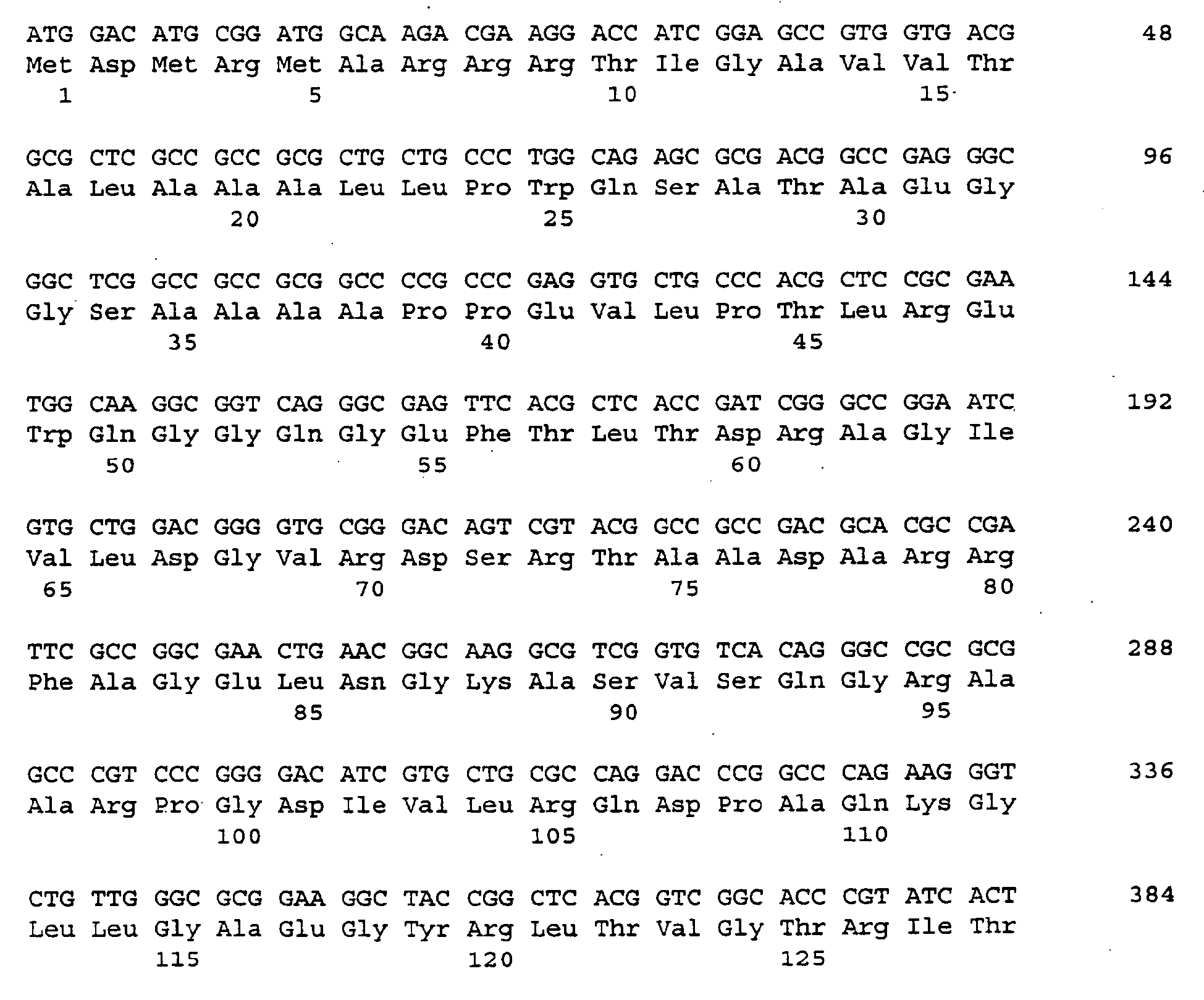


- (i) SEQUENCE CHARACTERISTICS:
- (2) INFORMATION FOR SEQ ID NO: 3:
- (i) SEQUENCE CHARACTERISTICS:
- (A) LENGTH: 639 amino acids
- (B) TYPE: amino acid
- (D) TOPOLOGY: linear
- (ii) MOLECULE TYPE: protein
- (xi) SEQUENCE DESCRIPTION: SEQ ID NO: 3:


- (i) SEQUENCE CHARACTERISTICS:
- (2) INFORMATION FOR SEQ ID NO: 4:
- (i) SEQUENCE CHARACTERISTICS:
- (A) LENGTH: 18 amino acids
- (B) TYPE: amino acid
- (C) STRANDEDNESS: single
- (D) TOPOLOGY: linear
- (ii) MOLECULE TYPE: peptide
- (v) FRAGMENT TYPE: N-terminal
- (xi) SEQUENCE DESCRIPTION: SEQ ID NO: 4:

- (i) SEQUENCE CHARACTERISTICS:
- (2) INFORMATION FOR SEQ ID NO: 5:
- (i) SEQUENCE CHARACTERISTICS:
- (A) LENGTH: 17 base pairs
- (B) TYPE: nucleic acid
- (C) STRANDEDNESS: single
- (D) TOPOLOGY: linear
- (ii) MOLECULE TYPE: other nucleic acid
- (A) DESCRIPTION: /desk = "synthetic DNA"
- (xi) SEQUENCE DESCRIPTION: SEQ ID NO: 5:
GCSMGSCCSC AYGARGT 17
- (i) SEQUENCE CHARACTERISTICS:
- (2) INFORMATION FOR SEQ ID NO: 6:
- (i) SEQUENCE CHARACTERISTICS:
- (A) LENGTH: 17 base pairs
- (B) TYPE: nucleic acid
- (C) STRANDEDNESS: single
- (D) TOPOLOGY: linear
- (ii) MOLECULE TYPE: other nucleic acid
- (A) DESCRIPTION: /desc = "synthetic DNA"
- (xi) SEQUENCE DESCRIPTION: SEQ ID NO: 6:
CCSCAYGARG TSCWNCC 17
- (i) SEQUENCE CHARACTERISTICS:
- (2) INFORMATION FOR SEQ ID NO: 7:
- (i) SEQUENCE CHARACTERISTICS:
- (A) LENGTH: 44 base pairs
- (B) TYPE: nucleic acid
- (C) STRANDEDNESS: single
- (D) TOPOLOGY: linear
- (ii) MOLECULE TYPE: other nucleic acid
- (A) DESCRIPTION: /desc = "synthetic DNA"
- (xi) SEQUENCE DESCRIPTION: SEQ ID NO: 7:
GCCGCCCGCC CSCACGARGT CCTSCCSACC CTSGACGAGG CCCA 44
- (i) SEQUENCE CHARACTERISTICS:
- (2) INFORMATION FOR SEQ ID NO: 8:
- (i) SEQUENCE CHARACTERISTICS:
- (A) LENGTH: 10 amino acids
- (B) TYPE: amino acid
- (C) STRANDEDNESS: single
- (D) TOPOLOGY: linear
- (ii) MOLECULE TYPE: peptide
- (v) FRAGMENT TYPE: internal
- (xi) SEQUENCE DESCRIPTION: SEQ ID NO: 8:

- (i) SEQUENCE CHARACTERISTICS:
- (2) INFORMATION FOR SEQ ID NO: 9:
- (i) SEQUENCE CHARACTERISTICS:
- (A) LENGTH: 9 amino acids
- (B) TYPE: amino acid
- (C) STRANDEDNESS: single
- (D) TOPOLOGY: linear
- (ii) MOLECULE TYPE: peptide
- (v) FRAGMENT TYPE: internal
- (xi) SEQUENCE DESCRIPTION: SEQ ID NO: 9:

- (i) SEQUENCE CHARACTERISTICS:
- (2) INFORMATION FOR SEQ ID NO: 10:
- (i) SEQUENCE CHARACTERISTICS:
- (A) LENGTH: 12 amino acids
- (B) TYPE: amino acid
- (C) STRANDEDNESS: single
- (D) TOPOLOGY: linear
- (ii) MOLECULE TYPE: peptide
- (xi) SEQUENCE DESCRIPTION: SEQ ID NO: 10:

- (i) SEQUENCE CHARACTERISTICS:
- (2) INFORMATION FOR SEQ ID NO: 11:
- (i) SEQUENCE CHARACTERISTICS:
- (A) LENGTH: 24 amino acids
- (B) TYPE: amino acid
- (C) STRANDEDNESS: single
- (D) TOPOLOGY: linear
- (ii)MOLECULE TYPE: peptide
- (xi) SEQUENCE DESCRIPTION: SEQ ID NO: 11:

- (i) SEQUENCE CHARACTERISTICS:
- (2) INFORMATION FOR SEQ ID NO: 12:
- (i) SEQUENCE CHARACTERISTICS:
- (A) LENGTH: 27 base pairs
- (B) TYPE: nucleic acid
- (C) STRANDEDNESS: single
- (D) TOPOLOGY: linear
- (ii) MOLECULE TYPE: other nucleic acid
- (A) DESCRIPTION: /desc = "synthetic DNA"
- (xi) SEQUENCE DESCRIPTION: SEQ ID NO: 12:
CARTGGAAYG AYGGNYTNGC NGGNAAR 27
- (i) SEQUENCE CHARACTERISTICS:
- (2) INFORMATION FOR SEQ ID NO: 13:
- (i) SEQUENCE CHARACTERISTICS:
- (A) LENGTH: 72 base pairs
- (B) TYPE: nucleic acid
- (C) STRANDEDNESS: single
- (D) TOPOLOGY: linear
- (ii) MOLECULE TYPE: other nucleic acid
- (A) DESCRIPTION: /desc = "synthetic DNA"
- (xi) SEQUENCE DESCRIPTION: SEQ ID NO: 13:

- (i) SEQUENCE CHARACTERISTICS:
- (2) INFORMATION FOR SEQ ID NO: 14:
- (i) SEQUENCE CHARACTERISTICS:
- (A) LENGTH: 39 base pairs
- (B) TYPE: nucleic acid
- (C) STRANDEDNESS: single
- (D) TOPOLOGY: linear
- (ii) MOLECULE TYPE: other nucleic acid
- (A) DESCRIPTION: /desc = "synthetic DNA"
- (xi) SEQUENCE DESCRIPTION: SEQ ID NO: 14:
AGAAGCTTGG CCATGGCCGC GGCCCCGCCC GAGGTGCTG 39
- (i) SEQUENCE CHARACTERISTICS:
- (2) INFORMATION FOR SEQ ID NO: 15:
- (i) SEQUENCE CHARACTERISTICS:
- (A) LENGTH: 21 base pairs
- (B) TYPE: nucleic acid
- (C) STRANDEDNESS: single
- (D) TOPOLOGY: linear
- (ii) MOLECULE TYPE: other nucleic acid
- (A) DESCRIPTION: /desc = "synthetic DNA"
- (xi) SEQUENCE DESCRIPTION: SEQ ID NO: 15:
GTCCTGGCGC AGCACGATGT C 21
- (i) SEQUENCE CHARACTERISTICS:
Claims (8)
- A DNA encoding a polypeptide possessing lacto-N-biosidase activity, consisting of(a) the DNA sequence of SEQ ID NO: 2, or(b) a DNA sequence capable of hybridizing to the DNA of (a), wherein hybridization is carried out with a probe in a solution containing 6 x SSC; 1% sodium lauryl sulfate, 100 µg/ml salmon sperm DNA and 5 x Denhardt's solution (containing bovine serum albumin, polyvinylpyrrolidone and Ficoll, each at 0.1%) at 65°C for 20 hours and then washing is carried out in 6 x SSC at room temperature for 10 minutes, in 2 x SSC containing 0.1 % SDS at room temperature for 10 minutes, then in 0.2 x SSC containing 0.1% SDS at 45°C for. 30 minutes.
- The DNA of claim 1, wherein the polypeptide is from a strain of the genus Streptomyces.
- The DNA according to any one of claims 1 to 2, wherein the polypeptide is from Streptomyces sp 142 (FERM No. BP-4569).
- A recombinant DNA which comprises a DNA sequence of any one of claims 1 to 3.
- A vector which comprises the recombinant DNA of claim 4.
- The vector of claim 5, wherein said recombinant DNA is operably linked to a promoter.
- A cell of a prokaryote or eukaryote transformed with the vector of claim 5 or 6.
- A method for producing a polypeptide possessing lacto-N-biosidase activity, comprising the steps of:(a) culturing the cell of claim 7; and(b) recovering the polypeptide possessing lacto-N-biosidase activity from the culture obtained in step (a).
Applications Claiming Priority (2)
| Application Number | Priority Date | Filing Date | Title |
|---|---|---|---|
| JP129731/95 | 1995-04-27 | ||
| JP12973195 | 1995-04-27 |
Publications (3)
| Publication Number | Publication Date |
|---|---|
| EP0739983A2 EP0739983A2 (en) | 1996-10-30 |
| EP0739983A3 EP0739983A3 (en) | 1998-05-06 |
| EP0739983B1 true EP0739983B1 (en) | 2009-12-30 |
Family
ID=15016814
Family Applications (1)
| Application Number | Title | Priority Date | Filing Date |
|---|---|---|---|
| EP96106569A Expired - Lifetime EP0739983B1 (en) | 1995-04-27 | 1996-04-25 | Gene encoding lacto-n-biosidase |
Country Status (5)
| Country | Link |
|---|---|
| US (1) | US5908772A (en) |
| EP (1) | EP0739983B1 (en) |
| KR (1) | KR100465927B1 (en) |
| CN (1) | CN1100878C (en) |
| DE (1) | DE69638104D1 (en) |
Families Citing this family (14)
| Publication number | Priority date | Publication date | Assignee | Title |
|---|---|---|---|---|
| JP4034846B2 (en) * | 1996-12-10 | 2008-01-16 | 株式会社林原生物化学研究所 | Crystalline powdered sugar, production method and use thereof |
| CA2720301C (en) * | 2008-04-03 | 2017-11-07 | Kane Biotech Inc. | Dispersinb tm, 5-fluorouracil, deoxyribonuclease i and proteinase k-based antibiofilm compositions and uses thereof |
| BRPI0923225A2 (en) | 2008-12-02 | 2016-10-04 | Chiralgen Ltd | Phosphorus-modified nucleic acid synthesis method |
| EP2451461A4 (en) | 2009-07-06 | 2013-05-29 | Ontorii Inc | NOVEL NUCLEIC ACID PRECURSORS AND THEIR METHODS OF USE |
| DK2620428T3 (en) | 2010-09-24 | 2019-07-01 | Wave Life Sciences Ltd | Asymmetric help group |
| CN107365339A (en) | 2011-07-19 | 2017-11-21 | 波涛生命科学有限公司 | Methods of Synthesizing Functionalized Nucleic Acids |
| SG11201500243WA (en) | 2012-07-13 | 2015-04-29 | Shin Nippon Biomedical Lab Ltd | Chiral nucleic acid adjuvant |
| WO2014010250A1 (en) | 2012-07-13 | 2014-01-16 | Chiralgen, Ltd. | Asymmetric auxiliary group |
| DK2872147T3 (en) | 2012-07-13 | 2023-02-20 | Wave Life Sciences Ltd | METHOD FOR PREPARATION OF CHIRAL OLIGONUCLEOTIDES |
| EP3095461A4 (en) | 2014-01-15 | 2017-08-23 | Shin Nippon Biomedical Laboratories, Ltd. | Chiral nucleic acid adjuvant having immunity induction activity, and immunity induction activator |
| WO2015108046A1 (en) | 2014-01-15 | 2015-07-23 | 株式会社新日本科学 | Chiral nucleic acid adjuvant having anti-allergic activity, and anti-allergic agent |
| EP3095459A4 (en) | 2014-01-15 | 2017-08-23 | Shin Nippon Biomedical Laboratories, Ltd. | Chiral nucleic acid adjuvant having antitumor effect and antitumor agent |
| EP3094728B1 (en) | 2014-01-16 | 2022-03-09 | Wave Life Sciences Ltd. | Chiral design |
| CN109234299B (en) * | 2018-11-09 | 2021-08-13 | 沈阳农业大学 | A kind of method for expressing and preparing lactobiose phosphorylase |
Family Cites Families (3)
| Publication number | Priority date | Publication date | Assignee | Title |
|---|---|---|---|---|
| JP2782563B2 (en) * | 1991-05-15 | 1998-08-06 | 寳酒造株式会社 | New carbohydrate hydrolase |
| JP2829810B2 (en) * | 1992-11-16 | 1998-12-02 | 寳酒造株式会社 | Carbohydrate hydrolases |
| JP2854541B2 (en) * | 1995-08-07 | 1999-02-03 | 寳酒造株式会社 | Hydrolysis method of sugar compounds |
-
1996
- 1996-04-25 DE DE69638104T patent/DE69638104D1/en not_active Expired - Lifetime
- 1996-04-25 EP EP96106569A patent/EP0739983B1/en not_active Expired - Lifetime
- 1996-04-26 US US08/637,899 patent/US5908772A/en not_active Expired - Fee Related
- 1996-04-27 CN CN96108908A patent/CN1100878C/en not_active Expired - Fee Related
- 1996-04-27 KR KR1019960013303A patent/KR100465927B1/en not_active Expired - Fee Related
Non-Patent Citations (1)
| Title |
|---|
| CANE D.E. ET AL: "Pentalene Synthase. purification, Molecular cloning, Sequencing, and Huigh-level expression in Escherichia Coli of a Terpenoid Cyclase from Streptomyces UC5319", BIOCHEMISTRY, vol. 33, no. 19, May 1994 (1994-05-01), pages 5846 - 5857 * |
Also Published As
| Publication number | Publication date |
|---|---|
| CN1100878C (en) | 2003-02-05 |
| KR960037830A (en) | 1996-11-19 |
| CN1143678A (en) | 1997-02-26 |
| DE69638104D1 (en) | 2010-02-11 |
| EP0739983A2 (en) | 1996-10-30 |
| EP0739983A3 (en) | 1998-05-06 |
| KR100465927B1 (en) | 2005-12-21 |
| US5908772A (en) | 1999-06-01 |
Similar Documents
| Publication | Publication Date | Title |
|---|---|---|
| US5908772A (en) | Gene encoding lacto-N-biosidase | |
| KR100454174B1 (en) | Genes encoding endoglycoceramides | |
| EP0759470B1 (en) | Gene encoding endoglycoceramidase activator | |
| JP4476360B2 (en) | Modified protein and method for producing the same | |
| KR20010071288A (en) | Endo-β-N-acetylglucos aminidase gene | |
| KR100543051B1 (en) | Gene coding for the polypeptide having a degrading activity of the sulfated-fucose-containing polysaccharide | |
| US5238821A (en) | Endo F-free PNGase | |
| EP0769550A2 (en) | Gene encoding endo-beta-n-acetyl glucosaminidase A | |
| EP0462833B1 (en) | Process for the preparation of ascorbic acid-2-phosphate | |
| US5861296A (en) | Purified thermostable inorganic pyprophosphatase obtainable from thermococcus litoralis | |
| US5637490A (en) | α-1,3/4-fucosidase gene | |
| US5217880A (en) | L-fucose dehydrogenase gene, microorganism having said gene and production of l-fucose dehydrogenase by the use of said microorganism | |
| KR100376748B1 (en) | Method for preparing enzyme alpha-1,4-glucanria, water prepared therefrom and use thereof | |
| JPH07213280A (en) | Thermostable esterase | |
| EP0472651B1 (en) | Endo f-free pngase | |
| JP3616203B2 (en) | Endoglycoceramidase activator gene | |
| JPH09173083A (en) | Endo-β-N-acetylglucosaminidase A gene | |
| EP0676473B1 (en) | Almond n-glycosidase gene | |
| JP3335287B2 (en) | Hexokinase gene | |
| JPH099977A (en) | Lacto-N-biosidase gene | |
| JP3527021B2 (en) | Endoglycoceramidase gene | |
| WO2003078616A1 (en) | Production of ugppase | |
| JPH09168389A (en) | DNA encoding ascorbate oxidase | |
| JP2000342273A (en) | β-fructofuranosidase gene | |
| JP2004024189A (en) | Dna encoding heat-resistant keratanase |
Legal Events
| Date | Code | Title | Description |
|---|---|---|---|
| PUAI | Public reference made under article 153(3) epc to a published international application that has entered the european phase |
Free format text: ORIGINAL CODE: 0009012 |
|
| AK | Designated contracting states |
Kind code of ref document: A2 Designated state(s): DE ES FR GB IT |
|
| PUAL | Search report despatched |
Free format text: ORIGINAL CODE: 0009013 |
|
| AK | Designated contracting states |
Kind code of ref document: A3 Designated state(s): DE ES FR GB IT |
|
| 17P | Request for examination filed |
Effective date: 19980609 |
|
| 17Q | First examination report despatched |
Effective date: 20010301 |
|
| RAP1 | Party data changed (applicant data changed or rights of an application transferred) |
Owner name: TAKARA BIO INC. |
|
| GRAP | Despatch of communication of intention to grant a patent |
Free format text: ORIGINAL CODE: EPIDOSNIGR1 |
|
| GRAC | Information related to communication of intention to grant a patent modified |
Free format text: ORIGINAL CODE: EPIDOSCIGR1 |
|
| RIC1 | Information provided on ipc code assigned before grant |
Ipc: C12N 5/10 20060101ALI20090520BHEP Ipc: C12N 1/21 20060101ALI20090520BHEP Ipc: C12N 15/70 20060101ALI20090520BHEP Ipc: C12N 9/24 20060101ALI20090520BHEP Ipc: C12N 15/56 20060101AFI20090520BHEP |
|
| GRAJ | Information related to disapproval of communication of intention to grant by the applicant or resumption of examination proceedings by the epo deleted |
Free format text: ORIGINAL CODE: EPIDOSDIGR1 |
|
| GRAP | Despatch of communication of intention to grant a patent |
Free format text: ORIGINAL CODE: EPIDOSNIGR1 |
|
| GRAS | Grant fee paid |
Free format text: ORIGINAL CODE: EPIDOSNIGR3 |
|
| GRAA | (expected) grant |
Free format text: ORIGINAL CODE: 0009210 |
|
| AK | Designated contracting states |
Kind code of ref document: B1 Designated state(s): DE ES FR GB IT |
|
| REG | Reference to a national code |
Ref country code: GB Ref legal event code: FG4D |
|
| REF | Corresponds to: |
Ref document number: 69638104 Country of ref document: DE Date of ref document: 20100211 Kind code of ref document: P |
|
| PGFP | Annual fee paid to national office [announced via postgrant information from national office to epo] |
Ref country code: GB Payment date: 20100325 Year of fee payment: 15 |
|
| PG25 | Lapsed in a contracting state [announced via postgrant information from national office to epo] |
Ref country code: ES Free format text: LAPSE BECAUSE OF FAILURE TO SUBMIT A TRANSLATION OF THE DESCRIPTION OR TO PAY THE FEE WITHIN THE PRESCRIBED TIME-LIMIT Effective date: 20100410 |
|
| PGFP | Annual fee paid to national office [announced via postgrant information from national office to epo] |
Ref country code: FR Payment date: 20100521 Year of fee payment: 15 |
|
| PGFP | Annual fee paid to national office [announced via postgrant information from national office to epo] |
Ref country code: DE Payment date: 20100430 Year of fee payment: 15 |
|
| PLBE | No opposition filed within time limit |
Free format text: ORIGINAL CODE: 0009261 |
|
| STAA | Information on the status of an ep patent application or granted ep patent |
Free format text: STATUS: NO OPPOSITION FILED WITHIN TIME LIMIT |
|
| 26N | No opposition filed |
Effective date: 20101001 |
|
| PG25 | Lapsed in a contracting state [announced via postgrant information from national office to epo] |
Ref country code: IT Free format text: LAPSE BECAUSE OF FAILURE TO SUBMIT A TRANSLATION OF THE DESCRIPTION OR TO PAY THE FEE WITHIN THE PRESCRIBED TIME-LIMIT Effective date: 20091230 |
|
| REG | Reference to a national code |
Ref country code: DE Ref legal event code: R119 Ref document number: 69638104 Country of ref document: DE |
|
| REG | Reference to a national code |
Ref country code: DE Ref legal event code: R119 Ref document number: 69638104 Country of ref document: DE |
|
| GBPC | Gb: european patent ceased through non-payment of renewal fee |
Effective date: 20110425 |
|
| REG | Reference to a national code |
Ref country code: FR Ref legal event code: ST Effective date: 20111230 |
|
| PG25 | Lapsed in a contracting state [announced via postgrant information from national office to epo] |
Ref country code: FR Free format text: LAPSE BECAUSE OF NON-PAYMENT OF DUE FEES Effective date: 20110502 |
|
| PG25 | Lapsed in a contracting state [announced via postgrant information from national office to epo] |
Ref country code: GB Free format text: LAPSE BECAUSE OF NON-PAYMENT OF DUE FEES Effective date: 20110425 |
|
| PG25 | Lapsed in a contracting state [announced via postgrant information from national office to epo] |
Ref country code: DE Free format text: LAPSE BECAUSE OF NON-PAYMENT OF DUE FEES Effective date: 20111031 |