EP0737773B1 - Method of treating textile products and textile products thus treated - Google Patents
Method of treating textile products and textile products thus treated Download PDFInfo
- Publication number
- EP0737773B1 EP0737773B1 EP95903962A EP95903962A EP0737773B1 EP 0737773 B1 EP0737773 B1 EP 0737773B1 EP 95903962 A EP95903962 A EP 95903962A EP 95903962 A EP95903962 A EP 95903962A EP 0737773 B1 EP0737773 B1 EP 0737773B1
- Authority
- EP
- European Patent Office
- Prior art keywords
- textile
- water
- treatment
- fluorine
- oil
- Prior art date
- Legal status (The legal status is an assumption and is not a legal conclusion. Google has not performed a legal analysis and makes no representation as to the accuracy of the status listed.)
- Expired - Lifetime
Links
- 239000004753 textile Substances 0.000 title claims abstract description 69
- 238000000034 method Methods 0.000 title claims description 20
- 239000011737 fluorine Substances 0.000 claims abstract description 29
- 229910052731 fluorine Inorganic materials 0.000 claims abstract description 29
- YCKRFDGAMUMZLT-UHFFFAOYSA-N Fluorine atom Chemical compound [F] YCKRFDGAMUMZLT-UHFFFAOYSA-N 0.000 claims abstract description 28
- 239000000835 fiber Substances 0.000 claims abstract description 23
- 239000005871 repellent Substances 0.000 claims abstract description 16
- 229910052751 metal Inorganic materials 0.000 claims abstract description 11
- 239000002184 metal Substances 0.000 claims abstract description 11
- 150000003839 salts Chemical class 0.000 claims abstract description 9
- 238000011282 treatment Methods 0.000 claims description 38
- 239000003795 chemical substances by application Substances 0.000 claims description 37
- 239000003607 modifier Substances 0.000 claims description 21
- AFINAILKDBCXMX-PBHICJAKSA-N (2s,3r)-2-amino-3-hydroxy-n-(4-octylphenyl)butanamide Chemical compound CCCCCCCCC1=CC=C(NC(=O)[C@@H](N)[C@@H](C)O)C=C1 AFINAILKDBCXMX-PBHICJAKSA-N 0.000 claims description 13
- 239000002253 acid Substances 0.000 claims description 12
- -1 salt compound Chemical class 0.000 claims description 11
- 150000001875 compounds Chemical class 0.000 claims description 7
- 125000004430 oxygen atom Chemical group O* 0.000 claims description 7
- 125000004432 carbon atom Chemical group C* 0.000 claims description 6
- 125000004435 hydrogen atom Chemical group [H]* 0.000 claims description 6
- VYZAMTAEIAYCRO-UHFFFAOYSA-N Chromium Chemical compound [Cr] VYZAMTAEIAYCRO-UHFFFAOYSA-N 0.000 claims description 4
- 125000003118 aryl group Chemical group 0.000 claims description 4
- 229910052804 chromium Inorganic materials 0.000 claims description 4
- 239000011651 chromium Substances 0.000 claims description 4
- 229910052757 nitrogen Inorganic materials 0.000 claims description 4
- 125000004433 nitrogen atom Chemical group N* 0.000 claims description 4
- 125000005010 perfluoroalkyl group Chemical group 0.000 claims description 4
- 229920006395 saturated elastomer Polymers 0.000 claims description 4
- 125000000472 sulfonyl group Chemical group *S(*)(=O)=O 0.000 claims description 4
- 229910052717 sulfur Inorganic materials 0.000 claims description 3
- 125000004434 sulfur atom Chemical group 0.000 claims description 3
- RTAQQCXQSZGOHL-UHFFFAOYSA-N Titanium Chemical compound [Ti] RTAQQCXQSZGOHL-UHFFFAOYSA-N 0.000 claims description 2
- QCWXUUIWCKQGHC-UHFFFAOYSA-N Zirconium Chemical compound [Zr] QCWXUUIWCKQGHC-UHFFFAOYSA-N 0.000 claims description 2
- 229910052782 aluminium Inorganic materials 0.000 claims description 2
- XAGFODPZIPBFFR-UHFFFAOYSA-N aluminium Chemical compound [Al] XAGFODPZIPBFFR-UHFFFAOYSA-N 0.000 claims description 2
- 239000010936 titanium Substances 0.000 claims description 2
- 229910052719 titanium Inorganic materials 0.000 claims description 2
- 229910052726 zirconium Inorganic materials 0.000 claims description 2
- 239000004411 aluminium Substances 0.000 claims 1
- 125000001183 hydrocarbyl group Chemical group 0.000 claims 1
- 238000005406 washing Methods 0.000 abstract description 12
- 150000001732 carboxylic acid derivatives Chemical class 0.000 abstract 1
- XLYOFNOQVPJJNP-UHFFFAOYSA-N water Substances O XLYOFNOQVPJJNP-UHFFFAOYSA-N 0.000 description 54
- 239000000243 solution Substances 0.000 description 33
- 239000003921 oil Substances 0.000 description 15
- KFZMGEQAYNKOFK-UHFFFAOYSA-N Isopropanol Chemical compound CC(C)O KFZMGEQAYNKOFK-UHFFFAOYSA-N 0.000 description 9
- 239000004744 fabric Substances 0.000 description 8
- 238000007654 immersion Methods 0.000 description 7
- LFQSCWFLJHTTHZ-UHFFFAOYSA-N Ethanol Chemical compound CCO LFQSCWFLJHTTHZ-UHFFFAOYSA-N 0.000 description 6
- 238000010521 absorption reaction Methods 0.000 description 6
- 230000000694 effects Effects 0.000 description 6
- 238000001035 drying Methods 0.000 description 5
- 210000004209 hair Anatomy 0.000 description 5
- 229920000642 polymer Polymers 0.000 description 5
- 229920000877 Melamine resin Polymers 0.000 description 4
- 239000004640 Melamine resin Substances 0.000 description 4
- 230000000052 comparative effect Effects 0.000 description 4
- 239000000839 emulsion Substances 0.000 description 4
- 125000003709 fluoroalkyl group Chemical group 0.000 description 4
- DCAYPVUWAIABOU-UHFFFAOYSA-N hexadecane Chemical compound CCCCCCCCCCCCCCCC DCAYPVUWAIABOU-UHFFFAOYSA-N 0.000 description 4
- 150000002430 hydrocarbons Chemical group 0.000 description 4
- 239000002649 leather substitute Substances 0.000 description 4
- BDAGIHXWWSANSR-UHFFFAOYSA-N methanoic acid Natural products OC=O BDAGIHXWWSANSR-UHFFFAOYSA-N 0.000 description 4
- QTBSBXVTEAMEQO-UHFFFAOYSA-N Acetic acid Chemical compound CC(O)=O QTBSBXVTEAMEQO-UHFFFAOYSA-N 0.000 description 3
- OKKJLVBELUTLKV-UHFFFAOYSA-N Methanol Chemical compound OC OKKJLVBELUTLKV-UHFFFAOYSA-N 0.000 description 3
- IMNFDUFMRHMDMM-UHFFFAOYSA-N N-Heptane Chemical compound CCCCCCC IMNFDUFMRHMDMM-UHFFFAOYSA-N 0.000 description 3
- 239000004677 Nylon Substances 0.000 description 3
- 229920001807 Urea-formaldehyde Polymers 0.000 description 3
- 239000007864 aqueous solution Substances 0.000 description 3
- 239000012948 isocyanate Substances 0.000 description 3
- 150000002513 isocyanates Chemical class 0.000 description 3
- 239000007788 liquid Substances 0.000 description 3
- 230000007774 longterm Effects 0.000 description 3
- 229920001778 nylon Polymers 0.000 description 3
- 229920000058 polyacrylate Polymers 0.000 description 3
- 238000012360 testing method Methods 0.000 description 3
- 239000002759 woven fabric Substances 0.000 description 3
- OSWFIVFLDKOXQC-UHFFFAOYSA-N 4-(3-methoxyphenyl)aniline Chemical compound COC1=CC=CC(C=2C=CC(N)=CC=2)=C1 OSWFIVFLDKOXQC-UHFFFAOYSA-N 0.000 description 2
- VEXZGXHMUGYJMC-UHFFFAOYSA-N Hydrochloric acid Chemical compound Cl VEXZGXHMUGYJMC-UHFFFAOYSA-N 0.000 description 2
- QAOWNCQODCNURD-UHFFFAOYSA-N Sulfuric acid Chemical compound OS(O)(=O)=O QAOWNCQODCNURD-UHFFFAOYSA-N 0.000 description 2
- 125000001931 aliphatic group Chemical group 0.000 description 2
- 125000000217 alkyl group Chemical group 0.000 description 2
- 150000001735 carboxylic acids Chemical class 0.000 description 2
- 239000003054 catalyst Substances 0.000 description 2
- DSHWASKZZBZKOE-UHFFFAOYSA-K chromium(3+);hydroxide;sulfate Chemical compound [OH-].[Cr+3].[O-]S([O-])(=O)=O DSHWASKZZBZKOE-UHFFFAOYSA-K 0.000 description 2
- 229910000356 chromium(III) sulfate Inorganic materials 0.000 description 2
- 239000011696 chromium(III) sulphate Substances 0.000 description 2
- 235000015217 chromium(III) sulphate Nutrition 0.000 description 2
- 238000000576 coating method Methods 0.000 description 2
- DIOQZVSQGTUSAI-UHFFFAOYSA-N decane Chemical compound CCCCCCCCCC DIOQZVSQGTUSAI-UHFFFAOYSA-N 0.000 description 2
- XBDQKXXYIPTUBI-UHFFFAOYSA-N dimethylselenoniopropionate Natural products CCC(O)=O XBDQKXXYIPTUBI-UHFFFAOYSA-N 0.000 description 2
- 235000019253 formic acid Nutrition 0.000 description 2
- LEQAOMBKQFMDFZ-UHFFFAOYSA-N glyoxal Chemical compound O=CC=O LEQAOMBKQFMDFZ-UHFFFAOYSA-N 0.000 description 2
- 239000004745 nonwoven fabric Substances 0.000 description 2
- TVMXDCGIABBOFY-UHFFFAOYSA-N octane Chemical compound CCCCCCCC TVMXDCGIABBOFY-UHFFFAOYSA-N 0.000 description 2
- 230000035515 penetration Effects 0.000 description 2
- 229920000728 polyester Polymers 0.000 description 2
- 229920002994 synthetic fiber Polymers 0.000 description 2
- 239000012209 synthetic fiber Substances 0.000 description 2
- BGHCVCJVXZWKCC-UHFFFAOYSA-N tetradecane Chemical compound CCCCCCCCCCCCCC BGHCVCJVXZWKCC-UHFFFAOYSA-N 0.000 description 2
- 210000002268 wool Anatomy 0.000 description 2
- PGOOBECODWQEAB-UHFFFAOYSA-N (E)-clothianidin Chemical compound [O-][N+](=O)\N=C(/NC)NCC1=CN=C(Cl)S1 PGOOBECODWQEAB-UHFFFAOYSA-N 0.000 description 1
- VEXZGXHMUGYJMC-UHFFFAOYSA-M Chloride anion Chemical compound [Cl-] VEXZGXHMUGYJMC-UHFFFAOYSA-M 0.000 description 1
- 229920000742 Cotton Polymers 0.000 description 1
- 229910002651 NO3 Inorganic materials 0.000 description 1
- NHNBFGGVMKEFGY-UHFFFAOYSA-N Nitrate Chemical compound [O-][N+]([O-])=O NHNBFGGVMKEFGY-UHFFFAOYSA-N 0.000 description 1
- 239000004952 Polyamide Substances 0.000 description 1
- QAOWNCQODCNURD-UHFFFAOYSA-L Sulfate Chemical compound [O-]S([O-])(=O)=O QAOWNCQODCNURD-UHFFFAOYSA-L 0.000 description 1
- ZMANZCXQSJIPKH-UHFFFAOYSA-N Triethylamine Chemical class CCN(CC)CC ZMANZCXQSJIPKH-UHFFFAOYSA-N 0.000 description 1
- 238000005299 abrasion Methods 0.000 description 1
- 235000011054 acetic acid Nutrition 0.000 description 1
- 150000003863 ammonium salts Chemical class 0.000 description 1
- 125000004429 atom Chemical group 0.000 description 1
- 238000003490 calendering Methods 0.000 description 1
- 239000011203 carbon fibre reinforced carbon Substances 0.000 description 1
- 150000001844 chromium Chemical class 0.000 description 1
- 229940125904 compound 1 Drugs 0.000 description 1
- 238000010276 construction Methods 0.000 description 1
- 150000004696 coordination complex Chemical class 0.000 description 1
- 229920001577 copolymer Polymers 0.000 description 1
- 230000006866 deterioration Effects 0.000 description 1
- ZBCBWPMODOFKDW-UHFFFAOYSA-N diethanolamine Chemical class OCCNCCO ZBCBWPMODOFKDW-UHFFFAOYSA-N 0.000 description 1
- 239000012153 distilled water Substances 0.000 description 1
- SNRUBQQJIBEYMU-UHFFFAOYSA-N dodecane Chemical compound CCCCCCCCCCCC SNRUBQQJIBEYMU-UHFFFAOYSA-N 0.000 description 1
- 238000004043 dyeing Methods 0.000 description 1
- 230000002708 enhancing effect Effects 0.000 description 1
- 238000011156 evaluation Methods 0.000 description 1
- 125000001153 fluoro group Chemical group F* 0.000 description 1
- 229940015043 glyoxal Drugs 0.000 description 1
- 238000010438 heat treatment Methods 0.000 description 1
- YCOZIPAWZNQLMR-UHFFFAOYSA-N heptane - octane Natural products CCCCCCCCCCCCCCC YCOZIPAWZNQLMR-UHFFFAOYSA-N 0.000 description 1
- XLYOFNOQVPJJNP-UHFFFAOYSA-M hydroxide Chemical compound [OH-] XLYOFNOQVPJJNP-UHFFFAOYSA-M 0.000 description 1
- 238000005470 impregnation Methods 0.000 description 1
- 229910052500 inorganic mineral Inorganic materials 0.000 description 1
- 150000002576 ketones Chemical class 0.000 description 1
- 229910003002 lithium salt Inorganic materials 0.000 description 1
- 159000000002 lithium salts Chemical class 0.000 description 1
- 230000014759 maintenance of location Effects 0.000 description 1
- 239000000463 material Substances 0.000 description 1
- 125000002496 methyl group Chemical group [H]C([H])([H])* 0.000 description 1
- 239000011707 mineral Substances 0.000 description 1
- 235000010755 mineral Nutrition 0.000 description 1
- 239000000203 mixture Substances 0.000 description 1
- 238000012986 modification Methods 0.000 description 1
- 230000004048 modification Effects 0.000 description 1
- 239000000178 monomer Substances 0.000 description 1
- 150000002780 morpholines Chemical class 0.000 description 1
- 229940094933 n-dodecane Drugs 0.000 description 1
- 150000007524 organic acids Chemical class 0.000 description 1
- 125000000962 organic group Chemical group 0.000 description 1
- 239000003960 organic solvent Substances 0.000 description 1
- QRTRRDMHGTZPBF-UHFFFAOYSA-L oxygen(2-);zirconium(4+);sulfate Chemical compound [O-2].[Zr+4].[O-]S([O-])(=O)=O QRTRRDMHGTZPBF-UHFFFAOYSA-L 0.000 description 1
- 229920002647 polyamide Polymers 0.000 description 1
- XAEFZNCEHLXOMS-UHFFFAOYSA-M potassium benzoate Chemical compound [K+].[O-]C(=O)C1=CC=CC=C1 XAEFZNCEHLXOMS-UHFFFAOYSA-M 0.000 description 1
- 238000012545 processing Methods 0.000 description 1
- 235000019260 propionic acid Nutrition 0.000 description 1
- WGYKZJWCGVVSQN-UHFFFAOYSA-N propylamine Chemical class CCCN WGYKZJWCGVVSQN-UHFFFAOYSA-N 0.000 description 1
- IUVKMZGDUIUOCP-BTNSXGMBSA-N quinbolone Chemical compound O([C@H]1CC[C@H]2[C@H]3[C@@H]([C@]4(C=CC(=O)C=C4CC3)C)CC[C@@]21C)C1=CCCC1 IUVKMZGDUIUOCP-BTNSXGMBSA-N 0.000 description 1
- 229920005989 resin Polymers 0.000 description 1
- 239000011347 resin Substances 0.000 description 1
- 150000003377 silicon compounds Chemical class 0.000 description 1
- 159000000000 sodium salts Chemical class 0.000 description 1
- 239000007787 solid Substances 0.000 description 1
- 239000000126 substance Substances 0.000 description 1
- 239000008399 tap water Substances 0.000 description 1
- 235000020679 tap water Nutrition 0.000 description 1
- 239000012085 test solution Substances 0.000 description 1
- 238000009941 weaving Methods 0.000 description 1
Classifications
-
- D—TEXTILES; PAPER
- D06—TREATMENT OF TEXTILES OR THE LIKE; LAUNDERING; FLEXIBLE MATERIALS NOT OTHERWISE PROVIDED FOR
- D06M—TREATMENT, NOT PROVIDED FOR ELSEWHERE IN CLASS D06, OF FIBRES, THREADS, YARNS, FABRICS, FEATHERS OR FIBROUS GOODS MADE FROM SUCH MATERIALS
- D06M13/00—Treating fibres, threads, yarns, fabrics or fibrous goods made from such materials, with non-macromolecular organic compounds; Such treatment combined with mechanical treatment
- D06M13/10—Treating fibres, threads, yarns, fabrics or fibrous goods made from such materials, with non-macromolecular organic compounds; Such treatment combined with mechanical treatment with compounds containing oxygen
- D06M13/184—Carboxylic acids; Anhydrides, halides or salts thereof
- D06M13/203—Unsaturated carboxylic acids; Anhydrides, halides or salts thereof
- D06M13/2035—Aromatic acids
-
- D—TEXTILES; PAPER
- D06—TREATMENT OF TEXTILES OR THE LIKE; LAUNDERING; FLEXIBLE MATERIALS NOT OTHERWISE PROVIDED FOR
- D06M—TREATMENT, NOT PROVIDED FOR ELSEWHERE IN CLASS D06, OF FIBRES, THREADS, YARNS, FABRICS, FEATHERS OR FIBROUS GOODS MADE FROM SUCH MATERIALS
- D06M13/00—Treating fibres, threads, yarns, fabrics or fibrous goods made from such materials, with non-macromolecular organic compounds; Such treatment combined with mechanical treatment
- D06M13/10—Treating fibres, threads, yarns, fabrics or fibrous goods made from such materials, with non-macromolecular organic compounds; Such treatment combined with mechanical treatment with compounds containing oxygen
- D06M13/184—Carboxylic acids; Anhydrides, halides or salts thereof
- D06M13/1845—Aromatic mono- or polycarboxylic acids
-
- D—TEXTILES; PAPER
- D06—TREATMENT OF TEXTILES OR THE LIKE; LAUNDERING; FLEXIBLE MATERIALS NOT OTHERWISE PROVIDED FOR
- D06M—TREATMENT, NOT PROVIDED FOR ELSEWHERE IN CLASS D06, OF FIBRES, THREADS, YARNS, FABRICS, FEATHERS OR FIBROUS GOODS MADE FROM SUCH MATERIALS
- D06M13/00—Treating fibres, threads, yarns, fabrics or fibrous goods made from such materials, with non-macromolecular organic compounds; Such treatment combined with mechanical treatment
- D06M13/10—Treating fibres, threads, yarns, fabrics or fibrous goods made from such materials, with non-macromolecular organic compounds; Such treatment combined with mechanical treatment with compounds containing oxygen
- D06M13/184—Carboxylic acids; Anhydrides, halides or salts thereof
- D06M13/188—Monocarboxylic acids; Anhydrides, halides or salts thereof
-
- D—TEXTILES; PAPER
- D06—TREATMENT OF TEXTILES OR THE LIKE; LAUNDERING; FLEXIBLE MATERIALS NOT OTHERWISE PROVIDED FOR
- D06M—TREATMENT, NOT PROVIDED FOR ELSEWHERE IN CLASS D06, OF FIBRES, THREADS, YARNS, FABRICS, FEATHERS OR FIBROUS GOODS MADE FROM SUCH MATERIALS
- D06M13/00—Treating fibres, threads, yarns, fabrics or fibrous goods made from such materials, with non-macromolecular organic compounds; Such treatment combined with mechanical treatment
- D06M13/10—Treating fibres, threads, yarns, fabrics or fibrous goods made from such materials, with non-macromolecular organic compounds; Such treatment combined with mechanical treatment with compounds containing oxygen
- D06M13/184—Carboxylic acids; Anhydrides, halides or salts thereof
- D06M13/207—Substituted carboxylic acids, e.g. by hydroxy or keto groups; Anhydrides, halides or salts thereof
- D06M13/21—Halogenated carboxylic acids; Anhydrides, halides or salts thereof
- D06M13/213—Perfluoroalkyl carboxylic acids; Anhydrides, halides or salts thereof
-
- D—TEXTILES; PAPER
- D06—TREATMENT OF TEXTILES OR THE LIKE; LAUNDERING; FLEXIBLE MATERIALS NOT OTHERWISE PROVIDED FOR
- D06M—TREATMENT, NOT PROVIDED FOR ELSEWHERE IN CLASS D06, OF FIBRES, THREADS, YARNS, FABRICS, FEATHERS OR FIBROUS GOODS MADE FROM SUCH MATERIALS
- D06M13/00—Treating fibres, threads, yarns, fabrics or fibrous goods made from such materials, with non-macromolecular organic compounds; Such treatment combined with mechanical treatment
- D06M13/10—Treating fibres, threads, yarns, fabrics or fibrous goods made from such materials, with non-macromolecular organic compounds; Such treatment combined with mechanical treatment with compounds containing oxygen
- D06M13/224—Esters of carboxylic acids; Esters of carbonic acid
-
- D—TEXTILES; PAPER
- D06—TREATMENT OF TEXTILES OR THE LIKE; LAUNDERING; FLEXIBLE MATERIALS NOT OTHERWISE PROVIDED FOR
- D06M—TREATMENT, NOT PROVIDED FOR ELSEWHERE IN CLASS D06, OF FIBRES, THREADS, YARNS, FABRICS, FEATHERS OR FIBROUS GOODS MADE FROM SUCH MATERIALS
- D06M13/00—Treating fibres, threads, yarns, fabrics or fibrous goods made from such materials, with non-macromolecular organic compounds; Such treatment combined with mechanical treatment
- D06M13/10—Treating fibres, threads, yarns, fabrics or fibrous goods made from such materials, with non-macromolecular organic compounds; Such treatment combined with mechanical treatment with compounds containing oxygen
- D06M13/224—Esters of carboxylic acids; Esters of carbonic acid
- D06M13/2243—Mono-, di-, or triglycerides
-
- D—TEXTILES; PAPER
- D06—TREATMENT OF TEXTILES OR THE LIKE; LAUNDERING; FLEXIBLE MATERIALS NOT OTHERWISE PROVIDED FOR
- D06M—TREATMENT, NOT PROVIDED FOR ELSEWHERE IN CLASS D06, OF FIBRES, THREADS, YARNS, FABRICS, FEATHERS OR FIBROUS GOODS MADE FROM SUCH MATERIALS
- D06M13/00—Treating fibres, threads, yarns, fabrics or fibrous goods made from such materials, with non-macromolecular organic compounds; Such treatment combined with mechanical treatment
- D06M13/244—Treating fibres, threads, yarns, fabrics or fibrous goods made from such materials, with non-macromolecular organic compounds; Such treatment combined with mechanical treatment with compounds containing sulfur or phosphorus
- D06M13/282—Treating fibres, threads, yarns, fabrics or fibrous goods made from such materials, with non-macromolecular organic compounds; Such treatment combined with mechanical treatment with compounds containing sulfur or phosphorus with compounds containing phosphorus
- D06M13/292—Mono-, di- or triesters of phosphoric or phosphorous acids; Salts thereof
-
- D—TEXTILES; PAPER
- D06—TREATMENT OF TEXTILES OR THE LIKE; LAUNDERING; FLEXIBLE MATERIALS NOT OTHERWISE PROVIDED FOR
- D06M—TREATMENT, NOT PROVIDED FOR ELSEWHERE IN CLASS D06, OF FIBRES, THREADS, YARNS, FABRICS, FEATHERS OR FIBROUS GOODS MADE FROM SUCH MATERIALS
- D06M13/00—Treating fibres, threads, yarns, fabrics or fibrous goods made from such materials, with non-macromolecular organic compounds; Such treatment combined with mechanical treatment
- D06M13/322—Treating fibres, threads, yarns, fabrics or fibrous goods made from such materials, with non-macromolecular organic compounds; Such treatment combined with mechanical treatment with compounds containing nitrogen
- D06M13/402—Amides imides, sulfamic acids
- D06M13/425—Carbamic or thiocarbamic acids or derivatives thereof, e.g. urethanes
- D06M13/428—Carbamic or thiocarbamic acids or derivatives thereof, e.g. urethanes containing fluorine atoms
-
- D—TEXTILES; PAPER
- D06—TREATMENT OF TEXTILES OR THE LIKE; LAUNDERING; FLEXIBLE MATERIALS NOT OTHERWISE PROVIDED FOR
- D06M—TREATMENT, NOT PROVIDED FOR ELSEWHERE IN CLASS D06, OF FIBRES, THREADS, YARNS, FABRICS, FEATHERS OR FIBROUS GOODS MADE FROM SUCH MATERIALS
- D06M15/00—Treating fibres, threads, yarns, fabrics, or fibrous goods made from such materials, with macromolecular compounds; Such treatment combined with mechanical treatment
- D06M15/19—Treating fibres, threads, yarns, fabrics, or fibrous goods made from such materials, with macromolecular compounds; Such treatment combined with mechanical treatment with synthetic macromolecular compounds
- D06M15/21—Macromolecular compounds obtained by reactions only involving carbon-to-carbon unsaturated bonds
- D06M15/263—Macromolecular compounds obtained by reactions only involving carbon-to-carbon unsaturated bonds of unsaturated carboxylic acids; Salts or esters thereof
- D06M15/277—Macromolecular compounds obtained by reactions only involving carbon-to-carbon unsaturated bonds of unsaturated carboxylic acids; Salts or esters thereof containing fluorine
-
- D—TEXTILES; PAPER
- D06—TREATMENT OF TEXTILES OR THE LIKE; LAUNDERING; FLEXIBLE MATERIALS NOT OTHERWISE PROVIDED FOR
- D06M—TREATMENT, NOT PROVIDED FOR ELSEWHERE IN CLASS D06, OF FIBRES, THREADS, YARNS, FABRICS, FEATHERS OR FIBROUS GOODS MADE FROM SUCH MATERIALS
- D06M15/00—Treating fibres, threads, yarns, fabrics, or fibrous goods made from such materials, with macromolecular compounds; Such treatment combined with mechanical treatment
- D06M15/19—Treating fibres, threads, yarns, fabrics, or fibrous goods made from such materials, with macromolecular compounds; Such treatment combined with mechanical treatment with synthetic macromolecular compounds
- D06M15/37—Macromolecular compounds obtained otherwise than by reactions only involving carbon-to-carbon unsaturated bonds
- D06M15/564—Polyureas, polyurethanes or other polymers having ureide or urethane links; Precondensation products forming them
- D06M15/576—Polyureas, polyurethanes or other polymers having ureide or urethane links; Precondensation products forming them containing fluorine
-
- D—TEXTILES; PAPER
- D06—TREATMENT OF TEXTILES OR THE LIKE; LAUNDERING; FLEXIBLE MATERIALS NOT OTHERWISE PROVIDED FOR
- D06M—TREATMENT, NOT PROVIDED FOR ELSEWHERE IN CLASS D06, OF FIBRES, THREADS, YARNS, FABRICS, FEATHERS OR FIBROUS GOODS MADE FROM SUCH MATERIALS
- D06M2101/00—Chemical constitution of the fibres, threads, yarns, fabrics or fibrous goods made from such materials, to be treated
- D06M2101/02—Natural fibres, other than mineral fibres
- D06M2101/04—Vegetal fibres
- D06M2101/06—Vegetal fibres cellulosic
-
- D—TEXTILES; PAPER
- D06—TREATMENT OF TEXTILES OR THE LIKE; LAUNDERING; FLEXIBLE MATERIALS NOT OTHERWISE PROVIDED FOR
- D06M—TREATMENT, NOT PROVIDED FOR ELSEWHERE IN CLASS D06, OF FIBRES, THREADS, YARNS, FABRICS, FEATHERS OR FIBROUS GOODS MADE FROM SUCH MATERIALS
- D06M2101/00—Chemical constitution of the fibres, threads, yarns, fabrics or fibrous goods made from such materials, to be treated
- D06M2101/02—Natural fibres, other than mineral fibres
- D06M2101/10—Animal fibres
- D06M2101/12—Keratin fibres or silk
-
- D—TEXTILES; PAPER
- D06—TREATMENT OF TEXTILES OR THE LIKE; LAUNDERING; FLEXIBLE MATERIALS NOT OTHERWISE PROVIDED FOR
- D06M—TREATMENT, NOT PROVIDED FOR ELSEWHERE IN CLASS D06, OF FIBRES, THREADS, YARNS, FABRICS, FEATHERS OR FIBROUS GOODS MADE FROM SUCH MATERIALS
- D06M2101/00—Chemical constitution of the fibres, threads, yarns, fabrics or fibrous goods made from such materials, to be treated
- D06M2101/16—Synthetic fibres, other than mineral fibres
- D06M2101/30—Synthetic polymers consisting of macromolecular compounds obtained otherwise than by reactions only involving carbon-to-carbon unsaturated bonds
- D06M2101/32—Polyesters
-
- D—TEXTILES; PAPER
- D06—TREATMENT OF TEXTILES OR THE LIKE; LAUNDERING; FLEXIBLE MATERIALS NOT OTHERWISE PROVIDED FOR
- D06M—TREATMENT, NOT PROVIDED FOR ELSEWHERE IN CLASS D06, OF FIBRES, THREADS, YARNS, FABRICS, FEATHERS OR FIBROUS GOODS MADE FROM SUCH MATERIALS
- D06M2101/00—Chemical constitution of the fibres, threads, yarns, fabrics or fibrous goods made from such materials, to be treated
- D06M2101/16—Synthetic fibres, other than mineral fibres
- D06M2101/30—Synthetic polymers consisting of macromolecular compounds obtained otherwise than by reactions only involving carbon-to-carbon unsaturated bonds
- D06M2101/34—Polyamides
-
- D—TEXTILES; PAPER
- D06—TREATMENT OF TEXTILES OR THE LIKE; LAUNDERING; FLEXIBLE MATERIALS NOT OTHERWISE PROVIDED FOR
- D06M—TREATMENT, NOT PROVIDED FOR ELSEWHERE IN CLASS D06, OF FIBRES, THREADS, YARNS, FABRICS, FEATHERS OR FIBROUS GOODS MADE FROM SUCH MATERIALS
- D06M2200/00—Functionality of the treatment composition and/or properties imparted to the textile material
- D06M2200/10—Repellency against liquids
- D06M2200/11—Oleophobic properties
-
- D—TEXTILES; PAPER
- D06—TREATMENT OF TEXTILES OR THE LIKE; LAUNDERING; FLEXIBLE MATERIALS NOT OTHERWISE PROVIDED FOR
- D06M—TREATMENT, NOT PROVIDED FOR ELSEWHERE IN CLASS D06, OF FIBRES, THREADS, YARNS, FABRICS, FEATHERS OR FIBROUS GOODS MADE FROM SUCH MATERIALS
- D06M2200/00—Functionality of the treatment composition and/or properties imparted to the textile material
- D06M2200/10—Repellency against liquids
- D06M2200/12—Hydrophobic properties
-
- D—TEXTILES; PAPER
- D06—TREATMENT OF TEXTILES OR THE LIKE; LAUNDERING; FLEXIBLE MATERIALS NOT OTHERWISE PROVIDED FOR
- D06M—TREATMENT, NOT PROVIDED FOR ELSEWHERE IN CLASS D06, OF FIBRES, THREADS, YARNS, FABRICS, FEATHERS OR FIBROUS GOODS MADE FROM SUCH MATERIALS
- D06M2200/00—Functionality of the treatment composition and/or properties imparted to the textile material
- D06M2200/50—Modified hand or grip properties; Softening compositions
Definitions
- the present Invention relates to a method for treatment of a textile, and a treated textile. More particularly, it relates to a method for treatment of a textile, which method maintains durable water- and oil-repellency even after long-term use including the washing and the like and further maintains a touch, a feeling and a flexibility of fiber Itself, by a modification treatment of the textile.
- a fluorine-containing compound having a fluoroalkyl group gives excellent water- and oil-repellency to a textile.
- an acrylic polymer treating agent having a fluoroalkyl group has been practically used.
- a disadvantage that a touch, a feeling and a flexibility of the treated textile are remarkably deteriorated and the resultant water repellency Is remarkably deteriorated by the washing or abrasion.
- a combined agent has been used on the treatment, together with the acrylic polymer having the fluoroalkyl group.
- Examples of combined agent include a melamine resin or a urea resin.
- these resins are used in combination, the durability is improved in comparison with the case when using the polymer alone, but the touch, feeling and flexibility of fiber itself are liable to be deteriorated. Accordingly, it can be said that the durability and the touch, feeling and flexibility of fiber itself are contrary each other when using the fluorine-containing polymer.
- Japanese Patent Kokal Publication No. 98568/1993 discloses that animal hair fibers are treated with an alkylphosphate salt to impart the water repellency and flexibility to the animal hair fibers. However, the treated fibers are inferior in durability because they are not treated with a fluorine-containing water- and oil-repellent.
- EP-A-0 624 680 reveals an agent for treating a textile comprising a modifying agent which is a fluorine-containing phosphoric acid derivative having the formula (I) as defined below, wherein R 1 and R 2 are, same or different, a hydrogen atom or R f -(CH 2 ) m -, wherein R f is a saturated or unsaturated, linear or branched fluorine-containing aliphatic group having 4 to 20 carbon atoms in which an oxygen atom, a nitrogen atom, a sulfonyl group and/or an aromatic ring may be present between carbon atoms; and m is 1 or 2; A is an oxygen atom, a sulfur atom or a direct bond, and n is 1 or 2.
- the treating agent further comprises a metal salt compound. After treating the textile with said treating agent, the textile is treated with a fluorine-containing water- and oil-repellent or a fluorine-containing stain-proofing agent.
- a chromium complex of carboxylic acid has also been used as a processing agent for a textile or paper for the purpose of Imparting a water repellency.
- a chromium complex of carboxylic acid having a perfluoroalkyl group has been used for the purpose of Imparting an oil repellency In addition to the water repellency (cf. Japanese Patent Kokoku Publication Nos. 466/1958 and 3274/1969).
- an effect of these chromium complexes Is not always sufficient, and a further enhancement in effect has been required.
- An object of the present invention Is to maintain a durable water- and oil-repellency even after long-term use including the washing and the like, and to maintain a touch, a feeling and a flexibility of fiber Itself even after the treatment of textile.
- the present invention provides a method for treatment of a textile, which comprises:
- the present invention also provides a textile treated by the above method for treatment.
- treatment means that a textile is contacted with a treating liquid containing the modifier the fixing agent the metal complex or the fluorine-containing water- and oil-repellent.
- the treatment may be conducted, for example, by an Immersion, an impregnation, a pad method or a coating method.
- the textile may be treated with the modifier after treated with the fixing agent.
- a textile may be treated with the fixing agent after treated with the modifier.
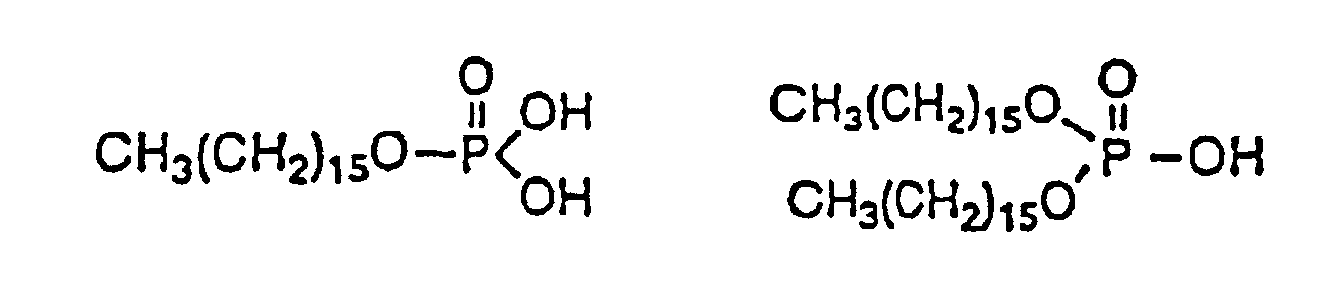
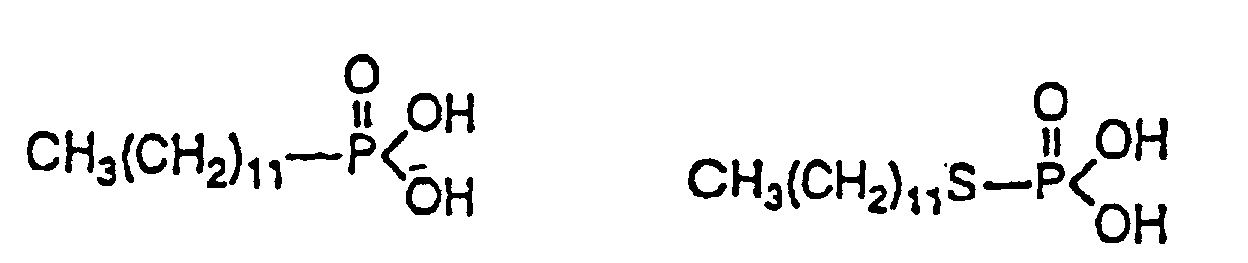
- the modifier used in the first stage of treatment is the phosphoric acid derivative represented by the above general formula (I) or the salt thereof.
- the phosphoric acid derivative is a compound having a P-OH bond and a hydrocarbon group.
- the hydrocarbon group usually means a saturated or unsaturated straight-chain or branched aliphatic hydrocarbon group, and includes those in which an oxygen atom, a nitrogen atom, a sulfonyl group or an aromatic ring exists in a carbon-carbon bond. It is preferred that the hydrocarbon group is an alkyl group.
- Examples of the salt of the phosphoric acid derivative include a monovalent metal salt such as a sodium salt, a potassium salt, or a lithium salt; an organic amine salt such as a diethanolamine salt, a triethylamine salt, a propylamine salt, or a morpholine salt; and an ammonium salt.
- a molecular weight of the phosphoric acid derivative or the salt thereof varies depending on the general formula, but is preferably not more than 2000.
- the metal In the metal salt compound as the fixing agent used in the first stage of treatment may be a polyvalent (divalent or more) metal which bonds ionically to a hydroxyl group bonding to a phosphoric atom.
- chromium, zirconium, titanium, or aluminum are preferred.
- the metal salt compound is water-soluble one.
- chloride, nitrate, sulfate, or hydroxide are preferred.
- basic chromium sulfate and basic zirconium sulfate are particularly preferred in view of durability.
- the fluorine-containing water- and oil-repellent used in the second step of treatment is a fluorine-containing compound having a perfluoroalkyl group.
- the fluorine-containing compound may be a known fluorine-containing polymer having a side chain of a perfluoroalkyl group.
- the following monomers forming polymers or copolymer can be used. wherein R 1 is a hydrogen atom or a methyl group; R 2 Is a lower alkyl group; X Is a divalent organic group; m Is an integer of 1 to 4; and n is an integer of 5 to 21.
- An average molecular weight of the fluorine-containing polymer is usually from 5,000 to 500,000.
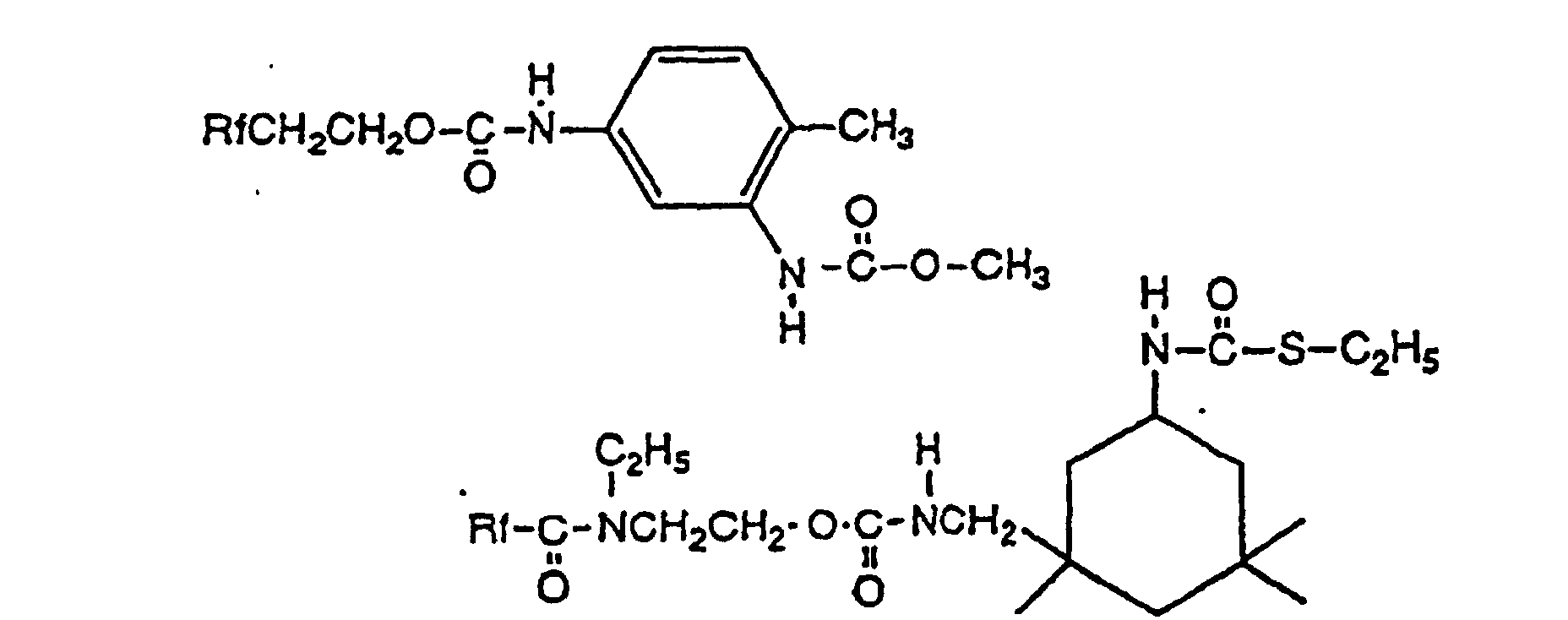
- the fluorine-containing compound may be a fluorine-containing urethane compound or a fluorine-containing ester compound, and examples thereof include the followings.
- Rf is C m F m+1 (m is an integer of 5 to 21); and n is 0 to 4.
- the fluorine-containing water- and oil-repellent may be used in combination with various combined agents, and examples of the combined agent include a melamine resin, a urea resin, a blocked isocyanate, or glyoxal.
- the textile is treated with the modifier and the fixing agent.
- the use order of the modifier and fixing agent may be freely selected as described hereinafter.
- Examples of the method for treatment using the modifier and the fixing agent include the following methods (1), (2) and (3).
- the solution of the metal salt compound as the fixing agent is an aqueous solution of 0.01 to 10% by weight, preferably from 0.03 to 3% by weight.
- a temperature of the fixing agent solution is usually from 20 to 70°C.
- a solution of the phosphoric acid derivative as the modifier is an aqueous solution or a lower alcohol solution of 0.01 to 10% by weight, preferably from 0.03 to 3% by weight. Examples of the lower alcohol include methanol, ethanol, or isopropyl alcohol.
- a temperature of the modifier solution is usually from 5 to 90°C, preferably from 20 to 70°C.
- the acid solution used for the immersion or the adjustment of pH is a solution, preferably aqueous solution, containing a mineral acid such as hydrochloric acid and sulfuric acid or an organic acid such as formic acid, acetic acid and propionic acid.
- a concentration of the acid solution is not specifically limited, but is usually from 0.05 to 30% by weight, preferably from 0.1 to 5% by weight.
- a temperature of the acid solution is usually from 5 to 90°C, preferably from 20 to 70°C.
- An immersion time in each of the fixing agent solution, the modifier solution and the acid solution Is usually at least 10 seconds, preferably from 1 to 120 minutes, more preferably from 1 to 30 minutes.
- a retention time in the bath adjusted to the pH of 1 to 5 is usually at least 10 seconds, preferably from 1 to 30 minutes.
- a drying temperature is usually from 10 to 70°C, preferably room temperature.
- the drying time varies depending on the drying condition (particularly, the drying temperature), but is usually within 24 hours, preferably from 0.1 to 10 hours.
- a weight ratio of the fixing agent to the modifier in the bath is usually from 0.1:1 to 10:1.
- the method of the second stage (B) may be a method which has hitherto been used.
- the treatment is conducted by an immersion, a pad method, a coating method or the like, followed by drying.
- the combined agent such as the melamine resin and the urea resin may be used in combination.
- a heat treatment, a calendering and the like may be conducted.
- a treating agent e.g. a silicon compound, other than the fluorine-containing compound in combination.
- the form of the fluorine-containing water- and oil-repellent may be an emulsion or a solution in an organic solvent.
- a water-soluble lower alcohol or ketone isopropyl alcohol is particularly preferred
- an amount of 0.1 to 10% by weight preferably from 1 to 5% by weight based on the emulsion, in view of penetration of the fluorine-containing water- and oll-repellent.
- the second stage of treatment can be applied to any textile.
- a resultant carpet or fabric
- the second stage of treatment can be conducted on raw yarns or raw hairs used for the carpet, and the carpet can be produced by using the treated raw yarns or raw hairs.
- the raw yarns and raw hairs may be subjected to the first stage of treatment and then the resultant carpet may be subjected to the second stage of treatment.
- the water- and oil-repellency is obtained only at the surface of the textile fabric because the phosphoric acid derivative is penetrated into the interior of a fiber bundle and then fixed. It is possible to impart the advantageous effect in the interior of textile even if the textile has a large thickness. Since the second stage of treatment is further conducted by using the fluorine-containing water- and oil-repellent, the durability becomes stronger. When using the phosphoric acid derivative, the deterioration of the feeling and flexibility of the textile which has not hitherto been avoided by using the fluorine-containing water- and oil-repellent alone, is improved surprisingly.
- the textile to be treated includes a yam, a woven fabric, a knitted fabric, a nonwoven fabric, an artificial leather and the like which are formed from the fiber, in addition to the textile having the form of the fiber as such.
- the fiber there can be used chemical fibers including synthetic fibers such as polyester and nylon in addition to natural fibers such as cotton, wool and silk. It is also possible to use a textile blend of natural fibers and synthetic fibers.
- the woven fabric and artificial leather comprising superfine fibers, which have recently been remarkably developed, are suitable for the present invention in view of the fact that the feeling and touch are considered to be Important.
- the superfine fibers usually have a fineness of not more than 1.1 dtex (1 denier), preferably not more than 0.89 dtex (0.8 denier), more preferably from 0.89 to 0.00011 dtex (0.8 to 0.0001 denier), most preferably from 0.1 to 0.0011 dtex (0.1 to 0.001 denier).
- the textile obtained by the present Invention has the above excellent advantages and, therefore, it is suitably used for applications where water and oil repellency as well as stainproofing properties are required.
- the textile which Is suitable for the present invention may be, for example, a carpet.
- the material of the carpet may be a polyamide such as nylon, a polyester, an acryl, a wool and the like, and is not specifically limited.
- the present invention is particularly effective for a nylon carpet which is usually used under a severe condition.
- the structure, the weaving type, the pile length of the carpet are not specifically limited.
- the textile obtained according to the present invention can be used for outdoor applications exposed to rainwater.
- Examples thereof include a tent, an automobile cover, a motorbike cover, a hood for rear deck of track, a coated sheet for construction, an umbrella and clothes (particularly, rainwears such as a raincoat and a poncho).
- the present invention can be used for the textiles used for a cover of a cap, a foot wear (e.g. shoes, slippers), a bag, a pouch or a seat (e.g. a car seat, a seat, a sofa and a chair), interior goods such as a curtain, a carpet, a wall and ceiling of buildings and vehicles (e.g. an automobile, a train, an aircraft and a ship) and various displays.
- a foot wear e.g. shoes, slippers
- a bag e.g. a bag, a pouch or a seat
- interior goods such as a curtain, a carpet, a wall and ceiling of buildings and vehicles (e.g. an automobile, a train, an aircraft and a ship) and various displays.
- the water repellency shown in the Examples and Comparative Examples is measured according to JIS-L-1092-1977 and expressed by the numeral shown in Table 1,
- the oil repellency is measured by a method according to AATTC TM-118-1975, and a maximum number of oil wherein no penetration is observed after 30 minutes from dropping several drops of oils having different surface tensions shown in Table 2 is expressed as the oil repellency.
- the washing resistance was measured according to JIS-L-0217-103 and was expressed by the water repellency and oil repellency before and after washing 20 times.
- the superscript "+" to the water repellency and oil repellency represents that the result is slightly better than said water repellency and said oil repellency.
- the water absorption properties are measured according to JIS-K-6550-1976. That is, each sample Is immersed in a distilled water for 30 minutes and the water absorption properties are represented by an increase in weight (%) before and after immersion.
- the water resistance is measured according to JIS-K-6550-1976. That Is, a sample is attached to a water resistance test machine (manufactured by YASUDA SEIKI SEISAKUSHO CO., LTD.) having a structure that a constant pressure is applied to a bore having a diameter of 50 mm, and then a water column is gradually increased.
- the water resistance is represented by a height of the water column at which water leaks onto the surface of the sample.
- a fabric consisting of superfine fibers (Artificial Leather SOFRINATIAL (trade name) manufactured by KURARAY CO., LTD) was immersed at 30°C In an aqueous 0.5% solution (bath ratio: 10:1) of basic chromium sulfate (BAYCHROME F (trade name) manufactured by BAYER AG) and then subjected to a rotating treatment using a dyeing test machine (manufactured by TSUZII SENKI KOGYO CO., LTD.) for 30 minutes.
- BAYCHROME F basic chromium sulfate
- the fabric After swish off of water, the fabric was immersed at 50°C in an aqueous 0.5% solution (bath ratio: 10:1) of a compound 1 (phosphoric acid derivative) shown In Table 4 and then subjected to a rotating treatment for 30 minutes. After the pH was adjusted to 3 by adding a 0.3% aqueous formic acid solution to the bath, the fabric was rotated for 30 minutes, swished to remove water, washed with water at 40°C and then dried at room temperature.
- aqueous 0.5% solution bath ratio: 10:1
- a compound 1 phosphoric acid derivative
- a fluorine-containing water- and oil-repellent (TEXGUARD TG-520 (trade name) manufactured by DAIKIN INDUSTRIES, LTD.) was diluted with tap water so that a solid content was 1%. Further 2% of a blocked isocyanate (ELASTRON BN-69 manufactured by DAIICHI KOGYO SEIYAKU CO., LTD.) as a combined agent, 0.2% of a catalyst (ELASTORON CATALYST manufactured by DAIICHI KOGYO SEIYAKU CO., LTD.) and 3% of isopropyl alcohol were added to prepare a treating liquid.
- a blocked isocyanate ELASTRON BN-69 manufactured by DAIICHI KOGYO SEIYAKU CO., LTD.
- a catalyst EASTORON CATALYST manufactured by DAIICHI KOGYO SEIYAKU CO., LTD.
- test fabric which had already been subjected to the first stage of treatment was immersed in the resultant treating liquid, squeezed with a mangle to adjust a wet pickup to 50%, dried at 110°C for 3 minutes and then heat-treated at 160°C for one minute.
- Example 1 The textile sample used in Example 1 was subjected to only the same treatment as the second stage of treatment used in Example 1. The feeling, water repellency, oil repellency, water absorption property and water resistance before and after washing were measured. The results are shown in Table 5.
- Example 1 The textile sample used in Example 1 was subjected to only the same treatment as the first stage of treatment used in Example 1. The feeling, water repellency, oil repellency, water absorption property and water resistance before and after washing were measured. The results are shown in Table 5. Feeling Water repellency Oil repellency Water absorption property (%) Water resistance (cm)
- Example 1 L0 ⁇ 100+ 4 5.8 140 L20 ⁇ 70 1 29.4 114 Com.
- L0 and L20 respectively indicate "before washing” and "after washing 20 times".
- the durable water repellency can be maintained even after a long-term use including washing and friction and, furthermore, the touch, the feeling and the flexibility of fiber itself can be maintained even after a treatment of a textile when treated with a phosphoric acid derivative and a fixing agent.
- the present invention solves the problem of durability and the problem of flexibility which were contrary each other, while said problems occurs when using a conventional fluorine-containing water- and oil-repellent.
Landscapes
- Engineering & Computer Science (AREA)
- Textile Engineering (AREA)
- Chemical & Material Sciences (AREA)
- Chemical Kinetics & Catalysis (AREA)
- Treatments For Attaching Organic Compounds To Fibrous Goods (AREA)
- Treatment Of Fiber Materials (AREA)
- Chemical Or Physical Treatment Of Fibers (AREA)
Abstract
Description

A is an oxygen atom, a sulfur atom or a direct bond; and
n is 1 or 2,
or a salt thereof before or after treating the textile with a fixing agent of a metal salt compound, and treating the textile with an acid solution having a pH of from 1 to 5, and then






| Water repellency | State |
| 100 | No wet on the surface |
| 90 | Slight wet on the surface |
| 80 | Partial wet on the surface |
| 70 | Wet on the surface |
| 50 | Wet over the whole surface |
| 0 | Complete wet on the front and back surfaces |
| Oil repellency | Surface tension | Test solution |
| 0 | - | Inferior to 1 |
| 1 | 31.45 | Nujol |
| 2 | 29.6 | Nujol/n-hexadecane = 65:35 (volume %) |
| 3 | 27.3 | n-Hexadecane |
| 4 | 26.35 | n-Tetradecane |
| 5 | 24.7 | n-Dodecane |
| 6 | 23.5 | n-Decane |
| 7 | 21.4 | n-Octane |
| 8 | 19,75 | n-Heptane |
| Indication | Feeling |
| ○ | Soft |
| Δ | Slightly hard |
| × | Hard |

| Feeling | Water repellency | Oil repellency | Water absorption property (%) | Water resistance (cm) | ||
| Example 1 | L0 | ○ | 100+ | 4 | 5.8 | 140 |
| L20 | ○ | 70 | 1 | 29.4 | 114 | |
| Com. Ex. 1 | L0 | × | 100+ | 4 | 10.6 | 109 |
| L20 | × | 50 | 0 | 72.6 | 79 | |
| Com. Ex. 2 | L0 | ○ | 70+ | 0 | 10.4 | 76 |
| L20 | ○ | 50 | 0 | 79.0 | 71 | |
| (Note) L0 and L20 respectively indicate "before washing" and "after washing 20 times". |
Claims (4)
- A method for treatment of a textile, which comprises:(A) applying to a textile a modifier of a phosphoric acid derivative represented by the general formula:wherein R1 and R2 are the same or different and are a hydrogen atom or a saturated or unsaturated straight-chain or branched hydrocarbon group having 4 to 20 carbon atoms (an oxygen atom, a nitrogen atom, a sulfonyl group or an aromatic ring may be present between carbon atoms), provided that R1 and R2 are not simultaneously a hydrogen atom;

A is an oxygen atom, a sulfur atom or a direct bond; and
n is 1 or 2,
or a salt thereof, before or after treating the textile with a fixing agent of a metal salt compound,
and treating the textile with an acid solution having a pH of from 1 to 5, and then(B) applying to the textile a fluorine-containing water- and oil-repellent which is a fluorine-containing compound having a perfluoroalkyl group. - The method for treatment of a textile according to claim 1, wherein the metal salt compound is a salt of chromium, zirconium, titanium or aluminium.
- A textile obtainable by the method according to claim 1, and comprising fixed textile modifier and the water- and oil-repellent as applied according to the method of claim 1.
- The textile according to claim 3, comprising a superfine fiber having a fineness of at most 0.89 dtex (0.8 denier).
Priority Applications (1)
| Application Number | Priority Date | Filing Date | Title |
|---|---|---|---|
| EP00110985A EP1039018A1 (en) | 1993-12-28 | 1994-12-27 | Method of treating textile products and textiles products thus treated |
Applications Claiming Priority (4)
| Application Number | Priority Date | Filing Date | Title |
|---|---|---|---|
| JP353613/93 | 1993-12-28 | ||
| JP35361393 | 1993-12-28 | ||
| JP5353613A JPH07197377A (en) | 1993-12-28 | 1993-12-28 | Textile product treatment method and treated textile product |
| PCT/JP1994/002223 WO1995018258A1 (en) | 1993-12-28 | 1994-12-27 | Method of treating textile products and textile products thus treated |
Related Child Applications (1)
| Application Number | Title | Priority Date | Filing Date |
|---|---|---|---|
| EP00110985A Division EP1039018A1 (en) | 1993-12-28 | 1994-12-27 | Method of treating textile products and textiles products thus treated |
Publications (3)
| Publication Number | Publication Date |
|---|---|
| EP0737773A1 EP0737773A1 (en) | 1996-10-16 |
| EP0737773A4 EP0737773A4 (en) | 1998-06-10 |
| EP0737773B1 true EP0737773B1 (en) | 2002-06-26 |
Family
ID=18432034
Family Applications (2)
| Application Number | Title | Priority Date | Filing Date |
|---|---|---|---|
| EP00110985A Withdrawn EP1039018A1 (en) | 1993-12-28 | 1994-12-27 | Method of treating textile products and textiles products thus treated |
| EP95903962A Expired - Lifetime EP0737773B1 (en) | 1993-12-28 | 1994-12-27 | Method of treating textile products and textile products thus treated |
Family Applications Before (1)
| Application Number | Title | Priority Date | Filing Date |
|---|---|---|---|
| EP00110985A Withdrawn EP1039018A1 (en) | 1993-12-28 | 1994-12-27 | Method of treating textile products and textiles products thus treated |
Country Status (7)
| Country | Link |
|---|---|
| EP (2) | EP1039018A1 (en) |
| JP (1) | JPH07197377A (en) |
| CN (1) | CN1096522C (en) |
| AT (1) | ATE219804T1 (en) |
| DE (1) | DE69430873T2 (en) |
| TW (1) | TW327198B (en) |
| WO (1) | WO1995018258A1 (en) |
Families Citing this family (6)
| Publication number | Priority date | Publication date | Assignee | Title |
|---|---|---|---|---|
| US7931944B2 (en) | 2003-11-25 | 2011-04-26 | Kimberly-Clark Worldwide, Inc. | Method of treating substrates with ionic fluoropolymers |
| US7811949B2 (en) | 2003-11-25 | 2010-10-12 | Kimberly-Clark Worldwide, Inc. | Method of treating nonwoven fabrics with non-ionic fluoropolymers |
| EP2302130A1 (en) * | 2009-09-26 | 2011-03-30 | Huntsman Textile Effects (Germany) GmbH | Compound for making fibre materials oil and/or water resistant |
| FR2954454B1 (en) * | 2009-12-23 | 2012-02-10 | Vallourec Mannesmann Oil & Gas | TRIPULATIVE TUBULAR THREADED COMPONENT AND METHOD FOR COATING SUCH COMPONENT |
| CN102797148A (en) * | 2012-08-30 | 2012-11-28 | 源达日化(天津)有限公司 | Moth repellent for textile products |
| CN111041834B (en) * | 2019-12-10 | 2022-09-23 | 上海驰纺材料科技有限公司 | Preparation method of multifunctional super-soft cotton-containing knitted fabric |
Family Cites Families (9)
| Publication number | Priority date | Publication date | Assignee | Title |
|---|---|---|---|---|
| US3061473A (en) * | 1960-06-23 | 1962-10-30 | Stevens & Co Inc J P | Process of and composition for producing improved textile materials having oil and water repellent and antistatic properties |
| GB1296255A (en) * | 1970-03-26 | 1972-11-15 | ||
| NL7505229A (en) * | 1974-05-07 | 1975-11-11 | Hoechst Ag | METHOD AND MEANS FOR THE DIRT-REPELLENT AND ANTISTATIC FINISHING OF FIBER MATERIAL. |
| JPS598568A (en) * | 1982-07-07 | 1984-01-17 | Nissan Motor Co Ltd | Kicking plate |
| JPS63105175A (en) * | 1986-10-23 | 1988-05-10 | カネボウ株式会社 | Antistatic and water repellent processing of synthetic fiber structure |
| JPH03193975A (en) * | 1989-12-22 | 1991-08-23 | Minnesota Mining & Mfg Co <3M> | Water-repellant oil-repellant treating agent |
| JP2796385B2 (en) * | 1989-12-22 | 1998-09-10 | ミネソタ マイニング アンド マニユフアクチユアリング カンパニー | Water and oil repellent treatment agent |
| JPH0598568A (en) * | 1991-10-09 | 1993-04-20 | Senka Kk | Treatment of animal hair fiber |
| DE69332402T2 (en) * | 1992-01-27 | 2003-06-26 | Daikin Industries, Ltd. | USE OF A TREATMENT AGAINST FIBER PRODUCTS, METHOD FOR TREATING FIBER PRODUCTS AND THE FIBER PRODUCTS TREATED BY THIS |
-
1993
- 1993-12-28 JP JP5353613A patent/JPH07197377A/en active Pending
-
1994
- 1994-12-27 AT AT95903962T patent/ATE219804T1/en not_active IP Right Cessation
- 1994-12-27 WO PCT/JP1994/002223 patent/WO1995018258A1/en not_active Ceased
- 1994-12-27 DE DE69430873T patent/DE69430873T2/en not_active Expired - Fee Related
- 1994-12-27 EP EP00110985A patent/EP1039018A1/en not_active Withdrawn
- 1994-12-27 CN CN94194723A patent/CN1096522C/en not_active Expired - Fee Related
- 1994-12-27 EP EP95903962A patent/EP0737773B1/en not_active Expired - Lifetime
-
1995
- 1995-02-07 TW TW084100982A patent/TW327198B/en active
Also Published As
| Publication number | Publication date |
|---|---|
| EP1039018A1 (en) | 2000-09-27 |
| WO1995018258A1 (en) | 1995-07-06 |
| ATE219804T1 (en) | 2002-07-15 |
| EP0737773A1 (en) | 1996-10-16 |
| CN1096522C (en) | 2002-12-18 |
| DE69430873T2 (en) | 2002-11-28 |
| JPH07197377A (en) | 1995-08-01 |
| TW327198B (en) | 1998-02-21 |
| EP0737773A4 (en) | 1998-06-10 |
| CN1139965A (en) | 1997-01-08 |
| DE69430873D1 (en) | 2002-08-01 |
Similar Documents
| Publication | Publication Date | Title |
|---|---|---|
| KR100233702B1 (en) | Treatment agent for fiber product, method of treating fiber product, and fiber product treated thereby | |
| US6855772B2 (en) | Water-repellent and soil-resistant finish for textiles | |
| Kissa | Repellent finishes | |
| DE69016635T2 (en) | Water and oil repellent treatment agent. | |
| JP2008542567A (en) | Textile base material with layered finish structure | |
| US3816229A (en) | Plural coated pile fabric | |
| EP0609456B1 (en) | Soil remover for dry cleaning | |
| EP1039018A1 (en) | Method of treating textile products and textiles products thus treated | |
| EP1226301A1 (en) | Abrasion- and wrinkle-resistant finish for textiles | |
| Lichstein | Stain and water repellency of textiles | |
| JP2836249B2 (en) | Textile treatment agent, textile treatment method and treated textile | |
| JPWO1993015254A1 (en) | Textile product treatment agent, textile product treatment method, and treated textile products | |
| MXPA05007414A (en) | Compositions and treated substrates having reversibly adaptable surface energy properties and method for making the same. | |
| JPH0681271A (en) | Production of water-and oil-repellent cloth | |
| JPH11302980A (en) | Antistatic water-repellent polyester microfiber cloth | |
| JPH1143868A (en) | Waterproof polyester fabric | |
| Lichstein | New Brunswick, New Jersey | |
| JPH09137382A (en) | Water repellent fiber cloth | |
| JP2023057061A (en) | Pigment-dyed fiber material and its manufacturing method | |
| JP2008163474A (en) | Fiber structure | |
| JPH08134780A (en) | Water and oil repellent processing method for wool fiber | |
| JPS58104284A (en) | Water and oil repellent nap sheet | |
| JPH01250432A (en) | Stain-resistant woven and knitted fabric | |
| Kut et al. | Improving the Effectiveness of Finishing Agents by Calendering. | |
| JPH06184929A (en) | Method for reducing air permeability of highly durable, water and oil-repelling processed product |
Legal Events
| Date | Code | Title | Description |
|---|---|---|---|
| PUAI | Public reference made under article 153(3) epc to a published international application that has entered the european phase |
Free format text: ORIGINAL CODE: 0009012 |
|
| 17P | Request for examination filed |
Effective date: 19960627 |
|
| AK | Designated contracting states |
Kind code of ref document: A1 Designated state(s): AT BE CH DE DK ES FR GB GR IE IT LI LU MC NL PT SE |
|
| A4 | Supplementary search report drawn up and despatched | ||
| AK | Designated contracting states |
Kind code of ref document: A4 Designated state(s): AT BE CH DE DK ES FR GB GR IE IT LI LU MC NL PT SE |
|
| 17Q | First examination report despatched |
Effective date: 19991119 |
|
| GRAG | Despatch of communication of intention to grant |
Free format text: ORIGINAL CODE: EPIDOS AGRA |
|
| GRAG | Despatch of communication of intention to grant |
Free format text: ORIGINAL CODE: EPIDOS AGRA |
|
| GRAH | Despatch of communication of intention to grant a patent |
Free format text: ORIGINAL CODE: EPIDOS IGRA |
|
| GRAH | Despatch of communication of intention to grant a patent |
Free format text: ORIGINAL CODE: EPIDOS IGRA |
|
| GRAA | (expected) grant |
Free format text: ORIGINAL CODE: 0009210 |
|
| AK | Designated contracting states |
Kind code of ref document: B1 Designated state(s): AT BE CH DE DK ES FR GB GR IE IT LI LU MC NL PT SE |
|
| PG25 | Lapsed in a contracting state [announced via postgrant information from national office to epo] |
Ref country code: NL Free format text: LAPSE BECAUSE OF FAILURE TO SUBMIT A TRANSLATION OF THE DESCRIPTION OR TO PAY THE FEE WITHIN THE PRESCRIBED TIME-LIMIT Effective date: 20020626 Ref country code: LI Free format text: LAPSE BECAUSE OF FAILURE TO SUBMIT A TRANSLATION OF THE DESCRIPTION OR TO PAY THE FEE WITHIN THE PRESCRIBED TIME-LIMIT Effective date: 20020626 Ref country code: GR Free format text: LAPSE BECAUSE OF FAILURE TO SUBMIT A TRANSLATION OF THE DESCRIPTION OR TO PAY THE FEE WITHIN THE PRESCRIBED TIME-LIMIT Effective date: 20020626 Ref country code: CH Free format text: LAPSE BECAUSE OF FAILURE TO SUBMIT A TRANSLATION OF THE DESCRIPTION OR TO PAY THE FEE WITHIN THE PRESCRIBED TIME-LIMIT Effective date: 20020626 Ref country code: BE Free format text: LAPSE BECAUSE OF FAILURE TO SUBMIT A TRANSLATION OF THE DESCRIPTION OR TO PAY THE FEE WITHIN THE PRESCRIBED TIME-LIMIT Effective date: 20020626 Ref country code: AT Free format text: LAPSE BECAUSE OF FAILURE TO SUBMIT A TRANSLATION OF THE DESCRIPTION OR TO PAY THE FEE WITHIN THE PRESCRIBED TIME-LIMIT Effective date: 20020626 |
|
| REF | Corresponds to: |
Ref document number: 219804 Country of ref document: AT Date of ref document: 20020715 Kind code of ref document: T |
|
| REG | Reference to a national code |
Ref country code: GB Ref legal event code: FG4D |
|
| REG | Reference to a national code |
Ref country code: CH Ref legal event code: EP |
|
| REG | Reference to a national code |
Ref country code: IE Ref legal event code: FG4D |
|
| REF | Corresponds to: |
Ref document number: 69430873 Country of ref document: DE Date of ref document: 20020801 |
|
| PG25 | Lapsed in a contracting state [announced via postgrant information from national office to epo] |
Ref country code: SE Free format text: LAPSE BECAUSE OF FAILURE TO SUBMIT A TRANSLATION OF THE DESCRIPTION OR TO PAY THE FEE WITHIN THE PRESCRIBED TIME-LIMIT Effective date: 20020926 Ref country code: PT Free format text: LAPSE BECAUSE OF FAILURE TO SUBMIT A TRANSLATION OF THE DESCRIPTION OR TO PAY THE FEE WITHIN THE PRESCRIBED TIME-LIMIT Effective date: 20020926 Ref country code: DK Free format text: LAPSE BECAUSE OF FAILURE TO SUBMIT A TRANSLATION OF THE DESCRIPTION OR TO PAY THE FEE WITHIN THE PRESCRIBED TIME-LIMIT Effective date: 20020926 |
|
| NLV1 | Nl: lapsed or annulled due to failure to fulfill the requirements of art. 29p and 29m of the patents act | ||
| ET | Fr: translation filed | ||
| PGFP | Annual fee paid to national office [announced via postgrant information from national office to epo] |
Ref country code: GB Payment date: 20021217 Year of fee payment: 9 |
|
| PG25 | Lapsed in a contracting state [announced via postgrant information from national office to epo] |
Ref country code: ES Free format text: LAPSE BECAUSE OF FAILURE TO SUBMIT A TRANSLATION OF THE DESCRIPTION OR TO PAY THE FEE WITHIN THE PRESCRIBED TIME-LIMIT Effective date: 20021220 |
|
| PGFP | Annual fee paid to national office [announced via postgrant information from national office to epo] |
Ref country code: DE Payment date: 20021224 Year of fee payment: 9 |
|
| PG25 | Lapsed in a contracting state [announced via postgrant information from national office to epo] |
Ref country code: LU Free format text: LAPSE BECAUSE OF NON-PAYMENT OF DUE FEES Effective date: 20021227 Ref country code: IE Free format text: LAPSE BECAUSE OF NON-PAYMENT OF DUE FEES Effective date: 20021227 |
|
| PGFP | Annual fee paid to national office [announced via postgrant information from national office to epo] |
Ref country code: FR Payment date: 20021227 Year of fee payment: 9 |
|
| REG | Reference to a national code |
Ref country code: CH Ref legal event code: PL |
|
| PLBE | No opposition filed within time limit |
Free format text: ORIGINAL CODE: 0009261 |
|
| STAA | Information on the status of an ep patent application or granted ep patent |
Free format text: STATUS: NO OPPOSITION FILED WITHIN TIME LIMIT |
|
| 26N | No opposition filed |
Effective date: 20030327 |
|
| PG25 | Lapsed in a contracting state [announced via postgrant information from national office to epo] |
Ref country code: MC Free format text: LAPSE BECAUSE OF NON-PAYMENT OF DUE FEES Effective date: 20030701 |
|
| REG | Reference to a national code |
Ref country code: IE Ref legal event code: MM4A |
|
| PG25 | Lapsed in a contracting state [announced via postgrant information from national office to epo] |
Ref country code: GB Free format text: LAPSE BECAUSE OF NON-PAYMENT OF DUE FEES Effective date: 20031227 |
|
| PG25 | Lapsed in a contracting state [announced via postgrant information from national office to epo] |
Ref country code: DE Free format text: LAPSE BECAUSE OF NON-PAYMENT OF DUE FEES Effective date: 20040701 |
|
| GBPC | Gb: european patent ceased through non-payment of renewal fee |
Effective date: 20031227 |
|
| PG25 | Lapsed in a contracting state [announced via postgrant information from national office to epo] |
Ref country code: FR Free format text: LAPSE BECAUSE OF NON-PAYMENT OF DUE FEES Effective date: 20040831 |
|
| REG | Reference to a national code |
Ref country code: FR Ref legal event code: ST |
|
| PG25 | Lapsed in a contracting state [announced via postgrant information from national office to epo] |
Ref country code: IT Free format text: LAPSE BECAUSE OF NON-PAYMENT OF DUE FEES Effective date: 20051227 |