EP0737726A1 - One-component, thermosetting resin composition for coating use - Google Patents
One-component, thermosetting resin composition for coating use Download PDFInfo
- Publication number
- EP0737726A1 EP0737726A1 EP96105719A EP96105719A EP0737726A1 EP 0737726 A1 EP0737726 A1 EP 0737726A1 EP 96105719 A EP96105719 A EP 96105719A EP 96105719 A EP96105719 A EP 96105719A EP 0737726 A1 EP0737726 A1 EP 0737726A1
- Authority
- EP
- European Patent Office
- Prior art keywords
- component
- parts
- composition
- meth
- resin
- Prior art date
- Legal status (The legal status is an assumption and is not a legal conclusion. Google has not performed a legal analysis and makes no representation as to the accuracy of the status listed.)
- Granted
Links
Classifications
-
- C—CHEMISTRY; METALLURGY
- C09—DYES; PAINTS; POLISHES; NATURAL RESINS; ADHESIVES; COMPOSITIONS NOT OTHERWISE PROVIDED FOR; APPLICATIONS OF MATERIALS NOT OTHERWISE PROVIDED FOR
- C09D—COATING COMPOSITIONS, e.g. PAINTS, VARNISHES OR LACQUERS; FILLING PASTES; CHEMICAL PAINT OR INK REMOVERS; INKS; CORRECTING FLUIDS; WOODSTAINS; PASTES OR SOLIDS FOR COLOURING OR PRINTING; USE OF MATERIALS THEREFOR
- C09D133/00—Coating compositions based on homopolymers or copolymers of compounds having one or more unsaturated aliphatic radicals, each having only one carbon-to-carbon double bond, and at least one being terminated by only one carboxyl radical, or of salts, anhydrides, esters, amides, imides, or nitriles thereof; Coating compositions based on derivatives of such polymers
- C09D133/04—Homopolymers or copolymers of esters
- C09D133/06—Homopolymers or copolymers of esters of esters containing only carbon, hydrogen and oxygen, the oxygen atom being present only as part of the carboxyl radical
-
- C—CHEMISTRY; METALLURGY
- C08—ORGANIC MACROMOLECULAR COMPOUNDS; THEIR PREPARATION OR CHEMICAL WORKING-UP; COMPOSITIONS BASED THEREON
- C08F—MACROMOLECULAR COMPOUNDS OBTAINED BY REACTIONS ONLY INVOLVING CARBON-TO-CARBON UNSATURATED BONDS
- C08F290/00—Macromolecular compounds obtained by polymerising monomers on to polymers modified by introduction of aliphatic unsaturated end or side groups
- C08F290/02—Macromolecular compounds obtained by polymerising monomers on to polymers modified by introduction of aliphatic unsaturated end or side groups on to polymers modified by introduction of unsaturated end groups
- C08F290/06—Polymers provided for in subclass C08G
-
- B—PERFORMING OPERATIONS; TRANSPORTING
- B05—SPRAYING OR ATOMISING IN GENERAL; APPLYING FLUENT MATERIALS TO SURFACES, IN GENERAL
- B05D—PROCESSES FOR APPLYING FLUENT MATERIALS TO SURFACES, IN GENERAL
- B05D7/00—Processes, other than flocking, specially adapted for applying liquids or other fluent materials to particular surfaces or for applying particular liquids or other fluent materials
- B05D7/50—Multilayers
-
- C—CHEMISTRY; METALLURGY
- C08—ORGANIC MACROMOLECULAR COMPOUNDS; THEIR PREPARATION OR CHEMICAL WORKING-UP; COMPOSITIONS BASED THEREON
- C08F—MACROMOLECULAR COMPOUNDS OBTAINED BY REACTIONS ONLY INVOLVING CARBON-TO-CARBON UNSATURATED BONDS
- C08F290/00—Macromolecular compounds obtained by polymerising monomers on to polymers modified by introduction of aliphatic unsaturated end or side groups
- C08F290/08—Macromolecular compounds obtained by polymerising monomers on to polymers modified by introduction of aliphatic unsaturated end or side groups on to polymers modified by introduction of unsaturated side groups
- C08F290/14—Polymers provided for in subclass C08G
Definitions
- This invention relates to a one-component, thermosetting resin composition for coating use. More paticularly, it relates to a resinous composition which cures through a Michael reaction.
- Michael reactions in which activated methylene is added to a polarized carbon-to-carbon double bond such as ⁇ , ⁇ -unsaturated carbonyl are utilized in the crosslinking of resinous compositions for coating use. Theses compositions are advantageous in that the Michael reaction gives a chemically stable crosslinking bond without forming any reaction by-product.
- Michael reactions in general require a base catalyst for forming carboanions from active hydrogen sites such as activated methylene or methyne group.
- Most of prior art compositions utilizing the Michael reaction for crosslinking employ a strong base such as alkali metal hydroxides, alkali metal alkoxides, quaternary ammonium hydroxides or carbonates, tertiary amines, guanidines, amidines and tertiary phosphines.
- strong base catalysts may catalize the Michael reaction even at ambient temperature
- systems containing the strong base generally have to be formulated into a two component composition.
- the strong base catalyst may also hydrolyze or otherwise deteriorate resin components when remained in the films applied on substrates.
- amines may cause yellowing of the cured films.
- Alkali metal based catalysts are hardly soluble in organic solvents conventially used in coating compositions and, therefore, may result, when used, in cured films of unsatisfactory appearance.
- the present invention has its basis on the discovery that quaternary ammonium or like onium salts having no or little catalytic activity may exhibit an adequate activity on a Michael type crosslinking reaction in the presence of a five-membered cyclic carbonate component.
- the present invention may, therefore, achieve a number of advantages over the prior art compositions.
- the composition of the present invention may be formulated in a one-component or one-pot composition having a relatively long pot life while retaining an adequate curability upon heating.
- thermosetting resin composition for coating use comprising:
- the resin composition of the present invention may exhibit an adequate curability at elevated temperatures and has a relatively long pot life even formulated into a one-component composition. Unlike amine catalysts, the onium salt will not cause yellowing or other deterioration in the resulting cured films. Furthermore, the solubility of the onium salt in the solvents commonly used in coating compositions may be increased by suitably selecting hydrocarbon residues attached to the onium atom so as to ensure uniform dissolution in the composition.
- Component (a) is a compound or polymer having a plurality of ethylenic unsaturations between carbon atoms at the ⁇ and ⁇ positions relative to a carbonyl group.
- Typical examples of such compound are acrylic or methacrylic (hereinafter collectively referred to as "(meth) acrylic") esters of polyhydric alcohols such as ethylene glycol di(meth)acrylate, diethylene glycol di(meth)-acrylate, propylene glycol di(meth)acrylate, neopentyl glycol di(meth)acrylate, trimethylolpropane tri(meth)-acrylate, glycerol tri(meth)acrylate, pentaerythritol tetra(meth)acrylate and the like.
- Acrylates or methacrylates of polyester polyols known as polyester acrylate resins fall within this class.
- Unsaturated polyesters containing an unsaturated dicarboxylic acid such as maleic or fumaric acid may also be used as component (a).
- Unsaturated polyesters are used in large quantities for molding various FRP products and may be synthesized, as is well-known, by the polycondensation reaction between an ⁇ , ⁇ - unsaturated dicarboxylic acid component such as maleic anhydride or fumaric acid optionally containing other polycarboxylic acids such as phthalic anhydride, isophthalic, terephthalic, adipic, sebacic or trimellitic acid and a polyol component such as ethylene glycol, diethylene glycol, propylene glycol, tetramethylene glycol, 1,6-hexanediol, neopentyl glycol, trimethylolpropane, glycerine or pentaerythritol.
- component (a) examples include epoxy acrylate resins produced by reacting (meth)acrylic acid with an epoxy resin such as bisphenol or novolac type epoxy resins, and urethane acrylate resins produced by reacting a hydroxyl group-containing acrylic resin first with an organic polyisocyanate such as isophoronediisocyanate, tolylenediisocyanate, diphenylmethanediisocyanate, hexamethylenediisocyanate or a urethane prepolymer thereof and then with 2-hydroxyethyl (meth)acrylate.
- an epoxy resin such as bisphenol or novolac type epoxy resins
- urethane acrylate resins produced by reacting a hydroxyl group-containing acrylic resin first with an organic polyisocyanate such as isophoronediisocyanate, tolylenediisocyanate, diphenylmethanediisocyanate, hexamethylenediisocyanate or a urethan
- Acrylic resins containing a plurality of ⁇ , ⁇ - unsaturated carbonyl functions may be produced via the ring-opening reaction of an epoxy ring with (meth)acrylic acid or the acylation of a hydroxyl group with (meth)acrylic acid.
- epoxy group-containing acrylic resins may be produced by copolymerizing an epoxy group-containing acrylic monomer such as glycidyl (meth)acrylate with an acrylic monomer free of the epoxy group and/or a nonacrylic ethylenically unsaturated monomer.
- copolymerizable acrylic monomers examples include alkyl (meth)-acrylates such as methyl, ethyl, propyl, n-butyl, isobutyl, t-butyl, 2-ethylhexyl or lauryl (meth)acrylate; hydroxyalkyl (meth)acrylates such as 2-hydroxyethyl (meth)-acrylate; aryl or aralkyl (meth)acrylates such as phenyl or benzyl (meth)acrylate; PLACCEL FA1 or FM1 (adduct of 2-hydroxyethyl (meth)acrylate with polycaprolactone sold by Daicel Chemical Industries, Ltd.); and other acrylic monomers such as acrylamide, methylene-bis-acrylamide or acrylonitrile.
- alkyl (meth)-acrylates such as methyl, ethyl, propyl, n-butyl, isobutyl, t-butyl, 2-eth
- copolymerizable non-acrylic monomers examples include styrene, ⁇ -methylstyrene, itaconic acid, maleic acid, vinyl acetate and the like.
- the epoxide function of the acrylic copolymer may then be opened with (meth)acrylic acid to introduce the ⁇ , ⁇ -unsaturated carbonyl function.
- an epoxy group-containing acrylic monomer such as glycidyl (meth)acrylate may be reacted with an acrylic polymer containing a plurality of free carboxylic functions which may be produced by copolymerizing a carboxyl group-containing monomer such as acrylic, methacrylic or itaconic acid with a copolymerizable acrylic monomer and optionally with a non-acrylic monomer as discussed supra.
- Acryl polyols containing a plurality of hydroxyl groups may be modified to have a plurality of ⁇ , ⁇ -unsaturated carbonyl functions by the acylation reaction with acrylic or methacrylic acid or a reactive derivative thereof such as chloride, or the transesterification reaction with a lower alkyl (meth)acrylate such as methyl (meth)acrylate.
- Acryl polyols may be produced by copolymerizing a hydroxyl group-containing acrylic monomer such as 2-hydroxyethyl (meth)acrylate, 2-hydroxypropyl (meth)acrylate, 4-hydroxybutyl (meth)acrylate or PLACCEL FM-1 with a copolymerizable acrylic and/or non-acrylic monomer as discussed supra.
- component (a) examples include polyether acrylate resins such as polyethylene glycol di(meth)-acrylate, and silicone oligoners such as 3-methacryloyloxy-propyl-terminated polydiorganosiloxanes.
- component (a) is a resin
- its molecular weight ranges between 400 and 100,000, preferably between 600 and 10,000
- the alkenyl equivalent weight ranges between 100 and 10,000, preferably between 100 and 1,000.
- equivalent weight refers to the molecular weight divided by the number of a function concerned.
- Compounds or resins usable as component (b) have a plurality of activated methylene or methyne groups in the molecule.
- Typical examples of activated methylene compounds are acetoacetic acid, cyanoacetic acid, malonic acid and derivatives of these acids.
- Component (b) having a plurality of activated methylene groups may be prepared from these activated methylene carboxylic acids or derivatives thereof.
- polyols may be reacted with a reactive derivative of acetoacetic, cyanoacetic or malonic acid to obtain component (b).
- Polyols may be a polyhydric alcohol used in the production of unsaturated polyesters as the polyol component thereof, or a polymeric polyol such as acryl polyols, polyester polyols, polyether polyols, epoxy polyols, polyurethane polyols or silicone polyols.
- Reactive derivatives of acetoacetic, cyanoacetic or malonic acid may be their lower alkyl esters or halides.
- Polyester resins having a plurality of activated methylene groups may be produced by polycondensating a polycarboxylic acid component containing dialkyl malonates and a polyol component as discussed supra.
- Component (b) having a plurality of acetoacetamide groups may be produced by reacting diketene with a polyamine such as ethylenediamine, 1,3-diaminopropane, 1,4-diaminobutane, 1,6-hexanediamine, 1,12-diaminododecane, 1,2-diaminocyclohexane, phenylenediamine, piperazine, 2,6-diaminotoluene, diethyltoluenediamine, N,N'-bis(2-aminopropyl)-ethylenediamine, or N,N'-bis(3-aminopropyl)-1,3-propanediamine.
- a polyamine such as ethylenediamine, 1,3-diaminopropane, 1,4-diaminobutane, 1,6-hexanediamine, 1,12-diaminododecane, 1,2-diamino
- Acrylic resins having a plurality of activated methylene groups may be produced by copolymerising an acrylic monomer having an activated methylene group such as 2-acetoacetoxyethyl (meth)acrylate, 2-cyanoacetoxyethyl (meth)acrylate, N-(2-cyanoacetoxyethyl)acrylamide, N-(2-propionylacetoxybutyl)acrylamide, N-(4-acetoacetoxymethyl) benzylacrylamide, N-(2-acetoacetylaminoethyl)acrylamide or N-(2-acetoacetylaminoethyl)methacrylamide with an acrylic and/or nonacrylic monomer as discussed supra with regard to component(a).
- an acrylic monomer having an activated methylene group such as 2-acetoacetoxyethyl (meth)acrylate, 2-cyanoacetoxyethyl (meth)acrylate, N-(2-cyanoacetoxyethyl)acrylamide,
- Component (b) having a plurality of activated methyne groups may be produced, as disclosed in EP-A-0310011, by the transesterification between a trialkyl methanetricarboxylate and a nonpolymeric or polymeric polyol, or by the addition reaction between an activated methylene compound and an isocyanate compound.
- either one of the activated methylene and isocyanate reactants should be polyfunctional.
- a polyisocyanate reactant produced by reacting a diisocyanate with a polyol at an NCO/OH ratio of greater than 1 may be reacted with a monofunctional activated methylene reactant such as dialkyl molonate.
- those compounds or resins having a plurality of activated methylene groups as discussed supra may be reacted with a monofunctional isocyanate.
- Component (b) may have both activated methylene and activated methyne groups in a mixture or in a single resin entity.
- a copolymer of a monomer mixture containing an activated methylene-containing acrylic monomer and an activated methyne-containing acrylic monomer may be copolyemrized optionally with other comonomers.
- component (b) is a resin
- its molecular weight ranges between 400 and 100,000, preferably between 600 and 10,000
- the active hydrogen equivalent weight ranges between 40 and 10,000, preferably between 80 and 5,000.
- ammonium salts may be used. However, tetraalkyl and trialkylaralkyl type ammonium salts are preferred for economical reasons. Nitrogen-containing heterocyclic ammoniums salts such as those derived from pyridine, piperidine, piperazine or morpholine may also he used.
- ammonium cations include tetrabutylammonium, tetramethylammonium, tetraethylammonium, trimethylbenzylammonium, tetrapropylammonium, tetrahexylammonium, tetraoctylammonium, tetradecylammonium, tetrahexadecylammonium, triethylhexylammonium, 2-hydroxyethyltrimethylammonium (choline), methyltrioctylammonium, cetyltrimethylammonium, 2-chloroethyltrimethylammonium and methylpyridinium.
- Counter anions should be capable of forming a non-basic stable salt with the ammonium cations and include halides, carboxylates, sulfonates, nitrate, nitrite, sulfate, sulfite, phosphate and acid phosphate esters.
- Specific examples thereof include acetate, laurate, glycolate, benzoate, salicylate, maleate, phthalate, chloride, bromide, iodide, methanesulfonate, p-toluenesulfonate, dodecylbenzene sulfonate, triflate, nitrate, sulfate, methosulfate, phosphate and acid t-dibutylphosphate.
- Quaternary phosphonium salts such as tetrabutylphosphonium bromide and tertiary sulfonium salts such as trimethylsulfonium iodide may also be used.
- Onium salts having above counter anions do not exhibit catalytic activity at ambient temperature when used alone but have catalytic activity only in the presence of component (d) under the conventional baking condition. Accordingly, they are useful when a thermosetting, storage stable, one-component composition is desired.
- five-membered cyclic carbonate compounds refers to 2-oxodioxolane otherwise known as ethylenecarbonate and its derivatives. They are produced by reacting phosgene with 1,2-alkylenediol such as ethylene glycol, 1,2-propylene glycol or 1,2-butylene glycol to form a cyclic carbonate structure. When glycerine is reacted with phosgene, glycerine carbonate, namely 2-oxo-4-hydroxymethyldioxolane is produced. These compounds are examples of component (d) to be independently added to the composition of the present invention.
- Polymerizable five-membered cyclic carbonate monomers may be produced from glycerine carbonate using the remaining hydroxyl group.
- a polymerizable unsaturated group may be introduced to glycerine carbonate by etherifying with a polymerizable alcohol such as allyl alcohol or 1-propenyl alcohol, esterifying with a reactive derivative of (meth)acrylic acid such as halide, or reacting with methacryloylisocyanate.
- Homo- or copolymers of these monomers may also be added independently to the composition of this invention as component (d).
- these monomers may be bound to component (a) or component (b) through a covalent bond.
- component (a) or component (b) is an acrylic polymer
- the cyclic carbonate monomer may be added to the mixture of comonomers and copolymerized therewith.
- Component (b) having hound thereto a five-membered cyclic carbonate may be produced by copolymerizing the cyclic carbonate monomer with an acrylic monomer having an activated methylene group and other acrylic and/or non-acrylic monomers.
- Glycerine carbonate and its acrylate or methacrylate ester are preferable as component (d) when adding independently and when binding to component (a) or (b), respectively.
- the proportions of component (a) and component (b) in the curable resin composition of the present invention generally lie between 2:1 and 1:2, preferably between 1.5:1 and 1:1.5 relative to the double bond and the active hydrogen atom to be added thereto.
- the proportion of component (c) may range generally between 0.1 and 10.0 equivalent %, preferably between 0.2 and 5.0 equivalent % based on the sum of component (a) and component (b).
- the proportion of component (d) may range generally between 0.5 and 100 equivalent %, preferably between 5.0 and 40 equivalent % based on the sum of component (a) and component (b).
- the composition When used as a coating composition, it may contain a variety of conventional additives such as solvents, extender pigments, coloring pigments, sag-preventing agents, UV absorbers and the like. After applying onto a substrate as a film, the composition may be cured by baking the film at a temperature between 100 °C and 250°C , preferably between 140 °C and 220°C.
- the curable resin composition may find use as a clear top coat composition to be applied on a color base coat.
- the base coat composition may be solvent type or water-borne compositions containing metallic or solid color pigments.
- the base and top coats may conveniently be applied using so-called two coats-one bake method by applying the top coat on the base coat wet-on-wet and then baking both coats simultaneously.
- the base coat is a water-borne system, it is preferable to subject the base coat to a preheating step at a temperature of 60-100 °C for 2-10 minutes before applying the top coat thereon.
- Base coat compositions useful in the above applications are disclose, for example, in U.S. Patents Nos. 5,151,125 and 5,183,504.
- a water-borne composition disclosed in Example 1 of U.S. Patent No. 5,183,504 may be used to advantage in combination with the composition of the present invention used as a top coat in order to give a multi-layer coating having satisfactory finish, appearance and other properties. It is very important for the top coat to be used for the above application particularly for finishing automobile bodies to have a satisfactory scratch resistance and acid rain resistance.
- the composition of the present invention is advantageous in these properties over conventional systems containing a melamine resin as a crosslinker.
- a reactor was charged with 236 parts of 1,6-hexanediol, 78 parts of dimethyl phthalate, 230 parts of dimethyl maleate and 1 part of dibutyltin oxide. The mixture was heated gradually to 200°C while distilling off methanol formed by a transesterification reaction. Then the reaction was continued at 200 °C until no distillation of methanol was found. After cooling 250 parts of xylene were added. A resin solution having a nonvolatile content of 61.4 %, Mn of 1,700, and an alkene equivalent weight as solids of 480 was obtained.
- a reactor was charged with 236 parts 1,6-hexanediol, 264 parts of dimethyl malonate and 1 part of dibutyltin oxide. The mixture was heated gradually to 200°C while distilling off methanol formed by a transesterification reaction. Then the reaction was continued at 200 °C until no distillation of methanol was found. After cooling 250 parts of xylene were added. A resin solution having a nonvolatile content of 58.8 %, Mn of 1,800 and an active hydrogen equivalent weight as solids of 184.2 was obtained.
- Example 1 was followed using 405 parts (200 parts as solids) of the resin solution of Production Example 2, 80 parts of PETA, 20 parts of glycerine carbonate and 2 parts of TBABr.
- the gel fraction of the cured film is shown in Table 2.
- Example 1 was followed using 395 parts (200 parts as solids) of Production Example 3, 60 parts of PETA and 4 parts of trimethylbenzylammonium chloride (BTMAC1).
- BTMAC1 trimethylbenzylammonium chloride
- Example 3 was followed except that 393 parts (200 parts as solids) of the resin solution of Production Example 4 were replaced for the resin solution of Production Example 3.
- the gel fraction of the cured film is shown in Table 2.
- Table 2 Example 1
- Example 3 Comp. Ex.2 Component(a), parts PETA 80 PETA 80 PETA 80 PETA 60 PETA 60 Component(b), parts Pro.Ex.1 405 Pro.Ex.2 405 Pro.Ex.2 405 Pro.Ex.3 395 Pro.Ex.4 393 Component(c), parts TBABr 2 TBABr 2 TBABr 2 BTMAC1 4 BTMAC1 4 Component(d), parts Contained in (b) Glycerine carbonate 20 Not present Contained in (b) Not present Baking condition 160°C ⁇ 20min 160°C ⁇ 20min 160°C ⁇ 20min 160°C ⁇ 20min 160°C ⁇ 20min Gel fraction,% 92.1 88.3 74.7 91.6 69.4
- Example 4 was followed except that 393 parts (200 parts as solids) of Production Example 4 were replaced for the resin solution of Production Example 3.
- the gel fraction of the cured film is shown in Table 3.
- a blend of 405 parts (200 parts as solids) of the resin solution of production Example 2 100 parts of UA-306H (adduct of hexamethylenediisocyanate and pentaerythritol triacrylate at 1:2 moles sold by Kyoeisha Yushi Kagaku Kogyo K.K.), 20 parts of glycerine carbonate and 3 parts of cetylpyridinium chloride (CPC1) was applied on a tinplate, baked at 160 °C for 20 minutes, and tested for the gel fraction. The result is shown in Table 3.
- Example 5 was followed using a blend of 405 parts (200 parts as solids) of the resin solution of Production Example 2, 100 parts of UA-306H and 3 parts of CPC1.
- the gel fraction is shown in Table 3.
- Example 6 was followed except that 393 parts (200 parts as solids) of the resin solution of Production Example 4 were replaced for the resin solution of Production Example 3.
- the gel fraction is shown in Table 3.
- Example 7 was followed except that glycerine carbonate was not added.
- the gel fraction is shown in Table 4.
- Example 8 was followed except that glycerine carbonate was not added.
- the gel fraction is shown in Table 4.
- Table 4 Ex. 7 Comp.Ex.6 Ex. 8 Comp. Ex.7 Component(a), parts Pro.Ex.6 377 Pro.Ex.6 377 Pro.Ex.7 326 Pro.Ex.7 326 Component(b), parts DTMPTA 30 DTMPTA 30 DTMPTA 70 DTMPTA 70 Component(c), parts TBABr 3 TBABr 3 TBAI 4 TBAI 4 Component(d), parts Glycerine carbonate 20 Not present Glycerine carbonate 30 Not present Baking condition 160°C ⁇ 20min 160°C ⁇ 20min 160°C ⁇ 20min 160 °C ⁇ 20min 160 °C ⁇ 20min Gel fraction, % 91.9 78.6 89.9 80.2
- Example 9 was followed except that glycerine carbonate was not added.
- the gel fraction is shown in Table 5.
- Example 10 was followed except that glycerine carbonate was not added.
- the gel fraction is shown in Table 5.
- Table 5 Ex. 9 Comp.Ex.8 Ex. 10 Comp. Ex.9 Component(a), parts Pro.Ex.6 377 Pro.Ex.6 377 Pro.Ex.6 377 Pro.Ex.6 377 Pro.Ex.6 377 Component(b), parts LH437 127 LH437 127 HBA 20 HBA 20 Component(c), parts CPC1 3 CPC1 3 CPC1 3 CPC1 3 Component(d), parts Glycerine carbonate 20 Not present Glycerine carbonate 20 Not present Baking condition 160°C ⁇ 20min 160°C ⁇ 20min 160°C ⁇ 20min 160 °C ⁇ 20min 160 °C ⁇ 20min Gel fraction, % 94.8 84.2 93.4 81.7
- Example 11 was followed except that 405 parts (200 parts as solids) of the resin solution of Production Example 2 were replaced for the resin solution of Production Example 1.
- the gel fraction is shown in Table 6.
- a blend of 947 parts of the resin solution of Production Example 9, 100 parts of PETA, 16 parts of glycerine carbonate and 16 parts of TBABr was produced. To this were dispersed 28 parts of MITSUBISHI CARBON MA-100 (carbon black sold by Mitsubishi Chemical Corp.) in a paint shaker until a particle size of less than 30 ⁇ m was reached. This composition was applied on a tinplate, baked at 220 °C for 2 minutes, and tested for the gel fraction as in Example 1. The gel fraction was greater than 95 %. The composition was stable upon storage at 40°C for 10 days.
- a zinc phosphate-treated steel plate having a thickness of 0.8 mm was coated with a cationic electrodeposition paint (POWER TOP PU-50 sold by Nippon Paint Co., Ltd.) electrically to a dry film thickness of about 25 microns and then with a mid-layer paint (ORGA P-2 SEALER sold by Nippon Paint Co., Ltd.) using an air spray gun to a dry film thickness of about 40 microns.
- the coated plate was then baked at 140 °C for 30 minutes.
- Base Coat Formulation ALPASTE 7160 N 1) 10 parts Acrylic varnish 2) 50 parts CYMEL 202 3) 10 parts CYMEL 327 4) 10 parts Isopropyl alcohol 7 parts Foot note: 1) Aluminum flake pigment paste containing 65 % aluminum flake sold by Toyo Aluminum Co., Ltd. 2) 80 % nonvolatile, hydroxyl number 100, acid number 30, Mn 1,800. 3) Melamine resin sold by Mitsui Cyanamide Co., Ltd., 80 % nonvolatile. 4) Melamine resin sold by Mitsui Cyanamide Co., Ltd., 90 % nonvolatile.
- the above base coat composition Onto the steel plate substrate prepared in Step A was applied the above base coat composition to a dry film thickness of about 16 microns by air spraying and allowed to set for about 7 minutes. Then, the above top coat composition adjusted to Ford cup #4 viscosity of 30 seconds at 20 °C was applied electrostatically on the base coat wet-on-wet to a dry film thickness of about 40 microns, allowed to set for about 7 minutes, and baked together with the base coat at 160°C for 25 minutes. The resulting multi-layer film was evaluated for various items. The results are shown in Table 7.
- Example 14 was followed except that the top coat composition used was a conventional acrylic-melamine based composition of the following formulation. The results are shown in Table 7.
- Top Coat Formulation for Comparison DIANAL HR-554 1) 58.3 parts ACR-461 2) 63.6 parts YUBAN 20N-60 3) 50.0 parts TINUBIN 900 2.0 parts SANOL LS-292 1.0 parts n-Butanol 1.3 parts SOLVESSO 100 5.0 parts Foot note: 1) Thermosetting acrylic varnish sold by Mitsubishi Rayon Co., Ltd., 60 % nonvolatile. 2) Thermosetting acrylic varnish sold by Nippon Paint Co., Ltd., 55 % nonvolatile. 3) Melamine resin sold by Mitsui Toatsu Chemicals, Inc., 60 % nonvolatile.
Landscapes
- Chemical & Material Sciences (AREA)
- Organic Chemistry (AREA)
- Health & Medical Sciences (AREA)
- Chemical Kinetics & Catalysis (AREA)
- Medicinal Chemistry (AREA)
- Polymers & Plastics (AREA)
- Life Sciences & Earth Sciences (AREA)
- Engineering & Computer Science (AREA)
- Wood Science & Technology (AREA)
- Materials Engineering (AREA)
- Paints Or Removers (AREA)
- Application Of Or Painting With Fluid Materials (AREA)
Abstract
Description
- This invention relates to a one-component, thermosetting resin composition for coating use. More paticularly, it relates to a resinous composition which cures through a Michael reaction.
- Michael reactions in which activated methylene is added to a polarized carbon-to-carbon double bond such as α , β -unsaturated carbonyl are utilized in the crosslinking of resinous compositions for coating use. Theses compositions are advantageous in that the Michael reaction gives a chemically stable crosslinking bond without forming any reaction by-product.
- Typical examples of prior art include the following patent literatures:
- U.S. Patent No. 4,408,018;
- U.S. Patent No. 5,017,649;
- U.S. Patent No. 5,084,536;
- EP-A-0448154
- JP-A-01/121341 (EP-A-0310011);
- JP-A-01/204919 (EP-A-0326723);
- Michael reactions in general require a base catalyst for forming carboanions from active hydrogen sites such as activated methylene or methyne group. Most of prior art compositions utilizing the Michael reaction for crosslinking employ a strong base such as alkali metal hydroxides, alkali metal alkoxides, quaternary ammonium hydroxides or carbonates, tertiary amines, guanidines, amidines and tertiary phosphines.
- Because such strong base catalysts may catalize the Michael reaction even at ambient temperature, systems containing the strong base generally have to be formulated into a two component composition. The strong base catalyst may also hydrolyze or otherwise deteriorate resin components when remained in the films applied on substrates. For examples, amines may cause yellowing of the cured films. Alkali metal based catalysts are hardly soluble in organic solvents conventially used in coating compositions and, therefore, may result, when used, in cured films of unsatisfactory appearance.
- The present invention has its basis on the discovery that quaternary ammonium or like onium salts having no or little catalytic activity may exhibit an adequate activity on a Michael type crosslinking reaction in the presence of a five-membered cyclic carbonate component. The present invention may, therefore, achieve a number of advantages over the prior art compositions. The composition of the present invention may be formulated in a one-component or one-pot composition having a relatively long pot life while retaining an adequate curability upon heating.
- The present invention provides a one-component, thermosetting resin composition for coating use comprising:
- (a) a component containing a plurality of α , β - ethylenically unsaturated carbonyl functions in the molecule;
- (b) a component containing a plurality of an activated methylene group or an activated methyne group;
- (c) a quaternary ammonium salt, a quaternary phosphonium salt or a tertiary sulfonium salt which does not have catalytic activity at ambient temperature when used alone;
- (d) a five-membered cyclic carbonate compound independently added to the composition or covalently attached to at least one of the above components (a) and (b).
- The resin composition of the present invention may exhibit an adequate curability at elevated temperatures and has a relatively long pot life even formulated into a one-component composition. Unlike amine catalysts, the onium salt will not cause yellowing or other deterioration in the resulting cured films. Furthermore, the solubility of the onium salt in the solvents commonly used in coating compositions may be increased by suitably selecting hydrocarbon residues attached to the onium atom so as to ensure uniform dissolution in the composition.
- Component (a) is a compound or polymer having a plurality of ethylenic unsaturations between carbon atoms at the α and β positions relative to a carbonyl group. Typical examples of such compound are acrylic or methacrylic (hereinafter collectively referred to as "(meth) acrylic") esters of polyhydric alcohols such as ethylene glycol di(meth)acrylate, diethylene glycol di(meth)-acrylate, propylene glycol di(meth)acrylate, neopentyl glycol di(meth)acrylate, trimethylolpropane tri(meth)-acrylate, glycerol tri(meth)acrylate, pentaerythritol tetra(meth)acrylate and the like. Acrylates or methacrylates of polyester polyols known as polyester acrylate resins fall within this class.
- Unsaturated polyesters containing an unsaturated dicarboxylic acid such as maleic or fumaric acid may also be used as component (a). Unsaturated polyesters are used in large quantities for molding various FRP products and may be synthesized, as is well-known, by the polycondensation reaction between an α , β - unsaturated dicarboxylic acid component such as maleic anhydride or fumaric acid optionally containing other polycarboxylic acids such as phthalic anhydride, isophthalic, terephthalic, adipic, sebacic or trimellitic acid and a polyol component such as ethylene glycol, diethylene glycol, propylene glycol, tetramethylene glycol, 1,6-hexanediol, neopentyl glycol, trimethylolpropane, glycerine or pentaerythritol.
- Other examples of component (a) include epoxy acrylate resins produced by reacting (meth)acrylic acid with an epoxy resin such as bisphenol or novolac type epoxy resins, and urethane acrylate resins produced by reacting a hydroxyl group-containing acrylic resin first with an organic polyisocyanate such as isophoronediisocyanate, tolylenediisocyanate, diphenylmethanediisocyanate, hexamethylenediisocyanate or a urethane prepolymer thereof and then with 2-hydroxyethyl (meth)acrylate.
- Acrylic resins containing a plurality of α , β - unsaturated carbonyl functions may be produced via the ring-opening reaction of an epoxy ring with (meth)acrylic acid or the acylation of a hydroxyl group with (meth)acrylic acid. For example, epoxy group-containing acrylic resins may be produced by copolymerizing an epoxy group-containing acrylic monomer such as glycidyl (meth)acrylate with an acrylic monomer free of the epoxy group and/or a nonacrylic ethylenically unsaturated monomer. Examples of copolymerizable acrylic monomers include alkyl (meth)-acrylates such as methyl, ethyl, propyl, n-butyl, isobutyl, t-butyl, 2-ethylhexyl or lauryl (meth)acrylate; hydroxyalkyl (meth)acrylates such as 2-hydroxyethyl (meth)-acrylate; aryl or aralkyl (meth)acrylates such as phenyl or benzyl (meth)acrylate; PLACCEL FA1 or FM1 (adduct of 2-hydroxyethyl (meth)acrylate with polycaprolactone sold by Daicel Chemical Industries, Ltd.); and other acrylic monomers such as acrylamide, methylene-bis-acrylamide or acrylonitrile. Examples of copolymerizable non-acrylic monomers include styrene, α -methylstyrene, itaconic acid, maleic acid, vinyl acetate and the like. The epoxide function of the acrylic copolymer may then be opened with (meth)acrylic acid to introduce the α , β -unsaturated carbonyl function. Conversely, an epoxy group-containing acrylic monomer such as glycidyl (meth)acrylate may be reacted with an acrylic polymer containing a plurality of free carboxylic functions which may be produced by copolymerizing a carboxyl group-containing monomer such as acrylic, methacrylic or itaconic acid with a copolymerizable acrylic monomer and optionally with a non-acrylic monomer as discussed supra.
- Acryl polyols containing a plurality of hydroxyl groups may be modified to have a plurality of α , β -unsaturated carbonyl functions by the acylation reaction with acrylic or methacrylic acid or a reactive derivative thereof such as chloride, or the transesterification reaction with a lower alkyl (meth)acrylate such as methyl (meth)acrylate. Acryl polyols may be produced by copolymerizing a hydroxyl group-containing acrylic monomer such as 2-hydroxyethyl (meth)acrylate, 2-hydroxypropyl (meth)acrylate, 4-hydroxybutyl (meth)acrylate or PLACCEL FM-1 with a copolymerizable acrylic and/or non-acrylic monomer as discussed supra.
- Further examples of component (a) include polyether acrylate resins such as polyethylene glycol di(meth)-acrylate, and silicone oligoners such as 3-methacryloyloxy-propyl-terminated polydiorganosiloxanes.
- When component (a) is a resin, its molecular weight ranges between 400 and 100,000, preferably between 600 and 10,000, and the alkenyl equivalent weight ranges between 100 and 10,000, preferably between 100 and 1,000. The term "equivalent weight" as used herein refers to the molecular weight divided by the number of a function concerned.
- Compounds or resins usable as component (b) have a plurality of activated methylene or methyne groups in the molecule. Typical examples of activated methylene compounds are acetoacetic acid, cyanoacetic acid, malonic acid and derivatives of these acids. Component (b) having a plurality of activated methylene groups may be prepared from these activated methylene carboxylic acids or derivatives thereof. For examples, polyols may be reacted with a reactive derivative of acetoacetic, cyanoacetic or malonic acid to obtain component (b). Polyols may be a polyhydric alcohol used in the production of unsaturated polyesters as the polyol component thereof, or a polymeric polyol such as acryl polyols, polyester polyols, polyether polyols, epoxy polyols, polyurethane polyols or silicone polyols. Reactive derivatives of acetoacetic, cyanoacetic or malonic acid may be their lower alkyl esters or halides. Polyester resins having a plurality of activated methylene groups may be produced by polycondensating a polycarboxylic acid component containing dialkyl malonates and a polyol component as discussed supra.
- Component (b) having a plurality of acetoacetamide groups may be produced by reacting diketene with a polyamine such as ethylenediamine, 1,3-diaminopropane, 1,4-diaminobutane, 1,6-hexanediamine, 1,12-diaminododecane, 1,2-diaminocyclohexane, phenylenediamine, piperazine, 2,6-diaminotoluene, diethyltoluenediamine, N,N'-bis(2-aminopropyl)-ethylenediamine, or N,N'-bis(3-aminopropyl)-1,3-propanediamine.
- Acrylic resins having a plurality of activated methylene groups may be produced by copolymerising an acrylic monomer having an activated methylene group such as 2-acetoacetoxyethyl (meth)acrylate, 2-cyanoacetoxyethyl (meth)acrylate, N-(2-cyanoacetoxyethyl)acrylamide, N-(2-propionylacetoxybutyl)acrylamide, N-(4-acetoacetoxymethyl) benzylacrylamide, N-(2-acetoacetylaminoethyl)acrylamide or N-(2-acetoacetylaminoethyl)methacrylamide with an acrylic and/or nonacrylic monomer as discussed supra with regard to component(a).
- Component (b) having a plurality of activated methyne groups may be produced, as disclosed in EP-A-0310011, by the transesterification between a trialkyl methanetricarboxylate and a nonpolymeric or polymeric polyol, or by the addition reaction between an activated methylene compound and an isocyanate compound. As will be apparent, either one of the activated methylene and isocyanate reactants should be polyfunctional. For example, a polyisocyanate reactant produced by reacting a diisocyanate with a polyol at an NCO/OH ratio of greater than 1 may be reacted with a monofunctional activated methylene reactant such as dialkyl molonate. Alternatively, those compounds or resins having a plurality of activated methylene groups as discussed supra may be reacted with a monofunctional isocyanate.
- Component (b) may have both activated methylene and activated methyne groups in a mixture or in a single resin entity. For example, a copolymer of a monomer mixture containing an activated methylene-containing acrylic monomer and an activated methyne-containing acrylic monomer may be copolyemrized optionally with other comonomers.
- When component (b) is a resin, its molecular weight ranges between 400 and 100,000, preferably between 600 and 10,000, and the active hydrogen equivalent weight ranges between 40 and 10,000, preferably between 80 and 5,000.
- A variety of ammonium salts may be used. However, tetraalkyl and trialkylaralkyl type ammonium salts are preferred for economical reasons. Nitrogen-containing heterocyclic ammoniums salts such as those derived from pyridine, piperidine, piperazine or morpholine may also he used. Specific examples of ammonium cations include tetrabutylammonium, tetramethylammonium, tetraethylammonium, trimethylbenzylammonium, tetrapropylammonium, tetrahexylammonium, tetraoctylammonium, tetradecylammonium, tetrahexadecylammonium, triethylhexylammonium, 2-hydroxyethyltrimethylammonium (choline), methyltrioctylammonium, cetyltrimethylammonium, 2-chloroethyltrimethylammonium and methylpyridinium.
- Counter anions should be capable of forming a non-basic stable salt with the ammonium cations and include halides, carboxylates, sulfonates, nitrate, nitrite, sulfate, sulfite, phosphate and acid phosphate esters. Specific examples thereof include acetate, laurate, glycolate, benzoate, salicylate, maleate, phthalate, chloride, bromide, iodide, methanesulfonate, p-toluenesulfonate, dodecylbenzene sulfonate, triflate, nitrate, sulfate, methosulfate, phosphate and acid t-dibutylphosphate. Quaternary phosphonium salts such as tetrabutylphosphonium bromide and tertiary sulfonium salts such as trimethylsulfonium iodide may also be used.
- Onium salts having above counter anions do not exhibit catalytic activity at ambient temperature when used alone but have catalytic activity only in the presence of component (d) under the conventional baking condition. Accordingly, they are useful when a thermosetting, storage stable, one-component composition is desired.
- The term "five-membered cyclic carbonate compounds" as used herein refers to 2-oxodioxolane otherwise known as ethylenecarbonate and its derivatives. They are produced by reacting phosgene with 1,2-alkylenediol such as ethylene glycol, 1,2-propylene glycol or 1,2-butylene glycol to form a cyclic carbonate structure. When glycerine is reacted with phosgene, glycerine carbonate, namely 2-oxo-4-hydroxymethyldioxolane is produced. These compounds are examples of component (d) to be independently added to the composition of the present invention.
- Polymerizable five-membered cyclic carbonate monomers may be produced from glycerine carbonate using the remaining hydroxyl group. For example, a polymerizable unsaturated group may be introduced to glycerine carbonate by etherifying with a polymerizable alcohol such as allyl alcohol or 1-propenyl alcohol, esterifying with a reactive derivative of (meth)acrylic acid such as halide, or reacting with methacryloylisocyanate. Homo- or copolymers of these monomers may also be added independently to the composition of this invention as component (d). Alternatively, these monomers may be bound to component (a) or component (b) through a covalent bond. For example, when component (a) or component (b) is an acrylic polymer, the cyclic carbonate monomer may be added to the mixture of comonomers and copolymerized therewith. Component (b) having hound thereto a five-membered cyclic carbonate may be produced by copolymerizing the cyclic carbonate monomer with an acrylic monomer having an activated methylene group and other acrylic and/or non-acrylic monomers.
- Glycerine carbonate and its acrylate or methacrylate ester are preferable as component (d) when adding independently and when binding to component (a) or (b), respectively.
- The proportions of component (a) and component (b) in the curable resin composition of the present invention generally lie between 2:1 and 1:2, preferably between 1.5:1 and 1:1.5 relative to the double bond and the active hydrogen atom to be added thereto. The proportion of component (c) may range generally between 0.1 and 10.0 equivalent %, preferably between 0.2 and 5.0 equivalent % based on the sum of component (a) and component (b). The proportion of component (d) may range generally between 0.5 and 100 equivalent %, preferably between 5.0 and 40 equivalent % based on the sum of component (a) and component (b).
- When used as a coating composition, it may contain a variety of conventional additives such as solvents, extender pigments, coloring pigments, sag-preventing agents, UV absorbers and the like. After applying onto a substrate as a film, the composition may be cured by baking the film at a temperature between 100 °C and 250°C , preferably between 140 °C and 220°C.
- The curable resin composition may find use as a clear top coat composition to be applied on a color base coat. The base coat composition may be solvent type or water-borne compositions containing metallic or solid color pigments. The base and top coats may conveniently be applied using so-called two coats-one bake method by applying the top coat on the base coat wet-on-wet and then baking both coats simultaneously. When the base coat is a water-borne system, it is preferable to subject the base coat to a preheating step at a temperature of 60-100 °C for 2-10 minutes before applying the top coat thereon. Base coat compositions useful in the above applications are disclose, for example, in U.S. Patents Nos. 5,151,125 and 5,183,504. Particularly, a water-borne composition disclosed in Example 1 of U.S. Patent No. 5,183,504 may be used to advantage in combination with the composition of the present invention used as a top coat in order to give a multi-layer coating having satisfactory finish, appearance and other properties. It is very important for the top coat to be used for the above application particularly for finishing automobile bodies to have a satisfactory scratch resistance and acid rain resistance. The composition of the present invention is advantageous in these properties over conventional systems containing a melamine resin as a crosslinker.
- The following examples are intended to illustrate the present invention without limiting thereto. All parts and per cents therein are by weight unless otherwise specified.
- To a 4-necked flask charged with 360 parts of xylene was added dropwise a monomer mixture containing a polymerization initiator shown in Table 1 at 110°C over 3 hours. After the addition, the mixture was allowed to react at 110°C for 30 minutes. Then 2 parts of KAYAESTER O (t-butylperoxyoctate sold by Nippon Kayaku Co., Ltd.) in 40 parts of xylene were added dropwise at 110 °C over 30 minutes and the mixture allowed to react at the same temperature for additional 90 minutes. An acrylic resin solution having 49.4 % nonvolatiles, a number average molecular weight Mn measured by the GPC method of 4,300, an activated methylene equivalent weight of 200, and a carbonate equivalent weight of 1002 was obtained.
- Production Example 1 was followed using a mixture shown in Table 1, respectively. Nonvolatile contents, Mn's and other data are also shown in Table 1.
Table 1 Material, parts Production Example 1 2 3 4 5 2-Acetoacetoxyethyl methacrylate 214 214 107 107 ― 2-Hydroxyethyl methacrylate ― ― 65 65 ― n-Butyl methacrylate 111 186 ― ― 240 Methyl methacrylate ― ― 57 65 59 Styrene ― ― 71 93 ― n-Butyl acrylate ― ― 61 70 ― Glycidyl methacrylate ― ― ― ― 101 Carbonate monomer 1) 75 ― 37 ― ― KAYAESTER O 18 18 18 18 18 Nonvolatile, % 49.4 49.4 50.6 50.9 50.8 Mn 4,300 4,400 4,600 4,500 4,900 Active H equivalent wt. 200 200 267 267 ― Carbonate equivalent wt. 1,002 ― 2,004 ― ― Epoxy equivalent wt. ― ― ― ― 561 1) Glycerine carbonate methacyrlate ester - To 394 part of the acrylic resin solution of Production Example 5 (200 parts as solids) were added 0.1 parts of hydroquinone, 1.0 part of tetrabutylammonium bromide and 30 parts of methacrylic acid. The mixture was allowed to react at 120 °C until an acid number of less than 1 was reached. A resin solution having a nonvolatile content of 53.0 %, and an alkene equivalent weight of 630 was obtained.
- A reactor was charged with 236 parts of 1,6-hexanediol, 78 parts of dimethyl phthalate, 230 parts of dimethyl maleate and 1 part of dibutyltin oxide. The mixture was heated gradually to 200°C while distilling off methanol formed by a transesterification reaction. Then the reaction was continued at 200 °C until no distillation of methanol was found. After cooling 250 parts of xylene were added. A resin solution having a nonvolatile content of 61.4 %, Mn of 1,700, and an alkene equivalent weight as solids of 480 was obtained.
- A reactor was charged with 236 parts 1,6-hexanediol, 264 parts of dimethyl malonate and 1 part of dibutyltin oxide. The mixture was heated gradually to 200°C while distilling off methanol formed by a transesterification reaction. Then the reaction was continued at 200 °C until no distillation of methanol was found. After cooling 250 parts of xylene were added. A resin solution having a nonvolatile content of 58.8 %, Mn of 1,800 and an active hydrogen equivalent weight as solids of 184.2 was obtained.
- 405 parts of the resin solution of Production Example 1 (200 parts as solids), 80 parts of pentaerythritol triacrylate (PETA) and 2 parts of tetrabutylammonium bromide (TBABr) were thoroughly mixed to make a solution. The solution was applied on a tinplate using a #40 bar coater and heated in an oven at 160 °C for 20 minutes. The gel fraction of the resulting cured film was determined based on the difference of weight before and after soaking the film in a 1:1 mixture of acetone and methanol at room temperature for 48 hours. The result is shown in Table 2.
- Example 1 was followed using 405 parts (200 parts as solids) of the resin solution of Production Example 2, 80 parts of PETA, 20 parts of glycerine carbonate and 2 parts of TBABr. The gel fraction of the cured film is shown in Table 2.
- Examples 1 was followed except that 405 parts of the resin solution of Production Example 2 (200 parts as solids) were replaced for the resin solution of Production Example 1. The results are shown in Table 2.
- Example 1 was followed using 395 parts (200 parts as solids) of Production Example 3, 60 parts of PETA and 4 parts of trimethylbenzylammonium chloride (BTMAC1). The gel fraction of the cured film is shown in Table 2.
- Example 3 was followed except that 393 parts (200 parts as solids) of the resin solution of Production Example 4 were replaced for the resin solution of Production Example 3. The gel fraction of the cured film is shown in Table 2.
Table 2 Example 1 Example 2 Comp.Ex.1 Example 3 Comp. Ex.2 Component(a), parts PETA 80 PETA 80 PETA 80 PETA 60 PETA 60 Component(b), parts Pro.Ex.1 405 Pro.Ex.2 405 Pro.Ex.2 405 Pro.Ex.3 395 Pro.Ex.4 393 Component(c), parts TBABr 2 TBABr 2 TBABr 2 BTMAC1 4 BTMAC1 4 Component(d), parts Contained in (b) Glycerine carbonate 20 Not present Contained in (b) Not present Baking condition 160°C × 20min 160°C × 20min 160°C × 20min 160°C × 20min 160°C × 20min Gel fraction,% 92.1 88.3 74.7 91.6 69.4 - A blend of 395 parts of the resin solution of Production Example 3 (200 parts as solids), 150 parts of EPOXY ESTER 3002A(reaction product of propylene oxidebisphenol A adduct diglycidyl ester with acrylic acid sold by Kyoeisha Yushi Kagaku Kogyo) and 3 parts of tetrabutylammonium iodide (TBAI) was applied on a tinplate, baked at 160°C for 20 minutes, and tested for the gel fraction. The result is shown in Table 3.
- Example 4 was followed except that 393 parts (200 parts as solids) of Production Example 4 were replaced for the resin solution of Production Example 3. The gel fraction of the cured film is shown in Table 3.
- A blend of 405 parts (200 parts as solids) of the resin solution of production Example 2, 100 parts of UA-306H (adduct of hexamethylenediisocyanate and pentaerythritol triacrylate at 1:2 moles sold by Kyoeisha Yushi Kagaku Kogyo K.K.), 20 parts of glycerine carbonate and 3 parts of cetylpyridinium chloride (CPC1) was applied on a tinplate, baked at 160 °C for 20 minutes, and tested for the gel fraction. The result is shown in Table 3.
- Example 5 was followed using a blend of 405 parts (200 parts as solids) of the resin solution of Production Example 2, 100 parts of UA-306H and 3 parts of CPC1. The gel fraction is shown in Table 3.
- A blend of 395 parts (200 parts as solids) of the resin solution of Production Example 3, 150 parts of NK ESTER A-400 (polyethylene glycol (n=9) diacrylate sold by Shin-Nakamura Kagaku Kogyo K.K.) and 2 parts of TBABr was applied on a tinplate, baked at 220°C for 1 minute, and tested for the gel fraction. The result is shown in Table 3.
- Example 6 was followed except that 393 parts (200 parts as solids) of the resin solution of Production Example 4 were replaced for the resin solution of Production Example 3. The gel fraction is shown in Table 3.

- A blend of 377 parts (200 parts as solids) of the resin solution of Production Example 6, 30 parts of ditrimethylolpropane tetraacetoacetate (DTMPTA), 20 parts of glycerine carbonate and 3 parts of TBABr was applied on a tinplate, baked at 160 °C for 20 minutes, and tested for the gel fraction. The result is shown in Table 4.
- Example 7 was followed except that glycerine carbonate was not added. The gel fraction is shown in Table 4.
- A blend of 326 parts (200 parts as solids) of the resin solution of Production Example 7, 70 parts of DTMPTA, 30 parts of glycerine carbonate and 4 parts of TBAI was applied on a tinplate, baked at 160°C for 20 minutes, and tested for the gel fraction. The result is shown in Table 4.
- Example 8 was followed except that glycerine carbonate was not added. The gel fraction is shown in Table 4.
Table 4 Ex. 7 Comp.Ex.6 Ex. 8 Comp. Ex.7 Component(a), parts Pro.Ex.6 377 Pro.Ex.6 377 Pro.Ex.7 326 Pro.Ex.7 326 Component(b), parts DTMPTA 30 DTMPTA 30 DTMPTA 70 DTMPTA 70 Component(c), parts TBABr 3 TBABr 3 TBAI 4 TBAI 4 Component(d), parts Glycerine carbonate 20 Not present Glycerine carbonate 30 Not present Baking condition 160°C × 20min 160°C × 20min 160°C × 20min 160 °C × 20min Gel fraction, % 91.9 78.6 89.9 80.2 - A blend of 377 parts (200 parts as solids) of the resin solution of Production Example 6, 127 parts of MACRYNAL LH437 (polyfunctional methanetricarboxylic acid ester sold by Hoechet), 20 parts of glycerine carbonate and 3 parts of CPC1 was applied on a tinplate, baked at 160°C for 20 minutes, and tested for the gel fraction. The result is shown in Table 5.
- Example 9 was followed except that glycerine carbonate was not added. The gel fraction is shown in Table 5.
- A blend of 377 parts (200 parts as solids) of the resin solution of Production Example 6, 20 parts of 1,3-cyclohexane-bis(methylacetoacetamide) (HBA), 20 parts of glycerine carbonate and 3 parts of CPC1 was applied on a tinplate, baked at 160 °C for 20 minutes, and tested for the gel fraction. The result is shown in Table 5.
- Example 10 was followed except that glycerine carbonate was not added. The gel fraction is shown in Table 5.
Table 5 Ex. 9 Comp.Ex.8 Ex. 10 Comp. Ex.9 Component(a), parts Pro.Ex.6 377 Pro.Ex.6 377 Pro.Ex.6 377 Pro.Ex.6 377 Component(b), parts LH437 127 LH437 127 HBA 20 HBA 20 Component(c), parts CPC1 3 CPC1 3 CPC1 3 CPC1 3 Component(d), parts Glycerine carbonate 20 Not present Glycerine carbonate 20 Not present Baking condition 160°C × 20min 160°C × 20min 160°C × 20min 160 °C × 20min Gel fraction, % 94.8 84.2 93.4 81.7 - A blend of 405 parts (200 parts as solids) of the resin solution of Production Example 1, 80 parts of PETA, 40 parts of X-22-164B (methacrylate-modified polysiloxane at both terminals sold by Shin-Etsu Chemical Co., Ltd.) and 5 parts of tetrabutylammonium nitrate (TBANO) was applied on a tinplate, baked at 180°C for 20 minutes, and tested for the gel fraction. The result is shown in Table 6.
- Example 11 was followed except that 405 parts (200 parts as solids) of the resin solution of Production Example 2 were replaced for the resin solution of Production Example 1. The gel fraction is shown in Table 6.
- A blend of 340 parts (200 parts as solids) of the resin solution of Production Example 8, 200 parts of KAYARAD DPCA-120 (dipentaerythritol (1 mole)/caprolactone (12 moles) adduct hexaacrylate sold Nippon Kayaku Co., Ltd.), 40 parts of glycerine carbonate and 4 parts of tetrabutylammonium phthalate (TBAPA) was applied on a tinplate, baked at 140 °C for 20 minutes, and tested for the gel fraction. The result is shown in Table 6.
Table 6 Ex. 11 Comp.Ex.10 Ex. 12 Component(a), parts PETA 80 PETA 80 DCPA-120 X-22-164B 40 X-22-164B 40 200 Component(b), parts Pro. Ex.1 405 Pro.Ex.2 405 Pro.Ex. 8 340 Component(c), parts TBANO 5 TBANO 5 TBAPA 4 Component(d), parts Contained in (b) Not present Glycerine carboante 40 Baking condition 180°C × 20min 180 °C × 20min 140 °C × 20min Gel fraction, % 84.1 0.0 91.2 - Production Example 1 was followed using the following monomer mixture.
Material Parts 2-Acetoacetoxyethyl methacrylate 191 n-Butyl methacrylate 88 Methyl methacrylate 171 n-Butyl acrylate 50 KAYAESTER O 15 - An acryl resin solution having a nonvolatile content of 60.4 %, Mn(GPC) of about 6,000, and active hydrogen equivalent weight of 281 was produced.
- A blend of 947 parts of the resin solution of Production Example 9, 100 parts of PETA, 16 parts of glycerine carbonate and 16 parts of TBABr was produced. To this were dispersed 28 parts of MITSUBISHI CARBON MA-100 (carbon black sold by Mitsubishi Chemical Corp.) in a paint shaker until a particle size of less than 30 µ m was reached. This composition was applied on a tinplate, baked at 220 °C for 2 minutes, and tested for the gel fraction as in Example 1. The gel fraction was greater than 95 %. The composition was stable upon storage at 40°C for 10 days.
- A zinc phosphate-treated steel plate having a thickness of 0.8 mm was coated with a cationic electrodeposition paint (POWER TOP PU-50 sold by Nippon Paint Co., Ltd.) electrically to a dry film thickness of about 25 microns and then with a mid-layer paint (ORGA P-2 SEALER sold by Nippon Paint Co., Ltd.) using an air spray gun to a dry film thickness of about 40 microns. The coated plate was then baked at 140 °C for 30 minutes.
-
1. Base Coat Formulation ALPASTE 7160 N1) 10 parts Acrylic varnish2) 50 parts CYMEL 2023) 10 parts CYMEL 3274) 10 parts Isopropyl alcohol 7 parts Foot note:
1) Aluminum flake pigment paste containing 65 % aluminum flake sold by Toyo Aluminum Co., Ltd.2) 80 % nonvolatile, hydroxyl number 100, acid number 30, Mn 1,800. 3) Melamine resin sold by Mitsui Cyanamide Co., Ltd., 80 % nonvolatile. 4) Melamine resin sold by Mitsui Cyanamide Co., Ltd., 90 % nonvolatile. -
2. Top Coat Formulation Acrylic resin varnish of Pro.Ex.7 405 parts PETA 80 parts TBABr 2 parts Glycerine carbonate 20 parts TINUBIN 9001) 6 parts SANOL LS-2922) 3 parts Foot note:
1) UV adsorber sold by Ciba-Geigy AG.2) Hindered amine antioxidant sold by Sankyo Yuki K.K. - Onto the steel plate substrate prepared in Step A was applied the above base coat composition to a dry film thickness of about 16 microns by air spraying and allowed to set for about 7 minutes. Then, the above top coat composition adjusted to Ford cup #4 viscosity of 30 seconds at 20 °C was applied electrostatically on the base coat wet-on-wet to a dry film thickness of about 40 microns, allowed to set for about 7 minutes, and baked together with the base coat at 160°C for 25 minutes. The resulting multi-layer film was evaluated for various items. The results are shown in Table 7.
- Example 14 was followed except that the top coat composition used was a conventional acrylic-melamine based composition of the following formulation. The results are shown in Table 7.
Top Coat Formulation for Comparison DIANAL HR-5541) 58.3 parts ACR-4612) 63.6 parts YUBAN 20N-603) 50.0 parts TINUBIN 900 2.0 parts SANOL LS-292 1.0 parts n-Butanol 1.3 parts SOLVESSO 100 5.0 parts Foot note:
1) Thermosetting acrylic varnish sold by Mitsubishi Rayon Co., Ltd., 60 % nonvolatile.2) Thermosetting acrylic varnish sold by Nippon Paint Co., Ltd., 55 % nonvolatile. 3) Melamine resin sold by Mitsui Toatsu Chemicals, Inc., 60 % nonvolatile. 
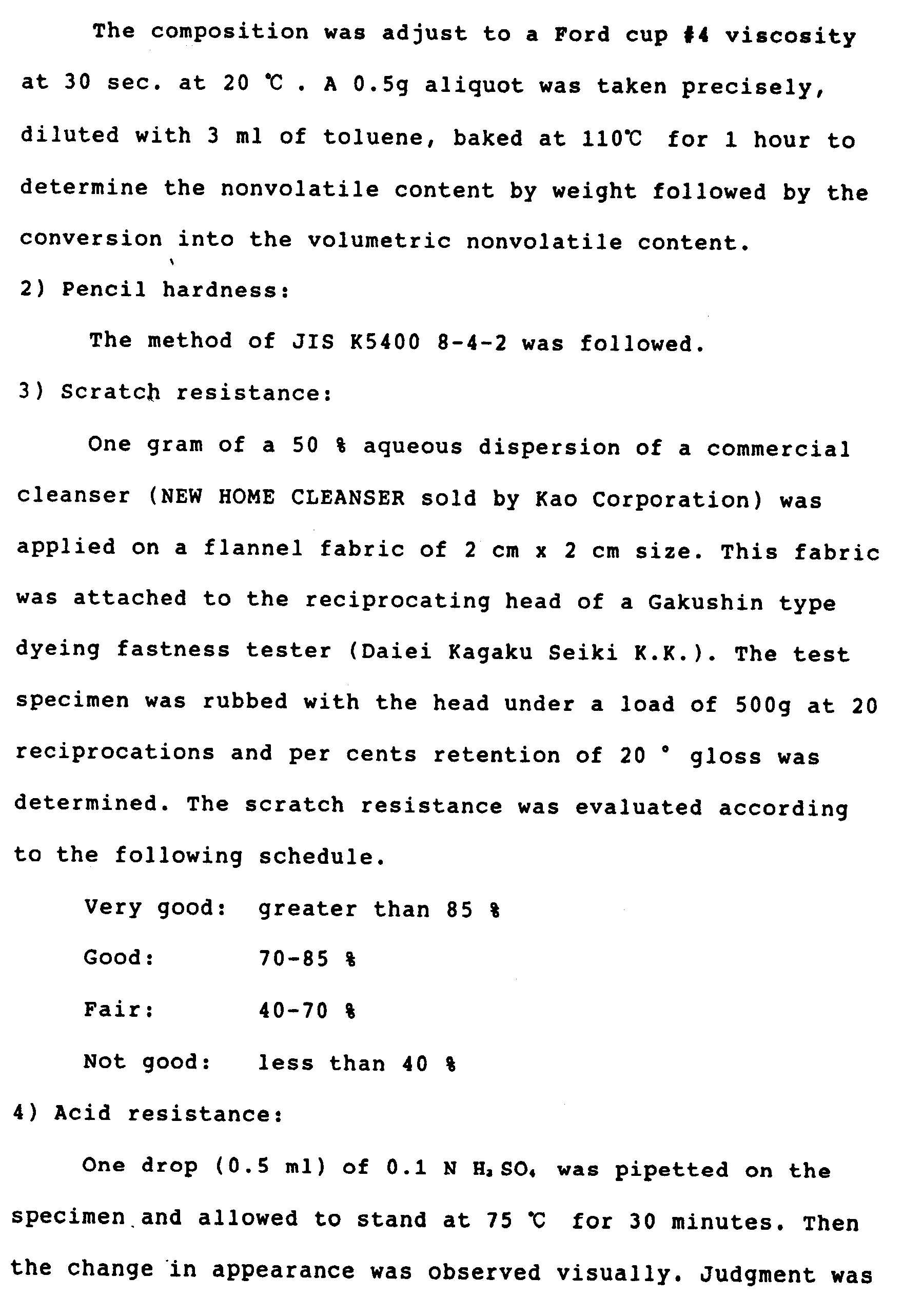

Claims (8)
- A one-component, thermosetting resin composition for coating use comprising:(a) a component containing a plurality of α , β - ethylenically unsaturated carbonyl groups in the molecule;(b) a component containing a plurality of activated methylene groups or activated methyne groups in the molecule;(c) a quaternary ammonium salt, a quaternary phosphonium salt or a tertiary sulfonium salt which does not have catalytic activity at ambient temperature when used alone;(d) a five-membered cyclic carbonate compound independently added to the composition or covalently attached to at least one of said component (a) and said component (b).
- The composition according to claim 1, wherein said component (a) is a polyol poly(meth)acrylate, an unsaturated polyester resin, a polyester acrylate resin, an epoxy acrylate resin, a urethane acrylate resin, a polyether acrylate resin, an α , β -unsaturated carbonyl group-containing acrylic resin, or a silicone oligomer having (meth)acryloyl groups.
- The composition according to claim 1, wherein said component (b) is an ester of an activated methylene- or methynecarboxylic acid with a nonpolymeric or polymeric polyol, a reaction product of a polyamine with diketene, a polymer of an activated methylene group-containing acrylic monomer, or an adduct of an isocyanate compound with an activated methylene compound.
- The composition according to claim 1, wherein the onium cation of said component (c) is a tetraalkylammonium, trialkylaralkylammonium, alkylpyridinium, tetraalkylphosphonium or trialkylsulfonium cation.
- The composition according to claim 1, wherein the counter anion of said component (c) is a halide, a monobasic carboxylate, a polybasic carboxylate, nitrate, nitrite, a sulfonate, sulfate, sulfite, phosphate or an acid phosphate ester anion.
- The composition according to claim 1, wherein said component (d) is a cyclic 1,2-alkylenecarbonate or glycerine carbonate independently added to the composition.
- The composition according to claim 1, wherein at least one of said component (a) and said component (b) is an acrylic resin or polymer, and wherein said component (d) is glycerine carbonate (meth)acrylate copolymerized with said acrylic resin or polymer.
- In a method of forming a multi-layer coating film on a substrate comprising the steps of applying onto the substrate a colored base coat composition, applying a clear top coat composition thereon wet-on-wet, and baking both coats simultaneously, the improvement wherein said clear top coat composition is the composition of claim 1.
Applications Claiming Priority (3)
| Application Number | Priority Date | Filing Date | Title |
|---|---|---|---|
| JP11115295 | 1995-04-12 | ||
| JP111152/95 | 1995-04-12 | ||
| JP7111152A JPH08283627A (en) | 1995-04-12 | 1995-04-12 | One-component thermosetting resin composition for paints |
Publications (2)
| Publication Number | Publication Date |
|---|---|
| EP0737726A1 true EP0737726A1 (en) | 1996-10-16 |
| EP0737726B1 EP0737726B1 (en) | 1999-07-14 |
Family
ID=14553788
Family Applications (1)
| Application Number | Title | Priority Date | Filing Date |
|---|---|---|---|
| EP96105719A Expired - Lifetime EP0737726B1 (en) | 1995-04-12 | 1996-04-11 | One-component, thermosetting resin composition for coating use |
Country Status (5)
| Country | Link |
|---|---|
| US (1) | US5827928A (en) |
| EP (1) | EP0737726B1 (en) |
| JP (1) | JPH08283627A (en) |
| KR (1) | KR960037791A (en) |
| DE (1) | DE69603215D1 (en) |
Cited By (17)
| Publication number | Priority date | Publication date | Assignee | Title |
|---|---|---|---|---|
| GB2323599A (en) * | 1997-03-18 | 1998-09-30 | Courtaulds Plc | Compositions curable by a Michael reaction |
| WO2001064626A1 (en) * | 2000-03-02 | 2001-09-07 | Lonza Ag | Acetoacetylated diamines and polyamines |
| US6297320B1 (en) | 1998-11-20 | 2001-10-02 | The Sherwin-Williams Company | Curable compositions comprising acetoacetoxy and imine functionality |
| EP1245590A1 (en) * | 2001-03-27 | 2002-10-02 | Nippon Paint Co., Ltd. | Curable coating composition and coating film forming method |
| WO2003022941A1 (en) * | 2001-09-12 | 2003-03-20 | E.I. Du Pont De Nemours And Company | Cathodic electrocoating compositions containing hydroxyl-carbonate blocked polyisocyanate crosslinking agent |
| EP1245655A3 (en) * | 2001-03-27 | 2004-02-11 | Nippon Paint Co., Ltd. | Thermosetting coating composition and coating film forming method using the same |
| WO2006081079A1 (en) * | 2005-01-25 | 2006-08-03 | 3M Innovative Properties Company | Crosslinkable hydrophilic materials from polymers having pendent michael donor groups |
| EP1765888A4 (en) * | 2004-04-29 | 2010-04-07 | Ashland Licensing & Intellectu | Self-photoinitiating water-dispersable acrylate ionomers and synthetic methods |
| EP2301977A1 (en) * | 2009-09-25 | 2011-03-30 | Construction Research & Technology GmbH | Water dispersible, cyclocarbonate functionalised vinyl copolymer system |
| WO2012130718A1 (en) | 2011-03-31 | 2012-10-04 | Basf Se | Two-component coating compositions |
| US9079871B2 (en) | 2011-12-29 | 2015-07-14 | Basf Se | Preparing cyclocarbonate-functionalized compounds |
| US9238764B2 (en) | 2011-03-31 | 2016-01-19 | Basf Se | Two-component coating compositions |
| DE102016111912A1 (en) | 2016-06-29 | 2018-01-04 | Eppendorf Ag | Dosing head, dosing device comprising a dosing head and method for dosing by means of a dosing head |
| DE102016111910A1 (en) | 2016-06-29 | 2018-01-04 | Eppendorf Ag | Dosing head, dosing device comprising a dosing head and method for dosing by means of a dosing head |
| CN111373005A (en) * | 2017-11-30 | 2020-07-03 | 中国涂料株式会社 | Acrylic polysiloxane resin-based coating composition and use thereof |
| CN111793425A (en) * | 2020-07-01 | 2020-10-20 | 王俊宇 | Multicoat systems, coating methods, coating structures, and coated substrates |
| US11279835B2 (en) | 2016-11-11 | 2022-03-22 | Hempel A/S | Antifouling coating composition comprising novel carbon-based hydrolysable polymers |
Families Citing this family (8)
| Publication number | Priority date | Publication date | Assignee | Title |
|---|---|---|---|---|
| DE19827084A1 (en) * | 1998-06-18 | 1999-12-23 | Basf Ag | Radiation-curable, weather-stable compositions containing carbonate (meth) acrylates |
| US6037423A (en) * | 1998-09-09 | 2000-03-14 | Toyo Boseki Kabushiki Kaisha | Polyester elastomer composition |
| US6167445A (en) * | 1998-10-26 | 2000-12-26 | Cisco Technology, Inc. | Method and apparatus for defining and implementing high-level quality of service policies in computer networks |
| JP4749443B2 (en) * | 2007-06-28 | 2011-08-17 | ローム アンド ハース カンパニー | Polymer solution |
| KR101466049B1 (en) * | 2014-07-28 | 2014-11-27 | 주식회사 서림 | Acrylic coating composition for heavy duty coating |
| DE102015105987A1 (en) | 2015-04-20 | 2016-10-20 | Mankiewicz Gebr. & Co. Gmbh & Co. Kg | Improved coating systems, their use for coating components as well as coated components for rail and aircraft |
| JP6663677B2 (en) * | 2015-10-06 | 2020-03-13 | 東京応化工業株式会社 | Resist composition and method for forming resist pattern, compound and acid diffusion controlling agent |
| US11643569B2 (en) * | 2018-05-03 | 2023-05-09 | Dow Global Technologies Llc | Method for providing substrate coated with a cured damping coating and coated substrate so provided |
Citations (3)
| Publication number | Priority date | Publication date | Assignee | Title |
|---|---|---|---|---|
| EP0224158A2 (en) * | 1985-11-21 | 1987-06-03 | Hoechst Aktiengesellschaft | Hardenable mixture based on olefinically unsaturated compounds and active hydrogen-containing compounds. |
| EP0448154A1 (en) * | 1990-03-20 | 1991-09-25 | Akzo Nobel N.V. | Coating composition including a blocked basic catalyst |
| EP0582188A1 (en) * | 1992-07-30 | 1994-02-09 | Herberts Gesellschaft mit beschränkter Haftung | Coating and its use for the preparation of coatings with a rapidly processable surface |
Family Cites Families (3)
| Publication number | Priority date | Publication date | Assignee | Title |
|---|---|---|---|---|
| EP0160824B2 (en) * | 1984-04-04 | 1994-08-03 | Hoechst Aktiengesellschaft | Reaction product of olefinically unsaturated compounds with active hydrogen compounds, process for their preparation and 2-component coating systems based thereon |
| US5017649A (en) * | 1988-01-19 | 1991-05-21 | Eastman Kodak Company | Low temperature Michael addition reactions |
| US5021511A (en) * | 1988-12-27 | 1991-06-04 | Rohm And Haas Company | Polymer compositions derived from acryloxyalkylcyanoacetamides |
-
1995
- 1995-04-12 JP JP7111152A patent/JPH08283627A/en active Pending
-
1996
- 1996-04-11 EP EP96105719A patent/EP0737726B1/en not_active Expired - Lifetime
- 1996-04-11 DE DE69603215T patent/DE69603215D1/en not_active Expired - Lifetime
- 1996-04-11 US US08/630,630 patent/US5827928A/en not_active Expired - Fee Related
- 1996-04-12 KR KR1019960010939A patent/KR960037791A/en not_active Abandoned
Patent Citations (3)
| Publication number | Priority date | Publication date | Assignee | Title |
|---|---|---|---|---|
| EP0224158A2 (en) * | 1985-11-21 | 1987-06-03 | Hoechst Aktiengesellschaft | Hardenable mixture based on olefinically unsaturated compounds and active hydrogen-containing compounds. |
| EP0448154A1 (en) * | 1990-03-20 | 1991-09-25 | Akzo Nobel N.V. | Coating composition including a blocked basic catalyst |
| EP0582188A1 (en) * | 1992-07-30 | 1994-02-09 | Herberts Gesellschaft mit beschränkter Haftung | Coating and its use for the preparation of coatings with a rapidly processable surface |
Cited By (27)
| Publication number | Priority date | Publication date | Assignee | Title |
|---|---|---|---|---|
| GB2323599A (en) * | 1997-03-18 | 1998-09-30 | Courtaulds Plc | Compositions curable by a Michael reaction |
| US6521716B1 (en) | 1997-03-18 | 2003-02-18 | Akzo Nobel N.V. | Coating, adhesive and sealant compositions |
| US6297320B1 (en) | 1998-11-20 | 2001-10-02 | The Sherwin-Williams Company | Curable compositions comprising acetoacetoxy and imine functionality |
| WO2001064626A1 (en) * | 2000-03-02 | 2001-09-07 | Lonza Ag | Acetoacetylated diamines and polyamines |
| EP1245590A1 (en) * | 2001-03-27 | 2002-10-02 | Nippon Paint Co., Ltd. | Curable coating composition and coating film forming method |
| EP1245655A3 (en) * | 2001-03-27 | 2004-02-11 | Nippon Paint Co., Ltd. | Thermosetting coating composition and coating film forming method using the same |
| US7144605B2 (en) | 2001-03-27 | 2006-12-05 | Nippon Paint Co., Ltd. | Curable coating composition and coating film forming method |
| WO2003022941A1 (en) * | 2001-09-12 | 2003-03-20 | E.I. Du Pont De Nemours And Company | Cathodic electrocoating compositions containing hydroxyl-carbonate blocked polyisocyanate crosslinking agent |
| US6607646B2 (en) | 2001-09-12 | 2003-08-19 | E. I. Du Pont De Nemours And Company | Cathodic electrocoating compositions containing hydroxyl-carbonate blocked polyisocyanate crosslinking agent |
| US6825361B2 (en) | 2001-09-12 | 2004-11-30 | E. I. Du Pont De Nemours And Company | Cathodic electrocoating compositions containing hydroxyl-carbonate blocked polyisocyanate crosslinking agent |
| EP1765888A4 (en) * | 2004-04-29 | 2010-04-07 | Ashland Licensing & Intellectu | Self-photoinitiating water-dispersable acrylate ionomers and synthetic methods |
| WO2006081079A1 (en) * | 2005-01-25 | 2006-08-03 | 3M Innovative Properties Company | Crosslinkable hydrophilic materials from polymers having pendent michael donor groups |
| EP2301977A1 (en) * | 2009-09-25 | 2011-03-30 | Construction Research & Technology GmbH | Water dispersible, cyclocarbonate functionalised vinyl copolymer system |
| WO2011035982A1 (en) | 2009-09-25 | 2011-03-31 | Construction Research & Technology Gmbh | Water dispersible, cyclic-carbonate-functionalized vinyl copolymer system |
| US8853322B2 (en) | 2009-09-25 | 2014-10-07 | Construction Research & Technology Gmbh | Water dispersable, cyclic-carbonate-functionalized vinyl copolymer system |
| WO2012130718A1 (en) | 2011-03-31 | 2012-10-04 | Basf Se | Two-component coating compositions |
| US9238764B2 (en) | 2011-03-31 | 2016-01-19 | Basf Se | Two-component coating compositions |
| US9079871B2 (en) | 2011-12-29 | 2015-07-14 | Basf Se | Preparing cyclocarbonate-functionalized compounds |
| DE102016111910A1 (en) | 2016-06-29 | 2018-01-04 | Eppendorf Ag | Dosing head, dosing device comprising a dosing head and method for dosing by means of a dosing head |
| DE102016111912A1 (en) | 2016-06-29 | 2018-01-04 | Eppendorf Ag | Dosing head, dosing device comprising a dosing head and method for dosing by means of a dosing head |
| WO2018002254A1 (en) | 2016-06-29 | 2018-01-04 | Eppendorf Ag | Metering head, metering device comprising a metering head, and method for metering by means of a metering head |
| US11279835B2 (en) | 2016-11-11 | 2022-03-22 | Hempel A/S | Antifouling coating composition comprising novel carbon-based hydrolysable polymers |
| CN111373005A (en) * | 2017-11-30 | 2020-07-03 | 中国涂料株式会社 | Acrylic polysiloxane resin-based coating composition and use thereof |
| CN111373005B (en) * | 2017-11-30 | 2021-07-09 | 中国涂料株式会社 | Acrylic polysiloxane resin-based coating composition and use thereof |
| US11555134B2 (en) | 2017-11-30 | 2023-01-17 | Chugoku Marine Paints, Ltd. | Acrylic polysiloxane resin coating compositions and uses thereof |
| CN111793425A (en) * | 2020-07-01 | 2020-10-20 | 王俊宇 | Multicoat systems, coating methods, coating structures, and coated substrates |
| CN111793425B (en) * | 2020-07-01 | 2022-03-18 | 王俊宇 | Multicoat systems, coating methods, coating structures, and coated substrates |
Also Published As
| Publication number | Publication date |
|---|---|
| KR960037791A (en) | 1996-11-19 |
| US5827928A (en) | 1998-10-27 |
| DE69603215D1 (en) | 1999-08-19 |
| EP0737726B1 (en) | 1999-07-14 |
| JPH08283627A (en) | 1996-10-29 |
Similar Documents
| Publication | Publication Date | Title |
|---|---|---|
| EP0651023B1 (en) | Curable resin composition for coating uses | |
| US5827928A (en) | One-component, thermosetting resin composition for coating use | |
| US5959028A (en) | Curable resin composition for coating use | |
| US6884845B2 (en) | Low temperature curable, two-component, waterborne film-forming composition | |
| JP3882096B2 (en) | Curable resin composition | |
| US6881786B2 (en) | One-component, waterborne film-forming composition | |
| JP2513713B2 (en) | Non-self-crosslinking binder composition | |
| US5739230A (en) | Curable resin composition for coating use | |
| JPH08503507A (en) | Acid-epoxy-melamine based coating composition modified with silane polymer | |
| JPH1045993A (en) | Curable resin composition and paint | |
| JP3218345B2 (en) | Cured resin composition for paint | |
| EP0421666B1 (en) | Thermosetting resin composition | |
| JPH08283657A (en) | Curable resin composition for paint | |
| JP3786964B2 (en) | Coating method | |
| CA2262194A1 (en) | Curable resin composition, coating, multilayer film-forming method, and coated article | |
| JPWO1997020642A1 (en) | Paint film formation method | |
| CA1323119C (en) | Curable composition based on branched acrylates with carboxyl groups and/or branched acrylates with epoxide groups and aminoplast resins | |
| WO2006137569A1 (en) | Water-borne clear coating composition and method of forming clear coating film | |
| EP1245655A2 (en) | Thermosetting coating composition and coating film forming method using the same | |
| EP1041115B1 (en) | Curable resin composition | |
| EP1743925A1 (en) | Water reducible binders for cathodic electrodeposition coating compositions | |
| WO2003025074A1 (en) | Improved mar resistance | |
| JP3491450B2 (en) | Thermosetting coating composition | |
| JP2548906B2 (en) | High solid content coating composition | |
| JP2979439B2 (en) | Thermosetting resin composition |
Legal Events
| Date | Code | Title | Description |
|---|---|---|---|
| PUAI | Public reference made under article 153(3) epc to a published international application that has entered the european phase |
Free format text: ORIGINAL CODE: 0009012 |
|
| AK | Designated contracting states |
Kind code of ref document: A1 Designated state(s): DE FR GB |
|
| 17P | Request for examination filed |
Effective date: 19961106 |
|
| 17Q | First examination report despatched |
Effective date: 19970919 |
|
| GRAG | Despatch of communication of intention to grant |
Free format text: ORIGINAL CODE: EPIDOS AGRA |
|
| GRAG | Despatch of communication of intention to grant |
Free format text: ORIGINAL CODE: EPIDOS AGRA |
|
| GRAH | Despatch of communication of intention to grant a patent |
Free format text: ORIGINAL CODE: EPIDOS IGRA |
|
| GRAH | Despatch of communication of intention to grant a patent |
Free format text: ORIGINAL CODE: EPIDOS IGRA |
|
| GRAA | (expected) grant |
Free format text: ORIGINAL CODE: 0009210 |
|
| AK | Designated contracting states |
Kind code of ref document: B1 Designated state(s): DE FR GB |
|
| PG25 | Lapsed in a contracting state [announced via postgrant information from national office to epo] |
Ref country code: FR Free format text: LAPSE BECAUSE OF FAILURE TO SUBMIT A TRANSLATION OF THE DESCRIPTION OR TO PAY THE FEE WITHIN THE PRESCRIBED TIME-LIMIT Effective date: 19990714 |
|
| REF | Corresponds to: |
Ref document number: 69603215 Country of ref document: DE Date of ref document: 19990819 |
|
| PG25 | Lapsed in a contracting state [announced via postgrant information from national office to epo] |
Ref country code: DE Free format text: LAPSE BECAUSE OF FAILURE TO SUBMIT A TRANSLATION OF THE DESCRIPTION OR TO PAY THE FEE WITHIN THE PRESCRIBED TIME-LIMIT Effective date: 19991015 |
|
| EN | Fr: translation not filed | ||
| PLBE | No opposition filed within time limit |
Free format text: ORIGINAL CODE: 0009261 |
|
| STAA | Information on the status of an ep patent application or granted ep patent |
Free format text: STATUS: NO OPPOSITION FILED WITHIN TIME LIMIT |
|
| 26N | No opposition filed | ||
| REG | Reference to a national code |
Ref country code: GB Ref legal event code: IF02 |
|
| PGFP | Annual fee paid to national office [announced via postgrant information from national office to epo] |
Ref country code: GB Payment date: 20050406 Year of fee payment: 10 |
|
| PG25 | Lapsed in a contracting state [announced via postgrant information from national office to epo] |
Ref country code: GB Free format text: LAPSE BECAUSE OF NON-PAYMENT OF DUE FEES Effective date: 20060411 |
|
| GBPC | Gb: european patent ceased through non-payment of renewal fee |
Effective date: 20060411 |