EP0735497A2 - System und Verfahren zur schnellen Ermittlung von Assoziationsregeln in Datenbanken - Google Patents
System und Verfahren zur schnellen Ermittlung von Assoziationsregeln in Datenbanken Download PDFInfo
- Publication number
- EP0735497A2 EP0735497A2 EP96301917A EP96301917A EP0735497A2 EP 0735497 A2 EP0735497 A2 EP 0735497A2 EP 96301917 A EP96301917 A EP 96301917A EP 96301917 A EP96301917 A EP 96301917A EP 0735497 A2 EP0735497 A2 EP 0735497A2
- Authority
- EP
- European Patent Office
- Prior art keywords
- itemsets
- itemset
- database
- candidate
- block
- Prior art date
- Legal status (The legal status is an assumption and is not a legal conclusion. Google has not performed a legal analysis and makes no representation as to the accuracy of the status listed.)
- Withdrawn
Links
Images



Classifications
-
- G—PHYSICS
- G06—COMPUTING OR CALCULATING; COUNTING
- G06Q—INFORMATION AND COMMUNICATION TECHNOLOGY [ICT] SPECIALLY ADAPTED FOR ADMINISTRATIVE, COMMERCIAL, FINANCIAL, MANAGERIAL OR SUPERVISORY PURPOSES; SYSTEMS OR METHODS SPECIALLY ADAPTED FOR ADMINISTRATIVE, COMMERCIAL, FINANCIAL, MANAGERIAL OR SUPERVISORY PURPOSES, NOT OTHERWISE PROVIDED FOR
- G06Q30/00—Commerce
- G06Q30/02—Marketing; Price estimation or determination; Fundraising
-
- G—PHYSICS
- G06—COMPUTING OR CALCULATING; COUNTING
- G06Q—INFORMATION AND COMMUNICATION TECHNOLOGY [ICT] SPECIALLY ADAPTED FOR ADMINISTRATIVE, COMMERCIAL, FINANCIAL, MANAGERIAL OR SUPERVISORY PURPOSES; SYSTEMS OR METHODS SPECIALLY ADAPTED FOR ADMINISTRATIVE, COMMERCIAL, FINANCIAL, MANAGERIAL OR SUPERVISORY PURPOSES, NOT OTHERWISE PROVIDED FOR
- G06Q10/00—Administration; Management
- G06Q10/06—Resources, workflows, human or project management; Enterprise or organisation planning; Enterprise or organisation modelling
- G06Q10/063—Operations research, analysis or management
-
- G—PHYSICS
- G06—COMPUTING OR CALCULATING; COUNTING
- G06Q—INFORMATION AND COMMUNICATION TECHNOLOGY [ICT] SPECIALLY ADAPTED FOR ADMINISTRATIVE, COMMERCIAL, FINANCIAL, MANAGERIAL OR SUPERVISORY PURPOSES; SYSTEMS OR METHODS SPECIALLY ADAPTED FOR ADMINISTRATIVE, COMMERCIAL, FINANCIAL, MANAGERIAL OR SUPERVISORY PURPOSES, NOT OTHERWISE PROVIDED FOR
- G06Q30/00—Commerce
- G06Q30/02—Marketing; Price estimation or determination; Fundraising
- G06Q30/0201—Market modelling; Market analysis; Collecting market data
-
- G—PHYSICS
- G06—COMPUTING OR CALCULATING; COUNTING
- G06F—ELECTRIC DIGITAL DATA PROCESSING
- G06F2216/00—Indexing scheme relating to additional aspects of information retrieval not explicitly covered by G06F16/00 and subgroups
- G06F2216/03—Data mining
-
- Y—GENERAL TAGGING OF NEW TECHNOLOGICAL DEVELOPMENTS; GENERAL TAGGING OF CROSS-SECTIONAL TECHNOLOGIES SPANNING OVER SEVERAL SECTIONS OF THE IPC; TECHNICAL SUBJECTS COVERED BY FORMER USPC CROSS-REFERENCE ART COLLECTIONS [XRACs] AND DIGESTS
- Y10—TECHNICAL SUBJECTS COVERED BY FORMER USPC
- Y10S—TECHNICAL SUBJECTS COVERED BY FORMER USPC CROSS-REFERENCE ART COLLECTIONS [XRACs] AND DIGESTS
- Y10S707/00—Data processing: database and file management or data structures
- Y10S707/99931—Database or file accessing
- Y10S707/99933—Query processing, i.e. searching
- Y10S707/99935—Query augmenting and refining, e.g. inexact access
Definitions
- the present invention relates generally to data processing, and more particularly to "computer database mining" in which significant sequential patterns of transactions are discovered.
- the invention concerns quickly mining a large database of sales transactions.
- basket data i.e., when a particular item from a particular lot was purchased by a consumer, how many items the consumer purchased, and so on, for automatic electronic storage of the basket data.
- the identity of the purchaser can be almost instantaneously known, recorded, and stored along with the basket data.
- vastly improved data storage media have made it possible to electronically store vast amounts of such information for future use.
- purchasing tendencies can be classified many ways.
- the customer purchasing tendencies during a single transaction is focussed on discovering association rules within itemsets (non-empty sets) of consumer transactions.
- a data base mining system for discovering association rules in itemsets stored in a database, each itemset including a plurality of items, comprising:
- the method steps include entering an itemset into a set of large itemsets when the number of times the itemset is present in the database exceeds a predefined minimum support value. Itemsets in the set of large itemsets are then concatenated in accordance with a predetermined concatenation regime to generate a next set of candidate large itemsets, and each itemset in the next set of candidate large itemsets is compared to the itemsets in the database to determine the number of times the candidate large itemset is present in the database. Next, a candidate large itemset is entered into a next forward set of large itemsets only when the number of times the candidate large itemset is present in the database is greater than the minimum support value.
- the number of times selected subsets of the itemsets appear in the database is determined.
- an association rule is output when the ratio of the number of times a selected subset appears in the database to the number of times the associated itemset appears in the database exceeds a predetermined minimum confidence value, thereby satisfying a minimum confidence constraint.
- each itemet in the next set of candidate large itemsets is compared either to the itemsets in the database or to a previous set of candidate large itemsets.
- each transaction is characterized by a unique transaction identifier, and candidate large itemsets in the next set of candidate large itemsets are associated with one of the transaction identifiers.
- the selected subsets of the itemsets in the next forward set of large itemsets each contain one item. Then, in a second iteration the selected subsets are supersets only of those subsets found in the first iteration to have satisfied the minimum confidence constraint.
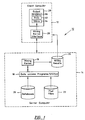
- the system 10 includes one or more digital processing apparatus, such as a client computer 12 and a server computer 14.
- the server computer 14 may be a mainframe computer made by IBM Corp. of Armonk, N.Y., and use an operating system sold under trademarks such as MVS.
- the server computer 14 may be a Unix computer, or OS/2 server, or Windows NT server.
- the server computer 14 may own a database system, such as DB2 or ORACLE, or it may have data on files on some data storage medium such as disk or tape.
- the server computer 14 includes a mining kernel 16 which may be executed by a processor within the server computer 14 as a series of computer-executable instructions. These instructions may reside, for example, in RAM of the computer 14.
- the instructions may be contained on a data storage device with a computer readable medium, such as a computer diskette.
- the instructions may be stored on a DASD array, magnetic tape, conventional hard disk drive, electronic read-only memory, optical storage device, or other appropriate data storage device.
- the computer-executable instructions may be lines of compiled C ++ language code. It is to be understood that architectures other than the one shown may be used.
- the functions of the client computer 12 may be incorporated into the server computer 14, and vice versa.
- Figures 2-8 and 10-12 illustrate, in the form of a flow chart, the structure of such a computer program.
- Figure 1 shows that, through appropriate data access programs and utilities 18, the mining kernel 16 accesses one or more databases 20 and/or flat files (i.e., text files) 22 which contain data chronicling transactions.
- the mining kernel After executing the steps described below, the mining kernel outputs association rules it discovers to a mining results repository 24, which can be accessed by the client computer 12.
- the database 20 is accessed by a dynamic multi-level hash data structure, as more fully discussed below.
- the client computer 12 can include a mining kernel interface 26 which, like the mining kernel 16, may be implemented in suitable computer code.
- the interface 26 functions as an input mechanism for establishing certain variables, including the minimum support value and minimum confidence value defined below.
- the client computer 12 preferably includes an output module 28 for outputting/displaying the mining results on a graphic display 30, print mechanism 32, or data storage medium 34.
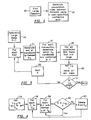
- FIG. 2 shows the overall method of the present invention.
- the system 10 identifies large itemsets in the database 20.
- block 36 is essentially a large itemset generator.
- large itemset is meant a set of one or more items which are purchased in a user-defined percentage of all transactions in the database 20, i.e., itemsets which are appear in the database 20 in a user-defined "minimum support" percentage of transactions.
- the database 20 is accessed for determining a first number of times an itemset appears in the database and for designating the itemset as a large itemset when the first number of times exceeds a minimum support value.
- block 38 is an association rule discoverer which accesses the large itemset generator established by block 36 for determining a second number of times at least one subset of an itemset appears in the database 20. Then, the association rule discoverer at block 38 outputs an association rule representative of purchasing tendencies of consumers when the ratio of the first number of times to the second number of times equals a predetermined or user specified minimum confidence value.
- the present invention might access a database which chronicles transactions in an automobile parts, supplies, and service center.
- An association rule that can be discovered by the present invention might be that 98% of all customers who purchase tires along with tire pressure gages also purchase wheel balancing services during the transaction. Stated differently, in the example given it can be said with a 98% confidence level that wheel balancing services are not purchased separately from tires and tire pressure gages.
- association rules which are discovered between itemsets can produce substantial economic value to retailers, advertisers, marketing executives, and indeed in a wide variety of applications.
- Figure 3 shows one embodiment of the process of the large itemset generator established by block 36 in Figure 2, referred to herein as "Apriori".
- the processing structure shown in Figure 3 is referred to as "Apriori" because, in contrast to the prior procedures mentioned above, the present invention determines Apriori which candidate large sequences are to be counted.
- the prior procedures mentioned above generate and count candidate large sequences "on the fly", i.e., during a pass over the database, which can undesirably lead to the generation and processing of an excessive number of candidates that turn out to be small.
- “large itemsets” means itemsets which appear in the database with a user-defined regularity, termed herein as "minimum support”. For example, the user may want to know what itemsets appear in at least 25% of the customer transactions in the database. The minimum support value in this instance is 25%, and by counting the number of transactions in which the itemset appears and then dividing by the total number of transactions, it may be determined whether the itemset meets the minimum support criterion.
- the mining kernel 16 embodied by the mining kernel 16 embodied by the system 10 identifies the set L 1 of large single-item itemsets in the database 20. To determine whether a single item itemset is large, all items in the database 20 are initially counted by passing over the database 20, and their support determined as described above.
- the mining kernel 16 embodied by the system 10 enters an iterative process for each k ⁇ 2.
- a seed set of large itemsets L k-1 having a length (i.e., number of itemsets) equal to "k-1" is used for generating a set of candidate large itemsets C k having length k.
- the method determines which candidate large itemsets in the set C k of candidate large itemsets are contained in the transaction.
- the support for the candidate large itemsets is determined by passing over the database to count the number of times each candidate large itemset appears therein, and then determining whether the number of times equals the minimum support value defined by the user.
- a forward set L k of actual large itemsets is set equal to the set of candidate large itemsets found at block 48 to have minimum support.
- This forward set L k of actual large itemsets becomes the seed for the next iteration at block 52.
- the mining kernel 16 embodied by the system 10 returns to block 42.
- L k is empty, the process terminates. This decision is shown in block 51.
- FIG. 4 shows the details of the Apriori embodiment in creating sets of candidate large itemsets.
- L k-1 is concatenated (i.e., joined) to itself to create an initial C k having c itemsets. More particularly, the itemsets, designated as p.litemset 1 p.litemset 2 ...p.litemset k-1 of L k-1 are joined to each of the other itemsets, designated q.litemset 1 , q.litemset 2 ...q-litemset k-1 in L k-1 to yield a set C k of candidate large itemsets c, each c having k itemsets, with the constraint that no itemset c in C k is repeated.
- the mining kernel 16 embodied by the system 10 prunes candidate itemsets c from C k which contain any subitemsets not found in L k-1 .
- the mining kernel 16 embodied by the system 10 considers, at block 56, each customer itemset c in the set of candidate large itemsets C k as described below, and then proceeds to block 58 for each subitemset s having k-1 itemsets of the candidate set of large itemsets C k .
- the mining kernel 16 embodied by the system 10 determines whether s is an element of the immediately preceding set of actual large itemsets L k-1 .
- the set of large itemsets is used as the seed for the first iteration.
- the mining kernel 16 embodied by the system 10 moves back to block 58 to retrieve the next subitemset s in C k . Otherwise, the mining kernel 16 embodied by the system 10 proceeds to block 62 to delete, i.e., prune, c from C k , and then the mining kernel 16 embodied by the system 10 returns to block 56 to test the next itemset c in C k .
- the immediately preceding set C k-1 of candidate large itemsets may be used in lieu of the immediately preceding set of actual large itemsets L k-1 to generate the set C k of candidate large itemsets.
- data in the present invention for example, data contained in a set C k of candidate large itemsets, is preferably arranged in a data structure organized to permit rapid searching such as a dynamic hash-tree.
- a data structure includes a root 64 that is at a depth, i.e., data structure level, of unity.
- the hash tree then branches into a plurality of hash table nodes 66, 68, 70 at depth 2, herein designated DB 1 2 , DB 2 2 ...DB m 2 , each of which hash table nodes 66, 68, 70 contains one or more so-called "buckets".
- Each bucket in one of the hash table nodes 66, 68, 70 points to a node at depth 3, e.g., one of the nodes 72, 74 designated DB 11 3 , DB 12 3 , and this branching to further hash table nodes to a depth "d" continues.
- the node becomes a so-called “leaf node", e.g, one of the leaf nodes 76, 78, which directly stores part of the transaction data.
- a hash function is applied to the d th item of the itemset c to thereby generate a path to follow down the hash tree.
- all nodes are created as leaf nodes, and when the number of itemsets stored in a leaf node exceeds a predetermined number, the leaf node is converted to a hash table node which points to a subordinate leaf node (or hash table node) in which further data may be stored.
- Figure 6 shows how the step at block 46 in Figure 3 is accomplished.
- the mining kernel 16 embodied by the system 10 applies the hash function (also referred to as "hashes on") every item "i" in the transaction "t" under test.
- decision block 82 it is determined whether the process is examining a leaf node. If so, at block 84 the mining kernel 16 embodied by the system 10 identifies which itemsets in the leaf node are contained in the transaction "t” and then adds a reference to those itemsets to the answer set, formatted in the preferred embodiment as a bitmap. Otherwise, at block 86 the mining kernel 16 embodied by the system 10 applies the hash function to every itemset following the itemset "i" under test at block 86 and recursively applies the procedure to the node.
- the hash function also referred to as "hashes on
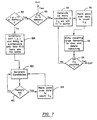
- Figure 7 shows the preferred method by which the Apriori embodiment undertakes data buffer management.
- the mining kernel 16 embodied by the system 10 determines whether the set L k-1 of actual large itemsets fits into buffer memory. If it does, the mining kernel 16 embodied by the system 10 tests at decision block 90 whether the set C k of candidate large itemsets fits into buffer memory. If it does, buffer size is not limited and the mining kernel 16 embodied by the system 10 exits the process shown in Figure 7.
- the mining kernel 16 embodied by the system 10 generates as many candidates "c" in the set C k of candidate large itemsets that will fit into memory at block 92. Then, a pass is made over the data at block 94 to count the support for the set C k of candidate large itemsets, and the resulting set L k of actual large itemsets is written to disk at block 96, with the small candidate large itemsets "c" being deleted.
- the mining kernel 16 embodied by the system 10 determines whether all candidate large itemsets "c" in the set C k of candidate large itemsets have been counted, and if so, exits Figure 7. Otherwise, the mining kernel 16 embodied by the system 10 loops back to block 92.
- the mining kernel 16 embodied by the system 10 moves to block 100 to externally sort the set L k-1 of actual large itemsets and bring into buffer memory subitemsets of the set L k-1 in which the first k-2 items are the same.
- candidate large itemsets "c" i.e., the set C k of candidate large itemsets
- the mining kernel 16 embodied by the system 10 then loops back to block 102. It will be appreciated that the pruning steps of Figure 4 cannot be executed, because all of the set L k-1 is not in buffer memory.
- the AprioriTid method generates successive sets of successively longer candidate large itemsets C k .
- the AprioriTid embodiment counts support for candidate large itemsets not by passing over the entire database 20 after the first iteration, but by examining a transformed set C ⁇ k of candidate large itemsets having a data format of ⁇ TID, ⁇ X k ⁇ > , where TID is a transaction identifier and ⁇ X k ⁇ is a potentially large k-itemset contained in the transaction with identifier TID.
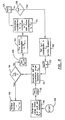
- the AprioriTid embodiment begins at start circle 108 and proceeds to block 110, wherein a transformed set C ⁇ 1 of candidate large itemsets is set equal to the database, and a set L 1 of large items is found in accordance with the principles disclosed below.
- k is set equal to two (2), and then at block 114 a set C k of candidate large itemsets is generated by the concatenation regime shown in Figure 4 above. From block 114, the mining kernel 16 determines whether the set C k of candidate large itemsets is null at decision block 116, and if so, outputs the answer at block 118 as being the union of sets L k of large itemsets.
- the mining kernel 16 embodied in the system 10 sets a transformed set C ⁇ k of candidate large itemsets equal to null at block 120. Then, at block 122, the transactions "t" in the immediately preceding transformed set C ⁇ k-1 of candidate large itemsets is selected and at block 124 it is determined, for this transaction "t", what candidate large itemsets in C k are contained in the transaction. The candidate large itemsets which are contained in the present transaction "t" under test are entered into a transaction set C t , and the transformed set C ⁇ k-1 of candidate large itemsets is set equal to the sum of all transaction sets C t .
- the mining kernel 16 determines whether the last transaction "t" in the immediately preceding transformed set C of candidate large itemsets has been tested, and if not, the mining kernel 16 retrieves the next transaction "t" at block 128 and then loops back to block 124. If the last transaction "t" has been tested, the mining kernel 16 compares the count of each candidate large itemset contained in the set C k of candidate large itemsets with the minimum support value at block 130, and sets a set L k of actual large itemsets equal to those candidates in the set C k of candidate large itemsets found to be large. From block 130, the mining kernel 16 proceeds to block 132 to retrieve the next k (i.e., to increment the value of k by one (1)), and then loops back to block 114.
- the mining kernel 16 proceeds to block 132 to retrieve the next k (i.e., to increment the value of k by one (1)), and then loops back to block 114.
- Figure 9 provides one illustration of data structures that are used and processed by the AprioriTid embodiment of the invention just described.
- the minimum support value has been established to be two (2).
- contents of the database 20 initially are sorted by transaction identity (TID) and include items contained in each transaction.
- TID transaction identity
- the first transformed set C ⁇ 1 of candidate large itemsets is then generated essentially as the database 20 with items of length one (1) therein separately listed with the corresponding TID.
- the first set L 1 of actual large itemsets is generated by passing over the database 20 to count the support of the candidate itemsets in the transformed set C ⁇ 1 of candidate large itemsets.
- the second set C 2 of candidate large itemsets is generated by concatenating the first set L 1 of actual large itemsets in accordance with the principles shown above in Figure 4. Then, the second transformed set C 2 of candidate large itemsets is generated by the union of the individual transaction sets C t .
- the first entry in the transformed set C ⁇ 2 is the candidate itemset ⁇ 1 3 ⁇ because ⁇ 1 3 ⁇ appears in the set C 2 and both ( ⁇ 1 3 ⁇ - ⁇ 1 ⁇ ) and ( ⁇ 1 3 ⁇ - ⁇ 3 ⁇ ) are members of the corresponding transaction set in the immediately preceding transformed set C ⁇ 1 .
- L 2 is generated as discussed above by counting the support for the candidate large itemsets in C 2 . It will be appreciated by the skilled artisan that in counting the support for the candidate large itemsets in C 2 , no pass over the database 20 is necessary. Instead, the transformed set C ⁇ 2 is examined, and the number of transactions in which any given candidate large itemset appears is equal to the count for that candidate large itemset. The counts of the individual candidate large itemsets are then simply compared to the minimum support value to determine whether the itemset is actually large, and if it is, it is entered into L 2 .
- each candidate large itemset Ck is assigned a unique ID number which can indicate the IDs of both, but preferably only the second, of the two large k-1 itemsets were joined to create Ck , and which also indicates the IDs of the k+1 candidates that are extensions of c k .
- Such a hybrid large itemset generator would begin to generate large itemsets using the Apriori embodiment when the value of k is relatively small, and then switch to the AprioriTid embodiment when the value of k is relatively large.
- Such a switch may advantageously be made when it is estimated that the transformed set C ⁇ k ' will fit into memory, provided that fewer candidate large itemsets were generated in the current k th pass than in the immediately preceding k-1 pass.
- the estimation is made by calculating the combined size of all candidates in C k having minimum support, plus the number of transactions in the database 20.
- Figure 10 one embodiment of the association rule discoverer of the present invention is shown. It is to be understood that Figure 10 is entered by the mining kernel 16 after all large itemsets in the database 20 have been identified using the Apriori or AprioriTid large itemset generator disclosed above. Stated differently, Figure 10 is entered with all itemsets found by the large itemset generator to have a support value in the database 20 which exceeds the user-defined minimum support value.
- the mining kernel 16 undertakes the operations shown in Figure 10 for each large itemset l k , k ⁇ 2, and proceeds to block 136, wherein the mining kernel 16 selects the next non-empty subset a m of the large itemset l k under test.
- the mining kernel 16 calculates a confidence value to be the support of the large itemset l k under test divided by the support of the subset a m under test.
- the mining kernel 16 compares the confidence value of the subset a m to a user-defined minimum confidence value, and if the confidence value of the subset a m is not at least equal to the user-defined minimum confidence value, the mining kernel 16 loops back to block 136 to retrieve the next subset a m+1 of the large itemset l k under test.
- the mining kernel 16 determines that the confidence value of the subset a m is at least equal to the user-defined minimum confidence value
- the mining kernel 16 loops back to block 136 to retrieve the next subset a m+1 of the large itemset l k under test.
- Figures 11 and 12 show a faster embodiment for discovering association rules.
- Figure 12 is called at block 148 to determine association rules having more than a one item consequent, and then the value of m is incremented by one at block 150.
- a next consequent set H m+1 is generated from the consequent set H m using the invention shown in Figure 4, with the consequent set H m as the entering argument.
- the mining kernel 16 calculates a confidence value to be the support of the large itemset l k under test divided by the support of the subset (l k - h m+1 ).
- the mining kernel 16 compares the confidence value determined at block 156 to a user-defined minimum confidence value, and if the confidence value is not at least equal to the user-defined minimum confidence value, the mining kernel 16 deletes the element h m+1 from the next consequent set H m+1 at block 160.
- Figures 2-12 illustrate the structures of computer program code elements that function according to this invention.
- the invention is practiced in its essential embodiment by a machine component that renders the computer program code elements in a form that causes a digital processing apparatus (that is, a computer) to perform a sequence of function steps corresponding to those shown in the Figures.
- the machine component is shown in FIGURE 13 as a combination of program code elements 204, 206, 208 and 210 in computer readable form that are embodied in a computer-usable data medium 202, on a floppy disk 200.
- program code elements 204, 206, 208 and 210 in computer readable form that are embodied in a computer-usable data medium 202, on a floppy disk 200.
- such media can also be found in semiconductor devices, on magnetic tape, and on optical disks.
Landscapes
- Business, Economics & Management (AREA)
- Engineering & Computer Science (AREA)
- Strategic Management (AREA)
- Development Economics (AREA)
- Entrepreneurship & Innovation (AREA)
- Finance (AREA)
- Accounting & Taxation (AREA)
- Economics (AREA)
- General Physics & Mathematics (AREA)
- Game Theory and Decision Science (AREA)
- Human Resources & Organizations (AREA)
- Marketing (AREA)
- Theoretical Computer Science (AREA)
- Physics & Mathematics (AREA)
- General Business, Economics & Management (AREA)
- Educational Administration (AREA)
- Tourism & Hospitality (AREA)
- Quality & Reliability (AREA)
- Data Mining & Analysis (AREA)
- Operations Research (AREA)
- Management, Administration, Business Operations System, And Electronic Commerce (AREA)
- Information Retrieval, Db Structures And Fs Structures Therefor (AREA)
- Cash Registers Or Receiving Machines (AREA)
Applications Claiming Priority (2)
| Application Number | Priority Date | Filing Date | Title |
|---|---|---|---|
| US415006 | 1989-09-29 | ||
| US08/415,006 US5794209A (en) | 1995-03-31 | 1995-03-31 | System and method for quickly mining association rules in databases |
Publications (2)
| Publication Number | Publication Date |
|---|---|
| EP0735497A2 true EP0735497A2 (de) | 1996-10-02 |
| EP0735497A3 EP0735497A3 (de) | 1998-02-25 |
Family
ID=23643960
Family Applications (1)
| Application Number | Title | Priority Date | Filing Date |
|---|---|---|---|
| EP96301917A Withdrawn EP0735497A3 (de) | 1995-03-31 | 1996-03-20 | System und Verfahren zur schnellen Ermittlung von Assoziationsregeln in Datenbanken |
Country Status (3)
| Country | Link |
|---|---|
| US (1) | US5794209A (de) |
| EP (1) | EP0735497A3 (de) |
| JP (1) | JPH08287106A (de) |
Cited By (7)
| Publication number | Priority date | Publication date | Assignee | Title |
|---|---|---|---|---|
| EP0959415A3 (de) * | 1998-05-21 | 2000-03-15 | Fujitsu Limited | Vorrichtung zur Datendekomposition, und Verfahren und Speichermedium dafür |
| US6272478B1 (en) | 1997-06-24 | 2001-08-07 | Mitsubishi Denki Kabushiki Kaisha | Data mining apparatus for discovering association rules existing between attributes of data |
| WO2003075183A1 (en) * | 2002-03-02 | 2003-09-12 | Bl Systems Inc. | Apparatus and method for generating association rules for ensemble machines in data mining |
| EP1376397A3 (de) * | 2002-06-21 | 2005-01-05 | Hitachi, Ltd. | Verfahren um Gegenstandsmuster von mehreren Datenbänken zu extrahieren, ein Netzwerksystem und ein Verarbeitungsgerät |
| US7069231B1 (en) * | 2000-07-20 | 2006-06-27 | Oracle International Corporation | Methods and systems for defining, applying and executing customer care relationship plans |
| US7162439B2 (en) * | 2000-12-22 | 2007-01-09 | General Electric Company | Workstation configuration and selection method and apparatus |
| CN105975608A (zh) * | 2016-05-17 | 2016-09-28 | 北京京东尚科信息技术有限公司 | 一种数据挖掘方法和装置 |
Families Citing this family (88)
| Publication number | Priority date | Publication date | Assignee | Title |
|---|---|---|---|---|
| US10361802B1 (en) | 1999-02-01 | 2019-07-23 | Blanding Hovenweep, Llc | Adaptive pattern recognition based control system and method |
| US6014661A (en) * | 1996-05-06 | 2000-01-11 | Ivee Development Ab | System and method for automatic analysis of data bases and for user-controlled dynamic querying |
| US6405195B1 (en) * | 1996-05-06 | 2002-06-11 | Spotfire Ab | System and method for collaborative hosted analysis of data bases via a network portal |
| US7216116B1 (en) | 1996-05-06 | 2007-05-08 | Spotfire Ab | Data analysis system with automated query and visualization environment setup |
| US6272457B1 (en) * | 1996-09-16 | 2001-08-07 | Datria Systems, Inc. | Spatial asset management system that time-tags and combines captured speech data and captured location data using a predifed reference grammar with a semantic relationship structure |
| JPH10222493A (ja) * | 1997-02-06 | 1998-08-21 | Kokusai Denshin Denwa Co Ltd <Kdd> | 相互因果関係解析システム |
| US5920855A (en) * | 1997-06-03 | 1999-07-06 | International Business Machines Corporation | On-line mining of association rules |
| US5943667A (en) * | 1997-06-03 | 1999-08-24 | International Business Machines Corporation | Eliminating redundancy in generation of association rules for on-line mining |
| DE69839467D1 (de) * | 1997-06-26 | 2008-06-26 | Fraunhofer Ges Forschung | Verfahren zur Entdeckung von Gruppen von Objekten mit einer auswählbaren Eigenschaft aus einer Objektpopulation |
| US6061682A (en) * | 1997-08-12 | 2000-05-09 | International Business Machine Corporation | Method and apparatus for mining association rules having item constraints |
| US6092064A (en) * | 1997-11-04 | 2000-07-18 | International Business Machines Corporation | On-line mining of quantitative association rules |
| JPH11328186A (ja) * | 1997-11-11 | 1999-11-30 | Mitsubishi Electric Corp | 相関ルール生成方法および相関ルール生成装置 |
| US6301575B1 (en) * | 1997-11-13 | 2001-10-09 | International Business Machines Corporation | Using object relational extensions for mining association rules |
| US5946683A (en) * | 1997-11-25 | 1999-08-31 | Lucent Technologies Inc. | Technique for effectively instantiating attributes in association rules |
| IL122850A0 (en) * | 1998-01-05 | 1999-03-12 | Wizsoft | Pattern recognition using generalized association rules |
| AU2587199A (en) * | 1998-02-03 | 1999-08-16 | Cogit Corporation | Method and apparatus for associations discovery |
| US8315909B1 (en) | 1998-03-11 | 2012-11-20 | West Corporation | Methods and apparatus for intelligent selection of goods and services in point-of-sale commerce |
| US6055513A (en) | 1998-03-11 | 2000-04-25 | Telebuyer, Llc | Methods and apparatus for intelligent selection of goods and services in telephonic and electronic commerce |
| US7386485B1 (en) | 2004-06-25 | 2008-06-10 | West Corporation | Method and system for providing offers in real time to prospective customers |
| US7437313B1 (en) | 1998-03-11 | 2008-10-14 | West Direct, Llc | Methods, computer-readable media, and apparatus for offering users a plurality of scenarios under which to conduct at least one primary transaction |
| US7729945B1 (en) | 1998-03-11 | 2010-06-01 | West Corporation | Systems and methods that use geographic data to intelligently select goods and services to offer in telephonic and electronic commerce |
| US7364068B1 (en) | 1998-03-11 | 2008-04-29 | West Corporation | Methods and apparatus for intelligent selection of goods and services offered to conferees |
| US6138117A (en) * | 1998-04-29 | 2000-10-24 | International Business Machines Corporation | Method and system for mining long patterns from databases |
| US6321221B1 (en) | 1998-07-17 | 2001-11-20 | Net Perceptions, Inc. | System, method and article of manufacture for increasing the user value of recommendations |
| US6334127B1 (en) | 1998-07-17 | 2001-12-25 | Net Perceptions, Inc. | System, method and article of manufacture for making serendipity-weighted recommendations to a user |
| US6317722B1 (en) * | 1998-09-18 | 2001-11-13 | Amazon.Com, Inc. | Use of electronic shopping carts to generate personal recommendations |
| US6412012B1 (en) | 1998-12-23 | 2002-06-25 | Net Perceptions, Inc. | System, method, and article of manufacture for making a compatibility-aware recommendations to a user |
| US7424439B1 (en) * | 1999-09-22 | 2008-09-09 | Microsoft Corporation | Data mining for managing marketing resources |
| JP2001134575A (ja) * | 1999-10-29 | 2001-05-18 | Internatl Business Mach Corp <Ibm> | 頻出パターン検出方法およびシステム |
| US20060259321A1 (en) * | 1999-11-05 | 2006-11-16 | Mindmatters Technologies, Inc. | System for automating and managing an enterprise IP environment |
| EP1240600A4 (de) * | 1999-11-12 | 2003-05-21 | Mindmatters Technologies Inc | System um die ip-umgebung einer firma zu automatisieren und zu verwalten |
| US6677963B1 (en) * | 1999-11-16 | 2004-01-13 | Verizon Laboratories Inc. | Computer-executable method for improving understanding of business data by interactive rule manipulation |
| JP3735505B2 (ja) * | 2000-02-16 | 2006-01-18 | 株式会社東芝 | Pos分析システム |
| US7299194B1 (en) * | 2000-02-22 | 2007-11-20 | International Business Machines Corporation | Method and system for researching sales effects of advertising using association analysis |
| US6473757B1 (en) * | 2000-03-28 | 2002-10-29 | Lucent Technologies Inc. | System and method for constraint based sequential pattern mining |
| JP2002150147A (ja) * | 2000-08-29 | 2002-05-24 | Yutaka Nishimura | 情報提供システム及び方法並びに情報提供用プログラムを記録した記録媒体 |
| US7650304B1 (en) | 2000-09-08 | 2010-01-19 | Capital One Financial Corporation | Solicitation to web marketing loop process |
| US7567916B1 (en) | 2000-09-12 | 2009-07-28 | Capital One Financial Corporation | System and method for performing Web based in-view monitoring |
| US6711577B1 (en) | 2000-10-09 | 2004-03-23 | Battelle Memorial Institute | Data mining and visualization techniques |
| US7539677B1 (en) | 2000-10-09 | 2009-05-26 | Battelle Memorial Institute | Sequential pattern data mining and visualization |
| US20050240428A1 (en) * | 2000-11-10 | 2005-10-27 | Gabrick John J | System for automating and managing an IP environment |
| US20040073443A1 (en) * | 2000-11-10 | 2004-04-15 | Gabrick John J. | System for automating and managing an IP environment |
| US20070276675A1 (en) * | 2000-11-10 | 2007-11-29 | Gabrick John J | Innovation management system, apparatus, and method |
| JP3695523B2 (ja) * | 2000-12-22 | 2005-09-14 | 日本電気株式会社 | 販売管理方法、データ処理方法および装置、データ通信システム、情報記憶媒体 |
| US6952693B2 (en) * | 2001-02-23 | 2005-10-04 | Ran Wolff | Distributed mining of association rules |
| US20030130991A1 (en) * | 2001-03-28 | 2003-07-10 | Fidel Reijerse | Knowledge discovery from data sets |
| US6754651B2 (en) | 2001-04-17 | 2004-06-22 | International Business Machines Corporation | Mining of generalized disjunctive association rules |
| US8260656B1 (en) | 2001-04-19 | 2012-09-04 | Amazon.Com, Inc. | Mining of user-generated playlists for data regarding relationships between digital works |
| US6711522B2 (en) * | 2001-04-25 | 2004-03-23 | Fujitsu Limited | Data analysis apparatus, data analysis method, and computer products |
| US20020174087A1 (en) * | 2001-05-02 | 2002-11-21 | Hao Ming C. | Method and system for web-based visualization of directed association and frequent item sets in large volumes of transaction data |
| US7739162B1 (en) | 2001-05-04 | 2010-06-15 | West Corporation | System, method, and business method for setting micropayment transaction to a pre-paid instrument |
| US20030099973A1 (en) * | 2001-07-18 | 2003-05-29 | University Of Louisville Research Foundation, Inc. | E-GeneChip online web service for data mining bioinformatics |
| US7487111B2 (en) * | 2001-10-19 | 2009-02-03 | U-Haul International, Inc. | Online marketplace for moving and relocation services |
| US6763354B2 (en) | 2002-05-10 | 2004-07-13 | Agentarts, Inc. | Mining emergent weighted association rules utilizing backlinking reinforcement analysis |
| US8370203B2 (en) * | 2002-10-07 | 2013-02-05 | Amazon Technologies, Inc. | User interface and methods for recommending items to users |
| US7962483B1 (en) * | 2002-12-20 | 2011-06-14 | Oracle International Corporation | Association rule module for data mining |
| US8306908B1 (en) | 2002-12-31 | 2012-11-06 | West Corporation | Methods and apparatus for intelligent selection of goods and services in telephonic and electronic commerce |
| US8712857B1 (en) | 2003-03-31 | 2014-04-29 | Tuxis Technologies Llc | Methods and apparatus for intelligent selection of goods and services in mobile commerce |
| US7720790B2 (en) * | 2003-08-18 | 2010-05-18 | Oracle International Corporation | Dynamic selection of frequent itemset counting technique |
| US7962526B2 (en) * | 2003-08-18 | 2011-06-14 | Oracle International Corporation | Frequent itemset counting using clustered prefixes and index support |
| US8655911B2 (en) * | 2003-08-18 | 2014-02-18 | Oracle International Corporation | Expressing frequent itemset counting operations |
| US7756853B2 (en) * | 2003-08-18 | 2010-07-13 | Oracle International Corporation | Frequent itemset counting using subsets of bitmaps |
| US7426520B2 (en) | 2003-09-10 | 2008-09-16 | Exeros, Inc. | Method and apparatus for semantic discovery and mapping between data sources |
| US7155446B2 (en) | 2004-05-14 | 2006-12-26 | Oracle International Corporation | Performing recursive database operations |
| US7232070B2 (en) * | 2004-06-10 | 2007-06-19 | Lockheed Martin Corporation | Chemical/biological hazard trigger with automatic mail piece tagging system and method |
| US20060053156A1 (en) * | 2004-09-03 | 2006-03-09 | Howard Kaushansky | Systems and methods for developing intelligence from information existing on a network |
| US7178720B1 (en) | 2004-09-30 | 2007-02-20 | West Corporation | Methods, computer-readable media, and computer program product for intelligent selection of items encoded onto portable machine-playable entertainment media |
| US7395254B2 (en) * | 2005-04-21 | 2008-07-01 | Xerox Corporation | Method for dynamic knowledge capturing in production printing workflow domain |
| US7809675B2 (en) * | 2005-06-29 | 2010-10-05 | Oracle International Corporation | Sharing state information among a plurality of file operation servers |
| JP2007041683A (ja) * | 2005-08-01 | 2007-02-15 | Toshiba Corp | 系列パターン抽出装置、系列パターン抽出方法、および系列パターン抽出プログラム |
| WO2007043199A1 (ja) * | 2005-10-07 | 2007-04-19 | Hitachi, Ltd. | 相関ルールを抽出する方法及びシステム |
| US7836004B2 (en) * | 2006-12-11 | 2010-11-16 | International Business Machines Corporation | Using data mining algorithms including association rules and tree classifications to discover data rules |
| US20080215607A1 (en) * | 2007-03-02 | 2008-09-04 | Umbria, Inc. | Tribe or group-based analysis of social media including generating intelligence from a tribe's weblogs or blogs |
| US8301623B2 (en) * | 2007-05-22 | 2012-10-30 | Amazon Technologies, Inc. | Probabilistic recommendation system |
| US8171001B2 (en) * | 2007-06-27 | 2012-05-01 | International Business Machines Corporation | Using a data mining algorithm to generate rules used to validate a selected region of a predicted column |
| US8166000B2 (en) * | 2007-06-27 | 2012-04-24 | International Business Machines Corporation | Using a data mining algorithm to generate format rules used to validate data sets |
| US8401987B2 (en) * | 2007-07-17 | 2013-03-19 | International Business Machines Corporation | Managing validation models and rules to apply to data sets |
| US9720971B2 (en) * | 2008-06-30 | 2017-08-01 | International Business Machines Corporation | Discovering transformations applied to a source table to generate a target table |
| JP5528292B2 (ja) | 2010-10-14 | 2014-06-25 | インターナショナル・ビジネス・マシーンズ・コーポレーション | 意味のある頻出アイテムセットを抽出するシステム、方法及びプログラム |
| TWI464608B (zh) * | 2010-11-18 | 2014-12-11 | Wang Yen Yao | 快速尋找高效益項目集的資料探勘演算法 |
| US8930303B2 (en) | 2012-03-30 | 2015-01-06 | International Business Machines Corporation | Discovering pivot type relationships between database objects |
| US10475049B2 (en) * | 2012-06-13 | 2019-11-12 | Transform Sr Brands Llc | Systems and methods for determining offer eligibility using a predicate logic tree against sets of input data |
| US9110969B2 (en) | 2012-07-25 | 2015-08-18 | Sap Se | Association acceleration for transaction databases |
| US9785890B2 (en) * | 2012-08-10 | 2017-10-10 | Fair Isaac Corporation | Data-driven product grouping |
| CN107870936A (zh) * | 2016-09-27 | 2018-04-03 | 腾讯科技(深圳)有限公司 | 数据项相关的高效用项集挖掘方法、装置及数据处理设备 |
| US11947978B2 (en) | 2017-02-23 | 2024-04-02 | Ab Initio Technology Llc | Dynamic execution of parameterized applications for the processing of keyed network data streams |
| US10831509B2 (en) | 2017-02-23 | 2020-11-10 | Ab Initio Technology Llc | Dynamic execution of parameterized applications for the processing of keyed network data streams |
| CN110442762B (zh) * | 2019-08-08 | 2022-02-08 | 厦门久凌创新科技有限公司 | 基于云平台大数据的大数据处理方法 |
Family Cites Families (3)
| Publication number | Priority date | Publication date | Assignee | Title |
|---|---|---|---|---|
| JPH0833857B2 (ja) * | 1987-02-18 | 1996-03-29 | 株式会社日立製作所 | システム間デ−タベ−ス共用システムジヤ−ナルマ−ジ方式 |
| AU613741B2 (en) * | 1988-02-29 | 1991-08-08 | Information Resources, Inc. | Passive data collection system for market research data |
| US5553279A (en) * | 1993-10-08 | 1996-09-03 | International Business Machines Corporation | Lossless distribution of time series data in a relational data base network |
-
1995
- 1995-03-31 US US08/415,006 patent/US5794209A/en not_active Expired - Lifetime
-
1996
- 1996-03-07 JP JP5001796A patent/JPH08287106A/ja active Pending
- 1996-03-20 EP EP96301917A patent/EP0735497A3/de not_active Withdrawn
Non-Patent Citations (6)
| Title |
|---|
| AGRAWAL ET AL: "Fast Algorithms for Mining Association Rules" PROCEEDINGS OF THE 20TH INTERNATIONAL CONFERENCE ON VERY LARGE DATABASES, 1994, SANTIAGO, CHILE, pages 487-499, XP000671665 * |
| AGRAWAL ET AL: "Mining Association Rules between Sets of Items in Large Databases" SIGMOD 1993, vol. 22, no. 2, May 1993, WASHINGTON DC, pages 207-216, XP000575841 * |
| AGRAWAL ET AL: "Quest: A Project on Database Mining" 1994 ACM SIGMOD INTERNATION CONFERENCE ON MANAGEMENT OF DATA, vol. 23, no. 2, May 1994, MINNEAPOLIS, USA, page 514 XP002046728 * |
| HOUTSMA ET AL: "Set-Oriented Mining for Association Rules in Relational Databases" PROCEEDINGS OF THE 11TH INTERNATIONAL CONFERENCE ON DATA ENGINEERING, 6 March 1995, TAIPEI, TAIWAN, pages 25-33, XP000576455 * |
| HOUTSMA: "Set-Oriented Mining for Association Rules" IBM RESEARCH REPORT - RJ 9567, October 1993, XP002046727 * |
| MANNILA ET AL: "Efficient Algorithms for Discovering Association Rules" KDD-94: AAAI WORKSHOP ON KNOWLEDGE DISCOVERY IN DATABASES, July 1994, pages 181-192, XP000671993 * |
Cited By (8)
| Publication number | Priority date | Publication date | Assignee | Title |
|---|---|---|---|---|
| US6272478B1 (en) | 1997-06-24 | 2001-08-07 | Mitsubishi Denki Kabushiki Kaisha | Data mining apparatus for discovering association rules existing between attributes of data |
| EP0959415A3 (de) * | 1998-05-21 | 2000-03-15 | Fujitsu Limited | Vorrichtung zur Datendekomposition, und Verfahren und Speichermedium dafür |
| US6341283B1 (en) | 1998-05-21 | 2002-01-22 | Fujitsu Limited | Apparatus for data decomposition and method and storage medium therefor |
| US7069231B1 (en) * | 2000-07-20 | 2006-06-27 | Oracle International Corporation | Methods and systems for defining, applying and executing customer care relationship plans |
| US7162439B2 (en) * | 2000-12-22 | 2007-01-09 | General Electric Company | Workstation configuration and selection method and apparatus |
| WO2003075183A1 (en) * | 2002-03-02 | 2003-09-12 | Bl Systems Inc. | Apparatus and method for generating association rules for ensemble machines in data mining |
| EP1376397A3 (de) * | 2002-06-21 | 2005-01-05 | Hitachi, Ltd. | Verfahren um Gegenstandsmuster von mehreren Datenbänken zu extrahieren, ein Netzwerksystem und ein Verarbeitungsgerät |
| CN105975608A (zh) * | 2016-05-17 | 2016-09-28 | 北京京东尚科信息技术有限公司 | 一种数据挖掘方法和装置 |
Also Published As
| Publication number | Publication date |
|---|---|
| EP0735497A3 (de) | 1998-02-25 |
| JPH08287106A (ja) | 1996-11-01 |
| US5794209A (en) | 1998-08-11 |
Similar Documents
| Publication | Publication Date | Title |
|---|---|---|
| US5794209A (en) | System and method for quickly mining association rules in databases | |
| US5615341A (en) | System and method for mining generalized association rules in databases | |
| US5819266A (en) | System and method for mining sequential patterns in a large database | |
| US5742811A (en) | Method and system for mining generalized sequential patterns in a large database | |
| US5724573A (en) | Method and system for mining quantitative association rules in large relational tables | |
| US5842200A (en) | System and method for parallel mining of association rules in databases | |
| Zhao et al. | Sequential pattern mining: A survey | |
| US6546389B1 (en) | Method and system for building a decision-tree classifier from privacy-preserving data | |
| US6061682A (en) | Method and apparatus for mining association rules having item constraints | |
| US6763354B2 (en) | Mining emergent weighted association rules utilizing backlinking reinforcement analysis | |
| US6662189B2 (en) | Method of performing data mining tasks for generating decision tree and apparatus therefor | |
| Park et al. | An effective hash-based algorithm for mining association rules | |
| US6212526B1 (en) | Method for apparatus for efficient mining of classification models from databases | |
| Dunkel et al. | Data organization and access for efficient data mining | |
| Houtsma et al. | Set-oriented mining for association rules in relational databases | |
| Toivonen | Sampling large databases for association rules | |
| US5943667A (en) | Eliminating redundancy in generation of association rules for on-line mining | |
| Al-Zawaidah et al. | An improved algorithm for mining association rules in large databases | |
| US6311179B1 (en) | System and method of generating associations | |
| US6278998B1 (en) | Data mining using cyclic association rules | |
| US6829608B2 (en) | Systems and methods for discovering mutual dependence patterns | |
| EP0742525A2 (de) | System und Verfahren zur Ermittlung von ähnlichen Zeitsequenzen in Datenbanken | |
| US6931403B1 (en) | System and architecture for privacy-preserving data mining | |
| O'Neil | The Set Query Benchmark. | |
| US6694303B1 (en) | Method and system for building a Naive Bayes classifier from privacy-preserving data |
Legal Events
| Date | Code | Title | Description |
|---|---|---|---|
| PUAI | Public reference made under article 153(3) epc to a published international application that has entered the european phase |
Free format text: ORIGINAL CODE: 0009012 |
|
| AK | Designated contracting states |
Kind code of ref document: A2 Designated state(s): DE FR GB |
|
| 17P | Request for examination filed |
Effective date: 19970120 |
|
| PUAL | Search report despatched |
Free format text: ORIGINAL CODE: 0009013 |
|
| RHK1 | Main classification (correction) |
Ipc: G06F 9/44 |
|
| AK | Designated contracting states |
Kind code of ref document: A3 Designated state(s): DE FR GB |
|
| STAA | Information on the status of an ep patent application or granted ep patent |
Free format text: STATUS: THE APPLICATION HAS BEEN WITHDRAWN |
|
| 18W | Application withdrawn |
Withdrawal date: 19980625 |