EP0732099A2 - Polymerizable dental material - Google Patents
Polymerizable dental material Download PDFInfo
- Publication number
- EP0732099A2 EP0732099A2 EP96103515A EP96103515A EP0732099A2 EP 0732099 A2 EP0732099 A2 EP 0732099A2 EP 96103515 A EP96103515 A EP 96103515A EP 96103515 A EP96103515 A EP 96103515A EP 0732099 A2 EP0732099 A2 EP 0732099A2
- Authority
- EP
- European Patent Office
- Prior art keywords
- dental material
- particles
- filler
- refractive index
- particle size
- Prior art date
- Legal status (The legal status is an assumption and is not a legal conclusion. Google has not performed a legal analysis and makes no representation as to the accuracy of the status listed.)
- Withdrawn
Links
- 239000005548 dental material Substances 0.000 title claims abstract description 60
- 239000002245 particle Substances 0.000 claims abstract description 72
- VYPSYNLAJGMNEJ-UHFFFAOYSA-N Silicium dioxide Chemical compound O=[Si]=O VYPSYNLAJGMNEJ-UHFFFAOYSA-N 0.000 claims abstract description 45
- 239000000178 monomer Substances 0.000 claims abstract description 31
- 239000003054 catalyst Substances 0.000 claims abstract description 14
- 239000012798 spherical particle Substances 0.000 claims abstract description 14
- 239000011230 binding agent Substances 0.000 claims abstract description 12
- 239000011521 glass Substances 0.000 claims abstract description 8
- 150000001252 acrylic acid derivatives Chemical class 0.000 claims abstract description 7
- 239000011256 inorganic filler Substances 0.000 claims abstract description 7
- 229910003475 inorganic filler Inorganic materials 0.000 claims abstract description 7
- 239000002241 glass-ceramic Substances 0.000 claims abstract description 6
- 239000000843 powder Substances 0.000 claims abstract description 6
- 150000002734 metacrylic acid derivatives Chemical class 0.000 claims abstract description 5
- 239000010453 quartz Substances 0.000 claims abstract description 5
- 239000012948 isocyanate Substances 0.000 claims abstract description 4
- 150000002513 isocyanates Chemical class 0.000 claims abstract description 4
- 239000000945 filler Substances 0.000 claims description 63
- 239000000203 mixture Substances 0.000 claims description 32
- 229910004298 SiO 2 Inorganic materials 0.000 claims description 26
- 239000011164 primary particle Substances 0.000 claims description 18
- 230000000737 periodic effect Effects 0.000 claims description 11
- 239000010410 layer Substances 0.000 claims description 10
- 206010041662 Splinter Diseases 0.000 claims description 6
- 125000002887 hydroxy group Chemical group [H]O* 0.000 claims description 6
- 239000007795 chemical reaction product Substances 0.000 claims description 5
- 239000011248 coating agent Substances 0.000 claims description 3
- 238000000576 coating method Methods 0.000 claims description 3
- 238000004220 aggregation Methods 0.000 claims description 2
- 230000002776 aggregation Effects 0.000 claims description 2
- 239000011247 coating layer Substances 0.000 claims description 2
- 239000000377 silicon dioxide Substances 0.000 abstract description 13
- 235000012239 silicon dioxide Nutrition 0.000 abstract description 12
- 229910052681 coesite Inorganic materials 0.000 abstract description 5
- 229910052906 cristobalite Inorganic materials 0.000 abstract description 5
- 229910052682 stishovite Inorganic materials 0.000 abstract description 5
- 229910052905 tridymite Inorganic materials 0.000 abstract description 5
- 238000006243 chemical reaction Methods 0.000 abstract description 2
- 239000000463 material Substances 0.000 description 25
- NIXOWILDQLNWCW-UHFFFAOYSA-M Acrylate Chemical compound [O-]C(=O)C=C NIXOWILDQLNWCW-UHFFFAOYSA-M 0.000 description 16
- 239000005368 silicate glass Substances 0.000 description 13
- 229910002012 Aerosil® Inorganic materials 0.000 description 11
- AMFGWXWBFGVCKG-UHFFFAOYSA-N Panavia opaque Chemical compound C1=CC(OCC(O)COC(=O)C(=C)C)=CC=C1C(C)(C)C1=CC=C(OCC(O)COC(=O)C(C)=C)C=C1 AMFGWXWBFGVCKG-UHFFFAOYSA-N 0.000 description 10
- 239000002131 composite material Substances 0.000 description 10
- 238000001723 curing Methods 0.000 description 10
- 238000000034 method Methods 0.000 description 10
- HWSSEYVMGDIFMH-UHFFFAOYSA-N 2-[2-[2-(2-methylprop-2-enoyloxy)ethoxy]ethoxy]ethyl 2-methylprop-2-enoate Chemical compound CC(=C)C(=O)OCCOCCOCCOC(=O)C(C)=C HWSSEYVMGDIFMH-UHFFFAOYSA-N 0.000 description 9
- XUIMIQQOPSSXEZ-UHFFFAOYSA-N Silicon Chemical compound [Si] XUIMIQQOPSSXEZ-UHFFFAOYSA-N 0.000 description 9
- 229910052916 barium silicate Inorganic materials 0.000 description 9
- HMOQPOVBDRFNIU-UHFFFAOYSA-N barium(2+);dioxido(oxo)silane Chemical compound [Ba+2].[O-][Si]([O-])=O HMOQPOVBDRFNIU-UHFFFAOYSA-N 0.000 description 9
- 238000011049 filling Methods 0.000 description 9
- 238000004519 manufacturing process Methods 0.000 description 9
- 125000002496 methyl group Chemical group [H]C([H])([H])* 0.000 description 9
- UEKHZPDUBLCUHN-UHFFFAOYSA-N 2-[[3,5,5-trimethyl-6-[2-(2-methylprop-2-enoyloxy)ethoxycarbonylamino]hexyl]carbamoyloxy]ethyl 2-methylprop-2-enoate Chemical compound CC(=C)C(=O)OCCOC(=O)NCCC(C)CC(C)(C)CNC(=O)OCCOC(=O)C(C)=C UEKHZPDUBLCUHN-UHFFFAOYSA-N 0.000 description 8
- 229920000642 polymer Polymers 0.000 description 8
- -1 des Propandiols Chemical class 0.000 description 7
- 239000000049 pigment Substances 0.000 description 7
- VNQXSTWCDUXYEZ-UHFFFAOYSA-N 1,7,7-trimethylbicyclo[2.2.1]heptane-2,3-dione Chemical compound C1CC2(C)C(=O)C(=O)C1C2(C)C VNQXSTWCDUXYEZ-UHFFFAOYSA-N 0.000 description 6
- 229930006711 bornane-2,3-dione Natural products 0.000 description 6
- 125000004432 carbon atom Chemical group C* 0.000 description 6
- 239000000919 ceramic Substances 0.000 description 6
- 230000003301 hydrolyzing effect Effects 0.000 description 6
- OMPJBNCRMGITSC-UHFFFAOYSA-N Benzoylperoxide Chemical compound C=1C=CC=CC=1C(=O)OOC(=O)C1=CC=CC=C1 OMPJBNCRMGITSC-UHFFFAOYSA-N 0.000 description 5
- JOYRKODLDBILNP-UHFFFAOYSA-N Ethyl urethane Chemical compound CCOC(N)=O JOYRKODLDBILNP-UHFFFAOYSA-N 0.000 description 5
- 235000019400 benzoyl peroxide Nutrition 0.000 description 5
- 150000001875 compounds Chemical class 0.000 description 5
- 238000002156 mixing Methods 0.000 description 5
- 238000006068 polycondensation reaction Methods 0.000 description 5
- 230000008569 process Effects 0.000 description 5
- 239000004342 Benzoyl peroxide Substances 0.000 description 4
- 229910010413 TiO 2 Inorganic materials 0.000 description 4
- XAGFODPZIPBFFR-UHFFFAOYSA-N aluminium Chemical compound [Al] XAGFODPZIPBFFR-UHFFFAOYSA-N 0.000 description 4
- 150000001412 amines Chemical class 0.000 description 4
- 230000001976 improved effect Effects 0.000 description 4
- 230000009021 linear effect Effects 0.000 description 4
- 229910052751 metal Inorganic materials 0.000 description 4
- 239000002184 metal Substances 0.000 description 4
- 239000011859 microparticle Substances 0.000 description 4
- 229920003023 plastic Polymers 0.000 description 4
- 239000004033 plastic Substances 0.000 description 4
- 238000006116 polymerization reaction Methods 0.000 description 4
- 229910052710 silicon Inorganic materials 0.000 description 4
- 238000012360 testing method Methods 0.000 description 4
- LYCAIKOWRPUZTN-UHFFFAOYSA-N Ethylene glycol Chemical compound OCCO LYCAIKOWRPUZTN-UHFFFAOYSA-N 0.000 description 3
- KRHYYFGTRYWZRS-UHFFFAOYSA-M Fluoride anion Chemical compound [F-] KRHYYFGTRYWZRS-UHFFFAOYSA-M 0.000 description 3
- PEDCQBHIVMGVHV-UHFFFAOYSA-N Glycerine Chemical compound OCC(O)CO PEDCQBHIVMGVHV-UHFFFAOYSA-N 0.000 description 3
- UFHFLCQGNIYNRP-UHFFFAOYSA-N Hydrogen Chemical compound [H][H] UFHFLCQGNIYNRP-UHFFFAOYSA-N 0.000 description 3
- ATUOYWHBWRKTHZ-UHFFFAOYSA-N Propane Chemical compound CCC ATUOYWHBWRKTHZ-UHFFFAOYSA-N 0.000 description 3
- ZMANZCXQSJIPKH-UHFFFAOYSA-N Triethylamine Chemical compound CCN(CC)CC ZMANZCXQSJIPKH-UHFFFAOYSA-N 0.000 description 3
- NIXOWILDQLNWCW-UHFFFAOYSA-N acrylic acid group Chemical group C(C=C)(=O)O NIXOWILDQLNWCW-UHFFFAOYSA-N 0.000 description 3
- 125000000217 alkyl group Chemical group 0.000 description 3
- 229910052782 aluminium Inorganic materials 0.000 description 3
- 238000009826 distribution Methods 0.000 description 3
- 150000002334 glycols Chemical class 0.000 description 3
- 239000001257 hydrogen Substances 0.000 description 3
- 229910052739 hydrogen Inorganic materials 0.000 description 3
- 125000004435 hydrogen atom Chemical group [H]* 0.000 description 3
- 230000001965 increasing effect Effects 0.000 description 3
- 229910052809 inorganic oxide Inorganic materials 0.000 description 3
- 239000011159 matrix material Substances 0.000 description 3
- 229910044991 metal oxide Inorganic materials 0.000 description 3
- 150000004706 metal oxides Chemical class 0.000 description 3
- 238000012986 modification Methods 0.000 description 3
- 230000004048 modification Effects 0.000 description 3
- 125000001997 phenyl group Chemical group [H]C1=C([H])C([H])=C(*)C([H])=C1[H] 0.000 description 3
- 239000010703 silicon Substances 0.000 description 3
- 238000003980 solgel method Methods 0.000 description 3
- AZQWKYJCGOJGHM-UHFFFAOYSA-N 1,4-benzoquinone Chemical compound O=C1C=CC(=O)C=C1 AZQWKYJCGOJGHM-UHFFFAOYSA-N 0.000 description 2
- UZKWTJUDCOPSNM-UHFFFAOYSA-N 1-ethenoxybutane Chemical compound CCCCOC=C UZKWTJUDCOPSNM-UHFFFAOYSA-N 0.000 description 2
- 125000000954 2-hydroxyethyl group Chemical group [H]C([*])([H])C([H])([H])O[H] 0.000 description 2
- XDLMVUHYZWKMMD-UHFFFAOYSA-N 3-trimethoxysilylpropyl 2-methylprop-2-enoate Chemical compound CO[Si](OC)(OC)CCCOC(=O)C(C)=C XDLMVUHYZWKMMD-UHFFFAOYSA-N 0.000 description 2
- YIVJZNGAASQVEM-UHFFFAOYSA-N Lauroyl peroxide Chemical compound CCCCCCCCCCCC(=O)OOC(=O)CCCCCCCCCCC YIVJZNGAASQVEM-UHFFFAOYSA-N 0.000 description 2
- CERQOIWHTDAKMF-UHFFFAOYSA-N Methacrylic acid Chemical compound CC(=C)C(O)=O CERQOIWHTDAKMF-UHFFFAOYSA-N 0.000 description 2
- JLTDJTHDQAWBAV-UHFFFAOYSA-N N,N-dimethylaniline Chemical compound CN(C)C1=CC=CC=C1 JLTDJTHDQAWBAV-UHFFFAOYSA-N 0.000 description 2
- DNIAPMSPPWPWGF-UHFFFAOYSA-N Propylene glycol Chemical class CC(O)CO DNIAPMSPPWPWGF-UHFFFAOYSA-N 0.000 description 2
- PPBRXRYQALVLMV-UHFFFAOYSA-N Styrene Chemical compound C=CC1=CC=CC=C1 PPBRXRYQALVLMV-UHFFFAOYSA-N 0.000 description 2
- GWEVSGVZZGPLCZ-UHFFFAOYSA-N Titan oxide Chemical compound O=[Ti]=O GWEVSGVZZGPLCZ-UHFFFAOYSA-N 0.000 description 2
- RTAQQCXQSZGOHL-UHFFFAOYSA-N Titanium Chemical compound [Ti] RTAQQCXQSZGOHL-UHFFFAOYSA-N 0.000 description 2
- QCWXUUIWCKQGHC-UHFFFAOYSA-N Zirconium Chemical group [Zr] QCWXUUIWCKQGHC-UHFFFAOYSA-N 0.000 description 2
- MCMNRKCIXSYSNV-UHFFFAOYSA-N Zirconium dioxide Chemical compound O=[Zr]=O MCMNRKCIXSYSNV-UHFFFAOYSA-N 0.000 description 2
- LPODPMFRVWIGSD-UHFFFAOYSA-N [2-hydroxy-3-[2-[2-hydroxy-3-(2-methylprop-2-enoyloxy)propoxy]butoxy]propyl] 2-methylprop-2-enoate Chemical compound CC(=C)C(=O)OCC(O)COC(CC)COCC(O)COC(=O)C(C)=C LPODPMFRVWIGSD-UHFFFAOYSA-N 0.000 description 2
- 238000005299 abrasion Methods 0.000 description 2
- 239000012190 activator Substances 0.000 description 2
- AZDRQVAHHNSJOQ-UHFFFAOYSA-N alumane Chemical group [AlH3] AZDRQVAHHNSJOQ-UHFFFAOYSA-N 0.000 description 2
- 238000000149 argon plasma sintering Methods 0.000 description 2
- ISAOCJYIOMOJEB-UHFFFAOYSA-N benzoin Chemical compound C=1C=CC=CC=1C(O)C(=O)C1=CC=CC=C1 ISAOCJYIOMOJEB-UHFFFAOYSA-N 0.000 description 2
- 230000015572 biosynthetic process Effects 0.000 description 2
- 239000004568 cement Substances 0.000 description 2
- 239000003638 chemical reducing agent Substances 0.000 description 2
- 239000000084 colloidal system Substances 0.000 description 2
- 230000000052 comparative effect Effects 0.000 description 2
- 239000000470 constituent Substances 0.000 description 2
- 239000003479 dental cement Substances 0.000 description 2
- MTHSVFCYNBDYFN-UHFFFAOYSA-N diethylene glycol Chemical class OCCOCCO MTHSVFCYNBDYFN-UHFFFAOYSA-N 0.000 description 2
- 230000009977 dual effect Effects 0.000 description 2
- 150000002148 esters Chemical class 0.000 description 2
- 230000012010 growth Effects 0.000 description 2
- ACCCMOQWYVYDOT-UHFFFAOYSA-N hexane-1,1-diol Chemical class CCCCCC(O)O ACCCMOQWYVYDOT-UHFFFAOYSA-N 0.000 description 2
- 150000002430 hydrocarbons Chemical group 0.000 description 2
- 238000010348 incorporation Methods 0.000 description 2
- 125000001449 isopropyl group Chemical group [H]C([H])([H])C([H])(*)C([H])([H])[H] 0.000 description 2
- 125000005395 methacrylic acid group Chemical group 0.000 description 2
- GYVGXEWAOAAJEU-UHFFFAOYSA-N n,n,4-trimethylaniline Chemical compound CN(C)C1=CC=C(C)C=C1 GYVGXEWAOAAJEU-UHFFFAOYSA-N 0.000 description 2
- 150000002978 peroxides Chemical class 0.000 description 2
- 239000011941 photocatalyst Substances 0.000 description 2
- 239000003504 photosensitizing agent Substances 0.000 description 2
- 239000011505 plaster Substances 0.000 description 2
- 229920001296 polysiloxane Polymers 0.000 description 2
- 238000002360 preparation method Methods 0.000 description 2
- ODLMAHJVESYWTB-UHFFFAOYSA-N propylbenzene Chemical compound CCCC1=CC=CC=C1 ODLMAHJVESYWTB-UHFFFAOYSA-N 0.000 description 2
- 230000002829 reductive effect Effects 0.000 description 2
- 150000004756 silanes Chemical class 0.000 description 2
- 239000003381 stabilizer Substances 0.000 description 2
- 239000000725 suspension Substances 0.000 description 2
- UWHCKJMYHZGTIT-UHFFFAOYSA-N tetraethylene glycol Chemical class OCCOCCOCCOCCO UWHCKJMYHZGTIT-UHFFFAOYSA-N 0.000 description 2
- 229910052719 titanium Inorganic materials 0.000 description 2
- 239000010936 titanium Substances 0.000 description 2
- 239000012780 transparent material Substances 0.000 description 2
- ZIBGPFATKBEMQZ-UHFFFAOYSA-N triethylene glycol Chemical class OCCOCCOCCO ZIBGPFATKBEMQZ-UHFFFAOYSA-N 0.000 description 2
- XLYOFNOQVPJJNP-UHFFFAOYSA-N water Substances O XLYOFNOQVPJJNP-UHFFFAOYSA-N 0.000 description 2
- WBYWAXJHAXSJNI-VOTSOKGWSA-M .beta-Phenylacrylic acid Natural products [O-]C(=O)\C=C\C1=CC=CC=C1 WBYWAXJHAXSJNI-VOTSOKGWSA-M 0.000 description 1
- MFEWNFVBWPABCX-UHFFFAOYSA-N 1,1,2,2-tetraphenylethane-1,2-diol Chemical compound C=1C=CC=CC=1C(C(O)(C=1C=CC=CC=1)C=1C=CC=CC=1)(O)C1=CC=CC=C1 MFEWNFVBWPABCX-UHFFFAOYSA-N 0.000 description 1
- XMAWUPHYEABFDR-UHFFFAOYSA-N 1,2-bis(4-chlorophenyl)ethane-1,2-dione Chemical compound C1=CC(Cl)=CC=C1C(=O)C(=O)C1=CC=C(Cl)C=C1 XMAWUPHYEABFDR-UHFFFAOYSA-N 0.000 description 1
- YNANGXWUZWWFKX-UHFFFAOYSA-N 1,2-bis(4-methoxyphenyl)ethane-1,2-dione Chemical compound C1=CC(OC)=CC=C1C(=O)C(=O)C1=CC=C(OC)C=C1 YNANGXWUZWWFKX-UHFFFAOYSA-N 0.000 description 1
- JAHNSTQSQJOJLO-UHFFFAOYSA-N 2-(3-fluorophenyl)-1h-imidazole Chemical compound FC1=CC=CC(C=2NC=CN=2)=C1 JAHNSTQSQJOJLO-UHFFFAOYSA-N 0.000 description 1
- JKNCOURZONDCGV-UHFFFAOYSA-N 2-(dimethylamino)ethyl 2-methylprop-2-enoate Chemical compound CN(C)CCOC(=O)C(C)=C JKNCOURZONDCGV-UHFFFAOYSA-N 0.000 description 1
- IJVRPNIWWODHHA-UHFFFAOYSA-N 2-cyanoprop-2-enoic acid Chemical compound OC(=O)C(=C)C#N IJVRPNIWWODHHA-UHFFFAOYSA-N 0.000 description 1
- XMTQQYYKAHVGBJ-UHFFFAOYSA-N 3-(3,4-DICHLOROPHENYL)-1,1-DIMETHYLUREA Chemical compound CN(C)C(=O)NC1=CC=C(Cl)C(Cl)=C1 XMTQQYYKAHVGBJ-UHFFFAOYSA-N 0.000 description 1
- IXXLKTZOCSRXEM-UHFFFAOYSA-N 3-(n-methylanilino)propanenitrile Chemical compound N#CCCN(C)C1=CC=CC=C1 IXXLKTZOCSRXEM-UHFFFAOYSA-N 0.000 description 1
- YYVYAPXYZVYDHN-UHFFFAOYSA-N 9,10-phenanthroquinone Chemical compound C1=CC=C2C(=O)C(=O)C3=CC=CC=C3C2=C1 YYVYAPXYZVYDHN-UHFFFAOYSA-N 0.000 description 1
- 229910018072 Al 2 O 3 Inorganic materials 0.000 description 1
- ZOXJGFHDIHLPTG-UHFFFAOYSA-N Boron Chemical compound [B] ZOXJGFHDIHLPTG-UHFFFAOYSA-N 0.000 description 1
- CSFLLVUCUISNAZ-UHFFFAOYSA-N CON(OC)OC Chemical compound CON(OC)OC CSFLLVUCUISNAZ-UHFFFAOYSA-N 0.000 description 1
- OKTJSMMVPCPJKN-UHFFFAOYSA-N Carbon Chemical compound [C] OKTJSMMVPCPJKN-UHFFFAOYSA-N 0.000 description 1
- WBYWAXJHAXSJNI-SREVYHEPSA-N Cinnamic acid Chemical compound OC(=O)\C=C/C1=CC=CC=C1 WBYWAXJHAXSJNI-SREVYHEPSA-N 0.000 description 1
- QSJXEFYPDANLFS-UHFFFAOYSA-N Diacetyl Chemical group CC(=O)C(C)=O QSJXEFYPDANLFS-UHFFFAOYSA-N 0.000 description 1
- 239000004593 Epoxy Substances 0.000 description 1
- 229910021193 La 2 O 3 Inorganic materials 0.000 description 1
- WHNWPMSKXPGLAX-UHFFFAOYSA-N N-Vinyl-2-pyrrolidone Chemical compound C=CN1CCCC1=O WHNWPMSKXPGLAX-UHFFFAOYSA-N 0.000 description 1
- OFOBLEOULBTSOW-UHFFFAOYSA-N Propanedioic acid Natural products OC(=O)CC(O)=O OFOBLEOULBTSOW-UHFFFAOYSA-N 0.000 description 1
- 229910000831 Steel Inorganic materials 0.000 description 1
- 244000028419 Styrax benzoin Species 0.000 description 1
- 235000000126 Styrax benzoin Nutrition 0.000 description 1
- 235000008411 Sumatra benzointree Nutrition 0.000 description 1
- GSEJCLTVZPLZKY-UHFFFAOYSA-N Triethanolamine Chemical compound OCCN(CCO)CCO GSEJCLTVZPLZKY-UHFFFAOYSA-N 0.000 description 1
- ZJCCRDAZUWHFQH-UHFFFAOYSA-N Trimethylolpropane Chemical compound CCC(CO)(CO)CO ZJCCRDAZUWHFQH-UHFFFAOYSA-N 0.000 description 1
- 238000003848 UV Light-Curing Methods 0.000 description 1
- 239000004837 Ultraviolet (UV) light curing adhesive Substances 0.000 description 1
- XTXRWKRVRITETP-UHFFFAOYSA-N Vinyl acetate Chemical compound CC(=O)OC=C XTXRWKRVRITETP-UHFFFAOYSA-N 0.000 description 1
- QYKIQEUNHZKYBP-UHFFFAOYSA-N Vinyl ether Chemical class C=COC=C QYKIQEUNHZKYBP-UHFFFAOYSA-N 0.000 description 1
- RVFZGBJPEZHEFY-UHFFFAOYSA-N [2-hydroxy-3-(1-phenylpropoxy)propyl] 2-methylprop-2-enoate Chemical compound CC(=C)C(=O)OCC(O)COC(CC)C1=CC=CC=C1 RVFZGBJPEZHEFY-UHFFFAOYSA-N 0.000 description 1
- YKTSYUJCYHOUJP-UHFFFAOYSA-N [O--].[Al+3].[Al+3].[O-][Si]([O-])([O-])[O-] Chemical compound [O--].[Al+3].[Al+3].[O-][Si]([O-])([O-])[O-] YKTSYUJCYHOUJP-UHFFFAOYSA-N 0.000 description 1
- 238000010521 absorption reaction Methods 0.000 description 1
- 230000002378 acidificating effect Effects 0.000 description 1
- 150000003926 acrylamides Chemical class 0.000 description 1
- 150000001298 alcohols Chemical class 0.000 description 1
- 125000002877 alkyl aryl group Chemical group 0.000 description 1
- 125000002947 alkylene group Chemical group 0.000 description 1
- 229910021486 amorphous silicon dioxide Inorganic materials 0.000 description 1
- QVGXLLKOCUKJST-UHFFFAOYSA-N atomic oxygen Chemical compound [O] QVGXLLKOCUKJST-UHFFFAOYSA-N 0.000 description 1
- 229960002130 benzoin Drugs 0.000 description 1
- RWCCWEUUXYIKHB-UHFFFAOYSA-N benzophenone Chemical compound C=1C=CC=CC=1C(=O)C1=CC=CC=C1 RWCCWEUUXYIKHB-UHFFFAOYSA-N 0.000 description 1
- 239000012965 benzophenone Substances 0.000 description 1
- 125000003236 benzoyl group Chemical group [H]C1=C([H])C([H])=C(C([H])=C1[H])C(*)=O 0.000 description 1
- 230000027455 binding Effects 0.000 description 1
- 238000009739 binding Methods 0.000 description 1
- 230000033228 biological regulation Effects 0.000 description 1
- 230000005540 biological transmission Effects 0.000 description 1
- IISBACLAFKSPIT-UHFFFAOYSA-N bisphenol A Chemical compound C=1C=C(O)C=CC=1C(C)(C)C1=CC=C(O)C=C1 IISBACLAFKSPIT-UHFFFAOYSA-N 0.000 description 1
- 238000006664 bond formation reaction Methods 0.000 description 1
- 229910052796 boron Inorganic materials 0.000 description 1
- CDQSJQSWAWPGKG-UHFFFAOYSA-N butane-1,1-diol Chemical compound CCCC(O)O CDQSJQSWAWPGKG-UHFFFAOYSA-N 0.000 description 1
- 125000003178 carboxy group Chemical group [H]OC(*)=O 0.000 description 1
- 125000003262 carboxylic acid ester group Chemical group [H]C([H])([*:2])OC(=O)C([H])([H])[*:1] 0.000 description 1
- 150000001735 carboxylic acids Chemical class 0.000 description 1
- 238000006555 catalytic reaction Methods 0.000 description 1
- 235000019993 champagne Nutrition 0.000 description 1
- 229930016911 cinnamic acid Natural products 0.000 description 1
- 235000013985 cinnamic acid Nutrition 0.000 description 1
- LDHQCZJRKDOVOX-NSCUHMNNSA-N crotonic acid Chemical compound C\C=C\C(O)=O LDHQCZJRKDOVOX-NSCUHMNNSA-N 0.000 description 1
- 125000004122 cyclic group Chemical group 0.000 description 1
- 125000002993 cycloalkylene group Chemical group 0.000 description 1
- INSRQEMEVAMETL-UHFFFAOYSA-N decane-1,1-diol Chemical compound CCCCCCCCCC(O)O INSRQEMEVAMETL-UHFFFAOYSA-N 0.000 description 1
- 239000011350 dental composite resin Substances 0.000 description 1
- 230000001419 dependent effect Effects 0.000 description 1
- 239000010432 diamond Substances 0.000 description 1
- 229910003460 diamond Inorganic materials 0.000 description 1
- 125000005442 diisocyanate group Chemical group 0.000 description 1
- 239000012153 distilled water Substances 0.000 description 1
- 239000005293 duran Substances 0.000 description 1
- 125000003700 epoxy group Chemical group 0.000 description 1
- FWDBOZPQNFPOLF-UHFFFAOYSA-N ethenyl(triethoxy)silane Chemical compound CCO[Si](OCC)(OCC)C=C FWDBOZPQNFPOLF-UHFFFAOYSA-N 0.000 description 1
- NKSJNEHGWDZZQF-UHFFFAOYSA-N ethenyl(trimethoxy)silane Chemical compound CO[Si](OC)(OC)C=C NKSJNEHGWDZZQF-UHFFFAOYSA-N 0.000 description 1
- BEFDCLMNVWHSGT-UHFFFAOYSA-N ethenylcyclopentane Chemical compound C=CC1CCCC1 BEFDCLMNVWHSGT-UHFFFAOYSA-N 0.000 description 1
- 125000001301 ethoxy group Chemical group [H]C([H])([H])C([H])([H])O* 0.000 description 1
- 125000001495 ethyl group Chemical group [H]C([H])([H])C([H])([H])* 0.000 description 1
- 230000002349 favourable effect Effects 0.000 description 1
- 125000000524 functional group Chemical group 0.000 description 1
- 239000000499 gel Substances 0.000 description 1
- 238000000227 grinding Methods 0.000 description 1
- 235000019382 gum benzoic Nutrition 0.000 description 1
- CJNBYAVZURUTKZ-UHFFFAOYSA-N hafnium(IV) oxide Inorganic materials O=[Hf]=O CJNBYAVZURUTKZ-UHFFFAOYSA-N 0.000 description 1
- 210000002216 heart Anatomy 0.000 description 1
- 238000013007 heat curing Methods 0.000 description 1
- 229910001385 heavy metal Inorganic materials 0.000 description 1
- JNNNAJIAXISWGB-UHFFFAOYSA-N icosane-1,1-diol Chemical compound CCCCCCCCCCCCCCCCCCCC(O)O JNNNAJIAXISWGB-UHFFFAOYSA-N 0.000 description 1
- 230000006872 improvement Effects 0.000 description 1
- 150000002484 inorganic compounds Chemical class 0.000 description 1
- 229910010272 inorganic material Inorganic materials 0.000 description 1
- 239000010954 inorganic particle Substances 0.000 description 1
- 230000010354 integration Effects 0.000 description 1
- 125000000959 isobutyl group Chemical group [H]C([H])([H])C([H])(C([H])([H])[H])C([H])([H])* 0.000 description 1
- 238000002955 isolation Methods 0.000 description 1
- 238000004898 kneading Methods 0.000 description 1
- 239000004922 lacquer Substances 0.000 description 1
- 229910052747 lanthanoid Inorganic materials 0.000 description 1
- 150000002602 lanthanoids Chemical class 0.000 description 1
- MRELNEQAGSRDBK-UHFFFAOYSA-N lanthanum oxide Inorganic materials [O-2].[O-2].[O-2].[La+3].[La+3] MRELNEQAGSRDBK-UHFFFAOYSA-N 0.000 description 1
- VZCYOOQTPOCHFL-UPHRSURJSA-N maleic acid Chemical compound OC(=O)\C=C/C(O)=O VZCYOOQTPOCHFL-UPHRSURJSA-N 0.000 description 1
- 239000011976 maleic acid Substances 0.000 description 1
- 238000005259 measurement Methods 0.000 description 1
- 239000000155 melt Substances 0.000 description 1
- 150000002739 metals Chemical class 0.000 description 1
- CERQOIWHTDAKMF-UHFFFAOYSA-M methacrylate group Chemical group C(C(=C)C)(=O)[O-] CERQOIWHTDAKMF-UHFFFAOYSA-M 0.000 description 1
- WBYWAXJHAXSJNI-UHFFFAOYSA-N methyl p-hydroxycinnamate Natural products OC(=O)C=CC1=CC=CC=C1 WBYWAXJHAXSJNI-UHFFFAOYSA-N 0.000 description 1
- LVHBHZANLOWSRM-UHFFFAOYSA-N methylenebutanedioic acid Natural products OC(=O)CC(=C)C(O)=O LVHBHZANLOWSRM-UHFFFAOYSA-N 0.000 description 1
- 239000003607 modifier Substances 0.000 description 1
- PBSASXNAZJHOBR-UHFFFAOYSA-N n-(2-methylpropyl)prop-2-enamide Chemical compound CC(C)CNC(=O)C=C PBSASXNAZJHOBR-UHFFFAOYSA-N 0.000 description 1
- 125000004108 n-butyl group Chemical group [H]C([H])([H])C([H])([H])C([H])([H])C([H])([H])* 0.000 description 1
- DYFFAVRFJWYYQO-UHFFFAOYSA-N n-methyl-n-phenylaniline Chemical compound C=1C=CC=CC=1N(C)C1=CC=CC=C1 DYFFAVRFJWYYQO-UHFFFAOYSA-N 0.000 description 1
- SLCVBVWXLSEKPL-UHFFFAOYSA-N neopentyl glycol Chemical compound OCC(C)(C)CO SLCVBVWXLSEKPL-UHFFFAOYSA-N 0.000 description 1
- FVXBCDWMKCEPCL-UHFFFAOYSA-N nonane-1,1-diol Chemical compound CCCCCCCCC(O)O FVXBCDWMKCEPCL-UHFFFAOYSA-N 0.000 description 1
- OEIJHBUUFURJLI-UHFFFAOYSA-N octane-1,8-diol Chemical compound OCCCCCCCCO OEIJHBUUFURJLI-UHFFFAOYSA-N 0.000 description 1
- 125000000962 organic group Chemical group 0.000 description 1
- 229920000620 organic polymer Polymers 0.000 description 1
- KTUFCUMIWABKDW-UHFFFAOYSA-N oxo(oxolanthaniooxy)lanthanum Chemical compound O=[La]O[La]=O KTUFCUMIWABKDW-UHFFFAOYSA-N 0.000 description 1
- 239000001301 oxygen Substances 0.000 description 1
- 229910052760 oxygen Inorganic materials 0.000 description 1
- 125000004430 oxygen atom Chemical group O* 0.000 description 1
- 238000012856 packing Methods 0.000 description 1
- FZUGPQWGEGAKET-UHFFFAOYSA-N parbenate Chemical compound CCOC(=O)C1=CC=C(N(C)C)C=C1 FZUGPQWGEGAKET-UHFFFAOYSA-N 0.000 description 1
- WXZMFSXDPGVJKK-UHFFFAOYSA-N pentaerythritol Chemical compound OCC(CO)(CO)CO WXZMFSXDPGVJKK-UHFFFAOYSA-N 0.000 description 1
- 229920006267 polyester film Polymers 0.000 description 1
- 239000002861 polymer material Substances 0.000 description 1
- 239000003755 preservative agent Substances 0.000 description 1
- 230000002335 preservative effect Effects 0.000 description 1
- 230000003449 preventive effect Effects 0.000 description 1
- 238000012545 processing Methods 0.000 description 1
- 239000000047 product Substances 0.000 description 1
- 239000001294 propane Substances 0.000 description 1
- ULWHHBHJGPPBCO-UHFFFAOYSA-N propane-1,1-diol Chemical compound CCC(O)O ULWHHBHJGPPBCO-UHFFFAOYSA-N 0.000 description 1
- 125000001436 propyl group Chemical group [H]C([*])([H])C([H])([H])C([H])([H])[H] 0.000 description 1
- 230000001698 pyrogenic effect Effects 0.000 description 1
- 229920006395 saturated elastomer Polymers 0.000 description 1
- 238000001878 scanning electron micrograph Methods 0.000 description 1
- 239000012812 sealant material Substances 0.000 description 1
- 238000007789 sealing Methods 0.000 description 1
- 238000004062 sedimentation Methods 0.000 description 1
- 239000002594 sorbent Substances 0.000 description 1
- 229940075582 sorbic acid Drugs 0.000 description 1
- 235000010199 sorbic acid Nutrition 0.000 description 1
- 239000004334 sorbic acid Substances 0.000 description 1
- 239000007858 starting material Substances 0.000 description 1
- 239000010959 steel Substances 0.000 description 1
- 238000003860 storage Methods 0.000 description 1
- IATRAKWUXMZMIY-UHFFFAOYSA-N strontium oxide Inorganic materials [O-2].[Sr+2] IATRAKWUXMZMIY-UHFFFAOYSA-N 0.000 description 1
- GJBRNHKUVLOCEB-UHFFFAOYSA-N tert-butyl benzenecarboperoxoate Chemical compound CC(C)(C)OOC(=O)C1=CC=CC=C1 GJBRNHKUVLOCEB-UHFFFAOYSA-N 0.000 description 1
- 125000000999 tert-butyl group Chemical group [H]C([H])([H])C(*)(C([H])([H])[H])C([H])([H])[H] 0.000 description 1
- BWSZXUOMATYHHI-UHFFFAOYSA-N tert-butyl octaneperoxoate Chemical compound CCCCCCCC(=O)OOC(C)(C)C BWSZXUOMATYHHI-UHFFFAOYSA-N 0.000 description 1
- 229920001187 thermosetting polymer Polymers 0.000 description 1
- 239000004408 titanium dioxide Substances 0.000 description 1
- 238000012549 training Methods 0.000 description 1
- VZCYOOQTPOCHFL-UHFFFAOYSA-N trans-butenedioic acid Natural products OC(=O)C=CC(O)=O VZCYOOQTPOCHFL-UHFFFAOYSA-N 0.000 description 1
- LDHQCZJRKDOVOX-UHFFFAOYSA-N trans-crotonic acid Natural products CC=CC(O)=O LDHQCZJRKDOVOX-UHFFFAOYSA-N 0.000 description 1
- DENFJSAFJTVPJR-UHFFFAOYSA-N triethoxy(ethyl)silane Chemical compound CCO[Si](CC)(OCC)OCC DENFJSAFJTVPJR-UHFFFAOYSA-N 0.000 description 1
- CPUDPFPXCZDNGI-UHFFFAOYSA-N triethoxy(methyl)silane Chemical compound CCO[Si](C)(OCC)OCC CPUDPFPXCZDNGI-UHFFFAOYSA-N 0.000 description 1
- FZMJEGJVKFTGMU-UHFFFAOYSA-N triethoxy(octadecyl)silane Chemical compound CCCCCCCCCCCCCCCCCC[Si](OCC)(OCC)OCC FZMJEGJVKFTGMU-UHFFFAOYSA-N 0.000 description 1
- BPSIOYPQMFLKFR-UHFFFAOYSA-N trimethoxy-[3-(oxiran-2-ylmethoxy)propyl]silane Chemical compound CO[Si](OC)(OC)CCCOCC1CO1 BPSIOYPQMFLKFR-UHFFFAOYSA-N 0.000 description 1
- 229930195735 unsaturated hydrocarbon Natural products 0.000 description 1
- 125000000391 vinyl group Chemical group [H]C([*])=C([H])[H] 0.000 description 1
- 229910001868 water Inorganic materials 0.000 description 1
- AWSFICBXMUKWSK-UHFFFAOYSA-N ytterbium(3+) Chemical compound [Yb+3] AWSFICBXMUKWSK-UHFFFAOYSA-N 0.000 description 1
- 229910052726 zirconium Inorganic materials 0.000 description 1
- SXPUVBFQXJHYNS-UHFFFAOYSA-N α-furil Chemical compound C=1C=COC=1C(=O)C(=O)C1=CC=CO1 SXPUVBFQXJHYNS-UHFFFAOYSA-N 0.000 description 1
Classifications
-
- A—HUMAN NECESSITIES
- A61—MEDICAL OR VETERINARY SCIENCE; HYGIENE
- A61K—PREPARATIONS FOR MEDICAL, DENTAL OR TOILETRY PURPOSES
- A61K6/00—Preparations for dentistry
- A61K6/80—Preparations for artificial teeth, for filling teeth or for capping teeth
- A61K6/884—Preparations for artificial teeth, for filling teeth or for capping teeth comprising natural or synthetic resins
- A61K6/887—Compounds obtained by reactions only involving carbon-to-carbon unsaturated bonds
Definitions
- the dental materials according to (6) should have good transparency and polishability as well as other good material properties such as compressive strength, abrasion resistance and flexural strength, it was found during reworking that the disclosed SiO 2 -particle mixed oxides require a complex manufacturing process and the compressive strength of the dental material shown can not meet the requirements.
- dental material refers to materials for tooth filling, inlays or onlays, dental cements, veneering materials for crowns and bridges, materials for artificial teeth or other materials for prosthetic, preservative and preventive dentistry.
- dental material also includes composites for dental and dental technical uses, sealant materials, self-curing composites, die build-up materials, veneering plastics, highly and normally filled dual cements as well as normally filled fluoride-containing dental lacquers.
- Suitable binders for the dental material are all those binders based on a polymerizable, ethylenically unsaturated monomer which are known to the person skilled in the art for this purpose.
- the polymerizable monomers that can be used successfully include preferably those with acrylic and / or methacrylic groups.
- the monomers mentioned are used either alone or in the form of a mixture of several monomers.
- the particularly advantageous monomers used in the dental material according to the invention include, in particular, 2,2-bis-4 (3-methacryloxy-2-hydroxypropoxy) phenylpropane (bis-GMA), 3,6-dioxaoctamethylene dimethacrylate (TEDMA) and / or 7.7 , 9-Trimethyl-4,13-dioxo-3,14-dioxa-5,12-diazahexadecane-1,16-dioxy-dimethacrylate (UDMA).
- bis-GMA 2,2-bis-4 (3-methacryloxy-2-hydroxypropoxy) phenylpropane
- TEDMA 3,6-dioxaoctamethylene dimethacrylate
- UDMA 9-Trimethyl-4,13-dioxo-3,14-dioxa-5,12-diazahexadecane-1,16-dioxy-dimethacrylate
- the dental material can be hot, cold and / or polymerizable by light.
- the known peroxides such as dibenzoyl peroxide, dilauroyl peroxide, tert-butyl peroctoate or tert-butyl perbenzoate can be used as catalysts for the hot polymerization, but also ⁇ , ⁇ '-azobis (isobutyroethyl ester), benzpinacol and 2,2'-dimethylbenzpinacol are suitable
- benzophenone and its derivatives and benzoin and its derivatives can be used as catalysts for photopolymerization.
- Further preferred photosensitizers are ⁇ -diketones such as 9,10-phenanthrenequinone, diacetyl, furil, anisil, 4,4'-dichlorobenzil and 4,4'-dialkoxybenzil, camphorquinone is particularly preferably used.
- the use of the photosensitizers together with a reducing agent is preferred.
- reducing agents are amines such as cyanoethylmethylaniline, dimethylaminoethyl methacrylate, triethylamine, triethanolamine, N, N-dimethylaniline, N-methyldiphenylamine, N, N-dimethyl-sym.-xylidine and N, N-3,5-tetramethylaniline and 4-dimethylaminobenzoic acid ethyl ester.
- amines such as cyanoethylmethylaniline, dimethylaminoethyl methacrylate, triethylamine, triethanolamine, N, N-dimethylaniline, N-methyldiphenylamine, N, N-dimethyl-sym.-xylidine and N, N-3,5-tetramethylaniline and 4-dimethylaminobenzoic acid ethyl ester.
- radical-supplying systems e.g. B. benzoyl or lauroyl peroxide is used together with amines such as N, N-dimethyl-sym.-xylidine or N, N-dimethyl-p-toluidine.
- amines such as N, N-dimethyl-sym.-xylidine or N, N-dimethyl-p-toluidine.
- It can dual curing systems for catalysis can also be used, e.g. B. Photoinitiators with amines and peroxides. Mixtures of UV light-curing and visible-light-curing catalysts are also suitable as photocatalysts.
- the amount of these catalysts in the dental material is usually between 0.01 and 5% by weight.
- the dental material according to the invention preferably serves as tooth filling material. Tooth filling materials are also produced as two-component materials that harden cold after mixing. The composition is similar to that of the light-curing materials, only a paste is used instead of the photocatalysts. B. benzoyl peroxide and in the other paste z. B. N, N-dimethyl-p-toluidine incorporated. By mixing approximately the same parts of the two pastes, a tooth filling material is obtained which hardens in a few minutes.
- a heat-curing dental material is obtained, which can be used for the production of an inlay or artificial teeth.
- an impression is taken from the cavity in the patient's mouth and a plaster model is made. The paste is placed in the cavity of the plaster model and the whole is polymerized in a pressure pot under heat. The inlay is removed, processed and then cemented into the cavity in the patient's mouth.
- the dental materials according to the invention owe their outstanding properties primarily to the type of fillers A) used and the well-balanced coordination of the proportion of spherical fillers A) to splinter-shaped filler particles B). It is Ratio A) to B) important for the strength of the polymerized dental material.
- Variants A1) to A3) or mixtures of these types are suitable as fillers A).
- Components A1) to A3) each solve the problem on which the invention is based, but what they have in common is that all types are based on SiO 2 or consist exclusively of them and furthermore all components A1) to A3) are not as agglomerates but are present as separate particles in the polymerized dental material.
- A1) SiO 2 particles with a refractive index of between 1.38 and ⁇ 1.50 with an average primary particle size of approximately 0.04 ⁇ m to approximately 1.5 ⁇ m can be used as component A).
- the pure SiO 2 particles have an average particle diameter of approximately 0.04 ⁇ m to approximately 0.25 ⁇ m. This particular size is particularly suitable in dental materials, which are used especially for restorative materials, veneering materials or artificial teeth.
- the average particle size of the pure SiO 2 particles overall is not greater than 0.1 ⁇ m.
- particle sizes of 0.25 ⁇ m to 1.5 ⁇ m are also preferred.
- the particles are then particularly advantageously in a size of 0.25 to 1.0 ⁇ m.
- the pure SiO 2 particles to be used according to the invention are preferably monodisperse, non-porous and essentially spherical. Basically, all oxide particles are suitable which can be obtained by hydrolytic polycondensation from alcoholate compounds of corresponding elements and are obtained in the form of monodisperse, compact spherical particles.
- the basic reaction conditions for the production of SiO 2 particles by hydrolytic polycondensation are, for example, from the publications W. Stöber et al. in J. Colloid and Interface Science 26, 62 (1968) and 30, 568 (1969) and U.S. Patent 3,634,588.
- the fillers of type A2) are layer-shaped particles which have an SiO 2 core which is coated with an oxide of at least one element from groups I, II, III and IV of the periodic table.
- the SiO 2 particle used as the core can in principle be identical to the pure SiO 2 particle described under A1), but as a rule it has a particle size reduced by the thickness of the coating as the starting product.
- the particles of type A2) are not present according to the invention as mixed oxide particles, but rather that the SiO 2 core is surrounded by a corresponding other oxide of at least one element from groups I to IV of the periodic table. It has surprisingly been found that, in contrast to the mixed oxides, the coated particles are generally present separately and in particular not in an aggregated manner in the polymerized dental material.
- the coated particles of type 2 can basically be produced in analogy to the two-stage processes described under A1) herein.
- a sol or a suspension of primary particles is formed in aqueous-alkaline-ammoniacal medium, which is then brought to the desired final size by metered addition of another tetraalkoxysilane.
- a primary particle is thus formed from an oxide, onto which another oxide or an oxide mixture is then deposited in the growth step. This allows advantageously the resulting refractive index vary. If the amount of oxide formed in the growth step outweighed the finished particle, it would be essentially responsible for the resulting refractive index.
- the particularly preferred oxidic compounds of groups I to IV of the periodic table deposited on the SiO 2 core include TiO 2 , ZrO 2 , Al 2 O 3 and / or V 2 O 5 .
- TiO 2 is very particularly preferred, but when using it, care must be taken that the TiO 2 is completely bound, since otherwise the dental material may yellowish.
- other compounds are also possible.
- the particles described under A1) or A2) can additionally be coated with a layer of a polymerizable organic binder (A3)) which is based on mono- or polyfunctional methacrylates and / or reaction products made from isocyanates and OH group-containing methacrylates.
- A3 polymerizable organic binder
- Organotrialkoxysilanes are preferred with regard to the use according to the invention of the particles as fillers in polymeric or polymerizable systems which have functional groups with which covalent integration into the polymer material can be achieved.
- trimethoxyvinylsilane examples include trimethoxyvinylsilane, triethoxyvinylsilane and 3-glycidoxypropyltrimethoxysilane, and also silanes with inorganic radicals carrying hydroxyl, carboxyl, epoxy and carboxylic acid ester groups.
- silanes with inorganic radicals carrying hydroxyl, carboxyl, epoxy and carboxylic acid ester groups examples include trimethoxyvinylsilane, triethoxyvinylsilane and 3-glycidoxypropyltrimethoxysilane, and also silanes with inorganic radicals carrying hydroxyl, carboxyl, epoxy and carboxylic acid ester groups.
- the incorporation of such modified particles according to A3) into the dental material is done by incorporating the particles into the dental material and subsequent polymerization during the actual curing of the dental material.
- the surface-modified particles according to A1) or A2) before the actual incorporation into the dental material. This can be done, for example, in accordance with a method described in the Journal of Colloid and Interface Science 160, 298-303 (1993).
- fine adjustment and regulation of the refractive index of the entire dental material can be achieved by suitably matching the monomer used for surface modification with the monomer or the monomer mixture which forms the polymer matrix of the dental material.
- the inorganic filler (B) of the filler mixture is quartz, glass ceramic or glass powder. Glasses are preferably used.
- the average primary particle size of the inorganic filler (B) should be between 0.5 and 5.0 ⁇ m, in particular between 1.0 and 2.0 ⁇ m and particularly preferably between 1.0 and 1.5 ⁇ m, while the refractive index values are between 1 , 50 and 1.58, in particular between 1.52 and 1.56. Filler mixtures can also be used.
- Ba silicate glasses with an average grain size in the range from 1.1 to 1.3 ⁇ m preference is given to Ba silicate glasses with an average grain size in the range from 1.1 to 1.3 ⁇ m, and Sr silicate glasses with an average grain size in the range from 1.1 to 1.3 ⁇ m, and Li / Al silicate glasses with a average grain size of 1.0 to 1.6 microns used.
- Such powders can e.g. B. obtained by fine grinding with a conventional ultrafine mill.
- Polysiloxane fillers which contain aluminum and consist of units of the formula are also suitable as splinter-shaped fillers of type (B) and units of the formula where R 1 for a linear or branched alkyl group having 1 to 6 carbon atoms connected to an acrylate or methacrylate residue or for a simple olefinically unsaturated linear or branched hydrocarbon residue with 2 to 8 carbon atoms or for a cyclic, single olefinically unsaturated hydrocarbon residue 5 to 8 carbon atoms or a linear or branched alkyl group having 1 to 8 carbon atoms, a cycloalkylene group having 5 to 8 carbon atoms, a phenyl group or an alkylaryl group, and / or units of the formula in which R 2 represents a methyl, ethyl, propyl or phenyl group, and - in each of the compositions - units of the formula in which R 3 is a linear or branched alkyl group with 1
- the aluminum in the polysiloxane filler may also be replaced by another metal.
- fillers (C) can be used to achieve increased X-ray opacity, the mean primary particle size of which should not exceed 5.0 ⁇ m.
- Such fillers are e.g. B. described in DE-OS 35 02 594.
- filler (D) can be added to the dental material to adjust the viscosity are incorporated, but at most 5% by weight, based on the dental material.
- the dental material is characterized in that the proportion by weight of filler (A) is 1-60% by weight and filler (B) is 15-85% by weight, with both% by weight details being in each case the total weight of the dental material are related.
- the ratio of the filler components (A) to the fillers (B) is set in the range from 1:85 to 4: 1 (in each case based on% by weight) such that the strength of the resulting dental material is based on its compressive strength is in the range from> 320 to approx. 480 MPa. It has proven to be particularly favorable here if the ratio of fillers A) to fillers B) ⁇ 1:10 (in each case based on% by weight).
- a commercial kneader from Grieser was used to produce the pastes described below. His kneading tools were modified so that a particularly intensive mixing and homogeneous distribution of the starting materials was possible.
- the monomer mixtures were usually homogenized using a three-roll mill.
- the curing time was 40 seconds using a commercially available lamp (Degulux® from Degussa).
- the composite paste filled into the steel molds of the same dimensions is loaded with 4000 kp for 30 seconds and then for 2 minutes with a dental lamp with a light intensity of at least 250 rel. Units cured.
- the composite surface is shielded from atmospheric oxygen by a transparent polyester film.
- the transparency is measured with a UV / VIS spectrophotometer PU8800 (Philips) in transmission mode.
- the test specimen is shortened to 6.0 mm with a diamond saw and stored in distilled water at 37 degrees Celsius for 24 hours.
- the pressure resistance is measured with a Universal testing machine from Frank. The numerical values are based on mean values from 7 individual measurements.
- the fillers A1, A2 and A3 are used as follows: A1: amorphous SiO 2 particles with a diameter of 80-1000 nm, refractive index approx. 1.4; A2: SiO 2 core of 500 nm + 30 nm thick layer of TiO 2 , refractive index 1.49; A3: SiO core of 500nm + 50nm thick layer of bis-GMA, refractive index 1.47.
Landscapes
- Health & Medical Sciences (AREA)
- Oral & Maxillofacial Surgery (AREA)
- General Health & Medical Sciences (AREA)
- Epidemiology (AREA)
- Life Sciences & Earth Sciences (AREA)
- Animal Behavior & Ethology (AREA)
- Plastic & Reconstructive Surgery (AREA)
- Public Health (AREA)
- Veterinary Medicine (AREA)
- Dental Preparations (AREA)
- Compositions Of Macromolecular Compounds (AREA)
- Paints Or Removers (AREA)
- Dental Prosthetics (AREA)
Abstract
Description
Die Erfindung beschreibt einen verbesserten polymerisierbaren Dentalwerkstoff mit variabel einstellbarer Transparenz, guter Polierbarkeit und Festigkeit. Insbesondere bezieht sich die Erfindung auf einen Dentalwerkstoff auf Basis eines polymerisierbaren, ethylenisch ungesättigten Monomeren als Bindemittel, eines Katalysators für die Kalt-, Heiß- und/oder Photopolymerisation und eines anorganischen Füllstoffs, der aus einer Mischung von
- A) kugelförmigen auf SiO2 basierenden Partikeln mit
- B) asphärischen, splitterförmigen Pulvern aus Quarz-, Glaskeramik und/oder Glas mit einem Brechungsindex von 1,50 bis 1,58 und einer durchschnittlichen Teilchengröße von 0,5 bis 5,0 µm
- A) spherical particles based on SiO 2
- B) aspherical, splinter-shaped powders made of quartz, glass ceramic and / or glass with a refractive index of 1.50 to 1.58 and an average particle size of 0.5 to 5.0 µm
Zum Stand der Technik werden folgende Druckschriften genannt:
- (1) DE-A 32 47 800
- (2) DE-A 39 03 407
- (3) EP-A 0 238 025
- (4) US-A 4,503,169 oder EP-A 0 159 887
- (5) EP-A 0 530 926
- (6) DE-A 40 29 230
- (1) betrifft amorphe, kugelförmige Partikel, Verfahren zu ihrer Herstellung und ihre Verwendung in Dentalmaterialien. Offenbart werden anorganische Verbindungen mit einer Teilchengröße von 0,1 bis 1,0 µm, die als Hauptbestandteile ein Oxid mindestens eines Metalls der Gruppe I, II, III oder IV des Periodensystems, das zur Bindung mit Siliciumdioxid befähigt ist, und Siliciumdioxid enthalten. Die amorphen Partikel werden z. B. aus der Schmelze oder nach einem Sol-Gel-Verfahren hergestellt. Hierbei resultieren Mischoxide, deren Brechungsindices im Bereich von 1,35 bis 1,70 liegen. In den Dentalmaterialien, die einen derartigen Füllstoff ggf. in Mischung mit einem Polymerfüller enthalten, sollen die Partikel nicht agglomerieren, wodurch das Füllungsverhältnis erhöht und die mechanische Festigkeit und die Oberfläche des erhaltenen Dental-Kompositmaterials gesteigert werden. Auch sollen die Transparenz und die Oberflächenglätte der Dentalmaterialien verbessert sein. Obwohl derartige Dentalwerkstoffe hinsichtlich einiger verarbeitungstechnischer Eigenschaften überzeugen können, ist deren mechanische Festigkeit noch verbesserungsbedürftig.
- Aus (2) kennt man organisch modifizierte Silikaverbindungen als dentale Füllstoffe. Hierbei handelt es sich um anorganisch-organische Polymere, die als "ORMOCERe" oder "ORMOSILe" bezeichnet werden. Die Herstellung dieser an Silikone erinnernden Polymere erfolgt nach einem Sol-Gel-Prozeß in Anwesenheit saurer oder basischer Katalysatoren. Die ORMOCER-Füllstoffe eignen sich als alleinige Füllstoffe von dentalen Füllmaterialien oder zur Kombination mit anderen Komponenten, wie z. B. silanisiertem Siliciumdioxid, Bor- und Bariumsilikatgläsern, Aluminiumsilikat oder Glaskeramikfüllstoffen. Sie sind durch eine Oberfläche von 10 bis 50 m2/g gekennzeichnet, eine Charakterisierung hinsichtlich Teilchengröße oder Brechungsindex erfolgt nicht. Ein Teil der Siliciumatome der ORMOCER-Struktur kann durch Titan- oder Zirkoniumatome ersetzt werden. Bei ORMOCERen handelt es sich um eine neue Klasse von Verbundwerkstoffen, wobei der Name ORMOCER als Kürzel für ORganically MOdified CERamics ist. Die ORMOCERe bestehen aus atomaren Keramik- und Kunststoff-Netzen, die sich miteinander verbinden und durchdringen.
Nachteilig beim Einsatz von ORMOCERen oder ORMOSILen in Füllstoffmischungen für Dentalwerkstoffe ist allerdings, daß die beschriebenen ORMOSILe keine transparenten Materialien ergeben, was deren Eignung insgesamt fraglich erscheinen läßt. - (3) hat röntgenopake polymerisierbare Dentalmassen zum Gegenstand, die neben einem oder mehreren ethylenisch ungesättigten polymerisierbaren Monomeren und/oder Polymeren sowie ggf. üblichen Füllstoffen, Pigmenten und weiteren Hilfsmitteln ein schwer lösliches komplexes Schwermetallfluorid enthalten. Es wird darauf hingewiesen, daß die Transparenz der auspolymerisierten Massen stark vom Verhältnis der Brechungsindices der Füllkörper und der polymeren Matrix abhängt, wobei Unterschiede in den Brechungsindices von Polymer und Monomer als gering angesehen werden, wenn sie im Bereich von 1,45 bis 1,6 liegen. Die aus (3) bekannten Füllstoffe liegen alle in Form von asphärischen Splittern vor, was bei Verwendung der in (3) offenbarten Dentalmassen zu einer ungenugenden Polierbarkeit der ausgehärteten Massen führt.
- Gemäß (4) sind Composites bekannt, die als Füllstoff bestimmte nicht-gläserne Mikropartikel enthalten, welche im wesentlichen frei von opaken Einschlüssen sind. Hierbei handelt es sich vorzugsweise um SiO2/ZrO2-Füllstoffe mit einem Durchmesser < 50 µm. Die Mikropartikel weisen eine Vielzahl amorpher und kristalliner Mikrobereiche auf, wobei die amorphen Bereiche Siliciumdioxid und die kristallinen Bereiche ein radiopakes, keramisches Metalloxid enthalten. Geeignet sind die Oxide von Elementen beispielsweise aus der zweiten bis fünften Hauptgruppe und der dritten bis fünften Nebengruppe des Periodensystems sowie Oxide der Lanthaniden. Bevorzugte keramische Metalloxide sind HfO2, La2O3, SrO und ZrO2. Die Mikropartikel werden vorzugsweise nach einem Sol-Gel-Verfahren hergestellt. Die Brechungsindices von Füllstoff und Composite-Kunststoff sollten sich bei durch sichtbares Licht härtbaren Zusammensetzungen entsprechen. Abweichungen von 0,05 bzw. 0,005 werden dabei angestrebt. Der Brechungsindex der Mikropartikel läßt sich durch Änderung des Verhältnisses von Siliciumdioxid zum Oxid des keramischen Metalls einstellen. Die in (4) beschriebenen Füllstoffe können mit Mikrofüllstoffen wie z. B. AEROSIL zusammen eingesetzt werden. Aus (4) folgt auf der einen Seite zwar die Wichtigkeit übereinstimmender Brechungsindices von Füllstoff und Composite-Kunststoff, zugleich wird aber in größeren Mengen amorphe Kieselsäure, die bekanntermaßen aggregiert, als sog. Mikrofüller zugesetzt.
- (5) offenbart Dentalmassen aus einem polymerisierbaren Monomer und einem anorganischen Füller, der zu 20 bis 80 Gew.-% aus sphärischen anorganischen Oxidpartikeln mit einer durchschnittlichen Teilchengröße zwischen 1,0 und 5,0 µm und zu 80 - 20 Gew.-% aus sphärischen anorganischen Oxidpartikeln mit einer Teilchengröße im Bereich von mindestens 0,05 µm und weniger als 1,0 µm besteht, wobei wenigstens 5 Gew.-% der letztgenannten Komponente im Bereich von 0,05 bis 0,2 µm liegen. Bei den anorganischen Partikeln handelt es sich ausschließlich um kugelförmige Partikel anorganischer Oxide des Siliciums, Zirkoniums, Aluminiums und Titans oder Mischoxide von Metallen aus der I - IV Hauptgruppe des Periodensystems mit Silicium. Die kugelförmigen Partikel werden z. B. durch hydrolytische Polymerisation von Alkoxysilanen hergestellt und können z. B. auch mit γ-Methacryloxypropyltrimethoxysilan oberflächenbehandelt werden.
Nachteilig an den nur kugelförmige Partikel aufweisenden Füllstoffen ist ebenso wie bei (1) eine unzureichende Festigkeit der resultierenden Dentalwerkstoffe. - Aus (6) ist ein verbesserter Dentalwerkstoff auf Basis eines polymerisierbaren, ethylenisch ungesättigten Monomeren als Bindemittel und eines Katalysators für die Kalt-, Heiß- und/oder Photopolymerisation bekannt, der als anorganischen Füllstoff 20 bis 90 Gew.-% einer Mischung enthält aus
- (A) amorphen, kugelförmigen Teilchen aus Siliciumdioxid und bis zu 20 Mol-% eines Oxids mindestens eines Elements der Gruppen I, II, III und IV des Periodensystems mit einem Brechungsindex von 1,50 bis 1,58 und mit einer durchschnittlichen Primärteilchengröße von 0,1 bis 1,0 um, und
- (B) Quarz-, Glaskeramik- oder Glaspulver oder deren Mischungen mit einem Brechungsindex von 1,50 bis 1,58 und mit einer durchschnittlichen Primärteilchengröße von 0,5 bis 5,0 µm
- (1) DE-A 32 47 800
- (2) DE-A 39 03 407
- (3) EP-A 0 238 025
- (4) US-A 4,503,169 or EP-A 0 159 887
- (5) EP-A 0 530 926
- (6) DE-A 40 29 230
- (1) relates to amorphous, spherical particles, processes for their preparation and their use in dental materials. Inorganic compounds with a particle size of 0.1 to 1.0 μm are disclosed which contain as main constituents an oxide of at least one metal of group I, II, III or IV of the periodic table which is capable of binding with silicon dioxide and silicon dioxide. The amorphous particles are e.g. B. made from the melt or by a sol-gel process. Here result in mixed oxides whose refractive indices are in the range from 1.35 to 1.70. In the dental materials, which contain such a filler, possibly in a mixture with a polymer filler, the particles should not agglomerate, as a result of which the filling ratio is increased and the mechanical strength and the surface of the dental composite material obtained are increased. The transparency and surface smoothness of the dental materials should also be improved. Although such dental materials can convince with regard to some processing properties, their mechanical strength is still in need of improvement.
- Organically modified silica compounds are known from (2) as dental fillers. These are inorganic-organic polymers that are referred to as "ORMOCERe" or "ORMOSILe". These silicone-like polymers are produced by a sol-gel process in the presence of acidic or basic catalysts. The ORMOCER fillers are suitable as the sole fillers of dental filling materials or in combination with other components, such as. B. silanized silicon dioxide, boron and barium silicate glasses, aluminum silicate or glass ceramic fillers. They are characterized by a surface area of 10 to 50 m 2 / g, they are not characterized in terms of particle size or refractive index. Some of the silicon atoms in the ORMOCER structure can be replaced by titanium or zirconium atoms. ORMOCERs are a new class of composite materials, whereby the name ORMOCER is an abbreviation for ORganically MOdified CERamics. The ORMOCERe consist of atomic ceramic and plastic networks that connect and penetrate each other.
A disadvantage of using ORMOCERs or ORMOSILs in filler mixtures for dental materials is, however, that that the ORMOSILe described do not result in transparent materials, which makes their suitability altogether questionable. - (3) has the object of X-ray-opaque polymerizable dental compositions which, in addition to one or more ethylenically unsaturated polymerizable monomers and / or polymers and, if appropriate, customary fillers, pigments and other auxiliaries, contain a difficultly soluble complex heavy metal fluoride. It is pointed out that the transparency of the polymerized masses strongly depends on the ratio of the refractive indices of the packing and the polymeric matrix, differences in the refractive indices of polymer and monomer being regarded as small if they are in the range from 1.45 to 1.6 lie. The fillers known from (3) are all in the form of aspherical splinters, which leads to inadequate polishability of the hardened compositions when using the dental compositions disclosed in (3).
- According to (4), composites are known which contain, as filler, certain non-glass microparticles which are essentially free of opaque inclusions. These are preferably SiO 2 / ZrO 2 fillers with a diameter of <50 μm. The microparticles have a multiplicity of amorphous and crystalline micro-regions, the amorphous regions containing silicon dioxide and the crystalline regions containing a radiopaque, ceramic metal oxide. The oxides of elements from, for example, the second to fifth main group and the third to fifth subgroup of the periodic table and oxides of lanthanides are suitable. Preferred ceramic metal oxides are HfO 2 , La 2 O 3 , SrO and ZrO 2 . The microparticles are preferably produced by a sol-gel process. The refractive indices of filler and composite plastic should correspond to compositions curable by visible light. Deviations of 0.05 or The target is 0.005. The refractive index of the microparticles can be adjusted by changing the ratio of silicon dioxide to the oxide of the ceramic metal. The fillers described in (4) can be filled with micro-fillers such as e.g. B. AEROSIL can be used together. On the one hand, the importance of matching refractive indices of filler and composite plastic follows from (4), but at the same time amorphous silica, which is known to aggregate, is added in larger quantities as a so-called microfiller.
- (5) discloses dental compositions composed of a polymerizable monomer and an inorganic filler, which consists of 20 to 80% by weight of spherical inorganic oxide particles with an average particle size between 1.0 and 5.0 µm and 80 to 20% by weight spherical inorganic oxide particles with a particle size in the range of at least 0.05 microns and less than 1.0 microns, with at least 5 wt .-% of the latter component in the range of 0.05 to 0.2 microns. The inorganic particles are exclusively spherical particles of inorganic oxides of silicon, zirconium, aluminum and titanium or mixed oxides of metals from the I - IV main group of the periodic table with silicon. The spherical particles are e.g. B. prepared by hydrolytic polymerization of alkoxysilanes and z. B. can also be surface-treated with γ-methacryloxypropyltrimethoxysilane.
A disadvantage of the fillers having only spherical particles, as in (1), is an inadequate strength of the resulting dental materials. - From (6) an improved dental material based on a polymerizable, ethylenically unsaturated monomer as a binder and a catalyst for cold, hot and / or photopolymerization is known, which as inorganic filler contains 20 to 90 wt .-% of a mixture
- (A) amorphous, spherical particles of silicon dioxide and up to 20 mol% of an oxide of at least one element from groups I, II, III and IV of the periodic table with a refractive index of 1.50 to 1.58 and with an average primary particle size of 0 , 1 to 1.0 µm, and
- (B) quartz, glass ceramic or glass powder or mixtures thereof with a refractive index of 1.50 to 1.58 and with an average primary particle size of 0.5 to 5.0 µm
Obwohl die Dentalwerkstoffe gemäß (6) eine gute Transparenz und Polierbarkeit sowie sonstige gute Werkstoffeigenschaften wie Druckfestigkeit, Abriebfestigkeit und Biegefestigkeit aufweisen sollen, hat es sich beim Nacharbeiten herausgestellt, daß die offenbarten SiO2-Partikel-Mischoxide ein aufwendiges Herstellverfahren erforderlich machen und die Druckfestigkeit des gezeigten Dentalwerkstoffes doch nicht die gestellten Anforderungen erfüllen kann.Although the dental materials according to (6) should have good transparency and polishability as well as other good material properties such as compressive strength, abrasion resistance and flexural strength, it was found during reworking that the disclosed SiO 2 -particle mixed oxides require a complex manufacturing process and the compressive strength of the dental material shown can not meet the requirements.
In Anbetracht des hierin angegebenen und diskutierten Standes der Technik war es Aufgabe der Erfindung, einen verbesserten Dentalwerkstoff anzugeben, der alle an einen modernen Dentalwerkstoff gestellten Anforderungen hinsichtlich Transparenz, Polierbarkeit, Druckfestigkeit, Wasseraufnahme, Abriebfestigkeit, Biegefestigkeit, Röntgenopazität usw. erfüllt, der leicht herstellbar und an bestimmte spezielle Erfordernisse leicht anpaßbar ist.In view of the state of the art specified and discussed herein, it was an object of the invention to provide an improved dental material that meets all the requirements placed on a modern dental material in terms of transparency, polishability, pressure resistance, water absorption, abrasion resistance, flexural strength, X-ray opacity, etc., which is easy to produce and is easily adaptable to certain special requirements.
Die Lösung dieser Aufgabe gelingt durch einen Dentalwerkstoff der eingangs erwähnten Gattung mit den Merkmalen des kennzeichnenden Teils des Anspruches 1.This object is achieved by a dental material of the type mentioned at the beginning with the features of the characterizing part of claim 1.
Zweckmäßige Weiterbildungen werden in den abhängigen Ansprüchen unter Schutz gestellt.Appropriate further training is protected in the dependent claims.
Dadurch, daß die Menge des Füllstoffs 1 - 95 Gew.-% bezogen auf den Dentalwerkstoff beträgt und daß er als Komponente A) im fertig auspolymerisierten Dentalwerkstoff separat vorliegende kugelförmige Partikel aufweist, aus
- A1) SiO2 mit einem Brechungsindex von zwischen ca. 1,38 und < 1,50 und einer durchschnittlichen Primärteilchengröße von ca. 0,04 µm bis 1,5 µm,
- A2) einem SiO2-Kern, der mit einem Oxid mindestens eines Elements der Gruppen I, II, III und IV des Periodensystems beschichtet ist, wobei die beschichteten Partikel einen Brechungsindex von 1,45 bis 1,62 und eine durchschnittliche Primärteilchengröße von 0,04 bis 1,5 µm aufweisen und die Beschichtung zwischen ca. 15 und 40 nm dick ist, und/oder
- A3) unter A1) oder A2) beschriebenen Partikeln, die zusätzlich mit einer Schicht aus einem polymerisierbaren organischen Bindemittel überzogen sind, welches auf mono- oder mehrfachfunktionellen (Meth)acrylaten und/oder Reaktionsprodukten aus Isocyanaten und OH-gruppenhaltigen Methacrylaten beruht, wobei die Primärteilchengröße der mit polymerisierbarer Bindemittelschicht versehenen Partikel zwischen ca. 0,04 und 1,5 µm liegt, während die Schichtdicke der Überzugsschicht im Bereich von 5 nm bis 50 nm und der Brechungsindex der beschichteten Partikel im Bereich von 1,40 - 1,52 liegt,
- A1) SiO 2 with a refractive index of between approximately 1.38 and <1.50 and an average primary particle size of approximately 0.04 µm to 1.5 µm,
- A2) an SiO 2 core which is coated with an oxide of at least one element from groups I, II, III and IV of the periodic table, the coated particles having a refractive index of 1.45 to 1.62 and an average primary particle size of 0, 04 to 1.5 microns and the coating is between about 15 and 40 nm thick, and / or
- A3) particles described under A1) or A2), which are additionally coated with a layer of a polymerizable organic binder which is based on mono- or polyfunctional (meth) acrylates and / or reaction products of isocyanates and OH group-containing methacrylates, the primary particle size the particle provided with a polymerizable binder layer is between approximately 0.04 and 1.5 μm, while the layer thickness of the coating layer is in the range from 5 nm to 50 nm and the refractive index of the coated particles is in the range from 1.40 to 1.52,
Dentalwerkstoff bezeichnet im Rahmen der Erfindung Materialien für die Zahnfüllung, Inlays oder Onlays, Zahnzemente, Verblendmaterialien für Kronen und Brücken, Materialien für künstliche Zähne oder sonstige Materialien für die prothetische, konservierende und präventive Zahnheilkunde. Insbesondere fallen unter den Begriff Dentalwerkstoff auch Komposits für zahnmedizinische und zahntechnische Einsatzzwecke, Versieglermaterialien, selbsthärtende Komposits, Stumpfaufbaumaterialien, Verblendkunststoffe, hoch- und normalgefüllte Dualzemente sowie normalgefüllte fluoridhaltige Zahnlacke.In the context of the invention, dental material refers to materials for tooth filling, inlays or onlays, dental cements, veneering materials for crowns and bridges, materials for artificial teeth or other materials for prosthetic, preservative and preventive dentistry. In particular, the term dental material also includes composites for dental and dental technical uses, sealant materials, self-curing composites, die build-up materials, veneering plastics, highly and normally filled dual cements as well as normally filled fluoride-containing dental lacquers.
Als Bindemittel kommen für den Dentalwerkstoff alle diejenigen Bindemittel auf Basis eines polymerisierbaren, ethylenisch ungesättigten Monomeren in Frage, die dem Fachmann für diesen Einsatzzweck geläufig sind. Zu den mit Erfolg einsetzbaren polymerisierbaren Monomeren gehören vorzugsweise solche mit acrylischen und/oder methyacrylischen Gruppen.Suitable binders for the dental material are all those binders based on a polymerizable, ethylenically unsaturated monomer which are known to the person skilled in the art for this purpose. The polymerizable monomers that can be used successfully include preferably those with acrylic and / or methacrylic groups.
Insbesondere handelt es sich hierbei u. a. um Ester der α-Cyanoacrylsäure, (Meth)acrylsäure, Urethan(meth)acrylsäure, Crotonsäure, Zimtsäure, Sorbinsäure, Maleinsäure und Itaconsäure mit ein- oder zweiwertigen Alkoholen; (Meth)acrylamide wie z. B. N-isobutylacrylamid; Vinylester von Carbonsäuren wie z. B. Vinylacetat; Vinylether wie z. B. Butylvinylether; Mono-N-vinyl-Verbindungen wie N-Vinylpyrrolidon; und Styrol sowie seine Derivate. Besonders bevorzugt sind die nachfolgend aufgeführten mono- und polyfunktionellen (Meth)acrylsäureester und Urethan(meth)acrylsäureester.
- (a) Monofunktionelle (Meth)acrylate
Methyl(meth)acrylat, N- oder i-Propyl(meth)acrylat, n-, i- oder tert.-Butyl(meth)acrylat und 2-Hydroxyethyl(meth)acrylat. - (b) Difunktionelle (Meth)acrylate
Verbindungen der allgemeinen Formel:

- (c) Tri- oder mehrfachfunktionelle (Meth)acrylate
Trimethylolpropantri(meth)acrylate und Pentaerythritoltetra(meth)acrylat. - (d) Urethan(meth)acrylat
Umsetzungsprodukte von 2 Mol hydroxylgruppenhaltigen (Meth)acrylatmonomer mit einem Mol Diisocyanat und Umsetzungsprodukte eines zwei NCO Endgruppen aufweisenden Urethanprepolymers mit einem methacrylischen Monomer, das eine Hydroxylgruppe aufweist, wie sie z. B. durch die allgemeine Formel wiedergegeben werden:
- (a) Monofunctional (meth) acrylates
Methyl (meth) acrylate, N- or i-propyl (meth) acrylate, n-, i- or tert-butyl (meth) acrylate and 2-hydroxyethyl (meth) acrylate. - (b) difunctional (meth) acrylates
Compounds of the general formula: - (c) Trifunctional or multifunctional (meth) acrylates
Trimethylolpropane tri (meth) acrylates and pentaerythritol tetra (meth) acrylate. - (d) urethane (meth) acrylate
Reaction products of 2 moles of hydroxyl-containing (meth) acrylate monomer with one mole of diisocyanate and reaction products of a urethane prepolymer having two NCO end groups with a methacrylic monomer which has a hydroxyl group, as described, for. B. are represented by the general formula:
Die genannten Monomeren werden entweder allein oder in Form einer Mischung von mehreren Monomeren verwendet.The monomers mentioned are used either alone or in the form of a mixture of several monomers.
Zu ganz besonders vorteilhaft im erfindungsgemäßen Dentalwerkstoff eingesetzten Monomeren gehören vor allem 2,2-Bis-4(3-methacryloxy-2-hydroxypropoxy)-phenylpropan (Bis-GMA), 3,6-Dioxaoctamethylendimethacrylat (TEDMA) und/oder 7,7,9-Trimethyl-4,13-dioxo-3,14-dioxa-5,12-diazahexadecan-1,16-dioxy-dimethacrylat (UDMA).The particularly advantageous monomers used in the dental material according to the invention include, in particular, 2,2-bis-4 (3-methacryloxy-2-hydroxypropoxy) phenylpropane (bis-GMA), 3,6-dioxaoctamethylene dimethacrylate (TEDMA) and / or 7.7 , 9-Trimethyl-4,13-dioxo-3,14-dioxa-5,12-diazahexadecane-1,16-dioxy-dimethacrylate (UDMA).
Der Dentalwerkstoff kann je nach Art des verwendeten Katalysators heiß, kalt und/oder durch Licht polymersierbar sein. Als Katalysatoren für die Heißpolymerisation können die bekannten Peroxide wie Dibenzoylperoxid, Dilauroylperoxid, tert.-Butylperoctoat oder tert.-Butylperbenzoat eingesetzt werden, aber auch α,α'-Azo-bis(isobutyroethylester), Benzpinakol und 2,2'-Dimethylbenzpinakol sind geeignetDepending on the type of catalyst used, the dental material can be hot, cold and / or polymerizable by light. The known peroxides such as dibenzoyl peroxide, dilauroyl peroxide, tert-butyl peroctoate or tert-butyl perbenzoate can be used as catalysts for the hot polymerization, but also α, α'-azobis (isobutyroethyl ester), benzpinacol and 2,2'-dimethylbenzpinacol are suitable
Als Katalysatoren für die Photopolymerisation können z. B. Benzophenon und seine Derivate sowie Benzoin und seine Derivate verwendet werden. Weitere bevorzugte Photosensibilisatoren sind α-Diketone wie 9,10-Phenanthrenchinon, Diacetyl, Furil, Anisil, 4,4'-Dichlorbenzil und 4,4'-Dialkoxybenzil, Campherchinon wird besonders bevorzugt verwendet. Die Verwendung der Photosensibilisatoren zusammen mit einem Reduktionsmittel wird bevorzugt. Beispiele für Reduktionsmittel sind Amine wie Cyanethylmethylanilin, Dimethylaminoethylmethacrylat, Triethylamin, Triethanolamin, N,N-Dimethylanilin, N-Methyldiphenylamin, N,N-Dimethyl-sym.-xylidin und N,N-3,5-Tetramethylanilin und 4-Dimethylaminobenzoesäureethylester.As catalysts for photopolymerization such. B. benzophenone and its derivatives and benzoin and its derivatives can be used. Further preferred photosensitizers are α-diketones such as 9,10-phenanthrenequinone, diacetyl, furil, anisil, 4,4'-dichlorobenzil and 4,4'-dialkoxybenzil, camphorquinone is particularly preferably used. The use of the photosensitizers together with a reducing agent is preferred. Examples of reducing agents are amines such as cyanoethylmethylaniline, dimethylaminoethyl methacrylate, triethylamine, triethanolamine, N, N-dimethylaniline, N-methyldiphenylamine, N, N-dimethyl-sym.-xylidine and N, N-3,5-tetramethylaniline and 4-dimethylaminobenzoic acid ethyl ester.
Als Katalysatoren für die Kaltpolymerisation werden Radikale liefernde Systeme, z. B. Benzoyl- bzw. Lauroylperoxid zusammen mit Aminen wie N,N-Dimethyl-sym.-xylidin oder N,N-Dimethyl-p-toluidin verwendet. Es können auch dual härtende Systeme zur Katalyse verwendet werden, z. B. Photoinitiatoren mit Aminen und Peroxiden. Als Photokatalysatoren kommen auch Mischungen aus UV-lichthärtenden und im Bereich des sichtbaren Lichts härtenden Katalysatoren in Betracht.As catalysts for cold polymerization, radical-supplying systems, e.g. B. benzoyl or lauroyl peroxide is used together with amines such as N, N-dimethyl-sym.-xylidine or N, N-dimethyl-p-toluidine. It can dual curing systems for catalysis can also be used, e.g. B. Photoinitiators with amines and peroxides. Mixtures of UV light-curing and visible-light-curing catalysts are also suitable as photocatalysts.
Die Menge dieser Katalysatoren im Dentalwerkstoff liegt üblicherweise zwischen 0,01 bis 5 Gew.-%.The amount of these catalysts in the dental material is usually between 0.01 and 5% by weight.
Vorzugsweise dient der erfindungsgemäße Dentalwerkstoff als Zahnfüllungsmaterial. Zahnfüllungsmaterialien werden auch als Zweikonponentenmaterialien hergestellt, die nach dem Anmischen kalt aushärten. Die Zusammensetzung ist ähnlich wie bei den lichthärtenden Materialien, nur wird anstatt der Photokatalysatoren in die eine Paste z. B. Benzoylperoxid und in die andere Paste z. B. N,N-Dimethyl-p-toluidin eingearbeitet. Durch Vermischen etwa gleicher Teile der beiden Pasten erhält man ein Zahnfüllungsmaterial, welches in wenigen Minuten aushärtet.The dental material according to the invention preferably serves as tooth filling material. Tooth filling materials are also produced as two-component materials that harden cold after mixing. The composition is similar to that of the light-curing materials, only a paste is used instead of the photocatalysts. B. benzoyl peroxide and in the other paste z. B. N, N-dimethyl-p-toluidine incorporated. By mixing approximately the same parts of the two pastes, a tooth filling material is obtained which hardens in a few minutes.
Wenn man bei den letztgenannten Materialien das Amin wegläßt und als Katalysator z. B. nur Benzoylperoxid verwendet, erhält man einen heißhärtenden Dentalwerkstoff, der für die Herstellung eines Inlays bzw. von künstlichen Zähnen verwendet werden kann. Für die Herstellung eines Inlays wird im Mund des Patienten von der Kavität ein Abdruck genommen und ein Gipsmodell hergestellt. In die Kavität des Gipsmodells wird die Paste eingebracht und das Ganze wird in einem Drucktopf unter Hitze polymerisiert. Das Inlay wird entnommen, bearbeitet und dann im Munde des Patienten in die Kavität einzementiert.If you omit the amine in the latter materials and as a catalyst z. B. only uses benzoyl peroxide, a heat-curing dental material is obtained, which can be used for the production of an inlay or artificial teeth. For the production of an inlay, an impression is taken from the cavity in the patient's mouth and a plaster model is made. The paste is placed in the cavity of the plaster model and the whole is polymerized in a pressure pot under heat. The inlay is removed, processed and then cemented into the cavity in the patient's mouth.
Die erfindungsgemäßen Dentalwerkstoffe verdanken ihre hervorragenden Eigenschaften vorwiegend der Art der verwendeten Füllstoffe A) sowie der wohlausgewogenen Abstimmung des Anteils an kugelförmigen Füllstoffen A) zu splitterförmigen Füllstoffpartikeln B). Dabei ist das Verhältnis A) zu B) u. a. bedeutend für die Festigkeit des auspolymerisierten Dentalwerkstoffes.The dental materials according to the invention owe their outstanding properties primarily to the type of fillers A) used and the well-balanced coordination of the proportion of spherical fillers A) to splinter-shaped filler particles B). It is Ratio A) to B) important for the strength of the polymerized dental material.
Als Füllstoffe A) kommen die Varianten A1) bis A3) oder auch Mischungen dieser Sorten in Frage.Variants A1) to A3) or mixtures of these types are suitable as fillers A).
Die Komponenten A1) bis A3) lösen dabei jede für sich allein schon die der Erfindung zugrundeliegende Aufgabe, wobei ihnen insbesondere gemeinsam ist, daß alle Sorten auf SiO2 basieren oder ausschließlich daraus bestehen und ferner alle Komponenten A1) bis A3) nicht als Agglomerat sondern als separate Partikel im auspolymerisierten Dentalwerkstoff vorliegen.Components A1) to A3) each solve the problem on which the invention is based, but what they have in common is that all types are based on SiO 2 or consist exclusively of them and furthermore all components A1) to A3) are not as agglomerates but are present as separate particles in the polymerized dental material.
Erfindungsgemäß können A1) SiO2-Partikel mit einem Brechungsindex von zwischen 1,38 und < 1,50 mit einer durchschnittlichen Primärteilchengröße von ca. 0,04 µm bis ca. 1,5 µm als Komponente A) eingesetzt werden.According to the invention, A1) SiO 2 particles with a refractive index of between 1.38 and <1.50 with an average primary particle size of approximately 0.04 μm to approximately 1.5 μm can be used as component A).
Überraschenderweise konnte bei Verwendung reiner SiO2-Partikel entgegen der in der Literatur herrschenden Auffassung (vgl. 6) ein Dentalwerkstoff für Füllungen von hervorragender zahnähnlicher Transparenz erhalten werden. Da die Lichtstreuung von der Größe der eingebetteten Partikel abhängig ist, wird bei Verwendung von kleinsten Partikeln, bevorzugt mit Durchmessern im nm-Bereich, die nicht aggregieren, eine Partikelverteilung erreicht, aufgrund derer die Lichtstreuung so gering ist, daß transparente Werkstoffe erhalten werden.Surprisingly, when using pure SiO 2 particles, contrary to the view prevailing in the literature (see FIG. 6), a dental material for fillings with excellent tooth-like transparency could be obtained. Since the light scattering depends on the size of the embedded particles, when using the smallest particles, preferably with diameters in the nm range that do not aggregate, a particle distribution is achieved, due to which the light scattering is so low that transparent materials are obtained.
In bevorzugter erfindungsgemäßer Ausführungsform weisen die reinen SiO2-Partikel einen durchschnittlichen Teilchendurchmesser von ca. 0,04 µm bis ca. 0,25 µm auf. Diese besondere Größe eignet sich vor allem in Dentalwerkstoffen, die speziell bei Füllungswerkstoffen, Verblendwerkstoffen oder künstlichen Zähnen Anwendung finden.In a preferred embodiment according to the invention, the pure SiO 2 particles have an average particle diameter of approximately 0.04 μm to approximately 0.25 μm. This particular size is particularly suitable in dental materials, which are used especially for restorative materials, veneering materials or artificial teeth.
Insbesondere auch für diese Anwendungszwecke ist es besonders zweckmäßig, daß die durchschnittliche Teilchengröße der reinen SiO2-Partikel insgesamt nicht größer als 0,1 µm ist.In particular for these applications as well, it is particularly expedient that the average particle size of the pure SiO 2 particles overall is not greater than 0.1 μm.
Dort wo die Transparenz des Werkstoffes von untergeordneter Bedeutung ist (beispielsweise bei Stumpfaufbaumaterialien, Zementen für die Befestigung, Versieglern und dgl.), sind auch Partikelgrößen von 0,25 µm bis 1,5 µm bevorzugt. Besonders zweckmäßig liegen die Teilchen dann in einer Größe von 0,25 bis 1,0 µm vor.Where the transparency of the material is of minor importance (for example in the case of core build-up materials, cements for fastening, sealers and the like), particle sizes of 0.25 µm to 1.5 µm are also preferred. The particles are then particularly advantageously in a size of 0.25 to 1.0 μm.
Die erfindungsgemäß zu verwendenden reinen SiO2-Partikel sind bevorzugt monodispers, unporös und essentiell kugelförmig. Grundsätzlich sind alle Oxid-Partikel geeignet, die sich durch hydrolytische Polykondensation aus Alkoholatverbindungen entsprechender Elemente erhalten lassen und dabei in Form monodisperser kompakter sphärischer Partikel anfallen. Die grundliegenden Reaktionsbedingungen zur Herstellung von SiO2-Partikeln durch hydrolytische Polykondensation sind beispielsweise aus den Publikationen W. Stöber et al. in J. Colloid and Interface Science 26, 62 (1968) und 30, 568 (1969) sowie dem US-Patent 3,634,588 zu entnehmen.The pure SiO 2 particles to be used according to the invention are preferably monodisperse, non-porous and essentially spherical. Basically, all oxide particles are suitable which can be obtained by hydrolytic polycondensation from alcoholate compounds of corresponding elements and are obtained in the form of monodisperse, compact spherical particles. The basic reaction conditions for the production of SiO 2 particles by hydrolytic polycondensation are, for example, from the publications W. Stöber et al. in J. Colloid and Interface Science 26, 62 (1968) and 30, 568 (1969) and U.S. Patent 3,634,588.
Für die Herstellung von hochmonodispersen, unporösen, kugelförmigen SiO2-Partikeln, die eine Standardabweichung von nicht mehr als 5 % aufweisen, wird auf EP 0 216 278 hingewiesen, die ein entsprechend abgestelltes Herstellungsverfahren auf Basis von hydrolytischer Polykondensation offenbart. Kern dieses Verfahrens, das für die Herstellung der SiO2-Partikel gemäß vorliegender Erfindung bevorzugt wird, ist eine zweistufige Vorgehensweise. Hierbei wird zunächst durch hydrolytische Polykondensation von Tetraalkoxysilanen in wässig-alkalisch-ammoniakalischem Medium ein Sol bzw. eine Suspension von Primärteilchen gebildet, die man daran anschließend durch dosierte Zugabe von weiterem Tetralkoxysilan auf die gewünschte Endgröße bringt.For the production of highly monodisperse, non-porous, spherical SiO 2 particles which have a standard deviation of not more than 5%, reference is made to EP 0 216 278, which discloses a correspondingly stopped production process based on hydrolytic polycondensation. At the heart of this process, which is preferred for the production of the SiO 2 particles according to the present invention, is a two-stage procedure. Here, a sol or a suspension of primary particles is first formed by hydrolytic polycondensation of tetraalkoxysilanes in an aqueous alkaline-ammoniacal medium then brought to the desired final size by metered addition of further tetralkoxysilane.
Ein sinngemäßes Verfahren zur Herstellung verschiedener Metalloxide in Form sphärischer Partikel mit enger Teilchengrößenverteilung ist ebenfalls aus EP 0 275 688 zu entnehmen.A similar process for the production of various metal oxides in the form of spherical particles with a narrow particle size distribution can also be found in EP 0 275 688.
Bei den Füllstoffen vom Typ A2) handelt es sich im Rahmen der Erfindung um schichtförmige Partikel, die einen SiO2-Kern aufweisen, der mit einem Oxid mindestens eines Elementes der Gruppen I, II, III und IV des Periodensystems beschichtet ist.In the context of the invention, the fillers of type A2) are layer-shaped particles which have an SiO 2 core which is coated with an oxide of at least one element from groups I, II, III and IV of the periodic table.
Hierbei kann das als Kern verwendete SiO2-Partikel grundsätzlich mit dem unter A1) beschriebenen reinen SiO2-Partikel identisch sein, i. d. R. weist es jedoch eine um die Dicke der Beschichtung verminderte Teilchengröße als Ausgangsprodukt auf. Es ist wesentlich hervorzuheben, daß die Partikel vom Typ A2) erfindungsgemäß nicht als Mischoxid-Partikel vorliegen, sondern vielmehr der SiO2-Kern von einem entsprechenden anderen Oxid mindestens eines Elements der Gruppen I bis IV des Periodensystems umgeben ist. Es hat sich überraschenderweise herausgestellt, daß im Gegensatz zu den Mischoxiden die beschichteten Partikel i. d. R. separat und insbesondere nicht aggregiert im auspolymerisierten Dentalwerkstoff vorliegen. Die beschichteten Partikel vom Typ 2 lassen sich grundsätzlich in Analogie zu den unter A1) hierin beschriebenen zweistufigen Verfahren herstellen. Dabei wird bei der hydrolytischen Polykondensation von Tetralkoxysilan in wässig-alkalisch-ammoniakalischem Medium ein Sol bzw. eine Suspension von Primärteilchen gebildet, die man daran anschließend durch dosierte Zugabe eines anderen Tetraalkoxysilans auf die gewünschte Endgröße bringt. So wird also ein Primärpartikel aus einem Oxid gebildet, auf das dann im Aufwachsschritt ein anderes Oxid oder ein Oxidgemisch abgeschieden wird. Hierdurch läßt sich vorteilhaft der resultierende Brechungsindex variieren. Würde die Menge des im Aufwachsschritt gebildeten Oxides in dem fertigen Partikel überwiegen, so wäre es für den resultierenden Brechungsindex im wesentlichen verantwortlich. Zu den besonders bevorzugten auf den SiO2-Kern abgeschiedenen oxidischen Verbindungen der Gruppen I bis IV des Periodensystemes gehören u. a. TiO2, ZrO2, Al2O3 und/oder V2O5. Dabei ist TiO2 ganz besonders bevorzugt, wobei bei dessen Verwendung darauf zu achten ist, daß das TiO2 vollständig gebunden ist, da sonst ggf. Gelbfärbungen des Dentalwerkstoffes auftreten können. Neben den bevorzugten Verbindungen aus den Gruppen I bis IV des Periodensystems sind auch andere Verbindungen möglich. So kann man auch mit Vorteil Nb2O5 oder Mischsysteme mit den vorgenannten Oxiden aus den Gruppen I bis IV des Periodensystems mit Erfolg auf SiO2-Primärpartikeln abscheiden.The SiO 2 particle used as the core can in principle be identical to the pure SiO 2 particle described under A1), but as a rule it has a particle size reduced by the thickness of the coating as the starting product. It should be emphasized that the particles of type A2) are not present according to the invention as mixed oxide particles, but rather that the SiO 2 core is surrounded by a corresponding other oxide of at least one element from groups I to IV of the periodic table. It has surprisingly been found that, in contrast to the mixed oxides, the coated particles are generally present separately and in particular not in an aggregated manner in the polymerized dental material. The coated particles of type 2 can basically be produced in analogy to the two-stage processes described under A1) herein. In the hydrolytic polycondensation of tetralkoxysilane, a sol or a suspension of primary particles is formed in aqueous-alkaline-ammoniacal medium, which is then brought to the desired final size by metered addition of another tetraalkoxysilane. A primary particle is thus formed from an oxide, onto which another oxide or an oxide mixture is then deposited in the growth step. This allows advantageously the resulting refractive index vary. If the amount of oxide formed in the growth step outweighed the finished particle, it would be essentially responsible for the resulting refractive index. The particularly preferred oxidic compounds of groups I to IV of the periodic table deposited on the SiO 2 core include TiO 2 , ZrO 2 , Al 2 O 3 and / or V 2 O 5 . Here, TiO 2 is very particularly preferred, but when using it, care must be taken that the TiO 2 is completely bound, since otherwise the dental material may yellowish. In addition to the preferred compounds from groups I to IV of the periodic table, other compounds are also possible. Thus, one can also advantageously deposit Nb 2 O 5 or mixed systems with the aforementioned oxides from groups I to IV of the periodic table on SiO 2 primary particles.
Die unter A1) oder A2) beschriebenen Partikel können erfindungsgemäß zusätzlich mit einer Schicht aus einem polymerisierbaren organischen Bindemittel überzogen sein (A3)), welches auf mono- oder mehrfachfunktionellen Methacrylaten und/oder Reaktionsprodukten aus Isocyanaten und OH-Gruppen-haltigen Methacrylaten basiert. Damit ist eine für den jeweiligen Anwendungszweck ggf. vorteilhafte organische Modifizierung der Partikel an der Oberfläche möglich. Diese kann in völliger Übereinstimmung mit Methoden vorgenommen werden, wie sie für die Herstellung für als chromatographische Sorbentien gebräuchlichen Kieselgelen bekannt sind. Gängige Modifizierungsmittel sind dabei Organotrialkoxysilande, wie z. B. Methyltriethoxysilan, Ethyltriethoxysilan, Octyltriethyoxysilan, Octadecyltriethoxysilan, Mono- oder Polyfluoroalkylethoxysilan oder auch Silane mit funktionalisierten Organogruppen, die eine spätere weitere Modifizierung durch kovalente Bindungsknüpfung in bekannter Weise ermöglichen. Im letzteren Fall sind solche Organotrialkoxysilane im Hinblick auf den erfindungsgemäßen Einsatz der Partikel als Füllstoffe in polymeren oder polymerisierbaren Systemen bevorzugt, die solche funktionelle Gruppen aufweisen, mit denen sich eine kovalente Einbindung in das Polymermaterial erreichen läßt. Beispiele hierfür sind Trimethoxyvinylsilan, Triethoxyvinylsilan und 3-Glycidoxypropyltrimethoxysilan, sowie Silane mit Hydroxyl-, Carboxyl-, Epoxy- und Carbonsäureestergruppen tragenden anorganischen Resten. Die Einbindung der solcher Art modifizierten Partikel gemäß A3) in den Dentalwerkstoff geschieht dabei durch Einarbeitung der Partikel in den Dentalwerkstoff und anschließende Polymerisation bei der eigentlichen Aushärtung des Dentalwerkstoffes.According to the invention, the particles described under A1) or A2) can additionally be coated with a layer of a polymerizable organic binder (A3)) which is based on mono- or polyfunctional methacrylates and / or reaction products made from isocyanates and OH group-containing methacrylates. An organic modification of the particles on the surface, which may be advantageous for the respective application, is thus possible. This can be done in complete accordance with methods known for the preparation of silica gels commonly used as chromatographic sorbents. Common modifiers are Organotrialkoxysilande, such as. As methyltriethoxysilane, ethyltriethoxysilane, octyltriethyoxysilane, octadecyltriethoxysilane, mono- or polyfluoroalkylethoxysilane or silanes with functionalized organo groups, which enable later further modification by covalent bond formation in a known manner. In the latter case, there are Organotrialkoxysilanes are preferred with regard to the use according to the invention of the particles as fillers in polymeric or polymerizable systems which have functional groups with which covalent integration into the polymer material can be achieved. Examples of these are trimethoxyvinylsilane, triethoxyvinylsilane and 3-glycidoxypropyltrimethoxysilane, and also silanes with inorganic radicals carrying hydroxyl, carboxyl, epoxy and carboxylic acid ester groups. The incorporation of such modified particles according to A3) into the dental material is done by incorporating the particles into the dental material and subsequent polymerization during the actual curing of the dental material.
Alternativ hierzu ist es auch möglich, die oberflächenmodifizierten Partikel gemäß A1) oder A2) vor der eigentlichen Einarbeitung in den Dentalwerkstoff zu polymerisieren. Dies kann beispielsweise in Übereinstimmung mit einem Verfahren geschehen, welches im Journal of Colloid and Interface Science 160, 298 - 303 (1993) beschrieben ist. In jedem Falle kann durch geeignete Abstimmung des zur Oberflächen-Modifizierung verwendeten Monomeren auf das Monomer oder die Monomermischung, die die Polymermatrix des Dentalwerkstoffes ausbildet, eine Feinabstufung und Regulierung des Brechungsindex des gesamten Dentalwerkstoffes erzielt werden.Alternatively, it is also possible to polymerize the surface-modified particles according to A1) or A2) before the actual incorporation into the dental material. This can be done, for example, in accordance with a method described in the Journal of Colloid and Interface Science 160, 298-303 (1993). In any case, fine adjustment and regulation of the refractive index of the entire dental material can be achieved by suitably matching the monomer used for surface modification with the monomer or the monomer mixture which forms the polymer matrix of the dental material.
Bei dem anorganischen Füllstoff (B) des Füllstoffgemisches handelt es sich um Quarz-, Glaskeramik- oder Glaspulver. Bevorzugt werden Gläser verwendet. Die durchschnittliche Primärteilchengröße des anorganischen Füllstoffes (B) soll zwischen 0,5 und 5,0 µm , insbesondere zwischen 1,0 und 2,0 µm und besonders bevorzugt zwischen 1,0 und 1,5 µm liegen, während der Brechungsindex Werte zwischen 1,50 und 1,58, insbesondere zwischen 1,52 und 1,56 aufweisen soll. Es können auch Füllstoffgemisches eingesetzt werden.The inorganic filler (B) of the filler mixture is quartz, glass ceramic or glass powder. Glasses are preferably used. The average primary particle size of the inorganic filler (B) should be between 0.5 and 5.0 μm, in particular between 1.0 and 2.0 μm and particularly preferably between 1.0 and 1.5 μm, while the refractive index values are between 1 , 50 and 1.58, in particular between 1.52 and 1.56. Filler mixtures can also be used.
Bevorzugt werden erfindungsgemäß Ba-Silikatgläser mit einer mittleren Korngröße im Bereich von 1,1 bis 1,3 µm, sowie Sr-Silikatgläser mit einer mittleren Korngröße im Bereich von 1,1 bis 1,3 µm, sowie Li/Al-Silikatgläser mit einer mittleren Korngröße von 1,0 bis 1,6 µm verwendet. Solche Pulver lassen sich z. B. durch Feinmahlung mit einer herkömmlichen Ultrafeinstmühle erhalten.According to the invention, preference is given to Ba silicate glasses with an average grain size in the range from 1.1 to 1.3 μm, and Sr silicate glasses with an average grain size in the range from 1.1 to 1.3 μm, and Li / Al silicate glasses with a average grain size of 1.0 to 1.6 microns used. Such powders can e.g. B. obtained by fine grinding with a conventional ultrafine mill.
Als splitterförmige Füllstoffe vom Typ (B) kommen auch Polysiloxan-Füllstoffe in Frage, die Aluminium-haltig sind und aus Einheiten der Formel

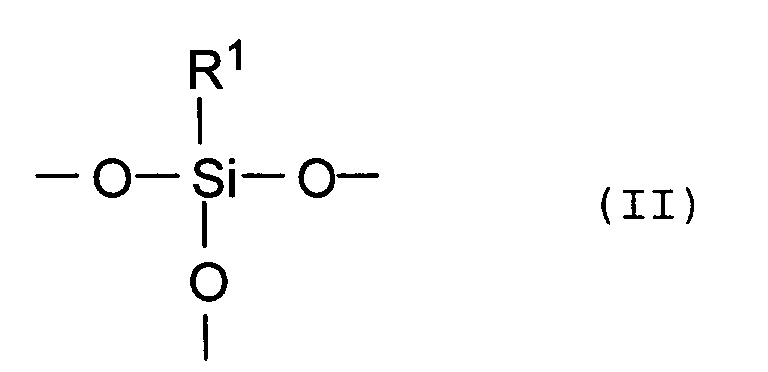


Dabei kann das Aluminum im Polysiloxan-Füllstoff ggf. auch durch ein anderes Metall ersetzt sein.The aluminum in the polysiloxane filler may also be replaced by another metal.
Gegebenenfalls können noch weitere Füllstoffe (C) zur Erzielung einer erhöhten Röntgenopazität eingesetzt werden, wobei deren mittlere Primärteilchengröße 5,0 µm nicht übersteigen sollte. Solche Füllstoffe sind z. B. in der DE-OS 35 02 594 beschrieben.If necessary, further fillers (C) can be used to achieve increased X-ray opacity, the mean primary particle size of which should not exceed 5.0 μm. Such fillers are e.g. B. described in DE-OS 35 02 594.
Gegebenenfalls können zur Einstellung der Viskosität geringe Mengen an mikrofeiner, pyrogener oder naßgefällter Kieselsäure (Füllstoff (D)) in den Dentalwerkstoff eingearbeitet werden, höchstens jedoch 5 Gew.-%, bezogen auf den Dentalwerkstoff.If necessary, small amounts of microfine, pyrogenic or wet-precipitated silica (filler (D)) can be added to the dental material to adjust the viscosity are incorporated, but at most 5% by weight, based on the dental material.
In bevorzugter erfindungsgemäßer Ausführungsform kennzeichnet sich der Dentalwerkstoff dadurch, daß der Gewichtsanteil an Füllstoff (A) 1 - 60 Gew.-% und an Füllstoff (B) 15 - 85 Gew.-% beträgt, wobei beide Gew.-%-Angaben jeweils auf das Gesamtgewicht des Dentalwerkstoffes bezogen sind. Durch eine Wahl der Mengen an Füllstoffen in diesem Bereich gelingt es besonders vorteilhaft, das Verhältnis von splitterförmigen Bestandteilen vom Typ B zu kugelförmigen separat vorliegenden Partikeln vom Typ A zu optimieren.In a preferred embodiment according to the invention, the dental material is characterized in that the proportion by weight of filler (A) is 1-60% by weight and filler (B) is 15-85% by weight, with both% by weight details being in each case the total weight of the dental material are related. By choosing the amounts of fillers in this area, it is particularly advantageous to optimize the ratio of type B splinter-like constituents to type A spherical, separate particles.
Weiterhin zweckmäßig ist es, das Verhältnis von Füllstoff A) zu Füllstoff B) so im fertigen Dentalwerkstoff einzustellen, daß eine Aggregatbildung der Füllstoffe (A) vermieden wird. Dies ist vom Fachmann durch entsprechende Versuche empirisch zu ermitteln.It is furthermore expedient to adjust the ratio of filler A) to filler B) in the finished dental material in such a way that aggregation of the fillers (A) is avoided. The person skilled in the art can determine this empirically by means of appropriate tests.
In besonders bevorzugter Ausführungsform wird das Verhältnis der Füllstoffkomponenten (A) zu den Füllstoffen (B) im Bereich von 1 : 85 bis 4 : 1 (jeweils bezogen auf Gew.-%) so eingestellt, daß die Festigkeit des resultierenden Dentalwerkstoffes bezogen auf seine Druckfestigkeit im Bereich von > 320 bis ca. 480 MPa beträgt. Hierbei hat es sich als besonders günstig herausgestellt, wenn das Verhältnis von Füllstoffen A) zu Füllstoffen B) ≧ 1 : 10 beträgt (jeweils bezogen auf Gew.-%).In a particularly preferred embodiment, the ratio of the filler components (A) to the fillers (B) is set in the range from 1:85 to 4: 1 (in each case based on% by weight) such that the strength of the resulting dental material is based on its compressive strength is in the range from> 320 to approx. 480 MPa. It has proven to be particularly favorable here if the ratio of fillers A) to fillers B) ≧ 1:10 (in each case based on% by weight).
Nachfolgend wird die Erfindung anhand von Ausführungsbeispielen und Vergleichsbeispielen weitergehend erläutert.The invention is explained in more detail below on the basis of exemplary embodiments and comparative examples.
Zur Herstellung der nachfolgend beschriebenen Pasten wurde ein handelsüblicher Kneter der Fa. Grieser verwendet. Seine Knetwerkzeuge wurden so modifiziert, daß eine besonders intensive Durchmischung und homogene Verteilung der Ausgangsstoffe möglich war. Die Homogenisierung der Monomermischungen erfolgte üblicherweise über einen Dreiwalzenstuhl.A commercial kneader from Grieser was used to produce the pastes described below. His kneading tools were modified so that a particularly intensive mixing and homogeneous distribution of the starting materials was possible. The monomer mixtures were usually homogenized using a three-roll mill.
Bei lichthärtenden Systemen betrug die Aushärtungszeit 40 sec mit einer handelsüblichen Lampe (Degulux® der Firma Degussa).In the case of light-curing systems, the curing time was 40 seconds using a commercially available lamp (Degulux® from Degussa).
Die Bestimmung der Transparenz erfolgt an Probenkörpern der Dicke d=3±0,1 mm und einem Durchmesser von 20±0,1 mm. Zur Herstellung der Proben wird die in die Stahlformen gleicher Dimensionen eingefüllte Kompositpaste mit 4000 kp für 30 sec belastet und anschließend für 2 min mit einer Dentallampe der Lichtintensität von mindestens 250 rel. Einheiten ausgehärtet. Während des Aushärtungsvorgangs ist die Kompositoberfläche durch eine transparente Polyesterfolie vom Luftsauerstoff abgeschirmt. Die Messung der Transparenz erfolgt mit einem UV/VIS Spektrophotometer PU8800 (Philips) in Transmissionsmodus.The transparency is determined on test specimens with a thickness of d = 3 ± 0.1 mm and a diameter of 20 ± 0.1 mm. To produce the samples, the composite paste filled into the steel molds of the same dimensions is loaded with 4000 kp for 30 seconds and then for 2 minutes with a dental lamp with a light intensity of at least 250 rel. Units cured. During the curing process, the composite surface is shielded from atmospheric oxygen by a transparent polyester film. The transparency is measured with a UV / VIS spectrophotometer PU8800 (Philips) in transmission mode.
Das Komposit wird blasenfrei in ein Duranglasrohr der Höhe h=9 mm und einem Durchmesser d=4mm und 40 sec lang mit einer Dentallampe der Lichtintensität von mindestens 250 rel. Einheiten ausgehärtet. Nach dem Entformen wird der Prüfkörper mit einer Diamantsäge auf 6,0 mm verkürzt und für 24h in destilliertem Wasser bei 37 Grad Celsius gelagert. Die Messung der Druckfestigkeit erfolgt mit einer Universalprüfmaschine der Fa. Frank. Den Zahlenwerten liegen Mittelwerte aus 7 Einzelmessungen zugrunde.The composite is blister-free in a Duran glass tube with a height of h = 9 mm and a diameter of d = 4 mm and for 40 seconds with a dental lamp with a light intensity of at least 250 rel. Units cured. After demolding, the test specimen is shortened to 6.0 mm with a diamond saw and stored in distilled water at 37 degrees Celsius for 24 hours. The pressure resistance is measured with a Universal testing machine from Frank. The numerical values are based on mean values from 7 individual measurements.
In den nachfolgenden Beispielen werden die Füllstoffe A1, A2 und A3 wie folgt verwendet: A1: amorphe SiO2-Partikel mit einem Durchmesser von 80-1000 nm, Brechungsindex ca. 1,4; A2: SiO2-Kern von 500nm + 30nm dicke Schicht aus TiO2, Brechungsindex 1,49; A3: SiO-Kern von 500nm + 50nm dicke Schicht aus Bis-GMA, Brechungsindex 1,47.In the examples below, the fillers A1, A2 and A3 are used as follows: A1: amorphous SiO 2 particles with a diameter of 80-1000 nm, refractive index approx. 1.4; A2: SiO 2 core of 500 nm + 30 nm thick layer of TiO 2 , refractive index 1.49; A3: SiO core of 500nm + 50nm thick layer of bis-GMA, refractive index 1.47.
In 22,86g einer Monomermischung, bestehend aus 45 Teilen Bis-GMA, 20 Teilen UDMA und 35 Teilen TEDMA, werden 71,14g silanisiertes Barium-Silikatglas, 5g Aerosil und 1g des kugelförmigen, monodispersen und nichtaggregiert im Werkstoff vorliegenden Füllstoffes A1, Partikeldurchmesser 500 nm zusammen mit 0,038 Gew.% Campherchinon eingearbeitet. Die entstandene Paste wurde mit Licht (Degulux® )ausgehärtet.
Transparenz: 21,7%In 22.86g of a monomer mixture consisting of 45 parts of Bis-GMA, 20 parts of UDMA and 35 parts of TEDMA, 71.14g of silanized barium silicate glass, 5g of Aerosil and 1g of the spherical, monodisperse and non-aggregated filler A1, particle diameter 500, are nm incorporated together with 0.038% by weight camphorquinone. The resulting paste was cured with light (Degulux®).
Transparency: 21.7%
wie Beispiel 1, aber der Partikeldurchmesser des Füllstoffes A1 beträgt 100 nm.
Transparenz: 33,4%as example 1, but the particle diameter of the filler A1 is 100 nm.
Transparency: 33.4%
In 21g einer Monomermischung analog Beispiel 1 werden 65g silanisiertes Barium-Silikatglas, 5g Aerosil und 9g des monodispersen Füllstoffes A1, Partikeldurchmesser 100 nm zusammen mit 0,038 Gew.% Campherchinon eingearbeitet. Die entstandene Paste wurde mit Licht (Degulux® ) ausgehärtet.
Transparenz: 20,3%65 g of silanized barium silicate glass, 5 g of Aerosil and 9 g of the monodisperse filler A1, particle diameter 100 nm, together with 0.038% by weight of camphorquinone are incorporated into 21 g of a monomer mixture analogous to Example 1. The resulting paste was cured with light (Degulux®).
Transparency: 20.3%
wie Beispiel 3, aber der Partikeldurchmesser des Füllstoffes A1 beträgt 80 nm.
Transparenz: 24,1%as example 3, but the particle diameter of the filler A1 is 80 nm.
Transparency: 24.1%
In 18,2g einer Monomermischung, bestehend aus 20 Teilen Bis-GMA, 55 Teilen UDMA und 25 Teilen TEDMA werden 64 g silanisiertes Ba-Silikatglas, 10,7g silanisiertes Aerosil und 7,1g des Füllstoffes A1 mit einem Durchmesser von 1000 nm zusammen mit 0,038 Gew.% Campherchinon eingearbeitet. Es entsteht ein geschmeidiges Material.
Transparenz: 11,9%In 18.2 g of a monomer mixture consisting of 20 parts of Bis-GMA, 55 parts of UDMA and 25 parts of TEDMA, 64 g of silanized Ba silicate glass, 10.7 g of silanized Aerosil and 7.1 g of filler A1 with a diameter of 1000 nm are combined with 0.038% by weight camphorquinone incorporated. A smooth material is created.
Transparency: 11.9%
In 21g einer Monomermischung analog Beispiel 1 werden 69g silanisiertes Barium-Silikatglas, 5g Aerosil und 5g des kugelförmigen, monodispersen und nicht aggregierten Füllstoffes A1, Partikeldurchmesser 95 nm zusammen mit 0,038 Gew.% Campherchinon eingearbeitet. Die Paste erhält nach Zugabe von Pigmenten ein zahnfarbenes Aussehen. Die entstandene Paste wurde mit Licht (Degulux®) ausgehärtet. Der erhaltene Werkstoff eignet sich als lichthärtendes, zahnfarbenes Füllungsmaterial für Front- und Seitenzahngebiet sowie als Material für Inlays und Onlays.
Transparenz: 23,0%
Druckfestigkeit: 420 MPa69 g of silanized barium silicate glass, 5 g of Aerosil and 5 g of the spherical, monodisperse and non-aggregated filler A1, particle diameter 95 nm, together with 0.038% by weight of camphorquinone are incorporated into 21 g of a monomer mixture analogous to Example 1. After adding pigments, the paste has a tooth-colored appearance. The resulting paste was cured with light (Degulux®). The material obtained is suitable as a light-curing, tooth-colored filling material for the anterior and posterior region and as a material for inlays and onlays.
Transparency: 23.0%
Compressive strength: 420 MPa
In 17,3g einer Monomermischung, bestehend aus 42,2 Teilen Bis-GMA, 36,4 Teilen UDMA und 21,4 Teilen TEDMA werden 46,8 g Barium-Silikatglas, 3,8g Aerosil, 15,4g Ytterbium(III)-fluorid und 16,5 g kugelförmiger Füllstoff nach DE 4029230 A1 eingearbeitet. Zusätzlich wurden geringe Mengen Farbpigment zugegeben
Transparenz: 21,0%
Druckfestigkeit: 300 MPaIn 17.3 g of a monomer mixture consisting of 42.2 parts of Bis-GMA, 36.4 parts of UDMA and 21.4 parts of TEDMA, 46.8 g of barium silicate glass, 3.8 g of Aerosil and 15.4 g of ytterbium (III) are fluoride and 16.5 g of spherical filler according to DE 4029230 A1. In addition, small amounts of color pigment were added
Transparency: 21.0%
Compressive strength: 300 MPa
In 22,4g einer Monomermischung, bestehend aus 54,9 Teilen UDMA, 20,1 Teilen Bis-GMA und 25 Teilen TEDMA werden 59,5g silanisiertes Barium-Silikatglas, 7,2g Aerosil, 0,5g Aktivator/Stabilisator und 10,4g Füllstoff A1 oder A2 oder A3 oder Kombinationen derselben eingearbeitet. Nach Zugabe einer kleinen Menge Pigmente entsteht eine hochviskose, zahnfarbene PasteIn 22.4g of a monomer mixture consisting of 54.9 parts UDMA, 20.1 parts Bis-GMA and 25 parts TEDMA are 59.5g silanized barium silicate glass, 7.2g Aerosil, 0.5g activator / stabilizer and 10.4g Filler A1 or A2 or A3 or combinations thereof incorporated. After adding a small amount of pigments, a highly viscous, tooth-colored paste is created
In 22,4g einer Monomermischung, bestehend aus 54,9 Teilen UDMA, 20,1 Teilen Bis-GMA und 25 Teilen TEDMA werden 59,5g silanisiertes Barium-Silikatglas, 7,2g Aerosil, 0,5g Benzoylperoxid und 10,4g Füllstoff A1 oder A2 oder A3 oder Kombinationen derselben eingearbeitet. Nach Zugabe einer kleinen Menge Pigmente entsteht eine hochviskose, zahnfarbene Paste, welche nach Mischen mit gleichen Teilen Basispaste als selbsthärtendes Füllungsmaterial oder zur Herstellung von heißhärtenden Inlays geeignet ist.
Transparenz: 21,2%In 22.4g of a monomer mixture consisting of 54.9 parts UDMA, 20.1 parts Bis-GMA and 25 parts TEDMA are 59.5g silanized barium silicate glass, 7.2g Aerosil, 0.5g benzoyl peroxide and 10.4g filler A1 or A2 or A3 or combinations thereof. After adding a small amount of pigments, a highly viscous, tooth-colored paste is formed, which, after mixing with equal parts of base paste, is suitable as a self-curing filling material or for the production of thermosetting inlays.
Transparency: 21.2%
In 30g einer Monomermischung, bestehend aus 28,9 Teilen TEDMA und 71,1 Teilen UDMA werden 59g silanisiertes Barium-Silikatglas, 6g des kugelförmigen Füllstoffes A1 und 5g silanisiertes Aerosil zusammen mit 1,15% eines Aktivator/Stabilisisatorgemisches und 0,09% Champherchinon eingearbeitet. Nach der Zugabe kleiner Mengen von Pigmenten entsteht eine zahnfarbene, zähfließende Paste.In 30 g of a monomer mixture consisting of 28.9 parts of TEDMA and 71.1 parts of UDMA are 59 g of silanized barium silicate glass, 6 g of the spherical filler A1 and 5 g of silanized aerosil together with 1.15% of an activator / stabilizer mixture and 0.09% champagne quinone incorporated. After adding small amounts of pigments, a tooth-colored, viscous paste is created.
In 30g einer Monomermischung, bestehend aus 28,9 Teilen TEDMA und 71,1 Teilen UDMA werden 59g silanisiertes Barium-Silikatglas, 6g des kugelförmigen Füllstoffes A1 und 5g silanisiertes Aerosil zusammen mit 0,6% Benzoylperoxid eingearbeitet. Nach der Zugabe kleiner Mengen von Pigmenten entsteht eine zahnfarbene, zähfließende Paste.In 30g of a monomer mixture consisting of 28.9 parts of TEDMA and 71.1 parts of UDMA, 59g of silanized barium silicate glass, 6g of the spherical filler A1 and 5g of silanized Aerosil are incorporated together with 0.6% benzoyl peroxide. After adding small amounts of pigments, a tooth-colored, viscous paste is created.
Nach dem Vermischen beider Pasten zu entsteht eine licht- und selbsthärtende Dental-Zementpaste.
Transparenz: 22,0%After mixing both pastes, a light and self-curing dental cement paste is created.
Transparency: 22.0%
In 96g einer Monomermischung, bestehend aus 60 Teilen Bis-GMA und 40 Teilen TEDMA werden 3g des kugelförmigen, monodispersen und separat im Werkstoff vorliegenden Füllstoffes A1 und 1g Titandioxid zusammen mit 0,12 % Campherchinon eingearbeitet. Es entsteht ein weißes dünnfließendes Material, welches nach einem Jahr Lagerung keine Sedimentation der Füllstoffe aufweist. Der erhaltene Dentalwerkstoff eignet sich zur Versieglung von Fissuren und Zahnoberflächen.
Transparenz: 30,3% (Schichtdicke=0,5mm)In 96g of a monomer mixture consisting of 60 parts of Bis-GMA and 40 parts of TEDMA, 3g of the spherical, monodisperse filler A1 and 1g of titanium dioxide present separately in the material are incorporated together with 0.12% camphorquinone. The result is a white, thin-flowing material that has no sedimentation of the fillers after one year of storage. The dental material obtained is suitable for sealing fissures and tooth surfaces.
Transparency: 30.3% (layer thickness = 0.5mm)
Claims (5)
dadurch gekennzeichnet,
daß die Menge des Füllstoffs 1 - 95 Gew.-% bezogen auf den Dentalwerkstoff beträgt und daß er als Komponente A) im fertig auspolymerisierten Dentalwerkstoff separat vorliegende kugelförmige Partikel aufweist, aus
characterized,
that the amount of filler is 1-95% by weight, based on the dental material, and that it contains, as component A), spherical particles present separately in the fully polymerized dental material
dadurch gekennzeichnet,
daß der Gewichtsanteil an Füllstoff (A) 1 bis 60 Gew.-% und an Füllstoff (B) 15 bis 85 Gew.-%, jeweils bezogen auf den Dentalwerkstoff, beträgt.Dental material according to claim 1,
characterized,
that the weight fraction of filler (A) is 1 to 60% by weight and of filler (B) 15 to 85% by weight, in each case based on the dental material.
dadurch gekennzeichnet,
daß das Verhältnis von Füllstoff (A) zu Füllstoff (B) so eingestellt ist, daß eine Aggregatbildung der Füllstoffe (A) vermieden wird.Dental material according to claim 1 or 2,
characterized,
that the ratio of filler (A) to filler (B) is set so that aggregation of the fillers (A) is avoided.
dadurch gekennzeichnet,
daß das Verhältnis von (A) zu (B) im Bereich von 1 : 85 bis 4 : 1 so eingestellt wird, daß die Festigkeit des Dentalwerkstoffes bezogen auf seine Druckfestigkeit von > 320 bis 480 MPa beträgt.Dental material according to one of the preceding claims,
characterized,
that the ratio of (A) to (B) is set in the range from 1:85 to 4: 1 so that the strength of the dental material, based on its compressive strength, is from> 320 to 480 MPa.
dadurch gekennzeichnet,
daß das Verhältnis von (A) zu (B) ≧ 1 : 10 beträgt.Dental material according to one of the preceding claims,
characterized,
that the ratio of (A) to (B) ≧ 1:10.
Applications Claiming Priority (2)
| Application Number | Priority Date | Filing Date | Title |
|---|---|---|---|
| DE19508586 | 1995-03-13 | ||
| DE19508586A DE19508586C2 (en) | 1995-03-13 | 1995-03-13 | Polymerizable dental material |
Publications (1)
| Publication Number | Publication Date |
|---|---|
| EP0732099A2 true EP0732099A2 (en) | 1996-09-18 |
Family
ID=7756269
Family Applications (1)
| Application Number | Title | Priority Date | Filing Date |
|---|---|---|---|
| EP96103515A Withdrawn EP0732099A2 (en) | 1995-03-13 | 1996-03-07 | Polymerizable dental material |
Country Status (5)
| Country | Link |
|---|---|
| EP (1) | EP0732099A2 (en) |
| JP (1) | JPH08259415A (en) |
| KR (1) | KR960033430A (en) |
| AU (1) | AU4806196A (en) |
| DE (1) | DE19508586C2 (en) |
Cited By (7)
| Publication number | Priority date | Publication date | Assignee | Title |
|---|---|---|---|---|
| WO2003043589A1 (en) * | 2001-11-20 | 2003-05-30 | Bisco, Inc. | Low shrinkage dental composite |
| EP0839511A3 (en) * | 1996-11-01 | 2004-01-07 | Tokuyama Corporation | Curable composition |
| US6709271B2 (en) | 2001-11-20 | 2004-03-23 | Bisco, Inc. | Low shrinkage dental composite |
| DE10346465A1 (en) * | 2003-10-02 | 2005-05-19 | Heraeus Kulzer Gmbh | Procedures and color kit for color correction of dentures or natural teeth |
| US6899948B2 (en) | 1999-10-28 | 2005-05-31 | 3M Innovative Properties Company | Dental materials with nano-sized silica particles |
| WO2005097043A1 (en) | 2004-04-07 | 2005-10-20 | Ivoclar Vivadent Ag | Hardening dental materials featuring adjustable translucence |
| US7393882B2 (en) | 2002-01-31 | 2008-07-01 | 3M Innovative Properties Company | Dental pastes, dental articles, and methods |
Families Citing this family (13)
| Publication number | Priority date | Publication date | Assignee | Title |
|---|---|---|---|---|
| DE19617931C5 (en) * | 1996-04-26 | 2010-07-22 | Ivoclar Vivadent Ag | Use of a filled and polymerizable material as dental material |
| EP1124529B1 (en) * | 1998-11-03 | 2008-01-09 | New Age Biomaterials, Inc. | Improved filler for dental composite materials |
| DE19904816A1 (en) * | 1999-02-05 | 2000-09-14 | Espe Dental Ag | Polymerizable and/or settable dental material, e.g. filling material or cement contains organopolysiloxane particles to allow high overall filler content and give low shrinkage on polymerization |
| DE102005003755C5 (en) * | 2005-01-27 | 2011-04-07 | Ivoclar Vivadent Ag | Coated dental powder |
| DE102005019600A1 (en) | 2005-04-27 | 2006-11-09 | Ivoclar Vivadent Ag | Surface modified fillers |
| DE102005053721A1 (en) * | 2005-11-10 | 2007-05-16 | Fraunhofer Ges Forschung | Reactive particles, their preparation and use |
| CA2942365C (en) | 2007-05-11 | 2019-04-16 | Dentsply International Inc. | Dental compositions for coating restorations and tooth surfaces |
| EP2578200B1 (en) | 2011-10-04 | 2018-03-28 | VOCO GmbH | Compounds for infiltrating and/or sealing of dental hard substance and method |
| DE102012214540A1 (en) | 2012-08-15 | 2014-02-20 | Helmholtz-Zentrum für Infektionsforschung GmbH | Tooth filling materials and coatings for inhibiting the biofilm formation of Streptococcus mutans and their production |
| US9381140B2 (en) * | 2012-08-31 | 2016-07-05 | Kettenbach Gmbh & Co. Kg | Radically polymerisable dental material, cured product and usage |
| DE102013008176A1 (en) | 2012-10-05 | 2014-04-10 | Voco Gmbh | Kit and method for the indirect chairside production of composite inlays |
| RU2018128362A (en) | 2016-02-05 | 2020-03-05 | 3М Инновейтив Пропертиз Компани | Dental compositions containing nanoparticles providing the difference between the refractive indices of the polymerizable resin and the filler |
| JPWO2021132217A1 (en) * | 2019-12-25 | 2021-07-01 |
Family Cites Families (5)
| Publication number | Priority date | Publication date | Assignee | Title |
|---|---|---|---|---|
| JPS58110414A (en) * | 1981-12-23 | 1983-07-01 | Tokuyama Soda Co Ltd | Inorganic oxide and its manufacture |
| DD248281A1 (en) * | 1984-10-17 | 1987-08-05 | Univ Schiller Jena | PROCESS FOR THE PRODUCTION OF COMPOSITES FOR DENTAL PRACTICE |
| DD245814A1 (en) * | 1986-02-06 | 1987-05-20 | Univ Schiller Jena | LIGHT HEALTHY DENTAL COMPOSITE |
| JP2811784B2 (en) * | 1988-09-09 | 1998-10-15 | 三菱化学株式会社 | Resin composition |
| DE4029230C2 (en) * | 1990-09-14 | 1995-03-23 | Ivoclar Ag | Polymerizable dental material |
-
1995
- 1995-03-13 DE DE19508586A patent/DE19508586C2/en not_active Expired - Lifetime
-
1996
- 1996-03-07 EP EP96103515A patent/EP0732099A2/en not_active Withdrawn
- 1996-03-08 JP JP8052064A patent/JPH08259415A/en active Pending
- 1996-03-12 AU AU48061/96A patent/AU4806196A/en not_active Abandoned
- 1996-03-13 KR KR1019960006586A patent/KR960033430A/en not_active Withdrawn
Cited By (7)
| Publication number | Priority date | Publication date | Assignee | Title |
|---|---|---|---|---|
| EP0839511A3 (en) * | 1996-11-01 | 2004-01-07 | Tokuyama Corporation | Curable composition |
| US6899948B2 (en) | 1999-10-28 | 2005-05-31 | 3M Innovative Properties Company | Dental materials with nano-sized silica particles |
| WO2003043589A1 (en) * | 2001-11-20 | 2003-05-30 | Bisco, Inc. | Low shrinkage dental composite |
| US6709271B2 (en) | 2001-11-20 | 2004-03-23 | Bisco, Inc. | Low shrinkage dental composite |
| US7393882B2 (en) | 2002-01-31 | 2008-07-01 | 3M Innovative Properties Company | Dental pastes, dental articles, and methods |
| DE10346465A1 (en) * | 2003-10-02 | 2005-05-19 | Heraeus Kulzer Gmbh | Procedures and color kit for color correction of dentures or natural teeth |
| WO2005097043A1 (en) | 2004-04-07 | 2005-10-20 | Ivoclar Vivadent Ag | Hardening dental materials featuring adjustable translucence |
Also Published As
| Publication number | Publication date |
|---|---|
| KR960033430A (en) | 1996-10-22 |
| AU4806196A (en) | 1996-09-26 |
| DE19508586A1 (en) | 1996-09-19 |
| JPH08259415A (en) | 1996-10-08 |
| DE19508586C2 (en) | 1997-07-10 |
Similar Documents
| Publication | Publication Date | Title |
|---|---|---|
| EP0475239B1 (en) | Polymerizable dental material | |
| EP1119337B1 (en) | Dental material with porous glass ceramics | |
| DE19508586C2 (en) | Polymerizable dental material | |
| EP0832636B1 (en) | Polymerisable dental material and use of apatite fillers in the dental material | |
| EP0803240B1 (en) | Polymerisable dental material containing a filler | |
| EP0717976B1 (en) | Polymerisable dental material | |
| EP1234567B1 (en) | Filling material based on particulate composite | |
| EP0156105B1 (en) | Dental filling material | |
| EP0449399B1 (en) | Polymerizable dental composition | |
| EP1711433B1 (en) | Dental composites based on radio-opaque spray flame synthesis mixed oxides | |
| EP0172513A2 (en) | Use of porous fillers in polymerizable dental compositions, these compositions and their use as moulding masses | |
| DE102004025030A1 (en) | Nano-apatite fillers containing curable restorative materials | |
| EP1181924B1 (en) | Dental composite material including a hybrid filler and method for producing the same | |
| EP1732499B1 (en) | Hardening dental materials featuring adjustable translucence | |
| EP3363423B1 (en) | Dental composite block for preparing permanent indirect restorations in cad/cam method | |
| DE19615763A1 (en) | Silica-based filler, process for its preparation and its use | |
| DE102004017125A1 (en) | Dental composite used as direct filling material for cavities, as fixing cement, or as material for inlays or facing materials, comprises nanoparticulate mixed oxide | |
| EP1951183B1 (en) | Restoring materials containing nanocrystalline earth alkaline fillers | |
| EP4124331A1 (en) | Aesthetic dental filling material with high curing depth | |
| DE29624496U1 (en) | Filled, polymerisable dental material, used as adhesive, filler, etc. - comprises a sol of amorphous silica in a liquid, organic dispersant |
Legal Events
| Date | Code | Title | Description |
|---|---|---|---|
| PUAI | Public reference made under article 153(3) epc to a published international application that has entered the european phase |
Free format text: ORIGINAL CODE: 0009012 |
|
| AK | Designated contracting states |
Kind code of ref document: A2 Designated state(s): AT DE FR GB IT NL SE |
|
| STAA | Information on the status of an ep patent application or granted ep patent |
Free format text: STATUS: THE APPLICATION HAS BEEN WITHDRAWN |
|
| 18W | Application withdrawn |
Withdrawal date: 19980709 |