EP0730443B1 - Suspension of loteprednol etabonate - Google Patents
Suspension of loteprednol etabonate Download PDFInfo
- Publication number
- EP0730443B1 EP0730443B1 EP94930831A EP94930831A EP0730443B1 EP 0730443 B1 EP0730443 B1 EP 0730443B1 EP 94930831 A EP94930831 A EP 94930831A EP 94930831 A EP94930831 A EP 94930831A EP 0730443 B1 EP0730443 B1 EP 0730443B1
- Authority
- EP
- European Patent Office
- Prior art keywords
- composition
- amount
- weight
- nonionic
- present
- Prior art date
- Legal status (The legal status is an assumption and is not a legal conclusion. Google has not performed a legal analysis and makes no representation as to the accuracy of the status listed.)
- Expired - Lifetime
Links
- 239000000725 suspension Substances 0.000 title claims abstract description 36
- 229960003744 loteprednol etabonate Drugs 0.000 title claims description 10
- DMKSVUSAATWOCU-HROMYWEYSA-N loteprednol etabonate Chemical compound C1CC2=CC(=O)C=C[C@]2(C)[C@@H]2[C@@H]1[C@@H]1CC[C@@](C(=O)OCCl)(OC(=O)OCC)[C@@]1(C)C[C@@H]2O DMKSVUSAATWOCU-HROMYWEYSA-N 0.000 title claims description 9
- 239000000203 mixture Substances 0.000 claims abstract description 34
- 150000003431 steroids Chemical class 0.000 claims abstract description 20
- 230000001225 therapeutic effect Effects 0.000 claims abstract description 14
- 239000002245 particle Substances 0.000 claims abstract description 13
- 239000003755 preservative agent Substances 0.000 claims description 25
- PEDCQBHIVMGVHV-UHFFFAOYSA-N Glycerine Chemical compound OCC(O)CO PEDCQBHIVMGVHV-UHFFFAOYSA-N 0.000 claims description 20
- 239000003246 corticosteroid Substances 0.000 claims description 20
- 239000004094 surface-active agent Substances 0.000 claims description 16
- 229920000642 polymer Polymers 0.000 claims description 13
- 239000001267 polyvinylpyrrolidone Substances 0.000 claims description 10
- 229920000036 polyvinylpyrrolidone Polymers 0.000 claims description 10
- 235000013855 polyvinylpyrrolidone Nutrition 0.000 claims description 10
- 230000002335 preservative effect Effects 0.000 claims description 9
- 239000004372 Polyvinyl alcohol Substances 0.000 claims description 7
- 229920002451 polyvinyl alcohol Polymers 0.000 claims description 7
- 235000019422 polyvinyl alcohol Nutrition 0.000 claims description 7
- 239000012929 tonicity agent Substances 0.000 claims description 7
- 229960000686 benzalkonium chloride Drugs 0.000 claims description 6
- CADWTSSKOVRVJC-UHFFFAOYSA-N benzyl(dimethyl)azanium;chloride Chemical compound [Cl-].C[NH+](C)CC1=CC=CC=C1 CADWTSSKOVRVJC-UHFFFAOYSA-N 0.000 claims description 6
- 229960004224 tyloxapol Drugs 0.000 claims description 6
- 229920001664 tyloxapol Polymers 0.000 claims description 6
- MDYZKJNTKZIUSK-UHFFFAOYSA-N tyloxapol Chemical group O=C.C1CO1.CC(C)(C)CC(C)(C)C1=CC=C(O)C=C1 MDYZKJNTKZIUSK-UHFFFAOYSA-N 0.000 claims description 6
- 229920001353 Dextrin Polymers 0.000 claims description 4
- 239000004375 Dextrin Substances 0.000 claims description 4
- 230000015572 biosynthetic process Effects 0.000 claims description 4
- 235000019425 dextrin Nutrition 0.000 claims description 4
- CGIGDMFJXJATDK-UHFFFAOYSA-N indomethacin Chemical compound CC1=C(CC(O)=O)C2=CC(OC)=CC=C2N1C(=O)C1=CC=C(Cl)C=C1 CGIGDMFJXJATDK-UHFFFAOYSA-N 0.000 claims description 4
- 229920000858 Cyclodextrin Polymers 0.000 claims description 3
- FBPFZTCFMRRESA-KVTDHHQDSA-N D-Mannitol Chemical compound OC[C@@H](O)[C@@H](O)[C@H](O)[C@H](O)CO FBPFZTCFMRRESA-KVTDHHQDSA-N 0.000 claims description 3
- 229930195725 Mannitol Natural products 0.000 claims description 3
- 239000012736 aqueous medium Substances 0.000 claims description 3
- 238000001727 in vivo Methods 0.000 claims description 3
- 239000000594 mannitol Substances 0.000 claims description 3
- 235000010355 mannitol Nutrition 0.000 claims description 3
- 239000002736 nonionic surfactant Substances 0.000 claims description 3
- 229920005862 polyol Polymers 0.000 claims description 3
- 150000003077 polyols Chemical class 0.000 claims description 3
- 229940126585 therapeutic drug Drugs 0.000 claims description 3
- CEAZRRDELHUEMR-URQXQFDESA-N Gentamicin Chemical compound O1[C@H](C(C)NC)CC[C@@H](N)[C@H]1O[C@H]1[C@H](O)[C@@H](O[C@@H]2[C@@H]([C@@H](NC)[C@@](C)(O)CO2)O)[C@H](N)C[C@@H]1N CEAZRRDELHUEMR-URQXQFDESA-N 0.000 claims description 2
- 229930182566 Gentamicin Natural products 0.000 claims description 2
- HEFNNWSXXWATRW-UHFFFAOYSA-N Ibuprofen Chemical compound CC(C)CC1=CC=C(C(C)C(O)=O)C=C1 HEFNNWSXXWATRW-UHFFFAOYSA-N 0.000 claims description 2
- CMWTZPSULFXXJA-UHFFFAOYSA-N Naproxen Natural products C1=C(C(C)C(O)=O)C=CC2=CC(OC)=CC=C21 CMWTZPSULFXXJA-UHFFFAOYSA-N 0.000 claims description 2
- 229960001259 diclofenac Drugs 0.000 claims description 2
- DCOPUUMXTXDBNB-UHFFFAOYSA-N diclofenac Chemical compound OC(=O)CC1=CC=CC=C1NC1=C(Cl)C=CC=C1Cl DCOPUUMXTXDBNB-UHFFFAOYSA-N 0.000 claims description 2
- 229960001680 ibuprofen Drugs 0.000 claims description 2
- 229960000905 indomethacin Drugs 0.000 claims description 2
- 230000004060 metabolic process Effects 0.000 claims description 2
- 230000000813 microbial effect Effects 0.000 claims description 2
- 229960002009 naproxen Drugs 0.000 claims description 2
- CMWTZPSULFXXJA-VIFPVBQESA-N naproxen Chemical compound C1=C([C@H](C)C(O)=O)C=CC2=CC(OC)=CC=C21 CMWTZPSULFXXJA-VIFPVBQESA-N 0.000 claims description 2
- 231100000252 nontoxic Toxicity 0.000 claims description 2
- 230000003000 nontoxic effect Effects 0.000 claims description 2
- 229960002895 phenylbutazone Drugs 0.000 claims description 2
- VYMDGNCVAMGZFE-UHFFFAOYSA-N phenylbutazonum Chemical compound O=C1C(CCCC)C(=O)N(C=2C=CC=CC=2)N1C1=CC=CC=C1 VYMDGNCVAMGZFE-UHFFFAOYSA-N 0.000 claims description 2
- 229960002702 piroxicam Drugs 0.000 claims description 2
- QYSPLQLAKJAUJT-UHFFFAOYSA-N piroxicam Chemical compound OC=1C2=CC=CC=C2S(=O)(=O)N(C)C=1C(=O)NC1=CC=CC=N1 QYSPLQLAKJAUJT-UHFFFAOYSA-N 0.000 claims description 2
- HFHDHCJBZVLPGP-UHFFFAOYSA-N schardinger α-dextrin Chemical compound O1C(C(C2O)O)C(CO)OC2OC(C(C2O)O)C(CO)OC2OC(C(C2O)O)C(CO)OC2OC(C(O)C2O)C(CO)OC2OC(C(C2O)O)C(CO)OC2OC2C(O)C(O)C1OC2CO HFHDHCJBZVLPGP-UHFFFAOYSA-N 0.000 claims description 2
- 229960000707 tobramycin Drugs 0.000 claims description 2
- 229920003169 water-soluble polymer Polymers 0.000 claims description 2
- ZGTMUACCHSMWAC-UHFFFAOYSA-L EDTA disodium salt (anhydrous) Chemical compound [Na+].[Na+].OC(=O)CN(CC([O-])=O)CCN(CC(O)=O)CC([O-])=O ZGTMUACCHSMWAC-UHFFFAOYSA-L 0.000 claims 2
- 230000003110 anti-inflammatory effect Effects 0.000 claims 2
- UCTWMZQNUQWSLP-VIFPVBQESA-N (R)-adrenaline Chemical compound CNC[C@H](O)C1=CC=C(O)C(O)=C1 UCTWMZQNUQWSLP-VIFPVBQESA-N 0.000 claims 1
- NLVFBUXFDBBNBW-PBSUHMDJSA-N tobramycin Chemical compound N[C@@H]1C[C@H](O)[C@@H](CN)O[C@@H]1O[C@H]1[C@H](O)[C@@H](O[C@@H]2[C@@H]([C@@H](N)[C@H](O)[C@@H](CO)O2)O)[C@H](N)C[C@@H]1N NLVFBUXFDBBNBW-PBSUHMDJSA-N 0.000 claims 1
- 229940079593 drug Drugs 0.000 abstract description 22
- 239000003814 drug Substances 0.000 abstract description 22
- 239000007900 aqueous suspension Substances 0.000 abstract description 14
- 229960001334 corticosteroids Drugs 0.000 description 12
- 239000003981 vehicle Substances 0.000 description 8
- 230000000694 effects Effects 0.000 description 7
- 238000002360 preparation method Methods 0.000 description 7
- KCXVZYZYPLLWCC-UHFFFAOYSA-N EDTA Chemical compound OC(=O)CN(CC(O)=O)CCN(CC(O)=O)CC(O)=O KCXVZYZYPLLWCC-UHFFFAOYSA-N 0.000 description 6
- 238000009472 formulation Methods 0.000 description 6
- 235000011187 glycerol Nutrition 0.000 description 6
- 230000000699 topical effect Effects 0.000 description 6
- 238000011282 treatment Methods 0.000 description 6
- 206010061218 Inflammation Diseases 0.000 description 5
- 230000008901 benefit Effects 0.000 description 5
- 230000004054 inflammatory process Effects 0.000 description 5
- 239000000463 material Substances 0.000 description 5
- 239000000375 suspending agent Substances 0.000 description 5
- 239000003795 chemical substances by application Substances 0.000 description 4
- 239000002207 metabolite Substances 0.000 description 4
- -1 prednisolone acetate Chemical class 0.000 description 4
- FAPWRFPIFSIZLT-UHFFFAOYSA-M Sodium chloride Chemical compound [Na+].[Cl-] FAPWRFPIFSIZLT-UHFFFAOYSA-M 0.000 description 3
- 230000002776 aggregation Effects 0.000 description 3
- 208000002205 allergic conjunctivitis Diseases 0.000 description 3
- 229940009662 edetate Drugs 0.000 description 3
- 230000004406 elevated intraocular pressure Effects 0.000 description 3
- 125000002887 hydroxy group Chemical group [H]O* 0.000 description 3
- 229940068196 placebo Drugs 0.000 description 3
- 239000000902 placebo Substances 0.000 description 3
- 235000010482 polyoxyethylene sorbitan monooleate Nutrition 0.000 description 3
- 229920000053 polysorbate 80 Polymers 0.000 description 3
- 239000000243 solution Substances 0.000 description 3
- 208000024891 symptom Diseases 0.000 description 3
- 230000009885 systemic effect Effects 0.000 description 3
- 208000002177 Cataract Diseases 0.000 description 2
- 206010010744 Conjunctivitis allergic Diseases 0.000 description 2
- RVGRUAULSDPKGF-UHFFFAOYSA-N Poloxamer Chemical compound C1CO1.CC1CO1 RVGRUAULSDPKGF-UHFFFAOYSA-N 0.000 description 2
- LRJOMUJRLNCICJ-JZYPGELDSA-N Prednisolone acetate Chemical compound C1CC2=CC(=O)C=C[C@]2(C)[C@@H]2[C@@H]1[C@@H]1CC[C@@](C(=O)COC(=O)C)(O)[C@@]1(C)C[C@@H]2O LRJOMUJRLNCICJ-JZYPGELDSA-N 0.000 description 2
- 238000005054 agglomeration Methods 0.000 description 2
- 125000002947 alkylene group Chemical group 0.000 description 2
- 229940124599 anti-inflammatory drug Drugs 0.000 description 2
- 230000000845 anti-microbial effect Effects 0.000 description 2
- 239000007864 aqueous solution Substances 0.000 description 2
- 208000024998 atopic conjunctivitis Diseases 0.000 description 2
- 150000001875 compounds Chemical class 0.000 description 2
- 210000000795 conjunctiva Anatomy 0.000 description 2
- 238000009826 distribution Methods 0.000 description 2
- 208000015181 infectious disease Diseases 0.000 description 2
- ZEUXAIYYDDCIRX-UHFFFAOYSA-N losartan carboxylic acid Chemical compound CCCCC1=NC(Cl)=C(C(O)=O)N1CC1=CC=C(C=2C(=CC=CC=2)C2=NNN=N2)C=C1 ZEUXAIYYDDCIRX-UHFFFAOYSA-N 0.000 description 2
- 230000002906 microbiologic effect Effects 0.000 description 2
- 238000002156 mixing Methods 0.000 description 2
- 150000002894 organic compounds Chemical class 0.000 description 2
- 239000008194 pharmaceutical composition Substances 0.000 description 2
- 239000000244 polyoxyethylene sorbitan monooleate Substances 0.000 description 2
- 229940068968 polysorbate 80 Drugs 0.000 description 2
- 229960005205 prednisolone Drugs 0.000 description 2
- OIGNJSKKLXVSLS-VWUMJDOOSA-N prednisolone Chemical compound O=C1C=C[C@]2(C)[C@H]3[C@@H](O)C[C@](C)([C@@](CC4)(O)C(=O)CO)[C@@H]4[C@@H]3CCC2=C1 OIGNJSKKLXVSLS-VWUMJDOOSA-N 0.000 description 2
- 229960002800 prednisolone acetate Drugs 0.000 description 2
- 239000000126 substance Substances 0.000 description 2
- XLYOFNOQVPJJNP-UHFFFAOYSA-N water Substances O XLYOFNOQVPJJNP-UHFFFAOYSA-N 0.000 description 2
- 230000029663 wound healing Effects 0.000 description 2
- 210000000707 wrist Anatomy 0.000 description 2
- 206010001367 Adrenal insufficiency Diseases 0.000 description 1
- 229920002134 Carboxymethyl cellulose Polymers 0.000 description 1
- 206010007764 Cataract subcapsular Diseases 0.000 description 1
- 208000009043 Chemical Burns Diseases 0.000 description 1
- 208000028006 Corneal injury Diseases 0.000 description 1
- 102000014824 Crystallins Human genes 0.000 description 1
- 108010064003 Crystallins Proteins 0.000 description 1
- 208000014311 Cushing syndrome Diseases 0.000 description 1
- 206010011715 Cyclitis Diseases 0.000 description 1
- 102000004190 Enzymes Human genes 0.000 description 1
- 108090000790 Enzymes Proteins 0.000 description 1
- LFQSCWFLJHTTHZ-UHFFFAOYSA-N Ethanol Chemical compound CCO LFQSCWFLJHTTHZ-UHFFFAOYSA-N 0.000 description 1
- 208000001860 Eye Infections Diseases 0.000 description 1
- 206010015995 Eyelid ptosis Diseases 0.000 description 1
- 206010018258 Giant papillary conjunctivitis Diseases 0.000 description 1
- 208000010412 Glaucoma Diseases 0.000 description 1
- 102000003676 Glucocorticoid Receptors Human genes 0.000 description 1
- 108090000079 Glucocorticoid Receptors Proteins 0.000 description 1
- 206010020751 Hypersensitivity Diseases 0.000 description 1
- 206010020772 Hypertension Diseases 0.000 description 1
- 206010027940 Mood altered Diseases 0.000 description 1
- 208000010428 Muscle Weakness Diseases 0.000 description 1
- 206010028289 Muscle atrophy Diseases 0.000 description 1
- 206010028372 Muscular weakness Diseases 0.000 description 1
- 208000006550 Mydriasis Diseases 0.000 description 1
- 206010052143 Ocular discomfort Diseases 0.000 description 1
- 208000001132 Osteoporosis Diseases 0.000 description 1
- 208000008469 Peptic Ulcer Diseases 0.000 description 1
- 229920001213 Polysorbate 20 Polymers 0.000 description 1
- 208000003251 Pruritus Diseases 0.000 description 1
- 206010037508 Punctate keratitis Diseases 0.000 description 1
- 206010053615 Thermal burn Diseases 0.000 description 1
- 206010046851 Uveitis Diseases 0.000 description 1
- 208000027418 Wounds and injury Diseases 0.000 description 1
- DPXJVFZANSGRMM-UHFFFAOYSA-N acetic acid;2,3,4,5,6-pentahydroxyhexanal;sodium Chemical compound [Na].CC(O)=O.OCC(O)C(O)C(O)C(O)C=O DPXJVFZANSGRMM-UHFFFAOYSA-N 0.000 description 1
- 230000004913 activation Effects 0.000 description 1
- 208000037855 acute anterior uveitis Diseases 0.000 description 1
- 208000017515 adrenocortical insufficiency Diseases 0.000 description 1
- 238000004220 aggregation Methods 0.000 description 1
- 208000026935 allergic disease Diseases 0.000 description 1
- 230000007815 allergy Effects 0.000 description 1
- 239000003242 anti bacterial agent Substances 0.000 description 1
- 230000000844 anti-bacterial effect Effects 0.000 description 1
- 230000000843 anti-fungal effect Effects 0.000 description 1
- 230000001384 anti-glaucoma Effects 0.000 description 1
- 238000011861 anti-inflammatory therapy Methods 0.000 description 1
- 229940088710 antibiotic agent Drugs 0.000 description 1
- 239000002246 antineoplastic agent Substances 0.000 description 1
- 229940041181 antineoplastic drug Drugs 0.000 description 1
- 239000003443 antiviral agent Substances 0.000 description 1
- 230000037444 atrophy Effects 0.000 description 1
- 229940092705 beclomethasone Drugs 0.000 description 1
- NBMKJKDGKREAPL-DVTGEIKXSA-N beclomethasone Chemical compound C1CC2=CC(=O)C=C[C@]2(C)[C@]2(Cl)[C@@H]1[C@@H]1C[C@H](C)[C@@](C(=O)CO)(O)[C@@]1(C)C[C@@H]2O NBMKJKDGKREAPL-DVTGEIKXSA-N 0.000 description 1
- 229960003872 benzethonium Drugs 0.000 description 1
- 229960002537 betamethasone Drugs 0.000 description 1
- UREBDLICKHMUKA-DVTGEIKXSA-N betamethasone Chemical compound C1CC2=CC(=O)C=C[C@]2(C)[C@]2(F)[C@@H]1[C@@H]1C[C@H](C)[C@@](C(=O)CO)(O)[C@@]1(C)C[C@@H]2O UREBDLICKHMUKA-DVTGEIKXSA-N 0.000 description 1
- 230000003115 biocidal effect Effects 0.000 description 1
- 230000033228 biological regulation Effects 0.000 description 1
- 239000008280 blood Substances 0.000 description 1
- 210000004369 blood Anatomy 0.000 description 1
- 230000003139 buffering effect Effects 0.000 description 1
- 239000001768 carboxy methyl cellulose Substances 0.000 description 1
- 235000010948 carboxy methyl cellulose Nutrition 0.000 description 1
- OSASVXMJTNOKOY-UHFFFAOYSA-N chlorobutanol Chemical compound CC(C)(O)C(Cl)(Cl)Cl OSASVXMJTNOKOY-UHFFFAOYSA-N 0.000 description 1
- 229960004926 chlorobutanol Drugs 0.000 description 1
- 210000004087 cornea Anatomy 0.000 description 1
- 229940097362 cyclodextrins Drugs 0.000 description 1
- 230000006378 damage Effects 0.000 description 1
- 230000003111 delayed effect Effects 0.000 description 1
- 230000002939 deleterious effect Effects 0.000 description 1
- 206010012601 diabetes mellitus Diseases 0.000 description 1
- LIKFHECYJZWXFJ-UHFFFAOYSA-N dimethyldichlorosilane Chemical compound C[Si](C)(Cl)Cl LIKFHECYJZWXFJ-UHFFFAOYSA-N 0.000 description 1
- 150000002009 diols Chemical class 0.000 description 1
- 239000006185 dispersion Substances 0.000 description 1
- 229940124274 edetate disodium Drugs 0.000 description 1
- 239000003974 emollient agent Substances 0.000 description 1
- 239000000839 emulsion Substances 0.000 description 1
- 150000002148 esters Chemical group 0.000 description 1
- 238000011156 evaluation Methods 0.000 description 1
- 238000001914 filtration Methods 0.000 description 1
- 229940043075 fluocinolone Drugs 0.000 description 1
- FEBLZLNTKCEFIT-VSXGLTOVSA-N fluocinolone acetonide Chemical compound C1([C@@H](F)C2)=CC(=O)C=C[C@]1(C)[C@]1(F)[C@@H]2[C@@H]2C[C@H]3OC(C)(C)O[C@@]3(C(=O)CO)[C@@]2(C)C[C@@H]1O FEBLZLNTKCEFIT-VSXGLTOVSA-N 0.000 description 1
- 229960001048 fluorometholone Drugs 0.000 description 1
- FAOZLTXFLGPHNG-KNAQIMQKSA-N fluorometholone Chemical compound C([C@@]12C)=CC(=O)C=C1[C@@H](C)C[C@@H]1[C@]2(F)[C@@H](O)C[C@]2(C)[C@@](O)(C(C)=O)CC[C@H]21 FAOZLTXFLGPHNG-KNAQIMQKSA-N 0.000 description 1
- 230000036541 health Effects 0.000 description 1
- 230000006872 improvement Effects 0.000 description 1
- 230000001939 inductive effect Effects 0.000 description 1
- 230000004968 inflammatory condition Effects 0.000 description 1
- 208000014674 injury Diseases 0.000 description 1
- 230000003993 interaction Effects 0.000 description 1
- 150000002500 ions Chemical class 0.000 description 1
- 201000004614 iritis Diseases 0.000 description 1
- 230000007794 irritation Effects 0.000 description 1
- 230000007803 itching Effects 0.000 description 1
- 239000002502 liposome Substances 0.000 description 1
- 210000004185 liver Anatomy 0.000 description 1
- 238000000034 method Methods 0.000 description 1
- 235000010270 methyl p-hydroxybenzoate Nutrition 0.000 description 1
- 238000011169 microbiological contamination Methods 0.000 description 1
- 230000007510 mood change Effects 0.000 description 1
- 201000000585 muscular atrophy Diseases 0.000 description 1
- 230000017066 negative regulation of growth Effects 0.000 description 1
- 238000006386 neutralization reaction Methods 0.000 description 1
- 239000003883 ointment base Substances 0.000 description 1
- 229940100654 ophthalmic suspension Drugs 0.000 description 1
- 230000003647 oxidation Effects 0.000 description 1
- 238000007254 oxidation reaction Methods 0.000 description 1
- 230000035515 penetration Effects 0.000 description 1
- WVDDGKGOMKODPV-ZQBYOMGUSA-N phenyl(114C)methanol Chemical compound O[14CH2]C1=CC=CC=C1 WVDDGKGOMKODPV-ZQBYOMGUSA-N 0.000 description 1
- 239000008363 phosphate buffer Substances 0.000 description 1
- 229920001983 poloxamer Polymers 0.000 description 1
- 229960000502 poloxamer Drugs 0.000 description 1
- 229920001993 poloxamer 188 Polymers 0.000 description 1
- 239000000256 polyoxyethylene sorbitan monolaurate Substances 0.000 description 1
- 235000010486 polyoxyethylene sorbitan monolaurate Nutrition 0.000 description 1
- 229920000136 polysorbate Polymers 0.000 description 1
- 229940068977 polysorbate 20 Drugs 0.000 description 1
- 201000009395 primary hyperaldosteronism Diseases 0.000 description 1
- 235000010232 propyl p-hydroxybenzoate Nutrition 0.000 description 1
- 201000003004 ptosis Diseases 0.000 description 1
- 230000009467 reduction Effects 0.000 description 1
- 230000000241 respiratory effect Effects 0.000 description 1
- 201000004700 rosacea Diseases 0.000 description 1
- 230000001932 seasonal effect Effects 0.000 description 1
- 235000019812 sodium carboxymethyl cellulose Nutrition 0.000 description 1
- 229920001027 sodium carboxymethylcellulose Polymers 0.000 description 1
- 239000011780 sodium chloride Substances 0.000 description 1
- 238000013112 stability test Methods 0.000 description 1
- 238000003860 storage Methods 0.000 description 1
- 238000001356 surgical procedure Methods 0.000 description 1
- 238000003786 synthesis reaction Methods 0.000 description 1
- 230000036575 thermal burns Effects 0.000 description 1
- RTKIYNMVFMVABJ-UHFFFAOYSA-L thimerosal Chemical compound [Na+].CC[Hg]SC1=CC=CC=C1C([O-])=O RTKIYNMVFMVABJ-UHFFFAOYSA-L 0.000 description 1
- 229940033663 thimerosal Drugs 0.000 description 1
- NLVFBUXFDBBNBW-PBSUHMDJSA-S tobramycin(5+) Chemical compound [NH3+][C@@H]1C[C@H](O)[C@@H](C[NH3+])O[C@@H]1O[C@H]1[C@H](O)[C@@H](O[C@@H]2[C@@H]([C@@H]([NH3+])[C@H](O)[C@@H](CO)O2)O)[C@H]([NH3+])C[C@@H]1[NH3+] NLVFBUXFDBBNBW-PBSUHMDJSA-S 0.000 description 1
- 230000009466 transformation Effects 0.000 description 1
- 230000001052 transient effect Effects 0.000 description 1
Classifications
-
- A—HUMAN NECESSITIES
- A61—MEDICAL OR VETERINARY SCIENCE; HYGIENE
- A61K—PREPARATIONS FOR MEDICAL, DENTAL OR TOILETRY PURPOSES
- A61K9/00—Medicinal preparations characterised by special physical form
- A61K9/10—Dispersions; Emulsions
-
- A—HUMAN NECESSITIES
- A61—MEDICAL OR VETERINARY SCIENCE; HYGIENE
- A61K—PREPARATIONS FOR MEDICAL, DENTAL OR TOILETRY PURPOSES
- A61K9/00—Medicinal preparations characterised by special physical form
- A61K9/0012—Galenical forms characterised by the site of application
- A61K9/0043—Nose
-
- A—HUMAN NECESSITIES
- A61—MEDICAL OR VETERINARY SCIENCE; HYGIENE
- A61K—PREPARATIONS FOR MEDICAL, DENTAL OR TOILETRY PURPOSES
- A61K31/00—Medicinal preparations containing organic active ingredients
- A61K31/56—Compounds containing cyclopenta[a]hydrophenanthrene ring systems; Derivatives thereof, e.g. steroids
-
- A—HUMAN NECESSITIES
- A61—MEDICAL OR VETERINARY SCIENCE; HYGIENE
- A61K—PREPARATIONS FOR MEDICAL, DENTAL OR TOILETRY PURPOSES
- A61K31/00—Medicinal preparations containing organic active ingredients
- A61K31/70—Carbohydrates; Sugars; Derivatives thereof
- A61K31/715—Polysaccharides, i.e. having more than five saccharide radicals attached to each other by glycosidic linkages; Derivatives thereof, e.g. ethers, esters
-
- A—HUMAN NECESSITIES
- A61—MEDICAL OR VETERINARY SCIENCE; HYGIENE
- A61K—PREPARATIONS FOR MEDICAL, DENTAL OR TOILETRY PURPOSES
- A61K31/00—Medicinal preparations containing organic active ingredients
- A61K31/74—Synthetic polymeric materials
-
- A—HUMAN NECESSITIES
- A61—MEDICAL OR VETERINARY SCIENCE; HYGIENE
- A61K—PREPARATIONS FOR MEDICAL, DENTAL OR TOILETRY PURPOSES
- A61K31/00—Medicinal preparations containing organic active ingredients
- A61K31/74—Synthetic polymeric materials
- A61K31/785—Polymers containing nitrogen
- A61K31/787—Polymers containing nitrogen containing heterocyclic rings having nitrogen as a ring hetero atom
- A61K31/79—Polymers of vinyl pyrrolidone
-
- A—HUMAN NECESSITIES
- A61—MEDICAL OR VETERINARY SCIENCE; HYGIENE
- A61K—PREPARATIONS FOR MEDICAL, DENTAL OR TOILETRY PURPOSES
- A61K45/00—Medicinal preparations containing active ingredients not provided for in groups A61K31/00 - A61K41/00
- A61K45/06—Mixtures of active ingredients without chemical characterisation, e.g. antiphlogistics and cardiaca
-
- A—HUMAN NECESSITIES
- A61—MEDICAL OR VETERINARY SCIENCE; HYGIENE
- A61K—PREPARATIONS FOR MEDICAL, DENTAL OR TOILETRY PURPOSES
- A61K9/00—Medicinal preparations characterised by special physical form
- A61K9/0012—Galenical forms characterised by the site of application
- A61K9/0048—Eye, e.g. artificial tears
-
- A—HUMAN NECESSITIES
- A61—MEDICAL OR VETERINARY SCIENCE; HYGIENE
- A61P—SPECIFIC THERAPEUTIC ACTIVITY OF CHEMICAL COMPOUNDS OR MEDICINAL PREPARATIONS
- A61P27/00—Drugs for disorders of the senses
- A61P27/02—Ophthalmic agents
-
- A—HUMAN NECESSITIES
- A61—MEDICAL OR VETERINARY SCIENCE; HYGIENE
- A61P—SPECIFIC THERAPEUTIC ACTIVITY OF CHEMICAL COMPOUNDS OR MEDICINAL PREPARATIONS
- A61P27/00—Drugs for disorders of the senses
- A61P27/16—Otologicals
-
- A—HUMAN NECESSITIES
- A61—MEDICAL OR VETERINARY SCIENCE; HYGIENE
- A61P—SPECIFIC THERAPEUTIC ACTIVITY OF CHEMICAL COMPOUNDS OR MEDICINAL PREPARATIONS
- A61P29/00—Non-central analgesic, antipyretic or antiinflammatory agents, e.g. antirheumatic agents; Non-steroidal antiinflammatory drugs [NSAID]
Definitions
- the invention relates to aqueous suspensions for treatment of ophthalmic and otolaryngological inflammations.
- Ointment bases containing an imidazdidinone are described in EP-A-137212.
- Ophthalmic aqueous solutions are disclosed in US-A-4409205.
- Pharmaceutical compositions for topical ophthalmic delivery are described in US-A-5 149 693.
- Numerous drugs are prepared in the form of suspensions for ophthalmic, oral, otic, nasal respiratory topical, and parenteral applications. Formulation of pharmaceutical dosages of water-insoluble drugs as suspensions is frequently hampered by the subsequent formation of cakes resulting from aggregation of the suspended material. Polymeric compounds (e.g. polyvinyl pyrrolidone (PVP), polyvinyl alcohol (PVA), dextrin) are commonly used to stabilize such suspensions.
- An alternative approach to the preparation of such drugs is to enhance the solubility of the drugs within the formulation by vehicles including emulsions, liposomes, and cyclodextrins.
- certain drugs in their therapeutic concentrations, are not sufficiently stabilized or solubilized by these methods for the above-mentioned applications.
- Topical steroids such as corticosteroids are commonly used for anti-inflammatory therapy of the eye, especially for treating inflammatory conditions of the palpebral or bulbar conjunctiva, cornea and anterior segment of the globe.
- Common therapeutic applications for steroids include allergic conjunctivitis, acne rosacea, superficial punctate keratitis and ulceris cyclitis.
- Steroids also are used to ameliorate inflammation associated with corneal injury due to chemical or thermal burns, or penetration of foreign bodies. Such conditions may result from surgery, injury, allergy or infection to the eye and can cause severe discomfort.
- topical ocular use of corticosteroids is associated with a number of complications, including posterior subcapsular cataract formation, elevation of intraocular pressure, secondary ocular infection, retardation of corneal wound healing, uveitis, mydriasis, transient ocular discomfort and ptosis.
- Numerous systemic complications also may arise from the topical ocular application of corticosteroids. These complications include adrenal insufficiency, Cushing's syndrome, peptic ulceration, osteoporosis, hypertension, muscle weakness or atrophy, inhibition of growth, diabetes, activation of infection, mood changes and delayed wound healing.
- Topical steroids for treating ocular inflammations can be based on soft drugs.
- Soft drugs as is known in the art, are designed to provide maximal therapeutic effect and minimal side effects.
- synthesis of a "soft drug” can be achieved by structurally modifying a known inactive metabolite of a known active drug to produce an active metabolite that undergoes a predictable one-step transformation in-vivo back to the parent, (see, U.S. patents 4,996,335 and 4,710,495 for soft steroids) inactive metabolite.
- Soft drugs therefore are biologically active chemical components characterized by predictable in vivo metabolism to non-toxic derivatives after they provide their therapeutic effect.
- compositions of water-insoluble drugs such as corticosteroids in aqueous suspensions for ocular and other uses must satisfy constraints imposed by physiological compatibilities such as pH, osmolality, and particle size of the suspended steroids. Furthermore, these compositions must meet requirements for preservative efficiency and ease of suspension over extended periods of time.
- Therapeutic suspensions of corticosteroids typically employ polymeric compounds such as polyvinyl pyrrolidone (“PVP”) and polyvinyl alcohol (“PVA”) as suspending agents in concentrations ranging from 0.1 to 10% (U.S. Pat. 2,861,920).
- PVP polyvinyl pyrrolidone
- PVA polyvinyl alcohol
- CMC sodium carboxymethylcellulose
- dextrin surface-active agents
- Polysorbate 80, Polysorbate 20, and tyloxapol also have been used to stabilize corticosteroid suspensions intended for ophthalmic, nasal, and otic uses.
- polymeric compounds and surface active agents must be determined to provide stability to suspensions of corticosteroids. Excessive amounts of polymeric compounds may hamper the antimicrobial effects of preservatives added to the suspension. Also, pharmaceutical ocular and nasal dosages of these suspensions either must be buffered or have an appropriate pH with no buffering capacity. These suspensions also should be isotonic.
- Loteprednol etabonate (“LE”) is a known soft corticosteroid based on the known inactive metabolite prednisolone acetate of the active drug prednisolone. See U.S. patents 4,996,335 and 4,710,495.
- LE is an analog of prednisolone that does not have a 20-keto group attached to the 17 ⁇ -position. Instead, the 17- ⁇ position is occupied with a metabolically-labile ester function.
- LE is hydrolysed to the inactive carboxylic acid metabolite (PJ-91) that does not bind to glucocorticoid receptors.
- PJ-91 carboxylic acid metabolite
- LE also provides superior safety by reducing the risk of steroid induced cataracts and elevation of intra-ocular pressure. The lability of LE to enzymes located in the blood and/or liver also reduces the likelihood of systemic side effects.
- LE therefore provides therapeutic advantages over other corticosteroids by providing efficacy similar to its parent compound, namely, prednisolone acetate, with fewer deleterious systemic side effects.
- Soft steroids have the potential advantage of treating inflammation without inducing elevation of intraocular pressure.
- soft steroids can provide the added benefit of a lower tendency to induce cataracts which may result from interaction of corticosteroids with the ocular lens proteins.
- Formulation of stable aqueous suspensions of LE for ocular applications and other uses has been hampered by agglomeration of the steroid particles.
- common tonicity agents such as aqueous solutions containing 0.9% NaCl, 0.1% EDTA, or phosphate buffer, even in concentrations as low as 1mM, can not be employed to provide stable aqueous suspensions of corticosteroids such as LE.
- the invention provides novel compositions of matter containing water-insoluble drugs suitable for therapeutic use.
- the invention provides stable aqueous suspensions of water-insoluble drugs of mean particle sizes of ⁇ 15 ⁇ m which remain in such a state so as to allow for immediate suspension, when desired, even after extended periods of settling.
- the invention is directed to aqueous suspensions of soft corticosteroids such as loteprednol etabonate suitable for therapeutic use in the eye, ear, or nose.
- aqueous suspensions of LE are surprisingly stable and can remain in a state suitable for immediate suspension when desired, even after extended periods of settling.
- the suspensions of the invention moreover, do not cause discomfort upon application.
- the aqueous suspensions of the invention comprise component (A) of a therapeutic quantity of a "soft" steroid such as LE present as particles preferably having a mean diameter of less than about fifteen microns, component (B) of a suspending agent of a nonionic polymer in an aqueous medium, and component (C) of a nonionic surface active agent.
- a "soft" steroid such as LE present as particles preferably having a mean diameter of less than about fifteen microns
- component (B) of a suspending agent of a nonionic polymer in an aqueous medium and component (C) of a nonionic surface active agent.
- Advantageous molar ratios of (A) : (B) : (C) can vary from 1:0.01:0.05 to 1:20:1.
- the steroid of component (A) preferably is loteprednol etabonate and is added to obtain a final concentration in the suspension of 0.2-2%, preferably 0.5-1% (w/w).
- the suspending agent may be any nonionic polymer which is soluble in an aqueous medium, and can be present in an amount of 0.2 to 2% by weight, and preferably 0.4 to 1% by weight.
- the molar ratio of component (A) to component (B) typically is in the range of 1:0.01 to 1:20, preferably 1:0.5 to 1:10 and more preferably 1:0.1 to 1:3.
- the nonionic surfactant of component (C) of the composition may be any one of a wide variety of nonionic alkylene oxide condensates of an organic compounds which contain one or more hydroxyl groups.
- This component (C) is advantageously present in an amount of between 0.05 and 1% by weight of the composition.
- the molar ratio of component (A) to component (C) typically is in the range of 1:0.05 to 1:1.
- compositions generally include component (D) of a nonionic tonicity agent for producing isotonicity, and, if necessary, component (E) of one or more preservatives.
- the preferred tonicity agents would be nonionic polyols such as glycerol or mannitol rather than the commonly used sodium chloride.
- the nonionic tonicity agent is preferably present in an amount of 1.05 to 5.75% by weight and more preferably 1.5 to 4%.
- Accepted preservatives such as benzalkonium chloride and disodium edetate (EDTA) may be included in the suspensions of the invention in concentrations sufficient for effective antibacterial action, preferably 0.0001 to 0.025%, based on the weight of the suspension.
- EDTA disodium edetate
- compositions of LE for ophthalmic or otolaryngological uses are made by aseptic preparation. Purity levels of all materials employed in the suspensions of the invention exceed 98%.
- the suspensions of the invention are prepared by thoroughly mixing the drug (component (A)), suspending agent (component (B)), and surface active agent (component (C)).
- tonicity agents (component (D)) and preservatives (component (E)) may be included.
- Drugs of component (A), preferably soft steroids and most preferably LE, can be employed.
- other steroids such as beclomethasone, betamethasone, fluocinolone, fluorometholone, exednisolone, may be employed.
- the suspensions of component (A) of the invention have a particle size of 0.1-30 ⁇ m, preferably 1-20 ⁇ m, more preferably less than 15 ⁇ m most preferably 2-10 ⁇ m in mean diameter. LE in this size range is commercially available from suppliers such as the Sipsy Co., (Avrille, France).
- the nonionic polymer of component (B) can be any nonionic water-soluble polymer.
- Typical compounds such as PVP, PVA, dextrin or cyclodextrin can be used in a concentration of 0.2-2%, and preferably 0.4 to 1%.
- Component (C) is a surface-active agent that is acceptable for ophthalmic or otolaryngological uses.
- this surfactant is non-ionic.
- the nonionic surfactant is a nonionic alkylene oxide condensate of an organic compound which contains one or more hydroxyl groups.
- ethoxylated and/or propoxylated alcohol or ester compounds or mixtures thereof are commonly available and are well known to those skilled in the art.
- Useful surface active agents include but are not limited to POLYSORBATE 80, tyloxapol, TWEEN 80 (ICI America Inc., Wilmington, Delaware), PLURONIC F-68 (from BASF, Ludwigshafen, Germany) and the POLOXAMER surfactants can also be used.
- the tyloxapol and TWEEN surfactants are preferred because they are FDA approved for human use.
- the concentration in which the surface active agent may be used is only limited by neutralization of the bacteriocidal effects on the accompanying preservatives, or by concentrations which may cause irritation.
- the concentration of component (C) is 0.05 to 1% based on the weight of the suspension, and preferably 0.1 to 0.6%.
- the tonicity agents of component (D) can be nonionic diols including mannitol and preferably glycerol, in sufficient amounts to achieve isotonicity.
- the nonionic tonicity agent is present in an amount of 1.05 to 5.75% by weight, and preferably 1.5 to 4%.
- the nonionic polymeric compounds of component (B), and the surface active agents of component (C) have good solubility in water, have sufficient number of hydroxyl groups to interact with the steroid, and have mild effects on the viscosity of the suspension. Final viscosity should not exceed 80-centipoise.
- stable aqueous suspensions of LE are provided by preparing aqueous suspensions of LE in concentrations of 0.5-1% with about 0.6% PVP, 2-2.8% glycerol, preferably 2.2-2.6% glycerol, most preferably about 2.4% glycerol, and 0.05-1% tyloxapol.
- the suspensions of the invention also may include additional therapeutic drugs such as drugs for treating glaucoma, anti-inflammatory drugs, antibiotic drugs, anti-cancer drugs, anti-fungal drugs and anti-viral drugs.
- additional therapeutic drugs such as drugs for treating glaucoma, anti-inflammatory drugs, antibiotic drugs, anti-cancer drugs, anti-fungal drugs and anti-viral drugs.
- anti-glaucoma drugs include but are not limited to timolol-base, betaxalol, athenolol, levobanolol, epinenephrin, dipivalyl, oxonolol, acetazilumide-base and methazalomide.
- anti-inflammatory drugs include but are not limited to non-steroids such as piroxicam, indomethacin, naproxen, phenylbutazone, ibuprofen and diclofenac. Additional therapeutic materials which may be employed include but are not limited to tobramycin, gentamycin or other
- ophthalmic preparations shall include a preservative.
- the preservatives of component (E) employed in the suspensions of the invention therefore are chosen to not interact with the surface active agent to an extent that the preservatives are prevented from protecting the suspension from microbiological contamination.
- benzalkonium chloride may be employed as a safe preservative, most preferably benzalkonium chloride with EDTA.
- Disodium edetate has also been found to be effective in reducing microbial growth in the present formulations.
- Other possible preservatives include but are not limited to benzyl alcohol, methyl parabens, propyl parabens, thimerosal, chlorbutanol and benzethonium chlorides.
- a preservative (or combination of preservatives) that will impart standard antimicrobial activity to the suspension and protect against oxidation of components (A)-(D) is employed.
- These preservatives are generally used in an amount of 0.0001 to 0.025% by weight and preferably 0.001 to 0.015%.
- Stable aqueous suspensions of the invention can be produced over a broad range of pH values.
- a pH of 4.5 - 7.4 especially is useful for preparing the stable LE suspensions of the invention.
- Example 1-37 are prepared by dissolving the suspending agent (Component B) in water by gentle mechanical mixing. Subsequently, the surfactant (Component C), the tonicity agent(s) and the preservatives (Components (D) and (E), respectively) are added in that order. The solution is then sterilized by filtration or autoclaving. LE, presterilized by irradiation, is added aseptically to the solution, and the dispersion is then mixed at 12,000 rpm for one minute. The amounts of these components are shown in Table 1.
- Example Number Particle Size(s) ( ⁇ m) and Fraction of Total Population Population A A% Population B B% 1 3.906+/-2.677 86.62 53.67+/-13.13 13.38 2 112.7+/-13.27 100 -- -- 3 3.526+/-1.706 100 -- -- 4 111.4+/-18.59 100 -- -- 5 23.52+/-20.58 100 -- -- 6 32.83+/-2.563 48.74 94.06+/-40.57 51.26 7 4.596+/-2.698 92.43 57.91+/-18.14 7.57 8 3.805+/-2.417 93.14 62.38+/-20.38 6.86 9* 6.591+/-3.566 100 -- -- 10 3.828+/-2.693 17.52 96.28+/-38.13
- Samples containing particles with desirable size distributions are tested for stability using accelerated stability tests as well as "real time” studies.
- Accelerated stability studies are performed by subjecting the samples to a centrifugal force of 5000xG for two minutes.
- the suspendability of the settled material is tested by measuring the number of seconds of wrist shaking required to eliminate visible residue attached to the container. Since existing marketed products require as much as sixty seconds of wrist shaking to suspend the entire amount of settled residue, ten seconds is determined to be an acceptable amount of time to suspend the residue. The results are shown in Table 3.
- the stability of suspensions intended for multiple doses is supported by the addition of preservatives which prevent potential microbiological growth.
- the indicated preparations are prepared under aseptic conditions and aliquots of each material are exposed to the indicated microbiological organisms for four weeks and evaluated for growth as described in the U.S. Pharmacopeia.
- the results, shown in Table 4, indicate whether the preservative was effective (+) or ineffective (-) according to U.S.P. requirements.
- compositions with satisfactory particle sizes and stabilities for unidose suspensions without preservatives appear in Table 5. These compositions are satisfactory for ophthalmic or otolaryngological uses when prepared under aseptic conditions and packaged in containers for single doses.
- the soft steroid loteprednol etabonate was formulated as an aqueous ophthalmic suspension containing polyvinyl pyrrolidone (0.6%), glycerine (2.4%), tyloxapol (0.3%), edetate disodium (0.0005%) and benzalkonium chloride (0.001%). Loteprednol etabonate (0.5%) was incorporated into this vehicle for use in clinical studies. During these studies, the formulation was evaluated on a total of 446 patients, 220 of which had giant papillary conjunctivitis ("GPC"), 145 of which had seasonal allergic conjunctivitis ("SAC”) and 81 had acute anterior uveitis.
- GPC giant papillary conjunctivitis
- SAC seasonal allergic conjunctivitis
- Loteprednol etabonate in this formulation was readily suspendable throughout extended periods of storage (i.e., greater than 18 months) as well as throughout the clinical treatment.
- the preparation was well tolerated in all patients and was significantly more effective than the vehicle itself, which was used as a placebo, with regard to the reduction of signs and symptoms of ocular inflammation.
- the vehicle was administered as a placebo to 219 GPC patients and 143 SAC patients.
- SAC treatment was initiated prophylactically, and therefore it was not possible to quantitate accurately the placebo effect.
- the GPC patients were enrolled in the study after the appearance of signs or symptoms. A significant number of GPC patients experienced clinically meaningful relief of signs and symptoms with the application of the vehicle alone. While the use of a demulcent solution applied four times per day should have some benefit in the treatment of GPC, the extent to which this occurred was higher than expected. Specifically, the size of the papillae was reduced in 50% of the patients, itching was reduced in 78% of the patients, and contact lens comfort was increased in 71% of the patients. This shows that the vehicle itself is useful for such treatments.
Landscapes
- Health & Medical Sciences (AREA)
- Life Sciences & Earth Sciences (AREA)
- Chemical & Material Sciences (AREA)
- Veterinary Medicine (AREA)
- Medicinal Chemistry (AREA)
- Pharmacology & Pharmacy (AREA)
- Animal Behavior & Ethology (AREA)
- General Health & Medical Sciences (AREA)
- Public Health (AREA)
- Epidemiology (AREA)
- Chemical Kinetics & Catalysis (AREA)
- Organic Chemistry (AREA)
- Ophthalmology & Optometry (AREA)
- General Chemical & Material Sciences (AREA)
- Nuclear Medicine, Radiotherapy & Molecular Imaging (AREA)
- Molecular Biology (AREA)
- Engineering & Computer Science (AREA)
- Bioinformatics & Cheminformatics (AREA)
- Otolaryngology (AREA)
- Rheumatology (AREA)
- Pain & Pain Management (AREA)
- Dispersion Chemistry (AREA)
- Pharmaceuticals Containing Other Organic And Inorganic Compounds (AREA)
- Medicinal Preparation (AREA)
- Epoxy Resins (AREA)
- Steroid Compounds (AREA)
- Electroluminescent Light Sources (AREA)
- Heterocyclic Carbon Compounds Containing A Hetero Ring Having Oxygen Or Sulfur (AREA)
- Pretreatment Of Seeds And Plants (AREA)
- Organic Low-Molecular-Weight Compounds And Preparation Thereof (AREA)
- Transition And Organic Metals Composition Catalysts For Addition Polymerization (AREA)
- Adhesives Or Adhesive Processes (AREA)
Abstract
Description
- The invention relates to aqueous suspensions for treatment of ophthalmic and otolaryngological inflammations.
- Ointment bases containing an imidazdidinone are described in EP-A-137212. Ophthalmic aqueous solutions are disclosed in US-A-4409205. Pharmaceutical compositions for topical ophthalmic delivery are described in US-A-5 149 693.
- Numerous drugs are prepared in the form of suspensions for ophthalmic, oral, otic, nasal respiratory topical, and parenteral applications. Formulation of pharmaceutical dosages of water-insoluble drugs as suspensions is frequently hampered by the subsequent formation of cakes resulting from aggregation of the suspended material. Polymeric compounds (e.g. polyvinyl pyrrolidone (PVP), polyvinyl alcohol (PVA), dextrin) are commonly used to stabilize such suspensions. An alternative approach to the preparation of such drugs is to enhance the solubility of the drugs within the formulation by vehicles including emulsions, liposomes, and cyclodextrins. However, certain drugs, in their therapeutic concentrations, are not sufficiently stabilized or solubilized by these methods for the above-mentioned applications.
- Topical steroids such as corticosteroids are commonly used for anti-inflammatory therapy of the eye, especially for treating inflammatory conditions of the palpebral or bulbar conjunctiva, cornea and anterior segment of the globe. Common therapeutic applications for steroids include allergic conjunctivitis, acne rosacea, superficial punctate keratitis and iritis cyclitis. Steroids also are used to ameliorate inflammation associated with corneal injury due to chemical or thermal burns, or penetration of foreign bodies. Such conditions may result from surgery, injury, allergy or infection to the eye and can cause severe discomfort.
- Despite their therapeutic advantages, topical ocular use of corticosteroids is associated with a number of complications, including posterior subcapsular cataract formation, elevation of intraocular pressure, secondary ocular infection, retardation of corneal wound healing, uveitis, mydriasis, transient ocular discomfort and ptosis. Numerous systemic complications also may arise from the topical ocular application of corticosteroids. These complications include adrenal insufficiency, Cushing's syndrome, peptic ulceration, osteoporosis, hypertension, muscle weakness or atrophy, inhibition of growth, diabetes, activation of infection, mood changes and delayed wound healing.
- Topical steroids for treating ocular inflammations can be based on soft drugs. Soft drugs, as is known in the art, are designed to provide maximal therapeutic effect and minimal side effects. By one approach, synthesis of a "soft drug" can be achieved by structurally modifying a known inactive metabolite of a known active drug to produce an active metabolite that undergoes a predictable one-step transformation in-vivo back to the parent, (see, U.S. patents 4,996,335 and 4,710,495 for soft steroids) inactive metabolite. "Soft drugs" therefore are biologically active chemical components characterized by predictable in vivo metabolism to non-toxic derivatives after they provide their therapeutic effect.
- Pharmaceutical compositions of water-insoluble drugs such as corticosteroids in aqueous suspensions for ocular and other uses must satisfy constraints imposed by physiological compatibilities such as pH, osmolality, and particle size of the suspended steroids. Furthermore, these compositions must meet requirements for preservative efficiency and ease of suspension over extended periods of time.
- Therapeutic suspensions of corticosteroids typically employ polymeric compounds such as polyvinyl pyrrolidone ("PVP") and polyvinyl alcohol ("PVA") as suspending agents in concentrations ranging from 0.1 to 10% (U.S. Pat. 2,861,920). Combinations of polymeric compounds such as PVP, PVA, sodium carboxymethylcellulose ("CMC"), and dextrin, with surface-active agents such as Polysorbate 80, Polysorbate 20, and tyloxapol also have been used to stabilize corticosteroid suspensions intended for ophthalmic, nasal, and otic uses.
- The amounts of polymeric compounds and surface active agents must be determined to provide stability to suspensions of corticosteroids. Excessive amounts of polymeric compounds may hamper the antimicrobial effects of preservatives added to the suspension. Also, pharmaceutical ocular and nasal dosages of these suspensions either must be buffered or have an appropriate pH with no buffering capacity. These suspensions also should be isotonic.
- Loteprednol etabonate ("LE") is a known soft corticosteroid based on the known inactive metabolite prednisolone acetate of the active drug prednisolone. See U.S. patents 4,996,335 and 4,710,495.
- LE is an analog of prednisolone that does not have a 20-keto group attached to the 17β-position. Instead, the 17-β position is occupied with a metabolically-labile ester function. In biological systems, LE is hydrolysed to the inactive carboxylic acid metabolite (PJ-91) that does not bind to glucocorticoid receptors. LE also provides superior safety by reducing the risk of steroid induced cataracts and elevation of intra-ocular pressure. The lability of LE to enzymes located in the blood and/or liver also reduces the likelihood of systemic side effects. LE therefore provides therapeutic advantages over other corticosteroids by providing efficacy similar to its parent compound, namely, prednisolone acetate, with fewer deleterious systemic side effects. Soft steroids have the potential advantage of treating inflammation without inducing elevation of intraocular pressure. In addition, soft steroids can provide the added benefit of a lower tendency to induce cataracts which may result from interaction of corticosteroids with the ocular lens proteins.
- Formulation of stable aqueous suspensions of LE for ocular applications and other uses, however, has been hampered by agglomeration of the steroid particles. Unexpectedly, common tonicity agents such as aqueous solutions containing 0.9% NaCl, 0.1% EDTA, or phosphate buffer, even in concentrations as low as 1mM, can not be employed to provide stable aqueous suspensions of corticosteroids such as LE.
- A need therefore exists for aqueous suspensions of corticosteroids such as LE which can be formulated without agglomeration. A further need exists for aqueous suspensions which have therapeutically effective amounts of corticosteroids such as LE but which avoid the problems associated with the steroid suspensions of the prior art.
- The invention provides novel compositions of matter containing water-insoluble drugs suitable for therapeutic use. The invention provides stable aqueous suspensions of water-insoluble drugs of mean particle sizes of ≤15µm which remain in such a state so as to allow for immediate suspension, when desired, even after extended periods of settling.
- More particularly, the invention is directed to aqueous suspensions of soft corticosteroids such as loteprednol etabonate suitable for therapeutic use in the eye, ear, or nose. The aqueous suspensions of LE are surprisingly stable and can remain in a state suitable for immediate suspension when desired, even after extended periods of settling. The suspensions of the invention, moreover, do not cause discomfort upon application.
- The aqueous suspensions of the invention comprise component (A) of a therapeutic quantity of a "soft" steroid such as LE present as particles preferably having a mean diameter of less than about fifteen microns, component (B) of a suspending agent of a nonionic polymer in an aqueous medium, and component (C) of a nonionic surface active agent. Advantageous molar ratios of (A) : (B) : (C) can vary from 1:0.01:0.05 to 1:20:1.
- The steroid of component (A) preferably is loteprednol etabonate and is added to obtain a final concentration in the suspension of 0.2-2%, preferably 0.5-1% (w/w). The suspending agent may be any nonionic polymer which is soluble in an aqueous medium, and can be present in an amount of 0.2 to 2% by weight, and preferably 0.4 to 1% by weight. The molar ratio of component (A) to component (B) typically is in the range of 1:0.01 to 1:20, preferably 1:0.5 to 1:10 and more preferably 1:0.1 to 1:3.
- The nonionic surfactant of component (C) of the composition may be any one of a wide variety of nonionic alkylene oxide condensates of an organic compounds which contain one or more hydroxyl groups. This component (C) is advantageously present in an amount of between 0.05 and 1% by weight of the composition. The molar ratio of component (A) to component (C) typically is in the range of 1:0.05 to 1:1.
- The compositions generally include component (D) of a nonionic tonicity agent for producing isotonicity, and, if necessary, component (E) of one or more preservatives.
- It is essential that these components (A)-(D) be nonionic insofar as possible since it has now been discovered that the presence of ions is the major cause of caking. Thus, the preferred tonicity agents would be nonionic polyols such as glycerol or mannitol rather than the commonly used sodium chloride. The nonionic tonicity agent is preferably present in an amount of 1.05 to 5.75% by weight and more preferably 1.5 to 4%.
- Accepted preservatives such as benzalkonium chloride and disodium edetate (EDTA) may be included in the suspensions of the invention in concentrations sufficient for effective antibacterial action, preferably 0.0001 to 0.025%, based on the weight of the suspension.
- Having briefly summarized the invention, the invention will now be described in detail by reference to the following specification and non-limiting examples. Unless otherwise specified, all percentages are by weight.
- Therapeutic suspensions of LE for ophthalmic or otolaryngological uses are made by aseptic preparation. Purity levels of all materials employed in the suspensions of the invention exceed 98%. The suspensions of the invention are prepared by thoroughly mixing the drug (component (A)), suspending agent (component (B)), and surface active agent (component (C)). Optionally, tonicity agents (component (D)) and preservatives (component (E)) may be included.
- Drugs of component (A), preferably soft steroids and most preferably LE, can be employed. Also, other steroids such as beclomethasone, betamethasone, fluocinolone, fluorometholone, exednisolone, may be employed. The suspensions of component (A) of the invention have a particle size of 0.1-30 µm, preferably 1-20 µm, more preferably less than 15 µm most preferably 2-10 µm in mean diameter. LE in this size range is commercially available from suppliers such as the Sipsy Co., (Avrille, France).
- The nonionic polymer of component (B) can be any nonionic water-soluble polymer. Typical compounds such as PVP, PVA, dextrin or cyclodextrin can be used in a concentration of 0.2-2%, and preferably 0.4 to 1%.
- Component (C) is a surface-active agent that is acceptable for ophthalmic or otolaryngological uses. Preferably, this surfactant is non-ionic. Generally, the nonionic surfactant is a nonionic alkylene oxide condensate of an organic compound which contains one or more hydroxyl groups. For example, ethoxylated and/or propoxylated alcohol or ester compounds or mixtures thereof are commonly available and are well known to those skilled in the art. Useful surface active agents include but are not limited to POLYSORBATE 80, tyloxapol, TWEEN 80 (ICI America Inc., Wilmington, Delaware), PLURONIC F-68 (from BASF, Ludwigshafen, Germany) and the POLOXAMER surfactants can also be used. The tyloxapol and TWEEN surfactants are preferred because they are FDA approved for human use. The concentration in which the surface active agent may be used is only limited by neutralization of the bacteriocidal effects on the accompanying preservatives, or by concentrations which may cause irritation. Advantageously, the concentration of component (C) is 0.05 to 1% based on the weight of the suspension, and preferably 0.1 to 0.6%.
- The tonicity agents of component (D) can be nonionic diols including mannitol and preferably glycerol, in sufficient amounts to achieve isotonicity. The nonionic tonicity agent is present in an amount of 1.05 to 5.75% by weight, and preferably 1.5 to 4%.
- The nonionic polymeric compounds of component (B), and the surface active agents of component (C) have good solubility in water, have sufficient number of hydroxyl groups to interact with the steroid, and have mild effects on the viscosity of the suspension. Final viscosity should not exceed 80-centipoise.
- In a preferred aspect, stable aqueous suspensions of LE are provided by preparing aqueous suspensions of LE in concentrations of 0.5-1% with about 0.6% PVP, 2-2.8% glycerol, preferably 2.2-2.6% glycerol, most preferably about 2.4% glycerol, and 0.05-1% tyloxapol.
- The suspensions of the invention also may include additional therapeutic drugs such as drugs for treating glaucoma, anti-inflammatory drugs, antibiotic drugs, anti-cancer drugs, anti-fungal drugs and anti-viral drugs. Examples of anti-glaucoma drugs include but are not limited to timolol-base, betaxalol, athenolol, levobanolol, epinenephrin, dipivalyl, oxonolol, acetazilumide-base and methazalomide. Examples of anti-inflammatory drugs include but are not limited to non-steroids such as piroxicam, indomethacin, naproxen, phenylbutazone, ibuprofen and diclofenac. Additional therapeutic materials which may be employed include but are not limited to tobramycin, gentamycin or other antibiotics.
- Health regulations in various countries generally require that ophthalmic preparations shall include a preservative. Many well known preservatives that have been used in ophthalmic preparations of the prior art, however, cannot be used in the preparations of the invention, since those preservatives may no longer be considered safe for ocular use, or may interact with the surfactant employed in the suspension to form a complex that reduces the bacteriocidic activity of the preservative.
- The preservatives of component (E) employed in the suspensions of the invention therefore are chosen to not interact with the surface active agent to an extent that the preservatives are prevented from protecting the suspension from microbiological contamination. In a preferred embodiment benzalkonium chloride may be employed as a safe preservative, most preferably benzalkonium chloride with EDTA. Disodium edetate has also been found to be effective in reducing microbial growth in the present formulations. Other possible preservatives include but are not limited to benzyl alcohol, methyl parabens, propyl parabens, thimerosal, chlorbutanol and benzethonium chlorides. Preferably, a preservative (or combination of preservatives) that will impart standard antimicrobial activity to the suspension and protect against oxidation of components (A)-(D) is employed. These preservatives are generally used in an amount of 0.0001 to 0.025% by weight and preferably 0.001 to 0.015%.
- Stable aqueous suspensions of the invention can be produced over a broad range of pH values. A pH of 4.5 - 7.4 especially is useful for preparing the stable LE suspensions of the invention.
- In the following examples, all parts and percentages are by weight unless otherwise indicated,
- Each of Examples 1-37 are prepared by dissolving the suspending agent (Component B) in water by gentle mechanical mixing. Subsequently, the surfactant (Component C), the tonicity agent(s) and the preservatives (Components (D) and (E), respectively) are added in that order. The solution is then sterilized by filtration or autoclaving. LE, presterilized by irradiation, is added aseptically to the solution, and the dispersion is then mixed at 12,000 rpm for one minute. The amounts of these components are shown in Table 1.
- The size distributions of the LE particles in the samples of Table 1 are measured with a CoulterR LS 130 instrument. An acceptable average particle size for ophthalmic suspensions is ≤ 15 µm. The results appear in Table 2.


Example Number Particle Size(s) (µm) and Fraction of Total Population Population A A% Population B B% 1 3.906+/-2.677 86.62 53.67+/-13.13 13.38 2 112.7+/-13.27 100 -- -- 3 3.526+/-1.706 100 -- -- 4 111.4+/-18.59 100 -- -- 5 23.52+/-20.58 100 -- -- 6 32.83+/-2.563 48.74 94.06+/-40.57 51.26 7 4.596+/-2.698 92.43 57.91+/-18.14 7.57 8 3.805+/-2.417 93.14 62.38+/-20.38 6.86 9* 6.591+/-3.566 100 -- -- 10 3.828+/-2.693 17.52 96.28+/-38.13 82.48 11 3.888+/-2.69 10.95 110.1+/-58.02 85.98 12 3.559+/-1.469 5.62 82.84+/-13.08 94.38 13 2.932+/-2.32 3.52 100.1+/-24,56 96.48 14 88.52+/-30.19 100 -- -- 15 3.652+/-2.692 100 -- -- 16 3.851+/-2.401 100 -- -- 17 3.969+/-2.572 100 -- -- 18 4.926+/-2.955 92.29 41.59+/-7.125 7.71 19 4.429+/-2,732 100 -- -- 20 3.980+/-2.566 100 -- -- 21 3.633+/-2.457 100 -- -- 22 4.716+/-2.762 100 -- -- 23 4.789+/-2.823 100 -- -- 24 4.528+/-2.552 100 -- -- 25 5.261+/-2.990 100 -- -- 26 5.262+/-3.013 100 -- -- 27 5.204+/-2.985 100 -- -- 28 4.918+/-2.832 100 -- -- 29 4.126+/-2.390 100 -- -- 30 12.45+/-10.91 100 -- -- 31 3.976+/-2.245 100 -- -- 32 3.789+/-1.609 100 -- -- 33 3.821+/-2.181 46.77 107.3+/-14.74 53.23 34 3.813+/-2.305 100 -- -- 35 3.385+/-1.506 78.44 25.16+/-1.421 21.56 36 3.737+/-2.044 100 -- -- 37 3.965+/-2.229 100 -- -- - Samples containing particles with desirable size distributions (average of 2-10um) are tested for stability using accelerated stability tests as well as "real time" studies.
- Accelerated stability studies are performed by subjecting the samples to a centrifugal force of 5000xG for two minutes. The suspendability of the settled material is tested by measuring the number of seconds of wrist shaking required to eliminate visible residue attached to the container. Since existing marketed products require as much as sixty seconds of wrist shaking to suspend the entire amount of settled residue, ten seconds is determined to be an acceptable amount of time to suspend the residue. The results are shown in Table 3.


- The results shown in Table 3 show samples which do not form agglomerates during the longest period of observation. Acceptable samples require ≤100 gentle inversions following the indicated period of settling.
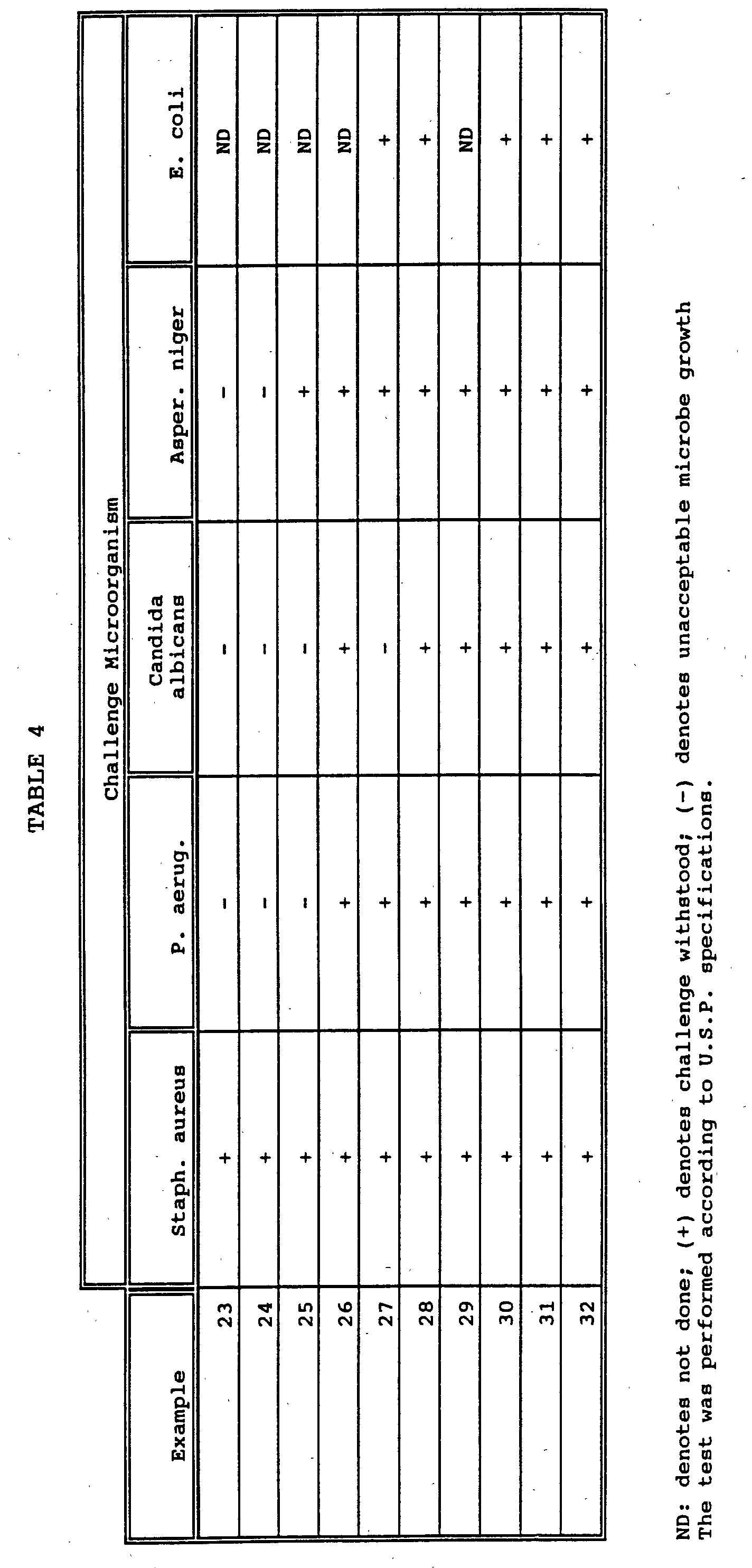
- The stability of suspensions intended for multiple doses is supported by the addition of preservatives which prevent potential microbiological growth. The indicated preparations are prepared under aseptic conditions and aliquots of each material are exposed to the indicated microbiological organisms for four weeks and evaluated for growth as described in the U.S. Pharmacopeia. The results, shown in Table 4, indicate whether the preservative was effective (+) or ineffective (-) according to U.S.P. requirements.
- Compositions with satisfactory particle sizes and stabilities for unidose suspensions without preservatives appear in Table 5. These compositions are satisfactory for ophthalmic or otolaryngological uses when prepared under aseptic conditions and packaged in containers for single doses.

- The soft steroid loteprednol etabonate was formulated as an aqueous ophthalmic suspension containing polyvinyl pyrrolidone (0.6%), glycerine (2.4%), tyloxapol (0.3%), edetate disodium (0.0005%) and benzalkonium chloride (0.001%). Loteprednol etabonate (0.5%) was incorporated into this vehicle for use in clinical studies. During these studies, the formulation was evaluated on a total of 446 patients, 220 of which had giant papillary conjunctivitis ("GPC"), 145 of which had seasonal allergic conjunctivitis ("SAC") and 81 had acute anterior uveitis.
- Loteprednol etabonate in this formulation was readily suspendable throughout extended periods of storage (i.e., greater than 18 months) as well as throughout the clinical treatment. The preparation was well tolerated in all patients and was significantly more effective than the vehicle itself, which was used as a placebo, with regard to the reduction of signs and symptoms of ocular inflammation.
- The vehicle was administered as a placebo to 219 GPC patients and 143 SAC patients. In SAC, treatment was initiated prophylactically, and therefore it was not possible to quantitate accurately the placebo effect. The GPC patients were enrolled in the study after the appearance of signs or symptoms. A significant number of GPC patients experienced clinically meaningful relief of signs and symptoms with the application of the vehicle alone. While the use of a demulcent solution applied four times per day should have some benefit in the treatment of GPC, the extent to which this occurred was higher than expected. Specifically, the size of the papillae was reduced in 50% of the patients, itching was reduced in 78% of the patients, and contact lens comfort was increased in 71% of the patients. This shows that the vehicle itself is useful for such treatments.
- In 76 to 94% of the GPC patients, loteprednol etabonate treatment resulted in clinically meaningful improvement in the same areas. These results are statistically significant (p < 0.001) compared to the administration of the vehicle alone. Thus, it is preferred to administrate the vehicle containing the loteprednol etabonate for optimum results.
Claims (15)
- A composition for ophthalmic or otolaryngological anti-inflammatory use comprising:(A) a corticosteroid having a particle size of 0.1 to 30 microns in diameter in an amount of 0.2 to 2% by weight;(B) a nonionic polymer in an aqueous medium; and(C) a nonionic surface active agent in an amount sufficient to retain the corticosteroid and nonionic polymer in suspension;(D) a nonionic tonicity agent in an amount sufficient to achieve isotonicity, wherein the molar ratio of (A) : (B) : (C) is between 1:0.01:0.05 to 1:20:1.
- The composition of claim 1 wherein the molar ratio of (A) : (B) : (C) is 1:0.1:0.05 to 1:3:1.
- The composition of claim 1 wherein the corticosteroid is selected from the group consisting of steroids having anti-inflammatory activity which are characterized by predictable in vivo metabolism to non-toxic derivatives after they provide their therapeutic effect, and is present in an amount of 0.2 and 2% by weight.
- The composition of claim 1 wherein the corticosteroid is loteprednol etabonate and is present in an amount of 0.5 and 1% by weight.
- The composition of claim 1 wherein said nonionic polymer is a water soluble polymer selected from the group consisting of polyvinylpyrrolidone, polyvinyl alcohol, dextrin and cyclodextrin and is present in an amount of 0.2 to 2% by weight.
- The composition of claim 1 wherein said nonionic polymer is polyvinylpyrrolidone and is present in an amount of 0.4 to 1% by weight.
- The composition of claim 1 wherein said nonionic surface active agent is tyloxapol and is present in an amount of 0.1 to 0.6% by weight.
- The composition of claim 1 wherein the nonionic tonicity agent is present in an amount of 1.05 to 5.75% by weight and the nonionic surfactant is present in an amount of 0.05 to 1% by weight.
- The composition of claim 1 wherein said nonionic tonicity agent is a nonionic polyol and is present in an amount of 1.5 to 4% by weight.
- The composition of claim 9 wherein said polyol is glycerol or mannitol.
- The composition of claim 1 further including a preservative for preventing microbial formation in said composition, and mixtures thereof and is present in an amount of 0.0001 to 0.025% by weight.
- The composition of claim 11 wherein said preservative is selected from the group consisting of benzalkonium chloride, disodium edetate and mixtures thereof.
- The composition of claim 11 wherein said preservative is a mixture of benzalkonium chloride and disodium edetate.
- The composition of claim 1 further comprising an additional therapeutic drug in admixture with said corticosteroid, wherein said additional therapeutic drug is selected from the group consisting of betaxalol, athenolol, levobanol, epinephrin, dipivalyl, oxonolol, acetazilumide-base, methazalomide, tobramycin, gentamycin, piroxicam, indomethacin, naproxen, phenylbutazone, ibuprofen, and diclofenac.
- The composition of claim 1 wherein said corticosteroid has a particle size less than fifteen microns.
Applications Claiming Priority (3)
| Application Number | Priority Date | Filing Date | Title |
|---|---|---|---|
| US08/142,743 US5540930A (en) | 1993-10-25 | 1993-10-25 | Suspension of loteprednol etabonate for ear, eye, or nose treatment |
| US142743 | 1993-10-25 | ||
| PCT/US1994/012059 WO1995011669A1 (en) | 1993-10-25 | 1994-10-21 | Suspension of loteprednol etabonate |
Publications (3)
| Publication Number | Publication Date |
|---|---|
| EP0730443A1 EP0730443A1 (en) | 1996-09-11 |
| EP0730443A4 EP0730443A4 (en) | 1997-11-05 |
| EP0730443B1 true EP0730443B1 (en) | 2002-05-15 |
Family
ID=22501105
Family Applications (1)
| Application Number | Title | Priority Date | Filing Date |
|---|---|---|---|
| EP94930831A Expired - Lifetime EP0730443B1 (en) | 1993-10-25 | 1994-10-21 | Suspension of loteprednol etabonate |
Country Status (17)
| Country | Link |
|---|---|
| US (2) | US5540930A (en) |
| EP (1) | EP0730443B1 (en) |
| JP (1) | JP3570720B2 (en) |
| KR (1) | KR100341497B1 (en) |
| AT (1) | ATE217523T1 (en) |
| AU (1) | AU697617B2 (en) |
| BR (1) | BR9407958A (en) |
| CA (1) | CA2174550C (en) |
| DE (1) | DE69430635T2 (en) |
| DK (1) | DK0730443T3 (en) |
| ES (1) | ES2179851T3 (en) |
| HU (1) | HU227316B1 (en) |
| IL (1) | IL111402A (en) |
| NZ (1) | NZ275749A (en) |
| PT (1) | PT730443E (en) |
| SG (1) | SG48768A1 (en) |
| WO (1) | WO1995011669A1 (en) |
Cited By (1)
| Publication number | Priority date | Publication date | Assignee | Title |
|---|---|---|---|---|
| US8580954B2 (en) | 2006-03-28 | 2013-11-12 | Hospira, Inc. | Formulations of low dose diclofenac and beta-cyclodextrin |
Families Citing this family (109)
| Publication number | Priority date | Publication date | Assignee | Title |
|---|---|---|---|---|
| US5849263A (en) * | 1993-03-30 | 1998-12-15 | Charlotte-Mecklenburg Hospital Authority | Pharmaceutical compositions containing alkylaryl polyether alcohol polymer |
| US5576311A (en) * | 1994-11-30 | 1996-11-19 | Pharmos Corporation | Cyclodextrins as suspending agents for pharmaceutical suspensions |
| US5976573A (en) * | 1996-07-03 | 1999-11-02 | Rorer Pharmaceutical Products Inc. | Aqueous-based pharmaceutical composition |
| US5955097A (en) | 1996-10-18 | 1999-09-21 | Virotex Corporation | Pharmaceutical preparation applicable to mucosal surfaces and body tissues |
| US5800832A (en) * | 1996-10-18 | 1998-09-01 | Virotex Corporation | Bioerodable film for delivery of pharmaceutical compounds to mucosal surfaces |
| TW503113B (en) * | 1997-01-16 | 2002-09-21 | Senju Pharma Co | Aqueous suspension for nasal administration |
| KR100508227B1 (en) * | 1997-03-14 | 2006-03-23 | 센주 세이야꾸 가부시키가이샤 | Aqueous suspension of loteprednol etabonate |
| US20050048102A1 (en) * | 1997-10-16 | 2005-03-03 | Virotex Corporation | Pharmaceutical carrier device suitable for delivery of pharmaceutical compounds to mucosal surfaces |
| SE9704186D0 (en) * | 1997-11-14 | 1997-11-14 | Astra Ab | New composition of matter |
| EP1050299A4 (en) * | 1998-01-22 | 2007-05-02 | Santen Pharmaceutical Co Ltd | Fluorometholone suspension eye drops |
| US6103266A (en) * | 1998-04-22 | 2000-08-15 | Tapolsky; Gilles H. | Pharmaceutical gel preparation applicable to mucosal surfaces and body tissues |
| WO2000012137A1 (en) * | 1998-09-02 | 2000-03-09 | Allergan Sales, Inc. | Preserved cyclodextrin-containing compositions |
| US6716830B2 (en) | 1998-09-30 | 2004-04-06 | Alcon, Inc. | Ophthalmic antibiotic compositions containing moxifloxacin |
| US6509327B1 (en) | 1998-09-30 | 2003-01-21 | Alcon Manufacturing, Ltd. | Compositions and methods for treating otic, ophthalmic and nasal infections |
| US6395746B1 (en) | 1998-09-30 | 2002-05-28 | Alcon Manufacturing, Ltd. | Methods of treating ophthalmic, otic and nasal infections and attendant inflammation |
| CZ295595B6 (en) * | 1999-06-22 | 2005-08-17 | Boehringer Ingelheim International Gmbh | A stable solution of xylometazoline and oxymetazoline |
| FR2796553B1 (en) * | 1999-07-22 | 2001-09-28 | Warner Lambert Co | SUSPENSION OF TIXOCORTOL PIVALATE, COLLUTORY BASED ON SAME AND PACKAGING CONTAINING SAME |
| DE60006262T2 (en) | 1999-09-24 | 2004-05-13 | Alcon, Inc. | TOPICAL SUSPENSION FORMULATIONS CONTAINING CIPROFLOXACIN AND DEXAMETHASONE |
| AR026073A1 (en) | 1999-10-20 | 2002-12-26 | Nycomed Gmbh | PHARMACEUTICAL COMPOSITION AQUATIC CONTAINING CICLESONIDE |
| KR20010089887A (en) * | 1999-10-20 | 2001-10-12 | 야스이 쇼사꾸 | Aqueous medicinal compositions |
| US20040097486A1 (en) * | 1999-11-18 | 2004-05-20 | Yanni John M. | Use of an H1 antagonist and a safe steroid to treat eye conditions |
| CN1376066A (en) * | 1999-11-18 | 2002-10-23 | 爱尔康公司 | Use of H1 antagonist and a safe steroid to treat eye conditions |
| US6495534B2 (en) * | 2000-05-15 | 2002-12-17 | Pharmacia & Upjohn Spa | Stabilized aqueous suspensions for parenteral use |
| WO2001087262A2 (en) * | 2000-05-15 | 2001-11-22 | Pharmacia Italia S.P.A. | Stabilized steroidal suspension |
| CA2412575C (en) | 2000-07-26 | 2009-12-29 | Onkar N. Singh | Improved process for manufacturing compositions containing ciprofloxacin and hydrocortisone |
| EP1337237B1 (en) * | 2000-11-15 | 2009-03-11 | Mohan A. Chandavarkar | Pharmaceutical preparations comprising corticosteroids and antiinfective agents |
| EP1341541A4 (en) * | 2000-11-16 | 2004-11-17 | Alcon Mfg Ltd | Combination therapy for lowering and controlling intraocular pressure |
| US20030139382A1 (en) * | 2001-09-21 | 2003-07-24 | Alcon, Inc. | Method of treating middle ear infections |
| US7001615B1 (en) | 2001-12-07 | 2006-02-21 | Alcon, Inc. | Sustained release ophthalmic, otic and nasal suspension |
| US20090215735A1 (en) * | 2002-02-25 | 2009-08-27 | Alcon, Inc. | Topical solution formulations containing a corticosteroid and a cyclodextrin |
| WO2004006957A1 (en) * | 2002-07-15 | 2004-01-22 | Alcon, Inc. | Pharmaceutical compositions for otic use |
| PT1551417E (en) * | 2002-10-18 | 2008-10-31 | Aqueous Pharma Ltd | Three layer tear formulation |
| US20040151754A1 (en) * | 2002-12-20 | 2004-08-05 | Control Delivery Systems, Inc. | Steroid suspensions for intraocular use |
| WO2004064828A1 (en) | 2003-01-21 | 2004-08-05 | Senju Pharmaceutical Co., Ltd. | Aqueous liquid preparation containing 2-amino-3-(4-bromobenzoyl)phenylacetic acid |
| US20050069590A1 (en) * | 2003-09-30 | 2005-03-31 | Buehler Gail K. | Stable suspensions for medicinal dosages |
| US20050095205A1 (en) * | 2003-10-31 | 2005-05-05 | Ramesh Krishnamoorthy | Combination of loteprednol etabonate and tobramycin for topical ophthalmic use |
| US20050197303A1 (en) * | 2003-10-31 | 2005-09-08 | Bausch & Lomb Incorporated | Combination of loteprednol etabonate and tobramycin for topical ophthalmic use |
| US20090246281A1 (en) * | 2003-11-03 | 2009-10-01 | Norton Healthcare Ltd. | Soft steroid compositions for use in dry powder inhalers |
| US20070224278A1 (en) * | 2003-11-12 | 2007-09-27 | Lyons Robert T | Low immunogenicity corticosteroid compositions |
| US20060141049A1 (en) * | 2003-11-12 | 2006-06-29 | Allergan, Inc. | Triamcinolone compositions for intravitreal administration to treat ocular conditions |
| US20050101582A1 (en) | 2003-11-12 | 2005-05-12 | Allergan, Inc. | Compositions and methods for treating a posterior segment of an eye |
| JP4820648B2 (en) * | 2003-12-02 | 2011-11-24 | 千寿製薬株式会社 | Loteprednol etabonate aqueous suspension |
| PE20050941A1 (en) | 2003-12-16 | 2005-11-08 | Nycomed Gmbh | AQUEOUS CYCLESOUND SUSPENSIONS FOR MISTING |
| EP1706095B1 (en) * | 2004-01-20 | 2008-12-24 | Allergan, Inc. | Compositions for localized therapy of the eye, comprising preferably triamcinolone acetonide and hyaluronic acid |
| WO2005072710A2 (en) * | 2004-01-28 | 2005-08-11 | Johns Hopkins University | Drugs and gene carrier particles that rapidly move through mucous barriers |
| US20050182039A1 (en) * | 2004-02-13 | 2005-08-18 | Bausch & Lomb Incorporated | Use of Loteprednol etabonate for the treatment of dry eye |
| AU2005229006B9 (en) * | 2004-03-25 | 2011-05-19 | Bausch & Lomb Incorporated | Use of loteprednol etabonate for the treatment of dry eye |
| US20050234018A1 (en) * | 2004-04-15 | 2005-10-20 | Allergan, Inc. | Drug delivery to the back of the eye |
| US8147865B2 (en) | 2004-04-30 | 2012-04-03 | Allergan, Inc. | Steroid-containing sustained release intraocular implants and related methods |
| US8119154B2 (en) | 2004-04-30 | 2012-02-21 | Allergan, Inc. | Sustained release intraocular implants and related methods |
| AU2005271700B2 (en) * | 2004-07-12 | 2010-11-11 | Allergan, Inc. | Opthalmic compositions and methods for treating ophthalmic conditions |
| CA2580659C (en) * | 2004-09-15 | 2013-02-26 | Ivx Animal Health, Inc. | Corticosteroid having low systemic absorption |
| WO2006043965A1 (en) * | 2004-10-14 | 2006-04-27 | Allergan, Inc. | Therapeutic ophthalmic compositions containing retinal friendly excipients and related methods |
| SI1885336T1 (en) * | 2005-05-10 | 2009-08-31 | Alcon Inc | Suspension formulations comprising an active principle, a poloxamer or meroxapol surfactant and a glycol, its use for the manufacture of a medicament for treating ophthalmic disorders |
| AU2006244245B2 (en) * | 2005-05-10 | 2010-11-18 | Alcon, Inc. | Ophthalmic suspension comprising an ophthalmic drug, a poloxamine and a glycol tonicity-adjusting agent, use of said composition for the manufacture of a medicament for treating ophthalmic disorders |
| CN101272807A (en) * | 2005-09-26 | 2008-09-24 | 皮埃蒙特医药品有限公司 | Methods for treatment and prevention of otitis media using nonionic surfactants to facilitate transmembrane drug delivery into the middle ear |
| EP1928439A4 (en) * | 2005-09-26 | 2009-04-29 | Piedmont Pharmaceuticals Llc | Methods for treatment and prevention of otitis media using chemical penetration enhancers to facilitate transmembrane drug delivery into the middle ear |
| US20090082321A1 (en) * | 2007-09-21 | 2009-03-26 | Allergan, Inc. | Steroid containing drug delivery systems |
| MX339797B (en) | 2005-10-18 | 2016-06-10 | Allergan Inc | Ocular therapy using glucocorticoid derivatives selectively penetrating posterior segment tissues. |
| US20070093461A1 (en) * | 2005-10-26 | 2007-04-26 | Bausch & Lomb Incorporated | Effect of Loteprednol etabonate on vascular dysfunction |
| WO2007058935A2 (en) * | 2005-11-14 | 2007-05-24 | Bausch & Lomb Incorporated | Ophthalmic composition for dry eye therapy |
| US20070128251A1 (en) * | 2005-12-07 | 2007-06-07 | Piedmont Pharmaceuticals, Inc. | Process for manufacturing chewable dosage forms for drug delivery and products thereof |
| US7955632B2 (en) | 2005-12-07 | 2011-06-07 | Bayer B.V. | Process for manufacturing chewable dosage forms for drug delivery and products thereof |
| MX2008012496A (en) * | 2006-03-28 | 2009-01-07 | Javelin Pharmaceuticals Inc | Formulations of low dose non-steroidal anti-inflammatory drugs and beta-cyclodextrin. |
| US20070238789A1 (en) * | 2006-03-31 | 2007-10-11 | Chin-Ming Chang | Prednisolone acetate compositions |
| WO2008002118A1 (en) * | 2006-06-27 | 2008-01-03 | Arturo Jimenez Bayardo | An ophthalmic formulation in suspension of loteprednol etabonate and ciprofloxacin hydrochloride |
| ES2577390T3 (en) | 2006-07-21 | 2016-07-14 | Biodelivery Sciences International, Inc. | Transmucosal administration devices with greater uptake |
| WO2008027341A2 (en) * | 2006-08-30 | 2008-03-06 | Merck & Co., Inc. | Topical ophthalmic formulations |
| WO2008027340A2 (en) * | 2006-08-30 | 2008-03-06 | Merck & Co., Inc. | Topical ophthalmic formulations |
| JP2010502713A (en) * | 2006-09-08 | 2010-01-28 | ザ・ジョンズ・ホプキンス・ユニバーシティー | Compositions and methods for enhancing transport through mucus |
| TWI415629B (en) * | 2006-10-26 | 2013-11-21 | Otsuka Pharma Co Ltd | Aqueous pharmaceutical suspensions containing rebamipide and manufacturing process thereof |
| WO2008057364A1 (en) * | 2006-11-02 | 2008-05-15 | Riolan Technologies, Inc. | Method for treating blepharitis |
| WO2008057360A1 (en) * | 2006-11-02 | 2008-05-15 | Riolan Technologies, Inc. | Methods of treating an ocular allergy with low dose dexamethasone |
| CN101721714B (en) * | 2009-12-18 | 2011-12-07 | 重庆莱美药业股份有限公司 | Passive targeting antitumor prodrug of solid tumor and preparation method thereof |
| US8889193B2 (en) | 2010-02-25 | 2014-11-18 | The Johns Hopkins University | Sustained delivery of therapeutic agents to an eye compartment |
| WO2012039979A2 (en) | 2010-09-10 | 2012-03-29 | The Johns Hopkins University | Rapid diffusion of large polymeric nanoparticles in the mammalian brain |
| EP3045163A1 (en) * | 2011-04-22 | 2016-07-20 | Alcon Research, Ltd. | Ophthalmic composition with a viscosity enhancement system having two different viscosity enhancing agents |
| MX352959B (en) | 2011-08-18 | 2017-12-15 | Biodelivery Sciences Int Inc | Abuse-resistant mucoadhesive devices for delivery of buprenorphine. |
| CA2851492A1 (en) | 2011-09-22 | 2013-03-28 | Bausch & Lomb Incorporated | Ophthalmic gel compositions |
| US9901539B2 (en) | 2011-12-21 | 2018-02-27 | Biodelivery Sciences International, Inc. | Transmucosal drug delivery devices for use in chronic pain relief |
| US8962577B2 (en) | 2012-03-16 | 2015-02-24 | The Johns Hopkins University | Controlled release formulations for the delivery of HIF-1 inhibitors |
| CA2867203C (en) | 2012-03-16 | 2016-09-20 | The Johns Hopkins University | Non-linear multiblock copolymer-drug conjugates for the delivery of active agents |
| WO2013166408A1 (en) * | 2012-05-03 | 2013-11-07 | Kala Pharmaceuticals, Inc. | Pharmaceutical nanoparticles showing improved mucosal transport |
| CN111700878A (en) * | 2012-05-03 | 2020-09-25 | 卡拉制药公司 | Drug nanoparticles exhibiting enhanced mucosal transport |
| US9056057B2 (en) | 2012-05-03 | 2015-06-16 | Kala Pharmaceuticals, Inc. | Nanocrystals, compositions, and methods that aid particle transport in mucus |
| US9827191B2 (en) | 2012-05-03 | 2017-11-28 | The Johns Hopkins University | Compositions and methods for ophthalmic and/or other applications |
| US11596599B2 (en) | 2012-05-03 | 2023-03-07 | The Johns Hopkins University | Compositions and methods for ophthalmic and/or other applications |
| CA2872519C (en) | 2012-05-04 | 2017-09-05 | The Johns Hopkins University | Lipid-based drug carriers for rapid penetration through mucus linings |
| CN103565742A (en) * | 2012-07-25 | 2014-02-12 | 天津金耀集团有限公司 | Fluorometholone eye drops |
| CN103565740A (en) * | 2012-07-25 | 2014-02-12 | 天津金耀集团有限公司 | Loteprednol etabonate suspension eye drops |
| US10568975B2 (en) | 2013-02-05 | 2020-02-25 | The Johns Hopkins University | Nanoparticles for magnetic resonance imaging tracking and methods of making and using thereof |
| US9353122B2 (en) | 2013-02-15 | 2016-05-31 | Kala Pharmaceuticals, Inc. | Therapeutic compounds and uses thereof |
| US9353123B2 (en) | 2013-02-20 | 2016-05-31 | Kala Pharmaceuticals, Inc. | Therapeutic compounds and uses thereof |
| US9688688B2 (en) | 2013-02-20 | 2017-06-27 | Kala Pharmaceuticals, Inc. | Crystalline forms of 4-((4-((4-fluoro-2-methyl-1H-indol-5-yl)oxy)-6-methoxyquinazolin-7-yl)oxy)-1-(2-oxa-7-azaspiro[3.5]nonan-7-yl)butan-1-one and uses thereof |
| US20150164882A1 (en) | 2013-07-22 | 2015-06-18 | Imprimis Pharmaceuticals, Inc. | Pharmaceutical compositions for intraocular administration and methods for fabricating thereof |
| US20160279055A1 (en) | 2013-07-22 | 2016-09-29 | Imprimis Pharmaceuticals, Inc. | Pharmaceutical ophthalmic compositions for intraocular administration and methods for fabricating thereof |
| US9890173B2 (en) | 2013-11-01 | 2018-02-13 | Kala Pharmaceuticals, Inc. | Crystalline forms of therapeutic compounds and uses thereof |
| KR20160099084A (en) | 2013-11-01 | 2016-08-19 | 칼라 파마슈티컬스, 인크. | Crystalline forms of therapeutic compounds and uses thereof |
| SMT202200179T1 (en) * | 2014-11-07 | 2022-07-21 | Santen Pharmaceutical Co Ltd | AQUEOUS OPHTHALMIC COMPOSITION. |
| JP6846351B2 (en) | 2015-01-27 | 2021-03-24 | ザ・ジョンズ・ホプキンス・ユニバーシティー | Hypotonic hydrogel formulation for enhanced transport of active agents on mucosal surfaces |
| CN106279324A (en) * | 2015-05-27 | 2017-01-04 | 天津金耀集团有限公司 | Loteprednol etabonate monohydrate and crystal formation thereof and preparation method |
| CN106279325A (en) * | 2015-05-27 | 2017-01-04 | 天津金耀集团有限公司 | A kind of Loteprednol etabonate novel crystal forms and preparation method thereof |
| CN106892953A (en) * | 2015-12-21 | 2017-06-27 | 天津金耀集团有限公司 | Loteprednol etabonate monohydrate and its crystal formation and preparation method |
| CN106892952A (en) * | 2015-12-21 | 2017-06-27 | 天津金耀集团有限公司 | A kind of Loteprednol etabonate novel crystal forms and preparation method thereof |
| US10253036B2 (en) | 2016-09-08 | 2019-04-09 | Kala Pharmaceuticals, Inc. | Crystalline forms of therapeutic compounds and uses thereof |
| WO2018048750A1 (en) | 2016-09-08 | 2018-03-15 | Kala Pharmaceuticals, Inc. | Crystalline forms of therapeutic compounds and uses thereof |
| EP3509421A4 (en) | 2016-09-08 | 2020-05-20 | Kala Pharmaceuticals, Inc. | CRYSTALLINE FORMS OF THERAPEUTIC COMPOUNDS AND USES THEREOF |
| WO2020210805A1 (en) | 2019-04-11 | 2020-10-15 | The Johns Hopkins University | Nanoparticles for drug delivery to brain |
| US12023344B2 (en) | 2022-05-25 | 2024-07-02 | Famygen Life Sciences, Inc. | Topical otic, ophthalmic, and nasal corticosteroid formulations |
Citations (1)
| Publication number | Priority date | Publication date | Assignee | Title |
|---|---|---|---|---|
| US4409205A (en) * | 1979-03-05 | 1983-10-11 | Cooper Laboratories, Inc. | Ophthalmic solution |
Family Cites Families (10)
| Publication number | Priority date | Publication date | Assignee | Title |
|---|---|---|---|---|
| US2861920A (en) * | 1954-05-04 | 1958-11-25 | Upjohn Co | Therapeutic suspensions of steroids containing pvp and/or pva |
| US4710495A (en) * | 1980-07-10 | 1987-12-01 | Otsuka Pharmaceutical Co., Ltd. | Soft steroids having anti-inflammatory activity |
| US4383992A (en) * | 1982-02-08 | 1983-05-17 | Lipari John M | Water-soluble steroid compounds |
| JPS6041607A (en) * | 1983-08-12 | 1985-03-05 | Otsuka Pharmaceut Co Ltd | Ointment base |
| JPS6143114A (en) * | 1984-08-03 | 1986-03-01 | Takeda Chem Ind Ltd | Eye drop for remedy of iridal and ciliary disease |
| US5192535A (en) * | 1988-02-08 | 1993-03-09 | Insite Vision Incorporated | Ophthalmic suspensions |
| US5149693A (en) * | 1988-03-09 | 1992-09-22 | Alcon Laboratories, Inc. | Combination of tobramycin and fluorometholone for topical ophthalmic use |
| NL8801670A (en) * | 1988-07-01 | 1990-02-01 | Walter Adrianus Josephus Johan | PHARMACEUTICAL PREPARATION. |
| CA2003198C (en) * | 1988-11-29 | 1995-03-21 | Anthony J. Dziabo, Jr. | Aqueous ophthalmic solutions and method for preserving same |
| US5277901A (en) * | 1990-01-05 | 1994-01-11 | Allergan, Inc. | Ophthalmic compositions and methods for preserving and using same |
-
1993
- 1993-10-25 US US08/142,743 patent/US5540930A/en not_active Expired - Lifetime
-
1994
- 1994-10-21 AU AU79835/94A patent/AU697617B2/en not_active Ceased
- 1994-10-21 PT PT94930831T patent/PT730443E/en unknown
- 1994-10-21 SG SG1996001471A patent/SG48768A1/en unknown
- 1994-10-21 HU HU9601081A patent/HU227316B1/en unknown
- 1994-10-21 AT AT94930831T patent/ATE217523T1/en active
- 1994-10-21 NZ NZ275749A patent/NZ275749A/en not_active IP Right Cessation
- 1994-10-21 BR BR9407958A patent/BR9407958A/en not_active Application Discontinuation
- 1994-10-21 KR KR1019960702130A patent/KR100341497B1/en not_active Expired - Lifetime
- 1994-10-21 DK DK94930831T patent/DK0730443T3/en active
- 1994-10-21 JP JP51272595A patent/JP3570720B2/en not_active Expired - Fee Related
- 1994-10-21 DE DE69430635T patent/DE69430635T2/en not_active Expired - Lifetime
- 1994-10-21 CA CA002174550A patent/CA2174550C/en not_active Expired - Lifetime
- 1994-10-21 WO PCT/US1994/012059 patent/WO1995011669A1/en not_active Ceased
- 1994-10-21 ES ES94930831T patent/ES2179851T3/en not_active Expired - Lifetime
- 1994-10-21 EP EP94930831A patent/EP0730443B1/en not_active Expired - Lifetime
- 1994-10-25 IL IL11140294A patent/IL111402A/en not_active IP Right Cessation
-
1996
- 1996-07-29 US US08/688,157 patent/US5747061A/en not_active Expired - Lifetime
Patent Citations (1)
| Publication number | Priority date | Publication date | Assignee | Title |
|---|---|---|---|---|
| US4409205A (en) * | 1979-03-05 | 1983-10-11 | Cooper Laboratories, Inc. | Ophthalmic solution |
Cited By (1)
| Publication number | Priority date | Publication date | Assignee | Title |
|---|---|---|---|---|
| US8580954B2 (en) | 2006-03-28 | 2013-11-12 | Hospira, Inc. | Formulations of low dose diclofenac and beta-cyclodextrin |
Also Published As
| Publication number | Publication date |
|---|---|
| ATE217523T1 (en) | 2002-06-15 |
| US5747061A (en) | 1998-05-05 |
| NZ275749A (en) | 1998-02-26 |
| HU227316B1 (en) | 2011-03-28 |
| DE69430635T2 (en) | 2003-01-02 |
| HUT74882A (en) | 1997-02-28 |
| EP0730443A4 (en) | 1997-11-05 |
| IL111402A (en) | 2000-12-06 |
| JPH09504294A (en) | 1997-04-28 |
| CA2174550C (en) | 2002-10-01 |
| DK0730443T3 (en) | 2002-09-09 |
| PT730443E (en) | 2002-11-29 |
| EP0730443A1 (en) | 1996-09-11 |
| KR100341497B1 (en) | 2002-12-05 |
| SG48768A1 (en) | 1998-05-18 |
| CA2174550A1 (en) | 1995-05-04 |
| WO1995011669A1 (en) | 1995-05-04 |
| KR960705541A (en) | 1996-11-08 |
| AU697617B2 (en) | 1998-10-15 |
| HU9601081D0 (en) | 1996-06-28 |
| US5540930A (en) | 1996-07-30 |
| AU7983594A (en) | 1995-05-22 |
| DE69430635D1 (en) | 2002-06-20 |
| BR9407958A (en) | 1996-11-26 |
| IL111402A0 (en) | 1994-12-29 |
| JP3570720B2 (en) | 2004-09-29 |
| ES2179851T3 (en) | 2003-02-01 |
Similar Documents
| Publication | Publication Date | Title |
|---|---|---|
| AU697617B2 (en) | Suspension of loteprednol etabonate | |
| CA2174550E (en) | Suspension of loteprednol etabonate | |
| EP0794783B1 (en) | Cyclodextrins as suspending agents for pharmaceutical suspensions | |
| JP5726774B2 (en) | Topical ophthalmic suspension of loteprednol etabonate and tobramycin | |
| TWI362264B (en) | Composition and use for treating a posterior segment of an eye | |
| WO1985001875A1 (en) | Eye drops composition | |
| CA2553381A1 (en) | Compositions for localized therapy of the eye, comprising preferably triamcinolone acetonide and hyaluronic acid | |
| EP0868919A2 (en) | Aqueous suspension of loteprednol etabonate | |
| CA3145055A1 (en) | Process for the preparation of sterile ophthalmic aqueous fluticasone propionate form a nanocrystals suspensions | |
| US20050197303A1 (en) | Combination of loteprednol etabonate and tobramycin for topical ophthalmic use | |
| JP3147076B2 (en) | Roteprednol etabonate aqueous suspension | |
| RU2336074C2 (en) | Compositions and methods of treatment of posterior ocular segment | |
| EP1366758A1 (en) | Novel ophthalmic compositions | |
| MXPA06004865A (en) | Suspension of loteprednol etabonate and tobramycin for topical ophthalmic use | |
| HK1092354B (en) | Suspension of loteprednol etabonate and tobramycin for topical ophthalmic use |
Legal Events
| Date | Code | Title | Description |
|---|---|---|---|
| PUAI | Public reference made under article 153(3) epc to a published international application that has entered the european phase |
Free format text: ORIGINAL CODE: 0009012 |
|
| 17P | Request for examination filed |
Effective date: 19960523 |
|
| AK | Designated contracting states |
Kind code of ref document: A1 Designated state(s): AT BE CH DE DK ES FR GB GR IE IT LI LU MC NL PT SE |
|
| AX | Request for extension of the european patent |
Free format text: LT PAYMENT 960523;SI PAYMENT 960523 |
|
| RAX | Requested extension states of the european patent have changed |
Free format text: LT PAYMENT 960523;SI PAYMENT 960523 |
|
| A4 | Supplementary search report drawn up and despatched |
Effective date: 19970917 |
|
| AK | Designated contracting states |
Kind code of ref document: A4 Designated state(s): AT BE CH DE DK ES FR GB GR IE IT LI LU MC NL PT SE |
|
| 17Q | First examination report despatched |
Effective date: 20001116 |
|
| GRAG | Despatch of communication of intention to grant |
Free format text: ORIGINAL CODE: EPIDOS AGRA |
|
| GRAG | Despatch of communication of intention to grant |
Free format text: ORIGINAL CODE: EPIDOS AGRA |
|
| GRAG | Despatch of communication of intention to grant |
Free format text: ORIGINAL CODE: EPIDOS AGRA |
|
| GRAH | Despatch of communication of intention to grant a patent |
Free format text: ORIGINAL CODE: EPIDOS IGRA |
|
| GRAH | Despatch of communication of intention to grant a patent |
Free format text: ORIGINAL CODE: EPIDOS IGRA |
|
| GRAA | (expected) grant |
Free format text: ORIGINAL CODE: 0009210 |
|
| AK | Designated contracting states |
Kind code of ref document: B1 Designated state(s): AT BE CH DE DK ES FR GB GR IE IT LI LU MC NL PT SE |
|
| AX | Request for extension of the european patent |
Free format text: LT PAYMENT 19960523;SI PAYMENT 19960523 |
|
| REF | Corresponds to: |
Ref document number: 217523 Country of ref document: AT Date of ref document: 20020615 Kind code of ref document: T |
|
| REG | Reference to a national code |
Ref country code: GB Ref legal event code: FG4D Ref country code: CH Ref legal event code: EP |
|
| REG | Reference to a national code |
Ref country code: IE Ref legal event code: FG4D |
|
| REF | Corresponds to: |
Ref document number: 69430635 Country of ref document: DE Date of ref document: 20020620 |
|
| REG | Reference to a national code |
Ref country code: DK Ref legal event code: T3 |
|
| RAP2 | Party data changed (patent owner data changed or rights of a patent transferred) |
Owner name: BAUSCH & LOMB INCORPORATED |
|
| ET | Fr: translation filed | ||
| REG | Reference to a national code |
Ref country code: GR Ref legal event code: EP Ref document number: 20020403137 Country of ref document: GR |
|
| REG | Reference to a national code |
Ref country code: CH Ref legal event code: PUE Owner name: PHARMOS CORPORATION TRANSFER- BAUSCH & LOMB INCORP Ref country code: CH Ref legal event code: NV Representative=s name: E. BLUM & CO. PATENTANWAELTE |
|
| REG | Reference to a national code |
Ref country code: PT Ref legal event code: SC4A Free format text: AVAILABILITY OF NATIONAL TRANSLATION Effective date: 20020807 |
|
| NLS | Nl: assignments of ep-patents |
Owner name: BAUSCH & LOMB INCORPORATED |
|
| LTIE | Lt: invalidation of european patent or patent extension |
Effective date: 20020515 |
|
| REG | Reference to a national code |
Ref country code: PT Ref legal event code: PC4A Free format text: BAUSCH & LOMB INCORPORATED US Effective date: 20021004 |
|
| NLT2 | Nl: modifications (of names), taken from the european patent patent bulletin |
Owner name: BAUSCH & LOMB INCORPORATED |
|
| REG | Reference to a national code |
Ref country code: ES Ref legal event code: FG2A Ref document number: 2179851 Country of ref document: ES Kind code of ref document: T3 |
|
| PGFP | Annual fee paid to national office [announced via postgrant information from national office to epo] |
Ref country code: MC Payment date: 20030305 Year of fee payment: 9 |
|
| PLBE | No opposition filed within time limit |
Free format text: ORIGINAL CODE: 0009261 |
|
| STAA | Information on the status of an ep patent application or granted ep patent |
Free format text: STATUS: NO OPPOSITION FILED WITHIN TIME LIMIT |
|
| 26N | No opposition filed |
Effective date: 20030218 |
|
| REG | Reference to a national code |
Ref country code: FR Ref legal event code: TP |
|
| PG25 | Lapsed in a contracting state [announced via postgrant information from national office to epo] |
Ref country code: MC Free format text: LAPSE BECAUSE OF NON-PAYMENT OF DUE FEES Effective date: 20031031 |
|
| REG | Reference to a national code |
Ref country code: FR Ref legal event code: RM |
|
| REG | Reference to a national code |
Ref country code: CH Ref legal event code: PFA Owner name: BAUSCH & LOMB INCORPORATED Free format text: BAUSCH & LOMB INCORPORATED#ONE BAUSCH & LOMB PLACE#ROCHESTER NEW YORK 14604-2701 (US) -TRANSFER TO- BAUSCH & LOMB INCORPORATED#ONE BAUSCH & LOMB PLACE#ROCHESTER NEW YORK 14604-2701 (US) |
|
| PGFP | Annual fee paid to national office [announced via postgrant information from national office to epo] |
Ref country code: GR Payment date: 20130927 Year of fee payment: 20 Ref country code: DK Payment date: 20130925 Year of fee payment: 20 Ref country code: IE Payment date: 20130926 Year of fee payment: 20 Ref country code: PT Payment date: 20130422 Year of fee payment: 20 |
|
| PGFP | Annual fee paid to national office [announced via postgrant information from national office to epo] |
Ref country code: GB Payment date: 20130925 Year of fee payment: 20 |
|
| PGFP | Annual fee paid to national office [announced via postgrant information from national office to epo] |
Ref country code: LU Payment date: 20131105 Year of fee payment: 20 |
|
| PGFP | Annual fee paid to national office [announced via postgrant information from national office to epo] |
Ref country code: AT Payment date: 20130925 Year of fee payment: 20 Ref country code: CH Payment date: 20131029 Year of fee payment: 20 Ref country code: DE Payment date: 20131031 Year of fee payment: 20 Ref country code: FR Payment date: 20130924 Year of fee payment: 20 Ref country code: SE Payment date: 20131007 Year of fee payment: 20 |
|
| PGFP | Annual fee paid to national office [announced via postgrant information from national office to epo] |
Ref country code: NL Payment date: 20131010 Year of fee payment: 20 Ref country code: ES Payment date: 20131011 Year of fee payment: 20 Ref country code: IT Payment date: 20131016 Year of fee payment: 20 Ref country code: BE Payment date: 20131104 Year of fee payment: 20 |
|
| REG | Reference to a national code |
Ref country code: DE Ref legal event code: R071 Ref document number: 69430635 Country of ref document: DE |
|
| REG | Reference to a national code |
Ref country code: DE Ref legal event code: R071 Ref document number: 69430635 Country of ref document: DE |
|
| REG | Reference to a national code |
Ref country code: DK Ref legal event code: EUP Effective date: 20141021 |
|
| REG | Reference to a national code |
Ref country code: PT Ref legal event code: MM4A Free format text: MAXIMUM VALIDITY LIMIT REACHED Effective date: 20141021 |
|
| REG | Reference to a national code |
Ref country code: NL Ref legal event code: V4 Effective date: 20141021 |
|
| REG | Reference to a national code |
Ref country code: CH Ref legal event code: PL |
|
| REG | Reference to a national code |
Ref country code: GB Ref legal event code: PE20 Expiry date: 20141020 |
|
| REG | Reference to a national code |
Ref country code: SE Ref legal event code: EUG |
|
| REG | Reference to a national code |
Ref country code: IE Ref legal event code: MK9A |
|
| REG | Reference to a national code |
Ref country code: AT Ref legal event code: MK07 Ref document number: 217523 Country of ref document: AT Kind code of ref document: T Effective date: 20141021 |
|
| REG | Reference to a national code |
Ref country code: ES Ref legal event code: FD2A Effective date: 20150108 |
|
| REG | Reference to a national code |
Ref country code: GR Ref legal event code: MA Ref document number: 20020403137 Country of ref document: GR Effective date: 20141022 |
|
| PG25 | Lapsed in a contracting state [announced via postgrant information from national office to epo] |
Ref country code: PT Free format text: LAPSE BECAUSE OF EXPIRATION OF PROTECTION Effective date: 20141028 Ref country code: GB Free format text: LAPSE BECAUSE OF EXPIRATION OF PROTECTION Effective date: 20141020 Ref country code: IE Free format text: LAPSE BECAUSE OF EXPIRATION OF PROTECTION Effective date: 20141021 Ref country code: ES Free format text: LAPSE BECAUSE OF EXPIRATION OF PROTECTION Effective date: 20141022 |