EP0725157A1 - Processing of alloys and products so produced - Google Patents
Processing of alloys and products so produced Download PDFInfo
- Publication number
- EP0725157A1 EP0725157A1 EP95308216A EP95308216A EP0725157A1 EP 0725157 A1 EP0725157 A1 EP 0725157A1 EP 95308216 A EP95308216 A EP 95308216A EP 95308216 A EP95308216 A EP 95308216A EP 0725157 A1 EP0725157 A1 EP 0725157A1
- Authority
- EP
- European Patent Office
- Prior art keywords
- alloy
- range
- selected temperature
- temperature generally
- iii
- Prior art date
- Legal status (The legal status is an assumption and is not a legal conclusion. Google has not performed a legal analysis and makes no representation as to the accuracy of the status listed.)
- Granted
Links
- 229910045601 alloy Inorganic materials 0.000 title claims abstract description 196
- 239000000956 alloy Substances 0.000 title claims abstract description 196
- DMFGNRRURHSENX-UHFFFAOYSA-N beryllium copper Chemical compound [Be].[Cu] DMFGNRRURHSENX-UHFFFAOYSA-N 0.000 claims abstract description 35
- 229910000881 Cu alloy Inorganic materials 0.000 claims abstract description 32
- XLYOFNOQVPJJNP-UHFFFAOYSA-N water Substances O XLYOFNOQVPJJNP-UHFFFAOYSA-N 0.000 claims abstract description 23
- 230000009467 reduction Effects 0.000 claims abstract description 12
- 238000000034 method Methods 0.000 claims description 43
- 238000010791 quenching Methods 0.000 claims description 26
- 230000000171 quenching effect Effects 0.000 claims description 26
- 238000000137 annealing Methods 0.000 claims description 24
- 229910052790 beryllium Inorganic materials 0.000 claims description 16
- ATBAMAFKBVZNFJ-UHFFFAOYSA-N beryllium atom Chemical compound [Be] ATBAMAFKBVZNFJ-UHFFFAOYSA-N 0.000 claims description 16
- 230000008569 process Effects 0.000 claims description 14
- 239000000463 material Substances 0.000 claims description 13
- XEEYBQQBJWHFJM-UHFFFAOYSA-N Iron Chemical compound [Fe] XEEYBQQBJWHFJM-UHFFFAOYSA-N 0.000 claims description 6
- RTAQQCXQSZGOHL-UHFFFAOYSA-N Titanium Chemical compound [Ti] RTAQQCXQSZGOHL-UHFFFAOYSA-N 0.000 claims description 3
- XAGFODPZIPBFFR-UHFFFAOYSA-N aluminium Chemical compound [Al] XAGFODPZIPBFFR-UHFFFAOYSA-N 0.000 claims description 3
- 229910052782 aluminium Inorganic materials 0.000 claims description 3
- 238000005242 forging Methods 0.000 claims description 3
- 229910052742 iron Inorganic materials 0.000 claims description 3
- 238000005096 rolling process Methods 0.000 claims description 3
- 239000010936 titanium Substances 0.000 claims description 3
- 229910052719 titanium Inorganic materials 0.000 claims description 3
- 239000004411 aluminium Substances 0.000 claims 1
- 238000000304 warm extrusion Methods 0.000 claims 1
- 238000001000 micrograph Methods 0.000 description 19
- 229910052737 gold Inorganic materials 0.000 description 13
- 239000010931 gold Substances 0.000 description 13
- 230000007797 corrosion Effects 0.000 description 9
- 238000005260 corrosion Methods 0.000 description 9
- OJHZNMVJJKMFGX-BWCYBWMMSA-N (4r,4ar,7ar,12bs)-9-methoxy-3-methyl-1,2,4,4a,5,6,7a,13-octahydro-4,12-methanobenzofuro[3,2-e]isoquinoline-7-one;(2r,3r)-2,3-dihydroxybutanedioic acid Chemical compound OC(=O)[C@H](O)[C@@H](O)C(O)=O.C([C@H]1[C@H](N(CC[C@@]112)C)C3)CC(=O)[C@@H]1OC1=C2C3=CC=C1OC OJHZNMVJJKMFGX-BWCYBWMMSA-N 0.000 description 6
- 238000004519 manufacturing process Methods 0.000 description 5
- 239000000243 solution Substances 0.000 description 5
- RYGMFSIKBFXOCR-UHFFFAOYSA-N Copper Chemical compound [Cu] RYGMFSIKBFXOCR-UHFFFAOYSA-N 0.000 description 4
- 230000000739 chaotic effect Effects 0.000 description 4
- 229910052802 copper Inorganic materials 0.000 description 4
- 239000010949 copper Substances 0.000 description 4
- 238000001556 precipitation Methods 0.000 description 4
- 229910000831 Steel Inorganic materials 0.000 description 3
- 230000008901 benefit Effects 0.000 description 3
- 238000005266 casting Methods 0.000 description 3
- 230000002708 enhancing effect Effects 0.000 description 3
- 238000000265 homogenisation Methods 0.000 description 3
- 239000010959 steel Substances 0.000 description 3
- 229910001316 Ag alloy Inorganic materials 0.000 description 2
- PXHVJJICTQNCMI-UHFFFAOYSA-N Nickel Chemical compound [Ni] PXHVJJICTQNCMI-UHFFFAOYSA-N 0.000 description 2
- ZMDCATBGKUUZHF-UHFFFAOYSA-N beryllium nickel Chemical compound [Be].[Ni] ZMDCATBGKUUZHF-UHFFFAOYSA-N 0.000 description 2
- 229910017052 cobalt Inorganic materials 0.000 description 2
- 239000010941 cobalt Substances 0.000 description 2
- GUTLYIVDDKVIGB-UHFFFAOYSA-N cobalt atom Chemical compound [Co] GUTLYIVDDKVIGB-UHFFFAOYSA-N 0.000 description 2
- 238000001816 cooling Methods 0.000 description 2
- 238000001125 extrusion Methods 0.000 description 2
- 230000001965 increasing effect Effects 0.000 description 2
- 229910000601 superalloy Inorganic materials 0.000 description 2
- 238000005382 thermal cycling Methods 0.000 description 2
- 238000007792 addition Methods 0.000 description 1
- 238000003483 aging Methods 0.000 description 1
- 230000004075 alteration Effects 0.000 description 1
- 239000002894 chemical waste Substances 0.000 description 1
- 238000010276 construction Methods 0.000 description 1
- 238000005553 drilling Methods 0.000 description 1
- 238000005516 engineering process Methods 0.000 description 1
- 239000000835 fiber Substances 0.000 description 1
- 230000004927 fusion Effects 0.000 description 1
- 238000003384 imaging method Methods 0.000 description 1
- 238000002347 injection Methods 0.000 description 1
- 239000007924 injection Substances 0.000 description 1
- 238000005272 metallurgy Methods 0.000 description 1
- 230000029052 metamorphosis Effects 0.000 description 1
- 238000012986 modification Methods 0.000 description 1
- 230000004048 modification Effects 0.000 description 1
- 229910052759 nickel Inorganic materials 0.000 description 1
- 230000003287 optical effect Effects 0.000 description 1
- 238000005498 polishing Methods 0.000 description 1
- 238000003672 processing method Methods 0.000 description 1
- 238000011084 recovery Methods 0.000 description 1
- 238000001953 recrystallisation Methods 0.000 description 1
- 238000001228 spectrum Methods 0.000 description 1
- 230000003068 static effect Effects 0.000 description 1
- 230000035882 stress Effects 0.000 description 1
- 238000003878 thermal aging Methods 0.000 description 1
- 230000009466 transformation Effects 0.000 description 1
Images





Classifications
-
- C—CHEMISTRY; METALLURGY
- C22—METALLURGY; FERROUS OR NON-FERROUS ALLOYS; TREATMENT OF ALLOYS OR NON-FERROUS METALS
- C22F—CHANGING THE PHYSICAL STRUCTURE OF NON-FERROUS METALS AND NON-FERROUS ALLOYS
- C22F1/00—Changing the physical structure of non-ferrous metals or alloys by heat treatment or by hot or cold working
- C22F1/08—Changing the physical structure of non-ferrous metals or alloys by heat treatment or by hot or cold working of copper or alloys based thereon
-
- C—CHEMISTRY; METALLURGY
- C22—METALLURGY; FERROUS OR NON-FERROUS ALLOYS; TREATMENT OF ALLOYS OR NON-FERROUS METALS
- C22F—CHANGING THE PHYSICAL STRUCTURE OF NON-FERROUS METALS AND NON-FERROUS ALLOYS
- C22F1/00—Changing the physical structure of non-ferrous metals or alloys by heat treatment or by hot or cold working
- C22F1/16—Changing the physical structure of non-ferrous metals or alloys by heat treatment or by hot or cold working of other metals or alloys based thereon
Definitions
- the present invention relates to processing of precipitation hardenable materials and more particularly to a novel method for enhancing properties of beryllium containing alloys.
- Beryllium-copper alloys are notable for their superior combination of thermal conductivity, strength, toughness, impact energy and resistance to corrosion. This has made them desirable for use in control bearings of aircraft landing gear and a variety of underground and undersea applications. Additional benefits of beryllium-copper alloys such as their relatively high electrical conductivity, ultrasonic inspectability and thermal management has made them suitable for face plates of continuous steel casting molds. Aerospace and compact disc technologies have also benefitted, in particular, from the relatively high polishability of these alloys as well as their magnetic transparency, thermal cycling and anti-galling characteristics. The cost of beryllium-copper being an issue, however, more economical processing is sought. Improvements in alloy properties and enhanced product performance are also desired.
- a specific, illustrative process comprises the steps of (i) thermodynamically treating the alloy at a first selected temperature generally within a range of 900° and 1500°F, (ii) warm working the alloy of step i at greater than about 30% strain at a strain rate ⁇ greater than or equal to about (2.210 x 10 7 )/exp[(2.873 x 10 4 )/(T + 459.4°)], where T is in °F, at the first temperature, (iii) annealing the alloy of step ii at a second selected temeprature generally within a range of 1375° and 1500°F, (iv) water quenching the alloy of step iii, and (v) thermal hardening the alloy of step iv at a third selected temperature generally within a range of 480° and 660°F. This produces a generally equiaxed uniform fine
- a "gold" beryllium-copper alloy is (i) thermodynamically treated at a first selected temperature generally within a range of 900° and 1500°F, then (ii) warm worked at greater than about 30% strain at a strain rate ⁇ greater than or equal to about (1.009 x 10 8 )/exp[(2.873 x 10 4 )/(T + 459.4°)], where T is in °F, at the first temperature, (iii) annealed at a second selected temperature generally within a range of 1375° and 1500°F, (iv) water quenched, and finally (v) thermal hardened at a third selected temperature generally within a range of about 480° and 660°F.
- a metamorphically processed "gold" beryllium-copper alloy where 3.0 times the impact energy of the alloy in foot pounds plus 2.0 times the alloy yield strength in ksi is greater than about 275.
- Metamorphic processing of a "red" beryllium-copper alloy produces a generally equiaxed uniform grain structure with concomitant improvements in mechanical properties, electrical conductivity and ultrasonic inspectability.
- a specific, illustrative process comprises the steps of: (i) thermodynamically treating the alloy at a first selected temperature generally within a range of 900° and 1850°F, (ii) warm working the alloy of step i at greater than about 30% strain at a strain rate ⁇ greater than or equal to about (1.243 x 10 7 )/exp[(2.873 x 10 4 )/(T + 459.4°)], where T is in °F, at the first temperature, (iii) annealing the alloy of step ii at a second selected temperature generally within a range of 1400° and 1750°F for about 15 minutes to about 3 hours, (iv) water quenching the alloy of step iii, and (v) thermal hardening the alloy of step
- a "red" beryllium-copper alloy is metamorphically processed by the steps of: (i) thermodynamically treating the alloy at a first selected temperature generally within a range of 900° and 1850°F, (ii) warm working the alloy of step i at greater than about 30% strain at a strain rate ⁇ greater than or equal to about (1.243 x 10 7 )/exp[(2.873 x 10 4 )/(T + 459.4°)], where T is in °F, at the first temperature, (iii) annealing the alloy of step ii at a second selected temperature generally within a range of 1400° and 1750°F, (iv) water quenching the alloy of step iii, and (v) primary thermal hardening of the alloy of step iv at a third selected temperature generally within a range of 900° and 1000°F followed by secondary thermal hardening at a fourth selected temperature generally within a range of 790° and 900°F
- a metamorphically processed "red" beryllium-copper alloy where 4.5 times the electrical conductivity of the alloy in % IACS plus the alloy yield strength in ksi is greater than about 400.
- Another object of the present invention is to produce beryllium containing alloys with enhanced mechanical properties, simply and efficiently.
- Still another object of the present invention is to provide an economical beryllium containing alloy product with enhanced mechanical properties.
- a further object of the present invention is to improve fatigue strength, creep strength, and ultrasonic inspectability.
- Still a further object of the present invention is to achieve finer polishing of guidance system mirrors and molds for manufacturing compact discs.
- Metamorphic alloy processing is a revolution in metallurgy. During processing, a metamorphosis takes place in the alloy somewhat analogous to that of a caterpillar's transformation into a butterfly. During an intermediate or "cocoon" stage of processing, the grain structure of the alloy becomes ugly, i.e., random, nonuniform, and chaotic. Further processing brings order out of the chaos and a super alloy emerges having a combination of properties and characteristics which are not only unique, but surpass those of any known material.
- gold and red alloys as used herein are intended to describe alloy appearance.
- a “gold” beryllium-copper alloy contains concentrations of beryllium sufficient to give the alloy a golden color.
- a “red” alloy typically contains relatively lesser amounts of beryllium, creating a reddish hue like that of copper.
- a "gold" beryllium-copper alloy e.g., Alloy 25 (C17200) which comprises the steps of (i) thermodynamically treating the alloy at a first selected temperature generally within a range of 900° and 1500°F, (ii) warm working the alloy of step i at greater than about 30% strain at a strain rate ⁇ greater than or equal to about (2.210 x 10 7 )/exp[(2.873 x 10 4 )/(T + 459.4°)], where T is in °F, at the first temperature, (iii) annealing the alloy of step ii at a second selected temperature generally within a range of 1375° and 1500°F, (iv) water quenching the alloy of step iii, and (v) thermal hardening the alloy of step iv at a third selected temperature generally within a range of 480° and 660°F.
- a "gold" beryllium-copper alloy e.g., Alloy 25 (C
- Alloy 25 has been found desirable for use in underground positional sensing equipment for oil and gas drilling, as well as control bearings for aircraft landing gear. More notable characteristics in this context include strength, toughness, impact energy, corrosion resistance, and thermal conductivity.
- this Alloy comprises about 1.80 to about 2.00 % by weight beryllium, 0.20 to 0.35 % by weight cobalt, the balance being substantially copper.
- the alloy is thermodynamically treated for greater than, e.g., about 10 hours, at a first selected temperature generally within a range of 900° to 1500°F. Preferably, this treatment occurs for a selected time greater than about 16 hours. During treatment, the alloy is heated to the first temperature and held there for the selected duration.
- Thermodynamic treatment preferably lasts greater than 16 hours at a first selected temperature generally within a range of 1000° and 1250°F. It is also preferred that annealing occur for about 30 minutes to about 1 hour and be accomplished by solution treatment. Thermal hardening for about 3 to 6 hours is particularly desirable.
- the alloy is warm worked. Warm working is preferably done by warm rolling the alloy, forging as with plates or bars, or by extrusion as with round products. During warm working, the alloy is maintained at the first selected temperature during which it is worked at greater than 3096 strain at a strain rate ⁇ greater than or equal to about (2.210 x 10 7 )/exp[(2.873 x 10 4 )/(T + 495.4°)], where T is in °F.
- the preferred range of warm working is at greater than 50% strain generally between 0.5 and 10.0/second (or in/in/sec).
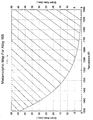
- a relationship between strain rate (s -1 ) and hot working temperature (°F) during warm working is illustrated by the metamorphic map of FIG. 17.
- thermodynamic treatment and warm working is dynamic recovery of the alloy, i.e., to set up the alloy for static recrystallization which occurs later during the annealing step.
- thermodynamic treatment and warm working steps (known as the metamorphic stage)
- a heterogeneous, quasi-amorphous, unrecrystallized (i.e., chaotic) grain structure is produced.
- the grain structures produced are unlike those made by prior methods of enhancing material properties.
- the alloy After warm working, the alloy is cooled at a rate, e.g., between 1000°F/second and 1°F/hour. Generally, it has been found that the rate of cooling the alloy at this phase of the process is a relatively less significant factor.
- the alloy After cooling the alloy to a selected temperature, for example, room temperature, it is annealed at a second selected temperature generally within a range of 1375° and 1500°F for about 15 minutes to about 3 hours.
- the preferred range is between 1375° and 1475°F for about 30 minutes to about 1 hour.
- the ingot is cooled by water quenching or a similar process, and thermal aged (or precipitation hardened) at a third selected temperature generally within a range of 480° and 660°F for about 3 to 6 hours. Preferred times and temperatures may vary depending upon customer requirements.
- the result of metamorphic processing is a super Alloy 25 product having a refined equiaxed uniform grain structure. Its strength is superior to that obtained by prior processing methods, and ductility, formability, conductivity, ultrasonic inspectability are improved as well as resistance to heat and corrosion.
- a micrograph of the alloy product is shown, for example, in FIG. 4.
- the alloy mechanical properties are as follows: Yield (ksi) Ultimate (ksi) Total Elongation Reduction In Area (%) CVN (ft. lbs.) 100 140 19 40 35 160 180 8 14 5
- the input is a wrought "gold" beryllium-copper alloy ingot, as shown in FIG. 5.
- the steps of homogenizing and cropping may be omitted at this stage, as those skilled in the art will appreciate.
- the wrought alloy yields a chaotic grain microstructure as shown in FIGS. 6 and 7.
- An overall objective of the present invention is to improve properties of bulk alloy products such as plates and sections of beryllium-copper and other alloys.
- Alloy 165 has been found useful in the construction of optical amplifier housings for undersea fiber optic components, particularly for its corrosion resistance, thermal conductivity toughness and strength.
- Alloy 165 is comprised of about 1.60 to about 1.79 % beryllium, 0.20 to 0.35 % cobalt, the balance being substantially copper.
- the alloy is preferably treated thermodynamically for greater than about 10 hours, e.g., about 16 hours, at a first selected temperature generally within a range of 1000° and 1250°F. Also, it is desirable to anneal by solution treatment for about 30 minutes to about 1 hour, and thermal harden the alloy for about 3 to 6 hours.
- the designated region in Fig. 18 illustrates a relationship between strain rate (s -1 ) and hot working temperature (°F) during warm working.
- metamorphically processed "gold" beryllium-copper alloys have a unique property fingerprint. For instance, 3.0 times the impact energy of a metamorphically processed "gold” alloy in foot pounds plus 2.0 times its yield strength in ksi is greater than about 275.
- Alloy 3 (C17510) is metamorphically processed by (i) thermodynamically treating the alloy at a first selected temperature generally within a range of 900° and 1850°F, (ii) warm working the alloy of step i at greater than about 30% strain at a strain rate ⁇ greater than or equal to about (1.243 x 10 7 )/exp[(2.873 x 10 4 )/(T + 459.4°)], where T is in °F, at the first temperature, (iii) annealing the alloy of step ii at a second selected temperature generally within a range of 1400° and 1750°F for about 15 minutes to about 3 hours, (iv) water quenching the alloy of step iii, and (v) thermal hardening the alloy of step iv at a third selected temperature generally within a range of 800° and 1000°F
- Alloy 3 such as its hardness-strength, thermal conductivity, toughness, and corrosion resistance make this alloy suitable for use in weld tooling and containers for nuclear and chemical waste.
- the alloy is preferably treated thermodynamically for greater than about 10 hours and annealed by solution treatment for about 15 minutes to about 3 hours. This is done to achieve optimum refinement in grain size and improve electrical conductivity, ultimate strength, toughness, total elongation and % reduction in area. Later, after water quenching, the alloy is hardened thermally for about 2 to 3 hours.
- Metamorphic processing of other "red" alloys e.g., HYCON 3 HPTM and PHASE 3 HPTM
- One such process comprises the steps of: (i) thermodynamically treating the alloy at a first selected temperature generally within a range of 900° and 1850°F, (ii) warm working the alloy of step i at greater than about 30% strain at a strain rate ⁇ greater than or equal to about (1.243 x 10 7 )/exp[(2.873 x 10 4 )/(T + 459.4°)], where T is in °F, at the first temperature, (iii) annealing the alloy of step ii at a second selected temperature generally within a range of 1400° and 1750°F, (iv) water quenching the alloy of step iii, and (v) primary thermal hardening of the alloy of step iv at a third selected temperature generally within
- HYCON 3 HPTM is desirable for use in nuclear fusion and cryogenic systems, particularly those high energy field magnets used for imaging. This is due to properties such as thermal and electrical conductivity, strength, toughness, corrosion resistance and ultrasonic inspectability.
- PHASE 3 HPTM is a material of choice for face plates of continuous steel casting molds. This alloy has been noted for superior thermal conductivity (and management), thermal cycling, strength, toughness, corrosion resistance and ultrasonic inspectability.
- Alloy 3, HYCON 3 HPTM, and PHASE 3 HPTM are comprised of about 0.20 to about 0.60 % beryllium, about 1.4 to about 2.2 % nickel, the balance being substantially copper.
- a cast Alloy 3 (or HYCON) ingot is homogenized and cropped, as above.
- the initial microstructure is shown in FIG. 9.
- wrought input is used, as best seen in FIG. 13.
- the alloy is thermodynamically treated for greater than, e.g., about 10 hours, at a first selected temperature generally within a range of 900° to 1850°F. During this step, the alloy is heated to the first temperature and held there for the selected duration.
- the alloy is maintained at the first selected temperature during which it is worked at greater than 30% strain at a strain of ⁇ greater than or equal to about (1.243 x 10 7 )/exp[(2.873 x 10 4 )/(T + 495.4°)], where T is in °F.
- the preferred range of warm working is at greater than 50% strain generally between 0.5 and 10.0/second (or in/in/sec).
- a relationship between strain rate (s -1 ) and hot working temperature (°F) for Alloy 3, HYCON 3HPTM and PHASE 3HPTM is set forth in the metamorphic map of FIG. 19.
- FIGS. 10 and 11 from cast input
- FIGS. 14 and 15 from wrought input.
- a heterogeneous, quasi-amorphous, unrecrystallized (i.e., chaotic) grain structure is produced.
- warm working may be done by warm rolling or forging as with plates or bars of the alloy, or by extrusion as with round products.
- the alloy After warm working, the alloy is cooled to a selected temperature, for example, room temperature, at a rate preferably between 1000°F/second and 1°F/hour. The material is then annealed at a second selected temperature generally within a range of 1375° and 1750°F for about 15 minutes to about 3 hours. The preferred range is between 1400° and 1750°F.
- the alloy is cooled by water quenching or a similar process.
- an initial or primary thermal hardening step is conducted at a third selected temperature generally within a range of 900° and 1000°F.
- the preferred duration of this step is between about 2 to 10 hours.
- secondary thermal hardening at a fourth selected temperature generally within a range of 700° and 900°F for about 10 to 30 hours.
- Preferred third temperatures are generally within a range of 925° and 1000°F
- fourth temperatures are generally within a range of 750° and 850°F.
- thermodynamically treat the alloy for greater than about 10 hours, and anneal by solution treatment for about 15 minutes to about 3 hours. It is also preferred that primary thermal hardening take place at a third selected temperature generally within a range of 925° and 1000°F for about 2 to 10 hours followed by secondary thermal hardening at a fourth selected temperature generally within a range of 750° and 850°F for about 10 to 30 hours.
- Metamorphic processing of "red” alloys results in a superior average grain size of, e.g., about 20 - 50 ⁇ m, which is desirable.
- refinement in the size of grains having equiaxed uniform structure has many advantages. It permits finer polishability of mirrors for missile guidance systems and of plastic injection molds used in the production of compact disks. Improved thermal conductivity and ultrasonic inspectability are also useful for heat exchangers of computers.
- Metamorphically processed "red” beryllium-copper alloys like the “gold” alloys, are further unique in the relationship of their respective properties. For example, 4.5 times the electrical conductivity of such alloy in % IACS plus the alloy yield strength in ksi is greater than about 400.
Landscapes
- Chemical & Material Sciences (AREA)
- Physics & Mathematics (AREA)
- Thermal Sciences (AREA)
- Crystallography & Structural Chemistry (AREA)
- Engineering & Computer Science (AREA)
- Materials Engineering (AREA)
- Mechanical Engineering (AREA)
- Metallurgy (AREA)
- Organic Chemistry (AREA)
- Conductive Materials (AREA)
- Continuous Casting (AREA)
Abstract
Description
- The present invention relates to processing of precipitation hardenable materials and more particularly to a novel method for enhancing properties of beryllium containing alloys.
- Beryllium-copper alloys are notable for their superior combination of thermal conductivity, strength, toughness, impact energy and resistance to corrosion. This has made them desirable for use in control bearings of aircraft landing gear and a variety of underground and undersea applications. Additional benefits of beryllium-copper alloys such as their relatively high electrical conductivity, ultrasonic inspectability and thermal management has made them suitable for face plates of continuous steel casting molds. Aerospace and compact disc technologies have also benefitted, in particular, from the relatively high polishability of these alloys as well as their magnetic transparency, thermal cycling and anti-galling characteristics. The cost of beryllium-copper being an issue, however, more economical processing is sought. Improvements in alloy properties and enhanced product performance are also desired.
- In this connection, conventional processing of beryllium-copper alloys have utilized a series of thermal and mechanical treatment steps. For example, a beryllium-copper alloy is cold rolled to heavy reduction, intermediate annealed at temperatures between about 1000° and 1750°F, solution annealed at temperatures of about 1600° to 1850°F, cold rolled to substantially finished gage, then aged at a temperature within a range of about 600° and 1000°F for less than 1 hour to about 8 hours. An objective is to enhance strength, ductility, formability, conductivity and stress relaxation. A process of this general description may be found, for example, in U.S. Patent No. 4,565,586 which issued on January 21, 1986 and in U.S. Patent No. 4,599,120 which issued on July 8, 1986. The disclosures of both patents are hereby incorporated by reference herein.
- Although prior methods of processing have been found useful, further improvements in strength and refinements in grain size are desired. For example, finer grain size with uniform equiaxed structure is sought for increased polishability of guidance system mirrors, i.e., to prevent arcing of lasers, and to improve surface quality of molds for manufacturing compact discs. Superior ductility, formability, ultrasonic inspectability and conductivity would ease product manufacture and reduce costs. Further resistance to heat and corrosion is desired to enhance product life and performance, e.g., of control bearings for aircraft landing gear. Moreover, by increasing the fatigue and creep strength of beryllium-copper face plates, performance of steel casting molds would be enhanced.
- According to a general aspect of the present invention, there is provided a metamorphic process as defined in Claim 1 appended hereto.
- In accordance with one aspect of the present invention is the metamorphic processing of beryllium-copper alloys known as "gold" alloys. A specific, illustrative process comprises the steps of (i) thermodynamically treating the alloy at a first selected temperature generally within a range of 900° and 1500°F, (ii) warm working the alloy of step i at greater than about 30% strain at a strain rate ε̇ greater than or equal to about (2.210 x 10⁷)/exp[(2.873 x 104)/(T + 459.4°)], where T is in °F, at the first temperature, (iii) annealing the alloy of step ii at a second selected temeprature generally within a range of 1375° and 1500°F, (iv) water quenching the alloy of step iii, and (v) thermal hardening the alloy of step iv at a third selected temperature generally within a range of 480° and 660°F. This produces a generally equiaxed uniform fine grain structure with concomitant improvements in mechanical properties and ultrasonic inspectability.
- In accordance with another aspect of the present invention, a "gold" beryllium-copper alloy is (i) thermodynamically treated at a first selected temperature generally within a range of 900° and 1500°F, then (ii) warm worked at greater than about 30% strain at a strain rate ε̇ greater than or equal to about (1.009 x 10⁸)/exp[(2.873 x 104)/(T + 459.4°)], where T is in °F, at the first temperature, (iii) annealed at a second selected temperature generally within a range of 1375° and 1500°F, (iv) water quenched, and finally (v) thermal hardened at a third selected temperature generally within a range of about 480° and 660°F.
- According to a further aspect of the invention is a metamorphically processed "gold" beryllium-copper alloy where 3.0 times the impact energy of the alloy in foot pounds plus 2.0 times the alloy yield strength in ksi is greater than about 275.
- Metamorphic processing of a "red" beryllium-copper alloy, according to yet another aspect of the present invention, produces a generally equiaxed uniform grain structure with concomitant improvements in mechanical properties, electrical conductivity and ultrasonic inspectability. A specific, illustrative process comprises the steps of: (i) thermodynamically treating the alloy at a first selected temperature generally within a range of 900° and 1850°F, (ii) warm working the alloy of step i at greater than about 30% strain at a strain rate ε̇ greater than or equal to about (1.243 x 10⁷)/exp[(2.873 x 104)/(T + 459.4°)], where T is in °F, at the first temperature, (iii) annealing the alloy of step ii at a second selected temperature generally within a range of 1400° and 1750°F for about 15 minutes to about 3 hours, (iv) water quenching the alloy of step iii, and (v) thermal hardening the alloy of step iv at a third selected temperature generally within a range of 800° and 1000°F.
- According to still another aspect of the invention, a "red" beryllium-copper alloy is metamorphically processed by the steps of: (i) thermodynamically treating the alloy at a first selected temperature generally within a range of 900° and 1850°F, (ii) warm working the alloy of step i at greater than about 30% strain at a strain rate ε̇ greater than or equal to about (1.243 x 10⁷)/exp[(2.873 x 104)/(T + 459.4°)], where T is in °F, at the first temperature, (iii) annealing the alloy of step ii at a second selected temperature generally within a range of 1400° and 1750°F, (iv) water quenching the alloy of step iii, and (v) primary thermal hardening of the alloy of step iv at a third selected temperature generally within a range of 900° and 1000°F followed by secondary thermal hardening at a fourth selected temperature generally within a range of 790° and 900°F.
- In accordance with yet a further aspect of the invention is a metamorphically processed "red" beryllium-copper alloy where 4.5 times the electrical conductivity of the alloy in % IACS plus the alloy yield strength in ksi is greater than about 400.
- Although the present invention is shown and described for use with beryllium-copper alloys, it is understood that analogous processes may be practiced on other precipitation hardenable materials such as alloys of aluminum, titanium and iron, giving consideration to the purpose for which the present invention is intended. Also, any alloy containing beryllium, including beryllium-nickel and beryllium-silver alloys, are considered within the spirit and scope of the invention.
- It is therefore an object of the present invention to improve strength and toughness of beryllium containing alloys while improving their resistance to heat and corrosion, ductility, formability and conductivity.
- Another object of the present invention is to produce beryllium containing alloys with enhanced mechanical properties, simply and efficiently.
- Still another object of the present invention is to provide an economical beryllium containing alloy product with enhanced mechanical properties.
- A further object of the present invention is to improve fatigue strength, creep strength, and ultrasonic inspectability.
- Still a further object of the present invention is to achieve finer polishing of guidance system mirrors and molds for manufacturing compact discs.
- The present invention will now be described by reference to the following drawings which are not intended to limit the accompanying claims.
-
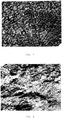
- FIG. 1 is a micrograph of a cast input "gold" beryllium-copper alloy at 100 x magnification, prior to homogenization, in accordance with one aspect of the present invention;
- FIG. 2 is a micrograph of the alloy of FIG. 1 at 100 x magnification, after the steps of thermodynamic treatment and warm working, in accordance with the present invention;
- FIG. 3 is a micrograph of the alloy of FIG. 2 at 1000 x magnification;
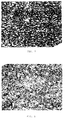
- FIG. 4 is a micrograph of the alloy of FIG. 2 at 100 x magnification, after the steps of annealing, quenching and thermal hardening in accordance with the present invention;
- FIG. 5 is a micrograph of a wrought input "gold" beryllium-copper alloy at 100 x magnification, in accordance with another aspect of the present invention;
- FIG. 6 is a micrograph of the alloy of FIG. 5 at 100 x magnification, after the steps of thermodynamic treatment and warm working in accordance with the present invention;
- FIG. 7 is a micrograph of the alloy of FIG. 6 at 1000 x magnification;
- FIG. 8 is a micrograph of the alloy of FIG. 6 at 100 x magnification, after the steps of annealing, quenching and thermal hardening in accordance with the present invention;
- FIG. 9 is a micrograph of a cast input "red" beryllium-copper alloy at 100 x magnification, prior to homogenization, in accordance with a further aspect of the present invention;
- FIG. 10 is a micrograph of the alloy of FIG. 9 at 100 x magnification, after the steps of thermodynamic treatment and warm working, in accordance with the present invention;
- FIG. 11 is a micrograph of the alloy of FIG. 10 at 1000 x magnification;
- FIG. 12 is a micrograph of the alloy of FIG. 10 at 100 x magnification, after the steps of annealing, quenching and thermal hardening in accordance with the present invention;
- FIG. 13 is a micrograph of a wrought input "red" beryllium-copper alloy at 100 x magnification, in accordance with yet another aspect of the present invention;
- FIG. 14 is a micrograph of the alloy of FIG. 13 at 100 x magnification, after the steps of thermodynamic treatment and warm working in accordance with the present invention;
- FIG. 15 is a micrograph of the alloy of FIG. 14 at 1000 x magnification;
- FIG. 16 is a micrograph of the alloy of FIG. 14 at 100 x magnification, after the steps of annealing, quenching and thermal hardening in accordance with the present invention;
- FIG. 17 is an illustrative metamorphic map of Alloy 25 showing the relationship between strain rate (s-1) and hot working temperature (°F);
- FIG. 18 is an illustrative metamorphic map of Alloy 165 showing the relationship between strain rate (s-1) and hot working temperature (°F); and
- FIG. 19 is an illustrative metamorphic map of Alloy 3, HYCON 3HP™ and PHASE 3HP™ showing the relationship between strain rate (s-1) and hot working temperature (°F).
- The same numerals are used throughout the various figures to designate similar elements.
- Still other objects and advantages of the present invention will become apparent from the following description of the preferred embodiments.
- Metamorphic alloy processing is a revolution in metallurgy. During processing, a metamorphosis takes place in the alloy somewhat analogous to that of a caterpillar's transformation into a butterfly. During an intermediate or "cocoon" stage of processing, the grain structure of the alloy becomes ugly, i.e., random, nonuniform, and chaotic. Further processing brings order out of the chaos and a super alloy emerges having a combination of properties and characteristics which are not only unique, but surpass those of any known material.
- Generally speaking, the terms "gold" and "red" alloys as used herein are intended to describe alloy appearance. Typically, a "gold" beryllium-copper alloy contains concentrations of beryllium sufficient to give the alloy a golden color. A "red" alloy typically contains relatively lesser amounts of beryllium, creating a reddish hue like that of copper.
- In accordance with one aspect of the present invention is the metamorphic processing of a "gold" beryllium-copper alloy, e.g., Alloy 25 (C17200), which comprises the steps of (i) thermodynamically treating the alloy at a first selected temperature generally within a range of 900° and 1500°F, (ii) warm working the alloy of step i at greater than about 30% strain at a strain rate ε̇ greater than or equal to about (2.210 x 10⁷)/exp[(2.873 x 104)/(T + 459.4°)], where T is in °F, at the first temperature, (iii) annealing the alloy of step ii at a second selected temperature generally within a range of 1375° and 1500°F, (iv) water quenching the alloy of step iii, and (v) thermal hardening the alloy of step iv at a third selected temperature generally within a range of 480° and 660°F.
-
Alloy 25 has been found desirable for use in underground positional sensing equipment for oil and gas drilling, as well as control bearings for aircraft landing gear. More notable characteristics in this context include strength, toughness, impact energy, corrosion resistance, and thermal conductivity. - In one embodiment, this Alloy comprises about 1.80 to about 2.00 % by weight beryllium, 0.20 to 0.35 % by weight cobalt, the balance being substantially copper.
- Upon commencement of metamorphic processing, a cast ingot or billet of
Alloy 25 is homogenized and cropped, the alloy microstructure being shown in FIG. 1. The steps of homogenization and cropping are considered familiar to those skilled in the art and further explanation is believed unnecessary for purposes of the present invention. - Next, the alloy is thermodynamically treated for greater than, e.g., about 10 hours, at a first selected temperature generally within a range of 900° to 1500°F. Preferably, this treatment occurs for a selected time greater than about 16 hours. During treatment, the alloy is heated to the first temperature and held there for the selected duration.
- Thermodynamic treatment preferably lasts greater than 16 hours at a first selected temperature generally within a range of 1000° and 1250°F. It is also preferred that annealing occur for about 30 minutes to about 1 hour and be accomplished by solution treatment. Thermal hardening for about 3 to 6 hours is particularly desirable. By the foregoing steps, grain size is refined with improvements in ultimate strength, total elongation, % reduction in area and toughness.
- After thermodynamic treatment, the alloy is warm worked. Warm working is preferably done by warm rolling the alloy, forging as with plates or bars, or by extrusion as with round products. During warm working, the alloy is maintained at the first selected temperature during which it is worked at greater than 3096 strain at a strain rate ε̇ greater than or equal to about (2.210 x 10⁷)/exp[(2.873 x 104)/(T + 495.4°)], where T is in °F. The preferred range of warm working is at greater than 50% strain generally between 0.5 and 10.0/second (or in/in/sec). A relationship between strain rate (s-1) and hot working temperature (°F) during warm working is illustrated by the metamorphic map of FIG. 17.
- An objective of thermodynamic treatment and warm working is dynamic recovery of the alloy, i.e., to set up the alloy for static recrystallization which occurs later during the annealing step.
- After the thermodynamic treatment and warm working steps (known as the metamorphic stage), a heterogeneous, quasi-amorphous, unrecrystallized (i.e., chaotic) grain structure is produced. As set forth in the micrographs of FIGS. 2 and 3 show, the grain structures produced are unlike those made by prior methods of enhancing material properties.
- After warm working, the alloy is cooled at a rate, e.g., between 1000°F/second and 1°F/hour. Generally, it has been found that the rate of cooling the alloy at this phase of the process is a relatively less significant factor.
- After cooling the alloy to a selected temperature, for example, room temperature, it is annealed at a second selected temperature generally within a range of 1375° and 1500°F for about 15 minutes to about 3 hours. The preferred range is between 1375° and 1475°F for about 30 minutes to about 1 hour.
- Finally, the ingot is cooled by water quenching or a similar process, and thermal aged (or precipitation hardened) at a third selected temperature generally within a range of 480° and 660°F for about 3 to 6 hours. Preferred times and temperatures may vary depending upon customer requirements.
- Quenching and thermal aging, it has been found, not only resurrect but also enhance alloy grain structure and properties.
- The result of metamorphic processing is a
super Alloy 25 product having a refined equiaxed uniform grain structure. Its strength is superior to that obtained by prior processing methods, and ductility, formability, conductivity, ultrasonic inspectability are improved as well as resistance to heat and corrosion. A micrograph of the alloy product is shown, for example, in FIG. 4. - A
cast Alloy 25 input, metamorphically processed by the foregoing steps, resulted in a grain size of about 10 - 30 µm (microns). The alloy mechanical properties are as follows:Yield (ksi) Ultimate (ksi) Total Elongation Reduction In Area (%) CVN (ft. lbs.) 100 140 19 40 35 160 180 8 14 5 - In an alternative embodiment of the present invention, the input is a wrought "gold" beryllium-copper alloy ingot, as shown in FIG. 5. The steps of homogenizing and cropping may be omitted at this stage, as those skilled in the art will appreciate.
- After the steps of thermodynamic treatment and warm working, the wrought alloy yields a chaotic grain microstructure as shown in FIGS. 6 and 7. Subsequent annealing, water quenching and thermal age hardening steps, in accordance with the present invention, produce a refined uniform, equiaxed grain structure as illustrated in FIG. 8.
- An ingot of
Alloy 25, processed metamorphically by the foregoing steps, also resulted in a grain size of about 10 - 30 µm, and the following mechanical properties:Yield (ksi) Ultimate (ksi) Total Elongation Reduction In Area (%) CVN (ft. lbs.) 100 140 19 40 35 160 180 8 14 5 - As this demonstrates, the properties of a selected metamorphically processed alloy have been found the same whether input in cast or wrought form. As such, this technique advantageously permits cost-effective mass production of high performance beryllium-copper alloys in cast or wrought form. An overall objective of the present invention is to improve properties of bulk alloy products such as plates and sections of beryllium-copper and other alloys.
- Specific, illustrative metamorphic processing of another "gold" beryllium-copper alloy, e.g., Alloy 165 (C17000), comprises the steps of: (i) thermodynamically treating the alloy at a first selected temperature generally within a range of 900° and 1500°F, (ii) warm working the alloy of step i at greater than about 30% strain at a strain rate ε̇ greater than or equal to about (1.009 x 10⁸)/exp[(2.873 x 104)/(T + 459.4°)], where T is in °F, at the first temperature, (iii) annealing the alloy of step ii at a second selected temperature generally within a range of 1375° and 1500°F, (iv) water quenching the alloy of step iii, and (v) thermal hardening the alloy of step iv at a third selected temperature generally within a range of about 480° and 660°F.
-
Alloy 165 has been found useful in the construction of optical amplifier housings for undersea fiber optic components, particularly for its corrosion resistance, thermal conductivity toughness and strength. - In one embodiment of the present invention,
Alloy 165 is comprised of about 1.60 to about 1.79 % beryllium, 0.20 to 0.35 % cobalt, the balance being substantially copper. - To refine grain size with concomitant improvements in ultimate strength, total elongation, % reduction in area and toughness, the alloy is preferably treated thermodynamically for greater than about 10 hours, e.g., about 16 hours, at a first selected temperature generally within a range of 1000° and 1250°F. Also, it is desirable to anneal by solution treatment for about 30 minutes to about 1 hour, and thermal harden the alloy for about 3 to 6 hours. The designated region in Fig. 18 illustrates a relationship between strain rate (s-1) and hot working temperature (°F) during warm working.
- Finally, it has been found that metamorphically processed "gold" beryllium-copper alloys have a unique property fingerprint. For instance, 3.0 times the impact energy of a metamorphically processed "gold" alloy in foot pounds plus 2.0 times its yield strength in ksi is greater than about 275.
- Turning now to a further aspect of the present invention, metamorphic processing is performed on a "red" beryllium-copper alloy. According to one embodiment, Alloy 3 (C17510) is metamorphically processed by (i) thermodynamically treating the alloy at a first selected temperature generally within a range of 900° and 1850°F, (ii) warm working the alloy of step i at greater than about 30% strain at a strain rate ε̇ greater than or equal to about (1.243 x 10⁷)/exp[(2.873 x 104)/(T + 459.4°)], where T is in °F, at the first temperature, (iii) annealing the alloy of step ii at a second selected temperature generally within a range of 1400° and 1750°F for about 15 minutes to about 3 hours, (iv) water quenching the alloy of step iii, and (v) thermal hardening the alloy of step iv at a third selected temperature generally within a range of 800° and 1000°F. By this method, a generally equiaxed uniform grain structure is again produced with concomitant improvements in mechanical properties, electrical conductivity and ultrasonic inspectability.
- Properties of
Alloy 3 such as its hardness-strength, thermal conductivity, toughness, and corrosion resistance make this alloy suitable for use in weld tooling and containers for nuclear and chemical waste. - By the present method, the alloy is preferably treated thermodynamically for greater than about 10 hours and annealed by solution treatment for about 15 minutes to about 3 hours. This is done to achieve optimum refinement in grain size and improve electrical conductivity, ultimate strength, toughness, total elongation and % reduction in area. Later, after water quenching, the alloy is hardened thermally for about 2 to 3 hours.
- Metamorphic processing of other "red" alloys, e.g.,
HYCON 3 HP™ andPHASE 3 HP™, likewise produces a generally equiaxed uniform grain structure with improved mechanical properties, electrical conductivity and ultrasonic inspectability. One such process comprises the steps of: (i) thermodynamically treating the alloy at a first selected temperature generally within a range of 900° and 1850°F, (ii) warm working the alloy of step i at greater than about 30% strain at a strain rate ε̇ greater than or equal to about (1.243 x 10⁷)/exp[(2.873 x 104)/(T + 459.4°)], where T is in °F, at the first temperature, (iii) annealing the alloy of step ii at a second selected temperature generally within a range of 1400° and 1750°F, (iv) water quenching the alloy of step iii, and (v) primary thermal hardening of the alloy of step iv at a third selected temperature generally within a range of 900° and 1000°F followed by secondary thermal hardening at a fourth selected temperature generally within a range of 700° and 900°F. -
HYCON 3 HP™ is desirable for use in nuclear fusion and cryogenic systems, particularly those high energy field magnets used for imaging. This is due to properties such as thermal and electrical conductivity, strength, toughness, corrosion resistance and ultrasonic inspectability. -
PHASE 3 HP™ is a material of choice for face plates of continuous steel casting molds. This alloy has been noted for superior thermal conductivity (and management), thermal cycling, strength, toughness, corrosion resistance and ultrasonic inspectability. - In accordance with various aspects of the present invention,
Alloy 3,HYCON 3 HP™, andPHASE 3 HP™ are comprised of about 0.20 to about 0.60 % beryllium, about 1.4 to about 2.2 % nickel, the balance being substantially copper. - Initially, according to one embodiment, a cast Alloy 3 (or HYCON) ingot is homogenized and cropped, as above. The initial microstructure is shown in FIG. 9. Alternatively, wrought input is used, as best seen in FIG. 13.
- Next, the alloy is thermodynamically treated for greater than, e.g., about 10 hours, at a first selected temperature generally within a range of 900° to 1850°F. During this step, the alloy is heated to the first temperature and held there for the selected duration.
- During warm working, the alloy is maintained at the first selected temperature during which it is worked at greater than 30% strain at a strain of ε̇ greater than or equal to about (1.243 x 10⁷)/exp[(2.873 x 104)/(T + 495.4°)], where T is in °F. The preferred range of warm working is at greater than 50% strain generally between 0.5 and 10.0/second (or in/in/sec). A relationship between strain rate (s-1) and hot working temperature (°F) for
Alloy 3, HYCON 3HP™ and PHASE 3HP™ is set forth in the metamorphic map of FIG. 19. - Micrographs of the alloy after the steps of thermodynamic treatment and warm working are shown, for example, in FIGS. 10 and 11 (from cast input) and FIGS. 14 and 15 (from wrought input). During this "metamorphic" stage, unlike prior methods of enhancing material properties, a heterogeneous, quasi-amorphous, unrecrystallized (i.e., chaotic) grain structure is produced.
- Again, warm working may be done by warm rolling or forging as with plates or bars of the alloy, or by extrusion as with round products.
- After warm working, the alloy is cooled to a selected temperature, for example, room temperature, at a rate preferably between 1000°F/second and 1°F/hour. The material is then annealed at a second selected temperature generally within a range of 1375° and 1750°F for about 15 minutes to about 3 hours. The preferred range is between 1400° and 1750°F. The alloy is cooled by water quenching or a similar process.
- Finally, an initial or primary thermal hardening step is conducted at a third selected temperature generally within a range of 900° and 1000°F. The preferred duration of this step is between about 2 to 10 hours. This is followed by secondary thermal hardening at a fourth selected temperature generally within a range of 700° and 900°F for about 10 to 30 hours. Preferred third temperatures are generally within a range of 925° and 1000°F, and fourth temperatures are generally within a range of 750° and 850°F. Specific, illustrative microstructures which result are shown in FIG. 12 (from cast input) and FIG. 16 (from wrought input).
- To refine grain size with concomitant improvements in electrical conductivity, ultimate strength, toughness, total elongation and % reduction in area, it is desirable to thermodynamically treat the alloy for greater than about 10 hours, and anneal by solution treatment for about 15 minutes to about 3 hours. It is also preferred that primary thermal hardening take place at a third selected temperature generally within a range of 925° and 1000°F for about 2 to 10 hours followed by secondary thermal hardening at a fourth selected temperature generally within a range of 750° and 850°F for about 10 to 30 hours.
- Metamorphic processing of "red" alloys, it has been found, results in a superior average grain size of, e.g., about 20 - 50 µm, which is desirable.
- In general, refinement in the size of grains having equiaxed uniform structure has many advantages. It permits finer polishability of mirrors for missile guidance systems and of plastic injection molds used in the production of compact disks. Improved thermal conductivity and ultrasonic inspectability are also useful for heat exchangers of computers.
- Metamorphically processed "red" beryllium-copper alloys, like the "gold" alloys, are further unique in the relationship of their respective properties. For example, 4.5 times the electrical conductivity of such alloy in % IACS plus the alloy yield strength in ksi is greater than about 400.
- Although the embodiments illustrated herein have been described for use with beryllium-copper alloys, it is understood that analogous processes may be practiced on other precipitation hardenable materials such as alloys of aluminum, titanium, and iron, giving consideration to the purpose for which the present invention is intended. Also, any alloy containing beryllium, including beryllium-nickel and beryllium-silver alloys, are considered within the spirit and scope of the present invention. While the present invention is intended to apply to the whole spectrum of beryllium-copper alloys in bulk sections, but other suitable applications will be appreciated.
- Various modifications and alterations to the present invention may be appreciated based on a review of this disclosure. These changes and additions are intended to be within the scope and spirit of this invention as defined by the following claims.
Claims (18)
- A method of processing a precipitation-hardenable alloy containing beryllium, aluminium, titanium or iron as the principal component, the method comprising the steps ofi) thermodynamically treating the alloy at a first selected temperature within the range of 900-1850°F,ii) warm working the alloy of step i) at greater than about 30% strain at a strain weight ε̇ greater than or equal to about (1.243 x 10⁷)/exp[(2.873 x 104)/(T + 459.4°)], where T is in °F, at the first temperature,iii) annealing the alloy of step ii) at a second temperature within the range of 1375-1750°F,iv) water quenching the alloy of step iii) andv) thermal hardening the alloy of step iv) at a third selected temperature within the range of 480-1000°F.
- A method according to Claim 1 in which the alloy contains beryllium, to produce a generally equiaxed uniform fine grain structure with concomitant improvements in mechanical properties and ultrasonic inspectability, the method comprising the steps of:i) thermodynamically treating the alloy at a first selected temperature generally within the range of 900-1500°F,ii) warm working the alloy of step i) at greater than about 30% strain at a strain weight ε̇ greater than or equal to about (2.210 x 10⁷)/exp[(2.873 x 104)/(T + 459.4°)], where T is in °F, at the first temperature,iii) annealing the alloy of step ii) at a second temperature generally within the range of 1375-1500°F,iv) water quenching the alloy of step iii), andv) thermal hardening the alloy of step iv) at a third selected temperature generally within the range of 480-660°F.
- A method according to Claim 1 in which the alloy is a beryllium-copper alloy, to produce an alloy having a refined grain size with concomitant improvements in ultimate strength, total elongation, % reduction in area and toughness, the method comprising the steps of:i) thermodynamically treating the alloy for greater than about 16 hours at a first selected temperature generally within the range of 1000-1250°F,ii) warm working the alloy of step i) at greater than about 30% strain at a strain weight ε̇ greater than or equal to about (2.210 x 10⁷)/exp[(2.873 x 104)/(T + 459.4°)], where T is in °F, at the first temperature,iii) annealing the alloy of step ii) at a second temperature generally within the range of 1375-1475°F for about 30 minutes to about 1 hour,iv) water quenching the alloy of step iii), andv) thermal hardening the alloy of step iv) at a third selected temperature generally within the range of 480-660°F for about 3 to 6 hours.
- A method according to Claim 1 in which the alloy contains beryllium, to produce a generally equiaxed uniform grain structure with concomitant improvements in mechanical properties and ultrasonic inspectability, the method comprising the steps of:i) thermodynamically treating the alloy at a first selected temperature generally within the range of 900-1500°F,ii) warm working the alloy of step i) at greater than about 30% strain at a strain weight ε̇ greater than or equal to about (1.009 x 10⁸)/exp[(2.873 x 104)/(T + 459.4°)], where T is in °F, at the first temperature,iii) annealing the alloy of step ii) at a second selected temperature generally within the range of 1375-1500°F,iv) water quenching the alloy of step iii), andv) thermal hardening the alloy of step iv) at a third selected temperature generally within the range of about 480-660°F.
- A method according to Claim 1 in which the alloy is a beryllium-copper alloy, to produce an alloy having a refined grain size with concomitant improvements in ultimate strength, total elongation, % reduction in area and toughness, the method comprising the steps of:i) thermodynamically treating the alloy for greater than 16 hours at a first selected temperature generally within the range of 1000-1250°F,ii) warm working the alloy of step i) at greater than about 30% strain at a strain weight ε̇ greater than or equal to about (1.009 x 10⁸)/exp[(2.873 x 104)/(T + 459.4°)], where T is in °F, at the first temperature,iii) annealing the alloy of step ii) at a second temperature generally within the range of 1375-1475°F for about 30 minutes to about 1 hour,iv) water quenching the alloy of step iii), andv) thermal hardening the alloy of step iv) at a third selected temperature generally within the range of 480-660°F for about 3 to 6 hours.
- A method according to Claim 1 in which the alloy contains beryllium, to produce a generally equiaxed uniform grain structure with concomitant improvements in mechanical properties, electrical conductivity and ultrasonic inspectability, the method comprising the steps of:i) thermodynamically treating the alloy at a first selected temperature generally within the range of 900-1850°F,ii) warm working the alloy of step i) at greater than about 30% strain at a strain weight ε̇ greater than or equal to about (1.243 x 10⁷)/exp[(2.873 x 104)/(T + 459.4°)], where T is in °F, at the first temperature,iii) annealing the alloy of step ii) at a second selected temperature generally within the range of 1400-1750°F for about 15 minutes to about 3 hours,iv) water quenching the alloy of step iii), andv) thermal hardening the alloy of step iv) at a third selected temperature generally within the range of 800-1000°F.
- A method according to Claim 1, in which the alloy is a beryllium-copper alloy, to produce an alloy having a refined grain size with concomitant improvements in electrical conductivity, ultimate strength, total elongation, % reduction in area and toughness, the method comprising the steps of:i) thermodynamically treating the alloy for greater than about 10 hours at a first selected temperature generally within the range of 900-1850°F,ii) warm working the alloy of step i) at greater than about 30% strain at a strain weight ε̇ greater than or equal to about (1.243 x 10⁷)/exp[(2.873 x 104)/(T + 459.4°)], where T is in °F, at the first temperature,iii) annealing the alloy of step ii) at a second selected temperature generally within the range of 1400-1750°F for about 15 minutes to about 3 hours,iv) water quenching the alloy of step iii), andv) thermal hardening the alloy of step iv) at a third selected temperature generally within the range of 900-950°F for about 2 to 3 hours.
- A method according to Claim 2 in which the alloy contains beryllium, to produce a generally equiaxed uniform grain structure with concomitant improvements in mechanical properties, electrical conductivity and ultrasonic inspectability, the method comprising the steps of:i) thermodynamically treating the alloy at a first selected temperature generally within the range of 900-1850°F,ii) warm working the alloy of step i) at greater than about 30% strain at a strain weight ε̇ greater than or equal to about (1.243 x 10⁷)/exp[(2.873 x 104)/(T + 459.4°)], where T is in °F, at the first temperature,iii) annealing the alloy of step ii) at a second selected temperature generally within the range of 1400-1750°F,iv) water quenching the alloy of step iii), andv) primary thermal hardening of the alloy of step iv) at a third selected temperature generally within the range of 900-1000°F followed by secondary thermal hardening at a fourth selected temperature generally within the range of 700-900°F.
- A method according to Claim 1 in which the alloy is a beryllium-copper alloy, to produce an alloy having a refined grain size with concomitant improvements in electrical conductivity, ultimate strength, total elongation, % reduction in area and toughness, the method comprising the steps of:i) thermodynamically treating the alloy for greater than about 10 hours at a first selected temperature generally within the range of 900-1850°F,ii) warm working the alloy of step i) at greater than about 30% strain at a strain weight ε̇ greater than or equal to about (1.243 x 10⁷)/exp[(2.873 x 104)/(T + 459.4°)], where T is in °F, at the first temperature,iii) annealing the alloy of step ii) at a second selected temperature generally within the range of 1400-1750°F for about 15 minutes to about 3 hours,iv) water quenching the alloy of step iii), andv) primary thermal hardening of the alloy of step iv) at a third selected temperature generally within the range of 925-1000°F for about 2 to 10 hours followed by secondary thermal hardening at a fourth selected temperature generally within the range of 750-850°F for about 10 to 30 hours.
- A method of metamorphic processing of a material so as to produce a generally equiaxed uniform fine grain structure with concomitant improvements in material properties and characteristics, the method comprising the steps of:i) thermodynamically treating the material at a first selected temperature generally within the range of 900-1700°F,ii) warm working the alloy of step i) at greater than about 30% strain at a strain weight ε̇ greater than or equal to about (1.243 x 10⁷)/exp[(2.873 x 104)/(T + 459.4°)], where T is in °F, at the first temperature,iii) annealing the alloy of step ii) at a second selected temperature generally within the range of 1375-1750°F,iv) water quenching the material of step iii), andv) thermal hardening the material of step iv) at a third selected temperature generally within the range of 600-1000°F.
- A method according to any preceding claim, in which the alloy input is a cast ingot homogenized prior to step i).
- A method according to Claim 11, in which the alloy of step ii) is cooled between steps ii) and iii) at a rate generally within the range of 1000°F/second and 1°F/hour.
- A process according to any preceding claim, in which the alloy input is in wrought form.
- A process according to any preceding claim, in which the alloy of step i) is warm worked by warm rolling.
- A process according to any of Claims 1 to 13, in which the alloy of step i) is warm worked by warm forging.
- A process according to any of Claims 1 to 13, in which the alloy of step i) is warm worked by warm extrusion.
- A metamorphically processed beryllium-copper alloy where 4.5 times the electrical conductivity of the alloy in %IACS plus the alloy yield strength in ksi is greater than about 400.
- A metamorphically processed beryllium-copper alloy where 3.0 times the impact energy of the alloy in foot pounds plus 2.0 times the alloy yield strength in ksi is greater than about 275.
Applications Claiming Priority (2)
| Application Number | Priority Date | Filing Date | Title |
|---|---|---|---|
| US38213195A | 1995-02-01 | 1995-02-01 | |
| US382131 | 1999-08-24 |
Publications (2)
| Publication Number | Publication Date |
|---|---|
| EP0725157A1 true EP0725157A1 (en) | 1996-08-07 |
| EP0725157B1 EP0725157B1 (en) | 2001-03-07 |
Family
ID=23507643
Family Applications (1)
| Application Number | Title | Priority Date | Filing Date |
|---|---|---|---|
| EP95308216A Expired - Lifetime EP0725157B1 (en) | 1995-02-01 | 1995-11-16 | Processing of alloys and products so produced |
Country Status (8)
| Country | Link |
|---|---|
| US (1) | US5651844A (en) |
| EP (1) | EP0725157B1 (en) |
| JP (1) | JP2827102B2 (en) |
| KR (1) | KR100245766B1 (en) |
| BR (1) | BR9600291A (en) |
| CA (1) | CA2164064C (en) |
| DE (1) | DE69520268T2 (en) |
| FI (1) | FI112505B (en) |
Cited By (1)
| Publication number | Priority date | Publication date | Assignee | Title |
|---|---|---|---|---|
| EP2665839B1 (en) * | 2011-01-21 | 2018-12-26 | Carl Zeiss SMT GmbH | Mirrors for euv lithography |
Families Citing this family (8)
| Publication number | Priority date | Publication date | Assignee | Title |
|---|---|---|---|---|
| US6001196A (en) * | 1996-10-28 | 1999-12-14 | Brush Wellman, Inc. | Lean, high conductivity, relaxation-resistant beryllium-nickel-copper alloys |
| DE10018504A1 (en) * | 2000-04-14 | 2001-10-18 | Sms Demag Ag | Use of a hardenable copper alloy containing beryllium and nickel for molds for producing plates for thin slab continuous casting molds |
| KR101467617B1 (en) * | 2008-03-28 | 2014-12-01 | 엔지케이 인슐레이터 엘티디 | Forged beryllium-copper bulk material |
| CN104769139B (en) | 2012-11-02 | 2017-06-09 | 日本碍子株式会社 | Cu-Be alloy and its manufacturing method |
| EP3710608B1 (en) * | 2017-11-17 | 2024-02-14 | Materion Corporation | Process for making a metal ring from a beryllium-copper alloy, metal ring made of a beryllium-copper alloy, an amorphous metal casting apparatus |
| JP6702296B2 (en) * | 2017-12-08 | 2020-06-03 | 株式会社村田製作所 | Electronic parts |
| CN113832420B (en) * | 2020-06-24 | 2022-04-19 | 南京理工大学 | Method for improving elastic performance and prolonging service life of beryllium bronze bean pod rod |
| CN113333696B (en) * | 2021-06-01 | 2023-02-17 | 西峡龙成特种材料有限公司 | CuAlFeNi crystallizer copper plate back plate, parent metal and machining method thereof |
Citations (4)
| Publication number | Priority date | Publication date | Assignee | Title |
|---|---|---|---|---|
| JPS5938367A (en) * | 1982-08-28 | 1984-03-02 | Sumitomo Electric Ind Ltd | Manufacture of functional copper alloy member |
| US4565586A (en) | 1984-06-22 | 1986-01-21 | Brush Wellman Inc. | Processing of copper alloys |
| US4599120A (en) | 1985-02-25 | 1986-07-08 | Brush Wellman Inc. | Processing of copper alloys |
| EP0390374A1 (en) * | 1989-03-15 | 1990-10-03 | Ngk Insulators, Ltd. | Method of hot forming copper-beryllium alloy and hot formed product thereof |
Family Cites Families (18)
| Publication number | Priority date | Publication date | Assignee | Title |
|---|---|---|---|---|
| US3201234A (en) * | 1961-09-25 | 1965-08-17 | Beryllium Corp | Alloy and method of producing the same |
| US4067750A (en) * | 1976-01-28 | 1978-01-10 | Olin Corporation | Method of processing copper base alloys |
| SE7712631L (en) * | 1976-11-19 | 1978-05-20 | Olin Corp | PROCEDURE FOR TREATMENT OF COPPER ALLOYS |
| US4077811A (en) * | 1977-03-01 | 1978-03-07 | Amax, Inc. | Process for "Black Fabrication" of molybdenum and molybdenum alloy wrought products |
| US4394185A (en) * | 1982-03-30 | 1983-07-19 | Cabot Berylco, Inc. | Processing for copper beryllium alloys |
| US4425168A (en) * | 1982-09-07 | 1984-01-10 | Cabot Corporation | Copper beryllium alloy and the manufacture thereof |
| JPS6335762A (en) * | 1986-07-30 | 1988-02-16 | Nippon Steel Corp | Manufacture of continuous casting mold |
| DE3773470D1 (en) * | 1986-11-13 | 1991-11-07 | Ngk Insulators Ltd | PRODUCTION OF COPPER-BERYLLIUM ALLOYS. |
| JPS6423526A (en) * | 1987-07-20 | 1989-01-26 | Matsushita Electronics Corp | Equipment for manufactureing semiconductor device |
| US4931105A (en) * | 1989-02-16 | 1990-06-05 | Beryllium Copper Processes L.P. | Process for heat treating beryllium copper |
| JPH03294462A (en) * | 1990-04-13 | 1991-12-25 | Furukawa Electric Co Ltd:The | Solid solution treatment of precipitation hardening copper alloy |
| JPH046787A (en) * | 1990-04-24 | 1992-01-10 | Fujikura Ltd | Planar heater |
| JPH04218630A (en) * | 1990-12-17 | 1992-08-10 | Nikko Kyodo Co Ltd | Copper alloy for metal mold for plastic molding having high strength and high thermal conductivity and its production |
| JPH04221031A (en) * | 1990-12-21 | 1992-08-11 | Nikko Kyodo Co Ltd | High strength and high thermal conductivity copper alloy for die for plastic molding and its manufacture |
| JPH0774420B2 (en) * | 1991-02-21 | 1995-08-09 | 日本碍子株式会社 | Method for producing beryllium copper alloy |
| JPH04308067A (en) * | 1991-04-05 | 1992-10-30 | Ngk Insulators Ltd | Production of source of oscillation for musical instrument |
| DE4142941A1 (en) * | 1991-12-24 | 1993-07-01 | Kabelmetal Ag | USE OF A CURABLE copper alloy |
| US5388319A (en) * | 1992-03-24 | 1995-02-14 | Ngk Insulators, Ltd. | Method for making organism deposit-inhibiting pipe |
-
1995
- 1995-11-16 EP EP95308216A patent/EP0725157B1/en not_active Expired - Lifetime
- 1995-11-16 DE DE69520268T patent/DE69520268T2/en not_active Expired - Lifetime
- 1995-11-29 CA CA002164064A patent/CA2164064C/en not_active Expired - Lifetime
- 1995-12-29 FI FI956313A patent/FI112505B/en not_active IP Right Cessation
-
1996
- 1996-01-31 BR BR9600291A patent/BR9600291A/en not_active Application Discontinuation
- 1996-01-31 JP JP8035724A patent/JP2827102B2/en not_active Expired - Lifetime
- 1996-02-01 KR KR1019960002466A patent/KR100245766B1/en not_active Expired - Lifetime
- 1996-08-07 US US08/692,981 patent/US5651844A/en not_active Expired - Lifetime
Patent Citations (4)
| Publication number | Priority date | Publication date | Assignee | Title |
|---|---|---|---|---|
| JPS5938367A (en) * | 1982-08-28 | 1984-03-02 | Sumitomo Electric Ind Ltd | Manufacture of functional copper alloy member |
| US4565586A (en) | 1984-06-22 | 1986-01-21 | Brush Wellman Inc. | Processing of copper alloys |
| US4599120A (en) | 1985-02-25 | 1986-07-08 | Brush Wellman Inc. | Processing of copper alloys |
| EP0390374A1 (en) * | 1989-03-15 | 1990-10-03 | Ngk Insulators, Ltd. | Method of hot forming copper-beryllium alloy and hot formed product thereof |
Non-Patent Citations (1)
| Title |
|---|
| DATABASE WPI Section Ch Week 8415, Derwent World Patents Index; Class M29, AN 84-091748, XP002003090 * |
Cited By (2)
| Publication number | Priority date | Publication date | Assignee | Title |
|---|---|---|---|---|
| EP2665839B1 (en) * | 2011-01-21 | 2018-12-26 | Carl Zeiss SMT GmbH | Mirrors for euv lithography |
| US10935704B2 (en) | 2011-01-21 | 2021-03-02 | Carl Zeiss Smt Gmbh | Substrate for an EUV-lithography mirror |
Also Published As
| Publication number | Publication date |
|---|---|
| EP0725157B1 (en) | 2001-03-07 |
| FI112505B (en) | 2003-12-15 |
| BR9600291A (en) | 1997-12-23 |
| CA2164064C (en) | 2009-01-20 |
| JP2827102B2 (en) | 1998-11-18 |
| KR960031639A (en) | 1996-09-17 |
| FI956313A0 (en) | 1995-12-29 |
| KR100245766B1 (en) | 2000-04-01 |
| CA2164064A1 (en) | 1996-08-02 |
| DE69520268T2 (en) | 2001-08-09 |
| JPH08302451A (en) | 1996-11-19 |
| FI956313L (en) | 1996-08-02 |
| DE69520268D1 (en) | 2001-04-12 |
| US5651844A (en) | 1997-07-29 |
Similar Documents
| Publication | Publication Date | Title |
|---|---|---|
| US5904062A (en) | Equal channel angular extrusion of difficult-to-work alloys | |
| Froes et al. | The beta titanium alloys | |
| US5861070A (en) | Titanium-aluminum-vanadium alloys and products made using such alloys | |
| EP2324137B1 (en) | Process for forming aluminium alloy sheet components | |
| US5032189A (en) | Method for refining the microstructure of beta processed ingot metallurgy titanium alloy articles | |
| JPS58213840A (en) | Metal composition suitable for producing semi-solid semi-liquid state and manufacture | |
| JP2013525608A (en) | Damage-resistant aluminum material with hierarchical microstructure | |
| US6274015B1 (en) | Diffusion bonded sputtering target assembly with precipitation hardened backing plate and method of making same | |
| JPS6350414B2 (en) | ||
| US5194102A (en) | Method for increasing the strength of aluminum alloy products through warm working | |
| EP1143021B1 (en) | Casting and forging employing copper base alloy | |
| EP0725157B1 (en) | Processing of alloys and products so produced | |
| KR100315076B1 (en) | Diffusion-bonded sputtering target assembly with precipitation hardened backplate and method of manufacturing the same | |
| US6451185B2 (en) | Diffusion bonded sputtering target assembly with precipitation hardened backing plate and method of making same | |
| RU2123065C1 (en) | Process of manufacture of tubular articles from zirconium alloys ( versions ) | |
| GB1566776A (en) | Processing chromium-containing precipitation hardenable copper base alloys | |
| JPH01272750A (en) | Production of expanded material of alpha plus beta ti alloy | |
| US3717511A (en) | Process for making hardenable copper alloy products | |
| EP0411537B1 (en) | Process for preparing titanium and titanium alloy materials having a fine equiaxed microstructure | |
| JPH03193850A (en) | Production of titanium and titanium alloy having fine acicular structure | |
| US6190468B1 (en) | Metamorphic processing of alloys and products thereof | |
| EP0460809B1 (en) | Method of treatment of metal matrix composites | |
| WO1995024514A1 (en) | Heat treatment for thick aluminum plate | |
| EP0694085A1 (en) | Improving mechanical properties of aluminum-lithium alloys | |
| JPH0663076B2 (en) | Method for producing titanium alloy material having equiaxed fine grain (α + β) two-phase structure |
Legal Events
| Date | Code | Title | Description |
|---|---|---|---|
| PUAI | Public reference made under article 153(3) epc to a published international application that has entered the european phase |
Free format text: ORIGINAL CODE: 0009012 |
|
| AK | Designated contracting states |
Kind code of ref document: A1 Designated state(s): CH DE FR GB IT LI SE |
|
| 17P | Request for examination filed |
Effective date: 19960902 |
|
| 17Q | First examination report despatched |
Effective date: 19961106 |
|
| GRAG | Despatch of communication of intention to grant |
Free format text: ORIGINAL CODE: EPIDOS AGRA |
|
| GRAG | Despatch of communication of intention to grant |
Free format text: ORIGINAL CODE: EPIDOS AGRA |
|
| GRAH | Despatch of communication of intention to grant a patent |
Free format text: ORIGINAL CODE: EPIDOS IGRA |
|
| GRAH | Despatch of communication of intention to grant a patent |
Free format text: ORIGINAL CODE: EPIDOS IGRA |
|
| GRAA | (expected) grant |
Free format text: ORIGINAL CODE: 0009210 |
|
| AK | Designated contracting states |
Kind code of ref document: B1 Designated state(s): CH DE FR GB IT LI SE |
|
| REG | Reference to a national code |
Ref country code: CH Ref legal event code: EP |
|
| REF | Corresponds to: |
Ref document number: 69520268 Country of ref document: DE Date of ref document: 20010412 |
|
| REG | Reference to a national code |
Ref country code: CH Ref legal event code: NV Representative=s name: AMMANN PATENTANWAELTE AG BERN |
|
| ET | Fr: translation filed | ||
| ITF | It: translation for a ep patent filed | ||
| REG | Reference to a national code |
Ref country code: GB Ref legal event code: IF02 |
|
| PLBE | No opposition filed within time limit |
Free format text: ORIGINAL CODE: 0009261 |
|
| STAA | Information on the status of an ep patent application or granted ep patent |
Free format text: STATUS: NO OPPOSITION FILED WITHIN TIME LIMIT |
|
| 26N | No opposition filed | ||
| PGFP | Annual fee paid to national office [announced via postgrant information from national office to epo] |
Ref country code: FR Payment date: 20141118 Year of fee payment: 20 Ref country code: CH Payment date: 20141127 Year of fee payment: 20 Ref country code: SE Payment date: 20141128 Year of fee payment: 20 Ref country code: DE Payment date: 20141128 Year of fee payment: 20 Ref country code: GB Payment date: 20141127 Year of fee payment: 20 |
|
| PGFP | Annual fee paid to national office [announced via postgrant information from national office to epo] |
Ref country code: IT Payment date: 20141126 Year of fee payment: 20 |
|
| REG | Reference to a national code |
Ref country code: DE Ref legal event code: R071 Ref document number: 69520268 Country of ref document: DE |
|
| REG | Reference to a national code |
Ref country code: CH Ref legal event code: PL |
|
| REG | Reference to a national code |
Ref country code: GB Ref legal event code: PE20 Expiry date: 20151115 |
|
| PG25 | Lapsed in a contracting state [announced via postgrant information from national office to epo] |
Ref country code: GB Free format text: LAPSE BECAUSE OF EXPIRATION OF PROTECTION Effective date: 20151115 |