EP0725149B1 - Method of detecting nucleic acid - Google Patents
Method of detecting nucleic acid Download PDFInfo
- Publication number
- EP0725149B1 EP0725149B1 EP95907490A EP95907490A EP0725149B1 EP 0725149 B1 EP0725149 B1 EP 0725149B1 EP 95907490 A EP95907490 A EP 95907490A EP 95907490 A EP95907490 A EP 95907490A EP 0725149 B1 EP0725149 B1 EP 0725149B1
- Authority
- EP
- European Patent Office
- Prior art keywords
- polyamine
- nucleic acid
- detecting
- label
- precursor
- Prior art date
- Legal status (The legal status is an assumption and is not a legal conclusion. Google has not performed a legal analysis and makes no representation as to the accuracy of the status listed.)
- Expired - Lifetime
Links
Images



Classifications
-
- C—CHEMISTRY; METALLURGY
- C12—BIOCHEMISTRY; BEER; SPIRITS; WINE; VINEGAR; MICROBIOLOGY; ENZYMOLOGY; MUTATION OR GENETIC ENGINEERING
- C12Q—MEASURING OR TESTING PROCESSES INVOLVING ENZYMES, NUCLEIC ACIDS OR MICROORGANISMS; COMPOSITIONS OR TEST PAPERS THEREFOR; PROCESSES OF PREPARING SUCH COMPOSITIONS; CONDITION-RESPONSIVE CONTROL IN MICROBIOLOGICAL OR ENZYMOLOGICAL PROCESSES
- C12Q1/00—Measuring or testing processes involving enzymes, nucleic acids or microorganisms; Compositions therefor; Processes of preparing such compositions
- C12Q1/68—Measuring or testing processes involving enzymes, nucleic acids or microorganisms; Compositions therefor; Processes of preparing such compositions involving nucleic acids
-
- C—CHEMISTRY; METALLURGY
- C12—BIOCHEMISTRY; BEER; SPIRITS; WINE; VINEGAR; MICROBIOLOGY; ENZYMOLOGY; MUTATION OR GENETIC ENGINEERING
- C12Q—MEASURING OR TESTING PROCESSES INVOLVING ENZYMES, NUCLEIC ACIDS OR MICROORGANISMS; COMPOSITIONS OR TEST PAPERS THEREFOR; PROCESSES OF PREPARING SUCH COMPOSITIONS; CONDITION-RESPONSIVE CONTROL IN MICROBIOLOGICAL OR ENZYMOLOGICAL PROCESSES
- C12Q1/00—Measuring or testing processes involving enzymes, nucleic acids or microorganisms; Compositions therefor; Processes of preparing such compositions
- C12Q1/68—Measuring or testing processes involving enzymes, nucleic acids or microorganisms; Compositions therefor; Processes of preparing such compositions involving nucleic acids
- C12Q1/6813—Hybridisation assays
- C12Q1/6816—Hybridisation assays characterised by the detection means
-
- C—CHEMISTRY; METALLURGY
- C12—BIOCHEMISTRY; BEER; SPIRITS; WINE; VINEGAR; MICROBIOLOGY; ENZYMOLOGY; MUTATION OR GENETIC ENGINEERING
- C12Q—MEASURING OR TESTING PROCESSES INVOLVING ENZYMES, NUCLEIC ACIDS OR MICROORGANISMS; COMPOSITIONS OR TEST PAPERS THEREFOR; PROCESSES OF PREPARING SUCH COMPOSITIONS; CONDITION-RESPONSIVE CONTROL IN MICROBIOLOGICAL OR ENZYMOLOGICAL PROCESSES
- C12Q1/00—Measuring or testing processes involving enzymes, nucleic acids or microorganisms; Compositions therefor; Processes of preparing such compositions
- C12Q1/26—Measuring or testing processes involving enzymes, nucleic acids or microorganisms; Compositions therefor; Processes of preparing such compositions involving oxidoreductase
- C12Q1/28—Measuring or testing processes involving enzymes, nucleic acids or microorganisms; Compositions therefor; Processes of preparing such compositions involving oxidoreductase involving peroxidase
-
- C—CHEMISTRY; METALLURGY
- C12—BIOCHEMISTRY; BEER; SPIRITS; WINE; VINEGAR; MICROBIOLOGY; ENZYMOLOGY; MUTATION OR GENETIC ENGINEERING
- C12Q—MEASURING OR TESTING PROCESSES INVOLVING ENZYMES, NUCLEIC ACIDS OR MICROORGANISMS; COMPOSITIONS OR TEST PAPERS THEREFOR; PROCESSES OF PREPARING SUCH COMPOSITIONS; CONDITION-RESPONSIVE CONTROL IN MICROBIOLOGICAL OR ENZYMOLOGICAL PROCESSES
- C12Q1/00—Measuring or testing processes involving enzymes, nucleic acids or microorganisms; Compositions therefor; Processes of preparing such compositions
- C12Q1/34—Measuring or testing processes involving enzymes, nucleic acids or microorganisms; Compositions therefor; Processes of preparing such compositions involving hydrolase
- C12Q1/42—Measuring or testing processes involving enzymes, nucleic acids or microorganisms; Compositions therefor; Processes of preparing such compositions involving hydrolase involving phosphatase
-
- C—CHEMISTRY; METALLURGY
- C12—BIOCHEMISTRY; BEER; SPIRITS; WINE; VINEGAR; MICROBIOLOGY; ENZYMOLOGY; MUTATION OR GENETIC ENGINEERING
- C12Q—MEASURING OR TESTING PROCESSES INVOLVING ENZYMES, NUCLEIC ACIDS OR MICROORGANISMS; COMPOSITIONS OR TEST PAPERS THEREFOR; PROCESSES OF PREPARING SUCH COMPOSITIONS; CONDITION-RESPONSIVE CONTROL IN MICROBIOLOGICAL OR ENZYMOLOGICAL PROCESSES
- C12Q1/00—Measuring or testing processes involving enzymes, nucleic acids or microorganisms; Compositions therefor; Processes of preparing such compositions
- C12Q1/68—Measuring or testing processes involving enzymes, nucleic acids or microorganisms; Compositions therefor; Processes of preparing such compositions involving nucleic acids
- C12Q1/6813—Hybridisation assays
Definitions
- the present invention relates to a method of detecting a nucleic acid using property in which a polyamine binds electrostatically to a nucleic acid.
- ethidium bromide As a conventional method of detection of nucleic acids, methods using ethidium bromide have been widely adopted.
- the known method comprises intercalation of ethidium bromide into a nucleic acid so as to emit fluorescence by which a location of a nucleic acid is detected.
- fluorescence cannot be detected in the light and the locations of nucleic acids can be detected only by comparing the original gel to a photograph thereof which was taken under ultraviolet radiation in the dark.
- ethidium bromide requires careful handling because of its strong carcinogenic property (cf. Gene Operation Manual, page 2, lines 18 - 21, Kodansha Scientific Press).
- the object of the present invention is thus to provide
- a nucleic acid means a polymer in which nucleotides consisting of a purine or pyrimidine base, a pentose and phosphoric acid as a basic unit are polymerized by ester linkages of the phosphoric acids.
- a base there are included adenine, cytosine, guanine, thymine and uracil, and modified bases thereof.
- Nucleic acids are distinguished by a sugar moiety into DNA and RNA, by the number of strands into single and double stranded nucleic acids and also by steric structure.
- solid carrier there may be exemplified a thin plate, a sheet, a strip, a slab, film, membrane, etc. There are typically mentioned agarose gel, nylon membrane, filter paper, nitrocellulose membrane, etc.
- a label means a substance which generates a measurable signal and includes an enzyme (in corporation with a substrate), a spin compound, a radioactive nuclear atom, a fluorescent substance, a chemiluminescent substance, an absorption substance, etc, with an enzyme being preferred.
- an enzyme there may be included peroxidase, ⁇ -galactosidase, glucose oxidase, alkaline phosphatase, glucose-6-phosphate dehydrogenase, etc.
- peroxidase ⁇ -galactosidase, glucose oxidase, alkaline phosphatase, glucose-6-phosphate dehydrogenase, etc.
- absorption method fluorescence method and chemiluminescence method.
- peroxidase is used in corporation with a chromogen, such as 2,2'-azinodi(3-ethylbenzthiazolin)-6'-sulfonate (ABTS) and the color developed is measured by the absorption method.
- a chromogen such as 2,2'-azinodi(3-ethylbenzthiazolin)-6'-sulfonate (ABTS)
- ABTS 2,2'-azinodi(3-ethylbenzthiazolin)-6'-sulfonate
- Glucose oxidase produces hydrogen peroxide from glucose as a substrate and therefore, it can be determined by the same way as above by conjugating with peroxidase.
- ⁇ -galactosidase can be determined using o-nitrophenyl- ⁇ -D-galactoside as a substrate.
- peroxidase can be determined using p-hydroxyphenyl-propionic acid as a substrate
- ⁇ -galactosidase can be determined using fluorescein- ⁇ -galactosidase or 4-methylunbelliferyl- ⁇ -D-galactoside as a substrate
- phosphatase can be measured using unbelliferyl phosphate or bromochloroindolyl phosphate/nitroblue-tetrazolium as a substrate.
- peroxidase can be measured using luminol and hydrogen peroxide as substrates.
- a label e.g.
- an enzyme may be bound to a polyamine by a crosslinking agent such as benzoquinone (quinhydrone), bis[2-(succinimidocarbonyloxy)ethyl]sulfon (BSOCOES), bis(sulfosuccinimidyl)-suberate (BS3), 1,2-difluoro-2,4-dinitrobenzene (DFDNB), 4,4'-diisothiocyano-2,2'-disulfostilbene disodium salt (CDIDS), dimethyl adipin-imidate dihydrochloride, N-( ⁇ -maleimidobutyryloxy)sucoinimide (GMBS), N-(4-azidophenylthio)phthalimide (APTP), N-succinimidyl-6-(4'-azido-phenyl)-1,3'-dithiopropionate (SADP), pyridine disulfide, thiophthalimide, etc
- a precursor of a label means, for example, a label blocked with a blocking substance, which can be converted into the detectable label .
- signal means visible ray, fluorescence, radioactive ray, or other electromagnetic waves and the like.
- a measured value of signal is to be related to an amount of a substance which emits the signal.
- detecting a label is to detect a signal by physical or technical means.
- polyamine herein means a compound which has an aliphatic bone having 2 or more primary amino groups and includes naturally occurring (a living body) amines and synthetic polymers.
- primary amino groups are at both ends of a chain of 3 to 50 carbon atoms, preferably, about 6 to about 15 or about 20 carbon atoms, and the chain may be interrupted by one or more imino groups.
- polyamine there may be included 1,3-diaminopropane, putrescine, cadaverine, norspermidine, spermidine, homospermidine, aminopropylcadaverine, telmine, spermine, thermospermine, canavalmine, aminopentylnorspermidine, N,N'-bis(aminopropyl)cadaverine, caldopentamine, homocaldopentamine, caldohexamine, etc.
- a typical synthetic polyamine includes diethylenetriamine, triethylenetetramine, tetraethylenepentamine, pentaethylenehexamine, hexamethylenediamine, polyethyleneimine (an average molcular weight is about 10,000 - about 200,000, preferably, about 20,000 - about 100,000, for example, about 50,000 - about 60,000, e.g. Polymin G 35 by BASF AG), etc.
- complex means to bond electrostatically and/or physically or a electrostatically and/or physically bonded product and does not mean to bond covalently or a covalently bonded product.
- Complex is generally reversible, and can be easily dissociated.
- hybridize or “hybridization” means that, when two single-stranded polynucleotides are complementary or almost complementary (for example, more than 70 %, preferably, more than 80 or 85 %, especially, more than 90 or 95 %), they bind to form a double-stranded polynucleotide.
- Under hybridization conditions means the conditions under which polynucleotides capable of hybridizing can produce a hybrid. In general, the conditions mean that a temperature is below about 70 °C, preferably below about 60 °C, generally below about 40 to 55 °C and a period that is short enough for hybridization.
- Probe is a DNA which is highly complementary to the target DNA and a part thereof and, in general, is shorter than the target DNA and has about 5 - about 50 bases, preferably about 10 - about 40 bases, for example, about 20 - about 30 bases.
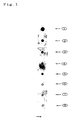
- Figure 1 shows the result of detection of ⁇ DNA in Example 1.
- Figure 2 shows the result of detection of Escherichia coli rRNA in Example 1.
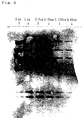
- Figure 3 represents a photograph of electrophoresis of ⁇ Hind III DNA in Example 1.
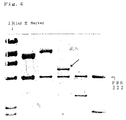
- Figure 4 represents a photograph of electrophoresis showing the result (the color development pattern according to the invention) of splitting a DNA fragment inserted into pBR322 with the restriction enzyme .
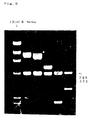
- Figure 5 represents a photograph of electrophoresis showing the result (the X-ray profile) of splitting a DNA fragment inserted into pBR322 with the restriction enzyme.
- Figure 6 represents a photograph of electrophoresis of ⁇ Hind III DNA in Example 1.
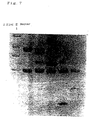
- Figure 7 like figure 6 in Example 1 represents the photograph of electrophoresis of ⁇ Hind III DNA in Example 1.
- Figure 8 shows the difference in color in Figure 7.
- a typical method of detecting a nucleic acid according to the invention may be summarized as follows:
- the reaction is considered to proceed according to the following scheme.
- ENZ represents a residue that is deleted by an amino group from an enzyme
- PA represents a residue that is deleted by an amino group from a polyamine
- X represents a primary amine or a secondary amine.
- the reaction is, for example, carried out as follows: To benzoquinone (about 1 part) is added an enzyme (about 150 parts) which has been previously purified, for example, by such a mean as dialysis, and preferably at a somewhat elevated temperature to give a reaction mixture of wine-red color, which was subjected to such a method as gel permeation chromatography and fractionated into a purple, a yellow and a wine-red fraction.
- the wine-red fraction was reacted with a polyamine (one of several parts of the enzyme) in the presence of a weak base while heating slightly to give an enzyme-labeled polyamine after suitable purification.
- Detection of a nucleic acid is for example performed as follows:
- Such a membrane as treated above develops color in itself, but not as an X-ray film and therefore, a subject nucleic acid can be directly detected on the membrane.
- amplification products having similar molecular weights, but having different sequences can be distinguished from each other by hybridization.
- the method of detecting a nucleic acid according to the invention has the following advantages:
- the method requires no dangerous reagents and can result in high sensitivity (i.e. picogram order in DNA and 10 picogram order in RNA). And also operation of the method is very easy, and if the reagents to be used in the method are incorporated into a kit, it becomes easier.
- Alkaline phosphatase (CIP, Boehringer-Mannheim GmbH, Grade 1), 0.81 ml/4.05 mg/7500 unit or horseradish peroxidase (Boehringer-Mannheim GmbH) is dialyzed against 0.1 M phosphate buffer at 40 °C overnight and then, according to a method as described in Immuno Chemistry, Vol. 14, 767-774 (1977), reacted with p-benzoquinone (120 ⁇ l/30 mg/ethanol) at 37 °C for 60 minutes in the dark.
- CIP Boehringer-Mannheim GmbH, Grade 1
- horseradish peroxidase (Boehringer-Mannheim GmbH) is dialyzed against 0.1 M phosphate buffer at 40 °C overnight and then, according to a method as described in Immuno Chemistry, Vol. 14, 767-774 (1977), reacted with p-benzoquinone (120 ⁇ l/30 mg/ethanol) at 37 °C for 60 minutes in the dark.
- ⁇ Hind III DNA or Escherichia coli K-12 rRNA was dotblotted on a nylon membrane (Biodyne A, Pall Co. Ltd.) as described in "Molecular Cloning", 1982, Cold Spring Harbour Laboratory.
- a clone of Staphylococcus aureus genome DNA which was random-cloned into a vector pBR322 was amplified according to a method known to those skilled in the art, extracted and then split with Hind III. Specimens were fractionated by 1 % agarose gel electrophoresis and the isolates were electroblotted on a membrane (40V, for 4 hours).
- ⁇ Hind III DNA was also blotted as above. The DNA or RNA specimen was subjected to baking (80 °C, 2 hours) to fix on the membrane.
- a membrane containing fixed DNA or RNA was soaked in 5mM phosphate buffer-1% bovine serum albumin (BSA, Sigma, Fraction V), incubated at room temperature for 60 minutes and then alkaline phosphatase (or peroxidase)-labelled polyethyleneimine was added in a ratio of 100 ⁇ l/20 ml thereto and incubated at 37 °C for 120 minutes.
- the membrane was washed 3 times with 5mM phosphate buffer-1 % BSA-1 % Tween 20 for 10 minutes and rinsed with 0.1 M Tris HCl (pH 9.5)-10 mM MgCl 2 .
- the membrane was developed with 50 ml of a staining solution consisting of 0.1M Tris HCl (pH 9.5)-10 mM MgCl 2 containing each 300 ⁇ l of bromochloroindolyl phosphate (BCIP: 75 mg/ml) and nitro blue tetrazolyium (NBT: 50 mg/ml).
- a staining solution consisting of 0.1M Tris HCl (pH 9.5)-10 mM MgCl 2 containing each 300 ⁇ l of bromochloroindolyl phosphate (BCIP: 75 mg/ml) and nitro blue tetrazolyium (NBT: 50 mg/ml).
- the moist membrane was wrapped in polyethylene film and the signal was detected by exposing to an X-ray film. Then, the membrane was treated for blocking with 3 % BSA - 0.1 % Tween 20 - phosphate buffer saline (PBS) at 42 °C for more than 3 hours, followed by adding 0.1 % BSA - 0.1 % Tween - PBS containing 100 ⁇ l of peroxidase-labelled polyethyleneimine per sheet, the membrane was reacted for 2 - 3 hours. The membrane was washed 3 times for 20 minutes with 0.1 % Tween 20 - PBS and developed with a diaminobenzidine (DAB) - H 2 O 2 system.
- DAB diaminobenzidine
- the membrane was washed 3 times with PBS - 0.1 % Tween 20 for 10 minutes, it was rinsed with 0.1 M Tris HCl (pH 9.5)-10 mM-MgCl 2 and then developed with BCIP - NBT system at room temperature for 20 minutes. The membrane was stored after washing with PBS - 0.1 % Tween 20.
Landscapes
- Chemical & Material Sciences (AREA)
- Organic Chemistry (AREA)
- Life Sciences & Earth Sciences (AREA)
- Zoology (AREA)
- Wood Science & Technology (AREA)
- Proteomics, Peptides & Aminoacids (AREA)
- Health & Medical Sciences (AREA)
- Engineering & Computer Science (AREA)
- Microbiology (AREA)
- Biochemistry (AREA)
- Physics & Mathematics (AREA)
- Molecular Biology (AREA)
- Biotechnology (AREA)
- Biophysics (AREA)
- Analytical Chemistry (AREA)
- Immunology (AREA)
- Bioinformatics & Cheminformatics (AREA)
- General Engineering & Computer Science (AREA)
- General Health & Medical Sciences (AREA)
- Genetics & Genomics (AREA)
- Measuring Or Testing Involving Enzymes Or Micro-Organisms (AREA)
- Saccharide Compounds (AREA)
Applications Claiming Priority (1)
| Application Number | Priority Date | Filing Date | Title |
|---|---|---|---|
| PCT/JP1993/001124 WO1995004832A1 (en) | 1992-06-18 | 1993-08-10 | Method of detecting nucleic acid |
Publications (3)
| Publication Number | Publication Date |
|---|---|
| EP0725149A1 EP0725149A1 (en) | 1996-08-07 |
| EP0725149A4 EP0725149A4 (en) | 1999-08-18 |
| EP0725149B1 true EP0725149B1 (en) | 2002-01-09 |
Family
ID=14070462
Family Applications (1)
| Application Number | Title | Priority Date | Filing Date |
|---|---|---|---|
| EP95907490A Expired - Lifetime EP0725149B1 (en) | 1993-08-10 | 1993-08-10 | Method of detecting nucleic acid |
Country Status (8)
| Country | Link |
|---|---|
| EP (1) | EP0725149B1 (da) |
| KR (1) | KR0169057B1 (da) |
| AT (1) | ATE211770T1 (da) |
| AU (1) | AU674694B2 (da) |
| CA (1) | CA2169166C (da) |
| DE (1) | DE69331443T2 (da) |
| DK (1) | DK0725149T3 (da) |
| WO (1) | WO1995004832A1 (da) |
Families Citing this family (4)
| Publication number | Priority date | Publication date | Assignee | Title |
|---|---|---|---|---|
| US6958392B2 (en) | 1998-10-09 | 2005-10-25 | Whatman, Inc. | Methods for the isolation of nucleic acids and for quantitative DNA extraction and detection for leukocyte evaluation in blood products |
| US6746841B1 (en) | 1999-04-14 | 2004-06-08 | Whatman Inc. | FTA- coated media for use as a molecular diagnostic tool |
| ATE370230T1 (de) * | 1999-04-14 | 2007-09-15 | Whatman Inc | Mit fta beschichteter träger zur verwendung als molekulares diagnosemittel |
| US6927029B2 (en) | 2001-12-03 | 2005-08-09 | Agilent Technologies, Inc. | Surface with tethered polymeric species for binding biomolecules |
Family Cites Families (5)
| Publication number | Priority date | Publication date | Assignee | Title |
|---|---|---|---|---|
| FR2422956A1 (fr) * | 1978-04-13 | 1979-11-09 | Pasteur Institut | Procede de detection et de caracterisation d'un acide nucleique ou d'une sequence de celui-ci, et reactif enzymatique pour la mise en oeuvre de ce procede |
| DE3310337A1 (de) * | 1983-03-22 | 1984-09-27 | Europäisches Laboratorium für Molekularbiologie (EMBL), 6900 Heidelberg | Verfahren zur durchfuehrung von hybridisierungsreaktionen |
| AU1701488A (en) * | 1987-04-08 | 1988-11-04 | Invitron Corporation | Detection and identification of dna and/or rna in protein-containing samples |
| US5092992A (en) * | 1989-06-07 | 1992-03-03 | J. T. Baker Inc. | Polyethyleneimine matrixes for affinity chromatography |
| JPH03128000A (ja) * | 1989-10-14 | 1991-05-31 | Sanyo Chem Ind Ltd | 核酸の検出法及び検出試薬 |
-
1993
- 1993-08-10 WO PCT/JP1993/001124 patent/WO1995004832A1/ja not_active Ceased
- 1993-08-10 CA CA002169166A patent/CA2169166C/en not_active Expired - Lifetime
- 1993-08-10 KR KR1019960700646A patent/KR0169057B1/ko not_active Expired - Lifetime
- 1993-08-10 DK DK95907490T patent/DK0725149T3/da active
- 1993-08-10 DE DE69331443T patent/DE69331443T2/de not_active Expired - Lifetime
- 1993-08-10 EP EP95907490A patent/EP0725149B1/en not_active Expired - Lifetime
- 1993-08-10 AT AT95907490T patent/ATE211770T1/de not_active IP Right Cessation
- 1993-08-10 AU AU47610/93A patent/AU674694B2/en not_active Expired
Also Published As
| Publication number | Publication date |
|---|---|
| EP0725149A1 (en) | 1996-08-07 |
| WO1995004832A1 (en) | 1995-02-16 |
| DE69331443T2 (de) | 2002-09-05 |
| DE69331443D1 (de) | 2002-02-14 |
| CA2169166C (en) | 2000-02-15 |
| AU674694B2 (en) | 1997-01-09 |
| CA2169166A1 (en) | 1995-02-16 |
| KR0169057B1 (ko) | 1999-01-15 |
| ATE211770T1 (de) | 2002-01-15 |
| KR960705058A (ko) | 1996-10-09 |
| EP0725149A4 (en) | 1999-08-18 |
| DK0725149T3 (da) | 2002-02-18 |
| AU4761093A (en) | 1995-02-28 |
Similar Documents
| Publication | Publication Date | Title |
|---|---|---|
| Kappen et al. | Deoxyribonucleic acid damage by neocarzinostatin chromophore: strand breaks generated by selective oxidation of C-5'of deoxyribose | |
| AU599083B2 (en) | Detection of microorganisms in a nucleic acid containing sample | |
| US5053326A (en) | Hybridization method and probe | |
| CA1288709C (en) | Immobilization of nucleic acids on derivatized nylon supports | |
| US5667976A (en) | Solid supports for nucleic acid hybridization assays | |
| US5348855A (en) | Assay for nucleic acid sequences in an unpurified sample | |
| US4777129A (en) | Nucleic acid probe detectable by specific nucleic acid binding protein | |
| EP0144914A2 (en) | Hybridization assay employing labeled pairs of hybrid binding reagents | |
| CA2039517A1 (en) | Dna probe signal amplification | |
| JPH0420300A (ja) | 核酸ハイブリツド形成アツセイ用固体支持体 | |
| JPS60231693A (ja) | 核酸検出用キット | |
| EP0124124A2 (en) | Method and materials useful for the analysis and detection of genetic material | |
| EP0725149B1 (en) | Method of detecting nucleic acid | |
| US5824474A (en) | Method for detecting nucleic acid | |
| Sahoo et al. | Termination of DNA replication in vitro: requirement for stereospecific interaction between two dimers of the replication terminator protein of Bacillus subtilis and with the terminator site to elicit polar contrahelicase and fork impedance. | |
| AU783653B2 (en) | Electrochemiluminescence helicase assay | |
| Heyting et al. | Hybridization of N-acetoxy-N-acetyl-2-aminofluorene-labelled RNA to Q-banded metaphase chromosomes | |
| TW309590B (da) | ||
| JP2806964B2 (ja) | 高分子コンジュゲート | |
| CA2427886A1 (en) | Method for detecting protozoae of the genus naegleria | |
| Konrad | Alkaline hydrolysis of oligoribonucleotides on chromatographic paper | |
| JPH09507756A (ja) | ハイブリダイゼーション検定および試薬 | |
| Vamvakopoulos | Conformational Properties of Polyribonucleic Acids: Studies with Yeast Transfer-RNA, Synthetic Homopolyribonucleotides and Rabbit Globin Messenger-RNA | |
| Oh | Mechanism of DNA repair by UvrABC endonuclease of Escherichia coli |
Legal Events
| Date | Code | Title | Description |
|---|---|---|---|
| PUAI | Public reference made under article 153(3) epc to a published international application that has entered the european phase |
Free format text: ORIGINAL CODE: 0009012 |
|
| 17P | Request for examination filed |
Effective date: 19960308 |
|
| AK | Designated contracting states |
Kind code of ref document: A1 Designated state(s): AT BE CH DE DK FR GB IT LI NL SE |
|
| A4 | Supplementary search report drawn up and despatched |
Effective date: 19990707 |
|
| AK | Designated contracting states |
Kind code of ref document: A4 Designated state(s): AT BE CH DE DK FR GB IT LI NL SE |
|
| 17Q | First examination report despatched |
Effective date: 20000623 |
|
| GRAG | Despatch of communication of intention to grant |
Free format text: ORIGINAL CODE: EPIDOS AGRA |
|
| GRAG | Despatch of communication of intention to grant |
Free format text: ORIGINAL CODE: EPIDOS AGRA |
|
| GRAG | Despatch of communication of intention to grant |
Free format text: ORIGINAL CODE: EPIDOS AGRA |
|
| GRAH | Despatch of communication of intention to grant a patent |
Free format text: ORIGINAL CODE: EPIDOS IGRA |
|
| GRAH | Despatch of communication of intention to grant a patent |
Free format text: ORIGINAL CODE: EPIDOS IGRA |
|
| GRAA | (expected) grant |
Free format text: ORIGINAL CODE: 0009210 |
|
| REG | Reference to a national code |
Ref country code: GB Ref legal event code: IF02 |
|
| AK | Designated contracting states |
Kind code of ref document: B1 Designated state(s): AT BE CH DE DK FR GB IT LI NL SE |
|
| REF | Corresponds to: |
Ref document number: 211770 Country of ref document: AT Date of ref document: 20020115 Kind code of ref document: T |
|
| REG | Reference to a national code |
Ref country code: CH Ref legal event code: EP |
|
| REF | Corresponds to: |
Ref document number: 69331443 Country of ref document: DE Date of ref document: 20020214 |
|
| REG | Reference to a national code |
Ref country code: CH Ref legal event code: NV Representative=s name: E. BLUM & CO. PATENTANWAELTE |
|
| REG | Reference to a national code |
Ref country code: DK Ref legal event code: T3 |
|
| ET | Fr: translation filed |
Inventor name: TANIGUCHI, MAKOTO Inventor name: SAKAGAMI, MASAHIRO Inventor name: IKEDA, MASAHIRO Inventor name: SUZUKI, KOKICHI Inventor name: YAMAMOTO, KEIJI |
|
| PLBE | No opposition filed within time limit |
Free format text: ORIGINAL CODE: 0009261 |
|
| STAA | Information on the status of an ep patent application or granted ep patent |
Free format text: STATUS: NO OPPOSITION FILED WITHIN TIME LIMIT |
|
| 26N | No opposition filed |
Inventor name: TANIGUCHI, MAKOTO Inventor name: SAKAGAMI, MASAHIRO Inventor name: IKEDA, MASAHIRO Inventor name: SUZUKI, KOKICHI Inventor name: YAMAMOTO, KEIJI |
|
| REG | Reference to a national code |
Ref country code: CH Ref legal event code: PFA Owner name: FUSO PHARMACEUTICAL INDUSTRIES LTD. Free format text: FUSO PHARMACEUTICAL INDUSTRIES LTD.#7-10, DOSHOMACHI 1-CHOME, CHUO-KU#OSAKA-SHI, OSAKA 541 (JP) -TRANSFER TO- FUSO PHARMACEUTICAL INDUSTRIES LTD.#7-10, DOSHOMACHI 1-CHOME, CHUO-KU#OSAKA-SHI, OSAKA 541 (JP) |
|
| PGFP | Annual fee paid to national office [announced via postgrant information from national office to epo] |
Ref country code: CH Payment date: 20110706 Year of fee payment: 19 Ref country code: DK Payment date: 20110822 Year of fee payment: 19 |
|
| PGFP | Annual fee paid to national office [announced via postgrant information from national office to epo] |
Ref country code: GB Payment date: 20120830 Year of fee payment: 20 Ref country code: SE Payment date: 20120824 Year of fee payment: 20 |
|
| PGFP | Annual fee paid to national office [announced via postgrant information from national office to epo] |
Ref country code: FR Payment date: 20120802 Year of fee payment: 20 Ref country code: DE Payment date: 20120928 Year of fee payment: 20 Ref country code: IT Payment date: 20120810 Year of fee payment: 20 Ref country code: BE Payment date: 20120723 Year of fee payment: 20 |
|
| PGFP | Annual fee paid to national office [announced via postgrant information from national office to epo] |
Ref country code: NL Payment date: 20120814 Year of fee payment: 20 |
|
| PGFP | Annual fee paid to national office [announced via postgrant information from national office to epo] |
Ref country code: AT Payment date: 20120820 Year of fee payment: 20 |
|
| REG | Reference to a national code |
Ref country code: DE Ref legal event code: R071 Ref document number: 69331443 Country of ref document: DE |
|
| REG | Reference to a national code |
Ref country code: DK Ref legal event code: EUP |
|
| REG | Reference to a national code |
Ref country code: DE Ref legal event code: R071 Ref document number: 69331443 Country of ref document: DE |
|
| REG | Reference to a national code |
Ref country code: CH Ref legal event code: PL |
|
| REG | Reference to a national code |
Ref country code: NL Ref legal event code: V4 Effective date: 20130810 |
|
| BE20 | Be: patent expired |
Owner name: *FUSO PHARMACEUTICAL INDUSTRIES LTD Effective date: 20130810 |
|
| REG | Reference to a national code |
Ref country code: GB Ref legal event code: PE20 Expiry date: 20130809 |
|
| REG | Reference to a national code |
Ref country code: AT Ref legal event code: MK07 Ref document number: 211770 Country of ref document: AT Kind code of ref document: T Effective date: 20130810 |
|
| REG | Reference to a national code |
Ref country code: SE Ref legal event code: EUG |
|
| PG25 | Lapsed in a contracting state [announced via postgrant information from national office to epo] |
Ref country code: DE Free format text: LAPSE BECAUSE OF EXPIRATION OF PROTECTION Effective date: 20130813 |
|
| PG25 | Lapsed in a contracting state [announced via postgrant information from national office to epo] |
Ref country code: GB Free format text: LAPSE BECAUSE OF EXPIRATION OF PROTECTION Effective date: 20130809 |