EP0723802A2 - Method for selective separation of carbon dioxide from waste gas of combustion - Google Patents
Method for selective separation of carbon dioxide from waste gas of combustion Download PDFInfo
- Publication number
- EP0723802A2 EP0723802A2 EP96300313A EP96300313A EP0723802A2 EP 0723802 A2 EP0723802 A2 EP 0723802A2 EP 96300313 A EP96300313 A EP 96300313A EP 96300313 A EP96300313 A EP 96300313A EP 0723802 A2 EP0723802 A2 EP 0723802A2
- Authority
- EP
- European Patent Office
- Prior art keywords
- carbon dioxide
- waste gas
- gas
- adsorbent
- temperature
- Prior art date
- Legal status (The legal status is an assumption and is not a legal conclusion. Google has not performed a legal analysis and makes no representation as to the accuracy of the status listed.)
- Withdrawn
Links
Images
Classifications
-
- B—PERFORMING OPERATIONS; TRANSPORTING
- B01—PHYSICAL OR CHEMICAL PROCESSES OR APPARATUS IN GENERAL
- B01D—SEPARATION
- B01D53/00—Separation of gases or vapours; Recovering vapours of volatile solvents from gases; Chemical or biological purification of waste gases, e.g. engine exhaust gases, smoke, fumes, flue gases, aerosols
- B01D53/02—Separation of gases or vapours; Recovering vapours of volatile solvents from gases; Chemical or biological purification of waste gases, e.g. engine exhaust gases, smoke, fumes, flue gases, aerosols by adsorption, e.g. preparative gas chromatography
-
- B—PERFORMING OPERATIONS; TRANSPORTING
- B01—PHYSICAL OR CHEMICAL PROCESSES OR APPARATUS IN GENERAL
- B01D—SEPARATION
- B01D53/00—Separation of gases or vapours; Recovering vapours of volatile solvents from gases; Chemical or biological purification of waste gases, e.g. engine exhaust gases, smoke, fumes, flue gases, aerosols
- B01D53/34—Chemical or biological purification of waste gases
- B01D53/46—Removing components of defined structure
- B01D53/62—Carbon oxides
-
- B—PERFORMING OPERATIONS; TRANSPORTING
- B01—PHYSICAL OR CHEMICAL PROCESSES OR APPARATUS IN GENERAL
- B01D—SEPARATION
- B01D2257/00—Components to be removed
- B01D2257/50—Carbon oxides
-
- Y—GENERAL TAGGING OF NEW TECHNOLOGICAL DEVELOPMENTS; GENERAL TAGGING OF CROSS-SECTIONAL TECHNOLOGIES SPANNING OVER SEVERAL SECTIONS OF THE IPC; TECHNICAL SUBJECTS COVERED BY FORMER USPC CROSS-REFERENCE ART COLLECTIONS [XRACs] AND DIGESTS
- Y02—TECHNOLOGIES OR APPLICATIONS FOR MITIGATION OR ADAPTATION AGAINST CLIMATE CHANGE
- Y02C—CAPTURE, STORAGE, SEQUESTRATION OR DISPOSAL OF GREENHOUSE GASES [GHG]
- Y02C20/00—Capture or disposal of greenhouse gases
- Y02C20/40—Capture or disposal of greenhouse gases of CO2
-
- Y—GENERAL TAGGING OF NEW TECHNOLOGICAL DEVELOPMENTS; GENERAL TAGGING OF CROSS-SECTIONAL TECHNOLOGIES SPANNING OVER SEVERAL SECTIONS OF THE IPC; TECHNICAL SUBJECTS COVERED BY FORMER USPC CROSS-REFERENCE ART COLLECTIONS [XRACs] AND DIGESTS
- Y10—TECHNICAL SUBJECTS COVERED BY FORMER USPC
- Y10S—TECHNICAL SUBJECTS COVERED BY FORMER USPC CROSS-REFERENCE ART COLLECTIONS [XRACs] AND DIGESTS
- Y10S95/00—Gas separation: processes
- Y10S95/90—Solid sorbent
Definitions
- This invention relates to a method for the separation and recovery from a hot waste gas of combustion such gaseous components as carbon dioxide in the original hot state without cooling the hot waste gas.
- the carbon dioxide and other gaseous components thus separated and recovered in the hot state can be utilized for chemical conversion reactions without loss of thermal energy.
- the specific gaseous components can be converted with high efficiency into various useful organic substances and such gaseous components as, for example, carbon dioxide which are entrained by the waste gas can be reclaimed at a low cost.
- Known ways of separating and recovering carbon dioxide from mixed gases include the method of gas absorption, the method of low temperature separation (the method of distillation), the method of gas adsorption (the method of pressure swing adsorption and the method of temperature swing adsorption), the method of membrane separation, and the like ("Techniques for Recovery of Carbon Dioxide Gas,” p. 22, compiled by Toshinaga Kawai and published by NTS K.K., 1991, and "Atmosphere Enveloping the Earth,” p. 115, compiled by Yuji Shindo and published by Ohm K.K., 1993).
- the method of gas absorption separates carbon dioxide from a mixed gas by contacting the mixed gas at a low temperature with a liquid absorbent capable of selectively absorbing carbon dioxide, thereby effecting selective absorption of the carbon dioxide by the liquid absorbent, and then heating the resultant solution, thereby gasifying the carbon dioxide out of the solution.
- the method of low temperature separation effects the separation of carbon dioxide from a mixed gas by a procedure which comprises compressing and cooling the mixed gas until liquefaction and then subjecting the liquid mixture consequently obtained to fractional distillation.
- the method of pressure swing adsorption effects the separation of carbon dioxide from a mixed gas by a procedure which comprises pressing the mixed gas into contact with such an adsorbent as, for example, activated carbon or a molecular sieve with micropores, thereby inducing selective adsorption of carbon dioxide, and then reducing the pressure, thereby separating the adsorbed carbon dioxide.
- This method is implemented, for example, by continuously performing the operations of pressure increase, adsorption, washing, and deaeration in a column. It is highly expensive, however, on account of the cost of the energy needed for increasing the pressure, of the equipment for adsorption and of the adsorbent used for the adsorption.
- the method of temperature swing adsorption attains the separation of carbon dioxide from a mixed gas by a procedure which comprises causing the mixed gas to contact the same adsorbent as mentioned above at normal room temperature or at a lowered temperature, thereby inducing selective adsorption of carbon dioxide, and then elevating the temperature, thereby separating the adsorbed carbon dioxide.
- This method is disadvantageous in the points that it incurs a large energy cost at the step of regeneration of the adsorbent owing to the use of steam for this regeneration, entails the time-consuming operation of switching between high temperature and normal room temperature, and requires provision of a large heating device.
- the method of membrane separation attains the separation of carbon dioxide from a mixed gas by setting in place in the flow path of the mixed gas a membrane capable of selectively passing carbon dioxide, differentiating the pressure before and after the membrane, and passing the mixed gas through this membrane.
- a method for recovering valuable components from the waste gas exhausted from a furnace type carbon black production apparatus comprises removing carbon black powders from the waste gas, cooling and exposing to increased pressure the resultant waste gas, then recovering carbon dioxide and carbon monoxide from said gas by absorption with respectively suitable solvents (absorbents), and separating and recovering the hydrogen gas still remaining in the gas by the method of adsorption or the method of low temperature separation (JP-A-57-27,902).
- This method recovers carbon dioxide and carbon monoxide from the waste gas by absorption with respective liquid absorbents and, particularly for the purpose of the absorption of carbon dioxide, utilizes the popular technique of removing carbon dioxide by the circulation of an alkali solution using an aqueous solution of ethanol amine or an aqueous solution of potassium carbonate as the absorbent.
- This method is characterized by attaining selective adsorptive separation and recovery of carbon dioxide in accordance with the pressure swing adsorption method at an extremely low temperature by means of a carbon molecular sieve, synthetic zeolite, activated alumina, or silica gel as the adsorbent.
- This method is characterized by supplying the mixed gas in a form having the specific gaseous component contained therein under increased partial pressures, causing the specific gaseous component to be adsorbed on a clinobutyrolite type adsorbent, separating the adsorbed gaseous component from the adsorbent under a reduced pressure to recover the gaseous component, and performing the foregoing steps cyclically.
- the present inventors after conducting various studies, found that the hot separation of carbon dioxide from hot combustion waste gas can be achieved by causing the hot waste gas to be adsorbed on a specific solid adsorbent and separating the component, specifically carbon dioxide, contained in the adsorbed waste gas with an adsorbent.
- This invention has been perfected as a result.
- This invention is specifically directed to a method for the selective separation of gaseous components of hot waste gas of combustion containing carbon dioxide, characterized by causing the hot waste gas to contact an adsorbent containing as a substantial main component thereof an inorganic solid substance exhibiting surface basicity, thereby inducing adsorption of the gaseous components of the hot waste gas on the adsorbent, and then selectively separating the adsorbed gaseous components by virtue of differences in retention time among the gaseous components on the adsorbent.
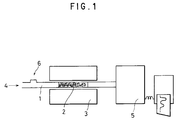
- Figure 1 is a schematic diagram of an apparatus used for working this invention.
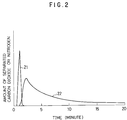
- Figure 2 is a diagram showing the results of a test for determining the retention times of nitrogen and carbon dioxide performed in Example 1.
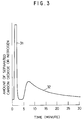
- Figure 3 is a diagram showing the results of a test for determining the retention times of nitrogen and carbon dioxide performed in Example 23.
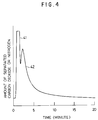
- Figure 4 is a diagram showing the results of a test for determining the retention times of nitrogen and carbon dioxide performed in Example 24.
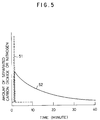
- Figure 5 is a diagram showing the results of a test for determining the retention times of nitrogen and carbon dioxide performed in Example 33.
- the method of this invention enables separation from hot waste gas of combustion of such a gaseous component as, for example, carbon dioxide in its initial hot state by passing the hot waste gas over a bed of a powder or minute particles of an inorganic solid substance exhibiting surface basicity packed in a slender cylindrical thermally resistant container and kept at an elevated temperature.
- the inorganic solid substance exhibiting surface basicity is preferably dolomite or europium oxide.
- the method of this invention will now be described more specifically.
- the specific components contained in the waste gas are adsorbed on the substance. These components are selectively separated and recovered by the differences in the lengths of time of adsorption and separation (differences in retention time).
- dolomite The chemical formula of dolomite is CaMg(CO 3 ) 2 . It has the form of a granular aggregate of white rhombohedral crystals of the trigonal system. It occurs copiously in sedimentary rocks and also arises from a hydrothermal action. Though it resembles calcite, it can be discriminated from calcite by the fact that it is not foamed by cold dilute hydrochloric acid, exhibits a high refractive index, shows the strongest line of X-ray diffraction at 2.886 ⁇ ngstroms, and manifests two endothermic points near about 800°C and 950°C in the differential thermal analysis ("Clay Handbook," Second Edition, p. 106, Nippon Clay Society, 1987).
- Europium is one of the rare earth elements.
- Europium oxide is used, for example, as a red phosphor in color pictures tubes.
- the oxides of rare earth elements excel in resistance to heat and form well-known high-melting materials.
- the rare earth elements have chemical properties resembling those of alkali earth elements and the oxides thereof exhibit basicity ("Rare Earths - Physical Properties and Applications," p. 86, Tsuyoshi Kano and Hiroaki Yanagida, Gihodo, 1980). They can therefore be expected to exhibit high affinity for carbon dioxide, which is an acidic gas. None has been known heretofore about the affinity of europium oxide for carbon dioxide or nitrogen at elevated temperatures.
- the waste gas which generally has an elevated temperature at the time of occurrence is passed, as held in its initially hot state, over the inorganic solid substance.
- the temperature of the waste gas is in the range of 300 to 900°C when the solid substance is dolomite and in the range of 100 to 1000°C when the solid substance is europium oxide.
- dolomite At temperatures falling short of 300°C and at temperatures exceeding 900°C, dolomite is deficient in the ability to adsorb and separate carbon dioxide. At these temperatures, therefore, dolomite cannot be used as an adsorbent.
- europium oxide is capable of adsorbing carbon dioxide over a wide temperature range from room temperature to 1000°C
- the lower limit of the temperature of adsorption by europium oxide is set at 100°C because the use of an organic separating agent suffices at temperatures falling below 100°C.
- the hot combustion waste gas contains nitrogen gas in a large amount. This nitrogen gas is also amenable to the selective separation contemplated by this invention.
- hot combustion waste gases at which this invention is aimed include the waste gas from plants using fossil fuels and the exhaust gas from internal combustion engines. This invention does not particularly specify the hot waste gas by its origin and only requires that it contain at least carbon dioxide.
- hot waste gases to which this invention can be applied include, combustion gases, various reaction gases, and by-produced gases originating in electric furnaces, converters, gas producers, and coke ovens. They may be naturally existing or produced gases.
- This invention separates a specific gaseous component such as carbon dioxide from hot combustion waste gas by a method which comprises causing the hot waste gas to contact dolomite as an adsorbent heated to a temperature in the range of 300 to 900°C, preferably exceeding 500°C, or to contact europium oxide, thereby inducing adsorption of the specific gaseous component on the adsorbent, and then separating the specific gas component from the adsorbent by utilizing the difference between lengths of time (retention time) required for the specific gaseous components to repeat adsorption to and separation from the dolomite or europium oxide.
- the dolomite or europium oxide is used, for example, as packed in the form of a bed of a powder or minute particles in a slender cylindrical thermally resistant container provided at the opposite ends thereof with an inlet and an outlet for a gaseous substance.
- the manner of use and the method of use of the adsorbent is not critical.
- the hot separation of carbon dioxide and nitrogen gas occurs in a temperature range of 300 to 900°C in the case of dolomite and 100 to 1000°C in the case of europium oxide because the retention time is longer for carbon dioxide and shorter for nitrogen gas and that these different retention times can be utilized for the separation.
- the retention times of the gaseous components in the waste gas are more or less varied by the flow volume of the waste gas. The retention times generally tend to decrease in proportion as the flow volume increases. By regulating the flow volume of the waste gas, therefore, the retention times of the specific gaseous components can be adjusted.
- the specific gaseous components adsorbed to and separated from the adsorbent mentioned above are separated from one another by utilizing the differences in retention time among the gaseous components.
- the separation of the specific gaseous components can be facilitated.
- the size and shape of the apparatus for separation, the material of the thermally resistant container, the shape of a temperature retaining device, etc. can be selected to suit the individual sources of waste gas such as, for example, a large stationary source like a steam power plant or an iron mill or a small disperse source like an automobile or a home.
- waste gas such as, for example, a large stationary source like a steam power plant or an iron mill or a small disperse source like an automobile or a home.
- the method of this invention for separation and recovery can be implemented without reference to the form of the origin mentioned above.
- this invention resides in a method for separating and recovering a specific gaseous component from a hot combustion waste gas, characterized by the steps of passing the waste gas at its original temperature or as adjusted to a prescribed temperature through an adsorbent containing an inorganic solid substance exhibiting surface basicity, thereby inducing adsorption of the specific gaseous component on the inorganic solid substance exhibiting surface basicity, and then selectively separating and recovering the specific gaseous components by virtue of differences in time for adsorption and separation of the specific gaseous component and other gaseous components (retention times) relative to the inorganic solid substance exhibiting surface basicity.
- a specific gaseous component such as carbon dioxide contained in a combustion gas discharged as a hot waste gas can be separated and recovered as kept at the initial elevated temperature.
- FIG. 1 designates a quartz glass tube 10 mm in diameter, 2 for an adsorbent formed of an inorganic solid substance exhibiting surface basicity and packed in the glass tube, 3 for a tubular furnace for heating, 4 for a carrier gas, and 5 for a gas sensor (TCD).
- TCD gas sensor
- the quartz glass tube 1 was packed with the adsorbent 2 and heated in the tubular furnace 4 to a prescribed temperature (heating temperature). Then, the packed quartz glass tube 1 was further heated to a prescribed temperature (the actual separating temperature equivalent to the temperature of the hot waste gas) and used for the following test.
- a carrier gas 4 such as helium was continuously introduced at a fixed flow volume into the quartz glass tube 1 through one end thereof and a mixed gas 6 consisting of carbon dioxide and nitrogen was introduced therein in a fixed amount.
- the times which carbon dioxide and nitrogen spent in passing over the adsorbent 2 while repeating adsorption to and separation from the adsorbent were determined by the gas sensor 5.
- the time at which the mixed gas was introduced into the quartz glass tube 1 was reckoned as 0 second (in the length of the retention time).
- the quartz glass tube 1 was packed with 1.00 g of dolomite as an adsorbent and heated to 800°C (heating temperature). Then, as a mixed gas specimen at a temperature (separating temperature) of 600°C, helium as a carrier gas was continuously fed at a flow volume of 30 ml/min and a mixed gas consisting of 0.1 ml of carbon dioxide and 0.1 ml of nitrogen was introduced into the packed quartz glass tube 1.
- the chart consequently obtained by the gas sensor 5 is shown in Figure 2.
- the horizontal axis represents time (minutes) and the vertical axis represents the amount of separated carbon dioxide or nitrogen gas detected by the gas sensor after passage over the dolomite (the numerical value of the amount of carbon dioxide is indicated as multiplied by 8).
- the curves 21, 22 respectively denote the determined nitrogen gas and carbon dioxide retention times.
- Figure 2 shows that the separation of carbon dioxide required a long time and that of nitrogen gas was completed in a short time.
- the quartz glass tube was packed with 1.00 g of dolomite and, with helium as a carrier gas continuously fed at a flow volume of 30 ml/min thereto, maintained at a given temperature for two hours. After this heating, the specimen temperature (separating temperature) was set at a given level and carbon dioxide and nitrogen gas were introduced. The amount of carbon dioxide introduced was varied in the range of 0.1 to 5.0 ml and that of nitrogen gas fixed at 0.1 ml. The retention times of carbon dioxide and nitrogen gas were determined from the chromatograph consequently obtained. The differences found between the varying sets of retention times indicate that at all the separation temperatures in the range of 300 to 900°C, carbon dioxide was separated at higher temperatures than nitrogen gas. The results are shown in Table 1.
- the quartz glass tube was packed with 5.0 g of europium oxide and, with the specimen temperature (separating temperature) set at 900°C, helium as a carrier gas was continuously fed at a flow volume of 30 ml/min and a mixed gas consisting of 0.1 ml of carbon dioxide and 0.1 ml of nitrogen gas was introduced.
- curves 31, 32 respectively denote the determined nitrogen gas and carbon dioxide retention times.
Landscapes
- Chemical & Material Sciences (AREA)
- Engineering & Computer Science (AREA)
- Analytical Chemistry (AREA)
- General Chemical & Material Sciences (AREA)
- Oil, Petroleum & Natural Gas (AREA)
- Chemical Kinetics & Catalysis (AREA)
- Health & Medical Sciences (AREA)
- Biomedical Technology (AREA)
- Environmental & Geological Engineering (AREA)
- Treating Waste Gases (AREA)
- Solid-Sorbent Or Filter-Aiding Compositions (AREA)
- Separation Of Gases By Adsorption (AREA)
Abstract
A method for the selective separation of gaseous components of hot waste gas of combustion containing carbon dioxide from the waste gas characterized by the steps of causing the hot waste gas to contact an adsorbent containing as a substantial main component thereof an inorganic solid substance exhibiting surface basicity, thereby inducing adsorption of the gaseous components on the adsorbent, and then selectively separating the adsorbed gaseous components by virtue of differences in retention time among the gaseous components on the adsorbent.
Description
- This invention relates to a method for the separation and recovery from a hot waste gas of combustion such gaseous components as carbon dioxide in the original hot state without cooling the hot waste gas. The carbon dioxide and other gaseous components thus separated and recovered in the hot state can be utilized for chemical conversion reactions without loss of thermal energy. As a result, the specific gaseous components can be converted with high efficiency into various useful organic substances and such gaseous components as, for example, carbon dioxide which are entrained by the waste gas can be reclaimed at a low cost.
- The total amount of energy consumed on the earth is huge and the consumption of this energy entails various environmental problems. One of the most serious of these is global warming and carbon dioxide is the main cause. If the consumption of fossil fuels continues to grow at the present rate, it is estimated that the carbon dioxide discharged by the burning of fossil fuels will by itself raise the average atmospheric temperature of the earth by 1 to 5°C over the next 30 to 60 years.
- For the solution of this problem, it is important to regulate the amount of discharged carbon dioxide. The occurrence of carbon dioxide cannot be eliminated so long as fossil fuels are used as energy sources. It is, therefore, important to separate and recover the carbon dioxide arising from the burning of fossil fuels and utilize it as a useful resources. Conceivable ways of making use of carbon dioxide include reduction to carbon monoxide and conversion into methanol, acetic acid, ethylene glycol, etc.
- Known ways of separating and recovering carbon dioxide from mixed gases include the method of gas absorption, the method of low temperature separation (the method of distillation), the method of gas adsorption (the method of pressure swing adsorption and the method of temperature swing adsorption), the method of membrane separation, and the like ("Techniques for Recovery of Carbon Dioxide Gas," p. 22, compiled by Toshinaga Kawai and published by NTS K.K., 1991, and "Atmosphere Enveloping the Earth," p. 115, compiled by Yuji Shindo and published by Ohm K.K., 1993). The method of gas absorption separates carbon dioxide from a mixed gas by contacting the mixed gas at a low temperature with a liquid absorbent capable of selectively absorbing carbon dioxide, thereby effecting selective absorption of the carbon dioxide by the liquid absorbent, and then heating the resultant solution, thereby gasifying the carbon dioxide out of the solution. The method of low temperature separation (the method of distillation) effects the separation of carbon dioxide from a mixed gas by a procedure which comprises compressing and cooling the mixed gas until liquefaction and then subjecting the liquid mixture consequently obtained to fractional distillation. In the method of gas adsorption, the method of pressure swing adsorption (the PSA method) effects the separation of carbon dioxide from a mixed gas by a procedure which comprises pressing the mixed gas into contact with such an adsorbent as, for example, activated carbon or a molecular sieve with micropores, thereby inducing selective adsorption of carbon dioxide, and then reducing the pressure, thereby separating the adsorbed carbon dioxide. This method is implemented, for example, by continuously performing the operations of pressure increase, adsorption, washing, and deaeration in a column. It is highly expensive, however, on account of the cost of the energy needed for increasing the pressure, of the equipment for adsorption and of the adsorbent used for the adsorption.
- The method of temperature swing adsorption (the TSA method) attains the separation of carbon dioxide from a mixed gas by a procedure which comprises causing the mixed gas to contact the same adsorbent as mentioned above at normal room temperature or at a lowered temperature, thereby inducing selective adsorption of carbon dioxide, and then elevating the temperature, thereby separating the adsorbed carbon dioxide. This method, however, is disadvantageous in the points that it incurs a large energy cost at the step of regeneration of the adsorbent owing to the use of steam for this regeneration, entails the time-consuming operation of switching between high temperature and normal room temperature, and requires provision of a large heating device.
- The method of membrane separation attains the separation of carbon dioxide from a mixed gas by setting in place in the flow path of the mixed gas a membrane capable of selectively passing carbon dioxide, differentiating the pressure before and after the membrane, and passing the mixed gas through this membrane.
- The standard PSA method and TSA method mentioned above are techniques of highly extensive utility for the separation and recovery of specific gaseous components from various kinds of mixed gas. They cannot be easily utilized for the recovery of specific gaseous components from low-grade waste gas of combustion, however, owing to high cost.
- The methods heretofore developed for the recovery of specific gaseous components from the waste gas will now be summarized.
- A method for recovering valuable components from the waste gas exhausted from a furnace type carbon black production apparatus comprises removing carbon black powders from the waste gas, cooling and exposing to increased pressure the resultant waste gas, then recovering carbon dioxide and carbon monoxide from said gas by absorption with respectively suitable solvents (absorbents), and separating and recovering the hydrogen gas still remaining in the gas by the method of adsorption or the method of low temperature separation (JP-A-57-27,902). This method recovers carbon dioxide and carbon monoxide from the waste gas by absorption with respective liquid absorbents and, particularly for the purpose of the absorption of carbon dioxide, utilizes the popular technique of removing carbon dioxide by the circulation of an alkali solution using an aqueous solution of ethanol amine or an aqueous solution of potassium carbonate as the absorbent.
- A method has been proposed for the recovery of carbon dioxide, argon, and nitrogen from combustion waste gas discharged from a low air ratio burner and containing substantially no oxygen by selectively separating carbon dioxide by adsorption at the first pressure swing adsorption step, selectively separating nitrogen or argon by adsorption at the second pressure swing adsorption step, and recovering the remainder of argon or nitrogen (JP-A-63-147,805). This method, however, is characterized by attaining selective adsorptive separation and recovery of carbon dioxide in accordance with the pressure swing adsorption method at an extremely low temperature by means of a carbon molecular sieve, synthetic zeolite, activated alumina, or silica gel as the adsorbent.
- Further, for the recovery of specific gaseous components from a mixed gas, a method has been proposed for recovering a specific component such as, for example, carbon dioxide from a combustion waste gas using the method of pressure variation type adsorptive separation (the method of pressure swing adsorption, i.e. the PSA method) (JP-A-01-180,218). This method, however, is characterized by supplying the mixed gas in a form having the specific gaseous component contained therein under increased partial pressures, causing the specific gaseous component to be adsorbed on a clinobutyrolite type adsorbent, separating the adsorbed gaseous component from the adsorbent under a reduced pressure to recover the gaseous component, and performing the foregoing steps cyclically.
- Though various methods have been proposed for the separation and recovery of specific gaseous components from waste gas as described above, they invariably carry out the operation of separation after the hot waste gas has been cooled. None of the heretofore known methods performs the operation of separation on a waste gas kept in the initial hot state. Therefore, the specific gaseous components, such as carbon dioxide, cannot be separated hot by any of the methods cited above utilizing currently available technologies.
- The feasibility of the conversion of such C1 compounds as carbon dioxide, carbon monoxide, and methane into methanol, acetic acid, ethylene glycol, and organic compounds having a larger numbers of carbon atoms and higher economic value is being studied. The conversions mentioned above are often conducted by catalytic reactions requiring thermal energy. The separation of carbon dioxide from a hot waste gas while maintaining the high temperature can be expected to be advantageous from the viewpoint of the energy conservation because the thermal energy retained by the recovered carbon dioxide can be used per se as for the conversion reaction.
- The present inventors, after conducting various studies, found that the hot separation of carbon dioxide from hot combustion waste gas can be achieved by causing the hot waste gas to be adsorbed on a specific solid adsorbent and separating the component, specifically carbon dioxide, contained in the adsorbed waste gas with an adsorbent. This invention has been perfected as a result.
- This invention is specifically directed to a method for the selective separation of gaseous components of hot waste gas of combustion containing carbon dioxide, characterized by causing the hot waste gas to contact an adsorbent containing as a substantial main component thereof an inorganic solid substance exhibiting surface basicity, thereby inducing adsorption of the gaseous components of the hot waste gas on the adsorbent, and then selectively separating the adsorbed gaseous components by virtue of differences in retention time among the gaseous components on the adsorbent.
- Figure 1 is a schematic diagram of an apparatus used for working this invention.
- Figure 2 is a diagram showing the results of a test for determining the retention times of nitrogen and carbon dioxide performed in Example 1.
- Figure 3 is a diagram showing the results of a test for determining the retention times of nitrogen and carbon dioxide performed in Example 23.
- Figure 4 is a diagram showing the results of a test for determining the retention times of nitrogen and carbon dioxide performed in Example 24.
- Figure 5 is a diagram showing the results of a test for determining the retention times of nitrogen and carbon dioxide performed in Example 33.
- The method of this invention enables separation from hot waste gas of combustion of such a gaseous component as, for example, carbon dioxide in its initial hot state by passing the hot waste gas over a bed of a powder or minute particles of an inorganic solid substance exhibiting surface basicity packed in a slender cylindrical thermally resistant container and kept at an elevated temperature.
- The inorganic solid substance exhibiting surface basicity is preferably dolomite or europium oxide.
- The method of this invention will now be described more specifically. When the hot combustion waste gas is passed over the inorganic solid substance, the specific components contained in the waste gas are adsorbed on the substance. These components are selectively separated and recovered by the differences in the lengths of time of adsorption and separation (differences in retention time).
- The chemical formula of dolomite is CaMg(CO3)2. It has the form of a granular aggregate of white rhombohedral crystals of the trigonal system. It occurs copiously in sedimentary rocks and also arises from a hydrothermal action. Though it resembles calcite, it can be discriminated from calcite by the fact that it is not foamed by cold dilute hydrochloric acid, exhibits a high refractive index, shows the strongest line of X-ray diffraction at 2.886 Ångstroms, and manifests two endothermic points near about 800°C and 950°C in the differential thermal analysis ("Clay Handbook," Second Edition, p. 106, Nippon Clay Society, 1987).
- Europium is one of the rare earth elements. Europium oxide is used, for example, as a red phosphor in color pictures tubes. The oxides of rare earth elements excel in resistance to heat and form well-known high-melting materials. The rare earth elements have chemical properties resembling those of alkali earth elements and the oxides thereof exhibit basicity ("Rare Earths - Physical Properties and Applications," p. 86, Tsuyoshi Kano and Hiroaki Yanagida, Gihodo, 1980). They can therefore be expected to exhibit high affinity for carbon dioxide, which is an acidic gas. Nothing has been known heretofore about the affinity of europium oxide for carbon dioxide or nitrogen at elevated temperatures.
- In the method of this invention, the waste gas which generally has an elevated temperature at the time of occurrence is passed, as held in its initially hot state, over the inorganic solid substance. Preferably the temperature of the waste gas is in the range of 300 to 900°C when the solid substance is dolomite and in the range of 100 to 1000°C when the solid substance is europium oxide.
- At temperatures falling short of 300°C and at temperatures exceeding 900°C, dolomite is deficient in the ability to adsorb and separate carbon dioxide. At these temperatures, therefore, dolomite cannot be used as an adsorbent.
- Though europium oxide is capable of adsorbing carbon dioxide over a wide temperature range from room temperature to 1000°C, the lower limit of the temperature of adsorption by europium oxide is set at 100°C because the use of an organic separating agent suffices at temperatures falling below 100°C.
- Generally, the hot combustion waste gas contains nitrogen gas in a large amount. This nitrogen gas is also amenable to the selective separation contemplated by this invention.
- Typical examples of the hot combustion waste gases at which this invention is aimed include the waste gas from plants using fossil fuels and the exhaust gas from internal combustion engines. This invention does not particularly specify the hot waste gas by its origin and only requires that it contain at least carbon dioxide. Examples of hot waste gases to which this invention can be applied include, combustion gases, various reaction gases, and by-produced gases originating in electric furnaces, converters, gas producers, and coke ovens. They may be naturally existing or produced gases.
- It is reported that the waste combustion gas from an oil-fired power plant has an average composition of 10% CO2, 75% N2, 3% O2, and 12% H2O ("Atmosphere Enveloping the Earth," p. 109, Yuji Shindo, Ohm K.K., 1993).
- This invention separates a specific gaseous component such as carbon dioxide from hot combustion waste gas by a method which comprises causing the hot waste gas to contact dolomite as an adsorbent heated to a temperature in the range of 300 to 900°C, preferably exceeding 500°C, or to contact europium oxide, thereby inducing adsorption of the specific gaseous component on the adsorbent, and then separating the specific gas component from the adsorbent by utilizing the difference between lengths of time (retention time) required for the specific gaseous components to repeat adsorption to and separation from the dolomite or europium oxide. For the method of this invention, the dolomite or europium oxide is used, for example, as packed in the form of a bed of a powder or minute particles in a slender cylindrical thermally resistant container provided at the opposite ends thereof with an inlet and an outlet for a gaseous substance. The manner of use and the method of use of the adsorbent is not critical.
- The inventors have found that the hot separation of carbon dioxide and nitrogen gas, for example, from hot waste gas, as demonstrated in the working examples cited hereinbelow, occurs in a temperature range of 300 to 900°C in the case of dolomite and 100 to 1000°C in the case of europium oxide because the retention time is longer for carbon dioxide and shorter for nitrogen gas and that these different retention times can be utilized for the separation. At the step of adsorption mentioned above, the retention times of the gaseous components in the waste gas are more or less varied by the flow volume of the waste gas. The retention times generally tend to decrease in proportion as the flow volume increases. By regulating the flow volume of the waste gas, therefore, the retention times of the specific gaseous components can be adjusted.
- The specific gaseous components adsorbed to and separated from the adsorbent mentioned above are separated from one another by utilizing the differences in retention time among the gaseous components. By presetting such conditions as temperature, flow volume, and flow rate suitably for the specific gaseous components, the separation of the specific gaseous components can be facilitated.
- The size and shape of the apparatus for separation, the material of the thermally resistant container, the shape of a temperature retaining device, etc. can be selected to suit the individual sources of waste gas such as, for example, a large stationary source like a steam power plant or an iron mill or a small disperse source like an automobile or a home. Naturally, the method of this invention for separation and recovery can be implemented without reference to the form of the origin mentioned above.
- As described in detail above, this invention resides in a method for separating and recovering a specific gaseous component from a hot combustion waste gas, characterized by the steps of passing the waste gas at its original temperature or as adjusted to a prescribed temperature through an adsorbent containing an inorganic solid substance exhibiting surface basicity, thereby inducing adsorption of the specific gaseous component on the inorganic solid substance exhibiting surface basicity, and then selectively separating and recovering the specific gaseous components by virtue of differences in time for adsorption and separation of the specific gaseous component and other gaseous components (retention times) relative to the inorganic solid substance exhibiting surface basicity. According to this invention, a specific gaseous component such as carbon dioxide contained in a combustion gas discharged as a hot waste gas can be separated and recovered as kept at the initial elevated temperature. [Examples]
- This invention will now be described specifically with reference to working examples thereof.
- The apparatus used in the working examples is shown in Figure 1. In the diagram, 1 designates a
quartz glass tube 10 mm in diameter, 2 for an adsorbent formed of an inorganic solid substance exhibiting surface basicity and packed in the glass tube, 3 for a tubular furnace for heating, 4 for a carrier gas, and 5 for a gas sensor (TCD). - First, the quartz glass tube 1 was packed with the
adsorbent 2 and heated in the tubular furnace 4 to a prescribed temperature (heating temperature). Then, the packed quartz glass tube 1 was further heated to a prescribed temperature (the actual separating temperature equivalent to the temperature of the hot waste gas) and used for the following test. - A carrier gas 4 such as helium was continuously introduced at a fixed flow volume into the quartz glass tube 1 through one end thereof and a
mixed gas 6 consisting of carbon dioxide and nitrogen was introduced therein in a fixed amount. The times which carbon dioxide and nitrogen spent in passing over theadsorbent 2 while repeating adsorption to and separation from the adsorbent (retention times) were determined by thegas sensor 5. The time at which the mixed gas was introduced into the quartz glass tube 1 was reckoned as 0 second (in the length of the retention time). - The quartz glass tube 1 was packed with 1.00 g of dolomite as an adsorbent and heated to 800°C (heating temperature). Then, as a mixed gas specimen at a temperature (separating temperature) of 600°C, helium as a carrier gas was continuously fed at a flow volume of 30 ml/min and a mixed gas consisting of 0.1 ml of carbon dioxide and 0.1 ml of nitrogen was introduced into the packed quartz glass tube 1. The chart consequently obtained by the
gas sensor 5 is shown in Figure 2. In the diagram of Figure 2, the horizontal axis represents time (minutes) and the vertical axis represents the amount of separated carbon dioxide or nitrogen gas detected by the gas sensor after passage over the dolomite (the numerical value of the amount of carbon dioxide is indicated as multiplied by 8). Thecurves - The quartz glass tube was packed with 1.00 g of dolomite and, with helium as a carrier gas continuously fed at a flow volume of 30 ml/min thereto, maintained at a given temperature for two hours. After this heating, the specimen temperature (separating temperature) was set at a given level and carbon dioxide and nitrogen gas were introduced. The amount of carbon dioxide introduced was varied in the range of 0.1 to 5.0 ml and that of nitrogen gas fixed at 0.1 ml. The retention times of carbon dioxide and nitrogen gas were determined from the chromatograph consequently obtained. The differences found between the varying sets of retention times indicate that at all the separation temperatures in the range of 300 to 900°C, carbon dioxide was separated at higher temperatures than nitrogen gas. The results are shown in Table 1. Though no data obtained at temperatures below 300°C are shown, the separation was naturally obtainable. It can be seen from the results that the ease with which carbon dioxide and nitrogen gas were separated increased in proportion as the difference between their retention times increased and that carbon dioxide and nitrogen gas were separated satisfactorily particularly at eluting temperatures in the range of 300 to 900°C.
[Table 1] Example No. Heating temperature Separating temperature Amount of carbon dioxide introduced Retention time (second) (°C) (°C) (ml) Carbon dioxide Nitrogen gas Difference 2 300 300 0.1 75 68 7 3 500 300 0.1 71 65 6 4 400 0.1 70 61 9 5 500 0.1 71 59 12 6 600 300 0.1 8 69 20 7 400 0.1 77 65 12 8 500 0.1 106 62 44 9 600 0.1 79 58 21 10 700 700 0.1 92 72 20 11 800 600 0.1 128 57 71 12 700 0.1 100 56 44 13 800 0.1 81 54 27 14 900 300 1.0 98 62 36 15 5.0 77 62 15 16 600 1.0 140 63 77 17 700 0.1 195 58 137 18 1.0 93 65 28 19 800 0.1 95 49 33 21 5.0 61 49 12 22 900 0.1 73 50 23 - The quartz glass tube was packed with 5.0 g of europium oxide and, with the specimen temperature (separating temperature) set at 900°C, helium as a carrier gas was continuously fed at a flow volume of 30 ml/min and a mixed gas consisting of 0.1 ml of carbon dioxide and 0.1 ml of nitrogen gas was introduced.
- The determined retention times are shown in Figure 3. In the diagram, curves 31, 32 respectively denote the determined nitrogen gas and carbon dioxide retention times.
- An experiment was performed by following the procedure of Example 23 while changing the specimen temperature (separation temperature) to 1000°C. The results are shown in Figure 4, in which curves 41, 42 respectively denote the determined nitrogen gas and carbon dioxide retention times. Figures 3 and 4 show that the separation of carbon dioxide required a long time and that of nitrogen gas was completed in a short time.
- Experiments were carried out by following the procedure of Example 23 while varying the specimen temperature (separation temperature). The results are shown in Table 2.
[Table 2] Example No. Separating temperature Retention time (seconds) (°C) Carbon dioxide Nitrogen gas Difference 25 100 * 61 - 26 400 * 63 - 27 500 212 69 143 28 600 146 72 74 29 700 177 71 106 30 800 290 68 222 31 900 297 61 236 32 1000 150 63 87 * No elution observed - An experiment was carried out by following the procedure of Example 23 while fixing the specimen temperature (separating temperature) at 300°C. The amount of nitrogen gas introduced was 0.1 ml, and that of carbon dioxide was 5.0 ml. The results are shown in Figure 5, in which curves 51, 52 respectively denote the determined nitrogen gas and carbon dioxide retention times. The results show that the separation of nitrogen was completed in a very short time (about 60 seconds), while the separation of carbon dioxide continued for about 40 minutes.
- As shown in Examples 25 to 32, hot separation of carbon dioxide was obtained over a wide range of separating temperatures.
- The ease with which the separation of carbon dioxide and nitrogen gas is obtained increases in proportion as the difference in retention time between the two compounds increases. It is particularly noteworthy that the separation of carbon dioxide and nitrogen gas is satisfactorily obtained at such high temperatures as 700, 800, 900, and 1000°C.
Claims (5)
- A method for the selective separation of gaseous components of waste gas of combustion containing carbon dioxide from the waste gas characterized by the steps of causing the hot waste gas of combustion at an elevated temperature to contact an adsorbent containing as a substantial main component thereof an inorganic solid substance exhibiting surface basicity, thereby inducing adsorption of the gaseous components on the adsorbent, and then selectively separating the adsorbed gaseous components by virtue of differences in retention time among the gaseous components on the adsorbent.
- The method as set forth in claim 1, wherein the temperature of the hot waste gas is in the range of 300 to 900°C and the inorganic solid substance exhibiting surface basicity is dolomite.
- The method as set forth in claim 2, wherein the hot waste gas contains nitrogen gas.
- The method as set forth in claim 1, wherein the temperature of the hot waste gas is in the range of 100 to 1000°C and the inorganic solid substance exhibiting surface basicity is europium oxide.
- The method as set forth in claim 4, wherein the hot waste gas contains nitrogen gas.
Applications Claiming Priority (4)
| Application Number | Priority Date | Filing Date | Title |
|---|---|---|---|
| JP30106/95 | 1995-01-26 | ||
| JP7030106A JP2708090B2 (en) | 1995-01-26 | 1995-01-26 | High temperature separation method of carbon dioxide by dolomite |
| JP7070867A JP2732503B2 (en) | 1995-03-03 | 1995-03-03 | High temperature separation method of carbon dioxide by europium oxide |
| JP70867/95 | 1995-03-03 |
Publications (2)
| Publication Number | Publication Date |
|---|---|
| EP0723802A2 true EP0723802A2 (en) | 1996-07-31 |
| EP0723802A3 EP0723802A3 (en) | 1997-01-02 |
Family
ID=26368398
Family Applications (1)
| Application Number | Title | Priority Date | Filing Date |
|---|---|---|---|
| EP96300313A Withdrawn EP0723802A3 (en) | 1995-01-26 | 1996-01-16 | Method for selective separation of carbon dioxide from waste gas of combustion |
Country Status (2)
| Country | Link |
|---|---|
| US (1) | US5667561A (en) |
| EP (1) | EP0723802A3 (en) |
Cited By (4)
| Publication number | Priority date | Publication date | Assignee | Title |
|---|---|---|---|---|
| US6322612B1 (en) | 1999-12-23 | 2001-11-27 | Air Products And Chemicals, Inc. | PSA process for removal of bulk carbon dioxide from a wet high-temperature gas |
| ES2186516A1 (en) * | 2001-01-08 | 2003-05-01 | Univ Vigo | System for reduction of concentration of carbon dioxide in closed locations and uses crystal cylinder filled with substance which adsorbs carbon dioxide |
| EP2048091A2 (en) | 2007-10-11 | 2009-04-15 | HILTI Aktiengesellschaft | Cartridge for an extrudable mass |
| CN102515118A (en) * | 2011-11-12 | 2012-06-27 | 天津凯德实业有限公司 | Engine tail gas recovery and separation device |
Families Citing this family (11)
| Publication number | Priority date | Publication date | Assignee | Title |
|---|---|---|---|---|
| US6805718B2 (en) * | 1995-12-22 | 2004-10-19 | Novozymes A/S | Enzymatic method for textile dyeing |
| US6800120B1 (en) * | 1998-11-23 | 2004-10-05 | Fluor Corporation | Split-flow process and apparatus |
| ATE425806T1 (en) * | 1998-11-23 | 2009-04-15 | Fluor Corp | DEVICE FOR DIVIDING A FLOW |
| DE60221373D1 (en) | 2001-04-13 | 2007-09-06 | Co2 Solution Inc | METHOD AND DEVICE FOR PRODUCING CEMENT LINKERS |
| CA2353307A1 (en) * | 2001-07-13 | 2003-01-13 | Carmen Parent | Device and procedure for processing gaseous effluents |
| CA2405635A1 (en) | 2002-09-27 | 2004-03-27 | C02 Solution Inc. | A process and a plant for the production of useful carbonated species and for the recycling of carbon dioxide emissions from power plants |
| WO2012100157A1 (en) | 2011-01-20 | 2012-07-26 | Saudi Arabian Oil Company | Direct densification method and system utilizing waste heat for on-board recovery and storage of co2 from motor vehicle internal combustion engine exhaust gases |
| WO2012100182A1 (en) | 2011-01-20 | 2012-07-26 | Saudi Arabian Oil Company | Membrane separation method and system utilizing waste heat for on-board recovery and storage of co2 from motor vehicle internal combustion engine exhaust gases |
| US9581062B2 (en) | 2011-01-20 | 2017-02-28 | Saudi Arabian Oil Company | Reversible solid adsorption method and system utilizing waste heat for on-board recovery and storage of CO2 from motor vehicle internal combustion engine exhaust gases |
| WO2012100165A1 (en) | 2011-01-20 | 2012-07-26 | Saudi Arabian Oil Company | Οn-board recovery and storage of c02 from motor vehicle exhaust gases |
| TWI630021B (en) * | 2012-06-14 | 2018-07-21 | 艾克頌美孚研究工程公司 | Integration of pressure swing adsorption with a power plant for co2 capture/utilization and n2 production |
Family Cites Families (18)
| Publication number | Priority date | Publication date | Assignee | Title |
|---|---|---|---|---|
| CA582189A (en) * | 1959-08-25 | Koppers Company | Removal of carbon dioxide and carbon monoxide from gases | |
| US1716028A (en) * | 1929-02-15 | 1929-06-04 | Selden Co | Effluent-gas treatment |
| US1831731A (en) * | 1929-02-26 | 1931-11-10 | Bataafsche Petroleum | Process for absorption of carbon dioxide from gases and vapors |
| GB365111A (en) * | 1929-07-16 | 1932-01-12 | Kohlentechnik Gmbh | Improvements in and relating to the treatment of lighting, heating and power gases |
| US2818323A (en) * | 1953-10-07 | 1957-12-31 | Universal Oil Prod Co | Purification of gases with an amine impregnated solid absorbent |
| US2845382A (en) * | 1954-04-23 | 1958-07-29 | Atlantic Refining Co | Cyclic process for the removal of hydrogen sulfide from high temperature gaseous streams without reduction in temperature |
| GB879228A (en) * | 1957-01-16 | 1961-10-11 | Koppers Gmbh Heinrich | Process for the removal of carbon dioxide and carbon monoxide from gases |
| US3619130A (en) * | 1968-08-27 | 1971-11-09 | Frank J Ventriglio | Method of removing carbon dioxide from gaseous mixtures |
| CH506318A (en) * | 1969-04-17 | 1971-04-30 | Sulzer Ag | Method and system for adsorbing at least one gaseous component from a gas mixture |
| US3865924A (en) * | 1972-03-03 | 1975-02-11 | Inst Gas Technology | Process for regenerative sorption of CO{HD 2 |
| SU793616A1 (en) * | 1978-10-09 | 1981-01-07 | Институт Нефтехимического Синте-За Им.A.B.Топчиева Ah Cccp | Method of production of carbon dioxide solid absorber |
| JPS5727902A (en) * | 1980-07-25 | 1982-02-15 | Mitsubishi Kakoki Kaisha Ltd | Recovering method for valuable component in waste gas |
| JPH0713274B2 (en) * | 1986-05-31 | 1995-02-15 | 株式会社鈴木商館 | Reversible storage / release material for hydrogen |
| JPS63147805A (en) * | 1986-12-11 | 1988-06-20 | Kinki Reinetsu Kk | Process for producing co2, ar, and n2 from waste combustion gas |
| JP2581944B2 (en) * | 1988-01-07 | 1997-02-19 | 関西熱化学株式会社 | Method for recovering specific gas components from mixed gas |
| SU1681922A1 (en) * | 1989-04-11 | 1991-10-07 | Отделение Нефтехимии Института Физико-Органической Химии И Углехимии Ан Усср | Method of separating acid admixtures from hydrogen |
| NL9201179A (en) * | 1992-07-02 | 1994-02-01 | Tno | PROCESS FOR THE REGENERATIVE REMOVAL OF CARBON DIOXIDE FROM GAS FLOWS. |
| DE69421359T2 (en) * | 1993-11-10 | 2000-06-08 | Agency Of Industrial Science & Technology, Ministry Of International Trade & Industry | Process for the separation of nitrogen and carbon dioxide using ceramic materials |
-
1996
- 1996-01-16 EP EP96300313A patent/EP0723802A3/en not_active Withdrawn
- 1996-01-16 US US08/586,275 patent/US5667561A/en not_active Expired - Fee Related
Cited By (4)
| Publication number | Priority date | Publication date | Assignee | Title |
|---|---|---|---|---|
| US6322612B1 (en) | 1999-12-23 | 2001-11-27 | Air Products And Chemicals, Inc. | PSA process for removal of bulk carbon dioxide from a wet high-temperature gas |
| ES2186516A1 (en) * | 2001-01-08 | 2003-05-01 | Univ Vigo | System for reduction of concentration of carbon dioxide in closed locations and uses crystal cylinder filled with substance which adsorbs carbon dioxide |
| EP2048091A2 (en) | 2007-10-11 | 2009-04-15 | HILTI Aktiengesellschaft | Cartridge for an extrudable mass |
| CN102515118A (en) * | 2011-11-12 | 2012-06-27 | 天津凯德实业有限公司 | Engine tail gas recovery and separation device |
Also Published As
| Publication number | Publication date |
|---|---|
| US5667561A (en) | 1997-09-16 |
| EP0723802A3 (en) | 1997-01-02 |
Similar Documents
| Publication | Publication Date | Title |
|---|---|---|
| US5667561A (en) | Method for selective separation of carbon dioxide from waste gas of combustion | |
| US7309378B2 (en) | Syngas purification process | |
| EP0316665B1 (en) | Selective adsorption of co2 on zeolites | |
| US4964889A (en) | Selective adsorption on magnesium-containing clinoptilolites | |
| AU615032B2 (en) | Desulphurisation | |
| EP0264523B1 (en) | Method of separating gaseous mixture | |
| US4360505A (en) | Recovering hydrogen from gas stream using metal hydride | |
| KR20240023427A (en) | Ammonia Decomposition for Green Hydrogen | |
| JP4745299B2 (en) | Adsorption / desorption material of ammonia using a combination of specific metal halides, separation method and storage method | |
| KR101591690B1 (en) | Method and device for separating hydrogen out of gas flows using alternating pressure adsorption method | |
| CN102173417A (en) | Process for the separation and recovery of carbon dioxide from waste gas or fumes produced by combustible oxidation | |
| CA2186976A1 (en) | Ozone enriching method | |
| Nandi et al. | Carbon molecular sieves for the concentration of oxygen from air | |
| US4440551A (en) | Method for the adsorptive removal of hydrogen sulfide from gas mixtures | |
| JP2741743B2 (en) | High temperature separation of carbon dioxide | |
| Pugsley et al. | Computer simulation of a novel circulating fluidized bed pressure-temperature swing adsorber for recovering carbon dioxide from flue gases | |
| JPH10137533A (en) | Recovery of specific gaseous component in combustion gas | |
| JPS5869724A (en) | Oxygen-stabilized intermetallic compound able to absorbing hydrogen reversibly | |
| CN116393088A (en) | An alkaline earth metal modified molecular sieve compound, its preparation method, and a carrier gas generating device for on-line detection equipment | |
| JP2708090B2 (en) | High temperature separation method of carbon dioxide by dolomite | |
| JP2732503B2 (en) | High temperature separation method of carbon dioxide by europium oxide | |
| JP2708091B2 (en) | High temperature separation method of carbon dioxide by talc | |
| KR20250049356A (en) | Production of gas mixtures of hydrogen and carbon dioxide | |
| JP2708093B2 (en) | High temperature separation method of carbon dioxide by samarium oxide. | |
| KR102710602B1 (en) | Separation and purification method of xenon and krypton |
Legal Events
| Date | Code | Title | Description |
|---|---|---|---|
| PUAI | Public reference made under article 153(3) epc to a published international application that has entered the european phase |
Free format text: ORIGINAL CODE: 0009012 |
|
| AK | Designated contracting states |
Kind code of ref document: A2 Designated state(s): DE FR GB |
|
| PUAL | Search report despatched |
Free format text: ORIGINAL CODE: 0009013 |
|
| AK | Designated contracting states |
Kind code of ref document: A3 Designated state(s): DE FR GB |
|
| 17P | Request for examination filed |
Effective date: 19961212 |
|
| STAA | Information on the status of an ep patent application or granted ep patent |
Free format text: STATUS: THE APPLICATION HAS BEEN WITHDRAWN |
|
| 18W | Application withdrawn |
Withdrawal date: 19980624 |