EP0721934B1 - Verfahren zur Herstellung von tert.-Butylamin - Google Patents
Verfahren zur Herstellung von tert.-Butylamin Download PDFInfo
- Publication number
- EP0721934B1 EP0721934B1 EP96100056A EP96100056A EP0721934B1 EP 0721934 B1 EP0721934 B1 EP 0721934B1 EP 96100056 A EP96100056 A EP 96100056A EP 96100056 A EP96100056 A EP 96100056A EP 0721934 B1 EP0721934 B1 EP 0721934B1
- Authority
- EP
- European Patent Office
- Prior art keywords
- reactor
- reaction
- butylamine
- preparing tert
- carried out
- Prior art date
- Legal status (The legal status is an assumption and is not a legal conclusion. Google has not performed a legal analysis and makes no representation as to the accuracy of the status listed.)
- Expired - Lifetime
Links
- YBRBMKDOPFTVDT-UHFFFAOYSA-N tert-butylamine Chemical compound CC(C)(C)N YBRBMKDOPFTVDT-UHFFFAOYSA-N 0.000 title claims description 20
- 238000000034 method Methods 0.000 title description 9
- 230000008569 process Effects 0.000 title description 4
- 238000002360 preparation method Methods 0.000 title description 2
- VQTUBCCKSQIDNK-UHFFFAOYSA-N Isobutene Chemical compound CC(C)=C VQTUBCCKSQIDNK-UHFFFAOYSA-N 0.000 claims description 36
- QGZKDVFQNNGYKY-UHFFFAOYSA-N Ammonia Chemical compound N QGZKDVFQNNGYKY-UHFFFAOYSA-N 0.000 claims description 30
- 238000006243 chemical reaction Methods 0.000 claims description 27
- 239000011541 reaction mixture Substances 0.000 claims description 17
- 229910021529 ammonia Inorganic materials 0.000 claims description 15
- 238000004519 manufacturing process Methods 0.000 claims description 13
- 239000002638 heterogeneous catalyst Substances 0.000 claims description 9
- 230000002378 acidificating effect Effects 0.000 claims description 7
- 238000012546 transfer Methods 0.000 claims description 5
- 239000003054 catalyst Substances 0.000 description 18
- 239000010457 zeolite Substances 0.000 description 17
- XEEYBQQBJWHFJM-UHFFFAOYSA-N Iron Chemical compound [Fe] XEEYBQQBJWHFJM-UHFFFAOYSA-N 0.000 description 16
- HNPSIPDUKPIQMN-UHFFFAOYSA-N dioxosilane;oxo(oxoalumanyloxy)alumane Chemical compound O=[Si]=O.O=[Al]O[Al]=O HNPSIPDUKPIQMN-UHFFFAOYSA-N 0.000 description 8
- 229910052742 iron Inorganic materials 0.000 description 8
- 239000000203 mixture Substances 0.000 description 8
- 229910000323 aluminium silicate Inorganic materials 0.000 description 7
- 238000010924 continuous production Methods 0.000 description 5
- IJKVHSBPTUYDLN-UHFFFAOYSA-N dihydroxy(oxo)silane Chemical compound O[Si](O)=O IJKVHSBPTUYDLN-UHFFFAOYSA-N 0.000 description 5
- 229910052751 metal Inorganic materials 0.000 description 5
- 239000002184 metal Substances 0.000 description 5
- 230000004048 modification Effects 0.000 description 5
- 238000012986 modification Methods 0.000 description 5
- VYPSYNLAJGMNEJ-UHFFFAOYSA-N Silicium dioxide Chemical compound O=[Si]=O VYPSYNLAJGMNEJ-UHFFFAOYSA-N 0.000 description 4
- 150000002739 metals Chemical class 0.000 description 4
- 239000002245 particle Substances 0.000 description 4
- OKKJLVBELUTLKV-UHFFFAOYSA-N Methanol Chemical compound OC OKKJLVBELUTLKV-UHFFFAOYSA-N 0.000 description 3
- 229910021536 Zeolite Inorganic materials 0.000 description 3
- 229910052784 alkaline earth metal Inorganic materials 0.000 description 3
- 238000001354 calcination Methods 0.000 description 3
- 238000001035 drying Methods 0.000 description 3
- GYHNNYVSQQEPJS-UHFFFAOYSA-N Gallium Chemical compound [Ga] GYHNNYVSQQEPJS-UHFFFAOYSA-N 0.000 description 2
- VEXZGXHMUGYJMC-UHFFFAOYSA-N Hydrochloric acid Chemical compound Cl VEXZGXHMUGYJMC-UHFFFAOYSA-N 0.000 description 2
- 229910002651 NO3 Inorganic materials 0.000 description 2
- NHNBFGGVMKEFGY-UHFFFAOYSA-N Nitrate Chemical compound [O-][N+]([O-])=O NHNBFGGVMKEFGY-UHFFFAOYSA-N 0.000 description 2
- NBIIXXVUZAFLBC-UHFFFAOYSA-N Phosphoric acid Chemical compound OP(O)(O)=O NBIIXXVUZAFLBC-UHFFFAOYSA-N 0.000 description 2
- 229910004298 SiO 2 Inorganic materials 0.000 description 2
- 239000002253 acid Substances 0.000 description 2
- 230000001476 alcoholic effect Effects 0.000 description 2
- 239000003513 alkali Substances 0.000 description 2
- 150000001342 alkaline earth metals Chemical class 0.000 description 2
- 229910052782 aluminium Inorganic materials 0.000 description 2
- -1 aluminum compound Chemical class 0.000 description 2
- WERYXYBDKMZEQL-UHFFFAOYSA-N butane-1,4-diol Chemical compound OCCCCO WERYXYBDKMZEQL-UHFFFAOYSA-N 0.000 description 2
- 238000002474 experimental method Methods 0.000 description 2
- 238000011049 filling Methods 0.000 description 2
- 229910052733 gallium Inorganic materials 0.000 description 2
- 150000004820 halides Chemical class 0.000 description 2
- NAQMVNRVTILPCV-UHFFFAOYSA-N hexane-1,6-diamine Chemical compound NCCCCCCN NAQMVNRVTILPCV-UHFFFAOYSA-N 0.000 description 2
- 239000001257 hydrogen Substances 0.000 description 2
- 229910052739 hydrogen Inorganic materials 0.000 description 2
- 238000005342 ion exchange Methods 0.000 description 2
- 239000000463 material Substances 0.000 description 2
- 239000000377 silicon dioxide Substances 0.000 description 2
- 235000012239 silicon dioxide Nutrition 0.000 description 2
- XFNJVJPLKCPIBV-UHFFFAOYSA-N trimethylenediamine Chemical compound NCCCN XFNJVJPLKCPIBV-UHFFFAOYSA-N 0.000 description 2
- 230000007306 turnover Effects 0.000 description 2
- XLYOFNOQVPJJNP-UHFFFAOYSA-N water Substances O XLYOFNOQVPJJNP-UHFFFAOYSA-N 0.000 description 2
- VILCJCGEZXAXTO-UHFFFAOYSA-N 2,2,2-tetramine Chemical compound NCCNCCNCCN VILCJCGEZXAXTO-UHFFFAOYSA-N 0.000 description 1
- 229910018072 Al 2 O 3 Inorganic materials 0.000 description 1
- PNEYBMLMFCGWSK-UHFFFAOYSA-N Alumina Chemical class [O-2].[O-2].[O-2].[Al+3].[Al+3] PNEYBMLMFCGWSK-UHFFFAOYSA-N 0.000 description 1
- QGZKDVFQNNGYKY-UHFFFAOYSA-O Ammonium Chemical group [NH4+] QGZKDVFQNNGYKY-UHFFFAOYSA-O 0.000 description 1
- ZOXJGFHDIHLPTG-UHFFFAOYSA-N Boron Chemical compound [B] ZOXJGFHDIHLPTG-UHFFFAOYSA-N 0.000 description 1
- 229910052684 Cerium Inorganic materials 0.000 description 1
- VYZAMTAEIAYCRO-UHFFFAOYSA-N Chromium Chemical compound [Cr] VYZAMTAEIAYCRO-UHFFFAOYSA-N 0.000 description 1
- KRHYYFGTRYWZRS-UHFFFAOYSA-N Fluorane Chemical class F KRHYYFGTRYWZRS-UHFFFAOYSA-N 0.000 description 1
- UFHFLCQGNIYNRP-UHFFFAOYSA-N Hydrogen Chemical compound [H][H] UFHFLCQGNIYNRP-UHFFFAOYSA-N 0.000 description 1
- 150000007513 acids Chemical class 0.000 description 1
- 229910052783 alkali metal Inorganic materials 0.000 description 1
- 150000001340 alkali metals Chemical class 0.000 description 1
- XAGFODPZIPBFFR-UHFFFAOYSA-N aluminium Chemical compound [Al] XAGFODPZIPBFFR-UHFFFAOYSA-N 0.000 description 1
- 229910000147 aluminium phosphate Inorganic materials 0.000 description 1
- 150000001412 amines Chemical class 0.000 description 1
- 229910052785 arsenic Inorganic materials 0.000 description 1
- RQNWIZPPADIBDY-UHFFFAOYSA-N arsenic atom Chemical compound [As] RQNWIZPPADIBDY-UHFFFAOYSA-N 0.000 description 1
- 239000011230 binding agent Substances 0.000 description 1
- 229910052796 boron Inorganic materials 0.000 description 1
- 229910052791 calcium Inorganic materials 0.000 description 1
- 238000006555 catalytic reaction Methods 0.000 description 1
- 229910052804 chromium Inorganic materials 0.000 description 1
- 239000011651 chromium Substances 0.000 description 1
- 239000004927 clay Substances 0.000 description 1
- 150000001875 compounds Chemical class 0.000 description 1
- 229910052802 copper Inorganic materials 0.000 description 1
- 230000007423 decrease Effects 0.000 description 1
- 238000013461 design Methods 0.000 description 1
- DQUIAMCJEJUUJC-UHFFFAOYSA-N dibismuth;dioxido(oxo)silane Chemical compound [Bi+3].[Bi+3].[O-][Si]([O-])=O.[O-][Si]([O-])=O.[O-][Si]([O-])=O DQUIAMCJEJUUJC-UHFFFAOYSA-N 0.000 description 1
- SBZXBUIDTXKZTM-UHFFFAOYSA-N diglyme Chemical compound COCCOCCOC SBZXBUIDTXKZTM-UHFFFAOYSA-N 0.000 description 1
- 238000004821 distillation Methods 0.000 description 1
- 239000000975 dye Substances 0.000 description 1
- 230000000694 effects Effects 0.000 description 1
- 238000004817 gas chromatography Methods 0.000 description 1
- 238000010438 heat treatment Methods 0.000 description 1
- 150000002431 hydrogen Chemical group 0.000 description 1
- 238000005470 impregnation Methods 0.000 description 1
- 239000003317 industrial substance Substances 0.000 description 1
- 150000002500 ions Chemical class 0.000 description 1
- 150000002506 iron compounds Chemical class 0.000 description 1
- 238000002955 isolation Methods 0.000 description 1
- 229910052746 lanthanum Inorganic materials 0.000 description 1
- 229910052749 magnesium Inorganic materials 0.000 description 1
- 229910052748 manganese Inorganic materials 0.000 description 1
- 229910052750 molybdenum Inorganic materials 0.000 description 1
- 229910052680 mordenite Inorganic materials 0.000 description 1
- 239000003921 oil Substances 0.000 description 1
- 238000006053 organic reaction Methods 0.000 description 1
- 229910052763 palladium Inorganic materials 0.000 description 1
- 239000004476 plant protection product Substances 0.000 description 1
- 229910052697 platinum Inorganic materials 0.000 description 1
- 229910052700 potassium Inorganic materials 0.000 description 1
- 239000012429 reaction media Substances 0.000 description 1
- 230000009467 reduction Effects 0.000 description 1
- 230000001105 regulatory effect Effects 0.000 description 1
- 238000007493 shaping process Methods 0.000 description 1
- 150000004760 silicates Chemical class 0.000 description 1
- 150000003377 silicon compounds Chemical class 0.000 description 1
- 229910052709 silver Inorganic materials 0.000 description 1
- 229910052708 sodium Inorganic materials 0.000 description 1
- 239000007858 starting material Substances 0.000 description 1
- 239000000126 substance Substances 0.000 description 1
- 238000005496 tempering Methods 0.000 description 1
- 229910052723 transition metal Inorganic materials 0.000 description 1
- 150000003624 transition metals Chemical class 0.000 description 1
- 229910052725 zinc Inorganic materials 0.000 description 1
Classifications
-
- C—CHEMISTRY; METALLURGY
- C07—ORGANIC CHEMISTRY
- C07C—ACYCLIC OR CARBOCYCLIC COMPOUNDS
- C07C209/00—Preparation of compounds containing amino groups bound to a carbon skeleton
- C07C209/60—Preparation of compounds containing amino groups bound to a carbon skeleton by condensation or addition reactions, e.g. Mannich reaction, addition of ammonia or amines to alkenes or to alkynes or addition of compounds containing an active hydrogen atom to Schiff's bases, quinone imines, or aziranes
Definitions
- the invention relates to a process for the preparation of tert-butylamine by reacting isobutene with ammonia on acid Heterogeneous catalysts under constant or almost constant Temperature.
- DE-A-33 26 579 describes a process for the production of tert-Butylamine by reacting isobutene with ammonia zeolitic catalysts known.
- Ammonia and isobutene in a molar ratio of 1: 1 to 5: 1 one Fixed bed reactor fed in at pressures from 40 to 700 bar and temperatures of 200 to 350 ° C to the reaction on the catalyst tert-butylamine takes place.
- This implementation is exothermic and represents an equilibrium reaction.
- a disadvantage of this method is that under technical reaction conditions isobutene conversions of less than 20% can be achieved. Because of that the unreacted starting materials are separated off after the reactor and be returned to the reactor, resulting in high operating costs arise.
- the present invention was therefore based on the object to remedy the aforementioned disadvantages.
- the method according to the invention can be carried out as follows:
- the reaction can be carried out in a tube bundle reactor, in which the acidic heterogeneous catalyst is arranged in the tubes and a heat transfer medium flows around the pipes, which keeps the reaction mixture at a constant or near constant temperature, i.e. Temperature fluctuations from 0 to 5 ° C, preferably 0 to 3 ° C, particularly preferably 0 to 2 ° C, is maintained.
- the tube bundle reactor can be operated so that the reaction mixture of isobutene and ammonia in the direction of flow constant or almost constant temperature (isothermal Business).
- the product mixture obtained from the reactor can be separated in a distillation column and the unreacted Isobutene and ammonia separated from the tert-butylamine and be returned to the reaction.
- the tube bundle reactor in this way design that the outside space around the pipes in several spatial separate individual rooms and each of them Individual rooms with their own heat transfer flow becomes.
- These heating zones can be operated so that the Reaction medium in the direction of flow at constant temperature is held or preferably operated so that the Temperature of the reaction mixture drops in the direction of flow.
- the reactors independently of one another from a heat transfer medium constant or almost constant temperature can be maintained or preferably the temperature of the first reactor higher, e.g. 2 to 20 ° C, preferably 3 to 10 ° C higher than the temperatures of the subsequent reactors.
- a likewise inexpensive procedure can be carried out by using a fixed bed reactor with built-in tubes can be achieved, the acidic heterogeneous catalyst being arranged around the tubes is and a heat transfer medium flows through the pipes be, which makes it possible to the reaction mixture to maintain a constant or almost constant temperature.
- a Fixed bed reactor in which in the direction of flow cold isobutene and / or cold in one or more places Ammonia, in each case from temperatures of 0 to 50 ° C., preferably 10 to 35 ° C, particularly preferably room temperature (20 to 25 ° C) fed is, whereby the reaction mixture cools and thereby higher equilibrium turnover is possible.
- the fixed bed reactor filled with catalyst can be used in several Places isobutene and / or ammonia are supplied, the Temperatures of these supplied currents are lower than that Reactor inlet temperature [usually 0 to 50 ° C., preferably 10 to 35 ° C, particularly preferably room temperature (20 to 25 ° C)].
- the reactor is usually constructed so that the catalyst is arranged in several single fixed beds (trays), whereby the reaction mixture after each single fixed bed from the reactor is led out, cooled by means of a heat exchanger and in turn is fed to the reactor.
- the heat exchangers can can also be structurally arranged within the reactor.
- the process according to the invention can also be carried out in two or more, thus 2 to 10, preferably 2 to 5, particularly preferably 2 to 4 spatially separated fixed bed reactors performed be, the reaction mixture between the individual devices by heat exchangers or by adding cold isobutene and / or ammonia is cooled.
- Acidic heterogeneous catalysts are acidic surface rich Silicates, especially aluminum and borosilicates.
- Silicates especially aluminum and borosilicates.
- Here can be X-ray amorphous or crystalline compounds.
- zeolites is preferred.
- the zeolites can have different chemical compositions have, e.g. Alumino, iron, gallium, chromium, arsenic and Bismuth silicate zeolites or their mixtures, as well as alumino, gallium and Iron germanate zeolites or their mixtures.
- the aluminosilicate or iron silicate zeolites are particularly suitable. Suitable aluminosilicate or iron silicate zeolites are obtained, for example, from an aluminum compound, preferably Al (OH) 3 or Al 2 (SO 4 ) 3 or iron compound, preferably Fe 2 (SO 4 ) 3 , and a silicon compound, preferably highly disperse silicon dioxide, in aqueous amine solution , in particular in 1,6-hexamethylenediamine or 1,3-propanediamine or triethylenetetramine solution with and without addition of alkali or alkaline earth metal at 100 to 220 ° C. under autogenous pressure.
- the synthesized aluminosilicate zeolites have an SiO 2 / Al 2 O 3 ratio of 10 to 40,000, depending on the amount of feedstock selected.
- Suitable aluminosilicate and iron silicate zeolites can also be used in ethereal medium such as diethylene glycol dimethyl ether, in alcoholic Medium like methanol or 1,4-butanediol but also in Synthesize water.
- the aluminosilicate and iron silicate zeolites thus produced can, after their isolation, drying at 100 to 160 ° C, preferably at about 110 ° C, and calcination at 450 to 550 ° C, preferably at about 500 ° C, with strands or Deform tablets.
- Various aluminum oxides are preferred as binders, preferably Boehmith, amorphous aluminosilicates silicon dioxide, preferably highly disperse SiO 2 and clay.
- the extrudates or compacts are expediently dried at 110 ° C./16 h and calcined at 500 ° C./16 h.
- a special embodiment is that the isolated Aluminosilicate or iron silicate zeolite immediately after drying is deformed and for the first time after the deformation of a calcination is subjected.
- a modification of the catalysts is that the undeformed or the deformed zeolites with alkali metals such as Na and K, alkaline earth metals like Ca, Mg, earth metals like Tl, transition metals such as Mn, Fe, Mo, Cu, Zn, Pd, Pt, Ag and rare ones Earth metals such as La, Ce ion can exchange or dope.
- alkali metals such as Na and K
- alkaline earth metals like Ca alkaline earth metals like Ca, Mg, earth metals like Tl
- transition metals such as Mn, Fe, Mo, Cu, Zn, Pd, Pt, Ag and rare ones Earth metals such as La, Ce ion can exchange or dope.
- Pentasil zeolites placed in a flow tube and at 20 to 100 ° C, e.g. a halide or a nitrate of those described above Metals transferred.
- Such an ion exchange can e.g. on the hydrogen, ammonium and alkali form of the zeolites be made.
- zeolites Another way of applying metal to the zeolites is that the zeolitic material, e.g. with a Halide, a nitrate or an oxide of those described above Impregnated metals in aqueous or alcoholic solution.
- the zeolitic material e.g. with a Halide, a nitrate or an oxide of those described above Impregnated metals in aqueous or alcoholic solution.
- Another possibility of modification is that one the zeolitic material - deformed or undeformed - a treatment with acids such as hydrochloric acid, hydrofluoric acids and phosphoric acid submits.
- Tert.-butylamine is an important intermediate in the Rubber and rubber industry and is used to manufacture industrial chemicals, Plant protection products and dyes used.
- a high-pressure reactor with a length of 300 mm (filling level of the catalyst) and an inner diameter of 50 mm, which has no feed or heat removal (adiabatic driving style).
- 300 g 580 ml
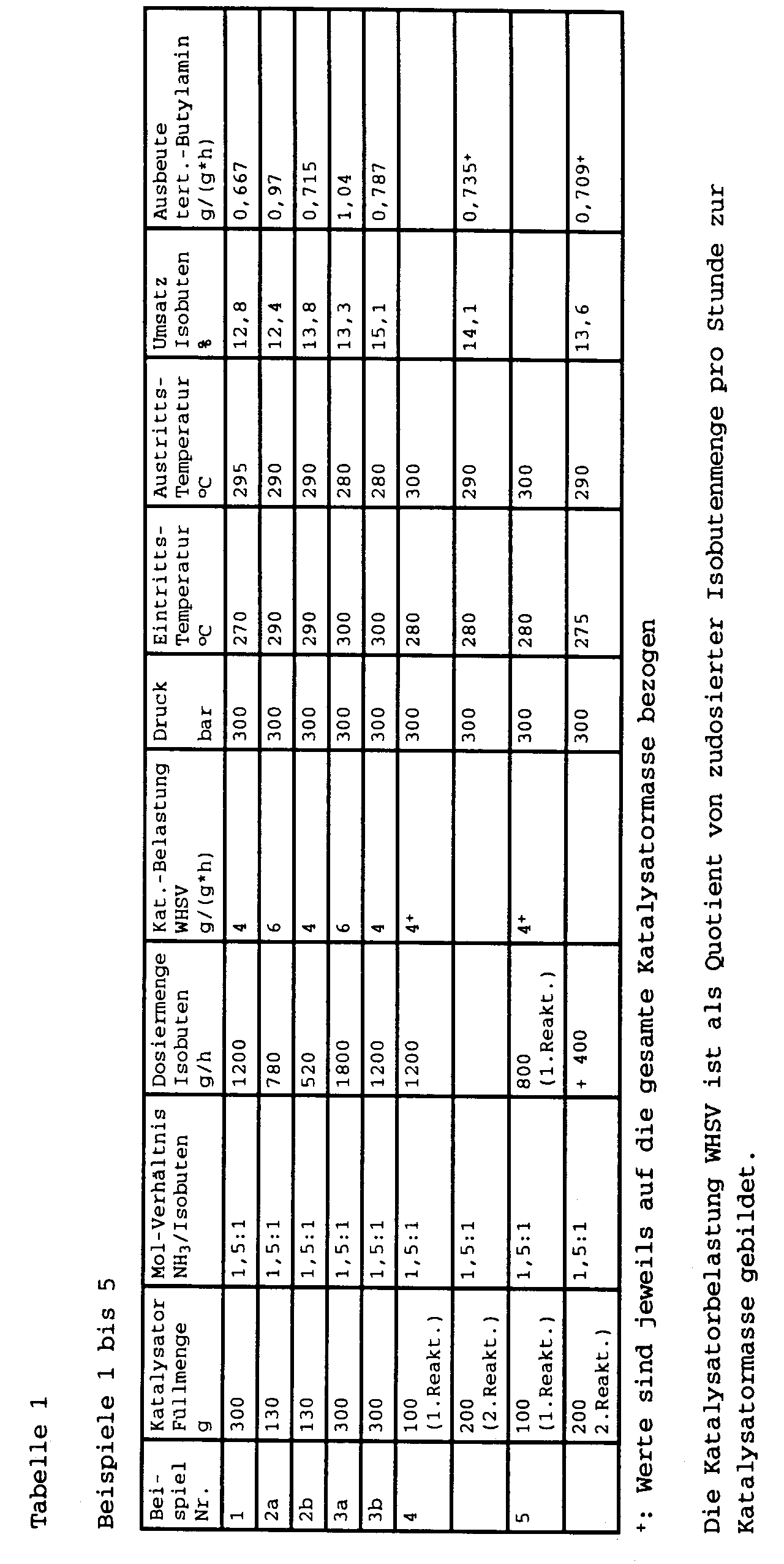
- Ammonia and isobutene were in the molar ratio of 1.5: 1 mixed, heated and the reactor in an amount of 1750 g / h (corresponds to 4 g / h isobutene per 1 g catalyst) for one Pressure of 300 bar supplied.
- the inlet temperature was 270 ° C
- the outlet temperature was 295 ° C.
- the reactor discharge was let down and analyzed by gas chromatography.
- the conversion of the isobutene was 12.8% with a selectivity tert-butylamine of> 99.5%.
- a high pressure reactor was used for continuous production with 500 mm length (filling height of the catalyst) and 25 mm inside diameter used, which is constant by means of oil temperature control Temperature was maintained (isothermal operation).
- the reactor was filled with 130 g (250 ml) of catalyst.
- the type of catalyst and the average particle diameter is as below Example 1 described.
- the reactor inlet temperature as well as the Outlet temperature was 290 ° C. The results are in Table 1 compiled.
- a high pressure reactor was used for continuous production as used in Example 1, the temperature of the reactor being so was regulated that along the reactor in the flow direction continuous tempering reduction was achieved.
- the reactor inlet temperature was 300 ° C
- the outlet temperature was 280 ° C.
Landscapes
- Chemical & Material Sciences (AREA)
- Organic Chemistry (AREA)
- Chemical Kinetics & Catalysis (AREA)
- Organic Low-Molecular-Weight Compounds And Preparation Thereof (AREA)
Description
Claims (10)
- Verfahren zur Herstellung von tert. -Butylamin durch Umsetzung von Isobuten mit Ammoniak bei Temperaturen von 200 bis 350°C und Drücken von 40 bis 700 bar in Gegenwart eines aciden Heterogenkatalysators, dadurch gekennzeichnet, daß man die Reaktion in einer oder mehreren Reaktionszonen unter jeweils konstanter oder nahezu konstanter Temperatur durchführt.
- Verfahren zur Herstellung von tert.-Butylamin nach Anspruch 1, dadurch gekennzeichnet, daß man die Reaktion in einem Rohrbündelreaktor durchführt.
- Verfahren zur Herstellung von tert.-Butylamin nach Anspruch 1, dadurch gekennzeichnet, daß man einen Rohrbündelreaktor einsetzt, der in Strömungsrichtung mindestens zwei voneinander getrennte Reaktionszonen aufweist, die jeweils durch ein Wärmeträgermedium auf konstanter oder nahezu konstanter Temperatur gehalten werden und die Temperatur der ersten Reaktionszone um 2 bis 20°C höher gehalten wird als die Temperatur der nachfolgenden Reaktionszonen.
- Verfahren zur Herstellung von tert.-Butylamin nach Anspruch 1, dadurch gekennzeichnet, daß man die Reaktion in einem Festbettreaktor durchführt.
- Verfahren zur Herstellung von tert.-Butylamin nach Anspruch 1, dadurch gekennzeichnet, daß man die Reaktion in einem Festbettreaktor durchführt und in Strömungsrichtung an einer oder an mehreren Stellen kaltes Isobuten und/oder Ammoniak zur Abkühlung der Reaktionsmischung zuführt.
- Verfahren zur Herstellung von tert.-Butylamin nach Anspruch 1, dadurch gekennzeichnet, daß man die Reaktion in einem Festbettreaktor durchführt, in dem man die Reaktionsmischung in Strömungsrichtung an einer oder mehreren Stellen dem Reaktor entnimmt, durch einen Wärmeaustauscher führt und abkühlt und wieder dem Reaktor zuführt.
- Verfahren zur Herstellung von tert.-Butylamin nach Anspruch 1, dadurch gekennzeichnet, daß man die Reaktion in mindestens zwei aufeinanderfolgenden Festbettreaktoren durchführt und die Reaktionsmischung zwischen den einzelnen Festbettreaktoren durch Zuführung von kalten Isobuten und/oder Ammoniak abkühlt.
- Verfahren zur Herstellung von tert.-Butylamin nach Anspruch 1, dadurch gekennzeichnet, daß man die Reaktion in mindestens zwei aufeinanderfolgenden Festbettreaktoren durchführt und die Reaktionsmischung zwischen den einzelnen Festbettreaktoren durch Wärmeaustauscher abkühlt.
- Verfahren zur Herstellung von tert.-Butylamin nach Anspruch 1, dadurch gekennzeichnet, daß man in der ersten und den folgenden Reaktionszonen den gleichen Heterogenkatalysator einsetzt.
- Verfahren zur Herstellung von tert.-Butylamin nach Anspruch 1, dadurch gekennzeichnet, daß man in der ersten und den folgenden Reaktionszonen unterschiedliche Heterogenkatalysatoren einsetzt.
Applications Claiming Priority (2)
| Application Number | Priority Date | Filing Date | Title |
|---|---|---|---|
| DE19500839 | 1995-01-13 | ||
| DE19500839A DE19500839A1 (de) | 1995-01-13 | 1995-01-13 | Verfahren zur Herstellung von tert.-Butylamin |
Publications (2)
| Publication Number | Publication Date |
|---|---|
| EP0721934A1 EP0721934A1 (de) | 1996-07-17 |
| EP0721934B1 true EP0721934B1 (de) | 1998-08-26 |
Family
ID=7751420
Family Applications (1)
| Application Number | Title | Priority Date | Filing Date |
|---|---|---|---|
| EP96100056A Expired - Lifetime EP0721934B1 (de) | 1995-01-13 | 1996-01-04 | Verfahren zur Herstellung von tert.-Butylamin |
Country Status (2)
| Country | Link |
|---|---|
| EP (1) | EP0721934B1 (de) |
| DE (2) | DE19500839A1 (de) |
Families Citing this family (2)
| Publication number | Priority date | Publication date | Assignee | Title |
|---|---|---|---|---|
| DE19530177A1 (de) * | 1995-08-17 | 1997-02-20 | Basf Ag | Verfahren zur Herstellung von Aminen aus Olefinen an Bor-BETA-Zeolithen |
| DE102005051044A1 (de) * | 2005-10-25 | 2007-04-26 | Basf Ag | Verfahren zur Herstellung von Alkylaminen durch Umsetzung von Olefinen mit Ammoniak |
Family Cites Families (5)
| Publication number | Priority date | Publication date | Assignee | Title |
|---|---|---|---|---|
| DE3326579A1 (de) * | 1983-07-23 | 1985-01-31 | Basf Ag, 6700 Ludwigshafen | Verfahren zur herstellung von aminen |
| DE3940349A1 (de) * | 1989-12-06 | 1991-06-13 | Basf Ag | Verfahren zur herstellung von aminen |
| DE4206992A1 (de) * | 1992-03-05 | 1993-09-09 | Akzo Nv | Verfahren zur herstellung von tertiaerem butylamin |
| DE4207905A1 (de) * | 1992-03-12 | 1993-09-16 | Bayer Ag | Festbettreaktoren mit kurzem katalysatorbett in stroemungsrichtung |
| CA2086814A1 (en) * | 1992-09-08 | 1994-03-09 | Brian L. Benac | Tert-butylamine synthesis over dealuminated y-type zeolites |
-
1995
- 1995-01-13 DE DE19500839A patent/DE19500839A1/de not_active Withdrawn
-
1996
- 1996-01-04 EP EP96100056A patent/EP0721934B1/de not_active Expired - Lifetime
- 1996-01-04 DE DE59600460T patent/DE59600460D1/de not_active Expired - Lifetime
Also Published As
| Publication number | Publication date |
|---|---|
| DE59600460D1 (de) | 1998-10-01 |
| EP0721934A1 (de) | 1996-07-17 |
| DE19500839A1 (de) | 1996-07-18 |
Similar Documents
| Publication | Publication Date | Title |
|---|---|---|
| EP0132736B1 (de) | Verfahren zur Herstellung von Aminen | |
| DE69412708T2 (de) | Verfahren zur Herstellung von Cumol | |
| DE3535128A1 (de) | Katalytische dealkoxylierung von geminalen di-alkoxyverbindungen, geeignete katalysatoren und deren herstellung | |
| EP0170182B1 (de) | Verfahren zur Gewinnung von 2-Butenen aus 1-Buten und gegebenenfalls 2-Butene enthaltenden C4-Kohlenwasserstoffgemischen | |
| EP0262532B1 (de) | Verfahren zur Herstellung von Aldehyden und/oder Ketonen durch Umsetzung von Epoxiden | |
| DE4206992A1 (de) | Verfahren zur herstellung von tertiaerem butylamin | |
| EP0257443B1 (de) | Verfahren zur Herstellung von Trialkylaminen | |
| EP1943210B1 (de) | Verfahren zur herstellung von alkylaminen durch umsetzung von olefinen mit ammoniak | |
| EP0266689B1 (de) | Verfahren zur Herstellung von 4-Pentensäureestern | |
| EP0423526A2 (de) | Verfahren zur Herstellung von Triethylendiamin und Piperazin | |
| EP0193799A2 (de) | Esteraustauschreaktionen an zeolithischen Katalysatoren | |
| EP0196554B1 (de) | Verfahren zur Herstellung von aliphatischen Dinitrilen | |
| DE3419379A1 (de) | Verfahren zur herstellung von dienen durch dehydratisierung von aldehyden | |
| EP0232712B1 (de) | Verfahren zur Herstellung von Nitrilen | |
| EP0206143A1 (de) | Verfahren zur Herstellung von 4-Pentensäureestern | |
| EP0249976B1 (de) | Verfahren zur Herstellung von Carbonsäuren | |
| EP0325141B1 (de) | Verfahren zur Herstellung von Phenylethanolen | |
| EP0752409B1 (de) | Verfahren zur Herstellung von Aminen aus Gemischen, die man bei der Spaltung von Erdölfraktionen erhält, an Zeolithen. | |
| EP0276767B1 (de) | Verfahren zur Herstellung von Ketonen | |
| EP0721934A1 (de) | Verfahren zur Herstellung von tert.-Butylamin | |
| EP0476400A1 (de) | Verfahren zur Abtrennung von Cyclohexen aus Gemischen mit Benzol und Cyclohexan | |
| EP0844991B1 (de) | Verfahren zur herstellung von aminen aus olefinen an bor-beta-zeolithen | |
| DE69613921T2 (de) | Herstellung von Methylaminen | |
| DE3824725A1 (de) | Verfahren zur herstellung von phenylacetaldehyden | |
| EP0340702B1 (de) | Verfahren zur Herstellung von Hydroxybenzaldehyden |
Legal Events
| Date | Code | Title | Description |
|---|---|---|---|
| PUAI | Public reference made under article 153(3) epc to a published international application that has entered the european phase |
Free format text: ORIGINAL CODE: 0009012 |
|
| 17P | Request for examination filed |
Effective date: 19960411 |
|
| AK | Designated contracting states |
Kind code of ref document: A1 Designated state(s): BE DE FR GB NL |
|
| 17Q | First examination report despatched |
Effective date: 19970411 |
|
| GRAG | Despatch of communication of intention to grant |
Free format text: ORIGINAL CODE: EPIDOS AGRA |
|
| GRAG | Despatch of communication of intention to grant |
Free format text: ORIGINAL CODE: EPIDOS AGRA |
|
| GRAH | Despatch of communication of intention to grant a patent |
Free format text: ORIGINAL CODE: EPIDOS IGRA |
|
| GRAH | Despatch of communication of intention to grant a patent |
Free format text: ORIGINAL CODE: EPIDOS IGRA |
|
| GRAA | (expected) grant |
Free format text: ORIGINAL CODE: 0009210 |
|
| AK | Designated contracting states |
Kind code of ref document: B1 Designated state(s): BE DE FR GB NL |
|
| GBT | Gb: translation of ep patent filed (gb section 77(6)(a)/1977) |
Effective date: 19980908 |
|
| REF | Corresponds to: |
Ref document number: 59600460 Country of ref document: DE Date of ref document: 19981001 |
|
| ET | Fr: translation filed | ||
| PLBE | No opposition filed within time limit |
Free format text: ORIGINAL CODE: 0009261 |
|
| STAA | Information on the status of an ep patent application or granted ep patent |
Free format text: STATUS: NO OPPOSITION FILED WITHIN TIME LIMIT |
|
| 26N | No opposition filed | ||
| REG | Reference to a national code |
Ref country code: GB Ref legal event code: IF02 |
|
| REG | Reference to a national code |
Ref country code: FR Ref legal event code: PLFP Year of fee payment: 20 |
|
| PGFP | Annual fee paid to national office [announced via postgrant information from national office to epo] |
Ref country code: NL Payment date: 20150126 Year of fee payment: 20 |
|
| PGFP | Annual fee paid to national office [announced via postgrant information from national office to epo] |
Ref country code: GB Payment date: 20150202 Year of fee payment: 20 Ref country code: FR Payment date: 20150130 Year of fee payment: 20 |
|
| PGFP | Annual fee paid to national office [announced via postgrant information from national office to epo] |
Ref country code: BE Payment date: 20150121 Year of fee payment: 20 |
|
| PGFP | Annual fee paid to national office [announced via postgrant information from national office to epo] |
Ref country code: DE Payment date: 20150331 Year of fee payment: 20 |
|
| REG | Reference to a national code |
Ref country code: DE Ref legal event code: R071 Ref document number: 59600460 Country of ref document: DE |
|
| REG | Reference to a national code |
Ref country code: NL Ref legal event code: MK Effective date: 20160103 |
|
| REG | Reference to a national code |
Ref country code: GB Ref legal event code: PE20 Expiry date: 20160103 |
|
| PG25 | Lapsed in a contracting state [announced via postgrant information from national office to epo] |
Ref country code: GB Free format text: LAPSE BECAUSE OF EXPIRATION OF PROTECTION Effective date: 20160103 |