EP0720982B1 - Benzimidazole derivatives, their production and use and use as angiotensin II antagonists - Google Patents
Benzimidazole derivatives, their production and use and use as angiotensin II antagonists Download PDFInfo
- Publication number
- EP0720982B1 EP0720982B1 EP95118796A EP95118796A EP0720982B1 EP 0720982 B1 EP0720982 B1 EP 0720982B1 EP 95118796 A EP95118796 A EP 95118796A EP 95118796 A EP95118796 A EP 95118796A EP 0720982 B1 EP0720982 B1 EP 0720982B1
- Authority
- EP
- European Patent Office
- Prior art keywords
- alkyl
- methyl
- benzimidazole
- alkoxy
- group
- Prior art date
- Legal status (The legal status is an assumption and is not a legal conclusion. Google has not performed a legal analysis and makes no representation as to the accuracy of the status listed.)
- Expired - Lifetime
Links
- 238000004519 manufacturing process Methods 0.000 title claims description 4
- 229940123413 Angiotensin II antagonist Drugs 0.000 title description 9
- 239000002333 angiotensin II receptor antagonist Substances 0.000 title description 9
- 229940058303 antinematodal benzimidazole derivative Drugs 0.000 title description 8
- 125000003785 benzimidazolyl group Chemical class N1=C(NC2=C1C=CC=C2)* 0.000 title description 3
- 239000013078 crystal Substances 0.000 claims abstract description 110
- 125000001997 phenyl group Chemical group [H]C1=C([H])C([H])=C(*)C([H])=C1[H] 0.000 claims abstract description 59
- 125000000217 alkyl group Chemical group 0.000 claims abstract description 45
- 150000003839 salts Chemical class 0.000 claims abstract description 31
- 125000003178 carboxy group Chemical group [H]OC(*)=O 0.000 claims abstract description 20
- 150000001408 amides Chemical class 0.000 claims abstract description 15
- 150000002148 esters Chemical class 0.000 claims abstract description 9
- BCPWNYREAURMOP-UHFFFAOYSA-N ethyl 2-ethoxy-3-[[4-[2-(2h-tetrazol-5-yl)phenyl]phenyl]methyl]benzimidazole-4-carboxylate Chemical compound C1=2C(C(=O)OCC)=CC=CC=2N=C(OCC)N1CC(C=C1)=CC=C1C1=CC=CC=C1C1=NN=NN1 BCPWNYREAURMOP-UHFFFAOYSA-N 0.000 claims abstract description 5
- 125000000843 phenylene group Chemical group C1(=C(C=CC=C1)*)* 0.000 claims abstract description 4
- 150000001875 compounds Chemical class 0.000 claims description 186
- -1 amino, dimethylamino, diethylamino, piperidino, morpholino Chemical group 0.000 claims description 164
- 239000002904 solvent Substances 0.000 claims description 57
- 125000004178 (C1-C4) alkyl group Chemical group 0.000 claims description 51
- 125000004432 carbon atom Chemical group C* 0.000 claims description 50
- 238000000034 method Methods 0.000 claims description 46
- 229910052736 halogen Inorganic materials 0.000 claims description 37
- 150000002367 halogens Chemical group 0.000 claims description 37
- 125000002887 hydroxy group Chemical group [H]O* 0.000 claims description 36
- 125000002496 methyl group Chemical group [H]C([H])([H])* 0.000 claims description 33
- 125000000229 (C1-C4)alkoxy group Chemical group 0.000 claims description 30
- 229910052739 hydrogen Inorganic materials 0.000 claims description 27
- 239000001257 hydrogen Substances 0.000 claims description 27
- 125000000753 cycloalkyl group Chemical group 0.000 claims description 25
- 125000004435 hydrogen atom Chemical group [H]* 0.000 claims description 23
- NBIIXXVUZAFLBC-UHFFFAOYSA-N Phosphoric acid Chemical compound OP(O)(O)=O NBIIXXVUZAFLBC-UHFFFAOYSA-N 0.000 claims description 22
- 125000002924 primary amino group Chemical group [H]N([H])* 0.000 claims description 22
- 125000003831 tetrazolyl group Chemical group 0.000 claims description 21
- 125000001589 carboacyl group Chemical group 0.000 claims description 18
- 125000001495 ethyl group Chemical group [H]C([H])([H])C([H])([H])* 0.000 claims description 18
- 125000004191 (C1-C6) alkoxy group Chemical group 0.000 claims description 17
- 125000003342 alkenyl group Chemical group 0.000 claims description 17
- 125000003236 benzoyl group Chemical group [H]C1=C([H])C([H])=C(C([H])=C1[H])C(*)=O 0.000 claims description 17
- 239000002168 alkylating agent Substances 0.000 claims description 16
- 229940100198 alkylating agent Drugs 0.000 claims description 16
- 239000003153 chemical reaction reagent Substances 0.000 claims description 15
- 125000003302 alkenyloxy group Chemical group 0.000 claims description 14
- 125000003545 alkoxy group Chemical group 0.000 claims description 14
- 125000000449 nitro group Chemical group [O-][N+](*)=O 0.000 claims description 14
- 238000003756 stirring Methods 0.000 claims description 13
- CZGUSIXMZVURDU-JZXHSEFVSA-N Ile(5)-angiotensin II Chemical compound C([C@@H](C(=O)N[C@@H]([C@@H](C)CC)C(=O)N[C@@H](CC=1NC=NC=1)C(=O)N1[C@@H](CCC1)C(=O)N[C@@H](CC=1C=CC=CC=1)C([O-])=O)NC(=O)[C@@H](NC(=O)[C@H](CCCNC(N)=[NH2+])NC(=O)[C@@H]([NH3+])CC([O-])=O)C(C)C)C1=CC=C(O)C=C1 CZGUSIXMZVURDU-JZXHSEFVSA-N 0.000 claims description 12
- 229950006323 angiotensin ii Drugs 0.000 claims description 12
- 239000003814 drug Substances 0.000 claims description 12
- 125000002221 trityl group Chemical group [H]C1=C([H])C([H])=C([H])C([H])=C1C([*])(C1=C(C(=C(C(=C1[H])[H])[H])[H])[H])C1=C([H])C([H])=C([H])C([H])=C1[H] 0.000 claims description 12
- 102000005862 Angiotensin II Human genes 0.000 claims description 11
- 101800000733 Angiotensin-2 Proteins 0.000 claims description 11
- 229910000147 aluminium phosphate Inorganic materials 0.000 claims description 11
- 125000001797 benzyl group Chemical group [H]C1=C([H])C([H])=C(C([H])=C1[H])C([H])([H])* 0.000 claims description 11
- 125000001511 cyclopentyl group Chemical group [H]C1([H])C([H])([H])C([H])([H])C([H])(*)C1([H])[H] 0.000 claims description 11
- KAKQVSNHTBLJCH-UHFFFAOYSA-N trifluoromethanesulfonimidic acid Chemical compound NS(=O)(=O)C(F)(F)F KAKQVSNHTBLJCH-UHFFFAOYSA-N 0.000 claims description 11
- LSNNMFCWUKXFEE-UHFFFAOYSA-M Bisulfite Chemical compound OS([O-])=O LSNNMFCWUKXFEE-UHFFFAOYSA-M 0.000 claims description 10
- 125000004849 alkoxymethyl group Chemical group 0.000 claims description 10
- 125000000582 cycloheptyl group Chemical group [H]C1([H])C([H])([H])C([H])([H])C([H])([H])C([H])(*)C([H])([H])C1([H])[H] 0.000 claims description 10
- 125000000113 cyclohexyl group Chemical group [H]C1([H])C([H])([H])C([H])([H])C([H])(*)C([H])([H])C1([H])[H] 0.000 claims description 10
- 125000004169 (C1-C6) alkyl group Chemical group 0.000 claims description 9
- 230000008569 process Effects 0.000 claims description 9
- 125000001424 substituent group Chemical group 0.000 claims description 9
- 230000003042 antagnostic effect Effects 0.000 claims description 8
- 150000001540 azides Chemical class 0.000 claims description 8
- 125000006503 p-nitrobenzyl group Chemical group [H]C1=C([H])C(=C([H])C([H])=C1[N+]([O-])=O)C([H])([H])* 0.000 claims description 8
- 125000004423 acyloxy group Chemical group 0.000 claims description 7
- 125000005194 alkoxycarbonyloxy group Chemical group 0.000 claims description 7
- 125000003282 alkyl amino group Chemical group 0.000 claims description 7
- HTQMVQVXFRQIKW-UHFFFAOYSA-N candesartan Chemical compound CCOC1=NC2=CC=CC(C(O)=O)=C2N1CC(C=C1)=CC=C1C1=CC=CC=C1C1=NN=NN1 HTQMVQVXFRQIKW-UHFFFAOYSA-N 0.000 claims description 7
- 125000004093 cyano group Chemical group *C#N 0.000 claims description 7
- 125000003854 p-chlorophenyl group Chemical group [H]C1=C([H])C(*)=C([H])C([H])=C1Cl 0.000 claims description 7
- 125000004414 alkyl thio group Chemical group 0.000 claims description 6
- 125000000319 biphenyl-4-yl group Chemical group [H]C1=C([H])C([H])=C([H])C([H])=C1C1=C([H])C([H])=C([*])C([H])=C1[H] 0.000 claims description 6
- 125000005745 ethoxymethyl group Chemical group [H]C([H])([H])C([H])([H])OC([H])([H])* 0.000 claims description 6
- 150000002540 isothiocyanates Chemical class 0.000 claims description 6
- 125000004184 methoxymethyl group Chemical group [H]C([H])([H])OC([H])([H])* 0.000 claims description 6
- 125000001624 naphthyl group Chemical group 0.000 claims description 6
- 239000012434 nucleophilic reagent Substances 0.000 claims description 6
- 125000001037 p-tolyl group Chemical group [H]C1=C([H])C(=C([H])C([H])=C1*)C([H])([H])[H] 0.000 claims description 6
- 239000008194 pharmaceutical composition Substances 0.000 claims description 6
- 125000006239 protecting group Chemical group 0.000 claims description 6
- 239000000126 substance Substances 0.000 claims description 6
- 230000007717 exclusion Effects 0.000 claims description 5
- 239000000843 powder Substances 0.000 claims description 5
- 230000009467 reduction Effects 0.000 claims description 5
- 238000006722 reduction reaction Methods 0.000 claims description 5
- 238000006467 substitution reaction Methods 0.000 claims description 5
- UFHFLCQGNIYNRP-UHFFFAOYSA-N Hydrogen Chemical compound [H][H] UFHFLCQGNIYNRP-UHFFFAOYSA-N 0.000 claims description 4
- 238000005804 alkylation reaction Methods 0.000 claims description 4
- 125000000304 alkynyl group Chemical group 0.000 claims description 4
- 230000007062 hydrolysis Effects 0.000 claims description 4
- 238000006460 hydrolysis reaction Methods 0.000 claims description 4
- 238000007363 ring formation reaction Methods 0.000 claims description 4
- GHOSNRCGJFBJIB-UHFFFAOYSA-N Candesartan cilexetil Chemical compound C=12N(CC=3C=CC(=CC=3)C=3C(=CC=CC=3)C3=NNN=N3)C(OCC)=NC2=CC=CC=1C(=O)OC(C)OC(=O)OC1CCCCC1 GHOSNRCGJFBJIB-UHFFFAOYSA-N 0.000 claims description 3
- OKTJSMMVPCPJKN-UHFFFAOYSA-N Carbon Chemical compound [C] OKTJSMMVPCPJKN-UHFFFAOYSA-N 0.000 claims description 3
- 125000004453 alkoxycarbonyl group Chemical group 0.000 claims description 3
- 125000004429 atom Chemical group 0.000 claims description 3
- 238000010511 deprotection reaction Methods 0.000 claims description 3
- 239000003085 diluting agent Substances 0.000 claims description 3
- AJHKSNOAUSAKLG-UHFFFAOYSA-N ethyl 2-ethylsulfanyl-3-[[4-[2-(2h-tetrazol-5-yl)phenyl]phenyl]methyl]benzimidazole-4-carboxylate Chemical compound C1=2C(C(=O)OCC)=CC=CC=2N=C(SCC)N1CC(C=C1)=CC=C1C1=CC=CC=C1C1=NN=NN1 AJHKSNOAUSAKLG-UHFFFAOYSA-N 0.000 claims description 3
- ZTOGDBDTAPYLRQ-UHFFFAOYSA-N ethyl 2-methylsulfanyl-3-[[4-[2-(2h-tetrazol-5-yl)phenyl]phenyl]methyl]benzimidazole-4-carboxylate Chemical compound C1=2C(C(=O)OCC)=CC=CC=2N=C(SC)N1CC(C=C1)=CC=C1C1=CC=CC=C1C1=NN=NN1 ZTOGDBDTAPYLRQ-UHFFFAOYSA-N 0.000 claims description 3
- DRYZNZVQHCFGSD-UHFFFAOYSA-N ethyl 2-propoxy-3-[[4-[2-(2h-tetrazol-5-yl)phenyl]phenyl]methyl]benzimidazole-4-carboxylate Chemical compound CCCOC1=NC2=CC=CC(C(=O)OCC)=C2N1CC(C=C1)=CC=C1C1=CC=CC=C1C1=NN=NN1 DRYZNZVQHCFGSD-UHFFFAOYSA-N 0.000 claims description 3
- KRCMFQFAEJNPQK-UHFFFAOYSA-N methyl 2-methoxy-3-[[4-[2-(2h-tetrazol-5-yl)phenyl]phenyl]methyl]benzimidazole-4-carboxylate Chemical compound C1=2C(C(=O)OC)=CC=CC=2N=C(OC)N1CC(C=C1)=CC=C1C1=CC=CC=C1C1=NN=NN1 KRCMFQFAEJNPQK-UHFFFAOYSA-N 0.000 claims description 3
- 230000003647 oxidation Effects 0.000 claims description 3
- 238000007254 oxidation reaction Methods 0.000 claims description 3
- 239000000546 pharmaceutical excipient Substances 0.000 claims description 3
- AGYJKWLACPVLLU-UHFFFAOYSA-N (5-methyl-2-oxo-1,3-dioxol-4-yl)methyl 2-ethoxy-3-[[4-[2-(2h-tetrazol-5-yl)phenyl]phenyl]methyl]benzimidazole-4-carboxylate Chemical compound C=12N(CC=3C=CC(=CC=3)C=3C(=CC=CC=3)C=3NN=NN=3)C(OCC)=NC2=CC=CC=1C(=O)OCC=1OC(=O)OC=1C AGYJKWLACPVLLU-UHFFFAOYSA-N 0.000 claims description 2
- MHYCZSLRSHMIJZ-UHFFFAOYSA-N 1-acetyloxyethyl 2-ethoxy-3-[[4-[2-(2h-tetrazol-5-yl)phenyl]phenyl]methyl]benzimidazole-4-carboxylate Chemical compound CCOC1=NC2=CC=CC(C(=O)OC(C)OC(C)=O)=C2N1CC(C=C1)=CC=C1C1=CC=CC=C1C1=NN=NN1 MHYCZSLRSHMIJZ-UHFFFAOYSA-N 0.000 claims description 2
- SHCLORQJYOHTCT-UHFFFAOYSA-N 1-cyclohexyloxycarbonyloxyethyl 2-(ethylamino)-3-[[4-[2-(2h-tetrazol-5-yl)phenyl]phenyl]methyl]benzimidazole-4-carboxylate Chemical compound C=12N(CC=3C=CC(=CC=3)C=3C(=CC=CC=3)C=3NN=NN=3)C(NCC)=NC2=CC=CC=1C(=O)OC(C)OC(=O)OC1CCCCC1 SHCLORQJYOHTCT-UHFFFAOYSA-N 0.000 claims description 2
- ITTQCOUEWOQXKP-UHFFFAOYSA-N 1-ethoxycarbonyloxyethyl 2-ethoxy-3-[[4-[2-(2h-tetrazol-5-yl)phenyl]phenyl]methyl]benzimidazole-4-carboxylate Chemical compound C1=2C(C(=O)OC(C)OC(=O)OCC)=CC=CC=2N=C(OCC)N1CC(C=C1)=CC=C1C1=CC=CC=C1C1=NN=NN1 ITTQCOUEWOQXKP-UHFFFAOYSA-N 0.000 claims description 2
- RGPBYKABVKOLGH-UHFFFAOYSA-N 1-propan-2-yloxycarbonyloxyethyl 2-ethoxy-3-[[4-[2-(2h-tetrazol-5-yl)phenyl]phenyl]methyl]benzimidazole-4-carboxylate Chemical compound CCOC1=NC2=CC=CC(C(=O)OC(C)OC(=O)OC(C)C)=C2N1CC(C=C1)=CC=C1C1=CC=CC=C1C1=NN=NN1 RGPBYKABVKOLGH-UHFFFAOYSA-N 0.000 claims description 2
- WEAWMWUQRKOVTP-UHFFFAOYSA-N 2,2-dimethylpropanoyloxymethyl 2-(ethylamino)-3-[[4-[2-(2h-tetrazol-5-yl)phenyl]phenyl]methyl]benzimidazole-4-carboxylate Chemical compound CCNC1=NC2=CC=CC(C(=O)OCOC(=O)C(C)(C)C)=C2N1CC(C=C1)=CC=C1C1=CC=CC=C1C1=NN=NN1 WEAWMWUQRKOVTP-UHFFFAOYSA-N 0.000 claims description 2
- MDLMYYHLFIAVIW-UHFFFAOYSA-N 2,2-dimethylpropanoyloxymethyl 2-ethoxy-3-[[4-[2-(2h-tetrazol-5-yl)phenyl]phenyl]methyl]benzimidazole-4-carboxylate Chemical compound CCOC1=NC2=CC=CC(C(=O)OCOC(=O)C(C)(C)C)=C2N1CC(C=C1)=CC=C1C1=CC=CC=C1C1=NN=NN1 MDLMYYHLFIAVIW-UHFFFAOYSA-N 0.000 claims description 2
- APMNCEGMCPPDAT-UHFFFAOYSA-N 2-(ethylamino)-3-[[4-[2-(2h-tetrazol-5-yl)phenyl]phenyl]methyl]benzimidazole-4-carboxylic acid Chemical compound CCNC1=NC2=CC=CC(C(O)=O)=C2N1CC(C=C1)=CC=C1C1=CC=CC=C1C1=NN=NN1 APMNCEGMCPPDAT-UHFFFAOYSA-N 0.000 claims description 2
- YJCGBKXKHUBCDM-UHFFFAOYSA-N 2-(propylamino)-3-[[4-[2-(2h-tetrazol-5-yl)phenyl]phenyl]methyl]benzimidazole-4-carboxylic acid Chemical compound CCCNC1=NC2=CC=CC(C(O)=O)=C2N1CC(C=C1)=CC=C1C1=CC=CC=C1C1=NN=NN1 YJCGBKXKHUBCDM-UHFFFAOYSA-N 0.000 claims description 2
- WGCKAKYVIFHPSA-UHFFFAOYSA-N 2-ethylsulfanyl-3-[[4-[2-(2h-tetrazol-5-yl)phenyl]phenyl]methyl]benzimidazole-4-carboxylic acid Chemical compound CCSC1=NC2=CC=CC(C(O)=O)=C2N1CC(C=C1)=CC=C1C1=CC=CC=C1C1=NN=NN1 WGCKAKYVIFHPSA-UHFFFAOYSA-N 0.000 claims description 2
- GGMUVWGZVYLWFZ-UHFFFAOYSA-N 2-methoxy-3-[[4-[2-(2h-tetrazol-5-yl)phenyl]phenyl]methyl]benzimidazole-4-carboxylic acid Chemical compound COC1=NC2=CC=CC(C(O)=O)=C2N1CC(C=C1)=CC=C1C1=CC=CC=C1C1=NN=NN1 GGMUVWGZVYLWFZ-UHFFFAOYSA-N 0.000 claims description 2
- DTTKGJDJYCPZAU-UHFFFAOYSA-N 2-methylpropanoyloxymethyl 2-ethoxy-3-[[4-[2-(2h-tetrazol-5-yl)phenyl]phenyl]methyl]benzimidazole-4-carboxylate Chemical compound CCOC1=NC2=CC=CC(C(=O)OCOC(=O)C(C)C)=C2N1CC(C=C1)=CC=C1C1=CC=CC=C1C1=NN=NN1 DTTKGJDJYCPZAU-UHFFFAOYSA-N 0.000 claims description 2
- PVYGZXHEQJQJQC-UHFFFAOYSA-N 2-methylsulfanyl-3-[[4-[2-(2h-tetrazol-5-yl)phenyl]phenyl]methyl]benzimidazole-4-carboxylic acid Chemical compound CSC1=NC2=CC=CC(C(O)=O)=C2N1CC(C=C1)=CC=C1C1=CC=CC=C1C1=NN=NN1 PVYGZXHEQJQJQC-UHFFFAOYSA-N 0.000 claims description 2
- XZTYHZLGMBRKDV-UHFFFAOYSA-N 2-propoxy-3-[[4-[2-(2h-tetrazol-5-yl)phenyl]phenyl]methyl]benzimidazole-4-carboxylic acid Chemical compound CCCOC1=NC2=CC=CC(C(O)=O)=C2N1CC(C=C1)=CC=C1C1=CC=CC=C1C1=NN=NN1 XZTYHZLGMBRKDV-UHFFFAOYSA-N 0.000 claims description 2
- GHZXQTZRKKTJBP-UHFFFAOYSA-N 2-propylsulfanyl-3-[[4-[2-(2h-tetrazol-5-yl)phenyl]phenyl]methyl]benzimidazole-4-carboxylic acid Chemical compound CCCSC1=NC2=CC=CC(C(O)=O)=C2N1CC(C=C1)=CC=C1C1=CC=CC=C1C1=NN=NN1 GHZXQTZRKKTJBP-UHFFFAOYSA-N 0.000 claims description 2
- VLRRSKNTCAPWDG-LVZFUZTISA-N [(e)-3-phenylprop-2-enoyl]oxymethyl 2-ethoxy-3-[[4-[2-(2h-tetrazol-5-yl)phenyl]phenyl]methyl]benzimidazole-4-carboxylate Chemical compound C=12N(CC=3C=CC(=CC=3)C=3C(=CC=CC=3)C=3NN=NN=3)C(OCC)=NC2=CC=CC=1C(=O)OCOC(=O)\C=C\C1=CC=CC=C1 VLRRSKNTCAPWDG-LVZFUZTISA-N 0.000 claims description 2
- UEMQOOXUEIMWQP-UHFFFAOYSA-N acetyloxymethyl 2-ethoxy-3-[[4-[2-(2h-tetrazol-5-yl)phenyl]phenyl]methyl]benzimidazole-4-carboxylate Chemical compound CCOC1=NC2=CC=CC(C(=O)OCOC(C)=O)=C2N1CC(C=C1)=CC=C1C1=CC=CC=C1C1=NN=NN1 UEMQOOXUEIMWQP-UHFFFAOYSA-N 0.000 claims description 2
- 238000005904 alkaline hydrolysis reaction Methods 0.000 claims description 2
- 125000003277 amino group Chemical group 0.000 claims description 2
- JGRFTJBTMXRQQK-UHFFFAOYSA-N butanoyloxymethyl 2-ethoxy-3-[[4-[2-(2h-tetrazol-5-yl)phenyl]phenyl]methyl]benzimidazole-4-carboxylate Chemical compound C1=2C(C(=O)OCOC(=O)CCC)=CC=CC=2N=C(OCC)N1CC(C=C1)=CC=C1C1=CC=CC=C1C1=NN=NN1 JGRFTJBTMXRQQK-UHFFFAOYSA-N 0.000 claims description 2
- PAZMRVOQCBRFLK-UHFFFAOYSA-N cyclohexanecarbonyloxymethyl 2-ethoxy-3-[[4-[2-(2h-tetrazol-5-yl)phenyl]phenyl]methyl]benzimidazole-4-carboxylate Chemical compound C=12N(CC=3C=CC(=CC=3)C=3C(=CC=CC=3)C=3NN=NN=3)C(OCC)=NC2=CC=CC=1C(=O)OCOC(=O)C1CCCCC1 PAZMRVOQCBRFLK-UHFFFAOYSA-N 0.000 claims description 2
- QVTHQNDDIKVSAN-UHFFFAOYSA-N cyclopentanecarbonyloxymethyl 2-ethoxy-3-[[4-[2-(2h-tetrazol-5-yl)phenyl]phenyl]methyl]benzimidazole-4-carboxylate Chemical compound C=12N(CC=3C=CC(=CC=3)C=3C(=CC=CC=3)C=3NN=NN=3)C(OCC)=NC2=CC=CC=1C(=O)OCOC(=O)C1CCCC1 QVTHQNDDIKVSAN-UHFFFAOYSA-N 0.000 claims description 2
- 125000003754 ethoxycarbonyl group Chemical group C(=O)(OCC)* 0.000 claims description 2
- GFTGGYBKCZYUHS-UHFFFAOYSA-N ethyl 2-(propylamino)-3-[[4-[2-(2h-tetrazol-5-yl)phenyl]phenyl]methyl]benzimidazole-4-carboxylate Chemical compound CCCNC1=NC2=CC=CC(C(=O)OCC)=C2N1CC(C=C1)=CC=C1C1=CC=CC=C1C1=NN=NN1 GFTGGYBKCZYUHS-UHFFFAOYSA-N 0.000 claims description 2
- 230000026030 halogenation Effects 0.000 claims description 2
- 238000005658 halogenation reaction Methods 0.000 claims description 2
- 125000001160 methoxycarbonyl group Chemical group [H]C([H])([H])OC(*)=O 0.000 claims description 2
- RBPFEPGTRLLUKI-UHFFFAOYSA-N methyl 2-ethoxy-3-[[4-[2-(2h-tetrazol-5-yl)phenyl]phenyl]methyl]benzimidazole-4-carboxylate Chemical compound CCOC1=NC2=CC=CC(C(=O)OC)=C2N1CC(C=C1)=CC=C1C1=CC=CC=C1C1=NN=NN1 RBPFEPGTRLLUKI-UHFFFAOYSA-N 0.000 claims description 2
- LHOCWVFNTNDYBW-UHFFFAOYSA-N propanoyloxymethyl 2-ethoxy-3-[[4-[2-(2h-tetrazol-5-yl)phenyl]phenyl]methyl]benzimidazole-4-carboxylate Chemical compound CCOC1=NC2=CC=CC(C(=O)OCOC(=O)CC)=C2N1CC(C=C1)=CC=C1C1=CC=CC=C1C1=NN=NN1 LHOCWVFNTNDYBW-UHFFFAOYSA-N 0.000 claims description 2
- 125000006705 (C5-C7) cycloalkyl group Chemical group 0.000 claims 8
- 125000004648 C2-C8 alkenyl group Chemical group 0.000 claims 5
- 125000004209 (C1-C8) alkyl group Chemical group 0.000 claims 2
- 125000005913 (C3-C6) cycloalkyl group Chemical group 0.000 claims 2
- 125000004649 C2-C8 alkynyl group Chemical group 0.000 claims 2
- 230000002152 alkylating effect Effects 0.000 claims 2
- 125000000000 cycloalkoxy group Chemical group 0.000 claims 2
- 230000010933 acylation Effects 0.000 claims 1
- 238000005917 acylation reaction Methods 0.000 claims 1
- 229910052799 carbon Inorganic materials 0.000 claims 1
- 230000032050 esterification Effects 0.000 claims 1
- 238000005886 esterification reaction Methods 0.000 claims 1
- KUIZUWBMEYLMEI-UHFFFAOYSA-N ethyl 2-(ethylamino)-3-[[4-[2-(2h-tetrazol-5-yl)phenyl]phenyl]methyl]benzimidazole-4-carboxylate Chemical compound CCNC1=NC2=CC=CC(C(=O)OCC)=C2N1CC(C=C1)=CC=C1C1=CC=CC=C1C1=NN=NN1 KUIZUWBMEYLMEI-UHFFFAOYSA-N 0.000 claims 1
- 238000007344 nucleophilic reaction Methods 0.000 claims 1
- 238000006798 ring closing metathesis reaction Methods 0.000 claims 1
- 125000003107 substituted aryl group Chemical group 0.000 claims 1
- 150000001450 anions Chemical class 0.000 abstract description 10
- 125000006850 spacer group Chemical group 0.000 abstract description 4
- HYZJCKYKOHLVJF-UHFFFAOYSA-N 1H-benzimidazole Chemical compound C1=CC=C2NC=NC2=C1 HYZJCKYKOHLVJF-UHFFFAOYSA-N 0.000 abstract 1
- 239000004215 Carbon black (E152) Substances 0.000 abstract 1
- FFWDHZHBAMSJBU-UHFFFAOYSA-N cyclohexyl 1-[2-ethoxy-1-[[4-[2-(2h-tetrazol-5-yl)phenyl]phenyl]methyl]benzimidazol-4-yl]ethyl carbonate Chemical compound CCOC1=NC2=C(C(C)OC(=O)OC3CCCCC3)C=CC=C2N1CC(C=C1)=CC=C1C1=CC=CC=C1C=1N=NNN=1 FFWDHZHBAMSJBU-UHFFFAOYSA-N 0.000 abstract 1
- 229930195733 hydrocarbon Natural products 0.000 abstract 1
- 150000002430 hydrocarbons Chemical class 0.000 abstract 1
- HEDRZPFGACZZDS-MICDWDOJSA-N Trichloro(2H)methane Chemical compound [2H]C(Cl)(Cl)Cl HEDRZPFGACZZDS-MICDWDOJSA-N 0.000 description 134
- XEKOWRVHYACXOJ-UHFFFAOYSA-N Ethyl acetate Chemical compound CCOC(C)=O XEKOWRVHYACXOJ-UHFFFAOYSA-N 0.000 description 108
- OKKJLVBELUTLKV-UHFFFAOYSA-N Methanol Chemical compound OC OKKJLVBELUTLKV-UHFFFAOYSA-N 0.000 description 108
- 238000005160 1H NMR spectroscopy Methods 0.000 description 91
- LFQSCWFLJHTTHZ-UHFFFAOYSA-N Ethanol Chemical compound CCO LFQSCWFLJHTTHZ-UHFFFAOYSA-N 0.000 description 90
- 239000000203 mixture Substances 0.000 description 87
- 229910001868 water Inorganic materials 0.000 description 75
- XLYOFNOQVPJJNP-UHFFFAOYSA-N water Substances O XLYOFNOQVPJJNP-UHFFFAOYSA-N 0.000 description 71
- 238000006243 chemical reaction Methods 0.000 description 67
- ZMXDDKWLCZADIW-UHFFFAOYSA-N N,N-Dimethylformamide Chemical compound CN(C)C=O ZMXDDKWLCZADIW-UHFFFAOYSA-N 0.000 description 63
- 239000000243 solution Substances 0.000 description 61
- HEMHJVSKTPXQMS-UHFFFAOYSA-M Sodium hydroxide Chemical compound [OH-].[Na+] HEMHJVSKTPXQMS-UHFFFAOYSA-M 0.000 description 60
- 239000011541 reaction mixture Substances 0.000 description 57
- 238000000921 elemental analysis Methods 0.000 description 55
- IAZDPXIOMUYVGZ-WFGJKAKNSA-N Dimethyl sulfoxide Chemical compound [2H]C([2H])([2H])S(=O)C([2H])([2H])[2H] IAZDPXIOMUYVGZ-WFGJKAKNSA-N 0.000 description 40
- HEDRZPFGACZZDS-UHFFFAOYSA-N Chloroform Chemical compound ClC(Cl)Cl HEDRZPFGACZZDS-UHFFFAOYSA-N 0.000 description 37
- 238000001953 recrystallisation Methods 0.000 description 34
- YMWUJEATGCHHMB-UHFFFAOYSA-N Dichloromethane Chemical compound ClCCl YMWUJEATGCHHMB-UHFFFAOYSA-N 0.000 description 33
- 238000010992 reflux Methods 0.000 description 32
- WEVYAHXRMPXWCK-UHFFFAOYSA-N Acetonitrile Chemical compound CC#N WEVYAHXRMPXWCK-UHFFFAOYSA-N 0.000 description 30
- YXFVVABEGXRONW-UHFFFAOYSA-N Toluene Chemical compound CC1=CC=CC=C1 YXFVVABEGXRONW-UHFFFAOYSA-N 0.000 description 30
- 238000004440 column chromatography Methods 0.000 description 27
- BWHMMNNQKKPAPP-UHFFFAOYSA-L potassium carbonate Substances [K+].[K+].[O-]C([O-])=O BWHMMNNQKKPAPP-UHFFFAOYSA-L 0.000 description 26
- QTBSBXVTEAMEQO-UHFFFAOYSA-N Acetic acid Chemical compound CC(O)=O QTBSBXVTEAMEQO-UHFFFAOYSA-N 0.000 description 24
- VEXZGXHMUGYJMC-UHFFFAOYSA-N Hydrochloric acid Chemical compound Cl VEXZGXHMUGYJMC-UHFFFAOYSA-N 0.000 description 24
- VYPSYNLAJGMNEJ-UHFFFAOYSA-N Silicium dioxide Chemical compound O=[Si]=O VYPSYNLAJGMNEJ-UHFFFAOYSA-N 0.000 description 24
- WYURNTSHIVDZCO-UHFFFAOYSA-N Tetrahydrofuran Chemical compound C1CCOC1 WYURNTSHIVDZCO-UHFFFAOYSA-N 0.000 description 24
- 239000000741 silica gel Substances 0.000 description 24
- 229910002027 silica gel Inorganic materials 0.000 description 24
- UIIMBOGNXHQVGW-UHFFFAOYSA-M Sodium bicarbonate Chemical compound [Na+].OC([O-])=O UIIMBOGNXHQVGW-UHFFFAOYSA-M 0.000 description 22
- 239000012044 organic layer Substances 0.000 description 22
- ZMANZCXQSJIPKH-UHFFFAOYSA-N Triethylamine Chemical compound CCN(CC)CC ZMANZCXQSJIPKH-UHFFFAOYSA-N 0.000 description 21
- 239000002585 base Substances 0.000 description 20
- 239000006188 syrup Substances 0.000 description 19
- 235000020357 syrup Nutrition 0.000 description 19
- 238000001914 filtration Methods 0.000 description 15
- OAYLNYINCPYISS-UHFFFAOYSA-N ethyl acetate;hexane Chemical compound CCCCCC.CCOC(C)=O OAYLNYINCPYISS-UHFFFAOYSA-N 0.000 description 13
- 229910000027 potassium carbonate Inorganic materials 0.000 description 13
- UHOVQNZJYSORNB-UHFFFAOYSA-N Benzene Chemical compound C1=CC=CC=C1 UHOVQNZJYSORNB-UHFFFAOYSA-N 0.000 description 12
- JUJWROOIHBZHMG-UHFFFAOYSA-N Pyridine Chemical compound C1=CC=NC=C1 JUJWROOIHBZHMG-UHFFFAOYSA-N 0.000 description 12
- CDBYLPFSWZWCQE-UHFFFAOYSA-L Sodium Carbonate Chemical compound [Na+].[Na+].[O-]C([O-])=O CDBYLPFSWZWCQE-UHFFFAOYSA-L 0.000 description 12
- 150000001298 alcohols Chemical class 0.000 description 12
- 238000009835 boiling Methods 0.000 description 12
- GEYOCULIXLDCMW-UHFFFAOYSA-N 1,2-phenylenediamine Chemical compound NC1=CC=CC=C1N GEYOCULIXLDCMW-UHFFFAOYSA-N 0.000 description 11
- 206010020772 Hypertension Diseases 0.000 description 11
- 208000006011 Stroke Diseases 0.000 description 11
- 229910000030 sodium bicarbonate Inorganic materials 0.000 description 11
- 235000017557 sodium bicarbonate Nutrition 0.000 description 11
- 0 **c1nc2cccc(*)c2[n]1* Chemical compound **c1nc2cccc(*)c2[n]1* 0.000 description 10
- 239000002253 acid Substances 0.000 description 10
- 201000010099 disease Diseases 0.000 description 10
- 208000037265 diseases, disorders, signs and symptoms Diseases 0.000 description 10
- 150000008282 halocarbons Chemical class 0.000 description 10
- CSCPPACGZOOCGX-UHFFFAOYSA-N Acetone Chemical compound CC(C)=O CSCPPACGZOOCGX-UHFFFAOYSA-N 0.000 description 9
- RTZKZFJDLAIYFH-UHFFFAOYSA-N Diethyl ether Chemical compound CCOCC RTZKZFJDLAIYFH-UHFFFAOYSA-N 0.000 description 9
- KWYUFKZDYYNOTN-UHFFFAOYSA-M Potassium hydroxide Chemical compound [OH-].[K+] KWYUFKZDYYNOTN-UHFFFAOYSA-M 0.000 description 9
- 150000001556 benzimidazoles Chemical class 0.000 description 9
- 235000008504 concentrate Nutrition 0.000 description 9
- 239000012141 concentrate Substances 0.000 description 9
- 238000001816 cooling Methods 0.000 description 9
- 238000001704 evaporation Methods 0.000 description 9
- 230000008020 evaporation Effects 0.000 description 9
- 125000001449 isopropyl group Chemical group [H]C([H])([H])C([H])(*)C([H])([H])[H] 0.000 description 9
- YLQBMQCUIZJEEH-UHFFFAOYSA-N tetrahydrofuran Natural products C=1C=COC=1 YLQBMQCUIZJEEH-UHFFFAOYSA-N 0.000 description 9
- IAZDPXIOMUYVGZ-UHFFFAOYSA-N Dimethylsulphoxide Chemical compound CS(C)=O IAZDPXIOMUYVGZ-UHFFFAOYSA-N 0.000 description 8
- KEAYESYHFKHZAL-UHFFFAOYSA-N Sodium Chemical compound [Na] KEAYESYHFKHZAL-UHFFFAOYSA-N 0.000 description 8
- 235000011054 acetic acid Nutrition 0.000 description 8
- 230000009471 action Effects 0.000 description 8
- 239000007864 aqueous solution Substances 0.000 description 8
- OSJRGDBEYARHLX-UHFFFAOYSA-N azido(trimethyl)stannane Chemical compound [N-]=[N+]=[N-].C[Sn+](C)C OSJRGDBEYARHLX-UHFFFAOYSA-N 0.000 description 8
- RTEXIPZMMDUXMR-UHFFFAOYSA-N benzene;ethyl acetate Chemical compound CCOC(C)=O.C1=CC=CC=C1 RTEXIPZMMDUXMR-UHFFFAOYSA-N 0.000 description 8
- 150000002170 ethers Chemical class 0.000 description 8
- 239000000725 suspension Substances 0.000 description 8
- FXHOOIRPVKKKFG-UHFFFAOYSA-N N,N-Dimethylacetamide Chemical compound CN(C)C(C)=O FXHOOIRPVKKKFG-UHFFFAOYSA-N 0.000 description 7
- 150000001412 amines Chemical class 0.000 description 7
- 125000000484 butyl group Chemical group [H]C([*])([H])C([H])([H])C([H])([H])C([H])([H])[H] 0.000 description 7
- 229940079593 drug Drugs 0.000 description 7
- 208000019622 heart disease Diseases 0.000 description 7
- 239000003960 organic solvent Substances 0.000 description 7
- 230000003389 potentiating effect Effects 0.000 description 7
- 239000012312 sodium hydride Substances 0.000 description 7
- 229910000104 sodium hydride Inorganic materials 0.000 description 7
- UMGDCJDMYOKAJW-UHFFFAOYSA-N thiourea Chemical compound NC(N)=S UMGDCJDMYOKAJW-UHFFFAOYSA-N 0.000 description 7
- ZWEHNKRNPOVVGH-UHFFFAOYSA-N 2-Butanone Chemical compound CCC(C)=O ZWEHNKRNPOVVGH-UHFFFAOYSA-N 0.000 description 6
- PXIPVTKHYLBLMZ-UHFFFAOYSA-N Sodium azide Chemical compound [Na+].[N-]=[N+]=[N-] PXIPVTKHYLBLMZ-UHFFFAOYSA-N 0.000 description 6
- WQDUMFSSJAZKTM-UHFFFAOYSA-N Sodium methoxide Chemical compound [Na+].[O-]C WQDUMFSSJAZKTM-UHFFFAOYSA-N 0.000 description 6
- QAOWNCQODCNURD-UHFFFAOYSA-N Sulfuric acid Chemical compound OS(O)(=O)=O QAOWNCQODCNURD-UHFFFAOYSA-N 0.000 description 6
- XSQUKJJJFZCRTK-UHFFFAOYSA-N Urea Chemical compound NC(N)=O XSQUKJJJFZCRTK-UHFFFAOYSA-N 0.000 description 6
- WORJEOGGNQDSOE-UHFFFAOYSA-N chloroform;methanol Chemical compound OC.ClC(Cl)Cl WORJEOGGNQDSOE-UHFFFAOYSA-N 0.000 description 6
- UREBWPXBXRYXRJ-UHFFFAOYSA-N ethyl acetate;methanol Chemical compound OC.CCOC(C)=O UREBWPXBXRYXRJ-UHFFFAOYSA-N 0.000 description 6
- INQOMBQAUSQDDS-UHFFFAOYSA-N iodomethane Chemical compound IC INQOMBQAUSQDDS-UHFFFAOYSA-N 0.000 description 6
- 239000010410 layer Substances 0.000 description 6
- 125000004123 n-propyl group Chemical group [H]C([H])([H])C([H])([H])C([H])([H])* 0.000 description 6
- 201000008383 nephritis Diseases 0.000 description 6
- UMJSCPRVCHMLSP-UHFFFAOYSA-N pyridine Natural products COC1=CC=CN=C1 UMJSCPRVCHMLSP-UHFFFAOYSA-N 0.000 description 6
- 229910000029 sodium carbonate Inorganic materials 0.000 description 6
- 125000000999 tert-butyl group Chemical group [H]C([H])([H])C(*)(C([H])([H])[H])C([H])([H])[H] 0.000 description 6
- 102000008873 Angiotensin II receptor Human genes 0.000 description 5
- 108050000824 Angiotensin II receptor Proteins 0.000 description 5
- 239000007810 chemical reaction solvent Substances 0.000 description 5
- 230000000694 effects Effects 0.000 description 5
- 238000000605 extraction Methods 0.000 description 5
- 238000001727 in vivo Methods 0.000 description 5
- 125000000959 isobutyl group Chemical group [H]C([H])([H])C([H])(C([H])([H])[H])C([H])([H])* 0.000 description 5
- LERUETMARSWZRK-UHFFFAOYSA-N methyl 3-amino-2-[[4-(2-cyanophenyl)phenyl]methylamino]benzoate Chemical compound COC(=O)C1=CC=CC(N)=C1NCC1=CC=C(C=2C(=CC=CC=2)C#N)C=C1 LERUETMARSWZRK-UHFFFAOYSA-N 0.000 description 5
- 125000004368 propenyl group Chemical group C(=CC)* 0.000 description 5
- 125000001436 propyl group Chemical group [H]C([*])([H])C([H])([H])C([H])([H])[H] 0.000 description 5
- 102000005962 receptors Human genes 0.000 description 5
- 108020003175 receptors Proteins 0.000 description 5
- JOXIMZWYDAKGHI-UHFFFAOYSA-N toluene-4-sulfonic acid Chemical class CC1=CC=C(S(O)(=O)=O)C=C1 JOXIMZWYDAKGHI-UHFFFAOYSA-N 0.000 description 5
- 125000000391 vinyl group Chemical group [H]C([*])=C([H])[H] 0.000 description 5
- 229920002554 vinyl polymer Polymers 0.000 description 5
- RYHBNJHYFVUHQT-UHFFFAOYSA-N 1,4-Dioxane Chemical compound C1COCCO1 RYHBNJHYFVUHQT-UHFFFAOYSA-N 0.000 description 4
- NGNBDVOYPDDBFK-UHFFFAOYSA-N 2-[2,4-di(pentan-2-yl)phenoxy]acetyl chloride Chemical compound CCCC(C)C1=CC=C(OCC(Cl)=O)C(C(C)CCC)=C1 NGNBDVOYPDDBFK-UHFFFAOYSA-N 0.000 description 4
- LFFIEVAMVPCZNA-UHFFFAOYSA-N 2-[4-(bromomethyl)phenyl]benzonitrile Chemical compound C1=CC(CBr)=CC=C1C1=CC=CC=C1C#N LFFIEVAMVPCZNA-UHFFFAOYSA-N 0.000 description 4
- NLXLAEXVIDQMFP-UHFFFAOYSA-N Ammonia chloride Chemical compound [NH4+].[Cl-] NLXLAEXVIDQMFP-UHFFFAOYSA-N 0.000 description 4
- CIWBSHSKHKDKBQ-JLAZNSOCSA-N Ascorbic acid Chemical compound OC[C@H](O)[C@H]1OC(=O)C(O)=C1O CIWBSHSKHKDKBQ-JLAZNSOCSA-N 0.000 description 4
- 206010019280 Heart failures Diseases 0.000 description 4
- 241001465754 Metazoa Species 0.000 description 4
- MUBZPKHOEPUJKR-UHFFFAOYSA-N Oxalic acid Chemical compound OC(=O)C(O)=O MUBZPKHOEPUJKR-UHFFFAOYSA-N 0.000 description 4
- 241000700159 Rattus Species 0.000 description 4
- DKGAVHZHDRPRBM-UHFFFAOYSA-N Tert-Butanol Chemical compound CC(C)(C)O DKGAVHZHDRPRBM-UHFFFAOYSA-N 0.000 description 4
- DTQVDTLACAAQTR-UHFFFAOYSA-N Trifluoroacetic acid Chemical compound OC(=O)C(F)(F)F DTQVDTLACAAQTR-UHFFFAOYSA-N 0.000 description 4
- 125000005336 allyloxy group Chemical group 0.000 description 4
- 230000003276 anti-hypertensive effect Effects 0.000 description 4
- 230000036772 blood pressure Effects 0.000 description 4
- 150000001732 carboxylic acid derivatives Chemical class 0.000 description 4
- 239000006185 dispersion Substances 0.000 description 4
- QXQJYCWDJBDKKR-UHFFFAOYSA-N ethyl 3-amino-2-[[4-(2-cyanophenyl)phenyl]methylamino]benzoate Chemical compound CCOC(=O)C1=CC=CC(N)=C1NCC1=CC=C(C=2C(=CC=CC=2)C#N)C=C1 QXQJYCWDJBDKKR-UHFFFAOYSA-N 0.000 description 4
- HBNYJWAFDZLWRS-UHFFFAOYSA-N ethyl isothiocyanate Chemical compound CCN=C=S HBNYJWAFDZLWRS-UHFFFAOYSA-N 0.000 description 4
- 238000002474 experimental method Methods 0.000 description 4
- 238000009472 formulation Methods 0.000 description 4
- 238000010438 heat treatment Methods 0.000 description 4
- 150000002513 isocyanates Chemical class 0.000 description 4
- 125000001972 isopentyl group Chemical group [H]C([H])([H])C([H])(C([H])([H])[H])C([H])([H])C([H])([H])* 0.000 description 4
- 239000002480 mineral oil Substances 0.000 description 4
- 235000010446 mineral oil Nutrition 0.000 description 4
- 125000004108 n-butyl group Chemical group [H]C([H])([H])C([H])([H])C([H])([H])C([H])([H])* 0.000 description 4
- 125000000740 n-pentyl group Chemical group [H]C([H])([H])C([H])([H])C([H])([H])C([H])([H])C([H])([H])* 0.000 description 4
- 125000001971 neopentyl group Chemical group [H]C([*])([H])C(C([H])([H])[H])(C([H])([H])[H])C([H])([H])[H] 0.000 description 4
- 230000001590 oxidative effect Effects 0.000 description 4
- XHXFXVLFKHQFAL-UHFFFAOYSA-N phosphoryl trichloride Chemical compound ClP(Cl)(Cl)=O XHXFXVLFKHQFAL-UHFFFAOYSA-N 0.000 description 4
- 238000002360 preparation method Methods 0.000 description 4
- 239000000047 product Substances 0.000 description 4
- 150000003536 tetrazoles Chemical class 0.000 description 4
- 125000004974 2-butenyl group Chemical group C(C=CC)* 0.000 description 3
- VBMKOTRJWPIKMG-UHFFFAOYSA-N 2-ethoxy-3-[[4-[2-(1-trityltetrazol-5-yl)phenyl]phenyl]methyl]benzimidazole-4-carboxylic acid Chemical compound CCOC1=NC2=CC=CC(C(O)=O)=C2N1CC(C=C1)=CC=C1C1=CC=CC=C1C1=NN=NN1C(C=1C=CC=CC=1)(C=1C=CC=CC=1)C1=CC=CC=C1 VBMKOTRJWPIKMG-UHFFFAOYSA-N 0.000 description 3
- 125000000094 2-phenylethyl group Chemical group [H]C1=C([H])C([H])=C(C([H])=C1[H])C([H])([H])C([H])([H])* 0.000 description 3
- 125000004975 3-butenyl group Chemical group C(CC=C)* 0.000 description 3
- 239000005541 ACE inhibitor Substances 0.000 description 3
- WFDIJRYMOXRFFG-UHFFFAOYSA-N Acetic anhydride Chemical compound CC(=O)OC(C)=O WFDIJRYMOXRFFG-UHFFFAOYSA-N 0.000 description 3
- WVDDGKGOMKODPV-UHFFFAOYSA-N Benzyl alcohol Chemical compound OCC1=CC=CC=C1 WVDDGKGOMKODPV-UHFFFAOYSA-N 0.000 description 3
- 206010008190 Cerebrovascular accident Diseases 0.000 description 3
- RWSOTUBLDIXVET-UHFFFAOYSA-N Dihydrogen sulfide Chemical class S RWSOTUBLDIXVET-UHFFFAOYSA-N 0.000 description 3
- 102000004190 Enzymes Human genes 0.000 description 3
- 108090000790 Enzymes Proteins 0.000 description 3
- 206010061216 Infarction Diseases 0.000 description 3
- SJRJJKPEHAURKC-UHFFFAOYSA-N N-Methylmorpholine Chemical compound CN1CCOCC1 SJRJJKPEHAURKC-UHFFFAOYSA-N 0.000 description 3
- 150000007513 acids Chemical class 0.000 description 3
- 239000003513 alkali Substances 0.000 description 3
- 230000029936 alkylation Effects 0.000 description 3
- 229910052794 bromium Inorganic materials 0.000 description 3
- 230000000747 cardiac effect Effects 0.000 description 3
- 230000002490 cerebral effect Effects 0.000 description 3
- 239000003795 chemical substances by application Substances 0.000 description 3
- 229910052801 chlorine Inorganic materials 0.000 description 3
- KRKNYBCHXYNGOX-UHFFFAOYSA-N citric acid Chemical compound OC(=O)CC(O)(C(O)=O)CC(O)=O KRKNYBCHXYNGOX-UHFFFAOYSA-N 0.000 description 3
- 238000007796 conventional method Methods 0.000 description 3
- MKRTXPORKIRPDG-UHFFFAOYSA-N diphenylphosphoryl azide Chemical compound C=1C=CC=CC=1P(=O)(N=[N+]=[N-])C1=CC=CC=C1 MKRTXPORKIRPDG-UHFFFAOYSA-N 0.000 description 3
- 239000003937 drug carrier Substances 0.000 description 3
- CHPMKOFPDCKNBG-UHFFFAOYSA-N ethyl 2-[[4-(2-cyanophenyl)phenyl]methylamino]-3-nitrobenzoate Chemical compound CCOC(=O)C1=CC=CC([N+]([O-])=O)=C1NCC1=CC=C(C=2C(=CC=CC=2)C#N)C=C1 CHPMKOFPDCKNBG-UHFFFAOYSA-N 0.000 description 3
- SKZXUMVKJUYJEX-UHFFFAOYSA-N ethyl 2-sulfanylidene-3-[[4-[2-(2h-tetrazol-5-yl)phenyl]phenyl]methyl]-1h-benzimidazole-4-carboxylate Chemical compound C1=2C(C(=O)OCC)=CC=CC=2N=C(S)N1CC(C=C1)=CC=C1C1=CC=CC=C1C1=NN=NN1 SKZXUMVKJUYJEX-UHFFFAOYSA-N 0.000 description 3
- GYTTUVXCCHRIBA-UHFFFAOYSA-N ethyl 3-[[4-(2-cyanophenyl)phenyl]methyl]-2-ethoxybenzimidazole-4-carboxylate Chemical compound C1=2C(C(=O)OCC)=CC=CC=2N=C(OCC)N1CC(C=C1)=CC=C1C1=CC=CC=C1C#N GYTTUVXCCHRIBA-UHFFFAOYSA-N 0.000 description 3
- 229910052731 fluorine Inorganic materials 0.000 description 3
- 150000004820 halides Chemical class 0.000 description 3
- XLYOFNOQVPJJNP-ZSJDYOACSA-N heavy water Substances [2H]O[2H] XLYOFNOQVPJJNP-ZSJDYOACSA-N 0.000 description 3
- 125000003187 heptyl group Chemical group [H]C([*])([H])C([H])([H])C([H])([H])C([H])([H])C([H])([H])C([H])([H])C([H])([H])[H] 0.000 description 3
- 239000005457 ice water Substances 0.000 description 3
- 230000007574 infarction Effects 0.000 description 3
- 239000007924 injection Substances 0.000 description 3
- 238000002347 injection Methods 0.000 description 3
- 239000012528 membrane Substances 0.000 description 3
- VEDIIGMQOAWKGH-UHFFFAOYSA-N methyl 2-[(2-methylpropan-2-yl)oxycarbonylamino]-3-nitrobenzoate Chemical compound COC(=O)C1=CC=CC([N+]([O-])=O)=C1NC(=O)OC(C)(C)C VEDIIGMQOAWKGH-UHFFFAOYSA-N 0.000 description 3
- HYPVNXPCKDMLMZ-UHFFFAOYSA-N methyl 3-[[4-(2-cyanophenyl)phenyl]methyl]-2-(ethylamino)benzimidazole-4-carboxylate Chemical compound CCNC1=NC2=CC=CC(C(=O)OC)=C2N1CC(C=C1)=CC=C1C1=CC=CC=C1C#N HYPVNXPCKDMLMZ-UHFFFAOYSA-N 0.000 description 3
- VLKZOEOYAKHREP-UHFFFAOYSA-N n-Hexane Chemical compound CCCCCC VLKZOEOYAKHREP-UHFFFAOYSA-N 0.000 description 3
- 125000004365 octenyl group Chemical group C(=CCCCCCC)* 0.000 description 3
- 150000007524 organic acids Chemical class 0.000 description 3
- 125000001147 pentyl group Chemical group C(CCCC)* 0.000 description 3
- 239000006187 pill Substances 0.000 description 3
- NLKNQRATVPKPDG-UHFFFAOYSA-M potassium iodide Chemical compound [K+].[I-] NLKNQRATVPKPDG-UHFFFAOYSA-M 0.000 description 3
- LPNYRYFBWFDTMA-UHFFFAOYSA-N potassium tert-butoxide Chemical compound [K+].CC(C)(C)[O-] LPNYRYFBWFDTMA-UHFFFAOYSA-N 0.000 description 3
- 230000036454 renin-angiotensin system Effects 0.000 description 3
- 229920006395 saturated elastomer Polymers 0.000 description 3
- 125000002914 sec-butyl group Chemical group [H]C([H])([H])C([H])([H])C([H])(*)C([H])([H])[H] 0.000 description 3
- 239000007858 starting material Substances 0.000 description 3
- 150000003462 sulfoxides Chemical class 0.000 description 3
- 239000003826 tablet Substances 0.000 description 3
- 229940124597 therapeutic agent Drugs 0.000 description 3
- VZCYOOQTPOCHFL-UHFFFAOYSA-N trans-butenedioic acid Natural products OC(=O)C=CC(O)=O VZCYOOQTPOCHFL-UHFFFAOYSA-N 0.000 description 3
- JBWKIWSBJXDJDT-UHFFFAOYSA-N triphenylmethyl chloride Chemical compound C=1C=CC=CC=1C(C=1C=CC=CC=1)(Cl)C1=CC=CC=C1 JBWKIWSBJXDJDT-UHFFFAOYSA-N 0.000 description 3
- NWZSZGALRFJKBT-KNIFDHDWSA-N (2s)-2,6-diaminohexanoic acid;(2s)-2-hydroxybutanedioic acid Chemical compound OC(=O)[C@@H](O)CC(O)=O.NCCCC[C@H](N)C(O)=O NWZSZGALRFJKBT-KNIFDHDWSA-N 0.000 description 2
- SCYULBFZEHDVBN-UHFFFAOYSA-N 1,1-Dichloroethane Chemical compound CC(Cl)Cl SCYULBFZEHDVBN-UHFFFAOYSA-N 0.000 description 2
- SZAOZGFHEAVFMM-UHFFFAOYSA-N 16533-45-2 Chemical compound CCOC(=O)C1=CC=CC([N+]([O-])=O)=C1C(O)=O SZAOZGFHEAVFMM-UHFFFAOYSA-N 0.000 description 2
- BNZMLIHMNWLHRL-UHFFFAOYSA-N 2-(4-methylphenyl)benzaldehyde Chemical compound C1=CC(C)=CC=C1C1=CC=CC=C1C=O BNZMLIHMNWLHRL-UHFFFAOYSA-N 0.000 description 2
- ZGQVZLSNEBEHFN-UHFFFAOYSA-N 2-(4-methylphenyl)benzonitrile Chemical group C1=CC(C)=CC=C1C1=CC=CC=C1C#N ZGQVZLSNEBEHFN-UHFFFAOYSA-N 0.000 description 2
- DJMQLZPEBHSABD-UHFFFAOYSA-N 2-(methoxycarbonyl)-6-nitrobenzoic acid Chemical compound COC(=O)C1=CC=CC([N+]([O-])=O)=C1C(O)=O DJMQLZPEBHSABD-UHFFFAOYSA-N 0.000 description 2
- HZAXFHJVJLSVMW-UHFFFAOYSA-N 2-Aminoethan-1-ol Chemical compound NCCO HZAXFHJVJLSVMW-UHFFFAOYSA-N 0.000 description 2
- XNWFRZJHXBZDAG-UHFFFAOYSA-N 2-METHOXYETHANOL Chemical compound COCCO XNWFRZJHXBZDAG-UHFFFAOYSA-N 0.000 description 2
- HNUKTDKISXPDPA-UHFFFAOYSA-N 2-oxopropyl Chemical group [CH2]C(C)=O HNUKTDKISXPDPA-UHFFFAOYSA-N 0.000 description 2
- 125000003903 2-propenyl group Chemical group [H]C([*])([H])C([H])=C([H])[H] 0.000 description 2
- VJWNLHRQOCVMNI-UHFFFAOYSA-N 2-propoxy-1h-benzimidazole Chemical compound C1=CC=C2NC(OCCC)=NC2=C1 VJWNLHRQOCVMNI-UHFFFAOYSA-N 0.000 description 2
- NHQDETIJWKXCTC-UHFFFAOYSA-N 3-chloroperbenzoic acid Chemical compound OOC(=O)C1=CC=CC(Cl)=C1 NHQDETIJWKXCTC-UHFFFAOYSA-N 0.000 description 2
- KFIRODWJCYBBHY-UHFFFAOYSA-N 3-nitrophthalic acid Chemical compound OC(=O)C1=CC=CC([N+]([O-])=O)=C1C(O)=O KFIRODWJCYBBHY-UHFFFAOYSA-N 0.000 description 2
- 125000006283 4-chlorobenzyl group Chemical group [H]C1=C([H])C(=C([H])C([H])=C1Cl)C([H])([H])* 0.000 description 2
- 241000282472 Canis lupus familiaris Species 0.000 description 2
- 238000006969 Curtius rearrangement reaction Methods 0.000 description 2
- VZCYOOQTPOCHFL-OWOJBTEDSA-N Fumaric acid Chemical compound OC(=O)\C=C\C(O)=O VZCYOOQTPOCHFL-OWOJBTEDSA-N 0.000 description 2
- OAKJQQAXSVQMHS-UHFFFAOYSA-N Hydrazine Chemical compound NN OAKJQQAXSVQMHS-UHFFFAOYSA-N 0.000 description 2
- 229910021578 Iron(III) chloride Inorganic materials 0.000 description 2
- FYYHWMGAXLPEAU-UHFFFAOYSA-N Magnesium Chemical compound [Mg] FYYHWMGAXLPEAU-UHFFFAOYSA-N 0.000 description 2
- 241000124008 Mammalia Species 0.000 description 2
- AFVFQIVMOAPDHO-UHFFFAOYSA-N Methanesulfonic acid Chemical compound CS(O)(=O)=O AFVFQIVMOAPDHO-UHFFFAOYSA-N 0.000 description 2
- LGDSHSYDSCRFAB-UHFFFAOYSA-N Methyl isothiocyanate Chemical compound CN=C=S LGDSHSYDSCRFAB-UHFFFAOYSA-N 0.000 description 2
- YNAVUWVOSKDBBP-UHFFFAOYSA-N Morpholine Chemical compound C1COCCN1 YNAVUWVOSKDBBP-UHFFFAOYSA-N 0.000 description 2
- PCLIMKBDDGJMGD-UHFFFAOYSA-N N-bromosuccinimide Chemical compound BrN1C(=O)CCC1=O PCLIMKBDDGJMGD-UHFFFAOYSA-N 0.000 description 2
- 241000283973 Oryctolagus cuniculus Species 0.000 description 2
- 208000001647 Renal Insufficiency Diseases 0.000 description 2
- FAPWRFPIFSIZLT-UHFFFAOYSA-M Sodium chloride Chemical compound [Na+].[Cl-] FAPWRFPIFSIZLT-UHFFFAOYSA-M 0.000 description 2
- 239000004480 active ingredient Substances 0.000 description 2
- 229910052783 alkali metal Inorganic materials 0.000 description 2
- 150000001340 alkali metals Chemical class 0.000 description 2
- 229910052784 alkaline earth metal Inorganic materials 0.000 description 2
- 150000001342 alkaline earth metals Chemical class 0.000 description 2
- 235000019270 ammonium chloride Nutrition 0.000 description 2
- 150000003863 ammonium salts Chemical class 0.000 description 2
- 239000003708 ampul Substances 0.000 description 2
- 229940044094 angiotensin-converting-enzyme inhibitor Drugs 0.000 description 2
- 150000004945 aromatic hydrocarbons Chemical class 0.000 description 2
- 125000003710 aryl alkyl group Chemical group 0.000 description 2
- 125000003118 aryl group Chemical group 0.000 description 2
- 235000010323 ascorbic acid Nutrition 0.000 description 2
- 239000011668 ascorbic acid Substances 0.000 description 2
- 229960005070 ascorbic acid Drugs 0.000 description 2
- WPYMKLBDIGXBTP-UHFFFAOYSA-N benzoic acid Chemical compound OC(=O)C1=CC=CC=C1 WPYMKLBDIGXBTP-UHFFFAOYSA-N 0.000 description 2
- GZUXJHMPEANEGY-UHFFFAOYSA-N bromomethane Chemical compound BrC GZUXJHMPEANEGY-UHFFFAOYSA-N 0.000 description 2
- 239000002775 capsule Substances 0.000 description 2
- 239000007806 chemical reaction intermediate Substances 0.000 description 2
- FIMJSWFMQJGVAM-UHFFFAOYSA-N chloroform;hydrate Chemical compound O.ClC(Cl)Cl FIMJSWFMQJGVAM-UHFFFAOYSA-N 0.000 description 2
- 125000000490 cinnamyl group Chemical group C(C=CC1=CC=CC=C1)* 0.000 description 2
- 238000009833 condensation Methods 0.000 description 2
- 230000005494 condensation Effects 0.000 description 2
- WRBLBPRJIBIRBP-UHFFFAOYSA-N cyclohexyl 1-iodoethyl carbonate Chemical compound CC(I)OC(=O)OC1CCCCC1 WRBLBPRJIBIRBP-UHFFFAOYSA-N 0.000 description 2
- PAFZNILMFXTMIY-UHFFFAOYSA-N cyclohexylamine Chemical compound NC1CCCCC1 PAFZNILMFXTMIY-UHFFFAOYSA-N 0.000 description 2
- 125000004210 cyclohexylmethyl group Chemical group [H]C([H])(*)C1([H])C([H])([H])C([H])([H])C([H])([H])C([H])([H])C1([H])[H] 0.000 description 2
- 125000004851 cyclopentylmethyl group Chemical group C1(CCCC1)C* 0.000 description 2
- 230000018044 dehydration Effects 0.000 description 2
- 238000006297 dehydration reaction Methods 0.000 description 2
- 239000000839 emulsion Substances 0.000 description 2
- MFOMDTCBCZQHQZ-UHFFFAOYSA-N ethoxymethanetriol Chemical compound CCOC(O)(O)O MFOMDTCBCZQHQZ-UHFFFAOYSA-N 0.000 description 2
- NYCBXLQKKUBOGV-UHFFFAOYSA-N ethyl 2-[(2-methylpropan-2-yl)oxycarbonylamino]-3-nitrobenzoate Chemical compound CCOC(=O)C1=CC=CC([N+]([O-])=O)=C1NC(=O)OC(C)(C)C NYCBXLQKKUBOGV-UHFFFAOYSA-N 0.000 description 2
- IZDXKXDXIKFPLL-UHFFFAOYSA-N ethyl 2-[[4-(2-cyanophenyl)phenyl]methylamino]-3-(ethylcarbamothioylamino)benzoate Chemical compound CCNC(=S)NC1=CC=CC(C(=O)OCC)=C1NCC1=CC=C(C=2C(=CC=CC=2)C#N)C=C1 IZDXKXDXIKFPLL-UHFFFAOYSA-N 0.000 description 2
- KGMJZDWXTWOYFQ-UHFFFAOYSA-N ethyl 2-[[4-(2-cyanophenyl)phenyl]methylamino]-3-(propylcarbamothioylamino)benzoate Chemical compound CCCNC(=S)NC1=CC=CC(C(=O)OCC)=C1NCC1=CC=C(C=2C(=CC=CC=2)C#N)C=C1 KGMJZDWXTWOYFQ-UHFFFAOYSA-N 0.000 description 2
- ZKJOQFJREXAQPH-UHFFFAOYSA-N ethyl 2-propylsulfanyl-3-[[4-[2-(2h-tetrazol-5-yl)phenyl]phenyl]methyl]benzimidazole-4-carboxylate Chemical compound CCCSC1=NC2=CC=CC(C(=O)OCC)=C2N1CC(C=C1)=CC=C1C1=CC=CC=C1C1=NN=NN1 ZKJOQFJREXAQPH-UHFFFAOYSA-N 0.000 description 2
- OUFOYEMYZHEFFU-UHFFFAOYSA-N ethyl 3-[[4-(2-cyanophenyl)phenyl]methyl]-2-(ethylamino)benzimidazole-4-carboxylate Chemical compound CCNC1=NC2=CC=CC(C(=O)OCC)=C2N1CC(C=C1)=CC=C1C1=CC=CC=C1C#N OUFOYEMYZHEFFU-UHFFFAOYSA-N 0.000 description 2
- UTRKVMUCKGXSTE-UHFFFAOYSA-N ethyl 3-[[4-(2-cyanophenyl)phenyl]methyl]-2-(propylamino)benzimidazole-4-carboxylate Chemical compound CCCNC1=NC2=CC=CC(C(=O)OCC)=C2N1CC(C=C1)=CC=C1C1=CC=CC=C1C#N UTRKVMUCKGXSTE-UHFFFAOYSA-N 0.000 description 2
- JHIJQICHYTUOCT-UHFFFAOYSA-N ethyl 3-[[4-(2-cyanophenyl)phenyl]methyl]-2-propoxybenzimidazole-4-carboxylate Chemical compound CCCOC1=NC2=CC=CC(C(=O)OCC)=C2N1CC(C=C1)=CC=C1C1=CC=CC=C1C#N JHIJQICHYTUOCT-UHFFFAOYSA-N 0.000 description 2
- 239000000194 fatty acid Substances 0.000 description 2
- 239000008187 granular material Substances 0.000 description 2
- 150000002391 heterocyclic compounds Chemical class 0.000 description 2
- 125000004051 hexyl group Chemical group [H]C([H])([H])C([H])([H])C([H])([H])C([H])([H])C([H])([H])C([H])([H])* 0.000 description 2
- IKDUDTNKRLTJSI-UHFFFAOYSA-N hydrazine monohydrate Substances O.NN IKDUDTNKRLTJSI-UHFFFAOYSA-N 0.000 description 2
- JUINSXZKUKVTMD-UHFFFAOYSA-N hydrogen azide Chemical compound N=[N+]=[N-] JUINSXZKUKVTMD-UHFFFAOYSA-N 0.000 description 2
- 150000002460 imidazoles Chemical class 0.000 description 2
- 239000003701 inert diluent Substances 0.000 description 2
- 230000005764 inhibitory process Effects 0.000 description 2
- 239000000543 intermediate Substances 0.000 description 2
- 229940079865 intestinal antiinfectives imidazole derivative Drugs 0.000 description 2
- 238000001990 intravenous administration Methods 0.000 description 2
- HVTICUPFWKNHNG-UHFFFAOYSA-N iodoethane Chemical compound CCI HVTICUPFWKNHNG-UHFFFAOYSA-N 0.000 description 2
- PELJISAVHGXLAL-UHFFFAOYSA-N iodomethyl 2,2-dimethylpropanoate Chemical compound CC(C)(C)C(=O)OCI PELJISAVHGXLAL-UHFFFAOYSA-N 0.000 description 2
- RBTARNINKXHZNM-UHFFFAOYSA-K iron trichloride Chemical compound Cl[Fe](Cl)Cl RBTARNINKXHZNM-UHFFFAOYSA-K 0.000 description 2
- 239000012948 isocyanate Substances 0.000 description 2
- 125000000555 isopropenyl group Chemical group [H]\C([H])=C(\*)C([H])([H])[H] 0.000 description 2
- 208000017169 kidney disease Diseases 0.000 description 2
- JVTAAEKCZFNVCJ-UHFFFAOYSA-N lactic acid Chemical compound CC(O)C(O)=O JVTAAEKCZFNVCJ-UHFFFAOYSA-N 0.000 description 2
- 230000005923 long-lasting effect Effects 0.000 description 2
- HQKMJHAJHXVSDF-UHFFFAOYSA-L magnesium stearate Chemical compound [Mg+2].CCCCCCCCCCCCCCCCCC([O-])=O.CCCCCCCCCCCCCCCCCC([O-])=O HQKMJHAJHXVSDF-UHFFFAOYSA-L 0.000 description 2
- VZCYOOQTPOCHFL-UPHRSURJSA-N maleic acid Chemical compound OC(=O)\C=C/C(O)=O VZCYOOQTPOCHFL-UPHRSURJSA-N 0.000 description 2
- LWJROJCJINYWOX-UHFFFAOYSA-L mercury dichloride Chemical compound Cl[Hg]Cl LWJROJCJINYWOX-UHFFFAOYSA-L 0.000 description 2
- WCYWZMWISLQXQU-UHFFFAOYSA-N methyl Chemical group [CH3] WCYWZMWISLQXQU-UHFFFAOYSA-N 0.000 description 2
- RYISODKHILKUHO-UHFFFAOYSA-N methyl 2-(butylamino)-3-[[4-(2-cyanophenyl)phenyl]methyl]benzimidazole-4-carboxylate Chemical compound CCCCNC1=NC2=CC=CC(C(=O)OC)=C2N1CC(C=C1)=CC=C1C1=CC=CC=C1C#N RYISODKHILKUHO-UHFFFAOYSA-N 0.000 description 2
- PRZLLGCHOAGJAZ-UHFFFAOYSA-N methyl 2-(butylamino)-3-[[4-[2-(2h-tetrazol-5-yl)phenyl]phenyl]methyl]benzimidazole-4-carboxylate Chemical compound CCCCNC1=NC2=CC=CC(C(=O)OC)=C2N1CC(C=C1)=CC=C1C1=CC=CC=C1C1=NN=NN1 PRZLLGCHOAGJAZ-UHFFFAOYSA-N 0.000 description 2
- KRKQIDCWCNFYLJ-UHFFFAOYSA-N methyl 2-[[4-(2-cyanophenyl)phenyl]methylamino]-3-(methoxycarbonylamino)benzoate Chemical compound COC(=O)NC1=CC=CC(C(=O)OC)=C1NCC1=CC=C(C=2C(=CC=CC=2)C#N)C=C1 KRKQIDCWCNFYLJ-UHFFFAOYSA-N 0.000 description 2
- MIJJTROOKPSAKH-UHFFFAOYSA-N methyl 2-[[4-(2-methoxycarbonylphenyl)phenyl]methylamino]-3-nitrobenzoate Chemical compound COC(=O)C1=CC=CC([N+]([O-])=O)=C1NCC1=CC=C(C=2C(=CC=CC=2)C(=O)OC)C=C1 MIJJTROOKPSAKH-UHFFFAOYSA-N 0.000 description 2
- PUZOQRDCWMWUQD-UHFFFAOYSA-N methyl 2-butoxy-3-[[4-(2-cyanophenyl)phenyl]methyl]benzimidazole-4-carboxylate Chemical compound CCCCOC1=NC2=CC=CC(C(=O)OC)=C2N1CC(C=C1)=CC=C1C1=CC=CC=C1C#N PUZOQRDCWMWUQD-UHFFFAOYSA-N 0.000 description 2
- DGBGGOHPHFHKAR-UHFFFAOYSA-N methyl 2-chloro-3-[[4-(2-cyanophenyl)phenyl]methyl]benzimidazole-4-carboxylate Chemical compound C1=2C(C(=O)OC)=CC=CC=2N=C(Cl)N1CC(C=C1)=CC=C1C1=CC=CC=C1C#N DGBGGOHPHFHKAR-UHFFFAOYSA-N 0.000 description 2
- IXHZODXLAIYVHZ-UHFFFAOYSA-N methyl 2-ethoxy-3-[[4-(2-methoxycarbonylphenyl)phenyl]methyl]benzimidazole-4-carboxylate Chemical compound CCOC1=NC2=CC=CC(C(=O)OC)=C2N1CC(C=C1)=CC=C1C1=CC=CC=C1C(=O)OC IXHZODXLAIYVHZ-UHFFFAOYSA-N 0.000 description 2
- KLOPPDHXOIYXRC-UHFFFAOYSA-N methyl 2-morpholin-4-yl-3-[[4-[2-(2h-tetrazol-5-yl)phenyl]phenyl]methyl]benzimidazole-4-carboxylate Chemical compound C=1C=C(C=2C(=CC=CC=2)C=2NN=NN=2)C=CC=1CN1C=2C(C(=O)OC)=CC=CC=2N=C1N1CCOCC1 KLOPPDHXOIYXRC-UHFFFAOYSA-N 0.000 description 2
- WHLCUHFMNYNJRI-UHFFFAOYSA-N methyl 2-piperidin-1-yl-3-[[4-[2-(2h-tetrazol-5-yl)phenyl]phenyl]methyl]benzimidazole-4-carboxylate Chemical compound C=1C=C(C=2C(=CC=CC=2)C=2NN=NN=2)C=CC=1CN1C=2C(C(=O)OC)=CC=CC=2N=C1N1CCCCC1 WHLCUHFMNYNJRI-UHFFFAOYSA-N 0.000 description 2
- YTZQGEOGJJXDAX-UHFFFAOYSA-N methyl 3-[[4-(2-cyanophenyl)phenyl]methyl]-2-(2,2,2-trifluoroethoxy)benzimidazole-4-carboxylate Chemical compound C1=2C(C(=O)OC)=CC=CC=2N=C(OCC(F)(F)F)N1CC(C=C1)=CC=C1C1=CC=CC=C1C#N YTZQGEOGJJXDAX-UHFFFAOYSA-N 0.000 description 2
- KSXLHOFDCDKQLH-UHFFFAOYSA-N methyl 3-[[4-(2-cyanophenyl)phenyl]methyl]-2-ethoxybenzimidazole-4-carboxylate Chemical compound CCOC1=NC2=CC=CC(C(=O)OC)=C2N1CC(C=C1)=CC=C1C1=CC=CC=C1C#N KSXLHOFDCDKQLH-UHFFFAOYSA-N 0.000 description 2
- AVLWZOXKJQLJFZ-UHFFFAOYSA-N methyl 3-[[4-(2-cyanophenyl)phenyl]methyl]-2-morpholin-4-ylbenzimidazole-4-carboxylate Chemical compound C=1C=C(C=2C(=CC=CC=2)C#N)C=CC=1CN1C=2C(C(=O)OC)=CC=CC=2N=C1N1CCOCC1 AVLWZOXKJQLJFZ-UHFFFAOYSA-N 0.000 description 2
- UPXHAIJRSNBMBO-UHFFFAOYSA-N methyl 3-[[4-(2-cyanophenyl)phenyl]methyl]-2-oxo-1h-benzimidazole-4-carboxylate Chemical compound C1=2C(C(=O)OC)=CC=CC=2NC(=O)N1CC(C=C1)=CC=C1C1=CC=CC=C1C#N UPXHAIJRSNBMBO-UHFFFAOYSA-N 0.000 description 2
- JXURVCAEJCIAFA-UHFFFAOYSA-N methyl 3-[[4-(2-cyanophenyl)phenyl]methyl]-2-piperidin-1-ylbenzimidazole-4-carboxylate Chemical compound C=1C=C(C=2C(=CC=CC=2)C#N)C=CC=1CN1C=2C(C(=O)OC)=CC=CC=2N=C1N1CCCCC1 JXURVCAEJCIAFA-UHFFFAOYSA-N 0.000 description 2
- BSQODZCCWHMNPZ-UHFFFAOYSA-N methyl 3-[[4-[2-(2h-tetrazol-5-yl)phenyl]phenyl]methyl]-2-(2,2,2-trifluoroethoxy)benzimidazole-4-carboxylate Chemical compound C1=2C(C(=O)OC)=CC=CC=2N=C(OCC(F)(F)F)N1CC(C=C1)=CC=C1C1=CC=CC=C1C1=NN=NN1 BSQODZCCWHMNPZ-UHFFFAOYSA-N 0.000 description 2
- UUBQRMSCSPJFFY-UHFFFAOYSA-N methyl 3-amino-2-[[4-(2-methoxycarbonylphenyl)phenyl]methylamino]benzoate Chemical compound COC(=O)C1=CC=CC(N)=C1NCC1=CC=C(C=2C(=CC=CC=2)C(=O)OC)C=C1 UUBQRMSCSPJFFY-UHFFFAOYSA-N 0.000 description 2
- 150000007522 mineralic acids Chemical class 0.000 description 2
- BWRTYSRMCAZULB-UHFFFAOYSA-N n-cyclohexyl-1-(2-methoxyphenyl)methanimine Chemical compound COC1=CC=CC=C1C=NC1CCCCC1 BWRTYSRMCAZULB-UHFFFAOYSA-N 0.000 description 2
- PVWOIHVRPOBWPI-UHFFFAOYSA-N n-propyl iodide Chemical compound CCCI PVWOIHVRPOBWPI-UHFFFAOYSA-N 0.000 description 2
- 231100000252 nontoxic Toxicity 0.000 description 2
- 230000003000 nontoxic effect Effects 0.000 description 2
- 239000000346 nonvolatile oil Substances 0.000 description 2
- ZRSNZINYAWTAHE-UHFFFAOYSA-N p-methoxybenzaldehyde Chemical compound COC1=CC=C(C=O)C=C1 ZRSNZINYAWTAHE-UHFFFAOYSA-N 0.000 description 2
- WEXRUCMBJFQVBZ-UHFFFAOYSA-N pentobarbital Chemical compound CCCC(C)C1(CC)C(=O)NC(=O)NC1=O WEXRUCMBJFQVBZ-UHFFFAOYSA-N 0.000 description 2
- 230000004962 physiological condition Effects 0.000 description 2
- 239000002244 precipitate Substances 0.000 description 2
- 108090000765 processed proteins & peptides Proteins 0.000 description 2
- 238000000746 purification Methods 0.000 description 2
- 239000011734 sodium Substances 0.000 description 2
- QDRKDTQENPPHOJ-UHFFFAOYSA-N sodium ethoxide Chemical compound [Na+].CC[O-] QDRKDTQENPPHOJ-UHFFFAOYSA-N 0.000 description 2
- 239000007787 solid Substances 0.000 description 2
- 239000007909 solid dosage form Substances 0.000 description 2
- 239000001117 sulphuric acid Substances 0.000 description 2
- 235000011149 sulphuric acid Nutrition 0.000 description 2
- 238000002560 therapeutic procedure Methods 0.000 description 2
- FYSNRJHAOHDILO-UHFFFAOYSA-N thionyl chloride Chemical compound ClS(Cl)=O FYSNRJHAOHDILO-UHFFFAOYSA-N 0.000 description 2
- FWPIDFUJEMBDLS-UHFFFAOYSA-L tin(II) chloride dihydrate Chemical compound O.O.Cl[Sn]Cl FWPIDFUJEMBDLS-UHFFFAOYSA-L 0.000 description 2
- PYOKUURKVVELLB-UHFFFAOYSA-N trimethyl orthoformate Chemical compound COC(OC)OC PYOKUURKVVELLB-UHFFFAOYSA-N 0.000 description 2
- 230000003639 vasoconstrictive effect Effects 0.000 description 2
- 239000003981 vehicle Substances 0.000 description 2
- GVJHHUAWPYXKBD-IEOSBIPESA-N (R)-alpha-Tocopherol Natural products OC1=C(C)C(C)=C2O[C@@](CCC[C@H](C)CCC[C@H](C)CCCC(C)C)(C)CCC2=C1C GVJHHUAWPYXKBD-IEOSBIPESA-N 0.000 description 1
- WSLDOOZREJYCGB-UHFFFAOYSA-N 1,2-Dichloroethane Chemical compound ClCCCl WSLDOOZREJYCGB-UHFFFAOYSA-N 0.000 description 1
- ZBTMRBYMKUEVEU-UHFFFAOYSA-N 1-bromo-4-methylbenzene Chemical compound CC1=CC=C(Br)C=C1 ZBTMRBYMKUEVEU-UHFFFAOYSA-N 0.000 description 1
- KKASGUHLXWAKEZ-UHFFFAOYSA-N 1-isothiocyanatopropane Chemical compound CCCN=C=S KKASGUHLXWAKEZ-UHFFFAOYSA-N 0.000 description 1
- ISTUKIUCOZRLRN-UHFFFAOYSA-N 2,2,2-trifluoroethoxymethanetriol Chemical compound OC(O)(O)OCC(F)(F)F ISTUKIUCOZRLRN-UHFFFAOYSA-N 0.000 description 1
- GOMLISZHRJBRGK-UHFFFAOYSA-N 2-(4-formylphenyl)benzonitrile Chemical compound C1=CC(C=O)=CC=C1C1=CC=CC=C1C#N GOMLISZHRJBRGK-UHFFFAOYSA-N 0.000 description 1
- GRIMYPQEIIHKDQ-UHFFFAOYSA-N 2-(butylamino)-3-[[4-[2-(2h-tetrazol-5-yl)phenyl]phenyl]methyl]benzimidazole-4-carboxylic acid Chemical compound CCCCNC1=NC2=CC=CC(C(O)=O)=C2N1CC(C=C1)=CC=C1C1=CC=CC=C1C1=NN=NN1 GRIMYPQEIIHKDQ-UHFFFAOYSA-N 0.000 description 1
- UNFBUKXRNUJSRD-UHFFFAOYSA-N 2-(methylamino)-3-[[4-[2-(2h-tetrazol-5-yl)phenyl]phenyl]methyl]benzimidazole-4-carboxylic acid Chemical compound CNC1=NC2=CC=CC(C(O)=O)=C2N1CC(C=C1)=CC=C1C1=CC=CC=C1C1=NN=NN1 UNFBUKXRNUJSRD-UHFFFAOYSA-N 0.000 description 1
- LRGAANMQNVMQFA-UHFFFAOYSA-N 2-[4-(aminomethyl)phenyl]benzonitrile Chemical compound C1=CC(CN)=CC=C1C1=CC=CC=C1C#N LRGAANMQNVMQFA-UHFFFAOYSA-N 0.000 description 1
- PDXMIINMRWDBPX-UHFFFAOYSA-N 2-[ethyl(methyl)amino]-3-[[4-[2-(2h-tetrazol-5-yl)phenyl]phenyl]methyl]benzimidazole-4-carboxylic acid Chemical compound CCN(C)C1=NC2=CC=CC(C(O)=O)=C2N1CC(C=C1)=CC=C1C1=CC=CC=C1C1=NN=NN1 PDXMIINMRWDBPX-UHFFFAOYSA-N 0.000 description 1
- 125000000069 2-butynyl group Chemical group [H]C([H])([H])C#CC([H])([H])* 0.000 description 1
- IQZBZEIJUUZHGP-UHFFFAOYSA-N 2-morpholin-4-yl-3-[[4-[2-(2h-tetrazol-5-yl)phenyl]phenyl]methyl]benzimidazole-4-carboxylic acid Chemical compound C=1C=C(C=2C(=CC=CC=2)C=2NN=NN=2)C=CC=1CN1C=2C(C(=O)O)=CC=CC=2N=C1N1CCOCC1 IQZBZEIJUUZHGP-UHFFFAOYSA-N 0.000 description 1
- JPVMNGNDKFHLJP-UHFFFAOYSA-N 2-piperidin-1-yl-3-[[4-[2-(2h-tetrazol-5-yl)phenyl]phenyl]methyl]benzimidazole-4-carboxylic acid Chemical compound C=1C=C(C=2C(=CC=CC=2)C=2NN=NN=2)C=CC=1CN1C=2C(C(=O)O)=CC=CC=2N=C1N1CCCCC1 JPVMNGNDKFHLJP-UHFFFAOYSA-N 0.000 description 1
- VGBJHGALXIPDTP-UHFFFAOYSA-N 2-propoxy-1-[[4-[2-(2h-tetrazol-5-yl)phenyl]phenyl]methyl]benzimidazole Chemical compound CCCOC1=NC2=CC=CC=C2N1CC(C=C1)=CC=C1C1=CC=CC=C1C1=NN=NN1 VGBJHGALXIPDTP-UHFFFAOYSA-N 0.000 description 1
- 125000001494 2-propynyl group Chemical group [H]C#CC([H])([H])* 0.000 description 1
- IKJPRKDLEHDLMQ-UHFFFAOYSA-N 3-[[4-(2-carboxyphenyl)phenyl]methyl]-2-ethoxybenzimidazole-4-carboxylic acid Chemical compound CCOC1=NC2=CC=CC(C(O)=O)=C2N1CC(C=C1)=CC=C1C1=CC=CC=C1C(O)=O IKJPRKDLEHDLMQ-UHFFFAOYSA-N 0.000 description 1
- CAOCTFFZCLXQQI-UHFFFAOYSA-N 3-[[4-[2-(2h-tetrazol-5-yl)phenyl]phenyl]methyl]-2-(2,2,2-trifluoroethoxy)benzimidazole-4-carboxylic acid Chemical compound C1=2C(C(=O)O)=CC=CC=2N=C(OCC(F)(F)F)N1CC(C=C1)=CC=C1C1=CC=CC=C1C1=NN=NN1 CAOCTFFZCLXQQI-UHFFFAOYSA-N 0.000 description 1
- BMYNFMYTOJXKLE-UHFFFAOYSA-N 3-azaniumyl-2-hydroxypropanoate Chemical compound NCC(O)C(O)=O BMYNFMYTOJXKLE-UHFFFAOYSA-N 0.000 description 1
- ALYNCZNDIQEVRV-UHFFFAOYSA-N 4-aminobenzoic acid Chemical compound NC1=CC=C(C(O)=O)C=C1 ALYNCZNDIQEVRV-UHFFFAOYSA-N 0.000 description 1
- IJIBRSFAXRFPPN-UHFFFAOYSA-N 5-bromo-2-methoxybenzaldehyde Chemical compound COC1=CC=C(Br)C=C1C=O IJIBRSFAXRFPPN-UHFFFAOYSA-N 0.000 description 1
- HBAQYPYDRFILMT-UHFFFAOYSA-N 8-[3-(1-cyclopropylpyrazol-4-yl)-1H-pyrazolo[4,3-d]pyrimidin-5-yl]-3-methyl-3,8-diazabicyclo[3.2.1]octan-2-one Chemical class C1(CC1)N1N=CC(=C1)C1=NNC2=C1N=C(N=C2)N1C2C(N(CC1CC2)C)=O HBAQYPYDRFILMT-UHFFFAOYSA-N 0.000 description 1
- JRLTTZUODKEYDH-UHFFFAOYSA-N 8-methylquinoline Chemical group C1=CN=C2C(C)=CC=CC2=C1 JRLTTZUODKEYDH-UHFFFAOYSA-N 0.000 description 1
- QTBSBXVTEAMEQO-UHFFFAOYSA-M Acetate Chemical compound CC([O-])=O QTBSBXVTEAMEQO-UHFFFAOYSA-M 0.000 description 1
- 229920001817 Agar Polymers 0.000 description 1
- 102000009027 Albumins Human genes 0.000 description 1
- 108010088751 Albumins Proteins 0.000 description 1
- PQSUYGKTWSAVDQ-ZVIOFETBSA-N Aldosterone Chemical compound C([C@@]1([C@@H](C(=O)CO)CC[C@H]1[C@@H]1CC2)C=O)[C@H](O)[C@@H]1[C@]1(C)C2=CC(=O)CC1 PQSUYGKTWSAVDQ-ZVIOFETBSA-N 0.000 description 1
- PQSUYGKTWSAVDQ-UHFFFAOYSA-N Aldosterone Natural products C1CC2C3CCC(C(=O)CO)C3(C=O)CC(O)C2C2(C)C1=CC(=O)CC2 PQSUYGKTWSAVDQ-UHFFFAOYSA-N 0.000 description 1
- GUBGYTABKSRVRQ-XLOQQCSPSA-N Alpha-Lactose Chemical compound O[C@@H]1[C@@H](O)[C@@H](O)[C@@H](CO)O[C@H]1O[C@@H]1[C@@H](CO)O[C@H](O)[C@H](O)[C@H]1O GUBGYTABKSRVRQ-XLOQQCSPSA-N 0.000 description 1
- QGZKDVFQNNGYKY-UHFFFAOYSA-O Ammonium Chemical compound [NH4+] QGZKDVFQNNGYKY-UHFFFAOYSA-O 0.000 description 1
- 206010002091 Anaesthesia Diseases 0.000 description 1
- 102000015427 Angiotensins Human genes 0.000 description 1
- 108010064733 Angiotensins Proteins 0.000 description 1
- 241000416162 Astragalus gummifer Species 0.000 description 1
- 241000283690 Bos taurus Species 0.000 description 1
- 208000014644 Brain disease Diseases 0.000 description 1
- CPELXLSAUQHCOX-UHFFFAOYSA-M Bromide Chemical compound [Br-] CPELXLSAUQHCOX-UHFFFAOYSA-M 0.000 description 1
- ZCZKIDRJBQWMBO-UHFFFAOYSA-N CC(CC1)=CCC1[IH]C(CCCC1)C1[Cl]=C Chemical compound CC(CC1)=CCC1[IH]C(CCCC1)C1[Cl]=C ZCZKIDRJBQWMBO-UHFFFAOYSA-N 0.000 description 1
- QTBNMALNTZBOME-UHFFFAOYSA-N CCOC(=O)c1ccc(Cc2ccc(cc2)-c2ccccc2C#N)c2nc(S)[nH]c12 Chemical compound CCOC(=O)c1ccc(Cc2ccc(cc2)-c2ccccc2C#N)c2nc(S)[nH]c12 QTBNMALNTZBOME-UHFFFAOYSA-N 0.000 description 1
- XCHQXALKSGPOGV-UHFFFAOYSA-N COC(=O)c1ccc(Cc2ccc(cc2)-c2ccccc2C#N)c2nc(OC)[nH]c12 Chemical compound COC(=O)c1ccc(Cc2ccc(cc2)-c2ccccc2C#N)c2nc(OC)[nH]c12 XCHQXALKSGPOGV-UHFFFAOYSA-N 0.000 description 1
- OYPRJOBELJOOCE-UHFFFAOYSA-N Calcium Chemical compound [Ca] OYPRJOBELJOOCE-UHFFFAOYSA-N 0.000 description 1
- 102000011632 Caseins Human genes 0.000 description 1
- 108010076119 Caseins Proteins 0.000 description 1
- 208000018152 Cerebral disease Diseases 0.000 description 1
- 229920002101 Chitin Polymers 0.000 description 1
- 229920001661 Chitosan Polymers 0.000 description 1
- VEXZGXHMUGYJMC-UHFFFAOYSA-M Chloride anion Chemical compound [Cl-] VEXZGXHMUGYJMC-UHFFFAOYSA-M 0.000 description 1
- XJUZRXYOEPSWMB-UHFFFAOYSA-N Chloromethyl methyl ether Chemical compound COCCl XJUZRXYOEPSWMB-UHFFFAOYSA-N 0.000 description 1
- 206010009192 Circulatory collapse Diseases 0.000 description 1
- 102000008186 Collagen Human genes 0.000 description 1
- 108010035532 Collagen Proteins 0.000 description 1
- FBPFZTCFMRRESA-KVTDHHQDSA-N D-Mannitol Chemical compound OC[C@@H](O)[C@@H](O)[C@H](O)[C@H](O)CO FBPFZTCFMRRESA-KVTDHHQDSA-N 0.000 description 1
- 229920002307 Dextran Polymers 0.000 description 1
- FEWJPZIEWOKRBE-JCYAYHJZSA-N Dextrotartaric acid Chemical compound OC(=O)[C@H](O)[C@@H](O)C(O)=O FEWJPZIEWOKRBE-JCYAYHJZSA-N 0.000 description 1
- BWLUMTFWVZZZND-UHFFFAOYSA-N Dibenzylamine Chemical compound C=1C=CC=CC=1CNCC1=CC=CC=C1 BWLUMTFWVZZZND-UHFFFAOYSA-N 0.000 description 1
- OIFBSDVPJOWBCH-UHFFFAOYSA-N Diethyl carbonate Chemical compound CCOC(=O)OCC OIFBSDVPJOWBCH-UHFFFAOYSA-N 0.000 description 1
- ZAFNJMIOTHYJRJ-UHFFFAOYSA-N Diisopropyl ether Chemical compound CC(C)OC(C)C ZAFNJMIOTHYJRJ-UHFFFAOYSA-N 0.000 description 1
- LCGLNKUTAGEVQW-UHFFFAOYSA-N Dimethyl ether Chemical compound COC LCGLNKUTAGEVQW-UHFFFAOYSA-N 0.000 description 1
- 208000007530 Essential hypertension Diseases 0.000 description 1
- 108010010803 Gelatin Proteins 0.000 description 1
- 239000007818 Grignard reagent Substances 0.000 description 1
- 241000282412 Homo Species 0.000 description 1
- 241000282414 Homo sapiens Species 0.000 description 1
- WTDHULULXKLSOZ-UHFFFAOYSA-N Hydroxylamine hydrochloride Chemical compound Cl.ON WTDHULULXKLSOZ-UHFFFAOYSA-N 0.000 description 1
- 206010020880 Hypertrophy Diseases 0.000 description 1
- DGAQECJNVWCQMB-PUAWFVPOSA-M Ilexoside XXIX Chemical compound C[C@@H]1CC[C@@]2(CC[C@@]3(C(=CC[C@H]4[C@]3(CC[C@@H]5[C@@]4(CC[C@@H](C5(C)C)OS(=O)(=O)[O-])C)C)[C@@H]2[C@]1(C)O)C)C(=O)O[C@H]6[C@@H]([C@H]([C@@H]([C@H](O6)CO)O)O)O.[Na+] DGAQECJNVWCQMB-PUAWFVPOSA-M 0.000 description 1
- XUJNEKJLAYXESH-REOHCLBHSA-N L-Cysteine Chemical compound SC[C@H](N)C(O)=O XUJNEKJLAYXESH-REOHCLBHSA-N 0.000 description 1
- GUBGYTABKSRVRQ-QKKXKWKRSA-N Lactose Natural products OC[C@H]1O[C@@H](O[C@H]2[C@H](O)[C@@H](O)C(O)O[C@@H]2CO)[C@H](O)[C@@H](O)[C@H]1O GUBGYTABKSRVRQ-QKKXKWKRSA-N 0.000 description 1
- 229930195725 Mannitol Natural products 0.000 description 1
- LSDPWZHWYPCBBB-UHFFFAOYSA-N Methanethiol Chemical compound SC LSDPWZHWYPCBBB-UHFFFAOYSA-N 0.000 description 1
- 229910002651 NO3 Inorganic materials 0.000 description 1
- 239000007832 Na2SO4 Substances 0.000 description 1
- NHNBFGGVMKEFGY-UHFFFAOYSA-N Nitrate Chemical compound [O-][N+]([O-])=O NHNBFGGVMKEFGY-UHFFFAOYSA-N 0.000 description 1
- GRYLNZFGIOXLOG-UHFFFAOYSA-N Nitric acid Chemical compound O[N+]([O-])=O GRYLNZFGIOXLOG-UHFFFAOYSA-N 0.000 description 1
- ZLMJMSJWJFRBEC-UHFFFAOYSA-N Potassium Chemical compound [K] ZLMJMSJWJFRBEC-UHFFFAOYSA-N 0.000 description 1
- OFOBLEOULBTSOW-UHFFFAOYSA-N Propanedioic acid Natural products OC(=O)CC(O)=O OFOBLEOULBTSOW-UHFFFAOYSA-N 0.000 description 1
- WTKZEGDFNFYCGP-UHFFFAOYSA-N Pyrazole Chemical compound C=1C=NNC=1 WTKZEGDFNFYCGP-UHFFFAOYSA-N 0.000 description 1
- KAESVJOAVNADME-UHFFFAOYSA-N Pyrrole Chemical compound C=1C=CNC=1 KAESVJOAVNADME-UHFFFAOYSA-N 0.000 description 1
- 239000007868 Raney catalyst Substances 0.000 description 1
- NPXOKRUENSOPAO-UHFFFAOYSA-N Raney nickel Chemical compound [Al].[Ni] NPXOKRUENSOPAO-UHFFFAOYSA-N 0.000 description 1
- 229910000564 Raney nickel Inorganic materials 0.000 description 1
- 108010083387 Saralasin Proteins 0.000 description 1
- PMZURENOXWZQFD-UHFFFAOYSA-L Sodium Sulfate Chemical compound [Na+].[Na+].[O-]S([O-])(=O)=O PMZURENOXWZQFD-UHFFFAOYSA-L 0.000 description 1
- UIIMBOGNXHQVGW-DEQYMQKBSA-M Sodium bicarbonate-14C Chemical compound [Na+].O[14C]([O-])=O UIIMBOGNXHQVGW-DEQYMQKBSA-M 0.000 description 1
- 229920002472 Starch Polymers 0.000 description 1
- KDYFGRWQOYBRFD-UHFFFAOYSA-N Succinic acid Natural products OC(=O)CCC(O)=O KDYFGRWQOYBRFD-UHFFFAOYSA-N 0.000 description 1
- CZMRCDWAGMRECN-UGDNZRGBSA-N Sucrose Chemical compound O[C@H]1[C@H](O)[C@@H](CO)O[C@@]1(CO)O[C@@H]1[C@H](O)[C@@H](O)[C@H](O)[C@@H](CO)O1 CZMRCDWAGMRECN-UGDNZRGBSA-N 0.000 description 1
- 229930006000 Sucrose Natural products 0.000 description 1
- 241000282887 Suidae Species 0.000 description 1
- QAOWNCQODCNURD-UHFFFAOYSA-L Sulfate Chemical compound [O-]S([O-])(=O)=O QAOWNCQODCNURD-UHFFFAOYSA-L 0.000 description 1
- FEWJPZIEWOKRBE-UHFFFAOYSA-N Tartaric acid Natural products [H+].[H+].[O-]C(=O)C(O)C(O)C([O-])=O FEWJPZIEWOKRBE-UHFFFAOYSA-N 0.000 description 1
- 229910021627 Tin(IV) chloride Inorganic materials 0.000 description 1
- 229920001615 Tragacanth Polymers 0.000 description 1
- GSEJCLTVZPLZKY-UHFFFAOYSA-N Triethanolamine Chemical compound OCCN(CCO)CCO GSEJCLTVZPLZKY-UHFFFAOYSA-N 0.000 description 1
- 206010047139 Vasoconstriction Diseases 0.000 description 1
- OCBFFGCSTGGPSQ-UHFFFAOYSA-N [CH2]CC Chemical compound [CH2]CC OCBFFGCSTGGPSQ-UHFFFAOYSA-N 0.000 description 1
- CIUQDSCDWFSTQR-UHFFFAOYSA-N [C]1=CC=CC=C1 Chemical compound [C]1=CC=CC=C1 CIUQDSCDWFSTQR-UHFFFAOYSA-N 0.000 description 1
- JEDZLBFUGJTJGQ-UHFFFAOYSA-N [Na].COCCO[AlH]OCCOC Chemical compound [Na].COCCO[AlH]OCCOC JEDZLBFUGJTJGQ-UHFFFAOYSA-N 0.000 description 1
- 238000010306 acid treatment Methods 0.000 description 1
- 230000002378 acidificating effect Effects 0.000 description 1
- 239000000654 additive Substances 0.000 description 1
- 230000000996 additive effect Effects 0.000 description 1
- 239000002671 adjuvant Substances 0.000 description 1
- 210000004404 adrenal cortex Anatomy 0.000 description 1
- 235000010419 agar Nutrition 0.000 description 1
- 229960002478 aldosterone Drugs 0.000 description 1
- 235000010443 alginic acid Nutrition 0.000 description 1
- 229920000615 alginic acid Polymers 0.000 description 1
- 125000002947 alkylene group Chemical group 0.000 description 1
- 229940087168 alpha tocopherol Drugs 0.000 description 1
- HSFWRNGVRCDJHI-UHFFFAOYSA-N alpha-acetylene Natural products C#C HSFWRNGVRCDJHI-UHFFFAOYSA-N 0.000 description 1
- 229940064734 aminobenzoate Drugs 0.000 description 1
- 230000037005 anaesthesia Effects 0.000 description 1
- 239000005557 antagonist Substances 0.000 description 1
- 239000003963 antioxidant agent Substances 0.000 description 1
- 235000006708 antioxidants Nutrition 0.000 description 1
- 210000001367 artery Anatomy 0.000 description 1
- 238000010533 azeotropic distillation Methods 0.000 description 1
- BJUSKQNPSWYMEI-UHFFFAOYSA-N azido(triphenyl)stannane Chemical compound C=1C=CC=CC=1[Sn](C=1C=CC=CC=1)(N=[N+]=[N-])C1=CC=CC=C1 BJUSKQNPSWYMEI-UHFFFAOYSA-N 0.000 description 1
- 235000019445 benzyl alcohol Nutrition 0.000 description 1
- 239000011230 binding agent Substances 0.000 description 1
- 230000015572 biosynthetic process Effects 0.000 description 1
- 210000004204 blood vessel Anatomy 0.000 description 1
- 210000001124 body fluid Anatomy 0.000 description 1
- 239000010839 body fluid Substances 0.000 description 1
- 230000037396 body weight Effects 0.000 description 1
- 150000001649 bromium compounds Chemical class 0.000 description 1
- 239000006172 buffering agent Substances 0.000 description 1
- 230000003139 buffering effect Effects 0.000 description 1
- KDYFGRWQOYBRFD-NUQCWPJISA-N butanedioic acid Chemical compound O[14C](=O)CC[14C](O)=O KDYFGRWQOYBRFD-NUQCWPJISA-N 0.000 description 1
- KMGBZBJJOKUPIA-UHFFFAOYSA-N butyl iodide Chemical compound CCCCI KMGBZBJJOKUPIA-UHFFFAOYSA-N 0.000 description 1
- 239000011575 calcium Substances 0.000 description 1
- 229910052791 calcium Inorganic materials 0.000 description 1
- 159000000007 calcium salts Chemical class 0.000 description 1
- 239000004202 carbamide Substances 0.000 description 1
- QGJOPFRUJISHPQ-NJFSPNSNSA-N carbon disulfide-14c Chemical compound S=[14C]=S QGJOPFRUJISHPQ-NJFSPNSNSA-N 0.000 description 1
- KXDHJXZQYSOELW-UHFFFAOYSA-N carbonic acid monoamide Natural products NC(O)=O KXDHJXZQYSOELW-UHFFFAOYSA-N 0.000 description 1
- PFKFTWBEEFSNDU-UHFFFAOYSA-N carbonyldiimidazole Chemical compound C1=CN=CN1C(=O)N1C=CN=C1 PFKFTWBEEFSNDU-UHFFFAOYSA-N 0.000 description 1
- 239000005018 casein Substances 0.000 description 1
- BECPQYXYKAMYBN-UHFFFAOYSA-N casein, tech. Chemical compound NCCCCC(C(O)=O)N=C(O)C(CC(O)=O)N=C(O)C(CCC(O)=N)N=C(O)C(CC(C)C)N=C(O)C(CCC(O)=O)N=C(O)C(CC(O)=O)N=C(O)C(CCC(O)=O)N=C(O)C(C(C)O)N=C(O)C(CCC(O)=N)N=C(O)C(CCC(O)=N)N=C(O)C(CCC(O)=N)N=C(O)C(CCC(O)=O)N=C(O)C(CCC(O)=O)N=C(O)C(COP(O)(O)=O)N=C(O)C(CCC(O)=N)N=C(O)C(N)CC1=CC=CC=C1 BECPQYXYKAMYBN-UHFFFAOYSA-N 0.000 description 1
- 235000021240 caseins Nutrition 0.000 description 1
- 239000003054 catalyst Substances 0.000 description 1
- 230000001413 cellular effect Effects 0.000 description 1
- 229920002678 cellulose Polymers 0.000 description 1
- 235000010980 cellulose Nutrition 0.000 description 1
- 239000007795 chemical reaction product Substances 0.000 description 1
- 150000001805 chlorine compounds Chemical class 0.000 description 1
- 125000001309 chloro group Chemical group Cl* 0.000 description 1
- 235000015165 citric acid Nutrition 0.000 description 1
- 229940110456 cocoa butter Drugs 0.000 description 1
- 235000019868 cocoa butter Nutrition 0.000 description 1
- 229920001436 collagen Polymers 0.000 description 1
- 125000001995 cyclobutyl group Chemical group [H]C1([H])C([H])([H])C([H])(*)C1([H])[H] 0.000 description 1
- 125000001559 cyclopropyl group Chemical group [H]C1([H])C([H])([H])C1([H])* 0.000 description 1
- 235000018417 cysteine Nutrition 0.000 description 1
- XUJNEKJLAYXESH-UHFFFAOYSA-N cysteine Natural products SCC(N)C(O)=O XUJNEKJLAYXESH-UHFFFAOYSA-N 0.000 description 1
- 229960002433 cysteine Drugs 0.000 description 1
- 238000011161 development Methods 0.000 description 1
- 235000005911 diet Nutrition 0.000 description 1
- 230000037213 diet Effects 0.000 description 1
- 235000014113 dietary fatty acids Nutrition 0.000 description 1
- 125000002147 dimethylamino group Chemical group [H]C([H])([H])N(*)C([H])([H])[H] 0.000 description 1
- 239000007884 disintegrant Substances 0.000 description 1
- NOIUAFPBNRUDHG-UHFFFAOYSA-L disodium 2-methylsulfanyl-3-[[4-[2-(2H-tetrazol-5-yl)phenyl]phenyl]methyl]benzimidazole-4-carboxylate Chemical compound [Na+].[Na+].CSc1nc2cccc(C([O-])=O)c2n1Cc1ccc(cc1)-c1ccccc1-c1nnn[nH]1.CSc1nc2cccc(C([O-])=O)c2n1Cc1ccc(cc1)-c1ccccc1-c1nnn[nH]1 NOIUAFPBNRUDHG-UHFFFAOYSA-L 0.000 description 1
- 239000002270 dispersing agent Substances 0.000 description 1
- 238000004821 distillation Methods 0.000 description 1
- 239000012153 distilled water Substances 0.000 description 1
- 239000002552 dosage form Substances 0.000 description 1
- 239000003651 drinking water Substances 0.000 description 1
- 235000020188 drinking water Nutrition 0.000 description 1
- 239000000890 drug combination Substances 0.000 description 1
- 239000003792 electrolyte Substances 0.000 description 1
- 239000002702 enteric coating Substances 0.000 description 1
- 238000009505 enteric coating Methods 0.000 description 1
- DZGCGKFAPXFTNM-UHFFFAOYSA-N ethanol;hydron;chloride Chemical compound Cl.CCO DZGCGKFAPXFTNM-UHFFFAOYSA-N 0.000 description 1
- BEFDCLMNVWHSGT-UHFFFAOYSA-N ethenylcyclopentane Chemical compound C=CC1CCCC1 BEFDCLMNVWHSGT-UHFFFAOYSA-N 0.000 description 1
- ZKQFHRVKCYFVCN-UHFFFAOYSA-N ethoxyethane;hexane Chemical compound CCOCC.CCCCCC ZKQFHRVKCYFVCN-UHFFFAOYSA-N 0.000 description 1
- BDHXJIRTSWHBPR-UHFFFAOYSA-N ethyl 1-iodoethyl carbonate Chemical compound CCOC(=O)OC(C)I BDHXJIRTSWHBPR-UHFFFAOYSA-N 0.000 description 1
- ARSSHFGJAYFBFR-UHFFFAOYSA-N ethyl 2-(ethylamino)-3-[[4-[2-(2h-tetrazol-5-yl)phenyl]phenyl]methyl]-1h-benzimidazole-2-carboxylate Chemical compound CCOC(=O)C1(NCC)NC2=CC=CC=C2N1CC(C=C1)=CC=C1C1=CC=CC=C1C1=NN=NN1 ARSSHFGJAYFBFR-UHFFFAOYSA-N 0.000 description 1
- IVZIJYSEGBFTMD-UHFFFAOYSA-N ethyl 2-chloro-3-[[4-(2-cyanophenyl)phenyl]methyl]benzimidazole-4-carboxylate Chemical compound C1=2C(C(=O)OCC)=CC=CC=2N=C(Cl)N1CC(C=C1)=CC=C1C1=CC=CC=C1C#N IVZIJYSEGBFTMD-UHFFFAOYSA-N 0.000 description 1
- DOTMTVGUCYAIGJ-UHFFFAOYSA-N ethyl 3-[[4-(2-cyanophenyl)phenyl]methyl]-2-methoxybenzimidazole-4-carboxylate Chemical compound C1=2C(C(=O)OCC)=CC=CC=2N=C(OC)N1CC(C=C1)=CC=C1C1=CC=CC=C1C#N DOTMTVGUCYAIGJ-UHFFFAOYSA-N 0.000 description 1
- VYPDHKUANDTWMS-UHFFFAOYSA-N ethyl 3-[[4-(2-cyanophenyl)phenyl]methyl]-2-sulfanylidene-1h-benzimidazole-4-carboxylate Chemical compound C1=2C(C(=O)OCC)=CC=CC=2N=C(S)N1CC(C=C1)=CC=C1C1=CC=CC=C1C#N VYPDHKUANDTWMS-UHFFFAOYSA-N 0.000 description 1
- LMSGAADILJORSB-UHFFFAOYSA-N ethyl 3-[[4-(2-cyanophenyl)phenyl]methylamino]-2-methoxybenzimidazole-4-carboxylate Chemical compound C1=2C(C(=O)OCC)=CC=CC=2N=C(OC)N1NCC(C=C1)=CC=C1C1=CC=CC=C1C#N LMSGAADILJORSB-UHFFFAOYSA-N 0.000 description 1
- DJLUGWFUVRDHLO-UHFFFAOYSA-N ethyl 4,5-dimethyl-6-oxo-7-propyl-7,8-dihydrocyclopenta[e][1]benzofuran-2-carboxylate Chemical compound O=C1C(CCC)CC2=C1C(C)=C(C)C1=C2C=C(C(=O)OCC)O1 DJLUGWFUVRDHLO-UHFFFAOYSA-N 0.000 description 1
- WDCDAAMJNUHOIY-UHFFFAOYSA-N ethyl acetate;2-propan-2-yloxypropane Chemical compound CCOC(C)=O.CC(C)OC(C)C WDCDAAMJNUHOIY-UHFFFAOYSA-N 0.000 description 1
- 125000000031 ethylamino group Chemical group [H]C([H])([H])C([H])([H])N([H])[*] 0.000 description 1
- 125000002534 ethynyl group Chemical group [H]C#C* 0.000 description 1
- 230000029142 excretion Effects 0.000 description 1
- 229930195729 fatty acid Natural products 0.000 description 1
- 150000004665 fatty acids Chemical class 0.000 description 1
- 239000010685 fatty oil Substances 0.000 description 1
- 210000001105 femoral artery Anatomy 0.000 description 1
- 210000003191 femoral vein Anatomy 0.000 description 1
- 239000000706 filtrate Substances 0.000 description 1
- 239000000796 flavoring agent Substances 0.000 description 1
- FIMAYKDZLLQUDW-UHFFFAOYSA-N fluoro(dioxido)borane;trimethyloxidanium Chemical compound C[O+](C)C.C[O+](C)C.[O-]B([O-])F FIMAYKDZLLQUDW-UHFFFAOYSA-N 0.000 description 1
- 239000001530 fumaric acid Substances 0.000 description 1
- 229920000159 gelatin Polymers 0.000 description 1
- 235000019322 gelatine Nutrition 0.000 description 1
- 235000011852 gelatine desserts Nutrition 0.000 description 1
- 125000005456 glyceride group Chemical group 0.000 description 1
- 150000004795 grignard reagents Chemical class 0.000 description 1
- 229940093915 gynecological organic acid Drugs 0.000 description 1
- 230000002140 halogenating effect Effects 0.000 description 1
- 230000036541 health Effects 0.000 description 1
- 125000005842 heteroatom Chemical group 0.000 description 1
- CBCIHIVRDWLAME-UHFFFAOYSA-N hexanitrodiphenylamine Chemical compound [O-][N+](=O)C1=CC([N+](=O)[O-])=CC([N+]([O-])=O)=C1NC1=C([N+]([O-])=O)C=C([N+]([O-])=O)C=C1[N+]([O-])=O CBCIHIVRDWLAME-UHFFFAOYSA-N 0.000 description 1
- 230000003284 homeostatic effect Effects 0.000 description 1
- XMBWDFGMSWQBCA-UHFFFAOYSA-N hydrogen iodide Chemical compound I XMBWDFGMSWQBCA-UHFFFAOYSA-N 0.000 description 1
- 229940071870 hydroiodic acid Drugs 0.000 description 1
- 125000004029 hydroxymethyl group Chemical group [H]OC([H])([H])* 0.000 description 1
- 230000001631 hypertensive effect Effects 0.000 description 1
- 230000001077 hypotensive effect Effects 0.000 description 1
- 230000006872 improvement Effects 0.000 description 1
- 238000011065 in-situ storage Methods 0.000 description 1
- 238000002329 infrared spectrum Methods 0.000 description 1
- 238000001802 infusion Methods 0.000 description 1
- 230000002401 inhibitory effect Effects 0.000 description 1
- 229940102223 injectable solution Drugs 0.000 description 1
- 229940102213 injectable suspension Drugs 0.000 description 1
- 229910052500 inorganic mineral Inorganic materials 0.000 description 1
- 229940064880 inositol 100 mg Drugs 0.000 description 1
- 239000002198 insoluble material Substances 0.000 description 1
- 238000007918 intramuscular administration Methods 0.000 description 1
- 239000007928 intraperitoneal injection Substances 0.000 description 1
- 238000010253 intravenous injection Methods 0.000 description 1
- 238000011835 investigation Methods 0.000 description 1
- 150000004694 iodide salts Chemical class 0.000 description 1
- BYXYCUABYHCYLY-UHFFFAOYSA-N isoindole-1,3-dione;potassium Chemical compound [K].C1=CC=C2C(=O)NC(=O)C2=C1 BYXYCUABYHCYLY-UHFFFAOYSA-N 0.000 description 1
- 238000002955 isolation Methods 0.000 description 1
- FZWBNHMXJMCXLU-BLAUPYHCSA-N isomaltotriose Chemical compound O[C@@H]1[C@@H](O)[C@H](O)[C@@H](CO)O[C@@H]1OC[C@@H]1[C@@H](O)[C@H](O)[C@@H](O)[C@@H](OC[C@@H](O)[C@@H](O)[C@H](O)[C@@H](O)C=O)O1 FZWBNHMXJMCXLU-BLAUPYHCSA-N 0.000 description 1
- 201000006370 kidney failure Diseases 0.000 description 1
- 239000004310 lactic acid Substances 0.000 description 1
- 235000014655 lactic acid Nutrition 0.000 description 1
- 239000008101 lactose Substances 0.000 description 1
- 231100001231 less toxic Toxicity 0.000 description 1
- 230000000670 limiting effect Effects 0.000 description 1
- 239000007788 liquid Substances 0.000 description 1
- 239000008297 liquid dosage form Substances 0.000 description 1
- 231100000053 low toxicity Toxicity 0.000 description 1
- 239000000314 lubricant Substances 0.000 description 1
- 239000011777 magnesium Substances 0.000 description 1
- 229910052749 magnesium Inorganic materials 0.000 description 1
- 235000019359 magnesium stearate Nutrition 0.000 description 1
- 239000011976 maleic acid Substances 0.000 description 1
- 239000000845 maltitol Substances 0.000 description 1
- 235000010449 maltitol Nutrition 0.000 description 1
- VQHSOMBJVWLPSR-WUJBLJFYSA-N maltitol Chemical compound OC[C@H](O)[C@@H](O)[C@@H]([C@H](O)CO)O[C@H]1O[C@H](CO)[C@@H](O)[C@H](O)[C@H]1O VQHSOMBJVWLPSR-WUJBLJFYSA-N 0.000 description 1
- 229940035436 maltitol Drugs 0.000 description 1
- 239000000594 mannitol Substances 0.000 description 1
- 235000010355 mannitol Nutrition 0.000 description 1
- 238000005259 measurement Methods 0.000 description 1
- 229910001507 metal halide Inorganic materials 0.000 description 1
- 150000005309 metal halides Chemical class 0.000 description 1
- 229940098779 methanesulfonic acid Drugs 0.000 description 1
- DVDMHNNCRXYJLU-UHFFFAOYSA-N methoxymethanetriol Chemical compound COC(O)(O)O DVDMHNNCRXYJLU-UHFFFAOYSA-N 0.000 description 1
- JKUWHFWMMIEKDU-UHFFFAOYSA-N methyl 2-(ethylamino)-3-[[4-[2-(2h-tetrazol-5-yl)phenyl]phenyl]methyl]benzimidazole-4-carboxylate Chemical compound CCNC1=NC2=CC=CC(C(=O)OC)=C2N1CC(C=C1)=CC=C1C1=CC=CC=C1C1=NN=NN1 JKUWHFWMMIEKDU-UHFFFAOYSA-N 0.000 description 1
- QEXQXIJRBJIQCB-UHFFFAOYSA-N methyl 2-[[4-(2-cyanophenyl)phenyl]methylamino]-3-(ethylcarbamothioylamino)benzoate Chemical compound CCNC(=S)NC1=CC=CC(C(=O)OC)=C1NCC1=CC=C(C=2C(=CC=CC=2)C#N)C=C1 QEXQXIJRBJIQCB-UHFFFAOYSA-N 0.000 description 1
- QYYUDGQFMDYHAL-UHFFFAOYSA-N methyl 2-[[4-(2-cyanophenyl)phenyl]methylamino]-3-(methylcarbamothioylamino)benzoate Chemical compound CNC(=S)NC1=CC=CC(C(=O)OC)=C1NCC1=CC=C(C=2C(=CC=CC=2)C#N)C=C1 QYYUDGQFMDYHAL-UHFFFAOYSA-N 0.000 description 1
- ZIRAEAZVSCADHC-UHFFFAOYSA-N methyl 2-[[4-(2-cyanophenyl)phenyl]methylamino]-3-nitrobenzoate Chemical compound COC(=O)C1=CC=CC([N+]([O-])=O)=C1NCC1=CC=C(C=2C(=CC=CC=2)C#N)C=C1 ZIRAEAZVSCADHC-UHFFFAOYSA-N 0.000 description 1
- ZKXXHSIMKPMMAJ-UHFFFAOYSA-N methyl 2-[ethyl(methyl)amino]-3-[[4-[2-(2h-tetrazol-5-yl)phenyl]phenyl]methyl]benzimidazole-4-carboxylate Chemical compound CCN(C)C1=NC2=CC=CC(C(=O)OC)=C2N1CC(C=C1)=CC=C1C1=CC=CC=C1C1=NN=NN1 ZKXXHSIMKPMMAJ-UHFFFAOYSA-N 0.000 description 1
- GXZTXPIOKLBOOS-UHFFFAOYSA-N methyl 2-butoxy-3-[[4-[2-(2h-tetrazol-5-yl)phenyl]phenyl]methyl]benzimidazole-4-carboxylate Chemical compound CCCCOC1=NC2=CC=CC(C(=O)OC)=C2N1CC(C=C1)=CC=C1C1=CC=CC=C1C1=NN=NN1 GXZTXPIOKLBOOS-UHFFFAOYSA-N 0.000 description 1
- HKHJWZDQEXJZDN-UHFFFAOYSA-N methyl 2-ethyl-7-(methylamino)-3-[[4-[2-(2h-tetrazol-5-yl)phenyl]phenyl]methyl]benzimidazole-4-carboxylate Chemical compound CCC1=NC2=C(NC)C=CC(C(=O)OC)=C2N1CC(C=C1)=CC=C1C1=CC=CC=C1C=1N=NNN=1 HKHJWZDQEXJZDN-UHFFFAOYSA-N 0.000 description 1
- MCPDWNKGHRIDOK-UHFFFAOYSA-N methyl 3-(butylcarbamoylamino)-2-[[4-(2-cyanophenyl)phenyl]methylamino]benzoate Chemical compound CCCCNC(=O)NC1=CC=CC(C(=O)OC)=C1NCC1=CC=C(C=2C(=CC=CC=2)C#N)C=C1 MCPDWNKGHRIDOK-UHFFFAOYSA-N 0.000 description 1
- OMQLRPUKTQBQNC-UHFFFAOYSA-N methyl 3-[[4-(2-cyanophenyl)phenyl]methyl]-2-[ethyl(methyl)amino]benzimidazole-4-carboxylate Chemical compound CCN(C)C1=NC2=CC=CC(C(=O)OC)=C2N1CC(C=C1)=CC=C1C1=CC=CC=C1C#N OMQLRPUKTQBQNC-UHFFFAOYSA-N 0.000 description 1
- MEQAHDPDKJVQII-UHFFFAOYSA-N methyl 3-[[4-(2-cyanophenyl)phenyl]methyl]-2-ethyl-7-(methylamino)benzimidazole-4-carboxylate Chemical compound CCC1=NC2=C(NC)C=CC(C(=O)OC)=C2N1CC(C=C1)=CC=C1C1=CC=CC=C1C#N MEQAHDPDKJVQII-UHFFFAOYSA-N 0.000 description 1
- DNRISKUCNZUBSX-UHFFFAOYSA-N methyl 3-[[4-(2-cyanophenyl)phenyl]methyl]-2-methoxybenzimidazole-4-carboxylate Chemical compound C1=2C(C(=O)OC)=CC=CC=2N=C(OC)N1CC(C=C1)=CC=C1C1=CC=CC=C1C#N DNRISKUCNZUBSX-UHFFFAOYSA-N 0.000 description 1
- 229940102396 methyl bromide Drugs 0.000 description 1
- XMJHPCRAQCTCFT-UHFFFAOYSA-N methyl chloroformate Chemical compound COC(Cl)=O XMJHPCRAQCTCFT-UHFFFAOYSA-N 0.000 description 1
- 125000000250 methylamino group Chemical group [H]N(*)C([H])([H])[H] 0.000 description 1
- 235000010755 mineral Nutrition 0.000 description 1
- 239000011707 mineral Substances 0.000 description 1
- 238000002156 mixing Methods 0.000 description 1
- PSHKMPUSSFXUIA-UHFFFAOYSA-N n,n-dimethylpyridin-2-amine Chemical compound CN(C)C1=CC=CC=N1 PSHKMPUSSFXUIA-UHFFFAOYSA-N 0.000 description 1
- SYSQUGFVNFXIIT-UHFFFAOYSA-N n-[4-(1,3-benzoxazol-2-yl)phenyl]-4-nitrobenzenesulfonamide Chemical class C1=CC([N+](=O)[O-])=CC=C1S(=O)(=O)NC1=CC=C(C=2OC3=CC=CC=C3N=2)C=C1 SYSQUGFVNFXIIT-UHFFFAOYSA-N 0.000 description 1
- 230000010807 negative regulation of binding Effects 0.000 description 1
- 238000006386 neutralization reaction Methods 0.000 description 1
- 229910017604 nitric acid Inorganic materials 0.000 description 1
- 150000002828 nitro derivatives Chemical class 0.000 description 1
- 125000004433 nitrogen atom Chemical group N* 0.000 description 1
- 231100000344 non-irritating Toxicity 0.000 description 1
- 125000002347 octyl group Chemical group [H]C([*])([H])C([H])([H])C([H])([H])C([H])([H])C([H])([H])C([H])([H])C([H])([H])C([H])([H])[H] 0.000 description 1
- 235000005985 organic acids Nutrition 0.000 description 1
- 150000007530 organic bases Chemical class 0.000 description 1
- 150000004967 organic peroxy acids Chemical class 0.000 description 1
- 235000006408 oxalic acid Nutrition 0.000 description 1
- 230000033116 oxidation-reduction process Effects 0.000 description 1
- 235000010987 pectin Nutrition 0.000 description 1
- 239000001814 pectin Substances 0.000 description 1
- 229920001277 pectin Polymers 0.000 description 1
- 229960001412 pentobarbital Drugs 0.000 description 1
- 239000002304 perfume Substances 0.000 description 1
- 230000000144 pharmacologic effect Effects 0.000 description 1
- FAIAAWCVCHQXDN-UHFFFAOYSA-N phosphorus trichloride Chemical compound ClP(Cl)Cl FAIAAWCVCHQXDN-UHFFFAOYSA-N 0.000 description 1
- 229920001223 polyethylene glycol Polymers 0.000 description 1
- 229920000642 polymer Polymers 0.000 description 1
- 239000011591 potassium Substances 0.000 description 1
- 229910052700 potassium Inorganic materials 0.000 description 1
- XAEFZNCEHLXOMS-UHFFFAOYSA-M potassium benzoate Chemical compound [K+].[O-]C(=O)C1=CC=CC=C1 XAEFZNCEHLXOMS-UHFFFAOYSA-M 0.000 description 1
- JCBJVAJGLKENNC-UHFFFAOYSA-M potassium ethyl xanthate Chemical compound [K+].CCOC([S-])=S JCBJVAJGLKENNC-UHFFFAOYSA-M 0.000 description 1
- 230000001376 precipitating effect Effects 0.000 description 1
- 239000003755 preservative agent Substances 0.000 description 1
- 239000000651 prodrug Substances 0.000 description 1
- 229940002612 prodrug Drugs 0.000 description 1
- 230000002035 prolonged effect Effects 0.000 description 1
- ZLMGJSDPCYCCQB-UHFFFAOYSA-N propoxymethanetriol Chemical compound CCCOC(O)(O)O ZLMGJSDPCYCCQB-UHFFFAOYSA-N 0.000 description 1
- 238000000425 proton nuclear magnetic resonance spectrum Methods 0.000 description 1
- 230000035484 reaction time Effects 0.000 description 1
- 230000008707 rearrangement Effects 0.000 description 1
- 210000000664 rectum Anatomy 0.000 description 1
- 230000002829 reductive effect Effects 0.000 description 1
- 206010038464 renal hypertension Diseases 0.000 description 1
- 238000011160 research Methods 0.000 description 1
- PFGWGEPQIUAZME-NXSMLHPHSA-N saralasin Chemical compound C([C@H](NC(=O)[C@H](C(C)C)NC(=O)[C@H](CCCN=C(N)N)NC(=O)CNC)C(=O)N[C@@H](C(C)C)C(=O)N[C@@H](CC=1NC=NC=1)C(=O)N1[C@@H](CCC1)C(=O)N[C@@H](C)C(O)=O)C1=CC=C(O)C=C1 PFGWGEPQIUAZME-NXSMLHPHSA-N 0.000 description 1
- 229960004785 saralasin Drugs 0.000 description 1
- 206010040560 shock Diseases 0.000 description 1
- 229910052708 sodium Inorganic materials 0.000 description 1
- 239000012419 sodium bis(2-methoxyethoxy)aluminum hydride Substances 0.000 description 1
- 239000011780 sodium chloride Substances 0.000 description 1
- RZFBEFUNINJXRQ-UHFFFAOYSA-M sodium ethyl xanthate Chemical compound [Na+].CCOC([S-])=S RZFBEFUNINJXRQ-UHFFFAOYSA-M 0.000 description 1
- 159000000000 sodium salts Chemical class 0.000 description 1
- 229910052938 sodium sulfate Inorganic materials 0.000 description 1
- RCOSUMRTSQULBK-UHFFFAOYSA-N sodium;propan-1-olate Chemical compound [Na+].CCC[O-] RCOSUMRTSQULBK-UHFFFAOYSA-N 0.000 description 1
- 239000012453 solvate Substances 0.000 description 1
- 239000004334 sorbic acid Substances 0.000 description 1
- 235000010199 sorbic acid Nutrition 0.000 description 1
- 229940075582 sorbic acid Drugs 0.000 description 1
- 239000007921 spray Substances 0.000 description 1
- 235000019698 starch Nutrition 0.000 description 1
- 238000010254 subcutaneous injection Methods 0.000 description 1
- 239000007929 subcutaneous injection Substances 0.000 description 1
- KDYFGRWQOYBRFD-UHFFFAOYSA-L succinate(2-) Chemical compound [O-]C(=O)CCC([O-])=O KDYFGRWQOYBRFD-UHFFFAOYSA-L 0.000 description 1
- 239000005720 sucrose Substances 0.000 description 1
- 239000000829 suppository Substances 0.000 description 1
- 239000000375 suspending agent Substances 0.000 description 1
- 239000003765 sweetening agent Substances 0.000 description 1
- 208000024891 symptom Diseases 0.000 description 1
- 238000003786 synthesis reaction Methods 0.000 description 1
- 230000002194 synthesizing effect Effects 0.000 description 1
- 229940042055 systemic antimycotics triazole derivative Drugs 0.000 description 1
- 230000009885 systemic effect Effects 0.000 description 1
- 239000011975 tartaric acid Substances 0.000 description 1
- 235000002906 tartaric acid Nutrition 0.000 description 1
- 150000003512 tertiary amines Chemical class 0.000 description 1
- 230000001225 therapeutic effect Effects 0.000 description 1
- 230000008719 thickening Effects 0.000 description 1
- 239000002562 thickening agent Substances 0.000 description 1
- HPGGPRDJHPYFRM-UHFFFAOYSA-J tin(iv) chloride Chemical compound Cl[Sn](Cl)(Cl)Cl HPGGPRDJHPYFRM-UHFFFAOYSA-J 0.000 description 1
- AOBORMOPSGHCAX-DGHZZKTQSA-N tocofersolan Chemical compound OCCOC(=O)CCC(=O)OC1=C(C)C(C)=C2O[C@](CCC[C@H](C)CCC[C@H](C)CCCC(C)C)(C)CCC2=C1C AOBORMOPSGHCAX-DGHZZKTQSA-N 0.000 description 1
- 229960000984 tocofersolan Drugs 0.000 description 1
- 235000010487 tragacanth Nutrition 0.000 description 1
- 239000000196 tragacanth Substances 0.000 description 1
- 229940116362 tragacanth Drugs 0.000 description 1
- 150000003626 triacylglycerols Chemical class 0.000 description 1
- 125000005270 trialkylamine group Chemical group 0.000 description 1
- IMFACGCPASFAPR-UHFFFAOYSA-N tributylamine Chemical compound CCCCN(CCCC)CCCC IMFACGCPASFAPR-UHFFFAOYSA-N 0.000 description 1
- 230000025033 vasoconstriction Effects 0.000 description 1
- 239000005526 vasoconstrictor agent Substances 0.000 description 1
- 239000000080 wetting agent Substances 0.000 description 1
- 239000002076 α-tocopherol Substances 0.000 description 1
- 235000004835 α-tocopherol Nutrition 0.000 description 1
Classifications
-
- C—CHEMISTRY; METALLURGY
- C07—ORGANIC CHEMISTRY
- C07D—HETEROCYCLIC COMPOUNDS
- C07D235/00—Heterocyclic compounds containing 1,3-diazole or hydrogenated 1,3-diazole rings, condensed with other rings
- C07D235/02—Heterocyclic compounds containing 1,3-diazole or hydrogenated 1,3-diazole rings, condensed with other rings condensed with carbocyclic rings or ring systems
-
- C—CHEMISTRY; METALLURGY
- C07—ORGANIC CHEMISTRY
- C07D—HETEROCYCLIC COMPOUNDS
- C07D235/00—Heterocyclic compounds containing 1,3-diazole or hydrogenated 1,3-diazole rings, condensed with other rings
- C07D235/02—Heterocyclic compounds containing 1,3-diazole or hydrogenated 1,3-diazole rings, condensed with other rings condensed with carbocyclic rings or ring systems
- C07D235/04—Benzimidazoles; Hydrogenated benzimidazoles
- C07D235/24—Benzimidazoles; Hydrogenated benzimidazoles with hetero atoms or with carbon atoms having three bonds to hetero atoms with at the most one bond to halogen, e.g. ester or nitrile radicals, directly attached in position 2
-
- A—HUMAN NECESSITIES
- A61—MEDICAL OR VETERINARY SCIENCE; HYGIENE
- A61P—SPECIFIC THERAPEUTIC ACTIVITY OF CHEMICAL COMPOUNDS OR MEDICINAL PREPARATIONS
- A61P13/00—Drugs for disorders of the urinary system
- A61P13/02—Drugs for disorders of the urinary system of urine or of the urinary tract, e.g. urine acidifiers
-
- A—HUMAN NECESSITIES
- A61—MEDICAL OR VETERINARY SCIENCE; HYGIENE
- A61P—SPECIFIC THERAPEUTIC ACTIVITY OF CHEMICAL COMPOUNDS OR MEDICINAL PREPARATIONS
- A61P15/00—Drugs for genital or sexual disorders; Contraceptives
-
- A—HUMAN NECESSITIES
- A61—MEDICAL OR VETERINARY SCIENCE; HYGIENE
- A61P—SPECIFIC THERAPEUTIC ACTIVITY OF CHEMICAL COMPOUNDS OR MEDICINAL PREPARATIONS
- A61P29/00—Non-central analgesic, antipyretic or antiinflammatory agents, e.g. antirheumatic agents; Non-steroidal antiinflammatory drugs [NSAID]
-
- A—HUMAN NECESSITIES
- A61—MEDICAL OR VETERINARY SCIENCE; HYGIENE
- A61P—SPECIFIC THERAPEUTIC ACTIVITY OF CHEMICAL COMPOUNDS OR MEDICINAL PREPARATIONS
- A61P43/00—Drugs for specific purposes, not provided for in groups A61P1/00-A61P41/00
-
- A—HUMAN NECESSITIES
- A61—MEDICAL OR VETERINARY SCIENCE; HYGIENE
- A61P—SPECIFIC THERAPEUTIC ACTIVITY OF CHEMICAL COMPOUNDS OR MEDICINAL PREPARATIONS
- A61P9/00—Drugs for disorders of the cardiovascular system
-
- A—HUMAN NECESSITIES
- A61—MEDICAL OR VETERINARY SCIENCE; HYGIENE
- A61P—SPECIFIC THERAPEUTIC ACTIVITY OF CHEMICAL COMPOUNDS OR MEDICINAL PREPARATIONS
- A61P9/00—Drugs for disorders of the cardiovascular system
- A61P9/12—Antihypertensives
-
- C—CHEMISTRY; METALLURGY
- C07—ORGANIC CHEMISTRY
- C07D—HETEROCYCLIC COMPOUNDS
- C07D235/00—Heterocyclic compounds containing 1,3-diazole or hydrogenated 1,3-diazole rings, condensed with other rings
- C07D235/02—Heterocyclic compounds containing 1,3-diazole or hydrogenated 1,3-diazole rings, condensed with other rings condensed with carbocyclic rings or ring systems
- C07D235/04—Benzimidazoles; Hydrogenated benzimidazoles
- C07D235/24—Benzimidazoles; Hydrogenated benzimidazoles with hetero atoms or with carbon atoms having three bonds to hetero atoms with at the most one bond to halogen, e.g. ester or nitrile radicals, directly attached in position 2
- C07D235/26—Oxygen atoms
-
- C—CHEMISTRY; METALLURGY
- C07—ORGANIC CHEMISTRY
- C07D—HETEROCYCLIC COMPOUNDS
- C07D235/00—Heterocyclic compounds containing 1,3-diazole or hydrogenated 1,3-diazole rings, condensed with other rings
- C07D235/02—Heterocyclic compounds containing 1,3-diazole or hydrogenated 1,3-diazole rings, condensed with other rings condensed with carbocyclic rings or ring systems
- C07D235/04—Benzimidazoles; Hydrogenated benzimidazoles
- C07D235/24—Benzimidazoles; Hydrogenated benzimidazoles with hetero atoms or with carbon atoms having three bonds to hetero atoms with at the most one bond to halogen, e.g. ester or nitrile radicals, directly attached in position 2
- C07D235/28—Sulfur atoms
-
- C—CHEMISTRY; METALLURGY
- C07—ORGANIC CHEMISTRY
- C07D—HETEROCYCLIC COMPOUNDS
- C07D235/00—Heterocyclic compounds containing 1,3-diazole or hydrogenated 1,3-diazole rings, condensed with other rings
- C07D235/02—Heterocyclic compounds containing 1,3-diazole or hydrogenated 1,3-diazole rings, condensed with other rings condensed with carbocyclic rings or ring systems
- C07D235/04—Benzimidazoles; Hydrogenated benzimidazoles
- C07D235/24—Benzimidazoles; Hydrogenated benzimidazoles with hetero atoms or with carbon atoms having three bonds to hetero atoms with at the most one bond to halogen, e.g. ester or nitrile radicals, directly attached in position 2
- C07D235/30—Nitrogen atoms not forming part of a nitro radical
-
- C—CHEMISTRY; METALLURGY
- C07—ORGANIC CHEMISTRY
- C07D—HETEROCYCLIC COMPOUNDS
- C07D403/00—Heterocyclic compounds containing two or more hetero rings, having nitrogen atoms as the only ring hetero atoms, not provided for by group C07D401/00
- C07D403/02—Heterocyclic compounds containing two or more hetero rings, having nitrogen atoms as the only ring hetero atoms, not provided for by group C07D401/00 containing two hetero rings
- C07D403/10—Heterocyclic compounds containing two or more hetero rings, having nitrogen atoms as the only ring hetero atoms, not provided for by group C07D401/00 containing two hetero rings linked by a carbon chain containing aromatic rings
-
- C—CHEMISTRY; METALLURGY
- C07—ORGANIC CHEMISTRY
- C07D—HETEROCYCLIC COMPOUNDS
- C07D405/00—Heterocyclic compounds containing both one or more hetero rings having oxygen atoms as the only ring hetero atoms, and one or more rings having nitrogen as the only ring hetero atom
- C07D405/14—Heterocyclic compounds containing both one or more hetero rings having oxygen atoms as the only ring hetero atoms, and one or more rings having nitrogen as the only ring hetero atom containing three or more hetero rings
Definitions
- the present invention relates to novel benzimidazole derivatives having potent pharmacological actions and intermediates for the preparation thereof. More particularly, the present invention relates to compounds having potent anti-hypertensive activity and strong angiotensin II antagonistic activity, which are useful as therapeutic agents for treating circulatory diseases such as hypertensive diseases, heart diseases (e.g. hypercardia, heart failure, cardiac infarction, etc.), strokes, cerebral apoplexy, nephritis, etc.
- circulatory diseases such as hypertensive diseases, heart diseases (e.g. hypercardia, heart failure, cardiac infarction, etc.), strokes, cerebral apoplexy, nephritis, etc.
- the renin-angiotensin system is involved in the homeostatic function to control systemic blood pressure, the volume of body fluid, balance among the electrolytes, etc., associated with the aldosterone system.
- Development of angiotensin II converting enzyme inhibitors (ACE inhibitor) (this converting enzyme produces angiotensin II which possesses a strong vasoconstrictive action) has clarified the relation between the renin-angiotensin system and hypertension. Since angiotensin II constricts blood vessel to elevate blood pressure via the angiotensin II receptors on the cellular membranes, angiotensin II antagonists, like the ACE inhibitor, would be useful in treating hypertension caused by angiotensin.
- angiotensin II analogues such as saralasin, [Sar 1 ,Ile 8 ]AII, possess potent angiotensin II antagonist activity.
- USP No. 4,880,804 discloses benzimidazole derivatives having an angiotensin II receptor antagonistic action, which are intravenously active in vivo in rats with renal hypertension.
- benzimidazole derivatives are those represented by the following formula (A): wherein substituents, for example, in the 5- and/or 6-position are hydroxymethyl, methoxy, formyl, chloro, or carboxy.
- substituents for example, in the 5- and/or 6-position are hydroxymethyl, methoxy, formyl, chloro, or carboxy.
- EP-A1-400 835, EP-A1-420 237, EP-A1-399 732 and EP-A1-392 317 which all are earlier patent documents but published after the priority date of the present case, relate to benzimidazoles with different substituents.
- the present invention provides novel benzimidazole derivatives having potent anti-hypertensive activity and strong angiotensin II antagonistic action, which are of practical value in clinical use as therapeutic agents.
- the present inventors considered that compounds functioning to control the renin-angiotensin system as well as clinically useful for the treatment of circulatory diseases such as hypertensive diseases, heart diseases (e.g. hypercardia, heart failure, cardiac infarction, etc.), strokes, cerebral apoplexy, etc. are required to have potent angiotensin II receptor antagonistic activity and to exert strong oral and long-lasting angiotensin II antagonist action. Extensive investigations were made based on those consideration.
- the present invention relates to benzimidazole derivatives having the formula I: wherein the ring A is a benzene ring which may optionally contain substitution in addition to the R' group as defined in claim 1, and R 1 , R 2 , X, R', y and n are defined as in claim 1; with the exclusion of 2-ethoxy-1-[[2'-(lH-tetrazol-5-yl)biphenyl-4-yl]methyl]-benzimidazole-7-carboxylic acid and 1-(cyclohexyloxycarbonyloxy)ethyl 2-ethoxy-1-[[2'-(1H-tetrazol-5-yl)biphenyl-4-yl]methyl)benzimidazole-7-carboxylate; and the pharmaceutically acceptable salts thereof.
- the present invention provides the benzimidazole derivatives (I) and the pharmaceutically acceptable salts thereof, which possess strong angiotensin II antagonist activity and are of value in the treatment of circulatory diseases such as hypertensive diseases, heart diseases, strokes, cerebral diseases, nephritis, etc., pharmaceutical compositions comprising an effective amount of the benzimidazole derivative having the formula I and a pharmaceutically acceptable carrier useful in treating said circulatory diseases, and processes for preparing such compounds and compositions.
- circulatory diseases such as hypertensive diseases, heart diseases, strokes, cerebral diseases, nephritis, etc.
- pharmaceutical compositions comprising an effective amount of the benzimidazole derivative having the formula I and a pharmaceutically acceptable carrier useful in treating said circulatory diseases, and processes for preparing such compounds and compositions.
- ring A is a benzene ring which may optionally contain substitution in addition to the R' b group as defined above;
- R 1 , R 2 , X, Y, n are as defined above and R' b is carboxyl, an ester thereof or an amide thereof ; and the pharmaceutically acceptable salts thereof.
- alkyl groups for R 1 are alkyl groups having 1 to 8 carbon atoms, which may be straight or branched, and include, for example, methyl, ethyl, propyl, isopropyl, butyl, isobutyl, sec-butyl, t-butyl, pentyl, i-pentyl, hexyl, heptyl, and octyl.
- Alkenyl groups for R 1 are alkenyl groups having 2 to 8 carbon atoms, which may be straight or branched, and include, for example, vinyl, propenyl, 2-butenyl, 3-butenyl, isobutenyl, and octenyl.
- Alkynyl groups for R 1 are alkynyl groups having 2 to 8 carbon atoms, which may be straight or branched, and include, for example, ethynyl, 2-propynyl, 2-butynyl, 2-pentynyl and 2-octynyl.
- Cycloalkyl groups for R 1 are cycloalkyl groups having 3 to 6 carbon atoms, and include, for example, cyclopropyl, cyclobutyl and cyclopentyl.
- alkyl, alkenyl, alkynyl, and cycloalkyl groups may be substituted with hydroxyl, amino, methylamino, halogen, or a lower (C 1-4 ) alkoxy group.
- Aralkyl groups for R 1 are phenyl-(C 1-4 ) alkyl such as benzyl, and phenethyl and the aralkyl group may be substituted with halogen (e.g. F, Cl, Br, etc.), nitro, (C 1-4 ) alkoxy (e.g. methoxy, ethoxy, etc.), or (C 1-4 ) alkyl (e.g. methyl, ethyl, etc.), at various positions of the benzene ring.
- the aryl group for R 1 is phenyl and the aryl group may be substituted with halogen (e.g.
- R 1 preferred examples are (C 1-5 ) alkyl and (C 2-5 ) alkenyl groups optionally substituted with hydroxyl, an amino group, halogen or a (C 1-4 ) alkoxy group.
- the groups capable of forming an anion and groups convertible thereinto for R 2 are carboxyl, tetrazolyl, trifluoromethanesulfonic amide (-NHSO 2 CF 3 ), phosphoric acid, sulfonic acid, cyano, and (C 1-4 ) alkoxycarbonyl. These groups may be protected with (C 1-4 ) alkyl, (C 1-4 ) alkoxymethyl, benzyl, (C 2-5 ) alkanoyl, or benzoyl. Such groups may include those which are capable of forming anions or convertible thereinto either chemically or under biological and/or physiological conditions (for example, in vivo reaction such as oxidation-reduction or hydrolysis catalyzed by in vivo enzymes).
- R 2 is a group capable of forming an anion or convertible thereinto chemically (e.g. by oxidation, reduction or hydrolysis) (for example, a group having the formula: wherein R is methyl, triphenylmethyl, 2-tetrahydropyranyl, tert-butyl, methoxymethyl, ethoxymethyl, p-methoxybenzyl or p-nitrobenzyl, and cyano are useful as synthetic intermediates.
- R 2 preferred examples are tetrazolyl groups optionally protected with (C 1-4 ) alkoxymethyl, benzyl, (C 2-5 ) alkanoyl or benzoyl, carboxyl groups optionally protected with (C 1-4 ) alkoxymethyl or benzyl and trifluoromethanesulfonic amide.
- Examples of carboxyl, esters thereof or amides thereof for R' and R' b include, for example, groups having the formula: -CO-D' wherein D' is hydroxyl, amino, N- (C 1-4 ) alkylamino, N,N-di (C 1-4 ) alkyl amino, (C 1-6 ) alkoxy optionally substituted with hydroxyl, amino, dimethylamino, diethylamino, piperidino, morpholino, halogen, (C 1-6 ) alkoxy, (C 1-6 ) alkylthio, dioxolenyl or 5-methyl-2-oxo-1,3-dioxolen-4-yl on the alkyl moiety or groups having the formula: -OCH(R 7 )OCOR 8 wherein R 7 is hydrogen, straight or branched alkyl having 1 to 6 carbon atoms (e.g.
- R 8 is straight or branched alkyl having 1 to 6 carbon atoms (e.g.
- alkenyl having 2 to about 8 carbon atoms e.g. vinyl, propenyl, 2-butenyl, 3-butenyl, isobutenyl, octenyl, etc.
- cyclopentyl cyclohexyl, cycloheptyl, (C 1-3 ) alkyl (e.g.
- phenyl, p-chlorophenyl or cycloalkyl having 5 to 7 carbon atoms e.g. benzyl, p-chlorobenzyl, phenethyl, cyclopentylmethyl, cyclohexylmethyl, etc.
- C 2-3 alkenyl (e.g. vinyl, propenyl, allyl, isopropenyl, etc.) which is substituted with phenyl or cycloalkyl having 5 to 7 carbon atoms (e.g.
- cinnamyl, etc. phenyl, p-tolyl, naphthyl, straight or branched alkoxy having 1 to 6 carbon atoms (e.g. methoxy, ethoxy, n-propoxy, isopropoxy, n-butoxy, isobutoxy, sec-butoxy, t-butoxy, n-pentyloxy, isopentyloxy, neopentyloxy, etc.), straight or branched alkenyloxy having 2 to about 8 carbon atoms (e.g.
- groups capable of forming an anion and groups convertible thereinto for R' may include, for example, tetrazolyl groups optionally protected with (C 1-4 ) alkyl, (C 1-4 ) alkoxy (C 1-4 ) alkyl, (C 2-5 ) alkanoyl or benzoyl, trifluoromethanesulfonic amide, phosphoric acid, and sulfonic acid.
- substituents for R' include -COOH and salts thereof, -COOMe, -COOEt, -COOtBu, -COOPr, pivaloyloxymethoxycarbonyl, 1-(cyclohexyloxycarbonyloxy)ethoxycarbonyl, (5-methyl-2-oxo-1,3-dioxolen-4-yl)methyloxycarbonyl, acetoxymethyloxycarbonyl, propionyloxymethoxycarbonyl, n-butyryloxymethoxycarbonyl, isobutyryloxymethoxycarbonyl, 1-(ethoxycarbonyloxy)ethoxycarbonyl, 1-(acetyloxy)ethoxycarbonyl, 1-(isobutyryloxy)ethoxycarbonyl, cyclohexylcarbonyloxymethoxycarbonyl, benzoyloxymethoxycarbonyl, cinnamyloxycarbonyl, cyclopentylcarbonyloxy
- Such groups may include those which are capable of forming anions (e.g. -COO - , derivatives thereof, etc.) or convertible thereinto either chemically or under biological and/or physiological conditions (for example, in vivo reaction such as oxidation- , reduction or hydrolysis catalyzed by in vivo enzymes).
- the benzene ring A may optionally contain substitution in addition to the R' group and such substituents include halogen (e.g. F, Cl, Br, etc.); nitro; cyano; - amino, N- (C 1-4 ) alkyl amino such as methylamino and ethylamino N,N-di (C 1-4 ) alkyl amino such as dimethylamino and diethylamino, phenylamino, naphthylamino, benzylamino, naphthylmethylamino, morpholino, piperidino, piperazino, N-phenylpiperazino ; groups having the formula: -W-R 13 wherein W is a chemical bond, -O-, -S-, or and R 13 is hydrogen or (C 1-4 ) alkyl optionally substituted with hydroxyl, amino, dimethylamino, diethylamino, piperidino, morpholino, halogen or
- R 10 is straight or branched alkyl having 1 to 6 carbon atoms (e.g.
- phenyl, p-chlorophenyl or cycloalkyl having 5 to 7 carbon atoms e.g. benzyl, p-chlorobenzyl, phenethyl, cyclopentylmethyl, cyclohexylmethyl, etc.
- C 2-3 alkenyl (e.g. vinyl, propenyl, allyl, isopropenyl, etc.) which is substituted with phenyl or cycloalkyl having 5 to 7 carbon atoms (e.g.
- cinnamyl, etc. phenyl, p-tolyl, naphthyl, straight or branched alkoxy having 1 to 6 carbon atoms (e.g. methoxy, ethoxy, n-propoxy, isopropoxy, n-butoxy, isobutoxy, sec-butoxy, t-butoxy, n-pentyloxy, isopentyloxy, neopentyloxy, etc.), straight or branched alkenyloxy having 2 to about 8 carbon atoms (e.g.
- One or two of these substituents may be substituted at various positions of the benzene ring.
- X shows that the adjacent phenylene group is bonded to the phenyl group directly or through a spacer with an atomic chain of 2 or less.
- the spacer any one can be exemplified, so long as it is a divalent chain in which the number of atoms constituting the straight chain is 1 or 2, and it may have a side chain. Examples of such spacers include (C 1-4 ) alkylene, etc.
- the most preferred X is a chemical bond between the phenylene group and the phenyl group.
- Y represents that R 1 is bonded to the 2-position of benzimidazole through a hetero atom.
- Y is -O-, -S(O) m - wherein m is 0, 1, or 2, or -N(R 4 ) - wherein R 4 is hydrogen or an (C 1-4 ) alkyl group, preferably -O-, -S-, and -NH-, more preferably -O- and -S-, especially -O-.
- the compounds of the present invention When the compounds of the present invention have several asymetric carbon atoms, they can thus exist in several stereochemical forms.
- the invention includes the mixture of isomers and the individual stereoisomers. It is intended that the present invention includes geometrical isomers, rotational isomers, enantiomers, racemates, and diastereomers.
- the compounds of the present invention can exist in any prodrug form of those wherein R' is carboxyl or the anion therefrom.
- a preferred embodiment of the invention is a compound of the formula: wherein R 1c is (C 1-5 ) alkyl optionally substituted with hydroxyl, amino, halogen, or a (C 1-4 ) alkoxy group ( inter alia (C 2-3 ) alkyl); R 10 is -CO-D' c wherein D 'c is hydroxyl, amino, N-(C 1-4 ) alkylamino, N,N-di (C 1-4 ) alkyl amino, or (C 1-4 ) alkoxy optionally substituted with hydroxyl, amino, halogen, (C 1-4 ) alkoxy, (C 2-6 ) alkanoyloxy (e.g.
- R" is hydrogen, halogen, (C 1-4 ) alkyl, (C 1-4 ) alkoxy, nitro or -CO-D" c wherein D" c is hydroxyl or (C 1-2 ) alkoxy optionally substituted with hydroxyl, (C 1-4 ) alkoxy, (C 2-6 ) alkanoyloxy (e.g. acetyloxy, pivaloyloxy, etc.) or 1- (C 1-6 ) alkoxycarbonyloxy (e.g.
- the compounds (I) of the present invention may be prepared by several reaction schemes, as illustrated below for a preferred compound.
- R 1 , R 2 , R', A, X, Y and n have the above-defined meanings and Z is halogen.
- each group has the above-defined meaning.
- R 1 , R', A, X, Y and n have the above-defined meanings
- R 5 is (C 1-6 ) alkyl.
- each group has the above-defined meaning. wherein each group has the above-defined meaning. wherein each group has the above-defined meaning. wherein each group has the above-defined meaning. wherein each group has the above-defined meaning. wherein A, R, R 1 , X, Y and n have the above-defined meanings, and R 6 is (C 1-6 ) alkyl optionally substituted with (C 2-6 ) alkanoyloxy, 1-(C 1-6 ) alkoxycarbonyloxy or the like as defined for R'.
- the reaction as illustrated in Scheme A is an alkylation using an alkylating agent in the presence of a base.
- a base One molar portion of the compound (II) is employed with approximately 1 to 3 moles of the base and 1 - 3 moles of the alkylating agent.
- the reaction is conventionally conducted in solvents such as dimethylformamide, dimethylacetamide, dimethylsulfoxide, acetonitrile, tetrahydrofuran, acetone, ethylmethylketone, and the like.
- solvents such as dimethylformamide, dimethylacetamide, dimethylsulfoxide, acetonitrile, tetrahydrofuran, acetone, ethylmethylketone, and the like.
- bases include sodium hydride, potassium t-butoxide, potassium carbonate, and sodium carbonate.
- alkylating agents examples include chlorides, bromides, iodides, p-toluenesulfonate esters, etc.
- the reaction conditions may vary depending on the combination of the base and the alkylating agent.
- the reaction is carried out at ice-cooling to room temperature for 1 - 10 hours.
- the nitrile compound (Ia) is reacted with various azides to form the tetrazole compound (Ib) as illustrated in Scheme B.
- One molar portion of the compound (Ia) is employed with 1 - 5 moles of the azide.
- the reaction is conventionally conducted in solvents such as dimethylformamide, dimethylacetamide, toluene, and benzene.
- azides include trialkyltin azide (e.g. trimethyltin azide, tributyltin azide, triphenyltin azide, etc.), hydrogen azide and ammonium salts thereof.
- the organotin azide compound In the case where the organotin azide compound is employed, 1 - 4 moles of the azide are employed per compound (Ia) and the reaction is carried out in toluene or benzene by heating under reflux for a period of 1 - 4 days.
- the hydrogen azide or its ammonium salt When the hydrogen azide or its ammonium salt is used, 1 - 5 moles of sodium azide and ammonium chloride or tertiary amine (e.g. triethylamine, tributylamine, etc.) are employed per compound (Ia) and the reaction is conducted in dimethylformamide at 100°C - 120°C for 1 - 4 days.
- it is preferable to facilitate the reaction by adding an appropriate amount of sodium azide and ammonium chloride. In this case, improvement may sometimes be observed in reaction time and yield by the addition of the azide compound in suitable fractions.
- the ester (Ic) is hydrolyzed in the presence of alkali to give the carboxylic acid (Id) as illustrated in Scheme C.
- This reaction is conducted usually in a solvent such as aqueous alcohol (e.g. methanol, ethanol, methyl cellosolve, etc.) by using alkali in an amount of 1 to 3 mol. relative to 1 mol. of Compound (Ic).
- a solvent such as aqueous alcohol (e.g. methanol, ethanol, methyl cellosolve, etc.)
- alkali in an amount of 1 to 3 mol. relative to 1 mol. of Compound (Ic).
- alkalis include sodium hydroxide, potassium hydroxide, etc.
- the reaction is conducted at temperatures ranging from room temperature to 100°C for 1 to 10 hours, preferably around the boiling point of the solvent for 2 to 5 hours.
- the 2-alkoxy derivative (Ie) is obtained by reacting phenylenediamine (IV) with alkyl orthocarbonate as illustrated in Scheme D.
- the reaction is conducted in the presence of an acid by using alkyl orthocarbonate of 1 to 3 mol. relative to Compound (IV).
- alkyl orthocarbonates include orthocarbonates of, for example, methyl, ethyl, propyl, isopropyl, butyl, etc.
- acetic acid or p-toluenesulfonic acid the reaction is accelerated to afford a ring-closed compound in a good yield.
- reaction solvent halogenated hydrocarbons and ethers can be employed but, usually, it is more convenient to conduct the reaction without a solvent.
- the reaction is usually conducted at 70 to 100°C for 1 to 5 hours.
- a dialkoxyimino compound is produced as the reaction intermediate, which is then ring-closed into the 2-alkoxy compound (Ie) in the presence of the acid in the reaction system. It is also possible to isolate the reaction intermediate, which is then subjected to ring-closure reaction in the presence of an acid to form the 2-alkoxy compound (Ie).
- the 2-hydroxy compound (If) is selectively O-alkylated with a Meerwein reagent to give the 2-alkoxy compound (Ig) as illustrated in Scheme F.
- This reaction is conducted by using the Meerwein reagent in an amount of 1 to 3 mol. relative to Compound (If), usually, employing, as the solvent, halogenated hydrocarbons (e.g. methylene chloride, chloroform, etc.) or ethers (e.g. methyl ether, ethyl ether, etc.).
- Meerwein reagents include, among others, trimethyl oxonium fluoroborate (Me 3 O + BF 4 - ), triethyl oxonium fluoroborate (Et 3 O + BF 4 - ), etc. These are preferably used by in situ preparation according to the method described in literature references [H. Meerwein, Org. Syn. 46 . 113 and 120(1966)]. The reaction is preferably conducted at temperatures ranging from room temperatures to the boiling point of the solvent used for 2 to 20 hours.
- the phenylene diamino compound (IV) is reacted with various reagents in an organic solvent to give the 2-mercapto compound (Ih) as illustrated in Scheme G.
- a thiocarbonylating agent e.g. carbon disulfide, thiourea, potassium xanthate, etc.
- isothiocyanate e.g. methyl isothiocyanate, ethyl isothiocyanate, etc.
- alcohols e.g. methanol, ethanol, etc.
- amides e.g. dimethylformamide, dimethylacetamide, etc.
- the reaction is preferably conducted at temperatures ranging from room temperatures to the boiling point of the solvent used for 5 to 20 hours.
- the 2-mercapto compound (Ih) is alkylated in the presence of a base in an organic solvent to give the alkylthio compound (Ii) as illustrated in Scheme H.
- the reaction is conducted by using, relative to 1 mol. of Compound (Ih), 1 to 3 mol. of the base and 1 to 3 mol. of the alkylating agent usually in a solvent such as dimethylformamide, dimethylacetamide, dimethylsulfoxide, acetonitrile, acetone, ethyl methyl ketone, ethanol, methanol and water.
- a solvent such as dimethylformamide, dimethylacetamide, dimethylsulfoxide, acetonitrile, acetone, ethyl methyl ketone, ethanol, methanol and water.
- the base there is used sodium hydroxide, potassium carbonate, sodium carbonate, sodium hydride, potassium t-butoxide, or potassium hydroxide.
- the alkylating agent there is used, for example, a halide (e.g. methyl iodide, ethyl iodide, propyl iodide, butyl iodide, and bromide or chloride thereof).
- a halide e.g. methyl iodide, ethyl iodide, propyl iodide, butyl iodide, and bromide or chloride thereof.
- the reaction is conducted usually at temperatures ranging from ice-cooling to the boiling point of the solvent used, while the reaction conditions vary with the base, the alkylating agent and the solvent employed.
- the phenylenediamine (IV) is reacted with isothiocyanate to form the thiourea compound (V), which is then subjected to desulfurization-cyclization to give the 2-substituted amino compound (Ij) as illustrated in Scheme I.
- the reaction is conducted by using about 1 to 3 mol. of isothiocyanate relative to 1 mol. of Compound (IV) usually in halogenated hydrocarbons (e.g. chloroform, methylene chloride, etc.), ethers (e.g. tetrahydrofuran, dioxane, etc.), aromatic hydrocarbons (e.g. benzene, toluene, etc.), alcohols (e.g.
- the reaction can also be conducted without these solvents.
- isothiocyanates include isothiocyanates of methyl, ethyl, propyl, isopropyl, butyl, etc.
- the reaction is conducted preferably at temperatures ranging from room temperatures to 50°C for 10 to 60 hours.
- the desulfurization-cyclization can be conducted in a manner as described below.
- the reaction is conducted, in halogenated hdyrocarbons (e.g. HgCl 2 ), by using 1 to 3 mol. of a metal halide (e.g. HgCl 2 ) relative to 1 mol. of the thiourea (V) obtained by the above-mentioned method.
- the reaction is conducted preferably at temperatures ranging from room temperature to the boiling point of a solvent employed for 3 to 10 hours.
- the reaction can also be conducted by using 1 to 3 mol. of methyl iodide relative to 1 mol. of thiourea (V) in alcohols (e.g. methanol or ethanol), preferably at temperatures ranging from room temperature to the boiling point of the solvent for 3 to 15 hours.
- the 2-halogeno compound (V') readily prepared from the compound (If) is reacted with various nucleophilic reagents to form the compound (I) as illustrated in Scheme I'.
- the reaction can be carried out according to the procedures as described in known references (e.g. D. Harrison and J. J. Ralph, J. Chem. Soc., 1965, 236).
- the compound (If) is reacted with a halogenating reagent (e.g. phosphorus oxychloride, phosphorus trichloride, etc.) to form the 2-halogeno compound (V') which is reacted with various nucleophilic reagents (e.g.
- the reaction conditions may vary depending on the nucleophilic reagent employed.
- alcoholates e.g. sodium methoxide, sodium ethoxide, sodium propoxide, etc.
- Relative to 1 mol. of the compound (V') there is used 2 to 5 mol. of an alcoholate.
- the reaction is usually conducted at the boiling point of the solvent used for 1 to 3 hours.
- amines 3 to 10 mol.
- reaction solvent examples include alcohols (e.g. ethanol, etc.) are employed but, an excess amount of amines can be used.
- the reaction is usually conducted at temperatures ranging from the boiling point of the solvent to 150°C for 1 to 10 hours.
- mercaptans 2 to 5 mol. of a mercaptan is used relative to 1 mol. of the compound (V').
- the reaction is preferably conducted in the presence of 1 to 3 mol. of an base (e.g. sodium carbonate, potassium carbonate, etc.) relative to Compound (IV).
- solvents include acetonitrile, alcohols, halogenated hydrocarbons (e.g.
- reaction can be conducted preferably at temperatures ranging from 50°C to the boiling point of the solvent for 1 to 5 hours.
- the compound (Ih) is reacted with an oxidizing reagent (e.g. m-chloroperbenzoic acid, etc.) to form the sulfoxide or sulfone compound (Ih') which is reacted with various nucleophilic reagents (e.g. alcohols, amines, mercaptans, etc.) to give the compound (I) as illustrated in Scheme I".
- an oxidizing reagent e.g. m-chloroperbenzoic acid, etc.
- nucleophilic reagents e.g. alcohols, amines, mercaptans, etc.
- the oxidation of the compound (Ih) to the sulfoxide or sulfone compound (Ih') is preferably conducted in solvents including halogenated hydrocarbons (e.g. dichloromethane, chloroform, dichloroethane, etc.), or ethers (e.g.
- oxidizing reagents include organic peracids such as m-chloroperbenzoic acid, N-halosuccinimides such as N-bromosuccinimide, etc.
- the oxidizing reagent is employed in an equal or slightly excess amount when compared to the compound (Ih).
- the sulfoxide can be produced by one mole of the oxidizing reagent and the sulfone compound (Ih') by two moles.
- the reaction is preferably conducted at temperatures ranging from about ice-cooled temperature to room temperature for 3 to 10 hours.
- the carboxylic acid (Ik) is formed by the alkaline hydrolysis of the carboxylic acid ester compound (Ij) as illustrated in Scheme J.
- the reaction is conducted by using 1 to 3 mol. of alkali relative to 1 mol. of Compound (Ij) usually in a solvent such as an aqueous alcohol (e.g. methanol, ethanol, methyl cellosolve, etc.).
- a solvent such as an aqueous alcohol (e.g. methanol, ethanol, methyl cellosolve, etc.).
- alkalis include sodium hydroxide, potassium hydroxide or the like.
- the reaction is conducted at temperatures ranging from room temperature to 100°C for 1 to 10 hours, preferably at the boiling point of a solvent used for 3 to 5 hours.
- the compound (Iq) is prepared by protecting the tetrazole group in the presence of a base, and then the carboxyl group to give the ester compound (Ip), followed by removing the protective group under acid conditions as illustrated in Scheme L.
- an alkylating agent is used in an amount of 1 to 1.5 mol. relative to 1 mol. of Compound (In).
- the solvents to be used for the reaction include halogenated hydrocarbons such as chloroform, methylene chloride and ethylene chloride, ethers such as dioxane and tetrahydrofuran, acetonitrile, pyridine, etc.
- Examples of such bases include potassium carbonate, sodium carbonate, triethylamine, pyridine, etc.
- alkylating agents include halides such as triphenylmethyl chloride and methoxy methyl chloride, etc. While reaction conditions vary with combinations of the base and the alkylating agent employed, it is preferable to conduct the reaction by using triphenylmethyl chloride at temperatures ranging from ice-cooling to room temperature for 1 to 3 hours in methylene chloride in the presence of triethylamine. In the reaction for producing Compound (Ip) from Compound (Io) thus obtained, the alkylating agent is used in an amount of 1 to 3 mol. relative to 1 mol. of Compound (Iq).
- the reaction for deprotecting Compound (Ip) thus obtained is conducted preferably in a manner similar to the reaction (K).
- trityl group is used as the protecting group of tetrazole group, it is preferable to conduct the reaction in methanol or ethanol, while adding 1N-HCl, at room temperatures for 30 minutes to one hour.
- reaction products obtained as above by the reaction processes (A) to (L), can be easily isolated and/or purified by or according to conventional methods such as, for example, evaporation of solvents, extraction by water or organic solvents, concentration, neutralization, recrystallization, distillation, and column chromatography.
- the compounds (I) thus produced via the reaction processes as depicted in Schemes A to L can be isolated and/or purified from the reaction mixture according to conventional methods such as, for example, recrystallization and column chromatography, to obtain a crystalline product.
- the compounds obtained as above by the reaction processes (A) to (L), may be in the form of solvates or salts (including addition salts) derived from pharmaceutically or physiologically acceptable acids or bases.
- These salts include but are not limited to the following: salts with inorganic acids such as hydrochloric acid, hydrobromic acid, hydroiodic acid, sulphuric acid, nitric acid, phosphoric acid and, as the case may be, such organic acids as acetic acid, oxalic acid, succinic acid, citric acid, ascorbic acid, lactic acid, p-toluenesulfonic acid, methanesulfonic acid, fumaric acid, tartaric acid and maleic acid.
- inorganic acids such as hydrochloric acid, hydrobromic acid, hydroiodic acid, sulphuric acid, nitric acid, phosphoric acid and, as the case may be, such organic acids as acetic acid, oxalic acid, succinic acid,
- salts include salts with ammonium, alkali metals or alkaline earth metals, such as sodium, potassium, calcium or magnesium or with organic bases (e.g. trialkylamines, dibenzylamine, ethanolamine, triethanolamine, N-methylmorpholine, etc).
- organic bases e.g. trialkylamines, dibenzylamine, ethanolamine, triethanolamine, N-methylmorpholine, etc.
- the compounds (I) can be formed as salts with non-toxic, physiologically or pharmaceutically acceptable acids or bases, for example salts with an inorganic acid such as hydrochloride, sulfate or nitrate, and, depending on compounds, salts with an organic acid such as acetate, oxalate, succinate or maleate, salts with an alkali metal such as sodium salt or potassium salt, or salts with an alkaline earth metal such as calcium salt.
- an inorganic acid such as hydrochloride, sulfate or nitrate
- organic acid such as acetate, oxalate, succinate or maleate
- salts with an alkali metal such as sodium salt or potassium salt
- salts with an alkaline earth metal such as calcium salt.
- the starting compounds (II) and (IV) can be synthesized by or according to the methods described in, for example, the following literature references or methods analogous thereto, namely, by the reactions (M), (N), (O) and (P) as depicted below.
- Schemes M and M' illustrate the process for preparing important intermediates which are useful in synthesizing the compound (I) of the present invention.
- the compound (VI) is converted by the Curtius reaction into the carbamic acid compound (X) followed by alkylation and subsequent reduction of nitro to form the diamino compound (IV).
- Compound (X) is produced in a high yield according to conventional procedures of the Curtius rearrangement: the acid chloride (VII) ⁇ the acid azide (VIII) the isocyanate (IX) ⁇ Compound (X).
- the compound (VI) is conveniently heated with diphenylphosphoryl azide (DPPA) in the presence of triethylamine in DMF to form the isocyanate (IX) via the acid azide (VIII) followed by reaction of an alcohol to give the compound (X) in a high yield.
- the compound (X) thus obtained is alkylated in the same manner as in Scheme A to form the compound (XI).
- the compound (XI) is heated under reflux in an alcohol containing a mineral acid (e.g. hydrochloric acid, sulphuric acid, etc.) or an organic acid (e.g.
- the compound (X') commercially available or readily obtained by known methods in the art is preferably reacted with the amine (IIIb) in the presence of a base (e.g. potassium carbonate, sodium carbonate, amines, etc.) in an organic solvent (e.g. alcohols, ethers, halogenated hydrocarbons, amides, etc.) at temperatures ranging from the boiling point of the solvent to 100°C for 5 to 20 hours.
- a base e.g. potassium carbonate, sodium carbonate, amines, etc.
- organic solvent e.g. alcohols, ethers, halogenated hydrocarbons, amides, etc.
- the compound (X) readily obtained by acid treatment of the compound (X) is subjected to condensation under dehydration conditions including azeotropic removal of water (or in the presence of a dehydrating agents) in an organic solvent (e.g. ethers, halogenated hydrocarbons, aromatic hydrocarbons, etc.) followed by reaction with a reducing reagent (e.g. NaCNBH 3 , etc.) to form the compound (XII).
- azeotropic removal of water or in the presence of a dehydrating agents
- an organic solvent e.g. ethers, halogenated hydrocarbons, aromatic hydrocarbons, etc.
- a reducing reagent e.g. NaCNBH 3 , etc.
- the compound (X") is reacted with the acid chloride (IIId), preferably in the presence of a base (e.g. pyridine, triethylamine, dimethylaminopyridine, etc.) in an organic solvent (e.g. halogenated hydrocarbons, pyridine, etc.) at temperatures ranging from room temperature to the boiling point of the solvent for 2 to 20 hours, to the amide (XI').
- a base e.g. pyridine, triethylamine, dimethylaminopyridine, etc.
- organic solvent e.g. halogenated hydrocarbons, pyridine, etc.
- the resulting amide (XI') is reacted with a reducing reagent (e.g. sodium aluminum hydride, sodium bis(2-methoxyethoxy)aluminum hydride, etc.) to form the diamino (IV).
- a reducing reagent e.g. sodium aluminum hydride, sodium bis(2-meth
- the compound (III) wherein n denotes 2 i.e. the compound (IIIb) can be obtained from the compound (IIIa) in accordance with the reaction (S). [wherein each group is of the same meaning as defined above].
- the compounds (I) and salts thereof can be orally, parenterally, by inhalation spray, rectally, or topically administered as pharmaceutical compositions or formulations (e.g. powders, granules, tablets, pills, capsules, injections, syrups, emulsions, elixirs, suspensions, and solutions) comprising at least one such compound alone or in admixture with pharmaceutically acceptable carriers, adjuvants, vehicles, excipients and/or diluents.
- the pharmaceutical compositions can be formulated in accordance with conventional methods.
- parenteral as used herein includes subcutaneous injections, intravenous, intramuscular, intraperitoneal injections, or infusion techniques.
- sterile injectable preparations for example, sterile injectable aqueous or oleaginous suspensions may be formulated according to the known art using suitable dispersing or wetting agents and suspending agents.
- the sterile injectable preparation may also be a sterile injectable solution or suspension in a non-toxic parenterally acceptable diluent or solvent, for example, as a solution in water.
- acceptable vehicles or solvents that may be employed are water, Ringer's solution, and isotonic sodium chloride soluticn.
- sterile, fixed oils are conventionally employed as a solvent or suspending medium.
- any bland fixed oil or fatty acid may be employed including natural, synthetic, or semisynthetic fatty oils or acids, and natural, synthetic, or semisynthetic mono-, di-, or triglycerides.
- Suppositories for rectal administration of the drug can be prepared by mixing the drug with a suitable non-irritating excipient such as cocoa butter and polyethylene glycols which are solid at ordinary temperatures but liquid at the rectal temperature and will therefore melt in the rectum and release the drug.
- Solid dosage forms for oral administration may include powders, granules, tablets, pills, and capsules as mentioned above.
- Such dosage forms may also comprise, as is normal practice, additional substances other than inert diluents, e.g., lubricating agents as magnesium stearate, preservatives such as parabens and sorbic acid, antioxidants such as ascorbic acid, ⁇ -tocopherol and cysteine, disintegrants, binders, thickening, buffering, sweetening, flavoring, and perfuming agents. Tablets and pills can additionally be prepared with enteric coatings.
- Liquid dosage forms for oral administration may include pharmaceutically acceptable emulsions, syrups, elixirs, suspensions, solutions containing inert diluents commonly used in the art, such as water.
- Specific dose levels for any particular patient will be employed depending upon a variety of factors including the activity of specific compounds employed, the age, body weight, general health, sex, diet, time of administration, route of administration, rate of excretion, drug combination, and the severity of the particular disease undergoing therapy.
- the dose varies with the diseases to be treated, symptoms, subjects and administration routes, and it is desirable that a daily dose of 1 to 50 mg for oral administration or 1 to 30 mg for intravenous injection can be administered in single or divided into 2 to 3 administrations when used as an agent for the therapy in adults.
- the active ingredient when used for treating adult essential hypertension, the active ingredient will preferably be administered in an appropriate amount, for example, 10 mg to 100 mg a day orally and 5 mg to 50 mg a day intravenously.
- the active ingredient will preferably be administered in equal doses two or three times a day.
- the compound (I) of the present invention when used as a therapeutic agent for circulatory failures such as hypertension, heart diseases, strokes, kidney diseases, etc., it can be used in accordance with, for example, the following formulation.
- (1), (2) and (3) are dissolved in distilled water for injection to make the whole volume 2 ml, which is filled into an ampoule.
- the whole process is conducted under sterile conditions.
- the syrup was dissolved in a mixture of trifluoroacetic acid (60 ml) and methylene chloride (40 ml) and the solution was stirred for one hour at room temperature.
- the reaction mixture was concentrated to dryness and to the residue was added ethyl ether (200 ml) to give crystals.
- the crystals were collected by filtration, washed with ether to give pale yellow crystals (22.1 g, 85%), m.p. 118-119°C.
- desired pale yellow syrup (2.0 g, 98%) was obtained from ethyl 3-amino-2-[[(2'-cyanobiphenyl-4-yl)methyl]amino]benzoate (1.6 g), propyl isothiocyanate (1.5 ml) and ethanol (1 ml).
- Methyl iodide (4.5 g) was added to a solution of ethyl 2-[[(2'-cyanobiphenyl-4-yl)methyl]amino]-3-(ethylthioureido)benzoate (1.8 g) in ethanol (50 ml), and the mixture was heated under reflux for 12 hours. To the reaction mixture was added 1N-HCl (60 ml) and the mixture was stirred at room temperature for 30 minutes. The reaction mixture was concentrated to dryness and the concentrate was dissolved in ethyl acetate. The solution was washed with an aqueous solution of sodium hydrogen carbonate and water and dried. The solvent was evaporated to dryness and the residue was purified by column chromatography on silica gel to afford yellow syrup (0.96 g, 58%).
- desired yellow syrup (1.2 g, 65%) was obtained from a solution of ethyl 2-[[(2'-cyanobiphenyl-4-yl)methyl]amino]-3-(3-propylthioureido)-benzoate (2.0 g) and methyl iodide (4.8 g) in ethanol (50 ml).
- the concentrate was dissolved in methanol (50 ml), to which was added 1N-HCl (15 ml), followed by stirring at 60°C for 2 hours.
- the reaction mixture was concentrated, to which were added water (15 ml) and ethyl acetate (15 ml).
- the mixture was made alkaline with 1N NaOH and shaken.
- the aqueous layer was adjusted to pH 3-4 with 1N-HCl and then extracted with chloroform.
- the organic layer was washed with water, dried and concentrated to dryness.
- the concentrate was purified by column chromatography on silica gel to yield crystals. Recrystallization from ethyl acetate - methanol gave colorless crystals (0.58 g, 35%), m.p. 177-179°C (decomp.). Elemental Analysis for C 24 H 22 N 6 O: C(%) H(%) N(%) Calcd. 70.23; 5.40; 20.47 Found 69.93; 5.43; 20.22
- the title compound was prepared from methyl [[(2'-cyanobiphenyl-4-yl)methyl]amino]-3-(butylureido)benzoate in substantially the same manner as Working Example 5. The yield was quantitative.
- the title compound was prepared as colorless crystals (3.2 g, 32%) according to the procedure for Working Example 5 from methyl 2-[[(2'-cyanobiphenyl-4-yl)methyl]amino]-3-(3-ethylthioureido)benzoate (10.5 g), which was synthesized from methyl 3-amino-2-[[(2'-cyanobiphenyl-4-yl)methyl]amino]benzoate in substantially the same manner as Reference Example 8.
- reaction mixture was extracted with ethyl acetate and the extract was washed with 1N-hydrochloric acid and water, dried and evaporated to dryness.
- the residue was purified by column chromatography on silica gel to give pale yellow syrup (2.0 g, 51%).
- Propyl iodide (0.37 g) was added to a solution of ethyl 2-mercapto-1-[[2'-(1H-tetrazol-5-yl)biphenyl-4-yl]methyl]-benzimidazole-7-carboxylate (0.91 g) in ethanol (13 ml) containing 1N NaOH (4.0 ml) and the mixture was stirred at room temperature for 5 hours. The reaction mixture was adjusted to about pH 4 with dilute hydrochloric acid to give crystals. The crystals were collected by filtration and purified by column chromatography on silica gel.
- Methyl [1-(2'-cyanobiphenyl-4-yl)methyl]-2-methoxybenzimidazole-7-carboxylate (0.60 g) and trimethyltin azide (1.5 g) in toluene (15 ml) were heated for 40 hours under reflux.
- Precipitated crystals were dissolved in methanol (10 ml) and to the solution was added 1N-HCl (3 ml). The mixture was stirred for 10 minutes at room temperature and the methanol was evaporated.
- the aqueous residue was adjusted to pH 3-4 with 1N-NaOH, followed by extraction with ethyl acetate. The organic layer was washed with water and dried.
- An experiment of inhibition on the binding of angiotensin II (A II) to A II receptor was conducted by modifying the method of Douglas et al. [Endocrinology, 102, 685-696 (1978)].
- An A II receptor membrane fraction was prepared from bovine adrenal cortex.
- the compound of the present invention (10 -6 M or 10 -7 M) and 125 I-angiotensin II ( 125 I-A II) (1.85 kBq/50 ⁇ l) were added to the receptor membrane fraction, and the mixture was incubated at room temperature for one hour.
- the receptor-bound and free 125 I-A II were separated through a filter (Whatman GF/B filter), and the radioactivity of 125 I-A II bound to the receptor was measured.
- Jcl SD rats (9 week old, male) were employed. On the previous day of the experiment, these animals were applied with cannulation into the femoral artery and vein under anesthesia with pentobarbital Na. The animals were fasted but allowed to access freely to drinking water until the experiment was started. Just on the day of conducting the experiment, the artery cannula was connected with a blood-pressure transducer, and the average blood pressure was recorded by means of polygraph. Before administration of the drug, the pressor action due to intravenous administration of A II (100 ng/kg) as the control was measured. The drugs were orally administered, then, at each point of the measurement, A II was administered intravenously, and the pressor action was similarly measured. By comparing the pressor action before and after administration of the drug, the percent inhibition by the drug on A II-induced pressor action was evaluated.
Landscapes
- Chemical & Material Sciences (AREA)
- Organic Chemistry (AREA)
- Health & Medical Sciences (AREA)
- General Health & Medical Sciences (AREA)
- Animal Behavior & Ethology (AREA)
- Veterinary Medicine (AREA)
- Chemical Kinetics & Catalysis (AREA)
- General Chemical & Material Sciences (AREA)
- Medicinal Chemistry (AREA)
- Nuclear Medicine, Radiotherapy & Molecular Imaging (AREA)
- Public Health (AREA)
- Pharmacology & Pharmacy (AREA)
- Life Sciences & Earth Sciences (AREA)
- Bioinformatics & Cheminformatics (AREA)
- Engineering & Computer Science (AREA)
- Heart & Thoracic Surgery (AREA)
- Cardiology (AREA)
- Endocrinology (AREA)
- Rheumatology (AREA)
- Urology & Nephrology (AREA)
- Pain & Pain Management (AREA)
- Reproductive Health (AREA)
- Pharmaceuticals Containing Other Organic And Inorganic Compounds (AREA)
- Plural Heterocyclic Compounds (AREA)
- Nitrogen And Oxygen Or Sulfur-Condensed Heterocyclic Ring Systems (AREA)
- Medicinal Preparation (AREA)
- Steroid Compounds (AREA)
- Polyesters Or Polycarbonates (AREA)
- Nitrogen Condensed Heterocyclic Rings (AREA)
Abstract
Description
- The present invention relates to novel benzimidazole derivatives having potent pharmacological actions and intermediates for the preparation thereof. More particularly, the present invention relates to compounds having potent anti-hypertensive activity and strong angiotensin II antagonistic activity, which are useful as therapeutic agents for treating circulatory diseases such as hypertensive diseases, heart diseases (e.g. hypercardia, heart failure, cardiac infarction, etc.), strokes, cerebral apoplexy, nephritis, etc.
- The renin-angiotensin system is involved in the homeostatic function to control systemic blood pressure, the volume of body fluid, balance among the electrolytes, etc., associated with the aldosterone system. Development of angiotensin II converting enzyme inhibitors (ACE inhibitor) (this converting enzyme produces angiotensin II which possesses a strong vasoconstrictive action) has clarified the relation between the renin-angiotensin system and hypertension. Since angiotensin II constricts blood vessel to elevate blood pressure via the angiotensin II receptors on the cellular membranes, angiotensin II antagonists, like the ACE inhibitor, would be useful in treating hypertension caused by angiotensin.
- It has been reported that various angiotensin II analogues such as saralasin, [Sar1,Ile8]AII, possess potent angiotensin II antagonist activity.
- It has, however, been reported that, when peptide antagonists are administered parenterally, their actions are not prolonged and, when administered orally, they are ineffective (M. A. Ondetti and D. W. Cushman, Annual Reports in Medicinal Chemistry, 13, 82-91 (1978)).
- It would be highly desirable to develop a non-peptide angiotensin II antagonist which overcomes these drawbacks. In the earliest studies in this field, imidazole derivatives having angiotensin II antagonist activity have been disclosed in Japanese Patent Laid Open No. 71073/1981; No. 71074/1981; No. 92270/1982; No. 157768/1983; USP No. 4,355,040, No. 4,340,598 etc. Later, improved imidazole derivatives are disclosed in European Patent Laid Open No. 0253310, No. 0291969, No. 0324377, Japanese Patent Laid Open No. 23868/1988; and No. 117876/1989. Further, pyrole, pyrazole, and triazole derivatives are disclosed as angiotensin II antagonists in European Patent Laid Open No. 0323841, and Japanese Patent Laid Open No. 287071/1989.
- USP No. 4,880,804 discloses benzimidazole derivatives having an angiotensin II receptor antagonistic action, which are intravenously active in vivo in rats with renal hypertension. Examples of such benzimidazole derivatives are those represented by the following formula (A):wherein substituents, for example, in the 5- and/or 6-position are hydroxymethyl, methoxy, formyl, chloro, or carboxy. Although most compounds among those exemplified are orally inactive, it is said that only the 6-hydroxymethyl and 6-chloro compounds are orally effective (100 mg/kg or less). It is, however, believed that the activity of even these disclosed compounds is insufficient for clinical uses.

- EP-A1-400 835, EP-A1-420 237, EP-A1-399 732 and EP-A1-392 317, which all are earlier patent documents but published after the priority date of the present case, relate to benzimidazoles with different substituents.
- The present invention provides novel benzimidazole derivatives having potent anti-hypertensive activity and strong angiotensin II antagonistic action, which are of practical value in clinical use as therapeutic agents.
- The present inventors considered that compounds functioning to control the renin-angiotensin system as well as clinically useful for the treatment of circulatory diseases such as hypertensive diseases, heart diseases (e.g. hypercardia, heart failure, cardiac infarction, etc.), strokes, cerebral apoplexy, etc. are required to have potent angiotensin II receptor antagonistic activity and to exert strong oral and long-lasting angiotensin II antagonist action. Extensive investigations were made based on those consideration. As a result of this research, the present inventors have succeeded in synthesizing novel 2-substituted benzimidazole derivatives (I) possessing highly angiotensin II receptor antagonistic activity as well as exerting strong oral and long-lasting angiotensin II antagonistic and anti-hypertensive action and developed the present invention.
- The present invention relates to benzimidazole derivatives having the formula I:wherein the ring A is a benzene ring which may optionally contain substitution in addition to the R' group as defined in claim 1, and R1, R2, X, R', y and n are defined as in claim 1; with the exclusion of 2-ethoxy-1-[[2'-(lH-tetrazol-5-yl)biphenyl-4-yl]methyl]-benzimidazole-7-carboxylic acid and 1-(cyclohexyloxycarbonyloxy)ethyl 2-ethoxy-1-[[2'-(1H-tetrazol-5-yl)biphenyl-4-yl]methyl)benzimidazole-7-carboxylate; and the pharmaceutically acceptable salts thereof.
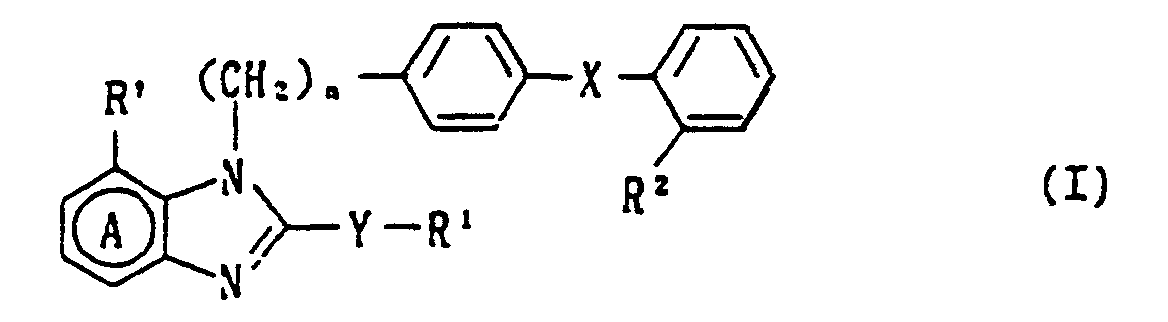
- These compounds are unexpectedly potent angiotensin II antagonists which are of value in the treatment of circulatory system diseases such as hypertensive diseases, heart diseases, strokes, nephritis, etc.
- Another aspect of the present invention relates to pharmaceutical compositions comprising an effective amount of the benzimidazole derivative having the formula I and a pharmaceutically acceptable carrier useful in treating circulatory system diseases such as hypertensive diseases, heart diseases, strokes, renal failure, nephritis, etc., and processes for preparing such compounds and compositions.
- The present invention provides the benzimidazole derivatives (I) and the pharmaceutically acceptable salts thereof, which possess strong angiotensin II antagonist activity and are of value in the treatment of circulatory diseases such as hypertensive diseases, heart diseases, strokes, cerebral diseases, nephritis, etc., pharmaceutical compositions comprising an effective amount of the benzimidazole derivative having the formula I and a pharmaceutically acceptable carrier useful in treating said circulatory diseases, and processes for preparing such compounds and compositions.
- An important group of compounds according to the present invention are the compounds of the formula I":wherein the ring A is a benzene ring which may optionally contain substitution in addition to the R'b group as defined above; R1, R2, X, Y, n are as defined above and R'b is carboxyl, an ester thereof or an amide thereof ; and the pharmaceutically acceptable salts thereof.

- With regard to the foregoing formula (I), alkyl groups for R1 are alkyl groups having 1 to 8 carbon atoms, which may be straight or branched, and include, for example, methyl, ethyl, propyl, isopropyl, butyl, isobutyl, sec-butyl, t-butyl, pentyl, i-pentyl, hexyl, heptyl, and octyl.
- Alkenyl groups for R1 are alkenyl groups having 2 to 8 carbon atoms, which may be straight or branched, and include, for example, vinyl, propenyl, 2-butenyl, 3-butenyl, isobutenyl, and octenyl.
- Alkynyl groups for R1 are alkynyl groups having 2 to 8 carbon atoms, which may be straight or branched, and include, for example, ethynyl, 2-propynyl, 2-butynyl, 2-pentynyl and 2-octynyl.
- Cycloalkyl groups for R1 are cycloalkyl groups having 3 to 6 carbon atoms, and include, for example, cyclopropyl, cyclobutyl and cyclopentyl.
- The above-mentioned alkyl, alkenyl, alkynyl, and cycloalkyl groups may be substituted with hydroxyl, amino, methylamino, halogen, or a lower (C1-4) alkoxy group.
- Aralkyl groups for R1 are phenyl-(C1-4) alkyl such as benzyl, and phenethyl and the aralkyl group may be substituted with halogen (e.g. F, Cl, Br, etc.), nitro, (C1-4) alkoxy (e.g. methoxy, ethoxy, etc.), or (C1-4) alkyl (e.g. methyl, ethyl, etc.), at various positions of the benzene ring. The aryl group for R1 is phenyl and the aryl group may be substituted with halogen (e.g. F, Cl, Br, etc.), nitro, (C1-4) alkoxy (e.g. methoxy, ethoxy, etc.), or (C1-4) alkyl (e.g. methyl, ethyl, etc.), at various positions of the benzene ring.
- Among the above-mentioned groups for R1, preferred examples are (C1-5) alkyl and (C2-5) alkenyl groups optionally substituted with hydroxyl, an amino group, halogen or a (C1-4) alkoxy group.
- The groups capable of forming an anion and groups convertible thereinto for R2 are carboxyl, tetrazolyl, trifluoromethanesulfonic amide (-NHSO2CF3), phosphoric acid, sulfonic acid, cyano, and (C1-4) alkoxycarbonyl. These groups may be protected with (C1-4) alkyl, (C1-4) alkoxymethyl, benzyl, (C2-5) alkanoyl, or benzoyl. Such groups may include those which are capable of forming anions or convertible thereinto either chemically or under biological and/or physiological conditions (for example, in vivo reaction such as oxidation-reduction or hydrolysis catalyzed by in vivo enzymes).
- The compounds wherein R2 is a group capable of forming an anion or convertible thereinto chemically (e.g. by oxidation, reduction or hydrolysis) (for example, a group having the formula:wherein R is methyl, triphenylmethyl, 2-tetrahydropyranyl, tert-butyl, methoxymethyl, ethoxymethyl, p-methoxybenzyl or p-nitrobenzyl, and cyano are useful as synthetic intermediates.

- Among the above-mentioned groups for R2, preferred examples are tetrazolyl groups optionally protected with (C1-4) alkoxymethyl, benzyl, (C2-5) alkanoyl or benzoyl, carboxyl groups optionally protected with (C1-4) alkoxymethyl or benzyl and trifluoromethanesulfonic amide.
- Examples of carboxyl, esters thereof or amides thereof for R' and R'b include, for example, groups having the formula: -CO-D' wherein D' is hydroxyl, amino, N- (C1-4) alkylamino, N,N-di (C1-4) alkyl amino, (C1-6) alkoxy optionally substituted with hydroxyl, amino, dimethylamino, diethylamino, piperidino, morpholino, halogen, (C1-6) alkoxy, (C1-6) alkylthio, dioxolenyl or 5-methyl-2-oxo-1,3-dioxolen-4-yl on the alkyl moiety or groups having the formula: -OCH(R7)OCOR8 wherein R7 is hydrogen, straight or branched alkyl having 1 to 6 carbon atoms (e.g. methyl, ethyl, n-propyl, isopropyl, n-butyl, isobutyl, t-butyl, n-pentyl, isopentyl, neopentyl, etc.), cyclopentyl, cyclohexyl, or cycloheptyl, and R8 is straight or branched alkyl having 1 to 6 carbon atoms (e.g. methyl, ethyl, n-propyl, isopropyl, n-butyl, isobutyl, sec-butyl, t-butyl, n-pentyl, isopentyl, neopentyl, etc.), straight or branched alkenyl having 2 to about 8 carbon atoms (e.g. vinyl, propenyl, 2-butenyl, 3-butenyl, isobutenyl, octenyl, etc.), cyclopentyl, cyclohexyl, cycloheptyl, (C1-3) alkyl (e.g. methyl, ethyl, n-propyl, isopropyl, etc.) which is substituted with phenyl, p-chlorophenyl or cycloalkyl having 5 to 7 carbon atoms (e.g. benzyl, p-chlorobenzyl, phenethyl, cyclopentylmethyl, cyclohexylmethyl, etc.), (C2-3) alkenyl (e.g. vinyl, propenyl, allyl, isopropenyl, etc.) which is substituted with phenyl or cycloalkyl having 5 to 7 carbon atoms (e.g. cinnamyl, etc.), phenyl, p-tolyl, naphthyl, straight or branched alkoxy having 1 to 6 carbon atoms (e.g. methoxy, ethoxy, n-propoxy, isopropoxy, n-butoxy, isobutoxy, sec-butoxy, t-butoxy, n-pentyloxy, isopentyloxy, neopentyloxy, etc.), straight or branched alkenyloxy having 2 to about 8 carbon atoms (e.g. allyloxy, isobutenyloxy, etc.), cyclopentyloxy, cyclohexyloxy, cycloheptyloxy, (C1-3) alkoxy (e.g. methoxy, ethoxy, n-propoxy, isopropoxy, etc.) which is substituted with phenyl or cycloalkyl having 5 to 7 carbon atoms (e.g. benzyloxy, phenethyloxy, cyclopentylmethyloxy, cyclohexylmethyloxy, etc.), (C2-3) alkenyloxy (e.g. vinyloxy, propenyloxy, allyloxy, isopropenyloxy, etc.) which is substituted with phenyl or cycloalkyl having 5 to 7 carbon atoms (e.g. cinnamyloxy, etc.), phenoxy, p-nitrophenoxy, or naphthoxy. Examples of groups capable of forming an anion and groups convertible thereinto for R' may include, for example, tetrazolyl groups optionally protected with (C1-4) alkyl, (C1-4) alkoxy (C1-4) alkyl, (C2-5) alkanoyl or benzoyl, trifluoromethanesulfonic amide, phosphoric acid, and sulfonic acid. Examples of substituents for R' include -COOH and salts thereof, -COOMe, -COOEt, -COOtBu, -COOPr, pivaloyloxymethoxycarbonyl, 1-(cyclohexyloxycarbonyloxy)ethoxycarbonyl, (5-methyl-2-oxo-1,3-dioxolen-4-yl)methyloxycarbonyl, acetoxymethyloxycarbonyl, propionyloxymethoxycarbonyl, n-butyryloxymethoxycarbonyl, isobutyryloxymethoxycarbonyl, 1-(ethoxycarbonyloxy)ethoxycarbonyl, 1-(acetyloxy)ethoxycarbonyl, 1-(isobutyryloxy)ethoxycarbonyl, cyclohexylcarbonyloxymethoxycarbonyl, benzoyloxymethoxycarbonyl, cinnamyloxycarbonyl, cyclopentylcarbonyloxymethoxycarbonyl, etc. Such groups may include those which are capable of forming anions (e.g. -COO-, derivatives thereof, etc.) or convertible thereinto either chemically or under biological and/or physiological conditions (for example, in vivo reaction such as oxidation- , reduction or hydrolysis catalyzed by in vivo enzymes).
- The benzene ring A may optionally contain substitution in addition to the R' group and such substituents include halogen (e.g. F, Cl, Br, etc.); nitro; cyano; - amino, N- (C1-4) alkyl amino such as methylamino and ethylamino N,N-di (C1-4) alkyl amino such as dimethylamino and diethylamino, phenylamino, naphthylamino, benzylamino, naphthylmethylamino, morpholino, piperidino, piperazino, N-phenylpiperazino ; groups having the formula: -W-R13 wherein W is a chemical bond, -O-, -S-, orand R13 is hydrogen or (C1-4) alkyl optionally substituted with hydroxyl, amino, dimethylamino, diethylamino, piperidino, morpholino, halogen or (C1-4) alkoxy ; groups having the formula: -(CH2)p-CO-D wherein D is hydrogen, hydroxyl, amino, N- (C1-4) alkylamino, N,N-di (C1-4) alkyl amino, (C1-6) alkoxy optionally substituted with hydroxyl, amino, dimethylamino, diethylamino, piperidino, morpholino, halogen, (C1-6) alkoxy, (C1-6) alkylthio, dioxolenyl or 5-methyl-2-oxo-1,3-dioxolen-4-yl on the alkyl moiety, or groups having the formula: -OCH(R9)OCOR10 wherein R9 is hydrogen, straight or branched alkyl having 1 to 6 carbon atoms (e.g. methyl, ethyl, n-propyl, isopropyl, n-butyl, isobutyl, t-butyl, n-pentyl, isopentyl, neopentyl, etc.), cyclopentyl, cyclohexyl, cycloheptyl, and R10 is straight or branched alkyl having 1 to 6 carbon atoms (e.g. methyl, ethyl, n-propyl, isopropyl, n-butyl, isobutyl, sec-butyl, t-butyl, n-pentyl, isopentyl, neopentyl, etc.), straight or branched alkenyl having 2 to 8 carbon atoms (e.g. vinyl, propenyl, 2-butenyl, 3-butenyl, isobutenyl, octenyl, etc.), cyclopentyl, cyclohexyl, cycloheptyl, (C1-3) alkyl (e.g. methyl, ethyl, n-propyl, isopropyl, etc.) which is substituted with phenyl, p-chlorophenyl or cycloalkyl having 5 to 7 carbon atoms (e.g. benzyl, p-chlorobenzyl, phenethyl, cyclopentylmethyl, cyclohexylmethyl, etc.), (C2-3) alkenyl (e.g. vinyl, propenyl, allyl, isopropenyl, etc.) which is substituted with phenyl or cycloalkyl having 5 to 7 carbon atoms (e.g. cinnamyl, etc.), phenyl, p-tolyl, naphthyl, straight or branched alkoxy having 1 to 6 carbon atoms (e.g. methoxy, ethoxy, n-propoxy, isopropoxy, n-butoxy, isobutoxy, sec-butoxy, t-butoxy, n-pentyloxy, isopentyloxy, neopentyloxy, etc.), straight or branched alkenyloxy having 2 to about 8 carbon atoms (e.g. allyloxy, isobutenyloxy, etc.), cyclopentyloxy, cyclohexyloxy, cycloheptyloxy, (C1-3) alkoxy (e.g. methoxy, ethoxy, n-propoxy, isopropoxy, etc.) which is substituted with phenyl or cycloalkyl having 5 to 7 carbon atoms (e.g. benzyloxy, phenethyloxy, cyclopentylmethyloxy, cyclohexylmethyloxy, etc.), (C2-3) alkenyloxy (e.g. vinyloxy, propenyloxy, allyloxy, isopropenyloxy, etc.) which is substituted with phenyl, or cycloalkyl having 5 to 7 carbon atoms (e.g. cinnamyloxy, etc.), phenoxy, p-nitrophenoxy, naphthoxy, and p is 0 or 1; tetrazolyl optionally protected with (C1-4) alkyl (C1-4) alkoxymethyl, benzyl (C2-5) alkanoyl, benzoyl; trifluoromethanesulfonic amide; phosphoric acid; sulfonic acid.

- One or two of these substituents may be substituted at various positions of the benzene ring.
- X shows that the adjacent phenylene group is bonded to the phenyl group directly or through a spacer with an atomic chain of 2 or less. As the spacer, any one can be exemplified, so long as it is a divalent chain in which the number of atoms constituting the straight chain is 1 or 2, and it may have a side chain. Examples of such spacers include (C1-4) alkylene,etc. The most preferred X is a chemical bond between the phenylene group and the phenyl group.

- Y represents that R1 is bonded to the 2-position of benzimidazole through a hetero atom. Y is -O-, -S(O)m- wherein m is 0, 1, or 2, or -N(R4) - wherein R4 is hydrogen or an (C1-4) alkyl group, preferably -O-, -S-, and -NH-, more preferably -O- and -S-, especially -O-.
- When R1 = H, the compounds having the formula (I) [Compound (I)] can exist in two tautomeric forms.
- When the compounds of the present invention have several asymetric carbon atoms, they can thus exist in several stereochemical forms. The invention includes the mixture of isomers and the individual stereoisomers. It is intended that the present invention includes geometrical isomers, rotational isomers, enantiomers, racemates, and diastereomers.
- The compounds of the present invention can exist in any prodrug form of those wherein R' is carboxyl or the anion therefrom.
- Among the compounds represented by the above formula (I), a preferred embodiment of the invention is a compound of the formula:wherein R1c is (C1-5) alkyl optionally substituted with hydroxyl, amino, halogen, or a (C1-4) alkoxy group (inter alia (C2-3) alkyl); R10 is -CO-D'c wherein D'c is hydroxyl, amino, N-(C1-4) alkylamino, N,N-di (C1-4) alkyl amino, or (C1-4) alkoxy optionally substituted with hydroxyl, amino, halogen, (C1-4) alkoxy, (C2-6) alkanoyloxy (e.g. acetyloxy, pivaloyloxy, etc.) or 1-(C1-6) alkoxycarbonyloxy (e.g. methoxycarbonyloxy, ethoxycarbonyloxy, cyclohexyloxycarbonyloxy, etc.) on the alkyl moiety, or tetrazolyl optionally protected with a (C1-4) alkyl, lower (C2-6) alkanoyl, or benzoyl; R2c is tetrazolyl optionally protected with (C1-4) alkyl(e.g. methyl), triphenylmethyl (trityl), methoxymethyl, ethoxymethyl, p-methoxybenzyl, p-nitrobenzyl, (C2-6) alkanoyl, or benzoyl or carboxyl optionally protected with (C1-4) alkyl (e.g. methyl), triphenylmethyl (trityl), methoxymethyl, ethoxymethyl, p-methoxybenzyl, or p-nitrobenzyl, R" is hydrogen, halogen, (C1-4) alkyl, (C1-4) alkoxy, nitro or -CO-D"c wherein D"c is hydroxyl or (C1-2) alkoxy optionally substituted with hydroxyl, (C1-4) alkoxy, (C2-6) alkanoyloxy (e.g. acetyloxy, pivaloyloxy, etc.) or 1- (C1-6) alkoxycarbonyloxy (e.g. methoxycarbonyloxy, ethoxycarbonyloxy, cyclohexyloxycarbonyloxy, etc.) on the alkyl moiety, or amino optionally substituted with (C1-4) alkyl (inter alia hydrogen, (C1-4) alkyl, or halogen, more preferably hydrogen); and Y is -O-, -S-, or -N(R4c)- wherein R4c is hydrogen or an (C1-4) alkyl group; with the exclusion of 2-ethoxy-1-[[2'-(1H-tetrazol-5-yl)biphenyl-4-yl]methyl]benzimidazole-7-carboxylic acid; and the pharmaceutically acceptable salts thereof.

- The compounds (I) of the present invention may be prepared by several reaction schemes, as illustrated below for a preferred compound.wherein R1, R2, R', A, X, Y and n have the above-defined meanings and Z is halogen.
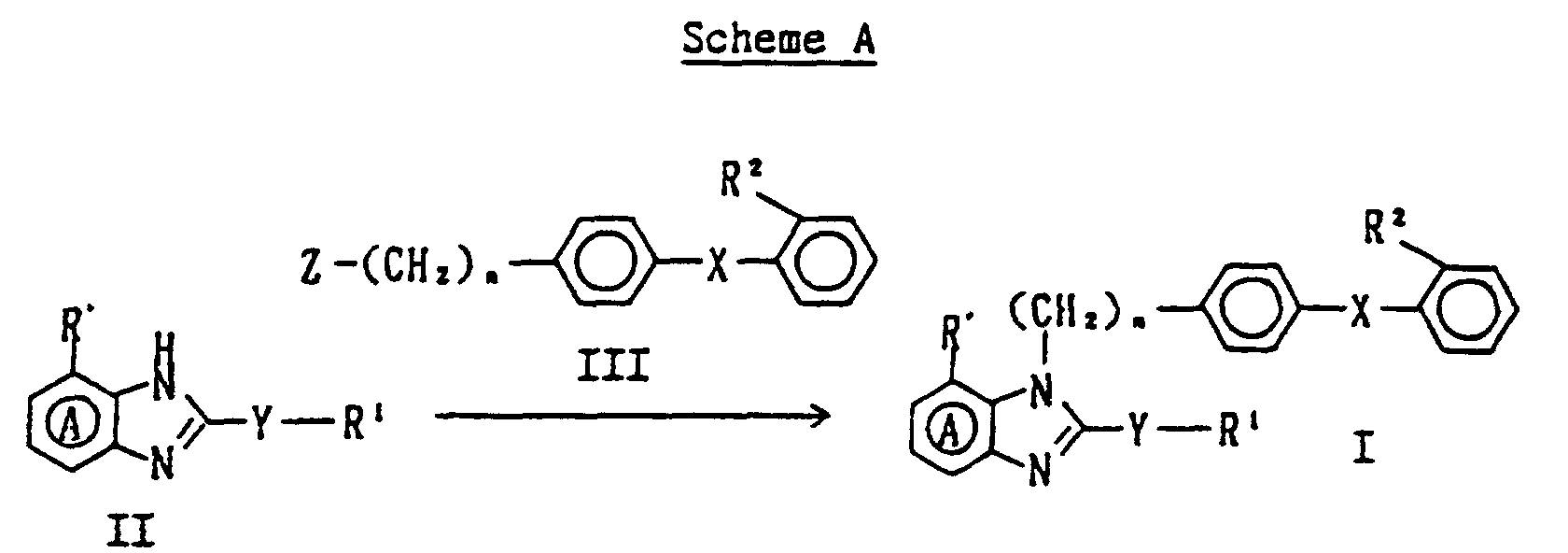 wherein each group has the above-defined meaning.
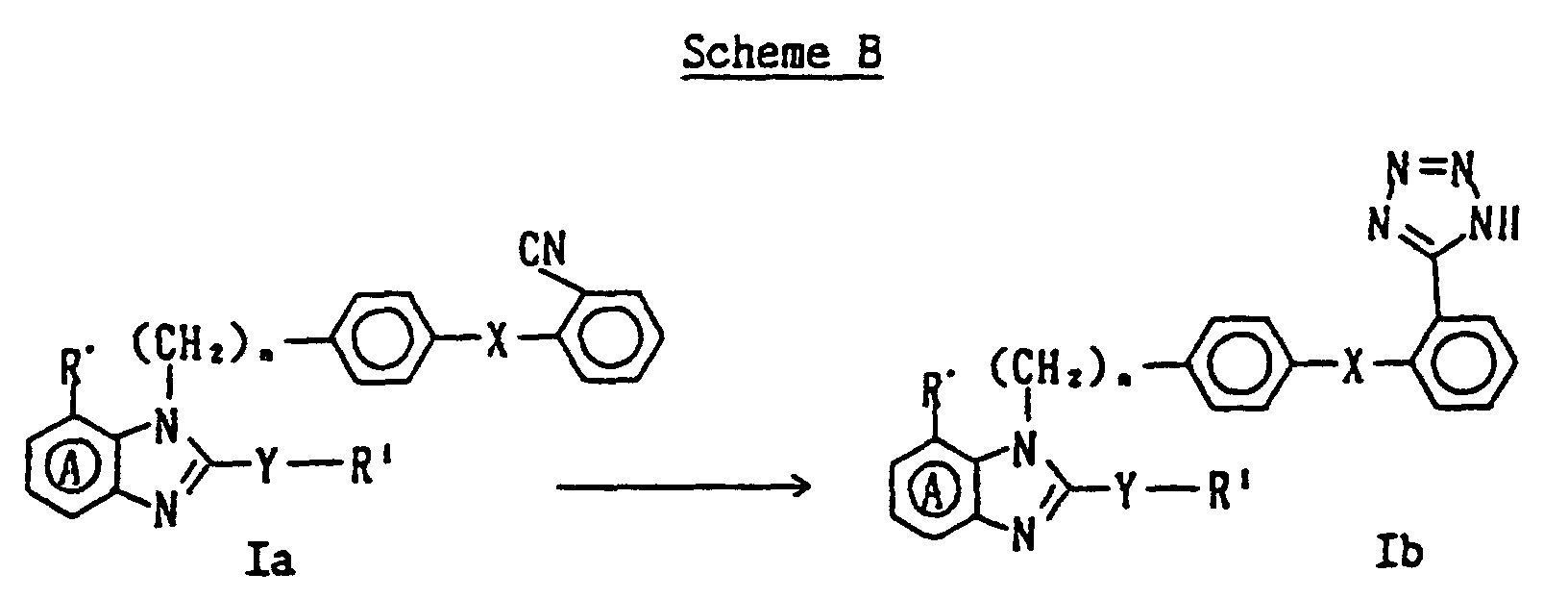 wherein R1, R', A, X, Y and n have the above-defined meanings, and R5 is (C1-6) alkyl.
 wherein each group has the above-defined meaning.
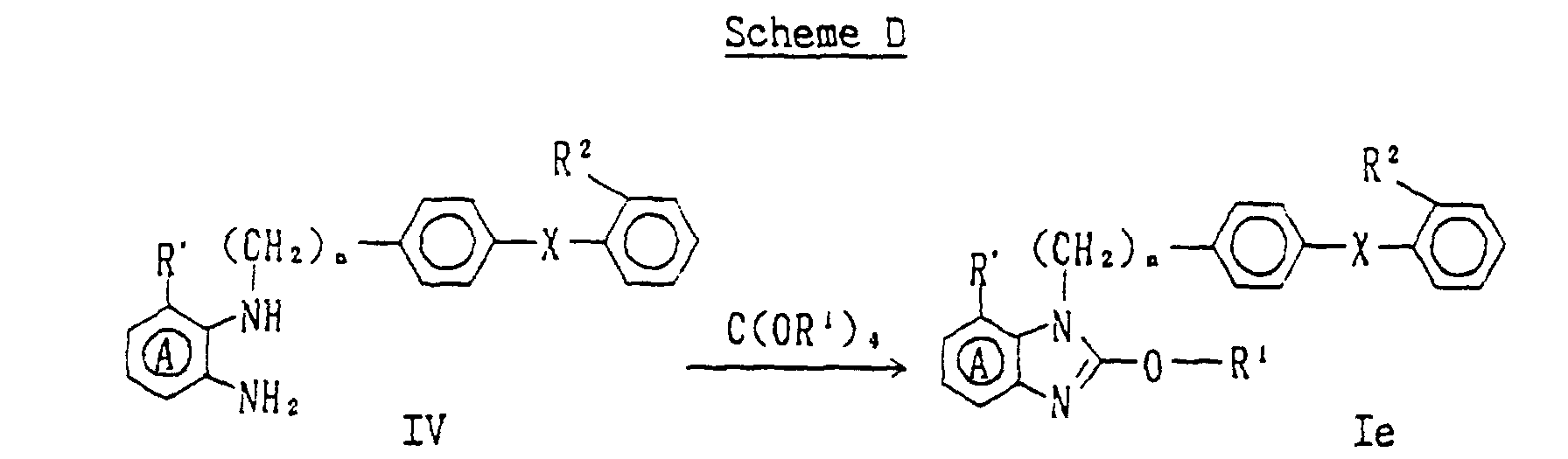 wherein each group has the above-defined meaning.
 wherein each group has the above-defined meaning.
 wherein each group has the above-defined meaning.
 wherein each group has the above-defined meaning.
 wherein each group has the above-defined meaning.
 wherein each group has the above-defined meaning.
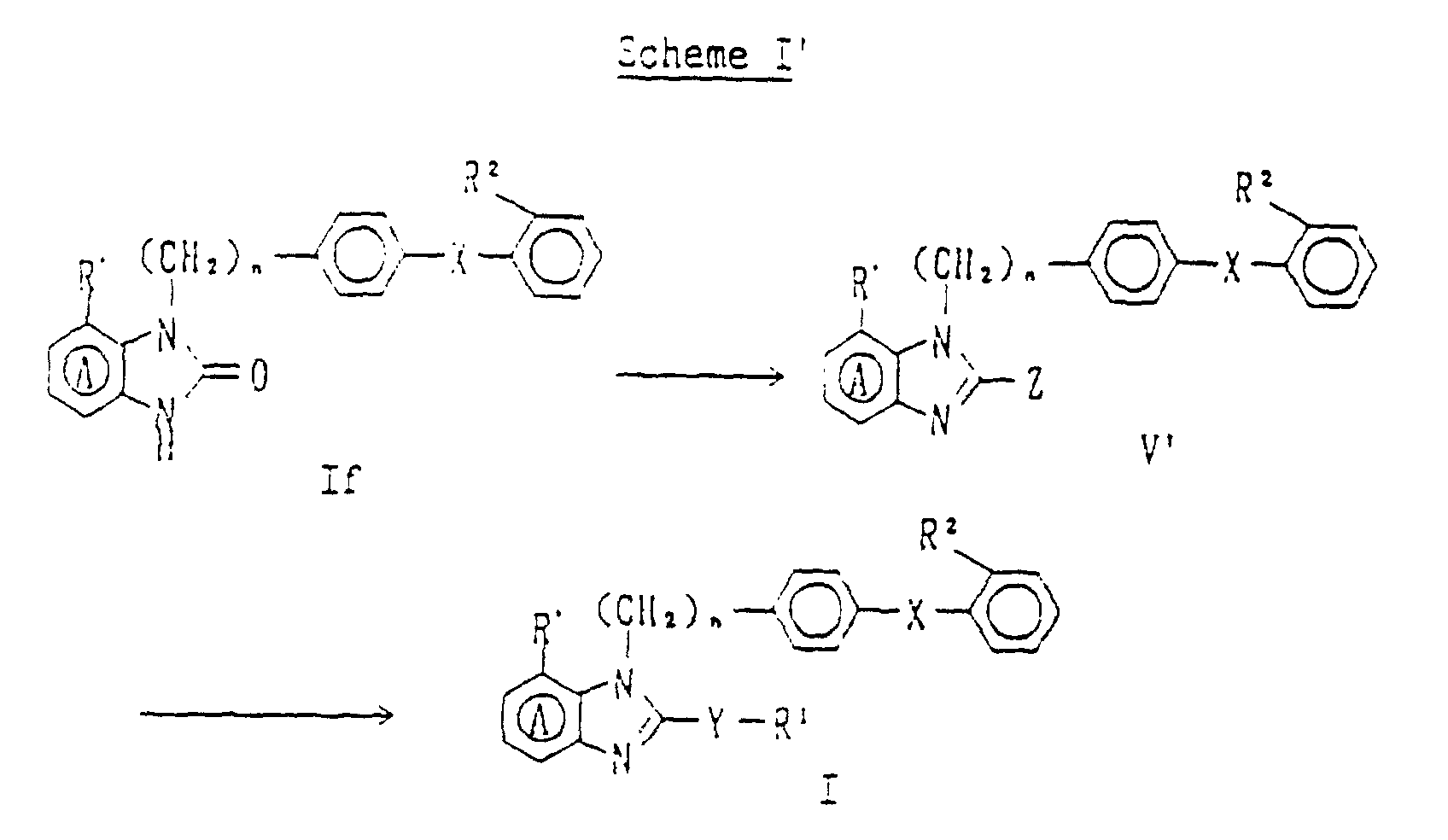 wherein each group has the above-defined meaning.
 wherein each group has the above-defined meaning.
 wherein each group has the above-defined meaning.
 wherein A, R, R1, X, Y and n have the above-defined meanings, and R6 is (C1-6) alkyl optionally substituted with (C2-6) alkanoyloxy, 1-(C1-6) alkoxycarbonyloxy or the like as defined for R'.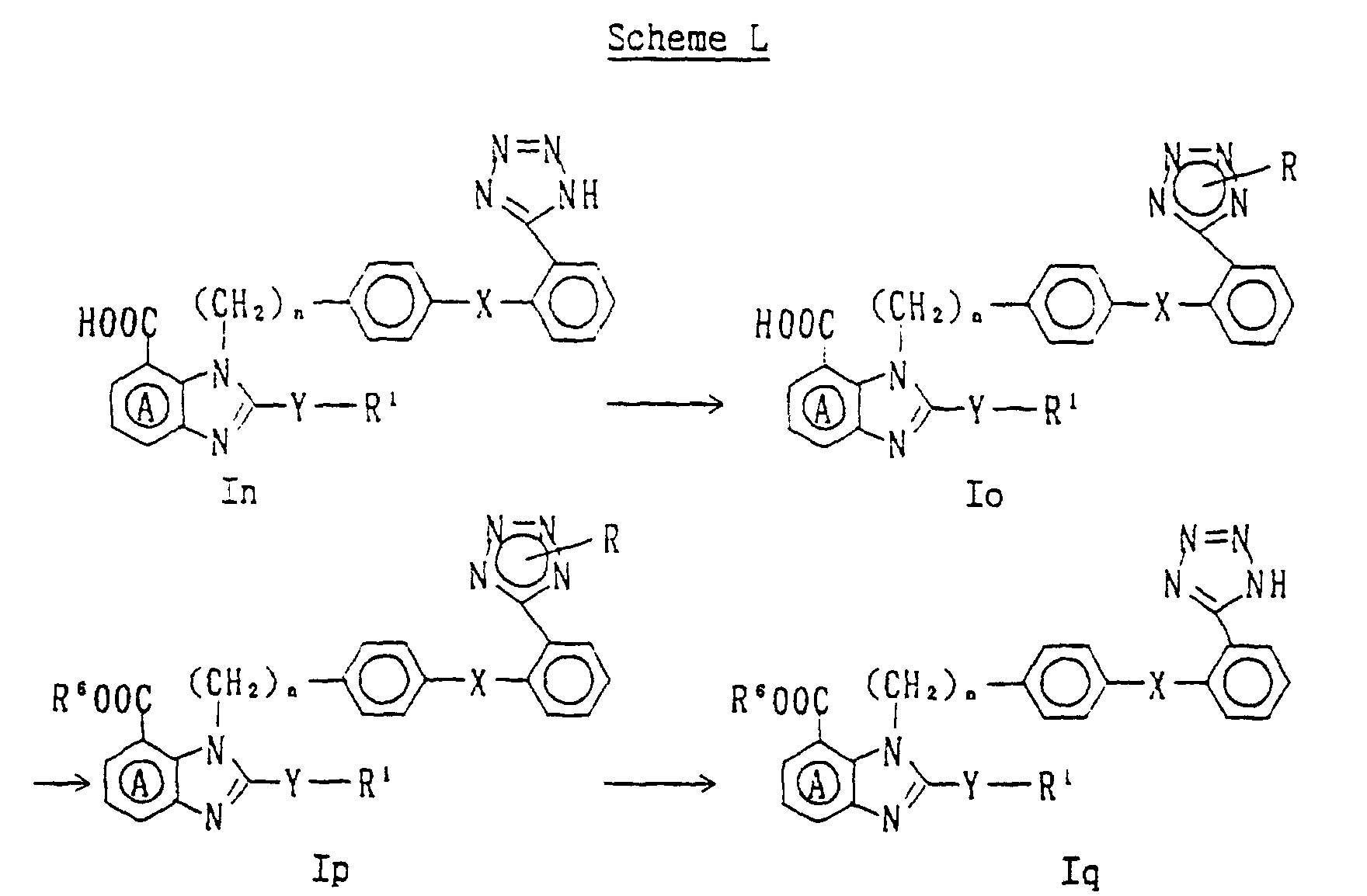
- The reaction as illustrated in Scheme A is an alkylation using an alkylating agent in the presence of a base. One molar portion of the compound (II) is employed with approximately 1 to 3 moles of the base and 1 - 3 moles of the alkylating agent. The reaction is conventionally conducted in solvents such as dimethylformamide, dimethylacetamide, dimethylsulfoxide, acetonitrile, tetrahydrofuran, acetone, ethylmethylketone, and the like. Examples of such bases include sodium hydride, potassium t-butoxide, potassium carbonate, and sodium carbonate. Examples of such alkylating agents include chlorides, bromides, iodides, p-toluenesulfonate esters, etc.
The reaction conditions may vary depending on the combination of the base and the alkylating agent. Advantageously, the reaction is carried out at ice-cooling to room temperature for 1 - 10 hours. - In the said alkylation, a mixture of two isomers, (I) and (I'") is usually obtained depending on the position of the N atom to be alkylated. While the production ratio of Compound (I) and Compound (I'") varies with the reaction conditions employed and the substituents on the benzimidazole ring, these two compounds can be obtained easily as pure products respectively by conventional isolation and/or purification methods (e.g. recrystallization, or column chromatography).
- The nitrile compound (Ia) is reacted with various azides to form the tetrazole compound (Ib) as illustrated in Scheme B. One molar portion of the compound (Ia) is employed with 1 - 5 moles of the azide. The reaction is conventionally conducted in solvents such as dimethylformamide, dimethylacetamide, toluene, and benzene. Examples of such azides include trialkyltin azide (e.g. trimethyltin azide, tributyltin azide, triphenyltin azide, etc.), hydrogen azide and ammonium salts thereof. In the case where the organotin azide compound is employed, 1 - 4 moles of the azide are employed per compound (Ia) and the reaction is carried out in toluene or benzene by heating under reflux for a period of 1 - 4 days. When the hydrogen azide or its ammonium salt is used, 1 - 5 moles of sodium azide and ammonium chloride or tertiary amine (e.g. triethylamine, tributylamine, etc.) are employed per compound (Ia) and the reaction is conducted in dimethylformamide at 100°C - 120°C for 1 - 4 days. During this reaction, it is preferable to facilitate the reaction by adding an appropriate amount of sodium azide and ammonium chloride. In this case, improvement may sometimes be observed in reaction time and yield by the addition of the azide compound in suitable fractions.
- The ester (Ic) is hydrolyzed in the presence of alkali to give the carboxylic acid (Id) as illustrated in Scheme C. This reaction is conducted usually in a solvent such as aqueous alcohol (e.g. methanol, ethanol, methyl cellosolve, etc.) by using alkali in an amount of 1 to 3 mol. relative to 1 mol. of Compound (Ic). Examples of such alkalis include sodium hydroxide, potassium hydroxide, etc. The reaction is conducted at temperatures ranging from room temperature to 100°C for 1 to 10 hours, preferably around the boiling point of the solvent for 2 to 5 hours.
- The 2-alkoxy derivative (Ie) is obtained by reacting phenylenediamine (IV) with alkyl orthocarbonate as illustrated in Scheme D. The reaction is conducted in the presence of an acid by using alkyl orthocarbonate of 1 to 3 mol. relative to Compound (IV). Examples of such alkyl orthocarbonates include orthocarbonates of, for example, methyl, ethyl, propyl, isopropyl, butyl, etc. And, by using ,for example, acetic acid or p-toluenesulfonic acid, the reaction is accelerated to afford a ring-closed compound in a good yield. As the reaction solvent, halogenated hydrocarbons and ethers can be employed but, usually, it is more convenient to conduct the reaction without a solvent. The reaction is usually conducted at 70 to 100°C for 1 to 5 hours. In this reaction, a dialkoxyimino compound is produced as the reaction intermediate, which is then ring-closed into the 2-alkoxy compound (Ie) in the presence of the acid in the reaction system. It is also possible to isolate the reaction intermediate, which is then subjected to ring-closure reaction in the presence of an acid to form the 2-alkoxy compound (Ie).
- The phenylenediamino compound (IV) is reacted with various reagents to give the 2-keto ccmpound (or the 2-hydroxy compound, If) as illustrated in Scheme E. This reaction is conducted by using a carbonylating reagent (e.g. urea, diethyl carbonate, bis(1-imidazolyl)ketone, etc.) in an amount of 1 to 5 mol. relative to 1 mol. of Compound (IV) and, usually, by using, among others, halogenated hydrocarbons (e.g. methylene chloride, chloroform, etc.), alcohols (e.g. methanol, ethanol, etc.) or amides (e.g. dimethylformamide, dimethylacetamide, etc.).
- The 2-hydroxy compound (If) is selectively O-alkylated with a Meerwein reagent to give the 2-alkoxy compound (Ig) as illustrated in Scheme F. This reaction is conducted by using the Meerwein reagent in an amount of 1 to 3 mol. relative to Compound (If), usually, employing, as the solvent, halogenated hydrocarbons (e.g. methylene chloride, chloroform, etc.) or ethers (e.g. methyl ether, ethyl ether, etc.). Examples of such Meerwein reagents include, among others, trimethyl oxonium fluoroborate (Me3O+BF4 -), triethyl oxonium fluoroborate (Et3O+BF4 -), etc. These are preferably used by in situ preparation according to the method described in literature references [H. Meerwein, Org. Syn. 46. 113 and 120(1966)]. The reaction is preferably conducted at temperatures ranging from room temperatures to the boiling point of the solvent used for 2 to 20 hours.
- The phenylene diamino compound (IV) is reacted with various reagents in an organic solvent to give the 2-mercapto compound (Ih) as illustrated in Scheme G. Relative to 1 mol. of the phenylene diamino compound (IV), 1 to 3 mol. of a thiocarbonylating agent (e.g. carbon disulfide, thiourea, potassium xanthate, etc.) or isothiocyanate (e.g. methyl isothiocyanate, ethyl isothiocyanate, etc.) is used. As the reaction solvent, alcohols (e.g. methanol, ethanol, etc.), or amides (e.g. dimethylformamide, dimethylacetamide, etc.) can be used. The reaction is preferably conducted at temperatures ranging from room temperatures to the boiling point of the solvent used for 5 to 20 hours.
- The 2-mercapto compound (Ih) is alkylated in the presence of a base in an organic solvent to give the alkylthio compound (Ii) as illustrated in Scheme H. The reaction is conducted by using, relative to 1 mol. of Compound (Ih), 1 to 3 mol. of the base and 1 to 3 mol. of the alkylating agent usually in a solvent such as dimethylformamide, dimethylacetamide, dimethylsulfoxide, acetonitrile, acetone, ethyl methyl ketone, ethanol, methanol and water. As the base, there is used sodium hydroxide, potassium carbonate, sodium carbonate, sodium hydride, potassium t-butoxide, or potassium hydroxide. As the alkylating agent, there is used, for example, a halide (e.g. methyl iodide, ethyl iodide, propyl iodide, butyl iodide, and bromide or chloride thereof). The reaction is conducted usually at temperatures ranging from ice-cooling to the boiling point of the solvent used, while the reaction conditions vary with the base, the alkylating agent and the solvent employed.
- The phenylenediamine (IV) is reacted with isothiocyanate to form the thiourea compound (V), which is then subjected to desulfurization-cyclization to give the 2-substituted amino compound (Ij) as illustrated in Scheme I. The reaction is conducted by using about 1 to 3 mol. of isothiocyanate relative to 1 mol. of Compound (IV) usually in halogenated hydrocarbons (e.g. chloroform, methylene chloride, etc.), ethers (e.g. tetrahydrofuran, dioxane, etc.), aromatic hydrocarbons (e.g. benzene, toluene, etc.), alcohols (e.g. methanol, ethanol, etc.), acetonitrile, or dimethylformamide. The reaction can also be conducted without these solvents. Examples of such isothiocyanates include isothiocyanates of methyl, ethyl, propyl, isopropyl, butyl, etc. The reaction is conducted preferably at temperatures ranging from room temperatures to 50°C for 10 to 60 hours. The desulfurization-cyclization can be conducted in a manner as described below.
- The reaction is conducted, in halogenated hdyrocarbons (e.g. HgCl2), by using 1 to 3 mol. of a metal halide (e.g. HgCl2) relative to 1 mol. of the thiourea (V) obtained by the above-mentioned method. The reaction is conducted preferably at temperatures ranging from room temperature to the boiling point of a solvent employed for 3 to 10 hours. The reaction can also be conducted by using 1 to 3 mol. of methyl iodide relative to 1 mol. of thiourea (V) in alcohols (e.g. methanol or ethanol), preferably at temperatures ranging from room temperature to the boiling point of the solvent for 3 to 15 hours.
- The 2-halogeno compound (V') readily prepared from the compound (If) is reacted with various nucleophilic reagents to form the compound (I) as illustrated in Scheme I'. The reaction can be carried out according to the procedures as described in known references (e.g. D. Harrison and J. J. Ralph, J. Chem. Soc., 1965, 236). The compound (If) is reacted with a halogenating reagent (e.g. phosphorus oxychloride, phosphorus trichloride, etc.) to form the 2-halogeno compound (V') which is reacted with various nucleophilic reagents (e.g. alcohols, mercaptans, amines, etc.) in a suitable organic solvent to give the compound (I). The reaction conditions may vary depending on the nucleophilic reagent employed. Upon the reaction with alcohols, alcoholates (e.g. sodium methoxide, sodium ethoxide, sodium propoxide, etc.) derived from alcohols and sodium metal are preferably used. As the reaction solvent, alcohols then used for nucleophilic reagents can be employed. Relative to 1 mol. of the compound (V'), there is used 2 to 5 mol. of an alcoholate. Advantageously, the reaction is usually conducted at the boiling point of the solvent used for 1 to 3 hours. Upon the reaction with amines, 3 to 10 mol. of an amine is used relative to 1 mol. of the compound (V').
As the reaction solvent, alcohols (e.g. ethanol, etc.) are employed but, an excess amount of amines can be used. Advantageously, the reaction is usually conducted at temperatures ranging from the boiling point of the solvent to 150°C for 1 to 10 hours.
Upon the reaction with mercaptans, 2 to 5 mol. of a mercaptan is used relative to 1 mol. of the compound (V'). The reaction is preferably conducted in the presence of 1 to 3 mol. of an base (e.g. sodium carbonate, potassium carbonate, etc.) relative to Compound (IV). Examples of solvents include acetonitrile, alcohols, halogenated hydrocarbons (e.g. chloroform, dichloroethane, etc.), ethers (e.g. tetrahydrofuran, dioxane, etc.) or amides (e.g. dimethylformamide, dimethylacetamide, etc.). The reaction can be conducted preferably at temperatures ranging from 50°C to the boiling point of the solvent for 1 to 5 hours. - The compound (Ih) is reacted with an oxidizing reagent (e.g. m-chloroperbenzoic acid, etc.) to form the sulfoxide or sulfone compound (Ih') which is reacted with various nucleophilic reagents (e.g. alcohols, amines, mercaptans, etc.) to give the compound (I) as illustrated in Scheme I". The oxidation of the compound (Ih) to the sulfoxide or sulfone compound (Ih') is preferably conducted in solvents including halogenated hydrocarbons (e.g. dichloromethane, chloroform, dichloroethane, etc.), or ethers (e.g. tetrahydrofuran, dioxane, etc.). Examples of such oxidizing reagents include organic peracids such as m-chloroperbenzoic acid, N-halosuccinimides such as N-bromosuccinimide, etc. Generally, the oxidizing reagent is employed in an equal or slightly excess amount when compared to the compound (Ih). The sulfoxide can be produced by one mole of the oxidizing reagent and the sulfone compound (Ih') by two moles. The reaction is preferably conducted at temperatures ranging from about ice-cooled temperature to room temperature for 3 to 10 hours.
- The reaction of the compound (Ih') into the compound (I) is conducted in essentially the same manner as mentioned in Scheme I'.
- The carboxylic acid (Ik) is formed by the alkaline hydrolysis of the carboxylic acid ester compound (Ij) as illustrated in Scheme J. The reaction is conducted by using 1 to 3 mol. of alkali relative to 1 mol. of Compound (Ij) usually in a solvent such as an aqueous alcohol (e.g. methanol, ethanol, methyl cellosolve, etc.). Examples of such alkalis include sodium hydroxide, potassium hydroxide or the like. The reaction is conducted at temperatures ranging from room temperature to 100°C for 1 to 10 hours, preferably at the boiling point of a solvent used for 3 to 5 hours.
- The protected tetrazole derivative (Il) is deprotected to give Compound (Im) as depicted in Scheme K. Conditions of the deprotection depend on the protective group (R) then used. When R is triphenylmethyl, 2-tetrahydropyranyl, methoxymethyl, or ethoxy methyl, it is convenient to conduct the reaction in an aqueous alcohol (e.g. methanol, ethanol, etc.) containing 0.5N to 2N hydrochloric acid or acetic acid at room temperatures for 1 to 10 hours.
- The compound (Iq) is prepared by protecting the tetrazole group in the presence of a base, and then the carboxyl group to give the ester compound (Ip), followed by removing the protective group under acid conditions as illustrated in Scheme L. In the reaction to obtain Compound (Io) from Compound (In), an alkylating agent is used in an amount of 1 to 1.5 mol. relative to 1 mol. of Compound (In). Examples of the solvents to be used for the reaction include halogenated hydrocarbons such as chloroform, methylene chloride and ethylene chloride, ethers such as dioxane and tetrahydrofuran, acetonitrile, pyridine, etc. Examples of such bases include potassium carbonate, sodium carbonate, triethylamine, pyridine, etc. Examples of such alkylating agents include halides such as triphenylmethyl chloride and methoxy methyl chloride, etc. While reaction conditions vary with combinations of the base and the alkylating agent employed, it is preferable to conduct the reaction by using triphenylmethyl chloride at temperatures ranging from ice-cooling to room temperature for 1 to 3 hours in methylene chloride in the presence of triethylamine. In the reaction for producing Compound (Ip) from Compound (Io) thus obtained, the alkylating agent is used in an amount of 1 to 3 mol. relative to 1 mol. of Compound (Iq). Examples of the reaction solvent include amides such as dimethylformamide and dimethylacetamide, acetonitrile, dimethylsulfoxide, acetone, ethyl methyl ketone, etc. Examples of the base include potassium carbonate, sodium carbonate, sodium hydride, potassium t-butoxide, etc. Examples of such alkylating agents include halides such as cyclohexyl 1-iodoethyl carbonate, ethyl 1-iodoethyl carbonate, pivaloyloxymethyl iodide, etc. While reaction conditions vary with combinations of the base and the alkylating agent employed, it is preferable to subject Compound (Io) to reaction in DMF, by adding the alkylating agent in the presence of potassium carbonate, at room temperatures for 30 minutes to one hour.
- The reaction for deprotecting Compound (Ip) thus obtained is conducted preferably in a manner similar to the reaction (K). When trityl group is used as the protecting group of tetrazole group, it is preferable to conduct the reaction in methanol or ethanol, while adding 1N-HCl, at room temperatures for 30 minutes to one hour.
- The reaction products obtained as above by the reaction processes (A) to (L), can be easily isolated and/or purified by or according to conventional methods such as, for example, evaporation of solvents, extraction by water or organic solvents, concentration, neutralization, recrystallization, distillation, and column chromatography. The compounds (I) thus produced via the reaction processes as depicted in Schemes A to L can be isolated and/or purified from the reaction mixture according to conventional methods such as, for example, recrystallization and column chromatography, to obtain a crystalline product.
- The compounds obtained as above by the reaction processes (A) to (L), may be in the form of solvates or salts (including addition salts) derived from pharmaceutically or physiologically acceptable acids or bases. These salts include but are not limited to the following: salts with inorganic acids such as hydrochloric acid, hydrobromic acid, hydroiodic acid, sulphuric acid, nitric acid, phosphoric acid and, as the case may be, such organic acids as acetic acid, oxalic acid, succinic acid, citric acid, ascorbic acid, lactic acid, p-toluenesulfonic acid, methanesulfonic acid, fumaric acid, tartaric acid and maleic acid. Other salts include salts with ammonium, alkali metals or alkaline earth metals, such as sodium, potassium, calcium or magnesium or with organic bases (e.g. trialkylamines, dibenzylamine, ethanolamine, triethanolamine, N-methylmorpholine, etc).
- And, by conventional means, the compounds (I) can be formed as salts with non-toxic, physiologically or pharmaceutically acceptable acids or bases, for example salts with an inorganic acid such as hydrochloride, sulfate or nitrate, and, depending on compounds, salts with an organic acid such as acetate, oxalate, succinate or maleate, salts with an alkali metal such as sodium salt or potassium salt, or salts with an alkaline earth metal such as calcium salt.
- For the synthesis of these compounds (I), the starting compounds (II) and (IV) can be synthesized by or according to the methods described in, for example, the following literature references or methods analogous thereto, namely, by the reactions (M), (N), (O) and (P) as depicted below.
- (1) P. N. Preston, The Chemistry of Heterocyclic Compounds, Vol. 40, ed. by P. N. Preston, John Wiley & Sons Inc., New York (1981), pp. 1-286,
- (2) E. S. Schipper and A. R. Day, Heterocyclic Compounds, Vol. 5, ed. by R. C. Elderfield, John Wiley & Sons Inc., New York (1965), pp. 194-297,
- (3) N. J. Leonard, D. Y. Curtin, & K. M. Beck, J. Am. Chem. Soc. 69, 2459 (1947),
- (4) S. Weiss, H. Michaud, H. Prietzel, & H. Kromer, Angew. Chem. 85, 866 (1973),
- (5) W. B. Wright, J. Heterocycl. Chem., 2, 41 (1965),
- (6) A. M. E. Omar, Synthesis, 1974, 41,
- (7) D. J. Brown & R. K. Lynn, J. Chem. Soc. (Perkin I), 1974, 349,
- (8) J. A. Van Allan & B. D. Deacon, Org. Syn., 30, 56 (1950),
- (9) S. P. Singh, S. S. Parmar & B. R. Pandey, J. Heterocycl. Chem., 14, 1093 (1977),
- (10) S. Nakajima, I. Tanaka, T. Seki & T. Anmo, Yakugaku Zasshi, 78, 1378 (1959),
- (11) K. Seno, S. Hagishita, T. Sato & K. Kuriyama, J. Chem. Soc., Perkin Trans. 1984, 2013,
- (12) D. R. Buckle et al., J. Med. Chem., 30, 2216 (1987),
- (13) R. P. Gupta, C. A. Larroquette & K. C. Agrawal, J. Med. Chem., 25, 1342 (1982), etc.
-
- Schemes M and M' illustrate the process for preparing important intermediates which are useful in synthesizing the compound (I) of the present invention.
- These compounds can be produced according to the above-mentioned references. The compound (VI) is converted by the Curtius reaction into the carbamic acid compound (X) followed by alkylation and subsequent reduction of nitro to form the diamino compound (IV). In the rearrangement of Compound (VI) to Compound (X), Compound (X) is produced in a high yield according to conventional procedures of the Curtius rearrangement: the acid chloride (VII) → the acid azide (VIII) the isocyanate (IX) → Compound (X). The compound (VI) is conveniently heated with diphenylphosphoryl azide (DPPA) in the presence of triethylamine in DMF to form the isocyanate (IX) via the acid azide (VIII) followed by reaction of an alcohol to give the compound (X) in a high yield. The compound (X) thus obtained is alkylated in the same manner as in Scheme A to form the compound (XI). In the reaction, it is convenient to heat the reaction mixture under reflux for 4 - 6 hours in the presence of potassium carbonate as a base in acetonitrile. The compound (XI) is heated under reflux in an alcohol containing a mineral acid (e.g. hydrochloric acid, sulphuric acid, etc.) or an organic acid (e.g. trifluoroacetic acid, etc.), for 1 - 2 hours to give the compound (XII). Various reducing reagents (e.g. raney nickel, stannic chloride, etc.) can be employed in the reduction of the nitro compound (XII) to the diamino compound (IV). Among them, the combination of ferric chloride and hydrazine · hydrate in an alcohol is the most convenient. Further, the compound (IV) can be prepared by various techniques other than those mentioned above.
- The compound (X') commercially available or readily obtained by known methods in the art is preferably reacted with the amine (IIIb) in the presence of a base (e.g. potassium carbonate, sodium carbonate, amines, etc.) in an organic solvent (e.g. alcohols, ethers, halogenated hydrocarbons, amides, etc.) at temperatures ranging from the boiling point of the solvent to 100°C for 5 to 20 hours.
- The compound (X") readily obtained by acid treatment of the compound (X) is subjected to condensation under dehydration conditions including azeotropic removal of water (or in the presence of a dehydrating agents) in an organic solvent (e.g. ethers, halogenated hydrocarbons, aromatic hydrocarbons, etc.) followed by reaction with a reducing reagent (e.g. NaCNBH3, etc.) to form the compound (XII). The condensation under dehydration conditions can be accelerated by using conventional acid or base catalysts.
- The compound (X") is reacted with the acid chloride (IIId), preferably in the presence of a base (e.g. pyridine, triethylamine, dimethylaminopyridine, etc.) in an organic solvent (e.g. halogenated hydrocarbons, pyridine, etc.) at temperatures ranging from room temperature to the boiling point of the solvent for 2 to 20 hours, to the amide (XI'). The resulting amide (XI') is reacted with a reducing reagent (e.g. sodium aluminum hydride, sodium bis(2-methoxyethoxy)aluminum hydride, etc.) to form the diamino (IV).[wherein each group is of the same meaning as defined above].
 [wherein each group is of the same meaning as defined above].
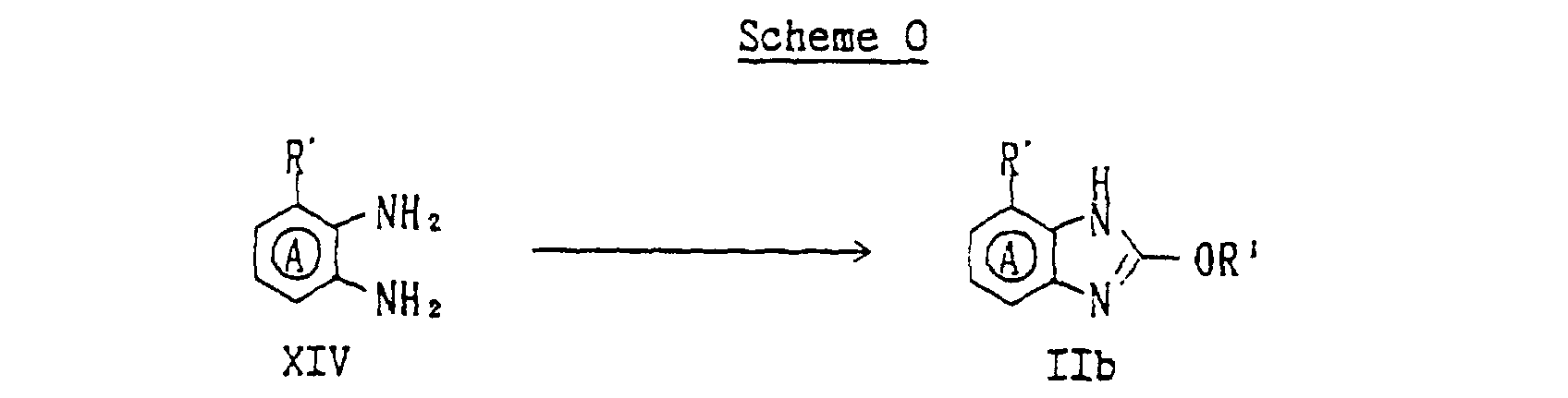 [wherein each group is of the same meaning as defined above].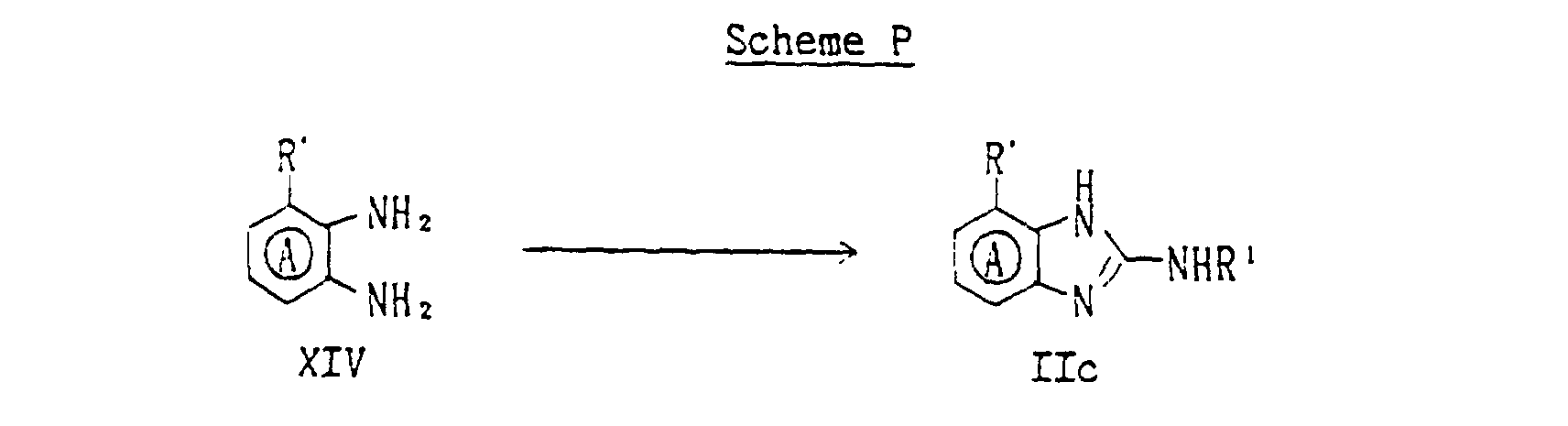
- And, among the starting compounds (III), the compound (III) wherein n denotes 1, i.e. the compound (IIIa) is commercially available, or can be readily obtained also by subjecting Compound (XV) to halogenomethylation in acccrdance with the methods described in literature references, for example;
- 1) J. R. E. Hoover, A. W. Chow, R. J. Stedman, N. M. Hall, H. S. Greenberg, M. M. Dolan and R. J. Feriauto, J. Med. Chem., 7, 245 (1964),
- 2) R. J. Stedman, J. R. E. Hoover, A. W. Chow, M. M. Dolan, N. M. Hall and R. J. Feriauto, J. Med. Chem., 7, 251 (1964),
- 3) H. Gilman and R. D. Gorsich, J. Am. Chem. Soc., 78, 2217 (1956),
- 4) M. Orchin and E. Oscar Woolfolk, J. Am. Chem. Soc., 67, 122
(1945), etc.
[wherein each group is of the same meaning as defined above].

-
- The compound (IIIa') can also be readily prepared according to the methods described in L. N. Pridgen, L. Snyoler and J. Prol, Jr., J. Org. Chem., 54, 1523 (1989) as illustrated in Scheme R, followed by halogenation (R12=Me) or halogenomethylation (R12=H).[wherein R12 is hydrogen or methyl].

- Further, among the starting compounds (III), the compound (III) wherein n denotes 2, i.e. the compound (IIIb) can be obtained from the compound (IIIa) in accordance with the reaction (S).[wherein each group is of the same meaning as defined above].
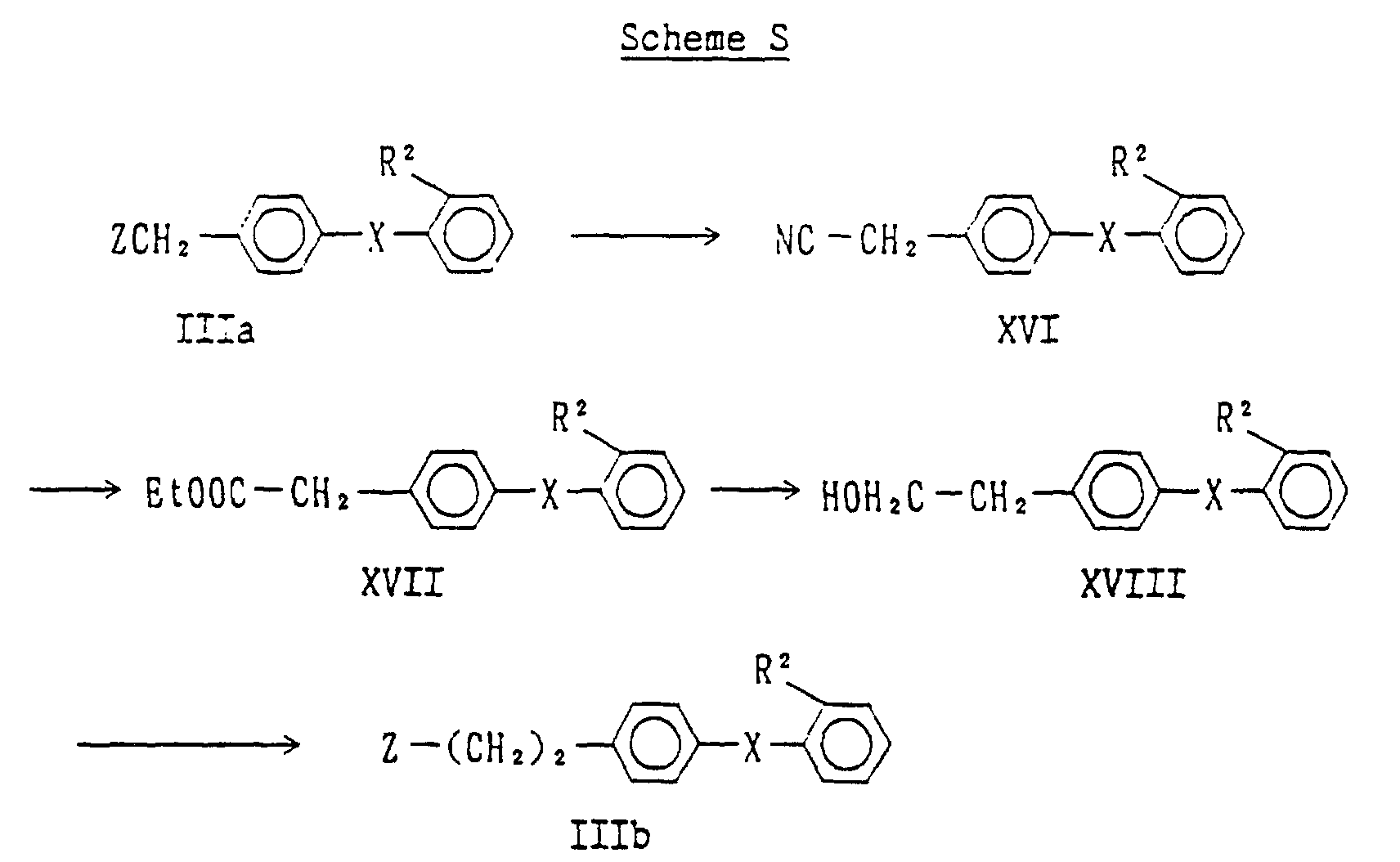
- The compounds and the salts thereof thus produced are less toxic, strongly inhibit the vasoconstrictive and hypertensive actions of angiotensin II, exert a hypotensive effect in animals, in particular mammals (e.g. human, dog, rabbit, rat, etc.), and therefore they are useful as therapeutics for not only hypertension but also circulatory diseases such as heart failure (hypertrophy of the heart, cardiac insufficiency, or cardiac infarction), strokes, cerebral apoplexy, nephropathy and nephritis. The compounds (I) and salts thereof according to the present invention strongly inhibit vasoconstriction and hypertension derived by sngiotensin II and therefore possess potent anti-hypertensive activity in animals, more specifically mammal animals (e.g. humans, dogs, pigs, rabbits, rats, etc.). Further, the compounds (I) and salts thereof according to the present invention are of quite low toxicity and clinically useful in treating not only hypertension but also circulatory system diseases such as heart and brain diseases, strokes, renal failures, and nephritis.
- For therapeutic use, the compounds (I) and salts thereof can be orally, parenterally, by inhalation spray, rectally, or topically administered as pharmaceutical compositions or formulations (e.g. powders, granules, tablets, pills, capsules, injections, syrups, emulsions, elixirs, suspensions, and solutions) comprising at least one such compound alone or in admixture with pharmaceutically acceptable carriers, adjuvants, vehicles, excipients and/or diluents. The pharmaceutical compositions can be formulated in accordance with conventional methods. The term parenteral as used herein includes subcutaneous injections, intravenous, intramuscular, intraperitoneal injections, or infusion techniques. Injectable preparations, for example, sterile injectable aqueous or oleaginous suspensions may be formulated according to the known art using suitable dispersing or wetting agents and suspending agents. The sterile injectable preparation may also be a sterile injectable solution or suspension in a non-toxic parenterally acceptable diluent or solvent, for example, as a solution in water. Among the acceptable vehicles or solvents that may be employed are water, Ringer's solution, and isotonic sodium chloride soluticn. In addition, sterile, fixed oils are conventionally employed as a solvent or suspending medium. For this purpose any bland fixed oil or fatty acid may be employed including natural, synthetic, or semisynthetic fatty oils or acids, and natural, synthetic, or semisynthetic mono-, di-, or triglycerides.
- Suppositories for rectal administration of the drug can be prepared by mixing the drug with a suitable non-irritating excipient such as cocoa butter and polyethylene glycols which are solid at ordinary temperatures but liquid at the rectal temperature and will therefore melt in the rectum and release the drug. Solid dosage forms for oral administration may include powders, granules, tablets, pills, and capsules as mentioned above. In such solid dosage forms, the active compound may be admixed with at least one additive such as sucrose, lactose, celluloses, mannitol, maltitol, dextran, starches, agars, alginates, chitins, chitosans, pectins, tragacanth gums, arabic gums, gelatins, collagens, casein, albumin, and synthetic or semisynthetic polymers or glycerides. Such dosage forms may also comprise, as is normal practice, additional substances other than inert diluents, e.g., lubricating agents as magnesium stearate, preservatives such as parabens and sorbic acid, antioxidants such as ascorbic acid, α-tocopherol and cysteine, disintegrants, binders, thickening, buffering, sweetening, flavoring, and perfuming agents. Tablets and pills can additionally be prepared with enteric coatings. Liquid dosage forms for oral administration may include pharmaceutically acceptable emulsions, syrups, elixirs, suspensions, solutions containing inert diluents commonly used in the art, such as water.
- Specific dose levels for any particular patient will be employed depending upon a variety of factors including the activity of specific compounds employed, the age, body weight, general health, sex, diet, time of administration, route of administration, rate of excretion, drug combination, and the severity of the particular disease undergoing therapy. The dose varies with the diseases to be treated, symptoms, subjects and administration routes, and it is desirable that a daily dose of 1 to 50 mg for oral administration or 1 to 30 mg for intravenous injection can be administered in single or divided into 2 to 3 administrations when used as an agent for the therapy in adults. For example, when used for treating adult essential hypertension, the active ingredient will preferably be administered in an appropriate amount, for example, 10 mg to 100 mg a day orally and 5 mg to 50 mg a day intravenously. The active ingredient will preferably be administered in equal doses two or three times a day.
- The foregoing is merely illustrative of the invention and is not intended to limit the invention to the disclosed compounds.
- By the following formulation examples, working examples, experimental examples and reference examples, the present invention will be explained more concretely, but they should not be interpreted as limiting the invention in any manner.
- Examples of abbreviations in this specification are as follows:
Me: methyl, Et: ethyl, Tet: tetrazolyl, cycl: cyclo-, Pr: propyl, Bu: butyl, Pen: pentyl, Bu: butyl, Hex: hexyl, Hep: heptyl, Ph: phenyl, DMF: dimethylformamide, and THF: tetrahydrofuran. - When the compound (I) of the present invention is used as a therapeutic agent for circulatory failures such as hypertension, heart diseases, strokes, kidney diseases, etc., it can be used in accordance with, for example, the following formulation.
-
(1) 2-methylthio-1-[[2'-(1H-tetrazol-5-yl)biphenyl-4-yl] methyl]benzimidazole-7-carboxylic acid disodium salt 10 mg (2) inositol 100 mg (3) benzyl alcohol 20 mg one ampoule 130 mg - (1), (2) and (3) are dissolved in distilled water for injection to make the whole volume 2 ml, which is filled into an ampoule. The whole process is conducted under sterile conditions.
- To a solution of o-phenylenediamine (2 g) in propyl crthocarbonate (5 ml) was added acetic acid (1.1 ml) and the solution was stirred at 80°C for 3 hours. To the reaction mixture was added ethyl acetate, and the solution was washed with an aqueous solution of sodium hydrogen carbonate and water, then dried (Na2SO4), followed by concentration to dryness. The concentrate was purified by column chromatography on silica gel to give crystals. Recrystallization from ethyl acetate - benzene afforded colorless crystals (1.54 g, 47%), m.p. 163-164°C.
- A mixture of 3-nitrophthalic acid (35 g) in ethanol (300 ml) containing conc. sulfuric acid (20 ml) was heated under reflux for 24 hours. The solvent was evaporated in vacuo and the residue was poured into cold water (700 ml). The mixture was extracted with ethyl acetate. The organic layer was washed with water and shaken with an aqueous solution of potassium carbonate. The aqueous layer was made acidic with hydrochloric acid and the mixture was extracted with methylene chloride. The organic layer was washed with water, then dried, followed by evaporation of the solvent. The resultant solid (29 g, 74%) was used for the subsequent reaction without purification.
- 1H-NMR(90MHz, CDCl3) δ :
- 1.43(3H,t), 4.47(2H,q), 7.70(1H,t), 8.40(2H,d), 9.87(1H,br s)
- IR(Nujol) cm-1 :
- 1725, 1535, 1350, 1300, 1270
- A mixture of ethyl 2-carboxy-3-nitrobenzoate (23.9 g) and thionyl chloride (12 ml) in benzene (150 ml) were heated under reflux for 3 hours. The reaction mixture was concentrated to dryness. The resultant acid chloride (26 g, quantitative) was dissolved in methylene chloride (20 ml). The solution was added dropwise to a mixture of sodium azide (9.75 g) in dimethylformamide(DMF) (20 ml) with stirring vigorously. The reaction mixture was poured into a mixture of ether-hexane (3 : 1, 200 ml) and water (250 ml) to separate into two layers. The organic layer was washed with water, then dried, followed by evaporation of the solvent. The residue was dissolved in t-butanol (200 ml) and the solution was heated gradually with stirring, followed by heating under reflux for 2 hours. The reaction mixture was concentrated in vacuo to give an oily product (30 g).
- 1H-NMR(90MHz, CDCl3) δ :
- 1.40(3H,t), 1.53(9H,s), 4.43(2H,q), 7.23(1H,t), 8.03-8.27(2H,m), 9.70(1H,br s)
- IR(Neat) cm-1 :
- 3320, 2980, 1740, 1585, 1535, 1500, 1440, 1375, 1265, 1155
- To a solution of ethyl 2-t-butoxycarbonylamino-3-nitrobenzoate (20 g) in tetrahydrofuran (50 ml) was added, while stirring under ice-cooling, sodium hydride (60% dispersion in mineral oil, 2.8 g). The mixture was stirred at room temperature for 20 minutes and to the mixture were then added 4-(2-cyanophenyl)benzyl bromide (18 g) and potassium iodide (360 mg), followed by heating for 10 hours under reflux. The solvent was evaporated to dryness and the residue was partitioned between water (250 ml) and ether (200 ml). The organic layer was washed with water, dried and concentrated to give a yellow syrup. The syrup was dissolved in a mixture of trifluoroacetic acid (60 ml) and methylene chloride (40 ml) and the solution was stirred for one hour at room temperature. The reaction mixture was concentrated to dryness and to the residue was added ethyl ether (200 ml) to give crystals. The crystals were collected by filtration, washed with ether to give pale yellow crystals (22.1 g, 85%), m.p. 118-119°C.
- 1H-NMR(90MHz,CDCl3) δ :
- 1.37(3H,t), 4.23(2H,s), 4.37(2H,q), 6.37(1H,t), 7.33-7.83(9H,m), 7.97-8.20(2H,m)
- IR(Nujol)cm-1:
- 3280, 2220, 1690, 1575, 1530, 1480, 1450, 1255, 1105, 755
- To a solution of ethyl 2 -[[(2'-cyanobiphenyl-4-yl)methyl]-amino]nitrobenzoate (10.4 g) in ethanol (50 ml) was added stannous dichloride dihydrate (28.1 g) and the mixture was stirred at 80°C for two hours. The solvent was evaporated to dryness. To the ice-cooling mixture of the residue in ethyl acetate (300 ml) was added dropwise 2N NaOH (500 ml) with stirring. The aqueous layer was extracted with ethyl acetate (200 ml x 2). The organic layers were combined, washed with water, and dried. The solvent was evaporated to dryness and the residue was purified by column chromatography on silica gel to give crystals. Recrystallization from ethyl acetate - hexane gave colorless crystals (7.3 g, 79%), m.p. 104-105°C.
- 1H-NMR(200MHz, CDCl3) δ :
- 1.33(3H,t), 4.23(2H,s), 4.27(2H,q), 6.83-6.93(2H,m), 7.35-7.55(7H,m), 7.64(1H,dt), 7.76(dd)
- IR(KBr) cm-1:
- 3445, 3350, 2220, 1680, 1470, 1280, 1240, 1185, 1160, 1070, 1050, 1020, 805, 750
- Acetic acid (0.2 g) was added to a solution of ethyl 3-amino-2-[[(2'-cyanobiphenyl-4-yl) methyl)amino)benzoate (1.1 g) in methyl orthocarbonate (5 ml). The mixture was stirred at 80°C for one hour. The reaction mixture was concentrated, and the concentrate was extracted with ethyl acetate. The organic layer was then washed with an aqueous solution of sodium hydrogen carbonate and water. The solvent was evaporated in vacuo to give crystals. Recrystallization from ethyl acetate - benzene afforded colorless crystals (1.09 g, 90%), m.p. 160-161°C.
- 1H-NMR(200MHz, CDCl3) δ :
- 1.23(3H,t), 4.23(2H,q), 4.26(3H,s), 5.72(2H,s), 7.09(2H,d), 7.20(1H,t), 7.38-7.48(4H,m), 7.58-7.66(2H,m), 7.73-7.79(2H,m)
- IR(KBr) cm-1:
- 3000, 2220, 1725, 1560, 1465, 1440, 1415, 1285, 1250, 1220, 1040, 760, 750, 740
- Acetic acid (0.2 g) was added to a solution of ethyl 3-amino-2-N-[2'-cyanobiphenyl-4-yl)methyl]aminobenzoate (1.0 g) in ethyl orthocarbonate (5 ml). The mixture was stirred at 80°C for one hour. The reaction mixture was concentrated, and the concentrate was dissolved in ethyl acetate. The solution was washed with an aqueous solution of sodium hydrogen carbonate and water. The solvent was evaporated to give crystals. Recrystallization from ethyl acetate - benzene afforded colorless crystals (0.79 g, 69%), m.p. 131-132°C.
Elemental Analysis for C26H23N3O3 : C(%) H(%) N(%) Calcd.: 73.39; 5.45; 9.88 Found : 73.36; 5.42 9.83 - 1H-NMR(200MHz, CDCl3) δ:
- 1.24(3H,t), 1.49(3H,t), 4.24(2H,q), 4.68(2H,q), 5.72(2H,s), 7.10(2H,d), 7.19(1H,t), 7.38-7.46(4H,m), 7.56-7.66(2H,m), 7.73-7.77(2H,m)
- IR(KBr) cm-1:
- 2220, 1720, 1550, 1480, 1430, 1280, 1245, 1215, 1040, 760, 740
- Acetic acid (0.2 g) was added to a solution of ethyl 3-amino-2-N-[[(2'-cyanobiphenyl-4-yl)methyl]amino]benzoate (0.9 g) in propyl orthocarbonate (5 ml). The mixture was stirred at 80°C for one hour. The reaction mixture was concentrated, and the concentrate was dissolved in ethyl acetate. The solution was washed with an aqueous solution of sodium hydrogen carbonate. The solvent was evaporated to give crystals. Recrystallization from ethyl acetate - benzene afforded colorless crystals (0.72 g, 68%), m.p. 90-92°C.
Elemental Analysis for C27H25N3O3 : C(%) H(%) N(%) Calcd. 73.79; 5.73; 9.56 Found 73.84; 5.79; 9.54 - 1H-NMR(200MHz, CDCl3) δ :
- 1.01(3H,t), 1.25(3H,t), 1.80-1.97(2H,m), 4.24(2H,q), 4.57(2H,q), 5.72(2H,s), 7.11(2H,d), 7.19(1H,t), 7.38-7.46(4H,m), 7.56-7.66(2H,m), 7.73-7.77(2H,m)
- IR(KBr) cm-1:
- 2220, 1725, 1550, 1480, 1460, 1430, 1370, 1280, 1245, 1210, 1115, 1040, 760, 750, 740
- A mixture of ethyl 3-amino-2-N-[[(2'-cyanobiphenyl-4-yl)-methyl]amino]benzoate (5.6 g) and sodium O-ethyl dithiocarbonate (7.3 g) in ethanol (50 ml) was heated for 8 hours under reflux. The reaction mixture was concentrated and the residue was dissolved in water. The solution was adjusted to pH 3-4 with hydrochloric acid. Precipitating crystals were collected by filtration, followed by recrystallization from ethanol to afford yellow crystals (5.0 g, 80%), m.p. 225-227°C.
- 1H-NMR(200MHz, DMSO-d6) δ :
- 1.08(3H,t), 4.12(2H,q), 5.90(2H,brs), 7.08(2H,d), 7.27(1H,t), 7.38-7.59(6H,m), 7.76(1H,dt), 7.92(1H,dd)
- IR(KBr) cm-1:
- 2210, 1720, 1460, 1440, 1420, 1375, 1335, 1265, 1180, 1135, 1115, 1100, 985, 760, 740
- A mixture of ethyl 2-[[(2'-cyanobiphenyl-4-yl)methyl]amino]-3-nitrobenzoate (5 g) and sodium hydride (60% dispersion in mineral oil, 1.62 g) in methanol (50 ml) was stirred at room temperature for one day. The reaction mixture was concentrated and the residue was poured into a saturated aqueous solution of sodium hydrogen carbonate (100 ml), followed by extraction with chloroform. The organic layer was washed with water, dried and concentrated to dryness to give crystals. Recrystallization from ethyl acetate - hexane afforded pale yellow crystals (3.98 g, 83%), m.p. 106-108°C.
- 1H-NMR(200MHz, CDCl3) δ :
- 3.81(3H,s), 3.97(2H,br s), 4.23(2H,s), 6.40(1H,br s), 6.88-6.91(2H,m), 7.34-7.55(7H,m), 7.65(1H,dt,J=1.2, 7.7Hz), 7.77(1H,dd,J=1.4,8.0Hz)
- IR(KBr) cm-1 :
- 3410, 3350, 2225, 1695, 1485, 1470, 1290, 1200, 780, 760
- Acetic acid (0.37 g) was added to a solution of methyl 3-amino-2-[[(2'-cyanobiphenyl-4-yl)methyl]amino]benzoate (2.03 g) in ethyl orthocarbonate (5 ml), and the mixture was stirred at 80°C for one hour. The reaction mixture was concentrated to dryness and the residue was dissolved in ethyl acetate. The solution was washed with an aqueous solution of sodium hydrogen carbonate and water. The solvent was evaporated in vacuo to give crystals. Recrystallization from ethyl acetate - hexane afforded colorless crystals (2.01 g, 86%), m.p. 168.5-169.5°C.
Elemental Analysis : C(%) H(%) N(%) Calcd. 72.98; 5.14; 10.21 Found 72.71; 5.12; 9.97 - 1H-NMR(200MHz,CDCl3) δ :
- 1.42(3H,t,J=7.1Hz), 3.71(3H,s), 4.63(2H,q,J=7.1Hz), 5.59(2H,s), 7.09(2H,d,J=8.4Hz), 7.20(1H,t,J=7.9Hz), 7.45-7.59(5H,m), 7.69-7.80(2H,m), 7.92(1H,dd,J=1.4,7.8Hz)
- IR(KBr) cm-1:
- 2225, 1725, 1550, 1480, 1430, 1350, 1280, 1250, 1040, 760, 750
- A mixture of ethyl 3-amino-2-[[(2'-cyanobiphenyl-4-yl)-methyl]amino]benzoate (1.61 g), ethyl isothiocyanate (1.5 ml) and ethanol (1 ml) was stirred at room temperature for 3 days. The reaction mixture was dissolved in ethyl acetate and the solution was washed with water, dried and concentrated to dryness to give crystals. Recrystallization from ethyl acetate - hexane afforded pale yellow crystals (1.92 g, 91%), m.p. 108-110°C.
- 1H-NMR (200MHz,CDCl3) δ :
- 1.15(3H,t), 1.40(3H,t), 3.50-3.70(2H,brs), 4.37(2H,q), 4.56(2H,d), 6.07(1H,t), 6.78(1H,t), 7.19-7.24(1H,m), 7.38-7.53(6H,m), 7.63(1H,dt), 7.72-7.76(1H,m), 7.99(1H,dd), 8.29(1H,br s)
- IR(KBr) cm-1:
- 3375, 3320, 3150, 2975, 2220, 1740, 1680, 1540, 1510, 1450, 1300, 1225, 1180, 1150, 760, 750
- In substantially the same manner as Reference Example 5, desired pale yellow syrup (2.0 g, 98%) was obtained from ethyl 3-amino-2-[[(2'-cyanobiphenyl-4-yl)methyl]amino]benzoate (1.6 g), propyl isothiocyanate (1.5 ml) and ethanol (1 ml).
- 1H-NMR(200MHz,CDCl3) δ :
- 0.88(3H,t), 1.40(3H,t), 1.48-1.67(2H,m), 3.42-3.68(2H,br s), 4.37(2H,q), 4.56(2H,d), 6.13(1H,t), 6.78(1H,t), 7.21-7.25(1H,m), 7.36-7.53(6H,m), 7.64(1H,dt), 7.73-7.77(1H,m), 7.99(1H,dd), 8.20-8.40(1H,br s)
- IR(Neat)cm-1:
- 3325, 3175, 2960, 2930, 2875, 2220, 1710, 1690, 1590, 1475, 1360, 1175, 1140, 1090, 1020, 760
- Methyl iodide (4.5 g) was added to a solution of ethyl 2-[[(2'-cyanobiphenyl-4-yl)methyl]amino]-3-(ethylthioureido)benzoate (1.8 g) in ethanol (50 ml), and the mixture was heated under reflux for 12 hours. To the reaction mixture was added 1N-HCl (60 ml) and the mixture was stirred at room temperature for 30 minutes. The reaction mixture was concentrated to dryness and the concentrate was dissolved in ethyl acetate. The solution was washed with an aqueous solution of sodium hydrogen carbonate and water and dried. The solvent was evaporated to dryness and the residue was purified by column chromatography on silica gel to afford yellow syrup (0.96 g, 58%).
- 1H-NMR(200MHz,CDCl3)δ:
- 1.23(6H,t), 3.48-3.62(2H,m), 4.09(1H,t), 4.23(2H,q), 5.57(2H,s), 7.15(1H,t), 7.25(2H,d), 7.40-7.77(8H,m)
- IR(Neat)cm-1:
- 3400, 3225, 2975, 2930, 2210, 1710, 1610, 1570, 1480, 1425, 1365, 1320, 1270, 1250, 1210, 1130, 1100, 1060, 770, 750
- In substantially the same manner as Working Example 8, desired yellow syrup (1.2 g, 65%) was obtained from a solution of ethyl 2-[[(2'-cyanobiphenyl-4-yl)methyl]amino]-3-(3-propylthioureido)-benzoate (2.0 g) and methyl iodide (4.8 g) in ethanol (50 ml).
- 1H-NMR(200MHz,CDCl3) δ:
- 0.87(3H,t), 1.25(6H,t), 1.52-1.70(2H,m), 3.42-3.52(2H,m), 4.12(1H,t), 4.25(2H,q), 5.58(2H,s), 7.16(1H,t), 7.29(2H,d), 7.41-7.78(8H,m)
- IR(Neat)cm-1:
- 3400, 3250, 2975, 2950, 2890, 2225, 1715, 1620, 1590, 1570, 1480, 1430, 1370, 1285, 1220, 1135, 1070, 760
- A solution of 5.2M sodium methoxide in methanol (0.5 ml) was added to a solution of ethyl 1-[(2'-cyanobiphenyl-4-yl)methyl]-2-methoxybenzimidazole-7-carboxylate (1.3 g) in methanol (50 ml). The mixture was heated for 4 hours under reflux. The reaction mixture was concentrated, and the precipitated crystals were collected by filtration. Recrystallization from methanol afforded colorless prisms (1.1 g, 85%), m.p. 149-150°C.
Elemental Analysis for C24H19N3O3: C(%) H(%) N(%) Calcd. 72.53; 4.82; 10.57 Found 72.38; 4.93; 10.44 - 1H-NMR(200MHz, CDCl3) δ :
- 3.75(3H,s), 4.26(3H,s), 5.69(2H,s), 7.09(2H,d), 7.23(1H,t), 7.37-7.46(3H,m), 7.55-7.65(2H,m), 7.72-7.78(2H,m)
- The above compound was synthesized (86 % yield) in substantially the same manner as Reference Example 8.
m.p. 152-155°C. - 1H-NMR(200MHz,CDCl3) δ :
- 3.05-3.07(3H,br s), 3.92(3H,s), 4.58(2H,d), 6.04-6.08(1H,br s), 6.77(1H,t), 7.22-7.26(1H,m), 7.39-7.52(6H,m), 7.63(1H,dt), 7.75(1H,dd), 7.97(1H,dd), 8.28(1H,br s)
- IR(KBr) cm-1:
- 3375, 3325, 3175, 2220, 1680, 1590, 1540, 1500, 1480, 1450, 1435, 1265, 1230, 1190, 1145, 1050, 830, 760, 740
- The above compound was synthesized as a syrup (42% yield) in substantially the same manner as Working Example 5.
- 1H-NMR(200MHz,CDCl3) δ :
- 3.11(3H,d), 3.73(3H,s), 4.22(1H,q), 5.54(2H,s), 7.17(1H,t), 7.27(2H,d), 7.41-7.79(8H,m)
- IR(Neat)cm -1:
- 3400, 3250, 3025, 2950, 2220, 1720, 1625, 1610, 1580, 1480, 1410, 1340, 1280, 1240, 1210, 1130, 1060, 750
- Sodium hydride (60% dispersion in mineral oil, 0.24 g) was added to a stirred solution of 2-propoxybenzimidazole (0.71 g) in DMF (10 ml) under ice-cooling. The mixture was stirred for 20 minutes, to which was added N-triphenylmethyl-5-[2-(4-bromomethylbiphenyl]tetrazole (2.3 g), followed by stirring at room temperature for 5 hours. To the reaction mixture was added ice-water, the mixture was extracted with ethyl acetate. The organic layer was washed with water, dried and concentrated to dryness. The concentrate was dissolved in methanol (50 ml), to which was added 1N-HCl (15 ml), followed by stirring at 60°C for 2 hours. The reaction mixture was concentrated, to which were added water (15 ml) and ethyl acetate (15 ml). The mixture was made alkaline with 1N NaOH and shaken. The aqueous layer was adjusted to pH 3-4 with 1N-HCl and then extracted with chloroform. The organic layer was washed with water, dried and concentrated to dryness. The concentrate was purified by column chromatography on silica gel to yield crystals. Recrystallization from ethyl acetate - methanol gave colorless crystals (0.58 g, 35%), m.p. 177-179°C (decomp.).
Elemental Analysis for C24H22N6O: C(%) H(%) N(%) Calcd. 70.23; 5.40; 20.47 Found 69.93; 5.43; 20.22 - 1H-NMR(200MHz,DMSO-d6) δ:
- 0.95(3H,t), 1.70-1.88(2H,m), 4.46(2H,t), 5.23(2H,s), 7.04-7.10(4H,m), 7.20(2H,d), 7.38-7.43(2H,m), 7.48-7.70(4H,m)
- IR(KBr) cm-1:
- 1540, 1535, 1485, 1475, 1450, 1425, 1385, 1285, 1270, 1040, 980, 755, 745
- The title compound was prepared from methyl [[(2'-cyanobiphenyl-4-yl)methyl]amino]-3-(butylureido)benzoate in substantially the same manner as Working Example 5. The yield was quantitative.
- 1H-NMR(200MHz,CDCl3)δ :
- 0.89(3H,t), 1.21-1.39(2H,m), 1.45-1.60(2H,m), 3.50-3.65(3H,brs), 3.92(3H,s), 4.56(2H,d), 6.08(1H,t), 6.78(1H,t), 7.21-7.30(1H,m), 7.39-7.54(6H,m), 7.64(1H,dt), 7.75(1H,dd), 7.98(1H,dd), 8.26(1H,brs)
- A mixture of sodium hydride (60% dispersion in mineral oil, 0.13 g) in DMF (5 ml) was stirred under ice-cooling for 5 min. and methyl 2-ethylamino-1-[(2'-cyanobiphenyl-4-yl)methyl]benzimidazole-7-carboxylate (0.95 g) was added to the mixture, followed by stirring for 10 min. To the mixture was added methyl iodide (0.2 ml) and the mixture was stirred for 20 min. To the reaction mixture was added water and the mixture was extracted with ethyl acetate. The extract was washed with water, dried and evaporated to dryness. The residue was purified by column chromatography on silica gel to give crude crystals, which were recrystallized from ethyl acetate - hexane to afford colorless needles (0.88 g, 82%), m.p. 66-69°C.
- 1H-NMR(200MHz,CDCl3) δ :
- 1.25(3H,t), 3.03(3H,s), 3.36(2H,q), 3.73(3H,s), 5.60(2H,s), 6.88(2H,d), 7.16(1H,t), 7.34-7.49(5H,m), 7.59(1H,dt), 7.73(1H,dd), 7.78(1H,dd)
- IR(KBr) cm-1:
- 2210, 1710, 1540, 1530, 1435, 1420, 1385, 1300, 1275, 1250, 1005, 760
- To a solution of methyl 2-[(2'-cyanobiphenyl-4-yl)-methylamino]-3-methoxycarbonylaminobenzoate (10.5 g) in methanol (100 ml) was added NaOMe (10 g), and the mixture was heated under reflux for 20 hours. The reaction mixture was neutralized with 1N-HCl and concentrated to dryness. The residue was extracted with chloroform - water. The organic layer was washed with water, dried and evaporated to dryness. The resulting crystals were recrystallized from chloroform - methanol to afford colorless needles (8.67 g, 89%), m.p. 250-253°C.
- 1H-NMR(200MHz,DMSO-d6) δ :
- 3.65(3H,s), 5.35(2H,s), 7.04-7.16(3H,m), 7.24-7.28(2H,m), 7.48-7.59(4H,m), 7.76(1H,dt), 7.92(1H,dd)
- IR(KBr) cm-1 :
- 2210, 1720, 1690, 1635, 1430, 1390, 1270, 1255, 760, 750, 730, 690
- A mixture of methyl 1-[(2'-cyanobiphenyl-4-yl)methyl]-2-oxo-2,3-dihydrobenzimidazole-7-carboxylate (8.02 g) in phosphorus oxychloride (30 ml) was heated under reflux for 8 hours. The reaction mixture was concentrated and the resulting residue was poured into ice-water. The mixture was extracted with chloroform. The extract was washed with water, dried and evaporated. The residue was purified by column chromatography on silica gel to give crystals, which were recrystallized from chloroform - methanol to afford colorless needles (2.2 g, 28%), m.p. 154-157°C.
- 1H-NMR(200MHz,CDCl3) δ :
- 3.78(3H,s), 5.95(2H,s), 7.06(2H,d), 7.31(1H,t), 7.39-7.48(4H,m), 7.58-7.66(1H,m), 7.71-7.77(2H,m), 7.93(1H,dd)
- IR(KBr) cm-1:
- 2240, 1720, 1480, 1450, 1440, 1425, 1370, 1350, 1290, 1270, 1200, 1150, 1120, 1000, 775, 760, 750
- To a stirred solution of methyl 3-amino-2-[(2'-cyanobiphenyl-4-yl)methylamino]benzoate (10 g) in pyridine (50 ml) was added dropwise methyl chloroformate (9.0 ml) under ice-cooling. The mixture was stirred at room temperature for 3 hours and concentrated. The residue was extracted with ethyl acetate. The extract was washed with water, dried and evaporated. The residue was recrystallized from ethyl acetate - hexane to afford pale yellow needles (10.5 g, 90%), m.p. 113-115°C.
- 1H-NMR(200MHz,CDCl3) δ :
- 3.80(3H,s), 3.83(3H,s), 4.11(2H,d), 6.29(1H,brs), 7.09(1H,t), 7.40-7.80(10H,m), 8.19(1H,d)
- A mixture of methyl 2-chloro-1-[(2'-cyanobiphenyl-4-yl)-methyl]benzimidazole-7-carboxylate (0.8 g) in morpholine (15 ml) was stirred at 100°C for 2 hours and the reaction mixture was concentrated to dryness. The residue was extracted with ethyl acetate. The extract was washed with water, dried and evaporated. The resulting crystals were recrystallized from ethyl acetate - hexane to afford colorless prisms (0.69 g, 77%).
- 1H-NMR(200MHz,CDCl3) δ :
- 3.38(4H,t), 3.72(3H,s), 3.90(4H,t), 5.63(2H,s), 6.89(2H,d), 7.20(1H,t), 7.37-7.65(6H,m), 7.74(1H,dd), 7.82(1H,dd)
- IR(KBr) cm-1:
- 2225, 1715, 1520, 1440, 1415, 1280, 1260, 1220, 1130, 1120, 1010, 860, 770, 760, 750
- The title compound was prepared in substantially the same manner as Reference Example 15. Yield: 81%, m.p. 119-121°C.
- 1H-NMR(200MHz,CDCl3) δ :
- 1.62-1.77(6R,m), 3.31-3.36(4H,m), 3.73(3H,s), 5.58(2H,s), 6.88(2H,d), 7.15(1H,t), 7.35-7.49(5H,m), 7.56-7.64(1H,m), 7.73(1H,dd), 7.79(1H,dd)
- IR(KBr) cm-1 :
- 2225, 1720, 1530, 1445, 1410, 1385, 1305, 1285, 1265, 1250, 1130, 1110, 770, 750
- To a solution of methyl 2-tert-butoxycarbonylamino-3-nitrobenzoate (1.84 g) in acetonitrile (10 ml) was added a solution of 4-(2'-methoxycarbonylbiphenyl-4-yl)methyl bromide (1.9 g) in acetonitrile (5 ml) and potassium carbonate (0.86 g) and the reaction mixture was heated under reflux for 20 hours. The reaction mixture was concentrated to dryness and the resulting residue was extracted with ethyl acetate and water. The organic layer was washed with water, dried and evaporated. The residue was purified by column chromatography on silica gel to give pale yellow syrup. The syrup was dissolved in ethanol (10 ml) and 20% hydrochloric acid in ethanol (4 ml) was added to the solution. The reaction mixture was stirred at room temperature for 22 hours and concentrated to dryness. The residue was dissolved in ethyl acetate and the solution was washed with saturated aqueous sodium bicarbonate and water, dried and evaporated to afford yellow syrup (1.39 g, 53%).
- 1H-NMR(200MHz,CHCl3) δ :
- 3.61(3H,s), 3.89(3H,s), 4.21(2H,d), 6.72(1H,t), 7.30(4H,d), 7.36(1H,dd), 7.42(1H,dd), 7.53(1H,dd), 7.82(1H,dd), 8.00(1H,dd), 8.10(1H,dd)
- The title compound was prepared as pale yellow syrup from methyl 2-[(2'-methoxycarbonylbiphenyl-4-yl)methylamino]-3-nitrobenzoate in substantially the same manner as Reference Example 5. Yield: 79%.
- 1H-NMR(200MHz,CHCl3) δ:
- 3.63(3H,s), 3.80(3H,s), 3.97(2H,brs), 4.22(2H,d), 6.40(1H,brs), 6.82-6.92(2H,m), 7.23-7.44(7H,m), 7.53(1H,dt), 7.79-7.83(1H,m)
- IR(Neat)cm-1:
- 3450, 3360, 2970, 1730, 1700, 1470, 1460, 1450, 1440, 1290, 1250, 1200, 770, 750
- The title compound was prepared as colorless plates from methyl 3-amino-2-[(2'-methoxycarbonylbiphenyl-4-yl)methylamino]-benzoate in substantially the same manner as Working Example 1.
Yield: 72%, m.p. 112-113°C. - 1H-NMR(200MHz,CHCl3) δ :
- 1.50(3H,t), 3.55(3H,s), 3.77(3H,s), 4.68(2H,q), 5.65(2H,s), 6.99(2H,d), 7.17(2H,d), 7.17(1H,t), 7.31-7.55(4H,m), 7.73(1H,dd), 7.77(1H,dd)
- IR(Neat)cm -1 :
- 1730, 1710, 1545, 1470, 1430, 1380, 1340, 1320, 1270, 1250, 1235, 1210, 1120, 1080, 1030, 750, 740, 710
- The title compound was prepared as colorless needles in substantially the same manner as Working Example 4.
Yield: 75%, m.p. 74-75°C. - 1H-NMR(200MHz,CDCl3) δ :
- 0.95(3H,t), 1.35-1.54(2H,m), 1.77-1.90(2H,m), 3.76(3H,s), 4.60(2H,t), 5.69(2H,s), 7.10(2H,d), 7.17(1H,t), 7.43(4H,d), 7.54-7.65(2H,m), 7.74(2H,dd)
- IR(KBr) cm-1 :
- 2220, 1725, 1560, 1490, 1470, 1440, 1395, 1320, 1295, 1265, 1245, 1120, 1050, 1020, 770
- The title compound was prepared as colorless plates in substantially the same manner as Working Example 4.
Yield: 73%, m.p. 118-119°C. - 1H-NMR(200MHz,CDCl3) δ :
- 3.76(3H,s), 5.12(2H,m), 5.33(1H,m), 5.43(1H,m), 5.72(2H,s), 6.02-6.21(1H,m), 7.11(2H,d), 7.19(1H,t), 7.44(4H,d), 7.56-7.66(2H,m), 7.75(2H,dd)
- IR(KBr) cm-1 :
- 2220, 1705, 1540, 1470, 1460, 1425, 1410, 1400, 1330, 1300, 1270, 1250, 1225, 1205, 1100, 1015, 995, 760, 750, 740, 730
- The title compound was prepared as colorless crystals (3.2 g, 32%) according to the procedure for Working Example 5 from methyl 2-[[(2'-cyanobiphenyl-4-yl)methyl]amino]-3-(3-ethylthioureido)benzoate (10.5 g), which was synthesized from methyl 3-amino-2-[[(2'-cyanobiphenyl-4-yl)methyl]amino]benzoate in substantially the same manner as Reference Example 8.
- 1H-NMR(200MHz, CDCl3) δ:
- 1.24(3H,t), 3.49-3.63(2H,m), 4.06(1H,t), 5.55(2H,s), 7.16(1H,t), 7.27(2H,d), 7.41-7.79(8H,m)
- IR(KBr) cm-1:
- 3275, 2225, 1720, 1620, 1610, 1580, 1570, 1480, 1350, 1275, 1240, 1215, 1100, 1070, 770, 760
- A solution of anisaldehyde (21 g) and cyclohexylamine (15 g) in chloroform (100 ml) was stirred at room temperature for 2 hours and evaporated to afford brown syrup (35 g, quantitative).
- 1H-NMR(200MHz,CDCl3) δ :
- 1.21-1.87(10H,m), 3.14-3.28(1H,m), 3.86(3H,s), 6.88-7.00(2H,m), 7.36(1H,m), 7.95(2H,dd), 8.75(1H,s)
- To a suspension of magnesium metal (1.1 g) in THF (3 ml) was added dropwise a solution of 4-bromotoluene (7.5 g) in THF (10 ml) under gentle reflux. The resulting solution of the Grignard reagent was added dropwise to an ice-cooled, stirred solution of N-(2-methoxyphenyl)methylidenecyclohexylamine (4.3 g) in THF (30 ml). The reaction mixture was stirred at room temperature for 1.5 hours, followed by heating under reflux for 7 hours. After addition of ice-water, the reaction mixture was acidified with conc. hydrochloric acid. The reaction mixture was extracted with ethyl acetate and the extract was washed with 1N-hydrochloric acid and water, dried and evaporated to dryness. The residue was purified by column chromatography on silica gel to give pale yellow syrup (2.0 g, 51%).
- 1H-NMR(200MHz,CDCl3) δ :
- 2.43(3H,s), 7.28(4H,s), 7.42-7.51(2H,m), 7.63(1H,t), 8.02(1H,d), 10.00(1H,s)
- A mixture of 4'-methyl-2-biphenylcarbaldehyde (2.0 g) and hydroxyamine hydrochloride (1.0 g) in pyridine (10 ml) was stirred at room temperature for 15 min., followed by addition of acetic anhydride (4.1 g). The reaction mixture was stirred at 90 - 100°C for 1 hr. and concentrated to dryness. After addition of water to the residue, the precipitated crystals were collected by filtration. Recrystallization from hexane gave colorless needles (1.5 g, 79%).
- 1H-NMR(90MHz,CDCl3) δ:
- 2.40(3H,s), 7.2-7.8(8H,m)
- The title compound can be readily converted into Compound(IIIa') according to the known references as mentioned above.
- To a suspension of 3-nitrophthalic acid (211 g) and methyl orthoformate (127 g) in methanol (420 ml) was added conc. sulfuric acid (20 ml) dropwise with stirring. The reaction mixture was heated under reflux for 18 hours and concentrated to dryness.
After addition of water (30 ml) to the residue, the mixture was stirred at 3 - 10°C for one hour. The precipitated crystals were recrystallized from ethyl acetate - hexane to give pale yellow prisms (185 g, 82%), m.p. 166-168°C. - 1H-NMR(200MHz, CDCl3) δ :
- 4.03(3H,s), 7.74(1H,t), 8.39(1H,dd), 8.42(1H,dd)
- To a solution of methyl 2-carboxy-3-nitrobenzoate (7.23 g) in DMF (50 ml) was added diphenylphosphoryl azide (11.3 g) at room temperature and then triethylamine (6.7 ml) was added dropwise to the stirred reaction mixture. After stirring at room temperature for 3 hours, tert-butanol (54 ml) was added to the stirred reaction mixture. After stirring at room temperature for 30 min., the reaction mixture was gradually warmed, then heated under reflux for 1 hour and evaporated to dryness. The resultant residue was dissolved in ethyl acetate, washed with dilute hydrochloric acid, aqueous sodium bicarbonate, and water, and then dried. After evaporation of the solvent, methanol was added to the resultant residue and the mixture was cooled to give colorless crystals (6.7 g, 70%).
- 1H-NMR(200MHz, CDCl3) δ :
- 1.50(9H,s), 3.96(3H,s), 7.23(1H,t), 8.10(1H,dd), 8.17(1H,dd)
- IR(KBr) cm-1:
- 3360, 1730, 1705, 1580, 1520, 1490, 1440, 1365, 1355, 1310, 1270, 1240, 1150, 870, 835, 770, 725, 705
- A solution of methyl 2-tert-butoxycarbonylamino-3-nitrobenzoate (0.6 g), 2-(4-bromomethylphenyl)benzonitrile (0.54 g) and K2CO3 (0.28 g) in acetonitrile (10 ml) was heated under reflux for 4 hours and concentrated to dryness. Water was added to the resultant residue and the mixture was extracted with ethyl acetate. The extract was washed with water, dried and evaporated to dryness. The residue was purified by column chromatography on silica gel to give crystals. Recrystallization from ethyl acetate - hexane afforded colorless prisms (0.83 g, 85%), m.p. 153-154°C.
- 1H-NMR(200MHz,CDCl3) δ :
- 1.35(9H,s), 3.70(3H,s), 4.63(1H,d), 4.80(1H,d), 7.23-7.29(3H,m), 7.39-7.53(6H,m), 7.59-7.67(1H,m), 7.75(1H,dd), 7.93(1H,dd), 7.99(1H,dd), 8.05(1H,dd), 8.11(1H,dd)
- IR(KBr) cm-1 :
- 2220, 1700, 1530, 1390, 1360, 1315, 1290, 1160, 765
- A mixture of methyl 2-[[N-tert-butoxycarbonyl-N-(2'-cyanobiphenyl-4-yl)methyl]amino]-3-nitrobenzoate (0.49 g) in 20% HCl-ethanol (3 ml) and ethyl acetate (3 ml) was stirred at room temperature for 1 hour. After evaporation of the solvent, to the residue was added methanol and saturated aqueous sodium bicarbonate to give crystals. The crystals were collected by filtration and recrystallized from chloroform - methanol to give pale yellow crystals (0.3 g, 77%), m.p. 140-141°C.
- 1H-NMR(200MHz, DMSO-d6)δ:
- 3.84(3H,s), 4.26(2H,m), 6.86(1H,t), 7.46(2H,d), 7.54-7.65(4H,m), 7.79(1H,d), 7.95(dd), 8.05-8.11(2H,m), 8.67(1H,t)
- A mixture of methyl 2-[[2'-cyanobiphenyl-4-yl)methyl]amino]-3-nitrobenzoate (10 g), FeCl3 · 6R2O (0.1 g), activated charcoal (1 g) in a mixture of methanol (100 ml) and THF (50 ml) was heated under reflux for 30 min. Hydrazine hydrate (7.2 ml) was added dropwise to the reaction mixture and the mixture was then heated under reflux for 14 hours. The insoluble material was removed from the reaction mixture by filtration and the filtrate was concentrated to dryness. Aqueous sodium bicarbonate was added to the resulting residue and the mixture was extracted with ethyl acetate. The extract was washed with water, dried and evaporated to dryness. The residue was purified by column chromatography on silica gel to give crystals. Recrystallization from isopropyl ether afforded pale yellow needles (6.0 g, 64%), m.p. 110-111°C.
- 1H-NMR(200MHz,CDCl3) δ :
- 3.81(3H,s), 3.97(2H,brs), 4.23(2H,d), 6.39(1H,t), 6.84-6.93(2H,m), 7.26-7.55(8H,m), 7.64(1H,dt), 7.77(1H,dd)
- The title compound was prepared as pale yellow crystals from methyl 3-amino-2-[[(2'-cyanobiphenyl-4-yl)methyl]amino]benzoate and 2,2,2-trifluoroethyl orthocarbonate according to the procedure for Reference Example 6. Yield: 25%, m.p. 143-145°C.
Elemental Analysis for C25H18F3N3O3: C(%) H(%) N(%) Calcd. 64.52; 3.90; 9.03 Found 64.35; 3.95; 8.98 - 1H-NMR(200MHz,CDCl3) δ:
- 3.80(3H,s), 5.01(2H,q), 5.74(2H,s), 7.13(2H,d), 7.23(1H,t), 7.38-7.47(4H,m), 7.58-7.66(2H,m), 7.72-7.78(2H,m)
- IR(KBr) cm-1:
- 2225, 1735, 1550, 1465, 1430, 1305, 1280, 1270, 1250, 1170, 1060, 770, 750, 745
- To a solution of ethyl 2-chloro-1-[(2'-cyanobiphenyl-4-yl)-methyl]benzimidazole-7-carboxylate (1.0 g) in ethanol (30 ml) was added NaOEt (0.17 g) and the mixture was heated under reflux for 1 hour. The reaction mixture was concentrated to dryness. The resultant residue was dissolved in ethyl acetate and the solution was washed with water, and then dried. After evaporation of the solvent, the residue was purified by column chromatography on silica gel to give the title compound as colorless crystals(0.37 g, 70%). 1H-NMR and IR spectra indicate that the product according to this Working Example is completely identical with that obtained in Working Example 1.
- A mixture of 2-(4-bromomethylphenyl)benzonitrile (12 g) and sodium bicarbonate (26 g) in dimethyl sulfoxide (150 ml) was heated at 120°C for 5 hours with stirring. After addition of water, the mixture was extracted with ethyl acetate. The extract was washed with water, dried and concentrated to dryness. The residue was purified by column chromatography on silica gel to give crystals. Recrystallization from chloroform - isopropyl ether gave colorless needles (5.77 g, 63%).
- 1H-NMR(200MHz,CDCl3) δ :
- 7.49-7.58(2H,m), 7.67-7.84(4H,m), 8.00-8.05(2H,m), 10.10(1H,s)
- A mixture of 2-(4-bromomethylphenyl)benzonitrile (12 g) and potassium phtalimide (15 g) in DMF (200 ml) was stirred at 70°C for 5 hours. After addition of water, the mixture was extracted with methylene chloride. The extract was washed with water, dried and concentrated to dryness to give crystals. Recrystallization from ethyl acetate - isopropyl ether gave colorless crystals. To a suspension of the crystals in methanol (500 ml) was added hydrazine hydrate (10 ml) and the mixture was refluxed for 12 hours. After evaporation of the solvent, the residue was dissolved in ethyl acetate and the solution was washed with 1N-NaOH and water. The organic layer was dried and concentrated to dryness to give crystals (14.2 g, 93%).
- 1H-NMR(200MHz,CDCl3) δ :
- 1.56(2H,br s), 3.88(2H,s), 7.27-7.78(8H,m)
- A mixture of ethyl 1-[(2'-cyanobiphenyl-4-yl)methyl]-2-ethoxybenzimidazole-7-carboxylate (0.7 g) and trimethyltin azide (0.7 g) in toluene (15 ml) was heated under reflux for 4 days. The reaction mixture was concentrated to dryness and to the residue were added methanol (20 ml) and 1N-HCl (10 ml). The mixture was stirred at room temperature for 30 minutes and adjusted to pH 3 to 4 with 1N NaOH. After removal of the solvent, the residue was partitioned between chloroform and water. The organic layer was washed with water and dried, and the solvent was evaporated to dryness to give a syrup. The syrup was purified by column chromatography on silica gel to give crystals. Recrystallization from ethyl acetate - benzene afforded colorless crystals (0.35 g, 45%), m.p. 158-159°C.
Elemental Analysis for C26H24N6O3: C(%) H(%) N(%) Calcd. 66.65; 5.16; 17.94 Found 66.61; 5.05; 17.84 - 1H-NMR(200MHz,CDCl3) δ :
- 1.09(3H,t), 1.43(3H,t), 4.02(2H,q), 4.30(2H,q), 5.57(2H,s), 6.71(2H,d), 6.83-6.96(4H,m), 7.27-7.31(1H,m), 7.40(1H,dd), 7.55-7.66(2H,m), 8.04-8.09(1H,m)
- IR(KBr) cm-1:
- 1720, 1605, 1540, 1470, 1430, 1250, 1040, 750
- A solution of ethyl 2-ethoxy-1-[[2'-(1H-tetrazol-5-yl)-biphenyl-4-yl]methyl]benzimidazole-7-carboxylate (0.24 g) and 1N NaOH (1.5 ml) in ethanol (4 ml) was stirred at 80°C for one hour. The reaction mixture was concentrated, and the concentrate was extracted with water and ethyl acetate. The aqueous layer was adjusted to pH 3-4 with 1N-HCl to give crystals. Recrystallization of the crystals from ethyl acetate - methanol afforded colorless crystals (0.15 g, 67%), m.p. 183-185°C.
Elemental Analysis for C24H20N6O3.1/5H2O: C(%) H(%) N(%) Calcd. 64.91; 4.63; 18.93 Found 65.04; 4.51; 18.77 - 1H-NMR(200MHz, DMSO-d6) δ:
- 1.38(3H,t), 4.58(2H,q), 5.63(2H,s), 6.97(4H,q), 7.17(1H,t), 7.47-7.68(6H,m)
- IR(KBr) cm-1:
- 1710, 1550, 1480, 1430, 1280, 1240, 1040, 760
- A mixture of ethyl 1-[(2'-cyanobiphenyl-4-yl)methyl]-2-propoxybenzimidazole-7-carboxylate (0.69 g) and trimethyltin azide (0.7 g) in toluene (15 ml) was heated for 4 days under reflux. The reaction mixture was concentrated to dryness and to the mixture was added methanol (20 ml) and 1N-HCl (10 ml). After stirring at room temperature for 30 minutes, the mixture was adjusted to pH 3-4 with 1N NaOH. After removal of the solvent, the residue was extracted with chloroform-water. The organic layer was washed with water and dried, and the solvent was evaporated to dryness to give a syrup. The syrup was purified by column chromatography on silica gel to give crystals. Recrystallization from ethyl acetate - benzene afforded colorless crystals (0.31 g, 43%), m.p. 157-159°C.
Elemental Analysis for C27H26N6O3: C(%) H(%) N(%) Calcd. 67.21; 5.43; 17.42 Found 67.26; 5.45; 17.28 - 1H-NMR(200MHz,CDCl3) δ :
- 1.03(3H,t), 1.13(3H,t), 1.75-1.92(2H,m), 4.05(2H,q), 4.23(2H,q), 5.57(2H,s), 6.75(2H,d), 6.90(2H,d), 6.96(2H,d), 7.28-7.33(1H,m), 7.39-7.44(2H,m), 7.57-7.62(2H,m), 8.07-8.11(1H,m)
- IR(KBr) cm-1 :
- 1720, 1540, 1470, 1430, 1280, 1250, 1130, 1020, 750
- A solution of ethyl 2-propoxy-1-[[2'-(1H-tetrazol-5-yl)-biphenyl-4-yl]methyl]benzimidazole-7-carboxylate (0.23 g) in ethanol (4 ml) containing 1N-NaOH (1.5 ml) was heated at 80°C for 2 hours. The reaction mixture was concentrated to dryness and the residue was extracted with water and ethyl acetate. The aqueous layer was adjusted to pH 3-4 with 1N-HCl to give crystals. Recrystallization from ethyl acetate - methanol afforded colorless crystals (0.15 g, 69%), m.p. 174-175°C.
Elemental Analysis for C25H22N6O3.0·3H2O: C(%) H(%) N(%) Calcd. 65.29; 4.95; 18.27 Found 65.41; 4.92; 18.20 - 1H-NMR(200MHz,DMSO-d6) δ :
- 0.92(3H,t), 1.70-1.87(2H,m), 4.47(2H,q), 5.63(2H,s), 6.96(4H,dd), 7.16(1H,t), 7.42-7.67(6H,m)
- IR(KBr) cm-1 :
- 1700, 1550, 1430, 1290, 1240, 765
- A mixture of ethyl [1-(2'-cyanobiphenyl-4-yl)methyl]-2-mercaptobenzimidazole-7-carboxylate (4.1 g) and trimethyltin azide (8.0 g) in toluene (100 ml) was heated for 4 days under reflux. The solvent was evaporated to dryness and the residue was stirred in a mixture of conc. hydrochloric acid (2 ml) and methanol (20 ml) at room temperature for 20 minutes. To the reaction mixture was added 1N-NaOH to adjust to about pH 4 and then the mixture was extracted with ethyl acetate. The organic layer was washed with water, dried, and concentrated to dryness to give crystals. Recrystallization from chloroform gave colorless crystals (5.0 g, 89%), m.p. 263-264°C (decomp.).
Elemental Analysis for C24H20N6O2S·1/2H2O: C(%) H(%) N(%) Calcd. 61.92; 4.55; 18.05 Found 61.99; 4.30; 17.86 - 1H-NMR(200MHz,DMSO-d6) δ :
- 1.10(3H,t), 4.09(2H,q), 5.82(2H,br s), 6.87(2H,d), 7.00(2H,d), 7.26(1H,t), 7.37-7.69(6H,m)
- IR(KBr) cm-1 :
- 1720, 1460, 1440, 1365, 1340, 1260, 1180, 1145, 1150, 1110, 990, 745
- To a solution of ethyl 2-mercapto-1-[[2'-(1H-tetrazol-5-yl)biphenyl-4-yl]benzimidazole-7-carboxylate (0.68 g) in ethanol (10 ml) containing 1N-NaOH (3.0 ml) was added methyl iodide (0.24 g), and the mixture was stirred at room temperature for 2 hours. The reaction mixture was neutralized with dilute hydrochloric acid to give crystals. The crystals were purified by column chromatography on silica gel. Recrystallization from ethyl acetate afforded colorless prisms (0.31 g, 44%), m.p. 207-208°C (decomp.).
Elemental Analysis for C25H22N6O2S: C(%) H(%) N(%) Calcd. 63.81; 4.71; 17.86 Found 63.55; 4.81; 17.50 - 1H-NMR(200MHz,DMSO-d6) δ :
- 1.13(3H,t), 2.77(3H,s), 4.14(2H,q), 5.62(2H,s), 6.84(2H,d), 7.26(1H,t), 7.46-7.70(5H,m)
- IR(KBr) cm-1 :
- 1705, 1480, 1450, 1420, 1360, 1340, 1275, 1255, 1190, 1140, 1100, 1025, 990, 770, 750
- To a solution of ethyl 2-mercapto-1-[[2'-(1H-tetrazol-5-yl)biphenyl-4-yl]methyl]benzimidazole-7-carboxylate (0.91 g) in ethanol (13 ml) containing 1N-NaOH (4 ml) was added ethyl iodide (0.34 g), and the mixture was stirred at room temperature for 4 hours. The reaction mixture was adjusted to pH 4 with dilute hydrochloric acid to give crystals. The crystals were collected by filtration and purified by column chromatography on silica gel. Recrystallization from ethyl acetate gave colorless prisms (0.55 g, 57%), m.p. 153-154°C (decomp.).
Elemental Analysis for C26H24N6O2S: C(%) H(%) N(%) Calcd. 64.44; 4.99; 17.34 Found 64.37; 5.05; 17.20 - 1H-NMR(200MHz,CDCl3) δ :
- 1.19(3H,t), 1.37(3H,t), 3.20(2H,q), 4.12(2H,q), 5.67(2H,s), 6.75(2H,d), 6.92(2H,d), 7.05(1H,t), 7.26-7.34(2H,m), 7.50(1H,dd), 7.53-7.63(2H,m), 8.05-8.11(1H,m)
- IR(KBr) cm-1:
- 1715, 1450, 1420, 1365, 1345, 1280, 1195, 1145, 1110, 1035, 1015, 990, 760, 745
- Propyl iodide (0.37 g) was added to a solution of ethyl 2-mercapto-1-[[2'-(1H-tetrazol-5-yl)biphenyl-4-yl]methyl]-benzimidazole-7-carboxylate (0.91 g) in ethanol (13 ml) containing 1N NaOH (4.0 ml) and the mixture was stirred at room temperature for 5 hours. The reaction mixture was adjusted to about pH 4 with dilute hydrochloric acid to give crystals. The crystals were collected by filtration and purified by column chromatography on silica gel. Recrystallization from ethyl acetate - hexane gave colorless prisms (0.4 g, 40%), m.p. 177-178°C (decomp.).
Elemental Analysis for C27H26N6O2S: C(%) H(%) N(%) Calcd. 65.04; 5.26; 16.85 Found 64.88; 5.25; 16.78 - 1H-NMR(200MHz,CDCl3) δ:
- 1.04(3H,t), 1.19(3H,t), 1.76(2H,m), 3.18(2H,t), 4.12(2H,q), 5.69(2H,s), 6.75(2H,d), 6.93(2H,d), 7.05(1H,t), 7.27-7.34(2H,m), 7.50(1H,dd), 7.54-7.63(2H,m), 8.07-8.12(1H,m)
- IR(KBr) cm-1:
- 1715, 1450, 1420, 1380, 1365, 1350, 1280, 1260, 1190, 1145, 1035, 1020, 990, 760, 745
- A solution of ethyl 2-methylthio-1-[[2'-(1H-tetrazol-5-yl)biphenyl-4-yl]methyl]benzimidazole-7-carboxylate (0.2 g) in a methanol (5 ml) solution containing 1N NaOH (1.3 ml) was heated under reflux for 2 hours. The reaction mixture was adjusted to about pH 4 with dilute hydrochloric acid to give crystals. The crystals were collected by filtration, and recrystallized from ethyl acetate - hexane to give colorless crystals (0.17 g, 81%), m.p. 223-225°C (decomp.).
Elemental Analysis for C23H18N6O2S·1/2C4H8O2 C(%) H(%) N(%) Calcd. 61.72; 4.56; 17.27 Found 61.59; 4.54; 17.54 - 1H-NMR(200MHz,DMSO-d6)δ:
- 2.75(3H,s), 5.76(2H,s), 6.88(2H,d), 7.01(2H,d), 7.25(1H,t), 7.47-7.66(5H,m), 7.82(1H,d)
- IR(KBr) cm-1:
- 1710, 1485, 1450, 1420, 1370, 1345, 1320, 1280, 1245, 1195, 1150, 990, 780, 760
- A solution of ethyl 2-ethylthio-1-[[2'-(1H-tetrazol-5-yl)biphenyl-4-yl]methyl]benzimidazole-7-carboxylate (0.35 g) in a methanol (7 ml) solution containing 1N NaOH (2.2 ml) was heated under reflux for 2 hours. After evaporation of the solvent, the aqueous residue was adjusted to about pH 3-4 with 1N-HCl to give crystals. The crystals were collected by filtration. Recrystallization from ethyl acetate - methanol gave colorless crystals (0.21 g, 64%), m.p. 209-210°C (decomp.).
Elemental Analysis for C24H20N6O2S: C(%) H(%) N(%) Calcd. 63.14; 4.42; 18.41 Found 62.89; 4.35; 18.15 - 1H-NMR(200MHz,DMSO-d6) δ :
- 1.39(3H,t), 3.36(2H,q), 5.76(2H,s), 6.87(2H,d), 7.01(2H,d), 7.25(1H,t), 7.47-7.69(5H,m), 7.82(1H,dd)
- IR(KBr) cm-1:
- 1695, 1450, 1415, 1350, 1275, 1225, 1190, 1180, 1145, 755, 740
- A solution of ethyl 2-propylthio-1-[[2'-(1H-tetrazol-5-yl)biphenyl-4-yl]methyl]benzimidazole-7-carboxylate (0.25 g) in methanol (5 ml) containing 1N-NaOH (1.5 ml) was heated under reflux for 2 hours. After removal of the solvent, the aqueous residue was adjusted to about pH 3-4 with 1N-HCl to give crystals. The crystals were collected by filtration. Recrystallization from ethyl acetate - hexane gave colorless crystals (0.21 g, 91%), m.p. 222-223°C (decomp.).
Elemental Analysis for C25H22N6O2S: C(%) H(%) N(%) Calcd. 63.95; 4.51; 17.90 Found 63.78; 4.85; 17.59 - 1H-NMR(200MHz,DMSO-d6) δ :
- 0.99(3H,t), 1.67-1.85(2H,m), 3.35(2H,t), 5.77(2H,s), 6.87(2H,d), 7.01(2H,d), 7.25(1H,t), 7.46-7.70(5H,m), 7.82(1H,dd)
- IR(KBr) cm-1:
- 1700, 1450, 1280, 1240, 1195, 1145, 755, 740
- A mixture of methyl 1-[(2'-cyanobiphenyl-4-yl)methyl]-2-ethoxybenzimidazole-7-carboxylate (1.85 g) and trimethyltin azide (2.80 g) in toluene (15 ml) were heated under reflux for one day. The reaction mixture was concentrated to dryness. To the residue were added methanol (50 ml) and 1N-HCl (20 ml) and the mixture was stirred at room temperature for 30 minutes. The reaction mixture was adjusted to about pH 3-4 with 1N-NaOH. After removal of the solvent, the residual syrup was purified by column chromatography on silica gel to give crystals. Recrystallization from ethyl acetate - benzene gave colorless crystals (1.16 g, 56%), m.p. 191-193°C (decomp.).
Elemental Analysis for C25H22N6O3·1/5H2O: C(%) H(%) N(%) Calcd. 65.58; 4.75; 18.53 Found 65.55; 4.93; 18.35 - 1H-NMR(200MHz,CDCl3) δ:
- 1.43(3H,t,J=7.0Hz)), 3.57(3H,s), 4.30(2H,q,J=7.0Hz), 5.54(2H,s), 6.72(2H,d,J=8.2), 6.84-6.97(4H,m), 7.28-7.33(1H,m), 7.40(1H,dd,J=1.8,7.0Hz), 7.57-7.62(2H,m), 8.03-8.07(1H,m)
- IR(KBr) cm-1:
- 1720, 1550, 1475, 1430, 1280, 1250, 1040, 755, 735
- A mixture of ethyl 1-[(2'-cyanobiphenyl-4-yl)methyl]-2-ethylaminobenzimidazole-7-carboxylate (1.23 g) and trimethyltin azide (2.80 g) in toluene (15 ml) was heated for 40 hours under reflux. Precipitates were collected by filtration and suspended in methanol (50 ml). To the suspension was added 1N-HCl (15 ml), and the mixture was stirred at room temperature for 10 minutes. The reaction mixture was adjusted to about pH 5 with 1N-NaOH, followed by extraction with chloroform. The organic layer was washed with water, dried and concentrated to dryness. The residue was purified by column chromatography on silica gel to give crystals. Recrystallization from methanol - ethyl acetate gave colorless crystals (0.83 g, 61%), m.p. 166-168°C.
- 1H-NMR(200MHz,CDCl3) δ :
- 1.13(3H,t), 1.21(3H,t), 343(2H,q), 4.13(2H,q), 5.48(2H,s), 6.78(2H,d), 6.99(2H,d), 7.07(1H,t), 7.22(1H,dd), 7.42-7.49(2H,m), 7.54-7.69(3H,m)
- IR(KBr) cm-1:
- 1720, 1650, 1310, 1285, 765, 755, 750
- A solution of ethyl 1-[(2'-cyanobiphenyl-4-yl)methyl]-2-propylaminobenzimidazole-7-carboxylate (1.20 g) and trimethyltin azide (2.7 g) in toluene (15 ml) was heated for 50 hours under reflux. Precipitates were collected by filtration and suspended in methanol (20 ml). After addition of 1N-HCl (15 ml), the reaction mixture was stirred at room temperature for 10 minutes. The mixture was adjusted to about pH 5 with 1N-NaOH, followed by extraction with chloroform. The organic layer was washed with water, dried and concentrated to dryness. The concentrate was purified by column chromatography on silica gel to give crystals. Recrystallization from methanol - ethyl acetate gave colorless crystals (10 g, 77%), m.p. 170-172°C.
- 1H-NMR(200MHz,CDCl3) δ :
- 0.89(3H,t), 1.14(3H,t), 1.52-1.70(2H,m), 3.35(2H,t), 4.14(2H,q), 5.49(2H,s), 6.77(2H,d), 6.99(2H,d), 7.05(1H,t), 7.21(1H,dd), 7.39-7.47(2H,m), 7.50-7.65(3H,m)
- IR(KBr) cm-1:
- 1720, 1670, 1660, 1290, 1270, 760
- To a solution of 2-ethoxy-1-[[2'-(1H-tetrazol-5-yl)biphenyl-4-yl]methyl]benzimidazole-7-carboxylic acid (2.07 g) in methylene chloride (10 ml) were added trityl chloride (1.59 g) and triethylamine (0.8 ml). The mixture was stirred at room temperature for one hour. The reaction mixture was washed with water, dried and concentrated to dryness. The residue was purified by column chromatography on silica gel to give crystals. Recrystallization of crude crystals thus obtained from ethyl acetate - benzene gave colorless crystals (2.12 g, 66%), m.p. 168-170°C.
Elemental Analysis for C43H34N6O3: C(%) H(%) N(%) Calcd. 75.64; 5.02; 12.31 Found 75.37; 4.96; 12.20 - 1H-NMR(200MHz,CDCl3)δ:
- 1.40(3H,t), 4.61(2H,q), 5.58(2H,s), 6.76(2H,d), 6.91-6.96(8H,m), 7.12(1H,t), 7.17-7.41(12H,m), 7.60(1H,dd), 7.73-7.82(2H,m)
- To a solution of 2-ethoxy-1-[[2'-(N-triphenylmethyltetrazol-5-yl)biphenyl-4-yl]methyl]benzimidazole-7-carboxylic acid (2.2 g) in DMF (10 ml) were added potassium carbonate (0.53 g) and pivaloyloxymethyl iodide (0.94 g), and the mixture was stirred for 30 minutes at room temperature. To the reaction mixture was added water and the mixture was extracted with ethyl acetate. The organic layer was washed with water and dried. After removal of the solvent, the residue was dissolved in methanol (30 ml) and 1N-HCl (6 ml). The mixture was stirred for one hour at room temperature. The reaction mixture was concentrated to dryness and the residue was partitioned between water and ethyl acetate. The organic layer was washed with water and dried. After removal of the solvent, the residue was purified by column chromatography on silica gel to give crystals. The crystals were recrystallized from ethyl acetate - hexane to give colorless crystals (1.13 g, 63%), m.p. 104-106°C.
Elemental Analysis for C30H30N6O5·1/5C4H8O2·1/5C6H14: C(%) H(%) N(%) Calcd. 65.06; 5.90; 14.32 Found 64.79; 5.85; 14.43 - 1H-NMR(200MHz,CDCl3) δ :
- 1.13(9H,s), 1.44(3H,t), 4.37(2H,q), 5.61(2H,s), 5.68(2H,s), 6.80(2H,d), 6.93(2H,d), 6.99-7.11(2H,m), 7.33-7.37(1H,m), 7.49-7.54(1H,m), 7.59-7.62(2H,m), 8.03-8.07(1H,m)
- To a solution of 2-ethoxy-1-[[2'-(N-triphenylmethyltetrazol-5-yl)biphenyl-4-yl]methyl]benzimidazole-7-carboxylic acid (0.5 g) in DMF (5 ml) were added potassium carbonate (0.12 g) and cyclohexyl 1-iodoethyl carbonate (0.26 g). The mixture was stirred for one hour at room temperature. To the reaction mixture was added water and the mixture was extracted with ethyl acetate. The organic layer was washed with water and dried. After removal of the solvent, the residue was dissolved in methanol (10 ml) and to the solution was added 1N-HCl (2 ml). The mixture was stirred for one hour at room temperature. The reaction mixture was concentrated to dryness and the residue was partitioned between ethyl acetate and water. The organic layer was washed with water and dried. After removal of the solvent, the residue was purified by column chromatography on silica gel to give colorless powder (0.21 g, 47%), m.p. 103-106°C.
Elemental Analysis for C33N34N6O6: C(%) H(%) N(%) Calcd 64.91; 5.61; 13.76 Found 64.94; 5.71; 13.66 - To the powder (1 g) obtained as above was added ethanol (6 ml). The mixture was stirred for 3 hours at room temperature and allowed to stand under ice-cooling. The mixture was then stirred for one hour at temperatures not higher than 10°C.
- Resultant crystals were collected by filtration and washed with cold ethanol. The crystals were dried at 25°C for 9 hours under reduced pressure, then at 35°C for further 18 hours to obtain white powdery crystals (0.94 g), m.p. 158-166°C (decomp.).
Elemental Analysis for C33H34N6O6: C(%) H(%) N(%) Calcd. 64.91; 5.61; 13.76 Found 64.73; 5.66; 13.64 - 1H-NMR (200MHz) δ :
- 1.13-1.84(16H,m), 4.28-4.55(3H,m), 5.65(2H,d), 6.72(1H,q), 6.81(2H,d), 6.93(2H,d), 7.03(1H,t), 7.22-7.23(1H,m), 7.31-7.36(1H,m), 7.52-7.60(3H,m), 8.02-8.07(1H,m)
- IR(KBr) cm-1 :
- 2942, 1754, 1717, 1549, 1476, 1431, 1076, 1034, 750
- MS(m/z) :
- 611 [M+H]+
- Methyl [1-(2'-cyanobiphenyl-4-yl)methyl]-2-methoxybenzimidazole-7-carboxylate (0.60 g) and trimethyltin azide (1.5 g) in toluene (15 ml) were heated for 40 hours under reflux. Precipitated crystals were dissolved in methanol (10 ml) and to the solution was added 1N-HCl (3 ml). The mixture was stirred for 10 minutes at room temperature and the methanol was evaporated. The aqueous residue was adjusted to pH 3-4 with 1N-NaOH, followed by extraction with ethyl acetate. The organic layer was washed with water and dried. After removal of the solvent, the residue was purified by column chromatography on silica gel to give crystals. The crystals were recrystallized from ethyl acetate to give colorless prisms (0.65 g, 65%), m.p. 165-166°C.
Elemental Analysis for C24H20N6O3·1/10H2O: C(%) H(%) N(%) Calcd. 65.18; 4.60; 19.00 Found 64.91; 4.49; 18.99 - 1H-NMR(200MHz,CDCl3)δ:
- 3.64(3H,s), 3.93(3H,s), 5.55(2H,s), 6.75(2H,d), 6.90-7.01(4H,m), 7.31-7.36(1H,m), 7.49(1H,dd), 7.55-7.64(2H,m), 8.03-8.07(1H,m)
- To a solution of methyl 2-methoxy-1-[[2'-(1H-tetrazol-5-yl)-biphenyl-4-yl]methyl]benzimidazole-7-carboxylate (0.22 g) in methanol (10 ml) was added 1N-NaOH (1.5 ml). The mixture was heated for 6 hours under reflux. The reaction mixture was concentrated to dryness and to the residue was added water. The mixture was adjusted to pH 3-4 with 1N-HCl to give crystals. Recrystallization from methanol-chloroform gave colorless needles (0.17 g, 77%),
m.p. 208-209°C.Elemental Analysis for C23H18N6O3·0.7H2O: C(%) H(%) N(%) Calcd. 62.92; 4.45; 19.14 Found 62.81; 4.08; 19.19 - 1H-NMR(200MHz,DMSO-d6) δ:
- 4.15(3H,s), 5.63(2H,s), 6.90(2H,d), 7.00(2H,d), 7.18(1H,t), 7.46-7.70(6H,m)
- To a solution of ethyl 2-ethylamino-1-[[2'-(1H-tetrazol-5-yl)biphenyl-4-yl]benzimidazole-7-carboxylate (0.52 g) in ethanol (5 ml) was added 1N-NaOH (4 ml), and the mixture was stirred for 2 hours at 80°C. The reaction mixture was concentrated to dryness and the aqueous residue was adjusted to pH 4-5 with 1N-HCl to give crystals. The crystals were collected by filtration and recrystallized from methanol-chloroform to give colorless crystals (0.3 g, 63.4%), m.p. 240-242°C.
Elemental Analysis for C24H21N7O2·1.1H2O: C(%) H(%) N(%) Calcd. 62.76; 5.09; 21.35 Found 62.65; 5.15; 21.23 - 1H-NMR(200MHz,DMSO-d6) δ:
- 1.20(3H,t), 3.43(2H,q), 5.62(2H,s), 6.85(2H,d), 6.99(2H,d), 7.10(1H,t), 7.34(1H,d), 7.44-7.68(5H,m)
- In substantially the same manner as Working Example 34, the above compound was obtained in a yield of 73%, m.p. 214-246°C.
Elemental Analysis for C26H23N7O2·1/2H2O: C(%) H(%) N(%) Calcd. 64.92; 5.23; 21.20 Found 64.79; 5.27; 21.08 - Yield: 55%, m.p. : 122-125°C (decomp.)
Elemental Analysis for C29H24N6O6·CHCl3: C(%) H(%) N(%) Calcd. 53.63; 3.75; 12.51 Found 53.32; 3.58; 12.24 - 1H-NMR(200MHz,CDCl3) δ :
- 1.43(3H,t), 2.11(3H,s), 4.40(2H,q), 4.80(2H,s), 5.58(2H,s), 6.79(2H,d), 6.94(2H,d), 7.02(1H,t), 7.15(1H,dd), 7.35-7.39(1H,m), 7.49-7.63(3H,m), 8.00-8.04(1H,m)
- Yield: 38%, m.p.: 152-154°C (decomp.)
Elemental Analysis for C27H24N6O5: C(%) H(%) N(%) Calcd. 63.27; 4.72; 16.40 Found 63.55; 4.70; 16.18 - 1H-NMR(200MHz,CDCl3) δ :
- 1.43(3H,t), 2.01(3H,s), 4.33(2H,q), 5.61(2H,s), 5.69(2H,s), 6.81(2H,d), 6.93(2H,d), 7.01(1H,t), 7.13(1H,d), 7.33-7.38(1H,m), 7.53-7.62(3H,m), 8.03-8.07(1H,m)
- Yield: 60%, m.p.: 145-150°C (decomp.)
Elemental Analysis for C28H26N6O5·0.2C7H8: C(%) H(%) N(%) Calcd. 64.79; 5.10; 15.42 Found 64.70; 5.10; 15.44 - 1H-NMR(200MHz,CDCl3)δ:
- 1.04(3H,t), 1.44(3H,t), 2.29(2H,q), 4.40(2H,q), 5.61(2H,s), 5.71(2H,s), 6.82(2H,d), 6.92-7.14(3H,m), 7.20(1H,m), 7.33-7.38(1H,m), 7.53-7.61(3H,m), 8.03-8.08(1H,m)
- Yield: 36%, m.p.: 96-100°C
Elemental Analysis for C29H28N6O5·0.4C7H8: C(%) H(%) N(%) Calcd. 66.15; 5.45; 14.55 Found 66.11; 5.44; 14.65 - 1H-NMR(200MHz, CDCl3)δ:
- 0.85(3H,t), 1.44(3H,t), 1.55(2H,m), 2.24(2H,q), 4.38(2H,q), 5.61(2H,s), 5.70(2H,s), 6.81(2H,d), 6.93(2H,d), 7.00(1H,t), 7.20(1H,m), 7.33-7.38(1H,m), 7.52-7.61(3H,m), 8.01-8.10(1H,m)
- Yield: 53%, m.p.: 143-145°C
Elemental Analysis for C29H28N6O5·0.1C7H8: C(%) H(%) N(%) Calcd. 64.88; 5.28; 15.29 Found 65.04; 5.25; 15.18 - 1H-NMR(200MHz,CDCl3) δ:
- 1.09(6H,d), 1.44(3H,t), 2.50(1H,m), 4.38(2H,q), 5.61(2H,s), 5.70(2H,s), 6.81(2H,d), 6.91-7.00(3H,m), 7.19(1H,m), 7.33-7.37(1H,m), 7.51-7.63(3H,m), 8.02-8.07(1H,m)
- In substantially the same manner as Reference Example 28, the following compounds (Working Examples 41-43) were synthesized.
- Yield: 44%, m.p.: 85-87°C
Elemental Analysis for C29H28N6O6·0.3H2O: C(%) H(%) N(%) Calcd. 61.98; 5.13; 14.95 Found 62.11; 5.02; 14.69 - 1H-NMR(200MHz,CDCl3) δ :
- 1.20(3H,t), 1.30(3H,d), 1.41(3H,t), 4.03-4.22(3H,m), 4.31-4.47(1H,m), 5.61(2H,s), 6.62-6.72(3H,m), 6.80-6.95(4H,m), 7.29-7.32(1H,m), 7.47(1H,dd), 7.54-7.64(2H,m), 7.97-8.01(1H,m)
- Yield: 31%, m.p.: 105-107°C
Elemental Analysis for C28H26N6O5·0.5H2O: C(%) H(%) N(%) Calcd. 62.80; 5.08; 15.69 Found 62.77; 4.69; 15.85 - 1H-NMR(200MHz,CDCl3) δ :
- 1.46(3H,t), 1.49(3H,d), 4.47-4.62(2H,m), 5.59(1H,d), 5.83(1H,d), 6.84(1H,q), 6.90(2H,d), 7.03(2H,d), 7.11(1H,t), 7.34-7.39(1H,m), 7.49(1H,d), 7.53-7.61(3H,m), 8.07-8.11(1H,m)
- Yield: 33%, m.p.: 74-76°C
Elemental Analysis for C30H30N6O5·1.5H2O: C(%) H(%) N(%) Calcd. 61.95; 5.72; 14.45 Found 62.02; 5.43; 14.20 - 1H-NMR(200MHz,CDCl3) δ :
- 1.20(3H,d), 1.21(3H,d), 1.30(3H,d), 1.42(3H,t), 4.08-4.24(1H,m), 4.34-4.50(1H,m), 4.79(1H,m), 5.61(2H,s), 6.62-6.75(3H,m), 7.27-7.32(1H,m), 7.48(1H,dd), 7.54-7.64(2H,m), 7.98-8.03(1H,m)
- The above compound was synthesized by substantially the same manner as Working Examples 28 and 34.
- Yield: 40%, m.p.: 247-250°C (decomp.)
Elemental Analysis for C23H19N7O2·2.0H2O: C(%) H(%) N(%) Calcd. 59.86; 5.02; 21.25 Found 59.99; 4.89; 21.36 - 1H-NMR(200MHz,CDCl3) δ :
- 2.94(3H,s), 5.64(2H,s), 6.82(2H,d), 6.99(2H,d), 7.02(1H,t), 7.31(1H,d), 7.42-7.63(5H,m)
- In substantially the same manner as Working Example 31, the following compounds (Working Examples 45-47) were synthesized.
- Yield: 54%, m.p.: 140-142°C
Elemental Analysis for C32H32N6O5: C(%) H(%) N(%) Calcd. 66.19; 5.55; 14.47 Found 65.93; 5.46; 14.39 - 1H-NMR(200MHz,CDCl3)δ:
- 1.21-1.87(13H,m), 2.20-2.32(1H,m), 4.47(2H,q), 5.60(2H,s), 5.73(2H,s), 6.86(2H,d), 7.07(1H,t), 7.27-7.40(3H,m), 7.54-7.61(2H,m), 8.05-8.09(1H,m)
- Yield: 47%, m.p.: 138-142°C
Elemental Analysis for C32H26N6O5.0.5H2O.0.1C4H8O2: C(%) H(%) N(%) Calcd. 65.67; 4.76; 14.18 Found 65.71; 4.66; 13.96 - 1H-NMR(200MHz,CDCl3)δ:
- 1.43(3H,t), 4.36(2H,q), 5.60(2H,s), 5.98(2H,s), 6.74(4H,s), 6.99(1H,t), 7.09-7.14(1H,m), 7.21-7.36(3H,m), 7.50-7.59(4H,m), 7.90(2H,d), 8.02-8.06(1H,m)
- Yield: 56%, m.p.: 146-147°C
Elemental Analysis for C34H28N6O5·0.4C4H8O2: C(%) H(%) N(%) Calcd. 67.16; 5.07; 13.20 Found 66.97; 4.86; 13.28 - 1H-NMR(200MHz,CDCl3) δ :
- 1.44(3H,t), 4.45(2H,q), 5.61(2H,s), 5.87(2H,s), 6.33(1H,d), 6.84(2H,d), 6.96(2H,d), 7.05(1H,t), 7.31-7.57(10H,m), 7.65(1H,d), 8.00-8.04(1H,m)
- In substantially the same manner as Working Examples 31 and 33, the following compounds (Working Examples 48-50) were synthesized.
- Yield: 54%, m.p.: 136-138°C
Elemental Analysis for C31H30N6O5: C(%) H(%) N(%) Calcd. 65.71; 5.34; 14.83 Found 65.59; 5.33; 14.67 - 1H-NMR(200MHz,CDCl3) δ :
- 1.41-1.84(11H,m), 2.61-2.76(1H,m), 4.43(2H,q), 5.61(2H,s), 5.72(2H,s), 6.84(2H,d), 6.96(2H,d), 7.05(1H,t), 7.22-7.26(1H,m), 7.35-7.39(1H,m), 7.53-7.61(3H,m), 8.03-8.08(1H,m)
- Yield: 59%, m.p.: 130-135°C
Elemental Analysis for C30H31N7O4·0.4CHCl3.0.2H2O: C(%) H(%) N(%) Calcd. 60.36; 5.30; 16.21 Found 60.20; 5.20; 16.08 - 1H-NMR(200MHz,CDCl3) δ :
- 1.12(9H,s), 1.20(3H,t), 3.43(2H,q), 5.52(2H,s), 5.81(2H,s), 6.80(2H,d), 6.99(2H,d), 7.08(1H,t), 7.24(1H,dd), 7.43-7.68(5H,m)
- Yield: 76%, m.p.: 149-152°C
Elemental Analysis for C33H35N7O5·0.5H2O: C(%) H(%) N(%) Calcd. 64.06; 5.86; 15.85 Found 64.27; 6.02; 15.86 - 1H-NMR(200MHz, CDCl3) δ :
- 1.12-1.88(16H,m), 3.38-3.47(2H,m), 4.48-4.59(1H,m), 5.51(2H,s), 6.75-6.88(5H,m), 7.04(1H,t), 7.29-7.40(2H,m), 7.47-7.51(3H,m), 7.91-7.95(1H,m)
- The title compound was prepared as colorless crystals from methyl 2-allyloxy-1-[(2'-cyanobiphenyl-4-yl)methyl]benzimidazole-7-carboxylate according to the procedure for Working Example 17.
- Yield: 30%, m.p.: 154-156°C.
Elemental Analysis for C26H22N6O3·0.5H2O: C(%) H(%) N(%) Calcd. 65.67; 4.88; 17.67 Found 65.63; 4.71; 17.68 - 1H-NMR(200MHz,CDCl3) δ :
- 3.75(3H,d), 4.58-4.61(1H,m), 4.92-4.95(1H,m), 5.18-5.48(2H,m), 5.52(2H,d), 5.83-6.15(1H,m), 6.98-7.05(2H,m), 7.09-7.17(2H,m), 7.35-7.44(2H,m), 7.47-7.60(3H,m), 8.09-8.19(1H,m)
- IR(KBr) cm-1:
- 1720, 1670, 1550, 1470, 1430, 1280, 1250, 1025, 760, 735
- The title compound was prepared as colorless needles from methyl 2-butoxy-1-[(2'-cyanobiphenyl-4-yl)methyl]benzimidazole-7-carboxylate according to the procedure for Working Example 17.
- Yield: 91%, m.p.: 146-148°C.
Elemental Analysis for C27H26N6O3: C(%) H(%) N(%) Calcd. 67.21; 5.43; 17.42 Found 67.00; 5.45; 17.49 - 1H-NMR(200MHz,CDCl3) δ:
- 0.99(3H,t), 1.37-1.55(2H,m), 1.74-1.88(2H,m), 3.61(3H,s), 4.27(2H,t), 5.53(2H,s), 6.75(2H,d), 6.90(2H,d), 6.97(2H,d), 7.30-7.34(1H,m), 7.41(2H,dd), 7.57-7.61(2H,m), 8.04-8.09(1H,m)
- IR(KBr) cm-1:
- 1720, 1600, 1540, 1470, 1430, 1270, 1250, 1020, 750
- The title compound was prepared as colorless crystals from methyl 2-butylamino-1-[(2'-cyanobiphenyl-4-yl)methyl]benzimidazole-7-carboxylate according to the procedure for Working Example 29.
- Yield: 42%, m.p.: 216-218°C.
Elemental Analysis for C27H27N7O2·H2O: C(%) H(%) N(%) Calcd. 64.91; 5.85; 19.63 Found 64.86; 5.68; 19.41 - 1H-NMR(200MHz,DMSO-d6) δ :
- 0.91(3H,t), 1.25-1.43(2H,m), 1.52-1.67(2H,m), 3.65(3H,s), 5.47(2H,s), 6.79(2H,d), 6.98-7.05(3H,m), 7.18(1H,dd), 7.42-7.64(5H,m)
- IR(KBr) cm-1:
- 1720, 1665, 1660, 1650, 1430, 1260, 745
- The title compound was prepared as colorless crystals from methyl 1-[(2'-cyanobiphenyl-4-yl)methyl]-2-morpholinobenzimidazole-7-carboxylate according to the procedure for Working Example 29.
- Yield: 62%, m.p.: 163-167°C.
Elemental Analysis for C27H25N7O3·0.6CHCl3: C(%) H(%) N(%) Calcd. 58.45; 4.55; 17.29 Found 58.66; 4.36; 17.54 - 1H-NMR(200MHz,CDCl3) δ :
- 3.33(4H,t), 3.73(3H,s), 3.90(4H,t), 5.44(2H,s), 6.62(2H,d), 6.97(2H,d), 7.17(1H,t), 7.33-7.38(1H,m), 7.43-7.50(2H,m), 7.55-7.61(2H,m), 8.08-8.13(1H,m)
- IR(KBr) cm-1 :
- 1730, 1600, 1530, 1455, 1420, 1405, 1280, 1260, 1120, 1110, 1000, 760, 750, 740
- The title compound was prepared as colorless crystals from methyl 1-[(2'-cyanobiphenyl-4-yl)methyl]-2-piperidinobenzimidazole-7-carboxylate according to the procedure for Working Example 29.
- Yield: 47%, m.p.: 146-150°C.
Elemental Analysis for C28H27N7O2·0.8CHCl3: C(%) H(%) N(%) Calcd. 58.72; 4.76; 16.64 Found 58.69; 4.66; 16.75 - 1H-NMR(200MHz,CDCl3) δ :
- 1.72(6H,br s), 3.11(4H,m), 3.61(3H,s), 5.38(2H,s), 6.45(2H,d), 6.80(2H,d), 6.89-6.96(2H,m), 7.28-7.37(2H,m), 7.56-7.64(2H,m), 8.01-8.06(1H,m)
- IR(KBr) cm-1 :
- 1715, 1600, 1530, 1450, 1420, 1415, 1405, 1300, 1280, 1260, 1240, 1215, 1130, 770, 760, 750
- The title compound was prepared as colorless crystals from methyl 2-ethylmethylamino-1-[(2'-cyanobiphenyl-4-yl)methyl]-benzimidazole-7- carboxylate according to the procedure for Working Example 29.
- Yield: 54%, m.p.: 130-136°C (decomp.).
Elemental Analysis for C26H25N7O2·0.6H2O: C(%) H(%) N(%) Calcd. 59.26; 4.79; 18.19 Found 59.04; 4.95; 18.05 - 1H-NMR(200MHz,CDCl3) δ :
- 1.19(3H,t), 2.57(3H,s), 3.22(2H,m), 3.62(3H,s), 5.40(2H,s), 6.43(2H,d), 6.78-6.94(4H,m), 7.30-7.34(1H,m), 7.57(1H,dd), 7.59-7.63(2H,m), 7.99-8.04(1H,m)
- IR(KBr) cm-1:
- 1720, 1600, 1540, 1435, 1400, 1300, 1280, 1255, 1015, 750, 740
- The title compound was prepared as colorless crystals from methyl 1-[[2'-(1H-tetrazol-5-yl)biphenyl-4-yl]methyl]-2-piperidinobenzimidazole-7-carboxylate according to the procedure for Reference Example 27.
- Yield: 91%, m.p.: 215-218°C (decomp.).
Elemental Analysis for C27H25N7O2·0.5CHCl3: C(%) H(%) N(%) Calcd. 61.25; 4.77; 18.18 Found 60.95; 4.70; 17.90 - 1H-NMR(200MHz,DMSO-d6) δ :
- 1.65(6H, br s), 3.24(4H,br s), 5.48(2H,s), 6.71(2H,d), 6.92(2H,d), 7.17(1H,t), 7.42-7.48(2H,m), 7.54-7.67(2H,m)
- IR(KBr) cm-1:
- 1685, 1530, 1450, 1440, 1420, 1400, 1285, 1270, 1245, 750, 730
- The title compound was prepared as colorless crystals from methyl 2-morpholino-1-[[2'-(1H-tetrazol-5-yl)biphenyl-4-yl]methyl]-benzimidazole-7-carboxylate according to the procedure for Reference Example 27.
- Yield: 59%, m.p.: 202-206°C (decomp.).
Elemental Analysis for C26H23N7O3·0.6CHCl3: C(%) H(%) N(%) Calcd. 57.76; 4.30; 17.73 Found 57.55; 4.25; 17.66 - 1H-NMR(200MHz, DMSO-d6)δ:
- 3.24(4H, br s), 3.76(4H,br s), 5.56(2H,s), 6.72(2H,d), 6.93(2H,d), 7.16(1H,t), 7.41-7.70(6H,m)
- IR(KBr) cm-1:
- 1690, 1535, 1460, 1450, 1420, 1410, 1290, 1260, 1245, 1120, 760, 740
- The title compound was prepared as colorless crystals from methyl 2-(N-ethylmethylamino)-1-[[2'-(1H-tetrazol-5-yl)biphenyl-4-yl]-methyl]benzimidazole-7-carboxylate according to the procedure for Working Example 34.
- Yield: 66%, m.p.: 204-206°C (decomp.).
Elemental Analysis for C25H23N7O2·0.5H2O: C(%) H(%) N(%) Calcd. 64.92; 5.23; 21.20 Found 65.22; 5.31; 21.11 - 1H-NMR(200MHz,CDCl3) δ :
- 1.13(3H,t), 2.93(3H,s), 3.27(2H,m), 5.54(2H,s), 6.68(2H,d), 6.92(2H,d), 7.13(1H,t), 7.43-7.48(2H,m), 7.53-7.67(2H,m)
- IR(KBr) cm-1 :
- 1725, 1620, 1550, 1540, 1460, 1440, 1420, 1300, 1250, 775
- The title compound was prepared as colorless crystals from methyl 2-butylamino-1-[[2'-(1H-tetrazol-5-yl)biphenyl-4-yl]-methyl]-benzimidazole-7-carboxylate according to the procedure for Working Example 34.
- Yield: 67%, m.p.: 213-216°C (decomp.).
Elemental Analysis for C26H25N7O2·H2O: C(%) H(%) N(%) Calcd. 64.32; 5.60; 20.19 Found 64.07; 5.77; 20.16 - 1H-NMR(200MHz, DMSO-d6) δ :
- 0.89(3H,t), 1.22-1.41(2H,m), 1.51-1.66(2H,m), 3.34-3.43(2H,m), 5.65(2H,s), 6.83(2H,d), 6.97-7.05(3H,m), 7.29(1H,dd), 7.40-7.67(5H,m)
- IR(KBr) cm-1:
- 1660, 1580, 1540, 1485, 1440, 1380, 1340, 1215, 850, 810, 780, 760, 750
- To a solution of methyl 2-ethoxy-1-[(2'-methoxycarbonylbiphenyl-4-yl)methyl]benzimidazole-7-carboxylate (0.7 g) in methanol (10 ml) was added 1N NaOH (5 ml) and the mixture was stirred at 80°C for 3 hours. After evaporation of the methanol, the aqueous residue was neutralized with 1N hydrochloric acid to give crystals.
The crystals were recrystallized from methanol - chloroform to afford colorless crystals (0.54 g, 83%), m.p. 213-215°C.Elemental Analysis for C24H20N2O5: C(%) H(%) N(%) Calcd. 69.22; 4.84; 6.73 Found 68.98; 4.89; 6.71 - 1H-NMR(200MHz,DMSO-d6) δ :
- 1.42(3H,t), 4.61(2H,q), 5.68(2H,s), 7.01(2H,d), 7.13-7.56(7H,m), 7.64-7.71(2H,m)
- IR(Neat)cm-1:
- 1725, 1545, 1460, 1420, 1380, 1280, 1260, 1230, 1205, 1120, 1030, 750
- The title compound was prepared as colorless crystals from methyl 2-ethylamino-1-[(2'-cyanobiphenyl-4-yl)methyl]benzimidazole-7-carboxylate according to the procedure for Working Example 29.
- Yield: 63%, m.p.: 256-258°C.
Elemental Analysis for C25H23N7O2·H2O: C(%) H(%) N(%) Calcd. 63.68; 5.34; 20.79 Found 63.99; 5.09; 20.68 - 1H-NMR(200MHz,DMSO-d6) δ :
- 1.21(3H,t), 3.40-3.60(2H,m), 3.63(3H,s), 5.47(2H,s), 6.78(2H,d), 6.98-7.05(3H,m), 7.18(1H,dd), 7.42-7.66(5H,m)
- IR(Neat)cm-1 :
- 1710, 1660, 1650, 1645, 1430, 1340, 1300, 1280, 1250, 1050, 740
- The title compound was prepared as colorless needles (0.37 g, 77%) from methyl 1-[(2'-cyanobiphenyl-4-yl)methyl]-2-(2,2,2-trifluoroethoxy)benzimidazole-7-carboxylate (0.48 g) according to the procedure for Working Example 17.
- m.p.: 210-212°C.
Elemental Analysis for C25H19F3N6O3 : C(%) H(%) N(%) Calcd. 59.06; 3.77; 16.53 Found 59.02; 3.71; 16.36 - 1H-NMR(200MHz,CDCl3) δ :
- 3.82(3H,s), 5.01(2H,q), 5.64(2H,s), 6.99(2H,d), 7.14(2H,d), 7.25(1H,t), 7.37-7.41(1H,m), 7.51-7.63(3H,m), 7.71(1H,dd), 8.17-8.22(1H,m)
- IR(KBr) cm-1:
- 1710, 1550, 1425, 1275, 1240, 1180, 1160, 1055, 750
- The title compound was prepared as colorless crystals (0.23 g, 88%) from methyl 1-[[2'-(1H-tetrazol-5-yl)biphenyl-4-yl]-methyl]-2-(2,2,2-trifluoroethoxy)benzimidazole-7-carboxylate (0.27 g) according to the procedure for Working Example 34.
- m.p.: 204-206°C.
Elemental Analysis for C24H17F3N6O3·H2O: C(%) H(%) N(%) Calcd. 57.26; 3.60; 16.69 Found 57.09; 3.59; 16.72 - 1H-NMR(200MHz,DMSO-d6) δ:
- 5.28(2H,q), 5.66(2H,s), 6.98(4H,d), 7.23(1H,t), 7.44-7.68(5H,m), 7.72(1H,dd)
- IR(KBr) cm-1:
- 1690, 1540, 1470, 1430, 1270, 1225, 1210, 1160, 1050, 740
- The following compounds as listed in Table 1 are prepared according to the procedures for Reference Examples and Working Examples disclosed herein.
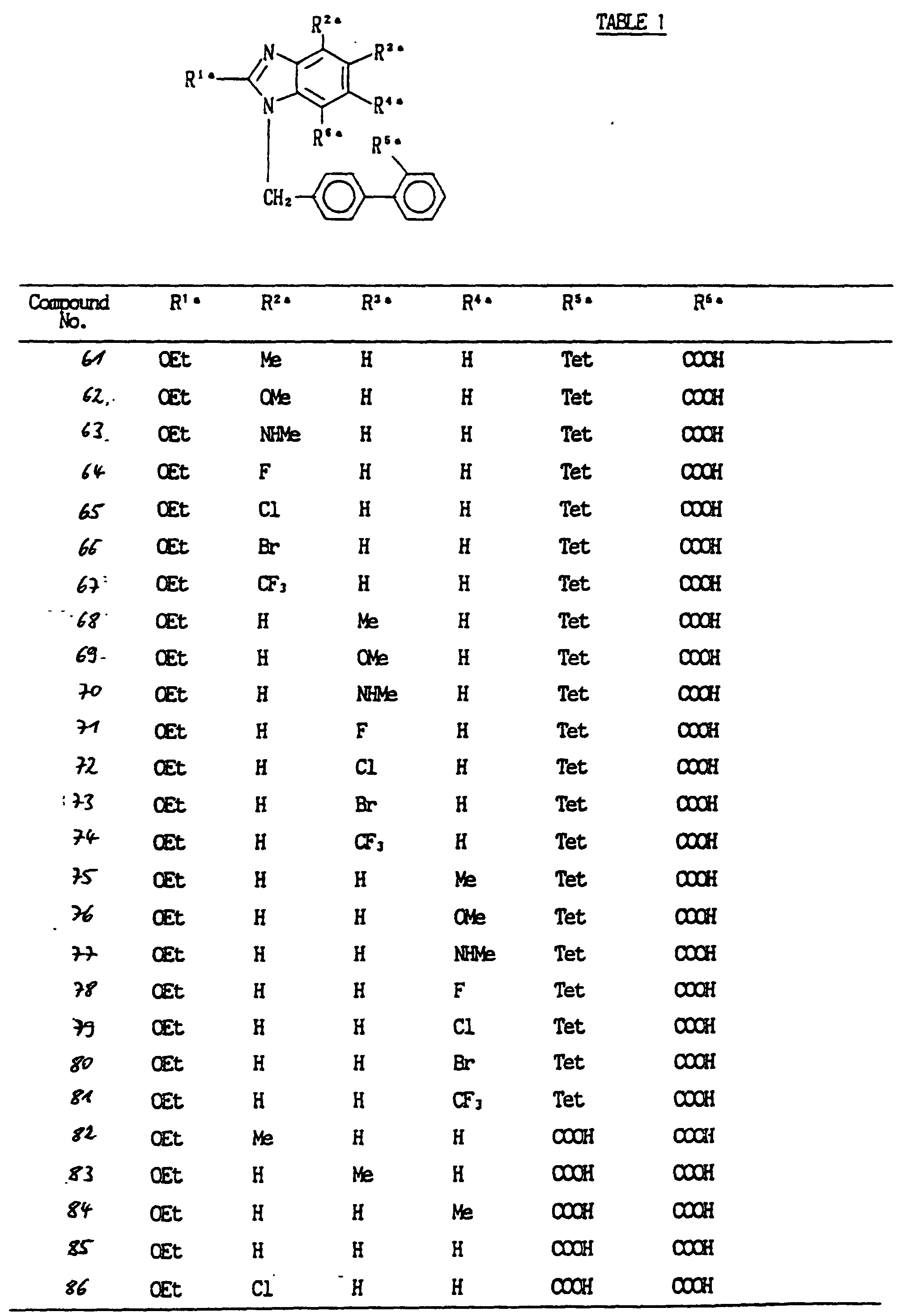
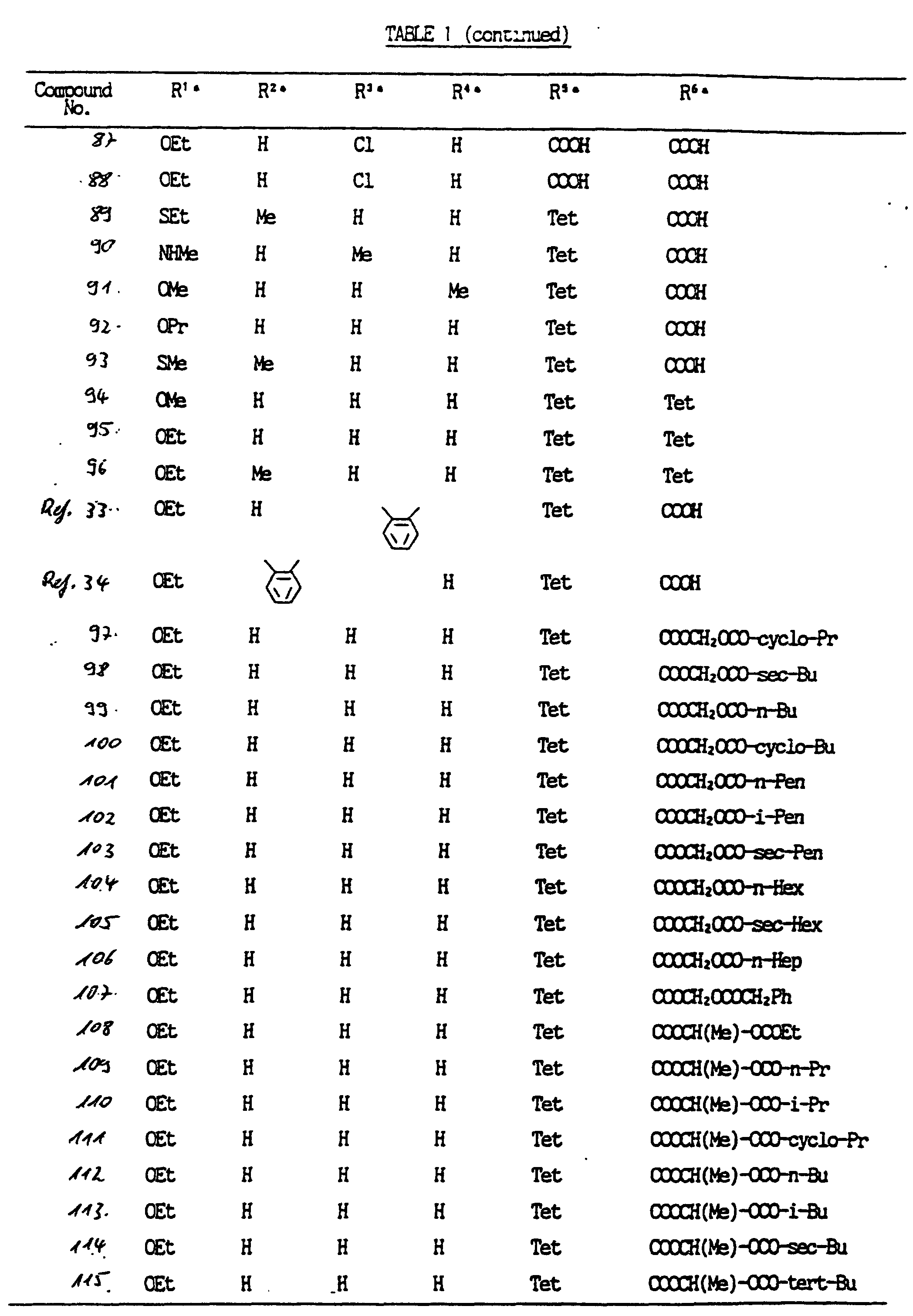
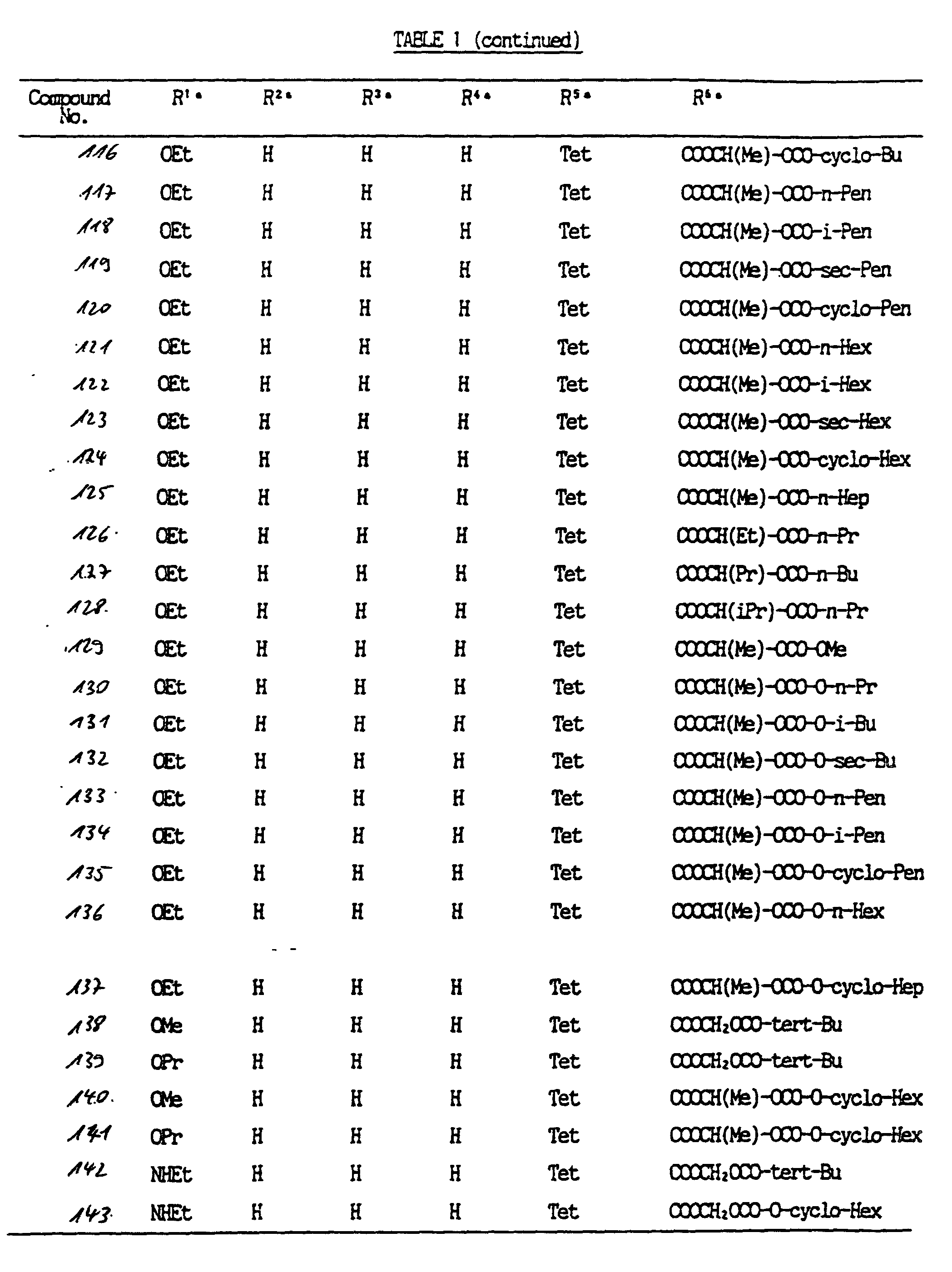
- An experiment of inhibition on the binding of angiotensin II (A II) to A II receptor was conducted by modifying the method of Douglas et al. [Endocrinology, 102, 685-696 (1978)]. An A II receptor membrane fraction was prepared from bovine adrenal cortex.
- The compound of the present invention (10 -6M or 10-7M) and 125I-angiotensin II (125I-A II) (1.85 kBq/50 µl) were added to the receptor membrane fraction, and the mixture was incubated at room temperature for one hour. The receptor-bound and free 125I-A II were separated through a filter (Whatman GF/B filter), and the radioactivity of 125I-A II bound to the receptor was measured.
- The results relating to the compounds of the present invention are shown in Table 2.
- Jcl : SD rats (9 week old, male) were employed. On the previous day of the experiment, these animals were applied with cannulation into the femoral artery and vein under anesthesia with pentobarbital Na. The animals were fasted but allowed to access freely to drinking water until the experiment was started. Just on the day of conducting the experiment, the artery cannula was connected with a blood-pressure transducer, and the average blood pressure was recorded by means of polygraph. Before administration of the drug, the pressor action due to intravenous administration of A II (100 ng/kg) as the control was measured. The drugs were orally administered, then, at each point of the measurement, A II was administered intravenously, and the pressor action was similarly measured. By comparing the pressor action before and after administration of the drug, the percent inhibition by the drug on A II-induced pressor action was evaluated.
- The results relating to the compounds of the present invention are shown in Table 2.


- It is understood that the preceding representative examples may be varied within the scope of the present invention by one skilled in the art to achieve essentially the same results.
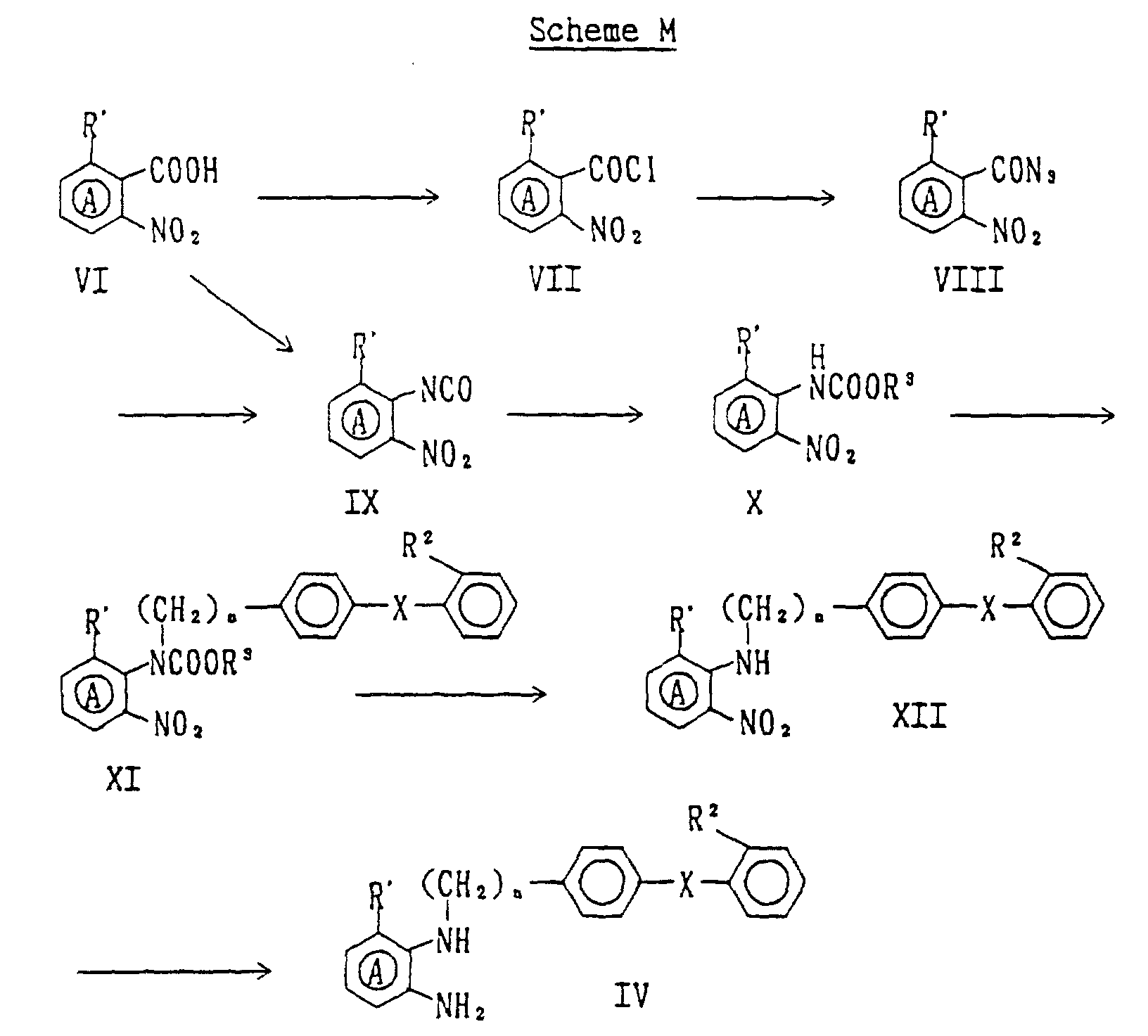
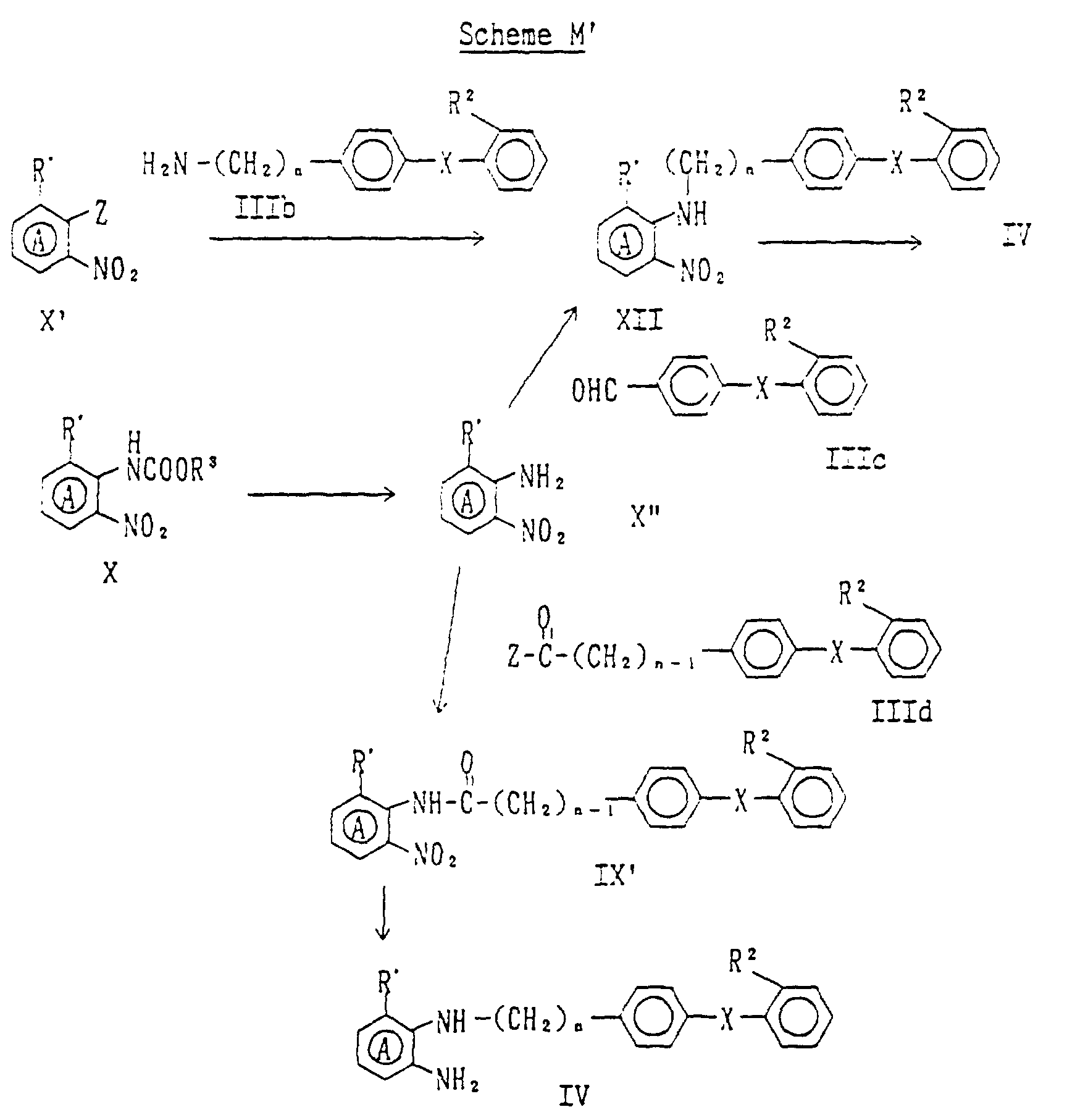
Claims (36)
- A compound of the formula:wherein the ring A is a benzene ring which in addition to the R' group may be optionally substituted by halogen; nitro; cyano; amino; N-(C1-4) alkyl amino; N,N-di(C1-4) alkyl amino, phenylamino, naphthylamino, benzylamino, naphthylmethylamino, morpholino, piperidino, piperazino, N-phenylpiperazino; groups having the formula: -W-R13 wherein W is a chemical bond, -O-, -S- or
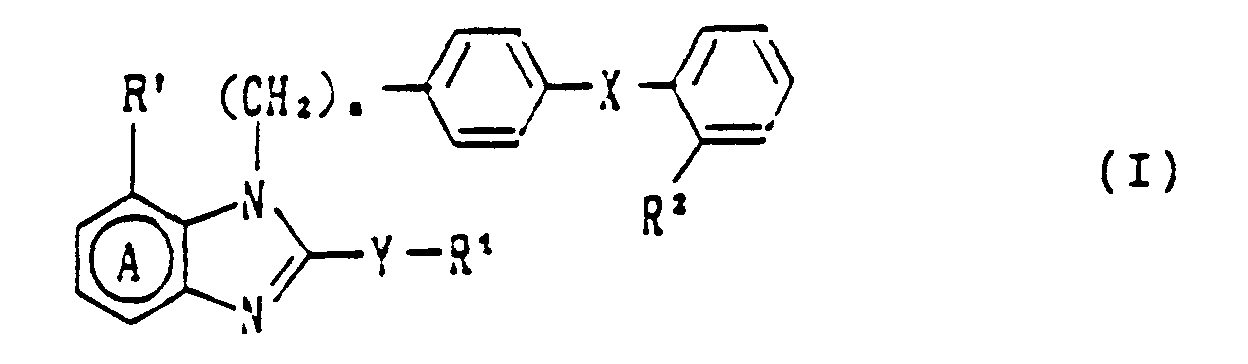 and R13 is hydrogen or (C1-4) alkyl optionally substituted with hydroxyl, amino, dimethylamino, diethylamino, piperidino, morpholino, halogen or (C1-4) alkoxy; groups having the formula -(CH2)p-CO-D wherein D is hydrogen, hydroxyl, amino, N-(C1-4) alkylamino, N,N-di(C1-4) alkyl amino or (C1-6) alkoxy optionally substituted with hydroxyl, amino, dimethylamino, diethylamino, piperidino, morpholino, halogen, (C1-6) alkoxy, (C1-6) alkylthio, dioxolenyl or 5-methyl-2-oxo-1,3-dioxolen-4-yl, on the alkyl moiety or groups having the formula: -OCH(R9)OCOR10 wherein R9 is hydrogen, straight or branched C1-6 alkyl, cyclopentyl, cyclohexyl or cycloheptyl, and R10 is straight or branched C1-6 alkyl, straight or branched C2-8 alkenyl, cyclopentyl, cyclohexyl, cycloheptyl, (C1-3) alkyl which is substituted with phenyl, p-chlorophenyl or C5-7 cycloalkyl, (C2-3) alkenyl which is substituted with phenylor C5-7 cycloalkyl, phenyl, p-tolyl, naphthyl, straight or branched C1-6 alkoxy, straight or branched C2-8 alkenyloxy, cyclopentyloxy, cyclohexyloxy, cycloheptyloxy, (C1-3) alkoxy which is substituted with phenyl dr C5-7 cycloalkyl, (C2-3) alkenyloxy which is substituted with phenyl or C5-7 cycloalkyl, phenoxy, p-nitrophenoxy or naphthoxy, and p is 0 or 1; tetrazolyl optionally protected with (C1-4) alkyl group, (C1-4) alkoxymethyl, benzyl, (C2-5) alkanoyl, or benzoyl, trifluoromethanesulfonic amide; phosphoric acid; or sulfonic acid; whereby one or two of these substituents may be substituted at various positions of the benzene ring,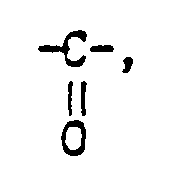
R' is carboxyl, an ester thereof, an amide thereof, a tetrazolyl group optionally protected with (C1-4) alkyl, (C1-4) alkoxy (C1-4) alkyl, (C2-5)alkanoyl or benzoyl, trifluoromethanesulfonic amide, phosphoric acid or sulfonic acid;
R1 is hydrogen or C1-8 alkyl, C2-8 alkenyl, C2-8 alkynyl, C3-6 cycloalkyl, which groups optionally may be substituted with hydroxyl, amino, methylamino, halogen or C1-4 alkoxy; phenyl optionally substituted with halogen, nitro, C1-4 alkoxy, C1-4 alkyl at various positions of the benzene ring or phenyl-(C1-4) alkyl optionally substituted with halogen, nitro, (C1-4) alkoxy, (C1-4) alkyl at various positions of the benzene ring;
R2 is carboxyl, tetrazolyl, trifluoromethanesulfonic amide (-NHSO2CF3), phosphoric acid, sulfonic acid, cyano, (C1-4) alkoxycarbonyl, which groups may be protected with a C1-4 alkyl group, C1-4 alkoxymethyl, benzyl, (C2-5)alkanoyl or benzoyl;
X is a direct bond or a divalent chain in which the number of atoms constituting the straight chain is 1 or 2;
Y is -O-, -S(O)m- or -N(R4)- wherein m is 0, 1 or 2 and R4 is hydrogen or a C1-4 alkyl group;
n is an integer of 1 or 2;
with the exclusion of 2-ethoxy-1-[[2'-(1H-tetrazol-5-yl)biphenyl-4-yl]methyl]-benzimidazole-7-carboxylic acid and 1-(cyclohexyloxycarbonyloxy)ethyl 2-ethoxy-1-[[2'-(1H-tetrazol-5-yl)biphenyl-4-yl]methyl]benzimidazole-7-carboxylate; or a pharmaceutically acceptable salt thereof. - A compound according to claim 1 whereby in formula I, R' represents a group having the formula -CO-D' wherein D' is hydroxyl, amino, N-(C1-4) alkylamino, N,N-di(C1-4) alkyl amino, (C1-6) alkoxy optionally substituted with hydroxyl, amino, dimethylamino, diethylamino, piperidino, morpholino, halogen, (C1-6) alkoxy, (C1-6) alkylthio, dioxolenyl or 5-methyl-2-oxo-1,3-dioxolen-4-yl on the alkyl moiety, a (C2-3) alkenyloxy optionally substituted with optionally substituted aryl on the alkenyl moiety, a group having the formula: -OCH(R7)OCOR8 wherein R7 is hydrogen, straight or branched C1-6 alkyl, cyclopentyl, cyclohexyl, cycloheptyl, and R8 is straight or branched C1-6 alkyl, straight or branched C2-8 alkenyl, cyclopentyl, cyclohexyl, cycloheptyl, (C1-3) alkyl which is substituted with phenyl, p-chlorophenyl or cycloalkyl having 5 to 7 carbon atoms, (C2-3) alkenyl which is substituted with phenyl or cycloalkyl having 5 to 7 carbon atoms, phenyl, p-tolyl, naphthyl, straight or branched C1-6 alkoxy, straight or branched C2-8 alkenyloxy, cyclopentyloxy, cyclohexyloxy, cycloheptyloxy, (C1-3) alkoxy which is substituted with phenyl or cycloalkyl having 5 to 7 carbon atoms, (C2-3) alkenyloxy which is substituted with phenyl or cycloalkyl having 5 to 7 carbon atoms, phenoxy, p-nitrophenoxy or naphthoxy.
- A compound according to claim 1 whereby in formula I, R' represents -COOH or a salt thereof, -COOMe, -COOEt, -COOtBu, -COOPr, pivaloyloxymethoxycarbonyl, 1-(cyclohexyloxycarbonyloxy)ethoxycarbonyl, (5-methyl-2-oxo-1,3-dioxolen-4-yl) methyloxycarbonyl, acetoxymethyloxycarbonyl, propionyloxymethoxycarbonyl, n-butyryloxymethoxycarbonyl, isobutyryloxymethoxycarbonyl, 1-(ethoxycarbonyloxy)ethoxycarbonyl, 1-(acetyloxy)ethoxycarbonyl, 1-(isobutyryloxy)ethoxycarbonyl, cyclohexylcarbonyloxymethoxycarbonyl, benzoyloxymethoxycarbonyl, cinnamyloxycarbonyl, or cyclopentylcarbonyloxymethoxycarbonyl.
- A compound according to claim 1, which is a compound of the formula:wherein the ring A is a benzene ring which may optionally contain substitution in addition to the R'b group as defined in claim 1, R1, R2, X and Y are as defined in claim 1 and R'b is carboxyl, an ester thereof or an amide thereof; or a pharmaceutically acceptable salt thereof.

- A compound according to claim 1, wherein R1 is an alkyl, alkenyl, alkynyl, or cycloalkyl group, which may be substituted with hydroxyl, an amino, methylamino, halogen or a (C1-4) alkoxy group.
- A compound according to claim 1, wherein R1 is a (C1-5) alkyl or (C2-5) alkenyl group optionally substituted with hydroxyl, an amino group, halogen or a (C1-4) alkoxy group.
- A compound according to claim 5, wherein the alkyl group is unsubstituted or substituted with hydroxyl, an amino, methylamino, halogen or a (C1-4) alkoxy group.
- A compound according to claim 1, wherein R1 is phenyl which may be substituted with halogen, nitro, (C1-4) alkoxy, or (C1-4) alkyl.
- A compound according to claim 1, wherein R1 is phenyl- (C1-4) alkyl which may be substituted with halogen, nitro, (C1-4) alkoxy, or (C1-4) alkyl.
- A compound according to claim 1, wherein R2 is a tetrazolyl group optionally protected with (C1-4) alkyl, (C1-4) alkoxymethyl, (C2-5)alkanoyl or benzoyl, a carboxyl group optionally protected with (C1-4) alkyl, (C1-4) alkoxymethyl, or bonzyl or trifluoromethanesulfonic amide.
- A compound according to claim 2, wherein R' is a group having the formula: -CO-D' wherein D' is hydroxyl or a (C1-6) alkoxy group optionally substituted with hydroxyl, amino, dimethylamino, diethylamino, piperidino, morpholino, halogen, (C1-6) alkoxy, (C1-6) alkylthio, dioxolenyl or 5-methyl-2-oxo-1,3-dioxolen-4-yl on the alkyl moiety, or a group having the formula: -OCH(R7)OCOR8 wherein R7 is hydrogen, straight or branched alkyl having 1 to 6 carbon atoms, or cycloalkyl having 5 to 7 carbon atoms and R8 is straight or branched alkyl having 1 to 6 carbon atoms, straight or branched alkenyl having 2 to 8 carbon atoms, cycloalkyl having 5 to 7 carbon atoms, (C1-3) alkyl which is substituted with phenyl, p-chlorophenyl or cycloalkyl having 5 to 7 carbon atoms, (C2-3) alkenyl which is substituted with phenyl or cycloalkyl having 5 to 7 carbon atoms,phenyl,p-tolyl,naphthyl, straight or branched alkoxy having 1 to 6 carbon atoms, straight or branched alkenyloxy having 2 to about 8 carbon atcms, cycloalkyloxy having 5 to 7 carbon atoms, (C1-3) alkoxy which is substituted with phenyl or cycloalkyl having 5 to 7 carbon atoms, (C2-3) alkenyloxy which is substituted with phenyl or cycloalkyl having 5 to 7 carbon atoms, phenoxy, p-nitrophenoxy or naphthoxy.
- A compound according to claim 1, wherein R' is a group capable of forming the residue: -CCO- or convertible thereinto.
- A compound according to claim 11, wherein D' is hydroxyl, a (C1-6) alkoxy group optionally substituted with hydroxyl, (C1-6) alkoxy, dioxolenyl or 5-methyl-2-oxo-1,3-dioxolen-4-yl on the alkyl moiety, a (C2-3) alkenyloxy optionally substituted with phenyl on the alkenyl moiety, or a group having the formula: -OCH(R7)OCOR8 wherein R7 is hydrogen, or straight or branched alkyl having 1 to 6 carbon atoms and R8 is straight or branched alkyl having 1 to 6 carbon atoms, cycloalkyl having 5 to 7 carbon atoms, (C1-3) alkyl which is substituted with phenyl, p-chlorophenyl or cycloalkyi having 5 to 7 carbon atoms, phenyl,p-tolyl,naphthyl, straight or branched alkoxy having 1 to 6 carbon atoms, cyclcalkyloxy having 5 to 7 carbon atoms, (C1-3) alkoxy which is substituted with phenyl or cycloalkyl having 5 to 7 carbon atoms, phenoxy, p-nitrophenoxy or naphthoxy.
- A compound according to claim 1, wherein R' is a group having the formula: -CO-OCH(R7)OCOR8 wherein R7 is hydrogen or straight or branched alkyl having 1 to 6 carbon atoms and R8 is straight or branched alkyl having 1 to 6 carbon atoms, cycloalkyl having 5 to 7 carbon atoms, phenyl, straight or branched alkoxy having 1 to 6 carbon atoms or cycloalkyloxy having 5 to 7 carbon atoms.
- A compound according to claim 1, wherein X is a direct bond or

- A compound of the formula (I'):wherein R1c is (C1-5) alkyl optionally substituted with hydroxyl, amino, halogen, or a (C1-4) alkoxy group; R1c is -CO-D1c wherein D1c is hydroxyl, amino, N- (C1-4) alkylamino, N,N-di (C1-4) alkyl amino, or (C1-4) alkoxy optionally substituted with hydroxyl, amino, halogen, (C1-4) alkoxy, (C2-6) alkanoyloxy or 1- (C1-6) alkoxycarbonyloxy on the alkyl moiety, or tetrazolyl optionally protected with a (C1-4) alkyl (C2-5) alkanoyl or benzoyl group; R2c is tetrazolyl optionally protected with a (C1-4) alkyl, trityl, methoxymethyl ethoxymethyl, p-methoxybenzyl, p-nitrobenzyl (C2-5) alkanoyl or benzoyl group, or carboxyl optionally protected with a (C1-4) alkyl, trityl, methoxymethyl, ethoxymethyl, p-methoxybenzyi, or p-nitrobenzyl group; R'' is hydrogen, halogen, (C1-4) alkyl, (C1-4) alkoxy, nitro or -CO-D"c wherein D"c is hydroxyl or (C1-2) alkoxy optionally substituted with hydroxyl, (C1-4) alkoxy, (C2-6) alkanoyloxy or 1-(C1-6) alkoxycarbonyloxy on the alkyl moiety, or amino optionally substituted with (C1-4) alkyl; Y is -O-, -S-, or -N(R1c)- wherein R1c is hydrogen or an (C1-4) alkyl group; with the exclusion of 2-ethoxy-1-[[2'-(1H-tetrazol-5-yl)biphenyl-4-yl]methyl]-benzimidazole-7-carboxylic acid; or a pharmaceutically acceptable salt thereof.

- A compound according to claim 16, wherein R1c is (C1-5) alkyl.
- A compound according to claim 16, wherein R'c is -CO-D'c wherein D1c is hydroxyl, or (C1-4) alkoxy optionally substituted with hydroxyl, (C1-4) alkoxy, (C2-6) alkanoyloxy or 1-(C1-6) alkoxycarbonyloxy on the alkyl moiety, or tetrazolyl optionally protected with a (C1-4) alkyl, trityl, methoxymethyl, ethoxymethyl, p-methoxybenzyl, p-nitrobenzyl or (C2-5) alkanoyl.
- A compound according to claim 16, wherein R2c is tetrazolyl optionally protected with (C1-4) alkyl, triphenylmethyl, p-methoxybenzyl, p-nitrobenzyl, (C2-5) alkanoyl or benzoyl, or carboxyl optionally protected with (C1-4) alkyl, triphenylmethyl, p-methoxybenzyl or p-nitrobenzyl.
- A compound according to claim 16, wherein R" is hydrogen, (C1-4) alkyl, or halogen.
- A compound according to claim 16, wherein R" is hydrcgen.
- A compound according to claim 16 , wherein Y is -O-.
- A compound according to claim 1, wherein R2 is a tetrazolyl group.
- A compound according to claim 1, wherein R' is a tetrazolyl group optionally protected with (C1-4) alkyl, (C1-4)alkoxy (C1-4)alkyl, (C2-5)alkanoyl or benzoyl, trifruoromethanesulfonic amide, phosphoric acid or sulfonic acid.
- A compound according to claim 1, wherein ring A is benzene ring which has no substituents in addition to the R' group.
- A compound according to claim 1, wherein X is the chemical bond between the phenylene group and the phenyl group.
- A compound according to claim 1 or a pharmaceutically acceptable salt thereof, which is selected from the group consisting of
ethyl 2-ethoxy-1-[[2'-(1H-tetrazol-5-yl)biphenyl-4-yl]methyl]-benzimidazole-7-carboxylate,
ethyl 2-propoxy-1-[[2'-(1H-tetrazol-5-yl)biphenyl-4-yl]methyl]-benzimidazole-7-carboxylate,
2-propoxy-1-[[2'-(1H-tetrazol-5-yl)biphenyl-4-yl]methyl]benzimidazole-7-carboxylic acid,
ethyl 2-methylthio-1-[[2'-(1H-tetrazol-5-yl)biphenyl-4-yl]methyl]-benzimidazole-7-carboxylate,
ethyl 2-ethylthio-1-[[2'-(1H-tetrazol-5-yl)biphenyl-4-yl]methyl]-benzimidazole-7-carboxylate,
ethyl 2-propylthio-1-[[2'-(1H-tetrazal-5-yl)biphenyl-4-yl]methyl]-benzimidazole-7-carboxylate,
2-methylthio-1-[[2'-(1H-tetrazol-5-yl)biphenyl-4-yl]methyl]-benzimidazole-7-carboxylic acid,
2-ethylthio-1-[[2'-(1H-tetrazol-5-yl)biphenyl-4-yl]methyl]-benzimidazole-7-carboxylic acid,
2-propylthio-1-[[2'-(1H-tetrazol-5-yl)biphenyl-4-yl]methyl]-benzimidazole-7-carboxylic acid,
methyl 2-ethoxy-1-[[2'-(1H-tetrazol-5-yl)biphenyl-4-yl]methyl]-benzimidazole-7-carboxylate,
ethyl 2-ethylamino-1-[[2'-(1H-tetrazol-5-yl)biphenyl-4-yl]methyl]-benzimidazole-7-carboxylate,
ethyl 2-propylamino-1-[[2'-(1H-tetrazol-5-yl)biphenyl-4-yl]methyl]-benzimidazole-7-carboxylate,
pivaloyloxymethyl 2-ethoxy-1-[[2'-(1H-tetrazol-5-yl)biphenyl-4-yl]methyl]-benzimidazole-7-carboxylate,
methyl 2-methoxy-1-[[2'-(1H-tetrazol-5-yl)biphenyl-4-yl]methyl]-benzimidazole-7-carboxylate,
2-methoxy-1-[[2'-(1H-tetrazol-5-yl)biphenyl-4-yl]methyl]benzimidazole-7-carboxylic acid,
2-ethylamino-1-[[2'-(1H-tetrazol-5-yl)biphenyl-4-yl]methyl]-benzimidazole-7-carboxylic acid,
2-propylamino-1-[[2'-(1H-tetrazol-5-yl)biphenyl-4-yl]methyl]-benzimidazole-7-carboxylic acid,
(5-methyl-2-oxo-1,3-dioxolen-4-yl)methyl 2-ethoxy-1-[[2'-(1H-tetrazol-5-yl)biphenyl-4-yl]methyl]benzimidazole-7-carboxylate,
acetoxymethyl 2-ethoxy-1-[[2'-(1H-tetrazol-5-yl)biphenyl-4-yl]methyl]-benzimidazole-7-carboxylate,
propionyloxymethyl 2-ethoxy-1-[[2'-(1H-tetrazol-5-yl)biphenyl-4-yl]-methyl]benzimidazole-7-carboxylate,
butyryloxymethyl 2-ethoxy-1-[[2'-(1H-tetrazol-5-yl)biphenyl-4-yl]-methyl]benzimidazole-7-carboxylate,
isobutyryloxymethyl 2-ethoxy-1-[[2'-(1H-tetrazol-5-yl)biphenyl-4-yl]-methyl]benzimidazole-7-carboxylate,
1-(ethoxycarbonyloxy)ethyl 2-ethoxy-1-[[2'-(1H-tetrazol-5-yl)-biphenyl-4-yl]methyl]benzimidazole-7-carboxylate,
1-acetoxyethyl 2-ethoxy-1-[[2'-(1H-tetrazol-5-yl)biphenyl-4-yl]-methyl]benzimidazole-7-carboxylate,
1-(isopropoxycarbonyloxy)ethyl 2-ethoxy-1-[[2'-(1H-tetrazol-5- yl)-biphenyl-4-yl]methyl]benzimidazole-7-carboxylate,
cyclohexylcarbonyloxymethyl 2-ethoxy-1-[[2'-(1H-tetrazol-5-yl)-biphenyl-4-yl]methyl]benzimidazole-7-carboxylate,
benzoyloxymethyl 2-ethoxy-1-[[2'-1H-tetrazol-5-yl)biphenyl-4- yl]-methyl]benzimidazole-7-carboxylate,
(E)-cinnamoyloxymethyl 2-ethoxy-1-[[2'-(1H-tetrazol-5-yl)biphenyl-4-yl]methyl]benzimidazole-7-carboxylate,
cyclopentylcarbonyloxymethyl 2-ethoxy-1-[[2'-(1H-tetrazol-5-yl)-biphenyl-4-yl]methyl]benzimidazole-7-carboxylate,
pivaloyloxymethyl 2-ethylamino-1-[[2'-(1H-tetrazol-5-yl)biphenyl-4-yl]methyl]benzimidazole-7-carboxylate, and
1-(cyclohexyloxycarbonyloxy)ethyl 2-ethylamino-1-[[2'-(1H-tetrazol-5-yl)biphenyl-4-yl]methyl]benzimidazole-7-carboxylate. - A pharmaceutical composition for antagonizing angiotensin II which comprises a therapeutically effective amount of a compound according to one of claims 1 - 27 or a pharmaceutically acceptable salt thereof in admixture with a pharmaceutical acceptable carrier, excipient or diluent.
- Use of a compound according to one of claims 1-27 a pharmaceutically acceptable salt thereof for the manufacture of a medicament for antagonizing angiotensin II.
- A method for producing a compound of the formula (I):wherein the ring A is a benzene ring which in addition to the R' group may be optionally substituted by halogen; nitro; cyano; amino; N-(C1-4) alkyl amino; N,N-di(C1-4) alkyl amino, phenylamino, naphthylamino, benzylamino, naphthylmethylamino, morpholino, piperidino, piperazino, N-phenylpiperazino; groups having the formula: -W-R13 wherein W is a chemical bond, -O-, -S- or -C-, and R13 is hydrogen or (C1-4) alkyl optionally substituted with hydroxyl, amino, dimethylamino, diethylamino, piperidino, morpholino, halogen or (C1-4) alkoxy; groups having the formula -(CH2)p-CO-D wherein D is hydrogen, hydroxyl, amino, N-(C1-4) alkylamino, N,N-di(C1-4) alkyl amino or (C1-6) alkoxy optionally substituted with hydroxyl, amino, dimethylamino, diethylamino, piperidino, morpholino, halogen, (C1-6) alkoxy, (C1-6) alkylthio, dioxolenyl or 5-methyl-2-oxo-1,3-dioxolen-4-yl, on the alkyl moiety or groups having the formula: -OCH(R9)OCOR10 wherein R9 is hydrogen, straight or branched C1-6 alkylor cyclopentyl, cyclohexyl, cycloheptyl, and R10 is straight or branched C1-6 alkyl, straight or branched C2-8 alkenyl, cyclopentyl, cyclohexyl, cycloheptyl, (C1-3) alkyl which is substituted with phenyl, p-chlorophenyl or C5-7 cycloalkyl, (C2-3) alkenyl which is substituted with phenylor C5-7 cycloalkyl, phenyl, p-tolyl, naphthyl, straight or branched C1-6 alkoxy, straight or branched C2-8 alkenyloxy, cyclopentyloxy, cyclohexyloxy, cycloheptyloxy, (C1-3) alkoxy which is substituted with phenyl or C5-7 cycloalkyl, (C2-3) alkenyloxy which is substituted with phenyl or C5-7 cycloalkyl, phenoxy, p-nitrophenoxy, naphthoxy, and p is 0 or 1; tetrazolyl optionally protected with (C1-4) alkyl group, (C1-4) alkoxymethyl, benzyl, (C2-5) alkanoyl, or benzoyl, trifluoromethanesulfonic amide; phosphoric acid; or sulfonic acid; whereby one or two of these substituents may be substituted at various positions of the benzene ring,
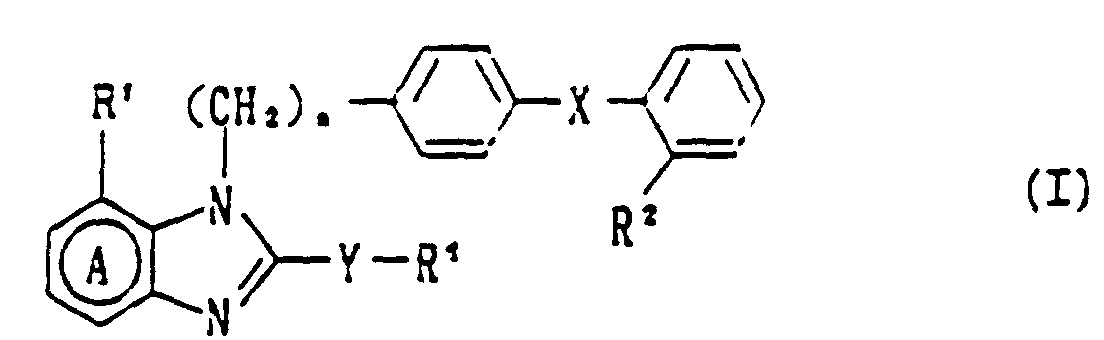
R' is carboxyl, an ester thereof, an amide thereof, a tetrazolyl group optionally protected with (C1-4) alkyl, (C1-4) alkoxy (C1-4) alkyl, (C2-5)alkanoyl or benzoyl, trifluoromethanesulfonic amide, phosphoric acid or sulfonic acid;
R1 is hydrogen or C1-8 alkyl, C2-8 alkenyl, C2-8 alkynyl, C3-6 cycloalkyl, which groups optionally may be substituted with hydroxyl, amino, methylamino, halogen or C1-4 alkoxy; phenyl optionally substituted with halogen, nitro, C1-4 alkoxy, C1-4 alkyl at various positions of the benzene ring, or phenyl-(C1-4) alkyl optionally substituted with halogen, nitro, (C1-4) alkoxy, (C1-4) alkyl at various positions of the benzene ring;
R2 is carboxyl, tetrazolyl, trifluoromethanesulfonic amide (-NHSO2CF3), phosphoric acid, sulfonic acid, cyano, (C1-4) alkoxycarbonyl, which groups may be protected with a C1-4 alkyl group, C1-4 alkoxymethyl, benzyl, (C2-5)alkanoyl or benzoyl; X is a direct bond or a divalent chain in which the number of atoms constituting the straight chain is 1 or 2;
Y is -O-, -S(O)m- or -N(R4)- wherein m is 0, 1 or 2 and R4 is hydrogen or a C1-4 alkyl group;
n is an integer of 1 or 2;
with the exclusion of 2-ethoxy-1-[[2'-(1H-tetrazol-5-yl)biphenyl-4-yl]methyl]-benzimidazole-7-carboxylic acid and 1-(cyclohexyloxycarbonyloxy)ethyl 2-ethoxy-1-[[2'-(1H-tetrazol-5-yl)biphenyl-4-yl]methyl]benzimidazole-7-carboxylate; or a pharmaceutically acceptable salt thereof, which comprisesand if desired, stirring a concentrated residue, amorphous powder or crystals other than stable C-type crystal in a suitable solvent to form the stable C-type crystal of the compound, and, if desired, converting a product obtained by the above processes (i) to (iii) into a compound of the formula (I) by azidation, hydrolysis, reduction, halogenation, O-, N- or S-alkylation, nucleophilic reaction, ring closure, acylation, esterification, oxidation and/or deprotection, and, if desired, converting a compound of the formula (I) into a pharmaceutically acceptable salt thereof.(i) reacting a compound of the formula (II):wherein R1, R', A and Y have the above-defined meanings, with a compound of the formula (III): wherein R2, X and n have the abcve-defined meanings and Z is halogen,
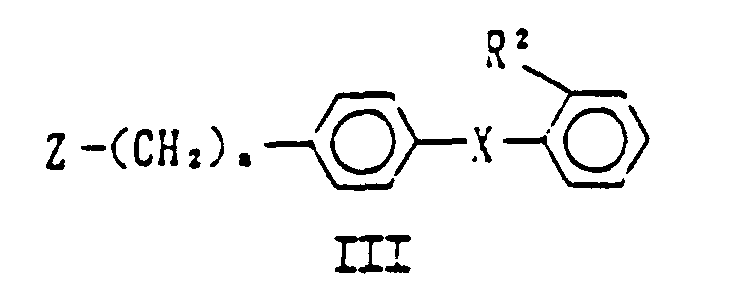 (ii) reacting a compound of the formula (IV):wherein each group has the above-defined meaning, with alkyl orthocarbonate, a carbonylating or thiccarbonylating reagent, or isothiocyanate,
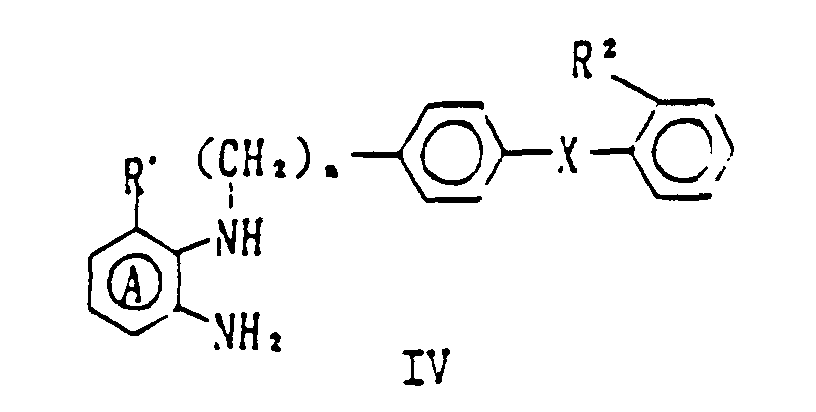 (iii) reacting a compound of the formula (V'):wherein each group has the above-defined meaning, with a nucleophilic reagent,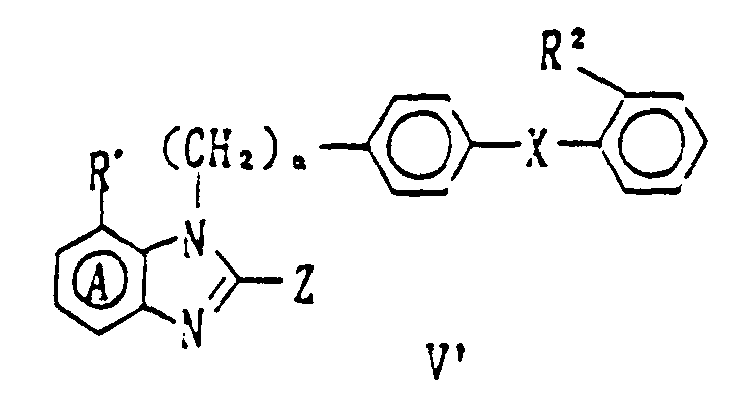
- A method according to Claim 30, wherein said compound is a compound of the formula:wherein the ring A is a benzene ring which may optionally contain substitution in addition to the R'b group as defined in claim 1, R1, R2, X and Y are as defined in claim 30 and R'b is carboxyl, an ester thereof or an amide thereof; or a pharmaceutically acceptable salt thereof.
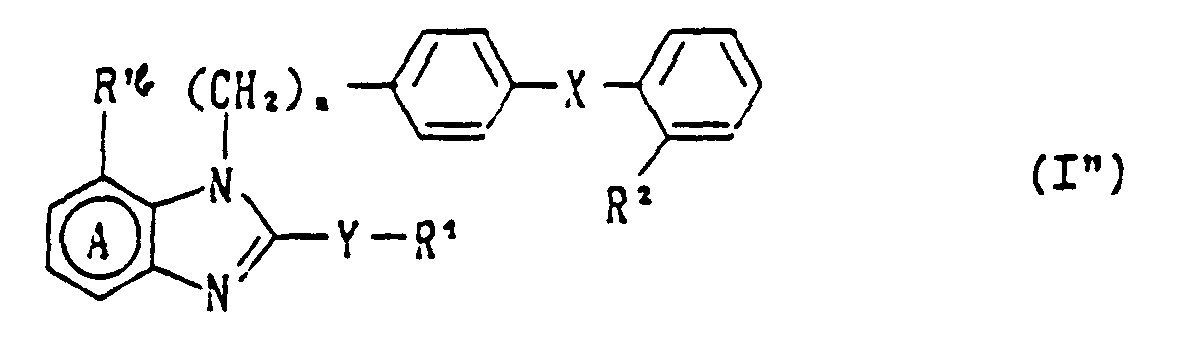
- The method according to claim 30, which gives a compound of the formula (Ik):wherein each group is as defined in claim 30, by the alkaline hydrolysis of a compound of the formula (Ij) :
 wherein A, R1 R2, X, Y and n has the above-defined meaning and R5 is an optionally substituted (C1-6) alkyl, obtained by the processes (i) to (iii).
- The method according to claim 30, which gives a compound of the formula (Im) :by deprotection of a compound of the formula (II) :
 wherein A, R', R1, X, Y and n has the meaning as defined in claim 30 and R is a protective group, obtained by the processes (i) to (iii).
- The method according to claim 30 , which gives a compound of the formula (Ib):by ring closure reaction of a compound of the formula (Ia):
 wherein each group is as defined in claim 30, obtained by the processes (i) to (iii) by reacting with azide.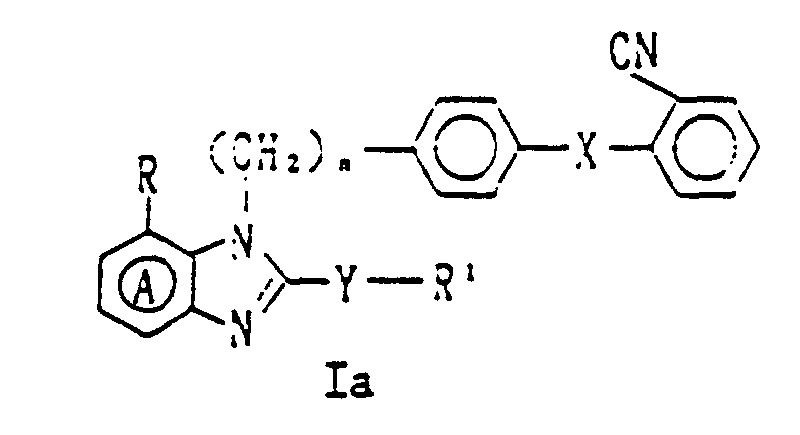
- The method according to claim 30, which gives a compound of the formula (Io):wherein A, R1, X, Y and n has the meaning as defined in claim 30 and R is a protective group by alkylating a compound of the formula (In) :
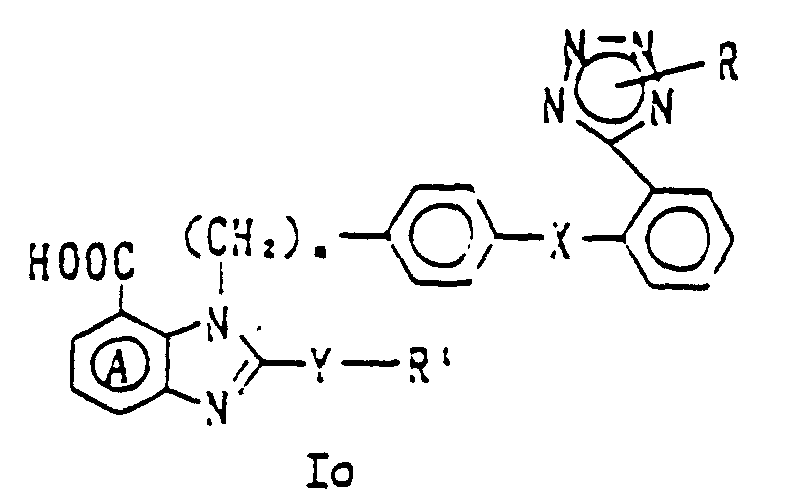 wherein each group has the above-defined meaning, obtained by the processes (i) to (iii) due to reacting with alkylating agent.
- The method according to claim 30, which gives a ccmpound of the formula (Ip) :wherein A, R1, X, Y and n has the meaning as defined in claim 30, R is a protective group and R6 is (C1-6) alkyl optionally substituted with (C2-6) alkanoyloxy or 1-(C1-6) alkoxycarbonyloxy, by alkylating a compound of the formula (Io):
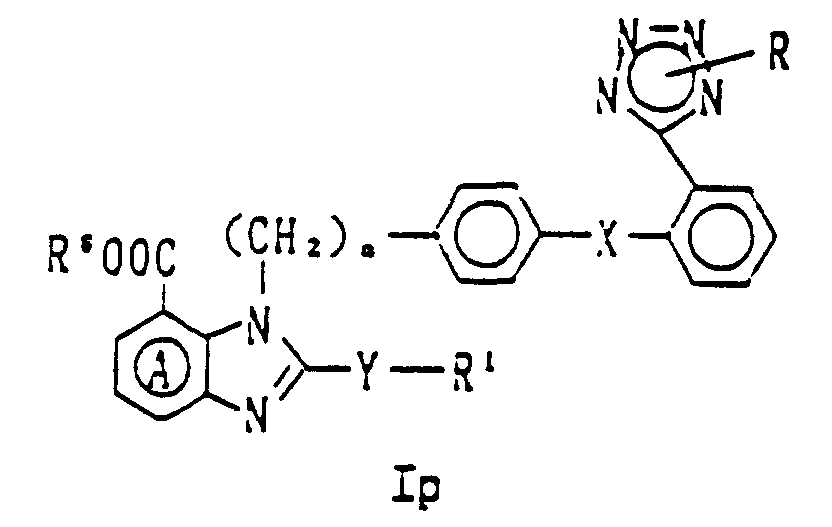 wherein each group has the above-defined meaning, obtained by the processes (i) to (iii) due to reacting with alkylating agent.
Applications Claiming Priority (16)
| Application Number | Priority Date | Filing Date | Title |
|---|---|---|---|
| JP11314890 | 1990-04-27 | ||
| JP113148/90 | 1990-04-27 | ||
| JP11314890 | 1990-04-27 | ||
| JP14194290 | 1990-05-30 | ||
| JP14194290 | 1990-05-30 | ||
| JP141942/90 | 1990-05-30 | ||
| JP208662/90 | 1990-08-06 | ||
| JP20866290 | 1990-08-06 | ||
| JP20866290 | 1990-08-06 | ||
| JP26457990 | 1990-10-01 | ||
| JP264579/90 | 1990-10-01 | ||
| JP26457990 | 1990-10-01 | ||
| JP41367990 | 1990-12-24 | ||
| JP413679/90 | 1990-12-24 | ||
| JP41367990 | 1990-12-24 | ||
| EP91106330A EP0459136B1 (en) | 1990-04-27 | 1991-04-19 | Benzimidazole derivatives, their production and use |
Related Parent Applications (2)
| Application Number | Title | Priority Date | Filing Date |
|---|---|---|---|
| EP91106330A Division EP0459136B1 (en) | 1990-04-27 | 1991-04-19 | Benzimidazole derivatives, their production and use |
| EP91106330.3 Division | 1991-04-19 |
Publications (2)
| Publication Number | Publication Date |
|---|---|
| EP0720982A1 EP0720982A1 (en) | 1996-07-10 |
| EP0720982B1 true EP0720982B1 (en) | 2002-11-13 |
Family
ID=27526589
Family Applications (2)
| Application Number | Title | Priority Date | Filing Date |
|---|---|---|---|
| EP91106330A Expired - Lifetime EP0459136B1 (en) | 1990-04-27 | 1991-04-19 | Benzimidazole derivatives, their production and use |
| EP95118796A Expired - Lifetime EP0720982B1 (en) | 1990-04-27 | 1991-04-19 | Benzimidazole derivatives, their production and use and use as angiotensin II antagonists |
Family Applications Before (1)
| Application Number | Title | Priority Date | Filing Date |
|---|---|---|---|
| EP91106330A Expired - Lifetime EP0459136B1 (en) | 1990-04-27 | 1991-04-19 | Benzimidazole derivatives, their production and use |
Country Status (21)
| Country | Link |
|---|---|
| US (4) | US5196444A (en) |
| EP (2) | EP0459136B1 (en) |
| JP (2) | JP2514282B2 (en) |
| KR (1) | KR100200541B1 (en) |
| CN (2) | CN1048486C (en) |
| AT (2) | ATE227709T1 (en) |
| CA (2) | CA2040955C (en) |
| CY (1) | CY2150B1 (en) |
| DE (3) | DE69123784T2 (en) |
| DK (2) | DK0720982T3 (en) |
| ES (2) | ES2095266T3 (en) |
| FI (2) | FI108434B (en) |
| GR (1) | GR3022172T3 (en) |
| HU (2) | HU213266B (en) |
| IE (1) | IE911317A1 (en) |
| LU (1) | LU90224I2 (en) |
| LV (1) | LV10258B (en) |
| NL (1) | NL970044I2 (en) |
| NO (3) | NO300923B1 (en) |
| NZ (1) | NZ237949A (en) |
| PT (1) | PT97451B (en) |
Cited By (2)
| Publication number | Priority date | Publication date | Assignee | Title |
|---|---|---|---|---|
| US7582760B2 (en) | 2005-07-13 | 2009-09-01 | Roche Palo Alto Llc | Benzimidazolone and dihydroindolone derivatives and uses thereof |
| EP2165702A1 (en) | 2008-09-17 | 2010-03-24 | Helm AG | Stable and readily dissolved compositions of candesartan cilexetil prepared with wet granulation |
Families Citing this family (229)
| Publication number | Priority date | Publication date | Assignee | Title |
|---|---|---|---|---|
| US5332744A (en) * | 1989-05-30 | 1994-07-26 | Merck & Co., Inc. | Substituted imidazo-fused 6-membered heterocycles as angiotensin II antagonists |
| US5223499A (en) * | 1989-05-30 | 1993-06-29 | Merck & Co., Inc. | 6-amino substituted imidazo[4,5-bipyridines as angiotensin II antagonists |
| IE70593B1 (en) * | 1989-09-29 | 1996-12-11 | Eisai Co Ltd | Biphenylmethane derivative the use of it and pharmacological compositions containing same |
| US5196444A (en) * | 1990-04-27 | 1993-03-23 | Takeda Chemical Industries, Ltd. | 1-(cyclohexyloxycarbonyloxy)ethyl 2-ethoxy-1-[[2'-(1H-tetrazol-5-yl)biphenyl-4-yl]methyl]benzimidazole-7-carboxylate and compositions and methods of pharmaceutical use thereof |
| DE4036706A1 (en) * | 1990-11-17 | 1992-05-21 | Hoechst Ag | METHOD FOR THE TREATMENT OF CARDIALS AND VASCULAR HYPERTROPHY AND HYPERPLASIA |
| GB9027198D0 (en) * | 1990-12-14 | 1991-02-06 | Smithkline Beecham Plc | Medicaments |
| GB9027208D0 (en) * | 1990-12-14 | 1991-02-06 | Smithkline Beecham Plc | Medicaments |
| SI9210098B (en) * | 1991-02-06 | 2000-06-30 | Dr. Karl Thomae | Benzimidazoles, drugs with this compounds, and process for their preparation |
| FR2673427B1 (en) * | 1991-03-01 | 1993-06-18 | Sanofi Elf | N-SUBSTITUTED DIAZOTATED HETEROCYCLIC DERIVATIVES BY A BIPHENYLMETHYL GROUP, THEIR PREPARATION, THE PHARMACEUTICAL COMPOSITIONS CONTAINING THE SAME. |
| TW274551B (en) * | 1991-04-16 | 1996-04-21 | Takeda Pharm Industry Co Ltd | |
| IL102183A (en) * | 1991-06-27 | 1999-11-30 | Takeda Chemical Industries Ltd | Biphenyl substituted heterocyclic compounds their production and pharmaceutical compositions comprising them |
| GB9201789D0 (en) * | 1992-01-28 | 1992-03-11 | Fujisawa Pharmaceutical Co | Heterocyclic derivatives |
| US5354759A (en) * | 1991-09-12 | 1994-10-11 | Fujisawa Pharmaceutical Co., Ltd. | Angiotenin II antagonizing heterocyclic compounds |
| TW284688B (en) * | 1991-11-20 | 1996-09-01 | Takeda Pharm Industry Co Ltd | |
| JP2682353B2 (en) * | 1991-11-20 | 1997-11-26 | 武田薬品工業株式会社 | Oral pharmaceutical composition and method for producing the same |
| DE4203872A1 (en) * | 1992-02-11 | 1993-08-12 | Thomae Gmbh Dr K | IMIDAZO (1,2-A) PYRIDINES, MEDICAMENTS CONTAINING SUCH COMPOUNDS AND METHOD OF PREPARING THEM |
| WO1993018030A1 (en) * | 1992-03-03 | 1993-09-16 | Fujisawa Pharmaceutical Co., Ltd. | Benzimidazole derivatives as angiotensin ii antagonists |
| US5310929A (en) * | 1992-08-06 | 1994-05-10 | E. I. Du Pont De Nemours And Company | Prodrugs of imidazole carboxylic acids as angiotensin II receptor antagonists |
| US5266583A (en) * | 1992-09-01 | 1993-11-30 | Merck & Co., Inc. | Angitotensin II antagonist |
| DK154092D0 (en) * | 1992-12-23 | 1992-12-23 | Neurosearch As | IMIDAZOLE COMPOUNDS, THEIR PREPARATION AND USE |
| CA2115985A1 (en) * | 1993-02-25 | 1994-08-26 | Kohei Nishikawa | Vascular hypertrophy suppressor |
| JP2787539B2 (en) * | 1993-02-26 | 1998-08-20 | 松森 昭 | Agent for preventing or treating viral diseases |
| JP2003306432A (en) * | 1993-04-22 | 2003-10-28 | Takeda Chem Ind Ltd | Prophylactic or therapeutic agent for renal disease |
| JP3810020B2 (en) | 1993-04-22 | 2006-08-16 | 武田薬品工業株式会社 | Preventive or therapeutic agent for kidney disease |
| CA2125251C (en) * | 1993-06-07 | 2005-04-26 | Yoshiyuki Inada | A pharmaceutical composition for angiotensin ii-mediated diseases |
| US5721263A (en) * | 1993-06-07 | 1998-02-24 | Takeda Chemical Industries, Ltd. | Pharmaceutical composition for angiotensin II-mediated diseases |
| JP3057471B2 (en) * | 1993-06-07 | 2000-06-26 | 武田薬品工業株式会社 | Agent for preventing or treating angiotensin II-mediated diseases |
| CZ154994A3 (en) * | 1993-07-02 | 1995-09-13 | Senju Pharma Co | Visual hypotensive agent |
| US5391566A (en) * | 1993-07-20 | 1995-02-21 | Merck & Co., Inc. | Benzimidazolinones substituted with phenoxyphenylacetic acid derivatives |
| ZA945190B (en) * | 1993-07-30 | 1995-02-24 | Kotobuki Seiyaku Co Ltd | Carboxymethylidenecycloheptimidazole derivatives method or manufacturing the same and therapeutic agents containing these compounds |
| US5824696A (en) * | 1993-09-01 | 1998-10-20 | Smithkline Beecham Corporation | Medicaments |
| US6676967B1 (en) * | 1993-09-20 | 2004-01-13 | Kos Pharmaceuticals, Inc. | Methods for reducing flushing in individuals being treated with nicotinic acid for hyperlipidemia |
| DE69517832T2 (en) * | 1994-01-28 | 2000-11-09 | Takeda Chemical Industries, Ltd. | A process for the preparation of tetrazolyl compounds |
| DE4408497A1 (en) * | 1994-03-14 | 1995-09-21 | Thomae Gmbh Dr K | Benzimidazoles, medicaments containing these compounds and process for their preparation |
| WO1995024902A1 (en) * | 1994-03-16 | 1995-09-21 | Sankyo Company, Limited | Ocular tension depressant |
| AU677702B2 (en) * | 1994-10-13 | 1997-05-01 | Takeda Pharmaceutical Company Limited | A prophylactic or therapeutic drug for renal diseases |
| SE9501881D0 (en) * | 1995-05-19 | 1995-05-19 | Astra Ab | New pharmacological use of AII receptor antagonists |
| SE9502219D0 (en) * | 1995-06-19 | 1995-06-19 | Astra Ab | Novel medical use |
| BR9611007A (en) * | 1995-10-06 | 1999-07-13 | Novartis Ag | AT1 receptor antagonists to prevent and treat post-ischemic kidney deficiency and to protect ischemic kidneys |
| EP0882718B1 (en) * | 1995-12-28 | 2005-08-31 | Fujisawa Pharmaceutical Co., Ltd. | Benzimidazole derivatives |
| DE69718146T2 (en) | 1996-02-29 | 2003-10-02 | Novartis Ag, Basel | AT1 RECEPTOR ANTAGONIST FOR EXCITING APOPTOSIS |
| US6107323A (en) * | 1996-04-05 | 2000-08-22 | Takeda Chemical Industries, Ltd. | Pharmaceutical composition |
| AU714618B2 (en) * | 1996-07-15 | 2000-01-06 | Sankyo Company Limited | Medicinal composition |
| US5771604A (en) * | 1997-04-07 | 1998-06-30 | Maytag Corporation | Clothes dryer air inlet arrangement |
| US6177587B1 (en) | 1997-05-26 | 2001-01-23 | Takeda Chemical Industries, Ltd. | Production method of aminobenzene compound |
| TW453999B (en) | 1997-06-27 | 2001-09-11 | Fujisawa Pharmaceutical Co | Benzimidazole derivatives |
| DE69830069T3 (en) | 1997-10-17 | 2012-02-09 | Ark Therapeutics Ltd. | USE OF INHIBITORS OF THE RENIN-ANGIOTENSIN SYSTEM FOR THE TREATMENT OF HYPOXIA OR REDUCED METABOLIC CHANGE |
| WO1999042451A1 (en) * | 1998-02-23 | 1999-08-26 | Kureha Chemical Industry Co., Ltd. | Benzimidazole derivative |
| DE19820151A1 (en) * | 1998-05-06 | 1999-11-11 | Hexal Ag | Transdermal therapeutic system for the application of candesartan |
| US6638937B2 (en) | 1998-07-06 | 2003-10-28 | Bristol-Myers Squibb Co. | Biphenyl sulfonamides as dual angiotensin endothelin receptor antagonists |
| HUP0103256A3 (en) | 1998-07-15 | 2002-05-28 | Teijin Ltd | Thiobenzimidazole derivatives and pharmaceutical compositions containing the compounds |
| KR100646716B1 (en) | 1998-12-23 | 2006-11-17 | 노파르티스 아게 | Use of an AT-1 receptor antagonist or an AT-2 receptor modulator in the treatment of a disease associated with elevated AT-1 or AT-2 receptors. |
| US6465502B1 (en) | 1998-12-23 | 2002-10-15 | Novartis Ag | Additional therapeutic use |
| CN101011390A (en) | 1999-01-26 | 2007-08-08 | 诺瓦提斯公司 | Use of angiotensin II receptor antagonists for treating acute myocardial infarction |
| GB0001662D0 (en) * | 1999-02-06 | 2000-03-15 | Zeneca Ltd | Pharmaceutical compositions |
| EP1153613B1 (en) * | 1999-02-19 | 2010-11-10 | Takeda Pharmaceutical Company Limited | Percutaneous absorption preparations of compound having angiotensin ii receptor antagonism |
| US6211217B1 (en) | 1999-03-16 | 2001-04-03 | Novartis Ag | Method for reducing pericardial fibrosis and adhesion formation |
| US6972287B1 (en) | 1999-06-10 | 2005-12-06 | Pfizer Inc. | Method of inhibiting amyloid protein aggregation and imaging amyloid deposits |
| AP2002002387A0 (en) * | 1999-06-10 | 2002-03-31 | Warner Lambert Co | Method of inhibiting amyloid aggregation and imaging amyloid deposits. |
| EP1197226B1 (en) | 1999-07-21 | 2007-11-21 | Takeda Pharmaceutical Company Limited | Agents for ameliorating troubles following cerebrovascular failure and inhibiting progress thereof |
| SE9903028D0 (en) | 1999-08-27 | 1999-08-27 | Astra Ab | New use |
| HUP0203326A3 (en) * | 1999-08-30 | 2003-04-28 | Sanofi Aventis Deutschland | Use of inhibitors of the renin-angiotensin system in the prevention of cardiovascular events |
| PL356422A1 (en) * | 2000-02-18 | 2004-06-28 | Takeda Chemical Industries, Ltd. | Tnf-alpha inhibitors |
| SE0002353D0 (en) * | 2000-06-22 | 2000-06-22 | Astrazeneca Ab | New use |
| MXPA03001306A (en) * | 2000-08-11 | 2003-10-15 | Boehringer Ingelheim Pharma | Heterocyclic compounds useful as inhibitors of tyrosine kinases. |
| PE20020617A1 (en) | 2000-08-22 | 2002-08-05 | Novartis Ag | COMPOSITION INCLUDING AN AT1 RECEPTOR ANTAGONIST AND AN INSULIN SECRETION POTENTIAL OR AN INSULIN SENSITIZER |
| AU2001284413A1 (en) * | 2000-08-30 | 2002-03-13 | Sankyo Company Limited | Medicinal compositions for preventing or treating heart failure |
| US20040102502A1 (en) * | 2000-10-25 | 2004-05-27 | Toshifumi Watanabe | Preventing/remedies for portal hypertension |
| US8168616B1 (en) | 2000-11-17 | 2012-05-01 | Novartis Ag | Combination comprising a renin inhibitor and an angiotensin receptor inhibitor for hypertension |
| EP1346722B1 (en) | 2000-12-01 | 2008-12-10 | Takeda Pharmaceutical Company Limited | Method for producing preparation containing bioactive substance |
| EP1420016A4 (en) * | 2001-08-03 | 2006-11-15 | Takeda Pharmaceutical | CRYSTAL AND METHOD FOR THE PRODUCTION THEREOF |
| NZ531346A (en) * | 2001-08-28 | 2005-10-28 | Sankyo Co | Medicinal compositions containing angiotensin II receptor antagonist |
| US7107198B2 (en) * | 2001-11-02 | 2006-09-12 | Sun Microsystems, Inc. | Automatic generation of reduced-size circuit models including inductive interaction |
| EP1444988A4 (en) | 2001-11-13 | 2007-04-25 | Takeda Pharmaceutical | ANTICANCING AGENTS |
| DE10205335A1 (en) * | 2002-02-07 | 2003-08-21 | Bdd Group Holding Ag Zug | Deuterated biphenyl-substituted benzimidazoles and drugs containing these compounds |
| EP1482896A4 (en) * | 2002-03-01 | 2005-11-23 | Merck & Co Inc | AMINOALKYLPHOSPHONATES AND ASSOCIATED COMPOUNDS AS EDG RECEPTOR AGONISTS |
| US7232828B2 (en) | 2002-08-10 | 2007-06-19 | Bethesda Pharmaceuticals, Inc. | PPAR Ligands that do not cause fluid retention, edema or congestive heart failure |
| EP1545519B1 (en) | 2002-08-19 | 2011-03-23 | Pfizer Inc. | Combination therapy for hyperproliferative diseases |
| DE10335027A1 (en) | 2003-07-31 | 2005-02-17 | Boehringer Ingelheim Pharma Gmbh & Co. Kg | Use of telmisartan and simvastatin for treatment or prophylaxis of cardiovascular, cardiopulmonary and renal diseases e.g. hypertension combined with hyperlipidemia or atherosclerosis |
| EP1511739B1 (en) * | 2003-03-17 | 2008-04-30 | Teva Pharmaceutical Industries Ltd. | Polymorphs of valsartan |
| US7504516B2 (en) * | 2003-03-27 | 2009-03-17 | Hetero Drugs Limited | Crystalline forms of candesartan cilexetil |
| SE0300988D0 (en) * | 2003-04-03 | 2003-04-03 | Astrazeneca Ab | New use |
| EP1556363A2 (en) | 2003-04-21 | 2005-07-27 | Teva Pharmaceutical Industries Limited | Process for the preparation of valsartan and intermediates thereof |
| US7732162B2 (en) | 2003-05-05 | 2010-06-08 | Probiodrug Ag | Inhibitors of glutaminyl cyclase for treating neurodegenerative diseases |
| GB0316546D0 (en) * | 2003-07-15 | 2003-08-20 | Novartis Ag | Process for the manufacture of organic compounds |
| US20050037063A1 (en) * | 2003-07-21 | 2005-02-17 | Bolton Anthony E. | Combined therapies |
| EA011507B1 (en) * | 2003-08-27 | 2009-04-28 | Зентива А.С. | A method for the preparation potassium salts of losartan |
| WO2005030202A1 (en) * | 2003-09-26 | 2005-04-07 | Novartis Ag | Use of angiotensin ii receptor antagonists for treating cerebrovascular disorders |
| GB0322552D0 (en) * | 2003-09-26 | 2003-10-29 | Astrazeneca Uk Ltd | Therapeutic treatment |
| US7098342B2 (en) * | 2003-10-16 | 2006-08-29 | Teva Pharmaceutical Industries Ltd. | Preparation of candesartan cilexetil |
| US20070292498A1 (en) * | 2003-11-05 | 2007-12-20 | Warren Hall | Combinations of proton pump inhibitors, sleep aids, buffers and pain relievers |
| EP1689383B1 (en) | 2003-11-19 | 2012-10-31 | Metabasis Therapeutics, Inc. | Novel phosphorus-containing thyromimetics |
| WO2005051928A1 (en) * | 2003-11-28 | 2005-06-09 | Ranbaxy Laboratories Limited | Process for production of tetrazolyl compounds |
| GB0327839D0 (en) | 2003-12-01 | 2003-12-31 | Novartis Ag | Organic compounds |
| JP2005206603A (en) * | 2004-01-21 | 2005-08-04 | Teva Pharmaceutical Industries Ltd | Preparation of candesartan cilexetil |
| GB0402262D0 (en) | 2004-02-02 | 2004-03-10 | Novartis Ag | Process for the manufacture of organic compounds |
| WO2005077941A2 (en) * | 2004-02-11 | 2005-08-25 | Teva Pharmaceutical Industries Ltd. | Candesartan cilexetil polymorphs |
| US7157584B2 (en) * | 2004-02-25 | 2007-01-02 | Takeda Pharmaceutical Company Limited | Benzimidazole derivative and use thereof |
| NZ549535A (en) | 2004-03-17 | 2010-11-26 | Novartis Ag | Use of aliskiren for treating renal and other disorders |
| US20050239845A1 (en) * | 2004-04-16 | 2005-10-27 | Santarus, Inc. | Combination of proton pump inhibitor, buffering agent, and prokinetic agent |
| CN1953973A (en) * | 2004-05-05 | 2007-04-25 | 特瓦制药工业有限公司 | Preparation of candesartan cilexetil in high purity |
| JP2009185060A (en) * | 2004-05-19 | 2009-08-20 | Teva Pharmaceutical Industries Ltd | Candesartan cilexetil polymorph |
| JP2005330277A (en) * | 2004-05-19 | 2005-12-02 | Teva Pharmaceutical Industries Ltd | Candesartan cilexetil polymorph |
| US7588779B2 (en) * | 2004-05-28 | 2009-09-15 | Andrx Labs, Llc | Pharmaceutical formulation containing a biguanide and an angiotensin antagonist |
| WO2005123720A1 (en) * | 2004-06-18 | 2005-12-29 | Ranbaxy Laboratories Limited | Fine particles of the angiotensin ii antagonist candesartan cilexetil and process for production thereof |
| JP2008510814A (en) | 2004-08-23 | 2008-04-10 | ワイス | Pyrrolo-naphthylic acid as a PAI-1 inhibitor |
| US7754747B2 (en) | 2004-08-23 | 2010-07-13 | Wyeth Llc | Oxazolo-naphthyl acids |
| CA2577846A1 (en) | 2004-08-23 | 2006-03-02 | Wyeth | Thiazolo-naphthyl acids as inhibitors of plasminogen activator inhibitor-1 |
| EP2248520A3 (en) | 2004-10-08 | 2010-11-17 | Novartis AG | Use of renin inhibitors for the prevention or treatment of diastolic dysfunction or diastolic heart failure |
| KR101021828B1 (en) | 2004-10-27 | 2011-03-17 | 다이이찌 산쿄 가부시키가이샤 | Benzene Compounds Having Two or More Substituents |
| EP1806137A4 (en) * | 2004-10-29 | 2011-03-30 | Kowa Co | THERAPEUTIC AGENT AGAINST GLOMERULAR DISEASES |
| EP1655298A1 (en) * | 2004-11-03 | 2006-05-10 | LEK Pharmaceuticals d.d. | Novel polymorph forms of candesartan cilexetil |
| EP1812423A1 (en) * | 2004-11-11 | 2007-08-01 | LEK Pharmaceuticals D.D. | Process for the synthesis of tetrazoles |
| AU2005308575A1 (en) * | 2004-11-23 | 2006-06-01 | Warner-Lambert Company Llc | 7-(2h-pyrazol-3-yl)-3, 5-dihyroxy-heptanoic acid derivatives as HMG Co-A reductase inhibitors for the treatment of lipidemia |
| DE102004060699A1 (en) * | 2004-12-16 | 2006-06-22 | Ratiopharm Gmbh | Process for the preparation of candesartan |
| EP1833801B9 (en) * | 2004-12-22 | 2009-02-25 | Algry Quimica, S.L | Intermediate compounds for the preparation of angiotensin ii receptor antagonists |
| US20060165806A1 (en) * | 2005-01-06 | 2006-07-27 | Elan Pharma International Limited | Nanoparticulate candesartan formulations |
| JP2007527925A (en) * | 2005-01-14 | 2007-10-04 | テバ ファーマシューティカル インダストリーズ リミティド | Preparation of crude candesartan cilexetil |
| WO2006079496A1 (en) * | 2005-01-26 | 2006-08-03 | Lek Pharmaceuticals D.D. | New pharmaceutical composition containing candesartan cilexetil as lipophilic crystalline substance |
| NZ562887A (en) * | 2005-03-30 | 2010-10-29 | Takeda Pharmaceutical | Benzimidazole derivative and use as angiotensin II antagonist |
| TW200719896A (en) * | 2005-04-18 | 2007-06-01 | Astrazeneca Ab | Combination product |
| CN100400536C (en) * | 2005-04-30 | 2008-07-09 | 重庆圣华曦药业有限公司 | Preparation method of candesartan cilexetil C-type crystal |
| JP2008505935A (en) * | 2005-05-10 | 2008-02-28 | テバ ファーマシューティカル インダストリーズ リミティド | Ultra finely ground stable candesartan cilexetil and process for its preparation |
| WO2007074399A2 (en) | 2005-06-06 | 2007-07-05 | Medichem, S.A. | Process for the preparation of tetrazolyl compounds |
| ES2264641B1 (en) * | 2005-06-17 | 2008-03-01 | Quimica Sintetica, S.A. | PROCEDURE FOR OBTAINING DERIVATIVES OF BENCIMIDAZOL AND ITS INTERMEDIATES. |
| SI22127A (en) * | 2005-10-07 | 2007-04-30 | Krka, Tovarna Zdravil, D.D., Novo Mesto | Procedure of preparation of candesartan cilexetil |
| CZ299265B6 (en) * | 2005-10-20 | 2008-05-28 | Zentiva, A. S. | Process for preparing 1-(cyclohexyloxy carbonyloxy)ethyl-2-ethoxy-1-[[2'-(1H-tetrazol-5-yl)biphenyl-4-yl]-methyl]benzimidazole-7-carboxylate (candesartan cilexetil) |
| US7741317B2 (en) | 2005-10-21 | 2010-06-22 | Bristol-Myers Squibb Company | LXR modulators |
| US7888376B2 (en) | 2005-11-23 | 2011-02-15 | Bristol-Myers Squibb Company | Heterocyclic CETP inhibitors |
| CN100344625C (en) * | 2005-12-22 | 2007-10-24 | 浙江天宇药业有限公司 | Method for preparing candestartan |
| WO2007094015A1 (en) * | 2006-02-15 | 2007-08-23 | Matrix Laboratories Ltd | An improved process for the preparation of candesartan cilexetil |
| CN101024643A (en) | 2006-02-20 | 2007-08-29 | 上海艾力斯医药科技有限公司 | Imidazo-5-carboxylic-acid derivatives, its preparing method and use |
| WO2008035360A2 (en) * | 2006-06-13 | 2008-03-27 | Alembic Limited | Novel crystalline forms of candesartan cilexetil, candesartan, tritylated candesartan and tritylated candesartan cilexetil |
| EP2066649A1 (en) * | 2006-07-28 | 2009-06-10 | KRKA, tovarna zdravil, d.d., Novo mesto | Process for the preparation of amorphous and crystalline forms of candesartan cilexetil using column chromatography |
| GEP20125420B (en) | 2006-08-10 | 2012-03-26 | Takeda Pharmaceutical | Solid pharmaceutical composition comprising benzimidazole compound |
| CA2665226C (en) | 2006-10-05 | 2014-05-13 | Santarus, Inc. | Novel formulations of proton pump inhibitors and methods of using these formulations |
| EP1908469A1 (en) | 2006-10-06 | 2008-04-09 | Boehringer Ingelheim Vetmedica Gmbh | Angiotensin II receptor antagonist for the treatment of systemic diseases in cats |
| WO2008044244A2 (en) * | 2006-10-10 | 2008-04-17 | Matrix Laboratories Ltd | One pot process for the preparation of candesartan |
| AU2007317561A1 (en) | 2006-10-27 | 2008-05-15 | The Curators Of The University Of Missouri | Compositions comprising at least one acid labile proton pump inhibiting agents, optionally other pharmaceutically active agents and methods of using same |
| ES2315141B1 (en) * | 2006-11-23 | 2009-12-22 | Quimica Sintetica, S.A | PROCEDURE FOR THE PREPARATION OF CARDESARTAN CILEXETILO IN CRYSTAL FORM. |
| JP5498168B2 (en) | 2006-12-01 | 2014-05-21 | ブリストル−マイヤーズ スクイブ カンパニー | N-((3-Benzyl) -2,2- (bis-phenyl) -propan-1-amine derivatives as CETP inhibitors for the treatment of atherosclerosis and cardiovascular disease |
| AU2006351517B8 (en) | 2006-12-06 | 2012-01-19 | Shenzhen Salubris Pharmaceuticals Co., Ltd. | The salts of imidazol-5-carboxylic acid derivatives, preparation methods and use thereof |
| CN101214242A (en) | 2007-01-05 | 2008-07-09 | 上海艾力斯医药科技有限公司 | Novel pharmaceutical composition |
| EP1952806A1 (en) | 2007-02-01 | 2008-08-06 | Helm AG | Process for the preparation of adsorbates of candesartan |
| TW200838501A (en) * | 2007-02-02 | 2008-10-01 | Theravance Inc | Dual-acting antihypertensive agents |
| US8242151B2 (en) | 2007-02-07 | 2012-08-14 | Kyowa Hakko Kirin Co., Ltd. | Tricyclic compounds |
| US20080194307A1 (en) * | 2007-02-13 | 2008-08-14 | Jeff Sanger | Sports-based game of chance |
| EP2481408A3 (en) | 2007-03-01 | 2013-01-09 | Probiodrug AG | New use of glutaminyl cyclase inhibitors |
| DE602008002371D1 (en) * | 2007-03-08 | 2010-10-14 | Teva Pharma | PHARMACEUTICAL COMPOSITION WITH CANDESARTAN CILEXETIL |
| AR065850A1 (en) * | 2007-03-28 | 2009-07-08 | Takeda Pharmaceutical | SOLID PHARMACEUTICAL COMPOSITION INCLUDING A BENZIMIDAZOL-7-CARBOXYLATE DERIVATIVE AND A PH CONTROL AGENT |
| WO2008128985A1 (en) | 2007-04-18 | 2008-10-30 | Probiodrug Ag | Thiourea derivatives as glutaminyl cyclase inhibitors |
| TWI448284B (en) | 2007-04-24 | 2014-08-11 | Theravance Inc | Dual-acting antihypertensive agents |
| SI22488A (en) * | 2007-04-24 | 2008-10-31 | Krka, Tovarna Zdravil, D.D., Novo Mesto | Crystal 1-(cyclohexyloxycarbonyloxy)ethyl 1-((2'-cyanobiphenyl-4-yl)methyl)-ethoxy-1h-benz(d)imidazol-7-carboxyn |
| MX2009011493A (en) | 2007-04-25 | 2009-11-09 | Teva Pharma | Pharmaceutical excipient complex. |
| US8969514B2 (en) | 2007-06-04 | 2015-03-03 | Synergy Pharmaceuticals, Inc. | Agonists of guanylate cyclase useful for the treatment of hypercholesterolemia, atherosclerosis, coronary heart disease, gallstone, obesity and other cardiovascular diseases |
| MX2009013293A (en) | 2007-06-04 | 2010-02-15 | Synergy Pharmaceuticals Inc | Agonists of guanylate cyclase useful for the treatment of gastrointestinal disorders, inflammation, cancer and other disorders. |
| TWI406850B (en) | 2007-06-05 | 2013-09-01 | Theravance Inc | Dual-acting benzoimidazole antihypertensive agents |
| US20100210852A1 (en) * | 2007-07-11 | 2010-08-19 | Alembic Limited | Process for the preparation of candesartan cilexetil |
| EP2200975A1 (en) | 2007-09-07 | 2010-06-30 | Theravance, Inc. | Dual-acting antihypertensive agents |
| US8212052B2 (en) | 2007-12-11 | 2012-07-03 | Theravance, Inc. | Dual-acting benzoimidazole antihypertensive agents |
| CN101980700A (en) | 2008-02-20 | 2011-02-23 | 密苏里大学董事会 | Composition comprising a combination of omeprazole and lansoprazole, and a buffering agent, and methods of using same |
| JP2011518884A (en) | 2008-04-29 | 2011-06-30 | セラヴァンス, インコーポレーテッド | Dual active antihypertensive |
| EP2810951B1 (en) | 2008-06-04 | 2017-03-15 | Synergy Pharmaceuticals Inc. | Agonists of guanylate cyclase useful for the treatment of gastrointestinal disorders, inflammation, cancer and other disorders |
| US20100210853A1 (en) * | 2008-06-24 | 2010-08-19 | Hetero Research Foundation | Process for preparation of candesartan cilexetil |
| CA2730603C (en) | 2008-07-16 | 2019-09-24 | Synergy Pharmaceuticals Inc. | Agonists of guanylate cyclase useful for the treatment of gastrointestinal disorders, inflammation, cancer and other disorders |
| US7863309B2 (en) | 2008-07-24 | 2011-01-04 | Theravance, Inc. | Dual-acting antihypertensive agents |
| CN101648918B (en) * | 2008-08-15 | 2013-01-09 | 联化科技股份有限公司 | Intermediate compound of candesartan cilexetil and synthesis method thereof |
| EA201170549A1 (en) * | 2008-10-10 | 2012-01-30 | Янссен Фармацевтика Нв | COMBINED THERAPY WITH THE USE OF ANGIOTENSIN RECEPTOR BLOCKETS AND VAZOPRESSIN RECEPTOR ANTAGONISTS |
| KR100995755B1 (en) | 2008-10-31 | 2010-11-19 | 일동제약주식회사 | Improved Preparation of Trityl Candesartan Silecetyl |
| DE102008059206A1 (en) | 2008-11-27 | 2010-06-10 | Bayer Schering Pharma Aktiengesellschaft | Pharmaceutical dosage form containing nifedipine or nisoldipine and an angiotensin II antagonist and / or a diuretic |
| WO2010075347A2 (en) | 2008-12-23 | 2010-07-01 | Takeda Pharmaceutical Company Limited | Methods of treating hypertension with at least one angiotensin ii receptor blocker and chlorthalidone |
| US20120046364A1 (en) | 2009-02-10 | 2012-02-23 | Metabasis Therapeutics, Inc. | Novel Sulfonic Acid-Containing Thyromimetics, and Methods for Their Use |
| WO2011005674A1 (en) | 2009-07-07 | 2011-01-13 | Theravance, Inc. | Dual-acting pyrazole antihypertensive agents |
| WO2011011232A1 (en) | 2009-07-22 | 2011-01-27 | Theravance, Inc. | Dual-acting oxazole antihypertensive agents |
| MX2012002993A (en) | 2009-09-11 | 2012-04-19 | Probiodrug Ag | Heterocylcic derivatives as inhibitors of glutaminyl cyclase. |
| WO2011080684A1 (en) | 2009-12-31 | 2011-07-07 | Ranbaxy Laboratories Limited | Process for the preparation of candesartan cilexetil |
| US8481549B2 (en) * | 2010-01-19 | 2013-07-09 | Theravance, Inc. | Dual-acting thiophene, pyrrole, thiazole and furan antihypertensive agents |
| WO2011092666A1 (en) | 2010-01-29 | 2011-08-04 | Ranbaxy Laboratories Limited | An improved process for the preparation of candesartan cilexetil, polymorphic forms of n-trityl candesartan and their uses thereof |
| JP6026284B2 (en) | 2010-03-03 | 2016-11-16 | プロビオドルグ エージー | Inhibitors of glutaminyl cyclase |
| US8269019B2 (en) | 2010-03-10 | 2012-09-18 | Probiodrug Ag | Inhibitors |
| WO2011131748A2 (en) | 2010-04-21 | 2011-10-27 | Probiodrug Ag | Novel inhibitors |
| CN101880241B (en) * | 2010-07-14 | 2013-04-17 | 浙江美诺华药物化学有限公司 | Method for preparing 2-(substituted phenyl) methylamino-3-nitrobenzene methyl formate by one-pot method |
| US9616097B2 (en) | 2010-09-15 | 2017-04-11 | Synergy Pharmaceuticals, Inc. | Formulations of guanylate cyclase C agonists and methods of use |
| KR101251741B1 (en) * | 2010-12-16 | 2013-04-05 | 동화약품주식회사 | An improved process for preparing candesartan cilexetil |
| ES2570167T3 (en) | 2011-03-16 | 2016-05-17 | Probiodrug Ag | Benzimidazole derivatives as glutaminyl cyclase inhibitors |
| CN102198129B (en) * | 2011-03-22 | 2016-03-30 | 浙江华海药业股份有限公司 | Oral tablet containing candesartan Cilexetil and hydrochlorothiazide |
| CN102206186A (en) * | 2011-04-18 | 2011-10-05 | 张家港市信谊化工有限公司 | Method for preparing candesartan ring compound |
| US9446032B2 (en) | 2011-08-26 | 2016-09-20 | Wockhardt Limited | Methods for treating cardiovascular disorders |
| WO2013041944A1 (en) | 2011-09-19 | 2013-03-28 | Ranbaxy Laboratories Limited | Process for the preparation of micronized candesartan cilexetil |
| JP5850697B2 (en) * | 2011-10-18 | 2016-02-03 | 株式会社トクヤマ | Method for producing candesartan cilexetil |
| AP2014007766A0 (en) | 2011-12-15 | 2014-07-31 | Takeda Pharmaceuticals Usa Inc | Combination os azilsartan and chlorthlidone for treating hypertension black patients |
| CN102391254B (en) * | 2011-12-16 | 2013-03-13 | 珠海润都制药股份有限公司 | Preparation method of Candesartan |
| CN103304543A (en) * | 2012-03-12 | 2013-09-18 | 邓俐丽 | Preparation method of candesartan cilexetil |
| CN102633816A (en) * | 2012-03-30 | 2012-08-15 | 李莎 | Cefoxitin esterified prodrug compound and oral preparations |
| EP3338776A1 (en) | 2012-05-01 | 2018-06-27 | Translatum Medicus Inc. | Methods for treating and diagnosing blinding eye diseases |
| JP6231553B2 (en) | 2012-05-07 | 2017-11-15 | バイエル ファーマ アクチエンゲゼルシャフト | Process for producing a pharmaceutical dosage form comprising nifedipine and candesartan cilexetil |
| US20140134187A1 (en) | 2012-06-25 | 2014-05-15 | The Johns Hopkins University | Therapeutic and diagnostic methods for autism spectrum disorders and other conditions |
| WO2014054798A1 (en) | 2012-10-04 | 2014-04-10 | 独立行政法人国立循環器病研究センター | Drug for inhibiting malignant tumor metastasis |
| CN102952040A (en) * | 2012-11-20 | 2013-03-06 | 峨眉山天梁星制药有限公司 | Method for reducing nitro group of candesartan cilexetil intermediate into amino group |
| PL236001B1 (en) | 2012-12-21 | 2020-11-30 | Adamed Spolka Z Ograniczona Odpowiedzialnoscia | Complex pharmaceutical composition comprising candesartan cilexetil and amlodipine, its preparation method and the unit dosage form comprising said composition, |
| JP2016514671A (en) | 2013-03-15 | 2016-05-23 | シナジー ファーマシューティカルズ インコーポレイテッド | Guanylate cyclase agonists and uses thereof |
| JP2016514670A (en) | 2013-03-15 | 2016-05-23 | シナジー ファーマシューティカルズ インコーポレイテッド | Guanylate cyclase receptor agonists in combination with other drugs |
| US9339542B2 (en) * | 2013-04-16 | 2016-05-17 | John L Couvaras | Hypertension reducing composition |
| SG11201507496UA (en) | 2013-04-17 | 2015-11-27 | Pfizer | N-piperidin-3-ylbenzamide derivatives for treating cardiovascular diseases |
| EA201592263A1 (en) | 2013-06-05 | 2016-05-31 | Синерджи Фармасьютикалз, Инк. | ULTRASCULAR AGONISTS OF GUANYLACYCLASE C, METHOD OF THEIR RECEIVING AND USING |
| EP3025711B1 (en) | 2013-07-23 | 2020-11-18 | Daiichi Sankyo Company, Limited | Medicine for preventing or treating hypertension |
| CN104098550A (en) * | 2014-07-17 | 2014-10-15 | 浙江华海药业股份有限公司 | Method for refining trityl-candesartan |
| WO2016055901A1 (en) | 2014-10-08 | 2016-04-14 | Pfizer Inc. | Substituted amide compounds |
| EP3312174B1 (en) * | 2015-06-05 | 2019-12-18 | Zhejiang Huahai Pharmaceutical Co., Ltd | Method for preparing trityl candesartan |
| CZ2015687A3 (en) | 2015-10-02 | 2017-04-12 | Zentiva, K.S. | A pharmaceutical composition comprising a combination of candesartan, amlodipine and hydrochlorothiazide |
| EP3219309A1 (en) | 2016-03-17 | 2017-09-20 | K.H.S. Pharma Holding GmbH | Fixed dosed pharmaceutical composition comprising amlodipine, candesartan cilexetil and hydrochlorothiazide for the treatment of hypertension |
| EP3434284A4 (en) | 2016-03-24 | 2019-11-13 | Daiichi Sankyo Company, Limited | MEDICINE FOR TREATING RENAL DISEASE |
| CN106432201B (en) * | 2016-09-14 | 2019-04-23 | 威海迪素制药有限公司 | A kind of preparation method of candesartan cilexetil crystal |
| AU2018295387B2 (en) | 2017-07-07 | 2024-02-15 | Boehringer Ingelheim Vetmedica Gmbh | Angiotensin II receptor antagonist for the prevention or treatment of systemic diseases in cats |
| PL3461819T3 (en) | 2017-09-29 | 2020-11-30 | Probiodrug Ag | Inhibitors of glutaminyl cyclase |
| CN112368011A (en) | 2018-04-11 | 2021-02-12 | 俄亥俄州创新基金会 | Methods and compositions for sustained release microparticles for ocular drug delivery |
| EP3907215A4 (en) | 2019-01-02 | 2022-03-16 | Linhai Huanan Chemical Co., Ltd. | Synthesis method for candesartan cilexetil intermediate |
| US11248001B2 (en) | 2019-01-18 | 2022-02-15 | Astrazeneca Ab | PCSK9 inhibitors and methods of use thereof |
| EP3996709A1 (en) | 2019-07-09 | 2022-05-18 | Boehringer Ingelheim Vetmedica GmbH | Telmisartan for the treatment of hypertension in dogs |
| CN110514758A (en) * | 2019-08-21 | 2019-11-29 | 天地恒一制药股份有限公司 | A kind of detection method of the candesartan Cilexetil in relation to substance |
| KR102670655B1 (en) * | 2020-08-13 | 2024-05-29 | 난징 헤론 파마슈티컬 사이언스 앤 테크놀로지 컴퍼니 리미티드 | Ibuprofen ester prodrug, pharmaceutical composition, manufacturing method and application |
| US11655220B2 (en) | 2020-10-22 | 2023-05-23 | Hetero Labs Limited | Process for the preparation of angiotensin II receptor blockers |
| EP4052695A1 (en) | 2021-03-05 | 2022-09-07 | Midas Pharma GmbH | Stable oral fixed-dose immediate release pharmaceutical compositions comprising amlodipine, atorvastatin and candesartan cilexetil |
| EP4370101A1 (en) | 2021-07-15 | 2024-05-22 | Adamed Pharma S.A. | A pharmaceutical composition comprising amlodipine, candesartan cilexetil and hydrochlorothiazide for the treatment of hypertension |
| CN114149414B (en) * | 2021-12-23 | 2023-08-04 | 浙江永宁药业股份有限公司 | Method for preparing candesartan by utilizing continuous flow of microreactor |
| WO2024075017A1 (en) | 2022-10-04 | 2024-04-11 | Zabirnyk Arsenii | Inhibition of aortic valve calcification |
| EP4374855A1 (en) | 2022-11-22 | 2024-05-29 | KRKA, D.D., Novo Mesto | Pharmaceutical dosage form of candesartan and indapamide |
| KR20260019532A (en) | 2023-05-24 | 2026-02-10 | 베링거잉겔하임베트메디카게엠베하 | Combination treatment and/or prevention of renal disease and/or hypertension in non-human mammals comprising one or more SGLT-2 inhibitors and telmisartan |
| WO2025125409A1 (en) | 2023-12-15 | 2025-06-19 | Boehringer Ingelheim Vetmedica Gmbh | Angiotensin ii receptor antagonist for the prevention of systemic diseases in cats |
Family Cites Families (16)
| Publication number | Priority date | Publication date | Assignee | Title |
|---|---|---|---|---|
| US4526896A (en) * | 1978-12-26 | 1985-07-02 | Riker Laboratories, Inc. | Tetrazol-5-yl 2-nitro-3-phenylbenzofurans and antimicrobial use thereof |
| JPS5671074A (en) * | 1979-11-12 | 1981-06-13 | Takeda Chem Ind Ltd | 1,2-disubstituted-4-halogenoimidazole-5-acetic acid derivative |
| JPS5671073A (en) * | 1979-11-12 | 1981-06-13 | Takeda Chem Ind Ltd | Imidazole derivative |
| US4775679A (en) * | 1985-04-25 | 1988-10-04 | Merck & Co., Inc. | Certain heterocyclic-ethyl-2,3-dihydrobenzofurans useful as anti-inflammatory agents |
| US4812462A (en) * | 1986-04-01 | 1989-03-14 | Warner-Lambert Company | 4,5,6,7-tetrahydro-1H-imidazo[4,5-c]pyridine-6-carboxylic acid analogs having antihypertensive activity |
| CA1334092C (en) * | 1986-07-11 | 1995-01-24 | David John Carini | Angiotensin ii receptor blocking imidazoles |
| US4820843A (en) * | 1987-05-22 | 1989-04-11 | E. I. Du Pont De Nemours And Company | Tetrazole intermediates to antihypertensive compounds |
| US4764623A (en) * | 1987-06-15 | 1988-08-16 | American Home Products Corporation | N-(1H-tetrazol-5-yl-alkylphenyl)polyfluoroalkanamides |
| US5015651A (en) * | 1988-01-07 | 1991-05-14 | E. I. Du Pont De Nemours And Company | Treatment of hypertension with 1,2,4-angiotensin II antagonists |
| US4880804A (en) * | 1988-01-07 | 1989-11-14 | E. I. Du Pont De Nemours And Company | Angiotensin II receptor blocking benzimidazoles |
| DE3928177A1 (en) * | 1989-04-08 | 1991-02-28 | Thomae Gmbh Dr K | BENZIMIDAZOLE, MEDICAMENTS CONTAINING THESE COMPOUNDS AND METHOD FOR THE PRODUCTION THEREOF |
| EP0400835A1 (en) * | 1989-05-15 | 1990-12-05 | Merck & Co. Inc. | Substituted benzimidazoles as angiotensin II antagonists |
| GB8911854D0 (en) * | 1989-05-23 | 1989-07-12 | Ici Plc | Heterocyclic compounds |
| IE70593B1 (en) * | 1989-09-29 | 1996-12-11 | Eisai Co Ltd | Biphenylmethane derivative the use of it and pharmacological compositions containing same |
| US5250554A (en) * | 1989-10-24 | 1993-10-05 | Takeda Chemical Industries, Ltd. | Benzimidazole derivatives useful as angiotensin II inhibitors |
| US5196444A (en) * | 1990-04-27 | 1993-03-23 | Takeda Chemical Industries, Ltd. | 1-(cyclohexyloxycarbonyloxy)ethyl 2-ethoxy-1-[[2'-(1H-tetrazol-5-yl)biphenyl-4-yl]methyl]benzimidazole-7-carboxylate and compositions and methods of pharmaceutical use thereof |
-
1991
- 1991-04-18 US US07/687,238 patent/US5196444A/en not_active Expired - Lifetime
- 1991-04-19 DE DE69123784T patent/DE69123784T2/en not_active Expired - Lifetime
- 1991-04-19 IE IE131791A patent/IE911317A1/en not_active IP Right Cessation
- 1991-04-19 DE DE69133149T patent/DE69133149T2/en not_active Expired - Lifetime
- 1991-04-19 AT AT95118796T patent/ATE227709T1/en not_active IP Right Cessation
- 1991-04-19 EP EP91106330A patent/EP0459136B1/en not_active Expired - Lifetime
- 1991-04-19 DK DK95118796T patent/DK0720982T3/en active
- 1991-04-19 EP EP95118796A patent/EP0720982B1/en not_active Expired - Lifetime
- 1991-04-19 DE DE1998175004 patent/DE19875004I2/en active Active
- 1991-04-19 AT AT91106330T patent/ATE146779T1/en active
- 1991-04-19 ES ES91106330T patent/ES2095266T3/en not_active Expired - Lifetime
- 1991-04-19 DK DK91106330.3T patent/DK0459136T3/en active
- 1991-04-19 ES ES95118796T patent/ES2181742T3/en not_active Expired - Lifetime
- 1991-04-22 NO NO911586A patent/NO300923B1/en not_active IP Right Cessation
- 1991-04-22 JP JP3189614A patent/JP2514282B2/en not_active Expired - Lifetime
- 1991-04-22 CA CA002040955A patent/CA2040955C/en not_active Expired - Lifetime
- 1991-04-22 FI FI911936A patent/FI108434B/en active Protection Beyond IP Right Term
- 1991-04-22 CA CA002204290A patent/CA2204290C/en not_active Expired - Lifetime
- 1991-04-23 PT PT97451A patent/PT97451B/en not_active IP Right Cessation
- 1991-04-23 KR KR1019910006525A patent/KR100200541B1/en not_active Expired - Lifetime
- 1991-04-23 CN CN91102569A patent/CN1048486C/en not_active Expired - Lifetime
- 1991-04-23 HU HU911347A patent/HU213266B/en unknown
- 1991-04-26 NZ NZ237949A patent/NZ237949A/en unknown
-
1992
- 1992-12-30 LV LVP-92-567A patent/LV10258B/en unknown
-
1993
- 1993-01-05 US US07/997,703 patent/US5328919A/en not_active Expired - Lifetime
- 1993-05-10 US US08/058,739 patent/US5401764A/en not_active Expired - Lifetime
- 1993-10-05 US US08/131,667 patent/US5705517A/en not_active Expired - Lifetime
-
1995
- 1995-04-18 HU HU95P/P00105P patent/HU210871A9/en unknown
- 1995-08-29 JP JP7220844A patent/JP2853611B2/en not_active Expired - Lifetime
-
1996
- 1996-05-23 CN CN96107765A patent/CN1058966C/en not_active Expired - Lifetime
- 1996-12-30 GR GR960403557T patent/GR3022172T3/en unknown
-
1997
- 1997-01-16 NO NO970195A patent/NO302752B1/en not_active IP Right Cessation
- 1997-12-19 NL NL970044C patent/NL970044I2/en unknown
-
1998
- 1998-03-11 LU LU90224C patent/LU90224I2/en unknown
- 1998-06-17 NO NO1998018C patent/NO1998018I1/en unknown
- 1998-10-21 CY CY9800044A patent/CY2150B1/en unknown
- 1998-12-21 FI FI982761A patent/FI114983B/en active IP Right Grant
Cited By (2)
| Publication number | Priority date | Publication date | Assignee | Title |
|---|---|---|---|---|
| US7582760B2 (en) | 2005-07-13 | 2009-09-01 | Roche Palo Alto Llc | Benzimidazolone and dihydroindolone derivatives and uses thereof |
| EP2165702A1 (en) | 2008-09-17 | 2010-03-24 | Helm AG | Stable and readily dissolved compositions of candesartan cilexetil prepared with wet granulation |
Also Published As
Similar Documents
| Publication | Publication Date | Title |
|---|---|---|
| US5962491A (en) | Benzimidazole derivatives and use thereof | |
| US5705517A (en) | Benzimidazole derivatives and use thereof | |
| US6355808B2 (en) | Benzimidazole compounds, their production and use | |
| EP0445811A2 (en) | Nitrogen-containing heterocyclic compounds, their production and use | |
| US5463073A (en) | Thienoimidazole derivatives, their production and use | |
| RU2052455C1 (en) | Benzimidazole derivatives, pharmaceutically acceptable salts thereof, stable crystal and composition for inhibiting angiotensine ii | |
| IL97882A (en) | N-aralkylbenzimidazole derivatives their production and pharmaceutical compositions containing them | |
| IE83797B1 (en) | Benzimidazole derivatives, their production and use and use as angiotensin II antagonists | |
| SK282473B6 (en) | Benzimidazole compound, its production method, stable crystal, pharmaceutical preparation and intermediate | |
| LT3246B (en) | Benzimidazole derivatives, their production and use in pharmaceutical compositions | |
| HK1000803B (en) | Benzimidazole derivatives, their production and use | |
| PL169116B1 (en) | Method for the production of new benzimidazole derivatives |
Legal Events
| Date | Code | Title | Description |
|---|---|---|---|
| PUAI | Public reference made under article 153(3) epc to a published international application that has entered the european phase |
Free format text: ORIGINAL CODE: 0009012 |
|
| AC | Divisional application: reference to earlier application |
Ref document number: 459136 Country of ref document: EP |
|
| AK | Designated contracting states |
Kind code of ref document: A1 Designated state(s): AT BE CH DE DK ES FR GB GR IT LI LU NL SE |
|
| 17P | Request for examination filed |
Effective date: 19961212 |
|
| 17Q | First examination report despatched |
Effective date: 19990722 |
|
| GRAG | Despatch of communication of intention to grant |
Free format text: ORIGINAL CODE: EPIDOS AGRA |
|
| GRAG | Despatch of communication of intention to grant |
Free format text: ORIGINAL CODE: EPIDOS AGRA |
|
| GRAH | Despatch of communication of intention to grant a patent |
Free format text: ORIGINAL CODE: EPIDOS IGRA |
|
| GRAH | Despatch of communication of intention to grant a patent |
Free format text: ORIGINAL CODE: EPIDOS IGRA |
|
| GRAH | Despatch of communication of intention to grant a patent |
Free format text: ORIGINAL CODE: EPIDOS IGRA |
|
| GRAA | (expected) grant |
Free format text: ORIGINAL CODE: 0009210 |
|
| AC | Divisional application: reference to earlier application |
Ref document number: 459136 Country of ref document: EP |
|
| AK | Designated contracting states |
Kind code of ref document: B1 Designated state(s): AT BE CH DE DK ES FR GB GR IT LI LU NL SE |
|
| REF | Corresponds to: |
Ref document number: 227709 Country of ref document: AT Date of ref document: 20021115 Kind code of ref document: T |
|
| REG | Reference to a national code |
Ref country code: GB Ref legal event code: FG4D |
|
| REG | Reference to a national code |
Ref country code: CH Ref legal event code: EP |
|
| REG | Reference to a national code |
Ref country code: CH Ref legal event code: NV Representative=s name: A. BRAUN, BRAUN, HERITIER, ESCHMANN AG PATENTANWAE |
|
| REF | Corresponds to: |
Ref document number: 69133149 Country of ref document: DE Date of ref document: 20021219 |
|
| REG | Reference to a national code |
Ref country code: GR Ref legal event code: EP Ref document number: 20020404293 Country of ref document: GR |
|
| REG | Reference to a national code |
Ref country code: ES Ref legal event code: FG2A Ref document number: 2181742 Country of ref document: ES Kind code of ref document: T3 |
|
| REG | Reference to a national code |
Ref country code: DK Ref legal event code: T3 |
|
| ET | Fr: translation filed | ||
| PLBE | No opposition filed within time limit |
Free format text: ORIGINAL CODE: 0009261 |
|
| STAA | Information on the status of an ep patent application or granted ep patent |
Free format text: STATUS: NO OPPOSITION FILED WITHIN TIME LIMIT |
|
| 26N | No opposition filed |
Effective date: 20030814 |
|
| REG | Reference to a national code |
Ref country code: CH Ref legal event code: PFA Owner name: TAKEDA PHARMACEUTICAL COMPANY LIMITED Free format text: TAKEDA CHEMICAL INDUSTRIES, LTD.#1-1, DOSHOMACHI 4-CHOME#CHUO-KU, OSAKA 541 (JP) -TRANSFER TO- TAKEDA PHARMACEUTICAL COMPANY LIMITED#1-1, DOSHOMACHI 4-CHOME CHUO-KU#OSAKA (JP) |
|
| NLT1 | Nl: modifications of names registered in virtue of documents presented to the patent office pursuant to art. 16 a, paragraph 1 |
Owner name: TAKEDA PHARMACEUTICAL COMPANY LIMITED |
|
| REG | Reference to a national code |
Ref country code: FR Ref legal event code: CD |
|
| REG | Reference to a national code |
Ref country code: CH Ref legal event code: PFA Owner name: TAKEDA PHARMACEUTICAL COMPANY LIMITED Free format text: TAKEDA PHARMACEUTICAL COMPANY LIMITED#1-1, DOSHOMACHI 4-CHOME CHUO-KU#OSAKA (JP) -TRANSFER TO- TAKEDA PHARMACEUTICAL COMPANY LIMITED#1-1, DOSHOMACHI 4-CHOME CHUO-KU#OSAKA (JP) |
|
| PGFP | Annual fee paid to national office [announced via postgrant information from national office to epo] |
Ref country code: GB Payment date: 20100325 Year of fee payment: 20 |
|
| PGFP | Annual fee paid to national office [announced via postgrant information from national office to epo] |
Ref country code: LU Payment date: 20100506 Year of fee payment: 20 Ref country code: FR Payment date: 20100521 Year of fee payment: 20 Ref country code: ES Payment date: 20100423 Year of fee payment: 20 Ref country code: DK Payment date: 20100412 Year of fee payment: 20 |
|
| PGFP | Annual fee paid to national office [announced via postgrant information from national office to epo] |
Ref country code: NL Payment date: 20100416 Year of fee payment: 20 Ref country code: IT Payment date: 20100421 Year of fee payment: 20 Ref country code: DE Payment date: 20100430 Year of fee payment: 20 Ref country code: BE Payment date: 20100322 Year of fee payment: 20 Ref country code: AT Payment date: 20100413 Year of fee payment: 20 |
|
| PGFP | Annual fee paid to national office [announced via postgrant information from national office to epo] |
Ref country code: CH Payment date: 20100414 Year of fee payment: 20 |
|
| PGFP | Annual fee paid to national office [announced via postgrant information from national office to epo] |
Ref country code: SE Payment date: 20100409 Year of fee payment: 20 |
|
| PGFP | Annual fee paid to national office [announced via postgrant information from national office to epo] |
Ref country code: GR Payment date: 20100322 Year of fee payment: 20 |
|
| REG | Reference to a national code |
Ref country code: DE Ref legal event code: R071 Ref document number: 69133149 Country of ref document: DE |
|
| REG | Reference to a national code |
Ref country code: NL Ref legal event code: V4 Effective date: 20110419 |
|
| REG | Reference to a national code |
Ref country code: CH Ref legal event code: PL |
|
| BE20 | Be: patent expired |
Owner name: *TAKEDA PHARMACEUTICAL CY LTD Effective date: 20110419 |
|
| REG | Reference to a national code |
Ref country code: DK Ref legal event code: EUP |
|
| REG | Reference to a national code |
Ref country code: GB Ref legal event code: PE20 Expiry date: 20110418 |
|
| PG25 | Lapsed in a contracting state [announced via postgrant information from national office to epo] |
Ref country code: NL Free format text: LAPSE BECAUSE OF EXPIRATION OF PROTECTION Effective date: 20110419 Ref country code: GB Free format text: LAPSE BECAUSE OF EXPIRATION OF PROTECTION Effective date: 20110418 |
|
| REG | Reference to a national code |
Ref country code: ES Ref legal event code: FD2A Effective date: 20120110 |
|
| PG25 | Lapsed in a contracting state [announced via postgrant information from national office to epo] |
Ref country code: ES Free format text: LAPSE BECAUSE OF EXPIRATION OF PROTECTION Effective date: 20110420 |
|
| PG25 | Lapsed in a contracting state [announced via postgrant information from national office to epo] |
Ref country code: DE Free format text: LAPSE BECAUSE OF EXPIRATION OF PROTECTION Effective date: 20110419 |