EP0715643B1 - Faseradditive zur verbesserung der abriebfestigkeit von elastomeren polymeren matrizen - Google Patents
Faseradditive zur verbesserung der abriebfestigkeit von elastomeren polymeren matrizen Download PDFInfo
- Publication number
- EP0715643B1 EP0715643B1 EP94924030A EP94924030A EP0715643B1 EP 0715643 B1 EP0715643 B1 EP 0715643B1 EP 94924030 A EP94924030 A EP 94924030A EP 94924030 A EP94924030 A EP 94924030A EP 0715643 B1 EP0715643 B1 EP 0715643B1
- Authority
- EP
- European Patent Office
- Prior art keywords
- fibers
- ceramic
- glass
- diameter
- composition according
- Prior art date
- Legal status (The legal status is an assumption and is not a legal conclusion. Google has not performed a legal analysis and makes no representation as to the accuracy of the status listed.)
- Expired - Lifetime
Links
- 239000000835 fiber Substances 0.000 title claims description 98
- 229920000642 polymer Polymers 0.000 title claims description 34
- 239000000654 additive Substances 0.000 title description 6
- 239000000203 mixture Substances 0.000 claims description 59
- 239000000919 ceramic Substances 0.000 claims description 48
- 239000003365 glass fiber Substances 0.000 claims description 35
- 229920002635 polyurethane Polymers 0.000 claims description 21
- 239000004814 polyurethane Substances 0.000 claims description 21
- 239000011159 matrix material Substances 0.000 claims description 18
- 229920003225 polyurethane elastomer Polymers 0.000 claims description 10
- 239000002241 glass-ceramic Substances 0.000 claims description 7
- 125000002887 hydroxy group Chemical group [H]O* 0.000 claims description 6
- 229920000049 Carbon (fiber) Polymers 0.000 claims description 4
- 239000004970 Chain extender Substances 0.000 claims description 4
- 239000004917 carbon fiber Substances 0.000 claims description 4
- 239000012948 isocyanate Substances 0.000 claims description 4
- 150000002513 isocyanates Chemical class 0.000 claims description 4
- 239000004760 aramid Substances 0.000 claims description 3
- 229920006231 aramid fiber Polymers 0.000 claims description 3
- 229920005862 polyol Polymers 0.000 claims description 3
- 150000003077 polyols Chemical class 0.000 claims description 3
- 239000004433 Thermoplastic polyurethane Substances 0.000 description 26
- 229920002803 thermoplastic polyurethane Polymers 0.000 description 26
- 239000011521 glass Substances 0.000 description 19
- ZXHZWRZAWJVPIC-UHFFFAOYSA-N 1,2-diisocyanatonaphthalene Chemical compound C1=CC=CC2=C(N=C=O)C(N=C=O)=CC=C21 ZXHZWRZAWJVPIC-UHFFFAOYSA-N 0.000 description 13
- 239000002131 composite material Substances 0.000 description 13
- 229920001971 elastomer Polymers 0.000 description 9
- 230000006835 compression Effects 0.000 description 8
- 238000007906 compression Methods 0.000 description 8
- 239000000806 elastomer Substances 0.000 description 7
- 238000010998 test method Methods 0.000 description 7
- 230000000704 physical effect Effects 0.000 description 5
- 239000000376 reactant Substances 0.000 description 5
- 229920001973 fluoroelastomer Polymers 0.000 description 4
- 239000000463 material Substances 0.000 description 4
- 239000003921 oil Substances 0.000 description 4
- 229920006395 saturated elastomer Polymers 0.000 description 4
- 238000007789 sealing Methods 0.000 description 4
- 229920000459 Nitrile rubber Polymers 0.000 description 3
- 230000000996 additive effect Effects 0.000 description 3
- 238000002347 injection Methods 0.000 description 3
- 239000007924 injection Substances 0.000 description 3
- 239000002904 solvent Substances 0.000 description 3
- 239000004971 Cross linker Substances 0.000 description 2
- QIGBRXMKCJKVMJ-UHFFFAOYSA-N Hydroquinone Chemical compound OC1=CC=C(O)C=C1 QIGBRXMKCJKVMJ-UHFFFAOYSA-N 0.000 description 2
- 229910000831 Steel Inorganic materials 0.000 description 2
- 230000008901 benefit Effects 0.000 description 2
- 230000007423 decrease Effects 0.000 description 2
- 150000002009 diols Chemical class 0.000 description 2
- 235000012489 doughnuts Nutrition 0.000 description 2
- 230000000694 effects Effects 0.000 description 2
- 229920006168 hydrated nitrile rubber Polymers 0.000 description 2
- 230000002401 inhibitory effect Effects 0.000 description 2
- 238000000034 method Methods 0.000 description 2
- 229920000728 polyester Polymers 0.000 description 2
- 229920000151 polyglycol Polymers 0.000 description 2
- 239000010695 polyglycol Substances 0.000 description 2
- 239000005060 rubber Substances 0.000 description 2
- 238000007655 standard test method Methods 0.000 description 2
- 239000010959 steel Substances 0.000 description 2
- 230000003746 surface roughness Effects 0.000 description 2
- BQCIDUSAKPWEOX-UHFFFAOYSA-N 1,1-Difluoroethene Chemical compound FC(F)=C BQCIDUSAKPWEOX-UHFFFAOYSA-N 0.000 description 1
- SBJCUZQNHOLYMD-UHFFFAOYSA-N 1,5-Naphthalene diisocyanate Chemical compound C1=CC=C2C(N=C=O)=CC=CC2=C1N=C=O SBJCUZQNHOLYMD-UHFFFAOYSA-N 0.000 description 1
- OKTJSMMVPCPJKN-UHFFFAOYSA-N Carbon Chemical compound [C] OKTJSMMVPCPJKN-UHFFFAOYSA-N 0.000 description 1
- 229920002302 Nylon 6,6 Polymers 0.000 description 1
- 239000004952 Polyamide Substances 0.000 description 1
- 238000005299 abrasion Methods 0.000 description 1
- 239000000853 adhesive Substances 0.000 description 1
- 230000001070 adhesive effect Effects 0.000 description 1
- WNLRTRBMVRJNCN-UHFFFAOYSA-L adipate(2-) Chemical compound [O-]C(=O)CCCCC([O-])=O WNLRTRBMVRJNCN-UHFFFAOYSA-L 0.000 description 1
- CDQSJQSWAWPGKG-UHFFFAOYSA-N butane-1,1-diol Chemical compound CCCC(O)O CDQSJQSWAWPGKG-UHFFFAOYSA-N 0.000 description 1
- 229910052799 carbon Inorganic materials 0.000 description 1
- 239000004927 clay Substances 0.000 description 1
- 229920001577 copolymer Polymers 0.000 description 1
- MTHSVFCYNBDYFN-UHFFFAOYSA-N diethylene glycol Chemical compound OCCOCCO MTHSVFCYNBDYFN-UHFFFAOYSA-N 0.000 description 1
- KIQKWYUGPPFMBV-UHFFFAOYSA-N diisocyanatomethane Chemical compound O=C=NCN=C=O KIQKWYUGPPFMBV-UHFFFAOYSA-N 0.000 description 1
- 239000011152 fibreglass Substances 0.000 description 1
- 239000002657 fibrous material Substances 0.000 description 1
- 239000012530 fluid Substances 0.000 description 1
- HCDGVLDPFQMKDK-UHFFFAOYSA-N hexafluoropropylene Chemical group FC(F)=C(F)C(F)(F)F HCDGVLDPFQMKDK-UHFFFAOYSA-N 0.000 description 1
- 238000001746 injection moulding Methods 0.000 description 1
- 230000014759 maintenance of location Effects 0.000 description 1
- 230000007246 mechanism Effects 0.000 description 1
- 125000001570 methylene group Chemical group [H]C([H])([*:1])[*:2] 0.000 description 1
- 238000005065 mining Methods 0.000 description 1
- 238000012544 monitoring process Methods 0.000 description 1
- 238000000465 moulding Methods 0.000 description 1
- 230000003287 optical effect Effects 0.000 description 1
- 239000002245 particle Substances 0.000 description 1
- 229920002647 polyamide Polymers 0.000 description 1
- QQONPFPTGQHPMA-UHFFFAOYSA-N propylene Natural products CC=C QQONPFPTGQHPMA-UHFFFAOYSA-N 0.000 description 1
- 125000004805 propylene group Chemical group [H]C([H])([H])C([H])([*:1])C([H])([H])[*:2] 0.000 description 1
- 239000011541 reaction mixture Substances 0.000 description 1
- 239000011342 resin composition Substances 0.000 description 1
- 230000000630 rising effect Effects 0.000 description 1
- 239000004576 sand Substances 0.000 description 1
- FZHAPNGMFPVSLP-UHFFFAOYSA-N silanamine Chemical compound [SiH3]N FZHAPNGMFPVSLP-UHFFFAOYSA-N 0.000 description 1
- 229910010271 silicon carbide Inorganic materials 0.000 description 1
- 239000002002 slurry Substances 0.000 description 1
- 230000003068 static effect Effects 0.000 description 1
- 229920001897 terpolymer Polymers 0.000 description 1
- 229920001169 thermoplastic Polymers 0.000 description 1
- 229920001187 thermosetting polymer Polymers 0.000 description 1
- 239000004416 thermosoftening plastic Substances 0.000 description 1
- XLYOFNOQVPJJNP-UHFFFAOYSA-N water Substances O XLYOFNOQVPJJNP-UHFFFAOYSA-N 0.000 description 1
Images


Classifications
-
- C—CHEMISTRY; METALLURGY
- C08—ORGANIC MACROMOLECULAR COMPOUNDS; THEIR PREPARATION OR CHEMICAL WORKING-UP; COMPOSITIONS BASED THEREON
- C08K—Use of inorganic or non-macromolecular organic substances as compounding ingredients
- C08K7/00—Use of ingredients characterised by shape
- C08K7/02—Fibres or whiskers
Definitions
- This invention relates generally to the use of fiber additives in a polymer elastomeric matrix to improve its wear resistance. More particularly, this invention relates to the use of fiber additives in a polyurethane elastomeric composition for forming injection moldable articles which have outstanding wear resistance.
- a polymer composition that combines superior wear resistance with flexibility is useful for making articles such as hydraulic cylinder seals that have excellent wear resistance, low compression set, good thermal stability, good oil resistance and tensile properties.
- a polymer composition comprising such a wear additive package may either be a thermoset or a thermoplastic.
- high performance polymers that have a combination of properties such as low compression set, good heat and solvent resistance, high tensile strength and good elasticity.
- fluoroelastomers have good heat and solvent resistance and low compression set. Although fluoroelastomers are often used in high temperature sealing applications, they are expensive and do not have outstanding wear resistance.
- HNBR's Hydrogenated nitrile rubbers
- HNBR's Hydrogenated nitrile rubbers
- polyurethanes have better wear and abrasion resistance than most other polymers.
- polyurethanes that have better wear resistance usually sacrifice flexibility and low compression set and thus a compromise has to be made between wear resistance, low compression set and cost.
- fiber materials have been added to polymers in order to increase the structural rigidity of the polymer composite. Further, these fibers have been incorporated in much larger weight percentages, thereby increasing the modulus and structural rigidity of the polymer composite and detrimentally reducing its wear resistance.
- U.S.-A-3,898,361 claims the use of ceramic fibers present in 20% to 50% by weight of a fluoroelastomer composite matrix. However, these ceramic particles are added to the polymer to increase the coefficient of friction of the composite and do not serve to enhance the wear resistance of the composite.
- the present invention is directed to overcoming one or more of the problems as set forth above.
- JP-A-5059709 discloses a wear resistant elastomeric polymer composition
- a wear resistant elastomeric polymer composition comprising: an elastomeric polymer matrix; and a plurality of fibers dispersed within the elastomeric polymer matrix comprising from 1% to no more than 10% by weight of the elastomeric polymer composition; the elastomeric polymer composition having a wear resistance from 25% to 50% greater than the wear resistance of the elastomeric polymer matrix without the fibers and an ultimate elongation of at least 60% of the ultimate elongation of the elastomeric polymer matrix without the fibers; and according to a first aspect of the present invention, such a composition is characterised in that the fibers are a mixture of glass fibers and ceramic fibers, the glass fibers having a length of from 0.5 mm to 3 mm and a diameter of from 0.01 mm to 0.3 mm; and the ceramic fibres having a length of from 0.05 mm to 3 mm and
- the mixture of glass and ceramic fibers are present in a weight ratio of about 50:50.
- the length and diameter of the glass fibers is about 1.5 mm and 0.1 mm respectively and the length and diameter of the ceramic fibers is about 0.14 mm and about 0.025 mm respectively.
- a wear resistant polyurethane elastomeric composition comprising: a polyurethane elastomer derived from a saturated hydroxyl terminated polyfunctional polyol, a polyfunctional chain extender, and a polyfunctional isocyanate; and a plurality of fibers dispersed within the polyurethane elastomer, the fibers having a length of from 0.5 mm to 3 mm and a diameter of from 0.01 mm to 0.3 mm, and comprising from 1% to no more than 10% by weight of the polyurethane elastomeric composition; the polyurethane elastomeric composition having a wear resistance of from 25% to 50% greater than the wear resistance of the polyurethane elastomeric composition without the fibers and an ultimate elongation which is at least 60% of the ultimate elongation of the polyurethane elastomeric composition without the fibers.
- a plurality of fibers are incorporated into a polyurethane elastomer matrix, resulting in a polyurethane composite material.
- elastomers that may alternatively be used to incorporate a plurality of fibers into, are fluoroelastomers that are copolymers or terpolymers of vinylidene fluoride, hexafluoropropylene and propylene and combinations thereof, saturated and partially saturated nitrile rubber and hydrogenated nitrile rubber.
- the polyurethane elastomer is derived from reacting a saturated hydroxyl terminated polyfunctional polyol, a polyfunctional chain extender and a polyfunctional isocyanate.
- the saturated hydroxyl terminated polyfunctional polyglycol used is butanediol polyglycol adipate (BPA).
- BPA butanediol polyglycol adipate
- the BPA used in carrying out the preferred embodiment has a trade name "Rucoflex Saturated Polyester Diol S-102-110", is manufactured by Ruco Polymer Corporation, and has a molecular weight of 980 gms/mole and a hydroxyl value of 110.
- the polyfunctional chain extender used is hydroquinone bis 2-hydroxyethyl ether (HQEE).
- the HQEE used in carrying out the preferred embodiment has a trade name "RC Crosslinker 30/10 tt", is manufactured by Rhein Chemie Corporation and has a hydroxyl value of about 566 and a molecular weight of about 198 gms/mole.
- the polyfunctional isocyanate used is 1,5 naphthalene diisocyanate (NDI).
- NDI 1,5 naphthalene diisocyanate
- the NDI used in carrying out the preferred embodiment has a trade name "Desmodur 15”, is manufactured by Miles, Inc and has a molecular weight of 210 gms/mole.
- the polyurethane elastomer is derived from reacting a mixture of the BPA "Rucoflex Saturated Polyester Diol S-102-110" and HQEE “RC Crosslinker 30/10 tt", with methylene diisocyanate (MDI).
- MDI used in carrying out an embodiment of the present invention has a trade name "PAPI 9094", is manufactured by Dow Chemical Co., and has a molecular weight of 250 gms/mole.
- the polyurethane elastomer used is a commercially available TPU called Texin 345D, a trade name of Miles, Inc.
- the plurality of fibers dispersed in the polyurethane elastomer are a mixture of glass fibers and ceramic fibers. These fibers advantageously impart excellent wear resistance to the polyurethane composite and yet substantially maintain the ultimate elongation property of the composite. Further, these fibers do not detrimentally affect any of the processing properties of the polyurethane composite, keeping it suitable for injection molding. Furthermore, these fibers do not disadvantageously decrease the elasticity or resilience of the polyurethane, maintaining its suitability for use as a seal material.
- the glass fibers have a length from 0.5 mm to 3 mm, a diameter from 0.01 mm to 0.3 mm, and a length to diameter ratio (L/D ratio for short) from 10 to 20.
- the glass fibers preferably have a length of from 1 mm to 2 mm, a diameter of from 0.1 mm to 0.2 mm, and a L/D ratio of about 15.
- the ceramic fibers desirably have a length of from 0.05 mm to 0.5 mm, a diameter of from 0.01 mm to 0.05 mm, and a L/D ratio of from 2 to 15.
- the ceramic fibers preferably have a length of from 0.05 mm to 0.3 mm, a diameter of from 0.015 mm to 0.03 mm, and a L/D ratio of about 6.
- Other examples of fibers that can be used in combination with glass and ceramic fibers are carbon fibers and aramid fibers. However, it has been found that only the combination of glass and ceramic fibers produces the desirable features such as increased wear and compression set resistance and substantial retention of elasticity.
- the glass fibers used in carrying out the preferred embodiment of making the thermoplastic polyurethane elastomer composition have a trade name "Fiberglas 737 BD", are manufactured by Owens Corning Fiber Glass Corp., and have an average fiber length of 1.5 mm, a mean diameter of 0.1 mm, and a mean L/D ratio of about 15.
- the ceramic fibers used in carrying out the preferred embodiment of making the thermoplastic polyurethane elastomer composition have a trade name "Fiberfrax EF 119", are manufactured by Carborundum Co., and have an average fiber length of 0.14 mm, a mean diameter of 0.025 mm, and a mean L/D ratio of about 6.
- the glass and ceramic fiber incorporated polyurethane elastomeric composition is derived from the reactants having the following composition comprising, by weight percent: BPA 60.0 HQEE 10.0 NDI 26.2 Glass fibers 1.9 Ceramic fibers 1.9
- the polyurethane elastomeric composition embodying the present invention has dramatically improved wear resistance at substantially the same ultimate tensile strength, ultimate elongation and hardness.
- the surface hardness of all the Examples described below was measured according to ASTM Test Method D 2240 (Shore D), Standard Test Method for Rubber Property, Durometer Hardness.
- the Variable Load Wear Test was conducted according to the procedure developed by Caterpillar Inc., which includes the following steps:
- the Mudbox Torsional Test was conducted according to the procedure developed by Caterpillar Inc., which includes the following steps:
- sample 1 an embodiment of the present invention, is a MDI based TPU, derived from the reactants comprising of BPA, HQEE and MDI and incorporated with glass and ceramic fibers as per the composition listed in Table 1.
- Sample 2 is the same as sample 1 but without any fibers.
- Sample 3 another embodiment of the present invention, is a commercially available MDI based TPU called Texin 345D, a trade name of Miles, Inc., incorporated with glass and ceramic fibers as per the composition shown in Table 1.
- Sample 4 is the same as sample 3 but without any fibers.
- test sample 5 representative of the preferred embodiment of the present invention, was formed by adding glass and ceramic fibers to the reaction mixture of BPA, HQEE and NDI as per the composition shown in Table 1.
- Test sample 6 is the same as test sample 5, but without any fibers.
- sample 5 has about 80% of the tensile strength and about 90% of the ultimate elongation of sample 6.
- Table III shows the results of the Mudbox Torsional Test for samples 1-6, and the marked influence of the combination of the glass and ceramic fibers, each in a 1.9 weight % respectively in each of the three embodiments of the present invention (samples 1, 3 and 5), in increasing their wear resistance.
- Texin 345D without the fibers exhibits the highest wear loss of 57%.
- the wear loss drops dramatically from 57% to 30%, resulting in about 50% improvement in the wear resistance.
- the fiber incorporated MDI based TPU shows about 26% improvement in wear resistance over the non-fiber incorporated MDI-TPU (sample 2).
- the NDI based TPU representative of the preferred embodiment of the present invention, shows a 35% improvement over sample 6. Further, the preferred embodiment also exhibits the lowest wear loss of any sample.
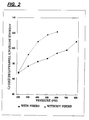
- FIG. 1, FIG. 2 and FIG. 3 illustrates the improved wear resistance of test samples 1, 3 and 5, all having a combination of about 1.9 weight % glass and 1.9 weight % ceramic fibers over test samples 2, 4 and 6 which respectively contain no fibers at all, as evidenced by the lower interface temperatures. While it is recognized that the actual wear in the test samples was not measured by any device, it has been found that the temperature at the test sample and wear plate interface correlates very closely to the amount of wear experienced by the sample. It has also been found that determination of the amount of wear by measuring the final thickness of the sample can be misleading in this type of an accelerated wear test.
- sample 5 the preferred embodiment of the present invention has the highest wear resistance of all the test samples.
- Example B the effect of varying the amount of glass fibers and ceramic fibers incorporated in an NDI based TPU, is shown.
- the NDI based TPU is derived from the same reactants and has the same composition as test sample 6, as shown in the previous example.
- Table V shows the composition of the various test samples 7-13.
- TEST SAMPLES 7-13 REACTANT WEIGHT% Sample 7 NDI-TPU 100.0 Glass Fibers 0.0 Ceramic Fibers 0.0 Sample 8 NDI-TPU 96.0 Glass Fibers 2.0 Ceramic Fibers 2.0 Sample 9 NDI-TPU 94.0 Glass Fibers 3.0 Ceramic Fibers 3.0 Sample 10 NDI-TPU 88.0 Glass Fibers 6.0 Ceramic Fibers 6.0 Sample 11 NDI-TPU 94.0 Glass Fibers 6.0 Ceramic Fibers 0.0 Sample 12 NDI-TPU 94.0 Glass Fibers 0.0 Ceramic Fibers 6.0 Sample 13 NDI-TPU 91.0 Glass Fibers 3.0 Ceramic Fibers 6.0
- sample 7 which is the NDI based TPU without any fibers incorporated in its matrix, has the highest amount of % wear loss.
- sample 8 By incorporating only 2% by weight glass fibers and 2% by weight ceramic fibers into the elastomer matrix (sample 8), the % wear loss decreases dramatically to 22%, resulting in a improved wear resistance of about 35%.
- sample 10 by gradually increasing the amount of glass and ceramic fibers incorporated in the elastomer matrix up to 6% glass and 6% ceramic, (sample 10), the % wear loss actually increases, thereby reducing the wear resistance of the elastomeric matrix.
- the glass and ceramic fiber reinforced elastomeric composition of the present invention is particularly useful in making hydraulic cylinder shaft seals for applications where the high wear resistance of the elastomeric composite can be exploited to achieve improved seal life.
- Such applications include sealing rings for hydraulic rams on earth-moving equipment, seals for all types of high pressure greasing equipment, and most high pressure static or reciprocating seals for pneumatic or hydraulic use.
- This wear resistant elastomeric composition is for making seals for control valves used in the mining industry.
- the seals in these type of valves also serve to seal off high pressure bleed valves. As there is a high velocity flow of hydraulic fluid across the sealing surface, these seals can be easily scoured or abraded.
- the present invention can overcome that problem.
- the glass and ceramic fiber additive package may be incorporated into a polyurethane elastomer for making highly wear resistant as well as resilient soles for footwear.
Landscapes
- Chemical & Material Sciences (AREA)
- Health & Medical Sciences (AREA)
- Chemical Kinetics & Catalysis (AREA)
- Medicinal Chemistry (AREA)
- Polymers & Plastics (AREA)
- Organic Chemistry (AREA)
- Compositions Of Macromolecular Compounds (AREA)
Claims (16)
- Eine abriebbeständige Elastomer-Polymerzusammensetzung, eine Elastomer-Polymermatrix und eine Vielzahl von in der Elastomer-Polymermatrix verteilten Fasern von 1 Gew.% bis nicht mehr als 10 Gew.% der Elastomer-Polymerzusammensetzung; wobei die Elastomer-Polymerzusammensetzung einen Abriebwiderstand von 25 % bis 50 % größer als den Abriebwiderstand der Elastomer-Polymermatrix ohne die Fasern besitzt und eine Bruchdehnung (ultimate elongation) von mindestens 60 % der Bruchdehnung der Elastomer-Polymermatrix ohne die Fasern,
dadurch gekennzeichnet, daß
die Fasern eine Mischung aus Glasfasern und Keramikfasern sind, wobei die Glasfasern eine Länge von 0,5 mm bis 3 mm und einen Durchmesser von 0,01 mm bis 0,3 mm besitzen, und wobei die Keramikfasern eine Länge von 0,05 mm bis 3 mm und einen Durchmesser von 0,01 mm bis 0,3 mm besitzen. - Zusammensetzung nach Anspruch 1, wobei ferner Aramidfasern vorgesehen sind.
- Zusammensetzung nach Anspruch 1 oder 2, wobei ferner Kohlenstoffasern vorgesehen sind.
- Zusammensetzung nach einem der vorhergehenden Ansprüche, wobei die Mischung aus Glasfasern und Keramikfasern in einem Gewichtsverhältnis von 25:75 bis 75:25 der Glasfasern zu Kermikfasern vorhanden ist.
- Zusammensetzung nach Anspruch 4, wobei die Glasfasern und die Keramikfasern in einem Gewichtsverhältnis von ungefähr 50:50 vorgesehen sind.
- Zusammensetzung nach einem der vorhergehenden Ansprüche, wobei die Länge der Glasfasern ungefähr 1,5 mm und der Durchmesser der Glasfasern ungefähr 0,1 mm beträgt.
- Zusammensetzung nach Anspruch 2, wobei die Keramikfasern eine Länge von 0,05 mm bis 0,5 mm haben, ferner einen Durchmesser von 0,01 mm bis 0,05 mm und ein Längen-zu-Durchmesser-Verhältnis von 2 bis 15.
- Zusammensetzung nach Anspruch 7, wobei die Länge der Keramikfasern ungefähr 0,14 mm beträgt und der Durchmesser der Keramikfasern ungefähr 0,025 mm ist.
- Eine abriebbeständige Polyurethanelastomerzusammensetzung, die folgendes aufweist:
ein Polyurethanelastomer abgeleitet von einem gesättigten endständige Hydroxylgruppen aufweisenden polyfunktionellen Polyol, einen polyfunktionellen Kettenverlängerer und ein polyfunktionelles Isocyanat; und eine Vielzahl von Fasern verteilt innerhalb des Polyurethanelastomers, wobei die Fasern eine Länge von 0,5 mm bis 3 mm und einen Durchmesser von 0,01 mm bis 0,3 mm besitzen und von 1 Gew.% bis nicht mehr als 10 Gew.% der Polyurethanelastomerzzuammensetung ausmachen; wobei ferner die Polyurethanelastomerzusammensetzung ein Abriebwiderstand von 25 bis 50 % größer als den Abriebwiderstand der Polyurethanelastomerzusammensetzung ohne die Fasern aufweist und eine Bruchdehnung, die mindestens 60 % der Bruchdehnung der Polyurethanelastomerzusammensetzung ohne die Fasern ist. - Zusammensetzung nach Anspruch 9, wobei die Fasern mindestens eine der folgenden aufweisen: Keramikfasern, Glasfasern, Aramidfasern und Kohlenstoffasern.
- Zusammensetzung nach Anspruch 9, wobei die Fasern eine Mischung aus Glasfasern und Keramikfasern sind.
- Zusammensetzung nach Anspruch 11, wobei die Mischung aus Glasfasern und Keramikfasern in einem Gewichtsverhältnis von 25:75 bis 75:25 der Glasfasern zu Keramikfasern vorhanden ist.
- Zusammensetzung nach Anspruch 12, wobei die Glasfasern und die Keramikfasern in einem Gewichtsverhältnis von 50:50 vorhanden sind.
- Zusammensetzung nach einem der Ansprüche 10 bis 13, wobei die Länge der Glasfasern ungefähr 1,5 mm und der Durchmesser der Glasfasern ungefähr 0,1 mm beträgt.
- Zusammensetzung nach einem der Ansprüche 10 bis 14, wobei die Keramikfasern eine Länge von 0,05 mm bis 0,5 mm besitzen, einen Durchmesser von 0,1 mm bis 0,05 mm und ein Länge-zu-Durchmesserverhältnis von 2 bis 15.
- Zusammensetzung nach Anspruch 15, wobei die Länge der Keramikfasern ungefähr 0,14 mm beträgt und der Durchmesser der Keramikfasern ungefähr 0,025 mm ist.
Applications Claiming Priority (3)
| Application Number | Priority Date | Filing Date | Title |
|---|---|---|---|
| US11240593A | 1993-08-25 | 1993-08-25 | |
| US112405 | 1993-08-25 | ||
| PCT/US1994/008470 WO1995006089A1 (en) | 1993-08-25 | 1994-07-26 | Fiber additives to improve the wear resistance of elastomeric polymer matrices |
Publications (2)
| Publication Number | Publication Date |
|---|---|
| EP0715643A1 EP0715643A1 (de) | 1996-06-12 |
| EP0715643B1 true EP0715643B1 (de) | 1998-01-28 |
Family
ID=22343723
Family Applications (1)
| Application Number | Title | Priority Date | Filing Date |
|---|---|---|---|
| EP94924030A Expired - Lifetime EP0715643B1 (de) | 1993-08-25 | 1994-07-26 | Faseradditive zur verbesserung der abriebfestigkeit von elastomeren polymeren matrizen |
Country Status (5)
| Country | Link |
|---|---|
| EP (1) | EP0715643B1 (de) |
| JP (1) | JP3553945B2 (de) |
| CN (1) | CN1129457A (de) |
| DE (1) | DE69408328T2 (de) |
| WO (1) | WO1995006089A1 (de) |
Families Citing this family (2)
| Publication number | Priority date | Publication date | Assignee | Title |
|---|---|---|---|---|
| CN104262580A (zh) * | 2014-09-04 | 2015-01-07 | 苏州市景荣科技有限公司 | 一种高抗折的pu鞋材及其制造方法 |
| CN106398085A (zh) * | 2016-09-09 | 2017-02-15 | 博硕科技(江西)有限公司 | 耐刮擦无卤阻燃tpe注塑料及其制备方法 |
Citations (1)
| Publication number | Priority date | Publication date | Assignee | Title |
|---|---|---|---|---|
| JPH0559709A (ja) * | 1991-09-02 | 1993-03-09 | Bando Chem Ind Ltd | 除雪車用スノウプラウ |
Family Cites Families (5)
| Publication number | Priority date | Publication date | Assignee | Title |
|---|---|---|---|---|
| DE3310951A1 (de) * | 1983-03-25 | 1984-09-27 | Bayer Ag, 5090 Leverkusen | Mineralfaserverstaerkte formmassen |
| DE3543638A1 (de) * | 1985-12-11 | 1987-06-19 | Bayer Ag | Sportschuh mit einer schalensohle aus nachgiebigem kunststoff |
| US4738999A (en) * | 1986-03-31 | 1988-04-19 | Lord Corporation | Fiber reinforced composites |
| JPH0817278B2 (ja) * | 1988-10-26 | 1996-02-21 | 北川工業株式会社 | 電磁波シールド用ガスケット |
| DE3916137A1 (de) * | 1989-05-18 | 1990-11-22 | Basf Ag | Dichtungselemente und gleitlager aus faserverstaerkten kunststoffen |
-
1994
- 1994-07-26 EP EP94924030A patent/EP0715643B1/de not_active Expired - Lifetime
- 1994-07-26 WO PCT/US1994/008470 patent/WO1995006089A1/en not_active Ceased
- 1994-07-26 CN CN 94193091 patent/CN1129457A/zh active Pending
- 1994-07-26 DE DE69408328T patent/DE69408328T2/de not_active Expired - Fee Related
- 1994-07-26 JP JP50758295A patent/JP3553945B2/ja not_active Expired - Fee Related
Patent Citations (1)
| Publication number | Priority date | Publication date | Assignee | Title |
|---|---|---|---|---|
| JPH0559709A (ja) * | 1991-09-02 | 1993-03-09 | Bando Chem Ind Ltd | 除雪車用スノウプラウ |
Also Published As
| Publication number | Publication date |
|---|---|
| JPH09501968A (ja) | 1997-02-25 |
| EP0715643A1 (de) | 1996-06-12 |
| CN1129457A (zh) | 1996-08-21 |
| DE69408328T2 (de) | 1998-09-03 |
| WO1995006089A1 (en) | 1995-03-02 |
| JP3553945B2 (ja) | 2004-08-11 |
| DE69408328D1 (de) | 1998-03-05 |
Similar Documents
| Publication | Publication Date | Title |
|---|---|---|
| US5599874A (en) | Thermoplastic polyurethane elastomer based on a hydroxyl terminated polyol, an aromatic chain extender and 1,5 naphthalene diisocyanate | |
| US5332798A (en) | Fluorinated polyurethanes and polyurethane-ureas, and methods for preparing them | |
| EP0359272B1 (de) | Elastomerartige Poly(perfluoralkyl(enoxid)-Blöcke und starre Blöcke enthaltende fluorierte Polyurethane | |
| US4331339A (en) | Seal assembly having a plastic annular sealing member with an integral sealing lip | |
| EP0794361A1 (de) | Kunstharzriemenscheibe | |
| EP1959171B1 (de) | Stangenabdichtungssystem | |
| KR20120094504A (ko) | 동력 전달 벨트를 위한 폴리우레아-우레탄 코드 처리 및 벨트 | |
| EP1185470A2 (de) | Flexible, thermoplastische hochtemperaturbeständige verbundwerkstoffe für die antriebsflächen eines förderbandes | |
| US20210237511A1 (en) | Non-pneumatic wheel having a moldable reinforced thermoplastic polyurethane spoke and a process for preparing the same | |
| US6596792B2 (en) | Tribological performance of thermoplastic composites via thermally conductive material and other fillers and a process for making the composite and molded articles of the same | |
| US5304594A (en) | Resin composition for resin-banded bearing | |
| US20020061151A1 (en) | Rolling bearing | |
| EP0240118A2 (de) | Faserverstärkte Verbundwerkstoffe | |
| EP0451983B1 (de) | Treibriemen | |
| US5565514A (en) | Fiber additives for reinforcing plastic matrices | |
| WO1995006089A1 (en) | Fiber additives to improve the wear resistance of elastomeric polymer matrices | |
| CA1236261A (en) | Reinforced polyurethane tires | |
| US5590225A (en) | Plastic holder for bearing | |
| US4131590A (en) | Epoxy-rubber based friction material | |
| JP3079450B2 (ja) | 耐油性ベルト | |
| EP0517883B1 (de) | Hochtemperatur bestandiger riemen aus polyurethan | |
| US4186261A (en) | Elastomeric polyurethane compositions and seals | |
| US4285168A (en) | Fiber lubricated bearings | |
| KR100600138B1 (ko) | 방진 고무용 클로로프렌 고무계 접착제 | |
| US20230113475A1 (en) | Polyurethane belt with improved hydrolysis resistance |
Legal Events
| Date | Code | Title | Description |
|---|---|---|---|
| PUAI | Public reference made under article 153(3) epc to a published international application that has entered the european phase |
Free format text: ORIGINAL CODE: 0009012 |
|
| 17P | Request for examination filed |
Effective date: 19960308 |
|
| AK | Designated contracting states |
Kind code of ref document: A1 Designated state(s): DE FR GB IT |
|
| 17Q | First examination report despatched |
Effective date: 19961007 |
|
| GRAG | Despatch of communication of intention to grant |
Free format text: ORIGINAL CODE: EPIDOS AGRA |
|
| GRAG | Despatch of communication of intention to grant |
Free format text: ORIGINAL CODE: EPIDOS AGRA |
|
| GRAH | Despatch of communication of intention to grant a patent |
Free format text: ORIGINAL CODE: EPIDOS IGRA |
|
| GRAH | Despatch of communication of intention to grant a patent |
Free format text: ORIGINAL CODE: EPIDOS IGRA |
|
| GRAA | (expected) grant |
Free format text: ORIGINAL CODE: 0009210 |
|
| AK | Designated contracting states |
Kind code of ref document: B1 Designated state(s): DE FR GB IT |
|
| REF | Corresponds to: |
Ref document number: 69408328 Country of ref document: DE Date of ref document: 19980305 |
|
| ITF | It: translation for a ep patent filed | ||
| ET | Fr: translation filed | ||
| PLBE | No opposition filed within time limit |
Free format text: ORIGINAL CODE: 0009261 |
|
| STAA | Information on the status of an ep patent application or granted ep patent |
Free format text: STATUS: NO OPPOSITION FILED WITHIN TIME LIMIT |
|
| 26N | No opposition filed | ||
| REG | Reference to a national code |
Ref country code: GB Ref legal event code: IF02 |
|
| PGFP | Annual fee paid to national office [announced via postgrant information from national office to epo] |
Ref country code: GB Payment date: 20040615 Year of fee payment: 11 |
|
| PGFP | Annual fee paid to national office [announced via postgrant information from national office to epo] |
Ref country code: FR Payment date: 20040702 Year of fee payment: 11 |
|
| PGFP | Annual fee paid to national office [announced via postgrant information from national office to epo] |
Ref country code: DE Payment date: 20040730 Year of fee payment: 11 |
|
| PG25 | Lapsed in a contracting state [announced via postgrant information from national office to epo] |
Ref country code: IT Free format text: LAPSE BECAUSE OF NON-PAYMENT OF DUE FEES;WARNING: LAPSES OF ITALIAN PATENTS WITH EFFECTIVE DATE BEFORE 2007 MAY HAVE OCCURRED AT ANY TIME BEFORE 2007. THE CORRECT EFFECTIVE DATE MAY BE DIFFERENT FROM THE ONE RECORDED. Effective date: 20050726 Ref country code: GB Free format text: LAPSE BECAUSE OF NON-PAYMENT OF DUE FEES Effective date: 20050726 |
|
| PG25 | Lapsed in a contracting state [announced via postgrant information from national office to epo] |
Ref country code: DE Free format text: LAPSE BECAUSE OF NON-PAYMENT OF DUE FEES Effective date: 20060201 |
|
| GBPC | Gb: european patent ceased through non-payment of renewal fee |
Effective date: 20050726 |
|
| PG25 | Lapsed in a contracting state [announced via postgrant information from national office to epo] |
Ref country code: FR Free format text: LAPSE BECAUSE OF NON-PAYMENT OF DUE FEES Effective date: 20060331 |
|
| REG | Reference to a national code |
Ref country code: FR Ref legal event code: ST Effective date: 20060331 |