EP0713526B1 - Soap product - Google Patents
Soap product Download PDFInfo
- Publication number
- EP0713526B1 EP0713526B1 EP94922322A EP94922322A EP0713526B1 EP 0713526 B1 EP0713526 B1 EP 0713526B1 EP 94922322 A EP94922322 A EP 94922322A EP 94922322 A EP94922322 A EP 94922322A EP 0713526 B1 EP0713526 B1 EP 0713526B1
- Authority
- EP
- European Patent Office
- Prior art keywords
- soap
- microwaves
- expanded
- piece
- size
- Prior art date
- Legal status (The legal status is an assumption and is not a legal conclusion. Google has not performed a legal analysis and makes no representation as to the accuracy of the status listed.)
- Expired - Lifetime
Links
- 229940095696 soap product Drugs 0.000 title claims abstract description 6
- 239000000344 soap Substances 0.000 claims abstract description 107
- 238000000034 method Methods 0.000 claims abstract description 17
- XLYOFNOQVPJJNP-UHFFFAOYSA-N water Substances O XLYOFNOQVPJJNP-UHFFFAOYSA-N 0.000 claims abstract description 12
- 239000007921 spray Substances 0.000 claims abstract description 3
- 239000000463 material Substances 0.000 claims 1
- 239000007787 solid Substances 0.000 claims 1
- 239000007858 starting material Substances 0.000 claims 1
- 238000004519 manufacturing process Methods 0.000 abstract description 8
- 238000005406 washing Methods 0.000 abstract description 4
- 238000009877 rendering Methods 0.000 abstract 1
- 239000002585 base Substances 0.000 description 20
- 239000000654 additive Substances 0.000 description 6
- 235000014113 dietary fatty acids Nutrition 0.000 description 6
- 239000000194 fatty acid Substances 0.000 description 6
- 229930195729 fatty acid Natural products 0.000 description 6
- 150000004665 fatty acids Chemical class 0.000 description 6
- 239000000203 mixture Substances 0.000 description 5
- 239000003513 alkali Substances 0.000 description 4
- 239000004094 surface-active agent Substances 0.000 description 4
- PEDCQBHIVMGVHV-UHFFFAOYSA-N Glycerine Chemical compound OCC(O)CO PEDCQBHIVMGVHV-UHFFFAOYSA-N 0.000 description 3
- 239000003599 detergent Substances 0.000 description 3
- 238000000465 moulding Methods 0.000 description 3
- LFQSCWFLJHTTHZ-UHFFFAOYSA-N Ethanol Chemical compound CCO LFQSCWFLJHTTHZ-UHFFFAOYSA-N 0.000 description 2
- DGAQECJNVWCQMB-PUAWFVPOSA-M Ilexoside XXIX Chemical compound C[C@@H]1CC[C@@]2(CC[C@@]3(C(=CC[C@H]4[C@]3(CC[C@@H]5[C@@]4(CC[C@@H](C5(C)C)OS(=O)(=O)[O-])C)C)[C@@H]2[C@]1(C)O)C)C(=O)O[C@H]6[C@@H]([C@H]([C@@H]([C@H](O6)CO)O)O)O.[Na+] DGAQECJNVWCQMB-PUAWFVPOSA-M 0.000 description 2
- 238000005273 aeration Methods 0.000 description 2
- 230000015572 biosynthetic process Effects 0.000 description 2
- 238000004140 cleaning Methods 0.000 description 2
- 238000001816 cooling Methods 0.000 description 2
- 239000003925 fat Substances 0.000 description 2
- 238000002156 mixing Methods 0.000 description 2
- 238000006386 neutralization reaction Methods 0.000 description 2
- 239000003755 preservative agent Substances 0.000 description 2
- 238000007127 saponification reaction Methods 0.000 description 2
- 229910052708 sodium Inorganic materials 0.000 description 2
- 239000011734 sodium Substances 0.000 description 2
- 239000000271 synthetic detergent Substances 0.000 description 2
- QGZKDVFQNNGYKY-UHFFFAOYSA-O Ammonium Chemical compound [NH4+] QGZKDVFQNNGYKY-UHFFFAOYSA-O 0.000 description 1
- 206010011409 Cross infection Diseases 0.000 description 1
- 206010029803 Nosocomial infection Diseases 0.000 description 1
- ZLMJMSJWJFRBEC-UHFFFAOYSA-N Potassium Chemical compound [K] ZLMJMSJWJFRBEC-UHFFFAOYSA-N 0.000 description 1
- KWYUFKZDYYNOTN-UHFFFAOYSA-M Potassium hydroxide Chemical class [OH-].[K+] KWYUFKZDYYNOTN-UHFFFAOYSA-M 0.000 description 1
- 229910052783 alkali metal Inorganic materials 0.000 description 1
- 150000001340 alkali metals Chemical class 0.000 description 1
- 229910052784 alkaline earth metal Inorganic materials 0.000 description 1
- 150000001342 alkaline earth metals Chemical class 0.000 description 1
- 150000001412 amines Chemical class 0.000 description 1
- 150000001768 cations Chemical class 0.000 description 1
- 239000003795 chemical substances by application Substances 0.000 description 1
- 239000003086 colorant Substances 0.000 description 1
- 238000005336 cracking Methods 0.000 description 1
- 230000003247 decreasing effect Effects 0.000 description 1
- 230000001419 dependent effect Effects 0.000 description 1
- 230000006866 deterioration Effects 0.000 description 1
- 238000001035 drying Methods 0.000 description 1
- 239000003792 electrolyte Substances 0.000 description 1
- 238000001125 extrusion Methods 0.000 description 1
- 230000002070 germicidal effect Effects 0.000 description 1
- 239000003921 oil Substances 0.000 description 1
- 239000002245 particle Substances 0.000 description 1
- 239000002304 perfume Substances 0.000 description 1
- 229910052700 potassium Inorganic materials 0.000 description 1
- 239000011591 potassium Substances 0.000 description 1
- 235000011118 potassium hydroxide Nutrition 0.000 description 1
- 239000000843 powder Substances 0.000 description 1
- 239000000376 reactant Substances 0.000 description 1
- 239000002002 slurry Substances 0.000 description 1
- 235000011121 sodium hydroxide Nutrition 0.000 description 1
- 239000000126 substance Substances 0.000 description 1
- 239000003760 tallow Substances 0.000 description 1
- 150000003626 triacylglycerols Chemical class 0.000 description 1
- UFTFJSFQGQCHQW-UHFFFAOYSA-N triformin Chemical compound O=COCC(OC=O)COC=O UFTFJSFQGQCHQW-UHFFFAOYSA-N 0.000 description 1
Images


Classifications
-
- C—CHEMISTRY; METALLURGY
- C11—ANIMAL OR VEGETABLE OILS, FATS, FATTY SUBSTANCES OR WAXES; FATTY ACIDS THEREFROM; DETERGENTS; CANDLES
- C11D—DETERGENT COMPOSITIONS; USE OF SINGLE SUBSTANCES AS DETERGENTS; SOAP OR SOAP-MAKING; RESIN SOAPS; RECOVERY OF GLYCEROL
- C11D17/00—Detergent materials or soaps characterised by their shape or physical properties
- C11D17/0047—Detergents in the form of bars or tablets
- C11D17/006—Detergents in the form of bars or tablets containing mainly surfactants, but no builders, e.g. syndet bar
-
- C—CHEMISTRY; METALLURGY
- C11—ANIMAL OR VEGETABLE OILS, FATS, FATTY SUBSTANCES OR WAXES; FATTY ACIDS THEREFROM; DETERGENTS; CANDLES
- C11D—DETERGENT COMPOSITIONS; USE OF SINGLE SUBSTANCES AS DETERGENTS; SOAP OR SOAP-MAKING; RESIN SOAPS; RECOVERY OF GLYCEROL
- C11D13/00—Making of soap or soap solutions in general; Apparatus therefor
- C11D13/14—Shaping
-
- C—CHEMISTRY; METALLURGY
- C11—ANIMAL OR VEGETABLE OILS, FATS, FATTY SUBSTANCES OR WAXES; FATTY ACIDS THEREFROM; DETERGENTS; CANDLES
- C11D—DETERGENT COMPOSITIONS; USE OF SINGLE SUBSTANCES AS DETERGENTS; SOAP OR SOAP-MAKING; RESIN SOAPS; RECOVERY OF GLYCEROL
- C11D13/00—Making of soap or soap solutions in general; Apparatus therefor
- C11D13/14—Shaping
- C11D13/16—Shaping in moulds
Definitions
- This invention relates to the implementation of an expansion, or aeration, process in the manufacture of both body and detergent soap.
- Conventional modern soap tablets are generally made by firstly manufacturing a soap base which is dried to the required moisture level, and then mixing with pieces of the soap base the desired additives and triglycerides according to the properties of the product to be made, i.e. perfumes, colorants, moisturisers, super-fatting agents, preservatives, oils, germicides and detergents, tallow etc. After the mixing operation in which the additives are coarsely distributed over the pieces of soap base, the mixture of the soap base and the additives is rendered homogenous. Finally the homogeneous soap is either moulded or extruded to form a bar which is cut into billets from which soap tablets of the desired shape are stamped.
- the desired additives and triglycerides according to the properties of the product to be made, i.e. perfumes, colorants, moisturisers, super-fatting agents, preservatives, oils, germicides and detergents, tallow etc.
- the soap base used may be made by any conventional soap-making process, for example by saponification of fats or by direct neutralisation of fatty acids by sodium or potassium hydroxides.
- the soap base is a sodium or potassium soap, or a mixture thereof, but if desired other alkali metal, alkaline earth metal, ammonium or amine soaps may be used as well as soap of the triglyceride family.
- the soap base comprises an amount of water that, after drying, will not generally exceed 20% by weight.
- the soap base contains no additives but, if desired, additives necessary for the production of soap pieces, for example, preservatives, may be incorporated into the soap base before its formation into bars.
- Soap tablets may be opaque, translucent or transparent, depending upon their method of manufacture.
- a transparent soap may be made, for example, by cooling a suitable soap base solution, such as a fatty acid/alkali soap base dissolved in alcohol or a fatty acid/alkali reactant mixture to which has been added alcohol, sugar solution and glycerol.
- Translucent soaps may be made, for example, by mechanically working a soap base at controlled temperatures.
- Soap tablets may also be made using alternative surfactants, such as synthetic detergents (so-called “soapless soaps”), such alternative surfactants being used in addition to or in replacement of a conventional fatty acid/alkali soap base.
- alternative surfactants such as synthetic detergents (so-called "soapless soaps"), such alternative surfactants being used in addition to or in replacement of a conventional fatty acid/alkali soap base.
- Soap tablets may be formulated for personal washing or alternatively for other cleaning or detergent purposes.
- Aerated or floating soaps are described in, for example, UK 539718, US 2048286 and UK 2118058A where air is introduced during vigorous mechanical working of a soap product which is subsequently shaped.
- GB-A-2 203 752 discloses formation of a floating soap by moulding a soap particle water mixture where the soap has been subjected to microwave irradiation.
- an expanded soap product characterised by applying microwaves to soap in the form of a soap piece to cause said soap piece to expand forming an expanded honeycombed soap piece.
- a soap piece may be made generally as described above.
- the soap may thus comprise a soap base in the form of any suitable surfactant or combination of surfactants including conventional fatty acid/alkali soap bases obtainable by the saponification of fats or by neutralisation of fatty acids and synthetic detergent soap bases.
- the soap base may be combined with desired additives according to the intended use to form a homogenous soap, which may be optionally shaped by, for example, extrusion, moulding or stamping.
- aerated soap tablets may be produced where each tablet lasts one wash.
- Figure 1 shows a cross-sectional view through a soap piece after a small burst of microwaves have been applied.
- Figure 2 shows in perspective a piece of soap having the cross-sectional shape shown in Figure 1.
- Figure 3a shows a soap piece prior to application of the method of the invention.
- Figure 3b shows the same soap as in Figure 3a, after an application of microwaves.
- Figure 4a shows a cross-sectional view of a sponge implanted with soap pieces.
- Figure 4b shows the same cross-sectional view of a sponge as Figure 4a after an application of microwaves.
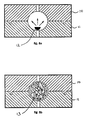
- Figure 5a shows a cross-sectional view of a two-part soap mould containing a soap piece.
- Figure 5b shows the same cross-sectional view of a mould as Figure 5a after an application of microwaves.
- FIG. 1 the cross-sectional shape of an aerated honeycombed soap 1, shows an expanded, aerated, honeycombed internal structure 2 made up of flakes of soap chained together.
- the soap's internal structure 2 is surrounded by a skin 3 of the same substance and of a varying thickness for example between 0.5mm to 0.005mm.
- This expanded, aerated or honeycombed soap may be arranged to allow each tablet to serve one hand/face wash or one body wash in which case the dosage is dependent upon the size of the soap tablet.
- the starting soap piece of Figure 3a may have a minimum dimension of 2.5 mm and a maximum dimension of 50 mm, to which microwaves may be applied for a period of 20-40 seconds (2450 MHz, intermittently applied) at a power of 500W.
- the soap tablet before treatment of microwaves, may have between 5-20% water content or higher, heat is produced by normal microwave action on the moisture within the soap when microwaves penetrate it.
- the power or frequency of microwaves applied can be increased e.g. by increasing the intensity or burst frequency, allowing the exposure time to be decreased and vice versa.
- the soap is caused to inflate and with this, form a honeycomb/aerate structure.
- the size expansion ratio can be further increased if desired, by the application of water (in the form of a fine spray) which rests on the surface of the expanded soap tablet.
- water in the form of a fine spray
- the surrounding soap skin repeats the affects explained earlier.
- Such a soap base may have the composition - aside from any non-soap particulate, lying within the ranges: total fatty matter 70-80% by weight accompanying cations 6-9% by weight electrolyte 0.1-1.0% by weight
- the soap base has a yield stress at 40 degrees centigrade of at least 1.8 x 10 -5 Nm -2 .
- the final soap tablet with its resultant honeycombed state dissolves in contact with water (at a faster rate than conventional soap, since much of the water from its original state has now evaporated) into a uniform froth with excellent lathering qualities as the chains of soap flakes start to break up.
- the common occurrence of cracked soap where undue cracking and deterioration of soap bars during handling is caused by age and temperature variation within a domestic situation can now be avoided.
- a single use size expanded tablet presents major hygiene benefits, since the soap tablet is never shared, with possible cross-infection avoided. Therefore the expanded soap presents itself as a new way of washing with significant improvements for the environment when adopted in areas such as hotel/guest soap, where only what is needed is used - rather than what is not used being disposed of.
- FIG 4a the cross-sectional shape of a sponge product 5 shows sponge 6, which may be a man-made sponge, impregnated with soap pieces 7.
- Figure 4b shows the same cross-sectional shaped sponge 6 impregnated with soap pieces after the application of microwaves for a period of 20 - 40 seconds at a power of 500W (2450 MHz, intermittently applied).
- the now aerated soap tablets 8 have increased in size by a ratio of roughly 1:7 and have therefore spread across the sponge area to form a semi-rigid sponge block 9.
- the block 9 is then cooled with the assistance of cold air.
- the final sponge block 9 with its resultant honeycombed soap tablets starts to dissolve in contact with water to form a uniform lathering froth as the chains of soap flakes gradually start to break down. What is left after all of the soap has dissolved is only the sponge 6. This enables washing of the body with only one piece of equipment, i.e. the soap sponge 9. This has advantages in situations of small living space or where hygiene is of paramount importance.
- FIG 5a a cross-section of a two-part mould 10,11 is shown. Inside is placed a soap piece 12 of, for example, 10-20% of the size of the mould.
- Figure 5b shows the same mould as illustrated in Figure 5a, but after the application of microwaves for a period of 20-40 seconds at a power of 500W (2450 MHz, intermittently applied). As shown, the now aerated soap piece 13 has increased in size by aeration to fill the mould. A cooling step then follows after which the soap tablet is released.
- This moulding process has advantages where exact dosage of soap are required i.e. for personal and medical care, and other household or industrial cleaning purposes, allowing a measured dose to be repeated precisely.
Landscapes
- Chemical & Material Sciences (AREA)
- Life Sciences & Earth Sciences (AREA)
- Engineering & Computer Science (AREA)
- Chemical Kinetics & Catalysis (AREA)
- Oil, Petroleum & Natural Gas (AREA)
- Wood Science & Technology (AREA)
- Organic Chemistry (AREA)
- Detergent Compositions (AREA)
Abstract
Description
- This invention relates to the implementation of an expansion, or aeration, process in the manufacture of both body and detergent soap.
- Conventional modern soap tablets are generally made by firstly manufacturing a soap base which is dried to the required moisture level, and then mixing with pieces of the soap base the desired additives and triglycerides according to the properties of the product to be made, i.e. perfumes, colorants, moisturisers, super-fatting agents, preservatives, oils, germicides and detergents, tallow etc. After the mixing operation in which the additives are coarsely distributed over the pieces of soap base, the mixture of the soap base and the additives is rendered homogenous. Finally the homogeneous soap is either moulded or extruded to form a bar which is cut into billets from which soap tablets of the desired shape are stamped.
- The soap base used may be made by any conventional soap-making process, for example by saponification of fats or by direct neutralisation of fatty acids by sodium or potassium hydroxides. Usually the soap base is a sodium or potassium soap, or a mixture thereof, but if desired other alkali metal, alkaline earth metal, ammonium or amine soaps may be used as well as soap of the triglyceride family. Normally the soap base comprises an amount of water that, after drying, will not generally exceed 20% by weight. Usually the soap base contains no additives but, if desired, additives necessary for the production of soap pieces, for example, preservatives, may be incorporated into the soap base before its formation into bars.
- Soap tablets may be opaque, translucent or transparent, depending upon their method of manufacture. A transparent soap may be made, for example, by cooling a suitable soap base solution, such as a fatty acid/alkali soap base dissolved in alcohol or a fatty acid/alkali reactant mixture to which has been added alcohol, sugar solution and glycerol. Translucent soaps may be made, for example, by mechanically working a soap base at controlled temperatures.
- Soap tablets may also be made using alternative surfactants, such as synthetic detergents (so-called "soapless soaps"), such alternative surfactants being used in addition to or in replacement of a conventional fatty acid/alkali soap base.
- Soap tablets may be formulated for personal washing or alternatively for other cleaning or detergent purposes.
- Aerated or floating soaps are described in, for example, UK 539718, US 2048286 and UK 2118058A where air is introduced during vigorous mechanical working of a soap product which is subsequently shaped.
- Microwave irradiation has been proposed for treatment of soap products. BE-A-1 004 876 and US-A-4 118 333 disclose the production of soap powders by application of microwaves to expand a soap and water slurry.
- GB-A-2 203 752 discloses formation of a floating soap by moulding a soap particle water mixture where the soap has been subjected to microwave irradiation.
- According to the present invention there is provided a process for producing an expanded soap product characterised by applying microwaves to soap in the form of a soap piece to cause said soap piece to expand forming an expanded honeycombed soap piece.
- According to the present invention a soap piece may be made generally as described above. The soap may thus comprise a soap base in the form of any suitable surfactant or combination of surfactants including conventional fatty acid/alkali soap bases obtainable by the saponification of fats or by neutralisation of fatty acids and synthetic detergent soap bases. The soap base may be combined with desired additives according to the intended use to form a homogenous soap, which may be optionally shaped by, for example, extrusion, moulding or stamping.
- The process of this invention is then applied to permit the manufacture of expanded or aerated soap. In particular aerated soap tablets may be produced where each tablet lasts one wash.
- The invention will be more clearly understood from the following description by way of example only with reference to the accompanying diagrammatic drawings in which:
- Figure 1 shows a cross-sectional view through a soap piece after a small burst of microwaves have been applied.
- Figure 2 shows in perspective a piece of soap having the cross-sectional shape shown in Figure 1.
- Figure 3a shows a soap piece prior to application of the method of the invention.
- Figure 3b shows the same soap as in Figure 3a, after an application of microwaves.
- Figure 4a shows a cross-sectional view of a sponge implanted with soap pieces.
- Figure 4b shows the same cross-sectional view of a sponge as Figure 4a after an application of microwaves.
- Figure 5a shows a cross-sectional view of a two-part soap mould containing a soap piece.
- Figure 5b shows the same cross-sectional view of a mould as Figure 5a after an application of microwaves.
- In Figure 1, the cross-sectional shape of an aerated honeycombed soap 1, shows an expanded, aerated, honeycombed
internal structure 2 made up of flakes of soap chained together. The soap'sinternal structure 2 is surrounded by a skin 3 of the same substance and of a varying thickness for example between 0.5mm to 0.005mm. This expanded, aerated or honeycombed soap may be arranged to allow each tablet to serve one hand/face wash or one body wash in which case the dosage is dependent upon the size of the soap tablet. - The manufacture of such a soap relies upon a further step added to the known soap-making processes. This step involves applying microwaves, preferably by way of small but frequent bursts of microwaves, to soap pieces. Figure 3a shows a
soap piece 4. Figure 3b shows the same piece after applying microwaves. The result is a soap tablet 1 that has increased in size by a ratio of 1:7 or more and has a cross section as illustrated in Figure 1. For a single hand or body wash expanded soap piece as illustrated in Figure 3b with a minimum dimension of 4 mm and a maximum dimension of 150 mm the starting soap piece of Figure 3a may have a minimum dimension of 2.5 mm and a maximum dimension of 50 mm, to which microwaves may be applied for a period of 20-40 seconds (2450 MHz, intermittently applied) at a power of 500W. - It is believed that, since the soap tablet, before treatment of microwaves, may have between 5-20% water content or higher, heat is produced by normal microwave action on the moisture within the soap when microwaves penetrate it. The power or frequency of microwaves applied can be increased e.g. by increasing the intensity or burst frequency, allowing the exposure time to be decreased and vice versa. As a result, the soap is caused to inflate and with this, form a honeycomb/aerate structure.
- The size expansion ratio can be further increased if desired, by the application of water (in the form of a fine spray) which rests on the surface of the expanded soap tablet. When the wetted expanded soap tablet is exposed to a further burst of microwaves, the surrounding soap skin repeats the affects explained earlier.
- Soft soap bases, show good expansion according to this invention. Such a soap base may have the composition - aside from any non-soap particulate, lying within the ranges:
total fatty matter 70-80% by weight accompanying cations 6-9% by weight electrolyte 0.1-1.0% by weight - It is preferred that the soap base has a yield stress at 40 degrees centigrade of at least 1.8 x 10⁻⁵Nm-2.
- The final soap tablet with its resultant honeycombed state dissolves in contact with water (at a faster rate than conventional soap, since much of the water from its original state has now evaporated) into a uniform froth with excellent lathering qualities as the chains of soap flakes start to break up. The common occurrence of cracked soap where undue cracking and deterioration of soap bars during handling is caused by age and temperature variation within a domestic situation can now be avoided. A single use size expanded tablet presents major hygiene benefits, since the soap tablet is never shared, with possible cross-infection avoided. Therefore the expanded soap presents itself as a new way of washing with significant improvements for the environment when adopted in areas such as hotel/guest soap, where only what is needed is used - rather than what is not used being disposed of.
- In Figure 4a, the cross-sectional shape of a sponge product 5 shows
sponge 6, which may be a man-made sponge, impregnated with soap pieces 7. Figure 4b shows the same cross-sectionalshaped sponge 6 impregnated with soap pieces after the application of microwaves for a period of 20 - 40 seconds at a power of 500W (2450 MHz, intermittently applied). As can be seen, the nowaerated soap tablets 8 have increased in size by a ratio of roughly 1:7 and have therefore spread across the sponge area to form a semi-rigid sponge block 9. The block 9 is then cooled with the assistance of cold air. - The final sponge block 9 with its resultant honeycombed soap tablets starts to dissolve in contact with water to form a uniform lathering froth as the chains of soap flakes gradually start to break down. What is left after all of the soap has dissolved is only the
sponge 6. This enables washing of the body with only one piece of equipment, i.e. the soap sponge 9. This has advantages in situations of small living space or where hygiene is of paramount importance. - In Figure 5a a cross-section of a two-
part mould soap piece 12 of, for example, 10-20% of the size of the mould. Figure 5b shows the same mould as illustrated in Figure 5a, but after the application of microwaves for a period of 20-40 seconds at a power of 500W (2450 MHz, intermittently applied). As shown, the nowaerated soap piece 13 has increased in size by aeration to fill the mould. A cooling step then follows after which the soap tablet is released. This moulding process has advantages where exact dosage of soap are required i.e. for personal and medical care, and other household or industrial cleaning purposes, allowing a measured dose to be repeated precisely.
Claims (9)
- A process for producing an expanded soap product characterised by applying microwaves to soap in the form of a soap piece to cause said solid soap piece to expand forming an expanded honeycombed soap piece.
- A process according to claim 1 further comprising:-applying water in the form of a fine spray to the expanded soap;further expanding the soap by a further application of microwaves.
- A process according to claim 1 or claim 2 wherein said soap is expanded to a volume at least 7 times that of the starting material.
- A process according to any one of claims 1 to 3 wherein said expanded soap has a density less than that of water.
- A process according to any one of claims 1 to 4, wherein said soap piece is located in a mould cavity.
- A process according to any one of claims 1 to 4, wherein soap tablets of varying or uniform size, are impregnated into a sponge before the application of microwaves.
- An expanded honeycombed soap product produced by a process according to any preceding claim.
- A product according to claim 7 comprising sufficient material for a single wash.
- A product according to claim 7 or claim 8, having a cross-sectional dimension from 4mm to 150mm.
Applications Claiming Priority (3)
| Application Number | Priority Date | Filing Date | Title |
|---|---|---|---|
| GB939316900A GB9316900D0 (en) | 1993-08-13 | 1993-08-13 | Soap product |
| GB9316900 | 1993-08-13 | ||
| PCT/GB1994/001745 WO1995005450A1 (en) | 1993-08-13 | 1994-08-10 | Soap product |
Publications (2)
| Publication Number | Publication Date |
|---|---|
| EP0713526A1 EP0713526A1 (en) | 1996-05-29 |
| EP0713526B1 true EP0713526B1 (en) | 1997-07-09 |
Family
ID=10740475
Family Applications (1)
| Application Number | Title | Priority Date | Filing Date |
|---|---|---|---|
| EP94922322A Expired - Lifetime EP0713526B1 (en) | 1993-08-13 | 1994-08-10 | Soap product |
Country Status (7)
| Country | Link |
|---|---|
| EP (1) | EP0713526B1 (en) |
| JP (1) | JPH09501464A (en) |
| AU (1) | AU7348294A (en) |
| DE (1) | DE69404152T2 (en) |
| GB (1) | GB9316900D0 (en) |
| IL (1) | IL110636A (en) |
| WO (1) | WO1995005450A1 (en) |
Cited By (1)
| Publication number | Priority date | Publication date | Assignee | Title |
|---|---|---|---|---|
| US7612031B2 (en) | 2005-12-15 | 2009-11-03 | Kimberly-Clark Worldwide, Inc. | Health-and-hygiene appliance comprising a dispersible component and a releasable component disposed adjacent or proximate to said dispersible component; and processes for making said appliance |
Families Citing this family (1)
| Publication number | Priority date | Publication date | Assignee | Title |
|---|---|---|---|---|
| DE10241597B4 (en) * | 2002-09-07 | 2004-09-16 | Scs Skin Care Systems Gmbh | Soap preparation with bubbles |
Family Cites Families (5)
| Publication number | Priority date | Publication date | Assignee | Title |
|---|---|---|---|---|
| US4118333A (en) * | 1975-10-20 | 1978-10-03 | Colgate-Palmolive Company | Manufacture of particulate detergents |
| US4885108A (en) * | 1986-08-12 | 1989-12-05 | Colgate-Palmolive Company | Method of shaping of soap bar |
| GB8709354D0 (en) * | 1987-04-21 | 1987-05-28 | Fox S | Floating soap |
| JPH02132198A (en) * | 1988-10-17 | 1990-05-21 | Kimie Miyazaki | Preparation of patterned solid soap |
| BE1004876A5 (en) * | 1991-05-27 | 1993-02-16 | Serstevens Albert T | Improvement in the production of washing powders with microwaves |
-
1993
- 1993-08-13 GB GB939316900A patent/GB9316900D0/en active Pending
-
1994
- 1994-08-10 DE DE69404152T patent/DE69404152T2/en not_active Expired - Fee Related
- 1994-08-10 EP EP94922322A patent/EP0713526B1/en not_active Expired - Lifetime
- 1994-08-10 WO PCT/GB1994/001745 patent/WO1995005450A1/en not_active Ceased
- 1994-08-10 AU AU73482/94A patent/AU7348294A/en not_active Abandoned
- 1994-08-10 JP JP7506803A patent/JPH09501464A/en active Pending
- 1994-08-11 IL IL11063694A patent/IL110636A/en not_active IP Right Cessation
Cited By (1)
| Publication number | Priority date | Publication date | Assignee | Title |
|---|---|---|---|---|
| US7612031B2 (en) | 2005-12-15 | 2009-11-03 | Kimberly-Clark Worldwide, Inc. | Health-and-hygiene appliance comprising a dispersible component and a releasable component disposed adjacent or proximate to said dispersible component; and processes for making said appliance |
Also Published As
| Publication number | Publication date |
|---|---|
| GB9316900D0 (en) | 1993-09-29 |
| AU7348294A (en) | 1995-03-14 |
| DE69404152T2 (en) | 1998-01-08 |
| EP0713526A1 (en) | 1996-05-29 |
| IL110636A (en) | 1999-04-11 |
| JPH09501464A (en) | 1997-02-10 |
| IL110636A0 (en) | 1994-11-11 |
| DE69404152D1 (en) | 1997-08-14 |
| WO1995005450A1 (en) | 1995-02-23 |
Similar Documents
| Publication | Publication Date | Title |
|---|---|---|
| EP0848056B1 (en) | Framed soap composition | |
| DE60309477T2 (en) | EXTRUDED CLEANING PRODUCT | |
| US3835058A (en) | Process of preparing bar soap compositions and products thereof | |
| US5895780A (en) | Floating soap | |
| CN1157632A (en) | Clear Personal Washing Soap Bar | |
| US5631215A (en) | Process for making high moisture content soap bars | |
| CN1292026A (en) | Fragrant beads in detergent foams | |
| WO1995005450A1 (en) | Soap product | |
| RU2193051C2 (en) | Soap composition | |
| EP0537964B1 (en) | Toilet soap bars | |
| EP0699234B1 (en) | Improvememts relating to soap bars | |
| KR20060126540A (en) | Fatty soap / fatty acid bar with good processability and foaming | |
| EP0877791B1 (en) | Process for the preparation of moulded bodies consisting of a washing or cleaning agent | |
| EP1618175B1 (en) | Improved detergent bar and process for manufacture | |
| KR100444900B1 (en) | Soap and a method for preparation thereof | |
| US2704279A (en) | Toilet soap and process of preparing same | |
| US2195399A (en) | Method of forming floating milled soap | |
| KR101162393B1 (en) | Massaging bar soap | |
| CZ290295A3 (en) | Cube-like soap and process for producing thereof | |
| WO1995003391A1 (en) | Process for making transparent soaps | |
| EA016833B1 (en) | Novel detergent bars | |
| KR100684366B1 (en) | Functional soap composition with s Korea | |
| EP1737941B1 (en) | A process for preparing multiphase toilet soap | |
| GB2439311A (en) | Soap | |
| CN120435277A (en) | Non-powdered solid composition comprising at least 8% by weight of a disintegrant |
Legal Events
| Date | Code | Title | Description |
|---|---|---|---|
| PUAI | Public reference made under article 153(3) epc to a published international application that has entered the european phase |
Free format text: ORIGINAL CODE: 0009012 |
|
| 17P | Request for examination filed |
Effective date: 19960311 |
|
| AK | Designated contracting states |
Kind code of ref document: A1 Designated state(s): DE FR GB |
|
| GRAG | Despatch of communication of intention to grant |
Free format text: ORIGINAL CODE: EPIDOS AGRA |
|
| 17Q | First examination report despatched |
Effective date: 19960617 |
|
| GRAH | Despatch of communication of intention to grant a patent |
Free format text: ORIGINAL CODE: EPIDOS IGRA |
|
| GRAH | Despatch of communication of intention to grant a patent |
Free format text: ORIGINAL CODE: EPIDOS IGRA |
|
| GRAA | (expected) grant |
Free format text: ORIGINAL CODE: 0009210 |
|
| AK | Designated contracting states |
Kind code of ref document: B1 Designated state(s): DE FR GB |
|
| PG25 | Lapsed in a contracting state [announced via postgrant information from national office to epo] |
Ref country code: FR Free format text: THE PATENT HAS BEEN ANNULLED BY A DECISION OF A NATIONAL AUTHORITY Effective date: 19970709 |
|
| REF | Corresponds to: |
Ref document number: 69404152 Country of ref document: DE Date of ref document: 19970814 |
|
| ET | Fr: translation filed | ||
| PG25 | Lapsed in a contracting state [announced via postgrant information from national office to epo] |
Ref country code: DE Free format text: LAPSE BECAUSE OF NON-PAYMENT OF DUE FEES Effective date: 19980501 |
|
| PLBE | No opposition filed within time limit |
Free format text: ORIGINAL CODE: 0009261 |
|
| STAA | Information on the status of an ep patent application or granted ep patent |
Free format text: STATUS: NO OPPOSITION FILED WITHIN TIME LIMIT |
|
| 26N | No opposition filed | ||
| PG25 | Lapsed in a contracting state [announced via postgrant information from national office to epo] |
Ref country code: GB Free format text: LAPSE BECAUSE OF NON-PAYMENT OF DUE FEES Effective date: 19980810 |
|
| REG | Reference to a national code |
Ref country code: FR Ref legal event code: ST |
|
| GBPC | Gb: european patent ceased through non-payment of renewal fee |
Effective date: 19980810 |