EP0711644B1 - A method for producing a tyre forming bladder - Google Patents
A method for producing a tyre forming bladder Download PDFInfo
- Publication number
- EP0711644B1 EP0711644B1 EP95307952A EP95307952A EP0711644B1 EP 0711644 B1 EP0711644 B1 EP 0711644B1 EP 95307952 A EP95307952 A EP 95307952A EP 95307952 A EP95307952 A EP 95307952A EP 0711644 B1 EP0711644 B1 EP 0711644B1
- Authority
- EP
- European Patent Office
- Prior art keywords
- bladder
- vulcanised
- separating agent
- vulcanising
- heating
- Prior art date
- Legal status (The legal status is an assumption and is not a legal conclusion. Google has not performed a legal analysis and makes no representation as to the accuracy of the status listed.)
- Expired - Lifetime
Links
Images
Classifications
-
- B—PERFORMING OPERATIONS; TRANSPORTING
- B29—WORKING OF PLASTICS; WORKING OF SUBSTANCES IN A PLASTIC STATE IN GENERAL
- B29D—PRODUCING PARTICULAR ARTICLES FROM PLASTICS OR FROM SUBSTANCES IN A PLASTIC STATE
- B29D30/00—Producing pneumatic or solid tyres or parts thereof
- B29D30/06—Pneumatic tyres or parts thereof (e.g. produced by casting, moulding, compression moulding, injection moulding, centrifugal casting)
- B29D30/0601—Vulcanising tyres; Vulcanising presses for tyres
- B29D30/0654—Flexible cores therefor, e.g. bladders, bags, membranes, diaphragms
-
- B—PERFORMING OPERATIONS; TRANSPORTING
- B29—WORKING OF PLASTICS; WORKING OF SUBSTANCES IN A PLASTIC STATE IN GENERAL
- B29C—SHAPING OR JOINING OF PLASTICS; SHAPING OF MATERIAL IN A PLASTIC STATE, NOT OTHERWISE PROVIDED FOR; AFTER-TREATMENT OF THE SHAPED PRODUCTS, e.g. REPAIRING
- B29C33/00—Moulds or cores; Details thereof or accessories therefor
- B29C33/56—Coatings, e.g. enameled or galvanised; Releasing, lubricating or separating agents
- B29C33/68—Release sheets
-
- B—PERFORMING OPERATIONS; TRANSPORTING
- B29—WORKING OF PLASTICS; WORKING OF SUBSTANCES IN A PLASTIC STATE IN GENERAL
- B29C—SHAPING OR JOINING OF PLASTICS; SHAPING OF MATERIAL IN A PLASTIC STATE, NOT OTHERWISE PROVIDED FOR; AFTER-TREATMENT OF THE SHAPED PRODUCTS, e.g. REPAIRING
- B29C35/00—Heating, cooling or curing, e.g. crosslinking or vulcanising; Apparatus therefor
- B29C35/02—Heating or curing, e.g. crosslinking or vulcanizing during moulding, e.g. in a mould
- B29C35/0222—Heating or curing, e.g. crosslinking or vulcanizing during moulding, e.g. in a mould the curing continuing after removal from the mould
-
- B—PERFORMING OPERATIONS; TRANSPORTING
- B29—WORKING OF PLASTICS; WORKING OF SUBSTANCES IN A PLASTIC STATE IN GENERAL
- B29C—SHAPING OR JOINING OF PLASTICS; SHAPING OF MATERIAL IN A PLASTIC STATE, NOT OTHERWISE PROVIDED FOR; AFTER-TREATMENT OF THE SHAPED PRODUCTS, e.g. REPAIRING
- B29C43/00—Compression moulding, i.e. applying external pressure to flow the moulding material; Apparatus therefor
- B29C43/32—Component parts, details or accessories; Auxiliary operations
- B29C43/36—Moulds for making articles of definite length, i.e. discrete articles
- B29C43/3642—Bags, bleeder sheets or cauls for isostatic pressing
-
- B—PERFORMING OPERATIONS; TRANSPORTING
- B29—WORKING OF PLASTICS; WORKING OF SUBSTANCES IN A PLASTIC STATE IN GENERAL
- B29C—SHAPING OR JOINING OF PLASTICS; SHAPING OF MATERIAL IN A PLASTIC STATE, NOT OTHERWISE PROVIDED FOR; AFTER-TREATMENT OF THE SHAPED PRODUCTS, e.g. REPAIRING
- B29C2791/00—Shaping characteristics in general
- B29C2791/001—Shaping in several steps
-
- B—PERFORMING OPERATIONS; TRANSPORTING
- B29—WORKING OF PLASTICS; WORKING OF SUBSTANCES IN A PLASTIC STATE IN GENERAL
- B29D—PRODUCING PARTICULAR ARTICLES FROM PLASTICS OR FROM SUBSTANCES IN A PLASTIC STATE
- B29D30/00—Producing pneumatic or solid tyres or parts thereof
- B29D30/06—Pneumatic tyres or parts thereof (e.g. produced by casting, moulding, compression moulding, injection moulding, centrifugal casting)
- B29D30/0601—Vulcanising tyres; Vulcanising presses for tyres
- B29D30/0654—Flexible cores therefor, e.g. bladders, bags, membranes, diaphragms
- B29D2030/0655—Constructional or chemical features of the flexible cores
-
- B—PERFORMING OPERATIONS; TRANSPORTING
- B29—WORKING OF PLASTICS; WORKING OF SUBSTANCES IN A PLASTIC STATE IN GENERAL
- B29K—INDEXING SCHEME ASSOCIATED WITH SUBCLASSES B29B, B29C OR B29D, RELATING TO MOULDING MATERIALS OR TO MATERIALS FOR MOULDS, REINFORCEMENTS, FILLERS OR PREFORMED PARTS, e.g. INSERTS
- B29K2021/00—Use of unspecified rubbers as moulding material
-
- B—PERFORMING OPERATIONS; TRANSPORTING
- B29—WORKING OF PLASTICS; WORKING OF SUBSTANCES IN A PLASTIC STATE IN GENERAL
- B29L—INDEXING SCHEME ASSOCIATED WITH SUBCLASS B29C, RELATING TO PARTICULAR ARTICLES
- B29L2030/00—Pneumatic or solid tyres or parts thereof
-
- B—PERFORMING OPERATIONS; TRANSPORTING
- B29—WORKING OF PLASTICS; WORKING OF SUBSTANCES IN A PLASTIC STATE IN GENERAL
- B29L—INDEXING SCHEME ASSOCIATED WITH SUBCLASS B29C, RELATING TO PARTICULAR ARTICLES
- B29L2031/00—Other particular articles
- B29L2031/755—Membranes, diaphragms
Definitions
- This invention relates to a method for producing a bladder for use in a tyre process where a green tyre is expandingly formed and vulcanised in a toroidal shape.
- a green tyre is placed in a vulcanising apparatus having upper and lower moulding members, and expandingly formed into a toroidal shape. Thereafter, the green tyre is vulcanised by heating the inner and outer surfaces of the green tyre to heat the whole.
- the vulcanising apparatus is provided with a central mechanism for supporting a green tyre.
- the upper and lower moulding members are disposed around the central mechanism to mould the green tyre into its specified shape.
- the central mechanism includes a bladder in the form of a rubber bag for expanding the green tyre into a toroidal shape.
- the green tyre After being mounted on the central mechanism of the vulcanising apparatus, the green tyre is vulcanised.
- vulcanising medium is supplied into the bladder at a high temperature and high pressure to expand the green tyre into a toroidal shape.
- the expanding green tyre is restricted by the upper and lower moulding members, and kept in a specified toroidal shape.
- the upper and lower moulding members After the vulcanisation of the green tyre is completed, the upper and lower moulding members are separated and the bladder is contracted to enable the vulcanised tyre to be removed from the vulcanising apparatus.
- the bladder In the vulcanising apparatus, the bladder is in close contact with the inner circumferential surface of the green tyre for a long time under conditions of high temperature and high pressure. Accordingly, there is a likelihood that the bladder adheres to the tyre. This will make it difficult to remove the vulcanised tyre from the bladder of the vulcanising apparatus.
- the oil components causing such separating agent layer peeling are softener and plasticiser, such as castor oil, which have been added to crude rubber in the kneading process of the bladder production.
- softener and plasticiser such as castor oil
- the amount of softener and plasticiser is closely related to the workability or the ability of shaping of crude rubber. Accordingly, the amount of softener and plasticiser reduction is limited. Thus, this way is not sufficiently feasible.
- the present invention is directed to a method for producing a bladder comprising the steps of shaping a mass of crude rubber containing an oil components into a specified bladder shape by a mould, vulcanising the shaped bladder in the mould, transporting the vulcanised bladder from the mould to a heating unit, heating the vulcanised bladder for a specified time period in the heated unit, and coating the outer surface of the vulcanised and heated bladder with a separating agent layer.
- the green bladder may be preferably heated in an enclosed space having a specified high temperature. Further, it may be turned or relocated in the enclosed high temperature space.
- the crude rubber for the bladder may be an isobutylene-isoprene rubber, and the separating agent may include silicone resin or fluorine resin.
- a mass of crude rubber is shaped and vulcanised into a green bladder while being tightly held in a mould.
- the green bladder is then heated for a specified time while an outer surface of the green bladder is not tightly held in the mould.
- the heating process causes the oil component to ooze or bleed from the free outer surface of the green bladder, thereby removing the oil component from the green bladder.
- the oil component-removed green bladder is coated with a separating agent layer.
- the separating agent layer remains on the outer surface of the bladder for a long time because there is no likelihood oil component oozes from the bladder even under the high temperature condition of the tyre vulcanising operation.
- this inventive method can produce a bladder having an increased durability or life.
- the heating of the green bladder in an enclosed space will assure the high thermal efficiency because the supplied thermal energy is enclosed. Also, the turning of the green tyre in the enclosed high temperature space will ensure uniform heating of the green bladder.
- isobutylene-isoprene rubber for crude rubber and silicone resin or fluorine resin for separating agent increases the separating performance between the bladder and the green tyre in the tyre vulcanising apparatus.
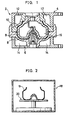
- the bladder vulcanising unit comprises an upper moulding member 4, a lower moulding member 6, and an intermediate moulding member 8. Crude rubber is placed in a cavity 10 defined between the upper moulding member 4 and the intermediate moulding member 8, and between the lower moulding member 6 and the intermediate moulding member 8 to form a bladder having a specified shape.
- a mass of crude rubber is placed in the vulcanising unit 2 in a state where the moulding members 4, 6 and 8 are set in their respective opened positions. Thereafter, the moulding members 4, 6 and 8 are set in their respective closed positions to thereby pressingly spread the mass of crude rubber in the entire cavity 10.
- the crude rubber is isobutylene-isoprene rubber.
- the crude rubber includes softener and plasticiser to give it a specified level of viscosity or shaping ability.
- the bladder B is taken out from the mould members of the vulcanising unit 2 and transported to a heating unit 18.
- the heating unit 18 has an enclosed space into which appropriate heating medium is supplied.
- the enclosed space of the heating unit 18 is kept at a high temperature, for example, about 180°C.
- the enclosed space is used to keep the supplied thermal energy in place.
- the bladder B is placed on a turntable 20 provided in the enclosed space of the heating unit 18 for a specified period of time. The turntable 20 is turned to heat the bladder B uniformly.
- the bladder B Upon completion of the heating stage, the bladder B is transported to a drying unit where the bladder B is dried. Thereafter, the bladder B is coated with a separating agent layer over an outer surface of the bladder B in a coating unit. More specifically, the separating agent includes silicone resin or fluorine resin and is applied to the outer surface of the bladder B which is to be brought into close contact with an inner circumferential surface of a green tyre. In this way, a bladder B is produced.
- the bladder B is obtained by heating a vulcanised and shaped rubber article for the specified time in the enclosed space and thereafter coating it with a separating agent layer.
- the bladder B is advantageous in that separating agent layer peeling is not liable to occur, and thus it has an increased durability.
- bladders produced by the conventional method have the drawbacks that during the vulcanising of green tyre, oil components such as softener and plasticiser, ooze from the bladder and spread in between the outer surface of the bladder and the separating agent layer, resulting in a peeling of the separating agent layer from the bladder.
- the vulcanised article is heated in an enclosed space before being coated with separating agent layer on its outer surface. Consequently, oil components such as softener and plasticiser are oozed from the vulcanised articles in the heating unit, and vaporised and removed from the outer surface of the bladder.
- the bladder produced in this embodiment has no likelihood that oil components spread in between the outer surface of the bladder and the separating agent layer in the vulcanising operation of green tyre. Accordingly, the separating agent layer can be prevented from peeling off the outer surface of the bladder.
- the bladder produced by the present invention has an increased durability. This advantageous effect can be clearly seen from experiment data to be referred to later.
- the oil components of the bladder B are removed after the shaping of the bladder in the vulcanising unit. Hence, the removal of the oil components of softener and plasticiser will not reduce the workability or the shaping ability of crude rubber which is necessary for the shaping of crude rubber into the specified bladder shape.
- Table 1 shows comparisons between bladders produced by the conventional method and bladders produced by the method of the present invention.
- Table 1 has the following measurement items: vulcanisation time of forming a bladder, heating time of heating a formed bladder, extracted amount of oil components extracted by acetone, and durability of a bladder.
- Bladders I and II were produced by the conventional method while bladders III and IV were produced by the method of the present invention.
- the respective extracted amounts and durabilities of the bladders II to IV are represented as relative value to those of the bladder I which are given a reference value of 100.
- the extracted amounts were obtained by immersing each bladder in a solution mainly composed of acetone for a specified time and measuring an amount of oil components which were extracted out from the bladder immersed in the solution.
- Bladder I Bladder II Bladder III Bladder IV Vulcanisation Time (min.) 45 60 30 20 Heating Time (min.) 0 0 30 40 Extracted Amount 100 92 45 34 Durability 100 97 133 132
- the inventive bladders III and IV which were heated between the coating of a separating agent layer and the shaping and vulcanising show an extremely reduced extracted amount of oil components compared to the conventional bladders I and II which were not heated between the coating of a separating agent layer and the shaping and vulcanising.
- the heat treatment before the separating agent coating after the shaping and vulcanising effectively removes oil components from the shaped and vulcanised bladder.
- the inventive bladders III and IV have the durability greater than the conventional bladders I and II which were not applied with the heat treatment before the separating agent coating.
Landscapes
- Engineering & Computer Science (AREA)
- Mechanical Engineering (AREA)
- Physics & Mathematics (AREA)
- Health & Medical Sciences (AREA)
- Oral & Maxillofacial Surgery (AREA)
- Thermal Sciences (AREA)
- Moulds For Moulding Plastics Or The Like (AREA)
- Heating, Cooling, Or Curing Plastics Or The Like In General (AREA)
- Tyre Moulding (AREA)
Description
| Bladder I | Bladder II | Bladder III | Bladder IV | |
| Vulcanisation Time (min.) | 45 | 60 | 30 | 20 |
| Heating Time (min.) | 0 | 0 | 30 | 40 |
| Extracted Amount | 100 | 92 | 45 | 34 |
| Durability | 100 | 97 | 133 | 132 |
Claims (6)
- A method for producing a bladder (B) comprising the steps of shaping a mass of crude rubber containing an oil components into a specified bladder shape by a mould, vulcanising the shaped bladder in the mould, transporting the vulcanised bladder from the mould to a heating unit, heating the vulcanised bladder for a specified time period in the heated unit, and coating the outer surface of the vulcanised and heated bladder with a separating agent layer.
- A method as defined in claim 1, characterised in that the heating of the vulcanised bladder is carried out in an enclosed space having a specified temperature.
- A method as defined in claim 1 or 2, characterised in the vulcanised bladder is turned in the enclosed space while being heated.
- A method as defined in any of claims 1, 2 or 3, characterised in that the crude rubber is isobutylene-isoprene rubber.
- A method as defined in any of claims 1 to 4, characterised in that the separating agent includes silicone resin.
- A method as defined in any of claims 1 to 4, characterised in that the separating agent includes fluorine resin.
Applications Claiming Priority (3)
| Application Number | Priority Date | Filing Date | Title |
|---|---|---|---|
| JP275159/94 | 1994-11-09 | ||
| JP27515994 | 1994-11-09 | ||
| JP6275159A JP2807634B2 (en) | 1994-11-09 | 1994-11-09 | Manufacturing method of bladder for tire vulcanization |
Publications (3)
| Publication Number | Publication Date |
|---|---|
| EP0711644A2 EP0711644A2 (en) | 1996-05-15 |
| EP0711644A3 EP0711644A3 (en) | 1996-11-20 |
| EP0711644B1 true EP0711644B1 (en) | 2000-03-15 |
Family
ID=17551502
Family Applications (1)
| Application Number | Title | Priority Date | Filing Date |
|---|---|---|---|
| EP95307952A Expired - Lifetime EP0711644B1 (en) | 1994-11-09 | 1995-11-07 | A method for producing a tyre forming bladder |
Country Status (4)
| Country | Link |
|---|---|
| US (1) | US5658512A (en) |
| EP (1) | EP0711644B1 (en) |
| JP (1) | JP2807634B2 (en) |
| DE (1) | DE69515594T2 (en) |
Families Citing this family (8)
| Publication number | Priority date | Publication date | Assignee | Title |
|---|---|---|---|---|
| DE10210028B4 (en) * | 2002-03-07 | 2004-04-01 | Continental Aktiengesellschaft | Process for the production of a rubber product |
| KR100510710B1 (en) * | 2002-11-14 | 2005-08-30 | 한국타이어 주식회사 | Tire cure bladder for preventing lamination failure |
| KR100533529B1 (en) * | 2003-07-25 | 2005-12-05 | 금호타이어 주식회사 | A Curing System of the Tire Bladder |
| JP4819557B2 (en) * | 2006-04-11 | 2011-11-24 | 住友ゴム工業株式会社 | Manufacturing method of tire bladder |
| US7404712B2 (en) * | 2006-10-17 | 2008-07-29 | Carlisle Intangible Company | Multiple segment mold to manufacture tire bladders |
| TW201200345A (en) * | 2010-06-25 | 2012-01-01 | Carnehammer Lars Bertil | Surface treatment of rubber using low pressure plasma |
| JP5699020B2 (en) * | 2011-04-01 | 2015-04-08 | 住友ゴム工業株式会社 | How to create a bladder |
| FR3064527A1 (en) * | 2017-03-30 | 2018-10-05 | Compagnie Generale Des Etablissements Michelin | COOKING MEMBRANE FOR PNEUMATIC |
Family Cites Families (10)
| Publication number | Priority date | Publication date | Assignee | Title |
|---|---|---|---|---|
| BE569608A (en) | 1957-07-22 | |||
| CA987211A (en) * | 1973-05-03 | 1976-04-13 | Roy J. Emerson | Puncture sealing means for pneumatic tires |
| FR2337030A1 (en) * | 1976-01-02 | 1977-07-29 | Michelin & Cie | TIRE MOLDING MEMBRANE AND ITS MANUFACTURING PROCESS |
| US4554122A (en) * | 1980-03-25 | 1985-11-19 | Releasomers, Inc. | Method for air bladder release during tire production |
| EP0111100B1 (en) * | 1982-10-16 | 1990-08-22 | Grace Service Chemicals GmbH | Utilisation of a separating layer at the vulcanisation of rubber articles |
| US4531902A (en) * | 1983-11-14 | 1985-07-30 | The B. F. Goodrich Company | Apparatus for making improved tire curing bladders |
| US4534812A (en) * | 1984-02-28 | 1985-08-13 | Zeon Kosan Co., Ltd. | Method for forming tires |
| US4822436A (en) | 1986-03-07 | 1989-04-18 | Northrop Corporation | Apparatus for debulking and autoclaving laminates of complex shapes |
| US4943609A (en) * | 1989-04-17 | 1990-07-24 | The Uniroyal Goodrich Tire Company | Curable rubber bladder stocks having reduced viscosity |
| JPH02311564A (en) * | 1989-05-25 | 1990-12-27 | Toray Dow Corning Silicone Co Ltd | Bladder lubricant composition for tire molding |
-
1994
- 1994-11-09 JP JP6275159A patent/JP2807634B2/en not_active Expired - Fee Related
-
1995
- 1995-11-07 EP EP95307952A patent/EP0711644B1/en not_active Expired - Lifetime
- 1995-11-07 DE DE69515594T patent/DE69515594T2/en not_active Expired - Fee Related
- 1995-11-09 US US08/555,810 patent/US5658512A/en not_active Expired - Fee Related
Also Published As
| Publication number | Publication date |
|---|---|
| JPH08132441A (en) | 1996-05-28 |
| DE69515594T2 (en) | 2000-07-06 |
| EP0711644A2 (en) | 1996-05-15 |
| US5658512A (en) | 1997-08-19 |
| EP0711644A3 (en) | 1996-11-20 |
| DE69515594D1 (en) | 2000-04-20 |
| JP2807634B2 (en) | 1998-10-08 |
Similar Documents
| Publication | Publication Date | Title |
|---|---|---|
| US2588571A (en) | Method for forming hollow articles | |
| US5658512A (en) | Method for producing a tire forming bladder | |
| KR20030072249A (en) | Use of microwave energy to disassemble, release, and hydrate contact lenses | |
| KR940003166B1 (en) | Vulcanization Method of Elastomeric Polymeric Articles | |
| EP1153723B1 (en) | Method of moulding an elastomeric article | |
| US4184822A (en) | Apparatus for making power transmission belting | |
| WO2010059162A1 (en) | Apparatus and method for curing a rubber like article | |
| JPH02307737A (en) | Method for washing stamper for optical disk | |
| JPH0549010B2 (en) | ||
| US2420815A (en) | Process of producing expanded rubber material | |
| US4147642A (en) | Method and apparatus for the renewal of the tread of a worn pneumatic or solid rubber tire | |
| US1276411A (en) | Treatment of tires. | |
| CN111873300B (en) | A degradable vascular stent injection molding method with flexible core structure | |
| RU2050283C1 (en) | Method of moulding products from composite materials | |
| US598550A (en) | Process of treating rubber | |
| JPS5825949A (en) | Manufacture of tire | |
| WO2005097455A1 (en) | Mold and method for manufacturing core | |
| KR100593006B1 (en) | Vulcanization Method of Green Tire for Condensate Discharge | |
| KR100509728B1 (en) | Supply method of green tire cure medium | |
| JP2001047437A (en) | Rubber crawler manufacturing method and mold used for it | |
| JPS6176323A (en) | Vulcanizing device of tire | |
| US2141788A (en) | Manufacture of rubber articles | |
| US9415553B2 (en) | Apparatus and method for curing a rubber like article | |
| JPH0223329B2 (en) | ||
| US5786444A (en) | Treating method for improving the strength of molded products of a thermosetting resin |
Legal Events
| Date | Code | Title | Description |
|---|---|---|---|
| PUAI | Public reference made under article 153(3) epc to a published international application that has entered the european phase |
Free format text: ORIGINAL CODE: 0009012 |
|
| AK | Designated contracting states |
Kind code of ref document: A2 Designated state(s): DE FR GB |
|
| PUAL | Search report despatched |
Free format text: ORIGINAL CODE: 0009013 |
|
| AK | Designated contracting states |
Kind code of ref document: A3 Designated state(s): DE FR GB |
|
| 17P | Request for examination filed |
Effective date: 19970131 |
|
| 17Q | First examination report despatched |
Effective date: 19990118 |
|
| GRAG | Despatch of communication of intention to grant |
Free format text: ORIGINAL CODE: EPIDOS AGRA |
|
| GRAG | Despatch of communication of intention to grant |
Free format text: ORIGINAL CODE: EPIDOS AGRA |
|
| GRAH | Despatch of communication of intention to grant a patent |
Free format text: ORIGINAL CODE: EPIDOS IGRA |
|
| GRAG | Despatch of communication of intention to grant |
Free format text: ORIGINAL CODE: EPIDOS AGRA |
|
| GRAH | Despatch of communication of intention to grant a patent |
Free format text: ORIGINAL CODE: EPIDOS IGRA |
|
| GRAA | (expected) grant |
Free format text: ORIGINAL CODE: 0009210 |
|
| AK | Designated contracting states |
Kind code of ref document: B1 Designated state(s): DE FR GB |
|
| REF | Corresponds to: |
Ref document number: 69515594 Country of ref document: DE Date of ref document: 20000420 |
|
| ET | Fr: translation filed | ||
| PLBE | No opposition filed within time limit |
Free format text: ORIGINAL CODE: 0009261 |
|
| STAA | Information on the status of an ep patent application or granted ep patent |
Free format text: STATUS: NO OPPOSITION FILED WITHIN TIME LIMIT |
|
| 26N | No opposition filed | ||
| REG | Reference to a national code |
Ref country code: GB Ref legal event code: IF02 |
|
| PGFP | Annual fee paid to national office [announced via postgrant information from national office to epo] |
Ref country code: GB Payment date: 20031105 Year of fee payment: 9 |
|
| PGFP | Annual fee paid to national office [announced via postgrant information from national office to epo] |
Ref country code: FR Payment date: 20031110 Year of fee payment: 9 |
|
| PG25 | Lapsed in a contracting state [announced via postgrant information from national office to epo] |
Ref country code: GB Free format text: LAPSE BECAUSE OF NON-PAYMENT OF DUE FEES Effective date: 20041107 |
|
| GBPC | Gb: european patent ceased through non-payment of renewal fee |
Effective date: 20041107 |
|
| PG25 | Lapsed in a contracting state [announced via postgrant information from national office to epo] |
Ref country code: FR Free format text: LAPSE BECAUSE OF NON-PAYMENT OF DUE FEES Effective date: 20050729 |
|
| REG | Reference to a national code |
Ref country code: FR Ref legal event code: ST |
|
| PGFP | Annual fee paid to national office [announced via postgrant information from national office to epo] |
Ref country code: DE Payment date: 20051103 Year of fee payment: 11 |
|
| PG25 | Lapsed in a contracting state [announced via postgrant information from national office to epo] |
Ref country code: DE Free format text: LAPSE BECAUSE OF NON-PAYMENT OF DUE FEES Effective date: 20070601 |