EP0709752A2 - Automatic variable pitch reconfiguration control in an electrostatographic printing machine - Google Patents
Automatic variable pitch reconfiguration control in an electrostatographic printing machine Download PDFInfo
- Publication number
- EP0709752A2 EP0709752A2 EP95307563A EP95307563A EP0709752A2 EP 0709752 A2 EP0709752 A2 EP 0709752A2 EP 95307563 A EP95307563 A EP 95307563A EP 95307563 A EP95307563 A EP 95307563A EP 0709752 A2 EP0709752 A2 EP 0709752A2
- Authority
- EP
- European Patent Office
- Prior art keywords
- photoreceptor belt
- belt speed
- machine
- average
- actual
- Prior art date
- Legal status (The legal status is an assumption and is not a legal conclusion. Google has not performed a legal analysis and makes no representation as to the accuracy of the status listed.)
- Granted
Links
- 108091008695 photoreceptors Proteins 0.000 claims abstract description 108
- 238000000034 method Methods 0.000 claims abstract description 20
- 230000004044 response Effects 0.000 claims abstract description 16
- 239000011295 pitch Substances 0.000 claims description 58
- 230000000977 initiatory effect Effects 0.000 claims description 15
- 230000004913 activation Effects 0.000 claims description 10
- 230000003213 activating effect Effects 0.000 claims 2
- 230000008569 process Effects 0.000 abstract description 9
- 238000005259 measurement Methods 0.000 abstract description 8
- 230000006870 function Effects 0.000 description 9
- 238000012545 processing Methods 0.000 description 9
- 238000012546 transfer Methods 0.000 description 8
- 238000004422 calculation algorithm Methods 0.000 description 4
- 230000008901 benefit Effects 0.000 description 3
- 238000012935 Averaging Methods 0.000 description 2
- 238000004364 calculation method Methods 0.000 description 2
- 238000004590 computer program Methods 0.000 description 2
- 238000013459 approach Methods 0.000 description 1
- 230000005540 biological transmission Effects 0.000 description 1
- 238000004140 cleaning Methods 0.000 description 1
- 230000001934 delay Effects 0.000 description 1
- 238000001514 detection method Methods 0.000 description 1
- 238000011161 development Methods 0.000 description 1
- 238000006073 displacement reaction Methods 0.000 description 1
- 230000000694 effects Effects 0.000 description 1
- 238000012986 modification Methods 0.000 description 1
- 230000004048 modification Effects 0.000 description 1
- 238000012544 monitoring process Methods 0.000 description 1
- 230000005693 optoelectronics Effects 0.000 description 1
- 239000000843 powder Substances 0.000 description 1
- 238000012552 review Methods 0.000 description 1
- 230000008054 signal transmission Effects 0.000 description 1
- 230000001360 synchronised effect Effects 0.000 description 1
Images


Classifications
-
- G—PHYSICS
- G03—PHOTOGRAPHY; CINEMATOGRAPHY; ANALOGOUS TECHNIQUES USING WAVES OTHER THAN OPTICAL WAVES; ELECTROGRAPHY; HOLOGRAPHY
- G03G—ELECTROGRAPHY; ELECTROPHOTOGRAPHY; MAGNETOGRAPHY
- G03G15/00—Apparatus for electrographic processes using a charge pattern
- G03G15/50—Machine control of apparatus for electrographic processes using a charge pattern, e.g. regulating differents parts of the machine, multimode copiers, microprocessor control
- G03G15/5033—Machine control of apparatus for electrographic processes using a charge pattern, e.g. regulating differents parts of the machine, multimode copiers, microprocessor control by measuring the photoconductor characteristics, e.g. temperature, or the characteristics of an image on the photoconductor
-
- G—PHYSICS
- G03—PHOTOGRAPHY; CINEMATOGRAPHY; ANALOGOUS TECHNIQUES USING WAVES OTHER THAN OPTICAL WAVES; ELECTROGRAPHY; HOLOGRAPHY
- G03G—ELECTROGRAPHY; ELECTROPHOTOGRAPHY; MAGNETOGRAPHY
- G03G21/00—Arrangements not provided for by groups G03G13/00 - G03G19/00, e.g. cleaning, elimination of residual charge
- G03G21/14—Electronic sequencing control
-
- G—PHYSICS
- G03—PHOTOGRAPHY; CINEMATOGRAPHY; ANALOGOUS TECHNIQUES USING WAVES OTHER THAN OPTICAL WAVES; ELECTROGRAPHY; HOLOGRAPHY
- G03G—ELECTROGRAPHY; ELECTROPHOTOGRAPHY; MAGNETOGRAPHY
- G03G2215/00—Apparatus for electrophotographic processes
- G03G2215/00025—Machine control, e.g. regulating different parts of the machine
- G03G2215/00071—Machine control, e.g. regulating different parts of the machine by measuring the photoconductor or its environmental characteristics
- G03G2215/00075—Machine control, e.g. regulating different parts of the machine by measuring the photoconductor or its environmental characteristics the characteristic being its speed
- G03G2215/0008—Machine control, e.g. regulating different parts of the machine by measuring the photoconductor or its environmental characteristics the characteristic being its speed for continuous control of recording starting time
Definitions
- the present invention relates generally to an electrophotographic printing machine, and more specifically concerns a process for providing automatic adjustment and variable pitch reconfiguration control in response to variations in photoreceptor belt speed in an electrophotographic printing machine.
- each latent image is typically recorded closely adjacent to one another on a photoconductive belt, each latent image being separated by a so-called interdocument zone.
- the photoreceptive belt is typically divided into a series of "pitches", wherein each pitch represents an individual image travelling through various states during the electrophotographic reproduction process. More than one image area or pitch may be defined on the photoreceptive belt at any one time.
- Timing and synchronizing of various events related to various pitches is essential for the control of the electrostatographic reproduction process.
- Such control is typically effected by a series of precisely timed clock signals relating to each pitch for synchronizing and coordinating the various events which occur during the electrophotographic reproduction process.
- clock signals relating to each pitch for synchronizing and coordinating the various events which occur during the electrophotographic reproduction process.
- US-A-4,416,534 discloses an apparatus and method for registering copy sheets in a variable pitch reproduction machine, wherein the speed and position of both a developed image on a photoreceptor belt and a copy sheet are monitored and updated by a programmed microprocessor.
- US-A-4, 588,284 discloses a control system for automatically altering the control of the machine to respond to a different number of pitches or images which the machine can manage at a particular time.
- Machine control is adjusted in accordance with a memory flag to manage a different number of pitches during the operation of the machine and to provide clock signals for the timed actuation of events in each of the pitches.
- US-A-5,101,232 discloses an apparatus and associated method for controlling the velocity of a photoreceptor within a reprographic machine having a seamed, web type photoreceptor, for producing a plurality of images thereon, wherein the images are separated by unexposed interdocument regions on the photoreceptor belt. That patent is particularly concerned with a process for assuring that the seamed region of the photoreceptor belt lies within an interdocument region.
- the number of pitches per belt cycle in a specific machine configuration is a fixed number such that the adaptability of the machine and the control system thereof is limited to that specific machine configuration and is not adaptable to other machine configurations.
- a method for automatically initiating a machine reconfiguration in an electrostatographic printing machine including a photoreceptor belt, to synchronize the activation of various machine subsystems in response to a variation in actual photoreceptor belt speed comprising the steps of: measuring actual photoreceptor belt speed for a selected revolution of the photoreceptor belt; calculating an average photoreceptor belt speed for a plurality of selected revolutions of the photoreceptor belt; comparing the actual photoreceptor belt speed to the average photoreceptor belt speed, for determining whether the actual photoreceptor belt speed is within a predetermined range relative to the average photoreceptor belt speed; and initiating a machine configuration in response to a determination that the actual photoreceptor belt speed is outside the predetermined range relative to the average photoreceptor belt speed.
- the machine reconfiguration step includes synchronizing the activation of various machine subsystems in accordance with the average photoreceptor belt speed.
- an electrophotographic printing apparatus having a photoreceptor belt wherein a system for automatically initiating a machine reconfiguration to synchronize the activation of various machine subsystems in response to a variation in actual photoreceptor belt speed is provided comprising: means for measuring actual photoreceptor belt speed for a selected revolution of the photoreceptor belt; means for calculating an average photoreceptor belt speed for a plurality of selected revolutions of the photoreceptor belt; means for comparing the actual photoreceptor belt speed to the average photoreceptor belt speed, for determining whether the actual photoreceptor belt speed is within a predetermined range relative to the average photoreceptor belt speed; and means for initiating a machine reconfiguration in response to a determination that the actual photoreceptor belt speed is outside the predetermined range relative to the average photoreceptor belt speed.
- the means for initiating machine reconfiguration includes means for synchronizing activation of various machine subsystems in accordance with the average photoreceptor belt speed
- the invention thus provides an electrostatographic copying system adapted to include an apparatus, for controlling the operating speed of a photoreceptor within an electrostatographic printing machine having a belt type photoreceptive member for recording a plurality of latent images thereon.
- the process provides automatic reconfiguration of the electrostatographic printing machine control system to determine appropriate pitch timing values in response to a measurement of the actual belt speed as measured by the elapsed time for a single revolution of the photoreceptor belt.
- pitches 116 A plurality of latent image areas, or so-called pitches 116, are shown in phantom on the surface of the photoreceptor belt 10. It will be understood that the number of pitches 116 fitting on the photoreceptor belt 10 is a function of the dimension of the photoreceptor belt 10 as well as the size of each pitch thereon. In many commercial copiers, the number of pitches occupied by images about the photoconductor belt 10 is a fixed quantity. That is, so long as each output document has substantially the same width, the pitch or latent image area spacing will remain constant. In such a fixed pitch system, the task of timing and synchronizing the various events related to various image areas is relatively simple so long as the photoreceptor belt 10 is driven and maintained at a constant rate.
- the task of registering the copy sheet with the developed powder image is reduced to insuring that the copy sheets are driven to the transfer station at the same rate once an initial synchronization is achieved between the sheet and the image.
- the spacing between individual copy sheets is chosen to be equal to a fixed and constant photoconductor pitch value, only minor changes in the copy sheet drive speed are needed to maintain registration.
- a fixed pitch system as described above, has very limited application in the high speed copying and printing business. It is advantageous to provide a copier with a multiple or variable pitch systems, wherein output copy sheets of various widths can be produced such that image spacing about the periphery of the photoreceptor belt 10 can vary with respect to output document size as well as input document size.
- a photoreceptive belt may accommodate as many as eight images for a first size document while being capable of accommodating as few as three images for a much wider document.
- variable pitch copier systems would be expected to accommodate a continuum of pitches between a minimum and maximum number.
- photoreceptor belt speed often varies significantly due to wear in system components, belt stretching, clutch slippage, power supply variation, and time delays in registration signal transmission, among other factors.
- a computer program utilized in implementing the automatic machine reconfiguration of the present invention provides a specific set of instructions for monitoring the photoreceptor belt speed to determine whether the belt speed is beyond a predetermined tolerance value for a given number of pitches and for causing a concommitant and automatic machine reconfiguration for handling the appropriate number of pitches corresponding to the belt speed.
- an automatic variable pitch reconfiguration control routine may be in the form of a computer program which is embedded into a scheduling routine managed by the controller.
- An example of suitable software code is included, as appendix A, in the priority application filed herewith, i.e. U.S. Patent Application Serial No. 08/327,958.
- the exemplary control algorithm for reconfiguring the machine in response to the photoreceptor belt speed will be described as a function of a determination of the average photoreceptor belt speed.
- an initial determination of the system mode status must be performed with respect to the system cycle-up or cycle-down mode. It is recognized that the photoreceptor belt speed during system cycle-up may be inaccurate as the belt comes up to speed. Likewise, the belt speed may also be inaccurate during system cycle-down as the belt is coming to a stop. In the case of system cycle-up or cycle-down, the monitored photoreceptor belt speed is ignored and the entire variable pitch reconfiguration control algorithm of the present invention is bypassed.
- the actual photoreceptor belt speed is monitored and a measurement thereof is provided as function of the amount of time required for the photoreceptor belt to travel in one complete revolution.
- the photoreceptor belt speed is provided as a function of time, wherein the elapsed time for a full revolution of the photoreceptor belt is provided by detecting the elapsed time between passage of a predetermined point on the belt, as for example, a belt seam or a timing mark.
- the belt is monitored by a sensor, preferably an optoelectronic device, which detects the presence of a photoreceptor seam or a belt mark during rotation of the photoreceptor belt.
- the actual belt speed or, more appropriately the actual belt time is initially compared to a set of predetermined values for determining whether the actual belt time is within a wide predetermined range, such that, if the belt time falls outside of the wide predetermined range so as to be either greater than a predetermined maximum belt time or less than a predetermined minimum belt time, an error signal is generated and logged in a memory module associated with the system scheduling software.
- This error signal is usually accompanied by a message displayed on a graphic user interface, indicating that the belt time is "out of range".
- the actual belt time is transmitted to a memory device which stores multiple actual belt times retrieved from the belt timing sensor.
- the transmission of an actual belt time simultaneously causes a counter to be incremented, initiating an average belt time accumulator routine for summing and averaging a predetermined number of actual belt time measurements to maintain a running average photoreceptor belt time.
- NVM non-volatile memory
- RAM random access memory
- this average belt time accumulator routine calculates the average belt time associated with an updated actual belt time such that the average belt time is determined as a function of a series of most recent actual belt time measurements. Older preceding measurements, which could be characterized as obsolete or outdated actual belt time measurements, are disposed of and are not factored into this average belt time calculation.
- the current actual belt time and the average belt time are compared and a difference between the current actual belt time and the average belt time is computed. This difference is utilized as a reference value for determining whether the present actual belt time is within a predetermined range relative to the average belt time, indicating that it is necessary to adjust the pitch timing signals, which, in turn, would necessitate a variable pitch machine reconfiguration in order to re-synchronize the various machine subsystems with the current average belt time.
- the actual belt time is considered out of specification such that a system fault is initiated, wherein the machine is cycled down such that the belt speed is brought to an idle state and a "system timing out of range" signal is transmitted to the control panel.
- the event is also recorded in memory as a logged event for archival purposes.
- the appropriate pitch timing value is calculated as a function of belt speed.
- a system reconfiguration or configuration exchange is initiated, whereby the timing and synchronization information corresponding to the new pitch timing values is generated.
- the declared fault causes the controller to recalculate the timing of various command signals for synchronizing activation of various machine subsystems in accordance with the appropriate number of pitches.
- the xerographic printing machine will be ready to run with better quality and efficiency since all machine subsystems are now precisely synchronized to the belt speed.
- the new pitch timing commands are communicated to the appropriate machine subsystems via the machine controller upon reactuation of the machine.
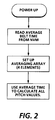
- the calculation of the new pitch timing values is illustrated in the flow chart of FIG. 2.
- the current average belt time stored in non-volatile memory is read and transmitted into a random access memory array in order to set up an averaging array comprising four elements. This most recent average is used to calculate all the pitch timing values which are thereafter transmitted to the controller to determine scheduling and timing information.
- One particular advantage of the present invention may be found in the following illustrative example, wherein the operation baseline software for an exemplary 135 page per minute machine is loaded into a machine designed to run at a much higher speed, for example 180 pages per minute.
- the electrostatographic printing machine would immediately declare a software fault, indicating that the system timing is out of range.
- a new set of pitch timing values would be calculated and transmitted to provide the appropriate pitch timing values for a 180 pitch per minute machine such that the 135 page per minute system software can be utilized to operate an electrostatographic printing machine running at 180 pages per minute.
- the implementation of the present invention is not limited to the above example of 135 pages per minute and 180 pages per minute, whereby the actual speed is limited by motor speeds, central processing unit capabilities, paper paths, etc.
- the present invention allows scalability and system reconfiguration using the same software control package so that, at least in theory, a single software control package can be utilized in numerous and various machines.
- Another advantage and effect of the present invention is to allow an electrostatographic machine to continue to run even if the belt speed drifts out of a specified range. Although throughput will obviously be affected, the system is resynchronized to the actual belt speed so as to maintain system integrity and quality.
- the present invention allows the electrostatographic machine scheduling software to run under a large range of machine speeds without being changed.
- the automatic photoreceptor belt speed control of the present invention enables the adjustment and recalculation of pitch timing values in response to actual photoreceptor belt speeds.
- the control algorithm provided herein allows for compensation for irregularities in the speed of the photoreceptor belt and allows for a machine reconfiguration so that the same system software can be used to run various electrostatographic printing machines at different machine speeds.
Landscapes
- Physics & Mathematics (AREA)
- General Physics & Mathematics (AREA)
- Engineering & Computer Science (AREA)
- Microelectronics & Electronic Packaging (AREA)
- Control Or Security For Electrophotography (AREA)
- Discharging, Photosensitive Material Shape In Electrophotography (AREA)
Abstract
Description
- The present invention relates generally to an electrophotographic printing machine, and more specifically concerns a process for providing automatic adjustment and variable pitch reconfiguration control in response to variations in photoreceptor belt speed in an electrophotographic printing machine.
- In high speed electrophotographic printing machines, successive electrostatic latent images are typically recorded closely adjacent to one another on a photoconductive belt, each latent image being separated by a so-called interdocument zone. Thus, the photoreceptive belt is typically divided into a series of "pitches", wherein each pitch represents an individual image travelling through various states during the electrophotographic reproduction process. More than one image area or pitch may be defined on the photoreceptive belt at any one time.
- Timing and synchronizing of various events related to various pitches is essential for the control of the electrostatographic reproduction process. Thus, it is necessary to precisely track the time that a particular event should occur with respect to a particular pitch. Such control is typically effected by a series of precisely timed clock signals relating to each pitch for synchronizing and coordinating the various events which occur during the electrophotographic reproduction process. Thus, in a typical electrostatographic copying machine, wherein various processing stations are employed for providing such functions as uniform charging, exposure, development, transfer, cleaning and fusing during any given image processing cycle, it becomes very important to provide a proper base for timing the sequence of operations of the various processing stations in order to maintain proper timing the processing functions relative to the images being generated. For example, it should be evident that it is necessary to provide efficient and reliable movement of sheets of copy paper along a paper path for precisely timed delivery of the copy paper to the transfer station with respect to the transport of a developed electrostatic image for providing proper control of the machine operation.
- It is well known to provide a control system having means for providing a series of clock pulses in a data stream, means for generating a reset signal or a series of successive start pulses for each processing cycle, and means for generating a plurality of timed control signals derived from the start and clock pulses in order to enable the various processing stations to implement the machine processing steps in a precisely timed manner. As a particular example, US-A-3,917,396 discloses a control system utilizing start or reset pulses keyed to the displacement or position of the photoreceptor belt which is monitored by a speed responsive element. That patent also teaches a system adapted to generate more than one cycle of enabling pulses for processing more than one copy at any given moment.
- Various techniques are known for enabling photoreceptor belt speed control in an electrostatographic printing apparatus.
- US-A-4,416,534 discloses an apparatus and method for registering copy sheets in a variable pitch reproduction machine, wherein the speed and position of both a developed image on a photoreceptor belt and a copy sheet are monitored and updated by a programmed microprocessor.
- US-A-4, 588,284 discloses a control system for automatically altering the control of the machine to respond to a different number of pitches or images which the machine can manage at a particular time. Machine control is adjusted in accordance with a memory flag to manage a different number of pitches during the operation of the machine and to provide clock signals for the timed actuation of events in each of the pitches.
- US-A-5,101,232 discloses an apparatus and associated method for controlling the velocity of a photoreceptor within a reprographic machine having a seamed, web type photoreceptor, for producing a plurality of images thereon, wherein the images are separated by unexposed interdocument regions on the photoreceptor belt. That patent is particularly concerned with a process for assuring that the seamed region of the photoreceptor belt lies within an interdocument region.
- Generally, the number of pitches per belt cycle in a specific machine configuration is a fixed number such that the adaptability of the machine and the control system thereof is limited to that specific machine configuration and is not adaptable to other machine configurations. However, it would be desirable to provide a capability to control tasks for a given number of pitches and machine clocks within a pitch while providing the further capability to control tasks based on the number of pitches in a cycle and the machine clocks within the pitch when the number of pitches within the machine has changed.
- The prior art, however, does not disclose an automatic variable pitch reconfiguration control system adaptable to different machine configurations and different belt and motor speeds.
- It is an object of the present invention to provide such an automaic control system.
- In accordance with the present invention, there is provided a method for automatically initiating a machine reconfiguration in an electrostatographic printing machine including a photoreceptor belt, to synchronize the activation of various machine subsystems in response to a variation in actual photoreceptor belt speed, comprising the steps of: measuring actual photoreceptor belt speed for a selected revolution of the photoreceptor belt; calculating an average photoreceptor belt speed for a plurality of selected revolutions of the photoreceptor belt; comparing the actual photoreceptor belt speed to the average photoreceptor belt speed, for determining whether the actual photoreceptor belt speed is within a predetermined range relative to the average photoreceptor belt speed; and initiating a machine configuration in response to a determination that the actual photoreceptor belt speed is outside the predetermined range relative to the average photoreceptor belt speed. The machine reconfiguration step includes synchronizing the activation of various machine subsystems in accordance with the average photoreceptor belt speed.
- Pursuant to another aspect of the present invention, there is provided an electrophotographic printing apparatus having a photoreceptor belt wherein a system for automatically initiating a machine reconfiguration to synchronize the activation of various machine subsystems in response to a variation in actual photoreceptor belt speed is provided comprising: means for measuring actual photoreceptor belt speed for a selected revolution of the photoreceptor belt; means for calculating an average photoreceptor belt speed for a plurality of selected revolutions of the photoreceptor belt; means for comparing the actual photoreceptor belt speed to the average photoreceptor belt speed, for determining whether the actual photoreceptor belt speed is within a predetermined range relative to the average photoreceptor belt speed; and means for initiating a machine reconfiguration in response to a determination that the actual photoreceptor belt speed is outside the predetermined range relative to the average photoreceptor belt speed. The means for initiating machine reconfiguration includes means for synchronizing activation of various machine subsystems in accordance with the average photoreceptor belt speed.
- The invention thus provides an electrostatographic copying system adapted to include an apparatus, for controlling the operating speed of a photoreceptor within an electrostatographic printing machine having a belt type photoreceptive member for recording a plurality of latent images thereon. The process provides automatic reconfiguration of the electrostatographic printing machine control system to determine appropriate pitch timing values in response to a measurement of the actual belt speed as measured by the elapsed time for a single revolution of the photoreceptor belt.
- A method and apparatus in accordance with the present invention will now be described, by way of example, with reference to the accompanying drawings, in which:
- Figures 1 and 2 show flow charts of a control algorithm for providing the automatic variable pitch reconfiguration control functions of the present invention; and
- Figure 3 is a perspective view of an illustrative photoreceptor belt showing a plurality of image areas or "pitches" superimposed thereon.
- Referring now to FIG. 3, wherein details of a photoreceptor and sheet transfer apparatus of an electrostatographic printing apparatus are shown, a copy sheet, identified by
reference numeral 110 is shown entering the input side of the transfer station D, comprisingtransfer corotron 46 anddetack corotron 48 situated in a spaced relationship tophotoreceptor belt 10. The copy sheet 1 10 is engaged by a feed nip comprising a pair ofrollers 72 operative to transport thecopy sheet 110 to the transfer station throughchute 108. The copy sheet is subsequently advanced into contact withphotoreceptor belt 10, where it will meet thebelt 10 in synchronization with a developed latent image area thereon. - A plurality of latent image areas, or so-called
pitches 116, are shown in phantom on the surface of thephotoreceptor belt 10. It will be understood that the number ofpitches 116 fitting on thephotoreceptor belt 10 is a function of the dimension of thephotoreceptor belt 10 as well as the size of each pitch thereon. In many commercial copiers, the number of pitches occupied by images about thephotoconductor belt 10 is a fixed quantity. That is, so long as each output document has substantially the same width, the pitch or latent image area spacing will remain constant. In such a fixed pitch system, the task of timing and synchronizing the various events related to various image areas is relatively simple so long as thephotoreceptor belt 10 is driven and maintained at a constant rate. Thus, for example, assuming that the developed images on thephotoreceptor belt 10 approach the transfer station D at a constant rate, the task of registering the copy sheet with the developed powder image is reduced to insuring that the copy sheets are driven to the transfer station at the same rate once an initial synchronization is achieved between the sheet and the image. In theory, since the spacing between individual copy sheets is chosen to be equal to a fixed and constant photoconductor pitch value, only minor changes in the copy sheet drive speed are needed to maintain registration. - It is well known that a fixed pitch system as described above, has very limited application in the high speed copying and printing business. It is advantageous to provide a copier with a multiple or variable pitch systems, wherein output copy sheets of various widths can be produced such that image spacing about the periphery of the
photoreceptor belt 10 can vary with respect to output document size as well as input document size. For example, a photoreceptive belt may accommodate as many as eight images for a first size document while being capable of accommodating as few as three images for a much wider document. Of course, such variable pitch copier systems would be expected to accommodate a continuum of pitches between a minimum and maximum number. In addition to system flexibility advantages, it is noted that photoreceptor belt speed often varies significantly due to wear in system components, belt stretching, clutch slippage, power supply variation, and time delays in registration signal transmission, among other factors. Thus, it is also advantageous to provide a variable pitch system wherein the number of pitches laid down on the belt can be varied in response to the variable speed of the belt. - However, changes in pitch values result in concomitant changes in timing and synchronization of various events within the electrostatographic reproduction machine. In addition, variations in the quantity of pitches on a photoreceptor belt may also affect the way in which the document is imaged on to the photoreceptor. Variations in pitch quantities on the photoreceptor belt require that the timing of the activation of machine subsystems related to the variable pitches must also be varied. This resynchronization process is commonly referred to as machine reconfiguration which generally involves a modification to the scheduling software in the machine controller, described hereinabove. Thus, providing variable pitch capability requires machine reconfiguration capability, wherein numerous system status inputs are continually monitored and varied in accordance with the actual photoreceptor belt speed and the number of image areas thereon.
- Referring now to Figures 1 and 2, the particular features of the automatic variable pitch reconfiguration control of the present invention will be described in greater detail via a pair of flow charts intended to illustrate the steps involved in the control process. A computer program utilized in implementing the automatic machine reconfiguration of the present invention provides a specific set of instructions for monitoring the photoreceptor belt speed to determine whether the belt speed is beyond a predetermined tolerance value for a given number of pitches and for causing a concommitant and automatic machine reconfiguration for handling the appropriate number of pitches corresponding to the belt speed. It will be understood that such an automatic variable pitch reconfiguration control routine may be in the form of a computer program which is embedded into a scheduling routine managed by the controller. An example of suitable software code is included, as appendix A, in the priority application filed herewith, i.e. U.S. Patent Application Serial No. 08/327,958.
- Beginning with the flow chart of FIG. 1, the exemplary control algorithm for reconfiguring the machine in response to the photoreceptor belt speed will be described as a function of a determination of the average photoreceptor belt speed. At the outset, an initial determination of the system mode status must be performed with respect to the system cycle-up or cycle-down mode. It is recognized that the photoreceptor belt speed during system cycle-up may be inaccurate as the belt comes up to speed. Likewise, the belt speed may also be inaccurate during system cycle-down as the belt is coming to a stop. In the case of system cycle-up or cycle-down, the monitored photoreceptor belt speed is ignored and the entire variable pitch reconfiguration control algorithm of the present invention is bypassed.
- Assuming that the electrostatographic printing machine is not in the cycle-up or cycle-down mode, the actual photoreceptor belt speed is monitored and a measurement thereof is provided as function of the amount of time required for the photoreceptor belt to travel in one complete revolution. Thus, the photoreceptor belt speed is provided as a function of time, wherein the elapsed time for a full revolution of the photoreceptor belt is provided by detecting the elapsed time between passage of a predetermined point on the belt, as for example, a belt seam or a timing mark. The belt is monitored by a sensor, preferably an optoelectronic device, which detects the presence of a photoreceptor seam or a belt mark during rotation of the photoreceptor belt. The actual belt speed or, more appropriately the actual belt time, is initially compared to a set of predetermined values for determining whether the actual belt time is within a wide predetermined range, such that, if the belt time falls outside of the wide predetermined range so as to be either greater than a predetermined maximum belt time or less than a predetermined minimum belt time, an error signal is generated and logged in a memory module associated with the system scheduling software. This error signal is usually accompanied by a message displayed on a graphic user interface, indicating that the belt time is "out of range".
- Assuming that the actual belt time is within the wide predetermined range, the actual belt time is transmitted to a memory device which stores multiple actual belt times retrieved from the belt timing sensor. The transmission of an actual belt time simultaneously causes a counter to be incremented, initiating an average belt time accumulator routine for summing and averaging a predetermined number of actual belt time measurements to maintain a running average photoreceptor belt time. Each time an actual belt time is transmitted, a new average belt time is computed and recorded in a non-volatile memory (NVM) unit and in a random access memory (RAM) array. Typically, this average belt time accumulator routine calculates the average belt time associated with an updated actual belt time such that the average belt time is determined as a function of a series of most recent actual belt time measurements. Older preceding measurements, which could be characterized as obsolete or outdated actual belt time measurements, are disposed of and are not factored into this average belt time calculation.
- After the actual belt time measurements are summed and averaged to provide the average belt time, the current actual belt time and the average belt time are compared and a difference between the current actual belt time and the average belt time is computed. This difference is utilized as a reference value for determining whether the present actual belt time is within a predetermined range relative to the average belt time, indicating that it is necessary to adjust the pitch timing signals, which, in turn, would necessitate a variable pitch machine reconfiguration in order to re-synchronize the various machine subsystems with the current average belt time. In the present example, as illustrated in the flow chart of Figure 1, if the difference between the actual belt time and the average belt time is greater than 100 milliseconds, the actual belt time is considered out of specification such that a system fault is initiated, wherein the machine is cycled down such that the belt speed is brought to an idle state and a "system timing out of range" signal is transmitted to the control panel. The event is also recorded in memory as a logged event for archival purposes.
- Upon system fault initiation, the appropriate pitch timing value is calculated as a function of belt speed. In addition, a system reconfiguration or configuration exchange is initiated, whereby the timing and synchronization information corresponding to the new pitch timing values is generated. Thus, the declared fault causes the controller to recalculate the timing of various command signals for synchronizing activation of various machine subsystems in accordance with the appropriate number of pitches. Thereafter, when the fault is cleared (typically when the operator reactuates the machine), the xerographic printing machine will be ready to run with better quality and efficiency since all machine subsystems are now precisely synchronized to the belt speed. The new pitch timing commands are communicated to the appropriate machine subsystems via the machine controller upon reactuation of the machine.
- The calculation of the new pitch timing values is illustrated in the flow chart of FIG. 2. At the time of cycle down (as caused by a fault detection), the current average belt time stored in non-volatile memory is read and transmitted into a random access memory array in order to set up an averaging array comprising four elements. This most recent average is used to calculate all the pitch timing values which are thereafter transmitted to the controller to determine scheduling and timing information.
- One particular advantage of the present invention may be found in the following illustrative example, wherein the operation baseline software for an exemplary 135 page per minute machine is loaded into a machine designed to run at a much higher speed, for example 180 pages per minute. In this illustrative example, utilizing the control system of the present invention, the electrostatographic printing machine would immediately declare a software fault, indicating that the system timing is out of range. Upon clearing the fault, a new set of pitch timing values would be calculated and transmitted to provide the appropriate pitch timing values for a 180 pitch per minute machine such that the 135 page per minute system software can be utilized to operate an electrostatographic printing machine running at 180 pages per minute. Of course, it will be recognized that the implementation of the present invention is not limited to the above example of 135 pages per minute and 180 pages per minute, whereby the actual speed is limited by motor speeds, central processing unit capabilities, paper paths, etc. Thus, the present invention allows scalability and system reconfiguration using the same software control package so that, at least in theory, a single software control package can be utilized in numerous and various machines. Another advantage and effect of the present invention is to allow an electrostatographic machine to continue to run even if the belt speed drifts out of a specified range. Although throughput will obviously be affected, the system is resynchronized to the actual belt speed so as to maintain system integrity and quality. Thus, the present invention allows the electrostatographic machine scheduling software to run under a large range of machine speeds without being changed.
- In review, the automatic photoreceptor belt speed control of the present invention enables the adjustment and recalculation of pitch timing values in response to actual photoreceptor belt speeds. The control algorithm provided herein allows for compensation for irregularities in the speed of the photoreceptor belt and allows for a machine reconfiguration so that the same system software can be used to run various electrostatographic printing machines at different machine speeds.
Claims (10)
- A method for automatically initiating a machine reconfiguration in an electrostatographic printing machine having a photoreceptor belt, to synchronize activation of various machine subsystems in response to a variation in actual photoreceptor belt speed, comprising the steps of:measuring actual photoreceptor belt speed for a selected revolution of the photoreceptor belt;calculating an average photoreceptor belt speed for a plurality of the selected revolutions of the photoreceptor belt;comparing the actual photoreceptor belt speed to the average photoreceptor belt speed, for determining whether the actual photoreceptor belt speed is within a predetermined range relative to the average photoreceptor belt speed; andinitiating a machine reconfiguration in response to a determination that the actual photoreceptor belt speed is outside the predetermined range relative to the average photoreceptor belt speed, wherein said machine reconfiguration step includes:synchronizing activation of various machine subsystems in accordance with said average photoreceptor belt speed.
- The method of claim 1, wherein said machine reconfiguration step further includes calculating an appropriate number of pitches to be laid down on the photoreceptor belt as a function of the average photoreceptor belt speed.
- The method of claim 1 or claim 2, wherein said machine reconfiguration step further includes initiating a machine cycle down in response to a determination that the actual photoreceptor belt speed is beyond the predetermined range relative to the average photoreceptor belt speed.
- The method of any one of claims 1 to 3, further comprising the step of determining whether the electrostatic printing machine is in either a cycle-up or cycle-down mode prior to initiating the actual photoreceptor belt speed measuring step.
- The method of any one of claims 1 to 4, further comprising the step of determining whether the actual photoreceptor belt speed is within a predetermined range prior to initiating the average photoreceptor belt speed calculating step.
- An electrostatographic printing apparatus having a photoreceptor belt, and including a system for automatically initiating a machine reconfiguration to synchronize activation of various machine subsystems in response to a variation in actual photoreceptor belt speed, the system comprising:means for measuring actual photoreceptor belt speed for a selected revolution of the photoreceptor belt;means for calculating an average photoreceptor belt speed for a plurality of selected revolutions of the photoreceptor belt;means for comparing the actual photoreceptor belt speed to the average photoreceptor belt speed, for determining whether the actual photoreceptor belt speed is within a predetermined range relative to the average photoreceptor belt speed;means for initiating a machine reconfiguration in response to a determination that the actual photoreceptor belt speed is outside the predetermined range relative to the average photoreceptor belt speed, wherein said machine reconfiguration step includes:means for synchronizing activation of various machine subsystems in accordance with said average photoreceptor belt speed.
- The electrostatographic printing apparatus of claim 6, further including means for calculating an appropriate number of pitches to be laid down on the photoreceptor belt as a function of the average photoreceptor belt speed.
- The electrostatographic printing apparatus of claim 6 or claim 7, further including means for initiating a machine cycle down in response to a determination that the actual photoreceptor belt speed is outside the predetermined range relative to the average photoreceptor belt speed.
- The electrostatographic printing apparatus of any one of claims 6 to 8, further including means for determining whether the electrostatic printing machine is in either a cycle-up or cycle-down mode prior to activating the means for calculating the average photoreceptor belt speed.
- The electrostatographic printing apparatus of any one of claims 6 to 9, further including means for determining whether the actual photoreceptor belt speed is within a predetermined range prior to activating the means for calculating the average photoreceptor belt speed.
Applications Claiming Priority (2)
| Application Number | Priority Date | Filing Date | Title |
|---|---|---|---|
| US08/327,958 US5455656A (en) | 1994-10-24 | 1994-10-24 | Automatic variable pitch reconfiguration control in an electrostatographic printing machine |
| US327958 | 1994-10-24 |
Publications (3)
| Publication Number | Publication Date |
|---|---|
| EP0709752A2 true EP0709752A2 (en) | 1996-05-01 |
| EP0709752A3 EP0709752A3 (en) | 1997-05-07 |
| EP0709752B1 EP0709752B1 (en) | 2000-06-28 |
Family
ID=23278848
Family Applications (1)
| Application Number | Title | Priority Date | Filing Date |
|---|---|---|---|
| EP95307563A Expired - Lifetime EP0709752B1 (en) | 1994-10-24 | 1995-10-24 | Automatic variable pitch reconfiguration control in an electrostatographic printing machine |
Country Status (4)
| Country | Link |
|---|---|
| US (1) | US5455656A (en) |
| EP (1) | EP0709752B1 (en) |
| JP (1) | JPH08194423A (en) |
| DE (1) | DE69517650T2 (en) |
Families Citing this family (9)
| Publication number | Priority date | Publication date | Assignee | Title |
|---|---|---|---|---|
| JPH0836345A (en) * | 1994-07-25 | 1996-02-06 | Konica Corp | Rotation abnormality detector in image forming device |
| US5903805A (en) * | 1995-05-26 | 1999-05-11 | Minolta Co., Ltd. | Belt slippage correcting device which controls movement of the belt in a direction perpendicular to the belt transporting direction |
| US5878320A (en) * | 1997-09-30 | 1999-03-02 | Xerox Corporation | Continuous imaging of a continuous web substrate with a single print engine with a photoreceptor belt seam |
| US5933679A (en) * | 1998-03-27 | 1999-08-03 | Xerox Corporation | Electronically controlled printing machine output rate control system |
| US6085050A (en) * | 1999-07-21 | 2000-07-04 | Xerox Corporation | Reproduction machine having an automatic variable machine speed control method and apparatus |
| US6844937B2 (en) * | 1999-08-30 | 2005-01-18 | Xerox Corporation | Digital printing apparatus with remotely selectable operating speeds and features |
| US6517066B2 (en) | 2001-07-12 | 2003-02-11 | Xerox Corporation | Method and system for purging and preparing a printer |
| US7343108B2 (en) * | 2004-05-05 | 2008-03-11 | Eastman Kodak Company | Apparatus and process for altering timing in an electrographic printer |
| US7706704B2 (en) * | 2006-06-12 | 2010-04-27 | Xerox Corporation | Digital printing apparatus having substantially equal output rates for various sheet sizes and orientations |
Citations (4)
| Publication number | Priority date | Publication date | Assignee | Title |
|---|---|---|---|---|
| US3917396A (en) | 1970-12-14 | 1975-11-04 | Xerox Corp | Control system |
| US4416534A (en) | 1981-11-05 | 1983-11-22 | Xerox Corporation | Apparatus and method for registering copy sheets in a variable pitch reproduction machine |
| US4588284A (en) | 1983-09-02 | 1986-05-13 | Xerox Corporation | Control system |
| US5101232A (en) | 1991-08-19 | 1992-03-31 | Xerox Corporation | Phase control of a seamed photoreceptor belt |
Family Cites Families (9)
| Publication number | Priority date | Publication date | Assignee | Title |
|---|---|---|---|---|
| NL8300415A (en) * | 1983-02-04 | 1984-09-03 | Oce Nederland Bv | TRANSFER DEVICE. |
| US5237521A (en) * | 1990-08-20 | 1993-08-17 | Xerox Corporation | High resolution position measurement system |
| US5233402A (en) * | 1991-05-16 | 1993-08-03 | Konica Corporation | Color image forming apparatus with improved color image registration |
| US5381167A (en) * | 1991-10-24 | 1995-01-10 | Konica Corporation | Color image forming apparatus |
| JP3196302B2 (en) * | 1992-03-03 | 2001-08-06 | 富士ゼロックス株式会社 | Rotating body drive control device |
| US5204620A (en) * | 1992-04-06 | 1993-04-20 | Xerox Corporation | Photoreceptor motion sensor using a segmented photosensor array |
| US5258775A (en) * | 1992-06-15 | 1993-11-02 | Xerox Corporation | Motion correction through image enhancement |
| US5313254A (en) * | 1992-12-23 | 1994-05-17 | Xerox Corporation | Motion control system for printing machines |
| US5383014A (en) * | 1993-05-20 | 1995-01-17 | Xerox Corporation | Photoreceptor belt motion sensor using linear position sensors |
-
1994
- 1994-10-24 US US08/327,958 patent/US5455656A/en not_active Expired - Lifetime
-
1995
- 1995-10-16 JP JP7266566A patent/JPH08194423A/en active Pending
- 1995-10-24 EP EP95307563A patent/EP0709752B1/en not_active Expired - Lifetime
- 1995-10-24 DE DE69517650T patent/DE69517650T2/en not_active Expired - Lifetime
Patent Citations (4)
| Publication number | Priority date | Publication date | Assignee | Title |
|---|---|---|---|---|
| US3917396A (en) | 1970-12-14 | 1975-11-04 | Xerox Corp | Control system |
| US4416534A (en) | 1981-11-05 | 1983-11-22 | Xerox Corporation | Apparatus and method for registering copy sheets in a variable pitch reproduction machine |
| US4588284A (en) | 1983-09-02 | 1986-05-13 | Xerox Corporation | Control system |
| US5101232A (en) | 1991-08-19 | 1992-03-31 | Xerox Corporation | Phase control of a seamed photoreceptor belt |
Also Published As
| Publication number | Publication date |
|---|---|
| JPH08194423A (en) | 1996-07-30 |
| US5455656A (en) | 1995-10-03 |
| EP0709752B1 (en) | 2000-06-28 |
| DE69517650T2 (en) | 2001-02-22 |
| DE69517650D1 (en) | 2000-08-03 |
| EP0709752A3 (en) | 1997-05-07 |
Similar Documents
| Publication | Publication Date | Title |
|---|---|---|
| EP0079222B1 (en) | Copying apparatus and method of copy sheet registration | |
| JP2701846B2 (en) | Copier | |
| US4589765A (en) | Sheet feeder control for reproduction machines | |
| US4035072A (en) | Programmable controller for controlling reproduction machines | |
| US3940210A (en) | Programmable controller for controlling reproduction machines | |
| EP0583928B1 (en) | Paper path velocity signature analysis apparatus and method | |
| US3944360A (en) | Programmable controller for controlling reproduction machines | |
| US4307957A (en) | Paper jam detecting device for use in an electrophotographic copying machine | |
| JPS629900B2 (en) | ||
| EP0709752B1 (en) | Automatic variable pitch reconfiguration control in an electrostatographic printing machine | |
| US4120034A (en) | Programmable controller for controlling reproduction machines | |
| JP2003084507A (en) | Image forming apparatus | |
| US5101232A (en) | Phase control of a seamed photoreceptor belt | |
| US20040184827A1 (en) | Image forming apparatus, control method therefor, and program for implementing the control method | |
| US4588284A (en) | Control system | |
| US4104726A (en) | Programmable controller for controlling reproduction machines | |
| JPH0152750B2 (en) | ||
| JP3919589B2 (en) | Belt meandering correction apparatus and image forming apparatus | |
| US4107779A (en) | Programmable controller for controlling reproduction machines | |
| JP5834598B2 (en) | Load abnormality detection device, image forming apparatus, load abnormality detection method, and computer-readable recording medium | |
| US3944359A (en) | Programmable controller for controlling reproduction machines | |
| JPH10340012A (en) | Image forming device | |
| US4109313A (en) | Programmable controller for controlling reproduction machines | |
| US4500957A (en) | Timing control system for determining abnormal motor operation | |
| JPH056045A (en) | Image forming device |
Legal Events
| Date | Code | Title | Description |
|---|---|---|---|
| PUAI | Public reference made under article 153(3) epc to a published international application that has entered the european phase |
Free format text: ORIGINAL CODE: 0009012 |
|
| AK | Designated contracting states |
Kind code of ref document: A2 Designated state(s): DE FR GB |
|
| PUAL | Search report despatched |
Free format text: ORIGINAL CODE: 0009013 |
|
| AK | Designated contracting states |
Kind code of ref document: A3 Designated state(s): DE FR GB |
|
| 17P | Request for examination filed |
Effective date: 19971107 |
|
| GRAG | Despatch of communication of intention to grant |
Free format text: ORIGINAL CODE: EPIDOS AGRA |
|
| 17Q | First examination report despatched |
Effective date: 19990827 |
|
| GRAG | Despatch of communication of intention to grant |
Free format text: ORIGINAL CODE: EPIDOS AGRA |
|
| GRAH | Despatch of communication of intention to grant a patent |
Free format text: ORIGINAL CODE: EPIDOS IGRA |
|
| GRAH | Despatch of communication of intention to grant a patent |
Free format text: ORIGINAL CODE: EPIDOS IGRA |
|
| GRAA | (expected) grant |
Free format text: ORIGINAL CODE: 0009210 |
|
| AK | Designated contracting states |
Kind code of ref document: B1 Designated state(s): DE FR GB |
|
| REF | Corresponds to: |
Ref document number: 69517650 Country of ref document: DE Date of ref document: 20000803 |
|
| ET | Fr: translation filed | ||
| PLBE | No opposition filed within time limit |
Free format text: ORIGINAL CODE: 0009261 |
|
| STAA | Information on the status of an ep patent application or granted ep patent |
Free format text: STATUS: NO OPPOSITION FILED WITHIN TIME LIMIT |
|
| 26N | No opposition filed | ||
| REG | Reference to a national code |
Ref country code: GB Ref legal event code: IF02 |
|
| REG | Reference to a national code |
Ref country code: GB Ref legal event code: 746 Effective date: 20050809 |
|
| PGFP | Annual fee paid to national office [announced via postgrant information from national office to epo] |
Ref country code: FR Payment date: 20101020 Year of fee payment: 16 |
|
| PGFP | Annual fee paid to national office [announced via postgrant information from national office to epo] |
Ref country code: DE Payment date: 20101020 Year of fee payment: 16 |
|
| PGFP | Annual fee paid to national office [announced via postgrant information from national office to epo] |
Ref country code: GB Payment date: 20101020 Year of fee payment: 16 |
|
| GBPC | Gb: european patent ceased through non-payment of renewal fee |
Effective date: 20111024 |
|
| REG | Reference to a national code |
Ref country code: FR Ref legal event code: ST Effective date: 20120629 |
|
| PG25 | Lapsed in a contracting state [announced via postgrant information from national office to epo] |
Ref country code: DE Free format text: LAPSE BECAUSE OF NON-PAYMENT OF DUE FEES Effective date: 20120501 |
|
| REG | Reference to a national code |
Ref country code: DE Ref legal event code: R119 Ref document number: 69517650 Country of ref document: DE Effective date: 20120501 |
|
| PG25 | Lapsed in a contracting state [announced via postgrant information from national office to epo] |
Ref country code: GB Free format text: LAPSE BECAUSE OF NON-PAYMENT OF DUE FEES Effective date: 20111024 Ref country code: FR Free format text: LAPSE BECAUSE OF NON-PAYMENT OF DUE FEES Effective date: 20111102 |