EP0707443B1 - Method for the production of high proportions of homokaryons in breeding stock of the mushroom agaricus bisporus - Google Patents
Method for the production of high proportions of homokaryons in breeding stock of the mushroom agaricus bisporus Download PDFInfo
- Publication number
- EP0707443B1 EP0707443B1 EP93915423A EP93915423A EP0707443B1 EP 0707443 B1 EP0707443 B1 EP 0707443B1 EP 93915423 A EP93915423 A EP 93915423A EP 93915423 A EP93915423 A EP 93915423A EP 0707443 B1 EP0707443 B1 EP 0707443B1
- Authority
- EP
- European Patent Office
- Prior art keywords
- agaricus bisporus
- spores
- strain
- trait
- hybrid
- Prior art date
- Legal status (The legal status is an assumption and is not a legal conclusion. Google has not performed a legal analysis and makes no representation as to the accuracy of the status listed.)
- Expired - Lifetime
Links
- 235000001674 Agaricus brunnescens Nutrition 0.000 title claims abstract description 188
- 241000222519 Agaricus bisporus Species 0.000 title claims abstract description 108
- 238000000034 method Methods 0.000 title claims abstract description 42
- 238000004519 manufacturing process Methods 0.000 title claims abstract description 34
- 238000009395 breeding Methods 0.000 title claims abstract description 21
- 230000001488 breeding effect Effects 0.000 title claims abstract description 21
- 108090000623 proteins and genes Proteins 0.000 claims abstract description 49
- 238000010397 one-hybrid screening Methods 0.000 claims abstract description 8
- 230000002068 genetic effect Effects 0.000 claims description 26
- 108700028369 Alleles Proteins 0.000 claims description 17
- 238000013507 mapping Methods 0.000 claims description 10
- 239000013598 vector Substances 0.000 claims description 8
- 238000010367 cloning Methods 0.000 claims description 4
- 210000000805 cytoplasm Anatomy 0.000 claims description 4
- 108091028043 Nucleic acid sequence Proteins 0.000 claims description 2
- 108020004707 nucleic acids Proteins 0.000 claims description 2
- 102000039446 nucleic acids Human genes 0.000 claims description 2
- 150000007523 nucleic acids Chemical class 0.000 claims description 2
- 102000004169 proteins and genes Human genes 0.000 claims 2
- 230000006872 improvement Effects 0.000 abstract description 4
- 208000035240 Disease Resistance Diseases 0.000 abstract description 3
- 238000011161 development Methods 0.000 abstract description 3
- 240000009288 Agaricus bisporus var. bisporus Species 0.000 description 23
- 235000005868 Agaricus bisporus var bisporus Nutrition 0.000 description 22
- 238000002474 experimental method Methods 0.000 description 19
- 108020004414 DNA Proteins 0.000 description 17
- 108010088535 Pep-1 peptide Proteins 0.000 description 14
- 241000894007 species Species 0.000 description 13
- 238000012360 testing method Methods 0.000 description 13
- 241000222518 Agaricus Species 0.000 description 10
- 235000005867 Agaricus bisporus var burnettii Nutrition 0.000 description 10
- 244000115216 Agaricus bisporus var. burnettii Species 0.000 description 10
- 230000013011 mating Effects 0.000 description 9
- 101100189913 Caenorhabditis elegans pept-1 gene Proteins 0.000 description 8
- 230000008901 benefit Effects 0.000 description 7
- 108010044467 Isoenzymes Proteins 0.000 description 6
- 238000009826 distribution Methods 0.000 description 6
- 239000003550 marker Substances 0.000 description 6
- 239000000523 sample Substances 0.000 description 6
- 238000005204 segregation Methods 0.000 description 6
- 101100326341 Drosophila melanogaster brun gene Proteins 0.000 description 5
- XDMACMMTPGFUCZ-UHFFFAOYSA-N Tetra-Ac-Benzyl glucopyranoside Natural products CC(=O)OC1C(OC(C)=O)C(OC(C)=O)C(COC(=O)C)OC1OCC1=CC=CC=C1 XDMACMMTPGFUCZ-UHFFFAOYSA-N 0.000 description 5
- VQKFNUFAXTZWDK-UHFFFAOYSA-N alpha-methylfuran Natural products CC1=CC=CO1 VQKFNUFAXTZWDK-UHFFFAOYSA-N 0.000 description 5
- 238000009402 cross-breeding Methods 0.000 description 5
- 239000000463 material Substances 0.000 description 5
- 210000000349 chromosome Anatomy 0.000 description 4
- 239000002361 compost Substances 0.000 description 4
- 239000012634 fragment Substances 0.000 description 4
- 239000002609 medium Substances 0.000 description 4
- 239000003415 peat Substances 0.000 description 4
- 230000008569 process Effects 0.000 description 4
- 210000001938 protoplast Anatomy 0.000 description 4
- 230000009467 reduction Effects 0.000 description 4
- 241000196324 Embryophyta Species 0.000 description 3
- 108020004511 Recombinant DNA Proteins 0.000 description 3
- 238000004458 analytical method Methods 0.000 description 3
- 230000000694 effects Effects 0.000 description 3
- 238000010448 genetic screening Methods 0.000 description 3
- 238000009399 inbreeding Methods 0.000 description 3
- 238000002955 isolation Methods 0.000 description 3
- 230000021121 meiosis Effects 0.000 description 3
- 238000000386 microscopy Methods 0.000 description 3
- 239000013612 plasmid Substances 0.000 description 3
- 239000000047 product Substances 0.000 description 3
- 238000011084 recovery Methods 0.000 description 3
- 210000001519 tissue Anatomy 0.000 description 3
- 229920001817 Agar Polymers 0.000 description 2
- 241000222510 Agaricus bitorquis Species 0.000 description 2
- 241000392551 Agaricus subfloccosus Species 0.000 description 2
- 241001647430 Agaricus subperonatus Species 0.000 description 2
- 108091029865 Exogenous DNA Proteins 0.000 description 2
- 241000233866 Fungi Species 0.000 description 2
- 108700026244 Open Reading Frames Proteins 0.000 description 2
- 239000008272 agar Substances 0.000 description 2
- 230000006399 behavior Effects 0.000 description 2
- 239000001058 brown pigment Substances 0.000 description 2
- 210000004027 cell Anatomy 0.000 description 2
- 238000012790 confirmation Methods 0.000 description 2
- 230000018109 developmental process Effects 0.000 description 2
- 238000001962 electrophoresis Methods 0.000 description 2
- 238000005516 engineering process Methods 0.000 description 2
- 230000035558 fertility Effects 0.000 description 2
- 238000010353 genetic engineering Methods 0.000 description 2
- 238000003306 harvesting Methods 0.000 description 2
- 238000009396 hybridization Methods 0.000 description 2
- 239000002054 inoculum Substances 0.000 description 2
- 230000010354 integration Effects 0.000 description 2
- 238000005259 measurement Methods 0.000 description 2
- 238000012986 modification Methods 0.000 description 2
- 230000004048 modification Effects 0.000 description 2
- 210000004940 nucleus Anatomy 0.000 description 2
- 239000001965 potato dextrose agar Substances 0.000 description 2
- 238000007894 restriction fragment length polymorphism technique Methods 0.000 description 2
- 239000002689 soil Substances 0.000 description 2
- 238000012546 transfer Methods 0.000 description 2
- 244000251953 Agaricus brunnescens Species 0.000 description 1
- 102100036475 Alanine aminotransferase 1 Human genes 0.000 description 1
- 101710096214 Alanine aminotransferase 1 Proteins 0.000 description 1
- 241000351920 Aspergillus nidulans Species 0.000 description 1
- 241000221198 Basidiomycota Species 0.000 description 1
- 241000588724 Escherichia coli Species 0.000 description 1
- 241000701959 Escherichia virus Lambda Species 0.000 description 1
- 241000206602 Eukaryota Species 0.000 description 1
- 102100021066 Fibroblast growth factor receptor substrate 2 Human genes 0.000 description 1
- 101000617784 Homo sapiens Alpha-1-syntrophin Proteins 0.000 description 1
- 101000818410 Homo sapiens Fibroblast growth factor receptor substrate 2 Proteins 0.000 description 1
- 241000446313 Lamella Species 0.000 description 1
- 241001465754 Metazoa Species 0.000 description 1
- 108020005196 Mitochondrial DNA Proteins 0.000 description 1
- 101100001026 Mus musculus Adh7 gene Proteins 0.000 description 1
- 108090000913 Nitrate Reductases Proteins 0.000 description 1
- 240000004808 Saccharomyces cerevisiae Species 0.000 description 1
- 230000001594 aberrant effect Effects 0.000 description 1
- 230000001133 acceleration Effects 0.000 description 1
- 238000009825 accumulation Methods 0.000 description 1
- 230000001668 ameliorated effect Effects 0.000 description 1
- 238000013459 approach Methods 0.000 description 1
- 238000003556 assay Methods 0.000 description 1
- 230000010165 autogamy Effects 0.000 description 1
- 230000032218 basidiospore formation Effects 0.000 description 1
- 230000015572 biosynthetic process Effects 0.000 description 1
- 239000000969 carrier Substances 0.000 description 1
- 230000007910 cell fusion Effects 0.000 description 1
- 230000001413 cellular effect Effects 0.000 description 1
- 238000000546 chi-square test Methods 0.000 description 1
- 230000002759 chromosomal effect Effects 0.000 description 1
- 239000013065 commercial product Substances 0.000 description 1
- 150000001875 compounds Chemical class 0.000 description 1
- 230000001186 cumulative effect Effects 0.000 description 1
- 230000001086 cytosolic effect Effects 0.000 description 1
- 230000002939 deleterious effect Effects 0.000 description 1
- 238000013461 design Methods 0.000 description 1
- 238000001514 detection method Methods 0.000 description 1
- 235000013399 edible fruits Nutrition 0.000 description 1
- 230000005684 electric field Effects 0.000 description 1
- 210000003527 eukaryotic cell Anatomy 0.000 description 1
- 238000011156 evaluation Methods 0.000 description 1
- -1 for example Substances 0.000 description 1
- 239000012737 fresh medium Substances 0.000 description 1
- 230000004927 fusion Effects 0.000 description 1
- 238000012252 genetic analysis Methods 0.000 description 1
- 238000012254 genetic linkage analysis Methods 0.000 description 1
- 239000011521 glass Substances 0.000 description 1
- 208000021267 infertility disease Diseases 0.000 description 1
- 238000013383 initial experiment Methods 0.000 description 1
- 238000003780 insertion Methods 0.000 description 1
- 230000037431 insertion Effects 0.000 description 1
- 239000000543 intermediate Substances 0.000 description 1
- 231100000225 lethality Toxicity 0.000 description 1
- 238000012423 maintenance Methods 0.000 description 1
- 230000014759 maintenance of location Effects 0.000 description 1
- 230000007246 mechanism Effects 0.000 description 1
- 244000005700 microbiome Species 0.000 description 1
- 238000002406 microsurgery Methods 0.000 description 1
- 230000002438 mitochondrial effect Effects 0.000 description 1
- 239000000203 mixture Substances 0.000 description 1
- 230000000877 morphologic effect Effects 0.000 description 1
- 239000013600 plasmid vector Substances 0.000 description 1
- 230000006798 recombination Effects 0.000 description 1
- 238000005215 recombination Methods 0.000 description 1
- 238000011160 research Methods 0.000 description 1
- 230000000717 retained effect Effects 0.000 description 1
- 238000005070 sampling Methods 0.000 description 1
- 238000012216 screening Methods 0.000 description 1
- 238000004904 shortening Methods 0.000 description 1
- 238000007619 statistical method Methods 0.000 description 1
- 238000000528 statistical test Methods 0.000 description 1
- 238000010399 three-hybrid screening Methods 0.000 description 1
- 230000009466 transformation Effects 0.000 description 1
- 230000001131 transforming effect Effects 0.000 description 1
- 238000011282 treatment Methods 0.000 description 1
- 230000000007 visual effect Effects 0.000 description 1
Classifications
-
- A—HUMAN NECESSITIES
- A01—AGRICULTURE; FORESTRY; ANIMAL HUSBANDRY; HUNTING; TRAPPING; FISHING
- A01H—NEW PLANTS OR NON-TRANSGENIC PROCESSES FOR OBTAINING THEM; PLANT REPRODUCTION BY TISSUE CULTURE TECHNIQUES
- A01H15/00—Fungi; Lichens
-
- Y—GENERAL TAGGING OF NEW TECHNOLOGICAL DEVELOPMENTS; GENERAL TAGGING OF CROSS-SECTIONAL TECHNOLOGIES SPANNING OVER SEVERAL SECTIONS OF THE IPC; TECHNICAL SUBJECTS COVERED BY FORMER USPC CROSS-REFERENCE ART COLLECTIONS [XRACs] AND DIGESTS
- Y10—TECHNICAL SUBJECTS COVERED BY FORMER USPC
- Y10S—TECHNICAL SUBJECTS COVERED BY FORMER USPC CROSS-REFERENCE ART COLLECTIONS [XRACs] AND DIGESTS
- Y10S47/00—Plant husbandry
- Y10S47/01—Methods of plant-breeding and including chromosome multiplication
Definitions
- This invention relates to the production and improvement of mushrooms, the sporocarps of edible agaric fungi. More particularly, this invention relates to the method of production of, and the utilization of, high proportions of homokaryons in hybrid breeding stock of the mushroom species Agaricus bisporus (Lange) Imbach, strains of which are commercially cultivated. Specifically, this invention relates to the introduction of a heritable elevated basidial spore number trait into stocks of Agaricus bisporus mushrooms, by producing hybrid Agaricus bisporus mushrooms which carry and express the trait and which produce relatively large percentages or fractions of homokaryons that may be easily recovered from among the offspring of the hybrid strains.
- homokaryons can be used in crosses to produce new hybrid strains of Agaricus bisporus mushrooms which may exhibit improvements with respect to various traits including productivity, rate of development, disease resistance, aesthetic qualities and the like. Also, these homokaryons can be used to map genes that control phenotypic traits of economic importance.
- a distinctive characteristic of Agaricus bisporus is that virtually all previously known strains have predominantly produced only two spores on each basidium. Generally, only small percentages (less than 10 percent) of basidia having more than two spores have been shown to occur in various Agaricus bisporus strains. In very rare instances, laboratory strains derived from predominantly bisporic strains have been reported to exhibit basidia in which basidia bearing more than two spores may predominate.
- each spore receives two nuclei which are jointly necessary for fertility.
- most spores of this species of mushroom as historically known, produce fertile, heterokaryotic progeny.
- Such a trait of self-fertility poses a problem for the mushroom breeder because heterokaryons apparently undergo little, if any, hybridization.
- the bisporic trait characterizes all commercially cultivated strains as well as the great majority of naturally occurring or "wild" strains of Agaricus bisporus thus far discovered.
- homokaryons such as those obtained from the homokaryotic spores of the parent strains of mushrooms must fuse and establish a common heterokaryotic cytoplasm.
- homokaryons are presently very difficult to obtain by conventional spore isolation from the two-spored Agaricus bisporus strains because typically less than three percent of the spores produced by such strains are homokaryotic.
- the great majority of spores of these strains produce fertile, heterokaryotic progeny as noted hereinabove.
- heterokaryotic and homokaryotic offspring are generally indistinguishable from one another except by genetic screening, such as by the use of allozyme or DNA markers, which is time consuming and costly. Homokaryons are also difficult to obtain by other presently available methods.
- Homokaryons are also difficult to obtain by other presently available methods.
- Raper et al., Mycologia, 64 (2) 1088-1117 (1972) discloses a cross between self-sterile spores from rare tetrasporic basidia borne on mushrooms from two distinct isolates of A . bisporus var. bisporus . Fritsche et al . in Van Griensven (ed) "The Cultivation of Mushrooms" 101, 123, gives an overview of various mushroom strains. Miller et al . in Edwards (ed) Mushroom Science VIII, 713-718, discussed bipolar sexuality in the mushroom. US-A-4996390 relates to a cellular hybrid produced by fusion between protoplasts of two different Agaricus species. Malardier et al., Gene 78, 147-156 (1989) discloses the cloning of the nitrate reductase gene of Aspergillus nidulans .
- an object of the present invention to provide a method for producing relatively high proportions of homokaryons from the breeding stock of the cultivated mushroom species Agaricus bisporus .
- the present invention provides a method for the production of homokaryons from breeding stock of the mushroom Agaricus bisporus which includes the steps of providing a first strain of Agaricus bisporus having tetrasporic ancestry and which carries at least one gene that determines a trait for production of basidia which predominantly bear at least three spores, and crossing the first strain with at least a second strain of Agaricus bisporus to form at least one hybrid heterokaryotic culture.
- At least one hybrid heterokaryotic culture is capable of producing mushrooms having basidia which predominantly bear at least three spores, a fraction of the spores being homokaryotic.
- the present invention also provides a method for introducing a trait for the production of basidia which predominantly bear at least three spores into stocks of the mushroom Agaricus bisporus which includes the steps of providing a first strain, from a first stock of Agaricus bisporus, having tetrasporic ancestry and which carries at least one gene which determines the trait for production of basidia which predominantly bear at least three spores, and incorporating the gene or genes into the genetic background of at least a second strain, from a second stock of Agaricus bisporus, such that the new resultant stock combines characteristics of the second stock with the trait.
- the present invention also provides for homokaryons produced from spores on hybrid mushrooms and their descendants, the hybrid mushrooms being formed by providing a first strain of Agaricus bisporus having tetrasporic ancestry and which carries at least one gene that determines a trait for production of basidia which predominantly bear at least three spores, and crossing the first strain with at least a second strain of Agaricus bisporus to form at least one hybrid heterokaryotic culture which is capable of producing the hybrid mushrooms and their descendants.
- the present invention further provides for heterokaryons, and their inbred and outcrossed descendants, produced from a cross between at least two strains of Agaricus bisporus, at least one of the strains having tetrasporic ancestry and carrying at least one gene which determines a trait for production of basidia which predominantly bear at least three spores.
- the present invention provides a method for selectively introducing an elevated basidial spore number trait into stocks of Agaricus bisporus including the steps of mapping a gene locus which determines the elevated basidial spore number traits; cloning an allele of the gene locus, which causes expression of the elevated basidial spore number trait, from a strain of Agaricus bisporus having tetrasporic ancestry; incorporating a DNA sequence encoding the allele into a nucleic acid vector construct; and introducing the vector construct into the cytoplasm of a recinient strain of Agaricus bisporus .
- the present invention provides a novel method for obtaining homokaryons of Agaricus bisporus by producing new hybrid strains, each of which results from the cross of a first strain of Agaricus bisporus having tetrasporic ancestry with at least a second strain of Agaricus bisporus .
- tetrasporic ancestry it is meant that the strain is genealogically descended from a strain belonging to a taxonomic variety of Agaricus bisporus which produces mushrooms characteristically having predominantly tetrasporic basidia.
- One such tetrasporic taxonomic variety is the rare, recently discovered Agaricus bisporus var. burnettii .
- bisporus which encompasses all historically known strains of Agaricus bisporus , is characterized by mushrooms which typically produce predominantly two-spored basidia.
- the term "genealogically descended” is specifically intended to distinguish this relationship from evolutionary descent, i.e., a naturally occurring process of genetic divergence typically involving at least hundreds of generations or thousands of years.
- first-generation hybrid strains have basidia which, without any known exception, predominantly bear at least three spores, a relatively large fraction of these spores being homokaryotic. As such, these strains produce homokaryons in higher proportions than what exists in today's two-spored commercial strains. It is meant by the terms “large fraction” and “higher proportions” as well as “high proportions” as noted in the title of the invention, a fraction or percentage of spores and/or homokaryons greater than the 0 to about 10 percent that is typically observed in the two-spored variety, Agaricus bisporus var. bisporus . Generally, in hybrids containing the elevated basidial spore number trait, this percentage is above about 10 percent and has been observed to exceed about 50 percent as shown hereinbelow. Moreover, the theoretical limit approaches 100 percent.
- hybrids can be produced because the homokaryons of the four-spored var. burnettii of Agaricus bisporus will interbreed freely with homokaryons of both wild and cultivated strains of the two-spored var. bisporus of Agaricus bisporus when conventional crossbreeding techniques are used.
- hybrids combining the desirable genetic background of the traditional breeding stocks of Agaricus bisporus var. bisporus with the gene or genes that confer the elevated basidial spore number trait found in strains of or descended from strains of Agaricus bisporus var. burnettii may be formed.
- elevated basidial spore number it is meant that a relatively larger number of basidia, relative to the bisporic variety, or a bisporic progenitor, have more than two spores. Even more significantly, when these hybrids are induced to produce mushrooms, for example, following transfers to grain medium and compost medium, the hybrid mushrooms have basidia which predominantly bear three or more spores, most of which are homokaryotic.
- each new spore is typically mononucleate and homokaryotic.
- a three-spored basidium may produce two homokaryotic spores and one binucleate, heterokaryotic spore, or three homokaryotic spores.
- Homokaryotic strains germinate to produce homokaryotic isolates (homokaryons).
- first-generation intervarietal hybrids always express the elevated basidial spore number trait, the trait must therefore exhibit genetic dominance.
- a hybrid strain of Agaricus bisporus which carries the trait for the production of basidia which predominantly bear at least three spores, i.e, the elevated basidia spore number trait, will itself produce relatively large fractions of homokaryotic offspring which can be used to produce further hybrid descendants.
- the dominance of this trait is of great practical value, since in the case of a recessive trait, most carriers, including all first generation intervarietal hybrids, would not express the trait.
- the percentage of hybrid homokaryotic offspring that will carry the gene or genes for the elevated basidial spore number trait will depend upon the number of genetic loci involved (present evidence indicates that only one locus has a major effect in determining basidial spore number) and upon whether the hybrid receives copies of any allele of such a gene responsible for the elevated basidial spore number trait from both, one or neither parent(s).
- hybrids By selecting homokaryotic offspring of hybrids on the basis of whether they carry any allele responsible for the elevated basidial spore number trait or not, it is then possible to design and produce at will subsequent generations of hybrids which exhibit one of the three following behaviors: (i) elevated basidial spore number (typically, trisporic or tetrasporic) hybrids whose direct descendants will all carry and express the elevated basidial spore number trait, (ii) elevated basidial spore number hybrids whose direct descendants will show segregation for two-spored and elevated basidia spore number traits, and (iii) two-spored hybrids whose offspring carry only the two-spored trait. Furthermore, through repeated back-crossing, using appropriate hybrid homokaryotic offspring, a gene determining the elevated basidial spore number trait can be incorporated independently within the genetic background of any traditional two-spored breeding stock.
- elevated basidial spore number typically, trisporic or tetrasporic
- a preferred technique to produce hybrid heterokaryons of Agaricus bisporus is to transfer inoculum of each of two substantially pure cultures of homokaryons to a suitable medium, for example, agar media such as potato dextrose agar (PDA) or complete yeast medium agar (CYMA).
- PDA potato dextrose agar
- CYMA complete yeast medium agar
- the inocula are placed about 1 to 2 centimeters apart.
- the colonies that grow from the inocula are allowed to grow until a junction zone of extensive contact along the opposing margins of the two colonies has occurred.
- Mating between sexually compatible homokaryons occurs via cell-fusion and the formation of common or shared cytoplasm. Fluffy or strandy mycelium is sometimes seen at this point in compatible crosses.
- Inoculum from the junction zone of successful crosses which will contain newly heterokaryotic hybrid mycelium, is then transferred to a fresh medium to establish a heterokaryotic culture. On this latter culture, tests to confirm heterokaryosis, which indicates a successful cross, may subsequently be performed.
- Heterokaryosis can be determined by genetic evaluation, demonstration of fertility or comparable methodologies.
- the elevated spore number trait has been incorporated into breeding stock, it becomes easier to manipulate germ plasm for the production of hybrids improved with respect to various traits of economic importance, such as mushroom color, size, yield, growth rate, temperature optima, disease resistance, and the like.
- the homokaryotic offspring can greatly predominate, the necessity for genetic screening may be eliminated.
- the heterokaryons present among spore offspring may not need to be screened out prior to using the homokaryotic offspring for breeding purposes.
- homokaryons of Agaricus bisporus is to observe whether genetic markers segregate jointly or independently at meiosis. Segregation usually cannot be observed in heterokaryotic offspring of this species. Analysis of segregation at multiple loci permits economically important trait loci to be located on genetic maps, associated with linked markers, followed through crosses and identified among offspring, and, if desired, cloned and sequenced. Because the present invention facilitates the production of homokaryons, it is an important adjunct to genetic mapping and genetic engineering in this species.
- the initial material employed in the invention was not known to be a tetrasporic variety of Agaricus bisporus . In fact, no such variety was known to exist. Furthermore, there were strong indications, based upon morphological data, that the initial material did not belong to the species Agaricus bisporus . Moreover, as noted hereinabove, the literature available prior to the demonstration of the present invention indicates that trying to cross breed material of a four-spored Agaricus species with two-spored Agaricus bisporus was very likely to be unsuccessful. Specimens of the initial material have been collected from nature in Riverside County, California, USA, since November, 1989. These specimens are identified along with their dates of collection in Table I.
- tissue cultures have been prepared. For the remainder, samples of viable spores have been preserved, and single- and multiple-spore cultures have been prepared from some of these samples.
- no genetic, interfertility, micromorphological, or cultural confirmation of identity has been made. Consequently, it is possible that some of the collections listed might actually represent taxa other than var. burnettii, although this number is unlikely to exceed a very small percentage.
- the initial steps of the invention utilized germ plasm from these wild strains of Agaricus , now placed in the newly proposed, characteristically four-spored taxon Agaricus bisporus var. burnettii .
- Two of these heterokaryotic stocks (JB2 and JB3) were each preserved as multiple-spore samples which were prepared from the specimens collected from nature in Riverside County, California, between November, 1989 and November 1990.
- JB2 stock Other relevant characteristics of the JB2 stock include the fact that, unlike Agaricus bisporus var. bisporus mushrooms of the culture JB2-ms had a fertile lamellar margin (i.e., basidia were present there) and cheilcystidia were notably absent. Moreover, the size of the spores from the mushrooms of the JB2-ms culture, and from other samples of var. burnettii mushrooms, were significantly smaller than those of both wild and cultivated bisporic strains, now placed in the taxon known as Agaricus bisporus var. bisporus .
- the difference in mean spore lengths for the two groups was equivalent to 4.33 SD, based upon the traditional Agaricus bisporus var. bisporus distribution, and equivalent to 11.07 SD, based on the var. burnettii distribution.
- spore number data were obtained for a number of cultures of the new tetrasporic strains and are reported in Table VI.
- spores were taken from the mushrooms found in nature and multi-spore cultures JB2-ms and JB3-ms were formed as noted hereinabove.
- cell tissue was obtained from each original mushroom and was regrown so as to form heterokaryotic tissue cultures. Spore Number Data on Certain Agaricus bisporus var.
- the novel hybrid heterokaryons formed from each cross were transferred to grain culture, and then to compost culture, to permit the production of hybrid mushrooms. Mushrooms were produced in all crosses in all cases. These mushrooms have basidia which predominantly bear at least three spores as reported in Table VIII hereinbelow. The proportions of four-spored and other basidia were determined by light microscopy as discussed in Kerrigan and Ross, "Dynamic Aspects of Basidiospore Number in Agaricus, " Mycologia , 79(2), 204-215 (1987). Specifically, light microscopy was performed with a Nikon compound microscope with a 20x objective and 10x ocular.
- Lamellae were excised from the freshly harvested subject mushrooms and placed on a glass slide to form a "dry mount". Observations were made immediately by transmitted light. Basidia were sampled by selecting an area of the lamella at random, and most or all basidia at the appropriate developmental stage within that visual field were scored. Successive fields were scored until one hundred (100) basidia had been scored. This was typically repeated on two additional lamellae to furnish a total sample of three hundred (300) basidia from each hybrid mushroom. Basidia which had aborted spores or asynchronous spore development were excluded from scoring, as were basidia so mature that one or more spores might have been discharged prior to observation.
- the growth rate frequency distribution curves for homokaryotic single spore isolates may be sharply truncated at the zero growth (inviability) point in contrast to those for heterokaryotic single spore isolates, suggesting that a disproportionately greater number of homokaryotic spores are inviable.
- the theoretical basis of this hypothesis is that secondary homothallism may favor the accumulation of recessive deleterious alleles, including those producing lethality in the haploid or homoallelic state.
- Formal genetic analysis was undertaken by preparing a series of 60 second-generation intervarietal hybrids.
- the first homokaryon was selected from among 12 prepared from spores of first-generation hybrid J102
- the second (non-intervarietal hybrid) homokaryon was from one of five strains of the bisporic var. bisporus .
- Homokaryon S381-907 is a direct progenitor (essentially a gamete of the grandparent S381) of J102, and few of the back-crosses between J102 homokaryons and S381-907 developed normally, probably due to the effects of inbreeding.
- two (J213 and J243) had about 32% and about 44% 4-spored basidia, respectively, and about 91% and about 93% at least 3-spored basidia, respectively. This ratio is not significantly different from the range of percentages given above for J102. Therefore, it is clear that the elevated spore number trait was retained in two back-crosses to the commercial var. bisporus cultivar S381.
- J213 and J243 are expected to have, on average, about 5/8 (62.5%) ancestry from S381, as opposed to the 50% that a first-generation hybrid, such as J154 (see Pedigree Chart hereinabove), will have.
- Ancestry used quantitatively, is equivalent to the fraction of DNA inherited from a progenitor. However, because chromosomes assort independently and because of the infrequency of crossing over which occurs in Agaricus bisporus during meiosis, this percentage could actually be much higher (or lower) in any individual case.
- burnettii strain can be constructed using this method.
- the problem of inbreeding depression which may be responsible for the high frequency of developmental problems in these back-crosses discussed hereinabove, can be ameliorated by back-crossing to sibling homokaryons of those from which the hybrid intermediates are descended.
- sibling homokaryons of S381-907 when used in a cross between S381 and J102, will exhibit enough genetic differences from S381-907 to produce hybrids with less homozygosity than what is predicted to exist in the 12 back-crosses to S381-907.
- Homozygosity is an underlying cause of inbreeding depression.
- homokaryons are the preferred method of obtaining hybrids, it is also sometimes possible to cross a homokaryon with a heterokaryon or, in rare instances, to cross two heterokaryons.
- some single-spore isolates from wild stocks of the tetrasporic var. burnettii of Agaricus bisporus are both self-fertile (and therefore heterokaryotic) and produce only white mushrooms (therefore lack a functional gene necessary for brown pigment production).
- RWK 1845-s1 was paired with the homokaryon 56B-4186 of var.
- RWK 1845-s1 is a single-spore isolate from field collection RWK 1845 of the tetrasporic var. burnettii of Agaricus bisporus, collected within 3 kilometers of JB2 and JB3. Yield is the arithmetic mean of all replicates (usually three) of about 0.3 square feet each. The data shows that a mating between the var. burnettii heterokaryon and the var. bisporus homokaryon occurred and produced a high yielding brown hybrid.
- the present invention may also include genetically engineering the tetrasporic trait into bisporic strains or stocks. That is, it is now possible to transform a diverse array of eukaryotic cells with exogenous DNA, thereby selectively incorporating individual genes determining economically important traits into the genetic background of an individual line or stock of the mushroom in question. It is now reasonable to believe that Agaricus bisporus may be transformed with respect to the spore number trait using recombinant DNA techniques.
- the first step in this process involves locating (mapping) and isolating the DNA segment that encodes the gene locus responsible for expression of the "tetrasporic" trait in Agaricus bisporus var. burnettii .
- SNT Spore Number Trait locus
- a chromosome walk is performed from one or more of these mapped DNA RFLP markers to the SNT locus.
- this library would contain only DNA from Chromosome I, which can be isolated by an alternating field electrophoresis technique such as contour-clamped homogeneous electrical field (CHEF) electrophoresis of whole-chromosome DNAs, following a preferred procedure discussed in Royer et al., "Electrophoretic Karyotype Analysis of the Button Mushroom Agaricus bisporus, " Genome , 35: 694-698 (1992), herein incorporated by reference, or a modification thereof. Overlapping homologous segments of DNA inserts in cosmids would permit the sequential ordering of the library via repeated hybridization of blots of clones in the library to probes incorporating ever more distant contiguous segments.
- CHEF contour-clamped homogeneous electrical field
- Such a walk will conventionally extend from a flanking marker through SNT to a flanking marker on the opposite side of SNT.
- the approximate location of SNT can be estimated by comparing the recombinational distances between the two flanking markers and SNT, using the map data disclosed hereinbelow, with the cumulative lengths of all of the cosmid inserts in the spanned interval. Based on this estimate, the cosmid most likely to contain SNT can be identified.
- the inserted DNA from this cosmid could be subcloned, incorporated into a suitable vector, such as pUC18, and introduced into hyphae or protoplasts of a recipient Agaricus bisporus strain.
- the plasmid vector construct should provide positive selection for retention of plasmid in host, and for insertion of DNA of interest into a cloning site in the plasmid sequence.
- a number of other refinements might be incorporated into such a recombinant vector, depending upon which strategies are ultimately successful in transforming Agaricus bisporus, including detection of the recombinant DNA in the target cells, and whether homologous or non-homologous integration, or maintenance of the plasmid as a self-replicating cytoplasmic component, is preferred.
- the recipient strain can be either a heterokaryon or a homokaryon, but will ordinarily carry no alleles for the "tetrasporic" trait; in other words, a bisporic strain will ordinarily be desired. Because the tetrasporic trait disclosed herein exhibits genetic dominance, the presence of the DNA of interest will be verifiable in any transformed strain because the tetrasporic trait will be expressed in mushrooms produced by a transformed homokaryon (or the hybrid produced by crossing a transformed homokaryon with another, compatible, bisporic homokaryon). This can be determined by fruiting the mushrooms and examining them microscopically. While this is an expensive and time-consuming assay, it is straightforward. If gene-dosage effects reduce expression of the novel DNA in a transformed hybrid, then homologous integration of the exogenous DNA to replace at least one copy of the (bisporic allele of the) SNT gene might be necessary.
- DNA from cosmids increasingly distant from the most likely cosmid can also be used to transform the recipient strain. This series of experiments will continue until, at some point, a cosmid clone, or a subclone, is found which causes expression of the trait in a transformed hybrid.
- the open reading frame (ORF) associated with the gene can be identified (through further subcloning and reconfirmation via transformation), sequenced, and studied.
- the subclone, in the appropriate vector can be used to introduce the SNT gene controlling the trait into any bisporic strain of interest, without introducing any other trait from var. burnettii or losing any trait, other than bispory, form the target strain. From the sequence data, it may be possible to understand the nature of the gene product and the mechanism by which it determines the pattern of basidiospore formation at the basidial apex. Finally, it may be possible to engineer new sequences which, when introduced, will have superior properties in terms of expression levels, the nature of the spore number pattern determined, or other improvements.
- heterokaryotic single-spore isolate progeny of Agaricus bisporus individuals are inbred, they exhibit little of the loss of parental heterozygosity that is characteristic of self-fertilization in most eukaryotes.
- Mendelian segregation of alleles is not observed in most single-spore offspring of var. bisporus, because most spores are heterokaryotic.
- To carry out gene mapping (in other words, to locate genes that control important phenotypic traits), it is necessary to determine whether alleles at two or more loci segregate jointly or independently, for example by characterizing the genotypes and/or phenotypes of a sufficient number of homokaryon offspring.
- a sufficient number it is meant that the number be great enough either to permit a sufficiently powerful statistical test of linkage, or to furnish a representative sample of individuals in pools of samples which are grouped into classes by trait.
- This number of homokaryons will vary inversely with the recombinational distance separating two loci, approaching infinity as the recombinational distance approached 50 percent, or conversely, becoming as little as 12-20 when two loci are absolutely linked. It is normally possible to use every homokaryon of a basidiomycete species to furnish data used in gene mapping.
- any method which increases the ability to obtain homokaryons from Agaricus bisporus for example by increasing the fraction of homokaryons above the typical 3 percent and even above the exceptional about 10 percent, is of corresponding value to efforts to map genes in this species.
- PEP1 and PEP2 each mark both MAT and SNT, permitting these traits to be scored in homokaryons without necessitating the making of test-crosses, nor, in the case of SNT, the producing of crops of hybrid mushrooms followed by microscopic examination.
- MAT and SNT would still serve as predictive markers for each other.
- the confidence level associated with predictions based on linked marker scores depends upon the degree of linkage existing between each pair of markers, which may vary somewhat from strain to strain, and which, even in the best studied cases, is still only approximately known for these loci.
- a test for early fruiting was performed as indicated generally hereinabove.
- three intervarietal hybrids J81 (JB2-s11 x 303-3105), J82 (JB2-s11 x RWK 1420-9559), and J83 (JB2-s11 x RWK 1420-s5), and one commercial control, S130 (commercial hybrid var. bisporus strain), were employed.
- S130 commercial hybrid var. bisporus strain
- the J-series hybrids although picked 2.5 days earlier, on average, yielded 6.6 percent more, on average, than the best performing commercial control strain.
- the two to three day reduction in the case to pick interval represents a 5.7 to 8.6 percent reduction in cycle time in a commercial tray-based cropping room leading to a proportional increase in profitability.
- the present invention does not necessarily relate to the intervarietal hybrid stocks.
- the crossing of two intravarietal stocks of Agaricus bisporus var. burnettii is also envisioned as falling within the scope of the present invention.
- any variations evident fall within the scope of the claimed invention and thus, the selection of specific crossbreeding techniques, and sources of and utilization of homokaryons or heterokaryons can be determined without departing from the spirit of the invention herein disclosed and described. Therefore, it is to be understood that other means of recombining genes, such as by genetic engineering, using recombinant DNA technology, may also be employed for the present invention.
- the scope of the invention shall include all modifications and variations that may fall within the scope of the attached claims.
Landscapes
- Life Sciences & Earth Sciences (AREA)
- Health & Medical Sciences (AREA)
- Microbiology (AREA)
- Mycology (AREA)
- Natural Medicines & Medicinal Plants (AREA)
- Botany (AREA)
- Developmental Biology & Embryology (AREA)
- Environmental Sciences (AREA)
- Breeding Of Plants And Reproduction By Means Of Culturing (AREA)
- Mushroom Cultivation (AREA)
- Micro-Organisms Or Cultivation Processes Thereof (AREA)
Abstract
Description
- This invention relates to the production and improvement of mushrooms, the sporocarps of edible agaric fungi. More particularly, this invention relates to the method of production of, and the utilization of, high proportions of homokaryons in hybrid breeding stock of the mushroom species Agaricus bisporus (Lange) Imbach, strains of which are commercially cultivated. Specifically, this invention relates to the introduction of a heritable elevated basidial spore number trait into stocks of Agaricus bisporus mushrooms, by producing hybrid Agaricus bisporus mushrooms which carry and express the trait and which produce relatively large percentages or fractions of homokaryons that may be easily recovered from among the offspring of the hybrid strains. These homokaryons can be used in crosses to produce new hybrid strains of Agaricus bisporus mushrooms which may exhibit improvements with respect to various traits including productivity, rate of development, disease resistance, aesthetic qualities and the like. Also, these homokaryons can be used to map genes that control phenotypic traits of economic importance.
- The mushroom species Agaricus bisporus (Lange) Imbach, also known as Agaricus brunnescens Peck, is a well known and widely cultivated commercial mushroom. At least one distinct horticultural variety, i.e., cultivated strain, of this species of mushroom has been the subject of a U.S. Plant Patent, No. Plant 7,636, incorporated herein by reference.
- Notably, a distinctive characteristic of Agaricus bisporus, that historically has defined the species, is that virtually all previously known strains have predominantly produced only two spores on each basidium. Generally, only small percentages (less than 10 percent) of basidia having more than two spores have been shown to occur in various Agaricus bisporus strains. In very rare instances, laboratory strains derived from predominantly bisporic strains have been reported to exhibit basidia in which basidia bearing more than two spores may predominate. These reports appear to involve traits which are either (1) unstable or inconsistently expressed, (2) possible artifacts of the sampling method (mushrooms too immature to provide representative data), or (3) associated with aberrant gross sporocarp morphologies which are unsuitable for the commercial market. In any event, although a long-felt need exists for increasing the production of homokaryons in breeding stock of Agaricus bisporus, none of the foregoing reports have led to a useful method for addressing this need.
- The characteristic of producing only two spores on each basidium is disadvantageous to the mushroom breeder. Following meiosis in a typical two-spored basidium of Agaricus bisporus, each spore receives two nuclei which are jointly necessary for fertility. As a result, most spores of this species of mushroom, as historically known, produce fertile, heterokaryotic progeny. Such a trait of self-fertility poses a problem for the mushroom breeder because heterokaryons apparently undergo little, if any, hybridization. The bisporic trait characterizes all commercially cultivated strains as well as the great majority of naturally occurring or "wild" strains of Agaricus bisporus thus far discovered.
- In contrast, all other known species of Agaricus produce predominantly four-spored basidia. In most agaric fungi, tetrasporic basidia are usually associated with the production of mononucleate homokaryotic spores which germinate to produce infertile homokaryons. In mushroom breeding, homokaryons, haploid strains which function in a manner similar to the gametes of plants and animals, are generally required for the practical crossbreeding of stocks to produce new hybrid strains. Homokaryons mate easily with other compatible homokaryons. However, less conventionally, it is sometimes possible to cross a homokaryon and a heterokaryon or, in some instances, to cross two heterokaryons.
- To produce hybrids in the conventional manner, homokaryons such as those obtained from the homokaryotic spores of the parent strains of mushrooms must fuse and establish a common heterokaryotic cytoplasm. However, homokaryons are presently very difficult to obtain by conventional spore isolation from the two-spored Agaricus bisporus strains because typically less than three percent of the spores produced by such strains are homokaryotic. The great majority of spores of these strains produce fertile, heterokaryotic progeny as noted hereinabove.
- Moreover, heterokaryotic and homokaryotic offspring are generally indistinguishable from one another except by genetic screening, such as by the use of allozyme or DNA markers, which is time consuming and costly. Homokaryons are also difficult to obtain by other presently available methods. For a more complete description of some conventional methodologies for the recovery of Agaricus bisporus homokaryons, and some difficulties and drawbacks thereof, see "Strategies For The Efficient Recovery of Agaricus bisporus Homokaryons" by Kerrigan et al. in Mycologia, 84 (4), 575-579 (1992), hereby incorporated by reference.
- In order to overcome the difficulties associated with obtaining homokaryons from the two-spored Agaricus bisporus strains, attempts have been made to interbreed a four-spored strain from another known species of Agaricus with a two-spored strain of Agaricus bisporus. For example, in Raper, "Sexuality and Life Cycle of the Edible, Wild Agaricus bitorquis," Journal of General Microbiology, 95, 54-66 (1976) a homokaryon from the species Agaricus bitorquis was crossed with a homokaryon from the species Agaricus bisporus. However, Raper was unable to establish stable, fertile heterokaryons, and thus, was precluded from cross-breeding. In fact, no attempt to interbreed a four-spored species of Agaricus with a two-spored Agaricus bisporus has ever been successful. Accordingly, heretofore, any very highly four-spored strain of Agaricus was believed not to belong to the species Agaricus bisporus and was believed not capable of interbreeding with the species Agaricus bisporus.
- Raper et al., Mycologia, 64 (2) 1088-1117 (1972) discloses a cross between self-sterile spores from rare tetrasporic basidia borne on mushrooms from two distinct isolates of A. bisporus var. bisporus. Fritsche et al. in Van Griensven (ed) "The Cultivation of Mushrooms" 101, 123, gives an overview of various mushroom strains. Miller et al. in Edwards (ed) Mushroom Science VIII, 713-718, discussed bipolar sexuality in the mushroom. US-A-4996390 relates to a cellular hybrid produced by fusion between protoplasts of two different Agaricus species. Malardier et al., Gene 78, 147-156 (1989) discloses the cloning of the nitrate reductase gene of Aspergillus nidulans.
- Nevertheless, the need has remained for a process which will permit the mushroom breeder to obtain relatively large percentages or fractions of homokaryons relatively quickly, efficiently and inexpensively from the breeding stock of the Agaricus bisporus mushroom. Moreover, the mushroom breeder has always strived to increase the mushroom productivity yield and to shorten the duration of the mushroom crop cycle. A crop of mushrooms which are higher yielding and earlier fruiting than most commercial mushrooms would be economically desirable.
- It is, therefore, an object of the present invention to provide a method for producing relatively high proportions of homokaryons from the breeding stock of the cultivated mushroom species Agaricus bisporus.
- It is another object of the present invention to provide a method, as above, which is less costly and more efficient than the present methods for producing and screening for homokaryons from breeding stocks of this particular species of mushroom.
- It is a further object of the present invention to provide a method for introducing an elevated basidial spore number trait into the bisporic stocks of Agaricus bisporus.
- It is still another object of the present invention to provide a method, as above, which will produce homokaryons of Agaricus bisporus which are useful for mapping genes that control phenotypic traits of economic importance.
- It is yet another object of the present invention to provide a method, as above, which would produce a higher yielding and earlier fruiting crop of Agaricus bisporus mushrooms.
- These and other objects of the present invention, together with the advantages thereof over known methods, which shall become apparent from the description which follows, are accomplished by the invention as hereinafter described and claimed.
- In general, the present invention provides a method for the production of homokaryons from breeding stock of the mushroom Agaricus bisporus which includes the steps of providing a first strain of Agaricus bisporus having tetrasporic ancestry and which carries at least one gene that determines a trait for production of basidia which predominantly bear at least three spores, and crossing the first strain with at least a second strain of Agaricus bisporus to form at least one hybrid heterokaryotic culture. At least one hybrid heterokaryotic culture is capable of producing mushrooms having basidia which predominantly bear at least three spores, a fraction of the spores being homokaryotic.
- The present invention also provides a method for introducing a trait for the production of basidia which predominantly bear at least three spores into stocks of the mushroom Agaricus bisporus which includes the steps of providing a first strain, from a first stock of Agaricus bisporus, having tetrasporic ancestry and which carries at least one gene which determines the trait for production of basidia which predominantly bear at least three spores, and incorporating the gene or genes into the genetic background of at least a second strain, from a second stock of Agaricus bisporus, such that the new resultant stock combines characteristics of the second stock with the trait.
- The present invention also provides for homokaryons produced from spores on hybrid mushrooms and their descendants, the hybrid mushrooms being formed by providing a first strain of Agaricus bisporus having tetrasporic ancestry and which carries at least one gene that determines a trait for production of basidia which predominantly bear at least three spores, and crossing the first strain with at least a second strain of Agaricus bisporus to form at least one hybrid heterokaryotic culture which is capable of producing the hybrid mushrooms and their descendants.
- The present invention further provides for heterokaryons, and their inbred and outcrossed descendants, produced from a cross between at least two strains of Agaricus bisporus, at least one of the strains having tetrasporic ancestry and carrying at least one gene which determines a trait for production of basidia which predominantly bear at least three spores.
- Still further, the present invention provides a method for selectively introducing an elevated basidial spore number trait into stocks of Agaricus bisporus including the steps of mapping a gene locus which determines the elevated basidial spore number traits; cloning an allele of the gene locus, which causes expression of the elevated basidial spore number trait, from a strain of Agaricus bisporus having tetrasporic ancestry; incorporating a DNA sequence encoding the allele into a nucleic acid vector construct; and introducing the vector construct into the cytoplasm of a recinient strain of Agaricus bisporus.
- The production of homokaryotic offspring from both wild and cultivated, two-spored breeding stock of the commercial mushroom Agaricus bisporus has always been time consuming and costly. This species of mushroom, as historically known, characteristically predominantly produces two-spored basidia. Thus, the resultant offspring from the spores are mostly, and sometimes always, heterokaryotic. Consequently, much effort and expense is associated with testing, either genetically or otherwise, to determine which of the spores of each mushroom are homokaryotic and which are heterokaryotic. For example, research experience indicates that, on average, it generally takes a researcher one to two days of effort to obtain a single homokaryon using conventional random spore isolation methods followed by genetic screening. Even greater effort and expense may be associated with obtaining homokaryons by alternative means such as microsurgery or protoplast production.
- The present invention provides a novel method for obtaining homokaryons of Agaricus bisporus by producing new hybrid strains, each of which results from the cross of a first strain of Agaricus bisporus having tetrasporic ancestry with at least a second strain of Agaricus bisporus. By the term "tetrasporic ancestry", it is meant that the strain is genealogically descended from a strain belonging to a taxonomic variety of Agaricus bisporus which produces mushrooms characteristically having predominantly tetrasporic basidia. One such tetrasporic taxonomic variety is the rare, recently discovered Agaricus bisporus var. burnettii. In contrast, Agaricus bisporus var. bisporus, which encompasses all historically known strains of Agaricus bisporus, is
characterized by mushrooms which typically produce predominantly two-spored basidia. The term "genealogically descended" is specifically intended to distinguish this relationship from evolutionary descent, i.e., a naturally occurring process of genetic divergence typically involving at least hundreds of generations or thousands of years. - These first-generation hybrid strains have basidia which, without any known exception, predominantly bear at least three spores, a relatively large fraction of these spores being homokaryotic. As such, these strains produce homokaryons in higher proportions than what exists in today's two-spored commercial strains. It is meant by the terms "large fraction" and "higher proportions" as well as "high proportions" as noted in the title of the invention, a fraction or percentage of spores and/or homokaryons greater than the 0 to about 10 percent that is typically observed in the two-spored variety, Agaricus bisporus var. bisporus. Generally, in hybrids containing the elevated basidial spore number trait, this percentage is above about 10 percent and has been observed to exceed about 50 percent as shown hereinbelow. Moreover, the theoretical limit approaches 100 percent.
- With respect to the present invention, it has been found that such hybrids can be produced because the homokaryons of the four-spored var. burnettii of Agaricus bisporus will interbreed freely with homokaryons of both wild and cultivated strains of the two-spored var. bisporus of Agaricus bisporus when conventional crossbreeding techniques are used. Thus, hybrids combining the desirable genetic background of the traditional breeding stocks of Agaricus bisporus var. bisporus with the gene or genes that confer the elevated basidial spore number trait found in strains of or descended from strains of Agaricus bisporus var. burnettii may be formed. By the term "elevated basidial spore number", it is meant that a relatively larger number of basidia, relative to the bisporic variety, or a bisporic progenitor, have more than two spores. Even more significantly, when these hybrids are induced to produce mushrooms, for example, following transfers to grain medium and compost medium, the hybrid mushrooms have basidia which predominantly bear three or more spores, most of which are homokaryotic.
- The reason the elevated basidial spore number trait results in a high proportion of homokaryotic offspring is thought to be that the four post-meiotic nuclei tend to migrate singly into the four spores of a tetrasporic basidium. Therefore, each new spore is typically mononucleate and homokaryotic. A three-spored basidium may produce two homokaryotic spores and one binucleate, heterokaryotic spore, or three homokaryotic spores. Homokaryotic strains germinate to produce homokaryotic isolates (homokaryons).
- Because first-generation intervarietal hybrids always express the elevated basidial spore number trait, the trait must therefore exhibit genetic dominance. Thus, a hybrid strain of Agaricus bisporus which carries the trait for the production of basidia which predominantly bear at least three spores, i.e, the elevated basidia spore number trait, will itself produce relatively large fractions of homokaryotic offspring which can be used to produce further hybrid descendants. The dominance of this trait is of great practical value, since in the case of a recessive trait, most carriers, including all first generation intervarietal hybrids, would not express the trait.
- This trait can be passed down to all generations of descendants. The percentage of hybrid homokaryotic offspring that will carry the gene or genes for the elevated basidial spore number trait will depend upon the number of genetic loci involved (present evidence indicates that only one locus has a major effect in determining basidial spore number) and upon whether the hybrid receives copies of any allele of such a gene responsible for the elevated basidial spore number trait from both, one or neither parent(s). By selecting homokaryotic offspring of hybrids on the basis of whether they carry any allele responsible for the elevated basidial spore number trait or not, it is then possible to design and produce at will subsequent generations of hybrids which exhibit one of the three following behaviors: (i) elevated basidial spore number (typically, trisporic or tetrasporic) hybrids whose direct descendants will all carry and express the elevated basidial spore number trait, (ii) elevated basidial spore number hybrids whose direct descendants will show segregation for two-spored and elevated basidia spore number traits, and (iii) two-spored hybrids whose offspring carry only the two-spored trait. Furthermore, through repeated back-crossing, using appropriate hybrid homokaryotic offspring, a gene determining the elevated basidial spore number trait can be incorporated independently within the genetic background of any traditional two-spored breeding stock.
- A preferred technique to produce hybrid heterokaryons of Agaricus bisporus is to transfer inoculum of each of two substantially pure cultures of homokaryons to a suitable medium, for example, agar media such as potato dextrose agar (PDA) or complete yeast medium agar (CYMA). The inocula are placed about 1 to 2 centimeters apart. The colonies that grow from the inocula are allowed to grow until a junction zone of extensive contact along the opposing margins of the two colonies has occurred. Mating between sexually compatible homokaryons occurs via cell-fusion and the formation of common or shared cytoplasm. Fluffy or strandy mycelium is sometimes seen at this point in compatible crosses. Inoculum from the junction zone of successful crosses, which will contain newly heterokaryotic hybrid mycelium, is then transferred to a fresh medium to establish a heterokaryotic culture. On this latter culture, tests to confirm heterokaryosis, which indicates a successful cross, may subsequently be performed. Heterokaryosis can be determined by genetic evaluation, demonstration of fertility or comparable methodologies.
- Once the elevated spore number trait has been incorporated into breeding stock, it becomes easier to manipulate germ plasm for the production of hybrids improved with respect to various traits of economic importance, such as mushroom color, size, yield, growth rate, temperature optima, disease resistance, and the like. Furthermore, because the homokaryotic offspring can greatly predominate, the necessity for genetic screening may be eliminated. The heterokaryons present among spore offspring may not need to be screened out prior to using the homokaryotic offspring for breeding purposes.
- An additional use of homokaryons of Agaricus bisporus is to observe whether genetic markers segregate jointly or independently at meiosis. Segregation usually cannot be observed in heterokaryotic offspring of this species. Analysis of segregation at multiple loci permits economically important trait loci to be located on genetic maps, associated with linked markers, followed through crosses and identified among offspring, and, if desired, cloned and sequenced. Because the present invention facilitates the production of homokaryons, it is an important adjunct to genetic mapping and genetic engineering in this species.
- At this point, it should be understood that the initial material employed in the invention was not known to be a tetrasporic variety of Agaricus bisporus. In fact, no such variety was known to exist. Furthermore, there were strong indications, based upon morphological data, that the initial material did not belong to the species Agaricus bisporus. Moreover, as noted hereinabove, the literature available prior to the demonstration of the present invention indicates that trying to cross breed material of a four-spored Agaricus species with two-spored Agaricus bisporus was very likely to be unsuccessful. Specimens of the initial material have been collected from nature in Riverside County, California, USA, since November, 1989. These specimens are identified along with their dates of collection in Table I.
Specimens of Agaricus bisporus var. burnettii Specimen ID Date of Collection Specimen ID Date of Collection JB 2 10 Nov 1989 JB 3 Nov 1990 JB 10 Feb 1992 JB 11 Feb 1992 JB 12 Feb 1992 JB 13 Feb 1992 JB 14 Feb 1992 JB 15 Feb 1992 JB 16 Feb 1992 JB 17 Feb 1992 JB 18 Feb 1992 JB 19 Feb 1992 JB 20 Feb 1992 JB 21 Feb 1992 JB 22 Feb 1992 JB 23 Feb 1992 JB 24 Feb 1992 JB 25 Feb 1992 JB 26 Feb 1992 JB 27 Feb 1992 JB 28 Feb 1992 JB 29 Feb 1992 JB 30 Feb 1992 JB 31 Feb 1992 JB 32 Feb 1992 JB 33 Feb 1992 JB 34 Feb 1992 JB 35 Feb 1992 JB 36 Feb 1992 JB 37 Feb 1992 JB 38 Feb 1992 JB 39 Feb 1992 JB 40 Feb 1992 JB 41 Feb 1992 JB 101 07 Mar 1992 JB 102 07 Mar 1992 JB 103 07 Mar 1992 JB 104 07 Mar 1992 JB 105 07 Mar 1992 JB 106 07 Mar 1992 JB 107 07 Mar 1992 JB 108 07 Mar 1992 JB 109 07 Mar 1992 JB 110 07 Mar 1992 JB 111 07 Mar 1992 JB 112 07 Mar 1992 JB 113 07 Mar 1992 JB 114 07 Mar 1992 JB 115 07 Mar 1992 JB 116 07 Mar 1992 JB 117 07 Mar 1992 JB 118 08 Mar 1992 JB 119 08 Mar 1992 JB 120 08 Mar 1992 JB 121 08 Mar 1992 JB 122 08 Mar 1992 JB 123 08 Mar 1992 JB 124 08 Mar 1992 JB 125 08 Mar 1992 JB 126 08 Mar 1992 JB 127 08 Mar 1992 JB 128 08 Mar 1992 JB 129 08 Mar 1992 JB 130 08 Mar 1992 JB 131 08 Mar 1992 JB 132 09 Mar 1992 JB 133 09 Mar 1992 JB 134 09 Mar 1992 JB 135 09 Mar 1992 JB 136 09 Mar 1992 JB 137 09 Mar 1992 JB 138 09 Mar 1992 JB 139 09 Mar 1992 JB 140 09 Mar 1992 JB 141 09 Mar 1992 JB 142 09 Mar 1992 JB 143 09 Mar 1992 JB 144 09 Mar 1992 JB 145 09 Mar 1992 JB 146 09 Mar 1992 JB 147 09 Mar 1992 JB 148 09 Mar 1992 JB 149 09 Mar 1992 JB 161 13 Mar 1992 JB 162 13 Mar 1992 JB 163 13 Mar 1992 JB 164 13 Mar 1992 JB 165 13 Mar 1992 JB 166 13 Mar 1992 JB 155 Apr 1992 JB 157 Apr 1992 JB 167 Apr 1992 JB 168 Apr 1992 JB 169 Apr 1992 JB 171 Apr 1992 JB 172 Apr 1992 JB 173 Apr 1992 JB 174 Apr 1992 JB 175 Apr 1992 JB 176 Apr 1992 JB 177 Apr 1992 JB 178 Apr 1992 JB 179 Apr 1992 JB X Apr 1992 RWK 1840 07 Mar 1992 RWK 1841 07 Mar 1992 RWK 1842 07 Mar 1992 RWK 1843 07 Mar 1992 RWK 1844 07 Mar 1992 RWK 1845 07 Mar 1992 RWK 1846 07 Mar 1992 RWK 1847 07 Mar 1992 RWK 1848 07 Mar 1992 RWK 1849 07 Mar 1992 RWK 1850 07 Mar 1992 RWK 1851 07 Mar 1992 RWK 1852 07 Mar 1992 RWK 1853 07 Mar 1992 RWK 1854 07 Mar 1992 RWK 1855 07 Mar 1992 RWK 1856 07 Mar 1992 RWK 1857 07 Mar 1992 RWK 1858 07 Mar 1992 RWK 1859 07 Mar 1992 RWK 1860 07 Mar 1992 RWK 1861 07 Mar 1992 RWK 1862 07 Mar 1992 RWK 1863 07 Mar 1992 RWK 1864 07 Mar 1992 RWK 1865 07 Mar 1992 RWK 1866 07 Mar 1992 RWK 1867 07 Mar 1992 RWK 1868 07 Mar 1992 RWK 1869 07 Mar 1992 RWK 1870 07 Mar 1992 RWK 1871 07 Mar 1992 RWK 1872 07 Mar 1992 RWK 1873 19 Mar 1992 RWK 1874 19 Mar 1992 RWK 1875 19 Mar 1992 JB 191 10 Apr 93 JB 192 10 APR 93 JB 193 10 Apr 93 JB 194 10 APR 93 JB 195 10 Apr 93 JB 196 10 APR 93 JB 197 10 Apr 93 JB 198 10 APR 93 JB 199 10 Apr 93 JB 200 10 APR 93 JB 201 10 Apr 93 JB 202 10 APR 93 JB 203 10 Apr 93 JB 204 10 APR 93 JB 205 10 Apr 93 JB 206 10 APR 93 JB 207 10 Apr 93 JB 208 10 APR 93 JB 209 10 Apr 93 JB 210 10 APR 93 - For several of these field specimens, tissue cultures have been prepared. For the remainder, samples of viable spores have been preserved, and single- and multiple-spore cultures have been prepared from some of these samples. However, for many of these field specimens, no genetic, interfertility, micromorphological, or cultural confirmation of identity has been made. Consequently, it is possible that some of the collections listed might actually represent taxa other than var. burnettii, although this number is unlikely to exceed a very small percentage.
- The initial steps of the invention utilized germ plasm from these wild strains of Agaricus, now placed in the newly proposed, characteristically four-spored taxon Agaricus bisporus var. burnettii. Two of these heterokaryotic stocks (JB2 and JB3) were each preserved as multiple-spore samples which were prepared from the specimens collected from nature in Riverside County, California, between November, 1989 and November 1990. One heterokaryotic multi-spore culture, prepared from the JB2 sample, having the proposed taxonomic description of Agaricus bisporus var. burnettii and designated as JB2-ms (Accession No. 76072), has been deposited with the American Type Culture Collection under the terms of the Budapest Treaty on the International Recognition of the Deposit of Microorganisms for the Purposes of Patent Procedure and has been available to the scientific public upon request since the 2nd of May, 1990. Genotype data was obtained for the heterokaryotic cultures JB2-ms and JB3-ms. These strains have unique combinations of genetic markers as reported in Table II set forth hereinbelow.
Genotype Data on Stocks JB2 and JB3 of Agaricus bisporus from Riverside County, California, Based upon Multi-Spore Cultures Nuclear marker loci JB2-ms Alleles JB3-ms Alleles P33N5 2/2 13/13* P33N6 1/1 1/1 P33N7 2/2 _/_ P33N10/1 3/3 3/5 P33N10/2 6/6 2/6 P33N13 5/5 5/5 P33N14 8/8 5/7 P33N18 1/1 1/1 P33N25 8/8* 3/4 P4N6 4/4 4/4 P4N27 1/1 1/2 GPT 1/1 _/_ ADH 3/3 4/4 PEP1 3/3 4/4 PEP2 5/5 3/3 BGLU 3/5 5/5 AAT 3/3* 1/1 PGM _/_ 2/2 EST 2/2 3/3 MPI S/F S/S - A similar pattern was observed when mitochondrial DNAs of JB2 and JB3 were subjected to restriction fragment analysis. Three mitochondrial fragments, B1, B4b, and B13 were hybridized to EcoRI cut DNAs from JB2-ms and JB3-ms. The resulting patterns of fragments were compared to a world-side sample of over 200 strains of Agaricus bisporus var. bisporus. The JB2-ms and JB3-ms patterns observed with B13, B1 and B4b were observed respectively in 46 and 4, 2 and 1, and 0 and 0 var. bisporus isolates. As with the nuclear genotype data presented hereinabove, there were indications of similarity to Agaricus bisporus as well as indications of uniqueness, evolutionary isolation, and genetic divergence.
- Other relevant characteristics of the JB2 stock include the fact that, unlike Agaricus bisporus var. bisporus mushrooms of the culture JB2-ms had a fertile lamellar margin (i.e., basidia were present there) and cheilcystidia were notably absent. Moreover, the size of the spores from the mushrooms of the JB2-ms culture, and from other samples of var. burnettii mushrooms, were significantly smaller than those of both wild and cultivated bisporic strains, now placed in the taxon known as Agaricus bisporus var. bisporus. A statistical analysis of the spore sizes was performed after obtaining length and width measurements on 10 to 60 spores from each of a total of 37 individual specimens from five different taxa (species or varieties). The mean of the length and width is provided for each specimen in Table III hereinbelow. Table IV sets forth a comparison of the overall means, and their standard deviations, for the five different taxa from which specimens were taken.
Spore Size Measurements of Five Agaricus Taxa Taxa Mean Length (µ) Mean Width (µ) BISP 6.45 4.97 BISP 6.95 5.49 BISP 6.73 5.24 BISP 6.38 5.13 BISP 6.64 5.31 BISP 7.24 5.55 BISP 7.08 5.84 BISP 6.79 4.99 BISP 6.83 5.18 BISP 7.20 5.33 BISP 6.94 5.55 BISP 7.02 5.52 BISP 6.75 5.48 BISP 7.09 5.52 BISP 6.45 5.10 BISP 7.58 5.74 BURN 5.56 4.49 BURN 5.37 4.27 BURN 5.47 4.44 BURN 5.74 4.47 BURN 5.51 4.56 BRUN 6.33 4.86 BRUN 6.34 4.88 SBPR 6.30 5.00 SBPR 5.83 4.55 SBPR 6.16 4.55 SBPR 6.03 4.65 SBPR 6.35 4.59 SBPR 5.99 4.59 SBPR 5.78 4.39 SBPR 6.34 4.68 SBPR 6.00 4.48 SBPR 6.08 4.50 SBPR 5.89 4.62 SBPR 6.08 4.50 SBPR 6.04 4.47 SFLC 6.33 4.86 Legend for Table III
BISP= Agaricus bisporus var. bisporus
BURN= Agaricus bisporus var. burnettii
BRUN= Agaricus brunnescens
SBPR= Agaricus subperonatus
SFLC= Agaricus subfloccosusStatistical Comparison Spore Sizes of Five Agaricus Taxa Taxa Mean Length Mean Width (µ) (SD) (µ) (SD) BISP 6.88 0.312 5.37 0.248 BURN 5.53 0.122 4.45 0.096 BRUN 6.34 NA 4.87 NA SBPR 6.07 0.175 4.58 0.143 SFLC 6.33 NA 4.86 NA Legend for Table IV
BISP= Agaricus bisporus var. bisporus
BURN= Agaricus bisporus var. burnettii
BRUN= Agaricus brunnescens
SBPR= Agaricus subperonatus
SFLC= Agaricus subfloccosus - Upon viewing the Tables III and IV, it should be clear that the spores taken from the var. burnettii strains were much smaller than the spores taken from specimens known to be Agaricus bisporus var. bisporus. The greatest mean spore length observed for var. burnettii fell 3.65 standard deviations (SD) below the grand mean for what is now known as Agaricus bisporus var. bisporus. The greatest mean spore width observed for var. burnettii fell 3.27 SD below the grand mean for what is now known as Agaricus bisporus var. bisporus. The least mean spore length observed for what is now known as Agaricus bisporus var. bisporus fell 6.97 SD above the grand mean for var. burnettii. The least mean spore width observed for what is now known as Agaricus bisporus var. bisporus fell 5.42 SD above the grand mean for var. burnettii. The difference in mean spore lengths for the two groups was equivalent to 4.33 SD, based upon the traditional Agaricus bisporus var. bisporus distribution, and equivalent to 11.07 SD, based on the var. burnettii distribution. The difference in mean spore widths for the two groups was equivalent to 3.71 SD, based upon the traditional Agaricus bisporus var. bisporus distribution, and equivalent to 9.58 SD, based on the var. burnettii distribution. Furthermore, without expressly detailing the difference, it is clear the hiatus in both spore length and spore width between the smallest Agaricus bisporus var. bisporus values and the largest var. burnettii values are substantially different when based upon either distribution. Thus, the new material did not fall within the existing circumscription of Agaricus bisporus.
- Nevertheless, in view of certain similarities between the genotypic data for Agaricus bisporus and the genotypic data presented in Table II, it was deemed worthwhile to take the unusual step of performing interfertility testing between these new strains and strains of Agaricus bisporus. The tests were constructed (1) to determine whether hybrid heterokaryons could be formed in confrontation between homokaryons of Agaricus bisporus and those of the new tetrasporic stocks, and (2) to ascertain the heritability of the spore number trait in any hybrids that might be produced. With respect to the latter issue, some background data on the spore number traits exhibited by the stocks utilized in the experiment is in order. Accordingly, in Table V, the number of spores per basidium for several commercially cultivated bisporic strains were determined by conventional light microscopy techniques as discussed in detail hereinbelow. Each of these strains was cultured under locally standard industry conditions. Once the mushrooms produced began to sporulate abundantly, the spore number data were obtained.
Spore Number Data on Certain Agaricus bisporus var. bisporus Percentage of N-spored Basidia Trial # Stock 4-spored 3-spored 2-spored 1-spored 1 FS 40 0.0 0.7 98.3 1.0 2 FS 25 0.0 9.0 89.7 1.3 3 TV 2 1.0 4.3 95.7 0.0 4 RWK 1547 0.0 1.0 98.7 0.3 5 RWK 1634 0.0 3.0 97.0 0.0 6 RWK 1646 0.0 5.7 94.3 0.0 7 303 0.0 0.0 100.0 0.0 8 S381 0.0 5.3 94.0 0.7 9 56B 0.3 9.7 87.0 3.0 10 S600 0.0 0.0 92.7 7.3 - Similarly, spore number data were obtained for a number of cultures of the new tetrasporic strains and are reported in Table VI. For the JB2 and JB3 stocks, spores were taken from the mushrooms found in nature and multi-spore cultures JB2-ms and JB3-ms were formed as noted hereinabove. For the other stocks noted in Table VI, cell tissue was obtained from each original mushroom and was regrown so as to form heterokaryotic tissue cultures.
Spore Number Data on Certain Agaricus bisporus var. burnettii Percentage of N-spored Basidia Trial # Stock 5-spored 4-spored 3-spored 2-spored 1 JB 2 0.0 99.0 1.0 0.0 2 JB 3 1.7 92.3 6.0 0.0 3 JB 102 2.0 97.7 0.3 0.0 4 JB 104 0.0 95.0 14.3 0.7 5 JB 105 0.0 92.7 7.0 0.3 6 JB 106 0.0 100.00 0.0 0.0 7 JB 107 0.0 92.0 7.3 0.7 8 JB 108 0.0 95.0 5.0 0.0 9 JB 109 0.0 53.0 41.3 5.7 10 JB 110 0.0 96.7 3.3 0.0 11 JB 111 0.0 72.0 27.0 1.0 12 JB 117 0.0 54.0 38.0 8.0 13 JB 118 0.0 93.0 6.0 1.0 14 JB 121 0.3 92.0 7.3 0.3 15 JB 123 0.0 96.0 4.0 0.0 16 JB 125 0.3 88.0 11.7 0.0 - Crosses were attempted as described hereinabove, between homokaryons from JB2 and known homokaryons from certain of the wild and cultivated, two-spored heterokaryotic breeding stocks of Agaricus bisporus as shown in Table V.
- In Experiment 1, individual homokaryons from JB2 were each crossed with a homokaryon from a commercial, nonhybrid, white, two-spored Agaricus bisporus var. bisporus stock belonging to the genotypic class No. 2 as set forth in Royse and May, "Use of Isozyme Variation to Identify Genotypic Classes of Agaricus brunnescens" Mycologia 74:93-102 (1982), which is hereby incorporated by reference and maintained in the Sylvan Spawn Laboratory Incorporated ("Sylvan Spawn") culture collection under the Stock 303 designation as shown in Trial 7 of Table V.
- In Experiment 2, individual homokaryons from JB2 were each crossed with a homokaryon from a wild, heterokaryotic, two-spored, white Agaricus bisporus var. bisporus stock, belonging to the genotypic class No. 36, as identified in Kerrigan and Ross, "Allozymes for a Wild Agaricus bisporus Population: New Alleles, New Genotypes," Mycologia 81:433-443 (1989), hereby incorporated by reference. This strain of Agaricus bisporus is maintained in the Sylvan Spawn culture collection and is designated as Stock R (also known as Stock RWK 1420).
- In Experiment 3, individual homokaryons from JB2 and a different homokaryon taken from the same Stock R as employed in Experiment 2 were crossed.
- In Experiment 4, individual homokaryons from JB2 were each crossed with a homokaryon from a pre-hybrid, heterokaryotic, two-spored, brown Agaricus bisporus var. bisporus stock. This strain of Agaricus bisporus is maintained in the Sylvan Spawn culture collection and is designated as Stock 56B as shown in Trial 9 of Table V.
- In Experiment 5, an individual homokaryon (-s11) from JB2 was crossed with homokaryons (-h25, -h33, and -h12) from a hybrid, heterokaryotic, two-spored, brown Agaricus bisporus var. bisporus stock. This strain of Agaricus bisporus is maintained in the Sylvan Spawn culture collection and is designated as Stock S600 as shown in Trial 10 of Table V. Notably, stock S600 is the commercial horticultural variety of Agaricus bisporus claimed in U.S. Plant Patent, No. Plant 7,636.
- For the convenience of the reader, a pedigree chart of three hybrids which are treated in subsequent experiments is presented in Table VII hereinbelow.
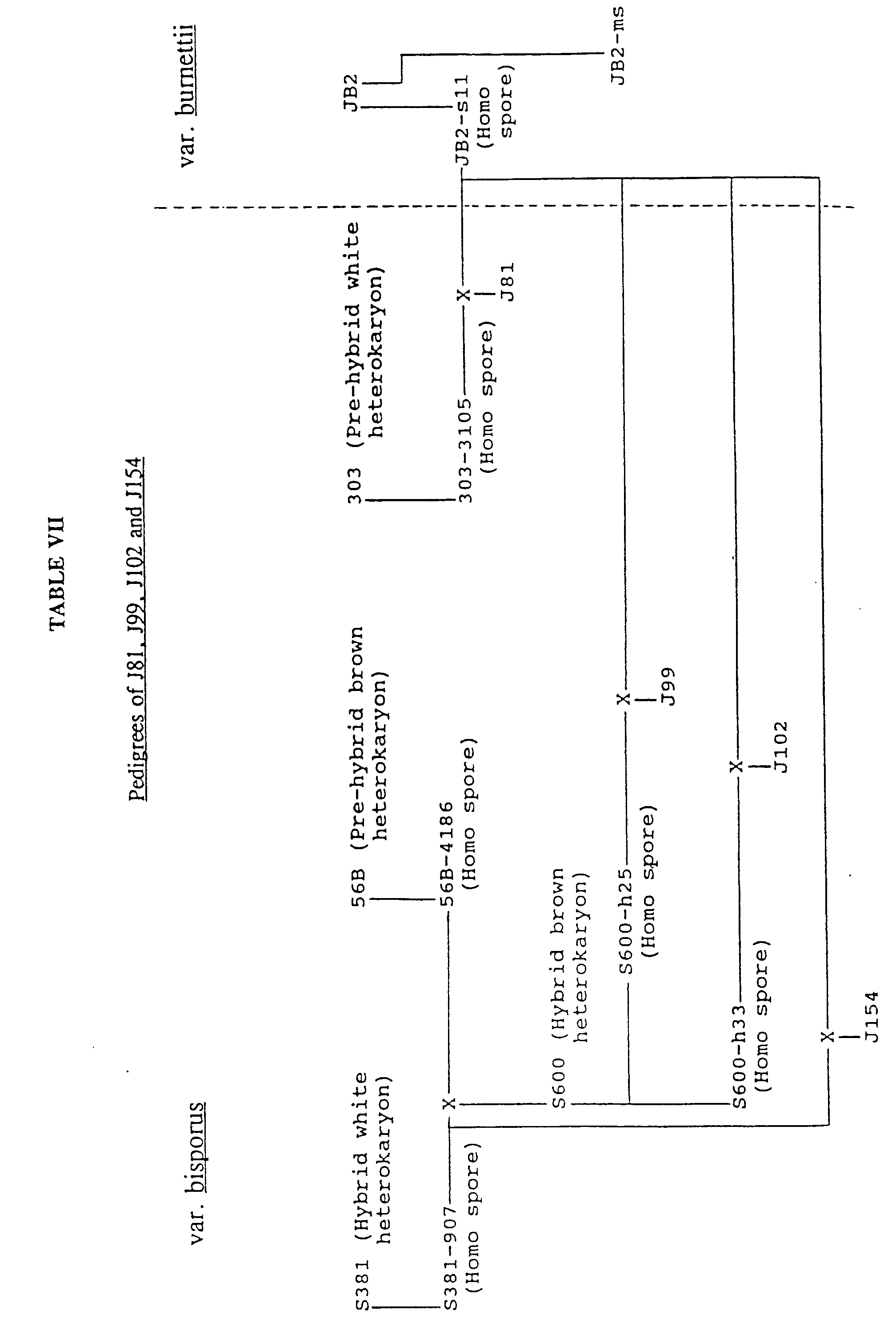
- In accordance with commercial practice, the novel hybrid heterokaryons formed from each cross were transferred to grain culture, and then to compost culture, to permit the production of hybrid mushrooms. Mushrooms were produced in all crosses in all cases. These mushrooms have basidia which predominantly bear at least three spores as reported in Table VIII hereinbelow. The proportions of four-spored and other basidia were determined by light microscopy as discussed in Kerrigan and Ross, "Dynamic Aspects of Basidiospore Number in Agaricus," Mycologia, 79(2), 204-215 (1987). Specifically, light microscopy was performed with a Nikon compound microscope with a 20x objective and 10x ocular. Lamellae were excised from the freshly harvested subject mushrooms and placed on a glass slide to form a "dry mount". Observations were made immediately by transmitted light. Basidia were sampled by selecting an area of the lamella at random, and most or all basidia at the appropriate developmental stage within that visual field were scored. Successive fields were scored until one hundred (100) basidia had been scored. This was typically repeated on two additional lamellae to furnish a total sample of three hundred (300) basidia from each hybrid mushroom. Basidia which had aborted spores or asynchronous spore development were excluded from scoring, as were basidia so mature that one or more spores might have been discharged prior to observation.

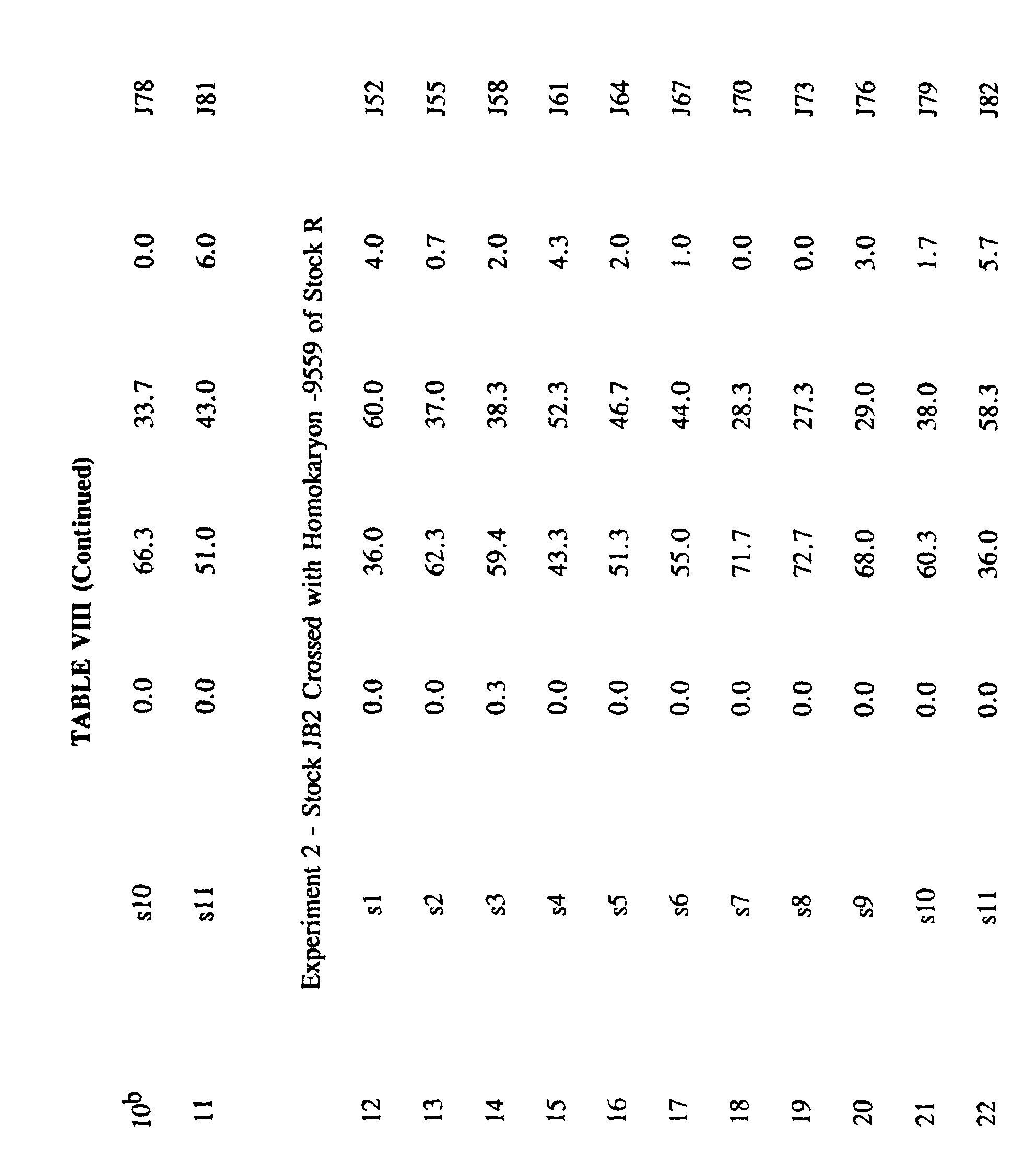


- Thus, based upon data collected and present evidence, it should be clear that at least 90 percent of the basidia produced in mushrooms of each hybrid strain are elevated to a higher spore number with respect to the two-spored condition prevailing in the bisporic parent. While the two-spored condition is not explicitly shown for Stock R in Table V, which is employed in Experiments 2 and 3 in Table VIII, it will be appreciated that tests have been performed on this stock which do show that it is, in fact, predominantly bisporic. Notably, the percentage of two-spored basidia has been reduced in the hybrid strains to less than 10 percent. Inasmuch as every first generation, intervarietal hybrid always expresses this elevated basidial spore number trait, the trait exhibits genetic dominance.
- Furthermore, the percentage of homokaryons and heterokaryons produced by the spores of three of these first-generation intervarietal hybrids are shown in Table IX. Based upon the results presented in this Table, it is noted that the 54 to 57 percent production rate of homokaryons from the spores of hybrids J99 and J102 is more than five times the percentage production rate observed in any other normal bisporic strain, and is closer to 10 to 50 times the rate ordinarily obtained. Clearly, high proportions of homokaryons are produced by the spores of these hybrid mushrooms.
Percentage of Homokaryons Found in Hybrids Hybrid ID % Homokaryons % Heterokaryons No. of Spores Examined J81 12.0 88.0 25 J99 54.2 45.8 24 J102 56.7 43.3 30 - With respect to the rather low proportion of homokaryons shown for J81 in Table IX this result can be explained best by the existence of a greater mortality rate among homokaryotic spores. While spore mortality is high for both heterokaryotic and homokaryotic spores (80 to 99% is common), mortality may be higher among homokaryotic spores produced by certain heterokaryons. With particular reference to Figure 2, empirical evidence for this fact is found in the article "Strategies for the Efficient Recovery of Agaricus bisporus Homokaryons" by Kerrigan et al. in Mycologia, 84(4), 575-579 (1992). Specifically, the growth rate frequency distribution curves for homokaryotic single spore isolates may be sharply truncated at the zero growth (inviability) point in contrast to those for heterokaryotic single spore isolates, suggesting that a disproportionately greater number of homokaryotic spores are inviable. The theoretical basis of this hypothesis is that secondary homothallism may favor the accumulation of recessive deleterious alleles, including those producing lethality in the haploid or homoallelic state.
- To demonstrate that the present invention can utilise virtually any strain of var. burnettii as a tetrasporic parent in a cross to produce a hybrid heterokaryon having the elevated spore number trait, a series of intervarietal hybrid crosses were constructed using a very diverse selection of wild var. burnettii isolates. This sample, drawn from the list in Table 1 hereinabove, were collections that represented all of the known field sites and two different habitats from which isolates of var. burnettii were collected in March of 1992. The field sites are all within about 5 kilometers from each other. The geographical range of var. burnettii is not known.
- The collections chosen for this experimental demonstration, the two var. bisporus to which they were crossed, the hybrid strain identifiers assigned to the new, resultant intervarietal hybrids, and the spore number data on the resultant hybrids are disclosed in Table X hereinbelow.

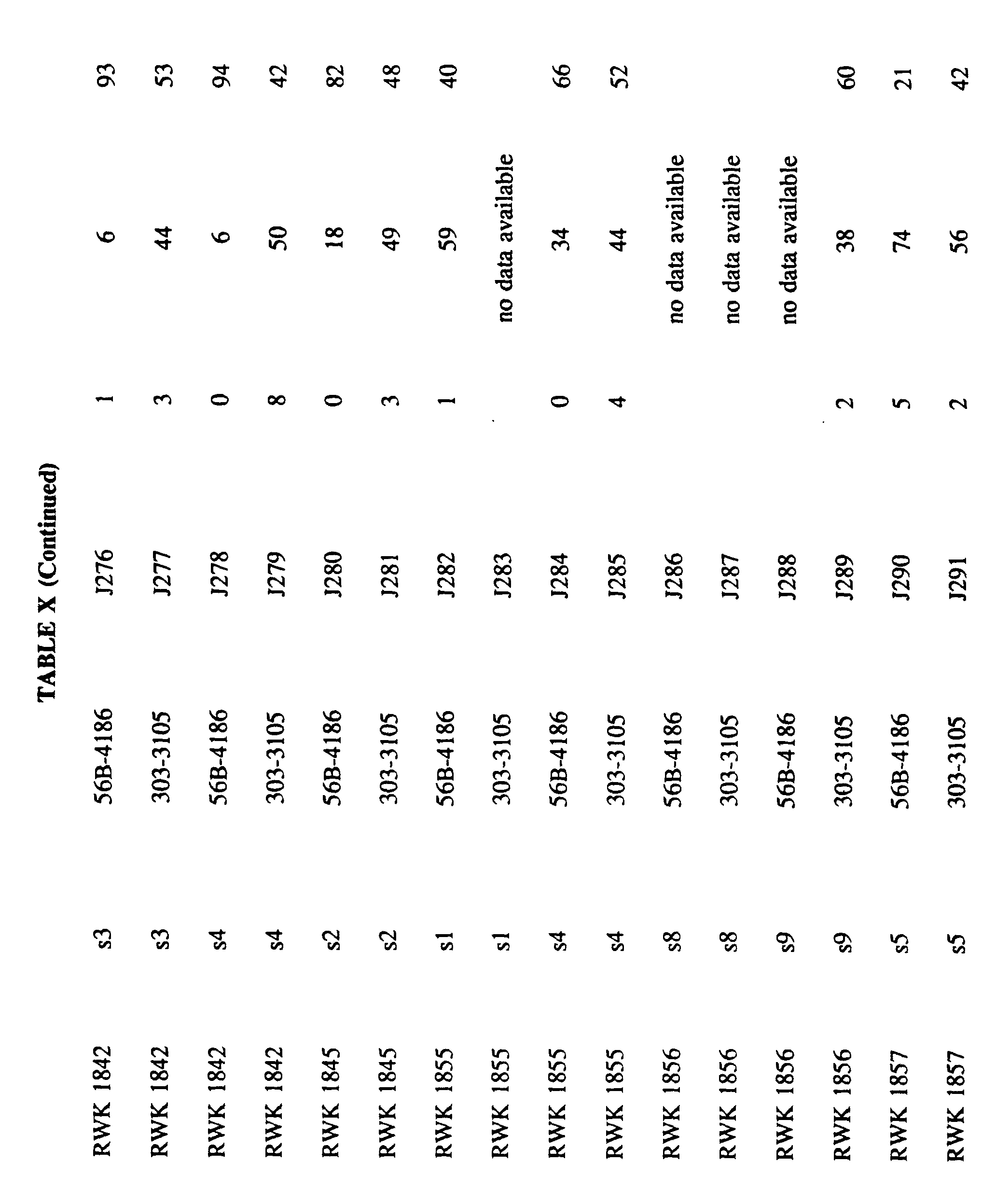

- Spore number data on the parents of 303-3105 and 56B-4186 are provided hereinabove in Table V. Both are highly bisporic isolates of var. bisporus. Therefore, the dominant expression of the elevated spore number trait in the above intervarietal hybrids, seen most clearly as a reduction of the percentage of bisporic basidia to about 8 percent or less, confirms that most and perhaps all stocks of var. burnettii may be employed in the method of the present invention. A small number of crosses in the above test were unsuccessful. For example, JB 105-s1 mated only with 303-3105, and JB 106-s9 mated only with 56B-4186. This is consistent with mating type incompatibility, resulting from the sharing of a common allele at the mating type locus (MAT) by both homokaryons. This is a common occurrence in var. bisporus matings and does not reflect negatively on the method of the present invention. Six other homokaryons grew poorly on grain and were not useful in matings; again, this is also rather common among var. bisporus homokaryons. One of the tested stocks, RWK 1854, produced 2 such homokaryons, therefore no successful matings were obtained from this stock. This is believed to be a chance result, but no confirmation of this is available at the present time. However, the discovery that some stocks of Agaricus bisporus having tetrasporic ancestry are less desirable for the purposes of the present invention than others, or are even unsuitable, would not materially affect the practice of the method of the present invention.
- To demonstrate that virtually any strain of Agaricus bisporus var. bisporus can be used to form heterokaryons in crosses with var. burnettii homokaryons, the JB2 homokaryons -s8 and -s11 were each crossed individually with three homokaryons of the off-white, pre-hybrid commercial Stock 8132, with two homokaryons of the golden-white, pre-hybrid commercial Stock 671, and with two homokaryons of Stock V1, a proprietary experimental hybrid between homokaryons of wild Stock RWK 1420. In all cases fertile heterokaryons were formed, and in about half of these trials, the yield equaled or exceeded that of the control, the high-yielding commercial strain S301. Three crosses between JB2 and JB3 homokaryons were also successful, resulting in fertile hybrid var. burnettii heterokaryons. In these experiments, the basidial spore numbers of the hybrid mushrooms were not determined.
- It has also been determined that the elevated spore number trait which is found in the tetrasporic var. burnettii of Agaricus bisporus is a genetically-determined trait. Based upon results of the initial experiments provided in Table VIII, this trait is always inherited and expressed in the first hybrid generation. This is a hallmark of genetic dominance, and no other explanation satisfactorily explains the inheritance of this stable trait in all first-generation hybrids.
- Formal genetic analysis was undertaken by preparing a series of 60 second-generation intervarietal hybrids. In these hybrids (J203 - J262), the first homokaryon was selected from among 12 prepared from spores of first-generation hybrid J102, and the second (non-intervarietal hybrid) homokaryon was from one of five strains of the bisporic var. bisporus. These five strains included:
Homokaryon Strain type S381-907 Hybrid White Cultivar 8132-8010 Pre-hybrid Off-white Cultivar 303-3105 Pre-hybrid White Cultivar WQ-9525 Pre-hybrid White Cultivar RWK 1420-s5 Wild Non-hybrid Coastal-Californian isolate - The results of each cross are set forth in Table XI hereinbelow. Each of the five bisporic strains has been grouped as a separate experiment for the convenience of the reader.
Results of Individual Crosses Between the Four-Spored Hybrid Stock J102 and Various Two-Spored Stocks of Agaricus bisporus Percentage of N-spored Basidia Trial Homokaryon Hybrid ID 2-Spored 3-Spored 4-Spored Experiment A - Homokaryons from Hybrid Strain J102 Crossed with Homokaryon -907 of Stock S381 1 s11 J203 -- NS -- 2 s12 J208 -- NF -- 3 s25 J213 9 59 32 4 s30 J218 -- NF -- 5 s15 J223 -- NS -- 6 s23 J228 99 1 0 7 s31 J233 -- NS -- 8 s40 J238 -- NF -- 9 s10 J243 7 49 44 10 s19 J248 -- NF -- 11 s22 J253 -- NS -- 12 s27 J258 -- NS -- Experiment B - Homokaryons from Hybrid Strain J102 Crossed with Homokaryon -8010 of Stock 8132 13 s11 J204 30 63 7 14 s12 J209 -- NF -- 15 s25 J214 2 52 46 16 s30 J219 53 41 6 17 s15 J224 36 63 1 18 s23 J229 29 63 8 19 s31 J234 20 69 11 20 s40 J239 23 57 20 21 s10 J244 10 60 30 22 s19 J249 18 67 15 23 s22 J254 14 68 18 24 s27 J259 -- NF -- Experiment C - Homokaryons from Hybrid Strain J102 Crossed with Homokaryon -9525 of Stock WQ 25 s11 J205 96 4 0 26 s12 J210 90 10 0 27 s25 J215 26 63 11 28 s30 J220 23 61 6 29 s15 J225 84 16 0 30 s23 J230 54 33 3 31 s31 J235 87 13 0 32 s40 J240 79 21 0 33 s10 J245 2 53 45 34 s19 J250 91 9 0 35 s22 J255 60 40 0 36 s27 J260 98 2 0 Experiment D - Homokaryons from Hybrid Strain J102 Crossed with Homokaryon -s5 of Stock RWK 1420 37 s11 J206 43 56 1 38 s12 J211 77 23 0 39 s25 J216 16 62 22 40 s30 J221 -- NF -- 41 s15 J226 22 75 3 42 s23 J231 13 65 22 43 s31 J236 48 49 3 44 s40 J241 81 18 1 45 s10 J246 11 54 35 46 s19 J251 73 27 0 47 s22 J256 24 64 12 48 s27 J261 -- NF -- Experiment E - Homokaryons from Hybrid Strain J102 Crossed with Homokaryon -3105 of Stock 303 49 s11 J207 96 4 0 50 s12 J212 90 10 0 51 s25 J217 12 59 29 52 s30 J222 27 65 8 53 s15 J227 99 1 0 54 s23 J232 87 13 0 55 s31 J237 95 5 0 56 s40 J242 70 26 4 57 s10 J247 6 59 35 58 s19 J252 93 7 0 59 s22 J257 84 16 0 60 s27 J262 100 0 0 NF= non-fruiting NS= non-sporulating - Crosses to 8132-8010 and RWK 1420-s5 exhibited a range of elevated basidial spore numbers, but Mendelian segregation could not be clearly discerned. However, in crosses to 303-3105 and to WQ-9525, the spore-number trait of these second-generation intervarietal hybrids resolved clearly into two groups. Nine of the 12 crosses to 303-3105 had at least about 70% 2-spored basidia, while the remaining three crosses had about 27% or fewer 2-spored basidia. An inverse relationship was observed for 4-spored basidia in these 12 crosses. In the 12 crosses to WQ-9525, the cutoffs for percentage of 2-spored basidia that separated the two groups were greater than about 54% versus less than about 26%. The spore number values within each pair of crosses to WQ-9525 and 303-3105 were similar, indicating that the genetic makeup of the particular J102 homokaryon determined the expression of the trait in hybrid offspring. Thus, the data from the 24 crosses to WQ-9525 and 303-3105, in conjunction with the pedigree and spore number data presented above, clearly indicate that the elevated basidial spore number trait (in this experiment seen best as the replacement of 2-spored basidia with 3- and 4-spored ones) is controlled primarily by a single segregating genetic determinant. This proves that elevated spore number is a genetically determined trait. The gene locus that determines this trait has been provisionally named SNT. It further shows that the trait is expressed in the second, as well as the first, hybrid generation. Additional data below, presented in an example of the application of this technology to gene mapping, further support this assertion. Other data presented herein demonstrate that the elevated spore number trait exhibits genetic dominance.
- Homokaryon S381-907 is a direct progenitor (essentially a gamete of the grandparent S381) of J102, and few of the back-crosses between J102 homokaryons and S381-907 developed normally, probably due to the effects of inbreeding. However, of those which did fruit and sporulate normally, two (J213 and J243) had about 32% and about 44% 4-spored basidia, respectively, and about 91% and about 93% at least 3-spored basidia, respectively. This ratio is not significantly different from the range of percentages given above for J102. Therefore, it is clear that the elevated spore number trait was retained in two back-crosses to the commercial var. bisporus cultivar S381. In contrast, a third back-cross (J228) had no four-spored basidia and 99 percent two-spored basidia. The influence of each individual J102 homokaryon on spore number in these three crosses was in complete agreement with observations on the crosses to Stocks 303 and WQ described hereinabove.
- J213 and J243 are expected to have, on average, about 5/8 (62.5%) ancestry from S381, as opposed to the 50% that a first-generation hybrid, such as J154 (see Pedigree Chart hereinabove), will have. Ancestry, used quantitatively, is equivalent to the fraction of DNA inherited from a progenitor. However, because chromosomes assort independently and because of the infrequency of crossing over which occurs in Agaricus bisporus during meiosis, this percentage could actually be much higher (or lower) in any individual case. By using various breeding strategies and making additional generations of back-crosses, and by using genetic markers to select for homokaryons which have inherited more than 50% of their genome from the back-cross parent (e.g., S381), it is ultimately possible to construct one or a series of heterokaryons or homokaryons in which all of the genome, excluding a small chromosomal segment encompassing the spore number trait determining locus, comes from the back-cross parent. In other words, one or more strains having about 99% of their DNA from a var. bisporus strain like S381, and only about 1 % from a var. burnettii strain like JB2, but expressing the elevated spore number trait originating in a var. burnettii strain, can be constructed using this method. The problem of inbreeding depression, which may be responsible for the high frequency of developmental problems in these back-crosses discussed hereinabove, can be ameliorated by back-crossing to sibling homokaryons of those from which the hybrid intermediates are descended. In other words, a different, sibling homokaryon of S381-907, when used in a cross between S381 and J102, will exhibit enough genetic differences from S381-907 to produce hybrids with less homozygosity than what is predicted to exist in the 12 back-crosses to S381-907. Homozygosity is an underlying cause of inbreeding depression.
- At this point, it is noted that although the crossing of homokaryons is the preferred method of obtaining hybrids, it is also sometimes possible to cross a homokaryon with a heterokaryon or, in rare instances, to cross two heterokaryons. For example, some single-spore isolates from wild stocks of the tetrasporic var. burnettii of Agaricus bisporus are both self-fertile (and therefore heterokaryotic) and produce only white mushrooms (therefore lack a functional gene necessary for brown pigment production). When one such single-spore isolate (RWK 1845-s1) was paired with the homokaryon 56B-4186 of var. bisporus (which is not self-fertile, but which when mated always produces brown mushrooms because it carries a functional, dominant allele for brown pigment production), brown mushrooms were produced abundantly and exclusively as shown in Table XII. RWK 1845-s1 is a single-spore isolate from field collection RWK 1845 of the tetrasporic var. burnettii of Agaricus bisporus, collected within 3 kilometers of JB2 and JB3. Yield is the arithmetic mean of all replicates (usually three) of about 0.3 square feet each. The data shows that a mating between the var. burnettii heterokaryon and the var. bisporus homokaryon occurred and produced a high yielding brown hybrid.
Demonstration of Heterokaryon-Homokaryon Mating Isolate(s) Test Yield (grams) Color of Mushroom RWK 1845-s1 1 63 White 2 235 White 56B-4186 x 0 RWK 1845-s1 x 56B-4186 1 280 Brown 2 230 Brown Control (S600) 1 214 Brown 2 192 Brown - Continuing, the present invention may also include genetically engineering the tetrasporic trait into bisporic strains or stocks. That is, it is now possible to transform a diverse array of eukaryotic cells with exogenous DNA, thereby selectively incorporating individual genes determining economically important traits into the genetic background of an individual line or stock of the mushroom in question. It is now reasonable to believe that Agaricus bisporus may be transformed with respect to the spore number trait using recombinant DNA techniques.
- The first step in this process involves locating (mapping) and isolating the DNA segment that encodes the gene locus responsible for expression of the "tetrasporic" trait in Agaricus bisporus var. burnettii. As noted hereinbelow, it has already been determined that a single genetic determinant, hereinafter called the Spore Number Trait locus (SNT), or possibly a cluster of linked loci within a single DNA segment, controls most or all of the expression of this trait in Agaricus bisporus, and that this locus lies very close to the PEP1 locus, as more specifically detailed hereinbelow. In Kerrigan et al., "Meiotic Behavior and Linkage Relationships in the Secondarily Homothallic Fungus Agaricus bisporus," Genetics, 133: 225-236 (1993), incorporated herein by reference, several allozyme and DNA RFLP and RAPD markers, including PEP2, R4-1, R4-3, P1N17, P1N31, P1N148, P1N150, P33N25, P33N25 and R18-6, have been mapped to within about 58.3, and to within as little as about 5.1 centiMorgans of PEP1, on Chromosome I of the nuclear genome. By quantifying the joint segregation of markers with SNT, the location of SNT can be pinpointed.
- With this information, a chromosome walk is performed from one or more of these mapped DNA RFLP markers to the SNT locus. First, one may construct an ordered cosmid library of genomic DNA from Agaricus bisporus, using lambda phage as vector and maintaining the recombinant clones in E. coli. Ideally this library would contain only DNA from Chromosome I, which can be isolated by an alternating field electrophoresis technique such as contour-clamped homogeneous electrical field (CHEF) electrophoresis of whole-chromosome DNAs, following a preferred procedure discussed in Royer et al., "Electrophoretic Karyotype Analysis of the Button Mushroom Agaricus bisporus," Genome, 35: 694-698 (1992), herein incorporated by reference, or a modification thereof. Overlapping homologous segments of DNA inserts in cosmids would permit the sequential ordering of the library via repeated hybridization of blots of clones in the library to probes incorporating ever more distant contiguous segments.
- Such a walk will conventionally extend from a flanking marker through SNT to a flanking marker on the opposite side of SNT. Once this has been achieved, the approximate location of SNT can be estimated by comparing the recombinational distances between the two flanking markers and SNT, using the map data disclosed hereinbelow, with the cumulative lengths of all of the cosmid inserts in the spanned interval. Based on this estimate, the cosmid most likely to contain SNT can be identified. The inserted DNA from this cosmid could be subcloned, incorporated into a suitable vector, such as pUC18, and introduced into hyphae or protoplasts of a recipient Agaricus bisporus strain. The plasmid vector construct should provide positive selection for retention of plasmid in host, and for insertion of DNA of interest into a cloning site in the plasmid sequence. A number of other refinements might be incorporated into such a recombinant vector, depending upon which strategies are ultimately successful in transforming Agaricus bisporus, including detection of the recombinant DNA in the target cells, and whether homologous or non-homologous integration, or maintenance of the plasmid as a self-replicating cytoplasmic component, is preferred.
- The recipient strain can be either a heterokaryon or a homokaryon, but will ordinarily carry no alleles for the "tetrasporic" trait; in other words, a bisporic strain will ordinarily be desired. Because the tetrasporic trait disclosed herein exhibits genetic dominance, the presence of the DNA of interest will be verifiable in any transformed strain because the tetrasporic trait will be expressed in mushrooms produced by a transformed homokaryon (or the hybrid produced by crossing a transformed homokaryon with another, compatible, bisporic homokaryon). This can be determined by fruiting the mushrooms and examining them microscopically. While this is an expensive and time-consuming assay, it is straightforward. If gene-dosage effects reduce expression of the novel DNA in a transformed hybrid, then homologous integration of the exogenous DNA to replace at least one copy of the (bisporic allele of the) SNT gene might be necessary.
- DNA from cosmids increasingly distant from the most likely cosmid can also be used to transform the recipient strain. This series of experiments will continue until, at some point, a cosmid clone, or a subclone, is found which causes expression of the trait in a transformed hybrid.
- At this point, the open reading frame (ORF) associated with the gene can be identified (through further subcloning and reconfirmation via transformation), sequenced, and studied. The subclone, in the appropriate vector, can be used to introduce the SNT gene controlling the trait into any bisporic strain of interest, without introducing any other trait from var. burnettii or losing any trait, other than bispory, form the target strain. From the sequence data, it may be possible to understand the nature of the gene product and the mechanism by which it determines the pattern of basidiospore formation at the basidial apex. Finally, it may be possible to engineer new sequences which, when introduced, will have superior properties in terms of expression levels, the nature of the spore number pattern determined, or other improvements.
- Turning to gene mapping, although heterokaryotic single-spore isolate progeny of Agaricus bisporus individuals are inbred, they exhibit little of the loss of parental heterozygosity that is characteristic of self-fertilization in most eukaryotes. As a result, Mendelian segregation of alleles is not observed in most single-spore offspring of var. bisporus, because most spores are heterokaryotic. To carry out gene mapping (in other words, to locate genes that control important phenotypic traits), it is necessary to determine whether alleles at two or more loci segregate jointly or independently, for example by characterizing the genotypes and/or phenotypes of a sufficient number of homokaryon offspring. By a sufficient number, it is meant that the number be great enough either to permit a sufficiently powerful statistical test of linkage, or to furnish a representative sample of individuals in pools of samples which are grouped into classes by trait. This number of homokaryons will vary inversely with the recombinational distance separating two loci, approaching infinity as the recombinational distance approached 50 percent, or conversely, becoming as little as 12-20 when two loci are absolutely linked. It is normally possible to use every homokaryon of a basidiomycete species to furnish data used in gene mapping. Therefore, any method which increases the ability to obtain homokaryons from Agaricus bisporus, for example by increasing the fraction of homokaryons above the typical 3 percent and even above the exceptional about 10 percent, is of corresponding value to efforts to map genes in this species.
- Once genes are mapped, it is possible to use linked flanking markers to follow them through crosses, which is of great value in efficiently breeding traits into or out of breeding stock and new hybrids. Thus, the present invention is of great value in this related aspect of mushroom breeding.
- An example of gene mapping in Agaricus bisporus using the present invention is detailed hereinbelow. Specifically , with reference to the data pertaining to the second-generation crosses between the 12 homokaryons of J102 and the five var. bisporus homokaryons, the 12 J102 homokaryons were characterized genotypically at two allozyme marker loci, PEP1 and BGLU, in accordance with the method presented in Kerrigan and Ross, "Allozymes of a Wild Agaricus bisporus Population: New Alleles, New Genotypes," Mycologia 81:433-443 (1989). Genotypes for all 12 J102 homokaryons are presented in the Table XIII hereinbelow.
Genotype Data for J102 Homokaryons J102 PEP1 BGLU s11 S600-h33 JB2-s11 s12 S600-h33 JB2-s11 s25 JB2-s11 JB2-s11 s30 JB2-s11 JB2-s11 s15 S600-h33 JB2-s11 s23 S600-h33 JB2-s11 s31 S600-h33 S600-h33 s40 -- JB2-s11 s10 JB2-s11 JB2-s11 s19 S600-h33 JB2-s11 s22 S600-h33 JB2-s11 s27 S600-h33 JB2-s11 PEP1 BGLU JB2-s11 S600-h33 JB2-s11 S600-h33 JB 2-s11 3 0 3 0 SNT1 S600-h33 0 8 7 1 - The ratio of parental to recombinant genotypes for the two loci, PEP1 and SNT is 11:0. While the data are too few to permit a conventional chi-squared test of linkage, the direct probability of obtaining this result by chance is only about 3% (=8/11)11. This exceeds the 5% error threshold conventionally used in genetic linkage analysis. This result provides preliminary evidence of tight linkage between the two loci PEP1 and SNT. Conversely, for the two loci BGLU and SNT, parentals do not even exceed recombinants, providing no evidence of linkage between these two loci.
- In related experiments, it has also been determined that the loci PEP1 and PEP2 are tightly linked to the mating-type locus, provisionally named MAT. In S600, a commercial var. bisporus strain, a Punnet square for PEP2 and MAT gave 36 parentals : 0 recombinants. This is highly significant evidence of tight linkage: chi-squared = 36.0. From prior work, it is known that PEP1 and PEP2 are linked at a distance of about 6 percent recombination. Therefore, PEP1, PEP2, MAT, and SNT are all linked, apparently fairly tightly. Accordingly, each locus serves as a marker for the inheritance of traits determined by the other, linked loci. For example, PEP1 and PEP2 each mark both MAT and SNT, permitting these traits to be scored in homokaryons without necessitating the making of test-crosses, nor, in the case of SNT, the producing of crops of hybrid mushrooms followed by microscopic examination. Similarly, in a cross where both PEP1 and PEP2 were homozygous, and therefore uninformative, in the resulting hybrid, MAT and SNT would still serve as predictive markers for each other. The confidence level associated with predictions based on linked marker scores depends upon the degree of linkage existing between each pair of markers, which may vary somewhat from strain to strain, and which, even in the best studied cases, is still only approximately known for these loci.
- It has been found that most hybrid intervarietal heterokaryons resulting from crosses between the tetrasporic var. burnettii and the bisporic var. bisporus of Agaricus bisporus tend to produce mushrooms in a shorter period of time than do isolates of var. bisporus. Specifically, after the casing soil layer is applied to compost which is fully colonized by the mushroom mycelium, mushrooms on intervarietal hybrid strains develop and are ready for harvest in fewer days than do mushrooms on var. bisporus strains. Additionally, it appears that colonization of the compost by the mycelium of the intervarietal hybrid strain is, in many cases, sufficiently vigorous to permit application of the casing layer one or more days earlier than what is customary for strains of var. bisporus, without resulting in a yield reduction. Both of these advantages may be combined to further shorten the duration of the crop cycle. Any such shortening of the crop cycle increases the number of crops that can be produced in a mushroom farm in a fixed period of time, which increases profitability of the farm. This crop cycle is, in part, under the control of the grower, rather than the mushroom, so the meaningful commercial comparison between strains must also be based upon the yield of mushrooms when different spawn to case intervals are imposed. The acceleration of the life cycle also represents an advantage in experimental breeding programs by permitting more rapid progress.
- A test for early fruiting was performed as indicated generally hereinabove. In the test, three intervarietal hybrids, J81 (JB2-s11 x 303-3105), J82 (JB2-s11 x RWK 1420-9559), and J83 (JB2-s11 x RWK 1420-s5), and one commercial control, S130 (commercial hybrid var. bisporus strain), were employed. Each of the hybrids was cased with soil except one J83 (peat) which was cased in peat. No peat control was furnished. The results of this test are disclosed in Table XIV hereinbelow.
Results of Early Fruiting Test Hybrid or Control ID Spawn run (days) Case to Pick (days) Yield (grams) Yield (% of control) J81 8 14.0 4116 113.0 J82 8 14.3 4282 117.6 J83 8 14.0 3828 105.1 S130 (Control) 8 15.8 3642 100.0 Intervarietal hybrid advantage 1.7 days 11.9% J81 10 15.7 3938 85.0 J82 10 13.2 3736 80.7 J83 10 13.0 3869 83.5 S130 (Control) 10 15.3 4631 100.0 Intervarietal hybrid advantage 1.3 days -16.9% J83 13 12.7 4315 102.1 J83 (peat) 13 12.5 4734 (112.0) S130 (Control) 13 15.0 4227 100.0 Intervarietal hybrid advantage 2.3 days 2.1% - Overall speed advantage for intervarietal hybrids in all three spawn run durations was ca 1.7 days. Data are means of six replicates, each having about 0.25 square meters of cropping surface. The median yields (not shown) for all treatments and controls were not significantly different at the 95% confidence level. Thus, it can be concluded from these data that (1) the crop is ready for harvest almost 2 days earlier, on average, in the case of three intervarietal hybrids relative to the commercial var. bisporus control; and (2) the average yield is comparable between the experimental and control strains. It is also appears that the performance difference of the intervarietal hybrid as compared to the commercial var. bisporus control may tend to favor the intervarietal hybrids at the shortest spawn run durations.
- Furthermore, the data presented hereinbelow indicate that intervarietal hybrids between the tetrasporic var. burnettii and the bisporic var. bisporus of Agaricus bisporus have yields which are often as high as or somewhat higher than the best performing commercial var. bisporus hybrids. This is unexpected because in evaluating the results of over 3,000 attempted matings between homokaryons of var. bisporus, the production of a novel hybrid capable of achieving this level of performance is almost unprecedented. Evidence of the frequently superior yield performance of the intervarietal hybrids as a group is presented in Table XIV hereinabove and Tables XV and XVI hereinbelow.
Results of First Series of J-series Hybrid Yield Tests: Hybrid or Control ID Cross: Case to pick (days) Yield: grams Yield (% of control) First group: (chamber) S600 (Control) 3768 100 A93 (Secondary control) 3820 J81 JB2-s11 x 303-3105 2 4514 119.8 J60 JB2-s4 x 303-3105 2 4863 129.0 J72 JB2-s8 x 303-3105 1 4469 118.6 First group: (mine) S600 (Control) 3658 100 S381 (Secondary control) 3449 J81 JB2-s11 x 303-3105 3-4 4050 110.7 J82 JB2-s11 x 1420-9559 3-4 3981 108.8 J83 JB2-s11 x RWK 1420-s5 3-4 3962 108.3 J60 JB2-s4 x 303-3105 3-4 4265 116.6 J72 JB2-s8 x 303-3105 2-3 3311 90.5 Second group: (mine) S600 (Control) 3613 100 J56 JB2-s2 x RWK 1420-s5 1 3530 97.7 J57 JB2-s3 x 303-3105 1 3705 102.5 J61 JB2-s4 x 1420-9559 1 3668 101.5 J76 JB2-s9 x 1420-9559 1 3897 107.9 J80 JB2-s10 x RWK 1420-s5 2 4311 119.3 Third group (mine): S600 (Control) 3650 S381 (Secondary control) 3888 J75 JB2-s9 x 303-3105 1 4111 112.6 J51 JB2-s1 x 303-3105 1 4062 111.3 J71 JB2-s7 x RWK 1420-s5 0 2706 74.1 J58 JB2-s3 x 1420-9559 2 4525 124.0 Fourth group (mine): S600 (Control) 4310 J52 JB2-s1 x 1420-9559 1 4963 115.2 J64 JB2-s5 x 1420-9559 0-1 3212 74.5 J79 JB2-s10 x 1420-9559 1 3553 82.4 J77 JB2-s9 x 1420-s5 1 4441 103.0 Semi-finalist Yield Test Series: J-series Hybrids Hybrid or Control ID Cross Case to pick: (days) Yield (grams) Yield (% of control) First group S130 (Control) 16.3 3400 100.0 J90 JB2-s11 x S600-h1 13.0 3787 111.4 J105 JB2-s11 x S600-h2 13.3 4295 126.3 J104 JB2-s11 x S600-h3 13.7 4708 138.5 J114 JB2-s11 x S600-h20 13.5 4635 136.3 J116 JB2-s11 x S600-h31 13.8 3905 114.9 J154 JB2-s11 x S381-907 12.8 3572 105.1 Second group S130 (Control) 16.0 3571 100.0 J108 JB2-s11 x S600-h12 13.2 4689 131.3 J117 JB2-s11 x S600-h35 13.7 4678 131.0 J119 JB2-s11 x S600-h37 13.7 4582 128.3 J120 JB2-s11 x S600-h38 13.0 5018 140.5 J121 JB2-s11 x S600-h42 14.0 4514 126.4 J125 JB2-s11 x S600-h49 13.0 4740 132.7 Third group S130 (Control) 15.7 4586 100.0 J91 JB2-s11 x S600-h5 13.8 3922 85.5 J92 JB2-s11 x S600-h7 13.2 4066 88.7 J96 JB2-s11 x S600-h21 13.2 4005 87.3 J100 JB2-s11 x S600-h28 13.0 4450 97.0 J102 JB2-s11 x S600-h33 13.0 4560 99.4 Fourth group S130 (Control) 15.7 4594 100.0 J95 JB2-S11 x S600-h17 13.3 4663 101.5 J97 JB2-s11 x S600-h22 13.5 4454 97.0 J109 JB2-s11 x S600-h13 13.7 4783 104.1 J113 JB2-s11 x S600-h19 13.7 4876 106.1 J118 JB2-s11 x S600-h36 13.7 4586 99.8 J89 JB2-s9 x 56B-4186 13.2 4349 94.7 J156 JB2-s11 x WQ-9525 15.8 3700 80.5 Avg. 2.5 106.6% - In summary, the J-series hybrids, although picked 2.5 days earlier, on average, yielded 6.6 percent more, on average, than the best performing commercial control strain. The two to three day reduction in the case to pick interval represents a 5.7 to 8.6 percent reduction in cycle time in a commercial tray-based cropping room leading to a proportional increase in profitability.
- Based upon the foregoing disclosure, it should now be apparent that crossbreeding a four-spored Agaricus bisporus mushroom, the spores of which are homokaryotic, and a two-spored mushroom of the same species, as described herein, will carry out the objects set forth hereinabove. Although the crossing of homokaryons is the preferred method of obtaining hybrids, it is also possible to cross a homokaryon with a heterokaryon or, in rare instances, to cross two heterokaryons. Thus, while homokaryons have been described throughout the specification, it should be understood that either homokaryons or heterokaryons, in any combination, may be employed (see Table XII). It is also possible to produce hybrids of Agaricus bisporus in less fully-defined situations in which mixtures of spores, protoplasts, or hyphal fragments are allowed to germinate or regenerate in mass cultures of uncertain ploidy, from which hybrid heterokaryons may subsequently be selected.
- Moreover, it is also noted that the hybrids described hereinabove were eminently suitable for the production of mushroom spawn and other inocula. Accordingly, it will be understood that mushrooms produced by the hybrid heterokaryons of the present invention, as well as the commercial products incorporating the heterokaryons or homokaryons, or other processes or products which utilize the heterokaryons or homokaryons, are within the scope of the present invention. Spawn is one such commercial product.
- Still further, it will be appreciated that the present invention does not necessarily relate to the intervarietal hybrid stocks. The crossing of two intravarietal stocks of Agaricus bisporus var. burnettii is also envisioned as falling within the scope of the present invention. It is also to be understood that any variations evident fall within the scope of the claimed invention and thus, the selection of specific crossbreeding techniques, and sources of and utilization of homokaryons or heterokaryons can be determined without departing from the spirit of the invention herein disclosed and described. Therefore, it is to be understood that other means of recombining genes, such as by genetic engineering, using recombinant DNA technology, may also be employed for the present invention. Thus, the scope of the invention shall include all modifications and variations that may fall within the scope of the attached claims.
Claims (9)
- A method for introducing a trait for the production of mushrooms which produce basidia, among which basidia bearing at least three spores predominate, into stocks of the mushroom Agaricus bisporus comprising the steps of: providing a first strain, from a first stock of Agaricus bisporus having tetrasporic ancestry, carrying at least one gene that determines the trait for production of basidia which predominantly bear at least three spores; and incorporating said at least one gene into the genetic background of at least a second strain, from a second stock of Agaricus bisporus, such that the new resultant stock combines characteristics of said second stock with the trait.
- A method according to Claim 1, for the production of homokaryons from breeding stock of the mushroom Agaricus bisporus wherein the step of incorporating said at least one gene into the genetic background of at least the second strain comprises crossing said first strain with at least the second strain of Agaricus bisporus to form at least one hybrid heterokaryotic culture, said at least one hybrid heterokaryotic culture being capable of producing mushrooms, the basidia of which predominantly bear at least three spores, a fraction of said spores being homokaryotic.
- A method according to Claim 1 for selectively introducing an elevated basidial spore number trait into stocks of Agaricus bisporus further comprising the steps of: mapping a gene locus which determines the elevated basidial spore number trait; and cloning an allele of said gene locus, which causes expression of the elevated basidial spore number trait, from the first strain of Agaricus bisporus; and wherein the step of incorporating said at least one gene into the genetic background of at least a second strain comprises incorporating a DNA sequence encoding said allele into a nucleic acid vector construct; and introducing said vector construct into the cytoplasm of the second, recipient strain of Agaricus bisporus.
- A method for the production of vigorous hybrid strains of Agaricus bisporus comprising the step of combining genetic material originating from a stock of a tetrasporic variety of Agaricus bisporus with genetic material from at least a second Agaricus bisporus stock.
- Homokaryons carrying at least one gene which determines the trait for the production of basidia, which predominantly bear at least three spores, produced from spores on hybrid mushrooms and their descendants, said hybrid mushrooms formed by providing a first strain of Agaricus bisporus having tetrasporic ancestry and carrying at least one gene that determines the trait for production of basidia, which predominantly bear at least three spores; and crossing said first strain with at least a second strain of Agaricus bisporus to form at least one hybrid heterokaryotic culture; said at least one hybrid heterokaryotic culture being capable of producing said hybrid mushrooms and their descendants.
- Heterokaryons, and their inbred and outcrossed descendants, the heterokaryons carrying at least one gene which determines the trait for the production of basidia, which predominantly bear at least three spores, and being produced from a cross between at least two strains of Agaricus bisporus, at least one of said strains having tetrasporic ancestry and carrying at least one gene which determines the trait for production of basidia which predominantly bear at least three spores.
- Inocula incorporating heterokaryons and their inbred and outcrossed descendants of Claim 6.
- Inocula according to Claim 7 wherein the inocula comprise spawns.
- Mushrooms produced by heterokaryons and their inbred and outcrossed descendants of Claim 6.
Applications Claiming Priority (3)
| Application Number | Priority Date | Filing Date | Title |
|---|---|---|---|
| US07/900,546 US5304721A (en) | 1992-06-18 | 1992-06-18 | Method for the production of high proportions of homokaryons in breeding stock of the mushroom Agaricus bisporus |
| US900546 | 1992-06-18 | ||
| PCT/US1993/005874 WO1994000006A1 (en) | 1992-06-18 | 1993-06-18 | METHOD FOR THE PRODUCTION OF HIGH PROPORTIONS OF HOMOKARYONS IN BREEDING STOCK OF THE MUSHROOM $i(AGARICUS BISPORUS) |
Publications (3)
| Publication Number | Publication Date |
|---|---|
| EP0707443A1 EP0707443A1 (en) | 1996-04-24 |
| EP0707443A4 EP0707443A4 (en) | 1996-05-01 |
| EP0707443B1 true EP0707443B1 (en) | 2002-01-16 |
Family
ID=25412691
Family Applications (1)
| Application Number | Title | Priority Date | Filing Date |
|---|---|---|---|
| EP93915423A Expired - Lifetime EP0707443B1 (en) | 1992-06-18 | 1993-06-18 | Method for the production of high proportions of homokaryons in breeding stock of the mushroom agaricus bisporus |
Country Status (9)
| Country | Link |
|---|---|
| US (3) | US5304721A (en) |
| EP (1) | EP0707443B1 (en) |
| AT (1) | ATE211881T1 (en) |
| AU (2) | AU4539293A (en) |
| CA (1) | CA2134895A1 (en) |
| DE (1) | DE69331470D1 (en) |
| HU (1) | HU220421B (en) |
| MX (1) | MX9303679A (en) |
| WO (2) | WO1994000005A1 (en) |
Families Citing this family (13)
| Publication number | Priority date | Publication date | Assignee | Title |
|---|---|---|---|---|
| US5304721A (en) * | 1992-06-18 | 1994-04-19 | Sylvan Spawn Laboratory Incorporated | Method for the production of high proportions of homokaryons in breeding stock of the mushroom Agaricus bisporus |
| US6521817B2 (en) * | 1992-09-28 | 2003-02-18 | C.T.C. Centre Technique Du Champignon Et Institut | Hybrid strains of Agaricus bisporus, germination of the spores of which provides mainly homokaryons, production and use thereof |
| EP0900027A4 (en) | 1995-02-09 | 2000-03-08 | Amycel Inc | MUSHROOM HATS WITH REDUCED SCALING |
| US5832659A (en) * | 1995-02-09 | 1998-11-10 | Amycel, Inc. | Mushroom caps with reduced scaling |
| US6315145B1 (en) | 1995-07-13 | 2001-11-13 | Sticksafe Llc | Lid for a specimen container that is adapted to minimize spills and leaks |
| FR2758688B1 (en) * | 1997-01-27 | 1999-03-19 | Agronomique Inst Nat Rech | NOVEL AGARICUS BISPORUS HYBRIDS, THEIR OBTAINMENT AND THEIR APPLICATION |
| US7608760B2 (en) * | 2005-08-04 | 2009-10-27 | Amycel Inc. | Brown mushrooms for commercial production |
| USPP19313P3 (en) * | 2006-05-15 | 2008-10-14 | Sylvan Bioproducts, Inc. | Agaricus subrufescens mushroom plant named ‘H1X1’ |
| EP2613623B1 (en) | 2010-07-16 | 2017-11-15 | Sylvan America, Inc. | Methods for production of sporeless agaricus bisporus mushrooms |
| CA2896208A1 (en) * | 2014-01-31 | 2016-09-20 | Richard W. Kerrigan | Mushroom line j10102-s69, hybrid mushroom strain j11500, descendants thereof, and methods and uses therefor |
| US9642333B2 (en) * | 2014-02-21 | 2017-05-09 | Sylvan America, Inc. | Mushroom line B12998-s39 and methods and uses therefor |
| US9017988B1 (en) * | 2014-02-21 | 2015-04-28 | Sylvan America, Inc. | Hybrid mushroom strain B14528 and descendants thereof |
| CN111394491B (en) * | 2019-01-03 | 2021-12-28 | 中国科学院微生物研究所 | Mushroom mating type molecular marker and application thereof in identification of mushroom mating type |
Family Cites Families (5)
| Publication number | Priority date | Publication date | Assignee | Title |
|---|---|---|---|---|
| DE3428988A1 (en) * | 1984-08-07 | 1984-12-13 | Gesellschaft für Pilzforschung Eger-Hummel mbH, 3556 Weimar | Method for the production of homocaryons from di- or heterocaryotic strains of Basidiomycetes |
| US4996390A (en) * | 1989-01-19 | 1991-02-26 | Campbell Soup Company | Novel interspecific mushroom strains |
| USPP7636P (en) * | 1989-06-08 | 1991-08-27 | Sylvan Spawn Laboratory, Inc. | Mushroom plant named Brown Hybrid X618 |
| US5304721A (en) * | 1992-06-18 | 1994-04-19 | Sylvan Spawn Laboratory Incorporated | Method for the production of high proportions of homokaryons in breeding stock of the mushroom Agaricus bisporus |
| FR2696187B1 (en) * | 1992-09-28 | 1994-12-16 | Tech Champignon Centre | New hybrid strains of Agaricus bisporus, the spore germination of which mainly provides homokaryons, their production and use. |
-
1992
- 1992-06-18 US US07/900,546 patent/US5304721A/en not_active Expired - Lifetime
-
1993
- 1993-06-16 AU AU45392/93A patent/AU4539293A/en not_active Abandoned
- 1993-06-16 WO PCT/US1993/005821 patent/WO1994000005A1/en not_active Ceased
- 1993-06-18 AU AU45411/93A patent/AU675229B2/en not_active Ceased
- 1993-06-18 MX MX9303679A patent/MX9303679A/en not_active IP Right Cessation
- 1993-06-18 WO PCT/US1993/005874 patent/WO1994000006A1/en not_active Ceased
- 1993-06-18 DE DE69331470T patent/DE69331470D1/en not_active Expired - Lifetime
- 1993-06-18 CA CA002134895A patent/CA2134895A1/en not_active Abandoned
- 1993-06-18 AT AT93915423T patent/ATE211881T1/en active
- 1993-06-18 US US08/196,139 patent/US5563317A/en not_active Expired - Lifetime
- 1993-06-18 EP EP93915423A patent/EP0707443B1/en not_active Expired - Lifetime
- 1993-06-18 HU HU9403637A patent/HU220421B/en not_active IP Right Cessation
-
1995
- 1995-12-19 US US08/575,700 patent/US5684228A/en not_active Expired - Lifetime
Non-Patent Citations (1)
| Title |
|---|
| MILLER, R.E.: "Evidence of sexuality in the cultivated mushroom, A. bisporus", MYCOLOGIA, vol. 63, 1971, pages 630 - 634, XP000915956 * |
Also Published As
| Publication number | Publication date |
|---|---|
| US5684228A (en) | 1997-11-04 |
| EP0707443A1 (en) | 1996-04-24 |
| HU9403637D0 (en) | 1995-02-28 |
| WO1994000006A1 (en) | 1994-01-06 |
| DE69331470D1 (en) | 2002-02-21 |
| HU220421B (en) | 2002-01-28 |
| EP0707443A4 (en) | 1996-05-01 |
| MX9303679A (en) | 1994-01-31 |
| WO1994000005A1 (en) | 1994-01-06 |
| AU4539293A (en) | 1994-01-24 |
| ATE211881T1 (en) | 2002-02-15 |
| US5563317A (en) | 1996-10-08 |
| AU4541193A (en) | 1994-01-24 |
| CA2134895A1 (en) | 1994-01-06 |
| US5304721A (en) | 1994-04-19 |
| HUT69974A (en) | 1995-09-28 |
| AU675229B2 (en) | 1997-01-30 |
Similar Documents
| Publication | Publication Date | Title |
|---|---|---|
| US6096944A (en) | Methods for conferring broad-based soybean cyst nematode resistance to a soybean line | |
| US9017988B1 (en) | Hybrid mushroom strain B14528 and descendants thereof | |
| US5684228A (en) | Method for the production of high proportions of homokaryons in breeding stock of the mushroom agaricus bisporus | |
| EP2613623B1 (en) | Methods for production of sporeless agaricus bisporus mushrooms | |
| US20100154079A1 (en) | Hybrid mushroom strain j9277, its descendants, and related methods | |
| AU2015218885B2 (en) | Hybrid BW-type mushroom strains and lines and methods and uses therefor | |
| AU2015212394B2 (en) | Mushroom line J10102-s69, hybrid mushroom strain J11500, descendants thereof, and methods and uses therefor | |
| EP3548605A1 (en) | MUSHROOM LINE J14756-ss3 AND METHODS AND USES THEREFOR | |
| Rocha de Brito et al. | Spore behaviors reveal a category of mating-competent infertile heterokaryons in the offspring of the medicinal fungus Agaricus subrufescens | |
| AU2015218877A1 (en) | Mushroom line B12998-s39 and methods and uses therefor | |
| Walser et al. | Genetic analysis of basidiomycete fungi | |
| Ashraf et al. | Conventional breeding of cotton | |
| KR20250034014A (en) | Method for excluding aggressive incompatible traits from strains of shiitake mushrooms, and related strains and lines | |
| Callac et al. | Outcrossing via the Buller phenomenon in a substrate simultaneously inoculated with spores and mycelium of Agaricus bisporus creates variability for agronomic traits | |
| JP2025519769A5 (en) | ||
| Gao et al. | Influence of environmental factors on bruising sensitivity and related traits in button mushrooms |
Legal Events
| Date | Code | Title | Description |
|---|---|---|---|
| PUAI | Public reference made under article 153(3) epc to a published international application that has entered the european phase |
Free format text: ORIGINAL CODE: 0009012 |
|
| 17P | Request for examination filed |
Effective date: 19941216 |
|
| AK | Designated contracting states |
Kind code of ref document: A1 Designated state(s): AT BE CH DE DK ES FR GB GR IE IT LI LU NL PT SE |
|
| A4 | Supplementary search report drawn up and despatched |
Effective date: 19960313 |
|
| AK | Designated contracting states |
Kind code of ref document: A4 Designated state(s): AT BE CH DE DK ES FR GB GR IE IT LI LU NL PT SE |
|
| RHK1 | Main classification (correction) |
Ipc: A01H 15/00 |
|
| 17Q | First examination report despatched |
Effective date: 19971126 |
|
| RAP1 | Party data changed (applicant data changed or rights of an application transferred) |
Owner name: SYLVAN AMERICA, INC. |
|
| GRAG | Despatch of communication of intention to grant |
Free format text: ORIGINAL CODE: EPIDOS AGRA |
|
| GRAG | Despatch of communication of intention to grant |
Free format text: ORIGINAL CODE: EPIDOS AGRA |
|
| GRAG | Despatch of communication of intention to grant |
Free format text: ORIGINAL CODE: EPIDOS AGRA |
|
| GRAH | Despatch of communication of intention to grant a patent |
Free format text: ORIGINAL CODE: EPIDOS IGRA |
|
| GRAH | Despatch of communication of intention to grant a patent |
Free format text: ORIGINAL CODE: EPIDOS IGRA |
|
| GRAA | (expected) grant |
Free format text: ORIGINAL CODE: 0009210 |
|
| REG | Reference to a national code |
Ref country code: GB Ref legal event code: IF02 |
|
| AK | Designated contracting states |
Kind code of ref document: B1 Designated state(s): AT BE CH DE DK ES FR GB GR IE IT LI LU NL PT SE |
|
| PG25 | Lapsed in a contracting state [announced via postgrant information from national office to epo] |
Ref country code: LI Free format text: LAPSE BECAUSE OF FAILURE TO SUBMIT A TRANSLATION OF THE DESCRIPTION OR TO PAY THE FEE WITHIN THE PRESCRIBED TIME-LIMIT Effective date: 20020116 Ref country code: GR Free format text: LAPSE BECAUSE OF FAILURE TO SUBMIT A TRANSLATION OF THE DESCRIPTION OR TO PAY THE FEE WITHIN THE PRESCRIBED TIME-LIMIT Effective date: 20020116 Ref country code: CH Free format text: LAPSE BECAUSE OF FAILURE TO SUBMIT A TRANSLATION OF THE DESCRIPTION OR TO PAY THE FEE WITHIN THE PRESCRIBED TIME-LIMIT Effective date: 20020116 Ref country code: AT Free format text: LAPSE BECAUSE OF FAILURE TO SUBMIT A TRANSLATION OF THE DESCRIPTION OR TO PAY THE FEE WITHIN THE PRESCRIBED TIME-LIMIT Effective date: 20020116 |
|
| REF | Corresponds to: |
Ref document number: 211881 Country of ref document: AT Date of ref document: 20020215 Kind code of ref document: T |
|
| REG | Reference to a national code |
Ref country code: CH Ref legal event code: EP |
|
| REG | Reference to a national code |
Ref country code: IE Ref legal event code: FG4D |
|
| REF | Corresponds to: |
Ref document number: 69331470 Country of ref document: DE Date of ref document: 20020221 |
|
| PG25 | Lapsed in a contracting state [announced via postgrant information from national office to epo] |
Ref country code: SE Free format text: LAPSE BECAUSE OF FAILURE TO SUBMIT A TRANSLATION OF THE DESCRIPTION OR TO PAY THE FEE WITHIN THE PRESCRIBED TIME-LIMIT Effective date: 20020416 Ref country code: PT Free format text: LAPSE BECAUSE OF FAILURE TO SUBMIT A TRANSLATION OF THE DESCRIPTION OR TO PAY THE FEE WITHIN THE PRESCRIBED TIME-LIMIT Effective date: 20020416 Ref country code: DK Free format text: LAPSE BECAUSE OF FAILURE TO SUBMIT A TRANSLATION OF THE DESCRIPTION OR TO PAY THE FEE WITHIN THE PRESCRIBED TIME-LIMIT Effective date: 20020416 |
|
| PG25 | Lapsed in a contracting state [announced via postgrant information from national office to epo] |
Ref country code: DE Free format text: LAPSE BECAUSE OF FAILURE TO SUBMIT A TRANSLATION OF THE DESCRIPTION OR TO PAY THE FEE WITHIN THE PRESCRIBED TIME-LIMIT Effective date: 20020417 |
|
| PG25 | Lapsed in a contracting state [announced via postgrant information from national office to epo] |
Ref country code: LU Free format text: LAPSE BECAUSE OF NON-PAYMENT OF DUE FEES Effective date: 20020618 |
|
| ET | Fr: translation filed | ||
| PG25 | Lapsed in a contracting state [announced via postgrant information from national office to epo] |
Ref country code: ES Free format text: LAPSE BECAUSE OF FAILURE TO SUBMIT A TRANSLATION OF THE DESCRIPTION OR TO PAY THE FEE WITHIN THE PRESCRIBED TIME-LIMIT Effective date: 20020730 |
|
| REG | Reference to a national code |
Ref country code: CH Ref legal event code: PL |
|
| PLBE | No opposition filed within time limit |
Free format text: ORIGINAL CODE: 0009261 |
|
| STAA | Information on the status of an ep patent application or granted ep patent |
Free format text: STATUS: NO OPPOSITION FILED WITHIN TIME LIMIT |
|
| 26N | No opposition filed | ||
| PGFP | Annual fee paid to national office [announced via postgrant information from national office to epo] |
Ref country code: NL Payment date: 20060604 Year of fee payment: 14 |
|
| PGFP | Annual fee paid to national office [announced via postgrant information from national office to epo] |
Ref country code: FR Payment date: 20060608 Year of fee payment: 14 |
|
| PGFP | Annual fee paid to national office [announced via postgrant information from national office to epo] |
Ref country code: GB Payment date: 20060614 Year of fee payment: 14 |
|
| PGFP | Annual fee paid to national office [announced via postgrant information from national office to epo] |
Ref country code: IE Payment date: 20060616 Year of fee payment: 14 |
|
| PGFP | Annual fee paid to national office [announced via postgrant information from national office to epo] |
Ref country code: IT Payment date: 20060630 Year of fee payment: 14 |
|
| PGFP | Annual fee paid to national office [announced via postgrant information from national office to epo] |
Ref country code: BE Payment date: 20060816 Year of fee payment: 14 |
|
| BERE | Be: lapsed |
Owner name: *SYLVAN AMERICA INC. Effective date: 20070630 |
|
| GBPC | Gb: european patent ceased through non-payment of renewal fee |
Effective date: 20070618 |
|
| NLV4 | Nl: lapsed or anulled due to non-payment of the annual fee |
Effective date: 20080101 |
|
| REG | Reference to a national code |
Ref country code: IE Ref legal event code: MM4A |
|
| PG25 | Lapsed in a contracting state [announced via postgrant information from national office to epo] |
Ref country code: BE Free format text: LAPSE BECAUSE OF NON-PAYMENT OF DUE FEES Effective date: 20070630 |
|
| REG | Reference to a national code |
Ref country code: FR Ref legal event code: ST Effective date: 20080229 |
|
| PG25 | Lapsed in a contracting state [announced via postgrant information from national office to epo] |
Ref country code: NL Free format text: LAPSE BECAUSE OF NON-PAYMENT OF DUE FEES Effective date: 20080101 |
|
| PG25 | Lapsed in a contracting state [announced via postgrant information from national office to epo] |
Ref country code: IE Free format text: LAPSE BECAUSE OF NON-PAYMENT OF DUE FEES Effective date: 20070618 Ref country code: GB Free format text: LAPSE BECAUSE OF NON-PAYMENT OF DUE FEES Effective date: 20070618 |
|
| PG25 | Lapsed in a contracting state [announced via postgrant information from national office to epo] |
Ref country code: FR Free format text: LAPSE BECAUSE OF NON-PAYMENT OF DUE FEES Effective date: 20070702 |
|
| PG25 | Lapsed in a contracting state [announced via postgrant information from national office to epo] |
Ref country code: IT Free format text: LAPSE BECAUSE OF NON-PAYMENT OF DUE FEES Effective date: 20070618 |