EP0705369B1 - Rails - Google Patents
Rails Download PDFInfo
- Publication number
- EP0705369B1 EP0705369B1 EP94918448A EP94918448A EP0705369B1 EP 0705369 B1 EP0705369 B1 EP 0705369B1 EP 94918448 A EP94918448 A EP 94918448A EP 94918448 A EP94918448 A EP 94918448A EP 0705369 B1 EP0705369 B1 EP 0705369B1
- Authority
- EP
- European Patent Office
- Prior art keywords
- rail
- head
- inch
- hardenability
- preceeding
- Prior art date
- Legal status (The legal status is an assumption and is not a legal conclusion. Google has not performed a legal analysis and makes no representation as to the accuracy of the status listed.)
- Expired - Lifetime
Links
- 229910000734 martensite Inorganic materials 0.000 claims abstract description 33
- 229910052799 carbon Inorganic materials 0.000 claims abstract description 14
- OKTJSMMVPCPJKN-UHFFFAOYSA-N Carbon Chemical compound [C] OKTJSMMVPCPJKN-UHFFFAOYSA-N 0.000 claims abstract description 13
- 238000001816 cooling Methods 0.000 claims description 20
- XLYOFNOQVPJJNP-UHFFFAOYSA-N water Substances O XLYOFNOQVPJJNP-UHFFFAOYSA-N 0.000 claims description 7
- RTAQQCXQSZGOHL-UHFFFAOYSA-N Titanium Chemical compound [Ti] RTAQQCXQSZGOHL-UHFFFAOYSA-N 0.000 claims description 6
- 239000011651 chromium Substances 0.000 claims description 6
- 239000010936 titanium Substances 0.000 claims description 6
- 229910052719 titanium Inorganic materials 0.000 claims description 6
- VYZAMTAEIAYCRO-UHFFFAOYSA-N Chromium Chemical compound [Cr] VYZAMTAEIAYCRO-UHFFFAOYSA-N 0.000 claims description 5
- 229910052804 chromium Inorganic materials 0.000 claims description 5
- 239000010955 niobium Substances 0.000 claims description 5
- 229910052758 niobium Inorganic materials 0.000 claims description 5
- GUCVJGMIXFAOAE-UHFFFAOYSA-N niobium atom Chemical compound [Nb] GUCVJGMIXFAOAE-UHFFFAOYSA-N 0.000 claims description 5
- 238000005275 alloying Methods 0.000 claims description 3
- 230000015572 biosynthetic process Effects 0.000 claims description 2
- 230000000063 preceeding effect Effects 0.000 claims 5
- 238000010791 quenching Methods 0.000 claims 2
- 229910000831 Steel Inorganic materials 0.000 description 17
- 239000010959 steel Substances 0.000 description 17
- 238000010586 diagram Methods 0.000 description 13
- 239000000203 mixture Substances 0.000 description 11
- 238000004519 manufacturing process Methods 0.000 description 8
- 239000007921 spray Substances 0.000 description 7
- 229910001562 pearlite Inorganic materials 0.000 description 6
- 238000005096 rolling process Methods 0.000 description 4
- 238000005516 engineering process Methods 0.000 description 3
- 229910000975 Carbon steel Inorganic materials 0.000 description 2
- XEEYBQQBJWHFJM-UHFFFAOYSA-N Iron Chemical compound [Fe] XEEYBQQBJWHFJM-UHFFFAOYSA-N 0.000 description 2
- 229910001209 Low-carbon steel Inorganic materials 0.000 description 2
- ZOKXTWBITQBERF-UHFFFAOYSA-N Molybdenum Chemical compound [Mo] ZOKXTWBITQBERF-UHFFFAOYSA-N 0.000 description 2
- PXHVJJICTQNCMI-UHFFFAOYSA-N Nickel Chemical compound [Ni] PXHVJJICTQNCMI-UHFFFAOYSA-N 0.000 description 2
- 229910001566 austenite Inorganic materials 0.000 description 2
- 229910001563 bainite Inorganic materials 0.000 description 2
- 239000010962 carbon steel Substances 0.000 description 2
- 238000010438 heat treatment Methods 0.000 description 2
- 239000011572 manganese Substances 0.000 description 2
- 238000005272 metallurgy Methods 0.000 description 2
- 238000000034 method Methods 0.000 description 2
- 229910052750 molybdenum Inorganic materials 0.000 description 2
- 239000011733 molybdenum Substances 0.000 description 2
- 230000008569 process Effects 0.000 description 2
- 230000007704 transition Effects 0.000 description 2
- 229910052720 vanadium Inorganic materials 0.000 description 2
- LEONUFNNVUYDNQ-UHFFFAOYSA-N vanadium atom Chemical compound [V] LEONUFNNVUYDNQ-UHFFFAOYSA-N 0.000 description 2
- ZOXJGFHDIHLPTG-UHFFFAOYSA-N Boron Chemical compound [B] ZOXJGFHDIHLPTG-UHFFFAOYSA-N 0.000 description 1
- 238000007546 Brinell hardness test Methods 0.000 description 1
- 229910001339 C alloy Inorganic materials 0.000 description 1
- RYGMFSIKBFXOCR-UHFFFAOYSA-N Copper Chemical compound [Cu] RYGMFSIKBFXOCR-UHFFFAOYSA-N 0.000 description 1
- 229910000677 High-carbon steel Inorganic materials 0.000 description 1
- PWHULOQIROXLJO-UHFFFAOYSA-N Manganese Chemical compound [Mn] PWHULOQIROXLJO-UHFFFAOYSA-N 0.000 description 1
- OAICVXFJPJFONN-UHFFFAOYSA-N Phosphorus Chemical compound [P] OAICVXFJPJFONN-UHFFFAOYSA-N 0.000 description 1
- XUIMIQQOPSSXEZ-UHFFFAOYSA-N Silicon Chemical compound [Si] XUIMIQQOPSSXEZ-UHFFFAOYSA-N 0.000 description 1
- NINIDFKCEFEMDL-UHFFFAOYSA-N Sulfur Chemical compound [S] NINIDFKCEFEMDL-UHFFFAOYSA-N 0.000 description 1
- 239000005864 Sulphur Substances 0.000 description 1
- 239000004411 aluminium Substances 0.000 description 1
- XAGFODPZIPBFFR-UHFFFAOYSA-N aluminium Chemical compound [Al] XAGFODPZIPBFFR-UHFFFAOYSA-N 0.000 description 1
- 229910052782 aluminium Inorganic materials 0.000 description 1
- 230000008901 benefit Effects 0.000 description 1
- 229910052796 boron Inorganic materials 0.000 description 1
- 238000004364 calculation method Methods 0.000 description 1
- 239000013065 commercial product Substances 0.000 description 1
- 239000000470 constituent Substances 0.000 description 1
- 239000010949 copper Substances 0.000 description 1
- 229910052802 copper Inorganic materials 0.000 description 1
- 230000002939 deleterious effect Effects 0.000 description 1
- 230000000694 effects Effects 0.000 description 1
- 230000001747 exhibiting effect Effects 0.000 description 1
- 239000012535 impurity Substances 0.000 description 1
- 230000000977 initiatory effect Effects 0.000 description 1
- 229910052742 iron Inorganic materials 0.000 description 1
- 238000005304 joining Methods 0.000 description 1
- 229910052748 manganese Inorganic materials 0.000 description 1
- WPBNNNQJVZRUHP-UHFFFAOYSA-L manganese(2+);methyl n-[[2-(methoxycarbonylcarbamothioylamino)phenyl]carbamothioyl]carbamate;n-[2-(sulfidocarbothioylamino)ethyl]carbamodithioate Chemical compound [Mn+2].[S-]C(=S)NCCNC([S-])=S.COC(=O)NC(=S)NC1=CC=CC=C1NC(=S)NC(=O)OC WPBNNNQJVZRUHP-UHFFFAOYSA-L 0.000 description 1
- 229910052759 nickel Inorganic materials 0.000 description 1
- 229910052698 phosphorus Inorganic materials 0.000 description 1
- 239000011574 phosphorus Substances 0.000 description 1
- 238000001556 precipitation Methods 0.000 description 1
- 230000009467 reduction Effects 0.000 description 1
- 229910052710 silicon Inorganic materials 0.000 description 1
- 239000010703 silicon Substances 0.000 description 1
- 229910001220 stainless steel Inorganic materials 0.000 description 1
- 239000000161 steel melt Substances 0.000 description 1
- 238000005728 strengthening Methods 0.000 description 1
- 238000005496 tempering Methods 0.000 description 1
- 230000009466 transformation Effects 0.000 description 1
- 238000011282 treatment Methods 0.000 description 1
Images


Classifications
-
- E—FIXED CONSTRUCTIONS
- E01—CONSTRUCTION OF ROADS, RAILWAYS, OR BRIDGES
- E01B—PERMANENT WAY; PERMANENT-WAY TOOLS; MACHINES FOR MAKING RAILWAYS OF ALL KINDS
- E01B5/00—Rails; Guard rails; Distance-keeping means for them
- E01B5/02—Rails
- E01B5/08—Composite rails; Compound rails with dismountable or non-dismountable parts
-
- C—CHEMISTRY; METALLURGY
- C21—METALLURGY OF IRON
- C21D—MODIFYING THE PHYSICAL STRUCTURE OF FERROUS METALS; GENERAL DEVICES FOR HEAT TREATMENT OF FERROUS OR NON-FERROUS METALS OR ALLOYS; MAKING METAL MALLEABLE, e.g. BY DECARBURISATION OR TEMPERING
- C21D9/00—Heat treatment, e.g. annealing, hardening, quenching or tempering, adapted for particular articles; Furnaces therefor
- C21D9/04—Heat treatment, e.g. annealing, hardening, quenching or tempering, adapted for particular articles; Furnaces therefor for rails
-
- C—CHEMISTRY; METALLURGY
- C21—METALLURGY OF IRON
- C21D—MODIFYING THE PHYSICAL STRUCTURE OF FERROUS METALS; GENERAL DEVICES FOR HEAT TREATMENT OF FERROUS OR NON-FERROUS METALS OR ALLOYS; MAKING METAL MALLEABLE, e.g. BY DECARBURISATION OR TEMPERING
- C21D2211/00—Microstructure comprising significant phases
- C21D2211/008—Martensite
Definitions
- This invention relates to rails and in particular to rails exhibiting improved strength, hardness and toughness.
- EP-A-0 022 451 discloses a rail the top surface of which is composed of martensite of 0.2-0.4% by weight carbon and of 13 - 18% by weight chromium, together with other constituents.
- Modern high performance rails are currently made by rolling steel of an appropriate composition and then cooling it.
- the rail may be cooled either directly after leaving the rolling mill, perhaps having been reheated, or after subsequent heat treatment. Cooling is controlled and the object is to create pearlite as the main component of the rail head.
- This pearlite has particular qualities of hardness and the cooling rate is in fact controlled to be below a particular rate for the steel composition in question so that it passes into what is known as the perlitic area on the continuous cooling transition (CCT) diagram for the steel.
- the cooling may be particularly controlled so that the path on the CCT diagram to passes through what is known as the "perlitic nose" when a pearlite of a fine inter lamellar spacing and consequently higher strength and hardness is produced.
- modern rail technology is now approaching the limits of hardness that can be achieved by a perlitic head because of the reductions in toughness brought about by the processing for increased hardness.
- a rail for use in a railway having, in section, a head and a foot, wherein the head comprises a traffic carrying surface composed of martensite of up to 0.4% by weight carbon and up to 1% by weight chromium.
- the head, and optionally the foot may be rapidly cooled by the application of water or water/air sprays.
- the carbon content of the rail may be between 0.1 and 0.4% and the rail may have alloying elements to improve the hardenability and may also contain titanium and niobium.
- the hardenability may fall into the ranges shown in Table 3 and the rail may be allowed to self temper by terminating the spray cooling and allowing the residual heat in the rail head to equalise under natural cooling.
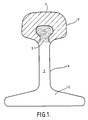
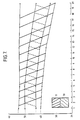
- Figure 1 shows a conventionally shaped flat bottomed railway rail 1. It has a foot 2 and head 3.
- the micro structure of the head in the shaded area 4 is martensite, while in region 5, where clearly the rate of cooling from external sprays is less it is a mixture of martensite and bainite.
- the foot has been cooled it is also largely martensite and the composition of the web 6 joining the foot and the head is not usually of great significance since in practice the performance required for the web is exceeded by most rails steels and heat treatments.
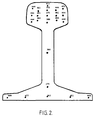
- the rail is made from a low carbon steel of composition as shown in Table 1. Brinell hardness tests were conducted on a section of such a rail and the results are shown in Figure 2.
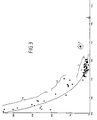
- FIG. 3 A comparison of the Brinell hardness for various rails is shown in Figure 3 where these are plotted along the abscissa. The ordinate is the wear rate in milligrammes per metre of slip.
- the rails fall into four groups: (a) in as-rolled condition and (b) is a 1% chromium steel, again in as rolled condition.
- the results (c) are those of various head hardened and heat treated pearlitic rails of conventional manufacture while (d) is the low carbon martensitic steel rail of the invention. It will be seen from Figures 2 and 3 that the hardness of the martensitic rail is high, and the wear rate is clearly comparable with modern day pearlitic rails.
- the corresponding figures for the pearlitic steel were a tensile strength of 1,210 N/mm 2 , and an elongation at break of 10%, and Brinell hardness of 360. This clearly shows that the resistance to fracture initiation is higher in the martensitic rail than the pearlitic, even at low temperatures.
- the fracture toughness of the martensitic rail has found to be between 100 and 110 MpA/m 1/2 , compared to typical values for pearlitic rails of 35-40 MPam 1/2 .
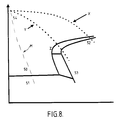
- FIG. 8 Such a diagram is shown in Figure 8 which is for 0.8% carbon steel.
- the area 54 is austenite (the form of steel at high temperatures), and temperature is shown on the ordinate and time, on a log scale is shown on the abscissa. Austenite is present at 50 and martensite at 51. Pearlite is shown by 52 and Bainite by 53. In between these areas a mixture of steel microstructures is produced.
- Dotted path X presents the path for normal air cooling and it will be seen that the path leads to the pearlitic state.
- the point marked Z is that point known as the pearlite nose, and controlled cooling along the path Y aims to pass the rail through the pearlitic nose producing the fine pearlite previously mentioned.
- the path M marks a typical path for the production of a martensitic rail, and it would be seen that it passes directly from the austenitic region to the martensitic region. Clearly this requires a high rate of cooling and this is achieved by the use of water, either as simple water sprays or mixed air water sprays.
- hardenability An important consideration in the production of rails is the quality known as hardenability. This is the ability of a steel to achieve a given hardness at a point remote from the point of application of cooling, particularly forced cooling.
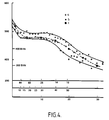
- the hardenability data for a low carbon steel of the composition given in Table 1 is shown in Figure 4. This shows as the ordinate the Brinell hardness (BHN) and the abscissa are, from top to bottom, cooling rate in degree Celsius per second at 700°C, the equivalent plate thickness in mm, and the distance from the quenched face in mm. Data reference (a) is for a thickness of 40mm and that at (b) is for 65mm. This diagram shows the variation in Brinell hardness as one progresses further from the quenched outside surface of the rail.
- BHN Brinell hardness
- abscissa are, from top to bottom, cooling rate in degree Celsius per second at 700°C, the equivalent plate thickness in mm, and the distance from the quenched face in mm.
- Hardenability of this steel is acceptable because the martensite is produced at these deeper levels.
- the main elements that are known to effect hardenability are manganese, to a lesser, molybdenum, vanadium, chromium, nickel and copper.
- the calculation of hardenability from alloying elements is quite difficult, and although it can be predicted to a reasonable extent it must in the end always be measured.
- the data for point (c) are from laboratory based steel melts.
- the elements titanium and niobium are added for the usual reasons, titanium to improve weldability and niobium as a general precipitation strengthening element.
- the process produces a rail with the hardenability characteristics of a high carbon steel while also allowing the formation of a low carbon martensite with its correspondingly high intrinsic hardness.
- Figure 7 shows the acceptable hardenability bands and these are also set out in Table 3.
- the preferred hardenability band is shown for the J positions (sixteenths of an inch from the quenched end of a 1.0 inch diameter bar) 1, 5, 12 and 20.
- the area 70 is the preferred band although the area 71 would be acceptable for such rails.
- Figure 6 shows a typical arrangement of the sprays that might be used to produce the cooling required for such a martensitic rail.
- compositions for grades of martensitic rail steels that have been found to lie within the preferred hardenability bands are set out in Table 2 where each grade shows the range of compositions that might fall within it.
- martensitic rail is that the higher intrinsic hardness of martensite, required levels of hardness are easier to achieve. Therefore the manufacturing process can be modified so that less attention need be paid to the optimising of the hardness of the head, with the results that the parameters for the process can be varied to improve other characteristics.
- self tempering of the rail head to produce a higher feature toughness and impact resistance can be carried out by stopping the spray when the core of the inside of the rail head has fallen to temperatures of up to approximately 500°C. The rail is then allowed to cool naturally, and the heat from the interior of the rail head will spread to the whole of the head slowly raising the temperature before the whole rail finally cools to ambient.
- rail heads can comprise low carbon martensite.
- hardness namely rolling contact wear and rolling contact fatigue
Landscapes
- Engineering & Computer Science (AREA)
- Chemical & Material Sciences (AREA)
- Mechanical Engineering (AREA)
- Thermal Sciences (AREA)
- Structural Engineering (AREA)
- Physics & Mathematics (AREA)
- Civil Engineering (AREA)
- Crystallography & Structural Chemistry (AREA)
- Materials Engineering (AREA)
- Metallurgy (AREA)
- Organic Chemistry (AREA)
- Architecture (AREA)
- Heat Treatment Of Articles (AREA)
- Linear Motors (AREA)
- Current-Collector Devices For Electrically Propelled Vehicles (AREA)
- Train Traffic Observation, Control, And Security (AREA)
- Walking Sticks, Umbrellas, And Fans (AREA)
- Road Paving Structures (AREA)
- Passenger Equipment (AREA)
- Fuel-Injection Apparatus (AREA)
- Valve Device For Special Equipments (AREA)
- Bearings For Parts Moving Linearly (AREA)
- Platform Screen Doors And Railroad Systems (AREA)
- Braking Arrangements (AREA)
Abstract
Description
| Element | Amount (Wt.%) |
| Carbon | 0.23 |
| Silicon | 0.40 |
| Manganese | 1.31 |
| Phosphorus | 0.016 |
| Sulphur | 0.004 |
| Chromium | 0.31 |
| Molybdenum | 0.30 |
| Niobium | 0.032 |
| Vanadium | 0.038 |
| Aluminium | 0.039 |
| Titanium | 0.022 |
| Boron | 0.002 |
| Balance | Iron and incidental impurities |
| TYPICAL COMPOSITIONS FOR COMMERCIAL PRODUCT OF MARTENSITIC RAIL STEELS | |||||||||||
| Grade | COMPOSITION Wt % | ||||||||||
| C | Si | Mn | Cr | Mo | Nb | Al | | Ti | B | ||
| 400 | 0.13 | 0.30 | 1.15 | 0.20 | 0.45 | 0.02 | 0.02 | 0.02 | 0.02 | 0.0015 | |
| 0.18 | 0.40 | 1.35 | 0.30 | 0.55 | 0.04 | 0.04 | 0.06 | 0.04 | 0.0025 | ||
| 450 | 0.20 | 0.30 | 1.30 | 0.25 | 0.25 | 0.02 | 0.02 | 0.02 | 0.02 | 0.0015 | |
| 0.25 | 0.40 | 1.40 | 0.35 | 0.04 | 0.04 | 0.06 | 0.04 | 0.06 | 0.0025 | ||
| 500 | 0.30 | 0.30 | 1.30 | 0.45 | 0.45 | - | - | - | - | - | |
| 0.35 | 0.40 | 1.40 | 0.55 | 0.55 | 0.04 | 0.04 | 0.06 | 0.04 | 0.0025 |
| HARDENABILITY BANDS FOR THE PRODUCTION OF MARTENSITIC RAILS | |||||
| J-Position (1/16th Inch) | |||||
| J1 | J5 | J12 | J20 | ||
| max. (HRC) | 50 | 50 | 47 | 42 | Preferred Hardenability Band |
| min. (HRC) | 43 | 43 | 40 | 33 | |
| max. (HRC) | 54 | 53 | 53 | 52 | Acceptable Hardenability Band |
| min. (HRC) | 40 | 39 | 36 | 30 |
Claims (9)
- A rail for use in a railway having, in section, a head and a foot, wherein the head comprises a traffic carrying surface composed of martensite of up to 0.4% by weight carbon and up to 1% by weight chromium.
- A rail as claimed in claim 1 wherein the head is rapidly cooled by the application of water.
- A rail as claimed in claim 1 wherein the head and the foot are rapidly cooled by the application of water.
- A rail as claimed in any preceeding claim wherein the carbon content thereof is between 0.1% and 0.4% by weight.
- A rail as claimed in any preceeding claim including hardenability improving alloying elements.
- A rail as claimed in any preceeding claim wherein the rail includes titanium and niobium.
- A rail as claimed in any preceeding claim wherein the rail in its formation is allowed to self-temper by terminating the sprayed cooling and allowing the residual heat in the rail head to equalize under natural cooling.
- A rail as claimed in any preceeding claim wherein the hardenability thereof is within the range:
J-Position (1/16th inch) J1 J5 J12 J20 max (HRC) 54 53 53 52 min (HRC) 40 39 36 30 - A rail as claimed in claim 8 wherein the hardenability thereof is within the range:
J-Position (1/16th inch) J1 J5 J12 J20 max (HRC) 50 50 47 42 min (HRC) 43 43 40 33
Applications Claiming Priority (3)
| Application Number | Priority Date | Filing Date | Title |
|---|---|---|---|
| GB9313060 | 1993-06-24 | ||
| GB939313060A GB9313060D0 (en) | 1993-06-24 | 1993-06-24 | Rails |
| PCT/GB1994/001326 WO1995000707A1 (en) | 1993-06-24 | 1994-06-20 | Rails |
Publications (2)
| Publication Number | Publication Date |
|---|---|
| EP0705369A1 EP0705369A1 (en) | 1996-04-10 |
| EP0705369B1 true EP0705369B1 (en) | 1998-04-08 |
Family
ID=10737731
Family Applications (1)
| Application Number | Title | Priority Date | Filing Date |
|---|---|---|---|
| EP94918448A Expired - Lifetime EP0705369B1 (en) | 1993-06-24 | 1994-06-20 | Rails |
Country Status (17)
| Country | Link |
|---|---|
| US (1) | US5645653A (en) |
| EP (1) | EP0705369B1 (en) |
| JP (1) | JPH08512093A (en) |
| CN (1) | CN1057810C (en) |
| AT (1) | ATE164899T1 (en) |
| AU (1) | AU679537B2 (en) |
| BR (1) | BR9406964A (en) |
| CA (1) | CA2165775A1 (en) |
| DE (1) | DE69409524T2 (en) |
| ES (1) | ES2118416T3 (en) |
| GB (2) | GB9313060D0 (en) |
| HU (1) | HU9503749D0 (en) |
| IN (1) | IN184701B (en) |
| MY (1) | MY111482A (en) |
| RU (1) | RU2122056C1 (en) |
| WO (1) | WO1995000707A1 (en) |
| ZA (1) | ZA944557B (en) |
Families Citing this family (14)
| Publication number | Priority date | Publication date | Assignee | Title |
|---|---|---|---|---|
| AT411176B (en) * | 1995-03-24 | 2003-10-27 | Voest Alpine Schienen Gmbh | RAIL WITH LOWER RADIATED AIR SOUND LEVEL |
| FR2840628B1 (en) * | 2002-06-05 | 2004-08-13 | Cogifer | RAIL TRACK COMPRISING A TRACK APPARATUS ELEMENT AND A WELDED RAIL SECTION WITHOUT MATERIAL SUPPLY |
| SE526266C2 (en) * | 2003-12-16 | 2005-08-09 | Gleim Ab | Compound-type guide rail and a method for producing such a guide rail |
| US7591909B2 (en) * | 2007-08-23 | 2009-09-22 | Transportation Technology Center, Inc. | Railroad wheel steels having improved resistance to rolling contact fatigue |
| US7559999B2 (en) * | 2007-08-23 | 2009-07-14 | Transportation Technology Center, Inc. | Railroad wheel steels having improved resistance to rolling contact fatigue |
| EP2343390B1 (en) * | 2008-10-31 | 2015-08-19 | Nippon Steel & Sumitomo Metal Corporation | Pearlite rail having superior abrasion resistance and excellent toughness |
| JP4824141B2 (en) * | 2009-02-18 | 2011-11-30 | 新日本製鐵株式会社 | Perlite rail with excellent wear resistance and toughness |
| WO2010150448A1 (en) | 2009-06-26 | 2010-12-29 | 新日本製鐵株式会社 | Pearlite–based high-carbon steel rail having excellent ductility and process for production thereof |
| RU2491381C1 (en) * | 2012-02-21 | 2013-08-27 | Федеральное государственное бюджетное образовательное учреждение высшего профессионального образования "Иркутская государственная сельскохозяйственная академия" | Rail of lighter design |
| WO2013161794A1 (en) * | 2012-04-23 | 2013-10-31 | 新日鐵住金株式会社 | Rail |
| EP2674504A1 (en) * | 2012-06-11 | 2013-12-18 | Siemens S.p.A. | Method and system for thermal treatments of rails |
| AT512792B1 (en) * | 2012-09-11 | 2013-11-15 | Voestalpine Schienen Gmbh | Process for the production of bainitic rail steels |
| US10563357B2 (en) * | 2014-05-29 | 2020-02-18 | Nippon Steel Corporation | Rail and production method therefor |
| WO2015182743A1 (en) * | 2014-05-29 | 2015-12-03 | 新日鐵住金株式会社 | Rail and production method therefor |
Family Cites Families (12)
| Publication number | Priority date | Publication date | Assignee | Title |
|---|---|---|---|---|
| CA719588A (en) * | 1965-10-12 | Dai-Ichi Koshuha Kogyo Kabushiki Kaisha | Rails for railway | |
| US1080590A (en) * | 1912-12-30 | 1913-12-09 | James C Russell | Metal article. |
| US1837189A (en) * | 1931-04-29 | 1931-12-22 | Bethlehem Steel Corp | Rail heat treatment |
| US3556499A (en) * | 1964-03-27 | 1971-01-19 | Chemetron Corp | Hardened steel members and method and apparatus for making the same |
| FR1600086A (en) * | 1968-12-30 | 1970-07-20 | ||
| JPS54148124A (en) * | 1978-05-12 | 1979-11-20 | Nippon Steel Corp | Manufacture of high strength rall of excellent weldability |
| DE2927890C2 (en) * | 1979-07-11 | 1983-12-22 | Elektro-Thermit Gmbh, 4300 Essen | Rail for track-bound vehicles |
| US4486248A (en) * | 1982-08-05 | 1984-12-04 | The Algoma Steel Corporation Limited | Method for the production of improved railway rails by accelerated cooling in line with the production rolling mill |
| JPS59116321A (en) * | 1982-12-22 | 1984-07-05 | Nippon Steel Corp | Heat treatment for improving resistance to fracture of upper filler of rail |
| DE3336006A1 (en) * | 1983-10-04 | 1985-04-25 | Krupp Stahl Ag, 4630 Bochum | RAIL WITH HIGH WEAR RESISTANCE IN THE HEAD AND HIGH BREAK PROTECTION IN THE FOOT |
| JPS6299438A (en) * | 1985-10-24 | 1987-05-08 | Nippon Kokan Kk <Nkk> | Wear-resistant, high-performance rail with the ability to stop unstable fracture propagation |
| DE4200545A1 (en) * | 1992-01-11 | 1993-07-15 | Butzbacher Weichenbau Gmbh | TRACK PARTS AND METHOD FOR THE PRODUCTION THEREOF |
-
1993
- 1993-06-24 GB GB939313060A patent/GB9313060D0/en active Pending
-
1994
- 1994-06-20 WO PCT/GB1994/001326 patent/WO1995000707A1/en not_active Ceased
- 1994-06-20 AU AU69764/94A patent/AU679537B2/en not_active Ceased
- 1994-06-20 HU HU9503749A patent/HU9503749D0/en unknown
- 1994-06-20 EP EP94918448A patent/EP0705369B1/en not_active Expired - Lifetime
- 1994-06-20 BR BR9406964A patent/BR9406964A/en not_active IP Right Cessation
- 1994-06-20 ES ES94918448T patent/ES2118416T3/en not_active Expired - Lifetime
- 1994-06-20 GB GB9526104A patent/GB2295179B/en not_active Expired - Fee Related
- 1994-06-20 CA CA002165775A patent/CA2165775A1/en not_active Abandoned
- 1994-06-20 CN CN94192863A patent/CN1057810C/en not_active Expired - Fee Related
- 1994-06-20 JP JP7502564A patent/JPH08512093A/en not_active Withdrawn
- 1994-06-20 DE DE69409524T patent/DE69409524T2/en not_active Expired - Fee Related
- 1994-06-20 US US08/557,169 patent/US5645653A/en not_active Expired - Fee Related
- 1994-06-20 AT AT94918448T patent/ATE164899T1/en not_active IP Right Cessation
- 1994-06-20 RU RU96101177A patent/RU2122056C1/en not_active IP Right Cessation
- 1994-06-23 MY MYPI94001623A patent/MY111482A/en unknown
- 1994-06-23 IN IN541MA1994 patent/IN184701B/en unknown
- 1994-06-24 ZA ZA944557A patent/ZA944557B/en unknown
Also Published As
| Publication number | Publication date |
|---|---|
| CN1057810C (en) | 2000-10-25 |
| CN1127537A (en) | 1996-07-24 |
| HU9503749D0 (en) | 1996-02-28 |
| GB9313060D0 (en) | 1993-08-11 |
| JPH08512093A (en) | 1996-12-17 |
| ATE164899T1 (en) | 1998-04-15 |
| WO1995000707A1 (en) | 1995-01-05 |
| ZA944557B (en) | 1995-02-17 |
| GB9526104D0 (en) | 1996-02-21 |
| GB2295179B (en) | 1996-10-30 |
| DE69409524T2 (en) | 1998-12-10 |
| RU2122056C1 (en) | 1998-11-20 |
| BR9406964A (en) | 1996-08-27 |
| US5645653A (en) | 1997-07-08 |
| IN184701B (en) | 2000-09-23 |
| CA2165775A1 (en) | 1995-01-05 |
| AU679537B2 (en) | 1997-07-03 |
| AU6976494A (en) | 1995-01-17 |
| DE69409524D1 (en) | 1998-05-14 |
| EP0705369A1 (en) | 1996-04-10 |
| MY111482A (en) | 2000-06-30 |
| ES2118416T3 (en) | 1998-09-16 |
| GB2295179A (en) | 1996-05-22 |
Similar Documents
| Publication | Publication Date | Title |
|---|---|---|
| US5879474A (en) | Relating to carbide-free bainitic steels and method of producing such steels | |
| CA2116504C (en) | Process for manufacturing high-strength bainitic steel rails with excellent rolling-contact fatigue resistance | |
| CA2679556C (en) | Internal high hardness type pearlitic rail with excellent wear resistance and rolling contact fatigue resistance and method for producing same | |
| AU2016200056B2 (en) | High-Strength and Highly Fatigue-Resistant Steel Rail and Production Method Thereof | |
| EP0705369B1 (en) | Rails | |
| US4082577A (en) | Process for the heat treatment of steel | |
| RU1831506C (en) | Wear resistant rail | |
| US4575397A (en) | Rail having high resistance to wear in its head and high resistance to rupture in its foot | |
| AU690457B2 (en) | Low-alloy heat-treated pearlitic steel rails | |
| KR970700783A (en) | PERLITE RAIL OF HIGH ABRASION RESISTANCE AND METHOD OF MANUFACTURING THE SAME | |
| RU2113511C1 (en) | Rail of steel with elevated wear- and fatigue-damage resistance and method of manufacturing thereof | |
| EP3717142B1 (en) | Method for manufacturing a rail and corresponding rail | |
| CA3186612A1 (en) | Rail having excellent fatigue crack propagation resistance characteristics, and method for producing same | |
| Singh et al. | Microstructure and mechanical properties of as rolled high strength bainitic rail steels | |
| US5482576A (en) | Railway-track elements and method of manufacturing them | |
| EP1052296B1 (en) | Use of a steel for the manufacture of amour plates | |
| AU2019204857B2 (en) | Track part made of a hypereutectoid steel | |
| CA1192476A (en) | As-pierced tubular products | |
| JPS6324045A (en) | Wear-resistant, high-performance rail with excellent ability to stop unstable fracture propagation | |
| CA2310521C (en) | Pearlitic steel railroad rail | |
| FI3783120T3 (en) | SPRING WIRE, CLAMP FORMED THEREOF AND METHOD FOR MANUFACTURE OF SUCH SPRING WIRE | |
| KR102485008B1 (en) | High carbon cold rolled steel sheet having high toughness and method of manufacturing the same | |
| KR100363193B1 (en) | A method for manufacturing bolts having high strength and elongation | |
| CN121204534A (en) | Bainitic ferrule channel steel and its manufacturing method | |
| OA20006A (en) | Track Part Made of a Hypereutectoid Steel. |
Legal Events
| Date | Code | Title | Description |
|---|---|---|---|
| PUAI | Public reference made under article 153(3) epc to a published international application that has entered the european phase |
Free format text: ORIGINAL CODE: 0009012 |
|
| 17P | Request for examination filed |
Effective date: 19960116 |
|
| AK | Designated contracting states |
Kind code of ref document: A1 Designated state(s): AT BE CH DE DK ES FR GB GR IE IT LI LU MC NL PT SE |
|
| 17Q | First examination report despatched |
Effective date: 19961010 |
|
| GRAG | Despatch of communication of intention to grant |
Free format text: ORIGINAL CODE: EPIDOS AGRA |
|
| GRAG | Despatch of communication of intention to grant |
Free format text: ORIGINAL CODE: EPIDOS AGRA |
|
| GRAH | Despatch of communication of intention to grant a patent |
Free format text: ORIGINAL CODE: EPIDOS IGRA |
|
| GRAH | Despatch of communication of intention to grant a patent |
Free format text: ORIGINAL CODE: EPIDOS IGRA |
|
| GRAH | Despatch of communication of intention to grant a patent |
Free format text: ORIGINAL CODE: EPIDOS IGRA |
|
| GRAA | (expected) grant |
Free format text: ORIGINAL CODE: 0009210 |
|
| AK | Designated contracting states |
Kind code of ref document: B1 Designated state(s): AT BE CH DE DK ES FR GB GR IE IT LI LU MC NL PT SE |
|
| PG25 | Lapsed in a contracting state [announced via postgrant information from national office to epo] |
Ref country code: NL Free format text: LAPSE BECAUSE OF FAILURE TO SUBMIT A TRANSLATION OF THE DESCRIPTION OR TO PAY THE FEE WITHIN THE PRESCRIBED TIME-LIMIT Effective date: 19980408 Ref country code: GR Free format text: LAPSE BECAUSE OF FAILURE TO SUBMIT A TRANSLATION OF THE DESCRIPTION OR TO PAY THE FEE WITHIN THE PRESCRIBED TIME-LIMIT Effective date: 19980408 Ref country code: BE Free format text: LAPSE BECAUSE OF FAILURE TO SUBMIT A TRANSLATION OF THE DESCRIPTION OR TO PAY THE FEE WITHIN THE PRESCRIBED TIME-LIMIT Effective date: 19980408 |
|
| REF | Corresponds to: |
Ref document number: 164899 Country of ref document: AT Date of ref document: 19980415 Kind code of ref document: T |
|
| REG | Reference to a national code |
Ref country code: CH Ref legal event code: EP |
|
| REF | Corresponds to: |
Ref document number: 69409524 Country of ref document: DE Date of ref document: 19980514 |
|
| PG25 | Lapsed in a contracting state [announced via postgrant information from national office to epo] |
Ref country code: LU Free format text: LAPSE BECAUSE OF NON-PAYMENT OF DUE FEES Effective date: 19980620 Ref country code: IE Free format text: LAPSE BECAUSE OF NON-PAYMENT OF DUE FEES Effective date: 19980620 |
|
| ITF | It: translation for a ep patent filed | ||
| PG25 | Lapsed in a contracting state [announced via postgrant information from national office to epo] |
Ref country code: SE Free format text: LAPSE BECAUSE OF FAILURE TO SUBMIT A TRANSLATION OF THE DESCRIPTION OR TO PAY THE FEE WITHIN THE PRESCRIBED TIME-LIMIT Effective date: 19980708 Ref country code: PT Free format text: LAPSE BECAUSE OF FAILURE TO SUBMIT A TRANSLATION OF THE DESCRIPTION OR TO PAY THE FEE WITHIN THE PRESCRIBED TIME-LIMIT Effective date: 19980708 Ref country code: DK Free format text: LAPSE BECAUSE OF FAILURE TO SUBMIT A TRANSLATION OF THE DESCRIPTION OR TO PAY THE FEE WITHIN THE PRESCRIBED TIME-LIMIT Effective date: 19980708 |
|
| REG | Reference to a national code |
Ref country code: IE Ref legal event code: FG4D Free format text: 79755 |
|
| REG | Reference to a national code |
Ref country code: CH Ref legal event code: NV Representative=s name: LUCHS & PARTNER PATENTANWAELTE |
|
| ET | Fr: translation filed | ||
| NLV1 | Nl: lapsed or annulled due to failure to fulfill the requirements of art. 29p and 29m of the patents act | ||
| REG | Reference to a national code |
Ref country code: ES Ref legal event code: FG2A Ref document number: 2118416 Country of ref document: ES Kind code of ref document: T3 |
|
| PG25 | Lapsed in a contracting state [announced via postgrant information from national office to epo] |
Ref country code: MC Free format text: LAPSE BECAUSE OF NON-PAYMENT OF DUE FEES Effective date: 19981231 |
|
| PLBE | No opposition filed within time limit |
Free format text: ORIGINAL CODE: 0009261 |
|
| STAA | Information on the status of an ep patent application or granted ep patent |
Free format text: STATUS: NO OPPOSITION FILED WITHIN TIME LIMIT |
|
| 26N | No opposition filed | ||
| REG | Reference to a national code |
Ref country code: FR Ref legal event code: CD |
|
| REG | Reference to a national code |
Ref country code: GB Ref legal event code: IF02 |
|
| PGFP | Annual fee paid to national office [announced via postgrant information from national office to epo] |
Ref country code: AT Payment date: 20040512 Year of fee payment: 11 |
|
| PGFP | Annual fee paid to national office [announced via postgrant information from national office to epo] |
Ref country code: CH Payment date: 20040602 Year of fee payment: 11 |
|
| PGFP | Annual fee paid to national office [announced via postgrant information from national office to epo] |
Ref country code: ES Payment date: 20040603 Year of fee payment: 11 |
|
| PGFP | Annual fee paid to national office [announced via postgrant information from national office to epo] |
Ref country code: GB Payment date: 20040607 Year of fee payment: 11 |
|
| PGFP | Annual fee paid to national office [announced via postgrant information from national office to epo] |
Ref country code: FR Payment date: 20040609 Year of fee payment: 11 |
|
| PGFP | Annual fee paid to national office [announced via postgrant information from national office to epo] |
Ref country code: DE Payment date: 20040830 Year of fee payment: 11 |
|
| PG25 | Lapsed in a contracting state [announced via postgrant information from national office to epo] |
Ref country code: IT Free format text: LAPSE BECAUSE OF NON-PAYMENT OF DUE FEES;WARNING: LAPSES OF ITALIAN PATENTS WITH EFFECTIVE DATE BEFORE 2007 MAY HAVE OCCURRED AT ANY TIME BEFORE 2007. THE CORRECT EFFECTIVE DATE MAY BE DIFFERENT FROM THE ONE RECORDED. Effective date: 20050620 Ref country code: GB Free format text: LAPSE BECAUSE OF NON-PAYMENT OF DUE FEES Effective date: 20050620 Ref country code: AT Free format text: LAPSE BECAUSE OF NON-PAYMENT OF DUE FEES Effective date: 20050620 |
|
| PG25 | Lapsed in a contracting state [announced via postgrant information from national office to epo] |
Ref country code: ES Free format text: LAPSE BECAUSE OF NON-PAYMENT OF DUE FEES Effective date: 20050621 |
|
| PG25 | Lapsed in a contracting state [announced via postgrant information from national office to epo] |
Ref country code: LI Free format text: LAPSE BECAUSE OF NON-PAYMENT OF DUE FEES Effective date: 20050630 Ref country code: CH Free format text: LAPSE BECAUSE OF NON-PAYMENT OF DUE FEES Effective date: 20050630 |
|
| PG25 | Lapsed in a contracting state [announced via postgrant information from national office to epo] |
Ref country code: DE Free format text: LAPSE BECAUSE OF NON-PAYMENT OF DUE FEES Effective date: 20060103 |
|
| REG | Reference to a national code |
Ref country code: CH Ref legal event code: PL |
|
| PG25 | Lapsed in a contracting state [announced via postgrant information from national office to epo] |
Ref country code: FR Free format text: LAPSE BECAUSE OF NON-PAYMENT OF DUE FEES Effective date: 20060228 |
|
| GBPC | Gb: european patent ceased through non-payment of renewal fee |
Effective date: 20050620 |
|
| REG | Reference to a national code |
Ref country code: FR Ref legal event code: ST Effective date: 20060228 |
|
| REG | Reference to a national code |
Ref country code: ES Ref legal event code: FD2A Effective date: 20050621 |