EP0704634B1 - Reduced friction screw - Google Patents
Reduced friction screw Download PDFInfo
- Publication number
- EP0704634B1 EP0704634B1 EP95306699A EP95306699A EP0704634B1 EP 0704634 B1 EP0704634 B1 EP 0704634B1 EP 95306699 A EP95306699 A EP 95306699A EP 95306699 A EP95306699 A EP 95306699A EP 0704634 B1 EP0704634 B1 EP 0704634B1
- Authority
- EP
- European Patent Office
- Prior art keywords
- screw
- reduced
- thread
- friction
- head
- Prior art date
- Legal status (The legal status is an assumption and is not a legal conclusion. Google has not performed a legal analysis and makes no representation as to the accuracy of the status listed.)
- Expired - Lifetime
Links
- 239000000463 material Substances 0.000 claims description 43
- 238000007373 indentation Methods 0.000 claims 1
- 239000002023 wood Substances 0.000 description 13
- 239000002184 metal Substances 0.000 description 11
- 235000008331 Pinus X rigitaeda Nutrition 0.000 description 5
- 241000018646 Pinus brutia Species 0.000 description 5
- 235000011613 Pinus brutia Nutrition 0.000 description 5
- 235000008578 Pinus strobus Nutrition 0.000 description 4
- 240000007320 Pinus strobus Species 0.000 description 4
- 235000009137 Quercus alba Nutrition 0.000 description 4
- 241001531312 Quercus pubescens Species 0.000 description 4
- 210000000988 bone and bone Anatomy 0.000 description 2
- 230000006835 compression Effects 0.000 description 1
- 238000007906 compression Methods 0.000 description 1
- 230000001186 cumulative effect Effects 0.000 description 1
- 230000003247 decreasing effect Effects 0.000 description 1
- 230000007547 defect Effects 0.000 description 1
- 238000005553 drilling Methods 0.000 description 1
- 230000003993 interaction Effects 0.000 description 1
- 239000000314 lubricant Substances 0.000 description 1
- 239000007769 metal material Substances 0.000 description 1
- 239000002245 particle Substances 0.000 description 1
- 238000007586 pull-out test Methods 0.000 description 1
- 230000007704 transition Effects 0.000 description 1
- 239000011800 void material Substances 0.000 description 1
Images


Classifications
-
- F—MECHANICAL ENGINEERING; LIGHTING; HEATING; WEAPONS; BLASTING
- F16—ENGINEERING ELEMENTS AND UNITS; GENERAL MEASURES FOR PRODUCING AND MAINTAINING EFFECTIVE FUNCTIONING OF MACHINES OR INSTALLATIONS; THERMAL INSULATION IN GENERAL
- F16B—DEVICES FOR FASTENING OR SECURING CONSTRUCTIONAL ELEMENTS OR MACHINE PARTS TOGETHER, e.g. NAILS, BOLTS, CIRCLIPS, CLAMPS, CLIPS OR WEDGES; JOINTS OR JOINTING
- F16B39/00—Locking of screws, bolts or nuts
- F16B39/22—Locking of screws, bolts or nuts in which the locking takes place during screwing down or tightening
- F16B39/28—Locking of screws, bolts or nuts in which the locking takes place during screwing down or tightening by special members on, or shape of, the nut or bolt
- F16B39/282—Locking by means of special shape of work-engaging surfaces, e.g. notched or toothed nuts
-
- F—MECHANICAL ENGINEERING; LIGHTING; HEATING; WEAPONS; BLASTING
- F16—ENGINEERING ELEMENTS AND UNITS; GENERAL MEASURES FOR PRODUCING AND MAINTAINING EFFECTIVE FUNCTIONING OF MACHINES OR INSTALLATIONS; THERMAL INSULATION IN GENERAL
- F16B—DEVICES FOR FASTENING OR SECURING CONSTRUCTIONAL ELEMENTS OR MACHINE PARTS TOGETHER, e.g. NAILS, BOLTS, CIRCLIPS, CLAMPS, CLIPS OR WEDGES; JOINTS OR JOINTING
- F16B25/00—Screws that cut thread in the body into which they are screwed, e.g. wood screws
- F16B25/001—Screws that cut thread in the body into which they are screwed, e.g. wood screws characterised by the material of the body into which the screw is screwed
- F16B25/0015—Screws that cut thread in the body into which they are screwed, e.g. wood screws characterised by the material of the body into which the screw is screwed the material being a soft organic material, e.g. wood or plastic
-
- F—MECHANICAL ENGINEERING; LIGHTING; HEATING; WEAPONS; BLASTING
- F16—ENGINEERING ELEMENTS AND UNITS; GENERAL MEASURES FOR PRODUCING AND MAINTAINING EFFECTIVE FUNCTIONING OF MACHINES OR INSTALLATIONS; THERMAL INSULATION IN GENERAL
- F16B—DEVICES FOR FASTENING OR SECURING CONSTRUCTIONAL ELEMENTS OR MACHINE PARTS TOGETHER, e.g. NAILS, BOLTS, CIRCLIPS, CLAMPS, CLIPS OR WEDGES; JOINTS OR JOINTING
- F16B25/00—Screws that cut thread in the body into which they are screwed, e.g. wood screws
- F16B25/0036—Screws that cut thread in the body into which they are screwed, e.g. wood screws characterised by geometric details of the screw
- F16B25/0042—Screws that cut thread in the body into which they are screwed, e.g. wood screws characterised by geometric details of the screw characterised by the geometry of the thread, the thread being a ridge wrapped around the shaft of the screw
- F16B25/0047—Screws that cut thread in the body into which they are screwed, e.g. wood screws characterised by geometric details of the screw characterised by the geometry of the thread, the thread being a ridge wrapped around the shaft of the screw the ridge being characterised by its cross-section in the plane of the shaft axis
-
- F—MECHANICAL ENGINEERING; LIGHTING; HEATING; WEAPONS; BLASTING
- F16—ENGINEERING ELEMENTS AND UNITS; GENERAL MEASURES FOR PRODUCING AND MAINTAINING EFFECTIVE FUNCTIONING OF MACHINES OR INSTALLATIONS; THERMAL INSULATION IN GENERAL
- F16B—DEVICES FOR FASTENING OR SECURING CONSTRUCTIONAL ELEMENTS OR MACHINE PARTS TOGETHER, e.g. NAILS, BOLTS, CIRCLIPS, CLAMPS, CLIPS OR WEDGES; JOINTS OR JOINTING
- F16B25/00—Screws that cut thread in the body into which they are screwed, e.g. wood screws
- F16B25/0036—Screws that cut thread in the body into which they are screwed, e.g. wood screws characterised by geometric details of the screw
- F16B25/0042—Screws that cut thread in the body into which they are screwed, e.g. wood screws characterised by geometric details of the screw characterised by the geometry of the thread, the thread being a ridge wrapped around the shaft of the screw
- F16B25/0052—Screws that cut thread in the body into which they are screwed, e.g. wood screws characterised by geometric details of the screw characterised by the geometry of the thread, the thread being a ridge wrapped around the shaft of the screw the ridge having indentations, notches or the like in order to improve the cutting behaviour
-
- F—MECHANICAL ENGINEERING; LIGHTING; HEATING; WEAPONS; BLASTING
- F16—ENGINEERING ELEMENTS AND UNITS; GENERAL MEASURES FOR PRODUCING AND MAINTAINING EFFECTIVE FUNCTIONING OF MACHINES OR INSTALLATIONS; THERMAL INSULATION IN GENERAL
- F16B—DEVICES FOR FASTENING OR SECURING CONSTRUCTIONAL ELEMENTS OR MACHINE PARTS TOGETHER, e.g. NAILS, BOLTS, CIRCLIPS, CLAMPS, CLIPS OR WEDGES; JOINTS OR JOINTING
- F16B33/00—Features common to bolt and nut
- F16B33/02—Shape of thread; Special thread-forms
-
- F—MECHANICAL ENGINEERING; LIGHTING; HEATING; WEAPONS; BLASTING
- F16—ENGINEERING ELEMENTS AND UNITS; GENERAL MEASURES FOR PRODUCING AND MAINTAINING EFFECTIVE FUNCTIONING OF MACHINES OR INSTALLATIONS; THERMAL INSULATION IN GENERAL
- F16B—DEVICES FOR FASTENING OR SECURING CONSTRUCTIONAL ELEMENTS OR MACHINE PARTS TOGETHER, e.g. NAILS, BOLTS, CIRCLIPS, CLAMPS, CLIPS OR WEDGES; JOINTS OR JOINTING
- F16B35/00—Screw-bolts; Stay-bolts; Screw-threaded studs; Screws; Set screws
- F16B35/04—Screw-bolts; Stay-bolts; Screw-threaded studs; Screws; Set screws with specially-shaped head or shaft in order to fix the bolt on or in an object
- F16B35/041—Specially-shaped shafts
Definitions
- the present invention relates to a screw according to the preamble of claim 1, which requires less torque to drive it into a workpiece than conventional screws.
- the screw has substantially the same holding power as conventional screws, and can be used, for example, in wood, particle boards, and other similar materials.
- the screw may be inserted without first preparing the workpiece, or a pilot hole may be drilled.
- One reason for drilling a pilot hole is to reduce the turning torque required to drive the screw into the material.
- the turning torque of a screw is that force required to cut a channel or groove in the material into which the screw is driven, and to overcome the sliding friction between the material and the thread and shaft of the screw as it is turned.
- the turning torque is of particular concern when driving long, large diameter screws into hard materials.
- a lubricant may also be applied to the thread of the screw.
- the torque required to drive the screw completely into the material may be too large to permit the comfortable use of a hand-held screwdriver.
- Conventional screws comprise a metallic shaft having an enlarged head on a first end, a tip on a second end and a uniform helical thread running from the tip toward the head.
- the thread at the tip cuts a helical channel into the workpiece as the screw is rotated by a turning tool.
- the trailing surface of the thread determines the holding power of the screw which can also be described as the resistance to screw pull-out from the workpiece.
- DE-A-2 543 960 discloses a screw according to the preamble of claim 1 having an outside diameter which is smaller in a region towards the head of the screw than in a forward region towards the tip.
- the present invention provides a reduced-friction screw as set out in claim 1.
- the cross-sections of the thread of a reduced-friction screw according to the invention are a combination of two different types found along the shaft.
- the shape of the thread from the conical tip of the screw up to a full-shaft-diameter point at the base of the tip is conventional and symmetrical, and cuts the channel in a workpiece in a standard fashion.
- the shape of the thread after the full-shaft-diameter point is non-symmetrical, having a recessed leading surface and a conventionally-shaped trailing surface.
- the conventional, channel-cutting thread is of full thickness
- the non-symmetrical thread is of reduced thickness.
- the reduced thickness thread does not completely fill the channel that was cut in the workpiece by the leading, channel-cutting thread.
- the material cut by the leading, channel-cutting thread rebounds into the void between the reduced thickness thread and the workpiece, thereby reducing the pressure against the thread which results in a reduction of the sliding friction.
- the reduced-friction screw exhibits adequate holding power when fully driven into a workpiece.
- the interaction of the force generated at the interface of the head of the reduced-friction screw and the outer surface of the material, and from the reaction force generated along the interface of the trailing surface of the reduced-thickness thread, which is of full depth except at the tip, serves to provide substantially the same holding power as a conventional screw of the same length having a thread of the same depth and pitch.
- the underside of the head of a reduced-friction screw according to the invention preferably contains protrusions which contact the workpiece when the screw is driven fully and snugly into the material.
- the protrusions act to increase the frictional contact of the head with the workpiece, which further stabilizes the screw.
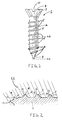
- Fig. 1 is a side view of a reduced-friction screw 1 according to an embodiment of the invention.
- the screw 1 is made of a suitable metallic material, and is shown having a head 3 with a slot 10 for accepting a turning tool (such as a screwdriver).
- the underside of the head 3 contains protrusions 7, which may be semi-cylindrical as shown, or may be wedge-shaped, with the apex facing the workpiece.
- the protrusions 7 contact the outer surface of a workpiece when the screw 1 is fully inserted, and function to resist loosening of the screw over time.
- the number and shape of the protrusions 7 may vary depending upon the resistance to loosening required.
- the reduced-friction screw 1 of Fig. 1 has a hardened metal shaft 2.
- a conventional, full-thickness, channel-forming thread 4 is formed from the conical tip 8 of the screw 1 up until a full-diameter point 9 at the base of the tip 8, at which the shaft 2 is at its maximum diameter.
- Reduced-thickness thread 5 begins at the full-shaft-diameter point 9 and continues up the entire length of the shaft 2 to the head 3.
- the reduced-thickness thread 5 may, however, end at some predetermined distance from the head 3, as on a typical wood screw.
- the shape of the cross-section of the thread of a conventional screw is uniform.
- the thread at the tip of a conventional screw compresses material out of the way as it penetrates a workpiece.
- the following thread completely fills the channel.
- the natural resiliency of the material creates a back pressure against the thread as the screw is turned, which creates a sliding friction along the entire length of the thread and shaft of the screw. Since the leading surface of the thread moves in a direction that tends to compress the material further when the screw is driven, the pressure against the leading surface is greater than that against the trailing surface. As a conventional screw is driven further into the material, the sliding friction increases.
- the turning torque required to form the channel remains essentially constant as the screw is driven deeper, the sliding friction increases since the surface area of the screw contacting the material increases.
- the turning torque required to overcome the sliding friction may become significantly larger than the turning torque required to form the channel as the screw burrows deeper into the material.
- the reduced-thickness thread 5 of the reduced-friction screw 1 has the same pitch as the channel-forming thread 4.
- the channel-forming thread 4 drills a channel into a workpiece, and the reduced-thickness thread 5 travels in the full width channel cut by the channel-forming thread 4 with reduced sliding friction, as explained below.
- Fig. 2 is a cross-sectional view taken along line A-A of Fig. 1 of the reduced-friction screw 1, shown after being driven into a material 12.
- the reduced-thickness thread 5 have preferably the same depth as, but are about one-half the thickness of, the largest channel-forming thread 4.
- a dashed line 13 represents the outline of the channel formed in the material by the full thickness, channel-forming thread 4.
- the leading surfaces 14 and the trailing surfaces 15 of the channel-forming thread 4 fully contact the channel cut into the material 12.
- only the trailing surface 17 of the reduced-thickness thread 5 contact the channel formed in the material 12.
- the leading surface 16 of the reduced thickness thread 5 faces voids 18. In reality, however, the voids 18 are not completely empty of material.
- the screw 1 of Fig. 1 As the screw 1 of Fig. 1 is driven into the workpiece, some of the material 12 rebounds into the voids 18.
- the material in contact with the leading surface 16 of the reduced thickness thread 5 is under less compression than the material in contact with the leading edge 14 of the channel-forming thread 4 and thus produces less sliding friction as the screw 1 is turned. Therefore, the torque required to drive the reduced-friction screw 1 into a material is less than that required for a conventional screw which has only full-thickness thread.
- the screw 1 has substantially the same holding power as a conventional screw. This is true because holding power is a function of the cumulative area of the thread and head taken in a plane perpendicular to the shaft, which is substantially the same for the present reduced-friction screw and for conventional screws.
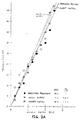
- Figs. 3A, 3B and 3C are graphs of the data generated during torque tests conducted by Underwriters Laboratories, Inc. of Melville, New York.
- a prototype reduced-friction screw according to an embodiment of the present invention, a conventional wood screw, and a conventional sheet-metal screw were used.
- Each type of screw was driven into 7.5 cm (three-inch) thick, construction-grade soft pine, hard pine, and white oak using hand tools.
- the wood was free of knots and defects, and a 2.5 cm (one-inch) long, 0.3 cm (one-eighth inch) diameter hole was used to tap the screws.
- the torque required to drive the screws was measured at various depths and recorded, and the results were plotted.
- FIG. 3A-3C show that the reduced-friction screw required less torque to be driven into soft pine, hard pine, or white oak than conventional wood or sheet-metal screws.
- Fig. 3B show a dramatic decrease in the torque required to drive a reduced-friction screw deeper into hard pine in comparison to the conventional wood or sheet metal screws.
- the force required to remove the reduced-friction screw was 500 kg (1110 pounds), and to remove the sheet-metal screw 455 kg (1010 pounds).
- the holding power of the reduced-friction screw compared favorably to that of the other type of screws tested.
- Fig. 4A is a side view of another embodiment of a reduced-friction screw 30.
- the reduced-friction screw 30 has a head 3 having protrusions 7, a hardened metal shaft 2, channel-forming thread 4, and reduced thickness thread 5.
- the diameter 2' of the shaft is reduced at a reduction point 31 in comparison to the diameter of the shaft 2.
- the reduced-diameter shaft structure reduces the sliding friction as the screw is driven into a material compared to the screw 1 of Fig. 1.
- the channel-forming thread 4 connected to the conical tip 8 compresses material out of the channel. The material exerts a back pressure against the thread and the shaft.
- the material found after reduction point 31 expands, which reduces the back-pressure and resultant sliding friction against the shaft.
- the transition in diameter at the reduction point 31 should be placed as close as possible to the first reduced thickness thread 5' consistent with acceptable internal stresses of the screw 30.
- the screw 30 has less resistance to shear forces and less pull-out strength than the screw 1 of Fig. 1.
- the screw 30 is suitable for use in many situations.
- Fig. 4B is a side view of an alternate screw 35, which is a conventional screw machined to include a reduced-diameter shaft 36 occurring from a reduction point 38 up to the head 3.
- Reduction point 38 should preferably occur at the point along the shaft where a fully bored-out channel will occur as the screw 35 is driven into a material. Since all of the thread 37 of the screw 35 are of full thickness, more torque is required to drive the screw 35 into a material than needed for the screw 30 of Fig. 4A.
- Fig. 4B has an area 39 devoid of thread. This is a common wood screw configuration, and each of the embodiments of the invention described herein may be so formed.
- Fig. 5A is a side view of yet another embodiment of a reduced friction screw 40 according to the present invention.
- the screw 40 is of the same basic structure as the screw 1 of Fig. 1, except that the reduced friction thread 41 is segmented.
- Arrow 46 depicts the direction of rotation of the screw 40 if removal from a workpiece was attempted.
- Fig. 5B is a cross sectional view taken along line B-B of Fig. 5A, depicting the shape of the segments 42 that form the reduced thickness thread 41.
- each thread segment 42 is shaped like a ramp that has a depth which varies from zero at point 43, at the surface of the shaft 2, to a full depth at 44.
- the depth of the thread for each segment is gradually increased from zero to a full depth as one travels along the circumference of the shaft 2 in the direction of arrow 46.
- the width of the segment 42 abruptly returns to zero to form a ridge 45. This pattern is repeated for each of the reduced thickness thread segments of the screw 40.
- the reduced friction screw 40 of Fig. 5A provides superior resistance to loosening under conditions where the material is stressed by twisting, vibration, or warping because the barbed-shape formed at the ridge 45 of each segment 42, best seen in Fig. 5B, acts to resist loosening of the screw 40.
- the segmented, reduced thickness thread 41 create relatively little friction because the material cut by the full thickness channel-forming thread 4 is smoothly forced out of the way by the ramped shape of the segments 42.
- a force is applied to rotate the screw 40 in the direction of arrow 46, then the ridges 45 of each segment 42 are forced against the material deposited into the channel and resist further motion. Since the screw 40 is difficult to withdraw from a material, it is thus suitable for use as a one-way screw.
- the degree to which the screw 40 resists withdrawal from a material depends upon how the segments 42 are manufactured. For example, as shown in Fig. 5A, all of the reduced-thickness thread 41 may be segmented in the fashion described above all the way along the shaft 2 from the channel-cutting thread 4 to the head 3. Such a screw 40 has high resistance to withdrawal but poorer pull-out strength in comparison to the screw 1 of Fig. 1.
- An alternate embodiment of the screw 40 of Fig. 5A contains a reduced number of segments 42 machined onto the shaft 2, starting at the head 3 and ending a predetermined distance from the channel-cutting thread 4. The remaining thread runs unbroken to the tip 8.
- the number of segments per revolution of the screw 40 may also be increased or decreased. Further, to improve the pull-out strength, the segments may be alternated with full-width reduced-thickness thread.
Landscapes
- Engineering & Computer Science (AREA)
- General Engineering & Computer Science (AREA)
- Mechanical Engineering (AREA)
- Physics & Mathematics (AREA)
- Geometry (AREA)
- Chemical & Material Sciences (AREA)
- Life Sciences & Earth Sciences (AREA)
- Dispersion Chemistry (AREA)
- Wood Science & Technology (AREA)
- Connection Of Plates (AREA)
- Transition And Organic Metals Composition Catalysts For Addition Polymerization (AREA)
- Braking Arrangements (AREA)
- Transmission Devices (AREA)
Applications Claiming Priority (2)
| Application Number | Priority Date | Filing Date | Title |
|---|---|---|---|
| US08/312,888 US5570983A (en) | 1994-09-27 | 1994-09-27 | Reduced-friction screw |
| US312888 | 1994-09-27 |
Publications (2)
| Publication Number | Publication Date |
|---|---|
| EP0704634A1 EP0704634A1 (en) | 1996-04-03 |
| EP0704634B1 true EP0704634B1 (en) | 2001-03-28 |
Family
ID=23213462
Family Applications (1)
| Application Number | Title | Priority Date | Filing Date |
|---|---|---|---|
| EP95306699A Expired - Lifetime EP0704634B1 (en) | 1994-09-27 | 1995-09-22 | Reduced friction screw |
Country Status (7)
| Country | Link |
|---|---|
| US (1) | US5570983A (da) |
| EP (1) | EP0704634B1 (da) |
| AT (1) | ATE200141T1 (da) |
| CA (1) | CA2158190A1 (da) |
| DE (1) | DE69520474T2 (da) |
| DK (1) | DK0704634T3 (da) |
| ES (1) | ES2157300T3 (da) |
Families Citing this family (47)
| Publication number | Priority date | Publication date | Assignee | Title |
|---|---|---|---|---|
| US5570983A (en) * | 1994-09-27 | 1996-11-05 | Hollander; Andrew A. | Reduced-friction screw |
| US6595733B1 (en) * | 1995-11-21 | 2003-07-22 | Wayne A. Willert | Fastener having torque reducing thread |
| DE19831269C2 (de) * | 1998-07-13 | 2000-11-30 | Heicko Schraubenvertriebs Gmbh | Fensterbauschraube |
| DE19960287C1 (de) * | 1999-12-14 | 2001-07-26 | Ejot Verbindungstech Gmbh & Co | Selbstfurchende Schraube |
| AR038680A1 (es) | 2002-02-19 | 2005-01-26 | Synthes Ag | Implante intervertebral |
| DE10235817B4 (de) * | 2002-08-05 | 2004-08-05 | Ejot Gmbh & Co. Kg | Selbstfurchende Schraube |
| DE50313446D1 (de) | 2003-02-06 | 2011-03-10 | Synthes Gmbh | Zwischenwirbelimplantat |
| JP3959640B2 (ja) * | 2003-04-30 | 2007-08-15 | 宣行 杉村 | 有効径変位ねじ |
| US20050049595A1 (en) | 2003-09-03 | 2005-03-03 | Suh Sean S. | Track-plate carriage system |
| US7909860B2 (en) | 2003-09-03 | 2011-03-22 | Synthes Usa, Llc | Bone plate with captive clips |
| US7857839B2 (en) | 2003-09-03 | 2010-12-28 | Synthes Usa, Llc | Bone plate with captive clips |
| DE20313819U1 (de) * | 2003-09-05 | 2005-01-13 | A-Z Ausrüstung Und Zubehör Gmbh & Co. Kg | Senkkopfschraube |
| US7014406B2 (en) * | 2004-01-07 | 2006-03-21 | Newfrey Llc | Anti-strip-out fastener |
| CA2476046C (en) * | 2004-07-23 | 2012-07-10 | Bruce Mead | Grounding method and grid for a pedestal supported access floor |
| DE102004051082A1 (de) * | 2004-10-19 | 2006-05-11 | Friedrich Battenfeld | Verbindungselement mit Außengewinde, insbesondere Spanplattenschraube |
| US7090453B2 (en) * | 2004-12-27 | 2006-08-15 | Teng-Hung Lin | Screw |
| US20060140741A1 (en) * | 2004-12-27 | 2006-06-29 | Teng-Hung Lin | Screw |
| US7163366B2 (en) * | 2005-01-05 | 2007-01-16 | Pei-Hua Chen | Screw with two types of threads |
| TWM294585U (en) * | 2006-01-09 | 2006-07-21 | Easylink Ind Co Ltd | Screw structure |
| US20100305704A1 (en) | 2006-02-27 | 2010-12-02 | Synthes Gmbh | Intervertebral implant with fixation geometry |
| DE102006037006B4 (de) * | 2006-08-08 | 2014-08-07 | TOGE-Dübel A. Gerhard KG | Beton-Schraube |
| KR20100105580A (ko) | 2007-11-16 | 2010-09-29 | 신세스 게엠바하 | 낮은 프로파일 추간 임플란트 |
| BRPI0921485A2 (pt) | 2008-11-07 | 2016-01-12 | Synthes Gmbh | montagem de placa acoplada e espaçador de intercorpo vertebral |
| GB2470404B (en) * | 2009-05-22 | 2014-03-19 | Phillips Screw Co | Low energy screws for wood and similar materials |
| US20110176888A1 (en) * | 2010-01-20 | 2011-07-21 | Powers Fasteners, Inc. | Masonry anchor |
| WO2011143733A1 (en) * | 2010-05-18 | 2011-11-24 | Walther, Uli | Screw with pull-out resistant thread normal to shank |
| US9241809B2 (en) | 2010-12-21 | 2016-01-26 | DePuy Synthes Products, Inc. | Intervertebral implants, systems, and methods of use |
| US9220604B2 (en) | 2010-12-21 | 2015-12-29 | DePuy Synthes Products, Inc. | Intervertebral implants, systems, and methods of use |
| US9482258B2 (en) | 2012-05-10 | 2016-11-01 | Simpson Strong-Tie Company, Inc. | Fastener with multiple threaded regions |
| DE202012013100U1 (de) | 2012-06-15 | 2014-10-30 | Reisser Schraubentechnik Gmbh | Schraube |
| TWI507614B (zh) * | 2012-12-11 | 2015-11-11 | Taiwan Shan Yin Int Co Ltd | 木螺絲 |
| US9651079B2 (en) | 2013-03-21 | 2017-05-16 | Simpson Strong-Tie Company, Inc. | Fastener with prolate cross-section |
| US11181138B2 (en) * | 2013-03-26 | 2021-11-23 | Simpson Strong-Tie Company, Inc. | Variable thread knurl fastener |
| AU2015321710B2 (en) * | 2014-09-22 | 2019-09-12 | Simpson Strong-Tie Company, Inc. | Variable thread fastener |
| US9867718B2 (en) | 2014-10-22 | 2018-01-16 | DePuy Synthes Products, Inc. | Intervertebral implants, systems, and methods of use |
| DE102015100037A1 (de) * | 2015-01-05 | 2016-07-07 | Adolf Würth GmbH & Co. KG | Schraube mit Diskontinuität an Zwischengewindeabschnitt |
| PL3056747T3 (pl) * | 2015-02-16 | 2020-10-19 | Kingi Oy | Wkręt montażowy |
| USD764266S1 (en) | 2015-06-26 | 2016-08-23 | Hk Marketing Lc | Composite action tie |
| US10000928B2 (en) * | 2015-08-24 | 2018-06-19 | Hk Marketing Lc | Tie for composite wall system that is both screwable and axially pushable |
| US20170108026A1 (en) * | 2015-10-15 | 2017-04-20 | Hui-Ju Yang | Screw |
| US11105362B2 (en) * | 2018-01-12 | 2021-08-31 | Triangle Fastener Corporation | Anti-burr threaded fastener |
| USD856122S1 (en) | 2018-07-13 | 2019-08-13 | Hk Marketing Lc | Tie |
| US10870988B2 (en) | 2018-01-29 | 2020-12-22 | Hk Marketing Lc | Tie for composite wall system fitting between insulation sheets |
| USD856121S1 (en) | 2018-01-29 | 2019-08-13 | Hk Marketing Lc | Composite action tie |
| US10823218B2 (en) | 2018-02-12 | 2020-11-03 | Columbia Insurance Company | High strength screw |
| USD968199S1 (en) | 2019-04-23 | 2022-11-01 | Hk Marketing Lc | Tie standoff |
| TWI809316B (zh) * | 2020-09-26 | 2023-07-21 | 徐國泰 | 抗拉拔低阻螺絲 |
Family Cites Families (31)
| Publication number | Priority date | Publication date | Assignee | Title |
|---|---|---|---|---|
| US493585A (en) * | 1893-03-14 | And thomas l | ||
| US42475A (en) * | 1864-04-26 | Improved wood-screw | ||
| US867552A (en) * | 1905-12-01 | 1907-10-01 | Burdsall & Ward Co | Means for fastening tires to wheel-rims. |
| US1933332A (en) * | 1931-06-06 | 1933-10-31 | Donald M May | Screw |
| US2128757A (en) * | 1936-05-29 | 1938-08-30 | Illinois Tool Works | Means for fastening |
| US2352540A (en) * | 1942-01-12 | 1944-06-27 | Illinois Tool Works | Self-locking screw |
| US2473752A (en) * | 1946-08-19 | 1949-06-21 | Johnson Products Inc | Self-locking tappet screw |
| US2587544A (en) * | 1948-06-01 | 1952-02-26 | United States Steel Corp | Threaded joint capable of being quickly made and broken |
| US2668072A (en) * | 1949-02-14 | 1954-02-02 | Wright Products Inc | Door latch |
| US3351115A (en) * | 1965-11-22 | 1967-11-07 | Roger W Boehlow | Thread-forming and fastening screw |
| US3469491A (en) * | 1966-05-10 | 1969-09-30 | Eaton Yale & Towne | Self-tapping screw |
| US3878759A (en) * | 1972-12-29 | 1975-04-22 | Textron Inc | Bi-lobular self-thread forming fastener |
| US4046051A (en) * | 1974-11-14 | 1977-09-06 | Industrial Fasteners Corporation | Thread forming screw |
| DE2543960A1 (de) * | 1975-10-02 | 1977-04-07 | Bosch Gmbh Robert | Selbstschneidende befestigungsschraube |
| DE2556985C2 (de) * | 1975-12-18 | 1982-11-25 | Bauer & Schaurte, 4040 Neuß | Selbstsicherndes Befestigungselement, wie z.B. eine Schraube oder Mutter |
| US4189975A (en) * | 1977-02-23 | 1980-02-26 | Nippon Steel Corporation | Screwed connection having improved fatigue strength |
| US4334814A (en) * | 1978-10-02 | 1982-06-15 | Microdot Inc. | Self-tapping screw for use in plastics |
| US4516893A (en) * | 1981-10-29 | 1985-05-14 | Illinois Tool Works Inc. | Sheet metal screw |
| EP0102605B1 (de) * | 1982-09-02 | 1986-08-13 | Rockenfeller KG Befestigungselemente | Holzschraube |
| US4764066A (en) * | 1985-04-22 | 1988-08-16 | Farley Metals, Inc. | Light gauge self-tapping sheet metal screw |
| US4705441A (en) * | 1986-02-12 | 1987-11-10 | Arnold Technologies, Inc. | Self locking sheet metal screw |
| US4820235A (en) * | 1987-07-28 | 1989-04-11 | Hirsh Company | Threaded fastener |
| US5417533A (en) * | 1990-07-13 | 1995-05-23 | National Medical Specialty, Inc. | Bone screw with improved threads |
| DE9108879U1 (de) * | 1991-07-19 | 1991-10-02 | Reisser - Schraubenwerk GmbH + Co, 7118 Künzelsau | Gewindeformende Schraube |
| JPH0571521A (ja) * | 1991-05-29 | 1993-03-23 | Toopura:Kk | ドリリングねじ |
| JPH0571522A (ja) * | 1991-05-29 | 1993-03-23 | Toopura:Kk | ドリリングねじ |
| US5199839A (en) * | 1991-10-09 | 1993-04-06 | Abbott-Interfast Corporation | Fastener screw having improved installation and self-locking characteristics |
| DE4138555A1 (de) * | 1991-11-23 | 1993-05-27 | Hilti Ag | Schraube zum selbstschneidenden setzen |
| US5188496A (en) * | 1992-07-13 | 1993-02-23 | Giannuzzi Louis | Self-tapping screw-type masonry anchor |
| DE4231547A1 (de) * | 1992-09-21 | 1994-03-24 | Schriever Hans Gmbh & Co | Selbstfurchende Schraube |
| US5570983A (en) * | 1994-09-27 | 1996-11-05 | Hollander; Andrew A. | Reduced-friction screw |
-
1994
- 1994-09-27 US US08/312,888 patent/US5570983A/en not_active Expired - Fee Related
-
1995
- 1995-09-13 CA CA002158190A patent/CA2158190A1/en not_active Abandoned
- 1995-09-22 DK DK95306699T patent/DK0704634T3/da active
- 1995-09-22 AT AT95306699T patent/ATE200141T1/de not_active IP Right Cessation
- 1995-09-22 ES ES95306699T patent/ES2157300T3/es not_active Expired - Lifetime
- 1995-09-22 DE DE69520474T patent/DE69520474T2/de not_active Expired - Fee Related
- 1995-09-22 EP EP95306699A patent/EP0704634B1/en not_active Expired - Lifetime
Also Published As
| Publication number | Publication date |
|---|---|
| US5570983A (en) | 1996-11-05 |
| DK0704634T3 (da) | 2001-05-07 |
| ATE200141T1 (de) | 2001-04-15 |
| DE69520474D1 (de) | 2001-05-03 |
| CA2158190A1 (en) | 1996-03-28 |
| ES2157300T3 (es) | 2001-08-16 |
| EP0704634A1 (en) | 1996-04-03 |
| DE69520474T2 (de) | 2001-07-12 |
Similar Documents
| Publication | Publication Date | Title |
|---|---|---|
| EP0704634B1 (en) | Reduced friction screw | |
| CN1046017C (zh) | 具有流动成型段的自钻和螺纹成型钻头 | |
| EP0576034B1 (en) | Fastening nail | |
| US4544313A (en) | Self-tapping screw | |
| US4480951A (en) | Self-drilling screw | |
| CN102439323B (zh) | 用于木头和类似材料的低能量螺钉 | |
| US5110245A (en) | Thread forming screw | |
| US7267513B2 (en) | Spade drill bit | |
| US5649796A (en) | Carbide spade-type drill bit | |
| US4568229A (en) | Drill tip and fastener employing same | |
| CN1584351A (zh) | 特别适用于塑性材料的螺纹紧固件 | |
| JPH0610924A (ja) | コンクリート釘の改良 | |
| US5000639A (en) | Self-threading bolt | |
| GB2063743A (en) | Screwdriver blades | |
| US5211520A (en) | Self-threading fastener | |
| US5667348A (en) | Screw for fibrous boards | |
| CN1758977A (zh) | 铲状钻头 | |
| NZ524480A (en) | Screw for concrete and masonry with varying outside diameter over thread | |
| US3949641A (en) | Self-drilling screw | |
| HU189781B (en) | Self-cutting thread inset | |
| JP2004316875A (ja) | ねじ込み性能の良いセルフタップ用ねじ | |
| GB2055652A (en) | Self-drilling self tapping screw | |
| WO1984002380A1 (en) | A screw | |
| US20260071644A1 (en) | Fastener | |
| JP2000502169A (ja) | ネジ山付き固定具 |
Legal Events
| Date | Code | Title | Description |
|---|---|---|---|
| PUAI | Public reference made under article 153(3) epc to a published international application that has entered the european phase |
Free format text: ORIGINAL CODE: 0009012 |
|
| AK | Designated contracting states |
Kind code of ref document: A1 Designated state(s): AT CH DE DK ES FR GB IT LI NL SE |
|
| 17P | Request for examination filed |
Effective date: 19960930 |
|
| 17Q | First examination report despatched |
Effective date: 19980724 |
|
| GRAG | Despatch of communication of intention to grant |
Free format text: ORIGINAL CODE: EPIDOS AGRA |
|
| GRAG | Despatch of communication of intention to grant |
Free format text: ORIGINAL CODE: EPIDOS AGRA |
|
| GRAH | Despatch of communication of intention to grant a patent |
Free format text: ORIGINAL CODE: EPIDOS IGRA |
|
| GRAH | Despatch of communication of intention to grant a patent |
Free format text: ORIGINAL CODE: EPIDOS IGRA |
|
| GRAA | (expected) grant |
Free format text: ORIGINAL CODE: 0009210 |
|
| AK | Designated contracting states |
Kind code of ref document: B1 Designated state(s): AT CH DE DK ES FR GB IT LI NL SE |
|
| REF | Corresponds to: |
Ref document number: 200141 Country of ref document: AT Date of ref document: 20010415 Kind code of ref document: T |
|
| REG | Reference to a national code |
Ref country code: CH Ref legal event code: NV Representative=s name: KIRKER & CIE SA Ref country code: CH Ref legal event code: EP |
|
| REF | Corresponds to: |
Ref document number: 69520474 Country of ref document: DE Date of ref document: 20010503 |
|
| REG | Reference to a national code |
Ref country code: DK Ref legal event code: T3 |
|
| ET | Fr: translation filed | ||
| ITF | It: translation for a ep patent filed | ||
| REG | Reference to a national code |
Ref country code: ES Ref legal event code: FG2A Ref document number: 2157300 Country of ref document: ES Kind code of ref document: T3 |
|
| REG | Reference to a national code |
Ref country code: GB Ref legal event code: IF02 |
|
| PLBE | No opposition filed within time limit |
Free format text: ORIGINAL CODE: 0009261 |
|
| STAA | Information on the status of an ep patent application or granted ep patent |
Free format text: STATUS: NO OPPOSITION FILED WITHIN TIME LIMIT |
|
| 26N | No opposition filed | ||
| PGFP | Annual fee paid to national office [announced via postgrant information from national office to epo] |
Ref country code: NL Payment date: 20020830 Year of fee payment: 8 Ref country code: FR Payment date: 20020830 Year of fee payment: 8 |
|
| PGFP | Annual fee paid to national office [announced via postgrant information from national office to epo] |
Ref country code: DK Payment date: 20020902 Year of fee payment: 8 Ref country code: CH Payment date: 20020902 Year of fee payment: 8 |
|
| PGFP | Annual fee paid to national office [announced via postgrant information from national office to epo] |
Ref country code: SE Payment date: 20020903 Year of fee payment: 8 Ref country code: AT Payment date: 20020903 Year of fee payment: 8 |
|
| PGFP | Annual fee paid to national office [announced via postgrant information from national office to epo] |
Ref country code: GB Payment date: 20020918 Year of fee payment: 8 |
|
| PGFP | Annual fee paid to national office [announced via postgrant information from national office to epo] |
Ref country code: DE Payment date: 20020930 Year of fee payment: 8 |
|
| PGFP | Annual fee paid to national office [announced via postgrant information from national office to epo] |
Ref country code: ES Payment date: 20021009 Year of fee payment: 8 |
|
| PG25 | Lapsed in a contracting state [announced via postgrant information from national office to epo] |
Ref country code: GB Free format text: LAPSE BECAUSE OF NON-PAYMENT OF DUE FEES Effective date: 20030922 Ref country code: AT Free format text: LAPSE BECAUSE OF NON-PAYMENT OF DUE FEES Effective date: 20030922 |
|
| PG25 | Lapsed in a contracting state [announced via postgrant information from national office to epo] |
Ref country code: SE Free format text: LAPSE BECAUSE OF NON-PAYMENT OF DUE FEES Effective date: 20030923 Ref country code: ES Free format text: LAPSE BECAUSE OF NON-PAYMENT OF DUE FEES Effective date: 20030923 |
|
| PG25 | Lapsed in a contracting state [announced via postgrant information from national office to epo] |
Ref country code: LI Free format text: LAPSE BECAUSE OF NON-PAYMENT OF DUE FEES Effective date: 20030930 Ref country code: DK Free format text: LAPSE BECAUSE OF NON-PAYMENT OF DUE FEES Effective date: 20030930 Ref country code: CH Free format text: LAPSE BECAUSE OF NON-PAYMENT OF DUE FEES Effective date: 20030930 |
|
| PG25 | Lapsed in a contracting state [announced via postgrant information from national office to epo] |
Ref country code: NL Free format text: LAPSE BECAUSE OF NON-PAYMENT OF DUE FEES Effective date: 20040401 Ref country code: DE Free format text: LAPSE BECAUSE OF NON-PAYMENT OF DUE FEES Effective date: 20040401 |
|
| EUG | Se: european patent has lapsed | ||
| REG | Reference to a national code |
Ref country code: DK Ref legal event code: EBP |
|
| GBPC | Gb: european patent ceased through non-payment of renewal fee |
Effective date: 20030922 |
|
| REG | Reference to a national code |
Ref country code: CH Ref legal event code: PL |
|
| PG25 | Lapsed in a contracting state [announced via postgrant information from national office to epo] |
Ref country code: FR Free format text: LAPSE BECAUSE OF NON-PAYMENT OF DUE FEES Effective date: 20040528 |
|
| NLV4 | Nl: lapsed or anulled due to non-payment of the annual fee |
Effective date: 20040401 |
|
| REG | Reference to a national code |
Ref country code: FR Ref legal event code: ST |
|
| REG | Reference to a national code |
Ref country code: ES Ref legal event code: FD2A Effective date: 20030923 |
|
| PG25 | Lapsed in a contracting state [announced via postgrant information from national office to epo] |
Ref country code: IT Free format text: LAPSE BECAUSE OF NON-PAYMENT OF DUE FEES Effective date: 20050922 |