EP0700938B1 - Cyclic conjugated diene polymer - Google Patents
Cyclic conjugated diene polymer Download PDFInfo
- Publication number
- EP0700938B1 EP0700938B1 EP94915282A EP94915282A EP0700938B1 EP 0700938 B1 EP0700938 B1 EP 0700938B1 EP 94915282 A EP94915282 A EP 94915282A EP 94915282 A EP94915282 A EP 94915282A EP 0700938 B1 EP0700938 B1 EP 0700938B1
- Authority
- EP
- European Patent Office
- Prior art keywords
- conjugated diene
- cyclic conjugated
- polymer
- monomer units
- polymerization
- Prior art date
- Legal status (The legal status is an assumption and is not a legal conclusion. Google has not performed a legal analysis and makes no representation as to the accuracy of the status listed.)
- Expired - Lifetime
Links
- 150000001993 dienes Chemical class 0.000 title claims description 348
- 229920000642 polymer Polymers 0.000 title claims description 336
- 125000004122 cyclic group Chemical group 0.000 title claims description 325
- 239000000178 monomer Substances 0.000 claims description 400
- 238000006116 polymerization reaction Methods 0.000 claims description 203
- 229920001400 block copolymer Polymers 0.000 claims description 143
- MGNZXYYWBUKAII-UHFFFAOYSA-N cyclohexa-1,3-diene Chemical compound C1CC=CC=C1 MGNZXYYWBUKAII-UHFFFAOYSA-N 0.000 claims description 135
- 238000000034 method Methods 0.000 claims description 101
- 229920001577 copolymer Polymers 0.000 claims description 95
- 239000002685 polymerization catalyst Substances 0.000 claims description 95
- 239000000203 mixture Substances 0.000 claims description 92
- 229910052751 metal Inorganic materials 0.000 claims description 89
- 239000002184 metal Substances 0.000 claims description 89
- 150000002902 organometallic compounds Chemical class 0.000 claims description 76
- 239000003054 catalyst Substances 0.000 claims description 57
- HGCIXCUEYOPUTN-UHFFFAOYSA-N cis-cyclohexene Natural products C1CCC=CC1 HGCIXCUEYOPUTN-UHFFFAOYSA-N 0.000 claims description 47
- 239000008139 complexing agent Substances 0.000 claims description 39
- KAKZBPTYRLMSJV-UHFFFAOYSA-N Butadiene Chemical compound C=CC=C KAKZBPTYRLMSJV-UHFFFAOYSA-N 0.000 claims description 38
- 150000001412 amines Chemical class 0.000 claims description 34
- 239000002904 solvent Substances 0.000 claims description 34
- RRHGJUQNOFWUDK-UHFFFAOYSA-N Isoprene Chemical compound CC(=C)C=C RRHGJUQNOFWUDK-UHFFFAOYSA-N 0.000 claims description 32
- 238000005227 gel permeation chromatography Methods 0.000 claims description 28
- 238000004519 manufacturing process Methods 0.000 claims description 26
- IJGRMHOSHXDMSA-UHFFFAOYSA-N Atomic nitrogen Chemical compound N#N IJGRMHOSHXDMSA-UHFFFAOYSA-N 0.000 claims description 22
- 229920000359 diblock copolymer Polymers 0.000 claims description 22
- PBKONEOXTCPAFI-UHFFFAOYSA-N 1,2,4-trichlorobenzene Chemical compound ClC1=CC=C(Cl)C(Cl)=C1 PBKONEOXTCPAFI-UHFFFAOYSA-N 0.000 claims description 21
- 230000000379 polymerizing effect Effects 0.000 claims description 18
- 239000004793 Polystyrene Substances 0.000 claims description 16
- 229920002223 polystyrene Polymers 0.000 claims description 16
- 229920002554 vinyl polymer Polymers 0.000 claims description 15
- 238000011088 calibration curve Methods 0.000 claims description 12
- 125000003837 (C1-C20) alkyl group Chemical group 0.000 claims description 11
- 230000000737 periodic effect Effects 0.000 claims description 10
- 125000000623 heterocyclic group Chemical group 0.000 claims description 9
- 125000004435 hydrogen atom Chemical group [H]* 0.000 claims description 9
- 229910052757 nitrogen Inorganic materials 0.000 claims description 9
- 229910052760 oxygen Inorganic materials 0.000 claims description 9
- 239000001301 oxygen Substances 0.000 claims description 9
- 229910052717 sulfur Inorganic materials 0.000 claims description 9
- MYMOFIZGZYHOMD-UHFFFAOYSA-N Dioxygen Chemical compound O=O MYMOFIZGZYHOMD-UHFFFAOYSA-N 0.000 claims description 8
- 125000005842 heteroatom Chemical group 0.000 claims description 8
- 125000004434 sulfur atom Chemical group 0.000 claims description 8
- 125000005843 halogen group Chemical group 0.000 claims description 7
- 238000007334 copolymerization reaction Methods 0.000 claims description 6
- 229910052727 yttrium Inorganic materials 0.000 claims description 2
- MZRVEZGGRBJDDB-UHFFFAOYSA-N N-Butyllithium Chemical compound [Li]CCCC MZRVEZGGRBJDDB-UHFFFAOYSA-N 0.000 description 82
- OKKJLVBELUTLKV-UHFFFAOYSA-N Methanol Chemical compound OC OKKJLVBELUTLKV-UHFFFAOYSA-N 0.000 description 72
- YXFVVABEGXRONW-UHFFFAOYSA-N Toluene Chemical compound CC1=CC=CC=C1 YXFVVABEGXRONW-UHFFFAOYSA-N 0.000 description 42
- 229920001519 homopolymer Polymers 0.000 description 41
- KWYHDKDOAIKMQN-UHFFFAOYSA-N N,N,N',N'-tetramethylethylenediamine Chemical compound CN(C)CCN(C)C KWYHDKDOAIKMQN-UHFFFAOYSA-N 0.000 description 40
- 239000000243 solution Substances 0.000 description 39
- XDTMQSROBMDMFD-UHFFFAOYSA-N Cyclohexane Chemical compound C1CCCCC1 XDTMQSROBMDMFD-UHFFFAOYSA-N 0.000 description 34
- 239000011541 reaction mixture Substances 0.000 description 34
- XKRFYHLGVUSROY-UHFFFAOYSA-N Argon Chemical compound [Ar] XKRFYHLGVUSROY-UHFFFAOYSA-N 0.000 description 28
- 229910052744 lithium Inorganic materials 0.000 description 27
- 238000007796 conventional method Methods 0.000 description 25
- 238000009826 distribution Methods 0.000 description 25
- 238000012360 testing method Methods 0.000 description 25
- -1 lithium or sodium Chemical class 0.000 description 24
- 150000002900 organolithium compounds Chemical class 0.000 description 23
- PPBRXRYQALVLMV-UHFFFAOYSA-N Styrene Chemical compound C=CC1=CC=CC=C1 PPBRXRYQALVLMV-UHFFFAOYSA-N 0.000 description 22
- 230000015572 biosynthetic process Effects 0.000 description 22
- 238000006243 chemical reaction Methods 0.000 description 22
- 238000003786 synthesis reaction Methods 0.000 description 22
- 150000002641 lithium Chemical group 0.000 description 20
- 230000000052 comparative effect Effects 0.000 description 19
- 150000001875 compounds Chemical class 0.000 description 16
- YMWUJEATGCHHMB-UHFFFAOYSA-N Dichloromethane Chemical compound ClCCl YMWUJEATGCHHMB-UHFFFAOYSA-N 0.000 description 15
- 238000010551 living anionic polymerization reaction Methods 0.000 description 15
- VEXZGXHMUGYJMC-UHFFFAOYSA-N Hydrochloric acid Chemical compound Cl VEXZGXHMUGYJMC-UHFFFAOYSA-N 0.000 description 14
- 229910052786 argon Inorganic materials 0.000 description 14
- 239000007789 gas Substances 0.000 description 14
- VLKZOEOYAKHREP-UHFFFAOYSA-N n-Hexane Chemical compound CCCCCC VLKZOEOYAKHREP-UHFFFAOYSA-N 0.000 description 14
- 239000012298 atmosphere Substances 0.000 description 13
- 239000011521 glass Substances 0.000 description 13
- 229920005989 resin Polymers 0.000 description 13
- 239000011347 resin Substances 0.000 description 13
- NLZUEZXRPGMBCV-UHFFFAOYSA-N Butylhydroxytoluene Chemical compound CC1=CC(C(C)(C)C)=C(O)C(C(C)(C)C)=C1 NLZUEZXRPGMBCV-UHFFFAOYSA-N 0.000 description 12
- HEDRZPFGACZZDS-UHFFFAOYSA-N Chloroform Chemical compound ClC(Cl)Cl HEDRZPFGACZZDS-UHFFFAOYSA-N 0.000 description 12
- WHXSMMKQMYFTQS-UHFFFAOYSA-N Lithium Chemical compound [Li] WHXSMMKQMYFTQS-UHFFFAOYSA-N 0.000 description 12
- 239000007822 coupling agent Substances 0.000 description 11
- 238000005984 hydrogenation reaction Methods 0.000 description 11
- 230000037048 polymerization activity Effects 0.000 description 11
- 238000005160 1H NMR spectroscopy Methods 0.000 description 10
- 239000004677 Nylon Substances 0.000 description 10
- 239000012046 mixed solvent Substances 0.000 description 10
- 229920001778 nylon Polymers 0.000 description 10
- 229920002725 thermoplastic elastomer Polymers 0.000 description 10
- RFFLAFLAYFXFSW-UHFFFAOYSA-N 1,2-dichlorobenzene Chemical compound ClC1=CC=CC=C1Cl RFFLAFLAYFXFSW-UHFFFAOYSA-N 0.000 description 9
- 239000005062 Polybutadiene Substances 0.000 description 9
- 125000004429 atom Chemical group 0.000 description 9
- 239000002131 composite material Substances 0.000 description 9
- 238000000748 compression moulding Methods 0.000 description 9
- 230000009477 glass transition Effects 0.000 description 9
- 230000000977 initiatory effect Effects 0.000 description 9
- 239000012071 phase Substances 0.000 description 9
- 229920002857 polybutadiene Polymers 0.000 description 9
- SDJHPPZKZZWAKF-UHFFFAOYSA-N 2,3-dimethylbuta-1,3-diene Chemical compound CC(=C)C(C)=C SDJHPPZKZZWAKF-UHFFFAOYSA-N 0.000 description 8
- CURLTUGMZLYLDI-UHFFFAOYSA-N Carbon dioxide Chemical compound O=C=O CURLTUGMZLYLDI-UHFFFAOYSA-N 0.000 description 8
- LIKFHECYJZWXFJ-UHFFFAOYSA-N dimethyldichlorosilane Chemical compound C[Si](C)(Cl)Cl LIKFHECYJZWXFJ-UHFFFAOYSA-N 0.000 description 8
- 229920001971 elastomer Polymers 0.000 description 8
- 239000011261 inert gas Substances 0.000 description 8
- RTZKZFJDLAIYFH-UHFFFAOYSA-N Diethyl ether Chemical compound CCOCC RTZKZFJDLAIYFH-UHFFFAOYSA-N 0.000 description 7
- 239000000806 elastomer Substances 0.000 description 7
- 125000000524 functional group Chemical group 0.000 description 7
- 229920000620 organic polymer Polymers 0.000 description 7
- 239000003960 organic solvent Substances 0.000 description 7
- 238000000425 proton nuclear magnetic resonance spectrum Methods 0.000 description 7
- MYRTYDVEIRVNKP-UHFFFAOYSA-N 1,2-Divinylbenzene Chemical compound C=CC1=CC=CC=C1C=C MYRTYDVEIRVNKP-UHFFFAOYSA-N 0.000 description 6
- WYURNTSHIVDZCO-UHFFFAOYSA-N Tetrahydrofuran Chemical compound C1CCOC1 WYURNTSHIVDZCO-UHFFFAOYSA-N 0.000 description 6
- ZMANZCXQSJIPKH-UHFFFAOYSA-N Triethylamine Chemical compound CCN(CC)CC ZMANZCXQSJIPKH-UHFFFAOYSA-N 0.000 description 6
- 238000010539 anionic addition polymerization reaction Methods 0.000 description 6
- 239000003963 antioxidant agent Substances 0.000 description 6
- 125000004432 carbon atom Chemical group C* 0.000 description 6
- GNOIPBMMFNIUFM-UHFFFAOYSA-N hexamethylphosphoric triamide Chemical compound CN(C)P(=O)(N(C)C)N(C)C GNOIPBMMFNIUFM-UHFFFAOYSA-N 0.000 description 6
- DIHKMUNUGQVFES-UHFFFAOYSA-N n,n,n',n'-tetraethylethane-1,2-diamine Chemical compound CCN(CC)CCN(CC)CC DIHKMUNUGQVFES-UHFFFAOYSA-N 0.000 description 6
- UKODFQOELJFMII-UHFFFAOYSA-N pentamethyldiethylenetriamine Chemical compound CN(C)CCN(C)CCN(C)C UKODFQOELJFMII-UHFFFAOYSA-N 0.000 description 6
- 239000002861 polymer material Substances 0.000 description 6
- VZGDMQKNWNREIO-UHFFFAOYSA-N tetrachloromethane Chemical compound ClC(Cl)(Cl)Cl VZGDMQKNWNREIO-UHFFFAOYSA-N 0.000 description 6
- VXEGSRKPIUDPQT-UHFFFAOYSA-N 4-[4-(4-methoxyphenyl)piperazin-1-yl]aniline Chemical compound C1=CC(OC)=CC=C1N1CCN(C=2C=CC(N)=CC=2)CC1 VXEGSRKPIUDPQT-UHFFFAOYSA-N 0.000 description 5
- DGAQECJNVWCQMB-PUAWFVPOSA-M Ilexoside XXIX Chemical compound C[C@@H]1CC[C@@]2(CC[C@@]3(C(=CC[C@H]4[C@]3(CC[C@@H]5[C@@]4(CC[C@@H](C5(C)C)OS(=O)(=O)[O-])C)C)[C@@H]2[C@]1(C)O)C)C(=O)O[C@H]6[C@@H]([C@H]([C@@H]([C@H](O6)CO)O)O)O.[Na+] DGAQECJNVWCQMB-PUAWFVPOSA-M 0.000 description 5
- 229910021627 Tin(IV) chloride Inorganic materials 0.000 description 5
- 238000005054 agglomeration Methods 0.000 description 5
- 230000002776 aggregation Effects 0.000 description 5
- XYLMUPLGERFSHI-UHFFFAOYSA-N alpha-Methylstyrene Chemical compound CC(=C)C1=CC=CC=C1 XYLMUPLGERFSHI-UHFFFAOYSA-N 0.000 description 5
- 230000008859 change Effects 0.000 description 5
- 230000008030 elimination Effects 0.000 description 5
- 238000003379 elimination reaction Methods 0.000 description 5
- BLHLJVCOVBYQQS-UHFFFAOYSA-N ethyllithium Chemical compound [Li]CC BLHLJVCOVBYQQS-UHFFFAOYSA-N 0.000 description 5
- 239000000463 material Substances 0.000 description 5
- 238000005259 measurement Methods 0.000 description 5
- 238000002844 melting Methods 0.000 description 5
- 230000008018 melting Effects 0.000 description 5
- DVSDBMFJEQPWNO-UHFFFAOYSA-N methyllithium Chemical compound C[Li] DVSDBMFJEQPWNO-UHFFFAOYSA-N 0.000 description 5
- 239000003607 modifier Substances 0.000 description 5
- 238000002360 preparation method Methods 0.000 description 5
- 239000012779 reinforcing material Substances 0.000 description 5
- 238000007086 side reaction Methods 0.000 description 5
- 239000005049 silicon tetrachloride Substances 0.000 description 5
- 229910052708 sodium Inorganic materials 0.000 description 5
- 239000011734 sodium Substances 0.000 description 5
- 235000012424 soybean oil Nutrition 0.000 description 5
- 239000003549 soybean oil Substances 0.000 description 5
- 239000003381 stabilizer Substances 0.000 description 5
- HPGGPRDJHPYFRM-UHFFFAOYSA-J tin(iv) chloride Chemical compound Cl[Sn](Cl)(Cl)Cl HPGGPRDJHPYFRM-UHFFFAOYSA-J 0.000 description 5
- 238000006276 transfer reaction Methods 0.000 description 5
- 229920000428 triblock copolymer Polymers 0.000 description 5
- AHAREKHAZNPPMI-AATRIKPKSA-N (3e)-hexa-1,3-diene Chemical compound CC\C=C\C=C AHAREKHAZNPPMI-AATRIKPKSA-N 0.000 description 4
- PMJHHCWVYXUKFD-SNAWJCMRSA-N (E)-1,3-pentadiene Chemical compound C\C=C\C=C PMJHHCWVYXUKFD-SNAWJCMRSA-N 0.000 description 4
- QVCUKHQDEZNNOC-UHFFFAOYSA-N 1,2-diazabicyclo[2.2.2]octane Chemical compound C1CC2CCN1NC2 QVCUKHQDEZNNOC-UHFFFAOYSA-N 0.000 description 4
- ZIKLHFPNSYDZSP-UHFFFAOYSA-N 1-n-(2-aminoethyl)-2-n,2-n,2-trimethylpropane-1,2-diamine Chemical compound CN(C)C(C)(C)CNCCN ZIKLHFPNSYDZSP-UHFFFAOYSA-N 0.000 description 4
- ROFVEXUMMXZLPA-UHFFFAOYSA-N Bipyridyl Chemical group N1=CC=CC=C1C1=CC=CC=N1 ROFVEXUMMXZLPA-UHFFFAOYSA-N 0.000 description 4
- QLKRSYCCEASJBZ-UHFFFAOYSA-N C1=CC=CCC1.C=CC(C)=C Chemical compound C1=CC=CCC1.C=CC(C)=C QLKRSYCCEASJBZ-UHFFFAOYSA-N 0.000 description 4
- BAPJBEWLBFYGME-UHFFFAOYSA-N Methyl acrylate Chemical compound COC(=O)C=C BAPJBEWLBFYGME-UHFFFAOYSA-N 0.000 description 4
- ZLMJMSJWJFRBEC-UHFFFAOYSA-N Potassium Chemical compound [K] ZLMJMSJWJFRBEC-UHFFFAOYSA-N 0.000 description 4
- 239000000654 additive Substances 0.000 description 4
- 230000003078 antioxidant effect Effects 0.000 description 4
- FUSUHKVFWTUUBE-UHFFFAOYSA-N buten-2-one Chemical compound CC(=O)C=C FUSUHKVFWTUUBE-UHFFFAOYSA-N 0.000 description 4
- 229910002092 carbon dioxide Inorganic materials 0.000 description 4
- 239000001569 carbon dioxide Substances 0.000 description 4
- 150000001768 cations Chemical class 0.000 description 4
- 230000008878 coupling Effects 0.000 description 4
- 238000010168 coupling process Methods 0.000 description 4
- 238000005859 coupling reaction Methods 0.000 description 4
- 125000000596 cyclohexenyl group Chemical group C1(=CCCCC1)* 0.000 description 4
- 229910001873 dinitrogen Inorganic materials 0.000 description 4
- 230000005674 electromagnetic induction Effects 0.000 description 4
- 150000002148 esters Chemical class 0.000 description 4
- 229920001002 functional polymer Polymers 0.000 description 4
- 238000004817 gas chromatography Methods 0.000 description 4
- UBJFKNSINUCEAL-UHFFFAOYSA-N lithium;2-methylpropane Chemical compound [Li+].C[C-](C)C UBJFKNSINUCEAL-UHFFFAOYSA-N 0.000 description 4
- WGOPGODQLGJZGL-UHFFFAOYSA-N lithium;butane Chemical compound [Li+].CC[CH-]C WGOPGODQLGJZGL-UHFFFAOYSA-N 0.000 description 4
- 150000002894 organic compounds Chemical class 0.000 description 4
- PMJHHCWVYXUKFD-UHFFFAOYSA-N piperylene Natural products CC=CC=C PMJHHCWVYXUKFD-UHFFFAOYSA-N 0.000 description 4
- 229920000728 polyester Polymers 0.000 description 4
- 229910052700 potassium Inorganic materials 0.000 description 4
- 239000011591 potassium Substances 0.000 description 4
- 238000007789 sealing Methods 0.000 description 4
- XJDNKRIXUMDJCW-UHFFFAOYSA-J titanium tetrachloride Chemical compound Cl[Ti](Cl)(Cl)Cl XJDNKRIXUMDJCW-UHFFFAOYSA-J 0.000 description 4
- GETQZCLCWQTVFV-UHFFFAOYSA-N trimethylamine Chemical compound CN(C)C GETQZCLCWQTVFV-UHFFFAOYSA-N 0.000 description 4
- OEVVKKAVYQFQNV-UHFFFAOYSA-N 1-ethenyl-2,4-dimethylbenzene Chemical compound CC1=CC=C(C=C)C(C)=C1 OEVVKKAVYQFQNV-UHFFFAOYSA-N 0.000 description 3
- NVZWEEGUWXZOKI-UHFFFAOYSA-N 1-ethenyl-2-methylbenzene Chemical compound CC1=CC=CC=C1C=C NVZWEEGUWXZOKI-UHFFFAOYSA-N 0.000 description 3
- QEDJMOONZLUIMC-UHFFFAOYSA-N 1-tert-butyl-4-ethenylbenzene Chemical compound CC(C)(C)C1=CC=C(C=C)C=C1 QEDJMOONZLUIMC-UHFFFAOYSA-N 0.000 description 3
- IGGDKDTUCAWDAN-UHFFFAOYSA-N 1-vinylnaphthalene Chemical compound C1=CC=C2C(C=C)=CC=CC2=C1 IGGDKDTUCAWDAN-UHFFFAOYSA-N 0.000 description 3
- KGIGUEBEKRSTEW-UHFFFAOYSA-N 2-vinylpyridine Chemical compound C=CC1=CC=CC=N1 KGIGUEBEKRSTEW-UHFFFAOYSA-N 0.000 description 3
- JLBJTVDPSNHSKJ-UHFFFAOYSA-N 4-Methylstyrene Chemical compound CC1=CC=C(C=C)C=C1 JLBJTVDPSNHSKJ-UHFFFAOYSA-N 0.000 description 3
- NLHHRLWOUZZQLW-UHFFFAOYSA-N Acrylonitrile Chemical compound C=CC#N NLHHRLWOUZZQLW-UHFFFAOYSA-N 0.000 description 3
- UHOVQNZJYSORNB-UHFFFAOYSA-N Benzene Chemical compound C1=CC=CC=C1 UHOVQNZJYSORNB-UHFFFAOYSA-N 0.000 description 3
- LYCAIKOWRPUZTN-UHFFFAOYSA-N Ethylene glycol Chemical compound OCCO LYCAIKOWRPUZTN-UHFFFAOYSA-N 0.000 description 3
- IAYPIBMASNFSPL-UHFFFAOYSA-N Ethylene oxide Chemical compound C1CO1 IAYPIBMASNFSPL-UHFFFAOYSA-N 0.000 description 3
- PEDCQBHIVMGVHV-UHFFFAOYSA-N Glycerine Chemical compound OCC(O)CO PEDCQBHIVMGVHV-UHFFFAOYSA-N 0.000 description 3
- IMNFDUFMRHMDMM-UHFFFAOYSA-N N-Heptane Chemical compound CCCCCCC IMNFDUFMRHMDMM-UHFFFAOYSA-N 0.000 description 3
- DNIAPMSPPWPWGF-UHFFFAOYSA-N Propylene glycol Chemical compound CC(O)CO DNIAPMSPPWPWGF-UHFFFAOYSA-N 0.000 description 3
- GOOHAUXETOMSMM-UHFFFAOYSA-N Propylene oxide Chemical compound CC1CO1 GOOHAUXETOMSMM-UHFFFAOYSA-N 0.000 description 3
- DGEZNRSVGBDHLK-UHFFFAOYSA-N [1,10]phenanthroline Chemical compound C1=CN=C2C3=NC=CC=C3C=CC2=C1 DGEZNRSVGBDHLK-UHFFFAOYSA-N 0.000 description 3
- 238000012661 block copolymerization Methods 0.000 description 3
- 229910052799 carbon Inorganic materials 0.000 description 3
- 230000003197 catalytic effect Effects 0.000 description 3
- 238000012718 coordination polymerization Methods 0.000 description 3
- MKNXBRLZBFVUPV-UHFFFAOYSA-L cyclopenta-1,3-diene;dichlorotitanium Chemical compound Cl[Ti]Cl.C=1C=C[CH-]C=1.C=1C=C[CH-]C=1 MKNXBRLZBFVUPV-UHFFFAOYSA-L 0.000 description 3
- ZSWFCLXCOIISFI-UHFFFAOYSA-N cyclopentadiene Chemical compound C1C=CC=C1 ZSWFCLXCOIISFI-UHFFFAOYSA-N 0.000 description 3
- LIQOCGKQCFXKLF-UHFFFAOYSA-N dibromo(dimethyl)silane Chemical compound C[Si](C)(Br)Br LIQOCGKQCFXKLF-UHFFFAOYSA-N 0.000 description 3
- FJBFPHVGVWTDIP-UHFFFAOYSA-N dibromomethane Chemical compound BrCBr FJBFPHVGVWTDIP-UHFFFAOYSA-N 0.000 description 3
- 238000010528 free radical solution polymerization reaction Methods 0.000 description 3
- DMEGYFMYUHOHGS-UHFFFAOYSA-N heptamethylene Natural products C1CCCCCC1 DMEGYFMYUHOHGS-UHFFFAOYSA-N 0.000 description 3
- 150000004678 hydrides Chemical class 0.000 description 3
- 239000012770 industrial material Substances 0.000 description 3
- 229910000103 lithium hydride Inorganic materials 0.000 description 3
- 150000002739 metals Chemical class 0.000 description 3
- 239000005055 methyl trichlorosilane Substances 0.000 description 3
- JLUFWMXJHAVVNN-UHFFFAOYSA-N methyltrichlorosilane Chemical compound C[Si](Cl)(Cl)Cl JLUFWMXJHAVVNN-UHFFFAOYSA-N 0.000 description 3
- OFBQJSOFQDEBGM-UHFFFAOYSA-N n-pentane Natural products CCCCC OFBQJSOFQDEBGM-UHFFFAOYSA-N 0.000 description 3
- 229920003023 plastic Polymers 0.000 description 3
- 239000004033 plastic Substances 0.000 description 3
- 229920002492 poly(sulfone) Polymers 0.000 description 3
- 229920001195 polyisoprene Polymers 0.000 description 3
- 229920000098 polyolefin Polymers 0.000 description 3
- 229920006324 polyoxymethylene Polymers 0.000 description 3
- 229920001955 polyphenylene ether Polymers 0.000 description 3
- 238000001228 spectrum Methods 0.000 description 3
- PJANXHGTPQOBST-UHFFFAOYSA-N stilbene Chemical group C=1C=CC=CC=1C=CC1=CC=CC=C1 PJANXHGTPQOBST-UHFFFAOYSA-N 0.000 description 3
- 229920003048 styrene butadiene rubber Polymers 0.000 description 3
- 230000002194 synthesizing effect Effects 0.000 description 3
- KBSUPJLTDMARAI-UHFFFAOYSA-N tribromo(methyl)silane Chemical compound C[Si](Br)(Br)Br KBSUPJLTDMARAI-UHFFFAOYSA-N 0.000 description 3
- 125000000391 vinyl group Chemical group [H]C([*])=C([H])[H] 0.000 description 3
- HRFJEOWVAGSJNW-UHFFFAOYSA-N 1,4,8,11-tetramethyl-1,4,8,11-tetrazacyclotetradecane Chemical compound CN1CCCN(C)CCN(C)CCCN(C)CC1 HRFJEOWVAGSJNW-UHFFFAOYSA-N 0.000 description 2
- CBXRMKZFYQISIV-UHFFFAOYSA-N 1-n,1-n,1-n',1-n',2-n,2-n,2-n',2-n'-octamethylethene-1,1,2,2-tetramine Chemical group CN(C)C(N(C)C)=C(N(C)C)N(C)C CBXRMKZFYQISIV-UHFFFAOYSA-N 0.000 description 2
- CJAOGUFAAWZWNI-UHFFFAOYSA-N 1-n,1-n,4-n,4-n-tetramethylbenzene-1,4-diamine Chemical compound CN(C)C1=CC=C(N(C)C)C=C1 CJAOGUFAAWZWNI-UHFFFAOYSA-N 0.000 description 2
- NBUGUQFIYUNXCW-UHFFFAOYSA-N 2,3,3-trimethylpentane-2,4-diamine Chemical compound CC(N)C(C)(C)C(C)(C)N NBUGUQFIYUNXCW-UHFFFAOYSA-N 0.000 description 2
- HVNKNASLCAWXSL-UHFFFAOYSA-N 2,3,4,5-tetramethylnaphthalene-1,8-diamine Chemical compound CC1=C(C)C(C)=C2C(C)=CC=C(N)C2=C1N HVNKNASLCAWXSL-UHFFFAOYSA-N 0.000 description 2
- NGNBDVOYPDDBFK-UHFFFAOYSA-N 2-[2,4-di(pentan-2-yl)phenoxy]acetyl chloride Chemical compound CCCC(C)C1=CC=C(OCC(Cl)=O)C(C(C)CCC)=C1 NGNBDVOYPDDBFK-UHFFFAOYSA-N 0.000 description 2
- PNDMRFPOLBDAJX-UHFFFAOYSA-N 3,3,4-trimethylpentane-1,4-diamine Chemical compound CC(C)(N)C(C)(C)CCN PNDMRFPOLBDAJX-UHFFFAOYSA-N 0.000 description 2
- HAWVOEGROBXJQG-UHFFFAOYSA-N 3,5-diethylheptane-3,5-diamine Chemical compound C(C)C(CC(N)(CC)CC)(N)CC HAWVOEGROBXJQG-UHFFFAOYSA-N 0.000 description 2
- YRNWIFYIFSBPAU-UHFFFAOYSA-N 4-[4-(dimethylamino)phenyl]-n,n-dimethylaniline Chemical compound C1=CC(N(C)C)=CC=C1C1=CC=C(N(C)C)C=C1 YRNWIFYIFSBPAU-UHFFFAOYSA-N 0.000 description 2
- OMAUSUKGZFZKBA-UHFFFAOYSA-N 5,5,6-trimethylheptane-1,6-diamine Chemical compound CC(C)(N)C(C)(C)CCCCN OMAUSUKGZFZKBA-UHFFFAOYSA-N 0.000 description 2
- 125000004008 6 membered carbocyclic group Chemical group 0.000 description 2
- 239000004953 Aliphatic polyamide Substances 0.000 description 2
- KQWBOVWCNWRPPH-UHFFFAOYSA-N C(C)C(C=CC(N)(CC)CC)(N)CC Chemical compound C(C)C(C=CC(N)(CC)CC)(N)CC KQWBOVWCNWRPPH-UHFFFAOYSA-N 0.000 description 2
- RGSFGYAAUTVSQA-UHFFFAOYSA-N Cyclopentane Chemical compound C1CCCC1 RGSFGYAAUTVSQA-UHFFFAOYSA-N 0.000 description 2
- VGGSQFUCUMXWEO-UHFFFAOYSA-N Ethene Chemical compound C=C VGGSQFUCUMXWEO-UHFFFAOYSA-N 0.000 description 2
- YNQLUTRBYVCPMQ-UHFFFAOYSA-N Ethylbenzene Chemical compound CCC1=CC=CC=C1 YNQLUTRBYVCPMQ-UHFFFAOYSA-N 0.000 description 2
- 239000005977 Ethylene Substances 0.000 description 2
- 229920000181 Ethylene propylene rubber Polymers 0.000 description 2
- HBBGRARXTFLTSG-UHFFFAOYSA-N Lithium ion Chemical compound [Li+] HBBGRARXTFLTSG-UHFFFAOYSA-N 0.000 description 2
- VVQNEPGJFQJSBK-UHFFFAOYSA-N Methyl methacrylate Chemical compound COC(=O)C(C)=C VVQNEPGJFQJSBK-UHFFFAOYSA-N 0.000 description 2
- PXHVJJICTQNCMI-UHFFFAOYSA-N Nickel Chemical compound [Ni] PXHVJJICTQNCMI-UHFFFAOYSA-N 0.000 description 2
- 229930040373 Paraformaldehyde Natural products 0.000 description 2
- ISWSIDIOOBJBQZ-UHFFFAOYSA-N Phenol Chemical compound OC1=CC=CC=C1 ISWSIDIOOBJBQZ-UHFFFAOYSA-N 0.000 description 2
- 239000004962 Polyamide-imide Substances 0.000 description 2
- 239000004698 Polyethylene Substances 0.000 description 2
- 239000004642 Polyimide Substances 0.000 description 2
- 239000004734 Polyphenylene sulfide Substances 0.000 description 2
- 239000004743 Polypropylene Substances 0.000 description 2
- VYPSYNLAJGMNEJ-UHFFFAOYSA-N Silicium dioxide Chemical compound O=[Si]=O VYPSYNLAJGMNEJ-UHFFFAOYSA-N 0.000 description 2
- KKEYFWRCBNTPAC-UHFFFAOYSA-N Terephthalic acid Chemical compound OC(=O)C1=CC=C(C(O)=O)C=C1 KKEYFWRCBNTPAC-UHFFFAOYSA-N 0.000 description 2
- RTAQQCXQSZGOHL-UHFFFAOYSA-N Titanium Chemical compound [Ti] RTAQQCXQSZGOHL-UHFFFAOYSA-N 0.000 description 2
- WXZIKFXSSPSWSR-UHFFFAOYSA-N [Li]CCCCC Chemical compound [Li]CCCCC WXZIKFXSSPSWSR-UHFFFAOYSA-N 0.000 description 2
- ICKXMDGNIZPYRS-UHFFFAOYSA-N [Li]CCCCCC[Li] Chemical compound [Li]CCCCCC[Li] ICKXMDGNIZPYRS-UHFFFAOYSA-N 0.000 description 2
- 229920003231 aliphatic polyamide Polymers 0.000 description 2
- 238000012662 bulk polymerization Methods 0.000 description 2
- GJKZSOHUVOQISW-UHFFFAOYSA-N buta-1,3-diene;2-methylbuta-1,3-diene;styrene Chemical compound C=CC=C.CC(=C)C=C.C=CC1=CC=CC=C1.C=CC1=CC=CC=C1 GJKZSOHUVOQISW-UHFFFAOYSA-N 0.000 description 2
- QGQIPFKQGIVANZ-UHFFFAOYSA-N buta-1,3-diene;cyclohexa-1,3-diene Chemical compound C=CC=C.C1CC=CC=C1 QGQIPFKQGIVANZ-UHFFFAOYSA-N 0.000 description 2
- 229910052792 caesium Inorganic materials 0.000 description 2
- TVFDJXOCXUVLDH-UHFFFAOYSA-N caesium atom Chemical compound [Cs] TVFDJXOCXUVLDH-UHFFFAOYSA-N 0.000 description 2
- 150000001721 carbon Chemical group 0.000 description 2
- 238000004132 cross linking Methods 0.000 description 2
- 239000003431 cross linking reagent Substances 0.000 description 2
- 239000013078 crystal Substances 0.000 description 2
- RWGFKTVRMDUZSP-UHFFFAOYSA-N cumene Chemical compound CC(C)C1=CC=CC=C1 RWGFKTVRMDUZSP-UHFFFAOYSA-N 0.000 description 2
- IVUWDMGPIBREGV-UHFFFAOYSA-N cyclohexa-1,3-diene;styrene Chemical compound C1CC=CC=C1.C=CC1=CC=CC=C1 IVUWDMGPIBREGV-UHFFFAOYSA-N 0.000 description 2
- ZWAJLVLEBYIOTI-UHFFFAOYSA-N cyclohexene oxide Chemical compound C1CCCC2OC21 ZWAJLVLEBYIOTI-UHFFFAOYSA-N 0.000 description 2
- FWFSEYBSWVRWGL-UHFFFAOYSA-N cyclohexene oxide Natural products O=C1CCCC=C1 FWFSEYBSWVRWGL-UHFFFAOYSA-N 0.000 description 2
- NNBZCPXTIHJBJL-UHFFFAOYSA-N decalin Chemical compound C1CCCC2CCCCC21 NNBZCPXTIHJBJL-UHFFFAOYSA-N 0.000 description 2
- DIOQZVSQGTUSAI-UHFFFAOYSA-N decane Chemical compound CCCCCCCCCC DIOQZVSQGTUSAI-UHFFFAOYSA-N 0.000 description 2
- 230000000694 effects Effects 0.000 description 2
- IIEWJVIFRVWJOD-UHFFFAOYSA-N ethylcyclohexane Chemical compound CCC1CCCCC1 IIEWJVIFRVWJOD-UHFFFAOYSA-N 0.000 description 2
- 238000011156 evaluation Methods 0.000 description 2
- 229910052730 francium Inorganic materials 0.000 description 2
- KLMCZVJOEAUDNE-UHFFFAOYSA-N francium atom Chemical compound [Fr] KLMCZVJOEAUDNE-UHFFFAOYSA-N 0.000 description 2
- 230000006872 improvement Effects 0.000 description 2
- 238000001746 injection moulding Methods 0.000 description 2
- 229910010272 inorganic material Inorganic materials 0.000 description 2
- QQVIHTHCMHWDBS-UHFFFAOYSA-N isophthalic acid Chemical compound OC(=O)C1=CC=CC(C(O)=O)=C1 QQVIHTHCMHWDBS-UHFFFAOYSA-N 0.000 description 2
- 150000002596 lactones Chemical class 0.000 description 2
- 239000007788 liquid Substances 0.000 description 2
- 229940006487 lithium cation Drugs 0.000 description 2
- DWWZPYPYUFXZTL-UHFFFAOYSA-N lithium;2h-inden-2-ide Chemical compound [Li+].C1=CC=C2[CH-]C=CC2=C1 DWWZPYPYUFXZTL-UHFFFAOYSA-N 0.000 description 2
- DBKDYYFPDRPMPE-UHFFFAOYSA-N lithium;cyclopenta-1,3-diene Chemical compound [Li+].C=1C=C[CH-]C=1 DBKDYYFPDRPMPE-UHFFFAOYSA-N 0.000 description 2
- CETVQRFGPOGIQJ-UHFFFAOYSA-N lithium;hexane Chemical compound [Li+].CCCCC[CH2-] CETVQRFGPOGIQJ-UHFFFAOYSA-N 0.000 description 2
- SZAVVKVUMPLRRS-UHFFFAOYSA-N lithium;propane Chemical compound [Li+].C[CH-]C SZAVVKVUMPLRRS-UHFFFAOYSA-N 0.000 description 2
- XBEREOHJDYAKDA-UHFFFAOYSA-N lithium;propane Chemical compound [Li+].CC[CH2-] XBEREOHJDYAKDA-UHFFFAOYSA-N 0.000 description 2
- UAEPNZWRGJTJPN-UHFFFAOYSA-N methylcyclohexane Chemical compound CC1CCCCC1 UAEPNZWRGJTJPN-UHFFFAOYSA-N 0.000 description 2
- GDOPTJXRTPNYNR-UHFFFAOYSA-N methylcyclopentane Chemical compound CC1CCCC1 GDOPTJXRTPNYNR-UHFFFAOYSA-N 0.000 description 2
- 238000002156 mixing Methods 0.000 description 2
- VGIVLIHKENZQHQ-UHFFFAOYSA-N n,n,n',n'-tetramethylmethanediamine Chemical compound CN(C)CN(C)C VGIVLIHKENZQHQ-UHFFFAOYSA-N 0.000 description 2
- DMQSHEKGGUOYJS-UHFFFAOYSA-N n,n,n',n'-tetramethylpropane-1,3-diamine Chemical compound CN(C)CCCN(C)C DMQSHEKGGUOYJS-UHFFFAOYSA-N 0.000 description 2
- URXNVXOMQQCBHS-UHFFFAOYSA-N naphthalene;sodium Chemical compound [Na].C1=CC=CC2=CC=CC=C21 URXNVXOMQQCBHS-UHFFFAOYSA-N 0.000 description 2
- BKIMMITUMNQMOS-UHFFFAOYSA-N nonane Chemical compound CCCCCCCCC BKIMMITUMNQMOS-UHFFFAOYSA-N 0.000 description 2
- TVMXDCGIABBOFY-UHFFFAOYSA-N octane Chemical compound CCCCCCCC TVMXDCGIABBOFY-UHFFFAOYSA-N 0.000 description 2
- NHKJPPKXDNZFBJ-UHFFFAOYSA-N phenyllithium Chemical compound [Li]C1=CC=CC=C1 NHKJPPKXDNZFBJ-UHFFFAOYSA-N 0.000 description 2
- 229920001643 poly(ether ketone) Polymers 0.000 description 2
- 229920002312 polyamide-imide Polymers 0.000 description 2
- 229920001230 polyarylate Polymers 0.000 description 2
- 229920001707 polybutylene terephthalate Polymers 0.000 description 2
- 229920000573 polyethylene Polymers 0.000 description 2
- 229920000139 polyethylene terephthalate Polymers 0.000 description 2
- 239000005020 polyethylene terephthalate Substances 0.000 description 2
- 229920001721 polyimide Polymers 0.000 description 2
- 239000003505 polymerization initiator Substances 0.000 description 2
- 229920000069 polyphenylene sulfide Polymers 0.000 description 2
- 229920001155 polypropylene Polymers 0.000 description 2
- 230000002035 prolonged effect Effects 0.000 description 2
- 230000035484 reaction time Effects 0.000 description 2
- 239000011369 resultant mixture Substances 0.000 description 2
- 229910052701 rubidium Inorganic materials 0.000 description 2
- IGLNJRXAVVLDKE-UHFFFAOYSA-N rubidium atom Chemical compound [Rb] IGLNJRXAVVLDKE-UHFFFAOYSA-N 0.000 description 2
- 229920006012 semi-aromatic polyamide Polymers 0.000 description 2
- FDNAPBUWERUEDA-UHFFFAOYSA-N silicon tetrachloride Chemical compound Cl[Si](Cl)(Cl)Cl FDNAPBUWERUEDA-UHFFFAOYSA-N 0.000 description 2
- 238000003756 stirring Methods 0.000 description 2
- 229920006132 styrene block copolymer Polymers 0.000 description 2
- 239000000126 substance Substances 0.000 description 2
- YLQBMQCUIZJEEH-UHFFFAOYSA-N tetrahydrofuran Natural products C=1C=COC=1 YLQBMQCUIZJEEH-UHFFFAOYSA-N 0.000 description 2
- 239000010936 titanium Substances 0.000 description 2
- 229910052719 titanium Inorganic materials 0.000 description 2
- XLYOFNOQVPJJNP-UHFFFAOYSA-N water Substances O XLYOFNOQVPJJNP-UHFFFAOYSA-N 0.000 description 2
- 229910001868 water Inorganic materials 0.000 description 2
- JIAARYAFYJHUJI-UHFFFAOYSA-L zinc dichloride Chemical compound [Cl-].[Cl-].[Zn+2] JIAARYAFYJHUJI-UHFFFAOYSA-L 0.000 description 2
- 239000004711 α-olefin Substances 0.000 description 2
- RRKODOZNUZCUBN-CCAGOZQPSA-N (1z,3z)-cycloocta-1,3-diene Chemical compound C1CC\C=C/C=C\C1 RRKODOZNUZCUBN-CCAGOZQPSA-N 0.000 description 1
- GWYPDXLJACEENP-UHFFFAOYSA-N 1,3-cycloheptadiene Chemical compound C1CC=CC=CC1 GWYPDXLJACEENP-UHFFFAOYSA-N 0.000 description 1
- OCJBOOLMMGQPQU-UHFFFAOYSA-N 1,4-dichlorobenzene Chemical compound ClC1=CC=C(Cl)C=C1 OCJBOOLMMGQPQU-UHFFFAOYSA-N 0.000 description 1
- SGUVLZREKBPKCE-UHFFFAOYSA-N 1,5-diazabicyclo[4.3.0]-non-5-ene Chemical compound C1CCN=C2CCCN21 SGUVLZREKBPKCE-UHFFFAOYSA-N 0.000 description 1
- HMUNWXXNJPVALC-UHFFFAOYSA-N 1-[4-[2-(2,3-dihydro-1H-inden-2-ylamino)pyrimidin-5-yl]piperazin-1-yl]-2-(2,4,6,7-tetrahydrotriazolo[4,5-c]pyridin-5-yl)ethanone Chemical compound C1C(CC2=CC=CC=C12)NC1=NC=C(C=N1)N1CCN(CC1)C(CN1CC2=C(CC1)NN=N2)=O HMUNWXXNJPVALC-UHFFFAOYSA-N 0.000 description 1
- GQHTUMJGOHRCHB-UHFFFAOYSA-N 2,3,4,6,7,8,9,10-octahydropyrimido[1,2-a]azepine Chemical compound C1CCCCN2CCCN=C21 GQHTUMJGOHRCHB-UHFFFAOYSA-N 0.000 description 1
- LDXJRKWFNNFDSA-UHFFFAOYSA-N 2-(2,4,6,7-tetrahydrotriazolo[4,5-c]pyridin-5-yl)-1-[4-[2-[[3-(trifluoromethoxy)phenyl]methylamino]pyrimidin-5-yl]piperazin-1-yl]ethanone Chemical compound C1CN(CC2=NNN=C21)CC(=O)N3CCN(CC3)C4=CN=C(N=C4)NCC5=CC(=CC=C5)OC(F)(F)F LDXJRKWFNNFDSA-UHFFFAOYSA-N 0.000 description 1
- SMZOUWXMTYCWNB-UHFFFAOYSA-N 2-(2-methoxy-5-methylphenyl)ethanamine Chemical compound COC1=CC=C(C)C=C1CCN SMZOUWXMTYCWNB-UHFFFAOYSA-N 0.000 description 1
- NIXOWILDQLNWCW-UHFFFAOYSA-N 2-Propenoic acid Natural products OC(=O)C=C NIXOWILDQLNWCW-UHFFFAOYSA-N 0.000 description 1
- SXAMGRAIZSSWIH-UHFFFAOYSA-N 2-[3-[2-(2,3-dihydro-1H-inden-2-ylamino)pyrimidin-5-yl]-1,2,4-oxadiazol-5-yl]-1-(2,4,6,7-tetrahydrotriazolo[4,5-c]pyridin-5-yl)ethanone Chemical compound C1C(CC2=CC=CC=C12)NC1=NC=C(C=N1)C1=NOC(=N1)CC(=O)N1CC2=C(CC1)NN=N2 SXAMGRAIZSSWIH-UHFFFAOYSA-N 0.000 description 1
- WZFUQSJFWNHZHM-UHFFFAOYSA-N 2-[4-[2-(2,3-dihydro-1H-inden-2-ylamino)pyrimidin-5-yl]piperazin-1-yl]-1-(2,4,6,7-tetrahydrotriazolo[4,5-c]pyridin-5-yl)ethanone Chemical compound C1C(CC2=CC=CC=C12)NC1=NC=C(C=N1)N1CCN(CC1)CC(=O)N1CC2=C(CC1)NN=N2 WZFUQSJFWNHZHM-UHFFFAOYSA-N 0.000 description 1
- JQMFQLVAJGZSQS-UHFFFAOYSA-N 2-[4-[2-(2,3-dihydro-1H-inden-2-ylamino)pyrimidin-5-yl]piperazin-1-yl]-N-(2-oxo-3H-1,3-benzoxazol-6-yl)acetamide Chemical compound C1C(CC2=CC=CC=C12)NC1=NC=C(C=N1)N1CCN(CC1)CC(=O)NC1=CC2=C(NC(O2)=O)C=C1 JQMFQLVAJGZSQS-UHFFFAOYSA-N 0.000 description 1
- ZRPAUEVGEGEPFQ-UHFFFAOYSA-N 2-[4-[2-(2,3-dihydro-1H-inden-2-ylamino)pyrimidin-5-yl]pyrazol-1-yl]-1-(2,4,6,7-tetrahydrotriazolo[4,5-c]pyridin-5-yl)ethanone Chemical compound C1C(CC2=CC=CC=C12)NC1=NC=C(C=N1)C=1C=NN(C=1)CC(=O)N1CC2=C(CC1)NN=N2 ZRPAUEVGEGEPFQ-UHFFFAOYSA-N 0.000 description 1
- YJLUBHOZZTYQIP-UHFFFAOYSA-N 2-[5-[2-(2,3-dihydro-1H-inden-2-ylamino)pyrimidin-5-yl]-1,3,4-oxadiazol-2-yl]-1-(2,4,6,7-tetrahydrotriazolo[4,5-c]pyridin-5-yl)ethanone Chemical compound C1C(CC2=CC=CC=C12)NC1=NC=C(C=N1)C1=NN=C(O1)CC(=O)N1CC2=C(CC1)NN=N2 YJLUBHOZZTYQIP-UHFFFAOYSA-N 0.000 description 1
- 125000003504 2-oxazolinyl group Chemical group O1C(=NCC1)* 0.000 description 1
- AYKYXWQEBUNJCN-UHFFFAOYSA-N 3-methylfuran-2,5-dione Chemical compound CC1=CC(=O)OC1=O AYKYXWQEBUNJCN-UHFFFAOYSA-N 0.000 description 1
- OFNISBHGPNMTMS-UHFFFAOYSA-N 3-methylideneoxolane-2,5-dione Chemical compound C=C1CC(=O)OC1=O OFNISBHGPNMTMS-UHFFFAOYSA-N 0.000 description 1
- CONKBQPVFMXDOV-QHCPKHFHSA-N 6-[(5S)-5-[[4-[2-(2,3-dihydro-1H-inden-2-ylamino)pyrimidin-5-yl]piperazin-1-yl]methyl]-2-oxo-1,3-oxazolidin-3-yl]-3H-1,3-benzoxazol-2-one Chemical compound C1C(CC2=CC=CC=C12)NC1=NC=C(C=N1)N1CCN(CC1)C[C@H]1CN(C(O1)=O)C1=CC2=C(NC(O2)=O)C=C1 CONKBQPVFMXDOV-QHCPKHFHSA-N 0.000 description 1
- 239000004925 Acrylic resin Substances 0.000 description 1
- 229920000178 Acrylic resin Polymers 0.000 description 1
- 241000531908 Aramides Species 0.000 description 1
- 229920000049 Carbon (fiber) Polymers 0.000 description 1
- UGFAIRIUMAVXCW-UHFFFAOYSA-N Carbon monoxide Chemical compound [O+]#[C-] UGFAIRIUMAVXCW-UHFFFAOYSA-N 0.000 description 1
- UFHFLCQGNIYNRP-UHFFFAOYSA-N Hydrogen Chemical compound [H][H] UFHFLCQGNIYNRP-UHFFFAOYSA-N 0.000 description 1
- NHTMVDHEPJAVLT-UHFFFAOYSA-N Isooctane Chemical compound CC(C)CC(C)(C)C NHTMVDHEPJAVLT-UHFFFAOYSA-N 0.000 description 1
- JHWNWJKBPDFINM-UHFFFAOYSA-N Laurolactam Chemical compound O=C1CCCCCCCCCCCN1 JHWNWJKBPDFINM-UHFFFAOYSA-N 0.000 description 1
- PEEHTFAAVSWFBL-UHFFFAOYSA-N Maleimide Chemical compound O=C1NC(=O)C=C1 PEEHTFAAVSWFBL-UHFFFAOYSA-N 0.000 description 1
- CERQOIWHTDAKMF-UHFFFAOYSA-N Methacrylic acid Chemical compound CC(=C)C(O)=O CERQOIWHTDAKMF-UHFFFAOYSA-N 0.000 description 1
- JLTDJTHDQAWBAV-UHFFFAOYSA-N N,N-dimethylaniline Chemical compound CN(C)C1=CC=CC=C1 JLTDJTHDQAWBAV-UHFFFAOYSA-N 0.000 description 1
- 238000005481 NMR spectroscopy Methods 0.000 description 1
- 229920000571 Nylon 11 Polymers 0.000 description 1
- 229920000299 Nylon 12 Polymers 0.000 description 1
- 229920001007 Nylon 4 Polymers 0.000 description 1
- 229920003189 Nylon 4,6 Polymers 0.000 description 1
- 229920002292 Nylon 6 Polymers 0.000 description 1
- 229920000305 Nylon 6,10 Polymers 0.000 description 1
- 229920002302 Nylon 6,6 Polymers 0.000 description 1
- 229920000572 Nylon 6/12 Polymers 0.000 description 1
- 229920000007 Nylon MXD6 Polymers 0.000 description 1
- CTQNGGLPUBDAKN-UHFFFAOYSA-N O-Xylene Chemical compound CC1=CC=CC=C1C CTQNGGLPUBDAKN-UHFFFAOYSA-N 0.000 description 1
- 229910019142 PO4 Inorganic materials 0.000 description 1
- 229930182556 Polyacetal Natural products 0.000 description 1
- 229920001744 Polyaldehyde Polymers 0.000 description 1
- 239000004952 Polyamide Substances 0.000 description 1
- 229920002732 Polyanhydride Polymers 0.000 description 1
- 239000002174 Styrene-butadiene Substances 0.000 description 1
- NINIDFKCEFEMDL-UHFFFAOYSA-N Sulfur Chemical compound [S] NINIDFKCEFEMDL-UHFFFAOYSA-N 0.000 description 1
- 229910021536 Zeolite Inorganic materials 0.000 description 1
- 239000006096 absorbing agent Substances 0.000 description 1
- 150000008065 acid anhydrides Chemical class 0.000 description 1
- 229920000122 acrylonitrile butadiene styrene Polymers 0.000 description 1
- 230000003213 activating effect Effects 0.000 description 1
- 239000000853 adhesive Substances 0.000 description 1
- 230000001070 adhesive effect Effects 0.000 description 1
- 230000032683 aging Effects 0.000 description 1
- 125000001931 aliphatic group Chemical group 0.000 description 1
- 150000001338 aliphatic hydrocarbons Chemical class 0.000 description 1
- 229910052783 alkali metal Inorganic materials 0.000 description 1
- 150000001340 alkali metals Chemical class 0.000 description 1
- 125000003545 alkoxy group Chemical group 0.000 description 1
- 125000000217 alkyl group Chemical group 0.000 description 1
- 125000002947 alkylene group Chemical group 0.000 description 1
- 229920005603 alternating copolymer Polymers 0.000 description 1
- 125000003368 amide group Chemical group 0.000 description 1
- 150000001408 amides Chemical class 0.000 description 1
- 125000003277 amino group Chemical group 0.000 description 1
- 125000000129 anionic group Chemical group 0.000 description 1
- 239000002216 antistatic agent Substances 0.000 description 1
- 150000004945 aromatic hydrocarbons Chemical class 0.000 description 1
- 229920003235 aromatic polyamide Polymers 0.000 description 1
- 125000003118 aryl group Chemical group 0.000 description 1
- QVGXLLKOCUKJST-UHFFFAOYSA-N atomic oxygen Chemical compound [O] QVGXLLKOCUKJST-UHFFFAOYSA-N 0.000 description 1
- 239000006085 branching agent Substances 0.000 description 1
- MTAZNLWOLGHBHU-UHFFFAOYSA-N butadiene-styrene rubber Chemical compound C=CC=C.C=CC1=CC=CC=C1 MTAZNLWOLGHBHU-UHFFFAOYSA-N 0.000 description 1
- 239000001273 butane Substances 0.000 description 1
- 239000004202 carbamide Substances 0.000 description 1
- 239000004917 carbon fiber Substances 0.000 description 1
- 229910002091 carbon monoxide Inorganic materials 0.000 description 1
- 125000003178 carboxy group Chemical group [H]OC(*)=O 0.000 description 1
- 150000001732 carboxylic acid derivatives Chemical class 0.000 description 1
- 238000010538 cationic polymerization reaction Methods 0.000 description 1
- 239000003795 chemical substances by application Substances 0.000 description 1
- 238000005345 coagulation Methods 0.000 description 1
- 229910017052 cobalt Inorganic materials 0.000 description 1
- 239000010941 cobalt Substances 0.000 description 1
- GUTLYIVDDKVIGB-UHFFFAOYSA-N cobalt atom Chemical compound [Co] GUTLYIVDDKVIGB-UHFFFAOYSA-N 0.000 description 1
- 239000003086 colorant Substances 0.000 description 1
- 150000001925 cycloalkenes Chemical class 0.000 description 1
- 125000000753 cycloalkyl group Chemical group 0.000 description 1
- 125000000113 cyclohexyl group Chemical group [H]C1([H])C([H])([H])C([H])([H])C([H])(*)C([H])([H])C1([H])[H] 0.000 description 1
- WJTCGQSWYFHTAC-UHFFFAOYSA-N cyclooctane Chemical compound C1CCCCCCC1 WJTCGQSWYFHTAC-UHFFFAOYSA-N 0.000 description 1
- 239000004914 cyclooctane Substances 0.000 description 1
- 125000000058 cyclopentadienyl group Chemical group C1(=CC=CC1)* 0.000 description 1
- 125000001511 cyclopentyl group Chemical group [H]C1([H])C([H])([H])C([H])([H])C([H])(*)C1([H])[H] 0.000 description 1
- 238000011161 development Methods 0.000 description 1
- 230000018109 developmental process Effects 0.000 description 1
- GUJOJGAPFQRJSV-UHFFFAOYSA-N dialuminum;dioxosilane;oxygen(2-);hydrate Chemical compound O.[O-2].[O-2].[O-2].[Al+3].[Al+3].O=[Si]=O.O=[Si]=O.O=[Si]=O.O=[Si]=O GUJOJGAPFQRJSV-UHFFFAOYSA-N 0.000 description 1
- 229940117389 dichlorobenzene Drugs 0.000 description 1
- GGSUCNLOZRCGPQ-UHFFFAOYSA-N diethylaniline Chemical compound CCN(CC)C1=CC=CC=C1 GGSUCNLOZRCGPQ-UHFFFAOYSA-N 0.000 description 1
- JVSWJIKNEAIKJW-UHFFFAOYSA-N dimethyl-hexane Natural products CCCCCC(C)C JVSWJIKNEAIKJW-UHFFFAOYSA-N 0.000 description 1
- HNPSIPDUKPIQMN-UHFFFAOYSA-N dioxosilane;oxo(oxoalumanyloxy)alumane Chemical compound O=[Si]=O.O=[Al]O[Al]=O HNPSIPDUKPIQMN-UHFFFAOYSA-N 0.000 description 1
- 238000004821 distillation Methods 0.000 description 1
- 125000003700 epoxy group Chemical group 0.000 description 1
- 150000002170 ethers Chemical class 0.000 description 1
- 125000001495 ethyl group Chemical group [H]C([H])([H])C([H])([H])* 0.000 description 1
- 239000012530 fluid Substances 0.000 description 1
- 239000004088 foaming agent Substances 0.000 description 1
- 239000007792 gaseous phase Substances 0.000 description 1
- 239000003365 glass fiber Substances 0.000 description 1
- 239000011491 glass wool Substances 0.000 description 1
- VOZRXNHHFUQHIL-UHFFFAOYSA-N glycidyl methacrylate Chemical compound CC(=C)C(=O)OCC1CO1 VOZRXNHHFUQHIL-UHFFFAOYSA-N 0.000 description 1
- 150000008282 halocarbons Chemical class 0.000 description 1
- 229910052736 halogen Inorganic materials 0.000 description 1
- 150000002367 halogens Chemical class 0.000 description 1
- 238000010438 heat treatment Methods 0.000 description 1
- 239000001307 helium Substances 0.000 description 1
- 229910052734 helium Inorganic materials 0.000 description 1
- SWQJXJOGLNCZEY-UHFFFAOYSA-N helium atom Chemical compound [He] SWQJXJOGLNCZEY-UHFFFAOYSA-N 0.000 description 1
- 125000004051 hexyl group Chemical group [H]C([H])([H])C([H])([H])C([H])([H])C([H])([H])C([H])([H])C([H])([H])* 0.000 description 1
- 229920006158 high molecular weight polymer Polymers 0.000 description 1
- 229930195733 hydrocarbon Natural products 0.000 description 1
- 125000002887 hydroxy group Chemical group [H]O* 0.000 description 1
- 239000012535 impurity Substances 0.000 description 1
- 125000003454 indenyl group Chemical group C1(C=CC2=CC=CC=C12)* 0.000 description 1
- 150000002484 inorganic compounds Chemical class 0.000 description 1
- 239000011147 inorganic material Substances 0.000 description 1
- 239000011810 insulating material Substances 0.000 description 1
- 230000010354 integration Effects 0.000 description 1
- 239000012948 isocyanate Substances 0.000 description 1
- IQPQWNKOIGAROB-UHFFFAOYSA-N isocyanate group Chemical group [N-]=C=O IQPQWNKOIGAROB-UHFFFAOYSA-N 0.000 description 1
- 125000001449 isopropyl group Chemical group [H]C([H])([H])C([H])(*)C([H])([H])[H] 0.000 description 1
- 150000002576 ketones Chemical class 0.000 description 1
- 238000004898 kneading Methods 0.000 description 1
- 150000003951 lactams Chemical class 0.000 description 1
- 239000004973 liquid crystal related substance Substances 0.000 description 1
- VCPPTNDHEILJHD-UHFFFAOYSA-N lithium;prop-1-ene Chemical compound [Li+].[CH2-]C=C VCPPTNDHEILJHD-UHFFFAOYSA-N 0.000 description 1
- 239000000314 lubricant Substances 0.000 description 1
- 229920002521 macromolecule Polymers 0.000 description 1
- FPYJFEHAWHCUMM-UHFFFAOYSA-N maleic anhydride Chemical compound O=C1OC(=O)C=C1 FPYJFEHAWHCUMM-UHFFFAOYSA-N 0.000 description 1
- 239000000155 melt Substances 0.000 description 1
- 229910001507 metal halide Inorganic materials 0.000 description 1
- 150000005309 metal halides Chemical class 0.000 description 1
- VNWKTOKETHGBQD-UHFFFAOYSA-N methane Chemical compound C VNWKTOKETHGBQD-UHFFFAOYSA-N 0.000 description 1
- 125000002496 methyl group Chemical group [H]C([H])([H])* 0.000 description 1
- GYNNXHKOJHMOHS-UHFFFAOYSA-N methyl-cycloheptane Natural products CC1CCCCCC1 GYNNXHKOJHMOHS-UHFFFAOYSA-N 0.000 description 1
- 239000010445 mica Substances 0.000 description 1
- 229910052618 mica group Inorganic materials 0.000 description 1
- 239000011490 mineral wool Substances 0.000 description 1
- 239000006082 mold release agent Substances 0.000 description 1
- 229910052901 montmorillonite Inorganic materials 0.000 description 1
- 229920006030 multiblock copolymer Polymers 0.000 description 1
- IJDNQMDRQITEOD-UHFFFAOYSA-N n-butane Chemical compound CCCC IJDNQMDRQITEOD-UHFFFAOYSA-N 0.000 description 1
- 125000004108 n-butyl group Chemical group [H]C([H])([H])C([H])([H])C([H])([H])C([H])([H])* 0.000 description 1
- 125000004123 n-propyl group Chemical group [H]C([H])([H])C([H])([H])C([H])([H])* 0.000 description 1
- 125000001624 naphthyl group Chemical group 0.000 description 1
- 150000002798 neodymium compounds Chemical class 0.000 description 1
- 229910052759 nickel Inorganic materials 0.000 description 1
- UMRZSTCPUPJPOJ-KNVOCYPGSA-N norbornane Chemical compound C1C[C@H]2CC[C@@H]1C2 UMRZSTCPUPJPOJ-KNVOCYPGSA-N 0.000 description 1
- RPQRDASANLAFCM-UHFFFAOYSA-N oxiran-2-ylmethyl prop-2-enoate Chemical compound C=CC(=O)OCC1CO1 RPQRDASANLAFCM-UHFFFAOYSA-N 0.000 description 1
- 125000001147 pentyl group Chemical group C(CCCC)* 0.000 description 1
- 125000001997 phenyl group Chemical group [H]C1=C([H])C([H])=C(*)C([H])=C1[H] 0.000 description 1
- NBIIXXVUZAFLBC-UHFFFAOYSA-K phosphate Chemical compound [O-]P([O-])([O-])=O NBIIXXVUZAFLBC-UHFFFAOYSA-K 0.000 description 1
- 239000010452 phosphate Substances 0.000 description 1
- OJMIONKXNSYLSR-UHFFFAOYSA-N phosphorous acid Chemical compound OP(O)O OJMIONKXNSYLSR-UHFFFAOYSA-N 0.000 description 1
- 239000000049 pigment Substances 0.000 description 1
- 125000005936 piperidyl group Chemical group 0.000 description 1
- 239000004014 plasticizer Substances 0.000 description 1
- 229920006111 poly(hexamethylene terephthalamide) Polymers 0.000 description 1
- 229920002647 polyamide Polymers 0.000 description 1
- 229920000515 polycarbonate Polymers 0.000 description 1
- 239000004417 polycarbonate Substances 0.000 description 1
- 229920000647 polyepoxide Polymers 0.000 description 1
- 229920001228 polyisocyanate Polymers 0.000 description 1
- 239000005056 polyisocyanate Substances 0.000 description 1
- 229920001470 polyketone Polymers 0.000 description 1
- 229920001021 polysulfide Polymers 0.000 description 1
- 239000005077 polysulfide Substances 0.000 description 1
- 150000008117 polysulfides Polymers 0.000 description 1
- 230000001376 precipitating effect Effects 0.000 description 1
- 125000004076 pyridyl group Chemical group 0.000 description 1
- 238000005510 radiation hardening Methods 0.000 description 1
- 150000005838 radical anions Chemical class 0.000 description 1
- 238000010526 radical polymerization reaction Methods 0.000 description 1
- 229920005604 random copolymer Polymers 0.000 description 1
- 150000002909 rare earth metal compounds Chemical class 0.000 description 1
- 238000011084 recovery Methods 0.000 description 1
- 238000004064 recycling Methods 0.000 description 1
- 238000010992 reflux Methods 0.000 description 1
- 239000005060 rubber Substances 0.000 description 1
- 229920006395 saturated elastomer Polymers 0.000 description 1
- 125000002914 sec-butyl group Chemical group [H]C([H])([H])C([H])([H])C([H])(*)C([H])([H])[H] 0.000 description 1
- 238000000926 separation method Methods 0.000 description 1
- 239000000377 silicon dioxide Substances 0.000 description 1
- 239000012748 slip agent Substances 0.000 description 1
- 239000007787 solid Substances 0.000 description 1
- 241000894007 species Species 0.000 description 1
- 238000012721 stereospecific polymerization Methods 0.000 description 1
- 238000003860 storage Methods 0.000 description 1
- 239000011115 styrene butadiene Substances 0.000 description 1
- 125000001424 substituent group Chemical group 0.000 description 1
- 150000005846 sugar alcohols Polymers 0.000 description 1
- 239000011593 sulfur Substances 0.000 description 1
- 239000000454 talc Substances 0.000 description 1
- 229910052623 talc Inorganic materials 0.000 description 1
- 238000009864 tensile test Methods 0.000 description 1
- 125000000999 tert-butyl group Chemical group [H]C([H])([H])C(*)(C([H])([H])[H])C([H])([H])[H] 0.000 description 1
- 150000003512 tertiary amines Chemical class 0.000 description 1
- 239000003017 thermal stabilizer Substances 0.000 description 1
- 150000003573 thiols Chemical class 0.000 description 1
- 125000003944 tolyl group Chemical group 0.000 description 1
- 229910052723 transition metal Inorganic materials 0.000 description 1
- 150000003624 transition metals Chemical class 0.000 description 1
- MCULRUJILOGHCJ-UHFFFAOYSA-N triisobutylaluminium Chemical compound CC(C)C[Al](CC(C)C)CC(C)C MCULRUJILOGHCJ-UHFFFAOYSA-N 0.000 description 1
- PXXNTAGJWPJAGM-UHFFFAOYSA-N vertaline Natural products C1C2C=3C=C(OC)C(OC)=CC=3OC(C=C3)=CC=C3CCC(=O)OC1CC1N2CCCC1 PXXNTAGJWPJAGM-UHFFFAOYSA-N 0.000 description 1
- 239000003643 water by type Substances 0.000 description 1
- 239000010456 wollastonite Substances 0.000 description 1
- 229910052882 wollastonite Inorganic materials 0.000 description 1
- 239000008096 xylene Substances 0.000 description 1
- 239000010457 zeolite Substances 0.000 description 1
- 235000005074 zinc chloride Nutrition 0.000 description 1
- 239000011592 zinc chloride Substances 0.000 description 1
- QMBQEXOLIRBNPN-UHFFFAOYSA-L zirconocene dichloride Chemical compound [Cl-].[Cl-].[Zr+4].C=1C=C[CH-]C=1.C=1C=C[CH-]C=1 QMBQEXOLIRBNPN-UHFFFAOYSA-L 0.000 description 1
Images


Classifications
-
- C—CHEMISTRY; METALLURGY
- C08—ORGANIC MACROMOLECULAR COMPOUNDS; THEIR PREPARATION OR CHEMICAL WORKING-UP; COMPOSITIONS BASED THEREON
- C08F—MACROMOLECULAR COMPOUNDS OBTAINED BY REACTIONS ONLY INVOLVING CARBON-TO-CARBON UNSATURATED BONDS
- C08F210/00—Copolymers of unsaturated aliphatic hydrocarbons having only one carbon-to-carbon double bond
- C08F210/02—Ethene
-
- C—CHEMISTRY; METALLURGY
- C08—ORGANIC MACROMOLECULAR COMPOUNDS; THEIR PREPARATION OR CHEMICAL WORKING-UP; COMPOSITIONS BASED THEREON
- C08F—MACROMOLECULAR COMPOUNDS OBTAINED BY REACTIONS ONLY INVOLVING CARBON-TO-CARBON UNSATURATED BONDS
- C08F4/00—Polymerisation catalysts
- C08F4/42—Metals; Metal hydrides; Metallo-organic compounds; Use thereof as catalyst precursors
- C08F4/44—Metals; Metal hydrides; Metallo-organic compounds; Use thereof as catalyst precursors selected from light metals, zinc, cadmium, mercury, copper, silver, gold, boron, gallium, indium, thallium, rare earths or actinides
-
- C—CHEMISTRY; METALLURGY
- C08—ORGANIC MACROMOLECULAR COMPOUNDS; THEIR PREPARATION OR CHEMICAL WORKING-UP; COMPOSITIONS BASED THEREON
- C08F—MACROMOLECULAR COMPOUNDS OBTAINED BY REACTIONS ONLY INVOLVING CARBON-TO-CARBON UNSATURATED BONDS
- C08F8/00—Chemical modification by after-treatment
-
- C—CHEMISTRY; METALLURGY
- C08—ORGANIC MACROMOLECULAR COMPOUNDS; THEIR PREPARATION OR CHEMICAL WORKING-UP; COMPOSITIONS BASED THEREON
- C08F—MACROMOLECULAR COMPOUNDS OBTAINED BY REACTIONS ONLY INVOLVING CARBON-TO-CARBON UNSATURATED BONDS
- C08F2800/00—Copolymer characterised by the proportions of the comonomers expressed
- C08F2800/20—Copolymer characterised by the proportions of the comonomers expressed as weight or mass percentages
Definitions
- the present invention relates to a cyclic conjugated diene polymer and a method for producing the same. More particularly, the present invention is concerned with a cyclic conjugated diene polymer comprising a six-membered cyclic conjugated diene monomer unit, or comprising a six-membered cyclic conjugated diene monomer unit and a monomer unit derived from a monomer other than the six-membered cyclic conjugated diene monomer, which other monomer is copolymerizable with the cyclic conjugated diene monomer, and wherein the cyclic conjugated diene polymer has a high number average molecular weight, so that it has not only excellent thermal properties in respect of, for example, a melting temperature, a glass transition temperature and a heat distortion temperature, but also excellent mechanical properties, such as high tensile modulus and high flexural modulus, and is also concerned with a method for producing such an excellent cyclic conjugated diene polymer.
- the present invention is further concerned with a polymerization catalyst useful for production of such a polymer as mentioned above, which catalyst has an excellent catalytic activity for not only achieving a desired high polymerization degree, but also effectively and efficiently performing a living anionic polymerization which enables a block copolymerization of a six-membered cyclic conjugated diene monomer and a monomer which is other than and copolymerizable with the six-membered cyclic conjugated diene monomer.
- conjugated diene polymers include homopolymers, such as a polybutadiene and a polyisoprene; copolymers of block, graft, taper and random configurations, such as a butadiene-isoprene copolymer, a styrene-butadiene copolymer, a propylene-butadiene copolymer, a styrene-isoprene copolymer, an ⁇ -methylstyrene-butadiene copolymer, an ⁇ -methylstyrene-isoprene copolymer, an acrylonitrile-butadiene copolymer, an acrylonitrile-isoprene copolymer, a butadiene-methyl methacrylate copolymer; and hydrogenated polymers derived therefrom.
- These polymers have been used for various purposes in various fields. For example, these conventional polymers have been used as plastics; e
- a block copolymer which comprises a polymer chain composed of an agglomeration phase (i.e., hard segment) which is of a polymer block having a Tg (glass transition temperature) of higher than room temperature, and an elastomer phase (i.e., soft segment) which is of a polymer block having a Tg of lower than room temperature.
- an agglomeration phase i.e., hard segment
- an elastomer phase i.e., soft segment
- block copolymers include a styrene-butadiene (isoprene)-styrene block copolymer and a hydrogenated product thereof.
- the block copolymer or a hydrogenated polymer thereof in the form of a block copolymer composition which is obtained by blending the above-mentioned block copolymer or a hydrogenated product thereof with another polymer, such as a polystyrene, a polyolefin, a polyphenylene ether or a styrene-butadiene diblock copolymer, or a hydrogenated product thereof.
- a catalyst system comprised mainly of a compound of an alkali metal, such as lithium or sodium
- a composite catalyst system comprised mainly of a compound of a transition metal, such as nickel, cobalt or titanium
- Some of these catalyst systems have already been employed for a commercial scale practice of polymerization of butadiene and isoprene (see, for example, End. Ing. Chem., 48, 784 (1956) and Examined Japanese Patent Application Publication No. 37-8198).
- a composite catalyst comprised mainly of a neodymium compound and an organoaluminum compound has been confirmed to have not only the ability to provide a desired polymer having a high cis-1,4-bond content, but also exhibits an excellent polymerization activity. Accordingly, this type of composite catalyst has already been commercially used as a catalyst for the polymerization of butadiene [see, for example, Makromol. Chem., 94 , 119 (1981); Macromolecules, 15 , 230 (1982)].
- J. Am. Chem. Soc., 81 , 448 (1959) discloses a cyclohexadiene homopolymer and a polymerization method therefor, which homopolymer is obtained by polymerizing 1,3-cyclohexadiene (a typical example of a cyclic conjugated diene monomer), using a composite catalyst comprised of titanium tetrachloride and triisobutylaluminum.
- the polymerization method disclosed in this prior art document is disadvantageous in that the use of a large amount of the catalyst is necessary, and the polymerization reaction must be conducted for a prolonged period of time, and that the obtained polymer has only an extremely low molecular weight. Therefore, the polymer obtained by the technique of this prior art document is of no commercial value.
- J. Polym. Sci., Pt. A, 2,3277 (1964) discloses methods for producing a cyclohexadiene homopolymer, in which the polymerization of 1,3-cyclohexadiene is conducted by various polymerization methods, such as radical polymerization, cationic polymerization, anionic polymerization and coordination polymerization.
- the polymers obtained have only an extremely low molecular weight. Therefore, the polymers obtained by the techniques of this prior art document are of no commercial value.
- Unexamined British Patent Application Publication No. 1,042,625 discloses a method for producing a cyclohexadiene homopolymer, in which the polymerization of 1,3-cyclohexadiene is conducted using a large amount of an organolithium compound as a catalyst.
- the catalyst In the polymerization method disclosed in unexamined British Patent Application Publication No. 1,042,625, the catalyst must be used in an amount as large as 1 to 2 wt%, based on the total weight of the monomers. Therefore, this method is economically disadvantageous. Further, the polymer obtained by this method has only an extremely low molecular weight. Moreover, in this prior art document, there is no teaching or suggestion of obtaining a copolymer. Furthermore, the method of this prior art document has disadvantages in that the polymer obtained contains a large amount of catalyst residue, which is very difficult to remove from the polymer, so that the polymer obtained by this method is of no commercial value.
- J. Polym. Sci., Pt. A, 3 , 1553 (1965) discloses a cyclohexadiene homopolymer, which is obtained by polymerizing 1,3-cyclohexadiene using an organolithium compound as a catalyst.
- the polymerization reaction must be continued for a period as long as 5 weeks, however, the polymer obtained has a number average molecular weight of only 20,000 or less.
- Polym. Prepr. (Amer. Chem. Soc., Div. Polym. Chem.) 12 , 402 (1971) teaches that when the polymerization of 1,3-cyclohexadiene is conducted using an organolithium compound as a catalyst, the upper limit of the number average molecular weight of the cyclohexadiene homopolymer obtained is only from 10,000 to 15,000. Further, this document teaches that the reason for such a small molecular weight resides in that, concurrently with the polymerization reaction, not only does a transfer reaction occur, which is caused by the abstraction of a lithium cation present in the polymer terminal, but also a reaction of elimination of lithium hydride occurs.
- Die Makromolekulare Chemie., 163 , 13 (1973) discloses a cyclohexadiene homopolymer which is obtained by polymerizing 1,3-cyclohexadiene using a large amount of an organolithium compound as a catalyst.
- the polymer obtained in this prior art document is an oligomer having a number average molecular weight of only 6,500.
- European Polymer J., 9 , 895 (1973) discloses a copolymer which is obtained by copolymerizing 1,3-cyclohexadiene with butadiene and/or isoprene, using a n-allylnickel compound as a polymerization catalyst.
- the polymer obtained in this prior art document is an oligomer having an extremely low molecular weight. Further, it has been reported that the polymer of this prior art document has a single glass transition temperature, which suggests that the polymer has a random copolymer structure.
- Kobunshi Ronbun-shu (Collection of theses concerning polymers), Vol. 34, No. 5, 333 (1977) discloses a method for synthesizing a copolymer of 1,3-cyclohexadiene and acrylonitrile using zinc chloride as a polymerization catalyst.
- the alternating copolymer obtained in this prior art document is an oligomer having an extremely low molecular weight.
- J. Polym. Sci., Polym. Chem. Ed., 20 , 901 (1982) discloses a cyclohexadiene homopolymer which is obtained by polymerizing 1,3-cyclohexadiene using an organosodium compound as a catalyst.
- the organosodium compound used is sodium naphthalene, and a radical anion derived from the sodium naphthalene forms a dianion which functions as a polymerization initiation site.
- Makromol. Chem., 191 , 2743 (1990) discloses a method for polymerizing 1,3-cyclohexadiene using a polystyryllithium as a polymerization initiator.
- a transfer reaction which is caused by the abstraction of a lithium cation present in the polymer terminal, but also a reaction of elimination of lithium hydride vigorously occurs.
- GB-A-2 044 277, US-A-4 020 251, US-A-3 328 372 and SU-A-210948 are noted as prior art references.
- GB-A-2 044 277 and US-A-3 328 372 do not disclose 6-membered cyclic conjugated diene polymers but cyclopentadiene polymers only.
- the present inventors have made extensive and intensive studies with a view toward developing a novel cyclic conjugated diene polymer comprising a six-membered cyclic conjugated diene monomer unit, or comprising a six-membered cyclic conjugated diene monomer unit and a monomer unit derived from a monomer other than the six-membered cyclic conjugated diene monomer, which other monomer is copolymerizable with the six-membered cyclic conjugated diene monomer, and wherein the cyclic conjugated diene polymer has a high number average molecular weight, so that it has not only excellent thermal properties in respect of, for example, a melting temperature, a glass transition temperature and a heat distortion temperature, but also excellent mechanical properties, such as high tensile modulus and high flexural modulus, and a method for producing such an excellent cyclic conjugated diene polymer.
- the present inventors have successfully developed a polymerization catalyst useful for production of such a polymer as mentioned above, which catalyst has an excellent catalytic activity for not only achieving a desired high polymerization degree, but also effectively and efficiently performing a living anionic polymerization which enables block copolymerization of a six-membered cyclic conjugated diene monomer and a monomer which is other than and copolymerizable with the six-membered cyclic conjugated diene monomer.
- a polymerization catalyst it has for the first time become possible to synthesize a high molecular weight six-membered cyclic conjugated diene polymer which has never been reported.
- the present invention has been completed, based on these findings.
- a cyclic conjugated diene polymer comprising a six-membered cyclic conjugated diene monomer unit, or comprising a six-membered cyclic conjugated diene monomer unit and a monomer unit derived from a monomer other than the six-membered cyclic conjugated diene monomer, which other monomer is copolymerizable with the cyclic conjugated diene monomer, and wherein the cyclic conjugated diene polymer has a high number average molecular weight, so that it has not only excellent thermal properties in respect of, for example, a melting temperature, a glass transition temperature and a heat distortion temperature, but also excellent mechanical properties, such as high tensile modulus and high flexural modulus.
- a cyclic conjugated diene polymer comprising a main chain represented by the following formula (I): wherein A and B are monomer units constituting said main chain in which monomer units A and B are arranged in any order, and l and m are, respectively, weight percentages of monomer units A and B, based on the total weight of monomer units A and B; wherein:
- a method for producing a cyclic conjugated diene polymer comprising a main chain represented by the following formula (I): wherein A and B are monomer units constituting said main chain in which monomer units A and B are arranged in any order, and l and m are, respectively, weight percentages of monomer units A and B, based on the total weight of monomer units A and B; wherein:
- the monomer units of the polymer are named in accordance with a nomenclature such that the names of the original monomers from which the monomer units are derived, as such, are used with the term “unit” attached thereto.
- the term "cyclic conjugated diene monomer unit” means a monomer unit which is formed in a polymer obtained by the polymerization of a cyclic conjugated diene monomer and which has a molecular structure such that a cycloolefin corresponding to the cyclic conjugated diene monomer is bonded at two carbon atoms of a skeleton thereof.
- the cyclic conjugated diene polymer of the present invention is a polymer comprising a main chain which is comprised partly or entirely of monomer units derived from the cyclic conjugated diene monomers.
- cyclic conjugated diene polymers of the present invention include a polymer comprising a main chain which is comprised solely of at least one monomer unit selected from the class consisting of cyclic conjugated diene monomer units, and a polymer comprising a main chain which is comprised of at least one monomer unit selected from the class consisting of cyclic conjugated diene monomer units and a monomer unit derived from at least one comonomer copolymerizable with the conjugated diene monomer.
- cyclic conjugated diene polymer of the present invention include a homopolymer of a cyclic conjugated diene monomer, a copolymer of at least two types of cyclic conjugated diene monomers, and a copolymer of at least one cyclic conjugated diene monomer and at least one comonomer copolymerizable with the cyclic conjugated diene monomer.
- cyclic conjugated diene polymer of the present invention include a polymer comprising a main chain which is comprised of at least one monomer unit selected from the class consisting of cyclic conjugated diene monomer units having a cyclohexene ring in a molecular structure thereof.
- cyclic conjugated diene monomer means a cyclic conjugated diene having a 6-membered carbocyclic structure.
- cyclic conjugated diene monomers examples include 1,3-cyclopentadiene, 1,3-cyclohexadiene, 1,3-cycloheptadiene, 1,3-cyclooctadiene, and derivatives thereof.
- Preferred examples of cyclic conjugated diene monomers include 1,3-cyclohexadiene and 1,3-cyclohexadiene derivatives, or a cyclic conjugated diene monomer having in its molecule a 6-membered carbocyclic structure attached thereto. Of these, 1,3-cyclohexadiene is most preferred.
- comonomers copolymerizable with the cyclic conjugated diene monomer there can be mentioned monomers which can be polymerized by anionic polymerization.
- Examples of such monomers include chain conjugated diene monomers, such as 1,3-butadiene, isoprene, 2,3-dimethyl-1,3-butadiene, 1,3-pentadiene and 1,3-hexadiene; and vinyl aromatic monomers, such as styrene, ⁇ -methylstyrene, o-methylstyrene, p-methylstyrene, p-tert-butylstyrene, 2,4-dimethylstyrene, divinylbenzene, vinylnaphthalene, diphenylethylene and vinylpyridine. Each of these monomers can be used individually or in combination.
- chain conjugated diene monomers such as 1,3-butadiene, isoprene, 2,3-dimethyl-1,3-butadiene, 1,3-pentadiene and 1,3-hexadiene
- vinyl aromatic monomers such as styrene, ⁇ -methylstyren
- the copolymer may be a block copolymer, such as a diblock, a triblock, a tetrablock, a multiblock or a radial block copolymer, or a taper block copolymer.
- the content of the cyclic conjugated diene monomer unit may vary depending on the intended use of the polymer. However, the content of the cyclic conjugated diene monomer unit is within the range of from 0.5 to 100 wt%, preferably from 1 to 100 wt%, based on the weight of the main chain of the cyclic conjugated diene polymer.
- the content of the cyclic conjugated diene monomer unit in the cyclic conjugated diene polymer be within the range of from 5 to 100 wt%, more preferably from 10 to 100 wt%, most preferably from 15 to 100 wt%, based on the weight of the main chain of the cyclic conjugated diene polymer.
- the number average molecular weight of the polymer be within the range of from 25,000 to 5,000,000. From the viewpoint of productivity in the commercial scale production of such a polymer, it is recommended that the number average molecular weight of the polymer be within the range of from 25,000 to 3,000,000, more preferably within the range of from 30,000 to 2,000,000, still more preferably from 35,000 to 1,000,000. The most preferred range is from 40,000 to 500,000.
- the cyclic conjugated diene polymer of the present invention comprises a main chain which is comprised only of at least one monomer unit selected from the class consisting of the cyclic conjugated diene monomer units
- the number average molecular weight of the polymer is within the range of from 40,000 to 5,000,000 in terms of the value obtained using a calibration curve of a standard polystyrene.
- the number average molecular weight of such a polymer is less than 40,000, the polymer is likely to become markedly brittle, so that the commercial value of the polymer becomes extremely low.
- the number average molecular weight of the polymer is preferably within the range of from 40,000 to 2,000,000, more preferably from 40,000 to 1,000,000. The most preferred range is from 40,000 to 500,000.
- the main chain is comprised only of at least one monomer unit selected from the class consisting of the cyclic conjugated diene monomer units, for controlling the molecular weight of the polymer or for obtaining it in the form of a star shaped polymer
- a conventional at least-bi-functional coupling agent such as dimethyldichlorosilane, methyltrichlorosilane, dimethyldibromosilane, methyltribromosilane, titanocene dichloride, methylene chloride, methylene bromide, chloroform, carbon tetrachloride, silicon tetrachloride, titanium tetrachloride, tin tetrachloride, an epoxidized soybean oil, or an ester.
- a conventional at least-bi-functional coupling agent such as dimethyldichlorosilane, methyltrichlorosilane, dimethyldibromosilane, methyltribromosilane, titanocene dichlor
- the molecular weight of the polymer can be selected according to the intended use of the polymer.
- the number average molecular weight of such a polymer in terms of the value obtained using a calibration curve of a standard polystyrene is generally within the range of from 25,000 to 5,000,000, preferably from 25,000 to 3,000,000, more preferably from 30,000 to 2,000,000, still more preferably from 35,000 to 1,000,000. The most preferred range is from 40,000 to 500,000.
- the polymer When the number average molecular weight of such a polymer is less than 25,000, the polymer is likely to be a markedly brittle solid substance or a viscous liquid, so that the commercial value of the polymer as an industrial material becomes low.
- the polymer when the number average molecular weight of such a polymer is more than 5,000,000, the polymer is disadvantageous in various aspects from the commercial viewpoint.
- a cyclic conjugated diene copolymer having such a high molecular weight has disadvantages in that a prolonged period of time is needed for the polymerization reaction, and that the melt viscosity of the polymer obtained becomes high.
- the number average molecular weight of the polymer is given in terms of the value obtained using a calibration curve of a standard polystyrene.
- the polymer block may be a polymer block comprised of monomer units derived only from at least one type of cyclic conjugated diene monomer, a polymer block comprised of a monomer unit derived from at least one type of cyclic conjugated diene monomer and a monomer unit derived from at least one type of comonomer copolymerizable with the cyclic conjugated diene, or a polymer block comprised of monomer units derived from at least one comonomer copolymerizable with the cyclic conjugated diene monomer.
- various types of polymer blocks can be designed and polymerized. By an appropriate choice and combination of such polymer blocks, a cyclic conjugated diene block copolymer having suitable properties for the intended use can be
- a part or all of a polymer block is comprised of monomer units selected from the class consisting of cyclic conjugated diene monomer units
- the polymer block contain a contiguous arrangement of at least 10 cyclic conjugated diene monomer units, preferably 20 or more cyclic conjugated diene monomer units, more preferably 30 or more cyclic conjugated diene monomer units, from the viewpoint of improvement in thermal and mechanical properties of the cyclic conjugated diene block copolymer of the present invention.
- a method for producing a cyclic conjugated diene block copolymer of the present invention there can be mentioned a method which comprises preparing a block unit polymer comprised of monomer units derived from at least one type of cyclic conjugated diene monomer, a block unit polymer comprised of monomer units derived from at least one cyclic conjugated diene monomer and a monomer unit derived from at least one type of comonomer copolymerizable with the cyclic conjugated diene monomer, and a block unit polymer comprised of monomer units derived from at least one type of comonomer copolymerizable with the cyclic conjugated diene monomer; choosing an appropriate combination of these block unit polymers; and polymerization-bonding the combination of block unit polymers together, thereby obtaining a cyclic conjugated diene block copolymer having suitable properties for the intended use of the polymer.
- the cyclic conjugated diene block copolymer can be subjected to hydrogenation, with the proviso that the carbon-to-carbon double bond contained in the molecular structure of the cyclic conjugated diene monomer unit should not be saturated by hydrogenation.
- One mode of the method comprises the steps of forming by polymerization a block unit polymer containing a monomer unit derived from at least one type of cyclic conjugated diene monomer, or a block unit polymer derived only from the cyclic conjugated diene monomer; and polymerizing the block unit polymer with at least one type of comonomer copolymerizable with the cyclic conjugated diene monomer, wherein the comonomer is successively bonded to one or both terminals of the block unit polymer by polymerization.
- the block copolymer obtained may be subjected to hydrogenation.
- Another mode of the method comprises the steps of polymerizing at least one type of comonomer copolymerizable with a cyclic conjugated diene monomer to obtain a block unit polymer; and polymerizing the block unit polymer with at least one cyclic conjugated diene monomer, and optionally with at least one type of comonomer copolymerizable with the cyclic conjugated diene monomer, wherein the cyclic conjugated diene monomer and the optional comonomer are successively bonded to one or both terminals of the block unit polymer by polymerization.
- the block copolymer obtained may be subjected to hydrogenation.
- a further mode of the method comprises the steps of forming by polymerization a block unit polymer containing a monomer unit derived from at least one cyclic conjugated diene monomer, or a block unit polymer derived only from the cyclic conjugated diene monomer; polymerizing the block unit polymer with at least one type of comonomer copolymerizable with the cyclic conjugated diene monomer to obtain a polymer; and successively bonding to the polymer by polymerization a block unit polymer containing a monomer unit derived from at least one cyclic conjugated diene monomer or a block unit polymer derived only from the cyclic conjugated diene monomer. If desired, the block copolymer obtained may be subjected to hydrogenation.
- Still a further mode of the method comprises the steps of polymerizing at least one type of comonomer copolymerizable with the cyclic conjugated diene monomer to obtain a block unit polymer; polymerizing the block unit polymer with a block unit polymer containing a monomer unit derived from at least one cyclic conjugated diene monomers or a block unit polymer derived only from the cyclic conjugated diene polymer; and successively bonding to the resultant polymer by polymerization at least one type of comonomer copolymerizable with the cyclic conjugated diene monomer.
- the block copolymer obtained may be subjected to hydrogenation.
- Still a further mode of the method comprises the steps of forming by polymerization a block unit polymer containing a monomer unit derived from at least one cyclic conjugated diene monomer or a block unit polymer derived only from the cyclic conjugated diene monomer; polymerizing the block unit polymer with at least one type of comonomer copolymerizable with the cyclic conjugated diene monomer to obtain a polymer; and bonding the terminals of the polymeric molecular chain of the polymer using a conventional at least-bi-functional coupling agent (such as dimethyldichlorosilane, methyltrichlorosilane, dimethyldibromosilane, methyltribromosilane, titanocene dichloride, methylene chloride, methylene bromide, chloroform, carbon tetrachloride, silicon tetrachloride, titanium tetrachloride, tin tetrachloride, an ep
- Still a further mode of the method comprises the steps of forming by polymerization a block unit polymer containing a monomer unit derived from at least one cyclic conjugated diene monomer or a block unit polymer derived only from the cyclic conjugated diene monomer; introducing a functional group to one or both terminals of the block unit polymer using a terminal modifier (such as ethylene oxide, propylene oxide, cyclohexene oxide, carbon dioxide, or an acid chloride), to obtain a functional block unit polymer (if desired, the obtained functional block unit polymer may be subjected to hydrogenation); and bonding the functional block unit polymer thus obtained to another polymer having a functional group which can be bonded to the functional group of the above-obtained functional block unit polymer.
- a terminal modifier such as ethylene oxide, propylene oxide, cyclohexene oxide, carbon dioxide, or an acid chloride
- the obtained functional block unit polymer may be subjected to hydrogenation
- Still a further mode of the method comprises steps of forming by polymerization a block unit polymer containing a monomer unit derived from at least one cyclic conjugated diene monomer or a block unit polymer derived only from the cyclic conjugated diene monomer; polymerizing the block unit polymer with at least one type of comonomer copolymerizable with the cyclic conjugated diene monomer to obtain a polymer; introducing a functional group to one or both terminals of the thus obtained polymer using a terminal modifier (such as ethylene oxide, propylene oxide, cyclohexene oxide, carbon dioxide or an acid chloride) to obtain a functional polymer (if desired, the functional polymer may be subjected to hydrogenation); and bonding the thus obtained functional polymer to another polymer having a functional group which can be bonded to the functional group of the above functional polymer.
- a terminal modifier such as ethylene oxide, propylene oxide, cyclohexene oxide, carbon dioxide or an acid
- Still a further mode of the method comprises polymerizing at least one cyclic conjugated diene monomer with at least one type of comonomer copolymerizable with the cyclic conjugated diene monomer, wherein the at least one comonomer has a different polymerization rate from that of the cyclic conjugated diene monomer, to thereby obtain a taper block copolymer.
- the block copolymer obtained may be subjected to hydrogenation.
- Still a further mode of the method comprises polymerizing a cyclic conjugated diene monomer and at least one type of comonomer copolymerizable with the cyclic conjugated diene monomer, wherein the ratio of the cyclic conjugated diene monomer to the at least one comonomer is not a unity. If desired, the block copolymer obtained may be subjected to hydrogenation.
- the block unit polymer comprised of at least one monomer unit selected from the class consisting of cyclic conjugated diene monomer units may further comprise a monomer unit derived from at least one comonomer copolymerizable with the cyclic conjugated diene monomer.
- the block unit polymer comprised of a monomer unit derived from at least one comonomer copolymerizable with the cyclic conjugated diene monomer may further comprise at least one monomer unit selected from the class consisting of cyclic conjugated diene monomer units.
- a monomer unit comprised of a cyclohexene ring and use a block unit polymer comprising a monomer unit comprised of a cyclohexene ring or consisting of monomer units each comprised of a cyclohexene ring.
- each R 2 independently represents a hydrogen atom, a halogen atom, a C 1 -C 20 alkyl group, a C 2 -C 20 unsaturated aliphatic hydrocarbon group, a C 5 -C 20 aryl group, a C 3 -C 20 cycloalkyl group, a C 4 -C 20 cyclodienyl group or a 5 to 10-membered heterocyclic group having at least one nitrogen, oxygen or sulfur atom as a heteroatom.
- the alkyl group have 1 to 10 carbon atoms
- the unsaturated aliphatic hydrocarbon group have 2 to 10 carbon atoms
- the aryl group have 5 to 10 carbon atoms
- the cycloalkyl group have 5 to 10 carbon atoms
- the cyclodienyl group have 5 to 10 carbon atoms
- the heterocyclic group have a 5 to 8-membered ring structure.
- substituent R 2 include a methyl group, an ethyl group, an n-propyl group, an isopropyl group, an n-butyl group, a sec-butyl group, a tert-butyl group, a pentyl group, a hexyl group, a cyclopentyl group, a cyclohexyl group, a vinyl group, a phenyl group, a tolyl group, a naphthyl group, a cyclopentadienyl group, an indenyl group, a pyridyl group, and a piperidyl group.
- the block copolymer for obtaining a cyclic conjugated diene block copolymer which can be used as a thermoplastic elastomer or a special high impact, transparent resin, or obtaining a composition comprising such a block copolymer, it is necessary that the block copolymer be comprised of at least two agglomeration phases (blocks) and at least one elastomer phase (block), and that these two types of blocks form a microdomain structure.
- the agglomeration phase functions as a physical crosslinking site at a temperature lower than Tg, so that the block copolymer has elastomeric properties.
- the agglomeration phase becomes fluid, so that the block copolymer is imparted with flowability. Therefore, in the case of the latter, it becomes possible to perform an injection molding or a recycling of the block copolymer.
- a preferred form of the cyclic conjugated diene block copolymer according to the present invention is an at least-tri-block copolymer comprising at least two Y blocks each containing at least one cyclic conjugated diene monomer unit A, and at least one Z block comprised mainly of chain conjugated diene monomer units B.
- cyclic conjugated diene block copolymer is a diblock copolymer comprising one Y block containing at least one cyclic conjugated diene monomer unit A, and one Z block comprised mainly of chain conjugated diene monomer units B.
- a cyclic conjugated diene copolymer composition comprising ( ⁇ ) the above-mentioned at least-tri-block copolymer and ( ⁇ ) the above-mentioned diblock copolymer.
- cyclic conjugated diene block copolymer composition of the present invention which comprises block copolymers ( ⁇ ) and ( ⁇ )
- block copolymers ( ⁇ ) and ( ⁇ ) it has surprisingly been found that the Y block and the Z block, which are contained in each of component block copolymers ( ⁇ ) and ( ⁇ ), form a microdomain structure.
- the Y block forms an agglomeration phase (i.e., a hard segment) and the Z block forms an elastomer phase (i.e., a soft segment).
- the cyclic conjugated diene block copolymer usable as component ( ⁇ ) is an at least-tri-block copolymer comprising a main chain which is comprised of at least two Y blocks and at least one Z block.
- cyclic conjugated diene block copolymers usable as component ( ⁇ ), which is an at least-tri-block copolymer comprising at least two polymer blocks (Y blocks) each comprised mainly of cyclic conjugated diene monomer units or a derivative thereof, and at least one polymer block (Z block) comprised mainly of chain conjugated diene monomers or a derivative thereof, include linear block copolymers respectively represented by the formulae (IV) and radial block copolymers respectively represented by the formulae (V): (Y-Z) r , Y-(Z-Y) q , and Z-(Y-Z) r wherein q is an integer of 1 or more, and each r is an integer of 2 or more; and [(Z-Y) q ] r X, [(Y-Z) q ] r X, [(Z-Y) q -Z] r X, and [(Y-Z) q -Y] r X
- the cyclic conjugated diene block copolymer usable as component ( ⁇ ) may be of other configuration than represented by formulae (IV) and (V) above.
- the block copolymer may be of an asymmetric radial block, a graft block, a star block and a comb block configuration.
- the block copolymer as component ( ⁇ ) comprise at least two Y blocks, as in the case of block copolymers represented by formulae (IV) and (V) above.
- the copolymer composition may further comprise a triblock copolymer represented by the formula Z-Y-Z, i.e., a triblock copolymer represented by the formula Z-(Y-Z) r of (IV) above in which r is 1.
- the content of such a copolymer in the block copolymer composition which copolymer does not function as a physical crosslinking site (such as the above-mentioned triblock copolymer represented by the formula Z-Y-Z), it may be appropriately selected depending on the intended use of the block copolymer composition. However, from the viewpoint of achieving satisfactory mechanical properties, it is preferred that the content of such a copolymer be 70 wt% or less, based on the weight of the copolymer composition.
- a radial block copolymer represented by the formula [(Y-Z) q ] r X, [(Y-Z) q -Y] r X, or [(Z-Y) q -Z] r X, wherein q is an integer of 1 or more, and r is an integer of 2 or more, can be used as a thermoplastic elastomer.
- a radial block copolymer represented by the formula [(Z-Y) q ] r X can be used as an elastomer, only when q is an integer of 2 or more (and r is an integer of 2 or more).
- the respective radial block copolymers of the above formulae need not have the same structural composition.
- the radial block copolymer represented by the formula [(Y-Z) q ] r X of (V) above may be present in the form of a mixture of block copolymers respectively represented by the formulae (Y-Z) 4 X, (Y-Z) 3 X, (Y-Z) 2 X and (Y-Z), wherein the ratios of the respective block copolymers, are appropriately chosen.
- the cyclic conjugated diene block copolymer as component ( ⁇ ) is a block copolymer such that at least a part of a main chain of the copolymer is comprised of at least two Y blocks and at least one Z block. Therefore, the block copolymer is not necessarily comprised only of Y blocks and Z blocks.
- a cyclic conjugated diene block copolymer usable as component ( ⁇ ) may have a structure represented by Y-Z-U-Y, Y-U-Z-Y, or Z-Y-U-Y, wherein the U block is comprised of at least one monomer unit selected from the class consisting of monomer units copolymerizable with the Y and Z blocks, and a derivative thereof.
- Examples of monomer units copolymerizable with the Y and Z blocks include vinyl aromatic monomers, such as styrene, ⁇ -methylstyrene, o-methylstyrene, p-methylstyrene, p-tert-butylstyrene, 2,4-dimethylstyrene, divinylbenzene, vinylnaphthalene, diphenylethylene and vinylpyridine; polar vinyl monomers, such as methyl methacrylate, methyl acrylate, acrylonitrile, methyl vinyl ketone and methyl ⁇ -cyanoacrylate; polar monomers, such as ethylene oxide, propylene oxide, a lactone, a lactam and a cyclic siloxane; ethylene monomer; and ⁇ -olefin monomers.
- vinyl aromatic monomers such as styrene, ⁇ -methylstyrene, o-methylstyrene, p-methylstyren
- a cyclic conjugated diene monomer or a derivative thereof and/or a chain conjugated diene monomer such as 1,3-butadiene, isoprene, 2,3-dimethyl-1,3-butadiene, 1,3-pentadiene, or 1,3-hexadiene, can be copolymerized into the U block.
- the block copolymer may comprise a plurality of different polymer blocks, e.g., a U block, a V block and a W block, wherein the monomer units of each of the V block and the W block are selected from the same monomer units as used in the U block but arranged in a different configuration from that of the U block.
- Such a block copolymer as component ( ⁇ ) comprising three or more polymer blocks is not limited to a linear block configuration which is the case of the formulae shown above.
- the block copolymer may be of a radial block, a star block or a comb block configuration.
- the content of component ( ⁇ ) in the cyclic conjugated diene block copolymer composition of the present invention may be appropriately selected within the range of from 5 to 95 wt%, preferably from 15 to 85 wt%.
- the content of component ( ⁇ ) is less than 5 wt%, it is impossible to obtain a copolymer composition having satisfactory mechanical properties (such as tensile strength at break and tensile elongation at break) for use as a thermoplastic elastomer or a special high impact, transparent resin.
- the content of component ( ⁇ ) is more than 95 wt%, although the copolymer composition exhibits excellent performances, especially in respect of mechanical properties, the copolymer composition is likely to have poor processability and poor flowability.
- the cyclic conjugated diene block copolymer as component ( ⁇ ) is a diblock copolymer comprising one Y block comprised mainly of monomer units derived from at least one cyclic conjugated diene monomer or a derivative thereof, and one Z block comprised mainly of monomer units derived from at least one chain conjugated diene monomer or a derivative thereof. That is, the cyclic conjugated diene block copolymer as component ( ⁇ ) is a Y-Z diblock copolymer.
- the Y-Z diblock copolymer as component ( ⁇ ) have a Y/Z weight ratio of 3/97 to 97/3. Further, the Y/Z weight ratio in component ( ⁇ ) may or may not be the same as that in the block copolymer as component ( ⁇ ).
- the content of the Y-Z diblock copolymer as component ( ⁇ ) in the cyclic conjugated diene block copolymer composition may be appropriately selected within the range of from 95 to 5 wt%, preferably from 85 to 15 wt%.
- content of the Y-Z diblock copolymer as component ( ⁇ ) is less than 5 wt%, it is likely that the processability and flowability of the copolymer composition become poor.
- the content of the Y-Z diblock copolymer as component ( ⁇ ) is more than 95 wt%, although the processability of the copolymer composition is greatly improved, it is impossible to obtain a copolymer composition having satisfactory mechanical properties (such as tensile strength at break and tensile elongation at break) for the copolymer composition to be used as a thermoplastic elastomer or a special high impact, transparent resin.
- the molecular weight of each of components ( ⁇ ) and ( ⁇ ) may be appropriately controlled depending on the intended use of the composition.
- the number average molecular weight of each of components ( ⁇ ) and ( ⁇ ) in terms of the value obtained using a calibration curve of a standard polystyrene is generally within the range of from 25,000 to 1,000,000, preferably from 25,000 to 500,000, and more preferably from 25,000 to 400,000.
- the molecular weight distribution (in terms of the value of Mw/Mn, wherein Mw and Mn indicate the weight average molecular weight and the number average molecular weight, respectively) of each of components ( ⁇ ) and ( ⁇ ) is within the range of from 1.01 to 10, preferably from 1.05 to 7, and more preferably from 1.1 to 5.
- the molecular weight of component ( ⁇ ) and that of component ( ⁇ ) may be appropriately selected within the above-mentioned ranges, but generally, the molecular weight of each component is controlled so that the molecular weight of component ( ⁇ ) is larger than that of component ( ⁇ ).
- the molecular weight of the Y block contained in each of components ( ⁇ ) and ( ⁇ ), which is comprised partially or entirely of monomer units derived from at least one cyclic conjugated diene monomer or a derivative thereof, may be appropriately controlled depending on the intended use of the composition.
- the Y block be comprised of a contiguous arrangement of 20 or more monomer units, more preferably 30 or more monomer units, and most preferably 50 or more monomer units.
- the respective lengths of at least two Y blocks in component ( ⁇ ) may be the same or different.
- component ( ⁇ ) is a triblock copolymer having a structure of Y-Z-Y
- the respective Y blocks may have different lengths, so as to form an asymmetric block copolymer.
- the content of the Y block (i.e., a polymer block comprised mainly of monomer units derived from at least one cyclic conjugated diene monomer or a derivative thereof) in each of components ( ⁇ ) and ( ⁇ ) may be appropriately selected according to the intended use of the composition.
- the content of the Y block in each of components ( ⁇ ) and ( ⁇ ) is generally selected within the range of from 3 to 97 wt%, preferably from 10 to 85 wt%, based on the weight of the composition.
- the content of the Y block be within the range of from 10 to 50 wt%, based on the weight of the copolymer composition.
- the content of the Y block be within the range of from 65 to 90 wt%, based on the weight of the copolymer composition.
- the Y block contained in each of components ( ⁇ ) and ( ⁇ ) may further comprise a monomer unit derived from at least one comonomer copolymerizable with the cyclic conjugated diene monomer.
- the Y block may contain the monomer unit derived from at least one comonomer copolymerizable with the cyclic conjugated diene monomer in an amount of up to 80 wt%, preferably up to 50 wt%, based on the weight of the Y block.
- cyclic conjugated diene monomers to be used for forming the Y block include those which are mentioned above as examples of the cyclic conjugated diene monomers to be used in the cyclic conjugated diene polymer of the present invention.
- the Y block comprises at least one monomer unit selected from the class consisting of cyclic conjugated diene monomer units and a comonomer unit derived from at least one comonomer copolymerizable with the cyclic conjugated diene monomer
- the Y block may be of any of conventional configurations, for example, a random, a block, an alternating or a taper configuration.
- comonomers which can be used for introducing a comonomer unit into the Y block include styrene and ⁇ -methylstyrene.
- examples of chain conjugated diene monomers to be used for forming the Z block contained in each of components ( ⁇ ) and ( ⁇ ) of the cyclic conjugated diene block copolymer composition of the present invention include 1,3-butadiene, isoprene, 2,3-dimethyl-1,3-butadiene, 1,3-pentadiene, and 1,3-hexadiene. Among these, 1,3-butadiene and isoprene are especially preferred.
- the Z block comprised mainly of chain conjugated diene monomer units may further comprise a monomer unit derived from at least one comonomer copolymerizable with the chain conjugated diene monomer.
- the Z block comprises chain conjugated diene monomer units and a monomer derived from at least one comonomer copolymerizable with the chain conjugated diene monomer
- the Z block may be of any of conventional configurations, for example, a random, a block, an alternating or a taper configuration.
- the content of the comonomer unit in the Z block is generally up to 50 wt%, preferably up to 30 wt%.
- comonomers copolymerizable with the chain conjugated diene monomer include styrene and ⁇ -methylstyrene.
- a polybutadiene block is formed as the Z block.
- cis- and trans-1,4-bonds and a vinyl-1,2-bond are present in the polybutadiene block.
- the vinyl-1,2-bond content is generally controlled within the range of from 10 to 90 mol%.
- the Z block is a soft segment (elastomer phase). Therefore, for obtaining a cyclic conjugated diene block copolymer composition which can be used as a thermoplastic elastomer, it is preferred that the glass transition temperature (Tg) of the Z block be lower than room temperature.
- Tg glass transition temperature
- the Z block contains 1,2-bonds in too large an amount, the Tg of the Z block becomes undesirably high, thereby lowering the properties of the elastomer under low temperature conditions. Therefore, it is preferred that the 1,2-bond content be within the range of from 10 to 80 mol%.
- the method for producing the cyclic conjugated diene block copolymer composition of the present invention can be appropriately selected from the following methods: a method comprising melt-kneading or solution-mixing components ( ⁇ ) and ( ⁇ ) which have been separately polymerized; a method comprising successively feeding a catalyst and a monomer to a polymer solution; a method comprising preparing a Y-Z diblock living polymer, and partially coupling the polymer; and a combination thereof.
- the method comprising preparing a Y-Z diblock living polymer by living anionic polymerization, and coupling a part of active terminals of the living polymer.
- the cyclic conjugated diene block copolymer composition of the present invention may contain a cyclic conjugated diene homopolymer and/or a chain conjugated diene homopolymer.
- Such a cyclic conjugated diene homopolymer and/or a chain conjugated diene homopolymer is occasionally incorporated in compatibility with each of the Y block and Z block contained in each of components ( ⁇ ) and ( ⁇ ) (i.e., the cyclic conjugated diene block copolymers) to thereby function as a plasticizer.
- the content of the cyclic conjugated diene homopolymer and/or the chain conjugated diene homopolymer in the copolymer composition is preferably up to 40 wt%, more preferably up to 20 wt%, most preferably up to 10 wt%.
- cyclic conjugated diene block copolymer compositions of the present invention include a copolymer composition comprising in combination the following components ( ⁇ ) and ( ⁇ ):
- a polymerization catalyst having an anionic polymerization activity, particularly a living anionic polymerization activity.
- the polymerization catalyst of the present invention is a complex comprising an organometallic compound containing a metal belonging to Group IA of the Periodic Table (Group IA metal) with a complexing agent.
- This complex as a polymerization active species has a binuclear or multinuclear complex structure.
- organometallic compounds containing a Group IA metal or complexes of the organometallic compounds containing a Group IA metal with complexing agents have already been widely used as living anionic polymerization catalysts.
- conventional living anionic polymerization catalysts do not have a satisfactory polymerization activity for use in a commercial scale practice of polymerization of monomers, which have a large steric hindrance and therefore are difficult to polymerize, such as cyclic conjugated diene monomers. Further, any of the conventional techniques does not teach or suggest that when such a conventional anionic polymerization catalyst is used, the structure of the polymeric molecular chain can be satisfactorily controlled.
- the present inventors have found a surprising fact which is contrary to the conventional recognition of a living anionic polymerization catalyst. That is, the present inventors have surprisingly, unexpectedly found that, with respect to a complex of an organometallic compound containing a Group IA metal with a complexing agent, a complex structure capable of well self-stabilizing an association of the molecules of the organometallic compound containing a Group IA metal is most effective for providing an excellent polymerization active species. Based on this finding, the polymerization catalyst of the present invention has been successfully developed.
- the polymerization catalyst of the present invention is a complex of an organometallic compound containing a Group IA metal with a complexing agent, wherein the polymerization active species of the complex has a binuclear or multinuclear complex structure.
- the polymerization catalyst of the present invention is a binuclear or multinuclear complex of an organometallic compound containing a Group IA metal, which complex has a complex structure capable of self-stabilizing an association of the molecules of the organometallic compound and self-maintaining the complex structure even in the presence of monomers.
- binuclear complex means a complex of an organometallic compound containing a Group IA metal, wherein two atoms of the Group IA metal are associated together to form an association unit.
- multinuclear complex means a complex of an organometallic compound containing a Group IA metal, wherein three or more atoms of the Group IA metal are associated together to form an association unit.
- association form of the atoms may be varied depending on the respective types of the organometallic compound and the complexing agent, and the intended use of the complex, and a most stable association form can be appropriately selected.
- the Group IA metal in the multinuclear complex be present in the form of an association of 3 to 20 metal atoms, more preferably 3 to 10 metal atoms. From a commercial point of view, it is most preferred that the Group IA metal in the multinuclear complex be present in the form of an association of 4 to 6 metal atoms.
- the polymerization catalyst of the present invention has not only a satisfactory polymerization activity for use in a commercial scale practice of polymerization of monomers, which have a large steric hindrance and therefore are difficult to polymerize, such as a cyclic conjugated diene monomer, but also the capability to self-maintain the complex structure thereof even in the presence of monomers to be polymerized.
- the polymerization reaction using the polymerization catalyst of the present invention is a living anionic polymerization reaction. Despite this, however, the reaction proceeds like a coordination polymerization, that is, by virtue of the specific structure of the catalyst of the present invention, a monomer to be polymerized is inserted to the complex as a polymerization active species as in a coordination polymerization. Therefore, even when the catalyst of the present invention is used for polymerization of other known monomers which can be polymerized by anionic polymerization, the molecular structure of the resultant polymer can be satisfactorily controlled.
- Group IA metals which can be used in the polymerization catalyst of the present invention, include lithium, sodium, potassium, rubidium, cesium and francium. Of these, lithium, sodium and potassium are preferred, and lithium is especially preferred.
- the complex used as a polymerization catalyst of the present invention is a complex of an organometallic compound containing a Group IA metal.
- a complex of an organometallic compound containing a Group IA metal Preferable examples of such complex include a binuclear or multinuclear complex of an organolithium compound, an organosodium compound or an organopotassium compound. Of these, a binuclear or multinuclear complex compound of an organolithium compound is most preferred.
- the organolithium compound which can be preferably used in the polymerization catalyst of the present invention, is a compound containing at least one lithium atom bonded to an organic molecule containing at least one carbon atom or to an organic polymer.
- organic molecule groups include a C 1 -C 20 alkyl group, a C 2 -C 20 unsaturated aliphatic hydrocarbon group, a C 5 -C 20 aryl group, a C 3 -C 20 cycloalkyl group, and a C 4 -C 20 cyclodienyl group.
- organolithium compounds usable in the polymerization catalyst of the present invention include methyllithium, ethyllithium, n-propyllithium, iso-propyllithium, n-butyllithium, sec-butyllithium, tert-butyllithium, pentyllithium, hexyllithium, aryllithium, cyclohexyllithium, phenyllithium, hexamethylenedilithium, cyclopentadienyllithium, indenyllithium, butadienyldilithium, and isoprenyldilithium.
- organolithium compounds include methyllithium, ethyllithium, n-butyllithium, sec-butyllithium, tert-butyllithium, and cyclohexyllithium. Of these, n-butyllithium is most preferred from a commercial point of view.
- each of the above-mentioned organometallic compounds containing a Group IA metal can be used individually or, if desired, in combination.
- a compound (a complexing agent) which forms a polymerization catalyst of the present invention in cooperation with the organometallic compound containing a Group IA metal, it is necessary that such a compound can form a stable association between organometallic compounds containing a Group IA metal, so as to form a binuclear or multinuclear complex capable of self-maintaining the structure thereof even in the presence of monomers to be polymerized.
- an organic compound can be used which is capable of donating an electron to the Group IA metal of an organometallic compound containing a Group IA metal so that a stable association is formed between organometallic compounds containing a Group IA metal.
- an organic compound include an amine.
- the complexing agent to be used with an organometallic compound containing a Group IA metal for forming a binuclear or multinuclear complex be an amine.
- a binuclear or multinuclear complex be formed from a Group IA metal-containing organometallic compound and a complexing agent, such as an amine, and it is most preferred that a binuclear or multinuclear complex be formed from an organolithium compound and an amine.
- Examples of amines which are most preferably used as the complexing agent for forming the polymerization catalyst of the present invention include an organic compound or organic polymer containing at least one R 1 R 2' N- group (wherein each of R 1 and R 2' independently represents a hydrogen atom, a C 1 -C 20 alkyl group, a C 2 -C 20 unsaturated aliphatic hydrocarbon group, a C 5 -C 20 aryl group, a C 3 -C 20 cycloalkyl group, a C 4 -C 20 cyclodienyl group, or a 5 to 10-membered heterocyclic group having at least one nitrogen, oxygen or sulfur atom as a heteroatom), which is a polar group having a non-covalent electron pair capable of coordinating with the organometallic compound containing a Group IA metal.
- a tert-amine is most preferred.
- tert-amines include trimethylamine, triethylamine, dimethylaniline, diethylaniline, tetramethyldiaminomethane, tetramethylethylenediamine, tetramethyl-1,3-propanediamine, tetramethyl-1,3-butanediamine, tetramethyl-1,4-butanediamine, tetramethyl-1,6-hexanediamine, tetramethyl-1,4-phenylenediamine, tetramethyl-1,8-naphthalenediamine, tetramethylbenzidine, tetraethylethylenediamine, tetraethyl-1,3-propanediamine, tetramethyldiethylenetriamine, pentamethyldiethylenetriamine, diazabicyclo-[2,2,2]octane, 1,5-diazabicyclo[4,3,0]-5-nonene, 1,8-diazabicyclo-[5,4,0]
- TEEDA tetraethylethylenediamine
- TEDA tetramethylethylenediamine
- TMEDTA tetramethyldiethylenetriamine
- PMDT pentamethyldiethylenetriamine
- DABACO diazabicyclo[2,2,2]octane
- HMPA hexamethylphosphoric triamide
- TMEDA tetramethylethylenediamine
- amines may be used individually or, if desired, in combination. Further, these amines may be used in combination with other types of complexing agents. In combining the amines and other types of complexing agents, an appropriate combination is selected so that an association between the molecules of organometallic compounds containing a Group IA metal can be stabilized.
- the complex is obtained by the reaction of an organometallic compound containing a Group IA metal with an amine.
- the synthesis can be conducted by conventional techniques.
- Examples of such conventional techniques include a method of dissolving the organometallic compound in an organic solvent in an atmosphere of an inert gas, and adding thereto a solution of an amine in an organic solvent; and a method of dissolving an amine in an organic solvent in an atmosphere of an inert gas, and adding thereto a solution of an organometallic compound. From these methods, a preferable method can be appropriately selected.
- a binuclear or multinuclear complex from a Group IA metal-containing organometallic compound and an amine, which complex is the most preferable polymerization catalyst of the present invention, it is preferred to employ the following molar ratio with respect to the amine and the Group IA metal contained in the organometallic compound.
- M 1 is the molar amount of the amine
- M 2 is the molar amount of the Group IA metal contained in the organometallic compound.
- a polymerization catalyst of the present invention which comprises, as a polymerization active species, a binuclear or multinuclear complex of an organometallic compound containing a Group IA metal, be prepared prior to the initiation of the polymerization reaction; namely, before cyclic conjugated diene monomers are added to the reaction system.
- a preferred form of the binuclear or multinuclear complex has a structure which can be represented, for example, by the following formula (VII): [(G) g ⁇ (J) j ] k wherein G represents at least one type of organometallic compound containing a Group IA metal; J represents at least one type of tert-amine; k is an integer of 1 or more; and g is an integer of 2 or more and j is an integer of 1 or more when k is 1, and each of g and j is an integer of 1 or more when k is an integer of 2 or more.
- polymerization catalysts of the present invention include a complex comprising an amine and an organolithium compound, in which the molar ratio of the amine to the organolithium compound is 1/4. More specific examples of polymerization catalysts of the present invention include a complex comprising an amine and an organolithium compound selected from the group consisting of methyllithium, ethyllithium and n-butyllithium, in which the molar ratio of the amine to the organolithium compound is 1/4.
- the polymerization catalyst of the present invention be a multinuclear complex comprising TMEDA and n-butyllithium (n-BuLi), in which the molar ratio of TMEDA to n-BuLi is 1/4.
- the polymerization catalyst of the present invention can be used not only for polymerization of cyclic conjugated diene monomers, but also for polymerization of other monomers which can be polymerized by anionic polymerization.
- Examples of other monomers than the cyclic conjugated diene monomers include chain conjugated diene monomers, such as 1,3-butadiene, isoprene, 2,3-dimethyl-1,3-butadiene, 1,3-pentadiene, and 1,3-hexadiene; vinyl aromatic monomers, such as styrene, ⁇ -methylstyrene, o-methylstyrene, p-methylstyrene, p-tert-butylstyrene, 2,4-dimethylstyrene, divinylbenzene, vinylnaphthalene, diphenylethylene, and vinylpyridine; polar vinyl monomers, such as methyl methacrylate, methyl acrylate, acrylonitrile, methyl vinyl ketone, and methyl ⁇ -cyanoacrylate; ethylene; and ⁇ -olefin monomers.
- the above-mentioned monomers may be used individually or, if desired, in
- polymer configurations include a homopolymer; a block copolymer, such as a diblock, a triblock, a tetrablock, a multiblock, a radial block, a star block, or a comb block copolymer; and a taper copolymers.
- examples of polymerization methods include a gaseous phase polymerization, a bulk polymerization, or a solution polymerization. Further, the polymerization reactions can be conducted in various manners, such as a batchwise, a semi-batchwise or a continuous manner.
- the polymerization catalyst of the present invention may be used individually or in combination with other types of polymerization catalyst. Further, if desired, the polymerization catalyst of the present invention may be supported by an inorganic compound, such as silica or a zeolite.
- a preferable polymerization method for obtaining the cyclic conjugated diene polymer of the present invention consists in using, as a polymerization catalyst, a complex of an organometallic compound containing a Group IA metal with a complexing agent.
- a binuclear or multinuclear complex of an organometallic compound containing a Group IA metal with a complexing agent is used as a polymerization catalyst.
- a binuclear or multinuclear complex of an organometallic compound containing a Group IA metal with an amine (a complexing agent) is used.
- the polymerization method of the present invention for producing the cyclic conjugated diene polymer is advantageous in that it has become possible to polymerize or copolymerize a cyclic conjugated diene monomer, which exhibits a large steric hindrance, so that it has been recognized to be difficult to polymerize by conventional techniques, into a homopolymer or copolymer having a high degree of polymerization.
- the polymerization method of the present invention by using a specific complex of a Group IA metal, it becomes possible to suppress the occurrence of unfavorable side reactions at polymer terminals (which side reactions are caused by cyclic conjugated diene monomers themselves), such as a transfer reaction caused by the abstraction of a Group IA metal cation present in the polymer terminal, and a reaction of elimination of lithium hydride, so that it has for the first time become possible to polymerize or copolymerize a cyclic conjugated diene monomer into a homopolymer or copolymer having a high degree of polymerization.
- a specific complex of a Group IA metal which side reactions are caused by cyclic conjugated diene monomers themselves
- metals belonging to Group IA of the Periodic Table which can be used in a polymerization catalyst to be used in the polymerization method of the present invention, include lithium, sodium, potassium, rubidium, cesium, and francium. Of these, lithium, sodium and potassium are preferred, and lithium is most preferred. These metals may be used individually or, if desired, in combination.
- a complex a binuclear or multinuclear complex of an organolithium compound is preferred.
- the complex which can be most preferably used in the polymerization method of the present invention is the polymerization catalyst of the present invention, i.e., a binuclear or multinuclear complex of an organometallic compound containing a Group IA metal with a complexing agent comprising an amine.
- one or more types of complexing agents can be appropriately selected depending on the reaction conditions, so as for the cation of the Group IA metal of the organometallic compound to be most effectively protected.
- a polymerization catalyst comprised of an at least-binuclear complex formed from a Group IA metal-containing organometallic compound and an amine, and it is especially preferred to use a polymerization catalyst a binuclear or multinuclear complex formed from an organolithium compound and a complexing agent comprising an amine.
- the organolithium compound which can be preferably used in the polymerization method of the present invention, is a known compound containing at least one lithium atom which is bonded to an organic molecule containing at least one carbon atom or to an organic polymer.
- organolithium compounds include methyllithium, ethyllithium, n-propyllithium, iso-propyllithium, n-butyllithium, sec-butyllithium, tert-butyllithium, pentyllithium, hexyllithium, allyllithium, cyclohexyllithium, phenyllithium, hexamethylenedilithium, cyclopentadienyllithium, indenyllithium, butadienyldilithium, and isoprenyldilithium.
- oligomeric or polymeric organolithium compounds each containing a lithium atom in a polymeric molecular chain thereof, such as polybutadienyllithium, polyisoprenyllithium and polystyryllithium, can also be used.
- organolithium compounds may be used individually or, if desired, in combination.
- organolithium compounds include methyllithium, ethyllithium, n-butyllithium, sec-butyllithium, tert-butyllithium, and cyclohexyllithium.
- n-butyllithium as the organolithium compound.
- Examples of amines which can be used as the most preferable complexing agent to be used for forming a complex with an organometallic compound containing a Group IA metal, include the same amines as mentioned above in connection with the preparation of the polymerization catalyst of the present invention.
- examples of such amines include an organic compound or an organic polymer, which contains at least one R 1 R 2' N- group (wherein each of R 1 and R 2' independently represents a C 1 -C 20 alkyl group, a C 5 -C 20 aryl group, or a hydrogen atom) which is a polar group having a non-covalent electron pair capable of coordinating with the organometallic compound containing a Group IA metal.
- a tert-amine is most preferred.
- tertiary amines include trimethylamine, triethylamine, tetramethyldiaminomethane, tetramethylethylenediamine, tetramethyl-1,3-propanediamine, tetramethyl-1,3-butanediamine, tetramethyl-1,4-butanediamine, tetramethyl-1,6-hexanediamine, tetramethyl-1,4-phenylenediamine, tetramethyl-1,8-naphthalenediamine, tetramethylbenzidine, tetraethylethylenediamine, tetraethyl-1,3-propanediamine, tetramethyldiethylenetriamine, pentamethyldiethylenetriamine, diazabicyclo[2,2,2]octane, 1,4,8,11-tetramethyl-1,4,8,11-tetraazacyclotetradecane, tetrakis(dimethylamino)ethylene,
- TEEDA tetraethylethylenediamine
- TEDA tetramethylethylenediamine
- TMEDTA tetramethyldiethylenetriamine
- PMDT pentamethyldiethylenetriamine
- DABACO diazabicyclo[2,2,2]octane
- HMPA hexamethylphosphorictriamide
- TMEDA tetramethylethylenediamine
- amines are appropriately selected depending on the intended use of the catalyst, and they can be used individually or, if desired, in combination.
- Examples of such conventional techniques include a method of dissolving an organometallic compound in an organic solvent in an atmosphere of an inert gas, and adding thereto a solution of a complexing agent in an organic solvent; a method of dissolving a complexing agent in an organic solvent in an atmosphere of an inert gas, and adding thereto a solution of an organometallic compound; and a method of simultaneously adding an organometallic compound and a complexing agent to an organic solvent in an atmosphere of an inert gas.
- a complex of a Group IA metal-containing organometallic compound with a complexing agent which complex is most preferred among the polymerization catalysts usable in the polymerization method of the present invention
- the catalyst satisfying the above-mentioned molar ratio M 1 /M 2 can be advantageously used for producing a polymer or a copolymer in high yield.
- the above-mentioned catalyst may be used in combination with a Group IA metal-containing organometallic compound which is not complexed with a complexing agent.
- the polymerization method of the present invention for producing a cyclic conjugated diene polymer can be conducted by bulk polymerization or solution polymerization in the presence of a polymerization catalyst, namely, a complex of a Group IA metal-containing organometallic compound with a complexing agent.
- polymerization solvents to be used in the solution polymerization reaction include aliphatic hydrocarbons, such as butane, n-pentane, n-hexane, n-heptane, n-octane, iso-octane, n-nonane, and n-decane; alicyclic hydrocarbons, such as cyclopentane, methylcyclopentane, cyclohexane, methylcyclohexane, ethylcyclohexane, cycloheptane, cyclooctane, decalin, and norbornane; aromatic hydrocarbons, such as benzene, toluene, xylene, ethylbenzene and cumene; and ethers, such as diethyl ether and tetrahydrofuran.
- aliphatic hydrocarbons such as butane, n-pentane, n-
- polymerization solvents may be used individually or, if desired, in combination.
- the amount of the polymerization catalyst may vary depending on the intended use of the polymer to be used.
- the polymerization catalyst is generally used in an amount of from 1 X 10 -6 mol to 1 X 10 -1 mol, preferably from 5 X 10 -6 mol to 5 X 10 -2 mol, in terms of the molar amount of metal atom per mol of the monomer or monomers.
- the polymerization reaction temperature may vary according to the other polymerization reaction conditions.
- the polymerization reaction temperature is generally from -100 to 150 °C, preferably from -80 to 120 °C, more preferably from -30 to 110 °C, and most preferably from 0 to 100 °C. From a commercial point of view, it is advantageous that the polymerization reaction temperature be from room temperature to 80 °C.
- the polymerization reaction time may vary depending on the intended use of the polymer and the other polymerization reaction conditions. However, the polymerization reaction time is generally not longer than 48 hours, preferably from 1 to 10 hours. Further, it is preferred that the polymerization reaction be conducted in an atmosphere of an inert gas, such as nitrogen, argon or helium. It is especially preferred that such an inert gas be used after being well dried.
- an inert gas such as nitrogen, argon or helium. It is especially preferred that such an inert gas be used after being well dried.
- a widely varied pressure can be chosen as long as the pressure is sufficient to maintain the monomer or monomers and the solvent at a liquid state at a polymerization temperature within the above-mentioned range. Further, care must be taken to prevent the intrusion of impurities, which deactivate a polymerization catalyst or the active terminals of the polymer being formed, such as water, oxygen and carbon dioxide, into the polymerization reaction system.
- a partial or entire amount of each of the components for the catalyst be subjected to a preliminary reaction to each other (and, optionally aging) to synthesize a complex to be used as the polymerization catalyst prior to the initiation of the polymerization reaction.
- the complex be formed prior to the addition of the cyclic conjugated diene monomer to the reaction system.
- the above-mentioned catalysts may be used individually or, if desired, in combination.
- conventional additives may be added to the polymerization reaction system.
- conventional additives include a terminal modifier, such as a halogen gas, carbon dioxide, carbon monoxide, an alkylene oxide, an alkylene sulfide, an isocyanate compound, an imino compound, an aldehyde compound, a ketone compound, a thioketone compound, an ester, a lactone, an amido group-containing compound, a urea compound or an acid anhydride; a terminal-branching agent, such as a polyepoxide, a polyisocyanate, a polyimine, a polyaldehyde, a polyanhydride, a polyester, a polyhalide or a metal halide; a coupling agent, such as dimethyldichlorosilane, methyltrichlorosi
- conventional polymerization stabilizers and antioxidants can be used.
- phenol type, organic phosphate type, organic phosphite type, amine type and sulfur type polymerization stabilizers and antioxidants can be used.
- the amount of each of the stabilizer and antioxidant to be added is generally from 0.001 to 10 parts by weight per 100 parts by weight of the cyclic conjugated diene polymer.
- any conventional polymerization terminator can be used as long as it can deactivate the polymerization activating species of the polymerization catalyst of the present invention.
- polymerization terminators include water, a C 1 -C 10 alcohol, a ketone, a polyhydric alcohol (such as ethylene glycol, propylene glycol, or glycerol), a phenol, a carboxylic acid, and a halogenated hydrocarbon.
- the amount of the polymerization terminator to be added is generally within the range of from 0.001 to 10 parts by weight per 100 parts by weight of the cyclic conjugated diene polymer.
- the polymerization terminator may be added before or simultaneously with the addition of a stabilizer and/or an antioxidant.
- the active terminals of the polymer may be deactivated by contacting the active terminals with a molecular hydrogen.
- the separation and recovery of the cyclic conjugated diene polymer of the present invention from the polymerization reaction mixture can be conducted by conventional methods which are generally used for recovering conventional polymers from polymerization reaction mixtures containing the same.
- conventional methods include a steam-coagulation method comprising directly contacting a polymerization reaction mixture with steam; a method comprising adding a poor solvent for a polymer to a polymerization reaction mixture, thereby precipitating the polymer; a method comprising heating a polymerization reaction mixture in a polymerization reactor, thereby distilling off the solvent; and a method comprising extruding a polymerization reaction mixture using an extruder having a vent, while distilling off a solvent through the vent, thereby obtaining a pelletized polymer.
- a most suitable method can be selected depending on the properties of the solvent used and the cyclic conjugated diene polymer to be obtained.
- the cyclic conjugated diene polymer of the present invention may also be modified or crosslinked by adding a polar group thereto by conventional techniques.
- polar groups include a carboxyl group (derived from maleic anhydride, itaconic anhydride, citraconic anhydride, acrylic acid or methacrylic acid), a hydroxyl group, an epoxy group (derived from glycidyl methacrylate or glycidyl acrylate), an amino group (derived from maleimide), an oxazoline group, an alkoxy group (derived from a vinyl compound containing an alkoxysilane group), and an isocyanate group.
- additives which are used in conventional polymer materials can be used depending on the intended use of the polymer.
- additives include a thermal stabilizer, an antioxidant, an ultraviolet absorbing agent, a lubricant, a nucleator, a coloring agent, a pigment, a crosslinking agent, a foaming agent, an antistatic agent, an anti-slip agent, an antiblocking agent, a mold-release agent, another polymer material, and an inorganic reinforcing material.
- the cyclic conjugated diene polymer may be in a single form, or in a composite form with another polymer material, an inorganic reinforcing material or an organic reinforcing material, depending on the intended use of the polymer.
- such another polymer material may be appropriately selected from conventionally known organic polymers.
- organic polymers examples include aliphatic polyamides, such as nylon 4, nylon 6, nylon 8, nylon 9, nylon 10, nylon 11, nylon 12, nylon 46, nylon 66, nylon 610, nylon 612, nylon 636 and nylon 1212; partially aromatic polyamides, such as nylon 4T (T: terephthalic acid), nylon 4I (I: isophthalic acid), nylon 6T, nylon 6I, nylon 12T, nylon 12I and nylon MXD6 (MXD: methaxylylenediamine); amide polymers, such as a copolymer or a blend of the above-mentioned aliphatic polyamides or partially aromatic polyamides; polyesters, such as a polybutylene terephthalate (PBT), a polyethylene terephthalate (PET), a polycarbonate (PC) and a polyarylate (PAR); olefin polymers, such as a polypropylene (PP), a polyethylene (PE), an ethylene-propylene rubber (EPR) and a
- organic polymers may be used individually or, if desired, in the form of a mixture or copolymer thereof.
- inorganic reinforcing materials include a glass fiber, a glass wool, a carbon fiber, talc, a mica, wollastonite, kaoline, a montmorillonite, a titanium whisker and a rock wool.
- organic reinforcing materials include an aramide, a polyimide, a liquid crystal polyester (LCP), a polybenzoimidazole and a polybenzothiazole.
- the cyclic conjugated diene polymer of the present invention can be used as an excellent industrial material, such as a plastic, a thermoplastic elastomer, and a modifier for other resins.
- a crosslinking agent may be added to the cyclic conjugated diene polymer of the present invention to provide a hardening resin, such as a thermohardening resin, an ultraviolet-hardening resin, or an electron radiation-hardening resin.
- Comparative Examples and Reference Examples with respect to chemicals, those which have most high purity among the commercially available ones were used.
- solvents commercially available solvents were treated by a conventional method before use. That is, the solvents were degassed, dehydrated under reflux over an activated metal in an atmosphere of an inert gas, and purified by distillation.
- the polymer was dissolved in 1,2,4-trichlorobenzene, and the resultant solution was subjected to gel permeation chromatography (GPC), to obtain the number average molecular weight, using a calibration curve obtained from a standard polystyrene.
- GPC apparatus include one which is manufactured and sold by Waters Assoc. Co., U.S.A.
- tetramethylethylenediamine (TMEDA) was dissolved in cyclohexane.
- TMEDA tetramethylethylenediamine
- n-BuLi n-butyllithium
- a tetranuclear complex having a molar ratio TMEDA / n-BuLi of 1/4, was obtained in the form of white crystals, the structure of which is assumed to be [(TMEDA)•(n-BuLi) 4 ] ⁇ .
- tetramethylethylenediamine (TMEDA) was dissolved in cyclohexane.
- TMEDA tetramethylethylenediamine
- n-BuLi n-butyllithium
- a well-dried 100 ml Schlenk tube was purged with dried argon gas by a conventional method.
- 5.00 g of 1,3-cyclohexadiene and 10.0 g of cyclohexane were charged in the Schlenk tube.
- an n-hexane solution of n-BuLi was added to the cyclohexane solution in an amount of 0.04 mmol in terms of the amount of lithium atom, to thereby obtain a mixture.
- a well-dried 100 ml Schlenk tube was purged with dried argon gas by a conventional method.
- 5.00 g of 1,3-cyclohexadiene, 10.0 g of cyclohexane and 0.01 mmol of TMEDA were charged in the Schlenk tube.
- an n-hexane solution of n-BuLi was added to the cyclohexane solution in an amount of 0.04 mmol in terms of the amount of lithium atom, to thereby obtain a mixture.
- a well-dried 100 ml Schlenk tube was purged with dried argon gas by a conventional method.
- 5.00 g of 1,3-cyclohexadiene and 10.0 g of cyclohexane were charged in the Schlenk tube.
- a polymerization catalyst which was obtained in Example 1, was added to the cyclohexane solution in an amount of 0.04 mmol in terms of the amount of lithium atom, and a polymerization reaction was conducted for 5 hours.
- lithium atoms were present in an amount as large as 4 equivalents per equivalent of TMEDA. Nevertheless, the respective lithium atoms functioned as equivalent active sites for polymerization, thereby extending a polymer chain by living anionic polymerization. As a result, a cyclohexadiene homopolymer having a number average molecular weight as high as 121,800 and an Mw / Mn ratio (which is used as a criterion for molecular weight distribution) of 1.14 was obtained in a yield of 98.9 %.
- the polymerization catalyst of the present invention maintained its complex structure and the polymerization proceeded on the multinuclear complex, thereby extending the polymer chain.
- the glass transition temperature (Tg) of the obtained polymer was 89 °C as measured in accordance with the DSC method.
- the polymer was subjected to injection molding at a cylinder temperature of 300 °C, to thereby obtain a colorless transparent test specimen having a thickness of 3 mm.
- the heat distortion temperature (HDT) of the test specimen was 102 °C as measured under a load of 1.824 MPa (18.6 kgf/cm 2 ) in accordance with ASTM D648.
- Example 3 Substantially the same procedure as in Example 3 was repeated, except that a mixed solvent of 1.00 g of toluene and 9.00 g of cyclohexane was used as a polymerization solvent.
- the yield of the obtained polymer was 98.7 %.
- the number average molecular weight of the obtained polymer was 101,900.
- the Mw / Mn ratio (criterion for molecular weight distribution) was 1.21.
- Example 3 Substantially the same procedure as in Example 3 was repeated, except that the amount of a polymerization catalyst was changed to 0.08 mmol in terms of the amount of lithium atom.
- the yield of the obtained polymer was 98.5 %.
- the number average molecular weight of the obtained polymer was 61,400.
- the Mw / Mn ratio (criterion for molecular weight distribution) was 1.18.
- Example 5 Substantially the same procedure as in Example 5 was repeated, except that a mixed solvent of 2.00 g of toluene and 18.0 g of cyclohexane was used as a polymerization solvent, and the polymerization temperature was changed to 60 °C.
- the yield of the obtained polymer was 72.5 %.
- the number average molecular weight of the obtained polymer was 43,700.
- the Mw / Mn ratio (criterion for molecular weight distribution) was 1.27.
- Example 3 Substantially the same procedure as in Example 3 was repeated, except that the polymerization solvent was changed to 20.0 g of cyclohexane, the polymerization temperature was changed to 40 °C and the amount of a polymerization catalyst was changed to 0.06 mmol in terms of the amount of lithium atom.
- the yield of the obtained polymer was 99.8 %.
- the number average molecular weight of the obtained polymer was 83,800.
- the Mw/Mn ratio (criterion for molecular weight distribution) was 1.16.
- the yield of the obtained polymer was 96.5 %.
- the number average molecular weight of the obtained polymer was 49,800.
- the Mw / Mn ratio (criterion for molecular weight distribution) was 1.51.
- Example 8 Substantially the same procedure as in Example 8 was repeated, except that the amount of a polymerization catalyst was changed to 0.040 mmol in terms of the amount of lithium atom.
- the yield of the obtained polymer was 98.5 %.
- the number average molecular weight of the obtained polymer was 64,300.
- the Mw / Mn ratio (criterion for molecular weight distribution) was 1.48.
- Example 8 Substantially the same procedure as in Example 8 was repeated, except that cyclohexane was used as the polymerization solvent instead of the toluene.
- the yield of the obtained polymer was 98.8 %.
- the number average molecular weight of the obtained polymer was 49,300.
- the Mw / Mn ratio (criterion for molecular weight distribution) was 1.28.
- Example 9 Substantially the same procedure as in Example 9 was repeated, except that cyclohexane was used as the polymerization solvent instead of the toluene.
- the yield of the obtained polymer was 99.1 %.
- the number average molecular weight of the obtained polymer was 61,700.
- the Mw / Mn ratio (criterion for molecular weight distribution) was 1.29.
- the yield of the obtained polymer was 98.9 %.
- the number average molecular weight of the obtained polymer was 38,800.
- the Mw / Mn ratio (criterion for molecular weight distribution) was 1.17.
- the yield of the obtained polymer was 99.8 %.
- the number average molecular weight of the obtained polymer was 39,200.
- the Mw/Mn ratio (criterion for molecular weight distribution) was 1.19.
- the yield of the obtained polymer was 95.9 %.
- the number average molecular weight of the obtained polymer was only 16,800.
- the Mw / Mn ratio (criterion for molecular weight distribution) was 1.87.
- the polymer was yellowish, and was very brittle, so that it was impossible to produce a molded article from the polymer.
- the catalyst of Comparative Example 6 was present in an amount of 1/10 as much as that of Comparative Example 5.
- a polymer having a high molecular weight was not obtained.
- the yield was as low as 45.6 %.
- the number average molecular weight was 12,500, and the Mw / Mn ratio (criterion for molecular weight distribution) was 2.05.
- the polymer was yellowish.
- polymerization catalysts having various TMEDA / n-BuLi molar ratios as indicated in Table 1 were prepared. Using these catalysts individually, polymerization reactions were conducted in substantially the same manner as in Example 3, except that the amount of cyclohexane was changed to 5.0 g.
- Example 3 In an atmosphere of dried argon gas, substantially the same procedure as in Example 3 was repeated, except that the polymerization catalyst was changed to n-BuLi (blend ratio TMEDA / n-BuLi : 0/1) and the amount of cyclohexane was changed to 5.0 g. As a result, a polymerization reaction did not occur, so that a desired polymer was not obtained.
- a polymerization catalyst which was obtained in Example 2 was added to the resultant toluene solution of isoprene in an amount of 0.08 mmol in terms of the amount of lithium atom, and a polymerization reaction was conducted at room temperature for 4 hours.
- 2.72 g of 1,3-cyclohexadiene was added to the polymerization reaction system, and the polymerization reaction was further conducted at room temperature for 4 hours.
- the copolymer was obtained in a yield of 97.6 %.
- the number average molecular weight was 38,200 as measured by GPC.
- the obtained chromatogram exhibited a single peak.
- the Mw/Mn ratio (criterion for molecular weight distribution) was 1.22.
- the polymer chain structure of the copolymer was determined by 1 H-NMR. It was confirmed that the polymer chain of the copolymer had substantially the same ratio of monomer units as the ratio of monomers charged in the glass bottle.
- Example 12 Substantially the same procedure as in Example 12 was repeated, except that the amount of isoprene was changed to 2.50 g and the amount of 1,3-cyclohexadiene was changed to 2.50 g.
- An isoprene-cyclohexadiene diblock copolymer was obtained in a yield of 98.8 %.
- the number average molecular weight was 34,400 as measured by GPC.
- the obtained chromatogram exhibited a single peak.
- the Mw/Mn ratio (criterion for molecular weight distribution) was 1.31.
- the polymer chain structure of the copolymer was determined by 1 H-NMR. It was confirmed that the polymer chain of the copolymer had substantially the same ratio of monomer units as the ratio of monomers charged in the glass bottle.
- Example 12 Substantially the same procedure as in Example 12 was repeated, except that the polymerization temperature was changed to 50 °C.
- An isoprene-cyclohexadiene diblock copolymer was obtained in a yield of 98.0 %.
- the number average molecular weight was 30,700 as measured by GPC.
- the obtained chromatogram exhibited a single peak.
- the Mw/Mn ratio (criterion for molecular weight distribution) was 1.20.
- the polymer chain structure of the copolymer was determined by 1 H-NMR. It was confirmed that the polymer chain of the copolymer had substantially the same ratio of monomer units as the ratio of monomers charged in the glass bottle.
- Example 14 Substantially the same procedure as in Example 14 was repeated to obtain a polymer, except that n-BuLi was used as a polymerization catalyst.
- the polymer obtained was an isoprene homopolymer.
- Example 12 Substantially the same procedure as in Example 12 was repeated, except that 1,3-cyclohexadiene was first subjected to a polymerization reaction and subsequently, isoprene was added for copolymerization.
- An isoprene-cyclohexadiene diblock copolymer was obtained in a yield of 98.5 %.
- the number average molecular weight was 36,200 as measured by GPC.
- the obtained chromatogram exhibited a single peak.
- the Mw/Mn ratio (criterion for molecular weight distribution) was 1.32.
- the polymer chain structure of the copolymer was determined by 1 H-NMR. It was confirmed that the polymer chain of the copolymer had substantially the same ratio of monomer units as the ratio of monomers charged in the glass bottle.
- Example 15 Substantially same procedure as in Example 15 was repeated to obtain a polymer, except that n-BuLi was used as the polymerization catalyst.
- the polymer obtained was a cyclohexadiene homopolymer.
- a well-dried 5-liter high-pressure autoclave having an electromagnetic induction agitator was purged with dried nitrogen gas by a conventional method.
- 2,400 g of cyclohexane and 400 g of butadiene were charged in the autoclave.
- a polymerization catalyst which was prepared so as to provide a TMEDA / n-BuLi molar ratio of 1/4, was added to the cyclohexane solution of butadiene in an amount of 25.6 mmol in terms of the amount of lithium atom, and a polymerization reaction was conducted at 60 °C for 1 hour.
- the number average molecular weight was 44,100 as measured by GPC.
- the obtained chromatogram exhibited a single peak.
- the Mw / Mn ratio (criterion for molecular weight distribution) was 1.36.
- the polymer chain structure of the copolymer was determined by 1 H-NMR. It was confirmed that the polymer chain of the copolymer had substantially the same ratio of monomer units as the ratio of monomers charged in the autoclave.
- the obtained copolymer was packed in a mold and subjected to compression molding at 180 °C, to thereby obtain a sample having a thickness of 3 mm.
- the tensile elongation (TE) was 500 % or more.
- a well-dried 5-liter high-pressure autoclave having an electromagnetic induction agitator was purged with dried nitrogen gas by a conventional method.
- 2,720 g of cyclohexane and 154 g of 1,3-cyclohexadiene were charged in the autoclave.
- a polymerization catalyst which was prepared so as to provide a TMEDA / n-BuLi molar ratio of 1/4, was added to the cyclohexane solution of 1,3-cyclohexadiene in an amount of 15.36 mmol in terms of the amount of lithium atom, and a polymerization reaction was conducted at 40 °C for 5 hours.
- the number average molecular weight was 69,700 as measured by GPC.
- the obtained chromatogram exhibited a single peak.
- the Mw/Mn ratio (criterion for molecular weight distribution) was 1.39.
- the polymer chain structure of the copolymer was determined by 1 H-NMR. It was confirmed that the polymer chain of the copolymer had substantially the same ratio of monomer units as the ratio of monomers charged in the autoclave.
- the obtained copolymer was packed in a mold and subjected to compression molding at 220 °C, to thereby obtain a colorless transparent test specimen having a thickness of 3 mm.
- the tensile elongation (TE) was 500 % or more.
- Example 17 Substantially the same procedure as in Example 17 was repeated, except that 3.80 mmol of tetrachlorosilane was used as the coupling agent instead of the dichlorodimethylsilane.
- the number average molecular weight was 120,500 as measured by GPC.
- the obtained chromatogram exhibited a single peak.
- the Mw/Mn ratio (criterion for molecular weight distribution) was 1.57.
- the polymer chain structure of the copolymer was determined by 1 H-NMR. It was confirmed that the polymer chain of the copolymer had substantially the same ratio of monomer units as the ratio of monomers charged in the autoclave.
- the obtained copolymer was packed in a mold and subjected to compression molding at 220 °C, to thereby obtain a colorless transparent test specimen having a thickness of 3 mm.
- the tensile elongation (TE) was 500 % or more.
- 2.50 g of 1,3-cyclohexadiene, 2.50 g of styrene and 10.0 g of cyclohexane were charged in the glass bottle.
- a polymerization catalyst, which was obtained in Example 1 was added to the resultant cyclohexane solution of 1,3-cyclohexadi ene and styrene in an amount of 0.08 mmol in terms of the amount of lithium atom, and a polymerization reaction was conducted at room temperature for 4 hours.
- the yield of the obtained copolymer was 74.8 %.
- the number average molecular weight of the obtained polymer was 37,100 as measured by GPC.
- the obtained chromatogram exhibited a single peak.
- the Mw/Mn ratio (criterion for molecular weight distribution) was 1.53.
- the polymer chain structure of the copolymer was determined by 1 H-NMR. It was confirmed that the polymer chain of the obtained copolymer had a structural composition corresponding to the molar ratio (1/3.4) of the cyclohexadiene monomers/styrene monomers charged in the glass bottle.
- Example 19 Substantially the same procedure as in Example 19 was repeated, except that a mixed solvent of 9 g of cyclohexane and 1 g of toluene was used as the polymerization solvent.
- copolymer test specimens were obtained from the polymerization reaction mixture respectively. With respect to the obtained test specimens, the respective molecular weights thereof were measured by GPC. Each of the chromatograms of the test specimens exhibited a single peak. The number average molecular weights of the copolymers obtained 0.5 hour and 1 hour after the initiation of the polymerization reaction were 16,100 and 33,800, respectively. The Mw/Mn ratios (criterion for molecular weight distribution) of the copolymer test specimens were 1.28 and 1.21, respectively.
- the polymer chain structures of the copolymer test specimens were determined by 1 H-NMR. It was confirmed that the polymer chains of the copolymers, obtained 0.5 hour and 1 hour after the initiation of the polymerization reaction, were each of a taper block configuration, and respectively had structural compositions corresponding to the molar ratios (1/4.9 and 1/2.9) of the cyclohexadiene monomers/styrene monomers charged.
- a well-dried 5-liter high-pressure autoclave having an electromagnetic induction agitator was purged with dried nitrogen gas by a conventional method.
- a sample of the polymerization reaction mixture was taken into methanol.
- the molecular weight of a polymer formed in the sample was measured by GPC.
- the color of the polymerization reaction mixture was dark yellow. From that color, it was confirmed that a reaction proceeded in a manner of living anionic polymerization.
- the color of the resultant polymerization reaction mixture was yellow, which was the same color as that of polybutadienyllithium. Thus, it was confirmed that a reaction proceeded in a manner of living anionic polymerizatation.
- dimethyldichlorosilane was added as a coupling agent to the polymerization reaction mixture in an amount of 1/2 equivalent mol per equivalent of the lithium atom in the catalyst, followed by stirring at 70 °C for 1 hour.
- the block copolymer composition comprised 45 wt% of a polycyclohexadiene-polybutadiene-polycyclohexadiene triblock copolymer and 55 wt% of a polycyclohexadiene-polybutadiene diblock copolymer.
- the solvent was distilled off from the polymerization reaction mixture, thereby obtaining a sheet.
- the sheet obtained from the copolymer composition was then packed in a mold and subjected to compression molding at 220 °C, to thereby obtain a test specimen. Using this test specimen, various properties of the block copolymer composition were evaluated by the following methods.
- the number average molecular weight of the block copolymer composition was measured by GPC in terms of the value obtained using a calibration curve of standard polystyrene.
- the structural composition and microstructure of the block copolymer composition were measured by 1 H-NMR (400 MHz; GX-400 FT-NMR: manufactured and sold by JEOL, Ltd., Japan), wherein integration was made 32 times in a 10 w/v % deuteride form of dichlorobenzene as solvent for quantitative determination.
- the surface hardness (JIS A) was measured at 25 °C.
- test specimen having a size of 20 mm length x 3 mm width x 3 mm thickness was prepared by compression molding.
- the tensile strength at break and elongation at break were measured by conducting a tensile test at 25 °C and a head speed of 20 mm/min in accordance with JIS K6301.
- the softening temperature was measured, using TMA 100 (manufactured and sold by Seiko Instruments, Inc., Japan) in which a 100 ⁇ m needle was used, under a load of 10 g.
- the tensile modulus (TM) of the test specimen was measured substantially in accordance with ASTM D638, except that the measurement was conducted in a condition of 300 % elongation.
- the value [300%Ms (kgf/cm 2 )] obtained is shown in Table 3.
- Example 21 Substantially the same procedure as in Example 21 was repeated, except that tetrachlorosilane was used as a coupling agent in an amount of 1/4 equivalent mol per equivalent of the lithium atom in the catalyst.
- the block copolymer composition comprised 62 wt% of a radial block copolymer [(polycyclohexadiene-polybutadiene) x SiCl 4-x , wherein x represents an integer of from 2 to 4], and 38 wt% of a polycyclohexadiene-polybutadiene diblock copolymer.
- Example 21 various properties of the block copolymer composition were evaluated in substantially the same manner as in Example 21.
- a well-dried 5-liter high-pressure autoclave having an electromagnetic induction agitator was purged with dried nitrogen gas by a conventional method.
- 1,3-cyclohexadiene was added to the polymerization reaction mixture.
- a polymerization reaction was further conducted at 35 °C for 3 hours.
- the conversion of 1,3-cyclohexadiene was 93.3 % as measured by gas chromatography.
- methyl alcohol was added as a polymerization terminator to the resultant polymerization reaction mixture in an amount of 0.8 equivalent mol per equivalent of the lithium atom in the catalyst, followed by stirring at 70 °C for 1 hour to thereby deactivate the active terminals of the living polymer formed in the polymerization reaction mixture.
- Example 21 various properties of the block copolymer composition were evaluated in substantially the same manner as in Example 21.
- Example 21 Substantially the same procedure as in Example 21 was repeated, except that styrene was used instead of the 1,3-cyclohexadiene, thereby obtaining a block copolymer composition.
- Example 21 various properties of the block copolymer composition were evaluated in substantially the same manner as in Example 21.
- Example 23 Substantially the same procedure as in Example 23 was repeated, except that styrene was used instead of the 1,3-cyclohexadiene, thereby obtaining a block copolymer composition.
- Example 21 various properties of the block copolymer composition were evaluated in substantially the same manner as in Example 21.
- the cyclic conjugated diene polymer of the present invention and the polymer composition comprising the same have not only excellent thermal properties in respect of, for example, a melting temperature, a glass transition temperature and a heat distortion temperature, but also excellent mechanical properties, such as high tensile modulus and high flexural modulus.
- the cyclic conjugated diene polymer of the present invention has not only a high molecular weight sufficient for the polymer to be used as a molded article, but also can be provided in the form of a copolymer of a cyclic conjugated diene monomer with a comonomer copolymerizable with the cyclic conjugated diene monomer, wherein the content of the comonomer and the configuration of the copolymer can be appropriately selected so that the copolymer can have desired thermal and mechanical properties. Therefore, the novel cyclic conjugated diene polymer and the polymer composition comprising the same can be advantageously used in various fields as industrially important materials, such as plastics, and thermoplastic elastomers.
- cyclic conjugated diene polymer of the present invention can be used singly or, if desired, in composite forms with other resins or inorganic materials, in various uses, for example, as materials for parts for automobiles, electric appliances and electronics; films; sheets; and tubes.
- the polymerization catalyst used in the method of the present invention has not only a high activity to polymerize a cyclic conjugated diene monomer, so that the polymer can be produced in high yield using the catalyst in a relatively small amount, but also can be used for synthesis of a high molecular weight polymer and copolymer which have never been produced using conventional catalysts.
- the polymerization catalyst of the present invention is also useful as a living anionic polymerization catalyst for obtaining polymers having desired structures, so that the catalyst can be widely used for producing conventional polymers by living anionic polymerization.
Landscapes
- Chemical & Material Sciences (AREA)
- Health & Medical Sciences (AREA)
- Chemical Kinetics & Catalysis (AREA)
- Medicinal Chemistry (AREA)
- Polymers & Plastics (AREA)
- Organic Chemistry (AREA)
- Engineering & Computer Science (AREA)
- Materials Engineering (AREA)
- General Chemical & Material Sciences (AREA)
- Graft Or Block Polymers (AREA)
- Transition And Organic Metals Composition Catalysts For Addition Polymerization (AREA)
- Addition Polymer Or Copolymer, Post-Treatments, Or Chemical Modifications (AREA)
Description

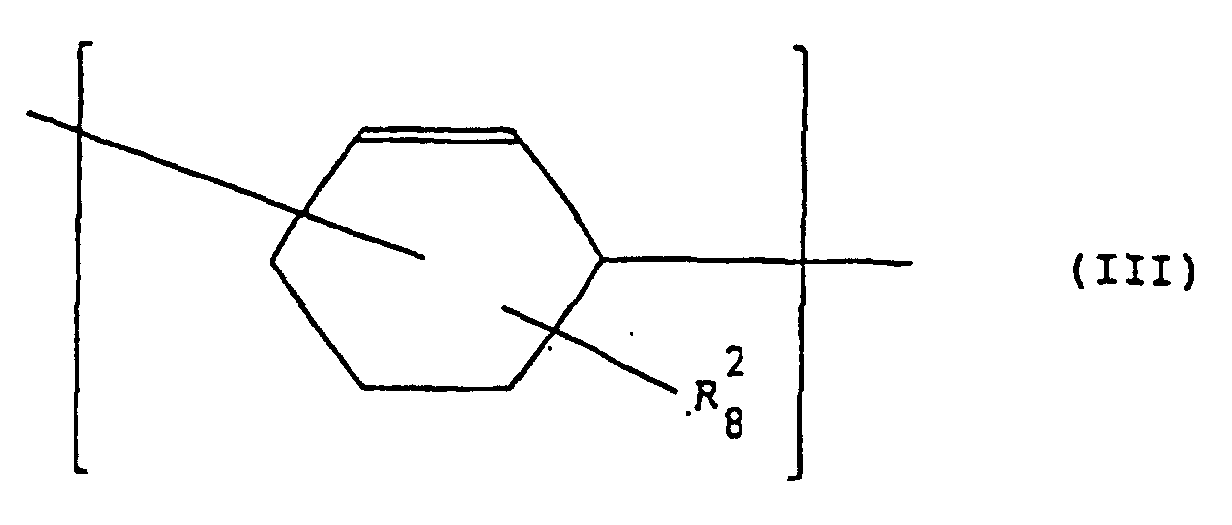
- ℓ and m satisfy the following requirements:
- ℓ + m = 100,
- 0.5 ≤ ℓ ≤ 100, and
- 0 ≤ m < 100,


- ℓ and m satisfy the following requirements:
- ℓ + m = 100,
- 0.5 ≤ ℓ ≤ 100, and
- 0 ≤ m < 100,
which comprises polymerizing at least one cyclic conjugated diene monomer, or copolymerizing at least one cyclic conjugated diene monomer and at least one comonomer copolymerizable therewith in the presence of a catalyst comprised of a binuclear or multinuclear complex of an organometallic compound containing a metal belonging to Group IA of the Periodic Table with a complexing agent comprised of an amine, wherein the copolymerization of said at least one cyclic conjugated diene monomer and said at least one comonomer is performed to produce a block copolymer, said at least one comonomer being selected from either the class consisting of chain conjugated diene monomers or the class consisting of vinyl aromatic monomers.

wherein:

- ℓ and m satisfy the following requirements:
- ℓ + m = 100,
- 0.5 ≤ ℓ ≤ 100, and
- 0 ≤ m < 100,

wherein:
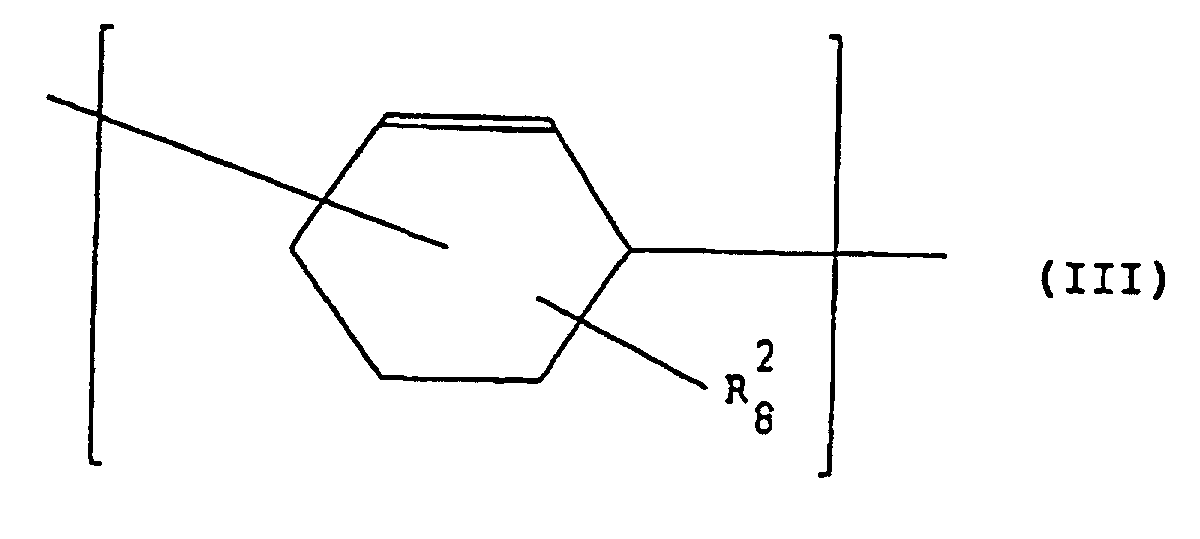
- ℓ and m satisfy the following requirements:
- ℓ + m = 100,
- 0.5 ≤ ℓ ≤ 100, and
- 0 ≤ m < 100,
which comprises polymerizing at least one cyclic conjugated diene monomer, or copolymerizing at least one cyclic conjugated diene monomer and at least one comonomer copolymerizable therewith in the presence of a catalyst comprised of a binuclear or multinuclear complex of an organometallic compound containing a metal belonging to Group IA of the Periodic Table with a complexing agent comprised of an amine, wherein the copolymerization of said at least one cyclic conjugated diene monomer and said at least one comonomer is performed to produce a block copolymer, said at least one comonomer being selected from either the class consisting of chain conjugated diene monomers or the class consisting of vinyl aromatic monomers.
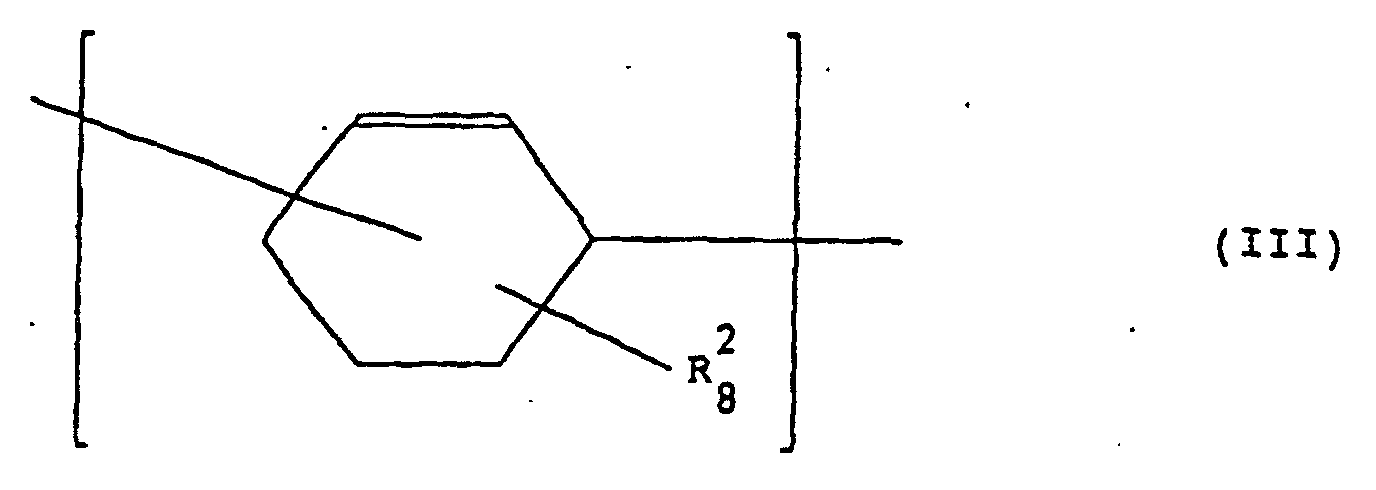
[(Z-Y)q-Z]rX, and [(Y-Z)q-Y]rX
wherein the ratios of the respective block copolymers, are appropriately chosen.

When the above mentioned molar ratio M1/M2 is within the range as defined above, a stable binuclear or multinuclear complex can be obtained, which can be advantageously used for producing a polymer or a copolymer in high yield.
Especially when the complex is an at least-bi-nuclear complex, the molar ratio is preferably:
| TMEDA/n-BuLi | Yield (%) | |
| Reference Example 3 | 2/1 | 58.6 |
| Reference Example 4 | 1/1 | 98.4 |
| Reference Example 5 | 1/2 | 97.7 |
| Reference Example 6 | 1/4 | 99.5 |
| Reference Example 7 | 1/8 | 69.2 |
| Reference Example 8 | 1/16 | 35.5 |
| DMA measurement conditions | |
| Thickness of specimen | about 2.0 mm |
| Span | about 18 mm |
| Measuring temperature | -150°C to +200°C |
| Temperature elevation rate | 2°C/min. |
| Mode of measuring frequency | Resonance frequency |
| Measuring device: 983 DMA, manufactured and sold by DuPont Instrument |
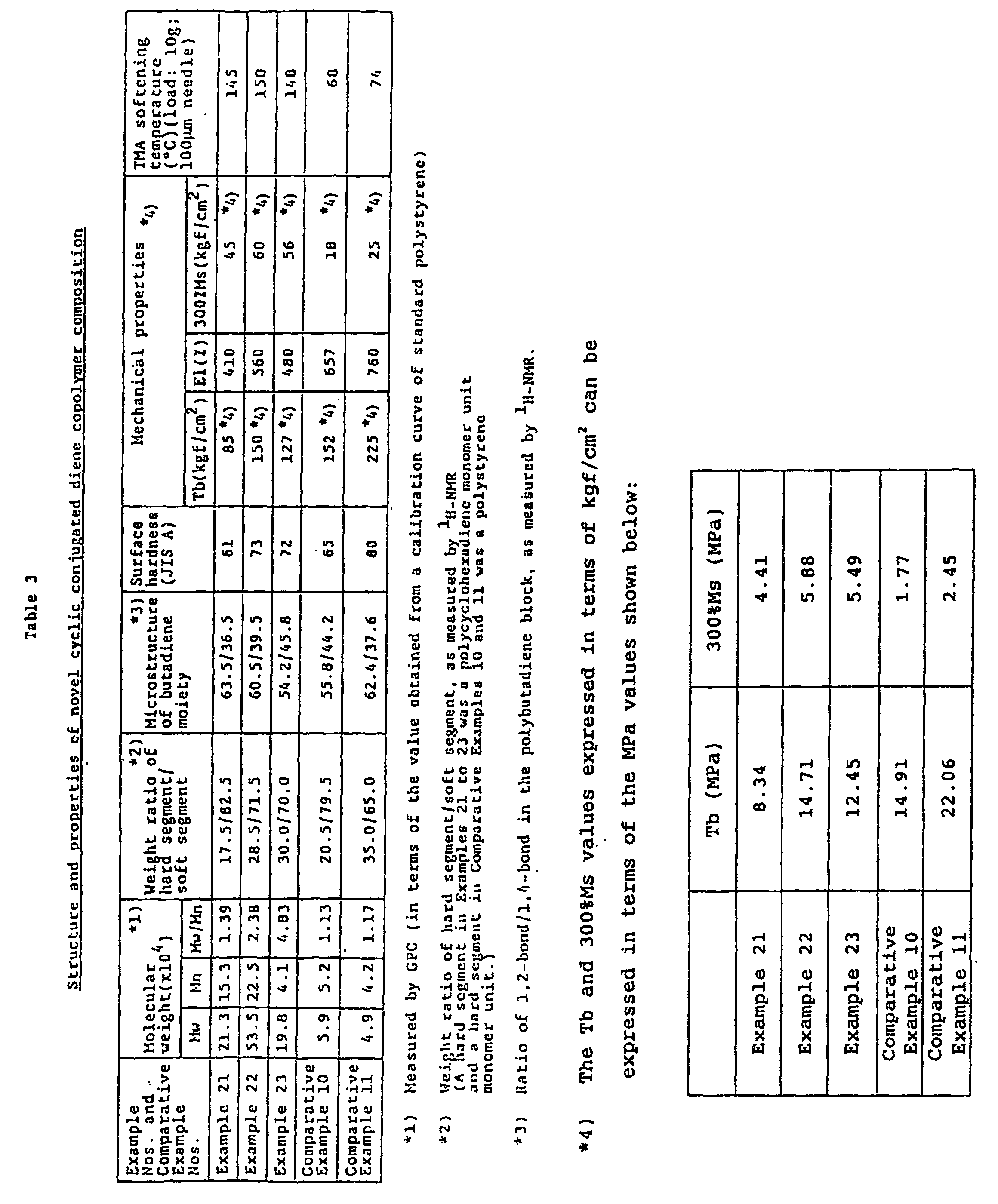
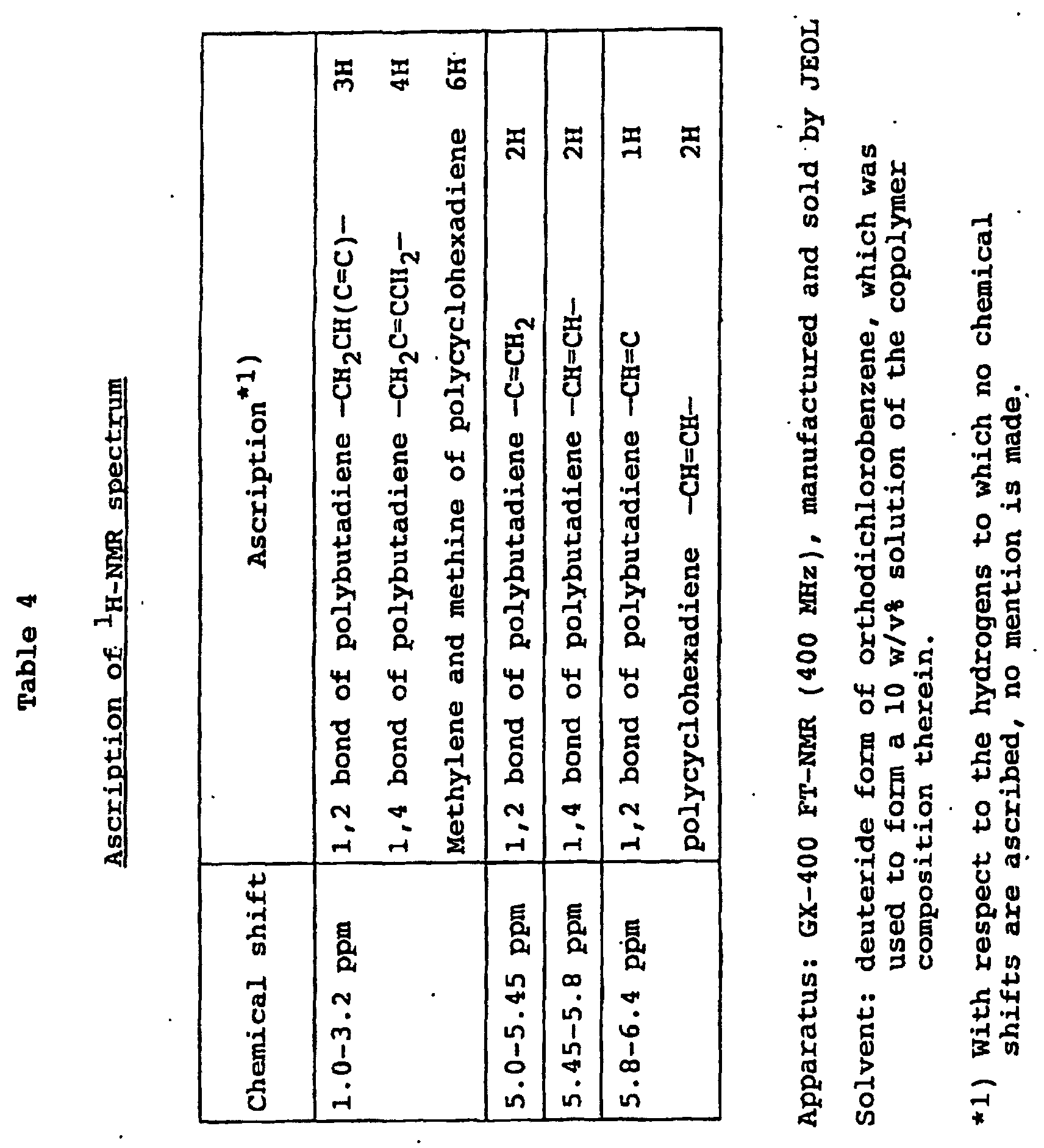
Claims (12)
- A cyclic conjugated diene polymer comprising a main chain represented by the following formula (I):wherein A and B are monomer units constituting said main chain in which monomer units A and B are arranged in any order, and ℓ and m are, respectively, weight percentages of monomer units A and B, based on the total weight of monomer units A and B;

wherein:wherein:A is selected from the class consisting of cyclic conjugated diene monomer units each being independently represented by the following formula (III):wherein each R2 independently represents a hydrogen atom, a halogen atom, a C1-C20 alkyl group, a C2-C20 unsaturated aliphatic hydrocarbon group, a C5-C20 aryl group, a C3-C20 cycloalkyl group, a C4-C20 cyclodienyl group or a 5 to 10-membered heterocyclic group having at least one nitrogen, oxygen or sulfur atom as a heteroatom.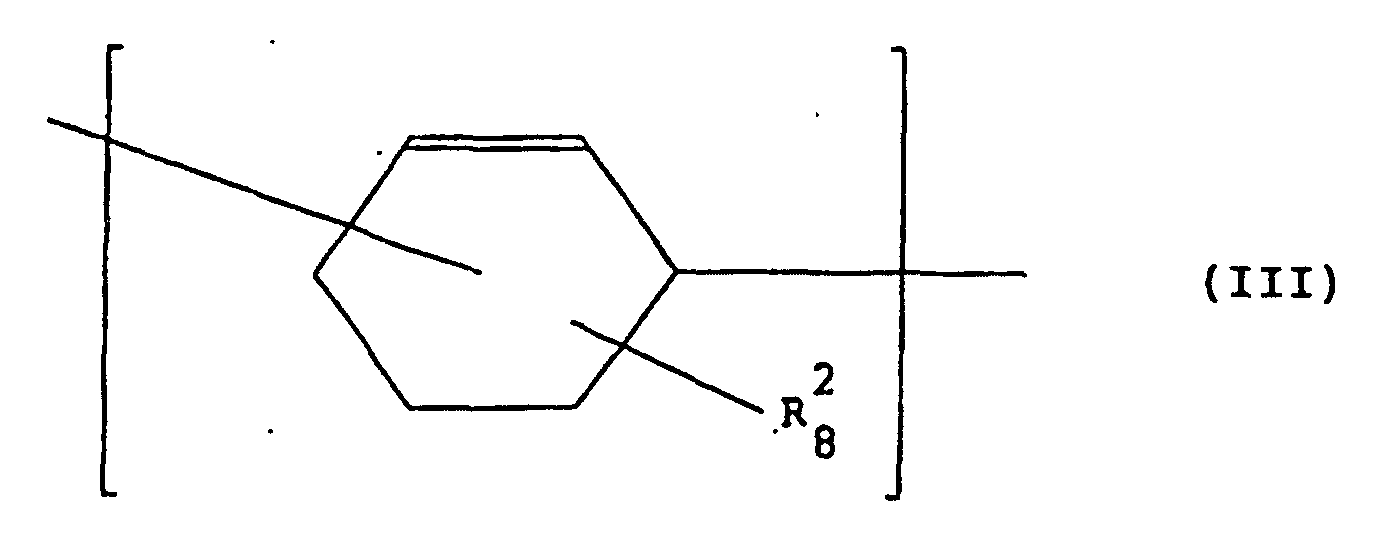 B is selected from either the class consisting of chain conjugated diene monomer units or the class consisting of vinyl aromatic monomer units; andwith the proviso that when ℓ = 100, said cyclic conjugated diene polymer has a number average molecular weight of from 40,000 to 5,000,000, and when 0.5 ≤ ℓ < 100, said cyclic conjugated diene polymer is a block copolymer comprising A monomer units and B monomer units and has a number average molecular weight of from 25,000 to 5,000,000, wherein the number average molecular weight is measured by gel permeation chromatography, using 1,2,4-trichlorobenzene as a solvent and using a calibration curve of a standard polystyrene.ℓ and m satisfy the following requirements:ℓ + m = 100,0.5 ≤ ℓ ≤ 100, and0 ≤ m < 100,
 - The cyclic conjugated diene polymer according to claim 1, wherein ℓ = 100, and wherein said A monomer units are comprised of cyclic conjugated diene monomer units which are the same or different.
- The cyclic conjugated diene polymer according to claim 1, wherein, in said block copolymer, said A monomer units are comprised of cyclic conjugated diene monomer units which are the same or different.
- The cyclic conjugated diene polymer according to claim 1, wherein said block copolymer is an at least-tri-block copolymer having a number average molecular weight of from 25,000 to 1,000,000 and comprising at least two Y blocks each containing at least one A monomer unit, and at least one Z block comprised mainly of chain conjugated diene monomer units as monomer units B, wherein the weight ratio of said at least two Y blocks to said at least one Z block is from 3/97 to 97/3.
- The cyclic conjugated diene polymer according to claim 1, wherein said block copolymer is a diblock copolymer having a number average molecular weight of from 25,000 to 1,000,000 and comprising one Y block containing at least one A monomer unit, and one Z block comprised mainly of chain conjugated diene monomer units as monomer units B.
- The cyclic conjugated diene polymer according to any one of claims 1 to 5, wherein at least one of said cyclic conjugated diene monomer units is a 1,3-cyclohexadiene monomer unit or a derivative thereof.
- A cyclic conjugated diene copolymer composition comprising (α) an at least-tri-block copolymer of claim 4 and (β) a diblock copolymer of claim 5, wherein the proportions of components (α) and (β) are, respectively, from 5 to 95 % by weight and from 95 % to 5 % by weight, based on the total weight of components (α) and (β).
- The composition according to claim 7, wherein at least a part of said Y block is comprised of at least one cyclic conjugated diene monomer unit selected from the class consisting of a 1,3-cyclohexadiene monomer unit and a derivative thereof, and said Z block is comprised mainly of units of at least one member selected from the class consisting of a 1,3-butadiene monomer unit and an isoprene monomer unit.
- The composition according to claim 7, wherein said at least-tri-block copolymer (α) has a configuration represented by a formula selected from the group consisting of Y - (Z - Y)q, (Y - Z)r, Z - (Y - Z)r, [(Z - Y)q]r, [(Y - Z)q]r, [(Z - Y)q-Z]r, and [(Y - Z)q-Y]r in which Y and Z are as defined above, q is an integer of 1 or more, and r is an integer of 2 or more.
- A method for producing a cyclic conjugated diene polymer comprising a main chain represented by the following formula (I):wherein A and B are monomer units constituting said main chain in which monomer units A and B are arranged in any order, and ℓ and m are, respectively, weight percentages of monomer units A and B, based on the total weight of monomer units A and B;

wherein:wherein:A is selected from the class consisting of cyclic conjugated diene monomer units each being independently represented by the following formula (III):wherein each R2 independently represents a hydrogen atom, a halogen atom, a C1-C20 alkyl group, a C2-C20 unsaturated aliphatic hydrocarbon group, a C5-C20 aryl group, a C3-C20 cycloalkyl group, a C4-C20 cyclodienyl group or a 5 to 10-membered heterocyclic group having at least one nitrogen, oxygen or sulfur atom as a heteroatom. B is selected from either the class consisting of chain conjugated diene monomer units or the class consisting of vinyl aromatic monomer units; andwith the proviso that when ℓ = 100, said cyclic conjugated diene polymer has a number average molecular weight of from 40,000 to 5,000,000, and when 0.5 ≤ ℓ < 100, said cyclic conjugated diene polymer is a block copolymer comprising A monomer units and B monomer units and has a number average molecular weight of from 25,000 to 5,000,000, wherein the number average molecular weight is measured by gel permeation chromatography, using 1,2,4-trichlorobenzene as a solvent and using a calibration curve of a standard polystyrene,ℓ and m satisfy the following requirements:ℓ + m = 100,0.5 ≤ ℓ ≤ 100, and0 ≤ m < 100,
which comprises polymerizing at least one cyclic conjugated diene monomer, or copolymerizing at least one cyclic conjugated diene monomer and at least one comonomer copolymerizable therewith in the presence of a catalyst comprised of a binuclear or multinuclear complex of an organometallic compound containing a metal belonging to Group IA of the Periodic Table with a complexing agent comprised of an amine, wherein the copolymerization of said at least one cyclic conjugated diene monomer and said at least one comonomer is performed to produce a block copolymer, said at least one comonomer being selected from either the class consisting of chain conjugated diene monomers or the class consisting of vinyl aromatic monomers. - The method according to claim 10, wherein said catalyst is one which has been prepared prior to the polymerization.
- A polymerization catalyst comprising a binuclear or multinuclear complex of an organometallic compound containing a metal belonging to Group IA of the Periodic Table with a complexing agent comprised of an amine.
Applications Claiming Priority (4)
| Application Number | Priority Date | Filing Date | Title |
|---|---|---|---|
| JP14128193 | 1993-05-21 | ||
| JP141281/93 | 1993-05-21 | ||
| JP14128193 | 1993-05-21 | ||
| PCT/JP1994/000822 WO1994028038A1 (en) | 1993-05-21 | 1994-05-23 | Cyclic conjugated diene polymer |
Publications (3)
| Publication Number | Publication Date |
|---|---|
| EP0700938A1 EP0700938A1 (en) | 1996-03-13 |
| EP0700938A4 EP0700938A4 (en) | 1996-07-24 |
| EP0700938B1 true EP0700938B1 (en) | 2005-08-24 |
Family
ID=15288248
Family Applications (1)
| Application Number | Title | Priority Date | Filing Date |
|---|---|---|---|
| EP94915282A Expired - Lifetime EP0700938B1 (en) | 1993-05-21 | 1994-05-23 | Cyclic conjugated diene polymer |
Country Status (6)
| Country | Link |
|---|---|
| EP (1) | EP0700938B1 (en) |
| KR (1) | KR100191817B1 (en) |
| CN (1) | CN1072234C (en) |
| CA (1) | CA2157896A1 (en) |
| DE (1) | DE69434471D1 (en) |
| WO (1) | WO1994028038A1 (en) |
Families Citing this family (3)
| Publication number | Priority date | Publication date | Assignee | Title |
|---|---|---|---|---|
| CN1166175A (en) * | 1994-11-18 | 1997-11-26 | 旭化成工业株式会社 | Improved cyclic conjugated diene polymer and its preparation method |
| WO2003016365A1 (en) * | 2001-08-17 | 2003-02-27 | Asahi Kasei Kabushiki Kaisha | Copolymer of conjugated cyclodiene |
| EP2488556B1 (en) * | 2009-10-14 | 2013-09-11 | Bridgestone Corporation | Processes for preparation of cyclic acyclic diene copolymer and rubber composition |
Citations (1)
| Publication number | Priority date | Publication date | Assignee | Title |
|---|---|---|---|---|
| GB2044277A (en) * | 1979-02-19 | 1980-10-15 | Sumitomo Chemical Co | Process for producing a cyclopentadiene copolymer and a composition comprising said copolymer and a rubber |
Family Cites Families (6)
| Publication number | Priority date | Publication date | Assignee | Title |
|---|---|---|---|---|
| FR1425276A (en) * | 1964-03-17 | 1966-01-24 | Exxon Research Engineering Co | Process for the polymerization of ethylene or conjugated diolefins |
| US3328372A (en) * | 1964-05-11 | 1967-06-27 | Exxon Research Engineering Co | Soluble high molecular weight polymers of cyclopentadiene |
| SU216948A1 (en) * | 1965-04-05 | 1982-11-07 | B V Erofeev | Process for producing polycyclohexadiene-1 |
| US4020251A (en) * | 1974-02-27 | 1977-04-26 | Phillips Petroleum Company | 1,3-Cyclodiene-acyclic conjugated diene copolymers |
| JPS5839842B2 (en) * | 1974-04-26 | 1983-09-01 | 住友化学工業株式会社 | Method for producing transparent block copolymer resin |
| JPS55110108A (en) * | 1979-02-19 | 1980-08-25 | Sumitomo Chem Co Ltd | Preparation of cyclopentadiene copolymer |
-
1994
- 1994-05-23 EP EP94915282A patent/EP0700938B1/en not_active Expired - Lifetime
- 1994-05-23 CN CN94191569A patent/CN1072234C/en not_active Expired - Fee Related
- 1994-05-23 DE DE69434471T patent/DE69434471D1/en not_active Expired - Lifetime
- 1994-05-23 CA CA002157896A patent/CA2157896A1/en not_active Withdrawn
- 1994-05-23 KR KR1019950704113A patent/KR100191817B1/en not_active Expired - Fee Related
- 1994-05-23 WO PCT/JP1994/000822 patent/WO1994028038A1/en not_active Ceased
Patent Citations (1)
| Publication number | Priority date | Publication date | Assignee | Title |
|---|---|---|---|---|
| GB2044277A (en) * | 1979-02-19 | 1980-10-15 | Sumitomo Chemical Co | Process for producing a cyclopentadiene copolymer and a composition comprising said copolymer and a rubber |
Also Published As
| Publication number | Publication date |
|---|---|
| CN1072234C (en) | 2001-10-03 |
| KR100191817B1 (en) | 1999-06-15 |
| CN1119871A (en) | 1996-04-03 |
| KR960701106A (en) | 1996-02-24 |
| DE69434471D1 (en) | 2005-09-29 |
| EP0700938A1 (en) | 1996-03-13 |
| EP0700938A4 (en) | 1996-07-24 |
| WO1994028038A1 (en) | 1994-12-08 |
| CA2157896A1 (en) | 1994-12-08 |
Similar Documents
| Publication | Publication Date | Title |
|---|---|---|
| US5792824A (en) | Cyclic conjugated diene polymer and method of producing same | |
| US5830965A (en) | Polymer containing a modified cyclic monomer unit | |
| US5795945A (en) | Polymer containing a cyclic olefin monomer unit | |
| JP3735149B2 (en) | Allyl- and xylyl-amine containing elastomers and products with reduced hysteresis | |
| JPH07258318A (en) | Polymerization catalyst | |
| JP2002507241A (en) | Aliphatic polyalcohol glycidyl ethers as coupling agents in anionic polymerization | |
| EP0192424B1 (en) | Process for producing thermoplastic elastomeric block copolymers | |
| EP0738738B1 (en) | Polymer containing saturated cyclic molecular structure units | |
| EP0700938A1 (en) | Cyclic conjugated diene polymer | |
| KR100208316B1 (en) | Improved cyclic conjugated diene polymer and process for producing the same | |
| JP5196699B2 (en) | Polymers with high vinyl end segments | |
| KR100235083B1 (en) | Novel polymerization catalyst | |
| JP3141190B2 (en) | Cyclic conjugated diene copolymer | |
| WO2023276741A1 (en) | Hydrogenated conjugated diene graft polymer, method for producing same, polymer composition, molded article, and crosslinked product | |
| JPH08225614A (en) | Improved cyclic conjugated diene-based polymer and its production | |
| JPH07247321A (en) | Polymer of cyclic conjugated diene and polymerization of the diene | |
| EP2803683B1 (en) | Functionalized elastomer and method of making such an elastomer | |
| JP3333045B2 (en) | Cyclic diene block copolymer composition | |
| JP3441015B2 (en) | Novel polymers containing saturated cyclic molecular structural units | |
| JPWO1995021202A1 (en) | Novel polymers containing modified cyclic molecular units | |
| JPH10152539A (en) | Production of cyclic conjugated diene-based block copolymer | |
| US20030158345A1 (en) | Method for preparing transparent blcok copolymer resin, copolymer prepared thereby, and usage thereof | |
| JPWO2003016365A1 (en) | Cyclic conjugated diene copolymer | |
| JPH10152538A (en) | Production of cyclic conjugated diene-based polymer | |
| JPS6026016A (en) | Block copolymer composition and its production |
Legal Events
| Date | Code | Title | Description |
|---|---|---|---|
| PUAI | Public reference made under article 153(3) epc to a published international application that has entered the european phase |
Free format text: ORIGINAL CODE: 0009012 |
|
| 17P | Request for examination filed |
Effective date: 19950925 |
|
| AK | Designated contracting states |
Kind code of ref document: A1 Designated state(s): DE FR GB |
|
| A4 | Supplementary search report drawn up and despatched | ||
| AK | Designated contracting states |
Kind code of ref document: A4 Designated state(s): DE FR GB |
|
| 17Q | First examination report despatched |
Effective date: 20000713 |
|
| RAP1 | Party data changed (applicant data changed or rights of an application transferred) |
Owner name: ASAHI KASEI KABUSHIKI KAISHA |
|
| GRAP | Despatch of communication of intention to grant a patent |
Free format text: ORIGINAL CODE: EPIDOSNIGR1 |
|
| GRAS | Grant fee paid |
Free format text: ORIGINAL CODE: EPIDOSNIGR3 |
|
| GRAA | (expected) grant |
Free format text: ORIGINAL CODE: 0009210 |
|
| AK | Designated contracting states |
Kind code of ref document: B1 Designated state(s): DE FR GB |
|
| REG | Reference to a national code |
Ref country code: GB Ref legal event code: FG4D |
|
| REF | Corresponds to: |
Ref document number: 69434471 Country of ref document: DE Date of ref document: 20050929 Kind code of ref document: P |
|
| PG25 | Lapsed in a contracting state [announced via postgrant information from national office to epo] |
Ref country code: DE Free format text: LAPSE BECAUSE OF FAILURE TO SUBMIT A TRANSLATION OF THE DESCRIPTION OR TO PAY THE FEE WITHIN THE PRESCRIBED TIME-LIMIT Effective date: 20051125 |
|
| PLBE | No opposition filed within time limit |
Free format text: ORIGINAL CODE: 0009261 |
|
| STAA | Information on the status of an ep patent application or granted ep patent |
Free format text: STATUS: NO OPPOSITION FILED WITHIN TIME LIMIT |
|
| 26N | No opposition filed |
Effective date: 20060526 |
|
| EN | Fr: translation not filed | ||
| PG25 | Lapsed in a contracting state [announced via postgrant information from national office to epo] |
Ref country code: FR Free format text: LAPSE BECAUSE OF FAILURE TO SUBMIT A TRANSLATION OF THE DESCRIPTION OR TO PAY THE FEE WITHIN THE PRESCRIBED TIME-LIMIT Effective date: 20061020 |
|
| PG25 | Lapsed in a contracting state [announced via postgrant information from national office to epo] |
Ref country code: FR Free format text: LAPSE BECAUSE OF FAILURE TO SUBMIT A TRANSLATION OF THE DESCRIPTION OR TO PAY THE FEE WITHIN THE PRESCRIBED TIME-LIMIT Effective date: 20050824 |
|
| PGFP | Annual fee paid to national office [announced via postgrant information from national office to epo] |
Ref country code: GB Payment date: 20130522 Year of fee payment: 20 |
|
| REG | Reference to a national code |
Ref country code: GB Ref legal event code: PE20 Expiry date: 20140522 |
|
| PG25 | Lapsed in a contracting state [announced via postgrant information from national office to epo] |
Ref country code: GB Free format text: LAPSE BECAUSE OF EXPIRATION OF PROTECTION Effective date: 20140522 |