EP0700007A2 - Procédé d'adressage à clé d'accès et de stockage pour le stockage et le recouvrement de données dans une mémoire adressable - Google Patents
Procédé d'adressage à clé d'accès et de stockage pour le stockage et le recouvrement de données dans une mémoire adressable Download PDFInfo
- Publication number
- EP0700007A2 EP0700007A2 EP95109004A EP95109004A EP0700007A2 EP 0700007 A2 EP0700007 A2 EP 0700007A2 EP 95109004 A EP95109004 A EP 95109004A EP 95109004 A EP95109004 A EP 95109004A EP 0700007 A2 EP0700007 A2 EP 0700007A2
- Authority
- EP
- European Patent Office
- Prior art keywords
- key
- memory
- keyv
- validity information
- stored
- Prior art date
- Legal status (The legal status is an assumption and is not a legal conclusion. Google has not performed a legal analysis and makes no representation as to the accuracy of the status listed.)
- Granted
Links
Images

Classifications
-
- G—PHYSICS
- G06—COMPUTING OR CALCULATING; COUNTING
- G06F—ELECTRIC DIGITAL DATA PROCESSING
- G06F16/00—Information retrieval; Database structures therefor; File system structures therefor
- G06F16/90—Details of database functions independent of the retrieved data types
- G06F16/901—Indexing; Data structures therefor; Storage structures
- G06F16/9014—Indexing; Data structures therefor; Storage structures hash tables
Definitions
- Data processing applications often require access to interconnected data.
- One reason for connecting such data to one another can be, for example, that a date refers to several further data records that are to be accessed on a case-by-case basis. Another reason for this may be that different data records have to be accessed in parallel and that a permanent connection of these data records would also have an adverse effect on the speed of data processing.
- such linked data are tables or lists that refer to each other. Such connected data or lists are frequently used in communication technology and in the field of artificial intelligence. However, other areas of application are also conceivable in which it is important to find information that is associated with one another quickly.
- a well-known solution for addressing tables in memories is, for example, the hash method.
- the search key as part of information to be stored, or all of the information, is used here directly in a hash function which, ideally, directly matches the location of the table that is sought delivers as a result. In this case, the search key would be directly below this for common hash methods Address saved.
- This method is generally very fast, but not very memory efficient, since the key must also be stored in the memory.
- This inefficient use of memory is disadvantageous, especially in those applications in which a great deal of information is to be stored in many decentralized units which are accessed occasionally by the hash method. This disadvantage affects above all when using many keys, ie with small table entries that have to be found separately, as well as with very long search keys.
- the object on which the invention is based is to specify a hash access method for an addressable memory in which a key entry in the memory can be dispensed with.
- a great advantage of the method according to the invention is that the key entries in the memory can be dispensed with, so that only the information to be stored has to be stored in the memory. Furthermore, the access accuracy can be determined arbitrarily by the number of hash functions used, since with increasing number of mutually independent hash functions, more key validity information is available and thus a more precise check of the validity of a key becomes possible.
- Another advantage of the method according to the invention is that the information to be stored only has to be stored once in a memory area.
- the key validity information which is stored in further memory areas, can only consist of a bit that has been set and thus consumes minimal memory space.
- the method according to the invention ensures that key validity information cannot be found in further memory areas in the event of incorrect entries or incorrect keys, or that the number of hits in key validity information provides a probability statement about the validity a key can be hit.
- the method according to the invention makes it particularly advantageous to make a statement about the validity of a key by relating the number of key validity information to the number of managed keys or the hash functions used. Access accuracy can be optimized depending on the application requirements.
- address collisions can advantageously be quickly identified and consequently overflow strategies can be used quickly.
- Figure 1 shows an example of an access according to the inventive method.
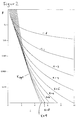
- FIG. 2 shows the relationship between the number of keys used and the number of additionally used hash functions in connection with the accuracy of access to a key.
- FIG. 1 shows an example of the addressing and storage method according to the invention.
- a data record DAT1 is shown, which contains a key KEY1 and an associated information INFO1 as a component. It is irrelevant for the method according to the invention whether a key is first transmitted as a data record and then converted, or whether part of a data record is used as a key. In the first case, the information INFO1 following the KEY1 key has to be practically entered as a second data record at the address that was found by using a hash function on the KEY1 key.
- FIG. Addresses A11 to A16 are present in the memory area SB1.
- a storage space for data entries is also provided there.
- Data inserts DAT1, DAT3 and DAT6 are entered as examples.
- Memory areas SB2 and SB3 are also present, in which key validity information is stored.
- the addresses are A21 A26 to A26 and key validity information, for example in the form of a set bit, are stored at address A21 or A26.
- Addresses A31 to A36 are present in memory area SB3 and key validity information KEYV is stored under address A31.
- the key in the data record DAT1 arrives, for example, via a data line, or is entered by an operator on a data processing system as a search term in order to be able to either write in or read out a memory content.
- the address A11 of the memory area SB1 is obtained by applying a hash function H1 to the key KEY1.
- the data record DAT1 is now stored in the intended memory location in the memory area SB1 under the address A11. If necessary, it can also be advantageous to only store the information INFO1 of the data record DAT1 at the corresponding address A11. This is particularly advantageous if the key is entered separately and otherwise has no relation to the information that is to be stored.
- the method according to the invention now also provides that, since the key itself is not stored in the memory area SB1 at the address A11, as provided in accordance with the invention, a different hash function H2 instead of H1 is applied to the key and thereby an address A21 in the memory area SB2 receive.
- H2 instead of H1 is applied to the key and thereby an address A21 in the memory area SB2 receive.
- By selecting the hash functions it can be ensured that A21 in the memory area SB2 does not match the address A11 in the memory area SB1.
- Only key validity information KEYV is now stored at address A21 in memory area SB2.
- This key validity information can consist, for example, of a single set bit.
- the method according to the invention provides for a hash function H3 now additionally to be applied to the key KEY, which has an address value A31 in the memory area SB3. Under this address value, one continues to become KEY KEYV key validity information belonging to DAT1 filed.
- a hash function H3 now additionally to be applied to the key KEY, which has an address value A31 in the memory area SB3.
- KEY KEYV key validity information belonging to DAT1 filed By avoiding a key entry in the memory area SB1 and further storing only key validity information KEYV in the further memory areas SB2 and SB3, an optimal memory usage is achieved. This optimal use of memory is particularly favorable if a lot of information that can be reached by a key entry is also to be accessed in different decentralized nodes.
- the access speed is also accelerated by the method according to the invention, since the necessary search processes can run faster because of the small memory entries.
- the application of the method according to the invention during the storage process clearly shows the address at which the data entry DAT1 can be found.
- it is located at address A11 of memory area SB1.
- the entries in the memory area SB2 and SB3 are now used to check whether the key is valid.
- it is checked whether in the memory area SB2 under the address A21 the key validity information KEYV for the key KEY is stored.
- the same happens in memory area SB3 at address A31. In this case, both key validity information are available. Since this key validity information was obtained by applying completely different hash functions to the key, it can be assumed that the key KEY and the data record DAT1 belong together.
- Another example results from the consideration of the memory area SB1.
- the address A13 of the memory area SB1 has been determined from a key in a data record in order to write or read a data record DAT3.
- Applying the hash function H2 to this key results, for example, in an address A24 in the memory area SB2.
- Applying the hash function A3 to this key results, for example, in an address entry A35 in the memory area SB3.
- To ensure key validity it is now checked whether there is a key validity entry. This key validity entry is not found, therefore the key is not valid, ie it cannot be accessed under A13 using this key. This means, for example, that data record DAT3 may neither be overwritten nor read out, as this could lead to errors.
- An incorrect key can be entered, for example, by an error occurring on a transport route of the data information or by a user, for example, incorrectly entering a street name. It can be advantageous to request this data record, which contains the wrong key, from its sender again, or to apply an error correction algorithm to this data record in order to correct the wrong key. However, it can also be expedient to issue an error message in order to inform a user of the data processing system that he should enter a new key.
- Analogous considerations can be made for the data entry DAT6 in the memory area SB1, which is located there under the address A16. If this data record is to be accessed using a key, key validity information can be found in the memory area SB2 by using H2 on this key under A26. However, no key validity information is stored in the memory area SB2 by using the hash function H3 on this key under A36.
- the method according to the invention now provides, depending on the number of key validity information found and in relation to the number of managed key validity information, a probability statement about the key validity. In this case the probability that the key is valid would be 50%.
- the probability of a key validity can be better determined for the storage of key validity information. For example, with 5 additional memory areas for key validity information and an incorrect entry for a key, the probability for the The validity of the key is 92%, whereas it is only 50% for a storage area.
- the exact relationships between the number of key validity information, the number of keys used and the number of hash functions used is explained in FIG. 2.
- FIG. 2 shows the relationship between the quantities P, s and K.
- P here means the probability with which a key is incorrectly assigned to a data record.
- s means the additional storage space per key in bytes, depending on the additional hash tables.
- K means the number of additional hash tables of size m, which is also decisive for the size of the memory of the data to be stored.
- n ( n m ) for an incorrect answer if the key is entered incorrectly.
- the memory space in the hash table in this case is nx 4 bytes (with 4 byte pointers that refer to additional information).
- FIG. 2 shows the optimal number of additional hash tables for managing key validity information using K opt .
Landscapes
- Engineering & Computer Science (AREA)
- Databases & Information Systems (AREA)
- Theoretical Computer Science (AREA)
- Software Systems (AREA)
- Data Mining & Analysis (AREA)
- Physics & Mathematics (AREA)
- General Engineering & Computer Science (AREA)
- General Physics & Mathematics (AREA)
- Information Retrieval, Db Structures And Fs Structures Therefor (AREA)
Applications Claiming Priority (2)
| Application Number | Priority Date | Filing Date | Title |
|---|---|---|---|
| DE4421640A DE4421640C1 (de) | 1994-06-21 | 1994-06-21 | Hash-Adressierungs- und Speicherverfahren zum Ablegen und Wiedergewinnen von Daten in einem adressierbaren Speicher |
| DE4421640 | 1994-06-21 |
Publications (3)
| Publication Number | Publication Date |
|---|---|
| EP0700007A2 true EP0700007A2 (fr) | 1996-03-06 |
| EP0700007A3 EP0700007A3 (fr) | 1996-03-20 |
| EP0700007B1 EP0700007B1 (fr) | 2001-09-12 |
Family
ID=6521105
Family Applications (1)
| Application Number | Title | Priority Date | Filing Date |
|---|---|---|---|
| EP95109004A Expired - Lifetime EP0700007B1 (fr) | 1994-06-21 | 1995-06-06 | Procédé d'adressage à clé d'accès et de stockage pour le stockage et le recouvrement de données dans une mémoire adressable |
Country Status (2)
| Country | Link |
|---|---|
| EP (1) | EP0700007B1 (fr) |
| DE (2) | DE4421640C1 (fr) |
Cited By (5)
| Publication number | Priority date | Publication date | Assignee | Title |
|---|---|---|---|---|
| RU2282238C1 (ru) * | 2005-02-24 | 2006-08-20 | ООО "Когнитивные технологии" | Информационно-справочная система производственно-экономических показателей авиаперевозок |
| WO2007036923A1 (fr) * | 2005-09-27 | 2007-04-05 | Allot Communications Ltd. | Fonction de hachage utilisant des nombres arbitraires |
| CN102930619A (zh) * | 2012-10-17 | 2013-02-13 | 深圳达实信息技术有限公司 | 大容量门禁系统及其控制方法 |
| CN104298774A (zh) * | 2014-10-31 | 2015-01-21 | 北京思特奇信息技术股份有限公司 | 一种利用函数查询哈希表的方法及系统 |
| CN109799961A (zh) * | 2019-01-24 | 2019-05-24 | 杭州嘉楠耘智信息科技有限公司 | 电路架构 |
Families Citing this family (10)
| Publication number | Priority date | Publication date | Assignee | Title |
|---|---|---|---|---|
| US6167400A (en) * | 1998-07-31 | 2000-12-26 | Neo-Core | Method of performing a sliding window search |
| DE10033612B4 (de) * | 2000-07-11 | 2004-05-13 | Siemens Ag | Verfahren zur Steuerung des Zugriffs auf eine Speichereinrichtung |
| AU2001285161A1 (en) | 2000-08-21 | 2002-03-04 | United States Postal Services | Delivery point validation system |
| DE10064526A1 (de) * | 2000-12-14 | 2002-06-27 | Helmut Schumacher | Verfahren zur Generierung von Objektidentifikationen, insbesondere bei Datenbanken |
| US7248585B2 (en) * | 2001-10-22 | 2007-07-24 | Sun Microsystems, Inc. | Method and apparatus for a packet classifier |
| AU2003213722A1 (en) | 2002-03-21 | 2003-10-08 | David J. Payne | Method and system for storing and retrieving data using hash-accessed multiple data stores |
| US7664731B2 (en) | 2002-03-21 | 2010-02-16 | United States Postal Service | Method and system for storing and retrieving data using hash-accessed multiple data stores |
| US7159119B2 (en) | 2002-09-06 | 2007-01-02 | United States Postal Service | Method and system for efficiently retrieving secured data by securely pre-processing provided access information |
| JP2006520493A (ja) * | 2002-09-06 | 2006-09-07 | ユナイテッド ステイツ ポスタル サービス | 安全な事前処理が施されたアクセス情報により、保護されているデータを効率的に検索する方法及びシステム |
| US7412449B2 (en) * | 2003-05-23 | 2008-08-12 | Sap Aktiengesellschaft | File object storage and retrieval using hashing techniques |
Family Cites Families (2)
| Publication number | Priority date | Publication date | Assignee | Title |
|---|---|---|---|---|
| US4922417A (en) * | 1986-10-24 | 1990-05-01 | American Telephone And Telegraph Company | Method and apparatus for data hashing using selection from a table of random numbers in combination with folding and bit manipulation of the selected random numbers |
| EP0381418A3 (fr) * | 1989-01-31 | 1991-11-27 | International Business Machines Corporation | Petite table de consultation rapide utilisée dans les systèmes de traitement de données |
-
1994
- 1994-06-21 DE DE4421640A patent/DE4421640C1/de not_active Expired - Fee Related
-
1995
- 1995-06-06 EP EP95109004A patent/EP0700007B1/fr not_active Expired - Lifetime
- 1995-06-06 DE DE59509587T patent/DE59509587D1/de not_active Expired - Fee Related
Non-Patent Citations (1)
| Title |
|---|
| OLLMERT H.J.: "Datenstrukturen und Datenorganisationen.", 1989, OLDENBOURG., pages: 133 - 162 |
Cited By (6)
| Publication number | Priority date | Publication date | Assignee | Title |
|---|---|---|---|---|
| RU2282238C1 (ru) * | 2005-02-24 | 2006-08-20 | ООО "Когнитивные технологии" | Информационно-справочная система производственно-экономических показателей авиаперевозок |
| WO2007036923A1 (fr) * | 2005-09-27 | 2007-04-05 | Allot Communications Ltd. | Fonction de hachage utilisant des nombres arbitraires |
| CN102930619A (zh) * | 2012-10-17 | 2013-02-13 | 深圳达实信息技术有限公司 | 大容量门禁系统及其控制方法 |
| CN104298774A (zh) * | 2014-10-31 | 2015-01-21 | 北京思特奇信息技术股份有限公司 | 一种利用函数查询哈希表的方法及系统 |
| CN104298774B (zh) * | 2014-10-31 | 2018-04-03 | 北京思特奇信息技术股份有限公司 | 一种利用函数查询哈希表的方法及系统 |
| CN109799961A (zh) * | 2019-01-24 | 2019-05-24 | 杭州嘉楠耘智信息科技有限公司 | 电路架构 |
Also Published As
| Publication number | Publication date |
|---|---|
| DE4421640C1 (de) | 1995-08-03 |
| EP0700007B1 (fr) | 2001-09-12 |
| EP0700007A3 (fr) | 1996-03-20 |
| DE59509587D1 (de) | 2001-10-18 |
Similar Documents
| Publication | Publication Date | Title |
|---|---|---|
| DE2726488C2 (de) | Adressenübersetzungseinrichtung | |
| EP0700007B1 (fr) | Procédé d'adressage à clé d'accès et de stockage pour le stockage et le recouvrement de données dans une mémoire adressable | |
| DE2523414C3 (de) | Hierarchische Speicheranordnung mit mehr als zwei Speicherstufen | |
| DE2725718C2 (de) | Datenverarbeitungsanordnung zum Übersetzen von virtuellen Adressen | |
| DE68925557T2 (de) | Verfahren zum Zugriff von Daten in einer Tabelle und seine Anwendung zum Lenken von Daten zwischen entfernten Stationen | |
| DE2235841C2 (de) | Datenverarbeitungsanlage mit Speichersteuerung für mindestens einen Prozessor und diesen zugeordneten Pufferspeichern | |
| EP0115609A2 (fr) | Dispositif d'adressage des mémoires de plusieurs unités de traitement de données dans un système de bus | |
| DE69506158T2 (de) | Fahrzeuglokalnetz und Nachrichtenleitweglenkungsverfahren | |
| DE2208664A1 (de) | Verfahren zur Decodierung eines vorsatzfreien Verdichtungscodes veränderlicher Länge | |
| DE1499687B2 (de) | Speicherschutz-einrichtung | |
| EP0856176B1 (fr) | Systeme de gestion de banque de donnees et procede de transmission de donnees | |
| EP0609703A2 (fr) | Dispositif de mémoire intégrée monolithique et méthode de son fonctionnement | |
| EP0814320A2 (fr) | Méthode pour changer une mémoire électronique pour données d'utilisation d'un véhicule | |
| DE2516050A1 (de) | Verfahren und einrichtung zur informationsspeicherung in einem datenverarbeitungssystem | |
| EP1924916A2 (fr) | Systeme de memoire et son mode de fonctionnement | |
| EP2102766A1 (fr) | Procédé pour extraire des données d'un support de mémoire | |
| DE3937021C2 (fr) | ||
| DE2714314C2 (de) | Datenverarbeitende Vorrichtung mit einem Datenspeicher | |
| DE2748859B2 (fr) | ||
| DE1449816C3 (de) | Schaltungsanordnung zur Steuerung des Zugriffs zu einem Magnettrommelspeicher | |
| EP1357477B1 (fr) | Dispositif connecté à un système de bus | |
| DE3013618C2 (de) | Schaltungsanordnung zur Bildung zweier miteinander in Beziehung stehender reeller Adressen aus einer zweiteiligen virtuellen Adresse | |
| DE3425844C2 (de) | Schaltungsanordnung zum schnellen Auffinden von bestimmten, von einer Fernmeldevermittlungsanlage oder Datenverarbeitungsanlage produzierten Datensätzen in einem Datenspeicher | |
| DE2404259C3 (de) | Schaltungsanordnung zum Zwischenspeichern von Datensätzen unterschiedlicher Länge | |
| DE3139886A1 (de) | Zeilendrucker und typentraeger dafuer |
Legal Events
| Date | Code | Title | Description |
|---|---|---|---|
| PUAI | Public reference made under article 153(3) epc to a published international application that has entered the european phase |
Free format text: ORIGINAL CODE: 0009012 |
|
| PUAL | Search report despatched |
Free format text: ORIGINAL CODE: 0009013 |
|
| AK | Designated contracting states |
Kind code of ref document: A2 Designated state(s): DE FR GB NL SE |
|
| AK | Designated contracting states |
Kind code of ref document: A3 Designated state(s): DE FR GB NL SE |
|
| 17P | Request for examination filed |
Effective date: 19960419 |
|
| GRAG | Despatch of communication of intention to grant |
Free format text: ORIGINAL CODE: EPIDOS AGRA |
|
| GRAG | Despatch of communication of intention to grant |
Free format text: ORIGINAL CODE: EPIDOS AGRA |
|
| GRAH | Despatch of communication of intention to grant a patent |
Free format text: ORIGINAL CODE: EPIDOS IGRA |
|
| 17Q | First examination report despatched |
Effective date: 20001110 |
|
| GRAH | Despatch of communication of intention to grant a patent |
Free format text: ORIGINAL CODE: EPIDOS IGRA |
|
| GRAA | (expected) grant |
Free format text: ORIGINAL CODE: 0009210 |
|
| AK | Designated contracting states |
Kind code of ref document: B1 Designated state(s): DE FR GB NL SE |
|
| REF | Corresponds to: |
Ref document number: 59509587 Country of ref document: DE Date of ref document: 20011018 |
|
| GBT | Gb: translation of ep patent filed (gb section 77(6)(a)/1977) |
Effective date: 20011121 |
|
| REG | Reference to a national code |
Ref country code: GB Ref legal event code: IF02 |
|
| ET | Fr: translation filed | ||
| PLBE | No opposition filed within time limit |
Free format text: ORIGINAL CODE: 0009261 |
|
| STAA | Information on the status of an ep patent application or granted ep patent |
Free format text: STATUS: NO OPPOSITION FILED WITHIN TIME LIMIT |
|
| 26N | No opposition filed | ||
| PGFP | Annual fee paid to national office [announced via postgrant information from national office to epo] |
Ref country code: DE Payment date: 20030818 Year of fee payment: 9 |
|
| PGFP | Annual fee paid to national office [announced via postgrant information from national office to epo] |
Ref country code: NL Payment date: 20040603 Year of fee payment: 10 |
|
| PGFP | Annual fee paid to national office [announced via postgrant information from national office to epo] |
Ref country code: SE Payment date: 20040604 Year of fee payment: 10 Ref country code: GB Payment date: 20040604 Year of fee payment: 10 |
|
| PGFP | Annual fee paid to national office [announced via postgrant information from national office to epo] |
Ref country code: FR Payment date: 20040618 Year of fee payment: 10 |
|
| PG25 | Lapsed in a contracting state [announced via postgrant information from national office to epo] |
Ref country code: DE Free format text: LAPSE BECAUSE OF NON-PAYMENT OF DUE FEES Effective date: 20050101 |
|
| PG25 | Lapsed in a contracting state [announced via postgrant information from national office to epo] |
Ref country code: GB Free format text: LAPSE BECAUSE OF NON-PAYMENT OF DUE FEES Effective date: 20050606 |
|
| PG25 | Lapsed in a contracting state [announced via postgrant information from national office to epo] |
Ref country code: SE Free format text: LAPSE BECAUSE OF NON-PAYMENT OF DUE FEES Effective date: 20050607 |
|
| PG25 | Lapsed in a contracting state [announced via postgrant information from national office to epo] |
Ref country code: NL Free format text: LAPSE BECAUSE OF NON-PAYMENT OF DUE FEES Effective date: 20060101 |
|
| EUG | Se: european patent has lapsed | ||
| PG25 | Lapsed in a contracting state [announced via postgrant information from national office to epo] |
Ref country code: FR Free format text: LAPSE BECAUSE OF NON-PAYMENT OF DUE FEES Effective date: 20060228 |
|
| GBPC | Gb: european patent ceased through non-payment of renewal fee |
Effective date: 20050606 |
|
| NLV4 | Nl: lapsed or anulled due to non-payment of the annual fee |
Effective date: 20060101 |
|
| REG | Reference to a national code |
Ref country code: FR Ref legal event code: ST Effective date: 20060228 |