EP0699645B1 - Process for the production of exothermically reacting compositions - Google Patents
Process for the production of exothermically reacting compositions Download PDFInfo
- Publication number
- EP0699645B1 EP0699645B1 EP95305162A EP95305162A EP0699645B1 EP 0699645 B1 EP0699645 B1 EP 0699645B1 EP 95305162 A EP95305162 A EP 95305162A EP 95305162 A EP95305162 A EP 95305162A EP 0699645 B1 EP0699645 B1 EP 0699645B1
- Authority
- EP
- European Patent Office
- Prior art keywords
- composition
- droplets
- particles
- mixture
- dispersion
- Prior art date
- Legal status (The legal status is an assumption and is not a legal conclusion. Google has not performed a legal analysis and makes no representation as to the accuracy of the status listed.)
- Expired - Lifetime
Links
Images


Classifications
-
- C—CHEMISTRY; METALLURGY
- C06—EXPLOSIVES; MATCHES
- C06B—EXPLOSIVES OR THERMIC COMPOSITIONS; MANUFACTURE THEREOF; USE OF SINGLE SUBSTANCES AS EXPLOSIVES
- C06B35/00—Compositions containing a metal azide
-
- F—MECHANICAL ENGINEERING; LIGHTING; HEATING; WEAPONS; BLASTING
- F26—DRYING
- F26B—DRYING SOLID MATERIALS OR OBJECTS BY REMOVING LIQUID THEREFROM
- F26B5/00—Drying solid materials or objects by processes not involving the application of heat
- F26B5/04—Drying solid materials or objects by processes not involving the application of heat by evaporation or sublimation of moisture under reduced pressure, e.g. in a vacuum
- F26B5/06—Drying solid materials or objects by processes not involving the application of heat by evaporation or sublimation of moisture under reduced pressure, e.g. in a vacuum the process involving freezing
- F26B5/065—Drying solid materials or objects by processes not involving the application of heat by evaporation or sublimation of moisture under reduced pressure, e.g. in a vacuum the process involving freezing the product to be freeze-dried being sprayed, dispersed or pulverised
-
- C—CHEMISTRY; METALLURGY
- C06—EXPLOSIVES; MATCHES
- C06B—EXPLOSIVES OR THERMIC COMPOSITIONS; MANUFACTURE THEREOF; USE OF SINGLE SUBSTANCES AS EXPLOSIVES
- C06B21/00—Apparatus or methods for working-up explosives, e.g. forming, cutting, drying
- C06B21/0091—Elimination of undesirable or temporary components of an intermediate or finished product, e.g. making porous or low density products, purifying, stabilising, drying; Deactivating; Reclaiming
Definitions
- This invention relates to a process for the production of an exothermically reactive composition containing one or more finely divided solid constituents, and to uses of such compositions produced by the process.
- the invention is particularly useful for the production of explosive or pyrotechnic compositions in the form of microporous particles consisting of agglomerates comprising mixed particles of the constituents of the composition.
- compositions which may advantageously be produced by the process of the invention include, for example, fast-burning gas-generating charges for projectile and rocket propellants, and inflators for vehicle occupant safety restraint 'air-bags', pyrotechnic compositions for example for pyrotechnic delay elements, flares and smoke producers; deflagrating blasting powder; and easily initiated detonating explosives.
- the reactive constituents are preferably in ultrafine form in order to achieve faster reaction rate as a consequence of the large area of the interface between the reacting constituents.
- Hitherto reactive constituents of exothermically reacting compositions have been prepared in fine form by various processes and mixed together. Many of these processes have involved grinding the constituents, singly or together with other ingredients of the composition, dry or wet in a comminution device such as a ball mill. Dry grinding has been described in United Kingdom patent specification no GB 2028785 and US patent specification nos 3895098, 4243443 and 4376002. Wet grinding has been described in US patent specifications nos 3947300, 4999063 and 5223184. A modification of the wet grinding process described in US patent specifications nos 5143567 and 5223184 involves wet grinding of ingredients in a slurry and spray drying droplets of the slurry.
- a further object is to increase the ease of ignition and burning rate of gas producing compositions for air-bags, projectile and rocket propellants, pyrotechnic compositions, igniters and deflagrating blasting powders and to increase the velocity of detonation and sensitivity to initiation to detonation of blasting explosives.
- a process for the production of an exothermically reacting composition containing at least one normally solid reactive constituent comprises the steps of:
- the frozen droplets are subjected to pressure and temperature conditions at which vapour from the carrier liquid is removed from the frozen particles by sublimation from the solid phase without any melting of the liquid.
- the process of the invention produces homogeneous substantially spherical, microporous particles of the exothermically reacting composition consisting of agglomerates comprising uniformly distributed primary particles of the ingredients of the composition containing pores which may be either closed or interconnected, open pores generally having a dimension of 0.2-10 ⁇ m.
- the porosity of the agglomerates is generally 10-80% and preferably 40-70% by volume.
- the particles of solid ingredients which do not dissolve in the carrier liquid substantially retain their original size and integrity, remaining as discrete particles throughout the process, whereas crystals of ingredients which dissolve in the carrier liquid are present as ultrafine crystals.
- Each agglomerate contains the ingredients of the compositions uniformly distributed in the correct proportions, the degree of mixing being commensurate with the size of the primary particles.
- the freeze-drying step locks the primary particles in the mixed structure and prevents segregation and re-agglomeration of like particles which occurs in conventional drying processes where the liquid is evaporated from a liquid phase.
- the porosity of the microporous particles will be dependent on the concentration of the dispersion and/or the rate of sublimation. Drying of the particles may be accelerated by heating the frozen droplets. Before forming the droplets, any ingredients which are insoluble in the carrier liquid are dispersed in the carrier liquid and the dispersion is maintained in a homogeneous condition by stirring if required. In some cases the dispersion will advantageously contain a thickening agent to obtain a preferred viscosity for droplet formation and to prevent segregation of the ingredients within the droplets. Ideally, however, solid constituents will be dispersed in the carrier liquid as a colloidal suspension of ultrafine particles. Further ingredients may optionally be included in the dispersion to modify the composition.
- the exothermically reacting composition comprises at least one reactive ingredient which is soluble in the carrier liquid, at least a portion of this soluble ingredient being dissolved in the carrier liquid of the dispersion.
- this soluble ingredient will be present in the microporous agglomerates in the form of ultrafine particles in uniform admixture with the remaining ingredients.
- the soluble ingredient is a crystalline substance the particles will consist of ultrafine crystals.
- Water soluble reactive constituents are conveniently dissolved in water but any suitable carrier liquid may be used.
- Droplets of the dispersion may be conveniently formed by spraying the dispersion through one or more orifices or by projecting the dispersion from the periphery of a rotating disc or basket in known manner.
- Preferred droplet diameters are in the range from 50-500 ⁇ m, more preferably 75-200 ⁇ m if subsequent pressing of the freeze-drying particles is required.
- the temperature of the cooling medium may conveniently be in the range -40 to -195°C, and preferably about -80°C.
- the cooling medium may comprise liquid, for example, liquid air or nitrogen but a gaseous medium is preferred in order to minimise distortion of the droplets and consequently optimise the free running properties of the product particles.
- Suitable cold gases comprise air, nitrogen, carbon dioxide, argon and helium.
- the cold gas is preferably recycled through conventional refrigeration means.
- the cold gas may be cooled by a recycled refrigerated fluid which may, for example, flow through a jacket surrounding a freezing chamber in which the droplets are frozen.
- the solidified droplets are preferably treated in a vacuum chamber maintained at a pressure below the triple point of the solvent, which for water is 6.11 mbar. Preferably the pressure is maintained at 0.1 to 2.0 mbar.
- the frozen droplets in the freeze-drying chamber are preferably heated to supply the heat of sublimation of the solvent and increase the vapour pressure, without melting the particles of said reactive constituent.
- the solvent vapour may conveniently be condensed in contact with a cold surface, leaving the desired freeze-dried solid particles.
- the microporous particles produced by this invention comprise uniform agglomerates which are much more reactive than particles of the same composition hitherto available. This has the effect of advantageously increasing the burning rate of pyrotechnic gas-producing compositions such as propellants for firing projectiles or gas-generants for inflating air-bags, increasing the velocity of detonation and ease of initiation to detonation of blasting explosive composition, and enhancing the ignitability and burning rate of deflagrating explosive blasting powders and pyrotechnic compositions.
- the particles are substantially free of dust, free flowing and collapse readily under pressure to form pressed grains when, for example, pressed grains are required for propellant explosives or gas-producing compositions charges in air-bags. Moreover if some of the carrier liquid, for example water, preferably about 0.5 to 5% by weight and preferably 1 to 2%, remains in the particles, high quality grains can be formed without the inclusion of a pressing agent.
- This invention provides a much safer method for producing explosive and pyrotechnic compositions containing finely divided solid reactive constituents than any of the dry mixing processes used hitherto in the manufacture of such explosive compositions since only wet mixing of a dispersion of the ingredients at low temperatures are used, thereby substantially eliminating the risk of overheating by applied heat or friction which could ignite the composition.
- Explosive compositions which may advantageously be prepared by the aforedescribed method include those containing alkali metal azides such as sodium azide and oxidizing salts such as nitrates, chlorates and perchlorates of ammonia and the alkali metals.
- alkali metal azides such as sodium azide
- oxidizing salts such as nitrates, chlorates and perchlorates of ammonia and the alkali metals.
- a sodium azide based gas-generating composition for air-bag inflation may be prepared from a slurry comprising a solution of sodium azide in water containing oxidizing material, such as iron oxide and silicon dioxide, dispersed in the solution.
- oxidizing material such as iron oxide and silicon dioxide
- the oxides which are readily available as ultrafine particles, will remain homogeneously distributed throughout the droplets and the particles produced therefrom.
- the resulting sodium azide compositions are especially advantageous as they have faster burning rates and the gaseous products contain less sodium and are therefore less toxic.
- An air-bag inflation composition based on ammonium nitrate may also advantageously be produced by the aforedescribed process, but in this case, a fuel, which may advantageously be a reactive polymeric binding material, and preferably a water-soluble polymeric material, for example, polyacrylamide will be mixed with a solution of ammonium nitrate and the mixture formed into droplets which are then frozen and freeze-dried.
- a fuel which may advantageously be a reactive polymeric binding material, and preferably a water-soluble polymeric material, for example, polyacrylamide will be mixed with a solution of ammonium nitrate and the mixture formed into droplets which are then frozen and freeze-dried.
- a composition is especially advantageous for air-bag inflation as it produces only non-toxic gas with no slag, thus enabling the usual gas filter to be omitted from the air-bag inflator assembly.
- the invention also enables the manufacture of a sensitive blasting explosive or blasting agent to be prepared from non-self-explosive ingredients such as mixtures of oxidizing salt and fuel, for example, ammonium nitrate and carbon black. Hitherto such mixtures could only be initiated to detonation by very heavy priming but the product of the present invention can be initiated by a blasting cap, detonating cord or light primer.
- non-self-explosive ingredients such as mixtures of oxidizing salt and fuel, for example, ammonium nitrate and carbon black. Hitherto such mixtures could only be initiated to detonation by very heavy priming but the product of the present invention can be initiated by a blasting cap, detonating cord or light primer.
- the invention may also be advantageously used to manufacture useful deflagrating explosive powder of the black powder class.
- Black powder is normally made by a process which involves prolonged milling of a composition comprising potassium nitrate, carbon and sulphur but we have found that the same composition produced by the process of the present invention using carbon black instead of charcoal has useful blasting properties although it has slightly lower density than milled black powder.
- An alternative deflagrating explosive powder may also advantageously be prepared from potassium nitrate and a fuel/binder such as polystyrene sulphonate.
- constituents' of an exothermically reacting composition are mixed in mixer 2 with a carrier liquid to produce a homogeneous or near-homogeneous dispersion 3 in the form of a solution or a suspension having a viscosity between 1 and 1000 mPas (cps), preferably 10 to 100 mPas (cps), at 20°C.
- the well mixed solution or suspension is sprayed as fine droplets into a freezing apparatus 4 containing cold gas.
- a spherical frozen particulate product 5 is produced in the freezing apparatus 4 and is discharged into a metering hopper 6 where its temperature is regulated, preferably such that the particles warm up but remain below their melting point.
- Product stream 7 from hopper 6 is transferred through a vacuum lock 8 from which product stream 9 flows to a vacuum freeze-drying chamber 10 and is distributed as a layer onto a heated surface within the chamber.
- the heated surface is held at a temperature substantially below the boiling point of the carrier liquid such that the product is not subjected to either eutectic melting or structural collapse phenomena.
- the carrier liquid is water a temperature of 20 to 40°C is preferred.
- the chamber 10 is held at a pressure below the triple point of the carrier liquid (6.11 mbar in the case of water), preferably in the range 0.1 to 2 mbar.
- the vapour 14 from the frozen particles 5 is removed by a sublimation mechanism according to the pressure-temperature phase equilibrium for the specific material, yielding a final powder product 11 with up to 5% w/w moisture, preferably in the range 0.01 to 2.5% w/w moisture.
- the vapour 14 is conducted to a cold condenser chamber 15 where it condenses and the condensed liquid is removed.
- the stream 11 is optionally fed to granulating apparatus 12 where, for example, it may be pressed into grains 13 as required for gas generators or projectile propellants.
- a freezing apparatus (4 of Fig. 1) suitable for use in the process is shown in Fig. 2.
- the apparatus comprises a dispersion holding tank 21, a pressure vessel 22, a supply of pressurised gas 23, a refrigerated spray chamber 24 and a cyclone separator 25.
- the chamber 24 has a spray nozzle 26 connected to the pressure vessel 22.
- the chambers 21 and 22 may contain stirrers to maintain the homogeneity of the mixed dispersion in the spraying process.
- the dispersion of the explosive composition in a carrier liquid is fed from the tank 21 to the pressure vessel 22 from which it is forced under the pressure of the gas 23 through the nozzle 26 to emerge as droplets falling through the chamber 24.
- Refrigerated gas is circulated through the chamber 24 and the cyclone separator 25.
- the droplets cool and form solid particles when contacted by the refrigerated gas and are separated in the cyclone separator 26 from which the particles are subsequently transferred to the freeze- drying apparatus.
- a batch-freeze drying apparatus (10 of Fig. 1) suitable for use in the process is shown in Fig. 3.
- the apparatus comprises a drying chamber 31 containing a heated rack 32 on which trays 33 are placed for heating.
- the chamber 31 has a sealed lid 34 and is connected by a vacuum seal 35 to a cooled condenser chamber 36 provided with a drainpipe 37.
- a vacuum pump 39 is connected to the chamber 36.
- a temperature controller 40 is provided to control the temperature of the rack 32 and a pressure gauge 41 is provided to control the pressure in chambers 31 and 36.
- the lid 34 may be removed or the seal 35 may be broken to allow the chambers 31 and 36 to be separated so that the rack 32 and the trays 33 may be put in place.
- the particles to be dried are loaded on the trays 33, the chambers 31 and 36 are sealed, the pressure in the chambers is reduced to the desired sublimation pressure and the rack is heated to supply the heat of sublimation to the particles.
- the vapour 14 of the carrier liquid sublimised from the frozen particles condenses in the chamber 36, from which the condensed liquid is removed through the drainpipe 38.
- the pressure in the chambers 31 and 36 is restored to atmospheric the chamber 31 is opened and the dried material is removed.
- a dispersion having the following composition was prepared: Sodium azide, NaN 3 27 parts Iron oxide, Fe 2 O 3 12.4 parts Silicon dioxide, SiO 2 3.4 parts Water (distilled) 100 parts
- the sodium azide was dissolved in the water and the pH of the solution was adjusted to be within the range 8.5 to 9.5 by the addition of 5N sodium hydroxide solution.
- Pigment grade iron oxide R1599 as supplied by Harcross having a particle size in the range 0.1 - 0.2 ⁇ m
- fumed silicon dioxide as sold under the trademark CAB-O-SIL EH5 by The Cabot Manufacturing Co having a particle size in the range 0.05 - 0.1 ⁇ m
- the dispersion was transferred to a pressure vessel and sprayed through a nozzle at a pressure of 5bar to give 80-250 ⁇ m diameter droplets (measured by laser anemometer).
- the droplet spray was directed into a freezing chamber containing a sufficient volume of cold gas at -80°C to freeze the droplets.
- the frozen droplets fell to the bottom of the freezing chamber and were subsequently transferred to a vacuum freeze-dryer.
- the resulting powder consisted of particles which were agglomerates containing sodium azide crystals, iron oxide and silicon dioxide in uniform admixture
- the particles were agglomerated into microporous spherical particles, 50 - 200 microns in diameter, which were very free flowing and could be compressed to a density of 2g/cm 3 by a pressure of 20,000 psi to form pressed grains with a burning rate of 45mm/second.
- the pressed grains typically in the form of toroidal or flat annular discs, 36mm outer diameter, 12mm inner diameter and 5mm thick, are suitable for use in gas-generant charges for inflating air-bags in vehicle occupant restraint safety systems.
- a photomicrograph of the microstructure of an agglomerated particle produced in this Example is shown in Figure 4. This shows a homogeneous substructure of agglomerated crytals of sodium azide, having a maximum dimensions pf 0.2-1 ⁇ m, with particles of iron oxide and silicon dioxide uniformly distributed and encapsulated therein.
- the agglomerated particle contained about 50% by volume of pores, most of which were interconnected, open pores having a maximum dimension of about 0.2-1 ⁇ m.
- a solution having the following composition was prepared Ammonium nitrate 50.1 parts Polyacrylamide 5.17 parts Water 400 parts The solution was prepared by mixing the ingredients until the composition was homogeneous. The solution was then sprayed as droplets into cold gas in which the droplets solidified as spherical particles. The particles were freeze dried as described in Example 1. The resulting powder contained homogeneous, spherical, microporous agglomerates 50-200 ⁇ m in diameter containing crystals of ammonium nitrate having a crystal size 0.5-1 ⁇ m coated with polyacrylamide. The agglomerates were easily compacted into pressed grains suitable for use in 'air-bag' inflation charges. Pressed charges of the agglomerates were also suitable for use as detonating blasting powders.
- FIG. 5 A photomicrograph of the microstructure of an agglomerated particle produced in this Example is shown in Figure 5. This shows agglomerated particles consisting of very fine crystals of ammonium nitrate about 0.2-1 ⁇ m maximum dimension, each surrounded by a thin film of polyacrylamide. The agglomerated particle contained about 50% by volume of pores, most of which were interconnected, open pores having a maximum dimension of 0.2 to 1 ⁇ m.
- a dispersion having the following composition was prepared: Ammonium nitrate 46.7 parts Carbon black (particle size ⁇ 0.1 ⁇ m) 3.3 parts Sodium poly(styrene sulphonate)surfactant 0.1 parts Water 50.0 parts In the preparation of the dispersion the ammonium nitrate was dissolved in the water and the surfactant (crystal growth inhibitor) was mixed into the solution. The carbon black, grade E125 carbon as sold by The Cabot Manufacturing Co was mixed with the solution for 20 minutes in a high shear (Silverson) mixer to produce a slurried dispersion.
- the dispersion was formed into droplets which were frozen and freeze-dried by the procedure described in Example 1.
- the resulting powder was in the form of free flowing, almost dust free, homogeneous, microporous, spherical agglomerates 50-200 ⁇ m average diameter and containing agglomerated crystals of ammonium nitrate encapsulating the carbon black particles.
- FIG. 6 A photomicrograph of the microstructure of an agglomerated particle produced in this Example is shown in Figure 6. This shows a structure wherein the carbon black particles are completely encapsulated in a substructure of agglomerated sub-micron size ammonium nitrate crystals having a maximum dimension of 0.4-2 ⁇ m.
- the agglomerated particle contained about 60% by volume of pores, most of which were interconnected, open pores having a maximum dimension of 0.2-3 ⁇ m.
- a dispersion having the following composition was prepared: Potassium nitrate 80 parts Carbon black (as in Example 3) 10 parts Sulphur (average particle size c. 1.0 ⁇ m) 10 parts Sodium poly(styrene sulphonate) surfactant 0.1 parts Water 200 parts
- the preparation of the dispersion ingredients were mixed for 25 minutes in a high shear mixer to produce a homogeneous dispersion, which was formed into droplets.
- the droplets were frozen and the product freeze-dried as described in Example 1 to a residual moisture content of 0.1% to produce homogeneous microporous spherical particles in the size range 100-300 ⁇ m, which were substantially dust-free and had excellent flow properties.
- the particles contained agglomerated crystals of potassium nitrate having a maximum dimension of 3-10 ⁇ m encapsulating particles of carbon black and sulphur.
- the agglomerated particles contained about 60% by volume of pores which were mostly interconnected, open pores having a maximum dimension of 1-10 ⁇ m. Pressed charges of the agglomerated particles could be easily ignited and had blasting properties similar to black powder.
- a solution having the following composition was prepared: Sodium poly(styrene sulphonate) 9 parts - (Molecular weight 70,000) Potassium nitrate 40 parts Water 100 parts In the preparation of the solution the ingredients were stirred and heated at 50°C until a homogeneous solution was obtained. The solution was formed into droplets which were frozen and freeze-dried by the procedure described in Example 1 to produce spherical dust-free, homogeneous, microporous particles 50-200 ⁇ m in diameter which were agglomerates of crystals of potassium nitrate, having a maximum dimension of 0.5-1 ⁇ m, coated with sodium poly(styrene sulphonate).
- the agglomerates contained about 50% by volume of pores, most of which were interconnected, open pores having a maximum dimension of 0.2-1 ⁇ m.
- a dispersion having the following composition was prepared by mixing the ingredients for 5 minutes in a high shear mixer: Potassium nitrate 30 parts Boron (particle size 1-5 ⁇ m) 10 parts Polyacrylic acid (dispersing agent) 0.5 parts Water 100 parts The dispersion was sprayed through an atomising nozzle into liquid nitrogen to form frozen droplets, 80 - 250 ⁇ m in diameter. The droplets were separated and freeze-dried as described in Example 1 to produce spherical, homogeneous, microporous agglomerates, 50-200 ⁇ m in diameter containing agglomerated crystals of potassium nitrate having a maximum dimension of 5-10 ⁇ m encapsulating or surrounding the particles of boron. The agglomerates contained about 60% by volume of pores, most of which were interconnected, open pores having a maximum dimension of 1-10 ⁇ m. The product was suitable for use as a pyrotechnic igniter composition.
- a dispersion having the following composition was prepared by mixing the ingredients in a high shear mixer for 5 minutes. Potassium permanganate 6 parts Antimony (particles all 10-20 ⁇ m) 5 parts Water 100 parts The dispersion was sprayed through an atomising nozzle into liquid nitrogen to form frozen droplets 80 - 250 ⁇ m in diameter.
- the droplets were separated and freeze-dried as described in Example 1 to produce spherical, homogeneous, microporous agglomerates 50 - 200 ⁇ m in diameter containing agglomerated crystals of potassium permanganate having a maximum dimension of 5-10 ⁇ m encapsulating or surrounding the particles of antimony.
- the aggregates contained about 70% by volume of pores, most of which were interconnected open pores of widely varying dimensions.
- the resulting product was suitable, when pressed, for use as a pyrotechnic charge in an incendiary delay device.
- a dispersion having the following composition was prepared by mixing the ingredients in a high shear mixer for 5 minutes.
- the dispersion was formed into droplets which were frozen and freeze-dried by the procedure described in Example 1 to produce spherical, homogeneous, microporous, agglomerated particles wherein the ferric oxide and boron particles were intimately mixed.
- the agglomerates contained about 60% by volume of pores, most of which were interconnected open pores having a maximum dimension of about 10 ⁇ m. Compressed charges of the particles were suitable for use as pyrotechnic delay elements.
- a dispersion was prepared as described in Example 8 except that 0.2 parts of sodium poly(styrene sulphonate) was added as a surfactant to facilitate dispersion of the ingredients.
Landscapes
- Engineering & Computer Science (AREA)
- Chemical & Material Sciences (AREA)
- Organic Chemistry (AREA)
- Health & Medical Sciences (AREA)
- Life Sciences & Earth Sciences (AREA)
- Molecular Biology (AREA)
- Mechanical Engineering (AREA)
- General Engineering & Computer Science (AREA)
- Air Bags (AREA)
Description
- This invention relates to a process for the production of an exothermically reactive composition containing one or more finely divided solid constituents, and to uses of such compositions produced by the process.
- The invention is particularly useful for the production of explosive or pyrotechnic compositions in the form of microporous particles consisting of agglomerates comprising mixed particles of the constituents of the composition.
- Compositions which may advantageously be produced by the process of the invention include, for example, fast-burning gas-generating charges for projectile and rocket propellants, and inflators for vehicle occupant safety restraint 'air-bags', pyrotechnic compositions for example for pyrotechnic delay elements, flares and smoke producers; deflagrating blasting powder; and easily initiated detonating explosives. In exothermically reactive compositions the reactive constituents are preferably in ultrafine form in order to achieve faster reaction rate as a consequence of the large area of the interface between the reacting constituents.
- Hitherto reactive constituents of exothermically reacting compositions, for example of explosive compositions, have been prepared in fine form by various processes and mixed together. Many of these processes have involved grinding the constituents, singly or together with other ingredients of the composition, dry or wet in a comminution device such as a ball mill. Dry grinding has been described in United Kingdom patent specification no GB 2028785 and US patent specification nos 3895098, 4243443 and 4376002. Wet grinding has been described in US patent specifications nos 3947300, 4999063 and 5223184. A modification of the wet grinding process described in US patent specifications nos 5143567 and 5223184 involves wet grinding of ingredients in a slurry and spray drying droplets of the slurry. In these grinding processes crystal sizes less than 5 µm are difficult to produce and, if produced, the fine particles tend to re-unite and form agglomerates, thereby impairing the intimacy of mixing of the ingredients in the reactive composition, since the degree of mixing is commensurate with the largest particle present in the mixture.
- An alternative process for the preparation of ammonium perchlorate in the form of small particles described in US patent specification no 3788095 involves spraying a solution of the material into a refrigerated apparatus where it is frozen into small droplets which are subsequently freeze-dried by vacuum sublimation to produce the desired material. The material produced by this process is in the form of agglomerates of fine primary particles. These agglomerates retain their integrity in any subsequent mechanical mixing operation and, accordingly, the intimacy of mixing of the ingredients of a reactive composition containing the material is limited by the size of the agglomerates.
- It is an object of this invention to provide a method of making exothermically reacting compositions comprising at least one reactive constituent having a smaller and more uniform crystal size than that of such constituents in compositions hitherto available. A further object is to increase the ease of ignition and burning rate of gas producing compositions for air-bags, projectile and rocket propellants, pyrotechnic compositions, igniters and deflagrating blasting powders and to increase the velocity of detonation and sensitivity to initiation to detonation of blasting explosives.
- In accordance with the invention a process for the production of an exothermically reacting composition containing at least one normally solid reactive constituent comprises the steps of:
- introducing the ingredients of the said composition to a
- carrier liquid to form a uniform dispersion or solution;
- forming droplets of said dispersion or solution;
- feeding said droplets into a cooling medium at a temperature
below the freezing point of said carrier liquid to form
solidified droplets;
and - freeze-drying said solidified droplets.
-
- In the freeze-drying process the frozen droplets are subjected to pressure and temperature conditions at which vapour from the carrier liquid is removed from the frozen particles by sublimation from the solid phase without any melting of the liquid. The process of the invention produces homogeneous substantially spherical, microporous particles of the exothermically reacting composition consisting of agglomerates comprising uniformly distributed primary particles of the ingredients of the composition containing pores which may be either closed or interconnected, open pores generally having a dimension of 0.2-10 µm. The porosity of the agglomerates is generally 10-80% and preferably 40-70% by volume.
- In the agglomerates the particles of solid ingredients which do not dissolve in the carrier liquid substantially retain their original size and integrity, remaining as discrete particles throughout the process, whereas crystals of ingredients which dissolve in the carrier liquid are present as ultrafine crystals. Each agglomerate contains the ingredients of the compositions uniformly distributed in the correct proportions, the degree of mixing being commensurate with the size of the primary particles. The freeze-drying step locks the primary particles in the mixed structure and prevents segregation and re-agglomeration of like particles which occurs in conventional drying processes where the liquid is evaporated from a liquid phase.
- The porosity of the microporous particles will be dependent on the concentration of the dispersion and/or the rate of sublimation. Drying of the particles may be accelerated by heating the frozen droplets. Before forming the droplets, any ingredients which are insoluble in the carrier liquid are dispersed in the carrier liquid and the dispersion is maintained in a homogeneous condition by stirring if required. In some cases the dispersion will advantageously contain a thickening agent to obtain a preferred viscosity for droplet formation and to prevent segregation of the ingredients within the droplets. Ideally, however, solid constituents will be dispersed in the carrier liquid as a colloidal suspension of ultrafine particles. Further ingredients may optionally be included in the dispersion to modify the composition.
- Preferably the exothermically reacting composition comprises at least one reactive ingredient which is soluble in the carrier liquid, at least a portion of this soluble ingredient being dissolved in the carrier liquid of the dispersion. After freeze-drying this soluble ingredient will be present in the microporous agglomerates in the form of ultrafine particles in uniform admixture with the remaining ingredients. When the soluble ingredient is a crystalline substance the particles will consist of ultrafine crystals.
- Water soluble reactive constituents are conveniently dissolved in water but any suitable carrier liquid may be used.
- Droplets of the dispersion may be conveniently formed by spraying the dispersion through one or more orifices or by projecting the dispersion from the periphery of a rotating disc or basket in known manner. Preferred droplet diameters are in the range from 50-500 µm, more preferably 75-200 µm if subsequent pressing of the freeze-drying particles is required.
- The temperature of the cooling medium may conveniently be in the range -40 to -195°C, and preferably about -80°C. The cooling medium may comprise liquid, for example, liquid air or nitrogen but a gaseous medium is preferred in order to minimise distortion of the droplets and consequently optimise the free running properties of the product particles. Suitable cold gases comprise air, nitrogen, carbon dioxide, argon and helium.
- The cold gas is preferably recycled through conventional refrigeration means. Alternatively the cold gas may be cooled by a recycled refrigerated fluid which may, for example, flow through a jacket surrounding a freezing chamber in which the droplets are frozen.
- For freeze-drying, the solidified droplets are preferably treated in a vacuum chamber maintained at a pressure below the triple point of the solvent, which for water is 6.11 mbar. Preferably the pressure is maintained at 0.1 to 2.0 mbar. The frozen droplets in the freeze-drying chamber are preferably heated to supply the heat of sublimation of the solvent and increase the vapour pressure, without melting the particles of said reactive constituent. The solvent vapour may conveniently be condensed in contact with a cold surface, leaving the desired freeze-dried solid particles.
- The microporous particles produced by this invention comprise uniform agglomerates which are much more reactive than particles of the same composition hitherto available. This has the effect of advantageously increasing the burning rate of pyrotechnic gas-producing compositions such as propellants for firing projectiles or gas-generants for inflating air-bags, increasing the velocity of detonation and ease of initiation to detonation of blasting explosive composition, and enhancing the ignitability and burning rate of deflagrating explosive blasting powders and pyrotechnic compositions. The particles are substantially free of dust, free flowing and collapse readily under pressure to form pressed grains when, for example, pressed grains are required for propellant explosives or gas-producing compositions charges in air-bags. Moreover if some of the carrier liquid, for example water, preferably about 0.5 to 5% by weight and preferably 1 to 2%, remains in the particles, high quality grains can be formed without the inclusion of a pressing agent.
- This invention provides a much safer method for producing explosive and pyrotechnic compositions containing finely divided solid reactive constituents than any of the dry mixing processes used hitherto in the manufacture of such explosive compositions since only wet mixing of a dispersion of the ingredients at low temperatures are used, thereby substantially eliminating the risk of overheating by applied heat or friction which could ignite the composition.
- Explosive compositions which may advantageously be prepared by the aforedescribed method include those containing alkali metal azides such as sodium azide and oxidizing salts such as nitrates, chlorates and perchlorates of ammonia and the alkali metals.
- Thus a sodium azide based gas-generating composition for air-bag inflation may be prepared from a slurry comprising a solution of sodium azide in water containing oxidizing material, such as iron oxide and silicon dioxide, dispersed in the solution. The oxides, which are readily available as ultrafine particles, will remain homogeneously distributed throughout the droplets and the particles produced therefrom. The resulting sodium azide compositions are especially advantageous as they have faster burning rates and the gaseous products contain less sodium and are therefore less toxic.
- An air-bag inflation composition based on ammonium nitrate may also advantageously be produced by the aforedescribed process, but in this case, a fuel, which may advantageously be a reactive polymeric binding material, and preferably a water-soluble polymeric material, for example, polyacrylamide will be mixed with a solution of ammonium nitrate and the mixture formed into droplets which are then frozen and freeze-dried. Such a composition is especially advantageous for air-bag inflation as it produces only non-toxic gas with no slag, thus enabling the usual gas filter to be omitted from the air-bag inflator assembly.
- The invention also enables the manufacture of a sensitive blasting explosive or blasting agent to be prepared from non-self-explosive ingredients such as mixtures of oxidizing salt and fuel, for example, ammonium nitrate and carbon black. Hitherto such mixtures could only be initiated to detonation by very heavy priming but the product of the present invention can be initiated by a blasting cap, detonating cord or light primer.
- The invention may also be advantageously used to manufacture useful deflagrating explosive powder of the black powder class. Black powder is normally made by a process which involves prolonged milling of a composition comprising potassium nitrate, carbon and sulphur but we have found that the same composition produced by the process of the present invention using carbon black instead of charcoal has useful blasting properties although it has slightly lower density than milled black powder. An alternative deflagrating explosive powder may also advantageously be prepared from potassium nitrate and a fuel/binder such as polystyrene sulphonate.
- The production of explosive composition by the process of the invention will be hereinafter described with reference to the accompanying drawings wherein
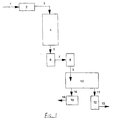
- Fig. 1 is a diagrammatic flow-sheet of the process;
- Fig. 2 shows diagrammatically in medial section an apparatus suitable for use in the process of Fig. 1 for freezing droplets;
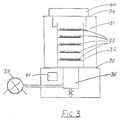
- Fig. 3 shows diagrammatically a freeze-drying apparatus suitable for use in the process of Fig. 1;
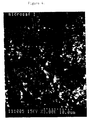
- Fig.4 is a photomicrograph of the microstructure of the particles produced in Example 1;
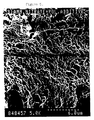
- Fig. 5 is a photomicrograph of the microstructure of the particles produced in Example 2; and
- Fig. 6 is a photomicrograph of the microstructure of the particles produced in Example 3.
-
- Referring to Fig. 1, constituents' of an exothermically reacting composition are mixed in
mixer 2 with a carrier liquid to produce a homogeneous or near-homogeneous dispersion 3 in the form of a solution or a suspension having a viscosity between 1 and 1000 mPas (cps), preferably 10 to 100 mPas (cps), at 20°C. - The well mixed solution or suspension is sprayed as fine droplets into a freezing apparatus 4 containing cold gas. A spherical frozen
particulate product 5 is produced in the freezing apparatus 4 and is discharged into ametering hopper 6 where its temperature is regulated, preferably such that the particles warm up but remain below their melting point. -
Product stream 7 fromhopper 6 is transferred through avacuum lock 8 from whichproduct stream 9 flows to a vacuum freeze-drying chamber 10 and is distributed as a layer onto a heated surface within the chamber. The heated surface is held at a temperature substantially below the boiling point of the carrier liquid such that the product is not subjected to either eutectic melting or structural collapse phenomena. When the carrier liquid is water a temperature of 20 to 40°C is preferred. Thechamber 10 is held at a pressure below the triple point of the carrier liquid (6.11 mbar in the case of water), preferably in the range 0.1 to 2 mbar. Thevapour 14 from thefrozen particles 5 is removed by a sublimation mechanism according to the pressure-temperature phase equilibrium for the specific material, yielding afinal powder product 11 with up to 5% w/w moisture, preferably in the range 0.01 to 2.5% w/w moisture. - The
vapour 14 is conducted to acold condenser chamber 15 where it condenses and the condensed liquid is removed. - The
stream 11 is optionally fed to granulating apparatus 12 where, for example, it may be pressed intograins 13 as required for gas generators or projectile propellants. - A freezing apparatus (4 of Fig. 1) suitable for use in the process is shown in Fig. 2. The apparatus comprises a
dispersion holding tank 21, apressure vessel 22, a supply of pressurisedgas 23, arefrigerated spray chamber 24 and acyclone separator 25. Thechamber 24 has aspray nozzle 26 connected to thepressure vessel 22. Thechambers - In operation the dispersion of the explosive composition in a carrier liquid is fed from the
tank 21 to thepressure vessel 22 from which it is forced under the pressure of thegas 23 through thenozzle 26 to emerge as droplets falling through thechamber 24. Refrigerated gas is circulated through thechamber 24 and thecyclone separator 25. The droplets cool and form solid particles when contacted by the refrigerated gas and are separated in thecyclone separator 26 from which the particles are subsequently transferred to the freeze- drying apparatus. - A batch-freeze drying apparatus (10 of Fig. 1) suitable for use in the process is shown in Fig. 3. The apparatus comprises a drying
chamber 31 containing aheated rack 32 on whichtrays 33 are placed for heating. Thechamber 31 has a sealedlid 34 and is connected by avacuum seal 35 to a cooledcondenser chamber 36 provided with a drainpipe 37. A vacuum pump 39 is connected to thechamber 36. Atemperature controller 40 is provided to control the temperature of therack 32 and apressure gauge 41 is provided to control the pressure inchambers - In operation, the
lid 34 may be removed or theseal 35 may be broken to allow thechambers rack 32 and thetrays 33 may be put in place. The particles to be dried are loaded on thetrays 33, thechambers vapour 14 of the carrier liquid sublimised from the frozen particles condenses in thechamber 36, from which the condensed liquid is removed through thedrainpipe 38. At the end of the drying period the pressure in thechambers chamber 31 is opened and the dried material is removed. - The production of explosive compositions by the process of the invention is further described in the following specific Examples. In the Examples all parts are given by weight.
- A dispersion having the following composition was prepared:
Sodium azide, NaN3 27 parts Iron oxide, Fe2O3 12.4 parts Silicon dioxide, SiO2 3.4 parts Water (distilled) 100 parts - The dispersion was transferred to a pressure vessel and sprayed through a nozzle at a pressure of 5bar to give 80-250 µm diameter droplets (measured by laser anemometer). The droplet spray was directed into a freezing chamber containing a sufficient volume of cold gas at -80°C to freeze the droplets. The frozen droplets fell to the bottom of the freezing chamber and were subsequently transferred to a vacuum freeze-dryer. After freeze-drying for 6 hours on a tray heated at 30°C in a vacuum of 2 millibar to a moisture content of 1.5% the resulting powder consisted of particles which were agglomerates containing sodium azide crystals, iron oxide and silicon dioxide in uniform admixture The particles were agglomerated into microporous spherical particles, 50 - 200 microns in diameter, which were very free flowing and could be compressed to a density of 2g/cm3 by a pressure of 20,000 psi to form pressed grains with a burning rate of 45mm/second. The pressed grains, typically in the form of toroidal or flat annular discs, 36mm outer diameter, 12mm inner diameter and 5mm thick, are suitable for use in gas-generant charges for inflating air-bags in vehicle occupant restraint safety systems. A photomicrograph of the microstructure of an agglomerated particle produced in this Example is shown in Figure 4. This shows a homogeneous substructure of agglomerated crytals of sodium azide, having a maximum dimensions pf 0.2-1 µm, with particles of iron oxide and silicon dioxide uniformly distributed and encapsulated therein. The agglomerated particle contained about 50% by volume of pores, most of which were interconnected, open pores having a maximum dimension of about 0.2-1 µm.
- A solution having the following composition was prepared
Ammonium nitrate 50.1 parts Polyacrylamide 5.17 parts Water 400 parts - A photomicrograph of the microstructure of an agglomerated particle produced in this Example is shown in Figure 5. This shows agglomerated particles consisting of very fine crystals of ammonium nitrate about 0.2-1 µm maximum dimension, each surrounded by a thin film of polyacrylamide. The agglomerated particle contained about 50% by volume of pores, most of which were interconnected, open pores having a maximum dimension of 0.2 to 1 µm.
- A dispersion having the following composition was prepared:
Ammonium nitrate 46.7 parts Carbon black (particle size < 0.1 µm) 3.3 parts Sodium poly(styrene sulphonate)surfactant 0.1 parts Water 50.0 parts - The dispersion was formed into droplets which were frozen and freeze-dried by the procedure described in Example 1.
- The resulting powder was in the form of free flowing, almost dust free, homogeneous, microporous, spherical agglomerates 50-200 µm average diameter and containing agglomerated crystals of ammonium nitrate encapsulating the carbon black particles.
- When packed to a density of 0.95g/cm3 in a 30mm diameter cartridge and initiated to detonation by a blasting cap the velocity of detonation was 4.4km/second.
- A photomicrograph of the microstructure of an agglomerated particle produced in this Example is shown in Figure 6. This shows a structure wherein the carbon black particles are completely encapsulated in a substructure of agglomerated sub-micron size ammonium nitrate crystals having a maximum dimension of 0.4-2 µm. The agglomerated particle contained about 60% by volume of pores, most of which were interconnected, open pores having a maximum dimension of 0.2-3 µm.
- A dispersion having the following composition was prepared:
Potassium nitrate 80 parts Carbon black (as in Example 3) 10 parts Sulphur (average particle size c. 1.0 µm) 10 parts Sodium poly(styrene sulphonate) surfactant 0.1 parts Water 200 parts - A 1.2cm x 0.9cm x 2.6cm test sample of the particles compressed to a density of 1.96g/cm3 had a burn rate of 20mm/second.
- A solution having the following composition was prepared:
Sodium poly(styrene sulphonate) 9 parts - (Molecular weight 70,000) Potassium nitrate 40 parts Water 100 parts - A dispersion having the following composition was prepared by mixing the ingredients for 5 minutes in a high shear mixer:
Potassium nitrate 30 parts Boron (particle size 1-5 µm) 10 parts Polyacrylic acid (dispersing agent) 0.5 parts Water 100 parts
The product was suitable for use as a pyrotechnic igniter composition. - A dispersion having the following composition was prepared by mixing the ingredients in a high shear mixer for 5 minutes.
Potassium permanganate 6 parts Antimony (particles all 10-20 µm) 5 parts Water 100 parts - The droplets were separated and freeze-dried as described in Example 1 to produce spherical, homogeneous, microporous agglomerates 50 - 200 µm in diameter containing agglomerated crystals of potassium permanganate having a maximum dimension of 5-10 µm encapsulating or surrounding the particles of antimony. The aggregates contained about 70% by volume of pores, most of which were interconnected open pores of widely varying dimensions. The resulting product was suitable, when pressed, for use as a pyrotechnic charge in an incendiary delay device.
- A dispersion having the following composition was prepared by mixing the ingredients in a high shear mixer for 5 minutes.
Ferric oxide (0.1-0.2 µm) 30 parts Boron (particles all 1-5 µm) 13 parts Water 100 parts - A dispersion was prepared as described in Example 8 except that 0.2 parts of sodium poly(styrene sulphonate) was added as a surfactant to facilitate dispersion of the ingredients.
- The product was similar to that of Example 8.
Claims (10)
- A process for the production of an exothermically reacting composition containing at least one normally solid reactive constituent comprising the steps of:introducing the ingredients of the said composition to a carrier liquid to form a uniform dispersion or solution;forming droplets of said dispersion or solution;feeding said droplets into a cooling medium at a temperature below the freezing point of said carrier liquid to form solidified droplets;
andfreeze-drying said solidified droplets. - A process as claimed in claim 1 characterised in that the exothermically reactive composition comprises at least one reactive ingredient which is soluble in the carrier liquid and is at least partially dissolved in the carrier liquid.
- A process as claimed in claim 1 or claim 2 characterised in that the said reactive constituent is water-soluble and the said carrier liquid comprises water.
- A process as claimed in any one of claims 1-3 characterised in that the droplets are formed by spraying said dispersion through one or more orifices or by projecting said dispersion from the periphery of a rotating disc or basket.
- A process as claimed in any one of claims 1-4 characterised in that the droplet forming provides droplets having diameters in the range from 50-500 µm.
- A process as claimed in any one of claims 1-5 characterised in that the temperature of the cooling medium is in the range -40 to -195°C.
- A process as claimed in any one of claims 1-6 characterised in that the said solidified droplets are freeze-dried by heating in a vacuum chamber at a pressure below the triple point of the solvent, and condensing the sublimed solvent vapour on a cold surface.
- A process as claimed in any one of claims 1 - 7 characterised in that the composition comprises,a mixture comprising sodium azide and iron oxide;a mixture comprising ammonium nitrate and a fuel;a mixture comprising ammonium nitrate and carbon black;a mixture comprising potassium nitrate, carbon and sulphur;a mixture comprising potassium nitrate and sodium poly(styrene sulphonate);a mixture comprising potassium permanganate and antimony;a mixture comprising ferric oxide and boron; ora mixture comprising potassium nitrate and boron.
- A process according to any one of the preceding claims including the further step of using the exothermically reacting composition in the production of at least one of the following products (a) a gas-generant suitable for inflating vehicle occupant safety restraint air-bags or propelling projectiles; (b) a blasting explosive; (c) a deflagrating powder, (d) a pyrotechnic delay composition or (e) an igniter composition.
- A process according to any one of claims 1 to 9 wherein the exothermically reacting composition is in the form of spherical, homogeneous, microporous, particles consisting of agglomerates comprising uniformly distributed primary particles of the ingredients of the composition.
Applications Claiming Priority (2)
| Application Number | Priority Date | Filing Date | Title |
|---|---|---|---|
| GB9416582 | 1994-08-17 | ||
| GB9416582A GB9416582D0 (en) | 1994-08-17 | 1994-08-17 | Process for the production of exothermically reacting compositions |
Publications (2)
| Publication Number | Publication Date |
|---|---|
| EP0699645A1 EP0699645A1 (en) | 1996-03-06 |
| EP0699645B1 true EP0699645B1 (en) | 1999-11-03 |
Family
ID=10759956
Family Applications (1)
| Application Number | Title | Priority Date | Filing Date |
|---|---|---|---|
| EP95305162A Expired - Lifetime EP0699645B1 (en) | 1994-08-17 | 1995-07-24 | Process for the production of exothermically reacting compositions |
Country Status (9)
| Country | Link |
|---|---|
| US (1) | US6416600B1 (en) |
| EP (1) | EP0699645B1 (en) |
| JP (1) | JPH08104588A (en) |
| KR (1) | KR960007516A (en) |
| AU (1) | AU693228B2 (en) |
| CA (1) | CA2156387A1 (en) |
| DE (1) | DE69513110T2 (en) |
| GB (1) | GB9416582D0 (en) |
| ZA (1) | ZA956459B (en) |
Cited By (1)
| Publication number | Priority date | Publication date | Assignee | Title |
|---|---|---|---|---|
| DE10224859A1 (en) * | 2002-06-05 | 2003-12-24 | Fraunhofer Ges Forschung | Production of free-running perchlorate, used as propellant, explosive and oxidant, e.g. in solid propellant or pyrotechnics, involves mixing with anticaking agent, transfer to inert carrier gas stream and hammer milling |
Families Citing this family (16)
| Publication number | Priority date | Publication date | Assignee | Title |
|---|---|---|---|---|
| GB9511263D0 (en) * | 1995-06-03 | 1995-07-26 | Ici Plc | Process for the production of a pyrotechnic or explosive device |
| US6454886B1 (en) | 1999-11-23 | 2002-09-24 | Technanogy, Llc | Composition and method for preparing oxidizer matrix containing dispersed metal particles |
| US6503350B2 (en) | 1999-11-23 | 2003-01-07 | Technanogy, Llc | Variable burn-rate propellant |
| JP2002155305A (en) * | 2000-11-14 | 2002-05-31 | Akira Kawasaki | Apparatus for producing monodisperse particles, method for producing monodisperse particles, and monodisperse particles produced by the method |
| JP2004224617A (en) * | 2003-01-21 | 2004-08-12 | Nippon Koki Co Ltd | Combined explosives of agglomerated particles composed of fine particles and a method for producing the combined explosives |
| JP2005139011A (en) | 2003-11-04 | 2005-06-02 | Nof Corp | Explosive raw material and method for producing the same |
| US7670446B2 (en) * | 2004-11-30 | 2010-03-02 | The United States Of America As Represented By The Secretary Of The Navy | Wet processing and loading of percussion primers based on metastable nanoenergetic composites |
| CL2007002677A1 (en) * | 2006-09-20 | 2008-05-02 | African Explosives Ltd | METHOD FOR MANUFACTURING A PIROTECHNICAL DELAY COMPOSITION THAT INCLUDES MIXING A SOLID OXIDIZER, A SOLID FUEL AND WATER TO FORM A WATERPROOF SUSPENSION, TRANSFORM THE SUSPENSION IN GOTICLES AND DRY BY GAS SAID GOALS TO FORM |
| EP2578975A1 (en) | 2011-10-05 | 2013-04-10 | Sanofi Pasteur Sa | Rotary drum freeze-dryer |
| EP2578974A1 (en) * | 2011-10-05 | 2013-04-10 | Sanofi Pasteur Sa | Process line for the production of freeze-dried particles |
| UA111631C2 (en) * | 2011-10-06 | 2016-05-25 | Санофі Пастер Са | HEATING DEVICE FOR ROTOR DRUM LYOPHILE DRYER |
| EP2777808A1 (en) | 2013-03-12 | 2014-09-17 | Bayer Technology Services GmbH | Method for handling deflagrating solids under reduced pressure conditions |
| EP3357571A1 (en) * | 2017-02-07 | 2018-08-08 | Bayer Aktiengesellschaft | Process to prevent and extinguish a deflagration |
| CN111818979A (en) * | 2018-03-06 | 2020-10-23 | 阿卜杜拉国王科技大学 | Method and apparatus for continuous extraction of salt from brine |
| US10497559B2 (en) * | 2018-03-28 | 2019-12-03 | Taiwan Semiconductor Manufacturing Company Ltd. | Method for dehydrating semiconductor structure and dehydrating method of the same |
| CN113577806B (en) * | 2021-08-11 | 2022-08-02 | 中北大学 | A kind of spray drying bed for preparing energetic material and method for preparing energetic material |
Family Cites Families (30)
| Publication number | Priority date | Publication date | Assignee | Title |
|---|---|---|---|---|
| US3290788A (en) * | 1964-07-16 | 1966-12-13 | Karl H Seelandt | Fluid-solids contacting methods and apparatus, particularly for use in desiccating organic materials |
| US3452445A (en) * | 1967-08-15 | 1969-07-01 | Us Army | Use of freeze-drying technique to make ultra-fine oxidizer for use in solid propellants |
| GB1228930A (en) * | 1967-12-22 | 1971-04-21 | ||
| US3685163A (en) * | 1971-03-16 | 1972-08-22 | Hercules Inc | Method of producing fine particle ammonium perchlorate |
| US3788095A (en) | 1971-05-25 | 1974-01-29 | Thiokol Chemical Corp | Spray-freezing apparatus and method |
| US3909957A (en) * | 1971-07-14 | 1975-10-07 | Arjun Dev Passey | Apparatus for freeze-drying |
| US3895098A (en) | 1972-05-31 | 1975-07-15 | Talley Industries | Method and composition for generating nitrogen gas |
| DE2236175C3 (en) | 1972-07-24 | 1975-07-10 | Bayern-Chemie Gesellschaft Fuer Flugchemische Antriebe Mbh, 8261 Aschau | Propellant for generating non-toxic propellant gases |
| US3819336A (en) * | 1972-12-20 | 1974-06-25 | Thiokol Chemical Corp | Method of making ultra-fine ammonium perchlorate particles |
| US3892610A (en) * | 1973-01-08 | 1975-07-01 | Hercules Inc | Freeze drying process of making ultra-fine ammonium perchlorate and product |
| US3888017A (en) * | 1974-03-25 | 1975-06-10 | Hercules Inc | Method for preparation of fine particle size inorganic oxidizers |
| US4177227A (en) * | 1975-09-10 | 1979-12-04 | The United States Of America As Represented By The Secretary Of The Air Force | Low shear mixing process for the manufacture of solid propellants |
| GB2028785B (en) | 1978-05-30 | 1982-09-22 | Ici Ltd | Comminution process |
| CA1087851A (en) | 1978-07-17 | 1980-10-21 | Lechoslaw A.M. Utracki | Gas generating composition |
| CA1146756A (en) | 1980-06-20 | 1983-05-24 | Lechoslaw A.M. Utracki | Multi-ingredient gas generants |
| US5000803A (en) * | 1982-09-30 | 1991-03-19 | General Technology Applications, Inc. | Freeze blending of reactive liquids and solids |
| US4981535A (en) * | 1982-09-30 | 1991-01-01 | General Technology Applications, Inc. | Process for making finely divided solids |
| US4728376A (en) * | 1982-11-01 | 1988-03-01 | Golden Power Of Texas, Inc. | Explosive composition and method |
| US5021395A (en) * | 1988-07-01 | 1991-06-04 | E. I. Du Pont De Nemours And Company | Process for making superconductors and their precursors |
| US4999063A (en) | 1990-06-07 | 1991-03-12 | Trw Vehicle Safety Systems Inc. | Process for manufacturing a gas generating material |
| US5223184A (en) | 1990-08-06 | 1993-06-29 | Morton International, Inc. | Enhanced thermal and ignition stability azide gas generant |
| US5098683A (en) * | 1991-03-06 | 1992-03-24 | Olin Corporation | Potassium fluoride stabilized ammonium nitrate and method of producing potassium fluoride stabilized ammonium nitrate |
| US5143567A (en) | 1991-08-23 | 1992-09-01 | Morton International, Inc. | Additive approach to ballistic and slag melting point control of azide-based gas generant compositions |
| EP0554999B1 (en) * | 1992-02-06 | 1996-10-16 | Nippon Carbide Kogyo Kabushiki Kaisha | Alkali metal azide particles |
| US5230162A (en) * | 1992-06-26 | 1993-07-27 | Oyler Jr James R | Systems and methods for the deliquification of liquid-containing substances by flash sublimation |
| GB9220052D0 (en) * | 1992-09-22 | 1992-11-04 | Ici Plc | Method of producing pyrotechnic masses |
| US5449423A (en) * | 1992-10-13 | 1995-09-12 | Cioffe; Anthony | Propellant and explosive composition |
| US5472647A (en) * | 1993-08-02 | 1995-12-05 | Thiokol Corporation | Method for preparing anhydrous tetrazole gas generant compositions |
| US5531845A (en) * | 1994-01-10 | 1996-07-02 | Thiokol Corporation | Methods of preparing gas generant formulations |
| GB9511263D0 (en) * | 1995-06-03 | 1995-07-26 | Ici Plc | Process for the production of a pyrotechnic or explosive device |
-
1994
- 1994-08-17 GB GB9416582A patent/GB9416582D0/en active Pending
-
1995
- 1995-07-24 EP EP95305162A patent/EP0699645B1/en not_active Expired - Lifetime
- 1995-07-24 DE DE69513110T patent/DE69513110T2/en not_active Expired - Lifetime
- 1995-08-02 ZA ZA956459A patent/ZA956459B/en unknown
- 1995-08-08 JP JP7202419A patent/JPH08104588A/en active Pending
- 1995-08-17 CA CA002156387A patent/CA2156387A1/en not_active Abandoned
- 1995-08-17 KR KR1019950025235A patent/KR960007516A/en not_active Abandoned
- 1995-08-17 US US08/516,259 patent/US6416600B1/en not_active Expired - Fee Related
- 1995-08-17 AU AU28572/95A patent/AU693228B2/en not_active Ceased
Cited By (1)
| Publication number | Priority date | Publication date | Assignee | Title |
|---|---|---|---|---|
| DE10224859A1 (en) * | 2002-06-05 | 2003-12-24 | Fraunhofer Ges Forschung | Production of free-running perchlorate, used as propellant, explosive and oxidant, e.g. in solid propellant or pyrotechnics, involves mixing with anticaking agent, transfer to inert carrier gas stream and hammer milling |
Also Published As
| Publication number | Publication date |
|---|---|
| AU2857295A (en) | 1996-02-29 |
| EP0699645A1 (en) | 1996-03-06 |
| US6416600B1 (en) | 2002-07-09 |
| ZA956459B (en) | 1996-04-01 |
| DE69513110T2 (en) | 2000-05-31 |
| CA2156387A1 (en) | 1996-02-18 |
| GB9416582D0 (en) | 1994-10-19 |
| AU693228B2 (en) | 1998-06-25 |
| DE69513110D1 (en) | 1999-12-09 |
| KR960007516A (en) | 1996-03-22 |
| JPH08104588A (en) | 1996-04-23 |
Similar Documents
| Publication | Publication Date | Title |
|---|---|---|
| US6416600B1 (en) | Process for the production of an exothermically reacting composition | |
| US4758287A (en) | Porous propellant grain and method of making same | |
| EP0055904B1 (en) | Azide-free compositions for generating nitrogen, the generation of nitrogen therefrom and inflation of gas bags therewith | |
| EP2265562B1 (en) | High performance gas generating compositions | |
| JPH03153593A (en) | Azide gas generating composition | |
| CN102216242B (en) | Gas generating compositions having glass fibers | |
| US2477549A (en) | Explosive composition | |
| US7645351B2 (en) | Explosive material composition and method for preparing the same | |
| US5756930A (en) | Process for the preparation of gas-generating compositions | |
| JPH08502467A (en) | Propellant and explosive compositions and methods of making them | |
| JPH05178601A (en) | Gas generating grain and preparation thereof | |
| US3971729A (en) | Preparation of gas generation grain | |
| US5665276A (en) | Process for the production of a pyrotechnic or explosive device | |
| WO2001038264A1 (en) | Composition and method for preparing oxidizer matrix containing dispersed metal particles | |
| JPH07206568A (en) | Method for manufacturing ignition powder granules | |
| US20020098143A1 (en) | Process for preparing phase-stabilized ammonium nitrate | |
| US6136115A (en) | Thermally-stabilized prilled ammonium dinitramide particles, and process for making the same | |
| US6902637B2 (en) | Process for preparing free-flowing particulate phase stabilized ammonium nitrate | |
| US20040108029A1 (en) | Porous igniter for automotive airbag applications | |
| CN118900832A (en) | Pyrotechnic composition and method for preparing the same | |
| US5449424A (en) | Method of producing pyrotechnic masses | |
| Larin et al. | Cyclic Nitramines as Nanoenergetic Organic Materials | |
| US6319341B1 (en) | Process for preparing a gas generating composition | |
| KR970002249A (en) | Method of manufacturing smoke or explosion device | |
| Agin et al. | A Review of Nano-Structured Thermites and Explosives: Synthesis and Emerging Applications. |
Legal Events
| Date | Code | Title | Description |
|---|---|---|---|
| PUAI | Public reference made under article 153(3) epc to a published international application that has entered the european phase |
Free format text: ORIGINAL CODE: 0009012 |
|
| AK | Designated contracting states |
Kind code of ref document: A1 Designated state(s): BE DE ES FR GB IT SE |
|
| RIN1 | Information on inventor provided before grant (corrected) |
Inventor name: OLIVER, RAY Inventor name: GRAHAM, DEREK ALEXANDER Inventor name: CLARKE, KAY HEATHER |
|
| 17P | Request for examination filed |
Effective date: 19960826 |
|
| 17Q | First examination report despatched |
Effective date: 19970714 |
|
| GRAG | Despatch of communication of intention to grant |
Free format text: ORIGINAL CODE: EPIDOS AGRA |
|
| GRAG | Despatch of communication of intention to grant |
Free format text: ORIGINAL CODE: EPIDOS AGRA |
|
| GRAH | Despatch of communication of intention to grant a patent |
Free format text: ORIGINAL CODE: EPIDOS IGRA |
|
| GRAH | Despatch of communication of intention to grant a patent |
Free format text: ORIGINAL CODE: EPIDOS IGRA |
|
| GRAA | (expected) grant |
Free format text: ORIGINAL CODE: 0009210 |
|
| AK | Designated contracting states |
Kind code of ref document: B1 Designated state(s): BE DE ES FR GB IT SE |
|
| PG25 | Lapsed in a contracting state [announced via postgrant information from national office to epo] |
Ref country code: SE Free format text: THE PATENT HAS BEEN ANNULLED BY A DECISION OF A NATIONAL AUTHORITY Effective date: 19991103 Ref country code: IT Free format text: LAPSE BECAUSE OF FAILURE TO SUBMIT A TRANSLATION OF THE DESCRIPTION OR TO PAY THE FEE WITHIN THE PRESCRIBED TIME-LIMIT;WARNING: LAPSES OF ITALIAN PATENTS WITH EFFECTIVE DATE BEFORE 2007 MAY HAVE OCCURRED AT ANY TIME BEFORE 2007. THE CORRECT EFFECTIVE DATE MAY BE DIFFERENT FROM THE ONE RECORDED. Effective date: 19991103 Ref country code: ES Free format text: THE PATENT HAS BEEN ANNULLED BY A DECISION OF A NATIONAL AUTHORITY Effective date: 19991103 Ref country code: BE Free format text: LAPSE BECAUSE OF FAILURE TO SUBMIT A TRANSLATION OF THE DESCRIPTION OR TO PAY THE FEE WITHIN THE PRESCRIBED TIME-LIMIT Effective date: 19991103 |
|
| REF | Corresponds to: |
Ref document number: 69513110 Country of ref document: DE Date of ref document: 19991209 |
|
| ET | Fr: translation filed | ||
| PLBE | No opposition filed within time limit |
Free format text: ORIGINAL CODE: 0009261 |
|
| STAA | Information on the status of an ep patent application or granted ep patent |
Free format text: STATUS: NO OPPOSITION FILED WITHIN TIME LIMIT |
|
| 26N | No opposition filed | ||
| REG | Reference to a national code |
Ref country code: GB Ref legal event code: IF02 |
|
| REG | Reference to a national code |
Ref country code: FR Ref legal event code: CA |
|
| PGFP | Annual fee paid to national office [announced via postgrant information from national office to epo] |
Ref country code: FR Payment date: 20100805 Year of fee payment: 16 Ref country code: DE Payment date: 20100723 Year of fee payment: 16 |
|
| PGFP | Annual fee paid to national office [announced via postgrant information from national office to epo] |
Ref country code: GB Payment date: 20100722 Year of fee payment: 16 |
|
| GBPC | Gb: european patent ceased through non-payment of renewal fee |
Effective date: 20110724 |
|
| REG | Reference to a national code |
Ref country code: FR Ref legal event code: ST Effective date: 20120330 |
|
| PG25 | Lapsed in a contracting state [announced via postgrant information from national office to epo] |
Ref country code: DE Free format text: LAPSE BECAUSE OF NON-PAYMENT OF DUE FEES Effective date: 20120201 Ref country code: FR Free format text: LAPSE BECAUSE OF NON-PAYMENT OF DUE FEES Effective date: 20110801 |
|
| REG | Reference to a national code |
Ref country code: DE Ref legal event code: R119 Ref document number: 69513110 Country of ref document: DE Effective date: 20120201 |
|
| PG25 | Lapsed in a contracting state [announced via postgrant information from national office to epo] |
Ref country code: GB Free format text: LAPSE BECAUSE OF NON-PAYMENT OF DUE FEES Effective date: 20110724 |