EP0699272B1 - Mehrwellen, zwischenheizungsgasturbine mit zwischenkühlung und wärmerückgewinnung - Google Patents
Mehrwellen, zwischenheizungsgasturbine mit zwischenkühlung und wärmerückgewinnung Download PDFInfo
- Publication number
- EP0699272B1 EP0699272B1 EP94914096A EP94914096A EP0699272B1 EP 0699272 B1 EP0699272 B1 EP 0699272B1 EP 94914096 A EP94914096 A EP 94914096A EP 94914096 A EP94914096 A EP 94914096A EP 0699272 B1 EP0699272 B1 EP 0699272B1
- Authority
- EP
- European Patent Office
- Prior art keywords
- shaft assembly
- compressor
- turbine
- expansion turbine
- additional shaft
- Prior art date
- Legal status (The legal status is an assumption and is not a legal conclusion. Google has not performed a legal analysis and makes no representation as to the accuracy of the status listed.)
- Expired - Lifetime
Links
Images

Classifications
-
- F—MECHANICAL ENGINEERING; LIGHTING; HEATING; WEAPONS; BLASTING
- F01—MACHINES OR ENGINES IN GENERAL; ENGINE PLANTS IN GENERAL; STEAM ENGINES
- F01K—STEAM ENGINE PLANTS; STEAM ACCUMULATORS; ENGINE PLANTS NOT OTHERWISE PROVIDED FOR; ENGINES USING SPECIAL WORKING FLUIDS OR CYCLES
- F01K21/00—Steam engine plants not otherwise provided for
- F01K21/04—Steam engine plants not otherwise provided for using mixtures of steam and gas; Plants generating or heating steam by bringing water or steam into direct contact with hot gas
- F01K21/047—Steam engine plants not otherwise provided for using mixtures of steam and gas; Plants generating or heating steam by bringing water or steam into direct contact with hot gas having at least one combustion gas turbine
-
- F—MECHANICAL ENGINEERING; LIGHTING; HEATING; WEAPONS; BLASTING
- F02—COMBUSTION ENGINES; HOT-GAS OR COMBUSTION-PRODUCT ENGINE PLANTS
- F02C—GAS-TURBINE PLANTS; AIR INTAKES FOR JET-PROPULSION PLANTS; CONTROLLING FUEL SUPPLY IN AIR-BREATHING JET-PROPULSION PLANTS
- F02C3/00—Gas-turbine plants characterised by the use of combustion products as the working fluid
- F02C3/36—Open cycles
-
- F—MECHANICAL ENGINEERING; LIGHTING; HEATING; WEAPONS; BLASTING
- F02—COMBUSTION ENGINES; HOT-GAS OR COMBUSTION-PRODUCT ENGINE PLANTS
- F02C—GAS-TURBINE PLANTS; AIR INTAKES FOR JET-PROPULSION PLANTS; CONTROLLING FUEL SUPPLY IN AIR-BREATHING JET-PROPULSION PLANTS
- F02C6/00—Plural gas-turbine plants; Combinations of gas-turbine plants with other apparatus; Adaptations of gas-turbine plants for special use
- F02C6/003—Gas-turbine plants with heaters between turbine stages
-
- F—MECHANICAL ENGINEERING; LIGHTING; HEATING; WEAPONS; BLASTING
- F05—INDEXING SCHEMES RELATING TO ENGINES OR PUMPS IN VARIOUS SUBCLASSES OF CLASSES F01-F04
- F05D—INDEXING SCHEME FOR ASPECTS RELATING TO NON-POSITIVE-DISPLACEMENT MACHINES OR ENGINES, GAS-TURBINES OR JET-PROPULSION PLANTS
- F05D2220/00—Application
- F05D2220/60—Application making use of surplus or waste energy
-
- F—MECHANICAL ENGINEERING; LIGHTING; HEATING; WEAPONS; BLASTING
- F05—INDEXING SCHEMES RELATING TO ENGINES OR PUMPS IN VARIOUS SUBCLASSES OF CLASSES F01-F04
- F05D—INDEXING SCHEME FOR ASPECTS RELATING TO NON-POSITIVE-DISPLACEMENT MACHINES OR ENGINES, GAS-TURBINES OR JET-PROPULSION PLANTS
- F05D2260/00—Function
- F05D2260/20—Heat transfer, e.g. cooling
- F05D2260/211—Heat transfer, e.g. cooling by intercooling, e.g. during a compression cycle
-
- Y—GENERAL TAGGING OF NEW TECHNOLOGICAL DEVELOPMENTS; GENERAL TAGGING OF CROSS-SECTIONAL TECHNOLOGIES SPANNING OVER SEVERAL SECTIONS OF THE IPC; TECHNICAL SUBJECTS COVERED BY FORMER USPC CROSS-REFERENCE ART COLLECTIONS [XRACs] AND DIGESTS
- Y02—TECHNOLOGIES OR APPLICATIONS FOR MITIGATION OR ADAPTATION AGAINST CLIMATE CHANGE
- Y02T—CLIMATE CHANGE MITIGATION TECHNOLOGIES RELATED TO TRANSPORTATION
- Y02T50/00—Aeronautics or air transport
- Y02T50/60—Efficient propulsion technologies, e.g. for aircraft
Definitions
- This invention relates to combustion turbine engines with inter cooling, saturation, recuperation and reheat.
- a typical and currently available simple cycle combustion turbine consists of a compressor for compressing the atmospheric air, a combustor for heating the compressed air, a turbine for power production and an electric generator for converting mechanical energy into electrical energy.
- a more sophisticated combustion turbine concept with a number of compressors with intercoolers and with a number of turbines with associated combustors and, also, with a recuperator, has been theoretically known at least since the 1920's.
- the first and the most important engineering problem is that the highest pressure turbine for the prior art combustion turbine concept has the highest inlet temperature. This presents a serious challenge because of high thermal and transient stresses in the high pressure and temperature turbine components, and requires special materials and engineering yet to be developed.
- the second engineering problem is a result of the fact that for a typical prior art concept a plurality of combustion turbines with the same inlet temperatures and equal pressure ratios have very high exhaust gas flow temperatures which are the inlet temperatures for a plurality of downstream combustors. This is yet another serious engineering challenge.
- US-A-2115338 describes a gas turbine system having a high pressure turbine and a low pressure turbine.
- the system described further includes two compressors, two coolers, two combustion chambers and a heat exchanger.
- An object of this invention is to develop a new combustion turbine with improved efficiency and economics which embodies a properly integrated plurality of turbines with reheat, a plurality of compressors with intercoolers, a recuperator, saturator, water heaters, duct burners, and a heat recovery steam generator.
- Another object of this invention is to develop a new thermal cycle with reduced inlet temperatures (as compared to the current level of temperatures for industrial expanders) to a plurality of turbines which have inlet pressures exceeding the level of the conventional inlet turbine pressure for simple cycle combustion turbines. This resolves the first and the most important engineering problem: a prohibitive combination of coincidental high pressures and temperatures.
- Still another object of this invention is to reduce the gas flow temperatures entering a plurality of combustors. This resolves the second engineering problem.
- Yet another object of this invention is an integration of a saturator in the combustion turbine concept to improve the combustion turbine thermal efficiency and to increase the specific production of electric power per pound of air.
- the saturator via heat and mass exchange, preheats the compressed air and saturates it with moisture before entering a recuperator.
- Another object of the invention is to incorporate a recuperator and water heaters into the inventive combustion turbine concept for better utilization of the combustion turbine cycle available heat with associated improvement of the thermal efficiency.
- Still another object of the invention is a maximum utilization of the available prior art simple cycle combustion turbine components with the addition of currently available industrial components properly integrated into the inventive cycle in order to facilitate practical implementation of the inventive concept.
- Yet a further object of this invention is to provide a heat recovery steam generator for the alternative utilization of the exhaust gas heat, for steam use in the bottoming cycle and/or for steam injection into one of the plurality of turbines.
- a further object of the invention is to provide duct burners strategically positioned in locations of the system to improve the efficiency and economics of the system further.
- an electric power generation system comprising:
- Also provided by the invention is a method for providing an electric power generating system including an electric generator by modifying a conventional power shaft assembly having a compressor, an expansion turbine, a combustor feeding said expansion turbine, and means for coupling said expansion turbine to drive said compressor and said electric generator, the method including the steps of:
- an electric power generating system which comprises an electric generator and a power shaft assembly including a compressor, an expansion turbine, a combustor feeding heated air to the expansion turbine, and means for coupling the expansion turbine to drive the compressor and the electric generator.
- At least one additional shaft assembly is provided.
- each additional shaft assembly includes a compressor, an intercooler, an expansion turbine, a combustor, and means for coupling the expansion turbine of the additional shaft assembly to drive the compressor of the additional shaft assembly.
- a recuperator and optional duct burners are provided.
- the power shaft assembly, the at least one additional shaft assembly, and the recuperator are connected to define an air and gas path that passes through the compressor of the power shaft assembly, through the intercooler and the compressor of each of the at least one additional shaft assembly-in a first predetermined ordered sequence, through the recuperator, through the combustor and the expansion turbine of each of the at least one additional shaft assembly in a second predetermined ordered sequence, through the combustor and expansion turbine of the power shaft assembly, through the recuperator and to the exhaust stack.
- incoming air is alternately compressed and cooled as it passes through the compressors of the power and additional shaft assemblies, is heated in the heat recuperator, and is alternately heated and expanded as its combustion product gas passes through the combustors and the expansion turbines of the additional and power shaft assemblies.
- the water for the inter-coolers is provided from either a cooling tower or other source.
- a new combustion turbine thermal cycle has been developed with major parameters and other features different from the prior art.
- the resulting cycle has a significantly higher efficiency as compared to the state-of-the art combustion turbine.
- This thermal cycle simultaneously resolves major engineering problems thus ensuring its practical implementation.
- the compression pressure ratio of the compressor is greater than the expansion pressure ratio of the expansion turbine. Therefore, for total pressure balance the compression pressure ratio of the power shaft assembly compressor is less than the expansion pressure ratio of the power shaft assembly expansion turbine. In effect, the compressor of the power shaft assembly is partially unloaded so that the expansion turbine of the power shaft assembly can supply more of its power to the electric generator.
- exhaust gas from the power shaft assembly expansion turbine is directed to the heat recuperator so as to provide a heat source therefor.
- the multi-shaft arrangement (power shaft and at least one additional shaft assembly) provides for convenient and economical location of inter-coolers. This allows an increase in the pressure ratio of compressors of the power balanced additional shaft assemblies, thus further unloading the compressor of the power shaft assembly, which, in turn, provides additional power for electric power generation and increases efficiency.
- the saturator saturates the compressed air, thus further reducing the air requirements per kilowatt-hour produced with associated reduction of power consumption by the compressors of the additional shaft assemblies and by the compressor of the power shaft assembly.
- hot water-required for the compressed air saturation in the saturator is produced in water heaters (recovering the heat available in the exhaust gas leaving the power shaft assembly turbine after partial heat recovery in the recuperator) and in the intercoolers and aftercooler (recovering the compressed air heat).
- the steam generated in the heat recovery steam generator produces additional power via steam injection or in the bottoming cycle.
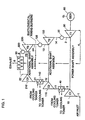
- FIG. 1 is a schematic representation of a first illustrative embodiment of an electric power generating system according to this invention.
- the power shaft assembly represents a conventional heavy duty combustion turbine or an aircraft derivative combustion turbine which includes the compressor 10, the expansion turbine 30, the combustor 20 which feeds heated combustion product gas to the expansion turbine 30, the expansion turbine 30 being coupled to drive the compressor 10 and the electric generator 60.
- air which enters the low pressure compressor 10 at its inlet 1 is compressed thereby and provided at its outlet 2.
- the compressed air is discharged directly to the low pressure combustor 20 and then expanded through the low pressure expansion turbine 30.
- the power output of the turbine 30 is substantially equally divided for driving the compressor 10 and the generator 60.
- At least one additional shaft assembly is provided to modify the conventional power shaft assembly described above.
- two additional shaft assemblies are shown.
- a heat recuperator 50 is provided.
- the first additional shaft assembly includes the intercooler 40, the intermediate pressure compressor 110, the intermediate pressure combustor 120 and the intermediate pressure expansion turbine 130.
- the second additional shaft assembly includes the high pressure intercooler 140, the high pressure compressor 210, the high pressure combustor 220 and the high pressure expansion turbine 230.
- the intercoolers 40 and 140 are cooled by water supplied from a cooling tower.
- the air and gas path extends through the modified compressor of the conventional power shaft assembly, through the intercoolers and compressors of the additional shaft assemblies, through the recuperator, through the combustors and expansion turbines of the additional shaft assemblies, and then through the combustor and expansion turbine of the conventional power shaft assembly.
- the exhaust 2 of the low pressure compressor 10 passes through the intercooler 40 which reduces its temperature at the inlet 11 of the intermediate compressor 110.
- the pressure of the air is then again raised and provided at the exhaust 12 of the compressor 110 to the intercooler 140 which lowers its temperature and provides the cooled intermediate pressure air at the inlet 21 to the high pressure compressor 210.
- the exhaust 22 of the high pressure compressor 210 is provided as an input to the heat recuperator 50.
- the outlet 5 of the heat recuperator 50 is connected to the high pressure combustor 220, whose outlet 23 is provided to the high pressure expansion turbine 230.
- the exhaust 24 of the high pressure expansion turbine 230 is heated in the intermediate pressure combustor 120 and then provided to the inlet 13 of the intermediate pressure expansion turbine 130.
- the exhaust 14 of the intermediate pressure expansion turbine 130 is heated in the low pressure combustor 20 and then provided to the inlet 3 of the low pressure expansion turbine 30, the exhaust 4 of which is utilized as a heat source for the heat recuperator 50, before going to the system exhaust 6.
- the thermodynamic cycle is shown as the temperature-entropy diagram of FIG. 2.
- the compression pressure ratio of the compressor equals the expansion pressure ratio of the turbine, and the output combustion turbine power from the turbine is substantially equally divided for driving the compressor and the electric generator.
- the compression pressure ratio of compressor 10 is substantially reduced so that turbine 30 can supply more of its power for driving generator 60.
- This lowering of the compression pressure ratio of the compressor 10 is accompanied by raising the overall compression pressure ratio of the additional shaft assemblies over the overall expansion pressure ratio of the additional shaft assemblies.
- the intercoolers 40 and 140 the temperature of the air entering the compressors 110 and 210 is reduced, which reduces the power consumed by the compressors 110 and 210, and for the same power consumption by the compressors allows for increased compression pressure ratios.
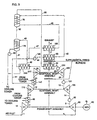
- FIG. 3 illustrates a modification to the system shown in FIG. 1 which further includes an aftercooler 240 and water saturators 170 and 70 connected between the output of the high pressure compressor 210 and the inlet of the heat recuperator 50.
- the compressed air is cooled in the aftercooler 240 and then directed into the inlet 31 of the saturator 170 and into the inlet 32 of the saturator 70, where the compressed air is saturated with water and preheated before entering the inlet 33 of the heat recuperator 50.
- the remainder of the air and gas path is identical to that of FIG. 1.
- the saturators 170 and 70 are fed by water which has been heated in intercooler 140 and aftercooler 240, and the exhaust gas heat recovering water heaters 65 and 165.
- the water flow paths, including the pumps 80 and 180, are readily apparent from FIG. 3. If desired, the recuperator 50 and the water heater 65 can be supplementally fired by the installation of duct burners.
- the system shown in FIG. 3 has been shown to have a significantly higher efficiency (up to approximately 53% with state of the art combustion turbines) over the basic system shown in FIG. 1 (approximately 47% efficiency), but the increased efficiency has some penalties.
- the system shown in FIG. 3 requires a significant amount of make-up water and therefore may have some siting limitations.
- the system shown in FIG. 3 with saturators is more complicated when compared with the basic system shown in FIG. 1, although it is significantly simpler in engineering and operation as compared to a combined cycle plant with a comparable efficiency.
- the specific capital cost, in dollars per kilowatt, for the system of FIG. 3 is only slightly higher than the cost of a simple cycle gas turbine.
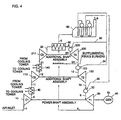
- FIG. 4 illustrates another modification to the system of FIG. 1 wherein the exhaust 6 from the heat recuperator 50 is directed to the heat recovery steam generator 90 to produce steam which may be injected into one or more of the combustors 20, 120 and 220.
- the remainder of the system is the same as that shown in FIG. 1.
- the inventive combustion turbine system is a multi-shaft combustion turbine system with a sophisticated thermodynamic cycle and significantly higher efficiency as compared to the state of the art combustion turbine with an estimated specific capital cost, in dollars per kilowatt hour, comparable to that of a simple cycle combustion turbine system.
- the inventive system resolves major engineering problems which until now have prevented an implementation of these sophisticated concepts.
- the system utilizes commercially available components and can be delivered skid mounted, thus shortening the construction time and reducing field construction and cost.
- TABLE 1 presents performance and key point parameters for the inventive system, which are compared to those for a simple cycle combustion turbine.
- the performance characteristics presented in TABLE 1 are based on the current level of technology development and on the performance characteristics of Westinghouse's W501F combustion turbine as the source of the power shaft assembly combustion turbine and the performance characteristics of commercial turbo-expanders and compressors for the additional shaft assemblies.
- TABLE 1 shows the advantages of other embodiments of the inventive concepts.
- the second embodiment (FIG 3) with the addition of a saturator, associated after cooler and waste heat water heaters, has a gross efficiency of 52.8%, as compared to an efficiency of 36.6% for the state of the art combustion turbine.
- TABLE 1 also shows that the third embodiment (FIG. 4) of the inventive concept with use of the heat recovery steam generator shows an efficiency of 48.5%.
- the power shaft assembly is a standard commercially available combustion turbine. The modifications required are relatively minor.
- the low pressure compressor 10 pressure ratio has to be reduced to below the pressure ratio of its associated expansion turbine.
- the power-balanced additional shaft assemblies have compression pressure ratios of compressors 110 and 210 which are higher than the corresponding expansion pressure ratios of the turbines 230 and 130. For the same overall compression pressure ratio, this in turn reduces the required compression pressure ratio for the low pressure compressor 10.
- the generator 60 is upgraded for the higher power generating capacity of the plant.
- the power shaft assembly is thrust balanced either by upgrading the existing thrust bearing or by the addition of an external thrust bearing connected to the power shaft assembly.
- the easiest way of reducing the pressure ratio of the compressor 10 is by de-blading a number of its last stages, which can be performed by a manufacturer or by any packager or any utility.
- the additional shaft assemblies can be supplied by industrial turbo-driven compressor manufacturers, supported by combustor manufacturers.
- the described multi-shaft combustion turbine can be commercially offered by combustion turbine manufacturers, industrial steam turbine and turbo machinery manufacturers and/or by other packagers.
- the system described herein is applicable to all alternative modifications of combustion turbines.
Landscapes
- Engineering & Computer Science (AREA)
- Chemical & Material Sciences (AREA)
- Combustion & Propulsion (AREA)
- Mechanical Engineering (AREA)
- General Engineering & Computer Science (AREA)
- Engine Equipment That Uses Special Cycles (AREA)
- Structures Of Non-Positive Displacement Pumps (AREA)
- Connection Of Motors, Electrical Generators, Mechanical Devices, And The Like (AREA)
- Turbine Rotor Nozzle Sealing (AREA)
- Separation By Low-Temperature Treatments (AREA)
Claims (26)
- Stromerzeugungssystem, umfassend:einen einzelnen Antriebswellenaufbau einschließlich einer Verbrennungsturbine, die einen Kompressor (10), eine Expansionsturbine (30), einen Combustor (20), der die Expansionsturbine (30) versorgt, einen Stromgenerator (60) und Mittel aufweist, um die Expansionsturbine (30) anzukoppeln, um den Kompressor (10) und den Stromgenerator (60) anzutreiben;zumindest einen zusätzlichen Wellenaufbau einschließlich eines Zwischenkühlers (40), eines Kompressors (110), einer Expansionsturbine (130), eines Combustors (120), der die Expansionsturbine (130 versorgt, und von Mitteln, um den Kompressor (110) des zusätzlichen Wellenaufbaus anzutreiben;einen Rekuperator bzw. Wärmeaustauscher (50); undeinen Abgaskamin,wobei der einzelne Antricbswellenaufbau, der zumindest eine zusätzliche Wellenaufbau und der Rekuperator (50) verbunden sind, um einen thermischen Kreislauf mit einer Luft- und Gasbahn zu definieren, die durch den Kompressor (10) des einzelnen Antriebswellenaufbaus, durch den Zwischenkühler (40) und den Kompressor (110) des zumindest einen zusätzlichen Wellenaufbaus, durch den Rekuperator (50), durch den Combustor (120) und die Expansionsturbine (130) des zumindest einen zusätzlichen Wellenaufbaus und durch den Combustor (20) und die Expansionsturbine (30) des einzelnen Antriebswellenaufbaus verläuft, und schließlich durch den Rekuperator (50) zu dem Abgaskamin auslässt, dadurch gekennzeichnet, dassder Kompressor (110) des zumindest einen zusätzlichen Wellenaufbaus so konstruiert und angeordnet ist, um ein Kompressionsverhältnis zu haben, das größer ist als ein Kompressionsverhältnis der Expansionsturbine (130) des zumindest einen zusätzlichen Wellenaufbaus, welcher mit dem einzelnen Antriebswellenaufbau fluidverbunden ist, um den Kompressor (10) des einzelnen Antriebswellenaufbaus von einem Druck zu entlasten.
- System nach Anspruch 1, weiterhin umfassend zumindest einen zusätzlichen Röhrenbrenner, der stromabwärts von der Expansionsturbine (30) des einzelnen Antriebswellenaufbaus und stromaufwärts des Rekuperators (50) angeordnet ist.
- System nach Anspruch 1 oder Anspruch 2, weiterhin umfassend Mittel, um Wasser bereitzustellen, um den Zwischenkühler (40) zu kühlen.
- System nach einem der Ansprüche 1 bis 3, weiterhin umfassend zumindest einen Sättiger (170, 70), der zwischen dem Auslass des Kompressors mit dem höchsten Druck und dem Rekuperator (50) angeordnet ist.
- System nach Anspruch 4, weiterhin umfassend einen Nachkühler (240), der zwischen dem Auslass des Kompressors mit dem höchstem Druck und dem zumindest einen Sättiger (170, 70) angeordnet ist.
- , System nach Anspruch 4 oder Anspruch 5, weiterhin umfassend zumindest eine Wasserheizvorrichtung (65, 165), die verfügbare Wärme von einem Abzug der Expansionsturbine des Antriebswellenaufbaus verwendet und den zumindest einen Sättiger (170, 70) mit Warmwasser versorgt.
- System nach Anspruch 6, weiterhin umfassend zumindest einen Röhrenbrenner, der zwischen dem Abzug der Expansionsturbine des Antriebswellenaufbaus und dem Rekuperator (50) angeordnet ist.
- System nach Anspruch 7, weiterhin umfassend zumindest einen Röhrenbrenner, der zwischen dem Abzug (6) des Rekuperators und den Wasserheizvorrichtungen (65, 165) angeordnet ist.
- System nach einem der vorhergehenden Ansprüche, weiterhin umfassend einen Mehrdruck-Wärmerückgewinnungs-Dampfgenerator (90), der zwischen dem Rekuperator (50) und dem Abgaskamin angeordnet ist.
- System nach einem der Ansprüche 1 bis 9, bei dem die Expansionsturbine (30) des einzelnen Antriebswellenaufbaus eine Einzyklus-Verbrennungsturbine ist, die aufgebaut und ausgelegt ist, um bei einer Einlasstemperatur von zumindest 1260° (2300°P) zu arbeiten.
- System nach Anspruch 1 oder Anspruch 10, bei dem die Expansionsturbine (130, 230) des zumindest einen zusätzlichen Wellenaufbaus eine industrielle Expansionsmaschine ist, die aufgebaut und ausgelegt ist, um bei einer Einlasstemperatur im Bereich von 760°C bis 871°C (1400°F bis 1600°F) zu arbeiten.
- , System nach einem der Ansprüche 1 bis 11, bei dem der thermische Kreislauf so beschaffen ist, dass:eine Einlasstemperatur der Turbine mit dem höchsten Druck der zusätzlichen Wellenaufbauten die niedrigste Einlasstemperatur von sämtlichen der Turbinen in dem System ist;sämtliche der Turbinen (230, 130) von jedem zusätzlichen Wellenaufbau im Wesentlichen gleiche Einlasstemperaturen aufweisen;eine Einlasstemperatur der Turbine (30) des einzelnen Antriebswellenaufbaus die höchste Einlasstemperatur von sämtlichen der Turbinen in dem System ist;Verdichtungsdruckverhältnisse der Turbinen in dem System im Wesentlichen gleichmäßig unter den Turbinen der zusätzlichen Wellenaufbauten aufgeteilt sind, wobei das höchste Verdichtungsdruckverhältnis des Systems der Turbine (30) des einzelnen Antriebswellenaufbaus zugeordnet ist;ein Gesamtverdichtungsdruckverbältnis der Kompressoren in dem System unter den Kompressoren von jedem zusätzlichen Wellenaufbau aufgeteilt ist, um ein Leistungsgleichgewicht von jedem zusätzlichen Wellenaufbau zu erzielen, wobei das restliche Verdichtungsdruckverhältnis dem Kompressor (10) des einzelnen Antriebswellenaufbaus zugeordnet ist; undder Rekuperator (50) Wärme von einem Abgas von hoher Temperatur der Turbine (10) des einzelnen Antriebswellenaufbaus zurückgewinnt, um eine Einlassluft bzw. Zuluft des Combustors mit dem höchsten Druck von jedem zusätzlichen Wellenaufbau vorzuheizen.
- System nach einem der Ansprüche 1 bis 12, bei dem die Turbine (130) des zumindest einen zusätzlichen Wellenaufbaus aufgebaut und ausgelegt ist, um eine Einlasstemperatur aufzuweisen, die niedriger ist als eine Einlasstemperatur der Turbine (30) des einzelnen Antriebswellenaufbaus.
- System nach einem der Ansprüche 1 bis 13, bei dem eine Mehrzahl von zusätzlichen Wellenaufbauten vorgesehen sind, so dass der einzelne Antriebswellenaufbau, die Mehrzahl von zusätzlichen Wellenaufbauten und der Rekuperator (50) verbunden bzw. geschaltet sind, um einen thermischen Kreislauf mit einer Luft- und Gasbahn zu definieren, die durch den Kompressor (10) des einzelnen Antriebswellenaufbaus, durch den Zwischenkühler (40, 140) und den Kompressor (110, 210) von jedem zusätzlichen Wellenaufbau der Mehrzahl von zusätzlichen Wellenaufbauten in einer ersten vorbestimmten geordneten Sequenz verläuft, die durch den Rekuperator (50), durch den Combustor (220, 120) und eine Expansionsturbine (230, 130) von jedem zusätzlichen Wellenaufbau der Mehrzahl der zusätzlichen Wellenaufbauten in einer zweite vorbestimmten geordneten Sequenz verläuft und die durch den Combustor (20) und die Expansionsturbine (30) des einzelnen Antriebswellenaufbaus verläuft und die schließlich durch den Rekuperator (50) zu dem Abgaskamin auslässt, wobei der Kompressor (110, 210) von jedem zusätzlichen Wellenaufbau aufgebaut und ausgelegt ist, um ein Kompressionsverhältnis aufzuweisen, das größer ist als ein Kompressionsverhältnis der zusammenwirkenden Expansionsturbine (230, 130), um den Kompressor (10) des einzelnen Antriebswellenaufbaus noch mehr von einem Druck zu entlasten.
- System nach Anspruch 14, bei dem der thermische Kreislauf so beschaffen ist, dass:eine Einlasstemperatur der Turbine mit dem höchsten Druck eines zusätzlichen Wellenaufbaus der Mehrzahl von zusätzlichen Wellenaufbauten die niedrigste Einlasstemperatur von sämtlichen der Turbinen in dem System ist;sämtliche der Turbinen der Mehrzahl von zusätzlichen Wellenaufbauten im Wesentlichen gleiche Einlasstemperaturen aufweisen;eine Einlasstemperatur der Turbine (30) mit dem niedrigsten Druck des einzelnen Antriebswellenaufbaus die höchste Einlasstemperatur von sämtlichen der Turbinen in dem System ist;Verdichtungsdruckverhältnisse der Turbinen in dem System im Wesentlichen gleichmäßig unter den Turbinen der Mehrzahl von zusätzlichen Wellenaufbauten aufgeteilt sind, wobei das höchste Verdichtungsdruckverhältnis des Systems der Turbine (30) mit dem niedrigsten Druck des einzelnen Antriebswellenaufbaus zugeordnet ist;ein Gesamtverdichtungsdruckverhältnis der Kompressoren in dem System unter den Kompressoren der Mehrzahl von zusätzlichen Wellenaufbauten aufgeteilt ist, um ein Leistungsgleichgewicht von jedem zusätzlichen Wellenaufbau der Mehrzahl von zusätzlichen Wellenaufbauten zu erzielen, wobei das restliche Verdichtungsdruckverhältnis dem Kompressor (10) des einzelnen Antriebswellenaufbaus zugeordnet ist; undder Rekuperator (50) Wärme von einem Abgas mit hoher Temperatur der Turbine (30) des einzelnen Antriebswellenaufbaus zurückgewinnt, um eine Einlassluft bzw. Zuluft des Combustors mit dem höchsten Druck der zusätzlichen Wellenaufbauten vorzuheizen.
- System nach einem der Ansprüche 1 bis 15, wobei das System nur einen Stromgenerator (60) beinhaltet, bei dem es sich um den Stromgenerator (60) des einzelnen Antriebswellenaufbaus handelt.
- Verfahren zum Bereitstellen eines Stromerzeugungssystems einschließlich eines Stromgenerators (60) durch Modifizieren eines konventionellen Antriebswellenaufbaus, der einen Kompressor (10), eine Expansionsturbine (30), einen Combustor (20), der die Expansionsturbine (30) versorgt, und Mittel aufweist, um die Expansionsturbine (30) anzukoppeln, um den Kompressor (10) und den Stromgenerator (60) anzutreiben, mit den folgenden Schritten:wobei ankommende Luft abwechselnd verdichtet und gekühlt wird, wenn sie durch die Kompressoren (10, 110) des Antriebswellenaufbaus und der zusätzlichen Wellenaufbauten strömt, in dem Wärmerekuperator (50) erwärmt wird und sein Verbrennungsproduktgas abwechselnd erwärmt und expandiert wird, wenn es durch die Combustoren (120, 20) und die Expansionsturbinen (130, 30) der zusätzlichen Wellenaufbauten und des Antriebswellenaufbaus strömt, dadurch gekennzeichnet, dass der Kompressor (110) des zumindest einen zusätzlichen Wellenaufbaus ein Kompressionsverhältnis aufweist, das größer ist als ein Kompressionsverhältnis der Expansionsturbine (130) des zumindest einen zusätzlichen Wellenaufbaus.es wird zumindest ein zusätzlicher Wellenaufbau bereitgestellt, wobei der zumindest eine zusätzliche Wellenaufbau jeweils einen Kompressor (110), einen Zwischenkühler (40), der dem Kompressor (110) gekühlte Luft zuführt, eine Industrie-Expansionsturbine (130), einen Combustor (120), der die Expansionsturbine (130) versorgt, und Mittel aufweist, um die Expansionsturbine (130) dieses zusätzlichen Wellenaufbaus anzukoppeln, um den Kompressor (110) dieses zusätzlichen Wellenaufbaus anzutreiben;es wird ein Wärmerekuperator bzw. Wärmeaustauscher bereitgestellt; undes werden der konventionelle Antriebswellenaufbau, der zumindest eine zusätzliche Wellenaufbau und der Rekuperator (50) verbunden, um die Luft- und Gasbahn des konventionellen Antriebswellenaufbaus so zu modifizieren, dass die modifizierte Luft- und Gasbahn durch den Kompressor (10) des konventionellen Antriebswellenaufbaus, durch den Zwischenkühler (40) und den Kompressor (110) von jedem der zumindest einen zusätzlichen Wellenaufbauten in einer ersten vorbestimmten geordneten Sequenz läuft, durch den Wärmerekuperator (50), durch den Combustor (120) und die Industrie-Expansionsturbine (130) von jedem der zumindest einen zusätzlichen Wellenaufbauten in einer zweiten vorbestimmten geordneten Sequenz läuft, sowie durch den Combustor (20) und die Expansionsturbine (30) des konventionellen Antriebswellenaufbaus läuft;
- Verfahren nach Anspruch 17, mit dem weiteren Schritt, dass der Kompressor (10) des konventionellen Antriebswellenaufbaus modifiziert wird, um dessen Kompressionsverhältnis zu reduzieren.
- Verfahren nach Anspruch 18, bei dem der Schritt des Modifizierens des Kompressors (10) des konventionellen Antriebswellenaufbaus den Schritt eines Entfernens der Schaufeln von zumindest einer Stufe des Kompressors (10) des Antriebswellenaufbaus umfasst.
- Verfahren nach Anspruch 17 oder Anspruch 18, weiterhin umfassend den Schritt eines Umleitens von Abgas von der Expansionsturbine (30) des konventionellen Antriebswellenaufbaus, um eine Wärmequelle für den Wärmerekuperator (50) bereitzustellen.
- Verfahren nach einem der Ansprüche 17 bis 20, mit den weiteren Schritten:es wird ein Wassersättiger (170, 70) bereitgestellt; undes wird der Wassersättiger (170, 70) zwischen den Wärmerekuperator (50) und den Kompressor des zumindest einen zusätzlichen Wellenaufbaus geschaltet, welcher der letzte der ersten vorbestimmten geordneten Sequenz ist.
- Verfahren nach Anspruch 21, mit dem weiteren Schritt, dass das Wasser, das von dem Wassersättiger (170, 70) bereitgestellt wird, erwärmt wird.
- Verfahren nach Anspruch 22, bei dem der Erwärmungsschritt Wärme verwendet, die von einem Abgas der Expansionsturbine (30) des konventionellen Antriebswellenaufbaus und von den Zwischenkühlern (40, 140) gewonnen wird.
- Verfahren nach einem der Ansprüche 21 bis 23, mit den weiteren Schritten:es wird ein Nachkühler (240) bereitgestellt; undder Nachkühler (240) wird zwischen den Wassersättiger (170, 70) und den Kompressor des zumindest einen zusätzlichen Wellenaufbaus geschaltet, welcher der letzte der ersten vorbestimmten geordneten Sequenz ist.
- Verfahren nach einem der Ansprüche 17 bis 24, mit dem weiteren Schritt, dass zumindest einer der Combustoren der zusätzlichen Wellenaufbauten und des Antriebswellenaufbaus mit Dampf versorgt wird.
- Verfahren nach Anspruch 25, bei dem der Schritt zum Versorgen mit Dampf Wärme verwendet, die von einem Abgas der Expansionsturbine (30) des konventionellen Antriebswellenaufbaus gewonnen wird.
Applications Claiming Priority (3)
| Application Number | Priority Date | Filing Date | Title |
|---|---|---|---|
| US08/052,948 US5347806A (en) | 1993-04-23 | 1993-04-23 | Cascaded advanced high efficiency multi-shaft reheat turbine with intercooling and recuperation |
| US52948 | 1993-04-23 | ||
| PCT/US1994/003902 WO1994025746A1 (en) | 1993-04-23 | 1994-04-14 | High efficiency multi-shaft reheat turbine with intercooling and recuperation |
Publications (3)
| Publication Number | Publication Date |
|---|---|
| EP0699272A1 EP0699272A1 (de) | 1996-03-06 |
| EP0699272A4 EP0699272A4 (de) | 1997-01-22 |
| EP0699272B1 true EP0699272B1 (de) | 2002-01-30 |
Family
ID=21980952
Family Applications (1)
| Application Number | Title | Priority Date | Filing Date |
|---|---|---|---|
| EP94914096A Expired - Lifetime EP0699272B1 (de) | 1993-04-23 | 1994-04-14 | Mehrwellen, zwischenheizungsgasturbine mit zwischenkühlung und wärmerückgewinnung |
Country Status (9)
| Country | Link |
|---|---|
| US (2) | US5347806A (de) |
| EP (1) | EP0699272B1 (de) |
| JP (1) | JPH08510311A (de) |
| AT (1) | ATE212695T1 (de) |
| CA (1) | CA2159104A1 (de) |
| DE (1) | DE69429769T2 (de) |
| ES (1) | ES2168296T3 (de) |
| IL (1) | IL109352A (de) |
| WO (1) | WO1994025746A1 (de) |
Families Citing this family (56)
| Publication number | Priority date | Publication date | Assignee | Title |
|---|---|---|---|---|
| US5535584A (en) * | 1993-10-19 | 1996-07-16 | California Energy Commission | Performance enhanced gas turbine powerplants |
| US5490377A (en) * | 1993-10-19 | 1996-02-13 | California Energy Commission | Performance enhanced gas turbine powerplants |
| US5881549A (en) * | 1993-10-19 | 1999-03-16 | California Energy Commission | Reheat enhanced gas turbine powerplants |
| AU8122794A (en) * | 1993-10-19 | 1995-05-08 | State Of California Energy Resources Conservation And Development Commission | Performance enhanced gas turbine powerplants |
| US5693201A (en) * | 1994-08-08 | 1997-12-02 | Ztek Corporation | Ultra-high efficiency turbine and fuel cell combination |
| US5501781A (en) * | 1994-08-08 | 1996-03-26 | Ztek Corporation | Electrochemical converter having internal thermal integration |
| US5948221A (en) * | 1994-08-08 | 1999-09-07 | Ztek Corporation | Pressurized, integrated electrochemical converter energy system |
| DE19531562A1 (de) * | 1995-08-28 | 1997-03-06 | Abb Management Ag | Verfahren zum Betrieb einer Kraftwerksanlage |
| US5937633A (en) * | 1996-05-31 | 1999-08-17 | Wang; Lin-Shu | High-pressure intercooled gas turbine |
| US5778675A (en) * | 1997-06-20 | 1998-07-14 | Electric Power Research Institute, Inc. | Method of power generation and load management with hybrid mode of operation of a combustion turbine derivative power plant |
| US6107693A (en) * | 1997-09-19 | 2000-08-22 | Solo Energy Corporation | Self-contained energy center for producing mechanical, electrical, and heat energy |
| US6079197A (en) * | 1998-01-02 | 2000-06-27 | Siemens Westinghouse Power Corporation | High temperature compression and reheat gas turbine cycle and related method |
| US6141953A (en) | 1998-03-04 | 2000-11-07 | Solo Energy Corporation | Multi-shaft reheat turbine mechanism for generating power |
| US6250064B1 (en) | 1999-05-07 | 2001-06-26 | General Electric Co. | Gas turbine inlet air integrated water saturation and supersaturation system and related process |
| US6378287B2 (en) | 2000-03-17 | 2002-04-30 | Kenneth F. Griffiths | Multi-stage turbomachine and design method |
| US6260349B1 (en) * | 2000-03-17 | 2001-07-17 | Kenneth F. Griffiths | Multi-stage turbo-machines with specific blade dimension ratios |
| US20020163819A1 (en) * | 2000-11-07 | 2002-11-07 | Treece William A. | Hybrid microturbine/fuel cell system providing air contamination control |
| WO2002103164A1 (en) * | 2001-06-18 | 2002-12-27 | Griffiths Kenneth F | Multi-stage turbo-machines with specific blade aspect ratios |
| EP1918547B1 (de) * | 2002-06-25 | 2017-05-03 | Mitsubishi Hitachi Power Systems, Ltd. | Gasturbinenherstellungsverfahren |
| US7254951B2 (en) * | 2003-01-07 | 2007-08-14 | Lockwood Jr Hanford N | High compression gas turbine with superheat enhancement |
| DE10307374A1 (de) * | 2003-02-21 | 2004-09-02 | Alstom Technology Ltd | Verfahren zum Betrieb eines teilgeschlossenen, aufgeladenen Gasturbinenkreislaufs sowie Gasturbinensystem zur Durchführung des Verfahrens |
| US20050144931A1 (en) * | 2003-11-13 | 2005-07-07 | Floyd Stephen M. | Integral heat recovery device |
| US7961835B2 (en) | 2005-08-26 | 2011-06-14 | Keller Michael F | Hybrid integrated energy production process |
| US20070130952A1 (en) * | 2005-12-08 | 2007-06-14 | Siemens Power Generation, Inc. | Exhaust heat augmentation in a combined cycle power plant |
| US7543440B2 (en) * | 2005-12-19 | 2009-06-09 | Caterpillar Inc. | Multiple turbine system with a single recuperator |
| US7770376B1 (en) | 2006-01-21 | 2010-08-10 | Florida Turbine Technologies, Inc. | Dual heat exchanger power cycle |
| US20090193783A1 (en) * | 2008-01-31 | 2009-08-06 | General Electric Company | Power generating turbine systems |
| US7707818B2 (en) * | 2008-02-11 | 2010-05-04 | General Electric Company | Exhaust stacks and power generation systems for increasing gas turbine power output |
| US8256202B1 (en) | 2008-11-25 | 2012-09-04 | Florida Turbine Technologies, Inc. | High bypass turbofan |
| US20100205967A1 (en) * | 2009-02-16 | 2010-08-19 | General Electric Company | Pre-heating gas turbine inlet air using an external fired heater and reducing overboard bleed in low-btu applications |
| WO2011109514A1 (en) * | 2010-03-02 | 2011-09-09 | Icr Turbine Engine Corporatin | Dispatchable power from a renewable energy facility |
| US8984895B2 (en) | 2010-07-09 | 2015-03-24 | Icr Turbine Engine Corporation | Metallic ceramic spool for a gas turbine engine |
| US9051873B2 (en) | 2011-05-20 | 2015-06-09 | Icr Turbine Engine Corporation | Ceramic-to-metal turbine shaft attachment |
| WO2013003481A1 (en) * | 2011-06-27 | 2013-01-03 | Icr Turbine Engine Corporation | High efficiency compact gas turbine engine |
| EP2644851A1 (de) * | 2012-03-29 | 2013-10-02 | Alstom Technology Ltd | Verfahren zum Betreiben eines Kombi-Kraftwerks und Kombi-Kraftwerk mit diesem Verfahren |
| US10094288B2 (en) | 2012-07-24 | 2018-10-09 | Icr Turbine Engine Corporation | Ceramic-to-metal turbine volute attachment for a gas turbine engine |
| WO2014055717A1 (en) | 2012-10-04 | 2014-04-10 | Kraft Robert J | Aero boost - gas turbine energy supplementing systems and efficient inlet cooling and heating, and methods of making and using the same |
| US8726629B2 (en) | 2012-10-04 | 2014-05-20 | Lightsail Energy, Inc. | Compressed air energy system integrated with gas turbine |
| US9003763B2 (en) * | 2012-10-04 | 2015-04-14 | Lightsail Energy, Inc. | Compressed air energy system integrated with gas turbine |
| US9388737B2 (en) | 2012-10-04 | 2016-07-12 | Powerphase Llc | Aero boost—gas turbine energy supplementing systems and efficient inlet cooling and heating, and methods of making and using the same |
| CN109681329B (zh) | 2012-10-26 | 2022-03-22 | 鲍尔法斯有限责任公司 | 燃气轮机能量补充系统和加热系统 |
| US9624829B2 (en) * | 2013-03-05 | 2017-04-18 | Industrial Turbine Company (Uk) Limited | Cogen heat load matching through reheat and capacity match |
| US10036317B2 (en) * | 2013-03-05 | 2018-07-31 | Industrial Turbine Company (Uk) Limited | Capacity control of turbine by the use of a reheat combustor in multi shaft engine |
| US20150176530A1 (en) * | 2013-12-19 | 2015-06-25 | United Technologies Corporation | Ultra high overall pessure ratio gas turbine engine |
| US20160047304A1 (en) * | 2013-12-19 | 2016-02-18 | United Technologies Corporation | Ultra high overall pressure ratio gas turbine engine |
| KR20170054411A (ko) * | 2014-08-22 | 2017-05-17 | 페레그린 터빈 테크놀로지스, 엘엘씨 | 동력 발생 시스템 및 동력 발생 방법 |
| US10526966B2 (en) | 2014-11-06 | 2020-01-07 | Powerphase Llc | Gas turbine efficiency and power augmentation improvements utilizing heated compressed air and steam injection |
| US10215060B2 (en) | 2014-11-06 | 2019-02-26 | Powerphase Llc | Gas turbine efficiency and power augmentation improvements utilizing heated compressed air |
| US9777630B2 (en) | 2014-11-06 | 2017-10-03 | Powerphase Llc | Gas turbine fast regulation and power augmentation using stored air |
| GB2536878A (en) * | 2015-03-23 | 2016-10-05 | Aurelia Turbines Oy | Multi-spool gas turbine arrangement |
| KR20180029957A (ko) * | 2015-04-17 | 2018-03-21 | 노스트럼 에너지 피티이. 리미티드 | 신규 다중루프 가스 터빈 및 그 작동 방법 |
| WO2017036431A1 (en) | 2015-08-31 | 2017-03-09 | Otevřel Marek | Equipment for gas turbine output increasing and efficiency improvement |
| EP3216989A1 (de) * | 2016-03-11 | 2017-09-13 | NEM Energy B.V. | Kombikraftwerk |
| US11492963B2 (en) | 2018-05-22 | 2022-11-08 | Siemens Energy Global GmbH & Co. KG | Extended gas turbine process having an expander |
| US11492964B2 (en) | 2020-11-25 | 2022-11-08 | Michael F. Keller | Integrated supercritical CO2/multiple thermal cycles |
| US11542869B2 (en) | 2021-05-27 | 2023-01-03 | Pratt & Whitney Canada Corp. | Dual cycle intercooled hydrogen engine architecture |
Family Cites Families (38)
| Publication number | Priority date | Publication date | Assignee | Title |
|---|---|---|---|---|
| BE331656A (de) * | 1923-12-13 | |||
| US2115338A (en) * | 1932-12-15 | 1938-04-26 | Milo Ab | Gas turbine system |
| US2186706A (en) * | 1933-11-14 | 1940-01-09 | Martinka Michael | Combustion engine and a method for the operation thereof |
| NL57180C (de) * | 1939-04-11 | 1900-01-01 | ||
| DE898099C (de) * | 1944-02-20 | 1953-11-26 | Maschf Augsburg Nuernberg Ag | Verfahren zum Betrieb von Gleichdruck-Gasturbinenanlagen mit Zwischenerhitzung des Arbeitsmittels |
| US2482791A (en) * | 1945-04-20 | 1949-09-27 | Nettel Frederick | Naval power plant |
| US2602289A (en) * | 1945-05-25 | 1952-07-08 | Rateau Soc | Method and means for propelling a vehicle using normally gaseous fuel as a liquid |
| US2567581A (en) * | 1946-02-28 | 1951-09-11 | Laval Steam Turbine Co | Turbine drive |
| FR1000608A (fr) * | 1946-03-11 | 1952-02-14 | Rateau Soc | Groupe moteur à turbine à gaz de grande puissance avec bon rendement aux charges fractionnaires |
| US2584232A (en) * | 1946-09-04 | 1952-02-05 | Rateau Soc | Gas turbine power plant, including means to treat combustion products between successive stages of expansion |
| US2633707A (en) * | 1946-12-16 | 1953-04-07 | Rateau Soc | Compound plant for producing mechanical power and heating steam with gas and steam turbines |
| US2626502A (en) * | 1947-05-29 | 1953-01-27 | Lagelbauer Ernest | Cooling system for gas turbine blading |
| GB676008A (en) * | 1948-10-11 | 1952-07-23 | Rateau Soc | Improvements in or relating to gas turbine plants |
| US2655364A (en) * | 1949-11-10 | 1953-10-13 | John Cockerill Sa | Installation for the production of hot gases under pressure |
| US2625012A (en) * | 1950-04-18 | 1953-01-13 | Gen Engineering And Res Corp | Gas turbine power plant, including multiple fluid operated turbines |
| US2758827A (en) * | 1952-03-25 | 1956-08-14 | Bbc Brown Boveri & Cie | Gas turbine plant for use in metallurgical works |
| GB749263A (en) * | 1952-07-19 | 1956-05-23 | Maschinefabrik Augsburg Nurnbe | Improvements in or relating to a gas-turbine installation with an auxiliary or after-burning chamber |
| US3054257A (en) * | 1953-03-10 | 1962-09-18 | Garrett Corp | Gas turbine power plant for vehicles |
| US2869324A (en) * | 1956-11-26 | 1959-01-20 | Gen Electric | Gas turbine power-plant cycle with water evaporation |
| US3048018A (en) * | 1960-03-20 | 1962-08-07 | Turbin Aktiebolaget De Laval L | Turbine power plant |
| FR1308962A (fr) * | 1961-12-18 | 1962-11-09 | Prvni Brnenska Strojirna Zd Y | Installation de turbines à gaz de combustion |
| GB1102572A (en) * | 1964-06-06 | 1968-02-07 | Bristol Siddeley Engines Ltd | Jet propulsion engines |
| US3325992A (en) * | 1966-04-26 | 1967-06-20 | Gen Electric | Combined steam turbine gas turbine cycle |
| CH456250A (de) * | 1966-05-06 | 1968-05-15 | Sulzer Ag | Verfahren zum gemischten Gas- und Dampfbetrieb einer Gasturbinenanlage sowie Anlage zur Ausübung des Verfahrens |
| CH465327A (de) * | 1966-11-10 | 1968-11-15 | Sulzer Ag | Verfahren zum gemischten Gas- und Dampfbetrieb einer Gasturbinenanlage sowie Anlage zur Ausübung des Verfahrens |
| US3657879A (en) * | 1970-01-26 | 1972-04-25 | Walter J Ewbank | Gas-steam engine |
| US3731485A (en) * | 1970-02-07 | 1973-05-08 | Metallgesellschaft Ag | Open-cycle gas turbine plant |
| US3877218A (en) * | 1971-09-14 | 1975-04-15 | William H Nebgen | Brayton cycle system with refrigerated intake and condensed water injection |
| GB1445639A (en) * | 1973-09-20 | 1976-08-11 | Rolls Royce | Gas turbine engine total energy system |
| US4896499A (en) * | 1978-10-26 | 1990-01-30 | Rice Ivan G | Compression intercooled gas turbine combined cycle |
| JPS55131532A (en) * | 1979-03-29 | 1980-10-13 | Nissan Motor Co Ltd | Fuel controller for gas turbine engine |
| US4418527A (en) * | 1980-04-21 | 1983-12-06 | Schlom Leslie A | Precooler for gas turbines |
| JPS5788225A (en) * | 1980-11-25 | 1982-06-02 | Mitsubishi Gas Chem Co Inc | Adding method of water |
| US4537023A (en) * | 1981-12-10 | 1985-08-27 | Mitsubishi Gas Chemical Company, Inc. | Regenerative gas turbine cycle |
| US4498289A (en) * | 1982-12-27 | 1985-02-12 | Ian Osgerby | Carbon dioxide power cycle |
| US4829763A (en) * | 1984-02-01 | 1989-05-16 | Fluor Corporation | Process for producing power |
| NL8702834A (nl) * | 1987-11-26 | 1989-06-16 | Turbo Consult Bv | Installatie voor het opwekken van mechanische energie alsmede werkwijze voor het bedrijven van een dergelijke installatie. |
| US5105617A (en) * | 1990-11-09 | 1992-04-21 | Tiernay Turbines | Cogeneration system with recuperated gas turbine engine |
-
1993
- 1993-04-23 US US08/052,948 patent/US5347806A/en not_active Expired - Fee Related
-
1994
- 1994-04-14 AT AT94914096T patent/ATE212695T1/de not_active IP Right Cessation
- 1994-04-14 DE DE69429769T patent/DE69429769T2/de not_active Expired - Fee Related
- 1994-04-14 EP EP94914096A patent/EP0699272B1/de not_active Expired - Lifetime
- 1994-04-14 ES ES94914096T patent/ES2168296T3/es not_active Expired - Lifetime
- 1994-04-14 CA CA002159104A patent/CA2159104A1/en not_active Abandoned
- 1994-04-14 JP JP6524297A patent/JPH08510311A/ja not_active Ceased
- 1994-04-14 WO PCT/US1994/003902 patent/WO1994025746A1/en not_active Ceased
- 1994-04-19 IL IL10935294A patent/IL109352A/xx not_active IP Right Cessation
- 1994-05-12 US US08/242,081 patent/US5386688A/en not_active Expired - Fee Related
Also Published As
| Publication number | Publication date |
|---|---|
| EP0699272A4 (de) | 1997-01-22 |
| ATE212695T1 (de) | 2002-02-15 |
| US5386688A (en) | 1995-02-07 |
| DE69429769T2 (de) | 2002-08-08 |
| EP0699272A1 (de) | 1996-03-06 |
| US5347806A (en) | 1994-09-20 |
| CA2159104A1 (en) | 1994-11-10 |
| IL109352A (en) | 1999-09-22 |
| JPH08510311A (ja) | 1996-10-29 |
| ES2168296T3 (es) | 2002-06-16 |
| WO1994025746A1 (en) | 1994-11-10 |
| DE69429769D1 (de) | 2002-03-14 |
| IL109352A0 (en) | 1994-07-31 |
Similar Documents
| Publication | Publication Date | Title |
|---|---|---|
| EP0699272B1 (de) | Mehrwellen, zwischenheizungsgasturbine mit zwischenkühlung und wärmerückgewinnung | |
| US11686250B2 (en) | Gas turbine energy supplementing systems and heating systems, and methods of making and using the same | |
| US7640643B2 (en) | Conversion of combined cycle power plant to compressed air energy storage power plant | |
| US4785621A (en) | Air bottoming cycle for coal gasification plant | |
| US6079197A (en) | High temperature compression and reheat gas turbine cycle and related method | |
| US7600368B2 (en) | High compression gas turbine with superheat enhancement | |
| US6817187B2 (en) | Re-fired gas turbine engine | |
| US3971211A (en) | Thermodynamic cycles with supercritical CO2 cycle topping | |
| US5495709A (en) | Air reservoir turbine | |
| US4271665A (en) | Installation for generating pressure gas or mechanical energy | |
| US20120111025A1 (en) | System For The Generation Of Mechanical And/Or Electrical Energy | |
| CZ163492A3 (en) | Combined gas/steam power plant | |
| EP3408506B1 (de) | Kombikraftwerk | |
| US20070256424A1 (en) | Heat recovery gas turbine in combined brayton cycle power generation | |
| AU2003266435B2 (en) | Turbo recuperator device | |
| CA1284586C (en) | Air turbine cycle | |
| CA1298615C (en) | Gas turbine unit for combined production of electricity and heat and method for operating such unit | |
| US5873233A (en) | Method of operating a gas-turbine group | |
| US8863492B2 (en) | Combined cycle power plant with split compressor | |
| Manfrida et al. | Exergy analysis of viable options for steam/water injection in gas turbines |
Legal Events
| Date | Code | Title | Description |
|---|---|---|---|
| PUAI | Public reference made under article 153(3) epc to a published international application that has entered the european phase |
Free format text: ORIGINAL CODE: 0009012 |
|
| 17P | Request for examination filed |
Effective date: 19951013 |
|
| AK | Designated contracting states |
Kind code of ref document: A1 Designated state(s): AT BE CH DE DK ES FR GB GR IE IT LI LU MC NL PT SE |
|
| A4 | Supplementary search report drawn up and despatched |
Effective date: 19961206 |
|
| AK | Designated contracting states |
Kind code of ref document: A4 Designated state(s): AT BE CH DE DK ES FR GB GR IE IT LI LU MC NL PT SE |
|
| 17Q | First examination report despatched |
Effective date: 19981030 |
|
| GRAG | Despatch of communication of intention to grant |
Free format text: ORIGINAL CODE: EPIDOS AGRA |
|
| GRAG | Despatch of communication of intention to grant |
Free format text: ORIGINAL CODE: EPIDOS AGRA |
|
| GRAH | Despatch of communication of intention to grant a patent |
Free format text: ORIGINAL CODE: EPIDOS IGRA |
|
| GRAH | Despatch of communication of intention to grant a patent |
Free format text: ORIGINAL CODE: EPIDOS IGRA |
|
| GRAA | (expected) grant |
Free format text: ORIGINAL CODE: 0009210 |
|
| REG | Reference to a national code |
Ref country code: GB Ref legal event code: IF02 |
|
| AK | Designated contracting states |
Kind code of ref document: B1 Designated state(s): AT BE CH DE DK ES FR GB GR IE IT LI LU MC NL PT SE |
|
| PG25 | Lapsed in a contracting state [announced via postgrant information from national office to epo] |
Ref country code: NL Free format text: LAPSE BECAUSE OF FAILURE TO SUBMIT A TRANSLATION OF THE DESCRIPTION OR TO PAY THE FEE WITHIN THE PRESCRIBED TIME-LIMIT Effective date: 20020130 Ref country code: GR Free format text: LAPSE BECAUSE OF FAILURE TO SUBMIT A TRANSLATION OF THE DESCRIPTION OR TO PAY THE FEE WITHIN THE PRESCRIBED TIME-LIMIT Effective date: 20020130 Ref country code: BE Free format text: LAPSE BECAUSE OF FAILURE TO SUBMIT A TRANSLATION OF THE DESCRIPTION OR TO PAY THE FEE WITHIN THE PRESCRIBED TIME-LIMIT Effective date: 20020130 Ref country code: AT Free format text: LAPSE BECAUSE OF FAILURE TO SUBMIT A TRANSLATION OF THE DESCRIPTION OR TO PAY THE FEE WITHIN THE PRESCRIBED TIME-LIMIT Effective date: 20020130 |
|
| REF | Corresponds to: |
Ref document number: 212695 Country of ref document: AT Date of ref document: 20020215 Kind code of ref document: T |
|
| REG | Reference to a national code |
Ref country code: CH Ref legal event code: EP |
|
| REF | Corresponds to: |
Ref document number: 69429769 Country of ref document: DE Date of ref document: 20020314 |
|
| REG | Reference to a national code |
Ref country code: IE Ref legal event code: FG4D |
|
| PG25 | Lapsed in a contracting state [announced via postgrant information from national office to epo] |
Ref country code: MC Free format text: LAPSE BECAUSE OF NON-PAYMENT OF DUE FEES Effective date: 20020414 Ref country code: LU Free format text: LAPSE BECAUSE OF NON-PAYMENT OF DUE FEES Effective date: 20020414 |
|
| PG25 | Lapsed in a contracting state [announced via postgrant information from national office to epo] |
Ref country code: IE Free format text: LAPSE BECAUSE OF NON-PAYMENT OF DUE FEES Effective date: 20020415 |
|
| REG | Reference to a national code |
Ref country code: CH Ref legal event code: NV Representative=s name: ISLER & PEDRAZZINI AG |
|
| PG25 | Lapsed in a contracting state [announced via postgrant information from national office to epo] |
Ref country code: SE Free format text: LAPSE BECAUSE OF FAILURE TO SUBMIT A TRANSLATION OF THE DESCRIPTION OR TO PAY THE FEE WITHIN THE PRESCRIBED TIME-LIMIT Effective date: 20020430 Ref country code: PT Free format text: LAPSE BECAUSE OF FAILURE TO SUBMIT A TRANSLATION OF THE DESCRIPTION OR TO PAY THE FEE WITHIN THE PRESCRIBED TIME-LIMIT Effective date: 20020430 Ref country code: DK Free format text: LAPSE BECAUSE OF FAILURE TO SUBMIT A TRANSLATION OF THE DESCRIPTION OR TO PAY THE FEE WITHIN THE PRESCRIBED TIME-LIMIT Effective date: 20020430 |
|
| REG | Reference to a national code |
Ref country code: ES Ref legal event code: FG2A Ref document number: 2168296 Country of ref document: ES Kind code of ref document: T3 |
|
| NLV1 | Nl: lapsed or annulled due to failure to fulfill the requirements of art. 29p and 29m of the patents act | ||
| ET | Fr: translation filed | ||
| PLBE | No opposition filed within time limit |
Free format text: ORIGINAL CODE: 0009261 |
|
| STAA | Information on the status of an ep patent application or granted ep patent |
Free format text: STATUS: NO OPPOSITION FILED WITHIN TIME LIMIT |
|
| 26N | No opposition filed | ||
| REG | Reference to a national code |
Ref country code: IE Ref legal event code: MM4A |
|
| PGFP | Annual fee paid to national office [announced via postgrant information from national office to epo] |
Ref country code: FR Payment date: 20030408 Year of fee payment: 10 |
|
| PGFP | Annual fee paid to national office [announced via postgrant information from national office to epo] |
Ref country code: GB Payment date: 20030409 Year of fee payment: 10 |
|
| PGFP | Annual fee paid to national office [announced via postgrant information from national office to epo] |
Ref country code: CH Payment date: 20030416 Year of fee payment: 10 |
|
| PGFP | Annual fee paid to national office [announced via postgrant information from national office to epo] |
Ref country code: DE Payment date: 20030424 Year of fee payment: 10 |
|
| PGFP | Annual fee paid to national office [announced via postgrant information from national office to epo] |
Ref country code: ES Payment date: 20030429 Year of fee payment: 10 |
|
| PG25 | Lapsed in a contracting state [announced via postgrant information from national office to epo] |
Ref country code: GB Free format text: LAPSE BECAUSE OF NON-PAYMENT OF DUE FEES Effective date: 20040414 |
|
| PG25 | Lapsed in a contracting state [announced via postgrant information from national office to epo] |
Ref country code: ES Free format text: LAPSE BECAUSE OF NON-PAYMENT OF DUE FEES Effective date: 20040415 |
|
| PG25 | Lapsed in a contracting state [announced via postgrant information from national office to epo] |
Ref country code: LI Free format text: LAPSE BECAUSE OF NON-PAYMENT OF DUE FEES Effective date: 20040430 Ref country code: CH Free format text: LAPSE BECAUSE OF NON-PAYMENT OF DUE FEES Effective date: 20040430 |
|
| PG25 | Lapsed in a contracting state [announced via postgrant information from national office to epo] |
Ref country code: DE Free format text: LAPSE BECAUSE OF NON-PAYMENT OF DUE FEES Effective date: 20041103 |
|
| GBPC | Gb: european patent ceased through non-payment of renewal fee |
Effective date: 20040414 |
|
| REG | Reference to a national code |
Ref country code: CH Ref legal event code: PL |
|
| PG25 | Lapsed in a contracting state [announced via postgrant information from national office to epo] |
Ref country code: FR Free format text: LAPSE BECAUSE OF NON-PAYMENT OF DUE FEES Effective date: 20041231 |
|
| REG | Reference to a national code |
Ref country code: FR Ref legal event code: ST |
|
| PG25 | Lapsed in a contracting state [announced via postgrant information from national office to epo] |
Ref country code: IT Free format text: LAPSE BECAUSE OF NON-PAYMENT OF DUE FEES Effective date: 20050414 |
|
| REG | Reference to a national code |
Ref country code: ES Ref legal event code: FD2A Effective date: 20040415 |