EP0699080B1 - Controlled oxygen/anti-microbial release films - Google Patents
Controlled oxygen/anti-microbial release films Download PDFInfo
- Publication number
- EP0699080B1 EP0699080B1 EP94919163A EP94919163A EP0699080B1 EP 0699080 B1 EP0699080 B1 EP 0699080B1 EP 94919163 A EP94919163 A EP 94919163A EP 94919163 A EP94919163 A EP 94919163A EP 0699080 B1 EP0699080 B1 EP 0699080B1
- Authority
- EP
- European Patent Office
- Prior art keywords
- reagent
- arrangement
- oxygen
- components
- dry
- Prior art date
- Legal status (The legal status is an assumption and is not a legal conclusion. Google has not performed a legal analysis and makes no representation as to the accuracy of the status listed.)
- Expired - Lifetime
Links
Images


Classifications
-
- A—HUMAN NECESSITIES
- A61—MEDICAL OR VETERINARY SCIENCE; HYGIENE
- A61L—METHODS OR APPARATUS FOR STERILISING MATERIALS OR OBJECTS IN GENERAL; DISINFECTION, STERILISATION OR DEODORISATION OF AIR; CHEMICAL ASPECTS OF BANDAGES, DRESSINGS, ABSORBENT PADS OR SURGICAL ARTICLES; MATERIALS FOR BANDAGES, DRESSINGS, ABSORBENT PADS OR SURGICAL ARTICLES
- A61L2/00—Disinfection or sterilisation of materials or objects, in general; Accessories therefor
- A61L2/16—Disinfection or sterilisation of materials or objects, in general; Accessories therefor using chemical substances
- A61L2/20—Gaseous substances, e.g. vapours
- A61L2/208—Hydrogen peroxide
-
- A—HUMAN NECESSITIES
- A01—AGRICULTURE; FORESTRY; ANIMAL HUSBANDRY; HUNTING; TRAPPING; FISHING
- A01N—PRESERVATION OF BODIES OF HUMANS OR ANIMALS OR PLANTS OR PARTS THEREOF; BIOCIDES, e.g. AS DISINFECTANTS, AS PESTICIDES OR AS HERBICIDES; PEST REPELLANTS OR ATTRACTANTS; PLANT GROWTH REGULATORS
- A01N25/00—Biocides, pest repellants or attractants, or plant growth regulators, characterised by their forms, or by their non-active ingredients or by their methods of application, e.g. seed treatment or sequential application; Substances for reducing the noxious effect of the active ingredients to organisms other than pests
- A01N25/34—Shaped forms, e.g. sheets, not provided for in any other sub-group of this main group
-
- A—HUMAN NECESSITIES
- A01—AGRICULTURE; FORESTRY; ANIMAL HUSBANDRY; HUNTING; TRAPPING; FISHING
- A01N—PRESERVATION OF BODIES OF HUMANS OR ANIMALS OR PLANTS OR PARTS THEREOF; BIOCIDES, e.g. AS DISINFECTANTS, AS PESTICIDES OR AS HERBICIDES; PEST REPELLANTS OR ATTRACTANTS; PLANT GROWTH REGULATORS
- A01N31/00—Biocides, pest repellants or attractants, or plant growth regulators containing organic oxygen or sulfur compounds
- A01N31/08—Oxygen or sulfur directly attached to an aromatic ring system
-
- A—HUMAN NECESSITIES
- A01—AGRICULTURE; FORESTRY; ANIMAL HUSBANDRY; HUNTING; TRAPPING; FISHING
- A01N—PRESERVATION OF BODIES OF HUMANS OR ANIMALS OR PLANTS OR PARTS THEREOF; BIOCIDES, e.g. AS DISINFECTANTS, AS PESTICIDES OR AS HERBICIDES; PEST REPELLANTS OR ATTRACTANTS; PLANT GROWTH REGULATORS
- A01N37/00—Biocides, pest repellants or attractants, or plant growth regulators containing organic compounds containing a carbon atom having three bonds to hetero atoms with at the most two bonds to halogen, e.g. carboxylic acids
- A01N37/16—Biocides, pest repellants or attractants, or plant growth regulators containing organic compounds containing a carbon atom having three bonds to hetero atoms with at the most two bonds to halogen, e.g. carboxylic acids containing the group; Thio analogues thereof
-
- A—HUMAN NECESSITIES
- A01—AGRICULTURE; FORESTRY; ANIMAL HUSBANDRY; HUNTING; TRAPPING; FISHING
- A01N—PRESERVATION OF BODIES OF HUMANS OR ANIMALS OR PLANTS OR PARTS THEREOF; BIOCIDES, e.g. AS DISINFECTANTS, AS PESTICIDES OR AS HERBICIDES; PEST REPELLANTS OR ATTRACTANTS; PLANT GROWTH REGULATORS
- A01N59/00—Biocides, pest repellants or attractants, or plant growth regulators containing elements or inorganic compounds
-
- A—HUMAN NECESSITIES
- A01—AGRICULTURE; FORESTRY; ANIMAL HUSBANDRY; HUNTING; TRAPPING; FISHING
- A01N—PRESERVATION OF BODIES OF HUMANS OR ANIMALS OR PLANTS OR PARTS THEREOF; BIOCIDES, e.g. AS DISINFECTANTS, AS PESTICIDES OR AS HERBICIDES; PEST REPELLANTS OR ATTRACTANTS; PLANT GROWTH REGULATORS
- A01N59/00—Biocides, pest repellants or attractants, or plant growth regulators containing elements or inorganic compounds
- A01N59/14—Boron; Compounds thereof
-
- A—HUMAN NECESSITIES
- A61—MEDICAL OR VETERINARY SCIENCE; HYGIENE
- A61L—METHODS OR APPARATUS FOR STERILISING MATERIALS OR OBJECTS IN GENERAL; DISINFECTION, STERILISATION OR DEODORISATION OF AIR; CHEMICAL ASPECTS OF BANDAGES, DRESSINGS, ABSORBENT PADS OR SURGICAL ARTICLES; MATERIALS FOR BANDAGES, DRESSINGS, ABSORBENT PADS OR SURGICAL ARTICLES
- A61L11/00—Methods specially adapted for refuse
-
- A—HUMAN NECESSITIES
- A61—MEDICAL OR VETERINARY SCIENCE; HYGIENE
- A61L—METHODS OR APPARATUS FOR STERILISING MATERIALS OR OBJECTS IN GENERAL; DISINFECTION, STERILISATION OR DEODORISATION OF AIR; CHEMICAL ASPECTS OF BANDAGES, DRESSINGS, ABSORBENT PADS OR SURGICAL ARTICLES; MATERIALS FOR BANDAGES, DRESSINGS, ABSORBENT PADS OR SURGICAL ARTICLES
- A61L15/00—Chemical aspects of, or use of materials for, bandages, dressings or absorbent pads
- A61L15/16—Bandages, dressings or absorbent pads for physiological fluids such as urine or blood, e.g. sanitary towels, tampons
- A61L15/42—Use of materials characterised by their function or physical properties
- A61L15/44—Medicaments
-
- A—HUMAN NECESSITIES
- A61—MEDICAL OR VETERINARY SCIENCE; HYGIENE
- A61L—METHODS OR APPARATUS FOR STERILISING MATERIALS OR OBJECTS IN GENERAL; DISINFECTION, STERILISATION OR DEODORISATION OF AIR; CHEMICAL ASPECTS OF BANDAGES, DRESSINGS, ABSORBENT PADS OR SURGICAL ARTICLES; MATERIALS FOR BANDAGES, DRESSINGS, ABSORBENT PADS OR SURGICAL ARTICLES
- A61L15/00—Chemical aspects of, or use of materials for, bandages, dressings or absorbent pads
- A61L15/16—Bandages, dressings or absorbent pads for physiological fluids such as urine or blood, e.g. sanitary towels, tampons
- A61L15/42—Use of materials characterised by their function or physical properties
- A61L15/46—Deodorants or malodour counteractants, e.g. to inhibit the formation of ammonia or bacteria
-
- A—HUMAN NECESSITIES
- A61—MEDICAL OR VETERINARY SCIENCE; HYGIENE
- A61L—METHODS OR APPARATUS FOR STERILISING MATERIALS OR OBJECTS IN GENERAL; DISINFECTION, STERILISATION OR DEODORISATION OF AIR; CHEMICAL ASPECTS OF BANDAGES, DRESSINGS, ABSORBENT PADS OR SURGICAL ARTICLES; MATERIALS FOR BANDAGES, DRESSINGS, ABSORBENT PADS OR SURGICAL ARTICLES
- A61L2/00—Disinfection or sterilisation of materials or objects, in general; Accessories therefor
- A61L2/16—Disinfection or sterilisation of materials or objects, in general; Accessories therefor using chemical substances
-
- A—HUMAN NECESSITIES
- A61—MEDICAL OR VETERINARY SCIENCE; HYGIENE
- A61L—METHODS OR APPARATUS FOR STERILISING MATERIALS OR OBJECTS IN GENERAL; DISINFECTION, STERILISATION OR DEODORISATION OF AIR; CHEMICAL ASPECTS OF BANDAGES, DRESSINGS, ABSORBENT PADS OR SURGICAL ARTICLES; MATERIALS FOR BANDAGES, DRESSINGS, ABSORBENT PADS OR SURGICAL ARTICLES
- A61L2/00—Disinfection or sterilisation of materials or objects, in general; Accessories therefor
- A61L2/16—Disinfection or sterilisation of materials or objects, in general; Accessories therefor using chemical substances
- A61L2/18—Liquid substances
-
- A—HUMAN NECESSITIES
- A61—MEDICAL OR VETERINARY SCIENCE; HYGIENE
- A61L—METHODS OR APPARATUS FOR STERILISING MATERIALS OR OBJECTS IN GENERAL; DISINFECTION, STERILISATION OR DEODORISATION OF AIR; CHEMICAL ASPECTS OF BANDAGES, DRESSINGS, ABSORBENT PADS OR SURGICAL ARTICLES; MATERIALS FOR BANDAGES, DRESSINGS, ABSORBENT PADS OR SURGICAL ARTICLES
- A61L2/00—Disinfection or sterilisation of materials or objects, in general; Accessories therefor
- A61L2/16—Disinfection or sterilisation of materials or objects, in general; Accessories therefor using chemical substances
- A61L2/20—Gaseous substances, e.g. vapours
-
- A—HUMAN NECESSITIES
- A61—MEDICAL OR VETERINARY SCIENCE; HYGIENE
- A61L—METHODS OR APPARATUS FOR STERILISING MATERIALS OR OBJECTS IN GENERAL; DISINFECTION, STERILISATION OR DEODORISATION OF AIR; CHEMICAL ASPECTS OF BANDAGES, DRESSINGS, ABSORBENT PADS OR SURGICAL ARTICLES; MATERIALS FOR BANDAGES, DRESSINGS, ABSORBENT PADS OR SURGICAL ARTICLES
- A61L2/00—Disinfection or sterilisation of materials or objects, in general; Accessories therefor
- A61L2/24—Apparatus using programmed or automatic operation
-
- A—HUMAN NECESSITIES
- A61—MEDICAL OR VETERINARY SCIENCE; HYGIENE
- A61L—METHODS OR APPARATUS FOR STERILISING MATERIALS OR OBJECTS IN GENERAL; DISINFECTION, STERILISATION OR DEODORISATION OF AIR; CHEMICAL ASPECTS OF BANDAGES, DRESSINGS, ABSORBENT PADS OR SURGICAL ARTICLES; MATERIALS FOR BANDAGES, DRESSINGS, ABSORBENT PADS OR SURGICAL ARTICLES
- A61L2/00—Disinfection or sterilisation of materials or objects, in general; Accessories therefor
- A61L2/26—Accessories
-
- A—HUMAN NECESSITIES
- A61—MEDICAL OR VETERINARY SCIENCE; HYGIENE
- A61L—METHODS OR APPARATUS FOR STERILISING MATERIALS OR OBJECTS IN GENERAL; DISINFECTION, STERILISATION OR DEODORISATION OF AIR; CHEMICAL ASPECTS OF BANDAGES, DRESSINGS, ABSORBENT PADS OR SURGICAL ARTICLES; MATERIALS FOR BANDAGES, DRESSINGS, ABSORBENT PADS OR SURGICAL ARTICLES
- A61L31/00—Materials for other surgical articles, e.g. stents, stent-grafts, shunts, surgical drapes, guide wires, materials for adhesion prevention, occluding devices, surgical gloves, tissue fixation devices
- A61L31/14—Materials characterised by their function or physical properties, e.g. injectable or lubricating compositions, shape-memory materials, surface modified materials
- A61L31/16—Biologically active materials, e.g. therapeutic substances
-
- B—PERFORMING OPERATIONS; TRANSPORTING
- B65—CONVEYING; PACKING; STORING; HANDLING THIN OR FILAMENTARY MATERIAL
- B65D—CONTAINERS FOR STORAGE OR TRANSPORT OF ARTICLES OR MATERIALS, e.g. BAGS, BARRELS, BOTTLES, BOXES, CANS, CARTONS, CRATES, DRUMS, JARS, TANKS, HOPPERS, FORWARDING CONTAINERS; ACCESSORIES, CLOSURES, OR FITTINGS THEREFOR; PACKAGING ELEMENTS; PACKAGES
- B65D77/00—Packages formed by enclosing articles or materials in preformed containers, e.g. boxes, cartons, sacks or bags
- B65D77/22—Details
- B65D77/225—Pressure relief-valves incorporated in a container wall, e.g. valves comprising at least one elastic element
-
- B—PERFORMING OPERATIONS; TRANSPORTING
- B65—CONVEYING; PACKING; STORING; HANDLING THIN OR FILAMENTARY MATERIAL
- B65D—CONTAINERS FOR STORAGE OR TRANSPORT OF ARTICLES OR MATERIALS, e.g. BAGS, BARRELS, BOTTLES, BOXES, CANS, CARTONS, CRATES, DRUMS, JARS, TANKS, HOPPERS, FORWARDING CONTAINERS; ACCESSORIES, CLOSURES, OR FITTINGS THEREFOR; PACKAGING ELEMENTS; PACKAGES
- B65D81/00—Containers, packaging elements, or packages, for contents presenting particular transport or storage problems, or adapted to be used for non-packaging purposes after removal of contents
- B65D81/32—Containers, packaging elements, or packages, for contents presenting particular transport or storage problems, or adapted to be used for non-packaging purposes after removal of contents for packaging two or more different materials which must be maintained separate prior to use in admixture
- B65D81/3216—Rigid containers disposed one within the other
-
- A—HUMAN NECESSITIES
- A61—MEDICAL OR VETERINARY SCIENCE; HYGIENE
- A61L—METHODS OR APPARATUS FOR STERILISING MATERIALS OR OBJECTS IN GENERAL; DISINFECTION, STERILISATION OR DEODORISATION OF AIR; CHEMICAL ASPECTS OF BANDAGES, DRESSINGS, ABSORBENT PADS OR SURGICAL ARTICLES; MATERIALS FOR BANDAGES, DRESSINGS, ABSORBENT PADS OR SURGICAL ARTICLES
- A61L2103/00—Materials or objects being the target of disinfection or sterilisation
- A61L2103/15—Laboratory, medical or dentistry appliances, e.g. catheters or sharps
-
- A—HUMAN NECESSITIES
- A61—MEDICAL OR VETERINARY SCIENCE; HYGIENE
- A61L—METHODS OR APPARATUS FOR STERILISING MATERIALS OR OBJECTS IN GENERAL; DISINFECTION, STERILISATION OR DEODORISATION OF AIR; CHEMICAL ASPECTS OF BANDAGES, DRESSINGS, ABSORBENT PADS OR SURGICAL ARTICLES; MATERIALS FOR BANDAGES, DRESSINGS, ABSORBENT PADS OR SURGICAL ARTICLES
- A61L2300/00—Biologically active materials used in bandages, wound dressings, absorbent pads or medical devices
- A61L2300/20—Biologically active materials used in bandages, wound dressings, absorbent pads or medical devices containing or releasing organic materials
- A61L2300/21—Acids
- A61L2300/212—Peroxy acids, peracids
-
- A—HUMAN NECESSITIES
- A61—MEDICAL OR VETERINARY SCIENCE; HYGIENE
- A61L—METHODS OR APPARATUS FOR STERILISING MATERIALS OR OBJECTS IN GENERAL; DISINFECTION, STERILISATION OR DEODORISATION OF AIR; CHEMICAL ASPECTS OF BANDAGES, DRESSINGS, ABSORBENT PADS OR SURGICAL ARTICLES; MATERIALS FOR BANDAGES, DRESSINGS, ABSORBENT PADS OR SURGICAL ARTICLES
- A61L2300/00—Biologically active materials used in bandages, wound dressings, absorbent pads or medical devices
- A61L2300/40—Biologically active materials used in bandages, wound dressings, absorbent pads or medical devices characterised by a specific therapeutic activity or mode of action
- A61L2300/404—Biocides, antimicrobial agents, antiseptic agents
-
- A—HUMAN NECESSITIES
- A61—MEDICAL OR VETERINARY SCIENCE; HYGIENE
- A61L—METHODS OR APPARATUS FOR STERILISING MATERIALS OR OBJECTS IN GENERAL; DISINFECTION, STERILISATION OR DEODORISATION OF AIR; CHEMICAL ASPECTS OF BANDAGES, DRESSINGS, ABSORBENT PADS OR SURGICAL ARTICLES; MATERIALS FOR BANDAGES, DRESSINGS, ABSORBENT PADS OR SURGICAL ARTICLES
- A61L2300/00—Biologically active materials used in bandages, wound dressings, absorbent pads or medical devices
- A61L2300/40—Biologically active materials used in bandages, wound dressings, absorbent pads or medical devices characterised by a specific therapeutic activity or mode of action
- A61L2300/45—Mixtures of two or more drugs, e.g. synergistic mixtures
-
- A—HUMAN NECESSITIES
- A61—MEDICAL OR VETERINARY SCIENCE; HYGIENE
- A61L—METHODS OR APPARATUS FOR STERILISING MATERIALS OR OBJECTS IN GENERAL; DISINFECTION, STERILISATION OR DEODORISATION OF AIR; CHEMICAL ASPECTS OF BANDAGES, DRESSINGS, ABSORBENT PADS OR SURGICAL ARTICLES; MATERIALS FOR BANDAGES, DRESSINGS, ABSORBENT PADS OR SURGICAL ARTICLES
- A61L2300/00—Biologically active materials used in bandages, wound dressings, absorbent pads or medical devices
- A61L2300/60—Biologically active materials used in bandages, wound dressings, absorbent pads or medical devices characterised by a special physical form
- A61L2300/606—Coatings
- A61L2300/608—Coatings having two or more layers
-
- A—HUMAN NECESSITIES
- A61—MEDICAL OR VETERINARY SCIENCE; HYGIENE
- A61L—METHODS OR APPARATUS FOR STERILISING MATERIALS OR OBJECTS IN GENERAL; DISINFECTION, STERILISATION OR DEODORISATION OF AIR; CHEMICAL ASPECTS OF BANDAGES, DRESSINGS, ABSORBENT PADS OR SURGICAL ARTICLES; MATERIALS FOR BANDAGES, DRESSINGS, ABSORBENT PADS OR SURGICAL ARTICLES
- A61L2300/00—Biologically active materials used in bandages, wound dressings, absorbent pads or medical devices
- A61L2300/60—Biologically active materials used in bandages, wound dressings, absorbent pads or medical devices characterised by a special physical form
- A61L2300/62—Encapsulated active agents, e.g. emulsified droplets
Definitions
- the present invention relates to the microbial decontamination arts. It finds particular application with bandages and wipes and will be described with particular reference thereto. It is to be appreciated, however, that the present invention will also find application in other areas where oxidants, anti-microbial agents, or medicaments are generated in situ such as in gloves, drapes, and the like.
- an anti-microbial agent most often in a liquid form, is coated on, caused to soak into, or otherwise attached to a flexible carrier or film.
- the anti-microbial agent treated film is packaged in a sealed pouch to prevent evaporation or contamination.
- the pouch is opened to use the wipe.
- the wipe is typically packaged with a sufficient amount of a liquid carrier that a wet layer of carrier and anti-microbial agent are left on the wiped surface.
- the carrier or a solvent such as water may be added to the film when the package is opened to render the anti-microbial agent more mobile.
- Flexible fabric or fiber-like materials which are apt to support mildew, mold, or bacterial growth are often treated with an anti-microbial agent.
- the fabric or fiber carries materials, e.g., sizing which are apt to support such microbial growth.
- the anti-microbial agent is typically intermixed with the material which is apt to support microbial growth.
- the anti-microbial agent requires a long shelf life.
- the wipe may be in the package for weeks or months before it is opened. After the wipe is used and discarded, a significant amount of the anti-microbial agent remains in the wipe. If the anti-microbial agent is a toxin or poison with a long life, disposal of the used wipe carries undesirable environmental and ecological side effects.
- the present invention contemplates a new and improved material which overcomes the above-referenced problems and others.
- an arrangement of components carries two or more constituents which in the presence of a solvent form oxygen or a strong oxidant.
- the arrangement of components is in the form of a film.
- the arrangement carries at least two reagents that react in the solvent to form the oxygen or anti-microbial agent.
- a means is provided to maintain the constituents or reagents separated until contacted with a solvent.
- the means for keeping the two constituents separated consists of a filter.
- means are provided for controlling a reaction rate between the constituents to control the rate at which the oxygen or anti-microbial agent is produced.
- the means for controlling the reaction rate includes added buffers which increase the pH to accelerate the reaction rate or decrease the pH to retard the reaction rate.
- the first reagent includes an acetyl donor and the second reagent includes a perborate.
- Suitable acetyl donors include acetylsalicylic acid which react with a perborate, preferably sodium perborate monohydrate or sodium perborate anhydrous to form peracetic acid and salicylic acid.
- the peracetic acid is a strong oxidant which decomposes to liberate free oxygen.
- the salicylic acid is a keratotic.
- acetyl donors include tetraacetyl ethylenediamine (TAED), diactyl dioxohexahydratriazine (DADHT), tetraacetyl glycoluril, and sodium nanonoyl oxygenzene sulfonate.
- TAED tetraacetyl ethylenediamine
- DADHT diactyl dioxohexahydratriazine
- tetraacetyl glycoluril sodium nanonoyl oxygenzene sulfonate.
- the arrangement is formulated such that the constituents react quickly, i.e. have a very short half-life.
- the arrangement or the surface to be disinfected are wet, such as by spraying or dipping.
- the solvent allows the constituents to react, generating the anti-microbial agent or oxidant.
- the half-life of the anti-microbial agent or oxidant is only a minute or two.
- the arrangement is incorporated in a bandage and configured such that the reaction progresses very slowly, i.e. there is a long half-life.
- the bandage is placed over a wound. Moisture from the wound acts as the solvent allowing the reaction which produces the anti-microbial agent and/or oxidant to take place.
- the half-life is on the order of several hours to a day or two such that the anti-microbial agent or oxygen is produced substantially continuously over the time that the dressing is applied to the wound.
- One advantage of the present invention is that it has a relatively long shelf-life and a relatively short half-life.
- Another advantage of the present invention is that the anti-microbial agent or oxidant is generated in situ at a controllable rate.
- Another advantage of the present invention is that it effectively kills microbes yet is not polluting when discarded.
- the invention may take form in various components and arrangements of components, and in various steps and arrangements of steps.
- the drawings are only for purposes of illustrating a preferred embodiment and are not to be construed as limiting the invention.
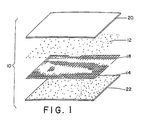
- particles of the first reagent 12 and particles of the second reagent 14 are separated by a filter sheet 18 .
- the filter sheet has a pore size which is sufficiently small relative to the particle size of the two powdered reagents that the particles are maintained physically separated. Yet, once dissolved in the solvent, the pore size is sufficiently large that the solvent and dissolved materials pass therethrough and react.
- a top or first outside coating layer 20 and a bottom or second outside coating layer 22 shield the particles of the two reagents from physical interaction so that they are not lost or brushed off before the film is actuated with the solvent. At least one of the two covering layers is permeable to the solvent to allow ready access to the constituents.
- the arrangement When used as a wipe, the arrangement may be dipped or sprayed with water to activate it. Alternately, the surface to be disinfected may be wet such that the arrangement and the impregnated reagents become wet, dissolve, and react from the water on the surface.
- the arrangement When used as a bandage, the arrangement may be initially dampened, such as with spray, to start the reaction. The reaction may be continued or in some embodiments initiated by moisture from the wound.
- the oxidant disinfectant agent not only functions as an anti-microbial agent to prevent infection, but also liberates free oxygen which promotes healing.
- one of the reagents 12 includes a sodium or other perborate in dry form or other dry constituents which liberate oxygen.
- Sodium perborate monohydrate and sodium perborate anhydrous are preferred.
- the other reagent 14 includes a dry acid precursor. The dry acid precursor and the dry persalt react when dissolved in water or other appropriate solvent to form a strong oxidant.
- the acid precursor is an acetyl donor, such as acetylsalicylic acid, tetraacetyl ethylenediamine (TAED), diactyl dioxohexahydratriazine (DADHT), tetraacetyl glycoluril, and sodium nanonoyl oxygenzene sulfonate.
- acetylsalicylic acid and sodium perborate react in water to form peracetic acid, salicylic acid, and sodium metaborate.
- Peracetic acid is a strong oxidant with a relatively short half-life that liberates free oxygen as it breaks down.
- Salicylic acid is a topical keratotic which softens or dissolves horny layers of the epidermis such as warts, callouses, and dead skin. In addition to softening skin, salicylic acid has anti-microbial properties.
- a means for controlling the reaction includes the pore size of the filter material 18 .
- the reaction rate is controlled by limiting communication between the constituents.
- the means for controlling the reaction rate further includes the permeability of the covering layers 20 and 22 .
- the means for controlling the reaction rate includes the addition of further powdered reagents.
- the reaction between the preferred acetylsalicylic acid and sodium perborate is pH sensitive.
- a wound dressing 30 includes a section of the arrangement 10 disposed between a gauze or other porous wound contacting layer 32 and a covering layer 34.
- the covering layer 34 includes an adhesive layer 36 which adheres to the arrangement 10 to a central portion thereof, adheres the wound contacting portion 32 , and adheres to the patient's skin around the wound.
- the arrangement 10 has the construction set forth in FIGURE 1 or in those described below.
- the film 10 has substantially the construction of FIGURE 1.
- the lower layer 22 disposed towards the patient's skin is porous to moisture exiting the wound. Lower layers of different porosity are used for different types of wounds.
- the bandage is advantageously used to generate oxygen to promote the healing of a wound.
- the lower layer 22 has a porosity which permits water vapor to pass therethrough at a controlled rate.
- the water vapor causes a limited wetting of the dry reagents such that they dissolve gradually and react, at an analogous controlled rate.
- the powdered constituents are buffered to have a relatively high pH such that the preferred acetylsalicylic acid and perborate form a peracetic acid with such a high pH that it is relatively unstable and breaks down quickly to free oxygen.
- a pH of 11 or higher is preferred for a quick breakdown to oxygen.
- the porosity of the lower layer 22 is again permeable to the free oxygen such that it enters the wound.
- the upper layer 20 being redundant with the layer 34 may be eliminated.
- the layer 34 , and layer 20 if redundantly applied may be moisture and gas permeable or may be semipermeable to either moisture or gas. Venting allows excess water vapor to escape. In some applications, layer 34 is impermeable.
- the generation of a strong anti-microbial agent is important as well as the production of oxygen.
- the porosity of lower layer 22 is again selected to control the amount of moisture permitted to enter. If the dressing is to be applied for a relatively short duration, e.g. a few hours, the lower layer 22 is preferably permeable by liquids such as water vapor from the skin, liquids exiting the wounds, or water sprayed from a spray bottle to actuate the dressing.
- the preferred acetylsalicylic acid and perborate react to form not only peracetic acid, but also salicylic acid.
- the lower layer 22 is sufficiently porous that it allows the dilutant with dissolved salicylic acid to flow back into the wound to promote healing.
- the salicylic acid can be used to remove horny layers of the epidermis.
- the film may be wet, such as by spraying or dipping and then applied to the area to be treated.
- the dry constituents include a gel which holds the water and continues the reaction and permits the salicylic acid solution to continue to reach the horny layer for several hours to a day. For relatively longer stability, an after reaction pH of 9.2-10 is preferred.
- the dry reagents 12 and 14 may also include emollients and other skin softeners.
- the constituents 12 and 14 are carried by layers of woven, non-woven, or knitted fibers or open cell or foam 40, 42.
- the dry constituents are sprayed and dried, impregnated, dry sprayed, or otherwise attached to or incorporated into the fibers or foam layers.
- a filter layer 18 holds the dry particulates apart.
- Outer layers 20 and 22 contain and protect layers 40 and 42 . At least one of the outer layers is fluid permeable such that the solvent can penetrate, dissolve the dry constituents, and start the chemical reaction.
- the porosity of the filter 18 and the outer layers 20, 22 control the rate at which the dilutant can enter and the reagents intermix, hence the rate of reaction. Additional buffering compositions may also control the rate of reaction.
- Surfactants, detergents, emollients, and the like may also be included in dry form.
- a protective glove 50 is defined by a continuous impermeable hand-shaped layer 52 of rubber, plastic, or other film material which is impermeable to the dilutant, the anti-microbial agent, strong oxidants, and gaseous oxygen, as well as any emollients, detergents, or other substances which may be dissolved in the solvent.
- the arrangement 10 is adhered to the outer surface of all or selected portions of the glove.
- the arrangement 10 is preferably laminated over the palm, thumb, and finger pad portions of the glove, i.e. the portions of the glove which would contact a grasped or touched object.
- An outer, permeable layer 22 surrounds the film 10 protecting it.
- the outer layer 22 is a material which can be readily affixed to the impermeable liner 52 , such as by heat fusion, adhesives, or the like.
- the film 10 has periodic discontinuities where the inner and outer layers contact and adhere to each other.
- oxidizing or antimicrobial agents can also be generated in situ, such as chlorine dioxide, chlorine, hydrogen peroxide, and mixtures thereof.
- potassium chromates, sodium chloride, and phosphates may be mixed according to the following equation to produce a strong chlorine oxidant on the addition of water: K 2 Cr 2 O 7 + 6 NACl + 7 H 3 PO 4 ⁇ 4 K 2 HPO 4 + Cr 2 N(HPO 4 ) 3 + HOCl + 6H + + H 2 O
- excess dichromate and an organic corrosion inhibitor may be provided for improved buffering and corrosion inhibiting.
- Hydrogen peroxide and an inorganic inhibitor can be generated: NaBO 3 + H 2 O + H 3 PO 4 ⁇ H 2 O 2 + NaBO 2 + H 3 PO 4
- chlorine dioxide can be generated from powdered ingredients on the addition of water: 2NaClO 2 + LiClO + H 2 O ⁇ 2ClO 2 + NaOH + NaCl + LiOH
- a mixed biocide system can be achieved by adding sodium chloride to the peracetic acid reaction to produce hypochlorous acid. Because sodium chloride is a component of physiological fluids, the reaction can be partially physiologically regulated. CH 3 COOOH + Na + + Cl - ⁇ CH 3 COONa + HOCl Excess peracetic acid is deliberately present such that both peracetic acid and hypochlorous acid are present in the biocidal solution.
- reagents include perborates which react in water to liberate free oxygen, and constituents which react to form other medically useful compositions.
Landscapes
- Health & Medical Sciences (AREA)
- Life Sciences & Earth Sciences (AREA)
- General Health & Medical Sciences (AREA)
- Veterinary Medicine (AREA)
- Engineering & Computer Science (AREA)
- Public Health (AREA)
- Animal Behavior & Ethology (AREA)
- Epidemiology (AREA)
- Chemical & Material Sciences (AREA)
- Agronomy & Crop Science (AREA)
- Environmental Sciences (AREA)
- Pest Control & Pesticides (AREA)
- Plant Pathology (AREA)
- Dentistry (AREA)
- Wood Science & Technology (AREA)
- Zoology (AREA)
- Chemical Kinetics & Catalysis (AREA)
- General Chemical & Material Sciences (AREA)
- Inorganic Chemistry (AREA)
- Hematology (AREA)
- Materials Engineering (AREA)
- Mechanical Engineering (AREA)
- Vascular Medicine (AREA)
- Heart & Thoracic Surgery (AREA)
- Molecular Biology (AREA)
- Medicinal Chemistry (AREA)
- Biomedical Technology (AREA)
- Toxicology (AREA)
- Surgery (AREA)
- Agricultural Chemicals And Associated Chemicals (AREA)
- Food Preservation Except Freezing, Refrigeration, And Drying (AREA)
- Materials For Medical Uses (AREA)
- Medicinal Preparation (AREA)
- Separation Using Semi-Permeable Membranes (AREA)
- Manufacture Of Porous Articles, And Recovery And Treatment Of Waste Products (AREA)
- Apparatus For Disinfection Or Sterilisation (AREA)
- Manufacture Of Macromolecular Shaped Articles (AREA)
- Detergent Compositions (AREA)
- Pharmaceuticals Containing Other Organic And Inorganic Compounds (AREA)
- Acyclic And Carbocyclic Compounds In Medicinal Compositions (AREA)
Abstract
Description
HOCl + 6H+ + H2O
Claims (8)
- An arrangement of components (10) including arrangement of component layers (20, 22) which contains dry constituents that react to generate at least one of oxygen and a strong oxidant in the presence of a solvent
wherein the dry constituents include a first dry reagent (12) in particulate form and a second dry reagent (14) in particulate form, particles of the first and second reagents being contained in between the layers (20, 22), the first and second reagent particles dissolve in the solvent and react with each other in situ to generate the at least one of oxygen and the strong oxidant; and characterized by:a sheet of filter material (18) which pores are smaller than the first and second reagent particles, said sheet separating the first and second reagent particles such that the particles of the first reagent and the particles of the second reagent are maintained physically separated from each other and thereby unable to react with each other until dissolved by the solvent. - The arrangement of components as set forth in preceding Claim 1 further characterized by the first reagent including an acid precursor and the second reagent including a perborate, the acid precursor and perborate reacting in the presence of water to generate the strong oxidant and further including at least one of:a surfactant;a detergent;an emollient;a pH buffer; anda water absorbing gel.
- The arrangement of components as set forth in either of preceding claims 1 and 2, further characterized by the first reagent including an acetyl donor and the second reagent including a perborate such that peracetic acid is generated.
- The arrangement of components as set forth in claim 3 further characterized by the acetyl donor including at least one of acetylsalicylic acid, tetraacetyl ethylenediamine, diacetyl dioxohexahydratriazine, tetraacetyl glycoluril, and sodium nanonoyl oxygenzene sulfonate.
- The arrangement of components as set forth in any of preceding claims 1-4 further characterized by a means for controlling a reaction rate between the first and second reagents.
- The arrangement of components as set forth in claim 5 further characterized by the reaction rate controlling means controlling the reaction rate to cause a complete reaction in less than 5 minutes, whereby the strong oxidant is generated rapidly enabling the arrangement to be used as an anti-microbial wipe.
- The arrangement of components as set forth in any one of the preceding claims further characterized by the filter including at least one of:woven fibers;non-woven fibers;knitted fibers;a permeable synthetic sheet; anda flexible foam layer.
- The arrangement of components as set forth in any one of the preceding claims further characterized by the arrangement being affixed to an exterior of a dilutant-impermeable glove.
Applications Claiming Priority (3)
| Application Number | Priority Date | Filing Date | Title |
|---|---|---|---|
| US08/064,391 US5407685A (en) | 1986-02-06 | 1993-05-18 | Controlled oxygen/anti-microbial release films |
| US64391 | 1993-05-18 | ||
| PCT/US1994/005570 WO1994026317A1 (en) | 1993-05-18 | 1994-05-18 | Controlled oxygen/anti-microbial release films |
Publications (2)
| Publication Number | Publication Date |
|---|---|
| EP0699080A1 EP0699080A1 (en) | 1996-03-06 |
| EP0699080B1 true EP0699080B1 (en) | 2002-10-02 |
Family
ID=22055641
Family Applications (1)
| Application Number | Title | Priority Date | Filing Date |
|---|---|---|---|
| EP94919163A Expired - Lifetime EP0699080B1 (en) | 1993-05-18 | 1994-05-18 | Controlled oxygen/anti-microbial release films |
Country Status (10)
| Country | Link |
|---|---|
| US (1) | US5407685A (en) |
| EP (1) | EP0699080B1 (en) |
| JP (1) | JPH08510155A (en) |
| AT (1) | ATE225188T1 (en) |
| AU (1) | AU685813B2 (en) |
| CA (1) | CA2163123C (en) |
| DE (1) | DE69431477T2 (en) |
| DK (1) | DK0699080T3 (en) |
| ES (1) | ES2183840T3 (en) |
| WO (1) | WO1994026317A1 (en) |
Cited By (2)
| Publication number | Priority date | Publication date | Assignee | Title |
|---|---|---|---|---|
| US10870818B2 (en) | 2018-06-15 | 2020-12-22 | Ecolab Usa Inc. | Enhanced peroxygen stability using fatty acid in bleach activating agent containing peroxygen solid |
| US11731889B2 (en) | 2015-04-03 | 2023-08-22 | Ecolab Usa Inc. | Enhanced peroxygen stability in multi-dispense TAED-containing peroxygen solid |
Families Citing this family (98)
| Publication number | Priority date | Publication date | Assignee | Title |
|---|---|---|---|---|
| US5837281A (en) * | 1995-03-17 | 1998-11-17 | Takeda Chemical Industries, Ltd. | Stabilized interface for iontophoresis |
| US5792090A (en) * | 1995-06-15 | 1998-08-11 | Ladin; Daniel | Oxygen generating wound dressing |
| DE19547055A1 (en) * | 1995-12-18 | 1997-06-19 | Solvay Interox Gmbh | Solid peroxo and peroxy compounds stabilized by coating |
| JP3037460U (en) * | 1996-11-05 | 1997-05-16 | 花王株式会社 | Nose pack |
| US6240879B1 (en) * | 1997-04-15 | 2001-06-05 | Seefar Technologies, Inc. | Amusement articles possessing microbe-inhibiting properties |
| US7556767B2 (en) * | 1997-12-17 | 2009-07-07 | Ethicon, Inc. | Integrated washing and sterilization process |
| US6203756B1 (en) | 1997-12-17 | 2001-03-20 | Johnson & Johnson Medical, Inc. | Integrated cleaning sterilization process |
| US20050163655A1 (en) * | 1997-06-11 | 2005-07-28 | Szu-Min Lin | Integrated washing and sterilization process |
| US7229591B2 (en) * | 1997-08-21 | 2007-06-12 | Ethicon, Inc. | Lumen sterilization device and method |
| US6605751B1 (en) * | 1997-11-14 | 2003-08-12 | Acrymed | Silver-containing compositions, devices and methods for making |
| US6187266B1 (en) | 1997-12-17 | 2001-02-13 | Johnson & Johnson Medical, Inc. | Integrated cleaning/sterilization process with lumen devices |
| US6685895B1 (en) | 1997-12-17 | 2004-02-03 | Ethicon, Inc. | Method and apparatus for processing device with reduced occlusion |
| US6015529A (en) * | 1997-12-17 | 2000-01-18 | Johnson & Johnson Medical, Inc. | Tray/container system for cleaning/sterilization processes |
| US6596232B1 (en) | 1997-12-17 | 2003-07-22 | Ethicon, Inc. | Device processing apparatus and method having positive pressure with two partitions to minimize leakage |
| US6013227A (en) * | 1997-12-17 | 2000-01-11 | Johnson & Johnson Medical, Inc. | Lumen device reprocessor without occlusion |
| US6083458A (en) * | 1997-12-17 | 2000-07-04 | Ethicon, Inc. | Apparatus and method for providing fluid to devices with reduced or without occlusion |
| US6645430B1 (en) | 1997-12-17 | 2003-11-11 | Ethicon, Inc. | Method and apparatus for processing device with fluid submersion |
| US6808658B2 (en) * | 1998-01-13 | 2004-10-26 | 3M Innovative Properties Company | Method for making texture multilayer optical films |
| WO1999065538A1 (en) * | 1998-06-19 | 1999-12-23 | Oxibio, Inc. | Medical device having anti-infective and contraceptive properties |
| AR021847A1 (en) | 1998-10-01 | 2002-08-07 | Minntech Corp | A MULTI-PART ANTI-MICROBIAL CONCENTRATED SYSTEM, AN ACTIVATED SOLUTION, A SOLUTION FOR DILUTED USE, A METHOD FOR PREPARING THEM AND A METHOD FOR STERILIZING WITH THE SOLUTION FOR DILUATING AND ANTI-CORROSIVE AGENT |
| BR9915865A (en) * | 1998-12-03 | 2002-01-02 | Redox Chemicals Inc | New method for protecting plants from pathogens, a process for increasing transcription of a gene in a plant, encoding a protein and composition for applying plant foliage and plant roots |
| EP1171368B1 (en) | 1998-12-30 | 2008-02-27 | Ethicon, Inc. | Sterile packaging for flexible endoscopes |
| US6312645B1 (en) | 1998-12-30 | 2001-11-06 | Ethicon, Inc. | Container with collapsible pouch for cleaning or sterilization |
| US6534002B1 (en) | 1998-12-30 | 2003-03-18 | Ethicon, Inc. | Flow of fluid through a lumen device from smaller-caliber end to larger-caliber end |
| US6352837B1 (en) | 1999-02-22 | 2002-03-05 | 3M Innovative Properties Company | Rapid readout sterilization indicator for liquid peracetic acid sterilization procedures |
| EP1034799A1 (en) * | 1999-03-05 | 2000-09-13 | The Procter & Gamble Company | Articles having an odour control system comprising a water soluble oxidising agent and an emulsifier |
| US6838050B1 (en) | 1999-06-04 | 2005-01-04 | Oxibio, Inc. | Methods and devices for providing anti-infective activity to a medical device |
| US6298521B1 (en) * | 1999-10-18 | 2001-10-09 | Gary Butterfield | Door knob sanitizing device |
| US6916480B2 (en) | 1999-12-28 | 2005-07-12 | Kimberly-Clark Worldwide, Inc. | Wiper containing a controlled-release anti-microbial agent |
| MXPA02006424A (en) | 1999-12-28 | 2002-11-29 | Kimberly Clark Co | Controlled release antimicrobial wipe for hard surfaces. |
| EP1241973B1 (en) | 1999-12-28 | 2007-04-11 | Kimberly-Clark Worldwide, Inc. | Use-dependent indicator system for absorbent articles |
| EP1244476B1 (en) * | 1999-12-30 | 2006-05-31 | Acrymed | Methods and compositions for improved delivery devices |
| WO2008065660A2 (en) * | 2006-11-28 | 2008-06-05 | Beta O2 Technologies Ltd. | Oxygen supply for cell transplant and vascularization |
| US6523714B2 (en) | 2000-10-03 | 2003-02-25 | Kimberly-Clark Worldwide, Inc. | Container having virucidal, bacterial, and/or germicidal properties |
| AU2003205058A1 (en) * | 2002-01-08 | 2003-07-24 | Bernard Techologies, Inc. | Antimicrobial body covering articles |
| US7203173B2 (en) * | 2002-01-25 | 2007-04-10 | Architecture Technology Corp. | Distributed packet capture and aggregation |
| CN1678277B (en) | 2002-07-29 | 2010-05-05 | 艾克里麦德公司 | Methods and compositions for treating skin diseases |
| US20040151919A1 (en) * | 2003-01-31 | 2004-08-05 | Kimberly-Clark Worldwide, Inc. | Glove having reduced microbe affinity and transmission |
| US20040170671A1 (en) * | 2003-03-05 | 2004-09-02 | Jian Tao | Thin wall gloves that release chlorine dioxide |
| US20060142684A1 (en) * | 2003-04-11 | 2006-06-29 | Shanbrom Technologies, Llc | Oxygen releasing material |
| US7275640B2 (en) * | 2004-02-05 | 2007-10-02 | Boston Scientific Scimed, Inc. | Packaging for imparting anti-microbial properties to a medical device |
| WO2005087951A2 (en) | 2004-03-05 | 2005-09-22 | Gen-Probe Incorporated | Reagents, methods and kits for use in deactivating nucleic acids |
| GB0411304D0 (en) * | 2004-05-21 | 2004-06-23 | Fellows Adrian N | An antimicrobial composition |
| US8361553B2 (en) | 2004-07-30 | 2013-01-29 | Kimberly-Clark Worldwide, Inc. | Methods and compositions for metal nanoparticle treated surfaces |
| NZ552928A (en) * | 2004-07-30 | 2011-05-27 | Acrymed Inc | Antimicrobial silver compositions |
| CN102783499A (en) * | 2004-07-30 | 2012-11-21 | 金伯利-克拉克环球有限公司 | Antimicrobial devices and compositions |
| US9289378B2 (en) * | 2004-09-20 | 2016-03-22 | Avent, Inc. | Antimicrobial amorphous compositions |
| US20060073067A1 (en) * | 2004-10-06 | 2006-04-06 | Government Of The United States Of America As Represented By The Secretary Of The Navy | Peracid-based large-area decontamination |
| US9044462B2 (en) | 2004-12-08 | 2015-06-02 | Avent, Inc. | Method for oxygen treatment of intact skin |
| US20060121101A1 (en) * | 2004-12-08 | 2006-06-08 | Ladizinsky Daniel A | Method for oxygen treatment of intact skin |
| US20060134163A1 (en) * | 2004-12-16 | 2006-06-22 | Bagwell Alison S | Immobilizing anti-microbial compounds on elastomeric articles |
| FR2883478B1 (en) * | 2005-03-24 | 2007-06-15 | Eurotab Sa | COMPACTED SOLID COMPOSITION DISINFECTING |
| US8293965B2 (en) * | 2006-04-28 | 2012-10-23 | Kimberly-Clark Worldwide, Inc. | Antimicrobial site dressings |
| WO2007134304A1 (en) * | 2006-05-15 | 2007-11-22 | Virginia Commonwealth University | Methods and compositions for controlled and sustained production and delivery of peroxides |
| JP5016032B2 (en) | 2006-06-07 | 2012-09-05 | トリニティ ワウンド インスティテュート, エルエルシー | Oxygen therapy using ultrasound |
| US9724550B2 (en) * | 2006-08-15 | 2017-08-08 | American Sterilizer Company | One part, solids containing decontamination blend composition |
| US9700644B2 (en) * | 2006-08-15 | 2017-07-11 | American Sterilizer Company | One part, solids containing decontamination blend composition |
| EP1905399A1 (en) * | 2006-09-29 | 2008-04-02 | Becton, Dickinson & Company | Thumb Immobilizer |
| WO2008062417A2 (en) * | 2006-11-22 | 2008-05-29 | Beta O2 Technologies Ltd. | Protecting algae from body fluids |
| US9351488B2 (en) * | 2006-12-22 | 2016-05-31 | Peroxychem Llc | Peracetic acid composition |
| CA2682507C (en) * | 2007-04-09 | 2017-11-21 | Wake Forest University Health Sciences | Oxygen-generating compositions for enhancing cell and tissue survival in vivo |
| US20080262413A1 (en) * | 2007-04-19 | 2008-10-23 | Ladizinsky Daniel A | Method For Supplying Oxygenated Water To Promote Internal Healing |
| US8038000B2 (en) * | 2007-08-16 | 2011-10-18 | Illinois Tool Works Inc. | Hydrogen peroxide point-of-use wipers |
| WO2009031154A2 (en) | 2007-09-07 | 2009-03-12 | Beta O2 Technologies Ltd. | Air gap for supporting cells |
| US8198503B2 (en) * | 2007-11-19 | 2012-06-12 | The Procter & Gamble Company | Disposable absorbent articles comprising odor controlling materials |
| US20090202617A1 (en) * | 2008-02-13 | 2009-08-13 | Ward Kevin R | Gas based wound and tissue therapeutics |
| DE102008018629A1 (en) * | 2008-04-11 | 2009-10-15 | Alcan Technology & Management Ag | Packaging film section, packaging film, packaging and packaging product unit |
| US9446168B2 (en) | 2010-06-07 | 2016-09-20 | Beta-O2 Technologies Ltd. | Multiple-layer immune barrier for donor cells |
| US9540630B2 (en) * | 2008-09-17 | 2017-01-10 | Beta O2 Technologies Ltd. | Optimization of alginate encapsulation of islets for transplantation |
| US20100125261A1 (en) * | 2008-11-20 | 2010-05-20 | Randall Alan Watson | Disposable Absorbent Articles Comprising Odor Controlling Materials In A Distribution Profile |
| AU2009316270B2 (en) * | 2008-11-24 | 2015-08-27 | Avent, Inc. | Antimicrobial laminate constructs |
| US8343515B2 (en) * | 2008-11-25 | 2013-01-01 | Oxygen Biotherapeutics, Inc. | Perfluorocarbon gel formulations |
| US8043271B2 (en) * | 2008-11-26 | 2011-10-25 | Beta 02 Technologies Ltd. | Apparatus for transportation of oxygen to implanted cells |
| US20100144597A1 (en) * | 2008-12-10 | 2010-06-10 | Ward Kevin R | Novel combinatorial approaches to enhancing oxygen transport to tissues |
| EP3375446B1 (en) * | 2010-04-13 | 2020-04-08 | KCI Licensing, Inc. | Compositions with reactive ingredients, and wound dressings, apparatuses, and methods |
| AU2012224574B2 (en) * | 2011-03-10 | 2016-09-22 | Nomacorc Llc | Closure for a product retaining container |
| US9381269B2 (en) | 2011-04-13 | 2016-07-05 | Avent, Inc. | Biosorbable wound treatment device, process for making, and method of using the same |
| GB201208282D0 (en) | 2012-05-11 | 2012-06-20 | Surfaceskins Ltd | Delivery device |
| US8919560B2 (en) * | 2012-06-13 | 2014-12-30 | Derek L. HOPKINS | Chewing gum disposal container |
| US10808211B2 (en) | 2013-06-27 | 2020-10-20 | Microlin, Llc | Disposable wipes with treatment agent safely formed insitu |
| US10260030B2 (en) | 2013-06-27 | 2019-04-16 | Microlin, Llc | Disposable wipes with peracetic acid treatment agent |
| US10687536B2 (en) * | 2013-06-27 | 2020-06-23 | Microlin, Llc | Disposable wipes for energized treatment agent |
| EP2868199A1 (en) * | 2013-10-29 | 2015-05-06 | Mondi Consumer Packaging Technologies GmbH | Fungicidally active protective film |
| US10022189B2 (en) | 2013-12-16 | 2018-07-17 | Stryker Sustainability Solutions, Inc. | Apparatus and method for cleaning an instrument |
| GB2522074A (en) | 2014-01-14 | 2015-07-15 | Peracide Uk Ltd | Disinfectant or sanitising composition |
| GB2531246A (en) | 2014-10-07 | 2016-04-20 | Peracide Uk Ltd | Disinfectant wipe dispenser |
| CN106999118B (en) | 2014-10-13 | 2020-07-17 | 葡萄糖传感器公司 | Analyte sensing device |
| US10555521B2 (en) | 2014-12-30 | 2020-02-11 | Micrulia LLC | Disposable wipes for optional disinfection, deodorization, and/or sterilization and methods of use thereof |
| US9783766B2 (en) | 2015-04-03 | 2017-10-10 | Ecolab Usa Inc. | Enhanced peroxygen stability using anionic surfactant in TAED-containing peroxygen solid |
| US10871487B2 (en) | 2016-04-20 | 2020-12-22 | Glusense Ltd. | FRET-based glucose-detection molecules |
| WO2018187831A1 (en) * | 2017-04-12 | 2018-10-18 | University Of South Australia | Oxygen releasing substrates and compositions and uses thereof |
| WO2018204445A1 (en) * | 2017-05-02 | 2018-11-08 | Medtronic Vascular Inc. | Packaging for dry tissue prosthetic heart valve |
| WO2018204455A1 (en) | 2017-05-02 | 2018-11-08 | Medtronic Vascular Inc. | Assemblies and methods for sterilizing a wet stored prosthetic heart valve |
| US12138140B2 (en) * | 2017-05-17 | 2024-11-12 | Uvic Industry Partnerships Inc | Wound covering for wound monitoring and therapeutic agent delivery |
| WO2020104550A1 (en) * | 2018-11-23 | 2020-05-28 | Mips Ab | Glove |
| US10772695B2 (en) * | 2019-12-31 | 2020-09-15 | Henny Avitan | Glove with medicinal pads and differing thickness regions |
| GB2592911B (en) * | 2020-02-28 | 2023-06-28 | Aga Nanotech Ltd | A plasma-activatable wound dressing for treatment of infections |
| GB202005556D0 (en) * | 2020-04-16 | 2020-06-03 | Aga Nanotech Ltd | Covid face mask |
Family Cites Families (40)
| Publication number | Priority date | Publication date | Assignee | Title |
|---|---|---|---|---|
| JPS5319345B2 (en) * | 1974-05-17 | 1978-06-20 | ||
| US4272264A (en) * | 1974-08-08 | 1981-06-09 | Multiform Desiccant Products, Inc. | Adsorbent package |
| GB1601923A (en) * | 1977-06-09 | 1981-11-04 | Beecham Group Ltd | Sustained release compositions |
| EP0010987B1 (en) * | 1978-11-07 | 1983-10-05 | Beecham Group Plc | Device for oral administration to a ruminant animal |
| US4405347A (en) * | 1982-01-11 | 1983-09-20 | Multiform Desiccants, Inc. | Adsorbent unit for mounting in the upper portion of a refrigerant receiver |
| US4457843A (en) * | 1982-05-12 | 1984-07-03 | Multiform Desiccants, Inc. | Self-retaining adsorbent container |
| US4453955A (en) * | 1982-11-16 | 1984-06-12 | Multiform Desiccants, Inc. | Desiccant cartridge for laboratory desiccator |
| US4505727A (en) * | 1983-11-25 | 1985-03-19 | Multiform Desiccants, Inc. | Adsorbent cartridge |
| US4601893A (en) * | 1984-02-08 | 1986-07-22 | Pfizer Inc. | Laminate device for controlled and prolonged release of substances to an ambient environment and method of use |
| US4584192A (en) * | 1984-06-04 | 1986-04-22 | Minnesota Mining & Manufacturing Company | Film-forming composition containing an antimicrobial agent and methods of use |
| US4687481A (en) * | 1984-10-01 | 1987-08-18 | Biotek, Inc. | Transdermal drug delivery system |
| US5154920A (en) * | 1985-03-13 | 1992-10-13 | Ecolab Inc. | Disinfectant polymeric coatings for hard surfaces |
| US4756710A (en) * | 1985-04-05 | 1988-07-12 | Merck & Co., Inc. | pH-Mediated drug delivery system |
| US4619673A (en) * | 1985-05-15 | 1986-10-28 | Multiform Desiccants, Inc. | Adsorbent device |
| US5217698A (en) * | 1986-02-06 | 1993-06-08 | Steris Corporation | Office size instrument sterilization system |
| US5116575A (en) * | 1986-02-06 | 1992-05-26 | Steris Corporation | Powdered anti-microbial composition |
| US5037623A (en) * | 1986-02-06 | 1991-08-06 | Steris Corporation | Sterilant concentrate injection system |
| US5209909A (en) * | 1986-02-06 | 1993-05-11 | Steris Corporation | Two compartment cup for powdered sterilant reagent components |
| US4749600A (en) * | 1986-05-16 | 1988-06-07 | Multiform Desiccants, Inc. | Liquid absorbing and immobilizing packet |
| US4847089A (en) * | 1986-07-16 | 1989-07-11 | David N. Kramer | Cleansing and distinfecting compositions, including bleaching agents, and sponges and other applicators incorporating the same |
| US4728323A (en) * | 1986-07-24 | 1988-03-01 | Minnesota Mining And Manufacturing Company | Antimicrobial wound dressings |
| GB8620227D0 (en) * | 1986-08-20 | 1986-10-01 | Smith & Nephew Ass | Wound dressing |
| US4877816A (en) * | 1986-12-24 | 1989-10-31 | Daicel Chemical Industries, Ltd. | Deodorant and antibacterial foamed polymer and sheet |
| DE3711680A1 (en) * | 1987-04-07 | 1988-10-27 | Hoechst Ag | AQUEOUS BIOCIDES CATIONIC PLASTIC DISPERSIONS AND THE USE THEREOF AS FUNGICIDES, BACTERICIDES AND ALGICIDES EQUIPMENT |
| US5061485A (en) * | 1987-05-12 | 1991-10-29 | Ecolab Inc. | Disinfectant polymeric coatings for hard surfaces |
| US5178495A (en) * | 1987-07-24 | 1993-01-12 | Reef Industries, Inc. | Polymeric film with biocide |
| US4783206A (en) * | 1987-09-18 | 1988-11-08 | Multiform Desiccants, Inc. | Adsorbent cartridge |
| AU2627388A (en) * | 1987-11-28 | 1989-07-05 | Fibre Treatments (Holdings) Limited | A wiping product |
| US5035892A (en) * | 1988-05-09 | 1991-07-30 | Dow Corning Corporation | Antimicrobial superabsorbent compositions and methods |
| GB8817199D0 (en) * | 1988-07-19 | 1988-08-24 | Unilever Plc | Package containing sheet-like article |
| US4904524A (en) * | 1988-10-18 | 1990-02-27 | Scott Paper Company | Wet wipes |
| US5091102A (en) * | 1988-11-15 | 1992-02-25 | Nordico, Inc. | Method of making a dry antimicrobial fabric |
| US5108740A (en) * | 1988-12-05 | 1992-04-28 | Ecolab Inc. | Antimicrobial film-forming compositions containing polymers having pendant pyran groups |
| US5104660A (en) * | 1989-11-21 | 1992-04-14 | Bruce A. Barber | Method of preparing an antimicrobial wound dressing |
| JPH03199403A (en) * | 1989-12-27 | 1991-08-30 | Chugoku Pearl Hanbai Kk | sterile gloves |
| US5069907A (en) * | 1990-03-23 | 1991-12-03 | Phoenix Medical Technology | Surgical drape having incorporated therein a broad spectrum antimicrobial agent |
| US5142010A (en) * | 1990-05-10 | 1992-08-25 | H. B. Fuller Licensing & Financing Inc. | Polymeric biocidal agents |
| US5092914A (en) * | 1990-06-07 | 1992-03-03 | Multiform Desiccants, Inc. | Floatable oxygen-absorbing cartridge |
| US5079004A (en) * | 1990-08-06 | 1992-01-07 | Dow Corning Corporation | Antimicrobial superabsorbent compositions and method |
| GB9109928D0 (en) * | 1991-05-08 | 1991-07-03 | Interox Chemicals Ltd | Thickened compositions |
-
1993
- 1993-05-18 US US08/064,391 patent/US5407685A/en not_active Expired - Lifetime
-
1994
- 1994-05-18 AT AT94919163T patent/ATE225188T1/en not_active IP Right Cessation
- 1994-05-18 WO PCT/US1994/005570 patent/WO1994026317A1/en not_active Ceased
- 1994-05-18 JP JP6525811A patent/JPH08510155A/en active Pending
- 1994-05-18 DE DE69431477T patent/DE69431477T2/en not_active Expired - Fee Related
- 1994-05-18 ES ES94919163T patent/ES2183840T3/en not_active Expired - Lifetime
- 1994-05-18 CA CA002163123A patent/CA2163123C/en not_active Expired - Fee Related
- 1994-05-18 EP EP94919163A patent/EP0699080B1/en not_active Expired - Lifetime
- 1994-05-18 AU AU70198/94A patent/AU685813B2/en not_active Ceased
- 1994-05-18 DK DK94919163T patent/DK0699080T3/en active
Cited By (3)
| Publication number | Priority date | Publication date | Assignee | Title |
|---|---|---|---|---|
| US11731889B2 (en) | 2015-04-03 | 2023-08-22 | Ecolab Usa Inc. | Enhanced peroxygen stability in multi-dispense TAED-containing peroxygen solid |
| US10870818B2 (en) | 2018-06-15 | 2020-12-22 | Ecolab Usa Inc. | Enhanced peroxygen stability using fatty acid in bleach activating agent containing peroxygen solid |
| US11193093B2 (en) | 2018-06-15 | 2021-12-07 | Ecolab Usa Inc. | Enhanced peroxygen stability using fatty acid in bleach activating agent containing peroxygen solid |
Also Published As
| Publication number | Publication date |
|---|---|
| AU7019894A (en) | 1994-12-12 |
| CA2163123C (en) | 2001-12-11 |
| ATE225188T1 (en) | 2002-10-15 |
| AU685813B2 (en) | 1998-01-29 |
| WO1994026317A1 (en) | 1994-11-24 |
| CA2163123A1 (en) | 1994-11-24 |
| JPH08510155A (en) | 1996-10-29 |
| DE69431477T2 (en) | 2003-08-28 |
| DK0699080T3 (en) | 2002-12-23 |
| ES2183840T3 (en) | 2003-04-01 |
| EP0699080A1 (en) | 1996-03-06 |
| US5407685A (en) | 1995-04-18 |
| DE69431477D1 (en) | 2002-11-07 |
Similar Documents
| Publication | Publication Date | Title |
|---|---|---|
| EP0699080B1 (en) | Controlled oxygen/anti-microbial release films | |
| US5126070A (en) | Chlorine dioxide generator | |
| CA1130204A (en) | Disinfecting tissues | |
| US6160196A (en) | Antimicrobial wound coverings | |
| US10967165B2 (en) | Systems and methods for enhancing gas and vapor transfer for tissue treatment devices | |
| EP1654114B1 (en) | Silver-containing wound care device, composition therefor, and method of producing | |
| AU2009331911B2 (en) | Wound dressing | |
| US7008392B2 (en) | Hemostatic cleansing swab | |
| US20050035327A1 (en) | Topical silver-based antimicrobial composition for wound care devices | |
| CA2014114A1 (en) | Polymeric broad-spectrum antimicrobial materials | |
| US8038000B2 (en) | Hydrogen peroxide point-of-use wipers | |
| US20070134045A1 (en) | Two-sided applicator with reactive or complementary chemistries | |
| JP2003213022A (en) | A simple method for producing an iodine-containing article, a water-resistant sustained-release iodine gas tool, and a disinfection system using the same. | |
| US20060094995A1 (en) | Bandage material with active carbon fibers | |
| JP2561989Y2 (en) | Mold removal sheet | |
| KR102683772B1 (en) | Wet wipes for improving function of anti-bacterial and sterilization | |
| JPH10286302A (en) | Deodorant composition | |
| JP2869560B2 (en) | Functional wrapper | |
| JP2001224622A (en) | Heating composition and heating element | |
| JPH08191855A (en) | Disinfection cotton for injection | |
| MX2008007408A (en) | Two-sided applicator with reactive or complementary chemistries | |
| JPH1099366A (en) | Fever bag |
Legal Events
| Date | Code | Title | Description |
|---|---|---|---|
| PUAI | Public reference made under article 153(3) epc to a published international application that has entered the european phase |
Free format text: ORIGINAL CODE: 0009012 |
|
| 17P | Request for examination filed |
Effective date: 19951117 |
|
| AK | Designated contracting states |
Kind code of ref document: A1 Designated state(s): AT BE CH DE DK ES FR GB GR IE IT LI LU MC NL PT SE |
|
| RIN1 | Information on inventor provided before grant (corrected) |
Inventor name: KRALOVIC, RAYMOND, C. Inventor name: MALCHESKY, PAUL, S. |
|
| 17Q | First examination report despatched |
Effective date: 19980429 |
|
| GRAG | Despatch of communication of intention to grant |
Free format text: ORIGINAL CODE: EPIDOS AGRA |
|
| GRAG | Despatch of communication of intention to grant |
Free format text: ORIGINAL CODE: EPIDOS AGRA |
|
| GRAG | Despatch of communication of intention to grant |
Free format text: ORIGINAL CODE: EPIDOS AGRA |
|
| GRAH | Despatch of communication of intention to grant a patent |
Free format text: ORIGINAL CODE: EPIDOS IGRA |
|
| GRAG | Despatch of communication of intention to grant |
Free format text: ORIGINAL CODE: EPIDOS AGRA |
|
| GRAH | Despatch of communication of intention to grant a patent |
Free format text: ORIGINAL CODE: EPIDOS IGRA |
|
| GRAH | Despatch of communication of intention to grant a patent |
Free format text: ORIGINAL CODE: EPIDOS IGRA |
|
| GRAA | (expected) grant |
Free format text: ORIGINAL CODE: 0009210 |
|
| AK | Designated contracting states |
Kind code of ref document: B1 Designated state(s): AT BE CH DE DK ES FR GB GR IE IT LI LU MC NL PT SE |
|
| PG25 | Lapsed in a contracting state [announced via postgrant information from national office to epo] |
Ref country code: GR Free format text: LAPSE BECAUSE OF FAILURE TO SUBMIT A TRANSLATION OF THE DESCRIPTION OR TO PAY THE FEE WITHIN THE PRESCRIBED TIME-LIMIT Effective date: 20021002 Ref country code: AT Free format text: LAPSE BECAUSE OF FAILURE TO SUBMIT A TRANSLATION OF THE DESCRIPTION OR TO PAY THE FEE WITHIN THE PRESCRIBED TIME-LIMIT Effective date: 20021002 |
|
| REF | Corresponds to: |
Ref document number: 225188 Country of ref document: AT Date of ref document: 20021015 Kind code of ref document: T |
|
| REG | Reference to a national code |
Ref country code: GB Ref legal event code: FG4D |
|
| REG | Reference to a national code |
Ref country code: CH Ref legal event code: EP |
|
| REG | Reference to a national code |
Ref country code: IE Ref legal event code: FG4D |
|
| REF | Corresponds to: |
Ref document number: 69431477 Country of ref document: DE Date of ref document: 20021107 |
|
| REG | Reference to a national code |
Ref country code: DK Ref legal event code: T3 |
|
| PG25 | Lapsed in a contracting state [announced via postgrant information from national office to epo] |
Ref country code: PT Free format text: LAPSE BECAUSE OF FAILURE TO SUBMIT A TRANSLATION OF THE DESCRIPTION OR TO PAY THE FEE WITHIN THE PRESCRIBED TIME-LIMIT Effective date: 20030102 |
|
| REG | Reference to a national code |
Ref country code: ES Ref legal event code: FG2A Ref document number: 2183840 Country of ref document: ES Kind code of ref document: T3 |
|
| ET | Fr: translation filed | ||
| PG25 | Lapsed in a contracting state [announced via postgrant information from national office to epo] |
Ref country code: MC Free format text: LAPSE BECAUSE OF NON-PAYMENT OF DUE FEES Effective date: 20030531 |
|
| PLBE | No opposition filed within time limit |
Free format text: ORIGINAL CODE: 0009261 |
|
| 26N | No opposition filed |
Effective date: 20030703 |
|
| PGFP | Annual fee paid to national office [announced via postgrant information from national office to epo] |
Ref country code: NL Payment date: 20040429 Year of fee payment: 11 |
|
| PGFP | Annual fee paid to national office [announced via postgrant information from national office to epo] |
Ref country code: DK Payment date: 20040524 Year of fee payment: 11 |
|
| PGFP | Annual fee paid to national office [announced via postgrant information from national office to epo] |
Ref country code: LU Payment date: 20040528 Year of fee payment: 11 |
|
| PG25 | Lapsed in a contracting state [announced via postgrant information from national office to epo] |
Ref country code: LU Free format text: LAPSE BECAUSE OF NON-PAYMENT OF DUE FEES Effective date: 20050518 |
|
| PG25 | Lapsed in a contracting state [announced via postgrant information from national office to epo] |
Ref country code: DK Free format text: LAPSE BECAUSE OF NON-PAYMENT OF DUE FEES Effective date: 20050531 |
|
| PG25 | Lapsed in a contracting state [announced via postgrant information from national office to epo] |
Ref country code: NL Free format text: LAPSE BECAUSE OF NON-PAYMENT OF DUE FEES Effective date: 20051201 |
|
| NLV4 | Nl: lapsed or anulled due to non-payment of the annual fee |
Effective date: 20051201 |
|
| REG | Reference to a national code |
Ref country code: DK Ref legal event code: EBP |
|
| REG | Reference to a national code |
Ref country code: CH Ref legal event code: PFA Owner name: STERIS CORPORATION Free format text: STERIS CORPORATION#9450 PINENEEDLE DRIVE#MENTOR, OHIO 44060 (US) -TRANSFER TO- STERIS CORPORATION#9450 PINENEEDLE DRIVE#MENTOR, OHIO 44060 (US) |
|
| PGFP | Annual fee paid to national office [announced via postgrant information from national office to epo] |
Ref country code: CH Payment date: 20080530 Year of fee payment: 15 |
|
| PGFP | Annual fee paid to national office [announced via postgrant information from national office to epo] |
Ref country code: BE Payment date: 20080624 Year of fee payment: 15 Ref country code: IT Payment date: 20080529 Year of fee payment: 15 |
|
| PGFP | Annual fee paid to national office [announced via postgrant information from national office to epo] |
Ref country code: SE Payment date: 20080529 Year of fee payment: 15 Ref country code: IE Payment date: 20080528 Year of fee payment: 15 |
|
| PGFP | Annual fee paid to national office [announced via postgrant information from national office to epo] |
Ref country code: ES Payment date: 20090526 Year of fee payment: 16 |
|
| PGFP | Annual fee paid to national office [announced via postgrant information from national office to epo] |
Ref country code: FR Payment date: 20090518 Year of fee payment: 16 Ref country code: DE Payment date: 20090528 Year of fee payment: 16 |
|
| BERE | Be: lapsed |
Owner name: *STERIS CORP. Effective date: 20090531 |
|
| PGFP | Annual fee paid to national office [announced via postgrant information from national office to epo] |
Ref country code: GB Payment date: 20090528 Year of fee payment: 16 |
|
| REG | Reference to a national code |
Ref country code: CH Ref legal event code: PL |
|
| PG25 | Lapsed in a contracting state [announced via postgrant information from national office to epo] |
Ref country code: LI Free format text: LAPSE BECAUSE OF NON-PAYMENT OF DUE FEES Effective date: 20090531 Ref country code: CH Free format text: LAPSE BECAUSE OF NON-PAYMENT OF DUE FEES Effective date: 20090531 |
|
| REG | Reference to a national code |
Ref country code: IE Ref legal event code: MM4A |
|
| PG25 | Lapsed in a contracting state [announced via postgrant information from national office to epo] |
Ref country code: IE Free format text: LAPSE BECAUSE OF NON-PAYMENT OF DUE FEES Effective date: 20090518 |
|
| PG25 | Lapsed in a contracting state [announced via postgrant information from national office to epo] |
Ref country code: BE Free format text: LAPSE BECAUSE OF NON-PAYMENT OF DUE FEES Effective date: 20090531 |
|
| GBPC | Gb: european patent ceased through non-payment of renewal fee |
Effective date: 20100518 |
|
| REG | Reference to a national code |
Ref country code: FR Ref legal event code: ST Effective date: 20110131 |
|
| PG25 | Lapsed in a contracting state [announced via postgrant information from national office to epo] |
Ref country code: IT Free format text: LAPSE BECAUSE OF NON-PAYMENT OF DUE FEES Effective date: 20090518 |
|
| PG25 | Lapsed in a contracting state [announced via postgrant information from national office to epo] |
Ref country code: DE Free format text: LAPSE BECAUSE OF NON-PAYMENT OF DUE FEES Effective date: 20101201 |
|
| PG25 | Lapsed in a contracting state [announced via postgrant information from national office to epo] |
Ref country code: FR Free format text: LAPSE BECAUSE OF NON-PAYMENT OF DUE FEES Effective date: 20100531 Ref country code: SE Free format text: LAPSE BECAUSE OF NON-PAYMENT OF DUE FEES Effective date: 20090519 |
|
| REG | Reference to a national code |
Ref country code: ES Ref legal event code: FD2A Effective date: 20110715 |
|
| PG25 | Lapsed in a contracting state [announced via postgrant information from national office to epo] |
Ref country code: GB Free format text: LAPSE BECAUSE OF NON-PAYMENT OF DUE FEES Effective date: 20100518 Ref country code: ES Free format text: LAPSE BECAUSE OF NON-PAYMENT OF DUE FEES Effective date: 20110705 |
|
| PG25 | Lapsed in a contracting state [announced via postgrant information from national office to epo] |
Ref country code: ES Free format text: LAPSE BECAUSE OF NON-PAYMENT OF DUE FEES Effective date: 20100519 |