EP0697656A1 - Verfahren für die Ablauffolgeplanung von aufeinanderfolgenden Aufgaben - Google Patents
Verfahren für die Ablauffolgeplanung von aufeinanderfolgenden Aufgaben Download PDFInfo
- Publication number
- EP0697656A1 EP0697656A1 EP95401848A EP95401848A EP0697656A1 EP 0697656 A1 EP0697656 A1 EP 0697656A1 EP 95401848 A EP95401848 A EP 95401848A EP 95401848 A EP95401848 A EP 95401848A EP 0697656 A1 EP0697656 A1 EP 0697656A1
- Authority
- EP
- European Patent Office
- Prior art keywords
- task
- tasks
- layer
- scheduling
- constraints
- Prior art date
- Legal status (The legal status is an assumption and is not a legal conclusion. Google has not performed a legal analysis and makes no representation as to the accuracy of the status listed.)
- Granted
Links
Images








Classifications
-
- G—PHYSICS
- G06—COMPUTING OR CALCULATING; COUNTING
- G06F—ELECTRIC DIGITAL DATA PROCESSING
- G06F9/00—Arrangements for program control, e.g. control units
- G06F9/06—Arrangements for program control, e.g. control units using stored programs, i.e. using an internal store of processing equipment to receive or retain programs
- G06F9/46—Multiprogramming arrangements
- G06F9/48—Program initiating; Program switching, e.g. by interrupt
- G06F9/4806—Task transfer initiation or dispatching
- G06F9/4843—Task transfer initiation or dispatching by program, e.g. task dispatcher, supervisor, operating system
- G06F9/4881—Scheduling strategies for dispatcher, e.g. round robin, multi-level priority queues
- G06F9/4887—Scheduling strategies for dispatcher, e.g. round robin, multi-level priority queues involving deadlines, e.g. rate based, periodic
Definitions
- the method according to the invention is applicable in particular to tasks which must be executed successively because they are executed by a single means capable of performing only one task at a time, for example: a machine tool, a bus IT, or a team of workers.
- a machine tool for example: a machine tool, a bus IT, or a team of workers.
- it can be applied to the management of a plurality of predetermined tasks to be executed successively in the same processor or on the same bus.
- a so-called field bus used to transmit information successively according to a predetermined scheduling.
- the known methods have two drawbacks: they require a long calculation time because they systematically check a very large number of permutations before providing a solution.
- the calculation time is generally proportional to the factorial function of the number of tasks to schedule.
- the known methods determine the duration of a macro-cycle equal to the least common multiple of all the periods of the tasks, and determine the duration of a micro-cycle equal to the greatest common divisor of all the periods of the tasks, then they seek a permutation of the tasks such that all the constraints are satisfied simultaneously, by trying all the possible permutations until finding one verifying this condition, by making the verifications micro-cycle by micro-cycle.
- a conflict appears in a micro-cycle the permutation being checked is abandoned, and another is tried.
- the work carried out to verify this permutation during the preceding micro-cycles becomes useless because all the constraints satisfied previously are called into question.
- the object of the invention is to propose a scheduling method which does not have these drawbacks, in order to more quickly obtain a solution to a static scheduling problem, but also to allow dynamic scheduling problems to be dealt with. , that is to say redetermine a scheduling as the number of tasks to be scheduled changes and the constraints relating to these tasks change.
- Such dynamic scheduling can be useful for example for scheduling machining tasks on a machine tool, when the products to be manufactured are very diverse; to schedule takeoffs or landings of aircraft on an airport runway; to schedule tasks on a bus or a computer processor; etc.
- this method is applicable to the scheduling of a system in which several tasks can be effectively performed in parallel, by decomposing this system into several parallel subsystems in which the tasks must all be executed successively; and by applying the method according to the invention for each of the subsystems thus determined.
- the method thus characterized has the advantage of being particularly rapid because in the event of failure for the scheduling of a task of this layer, it consists in moving, within this layer, one or more tasks preceding the task where the scheduling has failed, without systematically calling into question all the constraints already satisfied in this layer, and therefore without calling into question all of the work carried out previously in this layer.
- This characteristic considerably reduces the computation time compared to any process which would consist in systematically exploring all the possibilities of scheduling in this layer.
- the method according to the invention can be implemented both for determining a static scheduling and for determining a dynamic scheduling.
- the reduction in the computing time which it provides is particularly advantageous for determining a dynamic scheduling, since it allows changes in constraints or tasks to be taken into account in real time.
- FIG. 1 represents the block diagram of an example of a device implementing the method according to the invention for the dynamic scheduling of industrial production tasks for example.
- This device includes an OR computer coupled to a SY production system.
- This production system SY supplies to an input of the computer SY the parameters necessary for determining a scheduling: the identity ID K of each task, and the possible period T K of each task, and the definition R L of each constraint to satisfied. These parameters are provided whenever a change occurs in the nature of the tasks to be performed or in the constraints.
- the computer determines a new permutation PER, and the production system SY then executes the tasks in accordance with this new permutation.
- the tasks are generally carried out by different devices that make up the SY system.
- the OR computer must also be programmed to transmit information to each device indicating the times when it can execute a task.
- the programming of the computer OR to implement the method according to the invention and for the transmission to each device of information is within the reach of the skilled person, and will not be described beyond of the description of the process itself.
- the material means for coupling a computer OR to a system SY comprising different devices capable of performing respectively different tasks is within the reach of the skilled person.
- Figures 2 and 3 show an industrial control system requiring static scheduling. This application is considered as an example for implementing the method according to the invention, but it is not not limited to applications where scheduling is static. The same steps allow dynamic scheduling to be determined in real time.
- the initialization circuit CO is capable of transmitting information ID1 and information ID5.
- Each of the sensors C1 to C5 is capable of transmitting information.
- a sensor C2 is capable of transmitting information ID7 and information D15.
- Some sensors may receive certain information.
- the sensor C2 is capable of receiving the information ID6 or the information ID8.
- the regulation circuits C6 and C7 are also capable of transmitting and receiving information.
- the actuators A1, A3, A4 and the display A2 are only capable of receiving information.
- the actuator A1 is capable of receiving the information ID7 and the information ID15 emitted by the sensor C2.
- the same information can be received simultaneously by several elements of the system.
- the information ID8 supplied by the sensor C1 is received simultaneously by the sensor C2 and by the regulation circuit C7.
- FIG. 3 represents the block diagram of this example system, to show the physical links carrying the information ID1, ..., ID20. All the information is transmitted by a single medium B which is a so-called field bus passing close to each item of equipment.
- each of the elements CO, ..., C7, A1, ..., A4 operates with a repetition period.
- these periods are respectively: 200 ms, 200 ms, 500 ms, 400 ms, 40 ms, 40 ms, 40 ms, 200 ms, 400 ms, 40 ms, 40 ms.
- the system therefore operates according to a macro-cycle having a duration equal to the least common multiple of these periods, that is to say 400 ms.
- each task consists of the transmission of a single piece of information and has a uniform duration equal to 0.4 ms, regardless of the number of recipients for this information.
- these transmission tasks must satisfy constraints R1 to R33 listed below: R1) ID 1 delay [O; 400] R2) ID 13 after ID 1 [2; 40] R3) ID 14 after ID 1 [2; 40] R4) 2 a fter ID ID 1 [2, 40] R5) ID 2 after ID 9 [0; 40] R6) ID 2 after ID 10 [0; 40] R7) ID 2 after ID 11 [0; 40] R8) ID 2 after ID 12 [0; 40] R9) ID 9 delay [0; 400] R10) ID 10 delay [0; 400] R11) ID 11 delay [0; 400] R12) ID 12 delay [0; 400] R13) ID 3 after ID 2 [7; 40] R14) ID 16 after ID 2 [7; 40] R15) ID 3 after ID 16 [0; 40] R16) ID 3 after ID 13 [0; 40] R17) ID 3
- the constraint R26: ID5 delay [O, 400] requires that the transmission of information ID5, which is provided by an output of the initialization circuit CO, begins within a delay between O and 400 ms after an instant of absolute reference which is the initialization instant defined by the CO circuit and which triggers a macro-cycle.
- ID6 after ID5 [102,200] requires that the transmission of information ID6, which is supplied by the sensor C1, only starts within a delay of between 102 and 200 ms after the start of transmission of the ID5 information.
- Each constraint relates only to the start time of the transmission, which must be included in the indicated interval [t min , t max ]. Transmission can continue beyond the limit of this interval, it must only respect the fixed duration.
- the set of constraints R1, ..., R33 which relate to the tasks of transmitting information ID1, ..., ID2O can be represented by a graph called the graph of successions, in which each node represents a task and each arc connecting two nodes represents a constraint. Each arc is oriented from a node, called the predecessor, to a node corresponding to the task to which the constraint relates, and which must therefore be executed after the so-called predecessor task corresponding to the predecessor node.
- a preliminary step of the method according to the invention consists in reducing the number of permutations to be checked, by checking the scheduling of the tasks only during a micro-cycle which is the greatest common divisor of all the periods of repetition of the tasks. Indeed, if we manage to find a permutation such that if all the tasks are executed during the same micro-cycle and that they satisfy all the constraints, then this permutation will not cause any conflict during any of the micro -cycle constituting a macro-cycle, since the worst case is that where all the tasks fall in the same micro-cycle because of the coincidence of the multiples of their periods.
- Figures 4 and 5 illustrate this preliminary step of the method according to the invention. It should be noted that in the case where one or more tasks are not considered a priori as repetitive, it suffices to assign them a value of common period chosen arbitrarily but such that it facilitates the determination of a micro-cycle. It is therefore sufficient to determine the value of the greatest common divisor of the periods of repetitive tasks and then to choose a multiple of this value to constitute a period common to all the non-repetitive tasks.
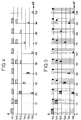
- Figures 4 and 5 illustrate an example where you have to schedule 6 periodic tasks T1, ..., T6, respectively with periods equal to 10 ms, 20 ms, 30 ms, 40 ms, 50 ms, 40 ms.
- the execution time is uniform for all tasks and is equal to 1 ms.
- Figure 4 shows in gray the time intervals [t min , t max ] for each of these tasks.
- TA1 [t min, t max ] [O, 4 ms] modulo 10 ms TA2 [10, 13 ms] modulo 20 ms TA3 [20, 23 ms] modulo 30 ms TA4 [30, 32 ms] modulo 40 ms TA5 [40, 41 ms] modulo 50 ms TA6 [20, 22 ms] modulo 40 ms
- tasks TA1, TA3, TA6 must be executed during the same micro-cycle [20 ms , 30 ms ] then [120 ms , 140 ms ], etc.
- the scheduling method according to the invention is then applied in this interval [0.10 ms].
- FIG. 5 represents the scheduling of the tasks thus obtained, over the interval O to 100 ms, the interval 100 to 600 ms not being shown but having a similar scheduling.
- Each execution interval is shown in black.
- the TA1 task is executed during the interval 23 to 24 ms.
- the TA3 task is executed during the interval 22 to 23 ms.
- the TA6 task is executed during the interval 21 to 22 ms.
- this preliminary step also consists in gathering the tasks in several independent graphs, if possible, each graph gathering only tasks linked together by constraints. Scheduling multiple graphs independently is faster than scheduling a single, more complex graph.
- FIG. 6 represents the successions graph for the tasks carried out in the system represented in FIGS. 2 and 3.
- the nodes corresponding to the tasks are gathered in 6 successive layers L1 ... L6.
- the constraints R26, R12, R11, R10, R9, R1, R33 are time constraints counted from an absolute reference instant DM which is the start of the micro-cycle.
- Layer L1 comprises the nodes representing the tasks of transmission of information ID5, ID12, ID11, ID10, ID9, ID1, ID20.
- the L2 layer includes the nodes corresponding to the information transmission tasks ID8, ID2, ID14, ID13.
- Layer L3 includes the nodes corresponding to the information transmission tasks ID6 and ID16.
- Layer L4 comprises the nodes corresponding to the information transmission tasks ID15 and ID3.
- Layer L5 includes the nodes corresponding to the information transmission tasks ID7, ID17, ID18, ID19.
- Layer L6 comprises only the node corresponding to the task of transmitting information ID4.
- the method according to the invention determines a sequencing layer by layer, successively in order increasing rows, L1, L2, ..., L6 corresponding to the successions imposed by the constraints.
- FIG. 7 represents the flow diagram of an example of the implementation method according to the invention.
- a preliminary step EO consists in determining the graph of the successions arising from the constraints relating to the tasks to be scheduled, that is to say to group the tasks into a certain number of subsets constituting the layers of the graph, according to the successions imposed by constraints. The particular case where there are repetitive tasks will be explained later.
- Any task is assigned to a first layer if it is subject only to constraints of the delay type with respect to an initialization instant.
- Any task is assigned to a rank 2 layer if it is subjected to at least one type constraint after a task assigned to the rank 1 layer, and if it is not subjected to any type constraint after a task which does not has not yet been assigned to a layer, and which therefore belongs to a layer of rank greater than 1, and which can for example be the layer of rank 2.
- the layers are formed according to the increasing ranks, by repeating the scanning of the list of constraints and by eliminating from this list the constraints relating to tasks which have been assigned to a layer.
- Any task is assigned to the layer of rank i> 1 if it is subjected to at least one type constraint after a task which has been assigned to the layer of rank i-1 and if it is not subjected to any type of constraint after a task that has not yet been assigned.
- rank i is incremented and the list of constraints is rescheduled until all the tasks have been allocated.
- a first step E1 determines the time intervals at which the execution of the tasks must respectively begin constituting the first layer of the graph.
- the limits of each of these time intervals are given directly by the values of the parameters of a constraint of the delay type. It is therefore not necessary to calculate the absolute value of the instants which limit these time intervals, for the first layer.
- a step E2 consists in scheduling all the tasks belonging to a layer, called the current layer, by verifying that this scheduling is compatible with the possible scheduling carried out previously for other layers. Indeed, step E2 is repeated for other layers than the first layer, as will appear below. Step E2 will be described in detail below, with reference to FIG. 13.
- step E2 determines whether there is a layer after the current layer. If there is no next layer, a step E4 concludes that the scheduling of all the tasks of the graph considered is successfully completed. If there is a next layer, this becomes the current layer and a step E5 gathers the data constituting the constraints relating to the tasks constituting this next layer.
- a step E6 calculates the limits of the time intervals [t min , t max ] where the execution of the tasks constituting the current layer must begin respectively. This calculation is described below, with reference to FIG. 4. If the calculation of a time interval for each of the tasks is a success, noted S, the method then consists in repeating step E2 to schedule the tasks belonging to the current layer. If the calculation of at least the time interval for at least one task concluded at an empty interval, step E6 is a failure, noted F. This case will be illustrated below with reference to FIG. 4. Then the method consists of an E7 test which determines whether the current layer is the first layer.
- a step E8 concludes that the scheduling has failed, because it is not possible to modify anything upstream of the first layer. If the current layer is not the first layer, then the method consists in performing a step E9 to determine a layer of rank lower than the current layer and in which the ordering will be modified to remedy the failure of the scheduling in the current layer. The layer thus determined by step E9 becomes the current layer.
- the test E7 is also carried out in the event of failure denoted F, the scheduling of the current layer by step E2. In this case, there is an incompatibility between the intervals [tmin, tmax] of at least two tasks of the current layer. It is not the same type of conflict as in the case of a failure of step E6, but it too requires reordering of at least one layer of rank lower than that of the current layer.
- Step E9 determines this layer by considering what the constraints are unsatisfied. For each of these constraints, there is a predecessor task which belongs to a layer having been previously scheduled. If there are several unsatisfied constraints, step E9 determines for each layer which contains the predecessor task, then determines among these layers which has the highest rank, to minimize the number of layers to be reordered.
- step E9 determines for the dissatisfied constraint corresponding to the layer thus determined, the direction and the duration of a displacement of the instant of start of execution of this predecessor task, such that the dissatisfied constraint may be satisfied during a subsequent reordering of the current layer.
- a step E10 then consists in checking whether it is possible to obtain the time offset determined by step E9, by modifying the permutation which was previously determined by step E2 for this layer determined by step E9.
- step E10 concludes that it is possible to carry out this time shift, by means of a modification of the permutation which has been determined for the layer determined by step E9, then a step E11 determines a new initial permutation in making this change.
- step E2 is repeated to reordering the current layer from this new initial permutation.
- step E10 concludes that it is not possible to obtain this time offset by modifying the initial permutation, it is a failure for the layer determined by step E9.
- the test E7 determines whether the layer which was determined by step E9 was the first layer or not. If it is the first layer, step E8 concludes that the scheduling of the entire graph has failed. If it is not the first layer, step E9 is repeated to determine another layer in which the ordering will be redetermined from a modified initial permutation.
- Step E9 searches for a layer to be modified, successively considering the layers corresponding to the dissatisfied constraints, according to their decreasing rank from the current layer. Step E9 determines the layer on which the scheduling procedure E2 must be restarted from a new initial permutation, taking into account the nature of the conflict which prevented the successful scheduling in the layer considered. If it is a conflict between a task of the current layer and another task of the same layer, step E9 proposes to modify the permutation for the scheduling procedure of the current layer.
- a new permutation constitutes the initial permutation.
- FIG. 8 illustrates step E1 and step E6 of the scheduling method. It represents the beginning DM of the macro-cycle of a graph, such as that represented on figure 6, comprising layers n ° 1, ..., m, ..., n, p, q.
- Each of the tasks of layer n ° 1 is subjected to a single constraint which is of the delay type counted from the start DM of the macro-cycle.
- the task G must satisfy a constraint R G which imposes that the instant t G deb , where the execution of this task G begins, is included in an interval [t G min , t G max ].
- the instant t G deb can be confused with the upper limit t G max .
- a small black rectangle represents the time interval occupied by the execution of the task.
- one or more constraints of the type after may impose that the start time of execution of this task is included in a time interval determined with respect to a predecessor task.
- a task referenced K in layer n ° p Layers 1, ..., m, ..., n are assumed to have been scheduled previously. The layer n ° p is being scheduled, and the layer n ° q is not yet scheduled.
- Task K must satisfy three constraints R K1 , R K2 , R K3 , which are of the type after .
- the constraint R K1 requires that the execution of the task K begins in a time interval which is defined by two duration values which are referenced with respect to the instant t1 where the execution of a given task of the layer begins n ° n.
- the constraint R K2 requires that the execution of the task K begins in an interval defined by two duration values referenced with respect to the instant t2 where the execution of a given task of the layer n ° m begins.
- the constraint R K3 requires that the execution of the task K begins at an instant comprised in an interval defined by two duration values referenced with respect to the instant t3 where the execution of a given task of the layer n ° begins. not.
- Constraints of type after are given with values such that the execution interval of the predecessor task cannot overlap with the execution interval of the task undergoing the considered constraint. Under these conditions, if the scheduling of a layer satisfies all the constraints relating to the tasks of this layer, it is not necessary to verify that this scheduling also satisfies other constraints relating to the layers of lower rank.
- Step E6 of the method consists in determining absolutely, by referring to the instant DM at the start of the macro-cycle, the limits of each of these three intervals. It thus determines three intervals [t K1 min , t K1 max ] [t K2 min , t K2 max ], and [t K3 min , t K3 max ]. Since task K must simultaneously satisfy the three constraints R K1 , R K2 , R K3 , the start of execution of this task K must be included in an interval [t K min , t K max ] which is the intersection of these three intervals.
- the new scheduling in layer n ° makes it possible to make the constraints R K1 , R K2 , R K3 compatible with each other, that is to say to determine a non-empty interval [t K min , t K max ], then the number of layers in which the scheduling is redetermined is limited to one.
- step E6 of the method determines a scheduling of these tasks.
- Figures 9 to 12 illustrate the basic principles of the procedure applied during step E2. This procedure orders all tasks belonging to the same layer, minimizing the number of permutations to be checked. This procedure is successfully completed if it has determined a permutation constituting a scheduling satisfying all the constraints relating to the tasks of this layer.
- FIG. 9 represents a timing diagram illustrating a first basic principle of the method according to the invention for scheduling tasks within the same layer.
- This first principle imposes to execute in priority the tasks for which the time interval begins the earliest, that is to say with a value t min the smallest.
- the initial permutation of the tasks that is to say the first permutation to be verified, will be constituted by a sequence referenced MIN-SUITE, in which the tasks are arranged according to the increasing order of the values of t min .
- FIG. 9 shows by rectangles IDA and IDB two time intervals allocated respectively to the execution of a task A and to the execution of a task B. Constraints impose that the task A begins to be executed within an interval [t A min , t A max ] or, at the limit, at time t A max . They require that task B begins to be executed within an interval [t B min , t B max ] or, at the limit, at time t B max . In this example t A min is less than t B min .
- the first basic principle consists in executing task A first, by shifting the interval during which this execution lasts, as close as possible to the lower bound t A min ; then to execute task B during an IDB interval starting as close as possible to the lower bound t B min without overlapping the IDA interval.
- FIG. 10 represents, on the same example, the consequences of a non-application of this basic principle, that is to say to execute task B before task A.
- the execution interval IDB then begins as soon as possible, that is to say at the lower limit of the interval [t B min, t B max].
- the IDA execution interval should start after the end of the IDB execution interval so as not to overlap the IDA interval, but in this example the IDB execution interval has a length such that it exceeds the instant t A max which constitutes the upper limit of the interval where it is allowed to start the execution of task A.
- the overlap area is hatched in Figure 6.
- FIG. 11 represents a timing diagram illustrating a second basic principle of the method according to the invention, for scheduling tasks within the same layer.
- This basic principle makes it possible to choose which is the task to be executed in priority among several tasks for which the lower limit t min has the same value.
- This second principle requires, in this case, to execute in priority the task for which the upper limit t max is the smallest.
- the upper bound t B max is greater than the upper bound t A max corresponding to task A.
- Figure 12 illustrates on the same example, a conflict which is more likely to occur if the second principle is not respected.
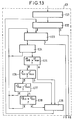
- FIG. 13 represents a flowchart of a preferred example of implementation of step E2 of the flowchart shown in FIG. 3.
- Step E2 firstly consists of a step E21 consisting in determining the sequence MIN- SUITE made up of all the tasks in the current layer, ordered according to the increasing values of the lower bound tmin. This sequence will be used to apply the first principle stated above.
- the initial permutation is constituted by MIN-SUITE; and the permutations which will be checked afterwards, in case of failure, will be deducted from MIN-SUITE, by successive modifications.
- step E21 consists in determining the MAX-SUITE sequence, consisting of all the tasks of the current layer, ordered according to the increasing values of the upper bound t max .
- This suite will be used to apply the second principle stated above, when it will be necessary to modify the initial permutation.
- a step E22 consists in verifying the current permutation, that is to say verifying whether it satisfies all the constraints relating to the tasks of the current layer.
- the current permutation is constituted by the initial permutation determined by step E21.
- This verification consists in successively taking each task in the order of the current permutation and in verifying that the execution interval [t deb , t end ] imposed by the position occupied by this task in the current permutation is compatible with the time interval [t min , t max ] imposed by the constraints relating to this task.
- the task for which this check is in progress is called the current task. If this verification is positive for each of the tasks of the current permutation, this means that the current permutation is a success, denoted S, and the scheduling can continue by step E3 of the flow chart represented in FIG. 7.
- step E22 finds a task, noted X, which is the first misplaced in the current permutation, it draws the conclusion, noted R, that it is necessary to seek a candidate candidate for a displacement to constitute a new permutation.
- the method then consists in executing a step E23 which searches for the task immediately preceding the current task X in the MAX-SUITE sequence. If there is no such task, step E23 ends in failure, denoted F, and the method then consists in performing step E7 of the flowchart shown in FIG. 7.
- step E23 finds a candidate task Q immediately preceding the current task X in the MAX-SUITE sequence, the method then consists of a step E24 verifying that this task Q has already been considered to be well placed, during a step E21 anterior. All the tasks which are considered to be well placed are those which have a rank lower than that of the current task X, since the verification of step E22 is done according to the increasing ranks in the current permutation. Consequently, step E24 simply consists in verifying that the candidate task Q precedes the current task X in the current permutation. If step E24 determines that the task Q has not been considered as well placed, step E23 is repeated to search for another candidate task, immediately preceding the task Q in MAX-SUITE.
- the method consists in executing a step E25 which consists in comparing the instant t Q deb of the start of execution of the task Q with the instant t X max which is the upper bound of the time interval corresponding to the current task X.
- step E29 consisting in moving the task Q in the current permutation, to insert it between the current task X and the task following the task X in the current permutation.
- the tasks which were placed between Q and X, and the task X itself, are shifted by one row, towards the lower rows, to fill the space left free by Q. Consequently, task Q now occupies the position which was that of X.
- the method then consists in repeating step E22 to verify whether the new current permutation thus obtained satisfies all the constraints of the layer considered. It should be noted that task Q and all the other tasks that followed it have been moved.
- FIG. 14 illustrates by an example the case ⁇ . Execution intervals are shown in dotted lines when a conflict prevents execution, and in solid lines otherwise.
- Figure 15 shows that by moving the tasks Q and X respectively in the positions PS i-1 and PSj, the probability that the instant t deb (PS i-1 ) falls in the interval [t X min , t X max ] is greater than the probability that the instant t deb (P si ) had to fall in this same interval, because t deb systematically believes with the rank of the position PS.
- the figure shows that the end t X max of the segment corresponding to task X has approached an execution interval, the one that begins at time t deb (PSi-1), and therefore has more chances to have an intersection with such an interval.
- the end t Q max of the segment corresponding to task Q has non-zero chances of having an intersection with the rectangle representing the execution interval starting at time t deb (PSi). Therefore, the new permutation is more likely than the old one to satisfy all the constraints and it is therefore useful to try this new permutation.
- t deb (PS i-1 ) falls beyond t max , so there is still a conflict for task X. It is therefore necessary to make one or more other modifications to the current permutation .
- step E26 This consists in comparing the instant t Q end of the end of execution of the task Q, with the instant t X max which is the upper limit of the interval where the execution of the task X must begin. If t Q end ⁇ t X max, this case is noted ⁇ , and the method then consists in carrying out step E30 which moves the task Q and inserts it after the task X. The opposite case is noted ⁇ ⁇ . Other checks are necessary before being able to conclude that task Q is an interesting candidate task.
- FIG. 16 represents a task X in the position PS i and a task Q in the position PSj, such as the case ⁇ ⁇ and the case ⁇ are realized: the instant t Q end of the end of execution of the task Q, that is to say the instant t end (PSj) imposed by the position PSj of Q in the current permutation , is located beyond the instant t X max .
- step E27 consists in comparing the instant t Q max which is the upper bound of the time interval at which the execution of the task Q must begin, at the instant t X max which is the upper bound of l time interval at which the execution of task X must begin. If t Q max > t X max , this case is noted ⁇ , and the method then consists in then performing a step E28. Otherwise noted ⁇ ⁇ , and the method then consists in repeating step E23 because the candidate task Q has no chance of being interesting.
- Figures 18 and 19 illustrate by example the case ⁇ ⁇ .
- the limit t Q max is strictly less than the instant t X max .
- FIG. 18 represents the tasks X and Q displaced respectively in the positions PS i-1 and P si .
- This figure 18 shows that the instant t Q max becomes closer to time t (PSi) deb than it was at time t (PSj) deb but task Q has no chance of being able to be executed because t Q max is even further from t (PSi) deb than was t Q max . Since task Q is 100% likely to be misplaced, it is useless to try such a modification of the current permutation, this is why the next step is a step E23 of searching for another candidate task for a relocation.
- step E28 consists in comparing the instant t Q min which is the lower bound of the interval in which the execution of the task Q must begin, with the instant t X min which is the bound lower the time interval in which the execution of task X should begin.
- step E28 The purpose of this step E28 is to verify that the task Q is placed before the current task X in the MIN-SUITE suite, in order to be able to move the task Q after the task X. Otherwise, noted ⁇ ⁇ , the next step is a step E23 of searching for another candidate task for a displacement.
- next step is a step E29 moving the task Q after the task X; then a step E22 is reiterated to check whether all the constraints relating to the tasks of the current layer are satisfied.
- Fig 20 illustrates an example where the cases ⁇ , ⁇ , ⁇ , ⁇ , are performed simultaneously.
- FIG. 21 represents the tasks X and Q displaced respectively in the positions PSi-1 and PSi, in an example where the constraints are such that they are effectively satisfied after this displacement: t deb (PSi) falls in the interval [t Q min , t Q max ] and t deb (PSi-1) fall in the interval [t X min , t X max ].
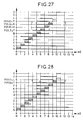
- Figures 22 to 31 illustrate the implementation of step E2 to schedule an example of a layer comprising 13 tasks: A, B, C, D, E, G, J, K, L, N, P, S, T.
- FIG. 22 represents on a time scale from 0 to 14 ms, the position of the execution intervals corresponding respectively to 13 positions PS1, ..., PS13.
- the tasks are executed in the order of positions PS1, ..., PS13, and each execution interval has a duration equal to 1 ms.
- Each task must satisfy one or more constraints which result in a single constraint: the start of the execution interval (black rectangle in figure 22) must be located in a given time interval (black segments in figure 23). In a borderline case it can start at the upper bound.
- Step E21 consists in determining the MIN-SUITE sequence consisting of all the tasks of the current layer, ordered according to the increasing values of the lower bound t min .
- MIN-SUITE N, J, S, D, E, B, T, A, K, P, L, C, G.
- the 13 tasks are represented in the order of MIN-SUITE, according to the direction of orientation of the ordinate axis.
- the so-called initial permutation which will be verified first will be that constituted by MIN-SUITE; and those which will be checked later, in the event of failure, will be deducted from MIN-SUITE by successive modifications.
- step E21 consists in determining the MAX-SUITE sequence, consisting of all the tasks of the current layer, ordered according to the increasing values of t max .
- This sequence will be used to apply the second principle stated above, when it will be necessary to modify the initial permutation.
- MAX-SUITE N, S, J, T, G, C, L, B, P, K, A, D, E.
- a step E22 consists in verifying the current permutation, that is to say verifying whether it satisfies all the constraints relating to the tasks of the layer considered.
- the current permutation is constituted by the initial permutation determined by step E21.
- the verification is done successively for each task, in the order of the current permutation: N, J, S, D, E, ..., G. If the verification is positive for a task it is considered to be well placed in the permutation, but its placement can be called into question later if this is necessary to satisfy other constraints.
- FIGS. 22 and 23 make it possible to conclude that there is no problem in executing tasks N, J, S, and D, respectively during the execution intervals represented in FIG. 22. They are therefore considered as well placed.
- the current permutation is: N J S D EBTAKPLCG where tasks considered to be well placed are underlined.
- Figure 24 illustrates the first conflict encountered during the verification of the initial permutation.
- black rectangles represent execution intervals for which there is no conflict between the constraints, and a dotted white rectangle represents the execution interval which is the cause of a conflict. It corresponds to position PS5, currently occupied by task E. This execution interval has nothing in common with the interval in which the execution of task E must begin.
- Step E23 then consists in searching in the MAX-SUITE sequence a task preceding task E, that is to say such that the limit t max has a higher value.
- MAX-SUITE N, S, J, T, G, C, L, B, P, K, A, D, E.
- Step E23 finds task D.
- Step E24 verifies that it is considered to be well placed, by verifying that it has a rank lower than the rank of the current task E, in the current permutation.
- step E25 draws a conclusion ⁇ ⁇ .
- step E26 draws a conclusion ⁇ .
- Step E29 then moves D to the POS5 position and E moves back in the POS4 position.
- Step E22 verifies that the constraints relating to E and the following tasks are satisfied but notes that the constraints relating to D are no longer satisfied. The permutation tried is not suitable. It is not retained as a new current permutation.
- Step E23 would then find successively as a candidate task: A, K, P, B, L, C, G, T, J; and step E24 would retain task J.
- MAX-SUITE N, S, J, T, G, C, L, B, P, K, A, P.
- step E23 finds successively A, K, P, B, L, C, G, T as candidate task, which are rejected by step E24. Then step E23 finds task J.
- Step E24 verifies that the task J is considered to be well placed.
- Step E25 comes to the conclusion ⁇ ⁇ .
- Step E26 comes to the conclusion ⁇ ⁇ .
- Steps E27 and E28 arrive at the conclusion ⁇ and ⁇ . Consequently step E29 places task J in position PS5, in place of E.
- Tasks E, D and S move back one place, S being in position PS2, D in position PS3, and E in the PS4 position.
- the other tasks do not change places.
- Step E22 then consists in verifying that the tasks which have been moved check all the constraints relating to them, starting with the task of lowest rank among those displaced: S, then E, then D, then J. It checks then that there is no conflict between the constraints successively for tasks B, T, A, K.
- Figure 26 illustrates the new current permutation. It should be noted that for task K the execution interval begins at the exact moment when the interval in which the execution of task K must begin begins. There is no conflict, but the constraints are narrowly met.
- the state of the current permutation is: N , S , E , D , J , B , T , A , K , P, L, C, G.
- FIG. 27 shows that a conflict appears for task P.
- Step E23 is then reiterated in order to determine in the MAX-SUITE sequence the task immediately preceding task P in this sequence. It finds task B.
- Step E24 verifies that task B is one of the tasks which are considered to be well placed.
- Steps E25 and E26 draw conclusions ⁇ ⁇ then ⁇ ⁇ .
- Step E23 is then repeated to search for another candidate task in the MAX-SUITE sequence.
- the segment representing the time interval corresponding to B would have no point of intersection with the execution interval [9 ms, 10 ms] corresponding to position POS10, if task B were moved to this position . Consequently the constraints relating to B would not be satisfied.
- Step E23 then successively finds the tasks L, C, G but step E24 rejects them because they are not considered to be well placed in the permutation. Finally steps E23 and E24 find task T. Steps E25 to E28 successively draw conclusions ⁇ ⁇ , ⁇ ⁇ , ⁇ , ⁇ . Step E29 moves T to position POS10. Tasks P, K, A move back respectively to positions POS9, POS8, POS7.
- Step E22 then verifies that the constraints relating to the displaced tasks A, K, P, T, and the following ones, are satisfied.
- the new current permutation is: N , S , E , D , J , B , A , K , P , T , L, C, G
- step E22 finds that the constraints relating to the task L are not satisfied.
- Step E23 finds task T and step E24 verifies that it is considered to be well placed. Step E25 and the following ones can therefore be executed. They draw conclusions ⁇ ⁇ , then ⁇ ⁇ , then ⁇ and ⁇ . Step E29 can then be executed. It places task T in position PS 11 which was occupied by task L. Task L moves back one place. Step E22 verifies that the constraints relating to the displaced tasks L and T are satisfied. Therefore the current permutation becomes: N , S , E , D , J , V , A , K , P , L , T , C, G
- the new current permutation is: N , S , E , D , J , B , A , K , P , L , C , T , G
- step E22 finds that there is a conflict between the constraints relating to task G.
- Step E23 determines a task, T, which precedes task G immediately in the MAX-SUITE sequence .
- Step E24 verifies that the task T is considered to be well placed in the permutation.
- Step E29 moves T after G in the permutation, which amounts to permuting T and G.
- step E22 verifies that all the constraints relating to the displaced tasks G and T are satisfied.
- the new current permutation is: N , S , E , D , J , B , A , K , P , L , C , G , T.
- step E2 takes ends with a success S. If there are other layers of higher rank, their ordering continues with step E3 of the flow diagram represented in FIG. 7.
Landscapes
- Engineering & Computer Science (AREA)
- Software Systems (AREA)
- Theoretical Computer Science (AREA)
- Physics & Mathematics (AREA)
- General Engineering & Computer Science (AREA)
- General Physics & Mathematics (AREA)
- Management, Administration, Business Operations System, And Electronic Commerce (AREA)
- Two-Way Televisions, Distribution Of Moving Picture Or The Like (AREA)
- Mobile Radio Communication Systems (AREA)
- Vehicle Body Suspensions (AREA)
- Control Of Steam Boilers And Waste-Gas Boilers (AREA)
- Control By Computers (AREA)
- Time-Division Multiplex Systems (AREA)
- Data Exchanges In Wide-Area Networks (AREA)
- Feedback Control In General (AREA)
- General Factory Administration (AREA)
- Paper (AREA)
- Position Fixing By Use Of Radio Waves (AREA)
Applications Claiming Priority (2)
| Application Number | Priority Date | Filing Date | Title |
|---|---|---|---|
| FR9409951A FR2723652B1 (fr) | 1994-08-11 | 1994-08-11 | Procede pour ordonnancer des taches successives |
| FR9409951 | 1994-08-11 |
Publications (2)
| Publication Number | Publication Date |
|---|---|
| EP0697656A1 true EP0697656A1 (de) | 1996-02-21 |
| EP0697656B1 EP0697656B1 (de) | 2000-03-01 |
Family
ID=9466263
Family Applications (1)
| Application Number | Title | Priority Date | Filing Date |
|---|---|---|---|
| EP95401848A Expired - Lifetime EP0697656B1 (de) | 1994-08-11 | 1995-08-07 | Verfahren für die Ablauffolgeplanung von aufeinanderfolgenden Aufgaben |
Country Status (8)
| Country | Link |
|---|---|
| US (1) | US5826080A (de) |
| EP (1) | EP0697656B1 (de) |
| JP (1) | JPH0869384A (de) |
| AT (1) | ATE190150T1 (de) |
| DE (1) | DE69515231T2 (de) |
| DK (1) | DK0697656T3 (de) |
| ES (1) | ES2145231T3 (de) |
| FR (1) | FR2723652B1 (de) |
Cited By (2)
| Publication number | Priority date | Publication date | Assignee | Title |
|---|---|---|---|---|
| WO2002001344A3 (en) * | 2000-06-27 | 2002-08-01 | Koninkl Philips Electronics Nv | Method of determining a schedule, scheduler and system |
| FR2873830A1 (fr) * | 2004-07-30 | 2006-02-03 | Commissariat Energie Atomique | Procede d'ordonnancement de traitement de taches et dispositif pour mettre en oeuvre le procede |
Families Citing this family (62)
| Publication number | Priority date | Publication date | Assignee | Title |
|---|---|---|---|---|
| US6948172B1 (en) * | 1993-09-21 | 2005-09-20 | Microsoft Corporation | Preemptive multi-tasking with cooperative groups of tasks |
| CA2228574A1 (en) * | 1997-06-05 | 1999-08-02 | Attention Control Systems, Inc. | An automatic planning and cueing system and method |
| US6317760B1 (en) | 1998-01-14 | 2001-11-13 | Microsoft Corporation | Extensible ordered information within a web page |
| US7805724B1 (en) * | 1998-05-27 | 2010-09-28 | Arc International I.P., Inc. | Apparatus, method and computer program for dynamic slip control in real-time scheduling |
| US7099848B1 (en) | 1999-02-16 | 2006-08-29 | Listen.Com, Inc. | Audio delivery and rendering method and apparatus |
| US6490298B1 (en) * | 1999-02-26 | 2002-12-03 | Harmonic Inc. | Apparatus and methods of multiplexing data to a communication channel |
| US6857106B1 (en) | 1999-09-15 | 2005-02-15 | Listen.Com, Inc. | Graphical user interface with moveable, mergeable elements |
| WO2001042900A2 (en) * | 1999-12-08 | 2001-06-14 | Tune To Com Inc. | Scheduled retrieval, storage and access of media data |
| US20030018581A1 (en) * | 2000-02-16 | 2003-01-23 | Bratton Timothy R. | Delivering media data to portable computing devices |
| US6622190B1 (en) * | 2000-04-27 | 2003-09-16 | Sharp Laboratories Of America | Method for modifying task execution priority in a multitasking, windowed operating environment |
| US7010788B1 (en) * | 2000-05-19 | 2006-03-07 | Hewlett-Packard Development Company, L.P. | System for computing the optimal static schedule using the stored task execution costs with recent schedule execution costs |
| DE10065498B4 (de) * | 2000-12-28 | 2005-07-07 | Robert Bosch Gmbh | Verfahren und Vorrichtung zur Rekonstruktion des Prozessablaufs eines Steuerprogramms |
| US20020143600A1 (en) * | 2001-03-08 | 2002-10-03 | Dugan Valerie G. | Internet-based appointment scheduling |
| ATE242892T1 (de) | 2001-05-11 | 2003-06-15 | Sospita As | Sequenznummerierungsmechanismus zur sicherung der ausführungsordnungs-integrietät von untereinander abhängigen smart-card anwendungen |
| US7076781B2 (en) * | 2002-05-31 | 2006-07-11 | International Business Machines Corporation | Resource reservation for large-scale job scheduling |
| US7140019B2 (en) * | 2002-06-28 | 2006-11-21 | Motorola, Inc. | Scheduler of program instructions for streaming vector processor having interconnected functional units |
| US7159099B2 (en) * | 2002-06-28 | 2007-01-02 | Motorola, Inc. | Streaming vector processor with reconfigurable interconnection switch |
| US7415601B2 (en) * | 2002-06-28 | 2008-08-19 | Motorola, Inc. | Method and apparatus for elimination of prolog and epilog instructions in a vector processor using data validity tags and sink counters |
| JP2004334537A (ja) * | 2003-05-07 | 2004-11-25 | Sony Corp | プログラム処理システム及びプログラム処理方法、並びにコンピュータ・プログラム |
| US7290122B2 (en) * | 2003-08-29 | 2007-10-30 | Motorola, Inc. | Dataflow graph compression for power reduction in a vector processor |
| JP4057989B2 (ja) * | 2003-09-26 | 2008-03-05 | 株式会社東芝 | スケジューリング方法および情報処理システム |
| US7650601B2 (en) * | 2003-12-04 | 2010-01-19 | International Business Machines Corporation | Operating system kernel-assisted, self-balanced, access-protected library framework in a run-to-completion multi-processor environment |
| US9558042B2 (en) * | 2004-03-13 | 2017-01-31 | Iii Holdings 12, Llc | System and method providing object messages in a compute environment |
| US20070266388A1 (en) | 2004-06-18 | 2007-11-15 | Cluster Resources, Inc. | System and method for providing advanced reservations in a compute environment |
| JP4208783B2 (ja) * | 2004-07-28 | 2009-01-14 | キヤノン株式会社 | 画像処理装置および設定時刻調整方法およびプログラム |
| US8271980B2 (en) | 2004-11-08 | 2012-09-18 | Adaptive Computing Enterprises, Inc. | System and method of providing system jobs within a compute environment |
| EP1677234A1 (de) * | 2004-12-29 | 2006-07-05 | Sap Ag | Kompakte Terminplanung |
| US8631130B2 (en) | 2005-03-16 | 2014-01-14 | Adaptive Computing Enterprises, Inc. | Reserving resources in an on-demand compute environment from a local compute environment |
| US9231886B2 (en) | 2005-03-16 | 2016-01-05 | Adaptive Computing Enterprises, Inc. | Simple integration of an on-demand compute environment |
| CA2603577A1 (en) | 2005-04-07 | 2006-10-12 | Cluster Resources, Inc. | On-demand access to compute resources |
| FR2889329B1 (fr) * | 2005-07-29 | 2007-10-19 | Airbus France Sas | Procede de sequencement automatique des specifications d'un calculateur, notamment pour aeronef |
| US8495613B2 (en) * | 2005-12-22 | 2013-07-23 | Microsoft Corporation | Program execution service windows |
| CN100507854C (zh) * | 2006-06-19 | 2009-07-01 | 纬创资通股份有限公司 | 避免微控制器执行程序碰撞的方法 |
| US7805326B2 (en) * | 2006-11-15 | 2010-09-28 | Sap Ag | System to resolve scheduling constraints |
| US8612991B2 (en) * | 2007-12-18 | 2013-12-17 | International Business Machines Corporation | Dynamic critical-path recalculation facility |
| US8341014B2 (en) | 2007-12-28 | 2012-12-25 | International Business Machines Corporation | Recovery segments for computer business applications |
| US8375244B2 (en) | 2007-12-28 | 2013-02-12 | International Business Machines Corporation | Managing processing of a computing environment during failures of the environment |
| US8677174B2 (en) | 2007-12-28 | 2014-03-18 | International Business Machines Corporation | Management of runtime events in a computer environment using a containment region |
| US8868441B2 (en) | 2007-12-28 | 2014-10-21 | International Business Machines Corporation | Non-disruptively changing a computing environment |
| US8751283B2 (en) | 2007-12-28 | 2014-06-10 | International Business Machines Corporation | Defining and using templates in configuring information technology environments |
| US9558459B2 (en) | 2007-12-28 | 2017-01-31 | International Business Machines Corporation | Dynamic selection of actions in an information technology environment |
| US8428983B2 (en) | 2007-12-28 | 2013-04-23 | International Business Machines Corporation | Facilitating availability of information technology resources based on pattern system environments |
| US20090172149A1 (en) | 2007-12-28 | 2009-07-02 | International Business Machines Corporation | Real-time information technology environments |
| US8365185B2 (en) * | 2007-12-28 | 2013-01-29 | International Business Machines Corporation | Preventing execution of processes responsive to changes in the environment |
| US8346931B2 (en) | 2007-12-28 | 2013-01-01 | International Business Machines Corporation | Conditional computer runtime control of an information technology environment based on pairing constructs |
| US8447859B2 (en) | 2007-12-28 | 2013-05-21 | International Business Machines Corporation | Adaptive business resiliency computer system for information technology environments |
| US8990810B2 (en) | 2007-12-28 | 2015-03-24 | International Business Machines Corporation | Projecting an effect, using a pairing construct, of execution of a proposed action on a computing environment |
| US8782662B2 (en) | 2007-12-28 | 2014-07-15 | International Business Machines Corporation | Adaptive computer sequencing of actions |
| US8826077B2 (en) | 2007-12-28 | 2014-09-02 | International Business Machines Corporation | Defining a computer recovery process that matches the scope of outage including determining a root cause and performing escalated recovery operations |
| US8763006B2 (en) | 2007-12-28 | 2014-06-24 | International Business Machines Corporation | Dynamic generation of processes in computing environments |
| US8682705B2 (en) | 2007-12-28 | 2014-03-25 | International Business Machines Corporation | Information technology management based on computer dynamically adjusted discrete phases of event correlation |
| US7945768B2 (en) * | 2008-06-05 | 2011-05-17 | Motorola Mobility, Inc. | Method and apparatus for nested instruction looping using implicit predicates |
| US8914783B2 (en) * | 2008-11-25 | 2014-12-16 | Fisher-Rosemount Systems, Inc. | Software deployment manager integration within a process control system |
| US8898660B2 (en) * | 2008-11-25 | 2014-11-25 | Fisher-Rosemount Systems, Inc. | Systems and methods to provide customized release notes during a software system upgrade of a process control system |
| JP2011039698A (ja) * | 2009-08-07 | 2011-02-24 | Sanyo Electric Co Ltd | 演算処理装置 |
| US11720290B2 (en) | 2009-10-30 | 2023-08-08 | Iii Holdings 2, Llc | Memcached server functionality in a cluster of data processing nodes |
| EP2610746A1 (de) * | 2011-12-30 | 2013-07-03 | bioMérieux | Auftragsplaner für elektromechanisches System zur biologischen Analyse |
| TWI533211B (zh) * | 2013-11-14 | 2016-05-11 | 財團法人資訊工業策進會 | 用於任務排程之電腦系統,方法及電腦可讀取記錄媒體 |
| CN108874627A (zh) * | 2018-06-14 | 2018-11-23 | 郑州云海信息技术有限公司 | 一种监控任务调度方法和装置 |
| JP7193771B1 (ja) * | 2021-06-30 | 2022-12-21 | 三菱電機株式会社 | スケジューリング方法及びスケジューリング設計支援装置 |
| CN113961333B (zh) * | 2021-12-22 | 2022-03-11 | 北京燧原智能科技有限公司 | 循环任务的生成、执行方法、装置、ai芯片及存储介质 |
| JP7313615B1 (ja) * | 2023-03-22 | 2023-07-25 | コグニロボ株式会社 | プログラム、製造計画装置、および製造計画方法 |
-
1994
- 1994-08-11 FR FR9409951A patent/FR2723652B1/fr not_active Expired - Fee Related
-
1995
- 1995-08-02 US US08/510,343 patent/US5826080A/en not_active Expired - Fee Related
- 1995-08-07 DK DK95401848T patent/DK0697656T3/da active
- 1995-08-07 AT AT95401848T patent/ATE190150T1/de not_active IP Right Cessation
- 1995-08-07 ES ES95401848T patent/ES2145231T3/es not_active Expired - Lifetime
- 1995-08-07 EP EP95401848A patent/EP0697656B1/de not_active Expired - Lifetime
- 1995-08-07 DE DE69515231T patent/DE69515231T2/de not_active Expired - Fee Related
- 1995-08-11 JP JP7206153A patent/JPH0869384A/ja active Pending
Non-Patent Citations (4)
| Title |
|---|
| BRINKLEY SPRUNT ET AL. :: "Aperiodic Task Scheduling for Hard-Real-Time Systems", REAL TIME SYSTEMS, vol. 1, no. 1, June 1989 (1989-06-01), DORDRECHT, NL, pages 27 - 60 * |
| KRITHI RAMAMRITHAM ET AL.:: "Scheduling Algorithms and Operating Systems Support for Real-Time Systems", PROCEEDINGS OF THE IEEE, vol. 82, no. 1, January 1994 (1994-01-01), NEW YORK, US, pages 55 - 67, XP000435881, DOI: doi:10.1109/5.259426 * |
| S. CHENG ET AL. :: "Dynamic Scheduling of Groups of Tasks with Precedence Constraints in Distributed Hard Real-Time Systems", PROCEEDINGS OF THE REAL-TIME SYSTEMS SYMPOSIUM, 2 December 1986 (1986-12-02), NEW ORLEANS, USA, pages 166 - 174 * |
| WEI ZHAO ET AL.:: "Scheduling Tasks with Resource Requirements in Hard Real-Time Systems", IEEE TRANSACTIONS ON SOFTWARE ENGINEERING, vol. SE-13, no. 5, May 1987 (1987-05-01), NEW YORK US, pages 564 - 576 * |
Cited By (5)
| Publication number | Priority date | Publication date | Assignee | Title |
|---|---|---|---|---|
| WO2002001344A3 (en) * | 2000-06-27 | 2002-08-01 | Koninkl Philips Electronics Nv | Method of determining a schedule, scheduler and system |
| FR2873830A1 (fr) * | 2004-07-30 | 2006-02-03 | Commissariat Energie Atomique | Procede d'ordonnancement de traitement de taches et dispositif pour mettre en oeuvre le procede |
| WO2006021713A1 (fr) * | 2004-07-30 | 2006-03-02 | Commissariat A L'energie Atomique | Procede d'ordonnancement de traitement de tâches et dispositif pour mettre en œuvre le procede |
| CN1993677B (zh) * | 2004-07-30 | 2010-08-11 | 法国原子能委员会 | 任务处理的调度方法及应用该方法的装置 |
| US8522243B2 (en) | 2004-07-30 | 2013-08-27 | Commissariat A L'energie Atomique | Method for configuring resources and scheduling task processing with an order of precedence |
Also Published As
| Publication number | Publication date |
|---|---|
| DE69515231T2 (de) | 2000-09-28 |
| FR2723652B1 (fr) | 1996-09-13 |
| ATE190150T1 (de) | 2000-03-15 |
| US5826080A (en) | 1998-10-20 |
| ES2145231T3 (es) | 2000-07-01 |
| FR2723652A1 (fr) | 1996-02-16 |
| EP0697656B1 (de) | 2000-03-01 |
| DK0697656T3 (da) | 2000-08-14 |
| JPH0869384A (ja) | 1996-03-12 |
| DE69515231D1 (de) | 2000-04-06 |
Similar Documents
| Publication | Publication Date | Title |
|---|---|---|
| EP0697656B1 (de) | Verfahren für die Ablauffolgeplanung von aufeinanderfolgenden Aufgaben | |
| EP0697657B1 (de) | Verfahren für die Ablauffolgeplanung von aufeinanderfolgenden Aufgaben mit Zeitzwangsbedingungen | |
| EP0546048B1 (de) | Ein verfahren und eine vorrichtung für speicherung der information in einem speicher und ihre benutzung in speicherkarten | |
| EP0527664B1 (de) | Hilfsverfahren für die Entwicklung einer miteinander kommunizierender Automatengruppe | |
| CA2907808C (fr) | Procede d'execution de taches dans un systeme temps-reel critique | |
| Mazzini et al. | A heuristic for single machine scheduling with early and tardy costs | |
| EP0611171B1 (de) | Synchronisationssystem für redundante Aufträge | |
| FR3072197B1 (fr) | Procede d'execution de plans de sequencement assurant une communication a faible latence entre taches temps-reel | |
| WO2012014057A2 (fr) | Systeme et procede d'edition, d'optimisation et de rendu de textures procedurales | |
| CA1257006A (fr) | Procede et dispositif pour la transmission de messages entre differentes stations, a travers un reseau local a diffusion | |
| EP0602281B1 (de) | Einrichtung zum Wiederherstellen der richtigen Zellenfolge in einem Knoten eines Zellenvermittlungssystems | |
| EP4071672A1 (de) | Klassifizierung von unbekannten fehlern in einem elektronischen kommunikationssystem | |
| EP0554177A1 (de) | Assoziativspeicherarchitektur | |
| CA2297276C (fr) | Procede et dispositif de reception et pretraitement de messages | |
| EP0678811B1 (de) | Verfahren zur Verklemmungserkennung in einem Multiprozessorsystem mit gemeinschaftlichen Speicher | |
| WO2022018140A1 (fr) | Procédés d'allocation de qubits logiques d'un algorithme quantique dans un processeur quantique | |
| EP3084602B1 (de) | Verfahren zum zusammenstellen und ausführen eines echtzeit-aufgabenabfolgeplans | |
| WO2012038000A1 (fr) | Procede de gestion de taches dans un microprocesseur ou un ensemble de microprocesseurs | |
| FR2806498A1 (fr) | Systeme informatique de calcul et procede de calcul mis en oeuvre au moyen d'un tel systeme | |
| FR3159688A1 (fr) | Procédé de mitigation d'interférences temporelles par exclusion temporelles configurées par compilation | |
| EP0942387A1 (de) | Verfahren und System zum mehrmals Lesen einer dynamischen Sammlung von Etiketten | |
| EP1004088B1 (de) | Verfahren zum verschachteln von elementaren zuschnitten auf einer oder mehreren verarbeitungsplatten | |
| JP2003216892A (ja) | ビット記述のブロック毎に符号を識別して電子ラベルを読み取るための処理 | |
| FR3149817A1 (fr) | Procédé de programmation comportementale de robot dans une architecture de réseau robotique | |
| EP3499366A1 (de) | Vorrichtung, datenverarbeitungskette und kontext-umschaltverfahren |
Legal Events
| Date | Code | Title | Description |
|---|---|---|---|
| PUAI | Public reference made under article 153(3) epc to a published international application that has entered the european phase |
Free format text: ORIGINAL CODE: 0009012 |
|
| AK | Designated contracting states |
Kind code of ref document: A1 Designated state(s): AT BE CH DE DK ES GB IT LI NL SE |
|
| 17P | Request for examination filed |
Effective date: 19960629 |
|
| GRAG | Despatch of communication of intention to grant |
Free format text: ORIGINAL CODE: EPIDOS AGRA |
|
| GRAG | Despatch of communication of intention to grant |
Free format text: ORIGINAL CODE: EPIDOS AGRA |
|
| GRAH | Despatch of communication of intention to grant a patent |
Free format text: ORIGINAL CODE: EPIDOS IGRA |
|
| 17Q | First examination report despatched |
Effective date: 19990818 |
|
| GRAH | Despatch of communication of intention to grant a patent |
Free format text: ORIGINAL CODE: EPIDOS IGRA |
|
| GRAA | (expected) grant |
Free format text: ORIGINAL CODE: 0009210 |
|
| AK | Designated contracting states |
Kind code of ref document: B1 Designated state(s): AT BE CH DE DK ES GB IT LI NL SE |
|
| REF | Corresponds to: |
Ref document number: 190150 Country of ref document: AT Date of ref document: 20000315 Kind code of ref document: T |
|
| REG | Reference to a national code |
Ref country code: CH Ref legal event code: EP |
|
| REF | Corresponds to: |
Ref document number: 69515231 Country of ref document: DE Date of ref document: 20000406 |
|
| REG | Reference to a national code |
Ref country code: CH Ref legal event code: NV Representative=s name: CABINET ROLAND NITHARDT CONSEILS EN PROPRIETE INDU |
|
| GBT | Gb: translation of ep patent filed (gb section 77(6)(a)/1977) |
Effective date: 20000327 |
|
| ITF | It: translation for a ep patent filed | ||
| REG | Reference to a national code |
Ref country code: ES Ref legal event code: FG2A Ref document number: 2145231 Country of ref document: ES Kind code of ref document: T3 |
|
| EN | Fr: translation not filed | ||
| REG | Reference to a national code |
Ref country code: DK Ref legal event code: T3 |
|
| EN4 | Fr: notification of non filing translation in an earlier bopi is erroneous | ||
| PLBE | No opposition filed within time limit |
Free format text: ORIGINAL CODE: 0009261 |
|
| STAA | Information on the status of an ep patent application or granted ep patent |
Free format text: STATUS: NO OPPOSITION FILED WITHIN TIME LIMIT |
|
| 26N | No opposition filed | ||
| REG | Reference to a national code |
Ref country code: GB Ref legal event code: IF02 |
|
| PGFP | Annual fee paid to national office [announced via postgrant information from national office to epo] |
Ref country code: DE Payment date: 20050818 Year of fee payment: 11 Ref country code: AT Payment date: 20050818 Year of fee payment: 11 |
|
| PGFP | Annual fee paid to national office [announced via postgrant information from national office to epo] |
Ref country code: SE Payment date: 20050819 Year of fee payment: 11 |
|
| PGFP | Annual fee paid to national office [announced via postgrant information from national office to epo] |
Ref country code: GB Payment date: 20050822 Year of fee payment: 11 |
|
| PGFP | Annual fee paid to national office [announced via postgrant information from national office to epo] |
Ref country code: NL Payment date: 20050823 Year of fee payment: 11 Ref country code: DK Payment date: 20050823 Year of fee payment: 11 Ref country code: CH Payment date: 20050823 Year of fee payment: 11 Ref country code: BE Payment date: 20050823 Year of fee payment: 11 |
|
| PGFP | Annual fee paid to national office [announced via postgrant information from national office to epo] |
Ref country code: ES Payment date: 20050919 Year of fee payment: 11 |
|
| PG25 | Lapsed in a contracting state [announced via postgrant information from national office to epo] |
Ref country code: AT Free format text: LAPSE BECAUSE OF NON-PAYMENT OF DUE FEES Effective date: 20060807 |
|
| PG25 | Lapsed in a contracting state [announced via postgrant information from national office to epo] |
Ref country code: SE Free format text: LAPSE BECAUSE OF NON-PAYMENT OF DUE FEES Effective date: 20060808 |
|
| PG25 | Lapsed in a contracting state [announced via postgrant information from national office to epo] |
Ref country code: LI Free format text: LAPSE BECAUSE OF NON-PAYMENT OF DUE FEES Effective date: 20060831 Ref country code: DK Free format text: LAPSE BECAUSE OF NON-PAYMENT OF DUE FEES Effective date: 20060831 Ref country code: CH Free format text: LAPSE BECAUSE OF NON-PAYMENT OF DUE FEES Effective date: 20060831 Ref country code: BE Free format text: LAPSE BECAUSE OF NON-PAYMENT OF DUE FEES Effective date: 20060831 |
|
| PGFP | Annual fee paid to national office [announced via postgrant information from national office to epo] |
Ref country code: IT Payment date: 20060831 Year of fee payment: 12 |
|
| PG25 | Lapsed in a contracting state [announced via postgrant information from national office to epo] |
Ref country code: NL Free format text: LAPSE BECAUSE OF NON-PAYMENT OF DUE FEES Effective date: 20070301 Ref country code: DE Free format text: LAPSE BECAUSE OF NON-PAYMENT OF DUE FEES Effective date: 20070301 |
|
| REG | Reference to a national code |
Ref country code: DK Ref legal event code: EBP |
|
| REG | Reference to a national code |
Ref country code: CH Ref legal event code: PL |
|
| EUG | Se: european patent has lapsed | ||
| GBPC | Gb: european patent ceased through non-payment of renewal fee |
Effective date: 20060807 |
|
| NLV4 | Nl: lapsed or anulled due to non-payment of the annual fee |
Effective date: 20070301 |
|
| REG | Reference to a national code |
Ref country code: ES Ref legal event code: FD2A Effective date: 20060808 |
|
| PG25 | Lapsed in a contracting state [announced via postgrant information from national office to epo] |
Ref country code: GB Free format text: LAPSE BECAUSE OF NON-PAYMENT OF DUE FEES Effective date: 20060807 |
|
| BERE | Be: lapsed |
Owner name: *CEGELEC Effective date: 20060831 |
|
| PG25 | Lapsed in a contracting state [announced via postgrant information from national office to epo] |
Ref country code: ES Free format text: LAPSE BECAUSE OF NON-PAYMENT OF DUE FEES Effective date: 20060808 |
|
| PG25 | Lapsed in a contracting state [announced via postgrant information from national office to epo] |
Ref country code: IT Free format text: LAPSE BECAUSE OF NON-PAYMENT OF DUE FEES Effective date: 20070807 |