EP0696017B1 - Skalierung von Binärbildern - Google Patents
Skalierung von Binärbildern Download PDFInfo
- Publication number
- EP0696017B1 EP0696017B1 EP95304268A EP95304268A EP0696017B1 EP 0696017 B1 EP0696017 B1 EP 0696017B1 EP 95304268 A EP95304268 A EP 95304268A EP 95304268 A EP95304268 A EP 95304268A EP 0696017 B1 EP0696017 B1 EP 0696017B1
- Authority
- EP
- European Patent Office
- Prior art keywords
- scaling
- image
- spline
- interpolant
- pixel image
- Prior art date
- Legal status (The legal status is an assumption and is not a legal conclusion. Google has not performed a legal analysis and makes no representation as to the accuracy of the status listed.)
- Expired - Lifetime
Links
Images






Classifications
-
- G—PHYSICS
- G06—COMPUTING OR CALCULATING; COUNTING
- G06T—IMAGE DATA PROCESSING OR GENERATION, IN GENERAL
- G06T3/00—Geometric image transformations in the plane of the image
- G06T3/40—Scaling of whole images or parts thereof, e.g. expanding or contracting
- G06T3/4007—Scaling of whole images or parts thereof, e.g. expanding or contracting based on interpolation, e.g. bilinear interpolation
Definitions
- the present invention relates to scaling binary images by piecewise polynomial interpolation.
- the original images are transmitted at a standard resolution, typically 203 dots per inch ("dpi") in the row direction and 98 dpi in the column direction, and printed at the printer resolution, e.g. 300 dpi, in both the row and column directions.
- dpi dots per inch
- printer resolution e.g. 300 dpi
- Another example of binary imaging involves font scaling, for example when a 12 point font at 300 dpi is to be used as a 24 point font and printed on a 600 dpi printer, the original image must be scaled by a factor of four.
- the scaling factor can be an integer or a fractional number.
- the present invention seeks to provide improved image scaling.
- scaling apparatus as specified in claim 11.
- the first and second coordinates are the X and Y coordinates and the third coordinate is the Z coordinate. It is possible with the preferred embodiment to provide a satisfactory and flexible scheme based on automatic numerical computation for binary image scaling that is general enough for all integer and fractional scaling factors, while avoiding quantization problems typically encountered in prior art approaches using piecewise polynomial interpolants.
- the described embodiment is based on a piecewise polynomial interpolation scheme.
- the scheme views images as three-dimensional data in which the X and Y coordinates are the input image dimensions, and the Z coordinate, i.e. the height field, is the intensity of the original image.
- the three-dimensional data set is fitted by a surface.
- a resampling process on this fitting surface provides interpolative data.
- a thresholding process applied on these interpolative data produces an output, i.e. a final binary image.
- each output pixel is a result of blending its neighboring input pixels, i.e. it is a weighted average, with weights determined by the type of the interpolant, its degree, and the scaling factor. For fixed scaling factors, the weights can be pre-calculated, and the convolution can be accomplished by table lookup.
- the exemplary embodiment is based on a piecewise polynomial interpolation scheme (see J. Yen, Binary Image Scaling by Piecewise Polynomial Interpolation, HPL Technical Report, March, 1994). It applies a surface based approach to image scaling, as opposed to prior art contour-tracing schemes.
- Image scaling described herein is not limited to cubic transforms, as described in H.S. Hou, H.C. Andrews, Cubic Splines for Image Interpolation and Digital Filtering, IEEE Transaction on Acoustic, Speech and Signal Processing, Vol. ASSP-26, pp. 508-517.
- the exemplary embodiment does share some features with the template based approaches of R.A. Ulichney, D.E. Troxel, Scaling Binary Images with the Telescoping Template, IEEE Transactions on Pattern Analysis and Machine Intelligence, Vol. PAMI-4, No. 3, pp. 331-335, 1982; and C. Tung, Resolution Enhancement Technology in Hewlett Packard LaserJet Printers, IST/SPIE Symposium on Electronic Imaging: Science and Technology, pp. 440-448, 1993.
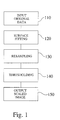
- Fig. 1 is a flow diagram showing a process path for an exemplary embodiment which provides a scheme that treats binary images as three-dimensional data in which the X and Y coordinates are the input image (110) dimensions, and the Z coordinate, i.e. the height field, is the intensity of the original image.
- This three-dimensional data set is fitted by a surface (120).
- a resampling process (130) on the fitting surface provides interpolative data.
- a thresholding process (140) is applied to the interpolative data to produce an output binary image (150). Based on this interpolation scheme, each output pixel is a result of blending its neighboring input pixels, i.e.
- each output pixel is a weighted average of its neighboring pixels, with weights determined by the type of the interpolant, its degree, and the desired scaling factor.
- the weights can be pre-calculated for fixed scaling factors, such that the convolution can be accomplished by table lookup.
- the exemplary embodiment provides a scheme that employs a piecewise polynomial, for example, B-splines, as the fitting interpolant to the original data (see W. J. Gordon and R. F. Riesenfeld, B-spline Curves and Surfaces in R. E. Barnhill and R. F. Riesenfeld (eds.), Computer Aided Geometric Design, Academic Press, New York, 1974, pp. 95-126).
- a piecewise polynomial for example, B-splines
- a cubic uniform polynomial B-spline curve is an inner product of four input coefficients p i 's and the cubic spline basis B i,4 (t) 's evaluated at t between [0,1).
- a cubic uniform polynomial B-spline curve t is defined as where the basis translation matrix is (see J. D. Foley, A. van Dam, S. K. Feiner, J. F. Hughes, Computer Graphics. Principles and Practice, Second Edition, Addison Wesley, 1990 ).
- a surface is a uniform polynomial B-spline tensor product surface in parameters u ⁇ [0,1) and v ⁇ [0,1), where:
- a bi-cubic uniform polynomial B-spline tensor product surface s ( u , v ) UM 4 PM T 4 V T where M 4 is the basis translation matrix of order 4, as shown above in Example 2.
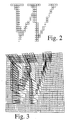
- Fig. 2 shows a test character in 20 point, 300 dpi, Times Font.
- Fig. 3 is a wireframe representation of the input coefficients for the test character of Fig. 2.
- Fig. 4 shows a bi-linear tensor product B-spline surface defined by the input data of the test character of Fig. 2;
- Fig. 5 shows a bi-quadratic tensor product B-spline surface defined by the input data of the test character of Fig. 2;
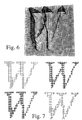
- Fig. 6 shows a bi-cubic tensor product B-spline surface defined by the input data of the test character of Fig. 2.
- Fig. 7 shows a bi-linear interpolation of the test character of Fig. 2
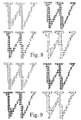
- Fig. 8 shows a bi-quadratic interpolation of the test character of Fig. 2
- Fig. 9 shows a bi-cubic interpolation of the test character of Fig. 2.
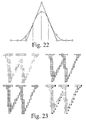
- the letter "W" is shown as a series of steps in which the lower right hand letter includes missing portions of the letter after scaling, indicated by small solid squares, and added portions of the letter after scaling, indicated by small hollow squares. Notice that the result of bi-linear interpolation appears to be blocky, while the results of higher order interpolation are usually smoother.
- the resampling process on the fitting surface evaluates the piecewise polynomial surface at a set of appropriate locations, one piece at a time.
- the evaluation locations are selected between [0,1) with even spacing, usually 0, 1 / M , 2 / M ,..., M - 1 / M in the U direction.
- the evaluation locations are selected between [0,1) with even spacing, usually 0, 1 / N , 2 / N ,..., M - 1 / N in the V direction.
- UM k U and M T k v V T can be pre-calculated as vectors, ⁇ and ⁇ , respectively.
- the coefficient matrix P is also k u by k v .
- the sum of the entry-by-entry product of P and K is the result of the surface evaluated at u 0 and v 0 ,
- the kernel matrix is constructed for each ( u , v ) pair.
- a threshold value is selected to compare against the numeric values, s ( u , v )'s, to obtain the binary data of the output pixels.
- s ( u,v ) For each 4 by 4 input pixels, e.g. a kernel matrix is calculated for each of the following 3 by 3 output pixels:
- the kernel matrix for s (0.0,0.0) can be calculated by multiplying entries of ( UM ) with ( M T V T ), i.e.
- the sum of the entry-to-entry product of P and K is a numeric value representing the point on the surface after resampling.
- the final quantization step compares this numeric value against a pre-selected threshold value to produce a binary value representing the upper-left corner of the output binary image.
- the fitting surface i.e. a B-spline surface
- the fitting surface is a continuum covering the entire input data. Accordingly, the resampling process always produces at least a few points on the surface, regardless of the arbitrariness of the scaling factors. Thus, this interpolating method is applicable for any arbitrary scaling factor.
- a B-spline tensor product surface is always contained in the convex hull formed by its input data mesh. Thus, all the output data produced from the resampling process are always bounded by the input data.
- a B-spline tensor product surface is C k -1 continuous in each parametric direction, where k is the order.
- the interpolated data are smooth. If a higher order interpolant is used, the edges of the output image are smoother.
- each point on the B-spline tensor product surface depends only on a finite number of input data points, k u by k v , where k 's are the orders of the surface.
- the convolution kernel size of each output pixel is no more than k u by k v .
- the surface evaluation process of a B-spline tensor product surface may be totally independent from one parametric direction to the other. Accordingly, this interpolation scheme works for different scaling factors in the two orthogonal directions. In addition, the order of one direction is totally independent from the order of the other direction. Thus, the selection of the interpolant orders may be as arbitrary as required.
- the complexity of the scheme herein described is linear in the input size because it has a fixed number of operations per pixel.
- the scheme may be thought of as constant filtering with a set of k u by k v convolution kernels, where k 's are the orders, i.e. degrees plus one, of the fitting surface.
- the number of the filters is at most M * N, where M and N are the scaling factors in the horizontal and vertical directions, respectively.
- the filtering process of the scheme described herein depends only on the scaling factor, the orders of the fitting surface, and the threshold value. Therefore, after the filter parameters are finalized, a template scheme may easily be implemented by pattern matching and table lookup.
- the lookup table size may be up to about 2 k u k v * M * N bits. However, much reduction in table size may be achieved by using the mathematical properties of B-splines. For example, when scaling by a factor of 3 with a bi-cubic uniform piecewise B-spline tensor product surface, the upper bound of the space complexity is 2 4*4 * 3 * 3 bits. That is, for each of the 9 output pixels, there is a table of 16 entries, as described below.
- the kernels K 0, 1 3 , K 0, 2 3 , K 1 3 , 0 , K 1 3 , 0 have similar rows or columns except the numbers are row-permutations or column-permutations of each other. Similar relationships hold for K 1 3 , 1 3 , K 1 3 , 2 3 , K 1 3 , 2 3 , K 1 3 , 2 3 .
- the space complexity of the lookup tables can be further reduced to 2 9 +2 12 +2 16 bits, if some processing capability is provided.
- Dominancy Some entries of the convolution kernels are more dominant with regard to the resulting output than are other entries.
- a final thresholding process is applied for binary image scaling. Many entries of the kernels become insignificant because of this quantization process. For example, if the threshold value is chosen as 16/32 for the above case, then in kernel of s (0,0), those entries with value 1/36 are effectively "don't-cares" because they never contribute to the final result in any significant way.
- the various implementations described may be optimized by keeping only the most dominant entries of kernels. In this way, one may fine tune the process for each specific application by balancing between a practical table size and a desired print quality.
- the lookup table size can be significantly reduced depending on the design constraints in memory limitation and processor speed.
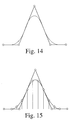
- the stroke width is not preserved if errors are produced from the quantization step of the scaling algorithm, for example when a single pixel line is scaled by a factor of 3 by means of a bi-quadratic B-spline interpolant.
- the scaled image either consistently has an extra pixel line, or it has one less pixel line than the pixel replication. Similar errors occur when a single pixel line is to be scaled by a factor of 2 by means of a bi-cubic B-spline interpolant.
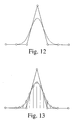
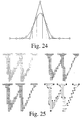
- Fig. 12 shows the impulse response of a cubic B-spline
- Fig. 13 shows the response function sampled at 0, 1/3, and 2/3.
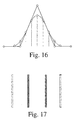
- the peak of the response function representing the input data point, is included in the resampled data.
- the peak of the response function is not included in the resampled data. This results because of sampling the interpolant at the locations, 0, 1 / N ,..., N - 1 / N .
- This phenomenon has been described as the phase distortion property of all the even degree polynomials (see I.E. Abdou and K.Y. Wong, Analysis of Linear Interpolation Schemes for Bi-Level Image Applications, IBM J. Res. Develop., V. 26, No. 6, pp. 667-680, November, 1982).
- the phase could be shifted by one half of the sampling spacing, e.g. by 1/6, to compensate for such phase distortion.
- One aspect solves the quantization error problem caused by a lack of the symmetry of the impulse response of B-spline interpolant when even scaling factors are applied.
- one aspect of this solution enlarges the search space from the space spanned by B-splines, which is equivalent to the space containing all the piecewise polynomials, to the space spanned by the Beta-spline, which is a more generalized form of splines ( see A. Lempel and G. Seroussi, Systematic derivation of spline bases, Computer Aided Geometric Design, 9 (1992), pp. 349-363; and G. Seroussi and B.
- the actual amount of phase shifting used is a function of the application.
- Another solution to the quantization error problem combines the two techniques described above, i.e. it uses a phase shifted, Beta-spline interpolant.
- the input images are transmitted in standard facsimile resolutions of 203 dpi horizontally and 98 dpi vertically.
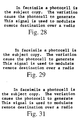
- Fig. 28 shows a portion of the Slerexe letter in standard resolution.
- the vertical resolution is 196 dpi;
- Fig. 29 shows a portion of the Slerexe letter in fine resolution.
- printer resolution is typically 300 dpi both ways, 600 dpi horizontally and 300 dpi vertically, or 600 dpi both ways. Therefore, for facsimile imaging the scaling factors are usually fixed numbers. However, because of complications associated with the physical constraints in printable margins of the facsimile printing mechanism, the scaling factor is not actually 300/203 or 300/98. Instead, the scaling factors are rounded off to 3/2 or 3/1 (i.e. 1.5 or 3.0) by padding with extra pixels to fill in the differences encountered in various firmware implementations.
- Fig. 30 shows a character cropped from the Slerexe letter.
- the aliasing artifacts shown in the figure include staircases, edge ticks, and stray dots.
- the staircases are smoothed, the number of stray dots is reduced, and edge ticks are increased in run length and lowered in height.
- stray dots may be detected and totally removed by the invention, if so desired.
- Fig. 31 shows the results of applying a bi-cubic B-spline surface as an interpolant for scaling horizontally and vertically by a factor of 3.0 in fine resolution. If it is necessary or desirable to compensate for the 2:1 aspect ratio used in standard resolution, a different order in horizontal direction may be chosen from that of the vertical direction of the fitting surface.
- Fig. 32 shows the result of applying a quadratic-by-quartic tensor product B-spline surface as an interpolant for scaling horizontally by a factor of 1.5 and vertically by a factor of 3.0 in standard resolution.
- the scheme may also be used to scale English character fonts. For example, to scale a 12 point font in 300 dpi to a 24 point font for printing on a 600 dpi printer requires scaling by a factor of 4 in both the horizontal and the vertical directions.
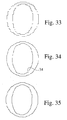
- Fig. 33 shows a test character in the original 12 point font in 300 dpi.
- Fig. 33 may be scaled by twice applying RET (Resolution Enhancement Technology), which uses a set of diamond shaped templates (see C. Tung, Resolution Enhancement Technology in Hewlett Packard LaserJet Printers, IST/SPIE Symposium on Electronic Imaging: Science and Technology, pp. 440-448, 1993).
- Fig. 34 shows the results obtained using this approach. In the figure, it can be seen that artifacts 34 have been introduced along the inside curved portion of the test character at lower right corner by this approach.
- test character involved interpolating by a bi-septimal tensor product B-spline surface using a rectangular template. This approach removes the artifacts, as can be seen in Fig. 35.
- convolution kernels for scaling by a factor of 3 with a bi-cubic uniform polynomial B-spline tensor product surface, s ( u,v ).
- K u 0, v 0 is the kernel for sampling s ( u , v ) at ( u 0 , v 0 ).
- this example provides an image scaling method that is based on piecewise polynomial interpolation. It may be used for arbitrary or fixed scaling factors, and it may also be used to reduce or remove aliasing artifacts.
- lookup table size may be substantially reduced to meet the memory space constraints.
Landscapes
- Physics & Mathematics (AREA)
- General Physics & Mathematics (AREA)
- Engineering & Computer Science (AREA)
- Theoretical Computer Science (AREA)
- Image Processing (AREA)
- Editing Of Facsimile Originals (AREA)
Claims (18)
- Ein Verfahren zum Skalieren eines binären Bildes durch stückweise Polynominterpolation in dem Speicher eines Computergeräts unter Verwendung eines stückweisen Polynominterpolationsmittels, wobei das Verfahren folgende Schritte aufweist:dadurch gekennzeichnet, daßModellieren (110) von binären Daten, die ein Eingangspixelbild darstellen, als einen dreidimensionalen Datensatz (X, Y, Z), bei dem die erste und die zweite Koordiante (X, Y) Eingangspixelbilddimensionen sind, und die dritte Koordinate (Z) die Intensität des ursprünglichen Pixelbildes ist;Anpassen (120) des dreidimensionalen Datensatzes durch ein Oberflächeninterpolationsmittel;Neuabtasten (130) der binären Daten, die das Eingangspixelbild darstellen, an der Anpassungsoberfläche mit Gewichtungen, die durch den Typ des Interpolationsmittels, den Grad desselben und einen Skalierungsfaktor bestimmt sind, um Interpolationsdaten zu liefern; undErzeugen (150) eines Ausgangspixelbildes, wobei das Ausgangspixelbild aus dem Eingangspixelbild skaliert ist,das stückweise Polynominterpolationsmittel vom B-Spline-, Beta-Spline-, einem phasenverschobenen oder einem nicht phasenverschobenen Typ ist, und daß das Verfahren ferner folgende Schritte aufweist:Bestimmen des Typs des stückweisen Polynominterpolationsmittels für die Oberflächenanpassung basierend darauf, ob ein Bildskalierungsfaktor, der die Bildskalierung bestimmt, eine gerade oder ungerade Ganzzahl ist;Korrigieren jeglicher Quantisierungsfehlerprobleme in den Interpolationsdaten, falls dies notwendig ist, durch Erzeugen von Faltungskernen für die Bildskalierung; undschwellenwertmäßiges Verarbeiten (140) der Interpolationsdaten, um binäre Daten zu erzeugen, die das Ausgangspixelbild darstellen.
- Ein Verfahren gemäß Anspruch 1, bei dem das Interpolationsmittel eine B-Spline-Tensorproduktoberfläche oder eine Beta-Spline-Tensorproduktoberfläche ist.
- Ein Verfahren gemäß Anspruch 1 oder 2, das folgenden Schritt aufweist:
Phasenverschieben während des Schrittes des Neuabtastens, um die Abtastposition bezüglich des Skalierungsfaktors neu auszurichten. - Ein Verfahren gemäß Anspruch 3, das folgenden Schritt aufweist:
Bestimmen des Phasenverschiebungsbetrags zum Reduzieren des Quantisierungsfehlers. - Ein Verfahren gemäß einem der vorhergehenden Ansprüche, das folgenden Schritt aufweist:
Bestimmen von Schwellenwerten, die verwendet werden, um binäre Ausgangspixel zu erzeugen. - Ein Verfahren gemäß einem der vorhergehenden Ansprüche, das folgende Schritte aufweist:Bestimmen von Werten, die verwendet werden, um die Gewichtungen von benachbarten Eingangspixeln zu steuern;Vorabberechnen der Gewichtungen durch Bestimmen des Typs des Interpolationsmittels und Bestimmen, ob dasselbe für vorbestimmte feste Skalierungsfaktoren einen ungeraden oder geraden Grad aufweist; undDurchführen einer Faltung durch eine Nachschlagtabelle auf der Basis der festen Skalierungsfaktoren.
- Ein Verfahren gemäß Anspruch 6, das den Schritt des Feinabstimmens der Nachschlagtabelle für den Typ des erzeugten Ausgangsbilds aufweist.
- Ein Verfahren gemäß Anspruch 6 oder 7, das folgende Schritte aufweist:Reduzieren der Nachschlagtabellengröße durch die in den Faltungskernen erfaßte Lokalheit;Reduzieren der Nachschlagtabellengröße durch die in den Faltungskernen erfaßte Symmetrie; undReduzieren der Nachschlagtabellengröße durch Beibehalten lediglich der dominantesten Einträge der Faltungskerne.
- Ein Verfahren gemäß einem der Ansprüche 6 bis 8, das ferner folgenden Schritt aufweist:
manuelles Modifizieren der Einträge der Nachschlagtabelle, um Bildunregelmäßigkeitsartefakte im wesentlichen zu entfernen. - Ein Computergerät-implementiertes System zum Skalieren eines binären Bildes durch eine stückweise Polynominterpolation unter Verwendung eines stückweisen Polynominterpolationsmittels, mitdadurch gekennzeichnet, daßeinem Eingangsmodul (110) zum Empfangen von binären Daten, die ein Eingangspixelbild darstellen, als einen dreidimensionalen Datensatz (X, Y, Z), bei dem die erste und die zweite Koordinate (X, Y) Eingangspixelbilddimensionen sind, und die dritte Koordinate (Z) die Intensität des ursprünglichen Pixelbildes ist;einem Oberflächenanpassungsmodul (120) zum Anpassen des dreidimensionalen Datensatzes durch eine Oberfläche;einem Neuabtastungsmodul (130) zum Neuabtasten der binären Daten, die das Eingangspixelbild darstellen, an der Anpassungsoberfläche mit Gewichtungen, die durch den Typ des Interpolationsmittels, den Grad desselben und einen Skalierungsfaktor bestimmt sind, um Interpolationsdaten zu liefern; undeinem Ausgangsmodul (150) zum Erzeugen eines Ausgangspixelbildes aus den binären Daten, wobei das Ausgangspixelbild aus dem Eingangspixelbild skaliert ist,das stückweise Polynominterpolationsmittel vom B-Spline-, Beta-Spline-, einem phasenverschobenen oder nicht phasenverschobenen Typ ist, und daß das Gerät zusätzlich folgende Merkmale aufweist:eine Einrichtung zum Bestimmen des Typs des stückweisen Polynominterpolationsmittels zur Oberflächenanpassung (120) basierend darauf, ob ein Bildskalierungsfaktor, der die Bildskalierung bestimmt, eine gerade oder ungerade Ganzzahl ist;ein Korrekturmodul zum Korrigieren jeglicher Quantisierungsfehlerprobleme in den Interpolationsdaten durch Erzeugen von Faltungskernen für die Bildskalierung; undein Schwellenwertverarbeitungsmodul (140) zum schwellenwertmäßigen Verarbeiten der Interpolationsdaten, um binäre Daten zu erzeugen, die das Ausgangspixelbild darstellen.
- Skalierungsvorrichtung gemäß Anspruch 10, bei dem das Interpolationsmittel eine B-Spline-Tensorproduktoberfläche oder eine Beta-Spline-Tensorproduktoberfläche ist.
- Skalierungsvorrichtung gemäß Anspruch 10 oder 11, die ferner folgendes Merkmal aufweist:
eine Einrichtung zum Phasenverschieben des binären Eingangsbildes, um die Abtastposition bezüglich des Skalierungsfaktors neu auszurichten. - Skalierungsvorrichtung gemäß Anspruch 12, die ferner folgendes Merkmal aufweist:
eine Einrichtung zum Bestimmen des Phasenverschiebungsbetrags, um einen Quantisierungsfehler zu reduzieren. - Skalierungsvorrichtung gemäß einem der Ansprüche 10 bis 13, die ferner folgendes Merkmal aufweist:
eine Einrichtung zum Bestimmen von Schwellenwerten, die verwendet werden, um binäre Ausgangspixel (140) zu erzeugen. - Skalierungsvorrichtung gemäß einem der Ansprüche 10 bis 14, die ferner folgende Merkmale aufweist:eine Einrichtung zum Bestimmen von Werten, die verwendet werden, um die Gewichtungen von benachbarten Eingangspixeln zu steuern;eine Einrichtung zum Vorabberechnen der Gewichtungen durch Bestimmen des Typs des Interpolationsmittels und Bestimmen, ob dasselbe für vorbestimmte feste Skalierungsfaktoren einen ungeraden oder geraden Grad aufweist; undeine Einrichtung zum Durchführen einer Faltung durch eine Nachschlagtabelle auf der Basis der festen Skalierungsfaktoren.
- Skalierungsvorrichtung gemäß Anspruch 15, die ferner eine Einrichtung zum Feinabstimmen der Nachschlagtabelle für den Typ des Ausgangsbilds, das erzeugt werden soll, aufweist.
- Skalierungsvorrichtung gemäß Anspruch 15 oder 16, die ferner folgende Merkmale aufweist:eine Einrichtung zum Reduzieren einer Nachschlagtabellengröße durch die in den Faltungskernen erfaßte Lokalheit;eine Einrichtung zum Reduzieren der Nachschlagtabellengröße durch die in den Faltungskernen erfaßte Symmetrie; undeine Einrichtung zum Reduzieren der Nachschlagtabellengröße durch Beibehalten lediglich der dominantesten Einträge der Faltungskerne.
- Skalierungsvorrichtung gemäß einem der Ansprüche 15 bis 17, die ferner folgendes Merkmal aufweist:
eine Einrichtung zum manuellen Modifizieren der Einträge der Nachschlagtabelle, um Bildunregelmäßigkeitsartefakte im wesentlichen zu entfernen.
Applications Claiming Priority (2)
| Application Number | Priority Date | Filing Date | Title |
|---|---|---|---|
| US08/286,561 US5627953A (en) | 1994-08-05 | 1994-08-05 | Binary image scaling by piecewise polynomial interpolation |
| US286561 | 1994-08-05 |
Publications (3)
| Publication Number | Publication Date |
|---|---|
| EP0696017A2 EP0696017A2 (de) | 1996-02-07 |
| EP0696017A3 EP0696017A3 (de) | 1996-10-02 |
| EP0696017B1 true EP0696017B1 (de) | 2001-08-16 |
Family
ID=23099162
Family Applications (1)
| Application Number | Title | Priority Date | Filing Date |
|---|---|---|---|
| EP95304268A Expired - Lifetime EP0696017B1 (de) | 1994-08-05 | 1995-06-20 | Skalierung von Binärbildern |
Country Status (4)
| Country | Link |
|---|---|
| US (1) | US5627953A (de) |
| EP (1) | EP0696017B1 (de) |
| JP (1) | JPH0863592A (de) |
| DE (1) | DE69522158T2 (de) |
Families Citing this family (22)
| Publication number | Priority date | Publication date | Assignee | Title |
|---|---|---|---|---|
| US5796879A (en) * | 1995-05-23 | 1998-08-18 | Hewlett-Packard Company | Area based interpolation for image scaling |
| US6151025A (en) * | 1997-05-07 | 2000-11-21 | Hewlett-Packard Company | Method and apparatus for complexity reduction on two-dimensional convolutions for image processing |
| US6222173B1 (en) | 1997-10-09 | 2001-04-24 | Agfa-Gevaert | Image sharpening and re-sampling method |
| EP0908845B1 (de) * | 1997-10-09 | 2003-12-03 | Agfa-Gevaert | Verfahren zur Verbesserung der Schärfe und zur Wiederabtastung eines Bildes |
| DE19812028A1 (de) | 1998-03-19 | 1999-09-23 | Heidelberger Druckmasch Ag | Verfahren zur Koordinatenumrechnung von Bilddaten mit zufälligem Offset der Bildpunkte |
| US5991464A (en) * | 1998-04-03 | 1999-11-23 | Odyssey Technologies | Method and system for adaptive video image resolution enhancement |
| US6281875B1 (en) | 1998-04-29 | 2001-08-28 | Canon Kabushiki Kaisha | Gradient-based pixel interpolation |
| US6498868B1 (en) * | 1998-06-11 | 2002-12-24 | Xerox Corporation | Image scaling using pattern matching to select among scaling algorithms |
| US6178272B1 (en) * | 1999-02-02 | 2001-01-23 | Oplus Technologies Ltd. | Non-linear and linear method of scale-up or scale-down image resolution conversion |
| US7154514B2 (en) * | 2002-09-23 | 2006-12-26 | Sharp Laboratories Of America, Inc. | Systems and methods for downscaling an image |
| EP1376381A1 (de) * | 2003-02-12 | 2004-01-02 | Agilent Technologies Inc | Verfahren und System zur Datenabtastung |
| JP4144374B2 (ja) * | 2003-02-25 | 2008-09-03 | ソニー株式会社 | 画像処理装置および方法、記録媒体、並びにプログラム |
| JP4144378B2 (ja) * | 2003-02-28 | 2008-09-03 | ソニー株式会社 | 画像処理装置および方法、記録媒体、並びにプログラム |
| US7242500B2 (en) * | 2003-03-12 | 2007-07-10 | Sharp Laboratories Of America, Inc. | Halftone image down-sampling |
| JP4617730B2 (ja) | 2004-06-15 | 2011-01-26 | ソニー株式会社 | 画像処理装置および方法、記録媒体、並びにプログラム |
| TWI296396B (en) * | 2005-12-12 | 2008-05-01 | Beyond Innovation Tech Co Ltd | An image resolution interpolation device and method |
| JP4274238B2 (ja) | 2006-12-22 | 2009-06-03 | ソニー株式会社 | 画像処理装置及び画像処理方法、並びにコンピュータ・プログラム |
| US8078007B2 (en) * | 2008-01-08 | 2011-12-13 | Seiko Epson Corporation | Enlarging a digital image |
| FR3001318A1 (fr) * | 2013-01-24 | 2014-07-25 | Thomson Licensing | Procede d’interpolation et dispositif correspondant |
| CN103473212A (zh) * | 2013-09-06 | 2013-12-25 | 深圳富泰宏精密工业有限公司 | 方程式计算系统及方法 |
| CN107367241B (zh) * | 2017-03-15 | 2020-06-30 | 山东交通学院 | 一种基于机器视觉的汽车轮胎花纹识别方法 |
| WO2018208850A1 (en) * | 2017-05-08 | 2018-11-15 | Compound Photonics Limited | Drive techniques for modulation devices |
Family Cites Families (1)
| Publication number | Priority date | Publication date | Assignee | Title |
|---|---|---|---|---|
| US5438654A (en) * | 1993-07-09 | 1995-08-01 | Silicon Graphics, Inc. | System and method for sharpening texture imagery in computer generated interactive graphics |
-
1994
- 1994-08-05 US US08/286,561 patent/US5627953A/en not_active Expired - Lifetime
-
1995
- 1995-06-20 EP EP95304268A patent/EP0696017B1/de not_active Expired - Lifetime
- 1995-06-20 DE DE69522158T patent/DE69522158T2/de not_active Expired - Lifetime
- 1995-07-05 JP JP7169393A patent/JPH0863592A/ja active Pending
Also Published As
| Publication number | Publication date |
|---|---|
| JPH0863592A (ja) | 1996-03-08 |
| DE69522158D1 (de) | 2001-09-20 |
| EP0696017A2 (de) | 1996-02-07 |
| EP0696017A3 (de) | 1996-10-02 |
| US5627953A (en) | 1997-05-06 |
| DE69522158T2 (de) | 2001-11-29 |
Similar Documents
| Publication | Publication Date | Title |
|---|---|---|
| EP0696017B1 (de) | Skalierung von Binärbildern | |
| US5131057A (en) | Method for video-to-printing image resolution conversion | |
| US8077356B2 (en) | Content-aware halftone image resizing using iterative determination of energy metrics | |
| US7149369B2 (en) | Method and system for image scaling | |
| US8023153B2 (en) | Content-aware halftone image resizing | |
| US20130028538A1 (en) | Method and system for image upscaling | |
| US6272261B1 (en) | Image processing device | |
| EP0673000B1 (de) | Verfahren zur Bildelementkorrektur und -glättung | |
| US6721458B1 (en) | Artifact reduction using adaptive nonlinear filters | |
| US6151025A (en) | Method and apparatus for complexity reduction on two-dimensional convolutions for image processing | |
| US20050157940A1 (en) | Edge generation method, edge generation device, medium recording edge generation program, and image processing method | |
| CN101911112A (zh) | 图像处理装置,图像处理方法,图像扩展装置,图像压缩装置,图像传输系统及存储介质 | |
| US20090034864A1 (en) | Multi-scale robust sharpening and contrast enhancement | |
| JP2000203010A (ja) | インクジェットプリンタにおけるドット削除方法 | |
| US6438270B1 (en) | Methods and systems for image sharpening | |
| US6748120B1 (en) | Steerable kernel for image interpolation | |
| EP0672999B1 (de) | Pixelkorrektur und Glättungsverfahren | |
| US6272260B1 (en) | Method of and apparatus for processing an image filter | |
| EP0673152A2 (de) | Verfahren zur Korrektur und Glättung von Bildelementen | |
| USH2003H1 (en) | Image enhancing brush using minimum curvature solution | |
| Getreuer | Contour stencils for edge-adaptive image interpolation | |
| US6927780B2 (en) | Fast text/graphics resolution improvement with chain-code table look-up | |
| US20090034863A1 (en) | Multi-scale robust sharpening and contrast enhancement | |
| US20150163375A1 (en) | Binary periodic to multibit aperiodic halftone and resolution conversion | |
| Yang et al. | Binary image scaling by piecewise polynomial interpolation |
Legal Events
| Date | Code | Title | Description |
|---|---|---|---|
| PUAI | Public reference made under article 153(3) epc to a published international application that has entered the european phase |
Free format text: ORIGINAL CODE: 0009012 |
|
| AK | Designated contracting states |
Kind code of ref document: A2 Designated state(s): DE FR GB IT |
|
| PUAL | Search report despatched |
Free format text: ORIGINAL CODE: 0009013 |
|
| AK | Designated contracting states |
Kind code of ref document: A3 Designated state(s): DE FR GB IT |
|
| 17P | Request for examination filed |
Effective date: 19970401 |
|
| 17Q | First examination report despatched |
Effective date: 19990818 |
|
| GRAG | Despatch of communication of intention to grant |
Free format text: ORIGINAL CODE: EPIDOS AGRA |
|
| GRAG | Despatch of communication of intention to grant |
Free format text: ORIGINAL CODE: EPIDOS AGRA |
|
| GRAH | Despatch of communication of intention to grant a patent |
Free format text: ORIGINAL CODE: EPIDOS IGRA |
|
| GRAH | Despatch of communication of intention to grant a patent |
Free format text: ORIGINAL CODE: EPIDOS IGRA |
|
| RAP1 | Party data changed (applicant data changed or rights of an application transferred) |
Owner name: HEWLETT-PACKARD COMPANY, A DELAWARE CORPORATION |
|
| GRAA | (expected) grant |
Free format text: ORIGINAL CODE: 0009210 |
|
| AK | Designated contracting states |
Kind code of ref document: B1 Designated state(s): DE FR GB IT |
|
| REF | Corresponds to: |
Ref document number: 69522158 Country of ref document: DE Date of ref document: 20010920 |
|
| ET | Fr: translation filed | ||
| REG | Reference to a national code |
Ref country code: GB Ref legal event code: IF02 |
|
| PLBE | No opposition filed within time limit |
Free format text: ORIGINAL CODE: 0009261 |
|
| STAA | Information on the status of an ep patent application or granted ep patent |
Free format text: STATUS: NO OPPOSITION FILED WITHIN TIME LIMIT |
|
| 26N | No opposition filed | ||
| REG | Reference to a national code |
Ref country code: GB Ref legal event code: 732E |
|
| REG | Reference to a national code |
Ref country code: GB Ref legal event code: 732E |
|
| PGFP | Annual fee paid to national office [announced via postgrant information from national office to epo] |
Ref country code: GB Payment date: 20070410 Year of fee payment: 13 |
|
| PGFP | Annual fee paid to national office [announced via postgrant information from national office to epo] |
Ref country code: IT Payment date: 20070626 Year of fee payment: 13 |
|
| PGFP | Annual fee paid to national office [announced via postgrant information from national office to epo] |
Ref country code: FR Payment date: 20070618 Year of fee payment: 13 |
|
| GBPC | Gb: european patent ceased through non-payment of renewal fee |
Effective date: 20080620 |
|
| REG | Reference to a national code |
Ref country code: FR Ref legal event code: ST Effective date: 20090228 |
|
| PG25 | Lapsed in a contracting state [announced via postgrant information from national office to epo] |
Ref country code: GB Free format text: LAPSE BECAUSE OF NON-PAYMENT OF DUE FEES Effective date: 20080620 |
|
| PG25 | Lapsed in a contracting state [announced via postgrant information from national office to epo] |
Ref country code: IT Free format text: LAPSE BECAUSE OF NON-PAYMENT OF DUE FEES Effective date: 20080620 Ref country code: FR Free format text: LAPSE BECAUSE OF NON-PAYMENT OF DUE FEES Effective date: 20080630 |
|
| REG | Reference to a national code |
Ref country code: FR Ref legal event code: TP |
|
| PGFP | Annual fee paid to national office [announced via postgrant information from national office to epo] |
Ref country code: DE Payment date: 20140618 Year of fee payment: 20 |
|
| REG | Reference to a national code |
Ref country code: DE Ref legal event code: R071 Ref document number: 69522158 Country of ref document: DE |