EP0693197B1 - Document framework system - Google Patents
Document framework system Download PDFInfo
- Publication number
- EP0693197B1 EP0693197B1 EP94911367A EP94911367A EP0693197B1 EP 0693197 B1 EP0693197 B1 EP 0693197B1 EP 94911367 A EP94911367 A EP 94911367A EP 94911367 A EP94911367 A EP 94911367A EP 0693197 B1 EP0693197 B1 EP 0693197B1
- Authority
- EP
- European Patent Office
- Prior art keywords
- command
- document data
- original document
- user
- data portion
- Prior art date
- Legal status (The legal status is an assumption and is not a legal conclusion. Google has not performed a legal analysis and makes no representation as to the accuracy of the status listed.)
- Expired - Lifetime
Links
Images

Classifications
-
- G—PHYSICS
- G06—COMPUTING OR CALCULATING; COUNTING
- G06F—ELECTRIC DIGITAL DATA PROCESSING
- G06F40/00—Handling natural language data
- G06F40/10—Text processing
- G06F40/194—Calculation of difference between files
-
- G—PHYSICS
- G06—COMPUTING OR CALCULATING; COUNTING
- G06F—ELECTRIC DIGITAL DATA PROCESSING
- G06F11/00—Error detection; Error correction; Monitoring
- G06F11/07—Responding to the occurrence of a fault, e.g. fault tolerance
- G06F11/14—Error detection or correction of the data by redundancy in operations
- G06F11/1446—Point-in-time backing up or restoration of persistent data
-
- G—PHYSICS
- G06—COMPUTING OR CALCULATING; COUNTING
- G06F—ELECTRIC DIGITAL DATA PROCESSING
- G06F11/00—Error detection; Error correction; Monitoring
- G06F11/07—Responding to the occurrence of a fault, e.g. fault tolerance
- G06F11/14—Error detection or correction of the data by redundancy in operations
- G06F11/1471—Error detection or correction of the data by redundancy in operations involving logging of persistent data for recovery
-
- G—PHYSICS
- G06—COMPUTING OR CALCULATING; COUNTING
- G06F—ELECTRIC DIGITAL DATA PROCESSING
- G06F40/00—Handling natural language data
- G06F40/10—Text processing
- G06F40/166—Editing, e.g. inserting or deleting
Definitions
- This invention generally relates to improvements in computer systems and more particularly to a system and method for a high availability document processing system.
- Document processing is currently the most prevalent application of computer technology.
- Examples of state of the art word processing technology include the WordPerfect ® text processor and the Word text processor from Microsoft ® Corporation. These products are designed to run on various operating systems and different hardware platforms. Some of the hardware platforms and operating systems are less reliable then others. To avoid loss of data or other information, these products have a backup capability that can be enabled at system setup. The backup occurs when a user specified time elapses, if a user selects to enable the capability. If the system has a failure between backups, then the information since the last backup is lost. Similar backup capability is provided for database, graphic, imaging applications or other computer applications. Thus, any failure between backups can be costly for computer applications.
- IBM Technical Disclosure Bulletin, vol. 33, no. 12, pp. 304-305 discloses a tool which was built to allow a Smalltalk programmer to quickly and easily recover from an image crash.
- Smalltalk/V uses a file called the change log file to hold the source code of the methods that the user has created or modified in the course of her work. This file is considered to be part of the environment image, specifically containing everything the user has typed in.
- Change log file to hold the source code of the methods that the user has created or modified in the course of her work.
- This file is considered to be part of the environment image, specifically containing everything the user has typed in.
- These changes include creation or modification of a method, deletion of a method, creation or modification of a class and deletion of a class as well as a history of all the Smalltalk code that the user has explicitly executed in testing her application.
- the change log file and the class hierarchy browser are dynamically updated with the changes that the user has made. Each change is appended to the end of the change log file.
- the user On a system crash, the user must restart the environment, edit the change.log file and manually extract all the changes made since the last time the image was saved. This is both tedious and time consuming, and often a lot of redundant data, such as a method the user has modified several times until he was satisfied with the changes is included.
- the change log file can get very large as development progresses.
- the solution provided in the reference is an addition to the object-oriented environment of a new method called 'unsaved changes' which saves the location in the change log where the last 'save image' occurred. All changes in the environment after the last save are still appended in the log file as before.
- 'unsaved changes which saves the location in the change log where the last 'save image' occurred. All changes in the environment after the last save are still appended in the log file as before.
- a crash when a crash occurs, only the changes from the saved location to the state just prior to the crash are brought quickly into the environment by executing this method and then filing in the contents of the the window that surfaces. Since only the latest changes are retrieved, there is a significant increase in the speed of the retrieval. Filing in these changes quickly restores the object-oriented environment to the state it was in just prior to the crash and allows the Smalltalk user to continue her debugging and other programming efforts.
- the system makes use of a cache that is located in the memory of the computer.
- Sam manages file changes for variable length files utilizing a two-pass algorithm for making changes, and treats each file as a database against which transactions are registered. Changes are not made directly to the contents. Instead, when a command is started, a 'mark' containing a sequence number is placed in the transcript Buffer, and each change made to the file, either an insertion or deletion or a change to the file name, is appended to the end of the transcript. When the command is complete, the transcript is rewound to the mark and applied to the contents. Sam provides no way to undo an undo. Each mark in the transcript contains a sequence number and the offset into the transcript of the previous mark, to aid in unwinding the transcript.
- the present invention provides a system and method for automatically saving a document by applying object oriented technology to document processing.
- the system automatically saves changes of a document as command objects that are logged to a non-volatile store. Then, in the event of a power-loss or other problem, the system applies the change objects in the order they were saved on the log to recreate the document or other application image.
- FIG. 1 illustrates a typical hardware configuration of a workstation in accordance with the subject invention having a central processing unit 10, such as a conventional microprocessor, with a built in non-volatile storage 11, and a number of other units interconnected via a system bus 12.
- a central processing unit 10 such as a conventional microprocessor
- FIG. 1 illustrates a typical hardware configuration of a workstation in accordance with the subject invention having a central processing unit 10, such as a conventional microprocessor, with a built in non-volatile storage 11, and a number of other units interconnected via a system bus 12.
- the workstation shown in Figure 1 includes a Random Access Memory (RAM) 14, Read Only Memory (ROM) 16, an I/O adapter 18 for connecting peripheral devices such as a disk unit 20, and a diskette unit 21 to the bus, a user interface adapter 22 for connecting a keyboard 24, a mouse 26, a speaker 28, a microphone 32, and/or other user interface devices such as a touch screen device (not shown) to the bus, a communication adapter 34 for connecting the workstation to a data processing network 23 and a display adapter 36 for connecting the bus to a display device 38.
- the workstation has resident thereon an operating system such as the Apple System/7 ® operating system.
- the invention is implemented in the C++ programming language using object oriented programming techniques.
- object oriented programming techniques Object-Oriented Programming (OOP) objects are software entities comprising data structures and operations on the data. Together, these elements enable objects to model virtually any real-world entity in terms of its characteristics, represented by its data elements, and its behavior, represented by its data manipulation functions. In this way, objects can model concrete things like people and computers, and they can model abstract concepts like numbers or geometrical concepts.
- OOP Object-Oriented Programming
- Objects hide, or encapsulate, the internal structure of their data and the algorithms by which their functions work. Instead of exposing these implementation details, objects present interfaces that represent their abstractions cleanly with no extraneous information. Polymorphism takes encapsulation a step further. The idea is many shapes, one interface.
- a software component can make a request of another component without knowing exactly what that component is. The component that receives the request interprets it and figures out according to its variables and data, how to execute the request.
- the third principle is inheritance, which allows developers to reuse pre-existing design and code. This capability allows developers to avoid creating software from scratch. Rather, through inheritance, developers derive subclasses that inherit behaviors, which the developer then customizes to meet their particular needs.
- a prior art approach is to layer objects and class libraries in a procedural environment.
- Many application frameworks on the market take this design approach.
- this design there are one or more object layers on top of a monolithic operating system. While this approach utilizes all the principles of encapsulation, polymorphism, and inheritance in the object layer, and is a substantial improvement over procedural programming techniques, there are limitations to this approach. These difficulties arise from the fact that while it is easy for a developer to reuse their own objects, it is difficult to use objects from other systems and the developer still needs to reach into the lower non-object layers with procedural Operating System (OS) calls.
- OS procedural Operating System
- frameworks Another aspect of object oriented programming is a framework approach to application development.
- One of the most rational definitions of frameworks come from Ralph E. Johnson of the University of Illinois and Vincent F. Russo of Purdue. In their 1991 paper, Reusing Object-Oriented Designs, University of Illinois tech report UIUCDCS91-1696 they offer the following definition: "An abstract class is a design of a set of objects that collaborate to carry out a set of responsibilities. Thus, a framework is a set of object classes that collaborate to execute defined sets of computing responsibilities.” From a programming standpoint, frameworks are essentially groups of interconnected object classes that provide a pre-fabricated structure of a working application.
- a user interface framework might provide the support and "default" behavior of drawing windows, scrollbars, menus, etc. Since frameworks are based on object technology, this behavior can be inherited and overridden to allow developers to extend the framework and create customized solutions in a particular area of expertise. This is a major advantage over traditional programming since the programmer is not changing the original code, but rather extending the software. In addition, developers are not blindly working through layers of code because the framework provides architectural guidance and modeling but at the same time frees them to then supply the specific actions unique to the problem domain.
- frameworks can be viewed as a way to encapsulate or embody expertise in a particular knowledge area.
- Corporate development organizations, Independent Software Vendors (ISV)s and systems integrators have acquired expertise in particular areas, such as manufacturing, accounting, or currency transactions as in our example earlier. This expertise is embodied in their code.
- Frameworks allow organizations to capture and package the common characteristics of that expertise by embodying it in the organization's code. First, this allows developers to create or extend an application that utilizes the expertise, thus the problem gets solved once and the business rules and design are enforced and used consistently.
- frameworks and the embodied expertise behind the frameworks have a strategic asset implication for those organizations who have acquired expertise in vertical markets such as manufacturing, accounting, or bio-technology would have a distribution mechanism for packaging, reselling, and deploying their expertise, and furthering the progress and dissemination of technology.
- C++ object-oriented languages
- C++ was found mostly on UNIX systems and researcher's workstations, rather than on Personal Computers in commercial settings. It is languages such as C++ and other object-oriented languages, such as Smalltalk and others, that enabled a number of university and research projects to produce the precursors to today's commercial frameworks and class libraries.
- Some examples of these are InterViews from Stanford University, the Andrew toolkit from Carnegie-Mellon University and University of Zurich's ET++ framework.
- frameworks There are many kinds of frameworks depending on what level of the system you are concerned with and what kind of problem you are trying to solve.
- the types of frameworks range from application frameworks that assist in developing the user interface, to lower level frameworks that provide basic system software services such as communications, printing, file systems support, graphics, etc.
- Commercial examples of application frameworks are MacApp (Apple), Bedrock (Symantec), OWL (Borland), NeXTStep App Kit (NeXT), and Smalltalk-80 MVC (ParcPlace) to name a few.
- Programming with frameworks requires a new way of thinking for developers accustomed to other kinds of systems. In fact, it is not like "programming" at all in the traditional sense.
- old-style operating systems such as DOS or UNIX
- the developer's own program provides all of the structure.
- the operating system provides services through system calls-the developer's program makes the calls when it needs the service and control returns when the service has been provided.
- the program structure is based on the flow-of-control, which is embodied in the code the developer writes.
- system frameworks such as those included in a preferred embodiment, leverage the same concept by providing system level services, which developers, such as system programmers, use to subclass/override to create customized solutions.
- system level services which developers, such as system programmers, use to subclass/override to create customized solutions.
- developers such as system programmers
- subclass/override to create customized solutions.
- a multi-media framework which could provide the foundation for supporting new and diverse devices such as audio, video, MIDI, animation, etc.
- the developer that needed to support a new kind of device would have to write a device driver.
- the developer only needs to supply the characteristics and behavior that is specific to that new device.
- the developer in this case supplies an implementation for certain member functions that will be called by the multi-media framework.
- An immediate benefit to the developer is that the generic code needed for each category of device is already provided by the multi-media framework. This means less code for the device driver developer to write, test, and debug.
- Another example of using systems framework would be to have separate I/O frameworks for SCSI devices, NuBus cards, and graphics devices. Because there is inherited functionality, each framework provides support for common functionality found in its device category. Other developers could then depend on these consistent interfaces to all kinds of devices.
- a preferred embodiment takes the concept of frameworks and applies it throughout the entire system.
- frameworks such as MacApp
- Application creation in the architecture of a preferred embodiment will essentially be like writing domain-specific puzzle pieces that adhere to the framework protocol. In this manner, the whole concept of programming changes. Instead of writing line after line of code that calls multiple API hierarchies, software will be developed by deriving classes from the preexisting frameworks within this environment, and then adding new behavior and/or overriding inherited behavior as desired.
- an application program resident in the RAM 14, and under the control of the CPU 10, is responsible for managing various tasks using an object oriented document framework.
- a preferred embodiment checkpoints each change to the document and logs it to disk.
- the system starts with the last "saved" version and replays all the changes the user made against the copy.
- the resulting document is identical to the document the user had at the time of the crash.
- the system automatically stores a saved image and a command log.
- the saved image records the state of the entire document at a certain point in time, and the command log records all changes to the document since that time.
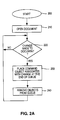
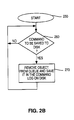
- FIG. 2 is a flowchart presenting the processing that transpires in accordance with a preferred embodiment.
- Processing commences at terminal 200 and immediately passes to function block 210 to open a document by retrieving the document from a disk or other storage device.
- a document could include text, graphic, image, audio or other information.
- Decision block 220 detects changes as they are made to the document. Then, for each change made to the document, a command object is built and placed at the end of a queue in storage as shown in function block 230.
- a background task shown in function block 240, is responsible for building the log in a non-volatile store based on objects in the queue.
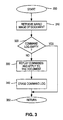
- FIG. 3 is a flowchart presenting processing that transpires when a document is restored in accordance with a preferred embodiment.
- Processing commences at terminal 300 and immediately passes to function block 310 to retrieve a stored document from a disk, disk cache or other memory.
- a decision is then performed at decision block 320 to determine if the command log is empty. If so, then the document is complete and control is passed back at terminal 350. If not, then the commands stored in the log are replayed, in order, and applied to the document as shown in function block 330, the command log is erased at function block 340, and control is returned at terminal 350.
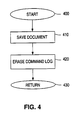
- FIG. 4 is a flowchart presenting the logic associated with saving a document in accordance with a preferred embodiment. Processing commences at terminal 400 and immediately passes to function block 410 to save the document. Then, the command log is erased at function block 420 and control is returned at terminal 430. This processing can occur at a user request, a user specified time, or automatically when a document is closed.
- the filing architecture defines an abstract model store that contains both the saved image and a command log.
- a document consists of a group of separate model objects that the model store provides access to.
- the model objects include a document image at the level of the individual models.
- the model store is saved on disk, but one of ordinary skill in the art will readily recognize that the model store can reside in memory, cache, or other storage mediums.
Landscapes
- Engineering & Computer Science (AREA)
- Theoretical Computer Science (AREA)
- Physics & Mathematics (AREA)
- General Engineering & Computer Science (AREA)
- General Physics & Mathematics (AREA)
- Health & Medical Sciences (AREA)
- Quality & Reliability (AREA)
- Artificial Intelligence (AREA)
- Audiology, Speech & Language Pathology (AREA)
- Computational Linguistics (AREA)
- General Health & Medical Sciences (AREA)
- Information Retrieval, Db Structures And Fs Structures Therefor (AREA)
- Document Processing Apparatus (AREA)
- Stored Programmes (AREA)
Applications Claiming Priority (3)
| Application Number | Priority Date | Filing Date | Title |
|---|---|---|---|
| US08/073,229 US5524190A (en) | 1993-06-04 | 1993-06-04 | Command object logging system for restoring documents |
| US73229 | 1993-06-04 | ||
| PCT/US1994/000082 WO1994029801A1 (en) | 1993-06-04 | 1994-01-03 | Document framework system |
Publications (2)
| Publication Number | Publication Date |
|---|---|
| EP0693197A1 EP0693197A1 (en) | 1996-01-24 |
| EP0693197B1 true EP0693197B1 (en) | 1997-04-09 |
Family
ID=22112512
Family Applications (1)
| Application Number | Title | Priority Date | Filing Date |
|---|---|---|---|
| EP94911367A Expired - Lifetime EP0693197B1 (en) | 1993-06-04 | 1994-01-03 | Document framework system |
Country Status (8)
| Country | Link |
|---|---|
| US (1) | US5524190A (enExample) |
| EP (1) | EP0693197B1 (enExample) |
| JP (1) | JPH08511116A (enExample) |
| CN (1) | CN1110065A (enExample) |
| AU (1) | AU6391094A (enExample) |
| CA (1) | CA2141932A1 (enExample) |
| DE (1) | DE69402540T2 (enExample) |
| WO (1) | WO1994029801A1 (enExample) |
Families Citing this family (39)
| Publication number | Priority date | Publication date | Assignee | Title |
|---|---|---|---|---|
| US5537526A (en) * | 1993-11-12 | 1996-07-16 | Taugent, Inc. | Method and apparatus for processing a display document utilizing a system level document framework |
| US5848246A (en) | 1996-07-01 | 1998-12-08 | Sun Microsystems, Inc. | Object-oriented system, method and article of manufacture for a client-server session manager in an interprise computing framework system |
| US5987245A (en) | 1996-07-01 | 1999-11-16 | Sun Microsystems, Inc. | Object-oriented system, method and article of manufacture (#12) for a client-server state machine framework |
| US6266709B1 (en) | 1996-07-01 | 2001-07-24 | Sun Microsystems, Inc. | Object-oriented system, method and article of manufacture for a client-server failure reporting process |
| US6038590A (en) | 1996-07-01 | 2000-03-14 | Sun Microsystems, Inc. | Object-oriented system, method and article of manufacture for a client-server state machine in an interprise computing framework system |
| US6424991B1 (en) | 1996-07-01 | 2002-07-23 | Sun Microsystems, Inc. | Object-oriented system, method and article of manufacture for a client-server communication framework |
| US6434598B1 (en) | 1996-07-01 | 2002-08-13 | Sun Microsystems, Inc. | Object-oriented system, method and article of manufacture for a client-server graphical user interface (#9) framework in an interprise computing framework system |
| US5999972A (en) | 1996-07-01 | 1999-12-07 | Sun Microsystems, Inc. | System, method and article of manufacture for a distributed computer system framework |
| US6272555B1 (en) | 1996-07-01 | 2001-08-07 | Sun Microsystems, Inc. | Object-oriented system, method and article of manufacture for a client-server-centric interprise computing framework system |
| US6304893B1 (en) | 1996-07-01 | 2001-10-16 | Sun Microsystems, Inc. | Object-oriented system, method and article of manufacture for a client-server event driven message framework in an interprise computing framework system |
| US6067541A (en) * | 1997-09-17 | 2000-05-23 | Microsoft Corporation | Monitoring document changes in a file system of documents with the document change information stored in a persistent log |
| US6842876B2 (en) * | 1998-04-14 | 2005-01-11 | Fuji Xerox Co., Ltd. | Document cache replacement policy for automatically generating groups of documents based on similarity of content |
| DE19826091A1 (de) * | 1998-06-12 | 1999-12-16 | Alcatel Sa | Verfahren zum gesicherten Ändern von in einer Datenbank gespeicherten Daten, Datenbanksystem und damit ausgestattetes Netzelement |
| US6731309B1 (en) | 1998-08-28 | 2004-05-04 | Corel Corporation | Real time preview |
| US6628305B1 (en) | 1998-11-09 | 2003-09-30 | International Business Machines Corporation | Architecture and definition of an extensible, object-oriented graphical user interface framework for managing and administering heterogenous digital library datastores |
| US6295611B1 (en) * | 1998-12-14 | 2001-09-25 | Sun Microsystems, Inc.. | Method and system for software recovery |
| AU5911600A (en) | 1999-06-30 | 2001-01-31 | Microsoft Corporation | System and method for protecting shared system files |
| US6701454B1 (en) * | 2000-06-05 | 2004-03-02 | Microsoft Corporation | Method and system for recovering information during a program failure |
| JP2002100126A (ja) * | 2000-09-18 | 2002-04-05 | Internatl Business Mach Corp <Ibm> | 記録再生装置、記憶装置、コンピュータ装置、データ処理方法、プログラム伝送装置 |
| AU2001293290A1 (en) | 2000-09-21 | 2002-04-02 | Integrity Pc Innovations, Inc. | An automatic real-time file management method and apparatus |
| US6823360B2 (en) * | 2000-12-18 | 2004-11-23 | International Business Machines Corp. | Cofetching in a command cache |
| US20020111992A1 (en) * | 2000-12-18 | 2002-08-15 | Copeland George P. | JSP composition in a cache for web applications with dynamic content |
| US6807606B2 (en) | 2000-12-18 | 2004-10-19 | International Business Machines Corp. | Distributed execution coordination for web caching with dynamic content |
| US6877025B2 (en) * | 2000-12-18 | 2005-04-05 | International Business Machines Corp. | Integrated JSP and command cache for web applications with dynamic content |
| US7702800B2 (en) | 2000-12-18 | 2010-04-20 | International Business Machines Corporation | Detecting and handling affinity breaks in web applications |
| US6769075B2 (en) * | 2001-03-30 | 2004-07-27 | International Business Machines Corporation | Method and apparatus for performing emergency shutdown of a malfunctioning computer system saving all open files, data, and work in progress |
| US6915449B2 (en) | 2001-03-30 | 2005-07-05 | International Business Machines Corporation | Method and apparatus for performing emergency shutdown of a malfunctioning computer system saving all open files, data, and work in progress to a remote data storage business entity |
| US9189467B1 (en) * | 2001-11-07 | 2015-11-17 | Apple Inc. | Method and apparatus for annotating an electronic document |
| US20050097288A1 (en) * | 2003-10-30 | 2005-05-05 | Richard Holzmann | System and method for monitoring and non-disruptive backup of data in a solid state disk system |
| US7643917B2 (en) * | 2004-08-26 | 2010-01-05 | Harman Becker Automotive Systems Gmbh | Vehicle multimedia system |
| US20060184867A1 (en) * | 2005-02-17 | 2006-08-17 | Avraham Shpigel | Method for reusing definitions in documents and monitoring thereof |
| CN100399322C (zh) * | 2005-12-02 | 2008-07-02 | 无锡永中科技有限公司 | 文件编辑环境的保存方法和恢复方法 |
| US8429328B2 (en) * | 2007-06-29 | 2013-04-23 | Sandisk Technologies Inc. | System for communicating with a non-volatile memory storage device |
| US8433842B2 (en) * | 2007-06-29 | 2013-04-30 | Sandisk Technologies Inc. | Method for communicating with a non-volatile memory storage device |
| US9092128B2 (en) | 2010-05-21 | 2015-07-28 | Apple Inc. | Method and apparatus for managing visual information |
| GB2492320B (en) * | 2011-06-21 | 2020-03-25 | Metaswitch Networks Ltd | Process recovery method and system |
| US10540416B2 (en) | 2011-06-23 | 2020-01-21 | Microsoft Technology Licensing, Llc | Linking source code to running element |
| US10534830B2 (en) * | 2011-06-23 | 2020-01-14 | Microsoft Technology Licensing, Llc | Dynamically updating a running page |
| US11102313B2 (en) * | 2015-08-10 | 2021-08-24 | Oracle International Corporation | Transactional autosave with local and remote lifecycles |
Family Cites Families (28)
| Publication number | Priority date | Publication date | Assignee | Title |
|---|---|---|---|---|
| DE3380643D1 (en) * | 1982-06-21 | 1989-11-02 | Ibm | Method and apparatus for restoring data in a computing system |
| US4507751A (en) * | 1982-06-21 | 1985-03-26 | International Business Machines Corporation | Method and apparatus for logging journal data using a log write ahead data set |
| US4821220A (en) * | 1986-07-25 | 1989-04-11 | Tektronix, Inc. | System for animating program operation and displaying time-based relationships |
| US4885717A (en) * | 1986-09-25 | 1989-12-05 | Tektronix, Inc. | System for graphically representing operation of object-oriented programs |
| EP0280773A3 (en) * | 1987-01-09 | 1989-12-20 | International Business Machines Corporation | Method for recovery enhancement in a transaction-oriented data processing system |
| US5072412A (en) * | 1987-03-25 | 1991-12-10 | Xerox Corporation | User interface with multiple workspaces for sharing display system objects |
| JP2695802B2 (ja) * | 1987-11-16 | 1998-01-14 | 株式会社日立製作所 | 電子ファイル装置 |
| US4974173A (en) * | 1987-12-02 | 1990-11-27 | Xerox Corporation | Small-scale workspace representations indicating activities by other users |
| US5043866A (en) * | 1988-04-08 | 1991-08-27 | International Business Machines Corporation | Soft checkpointing system using log sequence numbers derived from stored data pages and log records for database recovery |
| US4945474A (en) * | 1988-04-08 | 1990-07-31 | Internatinal Business Machines Corporation | Method for restoring a database after I/O error employing write-ahead logging protocols |
| US4891630A (en) * | 1988-04-22 | 1990-01-02 | Friedman Mark B | Computer vision system with improved object orientation technique |
| US4953080A (en) * | 1988-04-25 | 1990-08-28 | Hewlett-Packard Company | Object management facility for maintaining data in a computer system |
| EP0347162A3 (en) * | 1988-06-14 | 1990-09-12 | Tektronix, Inc. | Apparatus and methods for controlling data flow processes by generated instruction sequences |
| US5107443A (en) * | 1988-09-07 | 1992-04-21 | Xerox Corporation | Private regions within a shared workspace |
| US5121478A (en) * | 1988-09-08 | 1992-06-09 | Xerox Corporation | Window system with independently replaceable window functionality |
| US5041992A (en) * | 1988-10-24 | 1991-08-20 | University Of Pittsburgh | Interactive method of developing software interfaces |
| US5159669A (en) * | 1988-12-15 | 1992-10-27 | Xerox Corporation | Automatically creating a second workspace operation record including history data and a unit ID based on a first workspace operation |
| US5133075A (en) * | 1988-12-19 | 1992-07-21 | Hewlett-Packard Company | Method of monitoring changes in attribute values of object in an object-oriented database |
| US5089958A (en) * | 1989-01-23 | 1992-02-18 | Vortex Systems, Inc. | Fault tolerant computer backup system |
| US5050090A (en) * | 1989-03-30 | 1991-09-17 | R. J. Reynolds Tobacco Company | Object placement method and apparatus |
| US5060276A (en) * | 1989-05-31 | 1991-10-22 | At&T Bell Laboratories | Technique for object orientation detection using a feed-forward neural network |
| US5125091A (en) * | 1989-06-08 | 1992-06-23 | Hazox Corporation | Object oriented control of real-time processing |
| US5181162A (en) * | 1989-12-06 | 1993-01-19 | Eastman Kodak Company | Document management and production system |
| US5093914A (en) * | 1989-12-15 | 1992-03-03 | At&T Bell Laboratories | Method of controlling the execution of object-oriented programs |
| US5075848A (en) * | 1989-12-22 | 1991-12-24 | Intel Corporation | Object lifetime control in an object-oriented memory protection mechanism |
| DE69126066T2 (de) * | 1990-06-29 | 1997-09-25 | Oracle Corp | Verfahren und Gerät zur Optimierung des Logbuchaufhebungsgebrauchs |
| US5151987A (en) * | 1990-10-23 | 1992-09-29 | International Business Machines Corporation | Recovery objects in an object oriented computing environment |
| US5119475A (en) * | 1991-03-13 | 1992-06-02 | Schlumberger Technology Corporation | Object-oriented framework for menu definition |
-
1993
- 1993-06-04 US US08/073,229 patent/US5524190A/en not_active Expired - Lifetime
-
1994
- 1994-01-03 CA CA002141932A patent/CA2141932A1/en not_active Abandoned
- 1994-01-03 JP JP7501718A patent/JPH08511116A/ja not_active Ceased
- 1994-01-03 WO PCT/US1994/000082 patent/WO1994029801A1/en not_active Ceased
- 1994-01-03 DE DE69402540T patent/DE69402540T2/de not_active Expired - Lifetime
- 1994-01-03 CN CN94190303A patent/CN1110065A/zh not_active Withdrawn
- 1994-01-03 EP EP94911367A patent/EP0693197B1/en not_active Expired - Lifetime
- 1994-01-03 AU AU63910/94A patent/AU6391094A/en not_active Abandoned
Also Published As
| Publication number | Publication date |
|---|---|
| DE69402540T2 (de) | 1997-11-13 |
| WO1994029801A1 (en) | 1994-12-22 |
| CA2141932A1 (en) | 1994-12-22 |
| AU6391094A (en) | 1995-01-03 |
| EP0693197A1 (en) | 1996-01-24 |
| DE69402540D1 (de) | 1997-05-15 |
| CN1110065A (zh) | 1995-10-11 |
| JPH08511116A (ja) | 1996-11-19 |
| US5524190A (en) | 1996-06-04 |
Similar Documents
| Publication | Publication Date | Title |
|---|---|---|
| US5524190A (en) | Command object logging system for restoring documents | |
| US5379430A (en) | Object-oriented system locator system | |
| US5781732A (en) | Framework for constructing shared documents that can be collaboratively accessed by multiple users | |
| US5890176A (en) | Object-oriented document version tracking method and apparatus | |
| US5784583A (en) | Intuitive technique for building graphical menus | |
| US5623661A (en) | System for and method of providing delta-versioning of the contents of PCTE file objects | |
| US7281248B2 (en) | Virtualized and realized user interface controls | |
| EP0689692B1 (en) | Dynamic linking system | |
| US5396626A (en) | Object-oriented locator system | |
| US6049807A (en) | Technique for maintaining object integrity during modification of a persistent store of objects | |
| JP2007012080A (ja) | 複合ドキュメント・フレームワーク | |
| US7823060B2 (en) | Undo/redo architecture across multiple files | |
| CA1326565C (en) | Object management facility for maintaining data in a computer system | |
| JP2008146664A (ja) | メニュー項目表示方法および装置 | |
| Kurlander et al. | A visual language for browsing, undoing, and redoing graphical interface commands | |
| Gangopadhyay et al. | Understanding frameworks by exploration of exemplars | |
| KR100313844B1 (ko) | 프레임워크환경에서도구데이터객체를로킹하는메카니즘 | |
| US6360365B1 (en) | System, method, and program for preserving background settings during install and uninstall operations | |
| US7539971B2 (en) | System and method for registering and deploying stored procedures and triggers into a device database | |
| CN102073554A (zh) | 一种文件异常关闭的恢复方法和装置 | |
| CA2258704C (en) | Framework for constructing shared documents that can be collaboratively accessed by multiple users | |
| CN112231288A (zh) | 日志存储方法和装置、介质 | |
| US6405217B1 (en) | State-based implementation of transactions on a file system | |
| Coppit et al. | Multiple mass-market applications as components | |
| US6976244B2 (en) | Method, system, and product for storage of attribute data in an object oriented environment |
Legal Events
| Date | Code | Title | Description |
|---|---|---|---|
| PUAI | Public reference made under article 153(3) epc to a published international application that has entered the european phase |
Free format text: ORIGINAL CODE: 0009012 |
|
| 17P | Request for examination filed |
Effective date: 19951122 |
|
| AK | Designated contracting states |
Kind code of ref document: A1 Designated state(s): DE FR GB IT |
|
| GRAG | Despatch of communication of intention to grant |
Free format text: ORIGINAL CODE: EPIDOS AGRA |
|
| 17Q | First examination report despatched |
Effective date: 19960617 |
|
| GRAH | Despatch of communication of intention to grant a patent |
Free format text: ORIGINAL CODE: EPIDOS IGRA |
|
| GRAH | Despatch of communication of intention to grant a patent |
Free format text: ORIGINAL CODE: EPIDOS IGRA |
|
| GRAA | (expected) grant |
Free format text: ORIGINAL CODE: 0009210 |
|
| AK | Designated contracting states |
Kind code of ref document: B1 Designated state(s): DE FR GB IT |
|
| PG25 | Lapsed in a contracting state [announced via postgrant information from national office to epo] |
Ref country code: IT Free format text: LAPSE BECAUSE OF FAILURE TO SUBMIT A TRANSLATION OF THE DESCRIPTION OR TO PAY THE FEE WITHIN THE PRE;WARNING: LAPSES OF ITALIAN PATENTS WITH EFFECTIVE DATE BEFORE 2007 MAY HAVE OCCURRED AT ANY TIME BEFORE 2007. THE CORRECT EFFECTIVE DATE MAY BE DIFFERENT FROM THE ONE RECORDED.SCRIBED TIME-LIMIT Effective date: 19970409 |
|
| REF | Corresponds to: |
Ref document number: 69402540 Country of ref document: DE Date of ref document: 19970515 |
|
| ET | Fr: translation filed | ||
| PLBE | No opposition filed within time limit |
Free format text: ORIGINAL CODE: 0009261 |
|
| STAA | Information on the status of an ep patent application or granted ep patent |
Free format text: STATUS: NO OPPOSITION FILED WITHIN TIME LIMIT |
|
| 26N | No opposition filed | ||
| REG | Reference to a national code |
Ref country code: FR Ref legal event code: TP |
|
| REG | Reference to a national code |
Ref country code: GB Ref legal event code: 732E |
|
| REG | Reference to a national code |
Ref country code: GB Ref legal event code: IF02 |
|
| REG | Reference to a national code |
Ref country code: GB Ref legal event code: 732E Free format text: REGISTERED BETWEEN 20100603 AND 20100609 |
|
| REG | Reference to a national code |
Ref country code: FR Ref legal event code: TP Ref country code: FR Ref legal event code: CA |
|
| PGFP | Annual fee paid to national office [announced via postgrant information from national office to epo] |
Ref country code: DE Payment date: 20121231 Year of fee payment: 20 Ref country code: GB Payment date: 20130102 Year of fee payment: 20 Ref country code: FR Payment date: 20130204 Year of fee payment: 20 |
|
| REG | Reference to a national code |
Ref country code: DE Ref legal event code: R071 Ref document number: 69402540 Country of ref document: DE |
|
| REG | Reference to a national code |
Ref country code: GB Ref legal event code: PE20 Expiry date: 20140102 |
|
| PG25 | Lapsed in a contracting state [announced via postgrant information from national office to epo] |
Ref country code: GB Free format text: LAPSE BECAUSE OF EXPIRATION OF PROTECTION Effective date: 20140102 |
|
| PG25 | Lapsed in a contracting state [announced via postgrant information from national office to epo] |
Ref country code: DE Free format text: LAPSE BECAUSE OF EXPIRATION OF PROTECTION Effective date: 20140104 |