EP0693063B1 - Process for the preparation of 3,4-dihalo-1,2-epoxybutanes from 3,4-epoxy-1-butene - Google Patents
Process for the preparation of 3,4-dihalo-1,2-epoxybutanes from 3,4-epoxy-1-butene Download PDFInfo
- Publication number
- EP0693063B1 EP0693063B1 EP94912831A EP94912831A EP0693063B1 EP 0693063 B1 EP0693063 B1 EP 0693063B1 EP 94912831 A EP94912831 A EP 94912831A EP 94912831 A EP94912831 A EP 94912831A EP 0693063 B1 EP0693063 B1 EP 0693063B1
- Authority
- EP
- European Patent Office
- Prior art keywords
- butene
- epoxy
- tertiary amine
- chlorine
- hydrohalide
- Prior art date
- Legal status (The legal status is an assumption and is not a legal conclusion. Google has not performed a legal analysis and makes no representation as to the accuracy of the status listed.)
- Expired - Lifetime
Links
- GXBYFVGCMPJVJX-UHFFFAOYSA-N Epoxybutene Chemical compound C=CC1CO1 GXBYFVGCMPJVJX-UHFFFAOYSA-N 0.000 title claims abstract description 54
- 238000000034 method Methods 0.000 title claims abstract description 26
- 238000002360 preparation method Methods 0.000 title claims abstract description 13
- 229910052801 chlorine Inorganic materials 0.000 claims abstract description 43
- 239000002904 solvent Substances 0.000 claims abstract description 26
- 150000003512 tertiary amines Chemical class 0.000 claims abstract description 25
- 229910052794 bromium Inorganic materials 0.000 claims abstract description 17
- 238000005658 halogenation reaction Methods 0.000 claims abstract description 15
- 230000026030 halogenation Effects 0.000 claims abstract description 14
- 230000003197 catalytic effect Effects 0.000 claims abstract description 10
- 125000002924 primary amino group Chemical group [H]N([H])* 0.000 claims abstract description 8
- YMWUJEATGCHHMB-UHFFFAOYSA-N Dichloromethane Chemical group ClCCl YMWUJEATGCHHMB-UHFFFAOYSA-N 0.000 claims description 39
- ZMANZCXQSJIPKH-UHFFFAOYSA-N Triethylamine Chemical group CCN(CC)CC ZMANZCXQSJIPKH-UHFFFAOYSA-N 0.000 claims description 22
- JUJWROOIHBZHMG-UHFFFAOYSA-N Pyridine Chemical compound C1=CC=NC=C1 JUJWROOIHBZHMG-UHFFFAOYSA-N 0.000 claims description 18
- VEXZGXHMUGYJMC-UHFFFAOYSA-N Hydrochloric acid Chemical group Cl VEXZGXHMUGYJMC-UHFFFAOYSA-N 0.000 claims description 17
- 125000004432 carbon atom Chemical group C* 0.000 claims description 11
- 150000001875 compounds Chemical class 0.000 claims description 10
- 125000000217 alkyl group Chemical group 0.000 claims description 9
- UMJSCPRVCHMLSP-UHFFFAOYSA-N pyridine Natural products COC1=CC=CN=C1 UMJSCPRVCHMLSP-UHFFFAOYSA-N 0.000 claims description 9
- 229920006395 saturated elastomer Polymers 0.000 claims description 9
- 125000001183 hydrocarbyl group Chemical group 0.000 claims description 5
- 125000000623 heterocyclic group Chemical group 0.000 claims description 4
- 125000002947 alkylene group Chemical group 0.000 claims description 3
- 150000008280 chlorinated hydrocarbons Chemical class 0.000 claims description 3
- 125000002496 methyl group Chemical group [H]C([H])([H])* 0.000 claims description 3
- 229910052757 nitrogen Inorganic materials 0.000 claims description 3
- 125000004433 nitrogen atom Chemical group N* 0.000 claims description 3
- 125000001424 substituent group Chemical group 0.000 claims description 3
- 125000000467 secondary amino group Chemical class [H]N([*:1])[*:2] 0.000 claims 5
- 229910052799 carbon Inorganic materials 0.000 claims 1
- 239000000460 chlorine Substances 0.000 abstract description 40
- ZAMOUSCENKQFHK-UHFFFAOYSA-N Chlorine atom Chemical compound [Cl] ZAMOUSCENKQFHK-UHFFFAOYSA-N 0.000 abstract description 39
- 239000003054 catalyst Substances 0.000 abstract description 21
- WKBOTKDWSSQWDR-UHFFFAOYSA-N Bromine atom Chemical compound [Br] WKBOTKDWSSQWDR-UHFFFAOYSA-N 0.000 abstract description 13
- GDTBXPJZTBHREO-UHFFFAOYSA-N bromine Substances BrBr GDTBXPJZTBHREO-UHFFFAOYSA-N 0.000 abstract description 13
- 238000006243 chemical reaction Methods 0.000 abstract description 13
- 150000001412 amines Chemical class 0.000 abstract description 8
- 150000003335 secondary amines Chemical class 0.000 abstract description 5
- ZSVKDSDYRMOCFH-UHFFFAOYSA-N 2-(1,2-dibromoethyl)oxirane Chemical compound BrCC(Br)C1CO1 ZSVKDSDYRMOCFH-UHFFFAOYSA-N 0.000 abstract description 2
- UIIMBOGNXHQVGW-UHFFFAOYSA-M Sodium bicarbonate Chemical compound [Na+].OC([O-])=O UIIMBOGNXHQVGW-UHFFFAOYSA-M 0.000 description 24
- 239000000203 mixture Substances 0.000 description 20
- UKXROSORAUTSSH-UHFFFAOYSA-N 2-(1,2-dichloroethyl)oxirane Chemical compound ClCC(Cl)C1CO1 UKXROSORAUTSSH-UHFFFAOYSA-N 0.000 description 15
- 239000000047 product Substances 0.000 description 14
- 235000017557 sodium bicarbonate Nutrition 0.000 description 12
- 229910000030 sodium bicarbonate Inorganic materials 0.000 description 12
- XLYOFNOQVPJJNP-UHFFFAOYSA-N water Substances O XLYOFNOQVPJJNP-UHFFFAOYSA-N 0.000 description 12
- 238000003556 assay Methods 0.000 description 9
- 239000007789 gas Substances 0.000 description 9
- -1 phosphonium halide Chemical class 0.000 description 9
- KZBUYRJDOAKODT-UHFFFAOYSA-N Chlorine Chemical compound ClCl KZBUYRJDOAKODT-UHFFFAOYSA-N 0.000 description 8
- CSNNHWWHGAXBCP-UHFFFAOYSA-L Magnesium sulfate Chemical compound [Mg+2].[O-][S+2]([O-])([O-])[O-] CSNNHWWHGAXBCP-UHFFFAOYSA-L 0.000 description 7
- 238000001816 cooling Methods 0.000 description 7
- 239000000706 filtrate Substances 0.000 description 7
- 229910052736 halogen Inorganic materials 0.000 description 7
- 150000002367 halogens Chemical class 0.000 description 7
- 239000007788 liquid Substances 0.000 description 7
- 238000002390 rotary evaporation Methods 0.000 description 7
- NQRYJNQNLNOLGT-UHFFFAOYSA-N Piperidine Chemical compound C1CCNCC1 NQRYJNQNLNOLGT-UHFFFAOYSA-N 0.000 description 4
- 238000005660 chlorination reaction Methods 0.000 description 4
- AOJFQRQNPXYVLM-UHFFFAOYSA-N pyridin-1-ium;chloride Chemical compound [Cl-].C1=CC=[NH+]C=C1 AOJFQRQNPXYVLM-UHFFFAOYSA-N 0.000 description 4
- 229940086542 triethylamine Drugs 0.000 description 4
- CPELXLSAUQHCOX-UHFFFAOYSA-N Hydrogen bromide Chemical compound Br CPELXLSAUQHCOX-UHFFFAOYSA-N 0.000 description 3
- 125000001931 aliphatic group Chemical group 0.000 description 3
- 230000031709 bromination Effects 0.000 description 3
- 238000005893 bromination reaction Methods 0.000 description 3
- 230000000052 comparative effect Effects 0.000 description 3
- 239000012043 crude product Substances 0.000 description 3
- 238000004821 distillation Methods 0.000 description 3
- RGSFGYAAUTVSQA-UHFFFAOYSA-N pentamethylene Natural products C1CCCC1 RGSFGYAAUTVSQA-UHFFFAOYSA-N 0.000 description 3
- 125000004817 pentamethylene group Chemical group [H]C([H])([*:2])C([H])([H])C([H])([H])C([H])([H])C([H])([H])[*:1] 0.000 description 3
- AKHNMLFCWUSKQB-UHFFFAOYSA-L sodium thiosulfate Chemical compound [Na+].[Na+].[O-]S([O-])(=O)=S AKHNMLFCWUSKQB-UHFFFAOYSA-L 0.000 description 3
- 235000019345 sodium thiosulphate Nutrition 0.000 description 3
- PAMIQIKDUOTOBW-UHFFFAOYSA-N 1-methylpiperidine Chemical compound CN1CCCCC1 PAMIQIKDUOTOBW-UHFFFAOYSA-N 0.000 description 2
- OISVCGZHLKNMSJ-UHFFFAOYSA-N 2,6-dimethylpyridine Chemical class CC1=CC=CC(C)=N1 OISVCGZHLKNMSJ-UHFFFAOYSA-N 0.000 description 2
- CPELXLSAUQHCOX-UHFFFAOYSA-M Bromide Chemical compound [Br-] CPELXLSAUQHCOX-UHFFFAOYSA-M 0.000 description 2
- HEDRZPFGACZZDS-UHFFFAOYSA-N Chloroform Chemical compound ClC(Cl)Cl HEDRZPFGACZZDS-UHFFFAOYSA-N 0.000 description 2
- SMWDFEZZVXVKRB-UHFFFAOYSA-N Quinoline Chemical class N1=CC=CC2=CC=CC=C21 SMWDFEZZVXVKRB-UHFFFAOYSA-N 0.000 description 2
- 125000002723 alicyclic group Chemical group 0.000 description 2
- 150000001335 aliphatic alkanes Chemical class 0.000 description 2
- MVPPADPHJFYWMZ-UHFFFAOYSA-N chlorobenzene Chemical compound ClC1=CC=CC=C1 MVPPADPHJFYWMZ-UHFFFAOYSA-N 0.000 description 2
- 125000000753 cycloalkyl group Chemical group 0.000 description 2
- 125000000113 cyclohexyl group Chemical group [H]C1([H])C([H])([H])C([H])([H])C([H])(*)C([H])([H])C1([H])[H] 0.000 description 2
- JQVDAXLFBXTEQA-UHFFFAOYSA-N dibutylamine Chemical compound CCCCNCCCC JQVDAXLFBXTEQA-UHFFFAOYSA-N 0.000 description 2
- 150000008282 halocarbons Chemical class 0.000 description 2
- AWJUIBRHMBBTKR-UHFFFAOYSA-N isoquinoline Chemical class C1=NC=CC2=CC=CC=C21 AWJUIBRHMBBTKR-UHFFFAOYSA-N 0.000 description 2
- 150000003141 primary amines Chemical class 0.000 description 2
- 239000011541 reaction mixture Substances 0.000 description 2
- VZGDMQKNWNREIO-UHFFFAOYSA-N tetrachloromethane Chemical compound ClC(Cl)(Cl)Cl VZGDMQKNWNREIO-UHFFFAOYSA-N 0.000 description 2
- ILWRPSCZWQJDMK-UHFFFAOYSA-N triethylazanium;chloride Chemical compound Cl.CCN(CC)CC ILWRPSCZWQJDMK-UHFFFAOYSA-N 0.000 description 2
- 238000005406 washing Methods 0.000 description 2
- UOCLXMDMGBRAIB-UHFFFAOYSA-N 1,1,1-trichloroethane Chemical compound CC(Cl)(Cl)Cl UOCLXMDMGBRAIB-UHFFFAOYSA-N 0.000 description 1
- RELMFMZEBKVZJC-UHFFFAOYSA-N 1,2,3-trichlorobenzene Chemical compound ClC1=CC=CC(Cl)=C1Cl RELMFMZEBKVZJC-UHFFFAOYSA-N 0.000 description 1
- WSLDOOZREJYCGB-UHFFFAOYSA-N 1,2-Dichloroethane Chemical compound ClCCCl WSLDOOZREJYCGB-UHFFFAOYSA-N 0.000 description 1
- DLMLFVIAUWWNQA-UHFFFAOYSA-N 1,3,4-trichlorobutan-2-ol Chemical compound ClCC(O)C(Cl)CCl DLMLFVIAUWWNQA-UHFFFAOYSA-N 0.000 description 1
- BMVXCPBXGZKUPN-UHFFFAOYSA-N 1-hexanamine Chemical compound CCCCCCN BMVXCPBXGZKUPN-UHFFFAOYSA-N 0.000 description 1
- MFYSUUPKMDJYPF-UHFFFAOYSA-N 2-[(4-methyl-2-nitrophenyl)diazenyl]-3-oxo-n-phenylbutanamide Chemical compound C=1C=CC=CC=1NC(=O)C(C(=O)C)N=NC1=CC=C(C)C=C1[N+]([O-])=O MFYSUUPKMDJYPF-UHFFFAOYSA-N 0.000 description 1
- BSKHPKMHTQYZBB-UHFFFAOYSA-N 2-methylpyridine Chemical class CC1=CC=CC=N1 BSKHPKMHTQYZBB-UHFFFAOYSA-N 0.000 description 1
- XVEASTGLHPVZNA-UHFFFAOYSA-N 3,4-dichlorobut-1-ene Chemical compound ClCC(Cl)C=C XVEASTGLHPVZNA-UHFFFAOYSA-N 0.000 description 1
- LJGHYPLBDBRCRZ-UHFFFAOYSA-N 3-(3-aminophenyl)sulfonylaniline Chemical compound NC1=CC=CC(S(=O)(=O)C=2C=C(N)C=CC=2)=C1 LJGHYPLBDBRCRZ-UHFFFAOYSA-N 0.000 description 1
- 101100010166 Mus musculus Dok3 gene Proteins 0.000 description 1
- KFSLWBXXFJQRDL-UHFFFAOYSA-N Peracetic acid Chemical compound CC(=O)OO KFSLWBXXFJQRDL-UHFFFAOYSA-N 0.000 description 1
- CYTYCFOTNPOANT-UHFFFAOYSA-N Perchloroethylene Chemical group ClC(Cl)=C(Cl)Cl CYTYCFOTNPOANT-UHFFFAOYSA-N 0.000 description 1
- DWAQJAXMDSEUJJ-UHFFFAOYSA-M Sodium bisulfite Chemical compound [Na+].OS([O-])=O DWAQJAXMDSEUJJ-UHFFFAOYSA-M 0.000 description 1
- 238000004458 analytical method Methods 0.000 description 1
- 229940111121 antirheumatic drug quinolines Drugs 0.000 description 1
- 150000004945 aromatic hydrocarbons Chemical class 0.000 description 1
- 230000015572 biosynthetic process Effects 0.000 description 1
- 238000009835 boiling Methods 0.000 description 1
- 239000003638 chemical reducing agent Substances 0.000 description 1
- 238000007033 dehydrochlorination reaction Methods 0.000 description 1
- HPYNZHMRTTWQTB-UHFFFAOYSA-N dimethylpyridine Natural products CC1=CC=CN=C1C HPYNZHMRTTWQTB-UHFFFAOYSA-N 0.000 description 1
- 238000004817 gas chromatography Methods 0.000 description 1
- 150000005171 halobenzenes Chemical class 0.000 description 1
- 150000003840 hydrochlorides Chemical class 0.000 description 1
- 239000012442 inert solvent Substances 0.000 description 1
- 150000002537 isoquinolines Chemical class 0.000 description 1
- 238000004519 manufacturing process Methods 0.000 description 1
- 238000004949 mass spectrometry Methods 0.000 description 1
- 230000003647 oxidation Effects 0.000 description 1
- 238000007254 oxidation reaction Methods 0.000 description 1
- 150000003222 pyridines Chemical class 0.000 description 1
- 125000001453 quaternary ammonium group Chemical group 0.000 description 1
- 150000003248 quinolines Chemical class 0.000 description 1
- 150000003254 radicals Chemical class 0.000 description 1
- 235000010267 sodium hydrogen sulphite Nutrition 0.000 description 1
- 238000003786 synthesis reaction Methods 0.000 description 1
- 229950011008 tetrachloroethylene Drugs 0.000 description 1
- FVRDYQYEVDDKCR-DBRKOABJSA-N tiazofurine Chemical compound NC(=O)C1=CSC([C@H]2[C@@H]([C@H](O)[C@@H](CO)O2)O)=N1 FVRDYQYEVDDKCR-DBRKOABJSA-N 0.000 description 1
- IMFACGCPASFAPR-UHFFFAOYSA-N tributylamine Chemical compound CCCCN(CCCC)CCCC IMFACGCPASFAPR-UHFFFAOYSA-N 0.000 description 1
- 238000010626 work up procedure Methods 0.000 description 1
Classifications
-
- C—CHEMISTRY; METALLURGY
- C07—ORGANIC CHEMISTRY
- C07D—HETEROCYCLIC COMPOUNDS
- C07D303/00—Compounds containing three-membered rings having one oxygen atom as the only ring hetero atom
- C07D303/02—Compounds containing oxirane rings
- C07D303/08—Compounds containing oxirane rings with hydrocarbon radicals, substituted by halogen atoms, nitro radicals or nitroso radicals
Definitions
- This invention pertains to the preparation of 3,4-dihalo-1,2-epoxybutanes by the reaction of chlorine or bromine with 3,4-epoxy-1-butene. More specifically, this invention pertains to the chlorination or bromination of 3,4-epoxy-1-butene in the presence of an inert solvent and a catalytic amount of an amine or amine hydrohalide.
- US-A-5 103 028 discloses the bromination or chlorination of epoxybutene to the corresponding dihalogeno-epoxybutanes with bromine or chlorine in presence of a quaternary ammonium or phosphonium halide as catalyst.
- 3,4-dichloro- and 3,4-dibromo-1,2-epoxybutanes may be conveniently prepared in good yields and high purity by the reaction of 3,4-epoxy-1-butene and chlorine or bromine in the presence of a catalytic amount of a tertiary amine or a hydrohalide of a primary, secondary or tertiary amine.
- the present invention therefore provides a process for the preparation of a compound having the formula which comprises reacting 3,4-epoxy-1-butene with X 2 in the presence of a catalytic amount of a tertiary amine or a hydrohalide of a primary, secondary or tertiary amine wherein X is Cl or Br; and said hydrohalide is HCl or HBr.
- the process may be carried out in the presence of a conventional halogenation solvent.
- the tertiary amine catalysts include trihydrocarbylamines containing a total of 3 to 60 carbon atoms, preferably 6 to 18 carbon atoms, and heteroaromatic amines containing a total of 5 to 12 carbon atoms such as unsubstituted and substituted pyridines, quinolines and isoquinolines.
- the particular tertiary amine or amine hydrohalide employed should be stable to chlorine and bromine and exhibit sufficient solubility in the particular halogenation solvent used to effectively catalyze the halogenation reaction.
- each R 1 and R 2 individually is a hydrocarbyl group, preferably aliphatic or alicyclic hydrocarbyl group, e.g., alkyl of up to 20 carbon atoms or cycloalkyl such as cyclohexyl, n is 0, 1 or 2, and X and Y are selected from N and CH provided that X and Y are different.
- Two R 1 substituents collectively may represent an alkylene group, e.g., pentamethylene, which with the nitrogen atom to which each is bonded forms a saturated, heterocyclic group, e.g., an N-alkylpiperidine.
- Each R 1 preferably is selected from alkyl of 2 to 6 carbon atoms or 2 R 1 substituents collectively represent pentamethylene.
- Each R 2 preferably is selected from lower alkyl, e.g., alkyl of up to 4 carbon atoms, especially methyl.
- Triethylamine, tributylamine and N-methylpiperidine are specific examples of trihydrocarbylamine catalysts.
- the heteroaromatic amine catalysts include pyridine, isomers of picoline, isomers of lutidine, quinoline, isoquinoline, and alkylpyridine mixtures such as the commercial mixture known as denaturing pyridine.
- the amine hydrohalide catalysts may be the hydrochlorides and hydrobromides of primary and secondary amines as well as the hydrochloride and hydrobromide salts of the above-described tertiary amines.
- Examples of such primary and secondary amines are compounds having the general formulas (IV) and (V): wherein each of R 3 , R 4 and R 5 individually is selected from hydrocarbyl groups, preferably aliphatic or alicyclic hydrocarbyl groups, e.g., alkyl of up to 20 carbon atoms or cycloalkyl such as cyclohexyl.
- R 4 and R 5 collectively may represent an alkylene group, e.g., pentamethylene, which with the nitrogen atom to which each is bonded forms a saturated, heterocyclic group, e.g., piperidine.
- R 3 preferably is alkyl of 4 to 12 carbon atoms and R 4 and R 5 preferably are selected from alkyl of 2 to 12 carbon atoms.
- Hexylamine, dibutylamine and piperidine are specific examples of the amine components of the amine hydrohalide catalysts which may be used in our novel process.
- the catalysts which are particularly preferred are triethylamine hydrohalide and pyridine hydrohalide. These specific catalysts are sufficiently soluble in the preferred halogenation solvents to enable their use in catalytically-effective amounts and are sufficiently water soluble to permit their removal by water washing the 3,4-dihalo-1,2-epoxybutane product. However, it may be possible to utilize the 3,4-dihalo-1,2-epoxybutane product without the removal of the catalyst.
- the halide anion of the amine hydrohalide or pyridine hydrohalide normally is the same as the halogen X used in the process.
- the catalytically-effective amount of the catalyst compound typically is in the range of about 0.001 to 0.1 mole of catalyst per mole of 3,4-epoxy-1-butene.
- the organic, halogenation solvent normally used in the process of the present invention may be selected from various aliphatic, cycloaliphatic, aromatic hydrocarbons and halogenated derivatives thereof.
- Halogenated hydrocarbons such as chlorinated alkanes and halobenzenes, e.g., dichloromethane, chloroform, carbon tetrachloride, 1,2-dichloroethane, tetrachloroethylene, 1,1,1-trichloroethane, chlorobenzene and the isomers of di- and trichlorobenzene, are preferred since the use of non-halogenated hydrocarbons may result in product of lower quality and/or halogenation of the solvent.
- the use of catalyst/solvent combinations comprising (1) triethylamine hydrochloride or bromide with dichloromethane and (2) pyridine hydrochloride or bromide with dichloromethane is particularly preferred.
- the halogenation process in general may be carried out at a temperature of about -10 to 70°C.
- a reaction temperature of about -10 to 20°C is preferred whereas a range of about 20 to 50°C is preferred for bromination.
- a preferred embodiment of the present invention concerns the addition of 3,4-epoxy-1-butene to a solution of chlorine or bromine and a catalyst in an organic, halogenation solvent.
- the halogenation solvent contains dissolved chlorine or bromine.
- chlorine or bromine and 3,4-epoxy-1-butene are added at rates or in increments which maintain dissolved chlorine or bromine in the reaction mixture.
- the addition of chlorine or bromine is stopped and 3,4-epoxy-1-butene may be added to consume all of the unreacted halogen.
- unreacted halogen may be removed by distillation or by washing with an aqueous inorganic reducing agent (e.g., sodium thiosulfate or sodium bisulfite).
- an aqueous inorganic reducing agent e.g., sodium thiosulfate or sodium bisulfite
- the preferred embodiment described hereinabove comprises a process for the preparation of a compound having the formula which comprises adding 3,4-epoxy-1-butene and X 2 to a solution of X 2 and a tertiary amine hydrohalide or pyridine hydrohalide in a chlorinated alkane solvent.
- the 3,4-epoxy-1-butene and halogen X 2 may be added simultaneously or alternately, continuously or intermittently to always maintain dissolved halogen in the reaction during the process time.
- the presence of dissolved halogen is evident from the color of the reaction mixture: a light green for chlorine and a light orange for bromine.
- the mixture is given an aqueous work-up to remove catalyst and excess halogen.
- GC Gas chromatographic
- the crude, colorless product (97.2 g) was vacuum distilled at 931 Pa (7 torr) to give 3,4-dichloro-1,2-epoxybutane at 58-61°C.
- the colorless liquid weighed 67.97 g (theory 83.69 g, 81.2%) and had a GC assay of 99.7% (51.6/48.4 mixture of diastereomers).
- a 500-mL, four-neck, round-bottom flask was equipped with a gas addition tube, condenser, thermocouple, mechanical stirrer, addition funnel, and a cooling bath.
- To the flask was added 4.13 g (0.0300 mole) of triethylamine hydrochloride and 200 mL of dichloromethane.
- the solution was cooled to -5 to 5°C then the chlorine gas addition was begun. After the solution had turned light green, 3,4-epoxy-1-butene and chlorine were added simultaneously over about one hour at -5 to 5°C. Forty milliliters of 3,4-epoxy-1-butene were added dropwise and the chlorine addition was controlled so as to keep the reaction solution green in color.
- the mixture was dried with anhydrous magnesium sulfate, filtered, and the solvent was removed from the filtrate by vacuum rotary evaporation (up to about 35°C and about 3990 Pa (30 torr)).
- the crude, colorless product (85.93 g) was vacuum distilled at 931 Pa (7 torr) to give 3,4-dichloro-1,2-epoxybutane at 58-61°C.
- the colorless liquid weighed 60.6 g (theory 70.0 g, 86.6%) and had a GC assay of 99.6%.
- a 500-mL, four-neck, round-bottom flask was equipped with a gas addition tube, condenser, thermocouple, mechanical stirrer, addition funnel, and a cooling bath.
- a gas addition tube 5.0 g (0.030 mole) of dibutylamine hydrochloride and 200 mL of dichloromethane.
- the solution was cooled to -5 to 5°C and then the chlorine gas addition was begun. After the solution had turned light green, 3,4-epoxy-1-butene and chlorine were added simultaneously over about one hour at -5 to 5°C. Forty milliliters of 3,4-epoxy-1-butene were added dropwise and the chlorine addition was controlled so as to keep the reaction solution green in color.
- the mixture was dried with anhydrous magnesium sulfate, filtered, and the solvent was removed from the filtrate by vacuum rotary evaporation (up to about 35°C and about 3990 Pa (30 torr).
- the crude, light-yellow product (97.6 g) was vaccuum distilled at 931 Pa (7 torr) to give 3,4-dichloro-1,2-epoxybutane at 57-61°C.
- the colorless liquid weighed 49.35 g (theory 72.62 g, 68.0%) and had a GC assay of 98.1%.
- a 500-mL, four-neck, round-bottom flask was equipped with a gas addition tube, condenser, thermocouple, mechanical stirrer, addition funnel, and a cooling bath.
- a gas addition tube 3.1 g (0.031 mole) of triethylamine and 200 mL of dichloromethane.
- the solution was cooled to -5 to 5°C then the chlorine gas addition was begun.
- the solution had turned light green, 3,4-epoxy-1-butene and chlorine were added simultaneously over about one hour at -5 to 5°C. Forty milliliters of 3,4-epoxy-1-butene were added dropwise and the chlorine addition was controlled so as to keep the reaction solution green in color.
- the mixture was dried with anhydrous magnesium sulfate, filtered, and the solvent was removed from the filtrate by vacuum rotary evaporation (up to about 35°C and about 3990 Pa (30 torr).
- the crude, yellow product (97.7 g) was vacuum distilled at 931-1064 Pa (7-8 torr) to give 3,4-dichloro-1,2-epoxybutane at 57-62°C.
- the colorless liquid weighed 52.97 g (theory 81.47 g, 65.0 %) and had a GC assay of 97.9%.
- a 500-mL, four-neck, round-bottom flask was equipped with a gas addition tube, condenser, thermocouple, mechanical stirrer, addition funnel, and a cooling bath.
- 2.8 g (0.030 mole) of denaturing pyridine and 200 mL of dichloromethane was added to the flask.
- the solution was cooled to -5 to 5°C then the chlorine gas addition was begun.
- 3,4-epoxy-1-butene and chlorine were added simultaneously over about one hour at -5 to 5°C. Forty milliliters of 3,4-epoxy-1-butene were added dropwise and the chlorine addition was controlled so as to keep the reaction solution green in color.
- the mixture was dried with anhydrous magnesium sulfate, filtered, and the solvent was removed from the filtrate by vacuum rotary evaporation (up to about 35°C and about 3990 Pa (30 torr)).
- the crude, yellow product (92.93 g) was vacuum distilled at 931 Pa (7 torr) to give 3,4-dichloro-1,2-epoxybutane at 59-61°C.
- the colorless liquid weighed 53.51 g (theory 75.24 g, 71.1%) and had a GC assay of 98.9%.
- the mixture was dried with anhydrous magnesium sulfate, filtered, and the solvent was removed from the filtrate by vacuum rotary evaporation (up to about 35°C and about 3990 Pa (30 torr)).
- the crude product was distilled at 931 Pa (7 torr) to give a 3,4-dichloro-1,2-epoxybutane product fraction at 50-64°C.
- the product weighed 4.57 g (theory 70.0 g, 6.53%) and had a GC assay of 89.1%.
- the mixture was washed with 100 mL of 10% aqueous sodium thiosulfate and 100 mL of aqueous sodium bicarbonate (50 mL of saturated aqueous sodium bicarbonate plus 50 mL of water).
- the mixture was dried with anhydrous magnesium sulfate, filtered, and the solvent was removed from the filtrate by vacuum rotary evaporation (up to about 35°C and about 3990 Pa (30 torr)).
- the crude, colorless product was distilled at 931 Pa (7 torr) to give a 3,4-dichloro-1,2-epoxybutane product fraction at 58-61°C.
- the colorless liquid weighed 22.3 g (31.9%) and had a GC assay of 98.0%.
Landscapes
- Chemical & Material Sciences (AREA)
- Organic Chemistry (AREA)
- Epoxy Compounds (AREA)
- Organic Low-Molecular-Weight Compounds And Preparation Thereof (AREA)
Abstract
Description
- This invention pertains to the preparation of 3,4-dihalo-1,2-epoxybutanes by the reaction of chlorine or bromine with 3,4-epoxy-1-butene. More specifically, this invention pertains to the chlorination or bromination of 3,4-epoxy-1-butene in the presence of an inert solvent and a catalytic amount of an amine or amine hydrohalide.
- The literature contains a number of references to the preparation of 3,4-dichloro-1,2-epoxybutane. British Patent 864,880 describes the synthesis of 3,4-dichloro-1,2-epoxybutane by the dehydrochlorination of 1,3,4-trichlorobutan-2-ol. The preparation of 3,4-dichloro-1,2-epoxybutane by the oxidation of 3,4-dichloro-1-butene with peracetic or performic acid is described in British Patent 784,620 and U.S. Patent 3,150,154 and by Hawkins, J. Chem. Soc., 248, (1959). The preparation of 3,4-dichloro-1,2-epoxybutane by the addition of liquid chlorine to undiluted 3,4-epoxy-1-butene at -30°C is disclosed by Movsumzade et al., Dokl. Akad. Nauk. Az. SSR, 30, 14 (1974); Chem. Abstr. 82:86251k (1975).
- A study of the ionic and free radical halogenation of 3,4-epoxy-1-butene is reported by Shellhamer et al., J. Heterocyclic Chem., 20, 229 (1983) although the procedures used in this mechanistic study are not practical for the preparation of 3,4-dichloro-1,2-epoxybutane on a commercial scale. For example, Shellhamer et al. performed their reactions at very low concentrations and allowed the reactions to proceed to only 20 to 50% of completion. Furthermore, the products were purified by gas chromatography and were described as being unstable liquids which turn light yellow after several days.
- US-A-5 103 028 discloses the bromination or chlorination of epoxybutene to the corresponding dihalogeno-epoxybutanes with bromine or chlorine in presence of a quaternary ammonium or phosphonium halide as catalyst.
- Chlorination of 3,4-epoxy-1-butene according to a conventional halogenation procedure by adding a slight stoichiometric excess of chlorine to a 12% solution of 3,4-epoxy-1-butene in dichloromethane at -5 to 5°C produced 3,4-dichloro-1,2-epoxybutane. However, about 50% of the 3,4-epoxy-1-butene was converted to high-boiling, oligomeric compounds. When the crude product was distilled, 3,4-dichloro-1,2-epoxybutane was obtained in a yield of only 6.5%.
- It has been discovered that stable 3,4-dichloro- and 3,4-dibromo-1,2-epoxybutanes may be conveniently prepared in good yields and high purity by the reaction of 3,4-epoxy-1-butene and chlorine or bromine in the presence of a catalytic amount of a tertiary amine or a hydrohalide of a primary, secondary or tertiary amine. The present invention therefore provides a process for the preparation of a compound having the formula

- The tertiary amine catalysts include trihydrocarbylamines containing a total of 3 to 60 carbon atoms, preferably 6 to 18 carbon atoms, and heteroaromatic amines containing a total of 5 to 12 carbon atoms such as unsubstituted and substituted pyridines, quinolines and isoquinolines. As is apparent to those skilled in the art, the particular tertiary amine or amine hydrohalide employed should be stable to chlorine and bromine and exhibit sufficient solubility in the particular halogenation solvent used to effectively catalyze the halogenation reaction. Examples of the tertiary amine catalysts include compounds having the general formulas:

- The amine hydrohalide catalysts may be the hydrochlorides and hydrobromides of primary and secondary amines as well as the hydrochloride and hydrobromide salts of the above-described tertiary amines. Examples of such primary and secondary amines are compounds having the general formulas (IV) and (V):

- When using one of the preferred halogenation solvents such as a chlorinated hydrocarbon, the catalysts which are particularly preferred are triethylamine hydrohalide and pyridine hydrohalide. These specific catalysts are sufficiently soluble in the preferred halogenation solvents to enable their use in catalytically-effective amounts and are sufficiently water soluble to permit their removal by water washing the 3,4-dihalo-1,2-epoxybutane product. However, it may be possible to utilize the 3,4-dihalo-1,2-epoxybutane product without the removal of the catalyst. The halide anion of the amine hydrohalide or pyridine hydrohalide normally is the same as the halogen X used in the process. The catalytically-effective amount of the catalyst compound typically is in the range of about 0.001 to 0.1 mole of catalyst per mole of 3,4-epoxy-1-butene.
- The organic, halogenation solvent normally used in the process of the present invention may be selected from various aliphatic, cycloaliphatic, aromatic hydrocarbons and halogenated derivatives thereof. Halogenated hydrocarbons, such as chlorinated alkanes and halobenzenes, e.g., dichloromethane, chloroform, carbon tetrachloride, 1,2-dichloroethane, tetrachloroethylene, 1,1,1-trichloroethane, chlorobenzene and the isomers of di- and trichlorobenzene, are preferred since the use of non-halogenated hydrocarbons may result in product of lower quality and/or halogenation of the solvent. The use of catalyst/solvent combinations comprising (1) triethylamine hydrochloride or bromide with dichloromethane and (2) pyridine hydrochloride or bromide with dichloromethane is particularly preferred.
- The halogenation process in general may be carried out at a temperature of about -10 to 70°C. When 3,4-epoxy-1-butene is chlorinated according to our invention, a reaction temperature of about -10 to 20°C is preferred whereas a range of about 20 to 50°C is preferred for bromination.
- A preferred embodiment of the present invention concerns the addition of 3,4-epoxy-1-butene to a solution of chlorine or bromine and a catalyst in an organic, halogenation solvent. At the commencement of the operation of the process, the halogenation solvent contains dissolved chlorine or bromine. Then chlorine or bromine and 3,4-epoxy-1-butene are added at rates or in increments which maintain dissolved chlorine or bromine in the reaction mixture. At the end of a production run or cycle, the addition of chlorine or bromine is stopped and 3,4-epoxy-1-butene may be added to consume all of the unreacted halogen. Alternatively unreacted halogen may be removed by distillation or by washing with an aqueous inorganic reducing agent (e.g., sodium thiosulfate or sodium bisulfite).
- The preferred embodiment described hereinabove comprises a process for the preparation of a compound having the formula

- The halogenation process of the present invention is further illustrated by the following examples. Gas chromatographic (GC) analyses (reported in area-percent) were performed on a Hewlett-Packard 5890A gas chromatograph with a 30 meter, DB5, 0.32 mm inside-diameter, capillary column with a 0.25 micron film thickness. The temperature program was 35°C (4.5 minutes), 20°C per minute to 280°C, hold 5 minutes. The structures of the products obtained were confirmed by nuclear magnetic and mass spectrometry.
- A 500-mL, four-neck, round-bottom flask was equipped with a gas addition tube, condenser, thermocouple, mechanical stirrer, addition funnel, and a cooling bath. To the flask was added 3.47 g (0.0300 mole) of pyridine hydrochloride and 200 mL of dichloromethane. The solution was cooled to -5 to 5°C then the chlorine gas addition was begun. After the solution had turned light green, 3,4-epoxy-1-butene and chlorine were added simultaneously over about one hour at -5 to 5°C. Forty milliliters of 3,4-epoxy-1-butene were added dropwise and the chlorine addition was controlled so as to keep the reaction solution green in color. After the 3,4-epoxy-1-butene had been added, the chlorine addition was stopped and more 3,4-epoxy-1-butene was added as needed to decolorize the solution. A total of 48.6 g (0.685 mole) of chlorine and 41.6 g (0.594 mole) of 3,4-epoxy-1-butene was added. The mixture was washed three times with 100 mL of water. The mixture was dried with anhydrous magnesium sulfate, filtered, and the solvent was removed from the filtrate by vacuum rotary evaporation (up to about 35°C and about 3990 Pa (30 torr)). The crude, colorless product (97.2 g) was vacuum distilled at 931 Pa (7 torr) to give 3,4-dichloro-1,2-epoxybutane at 58-61°C. The colorless liquid weighed 67.97 g (theory 83.69 g, 81.2%) and had a GC assay of 99.7% (51.6/48.4 mixture of diastereomers).
- A 500-mL, four-neck, round-bottom flask was equipped with a gas addition tube, condenser, thermocouple, mechanical stirrer, addition funnel, and a cooling bath. To the flask was added 4.13 g (0.0300 mole) of triethylamine hydrochloride and 200 mL of dichloromethane. The solution was cooled to -5 to 5°C then the chlorine gas addition was begun. After the solution had turned light green, 3,4-epoxy-1-butene and chlorine were added simultaneously over about one hour at -5 to 5°C. Forty milliliters of 3,4-epoxy-1-butene were added dropwise and the chlorine addition was controlled so as to keep the reaction solution green in color. After the 3,4-epoxy-1-butene had been added, the chlorine addition was stopped and more 3,4-epoxy-1-butene was added as needed to decolorize the solution. A total of 38.5 g (0.543 mole) of chlorine and 34.8 g (0.497 mole) of 3,4-epoxy-1-butene was added. The mixture was washed with 100 mL of 0.5% aqueous hydrochloric acid, 100 mL of water, and 100 mL of aqueous sodium bicarbonate (50 mL of saturated aqueous sodium bicarbonate plus 50 mL of water). The mixture was dried with anhydrous magnesium sulfate, filtered, and the solvent was removed from the filtrate by vacuum rotary evaporation (up to about 35°C and about 3990 Pa (30 torr)). The crude, colorless product (85.93 g) was vacuum distilled at 931 Pa (7 torr) to give 3,4-dichloro-1,2-epoxybutane at 58-61°C. The colorless liquid weighed 60.6 g (theory 70.0 g, 86.6%) and had a GC assay of 99.6%.
- A 500-mL, four-neck, round-bottom flask was equipped with a gas addition tube, condenser, thermocouple, mechanical stirrer, addition funnel, and a cooling bath. To the flask was added 5.0 g (0.030 mole) of dibutylamine hydrochloride and 200 mL of dichloromethane. The solution was cooled to -5 to 5°C and then the chlorine gas addition was begun. After the solution had turned light green, 3,4-epoxy-1-butene and chlorine were added simultaneously over about one hour at -5 to 5°C. Forty milliliters of 3,4-epoxy-1-butene were added dropwise and the chlorine addition was controlled so as to keep the reaction solution green in color. After the 3,4-epoxy-1-butene had been added, the chlorine addition was stopped and more 3,4-epoxy-1-butene was added as needed to decolorize the solution. A total of 41.4 g (0.584 mole) of chlorine and 36.1 g (0.515 mole) of 3,4-epoxy-1-butene was added. The mixture was washed with 100 mL of 0.5% aqueous hydrochloric acid, 100 mL of water, and 100 mL of aqueous sodium bicarbonate (50 mL of saturated aqueous sodium bicarbonate plus 50 mL of water). The mixture was dried with anhydrous magnesium sulfate, filtered, and the solvent was removed from the filtrate by vacuum rotary evaporation (up to about 35°C and about 3990 Pa (30 torr). The crude, light-yellow product (97.6 g) was vaccuum distilled at 931 Pa (7 torr) to give 3,4-dichloro-1,2-epoxybutane at 57-61°C. The colorless liquid weighed 49.35 g (theory 72.62 g, 68.0%) and had a GC assay of 98.1%.
- A 500-mL, four-neck, round-bottom flask was equipped with a gas addition tube, condenser, thermocouple, mechanical stirrer, addition funnel, and a cooling bath. To the flask was added 3.1 g (0.031 mole) of triethylamine and 200 mL of dichloromethane. The solution was cooled to -5 to 5°C then the chlorine gas addition was begun. After the solution had turned light green, 3,4-epoxy-1-butene and chlorine were added simultaneously over about one hour at -5 to 5°C. Forty milliliters of 3,4-epoxy-1-butene were added dropwise and the chlorine addition was controlled so as to keep the reaction solution green in color. After the 3,4-epoxy-1-butene had been added, the chlorine addition was stopped and more 3,4-epoxy-1-butene was added as needed to decolorize the solution. A total of 44.0 g (0.621 mole) of chlorine and 40.5 g (0.578 mole) of 3,4-epoxy-1-butene was added. The mixture was washed twice with 100 mL of 5% aqueous hydrochloric acid, then once with 100 mL of aqueous sodium bicarbonate (50 mL of saturated aqueous sodium bicarbonate plus 50 mL of water). The mixture was dried with anhydrous magnesium sulfate, filtered, and the solvent was removed from the filtrate by vacuum rotary evaporation (up to about 35°C and about 3990 Pa (30 torr). The crude, yellow product (97.7 g) was vacuum distilled at 931-1064 Pa (7-8 torr) to give 3,4-dichloro-1,2-epoxybutane at 57-62°C. The colorless liquid weighed 52.97 g (theory 81.47 g, 65.0 %) and had a GC assay of 97.9%.
- A 500-mL, four-neck, round-bottom flask was equipped with a gas addition tube, condenser, thermocouple, mechanical stirrer, addition funnel, and a cooling bath. To the flask was added 2.8 g (0.030 mole) of denaturing pyridine and 200 mL of dichloromethane. The solution was cooled to -5 to 5°C then the chlorine gas addition was begun. After the solution had turned light green, 3,4-epoxy-1-butene and chlorine were added simultaneously over about one hour at -5 to 5°C. Forty milliliters of 3,4-epoxy-1-butene were added dropwise and the chlorine addition was controlled so as to keep the reaction solution green in color. After the 3,4-epoxy-1-butene had been added, the chlorine addition was stopped and more 3,4-epoxy-1-butene was added as needed to decolorize the solution. A total of 39.9 g (0.562 mole) of chlorine and 37.4 g (0.534 mole) of 3,4-epoxy-1-butene was added. The mixture was washed twice with 100 mL of 5% aqueous hydrochloric acid, twice with 100 mL of aqueous sodium bicarbonate (50 mL of saturated aqueous sodium bicarbonate plus 50 mL of water), and 100 mL of water. The mixture was dried with anhydrous magnesium sulfate, filtered, and the solvent was removed from the filtrate by vacuum rotary evaporation (up to about 35°C and about 3990 Pa (30 torr)). The crude, yellow product (92.93 g) was vacuum distilled at 931 Pa (7 torr) to give 3,4-dichloro-1,2-epoxybutane at 59-61°C. The colorless liquid weighed 53.51 g (theory 75.24 g, 71.1%) and had a GC assay of 98.9%.
- To a 500-mL, four-neck, round-bottom flask equipped with a gas addition tube, condenser, thermometer, mechanical stirrer, and cooling bath was added 200 mL of dichloromethane and 34.8 g (0.497 mole) of 3,4-epoxy-1-butene. The solution was cooled to -5 to 5°C and then the addition of chlorine gas was begun. Chlorine (41.6 g, 0.587 mole) was added at -5 to 5°C until the solution turned green. The mixture was washed with 100 mL of 10% aqueous sodium thiosulfate and 100 mL of aqueous sodium bicarbonate (50 mL of saturated aqueous sodium bicarbonate plus 50 mL of water). The mixture was dried with anhydrous magnesium sulfate, filtered, and the solvent was removed from the filtrate by vacuum rotary evaporation (up to about 35°C and about 3990 Pa (30 torr)). The crude product was distilled at 931 Pa (7 torr) to give a 3,4-dichloro-1,2-epoxybutane product fraction at 50-64°C. The product weighed 4.57 g (theory 70.0 g, 6.53%) and had a GC assay of 89.1%.
- To a 500-mL, four-neck, round-bottom flask equipped with a gas addition tube, condenser, thermometer, mechanical stirrer, addition funnel, and cooling bath was added 200 mL of dichloromethane. The solution was cooled to -5 to 5°C and then the chlorine gas addition was begun. After the solution had turned light green, 40 g (0.56 mole) of chlorine and 34.8 g (0.497 mole) of 3,4-epoxy-1-butene were added simultaneously over about 60 minutes at -5 to 5°C so as to keep the solution green in color. The mixture was washed with 100 mL of 10% aqueous sodium thiosulfate and 100 mL of aqueous sodium bicarbonate (50 mL of saturated aqueous sodium bicarbonate plus 50 mL of water). The mixture was dried with anhydrous magnesium sulfate, filtered, and the solvent was removed from the filtrate by vacuum rotary evaporation (up to about 35°C and about 3990 Pa (30 torr)). The crude, colorless product was distilled at 931 Pa (7 torr) to give a 3,4-dichloro-1,2-epoxybutane product fraction at 58-61°C. The colorless liquid weighed 22.3 g (31.9%) and had a GC assay of 98.0%.
- The advantages afforded by the process of the present invention are shown in the Table wherein the results obtained in Examples 1 and 2 and Comparative Examples 1 and 2 are summarized. In the Table, the "ADDITION MODE" column entries refer to (i) the addition of chlorine to a mixture of 3,4-epoxy-1-butene, catalyst and solvent ("Normal") or (ii) the simultaneous addition of chlorine and 3,4-epoxy-1-butene to a mixture of chlorine, catalyst and solvent ("Inverse"); the "CATALYST" column gives the chlorination catalyst, if any (Et3N=triethyl-amine); the "CRUDE ASSAY" column gives the GC area percent, disregarding solvent, of the crude product prior to distillation; and the "DISTILLED YIELD" column gives the percent yield of 3,4-dichloro-1,2-epoxybutane after distillation based on the theoretical amount obtainable from the 3,4-epoxy-1-butene used.
TABLE EXAMPLE ADDITION MODE CATALYST CRUDE ASSAY DISTILLED YIELD 1 Inverse Pyridine·HCl 98.7 81.2 2 Inverse Et3N·HCl 92.0 86.6 C-1 Normal None 50.3 6.5 C-2 Inverse None 68.3 31.9
Claims (8)
- Process for the preparation of a compound having the formula

- Process according to Claim 1 for the preparation of a compound having the formula


H2N-R3
or
- Process according to Claim 2 wherein the process is carried out at a temperature of -10 to 20°C in the presence of a solvent selected from chlorinated hydrocarbons and a catalytic amount of a hydrochloride of a tertiary amine having the general formula:

- Process according to Claim 3 wherein the tertiary amine is triethylamine or pyridine and the solvent is dichloromethane.
- Process for the preparation of a compound having the formula

- Process for the preparation of a compound having the formula
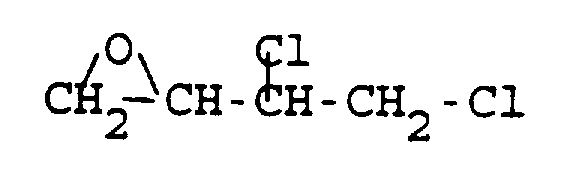
- Process according to Claim 6 wherein the process is carried out at a temperature of -10 to 20°C and in the presence of a solvent selected from chlorinated hydrocarbons and a catalytic amount of a hydrochloride of a tertiary amine having the general formula:

- Process according to Claim 7 wherein the tertiary amine is triethylamine or pyridine and the solvent is dichloromethane.
Applications Claiming Priority (3)
| Application Number | Priority Date | Filing Date | Title |
|---|---|---|---|
| US43072 | 1993-04-05 | ||
| US08/043,072 US5264595A (en) | 1993-04-05 | 1993-04-05 | Process for the preparation of 3,4-dihalo-1,2-epoxybutanes from 3,4-epoxy-1-butene |
| PCT/US1994/003062 WO1994022847A1 (en) | 1993-04-05 | 1994-03-23 | Process for the preparation of 3,4-dihalo-1,2-epoxybutanes from 3,4-epoxy-1-butene |
Publications (2)
| Publication Number | Publication Date |
|---|---|
| EP0693063A1 EP0693063A1 (en) | 1996-01-24 |
| EP0693063B1 true EP0693063B1 (en) | 1997-07-30 |
Family
ID=21925342
Family Applications (1)
| Application Number | Title | Priority Date | Filing Date |
|---|---|---|---|
| EP94912831A Expired - Lifetime EP0693063B1 (en) | 1993-04-05 | 1994-03-23 | Process for the preparation of 3,4-dihalo-1,2-epoxybutanes from 3,4-epoxy-1-butene |
Country Status (8)
| Country | Link |
|---|---|
| US (1) | US5264595A (en) |
| EP (1) | EP0693063B1 (en) |
| JP (1) | JPH08508494A (en) |
| CA (1) | CA2159004A1 (en) |
| DE (1) | DE69404641T2 (en) |
| ES (1) | ES2105685T3 (en) |
| SG (1) | SG47790A1 (en) |
| WO (1) | WO1994022847A1 (en) |
Families Citing this family (2)
| Publication number | Priority date | Publication date | Assignee | Title |
|---|---|---|---|---|
| US5264595A (en) * | 1993-04-05 | 1993-11-23 | Eastman Kodak Company | Process for the preparation of 3,4-dihalo-1,2-epoxybutanes from 3,4-epoxy-1-butene |
| JP5655281B2 (en) * | 2008-06-10 | 2015-01-21 | 東ソー株式会社 | Chlorinated polyether and polyurethane comprising the same |
Family Cites Families (3)
| Publication number | Priority date | Publication date | Assignee | Title |
|---|---|---|---|---|
| DE2537681C2 (en) * | 1975-08-23 | 1983-08-11 | Basf Ag, 6700 Ludwigshafen | Process for the isolation of the isomeric 1,4-dibromo-epoxy-cyclohexenes |
| US5103028A (en) * | 1991-09-09 | 1992-04-07 | Eastman Kodak Company | Process for the preparation of 3,4-dihalo-1,2-epoxybutanes |
| US5264595A (en) * | 1993-04-05 | 1993-11-23 | Eastman Kodak Company | Process for the preparation of 3,4-dihalo-1,2-epoxybutanes from 3,4-epoxy-1-butene |
-
1993
- 1993-04-05 US US08/043,072 patent/US5264595A/en not_active Expired - Fee Related
-
1994
- 1994-03-23 EP EP94912831A patent/EP0693063B1/en not_active Expired - Lifetime
- 1994-03-23 CA CA002159004A patent/CA2159004A1/en not_active Abandoned
- 1994-03-23 ES ES94912831T patent/ES2105685T3/en not_active Expired - Lifetime
- 1994-03-23 DE DE69404641T patent/DE69404641T2/en not_active Expired - Fee Related
- 1994-03-23 WO PCT/US1994/003062 patent/WO1994022847A1/en not_active Ceased
- 1994-03-23 JP JP6522149A patent/JPH08508494A/en active Pending
- 1994-03-23 SG SG1996004382A patent/SG47790A1/en unknown
Also Published As
| Publication number | Publication date |
|---|---|
| CA2159004A1 (en) | 1994-10-13 |
| US5264595A (en) | 1993-11-23 |
| SG47790A1 (en) | 1998-04-17 |
| EP0693063A1 (en) | 1996-01-24 |
| ES2105685T3 (en) | 1997-10-16 |
| DE69404641D1 (en) | 1997-09-04 |
| WO1994022847A1 (en) | 1994-10-13 |
| JPH08508494A (en) | 1996-09-10 |
| DE69404641T2 (en) | 1997-11-27 |
Similar Documents
| Publication | Publication Date | Title |
|---|---|---|
| EP1620396B1 (en) | Process for the preparation of n-substituted 2-cyanopyrrolidines | |
| EP0132764B1 (en) | Derivatives of dihydrodibenzocycloheptylidene-ethylamine | |
| JPH0788350B2 (en) | Method for producing N-fluorosulfonamide | |
| JP3662038B2 (en) | Method for producing epoxy compound | |
| Umemoto et al. | Perfluoroalkylation of aromatic compounds with RfI (Ph) OSO2CF3. | |
| CS226444B2 (en) | Method of preparing 2,3-dichloro-5-trichloromethylpyridine | |
| EP0605508B1 (en) | Process for the preparation of 3,4-dihalo-1,2-epoxybutanes | |
| US5264595A (en) | Process for the preparation of 3,4-dihalo-1,2-epoxybutanes from 3,4-epoxy-1-butene | |
| Kamierczak et al. | A simple, two-step conversion of various iodoarenes to (Diacetoxyiodo) arenes with Chromium (VI) oxide as the oxidant | |
| US5856570A (en) | Process for preparing 5-amino-2,4,6-triiodoisophthalic acid dichloride by chlorination of the corresponding acid in the presence of a tertiary amine salt or quaternary ammonium salt | |
| US4642399A (en) | Method for producing fluoronitrobenzene compounds | |
| EP0537600B1 (en) | An improved process for the preparation of 4-haloquinazolines | |
| US3470172A (en) | Process for producing certain amino substituted nitro pyridines | |
| US5710289A (en) | Process for the preparation of dihalotetrahydrofurans from dihydrofuran | |
| JP3596889B2 (en) | Improved process for producing N-fluorosulfonimides | |
| US4223166A (en) | Process for producing 4-bromo-2-chlorophenols | |
| Gensler et al. | N-Monoalkylation of sulfonamides | |
| JP3814944B2 (en) | Process for producing dialkyl carbonate | |
| JP3805788B2 (en) | Method for producing cyanopyridines | |
| JPH03258768A (en) | Preparation of 1,3,5-perhydrotriazine-2,4,6-trithione derivative | |
| CZ20002260A3 (en) | Process for preparing chlorobenzoxazoles | |
| HU201527B (en) | Process for producing substituted (dichloromethyl)-pyridines | |
| JP2609147B2 (en) | Method for producing 2,4-diamino-6-substituted-pyrimidine-3-oxide | |
| JPS58219163A (en) | Preparation of fluoroheterocyclic compound | |
| JPS6351148B2 (en) |
Legal Events
| Date | Code | Title | Description |
|---|---|---|---|
| PUAI | Public reference made under article 153(3) epc to a published international application that has entered the european phase |
Free format text: ORIGINAL CODE: 0009012 |
|
| 17P | Request for examination filed |
Effective date: 19950918 |
|
| AK | Designated contracting states |
Kind code of ref document: A1 Designated state(s): BE DE ES FR GB IT NL |
|
| 17Q | First examination report despatched |
Effective date: 19960607 |
|
| GRAG | Despatch of communication of intention to grant |
Free format text: ORIGINAL CODE: EPIDOS AGRA |
|
| GRAH | Despatch of communication of intention to grant a patent |
Free format text: ORIGINAL CODE: EPIDOS IGRA |
|
| GRAH | Despatch of communication of intention to grant a patent |
Free format text: ORIGINAL CODE: EPIDOS IGRA |
|
| GRAA | (expected) grant |
Free format text: ORIGINAL CODE: 0009210 |
|
| AK | Designated contracting states |
Kind code of ref document: B1 Designated state(s): BE DE ES FR GB IT NL |
|
| PG25 | Lapsed in a contracting state [announced via postgrant information from national office to epo] |
Ref country code: BE Effective date: 19970730 |
|
| REF | Corresponds to: |
Ref document number: 69404641 Country of ref document: DE Date of ref document: 19970904 |
|
| ITF | It: translation for a ep patent filed | ||
| REG | Reference to a national code |
Ref country code: ES Ref legal event code: FG2A Ref document number: 2105685 Country of ref document: ES Kind code of ref document: T3 |
|
| ET | Fr: translation filed | ||
| PLBE | No opposition filed within time limit |
Free format text: ORIGINAL CODE: 0009261 |
|
| STAA | Information on the status of an ep patent application or granted ep patent |
Free format text: STATUS: NO OPPOSITION FILED WITHIN TIME LIMIT |
|
| 26N | No opposition filed | ||
| PGFP | Annual fee paid to national office [announced via postgrant information from national office to epo] |
Ref country code: ES Payment date: 19990318 Year of fee payment: 6 |
|
| PGFP | Annual fee paid to national office [announced via postgrant information from national office to epo] |
Ref country code: NL Payment date: 19991213 Year of fee payment: 7 |
|
| PGFP | Annual fee paid to national office [announced via postgrant information from national office to epo] |
Ref country code: DE Payment date: 19991229 Year of fee payment: 7 |
|
| PGFP | Annual fee paid to national office [announced via postgrant information from national office to epo] |
Ref country code: GB Payment date: 20000204 Year of fee payment: 7 |
|
| PGFP | Annual fee paid to national office [announced via postgrant information from national office to epo] |
Ref country code: FR Payment date: 20000303 Year of fee payment: 7 |
|
| PG25 | Lapsed in a contracting state [announced via postgrant information from national office to epo] |
Ref country code: ES Free format text: LAPSE BECAUSE OF NON-PAYMENT OF DUE FEES Effective date: 20000324 |
|
| PG25 | Lapsed in a contracting state [announced via postgrant information from national office to epo] |
Ref country code: GB Free format text: LAPSE BECAUSE OF NON-PAYMENT OF DUE FEES Effective date: 20010323 |
|
| PG25 | Lapsed in a contracting state [announced via postgrant information from national office to epo] |
Ref country code: NL Free format text: LAPSE BECAUSE OF NON-PAYMENT OF DUE FEES Effective date: 20011001 |
|
| GBPC | Gb: european patent ceased through non-payment of renewal fee |
Effective date: 20010323 |
|
| PG25 | Lapsed in a contracting state [announced via postgrant information from national office to epo] |
Ref country code: FR Free format text: LAPSE BECAUSE OF NON-PAYMENT OF DUE FEES Effective date: 20011130 |
|
| REG | Reference to a national code |
Ref country code: ES Ref legal event code: FD2A Effective date: 20010910 |
|
| NLV4 | Nl: lapsed or anulled due to non-payment of the annual fee |
Effective date: 20011001 |
|
| REG | Reference to a national code |
Ref country code: FR Ref legal event code: ST |
|
| PG25 | Lapsed in a contracting state [announced via postgrant information from national office to epo] |
Ref country code: DE Free format text: LAPSE BECAUSE OF NON-PAYMENT OF DUE FEES Effective date: 20020101 |
|
| PG25 | Lapsed in a contracting state [announced via postgrant information from national office to epo] |
Ref country code: IT Free format text: LAPSE BECAUSE OF NON-PAYMENT OF DUE FEES Effective date: 20050323 |