EP0692147B1 - Improved processing of bscco-2223 oxide superconductors - Google Patents
Improved processing of bscco-2223 oxide superconductors Download PDFInfo
- Publication number
- EP0692147B1 EP0692147B1 EP94915352A EP94915352A EP0692147B1 EP 0692147 B1 EP0692147 B1 EP 0692147B1 EP 94915352 A EP94915352 A EP 94915352A EP 94915352 A EP94915352 A EP 94915352A EP 0692147 B1 EP0692147 B1 EP 0692147B1
- Authority
- EP
- European Patent Office
- Prior art keywords
- oxide superconductor
- article
- phase
- bscco
- heat treatment
- Prior art date
- Legal status (The legal status is an assumption and is not a legal conclusion. Google has not performed a legal analysis and makes no representation as to the accuracy of the status listed.)
- Expired - Lifetime
Links
- 239000002887 superconductor Substances 0.000 title claims abstract description 265
- 238000012545 processing Methods 0.000 title description 39
- QVGXLLKOCUKJST-UHFFFAOYSA-N atomic oxygen Chemical compound [O] QVGXLLKOCUKJST-UHFFFAOYSA-N 0.000 claims abstract description 89
- 239000001301 oxygen Substances 0.000 claims abstract description 89
- 229910052760 oxygen Inorganic materials 0.000 claims abstract description 89
- 238000000034 method Methods 0.000 claims abstract description 76
- 238000010438 heat treatment Methods 0.000 claims description 138
- 239000012071 phase Substances 0.000 claims description 103
- 239000007791 liquid phase Substances 0.000 claims description 54
- 239000002131 composite material Substances 0.000 claims description 43
- 230000007547 defect Effects 0.000 claims description 32
- 238000002844 melting Methods 0.000 claims description 30
- 230000008018 melting Effects 0.000 claims description 30
- 239000002243 precursor Substances 0.000 claims description 21
- 239000011159 matrix material Substances 0.000 claims description 12
- 238000000354 decomposition reaction Methods 0.000 claims description 11
- 208000036822 Small cell carcinoma of the ovary Diseases 0.000 claims description 9
- 229910052745 lead Inorganic materials 0.000 claims description 9
- 201000005292 ovarian small cell carcinoma Diseases 0.000 claims description 9
- 238000005096 rolling process Methods 0.000 claims description 8
- 238000001816 cooling Methods 0.000 claims description 6
- 238000003825 pressing Methods 0.000 claims description 6
- 230000009466 transformation Effects 0.000 claims description 5
- 230000001939 inductive effect Effects 0.000 claims description 4
- 239000000155 melt Substances 0.000 claims description 4
- 229910052799 carbon Inorganic materials 0.000 claims description 3
- 238000005242 forging Methods 0.000 claims description 2
- 238000001125 extrusion Methods 0.000 claims 1
- 238000000462 isostatic pressing Methods 0.000 claims 1
- 238000000137 annealing Methods 0.000 abstract description 34
- 239000000523 sample Substances 0.000 abstract description 29
- 230000007704 transition Effects 0.000 abstract description 19
- 230000008569 process Effects 0.000 description 29
- 239000000203 mixture Substances 0.000 description 22
- 238000006243 chemical reaction Methods 0.000 description 19
- 230000006872 improvement Effects 0.000 description 19
- BQCADISMDOOEFD-UHFFFAOYSA-N Silver Chemical compound [Ag] BQCADISMDOOEFD-UHFFFAOYSA-N 0.000 description 16
- 230000015572 biosynthetic process Effects 0.000 description 16
- 239000007788 liquid Substances 0.000 description 16
- 229910052709 silver Inorganic materials 0.000 description 16
- 239000004332 silver Substances 0.000 description 16
- 239000000463 material Substances 0.000 description 13
- XKRFYHLGVUSROY-UHFFFAOYSA-N Argon Chemical compound [Ar] XKRFYHLGVUSROY-UHFFFAOYSA-N 0.000 description 12
- 239000010949 copper Substances 0.000 description 10
- 239000000843 powder Substances 0.000 description 10
- 239000007787 solid Substances 0.000 description 9
- 230000000694 effects Effects 0.000 description 8
- 230000009467 reduction Effects 0.000 description 8
- 230000008901 benefit Effects 0.000 description 7
- 230000007423 decrease Effects 0.000 description 7
- 238000011282 treatment Methods 0.000 description 7
- 229910052786 argon Inorganic materials 0.000 description 6
- 230000035876 healing Effects 0.000 description 6
- 238000005259 measurement Methods 0.000 description 6
- 230000003247 decreasing effect Effects 0.000 description 5
- 238000010586 diagram Methods 0.000 description 5
- 230000005415 magnetization Effects 0.000 description 5
- 238000010587 phase diagram Methods 0.000 description 5
- IJGRMHOSHXDMSA-UHFFFAOYSA-N Atomic nitrogen Chemical compound N#N IJGRMHOSHXDMSA-UHFFFAOYSA-N 0.000 description 4
- 229910052797 bismuth Inorganic materials 0.000 description 4
- 238000007796 conventional method Methods 0.000 description 4
- 230000005496 eutectics Effects 0.000 description 4
- 239000007789 gas Substances 0.000 description 4
- 229910044991 metal oxide Inorganic materials 0.000 description 4
- 150000004706 metal oxides Chemical class 0.000 description 4
- 238000002360 preparation method Methods 0.000 description 4
- 239000007790 solid phase Substances 0.000 description 4
- 229910001316 Ag alloy Inorganic materials 0.000 description 3
- 239000005751 Copper oxide Substances 0.000 description 3
- JCXGWMGPZLAOME-UHFFFAOYSA-N bismuth atom Chemical compound [Bi] JCXGWMGPZLAOME-UHFFFAOYSA-N 0.000 description 3
- 239000000470 constituent Substances 0.000 description 3
- 229910000431 copper oxide Inorganic materials 0.000 description 3
- 229960004643 cupric oxide Drugs 0.000 description 3
- 238000004455 differential thermal analysis Methods 0.000 description 3
- 238000009792 diffusion process Methods 0.000 description 3
- 239000011261 inert gas Substances 0.000 description 3
- 238000004519 manufacturing process Methods 0.000 description 3
- 238000002156 mixing Methods 0.000 description 3
- 229910000510 noble metal Inorganic materials 0.000 description 3
- 230000003287 optical effect Effects 0.000 description 3
- 239000008188 pellet Substances 0.000 description 3
- 239000006104 solid solution Substances 0.000 description 3
- VTYYLEPIZMXCLO-UHFFFAOYSA-L Calcium carbonate Chemical compound [Ca+2].[O-]C([O-])=O VTYYLEPIZMXCLO-UHFFFAOYSA-L 0.000 description 2
- QPLDLSVMHZLSFG-UHFFFAOYSA-N Copper oxide Chemical compound [Cu]=O QPLDLSVMHZLSFG-UHFFFAOYSA-N 0.000 description 2
- 238000002441 X-ray diffraction Methods 0.000 description 2
- 229910000287 alkaline earth metal oxide Inorganic materials 0.000 description 2
- WMWLMWRWZQELOS-UHFFFAOYSA-N bismuth(iii) oxide Chemical compound O=[Bi]O[Bi]=O WMWLMWRWZQELOS-UHFFFAOYSA-N 0.000 description 2
- 239000002775 capsule Substances 0.000 description 2
- 230000008859 change Effects 0.000 description 2
- 230000001419 dependent effect Effects 0.000 description 2
- 238000002474 experimental method Methods 0.000 description 2
- 235000012054 meals Nutrition 0.000 description 2
- 229910052751 metal Inorganic materials 0.000 description 2
- 229910001092 metal group alloy Inorganic materials 0.000 description 2
- 229910003455 mixed metal oxide Inorganic materials 0.000 description 2
- 229910052757 nitrogen Inorganic materials 0.000 description 2
- 238000006213 oxygenation reaction Methods 0.000 description 2
- 150000003839 salts Chemical class 0.000 description 2
- 238000003746 solid phase reaction Methods 0.000 description 2
- 238000010671 solid-state reaction Methods 0.000 description 2
- 238000006467 substitution reaction Methods 0.000 description 2
- VZSRBBMJRBPUNF-UHFFFAOYSA-N 2-(2,3-dihydro-1H-inden-2-ylamino)-N-[3-oxo-3-(2,4,6,7-tetrahydrotriazolo[4,5-c]pyridin-5-yl)propyl]pyrimidine-5-carboxamide Chemical compound C1C(CC2=CC=CC=C12)NC1=NC=C(C=N1)C(=O)NCCC(N1CC2=C(CC1)NN=N2)=O VZSRBBMJRBPUNF-UHFFFAOYSA-N 0.000 description 1
- OKTJSMMVPCPJKN-UHFFFAOYSA-N Carbon Chemical compound [C] OKTJSMMVPCPJKN-UHFFFAOYSA-N 0.000 description 1
- RYGMFSIKBFXOCR-UHFFFAOYSA-N Copper Chemical compound [Cu] RYGMFSIKBFXOCR-UHFFFAOYSA-N 0.000 description 1
- 229910017770 Cu—Ag Inorganic materials 0.000 description 1
- AFCARXCZXQIEQB-UHFFFAOYSA-N N-[3-oxo-3-(2,4,6,7-tetrahydrotriazolo[4,5-c]pyridin-5-yl)propyl]-2-[[3-(trifluoromethoxy)phenyl]methylamino]pyrimidine-5-carboxamide Chemical compound O=C(CCNC(=O)C=1C=NC(=NC=1)NCC1=CC(=CC=C1)OC(F)(F)F)N1CC2=C(CC1)NN=N2 AFCARXCZXQIEQB-UHFFFAOYSA-N 0.000 description 1
- 229910003097 YBa2Cu3O7−δ Inorganic materials 0.000 description 1
- OSOKRZIXBNTTJX-UHFFFAOYSA-N [O].[Ca].[Cu].[Sr].[Bi] Chemical compound [O].[Ca].[Cu].[Sr].[Bi] OSOKRZIXBNTTJX-UHFFFAOYSA-N 0.000 description 1
- 229910045601 alloy Inorganic materials 0.000 description 1
- 239000000956 alloy Substances 0.000 description 1
- 229910052787 antimony Inorganic materials 0.000 description 1
- WATWJIUSRGPENY-UHFFFAOYSA-N antimony atom Chemical compound [Sb] WATWJIUSRGPENY-UHFFFAOYSA-N 0.000 description 1
- 238000013459 approach Methods 0.000 description 1
- 238000001354 calcination Methods 0.000 description 1
- 229910000019 calcium carbonate Inorganic materials 0.000 description 1
- 239000004568 cement Substances 0.000 description 1
- 239000000919 ceramic Substances 0.000 description 1
- 238000001311 chemical methods and process Methods 0.000 description 1
- 238000009694 cold isostatic pressing Methods 0.000 description 1
- 230000000052 comparative effect Effects 0.000 description 1
- 239000013068 control sample Substances 0.000 description 1
- 229910052802 copper Inorganic materials 0.000 description 1
- 238000005336 cracking Methods 0.000 description 1
- 230000002939 deleterious effect Effects 0.000 description 1
- 230000001627 detrimental effect Effects 0.000 description 1
- 238000011161 development Methods 0.000 description 1
- 238000005538 encapsulation Methods 0.000 description 1
- 238000005516 engineering process Methods 0.000 description 1
- 238000013213 extrapolation Methods 0.000 description 1
- 230000008570 general process Effects 0.000 description 1
- PCHJSUWPFVWCPO-UHFFFAOYSA-N gold Chemical compound [Au] PCHJSUWPFVWCPO-UHFFFAOYSA-N 0.000 description 1
- 229910052737 gold Inorganic materials 0.000 description 1
- 239000010931 gold Substances 0.000 description 1
- 238000000227 grinding Methods 0.000 description 1
- 229910052734 helium Inorganic materials 0.000 description 1
- 239000001307 helium Substances 0.000 description 1
- SWQJXJOGLNCZEY-UHFFFAOYSA-N helium atom Chemical compound [He] SWQJXJOGLNCZEY-UHFFFAOYSA-N 0.000 description 1
- 239000008241 heterogeneous mixture Substances 0.000 description 1
- 238000001513 hot isostatic pressing Methods 0.000 description 1
- 238000009413 insulation Methods 0.000 description 1
- 238000011835 investigation Methods 0.000 description 1
- 230000002427 irreversible effect Effects 0.000 description 1
- 238000012804 iterative process Methods 0.000 description 1
- XMFOQHDPRMAJNU-UHFFFAOYSA-N lead(II,IV) oxide Inorganic materials O1[Pb]O[Pb]11O[Pb]O1 XMFOQHDPRMAJNU-UHFFFAOYSA-N 0.000 description 1
- 238000005551 mechanical alloying Methods 0.000 description 1
- 230000007246 mechanism Effects 0.000 description 1
- 238000010309 melting process Methods 0.000 description 1
- 239000002184 metal Substances 0.000 description 1
- 229910001960 metal nitrate Inorganic materials 0.000 description 1
- 230000003278 mimic effect Effects 0.000 description 1
- 229910052759 nickel Inorganic materials 0.000 description 1
- 238000010943 off-gassing Methods 0.000 description 1
- 230000001151 other effect Effects 0.000 description 1
- 230000003647 oxidation Effects 0.000 description 1
- 238000007254 oxidation reaction Methods 0.000 description 1
- 230000037361 pathway Effects 0.000 description 1
- 238000012805 post-processing Methods 0.000 description 1
- 238000003672 processing method Methods 0.000 description 1
- 239000000376 reactant Substances 0.000 description 1
- 230000035484 reaction time Effects 0.000 description 1
- 238000002407 reforming Methods 0.000 description 1
- 238000011160 research Methods 0.000 description 1
- 238000000518 rheometry Methods 0.000 description 1
- 239000004065 semiconductor Substances 0.000 description 1
- 241000894007 species Species 0.000 description 1
- 239000007858 starting material Substances 0.000 description 1
- LEDMRZGFZIAGGB-UHFFFAOYSA-L strontium carbonate Chemical compound [Sr+2].[O-]C([O-])=O LEDMRZGFZIAGGB-UHFFFAOYSA-L 0.000 description 1
- 229910000018 strontium carbonate Inorganic materials 0.000 description 1
- 239000000126 substance Substances 0.000 description 1
- 230000001360 synchronised effect Effects 0.000 description 1
- 238000007669 thermal treatment Methods 0.000 description 1
- 238000000427 thin-film deposition Methods 0.000 description 1
- 229910021521 yttrium barium copper oxide Inorganic materials 0.000 description 1
Images


Classifications
-
- H—ELECTRICITY
- H10—SEMICONDUCTOR DEVICES; ELECTRIC SOLID-STATE DEVICES NOT OTHERWISE PROVIDED FOR
- H10N—ELECTRIC SOLID-STATE DEVICES NOT OTHERWISE PROVIDED FOR
- H10N60/00—Superconducting devices
- H10N60/01—Manufacture or treatment
- H10N60/0268—Manufacture or treatment of devices comprising copper oxide
- H10N60/0661—Processes performed after copper oxide formation, e.g. patterning
-
- Y—GENERAL TAGGING OF NEW TECHNOLOGICAL DEVELOPMENTS; GENERAL TAGGING OF CROSS-SECTIONAL TECHNOLOGIES SPANNING OVER SEVERAL SECTIONS OF THE IPC; TECHNICAL SUBJECTS COVERED BY FORMER USPC CROSS-REFERENCE ART COLLECTIONS [XRACs] AND DIGESTS
- Y10—TECHNICAL SUBJECTS COVERED BY FORMER USPC
- Y10S—TECHNICAL SUBJECTS COVERED BY FORMER USPC CROSS-REFERENCE ART COLLECTIONS [XRACs] AND DIGESTS
- Y10S505/00—Superconductor technology: apparatus, material, process
- Y10S505/725—Process of making or treating high tc, above 30 k, superconducting shaped material, article, or device
- Y10S505/742—Annealing
-
- Y—GENERAL TAGGING OF NEW TECHNOLOGICAL DEVELOPMENTS; GENERAL TAGGING OF CROSS-SECTIONAL TECHNOLOGIES SPANNING OVER SEVERAL SECTIONS OF THE IPC; TECHNICAL SUBJECTS COVERED BY FORMER USPC CROSS-REFERENCE ART COLLECTIONS [XRACs] AND DIGESTS
- Y10—TECHNICAL SUBJECTS COVERED BY FORMER USPC
- Y10S—TECHNICAL SUBJECTS COVERED BY FORMER USPC CROSS-REFERENCE ART COLLECTIONS [XRACs] AND DIGESTS
- Y10S505/00—Superconductor technology: apparatus, material, process
- Y10S505/775—High tc, above 30 k, superconducting material
- Y10S505/776—Containing transition metal oxide with rare earth or alkaline earth
- Y10S505/782—Bismuth-, e.g. BiCaSrCuO
-
- Y—GENERAL TAGGING OF NEW TECHNOLOGICAL DEVELOPMENTS; GENERAL TAGGING OF CROSS-SECTIONAL TECHNOLOGIES SPANNING OVER SEVERAL SECTIONS OF THE IPC; TECHNICAL SUBJECTS COVERED BY FORMER USPC CROSS-REFERENCE ART COLLECTIONS [XRACs] AND DIGESTS
- Y10—TECHNICAL SUBJECTS COVERED BY FORMER USPC
- Y10S—TECHNICAL SUBJECTS COVERED BY FORMER USPC CROSS-REFERENCE ART COLLECTIONS [XRACs] AND DIGESTS
- Y10S505/00—Superconductor technology: apparatus, material, process
- Y10S505/775—High tc, above 30 k, superconducting material
- Y10S505/785—Composition containing superconducting material and diverse nonsuperconducting material
Definitions
- the present invention relates to high-performance oxide superconductors and oxide superconductor composites.
- the present invention further relates to a method for healing defects introduced into the oxide superconductor phase during processing thereby improving superconducting properties. More particularly, the present invention relates to the processing of specific high performance bismuth-strontium-calcium-copper oxide superconductors and oxide superconductor composites and a method for improving the critical transition temperature (T c ) and critical current density (J c ) of these oxide superconductors.
- Oxide superconductors of the rare earth-barium-copper-oxide family (YBCO), bismuth(lead)-strontium-calcium-copper-oxide family ((Bi,Pb)SCCO) and thallium-barium-calcium-copper-oxide family (TBCCO) form plate-like and highly anisotropic superconducting oxide grains. Because of their plate-like morphology, the oxide grains can be oriented by mechanical strain. Mechanical deformation has been used to induce grain alignment of the oxide superconductor c-axis perpendicular to the plane or direction of elongation. The degree of alignment of the oxide superconductor grains is a major factor in the high critical current densities (J c ) obtained in articles prepared from these materials.
- YBCO rare earth-barium-copper-oxide family
- (Bi,Pb)SCCO) bismuth(lead)-strontium-calcium-copper-oxide family
- THCCO
- Known processing methods for obtaining textured oxide superconductor composite articles include an iterative process of alternating heating and deformation steps.
- the heat treatment is used to promote reaction-induced texture of the oxide superconductor in which the anisotropic growth of the superconducting grains is enhanced.
- Each deformation provides an incremental improvement in the orientation of the oxide grains.
- Additional heat treatment intermediate with or subsequent to deformation is also required to form the correct oxide superconductor phase, promote good grain interconnectivity and achieve proper oxygenation.
- Liquid phases in co-existence with solid oxide phases have been used in processing of oxide superconductors.
- One type of partial melting known as peritectic decomposition, takes advantage of liquid phases which form at peritectic points of the phase diagram containing the oxide superconductor.
- peritectic decomposition the oxide superconductor remains a solid until the peritectic temperature is reached, at which point the oxide superconductor decomposes into a liquid phase and a new solid phase.
- Peritectic decomposition of an oxide superconductor and the reformation of the oxide superconductor from the liquid + solid phase is the basis for melt textured growth of YBCO-123 and BSCCO-2212.
- Kase et al . in IEEE Trans. Mag. 27(2), 1254 (Mar. 1991) report obtaining highly textured BSCCO-2212 by slowly cooling through the peritectic point. This process necessarily involves total decomposition of the desired 2212 phase into an alkaline earth oxide and a liquid phase.
- an oxide superconductor itself can co-exist with a liquid phase under suitable processing conditions. This may occur by solid solution melting, eutectic melting or by formation of non-equilibrium liquids.
- Solid solution melting may arise in a phase system, in which the oxide superconductor is a solid solution.
- the oxide superconductor phase changes from a solid oxide phase to a liquid plus oxide superconductor partial melt (this happens at the solidus).
- a further increase in temperature (or some other controlling parameter) affords the complete melting of the oxide superconductor (this happens at the liquidus).
- a phase diagram containing a eutectic point may provide an oxide superconductor partial melt, known as eutectic melting, when the overall composition is chosen so as to be slightly off stoichiometry.
- eutectic melting oxide superconductor partial melt
- the temperature (or some other controlling parameter) of the system increases (or decreases)
- the mixed phase of oxide superconductor-plus-non-superconducting oxide (solid 1 + solid 2 ) changes to a liquid-plus-oxide superconductor partial melt (solid 1 + liquid).
- Non-equilibrium liquids may also promote partial melting in oxide superconductor systems.
- a non-equilibrium liquid is established through the relatively rapid heating of a mixture of oxides to a temperature above the eutectic melting point of local stoichiometries present in the heterogeneous mixture of phases.
- the oxides form the desired oxide superconductor, the solid and liquid phases can co-exist, if only temporarily.
- PFDR phase formation-decomposition-reformation
- the superconducting an constantly seeks to improve electrical properties, such as, critical current density and critical transition temperature.
- Partial melting in the processing of oxide superconductors has been used either to increase the yield of the BSCCO-2223 phase or to improve the contiguity and texturing of the oxide superconductor grains.
- the issue of healing defects, such as microcracks, which develop during deformation processing of the oxide superconductor, has in been addressed.
- the prior art has not addressed the possibility of using a two-step process where the oxide superconductor is stable in both steps for the healing of cracks and defects.
- Idemoto et al. Physica C 181 , 171-178 (1991) has investigated the oxygen content and copper and bismuth valances of BSCCO-2223 under a range of conditions, including temperatures m the range of 500 °C to 850 °C and oxygen pressures in the range of 0.005 to 0.20 atm.
- the samples were observed by means of a microbalance under changing temperatures conditions at constant oxygen pressures. Because the samples do not reach equilibrium during the observation period, it is difficult to determine the exact processing conditions experienced by the samples. No investigation of the effect of reported conditions on electrical properties is reported.
- a further object of the present invention is to provide a process to increase the critical current density of BSCCO-2223 by a method which also increases its critical transition temperature. It is a further object of the present invention to provide a novel high-T c BSCCO-2223 composition having a critical transition temperature greater than 111.0 K.
- a feature of the invention is a two-step heat treatment after which no further deformation occurs which introduces a small amount of a liquid phase co-existing with the oxide superconductor phase, and then transforms the liquid back into the oxide superconductor phase with no deformation occurring during or after the heat treatment of the invention.
- a further feature of the present invention is a low temperature, low oxygen pressure anneal of the oxide superconductor.
- An advantage of the invention is the production of highly defect-free oxide superconductor and superconducting composites which exhibit superior critical current densities.
- a further advantage of the invention is a marked improvement in critical transition temperature and critical current density as compared to oxide superconductors and superconducting composites which are not subjected to the method of the invention.
- EP-A-0,390,499 discloses in detail a deformation-less, partial melt process for preparing BSCCO type superconductor; the product obtained and the critical temperatures reported are typical of a BSCCO-2212 superconductor.
- EP-A-0,499,411 discloses a method by which a BSCCO-2212 superconductor is obtained, notwithstanding the starting material has a 2223 stoichiometry.
- a method for preparing a BSCCO-2223 oxide superconductor article comprising the steps of:
- the liquid phase wets surfaces of defects contained within the oxide superconductor article, and then the defects are healed upon transformation of the liquid to the desired oxide superconductor.
- the partial melting of step (a) and the transformation of step (b) are effected by selection of appropriate thermodynamic state variables, for example, temperature, P 02 , P total and total composition.
- deformation may occur during the heat treatment of the present invention up to immediately prior to the completion of step (a), providing that the liquid phase is available for a period of time sufficient to wet defect surfaces.
- two-step heat treatment or "heat treatment of the invention” as those terms are used herein, it is meant a heat treatment for forming an oxide superconductor after which no further deformation occurs.
- heat treatments for purposes other than those stated herein, such as, for example, oxygenation of the oxide superconductor, are possible. In all cases, no further deformation occurs.
- partial melt as that term is used herein, it is meant the oxide superconductor article is only partially melted, and that the desired oxide superconductor is present during melting.
- deformation as that term is used herein, it is meant a process which causes a change in the cross-sectional shape of the article.
- oxide superconductor precursor any material that can be converted to the desired oxide superconductor upon application of a suitable heat treatment.
- Suitable precursor materials include but are not limited to metal salts, simple metal oxides, complex mixed metal oxides and intermediate oxide superconductors to the desired oxide superconductor.
- oxide superconductor By “desired oxide superconductor”, as that term is used herein, it is meant the oxide superconductor which it is desired to ultimately prepare.
- An oxide superconductor is typically the “desired” oxide superconductor because of superior electrical properties, such as high T c and/or J c .
- the desired oxide superconductor is a high T c member of a particular oxide superconductor family, namely BSCCO-2223.
- intermediate oxide superconductor an oxide superconductor which is capable of being converted into the desired oxide superconductor.
- an intermediate oxide superconductor may have desirable processing properties, which warrants its formation initially before final conversion into the desired oxide superconductor.
- the formation of an “intermediate oxide superconductor” may be desired, particularly during heat treatment/deformation iterations, where the intermediate oxides are more amenable to texturing than the desired oxide superconductor.
- a textured oxide superconductor article can be prepared by subjecting an article containing an oxide superconductor precursor to at least one first heat treatment/deformation iteration.
- the heat treatment is effective to form a desired oxide superconductor.
- the resultant oxide superconductor phase is textured upon application of the first heat treatment/deformation iteration.
- the article is then exposed to the two-step heat treatment in which (a) the article is partially melted, such that a liquid phase co-exists with the desired textured oxide superconductor phase; and (b) the liquid phase is transformed into the desired oxide superconductor, with no deformation occurring after the heat treatment of the invention.
- textured oxide superconductor article can be prepared by subjecting an article containing an oxide superconductor precursor to at least one first heat treatment/deformation iteration.
- the heat treatment is effective to form an intermediate oxide superconductor.
- the intermediate textured oxide superconductor phase is formed,
- the article is then subjected to as least one second heat treatment/deformation iteration.
- the heat treatment is effective to form the desired oxide superconductor.
- the article is then exposed to the two-step heat treatment in which (a) the article is partially melted, such that a liquid phase co-exists with the desired textured oxide superconductor phase; and (b) the liquid phase is transformed into the desired oxide superconductor, with no deformation occurring after the heat treatment of the inversion.
- the intermediate oxide superconductor is BSCCO-2212 or (Bi,Pb)SCCO-2212 because it is readily textured by the heat treatment/deformation iterations.
- the intermediate oxide superconductor is then converted to a desired oxide superconducting phase, typically BSCCO-2223 or (Bi,Pb)SCCO-2223.
- the transformation of the liquid in step (b) may be carried out at a temperature in the range of 790-820°C at 0.075 atm O 2 .
- the liquid phase is formed in the range of 0.1-30 vol %.
- the heat treatment of the first and second hear treatment/deformation iterations partially melts the oxide superconductor article.
- an oxide superconductor article is exposed to a two-step heat treatment after a deformation step, which includes (a) heating the article at a temperature in the range of 810-860°C for a period of time in the range of 0.1 to 300 hours at a P O2 in the range of 0.001-1.0 atm; and (b) cooling the article to a temperature in the range of 780-845°C for a period of time in the range of 1 to 300 hours at a P O2 in the range of 0.001-1.0 atm, with no deformation occurring after the heat treatment of the present invention.
- an oxide superconductor article containing a desired oxide superconductor phase is exposed to a two-step heat treatment after a deformation step, which includes (a) subjecting the article to an oxygen partial pressure sufficient to partially melt the oxide superconducting article, such that a liquid phase co-exists with the desired oxide superconductor; and (b) raising to an oxygen partial pressure sufficient to transform the liquid phase into the desired oxide superconductor.
- the present invention provides for a multifilamentary oxide superconductor composite containing a plurality of oxide superconductor filaments contained within a matrix material which has been subjected to the two-step heat treatment of the invention.
- Such a multifilamentary oxide superconductor composite can contain a plurality of oxide superconductor filaments contained within a matrix material, the composite having a J c of at least 14 x 10 3 A/cm 2 at 77K, self field, as measured over a length at at least 50 m.
- the present invention provides oxide superconductors which exhibit marked improvement in critical current density (J c ) over samples processed in an otherwise similar manner, lacking only the two-step heat treatment of the present invention.
- a BSCCO-2223 oxide superconducting article is prepared by providing an oxide superconductor article including BSCCO-2223 oxide superconductor, and annealing the superconducting article at a temperature selected from the range of 500°C ⁇ T ⁇ 787 °C and an annealing atmosphere having an oxygen pressure selected from within the region having a lower bound defined by the equation, P O2 lower) ⁇ 3.5 x 10 10 exp(-32,000/T + 273) and an upper bound defined by the equation, P O2 (upper) ⁇ 1.1 x 10 12 exp(-32,000/T + 273) .
- the sample is annealed for a time sufficient to provide at least a 10% increase in critical current density as compared to the critical current density of the pre-anneal oxide superconductor article.
- a BSCCO-2223 oxide superconducting article can be prepared by providing an oxide superconductor article including BSCCO-2223 oxide superconductor, and annealing the superconducting article at a temperature selected from the range of 500°C ⁇ T ⁇ 760 °C and an annealing atmosphere having an oxygen pressure selected from within the region having a lower bound defined by the equation, P O2 (lower) ⁇ 8.5 x 10 10 exp(-32,000/T + 273) and an upper bound defined by the equation, P O2 (upper) ⁇ 2.62 x 10 11 exp(-32,000/T + 273) .
- the sample is annealed for a time sufficient to provide at least a 10% increase in critical current density as compared to the critical current density of the pre-anneal oxide superconductor article.
- a BSCCO-2223 oxide superconductor article can be prepared by exposing the article including at least BSCCO-2223 to a heat treatment after deformation of the article, including (a) heating the article at a temperature in the range of 815-860°C for a period of time in the range of 0.1 to 300 hours at a P O2 in the range of 0.001-1.0 atm; and (b) subjecting the article to a temperature in the range of 790-845°C for a period of time in the range of 1 to 300 hours at a P O2 in the range of 0.01-1.0 atm, with no deformation occurring after the heat treatment.
- the superconducting article is then annealed at a temperature selected from the range of 500°C ⁇ T ⁇ 787 °C and an annealing atmosphere having an oxygen pressure selected from within the region having a lower bound defined by the equation, P O2 (lower) ⁇ 3.5 x 10 10 exp(-32,000/T + 273) and an upper bound defined by the equation, P O2 (upper) ⁇ 1.1 x 10 12 exp(-32,000/T + 273) .
- anneal of the present invention it is meant a low pressure, low temperature heat treatment under equilibrium conditions during which no further formation of the desired oxide superconducting phase occurs; however, the internal chemistry of the oxide superconductor (i.e.; oxygen stoichiometry) and grain growth of the existing oxide superconductor phase may be affected.
- the annealing atmosphere is substantially at a pressure of one atmosphere and oxygen pressure is obtained by controlling the oxygen concentration in the annealing atmosphere.
- the annealing atmosphere may additionally contain an inert gas selected from the group consisting of argon, nitrogen and helium.
- the anneal is carried out at an oxygen pressure substantially in the range of 7.5 x 10 -2 atm to 1 x 10 -8 atm O 2 .
- the annealing of the invention is preferably the final annealing to which the superconducting article is subjected.
- the anneal is carried out at a temperature in the range of 770 to 787°C and an oxygen pressure in the range of 0.017 to 0.085 atm.
- the anneal is carried out at a temperature in the range of 750 to 770°C and an oxygen pressure in the range of 0.0009 to 0.052 atm.
- the anneal can be carried out at a temperature in the range of 730 to 750°C and an oxygen pressure in the range of 0.005 to 0.029 atm.
- the anneal can be carried out at a temperature in the range of 690 to 730°C and an oxygen pressure in the range of 0.0001-0.015 atm.
- Further possibilities include carrying out the anneal at a temperature in the range of 740 to 760°C and an oxygen pressure in the range of 0.0016 to 0.009 atm, or at a temperature in the range of 710 to 740°C and an oxygen pressure in the range of 0.0006-0.005 atm, or at a temperature in the range of 690 to 710°C and an oxygen pressure in the range of 0.0003-0.002 atm.
- sample is annealed at progressively lower temperature and oxygen pressure. This may be accomplished by continuously reducing temperature and/or oxygen pressure or by stepwise reduction of temperature and/or oxygen pressure.
- the invention comprehends a superconductor having the formula Bi 2-y Pb y Sr 2 Ca 2 Cu 3 O 10+x , where 0 ⁇ x ⁇ 1.5 and where 0 ⁇ y ⁇ 0.6, the oxide superconductor characterized by a critical transition temperature of greater than 111.0 K as defined by zero resistance by a four point linear probe method with zero resistance corresponding to a resistivity of less than 10 -8 ⁇ -cm.
- An article containing the oxide superconductor may additionally include silver.
- an oxide superconductor article can be prepared which is characterized by a critical transition temperature of greater than 111.0 K as defined by zero resistance by a four point linear probe method with zero resistance corresponding to a resitivity of less than 10 -8 ⁇ -cm and an x-ray diffraction pattern having peaks at 17.4°, 19.2°, 20.2°, 21.8°, 23.2°, 23.9°, 26.2°, 27.8°, 29°, 29.7°, 31.5°, 32°, 33.2°, 33.7°, 35°, 35.6°, 38°, 38.8°, 41.6°, 43.8°, 44.4°, 46.8°, 47.4°, 48° and 49°.
- the present invention comprehends a multifilamentary oxide superconductor composite containing a plurality of oxide superconductor filaments contained within a matrix material which has been subjected to an anneal according to the present invention.
- the oxide superconductor prepared according to the method of this invention exhibit superior electric transport properties and enhanced T c .
- the present invention is a method for improving the critical current density of oxide superconductor articles by healing defects, such as micro- and macrocracks, incurred upon deformation.
- the present invention calls for a final two-step treatment after deformation of the oxide superconductor article, in which (a) a liquid phase is formed such that the liquid phase co-exists with the desired oxide superconductor; and (b) the liquid phase is then transformed into the desired oxide superconductor without any intermediate deformation.
- the method of the invention is used to heal defects in the superconducting article. It is recognized, that complete transformation of the liquid to the oxide superconductor occurs under ideal conditions and that, under some circumstances, not all of the liquid may be transformed into the desired oxide superconductor.
- the liquid phase is formed upon partial melting of the oxide superconductor article.
- non-superconducting materials and intermediate oxide phases may be present with the desired oxide superconductor phase.
- the desired oxide superconductor, the non-superconducting materials, oxide superconducting precursors, the desired oxide superconductor or a mixture of these components may melt to form the liquid phase.
- the above process which required that liquid co-exist with the desired oxide superconductor phase, is distinguished from those which involve the peritectic decomposition of the oxide superconductor, such as described by Guo et al. and Kase et al., in which the desired oxide superconductor decomposes during the melting process.
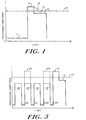
- Fig. 1 shows a processing profile of the final heat treatment of the invention.
- a dashed line 10 indicates a processing point at which a liquid phase is formed for a given set of processing conditions, e.g.. T, P O2 , P total and/or oxide composition.
- phase diagrams for BSCCO systems Processing conditions for obtaining the requisite liquid and solid oxide phases are well established and the relationship between temperature, oxygen partial pressure and total pressure is reasonably well understood.
- phase diagrams for BSCCO systems the interested reader is directed to "Phase Diagrams for High T c Superconductors", John D. Whitler arid Robert S. Roth, Ed.; American Ceramic Society, Waterville, OH.
- Presence of a liquid phase can also be determined experimentally by use of such conventional techniques as differential thermal analysis (DTA).
- DTA differential thermal analysis
- exothermic and endothermic reactions as a function of temperature can be identified and attributed to various thermodynamic and chemical processes. It is possible to identify endothermic processes corresponding to partial melting; i.e. liquid phase formation.
- volume percent of the liquid phase is typically in the range of 0.1 to 30.
- the oxide superconductor is deformed at a point 11 before the final heat treatment, at which time defects such as microcracks may be introduced into the article.
- Suitable deformation can include swaging, extruding, drawing, pressing, hot and cold isostatic pressing, rolling, and forging of wires, tapes and a variety of shaped articles.
- the method of the invention is particularly useful for oxide superconductor articles in which deformation processing introduces defects perpendicular to the direction of current flow.
- the deformation is largely plane strain, that is, extension in the length of the article entirely compensates for the reduction in thickness resulting in cracking in the transverse direction and perpendicular to the current flow.
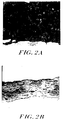
- Fig. 2a shows an optical photomicrograph of a pressed oxide superconductor filament without the final heat treatment of the invention. Many fine cracks are visible and clearly disrupt the percolative pathway for current flow. It is expected therefore, that rolled samples will benefit to a greater extent from the final heat treatment of the invention.
- the processing conditions are adjusted to bring the article to point 12 where the article is partially melted and a liquid phase co-exists with the desired oxide superconductor phase.
- the article is held at point 12 for a period of time during which the defect surfaces contained within the oxide superconductor are wet by the newly-formed liquid.
- a temperature of 820-835°C at 0.075 atm O 2 for 0.1-300 hours is sufficient.
- the processing parameters are then adjusted to bring the oxide superconductor to point 13 where the liquid phase is consumed and the desired oxide superconductor phase is formed from the melt.
- a temperature of 820-790°C at 0.073 atm O 2 for 1 to 300 hours is sufficient.
- the final heat treatment includes heating the article at a temperature of substantially in the range of 815°C to 860°C for a period of time substantially in the range of 0.1 to 300 h at a P O2 substantially in the range of 0.001-1.0 atm.
- the processing temperature will vary dependent upon the oxygen pressure. Additionally, variations in the chemical composition of the article will also affect selection of temperature and pressure. In particular, it has been noted that addition of silver to the oxide composition lowers the temperature range for partial melting, particularly at higher P O2 (0.1-1.0 atm).
- the two-step heat treatment heals cracks and other defects while effecting the final conversion of the oxide phases to the desired oxide superconductor phase.
- the formation of BSCCO-2223 from BSCCO-2212 is kinetically enhanced by the presence of the liquid phase, in part, due to the enhanced diffusivity of the oxide superconductor constituents.
- the partial melting during the final part of the process can perform two tasks. Firstly, the cracks formed during the prior deformation steps are healed by rapid growth of the oxide superconductor grains at the crack site. Secondly, the conversion rate of 2212 to 2223 is greatly accelerated, allowing the formation of a microscopically crack-free, interconnected 2223 phase.
- P O2 can be held constant and temperature can be raised to promote melting and formation of the liquid phase and lowered to regenerate the desired oxide superconductor.
- temperature can be held constant, and P O2 can be lowered to promote the partial melting of the oxide superconductor article and raised to reform the oxide superconductor.
- the processing conditions can be changed rapidly from point 12 to point 13 of the process (fast ramp rate).
- the oxide superconductor can be subjected to gradually changing conditions (of temperature or pressure) between point 12 and point 13 of the process designated by the curve 14 in Fig. 1 (slow ramp rate).
- the processing conditions can be slowly ramped from the processing conditions defined at point 12 to the processing conditions defined for point 13 . This process is illustrated by curve 15 in Fig. 1.
- Texture may be induced by reaction conditions and/or deformation.
- processing conditions are chosen to kinetically favor the anisotropic growth of oxide superconductor grains.
- Reaction-induced texture can occur in a solid phase system or, preferably, in a solid-plus-liquid phase system. The presence of a liquid phase enhances the kinetics of anisotropic grain growth, probably through increased rates of diffusion of the oxide components.
- deformation-induced texture a strain is applied to the superconducting article to induce alignment of the oxide grains in the plane or direction of elongation.
- Deformation-induced texture requires aspected grains or an anisotropic rheology in order to effect a preferential alignment of the grains.
- Fig. 3 shows a processing profile for a method of the invention used to obtain highly textured oxide superconductor articles.
- the general process for the formation of a textured oxide superconductor may consist of three distinct steps.
- an oxide superconductor precursor is subjected to one or more first heat treatment/deformation iterations, denoted by step 20 and step 21 , respectively, of Fig. 3.
- the oxide superconductor precursor can be any combination of materials which will yield the desired oxide superconductor upon reaction.
- it may be a metallic alloy containing the metallic constituents of the desired oxide superconductor and optionally containing silver.
- the constituent simple metal oxides, mixed metal oxides, meal salts and even intermediate oxide superconductors of the desired oxide superconductor may be used as a precursor.
- the precursor may optionally be mixed with a matrix meal, such as silver, and/or may be sheathed in a matrix material in a powder-in-tube configuration.
- the heat treatment 20 of the heat treatment/deformation iteration serves two purposes in the process. Firstly, the anneal is sufficient to form an oxide superconductor and results typically in a mixture of superconducting and secondary phases. "Secondary phases" include sub-oxide or non-superconducting oxide species which require further processing to form an oxide superconductor phase. BSCCO-2212 is often the intermediate oxide superconductor because it is readily textured during mechanical deformation. BSCCO-2223 is the desired oxide superconducting phase because of its high critical temperature. Secondly, the heat treatment promotes reaction-induced texture.
- the deformation 21 of the article promotes deformation-induced texture.
- One or more iterations can be performed.
- Fig. 3 shows two first heat treatment/deformation iterations, by way of example If more than one iteration is performed, both conversion to the superconducting phase and development of texture can be done in incremental stages.
- the second step of the process may consist of one or more second heat treatment/deformation iterations to form the desired oxide superconductor and to further texture the oxide superconductor phase.
- the article is heated in a step indicated by 22 whereby the desired oxide superconductor is formed and reaction-induced texture can occur. Secondary phases react with BSCCO-2212 to form the desired oxide superconductor. BSCCO-2223.
- the article is deformed in a subsequent step indicated by 23 , whereby deformation-induced texture can occur. If more than one iteration is used, only a portion of the intermediate oxide superconductor need be conversed into the desired oxide superconductor with each iteration. Conditions known to form intermediate and desired oxide superconductors are well known in the art. Suitable conditions are described in Sandhage, et al. JOM , 21 (Mar. 1991).
- the strain introduced in the deformation step can range up to 99%.
- the strains applied in each deformation/anneal iteration may be constant or they may be changed for each subsequent iteration. It is particularly desirable in some embodiments, to use decreasing strains with each subsequent iteration.
- step 24 It is also possible to adjust the processing conditions to promote partial melting during the heating step 20 or 22 of the heat treatment/deformation iterations, indicated by step 24 , to assist in grain growth and enhance reaction kinetics (reaction-induced texture). Heating in the range of 820-835°C in 0.075 atm O 2 and 1 atm total pressure for 0.1 to 100 hours is typical for partial melting to occur.
- the final part of the process consists of a two-step heat treatment in which
- the oxide superconductors which make up the oxide superconductor articles of the present invention are brittle and typically would not survive a mechanical deformation process, such as rolling or pressing. For this reason, the oxide superconductors of the present invention are typically processed as a composite material including a malleable matrix material. In particular, silver is preferred as the matrix material because of its cost, nobility and malleability.
- the oxide superconductor composite may be processed in any shape, however, the form of wires, tapes, rings or coils are particularly preferred.
- the oxide superconductor may be encased in a silver sheath, in a version of the powder-in-tube technology.
- the oxide superconductor can take the form of multiple filaments embedded within a silver matrix.
- the present invention may also call for a low temperature, low pressure annealing treatment after formation of a BSCCO-2223 oxide superconductor phase.
- the anneal is carried out in a low temperature, low pressure region which is within the phase stability region for BSCCO-2223.
- the phase stability region is that range of processing conditions for which BSCCO-2223 is a thermodynamically stable phase. Both oxygen pressure and temperature are known to be important (but not exclusive) processing parameters in determining the phase stability range of BSCCO-2223.
- the applicants have surprisingly discovered that an anneal of the BSCCO-2223 oxide superconductor according to the invention provides significant improvements in electrical properties, in particular. T c , I c and J c . Improvements of up to 10%. 20% 30% and even up to 50% in critical current upon annealing according to the invention has been observed. Bulk zero resistivity above 111.0 K after anneal also has been observed.
- the low temperature, low pressure anneal of the present invention is directed to Bi 2-y Pb y Sr 2 Ca 2 Cu 3 O 10+x, where 0 ⁇ x ⁇ 1.5 and 0 ⁇ y ⁇ 0.6.
- stated stoichiometries are all approximate. Intentional and unintentional variations in composition are contemplated.
- Such partial substitution of elements of the Bi 2 Sr 2 Ca 2 Cu 3 O 10+x oxide superconductor are contemplated within the scope of the invention and are considered represented within the notation "BSCCO-2223" used to describe the composition.
- the low pressure, low temperature anneal of the invention is effective to improve T c and J c of any BSCCO-2223 article regardless of the process used to form the oxide superconducting phase.
- the BSCCO-2223 phase can be prepared from any conventional method, including by way of example only, solid state reaction of metal oxides, reaction of metal-organic precursors, oxidation of metallic precursors and thin film deposition and reaction processes.
- the article can be textured by any conventional method to induce orientation of the oxide superconductor grains (texturing).
- the article may be processed by zone-refined melt growth techniques and mechanical deformation such as pressing and rolling, as described hereinabove.
- the two-step heat treatment of the invention is preferably used in conjunction with the low pressure, low temperature anneal to obtain superior results.
- Additional superconducting and non-superconducting phases can be included in the article, so long as they do not interfere with the superconducting properties of BSCCO-2223.
- other superconducting phases may include BSCCO-2212.
- non-superconducting phases may include noble metals which add ductility and formability to the superconducting article.
- Noble metals include silver and gold; silver is a preferred noble metal.
- the article may be a multifilamentary oxide superconductor in a silver matrix as described hereinabove.
- the anneal of the invention is most effective when carried out as the final processing step in the preparation of the oxide superconducting article. That is, the formation and texturing of the BSCCO-2223 phase should be optimized before annealing the article using the low pressure, low temperature anneal of the invention.
- the invention recognizes that additional post-processing thermal treatments may be required in the preparation of a usable article (for example, insulation of the superconducting article). Those steps are to be considered separate from the preparation of the oxide superconductor, for which the annealing of the present invention is preferably the final processing step.
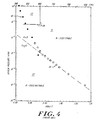
- Fig. 4 shows a prior art phase stability diagram for BSCCO-2223 as a function of oxygen pressure and temperature, which is taken from Rubin et al. ( J. Appl. Phys. Lett. 61 (16), 1977 (1992)).
- the region 31 above a line 30 (indicated with closed and open circles) defines the temperature and oxygen pressure conditions at which the BSCCO-2223 phase is stable.
- the region 32 below line 30 defines the temperature and oxygen pressures at which the BSCCO-2223 phase is unstable.
- the majority of the prior art processing of BSCCO-2223 is carried out under conditions defined by the smaller region 33 in the upper left hand corner of the diagram bounded by the line 30 and lines 34 .
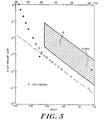
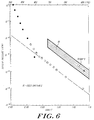
- the critical current and critical transition temperature of the BSCCO-2223 oxide superconductor can be improved by annealing the BSCCO-2223 phase under conditions defined by a hatched region 40 in Fig. 5.
- the annealing range lies above and roughly parallel to the published stability boundary; however, there also exists an upper boundary, above which superconducting properties will diminish. This region is satisfied by the following equations (for T (C°) and P O2 (atm)):
- the vertices of the parallelogram defining region 40 are defined by the following coordinates [T(C°), P O2 (atm)]: (787, 0.09); (787, 0.003); (500, 1.13 x 10 -6 ); and (500, 3.7 x 10 -8 ), which represent the corner bounds for temperature and pressure conditions.
- the anneal is preferably applied under conditions close to, but not exceeding, the upper boundary of region 40 . While approaching the upper bound, the temperature is preferably as low as kinetically and practically possible.
- the BSCCO-2223 phase is most beneficially annealed under conditions defined by a hatched region 50 .
- the annealing range lies parallel and closely approaches the upper boundary of the annealing conditions. This region is satisfied by the following equations (for T (C°) and P O2 (atm)):
- the vertices of the parallelogram defining region 50 are defined by the following coordinates [T(C°), P O2 (atm)]: (760, 0.0092); (760, 0.003); (500, 2.8 x 10 -7 ); and (500, 9.0 x 10 -8 ), which represent the corner bounds for temperature and pressure conditions for region 50 .
- the conditions of regions 50 are particularly well-suited to improve critical current and critical transition temperature of the oxide superconductor.
- the oxygen pressures of the invention are carefully controlled by maintaining a total annealing atmosphere at substantially one atmosphere.
- the annealing atmosphere includes an inert gas such as argon or nitrogen.
- the inert gas is mixed with a precisely controlled amount of oxygen to obtain the desired total oxygen pressure.
- This gas is continuously introduced above the oxide superconductor article during anneal. Hence, the annealing atmosphere remains essentially constant, since any changes in oxygen composition due to outgassing from the sample are mitigated by the flow of annealing atmosphere over the sample.
- the oxide superconductor is annealed for a time sufficient to effect the improvements in electrical properties of the present invention.
- the annealing time is a function of the anneal temperature and the size of the superconducting article. Annealing time increases as temperature decreases and hence poses a limit to anneal temperatures which can be practically applied. At 660 °C, greater than 150 hours anneal time are required. If the superconducting article is sufficiently thin, then the annealing time decreases and the anneal may be practically applied for temperatures as low as 500 °C. Anneal times typically range from 5 to 300 hours.
- the temperature is in the range of 770-787 °C and the oxygen pressure is in the range of 0.017-0.085 atm; or the temperature is in the range of 750-770 °C and the oxygen pressure is in the range of 0.0009-0.052 atm; or the temperature is in the range of 730-750 °C and the oxygen pressure is in the range of 0.005-0.029 atm; or the temperature is in the range of 690-730 °C and the oxygen pressure is in the range of 0.0001-0.015 atm.
- the temperature is in the range of 740-760 °C and the oxygen pressure is in the range of 0.0016-0.009 atm; or the temperature is in the range of 710-740 °C and the oxygen pressure is in the range of 0.0006-0.005 atm; or the temperature is in the range of 690-710 °C and the oxygen pressure is in the range of 0.0003-0.002 atm.
- the annealing step can take the form of a single anneal at temperatures and oxygen pressures within the annealing regions defined by region 40 and 50 in Figs. 5 and 6, respectively. Additional benefits to the electrical properties of the BSCCO-2223 article are observed when the annealing step includes application of progressively lower temperatures and/or oxygen pressures.
- the anneal may comprise two or more discrete "bakes" at progressively lower temperatures and oxygen pressures.
- the anneal may comprise continuous slow temperature reduction of the superconducting article while oxygen pressure is either continuously or stepwise decreased.
- the anneal may also comprise continuous decrease of oxygen pressure while the temperature is stepwise decreased.
- a particularly preferred embodiment includes treating the oxide superconductor by a stepwise or continuous reduction in temperature and oxygen pressure from 787 °C at 0.075 atm oxygen to temperatures in the range of 730°C to 690 °C at 0.003 to 0.0003 atm oxygen.
- a prior anneal at 787 °C and 0.075 atm oxygen is preferably carried out. At all times, however, the anneal must remain within the prescribed regions of either 40 or 50 .
- the method of approaching the low temperature, low oxygen pressure conditions of the anneal of the present invention is also a factor in the process.
- the decrease in temperature and oxygen pressure are synchronized and gradual.
- An oxide superconductor article which has been formed at higher temperatures and oxygen pressures (as is typically the case) will retain an internal oxygen potential at the elevated prior processing levels until diffusion permits the internal oxygen cement to accommodate the external change.
- the BSCCO-2223 oxide superconductor may undergo irreversible decomposition because the internal high oxygen potential of the article results in internal reaction conditions that are outside the upper boundary for oxygen pressure as preferred and defined as described above.
- the internal conditions are allowed to adapt to the changing external conditions and remain within the above-defined anneal region.
- the annealing of the present invention has been found to be particularly effective when used in conjunction with the two-step final heat treatment described above.
- the two-step heat treatment for BSCCO-2223 includes heating the article at a temperature substantially in the range of 815 °C to 860 °C for a period of time substantially in the range of 0.1 to 300 h at a P O2 substantially in the range of 0.001-1.0 atm and followed by reducing the article to a temperature substantially in the range of 790 °C to 845 °C for a period of time substantially in the range of 1 to 300 hours at a P O2 substantially in the range of 0.01 to 1.0 atm.
- the reader is referred to "I. Two-Step Heat Treatment" of the Description of the Preferred Embodiment, above, for further discussion of the two-step heat treatment.
- the examples below describe the two-step heat treatment and the anneal step of the present invention.
- the anneal is used in conjunction with the two-step heat treatment; however, it can be used on BSCCO-2223 oxide superconductor prepared by any conventional process.
- the J c obtained from samples subjected to the two-step heat treatment show significant improvements over prior art materials. Even further improvements in J c are observed by subjecting an oxide superconductor article obtained from the two-step beat treatment process to a low pressure, low temperature anneal.
- the following example compares the transport critical current characteristics of a samples treated with the two-step heat treatment of the present invention to those of conventionally processed samples.
- Precursor powders were prepared from the solid state reaction of freeze-dried precursor of the appropriate metal nitrates having the nominal composition of 1.7:0.3:1.9:2.0:3.1 (Bi:Pb:Sr:Ca:Cu). Bi 2 O 3 , CaCO 3 , SrCO 3 , Pb 3 O 4 and CuO powders could be equally used. After thoroughly mixing the powders in the appropriate ratio, a multistep treatment (typically, 3-4 steps) of calcination (800°C ⁇ 10°C, for a total of 15 h) and intermediate grinding was performed in order to remove residual carbon, homogenize the material and to generate the low T c BSCCO-2212 oxide superconductor phase. The powders were packed into silver sheaths having an inner diameter of 0.625" (1.5875 cm) and a length of 5.5" (13.97 cm) and a wall thickness of 0.150" (0.38 cm) to form a billet.
- the billets were extruded to a diameter of 1/4" (0.63 cm).
- the billet diameter was narrowed with multiple die passes, with a final pass drawn through a 0.070" (0.178 cm) hexagonally shaped die into silver/oxide superconductor hexagonal wires.
- Nineteen of the wires were bundled together and drawn through a 0.070" (0.178 cm) round die to form a multifilamentary round wire.
- the round wire was rolled to form a 0.009" x 0.100" (0.023 cm x 0.24 cm) multifilamentary tape.
- a length of the composite tape was then subjected to a heat treatment according to the invention.
- the composite tape was heated in a furnace in a first heat treatment at 820°C in 0.075 atm O 2 for 48 h.
- the first heat treatment formed significant amounts of the desired oxide superconductor phase, BSCCO-2223.
- the composite tape was then rolled to reduce thickness by 11% (0.009" to 0.008").
- the rolled composite tape was subjected to a two-step heat treatment, namely, heating from room temperature at a rate of 1°C/min to 820°C in 0.075 atm O 2 and holding for 54 h, cooling to 810°C in 0.075 atm O 2 and holding for 30 h.
- the sample was furnace cooled to room temperature in 1 atm P O2 .
- a comparable length of composite tape was subjected to a conventional heat treatment.
- the composite tape was heated in a furnace in a first heat treatment at 820°C in 0.075 atm O 2 for 48 h.
- the first heat treatment caused significant amounts of the desired oxide superconductor phase, BSCCO-2223 to form.
- the composite tape was then rolled to reduce thickness by 11% (0.009" to 0.008").
- the control samples were then subjected to a second heat treatment at 810°C in 0.075 atm O 2 for 84 h. This was a single step heat treatment in which no melting of the sample occurs.
- the microstructure of the samples were evaluated under an optical microscope.
- the samples prepared according to the method of the invention had a higher density and far less cracks than the control samples.
- the critical currents of the samples using a criterion of 1 ⁇ V/cm, 77 K and zero applied field were determined.
- a single critical current was determined end-to-end over a long length of tape (7-10 in).
- Critical current for a number of 10 cm lengths of composite tapes were determined and an average value was determined.
- Critical current (I c in A) is related to the critical current density (J c in A/cm 2 ) by the relationship, J c ⁇ 1,250 ⁇ I c .
- the results are reported in Table 1 and show that samples processed according to the method of the invention exhibited a factor of at least two improvement in critical transport properties.
- a composite tape is prepared as described in Example 1; however, a silver alloy containing low levels of Mg and Ni was used to sheathe the oxide superconductor.
- the tape was processed as in Example 1 according to the method of the invention.
- the avenge I c (77K, 10 cm) was 7.68 A as compared to ca. 4.08 A for a conventional process.
- This example compares samples which have been pressed or rolled as the intermediate deformation.
- Composite tapes were prepared as described in Example 1. A statistically designed experiment was performed using the following process parameters for the first anneal and final heat treatments.
- first heat treatment two-step heat treatment high temperature low temperature T(°C) t(h) T(°C) t(h) T(°C) t(h) - 820 12 - 820 12 - 810 36 0 827 24 0 827 24 0 815 54 + 835 48 + 835 48 + 815 72
- This example shows the effect of the number of heat treatment/deformation iterations on critical transport properties of the samples.
- Example 2 Ten meter lengths of composite tape were prepared as described for Example 1.
- the composite tapes were heated in a furnace in a first heat treatment at 815°C in 0.075 atm O 2 for 48 h.
- the composite tapes were then rolled to reduce thickness by 12%.
- the deformed composite tapes were subjected to a two-step heat treatment according to the invention, namely, heating at 824°C in 0.075 atm O 2 for 54 h, followed by heating at 815°C in 0.075 atm O 2 for 30 h.
- the final thickness for each tape was 0.0080" (0.020 cm).
- Composite tapes were prepared as described in Example 1, with the following exception. Powders of different stoichiometry were used in the preparation the composite tapes.
- the composite tapes prepared from powders A and B were subjected to the following heat treatment/deformation cycle: (1) heat treatment: 815 °C, 0.075 atm O 2 , 48 h (2) deformation: roll, 12% strain (3) heat treatment: 815 °C, 0.075 atm O 2 , 48 h (4) deformation: roll, 12% strain (5) two step heat treatment as described in Example 4
- a composite tape was prepared according to the processed described in Example 1.
- the composite tape having a length of 44 m was subjected to an heat treatment/deformation iteration comprised of heating at 815°C for 48 h under 0.075 atm O 2 and an 18% rolling deformation.
- the iteration was repeated three times.
- the two-step heat treatment consisted of heating at 824°C for 96 h (0.075 P O2 ), followed by heating at 815°C for 30 h (0.075 P O2 ).
- the sample had a materials J c measurement of greater than 17, 000 A/cm 2 (77 K, self field).
- This example illustrates the improved critical current for articles prepared according to the low pressure, low temperature anneal of the present invention.
- a BSCCO-2223 oxide superconducting article is prepared using the "metallic precursor” process (MP).
- MP metalic precursor
- Bi-Pb-Ca-Sr-Cu-Ag alloys are made by mechanical alloying of the metallic elements in stoichiometric proportions of 1.84:0.34:1.85:2.01:3.5 Bi:Pb:Sr:Ca:Cu with 64 wt% silver.
- the precursor metallic alloy is fabricated into a multifilament metallic precursor-silver composites tape as described in Example 1, above.
- the tape contains 361 precursor filaments in a silver matrix.
- the composite tape is oxidized in oxygen at approx. 400 °C for 150 to 400 hours to convert the metallic precursor into simple and complex metal oxides ("suboxides").
- the suboxides are then reacted at 760 to 800 °C (0.075 atm P O2 , 1-20 hr) to form BSCCO-2212 and remaining reactants necessary to form BSCCO-2223.
- Deformation by rolling having a total strain in the range of 60 to 90 % are used to texture the BSCCO-2212 phase, as described in Example 1, above.
- BSCCO-2212 is converted to BSCCO-2223 as described above and in Example 1.
- the composite tape is heated at 830 °C for 40 hours in air, followed by roll deformation at ambient to approx. 16% strain, followed by the two-step heat treatment of heating at 830 °C in 0.075 atm oxygen (balance argon for a total pressure of one atmosphere) for 40 hours and heating at 811 °C for 120 hours.
- the temperature is lowered at 4 °C/min to 787 °C.
- Oxygen pressure is maintained at 0.075 atm and total pressure is one atmosphere (balance of atmosphere is argon).
- the oxide superconductor composite is heated at 787 °C for 30 hours.
- the furnace atmosphere is maintained at the desired composition by carefully mixing argon with the proper amount of oxygen to attain an oxygen concentration of 0.075 atm.
- the gas mixture flows through the furnace and over the sample during the heat treatment.
- Critical current is measure as described in Example 1 across a 1 cm length.
- Critical current (I c ) increased from a 4.5 A pre-anneal value to a 5.5 A post-anneal value for a single sample.
- Critical current can be readily converted to critical current density by division or the area, which is typically approximately a factor of 0.00077 cm
- Example 8 shows the additional benefit to electrical properties when an article is subjected to anneal at successively lower temperatures and oxygen pressures.
- An oxide superconductor composite is prepared according to Example 7, including a low pressure, low temperature anneal at 787 °C and 0.075 atm O 2 .
- the oxide superconductor composite is then subjected to an additional low temperature, low P O2 treatment.
- the sample is reduced in temperature at 2 °C/min from 787 °C to the target lower temperature, which ranges as low as 724 °C in this example.
- the furnace atmosphere is maintained at the desired composition by carefully mixing argon with the proper amount of oxygen.
- the gas mixture is introduced into the furnace and passes over the sample during the heat treatment.
- the gas composition is adjusted with time such that oxygen pressure is approx. 0.01 atm at the start of the period and 0.0035 atm as the target lower temperature is attained.
- Fig. 7(a) illustrates the improvement in critical current as anneal temperature is decreased.
- the improvement is shown as the percent increase of critical current density over the critical current observed after the first anneal at 787 °C (0.075 atm O 2 ) shown in Example 7. It is understood that the sample from Example 7 is already an improvement over a conventionally processed material and even over materials processed according to Examples 1-6. Increases of greater than 30% over the critical current observed after the first anneal at 787 °C (0.073 atm O 2 ) shown in Example 7 were observed.
- Fig. 7(b) illustrates the improvement in critical transition temperature as anneal temperature is decreased.
- T c zero as high a 111.1 K were obtained for materials which were annealed at 745 - 752 °C.
- Critical transition temperature is measured by the standard four probe method which involves placing two voltage taps between two current taps, followed by passing a current through the sample and recording the voltage with changing temperature. The sample is considered to be superconducting with effectively zero resistance when resistance is less than 10 -8 ⁇ -cm.
- the data presented in Fig. 7(b) represents zero resistance measurements.
- the diffraction pattern (shown in Fig. 8) contained peaks at 2 ⁇ values of 17.4°, 19.2°, 20.2°, 21.8°, 23.2°, 23.9°, 26.2°, 27.8°, 29°, 29.7°, 31.5°, 32°, 33.2°, 33.7°, 35°, 35.6°, 38°, 38.8°, 41.6°, 43.8°, 44.4°, 46.8°, 47.4°, 48° and 49°.
- peaks typically associated with BSCCO-2223 represent the peaks typically associated with BSCCO-2223 and additional unidentified peaks.
- the peaks most typically associated with BSCCO-2223 are 19.2°, 20.2°, 21.8°, 23.2°, 23.9°, 26.2°, 29°, 31.5°, 32°, 33.2°, 33.7°, 35°, 35.6°, 38.8°, 44.4°, 47.4°, 48° and 49°.
- the method of the invention is highly versatile and can be successfully used with a variety of deformation processes, oxide superconductor compositions, silver alloy compositions and processing conditions.
Landscapes
- Engineering & Computer Science (AREA)
- Manufacturing & Machinery (AREA)
- Inorganic Compounds Of Heavy Metals (AREA)
- Superconductors And Manufacturing Methods Therefor (AREA)
- Oxygen, Ozone, And Oxides In General (AREA)
- Auxiliary Devices For Music (AREA)
- Nonmetallic Welding Materials (AREA)
- Superconductor Devices And Manufacturing Methods Thereof (AREA)
- Compositions Of Oxide Ceramics (AREA)
Abstract
Description
- The present invention relates to high-performance oxide superconductors and oxide superconductor composites. The present invention further relates to a method for healing defects introduced into the oxide superconductor phase during processing thereby improving superconducting properties. More particularly, the present invention relates to the processing of specific high performance bismuth-strontium-calcium-copper oxide superconductors and oxide superconductor composites and a method for improving the critical transition temperature (Tc) and critical current density (Jc) of these oxide superconductors.
- Oxide superconductors of the rare earth-barium-copper-oxide family (YBCO), bismuth(lead)-strontium-calcium-copper-oxide family ((Bi,Pb)SCCO) and thallium-barium-calcium-copper-oxide family (TBCCO) form plate-like and highly anisotropic superconducting oxide grains. Because of their plate-like morphology, the oxide grains can be oriented by mechanical strain. Mechanical deformation has been used to induce grain alignment of the oxide superconductor c-axis perpendicular to the plane or direction of elongation. The degree of alignment of the oxide superconductor grains is a major factor in the high critical current densities (Jc) obtained in articles prepared from these materials.
- Known processing methods for obtaining textured oxide superconductor composite articles include an iterative process of alternating heating and deformation steps. The heat treatment is used to promote reaction-induced texture of the oxide superconductor in which the anisotropic growth of the superconducting grains is enhanced. Each deformation provides an incremental improvement in the orientation of the oxide grains. Additional heat treatment intermediate with or subsequent to deformation is also required to form the correct oxide superconductor phase, promote good grain interconnectivity and achieve proper oxygenation.
- Processing long lengths of oxide superconductor is particularly difficult because deformation leads to microcracking and other defects which may not be healed in the subsequent heat treatment. Cracks that occur perpendicular to the direction of current flow limit the performance of the superconductor. In order to optimize the current carrying capability of the oxide superconductor, it is necessary to heal any microcracks that are formed during processing of the oxide superconductor or superconducting composite.
- Liquid phases in co-existence with solid oxide phases have been used in processing of oxide superconductors. One type of partial melting, known as peritectic decomposition, takes advantage of liquid phases which form at peritectic points of the phase diagram containing the oxide superconductor. During peritectic decomposition, the oxide superconductor remains a solid until the peritectic temperature is reached, at which point the oxide superconductor decomposes into a liquid phase and a new solid phase. The peritectic decompositions of Bi2Sr2CaCu2O8+x, (BSCCO-2212, where 0≤x≤1.5), into an alkaline earth oxide and a liquid phase and of YBa2Cu3O7-δ (YBCO-123, where 0≤δ≤1.0) into Y2BaCuO5 and a liquid phase are well known.
- Peritectic decomposition of an oxide superconductor and the reformation of the oxide superconductor from the liquid + solid phase is the basis for melt textured growth of YBCO-123 and BSCCO-2212. For example, Kase et al. in IEEE Trans. Mag. 27(2), 1254 (Mar. 1991) report obtaining highly textured BSCCO-2212 by slowly cooling through the peritectic point. This process necessarily involves total decomposition of the desired 2212 phase into an alkaline earth oxide and a liquid phase.
- It is also recognized that an oxide superconductor itself can co-exist with a liquid phase under suitable processing conditions. This may occur by solid solution melting, eutectic melting or by formation of non-equilibrium liquids.
- Solid solution melting may arise in a phase system, in which the oxide superconductor is a solid solution. As the temperature (or some other controlling parameter) of the system increases (or decreases), the oxide superconductor phase changes from a solid oxide phase to a liquid plus oxide superconductor partial melt (this happens at the solidus). A further increase in temperature (or some other controlling parameter) affords the complete melting of the oxide superconductor (this happens at the liquidus).
- A phase diagram containing a eutectic point may provide an oxide superconductor partial melt, known as eutectic melting, when the overall composition is chosen so as to be slightly off stoichiometry. As the temperature (or some other controlling parameter) of the system increases (or decreases), the mixed phase of oxide superconductor-plus-non-superconducting oxide (solid1 + solid2) changes to a liquid-plus-oxide superconductor partial melt (solid1 + liquid).
- Non-equilibrium liquids may also promote partial melting in oxide superconductor systems. A non-equilibrium liquid is established through the relatively rapid heating of a mixture of oxides to a temperature above the eutectic melting point of local stoichiometries present in the heterogeneous mixture of phases. As the oxides form the desired oxide superconductor, the solid and liquid phases can co-exist, if only temporarily.
- Partial melting of (Bi,Pb)2Sr2Ca2Cu3O10+x ((Bi,Pb)SCCO-2223, where 0≤x≤1.5) and (Bi)2Sr2Ca1Cu2O10+x ((Bi)SCCO-2223, where 0≤x≤1.5), collectively BSCCO-2223, at temperatures above 870°C in air has been reported; see, for example, Kobayashi et al. Jap. J. Appl. Phys. 28, L722-L744 (1989), Hatano et al. Ibid. 27(11), L2055 (Nov. 1988), Luo et al. Appl. Super. 1, 101-107, (1993), Aota et al. Jap.J. Appl. Phys. 28, L2196-L2199 (1989) and Luo et al. J. Appl. Phys. 72, 2385-2389 (1992). The exact mechanism of partial melting of BSCCO-2223 has not been definitively established.
- Guo et al. in Appl. Supercond. 1(1/2), 25 (Jan. 1993) have described a phase formation-decomposition-reformation (PFDR) process, in which a pressed sample of (Bi,Pb)SCCO-2223 is heated above its liquidus to decompose the 2223 phase, followed by a heat treatment at a temperature below the solidus. The sample was subsequently pressed again and reannealed. The final anneal of the PFDR process includes a standard single step heat treatment in which there is no melting.
- The "high Tc" oxide superconductor Bi2-yPbySr2Ca2Cu3O10+x , where 0≤x≤1.5 and 0 ≤ y ≤ 0.6 (BSCCO-2223 and (Bi, Pb)SCCO-2223, hereinafter referred to as "BSCCO-2223" to indicate both lead-doped and undoped compositions), is particularly desirable because of its high critical transition temperature (Tc ∼ 110 K) and high critical current (Ic, Jc). The superconducting an constantly seeks to improve electrical properties, such as, critical current density and critical transition temperature.
- Partial melting in the processing of oxide superconductors has been used either to increase the yield of the BSCCO-2223 phase or to improve the contiguity and texturing of the oxide superconductor grains. The issue of healing defects, such as microcracks, which develop during deformation processing of the oxide superconductor, has in been addressed. Further, the prior art has not addressed the possibility of using a two-step process where the oxide superconductor is stable in both steps for the healing of cracks and defects.
- Wang et al. ("Advances in Superconductivity", Springer-Verlag, New York, Editors: Y. Bando and H. Yamauchi, pp. 291-294 (1993)) report an increase in Tc by carrying out a post-anneal step at 790 °C at reduced total pressures. Wang et al. observed Tc by DC magnetization of 115 K and Tc, zero of 111 K by resistivity measurement. The technique used by Wang et al. (vacuum encapsulation at 10-4 Torr of oxide superconductor pellets, followed by annealing at 790 °C) does not permit determination of the oxygen pressure of the system. The encapsulated pellets reach an equilibrium oxygen pressure within the capsule by releasing oxygen. The pellet volume/capsule volume plays an important role in determining the final equilibrium oxygen pressure.
- Critical transition temperatures (determined by magnetization) as high as 117 K have been reported for multiphase materials containing BSCCO-2223. Fisher et al. (Physica C 160, 466 (1990)) reported a Tc of 115 K (determined by magnetization) with the substitution of lead and antimony in the BSCCO-2223 system. A non-reproducible Tc as high as 130 K was reported by Hongbo et al. (Solid Stare Comm. 69, 867 (1989)).
- While reports of high transition temperatures by magnetization studies are of interest, they can sometimes be misleading. The transition curves obtained by magnetization are "soft", making extrapolation to zero resistivity highly subjective. Further, other effects, such as semiconductor to metallic transitions, can mimic critical temperature transition behavior. It is therefore desirable to rely on bulk resistivity measurements for determining temperature at zero resistivity (Tc, zero).
- Idemoto et al. (Physica C 181, 171-178 (1991)) has investigated the oxygen content and copper and bismuth valances of BSCCO-2223 under a range of conditions, including temperatures m the range of 500 °C to 850 °C and oxygen pressures in the range of 0.005 to 0.20 atm. The samples were observed by means of a microbalance under changing temperatures conditions at constant oxygen pressures. Because the samples do not reach equilibrium during the observation period, it is difficult to determine the exact processing conditions experienced by the samples. No investigation of the effect of reported conditions on electrical properties is reported.
- None of the previous research has indicated the desirability of post-annealing the BSCCO-2223 phase at low temperatures and oxygen pressures to enhance the electric transport properties of the oxide superconductor, namely critical current.
- It is the object of the present invention to provide a method for improving superconducting performance of oxide superconductors and superconducting composites by healing cracks and defects formed during processing of oxide superconductors and superconducting composites.
- It is a further object of the invention to prepare oxide superconducting articles having significantly less cracks and defects than conventionally-processed articles.
- A further object of the present invention is to provide a process to increase the critical current density of BSCCO-2223 by a method which also increases its critical transition temperature. It is a further object of the present invention to provide a novel high-Tc BSCCO-2223 composition having a critical transition temperature greater than 111.0 K. A feature of the invention is a two-step heat treatment after which no further deformation occurs which introduces a small amount of a liquid phase co-existing with the oxide superconductor phase, and then transforms the liquid back into the oxide superconductor phase with no deformation occurring during or after the heat treatment of the invention. A further feature of the present invention is a low temperature, low oxygen pressure anneal of the oxide superconductor.
- An advantage of the invention is the production of highly defect-free oxide superconductor and superconducting composites which exhibit superior critical current densities. A further advantage of the invention is a marked improvement in critical transition temperature and critical current density as compared to oxide superconductors and superconducting composites which are not subjected to the method of the invention.
- By way of background, it is noted that IEEE Transactions on Applied Superconductivity,
Vol 3 No 1, March 1993, pp 931-934 discloses a partial melt technique for growing aligned grains of BSCCO-2212 type superconductor, wherein the BSCCO-2213 is produced by a peritectic reformation and growth process. - Japanese Journal of Applied Physics, Vol 32 (1993) pp 51-54, Part 1 No 1A also discloses production of BSCCO-2212 type superconductor by the partial melt technique. Likewise, this process of preparing BSCCO-2212 is disclosed in Japanese Journal of Applied Physics,
Vol 30, No 12A, December 1991, pp 3371-3376. - EP-A-0,390,499 discloses in detail a deformation-less, partial melt process for preparing BSCCO type superconductor; the product obtained and the critical temperatures reported are typical of a BSCCO-2212 superconductor.
- EP-A-0,499,411 discloses a method by which a BSCCO-2212 superconductor is obtained, notwithstanding the starting material has a 2223 stoichiometry.
- According to one aspect of the present invention, there is provided a method for preparing a BSCCO-2223 oxide superconductor article, comprising the steps of:
- deforming an oxide superconductor article, the article having a mixed oxide phase which is comprised of at least a BSCCO-2223 oxide superconductor phase, to align a c-axis of the BSCCO-2223 oxide superconductor and thereby introduce defects into the mixed oxide phase, the said BSCCO-2223 oxide superconductor phase being capable of forming a liquid phase in co-existence with the oxide superconductor phase;
- exposing the oxide superconductor article to a two-step
heat treatment after deformation of the article, the
heat treatment comprising,
- (a) heating the article to and maintaining the article at a first temperature and oxygen partial pressure range sufficient to partially melt the article, such that the BSCCO-2223 oxide superconductor phase coexists, without substantial decomposition, with the liquid phase, and such that the liquid phase wets surfaces of the defects contained in the article;
- (b) cooling the article to a second temperature and oxygen partial pressure range sufficient to substantially transform the liquid phase into the oxide superconductor, and holding the article in the second temperature and pressure range for a time sufficient to substantially transform the liquid phase into the BSCCO-2223 oxide superconductor phase whereby the defects are healed,
- the article being subjected to no defect-inducing deformation after the two-step heat treatment.
-
- According to another aspect of the invention there is provided a method of preparing a BSCCO-2223 oxide superconductor article, comprising the steps of:
- deforming an oxide superconductor article, the article having a mixed oxide phase which is comprised of at least a BSCCO-2223 oxide superconductor phase, to align a c-axis of the BSCCO-2223 oxide superconductor phase and thereby introduce defects into the mixed oxide phase, the said BSCCO-2223 oxide superconductor phase being capable of forming a liquid phase in co-existence with the oxide superconductor phase;
- exposing the oxide superconductor article to a two
step heat treatment after deformation of the article, the
heat treatment comprising
- (a) partially melting the article by heating to a selected temperature and subjecting it to an oxygen partial pressure, such that the BSCCO-2223 oxide superconductor phase co-exists without substantial decomposition, with the liquid phase, and such that the liquid phase wets surfaces of the defects contained in the article; and
- (b) maintaining the temperature constant and subjecting the article to a higher oxygen partial pressure to transform the liquid phase into BSCCO-2223 oxide superconductor phase, whereby the defects are healed, the article being subjected to no defect-inducing deformation after the two-step heat treatment.
-
- In this invention, the liquid phase wets surfaces of defects contained within the oxide superconductor article, and then the defects are healed upon transformation of the liquid to the desired oxide superconductor. The partial melting of step (a) and the transformation of step (b) are effected by selection of appropriate thermodynamic state variables, for example, temperature, P02, Ptotal and total composition. In principle, deformation may occur during the heat treatment of the present invention up to immediately prior to the completion of step (a), providing that the liquid phase is available for a period of time sufficient to wet defect surfaces.
- By "two-step heat treatment" or "heat treatment of the invention" as those terms are used herein, it is meant a heat treatment for forming an oxide superconductor after which no further deformation occurs. However, heat treatments for purposes other than those stated herein, such as, for example, oxygenation of the oxide superconductor, are possible. In all cases, no further deformation occurs.
- By "partial melt", as that term is used herein, it is meant the oxide superconductor article is only partially melted, and that the desired oxide superconductor is present during melting.
- By "deformation" as that term is used herein, it is meant a process which causes a change in the cross-sectional shape of the article.
- By "oxide superconductor precursor", as that term is used herein, it is meant any material that can be converted to the desired oxide superconductor upon application of a suitable heat treatment. Suitable precursor materials include but are not limited to metal salts, simple metal oxides, complex mixed metal oxides and intermediate oxide superconductors to the desired oxide superconductor.
- By "desired oxide superconductor", as that term is used herein, it is meant the oxide superconductor which it is desired to ultimately prepare. An oxide superconductor is typically the "desired" oxide superconductor because of superior electrical properties, such as high Tc and/or Jc. The desired oxide superconductor is a high Tc member of a particular oxide superconductor family, namely BSCCO-2223.
- By "intermediate oxide superconductor", as that term is used herein, it is meant an oxide superconductor which is capable of being converted into the desired oxide superconductor. However, an intermediate oxide superconductor may have desirable processing properties, which warrants its formation initially before final conversion into the desired oxide superconductor. The formation of an "intermediate oxide superconductor" may be desired, particularly during heat treatment/deformation iterations, where the intermediate oxides are more amenable to texturing than the desired oxide superconductor.
- In practising the present invention, a textured oxide superconductor article can be prepared by subjecting an article containing an oxide superconductor precursor to at least one first heat treatment/deformation iteration. The heat treatment is effective to form a desired oxide superconductor. The resultant oxide superconductor phase is textured upon application of the first heat treatment/deformation iteration. The article is then exposed to the two-step heat treatment in which (a) the article is partially melted, such that a liquid phase co-exists with the desired textured oxide superconductor phase; and (b) the liquid phase is transformed into the desired oxide superconductor, with no deformation occurring after the heat treatment of the invention.
- Moreover, textured oxide superconductor article can be prepared by subjecting an article containing an oxide superconductor precursor to at least one first heat treatment/deformation iteration. The heat treatment is effective to form an intermediate oxide superconductor. The intermediate textured oxide superconductor phase is formed, The article is then subjected to as least one second heat treatment/deformation iteration. The heat treatment is effective to form the desired oxide superconductor. The article is then exposed to the two-step heat treatment in which (a) the article is partially melted, such that a liquid phase co-exists with the desired textured oxide superconductor phase; and (b) the liquid phase is transformed into the desired oxide superconductor, with no deformation occurring after the heat treatment of the inversion.
- In preferred embodiments, the intermediate oxide superconductor is BSCCO-2212 or (Bi,Pb)SCCO-2212 because it is readily textured by the heat treatment/deformation iterations. The intermediate oxide superconductor is then converted to a desired oxide superconducting phase, typically BSCCO-2223 or (Bi,Pb)SCCO-2223. The partial melting of step (a) may be carried out at a temperature in the range of 820-835 °C at 0.075 atm (1 atm = 1,013 bar) O2. The transformation of the liquid in step (b) may be carried out at a temperature in the range of 790-820°C at 0.075 atm O2.
- In other preferred embodiments, the liquid phase is formed in the range of 0.1-30 vol %. In yet other preferred embodiments, the heat treatment of the first and second hear treatment/deformation iterations partially melts the oxide superconductor article.
- In one mode of practising the invention, an oxide superconductor article is exposed to a two-step heat treatment after a deformation step, which includes (a) heating the article at a temperature in the range of 810-860°C for a period of time in the range of 0.1 to 300 hours at a PO2 in the range of 0.001-1.0 atm; and (b) cooling the article to a temperature in the range of 780-845°C for a period of time in the range of 1 to 300 hours at a PO2 in the range of 0.001-1.0 atm, with no deformation occurring after the heat treatment of the present invention.
- In another mode of practising the present invention, an oxide superconductor article containing a desired oxide superconductor phase is exposed to a two-step heat treatment after a deformation step, which includes (a) subjecting the article to an oxygen partial pressure sufficient to partially melt the oxide superconducting article, such that a liquid phase co-exists with the desired oxide superconductor; and (b) raising to an oxygen partial pressure sufficient to transform the liquid phase into the desired oxide superconductor.
- The present invention provides for a multifilamentary oxide superconductor composite containing a plurality of oxide superconductor filaments contained within a matrix material which has been subjected to the two-step heat treatment of the invention.
- Such a multifilamentary oxide superconductor composite can contain a plurality of oxide superconductor filaments contained within a matrix material, the composite having a Jc of at least 14 x 103 A/cm2 at 77K, self field, as measured over a length at at least 50 m.
- The present invention provides oxide superconductors which exhibit marked improvement in critical current density (Jc) over samples processed in an otherwise similar manner, lacking only the two-step heat treatment of the present invention.
- In accordance with the present invention, a BSCCO-2223 oxide superconducting article is prepared by providing an oxide superconductor article including BSCCO-2223 oxide superconductor, and annealing the superconducting article at a temperature selected from the range of 500°C ≤ T ≤ 787 °C and an annealing atmosphere having an oxygen pressure selected from within the region having a lower bound defined by the equation,
- Moreover, a BSCCO-2223 oxide superconducting article can be prepared by providing an oxide superconductor article including BSCCO-2223 oxide superconductor, and annealing the superconducting article at a temperature selected from the range of 500°C ≤ T ≤ 760 °C and an annealing atmosphere having an oxygen pressure selected from within the region having a lower bound defined by the equation,
- Still further, a BSCCO-2223 oxide superconductor article can be prepared by exposing the article including at least BSCCO-2223 to a heat treatment after deformation of the article, including (a) heating the article at a temperature in the range of 815-860°C for a period of time in the range of 0.1 to 300 hours at a PO2 in the range of 0.001-1.0 atm; and (b) subjecting the article to a temperature in the range of 790-845°C for a period of time in the range of 1 to 300 hours at a PO2 in the range of 0.01-1.0 atm, with no deformation occurring after the heat treatment. The superconducting article is then annealed at a temperature selected from the range of 500°C ≤ T ≤ 787 °C and an annealing atmosphere having an oxygen pressure selected from within the region having a lower bound defined by the equation,
- By "anneal of the present invention", it is meant a low pressure, low temperature heat treatment under equilibrium conditions during which no further formation of the desired oxide superconducting phase occurs; however, the internal chemistry of the oxide superconductor (i.e.; oxygen stoichiometry) and grain growth of the existing oxide superconductor phase may be affected.
- In preferred embodiments, the annealing atmosphere is substantially at a pressure of one atmosphere and oxygen pressure is obtained by controlling the oxygen concentration in the annealing atmosphere. The annealing atmosphere may additionally contain an inert gas selected from the group consisting of argon, nitrogen and helium. The anneal is carried out at an oxygen pressure substantially in the range of 7.5 x 10⁻² atm to 1 x 10⁻⁸ atm O2. The annealing of the invention is preferably the final annealing to which the superconducting article is subjected.
- In other preferred embodiments, the anneal is carried out at a temperature in the range of 770 to 787°C and an oxygen pressure in the range of 0.017 to 0.085 atm. Alternatively, the anneal is carried out at a temperature in the range of 750 to 770°C and an oxygen pressure in the range of 0.0009 to 0.052 atm. Further the anneal can be carried out at a temperature in the range of 730 to 750°C and an oxygen pressure in the range of 0.005 to 0.029 atm. Still further, the anneal can be carried out at a temperature in the range of 690 to 730°C and an oxygen pressure in the range of 0.0001-0.015 atm. Further possibilities include carrying out the anneal at a temperature in the range of 740 to 760°C and an oxygen pressure in the range of 0.0016 to 0.009 atm, or at a temperature in the range of 710 to 740°C and an oxygen pressure in the range of 0.0006-0.005 atm, or at a temperature in the range of 690 to 710°C and an oxygen pressure in the range of 0.0003-0.002 atm.
- In yet other preferred embodiments, sample is annealed at progressively lower temperature and oxygen pressure. This may be accomplished by continuously reducing temperature and/or oxygen pressure or by stepwise reduction of temperature and/or oxygen pressure.
- The invention comprehends a superconductor having the formula Bi2-yPbySr2Ca2Cu3O10+x, where 0 ≤ x ≤ 1.5 and where 0 ≤ y ≤ 0.6, the oxide superconductor characterized by a critical transition temperature of greater than 111.0 K as defined by zero resistance by a four point linear probe method with zero resistance corresponding to a resistivity of less than 10-8 Ω-cm. An article containing the oxide superconductor may additionally include silver.
- Thanks to the invention, an oxide superconductor article can be prepared which is characterized by a critical transition temperature of greater than 111.0 K as defined by zero resistance by a four point linear probe method with zero resistance corresponding to a resitivity of less than 10-8 Ω-cm and an x-ray diffraction pattern having peaks at 17.4°, 19.2°, 20.2°, 21.8°, 23.2°, 23.9°, 26.2°, 27.8°, 29°, 29.7°, 31.5°, 32°, 33.2°, 33.7°, 35°, 35.6°, 38°, 38.8°, 41.6°, 43.8°, 44.4°, 46.8°, 47.4°, 48° and 49°.
- The present invention comprehends a multifilamentary oxide superconductor composite containing a plurality of oxide superconductor filaments contained within a matrix material which has been subjected to an anneal according to the present invention.
- The oxide superconductor prepared according to the method of this invention exhibit superior electric transport properties and enhanced Tc.
- In the Drawing;
- Figure 1 is a processing profile of the two-step heat treatment of the invention; and
- Figure 2 is an optical photomicrograph of (a) a pressed oxide superconductor article without the two step heat treatment of the invention, and (b) a pressed oxide superconductor article subjected to the heat treatment of the invention;
- Figure 3 is a processing profile used to obtain an textured oxide superconductor according to the method including the two-step heat treatment of the invention;
- Figure 4 is a prior art Van't Hoff diagram for BSCCO-2223;
- Figure 5 is a phase stability limit diagram for BSCCO-2223 indicating the low pressure, low temperature anneal conditions of the present invention;
- Figure 6 is a phase stability limit diagram for BSCCO-2223 indicating the low pressure, low temperature anneal conditions of the present invention;
- Figure 7 is a plot of the critical transition temperature and critical current v. anneal temperature for an article subjected to the two-step heat treatment and low pressure, low temperature anneal of the invention; and
- Figure 8 is an x-ray diffractogram of an article subjected to the two-step heat treatment and low pressure, low temperature anneal of the invention.
-
- The present invention is a method for improving the critical current density of oxide superconductor articles by healing defects, such as micro- and macrocracks, incurred upon deformation. The present invention calls for a final two-step treatment after deformation of the oxide superconductor article, in which (a) a liquid phase is formed such that the liquid phase co-exists with the desired oxide superconductor; and (b) the liquid phase is then transformed into the desired oxide superconductor without any intermediate deformation. The method of the invention is used to heal defects in the superconducting article. It is recognized, that complete transformation of the liquid to the oxide superconductor occurs under ideal conditions and that, under some circumstances, not all of the liquid may be transformed into the desired oxide superconductor.
- The liquid phase is formed upon partial melting of the oxide superconductor article. During partial melting of the article, non-superconducting materials and intermediate oxide phases may be present with the desired oxide superconductor phase. During the partial melting step of the invention the desired oxide superconductor, the non-superconducting materials, oxide superconducting precursors, the desired oxide superconductor or a mixture of these components may melt to form the liquid phase.
- The above process, which required that liquid co-exist with the desired oxide superconductor phase, is distinguished from those which involve the peritectic decomposition of the oxide superconductor, such as described by Guo et al. and Kase et al., in which the desired oxide superconductor decomposes during the melting process.
- Fig. 1 shows a processing profile of the final heat treatment of the invention. A dashed
line 10 indicates a processing point at which a liquid phase is formed for a given set of processing conditions, e.g.. T, PO2, Ptotal and/or oxide composition. - In the oxide superconductors and superconducting composites disclosed herein, processing conditions for obtaining the requisite liquid and solid oxide phases are well established and the relationship between temperature, oxygen partial pressure and total pressure is reasonably well understood. For further information on the phase diagrams for BSCCO systems, the interested reader is directed to "Phase Diagrams for High Tc Superconductors", John D. Whitler arid Robert S. Roth, Ed.; American Ceramic Society, Waterville, OH.
- Presence of a liquid phase can also be determined experimentally by use of such conventional techniques as differential thermal analysis (DTA). In DTA, exothermic and endothermic reactions as a function of temperature can be identified and attributed to various thermodynamic and chemical processes. It is possible to identify endothermic processes corresponding to partial melting; i.e. liquid phase formation.
- It is desired that only a small amount of liquid be formed during partial melting. The reason for this is that, at the time that the final heat treatment is applied, the article substantially is already textured. Complete or significant liquid formation at this point would result in loss of texture. Volume percent of the liquid phase is typically in the range of 0.1 to 30.
- The oxide superconductor is deformed at a point 11 before the final heat treatment, at which time defects such as microcracks may be introduced into the article. Suitable deformation can include swaging, extruding, drawing, pressing, hot and cold isostatic pressing, rolling, and forging of wires, tapes and a variety of shaped articles.
- The method of the invention is particularly useful for oxide superconductor articles in which deformation processing introduces defects perpendicular to the direction of current flow. In rolling, the deformation is largely plane strain, that is, extension in the length of the article entirely compensates for the reduction in thickness resulting in cracking in the transverse direction and perpendicular to the current flow. Fig. 2a shows an optical photomicrograph of a pressed oxide superconductor filament without the final heat treatment of the invention. Many fine cracks are visible and clearly disrupt the percolative pathway for current flow. It is expected therefore, that rolled samples will benefit to a greater extent from the final heat treatment of the invention.
- Other deformation processes, such as pressing, results in reduction of the article thickness accommodated by lateral spread, i.e., an increase in width. Cracks in this case form parallel to the current flow. While defects of this type, can be healed by the final heat treatment of the invention, the improvement to the electrical properties may not be as marked.
- Referring again to Fig. 1, the processing conditions are adjusted to bring the article to point 12 where the article is partially melted and a liquid phase co-exists with the desired oxide superconductor phase. The article is held at
point 12 for a period of time during which the defect surfaces contained within the oxide superconductor are wet by the newly-formed liquid. For BSCCO-2223, a temperature of 820-835°C at 0.075 atm O2 for 0.1-300 hours is sufficient. The processing parameters are then adjusted to bring the oxide superconductor to point 13 where the liquid phase is consumed and the desired oxide superconductor phase is formed from the melt. A temperature of 820-790°C at 0.073 atm O2 for 1 to 300 hours is sufficient. - The final heat treatment includes heating the article at a temperature of substantially in the range of 815°C to 860°C for a period of time substantially in the range of 0.1 to 300 h at a PO2 substantially in the range of 0.001-1.0 atm. The processing temperature will vary dependent upon the oxygen pressure. Additionally, variations in the chemical composition of the article will also affect selection of temperature and pressure. In particular, it has been noted that addition of silver to the oxide composition lowers the temperature range for partial melting, particularly at higher PO2 (0.1-1.0 atm).
- Hence, the two-step heat treatment heals cracks and other defects while effecting the final conversion of the oxide phases to the desired oxide superconductor phase. The formation of BSCCO-2223 from BSCCO-2212 is kinetically enhanced by the presence of the liquid phase, in part, due to the enhanced diffusivity of the oxide superconductor constituents. The partial melting during the final part of the process can perform two tasks. Firstly, the cracks formed during the prior deformation steps are healed by rapid growth of the oxide superconductor grains at the crack site. Secondly, the conversion rate of 2212 to 2223 is greatly accelerated, allowing the formation of a microscopically crack-free, interconnected 2223 phase.
- Various processing parameters can be controlled to obtain the necessary partial melt and oxide reforming steps. For example, PO2 can be held constant and temperature can be raised to promote melting and formation of the liquid phase and lowered to regenerate the desired oxide superconductor. Alternatively, temperature can be held constant, and PO2 can be lowered to promote the partial melting of the oxide superconductor article and raised to reform the oxide superconductor.
- The processing conditions can be changed rapidly from
point 12 to point 13 of the process (fast ramp rate). Alternatively, the oxide superconductor can be subjected to gradually changing conditions (of temperature or pressure) betweenpoint 12 andpoint 13 of the process designated by thecurve 14 in Fig. 1 (slow ramp rate). In another alternative embodiment, there need be no "hold" at 13. The processing conditions can be slowly ramped from the processing conditions defined atpoint 12 to the processing conditions defined forpoint 13. This process is illustrated bycurve 15 in Fig. 1. - Texture may be induced by reaction conditions and/or deformation. In reaction-induced texture, processing conditions are chosen to kinetically favor the anisotropic growth of oxide superconductor grains. Reaction-induced texture can occur in a solid phase system or, preferably, in a solid-plus-liquid phase system. The presence of a liquid phase enhances the kinetics of anisotropic grain growth, probably through increased rates of diffusion of the oxide components. In deformation-induced texture, a strain is applied to the superconducting article to induce alignment of the oxide grains in the plane or direction of elongation. Deformation-induced texture requires aspected grains or an anisotropic rheology in order to effect a preferential alignment of the grains.
- Fig. 3 shows a processing profile for a method of the invention used to obtain highly textured oxide superconductor articles. The general process for the formation of a textured oxide superconductor may consist of three distinct steps.
- In a first step, an oxide superconductor precursor is subjected to one or more first heat treatment/deformation iterations, denoted by
step 20 andstep 21, respectively, of Fig. 3. The oxide superconductor precursor can be any combination of materials which will yield the desired oxide superconductor upon reaction. In particular, it may be a metallic alloy containing the metallic constituents of the desired oxide superconductor and optionally containing silver. Alternatively, the constituent simple metal oxides, mixed metal oxides, meal salts and even intermediate oxide superconductors of the desired oxide superconductor may be used as a precursor. The precursor may optionally be mixed with a matrix meal, such as silver, and/or may be sheathed in a matrix material in a powder-in-tube configuration. - The
heat treatment 20 of the heat treatment/deformation iteration serves two purposes in the process. Firstly, the anneal is sufficient to form an oxide superconductor and results typically in a mixture of superconducting and secondary phases. "Secondary phases" include sub-oxide or non-superconducting oxide species which require further processing to form an oxide superconductor phase. BSCCO-2212 is often the intermediate oxide superconductor because it is readily textured during mechanical deformation. BSCCO-2223 is the desired oxide superconducting phase because of its high critical temperature. Secondly, the heat treatment promotes reaction-induced texture. - The
deformation 21 of the article promotes deformation-induced texture. One or more iterations can be performed. Fig. 3 shows two first heat treatment/deformation iterations, by way of example If more than one iteration is performed, both conversion to the superconducting phase and development of texture can be done in incremental stages. - If the desired oxide superconductor is not formed in the first heat treatment/deformation iterations, the second step of the process may consist of one or more second heat treatment/deformation iterations to form the desired oxide superconductor and to further texture the oxide superconductor phase. The article is heated in a step indicated by 22 whereby the desired oxide superconductor is formed and reaction-induced texture can occur. Secondary phases react with BSCCO-2212 to form the desired oxide superconductor. BSCCO-2223. The article is deformed in a subsequent step indicated by 23, whereby deformation-induced texture can occur. If more than one iteration is used, only a portion of the intermediate oxide superconductor need be conversed into the desired oxide superconductor with each iteration. Conditions known to form intermediate and desired oxide superconductors are well known in the art. Suitable conditions are described in Sandhage, et al. JOM, 21 (Mar. 1991).
- Practically, the incremental improvement in alignment for both anneal/deformation cycles will decrease markedly after several iterations, however, there is no theoretical limit to the number of iterations that can be used. The strain introduced in the deformation step can range up to 99%. The strains applied in each deformation/anneal iteration may be constant or they may be changed for each subsequent iteration. It is particularly desirable in some embodiments, to use decreasing strains with each subsequent iteration.
- It is also possible to adjust the processing conditions to promote partial melting during the
heating step - The final part of the process consists of a two-step heat treatment in which
- (a) the article is processed to form a liquid phase which co-exists with the desired oxide superconductor followed by (b) processing of the article under conditions that favor the formation of the desired oxide superconductor phase. Thus, step
- (b) of the two-step heat treatment is designed to promote conversion of the non-"desired oxide superconductor into the desired oxide superconductor. This process has been described in greater detail, above.
-
- The oxide superconductors which make up the oxide superconductor articles of the present invention are brittle and typically would not survive a mechanical deformation process, such as rolling or pressing. For this reason, the oxide superconductors of the present invention are typically processed as a composite material including a malleable matrix material. In particular, silver is preferred as the matrix material because of its cost, nobility and malleability. The oxide superconductor composite may be processed in any shape, however, the form of wires, tapes, rings or coils are particularly preferred. The oxide superconductor may be encased in a silver sheath, in a version of the powder-in-tube technology. The oxide superconductor can take the form of multiple filaments embedded within a silver matrix. For further information on superconducting tapes and wires; see, Sandhage et al.
- The present invention may also call for a low temperature, low pressure annealing treatment after formation of a BSCCO-2223 oxide superconductor phase. The anneal is carried out in a low temperature, low pressure region which is within the phase stability region for BSCCO-2223. The phase stability region is that range of processing conditions for which BSCCO-2223 is a thermodynamically stable phase. Both oxygen pressure and temperature are known to be important (but not exclusive) processing parameters in determining the phase stability range of BSCCO-2223. The applicants have surprisingly discovered that an anneal of the BSCCO-2223 oxide superconductor according to the invention provides significant improvements in electrical properties, in particular. Tc, Ic and Jc. Improvements of up to 10%. 20% 30% and even up to 50% in critical current upon annealing according to the invention has been observed. Bulk zero resistivity above 111.0 K after anneal also has been observed.
- The low temperature, low pressure anneal of the present invention is directed to Bi2-yPbySr2Ca2Cu3O10+x, where 0 ≤ x ≤ 1.5 and 0 ≤ y ≤ 0.6. As is well known in the art, stated stoichiometries are all approximate. Intentional and unintentional variations in composition are contemplated. It is also well known in the art to partially substitute one or more of the elements making up the oxide superconductor. In a particular embodiment, lead is substituted for between zero and thirty percent of the bismuth. Such partial substitution of elements of the Bi2Sr2Ca2Cu3O10+x oxide superconductor are contemplated within the scope of the invention and are considered represented within the notation "BSCCO-2223" used to describe the composition.
- The low pressure, low temperature anneal of the invention is effective to improve Tc and Jc of any BSCCO-2223 article regardless of the process used to form the oxide superconducting phase. The BSCCO-2223 phase can be prepared from any conventional method, including by way of example only, solid state reaction of metal oxides, reaction of metal-organic precursors, oxidation of metallic precursors and thin film deposition and reaction processes. Additionally, the article can be textured by any conventional method to induce orientation of the oxide superconductor grains (texturing). By way of example only, the article may be processed by zone-refined melt growth techniques and mechanical deformation such as pressing and rolling, as described hereinabove. The two-step heat treatment of the invention is preferably used in conjunction with the low pressure, low temperature anneal to obtain superior results.
- Additional superconducting and non-superconducting phases can be included in the article, so long as they do not interfere with the superconducting properties of BSCCO-2223. By way of example only, other superconducting phases may include BSCCO-2212. By way of example only, non-superconducting phases may include noble metals which add ductility and formability to the superconducting article. Noble metals include silver and gold; silver is a preferred noble metal. The article may be a multifilamentary oxide superconductor in a silver matrix as described hereinabove.
- The anneal of the invention is most effective when carried out as the final processing step in the preparation of the oxide superconducting article. That is, the formation and texturing of the BSCCO-2223 phase should be optimized before annealing the article using the low pressure, low temperature anneal of the invention. The invention recognizes that additional post-processing thermal treatments may be required in the preparation of a usable article (for example, insulation of the superconducting article). Those steps are to be considered separate from the preparation of the oxide superconductor, for which the annealing of the present invention is preferably the final processing step.
- Fig. 4 shows a prior art phase stability diagram for BSCCO-2223 as a function of oxygen pressure and temperature, which is taken from Rubin et al. (J. Appl. Phys. Lett. 61(16), 1977 (1992)). The
region 31 above a line 30 (indicated with closed and open circles) defines the temperature and oxygen pressure conditions at which the BSCCO-2223 phase is stable. Theregion 32 belowline 30 defines the temperature and oxygen pressures at which the BSCCO-2223 phase is unstable. The majority of the prior art processing of BSCCO-2223 is carried out under conditions defined by thesmaller region 33 in the upper left hand corner of the diagram bounded by theline 30 and lines 34. - The applicants have surprisingly discovered that the critical current and critical transition temperature of the BSCCO-2223 oxide superconductor can be improved by annealing the BSCCO-2223 phase under conditions defined by a hatched
region 40 in Fig. 5. The annealing range lies above and roughly parallel to the published stability boundary; however, there also exists an upper boundary, above which superconducting properties will diminish. This region is satisfied by the following equations (for T (C°) and PO2 (atm)): - (1) 500 °C ≤ T ≤ 787°C;
- (2)
- (3)
-
- The vertices of the
parallelogram defining region 40 are defined by the following coordinates [T(C°), PO2(atm)]: (787, 0.09); (787, 0.003); (500, 1.13 x 10⁻⁶); and (500, 3.7 x 10⁻⁸), which represent the corner bounds for temperature and pressure conditions. The anneal is preferably applied under conditions close to, but not exceeding, the upper boundary ofregion 40. While approaching the upper bound, the temperature is preferably as low as kinetically and practically possible. - With reference to the phase diagram of Fig. 6, the BSCCO-2223 phase is most beneficially annealed under conditions defined by a hatched
region 50. The annealing range lies parallel and closely approaches the upper boundary of the annealing conditions. This region is satisfied by the following equations (for T (C°) and PO2 (atm)): - (1) 500 °C ≤ T ≤ 760°C;
- (2)
- (3)
-
- The vertices of the
parallelogram defining region 50 are defined by the following coordinates [T(C°), PO2(atm)]: (760, 0.0092); (760, 0.003); (500, 2.8 x 10⁻⁷); and (500, 9.0 x 10⁻⁸), which represent the corner bounds for temperature and pressure conditions forregion 50. The conditions ofregions 50 are particularly well-suited to improve critical current and critical transition temperature of the oxide superconductor. - The oxygen pressures of the invention are carefully controlled by maintaining a total annealing atmosphere at substantially one atmosphere. The annealing atmosphere includes an inert gas such as argon or nitrogen. The inert gas is mixed with a precisely controlled amount of oxygen to obtain the desired total oxygen pressure. This gas is continuously introduced above the oxide superconductor article during anneal. Hence, the annealing atmosphere remains essentially constant, since any changes in oxygen composition due to outgassing from the sample are mitigated by the flow of annealing atmosphere over the sample.
- The oxide superconductor is annealed for a time sufficient to effect the improvements in electrical properties of the present invention. The annealing time is a function of the anneal temperature and the size of the superconducting article. Annealing time increases as temperature decreases and hence poses a limit to anneal temperatures which can be practically applied. At 660 °C, greater than 150 hours anneal time are required. If the superconducting article is sufficiently thin, then the annealing time decreases and the anneal may be practically applied for temperatures as low as 500 °C. Anneal times typically range from 5 to 300 hours.
- In preferred embodiments, the temperature is in the range of 770-787 °C and the oxygen pressure is in the range of 0.017-0.085 atm; or the temperature is in the range of 750-770 °C and the oxygen pressure is in the range of 0.0009-0.052 atm; or the temperature is in the range of 730-750 °C and the oxygen pressure is in the range of 0.005-0.029 atm; or the temperature is in the range of 690-730 °C and the oxygen pressure is in the range of 0.0001-0.015 atm. In more preferred embodiments, the temperature is in the range of 740-760 °C and the oxygen pressure is in the range of 0.0016-0.009 atm; or the temperature is in the range of 710-740 °C and the oxygen pressure is in the range of 0.0006-0.005 atm; or the temperature is in the range of 690-710 °C and the oxygen pressure is in the range of 0.0003-0.002 atm.
- The annealing step can take the form of a single anneal at temperatures and oxygen pressures within the annealing regions defined by
region - The method of approaching the low temperature, low oxygen pressure conditions of the anneal of the present invention is also a factor in the process. In preferred embodiments, the decrease in temperature and oxygen pressure are synchronized and gradual. An oxide superconductor article which has been formed at higher temperatures and oxygen pressures (as is typically the case) will retain an internal oxygen potential at the elevated prior processing levels until diffusion permits the internal oxygen cement to accommodate the external change. If the article is rapidly subjected to low temperature, low PO2 conditions, the BSCCO-2223 oxide superconductor may undergo irreversible decomposition because the internal high oxygen potential of the article results in internal reaction conditions that are outside the upper boundary for oxygen pressure as preferred and defined as described above. By slowly changing the temperature and oxygen pressure conditions, the internal conditions are allowed to adapt to the changing external conditions and remain within the above-defined anneal region.
- It is not certain what is the source of the improved critical current performance in the low pressure, low temperature anneal of the present invention. It has been suggested that oxygen stoichiometry is optimized by the long anneal times at low oxygen pressure and temperature. Alternatively, it may be that gram growth is optimized and the number of grain boundaries is reduced, thereby facilitating unimpeded current flow. An interesting possibility is the formation of a new oxide superconductor phase by atomic diffusion into the solid state structure of BSCCO-2223.
- The annealing of the present invention has been found to be particularly effective when used in conjunction with the two-step final heat treatment described above. The two-step heat treatment for BSCCO-2223 includes heating the article at a temperature substantially in the range of 815 °C to 860 °C for a period of time substantially in the range of 0.1 to 300 h at a PO2 substantially in the range of 0.001-1.0 atm and followed by reducing the article to a temperature substantially in the range of 790 °C to 845 °C for a period of time substantially in the range of 1 to 300 hours at a PO2 substantially in the range of 0.01 to 1.0 atm. The reader is referred to "I. Two-Step Heat Treatment" of the Description of the Preferred Embodiment, above, for further discussion of the two-step heat treatment.
- The examples below describe the two-step heat treatment and the anneal step of the present invention. The anneal is used in conjunction with the two-step heat treatment; however, it can be used on BSCCO-2223 oxide superconductor prepared by any conventional process. The Jc obtained from samples subjected to the two-step heat treatment show significant improvements over prior art materials. Even further improvements in Jc are observed by subjecting an oxide superconductor article obtained from the two-step beat treatment process to a low pressure, low temperature anneal.
- The following example compares the transport critical current characteristics of a samples treated with the two-step heat treatment of the present invention to those of conventionally processed samples.
- Precursor powders were prepared from the solid state reaction of freeze-dried precursor of the appropriate metal nitrates having the nominal composition of 1.7:0.3:1.9:2.0:3.1 (Bi:Pb:Sr:Ca:Cu). Bi2O3, CaCO3, SrCO3, Pb3O4 and CuO powders could be equally used. After thoroughly mixing the powders in the appropriate ratio, a multistep treatment (typically, 3-4 steps) of calcination (800°C ± 10°C, for a total of 15 h) and intermediate grinding was performed in order to remove residual carbon, homogenize the material and to generate the low Tc BSCCO-2212 oxide superconductor phase. The powders were packed into silver sheaths having an inner diameter of 0.625" (1.5875 cm) and a length of 5.5" (13.97 cm) and a wall thickness of 0.150" (0.38 cm) to form a billet.
- The billets were extruded to a diameter of 1/4" (0.63 cm). The billet diameter was narrowed with multiple die passes, with a final pass drawn through a 0.070" (0.178 cm) hexagonally shaped die into silver/oxide superconductor hexagonal wires. Nineteen of the wires were bundled together and drawn through a 0.070" (0.178 cm) round die to form a multifilamentary round wire. The round wire was rolled to form a 0.009" x 0.100" (0.023 cm x 0.24 cm) multifilamentary tape.
- A length of the composite tape was then subjected to a heat treatment according to the invention. The composite tape was heated in a furnace in a first heat treatment at 820°C in 0.075 atm O2 for 48 h. The first heat treatment formed significant amounts of the desired oxide superconductor phase, BSCCO-2223. The composite tape was then rolled to reduce thickness by 11% (0.009" to 0.008"). Lastly, the rolled composite tape was subjected to a two-step heat treatment, namely, heating from room temperature at a rate of 1°C/min to 820°C in 0.075 atm O2 and holding for 54 h, cooling to 810°C in 0.075 atm O2 and holding for 30 h. The sample was furnace cooled to room temperature in 1 atm PO2.
- A comparable length of composite tape was subjected to a conventional heat treatment. The composite tape was heated in a furnace in a first heat treatment at 820°C in 0.075 atm O2 for 48 h. The first heat treatment caused significant amounts of the desired oxide superconductor phase, BSCCO-2223 to form. The composite tape was then rolled to reduce thickness by 11% (0.009" to 0.008"). The control samples were then subjected to a second heat treatment at 810°C in 0.075 atm O2 for 84 h. This was a single step heat treatment in which no melting of the sample occurs. The microstructure of the samples were evaluated under an optical microscope. The samples prepared according to the method of the invention had a higher density and far less cracks than the control samples.
- The critical currents of the samples using a criterion of 1µV/cm, 77 K and zero applied field were determined. A single critical current was determined end-to-end over a long length of tape (7-10 in). Critical current for a number of 10 cm lengths of composite tapes were determined and an average value was determined. Critical current (Ic in A) is related to the critical current density (Jc in A/cm2) by the relationship, Jc ≃ 1,250·Ic. The results are reported in Table 1 and show that samples processed according to the method of the invention exhibited a factor of at least two improvement in critical transport properties.
A comparative study of the method of the invention with a conventional process. sample no. length (m) Ic (A) % σ Jc (A/cm2) Example 1-1 10 6.05 ----- 7563 Example 1-2 0.1 9.52 13 11,900 Control 1-1 7 2.23 ----- 2788 Control 1-2 0.1 4.08 16 5100 - This example demonstrates that silver alloys can be used in place of silver for the silver billet without detrimental effect on the electrical properties of the composite. A composite tape is prepared as described in Example 1; however, a silver alloy containing low levels of Mg and Ni was used to sheathe the oxide superconductor. The tape was processed as in Example 1 according to the method of the invention. The avenge Ic (77K, 10 cm) was 7.68 A as compared to ca. 4.08 A for a conventional process.
- This example compares samples which have been pressed or rolled as the intermediate deformation.
- Composite tapes were prepared as described in Example 1. A statistically designed experiment was performed using the following process parameters for the first anneal and final heat treatments.
first heat treatment two-step heat treatment high temperature low temperature T(°C) t(h) T(°C) t(h) T(°C) t(h) - 820 12 - 820 12 - 810 36 0 827 24 0 827 24 0 815 54 + 835 48 + 835 48 + 815 72 - Up to sixty four statistically selected combinations of reaction conditions were run both with and without the two-step heat treatment of the invention. The intermediate deformation step between the first heat treatment and two-step heat treatment consisted of a pressing with 12% strain reduction.
- Comparable statistically designed experiments were carried out for rolled samples with and without the two-step heat treatment of the invention. The intermediate deformation step between the first and two-step heat treatment consisted of rolling with 12% strain reduction. Critical currents (77 K, 0T) were measured across 1 cm. The results are reported in Table 2.
Comparison of pressed and rolled composite tapes. sample no. deformation treatment second heat treatment n Ic(σ) (A) Jc (A/cm2) 3-1 press two step 60 10.63(2.43) 13,288 3-2 press one step 6 9.45(0.20) 11,812 3-3 roll two step 60 11.71(1.09) 14,638 3-4 roll one step 64 3.41(0.77) 4,263 - The results found in Table 2 show that both pressed and rolled samples benefitted from the two-step heat treatment of the invention. The benefit is greater for rolled samples because roiling results in microcracking perpendicular to the direction of current flow, which is the most deleterious to transport critical current and the most responsive to the healing effect of the present invention.
- This example shows the effect of the number of heat treatment/deformation iterations on critical transport properties of the samples.
- Ten meter lengths of composite tape were prepared as described for Example 1. The composite tapes were heated in a furnace in a first heat treatment at 815°C in 0.075 atm O2 for 48 h. The composite tapes were then rolled to reduce thickness by 12%. The above heat treat and deform iteration was carried out for x=2, x=3 and x=4 iterations on three samples, respectively. Lastly, the deformed composite tapes were subjected to a two-step heat treatment according to the invention, namely, heating at 824°C in 0.075 atm O2 for 54 h, followed by heating at 815°C in 0.075 atm O2 for 30 h. The final thickness for each tape was 0.0080" (0.020 cm). The critical transport measurements for the three samples are given in Table 3. All samples exhibited critical currents higher than that of the control sample (3 A). In this series of samples, the incremental improvement to critical current was maximized at n = 3; however, dependent upon the particular experimental conditions, it may be desirable to perform more or less iterations.
Effect of Iteration Number on Critical Transport sample no. x Ic (A) Jc(A/cm2) 4-1 2 6.35 7938 4-2 3 7.83 9788 4-3 4 6.98 8725 - The effect of precursor powder stoichiometry was investigated. Composite tapes were prepared as described in Example 1, with the following exception. Powders of different stoichiometry were used in the preparation the composite tapes.
- Powder A:
- 1.8:0.4:2.0:2.2:3 Bi:Pb:Sr:Ca:Cu
- Powder B:
- 1.7:0.3:1.9:2.0:3.1 Bi:Pb:Sr:Ca:Cu
- The composite tapes prepared from powders A and B were subjected to the following heat treatment/deformation cycle:
(1) heat treatment: 815 °C, 0.075 atm O2, 48 h (2) deformation: roll, 12% strain (3) heat treatment: 815 °C, 0.075 atm O2, 48 h (4) deformation: roll, 12% strain (5) two step heat treatment as described in Example 4 - The final thickness of the tapes was 0.008" (0.020 cm). Critical current measurements are reported in Table 4.
Effect of sample composition on critical current. sample no. powder 60 m length 10 cm lengths Ic (A) Jc (A/cm2) Ic(σ) (A) Jc (A/cm2) 5-1 A 8.44 7,174 11.8(1.3) 10,030 5-2 B 10.4 8,840 11.1(1.2) 9,435 - A composite tape was prepared according to the processed described in Example 1. The composite tape having a length of 44 m was subjected to an heat treatment/deformation iteration comprised of heating at 815°C for 48 h under 0.075 atm O2 and an 18% rolling deformation. The iteration was repeated three times. The two-step heat treatment consisted of heating at 824°C for 96 h (0.075 PO2), followed by heating at 815°C for 30 h (0.075 PO2). The sample had a materials Jc measurement of greater than 17, 000 A/cm2 (77 K, self field).
- This example illustrates the improved critical current for articles prepared according to the low pressure, low temperature anneal of the present invention.
- A BSCCO-2223 oxide superconducting article is prepared using the "metallic precursor" process (MP). Bi-Pb-Ca-Sr-Cu-Ag alloys are made by mechanical alloying of the metallic elements in stoichiometric proportions of 1.84:0.34:1.85:2.01:3.5 Bi:Pb:Sr:Ca:Cu with 64 wt% silver. The precursor metallic alloy is fabricated into a multifilament metallic precursor-silver composites tape as described in Example 1, above. The tape contains 361 precursor filaments in a silver matrix. The composite tape is oxidized in oxygen at approx. 400 °C for 150 to 400 hours to convert the metallic precursor into simple and complex metal oxides ("suboxides"). The suboxides are then reacted at 760 to 800 °C (0.075 atm PO2, 1-20 hr) to form BSCCO-2212 and remaining reactants necessary to form BSCCO-2223. Deformation by rolling having a total strain in the range of 60 to 90 % are used to texture the BSCCO-2212 phase, as described in Example 1, above. BSCCO-2212 is converted to BSCCO-2223 as described above and in Example 1. Specifically, the composite tape is heated at 830 °C for 40 hours in air, followed by roll deformation at ambient to approx. 16% strain, followed by the two-step heat treatment of heating at 830 °C in 0.075 atm oxygen (balance argon for a total pressure of one atmosphere) for 40 hours and heating at 811 °C for 120 hours.
- Other samples may be prepared using the oxide powder in tube method (OPIT), according to Example 1.
- After formation of the BSCCO-2223 phase according to the above methods (or other conventional methods), the temperature is lowered at 4 °C/min to 787 °C. Oxygen pressure is maintained at 0.075 atm and total pressure is one atmosphere (balance of atmosphere is argon). The oxide superconductor composite is heated at 787 °C for 30 hours. The furnace atmosphere is maintained at the desired composition by carefully mixing argon with the proper amount of oxygen to attain an oxygen concentration of 0.075 atm. The gas mixture flows through the furnace and over the sample during the heat treatment.
- Critical current is measure as described in Example 1 across a 1 cm length. Critical current (Ic) increased from a 4.5 A pre-anneal value to a 5.5 A post-anneal value for a single sample. (Critical current can be readily converted to critical current density by division or the area, which is typically approximately a factor of 0.00077 cm
- Example 8 shows the additional benefit to electrical properties when an article is subjected to anneal at successively lower temperatures and oxygen pressures.
- An oxide superconductor composite is prepared according to Example 7, including a low pressure, low temperature anneal at 787 °C and 0.075 atm O2. The oxide superconductor composite is then subjected to an additional low temperature, low PO2 treatment. In a typical procedure, the sample is reduced in temperature at 2 °C/min from 787 °C to the target lower temperature, which ranges as low as 724 °C in this example. The furnace atmosphere is maintained at the desired composition by carefully mixing argon with the proper amount of oxygen. The gas mixture is introduced into the furnace and passes over the sample during the heat treatment. The gas composition is adjusted with time such that oxygen pressure is approx. 0.01 atm at the start of the period and 0.0035 atm as the target lower temperature is attained. The conditions are then held for 45 hours, followed by cool down at 10 °C/min to ambient (PO2 = 0.003).
- Fig. 7(a) illustrates the improvement in critical current as anneal temperature is decreased. The improvement is shown as the percent increase of critical current density over the critical current observed after the first anneal at 787 °C (0.075 atm O2) shown in Example 7. It is understood that the sample from Example 7 is already an improvement over a conventionally processed material and even over materials processed according to Examples 1-6. Increases of greater than 30% over the critical current observed after the first anneal at 787 °C (0.073 atm O2) shown in Example 7 were observed. The sample shows a steady improvement in critical current density up to 738 °C (ΔJc, = 32%), after which the improvement is somewhat lessened. This may represent a kinetic effect of annealing at reduced temperatures. It is expected that improved Jc may be obtained at even lower temperatures with longer anneal times. it is further expected that further reduction in temperature and oxygen pressure (under appropriate reaction times) will result in even greater improvements in critical current density.
- Fig. 7(b) illustrates the improvement in critical transition temperature as anneal temperature is decreased. Tc, zero as high a 111.1 K were obtained for materials which were annealed at 745 - 752 °C. Critical transition temperature is measured by the standard four probe method which involves placing two voltage taps between two current taps, followed by passing a current through the sample and recording the voltage with changing temperature. The sample is considered to be superconducting with effectively zero resistance when resistance is less than 10-8 Ω-cm. The data presented in Fig. 7(b) represents zero resistance measurements.
- X-ray diffraction analysis of a powdered sample obtained according to the method of Example 8, exhibited a unique diffraction pattern. In particular, the diffraction pattern (shown in Fig. 8) contained peaks at 2 values of 17.4°, 19.2°, 20.2°, 21.8°, 23.2°, 23.9°, 26.2°, 27.8°, 29°, 29.7°, 31.5°, 32°, 33.2°, 33.7°, 35°, 35.6°, 38°, 38.8°, 41.6°, 43.8°, 44.4°, 46.8°, 47.4°, 48° and 49°. The peaks on the diffraction pattern of Fig. 8 represent the peaks typically associated with BSCCO-2223 and additional unidentified peaks. The peaks most typically associated with BSCCO-2223 are 19.2°, 20.2°, 21.8°, 23.2°, 23.9°, 26.2°, 29°, 31.5°, 32°, 33.2°, 33.7°, 35°, 35.6°, 38.8°, 44.4°, 47.4°, 48° and 49°. These new peaks suggest the formation of one or more new oxide superconductor phases.
- As can be seen by the above examples, the method of the invention is highly versatile and can be successfully used with a variety of deformation processes, oxide superconductor compositions, silver alloy compositions and processing conditions.
Claims (14)
- A method for preparing a BSCCO-2223 oxide superconductor article, comprising the steps of:deforming an oxide superconductor article, the article having a mixed oxide phase which is comprised of at least a BSCCO-2223 oxide superconductor phase, to align a c-axis of the BSCCO-2223 oxide superconductor and thereby introduce defects into the mixed oxide phase, the said BSCCO-2223 oxide superconductor phase being capable of forming a liquid phase in co-existence with the oxide superconductor phase;exposing the oxide superconductor article to a two-step heat treatment after deformation of the article, the heat treatment comprising,(a) heating the article to and maintaining the article at a first temperature and oxygen partial pressure range sufficient to partially melt the article, such that the BSCCO-2223 oxide superconductor phase coexists, without substantial decomposition, with the liquid phase, and such that the liquid phase wets surfaces of the defects contained in the article;(b) cooling the article to a second temperature and oxygen partial pressure range sufficient to substantially transform the liquid phase into the oxide superconductor, and holding the article in the second temperature and pressure range for a time sufficient to substantially transform the liquid phase into the BSCCO-2223 oxide superconductor phase whereby the defects are healed,the article being subjected to no defect-inducing deformation after the two-step heat treatment.
- A method of preparing a BSCCO-2223 oxide superconductor article, comprising the steps of:deforming an oxide superconductor article, the article having a mixed oxide phase which is comprised of at least a BSCCO-2223 oxide superconductor phase, to align a c-axis of the BSCCO-2223 oxide superconductor phase and thereby introduce defects into the mixed oxide phase, the said BSCCO-2223 oxide superconductor phase being capable of forming a liquid phase in co-existence with the oxide superconductor phase;exposing the oxide superconductor article to a two step heat treatment after deformation of the article, the heat treatment comprising(a) partially melting the article by heating to a selected temperature and subjecting it to an oxygen partial pressure, such that the BSCCO-2223 oxide superconductor phase co-exists without substantial decomposition, with the liquid phase, and such that the liquid phase wets surfaces of the defects contained in the article; and(b) maintaining the temperature constant and subjecting the article to a higher oxygen partial pressure to transform the liquid phase into BSCCO-2223 oxide superconductor phase, whereby the defects are healed, the article being subjected to no defect-inducing deformation after the two-step heat treatment.
- A method according to claim 1 or claim 2, further comprising, prior to the deformation step, the step of subjecting to at least one anneal, an article comprised of an oxide superconductor precursor to the BSCCO-2223 oxide superconductor phase, the anneal being effective to form said BSCCO-2223 oxide superconductor phase, whereby a textured BSCCO-2223 oxide superconductor phase is formed.
- A method according to claim 1 or claim 2, further comprising, prior to the deformation step, the step ofsubjecting an article comprised of an oxide superconductor precursor to at least one first anneal which is effective to form an intermediate oxide superconductor;texturing said intermediate oxide superconductor phase; andsubjecting the article comprised of the intermediate oxide superconductor to at least one second anneal which is effective to form the said BSCCO-2223 oxide superconductor phase.
- A method according to claim 1, wherein the two-step heat treatment comprises:(a) heating the article to and maintaining the article at a temperature in the range of 815-860°C for a period of time in the range of 0.1 to 300 hours at a P02 in the range of 0.001-1.0 atm (bars; 1 atm = 1.013 bar); and(b) cooling the article to and maintaining the article at a temperature of 780-845°C and a P02 range of 0.01-1.0 atm (bar) for a time period of 1 to 300 hours, preferably 30 to 300 hours.
- The method according to any preceding claim, wherein the deformation is selected from rolling, pressing, isostatic pressing, drawing, swaging, extrusion and forging.
- The method according to claim 1, wherein partial melting of step (a) is carried out at a temperature in the range of 820 to 835°C and in an oxygen atmosphere having a partial oxygen pressure of 0.075 atm (bar; 1 atm = 1.013 bar) oxygen.
- The method according to claim 1, wherein the transformation of step (b) of the liquid phase into the oxide superconductor is carried out at a temperature in the range of 790 to 820°C and in an oxygen atmosphere having an oxygen partial pressure of 0.075 atm (bar) oxygen.
- The method according to claim 1, 2, 3 or 4, wherein the liquid phase of step (a) is in the range of 0.1 to 30 vol%.
- The method according to claim 4, wherein the anneal step of the first anneal/deformation iteration partially melts the oxide superconductor article, and/or the anneal step of the second anneal/deformation iteration partially melts the oxide superconductor article.
- The method according claim 4, wherein the oxide superconductor precursor or the intermediate oxide superconductor phase is selected from the group consisting of BSCCO-2212 and (Bi,Pb)SCCO-2212 and the BSCCO-2223 oxide superconducting phase is selected from the group consisting of BSCCO-2223 and (Bi,Pb)SCCO-2223.
- The method according to any of claims 1 to 5, wherein the oxide superconductor article is a composite article comprising an oxide superconductor phase and a matrix material, or is a multifilamentary composite, where the filaments are comprised of oxide superconductor and the filaments are contained within a matrix material.
- The method according to claim 1, wherein the two-step heat treatment is carried out at a constant oxygen partial pressure and the temperature is varied.
- The method according to claim 1, wherein the heating conditions are altered gradually between step (a) and (b) of the two-step heat treatment, or gradually throughout the heat treatment of step (a) and/or (b).
Applications Claiming Priority (5)
| Application Number | Priority Date | Filing Date | Title |
|---|---|---|---|
| US08/041,822 US5635456A (en) | 1993-04-01 | 1993-04-01 | Processing for Bi/Sr/Ca/Cu/O-2223 superconductors |
| US41822 | 1993-04-01 | ||
| US08/198,912 US5661114A (en) | 1993-04-01 | 1994-02-17 | Process of annealing BSCCO-2223 superconductors |
| PCT/US1994/003575 WO1994023459A1 (en) | 1993-04-01 | 1994-04-01 | Improved processing of oxide superconductors |
| US198912 | 2002-07-19 |
Publications (2)
| Publication Number | Publication Date |
|---|---|
| EP0692147A1 EP0692147A1 (en) | 1996-01-17 |
| EP0692147B1 true EP0692147B1 (en) | 2000-08-02 |
Family
ID=26718574
Family Applications (1)
| Application Number | Title | Priority Date | Filing Date |
|---|---|---|---|
| EP94915352A Expired - Lifetime EP0692147B1 (en) | 1993-04-01 | 1994-04-01 | Improved processing of bscco-2223 oxide superconductors |
Country Status (10)
| Country | Link |
|---|---|
| US (4) | US5661114A (en) |
| EP (1) | EP0692147B1 (en) |
| JP (1) | JP3450328B2 (en) |
| AT (1) | ATE195200T1 (en) |
| AU (1) | AU696752B2 (en) |
| DE (1) | DE69425432T2 (en) |
| DK (1) | DK0692147T3 (en) |
| ES (1) | ES2149272T3 (en) |
| NZ (1) | NZ266058A (en) |
| WO (1) | WO1994023459A1 (en) |
Families Citing this family (28)
| Publication number | Priority date | Publication date | Assignee | Title |
|---|---|---|---|---|
| DE69331631T2 (en) * | 1992-06-30 | 2003-02-06 | American Superconductor Corp., Westborough | METHOD FOR PRODUCING A HIGH TEMPERATURE SUPER LADDER |
| US6194352B1 (en) * | 1994-01-28 | 2001-02-27 | American Superconductor Corporation | Multifilament composite BSCCO oxide superconductor |
| US6311386B1 (en) * | 1994-10-28 | 2001-11-06 | American Superconductor Corporation | Processing of (Bi,Pb)SCCO superconductor in wires and tapes |
| DE4445405A1 (en) * | 1994-12-20 | 1996-06-27 | Siemens Ag | Process for producing an elongated superconductor with a bismuth phase with a high transition temperature |
| US6247224B1 (en) * | 1995-06-06 | 2001-06-19 | American Superconductor Corporation | Simplified deformation-sintering process for oxide superconducting articles |
| JP3292004B2 (en) * | 1995-10-24 | 2002-06-17 | ソニー株式会社 | Method for producing bismuth compound |
| US6247225B1 (en) * | 1995-11-07 | 2001-06-19 | American Superconductor Corporation | Method for making cabled conductors containing anisotropic superconducting compounds |
| US6202287B1 (en) * | 1996-01-18 | 2001-03-20 | American Superconductor Corporation | Method for producing biaxially aligned super conducting ceramics |
| US5908812A (en) * | 1996-02-05 | 1999-06-01 | The Regents Of The University Of California | Structure for hts composite conductors and the manufacture of same |
| US5798318A (en) | 1996-05-21 | 1998-08-25 | American Superconductor Corp. | Reaction for high performance (Bi,Pb)2 Sr2 Ca2 Cu3 Oy composites |
| US6083885A (en) * | 1997-01-14 | 2000-07-04 | Weinstein; Roy | Method of forming textured high-temperature superconductors |
| JP3089294B2 (en) * | 1997-02-04 | 2000-09-18 | 工業技術院長 | Manufacturing method of superconducting tape material |
| FR2764727B1 (en) * | 1997-06-12 | 1999-09-24 | Alsthom Cge Alcatel | TEXTURING METHOD FOR A HTC SUPERCONDUCTING CONDUCTOR, CONDUCTOR CARRIED OUT ACCORDING TO SUCH A METHOD |
| US6069116A (en) * | 1997-09-10 | 2000-05-30 | American Superconductor Corp. | Method of forming BSCCO superconducting composite articles |
| JP3291457B2 (en) * | 1997-10-13 | 2002-06-10 | 三洋電機株式会社 | Semiconductor device manufacturing method and liquid crystal display device manufacturing method |
| WO1999040633A1 (en) * | 1998-02-10 | 1999-08-12 | American Superconductor Corporation | Superconducting composite with high sheath resistivity |
| DE19860074C2 (en) * | 1998-12-23 | 2002-02-21 | Siemens Ag | Process for producing an oxide superconductor with a high proportion of the bismuth phase of 2223 type and use of the process |
| WO2001022436A1 (en) * | 1999-09-21 | 2001-03-29 | American Superconductor Corporation | Simultaneous constraint and phase conversion processing of oxide superconductors |
| JP4016601B2 (en) * | 2000-07-14 | 2007-12-05 | 住友電気工業株式会社 | Oxide superconducting wire manufacturing method and pressurized heat treatment apparatus used in the manufacturing method |
| US6887716B2 (en) * | 2000-12-20 | 2005-05-03 | Fujitsu Limited | Process for producing high quality PZT films for ferroelectric memory integrated circuits |
| US20030130129A1 (en) * | 2001-07-13 | 2003-07-10 | Massachusetts Institute Of Technology | Vacuum processing for fabrication of superconducting films fabricated by metal-organic processing |
| US6794339B2 (en) * | 2001-09-12 | 2004-09-21 | Brookhaven Science Associates | Synthesis of YBa2CU3O7 using sub-atmospheric processing |
| AU2003242406B2 (en) * | 2002-05-24 | 2007-09-13 | Sumitomo Electric Industries, Ltd. | Oxide superconducting wire producing method |
| RU2316837C2 (en) * | 2003-08-28 | 2008-02-10 | Сумитомо Электрик Индастриз, Лтд. | Method for producing superconducting wire, method for modifying oxide-coated superconducting wire, and oxide-coated superconducting wire |
| JP4496902B2 (en) * | 2004-09-15 | 2010-07-07 | 住友電気工業株式会社 | Superconducting wire manufacturing method |
| JP4696811B2 (en) * | 2005-09-22 | 2011-06-08 | 住友電気工業株式会社 | Manufacturing method of Bi-based superconductor |
| RU2521827C2 (en) * | 2010-02-05 | 2014-07-10 | Санам Ко., Лтд. | Method of producing ceramic conductor, system for producing same and superconductor using same |
| US8703651B2 (en) | 2012-07-06 | 2014-04-22 | Dale Richard Harshman | Layered ionic superconductor |
Family Cites Families (56)
| Publication number | Priority date | Publication date | Assignee | Title |
|---|---|---|---|---|
| US4885273A (en) | 1987-03-20 | 1989-12-05 | Fujikura Ltd. | Method of producing a superconducting wire using alloy preform |
| DE3853089T2 (en) | 1987-04-02 | 1995-09-28 | Sumitomo Electric Industries | Superconducting wire and process for its manufacture. |
| JPS6412413A (en) | 1987-07-07 | 1989-01-17 | Fujikura Ltd | Structure of superconducting wire |
| US5081075A (en) | 1987-05-12 | 1992-01-14 | At&T Laboratories | Method of producing a superconductive body, and apparatus and systems comprising the body |
| US4965245A (en) | 1987-07-17 | 1990-10-23 | Fujikura Ltd. | Method of producing oxide superconducting cables and coils using copper alloy filament precursors |
| US4992415A (en) | 1987-07-31 | 1991-02-12 | Olin Corporation | Method for fabricating ceramic superconductors |
| US5106825A (en) | 1987-07-31 | 1992-04-21 | Olin Corporation | Fabrication of superconducting wire and product |
| US5063200A (en) | 1987-08-12 | 1991-11-05 | Hitachi, Ltd. | Ceramic superconductor article |
| JPS6457535A (en) | 1987-08-27 | 1989-03-03 | Mitsubishi Metal Corp | Manufacture of superconductive ceramics wire |
| US5045527A (en) | 1987-10-02 | 1991-09-03 | Fujikura Ltd. | Method of producing a superconductive oxide conductor |
| US5068219A (en) | 1988-02-26 | 1991-11-26 | Mitsubishi Materials Corporation | High strength superconducting wires and cables each having high current density, and a process for fabricating them |
| JPH01241713A (en) | 1988-03-24 | 1989-09-26 | Fujikura Ltd | Manufacture of oxide superconductor wire |
| JPH01241708A (en) | 1988-03-24 | 1989-09-26 | Fujikura Ltd | Manufacture of oxide superconductor wire |
| JPH01275434A (en) | 1988-04-26 | 1989-11-06 | Natl Res Inst For Metals | Production of high temperature superconducting oxide film |
| JPH0230617A (en) | 1988-07-18 | 1990-02-01 | Semiconductor Energy Lab Co Ltd | Production of oxide superconductor |
| US5187589A (en) | 1988-07-28 | 1993-02-16 | Pioneer Electronic Corporation | Multiprogram video tape recording and reproducing device |
| JPH0780710B2 (en) | 1988-08-26 | 1995-08-30 | 科学技術庁金属材料技術研究所長 | Manufacturing method of oxide high temperature superconductor |
| AU611051B2 (en) | 1988-08-29 | 1991-05-30 | Sumitomo Electric Industries, Ltd. | Method of producing oxide superconductor |
| DE3830092A1 (en) * | 1988-09-03 | 1990-03-15 | Hoechst Ag | METHOD FOR THE PRODUCTION OF A HIGH-TEMPERATURE SUPERCONDUCTOR AND MOLDED BODY THEREOF |
| US4975416A (en) | 1988-11-18 | 1990-12-04 | Sumitomo Electric Industries, Ltd. | Method of producing superconducting ceramic wire |
| US4994633A (en) | 1988-12-22 | 1991-02-19 | General Atomics | Bend-tolerant superconductor cable |
| US5126094A (en) * | 1989-03-02 | 1992-06-30 | Farzin Nia Farrokh | Heat treatment of an orthodontic bracket |
| DE69024244T4 (en) * | 1989-03-30 | 2000-12-28 | Ngk Insulators, Ltd. | Process for the production of bismuth-based superconducting material |
| JP3113256B2 (en) | 1989-03-31 | 2000-11-27 | 住友電気工業株式会社 | Oxide superconducting wire, method for producing the same, and product using the same |
| FR2649529B1 (en) | 1989-07-04 | 1991-09-20 | Alsthom Gec | SUPERCONDUCTING CONDUCTOR WITH MULTIPLE STRANDS TRANSPOSED WITH INTERNAL COOLING CHANNELS, AND MANUFACTURING METHOD THEREOF |
| JP2546397B2 (en) | 1989-12-07 | 1996-10-23 | 日本電気株式会社 | Integrated magnetoresistive element circuit |
| US4999338A (en) | 1990-02-23 | 1991-03-12 | The Dow Chemical Company | Preparation of metal/superconducting oxide composites |
| US5142481A (en) | 1990-03-02 | 1992-08-25 | Milliken Research Corporation | Process and apparatus allowing the real-time distribution of data for control of a patterning process |
| JPH0793206B2 (en) | 1990-03-02 | 1995-10-09 | 株式会社日立製作所 | Superconducting magnetic field generator, superconducting coil and manufacturing method thereof |
| US5204316A (en) * | 1990-04-02 | 1993-04-20 | General Electric Company | Preparation of tape of silver covered bi-pb-ca;sr-cu-o oriented polycrystal superconductor |
| JPH0473821A (en) | 1990-07-16 | 1992-03-09 | Sumitomo Electric Ind Ltd | Method for manufacturing oxide superconducting wire |
| US5187859A (en) | 1990-08-23 | 1993-02-23 | The United States Of America As Represented By The United States Department Of Energy | Method of preloading superconducting coils by using materials with different thermal expansion coefficients |
| US5140006A (en) | 1990-09-21 | 1992-08-18 | General Atomics | Process for non-destructive heat treatment of spooled silver coated high temperature superconductor |
| US5057489A (en) | 1990-09-21 | 1991-10-15 | General Atomics | Multifilamentary superconducting cable with transposition |
| US5063201A (en) | 1990-10-18 | 1991-11-05 | The United States Of America As Represented By The Secretary Of The Navy | Method to produce YBa2 Cu3 O6+x superconducting wires or tapes |
| JP3179788B2 (en) | 1991-01-17 | 2001-06-25 | 三菱電機株式会社 | Semiconductor storage device |
| JP3149441B2 (en) | 1991-01-19 | 2001-03-26 | 住友電気工業株式会社 | Method for producing bismuth-based oxide superconducting wire |
| US5189260A (en) | 1991-02-06 | 1993-02-23 | Iowa State University Research Foundation, Inc. | Strain tolerant microfilamentary superconducting wire |
| US5187149A (en) * | 1991-02-15 | 1993-02-16 | At&T Bell Laboratories | Method of making a ribbon-like or sheet-like superconducting oxide composite body |
| JPH04272616A (en) | 1991-02-27 | 1992-09-29 | Aisin Seiki Co Ltd | Superconductive wire rod and manufacture thereof |
| JPH04292819A (en) | 1991-03-20 | 1992-10-16 | Sumitomo Electric Ind Ltd | Method for manufacturing oxide superconducting wire |
| US5149684A (en) | 1991-04-09 | 1992-09-22 | General Atomics | Production of a superconductor powder having a narrow melting transition width using a controlled oxygen atmosphere |
| JPH04317415A (en) | 1991-04-11 | 1992-11-09 | Furukawa Electric Co Ltd:The | Production of bi-based oxide superconductor |
| US5192739A (en) | 1991-06-28 | 1993-03-09 | General Electric Company | Method of forming a tape of the high temperature oxide superconductors |
| US5324712A (en) | 1991-08-16 | 1994-06-28 | Gte Laboratories Incorporated | Formation of the high TC 2223 phase in BI-SR-CA-CU-O by seeding |
| US5208215A (en) | 1991-08-23 | 1993-05-04 | Industrial Technology Research Institute | Process for fabricating flexible BI-PB-SR-CA-CU-O superconducting tape |
| WO1993022799A1 (en) * | 1992-04-27 | 1993-11-11 | Unisearch Limited | Silver clad superconductor composite |
| JPH06187849A (en) | 1992-12-21 | 1994-07-08 | Furukawa Electric Co Ltd:The | High temperature superconducting cable |
| US5354535A (en) * | 1993-04-06 | 1994-10-11 | University Of Chicago | Synthesis of highly phase pure (Bi, Pb)-Sr-Ca-Cu-O superconductor |
| JP3342739B2 (en) | 1993-05-10 | 2002-11-11 | 株式会社フジクラ | Oxide superconducting conductor, method of manufacturing the same, and oxide superconducting power cable having the same |
| JPH06325634A (en) | 1993-05-18 | 1994-11-25 | Furukawa Electric Co Ltd:The | Multi-core oxide superconducting wire |
| JP3363948B2 (en) | 1993-06-22 | 2003-01-08 | 中部電力株式会社 | Oxide superconducting power cable |
| JPH0745136A (en) | 1993-07-30 | 1995-02-14 | Furukawa Electric Co Ltd:The | Oxide superconducting conductor |
| JPH0765646A (en) | 1993-08-26 | 1995-03-10 | Mitsubishi Cable Ind Ltd | Oxide superconducting cable and manufacture of strand |
| US5531015A (en) | 1994-01-28 | 1996-07-02 | American Superconductor Corporation | Method of making superconducting wind-and-react coils |
| JPH07282659A (en) | 1994-04-07 | 1995-10-27 | Sumitomo Electric Ind Ltd | Method for manufacturing high temperature superconducting wire |
-
1994
- 1994-02-17 US US08/198,912 patent/US5661114A/en not_active Expired - Fee Related
- 1994-04-01 ES ES94915352T patent/ES2149272T3/en not_active Expired - Lifetime
- 1994-04-01 AU AU66640/94A patent/AU696752B2/en not_active Ceased
- 1994-04-01 NZ NZ266058A patent/NZ266058A/en unknown
- 1994-04-01 DK DK94915352T patent/DK0692147T3/en active
- 1994-04-01 AT AT94915352T patent/ATE195200T1/en not_active IP Right Cessation
- 1994-04-01 EP EP94915352A patent/EP0692147B1/en not_active Expired - Lifetime
- 1994-04-01 JP JP52239894A patent/JP3450328B2/en not_active Expired - Fee Related
- 1994-04-01 DE DE69425432T patent/DE69425432T2/en not_active Expired - Fee Related
- 1994-04-01 WO PCT/US1994/003575 patent/WO1994023459A1/en not_active Ceased
-
1997
- 1997-01-08 US US08/779,808 patent/US5994275A/en not_active Expired - Fee Related
-
1999
- 1999-11-30 US US09/451,742 patent/US6284712B1/en not_active Expired - Fee Related
-
2001
- 2001-05-18 US US09/861,248 patent/US6436876B1/en not_active Expired - Fee Related
Non-Patent Citations (1)
| Title |
|---|
| J.S.LUO ET AL.: "Thermostability and decomposition of the (Bi,Pb)2Sr2Ca2Cu3O10 phase in silver clad tapes", JOURNAL OF APPLIED PHYSICS, vol. 72, no. 6, 15 September 1992 (1992-09-15), pages 2385 - 2389 * |
Also Published As
| Publication number | Publication date |
|---|---|
| AU6664094A (en) | 1994-10-24 |
| US6436876B1 (en) | 2002-08-20 |
| US20020128155A1 (en) | 2002-09-12 |
| EP0692147A1 (en) | 1996-01-17 |
| ATE195200T1 (en) | 2000-08-15 |
| US6284712B1 (en) | 2001-09-04 |
| DE69425432T2 (en) | 2001-01-25 |
| ES2149272T3 (en) | 2000-11-01 |
| US5994275A (en) | 1999-11-30 |
| NZ266058A (en) | 1997-07-27 |
| WO1994023459A1 (en) | 1994-10-13 |
| AU696752B2 (en) | 1998-09-17 |
| DK0692147T3 (en) | 2000-09-04 |
| US5661114A (en) | 1997-08-26 |
| JPH09505265A (en) | 1997-05-27 |
| JP3450328B2 (en) | 2003-09-22 |
| DE69425432D1 (en) | 2000-09-07 |
Similar Documents
| Publication | Publication Date | Title |
|---|---|---|
| US5994275A (en) | Processing of oxide superconductors | |
| US5635456A (en) | Processing for Bi/Sr/Ca/Cu/O-2223 superconductors | |
| EP0836752B1 (en) | Elongated bscco superconducting articles and methods for the manufacture thereof | |
| US6310297B1 (en) | Strongly-linked oxide superconductor and a method of its manufacture | |
| US6620768B2 (en) | Production and processing of (Bi, Pb)SCCO superconductors | |
| US6613270B1 (en) | Method of forming superconducting composite article | |
| US5569641A (en) | Synthesis of Bi1.8 Pb0.4 Sr2 Ca2 Cu3 Ox superconductor | |
| WO1996014655A9 (en) | PRODUCTION AND PROCESSING OF (Bi, Pb)SCCO SUPERCONDUCTORS | |
| EP0456182B1 (en) | Oxide superconductor and process for producing the same | |
| US6481091B2 (en) | Method of preparing bismuth oxide superconducting wire | |
| EP0308326B1 (en) | A process for producing an elongated superconductor | |
| US5914297A (en) | Precursor composites for oxygen dispersion hardened silver sheathed superconductor composites | |
| WO1995005680A1 (en) | Improved superconductor tapes and coils and method of manufacture | |
| US6569813B2 (en) | Method of producing oxide superconductive composite material | |
| US6311386B1 (en) | Processing of (Bi,Pb)SCCO superconductor in wires and tapes | |
| Tirumala et al. | Effects of stoichiometric variation and cooling rate on the phase formation and critical current density of Bi-2223 powder-in-tube tapes made from aerosol precursor | |
| US5244874A (en) | Process for producing an elongated superconductor | |
| EP1204620A1 (en) | A method for forming bismuth-based superconducting ceramics | |
| Nakagawa et al. | Characterization and Superconducting Properties of High Tc Oxide Wire |
Legal Events
| Date | Code | Title | Description |
|---|---|---|---|
| PUAI | Public reference made under article 153(3) epc to a published international application that has entered the european phase |
Free format text: ORIGINAL CODE: 0009012 |
|
| 17P | Request for examination filed |
Effective date: 19951014 |
|
| AK | Designated contracting states |
Kind code of ref document: A1 Designated state(s): AT BE CH DE DK ES FR GB GR IE IT LI LU MC NL PT SE |
|
| 17Q | First examination report despatched |
Effective date: 19961023 |
|
| GRAG | Despatch of communication of intention to grant |
Free format text: ORIGINAL CODE: EPIDOS AGRA |
|
| GRAG | Despatch of communication of intention to grant |
Free format text: ORIGINAL CODE: EPIDOS AGRA |
|
| GRAG | Despatch of communication of intention to grant |
Free format text: ORIGINAL CODE: EPIDOS AGRA |
|
| GRAH | Despatch of communication of intention to grant a patent |
Free format text: ORIGINAL CODE: EPIDOS IGRA |
|
| GRAH | Despatch of communication of intention to grant a patent |
Free format text: ORIGINAL CODE: EPIDOS IGRA |
|
| GRAA | (expected) grant |
Free format text: ORIGINAL CODE: 0009210 |
|
| ITF | It: translation for a ep patent filed | ||
| AK | Designated contracting states |
Kind code of ref document: B1 Designated state(s): AT BE CH DE DK ES FR GB GR IE IT LI LU MC NL PT SE |
|
| PG25 | Lapsed in a contracting state [announced via postgrant information from national office to epo] |
Ref country code: GR Free format text: LAPSE BECAUSE OF NON-PAYMENT OF DUE FEES Effective date: 20000802 Ref country code: BE Free format text: LAPSE BECAUSE OF FAILURE TO SUBMIT A TRANSLATION OF THE DESCRIPTION OR TO PAY THE FEE WITHIN THE PRESCRIBED TIME-LIMIT Effective date: 20000802 Ref country code: AT Free format text: LAPSE BECAUSE OF FAILURE TO SUBMIT A TRANSLATION OF THE DESCRIPTION OR TO PAY THE FEE WITHIN THE PRESCRIBED TIME-LIMIT Effective date: 20000802 |
|
| REF | Corresponds to: |
Ref document number: 195200 Country of ref document: AT Date of ref document: 20000815 Kind code of ref document: T |
|
| REG | Reference to a national code |
Ref country code: CH Ref legal event code: NV Representative=s name: PATENTANWAELTE SCHAAD, BALASS, MENZL & PARTNER AG Ref country code: CH Ref legal event code: EP |
|
| ET | Fr: translation filed | ||
| REG | Reference to a national code |
Ref country code: DK Ref legal event code: T3 |
|
| REG | Reference to a national code |
Ref country code: IE Ref legal event code: FG4D |
|
| REF | Corresponds to: |
Ref document number: 69425432 Country of ref document: DE Date of ref document: 20000907 |
|
| REG | Reference to a national code |
Ref country code: ES Ref legal event code: FG2A Ref document number: 2149272 Country of ref document: ES Kind code of ref document: T3 |
|
| PG25 | Lapsed in a contracting state [announced via postgrant information from national office to epo] |
Ref country code: PT Free format text: LAPSE BECAUSE OF FAILURE TO SUBMIT A TRANSLATION OF THE DESCRIPTION OR TO PAY THE FEE WITHIN THE PRESCRIBED TIME-LIMIT Effective date: 20001102 |
|
| PG25 | Lapsed in a contracting state [announced via postgrant information from national office to epo] |
Ref country code: LU Free format text: LAPSE BECAUSE OF NON-PAYMENT OF DUE FEES Effective date: 20010401 |
|
| PG25 | Lapsed in a contracting state [announced via postgrant information from national office to epo] |
Ref country code: IE Free format text: LAPSE BECAUSE OF NON-PAYMENT OF DUE FEES Effective date: 20010402 |
|
| PGFP | Annual fee paid to national office [announced via postgrant information from national office to epo] |
Ref country code: SE Payment date: 20010402 Year of fee payment: 8 |
|
| PGFP | Annual fee paid to national office [announced via postgrant information from national office to epo] |
Ref country code: CH Payment date: 20010411 Year of fee payment: 8 |
|
| PG25 | Lapsed in a contracting state [announced via postgrant information from national office to epo] |
Ref country code: MC Free format text: LAPSE BECAUSE OF NON-PAYMENT OF DUE FEES Effective date: 20010430 |
|
| PGFP | Annual fee paid to national office [announced via postgrant information from national office to epo] |
Ref country code: ES Payment date: 20010511 Year of fee payment: 8 |
|
| PLBE | No opposition filed within time limit |
Free format text: ORIGINAL CODE: 0009261 |
|
| STAA | Information on the status of an ep patent application or granted ep patent |
Free format text: STATUS: NO OPPOSITION FILED WITHIN TIME LIMIT |
|
| 26N | No opposition filed | ||
| REG | Reference to a national code |
Ref country code: GB Ref legal event code: IF02 |
|
| REG | Reference to a national code |
Ref country code: IE Ref legal event code: MM4A |
|
| PG25 | Lapsed in a contracting state [announced via postgrant information from national office to epo] |
Ref country code: SE Free format text: LAPSE BECAUSE OF NON-PAYMENT OF DUE FEES Effective date: 20020402 Ref country code: ES Free format text: LAPSE BECAUSE OF NON-PAYMENT OF DUE FEES Effective date: 20020402 |
|
| PG25 | Lapsed in a contracting state [announced via postgrant information from national office to epo] |
Ref country code: LI Free format text: LAPSE BECAUSE OF NON-PAYMENT OF DUE FEES Effective date: 20020430 Ref country code: CH Free format text: LAPSE BECAUSE OF NON-PAYMENT OF DUE FEES Effective date: 20020430 |
|
| EUG | Se: european patent has lapsed |
Ref document number: 94915352.2 |
|
| REG | Reference to a national code |
Ref country code: CH Ref legal event code: PL |
|
| REG | Reference to a national code |
Ref country code: ES Ref legal event code: FD2A Effective date: 20030514 |
|
| PGFP | Annual fee paid to national office [announced via postgrant information from national office to epo] |
Ref country code: FR Payment date: 20060417 Year of fee payment: 13 |
|
| PGFP | Annual fee paid to national office [announced via postgrant information from national office to epo] |
Ref country code: GB Payment date: 20060424 Year of fee payment: 13 |
|
| PGFP | Annual fee paid to national office [announced via postgrant information from national office to epo] |
Ref country code: DK Payment date: 20060428 Year of fee payment: 13 |
|
| PGFP | Annual fee paid to national office [announced via postgrant information from national office to epo] |
Ref country code: IT Payment date: 20060430 Year of fee payment: 13 |
|
| PGFP | Annual fee paid to national office [announced via postgrant information from national office to epo] |
Ref country code: NL Payment date: 20060517 Year of fee payment: 13 |
|
| PGFP | Annual fee paid to national office [announced via postgrant information from national office to epo] |
Ref country code: DE Payment date: 20070531 Year of fee payment: 14 |
|
| REG | Reference to a national code |
Ref country code: DK Ref legal event code: EBP |
|
| GBPC | Gb: european patent ceased through non-payment of renewal fee |
Effective date: 20070401 |
|
| NLV4 | Nl: lapsed or anulled due to non-payment of the annual fee |
Effective date: 20071101 |
|
| PG25 | Lapsed in a contracting state [announced via postgrant information from national office to epo] |
Ref country code: NL Free format text: LAPSE BECAUSE OF NON-PAYMENT OF DUE FEES Effective date: 20071101 |
|
| PG25 | Lapsed in a contracting state [announced via postgrant information from national office to epo] |
Ref country code: GB Free format text: LAPSE BECAUSE OF NON-PAYMENT OF DUE FEES Effective date: 20070401 Ref country code: DK Free format text: LAPSE BECAUSE OF NON-PAYMENT OF DUE FEES Effective date: 20070430 |
|
| PG25 | Lapsed in a contracting state [announced via postgrant information from national office to epo] |
Ref country code: FR Free format text: LAPSE BECAUSE OF NON-PAYMENT OF DUE FEES Effective date: 20070430 |
|
| PG25 | Lapsed in a contracting state [announced via postgrant information from national office to epo] |
Ref country code: DE Free format text: LAPSE BECAUSE OF NON-PAYMENT OF DUE FEES Effective date: 20081101 |
|
| PG25 | Lapsed in a contracting state [announced via postgrant information from national office to epo] |
Ref country code: IT Free format text: LAPSE BECAUSE OF NON-PAYMENT OF DUE FEES Effective date: 20070401 |