EP0692002B1 - Verfahren zur herstellung von naphtalocyaninen - Google Patents
Verfahren zur herstellung von naphtalocyaninen Download PDFInfo
- Publication number
- EP0692002B1 EP0692002B1 EP94911925A EP94911925A EP0692002B1 EP 0692002 B1 EP0692002 B1 EP 0692002B1 EP 94911925 A EP94911925 A EP 94911925A EP 94911925 A EP94911925 A EP 94911925A EP 0692002 B1 EP0692002 B1 EP 0692002B1
- Authority
- EP
- European Patent Office
- Prior art keywords
- dicyanonaphthalene
- metal
- naphthalocyanine
- formula
- dihydroxy
- Prior art date
- Legal status (The legal status is an assumption and is not a legal conclusion. Google has not performed a legal analysis and makes no representation as to the accuracy of the status listed.)
- Expired - Lifetime
Links
- 238000000034 method Methods 0.000 title claims abstract description 21
- LKKPNUDVOYAOBB-UHFFFAOYSA-N naphthalocyanine Chemical compound N1C(N=C2C3=CC4=CC=CC=C4C=C3C(N=C3C4=CC5=CC=CC=C5C=C4C(=N4)N3)=N2)=C(C=C2C(C=CC=C2)=C2)C2=C1N=C1C2=CC3=CC=CC=C3C=C2C4=N1 LKKPNUDVOYAOBB-UHFFFAOYSA-N 0.000 claims abstract description 30
- JJBQXTABLSZHGC-UHFFFAOYSA-N 1,4-dihydroxynaphthalene-2,3-dicarbonitrile Chemical compound C1=CC=C2C(O)=C(C#N)C(C#N)=C(O)C2=C1 JJBQXTABLSZHGC-UHFFFAOYSA-N 0.000 claims abstract description 21
- 229910052751 metal Inorganic materials 0.000 claims abstract description 21
- 239000002184 metal Substances 0.000 claims abstract description 21
- 238000001465 metallisation Methods 0.000 claims abstract description 10
- 230000015572 biosynthetic process Effects 0.000 claims abstract description 7
- 238000006266 etherification reaction Methods 0.000 claims abstract description 4
- -1 alkali metal alkoxide Chemical class 0.000 claims description 41
- LFQSCWFLJHTTHZ-UHFFFAOYSA-N Ethanol Chemical compound CCO LFQSCWFLJHTTHZ-UHFFFAOYSA-N 0.000 claims description 22
- 239000000203 mixture Substances 0.000 claims description 16
- XLYOFNOQVPJJNP-UHFFFAOYSA-N water Substances O XLYOFNOQVPJJNP-UHFFFAOYSA-N 0.000 claims description 15
- ZNPWYAMBOPRTHW-UHFFFAOYSA-N naphthalene-1,2-dicarbonitrile Chemical compound C1=CC=CC2=C(C#N)C(C#N)=CC=C21 ZNPWYAMBOPRTHW-UHFFFAOYSA-N 0.000 claims description 12
- 239000002585 base Substances 0.000 claims description 11
- 239000003085 diluting agent Substances 0.000 claims description 11
- UFHFLCQGNIYNRP-UHFFFAOYSA-N Hydrogen Chemical compound [H][H] UFHFLCQGNIYNRP-UHFFFAOYSA-N 0.000 claims description 8
- 239000002168 alkylating agent Substances 0.000 claims description 8
- 229940100198 alkylating agent Drugs 0.000 claims description 8
- 150000003839 salts Chemical class 0.000 claims description 8
- 239000001257 hydrogen Substances 0.000 claims description 7
- 229910052739 hydrogen Inorganic materials 0.000 claims description 7
- 238000006243 chemical reaction Methods 0.000 claims description 6
- RYGMFSIKBFXOCR-UHFFFAOYSA-N Copper Chemical compound [Cu] RYGMFSIKBFXOCR-UHFFFAOYSA-N 0.000 claims description 5
- 239000010949 copper Substances 0.000 claims description 5
- 229910052802 copper Inorganic materials 0.000 claims description 5
- 239000003446 ligand Substances 0.000 claims description 4
- 125000001246 bromo group Chemical group Br* 0.000 claims description 3
- 125000001033 ether group Chemical group 0.000 claims description 3
- 125000004430 oxygen atom Chemical group O* 0.000 claims description 3
- 125000003837 (C1-C20) alkyl group Chemical group 0.000 claims description 2
- GDTBXPJZTBHREO-UHFFFAOYSA-N bromine Substances BrBr GDTBXPJZTBHREO-UHFFFAOYSA-N 0.000 claims description 2
- 229910052794 bromium Inorganic materials 0.000 claims description 2
- 229910052783 alkali metal Inorganic materials 0.000 claims 2
- 238000004519 manufacturing process Methods 0.000 claims 1
- OKKJLVBELUTLKV-UHFFFAOYSA-N Methanol Chemical class OC OKKJLVBELUTLKV-UHFFFAOYSA-N 0.000 description 66
- LRHPLDYGYMQRHN-UHFFFAOYSA-N N-Butanol Chemical compound CCCCO LRHPLDYGYMQRHN-UHFFFAOYSA-N 0.000 description 20
- YXFVVABEGXRONW-UHFFFAOYSA-N Toluene Chemical compound CC1=CC=CC=C1 YXFVVABEGXRONW-UHFFFAOYSA-N 0.000 description 18
- WQDUMFSSJAZKTM-UHFFFAOYSA-N Sodium methoxide Chemical compound [Na+].[O-]C WQDUMFSSJAZKTM-UHFFFAOYSA-N 0.000 description 16
- ZMXDDKWLCZADIW-UHFFFAOYSA-N N,N-Dimethylformamide Chemical compound CN(C)C=O ZMXDDKWLCZADIW-UHFFFAOYSA-N 0.000 description 12
- BWHMMNNQKKPAPP-UHFFFAOYSA-L potassium carbonate Chemical compound [K+].[K+].[O-]C([O-])=O BWHMMNNQKKPAPP-UHFFFAOYSA-L 0.000 description 11
- 238000003756 stirring Methods 0.000 description 11
- RTZKZFJDLAIYFH-UHFFFAOYSA-N Diethyl ether Chemical compound CCOCC RTZKZFJDLAIYFH-UHFFFAOYSA-N 0.000 description 10
- AMQJEAYHLZJPGS-UHFFFAOYSA-N N-Pentanol Chemical compound CCCCCO AMQJEAYHLZJPGS-UHFFFAOYSA-N 0.000 description 10
- 238000002360 preparation method Methods 0.000 description 9
- 239000003513 alkali Substances 0.000 description 8
- 239000000047 product Substances 0.000 description 8
- 238000010992 reflux Methods 0.000 description 8
- 125000000217 alkyl group Chemical group 0.000 description 6
- ZSIAUFGUXNUGDI-UHFFFAOYSA-N hexan-1-ol Chemical compound CCCCCCO ZSIAUFGUXNUGDI-UHFFFAOYSA-N 0.000 description 6
- BDERNNFJNOPAEC-UHFFFAOYSA-N propan-1-ol Chemical compound CCCO BDERNNFJNOPAEC-UHFFFAOYSA-N 0.000 description 6
- 239000011541 reaction mixture Substances 0.000 description 6
- VVFWMQCWYBQWTQ-UHFFFAOYSA-N 1,4-diethoxynaphthalene-2,3-dicarbonitrile Chemical compound C1=CC=C2C(OCC)=C(C#N)C(C#N)=C(OCC)C2=C1 VVFWMQCWYBQWTQ-UHFFFAOYSA-N 0.000 description 5
- 125000001495 ethyl group Chemical group [H]C([H])([H])C([H])([H])* 0.000 description 5
- 239000003208 petroleum Substances 0.000 description 5
- 229910000027 potassium carbonate Inorganic materials 0.000 description 5
- 235000011181 potassium carbonates Nutrition 0.000 description 5
- IAZDPXIOMUYVGZ-UHFFFAOYSA-N Dimethylsulphoxide Chemical compound CS(C)=O IAZDPXIOMUYVGZ-UHFFFAOYSA-N 0.000 description 4
- DGAQECJNVWCQMB-PUAWFVPOSA-M Ilexoside XXIX Chemical compound C[C@@H]1CC[C@@]2(CC[C@@]3(C(=CC[C@H]4[C@]3(CC[C@@H]5[C@@]4(CC[C@@H](C5(C)C)OS(=O)(=O)[O-])C)C)[C@@H]2[C@]1(C)O)C)C(=O)O[C@H]6[C@@H]([C@H]([C@@H]([C@H](O6)CO)O)O)O.[Na+] DGAQECJNVWCQMB-PUAWFVPOSA-M 0.000 description 4
- 238000009835 boiling Methods 0.000 description 4
- 238000001816 cooling Methods 0.000 description 4
- ORTQZVOHEJQUHG-UHFFFAOYSA-L copper(II) chloride Chemical compound Cl[Cu]Cl ORTQZVOHEJQUHG-UHFFFAOYSA-L 0.000 description 4
- OPQARKPSCNTWTJ-UHFFFAOYSA-L copper(ii) acetate Chemical compound [Cu+2].CC([O-])=O.CC([O-])=O OPQARKPSCNTWTJ-UHFFFAOYSA-L 0.000 description 4
- 239000012299 nitrogen atmosphere Substances 0.000 description 4
- 150000003254 radicals Chemical class 0.000 description 4
- YXJSABMTZAXNKC-UHFFFAOYSA-N 1,4-dibutoxynaphthalene-2,3-dicarbonitrile Chemical compound C1=CC=C2C(OCCCC)=C(C#N)C(C#N)=C(OCCCC)C2=C1 YXJSABMTZAXNKC-UHFFFAOYSA-N 0.000 description 3
- 150000001298 alcohols Chemical class 0.000 description 3
- 125000003342 alkenyl group Chemical group 0.000 description 3
- 239000002244 precipitate Substances 0.000 description 3
- 125000001436 propyl group Chemical group [H]C([*])([H])C([H])([H])C([H])([H])[H] 0.000 description 3
- 229910052708 sodium Inorganic materials 0.000 description 3
- 239000011734 sodium Substances 0.000 description 3
- KBPLFHHGFOOTCA-UHFFFAOYSA-N 1-Octanol Chemical compound CCCCCCCCO KBPLFHHGFOOTCA-UHFFFAOYSA-N 0.000 description 2
- BBMCTIGTTCKYKF-UHFFFAOYSA-N 1-heptanol Chemical compound CCCCCCCO BBMCTIGTTCKYKF-UHFFFAOYSA-N 0.000 description 2
- RXWOHFUULDINMC-UHFFFAOYSA-N 2-(3-nitrothiophen-2-yl)acetic acid Chemical compound OC(=O)CC=1SC=CC=1[N+]([O-])=O RXWOHFUULDINMC-UHFFFAOYSA-N 0.000 description 2
- YIWUKEYIRIRTPP-UHFFFAOYSA-N 2-ethylhexan-1-ol Chemical compound CCCCC(CC)CO YIWUKEYIRIRTPP-UHFFFAOYSA-N 0.000 description 2
- IJGRMHOSHXDMSA-UHFFFAOYSA-N Atomic nitrogen Chemical compound N#N IJGRMHOSHXDMSA-UHFFFAOYSA-N 0.000 description 2
- WKBOTKDWSSQWDR-UHFFFAOYSA-N Bromine atom Chemical class [Br] WKBOTKDWSSQWDR-UHFFFAOYSA-N 0.000 description 2
- 229910021591 Copper(I) chloride Inorganic materials 0.000 description 2
- 229910021592 Copper(II) chloride Inorganic materials 0.000 description 2
- KFZMGEQAYNKOFK-UHFFFAOYSA-N Isopropanol Chemical compound CC(C)O KFZMGEQAYNKOFK-UHFFFAOYSA-N 0.000 description 2
- WHXSMMKQMYFTQS-UHFFFAOYSA-N Lithium Chemical compound [Li] WHXSMMKQMYFTQS-UHFFFAOYSA-N 0.000 description 2
- 230000001476 alcoholic effect Effects 0.000 description 2
- 125000003545 alkoxy group Chemical group 0.000 description 2
- 230000029936 alkylation Effects 0.000 description 2
- 238000005804 alkylation reaction Methods 0.000 description 2
- BTANRVKWQNVYAZ-UHFFFAOYSA-N butan-2-ol Chemical compound CCC(C)O BTANRVKWQNVYAZ-UHFFFAOYSA-N 0.000 description 2
- MWKFXSUHUHTGQN-UHFFFAOYSA-N decan-1-ol Chemical compound CCCCCCCCCCO MWKFXSUHUHTGQN-UHFFFAOYSA-N 0.000 description 2
- 150000008050 dialkyl sulfates Chemical class 0.000 description 2
- DENRZWYUOJLTMF-UHFFFAOYSA-N diethyl sulfate Chemical compound CCOS(=O)(=O)OCC DENRZWYUOJLTMF-UHFFFAOYSA-N 0.000 description 2
- 229940008406 diethyl sulfate Drugs 0.000 description 2
- 239000005457 ice water Substances 0.000 description 2
- ZXEKIIBDNHEJCQ-UHFFFAOYSA-N isobutanol Chemical compound CC(C)CO ZXEKIIBDNHEJCQ-UHFFFAOYSA-N 0.000 description 2
- 125000002496 methyl group Chemical group [H]C([H])([H])* 0.000 description 2
- ZWRUINPWMLAQRD-UHFFFAOYSA-N nonan-1-ol Chemical compound CCCCCCCCCO ZWRUINPWMLAQRD-UHFFFAOYSA-N 0.000 description 2
- 125000001147 pentyl group Chemical group C(CCCC)* 0.000 description 2
- 159000000001 potassium salts Chemical class 0.000 description 2
- 238000000746 purification Methods 0.000 description 2
- 230000035484 reaction time Effects 0.000 description 2
- 238000010555 transalkylation reaction Methods 0.000 description 2
- XTFIVUDBNACUBN-UHFFFAOYSA-N 1,3,5-trinitro-1,3,5-triazinane Chemical compound [O-][N+](=O)N1CN([N+]([O-])=O)CN([N+]([O-])=O)C1 XTFIVUDBNACUBN-UHFFFAOYSA-N 0.000 description 1
- HSYMQIRSHYFTBA-UHFFFAOYSA-N 1,4-dimethoxynaphthalene-2,3-dicarbonitrile Chemical compound C1=CC=C2C(OC)=C(C#N)C(C#N)=C(OC)C2=C1 HSYMQIRSHYFTBA-UHFFFAOYSA-N 0.000 description 1
- MPPPKRYCTPRNTB-UHFFFAOYSA-N 1-bromobutane Chemical compound CCCCBr MPPPKRYCTPRNTB-UHFFFAOYSA-N 0.000 description 1
- GIEMHYCMBGELGY-UHFFFAOYSA-N 10-undecen-1-ol Chemical compound OCCCCCCCCCC=C GIEMHYCMBGELGY-UHFFFAOYSA-N 0.000 description 1
- 238000005160 1H NMR spectroscopy Methods 0.000 description 1
- 125000004200 2-methoxyethyl group Chemical group [H]C([H])([H])OC([H])([H])C([H])([H])* 0.000 description 1
- MSXVEPNJUHWQHW-UHFFFAOYSA-N 2-methylbutan-2-ol Chemical compound CCC(C)(C)O MSXVEPNJUHWQHW-UHFFFAOYSA-N 0.000 description 1
- 125000005916 2-methylpentyl group Chemical group 0.000 description 1
- KWPQTFXULUUCGD-UHFFFAOYSA-N 3,4,5,7,8,9,10,10a-octahydropyrido[1,2-a][1,4]diazepine Chemical class C1CCN=CC2CCCCN21 KWPQTFXULUUCGD-UHFFFAOYSA-N 0.000 description 1
- BWDBEAQIHAEVLV-UHFFFAOYSA-N 6-methylheptan-1-ol Chemical compound CC(C)CCCCCO BWDBEAQIHAEVLV-UHFFFAOYSA-N 0.000 description 1
- VMQMZMRVKUZKQL-UHFFFAOYSA-N Cu+ Chemical compound [Cu+] VMQMZMRVKUZKQL-UHFFFAOYSA-N 0.000 description 1
- SNRUBQQJIBEYMU-UHFFFAOYSA-N Dodecane Natural products CCCCCCCCCCCC SNRUBQQJIBEYMU-UHFFFAOYSA-N 0.000 description 1
- SUAKHGWARZSWIH-UHFFFAOYSA-N N,N‐diethylformamide Chemical compound CCN(CC)C=O SUAKHGWARZSWIH-UHFFFAOYSA-N 0.000 description 1
- SECXISVLQFMRJM-UHFFFAOYSA-N N-Methylpyrrolidone Chemical compound CN1CCCC1=O SECXISVLQFMRJM-UHFFFAOYSA-N 0.000 description 1
- KWYUFKZDYYNOTN-UHFFFAOYSA-M Potassium hydroxide Chemical compound [OH-].[K+] KWYUFKZDYYNOTN-UHFFFAOYSA-M 0.000 description 1
- 125000001204 arachidyl group Chemical group [H]C([*])([H])C([H])([H])C([H])([H])C([H])([H])C([H])([H])C([H])([H])C([H])([H])C([H])([H])C([H])([H])C([H])([H])C([H])([H])C([H])([H])C([H])([H])C([H])([H])C([H])([H])C([H])([H])C([H])([H])C([H])([H])C([H])([H])C([H])([H])[H] 0.000 description 1
- 239000012298 atmosphere Substances 0.000 description 1
- LBHVNQAMWXEMLK-UHFFFAOYSA-N but-3-en-1-ol Chemical compound OCCC=C.OCCC=C LBHVNQAMWXEMLK-UHFFFAOYSA-N 0.000 description 1
- 125000004369 butenyl group Chemical group C(=CCC)* 0.000 description 1
- 125000000484 butyl group Chemical group [H]C([*])([H])C([H])([H])C([H])([H])C([H])([H])[H] 0.000 description 1
- 150000004649 carbonic acid derivatives Chemical class 0.000 description 1
- 150000001875 compounds Chemical class 0.000 description 1
- 150000001879 copper Chemical class 0.000 description 1
- OXBLHERUFWYNTN-UHFFFAOYSA-M copper(I) chloride Chemical compound [Cu]Cl OXBLHERUFWYNTN-UHFFFAOYSA-M 0.000 description 1
- ARUVKPQLZAKDPS-UHFFFAOYSA-L copper(II) sulfate Chemical compound [Cu+2].[O-][S+2]([O-])([O-])[O-] ARUVKPQLZAKDPS-UHFFFAOYSA-L 0.000 description 1
- 229910000366 copper(II) sulfate Inorganic materials 0.000 description 1
- ZKXWKVVCCTZOLD-FDGPNNRMSA-N copper;(z)-4-hydroxypent-3-en-2-one Chemical compound [Cu].C\C(O)=C\C(C)=O.C\C(O)=C\C(C)=O ZKXWKVVCCTZOLD-FDGPNNRMSA-N 0.000 description 1
- 125000003493 decenyl group Chemical group [H]C([*])=C([H])C([H])([H])C([H])([H])C([H])([H])C([H])([H])C([H])([H])C([H])([H])C([H])([H])C([H])([H])[H] 0.000 description 1
- 125000002704 decyl group Chemical group [H]C([H])([H])C([H])([H])C([H])([H])C([H])([H])C([H])([H])C([H])([H])C([H])([H])C([H])([H])C([H])([H])C([H])([H])* 0.000 description 1
- VAYGXNSJCAHWJZ-UHFFFAOYSA-N dimethyl sulfate Chemical compound COS(=O)(=O)OC VAYGXNSJCAHWJZ-UHFFFAOYSA-N 0.000 description 1
- 125000005066 dodecenyl group Chemical group C(=CCCCCCCCCCC)* 0.000 description 1
- 125000003438 dodecyl group Chemical group [H]C([H])([H])C([H])([H])C([H])([H])C([H])([H])C([H])([H])C([H])([H])C([H])([H])C([H])([H])C([H])([H])C([H])([H])C([H])([H])C([H])([H])* 0.000 description 1
- 238000001035 drying Methods 0.000 description 1
- 239000007789 gas Substances 0.000 description 1
- 238000010438 heat treatment Methods 0.000 description 1
- 239000001307 helium Substances 0.000 description 1
- 229910052734 helium Inorganic materials 0.000 description 1
- SWQJXJOGLNCZEY-UHFFFAOYSA-N helium atom Chemical compound [He] SWQJXJOGLNCZEY-UHFFFAOYSA-N 0.000 description 1
- 125000003187 heptyl group Chemical group [H]C([*])([H])C([H])([H])C([H])([H])C([H])([H])C([H])([H])C([H])([H])C([H])([H])[H] 0.000 description 1
- 125000006038 hexenyl group Chemical group 0.000 description 1
- 125000004051 hexyl group Chemical group [H]C([H])([H])C([H])([H])C([H])([H])C([H])([H])C([H])([H])C([H])([H])* 0.000 description 1
- 150000002431 hydrogen Chemical class 0.000 description 1
- 239000000976 ink Substances 0.000 description 1
- 238000009413 insulation Methods 0.000 description 1
- PHTQWCKDNZKARW-UHFFFAOYSA-N isoamylol Chemical compound CC(C)CCO PHTQWCKDNZKARW-UHFFFAOYSA-N 0.000 description 1
- 125000000959 isobutyl group Chemical group [H]C([H])([H])C([H])(C([H])([H])[H])C([H])([H])* 0.000 description 1
- 238000002955 isolation Methods 0.000 description 1
- 125000001972 isopentyl group Chemical group [H]C([H])([H])C([H])(C([H])([H])[H])C([H])([H])C([H])([H])* 0.000 description 1
- 125000001449 isopropyl group Chemical group [H]C([H])([H])C([H])(*)C([H])([H])[H] 0.000 description 1
- 229910052744 lithium Inorganic materials 0.000 description 1
- 229910052808 lithium carbonate Inorganic materials 0.000 description 1
- 125000002960 margaryl group Chemical group [H]C([*])([H])C([H])([H])C([H])([H])C([H])([H])C([H])([H])C([H])([H])C([H])([H])C([H])([H])C([H])([H])C([H])([H])C([H])([H])C([H])([H])C([H])([H])C([H])([H])C([H])([H])C([H])([H])C([H])([H])[H] 0.000 description 1
- 125000001421 myristyl group Chemical group [H]C([*])([H])C([H])([H])C([H])([H])C([H])([H])C([H])([H])C([H])([H])C([H])([H])C([H])([H])C([H])([H])C([H])([H])C([H])([H])C([H])([H])C([H])([H])C([H])([H])[H] 0.000 description 1
- 125000001624 naphthyl group Chemical group 0.000 description 1
- KPSSIOMAKSHJJG-UHFFFAOYSA-N neopentyl alcohol Chemical compound CC(C)(C)CO KPSSIOMAKSHJJG-UHFFFAOYSA-N 0.000 description 1
- 125000001971 neopentyl group Chemical group [H]C([*])([H])C(C([H])([H])[H])(C([H])([H])[H])C([H])([H])[H] 0.000 description 1
- 229910052757 nitrogen Inorganic materials 0.000 description 1
- 125000001196 nonadecyl group Chemical group [H]C([*])([H])C([H])([H])C([H])([H])C([H])([H])C([H])([H])C([H])([H])C([H])([H])C([H])([H])C([H])([H])C([H])([H])C([H])([H])C([H])([H])C([H])([H])C([H])([H])C([H])([H])C([H])([H])C([H])([H])C([H])([H])C([H])([H])[H] 0.000 description 1
- 125000005187 nonenyl group Chemical group C(=CCCCCCCC)* 0.000 description 1
- 125000001400 nonyl group Chemical group [H]C([*])([H])C([H])([H])C([H])([H])C([H])([H])C([H])([H])C([H])([H])C([H])([H])C([H])([H])C([H])([H])[H] 0.000 description 1
- 125000005064 octadecenyl group Chemical group C(=CCCCCCCCCCCCCCCCC)* 0.000 description 1
- 125000004365 octenyl group Chemical group C(=CCCCCCC)* 0.000 description 1
- 125000002347 octyl group Chemical group [H]C([*])([H])C([H])([H])C([H])([H])C([H])([H])C([H])([H])C([H])([H])C([H])([H])C([H])([H])[H] 0.000 description 1
- 238000005580 one pot reaction Methods 0.000 description 1
- 125000000913 palmityl group Chemical group [H]C([*])([H])C([H])([H])C([H])([H])C([H])([H])C([H])([H])C([H])([H])C([H])([H])C([H])([H])C([H])([H])C([H])([H])C([H])([H])C([H])([H])C([H])([H])C([H])([H])C([H])([H])C([H])([H])[H] 0.000 description 1
- LQAVWYMTUMSFBE-UHFFFAOYSA-N pent-4-en-1-ol Chemical compound OCCCC=C LQAVWYMTUMSFBE-UHFFFAOYSA-N 0.000 description 1
- FSUXYWPILZJGCC-UHFFFAOYSA-N pent-4-en-1-ol Natural products CC=CCCO FSUXYWPILZJGCC-UHFFFAOYSA-N 0.000 description 1
- 125000002958 pentadecyl group Chemical group [H]C([*])([H])C([H])([H])C([H])([H])C([H])([H])C([H])([H])C([H])([H])C([H])([H])C([H])([H])C([H])([H])C([H])([H])C([H])([H])C([H])([H])C([H])([H])C([H])([H])C([H])([H])[H] 0.000 description 1
- 125000002255 pentenyl group Chemical group C(=CCCC)* 0.000 description 1
- 229940072033 potash Drugs 0.000 description 1
- 235000015320 potassium carbonate Nutrition 0.000 description 1
- 125000006233 propoxy propyl group Chemical group [H]C([H])([H])C([H])([H])C([H])([H])OC([H])([H])C([H])([H])C([H])([H])* 0.000 description 1
- 230000001681 protective effect Effects 0.000 description 1
- 239000012429 reaction media Substances 0.000 description 1
- 125000002914 sec-butyl group Chemical group [H]C([H])([H])C([H])([H])C([H])(*)C([H])([H])[H] 0.000 description 1
- CDBYLPFSWZWCQE-UHFFFAOYSA-L sodium carbonate Substances [Na+].[Na+].[O-]C([O-])=O CDBYLPFSWZWCQE-UHFFFAOYSA-L 0.000 description 1
- 229910000029 sodium carbonate Inorganic materials 0.000 description 1
- QDRKDTQENPPHOJ-UHFFFAOYSA-N sodium ethoxide Chemical compound [Na+].CC[O-] QDRKDTQENPPHOJ-UHFFFAOYSA-N 0.000 description 1
- 125000004079 stearyl group Chemical group [H]C([*])([H])C([H])([H])C([H])([H])C([H])([H])C([H])([H])C([H])([H])C([H])([H])C([H])([H])C([H])([H])C([H])([H])C([H])([H])C([H])([H])C([H])([H])C([H])([H])C([H])([H])C([H])([H])C([H])([H])C([H])([H])[H] 0.000 description 1
- 125000001973 tert-pentyl group Chemical group [H]C([H])([H])C([H])([H])C(*)(C([H])([H])[H])C([H])([H])[H] 0.000 description 1
- 125000005063 tetradecenyl group Chemical group C(=CCCCCCCCCCCCC)* 0.000 description 1
- 125000005040 tridecenyl group Chemical group C(=CCCCCCCCCCCC)* 0.000 description 1
- 125000002889 tridecyl group Chemical group [H]C([*])([H])C([H])([H])C([H])([H])C([H])([H])C([H])([H])C([H])([H])C([H])([H])C([H])([H])C([H])([H])C([H])([H])C([H])([H])C([H])([H])C([H])([H])[H] 0.000 description 1
- IMNIMPAHZVJRPE-UHFFFAOYSA-N triethylenediamine Chemical compound C1CN2CCN1CC2 IMNIMPAHZVJRPE-UHFFFAOYSA-N 0.000 description 1
- 125000005065 undecenyl group Chemical group C(=CCCCCCCCCC)* 0.000 description 1
- 125000002948 undecyl group Chemical group [H]C([*])([H])C([H])([H])C([H])([H])C([H])([H])C([H])([H])C([H])([H])C([H])([H])C([H])([H])C([H])([H])C([H])([H])C([H])([H])[H] 0.000 description 1
- 238000005406 washing Methods 0.000 description 1
- 238000010626 work up procedure Methods 0.000 description 1
Classifications
-
- C—CHEMISTRY; METALLURGY
- C07—ORGANIC CHEMISTRY
- C07D—HETEROCYCLIC COMPOUNDS
- C07D487/00—Heterocyclic compounds containing nitrogen atoms as the only ring hetero atoms in the condensed system, not provided for by groups C07D451/00 - C07D477/00
- C07D487/22—Heterocyclic compounds containing nitrogen atoms as the only ring hetero atoms in the condensed system, not provided for by groups C07D451/00 - C07D477/00 in which the condensed system contains four or more hetero rings
-
- C—CHEMISTRY; METALLURGY
- C09—DYES; PAINTS; POLISHES; NATURAL RESINS; ADHESIVES; COMPOSITIONS NOT OTHERWISE PROVIDED FOR; APPLICATIONS OF MATERIALS NOT OTHERWISE PROVIDED FOR
- C09B—ORGANIC DYES OR CLOSELY-RELATED COMPOUNDS FOR PRODUCING DYES, e.g. PIGMENTS; MORDANTS; LAKES
- C09B47/00—Porphines; Azaporphines
- C09B47/04—Phthalocyanines abbreviation: Pc
- C09B47/06—Preparation from carboxylic acids or derivatives thereof, e.g. anhydrides, amides, mononitriles, phthalimide, o-cyanobenzamide
- C09B47/067—Preparation from carboxylic acids or derivatives thereof, e.g. anhydrides, amides, mononitriles, phthalimide, o-cyanobenzamide from phthalodinitriles naphthalenedinitriles, aromatic dinitriles prepared in situ, hydrogenated phthalodinitrile
- C09B47/0675—Preparation from carboxylic acids or derivatives thereof, e.g. anhydrides, amides, mononitriles, phthalimide, o-cyanobenzamide from phthalodinitriles naphthalenedinitriles, aromatic dinitriles prepared in situ, hydrogenated phthalodinitrile having oxygen or sulfur linked directly to the skeleton
-
- G—PHYSICS
- G11—INFORMATION STORAGE
- G11B—INFORMATION STORAGE BASED ON RELATIVE MOVEMENT BETWEEN RECORD CARRIER AND TRANSDUCER
- G11B7/00—Recording or reproducing by optical means, e.g. recording using a thermal beam of optical radiation by modifying optical properties or the physical structure, reproducing using an optical beam at lower power by sensing optical properties; Record carriers therefor
- G11B7/24—Record carriers characterised by shape, structure or physical properties, or by the selection of the material
- G11B7/241—Record carriers characterised by shape, structure or physical properties, or by the selection of the material characterised by the selection of the material
- G11B7/242—Record carriers characterised by shape, structure or physical properties, or by the selection of the material characterised by the selection of the material of recording layers
- G11B7/244—Record carriers characterised by shape, structure or physical properties, or by the selection of the material characterised by the selection of the material of recording layers comprising organic materials only
- G11B7/246—Record carriers characterised by shape, structure or physical properties, or by the selection of the material characterised by the selection of the material of recording layers comprising organic materials only containing dyes
- G11B7/248—Record carriers characterised by shape, structure or physical properties, or by the selection of the material characterised by the selection of the material of recording layers comprising organic materials only containing dyes porphines; azaporphines, e.g. phthalocyanines
Definitions
- the present invention relates to a new process for the preparation of metal-free or metal-containing naphthalocyanines substituted eight times by alkoxy groups by etherification of 1,4-dihydroxy-2,3-dicyanonaphthalene, formation of the metal-free naphthalocyanine and optionally subsequent metallization.
- EP-A-433 220 describes the preparation of metal-free and metal-containing naphthalocyanines, starting from 1,4-dihydroxy-2,3-dicyanonaphthalenes.
- GB-A-2 200 650 also discloses the preparation of these naphthalocyanines starting from 1,4-dialkoxy-2,3-dicyanonaphthalenes.
- the object of the present invention was therefore to provide a new process for the preparation of naphthalocyanines which can be carried out in a simple manner and by means of which the target products can be obtained in high yield and purity.
- radicals R can be the same or different.
- R are e.g. Methyl, ethyl, propyl, isopropyl, butyl, isobutyl, sec-butyl, pentyl, isopentyl, neopentyl, tert-pentyl, hexyl, 2-methylpentyl, heptyl, octyl, 2-ethylhexyl, isooctyl, nonyl, isononyl, decyl, isodecyl, Undecyl, dodecyl, tridecyl, 3,5,5,7-tetramethylnonyl, isotridecyl (the above terms isooctyl, isononyl, isodecyl and isotridecyl are trivial names and come from the alcohols obtained after oxosynthesis - see also Ullmann's Encyclopedia of Industrial Chemistry, 4 Edition, volume 7, pages 215 to 217, and volume
- naphthalocyanines of the formula I in which R in each case means C 2 -C 13 alkyl or C 4 -C 11 alkenyl and in particular C 2 -C 8 alkyl, the preparation of such naphthalocyanines being the Formula I, in which R is in each case C 4 -alkyl or a C 2 / C 5 -alkyl mixture, is particularly noteworthy.
- 1,4-dihydroxy-2,3-dicyanonaphthalene is reacted with an alkylating agent II in the presence of a diluent.
- the molar ratio of 1,4-dihydroxy-2,3-dicyanonaphthalene: alkylating agent II is 1: 2 to 1: 3, preferably 1: 2.2 to 1: 2.4.
- suitable alkylating agents are the corresponding bromine compounds (R-Br) or dialkyl sulfates (ROSO 2 OR), the lower dialkyl sulfates preferably being used in the case of lower alkyl residues (methyl and ethyl), while the respective bromine compounds are preferably used in the other residues Find use.
- the alkylation step is carried out in the presence of a diluent and a base.
- a diluent e.g. N, N-dimethylformamide, N, N-diethylformamide, N-methylpyrrolidone or dimethyl sulfoxide.
- the use of N, N-dimethylformamide is preferred.
- Suitable bases are e.g. Alkali carbonates, such as lithium, sodium or potassium carbonate.
- the use of potassium carbonate is preferred.
- 1.5 to 3 mol of base are generally used per mol of 1,4-dihydroxy-2,3-dicyanonaphthalene. Based on the weight of 1,4-dihydroxy-2,3-dicyanonaphthalene, 400 to 700% by weight of diluent is generally used.
- the first step of the method according to the invention is usually carried out at a temperature of 80 to 120 ° C.
- the further work-up consists in pouring the reaction mixture onto water and suctioning off, washing and drying the dicyanonaphthalene of the formula III which is formed as a precipitate.
- the dicyanonaphthalene of the formula III is converted into the metal-free naphthalocyanine of the formula I in the presence of an alcohol by means of an alkali alcoholate.
- Dicyanonaphthalene III and alkali alcoholate are used in a molar ratio of 1: 2.5 to 2.5: 1, preferably 1: 2 to 2: 1.
- Suitable alkali alcoholates are, for example, lithium, sodium or potassium salts of methanol or ethanol.
- the use of the sodium or potassium salts is preferred, sodium methoxide or sodium ethoxide being of particular importance. It is also particularly advantageous to add the alkali alcoholates in alcoholic solution.
- Suitable alcohols are, for example, C 1 -C 20 -alkanols, the alkyl chain of which may be interrupted by 1 to 3 oxygen atoms in ether function, such as methanol, ethanol, propanol, isopropanol, butanol, isobutanol, sec-butanol, pentanol, isopentanol, neopentanol, tert- Pentanol, hexanol, heptanol, octanol, isooctanol, 2-ethylhexanol, nonanol, decanol, or C 4 -C 20 alkenols, such as but-3-en-1-ol, pent-4-en-1-ol or undec- 10-en-1-ol.
- ether function such as methanol, ethanol, propanol, isopropanol, butanol, isobutanol, sec-
- the second step of the process according to the invention is expediently carried out by introducing alkali alcoholate, alcohol and dicyanonaphthalene III and, if appropriate, heating to a temperature of 90 to 160 ° C. in a protective gas atmosphere, for example nitrogen or helium, with stirring.
- a protective gas atmosphere for example nitrogen or helium
- the reaction is generally complete after a reaction time of 0.25 to 6 hours.
- the alcohol can then be distilled off in whole or in part (in the latter case at least up to half), methanol added to the residue, the metal-free naphthalocyanine of the formula I (Me - twice hydrogen) which is collected as a precipitate is suctioned off, washed with methanol and dried.
- the metal-free naphthalocyanine is obtained in good purity and can be used directly without further purification, e.g. for the metallization reaction.
- a transalkylation (up to 100%) of the radicals R can be observed in the resulting naphthalocyanine.
- the OR residues present on the naphthalene ring can be partially exchanged for the alcoholate residues of the alcohol used.
- the metal-free naphthalocyanine of the formula I can then optionally be converted in a third step into a metal-containing naphthalocyanine. It is reacted with a metal salt in the presence of an alcohol. Naphthalocyanine and metal salt are used in a molar ratio of 1: 1 to 1:10, preferably 1: 1 to 1: 1.2.
- the reaction mixture obtained in the 2nd step can also be carried out directly, i.e. without intermediate insulation of the metal-free naphthalocyanine. This method is preferred.
- Suitable metal salts are e.g. Copper salts, such as copper (II) acetate, copper (I) chloride, copper (II) chloride, copper (II) sulfate or copper (II) acetylacetonate.
- Copper salts such as copper (II) acetate, copper (I) chloride, copper (II) chloride, copper (II) sulfate or copper (II) acetylacetonate.
- copper (II) acetate or copper (I) or copper (II) chloride is preferred.
- Suitable alcohols for this step are, for example, propanol, butanol or pentanol.
- the metallization is carried out without intermediate isolation of the metal-free naphthalocyanine, an alcoholic reaction medium is already present. In this case, the metallization can be carried out directly in this medium or, if necessary, diluted with further alcohol.
- bases e.g. 1,4-diazabicyclo [2.2.2] octane or 1,5-diazabicyclo [5.4.0] undec-5-enes.
- the third step of the process according to the invention is expediently carried out in such a way that a mixture of metal-free naphthalocyanine I, metal salt, diluent and optionally base is heated to a temperature of 80 to 160 ° C. with stirring.
- the reaction is generally complete after a reaction time of 5 to 20 hours.
- the diluent can then be distilled off in whole or in part (in the latter case at least up to half). Petroleum ether can be added to the residue and the metal-containing naphthalocyanine can be suctioned off, washed and dried.
- the process according to the invention which can be carried out in both continuous and discontinuous mode of operation, is simple to carry out and delivers the target products in high yield and purity, yield and purity being significantly higher in the new process compared to the above-mentioned prior art processes .
- the metal-free or metal-containing naphthalocyanines of the formula I are valuable compounds which absorb in the infrared range and can be used, for example, in printing inks (see, for example, EP-A-553 614).
Landscapes
- Chemical & Material Sciences (AREA)
- Organic Chemistry (AREA)
- Organic Low-Molecular-Weight Compounds And Preparation Thereof (AREA)
- Nitrogen Condensed Heterocyclic Rings (AREA)
Abstract
Description
- Die vorliegende Erfindung betrifft ein neues Verfahren zur Herstellung von achtfach durch Alkoxygruppen substituierten metallfreien oder metallhaltigen Naphthalocyaninen durch Veretherung von 1,4-Dihydroxy-2,3-dicyanonaphthalin, Bildung des metallfreien Naphthalocyanins und gegebenenfalls anschließender Metallisierung.
- In der EP-A-433 220 ist die Herstellung von metallfreien und metallhaltigen Naphthalocyaninen, ausgehend von 1,4-Dihydroxy-2,3-dicyanonaphthalinen beschrieben. Weiterhin ist aus der GB-A-2 200 650 die Herstellung dieser Naphthalocyanine ausgehend von 1,4-Dialkoxy-2,3-dicyanonaphthalinen bekannt. Schließlich sind in J. Org. Chem. 29, 3591, 1964, und in J. Chem. Soc., Perkin Trans. I, 1988, 2453, einzelne Teilschritte beschrieben. Es hat sich jedoch gezeigt, daß die aus dem Stand der Technik bekannten Methoden die Naphthalocyanine nur in unbefriedigender Ausbeute und Reinheit liefern.
- Aufgabe der vorliegenden Erfindung war es daher, ein neues Verfahren zur Herstellung von Naphthalocyaninen bereitzustellen, das auf einfache Weise durchgeführt werden kann und mittels dessen die Zielprodukte in hoher Ausbeute und Reinheit gewonnen werden können.
- Es wurde nun gefunden, daß die Herstellung von Naphthalocyaninen der Formel I

- Me
- zweimal Wasserstoff oder einen zweibindigen metallhaltigen Rest, der gegebenenfalls noch weitere Liganden aufweist, und
- R
- jeweils C1-C20-Alkyl, das gegebenenfalls durch 1 bis 3 Sauerstoffatome in Etherfunktion unterbrochen ist, oder C4-C20-Alkenyl bedeuten,
- a) in einem 1. Schritt 1,4-Dihydroxy-2,3-dicyanonaphthalin in Gegenwart eines Verdünnungsmittels und einer Base mit einem Alkylierungsmittel der Formel II
R-X (II),
in der X Brom oder den Rest RO-SO2O bedeutet und R jeweils die obengenannte Bedeutung besitzt, im Molverhältnis 1:2 bis 1:3 umsetzt, das Reaktionsgemisch auf Wasser gießt, das als Niederschlag anfallende Dicyanonaphthalin der Formel III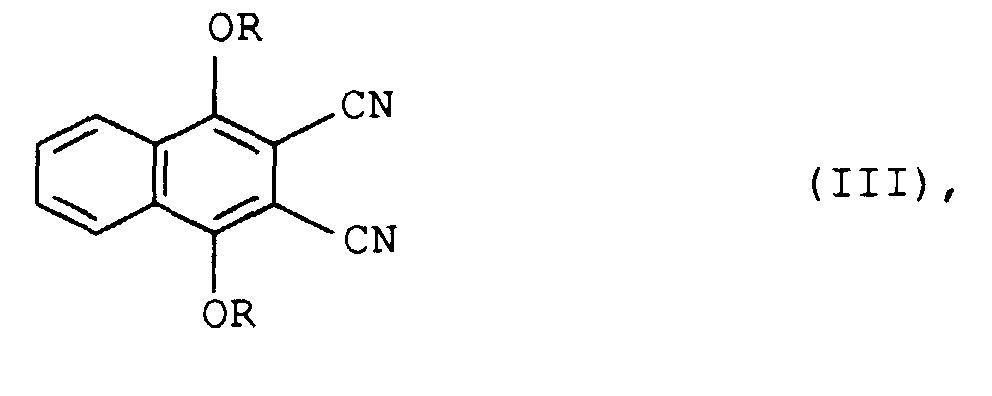
- b) in einem 2. Schritt in Gegenwart eines Alkohols mittels eines Alkalialkoholats in das Naphthalocyanin der Formel I, in der Me zweimal Wasserstoff bedeutet, überführt, wobei man ein Molverhältnis Alkalialkoholat:Dicyanonaphthalin III von 1:2,5 bis 2,5:1 anwendet, und gegebenenfalls anschließend
- c) in einem 3. Schritt das resultierende metallfreie Naphthalocyanin durch Umsetzung mit einem Metallsalz in Gegenwart eines Alkohols in das metallhaltige Naphthalocyanin der Formel I, in der Me einen metallhaltigen Liganden bedeutet, umwandelt, wobei Naphthalocyanin und Metallsalz im Molverhältnis von 1:1 bis 1:10 zur Reaktion gebracht werden.
- Alle in den obengenannten Formeln auftretenden Alkyl- und Alkenylgruppen können sowohl geradkettig als auch verzweigt sein.
- Die Reste R können dabei gleich oder verschieden sein.
- Reste R sind z.B. Methyl, Ethyl, Propyl, Isopropyl, Butyl, Isobutyl, sec-Butyl, Pentyl, Isopentyl, Neopentyl, tert-Pentyl, Hexyl, 2-Methylpentyl, Heptyl, Octyl, 2-Ethylhexyl, Isooctyl, Nonyl, Isononyl, Decyl, Isodecyl, Undecyl, Dodecyl, Tridecyl, 3,5,5,7-Tetramethylnonyl, Isotridecyl (die obigen Bezeichnungen Isooctyl, Isononyl, Isodecyl und Isotridecyl sind Trivialbezeichnungen und stammen von den nach der Oxosynthese erhaltenen Alkoholen - vgl. dazu Ullmanns Encyklopädie der technischen Chemie, 4. Auflage, Band 7, Seiten 215 bis 217, sowie Band 11, Seiten 435 und 436), Tetradecyl, Pentadecyl, Hexadecyl, Heptadecyl, Octadecyl, Nonadecyl, Eicosyl, 2-Methoxyethyl, 2-Ethoxyethyl, 2-Propoxyethyl, 2-Isopropoxyethyl, 2-Butoxyethyl, 2- oder 3-Methoxypropyl, 2- oder 3-Ethoxypropyl, 2- oder 3 Propoxypropyl, 2- oder 3-Butoxypropyl, 2- oder 4-Methoxybutyl, 2- oder 4-Ethoxybutyl, 2- oder 4-Propoxybutyl, 2- oder 4-Butoxybutyl, 3,6-Dioxaheptyl, 3,6-Dioxaoctyl, 4,8-Dioxanonyl, 3,7-Dioxaoctyl, 3,7-Dioxanonyl, 4,7-Dioxaoctyl, 4,7-Dioxanonyl, 4,8-Dioxadecyl, 3,6,8-Trioxadecyl, 3,6, 9-Trioxaundecyl, Butenyl, But-3-en-1-yl, Pentenyl, Pent-4-en-1-yl, 3-Methyl-but-3-en-1-yl, Hexenyl, Heptenyl, Octenyl, Nonenyl, Decenyl, Undecenyl, Undec-10-en-1-yl, Dodecenyl, Tridecenyl, Tetradecenyl, Pentadecenyl, Hexedecenyl, Heptadecenyl, Octadecenyl, Nonadecenyl, oder Eicosenyl.
- Als zweibindiger metallhaltiger Rest ist insbesondere Kupfer zu nennen.
- Bevorzugt ist eine Verfahrensweise zur Herstellung von Naphthalocyaninen der Formel I, in der Me zweimal Wasserstoff oder Kupfer bedeutet.
- Bevorzugt ist weiterhin eine Verfahrensweise zur Herstellung von Naphthalocyaninen der Formel I, in der R jeweils C2-C13-Alkyl oder C4-C11-Alkenyl und insbesondere C2-C8-Alkyl, bedeutet, wobei die Herstellung solcher Naphthalocyanine der Formel I, in der R jeweils C4-Alkyl oder ein C2/C5-Alkyl-Gemisch bedeutet, besonders hervorzuheben ist.
- Im 1. Schritt des erfindungsgemäßen Verfahrens wird 1,4-Dihydroxy-2,3-dicyanonaphthalin in Gegenwart eines Verdünnungsmittels mit einem Alkylierungsmittel II umgesetzt.
- Das Molverhältnis 1,4-Dihydroxy-2,3-dicyanonaphthalin:Alkylierungsmittel II beträgt dabei 1:2 bis 1:3, vorzugsweise 1:2,2 bis 1:2,4.
- Wie oben bereits ausgeführt, sind geeignete Alkylierungsmittel die entsprechenden Bromverbindungen (R-Br) oder Dialkylsulfate (ROSO2OR), wobei bei niederen Alkylresten (Methyl und Ethyl) vorzugsweise die jeweiligen Dialkylsulfate zur Anwendung gelangen, während bei den anderen Resten vorzugsweise die jeweiligen Bromverbindungen Verwendung finden.
- Der Alkylierungsschritt wird in Gegenwart eines Verdünnungsmittels und einer Base vorgenommen. Geeignete Verdünnungsmittel sind z.B. N,N-Dimethylformamid, N,N-Diethylformamid, N-Methylpyrrolidon oder Dimethylsulfoxid. Die Verwendung von N,N-Dimethylformamid ist bevorzugt.
- Geeignete Basen sind z.B. Alkalicarbonate, wie Lithium-, Natrium- oder Kaliumcarbonat. Die Verwendung von Kaliumcarbonat ist bevorzugt.
- Je mol 1,4-Dihydroxy-2,3-dicyanonaphthalin kommen in der Regel 1,5 bis 3 mol Base zur Anwendung. Bezogen auf das Gewicht von 1,4-Dihydroxy-2,3-dicyanonaphthalin wendet man in der Regel 400 bis 700 Gew.-% Verdünnungsmittel an.
- Der 1. Schritt des erfindungsgemäßen Verfahrens wird üblicherweise bei einer Temperatur von 80 bis 120°C vorgenommen.
- Er wird in der Regel so durchgeführt, daß man 1,4-Dihydroxy-2,3-dicyanonaphthalin und das Verdünnungsmittel vorlegt und zu diesem Gemisch Base und Alkylierungsmittel II gibt. Es ist jedoch auch möglich, diese Reihenfolge zu vertauschen und beispielsweise 1,4-Dihydroxy-2,3-dicyanonaphthalin, Verdünnungsmittel und Alkylierungsmittel II vorzulegen und dazu Base zu geben oder 1,4-Dihydroxy-2,3-dicyanonaphthalin, Verdünnungsmittel und Base vorzulegen und dazu Alkylierungsmittel II zu geben. Das resultierende Gemisch wird dann unter Rühren 4 bis 10 Stunden bei der obengenannten Temperatur gehalten.
- Die weitere Aufarbeitung besteht darin, das Reaktionsgemisch auf Wasser zu gießen und das als Niederschlag anfallende Dicyanonaphthalin der Formel III abzusaugen, zu waschen und zu trocknen.
- Es kann ohne weitere Reinigung direkt im 2. Schritt des erfindungsgemäßen Verfahrens zur Anwendung kommen, wobei diese Methode bevorzugt ist.
- Die Herstellung des als Ausgangsprodukt verwendeten 1,4-Dihydroxy-2,3-dicyanonaphthalins ist z.B. in J. Org. Chem. 29, 3591, 1964, beschrieben.
- Im 2. Schritt des erfindungsgemäßen Verfahrens wird das Dicyanonaphthalin der Formel III in Gegenwart eines Alkohols mittels eines Alkalialkoholats in das metallfreie Naphthalocyanin der Formel I übergeführt.
- Dicyanonaphthalin III und Alkalialkoholat kommen dabei im Molverhältnis 1:2,5 bis 2,5:1, vorzugsweise 1:2 bis 2:1, zur Anwendung.
- Geeignete Alkalialkoholate sind beispielsweise Lithium-, Natrium- oder Kaliumsalze von Methanol oder Ethanol. Die Verwendung der Natrium- oder Kaliumsalze ist bevorzugt, wobei Natriummethanolat oder Natriumethanolat besondere Bedeutung zukommt. Von besonderem Vorteil ist es weiterhin, die Alkalialkoholate in alkoholischer Lösung zuzugeben.
- Geeignete Alkohole sind z.B. C1-C20-Alkanole, deren Alkylkette gegebenenfalls durch 1 bis 3 Sauerstoffatome in Etherfunktion unterbrochen ist, wie Methanol, Ethanol, Propanol, Isopropanol, Butanol, Isobutanol, sec-Butanol, Pentanol, Isopentanol, Neopentanol, tert-Pentanol, Hexanol, Heptanol, Octanol, Isooctanol, 2-Ethylhexanol, Nonanol, Decanol, oder C4-C20-Alkenole, wie But-3-en-1-ol, Pent-4-en-1-ol oder Undec-10-en-1-ol.
- Die Verwendung von C2-C12-Alkanolen oder C4-C11-Alkenolen ist bevorzugt, wobei C3-C6-Alkanole besonders hervorzuheben sind.
- Bezogen auf das Gewicht von Dicyanonaphthalin der Formel III kommen in der Regel 300 bis 1000 Gew.-% Alkohol zur Anwendung.
- Der 2. Schritt des erfindungsgemäßen Verfahrens wird zweckmäßig so durchgeführt, daß man Alkalialkoholat, Alkohol und Dicyanonaphthalin III vorlegt und gegebenenfalls in einer Schutzgasatmosphäre, z.B Stickstoff oder Helium, unter Rühren auf eine Temperatur von 90 bis 160°C erhitzt.
- Es ist auch möglich, eine Lösung beispielsweise von Natriummethanolat in Methanol zusammen mit dem Alkohol vorzulegen und dieses Gemisch zu erwärmen, um Methanol abzudestillieren. Nach dem Entfernen des Methanols kann dann das Dicyanonaphthalin III zugegeben werden.
- Nach einer Reaktionsdauer von 0,25 bis 6 Stunden ist die Umsetzung im allgemeinen beendet. Man kann dann den Alkohol ganz oder teilweise abdestillieren (im letzten Fall mindestens bis zur Hälfte), zum Rückstand Methanol geben, das als Niederschlag anfallende metallfreie Naphthalocyanin der Formel I (Me - zweimal Wasserstoff) absaugen, mit Methanol nachwaschen und trocknen.
- Das metallfreie Naphthalocyanin fällt in guter Reinheit an und kann ohne weitere Reinigung direkt weiter verwendet werden, z.B. für die Metallisierungsreaktion.
- Am resultierenden Naphthalocyanin kann eine Umalkylierung (bis zu 100 %) der Reste R beobachtet werden. Während der Naphthalocyaninbildung können nämlich die am Naphthalinring vorhandenen OR-Reste teilweise gegen die Alkoholatreste des zur Anwendung kommenden Alkohols ausgetauscht werden.
- Es ist auch möglich, am bereits gebildeten Octaalkoxynaphthalocyanin eine Umalkylierung vorzunehmen. Dies kann z.B. durch Behandlung des Octaalkoxynaphthalocyanins mit Natriummethanolat und einem Alkohol, dessen Alkoxyrest von den am Naphthalocyanin befindlichen Alkoxygruppen verschieden ist, geschehen.
- Das metallfreie Naphthalocyanin der Formel I kann dann gegebenenfalls noch in einem 3. Schritt in ein metallhaltiges Naphthalocyanin umgewandelt werden. Dazu wird es in Gegenwart eines Alkohols mit einem Metallsalz umgesetzt. Naphthalocyanin und Metallsalz kommen dabei im Molverhältnis 1:1 bis 1:10, vorzugsweise 1:1 bis 1:1,2 zur Anwendung.
- Bei der Durchführung des 3. Schrittes kann man das im 2. Schritt anfallende Reaktionsgemisch auch direkt, d.h. ohne Zwischenisolierung des metallfreien Naphthalocyanins, verwenden. Diese Methode ist bevorzugt.
- Bezogen auf das Gewicht an metallfreiem Naphthalocyanin I werden in der Regel 1000 bis 2000 Gew.-% Alkohol verwendet.
- Geeignete Metallsalze sind z.B. Kupfersalze, wie Kupfer(II)acetat, Kupfer(I)chlorid, Kupfer(II)chlorid, Kupfer(II)sulfat oder Kupfer(II)acetylacetonat. Die Verwendung von Kupfer(II)acetat oder Kupfer(I)- oder Kupfer(II)chlorid ist bevorzugt.
- Geeignete Alkohole für diesen Schritt sind z.B. Propanol, Butanol oder Pentanol.
- Wenn man die Metallisierung ohne Zwischenisolierung des metallfreien Naphthalocyanins durchführt, liegt bereits ein alkoholisches Reaktionsmedium vor. In diesem Fall kann man die Metallisierung direkt in diesem Medium durchführen oder gegebenenfalls noch mit weiterem Alkohol verdünnen.
- In manchen Fällen kann es auch von Vorteil sein, die Metallisierung in Gegenwart von Basen, z.B. 1,4-Diazabicyclo[2.2.2]octan oder 1,5-Diazabicyclo[5.4.0]undec-5-en, durchzuführen.
- Der 3. Schritt des erfindungsgemäßen Verfahrens wird zweckmäßig so durchgeführt, daß man ein Gemisch aus metallfreiem Naphthalocyanin I, Metallsalz, Verdünnungsmittel und gegebenenfalls Base unter Rühren auf eine Temperatur von 80 bis 160°C erhitzt. Nach einer Reaktionsdauer von 5 bis 20 Stunden ist die Umsetzung in der Regel beendet. Danach kann das Verdünnungsmittel ganz oder teilweise (im letzten Fall mindestens bis zur Hälfte) abdestilliert werden. Zum Rückstand kann man Petrolether geben und das metallhaltige Naphthalocyanin absaugen, waschen und trocknen.
- Das erfindungsgemäße Verfahren, das sowohl in kontinuierlicher als auch diskontinuierlicher Arbeitsweise vorgenommen werden kann, ist einfach durchzuführen und liefert die Zielprodukte in hoher Ausbeute und Reinheit, wobei Ausbeute und Reinheit, verglichen mit den obengenannten Verfahren des Standes der Technik, im neuen Verfahren deutlich höher sind.
- Bei den metallfreien oder metallhaltigen Naphthalocyaninen der Formel I handelt es sich um wertvolle im Infrarotbereich absorbierende Verbindungen, die beispielsweise in Druckfarben zur Anwendung gelangen können (siehe z.B. EP-A-553 614).
- Die folgenden Beispiele sollen die Erfindung näher erläutern.
- 42 g (0, 2 mol) 1,4-Dihydroxy-2,3-dicyanonaphthalin wurden in 200 ml N,N-Dimethylformamid (DMF) bei Raumtemperatur vorgelegt. Dazu gab man 55,4 g (0,44 mol) Dimethylsulfat und 60,8 g (0,44 mol) Kaliumcarbonat. Dann erwärmte man langsam auf 100°C und rührte 8 h bei dieser Temperatur. Danach wurde auf Wasser gefällt, abgesaugt, mit Wasser nachgewaschen und getrocknet.
- Man erhielt 30 g 1,4-Dimethoxy-2,3-dicyanonaphthalin (Ausbeute: 64 %; Fp.: 190°C).
- 21 g (0,1 mol) 1,4-Dihydroxy-2,3-dicyanonaphthalin, 100 ml Dimethylsulfoxid und 38,5 g (0,25 mol) Diethylsulfat wurden bei Raumtemperatur vorgelegt. Dazu wurden unter Rühren 38,6 g (0,28 mol) Kaliumcarbonat zugegeben. Anschließend wurde 10 h lang bei 100°C gerührt, danach auf Eiswasser gefällt, mit Wasser nachgewaschen und getrocknet.
- Man erhielt 23,3 g 1,4-Diethoxy-2,3-dicyanonaphthalin (Ausbeute: 87 %; Fp.: 167°C).
- 210 g (1 mol) 1,4-Dihydroxy-2,3-dicyanonaphthalin wurden in 1 l DMF zusammen mit 339 g (2,2 mol) Diethylsulfat bei Raumtemperatur vorgelegt. Zu dieser Mischung wurden vorsichtig 304 g (2,2 mol) Kaliumcarbonat gegeben. Es wurde langsam auf 100°C erhitzt und 6 h lang bei 100°C gerührt. Man fällte dann auf Wasser, wusch mit Wasser nach und trocknete.
- Es wurden 231 g 1,4-Diethoxy-2,3-dicyanonaphthalin erhalten (Ausbeute: 87 %; Fp.: 167-169°C).
- 105 g 1,4-Dihydroxy-2,3-dicyanonaphthalin, 145 g Pottasche und 500 ml DMF wurden vorgelegt. Zu diesem Gemisch wurden 155 g 4-Brombutan gegeben. Dann wurde unter Rühren auf 100°C erhitzt und 6 Stunden bei dieser Temperatur nachgerührt. Danach wurde das Reaktionsgemisch abgekühlt und in 2000 ml Eiswasser gegeben. Der Niederschlag wurde abgesaugt, mit Wasser gewaschen und bei 60°C unter vermindertem Druck getrocknet.
- Man erhielt 120 g 1,4-Dibutoxy-2,3-dicyanonaphthalin (Ausbeute: 90 %; Fp.: 69-70°C).
- In 500 ml Ethanol wurden 3 g (0,13 mol) Natrium gelöst und 53,2 g (0,2 mol) 1,4-Diethoxy-2,3-dicyanonaphthalin zugegeben. Anschließend wurde 4 h unter Rückfluß gerührt. Ethanol wurde dann fast vollständig im Wasserstrahlvakuum abdestilliert (ca. 450 ml). Danach wurden 600 ml Methanol zum Reaktionsgemisch gegeben und 5 h lang bei Raumtemperatur gerührt. Das ausgefallene Produkt wurde abgesaugt, mit Methanol nachgewaschen und getrocknet.
- Man erhielt 23 g Octaethoxynaphthalocyanin (Ausbeute: 43 %; λmax: 856 nm; ε: 264 000 (in Toluol)).
- 47 g (0,26 mol) 30 gew.-%ige methanolische Natriummethanolatlösung wurden zusammen mit 700 ml n-Propanol vorgelegt. Unter Normaldruck wurde das Methanol abdestilliert, bis die Siedetemperatur des Propanols (97°C) fast erreicht wurde. Nach dem Abkühlen gab man unter Stickstoffatmosphäre 106 g (0,4 mol) 1,4-Diethoxy-2,3-dicyanonaphthalin zu und rührte 3 h lang unter Rückfluß nach. Das Propanol wurde dann im Wasserstrahlvakuum bis auf einen Rest von ca. 50 ml abdestilliert, und man gab dann 1 1 Methanol zu. Nach 8 h Rühren bei Raumtemperatur wurde das ausgefallene Produkt abgesaugt, mit Methanol nachgewaschen und getrocknet.
- Man erhielt 61,8 g eines Naphthalocyanins, das gemäß H-NMR zu 75 % transalkoxyliert wurde (R = 75 % Propyl und 25 % Ethyl) (Ausbeute: 53 %; λmax: 858 nm; ε: 263 000 (in Toluol)).
- 25 ml 30 gew.-%ige methanolische Natriummethanolatlösung wurden zusammen mit 500 ml Butanol vorgelegt. Unter Normaldruck wurde das Methanol abdestilliert, bis die Siedetemperatur des Butanols (117,8°C) fast erreicht wurde. Nach dem Abkühlen gab man unter Stickstoffatmosphäre 65 g 1,4-Dibutoxy-2,3-dicyanonaphthalin zu und rührte 2 h lang unter Rückfluß nach. Danach wurden 350 ml Butanol abdestilliert und 400 ml Methanol zugegeben. Nach 12 h Rühren bei Raumtemperatur wurde das ausgefallene Produkt abgesaugt, mit Methanol nachgewaschen und getrocknet.
- Man erhielt 45 g Octabutoxynaphthalocyanin (Ausbeute: 70 %)
- 47 g (0,26 mol) 30 gew.-%ige methanolische Natriummethanolatlösung wurden zu 1 1 n-Pentanol gegeben. Unter Normaldruck wurde Methanol abdestilliert, bis der Siedepunkt von Pentanol fast erreicht war (ca. 137°C). Nach Abkühlen wurden unter Stickstoffatmosphäre 106,4 g (0,4 mol) 1,4-Diethoxy-2,3-dicyanonaphthalin zugegeben und 3 h lang unter Rückfluß gerührt. Im Wasserstrahlvakuum wurde das Pentanol bis auf einen Rest von ca. 50 ml abdestilliert und 1 1 Methanol zugegeben. Nach 10 h Rühren bei Raumtemperatur wurde das ausgefallene Produkt abgesaugt, mit Methanol gewaschen und getrocknet.
- Man erhielt 90,3 g eines teilweise transalkoxylierten Naphthalocyanins (R = 88 % Pentyl und 12 % Ethyl) (Ausbeute: 66 %; λmax: 862 nm; ε: 260 000 (in Toluol)).
- 18 g (0,1 mol) 30 gew.-%ige methanolische Natriummethanolatlösung wurden in 300 ml n-Hexanol vorgelegt. Unter Normaldruck wurde Methanol abdestilliert, bis eine Temperatur von 153°C erreicht war. Nach Abkühlen gab man 11,4 g (0,01 mol) eines Octaalkoxynaphthalocyanins (R = 70 % Propyl und 30 % Ethyl) zu und rührte 4 h unter Rückfluß. Im Wasserstrahlvakuum wurde Hexanol bis fast zur Trockene abdestilliert. Anschließend wurden 500 ml Methanol zugegeben. Nach 6 h Rühren bei Raumtemperatur wurde das ausgefallene Produkt abgesaugt, mit Methanol nachgewaschen und getrocknet.
- Man erhielt 9,4 g Octahexyloxynaphthalocyanin (Ausbeute: 62 %; λmax: 864 nm; ε: 208 000 (in Toluol)).
- 45 g (0,035 mol) Octabutoxynaphthalocyanin wurden mit 7 g (0,039 mol) Kupfer(II)acetat-Monohydrat in 650 ml n-Butanol 10 h unter Rückfluß gerührt. Butanol wurde im Wasserstrahlvakuum abdestilliert, der Rückstand mit 700 ml Petrolether aufgerührt (1 h), abgesaugt, mit Petrolether gewaschen und getrocknet.
- Man erhielt 42 g Kupfer-Octabutoxynaphthalocyanin (Ausbeute: 88 %; λmax: 849 nm; ε: 235 000 (in Toluol)).
- 5,4 g (0,03 mol) 30 gew.%ige methanolische Natriummethanolatlösung wurden bei Raumtemperatur unter Rühren in 180 ml n-Butanol vorgelegt. Dann wurde bei Normaldruck Methanol abdestilliert, bis der Siedepunkt von n-Butanol (117°C) im Reaktionsgefäß erreicht wurde. Die Lösung wurde auf 60°C abgekühlt und mit 16,1 g (0,05 mol) 1,4-Dibutoxy-2,3-dicyanonaphthalin versetzt. Anschließend wurde das Reaktionsgemisch unter Stickstoffatmosphäre 2 h unter Rückfluß gerührt, dann auf 60°C abgekühlt und bei dieser Temperatur mit 1,9 g (0,0094 mol) Kupfer(II)acetat-Monohydrat versetzt. Nach 15 h Rühren unter Rückfluß wurden 80 % des Gesamtvolumens an n-Butanol unter vermindertem Druck abdestilliert. Der Rückstand wurde mit Petrolether (180 ml) 2 h bei Raumtemperatur gerührt, abgesaugt und mit Petrolether gewaschen.
- Man erhielt 13,4 g Kupfer-octa-butoxynaphthalocyanin (Ausbeute: 79,3 %; λmax= 850 mm; ε= 180 000 (in Toluol)).
Claims (4)
- Verfahren zur Herstellung von Naphthalocyaninen der Formel I
 Me zweimal Wasserstoff oder einen zweibindigen metallhaltigen Rest, der gegebenenfalls noch weitere Liganden aufweist, undR jeweils C1-C20-Alkyl, das gegebenenfalls durch 1 bis 3 Sauerstoffatome in Etherfunktion unterbrochen ist, oder C4-C20-Alkenyl bedeuten,durch Veretherung von 1,4-Dihydroxy-2,3-dicyanonaphthalin, Bildung des metallfreien Naphthalocyanins und gegebenenfalls anschließender Metallisierung,
dadurch gekennzeichnet, daß mana) in einem 1. Schritt 1,4-Dihydroxy-2,3-dicyanonaphthalin in Gegenwart eines Verdünnungsmittels und einer Base mit einem Alkylierungsmittel der Formel II
R-X (II),
in der X Brom oder den Rest RO-SO2O bedeutet und R jeweils die obengenannte Bedeutung besitzt, im Molverhältnis 1:2 bis 1:3 umsetzt, das Reaktionsgemisch auf Wasser gießt, das als Niederschlag anfallende Dicyanonaphthalin der Formel III b) in einem 2. Schritt in Gegenwart eines Alkohols mittels eines Alkalialkoholats in das Naphthalocyanin der Formel I, in der Me zweimal Wasserstoff bedeutet, überführt, wobei man ein Molverhältnis Alkalialkoholat:Dicyanonaphthalin III von 1:2,5 5 bis 2,5:1 anwendet, und gegebenenfalls anschließendc) in einem 3. Schritt das resultierende metallfreie Naphthalocyanin durch Umsetzung mit einem Metallsalz in Gegenwart eines Alkohols in das metallhaltige Naphthalocyanin der Formel I, in der Me einen metallhaltigen Liganden bedeutet, umwandelt, wobei Naphthalocyanin und Metallsalz im Molverhältnis von 1:1 bis 1:10 zur Reaktion gebracht werden.
 - Verfahren nach Anspruch 1, dadurch gekennzeichnet, daß Me zweimal Wasserstoff oder Kupfer bedeutet.
- Verfahren nach Anspruch 1, dadurch gekennzeichnet, daß R jeweils C2-C13-Alkyl oder C4-C11-Alkenyl bedeutet.
- Verfahren nach Anspruch 1, dadurch gekennzeichnet, daß R jeweils C2-C8-Alkyl bedeutet.
Applications Claiming Priority (3)
| Application Number | Priority Date | Filing Date | Title |
|---|---|---|---|
| DE4310371 | 1993-03-30 | ||
| DE4310371A DE4310371A1 (de) | 1993-03-30 | 1993-03-30 | Verfahren zur Herstellung von Naphthalocyaninen |
| PCT/EP1994/000863 WO1994022960A1 (de) | 1993-03-30 | 1994-03-18 | Verfahren zur herstellung von naphtalocyaninen |
Publications (2)
| Publication Number | Publication Date |
|---|---|
| EP0692002A1 EP0692002A1 (de) | 1996-01-17 |
| EP0692002B1 true EP0692002B1 (de) | 1996-12-27 |
Family
ID=6484260
Family Applications (1)
| Application Number | Title | Priority Date | Filing Date |
|---|---|---|---|
| EP94911925A Expired - Lifetime EP0692002B1 (de) | 1993-03-30 | 1994-03-18 | Verfahren zur herstellung von naphtalocyaninen |
Country Status (5)
| Country | Link |
|---|---|
| US (1) | US5656752A (de) |
| EP (1) | EP0692002B1 (de) |
| JP (1) | JPH08508269A (de) |
| DE (2) | DE4310371A1 (de) |
| WO (1) | WO1994022960A1 (de) |
Families Citing this family (10)
| Publication number | Priority date | Publication date | Assignee | Title |
|---|---|---|---|---|
| JPH07118273A (ja) * | 1993-10-22 | 1995-05-09 | Hiroyoshi Shirai | ナフタロシアニン系化合物および製造方法、ならびにナフタロシアニン系重合体および製造方法 |
| WO1998032832A1 (en) * | 1997-01-24 | 1998-07-30 | The Procter & Gamble Company | Low hue photobleaches |
| US7382379B1 (en) * | 1997-06-27 | 2008-06-03 | Eastman Kodak Company | Arrangement for mapping colors between imaging systems and method thereof |
| US6316264B1 (en) * | 1999-12-17 | 2001-11-13 | Bayer Corporation | Test strip for the assay of an analyte in a liquid sample |
| JP2007169477A (ja) * | 2005-12-22 | 2007-07-05 | Fujifilm Corp | ナフタロシアニン化合物およびその製造方法 |
| JP2007169478A (ja) * | 2005-12-22 | 2007-07-05 | Fujifilm Corp | ナフタロシアニン化合物およびその製造方法 |
| US20080040590A1 (en) * | 2006-08-11 | 2008-02-14 | Lea Hwang Lee | Selective branch target buffer (btb) allocaiton |
| JP2009215542A (ja) * | 2008-02-13 | 2009-09-24 | Fujifilm Corp | 赤外色素組成物及びそれを用いた赤外線吸収インク及び電子写真用トナー |
| JP2010197305A (ja) | 2009-02-26 | 2010-09-09 | Fujifilm Corp | ナフタロシアニン化合物を用いた製品の真偽を証明する方法、シグナル変換方法及び印刷用インク又はトナー、及びナフタロシアニン化合物の製造方法 |
| US20240101849A1 (en) | 2020-12-16 | 2024-03-28 | Yamamoto Chemicals, Inc. | Printed material |
Family Cites Families (4)
| Publication number | Priority date | Publication date | Assignee | Title |
|---|---|---|---|---|
| GB8431446D0 (en) * | 1984-12-13 | 1985-01-23 | Secr Defence | Alkoxyphthalocyanines |
| GB8614673D0 (en) * | 1986-06-17 | 1986-07-23 | Secr Defence | Alkoxyphthalocyanines |
| DE59008355D1 (de) * | 1989-11-22 | 1995-03-09 | Ciba Geigy Ag | Substituierte Naphthalocyanine und deren Verwendung. |
| DE4202038A1 (de) * | 1992-01-25 | 1993-07-29 | Basf Ag | Verwendung einer fluessigkeit, enthaltend ir-farbstoffe, als druckfarbe |
-
1993
- 1993-03-30 DE DE4310371A patent/DE4310371A1/de not_active Withdrawn
-
1994
- 1994-03-18 US US08/522,365 patent/US5656752A/en not_active Expired - Fee Related
- 1994-03-18 EP EP94911925A patent/EP0692002B1/de not_active Expired - Lifetime
- 1994-03-18 WO PCT/EP1994/000863 patent/WO1994022960A1/de not_active Ceased
- 1994-03-18 DE DE59401406T patent/DE59401406D1/de not_active Expired - Lifetime
- 1994-03-18 JP JP6521615A patent/JPH08508269A/ja active Pending
Also Published As
| Publication number | Publication date |
|---|---|
| JPH08508269A (ja) | 1996-09-03 |
| WO1994022960A1 (de) | 1994-10-13 |
| US5656752A (en) | 1997-08-12 |
| EP0692002A1 (de) | 1996-01-17 |
| DE59401406D1 (de) | 1997-02-06 |
| DE4310371A1 (de) | 1994-10-06 |
Similar Documents
| Publication | Publication Date | Title |
|---|---|---|
| EP0713488B1 (de) | [1,3,4]triazolo[1,5-al]pyridine als zwischenprodukte für die synthese von farbstoffen | |
| EP1294708B1 (de) | Kristallisationsmodifikatoren auf der basis von chinophthalonderivaten | |
| EP0692002B1 (de) | Verfahren zur herstellung von naphtalocyaninen | |
| DE2238628A1 (de) | Verfahren zur herstellung von furanverbindungen | |
| EP0252406A2 (de) | Verfahren zur Herstellung polycyclischer Verbindungen | |
| EP0454624B1 (de) | Verfahren zur Herstellung von 1,3-Diketonen | |
| DE2858259C2 (de) | 9,10-Dimathoxy-2,3,6,7-tetrahydro-4-H-pyrimido-(6,1-a)-isochinolin-4-on-Derivate und Verfahren zu ihrer Herstellung | |
| DE60103416T2 (de) | VErfahren zur Herstellung von 2-Alkoxy-6-Trifluoromethyl-N-([1,2,4]Triazolo[1,5-C]Pyrimidin-2-YL)Benzolsulfonamiden | |
| EP0235647B1 (de) | Verfahren zur Herstellung von 6,13-Dihydrochinacridonen und Chinacridonen | |
| EP0454623B1 (de) | Verfahren zur Herstellung von linearen 1,3-Diketonen | |
| EP0017181A1 (de) | Neues Verfahren zur Herstellung von Imidazobenzodiazepinderivaten sowie Zwischenprodukte zu deren Herstellung | |
| DE2350875C3 (de) | Verfahren zur Herstellung von 2-Hydrazinobenzthiazolen | |
| DE3744211C1 (de) | Verfahren zur Herstellung von Cyanopropylalkoxysilanen und Vorrichtung zur Durchfuehrung des Verfahrens | |
| DE19745922A1 (de) | Verfahren zur Überführung von halogenierten Kupferphtalocyanin-Rohpigmenten in eine für die Anwendung geeignete Pigmentform | |
| EP0673919A1 (de) | Verfahren zur Herstellung von carbocyclischen m-Amino-hydroxyaromaten | |
| DE2751784A1 (de) | Azofarbstoffe | |
| DE3937282A1 (de) | Verfahren zur herstellung von alkyl-(3-chlorphenyl)-sulfonen | |
| EP0005172A1 (de) | Cumarin-Verbindungen und ihre Verwendung als Aufheller für organische hochmolekulare Materialien | |
| DE1545803B2 (de) | Verfahren zur herstellung von 7-aminocarbostyril-verbindungen | |
| DE69917163T2 (de) | Verfahren zur herstellung von l-valinbenzylester-p-toluolsufonaten | |
| WO1996003463A1 (de) | Nitrofarbstoffe | |
| DE2928602A1 (de) | Verfahren zur herstellung von 2.3- perfluor-1.4-dioxanen sowie einige spezielle vertreter dieser verbindungsklasse | |
| DE2364689A1 (de) | Verfahren zur herstellung von metallfreiem phthalocyanin | |
| DE10151564A1 (de) | Verfahren zur Herstellung von Alkoxycarbonylamino-triazinen | |
| DE965260C (de) | Verfahren zur Herstellung von Kuepenfarbstoffen |
Legal Events
| Date | Code | Title | Description |
|---|---|---|---|
| PUAI | Public reference made under article 153(3) epc to a published international application that has entered the european phase |
Free format text: ORIGINAL CODE: 0009012 |
|
| 17P | Request for examination filed |
Effective date: 19950824 |
|
| AK | Designated contracting states |
Kind code of ref document: A1 Designated state(s): CH DE FR GB IT LI |
|
| GRAG | Despatch of communication of intention to grant |
Free format text: ORIGINAL CODE: EPIDOS AGRA |
|
| GRAH | Despatch of communication of intention to grant a patent |
Free format text: ORIGINAL CODE: EPIDOS IGRA |
|
| 17Q | First examination report despatched |
Effective date: 19960517 |
|
| GRAH | Despatch of communication of intention to grant a patent |
Free format text: ORIGINAL CODE: EPIDOS IGRA |
|
| GRAA | (expected) grant |
Free format text: ORIGINAL CODE: 0009210 |
|
| AK | Designated contracting states |
Kind code of ref document: B1 Designated state(s): CH DE FR GB IT LI |
|
| REF | Corresponds to: |
Ref document number: 59401406 Country of ref document: DE Date of ref document: 19970206 |
|
| GBT | Gb: translation of ep patent filed (gb section 77(6)(a)/1977) |
Effective date: 19970125 |
|
| ITF | It: translation for a ep patent filed | ||
| ET | Fr: translation filed | ||
| PLBE | No opposition filed within time limit |
Free format text: ORIGINAL CODE: 0009261 |
|
| STAA | Information on the status of an ep patent application or granted ep patent |
Free format text: STATUS: NO OPPOSITION FILED WITHIN TIME LIMIT |
|
| 26N | No opposition filed | ||
| REG | Reference to a national code |
Ref country code: GB Ref legal event code: IF02 |
|
| PGFP | Annual fee paid to national office [announced via postgrant information from national office to epo] |
Ref country code: DE Payment date: 20020309 Year of fee payment: 9 |
|
| PGFP | Annual fee paid to national office [announced via postgrant information from national office to epo] |
Ref country code: FR Payment date: 20030213 Year of fee payment: 10 |
|
| PGFP | Annual fee paid to national office [announced via postgrant information from national office to epo] |
Ref country code: CH Payment date: 20030227 Year of fee payment: 10 |
|
| PGFP | Annual fee paid to national office [announced via postgrant information from national office to epo] |
Ref country code: GB Payment date: 20030317 Year of fee payment: 10 |
|
| PG25 | Lapsed in a contracting state [announced via postgrant information from national office to epo] |
Ref country code: DE Free format text: LAPSE BECAUSE OF THE APPLICANT RENOUNCES Effective date: 20030415 |
|
| PG25 | Lapsed in a contracting state [announced via postgrant information from national office to epo] |
Ref country code: GB Free format text: LAPSE BECAUSE OF NON-PAYMENT OF DUE FEES Effective date: 20040318 |
|
| PG25 | Lapsed in a contracting state [announced via postgrant information from national office to epo] |
Ref country code: LI Free format text: LAPSE BECAUSE OF NON-PAYMENT OF DUE FEES Effective date: 20040331 Ref country code: CH Free format text: LAPSE BECAUSE OF NON-PAYMENT OF DUE FEES Effective date: 20040331 |
|
| GBPC | Gb: european patent ceased through non-payment of renewal fee |
Effective date: 20040318 |
|
| REG | Reference to a national code |
Ref country code: CH Ref legal event code: PL |
|
| PG25 | Lapsed in a contracting state [announced via postgrant information from national office to epo] |
Ref country code: FR Free format text: LAPSE BECAUSE OF NON-PAYMENT OF DUE FEES Effective date: 20041130 |
|
| REG | Reference to a national code |
Ref country code: FR Ref legal event code: ST |
|
| PG25 | Lapsed in a contracting state [announced via postgrant information from national office to epo] |
Ref country code: IT Free format text: LAPSE BECAUSE OF NON-PAYMENT OF DUE FEES;WARNING: LAPSES OF ITALIAN PATENTS WITH EFFECTIVE DATE BEFORE 2007 MAY HAVE OCCURRED AT ANY TIME BEFORE 2007. THE CORRECT EFFECTIVE DATE MAY BE DIFFERENT FROM THE ONE RECORDED. Effective date: 20050318 |