EP0686522A2 - Battery attaching/detaching structure in motor-assisted bicycle - Google Patents
Battery attaching/detaching structure in motor-assisted bicycle Download PDFInfo
- Publication number
- EP0686522A2 EP0686522A2 EP95107983A EP95107983A EP0686522A2 EP 0686522 A2 EP0686522 A2 EP 0686522A2 EP 95107983 A EP95107983 A EP 95107983A EP 95107983 A EP95107983 A EP 95107983A EP 0686522 A2 EP0686522 A2 EP 0686522A2
- Authority
- EP
- European Patent Office
- Prior art keywords
- battery case
- recess
- battery
- body cover
- motor
- Prior art date
- Legal status (The legal status is an assumption and is not a legal conclusion. Google has not performed a legal analysis and makes no representation as to the accuracy of the status listed.)
- Granted
Links
Images




Classifications
-
- B—PERFORMING OPERATIONS; TRANSPORTING
- B62—LAND VEHICLES FOR TRAVELLING OTHERWISE THAN ON RAILS
- B62M—RIDER PROPULSION OF WHEELED VEHICLES OR SLEDGES; POWERED PROPULSION OF SLEDGES OR SINGLE-TRACK CYCLES; TRANSMISSIONS SPECIALLY ADAPTED FOR SUCH VEHICLES
- B62M6/00—Rider propulsion of wheeled vehicles with additional source of power, e.g. combustion engine or electric motor
- B62M6/40—Rider propelled cycles with auxiliary electric motor
- B62M6/55—Rider propelled cycles with auxiliary electric motor power-driven at crank shafts parts
-
- B—PERFORMING OPERATIONS; TRANSPORTING
- B62—LAND VEHICLES FOR TRAVELLING OTHERWISE THAN ON RAILS
- B62K—CYCLES; CYCLE FRAMES; CYCLE STEERING DEVICES; RIDER-OPERATED TERMINAL CONTROLS SPECIALLY ADAPTED FOR CYCLES; CYCLE AXLE SUSPENSIONS; CYCLE SIDECARS, FORECARS, OR THE LIKE
- B62K19/00—Cycle frames
- B62K19/30—Frame parts shaped to receive other cycle parts or accessories
-
- B—PERFORMING OPERATIONS; TRANSPORTING
- B62—LAND VEHICLES FOR TRAVELLING OTHERWISE THAN ON RAILS
- B62M—RIDER PROPULSION OF WHEELED VEHICLES OR SLEDGES; POWERED PROPULSION OF SLEDGES OR SINGLE-TRACK CYCLES; TRANSMISSIONS SPECIALLY ADAPTED FOR SUCH VEHICLES
- B62M6/00—Rider propulsion of wheeled vehicles with additional source of power, e.g. combustion engine or electric motor
- B62M6/80—Accessories, e.g. power sources; Arrangements thereof
- B62M6/90—Batteries
Definitions
- the present invention relates to a motor-assisted bicycle having a motor to use motive power of the motor for assisting man power propelling the bicycle, and more particularly to an attaching/detaching structure of a battery for supplying electric power to the motor to/from a vehicle body of the motor-assisted bicycle.
- a motor is provided in a power transmitting system for transmitting a depression force applied to pedals to a wheel, and an output from the motor is controlled according to the depression force applied to the pedals. Further, a battery for supplying electric power to the motor is provided.
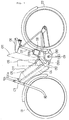
- Fig. 1 is a side view of a motor-assisted bicycle described in Japanese Patent Laid-open No. Hei 5-319104.
- a main frame having a V-shape as viewed in side elevation is provided between a front wheel 01 and a rear wheel 02.
- a down tube 04 of the main frame extends rearward and downward from a head pipe 03.
- An elongated battery case 05 is provided along the down tube 04.
- a seat tube 07 of the main frame extends rearward and upward from the lower end of the down tube 04 toward a seat 06.
- a motor 08 is provided on the seat tube 07.
- a pedal crank 09 is located at a V-shaped lowermost portion of the main frame. There is provided at the V-shaped lowermost portion a gear mechanism for reducing a driving force of the motor 08 in speed and transmitting it to a crankshaft 010 supporting the pedal crank 09.
- the battery case 05 is covered with an exterior cover 011.
- the exterior cover 011 can be opened by opening a lock device 011a provided at the front end of the exterior cover 011 and then upward pivoting the exterior cover 011 about a pivot shaft 011b provided at the rear upper end of the exterior cover 011.
- a support box 012 is detachably provided at the lower end of the battery case 05.
- the support box 012 can be upward pivoted together with the battery case 05 about a pivot shaft 012a.
- Fig. 1 the upward pivoted condition of the battery case 05 and the support box 012 is shown by a phantom line.
- the battery case 05 can be detached from the support box 012, thus being removed from a vehicle body.
- the lock device 011a In removing the battery case 05 from the vehicle body, the lock device 011a is first opened, and then the exterior cover 011 is pivoted upward to thereby expose the battery case 05. Then, a clamp (not shown) is removed and the battery case 05 is pivoted upward together with the support box 012. Then, an engaging member (not shown) is removed and the battery case 05 is separated from the support box 012.
- the operation is performed in the order reverse to the above-mentioned removing operation.
- a battery attaching/detaching structure comprising a battery case for storing the battery, the battery case being configured in the form of elongated box having a substantially quadrangular cross section; a body cover provided obliquely along a down frame extending rearward and downward from a head pipe, the body cover having a recess substantially U-shaped in side elevation, for fittedly supporting the battery case, the recess having an elongated inclined bottom surface opposed to an elongated lower surface of the battery case and front and rear inside surfaces respectively opposed to front and rear end surfaces of the battery case; and a lock device for disengageably engaging a front end of the battery case; wherein the rear inside surface of the recess of the body cover is steeply inclined at an acute angle near a right angle with respect to the inclined bottom surface of the recess; and an angle of the rear end surface of the battery case with respect
- the battery case When the battery case is fitted with the U-shaped recess of the body cover, and the lock device is operated to engage the front end of the battery case, the battery case is fixed at its front portion by the lock device. Further, the rear inside surface of the recess of the body cover is steeply inclined at an acute angle near a right angle with respect to the bottom surface of the recess, and the rear end surface of the battery case is opposed to the steeply inclined rear inside surface of the recess. Therefore, the rear end of the battery case is inhibited from pivoting upward about the front end of the battery case. Thus, the battery case fitted with the recess of the body cover is kept in a fixed condition.
- the battery case cannot be removed unless the lock device is disengaged from the front end of the battery case.
- the front end of the battery case is allowed to freely move upward.
- the battery case can be removed by upward sliding the battery case as a whole along the rear inside surface of the recess or upward pivoting the front end of the battery case.
- the battery case can be easily attached to or detached from the body cover. Further, the attaching/detaching structure of the battery case can be made simple.
- the lock device may be provided inside a front end portion of the battery case, and the lock device may have a lock pin projecting rearward to come into engagement with a lock hole formed through the front end surface of the battery case by a locking operation.
- the lock pin may be retracted from the lock hole by an unlocking operation. Accordingly, the locking and unlocking operations for the battery case can be easily performed by the simple lock device.
- the bottom surface and the front inside surface of the recess of the body cover may be formed by left and right separated side covers, and the rear inside surface of the recess may be formed by a center cover. Accordingly, the body cover can be formed by a small number of parts.
- Fig. 1 is a general side view of a motor-assisted bicycle in the prior art.
- Fig. 2 is a general side view of a motor-assisted bicycle according to a preferred embodiment of the present invention.
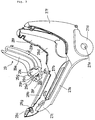
- Fig. 3 is an exploded perspective view of a body cover of the motor-assisted bicycle.
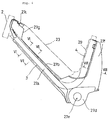
- Fig. 4 is a side view of side covers.
- Fig. 5 is a fragmentary top plan view of the side covers.
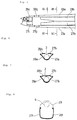
- Fig. 6 is a cross section taken along the line VI-VI in Figs. 4 and 5.
- Fig. 7 is a cross section taken along the line VII-VII in Figs. 4 and 5.
- Fig. 8 is a cross section taken along the line VIII-VIII in Fig. 4.
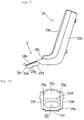
- Fig. 9 is a side view of a center cover.
- Fig. 10 is a view taken in the direction of the arrow X in Fig. 9.
- Fig. 11 is a side view of a body cover constructed by assembling the side covers and the center cover and a battery case removed from the body cover.
- Fig. 12 is a side view of the body cover and the battery case mounted thereon.
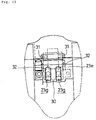
- Fig. 13 is a view taken in the direction of the arrow XIII in Fig. 12.
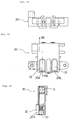
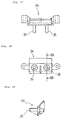
- Fig. 14 is a top plan view of a discharging connector.
- Fig. 15 is a rear elevation of the discharging connector.
- Fig. 16 is a cross section taken along the line XVI-XVI in Fig. 15.
- Fig. 17 is a top plan view of a connector mounted on the body cover.
- Fig. 18 is a rear elevation of the connector.
- Fig. 19 is a cross section taken along the line XIX-XIX in Fig. 18.
- Fig. 20 is a sectional view of the rear portion of the battery case and the lower portion of the center cover.
- Fig. 21 is a top plan view of a body of the battery case at its rear portion.
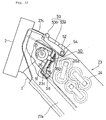
- Fig. 22 is a partially cutaway, side view of the front portion of the battery case in the vicinity of a head pipe.
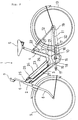
- Fig. 2 is a general side view of a motor-assisted bicycle 1 according to the preferred embodiment.
- the motor-assisted bicycle 1 includes a head pipe 2, a down tube 3 extending rearward and downward from the head pipe 2, and a seat tube 4 extending rearward and upward from the lower end of the down tube 3 to a seat 5.
- the down tube 3 and the seat tube 4 constitute a V-shaped main frame bent at the lower end of the down tube 3.
- a steering shaft 6 is pivotably supported to the head pipe 2, and a bar-shaped handle 7 is fixedly supported to the upper end of the steering shaft 6.
- a front fork 8 extends integrally from the lower end of the steering shaft 6, and a front wheel 9 is rotatably supported to the right and left lower ends of the front fork 8.
- a gear box 10 storing a gear mechanism is suspendedly fixed through a bracket 3a (see Fig. 20) to a V-shaped lower end portion of the main frame as the intersection between the down tube 3 and the seat tube 4.
- a rear fork 11 is fixed at its front end to the gear box 10 and extends rearward.
- the rear fork 11 is reinforced by a pair of right and left stays 12 extending between the right and left rear ends of the rear fork 11 and the seat tube 4.
- a rear wheel 13 is rotatably supported to the right and left rear ends of the rear fork 11.
- the gear box 10 serves also as a crankcase to rotatably support a crankshaft 15.
- a pair of right and left crank arms 16 are fixed at their base ends to the opposite ends of the crankshaft 15, and a pair of right and left pedals 17 are provided at the outer ends of the pair of crank arms 16.
- a chain 20 is wrapped around a drive sprocket 18 to be rotated by rotation of the crankshaft 15 and a driven sprocket 19 mounted on an axle of the rear wheel 13.
- the crankshaft 15 is rotated by a depression force applied to the pedals 17, the rear wheel 13 is rotated through the drive sprocket 18, the chain 20, and the driven sprocket 19, thereby allowing the motor-assisted bicycle 1 to be traveled as a usual bicycle.
- a motor 21 is fixed to the gear box 10 so as to be disposed along the seat tube 4.
- a driving force of the motor 21 is reduced in speed through the gear mechanism and then transmitted to the crankshaft 15, thereby assisting man power.
- a control device 22 including an electronic control unit and a motor driver for controlling the operation of the motor 21 is mounted on the rear surface of the seat tube 4 at a position over the motor 21.
- the down tube 3 and the seat tube 4 are covered with V-shaped, separated left and right side covers 27 and 28 and a center cover 29.
- An elongated battery case 23 is detachably mounted on the inclined upper surfaces of the side covers 27 and 28 at their front portions covering the down tube 3, and the battery case 23 itself forms a part of an outer surface of a vehicle body.
- a bicycle traveling battery 24 consisting of a plurality of Ni-Cd cells for supplying electric power to the motor 21 is stored in the battery case 23.
- a combination switch 25 is provided at a position before the battery case 23.
- the combination switch 25 serves also to drive a lock device 26 for locking the battery case 23 in its mounted condition.
- Each of the side covers 27 and 28 has a V-shape as viewed in side elevation, and they are substantially symmetrical with each other in the lateral direction of the vehicle.
- the front half portions of the side covers 27 and 28 include elongated side wall portions 27a and 28a covering the lower surface and both side surfaces of the down tube 3, elongated flat upper walls 27b and 28b covering the upper surface of the down tube 3, and front end portions 27c and 28c projecting upward from the side wall portions 27a and 28a so as to surround the rear surface of the head pipe 2 and define a space for locating the combination switch 25 and the lock device 26 behind the head pipe 2.
- the upper walls 27b and 28b are cut away at their front ends to define a space between them and the front end portions 27c and 28c. On the left and right sides of this space, there are formed inclined walls 27g and 28g so as to connect the side wall portions 27a and 28a with the front end portions 27c and 28c.
- the V-shaped lowermost portions of the side covers 27 and 28 include central side wall portions 27d and 28d covering both side surfaces of the gear box 10, and the left-handed central side wall portion 27d has a circular hole 27e through which the crankshaft 15 is inserted.
- the rear portions of the side covers 27 and 28 are formed as rear wall portions 27f and 28f so curved as to cover the rear surface of the seat tube 4 and define a space between them and the seat tube 4 for locating the motor 21 and the control device 22.
- the center cover 29 covering the front surface of the seat tube 4 has a J-shape as viewed in side elevation so as to be vertically elongated and bent at the lower end portion.
- the laterally central portion of the center cover 29 is formed as a frontward projecting portion 29a extending along the seat tube 4, and left and right side walls 29b are formed so as to curvedly extend rearward from the opposite sides of the central projecting portion 29a.
- the rear edges of the left and right side walls 29b are fitted with the front edges of the rear wall portions 27f and 28f of the left and right side covers 27 and 28.
- the front or lower end of the J-shaped center cover 29 is downward extended to form a four-step inclined surface consisting of four bottom walls 29c, 29d, 29e, and 29f. Further, a pair of opposed vertical side walls 29g are formed at the left and right ends of the bottom walls 29c, 29d, 29e, and 29f. Thus, a recess having a given shape is formed by the bottom walls 29c, 29d, 29e, and 29f and the vertical side walls 29g.
- the upper edges of the vertical side walls 29g are bent outward to form a pair of left and right flanges 29h.
- the bottom wall 29c forms a steep downward inclined surface having a given angle of inclination, and continues frontward through a substantially horizontal bottom wall 29d to the bottom wall 29e.
- the bottom wall 29e forms a gentle downward inclined surface, and it has a central large opening 29i.
- the bottom wall 29e continues frontward to the bottom wall 29f inclined upward.
- the front half portions of the side covers 27 and 28 cover the down tube 3 in such a manner that the flat upper walls 27b and 28b extend along the down tube 3 to form an inclined surface, and the rear wall portions 27f and 28f cover the rear surface of the seat tube 4 with a given space defined therebetween.
- the center cover 29 is placed so as to cover the front surface of the seat tube 4 in such a manner that the left and right side walls 29b of the center cover 29 are continuously joined to the rear wall portions 27f and 28f of the left and right side covers 27 and 28.
- the front end portions 27c and 28c continuing to the side wall portions 27a and 28a project upward;
- the elongated flat upper walls 27b and 28b are inclined downward;
- the flanges 29h of the center cover 29 are inclined upward with the bottom walls 29c, 29d, 29e, and 29f forming a given recess; whereby there is defined a substantially U-shaped recess ⁇ having an elongated bottom surface as viewed in side elevation.
- the body cover consisting of the side covers 27 and 28 and the center cover 29 forms the recess ⁇ elongated along the down tube 3.
- the upper walls 27b and 28b of the side covers 27 and 28 form a bottom surface of the recess ⁇ .
- the left and right inclined walls 27g and 28g of the side covers 27 and 28 form a front inside surface of the recess ⁇ .
- the bottom walls 29c, 29d, and 29e of the center cover 29 form a central portion of a rear inside surface of the recess ⁇ , and the flanges 29h of the center cover 29 form left and right side portions of the rear inside surface of the recess ⁇ .
- the battery case 23 is received and supported by the elongated recess ⁇ of the body cover.
- an inclined surface B-B formed by the upper bottom wall 29c (the rear inside surface of the recess ⁇ ) of the four bottom walls 29c, 29d, 29e, and 29f opposed to the rear end surface of the battery case 23 is a steep inclined surface near a perpendicular surface with respect to an inclined surface A-A formed by the elongated flat upper walls 27b and 28b (the bottom surface of the recess ⁇ ).
- the battery case 23 is configured in the form of elongated box having a substantially quadrangular cross section, and it is composed of a lower body 23a for storing the battery 24 and an upper lid 23b removably mounted on the lower body 23a.
- the front end surface, the lower surface, and the rear end surface of the battery case 23 are substantially the same in shape as the front inside surface, the bottom surface, and the rear inside surface of the recess ⁇ of the body cover, respectively.
- the front end portion of the battery case 23 includes a central front wall 23c somewhat projecting frontward from left and right front walls 23d.
- the rear end portion of the battery case 23 includes a central rear wall 23e somewhat projecting rearward from left and right rear walls 23f.
- the left and right front walls 23d of the battery case 23 are formed as inclined surfaces abutting against the inclined walls 27g and 28g forming the front inside surface of the recess ⁇ of the body cover.
- the lower surface of the battery case 23 abuts against the upper walls 27b and 28b forming the bottom surface of the recess ⁇ .
- the left and right rear walls 23f of the battery case 23 are formed as inclined surfaces abutting against the flanges 29h forming the left and right side portions of the rear inside surface of the recess ⁇ .
- the central rear wall 23e of the battery case 23 is formed as a stepped inclined surface having the same shape as that of the stepped inclined surface formed by the bottom walls 29c, 29d, and 29e forming the central portion of the rear inside surface of the recess ⁇ .
- the central rear wall 23e is opposed to the bottom walls 29c, 29d, and 29e with a small gap defined therebetween (see Fig. 20).
- the bottom wall 29f of the center cover 29 at its front lower end is parallel to the lower surface of the battery case 23.
- a pair of elongated holes 23g are formed through a portion of the central rear wall 23e of the battery case 23 corresponding to the bottom wall 29e of the center cover 29.
- a discharging connector 30 is fixed to the inside surface of the central rear wall 23e of the battery case 23.
- the discharging connector 30 is provided with a pair of left and right terminal plates 32 fixed at their upper ends by means of screws 31.
- Each terminal plate 32 is formed from a copper alloy plate and has elasticity.
- a spring 33 is provided so as to rearward bias the lower portion of each terminal plate 32.
- a pair of openings 30a are formed at the lower portion of the discharging connector 30 at positions behind the lower portions of the terminal plates 32, respectively.
- the pair of openings 30a correspond to the pair of elongated holes 23g of the central rear wall 23e of the battery case 23, respectively (see Fig. 13).
- the pair of terminal plates 32 are exposed to the pair of elongated holes 23g of the central rear wall 23e of the battery case 23, respectively.
- a connector 34 is mounted through the opening 29i of the bottom wall 29e of the center cover 29. As shown in Figs. 17 to 20, the connector 34 has a pair of left and right terminal rods 35 projecting frontward. The pair of terminal rods 35 of the connector 34 are opposed to the pair of terminal plates 32 of the discharging connector 30 mounted inside the battery case 23, respectively.
- a pair of plus and minus power line cords 36 and 37 extending from the battery 24 are connected at their outer ends to the screws 31 fixing the upper ends of the terminal plates 32 of the discharging connector 30.
- a fuse 38 is detachably connected and supported to the discharging connector 30.
- a charging connector 40 is fixed to the inside surface of the battery case 23 at its lower portion just inside the left rear wall 23f in such a manner that a connecting portion of the charging connector 40 is directed to the left side.
- a circular hole 41 is formed through the left lower portion of the battery case 23 at a position opposed to the connecting portion of the charging connector 40.
- a plug 44 provided at one end of a charging connector cable 43 extending from a charger is adapted to be inserted from the circular hole 41 of the battery case 23 and be connected to the connecting portion of the charging connector 40, thus allowing the battery 24 to be charged in the condition where the battery case 23 is mounted in the vehicle body (see Fig. 21).
- the charging connector cable 43 also has a pair of plus and minus power lines and a temperature signal line, and the charger includes a temperature detecting circuit.
- a plate 55 forming a part of a support bracket for a grip 53 to be hereinafter described is attached to the inside surface of the central front wall 23c at the front end portion of the battery case 23.
- a somewhat vertically elongated elliptical lock hole 50 is formed through the central front wall 23c and the plate 55.
- a support bracket 51 is provided inside the front end portions 27c and 28c of the left and right side covers 27 and 28, and the lock device 26 is fixed to the support bracket 51.
- the lock device 26 has a lock pin 26a retractably projecting rearward and adapted to be inserted through the lock hole 50 of the central front wall 23c and the plate 55 of the battery case 23.
- the lower end of the support bracket 51 for supporting the lock device 26 is bent rearward to extend to a position for receiving the lower surface of the front end portion of the battery case 23.
- a rubber cushion 56 is fixed to the upper surface of the rear bent portion of the support bracket 51. Accordingly, the battery case 23 is mounted in such a manner that the lower surface of the front end portion of the battery case 23 presses the rubber cushion 56.
- a circumferential groove 26b is formed on the lock pin 26a in the vicinity of the rear end thereof. After the lock pin 26a is inserted through the lock hole 50, a lower part of the inner circumferential edge of the lock hole 50 is adapted to engage the circumferential groove 26b of the lock pin 26.
- the front end portion of the battery case 23 received at a given position of the body cover is slightly depressed to elastically deform the rubber cushion 56.
- the lock device 26 is operated by a key to insert the lock pin 26a through the lock hole 50 of the battery case 23. Thereafter, when a depression force applied to the battery case 23 is removed, the lower circumferential edge portion of the lock hole 50 comes into engagement with the circumferential groove 26b of the lock pin 26a by an elastic force of the rubber cushion 56.
- a perfect locked condition of the battery case 23 is obtained to prevent rattling of the battery case 23.
- the locked condition of the battery case 23 cannot be canceled only by the key operation of the lock device 26 because the lower circumferential edge portion of the lock hole 50 is engaged with the circumferential groove 26b of the lock pin 26a. That is, the locked condition of the battery case 23 can be canceled by first depressing the front portion of the battery case 23 to thereby disengage the circumferential groove 26b of the lock pin 26a from the lower circumferential edge portion of the lock hole 50, and then operating the key under the depressed condition of the battery case 23 to retract the lock pin 26a from the lock hole 50.
- the lock device 26 is driven by the combination switch 25 provided on the right side of the lock device 26.
- the key is adapted to be inserted into a key insert hole opening to the right of the combination switch 25, then allowing a main switch to be turned on and off and also allowing the locking and unlocking operation of the lock device 26.
- the combination switch 25 has three key operating positions of ON, OFF, and LOCK.
- the ON position is a position where power assisting to the bicycle is to be performed.
- the lock pin 26a is projected to keep the locked condition of the battery case 23.
- the OFF position is a position where power assisting to the bicycle is not to be performed.
- the lock pin 26a is projected to keep the locked condition of the battery case 23.
- the LOCK position is a position where the unlocking operation of the lock device 26 is to be performed. In the LOCK position, the lock pin 26a is retracted to unlock the battery case 23, and power assisting is not performed, naturally.
- the key is operated to set the LOCK position.
- the OFF position or the ON position is selected to keep the locked condition of the battery case 23.
- the ON position is selected, whereas in traveling the bicycle without the power assisting as similar to a usual bicycle or keeping the bicycle stationary, for example, the OFF position is selected.
- a grip 53 is vertically pivotably supported to a pin 52 provided at the front upper end portion of the battery case 23.
- the grip 53 is composed of left and right arms 53a pivotably supported at their rear ends to the pin 52 and a connecting bar 53b connecting the front ends of the left and right arms 53a.
- the grip 53 is normally biased to its lowered position by a torsion spring 54.
- the grip 53 can be raised against a biasing force of the torsion spring 54 by gripping the connecting bar 53b and then pulling it up, thus facilitating the removal of the battery case 23.
- the grip 53 In the normal mounted condition of the battery case 23, the grip 53 is kept in its lowered position by the torsion spring 54.
- the lower surface of the battery case 23 is set in parallel to the inclined surface A-A formed by the elongated flat upper walls 27b and 28b of the side covers 27 and 28 as shown in Fig. 11. Then, the central rear wall 23e of the battery case 23 is fitted to the inclined surface B-B formed by the upper bottom wall 29c of the center cover 29, and the battery case 23 is moved down along the inclined surface B-B with the above parallel condition being maintained. In this manner, the battery case 23 can be engaged with the body cover.
- the battery case 23 may be engaged with the body cover by first fitting the rear portion of the battery case 23 to the lower portion of the center cover 29 and then pivotally lowering the front portion of the battery case 23.
- the central rear wall 23e of the battery case 23 is guided and received by the recess formed by the bottom walls 29c, 29d, 29e, and 29f and the left and right vertical side walls 29g of-the center cover 29, thereby positioning the central rear wall 23e in the longitudinal and lateral directions of the vehicle body. Furthermore, the central front wall 23c of the battery case 23 is received between the left and right inclined walls 27g and 28g of the front end portions 27c and 28c of the side covers 27 and 28.
- the lower surface of the battery case 23 abuts against the upper walls 27b and 28b of the side covers 27 and 28 (the bottom surface of the recess ⁇ ); the left and right front walls 23d of the battery case 23 abut against the left and right inclined walls 27g and 28g of the side covers 27 and 28 (the front inside surface of the recess ⁇ ); and the left and right rear walls 23f of the battery case 23 abut against the left and right flanges 29h of the center cover 29 (the rear inside surface of the recess ⁇ ).
- the battery case 23 is supported to the body cover as shown in Fig. 12.
- the lock pin 26a is projected to enter the lock hole 50 of the central front wall 23c of the battery case 23. Thereafter, when the depression force applied to the front portion of the battery case 23 is removed, the lower circumferential edge portion of the lock hole 50 comes into engagement with the circumferential groove 26b of the lock pin 26a by the elastic force of the rubber cushion 56 to obtain the locked condition of the battery case 23 with possible rattling prevented.
- the upward pulling of the rear portion of the battery case 23 means upward pivotal movement of the battery case 23 about the engaging portion between the lock pin 26a and the lock hole 50.
- the inclined surface B-B formed by the bottom wall 29c of the center cover 29 (the rear inside surface of the recess ⁇ ) is a steep inclined surface near a perpendicular surface with respect to the inclined surface A-A substantially parallel to the lower surface of the battery case 23
- the central rear wall 23e of the battery case 23 to be pivoted about the engaging portion of the lock pin 26a comes into abutment against the bottom wall 29c of the center cover 29 to inhibit the pivotal movement of the battery case 23. Therefore, the rear portion of the battery case 23 cannot be pulled upward in the locked condition of the battery case 23.
- the locked condition of the battery case 23 obtained by engaging the lock pin 26a of the lock device 26 with the lock hole 50 of the battery case 23 at only one position to inhibit the removal of the battery case 23 can be made perfect, and the locking operation can be simply performed.
- the front portion of the battery case 23 is slightly depressed, and the key is operated in the above depressed condition of the battery case 23 to retract the lock pin 26a of the lock device 26 from the lock hole 50 of the central front wall 23c of the battery case 23.
- the grip 53 is raised to pull up the front portion of the battery case 23 by gripping the connecting bar 53b of the grip 53. Accordingly, the rear portion of the battery case 23 is removed from the recess formed at the lower portion of the center cover 29.
- the battery case 23 can be simply removed after unlocking the battery case 23.
- the body cover in this preferred embodiment is composed of the three parts, that is, the left and right side covers 27 and 28 and the center cover 29. With such a small number of parts, the body cover can be easily assembled.
- the front portion of the battery case 23 is locked by the engagement of the lock pin 26a of the lock device 26, and the rear portion of the battery case 23 is inhibited from moving upward by the inclined surface B-B formed by the bottom wall 29c of the center cover 29.
- the perfect locked condition of the battery case 23 can be obtained only by the engagement of the lock pin 26a with a simple structure.
- the battery case 23 can be attached to or detached from the body cover only by the locking or unlocking operation at one position, and the attaching and detaching of the battery case 23 can be very simply performed.
- the rear inside surface of the recess of the body cover is steeply inclined at an acute angle near a right angle with respect to the bottom surface of the recess, and the rear end surface of the battery case is opposed to the steeply inclined rear inside surface of the recess. Therefore, when the front end of the battery case is engaged with the lock device, the rear end of the battery case is inhibited from pivoting upward about the front end of the battery case locked by the lock device, thus keeping a fixed condition of the battery case. In this manner, the battery case can be reliably supported and locked with a simple battery cover structure. Furthermore, the battery case can be simply attached to or detached from the body cover.
- the lock device is provided inside a front end portion of the battery case, and the lock device has a lock pin projecting rearward to come into engagement with a lock hole formed through the front end surface of the battery case by a locking operation.
- the lock pin is retracted from the lock hole by an unlocking operation. Accordingly, the locking and unlocking operations for the battery case can be easily performed by the simple lock device.
- the bottom surface and the front inside surface of the recess of the body cover are formed by left and right separated side covers, and the rear inside surface of the recess is formed by a center cover. Accordingly, the body cover can be formed by a small number of parts.
- the present invention provides a battery attaching/detaching structure in a motor-assisted bicycle which is simple, can facilitate attaching and detaching of a battery case, and can reliably lock the battery case.
- a battery attaching/detaching structure comprising a battery case 23 for storing the battery, the battery case 23 being configured in the form of elongated box having a substantially quadrangular cross section; a body cover 27, 28, 29 provided obliquely along a down frame extending rearward and downward from a head pipe, the body cover 27, 28, 29 having a recess ⁇ substantially U-shaped in side elevation, for fittedly supporting the battery case 23, the recess ⁇ having an elongated inclined bottom surface opposed to an elongated lower surface of the battery case and front and rear inside surfaces respectively opposed to front and rear end surfaces of the battery case 23; and a lock device 26 for
Landscapes
- Engineering & Computer Science (AREA)
- Chemical & Material Sciences (AREA)
- Combustion & Propulsion (AREA)
- Mechanical Engineering (AREA)
- Transportation (AREA)
- Battery Mounting, Suspending (AREA)
- Arrangement Or Mounting Of Propulsion Units For Vehicles (AREA)
Abstract
[Constitution] In a motor-assisted bicycle having a battery and a motor to be driven by electric power of the battery and generate motive power assisting man power; a battery attaching/detaching structure comprising a battery case (23) for storing the battery, the battery case (23) being configured in the form of elongated box having a substantially quadrangular cross section; a body cover (27, 28, 29) provided obliquely along a down frame extending rearward and downward from a head pipe, the body cover (27, 28, 29) having a recess α substantially U-shaped in side elevation, for fittedly supporting the battery case (23), the recess α having an elongated inclined bottom surface opposed to an elongated lower surface of the battery case and front and rear inside surfaces respectively opposed to front and rear end surfaces of the battery case (23); and a lock device (26) for disengageably engaging a front end of the battery case (23); wherein the rear inside surface (29c) of the recess α of the body cover is steeply inclined at an acute angle near a right angle with respect to the inclined bottom surface of the recess α; and an angle of the rear end surface of the battery case (23) with respect to the lower surface of the battery case (23) is equal to the acute angle of the rear inside surface of the recess α with respect to the bottom surface of the recess α of the body cover.
Description
- The present invention relates to a motor-assisted bicycle having a motor to use motive power of the motor for assisting man power propelling the bicycle, and more particularly to an attaching/detaching structure of a battery for supplying electric power to the motor to/from a vehicle body of the motor-assisted bicycle.
- In a motor-assisted bicycle, a motor is provided in a power transmitting system for transmitting a depression force applied to pedals to a wheel, and an output from the motor is controlled according to the depression force applied to the pedals. Further, a battery for supplying electric power to the motor is provided.
- Fig. 1 is a side view of a motor-assisted bicycle described in Japanese Patent Laid-open No. Hei 5-319104.
- A main frame having a V-shape as viewed in side elevation is provided between a front wheel 01 and a
rear wheel 02. Adown tube 04 of the main frame extends rearward and downward from ahead pipe 03. Anelongated battery case 05 is provided along thedown tube 04. Aseat tube 07 of the main frame extends rearward and upward from the lower end of thedown tube 04 toward aseat 06. Amotor 08 is provided on theseat tube 07. Apedal crank 09 is located at a V-shaped lowermost portion of the main frame. There is provided at the V-shaped lowermost portion a gear mechanism for reducing a driving force of themotor 08 in speed and transmitting it to acrankshaft 010 supporting thepedal crank 09. - The
battery case 05 is covered with anexterior cover 011. Theexterior cover 011 can be opened by opening alock device 011a provided at the front end of theexterior cover 011 and then upward pivoting theexterior cover 011 about a pivot shaft 011b provided at the rear upper end of theexterior cover 011. - A
support box 012 is detachably provided at the lower end of thebattery case 05. Thesupport box 012 can be upward pivoted together with thebattery case 05 about apivot shaft 012a. In Fig. 1, the upward pivoted condition of thebattery case 05 and thesupport box 012 is shown by a phantom line. - In this condition, the
battery case 05 can be detached from thesupport box 012, thus being removed from a vehicle body. - In removing the
battery case 05 from the vehicle body, thelock device 011a is first opened, and then theexterior cover 011 is pivoted upward to thereby expose thebattery case 05. Then, a clamp (not shown) is removed and thebattery case 05 is pivoted upward together with thesupport box 012. Then, an engaging member (not shown) is removed and thebattery case 05 is separated from thesupport box 012. - In mounting the
battery case 05, the operation is performed in the order reverse to the above-mentioned removing operation. - In this manner, the removing and mounting operations are troublesome because many steps must be sequentially carried out. Furthermore, many parts including the pivot shaft 011b, the
support box 012, and theexterior cover 011 are required, and the structure is complicated. - It is accordingly an object of the present invention to provide a battery attaching/detaching structure in a motor-assisted bicycle which is simple and can facilitate attaching and detaching of the battery case.
-
- In a motor-assisted bicycle having a battery and a motor to be driven by electric power of the battery and generate motive power assisting man power; there is provided a battery attaching/detaching structure comprising a battery case for storing the battery, the battery case being configured in the form of elongated box having a substantially quadrangular cross section; a body cover provided obliquely along a down frame extending rearward and downward from a head pipe, the body cover having a recess substantially U-shaped in side elevation, for fittedly supporting the battery case, the recess having an elongated inclined bottom surface opposed to an elongated lower surface of the battery case and front and rear inside surfaces respectively opposed to front and rear end surfaces of the battery case; and a lock device for disengageably engaging a front end of the battery case; wherein the rear inside surface of the recess of the body cover is steeply inclined at an acute angle near a right angle with respect to the inclined bottom surface of the recess; and an angle of the rear end surface of the battery case with respect to the lower surface of the battery case is equal to the acute angle of the rear inside surface of the recess with respect to the bottom surface of the recess.
- When the battery case is fitted with the U-shaped recess of the body cover, and the lock device is operated to engage the front end of the battery case, the battery case is fixed at its front portion by the lock device. Further, the rear inside surface of the recess of the body cover is steeply inclined at an acute angle near a right angle with respect to the bottom surface of the recess, and the rear end surface of the battery case is opposed to the steeply inclined rear inside surface of the recess. Therefore, the rear end of the battery case is inhibited from pivoting upward about the front end of the battery case. Thus, the battery case fitted with the recess of the body cover is kept in a fixed condition.
- Accordingly, in the fixed condition of the battery case fittedly supported by the recess of the body cover, the battery case cannot be removed unless the lock device is disengaged from the front end of the battery case.
- When the lock device is disengaged from the front end of the battery case, the front end of the battery case is allowed to freely move upward. In this condition, the battery case can be removed by upward sliding the battery case as a whole along the rear inside surface of the recess or upward pivoting the front end of the battery case. Thus, the battery case can be easily attached to or detached from the body cover. Further, the attaching/detaching structure of the battery case can be made simple.
- The lock device may be provided inside a front end portion of the battery case, and the lock device may have a lock pin projecting rearward to come into engagement with a lock hole formed through the front end surface of the battery case by a locking operation. The lock pin may be retracted from the lock hole by an unlocking operation. Accordingly, the locking and unlocking operations for the battery case can be easily performed by the simple lock device.
- The bottom surface and the front inside surface of the recess of the body cover may be formed by left and right separated side covers, and the rear inside surface of the recess may be formed by a center cover. Accordingly, the body cover can be formed by a small number of parts.
- Fig. 1 is a general side view of a motor-assisted bicycle in the prior art.
- Fig. 2 is a general side view of a motor-assisted bicycle according to a preferred embodiment of the present invention.
- Fig. 3 is an exploded perspective view of a body cover of the motor-assisted bicycle.
- Fig. 4 is a side view of side covers.
- Fig. 5 is a fragmentary top plan view of the side covers.
- Fig. 6 is a cross section taken along the line VI-VI in Figs. 4 and 5.
- Fig. 7 is a cross section taken along the line VII-VII in Figs. 4 and 5.
- Fig. 8 is a cross section taken along the line VIII-VIII in Fig. 4.
- Fig. 9 is a side view of a center cover.
- Fig. 10 is a view taken in the direction of the arrow X in Fig. 9.
- Fig. 11 is a side view of a body cover constructed by assembling the side covers and the center cover and a battery case removed from the body cover.
- Fig. 12 is a side view of the body cover and the battery case mounted thereon.
- Fig. 13 is a view taken in the direction of the arrow XIII in Fig. 12.
- Fig. 14 is a top plan view of a discharging connector.
- Fig. 15 is a rear elevation of the discharging connector.
- Fig. 16 is a cross section taken along the line XVI-XVI in Fig. 15.
- Fig. 17 is a top plan view of a connector mounted on the body cover.
- Fig. 18 is a rear elevation of the connector.
- Fig. 19 is a cross section taken along the line XIX-XIX in Fig. 18.
- Fig. 20 is a sectional view of the rear portion of the battery case and the lower portion of the center cover.
- Fig. 21 is a top plan view of a body of the battery case at its rear portion.
- Fig. 22 is a partially cutaway, side view of the front portion of the battery case in the vicinity of a head pipe.
- A preferred embodiment of the present invention will now be described with reference to Figs. 2 to 22.
- Fig. 2 is a general side view of a motor-assisted
bicycle 1 according to the preferred embodiment. - The motor-assisted
bicycle 1 includes ahead pipe 2, adown tube 3 extending rearward and downward from thehead pipe 2, and aseat tube 4 extending rearward and upward from the lower end of thedown tube 3 to aseat 5. Thus, thedown tube 3 and theseat tube 4 constitute a V-shaped main frame bent at the lower end of thedown tube 3. - A steering shaft 6 is pivotably supported to the
head pipe 2, and a bar-shapedhandle 7 is fixedly supported to the upper end of the steering shaft 6. Afront fork 8 extends integrally from the lower end of the steering shaft 6, and afront wheel 9 is rotatably supported to the right and left lower ends of thefront fork 8. - A
gear box 10 storing a gear mechanism is suspendedly fixed through abracket 3a (see Fig. 20) to a V-shaped lower end portion of the main frame as the intersection between thedown tube 3 and theseat tube 4. A rear fork 11 is fixed at its front end to thegear box 10 and extends rearward. The rear fork 11 is reinforced by a pair of right and left stays 12 extending between the right and left rear ends of the rear fork 11 and theseat tube 4. Arear wheel 13 is rotatably supported to the right and left rear ends of the rear fork 11. - The
gear box 10 serves also as a crankcase to rotatably support acrankshaft 15. A pair of right and left crankarms 16 are fixed at their base ends to the opposite ends of thecrankshaft 15, and a pair of right and leftpedals 17 are provided at the outer ends of the pair of crankarms 16. - A
chain 20 is wrapped around adrive sprocket 18 to be rotated by rotation of thecrankshaft 15 and a drivensprocket 19 mounted on an axle of therear wheel 13. When thecrankshaft 15 is rotated by a depression force applied to thepedals 17, therear wheel 13 is rotated through thedrive sprocket 18, thechain 20, and the drivensprocket 19, thereby allowing the motor-assistedbicycle 1 to be traveled as a usual bicycle. - A
motor 21 is fixed to thegear box 10 so as to be disposed along theseat tube 4. A driving force of themotor 21 is reduced in speed through the gear mechanism and then transmitted to thecrankshaft 15, thereby assisting man power. - A
control device 22 including an electronic control unit and a motor driver for controlling the operation of themotor 21 is mounted on the rear surface of theseat tube 4 at a position over themotor 21. - The down
tube 3 and theseat tube 4 are covered with V-shaped, separated left and right side covers 27 and 28 and acenter cover 29. Anelongated battery case 23 is detachably mounted on the inclined upper surfaces of the side covers 27 and 28 at their front portions covering thedown tube 3, and thebattery case 23 itself forms a part of an outer surface of a vehicle body. - A
bicycle traveling battery 24 consisting of a plurality of Ni-Cd cells for supplying electric power to themotor 21 is stored in thebattery case 23. - A
combination switch 25 is provided at a position before thebattery case 23. The combination switch 25 serves also to drive alock device 26 for locking thebattery case 23 in its mounted condition. - The details of the side covers 27 and 28 and the
center cover 29 in the motor-assistedbicycle 1 described above will now be described with reference to Figs. 3 to 10. - Each of the side covers 27 and 28 has a V-shape as viewed in side elevation, and they are substantially symmetrical with each other in the lateral direction of the vehicle. The front half portions of the side covers 27 and 28 include elongated
side wall portions down tube 3, elongated flatupper walls down tube 3, andfront end portions side wall portions head pipe 2 and define a space for locating thecombination switch 25 and thelock device 26 behind thehead pipe 2. - The
upper walls front end portions inclined walls side wall portions front end portions - The V-shaped lowermost portions of the side covers 27 and 28 include central
side wall portions gear box 10, and the left-handed centralside wall portion 27d has acircular hole 27e through which thecrankshaft 15 is inserted. - The rear portions of the side covers 27 and 28 are formed as
rear wall portions seat tube 4 and define a space between them and theseat tube 4 for locating themotor 21 and thecontrol device 22. - As shown in Figs. 3, 9, and 10, the
center cover 29 covering the front surface of theseat tube 4 has a J-shape as viewed in side elevation so as to be vertically elongated and bent at the lower end portion. The laterally central portion of thecenter cover 29 is formed as a frontward projectingportion 29a extending along theseat tube 4, and left andright side walls 29b are formed so as to curvedly extend rearward from the opposite sides of the central projectingportion 29a. The rear edges of the left andright side walls 29b are fitted with the front edges of therear wall portions - The front or lower end of the J-shaped
center cover 29 is downward extended to form a four-step inclined surface consisting of fourbottom walls vertical side walls 29g are formed at the left and right ends of thebottom walls bottom walls vertical side walls 29g. - The upper edges of the
vertical side walls 29g are bent outward to form a pair of left andright flanges 29h. - The
bottom wall 29c forms a steep downward inclined surface having a given angle of inclination, and continues frontward through a substantiallyhorizontal bottom wall 29d to thebottom wall 29e. Thebottom wall 29e forms a gentle downward inclined surface, and it has a centrallarge opening 29i. Thebottom wall 29e continues frontward to thebottom wall 29f inclined upward. - When the left and right side covers 27 and 28 are assembled together with the main frame interposed therebetween, the front half portions of the side covers 27 and 28 cover the
down tube 3 in such a manner that the flatupper walls down tube 3 to form an inclined surface, and therear wall portions seat tube 4 with a given space defined therebetween. - Thereafter, the
center cover 29 is placed so as to cover the front surface of theseat tube 4 in such a manner that the left andright side walls 29b of thecenter cover 29 are continuously joined to therear wall portions front end portions side wall portions upper walls flanges 29h of thecenter cover 29 are inclined upward with thebottom walls - More specifically, the body cover consisting of the side covers 27 and 28 and the
center cover 29 forms the recess α elongated along thedown tube 3. Theupper walls inclined walls bottom walls center cover 29 form a central portion of a rear inside surface of the recess α, and theflanges 29h of thecenter cover 29 form left and right side portions of the rear inside surface of the recess α. - The
battery case 23 is received and supported by the elongated recess α of the body cover. - In particular, as shown in Fig. 11, an inclined surface B-B formed by the
upper bottom wall 29c (the rear inside surface of the recess α) of the fourbottom walls battery case 23 is a steep inclined surface near a perpendicular surface with respect to an inclined surface A-A formed by the elongated flatupper walls - The
battery case 23 is configured in the form of elongated box having a substantially quadrangular cross section, and it is composed of alower body 23a for storing thebattery 24 and anupper lid 23b removably mounted on thelower body 23a. The front end surface, the lower surface, and the rear end surface of thebattery case 23 are substantially the same in shape as the front inside surface, the bottom surface, and the rear inside surface of the recess α of the body cover, respectively. - The front end portion of the
battery case 23 includes a centralfront wall 23c somewhat projecting frontward from left and rightfront walls 23d. Similarly, the rear end portion of thebattery case 23 includes a centralrear wall 23e somewhat projecting rearward from left and rightrear walls 23f. - The left and right
front walls 23d of thebattery case 23 are formed as inclined surfaces abutting against theinclined walls battery case 23 abuts against theupper walls rear walls 23f of thebattery case 23 are formed as inclined surfaces abutting against theflanges 29h forming the left and right side portions of the rear inside surface of the recess α. The centralrear wall 23e of thebattery case 23 is formed as a stepped inclined surface having the same shape as that of the stepped inclined surface formed by thebottom walls rear wall 23e is opposed to thebottom walls - The
bottom wall 29f of thecenter cover 29 at its front lower end is parallel to the lower surface of thebattery case 23. - As shown in Fig. 13, a pair of
elongated holes 23g are formed through a portion of the centralrear wall 23e of thebattery case 23 corresponding to thebottom wall 29e of thecenter cover 29. - A discharging
connector 30 is fixed to the inside surface of the centralrear wall 23e of thebattery case 23. As shown in Figs. 14 to 16, 20, and 21, the dischargingconnector 30 is provided with a pair of left and rightterminal plates 32 fixed at their upper ends by means ofscrews 31. Eachterminal plate 32 is formed from a copper alloy plate and has elasticity. Aspring 33 is provided so as to rearward bias the lower portion of eachterminal plate 32. A pair ofopenings 30a are formed at the lower portion of the dischargingconnector 30 at positions behind the lower portions of theterminal plates 32, respectively. The pair ofopenings 30a correspond to the pair ofelongated holes 23g of the centralrear wall 23e of thebattery case 23, respectively (see Fig. 13). - Accordingly, the pair of
terminal plates 32 are exposed to the pair ofelongated holes 23g of the centralrear wall 23e of thebattery case 23, respectively. - A
connector 34 is mounted through theopening 29i of thebottom wall 29e of thecenter cover 29. As shown in Figs. 17 to 20, theconnector 34 has a pair of left and rightterminal rods 35 projecting frontward. The pair ofterminal rods 35 of theconnector 34 are opposed to the pair ofterminal plates 32 of the dischargingconnector 30 mounted inside thebattery case 23, respectively. - Accordingly, when the central
rear wall 23e of thebattery case 23 is fitted with the recess formed at the lower end portion of thecenter cover 29, the pair ofterminal rods 35 of theconnector 34 pass through theelongated holes 23g and theopenings 30a, and press the pair ofterminal plates 32 of the dischargingconnector 30 against thesprings 33, thereby effecting the electrical connection between the dischargingconnector 30 and theconnector 34. - A pair of plus and minus
power line cords battery 24 are connected at their outer ends to thescrews 31 fixing the upper ends of theterminal plates 32 of the dischargingconnector 30. - Further, a
fuse 38 is detachably connected and supported to the dischargingconnector 30. - A charging
connector 40 is fixed to the inside surface of thebattery case 23 at its lower portion just inside the leftrear wall 23f in such a manner that a connecting portion of the chargingconnector 40 is directed to the left side. Acircular hole 41 is formed through the left lower portion of thebattery case 23 at a position opposed to the connecting portion of the chargingconnector 40. - Accordingly, a
plug 44 provided at one end of a chargingconnector cable 43 extending from a charger (not shown) is adapted to be inserted from thecircular hole 41 of thebattery case 23 and be connected to the connecting portion of the chargingconnector 40, thus allowing thebattery 24 to be charged in the condition where thebattery case 23 is mounted in the vehicle body (see Fig. 21). - Connected to the charging
connector 40 are a pair of plus and minuspower line cords 45 and 46 extending from thebattery 24 and a signal line cord 48 for outputting a temperature detection signal from a thermistor (not shown). - Accordingly, the charging
connector cable 43 also has a pair of plus and minus power lines and a temperature signal line, and the charger includes a temperature detecting circuit. - As shown in Fig. 22, a plate 55 forming a part of a support bracket for a
grip 53 to be hereinafter described is attached to the inside surface of the centralfront wall 23c at the front end portion of thebattery case 23. A somewhat vertically elongatedelliptical lock hole 50 is formed through the centralfront wall 23c and the plate 55. On the other hand, asupport bracket 51 is provided inside thefront end portions lock device 26 is fixed to thesupport bracket 51. Thelock device 26 has alock pin 26a retractably projecting rearward and adapted to be inserted through thelock hole 50 of the centralfront wall 23c and the plate 55 of thebattery case 23. When thelock pin 26a of thelock device 26 is inserted through thelock hole 50, the front end portion of thebattery case 23 can be locked by thelock pin 26a. - The lower end of the
support bracket 51 for supporting thelock device 26 is bent rearward to extend to a position for receiving the lower surface of the front end portion of thebattery case 23. Arubber cushion 56 is fixed to the upper surface of the rear bent portion of thesupport bracket 51. Accordingly, thebattery case 23 is mounted in such a manner that the lower surface of the front end portion of thebattery case 23 presses therubber cushion 56. - Further, a circumferential groove 26b is formed on the
lock pin 26a in the vicinity of the rear end thereof. After thelock pin 26a is inserted through thelock hole 50, a lower part of the inner circumferential edge of thelock hole 50 is adapted to engage the circumferential groove 26b of thelock pin 26. - More specifically, in mounting the
battery case 23, the front end portion of thebattery case 23 received at a given position of the body cover is slightly depressed to elastically deform therubber cushion 56. In this condition, thelock device 26 is operated by a key to insert thelock pin 26a through thelock hole 50 of thebattery case 23. Thereafter, when a depression force applied to thebattery case 23 is removed, the lower circumferential edge portion of thelock hole 50 comes into engagement with the circumferential groove 26b of thelock pin 26a by an elastic force of therubber cushion 56. Thus, a perfect locked condition of thebattery case 23 is obtained to prevent rattling of thebattery case 23. - Accordingly, the locked condition of the
battery case 23 cannot be canceled only by the key operation of thelock device 26 because the lower circumferential edge portion of thelock hole 50 is engaged with the circumferential groove 26b of thelock pin 26a. That is, the locked condition of thebattery case 23 can be canceled by first depressing the front portion of thebattery case 23 to thereby disengage the circumferential groove 26b of thelock pin 26a from the lower circumferential edge portion of thelock hole 50, and then operating the key under the depressed condition of thebattery case 23 to retract thelock pin 26a from thelock hole 50. - The
lock device 26 is driven by thecombination switch 25 provided on the right side of thelock device 26. The key is adapted to be inserted into a key insert hole opening to the right of thecombination switch 25, then allowing a main switch to be turned on and off and also allowing the locking and unlocking operation of thelock device 26. - More specifically, as shown in Fig. 22, the
combination switch 25 has three key operating positions of ON, OFF, and LOCK. The ON position is a position where power assisting to the bicycle is to be performed. In the ON position, thelock pin 26a is projected to keep the locked condition of thebattery case 23. The OFF position is a position where power assisting to the bicycle is not to be performed. Also in the OFF position, thelock pin 26a is projected to keep the locked condition of thebattery case 23. The LOCK position is a position where the unlocking operation of thelock device 26 is to be performed. In the LOCK position, thelock pin 26a is retracted to unlock thebattery case 23, and power assisting is not performed, naturally. - Accordingly, only in mounting or removing the
battery case 23, the key is operated to set the LOCK position. Usually, the OFF position or the ON position is selected to keep the locked condition of thebattery case 23. In requiring power assisting to the bicycle, the ON position is selected, whereas in traveling the bicycle without the power assisting as similar to a usual bicycle or keeping the bicycle stationary, for example, the OFF position is selected. - A
grip 53 is vertically pivotably supported to apin 52 provided at the front upper end portion of thebattery case 23. - The
grip 53 is composed of left andright arms 53a pivotably supported at their rear ends to thepin 52 and a connectingbar 53b connecting the front ends of the left andright arms 53a. Thegrip 53 is normally biased to its lowered position by atorsion spring 54. - Accordingly, the
grip 53 can be raised against a biasing force of thetorsion spring 54 by gripping the connectingbar 53b and then pulling it up, thus facilitating the removal of thebattery case 23. In the normal mounted condition of thebattery case 23, thegrip 53 is kept in its lowered position by thetorsion spring 54. - In mounting the
battery case 23 on the body cover consisting of the side covers 27 and 28 and thecenter cover 29, the lower surface of thebattery case 23 is set in parallel to the inclined surface A-A formed by the elongated flatupper walls rear wall 23e of thebattery case 23 is fitted to the inclined surface B-B formed by theupper bottom wall 29c of thecenter cover 29, and thebattery case 23 is moved down along the inclined surface B-B with the above parallel condition being maintained. In this manner, thebattery case 23 can be engaged with the body cover. - Alternatively, the
battery case 23 may be engaged with the body cover by first fitting the rear portion of thebattery case 23 to the lower portion of thecenter cover 29 and then pivotally lowering the front portion of thebattery case 23. - In any manner, the central
rear wall 23e of thebattery case 23 is guided and received by the recess formed by thebottom walls vertical side walls 29g of-thecenter cover 29, thereby positioning the centralrear wall 23e in the longitudinal and lateral directions of the vehicle body. Furthermore, the centralfront wall 23c of thebattery case 23 is received between the left and rightinclined walls front end portions battery case 23 abuts against theupper walls front walls 23d of thebattery case 23 abut against the left and rightinclined walls rear walls 23f of thebattery case 23 abut against the left andright flanges 29h of the center cover 29 (the rear inside surface of the recess α). Thus, thebattery case 23 is supported to the body cover as shown in Fig. 12. - As described above, when the front portion of the
battery case 23 is slightly depressed and the key is inserted into the key insertion hole of thecombination switch 25 to perform the locking operation (the key operation from the LOCK position to the OFF position), thelock pin 26a is projected to enter thelock hole 50 of the centralfront wall 23c of thebattery case 23. Thereafter, when the depression force applied to the front portion of thebattery case 23 is removed, the lower circumferential edge portion of thelock hole 50 comes into engagement with the circumferential groove 26b of thelock pin 26a by the elastic force of therubber cushion 56 to obtain the locked condition of thebattery case 23 with possible rattling prevented. - In the locked condition of the
battery case 23 obtained by the insertion of thelock pin 26a into thelock hole 50 as shown in Fig. 12, it is needless to say that the front portion of thebattery case 23 cannot be pulled upward, and it is to be noted that the rear portion of thebattery case 23 cannot also be pulled upward. - More specifically, the upward pulling of the rear portion of the
battery case 23 means upward pivotal movement of thebattery case 23 about the engaging portion between thelock pin 26a and thelock hole 50. However, since the inclined surface B-B formed by thebottom wall 29c of the center cover 29 (the rear inside surface of the recess α) is a steep inclined surface near a perpendicular surface with respect to the inclined surface A-A substantially parallel to the lower surface of thebattery case 23, the centralrear wall 23e of thebattery case 23 to be pivoted about the engaging portion of thelock pin 26a comes into abutment against thebottom wall 29c of thecenter cover 29 to inhibit the pivotal movement of thebattery case 23. Therefore, the rear portion of thebattery case 23 cannot be pulled upward in the locked condition of thebattery case 23. - Thus, the locked condition of the
battery case 23 obtained by engaging thelock pin 26a of thelock device 26 with thelock hole 50 of thebattery case 23 at only one position to inhibit the removal of thebattery case 23 can be made perfect, and the locking operation can be simply performed. - In removing the
battery case 23 in the unlocked condition thereof, the front portion of thebattery case 23 is slightly depressed, and the key is operated in the above depressed condition of thebattery case 23 to retract thelock pin 26a of thelock device 26 from thelock hole 50 of the centralfront wall 23c of thebattery case 23. Thereafter, thegrip 53 is raised to pull up the front portion of thebattery case 23 by gripping the connectingbar 53b of thegrip 53. Accordingly, the rear portion of thebattery case 23 is removed from the recess formed at the lower portion of thecenter cover 29. Thus, thebattery case 23 can be simply removed after unlocking thebattery case 23. - As described above, the body cover in this preferred embodiment is composed of the three parts, that is, the left and right side covers 27 and 28 and the
center cover 29. With such a small number of parts, the body cover can be easily assembled. The front portion of thebattery case 23 is locked by the engagement of thelock pin 26a of thelock device 26, and the rear portion of thebattery case 23 is inhibited from moving upward by the inclined surface B-B formed by thebottom wall 29c of thecenter cover 29. Thus, the perfect locked condition of thebattery case 23 can be obtained only by the engagement of thelock pin 26a with a simple structure. - Furthermore, the
battery case 23 can be attached to or detached from the body cover only by the locking or unlocking operation at one position, and the attaching and detaching of thebattery case 23 can be very simply performed. - According to the present invention, the rear inside surface of the recess of the body cover is steeply inclined at an acute angle near a right angle with respect to the bottom surface of the recess, and the rear end surface of the battery case is opposed to the steeply inclined rear inside surface of the recess. Therefore, when the front end of the battery case is engaged with the lock device, the rear end of the battery case is inhibited from pivoting upward about the front end of the battery case locked by the lock device, thus keeping a fixed condition of the battery case. In this manner, the battery case can be reliably supported and locked with a simple battery cover structure. Furthermore, the battery case can be simply attached to or detached from the body cover.
- The lock device is provided inside a front end portion of the battery case, and the lock device has a lock pin projecting rearward to come into engagement with a lock hole formed through the front end surface of the battery case by a locking operation. The lock pin is retracted from the lock hole by an unlocking operation. Accordingly, the locking and unlocking operations for the battery case can be easily performed by the simple lock device.
- The bottom surface and the front inside surface of the recess of the body cover are formed by left and right separated side covers, and the rear inside surface of the recess is formed by a center cover. Accordingly, the body cover can be formed by a small number of parts.
- Summarized the present invention provides a battery attaching/detaching structure in a motor-assisted bicycle which is simple, can facilitate attaching and detaching of a battery case, and can reliably lock the battery case.
[Constitution] In a motor-assisted bicycle having a battery and a motor to be driven by electric power of the battery and generate motive power assisting man power; a battery attaching/detaching structure comprising a battery case 23 for storing the battery, the battery case 23 being configured in the form of elongated box having a substantially quadrangular cross section; a body cover 27, 28, 29 provided obliquely along a down frame extending rearward and downward from a head pipe, the body cover 27, 28, 29 having a recess α substantially U-shaped in side elevation, for fittedly supporting the battery case 23, the recess α having an elongated inclined bottom surface opposed to an elongated lower surface of the battery case and front and rear inside surfaces respectively opposed to front and rear end surfaces of the battery case 23; and a lock device 26 for disengageably engaging a front end of the battery case 23; wherein the rear inside surface 29c of the recess α of the body cover is steeply inclined at an acute angle near a right angle with respect to the inclined bottom surface of the recess α; and an angle of the rear end surface of the battery case 23 with respect to the lower surface of the battery case 23 is equal to the acute angle of the rear inside surface of the recess α with respect to the bottom surface of the recess α of the body cover.
Claims (3)
- In a motor-assisted bicycle having a battery and a motor to be driven by electric power of said battery and generate motive power assisting man power; a battery attaching/detaching structure comprising:
a battery case (23) for storing said battery (24), said battery case (23) being configured in the form of elongated box having a substantially quadrangular cross section;
a body cover (27, 28, 29) provided obliquely along a down frame extending rearward and downward from a head pipe (2), said body cover (27, 28, 29) having a recess (α) substantially U-shaped in side elevation, for fittedly supporting said battery case (23), said recess (α) having an elongated inclined bottom surface opposed to an elongated lower surface of said battery case (23) and front and rear inside surfaces (29c) respectively opposed to front and rear end surfaces of said battery case (23); and
a lock device (26) for disengageably engaging a front end of said battery case (23);
wherein said rear inside surface (29c) of said recess (α) of said body cover (27, 28, 29) is steeply inclined at an acute angle near a right angle with respect to said inclined bottom surface of said recess (α); and
an angle of said rear end surface of said battery case (23) with respect to said lower surface of said battery case (23) is equal to said acute angle of said rear inside surface (29c) of said recess (α) with respect to said bottom surface of said recess (α). - A battery attaching/detaching structure in a motor-assisted bicycle according to Claim 1, wherein said lock device (26) is provided inside a front end portion of said body cover; and
said lock device (26) has a lock pin (26a) projecting rearward to come into engagement with a lock hole (50) formed through said front end surface of said battery case (23) by a locking operation, said lock pin (26a) being retracted from said lock hole (50) by an unlocking operation. - A battery attaching/detaching structure in a motor-assisted bicycle according to Claim 1 or 2, wherein said bottom surface and said front inside surface of said recess (α) of said body cover (27, 28, 29) are formed by left and right separated side covers (27, 28), and said rear inside surface of said recess is formed by a center cover (29).
Applications Claiming Priority (2)
| Application Number | Priority Date | Filing Date | Title |
|---|---|---|---|
| JP152725/94 | 1994-06-11 | ||
| JP15272594A JP3231551B2 (en) | 1994-06-11 | 1994-06-11 | Battery detachable structure for electric assist bicycle |
Publications (3)
| Publication Number | Publication Date |
|---|---|
| EP0686522A2 true EP0686522A2 (en) | 1995-12-13 |
| EP0686522A3 EP0686522A3 (en) | 1997-05-07 |
| EP0686522B1 EP0686522B1 (en) | 1998-12-30 |
Family
ID=15546796
Family Applications (1)
| Application Number | Title | Priority Date | Filing Date |
|---|---|---|---|
| EP19950107983 Expired - Lifetime EP0686522B1 (en) | 1994-06-11 | 1995-05-24 | Battery attaching/detaching structure in motor-assisted bicycle |
Country Status (5)
| Country | Link |
|---|---|
| EP (1) | EP0686522B1 (en) |
| JP (1) | JP3231551B2 (en) |
| CN (1) | CN1049631C (en) |
| DE (1) | DE69506947T2 (en) |
| ES (1) | ES2129152T3 (en) |
Cited By (13)
| Publication number | Priority date | Publication date | Assignee | Title |
|---|---|---|---|---|
| EP0908380A3 (en) * | 1997-09-16 | 2000-08-09 | Sanyo Electric Co., Ltd. | Electrically driven bicycle |
| CN1087248C (en) * | 1997-09-16 | 2002-07-10 | 三洋电机股份有限公司 | Motor-assisted bicycle |
| EP1462355A4 (en) * | 2001-12-28 | 2007-06-27 | Sunstar Engineering Inc | POWER ASSISTED BICYCLE |
| EP1982909A1 (en) * | 2007-03-16 | 2008-10-22 | Ideal Bike Corporation | Combination of bicycle frame and battery |
| EP2230164A1 (en) * | 2009-03-20 | 2010-09-22 | Thömus Veloshop AG | Bicycle frame for holding a battery unit and accompanying battery unit |
| US8930054B2 (en) | 2012-03-05 | 2015-01-06 | GM Global Technology Operations LLC | Integrated anti-theft device for an electric bicycle |
| US9580140B2 (en) * | 2012-03-16 | 2017-02-28 | Specialized Bicycle Components, Inc. | Bicycle with battery mount |
| EP3150475A1 (en) * | 2015-10-01 | 2017-04-05 | Fairly Bike Manufacturing Co., Ltd. | Electric bicycle frame |
| ES2609977A1 (en) * | 2015-10-09 | 2017-04-25 | Bultaco Motors Sl | Electric or mixed traction vehicle and battery for said vehicle |
| ES2727971A1 (en) * | 2018-04-18 | 2019-10-21 | Bh Bikes Europe S L | COUPLING BETWEEN AN ELECTRICAL BATTERY AND A TABLE OF ONE ELECTRIC BIKE, ELECTRIC BIKE AND COUPLING PROCESS (Machine-translation by Google Translate, not legally binding) |
| US10696355B2 (en) | 2015-06-26 | 2020-06-30 | Specialized Bicycle Components, Inc. | Bicycle frame with battery mount |
| US11072385B2 (en) | 2016-02-29 | 2021-07-27 | Lynx Aps | Bicycle frame with built-in and removable battery |
| US11572132B2 (en) | 2018-05-07 | 2023-02-07 | Trek Bicycle Corporation | Bicycle battery assembly |
Families Citing this family (15)
| Publication number | Priority date | Publication date | Assignee | Title |
|---|---|---|---|---|
| JPH08175466A (en) * | 1994-12-27 | 1996-07-09 | Sanyo Electric Co Ltd | Electric bicycle |
| JP3311592B2 (en) * | 1996-08-12 | 2002-08-05 | 三洋電機株式会社 | Electric bicycle |
| CN103863510A (en) * | 1997-11-17 | 2014-06-18 | 吴正德 | Electric vehicle |
| CN108382524A (en) * | 1999-04-21 | 2018-08-10 | 吴正德 | an electric bicycle |
| CN101919324A (en) * | 2009-06-16 | 2010-12-22 | 井关农机株式会社 | electric cultivator |
| DE102011050613B4 (en) * | 2011-05-24 | 2014-08-14 | André Armando Muff | Cover for an e-bike |
| JP5178965B1 (en) * | 2012-06-14 | 2013-04-10 | パナソニック株式会社 | Battery mounting structure and electric bicycle |
| CN103129671A (en) * | 2013-03-15 | 2013-06-05 | 宝岛车业集团有限公司 | Lower tube of electric bicycle |
| DE102016201377B4 (en) | 2016-01-29 | 2022-05-12 | Biketec Ag | Bicycle frame and step-through bicycle with such a bicycle frame |
| CN107585254B (en) * | 2017-09-30 | 2019-12-13 | 北京摩拜科技有限公司 | Vehicle-mounted power supply device, bicycle and electric bicycle |
| US10930903B2 (en) * | 2018-01-19 | 2021-02-23 | Shimano Inc. | Battery holder |
| TWI663089B (en) * | 2018-01-31 | 2019-06-21 | 光陽工業股份有限公司 | Battery box locking device for electric vehicle |
| CN108016554B (en) * | 2018-02-05 | 2023-09-12 | 天成车料(深圳)有限公司 | Electric bicycle integrated lower tube motor seat and hydraulic forming method |
| US11565769B2 (en) | 2020-12-11 | 2023-01-31 | Specialized Bicycle Components, Inc. | 3-position battery latching system |
| CN117341870B (en) * | 2023-09-15 | 2026-07-21 | 四川骏畅智能科技有限公司 | Electric bicycle with lower open type battery box device |
Citations (1)
| Publication number | Priority date | Publication date | Assignee | Title |
|---|---|---|---|---|
| JPH05319104A (en) | 1992-05-26 | 1993-12-03 | Yamaha Motor Co Ltd | Mounting structure for battery case for electric bicycle |
Family Cites Families (4)
| Publication number | Priority date | Publication date | Assignee | Title |
|---|---|---|---|---|
| JPS5319104A (en) * | 1976-08-06 | 1978-02-22 | Sumitomo Metal Ind Ltd | Observing apparatus for inside of high temperature vessel |
| JPH04358986A (en) * | 1991-06-04 | 1992-12-11 | Yamaha Motor Co Ltd | Motorbike |
| JPH04365690A (en) * | 1991-06-04 | 1992-12-17 | Yamaha Motor Co Ltd | Bicycle incorporating electric motor |
| EP0561268B1 (en) * | 1992-03-19 | 1998-01-14 | Sanyo Electric Co., Ltd. | Motor and pedal driven bicycle |
-
1994
- 1994-06-11 JP JP15272594A patent/JP3231551B2/en not_active Expired - Fee Related
-
1995
- 1995-05-24 ES ES95107983T patent/ES2129152T3/en not_active Expired - Lifetime
- 1995-05-24 DE DE1995606947 patent/DE69506947T2/en not_active Expired - Fee Related
- 1995-05-24 EP EP19950107983 patent/EP0686522B1/en not_active Expired - Lifetime
- 1995-06-09 CN CN95107373A patent/CN1049631C/en not_active Expired - Fee Related
Patent Citations (1)
| Publication number | Priority date | Publication date | Assignee | Title |
|---|---|---|---|---|
| JPH05319104A (en) | 1992-05-26 | 1993-12-03 | Yamaha Motor Co Ltd | Mounting structure for battery case for electric bicycle |
Cited By (17)
| Publication number | Priority date | Publication date | Assignee | Title |
|---|---|---|---|---|
| EP0908380A3 (en) * | 1997-09-16 | 2000-08-09 | Sanyo Electric Co., Ltd. | Electrically driven bicycle |
| US6148944A (en) * | 1997-09-16 | 2000-11-21 | Sanyo Electric Co., Ltd. | Electrically driven bicycle |
| CN1087248C (en) * | 1997-09-16 | 2002-07-10 | 三洋电机股份有限公司 | Motor-assisted bicycle |
| EP1462355A4 (en) * | 2001-12-28 | 2007-06-27 | Sunstar Engineering Inc | POWER ASSISTED BICYCLE |
| US7370720B2 (en) | 2001-12-28 | 2008-05-13 | Sunstar Giken Kabushiki Kaisha | Electromotive power assisted bicycle |
| EP1982909A1 (en) * | 2007-03-16 | 2008-10-22 | Ideal Bike Corporation | Combination of bicycle frame and battery |
| EP2230164A1 (en) * | 2009-03-20 | 2010-09-22 | Thömus Veloshop AG | Bicycle frame for holding a battery unit and accompanying battery unit |
| US8881857B2 (en) | 2009-03-20 | 2014-11-11 | Thomus Veloshop Ag | Bicycle frame for receiving a battery unit and associated battery unit |
| US8930054B2 (en) | 2012-03-05 | 2015-01-06 | GM Global Technology Operations LLC | Integrated anti-theft device for an electric bicycle |
| US9580140B2 (en) * | 2012-03-16 | 2017-02-28 | Specialized Bicycle Components, Inc. | Bicycle with battery mount |
| US10696355B2 (en) | 2015-06-26 | 2020-06-30 | Specialized Bicycle Components, Inc. | Bicycle frame with battery mount |
| US11364970B2 (en) | 2015-06-26 | 2022-06-21 | Specialized Bicycle Components, Inc. | Bicycle frame with battery mount |
| EP3150475A1 (en) * | 2015-10-01 | 2017-04-05 | Fairly Bike Manufacturing Co., Ltd. | Electric bicycle frame |
| ES2609977A1 (en) * | 2015-10-09 | 2017-04-25 | Bultaco Motors Sl | Electric or mixed traction vehicle and battery for said vehicle |
| US11072385B2 (en) | 2016-02-29 | 2021-07-27 | Lynx Aps | Bicycle frame with built-in and removable battery |
| ES2727971A1 (en) * | 2018-04-18 | 2019-10-21 | Bh Bikes Europe S L | COUPLING BETWEEN AN ELECTRICAL BATTERY AND A TABLE OF ONE ELECTRIC BIKE, ELECTRIC BIKE AND COUPLING PROCESS (Machine-translation by Google Translate, not legally binding) |
| US11572132B2 (en) | 2018-05-07 | 2023-02-07 | Trek Bicycle Corporation | Bicycle battery assembly |
Also Published As
| Publication number | Publication date |
|---|---|
| EP0686522A3 (en) | 1997-05-07 |
| DE69506947T2 (en) | 1999-05-27 |
| CN1126155A (en) | 1996-07-10 |
| ES2129152T3 (en) | 1999-06-01 |
| DE69506947D1 (en) | 1999-02-11 |
| CN1049631C (en) | 2000-02-23 |
| JP3231551B2 (en) | 2001-11-26 |
| EP0686522B1 (en) | 1998-12-30 |
| JPH07329857A (en) | 1995-12-19 |
Similar Documents
| Publication | Publication Date | Title |
|---|---|---|
| EP0686522B1 (en) | Battery attaching/detaching structure in motor-assisted bicycle | |
| EP0686551B1 (en) | Body cover structure in motor-assisted bicycle | |
| JP2623050B2 (en) | Mounting structure for battery case for electric bicycle | |
| US5789898A (en) | Battery holding device for vehicle | |
| EP0686550B1 (en) | Battery mounting-removing structure of motor-assisted bicycle | |
| US9093701B2 (en) | Terminal base of power supply device for electric vehicle | |
| JP4274759B2 (en) | Electric motorcycle | |
| US5633095A (en) | Battery holding structure | |
| EP2626233B1 (en) | Terminal base of power supply device for electric vehicle | |
| EP1188659B1 (en) | Motor-assisted bicycle with a battery containing box | |
| JPH0911759A (en) | Vehicle battery storage device | |
| EP0686549B1 (en) | Charging connector mounting structure of motor-assisted bicycle | |
| EP1193170B1 (en) | Electric motor assisted bicycle | |
| JP3569687B2 (en) | Saddle bag mounting structure for motorcycle | |
| JP2003154984A (en) | Electric assist bicycle | |
| EP1209071B1 (en) | Handle lever of bicycle | |
| JP2003182668A (en) | Electric assist bicycle | |
| JP3945678B2 (en) | Battery storage device for battery-assisted bicycle and battery-assisted bicycle | |
| JPH09161749A (en) | Vehicle battery storage device | |
| JP2001097275A (en) | Battery mounting structure for electric assist bicycle | |
| EP1445186A2 (en) | Motorised bicycle | |
| EP1184274B1 (en) | Bicycle | |
| JP2002173073A (en) | Bicycle steering device and steering device folding method | |
| JP3844192B2 (en) | Battery storage device for battery-assisted bicycle | |
| JP4530243B2 (en) | Electric assist bicycle |
Legal Events
| Date | Code | Title | Description |
|---|---|---|---|
| PUAI | Public reference made under article 153(3) epc to a published international application that has entered the european phase |
Free format text: ORIGINAL CODE: 0009012 |
|
| AK | Designated contracting states |
Kind code of ref document: A2 Designated state(s): DE ES FR IT |
|
| PUAL | Search report despatched |
Free format text: ORIGINAL CODE: 0009013 |
|
| AK | Designated contracting states |
Kind code of ref document: A3 Designated state(s): DE ES FR IT |
|
| 17P | Request for examination filed |
Effective date: 19970627 |
|
| 17Q | First examination report despatched |
Effective date: 19970814 |
|
| GRAG | Despatch of communication of intention to grant |
Free format text: ORIGINAL CODE: EPIDOS AGRA |
|
| GRAG | Despatch of communication of intention to grant |
Free format text: ORIGINAL CODE: EPIDOS AGRA |
|
| GRAH | Despatch of communication of intention to grant a patent |
Free format text: ORIGINAL CODE: EPIDOS IGRA |
|
| GRAH | Despatch of communication of intention to grant a patent |
Free format text: ORIGINAL CODE: EPIDOS IGRA |
|
| GRAA | (expected) grant |
Free format text: ORIGINAL CODE: 0009210 |
|
| AK | Designated contracting states |
Kind code of ref document: B1 Designated state(s): DE ES FR IT |
|
| REF | Corresponds to: |
Ref document number: 69506947 Country of ref document: DE Date of ref document: 19990211 |
|
| ET | Fr: translation filed | ||
| REG | Reference to a national code |
Ref country code: ES Ref legal event code: FG2A Ref document number: 2129152 Country of ref document: ES Kind code of ref document: T3 |
|
| PLBE | No opposition filed within time limit |
Free format text: ORIGINAL CODE: 0009261 |
|
| STAA | Information on the status of an ep patent application or granted ep patent |
Free format text: STATUS: NO OPPOSITION FILED WITHIN TIME LIMIT |
|
| 26N | No opposition filed | ||
| PGFP | Annual fee paid to national office [announced via postgrant information from national office to epo] |
Ref country code: DE Payment date: 20020328 Year of fee payment: 8 |
|
| PGFP | Annual fee paid to national office [announced via postgrant information from national office to epo] |
Ref country code: FR Payment date: 20020523 Year of fee payment: 8 |
|
| PGFP | Annual fee paid to national office [announced via postgrant information from national office to epo] |
Ref country code: ES Payment date: 20020530 Year of fee payment: 8 |
|
| PG25 | Lapsed in a contracting state [announced via postgrant information from national office to epo] |
Ref country code: ES Free format text: LAPSE BECAUSE OF NON-PAYMENT OF DUE FEES Effective date: 20030526 |
|
| PG25 | Lapsed in a contracting state [announced via postgrant information from national office to epo] |
Ref country code: DE Free format text: LAPSE BECAUSE OF NON-PAYMENT OF DUE FEES Effective date: 20031202 |
|
| PG25 | Lapsed in a contracting state [announced via postgrant information from national office to epo] |
Ref country code: FR Free format text: LAPSE BECAUSE OF NON-PAYMENT OF DUE FEES Effective date: 20040130 |
|
| REG | Reference to a national code |
Ref country code: FR Ref legal event code: ST |
|
| REG | Reference to a national code |
Ref country code: ES Ref legal event code: FD2A Effective date: 20030526 |
|
| PG25 | Lapsed in a contracting state [announced via postgrant information from national office to epo] |
Ref country code: IT Free format text: LAPSE BECAUSE OF NON-PAYMENT OF DUE FEES;WARNING: LAPSES OF ITALIAN PATENTS WITH EFFECTIVE DATE BEFORE 2007 MAY HAVE OCCURRED AT ANY TIME BEFORE 2007. THE CORRECT EFFECTIVE DATE MAY BE DIFFERENT FROM THE ONE RECORDED. Effective date: 20050524 |