EP0685118B1 - Electrodes for rechargeable lithium batteries - Google Patents
Electrodes for rechargeable lithium batteries Download PDFInfo
- Publication number
- EP0685118B1 EP0685118B1 EP94909592A EP94909592A EP0685118B1 EP 0685118 B1 EP0685118 B1 EP 0685118B1 EP 94909592 A EP94909592 A EP 94909592A EP 94909592 A EP94909592 A EP 94909592A EP 0685118 B1 EP0685118 B1 EP 0685118B1
- Authority
- EP
- European Patent Office
- Prior art keywords
- electrodes
- anode
- range
- active material
- cathode
- Prior art date
- Legal status (The legal status is an assumption and is not a legal conclusion. Google has not performed a legal analysis and makes no representation as to the accuracy of the status listed.)
- Expired - Lifetime
Links
- 229910052744 lithium Inorganic materials 0.000 title description 46
- WHXSMMKQMYFTQS-UHFFFAOYSA-N Lithium Chemical compound [Li] WHXSMMKQMYFTQS-UHFFFAOYSA-N 0.000 title description 41
- 239000011149 active material Substances 0.000 claims abstract description 30
- 229910015734 LixMnyOz Inorganic materials 0.000 claims abstract description 21
- 229910015329 LixMn2O4 Inorganic materials 0.000 claims abstract description 17
- 229910002102 lithium manganese oxide Inorganic materials 0.000 claims abstract description 14
- VLXXBCXTUVRROQ-UHFFFAOYSA-N lithium;oxido-oxo-(oxomanganiooxy)manganese Chemical group [Li+].[O-][Mn](=O)O[Mn]=O VLXXBCXTUVRROQ-UHFFFAOYSA-N 0.000 claims abstract description 13
- 230000001351 cycling effect Effects 0.000 claims description 12
- 239000007772 electrode material Substances 0.000 claims 1
- 239000007858 starting material Substances 0.000 abstract description 28
- -1 LixMn2O4 Chemical compound 0.000 abstract description 5
- 239000007787 solid Substances 0.000 abstract description 4
- 229910052751 metal Inorganic materials 0.000 abstract description 2
- 239000002184 metal Substances 0.000 abstract description 2
- 229910052755 nonmetal Inorganic materials 0.000 abstract description 2
- 239000000203 mixture Substances 0.000 description 31
- 239000011572 manganese Substances 0.000 description 27
- 229910010226 Li2Mn2O4 Inorganic materials 0.000 description 19
- 239000000463 material Substances 0.000 description 18
- AMWRITDGCCNYAT-UHFFFAOYSA-L hydroxy(oxo)manganese;manganese Chemical compound [Mn].O[Mn]=O.O[Mn]=O AMWRITDGCCNYAT-UHFFFAOYSA-L 0.000 description 14
- 229910001416 lithium ion Inorganic materials 0.000 description 13
- 238000009472 formulation Methods 0.000 description 11
- 238000000034 method Methods 0.000 description 11
- 230000003647 oxidation Effects 0.000 description 8
- 238000007254 oxidation reaction Methods 0.000 description 8
- 238000009830 intercalation Methods 0.000 description 7
- 229910002097 Lithium manganese(III,IV) oxide Inorganic materials 0.000 description 6
- 239000010406 cathode material Substances 0.000 description 6
- 239000003792 electrolyte Substances 0.000 description 6
- 230000002687 intercalation Effects 0.000 description 6
- 230000002441 reversible effect Effects 0.000 description 6
- 239000010405 anode material Substances 0.000 description 5
- XEEYBQQBJWHFJM-UHFFFAOYSA-N iron Substances [Fe] XEEYBQQBJWHFJM-UHFFFAOYSA-N 0.000 description 5
- PPNAOCWZXJOHFK-UHFFFAOYSA-N manganese(2+);oxygen(2-) Chemical class [O-2].[Mn+2] PPNAOCWZXJOHFK-UHFFFAOYSA-N 0.000 description 5
- PXHVJJICTQNCMI-UHFFFAOYSA-N Nickel Chemical compound [Ni] PXHVJJICTQNCMI-UHFFFAOYSA-N 0.000 description 4
- 230000008901 benefit Effects 0.000 description 4
- 150000001875 compounds Chemical class 0.000 description 4
- 239000000843 powder Substances 0.000 description 4
- 230000008569 process Effects 0.000 description 4
- 229910008090 Li-Mn-O Inorganic materials 0.000 description 3
- 229910011506 Li1Mn2O4 Inorganic materials 0.000 description 3
- 229910010081 Li2Mn4O9 Inorganic materials 0.000 description 3
- 229910011981 Li4Mn5O12 Inorganic materials 0.000 description 3
- WMFOQBRAJBCJND-UHFFFAOYSA-M Lithium hydroxide Chemical compound [Li+].[OH-] WMFOQBRAJBCJND-UHFFFAOYSA-M 0.000 description 3
- 229910015658 LixMny Inorganic materials 0.000 description 3
- 229910006369 Li—Mn—O Inorganic materials 0.000 description 3
- 238000006243 chemical reaction Methods 0.000 description 3
- 238000004519 manufacturing process Methods 0.000 description 3
- OKTJSMMVPCPJKN-UHFFFAOYSA-N Carbon Chemical compound [C] OKTJSMMVPCPJKN-UHFFFAOYSA-N 0.000 description 2
- RYGMFSIKBFXOCR-UHFFFAOYSA-N Copper Chemical compound [Cu] RYGMFSIKBFXOCR-UHFFFAOYSA-N 0.000 description 2
- 229910032387 LiCoO2 Inorganic materials 0.000 description 2
- PWHULOQIROXLJO-UHFFFAOYSA-N Manganese Chemical compound [Mn] PWHULOQIROXLJO-UHFFFAOYSA-N 0.000 description 2
- 239000006183 anode active material Substances 0.000 description 2
- 239000002585 base Substances 0.000 description 2
- 230000015572 biosynthetic process Effects 0.000 description 2
- 229910052799 carbon Inorganic materials 0.000 description 2
- 230000015556 catabolic process Effects 0.000 description 2
- 238000006731 degradation reaction Methods 0.000 description 2
- 239000011888 foil Substances 0.000 description 2
- 230000007062 hydrolysis Effects 0.000 description 2
- 238000006460 hydrolysis reaction Methods 0.000 description 2
- 229910052742 iron Inorganic materials 0.000 description 2
- 239000007788 liquid Substances 0.000 description 2
- 229910052748 manganese Inorganic materials 0.000 description 2
- 239000007773 negative electrode material Substances 0.000 description 2
- 229910052759 nickel Inorganic materials 0.000 description 2
- 229910001220 stainless steel Inorganic materials 0.000 description 2
- 239000010935 stainless steel Substances 0.000 description 2
- 229910052720 vanadium Inorganic materials 0.000 description 2
- QGZKDVFQNNGYKY-UHFFFAOYSA-O Ammonium Chemical compound [NH4+] QGZKDVFQNNGYKY-UHFFFAOYSA-O 0.000 description 1
- VHUUQVKOLVNVRT-UHFFFAOYSA-N Ammonium hydroxide Chemical compound [NH4+].[OH-] VHUUQVKOLVNVRT-UHFFFAOYSA-N 0.000 description 1
- 229910006264 Li1+xMn2O4 Inorganic materials 0.000 description 1
- 229910011477 Li1CoO2 Inorganic materials 0.000 description 1
- 229910014845 LiMn3O4 Inorganic materials 0.000 description 1
- 229910001091 LixCoO2 Inorganic materials 0.000 description 1
- 229910017280 LixM2O3 Inorganic materials 0.000 description 1
- 150000001242 acetic acid derivatives Chemical class 0.000 description 1
- 229910052783 alkali metal Inorganic materials 0.000 description 1
- 229910052782 aluminium Inorganic materials 0.000 description 1
- XAGFODPZIPBFFR-UHFFFAOYSA-N aluminium Chemical compound [Al] XAGFODPZIPBFFR-UHFFFAOYSA-N 0.000 description 1
- 239000000908 ammonium hydroxide Substances 0.000 description 1
- 238000013459 approach Methods 0.000 description 1
- 239000007864 aqueous solution Substances 0.000 description 1
- 150000007942 carboxylates Chemical class 0.000 description 1
- 239000006182 cathode active material Substances 0.000 description 1
- 239000011248 coating agent Substances 0.000 description 1
- 238000000576 coating method Methods 0.000 description 1
- 229910000428 cobalt oxide Inorganic materials 0.000 description 1
- IVMYJDGYRUAWML-UHFFFAOYSA-N cobalt(ii) oxide Chemical compound [Co]=O IVMYJDGYRUAWML-UHFFFAOYSA-N 0.000 description 1
- 239000002131 composite material Substances 0.000 description 1
- 229910052802 copper Inorganic materials 0.000 description 1
- 239000010949 copper Substances 0.000 description 1
- 239000011889 copper foil Substances 0.000 description 1
- 230000002596 correlated effect Effects 0.000 description 1
- 125000004122 cyclic group Chemical group 0.000 description 1
- 238000013461 design Methods 0.000 description 1
- 238000007599 discharging Methods 0.000 description 1
- 238000002848 electrochemical method Methods 0.000 description 1
- 238000003487 electrochemical reaction Methods 0.000 description 1
- 238000003411 electrode reaction Methods 0.000 description 1
- 230000008030 elimination Effects 0.000 description 1
- 238000003379 elimination reaction Methods 0.000 description 1
- 238000005516 engineering process Methods 0.000 description 1
- 230000003301 hydrolyzing effect Effects 0.000 description 1
- 150000004679 hydroxides Chemical class 0.000 description 1
- 238000003780 insertion Methods 0.000 description 1
- 230000037431 insertion Effects 0.000 description 1
- QEXMICRJPVUPSN-UHFFFAOYSA-N lithium manganese(2+) oxygen(2-) Chemical class [O-2].[Mn+2].[Li+] QEXMICRJPVUPSN-UHFFFAOYSA-N 0.000 description 1
- WPBNNNQJVZRUHP-UHFFFAOYSA-L manganese(2+);methyl n-[[2-(methoxycarbonylcarbamothioylamino)phenyl]carbamothioyl]carbamate;n-[2-(sulfidocarbothioylamino)ethyl]carbamodithioate Chemical compound [Mn+2].[S-]C(=S)NCCNC([S-])=S.COC(=O)NC(=S)NC1=CC=CC=C1NC(=S)NC(=O)OC WPBNNNQJVZRUHP-UHFFFAOYSA-L 0.000 description 1
- 239000011159 matrix material Substances 0.000 description 1
- 150000007530 organic bases Chemical class 0.000 description 1
- 239000002798 polar solvent Substances 0.000 description 1
- 239000007774 positive electrode material Substances 0.000 description 1
- 238000002360 preparation method Methods 0.000 description 1
- 238000012545 processing Methods 0.000 description 1
- 230000002035 prolonged effect Effects 0.000 description 1
- 230000001681 protective effect Effects 0.000 description 1
- 230000009257 reactivity Effects 0.000 description 1
- 230000009467 reduction Effects 0.000 description 1
- 239000007784 solid electrolyte Substances 0.000 description 1
- 239000000243 solution Substances 0.000 description 1
- 239000000126 substance Substances 0.000 description 1
- 229910000314 transition metal oxide Inorganic materials 0.000 description 1
Images

Classifications
-
- H—ELECTRICITY
- H01—ELECTRIC ELEMENTS
- H01M—PROCESSES OR MEANS, e.g. BATTERIES, FOR THE DIRECT CONVERSION OF CHEMICAL ENERGY INTO ELECTRICAL ENERGY
- H01M4/00—Electrodes
- H01M4/02—Electrodes composed of, or comprising, active material
- H01M4/36—Selection of substances as active materials, active masses, active liquids
- H01M4/48—Selection of substances as active materials, active masses, active liquids of inorganic oxides or hydroxides
- H01M4/50—Selection of substances as active materials, active masses, active liquids of inorganic oxides or hydroxides of manganese
- H01M4/505—Selection of substances as active materials, active masses, active liquids of inorganic oxides or hydroxides of manganese of mixed oxides or hydroxides containing manganese for inserting or intercalating light metals, e.g. LiMn2O4 or LiMn2OxFy
-
- H—ELECTRICITY
- H01—ELECTRIC ELEMENTS
- H01M—PROCESSES OR MEANS, e.g. BATTERIES, FOR THE DIRECT CONVERSION OF CHEMICAL ENERGY INTO ELECTRICAL ENERGY
- H01M10/00—Secondary cells; Manufacture thereof
- H01M10/05—Accumulators with non-aqueous electrolyte
- H01M10/052—Li-accumulators
- H01M10/0525—Rocking-chair batteries, i.e. batteries with lithium insertion or intercalation in both electrodes; Lithium-ion batteries
-
- H—ELECTRICITY
- H01—ELECTRIC ELEMENTS
- H01M—PROCESSES OR MEANS, e.g. BATTERIES, FOR THE DIRECT CONVERSION OF CHEMICAL ENERGY INTO ELECTRICAL ENERGY
- H01M6/00—Primary cells; Manufacture thereof
- H01M6/14—Cells with non-aqueous electrolyte
- H01M6/18—Cells with non-aqueous electrolyte with solid electrolyte
- H01M6/181—Cells with non-aqueous electrolyte with solid electrolyte with polymeric electrolytes
-
- Y—GENERAL TAGGING OF NEW TECHNOLOGICAL DEVELOPMENTS; GENERAL TAGGING OF CROSS-SECTIONAL TECHNOLOGIES SPANNING OVER SEVERAL SECTIONS OF THE IPC; TECHNICAL SUBJECTS COVERED BY FORMER USPC CROSS-REFERENCE ART COLLECTIONS [XRACs] AND DIGESTS
- Y02—TECHNOLOGIES OR APPLICATIONS FOR MITIGATION OR ADAPTATION AGAINST CLIMATE CHANGE
- Y02E—REDUCTION OF GREENHOUSE GAS [GHG] EMISSIONS, RELATED TO ENERGY GENERATION, TRANSMISSION OR DISTRIBUTION
- Y02E60/00—Enabling technologies; Technologies with a potential or indirect contribution to GHG emissions mitigation
- Y02E60/10—Energy storage using batteries
Definitions
- the oxidation state of the anode varies between +2 and +3.
- the oxidation state of the cathode always varies between 3 and 4.
- Hydrolysis is initiated by the addition of lithium hydroxide and completed by the use of a base that can be removed thermally.
- This base may be selected from among any organic base or ammonium hydroxide which is preferred for use herein.
- This low temperature process yields a gel-like product which may be heated at 200°C to 500°C temperatures to form thin or thick films of LiMn 2 O 4 of a desired grain size.
- the negative electrode (anode on discharge) and the positive electrode are prepared by the above described method to obtain Li 2 Mn 2 O 4 in both electrodes.
- the same materials and processes can be used for manufacture of both cathode and anode producing a battery which has a voltage between 2 and 3 V, as derived from Figure 2 and as shown in Figure 3.
- the Li x Mn 2 O 4 manganese oxide provides good results because of the reversible lithium intercalation reaction.
- Other manganese oxides are expected to perform in a similar manner for the reasons described above.
- Methods for forming other manganese oxide materials are known in the art, as are chemical and electrochemical methods for including lithium in various materials.
- the Li x Mn y O z formula generally represents the composition of one or more manganese oxides having varying amounts of lithium. Some may have essentially no lithium in a precharged state.
Landscapes
- Chemical & Material Sciences (AREA)
- Chemical Kinetics & Catalysis (AREA)
- Electrochemistry (AREA)
- General Chemical & Material Sciences (AREA)
- Engineering & Computer Science (AREA)
- Inorganic Chemistry (AREA)
- Materials Engineering (AREA)
- Manufacturing & Machinery (AREA)
- Battery Electrode And Active Subsutance (AREA)
- Secondary Cells (AREA)
- Inorganic Compounds Of Heavy Metals (AREA)
Abstract
Description
- This invention relates to electrochemical batteries, and more particularly, to improved electrodes for such batteries.
- Lithium batteries, with metallic lithium electrodes, have limited life-cycle due to the degradation of the metallic lithium electrodes. Lithium is attacked and/or passivated by electrolytes. This results in formation of lithium powder with a very high surface area at the interface between the metallic lithium and the electrolyte. The formation of high surface area lithium powder is undesirable because it reacts violently with moisture and air.
- In U.S. Patent No. 4,464,447, Lazzari et al have proposed using a material of the formula LixM2O3 to prepare a negative electrode (anode) where M is Fe. This approach has certain limitations because the reversible capacity of such electrode appears to be rather small. In U.S. Patent No. 5,147,739, issued September 15, 1992, Beard et al suggested a composite negative electrode (anode) which includes a first phase which is an intermediate intercalation material (LixCoO2) and a second phase which is metallic lithium. Although the intercalation material is said to have the general formula LixMaXb, Beard identifies only LixcoO2 with X having a value of 0 < x ≤ 1.0. Beard conjectures that other intercalation materials based on transition metal oxides, including manganese, might be suitable for use with metallic lithium. Beard does not describe what the specific values of x, a, and b should be for an intercalation material other than the LixcoO2. Since Beard's anodes include a metallic lithium phase, such anodes do not solve the problem of metallic lithium electrodes. In U.S. Patent No. 5,135,732, Barboux et al suggested a method to produce lithiated manganese oxide and lithiated cobalt oxide for use as positive electrodes (cathodes) in cells having lithium metal anodes. These cathode formulations are capable of intercalating lithium, but such cathodes do not address the problem of metallic lithium anodes.
- Therefore, what is needed is an improved anode which is an alternative to present metallic lithium anodes and which simultaneously fulfills the requirements of high reactivity, good charge rate capabilities and cycle life, low specific weight, stability, and low cost.
- Accordingly, it is an object of the present invention to provide an improved electrochemical battery based on lithium which has improved charging and discharging cyclic characteristics, a large discharge capacity, and which maintains its integrity over a prolonged life-cycle as compared to presently used anodes. Another objective is to provide an anode active material which is an alternative to metallic lithium anodes. It is also an object of the present invention to provide anodes and cathodes of similar or essentially the same active material, which can be manufactured more economically than present anodes and cathodes having very different active materials.
- According to one aspect of the invention, there is provided an electrochemical cell which has a non-metal negative electrode (anode on discharge). That is, no solid metal active material is used. Rather than the solid lithium metal of conventional anodes, the active material of the anode is lithium manganese oxide, LixMnyOx.
- According to another aspect of the invention, both the anode and cathode are formed of lithium manganese oxide, also represented by the formula LixMnyOz. The LixMnyOz represents possible formulations for starting materials for anodes and cathodes. Some starting materials may have essentially no lithium, that is, x equal to or near zero in a precharged state. During use of the cell, Li+ ions are transferred to the negative electrode upon charging. During discharge, Li+ ions are transferred from the negative electrode (anode) to the positive electrode (cathode). Upon subsequent charge and discharge, the Li+ ions are transported between the electrodes.
- Thus, the LixMnyOx formula represents starting material and x, y, and z vary according to the starting material selected. Furthermore, in use, x varies as Li ions are transported between electrodes. When selecting starting materials for the anode, or for both the anode and cathode, desirably, x is up to about 7; y is up to about 5; and z is up to about 12 in the starting material. Preferably, for the starting material, minimum values are as follows: x and y are each about 1 and z is about 2. As stated earlier, the value of x changes during use. For example, when an anode is prepared using starting material Li2Mn2O4, the quantity of x in the anode varies in the
range 3 ≤ x ≤ 4 during use.
Correspondingly, when a cathode is prepared from the same Li2Mn2O4, the quantity of x in the cathode varies during use in a range 0 ≤ x ≤ 1. The value of x may include zero for the starting material and an electrode may have a value of x equal to or near zero during use, depending on the configuration of the cell. The maximum values of x given above are related to the composition of lithium in the starting material, and the upper end of the desired range for the starting material may be exceeded during use. This is evident from the example of Li2Mn2O4 anode and cathode where x varies between 3 and 4 for the cathode during use. Thus, the active material initial or starting condition is the composition of the active material prior to charge or discharge. The symbol "≤" stands for "less than or equal to". - LixMn2O4 is thought to be more stable than some other Li-Mn-O formulations and it is suitable for both electrodes. Various LxMnyOz formulations include LiMn2O4, Li2Mn2O4, Li2Mn4O9, Li4Mn5O12, Li7Mn5O12. It should be understood that the optimum formulation of LixMnyOz for an anode may be different from the optimum formulation for a cell having both electrodes of the same starting material. This is further described below.
- In the case of a cell having both electrodes formed of LixMnyOz, the quantity of Lix in the cathode and anode, as formed (i.e. starting composition), may be the same. Thus, the active material for both electrodes may be produced using the same materials and process of manufacture.
- In the case where both electrodes are made from the same material, the material selected should fulfill certain requirements: 1) the lithium content is preferably exactly at the mid-point between the end point compositions (i.e. Li2Mn2O4); and 2) the composition range for lithium insertion to one side of the mid-point appears at low voltages and at high potentials at the other side of the mid-point. These requirements ensure a high capacity and a high operational voltage.
- Advantageously, a compound like Li1Nn2O4 can be used as an anode material, even though its voltage is relatively high (3 V vs Li), because cell performance of course depends on the cathode material in use.
- Accordingly, the LixMnyOz formula generally represents the composition of one or more manganese oxides having varying amounts of lithium. Some may have essentially no lithium, that is, x equal to or near zero in a precharged state or during use of the cell, as Li+ ions are transported between the electrodes.
- These and other objects, features and advantages will become apparent from the following description of the preferred embodiments, appended claims and accompanying drawings.
- Figure 1 is an illustration of a cross-section of a thin battery or cell embodying the invention.
- Figure 2 is a graph of potential for two LixMn2O4/Li couples for various values of x.
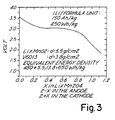
- Figure 3 is a graph of potential derived from the two LixMn2O4 couples of Figure 2.
- An electrochemical cell or
battery 10 has anegative electrode side 12, apositive electrode side 14, and aseparator 16 therebetween. The negative electrode is the anode during discharge, and the positive electrode is the cathode during discharge. The negative electrode side includescurrent collector 18, typically of nickel, iron, stainless steel, and copper foil, and negative electrodeactive material 20. The positive electrode side includescurrent collector 22, typically of aluminum, nickel, iron, stainless steel, and copper, and such foils having a protective conducting coating foil, and a positive electrodeactive material 24 which may be the same as or different than the negative electrodeactive material 20. Theseparator 16 is typically a solid electrolyte, separator/electrolyte. A suitable separator/electrolyte is described in U.S. Patent No. 4,830,939, and is a solid matrix containing an ionically conducting liquid with an alkali metal salt and the liquid is an aprotic polar solvent. - According to one aspect of the invention, the active material of the negative electrode (anode on discharge), is lithium manganese oxide, LixMnyOz.
- According to another aspect of the invention, both the negative and positive electrodes are formed of lithium manganese oxide, of the formula LixMnyOz. The LixMnyOz represents possible formulations for starting materials for anodes and cathodes. Some starting materials may have essentially no lithium, that is, x equal to or near zero in a precharged state. During use of the cell, Li+ ions are transferred to the negative electrode upon charging. During discharge, Li+ ions are transferred from the negative electrode (anode) to the positive electrode (cathode). Upon subsequent charge and discharge, the Li+ ions are transported between the electrodes.
- Thus, the LixMnyOz formula represents starting material and x, y, and z vary according to the starting material selected. Furthermore, in use, x varies as Li ions are transported between electrodes. When selecting starting materials for the anode, or for both the anode and cathode, desirably, x is up to about 7; y is up to about 5; and z is up to about 12 in the starting material. Preferably, for the starting material, minimum values are as follows: x and y are each about 1 and z is about 2. As stated earlier, the value of x changes during use. For example, when an anode is prepared using starting material Li2Mn2O4, the quantity of x in the anode varies in the
range 3 ≤ x ≤ 4 during use.
Correspondingly, when a cathode is prepared from the same Li2Mn2O4, the quantity of x in the cathode varies during use in a range 0 ≤ x ≤ 1. The value of x may include zero for the starting material, and an electrode may have a value of x equal to or near zero during use, depending on the configuration of the cell. The maximum values of x given above are related to the composition of lithium in the starting material and the upper end of the desired range for the starting material may be exceeded during use. This is evident from the example of the Li2Mn2O4 anode and cathode where x varies between 3 and 4 for the cathode during use. Thus, the active material initial or starting condition is the composition of the active material prior to charge or discharge. - LixMn2O4 is thought to be more stable than some other Li-Mn-O formulations and it is suitable for both electrodes. Various LixMnyOz formulations include LiMn2O4, Li2Nn2O4, Li2Mn4O9, Li4Mn5O12, Li7Mn5O12. It should be understood that the optimum formulation of LixMnyOz for an anode may be different from the optimum formulation for a cell having both electrodes of the same starting material. This is further described below.
- In the case of a cell having both electrodes formed of LixMnyOx, the quantity of Lix in both the positive and negative electrodes as formed, (i.e. starting composition), may be the same. Thus, the active material for both electrodes may be produced using the same materials and process of manufacture. In the case where both electrodes are made from the same material, Li2Mn2O4 and compounds with similar properties (see Figure 2) are suitable. There are several other lithium manganese oxides which can be used as starting materials similarly to the use of LiMn2O4 for preparation of the reduced form needed for a battery with identical electrodes: Li2Nn2O4. Examples are Li2Mn4O9, Li4Mn5O12, and Li7Mn5O12.
- A compound like Li1Mn2O4 can be used as an anode material, even though its voltage is relatively high (3 V vs Li), because cell performance of course depends on the cathode material in use. A 4-4.5 V cathode material permits the use of a 1.5 V LixMnyOz, anode material since the voltage is close to 3 V. An even higher anode voltage is thought to be acceptable since the voltage of common cathode materials i.e V6O13 vary between about 2 and 3 V vs Li, when both anode and cathode are to be of the same material Li2Mn2O4 is preferred over Li1Mn2O4.
- Accordingly, the LixMnyOz formula generally represents the composition of one or more manganese oxides having varying amounts of lithium. Some may have essentially no lithium, that is, x equal to or near zero in a precharged state.
- During use of the cell, Li+ ions are transferred to the negative electrode upon charging, and during discharge, Li+ ions are transferred to the positive electrode. Upon subsequent charge and discharge, the Li+ ions are transported between the electrodes. Meanwhile, Mn varies between oxidation states. The oxidation state variation of the Mn depends on the use of the manganese oxide. Consider the use Li2Mn2O4 as both anode and cathode material, and two different situations:
2 V battery configuration: Cathode Li1Mn2O4 ← Li2Mn2O4 → Anode Li3Mn2O4 Mn(3.5) Mn(3.0) Mn(2.5) - In this case, the average oxidation state varies between 3 and 3.5 in the cathode and between 3 and 2.5 in the anode. The average amount of Li in the anode varies between 2 and 3 and the average amount of Li in the cathode varies between 1 and 2.
2 V and 3 V combination: Cathode Mn2O4 ← Li2Mn2O4 → Anode Li4Mn2O4 Mn(4.0) Mn(3.0) Mn(2.0) - In this case, the oxidation state varies between 3 and 4 in the cathode and between 2 and 3 in the anode. The average amount of Li in the anode varies between 2 and 4 and the average amount of Li in the cathode varies between 0 and 2. The 3 V battery is thus realized by cycling the cathode between oxidation states 3.5 and 4, and the anode between 2.5 and 3. Here the average amount of Li in the anode is about 2 to about 3 and in the cathode about 2 to about 1. Continued cycling at 3 V, as illustrated in Figures 2 and 3, are achieved by cycling the cathode in the range 0 ≤ x ≤ 1 (at ca. 4 V), and the anode is cycled in the
range 3 ≤ x ≤ 4 (at 1 V). - In both cases, the oxidation state of the anode varies between +2 and +3. However, the oxidation state of the cathode always varies between 3 and 4.
- With LiCoO2 as the cathode material, LiCoO2 is assumed to be 4.3 V average:
Cathode: Li1CoO2 → CoO2(x=0 in the ideal case, usually not achievable) Anode: Case 1) LiMn2O4 → Li2Mn2O4 Mn(3.5) → Mn(3) 1.3 V Case 2) Li2Mn2O4 → Li3Mn2O4 Mn(3) → Mn(2.5) 3.3 V Case 3) Li3Mn2O4 → Li4Mn2O4 Mn(2.5) → Mn(2) 3.3 V - As seen,
Cases - It is thus possible to construct a battery in which the oxidation state of the manganese varies between +2 and +3.
- Accordingly, when a single composition LixMnyOz is to be optimized for use as both anode and cathode, and Li2Mn2O4 is selected as the starting material, during cycling the cathode composition can vary in the range of 0 < x < 1; and simultaneously, the anode composition will vary in a range of 3 < x < 4. In the case where an LixMnyOz composition is to be optimized for use in an anode, and LiMn2O4 is selected, the value of x is in a range of 2 < x < 4, where the cathode is of a different material, in order to keep the voltage as close to 1 volt as possible.
- The LixMn2O4 powders which form the basis of the active material for the anode, can be prepared by a method as described by J.M. Tarascon and D. Guyomard in an article entitled "Li Metal-Free Recharaeable Batteries Based on Li 1+x Mn 2 O 4 ", published in J. Electrochem. Soc., Volume 138, and as described by Barboux, Tarascon et al in U.S. Patent No. 5,135,732, issued August 4, 1992. These references are illustrative of suitable methods and are not limiting. These methods produced active material which currently is only used as the cathode (positive electrode) active material. Such methods are used to produce positive electrodes for use with negative electrodes of metallic lithium.
- Surprisingly, the present invention can use one type of active material for both the negative and positive electrodes. Negative electrodes can be similarly prepared for use with various lithium-containing positive electrodes. Suitable active material is prepared by hydrolyzing manganese or acetates or other carboxylates in an aqueous solution, the hydrolysis being promoted by the addition of the hydroxides of lithium and ammonium which control the pH of the solution.
- Hydrolysis is initiated by the addition of lithium hydroxide and completed by the use of a base that can be removed thermally. This base may be selected from among any organic base or ammonium hydroxide which is preferred for use herein. This low temperature process yields a gel-like product which may be heated at 200°C to 500°C temperatures to form thin or thick films of LiMn2O4 of a desired grain size.
- It is known that Li2Mn2O4 forms at an open circuit voltage close to 3 V vs. Li/Li+, similar to the redox (I3 -/I-) system. The electrochemical reaction is as follows: LiMn3O4 + 3x/2LiI - Li1+xMn3O4 + x/2LiI3. It has been determined that at 82°C, the composition Li2Mn2O4 can be obtained with a reasonable excess of LiI. At a given temperature, Li1+xMn2O4 powders of well defined composition (0 < x < 1) are obtained by adjusting the amount of LiI. The material prepared as described above was used as the active material in positive and negative electrodes.
- The negative electrode (anode on discharge) and the positive electrode are prepared by the above described method to obtain Li2Mn2O4 in both electrodes. The same materials and processes can be used for manufacture of both cathode and anode producing a battery which has a voltage between 2 and 3 V, as derived from Figure 2 and as shown in Figure 3.
- Figure 2 shows two voltage curves which are essentially mirror images of each other and illustrates the voltage variations during the cathode reaction and the anode reaction. All four plateaus are clearly distinguishable for both electrodes and the composition ranges associated with each electrode reaction are indicated in the figure. The curves are based upon expected cell potential upper plateau only, which is used for cathodes. Not shown is a plateau at one volt, which represent an identical capacity.
- The capacity according to Figure 2, at the high voltage plateau, is approximately 180 Ah/kg. The same capacity can be achieved when the same material is used as negative electrode, but at one volt vs. lithium.
- The starting composition for both electrodes in Figure 3 is Li2Nn2O4, although other manganese oxides are also suitable. The curve of Figure 3 was derived as the difference between the two curves of Figure 2 in the composition range 0 < x < 1 for the cathode and in the
range 3 < x < 4 for the anode. A set of data points from Figure 2 will illustrate how Figure 3 was developed, as follows. The 3.5 V value of Figure 3 is the difference between 4.25 V and 0.75 V at x = 0 of Figure 2. In Figure 3, at 3.5 V, the negative electrode (anode) has a total Li content of about x = 3 and the positive electrode (cathode) has a total Li content of about x = 1. In Figure 3, at about 2.0 V, the negative electrode (anode) has a total Li content of about x ≥ 2 and the positive electrode (cathode) has a total Li content of about x ≤ 2. - Although LixMn2O4 has been used as an example, all presently known Li-Mn-O compounds may be used as anode materials since they all are characterized by a plateau at one volt. Thus, it is possible to design and construct batteries with two "identical" electrode starting materials anode/electrolyte/cathode, similar to the example: LixMn2O4/ Electrolyte/LixMn2O4.
- Although not wishing to be limited to any particular theory, it is believed that the LixMn2O4 manganese oxide provides good results because of the reversible lithium intercalation reaction. Other manganese oxides are expected to perform in a similar manner for the reasons described above. Methods for forming other manganese oxide materials are known in the art, as are chemical and electrochemical methods for including lithium in various materials. The LixMnyOz formula generally represents the composition of one or more manganese oxides having varying amounts of lithium. Some may have essentially no lithium in a precharged state.
- As stated earlier, during charging, the lithium cations are deintercalated from the lithium bearing positive electrode which is the cathode during the discharge cycle. During charging, lithium cations are intercalated into the negative electrode which is the anode during the discharge cycle. Since the anode and cathode active materials are essentially the same, the amount of lithium moved between them is directly correlated, so that the reversible capacity of the cell is essentially undiminished. This is in contrast to conventional carbon negative electrodes (anodes) where the first intercalation of lithium into the carbon electrode, always results in a reduction in capacity. Thus, additional lithium bearing positive electrode (cathode) material must be included in conventional cells, compared to the amount required if the reversible capacity were undiminished. Such loss in capacity is not expected to occur in the cell of the invention. Both electrodes consist of essentially the same active material, and the reversible capacity of each electrode should remain relatively undiminished.
- A key advantage of the invention is the elimination of metallic lithium from the battery. This eliminates problems with metallic electrodes such as degradation and renders the battery more safe. These advantages offset the relatively lesser capacity of this battery (150-200 Ah/kg) as compared to metallic Li batteries. Other advantages are: 1) the battery is assembled in the discharge state (actually at 0 V) and the processing is, therefore, inherently more safe, especially in connection with large batteries (traction and load leveling); 2) because of the 0 V condition, larger amounts of small batteries can be shipped, presumably with less restrictions than lithium metal containing batteries; 3) in the fully charged state, assuming that only the 3 V plateau depicted in Figure 3 is used in the application, an additional 50% excess capacity exists at ca. 2 V, which can act as an overcharge protection or an indication that the battery needs to be recharged; 4) the battery can be fully discharged to 0 V without damage, at least from an electrode point of view. It is even possible to reverse the voltage without damage. Because the electrodes are identical, reversal of the battery voltage only means that the positive electrode becomes the negative electrode, and the negative electrode becomes the positive electrode. Compared to probably any other lithium battery technology known today, this invention is, therefore, extremely safe.
- While this invention has been described in terms of certain embodiments thereof, it is not intended that it be limited to the above description, but rather only to the extent set forth in the following claims.
- The embodiments of the invention in which an exclusive property or privilege is claimed are defined in the appended claims.
Claims (18)
- A battery which comprises a positive electrode and a negative electrode, said negative electrode (anode on discharge) having an active material consisting essentially of lithium manganese oxide of the general formula LixMnyOz, where x is greater than 0, y is greater than 1, and z is greater than 0.
- The battery according to claim 1 wherein the initial condition of the active material of the negative electrode is represented by the general formula LixMnyOz, where x is in a range of 1 ≤ x ≤ 7, y is in a range of 1 < y ≤ 5, and z is in a range of 2 ≤ z ≤ 12.
- The battery according to claim 1 which comprises said negative electrode having an active material of the general formula LixMn2O4, where the value of x is in a range of 2 ≤ x ≤ 4.
- The battery according to claim 2 which comprises both of said electrodes having an active material consisting essentially of lithium manganese oxide of the stated general formula LixMnyOz, and wherein the values of x, y, and z for each of the electrodes in an initial condition is the same or at least one of said values differs.
- The battery according to claim 1 which comprises both of said electrodes having an active material consisting essentially of lithium manganese oxide, and wherein the active material initial condition is represented by the general formula LixMnyOz, where x is in a range of 1 ≤ x ≤ 7, y is in a range of 1 < y ≤ 5, and z is in a range of 2 ≤ z ≤ 12, and where the values of x, y, and z for each of the electrodes in an initial condition is the same or at least one of said values differs.
- The battery according to claim 1 having non-metallic electrode active material and comprising both of said electrodes having an active material of the general formula LixMn2O4, where the value of x for both of the electrodes in an initial condition is in a range of 1 ≤ x ≤ 3.
- The battery according to claim 6 wherein during cycling (charge and discharge) the negative electrode has the value x in a range of 3 ≤ x ≤ 4.
- The battery according to claim 6 wherein during cycling (charge and discharge) the positive electrode has the value of x in a range of 0 ≤ x ≤ 1.
- The battery according to claim 4 wherein in an initial condition at least one of the values of x, y, or z are different in the electrodes.
- The battery according to claim 1 wherein the initial condition of the active material of both of the electrodes are represented by the general formula LixMn2O4, where the value of x is about 2.
- The battery accordinq to claim 10 wherein during cycling (charge and discharge) the lithium manganese oxide of the negative electrode is represented by the general formula LixMn2O4, where the value of x is in a range of 2 ≤ x ≤ 4.
- The battery of claim 10 wherein during cycling (charge and discharge) the lithium manganese oxide of the negative electrode is represented by the general formula LixMn2O4, where the value of x is in a range of 3 ≤ x ≤ 4.
- The battery of claim 10 wherein during cycling (charge and discharge) the lithium manganese oxide of the positive electrode is represented by the general formula LixMn2O4, where the value of x is in a range of 0 ≤ x ≤ 2.
- The battery of claim 10 wherein during cycling (charge and discharge) the lithium manganese oxide of the positive electrode is represented by the general formula LixMn2O4, where the value of x is in a range of 0 ≤ x ≤ 1.
- The battery according to claim 5 wherein in an initial condition, the active material of the positive and negative electrodes are different.
- The battery according to claim 5 wherein in an initial condition, the active material of the positive and negative electrodes are the same.
- The battery according to claim 6 wherein during cycling (charge and discharge) the negative electrode has the value of x in a range of 2 ≤ x ≤ 4.
- The battery according to claim 6 wherein during cycling (charge and discharge) the positive electrode has the value of x in a range of 0 ≤ x ≤ 2.
Applications Claiming Priority (3)
| Application Number | Priority Date | Filing Date | Title |
|---|---|---|---|
| US08/018,939 US5418090A (en) | 1993-02-17 | 1993-02-17 | Electrodes for rechargeable lithium batteries |
| PCT/US1994/001489 WO1994019836A1 (en) | 1993-02-17 | 1994-02-14 | Electrodes for rechargeable lithium batteries |
| US18939 | 1998-02-05 |
Publications (2)
| Publication Number | Publication Date |
|---|---|
| EP0685118A1 EP0685118A1 (en) | 1995-12-06 |
| EP0685118B1 true EP0685118B1 (en) | 1997-05-02 |
Family
ID=21790518
Family Applications (1)
| Application Number | Title | Priority Date | Filing Date |
|---|---|---|---|
| EP94909592A Expired - Lifetime EP0685118B1 (en) | 1993-02-17 | 1994-02-14 | Electrodes for rechargeable lithium batteries |
Country Status (8)
| Country | Link |
|---|---|
| US (1) | US5418090A (en) |
| EP (1) | EP0685118B1 (en) |
| JP (2) | JPH09501001A (en) |
| AU (1) | AU6238494A (en) |
| DE (1) | DE69402965T2 (en) |
| DK (1) | DK0685118T3 (en) |
| ES (1) | ES2105662T3 (en) |
| WO (1) | WO1994019836A1 (en) |
Families Citing this family (60)
| Publication number | Priority date | Publication date | Assignee | Title |
|---|---|---|---|---|
| US5506077A (en) * | 1993-06-14 | 1996-04-09 | Koksbang; Rene | Manganese oxide cathode active material |
| US5478672A (en) * | 1993-12-24 | 1995-12-26 | Sharp Kabushiki Kaisha | Nonaqueous secondary battery, positive-electrode active material |
| JP3227080B2 (en) * | 1994-12-02 | 2001-11-12 | キヤノン株式会社 | Lithium secondary battery |
| CA2147578C (en) * | 1995-04-21 | 2002-04-16 | Jan Naess Reimers | Lithium manganese oxide insertion compounds and use in rechargeable batteries |
| DE69601679T2 (en) * | 1995-09-06 | 1999-07-22 | Fuji Photo Film Co., Ltd., Minami-Ashigara, Kanagawa | Lithium-ion secondary battery |
| US5601796A (en) * | 1995-11-22 | 1997-02-11 | The Board Of Regents Of The University Of Oklahoma | Method of making spinel LI2MN204 compound |
| CA2163695C (en) * | 1995-11-24 | 2000-08-01 | Qiming Zhong | Method for preparing li1+xmn2-x-ymyo4 for use in lithium batteries |
| US5851696A (en) * | 1996-01-29 | 1998-12-22 | Valence Technology, Inc. | Rechargeable lithium battery |
| US5976489A (en) * | 1996-04-10 | 1999-11-02 | Valence Technology, Inc. | Method for preparing lithium manganese oxide compounds |
| US5770018A (en) * | 1996-04-10 | 1998-06-23 | Valence Technology, Inc. | Method for preparing lithium manganese oxide compounds |
| JP3846601B2 (en) * | 1996-06-13 | 2006-11-15 | 株式会社ジーエス・ユアサコーポレーション | Positive electrode active material for lithium battery, method for producing the same, and battery comprising the active material |
| US5670277A (en) * | 1996-06-13 | 1997-09-23 | Valence Technology, Inc. | Lithium copper oxide cathode for lithium cells and batteries |
| US5744265A (en) * | 1996-06-13 | 1998-04-28 | Valence Technology, Inc. | Lithium cell having mixed lithium--metal--chalcogenide cathode |
| US5763120A (en) * | 1996-06-25 | 1998-06-09 | Valence Technology, Inc. | Lithium manganese oxide cathodes with high capacity and stability |
| US5788943A (en) * | 1996-09-05 | 1998-08-04 | The Hall Chemical Company | Battery-grade nickel hydroxide and method for its preparation |
| US6203946B1 (en) | 1998-12-03 | 2001-03-20 | Valence Technology, Inc. | Lithium-containing phosphates, method of preparation, and uses thereof |
| US6007945A (en) * | 1996-10-15 | 1999-12-28 | Electrofuel Inc. | Negative electrode for a rechargeable lithium battery comprising a solid solution of titanium dioxide and tin dioxide |
| US5824285A (en) * | 1996-10-23 | 1998-10-20 | Valence Technology, Inc. | Method of making lithium manganese oxide compounds |
| WO1999000860A1 (en) * | 1997-06-27 | 1999-01-07 | Maxpower, Inc. | Transition manganese oxide cathodes |
| JPH11111286A (en) * | 1997-09-30 | 1999-04-23 | Mitsui Mining & Smelting Co Ltd | Method for producing positive electrode material for lithium secondary battery |
| US6153333A (en) | 1999-03-23 | 2000-11-28 | Valence Technology, Inc. | Lithium-containing phosphate active materials |
| DE19935091A1 (en) | 1999-07-27 | 2001-02-08 | Emtec Magnetics Gmbh | Lithium intercalation compounds containing lithium manganese oxide |
| US7524584B2 (en) * | 2000-04-27 | 2009-04-28 | Valence Technology, Inc. | Electrode active material for a secondary electrochemical cell |
| US6964827B2 (en) * | 2000-04-27 | 2005-11-15 | Valence Technology, Inc. | Alkali/transition metal halo- and hydroxy-phosphates and related electrode active materials |
| US6387568B1 (en) * | 2000-04-27 | 2002-05-14 | Valence Technology, Inc. | Lithium metal fluorophosphate materials and preparation thereof |
| US6777132B2 (en) * | 2000-04-27 | 2004-08-17 | Valence Technology, Inc. | Alkali/transition metal halo—and hydroxy-phosphates and related electrode active materials |
| US8057769B2 (en) * | 2000-04-27 | 2011-11-15 | Valence Technology, Inc. | Method for making phosphate-based electrode active materials |
| US6645452B1 (en) | 2000-11-28 | 2003-11-11 | Valence Technology, Inc. | Methods of making lithium metal cathode active materials |
| WO2002097907A2 (en) * | 2001-04-06 | 2002-12-05 | Valence Technology, Inc. | Sodium ion batteries |
| US6815122B2 (en) | 2002-03-06 | 2004-11-09 | Valence Technology, Inc. | Alkali transition metal phosphates and related electrode active materials |
| US7422823B2 (en) * | 2002-04-03 | 2008-09-09 | Valence Technology, Inc. | Alkali-iron-cobalt phosphates and related electrode active materials |
| US20030190527A1 (en) * | 2002-04-03 | 2003-10-09 | James Pugh | Batteries comprising alkali-transition metal phosphates and preferred electrolytes |
| US7482097B2 (en) * | 2002-04-03 | 2009-01-27 | Valence Technology, Inc. | Alkali-transition metal phosphates having a +3 valence non-transition element and related electrode active materials |
| US20040048157A1 (en) * | 2002-09-11 | 2004-03-11 | Neudecker Bernd J. | Lithium vanadium oxide thin-film battery |
| US7041239B2 (en) * | 2003-04-03 | 2006-05-09 | Valence Technology, Inc. | Electrodes comprising mixed active particles |
| US20070141468A1 (en) * | 2003-04-03 | 2007-06-21 | Jeremy Barker | Electrodes Comprising Mixed Active Particles |
| US7682745B2 (en) * | 2004-10-29 | 2010-03-23 | Medtronic, Inc. | Medical device having lithium-ion battery |
| US7563541B2 (en) * | 2004-10-29 | 2009-07-21 | Medtronic, Inc. | Lithium-ion battery |
| US8980453B2 (en) | 2008-04-30 | 2015-03-17 | Medtronic, Inc. | Formation process for lithium-ion batteries |
| CN101048898B (en) | 2004-10-29 | 2012-02-01 | 麦德托尼克公司 | Lithium-ion batteries and medical devices |
| US9077022B2 (en) | 2004-10-29 | 2015-07-07 | Medtronic, Inc. | Lithium-ion battery |
| US7641992B2 (en) * | 2004-10-29 | 2010-01-05 | Medtronic, Inc. | Medical device having lithium-ion battery |
| US7582387B2 (en) * | 2004-10-29 | 2009-09-01 | Medtronic, Inc. | Lithium-ion battery |
| US9065145B2 (en) * | 2004-10-29 | 2015-06-23 | Medtronic, Inc. | Lithium-ion battery |
| US7337010B2 (en) | 2004-10-29 | 2008-02-26 | Medtronic, Inc. | Medical device having lithium-ion battery |
| US8105714B2 (en) * | 2004-10-29 | 2012-01-31 | Medtronic, Inc. | Lithium-ion battery |
| US7927742B2 (en) | 2004-10-29 | 2011-04-19 | Medtronic, Inc. | Negative-limited lithium-ion battery |
| US7662509B2 (en) * | 2004-10-29 | 2010-02-16 | Medtronic, Inc. | Lithium-ion battery |
| KR101326118B1 (en) | 2004-10-29 | 2013-11-06 | 메드트로닉 인코포레이티드 | Method of charging lithium-ion battery |
| US7718319B2 (en) | 2006-09-25 | 2010-05-18 | Board Of Regents, The University Of Texas System | Cation-substituted spinel oxide and oxyfluoride cathodes for lithium ion batteries |
| EP1968141A1 (en) * | 2007-02-24 | 2008-09-10 | Ngk Insulators, Ltd. | Secondary battery |
| JP5293926B2 (en) * | 2007-02-24 | 2013-09-18 | 国立大学法人九州大学 | Secondary battery |
| JP5540643B2 (en) * | 2009-02-03 | 2014-07-02 | ソニー株式会社 | Thin-film solid lithium ion secondary battery and manufacturing method thereof |
| EP2237346B1 (en) * | 2009-04-01 | 2017-08-09 | The Swatch Group Research and Development Ltd. | Electrically conductive nanocomposite material comprising sacrificial nanoparticles and open porous nanocomposites produced thereof |
| EP2228855B1 (en) * | 2009-03-12 | 2014-02-26 | Belenos Clean Power Holding AG | Open porous electrically conductive nanocomposite material |
| JP2013004421A (en) * | 2011-06-20 | 2013-01-07 | Namics Corp | Lithium ion secondary battery |
| US9287580B2 (en) | 2011-07-27 | 2016-03-15 | Medtronic, Inc. | Battery with auxiliary electrode |
| CN102306791B (en) | 2011-08-18 | 2014-08-06 | 合肥国轩高科动力能源股份公司 | A kind of preparation method of carbon-coated non-stoichiometric ratio lithium iron phosphorus oxide material |
| US9711830B2 (en) * | 2011-09-02 | 2017-07-18 | Panisolar Inc. | Electrochemically rechargeable metal-air cell with a replaceable metal anode |
| US20130149560A1 (en) | 2011-12-09 | 2013-06-13 | Medtronic, Inc. | Auxiliary electrode for lithium-ion battery |
Family Cites Families (10)
| Publication number | Priority date | Publication date | Assignee | Title |
|---|---|---|---|---|
| JPS5671491A (en) * | 1979-11-12 | 1981-06-15 | Fujitsu Ltd | Control of predetermined position of linear induction motor |
| IT1131478B (en) * | 1980-05-13 | 1986-06-25 | Consiglio Nazionale Ricerche | HIGH SPECIFIC ENERGY RECHARGEABLE BATTERIES WITH INTERCALATION ANODE AND CATHODE |
| US4507371A (en) * | 1982-06-02 | 1985-03-26 | South African Inventions Development Corporation | Solid state cell wherein an anode, solid electrolyte and cathode each comprise a cubic-close-packed framework structure |
| US4830939B1 (en) * | 1987-10-30 | 1996-10-08 | Mhb Joint Venture | Radiation cured solid electrolytes and electrochemical devices employing the same |
| CA1331506C (en) * | 1988-07-12 | 1994-08-23 | Michael Makepeace Thackeray | Method of synthesizing a lithium manganese oxide |
| US5147739A (en) * | 1990-08-01 | 1992-09-15 | Honeywell Inc. | High energy electrochemical cell having composite solid-state anode |
| US5110696A (en) * | 1990-11-09 | 1992-05-05 | Bell Communications Research | Rechargeable lithiated thin film intercalation electrode battery |
| US5135732A (en) * | 1991-04-23 | 1992-08-04 | Bell Communications Research, Inc. | Method for preparation of LiMn2 O4 intercalation compounds and use thereof in secondary lithium batteries |
| US5478671A (en) * | 1992-04-24 | 1995-12-26 | Fuji Photo Film Co., Ltd. | Nonaqueous secondary battery |
| US5478673A (en) * | 1992-10-29 | 1995-12-26 | Fuji Photo Film Co., Ltd. | Nonaqueous secondary battery |
-
1993
- 1993-02-17 US US08/018,939 patent/US5418090A/en not_active Expired - Fee Related
-
1994
- 1994-02-14 DE DE69402965T patent/DE69402965T2/en not_active Expired - Fee Related
- 1994-02-14 DK DK94909592.1T patent/DK0685118T3/en active
- 1994-02-14 WO PCT/US1994/001489 patent/WO1994019836A1/en not_active Ceased
- 1994-02-14 AU AU62384/94A patent/AU6238494A/en not_active Abandoned
- 1994-02-14 ES ES94909592T patent/ES2105662T3/en not_active Expired - Lifetime
- 1994-02-14 JP JP6519038A patent/JPH09501001A/en active Pending
- 1994-02-14 EP EP94909592A patent/EP0685118B1/en not_active Expired - Lifetime
-
2001
- 2001-03-21 JP JP2001080391A patent/JP2001313080A/en active Pending
Also Published As
| Publication number | Publication date |
|---|---|
| DK0685118T3 (en) | 1997-11-03 |
| US5418090A (en) | 1995-05-23 |
| JPH09501001A (en) | 1997-01-28 |
| ES2105662T3 (en) | 1997-10-16 |
| JP2001313080A (en) | 2001-11-09 |
| DE69402965T2 (en) | 1997-11-20 |
| DE69402965D1 (en) | 1997-06-05 |
| AU6238494A (en) | 1994-09-14 |
| EP0685118A1 (en) | 1995-12-06 |
| WO1994019836A1 (en) | 1994-09-01 |
Similar Documents
| Publication | Publication Date | Title |
|---|---|---|
| EP0685118B1 (en) | Electrodes for rechargeable lithium batteries | |
| EP1009055B1 (en) | Nonaqueous electrolyte battery and charging method therefor | |
| JP7281672B2 (en) | battery | |
| EP1022792B1 (en) | Positive electrode for non-aqueous electrolyte cell and manufacturing method of the same | |
| EP3736892A1 (en) | Positive electrode material and battery | |
| US9843041B2 (en) | Coated positive electrode materials for lithium ion batteries | |
| EP0845158B1 (en) | Rechargeable lithium battery having improved reversible capacity | |
| CN100446334C (en) | Electrochemical cells for lithium ion batteries with improved high temperature stability | |
| EP3745522A1 (en) | Battery | |
| EP3745500A1 (en) | Battery | |
| EP3745519A1 (en) | Battery | |
| EP3745503A1 (en) | Positive electrode material and battery using same | |
| EP2277230A2 (en) | High energy lithium ion secondary batteries | |
| US6291100B1 (en) | Electrode composition comprising doped tungsten oxides and electrochemical cell comprising same | |
| EP0778629A1 (en) | Lithium manganese oxide compound and method of preparation | |
| WO1997028569A1 (en) | ELECTROCHEMICAL CELL OR BATTERY WITH A NEGATIVE ELECTRODE COMPRISING VANADIUM OXIDE, V6O13, OR LITHIATED VANADIUM OXIDE, LiyV6O13, AS AN ACTIVE MATERIAL | |
| EP4383362A1 (en) | Cathode material, battery using said cathode material, and method for charging battery | |
| EP1084516B1 (en) | Electrochemical cell | |
| JP3079382B2 (en) | Non-aqueous secondary battery | |
| US20140234719A1 (en) | High capacity lithium-ion electrochemical cells and methods of making same | |
| KR20080072340A (en) | Separator for lithium secondary battery, manufacturing method thereof and lithium secondary battery comprising same | |
| US12456732B2 (en) | Negative electrode material and battery | |
| KR100884622B1 (en) | Separator for lithium secondary battery, manufacturing method thereof and lithium secondary battery comprising same | |
| JPH10112307A (en) | Nonaqueous electrolyte secondary battery | |
| EP4368576B1 (en) | Core-shell particle and lithium ion battery |
Legal Events
| Date | Code | Title | Description |
|---|---|---|---|
| PUAI | Public reference made under article 153(3) epc to a published international application that has entered the european phase |
Free format text: ORIGINAL CODE: 0009012 |
|
| 17P | Request for examination filed |
Effective date: 19950713 |
|
| AK | Designated contracting states |
Kind code of ref document: A1 Designated state(s): DE DK ES FR GB IE IT |
|
| 17Q | First examination report despatched |
Effective date: 19960228 |
|
| GRAG | Despatch of communication of intention to grant |
Free format text: ORIGINAL CODE: EPIDOS AGRA |
|
| GRAH | Despatch of communication of intention to grant a patent |
Free format text: ORIGINAL CODE: EPIDOS IGRA |
|
| GRAH | Despatch of communication of intention to grant a patent |
Free format text: ORIGINAL CODE: EPIDOS IGRA |
|
| GRAA | (expected) grant |
Free format text: ORIGINAL CODE: 0009210 |
|
| AK | Designated contracting states |
Kind code of ref document: B1 Designated state(s): DE DK ES FR GB IE IT |
|
| REF | Corresponds to: |
Ref document number: 69402965 Country of ref document: DE Date of ref document: 19970605 |
|
| ITF | It: translation for a ep patent filed | ||
| REG | Reference to a national code |
Ref country code: IE Ref legal event code: FG4D Free format text: 73740 |
|
| ET | Fr: translation filed | ||
| REG | Reference to a national code |
Ref country code: ES Ref legal event code: FG2A Ref document number: 2105662 Country of ref document: ES Kind code of ref document: T3 |
|
| REG | Reference to a national code |
Ref country code: DK Ref legal event code: T3 |
|
| PLBE | No opposition filed within time limit |
Free format text: ORIGINAL CODE: 0009261 |
|
| STAA | Information on the status of an ep patent application or granted ep patent |
Free format text: STATUS: NO OPPOSITION FILED WITHIN TIME LIMIT |
|
| 26N | No opposition filed | ||
| PGFP | Annual fee paid to national office [announced via postgrant information from national office to epo] |
Ref country code: ES Payment date: 20010209 Year of fee payment: 8 |
|
| PGFP | Annual fee paid to national office [announced via postgrant information from national office to epo] |
Ref country code: IE Payment date: 20010221 Year of fee payment: 8 |
|
| PGFP | Annual fee paid to national office [announced via postgrant information from national office to epo] |
Ref country code: DK Payment date: 20011213 Year of fee payment: 9 |
|
| REG | Reference to a national code |
Ref country code: GB Ref legal event code: IF02 |
|
| PGFP | Annual fee paid to national office [announced via postgrant information from national office to epo] |
Ref country code: GB Payment date: 20020108 Year of fee payment: 9 |
|
| PGFP | Annual fee paid to national office [announced via postgrant information from national office to epo] |
Ref country code: FR Payment date: 20020131 Year of fee payment: 9 |
|
| PG25 | Lapsed in a contracting state [announced via postgrant information from national office to epo] |
Ref country code: IE Free format text: LAPSE BECAUSE OF NON-PAYMENT OF DUE FEES Effective date: 20020214 |
|
| PG25 | Lapsed in a contracting state [announced via postgrant information from national office to epo] |
Ref country code: ES Free format text: LAPSE BECAUSE OF NON-PAYMENT OF DUE FEES Effective date: 20020215 |
|
| PGFP | Annual fee paid to national office [announced via postgrant information from national office to epo] |
Ref country code: DE Payment date: 20020228 Year of fee payment: 9 |
|
| REG | Reference to a national code |
Ref country code: IE Ref legal event code: MM4A |
|
| PG25 | Lapsed in a contracting state [announced via postgrant information from national office to epo] |
Ref country code: GB Free format text: LAPSE BECAUSE OF NON-PAYMENT OF DUE FEES Effective date: 20030214 |
|
| PG25 | Lapsed in a contracting state [announced via postgrant information from national office to epo] |
Ref country code: DK Free format text: LAPSE BECAUSE OF NON-PAYMENT OF DUE FEES Effective date: 20030228 |
|
| PG25 | Lapsed in a contracting state [announced via postgrant information from national office to epo] |
Ref country code: DE Free format text: LAPSE BECAUSE OF NON-PAYMENT OF DUE FEES Effective date: 20030902 |
|
| REG | Reference to a national code |
Ref country code: DK Ref legal event code: EBP |
|
| GBPC | Gb: european patent ceased through non-payment of renewal fee | ||
| PG25 | Lapsed in a contracting state [announced via postgrant information from national office to epo] |
Ref country code: FR Free format text: LAPSE BECAUSE OF NON-PAYMENT OF DUE FEES Effective date: 20031031 |
|
| REG | Reference to a national code |
Ref country code: FR Ref legal event code: ST |
|
| REG | Reference to a national code |
Ref country code: ES Ref legal event code: FD2A Effective date: 20031022 |
|
| PG25 | Lapsed in a contracting state [announced via postgrant information from national office to epo] |
Ref country code: IT Free format text: LAPSE BECAUSE OF NON-PAYMENT OF DUE FEES Effective date: 20050214 |