EP0682867B1 - Antibacterial ceramic and antibacterial ceramic filter - Google Patents
Antibacterial ceramic and antibacterial ceramic filter Download PDFInfo
- Publication number
- EP0682867B1 EP0682867B1 EP95303074A EP95303074A EP0682867B1 EP 0682867 B1 EP0682867 B1 EP 0682867B1 EP 95303074 A EP95303074 A EP 95303074A EP 95303074 A EP95303074 A EP 95303074A EP 0682867 B1 EP0682867 B1 EP 0682867B1
- Authority
- EP
- European Patent Office
- Prior art keywords
- antibacterial
- antibacterial ceramic
- ceramic
- carrier
- phosphate
- Prior art date
- Legal status (The legal status is an assumption and is not a legal conclusion. Google has not performed a legal analysis and makes no representation as to the accuracy of the status listed.)
- Expired - Lifetime
Links
Classifications
-
- C—CHEMISTRY; METALLURGY
- C04—CEMENTS; CONCRETE; ARTIFICIAL STONE; CERAMICS; REFRACTORIES
- C04B—LIME, MAGNESIA; SLAG; CEMENTS; COMPOSITIONS THEREOF, e.g. MORTARS, CONCRETE OR LIKE BUILDING MATERIALS; ARTIFICIAL STONE; CERAMICS; REFRACTORIES; TREATMENT OF NATURAL STONE
- C04B38/00—Porous mortars, concrete, artificial stone or ceramic ware; Preparation thereof
-
- C—CHEMISTRY; METALLURGY
- C09—DYES; PAINTS; POLISHES; NATURAL RESINS; ADHESIVES; COMPOSITIONS NOT OTHERWISE PROVIDED FOR; APPLICATIONS OF MATERIALS NOT OTHERWISE PROVIDED FOR
- C09K—MATERIALS FOR MISCELLANEOUS APPLICATIONS, NOT PROVIDED FOR ELSEWHERE
- C09K17/00—Soil-conditioning materials or soil-stabilising materials
- C09K17/02—Soil-conditioning materials or soil-stabilising materials containing inorganic compounds only
-
- A—HUMAN NECESSITIES
- A01—AGRICULTURE; FORESTRY; ANIMAL HUSBANDRY; HUNTING; TRAPPING; FISHING
- A01N—PRESERVATION OF BODIES OF HUMANS OR ANIMALS OR PLANTS OR PARTS THEREOF; BIOCIDES, e.g. AS DISINFECTANTS, AS PESTICIDES OR AS HERBICIDES; PEST REPELLANTS OR ATTRACTANTS; PLANT GROWTH REGULATORS
- A01N57/00—Biocides, pest repellants or attractants, or plant growth regulators containing organic phosphorus compounds
- A01N57/10—Biocides, pest repellants or attractants, or plant growth regulators containing organic phosphorus compounds having phosphorus-to-oxygen bonds or phosphorus-to-sulfur bonds
- A01N57/16—Biocides, pest repellants or attractants, or plant growth regulators containing organic phosphorus compounds having phosphorus-to-oxygen bonds or phosphorus-to-sulfur bonds containing heterocyclic radicals
-
- A—HUMAN NECESSITIES
- A01—AGRICULTURE; FORESTRY; ANIMAL HUSBANDRY; HUNTING; TRAPPING; FISHING
- A01N—PRESERVATION OF BODIES OF HUMANS OR ANIMALS OR PLANTS OR PARTS THEREOF; BIOCIDES, e.g. AS DISINFECTANTS, AS PESTICIDES OR AS HERBICIDES; PEST REPELLANTS OR ATTRACTANTS; PLANT GROWTH REGULATORS
- A01N57/00—Biocides, pest repellants or attractants, or plant growth regulators containing organic phosphorus compounds
- A01N57/18—Biocides, pest repellants or attractants, or plant growth regulators containing organic phosphorus compounds having phosphorus-to-carbon bonds
- A01N57/20—Biocides, pest repellants or attractants, or plant growth regulators containing organic phosphorus compounds having phosphorus-to-carbon bonds containing acyclic or cycloaliphatic radicals
-
- A—HUMAN NECESSITIES
- A01—AGRICULTURE; FORESTRY; ANIMAL HUSBANDRY; HUNTING; TRAPPING; FISHING
- A01N—PRESERVATION OF BODIES OF HUMANS OR ANIMALS OR PLANTS OR PARTS THEREOF; BIOCIDES, e.g. AS DISINFECTANTS, AS PESTICIDES OR AS HERBICIDES; PEST REPELLANTS OR ATTRACTANTS; PLANT GROWTH REGULATORS
- A01N59/00—Biocides, pest repellants or attractants, or plant growth regulators containing elements or inorganic compounds
- A01N59/16—Heavy metals; Compounds thereof
-
- B—PERFORMING OPERATIONS; TRANSPORTING
- B01—PHYSICAL OR CHEMICAL PROCESSES OR APPARATUS IN GENERAL
- B01D—SEPARATION
- B01D39/00—Filtering material for liquid or gaseous fluids
- B01D39/14—Other self-supporting filtering material ; Other filtering material
- B01D39/20—Other self-supporting filtering material ; Other filtering material of inorganic material, e.g. asbestos paper, metallic filtering material of non-woven wires
- B01D39/2068—Other inorganic materials, e.g. ceramics
- B01D39/2072—Other inorganic materials, e.g. ceramics the material being particulate or granular
- B01D39/2075—Other inorganic materials, e.g. ceramics the material being particulate or granular sintered or bonded by inorganic agents
-
- C—CHEMISTRY; METALLURGY
- C04—CEMENTS; CONCRETE; ARTIFICIAL STONE; CERAMICS; REFRACTORIES
- C04B—LIME, MAGNESIA; SLAG; CEMENTS; COMPOSITIONS THEREOF, e.g. MORTARS, CONCRETE OR LIKE BUILDING MATERIALS; ARTIFICIAL STONE; CERAMICS; REFRACTORIES; TREATMENT OF NATURAL STONE
- C04B35/00—Shaped ceramic products characterised by their composition; Ceramics compositions; Processing powders of inorganic compounds preparatory to the manufacturing of ceramic products
-
- C—CHEMISTRY; METALLURGY
- C04—CEMENTS; CONCRETE; ARTIFICIAL STONE; CERAMICS; REFRACTORIES
- C04B—LIME, MAGNESIA; SLAG; CEMENTS; COMPOSITIONS THEREOF, e.g. MORTARS, CONCRETE OR LIKE BUILDING MATERIALS; ARTIFICIAL STONE; CERAMICS; REFRACTORIES; TREATMENT OF NATURAL STONE
- C04B38/00—Porous mortars, concrete, artificial stone or ceramic ware; Preparation thereof
- C04B38/06—Porous mortars, concrete, artificial stone or ceramic ware; Preparation thereof by burning-out added substances by burning natural expanding materials or by sublimating or melting out added substances
-
- B—PERFORMING OPERATIONS; TRANSPORTING
- B01—PHYSICAL OR CHEMICAL PROCESSES OR APPARATUS IN GENERAL
- B01D—SEPARATION
- B01D2239/00—Aspects relating to filtering material for liquid or gaseous fluids
- B01D2239/04—Additives and treatments of the filtering material
- B01D2239/0442—Antimicrobial, antibacterial, antifungal additives
-
- B—PERFORMING OPERATIONS; TRANSPORTING
- B01—PHYSICAL OR CHEMICAL PROCESSES OR APPARATUS IN GENERAL
- B01D—SEPARATION
- B01D2239/00—Aspects relating to filtering material for liquid or gaseous fluids
- B01D2239/04—Additives and treatments of the filtering material
- B01D2239/0471—Surface coating material
-
- B—PERFORMING OPERATIONS; TRANSPORTING
- B01—PHYSICAL OR CHEMICAL PROCESSES OR APPARATUS IN GENERAL
- B01D—SEPARATION
- B01D2239/00—Aspects relating to filtering material for liquid or gaseous fluids
- B01D2239/12—Special parameters characterising the filtering material
- B01D2239/1208—Porosity
-
- B—PERFORMING OPERATIONS; TRANSPORTING
- B01—PHYSICAL OR CHEMICAL PROCESSES OR APPARATUS IN GENERAL
- B01D—SEPARATION
- B01D2239/00—Aspects relating to filtering material for liquid or gaseous fluids
- B01D2239/12—Special parameters characterising the filtering material
- B01D2239/1216—Pore size
-
- C—CHEMISTRY; METALLURGY
- C04—CEMENTS; CONCRETE; ARTIFICIAL STONE; CERAMICS; REFRACTORIES
- C04B—LIME, MAGNESIA; SLAG; CEMENTS; COMPOSITIONS THEREOF, e.g. MORTARS, CONCRETE OR LIKE BUILDING MATERIALS; ARTIFICIAL STONE; CERAMICS; REFRACTORIES; TREATMENT OF NATURAL STONE
- C04B2111/00—Mortars, concrete or artificial stone or mixtures to prepare them, characterised by specific function, property or use
- C04B2111/00474—Uses not provided for elsewhere in C04B2111/00
- C04B2111/00586—Roofing materials
-
- C—CHEMISTRY; METALLURGY
- C04—CEMENTS; CONCRETE; ARTIFICIAL STONE; CERAMICS; REFRACTORIES
- C04B—LIME, MAGNESIA; SLAG; CEMENTS; COMPOSITIONS THEREOF, e.g. MORTARS, CONCRETE OR LIKE BUILDING MATERIALS; ARTIFICIAL STONE; CERAMICS; REFRACTORIES; TREATMENT OF NATURAL STONE
- C04B2111/00—Mortars, concrete or artificial stone or mixtures to prepare them, characterised by specific function, property or use
- C04B2111/00474—Uses not provided for elsewhere in C04B2111/00
- C04B2111/00793—Uses not provided for elsewhere in C04B2111/00 as filters or diaphragms
Definitions
- the present invention relates to an antibacterial ceramic and an antibacterial ceramic filter. More particularly, the present invention relates to a light-weight antibacterial ceramic, the method for producing a light-weight antibacterial ceramic, and an antibacterial ceramic filter which can remove and extirpate various bacteria.
- antibacterial ceramics each of which has an antibacterial metal such as silver, copper, and zinc loaded on a ceramic are known. Such antibacterial ceramics are used as soil conditioners and water conditioners because of their antibacterial property, anti-mildew property, and water-holding property.
- An antibacterial ceramic having the shape of a ball has been used for rearing chicks, prawns, or the like.
- An antibacterial ceramic having a shape of a pellet whose specific surface area is enlarged or a shape of a Rasching ring has been used for heating water to improve its quality.
- the aforementioned antibacterial ceramic is formed to be relatively porous so as to enhance its antibacterial property.
- many of such conventional antibacterial ceramics were dense and heavy.
- Antibacterial materials each made by adding an antibacterial metal to a plastic or a glass are also known.
- such antibacterial materials have a low antibacterial property because they have a low porosity.
- a ceramic filter as a precise filtering film has been also known.
- the filter can remove mildew and various bacteria in a liquid.
- a garden, or the like provided in a building or on the roof, not only soil itself of the garden but also a ⁇ soil conditioner is required to be lightweight because of the matter of structural strength of the building.
- the problem was that the aforementioned antibacterial ceramics are not suitable for a roof garden or the like since they are relatively heavy.
- another problem was that roots of plants in a roof garden are liable to rot because a roof garden is ill drained, and as a result, such a plant has a short life.
- an object of the present invention is to provide a light-weight antibacterial ceramic which is suitably applicable to a roof garden, etc., and a method for producing the light-weight antibacterial ceramic.
- Another object of the invention is to provide an antibacterial ceramic filter which has an antibacterial property which can remove and extirpate various bacteria and floating material.
- the antibacterial ceramic of the present invention is set out in claim 1.
- a method for producing an antibacterial ceramic, according to the present invention, is set out in claim 8.
- An antibacterial ceramic filter of the present invention is set out in claim 10.
- the ceramic can be lightened and the surface area can be enlarged because a bulk density of ceramic particle is appropriately controlled. Therefore, the antibacterial ceramic can be suitably used for a roof garden, etc., and the chance to be in contact with bacteria can be increased, which improves the antibacterial property.
- the antibacterial ceramic filter of the present invention can not only remove but also extirpate bacteria and further improve clarity of a liquid. It is also possible to make a diameter of pores a little larger than a conventional one so that the filtering time is shortened without decreasing clarity of the liquid because the antibacterial ceramic of the present invention can extirpate the bacteria which pass the pores and are not removed.
- the antibacterial ceramic of the present invention is hereinbelow described in more detail.
- the antibacterial ceramic of the present invention contains an antibacterial material made by loading an antibacterial metal or metallic ion on a carrier.
- the antibacterial material preferably has a composition of an antibacterial metal or metallic ion of 0.01 - 20 wt% and a carrier of 99.99-80 wt%.
- the antibacterial ceramic When the aforementioned antibacterial metal or the like is less than 0.01 wt%, the antibacterial ceramic has a low antibacterial property. When the antibacterial metal or the like is more than 20 wt%, the cost of the antibacterial ceramic becomes high because the cost of such a metal or the like is high.
- the antibacterial metal or metallic ion may be silver, copper, zinc, platinum, tin, arsenic, lead, cadmium, chromium, or any mixture of these components.
- the aforementioned carrier is phosphate, silica or zeolite, or any mixture of these components.
- Phosphate for the carrier may be calcium phosphate, zinc phosphate, zirconium phosphate, aluminum phosphate, or any mixture of these components.
- Calcium phosphate for the carrier may be tricalcium phosphate, calcium hydrogenphosphate, calcium pyrophosphate, calcium metaphosphate, hydroxy apatite, apatite halide, or any mixture of these components.
- Methods for loading an antibacterial metal or metallic ion on the aforementioned carrier are not limited. Applicable methods are, for example, ion exchange, firing treatment at 800°C or higher after ion exchange, heating at about 80°C or higher an aqueous solution containing a water-soluble salt having an antibacterial component and then collecting precipitate, etc. Among these methods, the best method is the one in which a water-soluble salt having an antibacterial component is used in view of prevention of elution of the antibacterial metallic component and reducing the production cost.
- the aforementioned calcium ceramics to be used for the carrier each is highly safe for a human body. Further, such a calcium ceramic easily absorbs a water-soluble salt of antibacterial metal and metallic ion when an antibacterial metal is loaded. Therefore, the calcium ceramics are suitably applicable to the present invention.
- An antibacterial ceramic of the present invention includes 1) the aforementioned antibacterial material of 0.01 - 20 wt% and 2) an oxide inorganic material and/or a non-oxide inorganic material 99.99 - 80 wt%.
- the antibacterial material be less than 0.01 wt% or more than 20 wt% because an antibacterial property decreases or because the production costs a lot respectively.
- the aforementioned oxide inorganic material or non-oxide inorganic material may be any of materials which are water-insoluble and harmless to human bodies, animals and plants.
- the oxide inorganic material may be alumina, cordierite, mullite, silica, clay, or the like.
- the non-oxide inorganic material may be silicon carbide, silicon nitride, or aluminum nitride. Note that self-sintering material such as clay or an inorganic binder such as frit can be mixed with these inorganic materials.
- an antibacterial ceramic of the present invention is light because it has a particle bulk density of 0.6 - 2.0 g/cm 3 , preferably 0.6 - 1.2 g/cm 3 . Therefore, an antibacterial ceramic of the present invention can be preferably used as a soil conditioner, particularly for a garden on the roof, or the like, and its conveyability is excellent. It is not preferable that an antibacterial ceramic has a bulk density of less than 0.6 g/cm 3 because it is light enough to be scattered in the wind. It is not preferable either that an antibacterial ceramic has more than 2.0 g/cm 3 because it is too heavy and an antibacterial property decrease since porosity becomes small.
- the aforementioned antibacterial ceramic of the present invention has an excellent antibacterial property and is safe for human bodies or the like, the ceramic can be not only used as a soil conditioner for a garden on the roof or the like but also applied to a soil for home gardening. Further, the ceramic can be used as sand for evacuation by a pet such as a dog, a cat, etc.
- An antibacterial ceramic of the present invention can prevent various bacteria from generating and make animals' and plants' lives longer while satisfying a proof load on a building.
- An antibacterial ceramic of the present invention is produced by a method including the steps of: preparing an antibacterial ceramic material by loading an antibacterial metal or metallic ion on a carrier; mixing the obtained antibacterial ceramic material of 0.01 - 20 wt% with an oxide inorganic material and/or a non-oxide inorganic material of 99.99 - 80 wt% to obtain a first mixture; mixing a combustible material at 5 - 50 weight parts with 100 weight parts of the first mixture to obtain a second mixture; and firing the second mixture at a temperature of 500 - 1300°C.
- the aforementioned combustible material may be a carbon powder, a grain powder such as wheat flour or rice flour, a sawdust, or the like. These combustibles are consumed by the aforementioned firing and have a function of making a resultant antibacterial ceramic light and porous. It is not preferable that less than 5 weight parts or more than 50 weight parts of the combustible material be added because the effect of lowering bulk specific gravity is small or a resultant ceramic is liable to be crushed. Note that the order of adding an antibacterial material, an inorganic material, and a combustible is not limited, and any order is acceptable if the aforementioned powder for firing having a predetermined composition can be obtained.
- An antibacterial ceramic filter of the present invention includes: the aforementioned antibacterial material at 0.01 - 20 wt%; and a base material phase at 99.99 - 80 wt% having 1) an aggregate phase containing an oxide inorganic material and/or a non-oxide inorganic material and 2) an inorganic binder phase.
- An oxide inorganic material and a non-oxide inorganic material to be used for forming an aggregate phase by firing are not limited, and any water-insoluble material which is harmless to human bodies, animals, and plants can be employed.
- An oxide inorganic material may be alumina, mullite, zirconia, andalusite, silica ceramic material, glass, or the like.
- a non-oxide inorganic material may be silicon carbide, silicon nitride, and aluminum nitride.
- a material of the aforementioned inorganic binder may be an inert self-sintering material such as clay or inorganic binding material such as frit.
- a ratio of such a material to the aforementioned aggregate is preferably within the range of 1 - 50 wt%. When the ratio is less than 1 wt%, the resultant filter does not have sufficient strength. When the ratio is more than 50 wt%, the resultant filter has a low porosity, which lowers water permeability.
- Each of the pores of a ceramic filter of the present invention preferably has a diameter ranging 20 to 8000 ⁇ m.
- the diameter of a pore is less than 20 ⁇ m, the pore is prone to be clogged up with impurities, which lowers water-permeability of the filter in the early stages.
- the diameter of a pore is more than 8000 ⁇ m, the filter has a low antibacterial property.
- a configuration of an antibacterial ceramic filter of the present invention is not particularly limited, and various kinds of configurations such as a shape of plate, cylinder, or the like can be employed.
- a use of the ceramic filter is not limited, and it can be suitably used for purifying water in a Japanese traditional bath tub and water for a large bathing place such as a swimming pool.
- an antibacterial ceramic filter of the present invention When an antibacterial ceramic filter of the present invention is used, a particular tank or the like is not necessary, and a flow passage or the like is directly equipped with the ceramic filter.
- a method for producing an antibacterial ceramic filter of the present invention is hereinafter described.
- a ceramic filter of the present invention includes the steps of: mixing the aforementioned antibacterial material at 0.01 - 20 wt% with the aforementioned mixture at 99.99 - 80 wt% containing an aggregate and said inorganic binder phase; adding a compatible material at 0 - 30 weight parts to the obtained mixture of 100 weight parts to prepare another mixture for forming a compact; preparing a compact having a predetermined shape by the mixture for forming a compact; and firing the compact at 1300°C or less, preferably at 700 - 1000°C.
- order of adding an antibacterial material, an aggregate, an inorganic binder, and a compatible material is not limited in the aforementioned method, and any order is acceptable if the aforementioned mixture having a predetermined composition for forming a compact can be obtained.
- the 50% average particle diameter of the aggregate is preferably 0.1 - 20 mm.
- this diameter is less than 0.1 mm, water-permeability becomes low because of clogging in the early stages though a discriminating ability is high.
- the diameter is more than 20 mm, the filter has a low antibacterial property, and a discriminating ability of the filter is lowered.
- the aforementioned inorganic bonding material has a particle diameter of 100 ⁇ m or less, preferably 44 ⁇ m or less, and the blending ratio of the inorganic bonding material to the aforementioned aggregate is preferably 1 - 50 %.
- porosity and pore diameter of a ceramic filter can be adjusted as necessary by adding the aforementioned combustible material.
- the combustible may have a particle diameter of 1 - 100 ⁇ m.
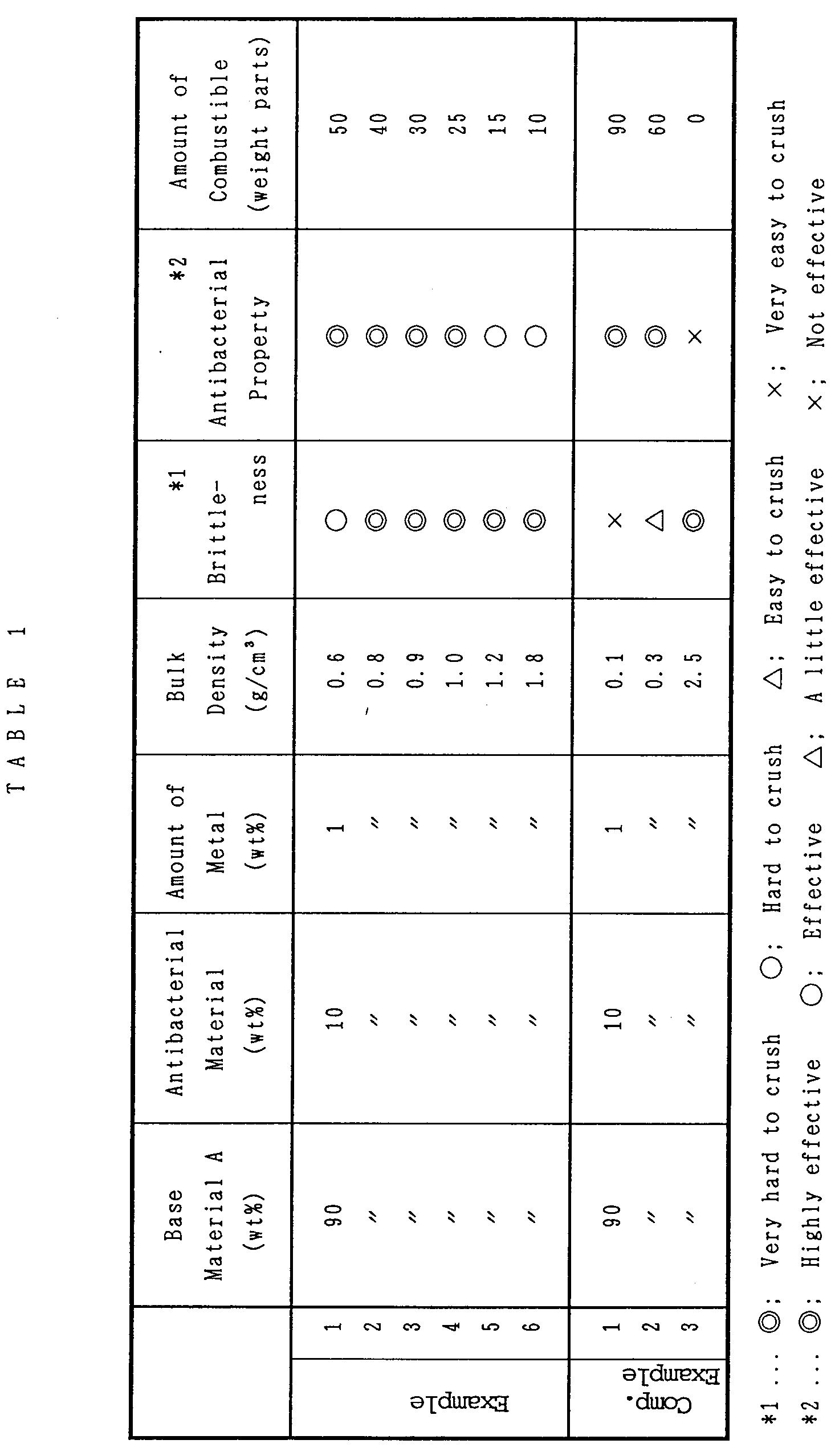
- a kneader a mixture of an oxide inorganic material (base material A) mainly consisting of cordierite, an antibacterial material produced by loading Ag on hydroxyapatite, an appropriate amount of binder, and a combustible material at 10 - 50 weight parts to the base material A of 100 weight parts in the ratio shown in Table 1.
- the obtained mixture was dried at 110°C, and then fired at 1100°C in the ambient air. Then, it was crushed by a roll crusher so as to obtain a light-weight antibacterial ceramic.
- amount of metal refers to the amount of Ag or the like contained in the whole light-weight antibacterial ceramic.
- the obtained light-weight antibacterial ceramic was dried and then measured for the dry weight.
- the dried ceramic was treated for three hours under a reduced pressure of 730 mmHg and then measured for weight in water. Then the ceramic saturated with water was measured for weight.
- the particle bulk density of the ceramic was calculated from the obtained three weights. The results are shown in Table 1.
- the ceramics were prepared and tested in the same manner as in Examples 1 - 6 except that a bulk density was varied. The results are shown in Table 1.
- base material B cordierite and frit as an oxide inorganic material and a hydroxyapatite on which Ag and Zn were loaded as an antibacterial material. Except for this, the ceramics were prepared and tested in the same manner as in Examples 1 - 5. The results are shown in Table 2.
- the ceramic was prepared and tested in the same manner as in Examples 6 - 13 except that the antibacterial material was not added. The results are shown in Table 2.
- the ceramics were prepared and tested in the same manner as in Examples 1 - 6 except that mullite (base material C) was used as an oxide inorganic material and calcium hydrogenphosphate on which Cu was loaded were used as an antibacterial material. The results are shown in Table 3.
- the ceramics were prepared and tested in the same manner as in Examples 15 - 17 except that silicon nitride (base material D) was used as a non-oxide inorganic material.
- the ceramics were prepared and tested in the same manner as in Examples 1 - 6 except that a mixture of cordierite and clay was used as an oxide inorganic material, that calcium phosphate on which Ag was loaded was used as an antibacterial material, and that each of the ceramics were fired at a temperature shown in Table 4.
- the obtained mixture was subjected to hydraulic pressing under a pressure of 300 Kg/cm 2 given by a pressurizing substance to abtain a plate-shaped compact having dimensions of 300 x 300 x 30 mm (thickness).
- the compact was dried at 110°C and then fired at 900°C in the ambient air so as to obtain an antibacterial ceramic filter.
- Each of the obtained antibacterial ceramic filters was measured for a porosity in the same manner as the aforementioned measurement for a particle bulk density. The results are shown in Table 5. The antibacterial property of each of the antibacterial ceramic filters was measured in the same manner, and the results are shown in Table 5.
- the ceramic filter was obtained and tested in the same manner as in Examples 27 - 34 except that an antibacterial material was not added. The results are shown in Table 5.
- the ceramic filters were obtained and tested in the same manner as in Examples 27 - 34 except that there were used 1) a base material G containing alumina having a 50% average particle diameter of 0.5 mm and frit and 2) an antibacterial material produced by loading Ag and Zn on hydroxyapatite so as to vary the porosity of each filter.
- Table 6 The results are shown in Table 6.
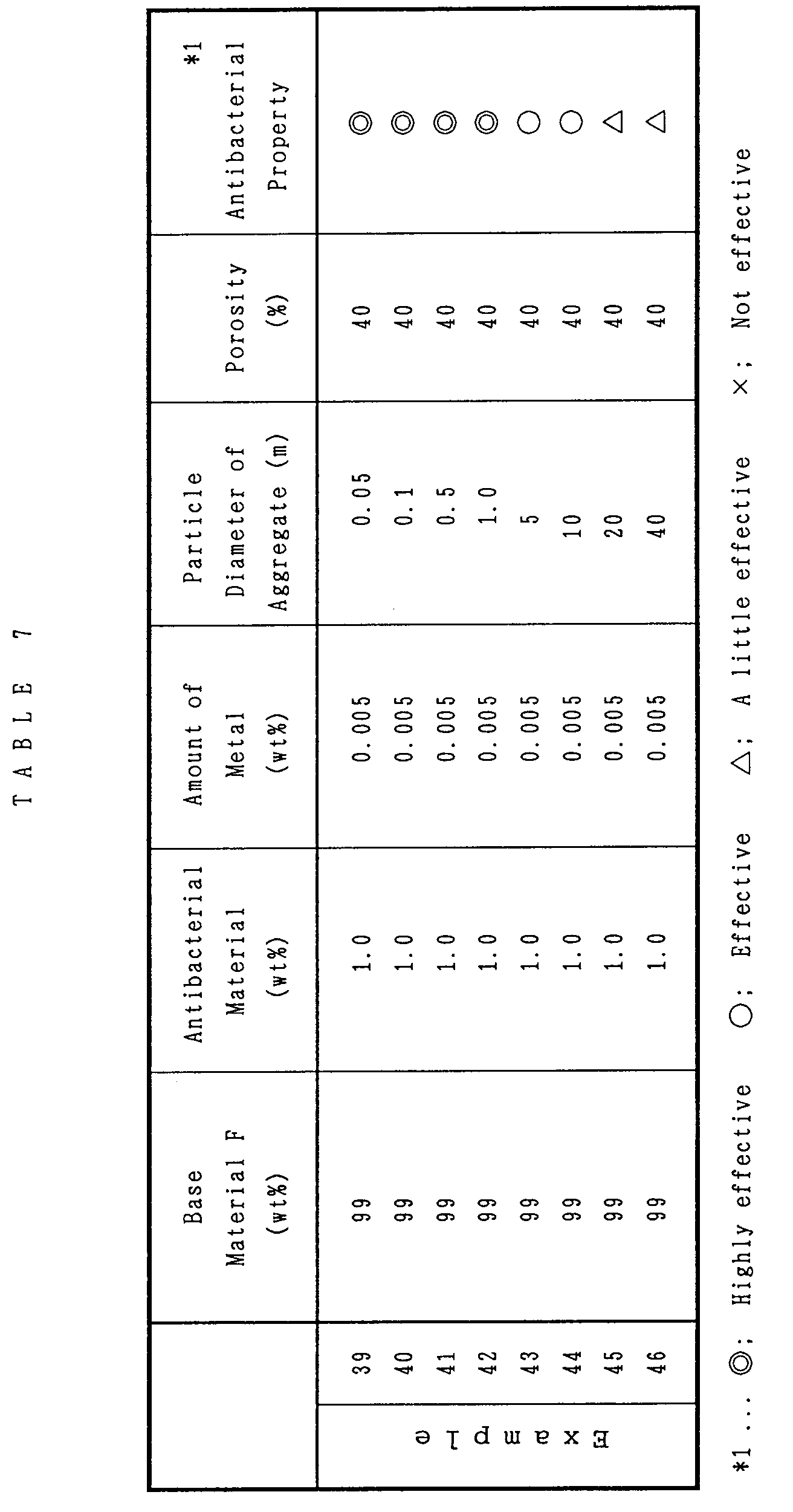
- the ceramic filters were obtained and tested in the same manner as in Examples 27 - 34 except that the 50% average particle diameter of an aggregate in a base material F was varied. The results are shown in Table 7.
- the ceramic filters were obtained and tested in the same manner as in Examples 39 - 46 except that 10% by wt. of antibacterial material is added. The results are shown in Table 8.
- the ceramic filters were obtained and tested in the same manner as in Examples 27 - 34 except that the 50% average particle diameter of the aggregate and the porosity were varied. The results are shown in Table 9.
- the ceramic filters were obtained and tested in the same manner as in Examples 55 - 57 except that a mixture of non-oxide SiC (aggregate) and a frit was used. The results are shown in Table 9.
- a light-weight antibacterial ceramic suitably applicable to a roof garden or the like, a method for producing the light-weight antibacterial ceramic, and an antibacterial ceramic filter capable of removing and extirpating various bacteria and suspensions.
- Bulk density and porosity of the sintered ceramic are controlled by mixing an antibacterial metal with particular materials and firing.
Landscapes
- Chemical & Material Sciences (AREA)
- Life Sciences & Earth Sciences (AREA)
- Engineering & Computer Science (AREA)
- Ceramic Engineering (AREA)
- Inorganic Chemistry (AREA)
- Materials Engineering (AREA)
- Organic Chemistry (AREA)
- Environmental Sciences (AREA)
- Wood Science & Technology (AREA)
- Zoology (AREA)
- Agronomy & Crop Science (AREA)
- Pest Control & Pesticides (AREA)
- Plant Pathology (AREA)
- Health & Medical Sciences (AREA)
- Dentistry (AREA)
- General Health & Medical Sciences (AREA)
- Structural Engineering (AREA)
- Chemical Kinetics & Catalysis (AREA)
- Geology (AREA)
- General Life Sciences & Earth Sciences (AREA)
- Soil Sciences (AREA)
- Manufacturing & Machinery (AREA)
- Filtering Materials (AREA)
- Agricultural Chemicals And Associated Chemicals (AREA)
- Compositions Of Oxide Ceramics (AREA)
- Porous Artificial Stone Or Porous Ceramic Products (AREA)
- Inorganic Compounds Of Heavy Metals (AREA)
Description
The filter can remove mildew and various bacteria in a liquid.
- o ○
- 10% or less was passed through the sieve.
- ○
- 10 - 20% was passed.
- ▵
- 20 - 50% was passed.
- X
- 50% or more was passed.




Claims (11)
- An antibacterial ceramic comprising:0.01 - 20 wt% of an antibacterial material comprising a carrier and at least one antibacterial metal or metallic ion loaded on the carrier, the carrier comprising at least one component selected from phosphate, silica and zeolite, and80 - 99.99 wt% of an oxide inorganic material and/or a non-oxide inorganic material,
said antibacterial ceramic having a particle bulk density of 0.6 - 2.0 g/cm3. - An antibacterial ceramic according to claim 1, wherein said antibacterial material comprises 0.01 - 20 wt% of the antibacterial metal or metallic ion and 99.99 - 80 wt% of the carrier.
- An antibacterial ceramic according to claim 1 or 2, wherein said antibacterial metal or metallic ion comprises at least one component selected from silver, copper, zinc, platinum, tin, arsenic, lead, cadmium and chromium.
- An antibacterial ceramic according to any one of claims 1 to 3 wherein said carrier comprises a phosphate which is at least one component selected from calcium phosphate, zinc phosphate, zirconium phosphate and aluminium phosphate.
- An antibacterial ceramic according to claim 4, wherein said phosphate comprises at least one component selected from tricalcium phosphate, calcium hydrogenphosphate, calcium pyrophosphate, calcium metaphosphate, hydroxyapatite, apatite halide.
- An antibacterial ceramic according to any one of claim 1 to 5, wherein said oxide inorganic material and said non-oxide inorganic material are insoluble in water and substantially harmless to human bodies, animals and plants.
- Use of an antibacterial ceramic according to any one of claims 1 to 6, as a soil conditioner for a garden provided in a building or on a roof top.
- A method for producing an antibacterial ceramic comprising the steps of:preparing an antibacterial ceramic material by loading an antibacterial metal or metallic ion on a carrier, the carrier comprising at least one component selected from phosphate, silica and zeolite;mixing 0.01 - 20 wt% of the obtained antibacterial ceramic material with 99.99 - 80 wt% of an oxide inorganic material and/or a non-oxide inorganic material to obtain a first mixture;mixing 5 - 50 weight parts of a combustible material with 100 weight parts of said first mixture to obtain a second mixture; andfiring the second mixture at a temperature of 500 - 1300°C.
- A method for producing an antibacterial ceramic according to claim 8, wherein said combustible material is a carbon powder, a grain powder such as wheat flour or rice flour, or a sawdust.
- An antibacterial ceramic filter comprising:(i) 80 - 99.99 wt% of a base material phase comprisingan aggregate phase comprising an oxide inorganic material and/or a non-oxide material;an inorganic binder phase; and(ii) 0.01 - 20 wt% of an antibacterial material comprising a carrier and at least one antibacterial metal or metallic ion loaded on said carrier; said carrier comprising at least one component selected from phosphate, silica and zeolite,
said antibacterial ceramic filter having a porosity of 20% or more. - An antibacterial ceramic filter according to claim 10, wherein said filter has a pore diameter ranging from 20 µm to 8000 µm.
Applications Claiming Priority (2)
| Application Number | Priority Date | Filing Date | Title |
|---|---|---|---|
| JP101429/94 | 1994-05-16 | ||
| JP6101429A JPH07309707A (en) | 1994-05-16 | 1994-05-16 | Lightweight antibacterial ceramics and antibacterial ceramics filter |
Publications (2)
| Publication Number | Publication Date |
|---|---|
| EP0682867A1 EP0682867A1 (en) | 1995-11-22 |
| EP0682867B1 true EP0682867B1 (en) | 1998-09-02 |
Family
ID=14300464
Family Applications (1)
| Application Number | Title | Priority Date | Filing Date |
|---|---|---|---|
| EP95303074A Expired - Lifetime EP0682867B1 (en) | 1994-05-16 | 1995-05-05 | Antibacterial ceramic and antibacterial ceramic filter |
Country Status (7)
| Country | Link |
|---|---|
| US (1) | US5618762A (en) |
| EP (1) | EP0682867B1 (en) |
| JP (1) | JPH07309707A (en) |
| KR (1) | KR0155226B1 (en) |
| CA (1) | CA2149260A1 (en) |
| DE (1) | DE69504408T2 (en) |
| TW (1) | TW303350B (en) |
Families Citing this family (35)
| Publication number | Priority date | Publication date | Assignee | Title |
|---|---|---|---|---|
| JP3983912B2 (en) * | 1998-01-30 | 2007-09-26 | 日本ゼオライト株式会社 | Porous ceramic for alkaline ion water production, method for producing the porous ceramic, and alkaline ion water generator |
| US6596401B1 (en) | 1998-11-10 | 2003-07-22 | C. R. Bard Inc. | Silane copolymer compositions containing active agents |
| US6303183B1 (en) | 1999-11-08 | 2001-10-16 | Aos Holding Company | Anti-microbial porcelain enamel coating |
| US6579539B2 (en) | 1999-12-22 | 2003-06-17 | C. R. Bard, Inc. | Dual mode antimicrobial compositions |
| KR100355347B1 (en) * | 2000-01-31 | 2002-10-11 | 한국과학기술연구원 | A prepartion method for a ceramic filter having continual antibiotic property |
| KR100377776B1 (en) * | 2000-07-11 | 2003-03-29 | 주식회사 이코바이오 | The manufacturing method of ceramic ball for water treatment |
| US7491330B2 (en) * | 2000-10-20 | 2009-02-17 | Anthony Reid Harvey | Silver chloride treated water purification device containing the porous grog and method for making same |
| US6537939B1 (en) * | 2000-10-20 | 2003-03-25 | Anthony Reid Harvey | Porous grog composition, water purification device containing the porous grog and method for making same |
| US6471876B1 (en) * | 2000-11-27 | 2002-10-29 | Kinetico Incorporated | Filter media with germicidal properties |
| JP4082559B2 (en) | 2001-11-22 | 2008-04-30 | 日本碍子株式会社 | Catalyst body and method for producing the same |
| US20030150791A1 (en) * | 2002-02-13 | 2003-08-14 | Cho Steven T. | Micro-fluidic anti-microbial filter |
| JP4951785B2 (en) * | 2004-04-13 | 2012-06-13 | 鈴木油脂工業株式会社 | Antibacterial fine particles, process for producing the same, and cosmetics or fungicides containing the antibacterial fine particles |
| KR100652941B1 (en) * | 2004-10-12 | 2006-12-07 | (주)석경에이.티 | Colorless transparent silver antibacterial agent and preparation method thereof |
| US8227365B2 (en) | 2005-06-08 | 2012-07-24 | Ramachandran Nageswaran | Biocidal ceramic compositions, methods and articles of manufacture |
| CN100532286C (en) * | 2007-05-30 | 2009-08-26 | 山东大学 | Nano silver composite antibacterial material using porous ceramics as carrier and preparation method thereof |
| ITRM20070363A1 (en) | 2007-06-27 | 2008-12-28 | Univ Bologna Alma Mater | POROUS SECTOR FROM CEMENTITIOUS MATERIAL OF CALCIUM PHOSPHATE AND ITS USE IN FLUID-SCALE EQUIPMENT |
| KR101359017B1 (en) | 2008-04-25 | 2014-02-07 | 호성산업개발(주) | Method of preparing ceramic filter and ceramic filter prepared thereby |
| US20100098618A1 (en) * | 2008-10-20 | 2010-04-22 | Keller Alfred E | Sulfur removal from gases |
| CN103200968B (en) * | 2010-10-29 | 2016-09-14 | 三菱电机株式会社 | Embedded material, implantation parts, implantation component manufacturing method, laser processing and laser processing device |
| KR101334149B1 (en) * | 2012-04-27 | 2013-11-28 | (주) 더몰론코리아 | antimicrobial ball for plant cultivation having antimicrobial function and plant cultivation method using the same |
| JP5476458B1 (en) * | 2012-12-26 | 2014-04-23 | ダイハツディーゼル株式会社 | Lubricant filter, lubricant metal component detection device, abnormality diagnosis device |
| EP3200586B1 (en) | 2014-09-19 | 2020-10-14 | The Hong Kong University of Science and Technology | Antimicrobial coating for long-term disinfection of surfaces |
| CN107913549A (en) * | 2015-08-03 | 2018-04-17 | 充梦霞 | Using the bacteriostasis antibiosis ceramic element of nanometer coal charcoal, preparation method |
| CN111187098A (en) * | 2020-02-20 | 2020-05-22 | 郑州普利飞尔环保科技有限公司 | Antibacterial silver-loaded ceramic and preparation method thereof |
| CN111517698A (en) * | 2020-04-14 | 2020-08-11 | 佛冈龙清电力器材有限公司 | A kind of self-sterilizing composite building material for public health environment and preparation method thereof |
| JP2024509813A (en) | 2021-03-05 | 2024-03-05 | サンーゴバン アブレイシブズ,インコーポレイティド | Abrasive article and method for forming the same |
| US12473475B2 (en) | 2021-03-05 | 2025-11-18 | Saint-Gobain Abrasives, Inc. | Abrasive articles and methods for forming same |
| CN118591435A (en) | 2021-12-30 | 2024-09-03 | 圣戈班磨料磨具有限公司 | Abrasive article and method of forming the same |
| EP4457058A4 (en) | 2021-12-30 | 2026-01-07 | Saint Gobain Abrasives Inc | Grinding articles and methods for shaping them |
| KR102795570B1 (en) | 2022-12-16 | 2025-04-15 | 한국생산기술연구원 | Ceramics in which metal particles are supported on surface-modified calcium phosphate-based compounds and their manufacturing method |
| CN116369300B (en) * | 2022-12-19 | 2024-12-13 | 佛山欧神诺陶瓷有限公司 | A long-lasting and sustained-release anti-cockroach lightweight ceramic plate and preparation method thereof |
| CN117585938B (en) * | 2023-11-18 | 2025-11-07 | 南阳英良石业有限公司 | Artificial quartz stone plate and preparation method thereof |
| CN118108523B (en) * | 2024-02-27 | 2025-11-28 | 嘉兴大学 | Antibacterial porous ceramic material capable of controllably releasing silver ions and preparation method and application thereof |
| CN118085515B (en) * | 2024-02-27 | 2024-09-10 | 东莞市方博新材料有限公司 | PET environment-friendly material and preparation method thereof |
| CN118894737A (en) * | 2024-07-16 | 2024-11-05 | 晋大纳米科技(厦门)有限公司 | Antibacterial ceramic material and preparation method thereof |
Family Cites Families (16)
| Publication number | Priority date | Publication date | Assignee | Title |
|---|---|---|---|---|
| DE1596882B2 (en) * | 1967-02-09 | 1972-02-24 | Ernst Leitz Gmbh, 6330 Wetzlar | MELT FOR MELTING WEATHERPROOF SILVER-ACTIVATED PHOSPHATE GLASSES FOR DOSIMETERS IN PARTICULAR FOR GAMMA RAYS |
| US4145291A (en) * | 1976-09-27 | 1979-03-20 | Foremost-Mckesson, Inc. | Disinfecting means within a water dispenser |
| JPS63175117A (en) * | 1987-01-08 | 1988-07-19 | Kanebo Ltd | Antimicrobial fibrous structural material |
| DE3705204A1 (en) * | 1987-02-19 | 1988-09-01 | Effem Gmbh | PLANT SUBSTRATE AND THEIR USE |
| JPH0776163B2 (en) * | 1988-06-16 | 1995-08-16 | 品川燃料株式会社 | Water-based disinfectant |
| JPH02180742A (en) * | 1988-09-02 | 1990-07-13 | Nippon Foil Mfg Co Ltd | Antibacterial composition for ceramics |
| JP2562186B2 (en) * | 1988-09-21 | 1996-12-11 | 日本碍子株式会社 | Manufacturing method of porous ceramic honeycomb structure |
| US5009898A (en) * | 1988-09-29 | 1991-04-23 | Kabushiki Kaisha Sangi | Antimicrobial hydroxyapatite powders and methods for preparing them |
| JPH02172467A (en) * | 1988-12-27 | 1990-07-04 | Amosu:Kk | Antibacterial ceramics material and its manufacture and usage |
| JPH02213350A (en) * | 1989-02-14 | 1990-08-24 | Daido Steel Co Ltd | antibacterial material |
| IL96313A (en) * | 1989-11-14 | 1995-03-30 | Sangi Kk | Antibacterial ceramic material |
| KR940000032B1 (en) * | 1990-10-19 | 1994-01-05 | 주식회사 삼우원적외선 | Disinfectant bioceramic composition |
| JPH05154A (en) * | 1991-06-24 | 1993-01-08 | Sangi Co Ltd | Antibacterial ceramic materials |
| JP3051228B2 (en) * | 1991-10-31 | 2000-06-12 | 株式会社サンギ | Antibacterial tricalcium phosphate |
| JPH05124919A (en) * | 1991-11-05 | 1993-05-21 | Sangi Co Ltd | Antibacterial ceramics |
| JPH061708A (en) * | 1992-06-18 | 1994-01-11 | Sangi Co Ltd | Antibacterial calcium phosphate ceramics |
-
1994
- 1994-05-16 JP JP6101429A patent/JPH07309707A/en not_active Withdrawn
-
1995
- 1995-05-05 DE DE69504408T patent/DE69504408T2/en not_active Expired - Fee Related
- 1995-05-05 EP EP95303074A patent/EP0682867B1/en not_active Expired - Lifetime
- 1995-05-10 TW TW084104636A patent/TW303350B/zh active
- 1995-05-11 US US08/439,374 patent/US5618762A/en not_active Expired - Fee Related
- 1995-05-12 CA CA002149260A patent/CA2149260A1/en not_active Abandoned
- 1995-05-15 KR KR1019950011948A patent/KR0155226B1/en not_active Expired - Fee Related
Also Published As
| Publication number | Publication date |
|---|---|
| CA2149260A1 (en) | 1995-11-17 |
| JPH07309707A (en) | 1995-11-28 |
| KR950031983A (en) | 1995-12-20 |
| DE69504408T2 (en) | 1999-03-18 |
| TW303350B (en) | 1997-04-21 |
| EP0682867A1 (en) | 1995-11-22 |
| US5618762A (en) | 1997-04-08 |
| DE69504408D1 (en) | 1998-10-08 |
| KR0155226B1 (en) | 1998-11-16 |
Similar Documents
| Publication | Publication Date | Title |
|---|---|---|
| US5618762A (en) | Light-weight antibacterial ceramic and antibacterial ceramic filter | |
| US5705118A (en) | Process for producing a ceramic body | |
| DE3020630C2 (en) | ||
| US20080213392A1 (en) | Biocidal Ceramic Compositions, Methods and Articles of Manufacture | |
| KR101728445B1 (en) | Environmental-friendly Plastering Additives with Antimicrobial and Deodorant Functions and Environmental-friendly Plastering Cement Using the Same and Mortar Containing the Same | |
| USRE32603E (en) | Process for preparing a ceramic foam | |
| JPS6222632B2 (en) | ||
| US6423350B2 (en) | Antimicrobial composition supported on a honeycomb shaped substrate | |
| KR20070116393A (en) | Cement Free Mortar Composition | |
| CN109776055A (en) | A kind of multi-functional environment-protection zeolite diatom ooze interior wall coating | |
| JPH08310881A (en) | Porous sintered body and manufacturing method thereof | |
| CN102173672A (en) | Attapulgite ceramic mud with air purifying function | |
| GB1593058A (en) | Granulated material and process for the production of granulated materials | |
| CN114307982B (en) | Preparation method of composite-based modified fly ash particles for static water body restoration | |
| EP0722659A2 (en) | A crystalline antimicrobial composition | |
| US4207116A (en) | Granulated material and process for the production of granulated materials | |
| JPWO2006054718A1 (en) | Zeolite-containing composition, and porous fired body and building material using the same | |
| WO2001019180A1 (en) | Seaweed field forming material and its block | |
| EP1000914B1 (en) | Cordierite ceramic filter | |
| PL169449B1 (en) | Method of binding heavy metals containing dust retained by filters into ceramic intermediate products | |
| JPH03136647A (en) | Dental porcelain prosthetic pallet | |
| US5447653A (en) | Method for the production of water purifying substances | |
| JP4311128B2 (en) | Flowerpot and planting equipment | |
| JPH10337469A (en) | Adsorbent porous sintered body and method for producing the same | |
| JPH08157277A (en) | Porous material and production thereof |
Legal Events
| Date | Code | Title | Description |
|---|---|---|---|
| PUAI | Public reference made under article 153(3) epc to a published international application that has entered the european phase |
Free format text: ORIGINAL CODE: 0009012 |
|
| AK | Designated contracting states |
Kind code of ref document: A1 Designated state(s): DE FR GB IT |
|
| 17P | Request for examination filed |
Effective date: 19960126 |
|
| 17Q | First examination report despatched |
Effective date: 19970127 |
|
| GRAG | Despatch of communication of intention to grant |
Free format text: ORIGINAL CODE: EPIDOS AGRA |
|
| GRAG | Despatch of communication of intention to grant |
Free format text: ORIGINAL CODE: EPIDOS AGRA |
|
| GRAH | Despatch of communication of intention to grant a patent |
Free format text: ORIGINAL CODE: EPIDOS IGRA |
|
| RAP1 | Party data changed (applicant data changed or rights of an application transferred) |
Owner name: SANGI COMPANY LIMITED Owner name: NGK ADREC CO., LTD. Owner name: NGK INSULATORS, LTD. |
|
| GRAH | Despatch of communication of intention to grant a patent |
Free format text: ORIGINAL CODE: EPIDOS IGRA |
|
| GRAA | (expected) grant |
Free format text: ORIGINAL CODE: 0009210 |
|
| AK | Designated contracting states |
Kind code of ref document: B1 Designated state(s): DE FR GB IT |
|
| REF | Corresponds to: |
Ref document number: 69504408 Country of ref document: DE Date of ref document: 19981008 |
|
| ET | Fr: translation filed | ||
| PG25 | Lapsed in a contracting state [announced via postgrant information from national office to epo] |
Ref country code: GB Free format text: LAPSE BECAUSE OF NON-PAYMENT OF DUE FEES Effective date: 19990505 |
|
| PLBE | No opposition filed within time limit |
Free format text: ORIGINAL CODE: 0009261 |
|
| STAA | Information on the status of an ep patent application or granted ep patent |
Free format text: STATUS: NO OPPOSITION FILED WITHIN TIME LIMIT |
|
| 26N | No opposition filed | ||
| GBPC | Gb: european patent ceased through non-payment of renewal fee |
Effective date: 19990505 |
|
| PG25 | Lapsed in a contracting state [announced via postgrant information from national office to epo] |
Ref country code: FR Free format text: LAPSE BECAUSE OF NON-PAYMENT OF DUE FEES Effective date: 20000131 |
|
| PG25 | Lapsed in a contracting state [announced via postgrant information from national office to epo] |
Ref country code: DE Free format text: LAPSE BECAUSE OF NON-PAYMENT OF DUE FEES Effective date: 20000301 |
|
| REG | Reference to a national code |
Ref country code: FR Ref legal event code: ST |
|
| PG25 | Lapsed in a contracting state [announced via postgrant information from national office to epo] |
Ref country code: IT Free format text: LAPSE BECAUSE OF NON-PAYMENT OF DUE FEES Effective date: 20050505 |