EP0680375B1 - Filter-trockner-körper - Google Patents
Filter-trockner-körper Download PDFInfo
- Publication number
- EP0680375B1 EP0680375B1 EP94907310A EP94907310A EP0680375B1 EP 0680375 B1 EP0680375 B1 EP 0680375B1 EP 94907310 A EP94907310 A EP 94907310A EP 94907310 A EP94907310 A EP 94907310A EP 0680375 B1 EP0680375 B1 EP 0680375B1
- Authority
- EP
- European Patent Office
- Prior art keywords
- molecular sieve
- weight percent
- filter body
- recited
- mixture
- Prior art date
- Legal status (The legal status is an assumption and is not a legal conclusion. Google has not performed a legal analysis and makes no representation as to the accuracy of the status listed.)
- Expired - Lifetime
Links
- URGAHOPLAPQHLN-UHFFFAOYSA-N sodium aluminosilicate Chemical compound [Na+].[Al+3].[O-][Si]([O-])=O.[O-][Si]([O-])=O URGAHOPLAPQHLN-UHFFFAOYSA-N 0.000 claims abstract description 74
- 239000002808 molecular sieve Substances 0.000 claims abstract description 70
- 239000000463 material Substances 0.000 claims abstract description 68
- XLYOFNOQVPJJNP-UHFFFAOYSA-N water Substances O XLYOFNOQVPJJNP-UHFFFAOYSA-N 0.000 claims abstract description 55
- 239000004734 Polyphenylene sulfide Substances 0.000 claims abstract description 24
- 229920000069 polyphenylene sulfide Polymers 0.000 claims abstract description 24
- 239000000203 mixture Substances 0.000 claims description 37
- 238000000034 method Methods 0.000 claims description 23
- 239000011230 binding agent Substances 0.000 claims description 21
- 229910052751 metal Inorganic materials 0.000 claims description 11
- 239000002184 metal Substances 0.000 claims description 11
- 239000011734 sodium Substances 0.000 claims description 11
- 229910052708 sodium Inorganic materials 0.000 claims description 10
- 239000002245 particle Substances 0.000 claims description 9
- 239000011591 potassium Substances 0.000 claims description 7
- 229910052700 potassium Inorganic materials 0.000 claims description 7
- DGAQECJNVWCQMB-PUAWFVPOSA-M Ilexoside XXIX Chemical compound C[C@@H]1CC[C@@]2(CC[C@@]3(C(=CC[C@H]4[C@]3(CC[C@@H]5[C@@]4(CC[C@@H](C5(C)C)OS(=O)(=O)[O-])C)C)[C@@H]2[C@]1(C)O)C)C(=O)O[C@H]6[C@@H]([C@H]([C@@H]([C@H](O6)CO)O)O)O.[Na+] DGAQECJNVWCQMB-PUAWFVPOSA-M 0.000 claims description 6
- ZLMJMSJWJFRBEC-UHFFFAOYSA-N Potassium Chemical compound [K] ZLMJMSJWJFRBEC-UHFFFAOYSA-N 0.000 claims description 6
- PNEYBMLMFCGWSK-UHFFFAOYSA-N aluminium oxide Inorganic materials [O-2].[O-2].[O-2].[Al+3].[Al+3] PNEYBMLMFCGWSK-UHFFFAOYSA-N 0.000 claims description 6
- 239000011575 calcium Substances 0.000 claims description 6
- 239000002131 composite material Substances 0.000 claims description 6
- 229910052791 calcium Inorganic materials 0.000 claims description 5
- 239000007769 metal material Substances 0.000 claims description 5
- 239000011148 porous material Substances 0.000 claims description 5
- VYPSYNLAJGMNEJ-UHFFFAOYSA-N silicon dioxide Inorganic materials O=[Si]=O VYPSYNLAJGMNEJ-UHFFFAOYSA-N 0.000 claims description 5
- 229910021645 metal ion Inorganic materials 0.000 claims description 4
- 238000010438 heat treatment Methods 0.000 claims description 3
- 239000011777 magnesium Substances 0.000 claims description 3
- 229910052749 magnesium Inorganic materials 0.000 claims description 3
- OYPRJOBELJOOCE-UHFFFAOYSA-N Calcium Chemical compound [Ca] OYPRJOBELJOOCE-UHFFFAOYSA-N 0.000 claims description 2
- FYYHWMGAXLPEAU-UHFFFAOYSA-N Magnesium Chemical compound [Mg] FYYHWMGAXLPEAU-UHFFFAOYSA-N 0.000 claims description 2
- 229910052788 barium Inorganic materials 0.000 claims description 2
- DSAJWYNOEDNPEQ-UHFFFAOYSA-N barium atom Chemical compound [Ba] DSAJWYNOEDNPEQ-UHFFFAOYSA-N 0.000 claims description 2
- 229910052792 caesium Inorganic materials 0.000 claims description 2
- TVFDJXOCXUVLDH-UHFFFAOYSA-N caesium atom Chemical compound [Cs] TVFDJXOCXUVLDH-UHFFFAOYSA-N 0.000 claims description 2
- 238000004519 manufacturing process Methods 0.000 claims description 2
- 229910052712 strontium Inorganic materials 0.000 claims description 2
- CIOAGBVUUVVLOB-UHFFFAOYSA-N strontium atom Chemical compound [Sr] CIOAGBVUUVVLOB-UHFFFAOYSA-N 0.000 claims description 2
- 239000000758 substrate Substances 0.000 description 19
- 239000012815 thermoplastic material Substances 0.000 description 18
- 238000012360 testing method Methods 0.000 description 9
- 239000003795 chemical substances by application Substances 0.000 description 8
- 239000013078 crystal Substances 0.000 description 8
- 230000009849 deactivation Effects 0.000 description 7
- 239000004033 plastic Substances 0.000 description 7
- 229920003023 plastic Polymers 0.000 description 7
- 239000011347 resin Substances 0.000 description 6
- 229920005989 resin Polymers 0.000 description 6
- 239000000126 substance Substances 0.000 description 6
- IJGRMHOSHXDMSA-UHFFFAOYSA-N Atomic nitrogen Chemical compound N#N IJGRMHOSHXDMSA-UHFFFAOYSA-N 0.000 description 4
- RYGMFSIKBFXOCR-UHFFFAOYSA-N Copper Chemical compound [Cu] RYGMFSIKBFXOCR-UHFFFAOYSA-N 0.000 description 4
- 239000010949 copper Substances 0.000 description 4
- 229910052802 copper Inorganic materials 0.000 description 4
- KWGKDLIKAYFUFQ-UHFFFAOYSA-M lithium chloride Chemical class [Li+].[Cl-] KWGKDLIKAYFUFQ-UHFFFAOYSA-M 0.000 description 4
- 238000002844 melting Methods 0.000 description 4
- 230000008018 melting Effects 0.000 description 4
- 229920001643 poly(ether ketone) Polymers 0.000 description 4
- 239000004677 Nylon Substances 0.000 description 3
- 239000004696 Poly ether ether ketone Substances 0.000 description 3
- 239000004695 Polyether sulfone Substances 0.000 description 3
- 239000012298 atmosphere Substances 0.000 description 3
- 239000000919 ceramic Substances 0.000 description 3
- 229910010293 ceramic material Inorganic materials 0.000 description 3
- HNPSIPDUKPIQMN-UHFFFAOYSA-N dioxosilane;oxo(oxoalumanyloxy)alumane Chemical compound O=[Si]=O.O=[Al]O[Al]=O HNPSIPDUKPIQMN-UHFFFAOYSA-N 0.000 description 3
- 239000008240 homogeneous mixture Substances 0.000 description 3
- 229910052500 inorganic mineral Inorganic materials 0.000 description 3
- 239000011707 mineral Substances 0.000 description 3
- 229920001778 nylon Polymers 0.000 description 3
- 229920006393 polyether sulfone Polymers 0.000 description 3
- 229920002530 polyetherether ketone Polymers 0.000 description 3
- 229920000642 polymer Polymers 0.000 description 3
- 239000000843 powder Substances 0.000 description 3
- 229920001169 thermoplastic Polymers 0.000 description 3
- 239000004416 thermosoftening plastic Substances 0.000 description 3
- LFQSCWFLJHTTHZ-UHFFFAOYSA-N Ethanol Chemical compound CCO LFQSCWFLJHTTHZ-UHFFFAOYSA-N 0.000 description 2
- KKCBUQHMOMHUOY-UHFFFAOYSA-N Na2O Inorganic materials [O-2].[Na+].[Na+] KKCBUQHMOMHUOY-UHFFFAOYSA-N 0.000 description 2
- 229910004291 O3.2SiO2 Inorganic materials 0.000 description 2
- 229920004695 VICTREX™ PEEK Polymers 0.000 description 2
- 229910021536 Zeolite Inorganic materials 0.000 description 2
- 239000003463 adsorbent Substances 0.000 description 2
- 229910052782 aluminium Inorganic materials 0.000 description 2
- XAGFODPZIPBFFR-UHFFFAOYSA-N aluminium Chemical compound [Al] XAGFODPZIPBFFR-UHFFFAOYSA-N 0.000 description 2
- QVGXLLKOCUKJST-UHFFFAOYSA-N atomic oxygen Chemical compound [O] QVGXLLKOCUKJST-UHFFFAOYSA-N 0.000 description 2
- IISBACLAFKSPIT-UHFFFAOYSA-N bisphenol A Chemical compound C=1C=C(O)C=CC=1C(C)(C)C1=CC=C(O)C=C1 IISBACLAFKSPIT-UHFFFAOYSA-N 0.000 description 2
- 229910001593 boehmite Inorganic materials 0.000 description 2
- 239000003153 chemical reaction reagent Substances 0.000 description 2
- 238000010586 diagram Methods 0.000 description 2
- 239000007789 gas Substances 0.000 description 2
- 239000011874 heated mixture Substances 0.000 description 2
- FAHBNUUHRFUEAI-UHFFFAOYSA-M hydroxidooxidoaluminium Chemical compound O[Al]=O FAHBNUUHRFUEAI-UHFFFAOYSA-M 0.000 description 2
- 150000002576 ketones Chemical class 0.000 description 2
- VNWKTOKETHGBQD-UHFFFAOYSA-N methane Chemical compound C VNWKTOKETHGBQD-UHFFFAOYSA-N 0.000 description 2
- 229910052757 nitrogen Inorganic materials 0.000 description 2
- 239000001301 oxygen Substances 0.000 description 2
- 229910052760 oxygen Inorganic materials 0.000 description 2
- -1 potassium cations Chemical class 0.000 description 2
- 229910001414 potassium ion Inorganic materials 0.000 description 2
- 229910001415 sodium ion Inorganic materials 0.000 description 2
- 238000001179 sorption measurement Methods 0.000 description 2
- 239000000080 wetting agent Substances 0.000 description 2
- 239000010457 zeolite Substances 0.000 description 2
- BVKZGUZCCUSVTD-UHFFFAOYSA-L Carbonate Chemical compound [O-]C([O-])=O BVKZGUZCCUSVTD-UHFFFAOYSA-L 0.000 description 1
- 229920004142 LEXAN™ Polymers 0.000 description 1
- 239000004418 Lexan Substances 0.000 description 1
- CBENFWSGALASAD-UHFFFAOYSA-N Ozone Chemical compound [O-][O+]=O CBENFWSGALASAD-UHFFFAOYSA-N 0.000 description 1
- YGYAWVDWMABLBF-UHFFFAOYSA-N Phosgene Chemical compound ClC(Cl)=O YGYAWVDWMABLBF-UHFFFAOYSA-N 0.000 description 1
- 239000004698 Polyethylene Substances 0.000 description 1
- 239000002202 Polyethylene glycol Substances 0.000 description 1
- NPYPAHLBTDXSSS-UHFFFAOYSA-N Potassium ion Chemical compound [K+] NPYPAHLBTDXSSS-UHFFFAOYSA-N 0.000 description 1
- FKNQFGJONOIPTF-UHFFFAOYSA-N Sodium cation Chemical compound [Na+] FKNQFGJONOIPTF-UHFFFAOYSA-N 0.000 description 1
- 229910000831 Steel Inorganic materials 0.000 description 1
- UCKMPCXJQFINFW-UHFFFAOYSA-N Sulphide Chemical compound [S-2] UCKMPCXJQFINFW-UHFFFAOYSA-N 0.000 description 1
- 229920004886 Victrex® PES Polymers 0.000 description 1
- 125000000217 alkyl group Chemical group 0.000 description 1
- 239000000956 alloy Substances 0.000 description 1
- 229910045601 alloy Inorganic materials 0.000 description 1
- 229910000323 aluminium silicate Inorganic materials 0.000 description 1
- JEWHCPOELGJVCB-UHFFFAOYSA-N aluminum;calcium;oxido-[oxido(oxo)silyl]oxy-oxosilane;potassium;sodium;tridecahydrate Chemical compound O.O.O.O.O.O.O.O.O.O.O.O.O.[Na].[Al].[K].[Ca].[O-][Si](=O)O[Si]([O-])=O JEWHCPOELGJVCB-UHFFFAOYSA-N 0.000 description 1
- 229910052908 analcime Inorganic materials 0.000 description 1
- JUPQTSLXMOCDHR-UHFFFAOYSA-N benzene-1,4-diol;bis(4-fluorophenyl)methanone Chemical compound OC1=CC=C(O)C=C1.C1=CC(F)=CC=C1C(=O)C1=CC=C(F)C=C1 JUPQTSLXMOCDHR-UHFFFAOYSA-N 0.000 description 1
- 239000007767 bonding agent Substances 0.000 description 1
- 125000004432 carbon atom Chemical group C* 0.000 description 1
- 238000006555 catalytic reaction Methods 0.000 description 1
- 150000001768 cations Chemical class 0.000 description 1
- 239000002801 charged material Substances 0.000 description 1
- 239000013626 chemical specie Substances 0.000 description 1
- 239000008119 colloidal silica Substances 0.000 description 1
- 150000001875 compounds Chemical class 0.000 description 1
- 238000011109 contamination Methods 0.000 description 1
- 239000002178 crystalline material Substances 0.000 description 1
- 230000018044 dehydration Effects 0.000 description 1
- 238000006297 dehydration reaction Methods 0.000 description 1
- 239000000839 emulsion Substances 0.000 description 1
- 238000005516 engineering process Methods 0.000 description 1
- 229910001657 ferrierite group Inorganic materials 0.000 description 1
- 238000001914 filtration Methods 0.000 description 1
- 239000012530 fluid Substances 0.000 description 1
- 229910052909 inorganic silicate Inorganic materials 0.000 description 1
- 150000002739 metals Chemical class 0.000 description 1
- 239000012229 microporous material Substances 0.000 description 1
- 150000007522 mineralic acids Chemical class 0.000 description 1
- 239000003345 natural gas Substances 0.000 description 1
- 239000012299 nitrogen atmosphere Substances 0.000 description 1
- 239000012454 non-polar solvent Substances 0.000 description 1
- 150000007524 organic acids Chemical class 0.000 description 1
- 235000005985 organic acids Nutrition 0.000 description 1
- 230000001590 oxidative effect Effects 0.000 description 1
- TWNQGVIAIRXVLR-UHFFFAOYSA-N oxo(oxoalumanyloxy)alumane Chemical compound O=[Al]O[Al]=O TWNQGVIAIRXVLR-UHFFFAOYSA-N 0.000 description 1
- 239000012188 paraffin wax Substances 0.000 description 1
- 238000005504 petroleum refining Methods 0.000 description 1
- 229910001743 phillipsite Inorganic materials 0.000 description 1
- 239000002798 polar solvent Substances 0.000 description 1
- 229910001744 pollucite Inorganic materials 0.000 description 1
- 229920000573 polyethylene Polymers 0.000 description 1
- 229920001223 polyethylene glycol Polymers 0.000 description 1
- 239000003507 refrigerant Substances 0.000 description 1
- 230000000717 retained effect Effects 0.000 description 1
- 230000002441 reversible effect Effects 0.000 description 1
- 238000007873 sieving Methods 0.000 description 1
- 229910052814 silicon oxide Inorganic materials 0.000 description 1
- 239000010959 steel Substances 0.000 description 1
- 239000001993 wax Substances 0.000 description 1
- 230000004584 weight gain Effects 0.000 description 1
- 235000019786 weight gain Nutrition 0.000 description 1
- 239000002023 wood Substances 0.000 description 1
Images

Classifications
-
- B—PERFORMING OPERATIONS; TRANSPORTING
- B01—PHYSICAL OR CHEMICAL PROCESSES OR APPARATUS IN GENERAL
- B01J—CHEMICAL OR PHYSICAL PROCESSES, e.g. CATALYSIS OR COLLOID CHEMISTRY; THEIR RELEVANT APPARATUS
- B01J20/00—Solid sorbent compositions or filter aid compositions; Sorbents for chromatography; Processes for preparing, regenerating or reactivating thereof
- B01J20/02—Solid sorbent compositions or filter aid compositions; Sorbents for chromatography; Processes for preparing, regenerating or reactivating thereof comprising inorganic material
- B01J20/10—Solid sorbent compositions or filter aid compositions; Sorbents for chromatography; Processes for preparing, regenerating or reactivating thereof comprising inorganic material comprising silica or silicate
- B01J20/16—Alumino-silicates
- B01J20/18—Synthetic zeolitic molecular sieves
- B01J20/183—Physical conditioning without chemical treatment, e.g. drying, granulating, coating, irradiation
Definitions
- a porous, adborbent filter body containing molecular sieve material and a minor amount of polyphenylene sulfide material is provided.
- a porous filter body comprised of at least about 75 weight percent of molecular sieve material and from about 9 to about 20 weight percent of polyphenylene sulfide.
- a molecular sieve material is mixed with a polyphenylene sulfide material.
- molecular sieve refers to a microporous material belonging to the zeolite family of minerals and synthetic compounds which is characterized by an aluminosilicate tetrahedral framework, ionexchangeable large cations, and loosely held water molecules permitting reversible dehydration. See, e.g., pages 696-698 of Volume 14 of the "McGraw-Hill Encyclopedia of Science & Technology” (McGraw-Hill, Inc., New York, 1977).
- the activated molecular sieve material used in the process of this invention has the formula M 2/n O:A1 2 O 3 :Si0 2 , wherein: (1) M is a metal ion preferably selected from the group consisting of sodium, potassium, calcium, strontium, barium, cesium, magnesium, and mixtures thereof, and (2) n is the valence of the metal ion and is selected from the group consisting of 1 and 2.
- the molecular sieve When the molecular sieve is activated, it becomes dehydrated and contains substantially no water. When it is not activated, it may be represented by the formula M 2/n O:A1 2 O 3 :Si0 2 :H 2 O.
- the zeolite family of minerals is well known to those skilled in the art.
- some members of this family include Analcime (M is Na), Wairakite (M is Ca), Pollucite (M is Cs), Edingtonite (M is Ba), Thomsonite (M is Na, Ca), Phillipsite (M is K, Na), Garronite (M is Na, Ca), Brewsterite (M is Sr), Ferrierite (M is Na, Mg), Paulingite (M is K, Ca), and the like.
- M is selected from the group consisting of sodium, potassium, and mixtures thereof.
- the molecular sieve material used in the process of this invention contain less than about 30 weight percent of M 2/n O, less than about 50 weight percent of silicon oxide, and less than about 40 weight percent of aluminum oxide, each by weight of the activated molecular sieve material.
- the molecular sieve is a crystalline material having cubic crystals which range in size between 1 and 5 ⁇ m.
- the crystal structure consists basically of a three-dimensional framework of SiO 4 and A10 4 tetrahedra, which are cross-linked by the sharing of oxygens.
- the electrovalence of the tetrahedra containing aluminum is balanced by the inclusion of sodium and/or potassium cations in the crystal.
- the configuration of the tetrahedra is such that the crystals are honeycombed with regularly spaced cavities interlaced by channels of molecular dimensions.
- the molecular sieve used in the process of this invention has a structure such that substantially all of its pores are smaller than about 4 x 10 -10 m.
- the complex crystals of molecular sieves form cages which are the basis of molecular adsorption, whereby adsorbed molecules occupy these cages.
- potassium and sodium ions in the crystal cages give the cage opening different sizes, allowing "sieving" of different sized molecules.
- the potassium ion makes the case opening about 3 x 10 -10 m in diameter.
- the sodium ion makes the cage opening about 4 angstroms in diameter. See, for example, Zeochem Bulletin No. Zi088, "Zeochem Molecular sieves for the natural gas, petroleum refining and petrochemical industry" (Zeochem Company, Louisville, Kentucky).
- the molecular sieve material used in the process of this invention has a particle size distribution such that substantially all of its particles pass through a 9 mesh screen (2,000 ⁇ m) and are retained on a 60 mesh screen (250 ⁇ m); this material is referred to as having a 9 x 60 particle size.
- the particle size of the sieve material is 9 x 20 (841 ⁇ m), 16 (1,000 ⁇ m) x 40, 20 x 40 ⁇ m.
- Molecular sieves with pore sizes smaller than about 4 x 10 -10 m are well known to those skilled in the art and may be purchased from many different vendors.
- Zeochem Molecular Sieve Type 4A This material has the formula Na 2 O.A1 2 O 3 .2SiO 2 .XH 2 O, a nominal pore diameter of 4 x 10 -10 m, a cubic crystal structure, a bulk density of 737 Kilograms per cubic metre, a theoretical equilibrium water capacity of 24 weight percent, and a water content (as shipped) of 1.5 weight percent (maximum).
- Zeochem Molecular Sieve Type 3A This material has the formula (K 2 0.Na 2 O).A1 2 O 3 .2SiO 2 .XH 2 O, a nominal pore diameter of 3 x 10 -10 m, a cubic crystal structure, a bulk density of 754 Kilograms per cubic metre, a theoretical equilibrium water capacity of 21 weight percent, and a water content (as shipped) of 1.5 weight percent (maximum).
- the molecular sieve material is mixed with a polyphenylene sulfide material.
- polyphenylene sulfide is a crystalline/semicrystalline temperature- and chemical-resistant polymer which has excellent chemical resistance to a wide range of polar and nonpolar solvents, mineral and organic acids, and alkalis. In addition, it is stable in air up to its melting point of about 288°C (550 degrees Fahrenheit). It also has good mechanical strength, thus making it a good bonding agent. See, e.g., page 76 of Volume 68, Number 11 (the mid-October, 1991 issue) of "Modern Plastics.”
- Polyphenylene sulfide is commercially available from many different vendors. Thus, referring to pages 696-697 of the mid-October, 1991 issue of "Modern Plastics,” one may purchase polyphenylene sulfide from Advance Resins Corporation of Chicopee, Ma., from Alpha Precision Plastics, Inc. of Houston, Texas, from Bamberger Polymers Inc. of New Hyde Park, New York, from ICI Advanced Materials of Exton, Pennsylvania, and the like.
- thermoplastic materials e.g. a ketone-based resin such as, polyetherether ketone, polyether ketone, polyether sulfone, and the like.
- ketone-based resins are commercially available (see page 690 of the mid-October 1991 issue of Modern Plastics) and may be obtained from, e.g.,l ICI Advanced Materials of Exton, Pennsylvania.
- PEEK polyetherether ketone
- PEK polyether ketone
- Victrex PEK polyether ketone
- PES polyether sulfone
- the composition of this invention may be made by mixing from about 9 to about 20 weight percent of said polyethylene sulfide with the aforementioned molecular sieve material.
- thermoplastic powder material from about 8 to about 20 percent
- the mixture is molded to its final shape, and the mixture is fired in an air atmosphere to a temperature of from about 315 to about 343 degrees Celsius until bonding occurs and the deactivated molecular sieve material has been reactivated (i.e., it contains a moisture content of less than about 1.0 percent).
- the aforementioned molecular sieve is wetted with a deactivation agent.
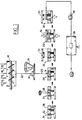
- a deactivation agent via line 12
- to the mixer 10 is charged molecular sieve (via line 12) and deactivation agent (via line 14).
- the purpose of the deactivation agent is to deactivate the molecular sieve so that it will not react with water-containing reagents used in the process.
- Any of the deactivation agents known to deactivate molecular sieves can be used.
- water an alcohol of the formula ROH wherein R is alkyl of from about 1 to 5 carbon atoms, mixtures of water and alcohol, and the like.
- a sufficient amount of the deactivation agent is preferably added to completely wet the surface of the molecular sieve material.
- from about 30 to about 47 weight percent (by total weight of wetted material) of deactivation agent is added.
- a green binder is added to the molecular sieve material along with the deactivation agent (via line 14). In another embodiment, the green binder is added separately via line 16.
- the binder used in the process have a particle size distribution such that substantially all of its particles are smaller than about 0.1 ⁇ m.
- Some of these preferred colloidal binders include colloidal silica, boehmite, and the like.
- DISPAL 180 (available from Vista Chemical Company of Austin, Texas).
- the mixture of molecular sieve and wetting agent is mixed with from 9 to about 20 weight percent (by total weight of mixture) of powdered thermoplastic material, i.e. the powdered polyphenylene sulfide material described above.
- This powdered thermoplastic material may be charged to mixer 10 via line 20.
- thermoplastic material After the thermoplastic material has been charged to mixer 10, the mixture so formed is mixed until a homogeneous mixture results.
- the mixture of molecular sieve, water, green binder, and thermoplastic material is discharged via line 22 to scale 24, wherein it is weighed to a predetermined weight. Thereafter, it is transferred to press 26 wherein it is compacted in a die, using mechanical, pneumatic, or hydraulic pressure.
- press 26 is comprised of case 28, bottom platen 30, press cavity 32, and top platen 34.
- the mixture 31 of molecular sieve, water, green binder, and thermoplastic material is transferred to die 32. Once mixture 31 is within press cavity 32, platen 30 and platen 34 compress it, thereby forming green body 36.
- Green body 36 may consist essentially of the compressed mixture of the molecular sieve, water, green binder, and thermoplastic material. Alternatively, green body 36 also may contain a substrate material 38 attached to the compressed mixture of the molecular sieve, water, green binder, and thermoplastic material.
- press 26 be a double-action press.
- the material is pressed to a given volume and density. In general, the material is pressed to a green density of from about 0.6 to about 1.6 grams per cubic cm.
- the green body is then transferred to a furnace wherein it is heated to the melting-fusion temperature of the thermoplastic material.
- the temperature used is preferably from about 327 to about 343 degrees Celsius. The heating may be conducted in an oxygen-containing atmosphere, such as air.
- the sample is heated until it contains less than about 1 weight percent of moisture, and preferably, less than about 0.5 weight percent of moisture.
- the dried sample is then removed from the furnace and packaged into a sealed container.
- the molecular sieve described above is first transferred to an oven 40 by line 42.
- this oven it is preferably heated to a temperature at or above the melting temperature of the thermoplastic material.
- the heated molecular sieve material is then transferred via line 44 to heated mixer 46.
- heated mixer 46 via line 48, is fed from about 9 to about 20 weight percent of the polyphenylene sulfide material.
- the mixing of the molecular sieve material and the thermoplastic material preferably occurs at or above the melting temperature of the thermoplastic material. The components are mixed until a homogeneous mixture is obtained.
- the heated mixture from mixer 46 is then transferred to a mold 52 by conventional transfer means such as, e.g., a jacketed auger 49.
- the mold is heated to a temperature which preferably is from about 5 to about 20 degrees Celsius lower than the temperature of the heated mixture.
- the hot material thus fed to the mold is then compacted until a molded article with a density of from about 10 to about 25 grams per cubic inch is produced.
- substrate refers to any material with a composition which is dissimilar to applicants' claimed filter body and which may, for example, consist of one or more metal screens, baffle plates, springs, vessel bodies, ceramically bonded filter dryer components (such as, e.g., those described in U.S. Patent No. 3,235,089).
- This bonded material may be provided by either of two processes.
- the substrate component is placed into the mold into which the mixture of molecular sieve/thermoplastic material/water/binder is to be charged. Thereafter, such mixture is charged to the mold, pressed, removed from the mold (together with the substrate part with which it is contiguous) and fired as described above.
- the substrate part is placed into the heated mold into which the molten mixture of molecular sieve and thermoplastic material is to be charged.
- the combination of substrate/molecular sieve/thermoplastic material is compacted as before.
- the final density to which the green body is pressed or molded may differ from the density desired when no such substrate part is in the mold or press.
- a green body density and/or a compacted density they are referring to the density of the molecular sieve/thermoplastic material component and not that of the substrate component.
- Those skilled in the art are well aware of means for measuring and determining the density of the molecular sieve/thermoplastic material component.
- the substrate material is comprised of metal. Any metal material, in substantially any shape, may be introduced into the mold. Thus, by way of illustration and not limitation, one may use metal screen, metal plates, metal baffles, metal springs, and the like. Some preferred metals include aluminum, steel, copper, alloys thereof, and the like.
- the substrate may contain ceramically bonded ceramic material.
- a bonded ceramic material is used as substrate 38, a composite material containing a ceramically bonded ceramic portion and a molecular sieve portion may be formed.
- a composite filter body is prepared which is comprised of both the molecular sieve filter body and, bonded thereto, another ceramic filter body.
- the other ceramic filter body which may be used as substrate 38, may be an adsorbent filter body comprised of at least about 50 weight percent of activated alumina.
- adsorbent filter body 38 contains at least about 75 weight percent of activated alumina.
- the molecular sieve filter body produced by the process of this invention will generally have a density of from about 0.6 to about 1.5 and, preferably, from about 0.8 to about 1.5 grams per cubic cm. It will contain from about 9 to about 20 weight percent of thermoplastic polyphenylene sulfide material (and, preferably, from about 9 to about 14 weight percent of the thermoplastic material). It is preferred that the filter body contain at least about 85 weight percent of the molecular sieve material.
- the molecular sieve filter body produced by applicants' process generally has a compressive strength of at least about 3447 Kilo-Newtons per square metre.
- the compressive strength of such filter body may be measured on a Carver Laboratory Press, Model Number 2901, equipped with a pressure gauge (Fred S. Carver, Inc., Summit, New Jersey).
- the filter body to be tested is placed on the platen of the press, and the plunger is forced into it until the sample breaks, at which point the compressive strength is noted.
- the molecular sieve filter body of this invention has a pressure drop of from about 12.7 cm (water column) to about 50.8 cm (water column), at a flow rate of 2.83 cubic metres per hour, when the filter body is tested as a disc 1.27 cm thick with a diameter of 4.25 cm, and when the filter body tested is mounted in the test apparatus so that the surface area tested is defined by a circle with a diameter of 3.49 cm.
- A.S.T.M. standard test F-778-82 "Gas Flow Resistance Testing of Filtration Media.”
- the molecular sieve filter body of this invention has a water capacity which is substantially greater than the water capacity of prior art filter bodies.
- the water capacity of a filter body is a measure of its ability to adsorb water molecules from refrigerant fluid.
- the term water capacity refers to weight gain experienced by the filter body under certain controlled test conditions.
- a cell which is approximately 46 x 20 x 46 cm is provided.
- Such a cell may be purchased from the Contamination Control Incorporated Company of Kulpsville, Pa. 19443; it consists essentially of "LEXAN” plastic (a thermoplastic carbonate-linked polymer produced by reacting bisphenol A and phosgene which is sold by the General Electric Company.
- a hygrometer to measure relative humidity and temperature.
- a Dickson hygrometer (available from the Dickson Company of Addison, Illinois 60601) is used in the test. Both temperature and relative humidity are monitored during this test.
- At least one vessel containing at least about 800 milliliters of supersaturated lithium chloride solution Into the cell are charged at least one vessel containing at least about 800 milliliters of supersaturated lithium chloride solution.
- at least about 800 milliliters of supersaturated lithium chloride solution e.g., one may mix 800 grams of anhydrous lithium chloride per 1000 milliliters of water to prepare such supersaturated solution.
- the cell After the supersaturated lithium chloride solution has been placed into the cell, the cell is allowed to reach equilibrium over a period of at least about 24 hours. At equilibrium, the relative humidity in the cell is held at about 15 percent and the temperature is held at about 24 degrees Celsius.
- the filter body to be tested is first activated by being heated to a temperature of 232 degrees Celsius until it contains less than about 0.5 weight percent of water.
- the activated filter body to be tested is then weighed. Thereafter, it immediately is placed into the cell for five days. Each 24 hour interval, the material is weighed, and the percent water pickup is recorded.
- the water pickup of the filter body of this invention is at least about 100 percent greater than the water pickup of the prior filter dryer bodies.
- the water pickup of the filter body of this invention is from about 7 to 16 percent
- the water pickup of prior art activated alumina-molecular sieve filter-driers is generally only from about 3.5 to about 6.5 percent.
- the filter body of this invention has a rate of water pickup which is substantially superior to the rate of water pickup of prior art filter bodies. Within the first 24 hours of the water adsorption test described above, it will pick up at least about 6 percent of water.
- the molecular sieve filter body of this invention when formed and heated in contact with metal or other substrate in accordance with the procedures described elsewhere in this specification, forms a bond of great strength.
- the filter body of this invention is used in a gas chromatograph.
- the molten mixture of polyphenylene sulfide and molecular sieve instead of being conveyed to a mold, is fed through an extruder, wherein it is formed by a die.
- honeycomb filter bodies may be formed which may be useful in, e.g., catalysis of ozone.
- the polyphenylene sulfide is electrostatically applied to dry molecular sieve material. In this embodiment, because water need not be removed from the system, energy costs for the process are reduced.
- the polyphenylene sulfide material is mixed with binder and water, and the mixture thus formed is then added to the molecular sieve material.
- the wetted sieve material was mixed with 15 grams of additional water and a 5.0 grams of a prepared binder solution.
- the binder solution was prepared by mixing 1000 grams of water with 0.4 grams of polyethylene glycol ("POLYOX 301,” obtained from the Union Carbide Chemicals and Plastics Company, Specialty Chemicals Division, Danbury, Connecticut) in a Waring blender. The deactivated molecular sieve material, water, and binder solution were mixed together for about 2 minutes.
- NACOTE PRO-1 polyphenylene sulfide powder
- the mixed material was weighed out and charged into a die mold.
- the mold had a diameter of 4.25 cm and a depth of 5.08 cm.
- the material was compressed to a density of 1.03 grams per cubic cm, which required a pressure of about 5171 Kilo-Newtons per square metre.
- the green body produced in the press was a disc with an outside diameter of 4.25 cm and a thickness of about 1.5 cm.
- the pressed body was placed into a furnace (model number 59544, manufactured by the Lindberg division of Sola Basic Industries, 304 Hart Street, Watertown, Wisconsin) and heated at a rate of 148 Celsius per hour to a temperature of 335 degrees Celsius; thereafter it was held at 335 degrees Celcius for 2 hours. The furnace was then allowed to cool naturally, at a rate of about 65 degrees Celsius per hour.
- the resulting body had a measured pressure drop of 35.5 cm water column at 2.83 standard cubic metres per hour flow rate.
- the body also had a measured water capacity of 15 percent.
- a mixture of molecular sieve material, binder, a polyphenylene sulfide was prepared in substantial accordance with the procedure of Example 1. Twelve grams of this mixture were charged into a copper tube (with a 1.91 cm outer diameter, a 0.09 cm wall thickness, and a length of 15.24 cm) containing a press-fit screen. After the material was charged into the tube, another screen was pressed into the tube so that the charged material was compressed between the two screens.
- the tube assembly was then placed in an atmosphere controlled furnace (which was about 27.94 cm in diameter and 40.64 cm in height) and heated to a temperature of 332 degrees Celsius while being contacted with flowing nitrogen at a rate of 0.14 standard m 3 per minute; the nitrogen atmosphere was used to prevent the copper tube from oxidizing. After heating the assembly for 30 minutes at this temperature, the furnace was allowed to cool to room temperature while the assembly was contacted with nitrogen flowing at 0.06 standard cubic metres per minute.
- atmosphere controlled furnace which was about 27.94 cm in diameter and 40.64 cm in height
- the tube was then removed from the furnace and cut lengthwise, using a bandsaw.
- the material in the tube was found to be well bonded to both the wall of the copper tube and to itself.
- the resulting body had a measured pressure drop of 35.56 cm (water column) at 2.83 standard cubic metres per hour flow rate.
- the body also had a measured water capacity of 9.6 percent.
Landscapes
- Chemical & Material Sciences (AREA)
- Inorganic Chemistry (AREA)
- Analytical Chemistry (AREA)
- Organic Chemistry (AREA)
- Chemical Kinetics & Catalysis (AREA)
- Solid-Sorbent Or Filter-Aiding Compositions (AREA)
- Filtering Materials (AREA)
- Centrifugal Separators (AREA)
- Filtering Of Dispersed Particles In Gases (AREA)
Claims (11)
- Filterkörper der aus einer Mischung gebildet ist, die mindestens etwa 75 Gewichtsprozentanteile eines molekularen Sieb-Materials und von etwa 9 bis etwa 20 Gewichtsprozent-anteile an Polyphenylensulfid enthält, wobei der Filterkörper eine Druckfestigkeit von mindestens etwa 3447 Kilo-Newton pro Quadratmeter, einen Druckabfall von etwa 12,7 bis zu etwa 50,8 cm Wassersäule bei einer Durchflußrate von 2,83 Standard m2/h - wenn der Filterkörper als Scheibe mit einer Dicke von 1,27 cm und einem Durchmesser von 4,25 cm getestet wird -, eine Wasseraufnahme von mindestens etwa 11 Gewichtsprozentanteilen und eine anfängliche 24-stündige Wasseraufnahme von mindestens etwa 6 Gewichtsprozentanteilen hat, und wobei:a) das molekulare Sieb die Formel1. M ein Metallion ist, ausgewählt aus der Gruppe bestehend aus Natrium, Kalium, Kalzium, Strontium, Barium, Cäsium, Magnesium und Mischungen derselben, und2. n die Wertigkeit des Metallions darstellt und aus der Gruppe bestehend aus 1 und 2 ausgewählt ist;b) im wesentlichen alle Poren des molekularen Sieb-Materials kleiner als etwa 4 x 10⁻¹⁰ m sind undc) im wesentlichen alle Partikel des molekularen Siebes größer als 100 µm und kleiner als 2000 µm sind.
- Filterkörper nach Anspruch 1, wobei M aus der Gruppe bestehend aus Natrium, Kalium, und Mischungen derselben ausgewählt ist.
- Mischung für einen Filterkörper nach Anspruch 1 oder 2 mit mindestens etwa 75 Gewichtsprozentanteilen des molekularen Sieb-Materials nach Anspruch 1 und mit von etwa 9 bis etwa 20 Gewichtsprozentanteilen an Polyphenylensulfid.
- Mischung nach Anspruch 3, wobei M aus der Gruppe bestehend aus Natrium, Kalium und Mischungen derselben ausgewählt ist.
- Mischung nach Anspruch 4, wobei mindestens etwa 80 Prozent der Partikel des Polyphenylensulfides maximale Abmessungen von etwa 5 bis etwa 200 µm besitzen.
- Verfahren zum Herstellen des Filterkörpers nach Anspruch 1, das folgende Schritte aufweist:(a) Vorsehen einer Mischung mit mindestens etwa 75 Gewichtsprozentanteilen des molekularen Sieb-Materials nach Anspruch 1 und mit etwa 9 bis etwa 20 Gewichts-prozentanteilen an Polyphenylensulfid; und(b) Komprimieren der Mischung zu einem Körper und Erwärmen des Körpers auf eine Temperatur von etwa 315 bis etwa 343 Grad Celsius.
- Verfahren nach Anspruch 6, wobei die Mischung aus molekularem Sieb-Material und Polyphenylensulfid auch von etwa 1 bis etwa 3 Gewichtsprozenzanteile Roh-Bindemittel enthält.
- Verbundkörper bestehend aus Metallmaterial, das zum aufgeführten molekularen Sieb-Filterkörper nach Anspruch 1 gebunden ist.
- Verbundkörper nach Anspruch 8, wobei das Metallmaterial ein Metallsieb ist.
- Verbundkörper nach Anspruch 8, wobei das Metallmaterial eine Metallplatte ist.
- Verbundkörper bestehend aus einem aktivierten Aluminiumoxid-Filterkörper, der an den molekularen Sieb-Filterkörper nach Anspruch 1 gebunden ist.
Applications Claiming Priority (3)
| Application Number | Priority Date | Filing Date | Title |
|---|---|---|---|
| US08/007,473 US5384047A (en) | 1993-01-22 | 1993-01-22 | Filter dryer body |
| US7473 | 1993-01-22 | ||
| PCT/US1994/000861 WO1994016801A1 (en) | 1993-01-22 | 1994-01-21 | Filter dryer body |
Publications (3)
| Publication Number | Publication Date |
|---|---|
| EP0680375A1 EP0680375A1 (de) | 1995-11-08 |
| EP0680375A4 EP0680375A4 (de) | 1996-02-28 |
| EP0680375B1 true EP0680375B1 (de) | 1998-06-10 |
Family
ID=21726384
Family Applications (1)
| Application Number | Title | Priority Date | Filing Date |
|---|---|---|---|
| EP94907310A Expired - Lifetime EP0680375B1 (de) | 1993-01-22 | 1994-01-21 | Filter-trockner-körper |
Country Status (5)
| Country | Link |
|---|---|
| US (1) | US5384047A (de) |
| EP (1) | EP0680375B1 (de) |
| AT (1) | ATE167082T1 (de) |
| DE (1) | DE69410987T2 (de) |
| WO (1) | WO1994016801A1 (de) |
Families Citing this family (14)
| Publication number | Priority date | Publication date | Assignee | Title |
|---|---|---|---|---|
| US5879764A (en) * | 1996-11-06 | 1999-03-09 | W. R. Grace & Co.-Conn. | Desiccation using polymer-bound desiccant beads |
| US6167720B1 (en) | 1999-10-19 | 2001-01-02 | Automotive Fluid Systems, Inc. | Accumulator baffle molded from desiccant |
| CN1275867C (zh) * | 2000-04-21 | 2006-09-20 | 沃特维森斯国际公司 | 含有可膨胀物质的复合材料的制备 |
| CA2409235A1 (en) * | 2000-05-16 | 2001-11-22 | Watervisions International, Inc. | Filter devices and methods of use |
| WO2002070104A1 (en) * | 2001-03-02 | 2002-09-12 | Watervisions International, Inc. | Purification materials and method of filtering using the same |
| EP1323468A1 (de) * | 2001-12-31 | 2003-07-02 | Grace GmbH & Co. KG | Adsorptionsmittel aus porösem funktionellem Feststoff eingelagert in einer Polymermatrix |
| US20040159605A1 (en) * | 2002-02-01 | 2004-08-19 | Hughes Kenneth D. | Compositions of insoluble magnesium containing minerals for use in fluid filtration |
| GB0216834D0 (en) * | 2002-07-19 | 2002-08-28 | Accentus Plc | Porous polymeric membrane |
| US7201841B2 (en) * | 2003-02-05 | 2007-04-10 | Water Visions International, Inc. | Composite materials for fluid treatment |
| US20050081559A1 (en) * | 2003-10-20 | 2005-04-21 | Mcgregor Ian A.N. | Accumulator with pickup tube |
| US8636919B1 (en) | 2004-03-26 | 2014-01-28 | Kenneth D. Hughes | Reactive solutions |
| US7383946B2 (en) | 2004-03-26 | 2008-06-10 | Hughes Kenneth D | Materials for storing and releasing reactive gases |
| WO2006069781A2 (en) * | 2004-12-30 | 2006-07-06 | Grace Gmbh & Co. Kg | Flexible adsorbent bodies |
| JP6495202B2 (ja) | 2016-06-20 | 2019-04-03 | キタムラ機械株式会社 | 工作機械用nc機能付操作盤 |
Family Cites Families (7)
| Publication number | Priority date | Publication date | Assignee | Title |
|---|---|---|---|---|
| NL296324A (de) * | 1962-08-06 | |||
| US3354129A (en) * | 1963-11-27 | 1967-11-21 | Phillips Petroleum Co | Production of polymers from aromatic compounds |
| US4270933A (en) * | 1980-03-19 | 1981-06-02 | Meny Allan H | Regenerative, fluid filter |
| US4522875A (en) * | 1983-09-30 | 1985-06-11 | Phillips Petroleum Company | Stampable sheets of bonded laminate of metal sheet and fiber mat reinforced poly(arylene sulfide) and method of preparation using radio frequency energy |
| GB8414272D0 (en) * | 1984-06-05 | 1984-07-11 | Cpc International Inc | Enzymatic hydrolysis |
| US4665050A (en) * | 1984-08-13 | 1987-05-12 | Pall Corporation | Self-supporting structures containing immobilized inorganic sorbent particles and method for forming same |
| US5114584A (en) * | 1990-12-13 | 1992-05-19 | Refractron Technologies Corporation | Filter dryer body |
-
1993
- 1993-01-22 US US08/007,473 patent/US5384047A/en not_active Expired - Fee Related
-
1994
- 1994-01-21 AT AT94907310T patent/ATE167082T1/de not_active IP Right Cessation
- 1994-01-21 WO PCT/US1994/000861 patent/WO1994016801A1/en not_active Ceased
- 1994-01-21 DE DE69410987T patent/DE69410987T2/de not_active Expired - Fee Related
- 1994-01-21 EP EP94907310A patent/EP0680375B1/de not_active Expired - Lifetime
Also Published As
| Publication number | Publication date |
|---|---|
| WO1994016801A1 (en) | 1994-08-04 |
| EP0680375A4 (de) | 1996-02-28 |
| US5384047A (en) | 1995-01-24 |
| ATE167082T1 (de) | 1998-06-15 |
| DE69410987D1 (de) | 1998-07-16 |
| EP0680375A1 (de) | 1995-11-08 |
| DE69410987T2 (de) | 1998-11-05 |
Similar Documents
| Publication | Publication Date | Title |
|---|---|---|
| US5384047A (en) | Filter dryer body | |
| CA1087151A (en) | Zeolite agglomerates having controlled pore structure | |
| KR101002129B1 (ko) | 중합체 매트릭스에 도입된 다공질 기능성 고체로 구성된흡착물질 | |
| CA2326179C (en) | Shaped body of zeolite, a process for its production and its use | |
| US3235089A (en) | Composite adsorbent filter body | |
| US3181231A (en) | Molecular sieve-metal agglomerates and their preparation | |
| CA1239530A (en) | Porous sintered glass with large open pore volume | |
| US5114584A (en) | Filter dryer body | |
| EP0645346A1 (de) | Aktivierte Kohlenstoffkörper mit einem Bindemittel aus Phenolharzen | |
| US4420419A (en) | Abrasion-resistant granular zeolite and process for preparation thereof | |
| US3262890A (en) | Manufacture of shaped crystalline zeolitic molecular sieve bodies | |
| US20100222204A1 (en) | Method of preparing a controlled porosity geopolymer, the resulting geopolymer and the various applications thereof | |
| CN105148834A (zh) | 具有有机粘结剂的沸石吸附剂 | |
| KR20180026514A (ko) | 수지와 결합된 제올라이트 입자를 갖는 물품 | |
| BR122019021410B1 (pt) | Adsorventes zeolíticos, seu processo de preparação e seus usos | |
| AU778139B2 (en) | Granular ceramic material with high porosity | |
| US3795631A (en) | Glass-fiber-reinforced zeolite granulates | |
| US3301788A (en) | Process for preparing a desiccant pellet | |
| JP2005500155A (ja) | 粘土と結合しているゼオライトが基礎になった乾燥剤、これの製造方法およびこれの使用 | |
| US3116131A (en) | Method and materials for disposing of radioactive waste | |
| CA1299124C (en) | Biological support | |
| US4199607A (en) | Process for carbonation of an aqueous medium | |
| JPS60132643A (ja) | 成形ゼオライト | |
| US3172935A (en) | Bonding of adsorbent materials | |
| Bień | Granulation of porous materials with phase change material (PCM) |
Legal Events
| Date | Code | Title | Description |
|---|---|---|---|
| PUAI | Public reference made under article 153(3) epc to a published international application that has entered the european phase |
Free format text: ORIGINAL CODE: 0009012 |
|
| 17P | Request for examination filed |
Effective date: 19950817 |
|
| AK | Designated contracting states |
Kind code of ref document: A1 Designated state(s): AT BE CH DE DK ES FR GB IT LI NL SE |
|
| A4 | Supplementary search report drawn up and despatched |
Effective date: 19960116 |
|
| AK | Designated contracting states |
Kind code of ref document: A4 Designated state(s): AT BE CH DE DK ES FR GB IT LI NL SE |
|
| 17Q | First examination report despatched |
Effective date: 19961031 |
|
| GRAG | Despatch of communication of intention to grant |
Free format text: ORIGINAL CODE: EPIDOS AGRA |
|
| GRAG | Despatch of communication of intention to grant |
Free format text: ORIGINAL CODE: EPIDOS AGRA |
|
| GRAH | Despatch of communication of intention to grant a patent |
Free format text: ORIGINAL CODE: EPIDOS IGRA |
|
| GRAH | Despatch of communication of intention to grant a patent |
Free format text: ORIGINAL CODE: EPIDOS IGRA |
|
| GRAA | (expected) grant |
Free format text: ORIGINAL CODE: 0009210 |
|
| RAP1 | Party data changed (applicant data changed or rights of an application transferred) |
Owner name: REFRACTRON TECHNOLOGIES CORPORATION |
|
| AK | Designated contracting states |
Kind code of ref document: B1 Designated state(s): AT BE CH DE DK ES FR GB IT LI NL SE |
|
| PG25 | Lapsed in a contracting state [announced via postgrant information from national office to epo] |
Ref country code: NL Free format text: LAPSE BECAUSE OF FAILURE TO SUBMIT A TRANSLATION OF THE DESCRIPTION OR TO PAY THE FEE WITHIN THE PRESCRIBED TIME-LIMIT Effective date: 19980610 Ref country code: LI Free format text: LAPSE BECAUSE OF FAILURE TO SUBMIT A TRANSLATION OF THE DESCRIPTION OR TO PAY THE FEE WITHIN THE PRESCRIBED TIME-LIMIT Effective date: 19980610 Ref country code: ES Free format text: THE PATENT HAS BEEN ANNULLED BY A DECISION OF A NATIONAL AUTHORITY Effective date: 19980610 Ref country code: CH Free format text: LAPSE BECAUSE OF FAILURE TO SUBMIT A TRANSLATION OF THE DESCRIPTION OR TO PAY THE FEE WITHIN THE PRESCRIBED TIME-LIMIT Effective date: 19980610 Ref country code: BE Free format text: LAPSE BECAUSE OF FAILURE TO SUBMIT A TRANSLATION OF THE DESCRIPTION OR TO PAY THE FEE WITHIN THE PRESCRIBED TIME-LIMIT Effective date: 19980610 Ref country code: AT Free format text: LAPSE BECAUSE OF FAILURE TO SUBMIT A TRANSLATION OF THE DESCRIPTION OR TO PAY THE FEE WITHIN THE PRESCRIBED TIME-LIMIT Effective date: 19980610 |
|
| REF | Corresponds to: |
Ref document number: 167082 Country of ref document: AT Date of ref document: 19980615 Kind code of ref document: T |
|
| REG | Reference to a national code |
Ref country code: CH Ref legal event code: EP |
|
| REF | Corresponds to: |
Ref document number: 69410987 Country of ref document: DE Date of ref document: 19980716 |
|
| ITF | It: translation for a ep patent filed | ||
| ET | Fr: translation filed | ||
| PG25 | Lapsed in a contracting state [announced via postgrant information from national office to epo] |
Ref country code: SE Free format text: LAPSE BECAUSE OF FAILURE TO SUBMIT A TRANSLATION OF THE DESCRIPTION OR TO PAY THE FEE WITHIN THE PRESCRIBED TIME-LIMIT Effective date: 19980910 Ref country code: DK Free format text: LAPSE BECAUSE OF FAILURE TO SUBMIT A TRANSLATION OF THE DESCRIPTION OR TO PAY THE FEE WITHIN THE PRESCRIBED TIME-LIMIT Effective date: 19980910 |
|
| NLV1 | Nl: lapsed or annulled due to failure to fulfill the requirements of art. 29p and 29m of the patents act | ||
| REG | Reference to a national code |
Ref country code: CH Ref legal event code: PL |
|
| PLBE | No opposition filed within time limit |
Free format text: ORIGINAL CODE: 0009261 |
|
| STAA | Information on the status of an ep patent application or granted ep patent |
Free format text: STATUS: NO OPPOSITION FILED WITHIN TIME LIMIT |
|
| 26N | No opposition filed | ||
| PGFP | Annual fee paid to national office [announced via postgrant information from national office to epo] |
Ref country code: GB Payment date: 20001207 Year of fee payment: 8 |
|
| PGFP | Annual fee paid to national office [announced via postgrant information from national office to epo] |
Ref country code: FR Payment date: 20001229 Year of fee payment: 8 |
|
| PGFP | Annual fee paid to national office [announced via postgrant information from national office to epo] |
Ref country code: DE Payment date: 20010324 Year of fee payment: 8 |
|
| REG | Reference to a national code |
Ref country code: GB Ref legal event code: IF02 |
|
| PG25 | Lapsed in a contracting state [announced via postgrant information from national office to epo] |
Ref country code: GB Free format text: LAPSE BECAUSE OF NON-PAYMENT OF DUE FEES Effective date: 20020121 |
|
| PG25 | Lapsed in a contracting state [announced via postgrant information from national office to epo] |
Ref country code: DE Free format text: LAPSE BECAUSE OF NON-PAYMENT OF DUE FEES Effective date: 20020801 |
|
| GBPC | Gb: european patent ceased through non-payment of renewal fee |
Effective date: 20020121 |
|
| PG25 | Lapsed in a contracting state [announced via postgrant information from national office to epo] |
Ref country code: FR Free format text: LAPSE BECAUSE OF NON-PAYMENT OF DUE FEES Effective date: 20020930 |
|
| REG | Reference to a national code |
Ref country code: FR Ref legal event code: ST |
|
| PG25 | Lapsed in a contracting state [announced via postgrant information from national office to epo] |
Ref country code: IT Free format text: LAPSE BECAUSE OF NON-PAYMENT OF DUE FEES Effective date: 20050121 |