EP0675898B1 - VERWENDUNG VON MOLEKULaR GEPRÄGTEN POLYMEREN FÜR STEREO- UND/ODER REGIOSELEKTIVE SYNTHESE - Google Patents
VERWENDUNG VON MOLEKULaR GEPRÄGTEN POLYMEREN FÜR STEREO- UND/ODER REGIOSELEKTIVE SYNTHESE Download PDFInfo
- Publication number
- EP0675898B1 EP0675898B1 EP94904058A EP94904058A EP0675898B1 EP 0675898 B1 EP0675898 B1 EP 0675898B1 EP 94904058 A EP94904058 A EP 94904058A EP 94904058 A EP94904058 A EP 94904058A EP 0675898 B1 EP0675898 B1 EP 0675898B1
- Authority
- EP
- European Patent Office
- Prior art keywords
- species
- template
- polymer
- imprint
- enantiomeric
- Prior art date
- Legal status (The legal status is an assumption and is not a legal conclusion. Google has not performed a legal analysis and makes no representation as to the accuracy of the status listed.)
- Expired - Lifetime
Links
- 230000015572 biosynthetic process Effects 0.000 title claims abstract description 35
- 238000003786 synthesis reaction Methods 0.000 title claims abstract description 27
- 229920000344 molecularly imprinted polymer Polymers 0.000 title claims abstract description 16
- 229920000642 polymer Polymers 0.000 claims abstract description 58
- 239000008364 bulk solution Substances 0.000 claims abstract description 13
- 238000006243 chemical reaction Methods 0.000 claims abstract description 13
- 108090000765 processed proteins & peptides Proteins 0.000 claims abstract description 8
- 102000004196 processed proteins & peptides Human genes 0.000 claims abstract description 6
- 239000011159 matrix material Substances 0.000 claims description 15
- 230000003993 interaction Effects 0.000 claims description 14
- 229940024606 amino acid Drugs 0.000 claims description 13
- 150000001413 amino acids Chemical class 0.000 claims description 10
- 230000000295 complement effect Effects 0.000 claims description 10
- 239000000203 mixture Substances 0.000 claims description 10
- -1 N-protected L-tryptophanyl chloride Chemical group 0.000 claims description 9
- 238000009833 condensation Methods 0.000 claims description 9
- 230000005494 condensation Effects 0.000 claims description 9
- 108010016626 Dipeptides Proteins 0.000 claims description 8
- VSDUZFOSJDMAFZ-UHFFFAOYSA-N methyl 2-amino-3-phenylpropanoate Chemical group COC(=O)C(N)CC1=CC=CC=C1 VSDUZFOSJDMAFZ-UHFFFAOYSA-N 0.000 claims description 7
- 125000006239 protecting group Chemical group 0.000 claims description 7
- 150000001719 carbohydrate derivatives Chemical class 0.000 claims description 6
- 239000003153 chemical reaction reagent Substances 0.000 claims description 6
- DZTHIGRZJZPRDV-LBPRGKRZSA-N N-acetyl-L-tryptophan Chemical compound C1=CC=C2C(C[C@H](NC(=O)C)C(O)=O)=CNC2=C1 DZTHIGRZJZPRDV-LBPRGKRZSA-N 0.000 claims description 4
- PASDCCFISLVPSO-UHFFFAOYSA-N benzoyl chloride Chemical compound ClC(=O)C1=CC=CC=C1 PASDCCFISLVPSO-UHFFFAOYSA-N 0.000 claims description 4
- YIVZYFDBEPMPNL-LBPRGKRZSA-N ethyl (2s)-2-acetamido-3-phenylpropanoate Chemical compound CCOC(=O)[C@@H](NC(C)=O)CC1=CC=CC=C1 YIVZYFDBEPMPNL-LBPRGKRZSA-N 0.000 claims description 4
- 108091034117 Oligonucleotide Proteins 0.000 claims description 3
- JLCPHMBAVCMARE-UHFFFAOYSA-N [3-[[3-[[3-[[3-[[3-[[3-[[3-[[3-[[3-[[3-[[3-[[5-(2-amino-6-oxo-1H-purin-9-yl)-3-[[3-[[3-[[3-[[3-[[3-[[5-(2-amino-6-oxo-1H-purin-9-yl)-3-[[5-(2-amino-6-oxo-1H-purin-9-yl)-3-hydroxyoxolan-2-yl]methoxy-hydroxyphosphoryl]oxyoxolan-2-yl]methoxy-hydroxyphosphoryl]oxy-5-(5-methyl-2,4-dioxopyrimidin-1-yl)oxolan-2-yl]methoxy-hydroxyphosphoryl]oxy-5-(6-aminopurin-9-yl)oxolan-2-yl]methoxy-hydroxyphosphoryl]oxy-5-(6-aminopurin-9-yl)oxolan-2-yl]methoxy-hydroxyphosphoryl]oxy-5-(6-aminopurin-9-yl)oxolan-2-yl]methoxy-hydroxyphosphoryl]oxy-5-(6-aminopurin-9-yl)oxolan-2-yl]methoxy-hydroxyphosphoryl]oxyoxolan-2-yl]methoxy-hydroxyphosphoryl]oxy-5-(5-methyl-2,4-dioxopyrimidin-1-yl)oxolan-2-yl]methoxy-hydroxyphosphoryl]oxy-5-(4-amino-2-oxopyrimidin-1-yl)oxolan-2-yl]methoxy-hydroxyphosphoryl]oxy-5-(5-methyl-2,4-dioxopyrimidin-1-yl)oxolan-2-yl]methoxy-hydroxyphosphoryl]oxy-5-(5-methyl-2,4-dioxopyrimidin-1-yl)oxolan-2-yl]methoxy-hydroxyphosphoryl]oxy-5-(6-aminopurin-9-yl)oxolan-2-yl]methoxy-hydroxyphosphoryl]oxy-5-(6-aminopurin-9-yl)oxolan-2-yl]methoxy-hydroxyphosphoryl]oxy-5-(4-amino-2-oxopyrimidin-1-yl)oxolan-2-yl]methoxy-hydroxyphosphoryl]oxy-5-(4-amino-2-oxopyrimidin-1-yl)oxolan-2-yl]methoxy-hydroxyphosphoryl]oxy-5-(4-amino-2-oxopyrimidin-1-yl)oxolan-2-yl]methoxy-hydroxyphosphoryl]oxy-5-(6-aminopurin-9-yl)oxolan-2-yl]methoxy-hydroxyphosphoryl]oxy-5-(4-amino-2-oxopyrimidin-1-yl)oxolan-2-yl]methyl [5-(6-aminopurin-9-yl)-2-(hydroxymethyl)oxolan-3-yl] hydrogen phosphate Polymers Cc1cn(C2CC(OP(O)(=O)OCC3OC(CC3OP(O)(=O)OCC3OC(CC3O)n3cnc4c3nc(N)[nH]c4=O)n3cnc4c3nc(N)[nH]c4=O)C(COP(O)(=O)OC3CC(OC3COP(O)(=O)OC3CC(OC3COP(O)(=O)OC3CC(OC3COP(O)(=O)OC3CC(OC3COP(O)(=O)OC3CC(OC3COP(O)(=O)OC3CC(OC3COP(O)(=O)OC3CC(OC3COP(O)(=O)OC3CC(OC3COP(O)(=O)OC3CC(OC3COP(O)(=O)OC3CC(OC3COP(O)(=O)OC3CC(OC3COP(O)(=O)OC3CC(OC3COP(O)(=O)OC3CC(OC3COP(O)(=O)OC3CC(OC3COP(O)(=O)OC3CC(OC3COP(O)(=O)OC3CC(OC3COP(O)(=O)OC3CC(OC3CO)n3cnc4c(N)ncnc34)n3ccc(N)nc3=O)n3cnc4c(N)ncnc34)n3ccc(N)nc3=O)n3ccc(N)nc3=O)n3ccc(N)nc3=O)n3cnc4c(N)ncnc34)n3cnc4c(N)ncnc34)n3cc(C)c(=O)[nH]c3=O)n3cc(C)c(=O)[nH]c3=O)n3ccc(N)nc3=O)n3cc(C)c(=O)[nH]c3=O)n3cnc4c3nc(N)[nH]c4=O)n3cnc4c(N)ncnc34)n3cnc4c(N)ncnc34)n3cnc4c(N)ncnc34)n3cnc4c(N)ncnc34)O2)c(=O)[nH]c1=O JLCPHMBAVCMARE-UHFFFAOYSA-N 0.000 claims description 3
- 238000006480 benzoylation reaction Methods 0.000 claims description 3
- 150000001720 carbohydrates Chemical class 0.000 claims description 3
- 125000002887 hydroxy group Chemical group [H]O* 0.000 claims description 3
- CJGXMNONHNZEQQ-UHFFFAOYSA-N ethyl 2-amino-3-phenylpropanoate Chemical compound CCOC(=O)C(N)CC1=CC=CC=C1 CJGXMNONHNZEQQ-UHFFFAOYSA-N 0.000 claims description 2
- HEGSGKPQLMEBJL-UHFFFAOYSA-N n-octyl beta-D-glucopyranoside Natural products CCCCCCCCOC1OC(CO)C(O)C(O)C1O HEGSGKPQLMEBJL-UHFFFAOYSA-N 0.000 claims description 2
- HEGSGKPQLMEBJL-RKQHYHRCSA-N octyl beta-D-glucopyranoside Chemical group CCCCCCCCO[C@@H]1O[C@H](CO)[C@@H](O)[C@H](O)[C@H]1O HEGSGKPQLMEBJL-RKQHYHRCSA-N 0.000 claims description 2
- 229920001542 oligosaccharide Polymers 0.000 claims description 2
- 150000002482 oligosaccharides Chemical class 0.000 claims description 2
- 229930182827 D-tryptophan Natural products 0.000 claims 1
- QIVBCDIJIAJPQS-SECBINFHSA-N D-tryptophane Chemical compound C1=CC=C2C(C[C@@H](N)C(O)=O)=CNC2=C1 QIVBCDIJIAJPQS-SECBINFHSA-N 0.000 claims 1
- 125000002777 acetyl group Chemical group [H]C([H])([H])C(*)=O 0.000 claims 1
- VSDUZFOSJDMAFZ-SECBINFHSA-N methyl (2r)-2-amino-3-phenylpropanoate Chemical compound COC(=O)[C@H](N)CC1=CC=CC=C1 VSDUZFOSJDMAFZ-SECBINFHSA-N 0.000 claims 1
- 230000009257 reactivity Effects 0.000 claims 1
- 239000000126 substance Substances 0.000 claims 1
- 239000000243 solution Substances 0.000 abstract description 8
- 230000000707 stereoselective effect Effects 0.000 abstract description 3
- 239000000758 substrate Substances 0.000 abstract description 3
- 238000010647 peptide synthesis reaction Methods 0.000 abstract description 2
- 239000000376 reactant Substances 0.000 abstract 1
- 235000001014 amino acid Nutrition 0.000 description 11
- 239000000178 monomer Substances 0.000 description 10
- 238000000605 extraction Methods 0.000 description 7
- XYXYXSKSTZAEJW-VIFPVBQESA-N (2s)-2-(phenylmethoxycarbonylamino)butanedioic acid Chemical compound OC(=O)C[C@@H](C(O)=O)NC(=O)OCC1=CC=CC=C1 XYXYXSKSTZAEJW-VIFPVBQESA-N 0.000 description 6
- 230000008878 coupling Effects 0.000 description 6
- 238000010168 coupling process Methods 0.000 description 6
- 238000005859 coupling reaction Methods 0.000 description 6
- 238000011534 incubation Methods 0.000 description 6
- 238000013459 approach Methods 0.000 description 5
- 238000000034 method Methods 0.000 description 5
- 238000006116 polymerization reaction Methods 0.000 description 5
- IVWWFWFVSWOTLP-YVZVNANGSA-N (3'as,4r,7'as)-2,2,2',2'-tetramethylspiro[1,3-dioxolane-4,6'-4,7a-dihydro-3ah-[1,3]dioxolo[4,5-c]pyran]-7'-one Chemical compound C([C@@H]1OC(O[C@@H]1C1=O)(C)C)O[C@]21COC(C)(C)O2 IVWWFWFVSWOTLP-YVZVNANGSA-N 0.000 description 4
- PEDCQBHIVMGVHV-UHFFFAOYSA-N Glycerine Chemical compound OCC(O)CO PEDCQBHIVMGVHV-UHFFFAOYSA-N 0.000 description 4
- WYURNTSHIVDZCO-UHFFFAOYSA-N Tetrahydrofuran Chemical compound C1CCOC1 WYURNTSHIVDZCO-UHFFFAOYSA-N 0.000 description 4
- 150000001875 compounds Chemical class 0.000 description 4
- 125000000524 functional group Chemical group 0.000 description 4
- 239000000047 product Substances 0.000 description 4
- QTBSBXVTEAMEQO-UHFFFAOYSA-N Acetic acid Chemical compound CC(O)=O QTBSBXVTEAMEQO-UHFFFAOYSA-N 0.000 description 3
- XEKOWRVHYACXOJ-UHFFFAOYSA-N Ethyl acetate Chemical compound CCOC(C)=O XEKOWRVHYACXOJ-UHFFFAOYSA-N 0.000 description 3
- OKKJLVBELUTLKV-UHFFFAOYSA-N Methanol Chemical compound OC OKKJLVBELUTLKV-UHFFFAOYSA-N 0.000 description 3
- ZMXDDKWLCZADIW-UHFFFAOYSA-N N,N-Dimethylformamide Chemical compound CN(C)C=O ZMXDDKWLCZADIW-UHFFFAOYSA-N 0.000 description 3
- 239000003054 catalyst Substances 0.000 description 3
- KRKNYBCHXYNGOX-UHFFFAOYSA-N citric acid Chemical compound OC(=O)CC(O)(C(O)=O)CC(O)=O KRKNYBCHXYNGOX-UHFFFAOYSA-N 0.000 description 3
- COLNVLDHVKWLRT-QMMMGPOBSA-N phenylalanine group Chemical group N[C@@H](CC1=CC=CC=C1)C(=O)O COLNVLDHVKWLRT-QMMMGPOBSA-N 0.000 description 3
- WQZGKKKJIJFFOK-SVZMEOIVSA-N (+)-Galactose Chemical compound OC[C@H]1OC(O)[C@H](O)[C@@H](O)[C@H]1O WQZGKKKJIJFFOK-SVZMEOIVSA-N 0.000 description 2
- 0 *OC(C(C1O)O)OC(CO)C1O Chemical compound *OC(C(C1O)O)OC(CO)C1O 0.000 description 2
- HSHGZXNAXBPPDL-HZGVNTEJSA-N 7beta-aminocephalosporanic acid Chemical compound S1CC(COC(=O)C)=C(C([O-])=O)N2C(=O)[C@@H]([NH3+])[C@@H]12 HSHGZXNAXBPPDL-HZGVNTEJSA-N 0.000 description 2
- 239000004971 Cross linker Substances 0.000 description 2
- QOSSAOTZNIDXMA-UHFFFAOYSA-N Dicylcohexylcarbodiimide Chemical compound C1CCCCC1N=C=NC1CCCCC1 QOSSAOTZNIDXMA-UHFFFAOYSA-N 0.000 description 2
- 238000005481 NMR spectroscopy Methods 0.000 description 2
- UIIMBOGNXHQVGW-UHFFFAOYSA-M Sodium bicarbonate Chemical class [Na+].OC([O-])=O UIIMBOGNXHQVGW-UHFFFAOYSA-M 0.000 description 2
- 150000003862 amino acid derivatives Chemical class 0.000 description 2
- 230000008901 benefit Effects 0.000 description 2
- 235000014633 carbohydrates Nutrition 0.000 description 2
- HOKIDJSKDBPKTQ-GLXFQSAKSA-N cephalosporin C Chemical compound S1CC(COC(=O)C)=C(C(O)=O)N2C(=O)[C@@H](NC(=O)CCC[C@@H](N)C(O)=O)[C@@H]12 HOKIDJSKDBPKTQ-GLXFQSAKSA-N 0.000 description 2
- 239000003795 chemical substances by application Substances 0.000 description 2
- 235000014113 dietary fatty acids Nutrition 0.000 description 2
- 230000000694 effects Effects 0.000 description 2
- 229930195729 fatty acid Natural products 0.000 description 2
- 239000000194 fatty acid Substances 0.000 description 2
- 150000004665 fatty acids Chemical class 0.000 description 2
- 238000002360 preparation method Methods 0.000 description 2
- UQDJGEHQDNVPGU-UHFFFAOYSA-N serine phosphoethanolamine Chemical compound [NH3+]CCOP([O-])(=O)OCC([NH3+])C([O-])=O UQDJGEHQDNVPGU-UHFFFAOYSA-N 0.000 description 2
- YLQBMQCUIZJEEH-UHFFFAOYSA-N tetrahydrofuran Natural products C=1C=COC=1 YLQBMQCUIZJEEH-UHFFFAOYSA-N 0.000 description 2
- 150000003626 triacylglycerols Chemical class 0.000 description 2
- YSCNREZXFSZAQO-ROUUACIJSA-N (3s)-4-[[(2s)-1-methoxy-1-oxo-3-phenylpropan-2-yl]amino]-4-oxo-3-(phenylmethoxycarbonylamino)butanoic acid Chemical compound C([C@@H](C(=O)OC)NC(=O)[C@H](CC(O)=O)NC(=O)OCC=1C=CC=CC=1)C1=CC=CC=C1 YSCNREZXFSZAQO-ROUUACIJSA-N 0.000 description 1
- ASOKPJOREAFHNY-UHFFFAOYSA-N 1-Hydroxybenzotriazole Chemical compound C1=CC=C2N(O)N=NC2=C1 ASOKPJOREAFHNY-UHFFFAOYSA-N 0.000 description 1
- OKTJSMMVPCPJKN-UHFFFAOYSA-N Carbon Chemical compound [C] OKTJSMMVPCPJKN-UHFFFAOYSA-N 0.000 description 1
- 229930186147 Cephalosporin Natural products 0.000 description 1
- 238000006641 Fischer synthesis reaction Methods 0.000 description 1
- OVRNDRQMDRJTHS-UHFFFAOYSA-N N-acelyl-D-glucosamine Natural products CC(=O)NC1C(O)OC(CO)C(O)C1O OVRNDRQMDRJTHS-UHFFFAOYSA-N 0.000 description 1
- OVRNDRQMDRJTHS-FMDGEEDCSA-N N-acetyl-beta-D-glucosamine Chemical compound CC(=O)N[C@H]1[C@H](O)O[C@H](CO)[C@@H](O)[C@@H]1O OVRNDRQMDRJTHS-FMDGEEDCSA-N 0.000 description 1
- DZTHIGRZJZPRDV-UHFFFAOYSA-N Nalpha-Acetyltryptophan Natural products C1=CC=C2C(CC(NC(=O)C)C(O)=O)=CNC2=C1 DZTHIGRZJZPRDV-UHFFFAOYSA-N 0.000 description 1
- WETWJCDKMRHUPV-UHFFFAOYSA-N acetyl chloride Chemical compound CC(Cl)=O WETWJCDKMRHUPV-UHFFFAOYSA-N 0.000 description 1
- 239000012346 acetyl chloride Substances 0.000 description 1
- 150000001252 acrylic acid derivatives Chemical class 0.000 description 1
- 125000005076 adamantyloxycarbonyl group Chemical group C12(CC3CC(CC(C1)C3)C2)OC(=O)* 0.000 description 1
- 239000003242 anti bacterial agent Substances 0.000 description 1
- 229940088710 antibiotic agent Drugs 0.000 description 1
- 239000000605 aspartame Substances 0.000 description 1
- 229960003438 aspartame Drugs 0.000 description 1
- CKLJMWTZIZZHCS-REOHCLBHSA-N aspartic acid group Chemical group N[C@@H](CC(=O)O)C(=O)O CKLJMWTZIZZHCS-REOHCLBHSA-N 0.000 description 1
- 125000001584 benzyloxycarbonyl group Chemical group C(=O)(OCC1=CC=CC=C1)* 0.000 description 1
- 238000006664 bond formation reaction Methods 0.000 description 1
- 230000031709 bromination Effects 0.000 description 1
- 238000005893 bromination reaction Methods 0.000 description 1
- 229910052799 carbon Inorganic materials 0.000 description 1
- 125000003178 carboxy group Chemical group [H]OC(*)=O 0.000 description 1
- 238000006555 catalytic reaction Methods 0.000 description 1
- 229940124587 cephalosporin Drugs 0.000 description 1
- 150000001780 cephalosporins Chemical class 0.000 description 1
- 239000007795 chemical reaction product Substances 0.000 description 1
- 238000003776 cleavage reaction Methods 0.000 description 1
- 238000006482 condensation reaction Methods 0.000 description 1
- 238000001816 cooling Methods 0.000 description 1
- 239000012043 crude product Substances 0.000 description 1
- 238000011161 development Methods 0.000 description 1
- 150000002016 disaccharides Chemical class 0.000 description 1
- 238000010494 dissociation reaction Methods 0.000 description 1
- 230000005593 dissociations Effects 0.000 description 1
- 230000009881 electrostatic interaction Effects 0.000 description 1
- 150000002148 esters Chemical class 0.000 description 1
- WTVXOKSBXDTJEM-INIZCTEOSA-N ethyl (2s)-2-benzamido-3-phenylpropanoate Chemical compound C([C@@H](C(=O)OCC)NC(=O)C=1C=CC=CC=1)C1=CC=CC=C1 WTVXOKSBXDTJEM-INIZCTEOSA-N 0.000 description 1
- 238000002474 experimental method Methods 0.000 description 1
- 239000000706 filtrate Substances 0.000 description 1
- 238000001914 filtration Methods 0.000 description 1
- 235000003599 food sweetener Nutrition 0.000 description 1
- 150000002390 heteroarenes Chemical class 0.000 description 1
- 229910052739 hydrogen Inorganic materials 0.000 description 1
- 239000001257 hydrogen Substances 0.000 description 1
- 238000002955 isolation Methods 0.000 description 1
- 238000011005 laboratory method Methods 0.000 description 1
- 229920002521 macromolecule Polymers 0.000 description 1
- 238000004519 manufacturing process Methods 0.000 description 1
- 229910052751 metal Inorganic materials 0.000 description 1
- 239000002184 metal Substances 0.000 description 1
- VSDUZFOSJDMAFZ-VIFPVBQESA-N methyl L-phenylalaninate Chemical compound COC(=O)[C@@H](N)CC1=CC=CC=C1 VSDUZFOSJDMAFZ-VIFPVBQESA-N 0.000 description 1
- 150000002772 monosaccharides Chemical class 0.000 description 1
- SYSQUGFVNFXIIT-UHFFFAOYSA-N n-[4-(1,3-benzoxazol-2-yl)phenyl]-4-nitrobenzenesulfonamide Chemical class C1=CC([N+](=O)[O-])=CC=C1S(=O)(=O)NC1=CC=C(C=2OC3=CC=CC=C3N=2)C=C1 SYSQUGFVNFXIIT-UHFFFAOYSA-N 0.000 description 1
- 229950006780 n-acetylglucosamine Drugs 0.000 description 1
- 229940116191 n-acetyltryptophan Drugs 0.000 description 1
- 239000002773 nucleotide Substances 0.000 description 1
- 125000003729 nucleotide group Chemical group 0.000 description 1
- 239000012074 organic phase Substances 0.000 description 1
- 238000006053 organic reaction Methods 0.000 description 1
- 230000035515 penetration Effects 0.000 description 1
- 229960005190 phenylalanine Drugs 0.000 description 1
- 230000000379 polymerizing effect Effects 0.000 description 1
- 108091033319 polynucleotide Proteins 0.000 description 1
- 239000002157 polynucleotide Substances 0.000 description 1
- 102000040430 polynucleotide Human genes 0.000 description 1
- 238000012746 preparative thin layer chromatography Methods 0.000 description 1
- 230000008569 process Effects 0.000 description 1
- 239000011541 reaction mixture Substances 0.000 description 1
- 229920006395 saturated elastomer Polymers 0.000 description 1
- 230000007017 scission Effects 0.000 description 1
- 238000012163 sequencing technique Methods 0.000 description 1
- 239000007787 solid Substances 0.000 description 1
- 239000007790 solid phase Substances 0.000 description 1
- 239000002904 solvent Substances 0.000 description 1
- 150000003440 styrenes Chemical class 0.000 description 1
- 239000003765 sweetening agent Substances 0.000 description 1
- 238000012546 transfer Methods 0.000 description 1
- 230000007306 turnover Effects 0.000 description 1
- XLYOFNOQVPJJNP-UHFFFAOYSA-N water Substances O XLYOFNOQVPJJNP-UHFFFAOYSA-N 0.000 description 1
Images



Classifications
-
- C—CHEMISTRY; METALLURGY
- C07—ORGANIC CHEMISTRY
- C07B—GENERAL METHODS OF ORGANIC CHEMISTRY; APPARATUS THEREFOR
- C07B53/00—Asymmetric syntheses
-
- C—CHEMISTRY; METALLURGY
- C07—ORGANIC CHEMISTRY
- C07K—PEPTIDES
- C07K1/00—General methods for the preparation of peptides, i.e. processes for the organic chemical preparation of peptides or proteins of any length
- C07K1/04—General methods for the preparation of peptides, i.e. processes for the organic chemical preparation of peptides or proteins of any length on carriers
- C07K1/042—General methods for the preparation of peptides, i.e. processes for the organic chemical preparation of peptides or proteins of any length on carriers characterised by the nature of the carrier
-
- G—PHYSICS
- G01—MEASURING; TESTING
- G01N—INVESTIGATING OR ANALYSING MATERIALS BY DETERMINING THEIR CHEMICAL OR PHYSICAL PROPERTIES
- G01N2600/00—Assays involving molecular imprinted polymers/polymers created around a molecular template
Definitions
- This invention refers to the use of molecularly imprinted polymers for stereo- and regioselective synthesis.
- Molecular imprinting is the name given to a process for preparing polymers that are selective for a particular compound (the "print molecule”).
- the technique involves: 1) prearranging the print molecule and the monomers and allowing complementary interactions to develop; 2) polymerizing around the print molecule-monomer complex; and 3) removing the print molecule from the polymer by extraction (Fig. 1). Polymerization thus preserves the complementarity to the print molecule, and subsequently the polymer will selectively adsorb the print molecule.
- the print molecule binds more favourably to the extracted polymer than to structural analogues.
- the technique has also been referred to as "host-guest" polymerization and "template” polymerization. Preparation of the selective polymers is easy, involving only simple, well-known laboratory techniques.
- the additional aspect of using such imprints for catalysis, i.e. involving turnover, is an area of potential interest which however requires a number of prerequisites to be fulfilled such as the correct positioning of the catalyst or penetration of the catalyst through the polymer as well as easy dissociation of the formed products.
- Fig. 1 shows the principle of molecular imprinting.
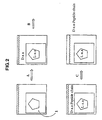
- Fig. 2 shows the use of molecularly imprinted polymers for the selective removal of one enantiomeric or regio-isomeric species from solution, while reaction takes place with the antipode or regio-isomer in bulk solution.
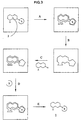
- Fig. 3 shows molecularly imprinted polymers used as interacting protecting matrix.
- Fig. 4 shows the selective benzoylation of a carbohydrate derivative
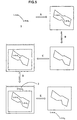
- Fig. 5 shows the use of molecularly imprinted polymers for directed synthesis.
- Fig. 6 shows the site-specific coupling of N-protected L-tryptophanyl cloride to DL-phenylalanine methyl ester.
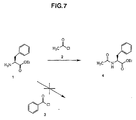
- Fig. 7 shows the chemoselective synthesis of N-protected amino acids.
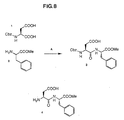
- Fig. 8 shows the combined use of the direction and protection strategies.
- Fig. 1 shows the development of complementary interactions between the print molecule and the monomers (a); polymerization (b); removal of the print molecule from the polymer (c).
- M monomers
- PM print molecule
- CR crosslinker.
- One aspect of the invention describes the use of molecularly impinted polymers for the selective removal of one enantiomeric or regio-isomeric species from solution, while reaction takes place with the enantiopode or regio-isomer in bulk solution, in the synthesis of peptides, oligosaccarides and oligonucleotides (5). This is achieved by the preparation of suitable imprinted polymer, careful manipulation of reaction stoichiometry and selection of suitable condensation reagents.
- this aspect relates to the use of a molecularly imprinted polymer for selective removal of one enantiomeric or regio-isomeric species from a bulk solution during synthesis of peptides, oligosaccharides or oligonucleotides, whereby one enantiomeric or regio-isomeric template or imprint species is non-covalently imprinted in the polymer, the template or imprint species is extracted, the polymer is incubated with a bulk solution of a racemic mixture of the enantiomeric or regio-isomeric species, leading to selective enrichment, by non-covalently interactions, of said on enantiomeric or regio-isomeric species in the polymer and the other enantiomeric or regio-isomeric species in the bulk solution, whereafter the other enantiomeric or regio-isomeric species is reacted in the bulk solution.
- Fig. 2 This aspect is outlined in Fig. 2, in which 1 symbolizes a molecularly imprinted polymer against, in this case, an L-enantiomer of an amino acid or amino acid derivative.
- the polymer in solution is incubated with the racemic mixture of the amino acid or amino acid derivative during step A leading to the selective enrichment, by non-covalent interactions, of the L-enantiomer in the polymer and the D-enantiomer in solution.
- a suitable coupling reagent together with the adequately protected amino acid or peptide chain are introduced in step B.
- the peptide chain is isolated by filtration in step C, whereas the L-enantiomer remains primarily in the polymer throughout the whole process.
- Example 1 describes the enantioselective synthesis of a dipeptide, N-acetyl-D-tryptophanyl-L-phenyl-alanin methyl ester, utilizing a polymer imprinted against N-acetyl-L-tryptophan and, after incubation with the racemic mixture thereof, subsequent condensation with L-phenylalanine methyl ester in the bulk solution.
- Another aspect of the invention covers the use of such imprinted polymers to act as interaction protecting matrices, capable of regio-selectively preventing a particular reaction at a specific site of a molecule containing several potentially reactive sites.
- This aspect is outlined in Fig. 3.
- a protecting group reagent R or R'
- step D leads to site-specific reaction with the free functional group (A).
- the product is isolated by extraction of the polymer in step E.
- the following groups can be substituted by interaction with the imprinted polymer matrix, may it be by complementary binding or by the surrounding matrix per se: Protection of functional group Protecting group Amino tert-butyloxycarbonyl (BOC) 9-fluorenylmethyloxycarbonyl (Fmoc) benzyloxycarbonyl (Cbz) biphenylisopropyloxycarbonyl (Bpoc) Carboxyl methyl tert-butyl benzyl Hydroxyl tert-butyl benzyl Thiol benzyl acetimidomethyl (Acm) Guanidino nitro tosyl adamantyloxycarbonyl (Adoc) Imidazol benzyloxymethyl (BOM)
- One example of this aspect is e.g. the selective benzoylation of a carbohydrate derivative utilizing selective protection of hydroxy groups by binding of the carbohydrate derivative to an imprinted polymer matrix, as indicated in Fig. 4.
- a polymer is imprinted against octyl-3-O-benzoyl- ⁇ -D-glucopyranoside (2) resulting in sites complementary to the above compound with the surrounding polymer matrix serving as protecting "agent" at the 2-O-, 4-O-, and 6-O-positions.
- a third aspect of the present invention covers the use of such imprinted polymers for directed synthesis such as enantioselective synthesis of peptides, whereby condensation of amino acid (derivatives) is allowed to take place in the preformed recognition cavity.
- This aspect is described in Fig. 5.
- a carefully selected template or imprint species in this case a suitably protected dipeptide (1), is imprinted by non-covalent interactions during step A. Extraction of the template in step B, results in a polymer matrix containing complementary recognition sites for 1.
- step C An activated form of amino acid 1 (L-a.a 1 -X) is incubated in the polymeric sites during step C and addition of a racemic mixture of the second amino acid (DL-a.a 2 ) during step D leads to specific condensation in the cavity of the L-enantiomer forming the dipeptide corresponding to the template species (1).
- the resulting product is finally isolated by extraction in step E.
- An example of this strategy is e.g. the site-specific coupling of N-protected L-tryptophanyl chloride to DL-phenylalanine methyl ester (Fig. 6) where PG represents a protecting group such as e.g. a benzyloxycarbonyl (Cbz) group.
- a polymer is imprinted against the N-protected dipeptide N-PG-L-tryptophanyl-L-phenylalanine methyl ester (3) leading to the formation of sites complementary in shape and functionality to this imprint molecule.
- Incubation of the polymer with N-PG-tryptophanyl chloride (1) followed by addition of DL-phenylalanine methyl ester (2) effects the preferential synthesis of the imprint species (3), thus minimizing formation of N-PG-L--tryptophanyl-D-phenylalanine methyl ester.
- Another example of this aspect is the chemoselective synthesis of N-protected amino acids as outlined in Fig. 7.
- a polymer is imprinted against N-acetyl-L-phenylalanine ethyl ester (4) resulting in recognition sites complementary to this particular N-acetylated amino acid ester.
- Incubation of the polymer matrix with L-phenylalanine ethyl ester (1) and subsequent addition of either acetyl chloride (2) or benzoyl chloride (3) leads to preferential formation of the imprinted molecule (4), whereas the formation of the benzoylated derivative is inhibited.
- Fig. 8 An example of employing molecularly imprinted polymers for applications combining both the direction and protection strategies is outlined in Fig. 8.
- these polymers can be imprinted against derivatives of molecules originally containing two or more identical functional groups, e.g. the dipeptide N-benzyloxycarbonyl--L-aspartyl-L-phenylalanine methyl ester (3).
- the ⁇ -carboxy group of this template species is unprotected and the carboxy group in the ⁇ -position of the aspartic acid residue is coupled to the phenylalanine residue.
- the resulting polymer leaves specific enantio- and regioselective interaction sites for the template molecule serving as a protecting matrix for the ⁇ -carboxy group.
- Another example utilizing both the surrounding polymer matrix as substitute for protecting groups, especially hydroxyl groups, and directing the synthesis is to be found in the syntheses of carbohydrates such as disaccharides.
- carbohydrates such as disaccharides.
- imprinting of the disacharide 4-O-( ⁇ -D--galactopyranosyl)- ⁇ -D-2-deoxy-2-(N-acetylamino)-glucopyranose is followed by extraction. Subsequent condensation in the cavities of D-galactose and N-acetyl-D-glucosamine leads to the original imprint molecule.
- the important compound metyl-3-O-( ⁇ -D-galactopyranosyl)-- ⁇ -D-glucopyranoside can be synthesized in a similar fashion.
- the condensation could be carried out following the Fischer reaction using solvents saturated with gaseous HCl or by utilizing one activated monosaccharide obtained by bromination at the anomeric carbon (6).
- a molecularly imprinted polymer was prepared against N-acetyl-L-tryptophan.
- Racemic N-acetyl-tryptophan (10 mg/ml in dry dimethylformamide) was incubated overnight at 4°C in the presence of the imprinted polymer (500 mg) in a total volume of 2 ml, made up with tetrahydrofuran.
- L-phenylalanine metyl ester (1 eq.
- 1-hydroxybenzotriazole 1.1 eq
- N,N'-dicyclohexylcarbodiimide 1.1 eq.
- reaction mixture was allowed to stand for 24 h, at room temperature, then filtered and the residue washed successively with portions of tetrahydrofuran and methanol/acetic acid.
- the filtrate was concentrated to dryness in vacuo and the residue partitioned between ethyl acetate and saturated sodium bicarbonate.
- the organic phase was successively washed with aqueous citric acid, saturated sodium bicarbonate and water, then dried and concentrated in vacuo.
- the crude products were purified by preparative thin layer chromatography, isolated and analysed by nuclear magnetic resonance (NMR).
Landscapes
- Chemical & Material Sciences (AREA)
- Organic Chemistry (AREA)
- General Health & Medical Sciences (AREA)
- Life Sciences & Earth Sciences (AREA)
- Biochemistry (AREA)
- Biophysics (AREA)
- Health & Medical Sciences (AREA)
- Genetics & Genomics (AREA)
- Medicinal Chemistry (AREA)
- Molecular Biology (AREA)
- Proteomics, Peptides & Aminoacids (AREA)
- Analytical Chemistry (AREA)
- Peptides Or Proteins (AREA)
- Organic Low-Molecular-Weight Compounds And Preparation Thereof (AREA)
- Addition Polymer Or Copolymer, Post-Treatments, Or Chemical Modifications (AREA)
Claims (11)
- Verwendung eines molekular geprägten Polymers zur selektiven Entfernung einer enantiomeren oder regioisomeren Spezies aus einer Gesamtlösung während der Synthese von Peptiden, Oligosacchariden oder Oligonucleotiden, wobeieine enantiomere oder regioisomere Templat- oder Prägespezies nichtkovalent in das Polymer eingeprägt wird,die Templat- oder Prägespezies extrahiert wird,das Polymer mit einer Gesamtlösung eines racemischen Gemisches der enantiomeren oder regioisomeren Spezies inkubiert wird, was zu einer selektiven Anreicherung, durch nichtkovalente Wechselwirkungen, der einen enantiomeren oder regioisomeren Spezies in dem Polymer und der anderen enantiomeren oder regioisomeren Spezies in der Gesamtlösung führt,wonach die andere enantiomere oder regioisomere Spezies in der Gesamtlösung umgesetzt wird.
- Verwendung nach Anspruch 1, wobei die eine enantiomere oder regioisomere Spezies N-Acetyl-L- oder D-Tryptophan ist, und die andere enantiomere oder regioisomere Spezies mit L- oder D-Phenylalaninmethylester in der Gesamtlösung umgesetzt wird, was zur Bildung von N-Acetyl-D- oder -L-tryptophanyl-L-phenyl-alaninmethylester bzw. N-Acetyl-D- oder -L-tryptophanyl-D-phenylalaninmethylester führt.
- Verwendung eines molekular geprägten Polymers für eine stereo- und regioselektive Synthese, wobeieine regioselektiv wechselwirkende Schutzpolymermatrix, die durch nichtkovalentes Einprägen eines Moleküls, das mehrere potentiell reaktive Stellen umfasst, von denen eine selektiv geschützt ist, und Extrahieren des Moleküls unter Zurücklassung eines Polymers mit komplementären Einprägungen bzw. Abdrücken des Moleküls hergestellt wird, mit einem ungeschützten Analogon des Moleküls inkubiert wird,ein Schutzgruppenreagenz zugegeben wird, was zu einer regiospezifischen (ortsspezifischen) Reaktion führt, unddas Molekül durch Extrahieren des Polymers isoliert wird.
- Verwendung nach Anspruch 3 zur selektiven Benzoylierung eines Kohlenhydratderivats, wobei Hydroxygruppen an dem Kohlenhydratderivat durch Binden des Kohlenhydratderivats an eine geprägte Polymermatrix selektiv geschützt werden.
- Verwendung nach Anspruch 4, wobei das Kohlenhydratderivat Octyl-β-D-glucopyranosid ist.
- Verwendung eines molekular geprägten Polymers für eine enantioselektive Synthese, wobeieine enantiomere Templat- oder Prägespezies nichtkovalent in das Polymer eingeprägt wird,die Templat- oder Prägespezies extrahiert wird,eine aktivierte Form von einem Teil der enantiomeren Templat- oder Prägespezies in dem geprägten Polymer inkubiert wird,und ein racemisches Gemisch des anderen Teils des enantiomeren Templats zugegeben wird,was zu einer spezifischen Kondensation in der Einprägung bzw. dem Abdruck eines Enantiomers entsprechend der Templat- oder Prägespezies führt.
- Verwendung nach Anspruch 6, wobei die enantiomere Templat- oder Prägespezies ein geschütztes Dipeptid ist, die aktivierte Form von einem Teil der enantiomeren Templat- oder Prägespezies eine erste Aminosäure ist, und das racemische Gemisch des anderen Teils des enantiomeren Templats oder Abdrucks ein racemisches Gemisch einer zweiten Aminosäure ist.
- Verwendung nach Anspruch 7, wobei die aktivierte Form von einem Teil des Dipeptids N-geschütztes L-Tryptophanylchlorid ist und das racemische Gemisch des anderen Teils des Dipeptids D,L-Phenylalaninmethylester ist.
- Verwendung eines molekular geprägten Polymers für eine chemoselektive Synthese, wobeieine Templat- oder Prägespezies, die eine spezifische Gruppe oder Komponente trägt, nichtkovalent in das Polymer eingeprägt wird,die Templat- oder Prägespezies extrahiert wird, was zu Erkennungsstellen in dem Polymer führt, die zu der Templat- oder Prägespezies komplementär sind,wonach die Templat- oder Prägespezies ohne diese Gruppe oder Komponente in dem geprägten Polymer inkubiert wird, undeine Gruppe oder Komponente, die einen Teil der Templat- oder Prägespezies bildet, zugegeben wird, gegebenenfalls in Mischung mit anderen Gruppen oder Komponenten mit der gleichen chemischen Reaktivität, aber verschiedenen Formen oder Größen,was zu einer spezifischen Kondensation in der Einprägung bzw. dem Abdruck der Gruppe entsprechend der Templat- oder Prägespezies führt.
- Verwendung nach Anspruch 9, wobei die Templat- oder Prägespezies N-Acetyl-L-phenylalaninethylester ist und das geprägte Polymer mit L-Phenylalaninethylester und Acetyl- oder Benzoylchlorid inkubiert wird.
- Verwendung von molekular geprägten Polymeren für eine stereo- und regioselektive Synthese unter Verwendung der kombinierten Funktionen von Einprägungen bzw. Abdrücken, die als Schutzmatrizes dienen, wie in Anspruch 3 beansprucht, und als Template zum Lenken von Reaktionen wirken, wie in Anspruch 1, 6 oder 9 beansprucht.
Applications Claiming Priority (3)
| Application Number | Priority Date | Filing Date | Title |
|---|---|---|---|
| SE9203913 | 1992-12-28 | ||
| SE9203913A SE9203913D0 (sv) | 1992-12-28 | 1992-12-28 | Framstaellning av polymerer genom molekylavtryck foer anvaendning vid stereo- och enantioselektiva synteser styrda primaert av icke-kovalenta interaktioner |
| PCT/SE1993/001107 WO1994014835A1 (en) | 1992-12-28 | 1993-12-27 | Use of molecularly imprinted polymers for stereo- and/or regioselective synthesis |
Publications (2)
| Publication Number | Publication Date |
|---|---|
| EP0675898A1 EP0675898A1 (de) | 1995-10-11 |
| EP0675898B1 true EP0675898B1 (de) | 2001-11-21 |
Family
ID=20388255
Family Applications (1)
| Application Number | Title | Priority Date | Filing Date |
|---|---|---|---|
| EP94904058A Expired - Lifetime EP0675898B1 (de) | 1992-12-28 | 1993-12-27 | VERWENDUNG VON MOLEKULaR GEPRÄGTEN POLYMEREN FÜR STEREO- UND/ODER REGIOSELEKTIVE SYNTHESE |
Country Status (7)
| Country | Link |
|---|---|
| EP (1) | EP0675898B1 (de) |
| JP (1) | JPH08507291A (de) |
| AU (2) | AU5825994A (de) |
| CA (1) | CA2152627A1 (de) |
| DE (1) | DE69331200T2 (de) |
| SE (1) | SE9203913D0 (de) |
| WO (1) | WO1994014835A1 (de) |
Families Citing this family (7)
| Publication number | Priority date | Publication date | Assignee | Title |
|---|---|---|---|---|
| SE9102622L (sv) | 1991-09-06 | 1993-03-07 | Klaus Mosbach | Saett att aastadkomma specifikt adsorptionsmaterial laempligt foer biologiska makromolekyler genom prearrangemang av immobiliserbara till makromolekylen i fraaga bindande funktionella grupper |
| JPH11507402A (ja) * | 1995-05-26 | 1999-06-29 | アイジェン・インコーポレーテッド | 分子的にインプリントされた粒状ポリマー及び同ポリマーのペルフロオロカーボン液中における安定化懸濁重合 |
| US7205162B1 (en) | 1995-12-07 | 2007-04-17 | Klaus Mosbach | Artificial antibodies, method of producing the same and use thereof |
| US6255461B1 (en) | 1996-04-05 | 2001-07-03 | Klaus Mosbach | Artificial antibodies to corticosteroids prepared by molecular imprinting |
| DE19627162C1 (de) * | 1996-07-05 | 1997-08-07 | Lutz Dr Fischer | In ihrer Konformation fixierte und stabilisierte, kovalent vernetzte Imprint-Polypeptide, Verfahren zu deren Herstellung und deren Verwendung |
| US5942444A (en) * | 1997-01-27 | 1999-08-24 | Biocode, Inc. | Marking of products to establish identity, source and fate |
| US6884842B2 (en) | 1997-10-14 | 2005-04-26 | Alnis Biosciences, Inc. | Molecular compounds having complementary surfaces to targets |
-
1992
- 1992-12-28 SE SE9203913A patent/SE9203913D0/xx unknown
-
1993
- 1993-12-27 AU AU58259/94A patent/AU5825994A/en not_active Abandoned
- 1993-12-27 WO PCT/SE1993/001107 patent/WO1994014835A1/en not_active Ceased
- 1993-12-27 DE DE69331200T patent/DE69331200T2/de not_active Expired - Fee Related
- 1993-12-27 CA CA 2152627 patent/CA2152627A1/en not_active Abandoned
- 1993-12-27 JP JP6515095A patent/JPH08507291A/ja active Pending
- 1993-12-27 EP EP94904058A patent/EP0675898B1/de not_active Expired - Lifetime
-
1998
- 1998-04-07 AU AU60692/98A patent/AU6069298A/en not_active Abandoned
Non-Patent Citations (3)
| Title |
|---|
| Ekberg, B., Mosbach, K., Molecular Imprinting: A Technique for Producing Specific Separation Materials, Trends Biotechnol., 7, 92-96, 1989 * |
| K. Nilsson, Trends in Biotechnology, 1988, vol. 6, 256-264. * |
| O-Shannessy, D., Ekberg, B., Andersson, L. I., Mosbach, ;., Recent Advances in the Preparation and Use of Molecularly Imprinted Polymers for Enantiomeric Resolution of Amino Acid Derivatives, J. Chromatogr., 470, 391-399, 1989 * |
Also Published As
| Publication number | Publication date |
|---|---|
| DE69331200T2 (de) | 2002-07-04 |
| SE9203913D0 (sv) | 1992-12-28 |
| EP0675898A1 (de) | 1995-10-11 |
| CA2152627A1 (en) | 1994-07-07 |
| DE69331200D1 (de) | 2002-01-03 |
| JPH08507291A (ja) | 1996-08-06 |
| AU6069298A (en) | 1998-06-18 |
| AU5825994A (en) | 1994-07-19 |
| WO1994014835A1 (en) | 1994-07-07 |
Similar Documents
| Publication | Publication Date | Title |
|---|---|---|
| Zhang et al. | Non‐covalent molecular imprinting with emphasis on its application in separation and drug development | |
| US5846839A (en) | Methods for hard-tagging an encoded synthetic library | |
| Sellergren et al. | Molecular recognition in macroporous polymers prepared by a substrate analog imprinting strategy | |
| US4923901A (en) | Membranes with bound oligonucleotides and peptides | |
| O'Donnell et al. | Enantioselective solid-phase synthesis of α-amino acid derivatives | |
| Fridkin et al. | Use of polymers as chemical reagents. II. Synthesis of bradykinin | |
| CA2180844A1 (en) | Synthetic receptors, libraries and uses thereof | |
| JP2003055396A (ja) | ペプチドの高速溶液合成方法 | |
| Christensen et al. | Efficient Solid‐Phase Synthesis of Peptide‐Based Phosphine Ligands: Towards Combinatorial Libraries of Selective Transition Metal Catalysts | |
| CA2152627A1 (en) | Use of molecularly imprinted polymers for stereo- and/or regioselective synthesis | |
| Weber et al. | The formation of peptides from the 2′(3′)-glycyl ester of a nucleotide | |
| US6492460B2 (en) | Linker based solid support for peptide and small molecule organic synthesis | |
| US5391711A (en) | Biotinylating reagent and purification process for synthesized peptide using thereof | |
| US20050027102A1 (en) | Use of molecularly imprinted polymers for stereo- and/or regioselective synthesis | |
| WO2010009196A1 (en) | Synthesis of bis-peptides oligomers comprising at least one n-substituted diketopiperazine as structural moiety | |
| AU2001234056A1 (en) | A new linker based solid support for peptide and small molecule organic synthesis | |
| AU1827801A (en) | Use of molecularly imprinted polymers for stereo-and/or regioselective synthesis | |
| JPH03504495A (ja) | 反応溶媒として超臨界二酸化炭素を用いての有機合成 | |
| WO1994000509A9 (en) | Oxazolone derived materials | |
| US5051368A (en) | Method for forming an amino acid thiohydantoin using an N-substituted ketenimine activator | |
| US5872207A (en) | N-terminal-marked peptides immobilized on glass beads and method of preparation and method of use thereof | |
| Andersson | Preparation of amino acid ester-selective cavities formed by non-covalent imprinting with a substrate in highly cross-linked polymers | |
| CA2441922C (en) | Solid phase synthesis supports and methods | |
| Bleicher et al. | New phenylfluorenyl based linkers for solid phase synthesis | |
| US5874589A (en) | Methods for synthesizing diverse collections of tetramic acids and derivatives thereof |
Legal Events
| Date | Code | Title | Description |
|---|---|---|---|
| PUAI | Public reference made under article 153(3) epc to a published international application that has entered the european phase |
Free format text: ORIGINAL CODE: 0009012 |
|
| 17P | Request for examination filed |
Effective date: 19950621 |
|
| AK | Designated contracting states |
Kind code of ref document: A1 Designated state(s): DE FR GB SE |
|
| 17Q | First examination report despatched |
Effective date: 19961219 |
|
| GRAG | Despatch of communication of intention to grant |
Free format text: ORIGINAL CODE: EPIDOS AGRA |
|
| GRAG | Despatch of communication of intention to grant |
Free format text: ORIGINAL CODE: EPIDOS AGRA |
|
| GRAH | Despatch of communication of intention to grant a patent |
Free format text: ORIGINAL CODE: EPIDOS IGRA |
|
| GRAH | Despatch of communication of intention to grant a patent |
Free format text: ORIGINAL CODE: EPIDOS IGRA |
|
| GRAA | (expected) grant |
Free format text: ORIGINAL CODE: 0009210 |
|
| AK | Designated contracting states |
Kind code of ref document: B1 Designated state(s): DE FR GB SE |
|
| REG | Reference to a national code |
Ref country code: GB Ref legal event code: IF02 |
|
| REF | Corresponds to: |
Ref document number: 69331200 Country of ref document: DE Date of ref document: 20020103 |
|
| ET | Fr: translation filed | ||
| PLBE | No opposition filed within time limit |
Free format text: ORIGINAL CODE: 0009261 |
|
| STAA | Information on the status of an ep patent application or granted ep patent |
Free format text: STATUS: NO OPPOSITION FILED WITHIN TIME LIMIT |
|
| 26N | No opposition filed | ||
| PGFP | Annual fee paid to national office [announced via postgrant information from national office to epo] |
Ref country code: SE Payment date: 20031223 Year of fee payment: 11 |
|
| PG25 | Lapsed in a contracting state [announced via postgrant information from national office to epo] |
Ref country code: SE Free format text: LAPSE BECAUSE OF NON-PAYMENT OF DUE FEES Effective date: 20041228 |
|
| EUG | Se: european patent has lapsed | ||
| PG25 | Lapsed in a contracting state [announced via postgrant information from national office to epo] |
Ref country code: FR Free format text: LAPSE BECAUSE OF NON-PAYMENT OF DUE FEES Effective date: 20060831 |
|
| REG | Reference to a national code |
Ref country code: FR Ref legal event code: ST Effective date: 20060831 |
|
| REG | Reference to a national code |
Ref country code: FR Ref legal event code: D3 |
|
| PGFP | Annual fee paid to national office [announced via postgrant information from national office to epo] |
Ref country code: DE Payment date: 20080613 Year of fee payment: 15 |
|
| PGFP | Annual fee paid to national office [announced via postgrant information from national office to epo] |
Ref country code: FR Payment date: 20080617 Year of fee payment: 15 |
|
| REG | Reference to a national code |
Ref country code: FR Ref legal event code: ST Effective date: 20090831 |
|
| PG25 | Lapsed in a contracting state [announced via postgrant information from national office to epo] |
Ref country code: DE Free format text: LAPSE BECAUSE OF NON-PAYMENT OF DUE FEES Effective date: 20090701 |
|
| PGFP | Annual fee paid to national office [announced via postgrant information from national office to epo] |
Ref country code: GB Payment date: 20100624 Year of fee payment: 17 |
|
| GBPC | Gb: european patent ceased through non-payment of renewal fee |
Effective date: 20101227 |
|
| PG25 | Lapsed in a contracting state [announced via postgrant information from national office to epo] |
Ref country code: GB Free format text: LAPSE BECAUSE OF NON-PAYMENT OF DUE FEES Effective date: 20101227 |
|
| PG25 | Lapsed in a contracting state [announced via postgrant information from national office to epo] |
Ref country code: FR Free format text: LAPSE BECAUSE OF NON-PAYMENT OF DUE FEES Effective date: 20081231 |