EP0670370B1 - Method of producing L-glutamic acid by fermentation - Google Patents
Method of producing L-glutamic acid by fermentation Download PDFInfo
- Publication number
- EP0670370B1 EP0670370B1 EP95100259A EP95100259A EP0670370B1 EP 0670370 B1 EP0670370 B1 EP 0670370B1 EP 95100259 A EP95100259 A EP 95100259A EP 95100259 A EP95100259 A EP 95100259A EP 0670370 B1 EP0670370 B1 EP 0670370B1
- Authority
- EP
- European Patent Office
- Prior art keywords
- glutamic acid
- gene
- suca
- escherichia coli
- mutant
- Prior art date
- Legal status (The legal status is an assumption and is not a legal conclusion. Google has not performed a legal analysis and makes no representation as to the accuracy of the status listed.)
- Expired - Lifetime
Links
- WHUUTDBJXJRKMK-VKHMYHEASA-N L-glutamic acid Chemical compound OC(=O)[C@@H](N)CCC(O)=O WHUUTDBJXJRKMK-VKHMYHEASA-N 0.000 title claims description 106
- 229960002989 glutamic acid Drugs 0.000 title claims description 54
- 238000000034 method Methods 0.000 title claims description 32
- 238000000855 fermentation Methods 0.000 title claims description 12
- 230000004151 fermentation Effects 0.000 title claims description 12
- 230000000694 effects Effects 0.000 claims description 46
- 230000002950 deficient Effects 0.000 claims description 27
- 241000588722 Escherichia Species 0.000 claims description 19
- 239000001963 growth medium Substances 0.000 claims description 16
- 108020004306 Alpha-ketoglutarate dehydrogenase Proteins 0.000 claims description 4
- 102000006589 Alpha-ketoglutarate dehydrogenase Human genes 0.000 claims description 3
- 101000950981 Bacillus subtilis (strain 168) Catabolic NAD-specific glutamate dehydrogenase RocG Proteins 0.000 claims description 3
- 102000016901 Glutamate dehydrogenase Human genes 0.000 claims description 3
- 108091000041 Phosphoenolpyruvate Carboxylase Proteins 0.000 claims description 3
- 238000012258 culturing Methods 0.000 claims description 3
- 238000009630 liquid culture Methods 0.000 claims description 2
- 101150111745 sucA gene Proteins 0.000 description 52
- 101150023641 ppc gene Proteins 0.000 description 34
- 241000588724 Escherichia coli Species 0.000 description 31
- 101100453819 Mycolicibacterium smegmatis (strain ATCC 700084 / mc(2)155) kgd gene Proteins 0.000 description 24
- 108090000623 proteins and genes Proteins 0.000 description 24
- 101150099894 GDHA gene Proteins 0.000 description 23
- 239000002585 base Substances 0.000 description 22
- 239000002773 nucleotide Substances 0.000 description 22
- 125000003729 nucleotide group Chemical group 0.000 description 22
- 102100034009 Glutamate dehydrogenase 1, mitochondrial Human genes 0.000 description 21
- 239000013612 plasmid Substances 0.000 description 18
- 108020004414 DNA Proteins 0.000 description 15
- 239000013611 chromosomal DNA Substances 0.000 description 15
- 101150055132 sucB gene Proteins 0.000 description 15
- 241001302584 Escherichia coli str. K-12 substr. W3110 Species 0.000 description 14
- 239000012634 fragment Substances 0.000 description 12
- 101100351124 Bacillus subtilis (strain 168) pckA gene Proteins 0.000 description 10
- 101100277701 Halobacterium salinarum gdhX gene Proteins 0.000 description 10
- 101100392454 Picrophilus torridus (strain ATCC 700027 / DSM 9790 / JCM 10055 / NBRC 100828) gdh2 gene Proteins 0.000 description 10
- 101100116769 Saccharolobus solfataricus (strain ATCC 35092 / DSM 1617 / JCM 11322 / P2) gdhA-2 gene Proteins 0.000 description 10
- 230000003321 amplification Effects 0.000 description 9
- 238000003199 nucleic acid amplification method Methods 0.000 description 9
- IJGRMHOSHXDMSA-UHFFFAOYSA-N Atomic nitrogen Chemical compound N#N IJGRMHOSHXDMSA-UHFFFAOYSA-N 0.000 description 8
- OKTJSMMVPCPJKN-UHFFFAOYSA-N Carbon Chemical compound [C] OKTJSMMVPCPJKN-UHFFFAOYSA-N 0.000 description 8
- 108091028043 Nucleic acid sequence Proteins 0.000 description 8
- 229910052799 carbon Inorganic materials 0.000 description 8
- 102000016928 DNA-directed DNA polymerase Human genes 0.000 description 6
- 108010014303 DNA-directed DNA polymerase Proteins 0.000 description 6
- WQZGKKKJIJFFOK-GASJEMHNSA-N Glucose Natural products OC[C@H]1OC(O)[C@H](O)[C@@H](O)[C@@H]1O WQZGKKKJIJFFOK-GASJEMHNSA-N 0.000 description 6
- 239000008103 glucose Substances 0.000 description 6
- 238000004519 manufacturing process Methods 0.000 description 6
- QTBSBXVTEAMEQO-UHFFFAOYSA-N Acetic acid Natural products CC(O)=O QTBSBXVTEAMEQO-UHFFFAOYSA-N 0.000 description 5
- 101100134884 Corynebacterium glutamicum (strain ATCC 13032 / DSM 20300 / BCRC 11384 / JCM 1318 / LMG 3730 / NCIMB 10025) aceF gene Proteins 0.000 description 5
- 101150090997 DLAT gene Proteins 0.000 description 5
- 230000001747 exhibiting effect Effects 0.000 description 5
- 239000002609 medium Substances 0.000 description 5
- 101150078036 odhB gene Proteins 0.000 description 5
- VTYYLEPIZMXCLO-UHFFFAOYSA-L Calcium carbonate Chemical compound [Ca+2].[O-]C([O-])=O VTYYLEPIZMXCLO-UHFFFAOYSA-L 0.000 description 4
- 241001646716 Escherichia coli K-12 Species 0.000 description 4
- LCTONWCANYUPML-UHFFFAOYSA-N Pyruvic acid Chemical compound CC(=O)C(O)=O LCTONWCANYUPML-UHFFFAOYSA-N 0.000 description 4
- FAPWRFPIFSIZLT-UHFFFAOYSA-M Sodium chloride Chemical compound [Na+].[Cl-] FAPWRFPIFSIZLT-UHFFFAOYSA-M 0.000 description 4
- 229940024606 amino acid Drugs 0.000 description 4
- 235000001014 amino acid Nutrition 0.000 description 4
- 150000001413 amino acids Chemical class 0.000 description 4
- 229940041514 candida albicans extract Drugs 0.000 description 4
- 210000004027 cell Anatomy 0.000 description 4
- 238000010367 cloning Methods 0.000 description 4
- 238000010276 construction Methods 0.000 description 4
- 238000005516 engineering process Methods 0.000 description 4
- 229910052757 nitrogen Inorganic materials 0.000 description 4
- 235000015097 nutrients Nutrition 0.000 description 4
- 239000012138 yeast extract Substances 0.000 description 4
- QGZKDVFQNNGYKY-UHFFFAOYSA-N Ammonia Chemical compound N QGZKDVFQNNGYKY-UHFFFAOYSA-N 0.000 description 3
- 108091026890 Coding region Proteins 0.000 description 3
- 102000012410 DNA Ligases Human genes 0.000 description 3
- 108010061982 DNA Ligases Proteins 0.000 description 3
- PEDCQBHIVMGVHV-UHFFFAOYSA-N Glycerine Chemical compound OCC(O)CO PEDCQBHIVMGVHV-UHFFFAOYSA-N 0.000 description 3
- 108700026244 Open Reading Frames Proteins 0.000 description 3
- BFNBIHQBYMNNAN-UHFFFAOYSA-N ammonium sulfate Chemical compound N.N.OS(O)(=O)=O BFNBIHQBYMNNAN-UHFFFAOYSA-N 0.000 description 3
- 229910052921 ammonium sulfate Inorganic materials 0.000 description 3
- 229960000723 ampicillin Drugs 0.000 description 3
- AVKUERGKIZMTKX-NJBDSQKTSA-N ampicillin Chemical compound C1([C@@H](N)C(=O)N[C@H]2[C@H]3SC([C@@H](N3C2=O)C(O)=O)(C)C)=CC=CC=C1 AVKUERGKIZMTKX-NJBDSQKTSA-N 0.000 description 3
- KRKNYBCHXYNGOX-UHFFFAOYSA-N citric acid Chemical compound OC(=O)CC(O)(C(O)=O)CC(O)=O KRKNYBCHXYNGOX-UHFFFAOYSA-N 0.000 description 3
- 238000009795 derivation Methods 0.000 description 3
- 239000003814 drug Substances 0.000 description 3
- 230000001717 pathogenic effect Effects 0.000 description 3
- 230000006798 recombination Effects 0.000 description 3
- 238000005215 recombination Methods 0.000 description 3
- NLXLAEXVIDQMFP-UHFFFAOYSA-N Ammonia chloride Chemical compound [NH4+].[Cl-] NLXLAEXVIDQMFP-UHFFFAOYSA-N 0.000 description 2
- 241000894006 Bacteria Species 0.000 description 2
- 241001522878 Escherichia coli B Species 0.000 description 2
- 241000901842 Escherichia coli W Species 0.000 description 2
- WHUUTDBJXJRKMK-UHFFFAOYSA-N Glutamic acid Natural products OC(=O)C(N)CCC(O)=O WHUUTDBJXJRKMK-UHFFFAOYSA-N 0.000 description 2
- 238000002105 Southern blotting Methods 0.000 description 2
- 102000008817 Trefoil Factor-1 Human genes 0.000 description 2
- 108010088412 Trefoil Factor-1 Proteins 0.000 description 2
- 235000011130 ammonium sulphate Nutrition 0.000 description 2
- 230000000340 anti-metabolite Effects 0.000 description 2
- 229940100197 antimetabolite Drugs 0.000 description 2
- 239000002256 antimetabolite Substances 0.000 description 2
- 229910000019 calcium carbonate Inorganic materials 0.000 description 2
- 108010079167 dihydrolipoamide succinyltransferase Proteins 0.000 description 2
- 229940079593 drug Drugs 0.000 description 2
- 230000002708 enhancing effect Effects 0.000 description 2
- 230000002068 genetic effect Effects 0.000 description 2
- 235000013922 glutamic acid Nutrition 0.000 description 2
- 239000004220 glutamic acid Substances 0.000 description 2
- 230000006801 homologous recombination Effects 0.000 description 2
- 238000002744 homologous recombination Methods 0.000 description 2
- 238000003780 insertion Methods 0.000 description 2
- 230000037431 insertion Effects 0.000 description 2
- 229930027917 kanamycin Natural products 0.000 description 2
- 229960000318 kanamycin Drugs 0.000 description 2
- SBUJHOSQTJFQJX-NOAMYHISSA-N kanamycin Chemical compound O[C@@H]1[C@@H](O)[C@H](O)[C@@H](CN)O[C@@H]1O[C@H]1[C@H](O)[C@@H](O[C@@H]2[C@@H]([C@@H](N)[C@H](O)[C@@H](CO)O2)O)[C@H](N)C[C@@H]1N SBUJHOSQTJFQJX-NOAMYHISSA-N 0.000 description 2
- 229930182823 kanamycin A Natural products 0.000 description 2
- JVTAAEKCZFNVCJ-UHFFFAOYSA-N lactic acid Chemical compound CC(O)C(O)=O JVTAAEKCZFNVCJ-UHFFFAOYSA-N 0.000 description 2
- 244000005700 microbiome Species 0.000 description 2
- 230000035772 mutation Effects 0.000 description 2
- 239000000047 product Substances 0.000 description 2
- 229940107700 pyruvic acid Drugs 0.000 description 2
- 150000003839 salts Chemical class 0.000 description 2
- 239000000523 sample Substances 0.000 description 2
- 239000011780 sodium chloride Substances 0.000 description 2
- 238000010561 standard procedure Methods 0.000 description 2
- KDYFGRWQOYBRFD-UHFFFAOYSA-N succinic acid Chemical compound OC(=O)CCC(O)=O KDYFGRWQOYBRFD-UHFFFAOYSA-N 0.000 description 2
- 230000009466 transformation Effects 0.000 description 2
- 229930003231 vitamin Natural products 0.000 description 2
- 235000013343 vitamin Nutrition 0.000 description 2
- 239000011782 vitamin Substances 0.000 description 2
- 229940088594 vitamin Drugs 0.000 description 2
- OWEGMIWEEQEYGQ-UHFFFAOYSA-N 100676-05-9 Natural products OC1C(O)C(O)C(CO)OC1OCC1C(O)C(O)C(O)C(OC2C(OC(O)C(O)C2O)CO)O1 OWEGMIWEEQEYGQ-UHFFFAOYSA-N 0.000 description 1
- 229920001817 Agar Polymers 0.000 description 1
- USFZMSVCRYTOJT-UHFFFAOYSA-N Ammonium acetate Chemical compound N.CC(O)=O USFZMSVCRYTOJT-UHFFFAOYSA-N 0.000 description 1
- 239000005695 Ammonium acetate Substances 0.000 description 1
- ATRRKUHOCOJYRX-UHFFFAOYSA-N Ammonium bicarbonate Chemical compound [NH4+].OC([O-])=O ATRRKUHOCOJYRX-UHFFFAOYSA-N 0.000 description 1
- 239000004254 Ammonium phosphate Substances 0.000 description 1
- 241000186063 Arthrobacter Species 0.000 description 1
- 241000193830 Bacillus <bacterium> Species 0.000 description 1
- 101100242035 Bacillus subtilis (strain 168) pdhA gene Proteins 0.000 description 1
- 101100350224 Bacillus subtilis (strain 168) pdhB gene Proteins 0.000 description 1
- 241000186146 Brevibacterium Species 0.000 description 1
- 101100402795 Caenorhabditis elegans mtl-1 gene Proteins 0.000 description 1
- 101100292356 Caenorhabditis elegans mtl-2 gene Proteins 0.000 description 1
- 241000222120 Candida <Saccharomycetales> Species 0.000 description 1
- 102100034229 Citramalyl-CoA lyase, mitochondrial Human genes 0.000 description 1
- 241000186216 Corynebacterium Species 0.000 description 1
- 101100236536 Corynebacterium glutamicum (strain ATCC 13032 / DSM 20300 / BCRC 11384 / JCM 1318 / LMG 3730 / NCIMB 10025) glcB gene Proteins 0.000 description 1
- WQZGKKKJIJFFOK-QTVWNMPRSA-N D-mannopyranose Chemical compound OC[C@H]1OC(O)[C@@H](O)[C@@H](O)[C@@H]1O WQZGKKKJIJFFOK-QTVWNMPRSA-N 0.000 description 1
- 230000004544 DNA amplification Effects 0.000 description 1
- 241000701959 Escherichia virus Lambda Species 0.000 description 1
- 229930091371 Fructose Natural products 0.000 description 1
- 239000005715 Fructose Substances 0.000 description 1
- RFSUNEUAIZKAJO-ARQDHWQXSA-N Fructose Chemical compound OC[C@H]1O[C@](O)(CO)[C@@H](O)[C@@H]1O RFSUNEUAIZKAJO-ARQDHWQXSA-N 0.000 description 1
- 101000887167 Gallus gallus Gallinacin-6 Proteins 0.000 description 1
- 101000887235 Gallus gallus Gallinacin-9 Proteins 0.000 description 1
- 101100394870 Geobacter sulfurreducens (strain ATCC 51573 / DSM 12127 / PCA) hisG1 gene Proteins 0.000 description 1
- 101710130569 Isocitrate dehydrogenase kinase/phosphatase Proteins 0.000 description 1
- 108020003285 Isocitrate lyase Proteins 0.000 description 1
- 239000007836 KH2PO4 Substances 0.000 description 1
- 101100123255 Komagataeibacter xylinus aceC gene Proteins 0.000 description 1
- FFEARJCKVFRZRR-BYPYZUCNSA-N L-methionine Chemical compound CSCC[C@H](N)C(O)=O FFEARJCKVFRZRR-BYPYZUCNSA-N 0.000 description 1
- 239000004472 Lysine Substances 0.000 description 1
- KDXKERNSBIXSRK-UHFFFAOYSA-N Lysine Natural products NCCCCC(N)C(O)=O KDXKERNSBIXSRK-UHFFFAOYSA-N 0.000 description 1
- 108020004687 Malate Synthase Proteins 0.000 description 1
- GUBGYTABKSRVRQ-PICCSMPSSA-N Maltose Natural products O[C@@H]1[C@@H](O)[C@H](O)[C@@H](CO)O[C@@H]1O[C@@H]1[C@@H](CO)OC(O)[C@H](O)[C@H]1O GUBGYTABKSRVRQ-PICCSMPSSA-N 0.000 description 1
- 241001467578 Microbacterium Species 0.000 description 1
- 101000608766 Mus musculus Galectin-6 Proteins 0.000 description 1
- VZUNGTLZRAYYDE-UHFFFAOYSA-N N-methyl-N'-nitro-N-nitrosoguanidine Chemical compound O=NN(C)C(=N)N[N+]([O-])=O VZUNGTLZRAYYDE-UHFFFAOYSA-N 0.000 description 1
- 101100277704 Neurospora crassa (strain ATCC 24698 / 74-OR23-1A / CBS 708.71 / DSM 1257 / FGSC 987) gdh-1 gene Proteins 0.000 description 1
- 229910019142 PO4 Inorganic materials 0.000 description 1
- 241000228143 Penicillium Species 0.000 description 1
- 239000001888 Peptone Substances 0.000 description 1
- 108010080698 Peptones Proteins 0.000 description 1
- 235000014676 Phragmites communis Nutrition 0.000 description 1
- 241000589516 Pseudomonas Species 0.000 description 1
- 101100134871 Pseudomonas aeruginosa (strain ATCC 15692 / DSM 22644 / CIP 104116 / JCM 14847 / LMG 12228 / 1C / PRS 101 / PAO1) aceE gene Proteins 0.000 description 1
- 101100406344 Pseudomonas aeruginosa (strain ATCC 15692 / DSM 22644 / CIP 104116 / JCM 14847 / LMG 12228 / 1C / PRS 101 / PAO1) aceF gene Proteins 0.000 description 1
- 108091081062 Repeated sequence (DNA) Proteins 0.000 description 1
- 241001400590 Richia Species 0.000 description 1
- 241000607720 Serratia Species 0.000 description 1
- 108010073771 Soybean Proteins Proteins 0.000 description 1
- 229920002472 Starch Polymers 0.000 description 1
- 241000187747 Streptomyces Species 0.000 description 1
- 229930006000 Sucrose Natural products 0.000 description 1
- CZMRCDWAGMRECN-UGDNZRGBSA-N Sucrose Chemical compound O[C@H]1[C@H](O)[C@@H](CO)O[C@@]1(CO)O[C@@H]1[C@H](O)[C@@H](O)[C@H](O)[C@@H](CO)O1 CZMRCDWAGMRECN-UGDNZRGBSA-N 0.000 description 1
- 101150094017 aceA gene Proteins 0.000 description 1
- 101150036393 aceB gene Proteins 0.000 description 1
- 101150001446 aceK gene Proteins 0.000 description 1
- 239000002253 acid Substances 0.000 description 1
- 239000000654 additive Substances 0.000 description 1
- 230000000996 additive effect Effects 0.000 description 1
- 238000005273 aeration Methods 0.000 description 1
- 239000008272 agar Substances 0.000 description 1
- GZCGUPFRVQAUEE-SLPGGIOYSA-N aldehydo-D-glucose Chemical compound OC[C@@H](O)[C@@H](O)[C@H](O)[C@@H](O)C=O GZCGUPFRVQAUEE-SLPGGIOYSA-N 0.000 description 1
- 239000003513 alkali Substances 0.000 description 1
- WQZGKKKJIJFFOK-PHYPRBDBSA-N alpha-D-galactose Chemical compound OC[C@H]1O[C@H](O)[C@H](O)[C@@H](O)[C@H]1O WQZGKKKJIJFFOK-PHYPRBDBSA-N 0.000 description 1
- 229910021529 ammonia Inorganic materials 0.000 description 1
- 229940043376 ammonium acetate Drugs 0.000 description 1
- 235000019257 ammonium acetate Nutrition 0.000 description 1
- 239000001099 ammonium carbonate Substances 0.000 description 1
- 235000012501 ammonium carbonate Nutrition 0.000 description 1
- 235000019270 ammonium chloride Nutrition 0.000 description 1
- 229910000148 ammonium phosphate Inorganic materials 0.000 description 1
- 235000019289 ammonium phosphates Nutrition 0.000 description 1
- 150000003863 ammonium salts Chemical class 0.000 description 1
- SCJNCDSAIRBRIA-DOFZRALJSA-N arachidonyl-2'-chloroethylamide Chemical compound CCCCC\C=C/C\C=C/C\C=C/C\C=C/CCCC(=O)NCCCl SCJNCDSAIRBRIA-DOFZRALJSA-N 0.000 description 1
- 101150024267 argH1 gene Proteins 0.000 description 1
- 101150070136 axeA gene Proteins 0.000 description 1
- WQZGKKKJIJFFOK-VFUOTHLCSA-N beta-D-glucose Chemical compound OC[C@H]1O[C@@H](O)[C@H](O)[C@@H](O)[C@@H]1O WQZGKKKJIJFFOK-VFUOTHLCSA-N 0.000 description 1
- GUBGYTABKSRVRQ-QUYVBRFLSA-N beta-maltose Chemical compound OC[C@H]1O[C@H](O[C@H]2[C@H](O)[C@@H](O)[C@H](O)O[C@@H]2CO)[C@H](O)[C@@H](O)[C@@H]1O GUBGYTABKSRVRQ-QUYVBRFLSA-N 0.000 description 1
- 230000015572 biosynthetic process Effects 0.000 description 1
- 159000000007 calcium salts Chemical class 0.000 description 1
- 150000001720 carbohydrates Chemical class 0.000 description 1
- 230000007910 cell fusion Effects 0.000 description 1
- 238000006243 chemical reaction Methods 0.000 description 1
- 210000000349 chromosome Anatomy 0.000 description 1
- 230000000295 complement effect Effects 0.000 description 1
- 238000007796 conventional method Methods 0.000 description 1
- 238000012136 culture method Methods 0.000 description 1
- MNNHAPBLZZVQHP-UHFFFAOYSA-N diammonium hydrogen phosphate Chemical compound [NH4+].[NH4+].OP([O-])([O-])=O MNNHAPBLZZVQHP-UHFFFAOYSA-N 0.000 description 1
- 235000014113 dietary fatty acids Nutrition 0.000 description 1
- 229910052564 epsomite Inorganic materials 0.000 description 1
- 238000011156 evaluation Methods 0.000 description 1
- 229930195729 fatty acid Natural products 0.000 description 1
- 239000000194 fatty acid Substances 0.000 description 1
- 150000004665 fatty acids Chemical class 0.000 description 1
- 235000013305 food Nutrition 0.000 description 1
- 229930182830 galactose Natural products 0.000 description 1
- 239000000413 hydrolysate Substances 0.000 description 1
- 238000004255 ion exchange chromatography Methods 0.000 description 1
- 159000000014 iron salts Chemical class 0.000 description 1
- 239000004310 lactic acid Substances 0.000 description 1
- 235000014655 lactic acid Nutrition 0.000 description 1
- 239000006166 lysate Substances 0.000 description 1
- 159000000003 magnesium salts Chemical class 0.000 description 1
- 150000002696 manganese Chemical class 0.000 description 1
- SQQMAOCOWKFBNP-UHFFFAOYSA-L manganese(II) sulfate Chemical compound [Mn+2].[O-]S([O-])(=O)=O SQQMAOCOWKFBNP-UHFFFAOYSA-L 0.000 description 1
- 229910000357 manganese(II) sulfate Inorganic materials 0.000 description 1
- 229910052603 melanterite Inorganic materials 0.000 description 1
- 229930182817 methionine Natural products 0.000 description 1
- 239000000203 mixture Substances 0.000 description 1
- 235000013379 molasses Nutrition 0.000 description 1
- 229910000402 monopotassium phosphate Inorganic materials 0.000 description 1
- 231100000219 mutagenic Toxicity 0.000 description 1
- 239000003471 mutagenic agent Substances 0.000 description 1
- 230000003505 mutagenic effect Effects 0.000 description 1
- 238000006386 neutralization reaction Methods 0.000 description 1
- 150000002823 nitrates Chemical class 0.000 description 1
- 108020004707 nucleic acids Proteins 0.000 description 1
- 150000007523 nucleic acids Chemical class 0.000 description 1
- 102000039446 nucleic acids Human genes 0.000 description 1
- 150000007524 organic acids Chemical class 0.000 description 1
- 235000005985 organic acids Nutrition 0.000 description 1
- 235000019319 peptone Nutrition 0.000 description 1
- NBIIXXVUZAFLBC-UHFFFAOYSA-K phosphate Chemical compound [O-]P([O-])([O-])=O NBIIXXVUZAFLBC-UHFFFAOYSA-K 0.000 description 1
- 239000010452 phosphate Substances 0.000 description 1
- GNSKLFRGEWLPPA-UHFFFAOYSA-M potassium dihydrogen phosphate Chemical compound [K+].OP(O)([O-])=O GNSKLFRGEWLPPA-UHFFFAOYSA-M 0.000 description 1
- 230000036515 potency Effects 0.000 description 1
- 208000019585 progressive encephalomyelitis with rigidity and myoclonus Diseases 0.000 description 1
- 239000003531 protein hydrolysate Substances 0.000 description 1
- 235000018102 proteins Nutrition 0.000 description 1
- 102000004169 proteins and genes Human genes 0.000 description 1
- 230000035945 sensitivity Effects 0.000 description 1
- 229940001941 soy protein Drugs 0.000 description 1
- 239000008107 starch Substances 0.000 description 1
- 235000019698 starch Nutrition 0.000 description 1
- 239000001384 succinic acid Substances 0.000 description 1
- 239000005720 sucrose Substances 0.000 description 1
- DPJRMOMPQZCRJU-UHFFFAOYSA-M thiamine hydrochloride Chemical compound Cl.[Cl-].CC1=C(CCO)SC=[N+]1CC1=CN=C(C)N=C1N DPJRMOMPQZCRJU-UHFFFAOYSA-M 0.000 description 1
- 229960000344 thiamine hydrochloride Drugs 0.000 description 1
- 235000019190 thiamine hydrochloride Nutrition 0.000 description 1
- 239000011747 thiamine hydrochloride Substances 0.000 description 1
- 230000026683 transduction Effects 0.000 description 1
- 238000010361 transduction Methods 0.000 description 1
- 230000004102 tricarboxylic acid cycle Effects 0.000 description 1
- 108010062110 water dikinase pyruvate Proteins 0.000 description 1
- -1 λ - Proteins 0.000 description 1
Images


Classifications
-
- C—CHEMISTRY; METALLURGY
- C12—BIOCHEMISTRY; BEER; SPIRITS; WINE; VINEGAR; MICROBIOLOGY; ENZYMOLOGY; MUTATION OR GENETIC ENGINEERING
- C12P—FERMENTATION OR ENZYME-USING PROCESSES TO SYNTHESISE A DESIRED CHEMICAL COMPOUND OR COMPOSITION OR TO SEPARATE OPTICAL ISOMERS FROM A RACEMIC MIXTURE
- C12P13/00—Preparation of nitrogen-containing organic compounds
- C12P13/04—Alpha- or beta- amino acids
- C12P13/14—Glutamic acid; Glutamine
-
- C—CHEMISTRY; METALLURGY
- C12—BIOCHEMISTRY; BEER; SPIRITS; WINE; VINEGAR; MICROBIOLOGY; ENZYMOLOGY; MUTATION OR GENETIC ENGINEERING
- C12N—MICROORGANISMS OR ENZYMES; COMPOSITIONS THEREOF; PROPAGATING, PRESERVING, OR MAINTAINING MICROORGANISMS; MUTATION OR GENETIC ENGINEERING; CULTURE MEDIA
- C12N15/00—Mutation or genetic engineering; DNA or RNA concerning genetic engineering, vectors, e.g. plasmids, or their isolation, preparation or purification; Use of hosts therefor
- C12N15/09—Recombinant DNA-technology
- C12N15/11—DNA or RNA fragments; Modified forms thereof; Non-coding nucleic acids having a biological activity
- C12N15/52—Genes encoding for enzymes or proenzymes
Definitions
- the present invention relates to a mutant useful for producing L-glutamic acid by fermentation as well as a method of producing L-glutamic acid by fermentation using such a mutant.
- L-glutamic acid is an amino acid widely used as an additive for foods and in medicaments.
- L-glutamic acid has conventionally been produced by fermentation using glutamic acid-producing bacteria and mutants thereof such as those of the genus Brevibacterium , Corynebacterium or Microbacterium (Amino acid fermentation, Gakkai Shuppan Center, pp.195 to 215 (1986)).
- Other known methods of producing L-glutamic acid by fermentation include a method employing microorganisms of the genus Bacillus, Streptomyces or Penicillium (US Patent No. 3,220,929) and a method employing microorganisms of the genus Pseudomonas , Arthrobacter , Serratia or Candida (US Patent No. 3,563,857). Even though such conventional methods produce significantly large amounts of L-glutamic acid, an even more efficient and less expensive method of producing L-glutamic acid is desired in order to meet the ever-increasing demand.
- Escherichia coli is a potentially excellent L-glutamic acid-producing bacterium in view of its high growth rate and the availability of sufficient gene information, while the reported amount of L-glutamic acid production by Escherichia coli is as low as 2.3 g/l (J. Biochem., Vol. 50, pp.164 to 165 (1961)). Recently, a mutant exhibiting a deficient or reduced ⁇ -ketoglutarate dehydrogenase (hereinafter referred to as ⁇ -KGDH) was reported to have the ability to produce large amounts of L-glutamic acid (French Patent Application Laid-Open No. 2680178).
- An objective of the present invention is to enhance the L-glutamic acid-producing ability of strains belonging to the genus Escherichia and to provide a method of producing L-glutamic acid more efficiently and at a lower cost.
- the present invention relates to :
- a method of producing L-glutamic acid by fermentation comprising culturing in a liquid culture medium a mutant of the genus Escherichia having L-glutamic acid-producing ability whose ⁇ -KGDH activity is deficient or reduced and PPC and GDH activities are enhanced, accumulating L-glutamic acid in the culture, and recovering L-glutamic acid therefrom.
- any non-pathogenic strain of the genus Escherichia may be employed. Examples of such strains are listed below. Escherichia coli K-12 (ATCC 10798) Escherichia coli W3110 (ATCC 27325) Escherichia coli B (ATCC 11303) Escherichia coli W (ATCC 9637)
- a mutant of the genus Escherichia which has L-glutamic acid-producing ability and having deficient or reduced ⁇ -KGDH activity may be prepared as follows.
- the starting parent strain mentioned above is first exposed to X-radiation or ultraviolet light or mutagenic agents such as N-methyl-N'-nitro-N-nitrosoguanidine (hereinafter referred to as NG) to introduce the mutation.
- NG N-methyl-N'-nitro-N-nitrosoguanidine
- gene engineering technology for example, gene recombination, gene transformation or cell fusion, may be used to efficiently introduce the intended mutation.
- sucA gene ⁇ -ketoglutarate dehydrogenase gene
- the intended mutants may be screened by procedures as illustrated below.
- a mutant exhibiting a deficient or reduced ⁇ -KGDH activity is either not able to grow or is able to grow only at a significantly reduced growth rate in a minimum culture medium containing glucose as the carbon source under aerobic condition.
- normal growth is possible by adding succinic acid or lysine plus methionine to the minimum culture medium containing glucose.
- anaerobic condition allows the mutant to grow even in the minimum culture medium containing glucose (Molec. Gen. Genetics, Vol. 105, pp. 182 to 190 (1969)). Based on these findings, the desired mutants can be screened.
- a mutant whose ⁇ -KGDH activity is deficient or reduced is more useful in view of its enhanced ability to produce L-glutamic acid when it further has the properties that L-glutamic acid-degrading activity is reduced or the expression of ace operon, that is, malate synthase ( aceB ) - isocitrate lyase ( aceA ) - isocitrate dehydrogenase kinase/phosphatase ( aceK ) operon becomes constitutive.
- ace operon that is, malate synthase ( aceB ) - isocitrate lyase ( aceA ) - isocitrate dehydrogenase kinase/phosphatase ( aceK ) operon becomes constitutive.
- a mutant having reduced ability to degrade L-glutamic acid may be isolated as a mutant which either cannot grow or can grow only slightly in a minimum culture medium containing L-glutamic acid as the sole carbon source instead of glucose or containing L-glutamic acid as a sole nitrogen source instead of ammonium sulfate.
- the minimum essential amount of the nutrient required for the growth may be added to the culture medium.
- a mutant in which the expression of the ace operon is constitutive may be obtained as a strain whose parent strain is a phosphoenolpyruvate synthase-deficient strain and which can grow in a minimum culture medium containing lactic acid as the carbon source but cannot grow in a minimum culture medium containing pyruvic acid or acetic/pyruvic acid as the carbon source, or as a strain which shows a higher growth rate than that of its parent strain whose ⁇ -KGDH is deficient or reduced under aerobic condition (J. Bacteriol., Vol. 96, pp. 2185 to 2186 (1968)).
- Escherichia coli AJ 12628 (FERM BP-3854)
- Escherichia coli AJ 12624 (FERM BP-3853)
- Escherichia coli AJ 12628 is a mutant having a reduced ⁇ -KGDH activity and a reduced ability to degrade L-glutamic acid in combination with constitutive expression of ace operon.
- Escherichia coli AJ 12624 is a mutant having reduced ⁇ -KGDH activity and a reduced ability to degrade L-glutamic acid (French Patent Application Laid-open No. 2680178).
- the flow of biosynthesis of L-glutamic acid via a -ketoglutaric acid in the TCA cycle is improved, resulting in an enhanced ability of producing L-glutamic acid.
- productivity of L-glutamic acid is increased in the mutant exhibiting deficient or reduced ⁇ -KGDH activity and significantly low ability to degrade the produced L-glutamic acid or in the mutant further having a constitutive expression of the ace operon whereby the growth is improved.
- a mutant of the genus Escherichia having amplified PPC and GDH activities was obtained from a starting parent strain exhibiting deficient or reduced ⁇ -KGDH activity and having the ability to produce L-glutamic acid. It is also possible to use a wild strain of the genus Escherichia as the parent strain to obtain a mutant having amplified PPC and GDH activities whereafter a mutant is bred which exhibits deficient or reduced ⁇ -KGDH activity.
- the starting parent strain used to prepare a mutant having amplified PPC and GDH activities is preferably a mutant of the genus Escherichia whose ⁇ -KGDH activity is deficient or reduced and which has the ability to produce L-glutamic acid or a non-pathogenic wild type strain of the genus Escherichia. Examples of such strains are listed below.
- Escherichia coli W3100 sucA::Km r Escherichia coli AJ 12628 (PERM BP-3854) Escherichia coli AJ 12624 (FERM BP-3853) (Those listed above are the mutants of the genus Escherichia whose ⁇ -KGDH activity is deficient or reduced and which have the ability to produce L-glutamic acid.)
- Escherichia coli K-12 ATCC 10798) Escherichia coli W3110 (ATCC 27325) Escherichia coli B (ATCC 11303) Escherichia coli W (ATCC 9637)
- those listed above are the non-pathogenic wild strains of the genus Escherichia .
- the genes coding for PPC and GDH are cloned in an appropriated plasmid, which is then used to transform the starting parent strain employed as a host.
- the copies of the genes coding for PPC and GDH (hereinafter referred to as ppc gene and gdhA gene, respectively) in the transformed cells are increased, resulting in amplified PPC and GDH activities.
- the ppc gene and gdhA gene to be cloned may be cloned into a single plasmid to be introduced into the starting parent strain employed as the host, or may be cloned separately into two types of plasmid which are compatible in the starting parent strain.
- the amplification of PPC and GDH activities may be conducted by allowing the ppc and gdhA genes to be present as multicopies on the chromosomal DNA of the starting parent strain employed as the host.
- homologous recombination is applied utilizing a target sequence present as a multicopy on the chromosomal DNA.
- the sequence present as the multicopy may be a repetitive DNA and an inverted repeat present at the terminal of insertion sequence.
- the ppc and gdhA genes are cloned on a transposon, which is then transposed, thereby introducing the multicopy into the chromosomal DNA.
- the copies of the ppc and gdhA genes in the transformed cells are increased, resulting in the amplification of PPC and GDH activities.
- the amplification of PPC and GDH activities may also be conducted by replacing the promoters of the ppc and gdhA genes with those having higher potencies.
- lac promoter, trp promoter, trc promoter, tac promoter, P R promoter and P L promoter of a lambda phage are known to be strong promoters.
- the ppc and gdhA genes can be obtained by isolating the genes which are complementary with regard to auxotrophy of the mutants which are either PPC or GDH deficient.
- the primers are synthesized based on the nucleotide sequences and then the genes are obtained by the PCR method using the chromosomal DNA as the template.
- a standard culture medium containing carbon sources, nitrogen sources, inorganic salts and, if necessary, organic trace nutrients such as amino acids and vitamins and a standard culture method may be employed.
- the carbon sources and the nitrogen sources employed in the culture medium may be any of those catabolized by the mutant employed.
- the carbon sources may be saccharides such as glucose, glycerol, fructose, sucrose, maltose, mannose, galactose, starch hydrolysate and molasses, and organic acids such as acetic acid and citric acid may also be employed independently or in combination with other carbon sources.
- saccharides such as glucose, glycerol, fructose, sucrose, maltose, mannose, galactose, starch hydrolysate and molasses
- organic acids such as acetic acid and citric acid may also be employed independently or in combination with other carbon sources.
- the nitrogen sources may be ammonia and ammonium salts such as ammonium sulfate, ammonium carbonate, ammonium chloride, ammonium phosphate, ammonium acetate as well as nitrates.
- the organic trace nutrients may be amino acids, vitamins, fatty acids and nucleic acids as they are or as contained in peptone, casamino acid, yeast extract, soy protein hydrolysate and the like. In cases of using an auxotroph the nutrient required for its growth should be supplemented.
- the inorganic salts may be phosphate, magnesium salts, calcium salts, iron salts, manganese salts and the like.
- Cultivation is conducted at a fermentation temperature from 20 to 45°C at a pH controlled to be in a range of from 5 to 9 with aeration.
- a pH controlled to be in a range of from 5 to 9 with aeration.
- calcium carbonate or alkali such as ammonia gas may be added for neutralization.
- a significant amount of L-glutamic acid is accumulated in the culture medium.
- L-glutamic acid in the culture medium after cultivation may be recovered by any of the known methods.
- the cells are removed from the culture medium, which is then concentrated and precipitated or subjected to ion exchange chromatography to obtain L-glutamic acid.
- sucA gene and dihydrolipoamide succinyl transferase gene (hereinafter referred to as sucB gene) of Escherichia coli K12 are known.
- the known nucleotide sequences of sucA gene and sucB gene are disclosed in Euro. J. Biochem., Vol. 141, pp. 351 to 374 (1984), and also shown here as Sequ ID No. 7 in the sequence listing.
- the nucleotide sequence from the 327th through the 3128th base residues corresponds to ORF (open reading frame) of the sucA gene, while that from the 3143rd through the 4357th base residues corresponds to ORF of the sucB gene.
- primers shown in Sequ ID No.1 to 4 were synthesized and sucA and sucB genes were amplified by PCR method employing the chromosomal DNA of Escherichia coli W3110 as a template.
- sequences shown in Sequ ID No.1 and 2 corresponds to the sequence consisting of the 45th through the 65th base residues in the nucleotide sequence figure of the sucA gene described in Euro. J. Biochem., Vol. 141, p. 354 (1984). It also corresponds to the sequence consisting of the 45th through the 65th base residues of the nucleotide sequence shown as Sequ ID No. 7.
- Sequ ID No. 2 corresponds to the sequence consisting of the 3173rd through the 3193rd base residues in the nucleotide sequence figure of the sucB gene shown in Euro. J. Biochem., Vol. 141, p. 364 (1984). It also corresponds to the sequence consisting of the 3173rd through the 3193rd base residues of the nucleotide sequence shown as Sequ ID No. 7.
- the synthetic primers used to amplify the sucB gene had the nucleotide sequences shown in Sequ ID No.3 and 4, and Sequ ID No. 3 corresponds to the sequence consisting of the 2179th through 2198th base residues in the nucleotide sequence figure of the sucA gene shown in Euro. J. Biochem., Vol. 141, p. 354 (1984). It also corresponds to the sequence consisting of the 2179th through the 2198th base residues of the nucleotide sequence shown as Sequ No. 7.
- Sequ ID No. 4 corresponds to the sequence consisting of the 4566th through the 4591st base residues in the nucleotide sequence figure of the sucB gene shown in Euro. J. Biochem., Vol. 141, p. 364 (1984). It also corresponds to the sequence consisting of the 4566th through the 4591st base residues of the nucleotide sequence shown as Sequ ID No. 7.
- the sucA gene and the sucB gene form an operon.
- the chromosomal DNA of Escherichia coli W3110 was recovered by a standard method (Seibutsukogaku Jikkensho, Ed. by Nippon Seibutsu Kogaku Kai, pp. 97 to 98, Baifukan (1992)).
- PCR reaction was carried out under the standard conditions described on page 8 of PCR Technology (Ed. by Henry Erlich, Stockton Press (1989)).
- Both ends of PCR products thus produced were converted into blunt ends using T4 DNA polymerase and cloned into a vector pBR322 at the Eco RV site.
- the plasmid obtained by cloning the sucA gene into pBR322 was designated as pBR-sucA, and that constructed with sucB was designated as pBR-sucB.
- the plasmids thus obtained were introduced into Escherichia coli JM109 and the plasmids were prepared. Then the restriction maps were constructed and compared with the restriction maps of the sucA and sucB genes reported, thereby confirming that the genes which had been cloned were the sucA and sucB genes.
- pBR-sucB was digested with Kpn I and Eco RI to prepare a DNA fragment containing the sucB gene.
- pBR-sucA was digested with Kpn I and Eco RI to prepare a large fragment. Both fragments were ligated using T4 DNA ligase to produce pBR-sucAB.
- Fig. 2 outlines the disruption of the sucA gene on the chromosomal DNA of Escherichia coli W3110.
- pBR-sucAB was digested with Kpn I and T4 DNA polymerase was used to obtain blunt ends.
- pUC4K purchased from Pharmacia
- Pst I was digested with Pst I to prepare a DNA fragment containing a kanamycin-resistance gene, which was converted to have blunt ends using T4 DNA polymerase. Both fragments were ligated using T4 DNA ligase to obtain pBR-sucA::Km r .
- a Hin dIII- Eco RI fragment containing the kanamycin-resistance gene was cut out as a linear DNA, which was used to transform Escherichia coli JC7623 ( thr-1 , ara-14 , leuB6 , ⁇ (gpt-proA)62 , lacY1 , tsx-23 , supE44 , galK2 , ⁇ - , rac - , sbcB15 , hisG4 , rfbD1 , recB21 , recC22 , rpsL31 , kdgK51 , xyl-5 , mtl-1 , argE3 , thi-1) obtained from the Escherichia coli Genetic Stock Center (at Yale University, USA), and strains in which the sucA gene on the chromosomal DNA was replaced with the sucA gene into which the kanamycin-resistance gene had been
- the chromosomal DNA was prepared and digested with Kpn I. By southern hybridization using a DNA fragment containing the sucA gene as a probe, all of 12 strains were confirmed to be strains in which the sucA gene on the chromosomal DNA was replaced with the sucA gene into which kanamycin-resistance gene had been inserted.
- the kanamycin-resistance Escherichia coli JC7623 (sucA::Km r ) thus obtained was then infected with P1 phage and the phage lysate was prepared. Then Escherichia coli W3100 strain was transduced with the sucA::Km r . Transduction with P1 phage was conducted by a standard method (Seibutsu-kogaku Jikkensho, Ed. by Nippon Seibutsu Kogaku Kai, pp. 75 to 76, Baifukan (1992)). The representative of the kanamycin-resistance strains isolated was designated as W3110 sucA::Km r .
- the ⁇ -KGDH activities of the strain W3110 sucA::Km r and Escherichia coli W3110 were determined according to the method by Reed et al (Methods in Enzymology, Vol. 13, pp. 55 (1969)). The results are shown in Table 1. ⁇ -KGDH activity of Escherichia coli W3110 sucA ::Km r was not detected. Thus, Escherichia coli W3110 sucA ::Km r is a strain deficient in ⁇ -KGDH activity. W3110 W3110 sucA ::Km r ⁇ -KGDH activity 3.70 Not detected (Unit : micromoles/mg protein/min)
- the PCR method was used to clone the gdhA gene.
- gdhA gene reported by Fernando et al, primers for PCR were synthesized.
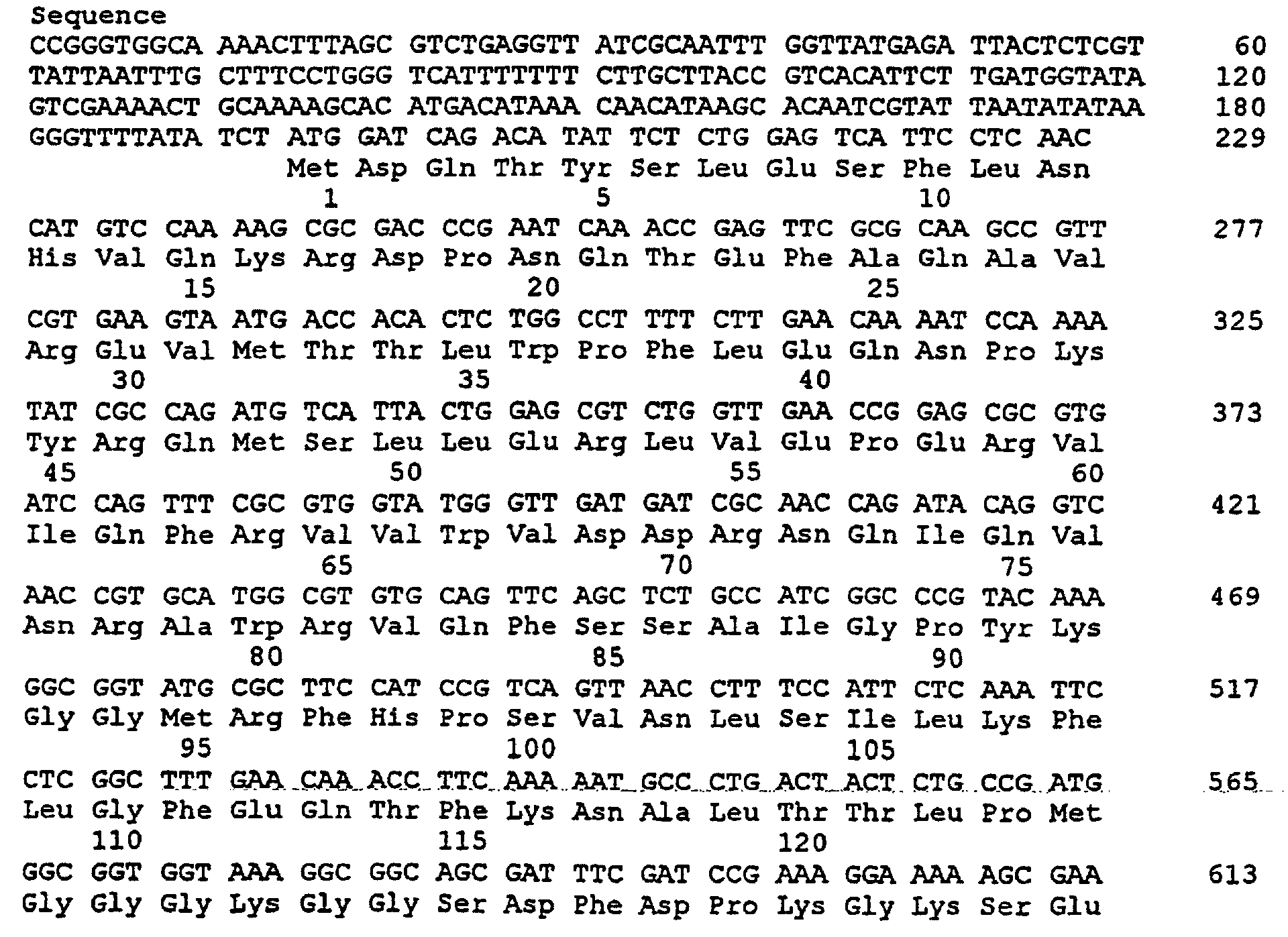
- the nucleotide sequence of the gdhA gene is disclosed in Gene, Vol. 27, pp.193 to 199 (1984), and is also shown here as Sequ ID No. 8 in the sequence listings.
- the nucleotide sequences of the primers are shown in Sequ ID Nos. 5 and 6.
- Sequ ID No. 5 corresponds to the sequence from the 191st through the 171st base residues in the nucleotide sequence figure of gdhA gene shown in Gene, Vol. 27, p.195 (1984), and it also corresponds to the sequence from the 3rd through the 23rd base residues in Sequ ID No. 8.
- Sequ ID No. 6 corresponds to the sequence consisting of the 1687th through the 1707th base residues in the nucleotide sequence figure of the gdhA gene shown in Gene, Vol. 27, p.195, (1984), and it also corresponds to the sequence consisting of 1880th through the 1900th base residues in Sequ ID No. 8.
- the gdhA gene was amplified by the PCR method employing the chromosomal DNA of Escherichia coli W3110 as a template. PCR products thus obtained were purified and converted to have blunt ends using T4 DNA polymerase, and then ligated to pBR 322 digested with Eco RV to obtain a plasmid pBRGDH.
- Fig. 3 shows the procedure for the construction of a plasmid having the ppc and gdhA genes.
- a DNA fragment containing the gdhA gene synthesized by the PCR method was converted to have blunt ends using T4 DNA polymerase. Subsequently, both fragments were ligated using T4 DNA ligase.
- the plasmid thus obtained was used to transform a GDH deficient strain, Escherichia coli PA 340 ( thr-1 , fhuA2 , leuB6 , lacY1 , supE44 , gal-6 , ⁇ - , gdh-1 , hisG1 , rfbD1 , galP63 , ⁇ (gltB-F) , rpsL19 , malT1 (lambdaR), xyl-7 , mtl-2 , argH1 , thi-1 ) obtained from the Escherichia coli Genetic Stock Center (at Yale University, USA) and an ampicillin-resistant strain which had lost its glutamic acid requirement for growth was isolated. From this strain, a plasmid was prepared and the restriction map was constructed, whereby it was confirmed that the ppc and gdhA genes were present on this plasmid. This plasmid was designated as pGK.
- the ⁇ -KGDH-deficient strain Escherichia coli W3100 sucA:: Km r
- the ⁇ -KGDH-deficient strain Escherichia coli W3100 sucA:: Km r
- each of the transformed strains was inoculated into a 500-ml shaker flask containing 20 ml of the culture medium having the composition shown in Table 2. Cultivation was then carried out at 37 °C until the glucose in the culture medium was consumed completely. The results are shown in Table 3.
- Glucose 40 (NH 4 ) 2 SO 4 20 KH 2 PO 4 1 MgSO 4 ⁇ 7H 2 O 1 FeSO 4 ⁇ 7H 2 O 0.01 MnSO 4 ⁇ 5H 2 O 0.01 Yeast extract 2 Thiamine hydrochloride 0.01 CaCO 3 50 Strain Accumulated L-glutamic acid (g/l) W3110 sucA::Km r 19.2 W3110 sucA::Km r /pS2 19.9 W3110 sucA::Km r /pBRGDH 2.8 W3110 sucA::Km r /pGK (AJ 12949) 23.3
- the transformed strain having the PPC activity amplified by the introduction of pS2 exhibited slightly reduced growth as compared with the host strain, W3110 sucA::Km r , it accumulated L-glutamic acid in an amount similar to that accumulated by the host strain.
- the strain having GDH activity amplified by the introduction of pBRGDH exhibited quite poor growth, and the amount of the accumulated L-glutamic acid was surprisingly smaller than that accumulated by the strain W3110 sucA::Km r .
- Escherichia coli AJ 12949 was originally deposited under the accession number FERM P-14039 on December 28, 1993, at the National Institute of Bioscience and Human-Technology, Agency of Industrial Science and Technology, 1-3, Higashi 1-chome, Tsukuba-shi, Ibaraki-ken 305, Japan, and the deposit was converted into a deposit under the Budapest Treaty under the accession number FERM BP-4881 on November 11, 1994.
- the host strain namely, W3110 sucA::Km r can be obtained by curing the plasmid from the deposited strain, AJ 12949 without damaging the cell.
- the plasmid may be lost from AJ 12949 spontaneously, or may be cured in a curing procedure (Bact. Rev., Vol. 36, p.361 to 405 (1972)).
- An example of the curing procedure is as follows.
- the strain AJ 12949 is inoculated to the L-broth medium (Bactotrypton 10 g/l, yeast extract 5 g/l, NaCl 5 g/l, pH 7.2), and cultivated at 40°C overnight.
- the culture broth is diluted appropriately, and spread onto the L-medium. After incubating it at 37° C overnight, the colonies formed are transferred to the L-medium containing 100 ⁇ g/ml of ampicillin and then ampicillin-sensitive colonies are isolated.
- the strain thus obtained is W3110 sucA::Km r
- the method according to the present invention provides a mutant of the genus Escherichia having a higher productivity of L-glutamic acid as well as the efficient and low-cost method for the production of L-glutamic acid.
- APPLICANT NAME: Ajinomoto Co., Inc. STREET: 15-1, Kyobashi 1-chome CITY: Chuo-ku, Tokyo COUNTRY: Japan POSTAL CODE: none
- COMPUTER READABLE FORM MEDIUM TYPE: Diskette
- COMPUTER IBM PC compatible OPERATING SYSTEM: MS-DOS
Landscapes
- Genetics & Genomics (AREA)
- Engineering & Computer Science (AREA)
- Health & Medical Sciences (AREA)
- Life Sciences & Earth Sciences (AREA)
- Organic Chemistry (AREA)
- Chemical & Material Sciences (AREA)
- Zoology (AREA)
- Wood Science & Technology (AREA)
- Biomedical Technology (AREA)
- Biotechnology (AREA)
- Bioinformatics & Cheminformatics (AREA)
- General Engineering & Computer Science (AREA)
- Microbiology (AREA)
- Molecular Biology (AREA)
- General Health & Medical Sciences (AREA)
- Biochemistry (AREA)
- Chemical Kinetics & Catalysis (AREA)
- General Chemical & Material Sciences (AREA)
- Physics & Mathematics (AREA)
- Biophysics (AREA)
- Plant Pathology (AREA)
- Preparation Of Compounds By Using Micro-Organisms (AREA)
- Micro-Organisms Or Cultivation Processes Thereof (AREA)
Description
Escherichia coli K-12 (ATCC 10798)
Escherichia coli W3110 (ATCC 27325)
Escherichia coli B (ATCC 11303)
Escherichia coli W (ATCC 9637)
Escherichia coli W3110 sucA::Kmr
Escherichia coli AJ 12628 (FERM BP-3854)
Escherichia coli AJ 12624 (FERM BP-3853)
Escherichia coli AJ 12628 is a mutant having a reduced α-KGDH activity and a reduced ability to degrade L-glutamic acid in combination with constitutive expression of ace operon. Escherichia coli AJ 12624 is a mutant having reduced α-KGDH activity and a reduced ability to degrade L-glutamic acid (French Patent Application Laid-open No. 2680178).
Escherichia coli W3100 sucA::Kmr
Escherichia coli AJ 12628 (PERM BP-3854)
Escherichia coli AJ 12624 (FERM BP-3853) (Those listed above are the mutants of the genus Escherichia whose α -KGDH activity is deficient or reduced and which have the ability to produce L-glutamic acid.)
Escherichia coli K-12 (ATCC 10798)
Escherichia coli W3110 (ATCC 27325)
Escherichia coli B (ATCC 11303)
Escherichia coli W (ATCC 9637)
(Those listed above are the non-pathogenic wild strains of the genus Escherichia.)
- Fig. 1
- shows the construction procedure of pBR-sucAB,
- Fig. 2
- shows a procedure for disrupting the sucA gene on the chromosomal DNA of Escherichia coli W3110, and
- Fig. 3
- shows the construction procedure of pGK.
| W3110 | W3110sucA::Kmr | |
| α-KGDH activity | 3.70 | Not detected |
| (Unit : micromoles/mg protein/min) |
| Component | Concentration (g/l) |
| Glucose | 40 |
| (NH4)2SO4 | 20 |
| KH2PO4 | 1 |
| MgSO4·7H2O | 1 |
| FeSO4·7H2O | 0.01 |
| MnSO4·5H2O | 0.01 |
| Yeast extract | 2 |
| Thiamine hydrochloride | 0.01 |
| CaCO3 | 50 |
| Strain | Accumulated L-glutamic acid (g/l) |
| W3110 sucA::Kmr | 19.2 |
| W3110 sucA::Kmr/pS2 | 19.9 |
| W3110 sucA::Kmr/pBRGDH | 2.8 |
| W3110 sucA::Kmr/pGK (AJ 12949) | 23.3 |
NAME: Ajinomoto Co., Inc.
STREET: 15-1, Kyobashi 1-chome
CITY: Chuo-ku, Tokyo
COUNTRY: Japan
POSTAL CODE: none
MEDIUM TYPE: Diskette
COMPUTER: IBM PC compatible
OPERATING SYSTEM: MS-DOS
SEQ ID No.: 1
Length : 21 base pairs
Type : Nucleotide
Strandedness : Single
Topology : Linear
Molecule type: Synthetic DNA
Feature : Primer for amplification of sucA gene of Escherichia coli

Length : 21 base pairs
Type : Nucleotide
Strandedness : Single
Topology : Linear
Molecule type: Synthetic DNA
Feature : Primer for amplification of sucA gene of Escherichia coli

Length : 20 base pairs
Type : Nucleotide
Strandedness : Single
Topology : Linear
Molecule type: Synthetic DNA
Feature : Primer for amplification of sucB gene of Escherichia coli

Length : 26 base pairs
Type : Nucleotide
Strandedness : Single
Topology : Linear
Molecule type: Synthetic DNA
Feature : Primer for amplification of sucB gene of Escherichia coli

Length : 21 base pairs
Type : Nucleotide
Strandedness : Single
Topology : Linear
Molecule type: Synthetic DNA
Feature : Primer for amplification of gdhA gene of Escherichia coli

Length : 21 base pairs
Type : Nucleotide
Strandedness : Single
Topology : Linear
Molecule type: Synthetic DNA
Feature : Primer for amplification of gdhA gene of Escherichia coli

Length : 4623 base pairs
Type : Nucleotide
Strandedness : Single
Topology : Linear
Molecule type: Genomic DNA
Original source
Organism : Escherichia coli
Features
Feature key : CDS ⇒from 327 to 318 bp coding sequence
Location : 327..3128
Method of feature determination : E
Feature key : CDS ⇒from 3143 to 4357 bp coding sequence Location : 3143..4357
Method of feature determination : E
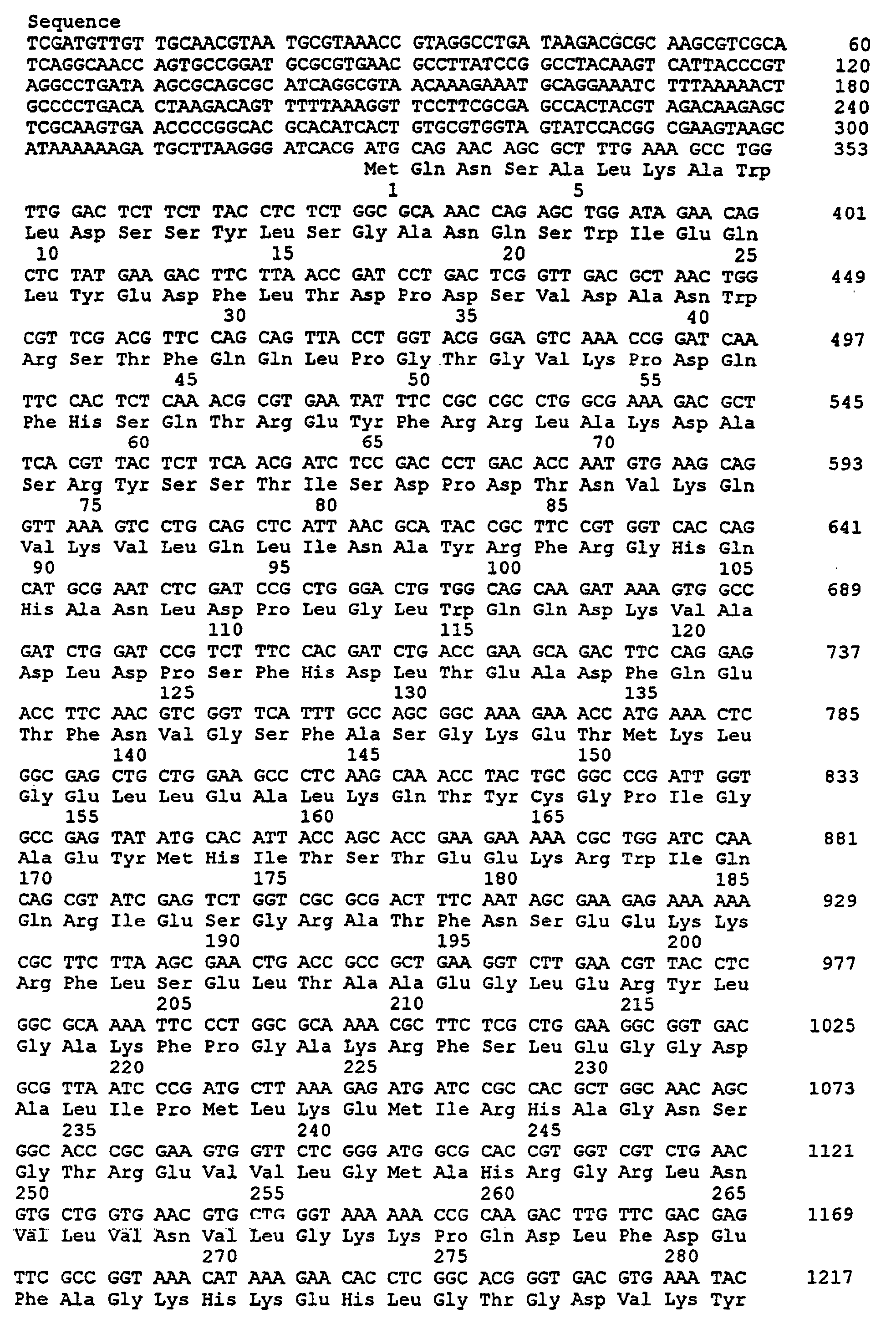
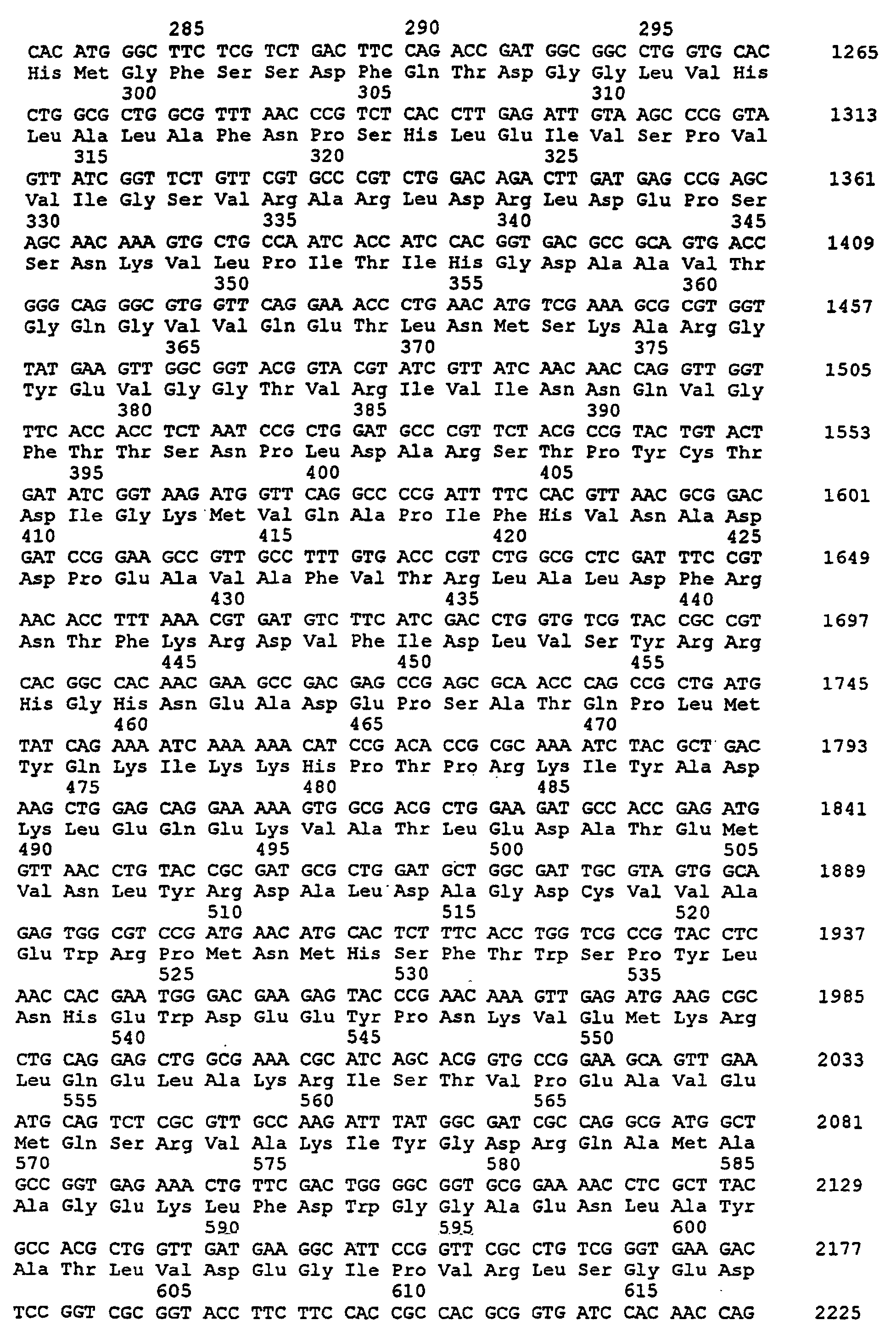
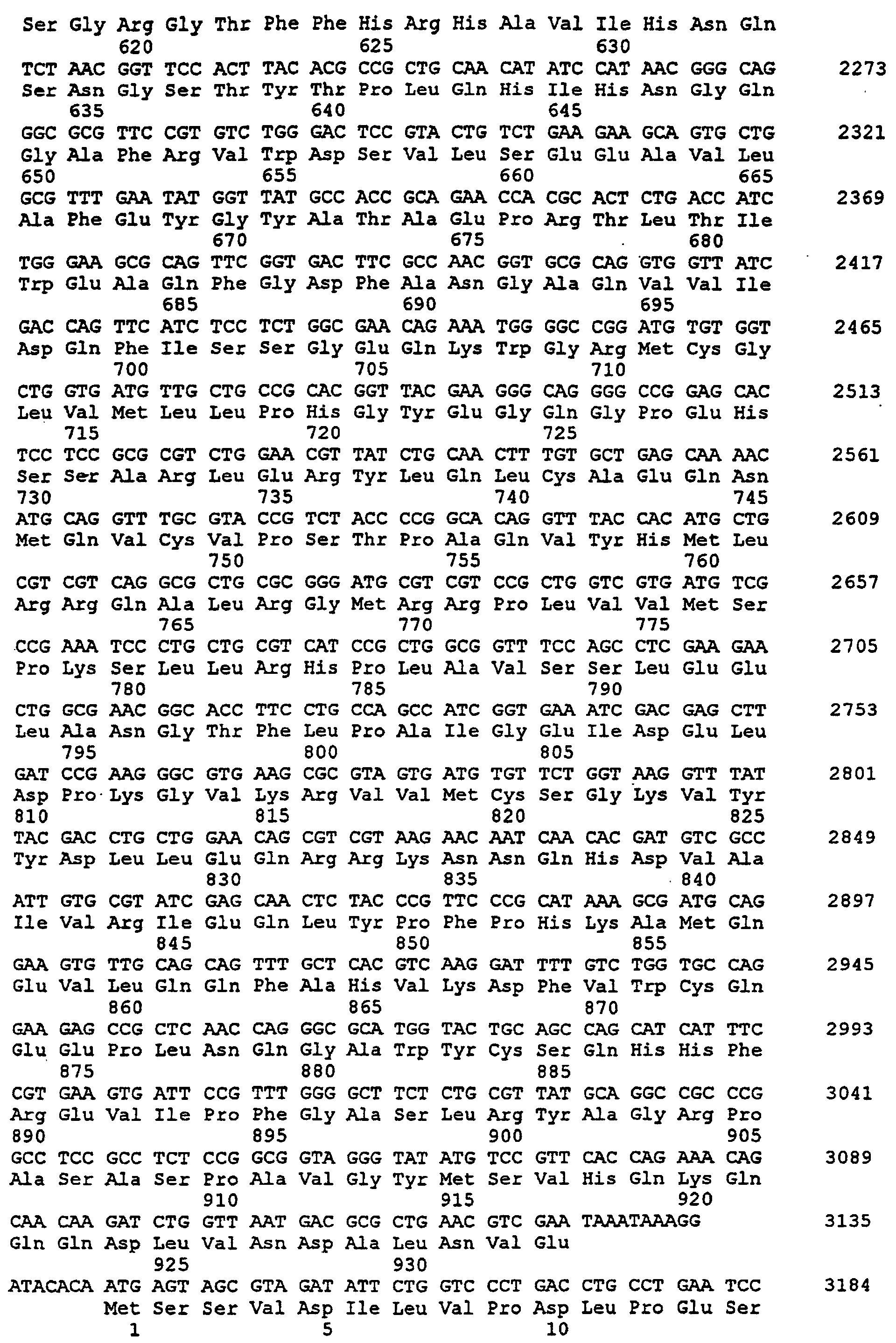

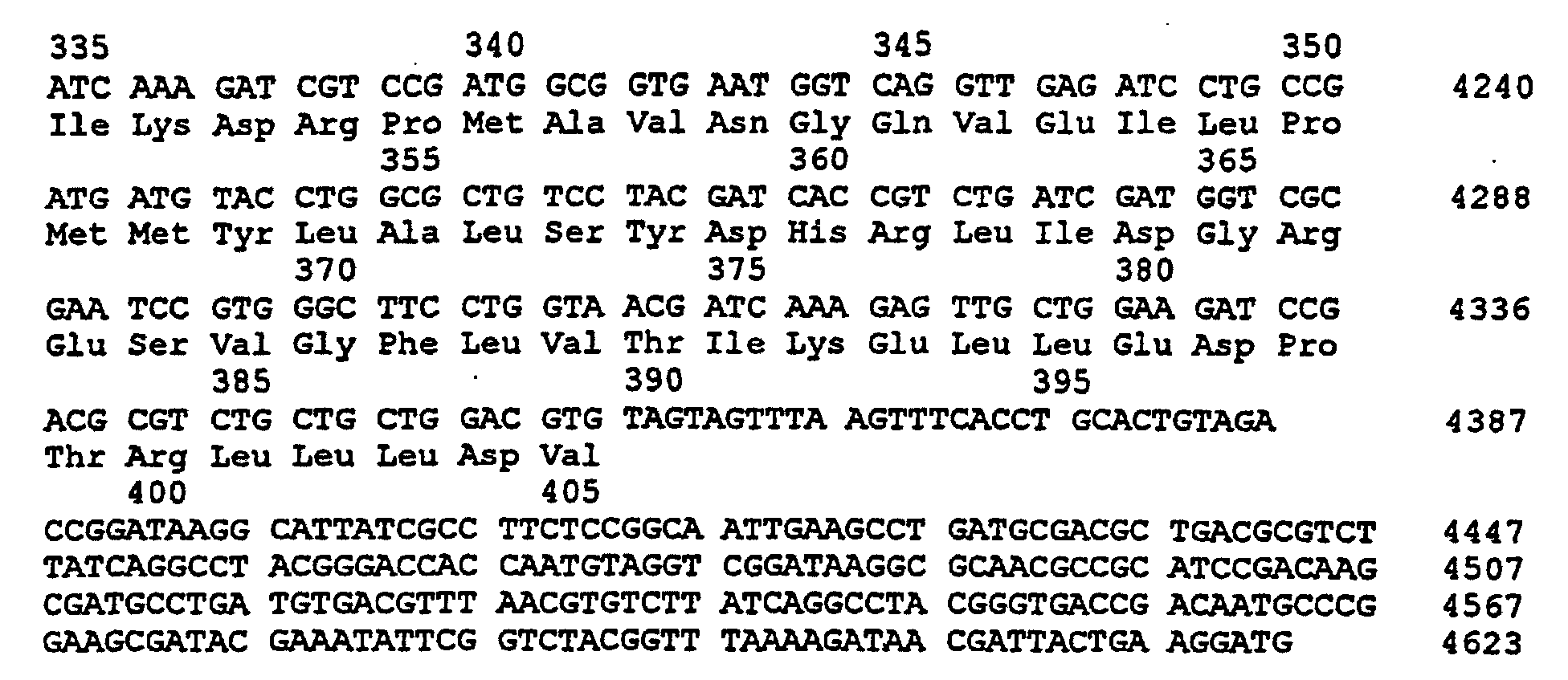
Length : 1937 base pairs
Type : Nucleotide
Strandedness : Single
Topology : Linear
Molecule type: Genomic DNA
Original source
Organism : Escherichia coli
Sequence feature
Feature key : CDS ⇒from 194 to 1537 bp coding sequence Location : 194..1537
Method of feature determination : E


Claims (2)
- A mutant of the genus Escherichia having L-glutamic acid-productivity, said mutant having deficient or reduced α-ketoglutarate dehydrogenase activity and enhanced phosphoenolpyruvate carboxylase and glutamate dehydrogenase activities.
- A method of producing L-glutamic acid by fermentation comprising culturing in a liquid culture medium a mutant of the genus Escherichia having L-glutamic acid-productivity said mutant having deficient or reduced α-ketoglutarate dehydrogenase activity and enhanced phosphoenolpyruvate carboxylase and glutamate dehydrogenase activities, accumulating L-glutamic acid in the culture, and recovering L-glutamic acid therefrom.
Applications Claiming Priority (3)
| Application Number | Priority Date | Filing Date | Title |
|---|---|---|---|
| JP82594 | 1994-01-10 | ||
| JP00082594A JP3880636B2 (en) | 1994-01-10 | 1994-01-10 | Method for producing L-glutamic acid by fermentation |
| JP825/94 | 1994-01-10 |
Publications (3)
| Publication Number | Publication Date |
|---|---|
| EP0670370A2 EP0670370A2 (en) | 1995-09-06 |
| EP0670370A3 EP0670370A3 (en) | 1997-05-28 |
| EP0670370B1 true EP0670370B1 (en) | 2003-04-09 |
Family
ID=11484433
Family Applications (1)
| Application Number | Title | Priority Date | Filing Date |
|---|---|---|---|
| EP95100259A Expired - Lifetime EP0670370B1 (en) | 1994-01-10 | 1995-01-10 | Method of producing L-glutamic acid by fermentation |
Country Status (9)
| Country | Link |
|---|---|
| US (1) | US5573945A (en) |
| EP (1) | EP0670370B1 (en) |
| JP (1) | JP3880636B2 (en) |
| CN (1) | CN1071794C (en) |
| BR (1) | BR9500052A (en) |
| DE (1) | DE69530242T2 (en) |
| ES (1) | ES2194030T3 (en) |
| MY (1) | MY112424A (en) |
| PE (1) | PE42395A1 (en) |
Families Citing this family (68)
| Publication number | Priority date | Publication date | Assignee | Title |
|---|---|---|---|---|
| US6969782B2 (en) | 1993-10-06 | 2005-11-29 | Ajinomoto Co., Inc. | Method of producing transgenic plants having improved amino acid composition |
| DE19681532T1 (en) * | 1995-08-23 | 1998-12-03 | Ajinomoto Kk | Process for the production of L-glutamic acid by fermentation |
| JP4032441B2 (en) | 1995-08-30 | 2008-01-16 | 味の素株式会社 | Method for producing L-amino acid |
| JPH09285294A (en) * | 1996-04-23 | 1997-11-04 | Ajinomoto Co Inc | Fermentation method for producing L-glutamic acid |
| TW460622B (en) | 1998-02-03 | 2001-10-21 | Atotech Deutschland Gmbh | Solution and process to pretreat copper surfaces |
| AU746542B2 (en) * | 1998-03-18 | 2002-05-02 | Ajinomoto Co., Inc. | L-glutamic acid-producing bacterium and method for producing L-glutamic acid |
| AU756507B2 (en) * | 1998-03-18 | 2003-01-16 | Ajinomoto Co., Inc. | L-glutamic acid-producing bacterium and method for producing L-glutamic acid |
| FR2780416B1 (en) * | 1998-06-10 | 2002-12-20 | Rhone Poulenc Nutrition Animal | INDUSTRIAL PROCESS FOR PRODUCING HETEROLOGOUS PROTEINS IN E. COLI AND STRAINS USEFUL FOR THE PROCESS |
| PE20001128A1 (en) * | 1998-10-19 | 2000-11-14 | Ajinomoto Kk | L-GLUTAMIC ACID PRODUCING BACTERIA AND PROCEDURE TO OBTAIN L-GLUTAMIC ACID |
| CN1067434C (en) * | 1998-12-28 | 2001-06-20 | 山东大学 | Glutamine fermentation production process |
| EP1026236A1 (en) * | 1999-02-04 | 2000-08-09 | Dsm N.V. | Auxotrophic strains for secondary metabolite biosynthesis |
| DE19904794A1 (en) * | 1999-02-05 | 2000-08-10 | Biotechnolog Forschung Gmbh | Methods for improving the primary metabolism of mammalian cell lines |
| JP4427878B2 (en) * | 1999-08-20 | 2010-03-10 | 味の素株式会社 | Method for producing L-glutamic acid by fermentation method with precipitation |
| JP4362959B2 (en) * | 2000-08-24 | 2009-11-11 | 味の素株式会社 | Method for producing basic amino acid |
| JP2002238592A (en) | 2001-02-20 | 2002-08-27 | Ajinomoto Co Inc | Method for producing l-glutamic acid |
| JP4599725B2 (en) * | 2001-02-20 | 2010-12-15 | 味の素株式会社 | Method for producing L-glutamic acid |
| JP4292724B2 (en) | 2001-02-20 | 2009-07-08 | 味の素株式会社 | Organic nitrogen-containing composition and fertilizer containing the same |
| JP4599726B2 (en) | 2001-02-20 | 2010-12-15 | 味の素株式会社 | Method for producing L-glutamic acid |
| ATE441714T1 (en) * | 2001-07-18 | 2009-09-15 | Evonik Degussa Gmbh | METHOD FOR PRODUCING L-AMINO ACIDS BY ENTEROBACTERIACEAE STRAINS WITH ENHANCED EXPRESSION OF THE RSEA GENE |
| RU2264457C2 (en) * | 2003-02-26 | 2005-11-20 | Закрытое акционерное общество "Научно-исследовательский институт Аджиномото-Генетика" | METHOD FOR PRODUCTION OF L-AMINO ACIDS USING BACTERIUM OF GENUS ESCHERICHIA CONTAINING NON-ACTIVE gadB GENE |
| EP1604023A2 (en) * | 2003-03-12 | 2005-12-14 | Ajinomoto Co., Inc. | Optimization of bacterial sucab expression by promoter mutagenesis for efficient l-glutamic acid production |
| EP1624069A4 (en) | 2003-05-07 | 2011-06-29 | Ajinomoto Kk | Process for producing l-glutamic acid |
| JP2005021154A (en) * | 2003-06-11 | 2005-01-27 | Ajinomoto Co Inc | Method for producing l-amino acid |
| JP2005065641A (en) * | 2003-08-27 | 2005-03-17 | Mitsubishi Chemicals Corp | Method for producing non-amino organic acid |
| US7344874B2 (en) | 2004-03-04 | 2008-03-18 | Ajinomoto Co., Inc. | L-glutamic acid-producing microorganism and a method for producing L-glutamic acid |
| US8003367B2 (en) * | 2004-03-16 | 2011-08-23 | Ajinomoto Co., Inc. | Method for producing L-amino acids by fermentation using bacteria having enhanced expression of xylose utilization genes |
| RU2283346C1 (en) * | 2005-03-14 | 2006-09-10 | Закрытое акционерное общество "Научно-исследовательский институт Аджиномото-Генетика" (ЗАО АГРИ) | Method for production of l-amino acids by fermentation using bacteria having increased expression of xylose utilization gene |
| DE102005048818A1 (en) | 2005-10-10 | 2007-04-12 | Degussa Ag | Microbiological production of 3-hydroxypropionic acid |
| JP2009118740A (en) | 2006-03-03 | 2009-06-04 | Ajinomoto Co Inc | Method for producing l-amino acid |
| WO2007119574A2 (en) | 2006-03-23 | 2007-10-25 | Ajinomoto Co., Inc. | A method for producing an l-amino acid using bacterium of the enterobacteriaceae family with attenuated expression of a gene coding for small rna |
| JP2009165355A (en) | 2006-04-28 | 2009-07-30 | Ajinomoto Co Inc | L-amino acid-producing microorganism and method for producing l-amino acid |
| RU2006143864A (en) | 2006-12-12 | 2008-06-20 | Закрытое акционерное общество "Научно-исследовательский институт Аджиномото-Генетика" (ЗАО АГРИ) (RU) | METHOD FOR PRODUCING L-AMINO ACIDS USING THE BACTERIA OF THE ENTEROBACTERIACEAE FAMILY IN WHICH THE EXPRESSION OF GENES cynT, cynS, cynX, OR cynR, OR THEIR COMBINATION IS DECREASED |
| BRPI0806790B1 (en) | 2007-01-22 | 2017-02-14 | Ajinomoto Kk | microorganism, and method for producing an 1-amino acid |
| JP2010110217A (en) | 2007-02-22 | 2010-05-20 | Ajinomoto Co Inc | L-amino acid-producing microorganism and method for producing l-amino acid |
| JP2010130899A (en) | 2007-03-14 | 2010-06-17 | Ajinomoto Co Inc | Microorganism producing l-glutamic acid-based amino acid, and method for producing amino acid |
| EP2147970B1 (en) | 2007-04-17 | 2014-12-31 | Ajinomoto Co., Inc. | A method for producing an acidic substance having a carboxyl group |
| RU2007147436A (en) * | 2007-12-21 | 2009-06-27 | Закрытое акционерное общество "Научно-исследовательский институт Аджиномото-Генетика" (ЗАО АГРИ) (RU) | BACTERIA-PRODUCER (2S, 3R, 4S) -4-HYDROXY-L-ISOLEUCIN AND METHOD FOR PRODUCTION (2S, 3R, 4S) -4-HYDROXY-L-ISOLEUCIN |
| JP5526785B2 (en) | 2008-01-23 | 2014-06-18 | 味の素株式会社 | Method for producing L-amino acid |
| RU2008105793A (en) | 2008-02-19 | 2009-08-27 | Закрытое акционерное общество "Научно-исследовательский институт Аджиномото-Генетика" (ЗАО АГРИ) (RU) | METHOD FOR DESIGNING OPERONS CONTAINING TRANSLATION-CONJUGATED GENES, BACTERIA CONTAINING SUCH OPERON, METHOD FOR PRODUCING USEFUL METABOLITIS AND METHOD FOR EXPRESS MONITORING |
| EP2343371B1 (en) | 2008-09-05 | 2015-10-21 | Ajinomoto Co., Inc. | Method for producing l-amino acid |
| ES2624913T3 (en) | 2008-09-08 | 2017-07-18 | Ajinomoto Co., Inc. | Microorganism that produces an L-amino acid and procedure to produce an L-amino acid |
| EP2382320B1 (en) | 2009-01-23 | 2018-04-18 | Ajinomoto Co., Inc. | Process for producing l-amino acids employing bacteria of the enterobacteriacea family in a culture medium with controlled glycerol concentration |
| RU2418064C2 (en) * | 2009-01-23 | 2011-05-10 | Закрытое акционерное общество "Научно-исследовательский институт Аджиномото-Генетика" (ЗАО АГРИ) | METHOD OF OBTAINING L-AMINO ACID OF GLUTAMATE FAMILY, OR L-BALINE WITH APPLICATION OF BACTERIUM BELONGING TO GENUS Escherichia |
| JPWO2011013707A1 (en) | 2009-07-29 | 2013-01-10 | 味の素株式会社 | Method for producing L-amino acid |
| RU2460793C2 (en) | 2010-01-15 | 2012-09-10 | Закрытое акционерное общество "Научно-исследовательский институт "Аджиномото-Генетика" (ЗАО АГРИ) | Method for producing l-amino acids with use of bacteria of enterobacteriaceae family |
| JP2013074795A (en) | 2010-02-08 | 2013-04-25 | Ajinomoto Co Inc | MUTANT rpsA GENE AND METHOD FOR PRODUCING L-AMINO ACID |
| RU2471868C2 (en) | 2010-02-18 | 2013-01-10 | Закрытое акционерное общество "Научно-исследовательский институт "Аджиномото-Генетика" (ЗАО АГРИ) | Mutant adenylate cyclase, dna coding it, bacteria of enterobacteriaceae family containing said dan and method for preparing l-amino acids |
| DE102010029973A1 (en) | 2010-06-11 | 2011-12-15 | Evonik Degussa Gmbh | Microbiological production of C4 bodies from sucrose and carbon dioxide |
| RU2501858C2 (en) | 2010-07-21 | 2013-12-20 | Закрытое акционерное общество "Научно-исследовательский институт "Аджиномото-Генетика" (ЗАО АГРИ) | METHOD FOR OBTAINING L-AMINOACID USING BACTERIUM OF Enterobacteriaceae FAMILY |
| RU2482188C2 (en) | 2010-07-21 | 2013-05-20 | Закрытое акционерное общество "Научно-исследовательский институт "Аджиномото-Генетика" (ЗАО АГРИ) | METHOD FOR PREPARING L-ARGININE WITH USE OF BACTERIA OF GENUS Escherichia WHEREIN astCADBE OPERON IS INACTIVATED |
| JP2014036576A (en) | 2010-12-10 | 2014-02-27 | Ajinomoto Co Inc | Method for producing l-amino acids |
| RU2011134436A (en) | 2011-08-18 | 2013-10-27 | Закрытое акционерное общество "Научно-исследовательский институт Аджиномото-Генетика" (ЗАО "АГРИ") | METHOD FOR PRODUCING L-AMINO ACID USING THE ENTEROBACTERIACEAE FAMILY POSSESSING AN INCREASED EXPRESSION OF GENES OF THE CASCADE OF THE FORMATION OF FLAGELLS AND CELL MOBILITY |
| RU2013118637A (en) | 2013-04-23 | 2014-10-27 | Закрытое акционерное общество "Научно-исследовательский институт Аджиномото-Генетика" (ЗАО "АГРИ") | METHOD FOR PRODUCING L-AMINO ACIDS USING THE BACTERIA OF THE ENTEROBACTERIACEAE FAMILY IN WHICH THE yjjK GENE IS ADJUSTABLE |
| JP2016165225A (en) | 2013-07-09 | 2016-09-15 | 味の素株式会社 | Method for producing useful substance |
| RU2013140115A (en) | 2013-08-30 | 2015-03-10 | Закрытое акционерное общество "Научно-исследовательский институт Аджиномото-Генетика" (ЗАО "АГРИ") | METHOD FOR PRODUCING L-AMINO ACIDS USING THE BACTERIA OF THE Enterobacteriaceae FAMILY IN WHICH THE EXPRESSION OF THE znuACB GENERAL CLUSTER IS DISORDERED |
| JP2016192903A (en) | 2013-09-17 | 2016-11-17 | 味の素株式会社 | Method for manufacturing l-amino acid from biomass derived from seaweed |
| RU2013144250A (en) | 2013-10-02 | 2015-04-10 | Закрытое акционерное общество "Научно-исследовательский институт Аджиномото-Генетика" (ЗАО "АГРИ") | METHOD FOR PRODUCING L-AMINO ACIDS USING THE BACTERIA OF THE Enterobacteriaceae FAMILY IN WHICH THE EXPRESSION OF A GENE CODING A PHOSPHATE TRANSPORTER IS DECREASED |
| JP6459962B2 (en) | 2013-10-21 | 2019-01-30 | 味の素株式会社 | Method for producing L-amino acid |
| US10006575B2 (en) | 2013-12-11 | 2018-06-26 | Nibco Inc. | Modular push-to-connect assembly |
| RU2014105547A (en) | 2014-02-14 | 2015-08-20 | Адзиномото Ко., Инк. | METHOD FOR PRODUCING L-AMINO ACIDS USING THE ENTEROBACTERIACEAE FAMILY HAVING A SUPER EXPRESSED GENE yajL |
| RU2015120052A (en) | 2015-05-28 | 2016-12-20 | Аджиномото Ко., Инк. | A method for producing an L-amino acid using a bacterium of the Enterobacteriaceae family in which gshA gene expression is weakened |
| WO2017146195A1 (en) | 2016-02-25 | 2017-08-31 | Ajinomoto Co., Inc. | A method for producing l-amino acids using a bacterium of the family enterobacteriaceae overexpressing a gene encoding an iron exporter |
| JP7066977B2 (en) | 2017-04-03 | 2022-05-16 | 味の素株式会社 | Manufacturing method of L-amino acid |
| EP3861109A1 (en) | 2018-10-05 | 2021-08-11 | Ajinomoto Co., Inc. | Method for producing target substance by bacterial fermentation |
| BR112021014194A2 (en) | 2019-02-22 | 2021-12-28 | Ajinomoto Kk | Method for producing an l-amino acid |
| BR112021017870A2 (en) | 2019-04-05 | 2021-12-07 | Ajinomoto Kk | Method for producing an l-amino acid |
| JP7655312B2 (en) | 2019-09-25 | 2025-04-02 | 味の素株式会社 | Method for producing L-amino acids by bacterial fermentation |
| US20240117393A1 (en) | 2022-09-30 | 2024-04-11 | Ajinomoto Co., Inc. | Method for producing l-amino acid |
Family Cites Families (11)
| Publication number | Priority date | Publication date | Assignee | Title |
|---|---|---|---|---|
| JPS526358B1 (en) * | 1968-03-30 | 1977-02-21 | ||
| JPS55131397A (en) * | 1979-04-02 | 1980-10-13 | Ajinomoto Co Inc | Preparation of l-threonine by fermentation |
| JPS568693A (en) * | 1979-06-29 | 1981-01-29 | Ajinomoto Co Inc | Preparation of l-glutamic acid |
| JPS568694A (en) * | 1979-06-29 | 1981-01-29 | Ajinomoto Co Inc | Preparation of l-glutamic acid by fermentation |
| US4411991A (en) * | 1980-10-07 | 1983-10-25 | Kanegafuchi Chemical Industry Company, Limited | Process for fermentative production of amino acids |
| JPS5820194A (en) * | 1981-07-29 | 1983-02-05 | Ajinomoto Co Inc | Preparation of l-glutamic acid by fermentation method |
| CA1215338A (en) * | 1983-02-25 | 1986-12-16 | Kiyoji Hattori | Process for producing l-glutamic acid by fermentation |
| JPH0783714B2 (en) * | 1983-08-29 | 1995-09-13 | 味の素株式会社 | Fermentation method for producing L-amino acid |
| JPS61268185A (en) * | 1984-12-27 | 1986-11-27 | Asahi Chem Ind Co Ltd | Dna fragment containing glutamic acid dehydrogenase-producing gene |
| JPH029384A (en) * | 1988-06-28 | 1990-01-12 | Kyowa Hakko Kogyo Co Ltd | Production of l-glutamic acid by fermentation process |
| BR9203053A (en) * | 1991-08-07 | 1993-03-30 | Ajinomoto Kk | PROCESS TO PRODUCE L-GLUTAMIC ACID PRO FERMENTATION |
-
1994
- 1994-01-10 JP JP00082594A patent/JP3880636B2/en not_active Expired - Fee Related
-
1995
- 1995-01-06 PE PE1995258760A patent/PE42395A1/en not_active Application Discontinuation
- 1995-01-09 US US08/370,193 patent/US5573945A/en not_active Expired - Lifetime
- 1995-01-10 DE DE69530242T patent/DE69530242T2/en not_active Expired - Lifetime
- 1995-01-10 EP EP95100259A patent/EP0670370B1/en not_active Expired - Lifetime
- 1995-01-10 CN CN95100509A patent/CN1071794C/en not_active Expired - Fee Related
- 1995-01-10 BR BR9500052A patent/BR9500052A/en not_active IP Right Cessation
- 1995-01-10 MY MYPI95000056A patent/MY112424A/en unknown
- 1995-01-10 ES ES95100259T patent/ES2194030T3/en not_active Expired - Lifetime
Also Published As
| Publication number | Publication date |
|---|---|
| DE69530242T2 (en) | 2004-03-11 |
| PE42395A1 (en) | 1996-01-04 |
| JP3880636B2 (en) | 2007-02-14 |
| CN1128295A (en) | 1996-08-07 |
| ES2194030T3 (en) | 2003-11-16 |
| BR9500052A (en) | 1995-10-03 |
| US5573945A (en) | 1996-11-12 |
| EP0670370A3 (en) | 1997-05-28 |
| DE69530242D1 (en) | 2003-05-15 |
| MY112424A (en) | 2001-06-30 |
| EP0670370A2 (en) | 1995-09-06 |
| CN1071794C (en) | 2001-09-26 |
| JPH07203980A (en) | 1995-08-08 |
Similar Documents
| Publication | Publication Date | Title |
|---|---|---|
| US5573945A (en) | Mutant and method for producing L-glutamic acid by fermentation | |
| US6110714A (en) | Process for producing L-glutamic acid by fermentation | |
| US5908768A (en) | Process for producing L-glutamic acid by fermentation with E. coli resistant to aspartic acid antimetabolite | |
| US6682912B2 (en) | L-glutamic acid-producing bacterium and method for producing L-glutamic acid | |
| US6893848B1 (en) | Desensitized aspartokinase | |
| US6737255B2 (en) | Mutant ilvH gene and method for producing L-valine | |
| EP0332234B1 (en) | Process for preparing l-tyrosine | |
| EP0864654B1 (en) | Stress-tolerant microorganism and method of the production of fermentation product | |
| HU224895B1 (en) | Process for producing l-amino acids | |
| AU779019B2 (en) | Metabolic engineering of amino acid production | |
| US7604979B2 (en) | Method for producing an L-amino acid using a bacterium with an optimized level of gene expression | |
| JPWO1999007853A1 (en) | Method for producing L-glutamic acid by fermentation | |
| AU8561598A (en) | Process for producing l-glutamic acid by fermentation method | |
| US7220572B2 (en) | Method for producing L-leucine | |
| EP0085958A2 (en) | Method for producing l-phenylalanine by fermentation | |
| WO2005075626A1 (en) | MICROORGANISM PRODUCING L-THREONINE HAVING INACTIVATED tyrR GENE, METHOD OF PRODUCING THE SAME AND METHOD OF PRODUCING L-THREONINE USING THE MICROORGANISM | |
| US4591562A (en) | Method for producing L-phenylalanine by fermentation | |
| JPWO1997008294A1 (en) | Method for producing L-glutamic acid by fermentation | |
| KR20100038639A (en) | Microorganism comprising modified purc gene and process for production method of inosine using the same | |
| JPH09285293A (en) | Fermentation method for producing L-glutamic acid |
Legal Events
| Date | Code | Title | Description |
|---|---|---|---|
| PUAI | Public reference made under article 153(3) epc to a published international application that has entered the european phase |
Free format text: ORIGINAL CODE: 0009012 |
|
| AK | Designated contracting states |
Kind code of ref document: A2 Designated state(s): CH DE ES FR GB IT LI NL Kind code of ref document: A2 Designated state(s): AT BE CH DE DK ES FR GB GR IE IT LI LU MC NL PT SE |
|
| RAX | Requested extension states of the european patent have changed |
Free format text: LT PAYMENT 950203;SI PAYMENT 950203 |
|
| PUAL | Search report despatched |
Free format text: ORIGINAL CODE: 0009013 |
|
| AK | Designated contracting states |
Kind code of ref document: A3 Designated state(s): AT BE CH DE DK ES FR GB GR IE IT LI LU MC NL PT SE |
|
| AX | Request for extension of the european patent |
Free format text: LT PAYMENT 950203;SI PAYMENT 950203 |
|
| 17P | Request for examination filed |
Effective date: 19970625 |
|
| 17Q | First examination report despatched |
Effective date: 20010227 |
|
| GRAG | Despatch of communication of intention to grant |
Free format text: ORIGINAL CODE: EPIDOS AGRA |
|
| GRAG | Despatch of communication of intention to grant |
Free format text: ORIGINAL CODE: EPIDOS AGRA |
|
| GRAH | Despatch of communication of intention to grant a patent |
Free format text: ORIGINAL CODE: EPIDOS IGRA |
|
| RBV | Designated contracting states (corrected) |
Designated state(s): CH DE ES FR GB IT LI NL |
|
| GRAH | Despatch of communication of intention to grant a patent |
Free format text: ORIGINAL CODE: EPIDOS IGRA |
|
| GRAA | (expected) grant |
Free format text: ORIGINAL CODE: 0009210 |
|
| DAX | Request for extension of the european patent (deleted) | ||
| AK | Designated contracting states |
Designated state(s): CH DE ES FR GB IT LI NL |
|
| REG | Reference to a national code |
Ref country code: GB Ref legal event code: FG4D |
|
| REG | Reference to a national code |
Ref country code: CH Ref legal event code: EP |
|
| REG | Reference to a national code |
Ref country code: CH Ref legal event code: NV Representative=s name: A. BRAUN, BRAUN, HERITIER, ESCHMANN AG PATENTANWAE |
|
| REG | Reference to a national code |
Ref country code: IE Ref legal event code: FG4D |
|
| REG | Reference to a national code |
Ref country code: ES Ref legal event code: FG2A Ref document number: 2194030 Country of ref document: ES Kind code of ref document: T3 |
|
| ET | Fr: translation filed | ||
| PLBE | No opposition filed within time limit |
Free format text: ORIGINAL CODE: 0009261 |
|
| STAA | Information on the status of an ep patent application or granted ep patent |
Free format text: STATUS: NO OPPOSITION FILED WITHIN TIME LIMIT |
|
| 26N | No opposition filed |
Effective date: 20040112 |
|
| REG | Reference to a national code |
Ref country code: IE Ref legal event code: MM4A |
|
| PGFP | Annual fee paid to national office [announced via postgrant information from national office to epo] |
Ref country code: GB Payment date: 20070110 Year of fee payment: 13 |
|
| PGFP | Annual fee paid to national office [announced via postgrant information from national office to epo] |
Ref country code: NL Payment date: 20070115 Year of fee payment: 13 Ref country code: CH Payment date: 20070115 Year of fee payment: 13 |
|
| PGFP | Annual fee paid to national office [announced via postgrant information from national office to epo] |
Ref country code: ES Payment date: 20070126 Year of fee payment: 13 |
|
| PGFP | Annual fee paid to national office [announced via postgrant information from national office to epo] |
Ref country code: IT Payment date: 20070601 Year of fee payment: 13 |
|
| REG | Reference to a national code |
Ref country code: CH Ref legal event code: PFA Owner name: AJINOMOTO CO., INC. Free format text: AJINOMOTO CO., INC.#NO. 15-1, KYOBASHI 1-CHOME, CHUO-KU#TOKYO 104 (JP) -TRANSFER TO- AJINOMOTO CO., INC.#NO. 15-1, KYOBASHI 1-CHOME, CHUO-KU#TOKYO 104 (JP) |
|
| REG | Reference to a national code |
Ref country code: CH Ref legal event code: PL |
|
| GBPC | Gb: european patent ceased through non-payment of renewal fee |
Effective date: 20080110 |
|
| NLV4 | Nl: lapsed or anulled due to non-payment of the annual fee |
Effective date: 20080801 |
|
| PG25 | Lapsed in a contracting state [announced via postgrant information from national office to epo] |
Ref country code: NL Free format text: LAPSE BECAUSE OF NON-PAYMENT OF DUE FEES Effective date: 20080801 Ref country code: LI Free format text: LAPSE BECAUSE OF NON-PAYMENT OF DUE FEES Effective date: 20080131 Ref country code: CH Free format text: LAPSE BECAUSE OF NON-PAYMENT OF DUE FEES Effective date: 20080131 |
|
| PG25 | Lapsed in a contracting state [announced via postgrant information from national office to epo] |
Ref country code: GB Free format text: LAPSE BECAUSE OF NON-PAYMENT OF DUE FEES Effective date: 20080110 |
|
| REG | Reference to a national code |
Ref country code: ES Ref legal event code: FD2A Effective date: 20080111 |
|
| PG25 | Lapsed in a contracting state [announced via postgrant information from national office to epo] |
Ref country code: ES Free format text: LAPSE BECAUSE OF NON-PAYMENT OF DUE FEES Effective date: 20080111 |
|
| PG25 | Lapsed in a contracting state [announced via postgrant information from national office to epo] |
Ref country code: IT Free format text: LAPSE BECAUSE OF NON-PAYMENT OF DUE FEES Effective date: 20080110 |
|
| PGFP | Annual fee paid to national office [announced via postgrant information from national office to epo] |
Ref country code: FR Payment date: 20120202 Year of fee payment: 18 |
|
| PGFP | Annual fee paid to national office [announced via postgrant information from national office to epo] |
Ref country code: DE Payment date: 20120104 Year of fee payment: 18 |
|
| REG | Reference to a national code |
Ref country code: FR Ref legal event code: ST Effective date: 20130930 |
|
| PG25 | Lapsed in a contracting state [announced via postgrant information from national office to epo] |
Ref country code: DE Free format text: LAPSE BECAUSE OF NON-PAYMENT OF DUE FEES Effective date: 20130801 |
|
| PG25 | Lapsed in a contracting state [announced via postgrant information from national office to epo] |
Ref country code: FR Free format text: LAPSE BECAUSE OF NON-PAYMENT OF DUE FEES Effective date: 20130131 |
|
| REG | Reference to a national code |
Ref country code: DE Ref legal event code: R119 Ref document number: 69530242 Country of ref document: DE Effective date: 20130801 |